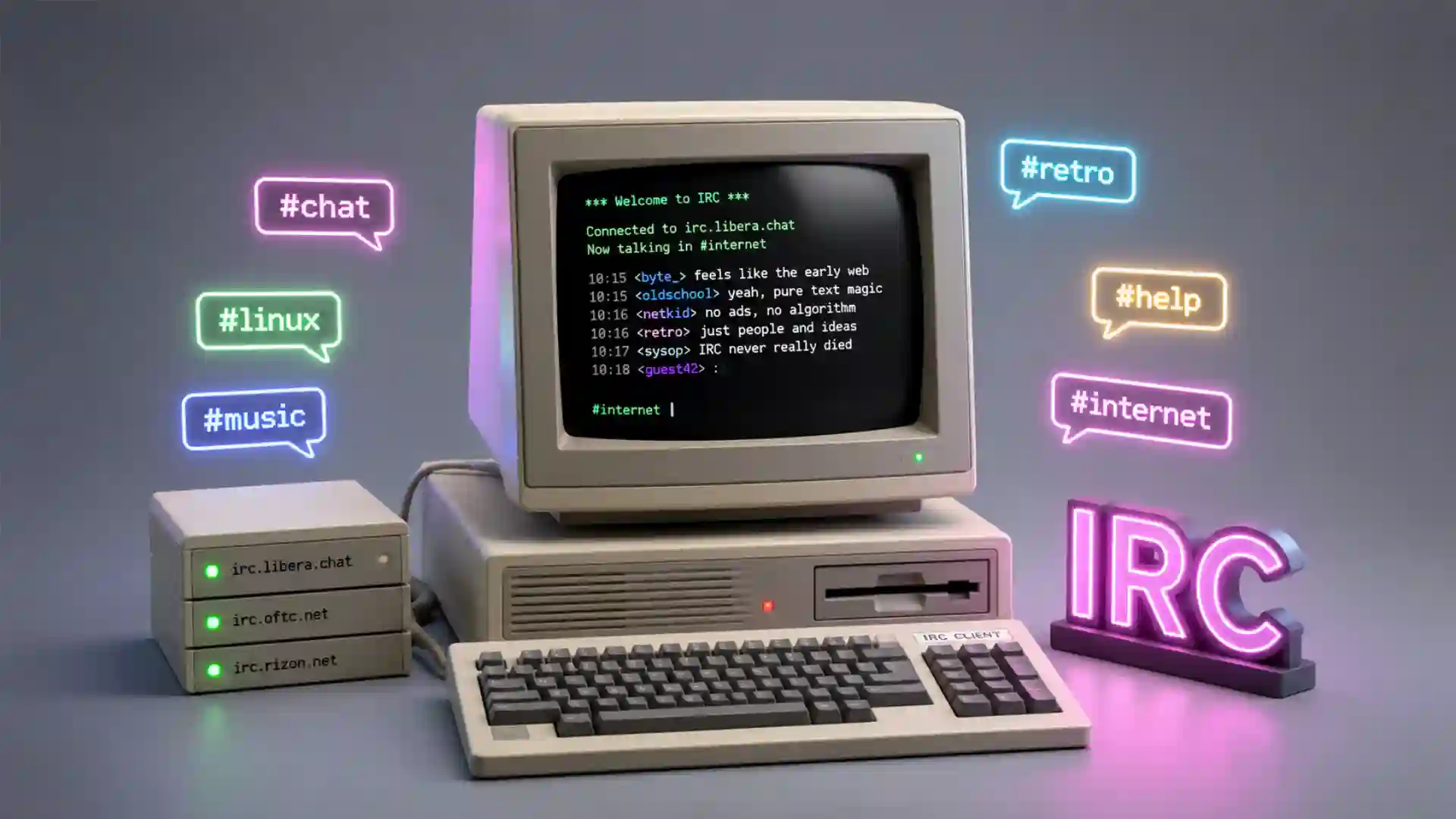
IRC looks almost too small to explain the internet it helped create. You do not need a camera. You do not need a profile photo. You do not need a feed, a follow graph, a reaction bar, a personalized homepage, or an onboarding animation that congratulates you for existing. You pick a nickname, join a channel, and type. That is the whole trick. It sounds primitive until you realize how much of online life is still trying to recreate the same feeling with heavier furniture.
Table of Contents
The door still opens
The surprise is not that IRC existed. The surprise is that it still works. Internet Relay Chat was invented in 1988 by Jarkko Oikarinen at the University of Oulu in Finland, replacing an earlier program called MUT, and it spread from a university machine into a wider network before most people had ever seen a web browser. It is older than the social web, older than mainstream instant messaging, older than the idea that every conversation should be attached to a real identity and a searchable personal archive.
Open a webchat on Libera.Chat or load Kiwi IRC today and the strange feeling is immediate. The interface does not ask you to perform your life. It asks where you want to go. The place names still begin with a hash: #python, #linux, #emacs, #libera, #music, #whatever-somebody-started-years-ago. The old grammar of channels, nicknames, operators, bots, topics, joins, parts, and private messages is still sitting there, alive enough to answer back.
That makes IRC a perfect Web Radar subject because it is not merely nostalgic. It is a working piece of internet culture that many people under thirty have never touched, even though its fingerprints are everywhere. Slack borrowed the channel. Discord borrowed the community room. Twitch borrowed live chat speed. Developer communities borrowed the habit of solving things in public. Even the little # symbol, now treated as a social-media tag, spent years doing very different work in chat rooms where it meant place, not marketing.
IRC feels like finding a service corridor behind the modern internet. The glossy public rooms are upstairs: Zoom, Teams, WhatsApp, Discord, Slack, Telegram, Instagram, TikTok live streams. IRC is behind a plain door with a hand-written label. The lights are fluorescent. The carpet is questionable. Someone has been idling in the same channel since 2006. A bot announces commits. A person with a one-word nickname answers your question with brutal accuracy. Nobody asks you to subscribe.
The first thing to understand is that IRC is not one website. It is a protocol, a way for clients and servers to pass text messages around. The original protocol was documented publicly in RFC 1459 in May 1993, with Jarkko Oikarinen and Darren Reed listed as authors, and the document reads like machinery rather than product copy. That matters because IRC never had to become a single company. It became a pattern.
A pattern survives differently from a platform. A platform ages when its owner changes strategy, sells ads harder, shuts down features, redesigns the interface, or decides a community is no longer worth supporting. A protocol ages when people stop caring enough to run clients and servers. IRC has had long quiet periods, painful splits, network drama, hostile rooms, abandoned channels, and plenty of awkwardness. Yet the basic door still opens because no one company owns the idea of it.
The best modern entry point is not a museum page but a live network. Libera.Chat describes itself as a Swedish nonprofit run by volunteer staff, created to provide community services for free and open-source software and peer-directed projects. That already tells you what kind of internet you are walking into. It is not a place built for mass entertainment. It is a place built because some people still believe persistent public text rooms are worth keeping online.
This is what makes IRC weirdly refreshing in a video-call age. Video asks for your face, your room, your lighting, your attention, your posture, your bandwidth, and your silence when someone else speaks. IRC asks for a line of text. It is lower-resolution, but it is also less demanding. You can think before you answer. You can lurk before you speak. You can read a room without turning yourself into content.
A room made of lines
The core IRC experience is almost aggressively modest. A channel scrolls. Nicks appear in a sidebar or a text column. Messages arrive in order. People join. People leave. Someone changes the topic. Someone types /me makes coffee, and the room understands it as an action. A bot says a server is down. A newcomer asks a question that has been asked a thousand times. An old regular responds with a link, a sigh, or both.
This plainness is not a flaw. It is the reason IRC can still feel faster than many richer tools. No one needs to decode a visual hierarchy. No one waits for an avatar stack to animate. No one has to check whether a message is a thread, a reply, a note, a comment, a mention, or a reaction. In IRC, a message is mostly a message. It arrives and joins the room’s memory for as long as your client, bouncer, or service keeps it.
The old terms tell you a lot about the culture. You do not usually enter a “group.” You join a channel. You do not usually have a “handle” in a branded identity system. You have a nick. A channel operator is not a community manager with a dashboard; an operator has permissions. A bot is not an AI companion with a personality strategy; a bot is a small worker that performs a task, sometimes with more charm than intended.
The channel is the genius piece. It gives a conversation a public address. The channel name is short, portable, memorable, and often blunt. If a project says “come to #projectname on Libera,” that is not a funnel. It is a room number. Libera’s own beginner guide explains the basic model cleanly: clients connect to servers, servers belong to networks, and users can connect through installed apps or web clients.
That room-number feeling shaped how software communities worked for decades. You could find the people who wrote the thing, the people who broke the thing, the people who knew the workaround, and the person who had been answering the same question since before you installed Linux. You did not always get warmth. You did often get reality. IRC could be sharp, funny, impatient, generous, cliquish, brilliant, boring, and alive in the way shared workrooms are alive.
It also made lurking socially acceptable. On many modern platforms, silence is suspicious or invisible. IRC understands presence differently. An idle nick might be asleep, at work, away, compiling, reading logs, or simply existing near the conversation. A person can belong to a room without constantly feeding it. That one design habit feels almost radical now, when so many services treat attention as something to squeeze until it squeaks.
The lack of forced identity changes the temperature of the room. A nickname is not the same as a legal name, a résumé, a creator brand, or a face. It can become a reputation, but it starts light. That gives people room to experiment, ask, vanish, return, and be known through behavior rather than a profile page. It also creates risk. Anonymity can protect shy newcomers and attract tedious pests. IRC never solved that cleanly. It made the trade-off visible.
The other old IRC habit is command literacy. You learn tiny spells: /join, /msg, /nick, /part, /quit, /whois. They are not hard, but they make the system feel like something you operate rather than consume. That difference matters. Modern apps often hide their machinery so deeply that users become passengers. IRC leaves the levers in sight. You may not touch many of them, but you know they are there.
Once you notice the levers, IRC starts to feel less antique and more honest. It does not pretend conversation is a lifestyle product. It does not hide that rooms need rules, that networks need operators, that abuse needs moderation, that clients differ, that servers sometimes split, that persistence is a choice, and that public speech is messy. The rough edges are not always pleasant. They are readable.
That readability is part of the charm. A channel topic is a pinned note before pinned notes became a product feature. A bot command is an integration before integrations became a marketplace. A netsplit is infrastructure failure made social, because half the room suddenly disappears and then returns. The system exposes enough of itself that you can learn by watching it misbehave.
Why it felt faster than video
Video calls carry social weight. Someone has to schedule them. Someone has to send the link. Someone has to be “on.” People talk over each other, apologize, mute, unmute, share screens, stop sharing screens, and wonder whether their expression looks bored. Video is powerful when faces matter. It is exhausting when text would have done the job.
IRC came from a colder, leaner idea of presence. You could be there without presenting yourself. You could answer when ready. You could talk while doing other work. You could keep a project channel open all day and let the room breathe. The system did not need everyone to arrive at the same moment. It supported real time without demanding ceremony.
That is why IRC suited programmers, sysadmins, gamers, hobbyists, and night people so well. The people most drawn to it were often already sitting at keyboards, already thinking in text, already comfortable with terse signals. A channel could become a workshop, a help desk, a backroom, a club, a crisis line, a release room, or a place to waste time with the exact people who understood your jokes.
The format also made expertise visible in a specific way. In a video meeting, status often comes from voice, confidence, title, or who interrupts cleanly. In IRC, status comes from being useful in public for a long time. The person who answers correctly, patches the bot, explains the log, fixes the server, or calms the room earns weight. The archive may be partial, the memory human, but the reputation is built line by line.
This is why IRC could feel more intimate than video while showing less of you. A face can be a wall. Text can be a tunnel. In a good channel, people reveal themselves through timing, precision, humor, obsessions, patience, and the kinds of problems they notice. You might know someone’s sleep schedule, favorite editor, kernel opinions, and emotional weather without knowing their real name.
The lack of algorithmic sorting also changes everything. IRC does not decide which message deserves reach. It does not rank the funniest line. It does not bury a boring but useful answer. It does not reward outrage with placement. The room scrolls because people type. That sounds obvious until you compare it with feeds that constantly edit reality on your behalf.
The price of that purity is that IRC can feel empty at first. A newcomer may join a channel, type hello, and receive nothing for ten minutes. This is not always rejection. It is often time zones, idling, work, or the fact that IRC rooms do not perform activity for visitors. The room may be alive at 22:00 UTC and silent at lunch. It may answer technical questions but ignore vague greetings. It has rhythms you learn by being there.
This is where IRC differs from polished community platforms. Many modern apps are designed to reduce uncertainty. They show unread badges, onboarding prompts, suggested channels, typing indicators, friendly empty states, animated reactions, and names attached to faces. IRC often gives you a blank room and expects patience. That can feel unfriendly. It can also feel adult.
For people raised on video chat, IRC’s restraint may be the most interesting part. It proves that liveness does not require maximum sensory input. A shared line of text can be live. A channel topic can hold context. A nick list can show presence. A bot announcement can change a room’s mood. A small public answer can save hours for someone else later.
Video chat is good at meetings. IRC is good at inhabiting a problem. That is a different mode. A meeting starts and ends. A channel persists. It lets people drift in, solve, joke, complain, document, vanish, return, and keep the thread of a community alive without treating every interaction as an event.
The strange social design of channels
The channel is one of the most durable social shapes on the internet. It sits between a private chat and a public forum. It is live but not necessarily scheduled. It can be tiny or huge. It can be official, unofficial, serious, absurd, temporary, or older than some of the people who join it. This flexibility is why the channel escaped IRC and became a default unit of online work.
The hash mark did not originally mean what many people now think it means. In IRC, #name is a place you can enter. On social platforms, a hashtag is usually a label attached to content. The difference is subtle but huge. A label organizes posts. A channel gathers people. IRC’s version is warmer, stranger, and more demanding because the destination is not a search result. It is a room with inhabitants.
That room can develop local customs. Some channels expect questions to be specific. Some expect greetings first. Some hate off-topic chatter. Some exist almost entirely for off-topic chatter. Some have bots that greet, log, quote, search, translate, or enforce rules. Some are sleepy because the project moved elsewhere. Some are alive because a handful of stubborn regulars kept showing up.
This is why IRC has always been difficult to explain from the outside. A screenshot makes it look like plain chat. The actual experience lives in the social grain. Who answers? How long do people wait? Are jokes allowed? Does the bot matter? Does the channel topic contain the real instructions? Are logs public? Are maintainers present? Is the silence comfortable or hostile? Every channel has its own weather.
The operator model makes power visible. In IRC, channel operators have flags and permissions. They can set modes, remove people, change topics, and protect the room. It is not perfect democracy, and it never pretends to be. A channel is governed by people with access, habits, history, and patience. Some rooms are fair. Some are fiefdoms. The system shows power as a function, not a brand voice.
Bots are part of the folklore because they made channels feel inhabited even when humans were quiet. A bot could remember quotes, announce builds, track bugs, answer help commands, serve files, kick spammers, or become the butt of jokes. Before every product had an automation layer, IRC rooms already had little text creatures doing jobs. They were rarely glamorous. They worked.
The roughest parts of IRC also came from this same openness. Public channels could be chaotic. Harassment existed. Takeovers, netsplits, nickname fights, flood attacks, and moderation disputes were part of the old world. The history of IRC is full of forks and arguments because people cared enough to fight over governance and because the protocol allowed different networks to make different choices. Daniel Stenberg’s IRC history tracks splits, network growth, EFnet, Undernet, Dalnet, Freenode, and the later move of many communities to Libera.Chat.
Those fights are not just trivia. They show what happens when online communities are infrastructure, not just audiences. People argue about rules because rules decide whether a room survives. People fork networks because ownership matters. People move channels because trust collapses. The old internet was not innocent. It was just less hidden behind corporate interface design.
Libera.Chat’s existence is a modern example of that old pattern. It is tied to free and open-source communities, run as a volunteer nonprofit, and built around a network rather than a single all-purpose social product. That makes it a useful doorway for someone curious about IRC now. You are not visiting a frozen exhibit. You are entering an active governance choice.
Channels also explain why IRC never needed the “creator” frame. The room matters more than the individual broadcaster. People do not usually join #postgresql because one charismatic host is performing there. They join because the room has accumulated people, memory, norms, and answers. IRC is social, but it is not automatically personality-led. That alone makes it feel like a dispatch from another civilization.
The format rewards the person who can be useful without owning the room. A strong IRC regular does not need a personal brand. They need judgment, timing, and the ability to answer without turning every answer into a performance. That does not make IRC morally superior. It makes it culturally different. The room is the stage, and the best people often leave the stage standing after they speak.
How to try it without pretending it is 1997
The easiest way to understand IRC is to open a modern web client, not to cosplay as a dial-up veteran. You can still use classic desktop clients, and many long-time users do. Yet a browser is enough for a first look. Libera.Chat points beginners toward webchat as a way to start without installing anything, while explaining that a proper client may make sense after you understand the basics.
Kiwi IRC is one of the cleanest doors because it turns IRC into a familiar web experience. Its own site describes it as a web IRC client and highlights browser use, SSL, themes, mobile and desktop support, plugins, scripts, and website widgets. That does not make IRC feel like Slack, which is good. It makes IRC approachable enough that the old structure can show itself without making the first hour about configuration.
The Lounge is more interesting for people who want to host their own persistent IRC home. It is a free, open-source, self-hosted web IRC client with push notifications, link previews, file uploads, IRCv3 support, mobile-friendly layout, and the ability to stay connected while you are offline. That last point matters because classic IRC presence has always had a catch: if your client disconnects, the room continues without you.
IRCCloud solves that same problem as a hosted service. It keeps the IRC connection running when your browser is closed or your computer is offline, and it syncs your read state across devices. For someone used to modern messaging apps, this is the bridge: the social shape of IRC with fewer old inconveniences.
mIRC remains the name many older users remember first. Its site describes it as an IRC client used by individuals and organizations across IRC networks, and notes that it has served the internet community for more than three decades. For Windows users in the late 1990s and early 2000s, mIRC was not merely software. It was the front door to whole subcultures.
A compact map of the IRC revival
| Path | Best for | What stands out |
|---|---|---|
| Libera.Chat webchat | First-time visitors | Fastest way to see a live network |
| Kiwi IRC | Casual browser access | Simple web client with familiar controls |
| The Lounge | Self-hosters | Persistent IRC in your own web app |
| IRCCloud | People switching devices | Always-connected hosted IRC |
| mIRC | Windows nostalgia and classic workflows | A long-running desktop client with history |
The table hides the real lesson: IRC is not a single product choice. You are choosing how to enter the same older social architecture. A browser client makes the first visit painless. A hosted client keeps you connected. A self-hosted client gives you control. A desktop client gives you the old tactile feeling of operating the internet with your own tools.
A good first experiment is simple. Open Libera.Chat’s webchat, choose a nickname that is not precious, join #libera for orientation, then look for a channel connected to a tool, language, operating system, or project you actually care about. Read the topic before talking. Watch the room. Ask a specific question only when you have one. IRC rewards people who arrive with enough context to avoid making the room do all the work.
The worst first experiment is treating IRC like a customer-service widget. If you join a channel and type “anyone here,” you may get silence because the question contains no work for anyone to answer. If you describe your issue clearly, show what you tried, mention versions, paste logs in the right place, and wait, the room has a chance to become useful. IRC etiquette is not always gentle, but it usually respects specificity.
Another old habit still matters: do not paste giant walls of text directly into a busy channel. Use a paste service when logs are long. Keep private messages private unless invited. Do not assume a channel is official unless it says so. Do not demand attention from maintainers. Do not treat idling nicks as support staff. These rules sound stern only because IRC rooms are shared space, not private help portals.
You will also notice that IRC’s time sense is different. A web app may train you to expect instant response, because every button is built to reassure you. IRC does not reassure. Some rooms answer in seconds. Some answer hours later. Some never answer because they are dead, seasonal, or socially closed. That uncertainty is part of the medium. It makes discovery feel more like walking a city than opening an app store.
The best channels are worth the patience. They have a texture that newer platforms struggle to fake. You can see years of shared shorthand. You can feel the difference between regulars and visitors. You can tell when the bot has local celebrity status. You can watch a bug get diagnosed in public by three people who have never met. You can see someone ask a naive question and receive an answer that is both curt and generous.
The dead channels are useful too. They remind you that the internet is full of abandoned rooms, not just deleted pages. A channel can outlive its purpose. A topic can point to a moved project. A bot can remain long after conversation stopped. This kind of digital archaeology is not sad by default. It shows that communities leave sediment.
What IRC still teaches the web
IRC’s most underrated lesson is that not every online space needs to be a product. Some spaces are protocols, agreements, habits, and rooms. They can be messy and fragile. They can also resist the churn that comes from treating every social interaction as a growth surface. IRC never needed to know your birthday to let you speak.
The second lesson is that low resolution can produce high trust. Trust does not always require video, verification badges, profile depth, or polished identity. Sometimes trust comes from showing up, answering well, not abusing the room, and being remembered. That is slower than account verification. It is also harder to fake over time.
The third lesson is that public rooms need local control. A universal rulebook rarely fits every community. IRC channels survived when people with context could set norms, appoint operators, use bots, ban pests, and keep the room usable. They failed when power curdled or nobody wanted to maintain the space. The social work never vanished. Modern platforms often hide that work behind policy teams and moderation queues. IRC puts it close to the room.
The fourth lesson is that text is not obsolete. Voice notes, video calls, livestreams, and avatars all have their place, but text remains the most portable form of live thought. It is searchable, skimmable, low-bandwidth, quiet, and forgiving. A person can participate from a weak connection, a shared office, a train, a terminal, or a screen reader. IRC’s old minimalism still has teeth.
The fifth lesson is that interoperability changes culture. Because IRC is a protocol, not a single branded room system, clients can differ. Networks can differ. People can choose tools. That creates fragmentation and confusion, but it also prevents one interface from defining the whole experience. IRCv3 continues this spirit by building extensions on top of the core IRC protocol, with stable specifications released after testing.
The sixth lesson is that old protocols do not have to freeze. The IRCv3 Working Group describes itself as a group of IRC software developers and network staff building extensions to the client protocol, with public updates and current work still appearing in 2026. This is not the same as chasing consumer trends. It is maintenance culture: careful, technical, sometimes slow, and very much alive.
The seventh lesson is that online community has always been partly annoying. People sometimes romanticize IRC because they remember the best rooms and forget the worst behavior. That is too easy. IRC could be rude, opaque, male-heavy, exclusionary, chaotic, and hostile to beginners. Its history includes brilliant cooperation and tedious gatekeeping. The point is not that the old internet was better. The point is that IRC makes the mechanics of community easier to see.
Modern apps learned from IRC, then covered the lesson with polish. Channels became workspaces. Bots became integrations. Presence became status. Operators became admins. Topics became pinned posts. Private messages became DMs. Notifications became a science. The old pieces were renamed, packaged, monetized, and made friendly enough for workplaces. Some of that was progress. Some of it buried the original simplicity under layers of management.
IRC also shows how much online conversation changed when identity became heavier. Real-name networks, work accounts, creator profiles, and phone-number messaging all attach speech to a more stable self. That can reduce abuse and increase accountability. It can also make people cautious, performative, and searchable forever. IRC’s nick-based culture sits on the older side of that trade. It is not safer by magic. It is freer in a way that needs care.
The web’s current hunger for smaller rooms makes IRC newly legible. People are tired of feeds that turn every thought into public material. They want group chats, private servers, small forums, local Discords, paid communities, hobby Slacks, and semi-hidden spaces where not everything becomes a performance. IRC is one ancestor of that desire. It says: here is a room, here are people, here is text, behave.
It also refuses the idea that progress always means richer media. The jump from text to voice to video is often treated as natural ascent, but communication does not work that neatly. A video meeting can be worse than a paragraph. A voice note can be worse than a line. A reaction emoji can be worse than silence. IRC’s stubborn text reminds us that the right medium is the one that fits the social job.
For discovery, the pleasure is in the contrast. You open something old and suddenly see the present more clearly. The channel list explains Slack. The bot explains automation. The nick explains pseudonymity. The idle user explains ambient presence. The server address explains why protocols matter. The silence explains that not every room exists for your immediate satisfaction.
Small doubts before you open it
No, but programmers and open-source communities kept it unusually alive. The format suits technical work because logs, commands, bots, and text-first problem solving fit naturally. You can still find non-technical rooms, hobby networks, gaming communities, language channels, and social spaces. The trick is finding living rooms rather than assuming the first silent channel represents the whole medium.
It is as safe as the network, channel, client, and behavior involved. Use a nickname that does not expose private information. Do not share personal details with strangers. Prefer TLS connections when available. Read network guidance. Treat public rooms as public. IRC is not uniquely dangerous, but it is less padded than consumer messaging apps. That means you should bring ordinary internet caution.
Some will. Many will not. IRC has both the generous expert and the exhausted gatekeeper. The best way to improve your odds is to ask specific questions, read channel topics, avoid entitlement, and wait longer than feels natural. A quiet room is not always hostile. A curt answer is not always contempt. A truly nasty room is not worth winning over.
Discord is easier for many communities, especially voice-heavy ones. IRC is lighter, more open, less centralized, and less visually demanding. It does not replace Discord for everyone. It offers a different social contract. If Discord feels like a community center with branding, roles, boosts, voice rooms, and animated stickers, IRC feels like the back table where the people doing the work forgot to decorate.
Slack is built for organizations, search, workplace identity, files, threads, and admin control. IRC is closer to a public utility for rooms. It is less polished and less comfortable for many teams. It is also less burdened by workspace politics, paid-seat logic, and corporate interface habits. For open communities, that difference still matters.
Sometimes. Classic IRC itself is live and ephemeral from the user’s point of view unless a client, bouncer, bot, service, or public logger records messages. Modern clients such as The Lounge and IRCCloud address persistence in different ways by keeping your connection alive or syncing history. Always check the channel norms before assuming a conversation is private or unlogged.
The better question is what “normal” means on the internet now. IRC is not mainstream in the way WhatsApp, Discord, or Slack are mainstream. It is alive in pockets: open-source projects, infrastructure communities, long-running networks, hobby groups, and people who like text without ceremony. That is enough. Not every good web thing needs to become the default.
It might. It may also feel clean after the fifth modern app asking you to enable notifications. The visual plainness is part of the encounter. A good IRC client can look comfortable, but IRC is not trying to seduce you with interface drama. The attraction is social and structural: rooms, text, names, bots, persistence, and a protocol that still answers.
Start with Libera.Chat through webchat or Kiwi IRC, join a public orientation channel, then move toward a topic you actually care about. Do not hunt for “the IRC experience” in the abstract. Find a living room connected to something real. IRC makes sense when the channel has a purpose.
The old room behind the new internet
The reason IRC is worth opening now is not nostalgia. Nostalgia flattens things. It turns rough tools into warm props and difficult communities into sepia memories. IRC deserves better than that. It is not cute because it is old. It is interesting because it still exposes choices the modern web often hides.
It shows that conversation can be live without being audiovisual. It shows that a room can exist without an engagement algorithm. It shows that pseudonyms can carry reputation. It shows that bots do not need to pretend to be human. It shows that a protocol can outlive trends by letting people build many doors into the same basic structure.
It also shows the cost of that freedom. You may have to learn etiquette. You may have to tolerate silence. You may have to choose a client. You may have to accept that some rooms are dead, some are unfriendly, and some are governed by people with old grudges and long memories. IRC does not hide the labor of community. It hands you the awkward bits with the useful ones.
That honesty is rare enough to feel fresh. The modern internet often sells smoothness as care. IRC sells nothing. It gives you a line, a room, a nickname, and the chance to see whether anyone is there. The first minute may feel underwhelming. The second may feel confusing. Then someone answers, a bot chirps, a topic points you somewhere, and the old machinery clicks.
Before video calls, before workplace chat became a subscription category, before social platforms taught everyone to perform in public, IRC gave the internet a way to sit together in text. It was not the first online chat system, and it was never the last. But it helped define the feeling of live group presence online: the scrolling room, the shared channel, the nick you recognized, the joke that made no sense outside that moment.
Most people do not need IRC every day. That is fine. Web Radar is not only about tools that replace your stack. It is about web experiences that sharpen your eye. IRC sharpens the eye because it lets you touch an older layer of online life and notice how much of it remains under the apps you already use.
Open it once and you may leave after five minutes. Open it with the right channel and you may understand why some people never fully left. There is a stubborn beauty in a room that does not care about your camera, your profile, your feed, or your personal brand. It only asks what people have always asked in good internet rooms: choose a name, read before speaking, and type something worth sending.
Author:
Jan Bielik
CEO & Founder of Webiano Digital & Marketing Agency
This article is an original analysis supported by the sources cited below
History of IRC
Daniel Stenberg’s detailed history of IRC, used for the early timeline, network splits, Freenode context, and Libera.Chat migration notes.
RFC 1459 Internet Relay Chat Protocol
The original public RFC for the IRC protocol, used for the protocol background and historical grounding.
About Libera Chat
The official Libera.Chat about page, used for its nonprofit structure, volunteer governance, and purpose.
New to using IRC
Libera.Chat’s beginner guide, used for the explanation of clients, servers, networks, webchat, and first connection basics.
Kiwi IRC
The official Kiwi IRC site, used for its browser-based IRC client features and webchat positioning.
The Lounge
The official site for The Lounge, used for details on self-hosted web IRC, persistent connection, mobile support, and IRCv3 support.
IRCv3 specifications
The official IRCv3 specifications page, used for the current extension model and protocol modernization details.
About IRCCloud
The official IRCCloud about page, used for hosted always-connected IRC, cross-device syncing, and modern client behavior.
| Citing this article? Brief excerpts are welcome. Please credit Webiano.digital, name the author where stated, and include a link to https://webiano.digital and to this original article. Full or substantial republication requires prior written permission. Read our Copyright and Content Use Policy. |
This article was prepared with the assistance of artificial intelligence tools. The content underwent expert human review, and Webiano Digital & Marketing Agency assumes editorial responsibility for its final version and publication.