The comparison starts with a correction
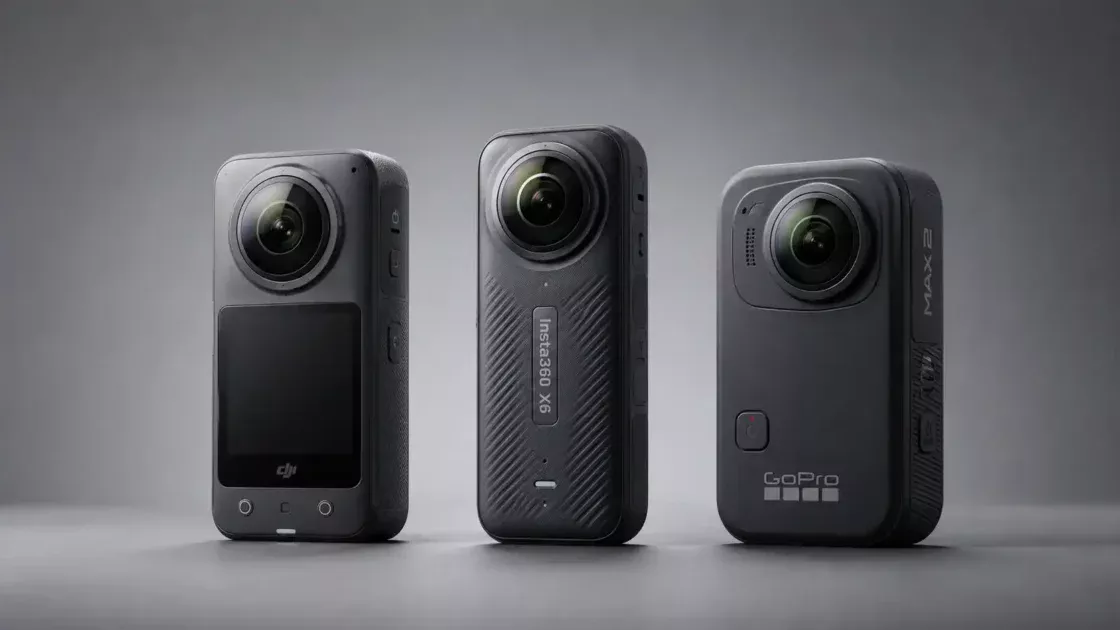
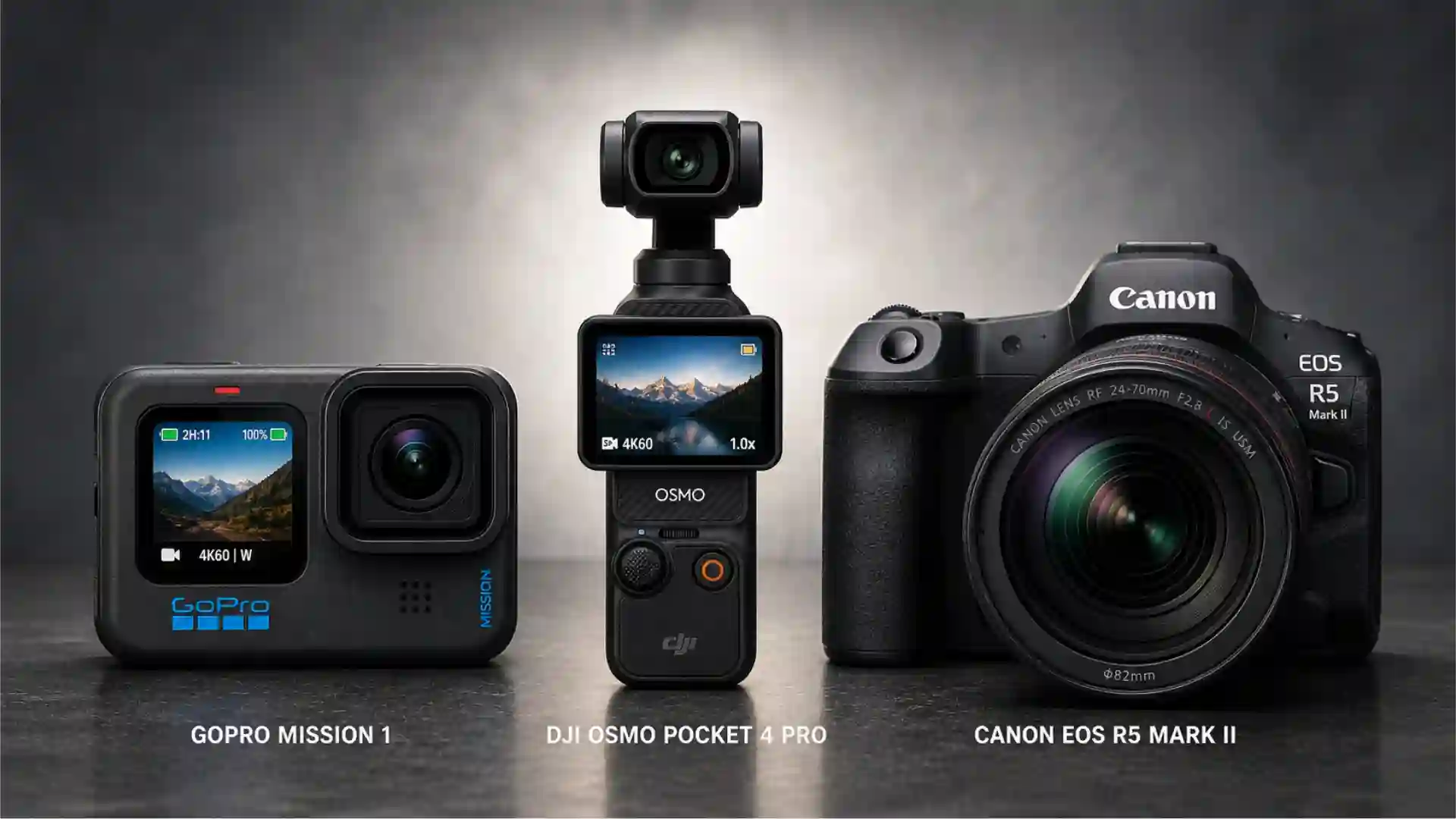
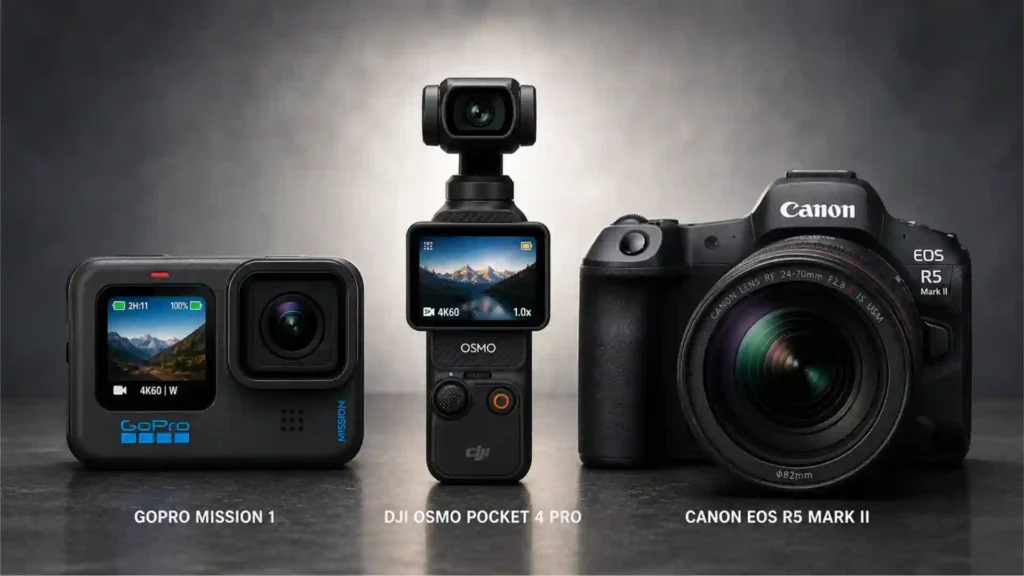
The most useful way to compare GoPro MISSION 1, DJI Osmo Pocket 4 Pro and Canon EOS R5 Mark II is to stop treating them as three versions of the same camera. They are not. GoPro is pushing a rugged compact cinema platform into territory that used to belong to larger production bodies. DJI is extending the pocket gimbal idea toward a more ambitious creator camera, though the Osmo Pocket 4 Pro remains only partly confirmed and partly leak-driven at the time of writing. Canon is selling a mature full-frame hybrid system body for photographers and filmmakers who need lenses, autofocus, files, redundancy and client-grade reliability.
Table of Contents
That distinction matters because a spec-sheet comparison alone produces bad buying advice. The GoPro MISSION 1 is not a smaller Canon EOS R5 Mark II. The Canon EOS R5 Mark II is not a pocket vlogging camera. The DJI Osmo Pocket 4 Pro, if the current dual-lens reporting holds, is not an action camera. Each one solves a different problem in the creator market.
The verified facts are uneven. GoPro officially announced the MISSION 1 Series on April 14, 2026, with a new 50MP 1-inch sensor, GP3 processor, 8K and 4K Open Gate capture across the lineup, and a release plan that starts with MISSION 1 and MISSION 1 PRO on May 28, 2026. Canon’s EOS R5 Mark II is a fully released professional mirrorless camera announced in July 2024, built around a 45MP full-frame stacked sensor, 30fps electronic shooting and 8K RAW video up to 60p. DJI’s standard Osmo Pocket 4 is official, but the Pro or 4P version sits in a different evidence category: the standard model has confirmed specs, while the Pro model is supported by leaks, regional teasers and reporting rather than a complete global DJI product page.
That does not make the DJI comparison useless. It makes it more interesting. A creator deciding between these cameras is really deciding between rugged capture, stabilized solo shooting and full-frame system production. The right answer changes with the job: helmet-mounted mountain bike footage, walking travel videos, interviews, documentary stills, sports assignments, wedding films, YouTube product reviews, underwater clips, event coverage, social-first vertical content or paid brand campaigns.
The current camera market is not short of resolution. It is short of trust. Buyers want to know which device will survive heat, movement, rain, long takes, poor light, fast subjects, mixed audio and real editing deadlines. In that sense, the comparison is less about “best camera” and more about which weaknesses you can live with.
GoPro’s MISSION 1 move is bigger than another action camera
GoPro has spent years being treated as the default action camera brand and, at the same time, as a company trapped by that very identity. The MISSION 1 Series is an attempt to widen the frame. Officially, GoPro describes the new line as compact professional 8K and 4K Open Gate cinema cameras, not merely HERO-style sports cameras with higher resolution. That wording is strategic. GoPro wants filmmakers, creators and serious enthusiasts to see MISSION 1 as a production tool rather than a helmet camera with better numbers.
The base MISSION 1 shares the core hardware platform with MISSION 1 PRO: a 50MP 1-inch sensor, the new GP3 processor and 50MP still capture. The difference is mostly in the top capture modes. MISSION 1 is limited to 8K30, 4K120 and 1080p240 in 16:9, plus 4K120 Open Gate. The MISSION 1 PRO goes higher with 8K60, 4K240 and 1080p960 burst slow motion, while the MISSION 1 PRO ILS moves the platform into an interchangeable Micro Four Thirds mount body planned for Q3 2026.
This is a hard pivot because GoPro is not only chasing resolution. It is chasing production credibility. The company says the MISSION 1 Series supports 10-bit color, GP-Log2, timecode sync, high bitrates, 32-bit float audio and accessories such as a wireless microphone system, Media Mod, filters, grips, housing and an Enduro 2 battery. Those are not casual vacation features. They belong to a workflow language used by creators who edit, grade, sync, monitor and deliver footage across platforms.
The price confirms the shift. GoPro announced MISSION 1 at $599.99 MSRP, MISSION 1 PRO at $699.99 MSRP and MISSION 1 PRO ILS at $699.99 MSRP, with $100 discounts for existing GoPro subscribers. That places MISSION 1 above the usual impulse-buy action camera zone and closer to a compact production tool.
The business context makes the launch feel heavier. GoPro reported 2025 revenue of about $652 million, down from about $801 million in 2024, with hardware revenue down 21.5 percent year over year. The company also framed GP3 as the processor platform for new cameras beginning in Q2 2026. MISSION 1 is not just a product refresh. It is GoPro trying to prove that it can move beyond the shrinking center of the action-camera market.
The risk is equally plain. A rugged 1-inch 8K camera at $599 sounds aggressive until the buyer remembers that professional work also needs batteries, mounts, ND filters, microphones, storage, maybe a grip, maybe a housing, maybe a gimbal and maybe a second camera. GoPro’s old strength was that people understood what a GoPro was for. MISSION 1 is more ambitious, but ambition asks the customer to think harder.
DJI’s Osmo Pocket 4 Pro problem is evidence, not interest
DJI has already proved that pocket gimbal cameras can become mainstream creator tools. The standard Osmo Pocket 4 is official and easy to describe: a pocket-sized gimbal camera with a 1-inch CMOS sensor, 4K/240fps capture, 14 stops of claimed dynamic range, 10-bit D-Log, 2x lossless zoom, 3-axis mechanical stabilization and a rotating 2-inch touchscreen. DJI lists the body at 144.2 × 44.4 × 33.5 mm and 190.5 g, making it tiny compared with a mirrorless rig.
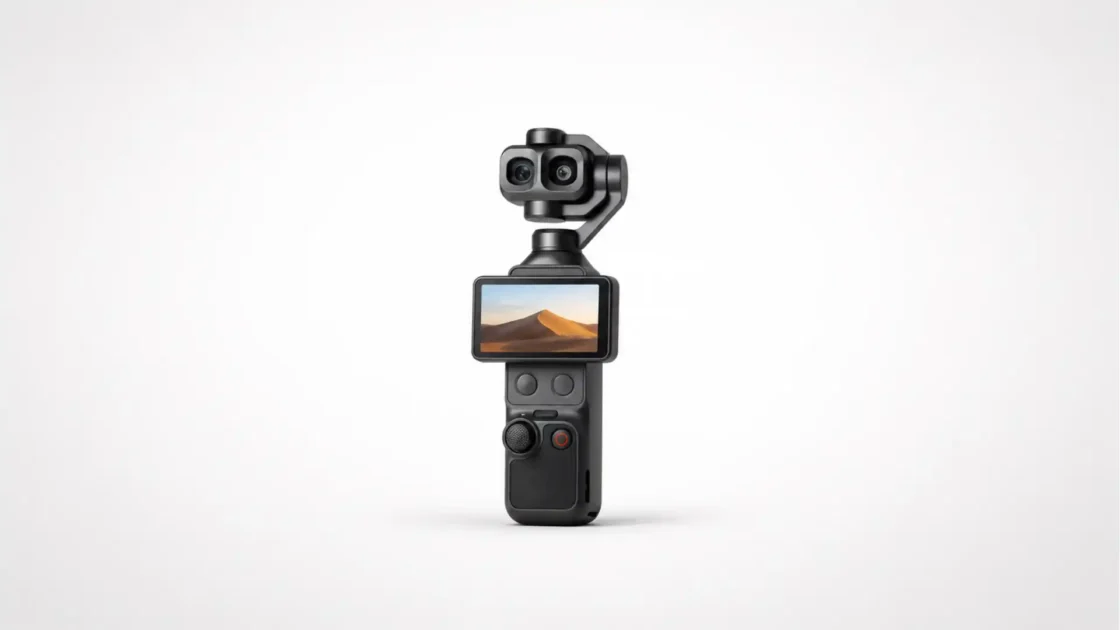
The Pro model is where things get complicated. Reporting from The Verge before the Pocket 4 announcement described leaked images of a dual-lens Pro version, reportedly pairing an ultrawide lens with a telephoto lens and optical zoom capability. RedShark News later reported a rumored June 2026 release window for the dual-camera Pocket 4 Pro. Notebookcheck has also reported on an apparent Osmo Pocket 4P or Xtra Muse 2 Pro connection in the U.S. market.
That evidence is enough to discuss the product direction, but not enough to publish a final buying verdict as if the global DJI Osmo Pocket 4 Pro were fully launched with locked specs. The honest comparison must treat the Pocket 4 Pro as a near-term product expectation, not as a finished camera with fully confirmed global availability, pricing and warranty terms.
The standard Osmo Pocket 4 gives a strong baseline. DJI’s official release states that the Pocket 4 supports 4K/240fps, 14-stop dynamic range and 10-bit D-Log, with European pricing at €479 for the Essential Combo, €499 for the Standard Combo and €629 for the Creator Combo. Review coverage also reports that the camera is not launching in the U.S. at the same time as other regions because authorization is pending, which is a real buying factor for American creators.
The reason creators care about the Pro model is obvious: optical reach. The standard Pocket cameras are wonderful walking cameras, but they are limited by one lens. A dual-lens Pocket 4 Pro with a real telephoto module would be more than a vlogging tool. It would let solo creators shoot street details, event cutaways, travel compression, food close-ups, stage moments, product B-roll and interview reaction shots without changing systems. If DJI adds optical zoom without ruining pocketability, the Pro model becomes the most flexible solo creator camera in this comparison.
The uncertainty is equally serious. Warranty, app access, U.S. distribution, service, firmware, accessory compatibility and exact codec behavior matter more than leaked sensor claims. DJI’s standard Pocket 4 is a known camera. The Pocket 4 Pro is still a partly reported camera. A good comparison keeps those two facts separate.
Canon’s EOS R5 Mark II is the adult in the room
Canon does not need the EOS R5 Mark II to look futuristic next to GoPro and DJI. It needs it to work. The R5 Mark II is a professional full-frame mirrorless camera built for photographers and hybrid shooters who live inside a system of lenses, cards, batteries, color tools, grips, flash, external recorders, cages, monitors and client expectations.
The headline hardware is strong: 45MP full-frame back-illuminated stacked CMOS sensor, 30fps maximum shooting speed, 8K RAW up to 60p, DIGIC Accelerator plus DIGIC X, Dual Pixel Intelligent AF and Canon Log 2/3 support. Canon’s official specs also list 4K DCI/UHD up to 119.9p and 2K or Full HD up to 239.76p, with dual-card recording and CFexpress Type B plus SD UHS-II media.
The camera’s price also tells the truth. Canon USA launched the EOS R5 Mark II body at an estimated $4,299, with an RF 24-105mm F4 L IS USM kit at $5,399. That is not in the same economic category as GoPro MISSION 1 or DJI’s Pocket line. A Canon buyer is paying for a sensor, mount, autofocus engine, body controls, viewfinder, weather sealing, professional stills performance, lens access and file control.
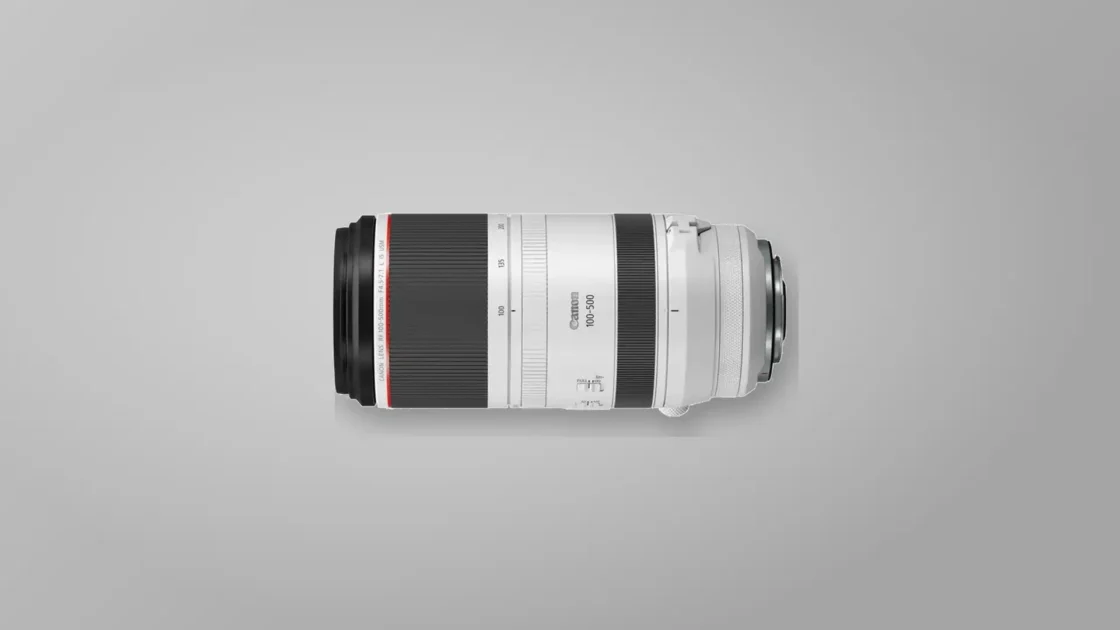
The R5 Mark II’s biggest advantage is not only image quality. It is choice. A Canon shooter can use a 15-35mm wide zoom, a 24-70mm workhorse lens, a 70-200mm event lens, a 100-500mm wildlife lens, fast primes, macro glass, tilt-shift options and adapted EF lenses. The GoPro MISSION 1 has a fixed ultra-wide lens. The standard DJI Pocket 4 has a fixed gimbal lens. A rumored Pocket 4 Pro may add a second optical view, but it still remains a small fixed-lens device. Canon lives in a system.
The cost of that choice is weight, rigging and attention. A Canon R5 Mark II with a good RF zoom is not a camera you forget in your jacket. It changes the way people behave around you. It needs lens choices before the shoot, careful media planning and more serious stabilization if you are walking. Canon gives the strongest files, but it also makes the shooter carry the burden of a real production camera.
The R5 Mark II is also not magically free from heat. PetaPixel’s review found that 8K60, Canon’s hardest mode, could run around 23 minutes at room temperature before stopping, while lower-demand modes performed much better. That does not make the camera weak. It means high-resolution hybrid bodies still obey physics.
Sensor size is the first real dividing line
Resolution numbers hide the most important image-quality split in this comparison. GoPro MISSION 1 and DJI Osmo Pocket 4 use 1-inch-type sensors. Canon EOS R5 Mark II uses a full-frame 36 × 24 mm sensor. Canon’s own spec sheet lists the R5 Mark II sensor as 36 × 24 mm full frame. Sony’s professional camcorder specs show a common 1.0-type sensor as 13.2 × 8.8 mm. Based on those dimensions, a full-frame sensor has about 864 mm² of area while a 1-inch-type sensor has about 116 mm², making full frame roughly 7.4 times larger.
That area difference shapes low light, depth of field, tonal rolloff, lens rendering and noise behavior. GoPro’s 50MP 1-inch sensor may produce impressive detail for the body size, and DJI’s Pocket 4 sensor may deliver clean-looking creator footage in many scenes. But full frame has a physics advantage when the lens, exposure and processing are handled well.
This does not mean Canon always looks better in every finished video. It means Canon gives the shooter more room before the file breaks. A full-frame sensor with a fast lens can separate subjects, hold cleaner shadows, tolerate higher ISO and deliver richer stills. If you shoot dim wedding receptions, indoor interviews, concerts, documentary stills or paid portraits, the R5 Mark II starts with a larger imaging foundation.
GoPro and DJI fight back through computation, processing and form. GoPro’s GP3 processor is designed for high frame rates, compact thermal behavior and camera-body intelligence. DJI’s Pocket line uses a gimbal and imaging pipeline to make small-camera footage look calmer than handheld footage from a larger body. These systems improve results, but they do not erase sensor math.
Sensor size also changes lens behavior. The GoPro MISSION 1’s wide lens is part of its identity. It wants to show action, space and movement. DJI’s Pocket line wants a human-scale field of view that works for walking, talking and travel. Canon gives the shooter every field of view from ultra-wide to super-telephoto. The sensor is not just a component. It decides the camera’s grammar.
Resolution numbers need context before they mean anything
GoPro’s 8K claim is real and aggressive for such a small body. The base MISSION 1 supports 8K30, while the MISSION 1 PRO supports 8K60 and 4K240. Canon’s EOS R5 Mark II also records 8K RAW up to 60p, but on a full-frame sensor with professional media and a very different body class. DJI’s standard Pocket 4 tops out at 4K, though with up to 240fps slow motion.
The mistake is to read those numbers as a ranking. 8K on GoPro does not equal 8K on Canon. The lenses, sensor size, bitrates, codecs, heat design, sharpening, rolling shutter, crop behavior and editing tolerance all matter. GoPro’s advantage is size and ruggedness. Canon’s advantage is file depth and system control. DJI’s advantage is not resolution; it is stable, framed, human-friendly footage without a rig.
For many creators, 4K is still the delivery format that matters. YouTube, Instagram, TikTok, client web videos, training content, travel films and product reviews rarely need final 8K export. Higher capture resolution matters when it gives better oversampling, reframing room, stabilization margin, still extraction or future-proof archive value. It is not automatically better if it slows editing, fills cards and overheats faster.
GoPro’s Open Gate modes are more interesting than the 8K headline for social-first creators. Open Gate capture uses more of the sensor area in a taller aspect ratio, giving editors room to export horizontal, vertical and square versions from the same shot. That is valuable for creators who publish one shoot across YouTube, Instagram Reels, TikTok, Shorts and paid ad placements.
Canon’s 8K RAW matters in a different way. It belongs to controlled production, high-end hybrid work, VFX plates, reframing, interviews with crop options, commercial footage and situations where a client may ask for the maximum archive. DJI’s 4K/240fps matters when a creator wants smooth motion from a tiny gimbal without thinking about cages or cards. The best video spec is the one that fits the shot, not the one that wins the table.
Confirmed and tentative spec comparison
| Camera | Evidence status | Sensor | Main video direction | Stabilization idea | Launch price or reported price |
|---|---|---|---|---|---|
| GoPro MISSION 1 | Official | 50MP 1-inch type | 8K30, 4K120, 4K120 Open Gate | Rugged body plus HyperSmooth-style processing | $599.99 MSRP |
| DJI Osmo Pocket 4 Pro | Partly reported | Expected 1-inch-class dual-camera setup | Rumored dual-lens pocket gimbal with optical zoom | 3-axis mechanical gimbal | Not fully confirmed globally |
| Canon EOS R5 Mark II | Official | 45MP full frame | 8K RAW up to 60p, 4K up to 120p | IBIS, lens IS and external support | $4,299 body at launch |
This table compresses the comparison, but it also shows the problem with treating all three cameras equally. Two are official products with locked public specs, while the DJI Pro model remains the least settled entry. The standard Osmo Pocket 4 is the verified DJI baseline; the Pro version should be discussed with careful language until DJI publishes a full global spec sheet.
Stabilization is where DJI changes the shooting experience
A gimbal is not just another stabilization method. It changes the kind of footage a solo creator can get. DJI’s Pocket line has always been strongest when the camera is walking, following, panning, tracking a person or sitting on a tiny tripod while the operator talks to camera. The standard Osmo Pocket 4 continues that formula with 3-axis stabilization, a rotating screen, ActiveTrack features and direct support for DJI microphone transmitters.
GoPro’s stabilization is different. It is built for violent motion, wide fields of view and body-mounted angles. It works because the camera can crop and process motion inside a very wide frame. That makes it excellent for bikes, helmets, boards, cars, skis, surfboards, chest mounts and tight spaces where a gimbal would be fragile or impractical. GoPro stabilization is action-first. DJI stabilization is operator-first.
Canon’s stabilization is the most flexible and the least automatic. The R5 Mark II has sensor-shift image stabilization, and Canon lists up to 8.5 stops at the center depending on lens and conditions. With the right RF lens, handheld stills and static video can look excellent. For walking shots, however, a mirrorless camera still needs careful technique, lens choice, digital stabilization or an external gimbal. Canon does not replace the operator’s skill.
The rumored DJI Osmo Pocket 4 Pro would matter because a dual-lens gimbal could solve one of the Pocket line’s oldest limits: reach. Standard pocket gimbal cameras are wonderful at arm’s-length and walking distance, but they cannot compress a city street or isolate a detail like a telephoto lens. If DJI adds optical zoom while keeping stabilization credible, the Pro model could become a stronger travel and event tool than the standard Pocket 4.
There is a trade-off. A gimbal is a moving mechanical structure. It has limits in wind, impacts, rain, sand, cold and fast action. GoPro’s fixed rugged body laughs at scenes that would make a gimbal nervous. Canon, with the right lens and rig, can handle professional motion but needs setup. Stabilization is not a universal score. It is a match between movement and mechanism.
Lens choice is the clearest Canon advantage
The Canon EOS R5 Mark II lives inside the RF lens system, and that changes everything. A buyer is not buying only a camera body. They are buying access to glass that defines perspective, compression, bokeh, low-light behavior, autofocus performance, macro range, weather sealing and future upgrades. Canon’s official manual confirms RF and RF-S lens compatibility, plus EF and EF-S compatibility through adapters.
The GoPro MISSION 1, in base form, does not work that way. It includes a GoPro standard wide lens and is built around a rugged compact capture style. That makes it fast and predictable, but it also means the shooter accepts GoPro’s wide-angle look. The MISSION 1 PRO ILS changes the conversation because it adds a Micro Four Thirds lens mount, but that model is not the base MISSION 1 and is scheduled for Q3 2026.
DJI’s standard Pocket 4 is also a fixed-lens device. Its 2x lossless zoom and 4x digital-style reach in certain modes are useful, but they are not a replacement for real interchangeable lenses. A rumored Pocket 4 Pro with optical telephoto would improve flexibility, but it would still be a closed small-camera system. The user would choose between the built-in views, not a lens shelf.
This matters most in paid work. A portrait client may need a flattering 85mm look. A wedding filmmaker may need a 70-200mm lens from the back of a ceremony. A wildlife photographer may need 500mm. A product shooter may need macro. An architecture shooter may need wide lenses with controlled distortion. Canon wins any job where the lens choice is the creative choice.
GoPro and DJI win where lens choice slows the shooter down. Their value is not that they can do every look. Their value is that they are ready in seconds and can be placed where a full-frame camera cannot easily go. A GoPro on a motorcycle fork or a DJI Pocket on a restaurant table is useful because it is not trying to be a full cinema package.
Ruggedness gives GoPro a real production niche
GoPro’s old advantage still matters: the camera can go places that larger cameras cannot. The MISSION 1 and MISSION 1 PRO are officially listed as waterproof to 66 feet or 20 meters without housing, with a protective housing rated to 196 feet or 60 meters. That single fact creates use cases where neither DJI nor Canon is the natural first choice.
A pocket gimbal is not a dive camera. A Canon R5 Mark II is weather-sealed, not a waterproof action body. You can protect and rig a mirrorless camera for harsh work, but the rig becomes larger, slower and more expensive. GoPro’s advantage is that rugged capture is the starting point, not an add-on.
The MISSION 1’s ruggedness also changes camera placement. A director or creator can mount it to a car, kayak, helmet, surfboard, drum kit, goalpost, motorcycle, ski pole, chest harness or underwater rig with much less anxiety. If the shot needs the camera to be small, low, wet, moving and replaceable, GoPro becomes more than a compromise. It becomes the only sensible tool in the group.
The new MISSION 1 specs push that role into higher-end work. A HERO-style camera has often been used as a crash camera, action insert camera or behind-the-scenes body. MISSION 1 aims to make those shots less visually separate from the main camera. If the 10-bit files, log profile and 1-inch sensor perform well in real tests, GoPro footage may cut more cleanly into professional edits.
The caution is that ruggedness does not solve every image issue. Wide-angle action cameras can distort faces, flatten composition and make everything feel like point-of-view footage. The best MISSION 1 work will come from shooters who use its toughness with taste, not from people who treat 8K as a magic fix.
The pocket gimbal remains DJI’s strongest creator idea
DJI’s Pocket cameras became popular because they respect the way many creators actually work. A solo creator often needs to walk, talk, track a face, shoot quick B-roll, capture clean enough audio, switch between horizontal and vertical, and avoid attracting the attention that a larger rig invites. The standard Osmo Pocket 4 doubles down on that pattern. It adds 4K/240 slow motion, 37MP stills, 107GB internal storage and a brighter screen while keeping the basic pocket form.
That is why the Pro version matters even before it is fully announced. The Pocket line’s weakness has never been convenience. It has been range. A dual-lens Pocket 4 Pro could let creators shoot wide talking footage and tighter detail shots with the same device. For travel videos, event recaps, street features and social campaigns, that could reduce the need for a second camera.
The standard Pocket 4 already addresses workflow with internal storage, fast transfer and DJI microphone support. DJI’s official release states that the Pocket 4 supports direct connection to DJI Mic transmitters, including Mic 2, Mic 3 and Mic Mini, with four-channel audio support. That matters because solo creator work often fails on audio before it fails on image quality.
Still, the Pocket approach has a ceiling. A gimbal camera is excellent at smooth movement and human framing, but it is not the right tool for dust, impact, underwater scenes, long professional interviews, lens-driven stills or controlled commercial setups with lighting and monitoring. It is a camera for speed and self-operation.
DJI’s strongest pitch is not that the Pocket 4 Pro will beat Canon or GoPro on every technical measure. Its strongest pitch is that one person can get polished footage with less thought, less rigging and fewer failed takes. For many creators, that is a bigger advantage than 8K.
Canon’s system depth still matters in a creator market
It is fashionable to say that phones, action cameras and pocket gimbals have made traditional mirrorless cameras less relevant. The EOS R5 Mark II shows the opposite. The more compact cameras become powerful, the more clearly system cameras need to justify their weight. Canon justifies it through stills quality, autofocus, lens range, media options, professional handling and files that tolerate demanding edits.
Canon’s launch materials emphasize the new Accelerated Capture imaging platform, the DIGIC Accelerator, DIGIC X, Dual Pixel Intelligent AF, Action Priority modes, Eye Control AF and reduced rolling shutter compared with the original R5. These are not features that matter only to spec collectors. They matter when a photographer has one chance to capture a football tackle, a bird’s wing position, a bride’s expression or a performer under bad light.
The R5 Mark II also bridges stills and video in a way neither GoPro nor DJI can. A wedding shooter can take 45MP RAW stills, shoot 4K slow motion, record 8K RAW clips, use Canon Log 2 and 3, mount professional lenses and deliver both photography and video from one body. The GoPro MISSION 1 can shoot 50MP photos, but it cannot replace a full-frame stills system. DJI can shoot stills, but a pocket gimbal is not a professional photography camera.
The gap becomes clearer in print, cropping and retouching. Full-frame RAW files from a 45MP Canon sensor give editors space for skin work, exposure recovery, color shaping and large prints. GoPro and DJI stills are useful, but they are secondary features. For a hybrid professional, Canon remains the camera that can serve as the main body, not just the secondary angle.
The cost is operational. Canon forces the creator to care about lenses, cards, batteries, settings, stabilization, heat and weight. That is not a flaw. It is the price of control.
Color workflows separate casual capture from serious editing
Color is one of the quiet dividing lines between these cameras. GoPro offers GP-Log2 and 10-bit color in the MISSION 1 Series. DJI’s standard Pocket 4 offers 10-bit D-Log. Canon’s EOS R5 Mark II offers Canon Log 2, Canon Log 3, PQ, HLG and Cinema EOS-style recording options.
For casual creators, these names may sound like decoration. They are not. Log profiles matter because they preserve more tonal information for grading. They allow editors to match cameras, protect highlights and avoid baked-in contrast. They also create work. A log file often looks flat out of camera and needs a color process before delivery.
Canon has the strongest professional color position because it sits inside a mature ecosystem. Canon Log 2 and Log 3 are known quantities in hybrid and Cinema EOS workflows. The R5 Mark II also offers 12-bit RAW internal recording in certain modes, which gives serious editors more flexibility than standard compressed footage.
GoPro’s GP-Log2 could be a major improvement if the files grade well and avoid the brittle look often associated with small action cameras under harsh light. DJI’s D-Log path is already familiar to drone and Osmo users. The winner depends on how hard the footage will be pushed. If the goal is quick social delivery, DJI and GoPro may be easier. If the goal is commercial grading, Canon has the deeper toolkit.
Matching these cameras in one project will require discipline. A Canon full-frame shot with controlled depth of field will not naturally match a GoPro ultra-wide action shot. A DJI gimbal shot may look smoother but less cinematic than a handheld Canon shot with a long lens. Good editors will use each look intentionally rather than trying to hide every difference.
Audio may decide more purchases than resolution
Video creators often buy cameras for image specs and regret them because of audio. This is where all three systems reveal their intended users.
GoPro is clearly trying to move upmarket. MISSION 1 Series materials mention four microphones, wind noise reduction, 32-bit float audio and Bluetooth audio, while the accessory system includes a wireless microphone kit and a Media Mod with multiple audio inputs, monitoring and timecode-related connections. That is a serious signal from a brand that used to be associated with usable but rough action audio.
DJI has a cleaner creator audio story. The Pocket 4 supports direct connection to DJI Mic transmitters and four-channel audio, making it attractive for interviews, walk-and-talk videos, travel narration and solo presenting. The Creator Combo approach also lets buyers get a working camera-and-mic kit without designing a rig.
Canon is different. The R5 Mark II has professional audio options, four-channel support and better integration with external systems, but the buyer is expected to know what they are doing. A Canon rig for serious video often includes a shotgun mic, wireless lavs, a handle, a recorder, monitoring and maybe timecode. That is stronger for production, weaker for grab-and-go work.
For solo creators, DJI’s audio convenience may beat Canon’s audio ceiling. For crews, Canon’s expandability wins. For action footage, GoPro’s 32-bit float support and rugged audio accessories could be a major upgrade if the real-world implementation holds up.
Audio also affects editing time. Clean, synced, unclipped dialogue saves hours. A camera that gets audio right on location can matter more than a camera that gives slightly sharper 8K footage with unusable sound.
Heat is the enemy that every small camera negotiates with
Every compact high-resolution camera fights heat. The body is small, the processor is busy, the sensor is active, the battery is limited and the user expects long recording. Manufacturers can improve thermal design, but they cannot escape heat physics.
GoPro claims strong thermal performance for the MISSION 1 Series, helped by the GP3 processor and Enduro 2 battery. The company lists 5+ hours at 1080p30 and 3+ hours at 4K30 on a single charge in its launch materials, with the product page also mentioning up to 1.5 hours at 8K30 in approximate recording times. Those numbers are promising, but independent long-run tests in heat, sun, wind and high-bitrate modes will matter.
DJI’s Pocket 4 faces the usual pocket-camera tension: small body, gimbal, high frame rates and creator expectations. 4K/240fps is impressive, but high-frame-rate modes are often short-clip tools rather than all-day recording modes. Reviews describe the standard Pocket 4 as improved, but the Pro model still needs independent testing when available.
Canon’s EOS R5 Mark II has a larger body and more serious media, but also much heavier video modes. PetaPixel’s test found around 23 minutes in 8K60 before a stop at room temperature, with longer results in lower-demand modes such as 4K24 before the battery ended. Canon also offers a cooling fan grip for users who need longer high-end recording.
The practical lesson is simple: do not buy any of these cameras assuming headline modes are meant for unlimited recording. 8K60, 4K240 and heavy RAW modes are specialty tools. For interviews, events and long shoots, the boring modes often save the day.
Storage and media costs change the real price
Camera prices are misleading without media costs. Canon’s EOS R5 Mark II uses CFexpress Type B for its fastest work and an SD UHS-II slot for secondary recording. CFexpress cards are fast and reliable, but they add real cost. High-bitrate 8K RAW also consumes storage quickly and creates heavy editing requirements.
GoPro MISSION 1 uses a smaller-camera workflow, but high-bitrate 8K and 4K modes still demand fast cards and disciplined offloading. GoPro lists bitrates up to 240Mbps in its MISSION 1 materials. That is manageable compared with Canon RAW, but it is still far above casual phone video. A creator planning travel or sports shoots needs enough cards and backup storage.
DJI’s standard Pocket 4 has one of the most creator-friendly storage choices: 107GB built-in storage plus microSD expansion, with reports of fast wired transfer. For a solo shooter, that reduces friction. If the Pro model keeps this structure, it will remain a strong advantage over GoPro and Canon in daily use.
Editing hardware also counts. Canon 8K RAW is not pleasant on weak computers. GoPro 8K footage may also stress older laptops, depending on codec and settings. DJI’s 4K footage is more approachable, though 4K/240 slow motion and 10-bit D-Log still require decent editing tools.
The cheapest camera on purchase day is not always the cheapest camera after media, batteries, storage, software, mounts and time. Canon is the most expensive system. GoPro sits in the middle but grows with accessories. DJI is likely the easiest for a creator who wants to shoot, transfer and publish fast.
Autofocus and subject tracking serve different worlds
Autofocus on these cameras should not be judged by one standard. Canon, GoPro and DJI are solving different subject problems.
Canon’s EOS R5 Mark II uses Dual Pixel Intelligent AF with face and eye detection, people, animals and vehicles, plus Action Priority modes for certain sports. Canon’s launch materials describe registered face priority, improved eye control AF and action recognition for basketball, soccer and volleyball. That is built for stills, sports, events, wildlife and hybrid production where critical focus must hold on a moving subject with a real lens.
DJI’s subject tracking is built around framing and solo operation. ActiveTrack features keep a person or subject in frame as the camera moves on its gimbal. That is less about razor-thin depth of field and more about making sure the creator stays composed while walking, presenting or filming alone. The standard Pocket 4 adds updated tracking modes, and a Pro model would presumably build from that foundation.
GoPro’s focus problem is different because the camera is wide and action-oriented. With wide lenses and small sensors, deep focus is easier. The challenge is not racking focus on eyes; it is exposure, motion, stabilization, dynamic range and keeping the shot usable under violent movement. MISSION 1’s machine-learning capture modes suggest GoPro is using scene understanding more for image tuning and capture behavior than traditional lens-driven autofocus.
Canon is the autofocus winner for critical subject isolation. DJI is the tracking winner for solo framing. GoPro wins when the camera is mounted where focusing would be one more thing to break.
Stills photography changes the ranking immediately
The EOS R5 Mark II is the clear winner if photography matters as much as video. It is a 45MP full-frame stills camera with RAW files, high-speed bursts, advanced autofocus, in-body stabilization, professional controls and access to Canon RF glass. It can shoot sports, portraits, wildlife, weddings, landscapes, editorial work and commercial stills with one body.
GoPro MISSION 1’s 50MP stills should not be dismissed. A rugged 1-inch camera that can shoot RAW and survive water, dirt and impact may become useful for travel, adventure, underwater, behind-the-scenes and social stills. For some creators, a MISSION 1 photo may be more useful than carrying a larger camera into unsafe or wet places. GoPro’s announcement points to 50MP RAW photo capture and burst capability.
DJI’s standard Pocket 4 raises still resolution to 37MP through its imaging pipeline, according to review reporting and DJI-related coverage. That is useful for thumbnails, travel posts and quick social assets. It does not make the Pocket line a substitute for a full-frame camera with lenses.
The decisive point is control. Canon lets the photographer choose focal length, aperture, flash, shutter technique, background compression and RAW processing. GoPro and DJI make quick images from fixed optical systems. If stills are paid work, Canon wins by a wide margin. If stills are supporting assets for video-first creators, GoPro and DJI may be enough.
That is the difference between a camera that creates a photograph and a camera that captures an image while doing something else.
Low light exposes the limits of tiny bodies
Low light is where marketing often outruns reality. GoPro says the MISSION 1 Series uses a new 50MP 1-inch sensor with larger native pixels and 3.2µm fused pixels in Quad Bayer mode, paired with GP3 processing for low-light performance and up to 14 stops of dynamic range at the sensor. DJI says the standard Pocket 4 uses a 1-inch CMOS sensor, 14 stops of dynamic range and 10-bit D-Log. Canon uses a much larger full-frame stacked sensor, with Canon Log options and fast RF lenses available.
The likely ranking is straightforward: Canon has the strongest low-light ceiling, DJI has the smoothest low-light walking style, and GoPro has the most rugged low-light placement options. A Canon with a fast prime can shoot scenes neither small camera can render with the same depth and cleanliness. A DJI Pocket can get stabilized handheld night footage without a gimbal rig. A GoPro can be mounted in wet or dangerous places where neither alternative belongs.
The mistake is to expect a 1-inch 8K action cinema camera to behave like full frame in poor light. Processing can reduce noise, but it may also smear texture. Noise reduction can rescue a clip, but it can make skin and foliage look plastic. A small camera may hold highlights well but lose shadow texture. Independent tests will show how far GoPro and DJI have pushed their pipelines.
For night streets, restaurants, concerts, receptions and indoor documentary work, the R5 Mark II remains the safer image-quality body. For movement-heavy night walks, DJI may produce the more pleasant finished clip with less effort. For underwater, action or mounted night scenes, GoPro may be the only one practical enough to get the shot.
Low light is not only about brightness. It is about how the image fails.
Vertical video and reframing are no longer side features
Creators now shoot for many frames at once. A camera that records only one format well creates extra work. GoPro’s Open Gate modes answer that need directly. MISSION 1 supports 4K120 Open Gate, while MISSION 1 PRO supports 8K30 and 4K120 Open Gate. That gives editors more vertical and horizontal options from a single capture.
DJI’s Pocket line attacks the same problem physically. Rotate the screen, shoot vertically, track the subject and publish. The standard Pocket 4 is built for creators who move between YouTube, TikTok, Reels and Shorts in the same week. Its pocket form makes vertical work feel natural instead of like a mirrorless camera turned sideways on a cage.
Canon can shoot vertical too, of course, but it is less native to the body experience. A professional can rig the R5 Mark II vertically, use L-brackets or cages, record high-quality footage and crop from 8K. The files are excellent. The process is heavier. If a social team needs clean vertical from a controlled shoot, Canon is powerful. If a solo creator needs five vertical clips during a walk, DJI is faster.
GoPro is strongest when one action shot must become many aspect ratios. DJI is strongest when the creator wants to shoot directly for social. Canon is strongest when high-end footage must be repurposed with the most quality headroom.
This is a hidden reason the MISSION 1 Series matters. GoPro no longer wants to be only the camera on the helmet. It wants to be the camera that produces clips for every screen from one dangerous, expensive or hard-to-repeat moment.
The bodies reveal the intended users
A camera body tells the truth about its user. GoPro MISSION 1 is small, rugged, waterproof and mountable. DJI Osmo Pocket 4 is tall, handled, stabilized and self-framing. Canon EOS R5 Mark II is shaped around a grip, viewfinder, controls, hot shoe, lens mount and card doors.
The GoPro body says: put me somewhere. The DJI body says: hold me while moving. The Canon body says: operate me deliberately.
That distinction matters more than many specs. A mountain biker does not need a full-frame body on the handlebars. A travel vlogger does not want to balance a 24-70mm lens on a gimbal for every café shot. A wedding photographer cannot replace an R5 Mark II with a pocket gimbal. The camera’s shape is a promise and a warning.
The R5 Mark II’s body gives direct controls, a serious EVF, weather resistance and professional handling, but it is still a compact mirrorless body rather than a cinema camera with built-in active cooling. The Pocket 4 body is lighter than many lenses. The MISSION 1 body is built to mount, not to cradle like a camera from the film era.
The right body is the one that disappears during the work. GoPro disappears into action. DJI disappears into solo operation. Canon disappears for professionals who already think in lenses and exposure controls.
Price comparisons are misleading without job value
On paper, Canon is far more expensive. At launch, the R5 Mark II body cost about seven times the GoPro MISSION 1 base price. Add RF lenses and the gap grows. DJI’s standard Pocket 4 pricing sits below GoPro’s MISSION 1 in Europe, while the rumored Pro model is expected to be higher but not yet globally confirmed.
But price is not value. A Canon R5 Mark II can earn money through professional stills and video work in ways a GoPro or DJI pocket camera usually cannot. A GoPro MISSION 1 can capture action angles that would be impossible or reckless with Canon gear. A DJI Pocket 4 or Pocket 4 Pro can reduce crew needs for a solo creator.
The right question is not “Which camera is cheaper?” The question is “Which camera saves or earns the most money in the work I actually do?” For a sports filmmaker, one GoPro shot mounted near the action can be worth more than a full-frame camera left safely on the sidelines. For a real estate or travel creator, DJI’s gimbal may cut setup time enough to pay for itself. For a wedding shooter, Canon’s reliability and lens range are the business.
There is also the accessory trap. GoPro at $599 grows quickly with ND filters, spare batteries, mounts, audio and housing. DJI’s Creator Combo raises the initial price but includes useful pieces. Canon starts high and then demands lenses, CFexpress cards, batteries, bags and often rigging.
A buyer comparing only bodies is comparing incomplete systems.
U.S. availability may push some creators away from DJI
DJI’s camera hardware is strong, but availability has become part of the buying calculation. The Verge reported that the Osmo Pocket 4 was not launching in the U.S. because authorization was still pending, even as it launched in Europe and other regions. The reported Xtra Muse connection around Pocket-style hardware adds another layer: a U.S. buyer may see similar devices under different branding, but that raises questions about service, warranties, firmware and ecosystem support.
For creators outside the U.S., this may be a minor issue. DJI’s distribution is broad in many regions, and the Pocket line has a loyal user base. For U.S.-based creators, however, official availability matters. A working creator needs replacements, warranty service, batteries, accessories and predictable support.
GoPro and Canon are simpler in this respect for U.S. buyers. GoPro’s MISSION 1 Series pricing and reservation details are published through GoPro’s own channels. Canon’s EOS R5 Mark II is a mainstream system camera sold through established channels.
The best camera is less attractive if buying it means uncertainty around support. For hobbyists, that may be acceptable. For paid creators, it can be a deal breaker.
The Pocket 4 Pro could still become a major camera. But until DJI’s global product page, regional availability and support terms are clear, the Pro model sits behind GoPro and Canon in purchase certainty.
Workflow speed gives DJI an advantage Canon cannot copy
Canon can produce better files. GoPro can survive harsher locations. DJI can make solo shooting faster. That speed is not a small feature. It is the product.
A creator using a Pocket camera can pull it from a pocket, rotate the screen, track a face, walk through a scene, record audio through a DJI mic and capture stabilized footage without building a rig. For daily content, travel, short-form video and behind-the-scenes work, that removes friction at every step.
Canon cannot copy that without becoming a different camera. An R5 Mark II with a lens, microphone and gimbal may produce better footage, but it is no longer spontaneous. GoPro is quick too, but its wide look and action-camera handling make it less natural for walking narration or face-forward content.
If the rumored Pocket 4 Pro adds a second lens, the workflow advantage grows. Instead of carrying a pocket gimbal plus a phone or second camera for tighter shots, a creator could stay inside one device. The most valuable feature may be not the telephoto lens itself, but the fact that it is always attached.
For creators who publish often, the camera that gets used every day may beat the camera that looks better once a week. That is DJI’s territory.
GoPro’s best role is the dangerous second camera
The MISSION 1 can serve as a primary camera for action creators, but its most interesting professional role may be as a dangerous second camera. That means a camera placed where the main camera should not go: water, impact zones, athlete mounts, vehicles, instruments, animals, tight spaces, weather, crowds and stunt paths.
The higher specs make that role more valuable. In the past, the action-camera insert often looked visibly different from the main footage. If MISSION 1’s 1-inch sensor, log profile and 10-bit files hold up, editors may have more freedom to mix GoPro angles into projects shot on Canon, Sony, RED, Blackmagic or DJI systems.
This has business value. A production can get extra angles without risking a full cinema camera. A sports creator can produce more dynamic edits. A travel filmmaker can mount the camera during rough movement and still retain a more gradeable file. A documentary shooter can leave a small camera in a cramped or wet scene.
The base MISSION 1’s limits matter. It does not have the full MISSION 1 PRO frame-rate set, and it does not have the MISSION 1 PRO ILS lens mount. But at $599.99, it may be the sweet spot if the shooter needs the new sensor and Open Gate flexibility more than 8K60 or 4K240.
GoPro does not need MISSION 1 to replace Canon. It needs MISSION 1 to be good enough that Canon shooters want one in the bag. That is a smarter target.
Canon remains the main camera for serious hybrid assignments
The R5 Mark II is the obvious main camera when the job includes stills, controlled lighting, client delivery, lens changes and high expectations. It has professional ergonomics, a mature lens ecosystem, advanced autofocus, high-resolution RAW stills, strong video codecs and a path into Canon’s broader professional system.
That makes it the camera of record. On a wedding, the Canon files are the primary deliverables. On a sports assignment, Canon captures the decisive stills and tight action. On a documentary, Canon handles interviews, portraits and detailed B-roll. On a commercial shoot, Canon offers the image control and lens rendering clients expect.
GoPro and DJI can support those jobs. GoPro can produce action inserts, overheads, car mounts, water shots and risky angles. DJI can shoot walking B-roll, solo behind-the-scenes clips and fast social assets. But neither replaces the R5 Mark II as the main professional hybrid body.
The R5 Mark II’s weakness is not quality. It is that it demands a photographer’s mindset. You must choose a lens, expose carefully, monitor focus, manage heat in demanding modes and move with intention. That is a burden for casual creators. It is normal work for professionals.
Canon is the safest answer when failure costs money. Not because it is perfect, but because its strengths are broad, known and supported by a complete system.
The DJI Pro model could become the best solo creator tool
If the Osmo Pocket 4 Pro arrives with a dual-camera design, optical zoom and the same core Pocket strengths, it could become the most useful camera here for one-person creator work. Not the highest-quality camera. Not the toughest camera. The most useful.
A solo creator needs speed, framing, stabilization, audio and enough image quality. A dual-lens Pocket 4 Pro could cover wide talking shots and tighter B-roll while staying small. It could replace a phone-plus-gimbal setup, reduce reliance on a larger camera and make travel filming lighter.
That said, the Pro model must clear three tests. First, DJI needs to publish full official specs and regional availability. Second, the telephoto camera must look good enough to match the main camera under real light. Third, the gimbal and battery must handle the added optical complexity without ruining the Pocket experience.
If it fails those tests, the standard Pocket 4 may remain the wiser purchase, or creators may look at competitors such as Insta360’s teased Luna line. PetaPixel reported that Insta360 showed Luna Pro and Luna Ultra concepts at NAB 2026, clearly targeting the Osmo Pocket category.
The Pocket 4 Pro’s promise is flexibility without setup. Its risk is that the real product may not match the rumor excitement. Until it ships and gets tested, buyers should keep one foot on the ground.
Business strategy explains the timing
GoPro, DJI and Canon are not only selling cameras. They are defending business positions.
GoPro needs a new growth story. Its 2025 revenue decline and GP3 processor messaging show why MISSION 1 matters. The company is moving beyond the HERO line because action cameras have become crowded and smartphone cameras are good enough for many casual users. MISSION 1 gives GoPro a higher-value story: compact cinema, rugged production and creator workflows.
DJI is defending the pocket gimbal category it largely owns. The standard Osmo Pocket 4 improves a successful formula. A Pro version would protect DJI from competitors that want to add dual lenses, optical zoom and more creator features. The reported Insta360 Luna push makes this more urgent.
Canon is defending professional hybrid users. The R5 Mark II is less about inventing a new category than keeping Canon shooters inside the RF system. It answers the original EOS R5’s video criticism, adds speed and intelligence, and keeps the 5-series relevant for photographers who now need video too.
The overlap is real but limited. All three brands use the language of creators, but they mean different people. GoPro means action creators and compact production shooters. DJI means solo video creators and mobile storytellers. Canon means professionals and advanced hybrid users.
The creator market is no longer one market. It is a set of jobs that happen to use cameras.
Purchase advice depends on the footage you cannot miss
The best buying advice starts with the shot that would hurt most to lose.
If the shot involves speed, water, impact, mounting or danger, choose GoPro MISSION 1. It is built to survive and to capture perspectives that normal cameras cannot. The base model is the value pick if 8K30, 4K120 and Open Gate are enough. The MISSION 1 PRO is the better pick if 8K60, 4K240 and the highest slow-motion modes matter.
If the shot involves walking, talking, travel, self-filming, smooth movement and fast social publishing, wait for firm DJI Osmo Pocket 4 Pro details or buy the standard Pocket 4 where officially available. The DJI path is strongest for solo creators who want the camera to frame and stabilize the work with minimal setup.
If the shot involves paid stills, client video, interchangeable lenses, low light, fast autofocus, long-term system investment and professional editing, choose Canon EOS R5 Mark II. It is expensive, but it is the only camera in this comparison that can realistically serve as a main stills-and-video body for professional assignments.
Best-fit production roles
| Job | Best fit | Reason |
|---|---|---|
| Mounted sports, underwater, crash angles | GoPro MISSION 1 | Rugged body, waterproofing, wide field of view and action-first design |
| Solo travel and walk-and-talk video | DJI Osmo Pocket 4 Pro if confirmed, standard Pocket 4 today | 3-axis gimbal, tracking, compact body and fast creator workflow |
| Weddings, portraits, sports stills and hybrid client work | Canon EOS R5 Mark II | Full-frame sensor, RF lenses, pro autofocus, RAW stills and serious video files |
| Multi-platform action content | GoPro MISSION 1 | Open Gate modes and compact mounting make reframing easier |
| Controlled interviews and commercial work | Canon EOS R5 Mark II | Lens choice, audio expansion, color workflow and system depth |
This table avoids a false winner. The best camera changes when the job changes. A creator who buys based on the hardest recurring shot will make a better choice than one who buys based on the biggest number printed in a launch headline.
The verdict is not a tie
This comparison does not end with all three cameras being equally good. They are unequal in useful ways.
GoPro MISSION 1 is the most disruptive camera here. It puts 1-inch 8K capture, Open Gate modes, rugged design and creator-facing production features into a compact body at a price that undercuts traditional cinema tools. It is not a Canon replacement, but it may become the action insert camera serious creators have wanted.
DJI Osmo Pocket 4 Pro is the most intriguing but least settled option. The standard Pocket 4 is real and strong. The Pro version’s reported dual-lens direction could make it the best solo creator camera if DJI executes well and solves availability questions. Until full official details are public, it should be treated as a promising near-term product rather than a proven purchase.
Canon EOS R5 Mark II is the strongest main camera. It is the body professionals choose when stills matter, lenses matter, files matter and the work has to survive client scrutiny. It costs much more because it does much more outside the narrow creator-camera lane.
The cleanest recommendation is this: buy GoPro for action placement, DJI for self-operated motion and Canon for professional system work. A serious creator may eventually own two of them. A working hybrid shooter could use Canon as the main body and GoPro as the rugged angle. A solo travel creator could use DJI for daily footage and Canon only for planned shoots. A sports creator could use GoPro for POV and Canon for telephoto stills.
The wrong move is to buy the most impressive spec sheet and hope it becomes the right camera. Cameras do not become right through numbers. They become right when their compromises match the work.
Practical questions creators are asking about these cameras
No. It is better for rugged action placement, water, mounting and compact Open Gate capture. Canon EOS R5 Mark II is better as a main professional hybrid camera with full-frame image quality, interchangeable lenses, high-end stills and deeper video workflows.
The standard DJI Osmo Pocket 4 is official. The Osmo Pocket 4 Pro or 4P is supported by reporting, leaks and regional discussion, but a complete global DJI product page with final specs and availability was not the same kind of official evidence at the time this analysis was written.
For solo walk-and-talk videos, DJI’s Pocket line is the easiest choice. GoPro MISSION 1 is better for action vlogs and mounted angles. Canon EOS R5 Mark II is best for studio, interview and high-production YouTube channels where lenses, lighting and audio are controlled.
DJI Osmo Pocket 4 or a confirmed Pocket 4 Pro is the most convenient travel option. GoPro MISSION 1 is stronger for rough travel, water, sports and adventure. Canon EOS R5 Mark II is best for travel creators who also need high-end photography.
Canon EOS R5 Mark II has the strongest image-quality ceiling because of its full-frame sensor, RF lenses and professional files. GoPro and DJI can produce excellent compact-camera footage, but they do not match Canon’s full-frame system depth.
Canon EOS R5 Mark II is the safest choice for low light, especially with fast RF lenses. DJI may produce smoother handheld night walking footage due to its gimbal. GoPro is useful for low-light action angles where rugged placement matters more than full-frame rendering.
GoPro MISSION 1 is the obvious pick for action sports because it is rugged, waterproof, mountable and built for violent movement. Canon can shoot sports from the sidelines with telephoto lenses. DJI is not the right first choice for impacts or water.
Canon EOS R5 Mark II. It is the only camera in this comparison designed as a professional stills camera with a full-frame sensor, RF lens support, RAW files, high-speed shooting and advanced autofocus.
Not automatically. GoPro’s 8K is useful for detail, reframing and action capture. DJI’s strength is stabilized pocket shooting. For many creator videos, stable 4K footage is more useful than 8K footage that does not fit the shooting style.
It can overheat in demanding modes such as 8K60, as high-resolution hybrid cameras often do. Reviews found much better behavior than the original R5, with longer recording in lower-demand modes and optional cooling support for demanding work.
DJI’s Pocket line is the easiest for handheld video because stabilization and framing are built into the device. GoPro is easy for action mounting but less flexible for normal framing. Canon is powerful but has the steepest learning curve.
DJI is best for direct vertical creator shooting. GoPro MISSION 1 is strong for reframing action footage through Open Gate capture. Canon can produce excellent vertical video, but it usually requires more setup.
Canon EOS R5 Mark II is best for controlled interviews with proper lenses and audio. DJI is good for quick solo interviews or travel conversations. GoPro is the least natural interview camera unless used as a secondary wide angle.
GoPro MISSION 1 is the best choice because MISSION 1 and MISSION 1 PRO are waterproof to 20 meters without housing and can go deeper with protective housing. DJI Pocket cameras and Canon R5 Mark II need more protection and are not built for the same role.
GoPro MISSION 1 is likely the best second camera for action, crash angles and hard-to-place shots. DJI is the best second camera for smooth behind-the-scenes or walking B-roll. Canon is usually the main camera, not the secondary one.
Canon EOS R5 Mark II has the best lens options because it uses Canon RF lenses and adapted EF lenses. GoPro MISSION 1 base models use fixed wide lenses. DJI Pocket cameras use fixed built-in lens systems, even if the Pro model adds a second optical view.
Creators who specifically want a pocket gimbal with optical zoom should wait for full official Pocket 4 Pro details. Creators who need a camera now can evaluate the standard Osmo Pocket 4 where officially available, or choose GoPro or Canon depending on the job.
GoPro MISSION 1 is strong value for rugged 8K and Open Gate capture. DJI is strong value for solo creator workflow. Canon is expensive but valuable for professionals who earn from stills, video and lens-based work.
No. Canon can cover the most professional ground, but it cannot replace a waterproof mounted action camera or a tiny pocket gimbal. GoPro and DJI are excellent specialized tools, but neither replaces a full-frame professional system body.
Author:
Jan Bielik
CEO & Founder of Webiano Digital & Marketing Agency
This article is an original analysis supported by the sources cited below
GoPro announces new MISSION 1 line of professional 8K and 4K Open Gate compact cinema cameras
Official GoPro announcement for the MISSION 1 Series, including sensor, processor, frame-rate, Open Gate, battery, waterproofing and availability claims.
GoPro MISSION 1 Pro Series camera page
GoPro product information page describing the MISSION 1, MISSION 1 PRO and MISSION 1 PRO ILS lineup.
GoPro announces pricing for new MISSION 1 Series professional cameras
Official GoPro investor release with MISSION 1 pricing, subscriber discounts, bundle pricing, accessory pricing and availability timing.
GoPro MISSION 1 PRO product listing
GoPro store page with product positioning, battery information and MISSION 1 Series FAQ details.
GoPro announces fourth quarter and 2025 results
GoPro investor results page used for business context, 2025 revenue and GP3 platform timing.
GoPro 2025 Form 10-K
SEC filing used for company context, supply chain discussion and forward-looking risk framing.
GoPro MISSION 1 Series cameras earn three top industry awards at NAB Show 2026
Newswire release covering early NAB recognition for the MISSION 1 Series.
DJI Osmo Pocket 4 official product page
Official DJI page for the standard Osmo Pocket 4, including 1-inch CMOS, 4K/240fps, 14-stop dynamic range, 10-bit D-Log and stabilization claims.
DJI Osmo Pocket 4 specifications
Official DJI specification page used for dimensions, weight, touchscreen, microSD support and device details.
DJI announces Osmo Pocket 4
Official DJI announcement with Osmo Pocket 4 launch details, pricing, accessory bundles and audio ecosystem information.
DJI Osmo Pocket 4 announced with confirmed specs
RedShark News coverage used for confirmed Pocket 4 specs, storage, pricing and availability context.
DJI Osmo Pocket 4 Pro specs, price and release date
RedShark News reporting used cautiously for the rumored Pocket 4 Pro release window and dual-camera direction.
Leaked images reveal a dual-lens pro version of DJI’s next Osmo Pocket camera
The Verge report on leaked DJI Osmo Pocket 4 Pro imagery and rumored dual-lens optical zoom direction.
DJI’s Osmo Pocket 4 camera is better at capturing slow-motion footage and photos
The Verge report covering official Pocket 4 launch details, U.S. availability issue, pricing and storage.
DJI’s Osmo Pocket 4 review
The Verge review used for practical Pocket 4 handling, battery, internal storage, stabilization and U.S. availability analysis.
Muse 2 Pro receiving U.S. launch as Osmo Pocket 4P with Xtra branding
Notebookcheck report used for the reported Xtra Muse 2 Pro and Osmo Pocket 4P connection.
Xtra Muse pocket gimbal camera product page
Xtra store page used for context on the related Muse pocket gimbal ecosystem and U.S. market positioning.
Canon EOS R5 Mark II specifications
Official Canon Europe specification page used for sensor, video modes, autofocus, Canon Log, stabilization and media details.
Canon EOS R5 Mark II product manual specifications
Canon product manual used for RF/EF lens compatibility, recording media, file formats and camera specifications.
Canon officially launches the EOS R1 and EOS R5 Mark II
Canon USA launch announcement used for EOS R5 Mark II launch timing, price and positioning.
Canon EOS R5 Mark II product page
Canon USA product page used for the R5 Mark II’s 45MP stacked sensor, 30fps electronic shutter and autofocus claims.
Canon launches EOS R1 and EOS R5 Mark II mirrorless cameras
Canon UK press release used for the Accelerated Capture platform, Dual Pixel Intelligent AF, Canon Log 2/3, 4K120 and cooling grip context.
Canon EOS R5 Mark II review
PetaPixel review used for practical EOS R5 Mark II overheating and real-world hybrid-camera assessment.
Insta360’s Luna Series cameras put the DJI Osmo Pocket in the crosshairs
PetaPixel report used for competitive context around Insta360 Luna Pro and Luna Ultra targeting the pocket gimbal camera category.
Sony PXW-Z200 professional camcorder specifications
Sony professional specification page used as a reference for common 1.0-type sensor dimensions.
| Citing this article? Brief excerpts are welcome. Please credit Webiano.digital, name the author where stated, and include a link to https://webiano.digital and to this original article. Full or substantial republication requires prior written permission. Read our Copyright and Content Use Policy. |
This article was prepared with the assistance of artificial intelligence tools. The content underwent expert human review, and Webiano Digital & Marketing Agency assumes editorial responsibility for its final version and publication.