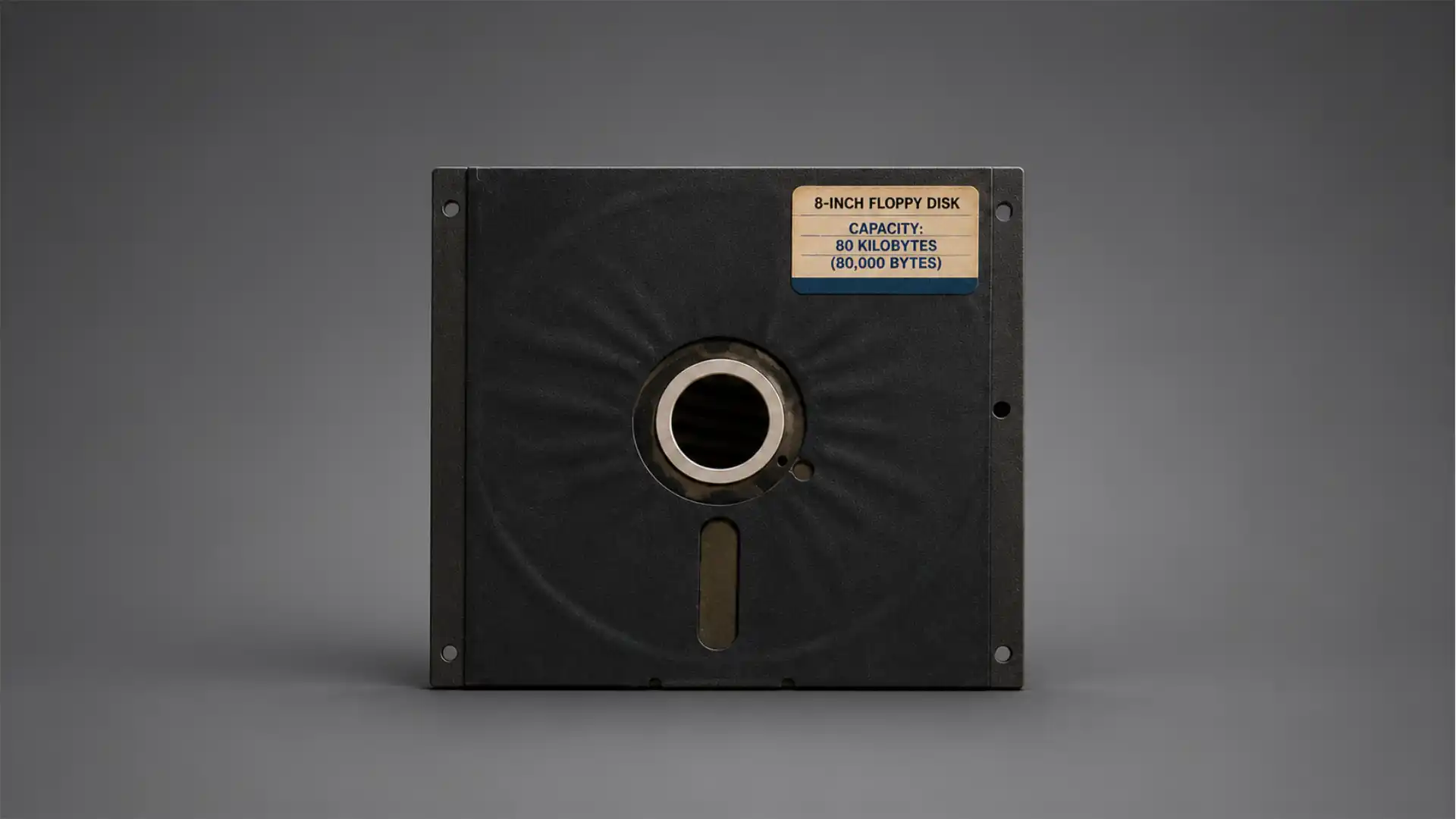
On June 6, 1972, U.S. Patent No. 3,668,658 was granted to IBM inventors Ralph Flores and Herbert E. Thompson for a “magnetic record disk cover.” The title sounds modest. The effect was not. The patent described a flexible magnetic disk sealed inside a cover whose inner surfaces cleaned the disk as it rotated, giving IBM’s early 8-inch floppy disk a practical answer to dust, handling, mailing, loading and repeated field use. The first version stored 80KB, roughly the capacity IBM and the Computer History Museum compare to about 3,000 punched cards.
Table of Contents
A patent for the part nobody remembers
The anniversary is easy to misread. The June 6, 1972 patent was not the whole floppy disk drive, and it was not the first day IBM used the technology. It was the patent for the disk cover, the jacket that turned a thin, flexible, oxide-coated disk into a usable storage medium. The drive patent, U.S. Patent No. 3,678,481, followed on July 18, 1972, naming Warren L. Dalziel, Jay B. Nilson and Donald L. Wartner as inventors.
That distinction matters because the floppy disk’s success was not only a story about data density. It was a story about making fragile magnetics ordinary enough for office work. The patent’s claims focused on a rotary magnetic record disk held in a cover whose inner surfaces touched the adjacent record surfaces and used porous antistatic cleaning material to remove contaminants while the disk spun.
The modern memory of the floppy disk is often the 3.5-inch plastic square, the save icon, and the ritual of sliding a disk into a beige PC. IBM’s early disk was different. It was 8 inches across, visibly flexible, and first aimed at mainframe maintenance rather than personal computing. It was a field-service and software-loading answer for large systems, not a consumer storage accessory. IBM’s own history places the work at its San Jose research operation, where a team led by David L. Noble started in 1967 on a reliable, low-cost system for loading instructions and software updates into mainframes.
The surprising lesson is that the floppy disk became famous because it solved a dull physical problem. Magnetic media do not tolerate dust well. A speck can turn into a read error. A fingerprint can do damage. A bare flexible disk may look simple, but simple is not the same as usable. Flores and Thompson’s cover made the disk portable, mail-friendly and repeatable. The jacket was not packaging. It was part of the machine.
That is why the phrase “really floppy” is more than nostalgia. The early disk was flexible because the magnetic medium was a thin Mylar disk coated with magnetic material. The system had to let that disk rotate while the outer cover stayed still. It had to expose enough of the disk for the magnetic head to read it, but shield enough of the disk to keep contamination under control. The patent is a reminder that storage history often advances through small mechanical bargains, not only through better bits.
The IBM problem behind the floppy
IBM did not begin with a consumer question such as, “How do people carry files?” The first problem was narrower. Mainframes and controllers needed a cheaper, more reliable way to load microcode and diagnostic routines than the options IBM had at hand. The Computer History Museum says Alan Shugart at IBM San Jose assigned David L. Noble in 1967 to lead development of an inexpensive system for loading microcode into the IBM 3330 “Merlin” controller. IBM shipped Noble’s solution, the 23FD “Minnow,” in 1971.
That origin explains the 80KB capacity. To a reader raised on gigabytes, 80KB looks almost comic. In its own setting, it had a clear job. IBM and the Computer History Museum describe that early capacity as roughly equivalent to 3,000 punched cards. The point was not to compete with hard disk files for live business databases. The point was to replace stacks of punched cards or other awkward maintenance media with a compact removable disk that service staff and systems could handle with less friction.
IBM had already changed data storage once with RAMAC. In 1956, IBM shipped the Model 350 disk storage unit as part of the IBM 305 RAMAC, which the Computer History Museum identifies as the first commercial hard disk drive. IBM’s own history calls RAMAC the first computer to use a random-access disk drive.
The floppy belonged to another branch of the same family tree. RAMAC made random-access disk storage possible for business records. The floppy made removable magnetic storage cheap enough to distribute. It was not a miniature hard disk. It was a delivery mechanism for software, diagnostics and later office data. That is a different economic role.
Mainframe computing in the late 1960s and early 1970s still lived with paper, cards, tapes and large storage cabinets. Operators loaded jobs, handled media, waited for batch runs and moved data through physical processes. IBM’s floppy project came from that world. It did not promise personal liberation. It promised a cleaner way to get instructions into big systems.
The design target was also shaped by field service. A storage medium sent to customer sites had to survive ordinary handling, not laboratory handling. It needed alignment aids, cleaning, a jacket, openings for the head and sensors, and enough ruggedness to travel. The June 6 patent’s focus on the cover shows that IBM understood the storage medium as a physical object in a human workflow, not only as a magnetic surface.
The 80KB figure needs its original scale
The number 80KB has become the punchline in anniversary posts because the scale gap is so large. One modern photo can exceed 80KB. A short compressed audio clip can exceed it. A single web page asset can be larger. But the early floppy was not judged against a smartphone photo library. It was judged against punched cards, operator time, error rates and the cost of distributing system instructions.
A standard punched card held a small fixed amount of information. Large jobs meant large decks. Cards had virtues: they were visible, sortable and well understood. They also bent, jammed, tore, lost order and consumed space. Replacing thousands of cards with one removable magnetic disk was not only a capacity upgrade. It reduced the chances of human mistakes in handling a sequence.
That is why the comparison to roughly 3,000 cards is not a trivia line. It describes a change in work. The floppy compressed a physical procedure into a portable object. The work of carrying, filing and loading data became easier to manage. The first floppy disk’s 80KB did not make it a universal storage device. It made it good enough for a high-value task inside a mainframe ecosystem.
Capacity figures also hide format differences. Early IBM 8-inch media, IBM 3740 disks, Memorex read-write disks, 5.25-inch PC formats and later 3.5-inch disks were not one smooth line of interchangeable media. They differed in recording method, sectoring, sides, density, track count, controller logic and error handling. The casual phrase “floppy disk” covers a whole family of formats that shared a flexible magnetic medium but not a single technical identity.
The first 80KB disk was read-only in field use. Later read-write systems changed the role of floppy media from distribution to working storage. IBM’s 3740 Data Entry System, announced in 1973, used the diskette as a data recording medium for data entry workflows, shifting the medium closer to ordinary business operations.
That move from microcode loading to data entry is the hinge. Once a removable disk could be written in the field, it became a small system’s local memory, a clerk’s batch of records, a developer’s software carrier, a student’s saved assignment and a computer store’s distribution object. The floppy’s cultural life began when a service medium became everyday media.
The cover was an engineering system
The June 6 patent reads like a cover patent because that is exactly what it is. Its claims describe a disk and a cover, with the cover’s inner surfaces in physical and frictional contact with the disk’s record surfaces. Those inner surfaces are described as solid, porous, antistatic cleaning material. The cover includes an aperture to expose part of the disk to a transducer, and the disk rotates while the cover stays stationary.
This is elegant because it turns a weakness into a maintenance method. The floppy medium needed a jacket to protect it. The jacket, in IBM’s design, also cleaned it. Rather than treating dust control as a separate process, the medium carried part of its own dust-management system. The disk’s motion created the cleaning action.
The patent also describes sector-marking apertures. The magnetic disk had holes spaced around it, and the cover had reference apertures so a light source and sensor could detect sector positions as the disk rotated.
That point shows the floppy disk as part of a hybrid machine. Magnetic storage needed mechanical rotation, optical sensing, head positioning, cleaning, pressure, access windows and housing geometry. The bits did not float above the hardware. They depended on alignment, friction, materials and timing.
The cover also solved a problem of removability. Rigid disk packs existed, and magnetic tape was common. But a removable flexible disk that ordinary staff could insert and remove needed a predictable form. The jacket gave the disk a square outline, a protected surface and a way to fit into a guide. It made the flexible circular medium behave like a cartridge.
Later users treated a floppy disk as a self-contained object. They wrote labels on it. They put it in a sleeve or a box. They passed it to colleagues. They mailed it. The June 6 patent is one reason that social behavior was possible. Without a cover that made the disk tolerant of handling, the floppy would have remained a lab curiosity or a specialist maintenance part.
The cover also shaped what people thought storage should feel like. Hard disks disappeared inside machines. Tapes sat on reels or cassettes. Cards were stacks. The floppy disk was a flat personal object. That physical grammar survived into the 3.5-inch era and then into the save icon.
Dust, dropout and the tiny enemy of removable storage
Magnetic storage is vulnerable because the read/write head must interact with a surface at close range. Contaminants interrupt that relationship. The patent text connects cleaning directly to reducing errors from “drop out,” the old term for loss of signal due to a defect, dirt or other disruption on the magnetic surface.
The disk’s jacket was not a decorative sleeve. It was a low-cost reliability device. It protected against dust settling on the magnetic surface and shielded the disk during handling. The inner porous layers wiped dust, wear particles and airborne contaminants away as the disk turned.
That mechanism matters because the floppy disk was meant to be removable. Removable media face a crueler life than sealed drives. They sit on desks. They are touched, dropped, stacked, mailed and inserted into drives of varying cleanliness. Every removal cycle exposes the medium to the world. A hard disk solves part of this by sealing the recording surfaces inside the drive. A floppy disk could not take that route. It had to be cheap, thin and interchangeable.
The cleaning jacket was IBM’s compromise. It did not make the medium indestructible. Floppies still failed, wore out, demagnetized, bent and suffered from bad drives. But the jacket raised the medium from delicate disk to usable article. That is the practical invention.
The same logic later appeared in user behavior. People learned not to touch the exposed part of a 5.25-inch disk. They learned to keep disks away from magnets, heat and dust. They put disks in paper sleeves, plastic boxes and binders. Storage culture grew around the limits of the medium.
The word “floppy” can make the technology sound unserious. It was not. IBM’s patent shows a careful answer to an unforgiving physical environment. The floppy disk worked because it treated contamination as a core design problem, not a user mistake.
The people behind the early disk
The early floppy disk was not the product of a single lone inventor. IBM’s history names David L. Noble as the leader of the small engineering team that began work in 1967. The Computer History Museum places Alan Shugart in the product-management role that assigned the original project to Noble, and names Warren L. Dalziel as a lead inventor of the drive. It also identifies Ralph Flores and Herbert Thompson as the designers of the cleaning jacket that protected the 8-inch disk.
Those names are worth preserving because the public story often collapses the invention into one brand and one object. The floppy disk was a system: medium, cover, drive, head mechanism, controller logic, formatting, field distribution and later application ecosystems. Different people contributed different parts.
Ralph Flores and Herbert E. Thompson appear on the June 6, 1972 patent. Warren L. Dalziel, Jay B. Nilson and Donald L. Wartner appear on the July 18 drive patent. David L. Noble led the original system effort. Alan Shugart later became central to the broader disk drive industry, including work at Memorex and Shugart Associates.
That team structure fits IBM’s industrial culture of the period. Large computing advances often emerged from organized product groups rather than garage mythologies. The engineering was distributed across materials, mechanics, electronics and system requirements. The floppy disk did not need a heroic origin story to be important. Its importance lies in the way an engineering group solved a cluster of mundane problems that customers actually had.
The original San Jose setting also matters. IBM’s storage work there linked the hard disk and floppy disk stories. RAMAC had emerged from IBM’s earlier disk-storage work in San Jose, and the floppy later grew from the same broad storage culture.
The result was a medium that could be made, shipped, inserted, read and trusted enough for mainframe support. The public later saw floppies as personal objects. Their origin was more institutional: engineers serving machines that filled rooms, cost heavily and demanded reliable maintenance procedures.
A read-only beginning that still changed software
The first IBM floppy disk was used as a read-only “memory disk” in field applications. The Computer History Museum describes IBM’s 23FD “Minnow” as an 8-inch floppy drive with removable read-only flexible memory disks, shipped in 1971 with 80KB capacity.
That read-only origin is easy to overlook because the later floppy became synonymous with saving. The early role was closer to a software cartridge. IBM needed to distribute control information and diagnostics to machines in the field. The disk could be written internally, shipped, inserted and read by the target system. Users did not yet treat it as a blank notebook.
Read-only media still mattered because software had become a thing that needed physical distribution. A machine’s behavior could be changed by loading instructions. The medium carrying those instructions became part of the product. That was a quiet shift in computing. Hardware did not stand alone. Firmware, microcode and diagnostics needed controlled transport.
This is one reason the floppy sits between eras. Earlier computing often tied function tightly to machine configuration. Later computing treated software as a circulating good. The floppy helped make that circulation normal. It was not the only medium that did so, but it became the one ordinary people remember.
The read-only beginning also explains why reliability had priority over capacity. A corrupted diagnostic or microprogram loader could create costly field problems. The disk needed to arrive intact, load predictably and avoid the handling failures that haunted paper or exposed magnetic media. The cover patent served that need.
When read-write floppy systems arrived, the medium’s social role widened. Users could store their own work. Businesses could capture data entry. Developers could distribute software that customers could also modify or configure. The medium became active rather than passive. The invention’s first job was loading software into big machines; its later job was letting people carry their own computing state.
IBM’s 1973 data-entry turn
IBM’s next major move was to apply the diskette to data entry. The IBM 3740 Data Entry System was announced in January 1973, and contemporary descriptions treated the diskette as a new recording medium for business data entry. An IBM 3740 reference manual describes the IBM Diskette as a flexible magnetic disk used by the system as the data recording medium.
That shift took the floppy out of the service channel and into clerical work. Data entry had long been tied to punched cards. Operators typed records into keypunch machines, producing physical decks for processing. The 3740 offered a new pattern: capture the data onto diskette, then feed it onward to larger systems.
The business case was not abstract. A diskette reduced bulk, removed some card-handling steps and allowed more flexible correction. Cards remained entrenched, but the diskette gave IBM a way to modernize customers without forcing an immediate break from centralized mainframe processing. The disk could sit between local work and central systems.
The 3740 also helped define floppy formats. Its single-sided diskette format became a reference point for later 8-inch media. The UvA Computer Museum notes that early 8-inch disks suffered from lack of standardization, with differences in sectoring and format that later archivists still encounter.
That lack of standardization is one of the less romantic parts of floppy history. The object looked simple, but compatibility depended on drive type, controller, sectoring, density and operating system. A diskette was not just a diskette. It belonged to a format ecosystem.
The 3740 era also reveals how IBM often spread new technology through business process rather than consumer desire. IBM did not need to convince home users that they wanted digital storage. It needed to give existing enterprise customers a better way to perform work they already did. The floppy advanced because it fit into existing organizational habits while quietly replacing their physical foundation.
Core facts behind the 1972 floppy disk patent
| Item | Detail |
|---|---|
| Patent granted | June 6, 1972 |
| Patent number | U.S. Patent 3,668,658 |
| Patent title | Magnetic record disk cover |
| Named inventors | Ralph Flores and Herbert E. Thompson |
| Assignee | International Business Machines Corporation |
| Original medium | 8-inch flexible magnetic disk |
| Early IBM capacity | 80KB on the 23FD “Minnow” memory disk |
| First commercial IBM shipment | 1971 for the 23FD system |
| Main technical problem | Protecting and cleaning a flexible magnetic disk during use |
| Companion drive patent | U.S. Patent 3,678,481, granted July 18, 1972 |
The table separates the media-cover patent from the broader floppy disk system. That separation is central to the anniversary: June 6 marks a patent for the practical jacketed disk, while July 18 marks the related drive patent.
The drive patent completed the system
The July 18, 1972 drive patent, U.S. Patent No. 3,678,481, covered a “data storage apparatus employing a single magnetic disk.” Its abstract describes an interchangeable sealed disk cartridge that drops into a guide channel, is centered and clamped to a rotary drive when the cover closes, and is loaded against a magnetic head assembly by a solenoid actuator.
That drive patent shows how the disk cover and the drive mechanism worked as a paired design. The cover made the disk handleable; the drive made it readable. The disk had to be inserted, positioned, rotated, sensed and accessed by a head moving radially through an aperture. The system needed mechanical repeatability because data tracks were narrow and alignment mattered.
The early floppy was not a casual storage slot. It was a miniature electromechanical file. The disk spun. A head moved. Light sensing detected sector position. A pressure or loading mechanism brought the medium and head into the correct relation. The cartridge had to sit still while the inner disk moved.
This is why the floppy disk’s apparent simplicity is deceptive. Its physical interface hid several coordinated operations from the user. Later personal computers made the ritual feel simple: insert disk, close latch or wait for the motor, read directory. Underneath, the system depended on motor speed, head stepping, index sensing, encoding and formatting.
The drive patent also reminds us that early floppies were not just media; they were part of direct access storage. Unlike tape, which works sequentially, a disk allows access to different tracks without reading everything before them. That made the floppy far faster for many small data tasks, even when its capacity was tiny by later standards.
The combination of cheap removable media and direct access created a new category. It was slower and smaller than hard disks, but cheaper and portable. It was less capacious than tape, but more convenient for random access and small software files. That middle position became commercially powerful.
The floppy’s first audience was not the PC user
The floppy disk arrived before the personal computer market became mass culture. IBM shipped the 23FD in 1971. The Apple II appeared in 1977. The IBM PC arrived in 1981. The first floppy was born inside mainframe support, then moved through data entry and small business systems before becoming a personal computing default.
That timeline changes the meaning of the invention. The floppy did not become useful because home computers existed. Home computers became more useful because floppy drives made software and saved data practical. The medium helped create the conditions for its most famous market.
Early microcomputers often used cassette tapes because tape hardware was cheaper. Cassette storage was slow, awkward and error-prone. A floppy drive raised the cost of a system but changed what users could do. Loading software became faster. Saving work became less painful. Disk operating systems became central.
The Computer History Museum’s Apple II materials capture this moment. Apple’s 1978 Disk II project needed both hardware and software. Steve Wozniak designed a notably small floppy disk controller using eight integrated circuits, and the system was demonstrated at the Consumer Electronics Show in January 1978. Apple then needed higher-level disk software to manage programs and data.
The Apple II example shows the floppy’s second life. Once attached to a personal computer, the disk became part of the software economy. Games, utilities, spreadsheets and programming tools could circulate on disks. Users could store their own files. Retail software became easier to package and sell.
The floppy also made computers feel less transient. With cassette storage, saving and loading could feel like a fragile audio ritual. With disks, the machine had files, directories and named objects. That changed how users understood computing. A computer with a floppy drive was not only a calculator or terminal. It was a workspace.
Apple’s Disk II turned storage into a selling point
Apple’s Disk II is a useful case because it shows how engineering around the floppy could affect company strategy. The Computer History Museum says Wozniak designed a controller using only eight integrated circuits, doing in programmed logic what other controllers handled in hardware. That design reduced parts and cost.
The Apple II itself, introduced in 1977, became a blockbuster after the floppy disk drive in 1978 and VisiCalc in 1979, according to the Computer History Museum’s Apple II exhibit.
The sequence matters. Hardware attracted early buyers. The floppy made software practical. Software gave business users a reason to buy the hardware. VisiCalc is often remembered as a killer app, but killer apps need usable storage. A spreadsheet that cannot be saved and reloaded with ease is not a business tool.
The floppy also created a market for independent software publishers. Selling programs on disk was easier than expecting users to type in long listings or manage tapes. Disk copy routines, installers, manuals, labels and packaging became part of a software business. Piracy also followed, as disks were easy to duplicate. The same portability that helped software spread made unauthorized copying simple.
Apple’s example also shows a design pattern repeated across technology history: the interface between storage and software can matter as much as the processor. A computer’s value depends not only on how fast it calculates, but on how easily it preserves work and moves programs. Floppy drives gave early personal computers memory beyond volatile RAM and personality beyond built-in ROM.
The Disk II story also draws a line back to IBM. Apple did not invent the floppy medium. It built a clever system around an existing storage category. That is how standards and near-standards propagate: one company creates a category, other companies adapt it, and the market finds new uses.
The 5.25-inch disk made the floppy personal
The 8-inch floppy was too large and costly to become the default home-computer object. The 5.25-inch disk, popularized in the late 1970s, fit smaller drives and lower-cost systems. It kept the flexible jacketed design but changed the scale. For millions of users, this was the first “real” floppy: flexible, black or dark, kept in a paper sleeve, handled by its label edge.
The smaller format mattered because personal computing needed affordable storage. A machine sold to hobbyists, schools or small offices could not rely on enterprise peripheral economics. The drive had to fit on a desk, connect to a microcomputer and work with software that ordinary users could buy.
The 5.25-inch disk also made the medium visibly fragile. Users could bend it. They could see the exposed slot. They could flip some disks over in single-sided drive systems if the format and notch allowed it. Labels, sleeves and write-protect tabs became part of everyday computing literacy.
That physical literacy created a culture. People knew to keep disks away from magnets. They knew the sound of a drive seeking. They knew the anxiety of a bad sector. They knew the ritual of backing up a disk by swapping source and destination media when a computer had only one drive.
This culture was not just nostalgia. It shaped software habits. Applications had to fit on disks. Games asked users to insert Disk 2. Word processors taught people to save often. Operating systems separated system disks from data disks. The medium’s limits taught users to manage files, storage space and copies.
The 5.25-inch disk was not always more capacious than the 8-inch disk; early formats varied. Its power came from cost, size and adoption. It was the medium that made floppies feel personal, classroom-friendly and store-bought. It turned removable storage from a mainframe accessory into a desk-drawer object.
The 3.5-inch disk fixed the handling problem again
The 3.5-inch floppy, associated strongly with Sony’s early 1980s design and later Macintosh and IBM PS/2 adoption, changed the object’s feel. It still used a flexible magnetic disk inside, but the outer case was rigid. A sliding metal shutter protected the head window. A built-in write-protect tab replaced adhesive stickers. Britannica notes that floppy disks were flexible magnetic media, while later forms were enclosed in hard square plastic cases.
The 3.5-inch disk solved the same class of problem the June 6, 1972 patent had solved: handling. The medium still needed protection from dust, fingers and casual damage. The answer changed from a flexible jacket to a rigid shell and shutter. The user could toss a 3.5-inch disk into a bag with less fear than a 5.25-inch disk.
The 3.5-inch format also improved the user interface. The disk inserted one way. The shutter opened inside the drive. The write-protect control was a sliding tab. The label area was defined. The object felt more like a cartridge than a delicate sheet. This made it suitable for consumer products, portable computers and offices where storage media moved often.
Apple helped popularize 3.5-inch disks through the Macintosh line. The original Macintosh, sold in 1984, used a 3.5-inch floppy drive rather than the 5.25-inch drives familiar to many PC users. Later IBM adoption on PS/2 systems helped make the format broadly standard in PC-compatible markets.
The 3.5-inch disk is also the object immortalized in the save icon. The irony is that the icon most people recognize as “floppy” is not the original 8-inch disk that made the category possible. It is a later, more rigid descendant that barely looks floppy from the outside. The flexible disk remained inside, hidden behind plastic.
The design lesson is direct. Every major floppy generation had to solve the same human problem again: people touch storage media. IBM’s 1972 cover, 5.25-inch sleeves and 3.5-inch shutters all answer that fact in different ways.
Capacity shifts across floppy generations
| Format or system | Typical historical role | Representative capacity |
|---|---|---|
| IBM 23FD “Minnow” 8-inch memory disk | Mainframe microcode and maintenance loading | 80KB |
| Memorex 650 8-inch read-write disk | Early commercial read-write flexible disk storage | About 175KB |
| IBM 3740 8-inch diskette | Data entry and business record capture | About 250KB class |
| Later 8-inch DSSD format | Larger business and system media | 500KB |
| Later 8-inch DSDD format | Higher-capacity 8-inch disk use | About 1.2MB class |
| Common 5.25-inch PC disks | Personal computer software and files | 160KB to 1.2MB depending on format |
| Common 3.5-inch high-density disk | Late PC and Macintosh removable storage | 1.44MB |
These figures compress a messy format history into a readable line. The real story includes sectoring, density, encoding, sides and controller differences. The broad direction is clear: floppy disks grew from a small service medium into the default removable storage layer for personal computing.
The floppy made software distribution physical and cheap
The floppy disk’s influence on software is hard to overstate because it sat between two ages. Before network distribution, software needed a physical carrier. After punched cards and tapes, the floppy gave software sellers a format customers could handle at a desk.
A disk was cheap enough to include in a box, small enough to mail, and rewritable in many formats. Documentation, registration cards and disks became a retail software package. Computer stores stocked software by title. Magazines distributed companion disks. Shareware authors mailed disks to users. Schools copied educational software. Offices exchanged templates and files.
This was more than logistics. It changed software design. Developers had to think about disk size, loading time, file layout and installation. Large programs shipped on multiple disks. Installers asked for Disk 1, Disk 2, Disk 3. Copy protection schemes used unusual sector formats or deliberate errors. Users learned that software was not only code; it was a set of physical artifacts.
The floppy also made updates possible at a new scale. Vendors could ship a new disk rather than replace hardware. Bugs could be fixed through media. Drivers, patches and utilities could circulate. This was an early form of the update culture now taken for granted in cloud software, app stores and firmware downloads.
The economics favored experimentation. A small developer could copy disks and sell software without pressing ROM cartridges or negotiating with a hardware platform holder. That helped the early software industry grow. The cost of distribution fell, and the number of possible products rose.
The same properties also complicated control. Floppies made copying easy. Software companies responded with licensing language, copy-protection systems, activation codes and manuals used as proof of purchase. The long argument over software ownership, copying and access did not begin with the internet. The floppy disk was already a battleground.
The floppy turned data into something workers carried
Before networks became common, the floppy disk created the everyday practice later nicknamed “sneakernet”: moving data by walking it from one machine to another. That practice sounds primitive, but for many offices it was the practical network. It required no cabling, no server and no shared protocol beyond compatible drives and formats.
This made data portable in a very literal way. A clerk could enter records on one machine and carry a disk to another. A student could save homework at school and bring it home if the formats matched. A designer could give a file to a printer. A software vendor could mail a patch. The disk was a small container for work.
The portability had limits. Floppies were easy to lose. They could carry malware. They had capacity ceilings. They failed silently or loudly. They created version confusion: which disk has the newest file? Yet these problems were side effects of a larger breakthrough. People had local ownership of digital artifacts.
The floppy also shaped early office security. A file could leave the building in a shirt pocket. A boot-sector virus could enter through a shared disk. A confidential spreadsheet could be copied faster than paper files. Media-control policies, labels and locked disk boxes became part of office life.
Modern cloud storage has made file movement invisible. The floppy age made it tangible. Users understood that data occupied a medium. They could count disks. They could run out of space. They could damage the only copy. The physicality taught caution, even when users failed to practice it.
Digital portability began as a thing you could bend, label, misplace and hear spinning in a drive. That is a very different relationship with data from the synchronized abstractions of current platforms.
The save icon kept the floppy alive after the drive disappeared
The floppy disk’s longest life may be symbolic. The 3.5-inch disk became the save icon in graphical software and remains widely recognized even among users who have never saved a file to a physical floppy. Nielsen Norman Group’s 2025 analysis says users still recognize the floppy disk icon as “save,” while noting that modern workflows may make it less clear in some interfaces.
That persistence is not accidental. Icons survive when they become conventional signs. A trash can icon does not require every user to think about office wastebaskets. A magnifying glass does not require a physical magnifier. The floppy icon has crossed the same threshold in many contexts. It no longer means “use this disk.” It means “commit this work.”
Still, the icon has a strange cultural twist. The physical object that gave the icon its shape has vanished from most desks. Younger users may read it as an abstract square with a notch. Some jokes describe it as a vending machine or a strange cabinet. Yet the action remains legible because software culture has repeated the symbol for decades.
The save icon also preserves an older model of computing. Saving used to be a deliberate act: work in memory was not safe until written to disk. Modern cloud apps blur that distinction with autosave, sync states and version history. The icon carries a mental model from an era of local files, volatile RAM and removable media.
That model still matters. Users need to know whether work is preserved, synchronized, exported, downloaded or shared. The floppy icon may be historically odd, but the user need remains. A symbol born from a storage object now points to a broader concept of persistence.
The floppy disk became obsolete as hardware, but it remains a design fossil in plain sight. Every click on a floppy-shaped save icon is a tiny reenactment of removable magnetic storage culture.
The decline began before people stopped using disks
The floppy disk did not vanish because one replacement killed it overnight. Its role eroded from several directions: larger hard drives, rewritable optical media, USB flash drives, email attachments, local networks, broadband internet, cloud storage and mobile operating systems. Each replacement took one job away.
For software distribution, CD-ROMs offered far more capacity. For file transfer, USB flash drives were faster, tougher and larger. For backup, hard drives and later cloud services were more practical. For operating systems, network recovery and solid-state storage changed installation methods. For firmware updates, internet delivery became normal.
Apple’s 1998 iMac helped mark the cultural break by shipping without a floppy drive, a controversial choice at the time. Macworld later described the original iMac’s removal of the floppy drive, SCSI, serial and ADB ports as one of the shocks of the product.
That decision did not end the floppy by itself. Many PCs kept floppy drives for years. Businesses still used disks for BIOS updates, drivers, machine tools, embroidery equipment, lab instruments and legacy transfer tasks. The iMac mattered because it treated the floppy as past-tense in a mass-market product.
Sony’s 2010 decision to stop selling 3.5-inch floppy disks in Japan by March 2011 became another symbolic marker of the end of mass production, as Wired reported at the time.
Yet decline and disappearance are not the same. A medium can stop being mainstream and still remain operationally necessary. That is one of the floppy’s strange afterlives.
Legacy systems kept floppies alive for rational reasons
The easiest cheap joke about floppies is that anyone still using them must be backward. The truth is less comic. Legacy systems keep old media because replacement is expensive, risky or tied to equipment that still performs its job. Wired’s 2022 report on lingering floppy use described industries such as embroidery, medical equipment and aviation where old systems persisted because the machines around them were costly and still functional.
The U.S. Government Accountability Office gave the most famous example in 2016, reporting that a Department of Defense legacy system coordinating operational functions of U.S. nuclear forces ran on an IBM Series/1 computer and used 8-inch floppy disks. The report framed it as part of a wider federal legacy IT problem.
The example went viral because it sounded absurd. It also revealed a real tension. Old systems may be hard to attack remotely because they are isolated and obscure, but they are hard to maintain because parts, expertise and media degrade. Security and fragility can coexist.
The Air Force later moved that nuclear command-and-control storage function away from floppy disks to a secure solid-state storage solution, according to Defense News reporting in 2019.
Legacy media persists when the cost of migration is higher than the daily pain of old tools. A factory machine reading a 3.5-inch disk may produce revenue every day. Replacing the controller may mean downtime, recertification or custom engineering. A hospital device may have regulatory approval tied to a particular configuration. A military system may be insulated from normal upgrade cycles.
That is why the floppy disk is not only a retro object. It is also a case study in technical debt. The medium’s end was delayed wherever the surrounding system lasted longer than the media market.
The floppy’s security story is mixed
Floppy disks were both safer and riskier than later networked systems, depending on the threat. A disconnected machine using removable disks had no internet attack surface. It could not be scanned from across the world. It could not receive a cloud credential-phishing email if it was not on email. Isolation was a real barrier.
At the same time, floppies were excellent carriers for malware. Boot-sector viruses spread through shared disks because computers often tried to boot from floppy drives. A disk left in a drive could infect a machine at startup. Office copying habits moved infected media from desk to desk.
The medium also made data leakage easy. A disk in a pocket could carry documents out of a workplace. The small capacity limited the scale compared with a modern flash drive, but for text records, source code or spreadsheets, even a low-capacity disk could carry sensitive data.
Floppy reliability added another risk. Bad sectors, weak magnetic signals and drive misalignment could damage access to important files. Users often learned backup discipline only after losing work. The phrase “save early, save often” belongs partly to this world of fallible local media.
The write-protect tab on 3.5-inch disks and adhesive write-protect notches on earlier disks gave users a simple hardware control. It was crude, but it was visible. A user could decide whether the disk was writable. That kind of tactile security is rare in current cloud workflows, where permissions are abstract and often hidden behind account settings.
The floppy’s security legacy is therefore ambivalent. It was not safe by default. It was not unsafe by default. It forced risk into physical space. People could see the medium, steal it, lock it, label it, protect it or ruin it.
The business model of storage changed around the floppy
IBM’s early floppy worked inside the company’s enterprise hardware business. Later floppy markets became more horizontal. Drive makers, media manufacturers, software publishers and computer vendors all built around the same broad category. That split of roles helped the personal computer market expand.
The floppy drive became a component. Media became a consumable. Software became a packaged good. Retailers sold blank disks by the box. Offices bought labels and storage cases. Copy shops duplicated disks. Training firms shipped lessons. Magazines bundled disks. The ecosystem mattered as much as the medium.
The economics of blank media created recurring revenue for media companies. Users did not buy one disk. They bought packs, then more packs, then higher-density disks, then replacement disks. Businesses stored years of archives in labeled boxes. Schools kept libraries of disks. Software houses ordered duplication runs.
At the same time, capacity pressure never stopped. Each application that used the floppy also strained it. Graphics, databases, desktop publishing and games quickly outgrew small disks. Multi-disk installation became annoying. Compression utilities flourished because users needed to squeeze files into fixed media.
The market moved in cycles. A format felt roomy, software filled it, users demanded more capacity, new media emerged. Zip disks, SuperDisk, CD-R, USB flash drives and memory cards all followed that pressure. The floppy’s decline was built into its success because it taught people to expect portable storage.
Yet the floppy lasted because it was cheap, standard and good enough for small files. Many technologies survive not because they are best, but because they are everywhere. A 3.5-inch drive on every office PC made the 1.44MB disk useful long after it looked technically poor.
The floppy’s material design shaped memory habits
The physical design of the floppy taught users how to think about digital work. The label encouraged naming. The sleeve encouraged preservation. The notch or tab encouraged a distinction between writable and protected. The capacity limit encouraged selection. The disk box encouraged archives.
A floppy was not a file system in the abstract. It was a small finite container. Users divided work by project, class, client, game or program. They wrote dates on labels. They crossed out old labels and created confusion. They made backup copies, sometimes. They kept “master disks” separate from working disks.
That physical model affected mental models. To save was to put work somewhere. To copy was to create another object. To install was to transfer from one object into another machine. To back up was to duplicate a disk or file set onto separate media. The actions had tactile analogies.
Modern interfaces still inherit this language. We speak of files, folders, drives, disks and saving even when data is distributed across flash chips and cloud object storage. The floppy did not invent those metaphors, but it made them personal for a generation.
There was also a time cost. Disk operations made noise and took seconds or minutes. Users waited while the drive head moved and the motor spun. This waiting reinforced the sense that persistence was a real act. A save was not merely a state change in a remote service. It was a write operation to a fallible medium.
The floppy’s physicality also made loss emotionally sharp. A failed disk was not an invisible server error. It was the damaged object in your hand. That made the medium memorable in a way cloud errors rarely are.
The patent was granted after the product had already arrived
Patent anniversaries often imply a clean sequence: invention, patent, product, adoption. The floppy disk history was messier. IBM shipped the 23FD in 1971, while the key U.S. patents were granted in 1972. The June 6 patent application had been filed on December 22, 1969, and the drive patent had been filed on March 13, 1970.
That lag is normal. Patent systems document inventions after examination and publication processes. Product development, internal use and commercial release may move on different timelines. The grant date is still historically useful, but it is not the birth date of the engineering work.
The filing dates show IBM had solved much of the problem before the public grant. The 1969 cover filing came during development toward the 1971 product. By the time the patent was granted, IBM had already placed the technology into real systems.
This matters because technology history should not treat patents as magic certificates of creation. A patent claims an invention. A product proves whether an invention works in a market or operational setting. The floppy disk needed both legal protection and manufacturing reality.
The June 6 patent remains a strong anniversary because it captures the feature that made the medium usable: a flexible disk enclosed in a cleaning cover. The date is a legal milestone for a practical design, not the moment somebody first imagined a flexible magnetic disk.
That distinction sharpens the story. The floppy disk became consequential not when an idea existed, but when IBM made it reliable enough to ship, mail and use.
Standards, incompatibility and the hidden mess under one name
People remember “the floppy disk” as one thing. Archivists know better. The same physical-looking disk may be unreadable on the wrong drive or controller. The UvA Computer Museum’s discussion of 8-inch diskettes points to early lack of standardization in sectoring and format, a problem that continued to matter for computer archaeology.
Sectoring alone created divisions. Some early disks were hard-sectored, using physical holes to mark sectors. Others were soft-sectored, with sector information encoded magnetically. Drives and controllers had to match. A disk could have the right diameter and still be functionally foreign.
Encoding methods differed too. FM, MFM and group-coded recording shaped capacity and compatibility. Track counts differed. Single-sided and double-sided media differed. Density markings mattered. Operating systems wrote directory structures and file systems that other systems did not understand.
These differences shaped user experience. A disk formatted for one computer might need reformatting for another. Reformatting erased data. A disk labeled “IBM” or “Apple” or “CP/M” did not simply contain files; it belonged to a technical ecosystem.
This hidden complexity also complicates preservation. Reading an old floppy today may require not only a working drive, but the right drive, controller, software and knowledge of the recording format. A USB floppy drive may read common 1.44MB PC disks but fail with older Macintosh 400KB or 800KB formats, exotic densities or hard-sectored disks.
The floppy’s surface simplicity hid a layered stack. The medium, drive, controller, encoding, file system and operating system all had to align. That makes its long mass-market success more impressive. The industry did not remove incompatibility. It narrowed the common paths enough for millions of users to treat disks as ordinary.
The floppy’s capacity looks tiny because software changed
An 80KB disk looks impossibly small only if we forget how much software expectations changed. Early programs were written under brutal constraints. Memory was scarce. Displays were low resolution. Text dominated. Programmers counted bytes because they had to.
The first floppy’s 80KB could hold diagnostic routines, microcode loaders and compact software artifacts. Later 1.44MB disks held word-processing documents, small applications, printer drivers, boot utilities and compressed archives. The capacity was small, but the software was also smaller.
The modern mismatch comes from changed defaults. Graphical user interfaces, high-resolution images, embedded fonts, localization files, media assets, frameworks, libraries and telemetry can make even simple applications large. A blank document in a current office suite may carry overhead that would have seemed extravagant in the floppy era.
This does not mean older software was better. It means constraints were different. Developers traded features, speed, code clarity and storage size under a harsher ceiling. Some work was clever. Some was brittle. Some was user-hostile because the machine could not afford niceties.
The floppy trained both developers and users to think in chunks. Could a program fit on one disk? Could a game fit on two? Could a document fit after deleting temporary files? Compression tools, disk utilities and file managers thrived because capacity anxiety was normal.
Storage abundance changed behavior. Today people attach files larger than entire floppy libraries without thinking. Software updates can exceed the capacity of thousands of early disks. That abundance is useful, but it also hides the engineering discipline that constrained media once forced.
The 80KB anniversary makes this contrast vivid. It asks a serious question: which parts of modern computing are larger because they are richer, and which are larger because storage became too cheap to discipline them?
The floppy’s sound became part of computing memory
Floppy drives had a soundscape: the motor spin, the head step, the clunk of a latch, the rhythmic seeking during load, the grinding anxiety of a retry. Users recognized normal and abnormal sounds. A disk drive was not silent infrastructure; it announced its work.
That sound mattered because it gave feedback. Users knew a program was loading. They knew a save was happening. They knew a disk was being searched. They also knew when something sounded wrong. The machine’s storage process was audible and mechanical.
Modern solid-state storage removed that sensory layer. Silence is faster and better for most purposes. Yet the loss changes the relationship. Current devices often hide storage activity behind progress indicators or none at all. The user sees a spinner, not a mechanism.
Floppy sound also shaped time. Loading a game from disk created anticipation. Swapping disks created pauses. Saving a large file created a moment of vulnerability. The machine was doing something, and the user waited. This gave computing a rhythm closer to operating equipment than using a service.
For technicians, sound could diagnose. A head seek pattern could suggest boot failure. A repeated knock could mean the drive was looking for track zero. A squeal or scrape could warn of media or mechanical trouble. The drive spoke in a crude language.
That physical feedback is part of why old floppies remain emotionally vivid. People do not only remember a capacity or a format. They remember the movement, labels, sleeves, dust, failed boots, and the distinct noise of storage becoming action.
The patent’s real lesson for modern hardware
The June 6 patent teaches a modern hardware lesson: the user-facing breakthrough may depend on the least glamorous part of the system. The cover made the floppy practical. Without it, the magnetic disk was too exposed. The invention was not the highest-status component, but it changed the viability of the whole product.
Current hardware has many similar parts. Hinges, seals, thermal pads, connectors, coatings, keyboard mechanisms, camera bumps, battery adhesives and charging ports rarely define a product in marketing copy. Yet they decide whether devices survive real use. A storage device fails not only when its bits are too few, but when its physical interface does not withstand people.
The floppy cover also shows that media design is human-factors design. IBM had to assume imperfect handling. People would touch disks, carry them, insert them, remove them and expose them to office air. The product had to absorb those behaviors rather than demand sterile discipline.
Modern devices make the same bargain. Phones use scratch-resistant glass because people put them in pockets. USB-C ports must survive repeated insertion. Camera lenses need coatings. SSDs need wear leveling because users write data unevenly. Cloud services need version history because users delete things accidentally.
The deeper pattern is that technology succeeds when it meets users where they are. IBM’s floppy jacket did not ask technicians to keep a bare disk spotless. It built cleaning into the medium. That is good design.
The floppy disk was a breakthrough in making a fragile technology socially usable. That is a higher bar than making it work once on a bench.
The floppy and the rise of ordinary backups
The floppy disk made backup culture accessible to ordinary users, even if many ignored it. A user could copy a file to another disk. A small business could keep daily data disks. A programmer could duplicate source files. A school could maintain master copies. Backup became a practice, not only an institutional storage operation.
The practice was imperfect. People reused disks too long, stored backups next to originals, failed to test restores and labeled disks badly. Yet the medium made redundancy visible. A backup was a second object. It could be placed in a different drawer. It could be mailed. It could be write-protected.
For small systems without hard drives, the floppy was both primary storage and backup medium. Users booted from one disk, saved to another, then copied important files. On one-drive systems, copying could require repeated disk swaps. This was annoying, but it taught the logic of source and destination.
Backup software emerged around these constraints. Programs split files across disks, verified writes, compressed archives and tracked disk sets. Disk utilities checked sectors and repaired directories. The floppy ecosystem forced users to confront failure because failure was common enough to be understood.
Modern backup has become more abstract. Cloud sync may look like backup but behave differently. Versioning, redundancy and deletion recovery depend on service design. Many users no longer know where their files physically reside. The floppy era’s backups were crude, but the model was legible.
The lesson still holds. Data is not safe because it exists. It is safer when copies exist, are readable and are separated from the original failure mode. Floppy disks taught that lesson at household and office scale.
The floppy helped create the software update habit
Software updates are now continuous, remote and often automatic. The floppy helped normalize the idea that software could change after hardware shipped. IBM’s original use case already included loading instructions and updates into mainframe systems.
That matters historically. A machine could be improved, corrected or configured through information on removable media. The owner did not need a new machine for every change. Service staff could arrive with disks. Vendors could mail updates. Users could install revised programs.
The update habit changed expectations of responsibility. A bug could be fixed later. A driver could be added. A printer could receive support. A game could have a new version. This was powerful, but it also shifted burden to users, who had to install, track and sometimes pay for updates.
Floppies made updates practical because they were cheap enough to distribute in small quantities. A vendor could send a disk to registered customers. A magazine could include a patch disk. A bulletin board user could download a file and copy it onto disk for another machine.
The path from floppy updates to internet updates is direct in concept, even if the mechanics changed. The core idea is software as mutable goods. The floppy disk gave that idea a durable physical carrier.
This also created version complexity. Which disk contains the current driver? Which patch has been applied? Which file is newer? Users and administrators developed habits of version labels, release notes and installation instructions. The floppy forced software maintenance into the open.
The patent reveals the storage stack before the term existed
Modern technologists often speak about the storage stack: media, controller, firmware, file system, operating system, application and user workflow. IBM’s early floppy system already had such a stack, though the language differed. The June 6 patent sits near the bottom, at the media-protection layer.
The disk itself stored magnetic signals. The cover preserved and cleaned the recording surface. The drive rotated and positioned. Sensors detected sector alignment. Controllers interpreted signals. System software loaded instructions. Human operators inserted disks. Every layer had to work.
A failure at any layer could look like “the disk does not work.” That remains true today. A cloud file may fail because of network, authentication, permissions, application bugs, storage corruption or user deletion. The stack is less visible, but the layered dependency is the same.
The floppy’s stack was easier to see because it was mechanical. Users could inspect the disk, try another drive, flip a write-protect tab, clean a head, copy files or hear the motor. Troubleshooting had a tactile quality. Modern troubleshooting often means interpreting opaque messages.
The patent’s cover layer is a useful reminder that storage is not only an abstract capacity number. It is a chain of trust. Bits must be written, preserved, found, read and interpreted. A storage medium is only as reliable as its weakest ordinary interaction.
In the first floppy’s case, the weakest interaction was dust and handling. IBM’s answer was a self-cleaning jacket. The solution was specific, material and grounded in the real behavior of office equipment.
The floppy’s place between cards and networks
The floppy disk sits between two older and newer modes of computing. Before it, punched cards and magnetic tape dominated many workflows. After it, networks and solid-state storage took over. The floppy’s role was transitional, but transition technologies often matter more than permanent ones.
Punched cards made data tangible but bulky and sequential. Magnetic tape carried more data but favored sequential access. Hard disks offered random access but were expensive and not easily portable. The floppy took a slice from each category: portable like cards and tape, random-access like disks, cheaper than hard disk storage.
That hybrid role made it useful in many settings. It was not best at everything. It was good enough at the intersection of price, portability and direct access. That made it the default for small computing.
Networks later removed much of the need for physical transfer. A file could move across Ethernet, dial-up, broadband or cloud infrastructure. But networks needed installation, protocols, accounts and trust. A floppy needed a compatible drive and a hand.
For a long period, floppies and networks coexisted. Offices used both. A network might connect departments, while disks moved files to machines outside the network. A home user might download software on one machine and move it by disk to another. Boot disks repaired networked computers when their own storage failed.
The floppy’s transitional role explains its durability. It connected worlds that did not yet have a better common link. It carried software into machines that could not yet easily retrieve software for themselves. It carried data out of machines not yet joined to reliable networks.
The strange dignity of small capacity
There is a temptation to treat old storage numbers as jokes. Eighty kilobytes. One hundred seventy-five kilobytes. One point four four megabytes. The numbers invite disbelief. But small capacity imposed clarity. Every file had a cost. Every byte had a place.
This produced habits that still have value. Programmers had to think about dependencies. Writers had to manage drafts. Users had to delete what they did not need. Designers had to consider assets. Games had to load levels carefully. The machine’s limits were not hidden.
Small capacity could also exclude. Rich media, accessibility features, localization, large datasets and forgiving interfaces were harder under tight limits. Constraints were not morally pure. They forced ingenuity and compromise. Sometimes they forced bad design.
The dignity of the floppy lies not in the limit itself, but in what people built despite it. Businesses entered data. Students wrote papers. Programmers shipped tools. Artists made graphics. Musicians exchanged MIDI files. Gamers explored worlds split across disks. The medium was narrow, yet human use filled it.
The 80KB origin puts current abundance in perspective. Storage growth did not merely let us store the same things more comfortably. It changed the kinds of things computers could be asked to hold: images, audio, video, maps, models, machine-learning datasets, backups of backups.
But the old scale remains useful as a mental exercise. If a modern app had to fit on a floppy, what would disappear? If a document had to fit on an 80KB disk, what would matter? The answers reveal how much of current computing is content, how much is framework, and how much is residue.
The floppy’s role in education and childhood computing
For many people, the floppy disk was the first object that made computer work feel personal. A school computer lab might have shared machines, but the disk belonged to the student. It carried assignments, BASIC programs, saved games and experiments. The label had a name on it.
Education made the medium familiar. Apple II systems, IBM PCs, Commodores and other machines used disks in classrooms, labs and libraries. Students learned file names, directories, copying and saving through physical media. They also learned failure: forgotten disks, corrupted disks, full disks and incompatible formats.
The floppy gave teachers a way to distribute software and collect work. A box of disks could contain a class set. A master disk could be copied. A student could take work home if the household had a compatible machine. The logistics were imperfect but workable.
That personal ownership mattered psychologically. A child could hold a program they wrote. The file was not an abstract entry on a remote server. It was on a disk with a sticker. That feeling helped make computing less institutional.
The floppy also supported experimentation. A boot disk could change what a machine became for a session. A game disk, a programming disk and a word-processing disk gave the same hardware different identities. The medium carried the machine’s temporary personality.
Current education technology often uses accounts, cloud drives and managed devices. Those tools are more powerful. They are also less tangible. The floppy era gave students a direct lesson in the materiality of data, one that is harder to teach when storage is invisible.
Preservation now depends on old drives, not only old disks
Saving old floppy data is harder than keeping old disks in a drawer. Magnetic media degrade. Drives fail. Rubber belts perish. Capacitors age. Heads get dirty. Interfaces disappear. Software needed to interpret formats becomes rare. The disk is only one part of a preservation chain.
A common 1.44MB PC-formatted 3.5-inch disk may still be readable with a USB floppy drive. Older formats are harder. Early Macintosh disks, hard-sectored 8-inch disks, unusual CP/M formats and proprietary word processor disks may need specialized hardware and software. The physical disk can be intact while the reading ecosystem is missing.
This is where the floppy’s lack of standardization returns as a preservation problem. Archives need to capture not only files, but disk images, sector structures, weak bits, copy-protection quirks and metadata. A plain file copy may lose historically relevant information.
Institutions such as the Computer History Museum have played a central role in preserving stories, artifacts and source code connected to early storage and personal computing. Its releases and exhibits on floppy history, Apple II DOS and storage systems show how hardware, software and documentation must be preserved together.
For private users, the practical advice is blunt: old disks should be imaged sooner rather than later. Waiting rarely improves the odds. Each read attempt may be one of the last. The best preservation work records the disk as completely as possible before converting files into modern formats.
The floppy’s preservation challenge is also a warning for current media. Cloud files, SSDs, memory cards and proprietary app formats will create their own archaeology. Obsolescence does not disappear when storage stops being magnetic. It changes shape.
A medium that taught users about files
The floppy disk did not invent files, but it taught file concepts to mass users. A disk had a directory. Files had names. A file could be copied, deleted, renamed or moved. A disk could be formatted. A bad command could erase everything.
These ideas are now basic computing literacy. They were not born basic. They had to be learned through machines with visible limits. The floppy disk was the classroom.
Disk operating systems gave users commands such as DIR, COPY, FORMAT and DISK COPY. Macintosh users dragged icons between disks. Apple II users cataloged disks and loaded programs. Different systems presented different metaphors, but the underlying lesson was similar: data lives in named units on storage media.
The floppy also made storage hierarchy understandable. One disk might be the system disk. Another might be the data disk. A folder or subdirectory might organize files if the operating system supported it. The user could run out of room and understand why.
Modern apps sometimes hide files behind libraries, databases and cloud containers. That can reduce friction, but it also weakens user agency. Many people now struggle to know where a file is stored or whether it is local. The floppy era had many frustrations, but location was usually concrete.
The file literacy created by removable disks supported later computing. Users who understood disks could understand hard drives, folders, backups and transfers. The floppy served as a bridge between operator culture and consumer computing.
The floppy’s limits helped define the hard drive’s role
Personal computer hard drives did not instantly eliminate floppies. They changed the floppy’s job. Once hard drives became common, users no longer needed floppy disks as the main workspace. Floppies became installation media, transfer media, boot media and backup media for small files.
This division clarified storage roles. The hard drive was local, larger and faster. The floppy was removable, shareable and small. Users installed software from floppy to hard disk, then saved working files locally and copied selected files outward.
The relationship could be tense. Early hard drives were expensive, and users feared failure. Floppies offered a backup path. A boot floppy could rescue a machine when the hard drive’s operating system failed. Utilities shipped on floppies because a failed system still needed a way to start.
The hard drive also raised expectations for software size. Once users had tens or hundreds of megabytes locally, applications grew. But distribution still relied on floppy disks until CD-ROM drives became common. That produced the era of software boxes containing stacks of disks. The hard drive absorbed the installed footprint; the floppy carried the installer in pieces.
The transition shows how storage media rarely replace each other cleanly. They overlap, trade roles and depend on each other. The floppy did not die when hard drives grew. It died when networks, optical media and flash storage took away its remaining jobs.
Even then, bootable USB drives inherited a floppy-like role: removable startup media for repair and installation. The object changed. The pattern remained.
IBM’s storage lineage gives the floppy context
IBM’s role in the floppy disk makes more sense when placed beside its broader storage history. RAMAC in 1956 created the commercial hard disk category. The floppy in 1971–1972 created a practical removable flexible disk category. IBM’s 3740 data-entry use pushed the diskette into business operations. These were not isolated curiosities. They were steps in making data easier to access, move and manage.
The pattern is clear. IBM’s customers had data problems before they had personal computing desires. They needed faster access than cards and tape. They needed cheaper distribution of machine instructions. They needed better data entry. IBM’s storage work answered those problems in hardware.
This institutional context can make the story less glamorous, but more accurate. The floppy disk was not born as a symbol of digital freedom. It was born as infrastructure for large systems. Its later use in personal computing was a second career.
That second career did not erase the first. Mainframe maintenance, data entry, minicomputers, word processors and personal computers all shaped floppy evolution. The medium traveled across markets because its core value — cheap removable direct-access storage — was broadly useful.
IBM’s early dominance did not mean IBM controlled every later development. The disk-drive industry became competitive. Shugart Associates, Memorex, Sony, media suppliers and many computer makers shaped subsequent formats. The floppy’s history is therefore both an IBM story and an industry story.
The June 6 patent sits at the IBM root. It marks the moment a small physical design entered the legal record and helped define a product category that escaped its original setting.
The term “floppy” survived even after the disks hardened
The earliest 8-inch and 5.25-inch disks were visibly floppy. Hold one by the edge and the jacket flexes. Inside, the magnetic disk is a thin flexible circle. The name described the object honestly.
The 3.5-inch disk complicated the word. Its outer case was rigid, but the magnetic disk inside remained flexible. People still called it a floppy, and the name stuck. The term had shifted from literal description to category label.
That linguistic drift matters because technology names often survive design changes. A phone is still called a phone when voice calls are only one app. A dashboard can be digital. A folder can be an interface object. A disk can mean storage even when no disk spins.
The “really floppy” anniversary phrase points back to the moment before the word became detached from the visible object. IBM’s 8-inch disk was large and flexible enough to make the name obvious. It belonged to a more mechanical age of computing, where media properties were visible.
The name also carried informality. “Diskette” sounded like IBM product language. “Floppy” sounded like user language. Both circulated, but “floppy” won culturally because it was vivid. It made the medium memorable.
This is part of the floppy’s charm and part of its technical identity. The flexibility was not a gimmick. It came from the thin polymer substrate that allowed low-cost removable magnetic media. The cover and drive had to manage that flexibility. The nickname points to a real engineering constraint.
The floppy as design metaphor for control
A floppy disk gave users a feeling of control that modern systems sometimes lack. The file was on the disk. The disk was in the hand. The user could choose when to insert it, remove it, write-protect it, copy it or lock it away. That control was limited, but tangible.
Modern storage is more convenient and vastly safer in many respects. Cloud systems replicate data, sync across devices and recover from hardware loss. Yet users often trade tactile control for account control. Access depends on passwords, subscriptions, service availability, policies and network connections.
The floppy’s control was local. It did not require a login. It did not ask for a subscription. It did not change terms of service. It also did not protect itself from fire, theft, magnets, mold or accidental formatting. The control was real but not complete.
This tradeoff explains some nostalgia. People do not necessarily miss 1.44MB limits or bad sectors. They miss the clarity of ownership. A disk was either present or absent. A file was either copied or not. A backup was either in the box or missing. The system had fewer invisible intermediaries.
For businesses, that local control was both a strength and a compliance risk. Media could be inventoried and physically secured. It could also walk out the door. The floppy made data governance a matter of objects and people.
The design metaphor still resonates. Save icons, disk images, virtual drives and “mounting” language preserve an era when storage had clear boundaries. Those boundaries were inconvenient. They were also understandable.
Lessons for cloud and AI-era storage
The floppy disk may seem distant from cloud platforms, AI systems and distributed storage, but the underlying lessons remain sharp. Storage becomes useful only when it matches the way people and systems move information. Capacity alone is not enough.
IBM’s first floppy did not win on capacity. It won because it was cheap enough, portable enough and reliable enough for a specific job. Modern storage products face similar tests. A cloud drive with massive capacity but confusing permissions fails users. An AI dataset without provenance or versioning becomes risky. A backup that cannot be restored is decoration.
The floppy also shows that media design shapes behavior. If saving requires a visible action, users learn one habit. If autosave is constant, users learn another. If files sync invisibly, users may misunderstand what is local, shared or recoverable. Storage interfaces teach mental models whether designers intend it or not.
Data durability also remains a chain. The early floppy needed a cleanable jacket and aligned drive. Cloud storage needs replication, integrity checks, access control, audit logs and readable formats. The physical problem changed, but the principle did not: a stored bit has value only if it can be retrieved correctly when needed.
AI systems add another layer. Training data, model checkpoints, embeddings, logs and generated outputs all depend on storage choices. Provenance, version control and deletion rights matter. The history of removable media reminds us that data infrastructure becomes social infrastructure once people rely on it.
The floppy disk’s deepest lesson is not that storage got bigger. It is that storage becomes powerful when it becomes ordinary.
The anniversary is about practicality, not nostalgia alone
The June 6 anniversary works as nostalgia because the object is charming: large, flexible, low-capacity and visually remote from current devices. But the stronger reason to remember it is practical. The patent solved a real reliability problem in removable storage.
That practicality is visible in every part of the design. The disk rotates. The cover stays stationary. The inner layers clean. Apertures expose only what the drive needs. Sector holes support timing. The medium can be mailed. The system can be loaded in the field. It is a chain of concrete answers.
The 80KB number should not distract from the engineering maturity. A small capacity device can still be a major infrastructure step if it changes workflows. IBM’s first floppy made software loading and later data capture less dependent on bulky paper media. That was enough to start a category.
The anniversary also corrects the popular image of invention. Not every breakthrough looks like a new processor or dramatic screen. Some look like a liner material inside a square jacket. The history of computing is full of such hidden components.
Remembering Flores and Thompson’s patent gives credit to the protective and cleaning system that made the disk usable. Remembering the companion drive patent gives credit to the apparatus that made it readable. Remembering Noble’s team gives credit to the operational problem that started the work. The full story is richer than a retro photo.
The floppy disk’s legacy is therefore not only the save icon or the sound of a drive. It is a design principle: make the fragile thing usable by ordinary people in ordinary places.
The 8-inch disk as a bridge from machine rooms to desks
The 8-inch floppy began in machine-room logic, but it pointed toward desk computing. It shrank a maintenance and loading task into a removable object. It gave software a small carrier. It made magnetic storage less tied to cabinets and more tied to human hands.
That bridge took years to cross. The 8-inch disk moved through IBM systems and business data entry. The 5.25-inch disk moved into microcomputers. The 3.5-inch disk moved into consumer and office standardization. By the time the floppy reached its mass-market peak, its mainframe origin had faded from ordinary memory.
But origins leave traces. The floppy’s concern with reliable loading, formatted tracks, sectoring and drive control came from serious computing environments. Personal computing inherited a storage technology already shaped by enterprise engineering.
The 8-inch disk also shows how large systems create technologies that later become personal. The early floppy was not designed for children, hobbyists or home offices. It became relevant to them because its core idea scaled down. Portability is portable across markets.
This pattern repeats in technology. Tools born for institutions become consumer objects once cost, size and usability change. GPS, digital cameras, networking and AI all followed forms of this path. The floppy is an early storage example.
The 8-inch disk may look oversized now, but it was a step toward smaller computing. It helped move software from centralized processes into transferable media. That movement prepared the ground for personal ownership of programs and files.
The real comparison is not 80KB versus terabytes
The common comparison says an 80KB disk is tiny beside terabytes. True, but incomplete. The better comparison is between workflows. What did 80KB replace? What did it make possible? What costs did it remove? What new habits did it create?
Against 3,000 punched cards, 80KB was compact. Against bare magnetic media, a jacketed disk was resilient. Against tape for small random-access tasks, a disk was convenient. Against hard disks, it was cheap and removable. Against modern flash, it is primitive. Each comparison answers a different question.
The terabyte comparison is useful for scale, but it risks flattening the history. A terabyte USB drive and an 80KB IBM memory disk do not occupy the same role. One is mass personal storage. The other was a controlled medium for mainframe instruction loading. Capacity alone cannot explain either one.
A modern 1TB drive can hold roughly 12.5 million 80KB chunks if using simple decimal arithmetic. That fact is astonishing. It also tells us less than the workflow shift from punched cards to diskette. The deeper story is the shrinking cost of moving reliable data.
The floppy disk’s achievement was not to maximize storage. It was to create a practical minimum. It held enough data to replace a burdensome medium in a critical process. From there, the format family grew.
That is the right way to read old technology. Not as failed modern hardware, but as successful answers to older constraints.
Questions readers ask about IBM’s 8-inch floppy disk
Yes. U.S. Patent No. 3,668,658, titled “Magnetic record disk cover,” was granted on June 6, 1972 to IBM inventors Ralph Flores and Herbert E. Thompson.
No. The June 6 patent covered the magnetic record disk cover, especially the protective and cleaning jacket around the flexible disk. The related drive patent, U.S. Patent No. 3,678,481, was granted on July 18, 1972.
The early IBM floppy disk was a team achievement. David L. Noble led the original development effort, Alan Shugart assigned the project, Warren L. Dalziel was a lead drive inventor, and Ralph Flores and Herbert Thompson designed the protective cleaning jacket.
The first IBM floppy was an 8-inch flexible magnetic disk used in the 23FD “Minnow” system.
IBM’s early 8-inch memory disk held 80KB, described by the Computer History Museum as roughly equivalent to 3,000 punched cards.
The first IBM 23FD memory disk was used as a read-only removable disk for loading microcode and system information. Read-write floppy systems followed soon after.
Its first major use was loading microcode, diagnostics and instructions into IBM mainframe-related systems, not storing home-computer files.
The original magnetic medium was a thin, flexible disk. Early 8-inch and 5.25-inch disks visibly bent, unlike the later 3.5-inch disks with rigid outer shells.
Inside the rigid plastic case was still a flexible magnetic disk. The outer shell was hard, but the recording medium remained a floppy disk.
The jacket protected the magnetic surface, kept the disk aligned in handling and used inner cleaning material to remove contaminants as the disk rotated.
Dust could interfere with magnetic reading and writing, causing signal loss or errors. IBM’s patent directly addressed this by cleaning the disk during rotation.
IBM shipped the 23FD “Minnow” in 1971, before the key U.S. patents were granted in 1972.
The IBM 3740 Data Entry System helped move the diskette from service and loading tasks into business data-entry workflows.
They gave personal computers a practical way to load software, save files, transfer data and boot operating systems without relying on cassette tape.
The 3.5-inch floppy became a common symbol for saving because it was the standard medium for storing files when graphical software conventions spread.
Yes. Nielsen Norman Group reported in 2025 that users still recognize the floppy icon as “save,” though modern workflows can make the symbol less clear in some cases.
The decline accelerated in the late 1990s and 2000s as CD-ROMs, USB flash drives, networks and internet downloads took over. Apple’s 1998 iMac without a floppy drive became a visible turning point.
Yes, some legacy industrial, medical, aviation and specialty systems have continued using floppy disks because replacing the surrounding equipment is costly or risky.
A 2016 Government Accountability Office report said a Department of Defense legacy system coordinating operational functions of U.S. nuclear forces used 8-inch floppy disks. That storage function was later replaced with a secure solid-state solution, according to 2019 reporting.
Author:
Jan Bielik
CEO & Founder of Webiano Digital & Marketing Agency
This article is an original analysis supported by the sources cited below
US3668658A Magnetic record disk cover
Google Patents record for IBM’s June 6, 1972 patent covering the magnetic record disk cover invented by Ralph Flores and Herbert E. Thompson.
US3678481A Data storage apparatus employing a single magnetic disk
Google Patents record for IBM’s July 18, 1972 floppy disk drive patent naming Warren L. Dalziel, Jay B. Nilson and Donald L. Wartner.
US3668658 patent PDF
Original patent image file showing the June 6, 1972 grant and drawings for the magnetic record disk cover.
US3678481 patent PDF
Original patent image file showing the July 18, 1972 grant and drawings for the IBM floppy disk drive apparatus.
Floppy disk storage
IBM’s historical account of the floppy disk’s origins at IBM San Jose and its role in loading instructions and software updates.
1971: Floppy disk loads mainframe computer data
Computer History Museum entry on IBM’s 23FD “Minnow,” the 80KB 8-inch floppy disk and the people involved in the project.
IBM 3740 Data Entry System reference manual
IBM reference manual covering the 3740 system and its use of the IBM Diskette as a data recording medium.
The IBM Diskette and its implications for minicomputer systems
IEEE Computer article abstract documenting the 1973 IBM 3740 announcement and its impact on data processing and minicomputer storage.
8 inch floppy disks
University of Amsterdam Computer Museum page explaining 8-inch diskette formats, sectoring and early compatibility issues.
Apple II DOS source code
Computer History Museum article on Apple II DOS, Wozniak’s Disk II controller and the software needed to make floppy storage useful.
The Apple II
Computer History Museum exhibit page describing the Apple II and the role of the 1978 floppy disk drive and VisiCalc in its success.
RAMAC
IBM history page on the IBM 305 RAMAC and the first computer to use a random-access disk drive.
1956: First commercial hard disk drive shipped
Computer History Museum entry on IBM’s Model 350 disk storage unit and the beginning of commercial hard disk storage.
The evolution of magnetic storage
Computer History Museum archive copy of L. D. Stevens’s historical paper on magnetic storage development.
Floppy disk
Britannica reference entry explaining floppy disks as flexible magnetic storage media and summarizing their late twentieth-century use.
Data media timeline
Obsolete Media timeline placing floppy disk formats within the wider chronology of removable data storage media.
iMac at 20: The reaction after the 1998 iMac introduction
Macworld retrospective on the original iMac’s controversial removal of the floppy drive and other legacy ports.
Sony announces the death of the floppy disk
Wired report on Sony’s decision to stop selling 3.5-inch floppy disks in Japan by March 2011.
Why the floppy disk just won’t die
Wired feature on surviving floppy disk use in legacy equipment and the economic reasons old media can persist.
Federal agencies need to address aging legacy systems
U.S. Government Accountability Office report documenting federal legacy IT systems, including the Defense Department system that used 8-inch floppy disks.
The U.S. nuclear forces’ Dr. Strangelove-era messaging system finally got rid of its floppy disks
Defense News report on the Air Force replacing floppy-disk storage in the Strategic Automated Command and Control System with a secure solid-state storage solution.
The floppy disk icon as save still appropriate today
Nielsen Norman Group analysis of the floppy disk save icon’s continuing recognition and limits in modern user interfaces.
| Citing this article? Brief excerpts are welcome. Please credit Webiano.digital, name the author where stated, and include a link to https://webiano.digital and to this original article. Full or substantial republication requires prior written permission. Read our Copyright and Content Use Policy. |
This article was prepared with the assistance of artificial intelligence tools. The content underwent expert human review, and Webiano Digital & Marketing Agency assumes editorial responsibility for its final version and publication.