Roughly 43 million people now describe themselves as digital nomads, working online while living outside their home country for months or years at a time. That figure, drawn from aggregated data across Nomads.com, DemandSage, MBO Partners and Nomad List, has become the standard reference point for an industry that still lacks a single, authoritative census. Americans make up the largest national contingent, somewhere between 18 and 19 million people, followed by a growing wave of professionals from the UK, Germany, Canada and increasingly Latin America and Southeast Asia. The average nomad now earns between $85,000 and $124,000 a year and stays roughly four months in each location before moving on.
Table of Contents
The scale of the digital nomad movement in 2026
What separates 2026 from the pandemic-era version of this trend is permanence. Digital nomadism stopped being a temporary escape valve for people stuck at home during lockdowns and became, instead, a structural feature of how a meaningful slice of the global workforce operates. Companies that once resisted distributed teams now build hiring pipelines around them. Governments that once treated remote foreign workers as a visa loophole now compete for them with dedicated programs, tax breaks and marketing campaigns aimed squarely at the “work from anywhere” demographic.
The dollar figure attached to this population has grown large enough to matter to national economies. Industry estimates put the annual economic contribution of digital nomads at roughly $940 billion, spread across accommodation, transport, coworking memberships, food and local services. Countries that once saw remote workers as tourists staying too long now treat them as a distinct economic category worth courting directly, which explains why more than 60 countries have rolled out dedicated digital nomad visa programs since 2020, with new entrants joining nearly every quarter.
But scale has not translated into smooth infrastructure. The systems built to support digital nomads — visa offices, banks, insurers, internet providers, immigration lawyers — were mostly designed for either tourists who stay a few weeks or expatriates who relocate permanently with employer sponsorship. Digital nomads fall into neither category, and that mismatch produces most of the friction described in the sections that follow. The core tension of the digital nomad lifestyle in 2026 is not lack of opportunity. It is a lifestyle running faster than the legal, financial and technical systems built to support it.
Artificial intelligence entered this gap over the past three years, and its role has been genuinely useful in some areas and genuinely overstated in others. Nomads increasingly rely on AI tools to draft correspondence, translate documents, track finances across currencies and manage the sheer volume of decisions that constant relocation demands. At the same time, AI has reshaped the freelance labor market that funds much of this lifestyle, cutting into some income streams while creating others. Understanding where AI genuinely reduces friction, and where it introduces new risk, requires looking at each problem nomads face on its own terms rather than treating “AI helps” as a blanket answer.
This analysis walks through the specific operational, legal, financial, psychological and technological challenges digital nomads face on the road in 2026, and examines, category by category, where artificial intelligence is solving real problems and where it is creating new ones.
Defining who actually counts as a digital nomad
There is no internationally agreed definition of what makes someone a digital nomad, and that absence of a shared vocabulary is not a minor academic quibble. It shapes visa eligibility, tax treatment and even insurance coverage. The International Bar Association’s Global Employment Institute, in its 2026 introductory Digital Nomad Report, characterizes digital nomads as workers who rely on internet connectivity to perform their jobs remotely, typically outside the jurisdiction of their employer, without entering the host country’s local labor market, combined with a lifestyle of ongoing international travel and multi-local living. That definition captures the general shape of the phenomenon, but it leaves enormous gray areas.
Consider three people who all call themselves digital nomads. One is a salaried software engineer employed by a company in Berlin, working from a rented apartment in Lisbon for three months on a tourist visa because her employer has no idea she left Germany. Another is a freelance copywriter based nowhere in particular, invoicing clients in five countries from a coworking space in Chiang Mai on a proper digital nomad visa. The third is a startup founder who spends six months a year in Bali and six months in his home country, running a company that has employees in both places. Legally, these three people are almost unrecognizable to each other, yet the marketing language around digital nomad visas, insurance products and banking services treats them as one homogenous group.
This matters practically because eligibility rules differ sharply depending on which category an applicant falls into. Most digital nomad visa programs explicitly require that income originate from clients or employers outside the host country — working locally, even part-time, typically voids eligibility and can trigger deportation or blacklisting from future visa applications. A nomad who picks up a local client while abroad, even informally, may unknowingly violate the terms of their residence permit.
The absence of a shared definition also complicates data collection. When one report cites 40 million digital nomads and another cites 43 million, the discrepancy often comes down to methodology rather than actual population change — some counts include anyone who has worked remotely from abroad for at least a month, others require a minimum stay of six months, and still others count only those on dedicated visas. Academic researchers studying the phenomenon, including a 2025 study on loneliness among digital nomads published in the World Leisure Journal, have specifically flagged this definitional instability as a barrier to producing comparable, longitudinal research on the population’s wellbeing and economic impact.
For the purposes of this analysis, the term digital nomad refers to the broad population identified in industry reporting: people earning income primarily online, living outside their country of citizenship or primary tax residence for extended but not necessarily permanent periods, and moving between locations more frequently than a typical expatriate. This is an imperfect definition, but it is the one that governs how visa programs, insurers and financial platforms currently segment the market, however inconsistently.
The visa boom and what it actually solved
The proliferation of digital nomad visas is real and substantial. Over 60 countries now offer dedicated programs, up from a handful in 2020, spanning Europe, Latin America, Africa, the Gulf and Southeast Asia. Spain’s Digital Nomad Visa allows stays of up to five years and requires roughly $3,105 in monthly income. Portugal’s D8 Remote Work Visa requires about $3,510 monthly and grants one year of residence, renewable. On the affordability end, Colombia requires only $750 a month and Brazil around $1,500, making them accessible to a much wider range of freelancers and early-career remote workers than the European programs.
These visas solved one genuine problem: the legal fiction that remote workers were simply extended tourists. Before dedicated programs existed, nomads routinely stayed on tourist visas that technically prohibited any form of work, remote or otherwise, creating a permanent low-level legal risk that most people simply ignored because enforcement was rare. Dedicated visas gave a name and a legal category to something that was already happening at scale, and in doing so gave nomads a defensible legal status rather than a gray-area workaround.
What the visa boom did not solve is consistency. Processing times range from one week for Barbados’s Welcome Stamp to eight weeks for Portugal’s D8 or Italy’s remote worker visa. Some countries, like Croatia and Barbados, exempt digital nomad visa holders from local income tax entirely. Others, including Spain, require tax registration even while granting the visa, creating a situation where a nomad can be legally resident without being confident about their tax exposure until well into their stay. The visa itself answers the immigration question. It rarely answers the tax question, and conflating the two is one of the most common and costly mistakes nomads make.
Documentation requirements compound the inconsistency. Most programs require proof of income — bank statements, tax returns, client contracts or an employer letter — along with health insurance meeting a minimum coverage threshold, a clean criminal record, and proof of accommodation. Romania’s D/AD visa requires proof of monthly income at three times the national average gross salary, roughly €3,600 to €3,800 as of 2026, verified for the six months prior to application and maintained for the entire duration of stay. Estonia requires demonstrated income of at least €3,500 monthly and evidence that the applicant is conducting freelance work for a non-Estonian company specifically. Every one of these thresholds is denominated in a different currency, calculated against a different baseline, and subject to annual revision that applicants are expected to verify independently rather than rely on secondhand summaries.
This is precisely the area where AI tools have made a genuine, if narrow, contribution. Large language models can now answer specific factual queries about visa requirements with reasonable speed — a query about current income requirements for a particular country’s digital nomad visa can return a sourced answer in seconds rather than requiring a search through scattered government pages, many of which exist only in the local language. The caveat that AI providers and independent visa consultants alike now attach to this use case is consistent and important: cross-check any AI-generated visa information against official government sources before acting on it. Income thresholds shift annually, processing offices sometimes apply informal criteria not documented publicly, and AI models trained on data that may lag behind the latest regulatory update can present stale figures with the same confident tone as current ones.
Immigration lawyers surveyed for the IBA’s 2026 report identified visa fragmentation itself, not the absence of visas, as the primary source of ongoing legal risk for both individual nomads and the multinational employers whose staff quietly work abroad. A worker who is legally resident under one country’s digital nomad visa may still trigger tax residency, social security obligations or even permanent establishment risk for their employer under a completely separate body of law that the visa application process never mentions.
A fragmented legal definition still causes chaos
The absence of a universally accepted legal definition of “digital nomad” does more damage than simple confusion. It actively prevents harmonization between jurisdictions on tax treatment, social security coordination and labor law enforcement, and this fragmentation is precisely what the IBA’s Global Employment Institute flagged as the defining challenge for the years ahead. Drawing on a survey of immigration lawyers across 34 jurisdictions, the GEI’s report found that the rapid growth of digital nomadism is creating complex compliance risks for multinational employers, particularly when staff work remotely across borders for short, overlapping periods that no single country’s regulatory framework was built to track.
The practical consequence for individual nomads is that legal exposure often depends on interpretation rather than clear rule. Two nomads with identical circumstances — same income, same visa type, same length of stay — can receive different guidance from different immigration lawyers, because the underlying statutes were written before this population existed in its current form and are being applied by analogy rather than by direct rule. A remote employee working from Portugal on a tourist visa for eleven weeks may be entirely fine under Portuguese immigration law while simultaneously creating a permanent establishment risk for their employer in the eyes of Portuguese corporate tax authorities — two separate legal questions, assessed by two separate government bodies, with no coordinated answer.
Notably, digital nomad visa schemes are not exclusively a warm-climate phenomenon, despite the beach-and-laptop imagery that dominates marketing for the lifestyle. Several Eastern European countries, including early adopter Estonia, have offered dedicated programs for years, and these visas typically restrict work to companies based abroad only, usually under an employment contract rather than freelance status — a structural detail that trips up a meaningful share of applicants who assume freelance income automatically qualifies.
Employers, for their part, face a different version of the same fragmentation problem. A company with staff scattered across a dozen countries at any given time cannot easily maintain a coherent view of where its payroll, tax and social security obligations actually sit, because each jurisdiction defines “presence” and “work” differently. Some countries trigger tax residency after 183 days; others use a more complex test involving center of vital interests, habitual abode or nationality as tiebreakers when residency claims overlap between two countries. None of this fragmentation shows signs of resolving quickly. The IBA GEI has signaled that its Digital Nomad Report is the first in a planned series, with further research focused specifically on employer responsibilities, taxation and social security coordination — an acknowledgment that the initial report only scratched the surface of a much larger regulatory gap.
AI tools have essentially no role in resolving this category of risk. Legal ambiguity of this kind is not a factual lookup problem that a well-trained model can resolve by retrieving the right document; it is a genuine interpretive gap in international law that requires human legal judgment, jurisdiction-specific expertise and, in ambiguous cases, formal advance rulings from tax authorities. Nomads and the lawyers who advise them are unanimous on this point: no AI tool should be treated as authoritative on cross-border legal status, and the temptation to ask a chatbot “am I a tax resident of this country” instead of consulting a qualified professional is one of the more dangerous shortcuts available in 2026.
Tax residency and the 183-day trap
Tax residency is the single most consequential and most misunderstood legal concept in the digital nomad lifestyle. The widely cited “183-day rule” — the idea that spending more than half the year in a country makes you a tax resident there — is a real feature of many countries’ tax codes, but treating it as a universal, simple threshold is a mistake that produces expensive surprises for nomads who assume they are safe as long as they keep moving.
The 183-day count is rarely as clean as it sounds. Some countries count any day where the person is physically present at midnight; others use a more generous or more restrictive counting method. Some measure the count across a calendar year, others across a rolling twelve-month period that does not reset on January 1. And crucially, physical presence is only one test among several that many jurisdictions apply. A country may claim tax residency over someone who spent fewer than 183 days there if that person’s habitual abode, center of vital interests, or permanent home is judged to be located within its borders — tests that involve factors like where a person’s family lives, where they maintain a lease, or where their primary bank accounts and doctor are registered.
This creates a scenario that catches many nomads off guard: it is entirely possible to become a tax resident of more than one country simultaneously, or to become a tax resident of no country at all, depending on how each jurisdiction’s rules interact. Neither outcome is good. Dual residency creates double taxation risk unless a tax treaty between the two countries specifically resolves the conflict. Non-residency everywhere — sometimes called “perpetual traveler” status — sounds appealing in theory but in practice creates serious difficulties opening bank accounts, accessing healthcare, and proving income source to visa officers, banks and even future landlords, all of whom generally expect an applicant to demonstrate a clear tax home somewhere.
The 183-day figure should be treated as a warning threshold, not a safety threshold. Staying under it does not guarantee non-residency in every country, and staying over it in a country with a different primary test does not automatically guarantee residency either. The rule’s popularity as nomad advice outstrips its actual reliability as a planning tool.
Digital nomad visa income requirements add a second layer of complexity on top of residency questions. Countries offering simplified taxation systems or territorial tax structures — meaning they tax only income earned within their borders, not worldwide income — continue to attract disproportionate demand from higher-income remote workers specifically because these structures sidestep some of the double-taxation risk described above. Croatia and Barbados both exempt digital nomad visa holders from local income tax on foreign-sourced earnings, which is part of why they appear consistently on lists of tax-advantaged nomad destinations. Spain and Portugal, by contrast, require some form of tax registration even for visa holders, and the tax treatment of foreign income for a Spanish or Portuguese digital nomad visa holder depends on additional factors including the source country, applicable tax treaties, and whether the income counts as employment or self-employment under local law.
For American nomads specifically, the Foreign Earned Income Exclusion offers a partial shield, allowing exclusion of up to $130,000 of foreign-earned income for the 2026 tax year — but the exclusion has its own qualifying tests around physical presence or bona fide residence abroad, and it does not eliminate the requirement to file US tax returns, nor does it address state tax residency questions for nomads who maintained a driver’s license, voter registration or property in a US state before leaving.
AI language models can explain these rules in general terms reasonably well, and can walk a nomad through the logic of the 183-day test, the tiebreaker rules in a typical tax treaty, or the mechanics of the Foreign Earned Income Exclusion. What they cannot reliably do is apply that general knowledge to a specific person’s fact pattern with the precision tax authorities require, because the correct answer often depends on documents, treaty text and administrative practice that shift year to year and that a general-purpose model has no privileged access to verify in real time. Every tax professional and immigration lawyer whose guidance informs this article converges on the same recommendation: use AI to understand the shape of the problem, then pay a qualified accountant or tax attorney to apply it to your actual situation.
Double taxation and the professionals who profit from confusion
Double taxation — being taxed on the same income by two different countries — is the direct financial consequence of the residency ambiguity described above, and it remains one of the most persistent complaints among long-term nomads. Tax treaties exist between many country pairs specifically to prevent this outcome, using tiebreaker rules and foreign tax credit mechanisms to ensure income is not taxed twice. But treaty coverage is uneven. A nomad moving between countries that have no bilateral tax treaty with each other, or between their home country and a state with a poorly developed treaty network, has no such protection and may face genuine double taxation with no clean mechanism to resolve it.
This gap has created a durable niche for tax advisory services specifically targeting the nomad population — a niche that has grown in direct proportion to the population it serves. Advisors who specialize in this area routinely describe intervening in cases where a nomad, acting on generic online advice or a well-intentioned but incomplete understanding of the 183-day rule, ends up with tax filings in two countries that directly conflict with each other, triggering audits, penalties or in some cases account freezes while the discrepancy gets resolved.
The financial stakes of getting this wrong are not trivial. A nomad earning a mid-range income of roughly $100,000 who is found to owe tax in two jurisdictions simultaneously, absent treaty relief, can face an effective liability well above what either country’s marginal rate alone would suggest — sometimes exceeding fifty percent of the disputed income once penalties and interest are included. This is precisely the kind of cost that makes proper upfront tax planning, however tedious it feels compared to booking flights and researching coworking spaces, one of the highest-leverage investments a nomad can make before committing to a country for an extended stay.
A related and frequently underestimated cost driver is document translation. Immigration and tax authorities in most countries require official documents — bank statements, employment contracts, proof of income, sometimes even entire tax returns — to be translated by a certified or sworn translator, not by machine translation, before they will be accepted as part of an application. Localization firms that specialize in this work report a recurring failure pattern: nomads submit AI-translated financial documents believing the translation is accurate, only to have applications rejected or delayed because immigration officers flag inconsistencies in how technical financial terms were rendered. A generic AI translation might render “net revenue” in a way that a local immigration officer interprets as “gross income,” misaligning the entire application against a strict legal income threshold without the applicant realizing anything went wrong until the rejection notice arrives.
This is a genuinely important and underappreciated limit on AI’s usefulness in the digital nomad context. Translation tools like DeepL and ChatGPT are excellent for everyday communication, understanding a lease agreement in broad terms, or drafting a message to a landlord. They are demonstrably not reliable for the specific, legally consequential documents that visa and tax authorities require, because those documents depend on precise terminology that carries different legal weight across languages and jurisdictions, and because immigration authorities in many countries simply do not accept AI-generated translations as valid regardless of accuracy. Sworn or certified human translation remains a mandatory, non-negotiable step for the small number of high-stakes documents in a nomad’s paperwork, even as AI handles the much larger volume of everyday translation needs perfectly well.
Health insurance across borders
Healthcare access and insurance coverage across borders remain one of the most consistently cited concerns among digital nomads, and unlike some of the other challenges discussed here, this one has not seen dramatic infrastructure improvement despite the growth of the underlying population. Most digital nomad visa programs require proof of health insurance meeting a minimum coverage threshold as a condition of the visa itself — commonly around €30,000 in coverage for European programs — but that minimum is calibrated to satisfy an immigration officer, not to guarantee adequate care in the event of a serious illness or accident.
The insurance products available to nomads fall into a few broad categories, each with real tradeoffs. Standard travel insurance, the kind purchased for a two-week vacation, is generally unsuitable for anyone staying more than a few months, both because coverage periods are capped and because travel policies typically exclude routine or ongoing care, treating the policyholder as a temporary visitor rather than a long-term resident. Dedicated nomad health insurance products, offered by companies like SafetyWing and Genki, are specifically designed to address this gap, offering rolling monthly coverage that can be activated or paused as the policyholder moves between countries. These products have genuinely improved the situation compared to five years ago, but coverage details, exclusions for pre-existing conditions, and claims processes still vary enough between providers that comparing options requires real diligence rather than picking the first result in a search.
A more structural problem is continuity of care. A nomad managing a chronic condition — diabetes, a mental health condition requiring ongoing medication, a cardiac issue — faces the challenge of coordinating care across multiple healthcare systems with different medication brand names, different prescribing rules, and no shared medical record. Telehealth has partially addressed this by allowing some continuity with a home-country doctor regardless of location, but telehealth providers are themselves subject to licensing rules that often restrict them to prescribing or practicing only within specific jurisdictions, meaning a doctor licensed in one US state may not be legally able to treat a patient currently in Thailand even via video call.
Mental health support specifically has seen meaningful improvement in accessibility. Platforms like BetterHelp and Talkspace, along with more nomad-specific and lower-cost alternatives like Calmerry, now offer therapy via video, phone or messaging from licensed therapists who work internationally, though therapist availability still varies by time zone and licensing jurisdiction. Pricing for these platforms typically runs $60 to $100 per session, or $260 to $400 monthly for unlimited messaging plus weekly video sessions — a meaningful cost but one that has made professional mental health support logistically possible in a way it simply was not for the nomad population a decade ago.
AI’s role in the healthcare dimension of nomad life is narrow but not negligible. AI-powered symptom-checking tools and general health information chatbots can help a nomad triage whether a symptom warrants an urgent care visit versus a routine appointment, and can help translate symptoms or medical history into the local language before a clinic visit. What AI cannot and should not do is substitute for licensed medical judgment, and the line between “helpful pre-appointment preparation” and “using a chatbot instead of seeing a doctor” is one that health professionals working with the nomad population report crossing more often than is medically advisable, particularly among nomads in lower-cost destinations who may be tempted to skip a paid consultation in favor of a free AI query when symptoms feel ambiguous or non-urgent.
Banking, currency conversion and frozen accounts
Traditional banking infrastructure was built for people who live in one place, and digital nomads routinely discover the friction points in that assumption the hard way. Banks monitor account activity for fraud signals, and a login or transaction from a foreign IP address — especially one that changes every few weeks as the account holder relocates — is exactly the kind of pattern fraud-detection systems are designed to flag. The practical result is that nomads report account freezes, blocked transactions and temporary lockouts at a rate meaningfully higher than stationary customers, often at the worst possible moment, such as the day rent is due on a new apartment.
Currency conversion fees compound this friction into a genuine, recurring cost. A nomad earning income in US dollars while paying rent in euros and buying groceries in Thai baht faces conversion costs at every step unless they specifically use tools designed to minimize them. Traditional banks routinely apply conversion margins of 2 to 4 percent above the market exchange rate, a cost that becomes significant at scale for someone converting tens of thousands of dollars a year across multiple currencies. This is the specific problem that multi-currency fintech platforms like Wise and Revolut were built to solve, offering transparent, close-to-market exchange rates and virtual multi-currency accounts that let a nomad hold and spend in several currencies without triggering a conversion at every transaction. Payoneer occupies a similar niche specifically for freelancers receiving payments from international clients or marketplaces, and has become close to a default choice for nomads invoicing clients scattered across multiple countries.
A short comparison of what each type of banking tool actually solves:
| Tool type | Solves | Does not solve |
|---|---|---|
| Traditional home-country bank | Baseline account, familiar dispute process | Fraud-flagging of foreign logins, high conversion fees, slow international transfers |
| Multi-currency fintech (Wise, Revolut) | Currency conversion cost, holding multiple currencies | Full banking services like mortgages, some business banking needs |
| Freelancer payment platform (Payoneer) | Receiving client payments internationally | Everyday spending, local bill payment in cash-heavy economies |
The table above reflects why most experienced nomads end up running two or three financial tools in parallel rather than relying on a single account, a workaround that adds administrative overhead but meaningfully reduces both fraud-related friction and conversion costs compared to depending on one traditional bank account alone.
AI plays a modest but genuinely useful role here, primarily in financial tracking and organization rather than in solving the structural banking problems described above. AI-enhanced accounting and expense-tracking tools can automatically categorize spending across multiple currencies, flag unusual transactions, and generate the kind of organized financial summary that a tax preparer or accountant needs at year-end — work that used to require manually reconciling spreadsheets pulled from three or four different banking apps in three or four different currencies. This is a legitimate time-saving application, but it addresses the administrative burden of managing multi-currency finances rather than the underlying structural issues of fraud-flagging and conversion costs, which remain a function of the banking and fintech products themselves rather than something an AI layer on top can fix.
The connectivity problem nobody solved
Despite years of infrastructure investment and marketing claims about global connectivity, reliable internet access remains one of the most frequently cited practical obstacles in the digital nomad lifestyle. Industry surveys put the figure starkly: 52% of digital nomads report difficulty finding a reliable and safe Wi-Fi connection for work and communication. That figure is remarkable given how central stable connectivity is to the entire premise of the lifestyle — a nomad who cannot join a scheduled video call or upload a deliverable on deadline is not experiencing an inconvenience, they are experiencing a direct threat to their income.
The reasons behind this persistent gap are structural rather than purely technical. Internet infrastructure investment tracks population density and economic development, and many of the destinations that attract nomads specifically because they are affordable, scenic or culturally interesting — smaller towns, island communities, rural coworking retreats — are exactly the places where fiber infrastructure lags behind major cities. A nomad who chooses a destination based on cost of living or lifestyle appeal frequently discovers only after arrival that the advertised “fast Wi-Fi” in a rental listing means something quite different from what a client expecting a stable video call assumes it means.
Accommodation platforms have started responding to this gap directly. Some now offer specific verification programs — inspections carried out by an experienced nomad specifically checking Wi-Fi speed, workspace quality and location suitability for remote work — issuing a badge to properties that pass. This represents a genuine, if incremental, improvement: it shifts the burden of connectivity verification from the individual traveler doing guesswork based on listing photos to a semi-standardized inspection process, though coverage remains limited to a relatively small share of available properties in any given destination.
The deeper issue is that even well-rated accommodation cannot guarantee stability, because internet reliability in many nomad destinations depends on factors outside any single property’s control — regional power stability, ISP infrastructure maintenance schedules, or simple oversubscription during peak usage hours when every remote worker in a coworking-heavy neighborhood happens to be on a video call simultaneously. A property can have genuinely fast internet on the day it was inspected and unreliable internet three months later, and no verification badge accounts for that kind of drift.
This is one area where the honest answer is that AI tools contribute essentially nothing to solving the underlying problem. No language model or productivity app changes the physical bandwidth available in a given location. What AI has changed is the research process nomads use to select destinations and accommodations in the first place — asking an AI assistant to compile connectivity data, reviews and inspection reports for a shortlist of neighborhoods is faster than manually cross-referencing multiple review sites, but the output is only as good as the underlying data, and connectivity conditions on the ground can shift faster than any dataset, AI-curated or otherwise, is updated.
eSIMs, satellite internet and the technical fixes that only half work
The most significant genuine technical improvement in nomad connectivity over the past several years has come not from AI but from hardware and telecom innovation: eSIMs and satellite internet. eSIMs — digital SIM profiles that can be purchased and activated remotely without a physical card — have become close to standard practice for nomads, allowing near-instant mobile data activation in a new country without hunting down a local SIM vendor or navigating a foreign-language purchase process at an airport kiosk. Providers specializing in nomad-friendly eSIM plans have proliferated, and the ability to hold multiple eSIM profiles simultaneously on modern phones means switching between a home-country number and a local data plan has become largely frictionless.
Satellite internet, primarily through Starlink and similar services, represents a more recent and more consequential shift, particularly for nomads who deliberately choose remote or rural destinations that lack reliable fixed-line infrastructure. Portable satellite terminals have made it possible to establish a stable internet connection in locations that would have been functionally unworkable for remote work even three years ago — a rented cabin without cable infrastructure, a co-living space on a remote coastline, a boat. This has genuinely expanded the map of viable nomad destinations beyond places with existing fiber or reliable 4G coverage.
Neither technology, however, fully solves the underlying reliability problem. eSIMs still depend on local mobile network quality, which varies enormously even within a single country — dense urban 5G in a capital city bears no resemblance to patchy 3G in a rural region two hours away, even though both might nominally be covered by the same eSIM provider’s network partnership. Satellite internet, while a genuine breakthrough for remote locations, remains sensitive to weather, requires line-of-sight to the sky that dense urban environments or thick tree canopy can block, and carries a cost — both the hardware and the monthly subscription — that puts it out of reach for nomads on tighter budgets, meaning it disproportionately benefits higher-income segments of an already income-stratified population.
The realistic picture in 2026 is one of layered redundancy rather than a single solved connectivity problem. Experienced nomads increasingly treat connectivity the way experienced hikers treat navigation: never relying on a single tool. A typical setup now involves a local eSIM as primary data, a portable mobile hotspot device as backup, and increasingly a coworking space or verified accommodation as a fallback location with fixed infrastructure for anything genuinely mission-critical, like a client presentation or a live-streamed meeting. This layered approach reduces the odds of total failure but adds cost and cognitive overhead — one more category of planning a nomad has to manage before every relocation, on top of visas, taxes, banking and healthcare.
Coworking spaces and the rise of the nomad-certified stay
Coworking spaces have evolved considerably from their original concept as simple shared desks for freelancers avoiding the isolation of working alone. In major nomad hubs, coworking has merged with co-living, producing purpose-built accommodations that combine private or shared living quarters with professional workspaces and organized community programming — a model designed to solve two problems simultaneously: unreliable connectivity and the loneliness described later in this analysis.
This merged model addresses a real structural gap. A nomad renting a standard short-term apartment through a general booking platform has no guarantee of desk quality, internet reliability, or any built-in social infrastructure; a nomad choosing a dedicated co-living space trades some flexibility and often a higher price point for a more predictable work environment and a pre-existing community of similarly situated people. Established operators in this space, along with a growing number of boutique competitors, have effectively created a distinct accommodation category that did not meaningfully exist a decade ago, and pricing reflects the premium — a coworking-and-coliving pass in a popular hub can run several hundred euros a month, well above the cost of an equivalent private rental in the same city.
The competitive dynamic among nomad destinations has started to reflect this shift too. Countries and cities that invest in purpose-built coworking and co-living infrastructure are increasingly differentiating themselves from destinations that simply offer low cost of living without matching infrastructure investment. This is part of why some 2026 forecasts point toward a redistribution of nomad traffic away from the most saturated original hotspots — Bali, Lisbon, Barcelona — toward “Tier 2” destinations in places like the Nordic countries or Eastern Europe that are investing specifically in this kind of infrastructure even though they carry a higher baseline cost of living.
AI has a legitimate, if secondary, role in this specific area: matching nomads to the right coworking or co-living option based on stated preferences, budget and work style. AI-enhanced booking and community platforms can filter and rank options faster than manually browsing dozens of individual coworking websites, and some platforms now use AI-driven recommendation engines to surface options a nomad might not have searched for directly. This is a genuine convenience improvement, though it does not change the underlying supply-and-demand dynamics or infrastructure gaps that determine whether a given destination actually has enough quality coworking capacity to meet current demand.
Cybersecurity risks unique to constant movement
Digital nomads face a cybersecurity risk profile meaningfully different from both office workers and typical remote employees who work from a single home location, and the difference comes down to one structural fact: nomads by definition connect from an unusually high number of distinct, often unfamiliar networks, in an unusually high number of jurisdictions, using an unusually high proportion of public or shared infrastructure. Every one of those factors independently increases exposure, and together they compound into a genuinely elevated risk relative to a stationary remote worker connecting from the same home network every day.
Public Wi-Fi remains the most frequently discussed risk, and for good reason, though the nature of the threat has shifted since the early days of unencrypted browsing. The classic man-in-the-middle attack, where an attacker positioned on the same network intercepts unencrypted traffic, has become substantially harder to execute successfully now that HTTPS covers the overwhelming majority of web traffic — but the threat has not disappeared, it has moved. Evil twin networks — fake hotspots designed to mimic a legitimate venue’s Wi-Fi name closely enough that most users connect without checking — remain a genuine and current threat, as do malicious captive portals that harvest login credentials under the guise of a normal “click to connect” login page, and metadata leaks that occur in the brief window before a VPN or encryption fully engages after connecting to a new network.
Device loss and theft present a different and in some ways more consequential risk category than network-based attacks. A nomad’s laptop typically contains not just work files but active login sessions, saved passwords, and access to financial accounts, email and client systems — meaning physical device loss is potentially far more damaging than a typical stolen laptop scenario, simply because of what a nomad’s device tends to hold and how difficult recovery becomes when the owner has no fixed local address, no easily accessible local police relationship, and often no immediate replacement device readily available.
Home network security represents a less obvious but genuinely important risk that many nomads underweight, assuming — incorrectly — that a private residential network is inherently safer than public Wi-Fi simply because it requires a password. Routers in rented apartments are frequently left with factory-default settings, weak default passwords, and outdated firmware that has never received a security patch, and unlike a corporate network managed by a professional IT team, a rented apartment’s router setup depends entirely on a landlord or property management company with no particular incentive or expertise to maintain it. A smart speaker, fitness tracker or security camera sharing that same network — devices increasingly common in short-term rentals marketed to tech-savvy nomads — represents an additional potential entry point that most guests never think to check.
Regional variation compounds all of the above. Cybersecurity infrastructure, legal protections and the prevalence of specific threat types vary substantially by country. Some regions face elevated risk from targeted financial fraud and ransomware; others contend more with state-level surveillance or internet censorship that complicates using standard privacy tools at all; still others see high rates of phishing attacks combined with genuinely under-resourced network infrastructure. A cybersecurity approach calibrated for working from a café in a well-resourced European city does not automatically transfer to working from a hotel in a country where the baseline threat environment, available protective tools and even the legal status of VPN usage itself may be entirely different.
Public Wi-Fi, VPNs and the limits of encryption
Given how central public Wi-Fi risk is to the digital nomad cybersecurity conversation, it is worth being precise about what a VPN actually does and does not protect against, because marketing language around VPNs has historically overstated their scope of protection. A VPN encrypts internet traffic between a device and the VPN provider’s server, masks the device’s real IP address, and routes the connection through that encrypted tunnel — this genuinely and substantially reduces the risk of data interception on an untrusted network, and remains one of the single highest-value, lowest-effort security investments a nomad can make.
What a VPN does not do is protect against phishing, social engineering, or malware downloaded from an untrusted source — a VPN encrypts the pipe the data travels through, but it has no ability to evaluate whether a login page a user is willingly typing credentials into is legitimate or fraudulent. This distinction matters because evil twin networks and malicious captive portals specifically target the moment before a VPN engages, or exploit user behavior rather than network-level vulnerabilities that encryption addresses.
A layered practical approach, consistent across cybersecurity guidance aimed at this population, generally includes: a reputable VPN with a verified no-logs policy and features like a kill switch that cuts connectivity if the VPN connection drops unexpectedly; a password manager to eliminate password reuse across the dozens of accounts a nomad accumulates; multi-factor authentication enabled on every account that supports it, ideally using an authenticator app rather than SMS given how easily SMS-based codes can be intercepted or redirected via SIM-swap attacks; and, where mobile data access is affordable and available, defaulting to a personal hotspot rather than public Wi-Fi for anything involving banking or sensitive work communication, since a personal hotspot removes the shared-network risk entirely rather than merely mitigating it.
Mapping specific threats to specific defenses makes the gaps easier to see. Data interception on public Wi-Fi is addressed by a VPN combined with the HTTPS encryption already default on most sites, but a password manager alone does nothing against it. An evil twin or fake hotspot is best defended by verifying the network name with venue staff and avoiding auto-reconnect, since a VPN alone offers no protection once a user is already connected and actively entering credentials into a fraudulent portal. Credential theft via phishing is stopped by multi-factor authentication and general security awareness, not by a VPN or antivirus software, neither of which evaluates whether a login page is genuine. Device theft is addressed by full-disk encryption and remote-wipe capability, not by a VPN or strong passwords alone, since physical possession of an unencrypted device bypasses password protection entirely.
No single tool covers the full range of threats, and nomads who treat a VPN subscription as a complete cybersecurity solution are meaningfully more exposed than they assume. AI contributes little directly to this category beyond helping less technical nomads understand these distinctions when they ask — a genuinely useful educational application, but not a substitute for the layered practical measures described above.
Device loss, theft and the physical security gap
The physical security dimension of nomad life receives less attention than network-based cybersecurity risk, but the consequences of getting it wrong are often more severe and harder to reverse. A stolen laptop or phone in a nomad’s home country typically triggers a fairly well-understood recovery process: a police report, an insurance claim, a replacement device shipped to a known address, restored from a recent backup. A stolen device abroad complicates every single step of that process. Police reporting procedures, language barriers, insurance claims processes that may not recognize a foreign address, and the simple logistics of receiving a replacement device shipped to an address the nomad may only occupy for another week — all of this turns a routine, if annoying, incident at home into a genuinely disruptive event abroad.
Full-disk encryption and remote-wipe capability are the two protective measures that matter most here, and both are frequently left disabled by default or simply never configured. Full-disk encryption ensures that even if a device falls into the wrong hands, the data on it remains inaccessible without the correct credentials — a meaningfully different outcome from an unencrypted laptop, where removing the storage drive and connecting it to another machine can expose files, saved passwords and cached credentials with minimal technical skill. Remote-wipe capability, standard on most modern operating systems but not automatically enabled, allows a nomad to erase a lost or stolen device’s data as soon as they realize it is missing, provided the device retains network connectivity long enough to receive the wipe command.
Theft targeting tourists and remote workers is not evenly distributed geographically, and experienced nomads generally adjust behavior — which bag to use, whether to work with a visible laptop in certain public settings, how to secure devices in shared accommodation — based on locally specific advice rather than generic global guidance, since the actual risk profile for opportunistic theft varies enormously between, for example, a quiet coastal town with low tourist density and a dense urban tourist district with a well-documented pattern of bag-snatching or distraction theft.
AI tools offer minimal direct benefit here beyond general research assistance in understanding a specific destination’s crime patterns before arrival — a legitimate but modest use case, easily replaced by consulting existing travel-safety resources, government travel advisories, or local nomad community forums where recent, specific, on-the-ground reports tend to be more current and more geographically precise than what a general-purpose AI model can offer.
Burnout as an occupational hazard, not a lifestyle failure
The psychological cost of the digital nomad lifestyle has become one of the most heavily studied and most consistently alarming aspects of the phenomenon, and the data is more severe than the lifestyle’s marketing suggests. A 2023 study found that 77% of digital nomads have experienced burnout at least once, with entrepreneurs specifically reporting an even higher rate of 80%. Fully remote workers report burnout at 61%, a rate higher than both hybrid workers at 57% and fully on-site workers, suggesting that the flexibility nomads prize is not, on its own, protective against the exhaustion it is often assumed to prevent.
Researchers studying this population have identified several distinct mechanisms driving burnout that operate somewhat independently of each other, meaning a nomad can be vulnerable to multiple compounding stressors simultaneously rather than facing a single identifiable cause. Decision fatigue ranks among the most cited: constant travel requires an enormous volume of small logistical decisions — where to stay, how to get there, which coworking space to use, how to manage an unfamiliar healthcare system — that stationary workers simply do not face on any comparable scale, and each decision, however small, draws on the same limited cognitive resource that also has to power actual work output.
Context-switching overload compounds this. Every relocation requires rebuilding an entire operational routine from scratch — finding a new grocery store, learning a new transit system, adjusting to different working hours dictated by local business culture, re-establishing a workout routine or sleep schedule disrupted by a new time zone. Unlike an office worker who might travel occasionally and return to a stable home base, nomads who move every few weeks or months never fully complete the adjustment process before the next relocation begins, creating a kind of chronic low-grade adaptation stress that accumulates over time even when no single relocation feels overwhelming on its own.
Identity fragmentation is a less obvious but frequently reported driver, referring to the loss of stable external anchors — a consistent home, a consistent community, a predictable routine — that most people rely on, often without realizing it, to maintain a stable sense of self. Nomads who have been on the road for extended periods, particularly those without a fixed home base to return to between trips, report a specific and recognizable form of exhaustion connected to never having a place or a role that stays constant.
The blurred boundary between work and travel deserves particular attention because it is structurally different from the boundary problem faced by ordinary remote workers. A stationary remote employee working from home still has a physically distinct “office” — even a corner of a living room — that they can leave at the end of the day, both literally and psychologically. A nomad’s laptop, bedroom, and the café where they might otherwise relax are frequently the exact same physical space, and the resulting difficulty in mentally closing the workday has been specifically identified as a factor unique to, or at least significantly amplified in, the nomad population compared to home-based remote work.
None of this is a personal failing or a sign that someone is unsuited to the lifestyle. It is a documented occupational hazard with an identifiable set of mechanisms, comparable in seriousness to burnout risk factors recognized in other high-mobility, high-autonomy professions. The World Health Organization’s formal recognition of burnout as an occupational phenomenon applies here as directly as it does to any conventional workplace, and treating nomad burnout as a lifestyle-choice problem rather than an occupational health issue tends to discourage the exact professional support — therapy, structured routine, deliberately slower travel — that the research consistently identifies as effective mitigation.
AI’s role in this domain is limited and should be treated with some caution rather than enthusiasm. AI-powered productivity tools can reduce the raw volume of decisions a nomad has to make — automating scheduling, pre-filtering accommodation options, drafting routine correspondence — which addresses decision fatigue at the margins. But AI chatbots marketed as wellness or companionship tools are not a substitute for professional mental health support, and nomads showing signs of burnout that persist beyond the normal adjustment period for a new location — sustained exhaustion, cynicism about work that previously felt engaging, or a marked decline in output quality despite continued effort — are better served by the licensed telehealth and therapy platforms discussed elsewhere in this analysis than by an AI tool positioned as an emotional support substitute.
Loneliness, transient friendships and emotional malnutrition
Loneliness ranks alongside burnout as one of the most consistently documented psychological costs of the digital nomad lifestyle, and the two are closely linked — loneliness has been specifically identified as a significant contributing factor to burnout in this population, not merely a separate, parallel concern. Between 40 and 45% of nomads report feeling lonely often or always, a figure that stands in some tension with the lifestyle’s public image of constant social novelty, meetups and a built-in global community of similarly minded travelers.
The apparent contradiction resolves once the quality of nomad social connection is examined rather than its quantity. A 2025 study on loneliness among digital nomads, published in the World Leisure Journal by researchers Cristina Miguel, Christoph Lutz, Rodrigo Perez-Vega and Filip Majetić, examined how nomads use social media specifically to try to build personal relationships while living a highly mobile lifestyle, and found that the mental wellbeing of the broader digital nomad community depends significantly on the people managing the online spaces nomads rely on for connection — community managers running social media groups, and content creators like bloggers who serve as informal hubs for the scattered population. The researchers noted the importance of these community figures proactively engaging with their audiences and watching for signs of isolation within their groups, arguing this kind of active moderation could help build a more welcoming approach to digital nomadism as a whole.
This points to a structural feature of nomad social life that distinguishes it from ordinary loneliness: the relationships nomads form on the road are frequently numerous but shallow, described by mental health professionals working with this population as producing a specific kind of “emotional malnutrition” — a state where someone experiences frequent social contact without the depth of connection that actually protects against loneliness. Relationships formed in a coworking space or a hostel common room carry an implicit expiration date baked in from the start; both parties typically know, often explicitly, that one or both of them will move on within weeks, which understandably discourages the kind of vulnerability and sustained investment that deeper friendship usually requires.
The paradox this creates — being constantly surrounded by people while still feeling profoundly isolated — is worth naming explicitly because it means the standard advice for loneliness (“get out more, meet people”) is largely ineffective for this population, who are already doing exactly that at high volume without the loneliness resolving. What mental health professionals specializing in this population instead emphasize is intentionality about relationship depth rather than quantity: deliberately choosing to stay longer in fewer places specifically to allow relationships time to deepen past the surface level, maintaining a small number of consistent long-distance relationships rather than treating every connection as necessarily temporary, and recognizing when normal adjustment-period loneliness has evolved into something requiring professional attention — persistent hopelessness lasting more than two weeks, significant sleep disruption that does not resolve with environmental changes, social withdrawal from both local and distance connections, or work-focus problems that persist despite relocating.
Community-based remote-work ecosystems — the merged coworking and co-living model discussed earlier — represent the most direct infrastructure-level response to this specific problem, built explicitly around the recognition that loneliness and lack of long-term community are among the primary drawbacks nomads themselves report. These models directly address the isolation problem by design, but they do so at a real financial premium, meaning the nomads most likely to be struggling with loneliness on a tight budget are often the least able to afford the specific accommodation model built to address it.
AI-based companionship apps have emerged as a lower-cost alternative marketed partly at this exact gap, but treating an AI chatbot as a substitute for genuine human connection carries real risk rather than being a neutral convenience. Loneliness research is unambiguous that the quality and reciprocity of human relationships is what protects mental health, and an AI companion, however conversationally fluent, cannot provide genuine reciprocity or shared lived experience. Nomads experiencing loneliness are far better served by the professional and community-based resources described above than by outsourcing connection itself to an AI product, even when that product is explicitly marketed as a solution to exactly this problem.
Time zone pressure and the myth of total flexibility
One of the more counterintuitive findings in recent research on the nomad lifestyle is that time zone management, not physical travel logistics, has become one of the most persistent sources of daily friction for a substantial share of this population — particularly the growing share who remain employed by a company rather than fully self-employed. The image of the digital nomad choosing their own hours based purely on personal preference describes freelancers and solopreneurs reasonably well, but it does not describe the meaningful and growing segment of nomads who are salaried employees expected to overlap with colleagues, managers or clients based in a fixed home-country time zone regardless of where the employee happens to be.
This creates a specific and recurring conflict between the stated appeal of the lifestyle — total location and schedule freedom — and its lived daily reality for corporate remote employees. A nomad based in Southeast Asia while working for a company headquartered in the United States or Western Europe may face a twelve-hour or greater time difference, meaning any required real-time meeting falls either very late at night or very early in the morning local time, disrupting sleep patterns in a way that compounds over weeks and months rather than resolving as a one-time adjustment.
The continuous need to align with a distant office schedule, rather than fading into the background as nomads acclimate, tends to persist for as long as the employment relationship continues, since the underlying time zone gap does not change even after the initial adjustment period. This directly undercuts the flexibility that drew many salaried professionals to the lifestyle in the first place, and researchers studying employer attitudes toward distributed teams have specifically flagged after-hours availability expectations and late-night meeting scheduling as a quiet but significant driver of burnout among nomads who remain in traditional employment relationships rather than transitioning fully to freelance or asynchronous work.
Some nomads have adapted by deliberately choosing destinations based primarily on time zone compatibility with their employer or major client base rather than on cost of living or lifestyle appeal — a strategic tradeoff that sacrifices some of the location freedom the lifestyle is supposed to offer in exchange for a more sustainable daily schedule, illustrating that even within the nomad population, “location independence” is often more constrained in practice than the term implies.
AI’s contribution to this specific problem is genuinely useful, if modest in scope. AI-enhanced scheduling tools can automatically calculate optimal meeting windows across multiple time zones, flag scheduling conflicts before they become a late-night surprise, and in some cases proactively suggest asynchronous alternatives — recorded video updates, written status reports — for meetings that do not strictly require real-time attendance. This does not eliminate the underlying structural mismatch between a nomad’s chosen location and a distant employer’s working hours, but it does reduce the administrative burden of managing that mismatch and can meaningfully cut down on the number of unnecessary real-time meetings a nomad has to accept purely out of habit rather than genuine necessity.
Housing pressure and the backlash from local residents
As the digital nomad population has grown into the tens of millions, its economic footprint on specific popular destinations has produced a predictable and increasingly visible backlash: rising housing costs and gentrification concerns in the neighborhoods and cities that have become the most concentrated nomad hubs. This is not a marginal side effect; it has become significant enough to shape both local politics and, in some cases, national visa policy in the destinations most affected.
The basic economic mechanism is straightforward. Nomads, particularly those earning income denominated in stronger currencies while living in destinations chosen partly for lower cost of living, can afford to pay rents that push out long-term local residents earning local wages, particularly in the specific neighborhoods that become popular nomad enclaves. Short-term and mid-term rental demand from nomads competes directly with long-term rental supply for local residents, since property owners can often earn more from a rotating series of nomad tenants paying premium short-stay rates than from a single long-term local tenant paying standard annual rent — a dynamic that has driven housing affordability pressure and documented gentrification concerns in several of the most established nomad hubs.
This tension has already produced policy responses in some destinations, ranging from short-term rental regulation aimed at protecting local housing supply to more explicit public debate about whether digital nomad visa programs should include conditions designed to limit their impact on local housing markets. The sustainability of the entire digital nomad phenomenon, from a local-community perspective, is now openly debated in the same conversations where it was, until recently, framed almost exclusively as a straightforward economic win for host countries.
The countries and cities best positioned to avoid this backlash appear to be those making deliberate infrastructure investments rather than relying purely on marketing to attract nomad traffic — dedicated coworking and co-living stock built specifically for the nomad market rather than converted from existing long-term housing stock, along with more structured, capacity-aware visa programs rather than fully open-ended ones. This is part of the logic behind projected shifts in nomad destination popularity toward Nordic countries, underrated Eastern European cities and select African and Gulf hubs — destinations investing in nomad-specific infrastructure from the outset rather than absorbing nomad demand into an already-strained existing housing market, as happened in earlier hotspots like Bali or Lisbon.
AI has no meaningful role in resolving this particular tension, which is fundamentally a housing-policy and urban-planning problem rather than a technology or information problem. AI-powered platforms can help individual nomads find housing more efficiently, but that efficiency, applied at scale across tens of millions of nomads competing for a finite housing stock in popular destinations, arguably intensifies rather than relieves the underlying competitive pressure on local rental markets, an unintended consequence worth naming honestly rather than glossing over in a broader narrative about AI’s benefits to the nomad lifestyle.
The gentrification argument and how governments are responding
The gentrification debate connected to digital nomadism has matured past the point of being dismissed as anti-nomad sentiment from a vocal minority; it now factors directly into how some governments design and adjust their visa and tourism strategies. Countries actively marketing themselves to remote workers have begun to differentiate their pitch specifically around this concern, positioning purpose-built nomad infrastructure — dedicated coworking and co-living developments, distinct from the general housing stock — as evidence that they have thought through the local-impact question rather than simply chasing the economic upside of nomad spending without regard for consequences.
Governments increasingly frame the economic argument for attracting nomads in terms designed to preempt the housing-pressure critique specifically: remote workers typically spend on accommodation, food, local services and experiences while contributing comparatively minimal strain to public services like schools or the local job market, since digital nomad visas explicitly prohibit local employment. This framing is economically accurate as far as it goes, but it deliberately sidesteps the housing-market effect, which does not depend on nomads competing for local jobs — it depends on nomads competing for local housing, a distinct channel of local economic impact that the “minimal strain on public services” argument does not actually address.
Some emerging destinations appear to have absorbed this lesson directly into policy design rather than treating it as an afterthought. Kenya’s newly launched Class N Digital Nomad permit, for example, positions itself around specific hub locations — Nairobi, coastal towns, areas near game reserves — rather than an open-ended national policy, a structure that at least in principle allows for more deliberate infrastructure planning tied to expected nomad concentration than a fully unrestricted visa would. Whether this kind of structured approach genuinely prevents the housing dynamics observed in earlier, less structured hotspots remains to be seen, given how recently these programs have launched relative to the multi-year timelines over which gentrification effects typically become visible and politically salient.
The broader trend line worth naming honestly is that the first wave of digital nomad visa programs, launched with limited foresight into long-term local impact, is now serving as a cautionary case study for the second and third waves of countries entering the space. Whether that lesson translates into meaningfully different outcomes, or whether new destinations simply repeat the same cycle on a delay, is one of the genuinely open questions in how this phenomenon develops over the next several years, and it is not a question artificial intelligence, financial technology or any other tool discussed in this analysis has the capacity to resolve, because it is fundamentally a matter of political will and housing policy design rather than technological capability.
AI’s genuine help: research and travel logistics
Having worked through the legal, financial, connectivity, security and psychological challenges nomads face, it is worth turning directly to the areas where AI tools deliver genuine, well-documented value, starting with the category where the improvement is least ambiguous: research and travel logistics. The sheer decision volume involved in constant relocation — flight options, accommodation comparisons, visa requirement lookups, local cost-of-living research, neighborhood safety assessment — is exactly the kind of information-synthesis task where large language models offer a real efficiency gain over manually cross-referencing a dozen separate websites and forum threads.
AI-powered research tools like Elicit, originally built for academic literature review, have found a genuine secondary use case among nomads doing more substantial research for consulting, market analysis or competitive intelligence work — pulling and summarizing relevant studies or reports in a fraction of the time manual research would take, a meaningful time-saving benefit for nomads whose work itself involves this kind of research rather than merely their travel planning.
For travel logistics specifically, AI applications now contribute to predicting pricing trends for flights and accommodation using pattern recognition across historical data, enabling more cost-effective booking decisions than manual comparison shopping alone typically achieves. This matters disproportionately for a population whose income, while often solidly middle to upper-middle class by global standards, is frequently variable and freelance-dependent, making cost-effective travel booking a genuine budget-management tool rather than a mere convenience.
The caveat that applies across this entire category, and that deserves restating clearly rather than glossing over: AI-generated travel and logistics information should be treated as a strong starting point for research, not a final source of truth, particularly for anything involving legal requirements, safety conditions, or time-sensitive pricing that can shift after the model’s training data was last updated. The practical workflow that experienced nomads and the tools built for them increasingly recommend is AI-assisted research followed by verification against a small number of authoritative primary sources — official government visa pages, direct airline or accommodation booking confirmation, or a real-time price check — rather than either extreme of ignoring AI research tools entirely or trusting AI output uncritically.
AI’s genuine help: translation and communication
Language barriers represent one of the most immediate, daily friction points in the digital nomad lifestyle, and it is also the domain where AI tools have produced the most unambiguous, widely acknowledged improvement over the pre-AI status quo. Real-time translation apps and AI-powered translation services have meaningfully reduced the friction of ordinary daily communication — ordering food, navigating a pharmacy, having a basic conversation with a landlord, understanding a menu or a street sign — in ways that make the day-to-day experience of living in a non-English-speaking country substantially more manageable than it was even five years ago.
DeepL in particular has established a strong reputation specifically for nuanced translation quality, especially across European languages, consistently outperforming more general-purpose translation tools for anything beyond the most basic phrase-level translation. For nomads managing document translation needs that fall short of the certified-translation threshold discussed earlier — understanding the general content of a lease agreement, a utility bill, or informal correspondence with a local service provider — DeepL’s document translation feature has become close to a default tool, and its accuracy for these lower-stakes use cases is generally strong enough that the difference between AI translation and a paid human translator for casual, non-legal content is minimal in practical terms.
Collaboration software powered by AI has similarly improved cross-team communication for nomads working within distributed teams that span multiple native languages, with real-time translation features embedded directly into video calls and chat tools reducing the friction of geographically and linguistically diverse remote collaboration in ways that would have required a dedicated human interpreter in a pre-AI workplace.
The line separating this genuinely successful use case from the translation risk discussed earlier in the context of visa and tax documents is worth restating precisely, because it is easy to blur in casual usage. AI translation is reliable and genuinely valuable for everyday communication and general comprehension. It is not reliable, and is often explicitly not accepted, for legally consequential documents that require certified or sworn human translation — a distinction based not on AI translation quality improving or declining, but on the legal requirement itself, which in most jurisdictions specifically mandates human certification regardless of how accurate an AI translation happens to be.
The translation trap: why immigration offices reject AI output
This distinction is important enough, and the financial and legal consequences of getting it wrong are severe enough, to warrant returning to directly rather than treating it as a minor footnote to the broader translation discussion. Localization and certified translation firms working specifically with the nomad population report a consistent and recurring failure pattern: nomads submit AI-translated financial statements, employment contracts or income documentation believing the translation is accurate — and it frequently is reasonably accurate in a general sense — only to have their visa or residency application rejected or significantly delayed because the specific terminology used does not meet the precision immigration officers are trained to expect, or because the document lacks the certification stamp that most immigration authorities require as a formal matter regardless of translation quality.
The specific example cited repeatedly by localization professionals involves financial terminology: a generic AI translation might render a term like “net revenue” in a way that a local immigration officer reasonably interprets as “gross income,” a distinction that sounds minor in casual conversation but that can instantly misalign an entire visa application against a strict, legally defined income threshold. The applicant, having relied on what appeared to be an accurate translation, often has no idea anything went wrong until a rejection notice arrives, at which point the delay can cost weeks or months while the correct certified translation is obtained and the application resubmitted — a cost measured not just in fees but in visa timelines that may not accommodate a second attempt before a tourist visa or existing permit expires.
Physical presence, income requirements and time-sensitive visa deadlines mean that a rejected application due to a translation technicality is rarely a simple do-over. A nomad whose application is rejected mid-process may find themselves suddenly out of legal status in the country where they are physically present, facing the choice between an expensive emergency flight home to restart the process, or an expedited (and often more expensive) resubmission that still carries no guarantee of approval before existing legal status lapses.
The consistent, unambiguous recommendation from every professional source consulted on this specific issue is the same: treat certified human translation as a fixed, non-negotiable cost for any document submitted to an immigration, tax or regulatory authority, and reserve AI translation exclusively for everyday communication, informal correspondence, and documents that carry no direct legal consequence. The cost difference between AI translation (effectively free) and certified human translation (typically charged per page or per word, and often requiring several business days of lead time) is real, but it is trivial compared to the cost of a rejected visa application, a missed deadline, or the emergency travel and legal fees that can follow.
AI as a virtual assistant for scheduling, tasks and admin
Beyond research and translation, AI-powered productivity and virtual assistant tools have become genuinely embedded in how a meaningful share of digital nomads manage the administrative overhead of their work, and this represents one of the categories where the improvement over pre-AI tools is both real and widely acknowledged rather than contested. AI features integrated into platforms like Notion now handle tasks that previously required significant manual effort: summarizing meeting notes, auto-generating content calendars from a rough outline, and converting an unstructured to-do list into a properly sequenced project plan.
The specific value proposition for nomads is reduced mental overhead during the highest-friction periods of the lifestyle — active relocation. Travel itself already requires constant decision-making around flights, accommodation, schedules, visas and transportation, and every one of those decisions consumes the same limited attention that also needs to go toward client deliverables and actual paid work. AI tools that automate scheduling, pre-draft routine correspondence, or handle first-pass organization of incoming information reduce the total decision load during exactly the period — the days immediately before and after a relocation — when a nomad has the least bandwidth to spare for administrative tasks.
AI-enhanced calendar and scheduling tools deserve specific mention given how frequently time zone miscalculation disrupts nomad workflows, as discussed earlier. Tools that automatically account for a user’s current location and recalculate meeting times, rather than requiring the user to manually track and convert time zones, have measurably reduced a specific, well-documented category of scheduling error that disproportionately affects this population compared to stationary remote workers.
A reasonable caution applies here too, distinct from the translation and legal-document risk discussed above but worth naming. AI-drafted correspondence, particularly for anything client-facing or contractually significant, should generally be reviewed by the actual person sending it rather than sent verbatim, both because AI-generated text can occasionally include factual errors or tonal mismatches that a first-pass review catches, and because clients in specialized or relationship-dependent fields — consulting, high-touch creative work, anything trading on personal expertise — increasingly notice and sometimes explicitly penalize communication that reads as obviously AI-generated rather than personally considered, a dynamic explored further in the discussion of freelance market shifts below.
AI and financial tracking across multiple currencies
The administrative burden of managing personal and business finances across multiple currencies, multiple banking platforms and multiple tax jurisdictions simultaneously represents exactly the kind of structured, repetitive, rules-based task that AI-enhanced financial tools handle well, and this is a category where the improvement over manual spreadsheet-based tracking is substantial and relatively uncontroversial.
AI-powered expense-tracking and accounting tools can automatically categorize transactions pulled from multiple currency accounts, flag anomalous spending that might indicate fraud or an accounting error, and generate the kind of organized, categorized financial summary that a tax preparer needs at year-end — work that previously required a nomad to manually reconcile exports from three or four separate banking apps, each denominated in a different currency, into a single coherent picture of income and expenses.
This matters more for nomads than for stationary workers specifically because of the currency-conversion and multi-jurisdiction complexity discussed earlier in the banking section. A stationary worker’s financial life typically involves one currency and one tax jurisdiction; a nomad’s financial life routinely involves several of each simultaneously, and the administrative overhead of simply keeping an accurate picture of income and expenses scales with that complexity in a way that makes automated categorization tools disproportionately valuable for this specific population compared to a general remote-work audience.
The limitation worth flagging clearly, consistent with the pattern established throughout this analysis, is that AI-enhanced financial tracking improves organization and reduces manual effort, but it does not replace the judgment of a qualified accountant or tax professional when it comes to actually filing taxes across multiple jurisdictions, applying treaty provisions correctly, or making judgment calls about how specific income should be classified for tax purposes in a given country. AI financial tools are best understood as excellent input preparation for a professional, not a substitute for one — they make the professional’s job faster and cheaper by delivering clean, organized data, but they do not carry the same legal weight or liability protection that comes from a properly filed return prepared or reviewed by a licensed professional.
The freelance market AI reshaped from underneath nomads
While the preceding sections describe AI as a set of tools nomads use, a separate and arguably more consequential story concerns AI’s effect on the freelance labor market that funds a substantial share of the nomad population’s income in the first place. This is not a story about convenience; it is a story about income, and the data on this specific point is unusually well-documented for a phenomenon this recent.
A study by researchers at Harvard and Imperial College London, tracking two million freelance job postings across 61 countries, found that freelance writing jobs dropped 30% within eight months of ChatGPT’s public launch. Software development gigs fell 21% over the same window, and graphic design work shrank 17%. A separate analysis by Bloomberry, examining more than five million job listings, corroborated the general pattern: freelance writing postings down 33% since ChatGPT’s release, translation work down 19%, customer support gigs down 16%. These are not marginal fluctuations attributable to normal market noise; they represent a rapid, measurable contraction in exactly the categories of freelance work that have historically served as accessible entry points for aspiring digital nomads without highly specialized technical skills.
The mechanism behind this contraction is straightforward and has been confirmed through separate spending-pattern research. A study examining the shift from “payrolls to prompts,” published in early 2026, found that more than half of businesses that spent money on freelance platforms in 2022 had stopped entirely by 2025. Freelance marketplace spending as a share of total company spend fell from 0.66% to 0.14% over the same period, while AI model spending rose from essentially zero to 2.85% of total company budgets. Businesses did not necessarily stop needing the underlying work; they redirected the budget that used to fund freelance writers, junior developers and customer support contractors toward AI subscriptions that now perform a meaningful share of that same work directly, in-house, without a freelancer as an intermediary at all.
This effect is not evenly distributed across skill levels, and the unevenness matters enormously for anyone assessing whether the nomad lifestyle remains financially viable going forward. Entry-level project availability on major platforms like Upwork fell below 9% of total project share in 2025, down from 15% the year before — meaning the segment of the freelance market that historically offered the lowest barrier to entry, and therefore served as the most accessible on-ramp into nomad-supporting income, has contracted the most sharply. This has direct implications for anyone considering the nomad lifestyle as a career transition today compared to five years ago: the entry-level pathways that made the lifestyle broadly accessible are measurably narrower than they were, even as the overall population of nomads continues to grow, driven increasingly by mid-career and specialized professionals rather than newcomers building a freelance career from scratch.
Who is losing income to AI, and who is gaining
The picture at the top of the freelance market tells a genuinely different, and in some ways more encouraging, story than the contraction at the entry level described above. Freelancers who adapted early to incorporating AI into their own workflow now earn 40% to 60% more per hour than they did before AI tools became widely available, and Upwork reports that AI-related freelance work specifically — building AI workflows, training custom models, integrating automation into client business operations — crossed $300 million in annualized platform value by late 2025. The floor of the freelance market is genuinely collapsing for commodity-level work; the ceiling is simultaneously rising for freelancers who have successfully repositioned around AI-adjacent skills or genuine domain expertise that AI cannot easily replicate.
This split defines the current freelance market with unusual clarity, and it maps directly onto which segments of the nomad population face real income risk and which do not. Tasks that are repeatable, template-driven and require minimal specific context are the most vulnerable to displacement — basic blog content, simple logo design, standard data entry, generic social media posts. Skills requiring deep domain expertise, original creative strategy, or client-specific judgment remain in strong and, in some cases, growing demand, precisely because these are the characteristics AI models still struggle to replicate convincingly.
The distinction professionals across this research consistently draw is between AI competition and AI-resistant specialization. A cybersecurity consultant writing threat assessments for a specific client’s infrastructure faces essentially zero direct AI competition, because the work depends on lived expertise, active credentials and specific institutional knowledge that a generic prompt cannot substitute for. A prompt cannot replace a medical device copywriter with actual FDA regulatory submission experience, because the value of that specific freelancer’s output depends on accumulated domain knowledge that took years to build and that clients are specifically paying to access, not merely on the ability to produce grammatically correct sentences about medical devices in general.
Productivity coaches and freelance business consultants working specifically with this shifting market have converged on a rough operational framework sometimes described as a 10-80-10 rule: a freelancer handles the first 10% of a project themselves — overall strategy, direction, creative framing that requires genuine judgment — delegates the middle 80% to AI tools for actual drafting and implementation, then applies a final 10% of human review, refinement and quality control before delivery to the client. Freelancers following something close to this model report that deliverables which previously took six hours now take roughly two and a half, while maintaining the same billed rate — a near tripling of effective profit per hour worked, a genuinely significant economic shift for anyone whose income directly funds a nomad lifestyle’s travel and living costs.
Notably, the share of freelancers actively using generative AI tools in their own work has grown extremely fast: from roughly 41% three years ago to 84% today according to one widely cited industry survey. Simply using AI tools, however, does not by itself protect income — the data makes clear that usage alone is now close to universal among freelancers, meaning it no longer functions as a competitive differentiator on its own. What separates the freelancers earning more from those earning less in the current market is not whether they use AI, but how they position that usage relative to genuine specialization and client relationship depth.
The specialization response: what survives automation
Given the clear divergence between the collapsing floor and the rising ceiling of the freelance market, the practical question for current and aspiring nomads becomes which specific skills and positioning strategies are actually AI-resistant, as distinct from skills that merely feel safe based on general intuition rather than market data.
A short comparison of which freelance categories face the most and least AI-driven pressure clarifies where the risk actually concentrates:
| Work category | AI pressure | Why |
|---|---|---|
| Generic blog writing, template content | High | Repeatable, low context, easily prompted |
| Basic graphic design, logo work | High | Style patterns are learnable from large datasets |
| Cybersecurity consulting, threat assessment | Low | Requires client-specific infrastructure knowledge |
| Regulatory or compliance writing | Low | Requires credentialed domain expertise and legal accountability |
This split is not about which industries are inherently safe or unsafe; it is about how much of a given task’s value depends on repeatable pattern-matching versus accumulated, client-specific human judgment.
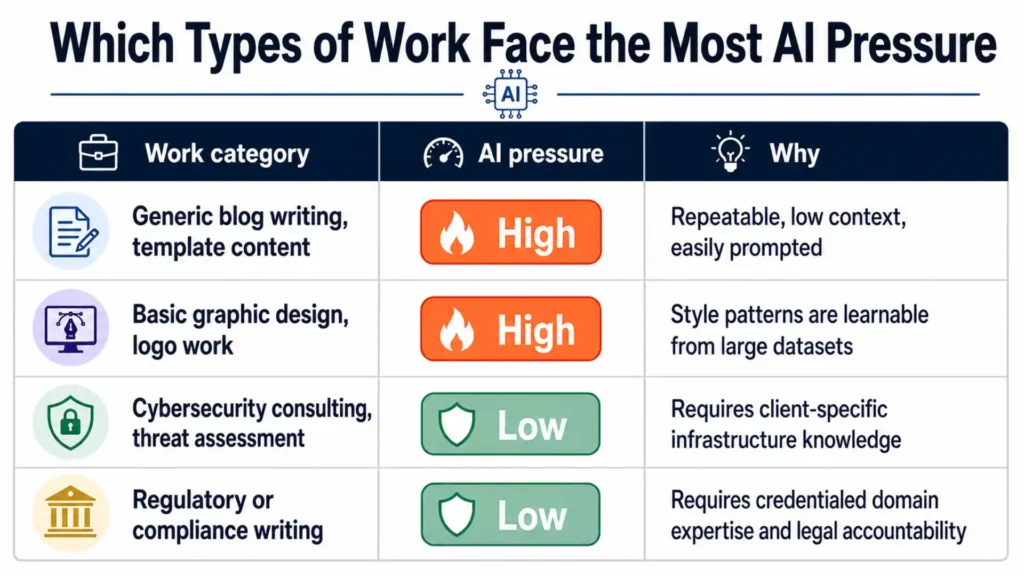
Deep specialization in a narrow industry, skill, or client type consistently emerges as the strongest identifiable moat against AI displacement across the research examined for this analysis. Generalist freelancers face the most competitive pressure specifically because general, broadly-applicable tasks are the easiest category for AI models to automate convincingly — there is no specific institutional knowledge, regulatory nuance or client-relationship history for a generic prompt to fail to replicate. A freelancer who has spent years building specific expertise in, for example, healthcare compliance content, financial services regulatory writing, or a particular software ecosystem’s technical documentation occupies a position that a well-prompted general-purpose AI model genuinely cannot substitute for, regardless of how capable the underlying model becomes at general writing or coding tasks.
Building direct client relationships, independent of any single freelance platform, represents the second consistently cited strategy. Platform dependency has become a specifically named vulnerability in this new environment: freelancers whose entire client pipeline runs through a single marketplace are exposed not only to AI-driven demand reduction for commodity work, but also to unilateral algorithm changes on the platform itself, and increasingly to new AI-powered competitors entering the same marketplace with instant scalability that a human freelancer cannot match on price alone. Freelancers who have built referral networks, direct professional relationships, and their own content-driven audience report meaningfully more resilient income streams than those relying entirely on marketplace-driven client acquisition.
The shift from hourly to value-based pricing recurs across nearly every source examined on this topic as a direct, practical response to AI-driven efficiency gains. If a freelancer using AI tools can complete work in a fraction of the time it previously required, continuing to bill purely by the hour effectively penalizes the freelancer for their own efficiency improvement — a client paying for two and a half hours of work instead of six captures the entire benefit of the freelancer’s AI adoption, while the freelancer’s income actually declines relative to what they earned before adopting the same tools. Value-based or project-based pricing, calculated around the outcome delivered rather than the hours logged, allows the freelancer to retain a meaningful share of the efficiency gain their own AI adoption created, which is precisely the mechanism behind the 40 to 60% income increase reported by early-adopting freelancers cited earlier.
Trust and long-term relationship quality remain, somewhat counterintuitively given how technical this discussion has become, the single strongest differentiator identified across the research. As AI-generated content becomes increasingly common and increasingly difficult for casual observers to distinguish from human work, clients report placing a growing premium specifically on freelancers who communicate honestly about how they use AI in their workflow, who demonstrate the judgment to know when a task genuinely requires human oversight rather than pure automation, and who have built a track record of reliability that a first-time interaction with an unfamiliar freelancer, however well-credentialed, cannot immediately replicate.
AI-powered freelance platforms and the algorithm dependency risk
The major freelance marketplaces that host much of the work funding the nomad lifestyle have themselves undergone a significant AI-driven transformation, and this transformation carries implications that go beyond simple competition from AI-generated content, extending into how the platforms themselves now function as intermediaries.
Platforms including Upwork, Fiverr and Toptal have integrated AI extensively into core marketplace functions: client-freelancer matching, proposal optimization, dynamic pricing recommendations, fraud detection and automated skill verification. Industry analysis credits AI-powered matching algorithms with improving freelancer-client compatibility by roughly 37% while cutting average time-to-hire from around 14 days to approximately 3.2 days — a genuine efficiency improvement in the mechanics of finding and securing freelance work, benefiting freelancers and clients alike in terms of reduced friction.
This efficiency, however, comes with a structural tradeoff that deserves clear examination rather than uncritical praise. Algorithm-driven matching and ranking systems determine, often opaquely from the freelancer’s perspective, which profiles get surfaced to which clients, which proposals receive priority visibility, and ultimately which freelancers succeed on the platform regardless of underlying skill quality. Freelancers with limited platform history or unconventional but genuinely strong portfolios can find themselves systematically deprioritized by ranking systems optimized for signals like platform tenure, review volume and response speed rather than actual work quality, a concern that has led to renewed interest in human-first, minimally algorithmic platforms as an explicit alternative positioning.
Data privacy concerns compound this structural issue. AI-powered freelance platforms collect extensive behavioral data — work patterns, productivity metrics, communication styles, financial behavior and even inferred career trajectory — in order to power their matching and ranking systems. Privacy advocacy organizations have specifically flagged concerns freelancers should weigh regarding this practice: whether platforms train their own AI models on freelancer-submitted work and communications without explicit separate consent, the extent of behavioral tracking used for algorithmic optimization, whether and how this data is shared with third parties, the general lack of transparency in how ranking algorithms actually weight different signals, and limited practical rights to have collected data deleted even where a legal right theoretically exists.
Regulatory response to these concerns has begun but remains uneven and geographically inconsistent. The European Union’s AI Act, in force as of 2026, requires a degree of transparency and human appeal processes for AI systems that materially affect livelihoods, a category that plausibly includes freelance-platform ranking algorithms determining which freelancers receive work opportunities. However, many of the largest freelance platforms operate across, or are headquartered in, jurisdictions without comparably strong protections, meaning the practical benefit of EU-level regulation for a freelancer physically located outside the EU, even if working with EU-based clients, remains genuinely unclear and largely untested as of 2026.
The practical response many freelancers have adopted is diversification rather than platform loyalty: maintaining a presence on one or two major algorithm-driven marketplaces for volume and discovery, while simultaneously building a separate, direct client pipeline through referrals, professional networking and independent content marketing that does not depend on any single platform’s ranking algorithm remaining favorable. This mirrors, in the freelance-platform context specifically, the broader diversification strategy that appears repeatedly throughout this analysis — layered redundancy rather than dependence on any single tool, system or provider, whether the topic is internet connectivity, banking, or client acquisition.
Data privacy and what AI tools collect from nomads
Beyond the freelance-platform-specific privacy concerns discussed above, digital nomads’ heavy reliance on AI tools across nearly every domain covered in this analysis — research, translation, financial tracking, scheduling, client communication — creates a broader data privacy exposure worth examining as its own distinct category rather than folding entirely into the freelance-platform discussion.
Nomads routinely feed AI tools an unusually concentrated stream of sensitive personal and business information: draft client contracts and proposals, financial statements and expense records, passport and visa application details discussed in the course of asking an AI tool for research help, health symptoms described to an AI chatbot before a medical appointment, and personal correspondence drafted with AI assistance. This concentration of sensitive data flowing through a comparatively small number of AI platforms represents a meaningfully different privacy risk profile than a stationary worker interacting with the same tools, simply because a nomad’s total reliance on cloud-based tools tends to be higher, given the impracticality of maintaining extensive local-only infrastructure while living out of a backpack or a rotating series of short-term rentals.
Most major AI providers publish data-handling policies addressing whether user conversations are used to train future models, how long data is retained, and what rights users have to review or delete their data, but the practical reality is that few users, nomads included, read these policies in detail before adopting a tool into their daily workflow, and policy terms differ meaningfully between providers and between free and paid tiers of the same provider’s product.
A reasonable baseline practice, consistent with general data-privacy guidance rather than anything nomad-specific, involves avoiding entering the most sensitive categories of information — passport numbers, full financial account details, unredacted legal documents — into general-purpose AI chat tools not specifically designed and contractually bound to handle such data securely, reserving those categories instead for dedicated, purpose-built tools (a proper password manager for credentials, a certified translation service for legal documents, a licensed accountant’s secure client portal for tax documents) that carry appropriate data-handling commitments and, in regulated contexts, legal liability if that commitment is breached.
Regulatory response: the EU AI Act and platform transparency rules
The European Union’s AI Act represents the most comprehensive regulatory response to date addressing the kinds of AI-driven platform and workplace concerns discussed throughout this analysis, and because a meaningful share of digital nomads either hold EU citizenship, work with EU-based clients, or are physically present within the EU on a digital nomad visa at any given time, its provisions have practical relevance for this population well beyond nomads who are themselves EU residents.
The Act’s transparency and human-appeal requirements for AI systems that materially affect a person’s livelihood or access to services represent a genuine, if still largely untested, protection relevant to the freelance-platform ranking concerns discussed above. In principle, a freelancer materially affected by an AI-driven platform decision — being deprioritized in search rankings, having a proposal automatically filtered, having account access restricted by an automated fraud-detection system — should be entitled to some form of explanation and human review under the Act’s provisions, where the platform or the underlying AI system falls within its jurisdictional scope.
The practical limitation, as with much of this analysis’s discussion of regulatory frameworks, is jurisdictional reach and enforcement maturity rather than the substance of the rule itself. A nomad who is an EU citizen but physically located outside the EU, working with a non-EU client through a non-EU-headquartered platform, sits in a genuinely ambiguous position regarding whether AI Act protections meaningfully apply to their situation, and as of 2026 there is limited case law or regulatory guidance specifically addressing this kind of cross-border, multi-jurisdictional scenario that the digital nomad lifestyle almost definitionally creates.
Other jurisdictions have moved more slowly or have adopted narrower sector-specific rules rather than the EU’s comprehensive framework, meaning the level of practical protection a nomad can expect regarding AI-driven decisions affecting their income or data varies substantially depending on which country’s law, if any, is judged to apply to a given dispute — itself often an unresolved question given the fragmented legal picture already discussed at length in the context of tax and immigration status earlier in this analysis. The regulatory patchwork surrounding AI’s role in the freelance and gig economy is, in this respect, simply another instance of the broader pattern this entire analysis keeps returning to: infrastructure and technology have moved faster than the legal frameworks meant to govern them, leaving individual nomads to manage the resulting gaps largely on their own.
Practical guidance for nomads building an AI-supported workflow
Drawing together the specific findings across every domain covered in this analysis, a coherent practical framework emerges for how digital nomads can integrate AI usefully into their workflow while avoiding the specific failure patterns documented above — a framework grounded in where AI has demonstrated genuine reliability versus where it has demonstrated genuine risk, rather than a generic enthusiasm for “using AI more.”
For research and travel logistics, use AI tools as a fast first-pass research assistant for comparing destinations, understanding general visa requirement categories, and identifying pricing trends, but verify anything time-sensitive or legally consequential — exact income thresholds, processing timelines, current fees — against the relevant government’s official page before relying on it for a decision with real financial or legal consequences.
For everyday translation and communication, AI tools are reliable and genuinely time-saving; use them freely for ordering food, understanding informal correspondence, and general comprehension of documents that carry no direct legal weight. For any document submitted to an immigration office, tax authority or court — visa applications, income documentation, contracts with legal force — budget for certified human translation as a fixed cost, not an optional upgrade, regardless of how confident an AI translation appears.
For scheduling and administrative overhead, AI-enhanced tools genuinely reduce decision fatigue during the highest-friction periods of relocation, and adopting them for calendar management, first-draft correspondence and task organization is close to unambiguously beneficial with minimal downside, provided client-facing communication still receives a human review pass before sending.
For financial tracking, AI-powered categorization and organization tools meaningfully reduce the administrative burden of multi-currency, multi-jurisdiction finances, but they should feed into, rather than replace, a relationship with a qualified accountant or tax professional who understands the specific tax treaty and residency questions relevant to a nomad’s actual situation.
For income and career positioning, the freelance-market data examined in this analysis points toward a clear strategic direction: invest in genuine domain specialization that AI cannot easily replicate, shift toward value-based rather than purely hourly pricing to retain the benefit of AI-driven efficiency gains, and build client relationships that do not depend entirely on a single algorithm-driven marketplace remaining favorable indefinitely.
For mental health and burnout risk, treat AI companionship or wellness chatbots as, at most, a minor supplementary tool rather than a substitute for professional therapy or genuine human connection, and take persistent symptoms — sustained exhaustion, prolonged loneliness, disrupted sleep that does not resolve with routine adjustment — as a signal to seek licensed telehealth support rather than to seek a technological workaround.
For legal, tax and immigration questions, use AI to understand the general shape and vocabulary of a problem, then engage a qualified professional — immigration lawyer, tax accountant, or both — before making any decision with real financial or legal stakes, given how consistently this analysis has found that the fragmented, jurisdiction-specific nature of these questions exceeds what a general-purpose AI model can reliably resolve.
None of this guidance is exotic or counterintuitive once stated plainly, but the consistent theme across every domain examined in this analysis is that AI’s genuine value lies overwhelmingly in reducing friction on well-defined, information-retrieval and organizational tasks, while its risk concentrates specifically in domains requiring jurisdiction-specific legal judgment, certified documentation, or genuine human connection — and nomads who internalize that distinction consistently report better outcomes than those who apply AI uniformly across every category of challenge without discriminating between them.
Sectors most affected by the combined pressure of mobility and AI
Stepping back from individual tools and strategies, it is worth examining which specific professional sectors within the broader nomad population face the most acute combined pressure from the freelance-market disruption and mobility-related challenges documented throughout this analysis, since the impact is far from uniform across the population.
Content writing and copywriting sit at the epicenter of both pressures simultaneously. This sector has absorbed the deepest measurable contraction in freelance job postings following the mainstream adoption of generative AI, while also being one of the most historically accessible entry points into nomad-supporting income for newcomers without specialized technical skills — meaning the population most affected by this contraction is disproportionately made up of people earlier in their nomad journey, with less accumulated savings buffer and less established specialized reputation to fall back on.
Software development, while also affected by AI-driven demand contraction at the entry level, shows a somewhat different pattern: demand for engineers who can effectively integrate large language models into consumer products, or who use AI-assisted coding tools to multiply their own output, has grown even as demand for straightforward, undifferentiated coding tasks has contracted. This sector illustrates the floor-collapsing-while-ceiling-rises pattern described earlier with particular clarity, since the skill of “using AI well” is itself becoming a distinct, monetizable specialization within software development rather than merely a productivity add-on.
Translation work, ironically given AI’s own translation capabilities, has seen measurable contraction in freelance job postings — down 19% by one measure — even as the certified, legally-consequential translation work discussed extensively in this analysis remains firmly outside AI’s practical reach and continues to command steady demand. This bifurcation within a single professional category — commodity translation contracting sharply while certified, legally-binding translation remains essentially untouched — mirrors the broader pattern across the freelance economy and suggests that professional translators positioning themselves specifically around certified and legally consequential work face meaningfully better prospects than those competing purely on general translation speed and price.
SEO and digital marketing specialists, by contrast, appear to be benefiting from a distinct dynamic: as AI reshapes how search engines and AI answer-engines surface information, demand for specialists who understand this shifting environment has grown rather than contracted, since businesses increasingly need human strategic judgment to work through an SEO environment that AI itself has made more complex rather than simpler, even though AI tools are simultaneously used heavily within the SEO workflow itself.
Consulting, strategy and fractional executive roles occupy the most consistently AI-resistant end of the spectrum examined in this analysis, precisely because this category of work depends most heavily on exactly the qualities — accumulated judgment, specific institutional relationships, accountability for outcomes rather than deliverables — that recur throughout this analysis as the characteristics AI struggles to replicate regardless of how capable the underlying models become at generating fluent, plausible-sounding text or code.
The next two years for nomads and AI
Synthesizing the trends documented across legal, financial, technological and economic domains throughout this analysis, several developments appear reasonably likely to continue or intensify over the next two years, while others remain genuinely uncertain and depend on decisions — regulatory, corporate, individual — that have not yet been made.
The visa picture will likely continue expanding in raw country count while remaining fragmented in substance. More countries will almost certainly launch digital nomad visa programs, continuing the trend of new entrants joining the list nearly every quarter, but the underlying inconsistency in income thresholds, tax treatment, processing times and documentation requirements shows no clear sign of converging toward a common standard, given that the IBA’s Global Employment Institute itself has signaled its own research into this fragmentation is only in its early stages, with further findings on employer responsibilities and social security coordination still to come.
Tax and social security coordination will likely become the more actively contested regulatory frontier, superseding pure immigration policy as the primary source of legal complexity for this population, precisely because immigration frameworks have received the most policy attention to date while tax treaty coverage and social security coordination between countries remain comparatively under-addressed relative to the scale of the population now affected by these gaps.
The freelance market’s bifurcation between collapsing commodity work and rising specialized, AI-augmented work will almost certainly continue rather than reverse, based on every economic indicator examined in this analysis. This means the entry-level pathway into nomad-supporting income will likely remain narrower than it was five years ago, while the ceiling for specialized, AI-fluent professionals continues to rise — a divergence with real implications for who can realistically enter this lifestyle going forward, favoring established professionals transitioning from traditional employment over newcomers attempting to build freelance income from scratch.
Connectivity infrastructure will likely continue improving incrementally through eSIM and satellite technology expansion, without fully closing the reliability gap that currently affects a majority of the nomad population according to the most recent survey data cited in this analysis, since the underlying gap is driven by regional infrastructure investment patterns that shift on timescales measured in years rather than months, regardless of how quickly individual technologies like satellite terminals improve.
Mental health and burnout support infrastructure appears positioned for continued, meaningful improvement, given the growing normalization of remote and international telehealth combined with reducing stigma around openly discussing burnout and loneliness within nomad community spaces — one of the more genuinely encouraging trend lines identified across this analysis, standing in contrast to the more static or worsening picture in several of the structural and regulatory domains examined.
The AI regulatory picture governing freelance platforms and gig-economy algorithms will likely remain uneven across jurisdictions for the foreseeable future, with the EU’s AI Act representing the leading edge of a regulatory response that most other major jurisdictions have not yet matched in scope, leaving individual nomads and freelancers to manage algorithm-driven platform decisions with meaningfully different levels of legal protection depending on jurisdiction — another instance of the broader pattern, recurring throughout this entire analysis, in which the infrastructure supporting a global, mobile, technologically-enabled workforce continues to outpace the legal and regulatory systems built to govern it.
The honest summary, drawing together every thread examined in this analysis, is that neither the challenges nor the solutions facing digital nomads in 2026 are primarily technological. AI has genuinely improved specific, well-defined categories of friction — translation for everyday communication, research efficiency, scheduling across time zones, financial organization — while leaving the deeper structural challenges largely untouched: fragmented international tax and immigration law, housing pressure in popular destinations, the psychological cost of sustained mobility, and a freelance labor market bifurcating in ways that reward specialization and penalize commoditized work. Nomads who understand this distinction clearly, and who deploy AI specifically where it demonstrably works while relying on professional human judgment where it does not, are the ones best positioned to manage a lifestyle that remains, for all its genuine appeal, considerably more operationally demanding than its marketing suggests.
Employer-sponsored relocation versus independent nomad status
Much of this analysis has treated “digital nomad” as roughly synonymous with freelance or self-employed status, but a growing share of the population — reflected in the Nordic and European relocation trend discussed earlier — consists of salaried employees whose companies have formally sanctioned their remote international work, sometimes through structured “workation” or extended-remote-work policies rather than a formal digital nomad visa. Comparing this employer-sponsored path against fully independent nomad status clarifies which of the challenges examined throughout this analysis are genuinely universal and which are specific to the self-employed segment of the population.
Employer-sponsored nomads typically face a meaningfully reduced version of the tax and legal complexity described earlier, simply because a company with in-house legal and HR resources, or access to specialized services like Deel’s visa and immigration support, can absorb much of the administrative burden that an independent freelancer has to handle alone. Some employers now offer structured programs granting employees a fixed number of “work from anywhere” weeks annually, explicitly designed and legally reviewed to stay under tax-residency thresholds in the destination country, removing the guesswork around the 183-day trap discussed earlier from the individual employee’s plate entirely.
This structural advantage comes at the direct cost of the flexibility the nomad lifestyle is generally understood to offer, and the time zone pressure described earlier disproportionately affects exactly this population — employees who remain formally tied to a company’s operating hours and reporting structure regardless of physical location. An independent freelancer choosing their own clients and hours faces the tax and legal fragmentation problem in its full, unmitigated form, but retains genuine schedule autonomy; an employer-sponsored nomad trades away much of that autonomy in exchange for institutional support navigating the legal complexity.
A middle category worth naming explicitly consists of nomads who maintain a formal employment relationship while negotiating explicitly for schedule flexibility as a condition of remote work approval — a negotiating position that has become more common as companies compete for talent willing to accept a fully distributed arrangement, but one that requires the employee to have enough leverage, typically through specialized or senior-level skills, to negotiate successfully rather than simply accept whatever remote-work policy a company offers as a standard, non-negotiable package.
The practical upshot for anyone weighing which path to pursue is that the employer-sponsored route substantially reduces exposure to the legal and tax fragmentation examined at length in this analysis, at the direct cost of the flexibility that the fully independent path preserves — a genuine tradeoff rather than a straightforwardly superior option in either direction, and one that depends heavily on individual risk tolerance, existing career stage, and whether the appeal of the nomad lifestyle for a given person centers more on genuine schedule freedom or simply on the ability to live and work from a location of their choosing while retaining employment stability.
Family nomads and the added layer of children’s education and logistics
Most of the challenges examined throughout this analysis assume, implicitly, a single adult or a couple without dependents — a reasonable simplification given that this describes the majority of the current nomad population, but an incomplete picture given the growing “semi-nomad” family segment noted earlier, in which couples and families make larger, less frequent moves every one to two years rather than relocating every few weeks or months.
Most digital nomad visa programs explicitly accommodate family members, typically allowing a spouse and dependent children to be included in the primary applicant’s application, but this accommodation addresses immigration status only, leaving a distinct set of family-specific logistical challenges largely unaddressed by the visa itself. Children’s education represents the most consequential of these: families choose between international schools, which offer curriculum continuity but at a cost that can rival or exceed housing as the largest single line item in a family nomad budget; homeschooling or world-schooling approaches, which offer maximum flexibility but require significant parental time investment that competes directly with the working parent’s or parents’ income-generating hours; and, for families making the less-frequent moves described above, enrollment in local schools, which offers the deepest cultural immersion but requires language capability and administrative navigation that can be substantial depending on the destination.
Healthcare complexity, already significant for individual nomads as discussed earlier, compounds meaningfully for families, particularly around pediatric care, vaccination schedule continuity across different national immunization programs, and the practical challenge of establishing a relationship with a trusted local pediatrician for a family that may only be in a given location for a matter of months. Family-specific nomad insurance products have begun to emerge specifically to address this gap, but coverage and network quality for pediatric and family care varies more widely between providers than the individual nomad insurance market discussed earlier, since family healthcare needs are inherently more varied and harder to standardize into a single policy structure.
Social and developmental considerations for children add a dimension entirely absent from the individual-nomad analysis conducted throughout most of this piece. Where an adult nomad’s loneliness and relationship-transience challenges, discussed at length earlier, represent a genuine but self-selected tradeoff for an adult choosing this lifestyle, a child moving between schools, friend groups and cultural contexts every year or two faces developmental questions that child psychologists specializing in this population describe as requiring active, deliberate parental attention rather than being assumed to resolve naturally through childhood’s general adaptability. Family nomad communities and dedicated co-living programs designed specifically for this segment have grown in response, offering structured peer groups for children alongside the coworking infrastructure built primarily around adult professional needs.
AI’s role for family nomads mirrors its role for individual nomads in most respects — useful for research, scheduling and translation — with one additional application worth noting: AI-powered educational tools and adaptive learning platforms have become a meaningful component of the homeschooling and world-schooling approaches some family nomads adopt, offering personalized curriculum pacing that can partially offset the reduced structure of a traditional school environment. This application carries the same general caution applied throughout this analysis regarding AI as a supplement rather than a substitute for human judgment — in this specific context, a parent’s active engagement and, where possible, a curriculum reviewed against home-country or target-country educational standards, rather than full delegation of a child’s education to an AI-driven platform operating without that oversight.
Retirement, pensions and long-term financial planning gaps
Long-term financial planning represents one of the most underexamined dimensions of the digital nomad lifestyle in mainstream coverage of the phenomenon, despite carrying consequences that compound over a much longer timeframe than the visa, tax and connectivity challenges that dominate most nomad-focused guidance, including much of this analysis to this point.
Pension and retirement contribution continuity is a genuine structural gap for many nomads, particularly those who have transitioned from traditional employment, where pension contributions were typically automatic, into independent freelance status, where no equivalent automatic mechanism exists. A nomad who spent a decade in salaried employment before transitioning to freelance nomad life may have built a meaningful pension foundation during that period, but freelance income earned while nomadic frequently goes entirely without any retirement contribution mechanism unless the individual specifically and consistently sets one up — a task that competes for attention with the more immediate, visible challenges of visas, banking and connectivity examined throughout this analysis, and that consequently receives less attention than its long-term importance would justify.
Social security contribution continuity presents a related but distinct problem, particularly for nomads who move between countries with different social security systems and inconsistent bilateral coordination agreements. Some countries maintain totalization agreements that allow contribution periods in one country to count toward eligibility in another; many do not, meaning a nomad who spends years working across multiple countries without a totalization agreement between them may end up with fragmented, non-portable contribution records that fail to meet the minimum threshold for a pension or social security benefit in any single country, despite having worked and paid into systems consistently throughout their career.
The tax-advantaged retirement account structures that stationary workers in most developed countries rely on — employer-sponsored plans, tax-deferred individual retirement accounts — frequently have residency or physical-presence requirements that a highly mobile nomad may struggle to satisfy consistently. A US citizen nomad, for example, generally retains eligibility for standard US retirement accounts regardless of physical location, but the specific rules governing contribution limits, required minimum distributions and account access can interact with foreign residency status in ways that require the same kind of qualified professional guidance recommended throughout this analysis for tax and immigration questions, rather than general assumptions carried over from a purely domestic financial planning framework.
Financial planners who specialize in this population consistently recommend treating long-term retirement and social security planning as a deliberate, scheduled task — reviewed at minimum annually — rather than allowing it to be perpetually deferred in favor of the more immediately pressing logistics that dominate day-to-day nomad life. The practical risk of deferral is not immediate or visible in the way a rejected visa application or a frozen bank account is; it accumulates quietly over years and becomes visible only when a nomad approaches an age where retirement income actually matters, at which point the options for correcting years of gaps are considerably more limited and expensive than addressing the issue proactively would have been.
AI tools offer a genuinely useful, low-stakes application here: general education about how different countries’ pension and retirement systems work, and basic projection modeling of how different saving and contribution strategies might play out over time. As with every other financial and legal application examined in this analysis, this educational use should feed into, rather than substitute for, an actual financial plan built with a qualified financial advisor who understands the cross-border complexity specific to a nomad’s situation — a caveat that by this point in the analysis should be a familiar and expected refrain rather than a surprising conclusion.
Open questions the evidence cannot yet settle
Having examined the digital nomad lifestyle’s challenges and AI’s role in addressing them across legal, financial, technological, psychological and economic dimensions, several genuinely open questions remain, where the available evidence does not yet support a confident conclusion in either direction, and where honest analysis requires acknowledging uncertainty rather than forcing a definitive answer the data does not actually support.
Whether the freelance market’s current bifurcation between collapsing commodity work and rising specialized work represents a stable long-term equilibrium, or merely an intermediate stage before AI capabilities advance further into currently AI-resistant specialized domains, remains genuinely unresolved. The consulting, strategy and deep-domain-expertise roles identified throughout this analysis as currently AI-resistant are assessed as such based on the current generation of AI capability; whether that assessment holds as AI models continue to improve is a question this analysis cannot answer with confidence, given how rapidly the underlying technology has changed even over the multi-year window covered by the freelance-market data examined here.
Whether the housing-pressure and gentrification dynamics documented in established nomad hubs will meaningfully improve in newer destinations that claim to have learned from that experience, or whether the same cycle will simply repeat on a delay, cannot yet be determined, given how recently many of the second-wave destinations — Kenya’s Class N permit, Slovenia’s upcoming program, various African and Gulf hubs — have launched relative to the multi-year timelines over which housing-market effects typically become visible and politically significant.
Whether tax and social security coordination between countries will meaningfully improve to close the fragmentation gap examined at length in this analysis, or whether the population of affected nomads will simply continue growing faster than international coordination mechanisms can adapt, depends on political and diplomatic processes this analysis has no basis for confidently predicting. The IBA Global Employment Institute’s own research program, still in its early stages with further reports planned specifically on this topic, suggests the organizations closest to this issue do not yet have a confident answer either.
Whether AI companionship and wellness applications will develop genuinely effective mechanisms for supporting nomad mental health, or whether the fundamental limitation — the absence of authentic reciprocity that current research identifies as the actual protective factor against loneliness — represents a structural ceiling that no amount of technical improvement in conversational AI can overcome, is a question actively debated among researchers studying both AI capability and human psychological wellbeing, without a settled answer as of 2026.
Whether the regulatory patchwork governing AI’s role in freelance platforms and gig-economy decision-making will converge toward something resembling the EU’s comprehensive approach, or whether jurisdictional fragmentation will persist indefinitely as different regions adopt fundamentally different regulatory philosophies, remains one of the more consequential open questions for the freelancers whose income depends on platforms operating, in practice, across dozens of legal jurisdictions simultaneously.
What can be said with confidence, drawing together the entirety of this analysis, is that the digital nomad lifestyle in 2026 sits at a genuinely unresolved intersection of technological capability that has advanced rapidly and legal, financial and social infrastructure that has not kept pace. AI has meaningfully improved specific, well-defined categories of friction within that lifestyle while leaving its deepest structural challenges largely untouched, and the population living this lifestyle — now numbering in the tens of millions and continuing to grow — is, in a very real sense, collectively generating the evidence that will eventually determine how these open questions resolve, simply by continuing to work through them in real time, one relocation, one tax filing and one client contract at a time.
Insurance products and the coverage gaps still unaddressed
Returning to healthcare with a sharper focus than the earlier overview allows, it is worth examining specifically what dedicated nomad insurance products do and do not cover, since the market has grown crowded enough by 2026 that meaningful differences between providers can get lost in near-identical marketing language promising “global coverage” and “peace of mind.”
Rolling monthly coverage, the defining feature of products built specifically for this population, genuinely solves the activation and cancellation flexibility problem that made standard travel or expatriate insurance a poor fit for people who move every few months. A nomad can activate coverage before a relocation and cancel or pause it during a period spent at a family home where local insurance or a home country’s national healthcare system already applies, avoiding the sunk cost of paying for overlapping coverage — a genuine improvement over the annual-policy structure that dominated the market before nomad-specific products existed.
What these products still handle inconsistently is coverage for pre-existing conditions, mental health treatment beyond a limited number of covered sessions, and dental or vision care, categories that many providers either exclude entirely or cover only after a waiting period that can span months, creating a coverage gap precisely during the early period of a policy when a new condition might first be diagnosed. A nomad managing a chronic condition prior to adopting the lifestyle frequently discovers that the exclusion for pre-existing conditions in a typical nomad insurance policy is broader and more strictly enforced than equivalent exclusions in employer-sponsored health insurance back home, where group coverage rules in many countries limit how aggressively insurers can exclude pre-existing conditions in ways that individual nomad policies are not similarly constrained by.
Emergency evacuation coverage — transport to an adequate medical facility, potentially involving international medical repatriation, in the event of a serious accident or illness in a location without adequate local care — represents another area of meaningful variation between providers that deserves more attention than it typically receives during the policy-shopping process, since this specific benefit only becomes relevant in a genuine emergency, precisely when comparing policy fine print is least practical. Nomads choosing a policy based primarily on monthly premium cost, without specifically checking evacuation coverage limits and the list of excluded destinations or activities, risk discovering a critical gap only when facing the exact emergency the coverage was meant to address.
The coverage variation between providers is compounded by a genuinely under-addressed problem: claims processing when a policyholder has no fixed address and may have already relocated to a different country by the time a claim from an earlier location is processed. Insurers built around a conventional model, where a policyholder’s address remains stable throughout the claims process, sometimes handle this poorly, with claim correspondence sent to an address the policyholder no longer occupies, or claims requiring documentation from a local provider in a country the policyholder has since left. Providers built specifically for the nomad market have generally adapted their processes to accommodate this reality better than general international insurers that added nomad-friendly marketing without redesigning the underlying claims infrastructure, but the difference in practical claims experience between providers is difficult to assess in advance, since it rarely surfaces in marketing materials and typically becomes apparent only when a policyholder actually needs to file a claim.
The practical recommendation that emerges from examining this market closely is to treat the specific exclusions, waiting periods and evacuation coverage limits in a policy’s actual terms as more informative than the marketing summary or the monthly premium price, and to specifically verify how a provider’s claims process functions for policyholders without a fixed address before relying on a policy in an actual emergency rather than discovering the gap only when a claim is already in progress. This is an area where independent insurance comparison research, whether AI-assisted or conducted manually, adds genuine value precisely because the differences between providers are substantive and are not reliably conveyed by comparing premium prices or marketing claims alone.
Community platforms, moderation and the wellbeing infrastructure around nomadism
One structural element that has quietly shaped much of the loneliness and burnout picture examined earlier deserves closer attention on its own terms: the online communities, forums and social platforms that nomads rely on for both practical information and social connection, and the specific role played by the people who run them.
The 2025 study on loneliness among digital nomads cited earlier found that the wellbeing of the wider nomad community depends significantly on community managers and content creators who moderate the online spaces this population relies on, a finding that positions these largely unpaid or informally compensated moderators as a meaningful piece of the mental health infrastructure supporting this population, whether or not they think of their role in those terms. A Facebook group, a Discord server or a blog’s comment section functioning as a de facto support network for a scattered, mobile population is qualitatively different from a similar community serving a stationary population, precisely because members joining and leaving as they relocate creates constant turnover that a stationary community’s moderators do not have to manage to nearly the same degree.
This has practical implications for how nomads should evaluate which communities to invest time in. A community with active, engaged moderation — visible efforts to welcome newcomers, address conflict, and specifically watch for members showing signs of isolation or distress — functions meaningfully differently from a large but passively moderated group where posts scroll past without response. Given how much of the loneliness mitigation strategy for this population depends on relationship depth rather than sheer social contact volume, as discussed at length earlier, the quality of community moderation is not a minor detail; it is close to a direct proxy for whether a given online community will actually help address isolation or will simply add another shallow, high-volume social channel to an already saturated one.
AI has begun to play a role in community moderation itself, with some larger nomad-focused platforms using AI-assisted moderation tools to flag concerning posts, surface members who may be at risk, or automatically connect new members with others in a similar location or situation. This represents a genuinely interesting extension of AI’s role beyond the individual-productivity applications examined throughout most of this analysis, into a more explicitly social-infrastructure function — though the same caution about AI as a supplement rather than a substitute for human judgment applies here as everywhere else in this analysis, since a moderation system flagging a concerning pattern still requires a human moderator, or in more serious cases a mental health professional, to actually respond appropriately rather than simply routing the flagged case to another automated system.
The broader point worth taking from this specific dimension of the nomad ecosystem is that the psychological infrastructure supporting this population is not solely a matter of individual coping strategies or professional therapy access, both discussed earlier, but also depends on the health of the informal community layer that sits between those two poles — a layer that has received comparatively little research or policy attention relative to its apparent importance in the loneliness and burnout dynamics this analysis has examined at length.
Common questions about digital nomad challenges and AI’s role
Working on a tourist visa is technically illegal in most countries, since tourist visas explicitly prohibit any form of work, including remote work for a foreign employer. Enforcement varies widely, but dedicated digital nomad visas, now offered by more than 60 countries, provide a legally defensible alternative that removes this risk entirely.
The 183-day rule refers to a common threshold in many countries’ tax codes where spending more than half the year in a country can trigger tax residency. It is a useful warning sign but not a complete rule, since many countries apply additional tests like center of vital interests or habitual abode that can trigger residency even below 183 days.
Yes. Dual tax residency happens when two countries’ rules both classify the same person as resident simultaneously, usually due to differing tests for physical presence, permanent home or vital interests. Tax treaties between the two countries, where they exist, typically include tiebreaker rules to resolve this, but not every country pair has such a treaty.
Most immigration and tax authorities require certified or sworn human translation for legally significant documents, regardless of how accurate an AI translation appears. This is a formal certification requirement, not solely a matter of translation quality, and AI translations of financial or legal terminology can also introduce subtle errors that misalign an application with strict legal thresholds.
The classic risk of unencrypted data interception has diminished significantly since HTTPS became standard across most of the web. Real risks that remain include evil twin fake hotspots, malicious captive portals, and metadata leaks before a VPN engages. A VPN combined with basic precautions meaningfully reduces, though does not eliminate, these risks.
A VPN encrypts internet traffic and masks a device’s IP address, which protects against data interception on untrusted networks. It does not protect against phishing, social engineering, or malware from untrusted downloads, since those threats exploit user behavior rather than the network connection itself.
Multiple studies place lifetime burnout prevalence among digital nomads at 77% or higher, with entrepreneurs specifically reporting rates around 80%. This is higher than burnout rates typically reported among traditional office workers, contradicting the assumption that lifestyle flexibility alone prevents burnout.
Research on this population points to relationship depth, not social contact volume, as the actual protective factor against loneliness. Nomad relationships are frequently numerous but shallow due to their transient nature, producing a documented pattern some researchers describe as emotional malnutrition.
Current loneliness research emphasizes that genuine reciprocity in human relationships is what protects mental health, a quality AI companionship tools cannot authentically replicate. These tools may offer superficial comfort but are not considered an adequate substitute for professional support or genuine human connection.
The effect is highly uneven. Freelance writing job postings dropped roughly 30% within eight months of ChatGPT’s launch, with similar declines in translation and customer support work. At the same time, freelancers who adapted early by integrating AI into specialized workflows report earning 40% to 60% more per hour than before AI tools were available.
Repeatable, template-driven tasks requiring minimal specific context face the highest risk, including basic blog writing, simple graphic design, generic social media content and standard data entry. Entry-level project availability on major freelance platforms has fallen sharply as a result.
Work requiring deep domain expertise, regulatory knowledge, or client-specific institutional relationships remains largely AI-resistant, since these characteristics depend on accumulated human judgment that a generic prompt cannot substitute for. Consulting, specialized technical work and fractional executive roles are frequently cited examples.
Value-based or project-based pricing has become increasingly recommended as AI tools reduce the time required to complete deliverables. Continuing to bill purely by the hour effectively transfers the entire benefit of a freelancer’s AI-driven efficiency gains to the client rather than the freelancer.
AI translation tools like DeepL and ChatGPT are reliable for everyday communication, informal correspondence and general comprehension. They should not be relied on for any document submitted to an immigration office, tax authority or court, which typically requires certified human translation regardless of AI accuracy.
Most digital nomad visa programs allow a spouse and dependent children to be included in the primary applicant’s application. However, family-specific logistics like children’s education, healthcare continuity and social development are not addressed by the visa itself and require separate planning.
Nomads earning income in stronger currencies can afford rents that outpace what local residents earning local wages can sustain, particularly in concentrated nomad hubs. This dynamic has driven housing affordability pressure and gentrification concerns in several established destinations, prompting policy responses in some countries.
Coverage varies significantly between providers, particularly for pre-existing conditions, mental health treatment limits, and emergency evacuation terms. Choosing a policy based on premium price alone, without checking these specific terms, risks discovering a critical coverage gap only during an actual emergency.
Not by itself. AI tool usage among freelancers has become nearly universal, meaning it no longer functions as a competitive differentiator on its own. Income protection depends more on genuine specialization, direct client relationships, and value-based pricing than on AI adoption alone.
Use AI tools to understand the general shape of a legal or tax question, then engage a qualified immigration lawyer or tax accountant before making any decision with real financial or legal consequences. The fragmented, jurisdiction-specific nature of these questions consistently exceeds what general-purpose AI models can reliably resolve on their own.
Both, depending on segment. Entry-level income pathways have narrowed due to AI-driven contraction in commodity freelance work, while specialized, AI-fluent professionals report rising rates and income. The lifestyle has become more financially demanding to enter but potentially more rewarding for those who successfully specialize.
Author:
Jan Bielik
CEO & Founder of Webiano Digital & Marketing Agency

This article is an original analysis supported by the sources cited below
IBA publishes new report on the digital nomad phenomenon and its implications for multinational organisations The International Bar Association’s Global Employment Institute report on legal, tax and immigration challenges arising from cross-border remote work, based on a survey of immigration lawyers across 34 jurisdictions.
Where the Nomad Life Is Headed Next: 2026 Trends & Predictions An industry analysis of shifting digital nomad destination patterns, covering the growth of digital nomad visas and emerging hubs beyond traditional hotspots.
Digital Nomad Statistics 2026: 43M Remote Workers, Salaries, Visas & Global Trends A compiled statistical overview of the global digital nomad population, income ranges, visa growth and burnout data aggregated from multiple industry sources.
The Rise of the Digital Nomad Lifestyle in 2026 An overview of the factors driving digital nomad growth, including connectivity challenges and accommodation platform responses like nomad-verification badges.
AI Tools for Digital Nomads in 2026: Build a Smarter Remote Work Stack A practical guide to AI tools used by digital nomads across writing, translation, project management and financial tracking, with specific product comparisons.
Digital Nomad Visas for Remote Work: The Complete 2026 List A comprehensive breakdown of digital nomad visa requirements, income thresholds and application processes across dozens of countries.
Digital Nomad Visa 2026: Apply Online for 60+ Countries A visa services overview covering income requirements, processing times and tax treatment differences across major digital nomad visa programs.
Best Remote Jobs for Digital Nomads: Entry-Level to Tech Careers A localization industry perspective on the administrative and translation risks digital nomads face during visa and tax document submission.
The Best AI Tools Every Digital Nomad Should Be Using in 2025 and Beyond A guide to AI productivity tools commonly adopted by digital nomads for writing, scheduling and business management.
Burnout and Digital Nomads An analysis of burnout prevalence and specific contributing factors among digital nomads, including isolation and blurred work-life boundaries.
Digital Nomad Burnout & Mental Health: Signs, Science, Solutions A detailed breakdown of burnout statistics and five distinct mechanisms driving burnout specifically within the nomad population.
The Dark Side of Being a Digital Nomad: 2023 Study A survey-based study reporting burnout and loneliness prevalence rates among digital nomads compared to the general workforce.
The Mental Health of Digital Nomads: Balancing Freedom and Loneliness A mental health resource discussing loneliness management strategies and access to remote therapy for digital nomads.
“Alone on the road”: Loneliness among digital nomads and the use of social media to foster personal relationships A peer-reviewed academic study published in the World Leisure Journal examining loneliness among digital nomads and the role of online community moderation.
Digital Nomad Security in 2026: VPN Essentials for the Remote Worker An analysis of public Wi-Fi risks, home network vulnerabilities and VPN protections relevant to the digital nomad population.
Cybersecurity for Digital Nomads: Tips and Risks A regional breakdown of cybersecurity threats facing digital nomads, including country-specific risk variation and basic protective measures.
Best VPN for Digital Nomads in 2026 A comparative analysis of VPN services evaluated specifically for digital nomad use cases, including banking access and public Wi-Fi protection.
Is It Safe to Use a VPN on Public WiFi in 2026? A technical explainer on VPN protections and their limitations against modern public Wi-Fi threats including evil twin networks.
How to Use Public Wi-Fi Safely in 2026 An analysis distinguishing outdated public Wi-Fi risk narratives from genuine current threats like malicious captive portals and metadata leaks.
Essential Data Protection Tips for Digital Nomads Abroad A practical guide to device security, data protection and safe Wi-Fi practices for nomads working from multiple countries.
7 Ways You Can Keep Your Data Secure as a Digital Nomad A cybersecurity vendor’s guide covering password management, device security and public Wi-Fi risks specific to nomadic work.
AI cut freelance rates 30%: How top earners fight back in 2026 An analysis of AI’s measurable impact on freelance job postings and rates, based on Harvard, Imperial College and Bloomberry research, with strategies for freelancers adapting to the shift.
Best AI-Powered Freelance Platforms in 2026 A comparative guide to AI-driven freelance marketplace features, including matching algorithms, data privacy concerns and regulatory context under the EU AI Act.
AI Is Flooding Freelance Platforms: How Independent Workers Can Compete in 2026 An analysis of freelance platform download trends and strategic responses for independent workers facing AI-driven market disruption.
Freelancing with AI in 2026: Tools, Skills & Strategies A guide to freelancer AI adoption rates, the 10-80-10 workflow model, and the shift toward value-based pricing in response to AI efficiency gains.
7 High-Paying Remote Jobs That Can Fund a Digital Nomad Lifestyle in 2026 A Forbes overview of income strategies and remote career paths supporting the digital nomad lifestyle, including freelance writing and consulting income structures.
| Citing this article? Brief excerpts are welcome. Please credit Webiano.digital, name the author where stated, and include a link to https://webiano.digital and to this original article. Full or substantial republication requires prior written permission. Read our Copyright and Content Use Policy. |
This article was prepared with the assistance of artificial intelligence tools. The content underwent expert human review, and Webiano Digital & Marketing Agency assumes editorial responsibility for its final version and publication.