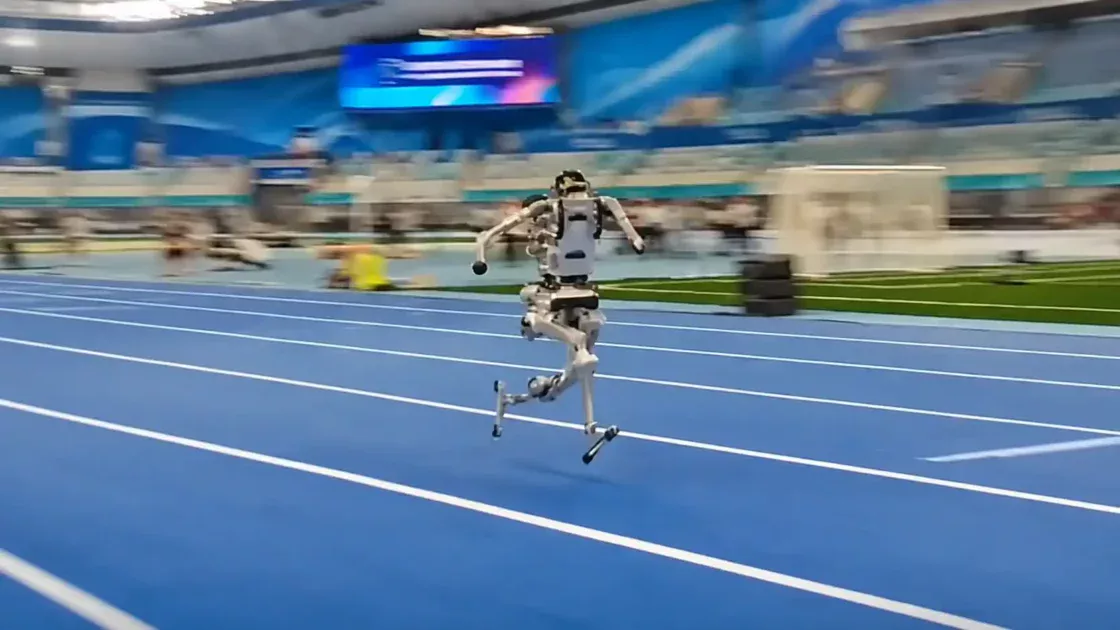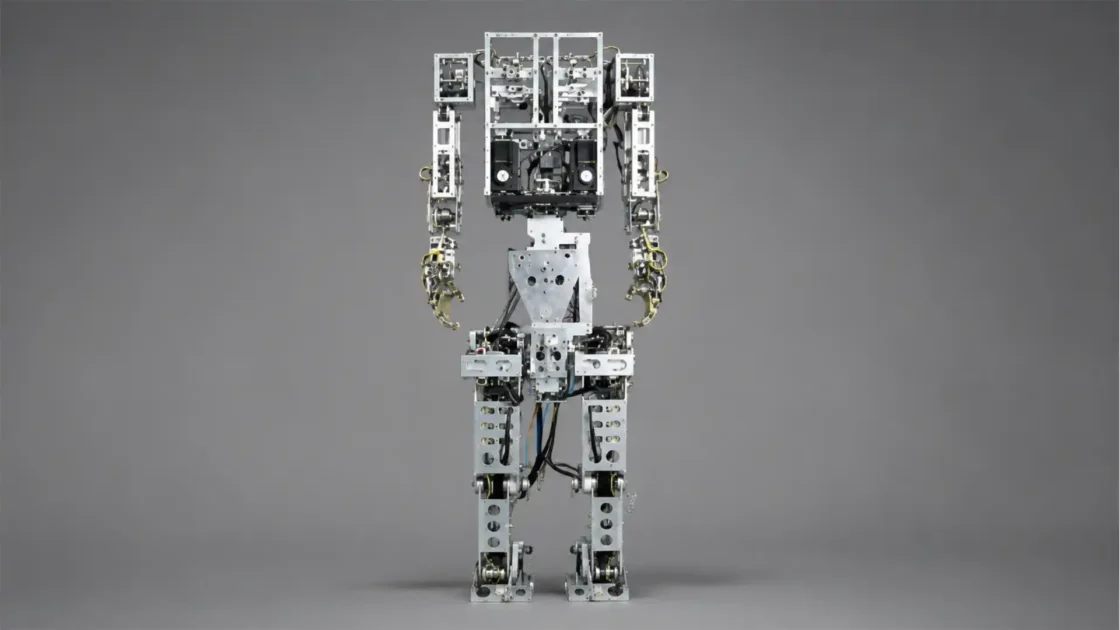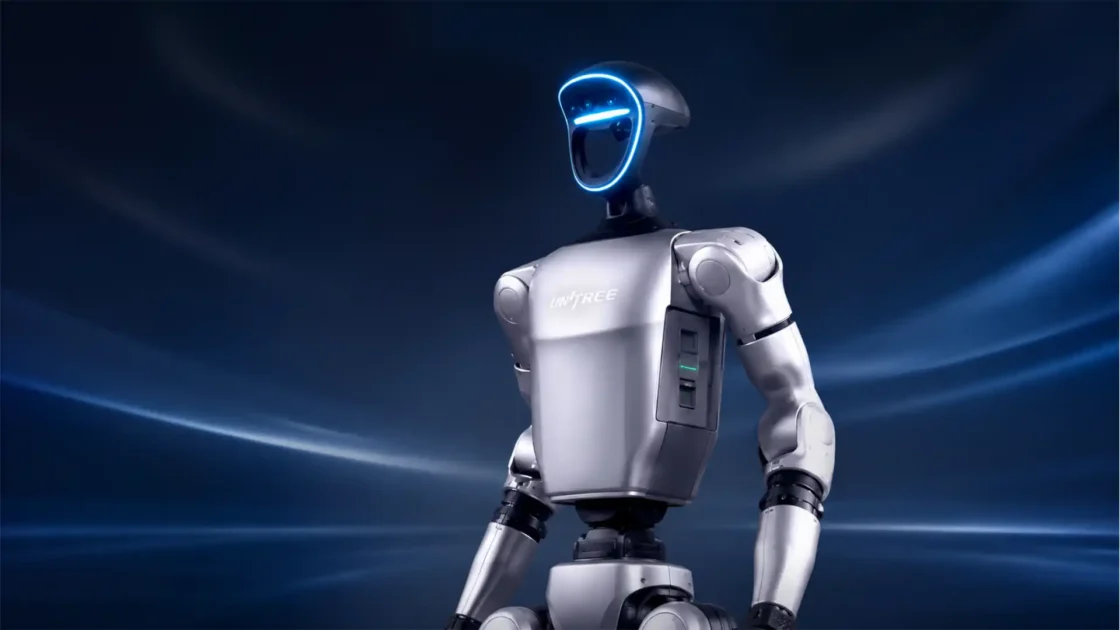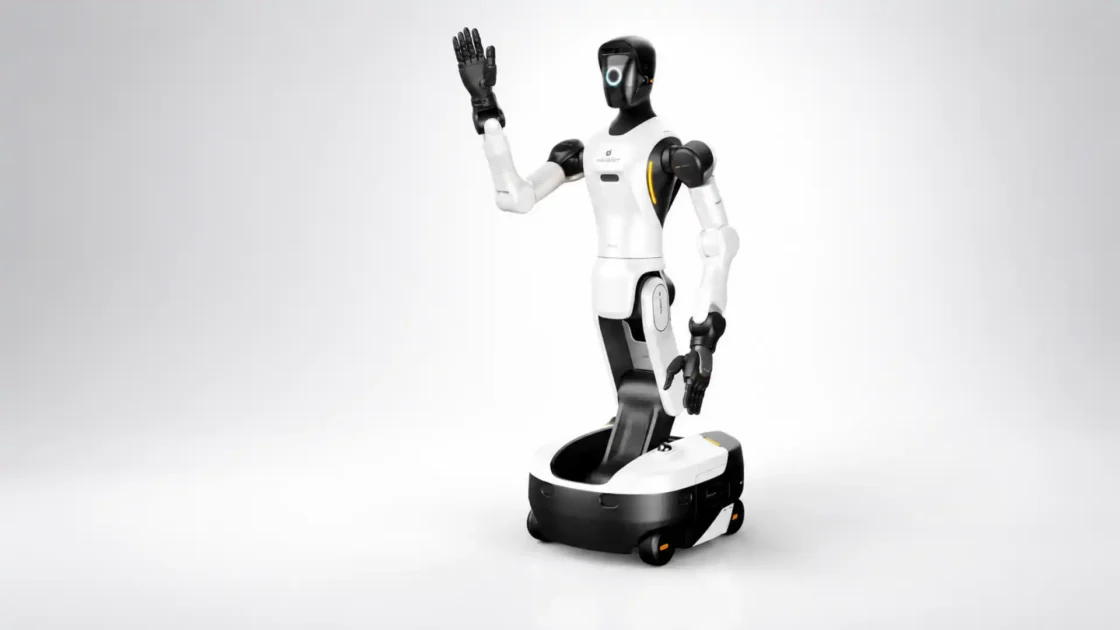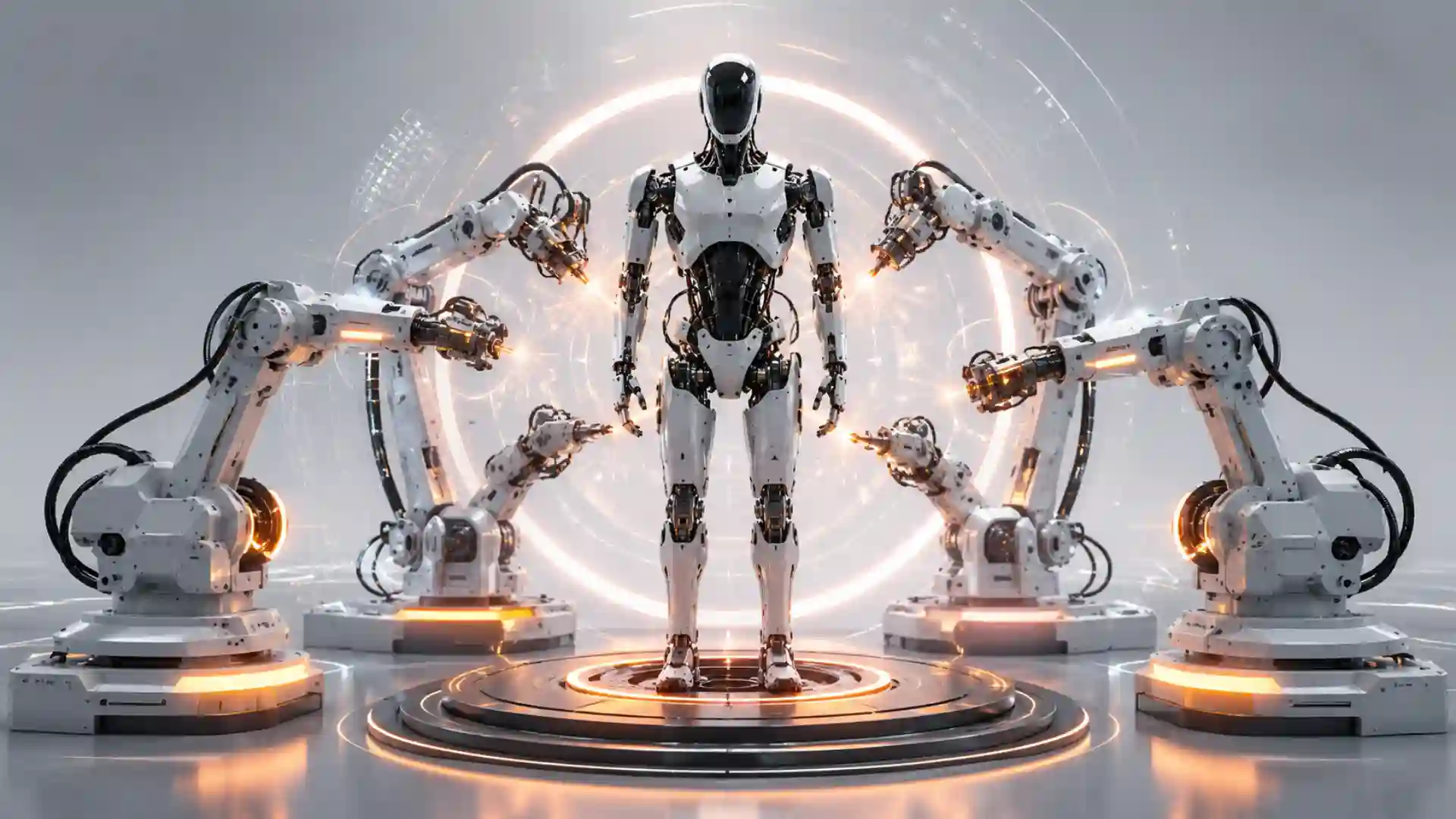
A production line in Foshan, Guangdong, now sits at the center of the humanoid robot debate because it makes one blunt claim: a humanoid robot can roll off the line every 30 minutes, with annual capacity above 10,000 units. The line, built by Leju Robotics and Guangdong Dongfang Precision Science & Technology, does not settle whether humanoids are ready to replace workers at scale. It settles something narrower and more immediate: China is treating humanoid robots as a manufacturing problem, not only an AI research problem. That distinction matters more than the viral demos.
Table of Contents
A factory claim that changes the question
The Guangdong claim is not merely that a Chinese company has another robot prototype. The claim is that a humanoid production line has crossed into repeatable industrial rhythm. China Daily reported that the Foshan operation has annual capacity of more than 10,000 humanoid robots and uses digital management and quality traceability to produce one robot every 30 minutes. Foshan Daily described a line with 24 precision assembly processes and 77 quality inspection steps, supported by an industrial internet platform for process control and traceability.
That is a different kind of signal from a robot walking across a stage. A stage demo asks whether a machine can move convincingly for a few minutes. A factory line asks whether motors, reducers, batteries, sensors, cabling, controllers, arms, legs, hands, software images, calibration steps, safety checks, packaging and supplier schedules can be forced into repeatable order. The hard part is not one unit. The hard part is the thousandth unit that behaves like the hundredth and can be serviced like the tenth.
The 30-minute figure should still be read carefully. It is not proof that one robot is built from raw parts to finished product in half an hour by a single worker or station. It is a production takt-time claim: once the line is running, a completed unit can come off the line at that interval. That implies work is distributed across stations and synchronized through scheduling, subassembly preparation, test routines and logistics. Takt time is not the same thing as total build time, but it is exactly the metric industrial buyers care about when judging whether a product is moving from workshop output toward volume delivery.
The Foshan line also sits inside a wider Guangdong system. China Daily’s separate report on Shenzhen said Leju’s Longhua pilot line can assemble a Roban 2 research and education robot in two hours and produce 500 to 1,000 units annually. After strict certification, products move to mass production at the Foshan factory, which is described as China’s first automated production line for humanoid robots with more than 10,000 units of annual capacity. That same report said each robot must pass 77 inspections and 41 scenario-based tests before shipment.
The most important word is not “humanoid.” It is “line.” A humanoid robot is harder to manufacture than a service robot on wheels because it contains more joints, more dynamic balance risk, more cable-routing problems and more points of failure. Yet the Foshan model borrows from industries that already learned to repeat complicated electromechanical production: cars, appliances, electronics, high-end machinery and automated equipment. The article’s core issue is therefore not whether the West is “behind” in all robotics. It is whether Western humanoid companies are trying to leap from software-led prototypes into manufacturing scale without the same density of local hardware suppliers, assembly experience and component cost pressure.
Tesla, Figure and Boston Dynamics remain formidable. Tesla has capital, AI talent, factories and a large installed base of manufacturing know-how. Figure has already converted a BMW pilot into public operating data and is ramping its BotQ manufacturing site. Boston Dynamics has unmatched locomotion history and is now commercializing Atlas with Hyundai’s industrial backing. The Guangdong line does not mean China has solved humanoid deployment. It means China is pulling the industry’s center of gravity toward production capacity earlier than many Western narratives expected.
The claim also forces a cleaner comparison. A humanoid robot company can win attention with a slick video. It can win investor interest with a market forecast. It can win early partners with pilot deployments. None of that guarantees the company can ship 10,000 units a year, maintain them, train customers, keep uptime high, update software safely and cut cost without quality collapse. The next phase of humanoid robotics will punish companies that confuse a working prototype with a manufacturable product.
The Foshan line is a manufacturing event, not just a robotics announcement
The Foshan facility matters because humanoid robots are becoming subject to the same discipline that shaped electric vehicles, solar panels, batteries and consumer electronics. A product category that looks magical during its research phase becomes brutal during its manufacturing phase. Every glamorous capability has to pass through suppliers, fixtures, tolerances, calibration, burn-in, failure analysis, spare parts and warranty reserves.
The Leju-Dongfang Precision collaboration is notable because it combines a robotics developer with a company rooted in high-end equipment manufacturing. China Daily identified Guangdong Dongfang Precision Science & Technology as a leading domestic high-end equipment manufacturer and Leju Robotics as a high-tech robot company. The line uses a modular, flexible architecture, movable workstations, intelligent scheduling and an automated guided vehicle delivery network.
Those words can sound like factory brochure language, but the underlying logic is practical. Humanoid robots are not yet fixed products like washing machines. Designs are still changing. Hands, actuators, batteries, skins, perception modules and torso packaging may shift quickly across model years. A rigid line built for one frozen design can become a liability. A flexible line lets a manufacturer test process changes, run multiple models, rebalance workstations and keep production moving while engineering revisions arrive.
That is a major advantage in a category where designs are not mature. A humanoid factory must be stable enough to ship and flexible enough to absorb engineering change. Too much stability locks in flawed designs. Too much flexibility destroys repeatability. The Foshan pitch is that digital control, modular stations and quality traceability can hold those tensions together.
The 24-process, 77-inspection architecture points to a classic industrial lesson: quality cannot be inspected only at the end. The robot’s walking stability depends on torque delivery, encoder accuracy, structural alignment, cable integrity, battery health and software calibration. A late-stage test can show that a robot fails, but it may not explain whether the root cause is a joint module, an assembly fixture, a loose connector, a software build, a sensor offset or a supplier batch problem. Distributed inspection creates earlier signals.
The reported 41 scenario-based tests before shipment also matter. A humanoid does not prove itself by powering on. It has to survive dynamic loads, repeated gait cycles, falls or near-falls, object handling and environmental variation. It has to recover from errors without becoming dangerous. A robot that passes a static test but fails after repeated motion is not a product; it is a warranty event waiting to happen.
Foshan also brings regional symbolism. Guangdong is not a random location. It is one of the world’s densest manufacturing regions, with deep electronics, machinery, appliance, automation and export networks. Shenzhen, Foshan, Dongguan and Guangzhou form a practical hardware ecosystem where suppliers, machine shops, firmware engineers, fixture makers and logistics providers are close enough to compress iteration cycles. Humanoid robots are physical AI, but physical AI still needs the old geography of screws, motors and factories.
This is where the Western comparison becomes uncomfortable. Tesla has factories, but it is building a new humanoid supply chain. Figure has a purpose-built site, but its current public production rate is still far from a 10,000-unit annual run rate in delivered fleets. Boston Dynamics has decades of robotics expertise, but Atlas is only beginning to move from research icon to industrial product. China’s edge is not that each robot is necessarily smarter. The edge is that a manufacturing system is already being organized around the assumption that humanoids will become a volume hardware category.
The risk for China is equally clear. Volume without reliable deployment can create inventory, subsidy dependence and customer disappointment. A line that can build 10,000 robots a year must find real use cases that justify 10,000 robots a year. Manufacturing capacity is a necessary condition for a humanoid industry, not proof of market success. The factory changes the question from “can they build it?” to “can they make it useful enough, safe enough and cheap enough for customers to keep ordering?”
The 30-minute number only matters when it meets quality
A 30-minute takt time sounds dramatic because humanoid robots have been treated as rare machines. Yet industrial history warns against worshipping speed alone. The useful metric is not speed in isolation. It is speed multiplied by consistency, test coverage, field reliability and cost control.
A factory can claim a fast interval between completed units while still relying on slow upstream work. Subassemblies may be prepared off-line. Critical modules may arrive from suppliers already tested. Software loading and calibration may be partially parallelized. Final assembly may look fast because the line has shifted complexity into earlier process steps. That does not make the claim irrelevant. It simply means readers should interpret it as a system-level throughput claim rather than a magical build time.
The more serious issue is yield. A line that produces one robot every 30 minutes but must rework a large share of units is not truly fast. Rework consumes engineers, clogs test stations and hides design weaknesses. In humanoids, rework can be especially expensive because faults may emerge only after dynamic testing. A slightly miscalibrated joint may pass static checks but produce gait instability after repeated walking. A cable harness routed too tightly may fail after thousands of bending cycles. A battery connector that looks fine at shipment may loosen after vibration.
That is why the inspection architecture reported in Foshan is more important than the headline interval. The line’s credibility depends on whether inspections catch variation early enough to prevent field failures. For industrial buyers, especially automotive and logistics customers, a robot that requires constant babysitting is worse than no robot. It creates a new failure mode inside an already timed operation.
Humanoid robotics differs from industrial robot arms in one crucial way. Traditional industrial robots are usually bolted down, guarded, programmed for defined tasks and integrated into carefully engineered cells. Humanoids are sold on flexibility: they can move through human-designed spaces, handle tools and work near people. That flexibility increases the burden on production quality. If each unit behaves slightly differently, software policies trained on one fleet may not transfer cleanly to another. Fleet learning depends on hardware consistency.
The 30-minute line therefore has software consequences. A consistent fleet generates cleaner operational data. If 1,000 robots share the same actuator response, sensor calibration and mechanical tolerances, software teams can learn from deployment data with less noise. If each robot has a different mechanical personality, AI training becomes messy. Manufacturing consistency is a data advantage. It makes the robot’s body a more reliable platform for learning.
That point is often missed in discussions about embodied AI. People talk about robot “brains” as though the body were just a shell. In practice, the body shapes the data. A robot hand with inconsistent friction produces inconsistent grasp outcomes. A hip actuator with variable torque response changes walking behavior. A camera module mounted with small angle differences changes perception. Manufacturing precision is not separate from AI performance; it is one of the conditions for AI performance.
The Foshan line’s value will therefore be judged in the field. The public claim is impressive. The real proof will be whether customers report stable uptime, low rework, predictable maintenance intervals and measurable labor or safety benefits. If those outcomes appear, the 30-minute line becomes a milestone. If not, it becomes a symbol of capacity built ahead of demand.
For now, the safest conclusion is direct: China has moved humanoid robots into a manufacturing-speed conversation before the Western leaders have publicly demonstrated comparable annual delivery at scale. That does not settle the race. It changes the scoreboard.
Tesla’s Optimus challenge is not ambition but industrialization
Tesla’s Optimus program has never lacked ambition. Tesla says Optimus is intended to be a general-purpose, bipedal autonomous humanoid robot for unsafe, repetitive or boring tasks, and that the goal requires balance, navigation, perception and interaction with the physical world. The company has the credibility of having scaled complex hardware before. It also has a culture that treats factories as products in their own right.
The problem is that Tesla’s public humanoid timeline has repeatedly run ahead of visible delivery. On Tesla’s Q4 2024 earnings call, Elon Musk said the company’s normal internal plan called for roughly 10,000 Optimus robots to be built in 2025, while also warning that the exact number was uncertain and that Optimus required an entirely new supply chain. He said Tesla had tried to use existing motors, actuators and sensors, but nothing worked for a humanoid robot “at any price.”
That last admission is the most revealing part. It frames Optimus not as a software feature but as a new industrial product category. Tesla could not simply pull parts from the shelf. A humanoid robot needs compact, powerful, durable actuators; high-reliability hands; safe batteries; thermal management; perception hardware; structural parts; and manufacturing processes that keep the machine light enough to move and strong enough to work. The supply chain is not a side issue for Optimus. It is the product.
Reuters later reported that Musk said Optimus production had been affected by China’s export restrictions on rare earth magnets, because exporters needed licenses and the restrictions covered magnets and other finished products that were difficult to replace. Musk said China wanted assurances that the magnets would not be used for military purposes.
That episode exposed a strategic vulnerability. Tesla may design in California and manufacture across several regions, but compact high-performance motors and actuators still touch rare earth magnet supply chains in which China has deep leverage. A humanoid robot contains many motorized joints. The more dexterous and human-scale it becomes, the more it depends on components whose production is tied to specialized materials, processing and supplier know-how.
Tesla’s strengths remain serious. It understands large-scale manufacturing, cost reduction, software updates and AI infrastructure. It has factories where Optimus can be tested internally before customer sales. It has a natural set of repetitive manufacturing tasks inside its own operations. It also has a leadership culture willing to pour attention into a product category before it is financially proven.
Yet Optimus faces a harder version of Tesla’s familiar ramp problem. Cars are complex, but they operate on roads, not inside human workspaces filled with fragile objects, moving people and changing tasks. A humanoid robot must combine mechanical reliability with embodied intelligence and workplace safety. Building 10,000 units is not enough if those units need expert operators, restricted environments or constant intervention.
Tesla’s public claims should therefore be separated into three layers. The first is long-term vision: Optimus could become a major product if general-purpose robotics works. The second is manufacturing intent: Tesla wants to build a robot line and use its factory expertise. The third is verified delivery: public evidence of mass commercial shipment remains thin compared with the scale of the ambition.
That gap is precisely why the Guangdong line matters. It does not prove Leju will beat Tesla in intelligence, autonomy or global adoption. It proves that a Chinese hardware ecosystem is pushing toward a public 10,000-unit manufacturing benchmark while Tesla’s own disclosures have highlighted uncertainty, supply-chain novelty and component constraints. In humanoids, a company can have better AI and still lose time if the body cannot be built at cost.
Figure is closer to deployment but still climbing the volume wall
Figure AI deserves a separate reading because it has published some of the clearest Western evidence of humanoids doing useful work in an industrial setting. Its Figure 02 robots completed an 11-month deployment at BMW Group Plant Spartanburg, with Figure reporting 90,000-plus parts loaded, more than 1,250 hours of runtime and contribution to production of more than 30,000 BMW X3 vehicles. BMW’s own account said the robot retrieved and positioned sheet metal parts for welding, operated five days a week for ten-hour shifts and helped expose needs such as revised safety concepts and improved 5G coverage.
That is a credible milestone. It is more valuable than a video of a robot folding laundry in a lab, because it happened inside automotive production constraints. The robot was not doing every job in the plant. It was not replacing an assembly line. But it was close enough to production work to reveal integration realities. Figure’s BMW deployment shows the industry what a real pilot looks like: narrow task, monitored environment, measurable runtime and many lessons that do not fit into a demo clip.
Figure has also moved openly toward manufacturing scale. In March 2025, it introduced BotQ, a high-volume manufacturing facility whose first-generation line would be capable of producing up to 12,000 humanoids per year. Figure said it was bringing manufacturing in-house to control build process and quality, building software infrastructure such as MES, PLM, ERP and WMS, and selecting external partners capable of scaling to 100,000 robots or 3 million actuators over four years.
By April 2026, Figure said it had produced more than 350 third-generation Figure 03 robots and increased production from one Figure 03 per day to one per hour, a 24-fold throughput improvement in under 120 days. That is impressive acceleration. It is also a reminder of how wide the gap remains between current production evidence and full annualized industrial capacity. One robot per hour, if sustained across enough working hours, starts to become meaningful. But a fleet of hundreds is not the same as steady delivery of 10,000 robots a year into paying environments.
Figure’s path may be more disciplined than Tesla’s because it is tying the robot to a specific manufacturing customer problem. Automotive plants have defined workflows, measurable cycle times and strong incentives to remove ergonomically difficult tasks. A humanoid that can move parts, tend machines or handle repetitive material flows may earn its place before it becomes general-purpose. That is a more believable route than promising a universal home robot in the near term.
The difficulty is that industrial customers are unforgiving. A robot that works in a pilot must eventually meet procurement standards, safety approvals, spare-parts planning, service-level expectations and return-on-investment thresholds. BMW’s note about barriers, partitions and 5G coverage is especially useful because it punctures the fantasy that humanoids simply walk into factories and start helping. The workplace must often be adapted. Network coverage matters. Safety zoning matters. Worker acceptance matters. Maintenance matters.
Figure’s manufacturing announcement also reveals a core tension for Western startups. They need enough volume to bring costs down and gather fleet data, but they need enough real deployment quality to justify volume. If they build too slowly, Chinese firms may dominate components and early market share. If they build too quickly, they risk field failures and expensive recalls. The correct ramp speed is not the fastest possible speed. It is the fastest speed that preserves learning, safety and customer trust.
Compared with the Foshan line, Figure’s public story is stronger on verified industrial deployment and weaker on visible mass output. Compared with Tesla, Figure looks more focused on near-term customer use. Compared with Boston Dynamics, Figure looks younger but more aggressive in public manufacturing claims. Its challenge is now brutal and simple: convert promising pilots and hourly production into repeatable multi-thousand-unit delivery.
Boston Dynamics has the best robotics lineage but a different scale clock
Boston Dynamics enters the humanoid race with a reputation no marketing department can easily buy. Atlas spent years as the robot that convinced the public bipedal machines could run, jump, balance and recover in ways that felt almost biological. That technical lineage matters. Locomotion is not a solved detail. Safety in motion is not a solved detail. Dynamic whole-body control remains central to humanoid usefulness.
Yet the old Atlas was not a mass-market product. It was a research icon. The shift now is commercial. Boston Dynamics said in January 2026 that it would begin production of new Atlas robots at its Boston headquarters, with all 2026 deployments already committed and fleets scheduled for Hyundai’s Robotics Metaplant Application Center and Google DeepMind. The company planned to add more customers in early 2027.
Hyundai’s role is decisive. Reuters reported that Hyundai plans to deploy Atlas at its U.S. manufacturing plant in Georgia from 2028, starting with parts sequencing and moving toward component assembly and heavier or more complex tasks by 2030. Hyundai said it aims to build a factory capable of manufacturing 30,000 robot units annually by 2028. The company also described Atlas as able to lift up to 50 kilograms and operate in industrial environments from minus 20 to 40 degrees Celsius.
That is not a sign of weakness. It is a sign that Boston Dynamics and Hyundai are putting Atlas on a longer industrial clock. The strategy appears to be: prove product version, deploy in committed fleets, use Hyundai’s manufacturing environment as the anchor customer, then scale toward a 2028 production system. Boston Dynamics is not trying to win the 2026 shipment headline. It is trying to turn the world’s most famous humanoid into an enterprise-grade industrial platform.
The risk is timing. If Chinese companies create lower-cost fleets faster, they may define customer expectations, supplier standards and early data ecosystems before Atlas reaches broader deployment. Boston Dynamics could still win high-value industrial segments where reliability, strength and safety matter more than price. But it may not own the volume narrative if Chinese firms ship thousands while Atlas deployments remain carefully staged.
Boston Dynamics’ product page frames Atlas around enterprise material handling, barcode scanning, workflow integration, autonomous charging and self-swappable batteries. It also lists 56 degrees of freedom, a four-hour battery life, a 50-kilogram instant weight capacity and a 30-kilogram sustained capacity. Those specifications point to a serious industrial machine, not a consumer gadget.
The industrial focus is sensible. Warehouses and factories have structured workflows, clear economics and existing automation budgets. They also have safety departments, integrators and maintenance teams. A humanoid that costs much more than a Chinese unit may still win if it performs heavier tasks, integrates better with enterprise systems and carries less operational risk.
The wider lesson is that “struggle to deliver 10,000 per year” means different things for different companies. Tesla has talked about huge future scale but faces near-term production and component uncertainty. Figure has a stated 12,000-unit capacity target and visible ramp progress, but is still proving volume. Boston Dynamics is moving from product launch to committed fleets, with Hyundai’s 30,000-per-year factory target set for 2028 rather than immediate 2026 output. The Western race is not empty. It is staggered. China’s Foshan line compresses the timeline and raises the pressure.
The real gap is between prototype culture and production culture
Humanoid robotics is full of prototype culture. The field rewards spectacular footage: walking, running, backflips, dancing, folding clothes, sorting objects, talking with people, recovering from pushes. Those clips prove engineering competence, but they often hide the production questions that decide business survival.
Production culture is less glamorous. It asks how many units failed at station 14 this week. It asks which supplier’s reducer batch generated higher vibration. It asks whether firmware flashing takes too long. It asks why the left knee cable harness has a higher replacement rate. It asks whether technicians can swap an actuator in 20 minutes without recalibrating the entire robot. It asks whether the robot can be packaged, shipped, installed and serviced without a PhD on-site.
The humanoid companies that win will be the ones that make the boring questions central. Guangdong’s line is interesting because it puts the boring questions in public view. It talks about workstations, inspection points, traceability, AGVs and process control. Those are not viral words. They are the language of products that need to leave the building.
Western humanoid companies have not ignored manufacturing. Figure’s BotQ announcement is explicitly about high-volume manufacturing infrastructure. Tesla treats factory design as core competence. Boston Dynamics is backed by Hyundai, one of the world’s largest industrial manufacturers. The difference is that China’s hardware ecosystem is trying to make production scale the story now, not after years of limited pilots.
A prototype can tolerate hand-built fixes. A production robot cannot. A prototype can be assembled by senior engineers who know every weakness. A production robot must be assembled by trained workers following standard operating procedures, with fixtures that prevent errors and tests that catch the remaining ones. A prototype can be restarted when it misbehaves. A production robot must recover or fail safely.
The hardest transition is cultural because robotics engineers often fall in love with capability. Manufacturing teams fall in love with repeatability. Both are needed. A humanoid that cannot manipulate objects is useless. A humanoid that manipulates objects brilliantly once and unpredictably the next day is also useless. Capability wins the demo. Repeatability wins the purchase order.
This split helps explain why the same companies can look advanced and behind at once. Tesla may have strong AI talent and still face actuator supply constraints. Boston Dynamics may have world-class dynamic control and still move cautiously on fleet scale. Figure may show real deployment progress and still have to prove it can ship thousands of units without support costs exploding. Chinese firms may build fast and cheap while still proving long-term autonomy, safety and customer ROI.
The industry is entering the phase where manufacturing exposes truth. Investors can no longer evaluate humanoid firms only by demos or founder reputation. They must ask about output, yield, supplier concentration, warranty risk, software update safety, field service, unit economics and customer renewal. A robot company that cannot answer those questions is not yet an industrial company.
China’s hardware ecosystem is turning into a humanoid flywheel
China’s advantage in humanoid robots is often described as government support or cheaper labor. Those are factors, but they are not the whole story. The stronger advantage is the density of hardware capability. China has deep supplier networks for motors, reducers, batteries, sensors, printed circuit boards, magnesium and aluminum parts, displays, cables, connectors, cameras, lidar, industrial automation and contract manufacturing. A humanoid robot pulls from many of those pools at once.
Reuters reported in 2025 that China is capable of making up to 90 percent of humanoid components, according to analysts and startups, and that some Chinese startups were selling robots for as low as 88,000 yuan, about $12,178 at the rate cited in the report. Bank of America Securities estimated the average bill of materials for a humanoid could be about $35,000 by the end of 2025 and fall to $17,000 by 2030 if most components are sourced from China, while Tesla’s component cost would be $50,000 to $60,000 if major parts were sourced outside China.
Those estimates are not final truth. Costs change quickly, and robot models vary widely. But the direction matters. If China can cut humanoid hardware cost faster, it can deploy more units, gather more data, pressure suppliers to improve and then cut cost again. That is the flywheel.
The same pattern appeared in electric vehicles, batteries and solar equipment. Early Western assumptions often focused on invention, brand and software. Chinese competitors focused heavily on manufacturing scale, supplier integration and cost reduction. Once the supply chain matured, the price curve changed the market. In humanoids, the product is more complex and less mature, so the analogy is imperfect. But the manufacturing pattern is familiar enough to worry every Western player.
The International Federation of Robotics reported that China installed 295,000 industrial robots in 2024, representing 54 percent of global deployments, and that China’s operational stock exceeded 2 million units. For the first time, Chinese manufacturers sold more than foreign suppliers in their home market, with domestic market share rising to 57 percent.
That matters for humanoids because it means China already has a huge base of automation buyers, integrators, maintenance workers, factory engineers and suppliers. Humanoids will not replace traditional industrial robots in many tasks. A six-axis robot arm will still be better for high-speed welding, painting, pick-and-place or precision operations inside engineered cells. But the industrial robot base creates knowledge, trust and procurement channels for physical automation.
The hardware flywheel also benefits component specialists. Reuters reported that Linkerbot, a Chinese robotic-hand company, holds more than 80 percent of the global market for high-degree-of-freedom robotic hands and plans to scale production to 10,000 units a month from almost 5,000. The company has five factories in Beijing and Shenzhen and is developing intelligent production lines where robotic hands manufacture other hands.
That is exactly the kind of supplier specialization that volume industries produce. A humanoid maker does not need to solve every hand problem internally if a domestic supplier can supply advanced hands at rising scale. Tesla, by contrast, has publicly emphasized how hard the Optimus hand is. The point is not that China has solved dexterity. The point is that China is turning dexterity into a supplier market, not only a lab challenge.
A flywheel can still spin into waste. If dozens of firms chase subsidies and produce similar robots without paying customers, capacity can become a bubble. Chinese officials and analysts have already warned about overheated humanoid investment. Yet the physical foundation is real. The country that can make the parts cheaply, iterate quickly and deploy fleets early has a structural advantage in embodied AI.
The Chinese state is pushing humanoids as industrial policy
Humanoid robotics has become a strategic sector in China because it touches several national priorities at once: advanced manufacturing, AI, aging demographics, labor productivity, export competitiveness, industrial upgrading and technological rivalry with the United States. The sector is not developing in a policy vacuum.
China’s State Council information channels reported that the Ministry of Industry and Information Technology aimed to establish a preliminary innovation system for humanoid robots by 2025 and a secure, reliable industrial and supply-chain system by 2027, with products deeply integrated into the real economy.
Reuters reported that Chinese authorities had allocated more than $20 billion to the humanoid sector over the prior year and that Beijing was establishing a one trillion yuan fund for startups in AI and robotics. It also found that state procurement of humanoid robots and related technology rose to 214 million yuan in 2024 from 4.7 million yuan in 2023. Shenzhen created a 10 billion yuan AI and robotics fund, while other cities offered subsidies, office space or procurement-linked incentives.
That scale of support changes company behavior. It lowers the cost of experimentation. It helps startups survive longer. It encourages local governments to build data centers, training sites and demonstration projects. It attracts suppliers into the category. It also creates distortion risk. Subsidies can make weak companies look stronger than they are, inflate capacity, and reward headline output over customer value.
The policy push also includes standards. Xinhua reported in March 2026 that China released its first national standard system for humanoid robotics and embodied intelligence, a top-level design covering the full industrial chain and lifecycle. The stated goal was to reduce production costs, speed technological iteration and support mass commercialization.
Standards are not glamorous, but they become powerful when a sector starts to scale. They can define interfaces, safety expectations, testing procedures, data formats, component specs and evaluation criteria. If China’s internal market converges on common technical standards faster than others, domestic firms may reduce integration friction and accelerate supplier specialization. If those standards later influence export markets, they could shape global expectations.
The policy logic is easy to understand. China’s factory workforce is aging. Wage advantages are narrowing. Export competition is fierce. Traditional manufacturing still needs higher productivity. Robots that can work in human-designed spaces are attractive because many factories were not built around automation from the start. Humanoids promise to automate some tasks without rebuilding every workstation, even though real deployments often still require adaptation.
The social tension is just as clear. Reuters reported concerns from Chinese policy circles that robots and AI could affect a large share of manufacturing employment, with proposals such as AI unemployment insurance for workers displaced by robots.
That tension will not disappear. A state-backed humanoid push can be framed as productivity, safety and elder-care support. Workers may experience it as job insecurity. The political economy of humanoid robots will matter as much as the engineering once deployments move beyond pilots.
The West still has deep strengths, but they are not the same strengths
The Guangdong line should not be read as a simple “China wins, West loses” story. Western firms and allied industrial groups have major advantages. Tesla has AI infrastructure, factory experience and capital access. Figure has fast iteration and credible industrial pilots. Boston Dynamics has unmatched locomotion heritage and Hyundai’s backing. Nvidia, Google DeepMind, Microsoft, OpenAI-linked ecosystems, European automation firms and American semiconductor companies all sit inside the broader Western-aligned robotics stack.
But those strengths cluster differently. The West is strong in AI models, high-end software, semiconductor design, robotics research, venture capital, enterprise customer relationships and premium industrial automation. China is strong in hardware manufacturing density, component localization, cost reduction, government-backed deployment, supplier speed and domestic industrial demand.
The coming competition is not AI versus manufacturing. It is the fusion of AI and manufacturing. A humanoid robot needs both. A beautiful policy model running on an unreliable body is useless. A cheap body with poor autonomy is also limited. The winner is not the company with the best demo or the lowest bill of materials. The winner is the one that can ship useful, safe, maintainable fleets at a price customers accept.
Western firms can still win high-value segments. A Boston Dynamics Atlas that performs reliably in demanding enterprise settings may command a premium. A Figure fleet that integrates cleanly with BMW-like operations may become a preferred platform for sophisticated industrial customers. Tesla could eventually use its factories and AI stack to scale Optimus rapidly once supply-chain bottlenecks are resolved. The United States and Europe also have stricter customer expectations around safety, liability and compliance, which can force stronger products.
The concern is speed. Manufacturing ecosystems compound. Once a supplier begins producing thousands of humanoid joint modules, it learns. Once a hand supplier serves many robot makers, it improves. Once service technicians maintain hundreds of units, they build tacit knowledge. Once customers deploy fleets, they produce data. Early volume is not just revenue. It is learning infrastructure.
That is where China’s strategy becomes dangerous for competitors. Even if early Chinese robots are less capable, broad deployment can produce field data, customer feedback and supplier experience at a rate slower competitors cannot match. This is especially true in structured tasks such as reception, guided tours, education, entertainment, inspection, material handling and constrained factory routines. Those tasks may not prove full general-purpose autonomy, but they create a base.
Western companies have an answer if they stop treating humanoids as moonshots and treat them as industrial platforms. That means building manufacturing partnerships earlier, standardizing components where possible, publishing honest deployment metrics, working with regulators, designing service networks and focusing on narrow tasks with clear economics. It also means resisting the temptation to sell humanoids as near-term domestic servants.
The West’s best route may not be matching every Chinese unit at the low end. It may be building fewer but more reliable robots for high-value industrial tasks, then scaling once component costs fall. But if Chinese suppliers dominate components, Western firms may still depend on the ecosystem they are competing against. That dependency is already visible in rare earth magnet constraints and dexterous-hand supply.
Public production claims need a stricter scoreboard
The humanoid sector has entered a dangerous period for claims. Companies can announce capacity, production targets, deliveries, rollouts, deployments, preorders, pilots and partnerships. Those words are not interchangeable. A factory with capacity for 10,000 units is not the same as 10,000 paid deliveries. A pilot robot in a factory is not the same as a fleet running unsupervised. A preorder is not revenue. A robot “deployed” for testing is not a robot integrated into production.
The article’s opening comparison between Guangdong and Tesla, Figure and Boston Dynamics should therefore be tightened. The Foshan line has a public claim of capacity above 10,000 units per year and one unit every 30 minutes. Figure has publicly stated BotQ’s first-generation line can produce up to 12,000 humanoids per year and has reported a current rate of one Figure 03 per hour after producing more than 350 units. Boston Dynamics has fully committed 2026 Atlas deployments but broader Hyundai factory deployment is scheduled from 2028, with a 30,000-unit annual factory target by then. Tesla has a grand long-term target but public production evidence remains behind prior near-term ambitions.
The cleanest scoreboard should separate six metrics.
First, installed production capacity: what the factory can theoretically build under defined shifts and yield assumptions.
Second, actual output: how many units have left the line in a defined period.
Third, paid shipments: how many units reached customers under commercial terms.
Fourth, active deployment hours: how long the robots worked in real environments.
Fifth, autonomy level: how much human supervision, teleoperation or constrained scripting was required.
Sixth, economic value: whether the robot saved labor time, improved safety, increased throughput or performed tasks that could not otherwise be staffed.
Without those distinctions, the industry becomes a fog of optimistic announcements. A company can look ahead because it reports capacity. Another can look ahead because it reports pilot hours. Another can look ahead because it has a better AI model. Customers and investors need to know which scoreboard is being used.
Public humanoid production signals by company
| Company or project | Public signal | Strongest proof so far | Main unresolved question |
|---|---|---|---|
| Leju Robotics and Dongfang Precision | Foshan line claims more than 10,000 annual capacity and one robot every 30 minutes | Reported automated line with 24 processes, 77 inspections and scenario testing | Field reliability and commercial demand at full output |
| Tesla Optimus | Prior internal plan discussed roughly 10,000 robots in 2025 and much larger future ambitions | Tesla’s manufacturing base and AI focus | Verified mass output, component supply and useful work at scale |
| Figure AI | BotQ first line announced up to 12,000 annual capacity, current Figure 03 rate reported at one per hour | BMW deployment with runtime, part handling and vehicle production contribution | Sustained multi-thousand-unit delivery and service economics |
| Boston Dynamics Atlas | 2026 deployments committed, Hyundai aims for 30,000-unit annual factory by 2028 | Decades of locomotion work and Hyundai industrial anchor | Speed of broad customer rollout and unit cost |
| AgiBot | 10,000th humanoid robot rollout announced in March 2026 | Public milestone from a major Chinese embodied AI company | Mix of commercial use, deployment depth and long-term uptime |
| Unitree | Reuters reported over 5,500 humanoid units shipped in 2025 | Shipment volume and broad research or public-use demand | Share of revenue from serious industrial applications |
The table makes one point visible: the race is not a single race. China’s strongest signal is shipment and line capacity. Figure’s strongest signal is pilot evidence and ramp speed. Boston Dynamics’ strongest signal is product maturity and an enterprise anchor. Tesla’s strongest signal is ambition and manufacturing potential, not verified humanoid deliveries.
AgiBot and Unitree show that China’s volume story is wider than Foshan
The Foshan line would be less significant if it were a single anomaly. It is not. AgiBot and Unitree show that China’s humanoid scale story is spreading across multiple companies and business models.
AgiBot announced on March 30, 2026, that it had rolled out its 10,000th humanoid robot, calling the milestone a transition from early-stage validation to scalable real-world deployment. The company framed the achievement as evidence that its supply chain was maturing and manufacturing was standardizing.
Unitree is another benchmark because its machines have moved from robotics circles into public visibility. Reuters reported that Unitree shipped more than 5,500 humanoid units in the previous year, representing 32.4 percent of the global humanoid market according to its prospectus document. Reuters also noted that real-world factory deployment remained limited and that industry-application revenue mainly came from enterprise reception and tour-guide use, intelligent manufacturing and inspection, with reception and tour-guide use accounting for roughly 50 to 70 percent.
That caveat is critical. China’s early humanoid volume is not the same as deep industrial automation volume. Research labs, universities, exhibitions, entertainment, reception, education and public demonstrations can absorb many robots. Those applications are useful for production learning and market formation, but they do not prove that humanoids are already transforming factory economics.
AgiBot’s scale also connects to data. Reuters visited an AgiBot-linked data operation where robots were guided through repeated tasks such as folding a T-shirt, making a sandwich and opening doors, with the goal of generating embodied AI training data. The facility operated 17 hours a day. Reuters reported that Shanghai authorities helped set up the site, providing premises rent-free, where about 100 robots operated by 200 humans worked daily.
That is a revealing model. China is not only building robots; it is building robot-training labor systems. The industry needs physical-world data, and that data is hard to scrape from the internet. It must be produced. People must guide robots, label outcomes, repeat motions and create task libraries. This creates a new labor layer: the robot trainer, teleoperator, data collector, maintenance worker and deployment technician.
The economics are still unsettled. Training robots with human operators is labor-intensive. It may be justified if the resulting models generalize across many robots and tasks. It may become costly if models remain brittle. But the strategy aligns with China’s strengths: large labor pools, local government support, physical facilities, hardware availability and willingness to run repetitive data operations.
The Chinese volume story therefore has three linked pieces. The first is manufacturing output. The second is component supply. The third is embodied data collection. A company that ships more robots can collect more data; better data can improve robot behavior; improved behavior can justify more deployments; more deployments can justify larger factories. That loop is what Western rivals need to watch.
UBTech shows industrial buyers are testing Chinese humanoids seriously
UBTech is not just another name in China’s humanoid crowd. It offers evidence that serious industrial buyers are willing to test Chinese humanoids in demanding settings. Reuters reported in January 2026 that UBTech signed a deal with Airbus to supply robots for aviation manufacturing. Airbus had already purchased UBTech’s Walker S2, while Airbus described the cooperation as early concept testing. UBTech said its 2025 humanoid robot order value exceeded 1.4 billion yuan and that industrial humanoid production capacity was expected to exceed 10,000 units in 2026.
Aviation manufacturing is not a casual environment. It has strict quality, documentation and safety requirements. An early concept test does not mean UBTech robots are about to build aircraft at scale. It does mean Chinese humanoid companies are being evaluated beyond entertainment and research contexts.
This distinction matters because critics often dismiss Chinese humanoid output as spectacle. Some of it is spectacle. Dancing robots, half-marathons and public performances attract attention. But a company that can place robots into Airbus testing is part of a different conversation. It is entering the slow, demanding path toward industrial qualification.
UBTech’s reported order value also reveals buyer curiosity. Orders are not the same as completed deployments, and the structure of those contracts matters. Yet a 1.4 billion yuan order figure signals that customers, governments or partners are willing to fund the transition from demonstration to application. That funding gives a company room to improve hardware and software through field exposure.
The question is whether UBTech can raise productivity. MERICS has noted that UBTech aims to lift Walker robot performance to 80 percent of human productivity by 2027 while scaling production from 500 units to 10,000 annually, but must solve dexterity, motion control and multifunctional-hand challenges.
That productivity benchmark is more honest than many hype claims. A robot that is 30 to 50 percent as productive as a worker may still be useful in certain roles if it can work long shifts, perform hazardous tasks, operate during labor shortages or gather data. But it will not be a universal replacement. Humanoids do not need to match humans everywhere to be commercially useful; they need to beat the combined cost, risk and availability profile of humans in specific tasks.
Airbus-style tests are therefore strategically valuable. They force robots into environments where vague claims collapse. Can the robot handle real parts? Can it follow process rules? Can it avoid contamination? Can it document actions? Can it be audited? Can it operate near workers? Can it recover from errors? Can it be maintained by ordinary technicians?
China’s humanoid industry will need more of these tests to prove its volume is not hollow. Foshan can build robots. AgiBot can roll out robots. Unitree can ship robots. UBTech can win serious pilots. The missing bridge is broad evidence of productive uptime across many paying industrial customers. The first Chinese company to prove that bridge will change the global robotics market.
Dexterous hands are becoming the supply-chain battlefield
The humanoid robot hand is one of the industry’s most underestimated bottlenecks. Walking attracts attention, but hands determine how many tasks a humanoid can actually perform. A robot without useful hands is mostly a mobile sensor platform. A robot with reliable hands can pick, place, press, pull, insert, sort, load, inspect, package and use tools.
Reuters’ Linkerbot report makes the point sharply. Linkerbot holds more than 80 percent of the global market share in high-degree-of-freedom robotic hands, according to the company, and plans to scale to 10,000 units a month from almost 5,000. Reuters also cited a robotics consultant saying the hand is the most complex mechanical part of the whole humanoid robot and that Musk had described it as taking more than half of the engineering effort for Optimus.
This is where China’s supplier model becomes especially important. If a hand specialist supplies many robot makers, it can amortize R&D across a larger base, refine designs through many customers and create de facto component standards. That can move the industry faster than every humanoid maker building fully custom hands internally.
The hand problem is hard because it combines strength, speed, sensitivity, compact packaging, durability and cost. A human hand is small, tendon-rich and sensor-dense. A robotic hand must fit motors or transmission mechanisms into limited space, survive impacts, manage heat, sense contact, avoid crushing objects and keep weight low so the arm does not become too heavy. It must also be manufacturable. A beautiful hand that takes days to assemble and fails after a month is not a product.
Linkerbot’s reported industrial examples are telling: turning screws, grasping deformable objects, threading a needle and high-precision manufacturing. These are not just tricks. They are categories of manipulation that expand where robots can earn money. Screws appear everywhere in factories. Deformable objects defeat many rigid grippers. Fine insertion and threading tasks test sensing and control.
Western firms understand this. Tesla’s Optimus hand is central to its promise of human-like utility. Figure’s factory work depends on reliable part handling. Boston Dynamics’ Atlas product version has human-scale hands with tactile sensing. But the question is whether Western companies build enough units to create the same supplier learning curve. A hand company producing 10,000 units a month can learn faster than a vertically integrated robot maker producing hundreds of complete robots.
There is also a strategic trade-off. Vertical integration gives control. Supplier specialization gives speed and cost. Tesla often prefers vertical control when components are core to product differentiation. Figure brought manufacturing in-house to control quality. Chinese firms may mix internal development with specialized domestic suppliers. The winning architecture may be modular enough to scale and integrated enough to perform.
Hands also affect the business model. Many factory owners may not need full humanoids. Reuters quoted Linkerbot’s CEO saying many customers mount robotic hands onto existing robotic arms rather than buying a full humanoid, because for many factory tasks two arms and dexterous hands are enough.
That point could restrain humanoid adoption. If a stationary arm with a good hand solves the task, a walking robot adds cost and risk. Humanoid makers must prove that mobility and human-like form add enough value. The hand may become both the enabler of humanoids and the reason some customers choose non-humanoid automation instead.
Actuators and magnets decide whether humanoids can be cheap
A humanoid robot is a machine full of joints. Every joint is an economic decision. Hips, knees, ankles, shoulders, elbows, wrists, fingers, waist and neck all require some combination of motors, gearboxes, encoders, bearings, sensors, structural parts and control electronics. The more capable the robot, the more demanding those modules become.
McKinsey’s humanoid supply-chain analysis described China’s humanoid supply chain as structurally different from the rest of the world, shaping hardware scale, cost trajectory and competitive position. It also pointed to industrial suppliers such as Schaeffler becoming preferred actuator suppliers across wheeled and bipedal platforms and codeveloping next-generation strain-wave gear actuators with humanoid players.
Actuators are where robotics dreams meet bill-of-material reality. They must deliver high torque in compact form, respond quickly, survive repeated cycles, avoid overheating, remain quiet enough for human environments and be cheap enough to multiply across a robot. A humanoid with 30 to 50 actuated joints cannot tolerate luxury pricing in every joint.
Tesla’s rare-earth magnet issue shows the geopolitical layer. China’s export restrictions affected Optimus production, according to Musk, because magnets and finished products are difficult to replace and exporters must apply for licenses.
Magnets are small but strategic. High-performance permanent magnets are central to compact motors. If a robot maker cannot source them reliably, it cannot scale. Alternative motor designs or magnet sources may reduce dependency, but redesign takes time. In a fast-moving sector, a six-month supply delay can change competitive position.
The cost curve also depends on standardization. If every humanoid maker designs a custom actuator, suppliers cannot reach efficient scale. If the industry converges around classes of actuator modules, costs fall faster. China’s dense supplier network may encourage faster convergence because robot makers and component suppliers can iterate locally. Western firms may keep more designs proprietary, which protects differentiation but slows shared cost reduction.
There is no easy answer. A humanoid maker wants differentiated motion, strength and efficiency. But customers want lower prices and easier maintenance. The actuator strategy must balance proprietary performance with serviceable standardization. A robot whose knee module can be replaced quickly from a stocked part is more attractive than one requiring complex factory service.
The Foshan line’s reported modular architecture suggests this issue is already recognized. Modular production works best when subassemblies are standardized enough to be tested separately and installed predictably. That supports throughput and quality. It also supports multiple robot models if the architecture can accept different modules.
The broader implication is harsh for startups. Humanoid companies are not only competing on AI talent. They are competing on procurement. They need supplier financing, quality systems, second sources, material access and manufacturing engineers. A weak actuator supply chain can kill a brilliant software company. In humanoids, the body is not a commodity yet. Whoever makes it close to a commodity first gains leverage.
Embodied AI needs fleets, not just foundation models
Generative AI trained on internet-scale text, images and code created the impression that model quality can advance mostly through digital data. Humanoid robotics is different. It needs physical data. A robot must learn how force, friction, delay, balance, object deformation, contact and failure behave in the real world.
Reuters’ China humanoid report makes this distinction clear. It described embodied AI as requiring task-focused datasets from physical interaction, such as stacking boxes or pouring water into a cup. AgiBot’s data site used robots guided by human operators to repeat tasks for training. Wider deployment, especially into factories, was expected to accelerate data collection.
This is why production volume matters even before robots are perfect. A company with 10 robots can collect limited experience. A company with 1,000 robots can see many more edge cases. A company with 10,000 robots can learn across hardware variation, customer environments, failures and task diversity. Fleet size becomes a data asset.
But not all data is equal. A thousand robots doing choreographed dances do not teach the same lessons as a thousand robots loading bins, inspecting parts or handling tools. The quality of deployment matters. Robots need tasks where success and failure are measurable. They need sensors that record relevant data. They need privacy and security controls. They need methods for turning experience into improved policies without creating unsafe behavior.
Western AI companies have strengths here. Google DeepMind’s partnership with Boston Dynamics and Hyundai points to the role of advanced AI research in industrial robotics. Tesla has deep neural-network training infrastructure from autonomous driving. Figure has built its own AI stack and has field data from BMW. The United States still has a powerful AI ecosystem.
China’s advantage is that it can pair AI models with physical deployment infrastructure quickly. Reuters reported that MagicLab integrated robots with models such as DeepSeek, Alibaba’s Qwen and ByteDance’s Doubao for task reasoning and comprehension.
The risk is overestimating language-model transfer. A robot does not become competent because it can parse an instruction. It must execute. A model may understand “put the part in the tray,” but the robot still needs perception, motion planning, grasp control, force feedback and error recovery. Language is a command layer, not the whole body intelligence.
Embodied AI progress will likely come from layered systems: foundation models for reasoning and instruction, vision models for perception, low-level control policies for motion, task-specific skills, simulation, teleoperation data, reinforcement learning and safety monitors. Manufacturing consistency improves this stack because policies transfer better across units.
This makes the Guangdong production line more than a hardware story. If Leju and other Chinese firms can produce consistent robots at scale, they create bodies for data collection. If they pair those bodies with training infrastructure, the learning loop tightens. The West can match this only by deploying enough robots in real settings, not by relying on lab benchmarks.
Industrial use will arrive before household use
The humanoid robot dream often drifts toward the home: cooking, cleaning, laundry, elder care, companionship. Those applications are emotionally powerful and commercially enormous if solved. They are also much harder than many industrial tasks.
Homes are unstructured. Lighting changes. Objects are countless. Floors are cluttered. Pets, children and elderly people move unpredictably. Privacy concerns are intense. Safety tolerance is low. The robot must handle soft goods, liquids, sharp objects, stairs, doors, cabinets and human preferences. A home robot must be cheap, quiet, safe, useful and trusted. That is a brutal product definition.
Factories and warehouses are easier in relative terms. They are still difficult, but tasks can be narrowed. A robot can be assigned to move totes, load parts, scan barcodes, tend machines, carry items between stations or inspect equipment. Work areas can be marked. Objects can be standardized. Safety procedures can be formalized. Value can be measured.
This is why BMW, Hyundai, Airbus and other industrial pilots matter more than home demos. Figure’s BMW deployment involved sheet metal parts for welding. Hyundai plans Atlas deployment first in parts sequencing. UBTech’s Airbus relationship is early concept testing in aviation manufacturing. These are constrained use cases with real economics.
The first profitable humanoid robots will probably be boring industrial workers, not household companions. They will perform narrow jobs inside mapped environments. They may require barriers, partitions, connectivity upgrades and trained support staff. They may not be fully autonomous across every task. But if they reduce ergonomic strain, cover labor shortages or run repetitive workflows reliably, they can justify investment.
The household market may still benefit from industrial deployment. Factories produce data, improve components, reduce costs and harden safety systems. A robot that learns to handle thousands of parts may later transfer some manipulation skills to homes. Battery, actuator and hand costs may fall. Service networks may mature. But the path likely runs through industrial and commercial use first.
China’s strategy appears aligned with that reality. The Foshan line points to factories, shopping malls and households as eventual markets, but the immediate logic is industrialization. AgiBot, UBTech, Unitree and Leju all operate across education, research, commercial, inspection and industrial contexts. This mixed market lets companies build volume before the hardest home tasks are ready.
Western companies also know this. Tesla’s first obvious customer is Tesla factories. Figure is in automotive production. Boston Dynamics is targeting enterprise industrial work. The gap is not strategic understanding. It is output speed and cost structure.
The danger for consumers is hype. A 10,000-unit factory does not mean affordable home humanoids are imminent. It means the hardware base is moving faster. Household usefulness still depends on dexterity, autonomy, safety, maintenance, privacy, price and support. A humanoid that works in a factory after careful integration is not automatically ready to live in a kitchen.
Factory integration is the hidden cost nobody can skip
Buying a humanoid robot is not like buying a laptop. The purchase price is only one part of deployment cost. A factory must assess tasks, map work areas, update safety procedures, train workers, integrate software with existing systems, create maintenance plans, stock spare parts, monitor performance and adjust workflows.
BMW’s description of its Figure pilot is useful because it mentions the less glamorous work: revised safety concepts with barriers and partitions, improved 5G coverage and employee involvement in determining how robots are used.
Those details are not minor. Wireless reliability can determine whether a robot communicates properly with fleet systems. Barriers may be necessary for early deployments, which limits the robot’s flexibility. Employee involvement can reduce resistance and surface practical issues engineers miss. Safety concepts may need revision as robot behavior changes.
Integration cost can decide whether a humanoid makes economic sense. If a robot costs $50,000 but integration costs another $100,000, the business case changes. If a robot must be monitored by a human constantly, labor savings vanish. If maintenance requires vendor engineers to fly in, uptime suffers. If safety restrictions prevent the robot from working near people, a cheaper fixed automation cell may be better.
Humanoid vendors need to sell deployment systems, not just robots. That includes simulation tools, task libraries, risk assessments, integration APIs, fleet dashboards, training, spare parts and service contracts. Boston Dynamics’ Orbit platform for connecting Atlas to manufacturing execution and warehouse systems points in this direction. Figure’s software infrastructure for manufacturing is another piece, though customer deployment infrastructure is a separate challenge.
China’s advantage may include local integrator networks. A dense manufacturing economy already has automation integrators who understand factories. If humanoid vendors can train those integrators, deployment may scale faster. But integration quality also varies, and poor deployments can damage customer trust.
The humanoid industry may therefore split into two business models. One model sells robots as products, relying on customers or integrators to make them useful. The other sells robot labor or automation outcomes, with vendors handling deployment and charging through leases, subscriptions or service contracts. The second model may be more realistic while technology is immature, but it requires more capital and operational discipline.
For factories, the practical advice is conservative. Start with tasks that are repetitive, ergonomically poor, spatially constrained and measurable. Avoid tasks that require high-speed judgment, delicate human interaction or constant exception handling. Measure uptime, intervention rate, cycle time, error rate, worker acceptance and maintenance cost. A humanoid pilot should be judged like any industrial project, not like a technology spectacle.
Safety and standards will slow some deployments and strengthen others
Humanoid robots create safety questions that differ from fixed industrial robots. They walk. They can fall. They move arms through human spaces. They may carry loads. They may learn new tasks. They may operate with changing levels of autonomy. They may record sensor data in workplaces or public areas.
Europe’s AI Act is a risk-based legal framework for AI, and the EU Machinery Regulation adds requirements for advanced machines, including software-based control systems and safety-related AI functions. A legal analysis by SKW Schwarz notes that humanoid robots are generally classified as machinery and subject to conformity assessment and CE marking, with the new Machinery Regulation applying fully from January 20, 2027.
China is also building standards, as Xinhua reported with the national standard system for humanoid robotics and embodied intelligence.
Safety may become a competitive advantage rather than a burden. A company that can document risk assessment, safe stop behavior, force limits, fall zones, cybersecurity, update validation and maintenance procedures will win serious customers. A company that ships cheap robots without a mature safety case may be limited to demonstrations, controlled venues or low-risk tasks.
Boston Dynamics and Hyundai appear to understand this. Hyundai’s Reuters report emphasized safe deployment, human-robot collaboration and phased expansion from parts sequencing to more complex tasks after safety and quality benefits are validated.
Figure’s BMW pilot also exposed safety adaptation needs. Barriers and partitions may not sound like the future of flexible humanoids, but early industrial robots often require controlled separation. Over time, improved perception, force control and certification may allow closer collaboration. The first deployments do not need to be perfect visions of human-robot teamwork; they need to be safe and useful.
Tesla faces a special scrutiny challenge because its brand is tied to autonomy. A factory robot failure is not the same as a vehicle autonomy failure, but public tolerance for “move fast” robotics near humans may be low. If Optimus enters workplaces or homes, safety claims will be examined intensely.
China’s speed could collide with safety if deployment outruns standards. Yet the national standards push suggests policymakers know that mass commercialization requires trust. Export markets will demand compliance with local regulations. A Chinese humanoid sold into Europe cannot rely only on domestic certification. The global race will reward the companies that make safety a repeatable manufacturing and software process, not a legal afterthought.
Safety also affects AI updates. A humanoid robot that learns new behaviors cannot be updated like a phone app if the update changes physical risk. Vendors will need staged rollouts, simulation tests, hardware-in-the-loop validation, rollback procedures and customer controls. Fleet learning is powerful, but unsafe fleet learning is commercially fatal.
Unit economics will decide the market faster than science fiction
A humanoid robot becomes a business tool when its cost, uptime and productivity beat the alternatives. The alternatives are not only human workers. They include fixed automation, conveyors, robot arms, autonomous mobile robots, cobots, better tools, redesigned workstations, outsourcing, or doing nothing.
The cost side includes purchase price or lease cost, integration, training, maintenance, spare parts, energy, downtime, software subscriptions, insurance and safety modifications. The benefit side includes labor substitution, injury reduction, higher uptime, improved consistency, data collection, flexibility and avoided facility redesign.
A robot that costs $100,000 and performs one narrow task at half human speed may still be attractive if the task is dangerous, hard to staff, available across many shifts and expensive to automate otherwise. A robot that costs $20,000 but requires constant intervention may be unattractive. Price is not value. Autonomous productive uptime is value.
Goldman Sachs projected in 2024 that the humanoid robot market could reach $38 billion by 2035, with estimated shipments of 1.4 million units and a faster path to profitability tied to a 40 percent reduction in material costs. Morgan Stanley later estimated a much larger long-term market, potentially above $5 trillion by 2050 including supply chains, repair, maintenance and support, with adoption accelerating in the late 2030s and 2040s.
These forecasts should be treated as scenarios, not destiny. They are useful because they show what investors are underwriting: a belief that costs fall, autonomy improves and demand spreads from factories into services and homes. If cost curves stall, the market shrinks. If safety incidents rise, adoption slows. If fixed automation solves most tasks more cheaply, humanoids remain niche.
China’s cost curve is therefore central. Reuters reported estimates that China-sourced humanoid bills of material could fall sharply, while China’s component ecosystem gives domestic companies an edge.
Western firms may not need the lowest unit cost if they deliver higher uptime and better integration. But if Chinese robots become “good enough” for many tasks at half the price, Western premium players will face margin pressure. That pattern has appeared in other hardware markets. The premium segment survives, but volume and supplier power move elsewhere.
Unit economics also expose the limits of government support. Subsidies can launch a sector, but customers eventually care about payback. If a robot cannot earn its keep, buyers will not keep scaling after pilot budgets end. The humanoid market will become real when purchasing shifts from innovation budgets to operations budgets. That is the moment sales teams will face harder questions: intervention rate, mean time between failures, payback period, service-level agreement and residual value.
The labor impact will be uneven and politically sensitive
Humanoid robots are sold partly as a response to labor shortages and dangerous work. They are also feared as job-displacement machines. Both views can be true depending on task, region and timeframe.
Factories often struggle to staff repetitive, physically demanding or night-shift roles. Aging populations make this harder. In those settings, robots may fill gaps rather than replace eager workers. They may reduce injuries from lifting, bending or repetitive motion. They may allow older workers to move into supervision, maintenance or quality roles.
But a robot that performs a task currently done by a person can still threaten livelihoods. Reuters reported Chinese policy concerns that robots and AI could affect around 70 percent of the manufacturing sector, with proposals for AI unemployment insurance. Hyundai’s labor context also shows sensitivity: Reuters noted union concerns and Hyundai’s statement that people would still be needed to maintain and train robots.
The labor impact will not be a simple replacement ratio. Robots will create new jobs in maintenance, integration, training, fleet operations, safety, data collection and manufacturing. They may also reduce demand for some low-skill repetitive roles. The geographic distribution matters. A robot built in Guangdong and deployed in a European factory may shift value from European labor to Chinese hardware suppliers while creating some local technician jobs.
The political question is who captures the productivity gain. If companies use robots to reduce injury and cover shortages while retraining workers, acceptance may rise. If robots are used mainly to cut headcount, resistance will grow. Labor unions will demand consultation, safety guarantees and job transition plans. Regulators may require risk assessments not only for physical safety but also for data and worker surveillance.
Humanoids also introduce psychological issues. A robot shaped like a person working beside people feels different from a conveyor belt. Workers may treat it as a colleague, a threat, a tool or a management sensor. Its cameras and microphones may raise privacy concerns. Its errors may be interpreted differently because it looks human-like.
Companies deploying humanoids should be honest with workers. Overpromising collaboration while planning layoffs will destroy trust. Underexplaining safety procedures will increase fear. The best deployments will involve workers early, target tasks workers dislike or find hazardous, publish safety limits and create training paths for robot-related roles.
China’s policy system may push faster through resistance than Europe or the United States. That speed can accelerate learning, but it may also create social stress. Western firms may move slower because labor consultation and regulation are heavier. That can be a disadvantage in speed and an advantage in trust. The deployment model that wins socially may not be the model that wins the first shipment headline.
Humanoids will not replace traditional automation
A common mistake is to treat humanoid robots as the future replacement for all industrial robots. That is unlikely. Fixed automation, robot arms, conveyors, autonomous mobile robots and specialized machines will remain better for many jobs.
Traditional robot arms are fast, precise and durable. They do not need legs. They can weld, paint, palletize, machine-tend and assemble inside engineered cells with high repeatability. Autonomous mobile robots are efficient for moving goods through warehouses. Cobots are useful for simpler collaborative tasks. Specialized machines often beat general-purpose machines on cost and reliability.
Humanoids earn their place where human-shaped flexibility matters. That includes workstations designed for people, tasks requiring movement between areas, manipulation of varied objects, temporary work, brownfield factories where rebuilding layouts is expensive, and tasks that combine mobility with hands. The humanoid value proposition is not maximum efficiency in one task. It is acceptable efficiency across many tasks without rebuilding the world.
That value proposition is powerful but limited. A humanoid that walks across a warehouse to press a button may be impressive and economically silly if a $20 sensor solves the problem. A humanoid that loads irregular parts across changing stations may make sense if fixed automation would be expensive. The buyer’s job is to compare alternatives.
China’s manufacturing base may actually sharpen this discipline. Chinese factory owners are often cost-sensitive and pragmatic. If a humanoid does not pay back, they will not buy it at scale unless subsidies mask the economics. Linkerbot’s CEO’s point that many customers may only need arms and hands on existing systems reflects this pragmatism.
Western companies should embrace the same honesty. The question is not “can a humanoid do it?” The question is “should a humanoid do it?” Many tasks will be better solved by simpler machines. The humanoid industry will mature when vendors stop forcing the form factor into every use case.
This reality may slow the total addressable market but strengthen the best deployments. Robots placed in the wrong tasks fail publicly. Robots placed in the right tasks create confidence. Early customers should choose pain points where human-like form matters: awkward part handling, mobile inspection, mixed material movement, repetitive tool use in human layouts or tasks with frequent variation that defeats fixed cells.
The Foshan line increases supply, but demand will still sort use cases harshly. A factory capable of building 10,000 humanoids must avoid filling the world with expensive solutions to cheap problems.
The Guangdong line is part of a broader Greater Bay Area strategy
Guangdong’s humanoid push should be understood geographically. The Greater Bay Area combines Shenzhen’s electronics and startup density, Foshan’s industrial base, Dongguan’s manufacturing networks, Guangzhou’s research and commercial centers, and Hong Kong’s finance and international access. This mix is unusually suited to physical AI.
China Daily’s Shenzhen report said the Guangdong-Hong Kong-Macao Greater Bay Area had largely established a complete manufacturing loop for humanoid robot production, and that Leju’s flagship KuaFu robot had a localization rate above 95 percent for its entire system.
Localization is not just nationalist bragging. It affects lead times, cost, export resilience and engineering iteration. If a robot maker can source most of its system domestically or regionally, it can redesign faster and avoid some geopolitical supply shocks. It can bring suppliers into design reviews. It can visit factories quickly. It can compare competing suppliers. It can push cost reduction with volume commitments.
The Greater Bay Area also contains many industries that could use humanoids: electronics assembly, appliances, logistics, automotive supply, retail, hotels, elder care and public services. A local pilot customer can become a test bed. A test bed can become a reference customer. Reference customers help exports.
Foshan’s role is especially interesting because it is known for manufacturing rather than pure software. The humanoid race is often framed around Silicon Valley-style AI. Foshan reframes it around industrial upgrading. It suggests that the winning region may not be the one with the flashiest model demos, but the one that can connect robotics labs to machine builders, component vendors and factory operators.
This geography creates pressure on Western regions. The United States has AI clusters and some robotics clusters, but its hardware supply chain is more fragmented. Europe has strong automation companies and safety culture, but startup scaling can be slower. Japan and South Korea have deep robotics and manufacturing traditions, with Hyundai’s Boston Dynamics strategy as a strong example. The race may become regional rather than purely corporate.
Physical AI clusters need four ingredients in one place: AI talent, hardware suppliers, manufacturing process knowledge and deployment customers. Guangdong has a strong claim on the last three and is trying to build the first through embodied AI policy and data infrastructure. Silicon Valley has the first and is trying to rebuild the rest. South Korea and Japan have manufacturing and robotics depth but face their own cost and market structure issues.
The Foshan line is therefore a regional proof point. It shows what happens when a humanoid company plugs into an existing manufacturing ecosystem instead of building everything from scratch. That model may be copied in other regions, but it is hard to copy quickly because supplier density takes decades.
The market is shifting from spectacle to procurement
Humanoid robots have spent years in the spectacle phase. The spectacle phase is useful. It attracts talent, funding and public attention. It shows technical progress. It helps customers imagine possibilities. But the procurement phase is harsher.
Procurement officers do not buy wonder. They buy uptime, service, compliance, price and risk reduction. They ask whether a vendor will exist in five years. They ask how spare parts are priced. They ask whether software updates are included. They ask who is liable if the robot damages equipment. They ask whether the robot integrates with existing systems. They ask what happens when it falls.
The Foshan line accelerates the procurement phase because it signals that humanoid vendors may soon be able to deliver fleets rather than single units. Fleet procurement triggers enterprise processes. Customers need vendor evaluation, pilot design, safety review, IT integration, cybersecurity review, maintenance planning and workforce communication.
This phase will expose weak companies. Some will have strong demos and no support organization. Some will have cheap robots and poor documentation. Some will have partnerships but no repeatable deployment method. Some will announce huge capacity but fail to convert it into paid utilization.
It will also reward companies that look boring. A vendor with clear manuals, spare-parts kits, technician training, conservative safety envelopes and honest performance dashboards may beat a vendor with better videos. Humanoid robotics is becoming an operations business.
The procurement shift also changes marketing. Claims such as “general purpose” become less useful than “loads this part at this cycle time with this intervention rate.” Buyers want proof. Figure’s BMW numbers are valuable because they are operational. BMW’s confirmation adds weight. China’s line numbers are valuable because they are manufacturing operational. The next frontier is field operational data from Chinese robots at comparable specificity.
Western firms may have an advantage with enterprise trust if they publish reliable deployment metrics. Chinese firms may have an advantage with price and volume. Procurement teams will compare both. A European automaker may pay more for safety, integration and support. A cost-sensitive factory may choose a cheaper Chinese platform for less critical tasks. The market will segment.
The buyer’s biggest risk is vendor lock-in before standards settle. A fleet of humanoids tied to proprietary task libraries, parts and cloud systems can become expensive to switch. Standards may reduce this risk over time. Until then, customers should negotiate data rights, service access, software update terms, parts availability and exit provisions.
The 10,000-unit threshold is symbolic and practical
Ten thousand units is not a magical number. It is small compared with smartphones, cars or appliances. It is large compared with the humanoid industry’s prototype history. That makes it both symbolic and practical.
Symbolically, 10,000 units says a company is no longer hand-building a few machines for demos. It suggests supplier contracts, production planning, quality systems and customer ambition. It gives investors a benchmark. It gives competitors a target.
Practically, 10,000 units can change costs. Suppliers may build dedicated capacity. Engineers can study failure distributions. Service teams can learn common repairs. Software teams can train on broader data. Customers can deploy fleets instead of single robots. Ten thousand units is the point where humanoid robotics starts to look like an industry rather than a lab category.
But the threshold can deceive. A company can build 10,000 robots that sit idle, perform low-value tasks or require constant human support. That would be industrial theater. The stronger benchmark is 10,000 robots with high active utilization, low intervention rates and paying customers who reorder.
AgiBot’s 10,000th rollout and the Foshan line’s 10,000-plus annual capacity show China moving into symbolic scale. Unitree’s 5,500 shipped units show a market already absorbing thousands, though Reuters’ caveats about use cases matter. Figure’s BotQ capacity target shows a Western startup aiming at the same threshold. Hyundai’s 30,000-unit Atlas factory target by 2028 shows a major automaker thinking beyond symbolic scale.
The next meaningful threshold may be 100,000 units across a company or ecosystem. At that level, component suppliers become more mature, fleet data becomes serious and service infrastructure becomes essential. But the industry should not rush the number. A bad 100,000-unit deployment wave could produce safety incidents, disappointed customers and regulatory backlash.
The 10,000-unit race therefore creates pressure and danger. Companies that delay may lose learning. Companies that rush may ship immature machines. The strongest players will scale in layers: internal deployments, controlled pilots, commercial fleets in narrow tasks, broader task libraries, then more open environments.
The Guangdong line’s importance is that it makes this scaling question immediate. It tells Tesla, Figure and Boston Dynamics that the benchmark is no longer only who can demonstrate the smartest robot. The benchmark is who can build, test, deliver and support enough robots to learn faster than everyone else.
Western companies face a component sovereignty problem
Humanoid robots expose a hardware-sovereignty issue that software companies often underestimate. A country can lead in AI models and still depend on another country for motors, magnets, reducers, batteries, sensors or robotic hands. That dependency matters when the product is a physical machine with many specialized parts.
Tesla’s rare-earth magnet disruption is the clearest example. Reuters reported that Chinese export restrictions affected Optimus production and that finished magnets were difficult to replace.
The issue is not only rare earths. It is the entire component stack. If Chinese firms dominate dexterous hands, actuator modules, low-cost reducers or certain sensors, Western humanoid makers face a choice: buy from Chinese suppliers, redesign around domestic alternatives, vertically integrate or accept higher costs. Each choice has consequences.
Buying from Chinese suppliers may be economically rational but geopolitically risky. Redesigning around domestic alternatives can take time and produce inferior performance. Vertical integration gives control but increases capital needs and slows iteration. Higher costs may restrict market adoption.
This does not mean Western firms are helpless. The United States, Europe, Japan and South Korea have strong industrial suppliers. Schaeffler, Bosch, Harmonic Drive, Nabtesco, Siemens, ABB, FANUC, Yaskawa, Rockwell, Teradyne, Nvidia and many others sit near the broader robotics stack. The question is whether they can move into humanoid-specific components fast enough and at the right cost.
McKinsey’s analysis noted that established industrial suppliers are already entering humanoid supply chains through actuator partnerships, component supply and manufacturing capabilities.
The strategic response should be selective, not autarkic. Western firms do not need to make every screw domestically. They do need secure access to critical components: actuators, magnets, batteries, high-reliability hands, sensors, compute and safety controllers. They also need second sources and redesign paths.
Component sovereignty in humanoids means avoiding single-point dependence in parts that determine cost, performance or production continuity. It does not require abandoning global trade. It requires knowing which dependencies can stop the line.
China’s own localization push gives domestic companies a cushion. Leju’s reported localization rate above 95 percent for KuaFu suggests a deliberate effort to keep critical supply close.
That may become a template for national robotics strategies. Governments that want domestic humanoid industries will fund component ecosystems, not only robot startups. The real industrial policy question is not “who has the best robot?” It is “who can supply the next million joints?”
Forecasts are rising, but the industry can still disappoint
Humanoid market forecasts have become enormous. Goldman Sachs’ $38 billion by 2035 scenario, Morgan Stanley’s $5 trillion by 2050 view and Omdia’s forecast of 2.6 million annual general-purpose embodied intelligent robot shipments by 2035 all point to a belief that physical AI could become a large industrial category.
The forecasts are plausible in direction and uncertain in magnitude. Humanoids address real problems: labor shortages, dangerous work, aging populations, expensive facility redesign and demand for flexible automation. AI progress has improved perception and task reasoning. Hardware costs are falling. Manufacturing ecosystems are forming.
But several things can go wrong.
Autonomy may improve slower than expected. Dexterous manipulation may remain brittle. Safety regulation may slow deployment. Customers may find fixed automation cheaper. Robots may require too much maintenance. Public incidents may damage trust. Subsidy-driven production may create oversupply. Financing may tighten if early revenue disappoints.
The industry also faces a mismatch between investor timelines and industrial timelines. Venture investors may expect software-like growth. Factories move slower. Safety certification moves slower. Customer procurement moves slower. Hardware failures are costly. Humanoid robotics will not scale like a mobile app. It will scale like a difficult machine industry with AI inside.
China’s speed could compress timelines, but it cannot repeal physics. A robot’s gearbox still wears. Batteries still age. Cables still fatigue. Hands still break. Falls still damage parts. Customers still demand support. The companies that survive will be those that budget for these realities.
Western companies may benefit from moving more slowly if that produces safer, more reliable deployments. China may benefit from moving faster if field learning overwhelms early flaws. The outcome is not predetermined.
The forecasts should therefore be used as maps of potential, not proof of inevitability. Investors should demand evidence along the chain: production yield, shipment volume, deployment hours, intervention rates, customer reorder rates and gross margin after service costs. Governments should support standards and component resilience, not just flashy demos. Customers should run pilots with clear pass-fail metrics.
The Guangdong line makes the forecasts feel closer because it gives the market a concrete production image. But the real market will form only when robots create measurable value repeatedly. The next decade of humanoids will be less about believing in the future and more about auditing the present.
Two visions of scale are now competing
There are two emerging visions of humanoid scale.
The first vision is vertically integrated, AI-led and premium. Tesla, Figure and Boston Dynamics each fit parts of this model. They emphasize advanced autonomy, internal manufacturing control, enterprise-grade systems and carefully managed deployments. They may produce fewer robots at first but aim for high capability and strong integration.
The second vision is ecosystem-led, hardware-dense and cost-aggressive. China’s approach fits this model. Multiple companies produce robots, specialized suppliers scale components, local governments support data and deployment, and factories push cost down through volume. Capability may vary, but iteration is fast.
Neither model is guaranteed to win. The premium model can produce superior robots but may lose volume learning. The ecosystem model can produce many robots but may struggle with differentiation, quality and profitable use cases. The market may support both, just as cars range from low-cost mass models to premium industrial machines.
The sharper question is where standards and platforms form. If Chinese components become the default for affordable humanoids, Chinese firms gain leverage even when foreign brands sell the final robot. If Western AI and safety platforms become the default for high-value deployments, Western firms retain influence even if some parts come from Asia.
Scale is not only the number of robots. It is the number of developers, suppliers, technicians, integrators, customers and data loops attached to the robot. China is building that ecosystem visibly. Western firms are building powerful but narrower stacks.
The ideal model may combine both: strong AI and safety discipline with manufacturing density and supplier specialization. That is easier to say than execute. Tesla wants to do much internally. Figure is building manufacturing in-house while relying on scalable suppliers. Boston Dynamics has Hyundai’s industrial base. Chinese companies are building supply ecosystems but may still need stronger software generalization.
The competition will likely become task-specific. A Chinese humanoid may dominate education, entertainment, reception, basic service and lower-cost industrial tasks. A Western robot may dominate high-reliability automotive, logistics or hazardous industrial tasks. Over time, boundaries can shift as costs fall and software improves.
For buyers, this means vendor choice should follow task risk and economics. Do not buy the robot with the best video. Buy the platform with the best evidence for the job, the clearest safety case and the strongest service plan. The humanoid race will be won one workflow at a time.
The Foshan line could pressure prices before robots are fully ready
Manufacturing capacity has a market effect even before products are mature. Once customers believe volume is coming, they expect prices to fall. Once suppliers see volume, they invest. Once competitors see capacity, they adjust pricing and roadmaps.
The Foshan line’s 10,000-unit annual capacity claim can therefore pressure Western pricing. A Western company seeking premium prices must justify the gap with uptime, safety, intelligence, integration and service. If Chinese robots are good enough for simpler tasks, they become reference points in negotiations. Even imperfect Chinese volume can reset buyer expectations.
This is already visible in robotics more broadly. Unitree’s lower-cost quadrupeds changed what universities, developers and smaller companies expected to pay for legged robots. Humanoid pricing could follow a similar path. A low-cost robot may not match a premium industrial machine, but it expands experimentation and builds a developer community.
Price pressure can be healthy. It forces vendors to reduce waste, standardize parts and focus on real value. It can also be dangerous if it encourages premature deployment of under-tested machines. A race to the bottom in humanoids would be unsafe. These are moving machines that can injure people and damage property.
The strongest companies will avoid both extremes: overpriced demos and unsafe cheap units. They will use manufacturing scale to lower cost while keeping reliability. That is hard because every dollar removed from the bill of materials can affect safety, lifespan or performance.
China’s domestic competition may accelerate price cuts. If more than a hundred humanoid firms chase customers, margins can compress quickly. Some companies will fail. Survivors may become stronger. The risk is that weak companies dump subsidized robots, creating noise and safety problems.
Western companies may respond by emphasizing certification, software and service. They may offer robotics-as-a-service contracts to lower upfront customer cost. They may focus on high-value tasks where cheap robots fail. They may also source more components from Asia, which complicates the geopolitical story.
The Foshan line is not just a production event. It is a pricing signal. It tells the market that humanoid robots may move down the cost curve faster than expected if Chinese supply chains engage fully. That could expand adoption and squeeze margins at the same time.
The data advantage may belong to whoever deploys first at scale
AI performance in humanoids will depend on data from real tasks. That gives early deployers a potential advantage. A company with thousands of robots in the field can collect edge cases, failure examples and task variations. It can improve manipulation, navigation, recovery and planning. It can build task libraries that make future deployments faster.
But data advantage is not automatic. It requires consent, infrastructure, labeling, model training, simulation, validation and safe update mechanisms. Bad data can mislead models. Data from low-value tasks may not transfer to high-value tasks. Data locked in one hardware configuration may not generalize to another.
China is trying to create data scale through training facilities and deployments. Reuters reported that government support extended to data collection sites in Shanghai, Beijing and Shenzhen, and that the lack of physical-world data is a main pain point for the industry.
Figure’s BMW deployment gives a different kind of data: fewer robots but high-quality industrial task data. Boston Dynamics’ Atlas deployments with Hyundai and Google DeepMind may produce rich data in controlled enterprise and research settings. Tesla can use its factories as internal data environments when Optimus units are ready.
The data race may split between breadth and depth. China may gather broad data across many robots and public or semi-structured tasks. Western companies may gather deeper data in tightly controlled high-value industrial settings. The better dataset depends on the target application.
A humanoid trained mostly on entertainment and reception tasks may not be ready for assembly. A humanoid trained only on one automotive task may not generalize to warehouses. The best companies will build data pipelines that combine teleoperation, simulation, real deployments and structured evaluation.
Manufacturing consistency again matters. Data collected from inconsistent bodies is harder to use. If one robot’s hand slips differently from another’s, grasp data becomes noisy. If actuators vary, control policies transfer poorly. A production line with tight quality control improves the value of fleet data.
This is why the Foshan line’s quality claims matter. If it produces consistent bodies, it supports better embodied AI. If it produces variable bodies, it creates data noise at scale. In physical AI, the factory is part of the model-training pipeline.
The export race will test trust, not only price
Chinese humanoid robots will not remain domestic products. Export pressure is likely because volume production seeks larger markets. But humanoid exports will face trust barriers.
Foreign buyers will ask about data security, remote access, software updates, component reliability, safety certification, warranty support, spare parts and geopolitical risk. A robot with cameras, microphones and cloud connectivity inside a factory is sensitive. It may see production processes, layouts, inventory, worker behavior and proprietary equipment. Companies will not treat it like a toy.
Western governments may also scrutinize Chinese humanoids in critical infrastructure, defense-adjacent manufacturing or sensitive industries. The same concerns that surround connected vehicles, drones and telecom equipment could appear in humanoid robotics. A humanoid robot is a mobile sensor and actuator inside the workplace. That makes it a cybersecurity object as much as a machine.
Chinese vendors can respond with local data processing, third-party audits, transparent software, regional cloud options, certification and partnerships with trusted integrators. Some will do so. Others may be limited to lower-risk markets.
Western vendors will face export challenges too. Tesla, Figure and Boston Dynamics may encounter regulatory barriers in China or other markets. Supply-chain dependence can complicate sales. High prices may limit adoption in emerging markets.
The global market may fragment. Chinese robots could dominate cost-sensitive markets and domestic Chinese industrial use. Western robots could dominate regulated premium markets. Local champions may emerge in Japan, South Korea, Europe and the Middle East. Standards will influence interoperability.
Foshan’s manufacturing capacity gives China a strong export base, but trust must travel with the robot. A cheap robot that customers cannot trust with data or safety will be constrained. A trusted robot that is too expensive will also be constrained. The export winner must solve both.
Humanoid factories will create a new supplier hierarchy
As humanoid production scales, the profit pool may shift toward suppliers. Actuators, hands, batteries, sensors, reducers, structural parts, safety systems, fleet software and maintenance services could become large markets. McKinsey’s analysis already frames supply-chain constraints as a major opportunity, with established industrial suppliers moving into humanoid-specific subsystems.
This pattern is common in hardware industries. Final brands get attention, but suppliers capture durable value if their parts become hard to replace. In smartphones, component suppliers and semiconductor firms became strategic. In electric vehicles, battery suppliers gained power. In humanoids, actuator and hand suppliers may become the equivalent.
Linkerbot’s hand position is an early example. If its claimed market share and production scale hold, it becomes a gatekeeper for dexterous manipulation.
Schaeffler, Bosch, Siemens and other industrial firms are also positioning around the stack. Automotive suppliers understand high-volume quality, cost reduction and warranty discipline. Their move into humanoids could professionalize the sector. It could also reduce startup differentiation if many companies buy similar modules.
The supplier hierarchy will depend on architecture. If humanoids become modular, suppliers gain power. If leading vendors keep proprietary designs, final robot makers keep more control but must carry more cost. A mixed model is likely: proprietary core control and integration, modular commodity components where differentiation is low.
China’s supplier ecosystem may move faster because many robot makers are competing domestically and sourcing locally. Western supplier ecosystems may focus on premium reliability and certification. The result could mirror automotive: multiple tiers, regional supply chains and strategic components with limited sources.
The companies to watch are not only the robot brands. They are the makers of the joints, hands, reducers, batteries, sensors, safety controllers and service software. A humanoid factory every 30 minutes creates demand for thousands of repeated subsystems. Whoever supplies those subsystems at quality may profit even if robot brands change.
The comparison with EVs is useful but incomplete
Humanoid robots are often compared with electric vehicles because China used manufacturing scale, subsidies and supply-chain depth to become an EV powerhouse. The comparison is useful. It shows how hardware cost curves can shift global competition. It shows how domestic demand and government support can mature suppliers. It shows how Western incumbents can underestimate Chinese manufacturing speed.
But the comparison is incomplete. EVs move through structured road environments with human passengers and regulated safety systems. They still face autonomy challenges, but the basic vehicle task is mature. Humanoid robots must perform open-ended physical tasks in varied environments. The product definition is less stable.
EV buyers understand what a car does. Humanoid buyers are still discovering what tasks make economic sense. EV manufacturing draws on a century of automotive production. Humanoid manufacturing draws on robotics, electronics and machinery, but the category is younger. EV value depends heavily on battery cost and vehicle quality. Humanoid value depends on embodied AI, manipulation, safety and integration as much as hardware cost.
China’s EV playbook can help humanoids scale, but it cannot solve autonomy by volume alone. A cheap humanoid that cannot perform useful tasks remains a curiosity. Yet volume can speed learning if deployment is real. That is the bridge China is trying to build.
Tesla knows the EV playbook from the other side. It changed the auto industry by combining software, batteries, manufacturing and brand. But Optimus is not simply another Tesla vehicle. Musk’s own comments about needing an entirely new supply chain make that clear.
The EV analogy also warns Western firms. Chinese EVs became globally competitive faster than many expected because suppliers matured, domestic competition intensified and costs fell. If humanoids follow even part of that path, Western firms will face cheaper competitors before their own platforms fully mature.
The right lesson is not panic. It is discipline. Build the component base. Deploy narrowly. Measure honestly. Reduce cost. Treat manufacturing as strategy. Avoid assuming that AI leadership alone will control a physical product market.
The near-term winners may look unimpressive
The first commercially useful humanoid tasks may not look like science fiction. They may involve moving bins, loading parts, scanning shelves, carrying tools, feeding machines, pressing buttons, inspecting gauges, sorting packages or handling simple repetitive assembly support. The robots may move slowly. They may work behind barriers. They may require remote support. They may look underwhelming.
That is normal. Early industrial automation often starts narrow. A robot that reliably performs one hated task can be worth more than a robot that almost performs many glamorous tasks. Figure’s BMW task was not cinematic, but it was meaningful. Hyundai’s planned parts sequencing is not glamorous, but it is a real factory function. UBTech’s Airbus concept testing will likely begin with constrained tasks.
The first winning humanoid deployments will be judged by boredom. If the robot becomes ordinary, it is succeeding. If workers stop filming it and start relying on it, the market has turned.
This is why the Foshan line matters. Mass production does not need every robot to be a genius. It needs robots to be useful enough in enough repeatable roles. A fleet of moderately capable robots can create more industrial value than a handful of brilliant prototypes.
The danger is that public expectations remain inflated. If buyers expect general-purpose human replacement, they will be disappointed. If they expect task-specific automation in human-shaped form, they may find value. Vendors should be honest about this. Overclaiming slows trust.
Near-term winners may include robot makers, component suppliers, deployment integrators, safety consultants, robot-training firms and maintenance providers. The humanoid economy will not be only robot sales. It will include everything needed to make robots work.
The next proof points to watch
The humanoid race now needs better proof. The most useful signals over the next 12 to 24 months will not be more dancing videos. They will be production and deployment metrics.
Watch whether the Foshan line reports actual monthly output, yield, customer shipments and field uptime. Watch whether Leju’s robots show repeatable industrial use beyond pilot announcements. Watch whether AgiBot’s 10,000-unit milestone turns into broad commercial utilization. Watch whether Unitree’s IPO documents reveal growing industrial revenue beyond reception, education and entertainment. Watch whether UBTech converts Airbus-style concept testing into operational deployments.
For Western firms, watch whether Tesla publishes credible Optimus production and internal-use metrics. Watch whether Figure sustains one robot per hour, expands beyond hundreds of Figure 03 units and converts BMW lessons into larger customer fleets. Watch whether Boston Dynamics moves Atlas from committed 2026 fleets into broader 2027 customer availability and whether Hyundai’s 2028 factory plan stays on schedule.
The single best metric may be intervention rate: how often a human must rescue the robot. A robot that works ten hours with one minor intervention is very different from one that needs help every ten minutes. The second metric is mean time between hardware failures. The third is customer reorder behavior. A customer ordering more after a pilot is stronger evidence than a press release.
The manufacturing gap behind a 30-minute line
| Layer | Foshan-style manufacturing question | Reason it matters |
|---|---|---|
| Components | Are actuators, hands, sensors and batteries available at consistent quality? | Weak suppliers stop scale before final assembly starts |
| Assembly | Can stations repeat work without senior engineers fixing units manually? | Prototype labor does not scale to 10,000 units |
| Calibration | Can each robot leave the line with predictable motion and perception behavior? | AI policies need consistent bodies |
| Testing | Do scenario tests catch walking, handling, recovery and safety failures? | Late field failures destroy customer trust |
| Service | Can parts be replaced quickly and cheaply after deployment? | Uptime decides return on investment |
| Data | Can fleet experience improve software safely? | Deployment scale matters only if learning is captured |
The table shows the practical meaning of the Guangdong claim. A 30-minute output interval is impressive only if the layers beneath it stay stable. In humanoids, manufacturing, software and service are one system.
The strategic meaning for Tesla, Figure and Boston Dynamics
Tesla, Figure and Boston Dynamics do not need to copy Foshan exactly. They need to answer the challenge it represents.
Tesla must prove that Optimus is moving from aspiration into verified productive fleets. Its manufacturing reputation gives it a credible path, but humanoids require components and safety cases unlike vehicles. Tesla’s strongest move would be transparent internal deployment metrics: number of robots working, tasks performed, hours, intervention rates, hardware failures and production output. Without that, the market will keep comparing claims against Chinese shipment signals.
Figure must prove its manufacturing ramp can hold while deployments deepen. It has one of the strongest public industrial pilot stories through BMW and a clear BotQ manufacturing narrative. The next step is not another slick demo. It is fleet expansion with hard numbers and customer validation. If Figure can combine Western enterprise trust with rising production, it may become one of the strongest non-Chinese contenders.
Boston Dynamics must prove Atlas can become a product without losing the engineering quality that made it famous. Hyundai gives it an industrial anchor and a path to a 30,000-unit annual factory by 2028, but the timetable leaves room for Chinese competitors to build volume earlier. Atlas may not need to be cheap if it is reliable, strong and safe enough for high-value tasks. Its battle is not spectacle; it is enterprise deployment.
The Guangdong line pressures all three because it makes manufacturing scale visible. It says the market will not wait forever for perfect robots. It says good-enough bodies may soon be available in large numbers. It says component suppliers are mobilizing. It says China wants the industrial learning curve.
The Western response should not be louder promises. It should be better proof.
The broader industrial lesson
The humanoid robot race is becoming a test of industrial systems. AI matters. Robotics research matters. Capital matters. But the companies and regions that win will be those that connect invention to production, production to deployment, deployment to data and data back to better products.
Guangdong’s 30-minute line is important because it embodies that loop. It is not the final answer. It may face yield problems, demand questions, autonomy limits or service challenges. But it is a concrete move toward treating humanoids as repeatable machines.
The West has the talent and industrial base to compete. Tesla, Figure and Boston Dynamics are not minor players. Hyundai’s Atlas strategy, BMW’s pilots, Figure’s BotQ, Tesla’s Optimus ambition and the broader ecosystem of AI labs and industrial suppliers all show serious movement. But China’s hardware ecosystem has forced the race onto terrain where manufacturing speed, supplier density and cost reduction carry more weight.
For readers trying to understand the sector, the right conclusion is balanced but firm. Humanoid robots are not yet a mature mass market. China is not guaranteed to dominate. Tesla, Figure and Boston Dynamics are not out of the race. But the center of competition has shifted. The question is no longer only who has the smartest humanoid. It is who can build thousands of useful humanoids, keep them working and learn from every unit in the field.
Practical answers for the humanoid robot race
Public reports describe the Foshan line as having annual capacity above 10,000 units and a takt time of one robot every 30 minutes. That should be read as line throughput once production is running, not as the total time to build one robot from raw parts.
The line was built by Leju Robotics and Guangdong Dongfang Precision Science & Technology in Foshan, Guangdong province.
It proves China is moving aggressively on manufacturing capacity. It does not prove Chinese humanoids are ahead in every measure of autonomy, safety, software or industrial value.
It marks a shift from hand-built prototypes toward industrial production. At that volume, suppliers, service teams, data pipelines and quality systems start to matter more.
Tesla has major AI and manufacturing strengths, but public evidence of Optimus mass production remains behind its earlier ambitions. Musk has also acknowledged the need for a new supply chain and rare-earth magnet constraints.
Figure announced that its BotQ first-generation line would be capable of up to 12,000 humanoids per year, and later said it had increased Figure 03 production to one robot per hour after producing more than 350 units. Sustained annual delivery at 10,000 units still needs public proof.
Figure reported that Figure 02 worked for 1,250-plus hours, loaded more than 90,000 parts and contributed to production of more than 30,000 BMW X3 vehicles at BMW Group Plant Spartanburg.
Boston Dynamics has deep humanoid robotics expertise and is commercializing Atlas with Hyundai. Its 2026 deployments are committed, while Hyundai aims for a 30,000-unit annual robot factory by 2028.
Boston Dynamics said it would begin production of new Atlas robots and that all 2026 deployments were committed. Broad high-volume manufacturing is tied more to Hyundai’s 2028 plan.
Hands determine whether humanoids can do useful manipulation tasks. They require compact strength, sensing, durability and fine control, making them one of the hardest subsystems to scale.
High-performance magnets are used in compact motors and actuators. A humanoid has many joints, so magnet supply can directly affect production scale.
Factories and warehouses are more likely near-term markets because tasks are narrower, environments are more controlled and return on investment is easier to measure.
They may replace or reduce some repetitive, hazardous or hard-to-staff tasks, but broad replacement is unlikely soon. Many deployments will require human supervision, maintenance and integration.
Not for many tasks. Robot arms are faster, cheaper and more precise in fixed cells. Humanoids are useful when mobility, human-shaped reach and flexible use in existing spaces matter.
Buyers should ask about uptime, intervention rate, safety certification, integration cost, task performance, spare parts, service support, data handling and software update controls.
No. Cost helps, but global buyers also need safety, trust, support, cybersecurity, compliance and proven productivity.
Embodied AI refers to AI systems inside physical machines that learn from and act in the real world, using perception, motion, manipulation and feedback from physical tasks.
Larger fleets can collect more real-world data, reveal more failures and improve software faster, provided the data is captured and validated safely.
The biggest question is whether high production capacity will translate into reliable field deployment and repeat orders from customers.
Watch actual shipments, customer deployments, intervention rates, hardware failure rates, gross margin after service costs and customer reorder behavior.
Author:
Jan Bielik
CEO & Founder of Webiano Digital & Marketing Agency
This article is an original analysis supported by the sources cited below
Shenzhen launches first humanoid robot production line
China Daily report on Leju Robotics’ Shenzhen pilot line, the Foshan mass-production step, annual capacity, inspection processes and Guangdong manufacturing ecosystem.
Automated humanoids production line in place
China Daily report on the Foshan automated humanoid robot production line, Leju Robotics, Dongfang Precision, 10,000-plus annual capacity and 30-minute throughput.
全国首条万台级人形机器人产线在佛山投产
Foshan Daily local report on the launch of the Foshan 10,000-unit humanoid robot line and its assembly and quality inspection structure.
BotQ: A high-volume manufacturing facility for humanoid robots
Figure AI announcement describing BotQ, its first-generation 12,000-unit annual manufacturing capacity target, internal manufacturing strategy and supply-chain scaling plans.
Ramping Figure 03 production
Figure AI update reporting more than 350 Figure 03 units produced and a production rate increase from one robot per day to one per hour.
F.02 contributed to the production of 30,000 cars at BMW
Figure AI report on its Figure 02 deployment at BMW Group Plant Spartanburg, including runtime, parts handled and production contribution.
BMW Group first humanoid robot introduced in Plant Leipzig
BMW Group article describing humanoid robot testing in Leipzig and the earlier Figure 02 pilot at Spartanburg.
Boston Dynamics unveils new Atlas robot to revolutionize industry
Boston Dynamics announcement on the new Atlas product direction, production start and committed 2026 deployments.
Atlas humanoid robot
Boston Dynamics product page describing Atlas enterprise positioning, material-handling applications, autonomy features and technical specifications.
Hyundai Motor Group announces AI robotics strategy to lead human-centered robotics era at CES 2026
Hyundai Motor Group announcement outlining its AI robotics strategy, Atlas industrial role and manufacturing deployment plan.
Hyundai Motor Group plans to deploy humanoid robots at US factory from 2028
Reuters report on Hyundai’s plan to deploy Boston Dynamics Atlas robots at its Georgia plant and build capacity for 30,000 robot units annually by 2028.
AI and robotics
Tesla page describing Optimus as a general-purpose bipedal autonomous humanoid robot and outlining the software challenges behind balance, navigation and interaction.
Tesla Q4 2024 earnings call transcript
Transcript source for Elon Musk’s comments on Optimus production targets, uncertainty and the need for a new humanoid robot supply chain.
Musk says Tesla’s Optimus humanoid robots affected by China’s export curbs on rare earths
Reuters report on rare earth magnet export restrictions affecting Tesla’s Optimus production and the licensing issue around Chinese supply.
AGIBOT reaches 10,000 units as real-world demand for robots accelerates
AgiBot announcement on rollout of its 10,000th humanoid robot and its claim of moving from validation toward scalable deployment.
Unitree plans Shanghai IPO, testing interest in humanoid robots
Reuters report on Unitree’s IPO plan, 5,500-plus humanoid shipments, market share and limits of current factory deployment.
UBTech agrees Airbus deal to expand robot use in aviation manufacturing
Reuters report on UBTech’s Airbus cooperation, Walker S2 testing and UBTech’s expected 2026 industrial humanoid production capacity.
China’s AI-powered humanoid robots aim to transform manufacturing
Reuters analysis of China’s humanoid robot push, government support, embodied AI data collection, component supply and cost estimates.
China robot-hand-building unicorn Linkerbot targets $6 billion valuation
Reuters report on Linkerbot’s robotic-hand market position, production scale, dexterity focus and role in the humanoid supply chain.
World Robotics 2025 report released by IFR
International Federation of Robotics report on global industrial robot installations, China’s 2024 deployment share and domestic supplier growth.
China pools efforts to fuel development of embodied AI robotics
Chinese government portal report on national and local embodied AI robotics efforts and humanoid robot policy goals for 2025 and 2027.
China’s first national standard system for humanoid robotics poised to spur industry development
Xinhua report on China’s national standard system for humanoid robotics and embodied intelligence.
AI Act
European Commission page describing the EU AI Act as a risk-based legal framework for artificial intelligence.
Physical AI and humanoid robots as a new regulatory reality
Legal analysis of humanoid robots under EU machinery and AI-related regulatory requirements.
The global market for humanoid robots could reach $38 billion by 2035
Goldman Sachs Research article on projected humanoid robot market size, shipment estimates and material cost assumptions.
Humanoid robot market expected to reach $5 trillion by 2050
Morgan Stanley Research article on long-term humanoid market potential, industrial and commercial adoption, and supply-chain services.
Scaling the humanoid robotics supply chain into billion-dollar wins
McKinsey analysis of humanoid robotics supply-chain constraints, China’s hardware ecosystem and supplier opportunities.
| Citing this article? Brief excerpts are welcome. Please credit Webiano.digital, name the author where stated, and include a link to https://webiano.digital and to this original article. Full or substantial republication requires prior written permission. Read our Copyright and Content Use Policy. |
This article was prepared with the assistance of artificial intelligence tools. The content underwent expert human review, and Webiano Digital & Marketing Agency assumes editorial responsibility for its final version and publication.