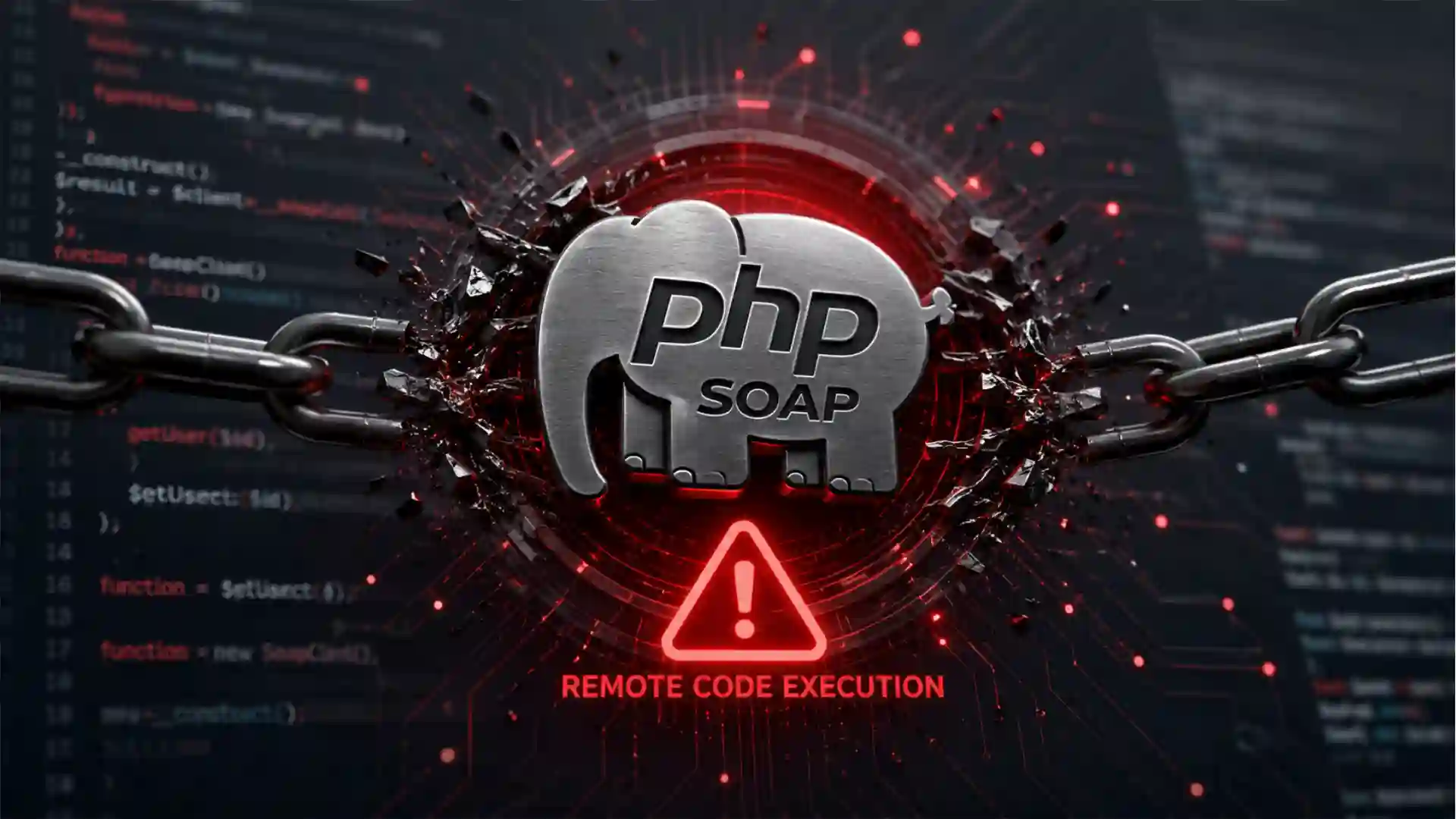
PHP’s May 2026 security releases should be treated as urgent by teams that run SOAP services on PHP, especially where untrusted clients can send SOAP request bodies to SoapServer. The most serious issue, CVE-2026-6722, is a use-after-free vulnerability in the PHP SOAP extension that the PHP Group rates as critical with a CVSS 4.0 base score of 9.5. The flaw affects PHP 8.2 before 8.2.31, 8.3 before 8.3.31, 8.4 before 8.4.21 and 8.5 before 8.5.6, and the patched versions were published on May 7, 2026.
Table of Contents
The PHP SOAP flaw is narrow in code and broad in operational risk
The vulnerability sits in a specific corner of PHP’s ext-soap implementation, not in every PHP application and not in every API endpoint. That distinction matters. A normal PHP site that does not load or use the SOAP extension is not exposed through this bug path. A PHP service that runs SoapServer and accepts attacker-controlled SOAP messages needs faster attention, especially if the endpoint is reachable from the internet or from a broad partner network.
The risk is serious because the affected code processes structured XML graphs that may contain internal references. SOAP is old, but it is not gone. Payment gateways, insurance platforms, government portals, enterprise resource planning systems, travel booking systems, and vendor integrations still use SOAP because contracts, WSDLs, and long-lived service dependencies are slow to replace. Many organizations have fewer people who understand those endpoints today than they had when the integrations were first deployed.
The PHP Group’s advisory describes the vulnerable package as ext-soap, with patched versions 8.2.31, 8.3.31, 8.4.21 and 8.5.6. The advisory says the issue arises when ext-soap deduplicates objects in the XML graph using id and href, remembers PHP objects in SOAP_GLOBAL(ref_map), and fails to increase the PHP object reference count before storing the object pointer.
That sentence explains the heart of the vulnerability. The extension keeps a reference to an object without properly keeping the object alive. Later processing can free the object while a stale pointer remains. A later reference can then copy the dangling pointer into the result. NVD describes the result plainly: an attacker controlling the SOAP request body can exploit the use-after-free to achieve remote code execution.
The word “remote” does not mean every remote HTTP request against a PHP site is automatically an exploit. It means the vulnerable parsing path is reachable through network-supplied SOAP content under the affected conditions. The practical question for defenders is therefore not “Do we use PHP?” but “Do we expose PHP SOAP server functionality that processes untrusted XML bodies?”
The May 7 patch set fixes more than one PHP problem
The May 7, 2026 releases were not a one-bug event. PHP published security releases for all four supported branches: PHP 8.5.6, 8.4.21, 8.3.31 and 8.2.31. The official PHP news archive identifies each of those releases as a security release and encourages users of those branches to upgrade.
The PHP 8 ChangeLog lists multiple fixes in the same patch train. In the SOAP area, it records fixes for CVE-2026-6722, CVE-2026-7261 and CVE-2026-7262. The same release set also includes PHP-FPM XSS, mbstring crashes and over-reads, a PDO Firebird SQL injection issue, and standard-library memory-safety fixes.
That mix matters for patch triage. CVE-2026-6722 is the headline because it carries remote code execution impact. The companion SOAP vulnerabilities still matter because they show the same subsystem received multiple security repairs in the same release window. A mature response should patch the whole PHP runtime, not attempt a selective workaround aimed only at one CVE.
Debian’s security advisory for php8.2 framed the broader patch set as multiple PHP security issues that may result in denial of service, SQL injection, cross-site scripting, or execution of arbitrary code. Debian fixed the oldstable php8.2 package in 8.2.31-1~deb12u1 and recommended package upgrades.
Security scanners also moved quickly. Tenable’s Nessus plugin for PHP 8.4 flags versions prior to 8.4.21 as affected by multiple vulnerabilities and recommends upgrading to PHP 8.4.21 or later. Tenable notes that the check relies on the application’s self-reported version rather than independent exploit testing, which is a useful reminder that version-based scan results still need asset context.
The affected versions are clear
PHP’s affected version range is unusually clean because all supported branches received coordinated point releases. The affected branches are PHP 8.2, PHP 8.3, PHP 8.4 and PHP 8.5 before the patched versions. The GitHub advisory for CVE-2026-6722 lists the affected versions as below 8.2.31, below 8.3.31, below 8.4.21 and below 8.5.6.
Affected PHP branches and patched versions
| PHP branch | Vulnerable before | Patched version | Release date | Security relevance |
|---|---|---|---|---|
| PHP 8.2 | 8.2.31 | 8.2.31 | May 7, 2026 | Security release for a branch in security-fix-only support |
| PHP 8.3 | 8.3.31 | 8.3.31 | May 7, 2026 | Security release for a branch in security-fix-only support |
| PHP 8.4 | 8.4.21 | 8.4.21 | May 7, 2026 | Security release for an actively supported branch |
| PHP 8.5 | 8.5.6 | 8.5.6 | May 7, 2026 | Security release for the latest supported branch |
The table should be read as a minimum patch target, not a long-term version strategy. Any PHP runtime below the patched version for its branch should be treated as vulnerable if it runs SOAP server code exposed to untrusted input. PHP’s supported-versions page also shows that PHP 8.2 and 8.3 are already in security-fixes-only status, while 8.4 and 8.5 remain in active support as of May 13, 2026.
The date matters because some organizations still wait for downstream packages, container image rebuilds, cPanel or Plesk updates, managed hosting rollouts, or distro backports. A source build of PHP, a Docker image, an OS package, and a managed platform runtime may expose different version strings and patch timelines. The security question is whether the runtime includes the patched code, not whether the version label looks familiar.
The vulnerable path starts with SOAP object deduplication
SOAP messages can describe graphs of values rather than only flat request parameters. SOAP 1.1 encoding permits elements to have id attributes and other elements to refer to them through matching href attributes. The W3C SOAP 1.1 note shows exactly that model: a containing element may have an id, and additional accessor elements may carry matching href attributes.
PHP’s SOAP extension implements support for SOAP servers and clients and supports subsets of SOAP 1.1, SOAP 1.2 and WSDL 1.1. That means ext-soap must translate XML nodes into PHP values and objects while preserving relationships inside the SOAP body. The deduplication mechanism exists because the same underlying value may appear more than once in a message graph.
CVE-2026-6722 breaks that translation at a memory-management boundary. The advisory says ext-soap remembers plain PHP objects in a hash map called SOAP_GLOBAL(ref_map), using a pointer to the libxml2 node as the key and the PHP object as the value. The bug is that the reference count of the PHP object is not increased when it is stored in that map.
In a garbage-collected runtime with reference counting, that is not a small bookkeeping error. Reference counts decide whether an object is still live. If code stores a pointer but does not hold a reference, later code may release the object while the pointer remains. That stale pointer points to memory that may later hold something else.
The advisory identifies an Apache map mechanism that can free objects between adding a reference and later checking it. When an apache:Map contains duplicate keys, the second entry can overwrite the first in a temporary result map. NVD describes that overwrite as freeing the original PHP object while the stale pointer remains in the map.
Remote code execution comes from memory reuse, not from normal SOAP logic
A use-after-free vulnerability becomes remote code execution when an attacker can shape what occupies freed memory and then force the program to treat that memory as the old object. That is why memory corruption bugs are so different from ordinary application bugs. SQL injection abuses query construction. XSS abuses browser interpretation. Use-after-free abuses object lifetime and memory reuse inside the runtime.
For CVE-2026-6722, the PHP advisory says the attacker can gain high control over the freed memory segment by subsequently allocating plain strings, leading to remote code execution. Snyk’s advisory summarizes the same issue as object deduplication storing object pointers without incrementing reference counts, with arbitrary code execution possible through a crafted SOAP request body that causes a freed object pointer to be reused.
This is not the same as saying exploitation is trivial in every deployment. NVD’s CVSS 4.0 vector from the PHP Group gives CVE-2026-6722 a critical base score of 9.5, while also listing high attack complexity and attack requirements present. The older CVSS 3.1 vector shown in NVD rates the issue 9.8 critical with network attack vector, low attack complexity, no privileges, no user interaction, and high confidentiality, integrity and availability impact.
The two scoring systems model conditions differently. Defenders should not get distracted by the scoring mismatch. The confirmed security outcome is severe: unauthenticated network input to a vulnerable SOAP parsing path may reach a memory corruption bug with RCE impact. That is enough to justify emergency inventory, patching and exposure reduction.
The correct operational posture is also not panic. The vulnerable code path is specific. Teams need to find affected PHP runtimes, identify active SOAP server endpoints, patch quickly, and add compensating controls where the patch cannot be applied at once.
SOAP remains present because enterprises rarely remove working integrations
SOAP is no longer the default choice for new public APIs, but it remains embedded in business workflows that prize contract stability over developer fashion. Many SOAP integrations were written when WSDL-driven service contracts were a normal enterprise architecture choice. Those integrations then became part of billing, claims processing, identity provisioning, shipping, procurement, travel inventory, healthcare messaging, tax filings and internal enterprise automation.
The security difficulty is that SOAP often sits behind language-specific tooling. Developers may not write raw XML by hand. They call generated client code or expose methods through a server class. The endpoint still accepts complex XML. The underlying runtime still parses the graph. A vulnerability in that parser can matter even if application developers have not touched SOAP code for years.
PHP’s SoapServer class provides a server for SOAP 1.1 and SOAP 1.2 protocols and can be used with or without a WSDL service description. That flexibility is useful for legacy integrations but dangerous for inventory. A team cannot search only for .wsdl files and assume it has found every SOAP service. Some services may be non-WSDL mode with a configured URI. Others may be hidden behind framework routes, reverse-proxy paths, or old virtual hosts.
A further problem is ownership. SOAP integrations often cross business boundaries. The application team might hesitate to change anything because a partner bank, insurer, booking engine, customs system, or ERP connector still depends on a fixed contract. Security teams may know PHP is present but not know that ext-soap is enabled. Platform teams may patch base images but not restart all long-running PHP-FPM pools. Every handoff adds time.
That is why the first response to CVE-2026-6722 should be inventory, not debate. The riskiest asset is a reachable PHP SoapServer endpoint running a vulnerable PHP build and accepting request bodies from untrusted or weakly trusted clients.
The Apache map detail matters for exposure analysis
The phrase “Apache map” may mislead some readers into thinking the bug applies only to Apache HTTP Server deployments. That is not the safest interpretation. In the CVE description, apache:Map refers to a SOAP encoding structure using the Apache XML-SOAP namespace, not simply the web server process that receives HTTP traffic. The vulnerable logic is in PHP’s SOAP decoding path.
The PHP advisory describes the Apache map as offering a mechanism to free objects between two points in the reference-tracking workflow. NVD describes an apache:Map node with duplicate keys where processing the second entry overwrites the first in the temporary result map, freeing the original object while a stale pointer remains.
That detail is useful for defenders because it narrows the path. The bug is not “any XML equals RCE.” It is a specific interaction between SOAP reference handling, duplicate map keys, temporary map overwrites, and later href resolution. A WAF rule looking for generic XML content will not solve the problem. A rule that blocks or constrains SOAP requests may reduce exposure, but it should not be treated as equal to a runtime patch.
The advisory’s explanation also shows why old protocols can hide modern memory-safety risk. SOAP’s graph model requires the runtime to store references and resolve them later. That is stateful parsing. State, references, deduplication and object lifetimes are exactly the kind of features that produce memory safety bugs in C extensions.
The safe fix is in PHP itself: keep the referenced object alive while it is stored in SOAP_GLOBAL(ref_map) and release it when the procedure is done. The GitHub advisory states the solution as increasing the reference count before adding objects to the map and configuring a deallocator to release those objects afterward.
CVE-2026-7261 adds a second SOAP use-after-free scenario
CVE-2026-7261 is a separate SOAP vulnerability fixed in the same release train. It does not carry the same headline RCE status as CVE-2026-6722, but it belongs in the same operational response because it affects ext-soap, the same PHP branches, and the same patched versions.
The GitHub advisory describes CVE-2026-7261 as a SoapServer session-persisted object use-after-free via SOAP header fault. It affects ext-soap before PHP 8.2.31, 8.3.31, 8.4.21 and 8.5.6, and the same versions patch it. The vulnerability depends on SOAP_PERSISTENCE_SESSION, which persists the SOAP handler object between requests using session storage.
The mechanism is different from the Apache map issue. Here, the advisory says soap.c fails to account for session persistence in failure cases where a handler function for a header node either returned false or threw an exception. When the session is written, a freed object can be read and written to session storage, producing a use-after-free.
That means the exposure is narrower than CVE-2026-6722. A server must use session persistence, and the attacker’s ability to shape freed memory may be limited because a typical SOAP server handles one SOAP request per PHP request. The advisory itself says attacker control of the freed memory segment is unlikely under normal request handling, though not impossible.
Still, defenders should not ignore it. A use-after-free in a server component is a memory safety issue, and real deployments are rarely as clean as assumptions. Session persistence, custom handlers, framework wrappers, error handling, and long-running process models all affect exploitability. The simplest treatment is to patch the PHP runtime and review whether SOAP_PERSISTENCE_SESSION is needed.
CVE-2026-7262 shows the denial-of-service side of the same subsystem
CVE-2026-7262 is another SOAP vulnerability patched on May 7. The GitHub advisory identifies it as a NULL pointer dereference in the SOAP apache:Map decoder with missing <value>. It affects ext-soap before the same patched versions and is rated moderate in the advisory.
The bug is a guard failure. The advisory says the <key> branch correctly checks for a missing key, but the <value> branch rechecks xmlKey instead of xmlValue. A missing value can then lead to master_to_zval_int() accessing data->properties without a NULL check. The branch is reachable when the SOAP server has a typemap configured.
The impact is denial of service rather than remote code execution. A malicious SOAP request can crash the process under the described conditions. In a PHP-FPM environment, that may kill a worker process rather than the whole host, but repeated crashes still degrade service, trigger pool churn, produce noisy logs, and may create business downtime for old integrations that depend on small worker pools.
The defensive lesson is that SOAP parsing bugs are not all equal. CVE-2026-6722 is the emergency because it crosses into RCE. CVE-2026-7261 is narrower but still memory-safety related. CVE-2026-7262 is mainly availability. The patch should be treated as one runtime security update covering a cluster of parsing and memory-lifetime failures.
This cluster also weakens any argument that a SOAP endpoint is “low risk” because it sits behind partner access rather than the public internet. Partner-facing APIs still process untrusted input. A compromised partner credential, misconfigured VPN route, shared API key, or staging exposure is enough to turn a “trusted” path into an attack path.
PHP-FPM and PDO Firebird fixes widen the patch urgency
The same security releases also patch issues outside SOAP. That matters because platform teams often patch by runtime branch rather than by application feature. A server that does not use SOAP may still need the May 7 PHP release because of PHP-FPM, mbstring, PDO Firebird or standard-library fixes.
The PHP-FPM advisory, CVE-2026-6735, covers cross-site scripting in the PHP-FPM status endpoint. GitHub’s advisory says improper sanitization of the request URI within the PHP-FPM status page allows arbitrary JavaScript execution on the victim’s machine, and it warns that the attacker does not require access to the /status endpoint to trigger the XSS sequence.
The PDO Firebird advisory, CVE-2025-14179, is more serious for applications that use Firebird. It says improper handling of NUL bytes during Firebird SQL query preparation can drop query sections, and the issue applies to SELECT, INSERT, UPDATE, DELETE, MERGE, WITH and EXECUTE statements. The advisory rates it high.
The mbstring issues include CVE-2026-7259, a NULL pointer dereference tied to mismatch between Oniguruma and mbfl encoding support, and CVE-2026-6104, a global buffer over-read in mb_convert_encoding() and related functions when parsing encoding names with embedded NUL bytes.
The standard-library issues include CVE-2026-7568, a signed integer overflow in metaphone() with very large strings, and CVE-2026-7258, an out-of-bounds read in urldecode() tied to signed char handling in ctype.h calls on affected platforms such as NetBSD.
For defenders, the message is simple: patching only SOAP-facing hosts is not enough if the same PHP fleet also exposes PHP-FPM status pages, Firebird database access, mbstring processing or affected standard-library paths.
The difference between confirmed exploitability and confirmed exploitation
A critical score and a plausible RCE path do not automatically prove active exploitation in the wild. Public advisories establish vulnerability, affected versions, impact and patched versions. They do not always establish whether attackers are already using the bug against real servers.
As of the sources checked for this analysis on May 13, 2026, the strongest primary sources for CVE-2026-6722 are the PHP Group/GitHub advisory, NVD and downstream distro or scanner advisories. Those sources confirm the RCE-capable use-after-free path and the patched PHP versions. They do not provide victim telemetry, campaign names, malware hashes, exploit-kit details or confirmed mass exploitation.
That distinction is not a reason to delay. Remote code execution bugs in server-side runtimes attract scanning once enough technical detail is public. The vendor advisory contains enough mechanism detail for capable researchers and attackers to understand the class of bug. Even when a full public exploit is absent, attackers often build private probes from advisory text, patch diffs, and regression tests.
A good security program treats “confirmed exploited” as a late signal, not an entry requirement for action. By the time a vulnerability appears in incident reports, defenders have lost the quiet patch window. The better threshold is reachability plus impact plus patch availability. CVE-2026-6722 meets that threshold for SOAP-exposed PHP services.
There is also a reputational risk in underreacting. A vulnerable SOAP endpoint may belong to a forgotten integration, but a compromise will not be perceived as a forgotten-system issue. It will be perceived as a failure to patch a critical RCE in a widely used runtime after public fixes were available.
Internet exposure is only one part of the risk model
The most obvious danger is an internet-facing SOAP endpoint on a vulnerable PHP build. That is the scenario that deserves immediate patching and temporary access restrictions. But internet exposure is not the full risk model.
Many SOAP services are reachable only over VPN, private peering, partner IP allowlists, service meshes, or internal reverse proxies. Those controls reduce random scanning, but they do not remove attacker-controlled input. A partner environment can be compromised. A staging route can be exposed by DNS. A cloud security group can drift. A VPN account can be phished. An internal adversary can pivot to legacy integration hosts after compromising a low-value system.
The vulnerable input is the SOAP request body. If the endpoint accepts a request body from any entity outside the owning application’s trust boundary, the input should be treated as untrusted. That includes B2B partners, mobile backends, vendor middleware, and internal systems administered by different teams.
The second risk factor is process privilege. A successful RCE inside PHP normally runs with the privileges of the PHP process. That may be www-data, apache, a site-specific user, a container user, or a service account. The impact depends on what that identity can read, write, execute, connect to, and impersonate. A hardened container with read-only filesystem, minimal secrets and no metadata-service access has a different blast radius from a shared legacy host with database credentials, SSH keys and writable web roots.
The third risk factor is persistence opportunity. If the PHP process can write to the application directory, upload directory, cron path, plugin directory, or shared NFS mount, an attacker who achieves code execution may place a web shell or modify application files. If the process can only write to ephemeral storage, persistence becomes harder.
Patch priority should combine version, SOAP reachability, privilege, secrets exposure, write permissions and network egress. A vulnerable but unreachable development container is less urgent than a partner-facing claims-processing SOAP server with production database credentials.
The runtime patch is the real fix
The only reliable fix is to run a PHP build that includes the patched ext-soap code. PHP’s May 7 security releases provide that fix for supported branches. The PHP news archive identifies PHP 8.5.6, 8.4.21, 8.2.31 and 8.3.31 as security releases, and the ChangeLog ties those releases to the SOAP CVEs.
Compensating controls have value, but they are not equal to patching. Disabling the SOAP extension removes the vulnerable code path if the application does not need SOAP. Blocking public access to SOAP endpoints reduces exposure. Restricting request body size, enforcing XML schema constraints, and narrowing partner IP access all improve defense. None of those controls repair the lifetime bug in SOAP_GLOBAL(ref_map).
For emergency response, teams should answer five questions:
- Which hosts or containers run PHP versions below 8.2.31, 8.3.31, 8.4.21 or 8.5.6?
- Which of those runtimes have
ext-soapinstalled and enabled? - Which applications instantiate
SoapServeror route requests to SOAP server handlers? - Which SOAP endpoints accept requests from the internet, partners, or broad internal networks?
- Which of those endpoints run with access to sensitive credentials, writable code paths, or high-value internal services?
This inventory can usually be started with package data, runtime introspection, configuration management, container image manifests, and code search. It should not rely on developer memory. The endpoints most likely to be missed are old virtual hosts, partner-only services, cron-triggered PHP wrappers, and container images pinned to older point releases.
A strong patch plan also includes restarts. Upgrading the package on disk does not always replace running PHP-FPM workers, Apache module processes, long-running CLI daemons, queue workers, or supervisor-managed services. The active process must load the patched library.
Temporary mitigations for teams that cannot patch immediately
Some organizations cannot patch every PHP service in one maintenance window. That may be a business reality, but it should be handled as a temporary exception with named owners, compensating controls and a short expiry date. A vague “we will patch later” leaves the most dangerous window open.
The first temporary mitigation is to remove exposure. If a SOAP endpoint is not used, disable it. If a SOAP route is needed only by a small partner set, restrict access at the edge, load balancer, API gateway, reverse proxy, VPN, firewall or service mesh. If the service is internal, narrow east-west access to specific callers rather than broad subnets.
The second mitigation is to disable ext-soap on hosts that do not need it. This is often safer than trying to write clever filtering rules. In many PHP deployments, extensions are loaded per runtime configuration. Removing or disabling the extension on unrelated hosts reduces attack surface without touching application logic.
The third mitigation is to limit request body size and XML complexity. OWASP’s web service security guidance calls out XML denial-of-service protection, including validation against recursive payloads, oversized payloads, entity expansion and overlong element names for SOAP-based services. These controls target availability and parser abuse, not the exact use-after-free, but they still reduce room for malicious shaping.
The fourth mitigation is monitoring. Watch for unusual POSTs to SOAP endpoints, unexplained PHP worker crashes, segmentation faults, repeated SOAP faults, unexpected outbound connections from PHP workers, new files in writable web directories, and changes to SOAP integration behavior. Memory-corruption exploitation may be noisy during probing.
The fifth mitigation is blast-radius reduction. Remove unnecessary write permissions from PHP service accounts. Rotate secrets after patching high-risk systems. Block unneeded outbound connections. Restrict access to instance metadata endpoints from application containers. A patched runtime stops this bug; hardening reduces damage if another bug remains.
Practical triage matrix for PHP SOAP exposure
| Exposure condition | Priority | Recommended action | Reason |
|---|---|---|---|
Internet-facing SoapServer on vulnerable PHP | Emergency | Patch immediately or disable external access until patched | Remote unauthenticated request bodies may reach CVE-2026-6722 |
| Partner-facing SOAP endpoint on vulnerable PHP | Emergency | Patch, restrict partner access, monitor requests | Partner trust does not remove attacker-controlled input |
| Internal SOAP endpoint on broad network | High | Patch and narrow service-to-service access | Lateral movement can reach legacy integration endpoints |
PHP host with ext-soap enabled but no known SOAP route | Medium | Patch and verify code paths | Inventory gaps are common in older PHP estates |
PHP host without ext-soap and no SOAP usage | Normal security update | Patch through standard runtime process | Other May 2026 PHP fixes may still apply |
This matrix should guide sequence, not justify delay. Any host with a vulnerable supported PHP branch should move to the patched point release, even if SOAP is not currently believed to be exposed. The SOAP risk drives urgency; the broader release set strengthens the case for fleet-wide runtime updates.
The WordPress question needs a careful answer
Many non-specialist readers will ask whether this is a WordPress vulnerability. The answer is no in the strict sense: CVE-2026-6722 is a PHP ext-soap vulnerability, not a vulnerability in WordPress core. But that does not mean WordPress-hosting environments can ignore the PHP update.
A WordPress site becomes relevant if the underlying PHP runtime is vulnerable and some installed plugin, theme, integration, custom code, or hosting component uses PHP’s SOAP server functionality in a reachable way. Most ordinary WordPress sites do not expose SoapServer endpoints. Some e-commerce, CRM, ERP, shipping, payment, booking or enterprise integration plugins may use SOAP clients, SOAP-related libraries, or custom service endpoints. Client-side SOAP usage is not the same as exposing a SOAP server, but it is still a reason to inventory the extension.
Shared hosting adds another wrinkle. A site owner may not control the exact PHP package build. Control panels may let users select PHP 8.2, 8.3, 8.4 or 8.5 but hide the patch-level version. Managed hosts may backport fixes without changing a version string in the way upstream PHP does. Customers should check provider advisories, runtime version output, and whether soap is loaded.
WordPress itself had compatibility changes across PHP branches, and the WordPress project maintains a PHP compatibility reference for core versions. That is relevant because some site owners cannot jump branches quickly without testing plugins. But CVE-2026-6722 does not require a branch jump. Supported PHP branches received patch-level security releases, so the safer path is to update within the same branch where possible.
For agencies and hosting providers, the practical message is: do not market this as a WordPress zero-day, but do patch PHP runtimes underneath WordPress fleets and verify whether SOAP-enabled custom integrations exist. Overstating the CMS angle creates noise; ignoring the runtime layer creates risk.
Containers make the patch appear simple and the cleanup harder
Containerized PHP services may look easier to patch because teams can rebuild images from updated base layers. The harder part is knowing which images are still running. A registry may contain a patched PHP 8.4.21 image while production still runs an older digest pinned in a deployment manifest. A Kubernetes cluster may have old pods that did not roll because a deployment was paused, a job image was pinned, or a stateful service resisted restart.
The correct check is the running process, not the Dockerfile. Teams should inspect active pods, ECS tasks, Nomad allocations, systemd services, and long-running CLI workers. Any runtime that loads vulnerable PHP code remains exposed even if the repository has already been patched.
Container images also create extension drift. One image may include ext-soap because a billing service needs it. Another image may inherit the same extension even though it only serves static API routes. Removing unused extensions from base images is one of the best long-term responses to this class of vulnerability. It reduces the number of hosts that need emergency triage when the next extension bug appears.
For high-risk SOAP services, patching the image is not enough. The rollout should include runtime restart, health checks, integration tests against partner clients, and rollback planning. A rushed patch that breaks a payment or claims interface may trigger pressure to roll back to a vulnerable image. The better plan is a tested patched runtime plus temporary traffic restrictions during the rollout.
A final container detail matters: secrets. Many PHP containers carry database passwords, API tokens, cloud credentials or private certificates as environment variables or mounted files. If a SOAP RCE is suspected before patching, rotate those secrets after containment. A patched container with stolen secrets is still an incident.
Legacy Linux packages may be patched without obvious upstream numbers
Operating system vendors often backport fixes. That means the version string may not always match the upstream PHP point release. Debian’s advisory, for example, fixes php8.2 in 8.2.31-1~deb12u1 for oldstable, while distro packaging may include release suffixes and backport identifiers.
Security teams should avoid two mistakes. The first mistake is assuming a host is safe only if php -v prints the exact upstream point release. Distro vendors may patch within a packaged version scheme. The second mistake is assuming a host is safe because the OS package manager says “latest” while the underlying distribution repository has not yet shipped the fix. “Latest available” is not the same as “fixed.”
The right approach is to map each runtime to its vendor advisory. For upstream builds, compare against PHP 8.2.31, 8.3.31, 8.4.21 or 8.5.6. For Debian, Ubuntu, Red Hat derivatives, Fedora, Alpine, Slackware, Mageia, cPanel EasyApache, Plesk and managed platforms, use the vendor’s package advisory and changelog. For custom builds, inspect the source commit or rebuild from a patched upstream tarball.
Tenable’s plugin note is useful here because it says the scan relies on self-reported version information rather than testing exploitability. Version scans are good first-pass signals, but they need validation on systems that use vendor backports.
Organizations with software bills of materials should update runtime SBOM entries, not only application dependency manifests. PHP extensions are part of the attack surface. A Composer lock file will not show that the C-level SOAP extension is vulnerable. Runtime inventory must include OS packages, PHP modules, container base layers and compiled extensions.
Logs and crash signals may reveal probing
Memory-corruption exploitation often leaves traces before it succeeds. For PHP SOAP endpoints, defenders should look for spikes in SOAP faults, malformed XML bodies, repeated POST requests with unusual namespace usage, requests containing unexpected apache:Map structures, duplicate-key patterns in SOAP maps, abrupt PHP-FPM worker exits, segmentation faults, and application logs that show handler failures before process termination.
No single log entry proves exploitation. SOAP integrations are notoriously noisy, and old partner clients sometimes send unusual XML. The pattern matters. A sudden cluster of malformed SOAP requests from unfamiliar IPs, followed by worker crashes, deserves investigation. A single partner client producing a stable parse error after a rollout may be a compatibility issue.
Network controls should also watch for post-exploitation behavior. If an attacker achieves code execution in a PHP worker, the next steps may include outbound HTTP callbacks, DNS lookups to attacker-controlled domains, shell execution, writes to web-accessible directories, credential discovery, environment variable reads, metadata-service access, or lateral movement to internal databases and queues.
File integrity monitoring is especially useful on older PHP hosts. Attackers often drop small web shells into writable directories. Upload folders, cache directories, theme/plugin directories, and temporary paths deserve attention. A runtime RCE may not need to modify code for immediate execution, but persistence often requires a write.
Incident responders should preserve evidence before patching destroys process state. Capture relevant web logs, PHP error logs, system logs, core dumps if available, file listings, process trees, loaded modules, environment variables, container image digests and network connection history. Then patch and rotate secrets where exposure is plausible.
WAF rules are useful only as a short-term pressure valve
A web application firewall can reduce exposure by blocking suspicious SOAP bodies, limiting XML complexity, enforcing request size limits, and narrowing access by source. It should not be described as a fix for CVE-2026-6722. The vulnerable logic lives in PHP’s SOAP extension. The patch fixes object lifetime handling. A WAF guesses at malicious input.
The difference matters because memory-corruption exploits often change shape. An attacker may alter whitespace, namespaces, encoding, ordering, body size, headers or transport details while preserving the underlying trigger. A WAF rule that looks for one string or one structure may miss a working variation. A strict allowlist for known partner request schemas is stronger than a broad denylist, but many legacy SOAP systems do not have clean schema enforcement at the edge.
A good temporary WAF plan is narrow and measurable. Allow only known SOAP actions. Enforce authentication before body parsing where architecture allows it. Restrict request size to what the business method actually needs. Reject unexpected content types. Require TLS client certificates for partner-only services. Log blocked requests with enough metadata for investigation.
The risk is false confidence. A WAF may stop mass scanners while a targeted attacker studies a partner schema and crafts traffic that looks legitimate. For a critical RCE, the WAF buys time; it does not close the issue.
Teams should also consider where parsing happens. If the WAF or API gateway only forwards traffic after inspecting headers and size, PHP still parses the SOAP body. The vulnerable code path is reached when SoapServer handles the body. Controls that do not prevent the body from reaching PHP under malicious conditions are incomplete.
Code search should look for behavior, not only names
A quick search for SoapServer is useful but incomplete. Some projects wrap SOAP server creation in framework classes. Some use dependency injection. Some load handlers dynamically. Some use old libraries that abstract PHP’s native SOAP extension. Some expose SOAP only through a legacy route that no longer appears in current documentation.
Search terms should include SoapServer, setClass, setObject, setPersistence, SOAP_PERSISTENCE_SESSION, handle, typemap, apache:Map, WSDL file paths, .wsdl, route names containing soap, and documentation references to SOAP actions. Composer packages that bridge to native ext-soap should also be inspected. Packagist packages exist that explicitly use PHP’s built-in SOAP functions as an engine, which means dependency review should include native-extension requirements, not only PHP library code.
Infrastructure search matters too. Reverse proxies may route /soap, /ws, /services, /api/v1/soap, /Service.asmx, /index.php?wsdl, or partner-specific paths to old PHP handlers. Some SOAP endpoints hide behind query strings rather than clean paths. Access logs often reveal more than code search because they show routes still receiving traffic.
A mature inventory should classify SOAP endpoints by owner, business function, runtime version, exposure, authentication, partner dependencies, data sensitivity and restart process. That inventory becomes useful beyond this CVE. It tells the organization where its legacy integration risk lives.
The strongest long-term control is not to ban SOAP. Some SOAP systems are business-critical and stable. The control is to keep them visible, patched, tested and isolated.
Memory safety in C extensions remains a PHP security boundary
PHP application developers often think of PHP security in terms of input validation, escaping, prepared statements, sessions and file uploads. CVE-2026-6722 is different. It is a memory-safety bug in a C extension inside the runtime. The application may be written in memory-safe PHP code and still depend on native extension code that manages pointers and reference counts.
That boundary is easy to forget because PHP hides memory management from userland developers. A developer creates objects, arrays and strings. The engine and extensions manage reference counts, destructors, allocations and deallocations. When extension code gets that wrong, userland application code may not have a meaningful way to defend itself.
This is why extension minimization matters. Every enabled native extension expands the trusted computing base. XML, image, compression, database, serialization, internationalization, cryptography and protocol extensions all parse complex inputs. Many are safe most of the time. Some have sharp edges. Keeping unused extensions enabled is unnecessary risk.
The PHP project has invested in testing, fuzzing, refactoring and security response, but C-level runtime bugs still appear. The May 2026 release train includes memory-safety and undefined-behavior fixes across SOAP, mbstring and standard-library code.
The practical security lesson is direct: application security reviews must include the PHP runtime, loaded extensions, SAPI model, operating system packages and container base images. A clean Composer audit does not prove a safe PHP runtime.
The CVSS score should guide urgency but not replace context
CVE-2026-6722’s NVD page shows a PHP Group CVSS 4.0 base score of 9.5 critical, while NVD’s change history shows a CVSS 3.1 vector that yields 9.8 critical. A team that only sorts by score will put the issue near the top of the patch queue, which is correct. But score alone does not tell which hosts should go first.
CVSS measures generic technical severity. Operational risk depends on reachability, exploit preconditions, privilege, data, monitoring, compensating controls and business impact. A vulnerable public SOAP endpoint handling financial transactions is a higher priority than a vulnerable CLI-only PHP build on an isolated batch host. A vulnerable PHP-FPM pool with write access to the web root is higher risk than one running in a locked-down container.
The companion vulnerabilities show the same point. CVE-2026-7261 is moderate in the GitHub advisory with a CVSS 4.0 score of 6.3, but it is a use-after-free and may be more interesting in unusual deployments that use SOAP_PERSISTENCE_SESSION. CVE-2026-7262 is also moderate and mainly availability-focused, but it may be painful for a small worker pool that handles business-critical partner traffic.
A useful patch order combines both models. Start with critical RCE reachable from untrusted networks. Then patch remaining SOAP services. Then patch all supported PHP branches fleet-wide because the release includes broader fixes. Do not use “we do not expose SOAP publicly” as a reason to skip the PHP update.
Business impact is highest where SOAP carries transactions
The technical impact is remote code execution. The business impact depends on what the endpoint does. SOAP services often carry high-value operations: invoice submission, claim status, inventory reservation, payment authorization, customer lookup, order creation, identity synchronization, policy validation, tax reporting or supplier onboarding.
A compromise of such an endpoint may expose more than the PHP host. The service account may have database access. The application may hold partner credentials. The host may connect to message queues or internal SOAP services. Logs may contain personally identifiable information or transaction data. File systems may store certificates, keystores, XML payload archives or exports.
The most damaging scenario is not a noisy crash. It is quiet code execution followed by credential theft and lateral movement. A PHP process with access to .env files, database passwords, API tokens, client certificates or cloud metadata can become a bridge into other systems. The attacker may not care about the SOAP business function at all; the endpoint is simply the first foothold.
For regulated sectors, the reporting implications may be significant. Healthcare, financial services, public-sector portals and insurance systems often have strict requirements for incident assessment and breach notification. A vulnerable SOAP endpoint that processes sensitive data should trigger a documented risk decision, not only a helpdesk ticket.
Business leaders need a plain explanation: this is a runtime vulnerability that may allow code execution through certain SOAP request bodies. The patch exists. Delaying patching leaves legacy integration endpoints as possible entry points into production systems.
Testing the patch should focus on integration compatibility
Security patches for PHP point releases are usually low-friction, but SOAP services deserve compatibility testing because old clients can be brittle. WSDL contracts, namespace handling, typemaps, object serialization, headers, faults and session persistence may all interact with custom business logic.
The May 7 patch changes internal memory handling, not the public SOAP contract. In principle, correct clients should continue working. Still, organizations should test representative SOAP actions, authentication flows, error handling, header processing, large payloads, typemap conversions and partner-specific requests. Tests should include both WSDL and non-WSDL modes if both are used.
The biggest operational risk is rollback. If a patched runtime causes a partner integration failure and the team rolls back to a vulnerable build, the organization returns to the exposure window. A better plan is to stage the patched runtime, run contract tests, prepare partner notification if needed, and keep temporary access restrictions active until confidence is high.
Observability should be part of the rollout. Watch PHP-FPM error rates, SOAP fault rates, HTTP 500s, worker restarts, latency and partner-specific transaction failures. A patch that silently breaks one SOAP action may not show in generic uptime checks. Business transaction monitoring is more useful than a simple health endpoint.
Because the same release set fixes PHP-FPM, mbstring, PDO and standard-library issues, test plans should include non-SOAP application paths too. PHP point releases are designed for compatibility, but production confidence comes from measuring the paths that matter.
Managed hosts and agencies need customer-facing guidance
Hosting providers, agencies and SaaS vendors that manage PHP fleets need to communicate without creating confusion. The message should not imply every PHP site has already been compromised. It should not frame the flaw as a WordPress or Laravel vulnerability. It should state that PHP published security releases on May 7, 2026, including a critical SOAP extension RCE fix, and that managed runtimes are being updated or have been updated.
Customers need three facts: the patched PHP versions, whether the provider has deployed them, and whether customer action is required. If the provider controls PHP runtimes centrally, say so. If customers choose PHP versions through a control panel, show them how to select a patched branch. If dedicated servers or custom containers are customer-managed, state that the customer must patch.
Agencies should review client sites for ext-soap usage, not only CMS versions. Many client projects include old integrations with accounting platforms, shipping APIs, reservation engines or public-sector services. Those integrations may live outside the main application framework. A client may think “we do not use SOAP” because the visible site is modern, while a hidden partner endpoint still runs old code.
Security vendors should avoid recycled headlines that say “critical PHP SOAP vulnerabilities enable remote code execution” without distinguishing CVE-2026-6722 from the moderate SOAP issues. Clear communication reduces panic and improves prioritization. The RCE center of gravity is CVE-2026-6722; the broader May release is still important across PHP fleets.
For procurement and compliance teams, this is a good moment to ask vendors whether they have an inventory of PHP runtime versions and enabled extensions. A vendor that cannot answer may not know whether it is exposed.
The vulnerability also exposes a maintenance culture problem
CVE-2026-6722 is not only a bug. It is a reminder that old integration code ages differently from core product code. Product teams rewrite frontends, migrate databases and ship new APIs. SOAP integrations often remain untouched because they still work. “Still works” becomes “nobody owns it.” Nobody owning it becomes delayed patching, stale documentation and weak monitoring.
Security programs often perform dependency scans at the application layer but miss runtime extensions. They track Composer packages but not php-soap. They scan containers but do not map enabled modules to reachable routes. They patch the main application but forget sidecar services, old admin panels and partner endpoints.
A better maintenance culture treats runtimes as products. Each PHP branch has an owner, a patch cadence, a support date, a test suite and a deprecation plan. The PHP supported-versions page shows support windows clearly: as of May 13, 2026, PHP 8.2 and 8.3 are in security-fixes-only support, while PHP 8.4 and 8.5 remain actively supported.
That lifecycle matters. A team staying on PHP 8.2 can still receive security patches until December 31, 2026, but it is already outside active support. A team on PHP 8.3 is also in security-fixes-only support. Those branches are acceptable only with strong patch discipline. They are not a reason to postpone planning for newer branches.
The deeper lesson is that unsupported or barely supported runtimes turn every security release into a scramble. Teams that know their runtime estate, test patch releases routinely and remove unused extensions handle these events calmly. Teams that discover SOAP endpoints during an emergency pay a higher price.
Attack surface reduction should survive the emergency
Once the patched PHP versions are deployed, the work should not end. The organization should reduce the chance that the next extension vulnerability becomes an emergency across hundreds of systems.
Start by disabling unused PHP extensions. If an application does not need SOAP, do not load ext-soap. If it does not need Firebird, do not load PDO Firebird. If it does not need legacy XML features, remove them where possible. This is not minimalism for its own sake; it is a practical way to shrink the native parsing code reachable by network input.
Next, segment legacy integration endpoints. Partner SOAP services should not share hosts or service accounts with public web applications unless there is a strong reason. They should not have broad outbound access. They should not run with write permissions to application code. They should have explicit owner metadata and documented consumers.
Then improve schema and contract enforcement. SOAP was designed for structured contracts. Use that advantage. Reject unknown actions, unexpected namespaces, oversized bodies and unauthenticated calls before application logic performs sensitive work. This does not replace memory-safety patches, but it reduces abuse paths.
Finally, add runtime-level visibility. Track PHP versions, SAPIs, enabled extensions, container digests and process restart times. A fleet dashboard that answers “Which production services run PHP below 8.4.21 with ext-soap enabled?” is worth far more than a spreadsheet assembled after a critical CVE.
The long-term response to CVE-2026-6722 is smaller attack surface, better runtime inventory and routine patch testing. The immediate response is patching.
Incident response playbook for suspected exploitation
If a vulnerable SOAP endpoint was exposed before patching, incident responders should assess whether there are signs of exploitation. The investigation should start with the period from public disclosure and patch release on May 7, 2026, but it should also review earlier logs if suspicious crashes or SOAP anomalies predate public attention.
Collect web access logs for SOAP routes, PHP error logs, PHP-FPM logs, reverse-proxy logs, WAF logs, system logs and container runtime logs. Look for unusual request volumes, unfamiliar source networks, malformed XML, SOAP faults, worker crashes, segmentation faults and unexpected restarts. Compare activity against normal partner schedules.
Inspect the filesystem for recently modified PHP files, new files in upload directories, changed plugin or theme files, suspicious dotfiles, unexpected cron entries, modified systemd units, new SSH keys, changed .htaccess files and web-accessible scripts with obfuscated content. Review writable paths used by the PHP service account.
Review outbound network activity from the affected hosts. Unexpected connections to external IPs or domains after suspicious SOAP requests may indicate command-and-control, payload retrieval or data exfiltration. Internal connections to databases, Redis, message queues, LDAP, SMB, S3-compatible storage or metadata endpoints may indicate lateral movement or credential use.
Rotate secrets if compromise cannot be ruled out. This includes database passwords, API tokens, partner credentials, OAuth client secrets, signing keys, client certificates and cloud credentials accessible to the PHP process. Patch first, preserve evidence, then rotate in a sequence that does not destroy critical logs.
Document the decision. If no compromise is found, record the evidence reviewed and the reason for closure. If compromise is suspected, escalate under the organization’s incident response and legal processes. A critical RCE against a production integration endpoint deserves careful handling.
Developers should understand the bug without copying the exploit
Developers need enough technical detail to reason about risk, but defensive communication should avoid distributing ready-to-run exploit material. The safe explanation is this: PHP’s SOAP extension stored object pointers in a global reference map without increasing the object reference count. A crafted SOAP graph involving duplicate Apache map keys could free the original object while leaving a stale pointer. A later href reference could reuse that stale pointer, and memory reuse through controlled allocations could lead to code execution.
That explanation gives engineers the mechanism without turning the article into an exploitation guide. It also helps them understand why input validation in userland PHP is not enough. The bug happens while decoding the SOAP message into PHP values. The application handler may not run before the dangerous internal state is created.
Developers should also understand the companion SOAP bugs. CVE-2026-7261 involves session-persisted SOAP handler objects and failure cases in header handling. CVE-2026-7262 involves a missing-value path in Apache map decoding when typemap is configured. These are not the same bug, but they share a theme: complex SOAP decoding paths need strict lifetime and NULL handling.
For application teams, the action items are practical. Update PHP. Restart processes. Test SOAP clients. Remove unused SOAP server code. Disable unused extensions. Add schema and action allowlists where possible. Log and monitor SOAP endpoints. Avoid long-lived service accounts with broad permissions. Build tests that exercise SOAP error paths, not only successful calls.
A security release should not be the first time the team reads its SOAP code.
Security teams should avoid three common mistakes
The first mistake is treating the vulnerability as irrelevant because the organization “uses REST now.” Current product APIs may use REST or GraphQL, while older partner integrations still run SOAP. The risk is tied to what is deployed, not what the architecture slide says.
The second mistake is searching only public domains. Internal SOAP endpoints may become reachable after a phishing incident, VPN compromise or cloud misconfiguration. RCE inside a trusted network is still RCE. Many damaging breaches start with internal movement after an unrelated initial access event.
The third mistake is patching the package but not restarting. PHP-FPM, Apache module workers, long-running CLI workers and queue processors need to load the patched code. A package manager log entry is not proof that the vulnerable process is gone. Runtime verification should include process start times and loaded PHP versions.
There is a fourth mistake: assuming a scanner fully proves exploitability. Tenable’s PHP 8.4 plugin explicitly says it relies on self-reported version information and has not tested for the issues. Version detection is useful for triage. It is not a substitute for route exposure analysis, extension inventory or process verification.
A disciplined response avoids drama and blind spots. Find the runtime, find the extension, find the endpoint, patch, restart, test, monitor and reduce exposure.
Boards and executives need a concise risk narrative
For executives, the technical description can be condensed without hiding the severity. PHP released security updates on May 7, 2026 for all supported branches. The most serious fix addresses a critical vulnerability in PHP’s SOAP extension that may allow remote code execution when vulnerable SOAP server endpoints process crafted request bodies. Patched versions are available. Systems that run SOAP integrations on vulnerable PHP builds need immediate updates.
The risk is not theoretical enough to wait for normal quarterly maintenance. The vendor advisory and NVD confirm the remote code execution impact. The affected software is a common runtime. The vulnerable feature is used in legacy enterprise integrations where visibility is often weak. Those three facts make the issue operationally serious.
Executives should ask for a small set of answers: how many PHP runtimes are below the fixed versions; how many have ext-soap enabled; how many expose SoapServer endpoints; how many are internet- or partner-facing; when those will be patched; and whether any suspicious activity was found. Those answers are more useful than a generic “we are investigating.”
The board-level concern is not only downtime. It is unauthorized code execution on systems that may hold credentials, transactional data and partner connectivity. A vulnerable SOAP endpoint can become a path into more valuable systems if service accounts and network access are poorly constrained.
The right leadership posture is to support emergency patching, accept short maintenance windows, and require a follow-up plan for runtime inventory and legacy integration ownership.
The security release is also a chance to clean up PHP branches
The May 2026 patch train landed across PHP 8.2 through 8.5, but branch status should influence planning after the emergency. PHP’s supported-versions page shows that PHP 8.2 entered security-fixes-only support after December 31, 2024, and reaches security support end on December 31, 2026. PHP 8.3 entered security-fixes-only support after December 31, 2025 and receives security support until December 31, 2027. PHP 8.4 and 8.5 have longer active support windows.
A patch-level update within a branch is the fastest safe move. A branch upgrade is a separate project. Teams should not delay CVE-2026-6722 remediation because they want to migrate from PHP 8.2 to 8.4 later. Patch now, then plan the branch upgrade.
After the emergency, organizations should reduce branch sprawl. Supporting PHP 8.2, 8.3, 8.4 and 8.5 across many applications multiplies test matrices and patch workflows. Some sprawl is unavoidable, but many old branches remain because no team owns migration. The next critical runtime CVE will be easier to handle if there are fewer runtime variants.
Branch cleanup also improves developer experience. Modern PHP versions bring language, performance and typing improvements, but the security value is patch agility. A fleet that can accept point releases quickly is safer than a fleet that treats every PHP update as a risky migration.
The practical target is not “always run the newest PHP on day one.” The target is run supported branches, keep patch releases current, know where each branch is deployed, and remove unsupported runtimes from production.
Vendor and supply-chain questions should be specific
Many organizations depend on vendors that embed PHP in appliances, hosted portals, integration middleware or managed applications. Asking “Are you affected?” often produces vague answers. Better questions force useful responses.
Ask whether the product uses PHP 8.2, 8.3, 8.4 or 8.5. Ask whether ext-soap is compiled or enabled. Ask whether the product exposes SoapServer endpoints to customers, partners, administrators or internal services. Ask which patched PHP version or backported package is included in the vendor’s fixed release. Ask whether the vendor has reviewed logs for exploitation. Ask whether customers need to rotate credentials after updating.
If the vendor says the product does not use SOAP, ask about the broader May 2026 PHP security release. PHP-FPM, mbstring, PDO Firebird and standard-library fixes may still apply depending on the product. The vendor should be able to map CVEs to affected components or explain why they are not reachable.
For SaaS providers, customers may not receive version-level visibility. In that case, the vendor should provide a dated security statement: when the PHP runtime was patched, which CVEs were addressed, whether any customer action is needed, and whether monitoring found suspicious activity.
Supply-chain security depends on verifiable detail. A generic “we take security seriously” does not answer whether a critical PHP SOAP RCE is patched.
The broader lesson for answer engines and search readers
Search readers arriving at this topic usually want direct answers: Is this real? Which CVE matters? Which PHP versions are affected? Do I need to patch? Is WordPress affected? Is SOAP required for exploitation? Has it been exploited? The article’s answer should be extractable.
CVE-2026-6722 is the critical PHP SOAP vulnerability with remote code execution impact. It affects PHP 8.2 before 8.2.31, 8.3 before 8.3.31, 8.4 before 8.4.21 and 8.5 before 8.5.6. The vulnerable component is ext-soap, especially SOAP server paths that process attacker-controlled request bodies. The patch is to upgrade PHP to the fixed point release for the branch and restart all running PHP processes.
The companion SOAP issues are CVE-2026-7261 and CVE-2026-7262. They are relevant because they affect the same extension and were patched in the same versions, but they should not be blurred into the same RCE claim without qualification.
WordPress, Laravel, Symfony and other PHP applications are not automatically vulnerable by name. Exposure depends on the underlying PHP runtime, loaded extensions and reachable SOAP server functionality. Hosting providers and agencies should patch PHP fleets and inventory SOAP integrations.
There is no defensible reason to wait for confirmed exploitation before patching a reachable SOAP service. The vendor fix exists. The impact is high. The exposed attack surface is discoverable. The remediation path is clear.
The practical bottom line for defenders
The May 2026 PHP security release is a runtime patch event with a critical SOAP RCE at its center. CVE-2026-6722 deserves immediate attention because it turns a complex SOAP decoding bug into a potential code-execution path through untrusted XML request bodies. The vulnerable mechanism is specific, but the operational footprint may be broad because legacy SOAP integrations are often poorly inventoried.
Defenders should patch PHP to 8.2.31, 8.3.31, 8.4.21 or 8.5.6, depending on branch; verify that running processes have restarted; identify all ext-soap usage; restrict access to SOAP endpoints during rollout; monitor for crashes and suspicious SOAP traffic; and rotate secrets if compromise is plausible.
The event also exposes a recurring weakness in PHP estates: runtime extensions are often treated as background plumbing rather than attack surface. That has to change. SOAP may be old, but old does not mean inert. An endpoint that accepts XML from a partner, customer or internal caller is still a network-facing parser. When that parser lives in a C extension, memory safety becomes part of application security.
Teams that already know their PHP versions, enabled extensions and SOAP routes will finish this response quickly. Teams that do not should use the incident to build that inventory. The next runtime CVE will not wait for legacy integration archaeology.
Questions readers are asking about the PHP SOAP RCE risk
The critical issue is CVE-2026-6722, a use-after-free vulnerability in PHP’s ext-soap object deduplication mechanism. NVD and the PHP advisory describe remote code execution impact when an attacker controls a SOAP request body that reaches the vulnerable path.
Affected versions are PHP 8.2 before 8.2.31, 8.3 before 8.3.31, 8.4 before 8.4.21 and 8.5 before 8.5.6. The fixed versions are 8.2.31, 8.3.31, 8.4.21 and 8.5.6.
PHP published the relevant security releases on May 7, 2026. The official PHP archive lists PHP 8.5.6, 8.2.31, 8.4.21 and 8.3.31 as security releases.
No. The RCE risk depends on the vulnerable PHP runtime and reachable SOAP server functionality that processes untrusted SOAP request bodies. A PHP site that does not load or use ext-soap is not exposed through this SOAP bug path, though it may still need the May 2026 PHP update for other fixes.
Not by itself. The highest-risk path is a PHP SOAP server processing attacker-controlled request bodies. SOAP client usage should still be inventoried, but CVE-2026-6722 centers on malicious input reaching SoapServer decoding behavior.
No. It is a PHP runtime extension vulnerability, not a WordPress core vulnerability. WordPress-hosting environments should still patch PHP, especially if plugins, custom code or integrations expose SOAP server endpoints.
ext-soap is PHP’s SOAP extension. PHP’s manual says it can be used to write SOAP servers and clients and supports subsets of SOAP 1.1, SOAP 1.2 and WSDL 1.1.
SoapServer is PHP’s class for providing SOAP 1.1 and SOAP 1.2 server functionality. It can run with or without a WSDL service description.
The vulnerable code stores PHP object pointers in SOAP_GLOBAL(ref_map) without increasing the objects’ reference counts. A crafted SOAP graph can free an object while leaving a stale pointer, and later processing can reuse that pointer.
SOAP encoding allows values to be referenced inside a message graph. SOAP 1.1 permits elements with id attributes and matching href references. PHP’s vulnerable deduplication logic exists to track those graph references.
In this context, apache:Map is a SOAP encoding structure, not simply the Apache HTTP Server. The bug uses duplicate keys in an Apache map structure to create stale object references during PHP SOAP decoding.
Yes. CVE-2026-7261 is a SOAP session-persistence use-after-free issue. CVE-2026-7262 is a NULL pointer dereference in SOAP Apache map decoding with a missing value. Both were patched in the same PHP versions.
They should not be described the same way as CVE-2026-6722 without qualification. CVE-2026-7261 is a use-after-free under narrower session-persistence conditions, and CVE-2026-7262 is described as a denial-of-service crash path.
Patch PHP to the fixed point release for your branch, restart PHP processes, and restrict access to SOAP endpoints until patching is complete. Start with internet-facing and partner-facing SoapServer endpoints.
Yes, if the application does not need SOAP. Disabling the extension removes the vulnerable SOAP code path from that runtime. It is not practical for applications that depend on SOAP server functionality, where patching is the correct fix.
No. A WAF may reduce exposure by blocking suspicious SOAP bodies or limiting access, but it does not fix the memory-lifetime bug in PHP. Use WAF rules only as temporary risk reduction while deploying patched PHP.
Review web access logs, PHP-FPM logs, PHP error logs, reverse-proxy logs and WAF logs for unusual SOAP POSTs, malformed XML, repeated SOAP faults, worker crashes, segmentation faults and unexpected outbound connections after SOAP requests.
Rotate secrets if exploitation is suspected or cannot be ruled out on a high-risk endpoint. A PHP RCE may expose environment variables, database credentials, API tokens, certificates and files readable by the PHP process.
Yes, if the distribution vendor has backported the fix into its package. Do not rely only on the upstream version string. Verify against the vendor advisory or package changelog.
Keep PHP supported and patched, disable unused extensions, inventory SOAP endpoints, isolate legacy integrations, enforce access controls, monitor parser errors and crashes, and reduce the privileges of PHP service accounts.
Author:
Jan Bielik
CEO & Founder of Webiano Digital & Marketing Agency
This article is an original analysis supported by the sources cited below
PHP 8 ChangeLog
Official PHP ChangeLog documenting the May 2026 security fixes, including the SOAP fixes for CVE-2026-6722, CVE-2026-7261 and CVE-2026-7262.
PHP News Archive 2026
Official PHP release archive listing PHP 8.5.6, 8.4.21, 8.3.31 and 8.2.31 as May 7, 2026 security releases.
Use-After-Free in SOAP using Apache map with Remote Code Execution
Primary PHP GitHub security advisory for CVE-2026-6722 describing the ext-soap object deduplication bug and patched versions.
CVE-2026-6722 NVD detail
National Vulnerability Database entry for CVE-2026-6722 with affected PHP versions, RCE impact description, CVSS data and weakness classification.
SoapServer session-persisted object use-after-free via SOAP header fault
Primary PHP GitHub advisory for CVE-2026-7261 describing a SOAP session-persistence use-after-free condition.
NULL pointer dereference in SOAP apache Map decoder with missing value
Primary PHP GitHub advisory for CVE-2026-7262 describing a denial-of-service path in SOAP Apache map decoding.
XSS within PHP-FPM status endpoint
Primary PHP GitHub advisory for CVE-2026-6735 covering cross-site scripting in the PHP-FPM status endpoint.
SQL injection in pdo firebird via NUL bytes in quoted strings
Primary PHP GitHub advisory for CVE-2025-14179 describing SQL injection risk in PDO Firebird query preparation.
Null pointer dereference in php mb check encoding via mb ereg search init
Primary PHP GitHub advisory for CVE-2026-7259 covering an mbstring NULL pointer dereference.
Global buffer over-read in mb convert encoding with attacker-supplied encoding
Primary PHP GitHub advisory for CVE-2026-6104 covering an mbstring global buffer over-read.
Signed integer overflow in metaphone
Primary PHP GitHub advisory for CVE-2026-7568 describing signed integer overflow and out-of-bounds read risk in metaphone().
Out-of-bounds read in urldecode
Primary PHP GitHub advisory for CVE-2026-7258 covering signed character handling and out-of-bounds read risk in URL decoding.
PHP SOAP manual
Official PHP manual page explaining the SOAP extension and its support for SOAP and WSDL specifications.
PHP SoapServer manual
Official PHP manual page for SoapServer, the PHP class used to provide SOAP 1.1 and SOAP 1.2 server functionality.
PHP supported versions
Official PHP lifecycle page showing active support, security support and end-of-life dates for PHP branches.
SOAP 1.1 W3C note
W3C SOAP 1.1 specification note documenting SOAP message structure, encoding rules, id and href reference behavior.
OWASP Web Service Security Cheat Sheet
OWASP guidance on web service security, including XML denial-of-service protections and SOAP-related validation concerns.
Debian Security Advisory DSA-6255-1 php8.2 security update
Debian security advisory listing the May 2026 PHP CVEs and fixed php8.2 package version for oldstable.
Debian security tracker for CVE-2026-6722
Debian tracker entry for CVE-2026-6722 summarizing the affected PHP versions and SOAP object deduplication flaw.
Tenable PHP 8.4.x below 8.4.21 multiple vulnerabilities
Tenable Nessus plugin describing PHP 8.4 versions before 8.4.21 as affected by multiple vulnerabilities and recommending upgrade.
Snyk CVE-2026-6722 use-after-free in PHP
Snyk vulnerability entry summarizing CVE-2026-6722 and its use-after-free mechanism in the PHP SOAP extension.
CVE Record for CVE-2026-6722
Canonical CVE program record page for CVE-2026-6722.
CVE Record for CVE-2026-7261
Canonical CVE program record page for the SOAP session-persistence use-after-free vulnerability.
CVE Record for CVE-2026-7262
Canonical CVE program record page for the SOAP Apache map NULL pointer dereference vulnerability.
| Citing this article? Brief excerpts are welcome. Please credit Webiano.digital, name the author where stated, and include a link to https://webiano.digital and to this original article. Full or substantial republication requires prior written permission. Read our Copyright and Content Use Policy. |
This article was prepared with the assistance of artificial intelligence tools. The content underwent expert human review, and Webiano Digital & Marketing Agency assumes editorial responsibility for its final version and publication.