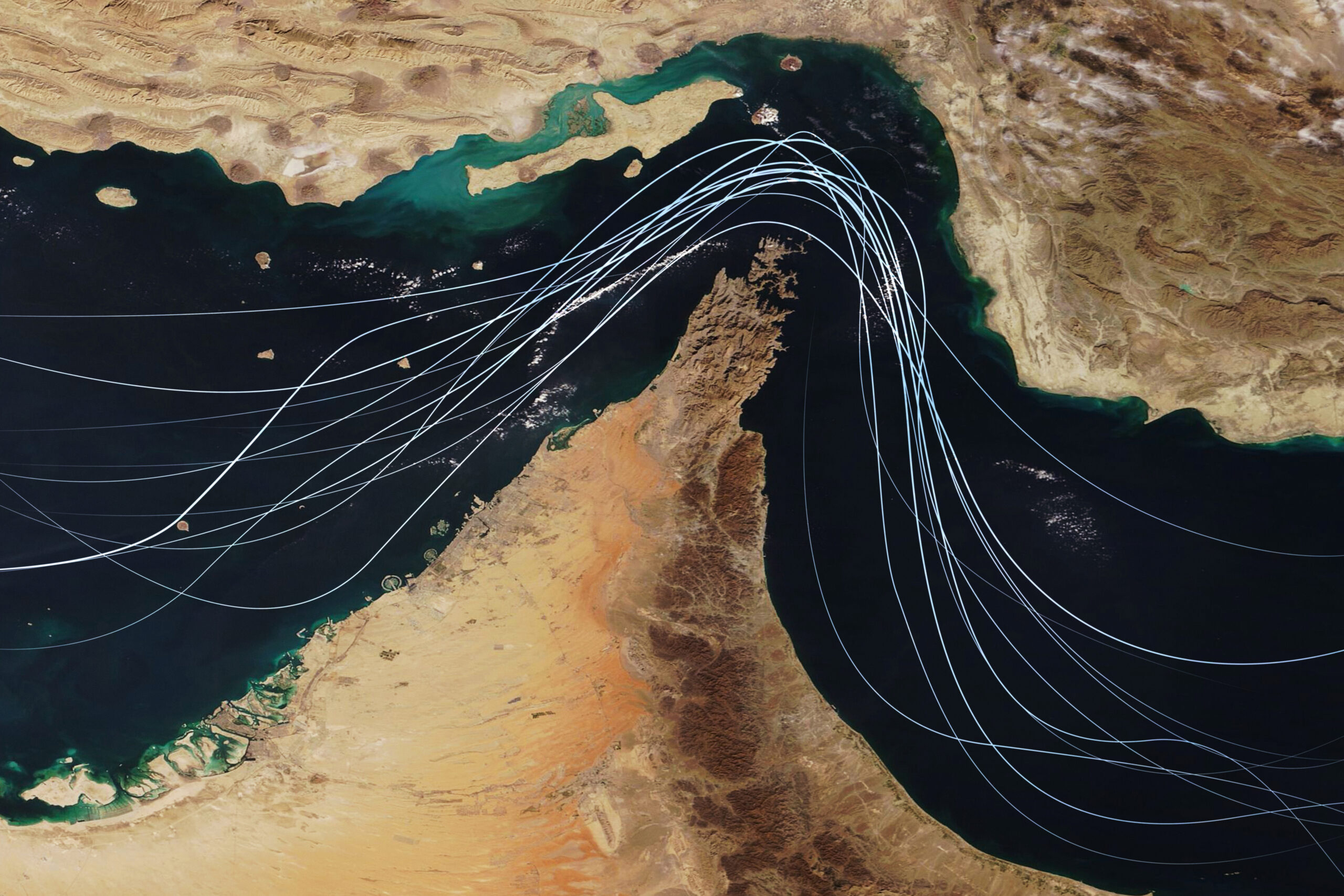
Artificial intelligence does not live in the Strait of Hormuz. No training clusters sit there. No fabs make GPUs there. No hyperscaler built its reputation on a tanker route between Iran and Oman. The connection is less obvious and more serious than that. The Strait matters to AI because modern AI rests on a physical stack that starts with power, moves through industrial materials, and ends in a semiconductor supply chain concentrated in Asia. Hormuz sits near the beginning of that chain, where oil and LNG still move at a scale large enough to change electricity costs, shipping risk, industrial confidence, and the resilience of the countries that manufacture the hardware behind the AI boom.
Table of Contents
That matters more in 2026 than it did even a few years ago. The International Energy Agency says data centres used about 415 terawatt-hours of electricity in 2024 and could reach around 945 TWh by 2030 in its base case. In a separate 2026 update, the IEA said electricity demand from data centres rose 17% in 2025, while spending by five large tech companies surged above $400 billion in 2025 and is set to rise again in 2026. AI is not just software scaling in the abstract. It is a fast-growing industrial load pressing on power systems, chip factories, transmission grids, transformers, gas turbines, and global freight.
The Strait of Hormuz is still one of the world’s most consequential energy chokepoints. The IEA says that in 2025 about 20 million barrels per day of oil and oil products moved through it, equal to around 25% of global seaborne oil trade, and that roughly 80% of those flows were destined for Asia. It also says that 93% of Qatar’s LNG exports and 96% of the UAE’s LNG exports transit Hormuz, representing roughly one-fifth of global LNG trade, with almost 90% of those LNG volumes heading to Asia in 2025. There are only limited oil bypass routes and no alternative sea route for LNG originating behind the Strait.
Once you line those facts up, the relationship with AI becomes easier to see. AI needs huge volumes of electricity. A meaningful share of Asia’s imported LNG and oil still depends on Hormuz. Asia is also where much of the advanced semiconductor manufacturing and memory supply for AI is concentrated. So a disruption in Hormuz does not need to “target AI” to hit AI. It can do it by raising fuel costs, tightening gas markets, straining power systems, unsettling industrial planning, and increasing the risk premium on the places that build the hardware.
A narrow sea lane with outsized digital consequences
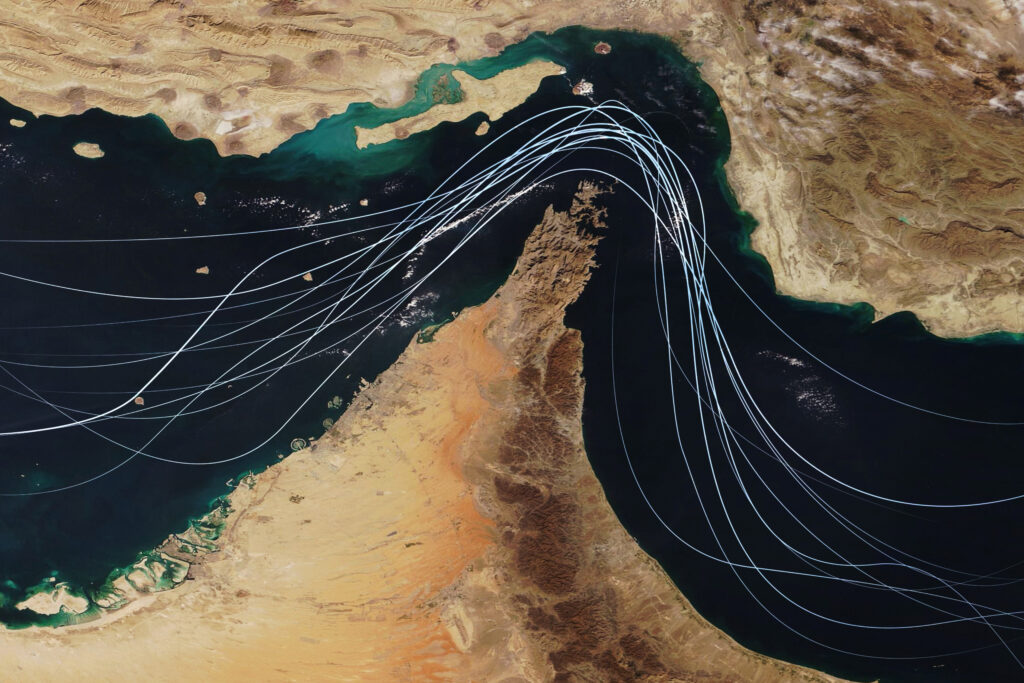
The Strait of Hormuz is easy to describe and hard to replace. It is a narrow maritime passage linking the Persian Gulf to the Gulf of Oman and the Arabian Sea. The countries behind it include Saudi Arabia, Iraq, Kuwait, Qatar, the UAE, Bahrain, and Iran. That matters because this is not just another shipping lane. It is the main outlet for some of the world’s most important oil and LNG exporters. The IEA notes that while Saudi Arabia and the UAE have some pipeline options outside the Strait, countries including Iraq, Kuwait, Qatar, Bahrain, and Iran rely on it for the vast majority of their oil exports, and the available oil bypass capacity is only about 3.5 to 5.5 million barrels per day, far below total flows.
UNCTAD framed the issue even more broadly in 2025 and 2026. In its maritime review, it said Hormuz handled 11% of global trade and about a third of seaborne oil; in its March 2026 note on disruptions, it warned that shocks in Hormuz can spread through supply chains, commodity markets, transport costs, food systems, and public finances in import-dependent economies. That is the right frame for AI as well. AI is sold as a digital product, but its foundations belong to the same world as shipping insurance, LNG cargoes, petrochemical feedstocks, and industrial electricity tariffs.
The market reaction in early 2026 showed that this is not a theoretical vulnerability. The U.S. Energy Information Administration said that after military action on February 28, 2026 and the de facto closure of the Strait, Brent crude climbed from $61 per barrel at the start of the year to $118 by the end of the first quarter, the sharpest first-quarter rise on an inflation-adjusted basis in data back to 1988. In its April 2026 Short-Term Energy Outlook, the EIA said the closure had created heightened volatility, sharply reduced available supply, and pushed Brent to an average of $103 in March, with daily prices nearing $128 on April 2.
That kind of move matters to the AI economy even before a single fab cuts output. Higher oil and gas prices alter electricity prices, freight costs, chemical input costs, and investor assumptions about inflation and interest rates. They also hit the countries most exposed to Hormuz, many of which are in Asia, the same region that sits at the heart of the AI hardware chain. The IEA says Asia receives the bulk of Hormuz oil and LNG. Japan and South Korea are particularly reliant on oil flows through the Strait, while LNG from Qatar and the UAE remains important for Asian power systems.
This is why the question “What does Hormuz have to do with AI?” has a better answer than many people expect. The Strait is not connected to AI by brand names or headlines. It is connected by dependencies. The modern AI build-out depends on huge energy consumption, concentrated chip production, and infrastructure expansion at a pace that is already stretching the physical economy. A chokepoint that can shake fuel prices, gas availability, and Asian industrial confidence is not far from AI at all. It is sitting upstream from it.
Two routes from Hormuz to AI
| Route | What travels through it |
|---|---|
| Energy route | Oil and LNG that influence fuel prices, electricity costs, and grid reliability in Asian economies tied to AI manufacturing and deployment |
| Hardware route | Indirect pressure on Taiwan, South Korea, Japan, and the wider semiconductor ecosystem that supplies GPUs, HBM memory, packaging, and server infrastructure |
That table is deliberately simple because the story is simple once the layers are separated. Hormuz affects AI first through energy, then through the industrial geography of semiconductors. The two routes are different, but they reinforce each other. A gas or oil shock can raise costs for the same economies that are already trying to expand chip output and data centre capacity at speed.
AI’s first dependency is electricity, not genius
A lot of commentary still treats AI as though its main bottleneck were model design. That is not wrong, but it is incomplete. The more successful AI becomes, the more it turns into an electricity story. Training large models, running inference at scale, cooling racks, storing data, networking servers, and keeping uptime near perfect all demand power long before they demand metaphors. The IEA says data centres consumed around 415 TWh in 2024, or about 1.5% of global electricity use, and projects they could roughly double by 2030. It also notes that accelerated servers, driven mainly by AI, are set to grow far faster in electricity use than conventional servers.
The IEA’s April 2026 update sharpened the point. It said data centre electricity demand rose 17% in 2025, with AI-focused facilities growing even faster. It also said data centre power use is increasingly colliding with hard physical bottlenecks, including gas turbines, transformers, grid connection delays, advanced chips, and IT components. Some developers are now pursuing on-site gas generation, especially in the United States, because grid connections are too slow. That is not a niche engineering detail. It shows that AI growth is already leaning on fuel supply chains and heavy electrical equipment, not just software talent.
This changes the way energy shocks should be read. When oil or LNG markets convulse, the impact is not limited to household inflation or airline fuel bills. It lands inside the capital budgeting of data centre developers, utilities, chipmakers, and industrial users that are trying to keep up with AI demand. Reuters reported in April 2026 that American cloud giants are expected to spend more than $600 billion this year on data centres, while TSMC and ASML signalled that the AI hardware boom remains intact but heavily constrained by capacity. If energy volatility lifts the cost of power, financing, materials, and logistics at the same time, it complicates the economics of that entire build-out.
It is worth keeping a sense of proportion. A disruption in Hormuz does not switch AI off. Microsoft will not stop serving models because one sea lane is under stress. But AI infrastructure is now large enough that energy system stress becomes a direct business issue rather than background noise. The countries and firms that can secure reliable, affordable electricity will move faster; those exposed to gas and shipping shocks will move less cleanly, pay more, or postpone expansion. The IEA put that bluntly when it said “there is no AI without energy” and that countries providing secure and affordable access to electricity will be a step ahead.
There is another reason electricity matters here: power demand from AI is geographically concentrated. The IEA says data centres cluster in particular regions, which makes grid integration harder than aggregate global percentages suggest. That concentration means local fuel shocks and regional power insecurity matter more than global averages imply. If a few chipmaking and data-heavy economies in Asia face tighter fuel markets or more expensive LNG, the effect on AI can be larger than the headline share of global energy use might suggest.
So the cleanest way to answer the original question is this: Hormuz matters to AI because AI is becoming a massive industrial electricity customer, and Hormuz still shapes fuel availability and pricing for several of the Asian economies that power and manufacture the AI stack. That is not a poetic link. It is a supply-chain link.
The LNG route behind Asian power systems
Oil gets the headlines, but LNG may be the more interesting connection to AI. The EIA says that in 2024 roughly 20% of global LNG trade moved through Hormuz, mainly from Qatar, with 83% of those volumes going to Asian markets. China, India, and South Korea were the top destinations that year, accounting for 52% of all LNG flows through Hormuz. The IEA’s 2025 data point to the same structure in broader terms: almost 90% of LNG moving through Hormuz in 2025 was headed to Asia, with no alternative route for those Gulf LNG exports.
That matters because gas is still central to electricity generation across much of Asia, especially in places that matter to the AI hardware chain. Japan remains a large LNG importer. Reuters reported in April 2026 that Japan takes about 4 million metric tons of LNG a year through Hormuz, around 6% of total LNG imports, and that LNG from Qatar and the UAE provides about 3.5% of Japan’s electric power. The same report noted that utilities were scrambling for extra spot cargoes and contract flexibility because the risk was not symbolic. It was tied to reserve margins heading into summer.
South Korea’s exposure is also telling. Reuters reported on April 15, 2026 that Seoul had secured 273 million barrels of crude oil and 2.1 million metric tons of naphtha through alternative routes outside Hormuz after saying the country relied on the Strait for 61% of crude oil imports and 54% of naphtha imports last year. That is not LNG, but it shows how deeply the region’s industrial economies still depend on Gulf energy routes, and how quickly governments move to reduce that dependence when Hormuz is threatened. South Korea matters to AI not just as an energy consumer but as a critical memory and electronics economy inside the broader compute stack.
Taiwan is where the energy link becomes especially sharp. The U.S. Commercial Service says Taiwan imports over 95.8% of its energy needs and is expanding LNG import terminals and gas-fired generation as part of its power transition. Reuters reported in April 2026 that Taiwan, a major semiconductor producer, had relied on Qatar for around a third of its LNG before the conflict and was seeking alternate supply from countries including Australia and the United States. That matters because Taiwan is not just any importer. It is the island on which a huge share of leading-edge AI chip production depends.
A gas shock does not map neatly into a chip outage. Taiwan can buy spot cargoes, switch supply origins, draw on inventories, and prioritise critical users. Japan and Korea can do versions of the same. But the direction of travel is clear: a disrupted Hormuz market tightens Asian gas conditions, and tighter gas conditions raise the cost and difficulty of running the economies that fabricate, package, and support AI hardware. It can also shift policy debates around nuclear restarts, grid investment, storage, and industrial prioritisation.
This is why LNG deserves more attention in discussions about AI. Oil shocks are visible and dramatic. LNG shocks can be quieter but more structural, especially where gas is embedded in power systems. If the question is whether Hormuz matters to AI, the LNG answer may be stronger than the oil answer, because AI runs on electricity every hour while oil often works through pricing, logistics, and macro conditions. Gas sits closer to the plug.
Taiwan turns an energy chokepoint into a chip chokepoint
The AI industry has a Taiwan problem in the narrowest and broadest sense. Narrowly, it depends on Taiwan Semiconductor Manufacturing Co. for a huge share of the most advanced chip fabrication that powers AI servers and accelerators. Broadly, it depends on Taiwan as an ecosystem of fabs, packaging, suppliers, engineers, and industrial know-how that has no quick substitute. The U.S. Commercial Service says Taiwan accounts for over 60% of global foundry revenue and more than 90% of leading-edge chip manufacturing, with firms such as NVIDIA, AMD, and Apple relying heavily on that manufacturing base.
TSMC’s own reporting leaves little doubt about where demand is coming from. In its 2024 annual report, the company said it saw robust AI-related demand throughout 2024, that 3-nanometer technology represented 18% of total wafer revenue in 2024, and that advanced technologies of 7 nanometers and below made up 69% of total wafer revenue. It also said continued AI-related demand in 2025 supported its conviction that structural demand for energy-efficient computing would accelerate. Reuters then reported in April 2026 that TSMC called AI demand “extremely robust,” raised its revenue forecast, and pushed capital spending toward the high end of its guidance to expand AI chip capacity.
This is where Hormuz stops being a general energy story and becomes an AI supply-chain story. Taiwan is not just another Asian import-dependent economy. It is the most important location in the world for leading-edge logic chips. The same island that builds the most advanced chips is also deeply dependent on imported energy and, until the recent conflict shock, had sourced about a third of its LNG from Qatar, according to Reuters. That does not mean a Hormuz disruption automatically shuts down TSMC. It means a major AI chokepoint sits inside an energy-vulnerable economy.
Taiwan’s trade data underline how central AI has become to its economy. Reuters reported in January 2026 that Taiwan’s 2025 exports reached a record $640.75 billion, driven by strong demand for chips and AI-related technology, with the finance ministry saying export momentum would continue to be buoyed by AI and high-performance computing applications. When that is the economic backdrop, energy security stops being a side issue. It becomes part of industrial strategy.
The point is not that Taiwan lacks buffers. TSMC told investors in April 2026 that it held safety stock for materials such as helium and hydrogen and sourced from multiple regions. Taiwan’s government also said it had received LNG supply assurances and could adjust shipment origins. Those are exactly the kinds of risk-management measures a system like this needs. But they also prove the deeper point: the AI supply chain already understands that Middle East energy disruption can matter to semiconductor continuity. If the link were trivial, firms and governments would not be building these buffers.
That is why Hormuz belongs in any serious map of AI risk. Not because tankers produce algorithms, but because the industrial heart of advanced AI hardware sits in places where imported fuel, power planning, and maritime security still matter a great deal. Taiwan concentrates the connection more clearly than anywhere else.
The supply chain concentration that magnifies every shock
AI hardware is concentrated at almost every important layer. TSMC dominates advanced foundry production. NVIDIA dominates large parts of the AI accelerator market. South Korea plays an outsized role in memory. ASML sits at the centre of lithography equipment. Packaging capacity is tight. The result is not a normal, diversified industrial system. It is a stack with a few powerful nodes and not much slack. Reuters reported in April 2026 that TSMC remains the world’s dominant producer of cutting-edge processors and that major AI chip designers such as NVIDIA, AMD, and Broadcom rely on it while the whole sector struggles with very tight capacity.
NVIDIA’s fiscal 2026 annual report adds another layer. The company said revenue rose to $215.9 billion in fiscal 2026, with Data Center revenue up 68% year over year. It also said its supply chain is mainly concentrated in Asia, that it uses foundries such as TSMC and Samsung, and that its business depends on reliable supply from overseas partners, especially in Taiwan and South Korea. That language matters because it comes from the company selling the most strategically important AI chips in the market. NVIDIA is effectively telling investors that geography and supply concentration are still core business risks.
CSIS made the geopolitical angle plain in 2025. It argued that the outcome of the chip innovation race will shape leadership in AI and that advanced semiconductors have major strategic and economic security implications. In a separate paper on Taiwan, CSIS said TSMC is central to U.S. economic and security interests and noted that investments in AI data-centre infrastructure have boosted demand for NVIDIA GPUs, for which TSMC is by far the leading manufacturer. This is the right way to think about the AI economy: not as an abstract software market, but as a strategic industrial system with a few tightly coupled dependencies.
Once a system looks like that, external shocks become more dangerous. A broad energy shock can raise operating costs across fabs, industrial suppliers, and transport. A shipping shock can delay material flows and create panic buying. A regional power shortage can force trade-offs inside a government or utility. A risk premium on Taiwan or Northeast Asia can change corporate investment decisions even if nothing catastrophic happens on the ground. None of these needs to be total to matter. With this much concentration, even moderate stress can have outsized downstream effects.
That is also why the phrase “indirect risk” can be misleading. Indirect does not mean weak. It means the shock travels through a chain. If the chain is dense enough and the hardware market concentrated enough, an indirect shock can be commercially decisive. Hormuz is not the chip industry’s only exposure, but it is one of the exposures that can hit many layers at once: fuel, freight, macro stability, Asian power systems, and confidence in the very places building AI capacity.
Price shocks travel faster than tankers
The fastest way Hormuz reaches AI is through markets. The Strait does not need to stay closed for months to matter. A short-lived disruption can change prices immediately, and prices move decisions before physical shortages show up. The EIA said the effective closure in early 2026 sharply reduced available oil supply and pushed Brent to levels not seen in years. It also said that even after flows resume, the market can take time to clear backlogs and re-route tankers, leaving a lasting risk premium in prices.
That matters for AI because this sector is in the middle of a capital-spending surge. The IEA said five large tech companies pushed capital expenditure above $400 billion in 2025, while Reuters said big cloud firms are expected to spend over $600 billion in 2026 on data centres. In a calmer environment, investors can still rationalise huge outlays if they believe demand, electricity access, chip supply, and financing conditions will remain favourable. Throw in an energy shock, and those assumptions wobble all at once.
The market channel works in more than one direction. Higher fuel prices can lift electricity costs. Shipping insurance can rise. Freight patterns can shift. Central banks can stay tighter for longer if energy-driven inflation persists. Commodity-sensitive currencies can swing. Governments can redirect attention toward emergency energy measures rather than long-horizon industrial projects. UNCTAD warned that Hormuz disruptions can spread into transport, food, and public-finance stress, especially in import-dependent economies. That is not an AI-specific warning, but AI is now expensive enough and infrastructure-heavy enough that broad macro stress feeds back into it quickly.
The recent reactions in Asia made that visible. Taiwan sought LNG assurances and alternative cargoes. South Korea negotiated crude and naphtha supplies routed outside Hormuz. Japan’s analysts warned of reserve-margin pressure if LNG disruptions persisted into summer. These are not random stories from the energy pages. They are signals from economies that either build, power, or support critical parts of the AI stack. When those governments move into contingency mode, the AI industry should pay attention.
This is the part of the argument many people miss because it lacks a cinematic moment. AI rarely fails in public because of a single ship. It gets slower, dearer, more politically contested, or more geographically selective because the cost of the physical world has risen underneath it. Hormuz matters because it can help set those underlying costs and risks. In that sense, it behaves less like a switch and more like a pressure valve. You may not notice it when it is stable. You notice it when everything attached to it starts getting more expensive at once.
The case for saying the link is indirect, not imaginary
It is worth being precise here because sloppy claims help nobody. The Strait of Hormuz is not the sole determinant of AI growth. AI demand will continue even if Hormuz is disrupted. The United States has domestic gas. Europe has diversified LNG. Cloud companies can sign long-term power deals, build where electricity is cheaper, and spread workloads across regions. TSMC is expanding in Arizona, Japan, and Germany. NVIDIA says it is expanding supply-chain resilience beyond Asia. The industry is not standing still.
At the same time, precision cuts both ways. It would also be wrong to dismiss the link because it is indirect. Indirect does not mean speculative when the intermediate steps are visible and measurable. Those steps are visible here: Hormuz moves oil and LNG at enormous scale; Asia absorbs most of those flows; AI is becoming a major electricity consumer; Taiwan and Northeast Asia remain central to AI hardware; and companies from TSMC to NVIDIA openly acknowledge supply concentration, material dependencies, and the need for resilience.
It also helps to separate AI into phases. Training frontier models requires dense clusters of advanced accelerators and huge energy availability. Inference at scale requires vast server fleets, networking, and increasingly stable power for always-on services. Chip fabrication requires giant capital outlays, advanced materials, ultra-clean manufacturing, and dependable electricity. Those phases are different, but each one is exposed to energy and supply-chain stress in some form. Hormuz does not touch them equally. It touches them enough.
This is also why the connection is stronger for some places than others. A U.S. data centre in a power-rich state may feel Hormuz through commodity pricing and financing more than through fuel scarcity. Taiwan may feel it through LNG security, industrial planning, and geopolitical risk premia. Japan may feel it through utility balancing and import strategy. South Korea may feel it through petrochemicals, power, and broader industrial energy security. The AI economy is global, but the exposure map is uneven.
That unevenness leads to a useful conclusion. The right question is not “Does Hormuz control AI?” It does not. The better question is “Can a disruption in Hormuz make AI hardware and infrastructure harder, riskier, or costlier to build and run?” The answer to that is clearly yes. The evidence is already visible in energy-market data, corporate filings, government responses, and the structure of semiconductor production.
The industry’s hedge against Hormuz risk
The encouraging part of this story is that governments and companies are already trying to reduce exposure. Some of the response is geographic. TSMC is expanding production in Arizona, Japan, and Germany. NVIDIA says it is broadening supply relationships and expanding beyond Asia into the U.S. and Latin America. These moves will not erase Taiwan’s importance soon, but they do create more redundancy over time. Reuters, TSMC, and NVIDIA all point in the same direction: the market understands concentration risk and is spending heavily to reduce it.
Some of the response is energy-side. The IEA says tech companies accounted for around 40% of corporate renewable PPAs signed in 2025 and that AI momentum is helping push interest in nuclear, geothermal, batteries, and more flexible data-centre designs. That matters because the strongest long-run hedge against Hormuz risk is not military commentary. It is less dependence on imported fossil fuels for critical digital infrastructure. The more AI can be powered by domestic renewables, firm low-carbon power, storage, stronger grids, and diversified fuel systems, the less vulnerable it becomes to maritime chokepoints.
Some of the response is tactical. Taiwan sought alternate LNG supply. South Korea secured crude and naphtha outside Hormuz. Japan looked to spot cargoes and contract flex. TSMC built safety stocks for helium and hydrogen. These are sensible steps, but they are still defensive measures inside a system that remains exposed. They buy time. They do not rewrite geography.
That leaves policymakers with a fairly clear agenda. Build more power where AI demand is growing. Diversify LNG and oil sources where full electrification is not yet possible. Strengthen grids and interconnections. Add storage. Speed up clean power permitting. Reduce the concentration of advanced packaging and leading-edge chip production without pretending it can be done overnight. Treat energy security and digital strategy as parts of the same industrial plan. The countries that do this best will not eliminate Hormuz risk, but they will be much less hostage to it.
Old geography still shapes the AI age
The most useful thing about this topic is that it forces a reality check. AI is often described as weightless, borderless, and detached from the older constraints of industry. It is none of those things. The AI age still depends on ships, cables, power plants, gas terminals, chip fabs, and a few territories that carry far more than their share of global importance. The Strait of Hormuz matters because it remains one of the places where physical scarcity can still ripple into digital ambition.
That does not make Hormuz the centre of AI. Taiwan, U.S. cloud spending, semiconductor tooling, memory supply, and grid expansion all matter more directly. But Hormuz sits upstream from several of those stories. It shapes the energy conditions of Asia, the economics of electricity-intensive infrastructure, and the resilience planning of the countries that manufacture the hardware behind the AI boom. If AI is the front end of a new industrial era, Hormuz is one of the old-world bottlenecks still capable of constraining it.
That is the real answer to the question. The Strait of Hormuz is related to AI not because AI is maritime, but because AI is physical. It runs on electricity, chips, industrial confidence, and concentrated supply chains. A chokepoint that can jolt all four deserves a place in any serious map of AI risk.
FAQ
The Strait matters to AI because it moves huge volumes of oil and LNG, especially to Asia, while AI depends on electricity-heavy data centres and a semiconductor supply chain concentrated in Asian economies such as Taiwan, Japan, and South Korea. A disruption can raise power costs, tighten fuel markets, and unsettle the regions that manufacture critical AI hardware.
No. The connection is indirect. Hormuz affects energy and industrial conditions, not model training code or server software by itself.
Because AI ultimately needs electricity, and LNG still feeds power systems across important Asian economies. The EIA says about one-fifth of global LNG trade passed through Hormuz in 2024, and most of it went to Asia.
For AI operations, LNG often sits closer to the immediate problem because it can directly affect electricity generation. Oil still matters through transport costs, inflation, petrochemicals, and overall energy-market pricing.
Taiwan is the clearest overlap point between energy vulnerability and AI hardware concentration. The U.S. Commercial Service says Taiwan accounts for over 60% of global foundry revenue and more than 90% of leading-edge chip manufacturing, while Reuters reported Taiwan had relied on Qatar for around a third of its LNG before the 2026 conflict shock.
Not automatically. TSMC and Taiwan have inventories, alternate sourcing options, and contingency planning. The risk is better described as higher cost, tighter energy conditions, and more pressure on continuity planning, not an instant stop button.
Because most oil and LNG moving through Hormuz goes to Asia, and Asia also hosts the densest concentration of advanced chip manufacturing and related supply chains. Europe is affected by price spillovers, but Asia is more directly exposed to the physical route.
It showed that Hormuz can move markets very quickly. The EIA said Brent rose from $61 at the start of 2026 to $118 by the end of the first quarter after the effective closure, and governments in Asia moved fast to secure alternative supplies.
Yes, in the sense that rising AI electricity demand increases the value of secure and affordable energy. The IEA says data-centre demand is climbing quickly, which makes upstream fuel and grid risks more relevant than before.
Because NVIDIA sells the most important AI accelerators in the market and says its supply chain remains mainly concentrated in Asia, with critical overseas partners especially in Taiwan and South Korea. That makes regional energy and industrial stability more important.
Both. Training frontier models needs dense clusters of advanced chips and lots of power. Inference at scale also needs large server fleets, networking, cooling, and reliable electricity.
It is both. The energy story explains how a Hormuz shock changes power and fuel conditions. The semiconductor story explains why those energy shocks matter so much to AI.
Japan remains exposed to LNG through Hormuz, and Reuters reported South Korea relied on the Strait for large shares of its crude and naphtha imports last year. Both countries are major industrial economies embedded in the electronics and semiconductor ecosystem.
No. Diversification is happening, but the current leading-edge manufacturing base is still heavily concentrated. New fabs take years, cost tens of billions, and require a full surrounding ecosystem.
The strongest argument is that AI has buffers: diversified demand centres, growing overseas fabs, alternate fuel suppliers, inventories, and rising investment in renewables and nuclear. Hormuz is a serious upstream risk, not the single master key to AI.
The strongest argument is concentration. AI hardware, memory, packaging, and power demand are all concentrated enough that upstream shocks can have outsized consequences even without total failure.
Yes. More renewables, nuclear, storage, and stronger grids would reduce dependence on imported fossil fuels and lower sensitivity to maritime chokepoints. The IEA says tech companies are already pushing large renewable, nuclear, and geothermal deals.
Because the AI build-out now shapes industrial policy, stock-market expectations, trade strategy, and national-security planning. A sea lane that can influence Asian energy security and semiconductor resilience is no longer a niche maritime issue.
Author:
Jan Bielik
CEO & Founder of Webiano Digital & Marketing Agency
This article is an original analysis supported by the sources cited below
Strait of Hormuz – About – IEA
IEA factsheet on oil and LNG volumes moving through Hormuz, destination markets, and the limits of bypass routes.
The Middle East and Global Energy Markets – IEA
IEA overview of the 2026 Middle East energy shock, including Hormuz’s role in oil, LNG, and Asian import exposure.
About one-fifth of global liquefied natural gas trade flows through the Strait of Hormuz
EIA analysis of LNG volumes, supplier countries, and Asian destinations tied to Hormuz.
Crude oil and petroleum product prices increased sharply in the first quarter of 2026
EIA review of the oil-price shock linked to the 2026 disruption in Hormuz.
Short-Term Energy Outlook – Global oil markets
EIA forecast discussing the market effects of the de facto closure of Hormuz in 2026.
Energy demand from AI – IEA
IEA analysis of current and projected data-centre electricity demand driven by AI.
Data centre electricity use surged in 2025, even with tightening bottlenecks driving a scramble for solutions
IEA update on AI-related data-centre growth, energy bottlenecks, and corporate power strategies.
Taiwan – Semiconductors including chip design for AI
U.S. Commercial Service guide quantifying Taiwan’s importance in foundry revenue and leading-edge manufacturing.
Taiwan – Energy Generation and Storage
U.S. Commercial Service overview of Taiwan’s high import dependence and gas-heavy power transition.
TSMC 2024 Annual Report Website
TSMC’s own discussion of AI-driven demand, advanced-node revenue mix, and global capacity expansion.
nvda-20260125
NVIDIA’s annual report describing data-centre growth, Asia-centred supply chains, and dependence on Taiwan and South Korea.
Silicon Island: Assessing Taiwan’s Importance to U.S. Economic Growth and Security
CSIS analysis of Taiwan’s semiconductor role and its importance to AI infrastructure and U.S. interests.
The Limits of Chip Export Controls in Meeting the China Challenge
CSIS paper connecting semiconductors directly to AI leadership and national security.
Strait of Hormuz disruptions: Implications for global trade and development
UNCTAD note on how Hormuz shocks spread through trade, commodity markets, and vulnerable economies.
Review of Maritime Transport 2025
UNCTAD’s maritime review, cited for the broad trade significance of Hormuz.
TSMC lifts revenue forecast, pledges more capital spending to meet AI chip demand
Reuters report on TSMC’s April 2026 results, AI demand, tight capacity, and material-risk planning.
TSMC likely to book fourth straight quarter of record profit on insatiable AI demand
Reuters preview capturing how AI demand continues to outstrip TSMC’s current capacity.
Strong ASML, TSMC forecasts signal AI spending boom is intact
Reuters report on hyperscaler spending, AI chip demand, and supplier concentration.
Taiwan says it has assurances over LNG supplies from ‘major’ country
Reuters report showing Taiwan’s LNG exposure and emergency diversification efforts during the 2026 shock.
Taiwan 2025 exports hit record on strong AI demand
Reuters report illustrating how strongly AI demand now shapes Taiwan’s export economy.
South Korea says secures 273 mln barrels of crude via routes outside Strait of Hormuz
Reuters report on South Korea’s alternative supply strategy and direct reliance on Hormuz-linked energy.
Japan risks summer power crunch due to Middle East LNG disruptions – IEEJ analyst
Reuters report on Japan’s LNG exposure through Hormuz and the potential power-system effects.
| Citing this article? Brief excerpts are welcome. Please credit Webiano.digital, name the author where stated, and include a link to https://webiano.digital and to this original article. Full or substantial republication requires prior written permission. Read our Copyright and Content Use Policy. |
This article was prepared with the assistance of artificial intelligence tools. The content underwent expert human review, and Webiano Digital & Marketing Agency assumes editorial responsibility for its final version and publication.