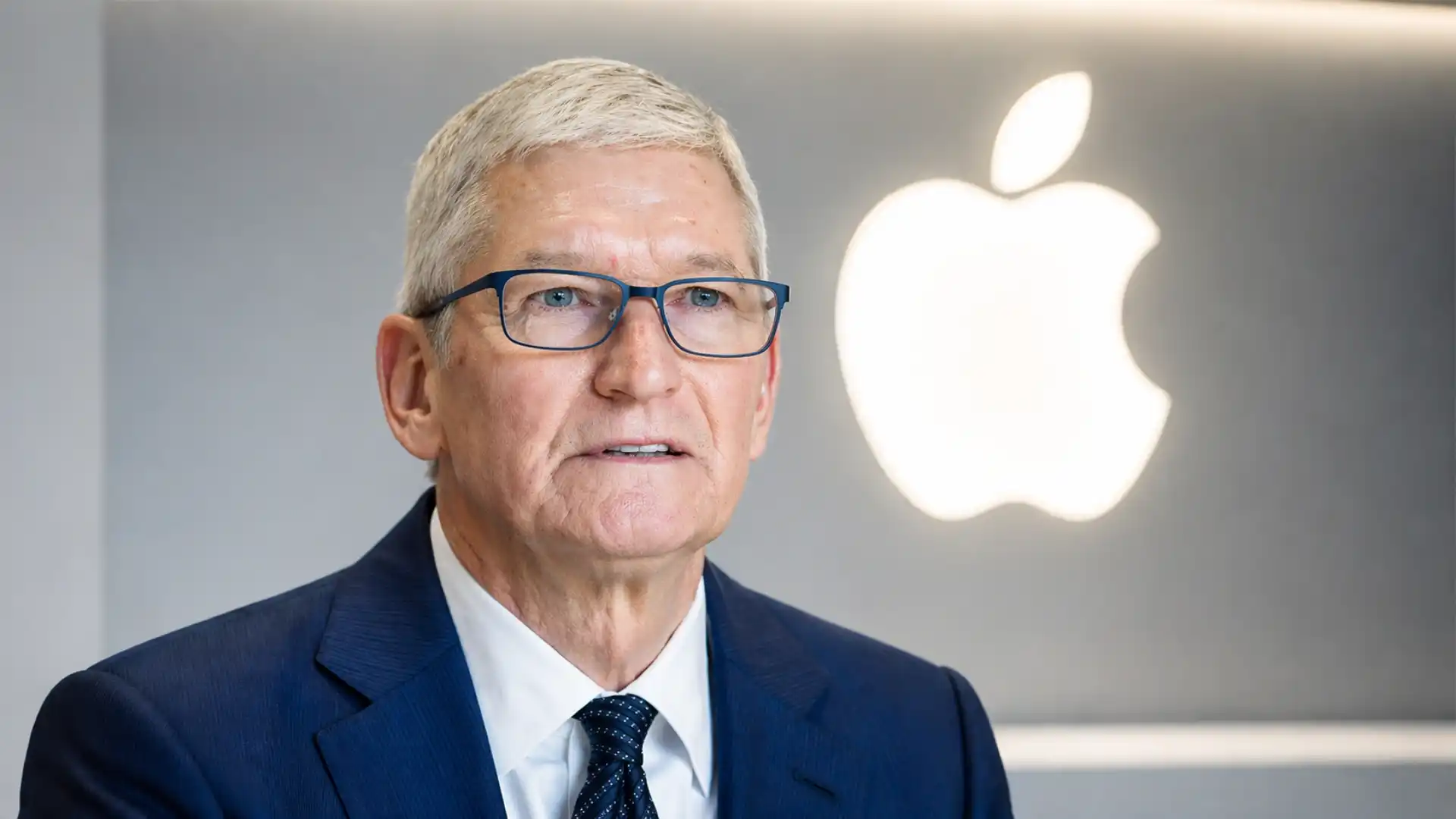
Apple has now confirmed that Tim Cook will leave the CEO role on September 1, 2026, become executive chairman, and hand day-to-day leadership to John Ternus, Apple’s senior vice president of Hardware Engineering. That one sentence answers the news question. It does not answer the bigger one. The bigger one is what this handoff says about the next phase of Apple, and what that next phase will do to the wider IT industry and the AI business wrapped around it.
Table of Contents
Cook is not disappearing. Apple’s own announcement makes that plain, and Apple’s governance documents make something else plain too: this was not a panic move, not a boardroom ambush, and not a sign that the company suddenly lost confidence in itself. Apple’s board has long treated executive succession as a standing duty, with the subject on the agenda for every regularly scheduled board meeting. The transition is staged, formal, and deliberate. That matters because it tells the market that Apple wants continuity in power even while it changes the public face of power.
The second point is harder and more interesting. Apple is making this move just as the center of gravity in tech shifts from mobile-era platform control to AI-era interface control. In the smartphone age, Apple’s strengths were hardware integration, supply-chain discipline, custom silicon, premium branding, privacy, and a tight software stack. In the AI age, those strengths still matter, but they are no longer enough by themselves. The fight is moving toward assistants, multimodel routing, on-device inference, cloud inference, agent behavior, developer access, and who becomes the trusted layer between the user and the model. Apple has pieces of that future. It does not yet own the whole shape of it.
That is why the Cook-to-Ternus shift matters beyond Apple gossip. It is a signal about what kind of company Apple thinks it must be in the next decade. By choosing a leader built in hardware and product execution, while keeping Cook in the chair above the chair, Apple is effectively saying that the company still believes its edge will come from shipping tightly integrated products at scale, not from turning itself into a pure frontier-model lab. The open question is whether that belief still gives Apple enough speed in AI.
Apple has announced a handoff, not a rupture
The easiest mistake is to read this as a clean break. It is not. Apple said Cook will move to executive chairman, which preserves influence over strategy, board dynamics, investor messaging, and government relations while removing him from the daily operating burden of the CEO role. Apple also described the move as the result of a “thoughtful, long-term succession planning process,” language that lines up with what its proxy statement already said months earlier about how seriously the board treats executive succession. The board’s own governance material says oversight of executive succession is one of its most critical duties and that it is discussed at every regularly scheduled meeting.
That governance context changes the meaning of the story. A sudden CEO departure usually tells outsiders that something broke. Apple’s process tells outsiders the opposite. The board wanted a controlled transfer while the company is still financially strong, operationally stable, and large enough to absorb leadership change without inviting panic. Apple reported record first-quarter fiscal 2026 revenue of $143.8 billion, record EPS, and an installed base of more than 2.5 billion active devices. This is a company choosing its succession window from strength, not scrambling for one after a stumble.
There is also a practical reason to avoid dramatic interpretations. Cook’s Apple has never depended on one-man showmanship the way Steve Jobs’ Apple did in the public imagination. Cook’s hallmark was systems leadership: supply chains, margins, services expansion, geopolitical navigation, disciplined capital returns, and the quiet scaling of a vast installed base. Under him, Apple became not merely a product company but a machine that could manufacture trust, predictability, and recurring revenue at global scale. Reuters noted that annual revenue nearly quadrupled under Cook to more than $416 billion, while Apple’s market value rose from roughly $350 billion to about $4 trillion.
That helps explain why Apple could structure the transition the way it did. Cook is leaving the CEO seat, but the system he built is still in place. The board is still in place. The operating model is still in place. The services engine is still in place. The capital discipline is still in place. The market is being asked to accept a change in operator, not a rewrite of the company’s institutional DNA. That is a very Apple kind of succession: low drama outside, heavy preparation inside.
The company Tim Cook leaves behind
Any serious read of this handoff has to start with the scale of the company Ternus inherits. Apple is not a turnaround story. It is not a wounded giant searching for identity. It is a company that still throws off extraordinary cash, still expands services, still controls one of the strongest hardware-software ecosystems in tech, and still has a device footprint large enough to turn even modest feature upgrades into global platform events. Apple’s January 2026 results showed record quarterly revenue, record EPS, and more than 2.5 billion active devices in use. That installed base is not just a bragging point. It is the economic base from which Apple can distribute new AI behavior.
The services layer matters just as much. Apple said 2025 was a record year for services, spanning Apple TV+, Apple Music, Apple News, Apple Pay, iCloud, and other everyday products. This is not secondary business anymore. Services make Apple less dependent on the replacement cycle of a single device line and give the company a better way to monetize software improvements across the installed base. In an AI market where the leading question is often “who pays for inference,” Apple’s services strength gives it room to experiment with pricing, bundling, and feature placement without looking desperate.
Cook’s legacy also includes the less glamorous parts of tech leadership that matter more than keynote applause. Apple’s 2025 Form 10-K says the company’s supply chain is large and complex, with a majority of supplier facilities outside the United States, and that performance depends significantly on global and regional economic conditions. That sounds dry until you remember what Apple has had to navigate: China exposure, tariffs, logistics shocks, component constraints, export politics, and a global manufacturing map that can no longer be treated as politically neutral. Cook spent years making Apple resilient enough to live with that reality, even if no company this large is ever fully insulated from it.
This is the backdrop for the succession. Ternus is not arriving to rescue Apple from decline. He is arriving to lead a company whose old strengths are intact but whose next test sits in a different layer of the stack. Apple knows how to sell premium devices. Apple knows how to build custom silicon. Apple knows how to manage hardware transitions. Apple knows how to keep enterprise and consumer trust. The question hanging over the handoff is whether those strengths can be translated into an AI era where user expectations are being reset by conversational interfaces, generative workflows, and model ecosystems that move faster than consumer hardware cycles used to.
John Ternus arrives from the engine room
Apple’s choice of successor is revealing. John Ternus is not an outsider imported to shake the place. He joined Apple’s product design team in 2001, became a vice president of Hardware Engineering in 2013, and joined the executive team in 2021. Apple says he has overseen hardware engineering work across every product category. Reuters described him as a hardware insider who helped revitalize Mac sales and who recently led the iPhone Air launch. This is not the profile of a corporate caretaker. It is the profile of a product builder.
His public footprint inside Apple’s product machine backs that up. Apple press releases have repeatedly put Ternus at the center of key hardware narratives: Mac Studio, repairability changes, AirPods Pro 3, and iPhone Air. Those quotes do not prove what kind of CEO he will be, but they do show where Apple has wanted investors, developers, partners, and customers to see him. He has been presented as a person associated with product engineering judgment, silicon-backed performance claims, repair decisions, and the practical business of taking ideas from lab to shipping hardware.
That background invites a straightforward inference. Apple is betting that its next CEO should understand the physical product stack all the way down to the engineering seams. That makes sense at a moment when the borders between chips, device thermals, battery life, latency, privacy, and AI quality are collapsing into one design problem. AI is often discussed as software magic floating above the hardware layer. Apple’s strategy has been the reverse. It keeps trying to pull intelligence downward into silicon, the operating system, and device-local processing. A hardware CEO is not an odd choice in that environment. It may be the most Apple choice possible.
That does not mean Ternus will be insulated from the parts of the job Cook mastered. He inherits a company that must still handle regulators, developers, Beijing-Washington friction, EU rules, supplier politics, privacy battles, and shareholder expectations about margins. But Apple’s board appears to be saying that the next cycle will be won or lost on product execution under AI pressure, not on financial engineering or headline management alone. Ternus will be judged by shipped results: better assistants, smarter operating systems, developer tools people actually adopt, and devices whose AI features feel native rather than bolted on.
Apple enters its most exposed AI stretch
Cook’s timing is hard to miss. Apple is changing CEOs just as its AI story moves from promise to scrutiny. Apple introduced Apple Intelligence in 2024 as a personal intelligence system woven into iPhone, iPad, and Mac, with an emphasis on personal context, utility, and privacy. In 2025 it expanded those capabilities across devices and opened its on-device foundation model to developers. That is the official story, and it is not fake. Apple has real AI features in market, real infrastructure, real developer tooling, and real research work underneath the public branding.
The trouble is that public perception of Apple’s AI position has been shaped less by its architecture and more by the gap between expectation and assistant quality. Reuters reported in March 2025 that some Siri AI improvements were delayed to 2026. By early 2026, Reuters was also reporting that Apple had struck a multi-year deal to use Google’s Gemini models for a revamped Siri, after Apple had already integrated access to ChatGPT in parts of Apple Intelligence. Put bluntly, Apple’s AI story stopped looking like a fully self-contained Apple stack and started looking like a hybrid system built from Apple models, Apple privacy infrastructure, and selected outside models where needed.
Then came the internal leadership change on the AI side. Apple announced in December 2025 that John Giannandrea would retire and that Amar Subramanya would join as vice president of AI, reporting to Craig Federighi and leading Apple Foundation Models, ML research, and AI safety and evaluation. That is not minor org-chart trivia. It tells you Apple itself believed the AI program needed fresh leadership energy, tighter product linkage, or both. The CEO handoff lands on top of an AI leadership reset that was already under way.
That is why Ternus inherits Apple at a moment of exposure. The company cannot keep selling the market on the idea that Apple Intelligence is strategically important while allowing Siri to remain the easiest punchline in consumer AI. The rest of big tech has made conversational competence the public benchmark for intelligence, fair or not. Apple can argue that privacy, integration, reliability, and on-device performance matter more than chatbot theater. It can even be right. But eventually the user asks a simpler question: does the assistant feel modern or does it feel late? That question will sit on Ternus’ desk from day one.
A different AI playbook is already on the table
Apple’s likely answer is not to copy OpenAI, Google, or Anthropic in a straight line. Its AI playbook already looks different. Apple’s documentation says the Foundation Models framework gives developers access to the on-device large language model at the core of Apple Intelligence. Its developer material stresses privacy, offline use, and native Swift access. Its machine learning updates describe both on-device and server foundation models. Its public Apple Intelligence pages repeatedly frame intelligence as deeply integrated into everyday experiences rather than as a separate destination app. Apple wants AI to feel like a system capability, not a product you travel to.
The privacy architecture is central to that pitch. Apple’s Private Cloud Compute security documentation says PCC supports computationally intensive Apple Intelligence requests while extending Apple’s security model into the cloud. Apple has also taken the unusual step of publicly inviting security and privacy researchers to inspect and verify PCC claims. Support documentation for Live Translation says certain features run entirely on device, reinforcing the same message: keep as much as possible local, and when cloud compute is needed, build it so the cloud behaves more like trusted device infrastructure than like a normal hyperscale black box.
That is not a small distinction for the IT world. Enterprise buyers, regulated industries, governments, and privacy-sensitive users have spent the last few years being told that generative AI requires more data centralization, more vendor dependence, and more faith in black-box processing. Apple is pushing a competing idea: some of the best AI value may come from pulling intelligence closer to the endpoint. Not every workload belongs on the device. Not every task can. But Apple is trying to make endpoint-local AI the default assumption rather than the special case.
The likely shape of Apple’s AI stack is therefore hybrid, not pure. On-device models for fast, private, everyday tasks. Private Cloud Compute for heavier Apple-run inference. External model partners where Apple decides that capability, speed, or economics justify it. Reuters reported that Apple may even open Siri to rival AI services more broadly, allowing users to route queries to other assistants from within Siri. Whether that exact plan lands as reported or changes before release, the direction is telling. Apple may decide that controlling the interface, the trust layer, and the orchestration layer matters more than insisting every model be its own.
The IT industry will read this as a signal about edge AI
This transition matters to the broader IT world because Apple is one of the few companies big enough to turn architecture choices into market norms. When Apple shifted to Apple silicon, the move mattered far beyond Mac sales. It changed assumptions about performance per watt, local compute, and the value of tight hardware-software co-design. Its AI choices could do something similar. If Apple doubles down under Ternus on on-device inference, privacy-preserving workflows, and AI built into operating systems rather than launched in browser tabs, that will reinforce edge AI as a serious enterprise direction rather than a side experiment.
Enterprise IT teams should pay attention for a practical reason. Apple already has strong standing in device management, executive fleets, creative departments, security-sensitive mobile use, and premium endpoint deployments. When Apple adds AI capabilities directly into iPhone, iPad, Mac, and Apple Vision Pro, those features are not arriving as optional vendor add-ons. They arrive as system behavior. That shifts the job of the CIO, CISO, endpoint management lead, and procurement team. They have to think about which tasks stay local, which tasks touch cloud services, what auditing is possible, what data leaves the device, which languages or features are supported, and how much of the AI experience Apple controls versus delegates.
There is a broader competitive effect too. If Apple proves that useful AI can be shipped through an installed base of billions of devices without training users to live inside a standalone chatbot, other IT vendors will borrow that model. PC makers, MDM vendors, security vendors, productivity suites, telecom operators, and even enterprise app developers will lean harder into embedded AI at the endpoint. The battleground then shifts from “whose model benchmark is higher” to “whose device and OS stack turns AI into low-friction habit.” Apple has always preferred that kind of fight.
That is why Cook stepping aside matters outside Cupertino. The leadership change tells the industry Apple believes the next stage of AI adoption will still be won through product discipline. The user will not reward architecture diagrams. The user will reward latency, reliability, trust, battery life, and whether the feature feels native. In a market drunk on model spectacle, Apple is still making a hardware-company argument. If Ternus can make that argument believable in software too, the rest of the industry will have to adjust.
Developers now matter even more to Apple’s next act
One of the most underappreciated parts of Apple’s AI story is that it is no longer just about Apple shipping first-party tricks. Apple’s developer documentation now lets app makers access the on-device foundation model, build structured generation flows, use tool calling, and even train custom adapters for app-specific behavior. Apple’s WWDC 2025 materials and developer pages put that shift in plain language: developers can tap directly into the on-device model that powers Apple Intelligence. That opens a route for Apple to expand its AI footprint without having to invent every winning use case itself.
For the IT ecosystem, that matters in two ways. First, it lowers the friction for developers who want AI features without always buying cloud inference from a third party. There will still be plenty of cloud-heavy applications. But Apple is handing developers a path to local summarization, extraction, classification, generation, and tool-assisted workflows on supported devices. Second, it increases the value of Apple’s installed base to software vendors. A feature built once can, in principle, ride across iPhone, iPad, and Mac environments where the model layer is already present and already governed by Apple’s platform rules.
This changes the competitive picture for AI vendors too. If Apple broadens Siri routing and keeps third-party model access available where useful, the company could become a distribution choke point for AI services rather than a pure one-brand model provider. Reuters reported that Apple may allow rival AI apps to integrate more directly with Siri. Apple has already integrated access to ChatGPT and reportedly signed the Gemini deal for revamped Siri. The pattern is increasingly visible: Apple may prefer to mediate AI demand through its own interface layer while keeping enough flexibility underneath to avoid being trapped by one model supplier or one internal roadmap.
That is good news for some developers and unsettling news for others. It is good if you want Apple users to access your intelligence through system-level pathways. It is less good if your whole strategy depends on owning the user relationship outside the operating system. Apple has played this game before with payments, browser defaults, privacy controls, and app distribution. AI is likely to become another layer where Apple decides what kind of openness serves the platform without weakening the platform’s grip. Ternus is not a policy theorist by reputation, but he is about to inherit a platform where developer relations, interface control, and AI distribution are converging into one power question.
Supply chain pressure still sits under every product decision
No Apple CEO gets to ignore manufacturing geography, silicon supply, or geopolitical pressure. The AI era may make those pressures worse, not better. Apple’s 10-K says the company’s global supply chain is large and complex, with most supplier facilities outside the United States. Reuters reported in 2025 that Apple aimed to make most iPhones sold in the U.S. in India by the end of 2026, part of a broader shift away from China exposure. Reuters also reported in early 2026 that Apple would move some Mac mini production to Houston, while Apple separately said it would raise its U.S. commitment to $600 billion over four years, with most direct hiring focused on R&D, silicon engineering, software development, and AI and machine learning.
These are not side stories. They are directly tied to what Apple can become in AI. Advanced features require memory, custom silicon, secure server infrastructure, tight thermals, and predictable component flows. Reuters reported in August 2025 that Apple was prepared to spend more on data centers to catch up in AI and that it was using its own chip designs to handle AI requests with privacy controls aligned to its devices. That fits Apple’s broader posture: preserve the brand promise around privacy while scaling the infrastructure needed to make AI feel immediate rather than remote.
Cook was especially strong at this layer of the business. He knew how to treat logistics, supplier negotiations, and geographic diversification as strategic weapons rather than back-office mechanics. Ternus, because he comes from hardware engineering, should understand how deeply product ambition depends on manufacturing reality. But the political environment is harsher now. India wants more local value creation. China remains indispensable and politically risky. The U.S. wants advanced manufacturing and strategic tech investment at home. Europe keeps pressing on platform rules and competition. Apple’s next CEO has to build AI products while the map under the factory floor keeps moving.
Apple’s own supply-chain reporting suggests the company knows the challenge is not only about cost or resilience. It is also about labor standards, environmental progress, water use, training, and reputational risk across a huge supplier network. In other words, Apple cannot simply chase the cheapest path to AI hardware scale. It has to chase a path that fits the company’s political, brand, and compliance needs. That constraint has always been real. It becomes even more real when AI hardware demand collides with national industrial policy.
The most likely shape of Apple’s next three years
The strongest reading of this succession is not that Apple is about to reinvent itself. It is that Apple is about to tighten the connection between product execution and AI delivery. Cook’s Apple spent years assembling the ingredients: Apple silicon, privacy credibility, the installed base, services scale, Apple Intelligence branding, Private Cloud Compute, developer access to foundation models, and selected outside partnerships. Ternus now has to turn that toolkit into a more convincing user experience. The goal will not be to win every model leaderboard. The goal will be to make the Apple stack feel like the most dependable place where AI fits naturally into ordinary computing.
A few things therefore look likely. First, Apple will keep treating on-device AI as a strategic differentiator, not a marketing slogan. Second, it will probably deepen the hybrid model approach rather than retreat from it. Third, it is likely to push harder on developer tooling because platform adoption scales faster when third parties build the “killer boring features” users keep every day. Fourth, Siri has to improve visibly and not just architecturally. Apple can hide a lot of complexity from users. It cannot hide whether the assistant feels behind.
The first-order change map
| What changes quickly | What does not change quickly |
|---|---|
| John Ternus becomes the day-to-day operator of Apple on September 1, 2026 | Tim Cook remains inside the company as executive chairman |
| Product execution and hardware credibility become the public face of the next era | Apple’s board-led succession planning and governance structure stay in place |
| Pressure rises on Siri, Apple Intelligence, and developer AI tools | Apple’s privacy-first AI architecture stays central |
| Investors watch whether Apple speeds AI delivery | Apple’s ecosystem, services engine, and installed base remain massive strategic assets |
This table is a compressed reading of Apple’s announcement, governance documents, current AI roadmap, and recent reporting. The point is simple: the transition changes who runs the machine each day, but not the basic design of the machine. What will change, and fast, is the pressure on Apple to show that its machine can ship AI experiences that feel as polished as its hardware.
Apple after Cook will be judged less by speeches than by shipped software
Cook’s departure from the CEO role closes one of the most successful operating tenures in modern tech. He did not try to imitate Jobs. He built a different Apple: bigger, calmer, richer, more procedural, more global, more services-driven, and in many ways more institutionally durable. That is why the transition can happen without a sense of existential fear. But durability is not the same thing as inevitability. The next measure of Apple will not be whether it remains powerful. It will be whether it remains decisive in the part of tech that is reshaping user behavior fastest.
For the IT world, the message is sharp. Watch Apple not merely as a device vendor, but as a company trying to set the terms for trustworthy AI at the endpoint. Watch whether enterprise teams begin to treat on-device and privacy-preserving AI as a standard procurement demand rather than a bonus feature. Watch whether developers treat Apple’s foundation model access as good enough to build around. Watch whether Apple can sit above multiple models without losing control of the user relationship. Those questions reach far beyond one executive title.
For AI, the signal is equally sharp. Apple is not leaving the field. It is reorganizing the field around its own strengths. The company’s likely wager is that users will not want a future made only of giant cloud models and noisy assistants. They will want intelligence that is local when possible, private by default, integrated with the operating system, and selective about when it reaches into the cloud or out to a partner. That wager could still fail if Apple ships too slowly or too cautiously. But if it works, it will influence not just Apple’s next decade, but the shape of personal computing across the industry.
And that is the real meaning of Tim Cook stepping down as CEO. The event itself is orderly. The stakes are not. Apple has chosen a hardware leader at the precise moment when hardware, software, silicon, privacy, cloud design, and AI behavior are fusing into one competitive battle. John Ternus is not taking over a finished empire. He is taking over the world’s most valuable test case for whether AI can be made to feel like Apple.
FAQ
No. Apple said Tim Cook will become executive chairman on September 1, 2026 while John Ternus becomes CEO, so Cook is leaving the CEO role but not the company.
Apple’s announcement says the transition takes effect on September 1, 2026.
Ternus is Apple’s senior vice president of Hardware Engineering, an Apple veteran since 2001, and a leader tied to product engineering across iPhone, iPad, Mac, Apple Watch, and AirPods.
Nothing in Apple’s public materials suggests that. Apple described the move as part of long-term succession planning, and its proxy statement shows executive succession is a regular board priority.
Because it comes while Apple is trying to prove it can turn Apple Intelligence, Siri, and on-device AI into a stronger competitive position. The leadership shift lands in the middle of Apple’s hardest AI stretch.
The clearest one is AI execution: better assistants, better system intelligence, stronger developer adoption, and faster delivery without breaking Apple’s privacy promise.
Apple has real AI products, infrastructure, and developer tools, but it has also faced criticism because some Siri upgrades were delayed and because competitors reset public expectations around conversational AI faster than Apple did.
Apple is leaning much harder on on-device models, privacy controls, and Private Cloud Compute, rather than making the whole experience depend on a conventional cloud-first assistant model.
It is Apple’s system for handling heavier Apple Intelligence requests in the cloud while extending Apple’s security model and privacy guarantees beyond the device.
Yes. Apple integrated access to ChatGPT in Apple Intelligence features, and Reuters reported Apple signed a multi-year Gemini deal for revamped Siri.
Possibly. Reuters reported Apple was planning to open Siri to rival AI services more broadly, which would fit a hybrid orchestration strategy, though that report described plans rather than a finished product launch.
They should watch Apple as a major edge-AI platform. The key questions are local versus cloud processing, compliance, auditability, supported features, and whether Apple’s system-level AI becomes standard across managed device fleets.
Because more than 2.5 billion active devices give Apple a huge distribution channel for AI features without needing users to adopt a separate product first.
A much bigger one. Apple’s Foundation Models framework and adapter tooling let developers build AI features on top of Apple’s on-device model, which can spread useful AI across the platform faster than Apple could do alone.
It is more accurate to say Apple is likely to become more visibly product-execution-driven while still pushing AI through hardware, silicon, operating systems, and services as one stack.
A lot of it. Services growth, privacy as a trust layer, custom silicon, supply-chain diversification, and disciplined platform control all look set to continue even after the CEO handoff.
Because AI products depend on chips, memory, manufacturing capacity, server investment, and geopolitical stability. Apple’s 10-K and recent Reuters reporting both show how central those pressures remain.
It could. That is a reasonable inference from Apple’s choice of a product-and-hardware leader, the earlier AI leadership reshuffle, and the mounting pressure to deliver stronger Siri and Apple Intelligence results.
Think of it as a controlled transfer from the architect of Apple’s operating system as a company to the executive who must prove that Apple can turn AI into a polished, everyday product advantage.
Author:
Jan Bielik
CEO & Founder of Webiano Digital & Marketing Agency
This article is an original analysis supported by the sources cited below
Tim Cook to become Apple Executive Chairman, John Ternus to become Apple CEO
Apple’s official announcement of the leadership transition, including the timing, roles, and succession framing.
Apple names insider John Ternus as CEO, Cook to become executive chairman
Reuters reporting on the announcement and the challenges Ternus inherits.
Who is John Ternus, Apple’s new CEO?
Background on Ternus’ career, product history, and public profile inside Apple.
Tim Cook will step down as Apple CEO and hand reins over to the iPhone maker’s hardware leader
AP coverage of the succession and Cook’s legacy in context.
Apple reports first quarter results
Apple’s official Q1 FY2026 results, including revenue, EPS, and active-device figures.
Apple Inc. | 2025 Form 10-K
Apple’s annual report describing financial performance, risk factors, supply-chain exposure, and legal matters.
Apple Inc. – DEF 14A
Apple’s 2026 proxy statement, used for board oversight and succession-planning details.
Leadership and Governance
Apple investor-governance page describing board oversight responsibilities.
John Giannandrea to retire from Apple
Apple’s official AI leadership transition announcement naming Amar Subramanya.
Introducing Apple Intelligence for iPhone, iPad, and Mac
Apple’s original public introduction of Apple Intelligence.
Apple Intelligence gets even more powerful with new capabilities across Apple devices
Apple’s WWDC 2025 update on Apple Intelligence features and developer access.
Apple Intelligence
Apple’s product page outlining current Apple Intelligence capabilities and privacy positioning.
Private Cloud Compute Security Guide
Apple security documentation explaining the architecture behind Private Cloud Compute.
Security research on Private Cloud Compute
Apple’s explanation of its researcher-verification approach for PCC.
Foundation Models | Apple Developer Documentation
Apple developer documentation for the on-device model access layer.
What’s new in Machine learning & AI
Apple developer overview of Foundation Models and related AI tooling.
Updates to Apple’s On-Device and Server Foundation Models
Apple machine learning research update on its newer foundation model stack.
Get started with Foundation Models adapter training
Apple developer resource on training custom adapters for app-specific use.
Apple, Google strike Gemini deal for revamped Siri in 2026
Reuters report on Apple’s Gemini partnership and its implications for Siri.
Apple says some AI improvements to Siri delayed to 2026
Reuters report on Siri delays that shaped market perception of Apple’s AI pace.
Apple plans to open Siri to rival AI services, Bloomberg News reports
Reuters reporting on Apple’s reported plan to let Siri connect to more outside AI services.
CEO Tim Cook says Apple ready to open its wallet to catch up in AI
Reuters coverage of Apple’s growing AI infrastructure spend.
Apple aims to source all U.S. iPhones from India by end-2026, FT reports
Reuters reporting on Apple’s manufacturing diversification toward India.
Apple to shift some Mac Mini production to Houston from Asia
Reuters reporting on Apple’s U.S. manufacturing move for Mac mini.
Apple increases U.S. commitment to $600 billion, announces ambitious program
Apple’s official statement on U.S. hiring, supplier jobs, and investment tied to silicon, software, and AI.
2026 Annual Update
Apple’s supply-chain progress update used for context on operational and sustainability priorities.
2025 marked a record-breaking year for Apple services
Apple’s official services summary, useful for understanding the non-hardware strength of the business.
Apple unveils new Mac Studio, the most powerful Mac ever
Apple release showing Ternus’ public role in hardware messaging.
Introducing iPhone Air, a powerful new iPhone with a breakthrough design
Apple release that illustrates Ternus’ prominence in major product launches.
Apple to expand repair options with support for used genuine parts
Apple release showing Ternus’ involvement in product design and repair strategy.
| Citing this article? Brief excerpts are welcome. Please credit Webiano.digital, name the author where stated, and include a link to https://webiano.digital and to this original article. Full or substantial republication requires prior written permission. Read our Copyright and Content Use Policy. |
This article was prepared with the assistance of artificial intelligence tools. The content underwent expert human review, and Webiano Digital & Marketing Agency assumes editorial responsibility for its final version and publication.