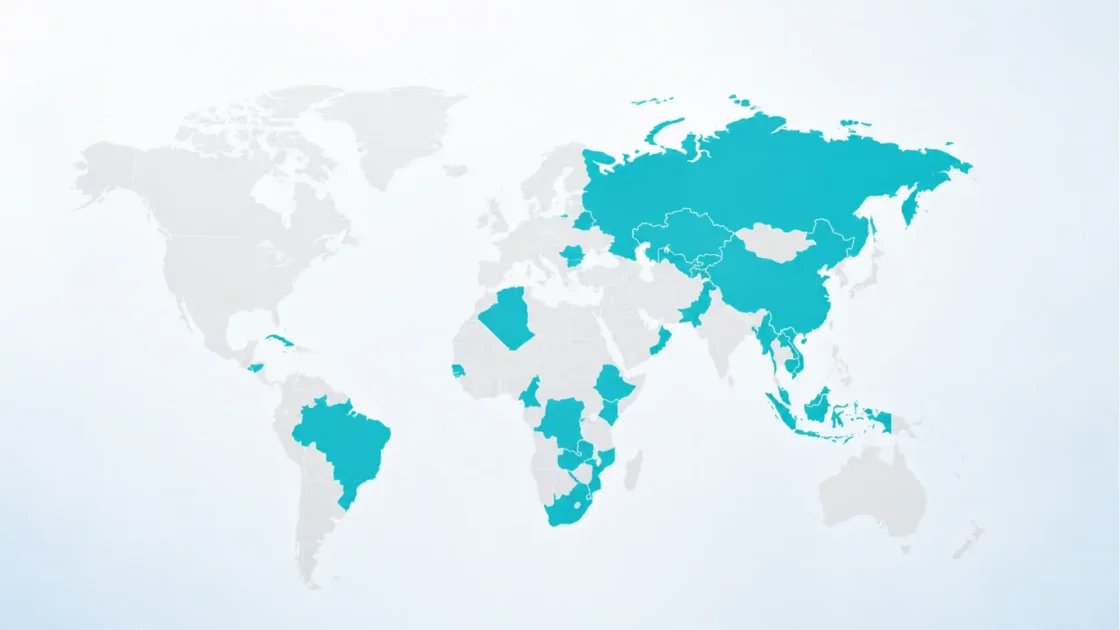
The viral chart lands because it makes AI feel smaller than the rhetoric around it. A planet of more than 8 billion people is rendered as dots. Most are grey. A green strip marks free chatbot users. A thin yellow strip marks paying users. A barely visible mark represents people using AI to write code. The suggested message is comforting and provocative at the same time: almost nobody is doing the thing that Silicon Valley treats as inevitable.
Table of Contents
The AI coding boom is tiny only if the whole planet is the denominator
The chart is useful because it punctures hype. It is also misleading because it uses the wrong denominator for the hardest claim. AI coding should not be measured first against the whole human population. It should be measured against developers, students, builders, companies, repositories, codebases, and software workflows. On those measures, the picture looks very different.
OpenAI said at DevDay 2025 that ChatGPT had 800 million-plus weekly users, 4 million developers had built with OpenAI, and its API platform processed 6 billion tokens per minute. Microsoft said in its fiscal 2025 fourth-quarter earnings call that GitHub Copilot had 20 million users, that Copilot Enterprise customers grew 75% quarter over quarter, and that 90% of the Fortune 100 used GitHub Copilot. Stack Overflow’s 2025 Developer Survey found that 84% of respondents were using or planning to use AI tools in development, while JetBrains reported that 85% of developers regularly use AI tools for coding and development.
So the right conclusion is not that AI coding barely exists. The better conclusion is sharper: AI coding is still tiny as a share of humanity, already large inside software work, and highly uneven across the world. The viral chart captures the first point. It misses the second and third.
The chart went viral because it made the AI boom feel measurable
The chart’s power comes from a simple visual trick. It shrinks the planet into 2,500 dots and asks the viewer to compare four groups: people who have never used AI, free chatbot users, paid AI subscribers, and people using AI for coding. A LinkedIn post by Steven Bartlett described the visualization as 2,500 dots for 8.1 billion humans, with each dot representing about 3.2 million people. The post says 6.8 billion people have never used AI, 1.3 billion use free chatbots, 15 million to 25 million pay for AI, and only a tiny number use AI coding tools. The user-provided version of the claim puts the coding group at about 2.5 million people.
The arithmetic is clear. If the global population is 8.1 billion, then 2.5 million people is only 0.031% of humanity. At 3.2 million people per dot, that group is less than one dot. The claim that “AI coders are a rounding error at global scale” is mathematically fair if the 2.5 million estimate is accepted.
But a chart can be arithmetically neat and still carry a weak interpretation. Most people do not write code. Most people are not expected to write code. Most people do not use professional design tools, CAD systems, Bloomberg terminals, medical imaging software, Kubernetes clusters, chip design software, or statistical programming languages either. A global-population denominator makes almost every specialized professional tool look irrelevant.
That is the first problem with the viral framing. It compares a specialized behavior with the full human species. The more precise question is not “What share of humanity uses AI to code?” The more precise question is “What share of people who create, maintain, learn, or commission software are now using AI?” On that question, the available evidence points to adoption that is no longer marginal.
There is still a reason the global view matters. The chart reminds readers that AI is not evenly distributed. A person in a developer-heavy online community may see AI code editors everywhere and assume the whole world has moved. That is false. The International Telecommunication Union estimated that 6 billion people were online in 2025 and 2.2 billion remained offline. It also found that internet use remained closely tied to income, with 94% of people in high-income countries online, compared with 23% in low-income countries.
A global chart is at its best when it shows uneven access. It is weaker when it suggests weak adoption inside a profession where the data says adoption is already deep.
Global AI adoption is hard to count because “using AI” no longer means one thing
The viral chart treats AI use as a ladder: no AI, free chatbot, paid chatbot, AI coding. That makes sense for a social-media image. It does not match the way AI now appears in daily software.
A person might use AI without opening ChatGPT. Search engines display AI summaries. Phones use AI for photo cleanup, transcription, predictive typing, translation, call screening, and voice features. Microsoft, Google, Adobe, Canva, Grammarly, Meta, Apple, and many smaller companies have embedded AI features into tools people already use. In that world, “has used AI” depends on the definition.
DataReportal’s Digital 2026 Global Overview said more than 1 billion people were using standalone LLM and generative AI platforms each month, while explicitly excluding AI Overviews in Google search, AI features inside tools such as Gmail, Microsoft Office, Canva, Adobe Photoshop, or Grammarly, companion chatbots, and Meta AI inside Facebook, WhatsApp, and Instagram. That exclusion matters. A narrow definition produces a lower number. A broad definition produces a far higher number.
DataReportal’s 2026 mid-year update goes further. Using GWI data for online adults, it estimated that 4.02 billion people aged 16 and above use AI, equal to 48.6% of the world’s total population, and argued that total AI use could exceed half of humanity once younger internet users are included. The report separates this broad AI-use figure from the narrower figure for generative AI platforms like ChatGPT.
That is not a minor footnote. It changes the chart’s first claim. The viral estimate of 6.8 billion people who have never used AI may be plausible under a narrow definition: no standalone chatbot, no visible AI product, no direct intent. It is not plausible under a broad definition that includes AI embedded into search, messaging, productivity software, phones, and creative apps.
This definitional problem is not unique to AI. Early internet adoption was easier to count because “using the internet” usually meant a direct connection through a browser, email, or app. AI is different. It is both a product and an ingredient. Some users seek it. Others encounter it. Some type prompts into a chatbot. Others click an AI summary without thinking of themselves as AI users. AI diffusion is partly explicit and partly invisible.
The coding category has the same problem. One developer may use Copilot inside VS Code. Another may paste a function into ChatGPT. A third may ask Claude Code to inspect a repository. A fourth may accept an AI-generated test from a CI tool. A fifth may review an agent-authored pull request without personally “using AI for coding” in the way a survey asks. Counting those cases as one category is not simple.
That is why the chart’s clean tiers should be read as a narrative model, not as a census. The model captures a useful intuition: paid and technical AI use is far smaller than casual chatbot use. It does not settle the adoption question.
The 2.5 million coding figure is too low for the current public evidence
The strongest challenge to the viral chart is not philosophical. It is numerical. Microsoft publicly said in July 2025 that GitHub Copilot had 20 million users. That is one product family, not the entire AI coding market. It does not include Cursor, Claude Code, OpenAI Codex, Replit, Windsurf, JetBrains AI, Google Gemini Code Assist, local coding models, AI features inside cloud platforms, or general chatbot coding use.
GitHub had already announced in December 2024 that it had passed 150 million developers on GitHub and was adding a free Copilot tier in VS Code, with 2,000 code completions and 50 chat messages per month for signed-in users. That move lowered the barrier from paid subscription to occasional free use inside a mainstream coding environment.
The point is not that every Copilot user codes every day with AI. Microsoft’s figure was not a monthly active user count in the same sense as a social app. TechCrunch reported that a GitHub spokesperson confirmed the 20 million number represented all-time users, which should make readers cautious. But all-time or not, it makes 2.5 million total AI coding users worldwide look stale or too narrow.
The difference is not subtle. If 2.5 million people use AI for coding, the group is 0.031% of 8.1 billion humans. If 20 million people have used GitHub Copilot, that single disclosed product figure equals about 0.247% of 8.1 billion humans, still tiny globally but eight times larger than the viral coding estimate.
The better estimate depends on what the category means. If “AI for coding” means “paid users of advanced autonomous coding agents,” 2.5 million may be closer to the right order of magnitude for a narrower moment in time. If it means “people who use AI to write, explain, debug, refactor, test, or learn code at least sometimes,” the number is almost certainly much larger.
OpenAI’s own consumer-use study, published with NBER in September 2025, found that computer programming was a relatively small share of ChatGPT use, while practical guidance, seeking information, and writing dominated. That supports the idea that coding is a minority use case among general chatbot users. It does not support the idea that the total number of AI coding users is only a few million.
Coding is small inside mass-market chatbots because most chatbot users are not programmers. Coding can still be large inside software work.
Developers are the denominator that matters most
The chart’s most serious measurement error is using humanity as the default denominator. A tool built for software creation should first be judged against the software-creating population.
SlashData estimated that the total global developer population reached 47.2 million in early 2025, with professional developers growing from 21.8 million in early 2022 to 36.5 million in early 2025. GitHub’s platform count is wider because it includes students, hobbyists, open-source contributors, occasional builders, and people who may not be professional developers. Both figures show why a few million AI coders would be small inside the developer world, but tens of millions would be large.
A 2.5 million estimate against 47.2 million developers would imply roughly 5.3% penetration. A 20 million Copilot all-time user figure against 47.2 million developers would imply a much larger reach, though the comparison is imperfect because not all Copilot users are active and not all developers are on GitHub.
Survey evidence points in the same direction. Stack Overflow’s 2025 Developer Survey reported that 84% of respondents were using or planning to use AI tools in the development process, with 47.1% of all respondents using them daily and 17.7% weekly. Among professional developers, 50.6% reported daily use.
JetBrains reported from its 2025 State of Developer Ecosystem work that 85% of developers regularly use AI tools for coding and development, and 62% rely on at least one AI coding assistant, agent, or code editor. It also found that 15% of developers had not adopted AI tools in daily work.
Survey populations skew toward people who answer developer surveys. They may overrepresent active, English-speaking, tool-aware, online developers. But the direction is hard to ignore. Inside the reachable software-development population, AI coding tools are no longer fringe. The remaining questions are frequency, depth, trust, team rules, and whether the tools improve actual outcomes.
That is where the viral chart misses the professional reality. It correctly says most humans do not code with AI. It does not tell us whether AI coding has reached a threshold inside the group that builds software. The best available evidence says it has.
The split between casual AI and coding AI is a split between consumption and production
The green strip in the chart represents free chatbot users. That category is large because chatbots are general-purpose tools. They answer questions, draft emails, explain concepts, translate text, plan trips, create images, summarize files, and act as a conversational interface for many everyday needs.
The coding group is different. It is a production group. A user who asks a chatbot for dinner ideas produces no persistent infrastructure. A developer who uses an AI assistant to write authentication logic, test a payment flow, migrate a database schema, or patch a security bug may affect a product used by thousands or millions. The social weight of a user group is not always proportional to its headcount.
This is one reason software has always produced outsized influence. A small group of developers can ship code that shapes work, media, finance, logistics, education, healthcare, retail, entertainment, government services, and personal communication. A change in developer tools can therefore ripple through many sectors before the general population notices.
The chart’s “rounding error” language works only if population share is the sole measure of importance. It is not. A small group using a tool at a production bottleneck can have more economic effect than a much larger group using a tool lightly. There are far fewer database administrators than smartphone users, but database work affects almost every digital service. There are far fewer semiconductor process engineers than social media users, but chips determine the limits of the AI boom.
AI coding sits in that category. It is a narrow practice with broad downstream reach. The tools may be used by a minority of humans, but they operate inside one of the main bottlenecks of digital output. That is why venture capital, cloud providers, enterprise software companies, and model labs treat coding as a strategic market.
Anthropic has been unusually direct about this. Its research on Claude Code found that startups appeared to be early adopters, with startup work accounting for 32.9% of Claude Code conversations, while enterprise work represented 23.8%. It also found that students, academics, personal project builders, and tutorial or learning users collectively represented half of interactions across Claude.ai and Claude Code.
The early adopters are not evenly spread. They are clustered where code matters, where the payoff from faster iteration is high, and where tool switching is easier. That distribution is exactly what a diffusion curve looks like at the stage when a technology is no longer obscure but has not yet become universal.
The free chatbot layer is massive, but it does not automatically create AI fluency
The chart implies a ladder: free chatbot use first, paid AI next, coding after that. Many users do follow a version of that path. They ask basic questions, discover that the tool can draft text or explain a spreadsheet, then try paid models or specialized tools. But the path is not automatic.
OpenAI’s NBER working paper found that by July 2025, ChatGPT had been adopted by around 10% of the world’s adult population, with non-work usage growing faster than work usage and exceeding 70% of all usage. It also found that practical guidance, seeking information, and writing accounted for nearly 80% of conversations, while computer programming and self-expression were smaller shares.
This matters because AI fluency is not the same as AI exposure. A person who asks a chatbot one question a month has used AI, but may not understand prompting, verification, context windows, tool use, model limits, hallucination risk, data privacy, or workflow redesign. The same is true in coding. A developer who accepts occasional autocomplete suggestions is not using AI in the same way as a developer who delegates a multi-file refactor to an agent and reviews the pull request.
The “1.3 billion free chatbot users” estimate in the viral chart, if treated as an order-of-magnitude claim, fits the idea that standalone generative AI platforms have crossed mass-market scale. DataReportal’s October 2025 work estimated more than 1 billion monthly users of standalone LLM and generative AI tools. OpenAI’s DevDay 2025 page said ChatGPT alone had 800 million-plus weekly users.
But the existence of a huge free layer does not mean the world has learned AI. It means the first interaction cost has collapsed. In practice, users cluster into intensity tiers. Some test a tool once and leave. Some use it for simple answers. Some make it part of work. Some pay. Some wire it into code editors, documents, data systems, and business processes. Some build software around model APIs. The economic effects come from the higher-intensity groups.
That is why the free chatbot layer is best understood as a distribution layer, not proof of deep adoption. It gives people a path into AI. It does not guarantee that they will climb.
Paid AI users are a small group because willingness to pay is a harder signal than curiosity
The chart’s 15 million to 25 million paid-user estimate is plausible as a rough consumer-paid-AI figure, but it is also hard to verify across providers. OpenAI, Anthropic, Google, Microsoft, Perplexity, xAI, Cursor, Replit, Midjourney, Adobe, and dozens of smaller firms disclose different numbers at different levels: weekly users, monthly users, business seats, all-time users, API customers, paying organizations, revenue run rate, or enterprise deployments. Those numbers are not interchangeable.
Payment is a useful signal because it reveals a higher-intensity relationship. People pay when a tool becomes frequent, valuable, entertaining, status-linked, workplace-funded, or hard to replace. But paid subscriptions undercount AI value in several ways.
First, many users access paid AI through employers, universities, or bundled software. Second, many coding tools are usage-based, seat-based, or included in broader platforms. Third, API usage may power products where the end user never pays the model lab directly. Fourth, free tiers can still produce serious use, especially for students and hobbyists.
Microsoft’s disclosed 20 million GitHub Copilot users shows the category’s reach, while its statement that 90% of the Fortune 100 used GitHub Copilot shows enterprise penetration. Those claims sit outside a simple “$20 per month” consumer subscription frame.
OpenAI’s DevDay numbers also resist the consumer-subscription frame. The company reported 4 million developers building with OpenAI and 6 billion tokens per minute on the API platform, alongside the 800 million-plus ChatGPT weekly-user figure. API traffic may represent developers, startups, enterprise workflows, automations, and products that do not look like a human paying $20 for a chatbot.
That is the second flaw in the viral ladder. The AI economy is not only a sequence from free user to $20 subscriber to AI coder. It is a mix of direct consumer use, employer-paid seats, API platforms, embedded features, enterprise contracts, open-source models, local models, and agentic workflows.
The $20 subscription remains culturally important because ChatGPT Plus trained people to think of AI as a paid personal tool. But coding adoption is increasingly tied to developer platforms and company workflows, not only consumer payment.
AI coding adoption looks high in surveys because developers are tool-switchers by habit
Developers adopt tools faster than the general population for a reason. Their work already involves new languages, frameworks, libraries, cloud services, editors, build tools, package managers, databases, API docs, testing libraries, CI systems, and deployment patterns. Tool learning is part of the job.
AI coding assistants fit into that habit. They also fit into daily pain. Developers spend time searching documentation, remembering syntax, writing boilerplate, generating tests, explaining unfamiliar code, reading error messages, renaming variables, drafting pull-request descriptions, and moving between abstractions. AI tools attack those small frictions first.
That is why survey adoption can be high even while trust remains mixed. Stack Overflow found high AI-tool use or planned use in 2025, but the same survey environment has repeatedly shown concern about accuracy, debugging time, security, and whether developers trust generated output. The headline is not “developers blindly accept AI.” The headline is closer to this: developers use AI because it is convenient, then inspect it because it is unreliable.
JetBrains reported that nearly nine out of ten developers who use AI save at least an hour per week, and one in five saves eight hours or more. It also reported that 68% expect employers to require AI proficiency in the near future. Those are not claims about replacing software engineers. They are claims about AI becoming part of the expected tool belt.
Coding also gives AI a feedback loop that other work lacks. If a model writes a bad paragraph, the error can be subjective or subtle. If it writes broken code, tests may fail. The compiler may complain. The IDE may flag types. The runtime may crash. The repository may reject the build. That feedback makes AI easier to use in some coding tasks than in vague strategic tasks, even though software has its own deep risks.
This is why AI coding became one of the first serious markets for generative AI. Developers can tolerate rough edges if the tool is fast and the feedback cycle is tight. They know how to check output. They already work inside machine-readable systems. The model’s mistakes are annoying, but not always invisible.
The real coding divide is not access but intensity
The question “Do you use AI for coding?” hides too much. A better question is “How deeply is AI inside your software workflow?”
There are at least five intensity tiers. The first is reference use: asking a chatbot to explain syntax, compare libraries, or debug an error message. The second is completion use: accepting inline suggestions in an editor. The third is chat-in-editor use: asking a model to edit a file, write tests, or explain a codebase. The fourth is multi-file agent use: delegating a task across a repository and reviewing a diff. The fifth is workflow integration: adding AI to CI, code review, documentation, migration, support, testing, and product prototyping.
A viral chart collapses all of those tiers into “AI for coding.” That makes the category seem smaller and simpler than it is. A student asking ChatGPT to explain a loop is counted beside a senior engineer using Claude Code to modify a distributed system. Those are both AI coding, but they are not the same adoption stage.
Anthropic’s March 2026 Economic Index report noted that coding tasks continued to migrate from Claude.ai to more automated workflows in first-party API traffic. That is a crucial clue. As users mature, some coding work moves out of general chat and into tool-driven or agentic environments.
This movement makes public measurement harder. If coding moves from visible chatbot prompts into API calls, background agents, IDE extensions, and enterprise systems, consumer surveys will miss part of the activity. Web traffic estimates will miss it too. Even developer self-reporting may lag because people normalize the tools quickly.
The same problem appeared with cloud computing. At first, a team “used cloud” by logging into a cloud dashboard. Later, cloud became infrastructure-as-code, CI pipelines, managed databases, serverless functions, identity systems, and internal platforms. The visible act disappeared into workflow. AI coding may follow the same path.
The future signal is not whether someone says they “use AI.” It is whether AI-generated or AI-assisted artifacts become ordinary parts of the software delivery chain.
A small coding cohort can still affect a huge economy
A world population chart makes AI coding look small. A software-economy lens makes it consequential. Software is not a niche layer of the economy. It is the control layer for many industries. Code runs payment systems, logistics, manufacturing, marketing operations, hospital scheduling, bank risk models, government portals, school platforms, media distribution, cybersecurity tools, smartphones, cars, industrial sensors, and cloud infrastructure.
When AI changes the cost, speed, and skill curve of software work, the effects do not stay inside the developer community. They change what startups can build, what internal teams can automate, what nontechnical employees can prototype, what security teams must review, what compliance teams must govern, and what executives expect from engineering budgets.
Stanford’s 2025 AI Index reported that U.S. private AI investment reached $109.1 billion in 2024, while global private investment in generative AI reached $33.9 billion, up 18.7% from 2023. It also reported that 78% of organizations used AI in 2024, up from 55% the previous year.
McKinsey’s 2025 global AI survey found that 88% of surveyed organizations regularly used AI in at least one business function, but only about one-third had begun to scale AI programs. It also found that 23% were scaling an agentic AI system somewhere in the enterprise, while another 39% were experimenting with agents.
These enterprise numbers matter because coding is often where AI moves from individual use to organizational architecture. An employee asking a chatbot for a summary is a productivity event. A developer embedding an AI workflow into support triage, documentation generation, test creation, or analytics pipelines is an operational change.
The difference is durable. A chatbot conversation disappears. A code change ships. A workflow runs again tomorrow. A model-backed feature becomes a product surface. That is why AI coding deserves more attention than its share of humanity suggests.
The “rounding error” argument is emotionally appealing but strategically weak
The viral claim offers relief to people who feel behind. It says the AI wave is smaller than the online noise suggests. That is partly healthy. People should not mistake a developer-heavy social feed for the whole world. They should not assume that every small business, school, government office, or household is using AI with expert skill.
But the argument becomes weak when it turns relief into complacency. A technology does not need majority human adoption to change labor markets, business models, or competitive pressure. Cloud computing did not need every person on Earth to manage AWS infrastructure. Mobile payments did not need every person to build payment rails. Social-media ad systems did not need every person to buy ads. Small professional groups can reshape large systems when they sit at leverage points.
Coding is such a point. That does not mean every person must learn to code with AI. It means leaders, educators, and workers should understand where the change is concentrated. The early advantage is not evenly distributed across all people. It is concentrated among builders, technical teams, digitally mature firms, students with access, and organizations that can absorb new workflows.
This is why a better reading of the chart is not “you are not behind.” It is “most of the world has not started, but some high-leverage groups have.” That message is less comforting, but more useful.
A person outside software may not need Claude Code or Copilot. A teacher, lawyer, salesperson, designer, analyst, founder, doctor, journalist, or government worker may need a different AI skill set. The chart’s coding dot should not become a universal fear trigger. It should be read as an early-adopter marker for one domain where AI has unusually strong product-market fit.
The risk is not that everyone must become an AI coder. The risk is that decision-makers misread low global penetration as low strategic importance.
Global access remains the largest constraint on any AI adoption story
The chart’s grey area is still the most important visual element, even if the exact “never used AI” claim is debatable. Billions of people have limited or no access to the conditions that make AI useful: reliable internet, affordable data, modern devices, payment methods, digital skills, language coverage, and safe institutional support.
The ITU estimated that 2.2 billion people remained offline in 2025. It also found that only 36% of Africa’s population used the internet, compared with 88% to 93% in Europe, the Americas, and the Commonwealth of Independent States. In least developed countries, only 34% of people were online.
Those numbers are a direct warning against universal AI narratives. A person cannot use a cloud AI coding assistant if they cannot reliably access the internet. A student cannot build with AI if data costs are too high, payment rails block subscriptions, or the tools perform poorly in their language. A small business cannot adopt AI safely without basic cybersecurity and digital literacy.
The inequality also appears among connected users. DataReportal’s mid-year update found that adoption rates differed sharply by country and that many Western markets lagged the global average for broad AI use among online adults, while China and other markets showed higher reported adoption.
Anthropic’s work on AI diffusion has also pointed to uneven geographic adoption. Its Economic Index research describes AI usage as geographically concentrated, with high-income countries overrepresented relative to working-age population.
This unevenness is one of the strongest reasons to keep the global chart in the conversation. Not because it proves AI coding is insignificant, but because it shows the access gap behind every adoption claim. The people most likely to gain early from AI are often the people who already have connectivity, skills, English-language exposure, capital, and institutional permission.
Without intervention, AI may widen existing digital divides before it narrows them.
The coding boom is uneven even among developers
Developer adoption is high in surveys, but it is not uniform. AI coding tools are easier to use in some settings than others.
They work better in popular languages with abundant training examples, clear tests, common frameworks, and public documentation. They are weaker in proprietary codebases with sparse context, old systems, unusual architectures, strict compliance demands, or hidden business logic. A model can generate a React component quickly because the internet contains many examples. It may struggle with a twenty-year-old internal insurance rules engine or a safety-critical embedded system.
They also work better for developers who know enough to judge output. Beginners may get quick explanations, but they may also accept flawed code because it looks plausible. Senior engineers may gain speed from boilerplate and search, but they may also spend time correcting subtle mistakes. The benefit depends on task type, codebase maturity, test quality, review culture, and the developer’s skill.
Research evidence is mixed. A randomized controlled trial on experienced open-source developers working in mature projects found that allowing early-2025 AI tools increased completion time by 19%, despite participants expecting time savings. The study involved 16 developers and 246 tasks, so it should not be read as the final verdict on all AI coding. But it is a useful warning against assuming every task gets faster.
Other research points to gains in output and exploration. A study estimating AI-generated Python functions in 80 million GitHub commits found that by December 2024, AI wrote an estimated 30.1% of Python functions from U.S. contributors, 24.3% in Germany, 23.2% in France, 21.6% in India, 15.4% in Russia, and 11.7% in China. It also estimated that moving to 30% AI use raised quarterly commits by 2.4%.
The contrast is the point. AI coding is not a single effect. It is a bundle of effects that vary by task, person, organization, and measurement method. It can speed up boilerplate and slow down expert work in complex systems. It can help a newcomer learn and also teach bad habits. It can raise commit volume and also create review burden. It can increase experimentation and add maintenance risk.
A chart cannot hold that complexity. A serious adoption analysis has to.
The tool has moved from autocomplete to agents
Early AI coding was mostly autocomplete. A model predicted the next line or block based on surrounding code. That was useful, but bounded. The developer remained the driver.
The newer market is moving toward agents. An agent can inspect files, plan steps, run commands, edit several parts of a repository, create tests, open a pull request, or respond to review comments. This does not make the agent a software engineer. It changes the human role from typing every line to specifying, supervising, testing, and deciding.
GitHub’s Octoverse 2025 report said more than 1.1 million public repositories used an LLM SDK, with 693,867 of those projects created in the previous 12 months, and said 80% of new developers on GitHub used Copilot in their first week. It also said developers merged a record 518.7 million pull requests.
Academic work on coding agents is starting to measure this shift directly. A 2026 study of coding-agent adoption on GitHub analyzed 129,134 projects and estimated adoption at 15.85% to 22.60% for a technology only a few months old, based on traces such as co-authored commits or pull requests. Another 2026 dataset study identified 932,791 agentic pull requests across 116,211 repositories involving 72,189 developers, produced by agents including OpenAI Codex, Devin, GitHub Copilot, Cursor, and Claude Code.
These numbers do not tell us that agents are reliable enough for unsupervised software production. They do tell us that AI coding is becoming visible in software artifacts, not only user surveys. That matters because artifact-based measurement is harder to dismiss as hype.
The move from autocomplete to agents also raises the stakes. Autocomplete mistakes are usually local. Agent mistakes may span files, tests, dependencies, configuration, permissions, and deployment assumptions. The human reviewer’s job becomes more important, not less. The question shifts from “Can AI write code?” to “Can teams build review systems that catch what AI gets wrong?”
Software work is shifting toward supervision
The most durable change in AI coding may be the shift from production to supervision. Developers still write code, but they spend more time framing tasks, reading generated diffs, checking assumptions, creating tests, refining prompts, and deciding whether output belongs in the system.
A 2026 longitudinal study of AI coding assistants found that professional software engineers reported spending less time on most development tasks, with 82% reporting less time writing code. The researchers described a shift from creation to verification and proposed the term supervisory engineering work for directing, evaluating, and correcting AI output. They also found a productivity-experience paradox: 84% reported productivity improvement at two survey points, while the share reporting worsened developer experience in at least one dimension nearly doubled from 14% to 27% among matched participants.
That result fits what many teams report anecdotally. AI makes some tasks feel faster, but it can increase cognitive load. The developer now has to hold the intended architecture in mind while checking code written by a system that does not truly understand the product, customers, risk tolerance, or long-term maintenance burden.
This is where beginner enthusiasm and senior caution often diverge. A beginner may see working output and feel empowered. A senior engineer may see hidden coupling, weak tests, security gaps, naming drift, or technical debt. Both are reacting to real things. The tool lowers the first barrier and raises some second-order burdens.
AI coding turns judgment into the scarce skill. Syntax matters less than it did, but it does not disappear. Architecture, testing, security, product understanding, debugging, observability, and code review become more valuable. The human role shifts up the stack, but not out of the loop.
That is why organizations should not treat AI coding as a headcount-reduction shortcut. Used poorly, it creates more code to review, more defects to chase, and more uncertainty about ownership. Used well, it gives skilled teams a faster way to explore, draft, test, and maintain.
The productivity question is still unsettled
The public debate often asks whether AI coding makes developers 10%, 30%, or 50% faster. The honest answer is that the effect depends on the task and the system around the developer.
AI can save time on boilerplate, documentation, test scaffolding, syntax recall, code explanation, migration drafts, small scripts, and unfamiliar API exploration. It may save less time on ambiguous product requirements, complex debugging, legacy systems, security-sensitive work, concurrency bugs, distributed systems, and architecture decisions. It may also shift time from writing to review, which feels different but still consumes attention.
DORA’s 2025 State of AI-assisted Software Development report frames AI as an amplifier that magnifies an organization’s existing strengths and weaknesses. Its public summary says the strongest returns come not from tools alone, but from the underlying organizational system.
Google’s announcement of the DORA report said the research drew on more than 100 hours of qualitative data and nearly 5,000 technology-professional survey responses. That framing matters because coding assistants do not operate in a vacuum. They sit inside team structure, testing depth, review norms, platform quality, data access, product management, and deployment culture.
McKinsey’s 2025 survey makes a similar point at enterprise level. AI use is now common, but most organizations have not embedded it deeply enough into workflows and processes to gain material enterprise-level benefits. The highest performers are more likely to redesign workflows, set human-validation processes, and have senior leaders engaged in adoption.
That should temper both extremes. The viral chart’s “almost nobody uses AI coding” claim underplays the change. The “AI will instantly replace developers” claim overplays it. The evidence supports a middle position: AI coding is already widespread among developers, but productivity gains are uneven and depend on the work system around the tool.
Adoption signals and their limits
| Signal | Reported figure | Better reading | Main limit |
|---|---|---|---|
| Viral coding estimate | ~2.5 million people | May describe a narrow slice of advanced AI coding users | Too low for broader coding assistance |
| GitHub Copilot | 20 million users | A major AI coding product has reached large scale | All-time users, not active users |
| Stack Overflow 2025 | 84% using or planning AI tools | AI is mainstream among survey respondents | Survey sample skews toward engaged developers |
| JetBrains 2025 | 85% regularly use AI for coding and development | AI is becoming normal in developer routines | “Regularly” can mean different depths of use |
| OpenAI DevDay 2025 | 4 million developers built with OpenAI | Developers are a large platform audience | Does not equal coding-assistant users |
The table shows why one figure should not carry the whole argument. The viral estimate is useful as a narrow provocation, but public product disclosures and developer surveys point to a much larger AI coding footprint.
Trust is the ceiling on adoption depth
Developers can adopt a tool while distrusting it. That is not hypocrisy. It is professional caution.
A compiler is trusted because it follows formal rules. A test suite is trusted only to the degree that it covers important behavior. A package manager is trusted until a dependency is compromised. A code review is trusted because another human can reason about intent. AI coding tools sit lower on the trust ladder. They produce plausible output without proof of correctness. They may invent APIs, miss edge cases, ignore nonfunctional requirements, or copy patterns that do not fit the system.
Stack Overflow’s 2025 survey shows this tension. The same survey that found high use and planned use also reveals the development community’s skepticism about AI outputs. The public discussion around the survey highlighted rising distrust, with developers using tools while still worrying about accuracy.
The trust problem is not only technical. It is organizational. Who owns AI-generated code? Does the developer who accepts it carry full responsibility? Does the company allow source code to leave the environment? Are prompts and completions stored? Does the tool train on private code? Are there license risks? Does the AI-generated diff meet security policy? Do auditors need to know whether AI was used?
These questions decide whether AI coding remains an individual productivity habit or becomes a sanctioned enterprise workflow. Startups can often accept more ambiguity. Regulated companies cannot. That difference explains why Anthropic observed stronger early Claude Code use in startup work and slower enterprise adoption.
Trust also shapes the human interface. Developers do not need AI tools to be perfect. They need them to be inspectable, steerable, and easy to reject. A weak suggestion is tolerable if it is clearly separated from human code and fast to discard. A hidden agent change inside a large diff is riskier. The deeper AI moves into the workflow, the more review, logging, and policy matter.
The ceiling on AI coding is not code generation. It is confidence in generated code.
The security problem grows when code becomes cheaper
AI coding lowers the cost of producing code. That is good when the code is useful, tested, secure, and maintainable. It is bad when it floods systems with brittle scripts, exposed secrets, weak authentication, copied vulnerabilities, or unreviewed dependencies.
The risk is not that AI always writes bad code. The risk is that it writes code fast enough to overwhelm review systems. Teams that already struggled with testing, dependency hygiene, access control, and code ownership may find that AI increases the volume of change before it increases the quality of change.
DORA’s amplifier framing is useful here. If a team has small batch sizes, strong tests, clear ownership, good observability, and fast rollback, AI-generated drafts may move safely through the system. If a team has weak tests, large pull requests, unclear architecture, and slow review, AI may add chaos.
Agentic coding increases the concern. An autocomplete line is easy to see. An agent may touch multiple files, create new dependencies, alter configuration, run commands, and produce a polished explanation. That polish can reduce scrutiny. Reviewers may trust the narrative and miss the risk.
Security teams therefore need different questions. They should not ask only whether AI code is allowed. They should ask where AI can read code, where it can write code, where it can execute commands, where logs are stored, whether secrets are masked, whether generated dependencies are checked, and whether AI-authored changes require a different review path.
The practical answer is not a blanket ban for every organization. It is a risk-tiered model. Low-risk scripts, internal tooling, tests, documentation, and prototypes can have one policy. Payment, identity, cryptography, personal data, safety-critical systems, production infrastructure, and regulated workflows need stricter controls.
AI coding makes software cheaper to produce. Cheap production without stronger review is not progress. It is debt with a better interface.
The education effect may be larger than the professional effect
AI coding is not only a workplace story. It is a learning story. Students use chatbots to understand syntax, generate examples, explain errors, and complete assignments. Hobbyists use AI to build small apps without formal training. Product managers and founders use it to create prototypes. Designers use it to make interactive demos. Analysts use it to write scripts.
This broadens the population of people who can make software-like artifacts. It does not turn everyone into a software engineer. It does change the entry ramp.
Anthropic’s software-development analysis found that students, academics, personal project builders, and tutorial or learning users collectively made up half of interactions across Claude.ai and Claude Code. That suggests coding AI is not confined to professional engineering teams.
Pew Research Center found that 34% of U.S. adults had used ChatGPT by early 2025, including 58% of adults under 30. It also found that 26% of U.S. adults had used ChatGPT to learn something new, and 28% of employed adults had used it for work.
For education, the opportunity is real. AI can explain a concept at different levels, generate practice problems, compare approaches, and help students see immediate feedback. For coding, that can reduce frustration at the moment when many beginners quit.
The risk is also real. If students outsource thinking too early, they may skip the struggle that builds mental models. They may produce working code without understanding state, control flow, data structures, security, or debugging. They may become prompt-dependent rather than capable.
The answer is not to pretend AI does not exist. It is to redesign learning around it. Beginners need assignments that require explanation, testing, critique, and modification. They need to read AI output skeptically. They need to compare generated solutions. They need to debug broken AI code. They need to learn when not to use the tool.
AI can make coding education more accessible, but only if education treats verification as a first-class skill.
Coding with AI is not the same as becoming a developer
The viral chart’s phrase “use AI for coding” can create a false binary. Either you code with AI or you do not. The reality is more layered.
A person can use AI to produce code without understanding software engineering. They can generate a landing page, a spreadsheet script, a small automation, a chatbot wrapper, or a demo app. That is useful. It may save money and time. It may turn ideas into prototypes. But it does not automatically confer the ability to maintain a production system.
Software engineering includes requirements, architecture, data modeling, security, accessibility, deployment, observability, performance, version control, testing, incident response, documentation, user feedback, compliance, and maintenance. AI can assist many of those tasks, but it does not remove the need to know they exist.
This distinction matters for “vibe coding,” the popular term for building by describing what you want and letting AI generate much of the code. It is powerful for prototypes and small tools. It is risky when users ship systems that handle real money, private data, accounts, or business operations without understanding the code.
AI lowers the cost of the first version. It may raise the cost of the second year if the system is built without structure. The old software truth still applies: the hard part is not making something run once. The hard part is making it safe, reliable, understandable, and changeable.
That is why professional developers remain central even as nondevelopers gain new building power. Their role may shift from typing code to reviewing, hardening, integrating, and maintaining code. The spread of AI-generated software may create more need for engineering judgment, not less.
The chart’s tiny coding dot therefore hides two groups. One group is professional and semi-professional developers using AI to speed work. The other is nondevelopers using AI to enter software creation. Both matter. They have different risks.
The business impact depends on workflow redesign, not tool licenses
Companies often buy AI tools before changing the work. That produces a familiar pattern: high excitement, scattered pilots, uneven usage, unclear ROI, policy anxiety, then either quiet adoption or disillusionment.
McKinsey’s 2025 survey captures this tension. AI use is widespread, but most organizations are still in experimentation or pilot phases, with only about one-third beginning to scale AI programs. The survey also finds that high performers are more likely to redesign workflows, set human-validation processes, and have active senior-leadership ownership.
For software teams, buying seats is the easy part. The hard part is deciding where AI belongs in the software delivery process. Should AI write tests before implementation? Should it draft pull-request descriptions? Should it review code for security? Should it generate migration scripts? Should it create documentation from merged changes? Should it triage bugs? Should it help product managers create prototypes? Should it be blocked from production code until a policy is ready?
Teams that answer these questions clearly will get more value than teams that simply tell developers to “use AI.” The best use cases often begin with pain points that are already measurable: slow test creation, stale documentation, onboarding friction, repetitive support scripts, migration backlog, code search, or review bottlenecks.
This is where the viral chart’s global view offers little guidance. Whether 0.03% or 0.25% of humanity uses AI coding tools is less useful to a CTO than knowing which parts of their delivery pipeline can safely absorb AI today.
The enterprise question is not “How many people use AI coding?” It is “Which software workflows improve when AI is inserted, and which workflows become riskier?”
That question requires local measurement. Teams need before-and-after data on cycle time, defect rates, review time, deployment frequency, incident rates, developer satisfaction, and maintenance burden. Without that, AI adoption becomes faith or fashion.
The labor-market story is more complex than replacement
AI coding raises obvious job fears. If code generation becomes cheaper, will companies need fewer developers? The evidence so far does not support a simple answer.
Some tasks will take less time. Some entry-level work may be automated or compressed. Some teams may expect the same headcount to ship more. Some companies may hire fewer junior developers if they believe AI can handle routine tasks. Others may hire more engineers because cheaper software creation expands the number of projects worth building. Productivity tools can reduce labor demand in one workflow and increase it in another by lowering costs and creating new demand.
McKinsey’s 2025 survey found mixed expectations across functions, with a plurality expecting little or no change in total workforce size, while 32% predicted an overall reduction of 3% or more and 13% predicted an increase of that magnitude in the year ahead. It also found software engineers and data engineers among the roles organizations hired for over the previous year.
OpenAI CEO Sam Altman’s May 2026 comments, reported by Reuters, also pointed away from the most extreme “jobs apocalypse” framing, though executive views should not be treated as labor-market proof.
The labor-market issue is not only how many developers exist. It is how the ladder into the profession changes. Junior developers traditionally learned by doing smaller tasks, fixing bugs, writing tests, reading code, and receiving review. If AI absorbs many of those tasks, companies must create new ways for juniors to learn. Otherwise, the industry risks weakening its future senior-talent pipeline.
At the same time, AI may let junior developers do more ambitious work earlier, if paired with strong mentorship. It may also help people from nontraditional backgrounds enter software through projects rather than credentials. The direction depends on institutions.
AI coding does not automatically remove developers. It changes which developer skills are scarce. The scarce skills become problem framing, system design, security judgment, testing discipline, code review, product reasoning, and the ability to work with imperfect machine output.
The “everyone will be a coder” claim is as flawed as the “nobody uses AI coding” claim
The opposite of the viral chart is another exaggeration: AI will make everyone a programmer. That claim is also wrong.
AI will let more people create software-like outputs. It will not make everyone responsible for production software. Most people do not want to maintain dependencies, debug deployment failures, manage user permissions, inspect logs, or reason about edge cases. They want a working result. AI may give them that result for small tasks. It does not turn software maintenance into a universal hobby.
The more realistic outcome is a widening spectrum. At one end, professional engineers use AI as part of daily work. Near them, technical-adjacent workers build internal tools and prototypes. Farther out, nontechnical users create simple apps, automations, dashboards, forms, and scripts. Many people will never code at all but will use AI-generated software surfaces made by others.
That spectrum is already visible in tools like GitHub Spark, Replit, Cursor, Lovable, Vercel v0, Bolt, and many internal enterprise builders. The market is moving from “learn syntax first” toward “describe intent first.” The shift is real. But intent is not enough for durable systems.
This distinction matters for education and business strategy. Teaching everyone to become a full-stack engineer is not realistic. Teaching more people to understand software logic, data, prompts, testing, privacy, and verification is realistic. In the AI era, the citizen-developer problem becomes a governance problem.
A company may welcome employee-built internal tools. It also needs rules for data access, authentication, auditability, maintenance ownership, and security review. Otherwise, AI-created shadow IT can spread faster than old spreadsheet macros ever did.
The future is not “everyone is a coder.” It is more people can create code-adjacent artifacts, while professional engineering standards become more important for anything that matters.
AI coding is becoming a platform battle
The coding market is strategically valuable because developers shape ecosystems. A developer who adopts a tool may bring it into a company, build on its API, create extensions, teach colleagues, and influence technology choices. That is why model labs and platform companies are fighting for the editor, terminal, repository, pull request, cloud environment, and agent runtime.
Microsoft has GitHub, VS Code, Copilot, Azure, and enterprise distribution. OpenAI has ChatGPT, Codex, APIs, and a vast consumer funnel. Anthropic has Claude and Claude Code, with strong mindshare among many developers. Google has Gemini, Android, Chrome, Cloud, Colab, and developer tooling. JetBrains has IDEs. Cursor and other AI-native editors compete for the developer’s daily workspace. Replit competes on browser-based building and deployment.
The prize is not only subscription revenue. It is workflow control. The tool that sees the codebase, issue tracker, documentation, tests, logs, cloud state, and deployment pipeline can become the developer’s operating layer. That position is valuable because it can route model usage, shape habits, and create switching costs.
This is another reason the global-population chart underplays coding. The AI coding market may be small in human-count terms, but it sits at the center of platform competition. The companies that win developer trust may influence how AI applications are built, deployed, secured, and billed.
OpenAI’s DevDay 2025 emphasized developers and agents, including tools to help developers code faster, build agents more reliably, and scale apps in ChatGPT. GitHub’s public materials emphasize Copilot inside developer workflows and free access through VS Code.
This platform battle will also shape open-source software. If AI agents create pull requests, maintainers must decide whether to accept them, label them, review them differently, or ban them. If AI tools increase the volume of low-quality contributions, maintainers may face more burden. If they help with tests, documentation, and issue triage, maintainers may gain support.
The outcome will not be uniform. Large firms may build controlled AI development systems. Open-source projects may adopt project-specific rules. Startups may move quickly. Safety-critical sectors may move slowly. That unevenness is normal.
Open-source software is the measurement frontier
The best evidence for AI coding may come not from surveys but from repositories. Public software artifacts can reveal AI-authored commits, agent-authored pull requests, LLM SDK usage, coding-agent signatures, and changes in commit patterns. This evidence is imperfect, but it avoids some self-report bias.
GitHub Octoverse 2025 reported more than 1.1 million public repositories using an LLM SDK and a large year-over-year increase in new projects. That shows AI is not only helping developers write code; it is also becoming a dependency inside applications.
The arXiv study “Who is using AI to code?” used a classifier on 80 million GitHub commits to estimate AI-generated Python functions across countries. Its estimates suggest that AI-generated code is already a visible share of Python functions in several major developer markets. The study’s country differences also show that adoption is uneven.
Agent-trace studies add another layer. When an agent co-authors a commit or opens a pull request, the evidence is more direct. The 2026 coding-agent adoption study and AIDev dataset both suggest that agentic software work is moving quickly enough to be measured at scale.
This artifact-based measurement will become more important because user categories blur. A developer may not think of themselves as “using AI” if Copilot is always on. An organization may not disclose AI coding use. A model provider may withhold active-user counts. Public code traces, while incomplete, give researchers another way to track diffusion.
They also create governance questions. Should AI-authored code be labeled? Should maintainers require disclosure? Should package registries track AI-generated releases? Should companies log AI assistance for regulated systems? There is no universal answer yet.
The software world may need provenance norms for AI-assisted code before the measurement problem becomes too messy to solve.
The chart is right about one thing that AI insiders forget
The chart’s strongest insight is not the exact size of the coding group. It is the reminder that the AI conversation is socially skewed.
People who work in technology, venture capital, digital marketing, product management, software engineering, research, and startup media live inside an AI-saturated information bubble. Their feeds overrepresent early adopters. Their peers test new models quickly. Their companies buy tools early. Their conferences treat agents as the next operating system. Their group chats discuss prompts, benchmarks, coding tools, and model releases.
Most people do not live that way. Many have used AI lightly or not at all. Many have heard of ChatGPT but do not have a daily habit. Many have no reason to pay for a model. Many are unsure whether the tools are accurate. Many are blocked by language, device, cost, employer rules, or lack of relevance.
Pew’s U.S. data captures this gap even in a wealthy, connected country. By early 2025, 34% of U.S. adults had used ChatGPT, meaning 66% had not. Usage was 58% among adults under 30, but only 10% among adults 65 and older.
This should humble AI forecasts. The difference between “available” and “adopted” remains large. The difference between “adopted once” and “used well” is larger. The difference between “used well by an individual” and “integrated safely into an organization” is larger still.
The chart reminds insiders not to project their environment onto humanity. That is valuable. It also reminds policymakers not to assume that AI literacy has already diffused. It has not.
But humility should cut both ways. Just as insiders overestimate broad adoption, outsiders may underestimate concentrated adoption in high-leverage fields. Both errors lead to bad decisions.
The practical meaning for workers outside software
For nondevelopers, the right lesson is not “learn AI coding or be left behind.” That is too broad and too anxious. The right lesson is to map AI use to the work you actually do.
A marketer may need AI for research synthesis, audience analysis, content drafts, campaign variants, and reporting. A lawyer may need it for document review, clause comparison, and research support, with strict verification. A teacher may need it for lesson planning and feedback design. A doctor may need it for administrative drafting, patient communication, and literature support, under clinical safeguards. A manager may need it for meeting synthesis, scenario planning, and decision memos. An analyst may need it for Python, SQL, spreadsheet formulas, and data explanation.
Coding matters even outside software because many knowledge workers work with structured information. The lowest-risk entry point is often small automation: turning repetitive spreadsheet work into scripts, cleaning data, generating charts, querying databases, or creating internal tools. AI can reduce the barrier to those tasks.
But nondevelopers should avoid shipping code they cannot inspect when the stakes are high. A script that renames files is one thing. A system that handles customer data, employee records, payments, legal claims, medical information, or security credentials is another.
The practical rule is simple: use AI to learn, draft, and prototype; use qualified review for anything that affects real users, money, safety, rights, or private data.
That rule keeps the upside without pretending AI has removed accountability. It also avoids the panic that everyone must become a full developer. Most people need domain-specific AI fluency, not professional software engineering.
The practical meaning for developers
For developers, the chart should not be reassuring. It should be clarifying. You are not competing against 8.1 billion AI coders. You are working inside a profession where AI tool use is already common and where expectations are changing quickly.
The first priority is not to use every new tool. It is to learn where AI helps and where it hurts. Developers should test AI across real tasks: writing unit tests, explaining unfamiliar code, generating migration drafts, building prototypes, reviewing pull requests, writing documentation, debugging logs, creating scripts, and exploring libraries. They should measure time saved and time lost. They should note defect patterns.
The second priority is verification. A developer who uses AI without improving testing is taking on hidden risk. Good AI-assisted development requires stronger tests, smaller diffs, clearer prompts, better review habits, and more disciplined observability. The goal is not to trust the model. The goal is to build a workflow where model errors are caught cheaply.
The third priority is codebase context. AI tools become more useful when they can access relevant files, docs, types, tests, issue history, and architecture notes. But access expands privacy and security risk. Developers need to understand what leaves their environment and what is logged.
The fourth priority is skill preservation. Do not let AI replace the mental models needed to debug. Use it to accelerate known work and explore unknown work, but keep the ability to reason without it. The developers who benefit most will not be the ones who paste every problem into a chatbot. They will be the ones who combine speed with judgment.
AI coding skill is becoming less about prompting tricks and more about technical taste under machine acceleration.
The practical meaning for companies
Companies should stop treating AI coding as either a miracle or a forbidden toy. The productive position is controlled adoption.
The first step is policy clarity. Developers need to know which tools are approved, what data can be shared, whether private code can be used, which models are allowed, and how AI-generated code should be reviewed. Ambiguity pushes employees toward personal accounts and shadow AI use.
The second step is use-case selection. Start with low-risk, high-friction workflows: tests, documentation, internal scripts, code explanation, onboarding, support tooling, migration drafts, and prototype work. Avoid starting with security-critical or compliance-heavy production paths unless the review system is mature.
The third step is measurement. Track review time, rework, defects, incident rates, developer satisfaction, cycle time, and maintenance load. Do not rely only on perceived productivity. Developers may feel faster while teams absorb more downstream cost.
The fourth step is platform design. AI coding works better when paired with good internal documentation, searchable code, strong CI, standard project templates, package governance, and observability. A chaotic codebase reduces AI value. It also increases AI risk.
The fifth step is training. Developers need guidance on verification, prompt framing, agent boundaries, secure use, and review norms. Nondevelopers who use AI to create tools need even more guardrails.
DORA and McKinsey point to the same pattern from different angles: AI value depends on the surrounding system, not only the model.
The companies that gain from AI coding will be the ones that redesign software work, not the ones that merely buy subscriptions.
The practical meaning for policymakers and educators
Policymakers should resist two errors. The first is assuming AI adoption is universal. The second is assuming AI adoption is trivial because global penetration is uneven.
For public policy, access still matters. Connectivity, affordability, digital skills, language support, and local institutions shape who benefits. The ITU’s offline population figures show that basic digital inclusion remains unfinished. AI policy that ignores connectivity will mostly serve people already online.
Education policy needs to move faster than prohibition. Students are using AI. Some will use it for cheating. Some will use it for learning. Schools and universities need assessment models that value process, oral defense, code explanation, version history, testing, critique, and applied judgment. A ban may be appropriate in some exams, but it cannot be the only strategy.
Workforce policy should avoid promising that everyone can become an AI engineer after a short course. The more useful goal is tiered AI literacy: basic understanding for citizens, workflow fluency for knowledge workers, technical fluency for builders, and governance fluency for managers. Coding with AI sits in the technical tier, but parts of it are relevant to many jobs that involve data or automation.
Public-sector adoption should be cautious. Government systems often involve rights, benefits, identity, legal obligations, and vulnerable populations. AI-generated code and AI-assisted decisions need procurement rules, audit trails, security review, and accountability. A cheap prototype can become a public failure if deployed without safeguards.
The viral chart is helpful for policymakers if it reminds them that adoption is uneven. It is harmful if it makes them dismiss early concentration in high-impact sectors.
A better mental model is stacked adoption
The chart uses one ladder. A better model is a stack.
At the bottom is connectivity: devices, internet access, electricity, affordability, language, and basic digital skills. Above that is passive AI exposure through search, phones, feeds, apps, and office software. Above that is active chatbot use. Above that is frequent AI use for work, learning, and creation. Above that is paid or employer-supported use. Above that is specialized use in domains such as coding, design, law, medicine, finance, education, and research. Above that is embedded AI inside workflows, products, and infrastructure. At the top is agentic delegation with governance.
People and organizations move through the stack unevenly. Some skip steps. A developer may go straight from no chatbot habit to daily Copilot use because the employer installs it. A teenager may use AI chatbots daily but never pay. A lawyer may use a firm-approved tool without knowing which model powers it. A farmer may benefit from AI inside a weather or pricing app without thinking of themselves as an AI user.
This stacked model explains why the viral chart feels true and false at once. It is true that paid and specialized AI use remains much smaller than casual or embedded exposure. It is false that a small global coding share means low professional adoption.
A cleaner way to read the AI adoption stack
| Layer | Typical user action | Adoption signal | Strategic meaning |
|---|---|---|---|
| Connectivity | Gets online with enough device quality | Internet-use and offline-population data | Sets the outer limit for AI access |
| Passive AI exposure | Sees AI in search, apps, phones, feeds | Hard to count directly | Broadest but shallowest layer |
| Active chatbot use | Opens ChatGPT, Claude, Gemini, Copilot, or similar tools | Weekly or monthly chatbot users | Shows intentional demand |
| Paid or workplace use | Pays directly or uses employer seats | Subscriptions, seats, business users | Indicates higher intensity |
| Specialized production use | Codes, designs, analyzes, writes, researches, automates | Developer surveys, tool usage, workflow data | Creates economic and institutional effects |
| Embedded agentic use | Delegates tasks inside systems | Agent traces, pull requests, API logs | Hardest to govern and most consequential |
This model avoids the false comfort of one denominator. AI adoption is not one curve. It is several curves moving at different speeds.
The coding cohort is small because the world’s coding population is small
Even if AI coding became universal among professional developers, it would still be tiny against the human population. That is not a sign of failure. It is a property of specialized work.
If there are roughly 47.2 million developers worldwide, they represent well under 1% of humanity. The professional segment is smaller. A tool used by most developers could still look like a sliver on a global chart. That is why global share is a poor measure for specialized production tools.
The same logic applies to many professions. The number of people using medical diagnostic software is tiny globally, but its impact is large in healthcare. The number of people using airline maintenance systems is tiny, but the stakes are high. The number of people using chip design tools is tiny, but the economic effects are enormous.
AI coding tools are not important because everyone uses them. They are important because software is a general-purpose production layer. A small population of developers can shape digital services for billions.
That does not mean AI coding is overhyped. Some claims are overhyped. Fully autonomous software engineering remains unreliable for many real-world systems. Enterprise ROI is uneven. AI-generated code can create risk. But dismissing AI coding because most humans do not use it is like dismissing cloud infrastructure because most humans never open a cloud console.
The better measure is not population share. It is penetration inside the relevant production group, depth of workflow integration, and downstream effects on software output.
On those measures, AI coding is early but serious.
The viral chart undercounts invisible coding use
A developer does not have to identify as an AI-coding-tool user to be affected by AI coding. The tool may be embedded in their IDE. A colleague may submit AI-assisted code. A dependency may contain AI-generated functions. A vendor may ship AI-written features. An internal platform team may generate infrastructure templates with AI. A product manager may create a prototype that engineering later rewrites.
This invisible use complicates measurement. Surveys ask individuals what they do. Product disclosures count accounts. Repository studies infer artifacts. Enterprise data counts seats. None captures the whole system.
The same issue affects the general AI adoption number. DataReportal explicitly excludes many embedded AI features from its standalone AI platform estimate. But those embedded features may reach hundreds of millions or billions of users.
Coding is moving toward the same embedded pattern. AI will not always appear as a visible chatbot. It may appear as a code-review suggestion, test-generation button, terminal agent, documentation updater, dependency fixer, security scanner, cloud assistant, or product-building interface.
This makes the viral “AI for coding” dot unstable. The dot grows not only when more people subscribe to coding assistants, but when software tools add AI quietly. A developer may accept an AI-generated fix in a security platform and never call it “using AI to code.” A team may merge AI-authored documentation without counting it as coding. A nondeveloper may generate a script inside a spreadsheet and think of it as spreadsheet help, not programming.
The boundary between coding and tool use is getting blurry. That is one of AI’s real changes.
The consumer chatbot story is broader than coding
OpenAI’s consumer-use research is a useful corrective to developer-centric narratives. It found that most ChatGPT use is not work-related, and that practical guidance, seeking information, and writing dominate. About half of messages are “Asking,” while “Doing” includes drafting text, planning, programming, and other output-oriented tasks.
That means the public experience of AI is not primarily code. It is advice, explanation, writing, planning, entertainment, learning, emotional support, and daily problem solving. The developer world may treat coding as the killer app. The broader public may treat AI as a conversational utility.
This distinction matters for media coverage. A headline about AI coding may not resonate with the majority of AI users. A student asking for help understanding a topic, a parent asking for meal ideas, a worker drafting an email, or a retiree asking for travel planning is using AI in a different way.
The “AI for coding” group is therefore not the whole adoption story. It is one high-leverage slice. The mass-market slice is different, larger, and less technically intense.
The viral chart compresses these differences into neat bands. But AI adoption is not simply “free chatbot users below, coders above.” Some of the most intense noncoding users may pay for AI for writing, research, therapy-like conversations, image generation, language learning, or business analysis. Some coding users may never pay because they use free tiers, employer tools, or open-source models.
The chart’s hierarchy also implies that coding is the most advanced form of AI interaction. Sometimes it is. But a researcher using AI for literature synthesis, a lawyer using it to analyze documents, or a scientist using it to design experiments may be using AI at comparable depth.
Coding is important. It is not the only serious use case.
The next adoption phase will be shaped by agents, cost, and governance
AI coding adoption in 2026 will not depend only on model quality. It will depend on agent reliability, inference cost, enterprise controls, legal comfort, and whether teams can measure value.
Agents are powerful but expensive. They may run many tool calls, read large codebases, generate long outputs, and retry failed steps. A human asking one coding question consumes little compute. An agent working through a repository can consume much more. At scale, companies will care about token cost, latency, data exposure, and whether the agent’s work justifies review burden.
Governance will also matter. Some companies currently tolerate personal AI use because it helps employees move faster. That phase may end as legal, security, and compliance teams demand logs, retention policies, model controls, and vendor review. The next wave of adoption may shift from individual accounts to enterprise platforms.
Model choice will also fragment. Some teams will use frontier cloud models for complex tasks. Others will use smaller local or private models for sensitive code. Some will route tasks by risk and cost. A cheap model may handle boilerplate. A stronger model may handle architecture exploration. A local model may inspect private code. A human may decide anything irreversible.
The market will reward tools that fit existing developer habits. Developers do not want to copy code between five windows. They want AI in the editor, terminal, issue tracker, code review, docs, CI, and cloud environment. But the deeper the integration, the greater the trust burden.
The next phase of AI coding is not about whether a model can write a function. It is about whether an AI system can safely participate in a software organization.
That is a much harder problem, and it is where the hype will meet operational reality.
The chart is best read as a warning about perception
The viral visualization should not be thrown away. It should be corrected.
It warns that AI insiders overestimate global penetration. It warns that paid AI remains a small subset of casual use. It warns that specialized technical adoption is concentrated. It warns that most of humanity is not living inside the same AI discourse as venture capitalists, founders, researchers, and developers.
But it should not be used to dismiss AI coding. The public evidence from Microsoft, GitHub, Stack Overflow, JetBrains, OpenAI, DORA, Anthropic, and repository studies says coding is one of the clearest areas of AI adoption. The exact user count is uncertain. The direction is not.
A better headline would be: AI coding is tiny as a share of humanity, but already mainstream among many developers and strategically important because software work has high leverage.
That headline is less viral because it contains two truths at once. Social media prefers one. Strategy requires both.
The strongest readers of the chart will hold the tension. They will not panic because most people are not AI coders. They will not relax because the global dot is small. They will ask where AI is concentrated, who has access, what workflows are changing, what risks appear, and what skills become more valuable.
That is the actual story behind the chart.
The real adoption story is early, uneven, and already consequential
AI coding is not everywhere. It is not used by most humans. It is not reliable enough to replace software engineering judgment. It is not evenly adopted across countries, companies, schools, teams, or codebases. It is not guaranteed to improve productivity in every task. It creates security, maintenance, legal, and education risks that many organizations have not solved.
It is also not a rounding error inside software work.
The viral 2.5 million figure may describe a narrow group of advanced users or a stale snapshot. It does not match the broader public record. Microsoft’s 20 million GitHub Copilot users, OpenAI’s 4 million developers building with its platform, Stack Overflow’s 84% AI-use-or-planned-use figure, JetBrains’ 85% regular developer-use figure, GitHub’s AI repository data, and emerging coding-agent studies all point to a field that has moved beyond novelty.
The global population denominator tells one truth: the average human is not coding with AI. The developer denominator tells another: AI assistance is becoming normal in software creation. The enterprise denominator tells a third: organizations are still learning how to turn tool use into measured value. The digital-divide denominator tells a fourth: billions remain outside the conditions needed for deep AI use.
A serious analysis needs all four. The viral chart gives us the first. The rest of the evidence supplies the missing story.
AI coding is small in human headcount, large in developer relevance, uneven in access, uncertain in productivity, and high in strategic consequence. That is the point worth taking from the chart.
Reader questions about AI coding adoption and the viral chart
It is probably too low if “AI for coding” includes anyone who uses ChatGPT, GitHub Copilot, Claude Code, Cursor, Codex, Replit, or similar tools to write, explain, debug, test, or refactor code. Microsoft alone disclosed 20 million GitHub Copilot users in July 2025, although that figure was all-time users rather than active users.
It compares AI coders with the entire human population. Since most people do not write code, almost any coding tool will look tiny on that denominator. A better denominator is the global developer population or the population of people who create software.
Among surveyed developers, yes. Stack Overflow’s 2025 survey found that 84% of respondents were using or planning to use AI tools in development, and JetBrains reported that 85% of developers regularly use AI tools for coding and development.
No. AI use by developers does not mean AI writes most production software. Many developers use AI for explanations, autocomplete, tests, boilerplate, documentation, debugging, or prototypes. Human review and system knowledge remain central.
Because it is an all-time user count for one product family. It does not tell us monthly active use, daily use, depth of use, or overlap with other tools. It does show that the viral 2.5 million total-coding estimate is likely too narrow for broad AI coding use.
OpenAI said at DevDay 2025 that ChatGPT had more than 800 million weekly users. An OpenAI and NBER study said ChatGPT had 700 million weekly active users by July 2025 and had been adopted by around 10% of the world’s adult population.
Not among general consumer users. OpenAI’s NBER paper found that practical guidance, seeking information, and writing dominate ChatGPT usage, while computer programming is a relatively small share. That is expected because most ChatGPT users are not developers.
They can replace or reduce some tasks, especially boilerplate, simple scripts, test drafts, and code explanations. They do not replace engineering judgment, system design, debugging skill, security review, product understanding, or accountability.
The biggest risk is not only bad code. It is fast code that overwhelms weak review systems. AI can increase the volume of changes, dependencies, and drafts, which can create security and maintenance problems if teams lack tests, review discipline, and ownership.
No. Some studies and surveys show perceived time savings, while at least one randomized trial on experienced open-source developers found that early-2025 AI tools slowed completion time in mature projects. The effect depends on task type, codebase quality, tests, and developer skill.
They are often useful for boilerplate, syntax recall, small scripts, unit-test drafts, code explanation, documentation, migration scaffolds, debugging hints, and prototype work. They are riskier for security-critical, ambiguous, large-scale, or poorly tested systems.
Assistants usually help with suggestions, chat, or local edits. Agents can inspect a repository, plan steps, modify several files, run commands, create tests, and produce pull requests. Agents raise bigger review and governance questions.
Yes, but carefully. AI can explain concepts and errors, but beginners should still write code, test it, read it, and explain it. Learning should include verifying and debugging AI output, not only accepting it.
Not by itself. AI lets nondevelopers create prototypes, scripts, and simple apps, but production software still requires security, architecture, testing, deployment, maintenance, and ownership.
Startups usually have fewer approval layers, stronger pressure to ship quickly, and higher tolerance for tool risk. Enterprises often need security review, procurement, compliance checks, and integration with internal systems.
They should define approved tools, data-sharing rules, review standards, risk tiers, logging needs, and measurement. They should start with low-risk workflows and track defects, review time, cycle time, and maintenance burden.
No. The ITU estimated that 2.2 billion people remained offline in 2025, and internet access remains strongly tied to income and region. AI adoption is limited by connectivity, device quality, affordability, language, skills, and institutional support.
Because software developers sit at a production bottleneck. A small number of developers can build systems used by millions or billions. AI coding tools can therefore have effects beyond their user count.
Read it as a reminder that most humans are not deep AI users. Do not read it as proof that AI coding is insignificant. AI coding is small globally but already important inside software work.
Author:
Jan Bielik
CEO & Founder of Webiano Digital & Marketing Agency

This article is an original analysis supported by the sources cited below
Steven Bartlett LinkedIn post on the viral AI usage visualization
A widely shared post describing the dot-based AI adoption visualization and its core claims about nonusers, free chatbot users, paying users, and coding users.
OpenAI DevDay 2025
OpenAI’s official DevDay page reporting 800 million-plus weekly ChatGPT users, 4 million developers building with OpenAI, and 6 billion tokens per minute on the API platform.
How people are using ChatGPT
OpenAI’s summary of its large-scale study with NBER on consumer ChatGPT usage, including user demographics and main use categories.
How People Use ChatGPT
The NBER working paper by OpenAI researchers and David Deming analyzing ChatGPT adoption and usage patterns through July 2025.
Microsoft fiscal year 2025 fourth-quarter earnings conference call
Microsoft’s official earnings transcript disclosing 20 million GitHub Copilot users and Fortune 100 Copilot adoption.
AI section of the 2025 Stack Overflow Developer Survey
Stack Overflow’s developer survey data on AI tools in the development process, including daily and weekly usage rates.
The State of Developer Ecosystem 2025
JetBrains’ 2025 developer ecosystem report summary covering AI tool use among developers and reported time savings.
DORA Research 2025
DORA’s 2025 State of AI-assisted Software Development report page, framing AI as an amplifier of organizational strengths and weaknesses.
Announcing the 2025 DORA Report
Google Cloud’s announcement of the 2025 DORA report, including the study scope of nearly 5,000 technology professionals and more than 100 hours of qualitative data.
Digital 2026 Global Overview Report
DataReportal’s global digital report covering internet use, AI platform usage, social media, and digital behavior trends.
Digital 2026 Mid-Year Global Update Report
DataReportal’s 2026 mid-year update estimating broad AI use among online adults and discussing the gap between broad AI use and generative AI platform use.
More than 1 billion people use AI
DataReportal’s analysis of standalone AI tool usage and exclusions, including embedded AI features in search, productivity software, and social platforms.
ITU Facts and Figures 2025
The International Telecommunication Union’s 2025 digital development statistics covering internet access, offline populations, affordability, and digital divides.
ITU 2025 internet use statistics
ITU’s internet-use data page reporting 6 billion internet users, 74% global online penetration, and regional and income-based gaps.
World Population Prospects 2024
The United Nations Population Division’s official global population estimates and projections.
The 2025 AI Index Report
Stanford HAI’s annual AI Index covering AI investment, model development, business adoption, and global AI trends.
The State of AI Global Survey 2025
McKinsey’s 2025 global AI survey on enterprise adoption, scaling, agents, workflow redesign, governance, and organizational value.
Anthropic Economic Index
Anthropic’s research hub for measuring AI’s economic effects and usage patterns across Claude and API activity.
AI’s impact on software development
Anthropic’s analysis of Claude Code and Claude.ai software-development use, including startup, enterprise, education, and personal-project patterns.
Anthropic Economic Index report on learning curves
Anthropic’s March 2026 report on AI usage diversification, learning curves, and the migration of coding tasks toward more automated workflows.
GitHub Octoverse 2025
GitHub’s 2025 Octoverse report on AI adoption in repositories, LLM SDK usage, pull requests, and Copilot use among new developers.
Announcing 150 million developers and GitHub Copilot Free in VS Code
GitHub’s announcement of Copilot Free in VS Code and its 150 million-developer platform milestone.
GitHub Universe 2024 press release
GitHub’s announcement covering its developer platform scale and Copilot organizational adoption.
ChatGPT use among Americans roughly doubled since 2023
Pew Research Center’s 2025 U.S. survey on ChatGPT awareness, use by age and education, and work-related usage.
Global developer population trends 2025
SlashData’s analysis of the global developer population, including the 47.2 million developer estimate and professional developer growth.
Measuring the Impact of Early-2025 AI on Experienced Open-Source Developer Productivity
A randomized controlled trial testing AI tool use among experienced open-source developers on mature software projects.
Who is using AI to code
A study estimating AI-generated Python functions across GitHub commits and measuring uneven global adoption of AI coding.
Agentic Much
A large-scale study of coding-agent adoption on GitHub based on traces in commits and pull requests.
AIDev
A dataset paper documenting agent-authored pull requests across repositories and developers, covering agents including Codex, Devin, GitHub Copilot, Cursor, and Claude Code.
| Citing this article? Brief excerpts are welcome. Please credit Webiano.digital, name the author where stated, and include a link to https://webiano.digital and to this original article. Full or substantial republication requires prior written permission. Read our Copyright and Content Use Policy. |
This article was prepared with the assistance of artificial intelligence tools. The content underwent expert human review, and Webiano Digital & Marketing Agency assumes editorial responsibility for its final version and publication.