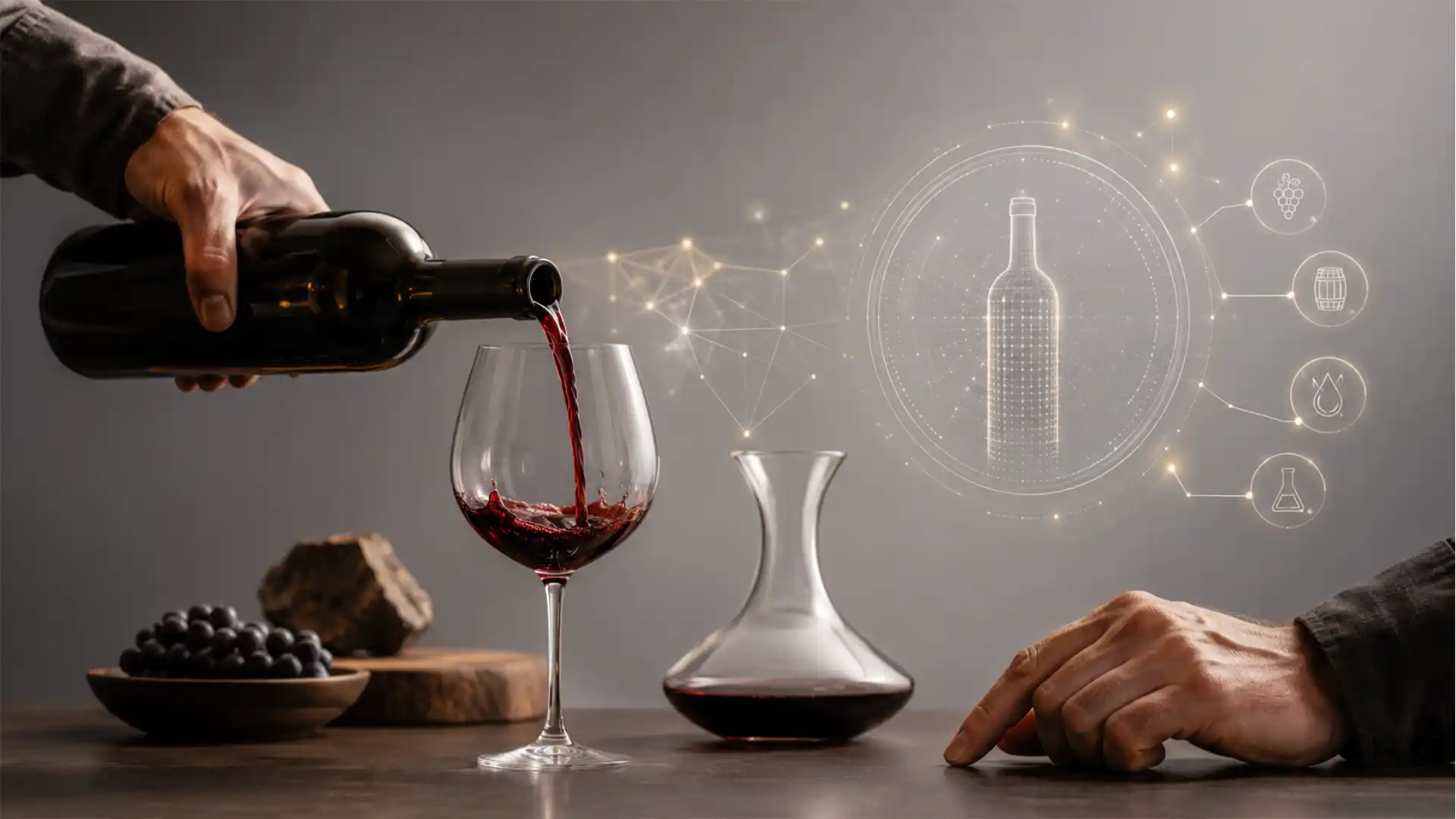
Artificial intelligence will not turn a mediocre vineyard into a great estate, nor will it give a young distillery the patience of a master blender. Its strongest contribution is preventing avoidable mistakes before they become permanent defects. In wine, that means earlier warning of disease pressure, heat stress, uneven ripening, fermentation slowdown, oxygen exposure, volatile acidity risk or packaging inconsistency. In spirits, it means tighter control of fermentation, distillation cuts, barrel management, blending consistency, laboratory screening and traceability.
Table of Contents
Better quality begins with fewer preventable flaws
That distinction matters because “better” is not a single measurable property. A wine may be technically clean yet boring. A whisky may match a brand specification yet lack the character that makes consumers return to it. AI is much better at detecting patterns than deciding whether a drink has soul. The practical value comes from giving growers, winemakers, distillers and sensory teams earlier evidence, more repeatable measurements and a clearer record of what happened at each stage.
Wine and spirits also face a harsher operating environment than they did a decade ago. Climate volatility, uneven harvests, water constraints, labour shortages, energy costs and changing consumer demand have increased the cost of poor decisions. The International Organisation of Vine and Wine reported another historically low global wine-production period in 2025, with climate events affecting vineyards across both hemispheres. When raw material becomes less predictable, decision quality becomes more valuable.
AI is already useful where the question is narrow and measurable: Which block is ripening faster? Which fermentation is drifting from its expected path? Which barrels deserve sensory review first? Which bottle appears chemically inconsistent with the declared vintage? These are not futuristic questions. They are operating questions, and they fit machine-learning systems because they combine repeatable data with decisions that have measurable outcomes.
The danger begins when producers ask software to replace judgement rather than strengthen it. A model trained on yesterday’s conditions may be least reliable during the unusual season that matters most. A vineyard system trained on ordinary summers may struggle during smoke exposure, drought, spring frost or extreme rainfall. A blending model trained on previous customer data may reinforce familiar flavour profiles while overlooking a new style that deserves to exist.
The realistic answer to whether AI will produce better wine or spirits is therefore conditional. It will improve quality when it sharpens observation, speeds up testing, reduces preventable variation and keeps human experts responsible for final choices. It will damage quality when producers mistake statistical similarity for excellence, automate decisions they do not understand or use weak data to create false confidence.
The vineyard is AI’s first serious proving ground
The path to better wine begins in the vineyard because the cellar cannot fully repair poor fruit. Winemaking can manage extraction, fermentation, oxygen, acid balance and microbial risk. It cannot recreate aroma precursors lost to heat, restore a vine’s water status after prolonged stress or turn diseased fruit into healthy fruit. AI has its clearest early role in helping growers see variation before it becomes visible from the tractor seat.
Modern vineyards generate data from weather stations, soil probes, satellite imagery, drones, yield monitors, field notes, laboratory analysis and sometimes hand-held sensors. None of these tools is new on its own. What changes with machine learning is the ability to combine signals that humans would struggle to compare at scale. A vineyard manager may recognise that one block looks weaker. A model can compare that block’s canopy temperature, historical vigour, rainfall, slope, soil conductivity, irrigation history and disease records against several years of observations.
Research on smart viticulture has shown that digital sensing, imaging and machine-learning approaches are increasingly being used to assess vine condition, crop variability and harvest timing without relying only on destructive sampling. The goal is not to replace field walking; it is to direct field walking toward the places where it matters most.
The best applications are highly local. A vineyard is not a uniform agricultural unit. Within a single parcel, differences in soil depth, drainage, rootstock, canopy density, exposure and vine age can produce very different fruit. When a model identifies a zone with unusually high stress or delayed development, the viticulturist still needs to ask why. The cause may be blocked irrigation, compacted soil, virus pressure, a broken trellis line, root competition or an inaccurate sensor.
A useful vineyard model should produce a question, not merely a coloured map. If a grower receives a red zone on a dashboard without a clear probability, confidence range or explanation of the variables involved, the system is not yet supporting a sound decision. Good precision-viticulture systems show uncertainty, record ground-truth observations and allow the grower to correct the model.
AI becomes more valuable when it accumulates estate-specific knowledge. A global software platform may offer useful benchmarks, but a vineyard’s historical records contain the clues that define its local behaviour. Which slopes ripen first after a dry spring? Which blocks develop botrytis after late-August rain? Which rows consistently produce lower pH? Which parcels preserve acidity under heat? The estate’s own records are usually more useful than generic predictions once enough clean data exists.
This is also where smaller producers face a practical challenge. Large estates may own weather stations, drones, laboratory equipment and dedicated technical staff. Smaller growers often work from memory, notebooks and experience. Yet AI does not require an expensive control room to be useful. A structured digital record of phenology, disease events, irrigation, harvest dates and fruit chemistry can become a better foundation than a costly platform fed with unreliable information.
Weather intelligence changes the economics of harvest decisions
Weather prediction is one of the oldest forms of agricultural intelligence, but vineyard decisions require more than knowing whether rain is likely tomorrow. Growers need to understand the likely interaction between temperature, humidity, leaf wetness, wind, soil moisture, canopy condition and fruit development. AI earns its place when it translates weather data into a decision that has a clear operational consequence.
A forecast of rain matters differently at flowering, veraison, harvest or during a botrytis-prone period. At flowering, growers may be concerned about fruit set. Near harvest, they may be weighing sugar accumulation against acid decline, dilution risk, disease pressure and labour availability. A machine-learning system may estimate likely ripening trajectories based on historical weather patterns, but the output should never be treated as a harvest order. It should be treated as an additional scenario.
Climate variability has made this harder. The OIV has linked recent low global production to climatic disruptions, with frost, drought, heat and irregular rainfall affecting major producing regions. The central value of AI is not perfect forecasting; it is better preparation for several plausible outcomes.
For a winery, a few days can change the logistics of an entire harvest. Tank availability, transport, crusher capacity, sorting teams, yeast preparation and press schedules depend on timing. If several blocks suddenly reach target maturity together, the winery may face a bottleneck. AI models that combine crop estimates, maturity sampling and weather forecasts can help managers plan labour and cellar capacity before the rush begins.
The limitation is obvious but important: weather data may be spatially coarse. A public forecast station several kilometres away may not capture a frost pocket, sea breeze, slope inversion or rainfall event that affects one vineyard but not another. Models cannot compensate for missing local observations. A smart system built on poor weather coverage is still a poor system, only with more confident graphics.
There is also a temptation to chase a mathematically ideal harvest date. Wine quality does not emerge from sugar and acid numbers alone. Aromatic development, tannin ripeness, seed maturity, skin condition, vine balance, intended style and cellar capacity all matter. A cool-climate producer making sparkling wine may value acidity and lower potential alcohol. A producer making structured red wine may accept later harvest risk to gain tannin maturity. AI can show trade-offs; it cannot determine the producer’s ambition.
The best harvest models make trade-offs visible rather than pretending they do not exist. They should provide ranges, not a false single date. They should distinguish between evidence and recommendation. They should retain the grower’s ability to reject the prediction when direct observation contradicts the screen.
Seeing vine stress before the fruit shows it
One of the most promising uses of AI in viticulture is early identification of stress. Vines under water stress, heat stress, nutrient imbalance or disease pressure often show changes in canopy temperature, spectral reflectance, growth rate or leaf colour before those changes are obvious to the human eye. Earlier detection matters because the least expensive intervention usually occurs before visible damage appears.
Thermal cameras can identify zones where canopies are warmer than expected, which may indicate reduced transpiration and water stress. Multispectral imagery can highlight differences in vigour. Satellite data can provide repeated broad coverage, while drones offer more detail when conditions justify the cost. Machine-learning models combine these signals with weather records, soil data and field observations to classify areas that need inspection.
The technology is useful because human scouting is selective. A vineyard manager may walk representative rows, but cannot examine every plant with equal attention across dozens or hundreds of hectares. AI changes the task from searching everywhere to verifying the highest-risk areas first. That saves time, but it also improves the quality of field judgement because experts spend more time investigating anomalies rather than performing repetitive scans.
There are important technical limits. Spectral and thermal signals are not direct diagnoses. A warm canopy may indicate water stress, but it may also reflect sparse foliage, disease, root damage, poor soil structure or temporary atmospheric conditions. A model may identify a pattern associated with nutrient deficiency, yet leaf analysis could reveal a different issue. Remote sensing identifies symptoms and probabilities, not biological certainty.
This is why ground truth remains essential. Growers need regular leaf, soil, berry and visual assessments to validate machine predictions. A system that is never checked can drift into error. Images may be captured under different light conditions. Sensors may lose calibration. Vines may be pruned differently from one year to another. New cover crops or irrigation changes may alter the relationship between a signal and an outcome.
The commercial value is strongest when stress detection links directly to action. A model that identifies a dry zone is useful only if the grower can adjust irrigation, investigate equipment, alter canopy management or plan separate harvest. If no action is possible, the result may still improve future planning, but it should not be sold as a quality intervention.
Better wine comes from acting on useful information, not from collecting more information than the vineyard can absorb. Producers should begin with one or two decisions where earlier evidence has a clear financial or quality consequence. That may be irrigation prioritisation, disease scouting or harvest zoning. The system becomes credible when it repeatedly improves those decisions under real operating conditions.
Yield estimates protect both quality and cash flow
Yield prediction may sound like an administrative exercise, but it is closely tied to quality. A winery that accurately estimates crop volume can plan tank space, labour, logistics, packaging, sales commitments and financing. A winery that guesses badly may rush harvest, overfill equipment, compromise sorting or make unwanted blending decisions under pressure. AI-based crop estimates are valuable because operational disorder often becomes a quality problem.
Traditionally, crop estimates rely on sample counts, cluster weights, historical averages and expert adjustments. Those methods can be effective, especially in small vineyards where experienced growers know their blocks intimately. Computer vision adds another layer by using images from tractors, smartphones or drones to count clusters, estimate berry size or assess canopy development. Models can then connect image data with prior yield records, variety, pruning levels, weather and vineyard structure.
The scientific literature on AI-powered grape-cluster detection has grown rapidly, particularly around object recognition and image analysis for estimating yield. Yet the result should be read carefully. Detecting visible clusters is not the same as predicting final tonnage. Clusters may be hidden behind leaves, affected by later weather, dropped during thinning or lost to disease. Berry size can change sharply before harvest.
A good crop-estimation model therefore uses images as one input, not as the whole answer. It should be updated through the season as fruit set, berry growth, disease events and thinning decisions become clearer. It should also show where the estimate is uncertain. A block with wide canopy variation should have a wider prediction interval than a uniform block with years of consistent records.
This matters commercially because AI can expose the difference between a confident number and a reliable number. A model that says “10 tonnes” without uncertainty may be less useful than one that says “9 to 11 tonnes, with highest risk in the lower slope.” The second answer gives the production team information they can plan around.
Yield prediction also influences crop balance. Overcropped vines may struggle to ripen fruit evenly, while low-yield blocks may produce concentrated fruit but insufficient volume for a planned product. AI can flag blocks where vine vigour and estimated crop load appear mismatched, allowing the grower to inspect whether leaf area, water availability or cluster thinning needs attention.
The risk is that producers begin to treat yield optimisation as the sole goal. Wine regions with strict yield rules, protected designations or quality classifications already recognise that more fruit is not automatically better. AI should improve crop understanding, not turn vineyards into factories chasing maximum tonnage. The most useful models are those that help growers preserve their intended style while reducing unwelcome surprises.
Disease warnings become more precise when they stay local
Fungal disease is one of the clearest examples of a problem where AI can improve timing. Downy mildew, powdery mildew, botrytis and other vineyard threats are strongly influenced by local weather, canopy conditions, plant growth stage and prior disease history. Traditional decision support often uses weather thresholds and field scouting. AI adds pattern recognition, but it does not remove the need for trained observation.
The practical aim is earlier, better-targeted intervention rather than blanket prediction. A model may identify conditions associated with elevated mildew risk in specific blocks, allowing a grower to inspect those blocks first. It may also connect disease risk with leaf wetness, rainfall timing, temperature, vineyard vigour and historical outbreaks. That is useful when labour is limited and the vineyard cannot be scouted evenly every day.
Digital viticulture research repeatedly points to the value of non-invasive sensing and decision support for managing variability and improving resource efficiency. But it also warns indirectly against overconfidence: field data is noisy, biological systems change and models need repeated validation.
An AI disease system should not simply generate “spray” or “do not spray” recommendations. That is too crude. It should identify risk drivers, confidence level, affected locations and the time window in which inspection is most useful. The producer needs to understand the reason for the alert, because treatment decisions have agronomic, environmental, legal and economic consequences.
This is especially important for producers using integrated pest management, organic viticulture or reduced-input strategies. A false negative may lead to crop loss. A false positive may lead to unnecessary treatment, cost and residue concerns. If the model has no record of the vineyard’s actual canopy density, cultivar sensitivity or previous disease pressure, its output may be less reliable than the grower’s own experience.
Computer vision has also been used to detect visible symptoms on leaves and clusters. These systems are promising for scouting and documentation, but they face a familiar limitation: symptoms may look similar across causes, lighting changes affect image quality and models often perform better in experimental conditions than in commercial vineyards. A leaf image may classify a pattern; it does not replace a diagnosis.
The strongest business case is not “AI eliminates disease.” It is “AI reduces the time between emerging risk and informed inspection.” That can mean fewer missed hotspots, more targeted work, better records and stronger post-season analysis. A winery that records exactly where disease occurred, how it responded and what the fruit quality became can build a local knowledge base that improves every year.
Water and nutrition decisions gain discipline from data
Water management has become one of the most politically and economically sensitive areas of wine production. In some regions, irrigation is tightly regulated. In others, drought has made water availability a central risk to vineyard survival. Nutrient decisions carry similar consequences: too little nitrogen can limit vine development and fermentation performance, while too much can encourage excessive vigour, delay maturity or create cellar complications. AI is useful here because water and nutrition decisions benefit from repeated measurement, not because the system knows the vine better than the grower does.
Soil-moisture probes, evapotranspiration data, weather records, plant-based sensing and historical yield information can be combined to estimate where water stress is developing. In theory, that allows growers to prioritise irrigation where it protects fruit quality rather than applying water uniformly. In practice, the accuracy depends on probe placement, soil variability, irrigation infrastructure and the grower’s understanding of the vineyard.
A model may identify a block as dry, but the response should depend on the production objective. Mild water stress can be part of a quality strategy for certain red wines, encouraging smaller berries and more concentrated skins. Severe stress may stop sugar accumulation, damage canopy function and increase sunburn risk. The decision is not whether stress exists; it is whether the stress is within the desired range for that vineyard and style.
AI can improve this judgement by connecting current sensor readings with historical outcomes. If a producer has several years of data showing that a specific block reaches the best phenolic balance at a certain range of water potential or canopy temperature, the system can identify deviations earlier. That is a more realistic use than assuming a universal threshold applies across varieties, soils and climates.
Nutrition decisions follow the same logic. Models can combine leaf analysis, soil data, vigour imagery, yield history and weather patterns to identify blocks that deserve sampling. But nutrition is a biological and soil-management issue, not merely a colour-coded map. The system should guide sampling and prioritisation, not prescribe fertiliser without agronomic review.
The environmental case is substantial. Better-targeted irrigation and nutrient inputs may reduce waste, lower pumping energy and limit unnecessary applications. Yet sustainability claims need evidence. A producer should measure actual water use, fertiliser reductions, yield outcomes and fruit quality rather than declaring success because a dashboard was installed.
The best vineyard AI systems make management more disciplined. They replace vague impressions with documented observations, preserve lessons from previous seasons and show where a decision was based on evidence rather than habit. That may not sound glamorous, but in agriculture, better records often become better wine long before better algorithms do.
Harvest timing remains a judgement, not a calculation
Harvest is the moment when a vineyard’s biological uncertainty becomes a production commitment. Once fruit is picked, the producer cannot return to the vine and wait for another day of flavour development, acidity retention or weather stability. AI can estimate maturity trends, identify uneven zones and model weather risk. It cannot decide what the producer means by ripe.
The traditional harvest markers remain important: sugar concentration, pH, titratable acidity, berry weight, seed colour, skin texture, aroma development and taste. Different wine styles require different balances. A sparkling-wine producer may pick at acidity levels that would seem unripe for a still Chardonnay. A producer of late-harvest sweet wine may accept botrytis risk as part of the style. A serious harvest model must begin with the intended product, not a generic optimum.
Machine learning can combine repeated berry sampling with historical weather and vineyard data to estimate where maturity is moving fastest. It may identify blocks that are likely to reach target conditions earlier than expected or zones where heat has accelerated sugar accumulation relative to flavour development. That is useful because sugar can move quickly while phenolic and aromatic maturity follow a different timetable.
Studies connecting weather conditions, vineyard data and wine quality show that machine learning may reveal relationships that are difficult to detect through simple averages. But those results are not universal laws. They depend on local datasets, particular varieties, particular wine styles and the quality measures chosen by researchers.
This is where producers should be cautious about score-based systems. A model trained on critic ratings or commercial wine scores may learn market preferences, but it may also reproduce existing biases. It may favour styles already rewarded by a narrow group of tasters. It may penalise unconventional wines before they have a chance to find an audience. A harvest decision should protect a producer’s identity, not merely pursue historical scoring patterns.
AI can be particularly useful when harvest is fragmented. A single estate may decide to pick different zones separately, process them in small lots and blend later. That preserves optionality. Rather than asking software to declare one harvest date for an entire vineyard, the producer can ask it to identify where separate picking is justified.
The strongest decision rule is simple: use AI to sharpen the discussion around harvest, then taste the fruit. No model should overrule direct sensory assessment of berries, skins, seeds and vine condition. The algorithm sees correlations. The grower and winemaker must decide whether those correlations fit the wine they intend to make.
Sorting fruit is a practical route to cleaner wines
Fruit sorting has always been one of the most direct ways to improve wine quality. Removing diseased, sunburned, underripe or damaged berries reduces the burden placed on the cellar. Optical sorters already use cameras, colour recognition and mechanical systems to separate material at speed. AI extends this process by improving image classification, identifying more subtle defects and learning from batches that later produced different wine outcomes.
The immediate benefit is not artistic; it is reduction of unwanted material entering fermentation. That can lower the risk of mould-related taints, excessive bitterness, poor colour extraction, microbial instability or off-aromas. It can also make the work of the winemaker more predictable, especially in difficult vintages where fruit quality varies sharply.
The limitation is that “good berry” is not an objective category. A berry that looks darker may be desirable for one style and undesirable for another. A shrivelled berry may be a defect in a fresh, aromatic white wine but a valuable component in certain rich red or sweet wines. A sorting algorithm must be trained around a specific production objective, not a universal visual ideal.
Sorting systems are strongest at tasks with clear visual boundaries: leaves, stems, visibly rotten fruit, foreign material, damaged berries or colour extremes. They are weaker when the quality distinction depends on hidden chemistry, flavour precursor concentration or future fermentation performance. A perfect-looking berry may still have undesirable chemistry. A visually uneven berry may contribute complexity.
This is where AI should be connected to downstream results. A winery that records the composition, fermentation behaviour and sensory outcomes of sorted fractions can learn whether the visual classification actually produced a better wine. That creates a feedback loop. Without feedback from the cellar and tasting room, sorting intelligence remains an assumption.
For premium producers, AI sorting may allow finer lot separation. Fruit from one zone can be kept apart from another, with sorting thresholds adapted to each parcel. That can preserve distinctive components instead of forcing every grape through the same standard. For large wineries, the benefit may be more consistent base quality and fewer costly surprises.
The business case depends on volume, labour costs and fruit condition. A small winery with careful hand sorting may not gain enough to justify capital expenditure. A large producer dealing with substantial harvest volume or variable fruit may see faster returns. The decision should be made around bottlenecks, not technology fashion.
AI sorting improves quality when it removes obvious risk and preserves useful variation. It becomes destructive when it standardises the fruit so aggressively that every lot begins to taste the same.
Fermentation is a biological control problem
Fermentation is where raw agricultural material becomes wine. It is also where small deviations can become costly. Temperature, sugar concentration, nitrogen availability, pH, oxygen exposure, yeast health, microbial competition, extraction, cap management and vessel conditions interact continuously. AI is well suited to fermentation because the process produces time-series data and the cost of late intervention can be high.
Traditional cellar management already depends on frequent measurement. Winemakers monitor density, temperature, sugar depletion, acidity, volatile acidity, dissolved oxygen, turbidity and sensory development. The challenge is that data arrives at different intervals, from different instruments and often in different formats. A machine-learning model can combine those readings and identify fermentation behaviour that differs from expected trajectories.
That does not mean the model needs to control the fermentation automatically. Its most useful role may be as an early-warning system: this tank is cooling more slowly than comparable tanks; this yeast strain is consuming sugar at an unusual rate; this must shows an elevated risk of nutrient limitation; this red fermentation appears to be extracting more aggressively than expected. The winemaker still decides whether to cool, warm, aerate, feed nutrients, rack, punch down or wait.
Where AI has the strongest evidence in wine production
| Production stage | Useful data signals | Best AI-supported decision |
|---|---|---|
| Vineyard monitoring | Weather, imagery, soil moisture, field observations | Prioritise scouting, irrigation and disease checks |
| Harvest planning | Berry chemistry, crop estimates, weather scenarios | Sequence picking and allocate cellar capacity |
| Fermentation | Temperature, density, CO₂, pH, sugar, sensor trends | Flag stalls, deviations and risk of intervention delay |
| Quality control | Spectroscopy, chromatography, sensory records | Screen batches for inconsistency or further review |
| Blending and maturation | Barrel data, analytical profiles, tasting records | Identify candidate combinations for expert evaluation |
Research reviews of oenological monitoring note that sensors are being developed for fermentation, maceration and ageing, while newer work examines online sensing for commercial winemaking. The research supports faster monitoring, not the claim that software can independently make great wine.
A well-designed system should be trained on the winery’s own operating history. Different vessels, yeast strains, grape varieties, juice solids, nutrient regimes and cellar temperatures produce different normal patterns. A generic model may be useful for basic anomaly detection, but local data gives it practical value. The winery must also record interventions, because a model that sees only outcomes cannot learn which actions produced which effects.
The data architecture matters as much as the algorithm. If temperature is measured continuously but density only once a day, the model must account for that difference. If staff enter notes inconsistently, the system may interpret missing data as a meaningful signal. If a sensor is not calibrated, the model may learn the error. Garbage data does not become cellar intelligence because it passes through an AI platform.
The sensor layer matters more than the chatbot
Much public discussion of AI focuses on generative tools that write tasting notes, marketing copy or technical summaries. Those tools may save administrative time, but they are not the core technology that will influence liquid quality. The important AI in wine and spirits is usually invisible: sensors, laboratory instruments, databases, models and alerts.
A fermentation tank may generate a stream of temperature, pressure, carbon dioxide, density and pH measurements. A barrel warehouse may record temperature, humidity, airflow and evaporation. A vineyard may collect weather and soil data every few minutes. These signals have little value if they are not reliable, time-stamped and linked to the correct lot, vessel or parcel.
The concept sometimes described as a digital twin is useful here. A digital twin is not a magical virtual copy of a winery. It is a model that links a physical process with ongoing data so operators can compare actual performance against expected behaviour. A useful twin helps people see deviation early; it does not eliminate the need to understand the physical process.
For wine, the difficulty is biological complexity. A tank is not a simple chemical reactor. Yeast metabolism changes as sugar declines, temperature shifts and nutrient availability changes. Red-wine fermentation includes solids, cap management and extraction. Barrel ageing involves oxygen ingress, evaporation, wood chemistry and microbial risk. A model that works well for a clean white-wine fermentation may not transfer to a skin-contact wine or a spontaneous fermentation.
Sensor placement also matters. A temperature probe in one part of a tank may not represent the entire vessel. A barrel-room sensor may not reflect conditions at different heights in a warehouse. A model cannot see what the sensor network does not capture. Producers should test whether measurements align with physical reality before using them for automatic decisions.
The cost of instrumentation has fallen, but data integration remains difficult. Many wineries use equipment from different vendors, spreadsheets, laboratory systems and paper records. AI projects often fail not because the model is weak, but because the underlying data is fragmented. Connecting a cellar’s operational history may require more work than buying the software.
The practical lesson is simple. Before purchasing an AI product, producers should audit their data: Which measurements are collected? How often? By whom? In what format? Are they reliable? Are lot identifiers consistent? The best first investment may be cleaner records and calibrated sensors rather than a more sophisticated algorithm.
Yeast selection gains a new layer of evidence
Yeast choice has a strong influence on fermentation speed, aroma formation, alcohol yield, glycerol production, volatile acidity and the risk of stuck fermentation. Winemakers already make yeast decisions from grape chemistry, style goals, historical experience and supplier guidance. AI can add another layer by comparing many previous fermentations and identifying combinations of grape condition, nutrient status, temperature regime and yeast selection that produced desirable outcomes.
The promise is better matching between must conditions and fermentation strategy, not algorithmic replacement of microbial expertise. A model may identify that certain high-pH musts performed more reliably with a particular nutrient programme, or that a specific yeast strain produced unwanted aroma outcomes at higher fermentation temperatures. Such insights are valuable when they are derived from sufficiently large, well-documented internal datasets.
The danger is overinterpreting correlation. A yeast strain may appear associated with a preferred aroma profile because it was used in the best vineyard blocks, not because it caused the result. A model may conclude that a nutrient addition produces higher quality when, in reality, that addition was used only in difficult fermentations. Causation requires experimental design, not merely historical records.
This is why controlled trials remain necessary. A winery can use AI to identify hypotheses, then test them through replicated lots. For example, if the system suggests that a certain yeast performs better in fruit with lower nitrogen availability, the technical team can run side-by-side fermentations in the next harvest. The resulting evidence is stronger than any retrospective pattern alone.
Microbial data is becoming more accessible through sequencing and metabolomics, but interpretation remains complex. Spontaneous fermentations may involve shifting populations of yeasts and bacteria, while commercial cultures introduce more controlled conditions. AI may eventually improve prediction of microbial behaviour, but the biology is too context-dependent for universal recipes.
There is also a philosophical issue. Many producers value indigenous fermentation precisely because it introduces variation and expresses local conditions. AI does not need to eliminate that variation. It can document it, compare it and identify risks. A producer may use machine learning to detect an unusual fermentation trajectory while still choosing not to intervene because the aroma development is promising.
The most responsible use of AI in fermentation is therefore conservative. It should improve early detection, support trial design and preserve technical memory. It should not push every winery toward the same yeast, temperature profile or aromatic outcome simply because those patterns are easiest to model.
Colour, tannin and texture become easier to measure
Wine quality is often discussed through flavour and aroma, but texture matters just as much. Tannin structure, colour stability, astringency, body and mouthfeel influence whether a red wine feels harsh, elegant, thin, firm or complete. These characteristics are difficult to predict because they depend on grape composition, skin contact, seed extraction, temperature, alcohol, pH, oxygen management and ageing.
AI is increasingly being used to relate analytical data to sensory outcomes. Spectroscopy, chromatography and laboratory measurements can produce chemical fingerprints that models compare with human sensory assessments. Research has explored machine-learning approaches for predicting wine sensory properties from mid-infrared data and for modelling aspects of red-wine mouthfeel from chemical measurements. The important word is “predicting,” not “replacing.”
A model may identify chemical patterns associated with astringency, colour intensity or aroma descriptors. That can make laboratory screening faster and help winemakers decide which lots deserve further attention. It may also help with blending decisions, particularly in large wineries handling many component lots.
Yet taste is not a laboratory output. Two wines with similar tannin measurements may feel different because of acidity, alcohol, polysaccharides, volatile aroma compounds, temperature, serving context and individual perception. A model may capture a useful average relationship, but human tasting remains necessary because the consumer experiences the complete wine, not an isolated chemical variable.
The best use of sensory prediction is triage. A winery can use AI to rank lots by likelihood of a particular sensory issue, then send the most relevant samples to trained tasters. This reduces panel fatigue and makes laboratory work more focused. It does not remove the need for descriptive analysis, triangle tests, blending trials or sensory calibration.
There is also a commercial benefit. Producers can preserve institutional knowledge when experienced tasters retire or move on. If analytical and sensory records are stored together over many years, the winery gains a clearer history of how different vineyard conditions and cellar decisions affected texture. That is more valuable than asking a model to imitate a critic’s score.
The strongest models are transparent enough to be challenged. A winemaker should be able to ask which variables influenced a prediction and whether the model has seen similar wines before. If the system cannot explain its confidence, it should not control major extraction or blending decisions.
Aroma models make screening faster, not taste obsolete
Aroma is where AI receives the most dramatic publicity because it appears to approach a traditionally human domain: smelling and describing a drink. Electronic noses, gas chromatography, mass spectrometry and machine-learning models can identify complex patterns among volatile compounds. They may classify products, detect deviations and estimate likely sensory descriptors. They do not smell in the human sense, but they can recognise chemical patterns with remarkable consistency.
Research on whisky aroma prediction combined molecular analysis, sensory data from experienced panelists and machine-learning methods to predict key odour attributes. The study showed promising results, but it also involved a limited set of samples. That limitation matters because aroma models often perform best within the range of products they have already encountered.
For wine, the same principle applies. A model trained on a defined set of Shiraz vintages may classify vintage or predict aroma intensity with strong accuracy. It may perform poorly when exposed to a new region, unusual fermentation method, smoke-affected fruit or a wine style outside its training set. High accuracy inside a narrow dataset should not be mistaken for universal sensory understanding.
Electronic noses are particularly useful for repeated screening. A winery may use them to compare batches, identify unusual headspace profiles, monitor oxidative change or flag potential spoilage. The instrument is consistent and does not become tired after tasting fifty samples. But its output requires interpretation. It may detect a shift without explaining whether that shift is desirable, neutral or harmful.
Human panels remain essential because flavour perception is social, cultural and contextual. A trained panel can identify whether a smoky note is elegant, intrusive or expected. A machine can recognise volatile patterns associated with smoke. The difference is not trivial. Quality is partly a relationship between chemistry and expectation.
The best future workflow is hybrid. Instruments and models perform high-throughput screening, flag anomalies and organise samples. Human experts review the highest-risk or most interesting samples. The sensory panel then feeds conclusions back into the dataset. This produces a system that becomes more useful without pretending that a machine is the final judge of pleasure.
Producers should resist marketing claims that AI “tastes” wine or spirits better than people. The credible claim is narrower: AI may identify patterns more consistently in certain defined tasks. That can improve quality-control efficiency. It does not make the tasting room redundant.
Human sensory panels remain the standard for final judgement
Sensory panels are imperfect. Tasters become fatigued. Their thresholds vary. Language differs across cultures and training backgrounds. Mood, expectation, glassware and serving temperature influence perception. Yet trained panels remain indispensable because they evaluate the drink as a complete human experience. AI may reduce panel workload, but it cannot establish quality without human calibration.
A serious tasting panel needs controlled conditions, agreed vocabulary, blind samples, repeated reference standards and regular calibration. These practices are not glamorous, but they make sensory data more reliable. AI benefits from this discipline because a model trained on inconsistent ratings will produce inconsistent recommendations.
The best use of AI is to support panel management. It can identify where assessors disagree unusually, spot panel drift, detect samples that need retasting and compare sensory notes against chemistry. It may also help organise a large archive of tasting records, allowing a winery to identify recurring descriptors associated with vineyard blocks, barrel types or fermentation regimes.
The danger is turning subjective data into fake objectivity. A tasting score is still a judgement. Machine learning can find patterns in those judgements, but it cannot make them universal truths. A model trained on one panel’s preference for oak, sweetness or extraction may reproduce that preference indefinitely.
There is another risk: sensory panels may be small. A winery may have only three or four regular tasters, which is insufficient for training a broad model without careful design. Small datasets can produce convincing-looking outputs that fail outside the original samples. Producers should not assume that every collection of tasting notes is large enough for predictive modelling.
The most valuable datasets combine descriptive sensory analysis with operational context. A note saying “firm tannin and dark fruit” is more useful when linked to vineyard block, harvest date, berry chemistry, yeast, fermentation temperature, maceration length, barrel treatment and final consumer response. Context turns tasting notes into usable technical knowledge.
AI also offers an opportunity to preserve human expertise. Senior winemakers often hold decades of memory about vintages, blocks and cellar decisions. Recording their observations in a structured way creates an archive that survives personnel changes. But that archive should remain open to challenge. New winemakers should be able to disagree with historic patterns rather than becoming servants of old preferences.
The future is not machine versus panel. It is a better division of labour: machines measure and compare quickly; people interpret, taste, decide and take responsibility.
Distillation rewards precision but punishes simplification
Distillation looks more mechanical than winemaking, which makes it attractive for AI applications. Heat input, vapour flow, reflux, alcohol concentration, condenser performance and cut timing can all be measured. Yet distillation is not merely a process of separating alcohol from water. Small changes in fermentation quality, still shape, heating rate and cut decisions can alter the final spirit’s identity.
In whisky, rum, brandy, gin and other spirits, the distiller manages a balance between desirable flavour compounds and unwanted elements. The heads, hearts and tails are not cleanly divided by a single number. Experienced distillers use alcohol strength, temperature, flow, aroma and taste to decide where cuts should occur. AI may assist by learning from prior runs, but it needs rich data and must be supervised closely.
A recent study examining the rate of spirit distillation in single malt whisky highlighted that changes in distillate flow rate can affect floral aroma characteristics. That is a useful reminder that process variables shape flavour in ways that may not be obvious from alcohol strength alone. AI has value when it helps operators understand these relationships, not when it reduces a complex cut to a fixed formula.
Distilleries can use machine learning to detect abnormal runs, compare current performance against historical batches and identify combinations of conditions associated with preferred new-make spirit profiles. This may be particularly useful for large production sites where consistency is essential. It may also help smaller distilleries document knowledge that previously existed only in the head distiller’s memory.
The risk is over-standardisation. Some of the most distinctive spirits derive character from deliberate variation: longer fermentations, unusual yeast behaviour, slower distillation, different cut styles, seasonal warehouse changes or distinctive raw materials. A model trained only to minimise variation may erase the variation that consumers value.
Distillation AI should therefore be configured around house style, not generic efficiency. A peated whisky producer, a fruit-brandy maker and a neutral-spirit producer do not have the same quality objective. The model must understand the process target before it can identify deviation.
The best operational use is often anomaly detection. Rather than commanding a cut point, the model can say: this run differs materially from similar runs; review vapour temperature, reflux, fermentation chemistry and condenser behaviour. That keeps the expert in control while making unusual process behaviour easier to spot.
Cut points are a decision-support task, not an automatic switch
The first and final cuts of distillation are among the most consequential choices in spirit production. They determine which compounds move into the final spirit and which remain outside the intended profile. Heads may contain sharp, solvent-like or undesirable volatile compounds. Tails may bring heavier, oily, vegetal or complex notes depending on the spirit and style. The correct cut is not a universal point; it is a sensory and commercial decision shaped by house style.
Machine learning can assist by analysing past distillation data, chemical measurements and sensory results. If a distillery has recorded alcohol strength, temperature curves, flow rates, reflux conditions, fermentation composition and sensory quality over hundreds of runs, it may identify patterns associated with preferred cuts. That information can help train newer staff and improve consistency.
However, an automated cut system faces a serious problem: the raw material changes. Grain quality, fruit condition, fermentation duration, yeast metabolism and seasonal temperature can alter the chemical composition of the wash or wine entering the still. A cut rule that worked perfectly last month may be wrong today because the input liquid is different.
This makes adaptive systems more promising than fixed systems. An AI model can estimate whether a current run resembles historical runs, flag when it does not and recommend closer sensory review. It should not assume that every run belongs to a known category. When confidence is low, the correct response is more human attention, not stronger automation.
Distillers also need to separate compliance from style. Certain safety and legal requirements are non-negotiable. Methanol levels, for example, must be controlled and verified through appropriate analytical methods. AI-assisted screening may offer faster early warning, but it does not remove the need for validated laboratory confirmation and regulatory compliance. A 2026 Scientific Reports study on rapid methanol screening in distilled spirits explicitly framed machine learning as a screening and prioritisation tool before confirmatory testing.
Safety-critical decisions require validation, traceability and a clear escalation path. A system should record what it measured, what it predicted, what action followed and who approved that action. That protects both product quality and the distillery’s ability to explain its process to regulators, auditors and customers.
The most sensible future is semi-automated. AI monitors process signals continuously, predicts when the run may be shifting, recommends review points and preserves a detailed record. The distiller retains authority over the final cut. That preserves craft while reducing the chance that fatigue, distraction or inconsistent documentation causes an avoidable quality loss.
Barrel ageing is where prediction meets patience
Barrel ageing is among the hardest stages to model because time, wood, oxygen, temperature, humidity, warehouse position and evaporation interact over years. A barrel is not a sealed container. It is a changing environment. The spirit extracts compounds from wood, loses liquid through evaporation, reacts with oxygen and develops through slow chemical change. AI can improve barrel management, but it cannot compress maturity into a dashboard.
Distilleries already track cask type, fill date, warehouse location, spirit strength and inventory. More advanced sites add sensors for temperature, humidity and airflow. AI can combine these records to identify warehouse zones that produce particular maturation patterns, estimate evaporation risk or help select barrels for blending trials.
The commercial appeal is obvious. Mature spirit represents tied-up capital. A distillery wants to know which barrels are developing as intended, which may need earlier review and which may be at risk of excessive loss. Yet prediction must not become a promise. A barrel’s future remains uncertain because wood variability and seasonal conditions are difficult to capture fully.
AI can be especially useful for inventory prioritisation. Instead of tasting every barrel with equal frequency, a distillery can use historical patterns to identify casks most likely to have reached a desired maturity stage or moved away from the house style. Human tasters then verify the prediction. This is a better use than declaring a barrel ready based on a model alone.
The same logic applies to cask management. A system may identify that barrels at a certain warehouse level experience higher evaporation or more rapid extraction. The distillery can investigate whether rotation, storage policy or blending strategy should change. The model should reveal operational patterns, not hide them behind proprietary scores.
There are ethical and commercial issues too. If AI allows a producer to identify and reserve the most promising barrels early, it may improve premium releases but also encourage aggressive financialisation of stock. The technology could make rare casks more valuable and less accessible. This is not a quality defect, but it changes the economics and culture of spirits.
Barrel ageing remains a domain where patience is still a competitive advantage. AI may reduce uncertainty around inventory, but it cannot make a two-year-old spirit chemically or sensorially equivalent to a twelve-year-old one. Time remains an ingredient that no model can manufacture.
Blending becomes more searchable without becoming automatic
Blending is one of the areas where AI appears most naturally useful. A blender may work with hundreds or thousands of component lots, each with analytical data, sensory notes, age information, barrel history and cost implications. Searching through that complexity is difficult. AI can identify promising combinations faster than a person can review every possible permutation.
This does not mean the system can create the perfect blend independently. Blending involves taste, texture, aroma balance, brand identity, inventory constraints, legal definitions, production cost and market positioning. A model may suggest that a particular combination is likely to match a desired profile, but the final blend still needs tasting and technical review.
The most practical systems use AI to narrow options. A blender can specify targets such as fruity aroma, lower smoke intensity, stronger mid-palate texture, limited cost or a particular age statement. The system then searches the available inventory for candidate components. The human expert evaluates the candidates, rejects unsuitable options and teaches the system through feedback.
The Mackmyra AI whisky project became a widely cited example because it used machine learning as part of whisky development rather than as a replacement for the master blender. The project drew from historical recipes, sales data and flavour information, while the distillery presented AI as a complement to craft.
The example is instructive because recipe generation is easier to market than it is to evaluate. An AI-generated whisky may be novel, but novelty does not prove it is better. The meaningful question is whether the system produced a blend that consumers enjoyed, that fit the brand and that justified the production choices behind it.
For wine, blending models can support decisions around colour, acidity, tannin, aroma and volume. They may help a winery understand which components are scarce, which lots are flexible and where a blend is at risk of becoming unbalanced. But a wine may be analytically correct and still feel dull. Blending remains a sensory act because harmony is not fully reducible to chemistry.
The strongest use of AI is therefore inventory intelligence. It can preserve options, expose trade-offs and reduce the time spent searching. It should not reduce blending to a cost-minimisation exercise. A system focused only on margin may suggest blends that are cheaper but less distinctive, damaging the brand over time.
Safety screening is one of AI’s most defensible roles
Food and drink safety is an area where speed, consistency and documentation matter enormously. Wine and spirits producers must manage microbial risk, contaminants, adulteration, packaging issues and process control. AI does not change the legal responsibility of the producer, but it can improve screening and prioritisation. The strongest safety use case is early warning followed by validated confirmation.
Machine learning can analyse spectroscopy, sensor arrays, laboratory results and production records to detect patterns associated with unusual samples. An electronic nose may flag a batch with an atypical volatile profile. A model may identify a possible contamination pattern or packaging deviation. A system can also prioritise samples for laboratory testing when capacity is limited.
The key word is “screening.” In safety-critical situations, models should not become the sole evidence. False positives may create unnecessary disruption, while false negatives can endanger consumers. AI should tell a producer where to look first, not provide legal clearance.
Research on rapid methanol screening in distilled beverages illustrates this principle. Portable sensor systems paired with machine learning may provide useful in-situ indications, but laboratory methods remain necessary for confirmation. This approach is particularly relevant for illicit or poorly controlled alcohol production, where methanol poisoning remains a serious public-health risk.
For established wineries and distilleries, AI can also improve traceability. If a quality issue appears after bottling, a well-structured dataset can connect the bottle to the relevant lot, tank, barrel, packaging line, laboratory results and distribution records. That does not prevent every problem, but it makes response faster and more defensible.
The European Food Safety Authority has increasingly examined AI and data readiness in risk assessment, while stressing governance, data quality, transparency and human oversight. The policy direction is clear: AI may support food-safety work, but evidence and accountability remain human responsibilities.
A producer considering AI for safety should ask practical questions. Has the model been validated with real samples? What are the false-positive and false-negative rates? Does it work across different product matrices? Who reviews alerts? How are results documented? What happens when the system is uncertain?
The answer should never be “the model knows.” In food and drink production, a trustworthy system is one that shows its limits as clearly as its predictions.
Authentication and fraud detection may become much stronger
Wine and spirits are vulnerable to fraud because bottles may carry high value, strong regional identities and complex supply chains. Counterfeit bottles, label substitution, dilution, unauthorised blending and false origin claims can damage consumers and producers alike. AI offers useful tools for detecting anomalies in chemical profiles, packaging images, labels, supply-chain records and sales patterns.
The clearest opportunity is identifying products that deserve closer investigation. A model may compare a bottle’s spectroscopic signature with authenticated reference samples. It may detect label inconsistencies from images. It may identify unusual transaction patterns suggesting diversion or counterfeiting. It may compare an alleged vintage profile against expected chemical characteristics.
For whisky and other spirits, research has shown that machine learning can classify aroma and molecular patterns with useful accuracy in defined sample sets. That could eventually support authenticity screening, though it should not be presented as a universal anti-counterfeit solution.
The challenge is reference data. Authentication models require a reliable library of genuine products, including variation across batches, vintages, warehouses and production years. If the reference library is too narrow, the model may mistakenly treat legitimate variation as fraud or fail to detect sophisticated substitution.
A model is only as trustworthy as the authenticated samples used to train it. Producers, regulators and laboratories may need shared standards for sample collection, storage, metadata and analytical methods. Without that discipline, different systems may produce conflicting results.
There is also a legal issue. A suspicious AI output is not the same as proof. A producer accused of fraud needs access to the evidence, methods and confirmatory analysis behind the allegation. AI systems should therefore support investigation, not replace forensic procedure.
Traceability technologies such as secure serialisation, QR-linked product records and tamper-evident packaging may work well alongside AI. A model can analyse supply-chain data, while physical and digital records improve the reliability of provenance claims. Yet even this approach has limits: a perfect digital history is meaningless if fraudulent information enters the system at the source.
The long-term gain may be consumer trust. Buyers of premium wine and spirits increasingly want confidence that the bottle matches the story on the label. AI will be most useful when it makes authenticity easier to verify without turning every purchase into a surveillance exercise.
Sustainability claims need measured results, not software branding
AI is often marketed as an environmental solution. It may reduce irrigation, energy use, chemical applications, transport waste or spoilage. It may improve harvest planning and reduce unnecessary inputs. These are real possibilities, but a sustainability claim is credible only when the producer measures the outcome.
In vineyards, targeted monitoring may reduce unnecessary spraying, irrigation or fertiliser use. In wineries, fermentation monitoring may reduce product loss and energy waste. In distilleries, sensor-driven control may improve heat management, detect abnormal energy use and reduce rework. In warehouses, better inventory data may reduce avoidable barrel loss.
The OIV’s sustainable vitiviniculture guidance frames sustainability as environmental, social and economic rather than a narrow carbon calculation. That is useful because AI projects can create trade-offs. A drone programme may improve vineyard monitoring but require equipment, batteries, data infrastructure and skilled labour. A cloud-based model may reduce field travel but consume digital resources. The question is not whether AI is sustainable in theory, but whether it improves the actual environmental performance of a specific operation.
Producers should establish baselines before implementation. How much water was used per hectare? How many fungicide applications were made? How many litres of wine were lost to quality issues? How much energy was consumed per litre of spirit? How much product was rejected or reworked? Without baseline data, later claims become marketing language rather than evidence.
AI may also support climate adaptation. It can help identify frost-prone zones, water-stress patterns, heat-risk blocks and changes in ripening behaviour. That information may influence replanting, rootstock selection, canopy strategy or harvest planning. But AI does not remove the structural climate risks facing vineyards. It helps producers understand and respond to them.
Sustainability also includes labour. A system that reduces repetitive manual checks may improve working conditions. A system that replaces skilled seasonal workers without creating meaningful new roles may have a different social effect. Producers should evaluate this honestly rather than treating all automation as progress.
The best sustainability applications are modest and measurable. A vineyard uses fewer unnecessary passes. A winery catches a spoilage risk before losing a tank. A distillery reduces wasted energy during abnormal runs. These improvements are more credible than grand claims about “AI-powered sustainable wine.”
Small producers should start with data discipline, not expensive platforms
The AI conversation often appears designed for large companies with large datasets. Small wineries and distilleries may assume the technology is beyond their reach. That is partly true: advanced custom models require data, technical skill and investment. Yet small producers can gain meaningful benefits from better digital records long before they buy sophisticated AI tools.
A small winery may not need drones, automated barrels or proprietary predictive systems. It may benefit more from consistent records of vineyard observations, harvest chemistry, fermentation temperatures, laboratory results, barrel movements, blending trials and customer feedback. Once records are structured, the producer can identify patterns through simple analysis before introducing machine learning.
This matters because many small producers already possess the rarest form of data: long-term local knowledge. They know which blocks struggle after wet springs, which yeast strains behave poorly in certain conditions, which barrels produce more rapid evolution and which customers respond to particular styles. The task is to preserve that knowledge in a form that survives memory, staff turnover and changing ownership.
Cloud software and shared services may lower barriers, but small producers should remain cautious. A cheap platform can become expensive if it creates dependence on vendor-controlled data, requires constant manual input or produces generic recommendations. The producer should ask whether they can export their data, whether the system works offline when needed and whether they retain ownership of historical records.
The first AI project should solve a narrow pain point. It might be fermentation alerting, inventory traceability, disease-risk prioritisation or automatic organisation of laboratory results. A project that attempts to digitise the whole business at once is likely to overwhelm staff. The best first project is boring enough to be useful.
Small producers should also avoid building models from too little data. A few years of tasting notes or a handful of fermentations are often insufficient for reliable prediction. Simple rules, dashboards and well-kept records may outperform machine learning until the dataset becomes larger and more consistent.
Collaboration may offer another route. Regional associations, research institutions, cooperatives and equipment suppliers can create shared datasets or services, though governance matters. Producers need to know how their data will be used and whether commercially sensitive information could be exposed.
The core lesson is practical: small producers do not need to become technology companies. They need systems that protect their time, memory and product quality.
Weak data creates expensive confidence
AI systems can be persuasive because they produce scores, graphs and predictions. The interface may look sophisticated even when the underlying data is incomplete, biased or poorly matched to the decision. In wine and spirits, this risk is serious because production conditions vary across seasons, regions and product styles. The most dangerous model is not the one that admits uncertainty; it is the one that hides it.
Historical data may contain hidden bias. A winery may have consistently harvested one block later because it was easier to access, not because it produced better fruit. A distillery may have used a particular cask type only for premium releases, making the model associate that cask with quality even though other factors caused the result. A marketing dataset may confuse high sales with high sensory quality.
Data quality also depends on definitions. If one cellar worker records “stuck fermentation” at 5 grams per litre of residual sugar and another uses the term only when fermentation has fully stopped, the system learns inconsistent labels. If barrel locations are recorded manually and sometimes entered incorrectly, warehouse models may identify false patterns. Consistency of language and lot identification is an engineering problem, not an administrative detail.
Models can also fail during unusual conditions. A system trained on ten ordinary vintages may not know what to do with severe smoke exposure, unusual disease pressure or extreme heat. A whisky model trained on standard warehouse conditions may struggle after changes to cask supply, building ventilation or climate. This is known as distribution shift: the real-world data changes from the data used to train the model.
The appropriate response is not to abandon AI. It is to build safeguards. Producers should track model performance by season, product type and site. They should review errors. They should retain human override. They should retrain models when operating conditions change. A model is a living technical asset, not a one-time purchase.
Explainability matters too. A grower should be able to ask why a model believes a block is at risk. A cellar manager should know why a tank has been flagged. If the answer is only “the algorithm detected it,” the system will struggle to earn trust in serious operations.
The strongest AI culture is one where staff feel able to challenge the screen. A winemaker who knows a model is wrong should say so, document why and feed that information back into the system. That creates a learning process. Blind obedience creates a technical ritual.
Terroir becomes more measurable without becoming less real
Some producers fear that AI will flatten terroir by standardising production around measurable traits. That concern is reasonable. If every vineyard uses similar models trained on the same commercial definitions of quality, producers may be pushed toward a narrow style: riper fruit, smoother texture, predictable aromatics and lower perceived risk. Terroir is vulnerable when technology is used to erase difference rather than understand it.
Yet AI can also make terroir more visible. Detailed vineyard data may reveal how slope, soil depth, drainage, exposure and microclimate shape fruit composition over time. A producer may discover that a small section of a parcel consistently retains acidity, produces different tannin structure or responds differently to drought. Instead of blending that difference away, the producer can bottle it separately or use it deliberately in the final blend.
This is a more interesting form of precision viticulture. The aim is not uniformity. It is identification of meaningful variation. A vineyard map can become a tool for preserving distinct lots, planning separate harvesting and documenting site expression. The algorithm should make local character easier to notice, not easier to suppress.
The same idea applies to spirits. Warehouse position, barrel source, fermentation conditions and still behaviour can all create variation. AI can identify patterns that help a distillery understand why one group of casks develops more floral, fruity, smoky or woody character. The producer can then choose whether to preserve that variation for special releases or use it to maintain a consistent house style.
There is a cultural limit. Terroir is not merely a dataset. It includes history, farming practice, local knowledge, legal definitions, people and consumer expectation. A model can describe measurable environmental influences. It cannot fully capture the meaning a community gives to a place.
Protected geographical indications reinforce this point. EU law protects the description and presentation of wine and spirit products, linking many names to origin and production requirements. AI can document provenance, but it cannot manufacture legitimate origin.
The best producers will use AI as a microscope, not a mould. They will use it to see more clearly what makes each site different, then decide whether that difference deserves to be protected, blended or communicated to consumers.
Regulation will shape the acceptable uses of AI
Wine and spirits producers operate in a regulated environment. Product definitions, geographical indications, labelling, food safety, marketing claims, data protection and consumer information all constrain what companies can do. AI does not sit outside those rules. A producer remains responsible for the product and claims even when software contributes to the decision.
The EU Artificial Intelligence Act establishes a risk-based framework for AI systems. Most vineyard, cellar and distillery tools are unlikely to fall into the highest-risk categories associated with areas such as critical infrastructure, employment or law enforcement. Still, the Act matters because it reinforces expectations around transparency, documentation, risk management and responsible deployment.
For beverage producers, a more immediate issue is the use of AI in consumer-facing communication. A chatbot providing product information, an AI-generated label image, a recommendation engine or a personalised marketing system must not create misleading claims. Alcohol marketing is already sensitive, particularly where age restrictions, health messaging or vulnerable consumers are concerned.
Wine labelling rules have also evolved. The European Commission confirmed that ingredient and nutrition information rules for wine products began applying from 8 December 2023, with specified transitional treatment for existing stock. AI may make compliance administration easier, but it does not reduce the producer’s duty to provide accurate information.
For spirits, Regulation (EU) 2019/787 defines and governs the description, presentation and labelling of spirit drinks. An AI system that proposes a product name, label or marketing description should therefore be reviewed by people who understand the relevant legal categories and geographical indications.
Data protection is another consideration. Vineyard and cellar data may not always be personal data, but employee records, customer information, supplier data and commercial contracts may be. Producers should understand where data is stored, whether it is shared with vendors and whether it could be used to train external models.
Compliance should be built into the workflow, not checked after the AI has already influenced a decision. That means audit trails, approval processes, version control and documented human oversight.
Skilled jobs will change more than they disappear
AI will change work in vineyards, wineries and distilleries, but the effect will not be limited to job replacement. Repetitive monitoring tasks may decline. Data-entry work may become more automated. Quality teams may spend less time looking for routine anomalies and more time investigating difficult cases. The central labour question is whether technology increases skilled judgement or removes the opportunity to develop it.
A young winemaker learns partly through repeated observation: smelling tanks, tasting fermentations, walking vineyards, watching weather patterns and comparing results across vintages. If AI simply delivers decisions, it may weaken that learning. If it shows the reasoning, uncertainty and historical evidence behind a recommendation, it may accelerate education.
The same applies in distilling. A new operator needs to understand fermentation, heat transfer, vapour behaviour, cuts and sensory consequences. An automated system that hides the process may make production safer in the short term but create a workforce unable to respond when the system behaves unexpectedly. Human skill is most valuable when conditions depart from the model.
Producers should therefore treat AI adoption as a training project. Staff need to understand what the system measures, what it does not measure, how alerts are generated and when to override them. That training should include practical examples from real production, not only vendor demonstrations.
There may also be new roles. Wineries and distilleries may need data stewards, technical operators able to work with sensors, quality specialists who understand both chemistry and analytics, and managers who can translate production goals into model requirements. Smaller producers may not hire dedicated specialists, but they will still need external support or internal champions.
The most resilient businesses will pair digital literacy with sensory and agricultural literacy. A person who can read a dashboard but cannot taste a fault is incomplete. A person with exceptional palate but no ability to interpret modern process data may also become limited.
The labour outcome will depend on management choices. A producer can use AI to reduce staff, standardise decisions and centralise control. Or it can use AI to remove tedious checks, preserve knowledge and give skilled people more time for vineyard work, tasting and experimentation. Technology does not decide that on its own.
Consumer personalisation has limits in alcohol
AI is increasingly used to predict consumer preferences, recommend products and generate marketing content. For wine and spirits, recommendation systems may analyse purchase history, tasting preferences, price sensitivity, occasion and product attributes. This may help retailers suggest bottles customers are more likely to enjoy. It should not become a tool for encouraging excessive alcohol consumption or exploiting vulnerable behaviour.
Taste recommendation is not inherently harmful. A customer who enjoys dry Riesling, lightly peated whisky or fruit-forward rum may appreciate better discovery tools. Producers may also use aggregated feedback to understand which styles are gaining attention. But alcohol is not an ordinary consumer product. Its marketing and personalisation require extra restraint.
The strongest recommendation systems should focus on product fit, food pairing, flavour education, provenance and responsible purchasing. They should not use manipulative urgency, unhealthy consumption patterns or behavioural vulnerabilities to increase sales. Better matching should mean better choice, not more drinking.
AI-generated tasting notes present another issue. They may be useful for internal catalogues or basic descriptions, but they risk flattening language into generic phrases. A distinctive wine deserves more than a model repeating “notes of dark fruit and spice.” Producers should use AI drafts as a starting point, then edit them with real sensory knowledge.
There is also a credibility risk. If consumers discover that all brand storytelling, tasting notes and heritage claims are generated by a machine without human verification, trust may decline. Wine and spirits depend heavily on authenticity. The story matters because buyers want a connection to place, people and craft. AI should support communication, not fabricate intimacy.
Consumer data also needs careful handling. Purchase history can reveal personal habits. Producers and retailers should collect only what they need, protect it properly and avoid treating customers as behavioural targets.
The best commercial use of AI is modest: better product discovery, cleaner product information, faster customer service and more accurate stock management. The producer’s own voice should remain human, especially when describing flavour, origin and craftsmanship.
Proof should come from repeated production results
AI projects often begin with demonstrations. A vendor shows a dashboard, a prediction model or a prototype capable of classifying samples. That is not enough. A winery or distillery should judge the system by whether it improves real production decisions over repeated cycles. The relevant evidence is not whether AI can predict something once; it is whether it improves outcomes under commercial conditions.
For vineyard tools, useful metrics may include reduced missed disease hotspots, improved irrigation targeting, more accurate harvest forecasts, lower unnecessary input use or better separation of quality zones. For cellar tools, measures may include earlier detection of fermentation deviations, reduced product loss, fewer spoilage events, improved tank utilisation or more reliable laboratory triage.
For distilleries, metrics may include lower variation in new-make spirit, earlier detection of abnormal runs, improved inventory accuracy, reduced avoidable barrel loss or more efficient blending trials. These results should be compared against a baseline, ideally across more than one season or production cycle.
A model should be tested on data it has not seen before. This is particularly important in wine and spirits because vintage variation is central to the business. A system that predicts last year’s conditions well may fail under a new weather pattern or raw-material profile. Producers should ask vendors whether validation was performed on independent datasets and whether the model has been tested in comparable production environments.
Commercial pilots should include human review. Staff should record whether alerts were useful, false, late or unclear. They should document decisions taken and final outcomes. This creates a feedback loop and prevents the project from becoming a dashboard that nobody trusts.
Producers should also measure opportunity cost. If staff spend hours cleaning data, maintaining sensors or chasing vendor support, the system may not be saving time. If it improves decision quality enough to prevent one major loss, it may still be worth the effort. Value must be measured in avoided mistakes, not only in software features.
The standard should be high because alcohol producers trade on trust. A false claim that AI improves quality can damage credibility quickly. A carefully documented result, even if modest, is more persuasive: fewer fermentation failures, better lot selection, reduced water use or more consistent blending performance.
The likely future is human-led and machine-assisted
AI will not replace the vineyard manager who understands a frost pocket, the winemaker who recognises a fermentation’s unusual aroma, the distiller who hears a still behaving differently or the blender who knows when a technically correct combination lacks life. Wine and spirits remain products of agriculture, chemistry, time, taste and judgement.
What AI will do is reduce blind spots. It will allow producers to monitor more variables, preserve more institutional knowledge and detect more anomalies before they become losses. It will make it easier to compare this vintage with earlier vintages, this barrel with similar barrels, this fermentation with earlier runs and this bottle with authenticated reference samples.
The likely winners will not be companies that automate every decision. They will be companies that understand where human attention is scarce and use AI to direct it intelligently. In the vineyard, that may mean sending people to the rows that need inspection. In the cellar, it may mean tasting the tanks that are behaving unusually. In the distillery, it may mean reviewing runs that depart from expected patterns. In the blending room, it may mean exploring candidate combinations that would otherwise be overlooked.
The best AI systems will make experts more observant, not less necessary. They will explain uncertainty, preserve audit trails and invite challenge. They will improve consistency where consistency matters, while protecting variation where variation creates identity.
The worst systems will do the opposite. They will turn incomplete data into authoritative-looking scores, reward standardisation, conceal uncertainty and make producers dependent on tools they do not understand. They may produce technically cleaner drinks that are less distinctive, more uniform and less connected to place.
The final answer is therefore clear. AI is likely to make many wines and spirits more reliable, safer and more consistent. It may also make certain wines and spirits better, especially when quality problems arise from delayed detection, poor coordination or weak records. It will not make drinks better merely because it is present. Quality still depends on the people who decide what “better” means.
Questions producers ask before buying AI for wine or spirits
No. It is most useful for monitoring, screening, forecasting and documenting decisions. Final quality judgement remains human.
It can identify patterns associated with past quality measures, but its reliability depends on local data, clear definitions and validation across different vintages.
Yes, but the best starting point is usually structured record-keeping, sensor calibration and one narrowly defined operational problem.
It can estimate maturity trends and weather risk, but harvest timing still requires tasting fruit and defining the intended wine style.
It may support more targeted irrigation decisions, but savings must be measured against a baseline rather than assumed.
It can flag unusual sensor, spectroscopy or chemical patterns for review. Confirmatory testing and human sensory evaluation remain necessary.
It may identify warning signs earlier, giving winemakers more time to investigate and intervene.
It may if producers use it only to reduce variation. Used carefully, it can also help preserve meaningful vineyard differences.
Yes. It can search large inventories and suggest candidate combinations, but human blenders should evaluate and approve final blends.
It may support cut decisions, but changing raw materials and sensory complexity make human supervision essential.
It can improve inventory monitoring, identify barrels for review and estimate maturation patterns, but it cannot replace time in wood.
It can support anomaly detection using chemical, sensory, image and supply-chain data. A suspicious result still needs forensic confirmation.
It can support rapid screening for anomalies such as methanol-related patterns, but validated laboratory methods remain necessary for confirmation.
Only when reviewed by people with real product knowledge. Automated notes can be generic, misleading or detached from the actual liquid.
It may apply depending on the AI system and its use. Producers should consider transparency, documentation, governance and data protection.
It can support better measurement and targeting, but environmental claims should be based on demonstrated reductions in water, energy, waste or inputs.
Overconfidence in weak data. A confident-looking prediction can be harmful when staff do not understand its limits.
Choose a narrow operational issue with measurable value, such as fermentation alerts, crop estimates, traceability or quality-control screening.
Many will accept it when it improves consistency, safety or transparency. Acceptance is likely to fall if AI is used to fake heritage or replace authenticity.
Author:
Jan Bielik
CEO & Founder of Webiano Digital & Marketing Agency
This article is an original analysis supported by the sources cited below
State of the world wine sector in 2025
OIV statistical report covering global vineyard area, production, consumption and trade conditions.
State of the world vine and wine sector in 2024
OIV report on global production, consumption and climate-related sector conditions.
Smart applications and digital technologies in viticulture
Review of digital sensing, machine learning and precision-viticulture applications.
Smart Viniculture
Review of AI applications across grape production, fermentation, bottling and food safety.
Devices for monitoring oenological processes
Review of sensor technologies for monitoring fermentation, maceration and ageing.
A review of sensors for the monitoring, modeling, and control of wine fermentation
Review of online sensing and process-control approaches in commercial winemaking.
Precision agriculture for wine production
Research linking weather conditions, machine learning and wine-quality assessment.
A machine learning pipeline for predicting Pinot Noir wine quality
Study of vineyard-to-quality machine-learning approaches for Pinot Noir.
Non-invasive digital technologies to assess wine quality
Research on NIR spectroscopy and machine learning for vintage and sensory prediction.
Prediction of wine sensory properties using mid-infrared spectroscopy
Study examining sensory-property prediction from wine and grape chemical spectra.
Bagging and boosting machine learning algorithms for red wine mouthfeel
Research on modelling red-wine mouthfeel from chemical data and winemaker assessments.
Odor prediction of whiskies based on their molecular composition
Study combining molecular analysis, sensory-panel data and machine learning for whisky aroma prediction.
AI-driven 5G IoT e-nose for whiskey classification
Research on electronic-nose architecture and machine-learning whisky classification.
Rapid on-site methanol screening in distilled spirits
Study of sensor-array and machine-learning approaches for preliminary methanol screening.
Impact of the rate of spirit distillation on floral aromas in single malt whisky
Research examining distillation rate, reflux and floral aroma in whisky production.
Meet the world’s first AI-created whisky
Microsoft report on the Mackmyra artificial-intelligence whisky project.
Mackmyra
Case study describing machine-learning-supported whisky development with Mackmyra.
OIV guide for sustainable vitiviniculture
International guidance on environmental, social and economic sustainability in vitiviniculture.
Regulation on artificial intelligence
Official text of the European Union Artificial Intelligence Act.
Regulation on spirit drinks
Official EU regulation covering spirit-drink definitions, description, presentation and labelling.
New rules for wine labelling enter into application
European Commission information on wine ingredient and nutrition labelling requirements.
AI at EFSA
European Food Safety Authority material on human-centric AI, governance and food-risk assessment.
New approach methodologies
EFSA information on data, modelling and AI-related work in chemical and food safety assessment.
Evaluation of spontaneous fermentation impact on aroma compounds
Research using machine learning to predict aromatic compounds and sensory descriptors after fermentation.
| Citing this article? Brief excerpts are welcome. Please credit Webiano.digital, name the author where stated, and include a link to https://webiano.digital and to this original article. Full or substantial republication requires prior written permission. Read our Copyright and Content Use Policy. |
This article was prepared with the assistance of artificial intelligence tools. The content underwent expert human review, and Webiano Digital & Marketing Agency assumes editorial responsibility for its final version and publication.