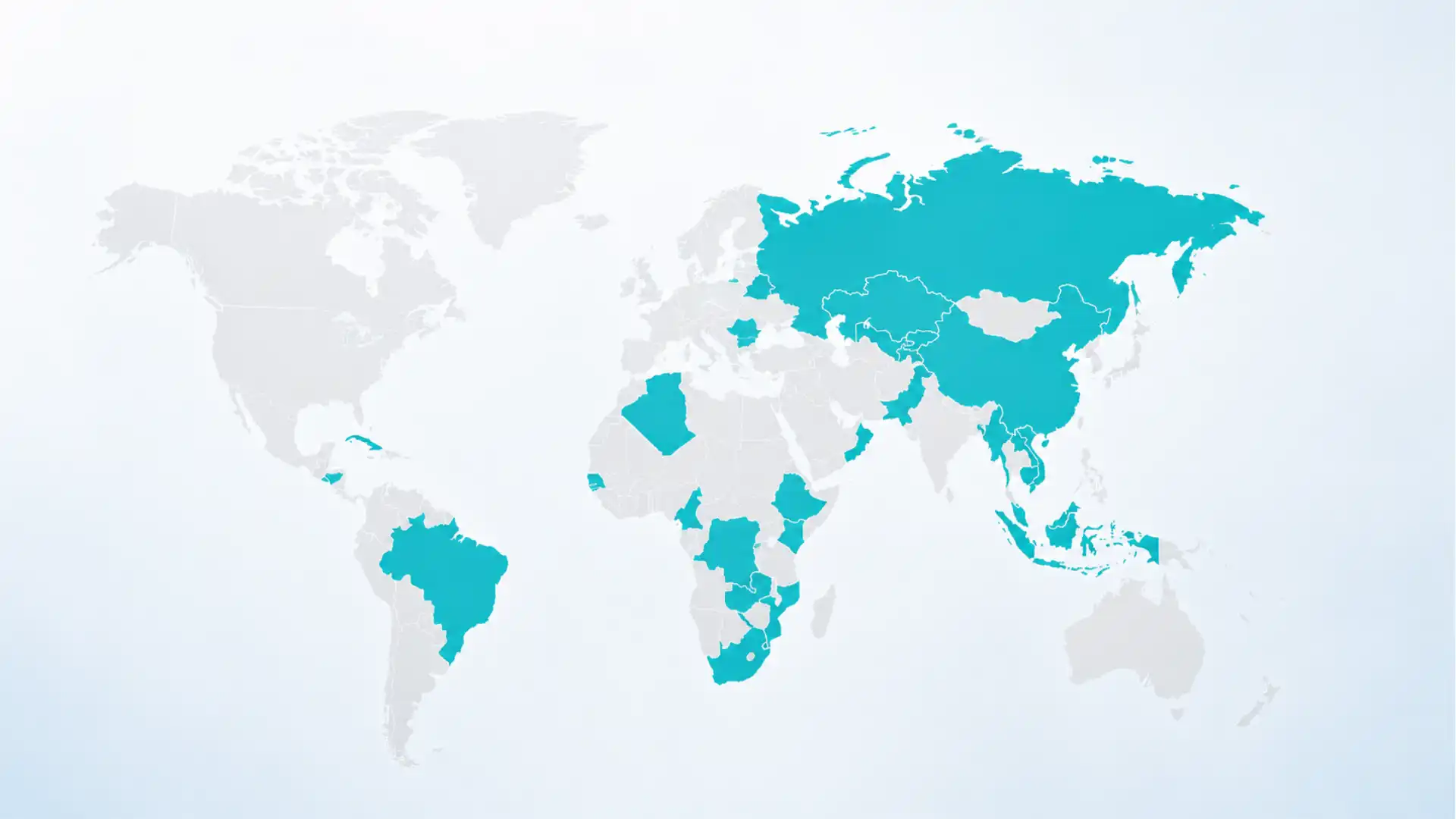
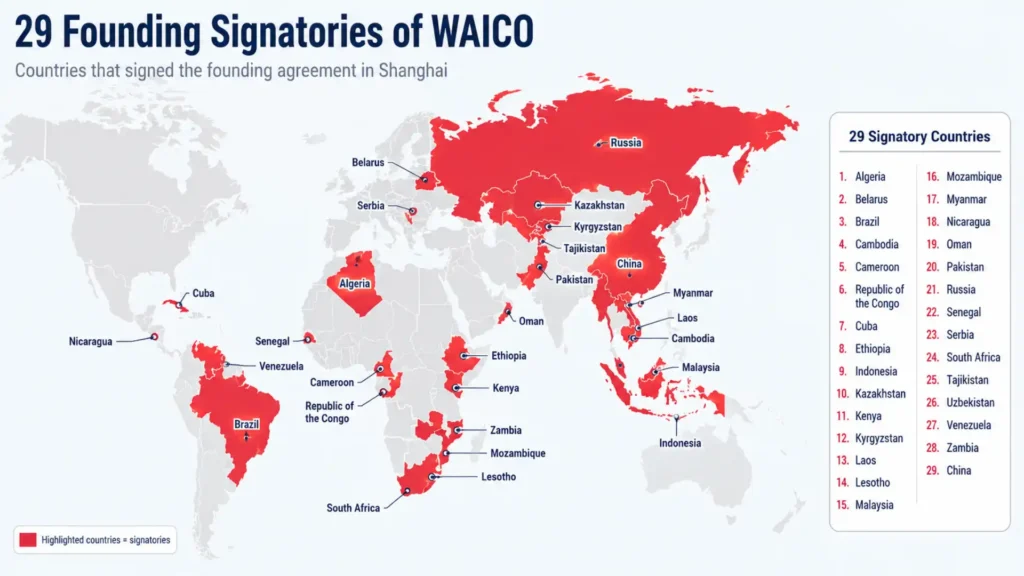
On Thursday, July 16, 2026, representatives of 29 countries signed an agreement in Shanghai establishing the World Artificial Intelligence Cooperation Organization, the treaty body China first proposed a year earlier. Xinhua confirmed the number and the date in a brief dispatch from the city. Sputnik, reporting from the ceremony, described the group as Russia, China and more than 25 other states, and named the two most closely watched signatories at the table: Russia’s Digital Development Minister Maksut Shadayev signed for Moscow, and Chinese Foreign Minister Wang Yi signed on behalf of Beijing.
Table of Contents
The signing in Shanghai and the facts confirmed so far
The choreography matters as much as the ink. The ceremony was deliberately scheduled one day before the opening of the 2026 World Artificial Intelligence Conference and the High-Level Meeting on Global AI Governance, which run in Shanghai from July 17 to July 20. Chinese President Xi Jinping attends the opening ceremony on July 17 and delivers the keynote, his first in-person appearance at the event since it launched in 2018. The sequencing means Xi will not be announcing an idea. He will be addressing member states of an organization that legally exists, with a founding document signed roughly 24 hours before he takes the stage.
That inversion is the story. For a year, the World Artificial Intelligence Cooperation Organization, usually shortened to WAICO, lived as a stated intention: announced by Premier Li Qiang at the 2025 conference, promoted by Xi at the APEC summit in Gyeongju in the autumn, referenced in a China-Russia prime ministerial communiqué in November 2025, endorsed in an unusual Nature editorial in December, and pushed through a June 2026 State Council Information Office briefing which reported that preparations were accelerating. Skeptics could reasonably point out that no country had formally joined. As of July 16, 2026, that objection is gone. Twenty-nine governments have converted a Chinese diplomatic initiative into a treaty organization with founding members, a founding text, and a planned headquarters in Shanghai.
A precision note on names, because the two get conflated constantly in coverage. WAIC is the World Artificial Intelligence Conference, the annual Shanghai trade-and-policy event held every year since 2018. WAICO is the World Artificial Intelligence Cooperation Organization, the new intergovernmental body signed into existence on July 16. The conference is the stage; the organization is the institution. Confusing them leads to real analytical errors, such as treating exhibitor counts as evidence of treaty membership.
What was actually signed, in legal terms, is an agreement on establishment, the standard first instrument in the life of an international organization. Comparable documents created the Asian Infrastructure Investment Bank in 2015 and the Shanghai Cooperation Organization’s charter phase in 2002. An establishment agreement typically fixes the organization’s name, purpose, headquarters, initial membership rules and the process for building out organs such as a council, a secretariat and working bodies. The full text of the WAICO agreement had not been published in English at the time of writing, and several structural details, including the budget model, voting arrangements and the secretariat’s staffing, remain undisclosed. Where this article describes those mechanics, it relies on official Chinese statements, the 2025 action plan that accompanied the original proposal, and independent research that has mapped the organization’s stated design. Confirmed facts and interpretation are flagged as such throughout.
Two attendance details from the signing week sharpen the picture. Pakistan’s Deputy Prime Minister and Foreign Minister Ishaq Dar traveled to Shanghai on July 16 specifically to sign the founding agreement on behalf of Pakistan, at Wang Yi’s personal invitation, and Pakistani state media framed founding membership as a diplomatic achievement. Meanwhile, the guest list for the conference that follows includes UN Secretary-General António Guterres, Kazakh President Kassym-Jomart Tokayev, Thai Prime Minister Anutin Charnvirakul and Cambodian Prime Minister Hun Manet, alongside nine Turing Award and Nobel laureates, among them Yoshua Bengio and Richard Sutton. Reporting from Dawn and other outlets notes one conspicuous gap: there is little representation from major US technology firms, and no indication that the United States or any G7 government signed the agreement.
The absence is not an accident of scheduling. Washington has spent three years constructing its own AI governance architecture out of export controls, entity lists and voluntary domestic frameworks, and it has repeatedly rejected calls for binding global AI regulation under international bodies. Beijing has now answered that architecture with a different kind of structure, one made of membership rather than restriction. The 29 signatures collected in Shanghai are the first hard data point on how much of the world is willing to take the offer.
WAICO defined, from acronym to treaty organization
The World Artificial Intelligence Cooperation Organization is an intergovernmental body, proposed by the Chinese government on July 26, 2025 and formally established by a signing ceremony in Shanghai on July 16, 2026, whose stated purpose is to coordinate international cooperation on artificial intelligence development, application and governance, with its headquarters planned for Shanghai. That single sentence contains everything confirmed about the organization’s legal identity, and fixing it before the analysis starts matters, because most of what circulates about WAICO is a mix of official aspiration and outside speculation.
Chinese official materials describe the organization’s work as resting on three declared goals: deepening innovation cooperation, promoting inclusive development, and strengthening collaborative governance. Each phrase carries specific content in Beijing’s usage. Innovation cooperation refers to a supply-and-demand matching function: connecting countries that need AI capability with providers of models, compute, talent and training, and removing barriers to the flow of those production factors. Inclusive development is the Global South agenda, bridging what Chinese documents call the digital and intelligent divide through capacity building, technology transfer and support for local AI ecosystems. Collaborative governance is the rule-making layer: aligning national AI strategies and technical standards, and coordinating positions in other forums, above all the United Nations.
Official framing consistently positions WAICO as a supplement to the UN, not a rival to it. The organization commits, on paper, to the purposes and principles of the UN Charter and to supporting the UN as the main channel for AI governance. That phrasing is doing strategic work. It preempts the charge that China is building a parallel order, and it aligns WAICO with the UN Global Digital Compact and the 2024 UN General Assembly resolution on AI capacity building that China itself sponsored and which passed by consensus with a core group of some eighty countries. The claim of complementarity is genuine in one sense and tactical in another, and later sections of this article treat both readings.
Institutionally, the preparatory work has a concrete home. Industry sources cited by the analyst George Chen report that the Shanghai AI Laboratory, backed by the municipal government and by Fudan University, has functioned as WAICO’s de facto secretariat since the 2025 announcement, handling institutional groundwork, research coordination and organizational support. On the government side, the Simon Institute for Longterm Governance identifies the Ministry of Foreign Affairs and the National Development and Reform Commission as the two lead agencies shaping the organization, with the Ministry of Industry and Information Technology likely to carry delivery work given its existing role in BRICS-China AI projects and digital capacity-building programs.
What WAICO is not, at least in its founding form, is a regulator. Analysts at the North American Academy of Sciences and elsewhere converge on the same reading: the organization will not directly regulate AI in an enforceable way in the near term. Its plausible early function is a forum that shapes consensus, harmonizes national policies where members want harmonization, runs training and joint research, and promotes open-weight and open-source models and tools. The Simon Institute’s assessment, published in June 2026 after consultations with people close to the process, expects WAICO’s practical program to center on training, joint research, use-case sharing, promotion of open models, and deployment support, with possible extension into data center infrastructure cooperation.
The financing model is a genuine unknown. No budget, contribution formula or financing mechanism has been published. That gap matters more than it might appear, because resourcing determines whether an international organization becomes an actor or stays a letterhead. The International Atomic Energy Agency inspects reactors because member states fund inspectors. The Global Partnership on Artificial Intelligence, by contrast, ran for years on a modest OECD-hosted secretariat and produced working-group reports rather than binding outcomes. Which trajectory WAICO follows will be visible in its first budget, and that document does not yet exist in public.
One more definitional point deserves emphasis because it separates WAICO from every Western-led forum. Membership, as described in all official materials, is open to any sovereign state, with no values test, no regime-type screening and no economic threshold. The G7 Hiroshima Process, the OECD’s AI bodies and the now-folded GPAI all gated entry through shared democratic values. The EU AI Act binds a defined regional bloc. WAICO’s door policy is closer to the UN’s own: statehood is the ticket. That design choice, more than any single clause in the founding agreement, defines what kind of institution the 29 signatories just created.
The signature list and the geography behind it
Xinhua’s confirmed figure is 29 signatory countries. A complete official list had not been released in English by the time this analysis was written, and responsible reporting has to respect that boundary rather than fill it with guesses. What can be established from primary statements and wire coverage is a partial roster and, more usefully, a clear pattern in who was in the room and who was not.
China and Russia are confirmed founding signatories at senior level. China signed through its foreign minister, Wang Yi, which is a deliberate elevation; a technology-ministry signature would have framed WAICO as a sectoral project, while a foreign-ministry signature frames it as statecraft. Russia signed through Maksut Shadayev, the minister responsible for digital development, communications and mass media, which places the Russian commitment in the hands of the ministry that runs its domestic AI and internet policy. Pakistan is a confirmed founding member, with Ishaq Dar’s Shanghai visit announced in advance by the Foreign Office and framed around founding-member status, a bilateral with Wang Yi, and a speaking role on Global South priorities at the governance meeting on July 17.
Beyond the named three, the composition can be inferred with stated uncertainty from the diplomatic record of the preceding year. Kazakhstan’s President Tokayev publicly supported the organization’s development at the 2025 Shanghai Cooperation Organization summit and is attending WAIC 2026 in person. Thailand’s and Cambodia’s prime ministers are attending and speaking at the opening ceremony. The November 2025 China-Russia premiers’ communiqué locked in Moscow’s participation eight months before the ceremony. Chinese outreach documented by Outlook Business involved invitations to more than 40 countries for governance talks, with incentives including training programs, research collaboration and access to Chinese models. The realistic reading is that the founding 29 draw heavily from the Shanghai Cooperation Organization’s membership and observers, BRICS partners, Belt and Road participants in Southeast Asia, Central Asia, the Middle East and Africa, and states already inside China’s AI capacity-building network, such as Laos, which hosts a bilateral AI innovation cooperation center with China.
Just as instructive is the negative space. No G7 country signed. No EU member state has announced membership, and the EU’s institutional posture, anchored in the AI Act’s rights-based, risk-tiered model, sits at a structural angle to WAICO’s sovereignty-first framing. India’s position deserves particular attention: New Delhi participates in SCO AI cooperation and hosted its own AI Impact Summit in February 2026, whose declaration attracted 89 signatures, yet India has cultivated a deliberate distance from China-centered institutions since the border crises, and Indian policy commentary has urged three guardrails before any WAICO engagement, namely geographic neutrality, balanced representation and open ecosystems. Whether India is among the 29 was not confirmed in available reporting, and the answer, when published, will be one of the most telling single data points about the organization’s reach.
A 29-country founding cohort is neither small nor large by institutional standards, and both spins are available. The Asian Infrastructure Investment Bank launched with 57 founding members in 2015, including the United Kingdom, Germany and France, a genuine breach of the US-led financial order. Against that benchmark, 29 signatures with no Western participation looks like a bloc, not a breakthrough. On the other side of the ledger, the Global Partnership on Artificial Intelligence peaked at 29 members after two years of expansion from a G7 core, and the Council of Europe’s AI framework convention has gathered signatures slowly. WAICO reached the GPAI’s peak membership on day one, without a single wealthy democracy on the list, drawing from the roughly 160 states the Western clubs never invited. Both facts are true simultaneously, and the organization’s future depends on which pattern dominates.
The table below consolidates what is confirmed, what is officially signaled, and what remains open about the founding membership, so that readers can separate evidence tiers at a glance.
Confirmed facts versus open questions about the WAICO founding membership
| Item | Status as of July 16, 2026 | Source basis |
|---|---|---|
| Number of signatories | 29 countries, confirmed | Xinhua dispatch from Shanghai |
| China’s signature | Confirmed, signed by FM Wang Yi | Sputnik ceremony reporting |
| Russia’s signature | Confirmed, signed by Minister Shadayev | Sputnik ceremony reporting |
| Pakistan’s signature | Confirmed founding member | Pakistan Foreign Office statements |
| Full official list | Not yet published in English | No primary document available |
| G7 or EU signatures | None announced | Absence across all coverage |
| India’s participation | Unconfirmed either way | No official statement located |
| Headquarters | Shanghai, planned | Chinese government statements |
The table reflects the evidence available on signing day. The full membership list, once published, should be checked against it, and any state-media claims that extend beyond the confirmed tier deserve independent verification before republication.
Twelve months from Li Qiang’s proposal to a signed agreement
The speed is the underrated variable. International organizations usually gestate for years between proposal and treaty. The OECD took over a decade to evolve from the postwar OEEC. ASEAN operated for forty years before adopting a formal charter in 2007, a precedent the Simon Institute cites as typical Asian caution toward institutionalizing cooperation. The World Trade Organization emerged from eight years of Uruguay Round negotiation. WAICO went from a premier’s speech to a 29-country founding treaty in 355 days. Reconstructing that year explains both how Beijing pulled it off and what the compressed timeline cost in institutional detail.
The starting gun was July 26, 2025, at the opening of WAIC 2025 in Shanghai’s World Expo Exhibition and Convention Center. Premier Li Qiang announced the organization on behalf of the Chinese government and simultaneously released the Global AI Governance Action Plan, a thirteen-point program covering multilateral cooperation on AI safety, infrastructure, data standards and development. Li’s speech carried a pointed warning against AI becoming the monopoly of a few countries and companies, language aimed at the audience of developing-country delegations in the hall. Three days later, the foreign ministry’s spokesperson framed the proposal as an international public good and confirmed Shanghai as the tentative headquarters. The timing was itself a message: the announcement came three days after the White House released its own program, Winning the AI Race, on July 23, 2025, making the two plans read as dueling manifestos.
Through the autumn of 2025, the proposal climbed the protocol ladder. At the APEC summit in Gyeongju in the autumn, Xi Jinping personally called for WAICO’s creation, his first public remarks on the plan, telling an audience of 21 Pacific Rim economies that AI governance needed a cooperative institution and reiterating the Shanghai headquarters offer. Reuters, the BBC and the South China Morning Post all noted that Beijing had been quietly introducing the concept to partner governments throughout the year. On November 4, 2025, the joint communiqué of the 30th regular meeting between the Chinese and Russian premiers recorded Moscow’s willingness to cooperate on the initiative, the first treaty-adjacent commitment by a major state.
December brought an endorsement from an unexpected quarter. Nature published an editorial on December 11, 2025 arguing that China was leading the world on AI governance and urging other countries to engage with WAICO, suggesting the International Atomic Energy Agency’s inspection model as a template the organization could learn from. A scientific journal of Nature’s standing lending legitimacy to a Chinese institutional proposal was itself news, and Chinese state media circulated the editorial heavily. Whatever one makes of the editorial’s judgment, it marked the moment WAICO crossed from a diplomatic story into the mainstream of the global AI safety debate.
The first half of 2026 was execution. A French policy commentator writing in China Daily proposed WAICO as a live testing ground for global AI norms. The Shanghai AI Laboratory, per George Chen’s industry sources, worked through the winter as the de facto secretariat, preparing institutional groundwork. On June 17, 2026, a State Council Information Office press conference confirmed that establishment was accelerating and that all willing parties were welcome. Foreign ministries began announcing travel: Pakistan’s curtain-raiser statement came on July 15, Dar flew out on the morning of July 16, and by Thursday evening the agreement carried 29 signatures.
Two features of this timeline deserve flagging. First, the sequencing ran diplomacy ahead of design: the treaty exists, while the budget, voting rules and secretariat structure remain unpublished, an inversion of the usual order in which states negotiate mechanics before signing. That is a deliberate trade. Beijing prioritized an irreversible political fact, the founding ceremony before Xi’s keynote, over a finished rulebook. Second, the entire arc from proposal to treaty happened inside a single cycle of worsening US-China technology conflict, which included fresh American export-control rounds, Chinese restrictions on overseas access to some frontier models, and public accusations by Anthropic that Chinese firms had illicitly accessed its models. WAICO was not built in calm weather. It was built as the storm intensified, and it is designed for that weather.
Shanghai’s decade-long bet on becoming the AI capital
Headquarters decisions in international politics are never logistics. Vienna hosts the IAEA, Geneva the WTO and much of the UN system, Basel the Bank for International Settlements, and each city’s identity is partly built on the institutions it houses. Shanghai is now positioned to become the first city outside the Western orbit to host a global technology governance body, and the city has been engineering that outcome for roughly a decade.
The World Artificial Intelligence Conference itself was part of the plan. Launched in 2018 with central government backing, the annual event turned Shanghai into the default venue for China’s AI showcase, drawing figures such as Elon Musk and Jack Ma in earlier editions. Municipal policy did the quieter work: compute subsidies, dedicated AI investment funds, and a cluster of research institutions concentrated in the Xuhui district and the Zhangjiang science city. The Shanghai AI Laboratory, established with municipal backing and academic anchoring at Fudan University, grew into one of China’s most productive AI research organizations and, since mid-2025, into WAICO’s preparatory secretariat. The China-BRICS AI Development and Cooperation Centre, set up in January 2025, is headquartered in the same Xuhui district, giving the city an existing node in China’s international AI capacity-building network.
Xi Jinping personally blessed the strategy during a 2025 visit to a Shanghai startup incubator, where he described AI as entering a period of explosive development and urged the city to lead in both development and governance. The pairing of those two words, development and governance, was the tell. Shanghai’s assignment was never only to produce models and robots; it was to produce the institutional address where rules get discussed. A permanent WAICO headquarters completes that assignment. It gives Chinese AI diplomacy a physical campus, a standing secretariat with local government support, and a annual synchronization point in the July conference, when member-state delegations, corporate exhibitors and visiting laureates all converge on the same week.
For interpretation, the closest structural analogy is not Brussels but Vienna in the Cold War: a hosting city whose institutions gave one side of a divided world a venue that the other side still had to attend. Whether Western officials eventually walk into a Shanghai headquarters the way they walk into Vienna’s agencies is one of the medium-term tests of the organization’s pull. The early evidence from WAIC 2026’s attendance, a UN Secretary-General and multiple heads of government but almost no major US technology firms, describes exactly where that boundary currently runs.
The economics for the city are not decorative either. Hosting an intergovernmental organization brings resident delegations, translation and legal services, conference traffic and prestige procurement. Shanghai’s exhibition economy already banks the WAIC week; organizers report that the 2026 edition exceeds 100,000 square meters of exhibition space for the first time. Layering a treaty organization’s permanent calendar on top of the annual conference gives the city something no export-control regime can sanction away: a recurring reason for a large part of the world’s governments to show up.
Xi Jinping’s first WAIC appearance raises the stakes
Until this week, the World Artificial Intelligence Conference followed a stable protocol pattern. Xi Jinping sent a congratulatory letter to the inaugural 2018 edition and then stayed away, leaving the opening ceremonies to other senior officials, with Premier Li Qiang headlining in both 2024 and 2025. On July 13, 2026, the foreign ministry broke the pattern: Xi will attend the opening ceremony on July 17 and deliver the keynote himself, his first in-person appearance in the event’s history. Spokesperson Lin Jian’s formulation was that Xi will systematically elaborate China’s policies, positions, visions and propositions on AI development and governance.
In the grammar of Chinese politics, the change of speaker changes the meaning of the event. A premier headlining a technology conference marks it as important economic policy. The head of state and party headlining it marks it as national strategy of the first rank, on par with the diplomacy Xi personally conducts. Bloomberg’s read was straightforward: the appearance signals the growing weight Beijing attaches to AI as its rivalry with the United States intensifies. The Seoul Economic Daily and others connected the decision to a specific shift in the underlying technology balance, citing Stanford’s 2026 AI Index finding that the performance gap between leading US and Chinese models had narrowed to 2.7 percentage points as of March 2026, and OpenRouter data showing Chinese models overtaking American ones in token share on that platform for the first time in early June.
The domestic audience matters as much as the international one. Xi’s presence tells ministries, provincial governments and state banks how seriously the technology is taken at the very top, and it lands five months after China’s 2026 government work report called for building a new form of intelligent economy, expanding the AI Plus campaign, accelerating commercial adoption and strengthening governance. In January 2026, Xi compared AI to the steam engine as an epoch-making technological transformation. The keynote is the ceremonial capstone of a policy structure that has been assembling for eighteen months.
For WAICO specifically, the timing turns the keynote into a founding address. Analysts quoted across the pre-conference coverage expected Xi to use the speech to give the organization definition: what membership entails, what governance commitments members accept, how the body relates to the UN, and possibly which further states are invited. The signing ceremony on July 16 resolved the largest open question, whether anyone would formally join, before Xi spoke. What remains for the speech is mechanism. The Next Web’s preview put the test crisply: a keynote heavy on partnership and light on mechanism would leave WAICO roughly where it sat on paper, while a keynote that names institutions, funding and obligations would mark the organization’s real birth as an actor.
There is also a harder edge to the moment that the ceremonial framing tends to soften. Xi steps onto the WAIC stage in a year when Beijing has restricted overseas access to some of its best models while Washington accuses Chinese firms of copying American ones, when Anthropic has publicly alleged that Chinese rivals including Alibaba illicitly accessed its models to replicate capabilities, and when a US frontier system, Anthropic’s cybersecurity-focused Mythos model, reportedly uncovered thousands of major software vulnerabilities and forced governments and banks to reassess cyber defenses. The keynote’s cooperative vocabulary will be delivered from inside an escalating security competition, and every government in the audience knows it. Reading the speech will mean reading the distance between the two.
WAIC 2026 as the stage, and the scale of the show
The conference wrapped around the signing is the largest in the event’s history, and the scale is itself part of the diplomatic argument. Organizers report more than 140 forums, over 1,400 invited guests, more than 1,100 exhibiting companies, over 3,000 exhibits and more than 300 products making their global debut, across an exhibition footprint exceeding 100,000 square meters for the first time, spread over the Expo, Zhangjiang and West Bund zones of Shanghai. Twelve government ministries and eight national laboratories participate. The theme for 2026 is AI cooperation for a brighter future, and the governance meeting runs in parallel through July 20.
The product slate is calibrated to demonstrate that China’s AI stack now spans every layer. At the compute layer, Huawei is showcasing its Atlas 950 computing cluster, the company’s answer to the export-controlled Nvidia systems Chinese buyers cannot legally obtain at the frontier. At the model layer, MiniMax launches its M3 multimodal model with extended reasoning across text, code, image and video, while StepFun presents its Jieyue Agent operating system. At the device layer, ZTE debuts what organizers bill as the world’s first AI Agent smartphone. Around them, more than 200 companies each populate the intelligent-computing and embodied-AI halls, the latter stocked with humanoid robotics platforms from an industry in which Chinese firms such as Unitree ship at consumer prices.
The guest architecture mirrors the membership pitch. UN Secretary-General António Guterres attends, lending the complementarity-with-the-UN narrative its most visible symbol. Heads of government from Thailand, Cambodia and Kazakhstan attend and, in the Thai and Cambodian cases, speak at the opening ceremony. Nine Turing Award and Nobel laureates appear, including Yoshua Bengio, the most-cited voice in AI safety research, and Richard Sutton, the father of reinforcement learning. The scientific presence gives Beijing something it values highly: the ability to present its governance track as engaged with the field’s intellectual leadership rather than only with friendly governments.
Against that, the American absence is stark and evidently structural. Dawn’s reporting from the eve of the conference records little representation from major US technology firms, a sharp contrast with earlier editions that featured Musk and other Silicon Valley figures. Part of the explanation is legal risk under expanding US export and investment restrictions; part is commercial, since American frontier labs sell little in China; and part is political, since attending the launch week of a Beijing-built governance body carries Washington-facing costs no US executive needs. The result is a conference that photographs exactly like the geopolitical situation it addresses: a very large, very advanced, very international room with the world’s leading AI power missing from it.
A People’s Daily commentary published in the run-up distilled the official message for the week, insisting that AI development must never become a self-enclosed technological monopoly and should serve humanity as a whole. Strip the editorial varnish and the operational content is a market argument: China’s open-weight models and cheaper inference are presented as the practical alternative to closed Western systems, and WAIC 2026 is the trade fair where the argument comes with product demos attached.
The 13-point action plan underneath the organization
WAICO did not arrive alone in July 2025. Li Qiang released it together with the Global AI Governance Action Plan, a thirteen-point program that functions as the organization’s intellectual charter, and reading the plan is the closest anyone outside the negotiations can currently get to the treaty’s substance. The Carnegie Endowment’s May 2026 analysis describes the plan as a road map for international AI development and governance emphasizing multilateral collaboration on safety, infrastructure including compute, data centers and networks, data standards and sustainable development.
The plan’s own stated principles, in the official Chinese text, are worth listing precisely because their ordering encodes the doctrine: benefiting the people, respect for sovereignty, a development orientation, safety and controllability, fairness and inclusiveness, and open cooperation. An arXiv study published in June 2026, which coded fifteen international AI governance instruments on membership rules, organization and priorities, observes that the center of gravity of that list is sovereignty, development and openness rather than a test of shared values. Safety appears, but as one principle among six, paired with controllability, a word that in Chinese regulatory usage carries connotations of state oversight of information systems as much as technical alignment of models.
Several of the thirteen points translate into concrete program lines that WAICO can now operationalize. The AI Capacity Building Universal Benefit Plan, referenced in Chinese descriptions of the organization’s functions, commits to helping Global South countries strengthen technical capacity, a continuation of the workshop-and-seminar diplomacy China has run through the UN Group of Friends for International Cooperation on AI Capacity-Building, the eighty-country grouping it co-chairs with Zambia. The plan’s infrastructure points map onto cooperation on data centers and networks, an area where, as the Simon Institute notes, some experts expect WAICO to extend. The standards points connect to a stated ambition, described in Chinese materials, of building a rule incubator in which developing countries move from rule-takers to co-creators, and in which governance rules evolve from soft constraints to hard mechanisms over time.
That last phrase deserves a pause, because it is the most consequential sentence in the official corpus. Soft constraints becoming hard mechanisms is a published aspiration for WAICO’s trajectory, and it cuts against the reassuring reading of the organization as a mere talk shop. Nothing in the founding moment creates enforcement powers, and no member state has surrendered regulatory authority. But the design intent on record is evolutionary: begin with training programs and voluntary alignment, and build toward binding coordination as trust and membership accumulate. The IAEA comparison that Nature’s editorial floated, an agency whose members accept development limits and open facilities to inspection, is the maximal version of that trajectory. Whether WAICO’s members would ever accept anything comparable is entirely unproven, and the honest analytical position is that the plan states a direction, not a capability.
The action plan also does quiet definitional work on what counts as the problem to be governed. Western frameworks foreground model risk: catastrophic misuse, loss of control, rights violations, discrimination. The Chinese plan foregrounds distributional risk: the concentration of AI capability, compute and rule-making power in a few countries and companies. Both are real problems, and the choice of emphasis is the fork in the road. An institution built around distributional risk will measure success in members trained, models transferred and data centers built, not in safety evaluations passed. Businesses and governments deciding how to engage with WAICO should read the thirteen points as the organization’s actual product catalogue, because for at least its first years, they will be.
Sovereignty first, development second, safety third
Every governance institution encodes a hierarchy of values, usually implicitly. WAICO’s hierarchy is explicit, and stating it plainly is more useful than euphemism: the organization ranks state sovereignty above harmonized rules, development above risk mitigation, and access above safety gating. Each ranking is defensible on its own terms, each has a constituency, and each carries a cost. Unpacking the doctrine matters because it predicts the organization’s behavior better than any membership count.
Sovereignty first means that WAICO, per the official texts, supports countries conducting AI cooperation according to their own national conditions, with no values test at the door and no regime-type screening. For the roughly 130 states that are neither wealthy democracies nor pariah regimes, that framing removes the awkwardness that Western clubs impose: nobody in Shanghai will ask about press freedom before discussing compute grants. The cost is equally structural. A body that treats every member’s domestic AI rules as sovereign business has no lever against a member that uses AI for mass surveillance, social scoring or wartime targeting, and cannot even name those practices as problems without violating its own charter logic. The Carnegie analysis draws the practical implication for the technology itself: Chinese-built large language models deployed abroad may carry embedded content controls, censoring liberal norms such as the right to protest regardless of where the model runs, and a sovereignty-first institution has nothing to say about that.
Development second means the agenda centers on what Chinese documents call the global intelligence gap. The factual basis is strong and worth stating without irony. UN materials from the July 2026 Global Dialogue on AI Governance record that the United States accounts for about 75 percent of computing power among the world’s top 500 AI supercomputers, with China at 15 percent, leaving the remaining 190-odd countries sharing single digits; leading general-purpose models come almost entirely from firms in two countries; and adoption in the Global South lags far behind the North. For a health ministry in Dhaka or an agriculture agency in Nairobi, the binding constraint on AI is not alignment research, it is compute, connectivity, local-language data and trained staff. WAICO is the first treaty organization whose founding purpose is that constraint. The Benton Institute’s summary of the UN dialogue makes the same point from the multilateral side: capacity, evaluation expertise and data are concentrated where AI is built, leaving most countries dependent on systems they cannot inspect or adapt.
Safety third does not mean safety absent. The action plan lists safety and controllability among its principles, Chinese domestic regulation of generative AI is in some respects stricter than American practice, and the governance meeting attached to WAIC 2026 includes AI safety on its agenda alongside sovereignty and accessibility. The Simon Institute even identifies a constructive niche: WAICO could become the venue where the safety and security questions raised by open-weight models get worked, precisely because China’s open-model ecosystem is the strongest in the world and the risk-management concerns about open weights are growing both internationally and inside China. But in the hierarchy, safety functions as a constraint on the development agenda, not as the organizing purpose. That is the mirror image of the Bletchley-to-Seoul summit lineage in the West, where safety was the organizing purpose and development a side panel.
The doctrine’s political genius and its analytical weakness are the same feature. By ranking the values this way, WAICO offers most of the world’s governments exactly what the existing order has not: standing, resources and no lectures. By the same ranking, it structurally cannot address the scenarios that most alarm the field’s own scientists, several of whom, including Bengio, are walking the WAIC halls this week. An institution optimized for distribution will distribute whatever the technology becomes, including its failure modes. Member states have effectively wagered that the divide is the more urgent risk. The wager may even be right for them. It is still a wager, and it was placed on July 16 with 29 signatures.
An institutional design no existing body occupies
The most rigorous independent work on WAICO to date is the June 2026 arXiv study that mapped the organization against fifteen international AI governance instruments and institutions, coding each on how it admits members, how it is organized and what it prioritizes. The study’s core finding gives the analysis of this article its structural backbone: WAICO combines three design features that no constituted multilateral body currently unites — membership open to any sovereign state, no values or regime-type test for entry, and an agenda built around development and the global capability divide.
Walk through the existing field and the gap becomes visible. The Western-led bodies are clubs. The G7 Hiroshima Process, the OECD AI Principles community and the Global Partnership on Artificial Intelligence admit members who share declared democratic values, and their agendas center on managing advanced-AI risk: safety, accountability, rights. The Council of Europe’s Framework Convention on AI is open to accession beyond Europe but is anchored in human rights, democracy and the rule of law by design. The UN bodies are universal, open to all states, but anchored all the same in the human-rights architecture of the Charter system. The AI summit lineage from Bletchley Park through Seoul to Paris and the February 2026 New Delhi AI Impact Summit produced declarations, the New Delhi one signed by 89 countries and organizations, but declarations are instruments, not institutions; they have no members, staff or budget. A development-first agenda exists in the regional strategies of the African Union, ASEAN and similar groupings, but those are regional by definition.
The study’s conclusion is that the only prior occupant of WAICO’s intended position was China’s own 2023 Global AI Governance Initiative, the precursor policy Xi announced that year. In plainer language: Beijing identified an empty quadrant in the institutional map, open membership plus development agenda, and built the first organization in it. The July 16 signing means the quadrant is no longer empty and no longer merely Chinese; it is multilateral, with 29 states inside.
Institutional-design analysis also clarifies what WAICO is modeled on. George Chen’s preview and multiple other assessments point to the Shanghai Cooperation Organization as the loose template: a China-co-founded multilateral body with a Chinese-hosted secretariat, consensus-style decision-making, an expanding membership drawn from Eurasia and the Global South, and a functional focus, security for the SCO, technology for WAICO. The SCO precedent cuts both ways. It proves China can build and sustain a durable intergovernmental organization that the West neither joins nor destroys. It also illustrates the ceiling: after two decades, the SCO coordinates exercises and statements but commands nothing, and its members, notably India and Pakistan, pursue opposed interests inside it. An SCO-for-AI would be a real institution with real convening power and modest binding force.
One more design observation matters for forecasting. Because entry has no values gate, WAICO’s membership can only grow; there is no principled basis for refusing any state that applies, and every accession is a diplomatic win Beijing can announce. Western clubs face the opposite pattern, where each expansion debate re-litigates the values test, as GPAI’s slow, invitation-based growth showed before the body was folded into the OECD’s integrated AI work. Over a decade, the asymmetry compounds: one pole accumulates flags by default, the other by exception. Raw membership counts will therefore flatter WAICO structurally, and analysts should discount them accordingly, watching budgets, programs and secondments instead.
Russia’s stake in a non-Western AI order
Russia signed second in every headline for a reason. Moscow is the founding member with the least to contribute technologically and the most to gain institutionally, and its role inside WAICO deserves separate treatment because it shapes how the organization will be perceived in every Western capital.
Start with the technical position. Russia entered the 2020s with a credible AI research tradition, a strong mathematics pipeline and one dominant corporate champion in Sberbank, whose GigaChat models and AI investments anchor the domestic ecosystem, alongside Yandex’s language technology. Sanctions changed the trajectory. Cut off from Nvidia hardware, Western cloud services and much of the international research circuit after February 2022, Russian AI development has been compute-starved at exactly the moment compute became the decisive input. The candid Russian view of the workaround was voiced by Sberbank’s first deputy chairman Alexander Vedyakhin in Vladivostok: joint Russian-Chinese work in AI could become the core of a new technological architecture offering an alternative to Western centers of power, with China supplying market leadership while Russia seeks access to computing power and technology stacks independent of the United States. Vedyakhin framed the partnership explicitly as part of BRICS and SCO cooperation, and reported concrete integration, including memoranda with Chinese partners and a 50 percent rise in Chinese SMEs opening Sberbank accounts across 2024 and 2025.
Russian scholarly interest points the same direction. At the Valdai Russian-Chinese conference in Shanghai in April 2026, participants repeatedly flagged China’s open-source models as the object of Russian attention, with one St. Petersburg academic noting that Russian companies and small businesses look forward to cooperation specifically because of open models such as DeepSeek, and others observing that China’s experience of optimizing model training under GPU sanctions holds direct lessons for Russia. For a sanctioned economy, open weights are not a philosophical preference, they are the only legal supply chain to frontier-adjacent capability, and WAICO institutionalizes access to that supply chain.
Institutionally, Moscow brings assets Beijing values. Russia has decades of experience building and running non-Western multilateral bodies, from the SCO and the Eurasian Economic Union to BRICS machinery, and its diplomats have co-drafted the cyber-sovereignty agenda with China at the UN since the 2010s, the campaign that once opposed ICANN’s role in internet governance, a history the Atlantic Council’s analysts trace directly into the present institutional contest. The joint premiers’ communiqué of November 2025 made Russia the first great-power endorser of WAICO, months before any signing, and the choice of Shadayev, the minister who administers Russia’s sovereign-internet apparatus, as signatory tells its own story about which policy tradition Russia thinks it is joining.
The cost of Russian prominence is reputational arithmetic that Beijing understands perfectly well. Every Western skeptic of WAICO now has a one-sentence argument: the organization’s two most senior founders are a state under global technology sanctions and the state supplying it. The Carnegie assessment’s conclusion that wholesale normative alignment with the China-Russia state-controlled vision remains unlikely across the Global South rests partly on a decade of watching exactly this pattern in cyber diplomacy, where developing countries took Chinese infrastructure and training without endorsing the underlying model of information control. WAICO’s founding cohort will be read through the Russian signature whether or not the other 27 members like it, and several of them, courting Western investment simultaneously, will spend the coming years managing that association.
Pakistan and the shape of the Global South pitch
Pakistan’s participation is the best-documented case study of how WAICO membership is being sold and bought, because Islamabad narrated the whole transaction in public. The Foreign Office’s July 15 curtain-raiser, state radio coverage, and reporting in Dawn, The Express Tribune and Pakistan Today together describe the anatomy of a founding membership from the member’s side.
The mechanics first. Deputy Prime Minister and Foreign Minister Ishaq Dar traveled to Shanghai July 16 to 17 at the personal invitation of Wang Yi, signed the founding agreement on behalf of Pakistan at the July 16 ceremony, attends the WAIC opening and the High-Level Meeting on Global AI Governance on July 17, and holds a bilateral with Wang plus meetings with other visiting counterparts on the sidelines. The Foreign Office scripted his message in advance: Pakistan’s perspective on international AI cooperation with particular emphasis on the priorities and development needs of the Global South, covering the global AI divide, equitable access to AI technologies, capacity building and AI’s contribution to development. The trip slots into a wider China-Pakistan calendar; Dar met the SCO secretary-general the day before departure, and Pakistan assumes the SCO Council of Heads of State chairmanship in September 2026 ahead of hosting the 2027 summit.
Read as a transaction, both sides’ considerations are legible. For Pakistan, founding membership costs nothing measurable and yields several concrete goods: a seat at a rule-making table that the OECD world never offered, priority access to Chinese training programs, models and potentially compute under WAICO’s capacity-building plans, a headline diplomatic deliverable inside the all-weather partnership with Beijing, and standing to speak for Global South AI interests at a moment when that constituency lacks institutional representation. For China, Pakistan delivers a populous, strategically central founding member whose signature demonstrates that WAICO extends beyond a China-Russia axis, and whose foreign minister will make the development case at the governance meeting in his own voice rather than Beijing’s.
The Pakistani case generalizes. The pitch that lands in Islamabad lands, with local variations, in Phnom Penh, Bangkok, Astana, Vientiane and dozens of capitals whose leaders or ministers populate the WAIC guest list. Its three components recur everywhere. First, material access: open-weight models, cheaper inference, training slots and infrastructure cooperation, the package TechTimes summarized as open models, lower costs and a formal governance role, which the US-EU trusted-partners framework has not replicated for most countries. Second, status: the promise, in the language of Chinese planning documents, of moving from rule-taker to rule co-creator. Third, non-conditionality: no governance benchmarks, no rights reporting, no alignment homework.
The honest counter-reading is that the offer’s price is denominated in a currency other than money. Founding members lend legitimacy to a Chinese-designed institution and accept a technological relationship in which the standards, the models and the headquarters are Chinese. Indian policy commentary spelled out the resulting caution, urging geographic neutrality, balanced representation and open ecosystems as preconditions for engagement, and India’s apparent absence from the signing table, while unconfirmed, is consistent with that stance. Dependence is the Global South’s oldest technology problem, and a development organization headquartered in one country’s flagship city does not obviously solve it; it may relocate it. The 29 founding members have judged the trade worthwhile. The next hundred prospective members will be watching what the first cohort actually receives.
Open-weight models as the economic engine of membership
Strip away the diplomacy and WAICO runs on a commercial fact: China gives away, as open weights, a class of AI capability that the United States mostly sells behind APIs or restricts outright, and an international organization is a purpose-built machine for converting that giveaway into influence. Understanding the open-weight economics is therefore not a technical digression; it is the organization’s business model.
Definitions first, briefly and precisely. An open-weight model is one whose trained parameters are published for download, so that any party with sufficient hardware can run, fine-tune and deploy it locally without the developer’s permission or ongoing involvement. It differs from a closed model, accessible only through the developer’s hosted API, and from fully open-source AI, which would also include training data and code. China’s leading labs, DeepSeek, Alibaba’s Qwen team, Zhipu and others, have made open-weight release their default strategy with strong government encouragement, while US frontier labs, OpenAI and Anthropic above all, keep their strongest systems closed, a divergence that the North American Academy of Sciences’ explainer identifies as a defining difference between the two ecosystems.
The adoption data explains why this became geopolitics. On OpenRouter, the US-based model-routing platform whose token statistics offer a rare neutral usage gauge, Chinese models surpassed American models in token share for the first time in early June 2026, with DeepSeek’s share alone nearly doubling from 9 percent at the start of the year to 18 percent. Token share on one router is not the world market, but the direction is corroborated across the industry: for cost-sensitive deployments, which is most deployments outside the wealthy West, downloading a competitive Chinese model and running it on local or rented hardware beats paying per-token API prices for a marginally better American one. Eric Olander of the China-Global South Project made the market observation directly: China arrives with an AI product mix built for lower-income countries, lighter-weight tools for regions without vast data-center capacity.
WAICO institutionalizes this distribution channel. The organization’s stated functions, supply-demand matching, capacity building, open-source community collaboration and technology transfer, are precisely the functions of a global deployment network for open models: it trains the engineers who will fine-tune them, funds the workshops that localize them into under-served languages, and coordinates the infrastructure cooperation that gives members somewhere to run them. Every service deepens the installed base, and the installed base is sticky. A ministry that has built its document systems on a Qwen fine-tune, trained its staff through WAICO programs and stored its embeddings in a Chinese-stack vector database has acquired switching costs that no future trade negotiation easily reverses.
The strategy has two internal tensions that will shape the organization’s next years. The first is commercial: Chinese labs, like all labs, face pressure to monetize, and Beijing has already begun restricting overseas access to some frontier systems, a fact The Next Web notes sits awkwardly beside the openness rhetoric of the conference. If China’s best models progressively close while the open tier lags, the membership offer thins. The second is the safety tension the Simon Institute highlights: open weights cannot be recalled, and concern about open-model misuse is rising inside China as well as internationally. WAICO could become the forum where open-weight safety practice gets worked out among the countries actually deploying such models at scale, which would be genuinely useful, or it could treat the question as a Western distraction from development, which would be consequential in a different way. The founding documents permit either path.
DeepSeek, Qwen and a performance gap of 2.7 points
The signing ceremony would read very differently if Chinese AI were two years behind the frontier. It is not, and the technical convergence of the past eighteen months is the load-bearing fact under the entire diplomatic construction, so it needs stating with numbers rather than vibes.
The headline metric comes from Stanford’s 2026 AI Index: as of March 2026, the performance gap between the leading American and Chinese models had narrowed to 2.7 percentage points on the index’s benchmark composite. Behind that aggregate sits a sequence of specific releases. DeepSeek’s V3 and R1 models in late 2025 demonstrated that a Chinese lab could reach the performance frontier at a fraction of the assumed compute cost, a result that unsettled Western assumptions about the race’s economics and briefly moved trillions in market capitalization. Alibaba’s Qwen family became the most-forked open-model lineage on developer platforms. ByteDance’s Doubao models achieved competitive benchmark scores against frontier Western systems. MiniMax and Zhipu raised at multi-billion valuations on real revenue, and MiniMax’s M3 multimodal reasoning model debuts at this week’s conference alongside Huawei’s Atlas 950 cluster at the hardware layer and StepFun’s agent operating system at the software layer.
Precision about what has and has not converged keeps the analysis honest. The 2.7-point figure measures benchmark performance on leading published models; it does not measure the classified or unreleased frontier, where American labs are widely believed to retain a real edge, nor does it capture reliability in agentic deployment, where evaluation remains immature everywhere. Compute remains the sharpest asymmetry: US export controls still deny Chinese firms the top Nvidia hardware at scale, which is why Huawei’s domestic accelerator clusters headline the conference, and why training-efficiency breakthroughs of the DeepSeek type carry strategic weight in Beijing far beyond their engineering interest. Talent flows have partially reversed toward China but the deepest pools of frontier research experience remain concentrated in a handful of American labs.
Two second-order effects of convergence bear directly on WAICO’s prospects. The first is credibility: a development organization is only as attractive as the technology it distributes, and in 2024 a Chinese-led AI body would have been offering second-tier goods. In July 2026 it offers models that measurably compete with, and on cost dominate, the Western alternative for the workloads most member states run. The narrowing gap converts the membership pitch from charity to procurement. The second effect runs through Washington’s psychology. The export-control regime was designed to preserve a durable American lead; a 2.7-point gap after four years of escalating controls reads, in hawkish quarters, as evidence the controls failed, and in dovish quarters, as evidence they accelerated exactly the self-reliant Chinese stack now on display in Shanghai. Either reading hardens the two-bloc drift that WAICO institutionalizes on one side.
The competitive picture also explains the timing of Chinese assertiveness on governance. States negotiate hardest from positions of strength, and Beijing has chosen the first moment of near-parity to convene founding members, put its head of state on the conference stage and collect signatures. Whatever else the 2.7-point number means, Chinese leadership evidently reads it as sufficient technological standing to write rules rather than receive them, and 29 governments have just endorsed that reading with ink.
The American counter-model built on export controls
WAICO cannot be understood in isolation, because it is one half of a pair. The other half is the American governance model, and the two systems were even announced in the same week of July 2025, three days apart, in what the Atlantic Council called dueling action plans. Setting them side by side clarifies what the July 16 signing actually changes.
The US framework, consolidated in the July 23, 2025 program Winning the AI Race, is built from four materials. Export controls deny China and designated others the most advanced chips, chipmaking tools and, increasingly, model weights above certain capability thresholds. Entity lists and investment screening police the corporate perimeter, restricting which firms may buy, sell or receive American capital. Voluntary domestic frameworks rather than comprehensive legislation govern American labs, with the deregulation-first stance justified as preserving innovation speed; the United States has still not passed a general AI law. Allied coordination extends the perimeter through trusted-partner arrangements with the wealthy democracies, the Netherlands and Japan on lithography, the G7 on principles. The model’s theory of safety is dominance: the world is safest if the leading systems are American, and governance means keeping it that way. Washington has accordingly rejected repeated calls for binding global AI regulation under international organizations, a position it maintained through the APEC summit where Xi first personally pitched WAICO.
The structural weakness of the American model is that it offers most of the world nothing. A perimeter has an inside and an outside, and roughly 160 countries are outside: not sanctioned, not trusted partners, simply unaddressed. They receive no compute allocations, no capacity programs at scale, no seat in the rule-making rooms, and periodic pressure to enforce American restrictions against their own commercial interest. The Atlantic Council’s analysts locate the deeper cost in agenda-setting power: the United States historically profited from writing the rules others operated under, and a dominance-based approach underestimates how much that power depended on offering others a stake. Into exactly that vacancy, Beijing has inserted an organization whose entire product is stakes: membership, training, models, standing.
The May 2026 Trump-Xi summit in Beijing complicated the picture without resolving it. Lawfare’s account records much ceremony, few breakthroughs, and one concrete result: an agreement to cooperate on AI guardrails, terms undefined. The two governments therefore simultaneously maintain an escalating restriction regime, a nascent bilateral safety channel, and now competing multilateral institutions, with Washington also raising intellectual-property grievances, including Anthropic’s public accusation that Chinese firms illicitly accessed its models. Nothing about the July 16 signing forecloses the bilateral channel; heads of state have institutionalized rivalries and negotiated across them before, and the nuclear arms-control precedent, adversaries building verification regimes while competing, is the standing historical template.
What the signing does foreclose is the assumption that governance-by-perimeter would go unanswered. As of this week, a country declined a place inside the American perimeter is no longer choosing between inclusion and nothing; it is choosing between two offers, one of which asks for alignment and the other of which asks only for a signature. American policymakers can dismiss WAICO as a bloc of the sanctioned and the dependent, and the founding roster gives that dismissal material. The harder question for Washington is arithmetic: the perimeter strategy was priced for a world with one supplier of frontier-adjacent AI, and Stanford’s 2.7-point gap says that world is ending. Counter-programming an institution requires an institution, and the United States currently is not building one.
The EU, the OECD and a crowded field of frameworks
Between the American perimeter and the new Shanghai organization stretches a middle terrain of existing governance efforts, and WAICO’s arrival forces each of them into a repositioning. Mapping the field shows where the new body genuinely competes, where it complements, and where it simply ignores.
The European Union runs the world’s only comprehensive binding AI law. The AI Act entered staged enforcement, with obligations on prohibited practices and general-purpose models already live in 2025 and high-risk system requirements phasing in through 2026 and 2027. The Act’s model, risk tiers, conformity assessment, fundamental-rights anchoring, is the philosophical antipode of WAICO’s sovereignty-first design, and the EU exports it through the Brussels effect: firms selling into Europe comply globally because compliance segmentation is expensive. WAICO threatens that mechanism at the margins. Its rule-incubator ambition, developing alternative standards among members, offers governments and vendors a counter-reference: where Brussels demands transparency dossiers, the WAICO track may bless lighter sovereign discretion. For multinationals the result is not either-or but both, a compliance matrix examined later in this article.
The OECD and the G7 lineage hold the oldest soft-law franchise: the OECD AI Principles of 2019, the G7 Hiroshima Process code of conduct, and the Global Partnership on AI, which after peaking at 29 members was folded into the OECD’s integrated AI work, its brand quietly retired. This is the club pole the arXiv study describes, values-gated and risk-focused, and it is the pole WAICO most directly shadows: same claimed function, international AI cooperation, opposite membership logic. The Council of Europe Framework Convention on AI, the first binding international AI treaty, remains open to non-European accession but anchored in rights and, as Nature’s editorial noted of the field generally, weakly enforced.
The summit lineage, Bletchley Park 2023, Seoul 2024, Paris 2025, New Delhi February 2026, produced the broadest declarations, the New Delhi AI Impact Summit Declaration gathering 89 signatures from countries and organizations around a voluntary framework tilted, notably, toward development and inclusion, India’s deliberate reframing of the agenda. Medianama’s assessment of that declaration applies almost verbatim to WAICO’s soft phase: without binding instruments, standardized reporting and independent benchmarks, voluntary platforms risk becoming diplomatic cover, because words alone do not steer behavior where commercial and national interests diverge. The difference is that a treaty organization, unlike a summit declaration, has the machinery to grow teeth if its members ever want teeth.
The net effect of WAICO’s entry is a field reorganized into recognizable poles: a binding regional regulator in Brussels, a values club around the OECD and G7, a universal but rights-anchored UN track, an American perimeter regime, and now a sovereignty-and-development treaty pole in Shanghai. Governments in the middle will not choose one; they will arbitrage among them, taking EU-compatible rules for export sectors, WAICO resources for capacity, UN forums for voice. Institutional competition of this kind is not necessarily pathological, and historians of the postwar order note that overlapping bodies often disciplined each other. But it does end the brief fiction, alive from Bletchley through the UN compact, that the world was converging on a single conversation about AI. After July 16, there are at least two conversations, each with a headquarters.
The UN track and the quiet contest for the main channel
Every official Chinese description of WAICO repeats one formula: the organization supports the United Nations in playing the main channel role in AI governance and supplements the UN’s efforts. The formula is sincere, strategic and contested all at once, and the UN dimension deserves its own examination because it is where WAICO’s legitimacy battle will actually be fought.
The UN’s own AI machinery matured in parallel with WAICO’s gestation. The Global Digital Compact, adopted with the Pact for the Future in 2024, committed member states to cooperative digital governance. A UN General Assembly resolution on AI capacity building, sponsored by China and co-chaired through a Group of Friends with Zambia comprising some eighty countries, passed by consensus in 2024. The Global Dialogue on AI Governance convened its inaugural session on July 6 and 7, 2026, ten days before the Shanghai signing, seeking governance that reflects the priorities of all nations, with an agenda spanning the AI divide, international cooperation and human oversight. The AI for Good Global Commission launched July 1, 2026 under the UN and the International Telecommunication Union, co-chaired by Salesforce’s Marc Benioff and Rwandan President Paul Kagame. And UN Secretary-General António Guterres attends WAIC 2026 in person, having previously praised the inclusive-development thrust of China’s initiative, with ITU and other specialized agencies engaged alongside.
Beijing’s UN-first rhetoric pays three dividends. It reassures hesitant governments that joining WAICO does not mean defecting from the universal system. It contrasts favorably with Washington, which has retreated from several multilateral commitments and rejects binding UN AI mechanisms, allowing China to present itself as the great power that shows up. And it channels WAICO’s outputs into forums where the Global South holds voting majorities, terrain structurally favorable to a sovereignty-and-development agenda. The Carnegie Endowment’s analysts add the sharper reading: China increasingly believes it can steer UN processes, so anchoring AI governance there is not deference but strategy, the pursuit of an order it expects to shape from within.
The contest, then, is not UN versus WAICO but over what the UN’s main channel carries. If WAICO functions as a caucus that arrives at UN dialogues with 29-plus pre-aligned positions on sovereignty, capacity and open models, it becomes the most organized voting bloc in a system where the wealthy democracies coordinate loosely and the United States often stands apart. The Simon Institute sketches the constructive version of the same mechanism: WAICO could feed the UN dialogue’s three priority areas, trustworthy AI, capacity building and open models, with actual programs and evidence, something declarations cannot do. Both versions can be true simultaneously, and probably will be. Multilateral history suggests that whoever brings the working programs eventually drafts the resolutions, and after July 16, the working programs on AI development have an address, and it is not Geneva or New York.
The skeptics’ case against a Shanghai-based rule-maker
An analysis that only mapped WAICO’s design would flatter it. The organization launches into a wall of documented skepticism, and the strongest versions of the critique deserve full statement, because they will determine which governments ever walk through the open door.
The first critique is techno-authoritarian export. Western governments, with the G7 and the US State Department cited in coverage of the proposal’s reception, warn that a Chinese-headquartered governance body will normalize and transmit the governance model of its host: content controls baked into models, surveillance-friendly standards, and a definition of safety centered on state control of information. The Carnegie analysis supplies the concrete mechanism, noting that Chinese-built language models may censor liberal norms wherever deployed, and situating WAICO inside a broader effort to hollow out liberal norms in the Global South’s AI stacks as Washington retreats. On this reading, capacity building is the sugar and standards capture is the medicine, and the sovereignty-first charter guarantees the organization will never police its own members’ abuses.
The second critique is asymmetry dressed as multilateralism. The headquarters is Chinese, the de facto secretariat is a Chinese state-backed laboratory, the lead ministries are Chinese, the model supply is Chinese and the largest funder will presumably be Chinese. Lawfare’s comparative point cuts deep here: Chinese AI governance is made by state mandate, without independent courts, press or civil society as counterweights, so the pluralism that disciplines Western institutions from below has no analogue in the institution’s host system. Indian commentary drew the practical conclusion in advance, conditioning any engagement on geographic neutrality and balanced representation, conditions the founding arrangement conspicuously does not meet. An organization can outgrow its founder’s shadow, as some UN agencies outgrew their American origins, but only if members other than the founder acquire real budgetary and staffing weight, which is precisely the information WAICO has not published.
The third critique is hollowness, the mirror image of the first two. On this view the threat is overstated because the organization will never matter: no budget has been shown, no enforcement exists, Asian institutional culture defaults to non-binding consensus, the SCO template produces communiqués rather than capability, and heightened geopolitical sensitivity around AI will keep every serious technology decision in national capitals. The Simon Institute’s interlocutors, while expecting sufficient uptake to launch, catalogue exactly these frictions: caution about new multilateral bodies, unresolved resourcing, and member states balancing between China and the United States. The New Delhi declaration’s fate is the cautionary parallel, 89 signatures on a voluntary framework that, absent reporting and benchmarks, risks remaining diplomatic cover.
The critiques partially cancel. WAICO cannot simultaneously be a potent instrument of authoritarian standard-setting and an empty letterhead; the truth will occupy a point between, and the honest position on signing day is uncertainty about which pole it drifts toward. Two observable variables will settle the matter within a few years. Money: a published budget with real non-Chinese contributions would falsify hollowness, while a secretariat funded and staffed overwhelmingly from one capital would confirm asymmetry. First programs: if early outputs are language datasets, training academies and compute-sharing pilots, the development story holds; if they are standards documents mirroring Chinese domestic content rules, the export story holds. Skeptics and supporters alike should commit now to watching those two variables rather than re-litigating the launch rhetoric annually.
The binding force of the agreement, read carefully
Treaty language invites overreading in both directions, so this section does the unglamorous work of establishing what the July 16 agreement legally accomplishes, what it does not, and what remains genuinely indeterminate, based on the instrument’s type and the official descriptions available.
What the signing accomplishes with certainty: it creates an international legal person. An establishment agreement, once in force among its parties, gives the organization the capacity to conclude contracts, hold property, employ staff, sign headquarters arrangements with the host state, and enter relationships with other organizations, including the UN system. It fixes founding membership, the 29 signatories, and a founding narrative that no later entrant can share. It commits China, politically and reputationally, to delivering a functioning body; a founder that lets its own creation stall pays a visible price. And it converts a proposal that any government could previously ignore into an entity that every government must now have a position on, which is why foreign ministries from Islamabad to Brussels generated paper about this week.
What the signing almost certainly does not accomplish: it imposes no regulatory obligations on anyone. Nothing in the official descriptions suggests members accepted rules about how they develop, deploy or restrict AI domestically; the sovereignty principle runs the other way, expressly protecting national discretion. It creates no inspection, verification or enforcement machinery of the IAEA type that Nature’s editorial imagined as an aspiration. It does not, on any available evidence, obligate financial contributions of stated size. And signature is not ratification: depending on the agreement’s entry-into-force clause, some signatories’ parliaments or cabinets must still act, a stage at which international agreements routinely shed participants or stall for years, and a checkpoint worth monitoring through late 2026.
The indeterminate middle is where the interesting law lives. Decision rules are unpublished: consensus of all members, weighted arrangements or a council structure would each produce a different organization. The relationship between the secretariat and the Shanghai AI Laboratory, currently the de facto administrative organ, has no announced formal resolution. Membership procedure for later applicants, and whether any category of state could ever be refused, is unstated, though the open-door doctrine implies near-automatic accession. Most consequentially, the pathway from soft constraints to hard mechanisms, the published Chinese aspiration for governance rules to acquire binding force over time, has no announced procedure, and hardening would presumably require fresh consent from each member at each step.
For businesses and governments doing planning rather than commentary, the operative summary is this: as of July 16, 2026, WAICO changes the diplomatic map immediately and the regulatory map not at all. No compliance obligation anywhere on earth changed this week because of the signing. What changed is the trajectory of where obligations might come from in the 2030s, and prudent strategy work treats the organization as a standards-body-in-waiting: cheap to monitor now, expensive to discover late.
Business impact on Chinese AI vendors and platforms
Markets price institutions eventually, and WAICO’s founding is, among other things, a distribution event for a specific set of companies. The commercial beneficiaries divide into tiers, and tracing them shows how a treaty organization translates into revenue lines.
The first tier is China’s model and platform majors. Alibaba, Baidu, Tencent, Huawei, DeepSeek, Zhipu, MiniMax and ByteDance gain a state-sponsored international channel into exactly the markets their export strategies target. FinancialContent’s early assessment named Alibaba, Baidu and Tencent as primary beneficiaries whose early engagement in shaping WAICO’s standards could advantage their expansion across the Global South, and the mechanism is concrete rather than rhetorical: when WAICO runs a capacity-building academy in a member state, the curriculum runs on somebody’s models and cloud, and the somebody will be Chinese. Alibaba’s international cloud arm, already the default infrastructure partner across much of Southeast Asia, is positioned to carry WAICO-branded programs; Huawei’s Atlas clusters, headlining the conference floor, are the obvious hardware substrate for any compute-sharing initiative among members that US export rules exclude from Nvidia’s frontier.
The second tier is the open-model ecosystem economy. Open weights monetize indirectly, through cloud hosting, fine-tuning services, support contracts, and hardware pulled through by deployment. Every WAICO training program that teaches a ministry to fine-tune Qwen or DeepSeek creates downstream demand for Chinese-stack tooling, vector databases, inference optimization and consulting, much of it serviceable by second-tier Chinese firms and by local integrators in member states. This is the same playbook that made Android dominant: give away the core, monetize the periphery, and let an ecosystem’s gravity do the lock-in. For local IT firms inside member states, the opportunity is real, integration and localization work funded by capacity-building budgets, and so is the strategic position: they become the local face of a Chinese stack.
The third tier is infrastructure. If WAICO extends into data-center cooperation, as the Simon Institute reports some experts expect, the beneficiaries are China’s data-center builders, power-equipment exporters and connectivity firms, an extension of Digital Silk Road patterns into an AI-specific institutional frame. Belt and Road financing channels already exist; WAICO adds a multilateral imprimatur that single-country deals lack, useful for member governments that need domestic political cover for Chinese infrastructure dependence.
The risk column is real on every tier. Association with a body Washington reads as adversarial invites secondary scrutiny: US-listed Chinese firms, and any company with American investors, supply chains or customers, must weigh WAICO-adjacent visibility against sanctions and delisting exposure, and the Manus episode, executives barred from leaving China during an investigation touching an American acquirer, illustrates how quickly firms get caught between the two states. Beijing’s own tightening of overseas access to frontier models cuts against the export narrative. And member-state procurement is not guaranteed; governments that joined for training and status may still buy American or European systems where quality or politics dictate. The signing opens a channel; it does not fill it.
Compute, chips and data centers in a two-bloc market
Beneath the model layer, WAICO’s founding accelerates a hardware-market split that has been forming since the first export-control rounds, and the compute story deserves separate treatment because compute is where governance abstractions become purchase orders.
The starting distribution is extreme. The figures aired around the UN’s July dialogue bear repeating: the United States holds roughly 75 percent of the computing power among the world’s top 500 AI supercomputers, China about 15 percent, and the rest of the planet shares the remainder. For nearly every prospective WAICO member, sovereign AI capability is gated on access to accelerators, power and data-center engineering they do not possess and cannot buy at the frontier, since US rules restrict the top Nvidia and AMD parts to trusted jurisdictions. The American perimeter therefore creates, as a side effect, a captive demand pool for any alternative supplier, and China’s accelerator industry, Huawei’s Ascend line above all, is the only alternative at scale.
WAICO gives that supply relationship an institutional wrapper with three practical consequences. First, aggregation: individually, most member states are too small to justify frontier-class data-center investment, but a cooperation organization can pool demand into regional facilities, the model already visible in China’s bilateral AI centers in Laos and the BRICS AI center in Shanghai. Second, legitimation: procurement of Chinese compute through a 29-country multilateral framework is politically easier for a finance ministry to defend than a bilateral deal with Beijing, the same laundering-through-multilateralism effect that made the Asian Infrastructure Investment Bank palatable. Third, standards pull-through: whoever supplies the hardware shapes the software stack above it, from CUDA-alternative toolchains to model formats, and a WAICO standards track that blesses Chinese-stack interoperability specifications would harden the split from the silicon up.
The Western side of the market feels the consequences unevenly. Nvidia loses little revenue it was legally allowed to earn, but it loses future markets: every WAICO-financed Ascend cluster in Central Asia or Africa is an account that will not convert to American silicon later, and the company has lobbied against exactly this outcome. American and European cloud providers face a subtler squeeze, since sovereignty-first governance norms of the kind WAICO promotes favor in-country deployment over hyperscaler regions, advantaging vendors who will build small and local, historically a Chinese strength and a Western reluctance. Power and construction suppliers, meanwhile, sell into both blocs, and Gulf states, already hedging between American AI partnerships and Chinese ones, will happily host capacity for either.
The unresolved variable is energy and cost realism. Frontier-class compute is brutally capital- and power-intensive, and most WAICO members lack grid headroom for even mid-scale AI facilities, which is why the near-term expression of compute cooperation is likelier to be inference-grade regional hubs and subsidized access to Chinese-hosted capacity than sovereign training clusters. That is also the honest ceiling on the intelligence-gap rhetoric: no organization can redistribute what physics and capex constrain. What WAICO can do is decide whose mid-tier hardware fills the world’s actually buildable data centers this decade, and the founding membership just voted, implicitly, for Shenzhen’s.
Enterprise consequences inside signatory countries
For companies operating inside the 29 founding states, and inside the larger set likely to accede, the organization’s arrival changes planning assumptions in ways that deserve concrete statement rather than geopolitical mood. Five effects will reach ordinary enterprises first.
Procurement gravity shifts. Government AI procurement in member states will increasingly flow through WAICO-affiliated programs, training partnerships and vendor lists, which means Chinese-stack solutions arrive with multilateral endorsement and often with capacity-building subsidies attached. Local enterprises selling to their own governments, systems integrators, telecoms, banks running national infrastructure, will find tenders written around open-weight deployment, local hosting and Chinese-compatible toolchains. Firms with Western-stack practices face a choice between dual competence and niche retreat.
Talent programs open. The most immediately tangible WAICO deliverable, on all available signals, will be training: academies, exchanges, certification tracks run with Chinese universities and labs. For enterprises in member states starved of AI engineering talent, which is most of them, subsidized upskilling is a genuine windfall regardless of its strategic packaging, and HR departments should treat WAICO program announcements as recruitment-pipeline news. The strategic hitch surfaces later, when a national talent cohort trained entirely on one ecosystem’s tools prices switching in careers rather than licenses.
Data and localization rules tilt sovereign. WAICO’s governance vocabulary, sovereignty, national conditions, controllability, gives member governments doctrinal cover for data-localization and local-hosting mandates, a regulatory direction many were already traveling. Enterprises should expect more in-country processing requirements, not fewer, and should note the asymmetry: such rules burden foreign SaaS heavily and burden locally deployable open-weight stacks lightly, which is not accidental.
Financing channels appear. Where WAICO programs interlock with Belt and Road and BRICS financing, member-state firms gain access to project capital for AI-adjacent infrastructure, data centers, smart-city systems, connectivity, that Western development finance has been slow to supply for AI specifically. Construction, energy and telecom companies in member states are earlier beneficiaries than software firms.
Compliance splits by export market. An enterprise in a member state selling into Europe still answers to the EU AI Act for those products; membership changes nothing about the Brussels effect. The practical consequence is portfolio bifurcation, one product line built for WAICO-world deployment norms and one for EU conformity, with the cost of maintaining both falling hardest on mid-sized firms. The next two sections treat the two specialized faces of this split, the search-and-content ecosystem and the cross-bloc compliance matrix, in detail.
The summary judgment for enterprise strategists inside the founding countries: WAICO’s first-order effects are subsidy and access, which are welcome, and its second-order effect is ecosystem commitment, which is sticky. The rational posture is to take the training and the financing with clear eyes about the stack dependence being purchased alongside, and to preserve architectural portability, containerized workloads, model-agnostic pipelines, exportable data, as deliberate insurance the organization’s own programs will never prioritize.
Search, GEO and content ecosystems in a split AI world
The governance split formalized in Shanghai reaches an industry that rarely appears in treaty coverage: search, content and the emerging discipline of generative engine optimization. The connection is direct, because answer engines are AI models, the models are now bifurcating by bloc, and visibility strategy inherits the bifurcation.
The mechanics of the inheritance run as follows. GEO, the practice of making content retrievable, quotable and citable by AI systems, is always optimization against specific models and their retrieval layers: ChatGPT Search, Perplexity, Gemini, Copilot and Google’s AI Overviews in the Western stack. The OpenRouter shift of June 2026, Chinese models overtaking American ones in token share, measures developer routing rather than consumer search, but it marks the leading edge of a broader movement: a growing share of the world’s AI-mediated question answering now runs through DeepSeek, Qwen, Doubao and their derivatives, embedded in super-apps, government portals, telecom assistants and enterprise deployments across exactly the countries WAICO is organizing. Every WAICO capacity program that ships an open Chinese model into a ministry, a bank or a national platform adds retrieval surface that Western-focused GEO practice does not touch.
For publishers and brands, three practical consequences follow. First, audience geography now implies model geography. A company whose customers sit in Central Asia, Southeast Asia, the Gulf or Africa, the WAICO catchment, should expect a rising fraction of AI-mediated discovery to occur through Chinese-lineage models, and should test its visibility in them the way it tests Google rankings, starting with whether its entities, products and factual claims are represented at all in those models’ training and retrieval sources. Second, corpus politics matter. Models fine-tuned inside sovereignty-first information regimes will draw on different source hierarchies, national news agencies, approved encyclopedias, local-language corpora, than Western engines do, so citation-worthiness becomes jurisdiction-specific: presence in the region’s authoritative local-language sources may count more than a strong Western backlink profile. Third, content controls propagate into answers. Carnegie’s observation that Chinese-built models may censor certain norms wherever deployed has a commercial corollary: topics, framings and even brands can be differentially visible across blocs, and communications teams for global companies will eventually manage answer-engine reputation per ecosystem, as they already manage social platforms per market.
For the search industry itself, WAICO’s standards ambitions add a regulatory wildcard. A rule incubator that produces member-state norms on AI-generated content labeling, training-data sourcing or answer attribution would create a second compliance regime for anyone operating answer engines or publishing at scale into member markets, parallel to the EU’s transparency rules. Nothing of the sort exists yet, and the earlier caution applies, no obligation changed this week. But the direction of travel is legible, and content businesses have lived this movie before: the web fragmented by privacy regime after GDPR, by platform after the app-store wars, and now, plausibly, by model bloc after Shanghai.
The strategic note for practitioners is unglamorous: multilingual, structured, source-transparent content that states facts plainly, attributes claims and exists in the languages of its markets travels best across every retrieval regime yet built, Western or Chinese. Bloc-splitting raises the price of thin content faster than it raises the price of good content. That is the one respect in which the treaty signed this week is kind to editorial quality.
Compliance exposure for companies operating across blocs
Multinationals now face a governance matrix with a new column, and legal and strategy teams need a sober account of where WAICO-derived exposure could actually arise, on what timeline, and how it interacts with the regimes already binding them. The analysis below is interpretive, grounded in the instruments’ current state, and flagged honestly as forward-looking where it is.
The immediate exposure is American, not Chinese. The live legal risk attached to WAICO in 2026 runs through Washington’s toolkit: participation in WAICO-linked projects, consortia or standards bodies could, depending on their composition, touch entity-listed organizations, trigger investment-screening review, or draw the informal scrutiny that now attends any China-adjacent AI activity by US persons and firms. General counsel at Western companies invited into WAICO-affiliated research or capacity programs should map counterparties against US restricted lists before, not after, engagement, and should assume the lists lengthen. The Shanghai AI Laboratory’s secretariat role concentrates this question, since collaboration with the organization may be legally indistinguishable from collaboration with its host institutions.
The medium-term exposure is standards divergence. If WAICO’s rule-incubation produces member-state technical standards, on model documentation, content provenance, security certification or data handling, companies selling into member markets will face conformity requirements drafted in a system they have no seat in, mirroring the position Chinese firms have long occupied toward Brussels. The rational hedge is monitoring plus optionality: track the organization’s standards output from its first working groups, and architect products so that bloc-specific conformity layers can be added without forked cores. The EU AI Act experience is the template for cost expectations; firms that began conformity engineering early spent a fraction of what latecomers are now spending.
The long-term exposure is forced choosing. The genuinely uncomfortable scenario for multinationals is not dual compliance, which is expensive but manageable, and already daily reality between the EU and US regimes. It is mutual exclusivity: an American rule that penalizes WAICO-market participation, or a WAICO-bloc norm that conditions market access on distance from American restrictions. Precedents exist in both directions, from US secondary sanctions to China’s unreliable-entity list and its export controls on model access. Nothing signed on July 16 creates such exclusivity, and the Trump-Xi guardrails channel suggests both governments retain interest in floors under the rivalry. But board-level scenario planning that omits the choosing scenario is no longer complete, particularly for cloud, chip, model and data-infrastructure companies whose products are the rivalry’s terrain.
The second table consolidates the matrix as it stands on signing day, comparing the governance poles a cross-border AI business must now track simultaneously.
Governance poles a cross-bloc AI business must track after July 16, 2026
| Pole | Instrument type | Binding force today | Membership logic | Primary business exposure |
|---|---|---|---|---|
| EU AI Act | Regional statute | Binding, phasing in | Territorial | Conformity costs, extraterritorial pull |
| US regime | Export controls, entity lists | Binding at the perimeter | Trusted partners | Market denial, secondary scrutiny |
| OECD and G7 lineage | Principles, codes | Voluntary | Values-gated club | Reputational benchmarks |
| UN track | Compact, dialogues | Voluntary | Universal | Norm signals, procurement framing |
| WAICO | Treaty organization | None yet on firms | Open, sovereignty-first | Future standards, ecosystem lock-in |
The table’s last column is the planning shorthand: today’s binding costs sit in Brussels and Washington, and Shanghai’s column is populated with futures. The mistake available to Western firms is treating a currently empty column as permanently empty; the mistake available to member-state firms is the reverse.
Realistic scenarios for WAICO’s first five years
Forecasting a week-old organization invites embarrassment, so the responsible format is scenarios with observable triggers rather than predictions. Three trajectories cover the plausible space through roughly 2031, and each comes with the evidence that would confirm it.
Scenario one, the working development agency. WAICO publishes a budget within a year, stands up a professional secretariat that absorbs the Shanghai AI Laboratory’s preparatory role, and ships visible programs: regional training academies, multilingual dataset projects, inference-hub pilots, open-model safety workshops of the kind the Simon Institute sketched at the intersection of the UN dialogue’s priorities. Membership drifts upward through the Global South toward 60 or more states, including some US partners hedging quietly, and the organization becomes the operational arm of the UN capacity-building track, its programs cited in General Assembly resolutions. It writes few rules and enforces none, resembling a technology-focused hybrid of the ITU’s development sector and the SCO’s convening function. Confirming evidence: budget publication, non-Chinese secondments into the secretariat, program launches in named countries within 18 months. On the record so far, this is the most likely path, because it is the path of least resistance for every participant including Beijing.
Scenario two, the standards pole. The rule-incubator ambition materializes. Working groups produce member-endorsed technical standards on provenance, certification and deployment; member governments write them into procurement and law; conformity infrastructure emerges, and the soft-to-hard evolution the Chinese planning texts describe begins in earnest. The world’s AI market formalizes into two standards regimes with a contested middle, and WAICO membership starts carrying regulatory meaning for firms, not just diplomatic meaning for states. Confirming evidence: a standards work program in the first year, adoption language in member-state regulation, and any move to condition WAICO program access on standards uptake. This path requires sustained Chinese investment and member appetite for obligation, both uncertain; it is the scenario Western capitals fear and the one their own disengagement makes more available.
Scenario three, the letterhead. Ratifications straggle, the budget never surfaces, programs remain announcements, and the organization settles into an annual Shanghai communiqué synchronized with WAIC, real as a diplomatic signal and inert as an actor, the fate skeptics assign it by analogy to the softer SCO outputs and the summit declarations. Confirming evidence is negative space: a second anniversary without a published budget, staff roster or delivered program. Even this scenario is not nothing, because the caucus function at the UN survives institutional weakness, but it would mark the gap between Beijing’s institutional rhetoric and its willingness to fund other people’s development.
Cross-cutting all three run two swing variables. The first is American behavior: an aggressive campaign to punish WAICO participation would paradoxically strengthen membership solidarity and Beijing’s narrative, while a credible American counter-offer on compute and capacity for the unaligned middle would starve the organization of its constituency; Washington currently shows appetite for neither. The second is the technology itself: a major open-model-enabled catastrophe would force the safety question to the top of every agenda including WAICO’s, while continued benign diffusion entrenches the development framing. The organization’s founders have bet on the second branch of each variable. Five years of evidence starts accumulating on July 17, when Xi tells the founding members what they have joined.
China’s domestic AI rulebook and what members are importing
An organization exports its host’s habits, so understanding what China’s own AI governance actually consists of is prerequisite to judging what WAICO’s programs will carry into member states. The domestic system is neither the lawless accelerationism of caricature nor the Western-style rights regime of official brochures; it is a third thing with specific machinery.
China regulates AI through targeted administrative measures rather than a single statute. The algorithm recommendation provisions of 2022 require registration of recommendation systems and give authorities visibility into ranking logic. The deep synthesis rules of 2023 mandate labeling of synthetic media, one of the earliest such requirements anywhere. The interim measures for generative AI of 2023 oblige providers of public-facing generative services to conduct security assessments, register algorithms, ensure training-data legality and, decisively, ensure outputs reflect approved values, the clause that operationalizes content control inside models. Around these sit data-side statutes, the Cybersecurity Law, Data Security Law and Personal Information Protection Law, which together enforce data localization, classified data tiers and state access. Lawfare’s comparative observation frames the enforcement reality: the system is administered by state mandate, with expert input permitted inside political boundaries but no independent courts, press or civil society acting as counterweights, and entrepreneurs, as the Manus investigation and the arc of earlier platform crackdowns showed, comply because the alternative is demonstrated regularly.
The nuance that surprises Western readers is that parts of this rulebook are genuinely ahead of Western practice on paper. Mandatory synthetic-media labeling, provider liability for model outputs and pre-deployment security assessment are all measures Western safety advocates have demanded and mostly not obtained; Nature’s editorial credited Chinese regulators with attempting to match AI’s pace for a reason. The doctrine of safety and controllability is not empty, it is simply fused with information control, so that model alignment and message alignment travel in the same administrative package. That fusion is precisely what cannot be unbundled on export. A WAICO training curriculum built on Chinese regulatory practice will teach registration regimes, labeling infrastructure and assessment protocols, useful state capacity by any measure, and will teach them in the grammar of a system where the assessor’s first question is political.
For member states, the import decision is therefore not binary. A government can adopt the labeling rules without the values clause, the registration machinery without the censorship layer; several Southeast Asian regulators have already cherry-picked in exactly this way. The realistic forecast is a spectrum of partial adoptions, densest where governments already lean toward information control and thinnest where domestic politics resist it. What WAICO changes is availability: a complete, field-tested, technically supported regulatory stack, offered with training and tooling, now sits on the shelf for any member that wants it, and regulatory stacks, like software stacks, win adoption through availability as much as merit.
The lineage from the 2017 plan to the 2023 governance initiative
WAICO looks sudden only if the clock starts in 2025. Inside Chinese policy, the organization is the terminal stage of a nine-year sequence, and walking the sequence explains both the design and the confidence with which Beijing executed the final year.
The foundation is the New Generation Artificial Intelligence Development Plan of July 2017, the State Council document that set the goal of making China the world’s primary AI innovation center by 2030 and organized state finance, provincial competition and corporate mobilization around it. The plan treated AI from the outset as strategic capability, in Lawfare’s summary, central to economic modernization and geopolitical competition rather than consumer technology, and it scheduled governance as a later phase: first build the industry, then write its rules, then export them. The domestic regulatory wave of 2022 and 2023 executed the second phase on schedule.
The external phase opened in October 2023, when Xi announced the Global AI Governance Initiative, the policy statement whose vocabulary, sovereignty, development orientation, AI for good, opposition to technological monopoly and hegemony, supplied WAICO’s entire conceptual frame two years early. The arXiv institutional study makes the point formally: among all constituted and proposed governance bodies it coded, the only prior occupant of WAICO’s design position was this 2023 initiative, meaning the organization is the initiative given legal personality. Through 2024 China ran the UN track in parallel, passing the capacity-building resolution by consensus and building the eighty-member Group of Friends with Zambia, assembling the voting constituency before proposing the institution.
Seen along this timeline, the 2025 and 2026 moves lose their improvisational appearance. Li Qiang’s announcement three days after the American action plan of July 2025 was rapid response in presentation but long preparation in substance; the action plan’s thirteen points compile positions China had tabled in UN and bilateral settings for years. Xi’s APEC advocacy, the Russia communiqué, the SCIO acceleration briefing and the July 16 ceremony executed a sequence whose logic was set when the 2017 plan first paired development and governance as twin tracks. Even the venue was pre-positioned: Shanghai’s conference, laboratory and BRICS AI center were built out across the same years.
The lineage carries a forecasting lesson. Chinese institutional projects of this type run on long clocks and survive leadership attention cycles because they are written into planning documents that outlive news cycles; the 2026 government work report’s intelligent-economy language is the current installment. Analysts who priced WAICO as a publicity gesture in 2025 misread the genre. The same misreading is available today in both directions, and the corrective is the one the whole nine-year record teaches: watch the planning documents and the budgets, because in this system they, not the speeches, are the binding text.
Capacity building in practice, the mechanics of moving AI capability
Capacity building is WAICO’s flagship promise and diplomacy’s vaguest phrase, so this section specifies, concretely and for a non-specialist, what actually has to move for a country to acquire AI capability, and what an organization can and cannot do about each component. The exercise doubles as a feasibility audit of the intelligence-gap agenda.
AI capability decomposes into five transferable layers. Compute: accelerator hardware, the data centers that house it and the power that feeds it. Transferable by sale and financing, constrained by export controls at the frontier and by member-state grids well below it; the realistic WAICO instrument is regional inference hubs and subsidized access to Chinese-hosted capacity, as discussed earlier. Models: the trained systems themselves. The most transferable layer in history, since open weights move at download speed, and the layer where China’s open ecosystem gives WAICO its genuine comparative advantage. Data: local-language corpora, domain datasets, evaluation benchmarks. Only partially transferable, because the scarce material is local by definition; here an organization adds value by funding collection and curation, the multilingual dataset and benchmark work the UN dialogue also prioritized for under-represented languages. Talent: engineers, applied researchers, regulators who understand what they are regulating. Transferable only through years-long training pipelines, which is why academies and exchanges dominate every realistic program forecast, and why effects lag announcements by half a decade. Institutions: procurement competence, safety assessment capacity, standards bodies. The slowest layer, transferable through secondment and template, the layer where China’s exportable regulatory stack, examined above, plugs in.
Run WAICO’s announced functions against this stack and the shape of the honest offer emerges. The organization can move models immediately, talent and data on a five-year clock, institutions on a ten-year clock, and compute only in the mid-tier band that physics, capex and export law leave open. That is a real offer, and for most member states it beats the status quo of nothing. It is also bounded in exactly the way the UN’s own diagnosis of concentration implies: evaluation expertise, frontier research and the deepest compute remain where AI is built, and no treaty redistributes them.
The delivery-system question is the operational one to watch. China already runs the components separately, bilateral AI centers in Laos and with BRICS, Digital Silk Road connectivity finance, university programs hosting Global South cohorts, MIIT-run workshops. WAICO’s practical job is to multilateralize this machinery, standardize its curriculum and badge it with 29 flags instead of one. Whether that adds substance or only legitimacy depends on the budget nobody has yet seen, and on a metric this article proposes analysts adopt now: not memoranda signed, but engineers certified, datasets published and inference capacity commissioned per member state per year. Those numbers, or their absence, will say more about the intelligence gap’s trajectory than any communiqué issued this week.
Privacy and data handling across the two governance poles
Data governance is where the abstract split between the poles touches individuals, and the privacy consequences of a WAICO-organized bloc deserve direct treatment, because the organization’s members are choosing, along with their AI stack, the default answer to who may see their citizens’ data.
The three reference regimes differ at the root. The European model treats personal data as an extension of the person: processing requires a legal basis, individuals hold enforceable rights of access, correction and erasure, and independent authorities police the system, with the AI Act layering model-specific transparency and risk duties on top. The American model is sectoral and market-led, strong in specific verticals, thin as a general floor, and currently supplemented by executive action rather than statute. The Chinese model, embodied in the Personal Information Protection Law, borrows European consent-and-rights vocabulary against commercial actors while carving the state’s own access wide: localization mandates, security reviews for cross-border transfer, and no independent authority standing between the citizen and the government. WAICO’s sovereignty-first doctrine generalizes the third model’s constitutional core, each state’s data arrangements are its own business, into the bloc’s default.
For citizens of member states, the practical consequences cut both ways, and pretending otherwise would be advocacy rather than analysis. On one side, locally deployed open-weight models are genuinely more privacy-protective in one specific dimension than the Western SaaS default: a ministry or hospital running a fine-tuned open model on premises sends nothing to a foreign cloud, no prompts, no records, no telemetry, which is precisely the pitch that lands with governments burned by dependence on American hyperscalers and mindful of American surveillance law’s long reach. On the other side, the same sovereignty that blocks foreign access consolidates domestic access, and a national AI stack built on WAICO-channel tooling gives the member government an integrated view of its population that fragmented Western vendors never provided. The privacy gain is against outsiders; the privacy exposure is to one’s own state, and which trade a citizen prefers depends heavily on the state.
Cross-border data flows are where the bloc structure will bind hardest. AI development runs on pooled data, and WAICO’s stated ambition to remove barriers to the flow of production factors among members implies, sooner or later, an intra-bloc data-sharing framework, mirroring in structure, if not in values, the EU’s adequacy system. Any such framework will be negotiated among governments whose common doctrine is state discretion, which predicts government-to-government sharing arrangements with thin individual-rights plumbing. Multinationals should note the compliance geometry now: data gathered inside WAICO members under localization rules cannot simply feed global model training, and models trained on intra-bloc pools may be unexportable to EU markets whose provenance rules are tightening. Data lineage documentation, already a Brussels requirement, becomes the only instrument that keeps a cross-bloc AI business auditable in both directions, and firms should treat it as core infrastructure rather than compliance paperwork.
The AI safety community’s awkward seat at the table
Nine Turing Award and Nobel laureates attend WAIC 2026, among them Yoshua Bengio, the most prominent scientific voice warning of catastrophic AI risk, and Richard Sutton, reinforcement learning’s founding theorist. Their presence at the launch week of a development-first treaty organization crystallizes a dilemma the safety research community has been circling for two years, and the dilemma has structure worth spelling out.
The community’s core claim is that advanced AI poses risks, from engineered pandemics and cyber weapons to loss of human control, that no country can manage alone, so governance must eventually be global and must include China, whose labs now sit within measurable distance of the frontier. On that logic, engagement with Chinese-led forums is not optional; it is the mission. Nature’s December editorial argued exactly this, urging governments onto WAICO’s platform and floating the IAEA’s inspect-and-verify model as the aspiration, and Geoffrey Hinton lent support at the 2025 conference to an international consortium on emerging risks. The counter-logic is equally clean: WAICO’s charter ranks sovereignty above scrutiny, its host fuses safety with information control, and its agenda treats capability diffusion, the thing safety researchers most want slowed at the frontier, as the organization’s founding purpose. Scientists lending their names to the launch may be building the room where verification is eventually negotiated, or furnishing legitimacy for an institution designed never to negotiate it.
The substantive overlap, where cooperation could be real rather than ornamental, is narrower than the rhetoric but not empty. Chinese researchers publish seriously on alignment and evaluation; Chinese regulators imposed pre-deployment assessment before most Western governments; and the open-weight safety problem, how to manage models that cannot be recalled, is one Beijing increasingly shares, with the Simon Institute identifying it as WAICO’s most productive potential workstream. Bilaterally, the May 2026 Trump-Xi guardrails agreement, however skeletal, created the first leader-level acknowledgment that the two frontier states need floors under the competition. A WAICO that hosted joint red-teaming standards, incident-reporting norms or evaluation benchmarks for open models would be doing work the field genuinely lacks a venue for.
The realistic near-term forecast is thinner: safety will feature at the governance meeting as one agenda line among sovereignty and accessibility, laureates will be photographed, and the organization’s first programs will be development programs. The community’s leverage, such as it is, lies in conditionality, showing up with specific verification and evaluation proposals and making continued participation contingent on their uptake, rather than attending as scenery. Whether the scientists in Shanghai this week exercise that leverage is one of the softer signals worth reading in the coverage after July 20, because institutions acquire their habits early, and the habit of treating safety as decoration, once set, has never yet been broken by any AI governance body on either side of the split.
Europe’s strategic dilemma between the perimeter and the pole
No actor is placed more awkwardly by the July 16 signing than the European Union, and the European response over the next two years will decide whether the governance world has two poles or three. The dilemma is structural, so it can be stated precisely.
Europe owns the regulatory asset, the AI Act, the only comprehensive binding statute, plus the Council of Europe convention and the GDPR substrate, and its historical strategy is the Brussels effect: legislate for the single market and let commercial gravity export the rules. But the Brussels effect presumes that the regulated want the market more than they resent the rules, and it has no answer to a competing pole that offers the unregulated majority of states resources instead of obligations. Europe cannot join WAICO; the sovereignty-first charter contradicts the rights anchoring of everything the Union has built, and the Russian co-founding makes association politically impossible while the war economy persists. Europe also cannot comfortably shelter under the American perimeter, which treats allies as compliance extensions, periodically threatens their chip and cloud industries with extraterritorial rules, and offers the EU no co-authorship of the restriction regime it is expected to enforce.
The missing European instrument is the one WAICO just demonstrated: an offer. The Union runs Global Gateway as its Belt and Road answer and funds digital programs across Africa and the neighborhood, but it has never packaged compute access, open models, training and rule co-creation into a membership proposition for the unaligned middle, and its AI Act diplomacy has mostly exported homework rather than resources. The February 2026 New Delhi declaration showed the demand side plainly, 89 signatures gathered around a development-tilted voluntary framework, and India’s careful positioning, engaged with Western capitals, absent from the Shanghai signing table so far as the record shows, marks out the constituency a third pole could organize: large democracies and middle powers that want neither bloc’s tutelage.
Concretely, a European counter-offer would have recognizable components, several already lying in inventory: EuroHPC supercomputing access for partner-country researchers, the open-model work of European labs such as Mistral packaged for localization, AI Act conformity assistance converted from burden into subsidized service, and a standing capacity facility co-governed with recipient states rather than administered at them. None of this is announced, and the honest assessment is that European AI policy energy in 2026 remains absorbed by implementation battles and competitiveness anxiety at home, with the Draghi-report critique of over-regulation still shaping the internal debate. The window is real but not indefinite: ecosystems lock in through the talent and procurement channels this article has traced, and every year of European absence from the offer market converts more of the middle into installed base for the pole that showed up. The July 16 ceremony was, among its other meanings, an invoice addressed to Brussels for a decade of assuming that rules alone travel.
Market backdrop, bubble anxiety and the pricing of AI geopolitics
The signing lands in a financial environment that shapes how every actor behaves, and the market backdrop belongs in the analysis because institutional politics and capital cycles feed each other in both directions.
The dominant market anxiety of the past year has been the AI bubble question. Nature’s editorial, no market publication, felt compelled to note the widespread fear that the AI race has created an economic bubble near its brink; the trillions of market capitalization that moved on DeepSeek’s efficiency demonstrations in late 2025 showed how much Western AI valuation rests on assumptions about compute intensity and pricing power that Chinese engineering keeps attacking. The capital-expenditure race among American hyperscalers, hundreds of billions annually into data centers whose returns depend on sustained frontier pricing, is the single largest private bet in economic history, and it is a bet that the closed, capital-heavy model wins.
WAICO is, financially speaking, organized pressure on that bet. Every element of the organization’s program, open weights, cheaper inference, lighter models for lighter infrastructure, capacity building that grows the low-cost ecosystem’s user base, compresses the revenue pool available to the closed model at the global margin. The pressure is already visible in the token-share data: usage migrating to models that monetize at a fraction of Western rates, in markets Western firms barely price for. None of this threatens frontier-lab revenue in wealthy markets near-term, where enterprises pay for reliability, integration and indemnification. It does cap the global expansion story that underwrites the most aggressive valuations, and equity analysts pricing the hyperscaler capex cycle now need a line item for bloc formation that did not exist in their models two years ago.
Capital flows will also sort along the split. Sanctions architecture already fences American capital out of much of Chinese AI; WAICO-market growth will be financed, where it is financed, by Chinese policy banks, Gulf sovereign funds hedging between blocs, and member-state budgets, with Belt and Road channels providing the plumbing. Gulf capital deserves particular watching: the same funds hold large positions in American AI firms and are building domestic capacity with both American and Chinese partners, making them the arbitrageurs of the split and, plausibly, early WAICO accession candidates whose membership would move the organization’s weight class sharply.
For investors and corporate strategists, the tractable conclusion is about scenario weights, not stock picks, and it is analysis rather than advice. Bloc formation raises the probability mass on the fragmented-market scenario, two partially closed technology spheres with duplicated infrastructure, versus the integrated-market scenario embedded in most 2023-era AI growth theses. Fragmentation is not uniformly bearish, duplication means double demand for power, construction and mid-tier silicon, but it redistributes the upside away from winner-take-all platform assumptions toward infrastructure and localization plays. The July 16 signatures did not move markets on the day; institutional events rarely do. They moved the probability distribution, and distributions are what the capex race is actually priced against.
A monitoring playbook for the next twelve months
Analysis without a follow-up plan decays into commentary, so this section converts the article’s threads into a concrete monitoring playbook: the specific documents, dates and signals that will resolve today’s uncertainties, ordered by when they can be expected. Readers tracking WAICO professionally, in government, business or research, can run this list as written.
Immediately, the week of July 17 to 20. Obtain the full official signatory list when published and diff it against the diplomatic record: India’s presence or absence, any Gulf state, any NATO member, any surprise. Read Xi’s keynote against the mechanism test set out earlier, does it name organs, funding, membership procedure and a standards work program, or does it stay at vision altitude. Watch the High-Level Meeting’s closing documents for any successor to the 2025 action plan, and Guterres’s remarks for how far the UN leans into formal relationship language with the new body.
Within three to six months. The entry-into-force question: which signatories ratify, on what clause, and whether the agreement’s text is published in UN treaty registration channels, where establishment agreements normally surface, giving the first primary-source read of the actual obligations. The secretariat question: whether a secretary-general or equivalent is named, of what nationality, and whether the Shanghai AI Laboratory’s role is formalized or superseded. Any budget figure, from any member government’s appropriations documents if not from the organization itself; parliamentary budget lines in member states are often the first hard numbers on new organizations.
Within a year. First programs with named countries, curricula and vendors, scored against the metric proposed earlier, engineers certified, datasets published, inference capacity commissioned. First standards activity, any working group on provenance, certification or interoperability, and the first appearance of WAICO references in member-state procurement or regulation. Membership growth, with quality weighting: a large democracy or wealthy hedging state joining matters more than five micro-states. American and European responses in kind, any US counter-offer to the unaligned middle, any European capacity facility, both currently absent. And the next WAIC cycle, July 2027, which the organization’s calendar will synchronize with, providing the natural annual audit point.
Continuously. The technology balance that underwrites the whole structure: Stanford’s next AI Index gap measurement, OpenRouter and comparable usage shares, the openness of China’s best models versus the closing trend already visible, and any open-weight-linked security incident large enough to reorder agendas. Plus the two swing variables from the scenario section, Washington’s posture toward WAICO participation and the bilateral guardrails channel’s fate.
The playbook’s premise is the article’s core argument in operational form: WAICO’s meaning is currently undetermined and will be determined by observable acts, most of them documentary and datable. Twelve months of this list will sort the working agency from the standards pole from the letterhead with high confidence, which is more than can be said for twelve months of launch-week opinion.
The four days in Shanghai that frame the organization’s first test
Between July 17 and July 20, the new organization’s founding week plays out in public, and the conference program itself is a structured test whose results arrive on a known schedule. A brief guide to reading the four days closes the factual portion of this analysis.
July 17 carries the density. Xi’s opening keynote is the headline instrument, with the foreign ministry’s own framing, a systematic elaboration of China’s policies, positions, visions and propositions, setting the bar the text must clear. The High-Level Meeting on Global AI Governance convenes the same day, with Guterres, Tokayev, Anutin, Hun Manet and Dar among the principals; Dar’s scripted Global South address and his bilateral with Wang Yi make Pakistan the clearest single window into founder-level expectations. Any announcement of WAICO organs, leadership or an expanded membership pipeline would most naturally come inside this window, stagecraft favoring the day the world watches.
July 18 through 20 belong to the trade fair and the working sessions, and the signal there is compositional. The 140-plus forums, per the published program, tilt heavily toward governance and socioeconomic themes rather than pure demos, unusual for a technology exhibition and consistent with the institutional purpose of the year. The exhibition floor tells the industrial-policy story regardless of speeches: Huawei’s Atlas 950 as the sanctions-proof compute claim, ZTE’s agent phone and the humanoid halls as the consumer and embodied frontier, MiniMax’s M3 and StepFun’s agent OS as the model-layer bench strength, three hundred debuts as the aggregate statement that the ecosystem no longer needs Western validation to fill a hundred thousand square meters.
The absences will be scored as closely as the appearances. Little major US corporate presence is already confirmed by pre-conference reporting; the remaining questions are whether any American official attends the governance track at any level, whether European institutional observers appear, and whether the laureates’ sessions produce anything beyond photographs, a joint statement, a proposed workstream, any conditionality of the kind the safety section above described. Journalistically, the divergence between Chinese state coverage and Western coverage of identical events, already visible in the signing-day reporting, where Xinhua counted 29 and led with establishment while Western wires led with Russia’s presence, will itself be data on how the two information spheres will narrate the organization going forward.
By the evening of July 20, the record will contain a keynote text, meeting outcome documents, an attendance ledger and possibly a membership list, and the scenario weights sketched earlier can take their first proper update. Institutions reveal their nature in their first ceremonies less than founders hope and more than skeptics admit; the reader equipped with this week’s documents and the monitoring playbook above holds everything needed to do the revealing without waiting for anyone’s verdict, including this article’s.
Consequences for working professionals across the affected fields
Institutional stories usually stay abstract until they reach individual careers, so this section translates the split into concrete terms for the professional groups whose daily work the organization’s success or failure would touch, since treaties change labor markets before they change anything else people notice.
Software engineers and ML practitioners face a widening skills geography. Inside WAICO’s catchment, employability increasingly means fluency with the Chinese open stack: Qwen and DeepSeek fine-tuning, Ascend-compatible toolchains where CUDA is unavailable, deployment patterns for constrained infrastructure. In Western markets the closed-API stack dominates hiring. The practitioners best positioned are the bilingual ones, technically speaking, engineers who can move a workload between ecosystems, and the training subsidies about to flow through capacity programs make the Chinese-stack half of that bilingualism unusually cheap to acquire for anyone inside a member state. The corresponding career risk is monoculture: a resume built entirely on one bloc’s tooling now carries jurisdiction risk the way a resume built on one vendor’s certification always has.
Policy professionals and diplomats gain an entire new file. Twenty-nine foreign ministries need WAICO desks; a hundred more need watching briefs; multilateral organizations need liaison positions; and the analytical market for people who can read both a Politburo readout and a model card has been undersupplied for years. The arXiv study, the Simon Institute’s consultations and Carnegie’s program work mark out the emerging research field, and the monitoring playbook in this article is, functionally, a job description. For officials in non-member middle powers, the immediate task is harder and more interesting: drafting the engagement criteria their governments will be asked for within the year, with the Indian three-condition template, neutrality, representation, openness, as the available prior art.
Compliance, legal and procurement officers inherit the matrix laid out in the compliance section, and the near-term work is unglamorous list hygiene: mapping counterparties in any China-adjacent AI collaboration against US restricted lists, building data-lineage documentation that survives audits in both directions, and writing portability clauses into AI procurement so that today’s subsidized stack does not become tomorrow’s unexitable dependency. The professionals who did GDPR readiness in 2016 and AI Act readiness in 2024 will recognize the moment: the cheap years, when preparation is optional, are exactly the years it pays.
Marketing, SEO and GEO practitioners, the trade closest to this publication’s readership, get the assignment sketched in the search section, now stated as practice. Add Chinese-lineage answer engines to visibility testing wherever client markets overlap the WAICO catchment; invest in the local-language authoritative sources those models retrieve from; and build measurement for per-ecosystem answer presence, because a single global share-of-voice number is now as obsolete as a single global search ranking. Agencies that operationalize cross-bloc GEO early will hold the same first-mover position that early mobile-search specialists held fifteen years ago, and for the same structural reason: the platforms split before the measurement industry did.
Researchers and academics confront the collaboration question in its sharpest form since the Cold War’s scientific exchanges: WAICO-affiliated programs will fund conferences, datasets and joint projects, participation will carry both genuine scientific value and institutional-legitimacy freight, and universities will need policies where individual improvisation now stands. The safety community’s conditionality logic generalizes to the whole academy, engage with named deliverables and stated limits, or abstain with stated reasons, and the worst position is the unexamined middle.
The questions the signature page leaves open
An analysis that has spent this many words on a one-day-old organization owes the reader a closing accounting of what remains genuinely unknown, stated plainly and without the false comfort of prediction, because the open questions are the actual frontier of the story.
The text itself. The founding agreement’s full wording was unpublished in English at signing. Everything in this article about obligations, structure and trajectory is triangulated from official descriptions, the 2025 action plan and institutional analysis; the primary document, when it surfaces through treaty registration or member-state ratification papers, may confirm the triangulation or embarrass parts of it, and readers should privilege the text over every secondary account including this one.
The list. Who, exactly, are the 29. The answer determines whether WAICO launched as a China-Russia-plus-clients bloc or as something with genuine cross-regional weight, and single names, India above all, any Gulf monarchy, any US treaty ally, carry more information than the count.
The money. No budget, no contribution formula, no financing model. Every scenario in this article branches on this variable, and it remains at zero public information.
The people. No secretary-general, no staffing plan, no formal disposition of the Shanghai AI Laboratory’s caretaker role. Institutions are their personnel; an organization staffed multinationally at senior levels would be a different creature from a Chinese agency with member-state letterhead, and nothing yet distinguishes the two futures.
The rules of decision. Consensus, weighted voting or council governance, unpublished. This single design choice determines whether any member, or any founder, can be outvoted, which is to say whether the organization can ever surprise its host.
The hardening question. Whether the published aspiration for soft constraints to become hard mechanisms has any procedural path, any member appetite, or any timeline, or whether it remains planning-document poetry. The entire standards-pole scenario hangs on it.
The counter-move question. Whether Washington answers with punishment, an offer, or nothing, and whether Brussels converts its regulatory assets into a membership proposition for the middle. Both are choices, not forecasts, and both remain unmade.
The technology question, above all the rest. Every institutional calculation here assumes the current trajectory, converging capability, viable open weights, manageable risk, continues smoothly. AI has not honored smooth trajectories yet. A capability discontinuity, a security catastrophe traceable to open models, or a bursting of the financing cycle would reorder every agenda in this article inside a quarter, and the organizations on both sides of the split are equally unbuilt for that contingency.
What is not open, after July 16, 2026, is the baseline fact this analysis began with. Twenty-nine countries signed a treaty in Shanghai creating a permanent organization for artificial intelligence built on sovereignty and development rather than values and risk, the head of the Chinese state addresses its founding week in person, and the governments of the Atlantic world were not in the room and have, as yet, no answer on the table. The signature page is thin, the institution behind it thinner still, and the questions above may yet hollow it out. But maps are redrawn by exactly such thin documents more often than by any other instrument, and the burden of proof, which for a year rested on those claiming WAICO was real, moved on Thursday to those still claiming it is not.
Two information spheres are already telling two different stories
The coverage of the signing is itself evidence, because the divergence between the information spheres previews how the organization will exist in global discourse, and readers consuming only one sphere are already receiving a materially different event.
The Chinese and aligned sphere reported an institution being born. Xinhua’s dispatch was two sentences of establishment fact, 29 countries, an agreement, Shanghai, the house style for announcements meant to read as inevitabilities. CGTN’s June preview framed acceleration as multilateralism in action and a response to Global South calls. Sputnik, carrying the Russian state’s framing, foregrounded the co-founding partnership and the ministerial signatures, folding the ceremony into the wider narrative of a multipolar technological order that Russian officials from Sberbank’s leadership outward have promoted all year. Pakistani state media narrated national achievement, a founding membership secured, a foreign minister invited by name.
The Western sphere reported a challenge being mounted. Bloomberg framed Xi’s conference debut through intensifying US rivalry; wire and analytical coverage led with Russia’s presence on the signature page and the absence of any Western state; think-tank commentary from Carnegie to the Atlantic Council situated the week inside a contest over rules, norms and the hollowing or defense of the liberal order. The same 29 signatures therefore entered one sphere as arrival and the other as encroachment, with almost no overlap in emphasis, sourcing or implied future.
Both framings are selectively true, which is what makes the divergence durable rather than correctable. The practical caution for professionals is sourcing discipline of the kind this article has tried to model: separate the confirmable stratum, counts, names, dates, documents, from each sphere’s interpretive stratum, and treat single-sphere claims about the organization’s membership, resources or intentions as unverified until a primary document or cross-sphere confirmation exists. WAICO will spend its institutional life being narrated twice, and the analysts who stay useful will be the ones reading both transcripts against the treaty text neither sphere has yet published.
The 29 Founding Signatory Countries
The founding agreement establishing the World Artificial Intelligence Cooperation Organization was signed by 29 countries. The signatory group spans Asia, Africa, Europe, Latin America and the Caribbean, reflecting the organization’s strong focus on cooperation among emerging economies and countries of the Global South. The complete list of founding signatories is provided below.
| Country | Position on AI |
|---|---|
| Algeria | Supports sovereign AI development, digital modernization and stronger access to international technology cooperation. |
| Belarus | Favors state-led AI development, technological sovereignty and cooperation with non-Western partners. |
| Brazil | Promotes inclusive AI development, national regulatory autonomy and a stronger role for emerging economies in global governance. |
| Cambodia | Views AI primarily as a tool for economic development, public-service modernization and workforce capacity building. |
| Cameroon | Prioritizes access to AI infrastructure, skills development and practical applications supporting national development. |
| Republic of the Congo (Congo-Brazzaville) | Supports AI capacity building, digital transformation and improved access to technologies for developing economies. |
| Cuba | Emphasizes technological sovereignty, public-sector applications and reduced dependence on Western technology platforms. |
| Ethiopia | Sees AI as a driver of economic modernization, public administration, agriculture and digital inclusion. |
| Indonesia | Supports balanced AI governance combining innovation, national sovereignty, inclusion and international cooperation. |
| Kazakhstan | Promotes AI as a strategic component of economic diversification, digital government and regional technological cooperation. |
| Kenya | Favors innovation-led AI development, digital entrepreneurship and applications in public services, finance and agriculture. |
| Kyrgyzstan | Prioritizes access to AI expertise, digital infrastructure, education and regional cooperation. |
| Laos | Supports AI capacity building and close technological cooperation with China and other regional partners. |
| Lesotho | Views AI mainly through the priorities of digital inclusion, education, public-sector modernization and development assistance. |
| Malaysia | Supports responsible AI adoption, digital-economy growth, national competitiveness and regionally coordinated governance. |
| Mozambique | Prioritizes AI access, digital skills, infrastructure development and applications supporting public services and economic growth. |
| Myanmar | Supports state-directed digital development and cooperation on AI technologies under a sovereignty-first model. |
| Nicaragua | Favors sovereign technological development, state-led modernization and cooperation with non-Western technology partners. |
| Oman | Promotes AI as part of economic diversification, smart government, industrial modernization and the development of national capabilities. |
| Pakistan | Strongly supports equitable access to AI, capacity building and greater representation for the Global South in international governance. |
| Russia | Advocates technological sovereignty, reduced dependence on Western systems and stronger AI cooperation with China and other non-Western partners. |
| Senegal | Supports inclusive AI, local capacity building, digital entrepreneurship and the use of technology for sustainable development. |
| Serbia | Seeks to expand AI innovation, research and public-sector adoption while maintaining flexibility between European and non-Western partnerships. |
| South Africa | Promotes inclusive and development-focused AI governance, African representation and reduced global technological inequality. |
| Tajikistan | Prioritizes AI education, digital infrastructure, public administration and regional technological cooperation. |
| Uzbekistan | Treats AI as a strategic tool for economic modernization, digital government, education and industrial development. |
| Venezuela | Supports technological sovereignty, state-led AI adoption and reduced reliance on Western digital infrastructure. |
| Zambia | Emphasizes AI capacity building, digital inclusion and stronger representation of developing countries in global governance. |
| China | Advocates sovereignty-based, development-oriented and inclusive AI governance, supported by technology transfer, open models and international capacity building. |
What This Will Mean for Countries That Did Not Sign
For countries that did not sign the founding agreement, the immediate legal consequences are limited, because WAICO does not currently impose regulatory obligations outside its membership and does not replace national legislation, the EU AI Act, OECD principles, UN processes or existing bilateral technology agreements. The more important effects will therefore be strategic, economic and institutional rather than directly legal. Non-signatory governments will have less influence over the organization’s early priorities, technical cooperation programs, governance language and emerging standards, while founding members will be able to participate from the beginning in working groups, capacity-building initiatives, training programs, research partnerships and discussions concerning AI infrastructure, open models and technology transfer. This could gradually create a first-mover advantage for member states, particularly if WAICO begins coordinating access to Chinese AI models, cloud platforms, data-center infrastructure, technical expertise or subsidized deployment programs.
Countries outside the organization may still use Chinese technologies or cooperate with individual members, but they could remain rule-takers rather than rule-shapers if WAICO develops its own standards for model deployment, data governance, local hosting, interoperability or public-sector procurement. The impact will be especially significant for developing countries that currently lack advanced computing infrastructure, specialized talent and meaningful representation in Western-led AI institutions. Remaining outside WAICO could mean missing access to a coordinated development platform specifically designed around those needs, although non-members may also avoid deeper technological dependence on Chinese vendors, standards and infrastructure. For the United States, the European Union and other advanced democracies, the challenge will be different. They are unlikely to face exclusion from frontier AI development, but they may lose diplomatic and commercial influence in markets where Chinese open-weight models, lower deployment costs and sovereignty-focused governance prove more attractive than Western systems accompanied by export controls, regulatory conditions or limited access.
European companies may increasingly encounter markets where WAICO-compatible standards coexist with EU requirements, forcing them to operate across two partially competing governance environments. Governments may likewise need to maintain relationships with both systems: applying European or OECD-aligned rules in sectors connected to Western markets while adopting WAICO-supported technologies in public administration, education, healthcare, agriculture or infrastructure. Over time, this could fragment global AI governance into parallel regulatory, technical and commercial ecosystems.
Non-signatory countries will therefore need to decide whether to remain outside, seek observer or partner status, cooperate selectively through individual programs, or develop a credible alternative that offers comparable access to technology, training, financing and institutional influence. The central risk is not that countries outside WAICO will suddenly be prohibited from participating in global AI development, but that standards, supply chains and political alliances may begin forming without them, making later participation more expensive and reducing their ability to shape the rules once those systems become established.
Reader questions about the WAICO signing, answered directly
Xinhua confirmed 29 signatory countries on July 16, 2026. Individually confirmed founding members are China, signed by Foreign Minister Wang Yi, Russia, signed by Digital Development Minister Maksut Shadayev, and Pakistan, signed by Deputy Prime Minister and Foreign Minister Ishaq Dar. The full official list had not been published in English at the time of writing.
The signing ceremony took place in Shanghai on Thursday, July 16, 2026, one day before the opening of the 2026 World Artificial Intelligence Conference and the High-Level Meeting on Global AI Governance, which run from July 17 to July 20.
WAICO is the World Artificial Intelligence Cooperation Organization, an intergovernmental body proposed by China on July 26, 2025 and established by treaty on July 16, 2026, with headquarters planned for Shanghai. Its declared goals are deepening innovation cooperation, promoting inclusive AI development and strengthening collaborative governance.
The Chinese government proposed it. Premier Li Qiang announced the organization at the opening of the 2025 World AI Conference on July 26, 2025, together with a thirteen-point Global AI Governance Action Plan, and Xi Jinping personally promoted it at the APEC summit in Gyeongju later that year.
Yes. China’s foreign ministry announced on July 13, 2026 that Xi Jinping will attend the opening ceremony in Shanghai on July 17 and deliver the keynote, elaborating China’s policies and positions on AI development and governance. It is his first in-person appearance at the event since it launched in 2018.
No. WAIC is the World Artificial Intelligence Conference, the annual Shanghai event held since 2018. WAICO is the new treaty organization signed into existence on July 16, 2026. The conference is the annual event; the organization is a permanent intergovernmental body.
No G7 or EU government was reported among the signatories, and no Western state has announced membership. Coverage of the conference also notes little representation from major US technology firms.
India’s participation was unconfirmed either way at the time of the signing. Indian policy commentary has urged conditions such as geographic neutrality and balanced representation before any engagement with the organization.
Shanghai. Chinese officials have consistently named the city, citing its role as China’s leading AI hub. The Shanghai AI Laboratory, backed by the municipal government and Fudan University, has reportedly served as the organization’s de facto secretariat during preparations.
No. The July 16 agreement establishes the organization but, on all available evidence, imposes no regulatory obligations on members or companies. Chinese planning documents describe an aspiration for governance rules to evolve from soft constraints to hard mechanisms over time, but no such mechanism exists today.
A thirteen-point program released alongside the WAICO proposal on July 26, 2025. It covers multilateral cooperation on AI safety, infrastructure such as compute and data centers, data standards and development, with stated principles including respect for sovereignty, a development orientation, safety and controllability, and open cooperation.
The offer combines material access to open-weight Chinese models, cheaper inference, training programs and infrastructure cooperation, a formal role in shaping AI rules, and no values-based entry conditions. Compute concentration explains the demand: the US holds roughly 75 percent of top-500 AI supercomputer capacity and China about 15 percent, leaving most countries with almost none.
Russia is a founding signatory and the most prominent member after China. Sanctions have cut Russia off from Western chips and cloud services, so Moscow seeks compute access and technology stacks independent of the United States, with Chinese open-source models such as DeepSeek a stated focus of Russian institutional interest.
Western-led bodies admit members who share democratic values and focus on AI risk, safety and rights. WAICO is open to any sovereign state with no values test and centers its agenda on development and closing the global AI capability gap, a combination independent researchers found in no other constituted multilateral body.
Official Chinese materials describe WAICO as a supplement that supports the UN as the main channel for AI governance, aligned with the Global Digital Compact. In practice it can also function as a pre-aligned caucus of members inside UN processes such as the Global Dialogue on AI Governance, which held its first session on July 6 and 7, 2026.
Three recur: that it will export techno-authoritarian standards such as content controls embedded in models; that it is asymmetric, with Chinese headquarters, secretariat, funding and model supply behind a multilateral label; and, conversely, that it may prove hollow, with no published budget, no enforcement and consensus-style inertia.
Nothing changed legally on July 16, so the near-term work is monitoring and optionality: track the treaty text, budget and first programs; map counterparties in any WAICO-linked collaboration against US restricted lists; document data lineage for cross-bloc auditability; and preserve architectural portability when accepting subsidized Chinese-stack training or tooling.
AI-mediated discovery is splitting by model bloc. Brands with audiences in WAICO-catchment markets should test visibility in Chinese-lineage answer engines built on models like DeepSeek and Qwen, invest in authoritative local-language sources those systems retrieve from, and measure answer-engine presence per ecosystem rather than globally.
Stanford’s 2026 AI Index put the benchmark gap between leading US and Chinese models at 2.7 percentage points as of March 2026, and Chinese models overtook American ones in token share on the OpenRouter platform in early June 2026, with DeepSeek’s share nearly doubling from 9 to 18 percent since January.
Five markers: publication of the full treaty text and signatory list; ratification progress; a published budget with non-Chinese contributions; appointment of a secretariat and its national composition; and first delivered programs, measured in engineers trained, datasets published and compute commissioned rather than memoranda signed.
Author:
Jan Bielik
CEO & Founder of Webiano Digital & Marketing Agency
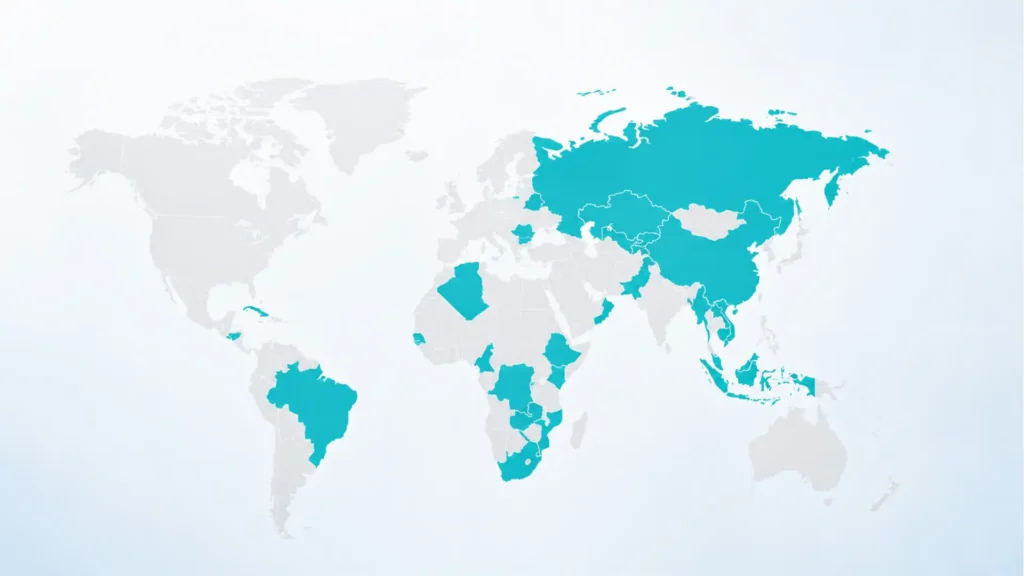
This article is an original analysis supported by the sources cited below
29 countries sign agreement on establishing World AI Cooperation Organization Xinhua’s July 16, 2026 dispatch confirming that 29 countries signed the WAICO establishment agreement in Shanghai.
Russia, China, 25 More States Sign Agreement to Create World AI Cooperation Organization Sputnik’s ceremony report naming Maksut Shadayev and Wang Yi as signatories and placing the signing ahead of WAIC 2026.
Xi to attend opening ceremony of 2026 World AI Conference, deliver keynote speech Chinese government confirmation of the July 17 to 20 conference dates and Xi Jinping’s keynote at the opening ceremony.
Xi Jinping to attend World AI Conference for first time as China elevates tech push South China Morning Post reporting on Xi’s first WAIC appearance, conference scale figures and China’s 2026 AI policy priorities.
Xi to Debut at China’s Flagship AI Summit as US Rivalry Heats Up Bloomberg’s analysis of Xi’s attendance as a signal of AI’s weight in Beijing’s rivalry with Washington.
Xi Jinping will give the keynote at China’s flagship AI summit for the first time The Next Web’s preview assessing what the keynote must contain for WAICO to gain definition, and the open-weights membership pitch.
DPM Dar to attend signing ceremony for China-led AI governance body in Shanghai Dawn’s report on Pakistan’s founding membership, Ishaq Dar’s Shanghai program and his bilateral with Wang Yi.
Dar arrives in Shanghai to sign Pakistan’s founding membership of China-led AI body Dawn’s arrival-day coverage noting WAIC 2026 attendees including Guterres, Tokayev, laureates Bengio and Sutton, and the thin US corporate presence.
Pakistan to become founding member of global AI cooperation body The Nation’s account of Pakistan’s July 16 signing at Wang Yi’s invitation and Dar’s Global South agenda at the governance meeting.
Ishaq Dar to sign AI body agreement in Shanghai Pakistan Today’s confirmation of the founding-member signature and the July 17 opening-ceremony participation.
DPM to undertake two-day China visit from tomorrow Radio Pakistan’s official curtain-raiser detailing the signing ceremony schedule and Pakistan’s stated priorities.
Dar heads to Shanghai to formalise Pakistan’s founding role in AI organisation The Express Tribune’s report including the People’s Daily commentary on technological monopoly and the conference guest list.
China accelerating establishment of World AI Cooperation Organization CGTN’s June 2026 report on the State Council Information Office briefing confirming accelerated preparations and the Shanghai headquarters plan.
Foreign Ministry Spokesperson Guo Jiakun’s Regular Press Conference on July 29, 2025 Primary-source Chinese government account of the 2025 conference outcomes, Li Qiang’s proposals and the original WAICO announcement.
China’s Pivot on Global AI Carnegie Endowment analysis of the thirteen-point action plan, China’s UN strategy, capacity-building network and the norms critique of exported Chinese models.
WAICO: Understanding China’s Global AI Cooperation Initiative Simon Institute assessment of WAICO’s likely programs, lead ministries, resourcing unknowns and the open-weight safety opportunity.
World Artificial Intelligence Cooperation Organization: Mapping an Emerging Institution in the Global AI Governance Regime Complex Peer-circulated study coding fifteen governance institutions and identifying WAICO’s unique combination of open membership, no values test and a development agenda.
PREVIEW: WAIC 2026 showcases Xi’s keynote, Huawei’s Atlas 950, ZTE’s AI Agent Phone, and China’s AI governance push George Chen’s preview reporting the Shanghai AI Laboratory’s de facto secretariat role and the SCO-style institutional template.
China is leading the world on AI governance: other countries must engage Nature’s December 2025 editorial urging global engagement with WAICO and proposing the IAEA verification model as a template.
Reading between the lines of the dueling US and Chinese AI action plans Atlantic Council expert analysis of the July 2025 American and Chinese action plans and the agenda-setting stakes of institutional competition.
What’s ‘World AI Cooperation Organization’ Launched by China to Counter Western Dominance in AI Governance Outlook Business explainer on the 2025 launch, Li Qiang’s monopoly warning, the 40-country outreach and the lower-income-market product pitch.
Xi Jinping Steps Onstage as China Pushes Rival AI Governance Body for Global South TechTimes synthesis of the Global South membership offer and the questions Xi’s keynote is expected to answer.
Xi Jinping to Headline AI Summit as China Narrows US Gap Seoul Economic Daily report citing Stanford’s 2.7-point model gap, OpenRouter token-share data and WAIC 2026 exhibition figures.
The Missing Resistance in China’s AI Debate Lawfare analysis of China’s state-led AI governance system, the 2017 development plan lineage and the May 2026 US-China guardrails agreement.
Nearly 200 Nations Step Through the Door Towards AI Governance Benton Institute summary of the UN Global Dialogue on AI Governance of July 6 and 7, 2026, including global compute concentration figures.
89 Nations Sign AI Impact Summit Declaration, But Can It Deliver? Medianama’s assessment of the February 2026 New Delhi declaration and the accountability limits of voluntary AI frameworks.
China and Russia Can Lead Way in AI: Leading Banker Report of Sberbank deputy chairman Alexander Vedyakhin’s remarks on Russia-China AI cooperation as an alternative technological architecture.
Russian scholars show interest in China’s AI tech, open-source models in Valdai Russian-Chinese conference in Shanghai Global Times coverage of the April 2026 Valdai conference documenting Russian institutional interest in Chinese open-source models under sanctions.
China’s AI Governance Proposal: WAICO Explained North American Academy of Sciences explainer on WAICO’s non-enforcing forum design, China’s open-weight strategy and treaty precedents from nuclear safety.
| Citing this article? Brief excerpts are welcome. Please credit Webiano.digital, name the author where stated, and include a link to https://webiano.digital and to this original article. Full or substantial republication requires prior written permission. Read our Copyright and Content Use Policy. |
This article was prepared with the assistance of artificial intelligence tools. The content underwent expert human review, and Webiano Digital & Marketing Agency assumes editorial responsibility for its final version and publication.