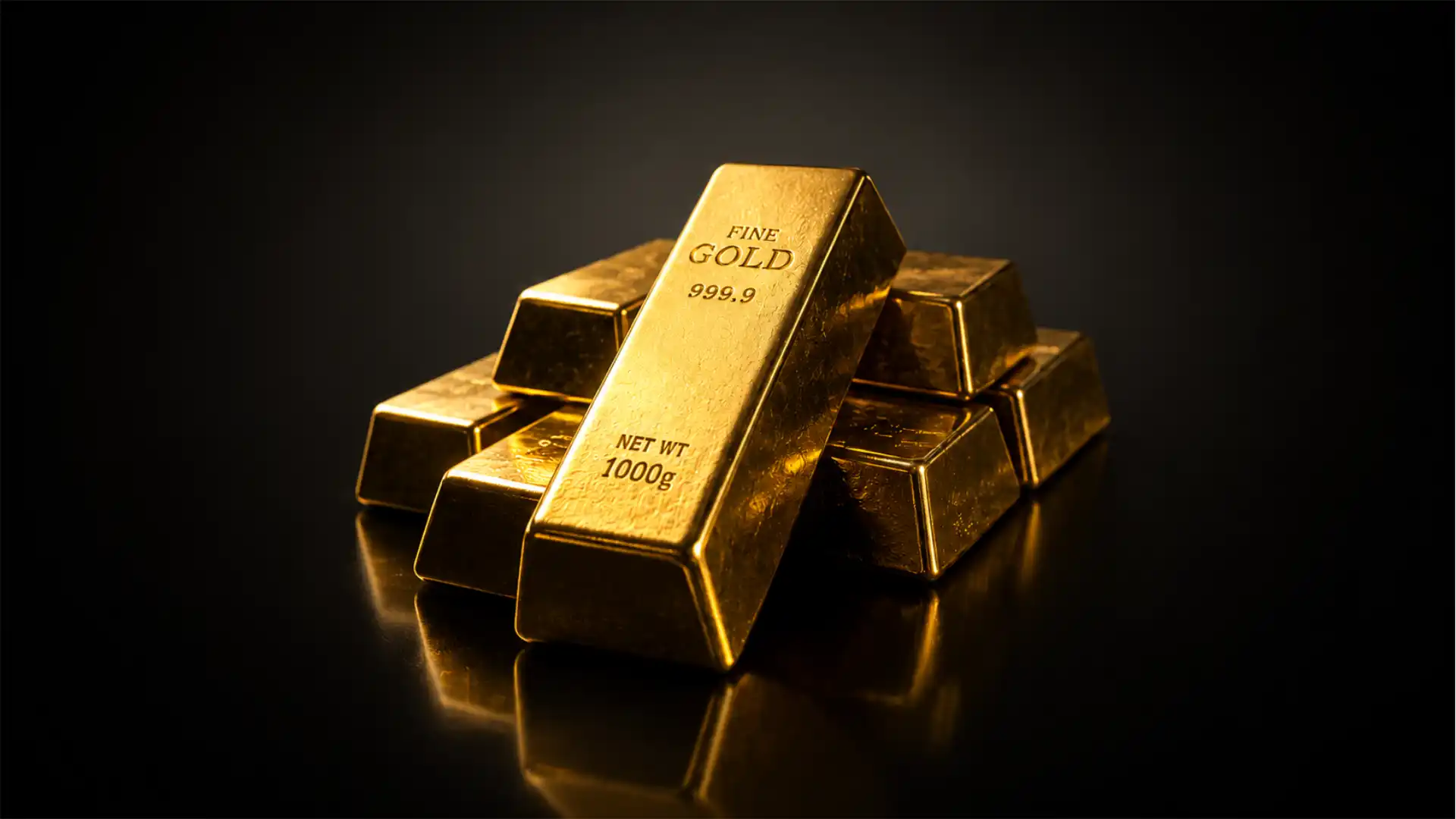
Artificial intelligence has become a real, measurable source of gold demand. High-performance computing uses gold in bonding wire, connectors and interconnect materials whose reliability matters in servers, networking equipment and advanced electronics. Yet AI has not turned gold into an “AI commodity” in the same sense that electrification has altered copper markets. The physical link exists, but it is narrow. The price link is broader, more indirect and much less predictable.
Table of Contents
The clearest evidence comes from the market’s own composition. In 2025, technology demand for gold was 322.8 tonnes, while total gold demand including over-the-counter activity reached 5,002.3 tonnes. Investment demand alone was 2,175.3 tonnes and central banks added 863.3 tonnes. Technology demand was broadly unchanged even as AI-related applications supported electronics demand; the large price move came alongside powerful investment flows, geopolitical concerns, reserve diversification and a changing outlook for rates and the US dollar.
That distinction matters for investors, company executives and anyone tempted by a tidy story that “AI needs gold, therefore gold must rise.” A stronger statement is available: AI can support a small but strategically important part of industrial gold use, while AI’s larger influence on bullion prices runs through financial markets, power systems, inflation expectations, productivity expectations and interest rates. Each channel works on a different timetable. Each can point in a different direction.
The direct connection begins inside electronic hardware
Gold’s industrial role is rooted in physics rather than fashion. It conducts electricity well, resists corrosion and can be made into very thin wire or plating. Those features make it useful where electrical contacts must keep working through heat, humidity, vibration and long service periods. The World Gold Council notes that gold has long been used in electronics because it does not corrode or tarnish like copper or silver and is easy to draw into narrow wire or apply as thin coatings.
AI workloads do not change those properties. They change the mix of equipment being produced. Large AI systems require accelerated servers, high-bandwidth memory, switches, optical networking, power-management components, storage and dense interconnects. The relevant gold is usually not a visible block of metal inside a graphics processor. It is found in small quantities across component packages, connector surfaces, contacts and bonding applications. These uses add up across vast production volumes, but each unit’s gold content is limited.
The distinction between “AI chips” and the wider data-centre stack is also useful. A server rack includes more than accelerator cards. It contains networking, power delivery, cooling controls, cables, storage and boards that must operate reliably at high utilization. Gold’s value is often greatest where failure is expensive. A tiny plated contact can be worth more than a cheaper alternative if it reduces a reliability risk in a high-value system.
World Gold Council research for 2025 described high-speed computing as supporting gold use in bonding wire and contact and interconnect materials. It also warned that the AI boom was creating tension elsewhere in electronics, as component capacity shifted toward AI-related applications and raised costs in consumer devices. That is a more realistic picture than the popular idea of a simple AI-driven gold shortage.
AI hardware uses gold, but it uses much more of other materials
The AI build-out is materially important for semiconductors, electricity, cooling systems and network infrastructure. Gold is part of the hardware story, not its central raw-material constraint. Silicon wafers, copper wiring, aluminum, specialty gases, chemicals, advanced packaging materials, power equipment and electricity shape far more of the physical and financial burden of deploying AI infrastructure.
This is not a dismissal of gold’s engineering role. Gold can be difficult to replace in specific high-reliability applications. It retains performance when oxidation would weaken another contact surface. It can form fine bonding wire. Precious-metal specialist Tanaka, for example, supplies pure-gold and precious-metal-coated bonding wires for electronics applications, illustrating that gold remains an active packaging material even after years of substitution efforts.
Still, material relevance does not equal price-setting relevance. Copper prices can react strongly to a change in expected electrical infrastructure because copper is used in large, visible volumes across grids, cables and equipment. Gold is different. It is durable, stock-like and heavily held for monetary and investment purposes. Most of the gold ever mined remains above ground in jewellery, bars, coins, vaults and central-bank reserves. New industrial purchases matter, but they enter a market whose price is dominated by the willingness of holders and investors to buy, sell or continue holding.
The semiconductor industry’s revenue boom shows the scale of AI demand without proving a one-for-one increase in gold use. Global semiconductor sales reached $791.7 billion in 2025, up 25.6% from 2024, according to the Semiconductor Industry Association. Much of that growth came from the highest-value logic and memory products used in advanced computing. Revenue, however, reflects pricing, product mix and technical complexity as well as shipment volume. It cannot be translated directly into tonnes of gold.
Scale puts the AI link in perspective
A market-share view clarifies why AI has a limited direct grip on bullion prices. The table uses the World Gold Council’s 2025 global figures. Shares are calculated against total gold demand including over-the-counter activity, so they are useful as scale indicators rather than as a trading model.
Gold demand in 2025 shows the size gap
| Gold-market category | 2025 demand | Approximate share of total demand | Relevance to the AI question |
|---|---|---|---|
| Technology | 322.8 tonnes | 6.5% | AI supports part of electronics use, but no published figure isolates AI-only gold demand |
| Investment | 2,175.3 tonnes | 43.5% | ETF flows, bars, coins and other investment activity are major price-moving channels |
| Central banks and other institutions | 863.3 tonnes | 17.3% | Reserve diversification affects the market far more than AI hardware procurement |
| Jewellery fabrication | 1,638.0 tonnes | 32.7% | High prices can reduce volume demand while still lifting the value of sales |
| Total demand including OTC | 5,002.3 tonnes | 100.0% | The denominator for the shares above |
Technology demand was smaller than investment demand by a wide margin in 2025, and its year-on-year change was negative one percent. Investment demand rose 84%, while physically backed ETFs added 801.2 tonnes after small net outflows in 2024. The market data do not support the claim that the 2025 gold rally was caused by AI hardware demand. They support a narrower claim: AI helped stabilize technology demand during a difficult period for consumer electronics.
The same pattern continued into early 2026. First-quarter technology demand edged one percent higher to 81.6 tonnes, while the electronics component rose three percent to 69.3 tonnes. The World Gold Council attributed the resilience mainly to AI infrastructure. Yet the same quarter also featured record-high gold prices, strong bar-and-coin buying and 243.7 tonnes of central-bank net purchases. A small industrial increase and a large monetary-market move occurred at the same time; correlation alone cannot assign the price move to AI.
A small amount of gold can still have high technical value
Gold’s physical volume in a device can be modest while its function is critical. The metal is not chosen because it is cheap. It is chosen where the expected cost of failure exceeds the material saving from using less gold or a different metal. That logic is familiar in aerospace, medical devices, telecommunications and high-end computing. AI infrastructure inherits it because it is dense, expensive and expected to operate at high duty cycles.
This creates a useful distinction between material intensity and functional intensity. Material intensity asks how many grams of gold are used per server, switch or accelerator. Functional intensity asks whether a small quantity occupies a point of failure that cannot be easily compromised. Gold’s importance lies more often in the second category.
Manufacturers still have powerful reasons to minimize gold use. Rising gold prices make plating thickness, wire diameter, alloy choice and package design recurring cost questions. Semiconductor packaging has moved over time toward copper, silver alloys and other alternatives in applications where they meet performance and manufacturing requirements. Gold’s role is therefore subject to “thrifting”: engineers seek the same performance with less precious metal.
That response limits the direct-demand case for gold. Rising AI equipment output may increase the number of components requiring contacts or interconnects, but gold intensity per unit need not rise. It may fall. A demand forecast that counts future servers without accounting for substitution, redesign and lower gold loading will overstate the effect on the bullion market.
The same reasoning explains why direct AI demand is better treated as a supporting factor than as a stand-alone thesis. Gold’s industrial use benefits from the production of reliable electronics; its price still reflects the monetary value people place on holding an asset with no issuer and no credit risk.
The price of gold is formed in financial markets
Gold’s benchmark price is not set at a mine gate or inside a server factory. It is formed in a global market where bullion, derivatives, exchange-traded products, central-bank activity, refining, fabrication and institutional portfolios meet. The LBMA Gold Price is a global benchmark for unallocated gold delivered in London and is produced through electronic auctions operated by ICE Benchmark Administration.
That market structure has consequences. A data-centre procurement officer buying equipment affects gold demand indirectly and diffusely through suppliers. A global investor buying or selling a gold-backed ETF can move the balance of available bullion and market sentiment far more quickly. A central bank changing the composition of reserves can do the same over a longer horizon. Futures positioning can amplify short-term moves without changing physical electronics demand at all.
The World Gold Council’s 2025 figures make this clear. Total technology demand was 322.8 tonnes, while ETF holdings increased by 801.2 tonnes. Investment demand, which includes ETFs and bar-and-coin purchases, was 2,175.3 tonnes. These flows were occurring in a market where the annual average LBMA Gold Price rose 44% to $3,431.5 an ounce.
None of this makes industrial demand irrelevant. Technology demand contributes a steady base of physical consumption and can matter at the margin. The point is hierarchy. A large change in investment appetite can overwhelm a modest change in electronics fabrication demand. Gold’s short-run price is usually a financial signal before it is an industrial signal.
Investment flows outweigh data-centre procurement
AI investment changes the economy’s demand for computing equipment. Gold investment changes the immediate financial demand for bullion. The two are different in speed and scale. A hyperscaler may plan server purchases over quarters, constrained by chip availability, construction schedules and power connections. ETF investors can add or remove exposure in minutes.
This timing difference matters when markets become nervous. If a disappointing AI earnings report triggers a broad equity sell-off, gold can rise because investors seek protection from financial stress. It can also fall if the sell-off forces leveraged investors to raise cash by selling liquid assets, including gold. The direction depends on the character of the shock, the level of real yields, the US dollar and the urgency of deleveraging.
There is no permanent inverse relationship between AI stocks and bullion. In calm, liquid markets, both can rise: AI shares on growth expectations and gold on falling real yields, a weaker dollar or reserve diversification. In a sharp growth scare, AI shares may fall while gold rises. In a rate shock, both can fall if higher yields reduce the appeal of long-duration growth equities and non-yielding gold simultaneously.
The European Central Bank has found that gold has tended to perform well during episodes of elevated geopolitical risk and economic-policy uncertainty, while stocks and bonds often weaken. It also cautions that this safe-haven role is strongest in stress episodes rather than in every ordinary market decline.
That is the more relevant investment link: AI can alter the behaviour of risk assets, but gold reacts to the macro-financial conditions created by that behaviour. It does not automatically trade as the opposite side of an AI-stock position.
Central-bank buying carries more weight than server racks
Central banks do not buy gold because they expect more GPUs to be installed. They buy or hold it for reserve diversification, liquidity, lack of issuer risk and, in some cases, resilience against geopolitical or sanctions-related concerns. Those motives are distinct from industrial demand and are large enough to shape the market narrative.
In 2025, central banks and other institutions bought a net 863.3 tonnes, down from 1,092.4 tonnes in 2024 but still far above the pace seen before the recent wave of official-sector accumulation. The National Bank of Poland was the largest buyer in the World Gold Council’s estimates, adding 102 tonnes during the year.
The data contain an important caution. Official-sector figures are estimates that can differ from International Monetary Fund reserve data because purchases may be reported late, not reported publicly or classified differently. Brookings noted that the World Gold Council’s 2025 estimate exceeds the amount visible in IMF data, partly because of unreported transactions and the inclusion of other official institutions.
For the AI-gold question, the conclusion is straightforward. A central bank decision to diversify reserves can shift hundreds of tonnes of demand; AI-related electronics growth is measured in a smaller slice of the technology category. Investors who watch only chip shipments are therefore watching the less influential side of the gold market.
This does not make the industrial story uninteresting. It simply places it in proportion. AI can strengthen the floor under technology demand. Central banks, ETF flows and bar-and-coin demand have more power to change the price level at which that technology demand is met.
Real interest rates remain the core macro variable
Gold does not pay a coupon, dividend or deposit rate. Holding it therefore involves an opportunity cost: the return an investor gives up by not holding an interest-bearing asset. The relevant comparison is not merely nominal interest rates. It is expected real interest rates, adjusted for expected inflation and viewed over the horizon investors care about.
Research from the Federal Reserve Bank of Chicago identifies long-term real rates, expected inflation and pessimism about future economic conditions as major drivers of the real gold price. Its historical estimates found that a one-percentage-point increase in the long-term real interest rate was associated with a 13.1% decline in the real gold price, while the relationship varied across eras and should not be treated as a mechanical daily rule.
AI matters here because it may affect growth, investment and inflation expectations. If markets decide AI will lift productivity without causing a lasting inflation problem, they may expect stronger real growth and potentially higher real returns on capital. That can raise real yields and create a headwind for gold. If markets instead see AI infrastructure spending as demand-heavy, energy-constrained and inflationary, they may expect rates to remain high but also worry about policy error or fiscal strain. Gold’s response could then differ.
The key phrase is “may.” These are competing macroeconomic paths, not settled facts. AI is a possible input into the rate outlook, not a replacement for it. Anyone examining gold’s response to AI should monitor real yields directly rather than infer them from headlines about model releases or chip launches.
The US dollar changes the transmission
Gold is generally quoted in US dollars. A stronger dollar makes an ounce more expensive in other currencies, which can restrain foreign physical demand. A weaker dollar can support demand from buyers whose domestic currency has strengthened against it. The dollar also reflects interest-rate expectations, capital flows, risk appetite and perceptions of US economic policy.
AI can affect the dollar through several routes. A sustained AI-led investment boom in the United States could attract capital and support the dollar. Stronger productivity could improve expected returns on US assets. A surge in imports of hardware and energy equipment could push in the opposite direction through trade channels, while the effect of fiscal spending and monetary policy would depend on the broader economy.
These are macroeconomic connections, not hardware-supply connections. An AI server purchased in Virginia does not directly change the dollar price of gold because it contains gold. It matters only if millions of such investment decisions alter growth, inflation, interest rates, trade flows or investor appetite for US assets.
The World Gold Council’s 2025 market report attributed strong investment demand to safe-haven and diversification motives, while the World Bank’s commodity outlook also emphasized central-bank demand, monetary easing expectations and geopolitical uncertainty as the main background for elevated gold prices. AI hardware demand was not the central explanation.
For gold investors outside the United States, currency exposure adds another layer. Gold can rise in dollars but behave differently in euros, pounds, yen or other currencies. An AI-driven shift in US growth expectations may therefore have one effect on the dollar price and another on the local-currency price paid by an investor abroad.
AI capital spending is a financial-market story first
The scale of AI investment is not in doubt. Nvidia reported fiscal 2026 revenue of $215.9 billion, up 65% year on year, and fourth-quarter data-centre revenue of $62.3 billion, up 75%. TSMC described demand for its advanced technologies as robust, with three-nanometre technology contributing 24% of wafer revenue in 2025.
Those figures show why AI has become a market-wide narrative. The spending is big enough to influence stock indices, corporate capital expenditure, semiconductor supply chains, electricity planning and national industrial policy. It can change the composition of market leadership. It can also create concentration risk if a small number of companies account for a large share of index gains and capital spending.
For gold, the important question is not whether AI capex is high. It is whether the spending creates a macroeconomic imbalance or a financial vulnerability. Heavy investment funded from strong cash flows is different from investment funded by fragile leverage. A profitable productivity wave is different from a wave of duplicated capacity built on unrealistic demand assumptions.
The International Monetary Fund warned in its January 2026 World Economic Outlook Update that a reevaluation of AI-related productivity expectations could reduce investment and trigger an abrupt financial-market correction that spreads beyond AI-linked companies. That is not a prediction that such a correction will happen. It is a reason to treat AI enthusiasm as a possible source of broader market volatility.
Gold may benefit in a disorderly risk-off phase if investors seek a hedge against equity-market stress and policy uncertainty. It may not benefit if the shock causes a rush for dollars, rising real yields or forced liquidation. The underlying story matters more than the word “AI.”
Productivity gains can create opposing effects on gold
The popular story says AI will lower costs, reduce inflation and make gold less necessary. The opposite story says AI will trigger an investment boom, increase electricity demand and keep inflation and rates high. Both contain plausible elements. Neither should be treated as a finished forecast.
The IMF’s 2025 analysis of AI’s global impact found that productivity shocks can produce modest short-term inflation pressure if rising expected income and investment lift demand before new supply capacity is fully realized. Over time, higher productivity and capital accumulation can increase supply capacity and reduce inflation. The sequence, magnitude and distribution of these effects differ by country.
For gold, this creates a two-stage possibility. In an early expansion phase, AI spending could add demand pressure in construction, energy and skilled labour markets. Central banks might maintain tighter policy, pushing real yields higher and pressuring gold. In a later phase, if productivity gains reduce unit costs broadly, inflation expectations may fall. Lower inflation expectations can also be a gold headwind unless nominal rates fall even faster.
A third outcome is possible: AI productivity gains remain concentrated in a narrow set of firms and sectors. In that case, the benefits to aggregate productivity may arrive more slowly than capital spending. Market valuations can move well ahead of measured output. Gold would then respond less to actual AI adoption and more to the financial conditions surrounding the investment boom.
There is no single “AI effect” on gold because AI can be simultaneously disinflationary in production, inflationary in investment and destabilizing in financial markets. The balance changes over time.
Electricity demand is the strongest indirect physical channel
The most consequential indirect channel runs through electricity. AI models require data centres; data centres require power, cooling and grid connections. Those requirements are large enough to change regional energy systems, which can affect energy prices, construction costs, inflation expectations and political choices about power supply.
The International Energy Agency projects global data-centre electricity consumption to double to about 945 terawatt-hours by 2030 in its base case. It expects accelerated servers, mainly driven by AI adoption, to increase electricity use by roughly 30% a year and account for almost half of the net growth in data-centre power demand.
The United States illustrates the scale of the local challenge. The Department of Energy, citing Lawrence Berkeley National Laboratory, reported that data-centre load growth had tripled over the preceding decade and could double or triple again by 2028. A separate DOE resource hub estimated that data centres used about 4.4% of US electricity in 2023 and could account for roughly 6.7% to 12% by 2028.
Gold does not gain a direct industrial-demand windfall from each kilowatt-hour consumed. The relevant link is macroeconomic. If data-centre growth tightens regional power markets, raises energy costs or forces costly grid investment, inflation can prove stickier than expected. If the spending accelerates renewable generation, transmission and storage without creating broader inflation, the outcome may be different. If power constraints slow AI deployment, equity expectations and capex plans may be revised.
The electricity channel is therefore more powerful than the connector channel, but still indirect. It changes the economic setting in which gold is priced.
Local power bottlenecks matter more than global averages
A global number such as 945 terawatt-hours can obscure the practical issue: electricity systems are local. A country may have enough generation in aggregate while a specific region lacks transmission capacity, firm power or water infrastructure for a cluster of large data centres. Connection queues, transformer shortages and permitting delays can turn an AI investment plan into a multi-year infrastructure problem.
The IEA expects the United States and China to account for nearly 80% of global growth in data-centre electricity consumption through 2030. In the United States, projected per-capita data-centre electricity use rises from about 540 kilowatt-hours in 2024 to more than 1,200 kilowatt-hours by the end of the decade in the agency’s base case.
This concentration influences the gold market only if it changes financial conditions. A localized surge in electricity prices can hurt the margins of other industries, alter household bills and pressure state regulators. Large transmission and generation investment can strengthen demand for industrial materials and labour. Political responses may include capacity payments, tax incentives, industrial tariffs or restrictions on data-centre development.
EPRI’s 2026 scenarios estimated that US data centres could consume 9% to 17% of national electricity by 2030, up from roughly 4% to 5% at the time of its analysis. The wide range itself is a warning: the outcome depends on project execution, infrastructure delivery and the pace at which announced data-centre plans become operating facilities.
For gold, uncertainty about these bottlenecks can matter more than the average consumption estimate. Markets price the risk that a growth story collides with real-world constraints. AI power demand is one place where that collision could show up.
Inflation pressures do not automatically make gold rise
Gold is often described as an inflation hedge, but the phrase is incomplete. Gold has historically responded not only to inflation but to expected inflation, real yields, the dollar, financial stress and the credibility of monetary policy. A period of higher inflation accompanied by much higher nominal and real rates can be difficult for gold. A period of modest inflation accompanied by falling real yields can be favorable.
AI-related investment could raise certain prices even if it improves productivity elsewhere. Grid equipment, specialized cooling systems, data-centre construction, advanced chips and skilled engineering capacity can become bottlenecks. This is a relative-price story before it becomes a general-inflation story. An expensive transformer or a constrained power connection does not automatically change the overall price level enough to shift monetary policy.
The IMF’s work on AI, ICT capital and the natural rate of interest captures this ambiguity. Across its scenarios, faster AI-related investment raised annual GDP growth, inflation and the natural rate of interest by varying amounts. Under strong complementarity between technology and labour, the rise in the natural rate could be much larger; under stronger substitution, wage and price pressure could ease.
That matters because a higher equilibrium real rate can weigh on gold even in a high-investment economy. A lower-inflation productivity boom can also weaken the case for gold if it is accompanied by higher real returns on bonds and cash. Gold’s bullish AI scenario is therefore not “more data centres equals more inflation.” It is closer to “AI investment produces enough macro or financial strain to lower real-rate confidence, weaken the dollar or increase the demand for hedges.”
A practical map of the AI-gold channels
The channels below separate direct physical demand from the economic and market effects that could influence bullion pricing. They are mechanisms, not forecasts.
The AI-gold relationship has four distinct routes
| Channel | Near-term effect on gold demand | Likely influence on bullion price | Evidence worth watching |
| Electronics and packaging | Incremental support for technology demand | Usually limited on its own | Technology-demand data, packaging trends, gold thrifting |
| AI capital expenditure | No direct bullion demand from capex totals | Can affect risk appetite, equity concentration and credit conditions | Hyperscaler spending, chip orders, earnings revisions |
| Data-centre electricity growth | Indirect and delayed | Can affect inflation, rates and growth expectations | Power prices, connection queues, grid investment |
| AI productivity outcomes | No direct physical demand | Can raise or lower real rates, inflation expectations and the dollar | Productivity data, wages, policy rates, real yields |
The table explains why one-sided claims fail. A rise in AI electronics output may be mildly supportive for gold fabrication demand. A surge in AI productivity may be bearish for gold if it lifts real rates. A power shock connected to data-centre growth may be supportive if it creates inflation concerns or policy uncertainty. A collapse in AI investment may support gold during a risk shock or hurt it during a dollar-and-liquidity scramble.
The important task is to identify the active channel rather than attach every gold move to AI. That is also the disciplined way to read news about chip shortages, data-centre projects and AI earnings.
The AI trade can become a source of risk-off demand
AI enthusiasm has concentrated capital in a relatively small group of companies, suppliers and infrastructure projects. Concentration does not guarantee a collapse, but it raises the market impact of a disappointment. If earnings, margins, power availability or adoption rates fail to justify capital expenditure, the correction may spread through indices, corporate debt and private-market valuations.
The IMF’s scenario work on the economic and financial implications of AI identifies financial-market volatility as one of the paths through which AI diffusion could produce broader consequences. The institution does not present a single baseline outcome; it stresses uncertainty about adoption, investment, labour displacement, market structure and policy responses.
Gold’s historical behavior in stress gives it relevance here. The ECB finds that gold has often performed as a safe haven during high geopolitical risk, policy uncertainty and extreme stock-market volatility. That record does not mean it is a guaranteed hedge against an AI correction. Gold can fall during early liquidation, especially if investors need US dollars or if real yields rise.
The strongest gold-supportive AI-risk scenario is not a gentle re-rating of expensive technology stocks. It is a broader loss of confidence involving financial stress, uncertainty about growth or concerns that policy makers have limited room to respond. The strongest gold-negative scenario is a smooth productivity boom with rising real returns, a firm dollar and little inflation anxiety.
Those two paths show why the same AI headline can lead to opposite market reactions. A large model release can be interpreted as evidence of future productivity, driving yields higher. The same release can be interpreted as evidence that capital spending will remain enormous, increasing concern about power constraints and valuation risk.
Gold is not a substitute for AI equities
Gold and AI equities solve different investor problems. AI-related shares provide exposure to corporate earnings, technological leadership, pricing power and productivity growth. Gold offers no earnings stream. Its appeal rests on scarcity, liquidity, lack of issuer credit risk and its historical role in diversification and reserve management.
Treating gold as an “AI hedge” can therefore be misleading. A hedge should have a defined relationship to the risk being hedged. Gold does not reliably rise every time AI stocks fall. It may hedge particular forms of market stress, currency weakness or falling real rates. It does not hedge the business risk of a specific chip maker, cloud company or software platform.
This matters for portfolio construction. A person concerned that AI valuations are excessive must first identify the feared outcome. Is the concern a broad equity correction? A rise in yields? A recession? A credit event? Persistent inflation from capex and energy demand? A stronger dollar? Gold has different historical sensitivities to each.
The World Gold Council describes gold as having a “dual nature,” combining consumer and industrial uses with an investment role. That structure helps explain its behavior. Gold can benefit from a weakening local currency or geopolitical stress even when fabrication demand is soft. It can face pressure from high real rates even when electronics demand is firm.
Gold is best viewed as a macro asset with industrial demand, not as a direct proxy for AI adoption. The difference is not semantic. It determines whether a portfolio is positioned for a technology cycle, a monetary cycle or a risk-management need.
Gold’s physical supply responds slowly
Gold supply does not respond to a price rise as quickly as many manufactured goods. New mines require exploration, permitting, financing, construction and years of operational work. Existing mines can adjust grades, recoveries and mine plans, but their capacity is constrained by geology, energy, water, labour and equipment.
In 2025, mine production rose only one percent to 3,671.6 tonnes, while recycled gold increased three percent to 1,404.3 tonnes. Total supply rose one percent to 5,002.3 tonnes. The relatively modest supply response occurred despite a sharp rise in the gold price, reinforcing the idea that gold supply is slow-moving at the global level.
AI could enter the supply side through mine planning, exploration targeting, predictive maintenance, ore sorting and processing control. Machine-learning models can analyze geological data, detect operational anomalies and help operators decide where to drill or how to process variable ore. These uses may lower costs or improve recovery at individual operations.
The practical limit is scale and timing. A better model cannot create a deposit where geology does not support one. It cannot remove the permitting, social-license, water and infrastructure constraints that shape mine development. Nor is there public evidence that AI use in mining has yet altered global gold supply enough to explain price movements.
The realistic conclusion is that AI may improve the productivity of some mines over time. It is not a near-term mechanism for flooding the gold market with new supply.
Thrifting and substitution curb the hardware-demand upside
Gold’s high price is a strong incentive for manufacturers to reduce its use. In electronics, “thrifting” means using thinner coatings, smaller contacts, lower-volume bonding techniques or more efficient package designs while maintaining reliability. Substitution means shifting to copper, silver alloys, nickel, palladium or other materials where performance standards allow.
The process is not frictionless. A replacement metal may oxidize more easily, require different manufacturing conditions or perform less well in a demanding environment. Gold remains attractive in applications where failure risk is costly. Yet the long history of substitution is central to the AI-gold question because it prevents a simple extrapolation from rising equipment volumes to rising gold tonnage.
The World Gold Council’s 2025 technology commentary reflected this tension. It reported that AI-related electronics demand helped gold use in high-speed computing, but overall technology demand was stable rather than surging because weakness and volatility in consumer electronics offset the gains.
AI servers may also be more valuable and more complex than consumer devices, encouraging the use of higher-reliability components. But their production volumes are much lower than the volumes of smartphones, laptops and mass-market consumer electronics. A server-heavy mix does not automatically generate more total gold demand than a broad consumer-electronics boom.
This is another reason to avoid grand claims. AI can improve the quality of gold demand in certain electronics niches without changing the global metal balance enough to drive price discovery.
Recycling gives the market a secondary supply valve
Gold is highly recyclable. Jewellery, industrial scrap, refinery residues and electronic waste all create a secondary supply stream. The economics of recovery depend on the gold content of the material, collection systems, refining costs, regulation and the gold price.
Electronic waste is particularly relevant to the AI conversation because more data-centre hardware eventually means more retired boards, connectors and equipment. Yet the path from a decommissioned server to recovered gold is long. Hardware may be reused, resold, stored or disassembled across several countries. Recovering small quantities economically requires efficient collection and specialized processing.
The World Gold Council has highlighted the metal value contained in electronic waste and the opportunity for recycling, while also noting that recovery is constrained by collection and processing systems.
In 2025, recycled gold rose only three percent despite the large increase in the dollar gold price. That response was more muted than a simplistic price model might predict. Holders may wait for higher prices, jewellery may be retained for cultural or savings reasons, and physical collection systems cannot expand instantly.
AI could eventually increase the stock of recoverable gold in data-centre equipment. It does not create immediate supply. The first major wave of AI infrastructure is still being installed. Its gold-bearing components will remain in use for years, then pass through resale and recycling channels. This is a long-duration supply effect, not a near-term explanation for gold-price movement.
AI may improve gold mining economics at the margin
Mining is an information-heavy business. Deposits are uneven, ore grades vary, equipment fails, plants process complex material and decisions are made under uncertainty. These characteristics make mining a plausible setting for advanced analytics and machine learning.
AI tools can assist in several areas: geological targeting, geometallurgical modeling, predictive maintenance, energy management, fleet dispatch, process control and safety monitoring. Better predictions can reduce wasted drilling, identify equipment issues earlier or help a plant manage ore variability. In a mature mine, a small improvement in recovery or downtime can be financially material.
The price effect remains uncertain. Lower costs can improve margins without increasing total output. Better targeting can direct exploration budgets toward more promising areas without producing a mine for many years. Higher efficiency can extend the life of a project rather than increase annual production. These outcomes affect individual companies before they affect global gold supply.
The US Geological Survey’s 2026 mineral summary records the scale of the global market but offers no evidence that AI adoption has altered gold’s world supply balance. That absence is instructive. The mining-AI story is commercially credible, but it remains far too early to treat it as a macro supply shock.
A disciplined investor should separate three claims: AI can improve mine operations; some gold companies may benefit from that improvement; and global bullion prices will fall because AI sharply raises supply. The first is plausible, the second is company-specific, and the third is currently unsupported.
Gold miners carry a different kind of AI exposure
A gold miner is not a substitute for gold bullion. Its share price reflects the gold price, production volume, costs, reserve life, capital expenditure, country risk, hedging, management decisions, labour relations and currency exposure. AI can affect a miner’s costs and productivity, but it does not remove these other variables.
A gold miner may gain from AI through higher recovery, lower downtime or improved exploration targeting. It may also face higher costs because AI data-centre growth increases competition for electricity, engineers, equipment or capital. The outcome depends on mine location, power contracts, grid exposure and the company’s own technology capabilities.
Bullion has no operating leverage. A gold miner does. If gold rises while costs remain stable, miner margins can expand quickly. If gold falls or operating costs rise, the same leverage works in reverse. An investor who wants exposure to monetary gold and an investor who wants exposure to mining productivity are making different bets.
AI-related technology stocks add a third exposure. They depend on demand growth, hardware supply, energy availability, competition and valuation. A portfolio that holds gold, miners and AI shares is not diversified merely because it has three labels. Its resilience depends on the actual drivers of each holding.
The practical lesson is to analyze the instrument, not the story attached to it. Gold bullion reflects the monetary and investment market. Gold miners reflect that market plus operating execution. AI companies reflect future cash flows, capital intensity and competition.
Semiconductor expansion supports the direct demand case
The direct case for AI support is strongest when viewed as part of broader high-performance computing growth. Semiconductor demand has accelerated, advanced-node capacity remains valuable and packaging has become more important as chip designers pursue performance through multi-chip systems and high-bandwidth memory.
TSMC’s 2025 annual report described AI demand as positive and noted robust demand for advanced technology nodes. The company’s three-nanometre process accounted for 24% of wafer revenue during the year. Nvidia’s data-centre results showed the commercial force behind that demand.
SEMI forecast strong growth in semiconductor manufacturing equipment spending and noted a continued recovery in assembly and packaging equipment, a segment relevant to advanced packages and interconnect-intensive designs.
Gold’s role is present throughout this ecosystem, but it is only one of many material inputs. The more credible conclusion is not that gold will track semiconductor sales. It is that a sustained expansion in advanced computing reduces the chance that technology demand for gold collapses, even if consumer devices remain weak. That is a supportive demand-floor argument, not a price-target argument.
The 2025 and early-2026 data fit this interpretation. Technology demand remained stable in 2025 and rose slightly in the first quarter of 2026. The AI infrastructure boom helped offset weakness elsewhere. It did not produce a spectacular rise in total gold technology demand, because other electronics cycles and cost pressures still mattered.
The strongest bearish AI scenario for gold is orderly success
It may sound counterintuitive, but a successful AI boom can be bearish for gold under certain conditions. Suppose AI raises productivity across the economy, lifts expected profits, improves supply capacity, keeps inflation contained and supports higher real returns on bonds and equities. Suppose the dollar stays firm because US investment returns remain attractive. In that world, the opportunity cost of holding non-yielding gold can rise.
This is not the only successful-AI outcome. Productivity might arrive alongside heavy investment and persistent supply constraints. Still, it is the cleanest case in which AI’s economic benefits weaken the monetary case for gold.
The IMF’s analysis of AI and the natural rate makes this possible path explicit. Its scenarios show that AI-related ICT investment can lift growth, inflation and the natural rate of interest, with the result sensitive to the relationship between technology and labour. A higher natural rate could mean that higher real yields persist even if central banks are no longer fighting a temporary inflation surge.
Gold would not necessarily collapse in such a scenario. Central-bank demand, geopolitical risk and reserve diversification could still support it. The point is causal discipline. AI progress itself is not intrinsically bullish for gold. Its consequences for real yields, the dollar and perceived economic stability determine the direction.
This is also why forecasts based solely on the amount of electricity AI will use are incomplete. Large power consumption could signal bottlenecks and inflation, or it could be met by abundant generation and efficient infrastructure. Markets will focus on the difference.
The strongest bullish AI scenario for gold is disorderly strain
The bullish AI scenario is not simply more chips. It is a world in which the AI investment race strains power systems, raises capital needs, concentrates market risk and produces a conflict between growth ambitions and monetary stability.
Under that scenario, data-centre demand could collide with slow grid expansion. Electricity and infrastructure costs could rise in important regions. Investors could worry that valuations assume revenue growth that depends on power, chips and customers arriving on schedule. Central banks could face a difficult mix of investment-led demand, uneven productivity gains and persistent price pressures.
Gold might benefit if these conditions weaken confidence in the path of real rates, increase demand for reserve diversification or lead investors to seek protection from financial stress. The metal would be responding to uncertainty and macroeconomic strain, not to physical gold use in AI devices.
The World Bank’s commodity outlook has repeatedly connected elevated gold prices to safe-haven demand, central-bank purchases, geopolitical tension and monetary-policy expectations. These drivers can interact with AI-related investment strain, but they remain broader than the technology cycle.
A disorderly scenario should not be treated as a base case. It is a risk pathway. The value of laying it out is that it explains the conditions under which AI could matter a great deal to gold prices without requiring a large increase in tonnes of gold used by data centres.
The price evidence argues against a simple AI thesis
The market has already provided a useful test. During 2025, gold’s annual average price rose 44% while technology demand fell one percent to 322.8 tonnes. At the same time, investment demand rose 84% and ETF holdings increased by 801.2 tonnes.
A simplistic AI-demand story would struggle to explain that combination. If AI hardware demand were the dominant gold-price driver, one would expect a much closer relationship between technology tonnage and price. Instead, the data point to a market in which investment appetite and official-sector demand can dominate the annual movement, while industrial demand remains a stabilizer.
Early 2026 adds another observation. First-quarter technology demand rose one percent, and electronics demand rose three percent. Gold’s quarterly average price was 70% higher year on year, while central banks bought 243.7 tonnes and bar-and-coin demand rose 42%.
The interpretation should remain modest. One quarter cannot prove causality. Gold prices are affected by many simultaneous variables. Yet the mismatch between a small change in technology demand and very large movements in price reinforces the core conclusion.
AI is becoming part of the demand background for gold. It is not the main switch that turns the gold price up or down.
Signals that separate evidence from narrative
A sensible monitoring framework should track direct demand, macro conditions and financial positioning separately. Mixing them produces confident but weak conclusions.
For the direct AI channel, watch World Gold Council technology-demand data, semiconductor packaging trends, high-performance computing shipments and evidence of substitution away from gold in contacts and bonding. Stable or rising technology demand confirms that AI is supporting fabrication. It does not by itself establish a bullish price signal.
For the macro channel, watch long-term real yields, inflation expectations, US-dollar strength, central-bank guidance, electricity prices in data-centre regions and the pace of grid construction. These variables explain much more of gold’s price sensitivity. The Federal Reserve Bank of Chicago’s research is particularly useful as a reminder that real rates and expected inflation matter more than a narrow industrial-use story.
For the market-risk channel, watch AI capital-spending plans, credit conditions, equity-market breadth, concentration in major indices and revisions to productivity expectations. The IMF’s warning about the potential for a reevaluation of AI expectations to trigger a wider correction shows why this deserves attention.
Finally, watch the official sector. Central-bank purchases and gold ETF flows can change the physical and financial balance quickly. An AI story may dominate headlines while reserve managers and ETF investors determine the market’s larger directional move.
A disciplined decision framework avoids false precision
The AI-gold relationship is useful only when it is framed as a set of conditional scenarios. Start with the direct fact: AI infrastructure supports certain uses of gold in electronics. Then ask whether that support is large enough to change total technology demand materially. The data so far suggest incremental support, not a transformative surge.
Next, identify the relevant macro result. Is AI lifting real rates? Weakening the dollar? Raising inflation anxiety? Causing a power bottleneck? Improving productivity without strain? Each outcome has a different implication for gold. A single word such as “AI” cannot substitute for this analysis.
Third, distinguish bullion from related assets. Physical gold, ETFs, futures, miners, semiconductor companies and utilities all respond to different combinations of variables. A reader looking for an AI investment thesis should not assume that buying gold provides focused AI exposure. A reader looking for a hedge against AI valuation risk should not assume that gold supplies a perfect offset.
The most defensible conclusion is deliberately narrow: AI is a modestly positive structural factor for gold’s technology demand and a potentially important indirect factor for the macro environment. Gold prices will still be led primarily by investment flows, real rates, the US dollar, central-bank behavior and risk perception.
That conclusion is less dramatic than the claim that AI will make gold scarce. It is more useful because it matches the structure of the market.
The next phase will test the indirect channels
The next few years will reveal more about AI’s indirect effect than its direct use of gold. Chip demand has already demonstrated the commercial force of AI infrastructure. Electricity systems, grid policy, data-centre build schedules and productivity statistics will determine whether the boom becomes a broad economic transformation or a narrower capital-spending cycle.
The IEA’s projections show that AI-related computing can become a material source of electricity-demand growth. The IMF’s work shows that the macro consequences of AI depend heavily on labour-market interactions, investment scale and the speed at which productivity gains arrive. The gold market will react to those consequences through yields, currencies and investor confidence.
There is no need to choose between “AI does not matter” and “AI explains gold.” Both are wrong. AI matters in ways that are real but uneven. It helps sustain industrial demand in advanced electronics. It may reshape power demand. It may alter productivity, inflation and financial-market concentration. Those effects can support or pressure gold depending on the wider macro setting.
For now, the evidence supports one final judgment: gold is connected to AI through hardware, power and market psychology, but it remains priced as a global monetary and investment asset. That hierarchy should guide every claim about the metal’s future.
Questions investors ask about gold and AI
Yes, but the direct effect is limited. AI servers and networking systems use components that may contain gold in bonding wire, contacts and interconnects. World Gold Council data show AI infrastructure supporting technology demand, though no official estimate isolates AI-only gold consumption.
No. Copper is used in much larger volumes across cables, grids and electrical equipment. Gold is used in small but valuable quantities in electronics, while its price is mainly influenced by investment flows, central banks, real rates and currencies.
The data do not support that conclusion. Gold technology demand fell one percent in 2025, while investment demand rose 84% and ETF holdings added 801.2 tonnes.
Not necessarily in the same form or amount. Gold may be used in package connections, bonding applications or contacts, while many designs rely more heavily on copper, silver alloys and other materials.
Gold resists corrosion, conducts electricity and can be applied as thin coatings or fine wire. Those properties are useful for reliable contacts and interconnects.
There is no evidence of an AI-driven physical gold shortage. AI demand is part of the technology category, which represented about 6.5% of total 2025 gold demand including OTC activity.
Indirectly, yes. AI data centres can affect electricity prices, infrastructure spending and inflation expectations. Gold would react through real rates, the dollar and risk sentiment rather than through power use alone.
Yes. A smooth AI productivity boom that raises real interest rates, strengthens the dollar and reduces inflation fears could weigh on gold despite stronger electronics demand.
No. Both can rise or fall together. Their relationship depends on yields, growth expectations, liquidity and the type of market shock.
Gold may help during broad market stress, but it is not a perfect hedge. It can fall during a liquidity-driven sell-off or if the shock raises real yields and strengthens the dollar.
No. Official-sector gold demand is driven by reserve diversification, liquidity and geopolitical or policy concerns, not demand for AI hardware.
AI and advanced analytics may improve exploration, maintenance, processing and energy management at individual mines. There is no evidence that this has yet transformed global gold supply.
It may lower costs at certain operations, but outcomes depend on geology, power, water, labour, equipment and permitting. Any supply effect would likely be gradual.
Eventually, retired servers and networking equipment can enter recycling streams. That effect is delayed because infrastructure remains in use for years before being replaced or dismantled.
Watch technology demand, electronics demand, ETF flows, central-bank purchases, long-term real yields, the US dollar and electricity constraints in data-centre regions.
No single driver always dominates, but real interest rates, the US dollar, investment flows, central-bank demand and risk perception are usually more important than industrial technology demand.
No. Gold’s response depends on real yields and monetary policy. Inflation paired with sharply higher real rates can be a headwind.
They could if they increase inflation uncertainty, slow AI investment or create wider financial stress. The effect is indirect and depends on the broader economy.
No. Physical gold offers monetary and diversification exposure, not focused AI-growth exposure. Semiconductor shares provide more direct exposure to AI demand but also carry greater business and valuation risk.
AI supports some industrial demand for gold, but the metal’s price is still governed mainly by macroeconomics and financial flows.
Author:
Jan Bielik
CEO & Founder of Webiano Digital & Marketing Agency

This article is an original analysis supported by the sources cited below
Gold Demand Trends Q4 and full year 2025
World Gold Council market data on 2025 gold demand, supply, prices, investment flows and central-bank activity.
Technology demand in 2025
World Gold Council analysis of electronics demand, high-speed computing and AI-related gold use.
Gold Demand Trends Q1 2026
World Gold Council data covering first-quarter 2026 gold demand, central-bank purchases and technology demand.
Technology demand in Q1 2026
World Gold Council commentary on AI infrastructure and first-quarter 2026 electronics demand.
Gold and the electronics sector
Explanation of gold’s corrosion resistance, conductivity and use in electronic contacts and coatings.
Gold market primer
Background on the dual consumer, industrial and investment character of the gold market.
Mineral Commodity Summaries 2026 Gold
US Geological Survey reference on global gold production, reserves and market definitions.
LBMA Gold and Silver Price
ICE Benchmark Administration explanation of the global gold-price benchmark and auction process.
What drives gold prices
Federal Reserve Bank of Chicago research on real rates, inflation expectations and gold prices.
Gold and risk perceptions in financial markets
European Central Bank analysis of gold’s behavior during geopolitical and financial stress.
Energy demand from AI
International Energy Agency projections for data-centre electricity use and AI-driven accelerated-server demand.
Data-centre electricity use surged in 2025
International Energy Agency update on recent growth in data-centre power demand and infrastructure constraints.
US data-centre energy-use report
US Department of Energy release summarizing Lawrence Berkeley National Laboratory estimates for data-centre electricity demand.
Electricity demand growth resource hub
US Department of Energy overview of data-centre demand, AI, manufacturing and electrification pressures.
Powering Intelligence 2026
Electric Power Research Institute scenarios for US data-centre electricity demand through 2030.
Global semiconductor sales in 2025
Semiconductor Industry Association data on record 2025 chip sales and the role of AI demand.
NVIDIA fiscal 2026 financial results
Company results showing the scale and growth of AI data-centre revenue.
TSMC 2025 annual report
Company disclosures on AI demand, advanced nodes and the composition of wafer revenue.
SEMI semiconductor equipment forecast
Industry data on semiconductor equipment spending and assembly-and-packaging investment.
The global impact of AI
International Monetary Fund analysis of AI-related productivity shocks, inflation and macroeconomic transmission.
AI, ICT capital and the natural rate
International Monetary Fund research on AI investment, growth, inflation and the natural rate of interest.
World Economic Outlook Update January 2026
International Monetary Fund discussion of risks from a reevaluation of AI productivity expectations.
Global economic and financial implications of AI
International Monetary Fund scenario analysis of AI diffusion, financial conditions and policy choices.
Commodity markets
World Bank commodity-market research and forecasts that frame gold within monetary, geopolitical and investment conditions.
Gold and e-waste
World Gold Council discussion of gold recovery from electronic waste and the limits of recycling systems.
Precious-metal bonding wire
Manufacturer material on gold bonding-wire applications in electronics.
| Citing this article? Brief excerpts are welcome. Please credit Webiano.digital, name the author where stated, and include a link to https://webiano.digital and to this original article. Full or substantial republication requires prior written permission. Read our Copyright and Content Use Policy. |
This article was prepared with the assistance of artificial intelligence tools. The content underwent expert human review, and Webiano Digital & Marketing Agency assumes editorial responsibility for its final version and publication.