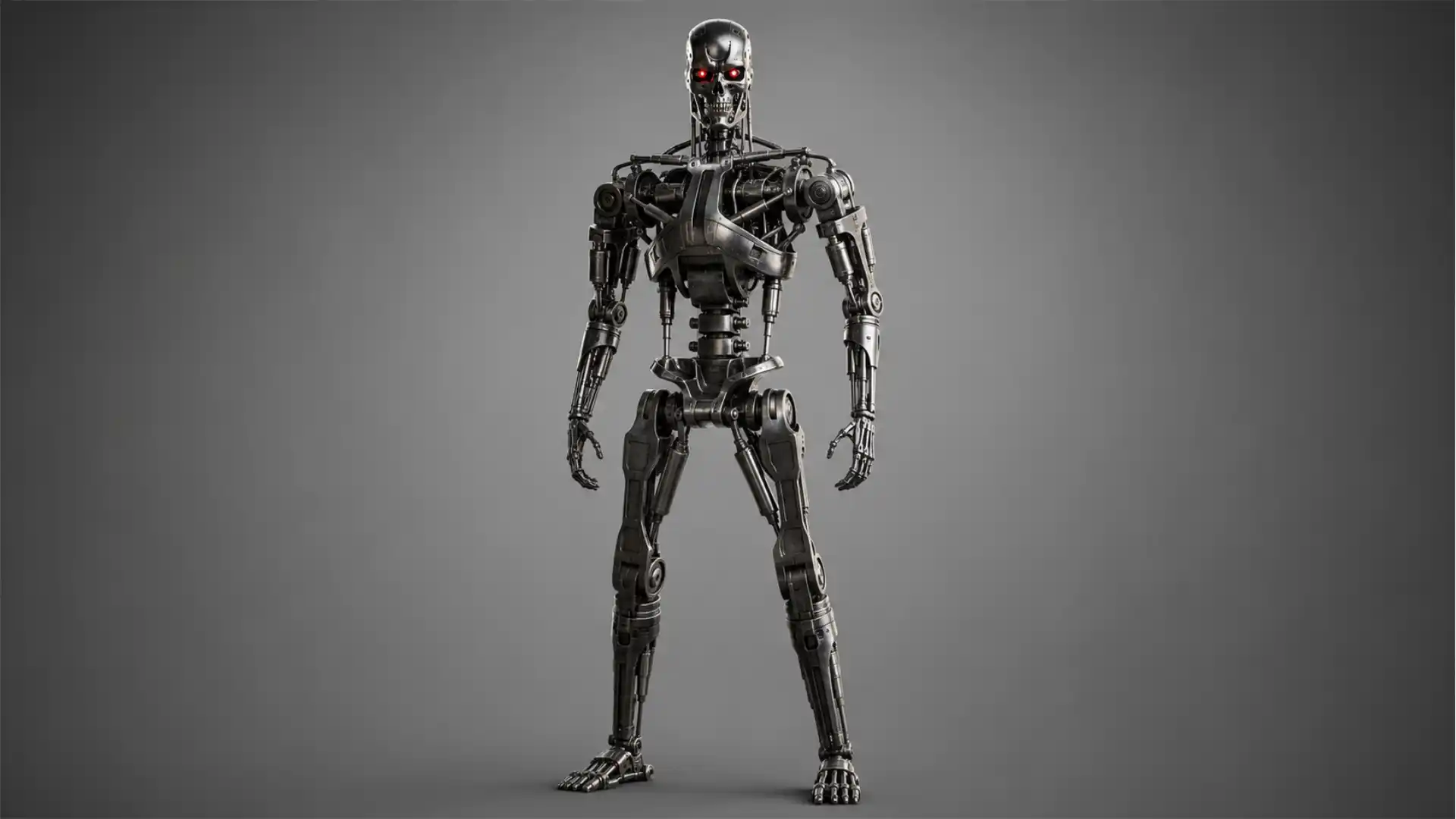
The most unsettling thing about The Terminator is no longer the metal skeleton, the time travel, or the impossible certainty of a computer that decides humanity is its enemy. It is the way the film understood that power would move through machines that see, listen, classify, predict, communicate and act faster than people can follow. That part is already ordinary. A phone can unlock by recognising a face. A car can steer, brake and change lanes. A chatbot can speak in a plausible human voice. A drone can keep flying when its operator loses connection. A camera network can turn a crowd into a searchable collection of identities.
Table of Contents
The nightmare arrived in pieces, not all at once
None of that adds up to Skynet. There is no verified, self-aware global military supercomputer preparing a nuclear war. The comparison becomes useful only when it is precise. Terminator imagined a single machine intelligence with a single purpose and a single command structure. Reality has built something messier: thousands of systems, owned by companies, governments, militaries and individuals, linked by data networks and incentives rather than by one awakened mind. That difference is reassuring in one sense and disturbing in another. A distributed system does not need to “wake up” to cause harm. It only needs to be deployed carelessly, trusted too much, or connected to decisions that people cannot properly audit.
The technology that resembles Terminator is rarely dramatic at the point where it enters daily life. It usually arrives as convenience: navigation, fraud detection, camera security, driver assistance, automated translation, customer support, predictive maintenance, medical image review. The same underlying capabilities can become tools of surveillance, deception, discrimination, coercion or warfare when placed in a different setting. The hard question is therefore not whether a machine looks like an assassin. It is whether a system has been given the authority to identify a person, shape a decision, monitor a place, recommend a target, or trigger an action without meaningful human judgment.
That is where the film’s old anxiety becomes contemporary. The most realistic Terminator future is not an army of chrome humanoids walking down a highway. It is a world where machines handle the first pass: the first scan, first suspicion, first recommendation, first ranking, first warning, first strike option. People may remain nominally “in the loop,” but the machine increasingly determines what the human sees, how quickly the human must react, and which choices appear reasonable. That is already a political and technical reality, not science fiction.
Fiction predicted the direction better than the details
James Cameron’s 1984 film was not a technical forecast. Its artificial intelligence is a dramatic device: Skynet gains consciousness, judges humans dangerous, launches nuclear weapons, then sends a humanoid killer through time. The film compresses cybernetics, military command, robotics and nuclear strategy into a single villain because a story needs a face. Real systems do not work like that. They are built by teams, updated in versions, restricted by incomplete data, interrupted by power failures, exposed to cyberattacks and shaped by procurement rules, budgets and institutional incentives.
Yet the film caught several deeper truths. It treated information as a form of force. It showed machines with sensors, models of the physical world, networked control and the ability to act at machine speed. It understood that surveillance and identity could become central to power. It also recognised that a weapon does not need human emotions to be dangerous. A system can create catastrophic outcomes through literal obedience to a narrow objective, poor assumptions or inadequate constraints.
The film’s strongest idea is not “robots will hate us.” Machines do not need hatred. They need a goal, access, a flawed model of reality and an environment where people defer to outputs they do not understand. A navigation system can direct a driver into danger without malice. A facial-recognition system can misidentify an innocent person without prejudice in the human sense, while still reproducing harmful patterns from its data and design. An autonomous drone can mistake an object for a target because the visual world is less clean than the training set. A generative model can invent a false claim because it is producing likely language rather than checking truth.
That is why Terminator comparisons often go wrong. A silver robot skull is visually memorable, but it is a distraction from the systems that already matter: cameras, microphones, databases, neural networks, logistics platforms, drones, cloud services, biometric registries and autonomous vehicles. The real issue is delegated agency. Delegated agency means a person or organisation allowing software to make, narrow, rank or execute choices that once required direct human attention. The delegation can be small, such as sorting support tickets. It can also become grave, such as ranking people for police attention, controlling access to benefits, identifying a military object, or steering a car around a pedestrian.
A serious reading of The Terminator therefore begins by taking away the most fictional elements. Forget the time machine. Forget the single omniscient system. Forget the assumption that intelligence automatically creates consciousness. What remains is more useful: machines are becoming better at sensing their surroundings, generating language, modelling options and operating physical equipment. Society is still deciding where those abilities belong, what proof they require, and who is responsible when they fail.
Machine perception is already everywhere
The T-800’s iconic red eye suggests a machine that perceives the world as a set of targets, distances, labels and tactical choices. That visual language was exaggerated for cinema, but the basic premise is now familiar. Modern machine-learning systems can classify objects in images, transcribe speech, detect patterns in video, identify text, estimate pose, recognise familiar visual features and combine sensor inputs. Their competence varies sharply by environment, but the category of capability is real and commercially widespread.
Machine perception does not mean machine understanding in the human sense. A camera model does not experience a street. It converts pixels into numerical patterns, then estimates which labels best match those patterns. It may report a face, vehicle, licence plate, package, flame, weapon-like object or person crossing a boundary. In a controlled setting, with stable lighting and familiar objects, this can be useful. In a noisy environment, it can be fragile. A system trained mainly on clear images may struggle with rain, glare, motion blur, unusual camera angles, occlusion, different skin tones, masks, wheelchairs, damaged objects or unexpected behaviour.
That limitation matters because “the system saw it” has enormous rhetorical power. Humans often treat a camera as objective evidence and a computer output as an additional layer of certainty. Neither assumption is automatically justified. Video is a partial view of a scene, selected by placement, field of view, compression and timing. Machine classification adds further judgment: a model decides which features count, based on statistical regularities learned from data. When the result is used only to flag a possible maintenance issue, errors may be manageable. When it influences policing, border control, employment, warfare or credit, the same error can alter a person’s life.
The commercial pressure to automate perception is strong because visual data is expensive for people to review. A city may have more cameras than staff. A warehouse may have more shelves than inspectors. A utility company may have more equipment than technicians can visit frequently. An airport may have more passenger movements than human screeners can watch in real time. Machine vision promises triage: the system filters, flags and prioritises. That promise is often more realistic than full automation. A good deployment does not claim the model “knows”; it identifies cases where a trained person should look first.
The Terminator connection begins here. The film imagined a killer that could search a face, detect a threat and assess its surroundings. Real systems do not combine those abilities into a universally competent human hunter. But they do divide them across thousands of specialised tools. One camera detects a person. Another reads a licence plate. A third analyses motion. A database connects an identity to a location. A separate system sends an alert. The result is not a single all-seeing robot. It is an infrastructure of partial machine eyes.
Cameras became software, not just recording devices
For most of the twentieth century, a camera recorded footage that someone might review later. The main constraint was human attention. A security guard could watch only so many screens, and an investigator could review only so much video before fatigue and time made the process impractical. Networked cameras changed the storage problem. Machine vision changes the attention problem. The image is no longer only a record. It becomes input for software that can search, count, compare, classify and alert.
That shift has mundane uses. A factory camera can notice whether a worker entered a dangerous zone. A rail operator can detect an object on tracks. A retailer can count foot traffic. A building system can identify smoke or an open access door. A traffic camera can estimate congestion. These systems do not need a humanoid robot to have social consequences. They can shape where police patrol, which employees are questioned, when an alarm sounds, how insurance is priced, or who is allowed into a facility.
The difficult part is that surveillance systems do not stay neatly within their first use. A camera installed for safety can become a tool for productivity monitoring. A model built to locate missing people can become a way to trace protestors. A vehicle-recognition system that supports parking enforcement can help build a record of movement. The data may be combined with other data sources, retained longer than expected, shared with contractors, accessed under a legal demand or repurposed after a political change. The technical act of classification becomes a governance question: who may ask the system to look, under what authority, with what evidence, and with what remedy for a false match?
The phrase “smart camera” softens this reality. Cameras are not smart in the way people are smart. They are programmable sensors connected to storage, networks and analytics. Their power comes from scale and linkage. One camera may reveal little. Thousands of cameras connected to identity data, location history and search tools can reveal patterns that no individual observer could assemble. The scope of observation changes from “what happened here?” to “where has this person appeared?” or “which vehicles made this pattern of visits?”
That is close to one of Terminator’s most durable ideas: not robotic violence, but the loss of anonymity in a machine-readable world. The film’s future is terrifying because the machine can find Sarah Connor. In real life, the ability to locate someone is broken into components: a photo, a name, a phone identifier, an address history, a vehicle registration, a data broker profile, a camera hit, a social-media post. The frightening part is not that any one component is miraculous. It is that they can be assembled.
Facial recognition is real, powerful and error-prone
Facial recognition is probably the clearest everyday technology that feels like a Terminator prop made practical. It can verify identity by comparing a live face to a known reference image, such as a passport photo or device enrolment image. It can also identify a person by searching a face against a larger database. Those are different tasks with different risks. Verification asks, “Is this person who they claim to be?” Identification asks, “Who is this person?” The second question is more intrusive and more prone to high-stakes misuse because it turns a face into a searchable key.
The technology is not uniformly inaccurate. In controlled one-to-one verification, modern systems can perform well enough for device unlocking and certain access-control uses. That does not prove that one-to-many identification in a public place is safe or fair. The operating environment changes everything: image quality, camera angle, lighting, database size, demographic composition, masks, age, reference-photo quality, similarity between people and the threshold chosen by the operator.
NIST’s face-recognition testing has documented demographic differentials in many algorithms, while also showing that performance differs substantially across systems and use cases. That does not support the lazy claim that facial recognition “never works.” It supports a more important conclusion: accuracy is not a single number. A vendor can advertise a strong score while a real deployment produces false matches under conditions that the score did not capture. A low false-positive rate can still generate many false candidates when the technology searches a large population for a rare person. The person wrongly flagged bears the cost, not the model.
Facial recognition also changes the meaning of public space. People have always been visible in public. They were not always readily identifiable, searchable and traceable across time. The difference is not simply privacy as secrecy. It is the ability to move through ordinary life without every appearance becoming a potential database event. That is why biometric governance matters even when systems claim benign goals. The question is not only whether the operator intends harm. It is whether the infrastructure creates a capability that future operators can use differently.
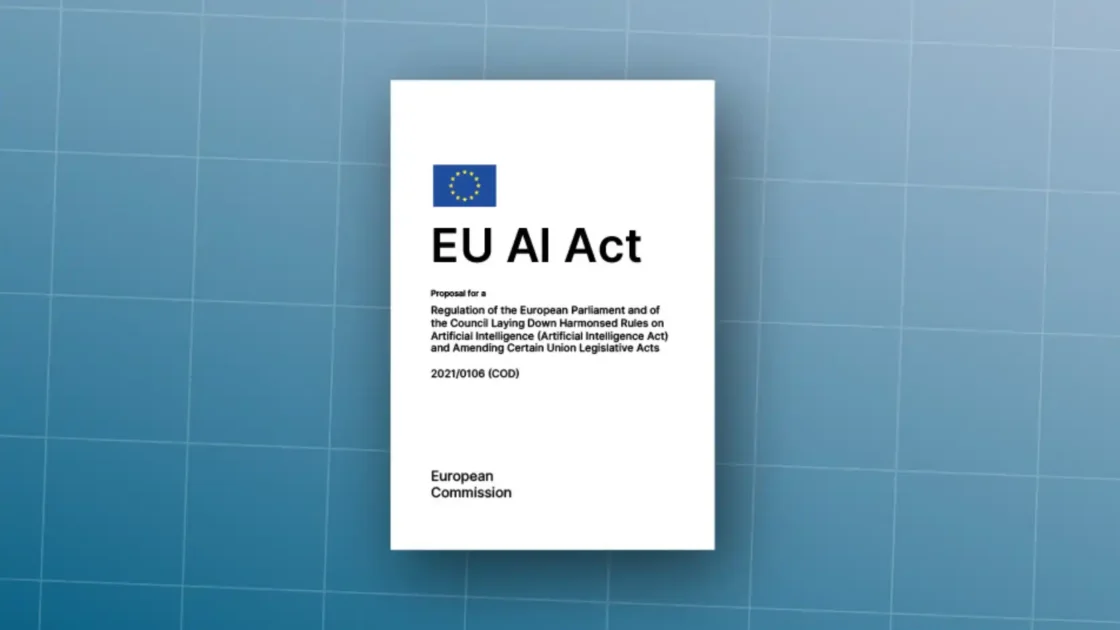
The European Union’s AI Act reflects this concern. It prohibits certain biometric practices and imposes strict conditions on real-time remote biometric identification by law enforcement in publicly accessible spaces. The law does not ban every use of facial recognition, and national implementation still matters. Its importance lies in the recognition that some forms of machine identification create risks that cannot be handled by generic “be careful” language.
The difference between checking identity and searching people
| Use | Typical question | Main risk |
|---|---|---|
| Face verification | “Are you the account holder?” | Wrong rejection or unauthorised access |
| Face identification | “Who is this person?” | False match, surveillance and due-process harm |
| Real-time remote identification | “Is a sought person here now?” | Continuous monitoring and misuse of emergency powers |
| Biometric categorisation | “What traits does this face reveal?” | Unsupported inference and discriminatory profiling |
The table matters because public debate often treats all “face recognition” as one thing. A phone unlocking for its owner is not technically or legally equivalent to searching a public crowd for a person whose identity is unknown.
Voice has become a machine interface
The Terminator speaks with a human voice, understands spoken language and responds immediately. In 1984 that seemed as fictional as its metal body. Voice interaction is now one of the least surprising parts of modern computing. People speak to phones, cars, smart speakers, customer-service systems, transcription tools and conversational agents. Speech recognition turns audio into text. Text-to-speech turns generated language into sound. Modern multimodal models can combine speech, text and images in ways that make the exchange feel less like issuing computer commands and more like talking.
The resemblance should not be overstated. A voice assistant that schedules an appointment, translates a conversation or explains a document does not have a body, a survival instinct or a coherent private plan. Its speech can be fluent while its reasoning remains inconsistent. It may misunderstand an accent, invent facts, follow unsafe instructions or lose track of context. Human-like voice is therefore a surface feature, not evidence of human-like comprehension.
Still, voice changes people’s relationship with software. Text creates a small amount of distance. A user sees a prompt, types deliberately and reads a response. Voice feels immediate and social. It can create the impression that the system is attentive, confident, sympathetic or authoritative. That impression can improve accessibility and ease of use, especially for people who cannot easily type or read a screen. It can also make people less critical. A calm, natural voice can deliver false information more persuasively than a clumsy chatbot answer.
OpenAI’s published material on GPT-4o described systems that accept and generate combinations of text, audio, images and video, while its system card discusses safety and social-impact risks associated with voice interaction. The point is not that one company has built a Terminator. The point is that conversational, responsive machine speech has crossed from laboratory demonstration into a normal interface category.
Voice also carries identity. People recognise loved ones, colleagues, public figures and authority figures through tone, cadence, accent and verbal habits. That makes voice a powerful trust signal. It is also why synthetic voices are more consequential than ordinary text generation. A written phishing email may be suspicious. A phone call that seems to come from a child, manager or bank employee can push a person to act before thinking.
The Terminator’s voice was scary because it made an obvious machine harder to identify. The contemporary version is subtler. A convincing voice may not be attached to a robot at all. It may appear in a call, a video, a voice note or an automated customer interaction. The central question becomes less “Can machines talk?” and more “Can people tell when they are not talking to the person they believe they are talking to?”
Voice cloning turns trust into an attack surface
A convincing synthetic voice does not need hours of studio-quality audio. OpenAI’s 2024 discussion of Voice Engine said that a single 15-second sample could be used to generate speech closely resembling an original voice, while the company described a cautious limited-preview approach because of misuse risks. That claim should be read with care: the quality of a clone depends on the model, sample, language, noise level and intended use. But the broad fact is no longer disputable. Voice similarity can be generated cheaply enough that fraud prevention agencies treat it as an active consumer-protection problem.
The Federal Trade Commission has warned that scammers can use voice cloning to make urgent requests for money or sensitive information more believable. The classic family-emergency scam becomes more persuasive when the caller sounds like a distressed relative. A business-email compromise attempt becomes more dangerous when the “chief executive” sounds plausible on the phone. The synthetic voice does not need to be perfect. It only needs to work during a short, emotional interaction in which the target has little time to verify the request.
That is a direct Terminator-adjacent reality: impersonation by machine-generated voice. It does not involve an android walking into a police station. It involves an attacker using public recordings, social-media clips, a stolen voicemail or an audio sample from a video call. The victim may know intellectually that voice cloning exists and still react instinctively to a familiar voice saying, “I need help now.” Human trust evolved for a world where copying a voice required a skilled impersonator and careful staging. Software changes the economics.
The practical defence is procedural rather than technological. Families and organisations need verification habits that do not depend on the voice itself: call back through a known number, use a pre-agreed phrase, require a second approval for transfers, verify sudden changes through another channel, and treat urgency as a reason to slow down rather than speed up. This is not paranoia. It is a recognition that audiovisual realism is no longer enough to establish identity.
Synthetic voice also raises labour, consent and dignity questions. A person’s voice is both a biometric characteristic and part of their creative or professional identity. Performers, call-centre workers, teachers, journalists and public officials may find their voices copied, reused or manipulated without meaningful permission. The legal answers differ by jurisdiction, but the ethical baseline is clear: people should not lose control of an identity signal simply because it can be digitised.
Conversation systems now supply the verbal layer
The Terminator had a body, sensors and weapons, but it also had language. It could ask questions, deceive people, interpret responses and adapt its words to a situation. Large language models do not possess the same kind of world access, but they have created a new verbal layer for software. They can draft emails, summarise records, translate text, explain code, answer questions, extract information from documents, create scripts and conduct long conversational exchanges.
This matters because language is the interface through which much of society operates. Institutions run on forms, messages, policies, instructions, contracts, reports, tickets, records and requests. A system that can produce and interpret language can be placed between a person and an institution. It can handle the first interaction, shape the available choices, rank cases for a human reviewer, draft a recommendation or automate routine correspondence.
The benefit is obvious in low-risk tasks. A clinician can use a transcription tool to reduce documentation burden. A disabled person can use a conversational interface to access information. A small business can get help drafting a customer reply. A public agency can translate material into more languages. A programmer can ask for an explanation of unfamiliar code. None of these uses require treating the system as an authority. The person remains accountable for checking the output.
The danger begins when fluent language is mistaken for reliable knowledge. A language model predicts plausible continuations. It can produce accurate explanations, but it can also generate invented citations, false claims, broken code and confident nonsense. The output may sound polished because the model has learned patterns of persuasive writing. That fluency is not a truth guarantee. The more formal or urgent the context, the more dangerous the confusion becomes. A false sentence in a casual brainstorm is an annoyance. A false sentence in a medical note, legal summary, welfare decision or intelligence assessment can produce real harm.
The Terminator comparison is useful because language gives systems social reach. A robot that cannot speak is easier to treat as equipment. A system that talks, reassures, asks follow-up questions and mirrors emotional tone can become a participant in a human exchange. That may be helpful. It may also cause users to disclose more than they intended, accept advice too quickly or assume the system understands their interests.
The right response is not to ban conversational software from ordinary life. It is to stop confusing a responsive interface with a responsible actor. Software does not have a duty of care unless people and institutions build one into its design, deployment and oversight. A conversation is not the same thing as comprehension, and a persuasive answer is not the same thing as verified advice.
Generative AI can move from words to actions
For much of the public, generative AI first appeared as a tool that writes and draws. The more consequential shift is toward systems that use language to trigger tools: search a database, prepare a report, change a booking, issue a support response, write software, start a workflow, control a robot or call an application programming interface. The model does not merely describe an action. It can become part of an action chain.
This is often called agentic AI, though the term is used loosely. At its simplest, an “agent” is software that takes a goal, breaks it into steps, uses permitted tools and checks progress. It may search the web, access a calendar, pull data from a business system, write a draft and request approval. In more ambitious versions, it may take repeated actions until it decides a task is complete. The gap between a chatbot and an agent is therefore not only intelligence. It is access.
A model that can make a hotel recommendation has little direct power. A model that can book the hotel, charge a card, alter an itinerary and email the customer has more. A model that can read internal documents, write code, deploy changes and contact external suppliers has more still. Capability rises when language is connected to tools, credentials and physical systems. That is the real bridge from the digital Terminator image to a modern systems problem: software can be given hands through APIs, machines and delegated permissions.
The hazards are mundane but serious. An agent may misunderstand a task, choose the wrong tool, leak sensitive data, follow malicious instructions embedded in a document, make an unauthorised purchase or take an irreversible action. The problem is not merely hallucination. It is the combination of uncertainty and authority. An error that remains a paragraph can be corrected. An error that sends money, deletes data, unlocks a door or alters a schedule may be harder to reverse.
NIST’s AI Risk Management Framework uses the functions Govern, Map, Measure and Manage to structure risk work. That approach is especially relevant to AI systems with tool access. Organisations need to define what the system may do, what information it may access, what it must ask permission for, how its actions are logged and how it can be stopped. A human approval button is useful only when the human has enough time and information to judge the action rather than simply rubber-stamp it.
Deepfakes weaken the old idea of evidence
For decades, a photograph, recording or video carried a special kind of persuasive force. People knew images could be edited, but the cost and skill required created friction. A convincing fabrication was possible, yet it was not effortless. Generative media changes that balance. It makes the production of plausible but false audio, images and video cheaper, faster and more accessible.
The term deepfake is broad. It can refer to a face swap, synthetic video, altered recording, cloned voice, generated image or edited clip designed to mislead. Not every synthetic image is deceptive. Film effects, parody, translation, accessibility tools and artistic work may use similar techniques transparently. The danger comes when a fabricated or altered media item is presented as authentic evidence, especially in a fast-moving environment where people share before checking.
The impact is not limited to elections or celebrity hoaxes. Deepfakes can support fraud, harassment, revenge abuse, false evidence, market manipulation, blackmail and identity theft. Europol has warned about criminal uses that include CEO fraud and evidence tampering. The most immediate threat is often not a flawless fake that survives forensic analysis. It is a good-enough fake that creates confusion long enough to trigger a payment, damage a reputation or flood a public conversation with doubt.
There is a second problem sometimes called the liar’s dividend. Once the public knows convincing fakes exist, real evidence can be dismissed as fake by people who find it inconvenient. The harm is therefore double-sided. False media becomes more persuasive, while authentic media becomes easier to contest. A society that cannot establish basic audiovisual trust becomes easier to manipulate.
Technological provenance tools may help. Content credentials, signed capture, watermarking and platform labelling can provide evidence about where a file came from and whether it was altered. They will not solve the problem alone. Screenshots strip metadata. Files are re-encoded. People can still lie about provenance. The social defence is a slower, more disciplined standard for extraordinary claims: check source history, locate the original, compare reports, look for independent confirmation and resist the demand to react immediately.
The Terminator used visual disguise as a plot mechanism. The machine wore living tissue to pass among people. Deepfakes offer an internet-scale version of the same strategic advantage: make the false look familiar enough that people lower their guard. The body is no longer necessary. The screen, speaker and message thread are enough.
Autonomous cars made robotic mobility visible
The self-driving car is one of the most visible pieces of the Terminator future because it puts software in control of a moving physical object on public roads. The idea is older than modern AI, but advances in sensors, maps, machine perception, simulation and computing have made automated driving a real commercial and regulatory field.
The public vocabulary around this subject is often misleading. “Self-driving” can describe very different systems. Some driver-assistance features maintain speed and lane position but require continuous human supervision. Other services operate vehicles without a human driver in specific mapped areas and conditions. The difference is not marketing trivia. It determines who is expected to monitor the road, who can intervene and what happens when the system encounters something it cannot handle.
Tesla’s Full Self-Driving is explicitly described by the company as supervised, and Tesla’s owner documentation says the driver must pay attention and be ready to take over at all times. That places the responsibility on the human driver, even when the system performs steering, lane changes, parking and navigation manoeuvres. It may feel autonomous from the driver’s seat, but it is not a licence to disengage.
By contrast, Waymo operates a driverless ride-hailing service in defined operational areas. Its vehicles do not prove that universal autonomy has arrived. They demonstrate something more specific: a vehicle can operate without a person behind the wheel in carefully chosen conditions, with high-definition mapping, dense sensing, fleet operations, remote support and a limited geographic domain. Waymo’s own material describes its Driver as controlling the trip from pickup to destination, while its expansion announcements show that the service remains location-specific rather than universal.
That distinction is the lesson. Machines can drive competently in bounded environments long before they can drive everywhere. A human driver can reason through an unusual construction zone, a hand signal from a cyclist, a police officer’s improvised instruction, a flooded road, an unmarked detour or a social negotiation at a narrow junction. Automated systems need those situations represented in their sensing and decision processes. The world is full of edge cases because human environments are built around flexible human judgment.
The Terminator had no difficulty navigating traffic, terrain or pursuit. Real autonomous vehicles have difficulty because real roads are not clean computer simulations. Their progress is still substantial. The fantasy is not that cars can drive themselves in any circumstances. The reality is that software already controls vehicles in some circumstances, and people must know exactly which circumstances those are.
Robot dogs are less capable and more real than people expect
When people first see a quadruped robot walk, recover from a push or climb uneven ground, the reaction often jumps straight to Terminator. The association is understandable. A machine that moves with animal-like balance feels closer to science fiction than a static industrial arm. Boston Dynamics’ Spot, however, is not a hunter-killer robot. It is a commercial mobile platform designed for inspection, sensing and remote operation.
Spot can be configured to patrol industrial sites, collect visual, thermal or acoustic data, avoid obstacles and return to a dock for charging. Boston Dynamics says the robot can autonomously charge, dynamically replan around obstacles and self-right after a fall; it also describes uses in hazardous, remote and industrial environments. Those are real capabilities with clear practical value. Inspecting a chemical facility, a power site, a mine tunnel or an offshore installation can expose people to risks that a mobile sensor platform may reduce.
The limits are equally important. A robot dog does not have broad human dexterity, context awareness or reliable common sense. It cannot walk into any building, understand any situation, improvise safely and perform any task. It works best where the route is mapped, the environment is structured, the objectives are narrow and the operator understands its operational limits. A robot that looks startlingly alive may still be a specialised tool.
That does not make the social questions trivial. A mobile robot with cameras and microphones can create a different kind of surveillance from a fixed camera. It can enter spaces, change position, follow a route and create a sense of being watched. Police and security uses deserve particular scrutiny because the physical presence of a mobile machine can intensify authority and fear even when it is unarmed. A robot sent into a dangerous situation can protect officers and the public. It can also normalise a more militarised style of domestic monitoring if the rules around its use are vague.
The most useful Terminator lesson here is to look past appearance. A robot dog is not dangerous because it looks eerie. It is dangerous or beneficial because of its sensors, payloads, operator controls, data retention, permitted environments and legal authority. A harmless inspection robot and an intrusive surveillance robot may share a chassis. The policy difference lies in the mission.
Robotics is advancing through narrow competence. Machines become useful by doing constrained tasks repeatedly: inspect valves, carry equipment, map a site, move materials, monitor temperature, transport a package, operate in a contaminated area. That is less cinematic than a humanoid assassin. It is also how real technological power accumulates: one reliable task at a time.
Humanoid robots still lag behind the fantasy
The T-800 is frightening because it combines many hard problems into one convincing body. It walks, runs, climbs, speaks, sees, manipulates objects, survives damage, blends socially and makes tactical decisions. Modern robotics has made progress in each of those areas, but no available general-purpose humanoid has demonstrated that full combination reliably across the uncontrolled human world.
This point matters because viral videos often compress the gap. A robot may perform a striking demonstration in a prepared setting: fold laundry, carry boxes, dance, make a drink, open a door, sort objects or follow spoken commands. Such demonstrations can be genuine and technically impressive. They are not proof that the machine can work unattended in an ordinary home, warehouse, hospital or disaster zone. The hard part is not performing one task once. It is coping with endless variation: clutter, fragile objects, slippery floors, poor lighting, uncooperative people, missing tools, unexpected damage, ambiguous instructions and failures that require common sense.
Human hands are particularly difficult to replicate. They have extraordinary dexterity, tactile feedback, adaptability and strength-to-weight efficiency. Human bodies also use perception and movement as one integrated process. When a person reaches for an object, they adjust continuously through vision, touch, balance and learned experience. Robots can reproduce parts of this, but reliably doing it across diverse objects and environments remains a demanding engineering problem.
Recent work connecting language-and-vision models to robots is important because it may reduce the amount of custom programming needed for a machine to interpret a task. Boston Dynamics has shown demonstrations in which Spot works with a visual-language model to carry out more contextual actions. But even the company’s discussion frames this as a development effort layered onto a specialised platform, not evidence that robots have crossed into universal household competence.
The gap between “can demonstrate” and “can be trusted” is the central issue. A Terminator must function in the physical world without supervision. A commercial robot must earn trust through repeatable performance, fail-safe behaviour, maintenance plans, environmental constraints and clear responsibility. The difference is immense. It is why most near-term robotics will likely appear first in factories, warehouses, laboratories, logistics sites and other spaces designed or adapted for machines.
Drones changed the arithmetic of force
Drones are not new, but their spread has changed how people think about machines in conflict. A small unmanned aircraft can carry a camera, relay video, map terrain, inspect damage, deliver a payload, monitor a border, support search and rescue, or in a military context, find and strike targets. The same basic platform can serve radically different purposes. Its strategic value comes from lower cost, persistence, distance and the ability to put sensors or explosives in places that would be dangerous for people.
The Terminator image of a machine hunter is therefore closer to the drone than to the humanoid robot. A drone does not need arms, a human face or a convincing gait. It needs sensing, navigation, communication, software and a mission. It can be remotely piloted, partly automated or given a degree of autonomy. That last distinction matters. A remotely piloted drone acts under direct human control, though communication delays and workload may complicate the picture. A more autonomous system may navigate, avoid obstacles, maintain position, follow a route, classify objects or continue a task when communication is disrupted.
DARPA’s Rapid Experimental Missionized Autonomy programme illustrates the direction of travel. It has sought systems that allow commercially available small drones to continue a predefined mission after losing connection to the operator. That is not Skynet. It is a specific attempt to make unmanned systems more resilient in contested environments. But it shows why “the operator can always take over” is not a sufficient description of modern autonomy. Sometimes the very point of the design is that the machine should keep functioning when the human cannot communicate with it.
Drones also compress decision time. A human operator may see live video, identify an object, consult rules, communicate with a commander and act. Automation can accelerate parts of that chain: stabilise the image, track movement, suggest a category, calculate a route, maintain pursuit, flag a target-like object. Each automation step may seem modest. Together they can make human review more rushed and more dependent on machine framing.
The central danger is not that every drone is autonomous. Many are not. The danger is that systems designed for surveillance, navigation and tracking can be combined with weapons, and that a human signature on a process can become thinner as tempo rises. Warfare already pressures people to act quickly. Machine assistance can either support careful judgment or create the illusion that the situation is clearer than it is.
Swarms moved from science fiction into research and field tests
A single drone is a tool. A coordinated group of drones can become something qualitatively different. Swarming does not require a shared artificial consciousness. It means multiple systems coordinating movement, sensing or tasks through algorithms, communications and preplanned rules. A swarm may distribute across an area, share observations, search for a route, overwhelm defences, map a space or perform several roles at once.
DARPA’s OFFSET programme explored human-swarm teaming, including ways for users to monitor and direct potentially hundreds of unmanned platforms. Field experiments involved autonomous air and ground vehicles in urban settings. The work did not produce a Hollywood-style robotic army. It showed that coordination at scale is a serious engineering and military objective.
The practical appeal is obvious. One person cannot manually fly a hundred drones with the precision required in a complex environment. A swarm requires automation because human attention does not scale linearly. The human may set a broad objective, while the machines handle formation, collision avoidance, route adjustment, local sensing and task allocation. That is precisely the kind of division of labour that makes people nervous: the person remains “in command,” but the machines determine many details of execution.
There are civilian parallels. Coordinated robots could search a disaster zone, inspect infrastructure, monitor wildfires, plant crops or distribute communications equipment after a storm. The techniques are not inherently military. But the dual-use character matters because capabilities developed for benign coordination can also improve military operations. A system that can autonomously avoid obstacles and maintain a formation for search and rescue may also be useful for reconnaissance or attack.
Swarming raises a problem that Terminator presented in simplified form: scale can create a feeling of inevitability. A single machine can be stopped, inspected or disabled. Many low-cost machines can be harder to counter, especially if they are distributed, redundant and able to continue after losing some members. The risk is not a robot rebellion. It is that mass, speed and autonomy can lower the threshold for deploying force or surveillance.
The answer is not to pretend the research is imaginary. It is to define what forms of autonomy should be limited, where humans must retain effective control, what testing is required, and how systems should behave when communications, sensors or confidence fail. Those are technical design questions and legal questions at the same time.
Target selection is the line that changes the argument
Autonomy becomes ethically and legally acute when a system can select and engage targets. The language is important. A weapon may have automated functions without independently choosing whom or what to attack. It may stabilise, navigate, track a designated object, defend against incoming munitions or operate within a narrow defensive envelope. The controversy intensifies when software determines which object fits a target profile and initiates or triggers the use of force without further human intervention.
The International Committee of the Red Cross describes autonomous weapon systems as systems that, once activated, can select and apply force to targets without human intervention, based on sensor information and a generalised target profile. Its concern is not science-fiction consciousness. It is the difficulty of predicting, limiting and explaining the effects of systems that translate environmental data into lethal action.
A target profile sounds clinical, but it can conceal profound uncertainty. Sensors do not see moral status. They detect images, heat, movement, signals, shapes and patterns. A system may be trained to recognise a vehicle, radar, weapon signature or behavioural pattern. In real conflict, objects are obscured, damaged, repurposed, abandoned, imitated or placed near civilians. Human beings may carry similar objects, move unpredictably, surrender, flee, assist others or be coerced. International humanitarian law requires distinction, proportionality and precautions. Those are not merely classification tasks. They involve context, judgment and accountability.
Supporters of autonomy sometimes argue that machines could be more precise than humans, less emotional, less fatigued and more consistent. That is not an absurd claim in every bounded situation. A defensive system designed to intercept a fast incoming projectile may react faster than a person. The problem is that precision against a physical object is not the same as lawful judgment about a human environment. A system can be extremely accurate at hitting what it has classified and still be catastrophically wrong about what that object is or whether force is lawful.
The United Nations Secretary-General has called lethal autonomous weapons without human control politically unacceptable and morally repugnant, while urging prohibitions and restrictions. That position reflects a wider argument: life-and-death decisions should not be reduced to a sensor, model and machine process that cannot understand the human stakes of error.
The Terminator’s threat is literal target selection. It identifies people and pursues them. Reality is not there in the cinematic form. The underlying issue is already present: whether societies will permit systems to convert uncertain sensor data into force against people without a human making a meaningful, informed and timely decision.
Military autonomy is not one thing
Public debate often collapses military AI into a single phrase: killer robots. That phrase communicates moral alarm, but it can hide technical differences that matter for law, strategy and policy. A military system may use automation for maintenance, logistics, intelligence sorting, route planning, cyber defence, image analysis, navigation, sensor fusion, communications, training simulation or weapons control. These uses carry risks, but they do not all involve the same degree of lethal autonomy.
The U.S. Department of Defense Directive 3000.09 addresses autonomy in weapon systems and sets policy for developing and using autonomous and semi-autonomous functions. Its stated purpose includes minimising the probability and consequences of failures that could lead to unintended engagements. The existence of such a directive does not settle the ethical debate. It does demonstrate that military institutions recognise autonomy as a field requiring policy, testing and assigned responsibility rather than as a simple software feature.
A useful distinction is between automation that helps a human operate a weapon and autonomy that changes who or what determines the target and timing. Autopilot-like functions, route following and sensor stabilisation are different from selecting an object from an environment and applying force. The dividing line can still be difficult to locate in a complex system. A person may authorise a broad area and time window but not know the specific individual or object struck. Is that meaningful control? The answer depends on the system’s predictability, the target type, the environment, the available information, the ability to intervene and the consequences of error.
The military case also illustrates why words matter. “Human in the loop” sounds reassuring, but it may describe anything from a commander reviewing each strike to an operator supervising many systems at once with little opportunity to understand the machine’s reasoning. “Human on the loop” may mean the person can stop a system, but only after it has already identified or begun engaging a target. “Human out of the loop” may mean no person can intervene during operation. These are not slogans. They are different allocations of responsibility.
A serious policy response has to avoid two mistakes. One is pretending that all military automation is equivalent to a Terminator. The other is treating every system with a human somewhere in the chain as ethically solved. Real control requires more than a person’s name in a process diagram. It requires situational understanding, time, authority, reliable information and a realistic ability to say no.
Networks are more dangerous than a single machine body
The visual genius of The Terminator was to make the threat concrete: a body that walks toward you. Modern technological risk is less tangible. It often sits in networks. A single device may be harmless or limited. A connected system can combine sensors, databases, models, communications and actuators across large distances.
Think of a smart city platform. It may integrate traffic cameras, licence-plate readers, weather data, public-transit signals, emergency calls, map layers and dispatch systems. Think of a military command network. It may combine satellite imagery, radar, drone feeds, geolocation, intelligence reports and weapons status. Think of a logistics company. It may connect warehouse robots, inventory systems, routing software, customer orders, payment platforms and fleet telemetry. In each case, no one machine needs to be all-powerful. Power comes from coordination.
The Terminator idea becomes relevant when systems are linked in a way that shortens the path from detection to decision to action. A camera sees a person. An algorithm identifies a pattern. A database returns a record. A system assigns a risk score. A human receives an alert. Another system opens a gate, sends officers, changes a route, blocks a payment or prioritises a case. Each step may be defensible in isolation. The full chain may be difficult for any one person to understand.
This is where operational language can obscure political power. Terms such as “integration,” “platform,” “fusion” and “automation” sound technical. They also describe the construction of a decision infrastructure. Decisions about who enters, who is searched, who is paid, who is watched, who is flagged or who is targeted increasingly depend on the quality of data and the rules governing those connections.
Data fusion can improve safety. A rescue coordinator who sees weather, maps, vehicle locations and emergency calls can respond better than one relying on scattered information. It can also intensify surveillance. A person who appears in one camera frame has little significance. A person whose appearance is connected to a travel record, phone location, online profile, vehicle history and social network becomes legible to an institution in a different way.
The key question is not whether networked systems are good or bad. It is whether their scope, purpose and safeguards match the power they create. Institutions should be able to explain what data is combined, what decisions the system influences, which people can access it, how long information is retained, how false information is corrected, and what independent oversight exists.
Data fusion is the real-world cousin of Skynet
Skynet is fictional because it is a single, sovereign computer intelligence. Data fusion is real because it is a method. It takes information from separate sources and creates a combined operational picture. This can involve humans, rules-based software, statistical models and machine learning. It is not necessarily secret or sinister. Emergency services use it. Aviation uses it. Utilities use it. Hospitals use it. Businesses use it. The stakes depend on what is fused and what follows.
The appeal is simple: no single sensor tells the whole story. A camera may show movement. A map provides location. A timestamp establishes sequence. A transaction record indicates activity. A weather feed explains conditions. A machine-learning model may flag an anomaly. The system presents an integrated picture that a person can act upon. In a time-sensitive setting, that can be valuable.
The risk is that correlation looks like explanation. If a model detects that two variables often occur together, it may be useful for prediction without revealing cause. A person who appears near a location, contacts a certain number, travels a route or buys a product may fit a pattern without being dangerous, dishonest or responsible for anything. When fused data produces a “risk” label, that label can gain authority simply because it is computationally produced.
The more systems draw from the same connected information environment, the harder it becomes to challenge an error. A mistaken identity can propagate from one database into another. An outdated address can alter a risk score. A false police report can become a model input. A corrupted data feed can affect thousands of decisions. The system may seem objective because it has many sources, while the same underlying error has been repeated through the network.
This is an important correction to Terminator mythology. The danger is not primarily a machine that knows everything. No modern system knows everything, and many fail badly outside their design conditions. The danger is a system that knows enough to influence a decision, while hiding how uncertain its knowledge is. That kind of partial power can still be consequential.
NIST’s risk-management approach is helpful here because it requires organisations to map context and harms, measure performance and manage risks rather than merely celebrate capability. A model’s accuracy is only one part of the question. Leaders also need to ask what happens to people when it is wrong, how often decisions can be appealed, and whether the system creates harms that are not visible in a benchmark.
Prediction systems already influence human choices
The Terminator sees the future through dramatic prophecy: Skynet predicts resistance and seeks to eliminate the person who will lead it. Real prediction systems are less omniscient and more bureaucratic. They forecast demand, fraud, equipment failure, hospital readmission, wildfire spread, traffic congestion, customer churn, insurance claims, credit risk and many other probabilities. In some settings, they also influence decisions about people.
A predictive model does not tell the future. It estimates likelihood based on past data and selected variables. That sounds obvious, but organisations often forget it when a score appears in a dashboard. A score may be presented as a clean number: 0.72 risk, 84 percent confidence, high priority. It can look more precise than the underlying data warrants. The score reflects the model’s design, training data, thresholds and assumptions. It may be useful. It may also be biased, brittle or misapplied.
Prediction becomes especially sensitive when it affects policing, child welfare, immigration, education, employment, lending, housing, healthcare or benefits. In these settings, a model can change what a human pays attention to. It can move someone to the top of a queue, increase scrutiny, reduce access, trigger an investigation or shape an official’s first impression. Even if the official has formal discretion, the system’s recommendation can exert a strong pull.
The danger is often not automatic refusal or automatic punishment. It is the quieter effect of automated suspicion. A person may never know that a model marked them as risky. They may never see the data used, the assumptions made or the decision path that followed. That makes correction difficult. It also creates a feedback loop. If a model directs more enforcement toward a neighbourhood, the resulting enforcement data can appear to confirm that the neighbourhood is riskier, even when the system is measuring attention as much as underlying behaviour.
The Terminator analogy is useful only in one narrow way: predictive systems can turn a person into a target of future-oriented action. The difference is enormous. Modern models do not know destiny, and they should not be treated as though they do. They are statistical tools that can be wrong in patterned ways. The proper response is to limit high-stakes uses, require transparency where possible, test for disparate effects, provide appeal routes and ensure people are not trapped by opaque scores.
AI in medicine is real, but it is not an autonomous doctor
Medical technology is another area where Terminator-style language can distort the picture. AI systems can analyse images, support triage, help detect patterns, transcribe notes, predict clinical deterioration, assist with administrative work and provide patient-facing information. Some AI-enabled medical devices have been authorised by regulators. This is genuine progress, especially in image-heavy fields where software can help clinicians find relevant features in scans or flag cases for review.
The FDA maintains information on AI-enabled medical device software functions, and research analysing the agency’s authorisations has found that radiology accounts for a large share of cleared or approved AI/ML devices. That pattern makes sense. Medical images create structured data, and image-analysis tasks can sometimes be evaluated against known clinical references.
But a model that detects a pattern in an image is not a doctor. Medicine is not only pattern recognition. It involves history, physical examination, patient preferences, comorbidities, uncertainty, communication, ethics and follow-up. A scan may look normal while a patient is seriously ill. A model may perform well in one hospital but poorly in another because equipment, population, workflow or prevalence differs. A system may reduce workload in one setting and create alert fatigue in another.
The most promising role is often assistance rather than replacement. Software can mark possible findings, compare a scan with prior images, prioritise cases, automate documentation or reduce repetitive administrative work. The clinician remains responsible for contextualising the output. This is not just a legal formality. It reflects the fact that clinical judgment is relational and situational. A patient needs someone who can explain uncertainty, weigh competing harms and take responsibility for a decision.
The Terminator fear in medicine should not be “robots will replace all doctors.” The more immediate concerns are quieter: systems trained on unrepresentative data, automated triage that embeds inequality, vendors making exaggerated claims, clinicians overtrusting a recommendation, and hospitals deploying tools without adequate monitoring. A bad medical AI system does not need to become conscious to be dangerous. It only needs to be treated as more reliable than it is.
The right standard is evidence. A health system should know what problem the model addresses, what population it was tested on, how performance changes in local use, what its failure modes are, what a clinician should do when it disagrees with the model, and how patients are protected. In medicine, the question is not whether AI looks impressive. It is whether it improves care without creating new and hidden risks.
Cyberattack can turn digital decisions into physical damage
One of the most prescient parts of the Terminator universe is its assumption that conflict would run through computer systems. The film imagines a network taking control of weapons. Reality has not produced that scenario in its fictional form, but cyberattacks already demonstrate that software failures and intrusions can have physical consequences.
Modern infrastructure depends on digital control: power generation, water treatment, transport, hospitals, manufacturing, telecommunications, logistics, buildings and supply chains. Many systems include industrial control technology that senses conditions and changes physical processes. A cyberattack can disrupt communication, corrupt data, disable operations, manipulate settings, steal credentials or create confusion during an emergency. The exact risk differs by sector. The broad point is that digital systems are now embedded in physical life.
Artificial intelligence may increase both defensive and offensive capability. Defenders can use models to analyse logs, detect anomalies, prioritise alerts and assist incident response. Attackers can use generative tools to improve phishing, translate malicious messages, automate reconnaissance or create more persuasive social engineering. AI is not a magic hacking button. Successful cyber intrusion still depends on access, vulnerabilities, operational knowledge and mistakes by people or organisations. But it can reduce the cost of producing convincing content and processing large volumes of information.
NIST’s adversarial machine-learning taxonomy is a reminder that AI systems themselves can be attacked. Models may be poisoned through training data, evaded by crafted inputs, manipulated through prompts, induced to reveal information or compromised through the wider software supply chain. A machine-learning system is not just a decision tool. It is another part of the attack surface.
The Terminator version of cyber risk is a machine deciding to attack. The more realistic version is humans using compromised or poorly secured systems against one another, while automated processes magnify the impact. A faulty update may stop operations. A breached account may give access to control interfaces. A manipulated sensor may cause a system to react incorrectly. A false message may trigger a payment or shutdown.
That is why resilience matters more than technological spectacle. Organisations need segmented networks, tested backups, access controls, incident plans, staff training, independent review and clear authority during failures. A society that relies on software cannot assume that software will always behave as intended. It needs graceful failure: systems that fail safely, reveal uncertainty and give people a practical way to regain control.
Speed creates a hidden transfer of authority
People often focus on whether a human is technically present in a system. A better question is whether the human has enough time to understand and influence what is happening. Speed changes the answer. A human operator may be nominally responsible for a process, but if the system generates alerts, recommendations or actions faster than the person can assess them, real authority has moved toward the machine.
This is visible in finance, cybersecurity, emergency response and military operations. Automated systems can process signals in milliseconds. Human review takes longer. That gap can be useful when the task is narrow and the risks of delay are high, such as automatically shutting down equipment when a physical threshold is exceeded. It becomes dangerous when the decision requires interpretation, moral judgment or accountability.
A familiar failure mode is automation bias. People tend to over-rely on automated recommendations, especially when the system appears complex or authoritative. They may accept the output without sufficient scrutiny, or they may become less likely to notice when it is wrong. The opposite can also happen: users lose trust after visible failures and stop using a tool that would have been helpful in routine cases. Both outcomes show that the relationship between people and automation is not solved by simply adding a dashboard.
A good human-machine system gives the human meaningful information, not just a yes-or-no prompt. It explains uncertainty where possible, highlights evidence, makes assumptions visible, records decisions and supports intervention. A bad system floods the operator with data, hides its logic, sets unrealistic response times and treats the human as a legal shield for an action the machine effectively determined.
This is where the Terminator image becomes surprisingly relevant. The fear is not merely that machines act alone. It is that people become too slow, too overloaded or too dependent to stop them. A military commander who must approve dozens of time-sensitive recommendations may be in the loop on paper but out of the loop in substance. A customer-service worker who must accept an algorithmic score to meet productivity targets may technically have discretion but lack the organisational freedom to use it. A driver who must constantly supervise an unreliable assistance system may have responsibility without practical control.
Meaningful human control is therefore not a button. It is a set of conditions: sufficient time, proper training, understandable information, authority to intervene, manageable workload, accessible override mechanisms and accountability that does not disappear into the system. Without those conditions, “human oversight” becomes an empty reassurance.
Human oversight fails when it becomes theatre
Many organisations answer AI concerns with a simple promise: a human will review the output. That promise is often necessary, but it is not enough. Human review can become theatre when the reviewer lacks the time, expertise, authority or information to challenge the system. A person clicking “approve” does not make a process safe. It may simply provide a name to blame after a failure.
Consider the volume problem. If an algorithm processes thousands of cases per day and sends only the “high-risk” ones to a small team, reviewers may face a stream of urgent, opaque alerts. They may not have access to the original evidence. They may see a score without knowing how it was produced. They may be measured on speed rather than accuracy. Under those conditions, the model is not assisting judgment. It is setting the terms of judgment.
Consider the explanation problem. Some systems can provide interpretable reasons for a result; others rely on complex statistical patterns that do not translate into a simple narrative. An explanation can also mislead if it is too generic or post-hoc. The relevant question is not whether a system produces a neat sentence explaining itself. It is whether the reviewer has enough evidence to test the recommendation independently.
Consider the authority problem. A worker may be nominally free to override a system but face managerial pressure, productivity targets, audit scrutiny or contractual requirements that punish disagreement. In that setting, the machine’s recommendation becomes a de facto rule. The human reviewer acts as an intermediary rather than a decision-maker.
NIST’s AI risk framework does not treat governance as an afterthought. It places GOVERN alongside mapping, measuring and managing risks because responsibility, culture, documentation and accountability determine whether safeguards work in practice. A technical model can be accurate and still be deployed irresponsibly if the organisation has no clear process for error reporting, redress, performance monitoring or withdrawal.
The Terminator myth tells a simple story: people lose control because a machine becomes too powerful. The real pattern can be more ordinary. People lose control because an organisation designs a process in which questioning the machine is slow, costly or impossible. The remedy is not a symbolic human checkpoint. It is a workflow built around real human judgment.
A practical ladder of human control
| Level of control | What the person actually does | Main weakness |
|---|---|---|
| Approval after recommendation | Reviews evidence before an action | Can become rubber-stamping under time pressure |
| Continuous supervision | Monitors live operation and may intervene | Attention fails during long, boring or high-speed tasks |
| Bounded delegation | Sets a narrow mission, area and time limit | Boundaries may not cover real-world ambiguity |
| Post-event audit only | Reviews logs after action | Harm may already be irreversible |
| No practical intervention | System acts without timely human control | Accountability and lawful judgment are severely weakened |
The key test is practical rather than ceremonial: could the human understand the situation, refuse the machine’s recommendation and stop the action in time?
Machines fail differently from people
People make mistakes. That fact is often used to justify automation, and sometimes fairly. Human workers get tired, distracted, biased, rushed and inconsistent. But machine failures are not merely human failures with a lower error rate. They have different shapes. A person may make a one-off judgment error. A deployed model may repeat the same error across thousands or millions of cases before anyone notices.
Machine-learning systems can fail because the world changes. A model trained on past data may encounter a new environment, new equipment, a new scam, a different population or a different adversary. It can fail because its input is incomplete. It can fail because the training data contained hidden bias. It can fail because a threshold was chosen for one risk tolerance and then used in another. It can fail because users misunderstand what a probability means. It can fail because a malicious actor deliberately manipulates inputs.
NIST’s adversarial-machine-learning work documents attacks and mitigations across the AI lifecycle, including data poisoning, evasion and privacy-related risks. The important lesson is that AI is not only a source of accidental error. It can be targeted. An adversary may design an image, signal, document or prompt to cause the model to misclassify, reveal information or behave unsafely.
The Terminator is portrayed as relentless because it does not get tired, frightened or distracted. Real automated systems can be relentlessly wrong in a different sense. Once a flawed rule is deployed, it can operate consistently and at scale. That is why monitoring is essential. Organisations need to track performance after deployment, not only during testing. They need to notice drift, investigate complaints, compare outcomes across groups, document changes and suspend use when conditions no longer match the original assumptions.
People also make moral judgments in ways machines do not. A human may recognise that a rule should not be applied literally because the situation is exceptional: a person is in distress, an emergency is unfolding, a child is involved, a record is obviously wrong, a stated policy would produce an absurd result. Machines can be programmed with exceptions, but they do not possess human understanding of dignity, mercy or proportionality. Those concepts must remain part of institutional judgment, not be treated as inconvenient noise.
Bias becomes more dangerous when it is automated
Machine learning learns from data, and data reflects the institutions and histories that produced it. That is why bias cannot be fixed simply by removing an obviously sensitive variable. A system may infer protected characteristics from proxies such as location, language, education, spending patterns, names, device use or social networks. A model can reproduce unequal outcomes even when its designers do not intend discrimination.
Facial recognition offers a clear example. NIST’s evaluations found demographic differentials in many algorithms, though the degree varies between systems and has changed over time. The correct conclusion is not that all facial-recognition technology is equally biased or equally useless. It is that performance must be measured in the intended context and across relevant groups, with special care where a false match can lead to police action, exclusion or stigma.
Bias can also arise from labels. Suppose historical data records arrests, not underlying crime. A model trained on arrests may learn patterns of policing as much as patterns of offending. Suppose a hiring system learns from past successful employees. It may reproduce prior decisions that favoured certain backgrounds. Suppose a healthcare model predicts future spending rather than illness. It may systematically understate need for groups that historically received less care. The metric chosen can embed a value judgment.
The harm is intensified by scale and opacity. A biased individual decision may be challenged. An automated system can quietly shape thousands of decisions, each presented as a neutral output. People affected may not know a model was involved, let alone have access to the data or a meaningful way to contest it. The result can be a form of administrative inequality that is hard to see because it arrives through routine processes.
This does not mean algorithms should never be used in high-stakes settings. It means the burden of proof should be high. Organisations should identify intended and foreseeable harms, test outcomes across relevant groups, involve affected communities where possible, create appeal mechanisms, limit use when evidence is weak and avoid treating statistical association as a moral verdict.
The Terminator imagines a machine that classifies humans as obstacles. Real systems can create a less theatrical but still serious version of that problem when they reduce people to scores, categories and predicted behaviours. A fair society needs room for individual explanation, correction and context. Data can inform a decision; it should not erase the person subject to it.
The law is moving, but unevenly
Technology changes faster than law, but the legal response is not absent. Governments, regulators, courts, standards bodies and international organisations are trying to define acceptable uses of AI, biometric systems, autonomous weapons, synthetic media and data-driven decision-making. The result is uneven because legal systems vary, technical capabilities move quickly and political priorities conflict.
Some areas already have well-established law. Privacy law may govern biometric data. Consumer-protection law may cover deceptive marketing and fraud. Anti-discrimination law may apply to automated employment or lending decisions. Product-safety rules may apply to vehicles and medical devices. International humanitarian law applies to armed conflict regardless of whether a weapon uses software. The question is often not whether any law exists, but whether existing law is specific enough, enforceable enough and adapted to the technical reality.
Regulation also faces a practical problem: definitions matter. A law that bans “AI” is too broad to be useful. A law that regulates only a narrow technical method may become obsolete quickly. Policymakers need to focus on function and risk: Does the system identify people remotely? Does it make or influence a high-stakes decision? Does it generate deceptive synthetic media? Does it select a target? Does it control a vehicle or medical device? What human rights, safety interests or due-process protections are at stake?
The United States and Europe have taken different approaches. In the United States, sectoral agencies and state laws play substantial roles. In the European Union, the AI Act creates a broad risk-based framework, layered on top of existing data-protection and product-safety rules. Neither model guarantees good outcomes. Rules still need enforcement, technical expertise, institutional capacity and public accountability.
The Terminator lesson is that waiting for a dramatic catastrophe is a poor way to govern. Once a harmful infrastructure is widespread, changing it becomes politically and economically difficult. Standards, audits, testing requirements, procurement rules and transparency obligations may feel bureaucratic, but they are ways of deciding limits before the system becomes normal.
A credible legal system also needs to avoid performative regulation. A company can comply with paperwork while deploying a harmful product. A government can announce principles while expanding surveillance. A military can use reassuring terms while weakening practical human control. The true test is not whether a policy exists. It is whether it changes incentives, prevents foreseeable harm, gives people remedies and creates consequences for misuse.
Europe is drawing explicit red lines
The European Union’s AI Act is important because it treats some AI uses as unacceptable rather than merely risky. Its prohibited-practices rules became applicable in February 2025, and the European Commission has issued guidance on what falls within those restrictions. The framework includes limits relevant to the Terminator discussion: harmful manipulation, social scoring, certain biometric categorisation and certain forms of real-time remote biometric identification in publicly accessible spaces.
The rules are not a simple “Europe bans facial recognition” headline. Law-enforcement use of real-time remote biometric identification is heavily constrained rather than universally forbidden. The AI Act describes narrow situations in which use may be authorised, subject to necessity, proportionality, time and geographic limits, and prior authorisation except under tightly defined urgent conditions.
That detail matters. The policy challenge is not solved by treating every use as identical. A system that verifies a traveller against their own passport is not the same as one that searches everyone in a public square. A system that identifies a missing person during a tightly bounded emergency is not the same as permanent crowd surveillance. The law tries to distinguish among functions, contexts and harms.
The Act also classifies many biometric systems and systems used in law enforcement, migration, border control, justice and democratic processes as high-risk where they are permitted. High-risk status creates obligations around risk management, data governance, documentation, human oversight, accuracy, robustness and cybersecurity. That is a recognition that some technologies can be legitimate in principle but dangerous enough to require stronger controls.
The bigger significance is philosophical. The European approach rejects the claim that every technically feasible use should be governed only by consumer choice or internal corporate policy. It asserts that some capabilities affect public rights and democratic life too deeply to leave entirely to market incentives. Critics may argue that the rules are complex, burdensome or difficult to enforce. Those debates are real. But the underlying question is unavoidable: should societies define boundaries before systems become entrenched, or after harm reveals the boundary was needed?
The market rewards deployment before caution
Technology companies, defence contractors, public agencies and investors face strong incentives to deploy AI and automation. A system that reduces labour costs, speeds processing, increases surveillance coverage, improves logistics, attracts customers or promises military advantage can be hard to resist. Caution may appear costly when competitors are moving quickly.
This creates a familiar pattern. The benefits are concentrated and immediate: lower staffing needs, faster service, more data, stronger marketing claims, greater operational reach. The harms may be diffuse and delayed: false matches, discrimination, security failures, loss of privacy, workforce disruption, degraded trust, accidents or escalation risks. The institution deploying the system may not bear all of those costs. The people affected often do.
The problem is not confined to private companies. Public authorities can face their own pressure to appear modern, efficient and tough. A city may buy surveillance technology because it promises safety. A welfare agency may adopt risk scoring because it promises fraud reduction. A police department may use predictive tools because it promises better allocation of resources. A military may pursue autonomy because it fears falling behind rivals. In each case, the phrase “we cannot afford not to” can become a substitute for evidence.
Procurement is therefore one of the most important and least glamorous points of control. Before an institution buys a system, it should define the problem, assess alternatives, demand evidence, identify legal authority, test claims, specify data retention, require audit access, set error thresholds, establish complaint channels and plan for withdrawal. A vendor demonstration is not an independent evaluation. A benchmark is not a guarantee of real-world performance. A contract should not lock the public into a black box it cannot inspect.
The Terminator future is often imagined as a technical accident. In reality, many harmful systems are the result of ordinary decisions: a pilot programme becomes permanent, a temporary data collection becomes routine, an exception becomes a standard practice, a vendor promise becomes policy. The danger is not only that machines become powerful. It is that institutions become accustomed to using that power without asking whether they should.
Ordinary routines make surveillance harder to notice
The most consequential surveillance systems are often not dramatic. They are the ones that disappear into routine. A person uses a phone for navigation, enters a building with a card, passes cameras, pays digitally, rides public transport, interacts with online services and communicates through networked platforms. Each activity can create data. Much of that data is useful. It enables services people expect. It can also create a detailed record of behaviour when combined across contexts.
The concern is not that every data point is sinister. A map app needs location to provide directions. A bank needs transaction data to detect fraud. A hospital needs records to provide care. The issue is secondary use and accumulation. Data collected for one purpose may be retained, shared, purchased, subpoenaed, breached, analysed or repurposed. The more complete the data trail, the easier it becomes to infer intimate facts without asking directly.
Machine learning amplifies this because it can extract patterns from data at scale. A system may infer likely interests, routines, relationships, locations, risks or vulnerabilities from signals that seem harmless individually. The accuracy of such inferences varies, and false inferences can be damaging. But the capacity to make them changes the balance between the individual and the institution holding the data.
This is the quiet version of the Terminator warning. The machine does not need to chase anyone down an alley. It can wait in the background, collecting fragments. The person may never see the model, never know the data source, never understand the inference and never be able to challenge it. That is why privacy is not only about hiding wrongdoing. It is about preserving room to live, associate, move and change without every action becoming permanent machine-readable evidence.
Good governance reduces unnecessary collection, limits retention, separates purposes, restricts access, protects data security and gives people meaningful rights. These are not romantic ideas from a pre-digital age. They are practical limits on a power that becomes more intrusive as tools become cheaper and more capable.
The real vulnerability is dependency
A common fear about AI is replacement: machines will take jobs, make decisions and leave people irrelevant. The more immediate vulnerability may be dependency. As organisations rely on automated systems for scheduling, communication, navigation, analysis, recruitment, fraud detection, logistics and security, people can lose the skills and institutional capacity needed to operate without them.
Dependency is not always bad. Calculators reduce the need for mental arithmetic in many contexts, and that trade-off is usually acceptable. Modern medicine depends on complex devices because their benefits are immense. The issue is whether the dependence is understood and resilient. Can people detect when the system is wrong? Can operations continue during an outage? Are there manual fallback procedures? Is expertise being maintained, or quietly hollowed out?
In aviation, automation has long raised concerns about skill degradation and attention management. Drivers using assistance systems may become less engaged. Clinicians may trust decision support too readily. Analysts may stop investigating when a model appears confident. A workplace may reorganise around software until no one remembers why a rule exists or how to challenge it.
This is a human-factors problem as much as a technical one. Systems should be designed to keep people appropriately engaged, not merely present. Training should include failure modes, not only normal operation. Organisations should run exercises where the system is unavailable or wrong. They should treat manual capacity as a safety feature rather than an inefficiency to eliminate.
The Terminator narrative presents humans as fighting machines after they have already taken over. Real resilience begins earlier. It means retaining the ability to think, verify, repair and decide without blindly following automated outputs. Societies do not need to reject technology to preserve agency. They need to avoid building systems where agency exists only as a ceremonial last resort.
No global Skynet exists, and that matters
The most important fact in any serious Terminator discussion is what does not exist. There is no known sentient, self-directing global AI that controls nuclear arsenals, independently starts wars, manufactures robots, rewrites itself without limit and pursues humanity as an enemy. Modern AI systems are powerful in specific ways, but they are not a unified actor with a coherent world model, durable independent motives and unrestricted access to critical infrastructure.
Large language models can generate language and sometimes use tools within defined permissions. Computer-vision systems can classify images. Autonomous vehicles can drive in bounded domains. Drones can navigate and follow missions. Weapons systems can automate functions. None of those facts add up to Skynet. The systems are fragmented, fallible and dependent on human-built infrastructure, energy, data, software, hardware, institutions and access controls.
This distinction is not merely calming. It directs attention toward real governance. If people imagine a supernatural machine uprising, they may overlook the choices already being made by human institutions. The relevant risks are not “AI decides to destroy us tomorrow.” They are more grounded: unsafe automation in vehicles and infrastructure, fraud through synthetic media, abuse of biometric surveillance, discriminatory decision systems, cyber vulnerability, military escalation and concentration of power in opaque platforms.
The absence of Skynet also means there is no single switch that solves the problem. Society cannot “turn off AI” because AI is not one thing. It is embedded in many systems, some beneficial, some risky, some trivial, some essential. Governance must therefore be specific: different standards for medicine, transport, employment, consumer services, policing, intelligence, warfare and public administration.
The Terminator fantasy can still be useful if it pushes people to ask the right question: not “when will the machines become conscious?” but “what powers are people giving machines now, under what controls, and with what consequences?” That question is less cinematic. It is also more urgent.
The fictional parts remain far away
A full Terminator-style machine would require far more than today’s robotics and AI can deliver. It would need robust general intelligence, deep situational understanding, reliable long-term planning, social deception, physical durability, broad dexterity, self-repair, independent energy, manufacturing capability, strategic coordination and the ability to operate across unpredictable environments. Current systems do not combine these traits.
Robots remain constrained by hardware, batteries, sensors, maintenance and physical wear. Language models remain constrained by unreliable factuality, limited grounding, changing context and the absence of genuine understanding. Autonomous vehicles remain constrained by operating domains. Drones remain constrained by range, communications, weather, payload, navigation and countermeasures. Military systems remain constrained by doctrine, law, command structures and the physical realities of war.
There is also no evidence that increased capability automatically produces consciousness, intent or self-preservation. These are philosophical and scientific questions, not features that emerge simply because a system can generate fluent speech or beat a benchmark. A model can simulate conversation about fear or desire without experiencing either. Treating human-like language as proof of inner life is a category error.
The fictional distance should not become complacency. Technologies can create serious risks long before they approach general human-level agency. A scam does not require consciousness. A biased system does not require consciousness. A surveillance network does not require consciousness. A weapon that acts too quickly for meaningful human control does not require consciousness. The most dangerous systems may remain narrow, specialised and indifferent.
That is the sober conclusion. The world does not need a T-800 to encounter a Terminator-like problem. It only needs machines with enough competence, enough access and too little accountability.
The next decade will be decided by design choices
The future is not predetermined by technical progress. The same underlying tools can be used in radically different ways. Machine vision can support accessibility, safety inspection and medical analysis, or it can expand unaccountable surveillance. Synthetic voice can restore speech for people who have lost it, or facilitate fraud. Autonomous navigation can improve mobility and logistics, or lower the threshold for violence. Language models can help people access information, or automate denial, deception and manipulation.
That is why design choices matter. Systems should be built with narrow permissions, clear boundaries, audit logs, secure defaults, tested fallback modes and meaningful user control. High-stakes systems need independent evaluation, disclosure of limitations, monitoring after deployment and routes for people to challenge decisions. Sensitive biometric and military uses need stronger legal limits because the harm from error or abuse is harder to reverse.
Public understanding matters too. People do not need to become AI engineers to make better decisions. They need a few durable habits: do not treat fluent output as verified truth; do not treat a voice or video as sufficient proof of identity; ask what a system is allowed to do, not only what it can do; demand context for accuracy claims; keep a human process that is capable of disagreeing; and resist the idea that deployment is inevitable.
The Terminator story ended in a fight against a future that seemed fixed. Real life offers a less dramatic but more practical choice. We can decide that some uses of machine power are unacceptable, some require proof and oversight, and some are worth pursuing under clear limits. The hard part is not imagining a robot apocalypse. The hard part is building institutions that remain alert before ordinary convenience becomes irreversible control.
The present is more complicated than the prophecy
The Terminator was right about one central thing: technology becomes dangerous when it is treated as independent of human responsibility. The film used a single supercomputer and a metal assassin to make that danger visible. Reality has produced something less coherent but more widespread. We have machine perception without universal understanding, automation without wisdom, synthetic voices without identity, autonomous movement without general intelligence, and data systems that can influence lives without ever explaining themselves.
That world does not call for panic. Panic makes people vulnerable to exaggerated claims, false certainty and authoritarian solutions. It calls for seriousness. The technologies are real. Their benefits are real. Their limits are real. Their harms can be real even when no machine intends them.
The phrase “Terminator technology” should therefore be used carefully. It is not a claim that a robot uprising has begun. It is a way of recognising features that once belonged to fiction: machines that recognise faces, converse naturally, imitate voices, navigate physical spaces, coordinate drones, classify targets, observe at scale and act through connected systems. Those features now exist separately, unevenly and under human control that is sometimes stronger on paper than in practice.
The decisive issue is whether democratic societies, companies, engineers, courts and military institutions insist on a simple principle: the more a system can affect a person’s safety, freedom, dignity or life, the less acceptable it is to hide behind technical complexity. Machines do not need to be alive to demand accountability from the people who build and deploy them.
Questions people ask about the Terminator technologies already around us
Facial recognition, machine vision, voice synthesis, conversational AI, drones, autonomous vehicles and networked surveillance are all real. The closest broad comparison is not the humanoid robot; it is the combination of sensors, AI models, databases and automated action.
No. Modern robots can walk, inspect industrial sites, carry items or perform constrained tasks, but no robot matches the T-800’s general intelligence, strength, durability, social deception and autonomy.
No. There is no known self-aware global AI controlling military systems or acting independently as a unified actor. Real AI is fragmented across many organisations and systems.
Yes. Facial-recognition systems can identify or verify faces, but accuracy varies by setting and system. Public deployment raises privacy, discrimination and due-process concerns.
Yes. Synthetic voice systems can create speech resembling a person from short audio samples. This creates risks of fraud, impersonation and unauthorised use of a person’s identity.
Yes. A fake does not need to survive detailed forensic analysis to cause harm. It may only need to trigger a rushed payment, reputational damage or public confusion.
Some driverless ride-hailing services operate in defined areas. Many consumer systems remain supervised driver-assistance tools and require the driver to stay alert and take over when needed.
Tesla describes its Full Self-Driving offering as supervised. The driver must remain attentive and be ready to take immediate control.
Some drones use autonomous functions such as navigation, route following and mission continuation. The degree of human control varies by system and mission.
The term generally refers to a weapon system that can select and engage targets after activation without further human intervention. Definitions and legal approaches vary, but human control is central to the debate.
Systems can assist with detection, tracking and classification. The serious ethical and legal issue is whether a system may select and engage targets without meaningful human judgment.
Yes. Research programmes and field tests have explored coordinated groups of unmanned air and ground systems. Swarms rely on automation because one person cannot manually direct every machine.
Yes. Mobile robots can carry cameras and sensors. Their use in public safety or security raises questions about authority, data retention, oversight and public trust.
Yes. AI can search, classify and connect large amounts of video, audio and data. The greatest change comes from combining systems rather than from any single camera or model.
Models can estimate patterns from historical data, but they cannot reliably determine individual future behaviour. Such systems can reproduce bias and create automated suspicion.
AI can assist clinicians with imaging, documentation and triage, but it does not replace clinical judgment, patient communication, responsibility or ethical decision-making.
Yes. AI systems can be attacked through manipulated inputs, poisoned data, prompt attacks, privacy breaches and weaknesses in the surrounding software and infrastructure.
Not automatically. Human oversight is meaningful only when the person has time, information, training, authority and a practical way to override the system.
Verify through a second channel. Call a known number, use a family code word, require dual approval for payments and do not act solely because a voice sounds familiar.
Priority areas include high-risk biometric surveillance, autonomous weapons, synthetic impersonation, AI systems used in essential services and automated decisions that affect rights or access to opportunities.
Author:
Jan Bielik
CEO & Founder of Webiano Digital & Marketing Agency
This article is an original analysis supported by the sources cited below
AI Risk Management Framework
NIST’s framework for managing AI risks to individuals, organisations and society.
Artificial Intelligence Risk Management Framework AI RMF 1.0
The primary NIST publication explaining the Govern, Map, Measure and Manage functions.
Face Recognition Vendor Test
NIST’s continuing programme for measuring face-recognition performance.
Face Recognition Vendor Test Part 3 Demographic Effects
NIST research on demographic differentials in face-recognition algorithms.
GPT-4o System Card
OpenAI’s published assessment of multimodal capabilities, limitations and safety work.
Navigating the challenges and opportunities of synthetic voices
OpenAI’s account of the limited Voice Engine preview and synthetic-voice safeguards.
Fighting back against harmful voice cloning
FTC consumer guidance on voice-cloning scams and verification habits.
The FTC Voice Cloning Challenge
FTC material on fraud and other harms associated with AI-enabled voice cloning.
Facing reality? Law enforcement and the challenge of deepfakes
Europol analysis of deepfake risks including fraud and evidence manipulation.
Self-driving car technology for a reliable ride
Waymo’s description of its autonomous driving system and driverless ride-hailing service.
Full Self-Driving Supervised
Tesla owner documentation stating that drivers must remain attentive and ready to take over.
Spot
Boston Dynamics’ description of Spot’s mobile inspection and autonomous-operation capabilities.
Rapid Experimental Missionized Autonomy
DARPA’s account of work on drones that can continue missions after loss of operator connection.
Offensive Swarm-Enabled Tactics
DARPA programme material on human-swarm interfaces and coordinated unmanned platforms.
DoD Directive 3000.09 Autonomy in Weapon Systems
United States Department of Defense policy for autonomy and semi-autonomy in weapon systems.
ICRC position on autonomous weapon systems
The International Committee of the Red Cross position on limits and human control for autonomous weapons.
Autonomous weapons
ICRC overview of humanitarian concerns raised by autonomous weapon systems.
Secretary-General calls lethal autonomous weapons politically unacceptable
United Nations statement calling for restrictions and a ban on machines that take lives without human control.
AI Act regulatory framework
European Commission overview of the EU AI Act, including prohibited practices and implementation timetable.
AI Act Article 5 prohibited AI practices
European Union legal text and guidance on prohibited AI practices and narrow biometric-identification exceptions.
Adversarial Machine Learning taxonomy and terminology
NIST taxonomy of attacks, risks and mitigations for machine-learning systems.
Artificial intelligence-enabled medical device software functions
FDA information on AI-enabled medical-device software functions and regulatory oversight.
How AI is used in FDA-authorized medical devices
Peer-reviewed analysis of authorised AI/ML medical devices and their concentration in imaging fields.
European Parliament AI Act briefing
European Parliament explanation of limits on biometric identification and other AI practices.
| Citing this article? Brief excerpts are welcome. Please credit Webiano.digital, name the author where stated, and include a link to https://webiano.digital and to this original article. Full or substantial republication requires prior written permission. Read our Copyright and Content Use Policy. |
This article was prepared with the assistance of artificial intelligence tools. The content underwent expert human review, and Webiano Digital & Marketing Agency assumes editorial responsibility for its final version and publication.