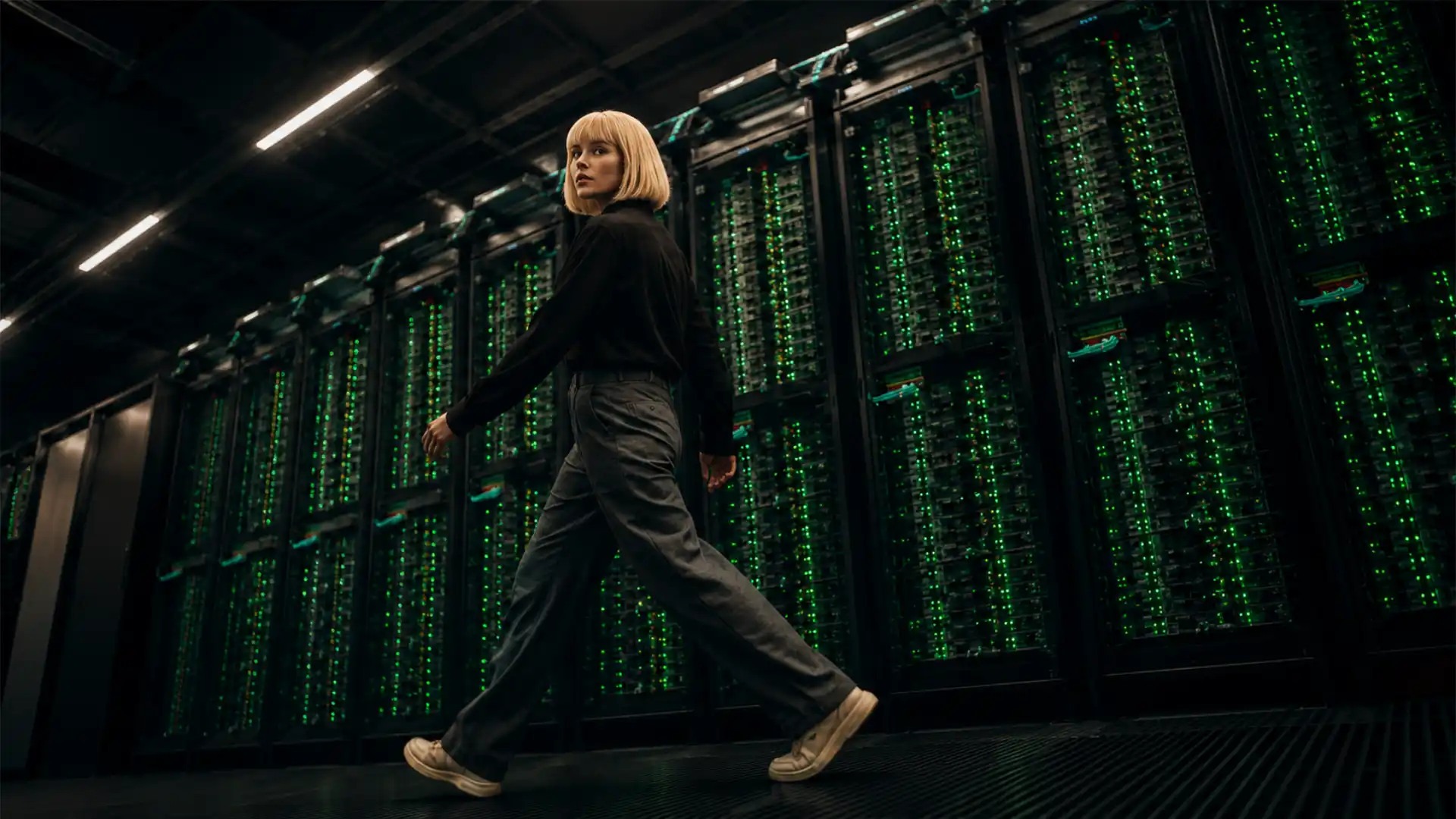
On 23 June 2026, at the ISC High Performance conference in Hamburg, the people who maintain the TOP500 list read out a name that almost no one in the room had seen before. LineShine, a system installed at the National Supercomputing Centre in Shenzhen, debuted at number one with 2.198 exaflops on the High Performance Linpack benchmark. It displaced El Capitan at Lawrence Livermore National Laboratory, the American machine that had led the ranking since November 2024, and it did so by a margin of roughly 20 percent. For the first time since 2017, the world’s fastest publicly ranked supercomputer sits in China.
Table of Contents
That single fact would be enough to make headlines. What makes LineShine genuinely interesting is how it got there. The machine contains no NVIDIA accelerators, no AMD parts, no Intel chips, and no Western interconnect. It runs on a Chinese-designed processor, a Chinese-designed network, and a Chinese operating system. It is the first system in the history of the list to cross two exaflops of sustained double-precision performance using central processing units only, without the graphics processors that power almost every other leading machine and almost every large AI training cluster. The result is a statement about what export controls did and did not accomplish, delivered in the most public forum the field has.
There is a second number that complicates the celebration. On HPL-MxP, the benchmark that approximates the mixed-precision arithmetic used to train large language models, LineShine placed fourth, behind three American systems built around the very accelerators China cannot currently buy. The crown is real. The asterisk is also real. This article works through both.
The result that ended a seven-year drought
China’s relationship with the TOP500 has been strange for most of the past decade. The country once owned the list, both at the top and in sheer volume, and then it walked away from it. LineShine’s debut closes a gap that had lasted seven years and reopens a competition many observers assumed had quietly ended.
The headline figure is 2.198 exaflops, which means roughly 2.2 quintillion floating-point operations every second on a dense system of linear equations. That is the workload Linpack measures, and it has been the field’s common yardstick since 1993. El Capitan, now second, recorded 1.809 exaflops. Frontier at Oak Ridge National Laboratory holds third at 1.353 exaflops, Aurora at Argonne National Laboratory fourth at 1.012 exaflops, and Germany’s JUPITER Booster fifth at exactly 1.000 exaflops. Five machines now sustain more than an exaflop on Linpack, up from four on the previous list, and for the first time those five sit across three continents at once.
The drought has a precise beginning. Sunway TaihuLight, built at the National Supercomputing Center in Wuxi, was the last Chinese system to top the ranking. It held first place from June 2016 through November 2017, then ceded to the American Summit machine in June 2018. After that, Chinese leadership-class systems stopped appearing at the top of the list entirely, and within a few years they stopped appearing in any serious numbers at all. The reasons were political rather than technical, and the next sections trace them in detail.
What changed in June 2026 is that a Chinese institution chose, once again, to submit a Linpack result for a flagship machine and to do it in public, on stage, at the field’s main European gathering. The decision to re-enter the ranking was itself part of the message. A government and a research centre that had spent years declining to benchmark their best hardware in a Western-run competition decided the moment was right to put a number on the board. That choice carries weight beyond the 2.198 figure, because it signals confidence that the system depends on nothing the United States can switch off.
It helps to be precise about what “fastest” means here, because the word does a lot of quiet work. LineShine is the fastest machine on one benchmark, Linpack, and on a second related benchmark, HPCG. It is not the fastest machine on the benchmark most relevant to modern AI, and it is almost certainly not the largest concentration of AI computing power on Earth, since the biggest American cloud and AI clusters do not enter the list at all. The achievement is specific and verifiable, and it is narrower than a casual reading of “world’s fastest supercomputer” suggests. Holding those two ideas together is the whole task of understanding this story.
The people who run the list were careful to say as much. Jack Dongarra, one of the project’s founders and a Turing Award winner, called the result genuine but reminded reporters that the ranking measures one benchmark and should not be read as a complete measure of technological leadership. Software maturity, energy efficiency, reliability, and the ability to serve a broad research community all matter, and a single Linpack score captures none of them. That caution runs through everything that follows.
Inside LineShine’s hardware and the LingKun platform
The technical details of LineShine matter more than usual, because the machine’s whole significance rests on what it is built from. According to the figures published with the June 2026 list, the system reached 2.198 exaflops on Linpack against a theoretical peak of 2.736 exaflops, which works out to about 80 percent efficiency on that workload. For a machine of this scale, sustaining four-fifths of peak on Linpack is a strong result and points to a carefully balanced design rather than a raw collection of cores.
The hardware is organised around what its builders call the LingKun platform. LineShine carries 13.79 million cores spread across processors that each hold 304 cores running at 1.55 gigahertz. That core count puts it well above El Capitan’s 11.34 million and makes it one of the widest machines ever ranked. The processors are linked by a proprietary network the designers call the LingQi interconnect, and the whole system runs Kylin OS, a Chinese Linux distribution with a long history in government and defence computing. The machine was installed at the National Supercomputing Centre in Shenzhen and built by the Shenzhen Cloud Computing Center.
Two numbers describe its appetite for power. LineShine draws roughly 42.2 megawatts and delivers about 52.07 gigaflops per watt on Linpack. That is a large power budget, larger than several of the machines it now ranks above, and the efficiency figure is one of the more revealing data points in the whole result. El Capitan, sitting in second place, manages 60.94 gigaflops per watt, which means the American system does more computing per unit of electricity than the new Chinese leader. A later section returns to why that gap exists and what it tells us about the tradeoffs in a CPU-only design.
Doing a little arithmetic on the published figures sharpens the picture. With 13.79 million cores producing 2.198 exaflops on Linpack, each core contributes on the order of 159 gigaflops sustained. At a clock of 1.55 gigahertz, that implies each core completes roughly a hundred double-precision floating-point operations per cycle. No conventional scalar core does that. The number only makes sense if each LX2 core carries wide vector or matrix units capable of issuing many fused multiply-add operations at once. Chinese designers have described circuitry that handles matrix and vector mathematics directly on the processor, and the performance figures are consistent with that description. This is not a general-purpose server chip pressed into service. It is a processor shaped specifically for dense numerical work.
The number of processors follows from the same figures. At 304 cores each, 13.79 million cores requires on the order of 45,000 LX2 chips, an enormous manufacturing commitment for a single installation. Building, packaging, and cooling that many custom processors, then wiring them together with a custom interconnect and feeding them 42 megawatts, is an industrial undertaking as much as an engineering one. It speaks to a supply chain that can produce leading-edge silicon in volume without Western tools and parts, which is precisely the claim Chinese officials have been making about the project.
There is a naming detail worth flagging for accuracy. Different reports have referred to the platform, the processor family, and the interconnect under slightly different transliterations, and the underlying Chinese names do not always map cleanly into English. The figures published alongside the list, used here, give the platform as LingKun, the processor as the 304-core LX2 at 1.55 gigahertz, and the network as the LingQi interconnect, running Kylin OS. Where popular coverage and the official data diverge on a name, the official data is the safer guide, and the engineering substance is the same regardless of how the labels are romanised.
What the hardware adds up to is a sovereign stack in the literal sense. Every layer that matters for performance was designed and built inside China: the cores, the vector units, the packaging, the network fabric, and the system software. That completeness is the point the builders most want understood, and it is what separates LineShine from the Chinese machines of a decade ago, which sat on Intel and NVIDIA parts and could be slowed by an export decision in Washington.
The LX2 processor at the heart of the machine
A supercomputer is, in the end, a story about its processor repeated tens of thousands of times. LineShine’s story is the LX2, a 304-core chip clocked at 1.55 gigahertz. The core count alone marks a design philosophy. Western server processors top out at a few hundred cores only in their most extreme variants, and most leading HPC chips reach high throughput by pairing a modest CPU with a separate accelerator. The LX2 puts the throughput on the CPU die itself.
The chip belongs to a lineage Chinese engineers have pursued for years, and several reports describe it as an Arm-based design rather than a clone of any Western part. The relevant detail is not the instruction set but the execution width. To reach the per-core performance the list implies, each LX2 core must carry wide SIMD or matrix units that retire many floating-point operations every clock. The 1.55 gigahertz frequency is deliberately conservative. Running a very wide core at a low clock keeps power and heat manageable, which is exactly the constraint you face when you are placing 13.79 million cores in one room. Width over frequency is the classic many-core bargain, and the LX2 takes it to an unusual extreme.
This approach has a clear ancestor in China’s own history. Sunway TaihuLight, the 2016 champion, was built on the homegrown SW26010, a 260-core processor that achieved its 93-petaflop Linpack result by packing many simple cores onto a single die with a fast on-chip network. The LX2 sits in the same tradition, scaled up by an order of magnitude and refined with on-chip vector and matrix hardware. Chinese designers learned, a decade ago, that they could reach the top of the list with many lean cores rather than a few complex ones, and that lesson clearly shaped LineShine.
The economics of this choice deserve attention. A 304-core CPU is a large, expensive die, and yield on large dies falls sharply as defects accumulate. Building tens of thousands of them at a competitive cost requires either a mature domestic process node or aggressive use of techniques like chiplets, where smaller pieces are stitched together to behave as one large processor. The published material does not settle which approach LineShine uses, and that uncertainty is worth holding onto rather than papering over. What the result proves is capability at the system level, not the precise process geometry of the silicon. A machine can top the list on a slightly older, well-understood manufacturing process if the architecture is efficient and the volume is there, and that may well be the case here.
The clock speed also tells you something about the intended workloads. Scientific simulation, the traditional bread and butter of these machines, rewards memory bandwidth and parallel throughput far more than raw single-thread speed. A weather model, a fluid-dynamics simulation, or a structural analysis spreads across millions of cores and runs for hours or days. None of it cares whether an individual core hits four gigahertz. By choosing 1.55 gigahertz and an enormous core count, the LX2 is tuned for the work the National Supercomputing Centre actually plans to run, which is dense numerical computation at planetary scale.
The contrast with AI hardware is sharp and matters for the rest of this story. A modern AI accelerator devotes most of its silicon to low-precision matrix multiplication, the operation at the core of neural-network training. It runs at lower numerical precision, trades exactness for speed, and feeds on specialised memory with extreme bandwidth. The LX2, by every indication, is built for high-precision scientific arithmetic first. It can do lower-precision work, as its HPL-MxP result shows, but that is not where its design effort went. A processor built for sixty-four-bit physics is not the same as one geared to sixteen-bit or eight-bit machine learning, and LineShine’s two benchmark positions are the direct consequence of that difference.
For anyone reading the headlines, the practical takeaway is this. LineShine’s processor is a genuine piece of indigenous engineering aimed squarely at scientific computing, and it succeeds at that aim. It is not a repurposed AI chip, and it does not pretend to be. The machine is fastest in the world at the thing it was built to do, and the thing it was built to do is not the same as training the next frontier language model.
The LingQi interconnect and a fully domestic software stack
Cores do the arithmetic, but the network decides whether a million of them behave like one machine or a million arguing strangers. At exascale, the interconnect is often the harder engineering problem than the processor, and it is the part where Western suppliers like NVIDIA, with its InfiniBand and NVLink fabrics, and HPE, with its Slingshot network, have long held an advantage. LineShine sidesteps that advantage entirely with a proprietary fabric its builders call the LingQi interconnect.
The job of an HPC interconnect is brutal in its demands. When a simulation splits across 45,000 processors, those processors must constantly exchange the values at the boundaries of their pieces of the problem. If the network is slow or its latency is uneven, cores sit idle waiting for data, and the machine’s real performance collapses far below its peak. LineShine’s 80 percent Linpack efficiency is the clearest evidence that the LingQi fabric works well. You do not sustain four-fifths of peak across 13.79 million cores on a mediocre network. That efficiency figure is, in a quiet way, as impressive as the headline exaflops, because it shows the system was engineered as a coherent whole rather than assembled from fast parts that fail to cooperate.
A custom interconnect also closes one of the most effective levers in the export-control toolkit. High-end networking silicon and the optical components that carry data between racks have been targets of restriction precisely because they are hard to build and easy to choke off. By designing its own fabric, China removes that pressure point. Whatever Washington restricts next, it cannot restrict a network that no American company supplies. The strategic logic is the same as the logic behind the processor: control the whole stack, and external policy loses its grip.
The software side completes the picture. LineShine runs Kylin OS, a Chinese Linux distribution with deep roots in the country’s government, military, and critical-infrastructure systems. Kylin has existed in various forms for two decades and was developed in part to reduce dependence on foreign operating systems for sensitive deployments. Running the national flagship supercomputer on Kylin rather than a Western HPC Linux is both a practical choice and a political one. It keeps the entire environment, from the kernel up, under domestic control and auditable by domestic institutions.
Software is also where Chinese supercomputing has historically been weakest, and it is worth being honest about that. A fast machine is only useful if scientists can write code that runs well on it. Tianhe-2, the 2013 champion, drew criticism from its own users for being difficult to program, with some saying that real applications would take years to adapt to its architecture. The same risk applies to any radically custom system. A 304-core processor with bespoke vector units and a proprietary interconnect needs compilers, math libraries, communication libraries, and debugging tools that match it, and that software ecosystem takes years to mature even when the hardware is excellent.
The signs suggest China has taken this lesson seriously. The Sunway line eventually grew a real software stack, including deep-learning libraries tuned to its unusual cores, and the 2016 Gordon Bell Prize went to a team that ran a demanding weather simulation across ten million Sunway cores, which proved the machine was a working scientific instrument rather than a benchmark trophy. A list result tells you the hardware exists; a Gordon Bell-calibre application tells you the software has caught up. LineShine will be judged, over the next two years, on whether it produces that second kind of evidence.
For now, the software stack is best understood as a deliberate sovereign choice with a known weak spot. The operating system, the libraries, and the tools are domestic, which serves the self-reliance goal completely. Whether they are mature enough to let a broad community of Chinese scientists extract the machine’s full value is the open question, and it is the question that separates a genuine research platform from a very fast demonstration.
A CPU-only exascale machine and the logic behind it
The detail that separates LineShine from every other system near the top of the list is what it leaves out. There are no GPUs anywhere in the design. The machine reaches more than two exaflops on Linpack using general-purpose processors alone, the first time any system on the ranking has done so. Understanding why China built it this way, and what the choice costs, explains most of the debate around the result.
Almost every leading supercomputer of the past eight years has been a hybrid. El Capitan pairs AMD EPYC CPUs with AMD Instinct MI300A accelerators. Frontier uses AMD CPUs and GPUs. Aurora combines Intel CPUs and Intel GPUs. The reason is simple: a GPU delivers far more floating-point throughput per watt and per dollar than a CPU on the dense, regular mathematics that Linpack and AI training both involve. The accelerator does the heavy arithmetic while the CPU coordinates. That template has dominated the field because, when you can buy the accelerators, it wins on almost every metric that matters.
China, for the most part, cannot buy them. United States export controls have restricted the sale of NVIDIA’s and AMD’s most capable data-centre GPUs to Chinese buyers, and they have also restricted the manufacturing equipment needed to produce equivalent chips domestically at the leading edge. Faced with that wall, Chinese designers had two options. They could build their own GPUs, which is hard and slow and exactly what the manufacturing restrictions target, or they could reach exascale a different way, by pushing CPUs further than anyone had before. LineShine is the second option made real. It is what a leading supercomputer looks like when the obvious accelerator path is closed and a country decides to win on CPUs instead.
The choice is not purely defensive. CPU-only designs carry genuine engineering advantages for a large class of scientific problems. A GPU is fastest when the work is regular and predictable, with the same operation applied to enormous arrays in lockstep. Many real scientific codes are not like that. They have irregular memory access, complex branching, and tightly coupled steps that map poorly onto a GPU’s rigid execution model. On those workloads, a powerful CPU with high memory bandwidth and a fast interconnect can be the better tool, and it is far easier to program. The HPCG benchmark, which LineShine also leads, was designed precisely to reward machines that handle these messier, more realistic patterns, and a CPU-only design is well suited to it.
The cost of the choice appears on the AI-style benchmark and in the power bill. On HPL-MxP, which rewards low-precision matrix throughput, LineShine sits fourth with a 3.6-times speedup over its standard Linpack score. The American hybrid machines post speedups of eight to eleven times, because their GPUs are stuffed with low-precision matrix engines that the LX2 simply does not match. The same gap shows in energy: at 52.07 gigaflops per watt, LineShine is less efficient than the GPU-accelerated El Capitan’s 60.94. A CPU-only machine pays for its independence in watts and in low-precision throughput. Those are the two prices, and the result lays them out plainly.
There is a deeper strategic point in the design. By proving that exascale is reachable without Western accelerators, China weakens the single most important assumption behind the export-control regime, which is that denying advanced GPUs denies leadership-class computing. LineShine does not refute that assumption on AI workloads, where GPUs still rule. It refutes it decisively on classical scientific computing, where the country can now claim the top of the list on entirely domestic hardware. That is a narrower victory than the headlines imply and a real one all the same.
For the rest of the world’s HPC programmes, the machine reopens a design question many considered settled. The GPU-accelerated template won so completely that CPU-only exascale had become almost unthinkable. LineShine shows it can be done, given enough cores, a good vector unit, a strong interconnect, and a willingness to spend the power. Whether that is a smart general strategy or a forced adaptation to sanctions is exactly the argument the result has started, and reasonable experts land on both sides of it.
Linpack, HPCG, and HPL-MxP without the jargon
Three benchmarks decide most of what gets said about LineShine, and they measure three different things. Confusing them is the single most common error in coverage of the list, so it is worth slowing down to separate them clearly.
Linpack, formally High Performance Linpack or HPL, is the oldest and the one that determines the TOP500 ranking. It solves a large dense system of linear equations and measures how many double-precision, sixty-four-bit floating-point operations the machine sustains while doing it. Double precision matters: it is the high-accuracy arithmetic that scientific and engineering simulations rely on, where small rounding errors compound into wrong answers. Linpack has been the field’s yardstick since 1993, which is its great strength, because it allows comparison across more than three decades of machines. Its great weakness is that almost no real application looks like Linpack. The benchmark is unusually regular and compute-heavy, which lets a well-tuned machine hit a large fraction of its theoretical peak, but that same regularity means a high Linpack score does not guarantee high performance on messier work.
HPCG, the High Performance Conjugate Gradient benchmark, was created to address exactly that weakness, and Jack Dongarra was among its designers. It models the access patterns of real scientific codes: sparse data, irregular memory traffic, and frequent communication between parts of the problem. Machines score far lower on HPCG than on Linpack, often by a factor of fifty or more, because this kind of work stresses the parts of a system that Linpack lets coast, especially memory bandwidth and network latency. A strong HPCG result is, in many ways, a better signal of how useful a machine will be to working scientists than its Linpack number. LineShine leads HPCG at 22.00 petaflops, ahead of El Capitan’s 17.41 and Fugaku’s 16.00, and that is arguably the more telling of its two first-place finishes.
HPL-MxP, the mixed-precision benchmark once known as HPL-AI, is the newest and the one tied most directly to artificial intelligence. It allows the machine to use lower-precision arithmetic, the sixteen-bit and eight-bit formats that neural-network training depends on, and to refine the result back to full accuracy at the end. The benchmark exists because AI hardware is built around low-precision matrix math, and HPL-MxP rewards exactly that capability. The speedup a machine shows over its standard Linpack score is a rough proxy for how much low-precision horsepower it carries. El Capitan posts a 9.2-times speedup, Aurora 11.5, Frontier 8.4. LineShine posts 3.6, and that gap is the clearest single measure of the distance between China’s CPU-only design and the GPU-accelerated American systems on AI-relevant work.
The relationship between the three is the whole point. A machine can lead one and trail another, and LineShine does exactly that: first on Linpack, first on HPCG, fourth on HPL-MxP. None of these is wrong or rigged. They simply measure different abilities, and a single processor architecture cannot be best at all of them at once. The LX2’s wide double-precision vector units win Linpack and HPCG; the absence of dedicated low-precision matrix accelerators loses HPL-MxP.
This is why “world’s fastest supercomputer” is a phrase that needs a footnote every time it appears. On the classical scientific yardstick, LineShine is genuinely first, and on the more realistic scientific yardstick it is also first. On the yardstick that best reflects modern AI, it is fourth, and the systems ahead of it are American. A reader who understands those three benchmarks understands the entire LineShine story. A reader who collapses them into one number will misread it in one direction or the other, either overstating China’s AI position or dismissing a real and hard-won scientific achievement.
One more figure puts the AI gap in perspective. Further down the HPL-MxP results, SoftBank’s CHIE-4 system in Japan recorded a 24.4-times speedup over its standard Linpack score, the largest gain in the field. That number comes from a machine purpose-built for AI, and it shows how far a design tuned for low precision can stretch beyond its double-precision rating. LineShine’s 3.6 sits at the opposite end of that spectrum, which is exactly what you would expect from a machine built for the other kind of work.
The two rankings LineShine leads and the third it trails
Putting LineShine’s three results side by side shows a machine that is exceptional at one kind of computing and ordinary, by elite standards, at another. The pattern is consistent and explainable, and it rewards a careful look rather than a headline.
On Linpack, LineShine’s 2.198 exaflops beats El Capitan’s 1.809 by about 21 percent. That is not a narrow win. A fifth more sustained double-precision throughput than the previous champion is a commanding margin at this level, where systems usually leapfrog each other by smaller steps. The result also clears two exaflops, a threshold no machine had crossed on CPUs, which gives it a place in the record books beyond the ranking itself.
On HPCG, the gap is wider still in relative terms. LineShine’s 22.00 petaflops sits well above El Capitan’s 17.41 and Fugaku’s 16.00, with Frontier at 14.05 further back. This is the result that should reassure anyone worried the machine is a Linpack special. HPCG rewards memory bandwidth and efficient communication, the qualities that determine whether real simulations run well, and LineShine leads it clearly. A system that tops both Linpack and HPCG is a serious scientific instrument, not a benchmark stunt. The CPU-only design, with its high memory bandwidth and strong interconnect, is genuinely well matched to this workload.
On HPL-MxP, the story inverts. El Capitan holds first at 16.7 exaflops, Aurora second at 11.6, Frontier third at 11.4, and LineShine fourth at 7.92. The raw numbers are less telling than the speedups behind them. El Capitan’s 9.2-times jump over its Linpack score reflects the low-precision matrix engines packed into its MI300A accelerators. LineShine’s 3.6-times jump reflects their absence. The machine that is twenty percent faster than El Capitan on classical math is less than half as fast on the math that resembles AI training. That single comparison is the most important quantitative fact in the entire result, and it is the reason careful analysts refused to call LineShine the world’s most powerful AI machine.
The pattern is not a flaw in LineShine. It is the signature of its design. A processor built around wide double-precision vector units will dominate Linpack and HPCG and trail on low-precision work, because the silicon that would accelerate low precision was spent on something else. You can build a chip for sixty-four-bit physics or for eight-bit machine learning, and the further you push one, the more you give up on the other. LineShine chose physics, decisively, and its three results are the receipt.
This matters for how different audiences should read the news. For the scientific computing community, the relevant facts are the Linpack and HPCG leads, and they are real and impressive. For the AI policy community, the relevant fact is the HPL-MxP position, and it suggests export controls are still constraining China’s access to the kind of compute that trains frontier models, even as they failed to keep China off the top of the classical list. Both readings are correct, and they describe different parts of the same machine.
It is also worth noting what the list does not contain, because that absence shapes the AI comparison more than any benchmark. The largest American AI clusters, the ones run by cloud providers and AI labs, mostly do not submit to TOP500 at all. If they did, several of them would likely rank near or above LineShine on AI-relevant work and possibly on Linpack too. The ranking, by its nature, captures government and academic machines that volunteer their results, and it has become a partial view of the world’s computing power rather than a complete one. LineShine is the fastest machine that chose to be measured, which is not quite the same as the fastest machine that exists.
The reshuffled top ten and a more crowded exascale club
LineShine’s debut did more than change the name at the top. It pushed every other machine down a rung and reshaped a top ten that now spans an unusual range of architectures and countries. The June 2026 list is the most geographically spread leadership tier the field has produced.
The June 2026 TOP500 top ten by Linpack
| Rank | System | Site | Country | Linpack |
|---|---|---|---|---|
| 1 | LineShine | National Supercomputing Centre, Shenzhen | China | 2.198 EF |
| 2 | El Capitan | Lawrence Livermore National Laboratory | United States | 1.809 EF |
| 3 | Frontier | Oak Ridge National Laboratory | United States | 1.353 EF |
| 4 | Aurora | Argonne National Laboratory | United States | 1.012 EF |
| 5 | JUPITER Booster | Jülich Supercomputing Centre | Germany | 1.000 EF |
| 6 | HPC7 | Eni S.p.A. | Italy | 571.5 PF |
| 7 | Eagle | Microsoft Azure | United States | 561.2 PF |
| 8 | HPC6 | Eni S.p.A. | Italy | 477.9 PF |
| 9 | Fugaku | RIKEN | Japan | 442 PF |
| 10 | Alps | Swiss National Supercomputing Centre | Switzerland | 434.9 PF |
The table shows a leadership tier built on no single technology, with custom Chinese silicon, AMD and Intel accelerated systems, NVIDIA Grace Hopper machines, a Microsoft cloud cluster, and Japan’s Arm-based Fugaku all sharing the top ten.
Several movements within the list are worth tracing. Five systems now exceed one exaflop on Linpack, up from four, and they sit across Asia, North America, and Europe at the same time, a first for the ranking. Below the exascale five, Eni’s new HPC7 entered directly at sixth with 571.5 petaflops, built on the same HPE Cray EX255a architecture as El Capitan and joining the Italian energy company’s existing HPC6 machine at eighth. That an oil-and-gas firm runs two of the world’s ten fastest supercomputers is a reminder that private industry, not only national labs, now operates at this scale for seismic imaging and reservoir modelling.
Microsoft’s Azure-based Eagle slipped to seventh at 561.2 petaflops, the only American cloud system in the top ten and a rare case of a hyperscaler submitting a result at all. Japan’s Fugaku held ninth at 442 petaflops, remarkable longevity for a machine that topped the list in 2020 and remains a workhorse five years later. Switzerland’s Alps rounded out the top ten at 434.9 petaflops on NVIDIA Grace Hopper hardware. Just outside, Finland’s LUMI and Italy’s Leonardo, ninth and tenth on the previous list, fell to eleventh and twelfth, squeezed down by the new arrivals above them.
The aggregate numbers tell their own story of a field still growing fast. The combined Linpack performance of all 500 systems reached 18.74 exaflops, up from 14.99 on the November 2025 list, a 25 percent jump in six months. The number of systems using accelerators rose to 277 from 255. Even setting aside the top spot, the list as a whole is climbing at a healthy rate, driven largely by AI-oriented hardware spreading into machines at every level.
Vendor representation reveals where the supply chain power sits. HPE integrated six of the ten systems, the dominant position among system builders, supplying El Capitan, Frontier, Aurora, HPC7, HPC6, and Alps. AMD powered four machines directly and contributed more than 40 percent of the combined top-ten Linpack performance, the strongest processor presence on the list. NVIDIA technology appeared in three systems through its Grace Hopper and accelerator products. Against that backdrop of American and European suppliers, China’s entry stands out precisely because it shares none of them. LineShine is the only top-ten machine built entirely outside the Western HPC supply chain, and that is the whole reason it matters more than its ranking alone would suggest.
El Capitan, Frontier, and the US national-lab fleet
Losing the top spot does not mean the United States lost its depth, and the June 2026 list makes that distinction clearly. America still holds three of the top four positions and operates the most capable collection of leadership-class machines in the world, all aimed at problems the country treats as matters of national security.
El Capitan, now second at 1.809 exaflops, sits at Lawrence Livermore National Laboratory and is the machine that LineShine displaced. It is no less capable than it was the day before the list came out. Built on the HPE Cray EX255a architecture with AMD fourth-generation EPYC processors and AMD Instinct MI300A accelerators, it carries 11.34 million cores and delivers 60.94 gigaflops per watt, which keeps it more energy-efficient than the new Chinese leader. El Capitan’s primary job is stewardship of the United States nuclear weapons stockpile, running the three-dimensional simulations that let the country certify its arsenal without physical testing. It also leads HPL-MxP at 16.7 exaflops, which means that on the benchmark closest to AI training, El Capitan, not LineShine, remains the fastest machine on the list.
Frontier, third at 1.353 exaflops, was the world’s first official exaflop machine when it debuted at Oak Ridge National Laboratory in 2022, and it remains a central instrument for open science. Its AMD CPU-and-GPU design set the template that El Capitan refined, and it supports research from climate modelling to materials discovery to the early training of large scientific AI models. Aurora, fourth at 1.012 exaflops, sits at Argonne National Laboratory and is the outlier in the American fleet, built on Intel CPUs and Intel GPUs rather than AMD parts. Its path to exascale was long and troubled, but it now anchors Argonne’s work in chemistry, fusion, and AI for science.
The common thread is that these are public, mission-driven machines funded by the Department of Energy, designed to serve broad research communities and to certify the nuclear stockpile. They are not built to win benchmark contests, though they often do, and they are not the largest concentrations of raw AI compute in the country. That distinction belongs to private clusters that never enter the list. The national-lab fleet represents something different: durable, well-supported scientific infrastructure with mature software and a track record of producing real results across many fields.
LineShine’s arrival changes the symbolism around this fleet without changing its substance. The United States still has more top-tier machines, still leads on the AI-relevant benchmark, and still operates the deepest HPC software ecosystem on Earth. What it no longer has is the single fastest machine on the classical yardstick, and in a competition where symbolism carries real political weight, that loss matters even though the underlying capability is intact. The reaction in Washington, traced in a later section, has more to do with what the result signals about China’s trajectory than with any sudden American weakness.
JUPITER, Alps, and Europe’s sovereign computing push
Europe’s presence in the top ten reflects a decade-long project to build sovereign computing capacity, and the June 2026 list shows that project bearing fruit. The continent now operates the only non-American, non-Chinese exascale machine on the ranking, along with several systems that lead the world on energy efficiency.
JUPITER Booster, fifth at exactly 1.000 exaflops, is the headline European result. Operated by the Jülich Supercomputing Centre in Germany under the EuroHPC Joint Undertaking, it is Europe’s first and only system above the exascale threshold on Linpack. It is built on Eviden’s BullSequana XH3000 platform using NVIDIA Grace Hopper Superchips, which makes it a proof of European system integration paired with American accelerator technology. JUPITER’s mission is deliberately broad, spanning climate research, brain simulation, and the training of large European AI models, and its exascale milestone is a point of real pride for a bloc that has worked hard to avoid dependence on either Washington or Beijing for its most demanding computing.
Alps, tenth at 434.9 petaflops, sits at the Swiss National Supercomputing Centre and also runs on NVIDIA Grace Hopper hardware. It serves Swiss and European science across weather, climate, and a growing portfolio of AI work. Together with JUPITER, it anchors a European HPC strategy that pours public money into shared infrastructure rather than leaving capability concentrated in a few private hands.
The European story is most striking on the Green500, the ranking that measures energy efficiency rather than raw speed. All three of the most efficient machines in the world are European, and the order was unchanged from the previous list. KAIROS, at the CALMIP centre at the University of Toulouse and France’s CNRS, leads at 73.28 gigaflops per watt. ROMEO-2025, at the ROMEO centre in the Champagne-Ardenne region of France, follows at 70.91. The Levante GPU extension at Germany’s DKRZ climate-computing centre takes third at 69.43. All three share the same BullSequana XH3000 architecture built on Grace Hopper Superchips with NVIDIA InfiniBand networking, and their ranking order reflects size, since smaller installations of identical technology consistently edge out larger ones on efficiency.
That efficiency leadership is a quiet rebuke to the assumption that the supercomputing race is only about peak speed. A machine that delivers 73 gigaflops per watt does more science per megawatt than LineShine’s 52, and in a world of rising energy costs and carbon targets, that ratio is becoming as strategically important as the headline exaflops. Europe has chosen to compete on this axis deliberately, and the Green500 shows the strategy working even as the continent sits behind on raw Linpack.
Europe’s position in this race is therefore distinctive. It does not lead on the fastest machine, and it is not trying to. It leads on efficiency, it operates the only exascale system outside the two superpowers, and it has built its capacity around shared public infrastructure and the explicit goal of digital sovereignty. That is a third model, neither American private-cloud dominance nor Chinese state-driven self-reliance, and the next two lists will show whether it can keep pace as the other two pour resources into the contest.
Fugaku and Japan’s distinctive Arm bet
Japan’s place on the list is a lesson in longevity and in the value of a clear architectural philosophy. Fugaku, ninth at 442 petaflops, topped the TOP500 in 2020 and still holds a top-ten position six years later, which is rare in a field where machines usually fade within three or four years. Its endurance says something about how it was built.
Fugaku, operated by the RIKEN research institute, runs on Fujitsu’s A64FX processor, an Arm-based chip with wide vector units and no separate GPU. In that sense, it is the closest precedent for LineShine’s approach: a CPU-only machine that reached the top of the list using a custom Arm design with heavy vector capability. Fugaku proved, years before LineShine, that a well-engineered CPU-only system could lead the world and serve a broad scientific community, and the Japanese machine’s software maturity and ease of use became part of its reputation. Chinese designers building a wide-vector CPU machine were not working without a model.
The differences matter as much as the parallel. Fugaku was built in open collaboration with the global HPC community, using a standard Arm instruction set and a mature software stack that scientists could adopt readily. Its design choices were shared, debated, and refined in public. LineShine, by contrast, is a closed, sovereign system whose internal details are partly opaque and whose software stack is domestic. Both are CPU-only, vector-heavy, Arm-influenced machines, and they sit at opposite ends of the openness spectrum. That contrast captures a real divide in how nations now approach leadership computing.
Fugaku also illustrates the AI question from another angle. Despite being a capable scientific machine, it was never an AI-training powerhouse, because its design predated the explosion of low-precision matrix hardware. Japan’s answer has been to build separate, AI-focused systems, including SoftBank’s CHIE-4, which posted the largest mixed-precision speedup on the entire June 2026 list at 24.4 times its Linpack score. Japan effectively split the problem, keeping Fugaku for classical science and building dedicated machines for AI, rather than asking one architecture to do both. That separation is a strategy China and others may increasingly follow, since the two workloads pull processor design in opposite directions.
For the broader field, Fugaku’s staying power is a reminder that the newest machine is not always the most useful one. A system with mature software, a stable architecture, and a productive user community keeps delivering science long after it leaves the top of the list. LineShine’s real test is not whether it can top one ranking but whether, six years from now, it is still doing valuable work the way Fugaku is. That is a far harder bar than a single Linpack submission, and it is the bar that ultimately defines a successful supercomputer.
China’s long climb from Yinhe-1 to the summit
LineShine did not appear from nowhere. It is the latest peak in a climb that began more than four decades ago, and the history explains both why the achievement was possible and why it carries such national weight. China has been building toward this kind of result, with interruptions, since the early 1980s.
The starting point was Yinhe-1 in 1983, China’s first domestically built supercomputer, developed by the National University of Defense Technology. At the time, the country was far behind the United States, Japan, and Europe, and supercomputing was treated as a strategic capability tied to weapons design, weather forecasting, and national planning. For years, progress was slow and dependent on imported technology where it was available and on painstaking domestic effort where it was not.
China first appeared on the TOP500 at all in 2001, and as late as 2009 it had no entries in the top ten. The turning point came at the end of that decade. In June 2010, the Nebulae system at the National Supercomputing Centre in Shenzhen, the same site that now hosts LineShine, reached second place. A few months later, in November 2010, Tianhe-1A at the National Supercomputing Center in Tianjin became the first Chinese system ever to top the list, displacing the American Jaguar machine with a Linpack result of around 2.5 petaflops. For the first time since the ranking began in 1993, the world’s fastest supercomputer was Chinese.
The ascent was extraordinarily fast by any historical measure. A country with no top-ten presence in 2009 held the number-one spot a year later and would soon dominate the list in raw numbers. Observers at the time noted that China had come further and faster in supercomputing than any nation before it. The growth was driven by sustained state investment through programmes like the 863 High Technology Program and the country’s five-year plans, which treated leadership computing as a national priority rather than a commercial afterthought.
Tianhe-1A’s reign was brief, ended by Japan’s K computer in 2011, but it established a pattern. China would build enormous machines, top the list, lose the top spot to a rival, and come back with something larger. The Tianhe line, developed by the defence university, and the Sunway line, developed by the National Research Center of Parallel Computer Engineering and Technology, became the two pillars of Chinese leadership computing, and between them they would hold the world’s top position for most of the middle of the decade.
The early machines had a vulnerability that LineShine was built to eliminate. Tianhe-1A and Tianhe-2 relied on American processors, Intel Xeons and, in Tianhe-2’s case, Intel Xeon Phi accelerators. That dependence made them powerful but exposed, because the United States could and eventually did restrict the export of those parts. The whole arc of the next fifteen years, from the 2015 Intel ban through the export controls of the 2020s to LineShine’s fully domestic stack, is the story of China working to remove that exposure. The summit in 2026 is impressive partly because of the height and partly because of what the machine is made of, and the second part only makes sense against this history.
By June 2016, China had passed the United States in the total number of systems on the list, 167 to 165, the first time it had ever led on that count. By 2018, the gap had widened to 206 to 124. China was not merely competing at the top; it had become the most prolific producer of ranked supercomputers in the world. That breadth, as much as the headline machines, defined the country’s first era of supercomputing dominance, and it is the era that the quiet years after 2017 brought to an apparent end.
Five years at the top with Tianhe and Sunway
The heart of China’s first supercomputing era ran from 2013 to 2017, when two machines held the world’s top spot almost continuously and turned the country from a fast-rising challenger into the dominant force on the list. Understanding those two systems clarifies what LineShine is built on and how far the domestic capability has come.
Tianhe-2, also called Milkyway-2, took first place in June 2013 and held it for six consecutive lists, through November 2015, the longest unbroken reign of the period. Built by the National University of Defense Technology and installed at the National Supercomputer Center in Guangzhou, it reached 33.86 petaflops on Linpack against a peak of around 55, and it did so as a hybrid system combining Intel Xeon processors with Intel Xeon Phi accelerators. Tianhe-2 nearly doubled the performance of the American Titan machine it surpassed, and it announced that China could field the world’s most powerful computer on demand. It also exposed the dependence that would later become a liability, since its accelerators came from Intel.
Tianhe-2 carried a known weakness that foreshadowed a theme of this article. Its own users complained that it was hard to program, with one senior figure noting that some applications would take years to adapt to the machine. A fast computer that scientists struggle to use delivers less than its benchmark suggests, and Tianhe-2’s software gap was real. The lesson, that hardware leadership must be matched by software maturity, is one that Chinese supercomputing has spent the decade since trying to absorb.
The succession came in 2016, and it changed the technological story. Sunway TaihuLight, built by the National Research Center of Parallel Computer Engineering and Technology and installed at the National Supercomputing Center in Wuxi, took first place in June 2016 and held it through November 2017. It reached 93 petaflops on Linpack, nearly three times Tianhe-2’s figure, with a peak of 125. What set it apart was its processor. TaihuLight ran on the SW26010, a fully homegrown chip with 260 cores, and it carried 10.65 million cores in total. It was the first Chinese number-one system built entirely on domestic processors, and its director described it at the time as proof of China’s progress in designing and manufacturing large-scale computers without foreign parts.
The parallel to LineShine is direct and worth stating plainly. Sunway TaihuLight was the first proof that China could top the list on its own silicon; LineShine is the second, an order of magnitude faster and built after years of intensifying sanctions. The 2016 machine used a 260-core CPU; the 2026 machine uses a 304-core CPU with vastly more capability. The lineage runs straight from one to the other, through the same conviction that many lean domestic cores, well networked, can reach the summit.
TaihuLight also showed that a Chinese machine could be a genuine scientific instrument and not only a benchmark winner. In 2016, a team running a demanding weather and climate simulation across ten million of its cores won the Gordon Bell Prize, the field’s top honour for real applications. That award answered the criticism that had dogged Tianhe-2, because it showed the software ecosystem catching up to the hardware. The cost of all this was substantial: TaihuLight’s building, hardware, research, and software were reported to run around 270 million dollars, a price that only made sense as a state investment in strategic capability rather than a commercial purchase.
The end of TaihuLight’s reign, when the American Summit machine surpassed it in June 2018, closed the most successful chapter of Chinese supercomputing to date. For five years across three machines, China had held the world’s top position more often than not, and it led the list in raw numbers by a wide margin. What happened next was not a loss of capability but a deliberate withdrawal, and that withdrawal is the strangest and most revealing part of the story.
The quiet years after 2017
The most puzzling stretch of China’s supercomputing history is the period when the country stopped showing up. After TaihuLight’s reign ended in 2018, Chinese leadership-class systems simply disappeared from the top of the TOP500, and within a few years they had largely vanished from the list altogether. The disappearance was not a decline in ability. It was a choice, and it tells you as much about the politics of the field as any benchmark.
The pattern was gradual. China kept submitting many systems through 2018 and 2019, when it still led the world in the sheer number of ranked machines. But its flagship systems stopped appearing, and its overall participation began to fall. Several reports place the effective end of Chinese leadership-class submissions around 2019, after the first wave of United States sanctions, with the withdrawal deepening through the early 2020s. By the time of LineShine’s debut, the field had gone seven years without a Chinese system at the top and several years without serious Chinese participation at all.
The reason was a mix of caution and protest. Submitting a flagship machine to the TOP500 means publishing detailed information about its scale and architecture and inviting scrutiny from a Western-run organisation. As United States sanctions tightened and several Chinese supercomputing institutions landed on the Commerce Department’s Entity List, the calculation changed. There was little upside in advertising a strategic capability to the country actively trying to constrain it, and there was real downside in confirming exactly how far Chinese systems had progressed. Staying off the list became the prudent move.
China kept building, though, and that is the part that matters. Even as it withdrew from the ranking, the country brought several exascale-class machines into service that were never officially benchmarked on the list. The most-discussed are OceanLight, a successor to the Sunway line, and Tianhe-3, sometimes called Xingyi, the next generation of the defence university’s machines. Both were reported to operate in the exaflop range years before LineShine, and the strongest public evidence came not from TOP500 submissions but from Gordon Bell Prize papers, where Chinese teams described running enormous applications on machines they did not name in full. The field knew China had reached exascale; it simply could not see the official numbers.
This created a strange information gap that shaped Western perceptions. Because China was absent from the list, casual observers could believe the United States had pulled decisively ahead, since American machines held every top spot from 2018 onward. Specialists knew better, because they could read between the lines of the conference papers and the occasional disclosure. The official ranking said the United States led; the deeper evidence said China had quietly reached the same exascale frontier without saying so. LineShine did not create a new capability so much as make a long-existing one visible.
Seen this way, the 2026 debut is less a sudden leap than a decision to lift the curtain. China had the capability to top the list, or to come close, for years. What changed was the judgment that the moment was right to show it, on a fully domestic machine that no export decision could undermine. The achievement is the silicon, not the speed alone, and the timing is a message: China is now confident enough in its self-reliance to compete in public again. The quiet years were a strategic pause, and LineShine is its deliberate end.
Export controls and the chips China cannot buy
The whole meaning of LineShine rests on a decade of United States export policy, and the machine cannot be understood without it. The restrictions began as a narrow response to a specific worry and grew into the most ambitious technology-denial regime of the modern era. LineShine is both a product of that regime and a partial answer to it.
The first major action came in 2015, when the United States blocked Intel from selling its Xeon processors to several Chinese supercomputing institutions, including the defence university behind the Tianhe machines. The stated concern was that Tianhe-2 was being used for nuclear-weapons-related simulation. The ban was meant to slow China’s progress, and in the short term it did. But it also pushed China toward domestic chips, and within a year Sunway TaihuLight reached the top of the list on a homegrown processor. The first export control produced the first all-Chinese champion, a pattern that would repeat.
The restrictions widened over the following years. In October 2019, the Commerce Department added several Chinese supercomputing and chip-design entities to its Entity List, cutting them off from American technology without licenses. In April 2021, it added seven more, including processor designers and three of the National Supercomputing Centres themselves. These actions targeted not just finished chips but the broader ecosystem of design and manufacturing that leadership computing depends on.
The decisive escalation came on 7 October 2022, when the Bureau of Industry and Security issued sweeping rules restricting the export of advanced computing chips and the equipment used to make them. The rules targeted high-end data-centre GPUs, the NVIDIA and AMD accelerators that power both modern AI training and most leading supercomputers, and they restricted the semiconductor manufacturing equipment needed to produce equivalent chips at the leading edge inside China. A further tightening in October 2023 closed loopholes that had allowed slightly slowed versions of the restricted chips to keep flowing. The combined effect was to deny China both the best accelerators and the tools to build its own at the most advanced process nodes.
The logic of the regime was straightforward. Advanced GPUs are the engine of both frontier AI and leadership supercomputing, and the equipment to make them is concentrated in a handful of companies in the United States, the Netherlands, and Japan. By controlling that chokepoint, Washington hoped to cap China’s progress in both fields. The bet was that you cannot build a world-leading computer without world-leading accelerators, and that China could be kept from world-leading accelerators. LineShine tests that bet directly.
The result is a split verdict, and honesty requires stating both halves. On classical scientific computing, the bet failed. China reached the top of the list, past two exaflops, on entirely domestic hardware with no restricted parts anywhere in the design. The export controls did not prevent a Chinese number-one system; if anything, by closing the accelerator path, they channelled China’s effort into the CPU-only design that now leads Linpack and HPCG. On the workloads the controls were partly meant to protect, they were defeated by adaptation.
On AI-relevant computing, the bet is holding, at least for now. LineShine’s fourth-place HPL-MxP result, with its modest 3.6-times speedup, is the clearest evidence that China still lacks the dense low-precision matrix hardware that the restricted GPUs provide. The three machines ahead of it on that benchmark are American and depend on exactly the accelerators China cannot buy. The controls failed to keep China off the classical summit and succeeded, so far, in keeping it behind on the AI frontier. That is a more complicated outcome than either side’s talking points allow, and it is the central policy lesson of the result.
Jack Dongarra summed up the tension when he said export controls may slow China’s access to advanced components while also pushing it toward domestic alternatives. He added that he was not entirely surprised China had taken the lead, and that controls might both constrain China and accelerate its drive toward self-sufficiency. That dual effect, constraint and acceleration at the same time, is the hard truth the LineShine result forces policymakers to confront. A denial regime can buy time and raise costs, and it can also harden a rival’s determination to need nothing from you. China spent the years of pressure building a stack that no future control can touch, and the summit in 2026 is the dividend on that investment.
The self-reliance doctrine behind the machine
LineShine is not only an engineering achievement. It is the physical expression of a political doctrine that has guided Chinese technology policy for years, and the machine’s value to Beijing lies as much in what it proves about that doctrine as in its benchmark scores.
The doctrine has a name in Chinese policy language built around self-reliance and controllability, the idea that strategic technologies must be designed, manufactured, and operated using domestic capability that no foreign power can disrupt. When the National Supercomputing Centre in Shenzhen completed full-machine testing of LineShine in early 2026, officials framed the achievement in exactly these terms, describing complete self-reliance across the entire technology stack. That phrasing is the point. The machine matters to its builders because it depends on nothing the United States can switch off.
This doctrine did not emerge in a vacuum. It is the direct response to the export controls of the past decade, and it reflects a strategic conclusion China drew from watching those controls tighten. If access to foreign technology can be revoked by a policy decision in Washington, then any strategic capability built on foreign technology is hostage to that decision. The only durable answer is to build the whole stack domestically, accepting higher costs and slower progress in exchange for security against denial. LineShine is what that conclusion looks like when it is funded and executed at national scale.
The completeness of the system is therefore not an accident or a flourish; it is the entire purpose. A machine that was ninety percent domestic but depended on a foreign interconnect or a foreign operating system would still be vulnerable, and it would not serve the doctrine. By controlling the processor, the network, and the software together, LineShine becomes proof that China can field a leadership-class machine with no foreign dependencies at any layer. That is a capability statement aimed at both domestic and foreign audiences, and it is meant to change how each thinks about the limits of American power.
For a domestic audience, the message is reassurance and pride. It tells Chinese scientists, industries, and citizens that the country can reach the technological frontier on its own terms, that sanctions are an obstacle rather than a ceiling, and that the investments of the past decade are paying off. National technological achievements carry symbolic weight everywhere, and a machine that tops the world list on entirely Chinese hardware is a potent symbol of the self-reliance project succeeding.
For a foreign audience, the message is a warning to those who believe denial can hold China back indefinitely. LineShine says that pressure produces adaptation, that closing one path forces the opening of another, and that a determined state with deep resources will eventually build what it is denied. The machine is an argument that export controls, however effective in the short term, may accelerate the very self-sufficiency they were meant to prevent. Whether that argument is correct in the long run is genuinely contested, but LineShine gives it a concrete and very fast piece of evidence.
The doctrine has limits that the AI benchmark exposes, and a clear-eyed reading holds them in view. Self-reliance got China to the top of the classical list, but it has not yet matched the West on the low-precision AI hardware that the manufacturing restrictions most directly target. Building your own CPU is achievable; building leading-edge AI accelerators without leading-edge manufacturing equipment is much harder, and that is where the doctrine still strains against reality. LineShine proves the doctrine can succeed in one domain. It does not prove the doctrine can succeed everywhere, and the gap between those two claims is the space where the next phase of the competition will play out.
The distance between Linpack speed and AI training
The single most important misreading of the LineShine result is the assumption that the world’s fastest supercomputer must also be the world’s most powerful AI machine. It is not, and the reasons go to the heart of how computing has split into two related but distinct disciplines over the past decade.
Classical high-performance computing and modern AI training both involve enormous amounts of arithmetic, which is why they share hardware lineage and benchmarks. But they demand different things from a processor. Scientific simulation needs high numerical precision, the sixty-four-bit double-precision arithmetic that keeps rounding errors from corrupting a physics calculation over billions of steps. AI training tolerates and even prefers low precision, the sixteen-bit and eight-bit formats that let a neural network process vastly more data per second at the cost of exactness that the training process does not need. A chip suited to one is not suited to the other.
LineShine is a precision machine. Its LX2 processors carry wide double-precision vector units, which is why it dominates Linpack and HPCG. The same design choice limits it on AI training, because the silicon that would accelerate low-precision matrix multiplication was spent on double-precision capability instead. The 3.6-times speedup on HPL-MxP, against eight to eleven times for the American hybrid machines, is the precise measure of that tradeoff. LineShine is roughly half as capable on AI-style arithmetic as a machine of similar Linpack standing that carries modern accelerators.
This is not a Chinese weakness so much as a consequence of the export controls and the design they forced. Building a leading AI machine requires dense low-precision matrix engines, and the best of those come from NVIDIA and AMD, which China cannot buy, or from domestic chips that need leading-edge manufacturing China cannot yet fully access. The same restrictions that pushed China toward a CPU-only design for the classical summit are the restrictions that keep it behind on AI hardware. LineShine’s two benchmark positions are the two sides of one policy.
The practical consequence is that LineShine, for all its Linpack speed, is not the machine you would build to train a frontier large language model. Training a model on the scale of the largest Western systems requires tens of thousands of high-end accelerators working in concert on low-precision math, fed by extreme memory bandwidth. A CPU-only machine, however fast on Linpack, is the wrong tool for that job, and no amount of double-precision throughput changes it. China’s leadership on the list does not translate into leadership in training the largest AI models, and conflating the two badly misreads where each country actually stands.
It would be equally wrong to conclude that LineShine is irrelevant to AI. Scientific AI, the use of machine learning inside physics, chemistry, biology, and climate research, often needs exactly the high-precision capability and tight coupling that LineShine provides. A growing class of AI-for-science work mixes traditional simulation with neural-network surrogates, and that hybrid work runs well on a machine like this. The distinction is between training general-purpose chatbots, where LineShine is poorly suited, and accelerating scientific discovery with AI methods, where it may be very well suited indeed. The machine sits firmly on the science side of the AI divide.
Stanford’s 2026 AI Index, released a few months before the list, found that China had effectively closed the gap with the United States on AI model performance, even as the United States still produced more of the very top models. That finding sits alongside the LineShine result in an interesting tension. China is closing the gap on AI model quality while remaining behind on the specialised hardware that trains the largest models, and it now leads the world on the classical computing the same hardware restrictions were meant to constrain. The picture is not one of clear American dominance or clear Chinese ascendancy. It is a genuinely mixed scoreboard, and LineShine is one entry on it.
Addison Snell of Intersect360 Research framed the policy stakes precisely when he warned against assuming that AI dominance automatically becomes science dominance, and argued that governments must invest in both AI and scientific computing rather than treating them as alternatives. The danger in misreading LineShine is that it pushes policy toward a false choice, either chasing AI at the expense of science or vice versa, when the actual competition requires strength in both. The machine is a reminder that the computing race has more than one finish line, and a country can be ahead at one and behind at another at the very same moment.
Hyperscalers and the supercomputers that never enter the list
The TOP500 has a blind spot that grows more consequential every year, and LineShine throws it into sharp relief. The most powerful concentrations of computing on Earth, the clusters run by cloud providers and AI labs, largely do not appear on the list at all. Any honest assessment of who leads in raw compute has to account for the machines the ranking cannot see.
The list works by voluntary submission. Government laboratories and academic centres run the Linpack benchmark on their machines and report the results, partly for prestige and partly because public funding rewards visible achievement. Private companies have no such incentive. A cloud provider or an AI lab gains little from publishing a benchmark, and it often has strong reasons not to reveal the scale of its infrastructure to competitors. So the largest commercial systems stay off the list, and the ranking quietly becomes a measure of public computing rather than of total computing.
The gap is not small. Companies like Microsoft, Amazon, Google, and Meta operate AI-focused data centres at a scale that rivals or exceeds the national laboratories, and the AI lab xAI built a cluster in Memphis, named Colossus, that analysts estimate would rank near or above the leading public systems on AI-relevant work if it were ever submitted. Industry observers widely believe that several hyperscaler systems could claim top positions on the list if their operators chose to enter, and they simply choose not to. Microsoft’s Eagle, sitting at seventh, is the rare exception, a single cloud machine that did submit, and it hints at how much capability is hidden behind the companies that did not.
This changes how to read LineShine’s crown. The machine is the fastest system that chose to be measured on Linpack, which is a real distinction, but it is not the same as the fastest system that exists. On AI-relevant compute in particular, the unranked American commercial clusters very likely exceed LineShine, and possibly exceed it by a wide margin. The list captures China’s flagship because China chose to submit it; it misses the largest American AI machines because their owners chose silence. Comparing a submitted Chinese system against an unsubmitted American one through the lens of the ranking produces a distorted picture in China’s favour on exactly the AI dimension where the United States is strongest.
The deeper point is that the list and the AI era have diverged. When the TOP500 began in 1993, the most powerful computers in the world were almost all government and academic machines, and the list captured nearly everything that mattered. Today the centre of gravity in raw computing has shifted toward private AI infrastructure, and a voluntary ranking of public scientific machines no longer maps cleanly onto the question of who has the most computing power. Several experts have argued the ranking has become less relevant for precisely this reason, even as it remains a strong indicator of the scientific computing that governments and universities run.
That does not make the list worthless. It makes it specific. The TOP500 is an excellent measure of leadership-class scientific computing, the kind of public infrastructure that serves broad research communities and certifies national capabilities. It is a poor measure of total AI compute, because the largest AI machines are private and unranked, and reading it as the latter is the error that distorts most coverage of results like LineShine’s. Snell put the institutional point well: hyperscalers could take the top spots if they wanted, and the ranking still matters as a gauge of scientific supercomputing even though it no longer captures the whole field.
For LineShine specifically, the blind spot cuts in a clarifying direction. The machine’s classical computing leadership is real and complete, because the public systems it beat are the relevant comparison for that kind of work. Its AI-relevant standing is the one most distorted by the missing machines, and the distortion runs in China’s favour, which is the opposite of what the triumphant headlines suggest. A careful reader takes the Linpack and HPCG crowns at face value and treats any claim about AI leadership built on the list with deep suspicion, because the list was never built to answer that question and is missing most of the evidence that would.
A 42-megawatt machine and the efficiency tradeoff
LineShine’s power consumption is one of its most revealing numbers and one of the least discussed. The machine draws roughly 42.2 megawatts, enough to power a small city, and that figure exposes the real cost of the CPU-only design in a way the headline exaflops conceals. Efficiency, not raw speed, may be the metric that matters most as these machines grow.
Power and efficiency among the leading systems
| System | Linpack | Efficiency (Gflops/W) | Approx. power |
|---|---|---|---|
| LineShine | 2.198 EF | 52.07 | ~42.2 MW |
| El Capitan | 1.809 EF | 60.94 | ~29.7 MW |
| KAIROS (Green500 leader) | 3.046 PF | 73.28 | ~0.04 MW |
The comparison is deliberately uneven in scale to make the efficiency point: a small, modern accelerated system like KAIROS does far more computing per watt than either giant, and El Capitan does appreciably more per watt than LineShine despite ranking below it.
The El Capitan comparison is the sharp one. At 60.94 gigaflops per watt against LineShine’s 52.07, the American machine is roughly 17 percent more energy-efficient on Linpack while sitting in second place. Running the numbers, El Capitan reaches its 1.809 exaflops on about 30 megawatts, while LineShine needs about 42 megawatts to reach 2.198. LineShine uses roughly 40 percent more power to deliver about 20 percent more performance. That is the price of the CPU-only approach laid bare. The GPU accelerators in El Capitan do their arithmetic more efficiently than LineShine’s wide CPU cores, and the electricity bill shows it.
The efficiency gap has practical and strategic consequences. A 42-megawatt machine is expensive to run, demands enormous cooling, and contributes a large carbon footprint unless it draws on clean power. Over a system’s lifetime of several years, the difference between 42 and 30 megawatts compounds into a substantial sum and a substantial emissions difference. As supercomputers and AI data centres push toward and past 100 megawatts, efficiency stops being a footnote and becomes the binding constraint, because there are limits to how much power any single site can draw and cool.
This is where the Green500 becomes more than a curiosity. The three most efficient machines in the world are all European, led by France’s KAIROS at 73.28 gigaflops per watt, and they reach that efficiency through NVIDIA Grace Hopper accelerators and tight engineering. A machine at 73 gigaflops per watt does roughly 40 percent more computing per unit of energy than LineShine at 52, and while those efficient systems are far smaller in absolute terms, the ratio points to where the frontier of sustainable computing is heading. Europe’s bet on efficiency is a bet that, as power becomes the limiting factor, doing more per watt will matter as much as doing more in total.
For China, the efficiency figure is the clearest cost of the self-reliance doctrine. Forced toward a CPU-only design by the unavailability of the most efficient accelerators, China accepted a less efficient machine to gain an independent one. That tradeoff is rational under sanctions, but it is a tradeoff, and it means LineShine’s leadership comes with a power penalty that a fully unconstrained design would not pay. If China gains access to or develops competitive low-precision accelerators, future machines could close both the AI gap and the efficiency gap at once, which is one reason the manufacturing-equipment restrictions, more than the chip restrictions, are the real long-term battleground.
The broader lesson is that ranking machines by Linpack alone rewards the wrong thing as the field matures. A slightly slower machine that uses far less power may be the better engineering achievement and the more useful scientific instrument, and the Green500 exists precisely to capture that. LineShine wins the headline by spending the watts. Whether that is the right way to win is exactly the question the efficiency numbers raise, and it is a question that will only grow louder as the power demands of leading computing keep climbing.
Scientific workloads the system was built to run
A supercomputer is justified by the science it produces, not the list it tops, and LineShine was built for specific kinds of work. Understanding those workloads grounds the abstract benchmark numbers in the real problems the machine exists to solve, and it explains why a CPU-only, high-precision design made sense to its builders.
The first and most demanding category is Earth-system modelling. Simulating how the atmosphere, oceans, land, and ice interact over decades is among the most computationally punishing problems in science, and it rewards exactly the qualities LineShine has: high double-precision throughput, large memory bandwidth, and efficient communication across millions of cores. Reports indicate the machine is already running a detailed simulation of the Earth’s coupled systems, the kind of work that improves climate projection and weather forecasting. Climate modelling is a national strategic priority for a country exposed to floods, droughts, and extreme weather, and it is precisely the workload a machine like this is built to accelerate.
A second category is neuroscience and brain mapping. Simulating neural systems at scale, tracing how vast networks of neurons connect and behave, demands the tight coupling and high precision that scientific machines provide and that AI accelerators handle poorly. LineShine is reported to run large neural-mapping models, contributing to research that sits at the intersection of biology, medicine, and computing. This is fundamental science with long horizons, the kind that national laboratories exist to support and that rarely attracts private investment.
Drug discovery and molecular science form a third pillar. Simulating how molecules fold, bind, and react requires high-precision calculation of physical forces at atomic scale, repeated across enormous chemical spaces. A machine that excels at double-precision arithmetic is well matched to this work, and LineShine is reported to assist drug-discovery projects. The payoff is concrete: faster screening of candidate compounds, better understanding of disease mechanisms, and a domestic capability in pharmaceutical research that reduces dependence on foreign tools and data.
Engineering simulation rounds out the core workloads. Designing aircraft, ships, engines, and industrial systems relies on computational fluid dynamics and structural analysis, both of which are classical high-precision problems that map well onto LineShine’s architecture. China’s industrial and defence sectors have an obvious appetite for this capability, and a leading domestic machine that can run these simulations at scale supports everything from commercial aviation to advanced manufacturing. These are the bread-and-butter applications of scientific supercomputing, and they are where a CPU-only, high-precision machine earns its keep.
What unites these workloads is that none of them is frontier AI training, and all of them play to LineShine’s strengths. The machine was designed for the science of physical systems, where precision and tight coupling matter more than low-precision matrix throughput, and its workload list reflects that design exactly. A reader trying to judge whether LineShine is a serious instrument or a benchmark trophy should look at this list: a machine running coupled Earth-system models, brain simulations, drug-discovery pipelines, and engineering analyses is doing real and demanding science, regardless of how it ranks on an AI benchmark it was never built to win.
The breadth of the workload also speaks to the software question raised earlier. Running coupled climate models and molecular simulations at scale requires mature application software, well-tuned libraries, and a community of scientists who can use the machine. If LineShine is genuinely running these applications productively, it means the domestic software ecosystem has matured beyond the weakness that hampered Tianhe-2 a decade ago. That, more than any benchmark, would mark China’s arrival as a complete supercomputing power rather than merely a fast one, and it is the development most worth watching over the next two years.
The Gordon Bell test and the software question
The benchmark settles the ranking, but it does not settle the more important question of whether LineShine is a productive scientific instrument. The clearest test of that is the Gordon Bell Prize, awarded each year to the team that shows the most impressive real application running at scale on a leading machine. A supercomputer earns its reputation not by topping a list but by enabling a piece of science that could not have been done anywhere else, and the Gordon Bell record is the closest thing the field has to an honest scoreboard for that.
China has been on that scoreboard before, and pointedly. In 2016, a team running a global atmospheric simulation on Sunway TaihuLight, using more than ten million of the machine’s homegrown cores, won the Gordon Bell Prize outright. That award mattered more than the TOP500 ranking because it proved the machine could be programmed to do demanding science, not merely to solve the dense linear algebra that Linpack measures. The same standard now applies to LineShine. The early reports of climate models, brain simulations, and molecular work are encouraging, but they are claims, and the discipline of the Gordon Bell process is that it requires teams to show the work in front of expert reviewers.
The reason this matters is the long shadow of Tianhe-2. That machine topped the list for six consecutive editions in the middle of the last decade, and yet researchers who tried to use it often found it hard to program, with the Intel accelerators sitting underused because the software to drive them efficiently lagged the hardware. A machine that ranks first but is awkward to program is a trophy more than a tool, and China has learned that lesson at first hand. The whole point of building a fully domestic stack, from the LX2 processor up through the Kylin operating system and the application libraries, is to control the software as well as the silicon and avoid repeating that mistake.
This is where the absence of detail becomes its own signal. China has released the headline numbers and the architecture in broad strokes, but it has said relatively little about the maturity of the application software, the compilers, and the numerical libraries that scientists actually use. Those are the components that separate a fast machine from a useful one, and they are the hardest to build. Hardware can be designed in a few years; a mature software ecosystem and a community of users who trust it take far longer, and they cannot be sanctioned into existence or bought off a shelf.
There is a reasonable case that the software is further along than the silence suggests. The reported workloads are not toy problems. Running a coupled Earth-system model or a large molecular simulation at exascale requires well-tuned code, efficient communication across millions of cores, and libraries that have been hardened against the numerical quirks of a new processor. If those applications are genuinely running and producing results, the underlying software must be reasonably mature, because such codes do not run at all on an immature stack. The question is not whether the software works but how broadly and how efficiently, and that is exactly what a Gordon Bell submission would reveal.
The next test cycles will be telling. If a team publishes a major application result on LineShine, or competes seriously for a Gordon Bell Prize on the strength of work done on the machine, that will confirm China has built a complete supercomputing capability rather than a fast but underused flagship. If, on the other hand, the machine tops the list but produces little visible application science over the following year, that will suggest the software ecosystem is still catching up to the hardware, which would echo the Tianhe-2 era and temper the achievement.
For now the honest reading is that LineShine has passed the hardware test convincingly and the software test provisionally. The architecture is real, the benchmarks are verified, and the reported applications are plausible and serious. What remains unproven in public is the depth of the software stack and the breadth of the user community, and those are the things that determine whether a machine changes what science gets done. The ranking is a fact; the productivity is a promise, and the next year of results will show whether the promise is kept.
Ripple effects across the semiconductor and HPC industry
LineShine is a single machine, but its existence sends signals through two industries at once: the global market for high-performance computing systems and the far larger contest over semiconductors. Reading those signals carefully matters more than reacting to the headline, because the machine’s real importance lies less in its speed than in what it proves about a manufacturing base under sanction.
The first signal is to the established HPC vendors. The new top ten is dominated by familiar Western names: Hewlett Packard Enterprise integrated six of the ten systems through its Cray division, American chips from AMD power four of them directly, and NVIDIA accelerators sit inside three. The world’s number-one machine uses none of these suppliers, and that absence is the point. It proves that a complete leadership-class system can now be assembled entirely outside the Western vendor ecosystem, which until recently was treated as the only path to the top of the list. For the incumbents, this is not an immediate commercial threat, because China’s domestic machines were never going to be their customers, but it is a strategic one, because it proves the dependency the West assumed it could enforce is no longer absolute.
The second and larger signal concerns chip fabrication. Designing a capable processor is one achievement; manufacturing millions of them at a competitive process node, while cut off from the most advanced foreign tools, is a harder one. China designed the LX2 domestically, and the machine is built from roughly forty-five thousand of them, which means the chips were produced in volume somewhere. The fact that China can field a machine with nearly fourteen million cores built on domestic processors says something concrete about the state of its fabrication base, even though the exact manufacturing process behind the LX2 has not been disclosed. That undisclosed detail is one of the most consequential open questions the result raises, because the gap between the West and China in raw computing is now narrower than the gap in the manufacturing equipment used to make the chips.
This is why the manufacturing-equipment restrictions matter more than the chip restrictions, a distinction that often gets lost in coverage. Washington can block the sale of finished American processors, and it has, but the deeper lever is the export control on the lithography and fabrication tools needed to make advanced chips at all. A country that cannot buy the best chips can design its own; a country that cannot buy or build the best fabrication tools faces a ceiling on how good its own chips can become. LineShine shows that China has pushed through the first constraint. Whether it can push through the second, over years rather than months, is the question that will shape the next decade of the contest, and this single result does not answer it.
For the wider market, the clearest effect is a hardening split into two computing stacks. On one side sits the Western ecosystem of x86 and Arm processors, NVIDIA and AMD accelerators, and the mature software that runs on them. On the other, a Chinese stack is taking shape, with domestic processors, domestic interconnects, a domestic operating system, and a growing body of domestic software. The two stacks are increasingly incompatible by design, and LineShine is the most visible proof that the Chinese stack is now capable of frontier-class work rather than merely catching up. For multinational technology firms, this bifurcation complicates everything from supply chains to standards to talent, and it points toward a less connected and more duplicated global computing industry.
There is a commercial dimension closer to home for China too. A successful domestic flagship validates the companies and research institutes that built it, channels state funding toward them, and creates a reference design that smaller Chinese systems can follow. Success at the top of the list pulls investment and talent toward the domestic supply chain, which is precisely the self-reinforcing effect the self-reliance policy was designed to produce. The machine is therefore not only a scientific instrument and a geopolitical statement but an industrial-policy instrument, meant to prove to China’s own engineers and investors that a fully domestic path is viable.
The sober conclusion is that LineShine matters to industry less as a product than as evidence. It does not sell against HPE or NVIDIA, and it will not appear in a Western data centre. What it does is settle an argument about whether sanctions could keep China off the frontier of classical computing. They could not, and the chip and systems industries on both sides will plan around that fact for years.
National computing power as planned infrastructure
A flagship machine like LineShine is best understood not as a standalone object but as the visible peak of a much larger national effort to treat computing as basic infrastructure, in the same category as electricity grids and rail networks. China has spent more than a decade building a network of national supercomputing centres, and the machine in Shenzhen is one node in that system rather than a one-off.
The centres themselves tell the story. The names that recur through China’s TOP500 history, Shenzhen, Tianjin, Guangzhou, Wuxi, Jinan, Zhengzhou, are not random laboratories but designated national supercomputing centres, each tied to a region and a set of research and industrial users. China built institutional capacity for high-performance computing across the country before it built the world’s fastest single machine, and that distributed base is what makes a flagship like LineShine usable rather than ornamental. A top machine with no surrounding ecosystem of centres, users, and supporting systems would be a stunt; embedded in a national network, it becomes the apex of a working pyramid.
This approach reflects a deliberate policy choice to treat computing capacity as a strategic resource to be planned and distributed. China has pursued a national strategy, sometimes summarised as moving data-processing workloads toward regions with abundant and cheaper energy, that aims to knit data centres and computing facilities into an integrated national resource. The underlying idea is that computing power, like electric power, should be planned at national scale, matched to energy supply, and made available as shared infrastructure rather than left to accumulate wherever it happens to be commercially convenient. Whether that planning succeeds in practice is debatable, but the intent shapes how machines like LineShine are justified and funded.
The contrast with the American model is instructive and runs deeper than any single ranking. In the United States, the most powerful machines split into two camps: government systems at the national laboratories, built for specific public missions, and private systems inside hyperscale clouds, built for commercial return. China’s model blurs that line, with the state directing both the public research machines and, to a large degree, the broader build-out of computing capacity. The American system relies on the combination of mission-driven public labs and profit-driven private clouds; the Chinese system relies on state direction across the whole field, and the two produce different kinds of machines for different reasons.
This systems-level view reframes what LineShine’s number-one ranking actually proves. The ranking measures one machine against others, but the achievement behind it is the capacity to design, build, operate, and feed work to such a machine within a self-contained national system. The harder accomplishment is not the single fast computer but the surrounding base of centres, engineers, software, and users that lets a country produce one and keep producing them, and that base is what sanctions were meant to deny and did not. A nation that can build one frontier machine from domestic parts can, in principle, build the next one too, and the planned-infrastructure approach is designed to make that repetition routine rather than exceptional.
It also explains why comparing national totals can be more revealing than comparing single machines, even as both have limits. China overtook the United States in the sheer number of TOP500 systems years ago, a milestone that drew far less attention than any single ranking because no one machine carried it. The breadth of a country’s computing base, the number of capable systems and the institutions that run them, is a better gauge of sustained capability than the speed of its single best machine. Headlines track the fastest computer because it is a clean number; the more important figure is the depth of the national base behind it, and that depth is harder to see and harder to sanction.
The caution worth keeping is that planned infrastructure and a top ranking do not guarantee productive use, any more than a fast machine guarantees good software. A national network of centres is only as valuable as the science and engineering it enables, and that returns to the open question of software maturity and application results. The infrastructure is real and the planning is serious, but infrastructure is a means, not an end, and the test remains whether all this capacity translates into research and industrial advantage rather than impressive but underused hardware.
Defense, intelligence, and the dual-use problem
Behind the scientific framing of any leading supercomputer sits an uncomfortable fact: the same machine that models the climate can model a weapon, and the same arithmetic that folds a protein can break a cipher. This dual-use character is not incidental to the LineShine story. It is the reason export controls existed in the first place, and it shapes how the machine will be read in capitals far from Beijing.
The history is explicit on this point. When the United States blocked the sale of Intel processors destined for Chinese supercomputers in 2015, the stated concern was that the machines in question were being used for nuclear-related modelling. The original export controls on high-performance computing were justified by weapons simulation, not commercial rivalry, and that justification has shaped the policy ever since. The premise was that beyond a certain threshold, raw computing capacity is itself a strategic capability, because it lets a state simulate physical processes, including those relevant to weapons design, without testing them in the open where they can be detected.
That logic applies with full force to a fully domestic exascale machine. The most demanding classical simulation problems, the ones LineShine’s high-precision, tightly coupled design suits best, include exactly the physics behind advanced weapons modelling. A nation with a sovereign exascale machine can run the simulations that matter most to a modern military entirely on its own hardware, beyond the reach of any supplier’s veto, and that independence is precisely what the controls were meant to prevent. This is not an accusation that LineShine is a weapons machine; its reported workloads are civilian science. It is a recognition that the capability is inherently dual-use and that the line between civilian and military supercomputing is one of intent and access, not architecture.
The American comparison makes the dual-use reality plain rather than hidden. The current number-two machine, El Capitan at Lawrence Livermore, exists primarily to simulate the United States’ nuclear stockpile so that its reliability can be assessed without live testing. The second-fastest computer in the world is openly a weapons-science machine, which is a useful reminder that leading supercomputers have always served national-security missions and that this is not unique to China. The difference the West worries about is not that China has such a capability but that it now has it on fully domestic silicon, immune to the supply-chain pressure that controls were supposed to provide.
Beyond weapons modelling, large-scale computing carries other security implications that rarely make headlines. Cryptography is one: enormous classical computing power assists certain forms of cryptanalysis and the broader work of securing and attacking communications, though it is the eventual arrival of large quantum machines, not classical exascale, that poses the deeper threat to modern encryption. Intelligence analysis is another, as the ability to process and model vast datasets at scale supports everything from signals analysis to the training of large models with security applications. A sovereign machine of this class strengthens a state’s hand across a range of security functions at once, which is why such systems are treated as strategic assets rather than mere research tools.
The dual-use problem has no clean solution, and pretending otherwise is the main error to avoid. The capabilities that make supercomputers valuable for open science are the same ones that make them valuable for closed military and intelligence work, and no amount of policy can separate the two at the level of the hardware. Export controls can slow a rival’s access to the best foreign components, but they cannot prevent a determined state from eventually building a dual-use capability of its own, as LineShine shows, and the controls’ real effect is to change the timeline and the cost rather than the outcome. This is the hard truth that the self-reliance response exposes: a capability that can be built domestically cannot be permanently denied, only delayed.
For the reader, the sensible posture is neither alarm nor dismissal. LineShine does not announce a new weapons program, and its visible purpose is civilian research. But it does confirm that China has joined the small group of states able to run the most demanding strategic simulations on sovereign hardware, and that confirmation is part of why the machine is read as a national-security event and not only a scientific one. The dual-use nature of leading computing means every such machine is simultaneously a research instrument and a strategic asset, and honest analysis holds both of those truths at once rather than choosing the more comfortable one.
Energy, materials, and the industrial science agenda
The workloads that justify a machine like LineShine are not only about understanding the natural world; many are about building a stronger industrial base, and this is where supercomputing connects most directly to economic competition. Materials science and energy research sit at the centre of that agenda, and they are domains where a high-precision classical machine offers a concrete and lasting advantage.
Materials science is perhaps the clearest case. Designing better batteries, more efficient solar cells, stronger alloys, and the semiconductors of the future all depend on simulating how atoms and electrons behave in candidate materials before anyone builds them in a laboratory. These simulations, grounded in quantum mechanics and the physics of solids, are exactly the kind of high-precision, computationally heavy work that LineShine’s architecture suits. A nation that can screen thousands of candidate materials in simulation, finding the promising ones before committing to expensive experiments, compresses the timeline of industrial innovation, and that capability compounds across batteries, chips, and clean energy at once. For a country trying to lead in electric vehicles, renewable energy, and its own semiconductor supply, that is not abstract science but a direct input to manufacturing strength.
Energy research carries the same weight and the same strategic logic. Modelling combustion, nuclear fission, and the punishing physics of nuclear fusion all demand enormous high-precision computing, and all bear on the security and cost of a nation’s power supply. Fusion in particular is a problem that has resisted decades of effort, and progress depends partly on simulating the behaviour of superheated plasma in conditions no experiment can fully reproduce. Computing power is one of the few tools that lets researchers explore energy technologies that are too extreme, too expensive, or too dangerous to test directly, and a leading machine widens the range of what can be studied. The country that models these systems best does not automatically win the race to better energy, but it improves its odds, and energy independence is a strategic prize that justifies large public investment.
What ties materials and energy together is that both are dominated by physics-based simulation rather than data-driven pattern matching, which is why they play to LineShine’s strengths rather than its weaknesses. The arithmetic involved is high-precision and tightly coupled, the opposite of the low-precision matrix work that defines AI training. The same design choices that leave LineShine in fourth place on the AI-relevant benchmark make it well suited to the materials and energy problems that matter most for industrial competitiveness, which is a reminder that the right machine depends entirely on the problem. A machine built for AI training would be the wrong tool for high-fidelity materials simulation, and vice versa, and LineShine was clearly built for the latter.
The economic framing is the one most often missed in coverage focused on geopolitics. Behind the language of national prestige sits a practical bet that leading computing capacity translates into industrial advantage across exactly the sectors a modern economy competes in: advanced materials, clean energy, semiconductors, and high-end manufacturing. The investment in a machine like LineShine is, in part, an industrial-policy investment, intended to give domestic firms and researchers a tool that shortens the path from idea to product in the industries that define economic power. Whether the return justifies the cost is impossible to measure cleanly, but the logic is coherent and is the same logic that drives public investment in supercomputing in the United States, Europe, and Japan.
The honest qualification is that owning the machine is not the same as winning the science. Materials discovery and energy breakthroughs depend on researchers, experimental facilities, and the slow accumulation of validated results, not on raw computing alone. A fast machine accelerates the parts of materials and energy research that are computational, but the bottleneck often lies in experiment, scale-up, and engineering, where no supercomputer helps directly. LineShine improves China’s hand in these fields without guaranteeing outcomes, and the realistic expectation is incremental advantage rather than sudden leaps, spread across many industrial problems rather than concentrated in any single famous result.
Genomics, drug discovery, and the limits of simulation
The life sciences are a revealing test case for what a machine like LineShine can and cannot do, because biology is splitting into two computational styles that pull in opposite directions. One is physics-based simulation, where LineShine excels; the other is data-driven, AI-style modelling, where its design works against it. Holding that distinction clearly is the key to judging the machine’s value in medicine and biology.
The simulation side fits the machine well. Modelling how a drug molecule binds to a protein target, or how a protein folds and moves, can be approached as a physics problem, calculating the forces between atoms in high precision and tracking how a system evolves over time. This molecular-dynamics work is classical high-precision computing of exactly the kind LineShine was built for, and it has real payoffs: better understanding of how candidate drugs behave, faster screening of chemical possibilities, and insight into disease mechanisms at the molecular level. For the parts of drug discovery and molecular biology that reduce to simulating physical forces at atomic scale, a high-precision machine like LineShine is a strong and appropriate tool.
The data-driven side is where the picture changes, and where the AI-benchmark gap discussed earlier comes back into view. Some of the most consequential recent advances in biology have come not from physics simulation but from machine-learning models trained on vast biological datasets, the most famous being the breakthrough in predicting protein structures from sequence data using deep learning rather than force calculation. That style of biology is built on the same low-precision matrix mathematics as frontier AI, and it is exactly the kind of work where LineShine’s CPU-only design, which left it fourth on the mixed-precision benchmark, is least suited. A machine geared to double-precision physics is not the natural home for training large biological models, and that is a real limitation in a field moving rapidly toward data-driven methods.
This tension inside the life sciences mirrors the larger argument running through the whole LineShine story. The machine is genuinely first-rate for one major mode of scientific computing and clearly behind the frontier for another, and biology happens to use both heavily. A country that wants to lead in modern biomedicine needs strength in physics-based simulation and in AI-driven modelling, and LineShine delivers the first while underscoring the gap in the second. That is not a flaw in the machine so much as evidence that no single architecture serves every important problem, and that a complete national capability requires more than one kind of system.
The practical reading for the life sciences is therefore mixed in a specific and informative way. For molecular dynamics, drug binding, and the physics of biological systems, LineShine gives China a serious instrument; for the data-hungry, AI-driven frontier of biology, it does not close the gap that the mixed-precision benchmark exposed. A balanced assessment notes both: the machine strengthens China’s position in computational biology where physics dominates, while the AI-relevant gap means the most fashionable and fast-moving parts of the field still favour systems built around low-precision accelerators. The life sciences, in miniature, show why “world’s fastest supercomputer” is a claim that needs qualification rather than celebration.
Washington’s export-control calculus after LineShine
For the policymakers who designed the restrictions on China’s access to advanced computing, LineShine arrives as a hard piece of evidence to be reckoned with rather than explained away. The honest question it forces is whether the controls worked, and the honest answer is split: they failed at one goal and are holding at another. How Washington reads that split verdict will shape the next phase of the contest.
The failure is plain in the ranking itself. The controls were meant, among other things, to keep China off the frontier of leading-edge computing by denying it the best American processors and accelerators. China now holds the number-one spot on the main supercomputer ranking using entirely domestic silicon, which means the controls did not prevent the outcome they were partly designed to prevent. Worse, from the perspective of the policy’s authors, the restrictions plausibly accelerated the domestic alternative they hoped to forestall, by removing any option to buy foreign parts and forcing investment into homegrown design. The co-founder of the TOP500 list has made exactly this point, observing that controls can constrain China and spur its own efforts at the same time, and the result on the list is consistent with that reading.
The part that is holding is less visible but arguably more important. On the benchmark that best reflects modern AI training, the low-precision mixed-math test, LineShine sits in fourth place, well behind the leading American machines, because it has no competitive low-precision accelerators. The controls have not kept China off the classical-computing frontier, but they appear to be slowing its access to the specialised AI hardware that matters most for training large models, which is where the strategic stakes are highest today. A policymaker can therefore claim, with some justification, that the restrictions are failing on yesterday’s contest while holding on tomorrow’s, and that the AI-relevant gap visible in the benchmark is precisely the gap the controls were refined to protect.
This split points toward a specific recalibration rather than abandonment. The lesson is not that controls are useless but that the real pressure point lies in a narrower place than finished chips. Blocking the sale of completed processors slows China only until it designs its own; the deeper and more durable constraint is on the manufacturing equipment, the advanced lithography and fabrication tools, needed to make competitive chips at all. LineShine proves China can design and field capable processors; what remains uncertain is whether it can manufacture the most advanced chips at scale without foreign tools. A policy focused on that bottleneck targets the part of the problem China has not visibly solved, rather than the part it clearly has.
There is a counterargument inside the policy debate worth stating fairly, because it is the strongest case for restraint. Tighter controls carry costs of their own: they hurt American and allied firms that lose a large market, they accelerate China’s drive for self-sufficiency by raising the stakes, and they harden the split into two incompatible technology blocs in ways that may not serve long-term Western interests. Each tightening of the controls strengthens China’s incentive to build a fully independent stack, and LineShine is partly a product of that incentive, so the policy contains a feedback loop its designers have to weigh. Some analysts argue the controls have already triggered the worst-case response and that further escalation buys little while costing much, an argument that the existence of a fully domestic number-one machine makes harder to dismiss.
A second strand of the debate concerns priorities, and it cuts against treating every Chinese advance as equally threatening. Voices in the research-policy world have warned against conflating leadership in AI with leadership in science, and against framing the contest as a choice between the two. The argument is that policy should treat advanced computing as a tool for science as well as for AI, rather than fixating on AI dominance to the exclusion of the broader scientific and industrial value these machines provide. On this view, a Chinese machine excelling at climate and materials science is not the same kind of concern as one excelling at frontier AI training, and controls calibrated to the genuine strategic risk should distinguish between them rather than treating all exascale capability as a single threat.
The likely path is continuity with sharper focus. The restrictions are unlikely to be lifted, because the AI-relevant gap they help maintain is real and valued, and they are unlikely to disappear given the political consensus behind them. The most probable response to LineShine is a tightening aimed at manufacturing equipment and the most advanced AI accelerators, paired with continued pressure at the chip level, rather than either retreat or indiscriminate escalation. The machine has exposed the limits of controlling finished products, and a clear-eyed policy will shift toward the constraints that have not yet been overcome while accepting that the classical-computing contest, at least, has been lost on its original terms.
Digital sovereignty as the new organizing idea
The deepest current running beneath the LineShine result is not a contest between two countries but a worldwide shift in how states think about computing. The organizing idea of the coming decade is sovereignty: the conviction that a nation must control its own critical technology rather than depend on others for it. Seen through that lens, LineShine is one expression of a pattern visible across the major powers, and understanding the pattern matters more than fixating on any single machine.
China’s version is the most advanced and the most forced. Cut off from the best foreign components, it built a complete domestic stack out of necessity, and LineShine is the proof that the strategy can reach the frontier. China’s pursuit of technological self-reliance was accelerated by sanctions, and the fully domestic number-one machine is the clearest proof that a determined state can build sovereign computing capability even under heavy restriction. What began as a defensive response to export controls has become a settled national strategy, and the machine is its showpiece. The lesson China draws from its own success is that independence is achievable, which makes further investment in the domestic path more likely, not less.
Europe is pursuing the same goal from a different starting point and for different reasons. The continent’s flagship exascale machine, JUPITER in Germany, was built through a coordinated European effort precisely to give the region sovereign computing capacity rather than leave it dependent on American or Asian systems. Europe’s investment in its own exascale machine, and its broader push for sovereign capability in computing and AI, reflects the same conviction driving China: that control over critical technology is a strategic necessity rather than a commercial preference. Europe’s path differs in that it still relies on American accelerators inside its leading machines, so its sovereignty is partial, centred on operating the capability domestically rather than building every component. But the strategic motive, reducing dependence on others for a technology seen as foundational, is identical.
The United States, often cast as the defender of an open global system, is in fact pursuing its own version of the same idea. The drive to bring semiconductor manufacturing back onto American soil, backed by large public subsidies, is a sovereignty policy in all but name, aimed at reducing dependence on foreign fabrication for chips deemed too important to import. The American push to rebuild domestic chip manufacturing is the same sovereignty impulse expressed by the country that designed the open system it is now partly retreating from. When the leading power begins treating supply-chain independence as a national-security priority, the era of assuming computing would remain a globally integrated industry is effectively over, and LineShine is a symptom of that ending rather than its cause.
The common thread is a turn away from interdependence toward self-sufficiency in the technologies states consider foundational. For two decades the dominant assumption was that computing would be a globally integrated industry, with design, manufacturing, and assembly distributed across borders according to comparative advantage. That assumption is breaking down, replaced by a logic in which each major power seeks to control the full stack of critical computing technology within its own borders or trusted bloc, and LineShine is one of the clearest signs of the shift. The result is duplication, higher costs, and slower diffusion of the best technology, but states are accepting those costs in exchange for security and independence.
This reframing changes what the LineShine ranking means. Read narrowly, it is a story about whether China or the United States has the fastest computer this year. Read in the context of the sovereignty turn, it is one data point in a larger movement toward a world of parallel, self-contained computing ecosystems, each developed and controlled by a major power or bloc. The important shift is not which flag flies over the number-one machine but the worldwide move toward sovereign, duplicated computing stacks, and LineShine matters most as evidence that this fragmented future is already arriving. The race for the fastest supercomputer, in other words, is increasingly a race that each major power intends to run on its own track, and the question of who leads on any given list is becoming less important than the fact that everyone now insists on building their own.
The problem with crowning one machine the fastest
Every six months the world is told which computer is fastest, and the phrase is repeated as if it described a single, settled fact. It does not. The ranking rests on one benchmark, chosen decades ago for good reasons that have eroded over time, and the habit of compressing a machine’s worth into a single number distorts more than it reveals. LineShine is a useful occasion to question the ranking itself, not only its result.
The benchmark behind the headline measures one thing: how fast a machine solves a large, dense system of linear equations in high precision. That test was a sensible proxy for general computing power when the list began in the early 1990s, because the workload stressed the parts of a machine that mattered for most scientific computing of the era. The trouble is that the benchmark has stayed largely the same while real scientific workloads have moved on, so a single dense-algebra score is now a weaker proxy for usefulness than it once was. A machine can top the test while struggling with the irregular, memory-bound problems that dominate much of modern science, which is exactly why a second benchmark exists to capture that gap.
That gap is not a secret; it is openly acknowledged by the people who run the list. The same researchers maintain a separate ranking built around a sparse, irregular problem closer to real scientific codes, precisely because they know the headline benchmark overstates real-world performance. The existence of a second, more realistic benchmark alongside the famous one is an admission by the field’s own authorities that no single number captures a machine’s true capability. When the custodians of a ranking build a parallel ranking to correct for its weaknesses, the honest reader takes the hint and treats the headline figure as one indicator among several rather than a verdict.
The case of LineShine sharpens the point because the three main benchmarks tell three different stories about the same machine. It is first on the dense-algebra test, first on the more realistic sparse test, and only fourth on the mixed-precision test that reflects AI training. A machine that ranks first, first, and fourth on three respected benchmarks cannot be summed up as simply the fastest in the world, and the single-number headline hides exactly the variation that matters most. Anyone who reads only the top line learns that China leads; anyone who reads all three learns the far more useful fact that China leads in classical science computing while trailing in AI-relevant computing, which is a different and more accurate statement.
There are dimensions the rankings do not capture at all, and they often decide whether a machine is worth building. Energy efficiency is one, and it is becoming the binding constraint as power demands climb; reliability is another, since a machine that computes quickly but fails often is of little use; and the maturity of the software that lets scientists actually run their codes is perhaps the most important and the least measurable. Speed is the easiest property to measure and the easiest to rank, which is exactly why it dominates the headlines, while the harder-to-quantify properties that often determine real value go unranked and underdiscussed. A separate efficiency ranking exists and is worth reading, but no list captures software maturity or scientific output, and those are frequently what separate a great machine from a merely fast one.
The deeper issue is the impulse to have a single champion at all. The desire for one fastest computer reflects a wish for a clean scoreboard in a contest that is genuinely multidimensional, and the wish produces a number that is real but narrow. Treating “world’s fastest supercomputer” as a complete description of national computing leadership is the central error these rankings encourage, and resisting it is the beginning of reading them well. A country’s standing in computing is a composite of many machines, much software, deep expertise, and a manufacturing base, none of which fits on a single line of a twice-yearly list.
None of this diminishes what LineShine achieved on the terms the ranking sets. It is genuinely first on two of the three main benchmarks, and that is a real accomplishment verified by an independent body. The point is not that the ranking is wrong but that it is partial, and the right response to any “fastest computer” headline is to ask which benchmark, on whose hardware, for what kind of work, and at what cost in power. Those questions turn a slogan back into information, and they are the questions the LineShine result rewards more than any other machine in recent memory.
Reading the result without the triumphalism
Stripped of both the alarm and the celebration, the LineShine result supports a set of measured conclusions that are more useful than any headline. The achievement is real, its meaning is specific, and the temptation to inflate it in either direction should be resisted. Setting down what the result does and does not show is the most valuable thing an analysis can do.
What it clearly shows is that China can build a frontier-class supercomputer entirely from domestic components. This is not in dispute. The machine is verified first on the main ranking by an independent body, it is built without any foreign processors, accelerators, or interconnect, and it is the first system anywhere to exceed two exaflops of sustained high-precision performance using general-purpose processors alone. China has proven, beyond reasonable argument, that it can design and field a leading supercomputer on sovereign silicon, and that fact is the durable core of the story regardless of how the rankings shift next. Any reading that dismisses this as a paper achievement or a benchmark trick is wrong on the facts.
What it equally clearly shows is that China is not ahead across the board, and the same data that proves the achievement also bounds it. On the benchmark that best reflects AI training, the machine sits in fourth place, behind the leading American systems, because it lacks competitive low-precision accelerators. The result that confirms China’s classical-computing leadership simultaneously confirms its lag in AI-relevant computing, and an honest account reports both from the same set of numbers rather than choosing one. The machine also uses substantially more power than the American system just behind it, a sign that the domestic design carries an efficiency penalty. Leadership on one benchmark coexists with clear gaps on others, and that coexistence is the whole point.
There is a further fact that the ranking-focused coverage tends to omit, and it cuts against simple national framing. The fastest machines for the kind of low-precision computing that powers modern AI are very likely not on the public list at all, because the largest clusters built by the major cloud companies for AI training are private and unranked. If the biggest AI machines in the world are sitting unlisted inside private data centres, then a public ranking of scientific supercomputers does not capture the most strategically important computing being done today. Reading LineShine’s first-place finish as the last word on global computing leadership misses this entirely, and the omission matters because AI is where the highest stakes currently lie.
The geopolitical reading should be similarly restrained. LineShine confirms that export controls failed to keep China off the classical-computing frontier and probably hastened its domestic alternative, while the AI-relevant gap suggests the controls are still slowing China’s access to the hardware that matters most for AI. The result is best read as a split verdict on sanctions, not a clean win or loss for either side, and the policy lesson is recalibration toward manufacturing equipment rather than retreat or indiscriminate escalation. Treating the ranking as proof that controls are pointless, or as proof that China has surged ahead, both overreach what the evidence supports.
The most important discipline is to hold several true things at once without collapsing them into a slogan. China built a genuinely first-rate machine from its own parts, a real and hard-won achievement. The same machine trails in AI-relevant computing and pays an efficiency penalty for its independence. The biggest AI machines are probably private and unlisted, so the public ranking is an incomplete map of computing power. And the whole episode is one chapter in a worldwide turn toward sovereign, duplicated computing stacks. All of these are true together, and the analysis that survives contact with the facts is the one that keeps them in view rather than reaching for a single clean conclusion.
The temptation to simplify will be strong, because a single fastest computer makes a cleaner story than a multidimensional contest. But the cleaner story is the less accurate one, and the reader who wants to understand rather than react is better served by the complexity. LineShine is a major achievement with clear limits, a real milestone that does not settle the larger contest, and the honest verdict is precisely that mixture rather than any tidier version of it. Holding that mixture steady, against the pull of both triumphalism and dismissal, is what reading the result well actually requires.
Practical takeaways for people tracking the race
For anyone who follows this contest professionally, whether to inform policy, guide investment, or report it accurately, the LineShine result rewards a few specific habits of interpretation. The headline is the least useful part; the structure underneath it is where the signal lives. A handful of practical rules turn the news into something worth acting on.
The first rule is to read past the single ranking to the full benchmark picture. The machine’s first-place finish on the main list is only one of three relevant results, and the other two, its first place on the realistic sparse benchmark and its fourth place on the AI-relevant test, carry as much information. The most common mistake is to stop at the headline ranking, and the simplest corrective is to ask for all three benchmark results before drawing any conclusion about what a machine can do. A reader who internalises this will not be misled by a top-line number that hides the variation that matters.
The second rule is to separate classical computing from AI computing, because conflating them produces bad analysis and worse policy. The two require different hardware, serve different purposes, and tell different strategic stories. China leads in classical scientific computing and trails in AI-relevant computing, and treating these as one combined contest erases the distinction that the data makes most clearly. Anyone assessing the state of the race should track the two separately, because progress in one does not imply progress in the other, and the policy responses they call for differ.
The third rule is to watch the manufacturing base rather than the chip designs. The LX2 processor proves China can design capable silicon; the open question is whether it can manufacture the most advanced chips at scale without foreign equipment. The decisive long-term factor is fabrication capability, not design capability, so the developments worth following most closely are those concerning advanced chip manufacturing and the equipment it requires. Reports about lithography, process nodes, and fabrication tools are better predictors of the next decade than any single machine’s ranking, and they deserve more attention than they usually get.
The fourth rule is to remember the unlisted machines. The largest AI clusters built by major cloud companies are private and do not appear on the public ranking, which means the list is an incomplete map of the most strategically important computing. The fastest machines for AI are probably not on any public list, so the ranking should be read as a partial picture that omits exactly the computing that matters most for the AI contest. Treating the public list as a complete inventory of global computing power is a structural error, and the people who track the field most usefully keep the private build-out firmly in mind.
The fifth rule is to resist treating each six-month list as a turning point. Rankings shift as new machines come online and old ones age, and the lead has changed hands many times over the years without any single change being decisive. A single list captures a moment, and the trends that matter, in capability, efficiency, and manufacturing, play out over years rather than editions, so overreacting to any one ranking is a reliable way to misjudge the contest. The result this June is a genuine milestone, but it is a data point in a long series, and its importance lies in what it confirms about the trajectory rather than in the momentary fact of who leads.
A final, quieter takeaway concerns tone. The contest invites breathless framing, and breathless framing produces poor decisions, whether in policy, investment, or public understanding. The most valuable habit is to hold the achievement and its limits together, neither dismissing a real milestone nor inflating it into something it is not, and to keep asking which benchmark, whose hardware, what workload, and at what cost. Those who follow this race well are not the ones with the strongest reactions but the ones who keep the full, complicated picture in view while everyone else reaches for the headline.
Scenarios that could shape the next two lists
The June 2026 ranking is a snapshot, and the contest will look different by the next edition and different again by the one after that. Rather than predict a single outcome, it is more useful to map the forces that could move the next two lists, because the realistic future is a range of possibilities shaped by decisions in several capitals at once. Several distinct scenarios are worth holding in mind.
The first concerns the United States and its national laboratories. The American exascale fleet, led by El Capitan, Frontier, and Aurora, is established, but new systems are always in development, and a fresh leadership-class machine could retake the top spot on a future list. A new American national-laboratory machine could reclaim the number-one ranking, and given the depth of the United States’ installed base and vendor ecosystem, such a development would be unsurprising rather than dramatic. The lead has changed hands repeatedly, and a future American machine reaching first place would be a continuation of that pattern, not a reversal of the LineShine result, which would still stand as the first fully domestic Chinese number one.
The second concerns China’s next move, which the success of LineShine makes more rather than less likely. Having proved the domestic path can reach the frontier, China has every incentive to keep building, and reports of other domestic exascale systems suggest more machines are in the pipeline. A second or third fully domestic Chinese machine appearing high on a future list would confirm that LineShine was the start of a sustained presence rather than a single peak, and the self-reliance strategy points firmly in that direction. The more important question is not whether China fields another top machine but whether it closes the AI-relevant gap, which depends on developments in low-precision accelerators and the manufacturing base behind them.
The third concerns the AI-relevant gap specifically, and it is the variable with the highest stakes. LineShine trails on the mixed-precision benchmark because it lacks competitive low-precision accelerators, and the central uncertainty is whether China can develop or acquire them. If China fields a machine with competitive low-precision performance on a future list, it would mark a far more strategically important shift than any classical-computing ranking, because it would narrow the gap in exactly the computing that matters most for AI. That development, more than another classical number one, is the one to watch, and its timing depends heavily on the manufacturing-equipment question that remains unresolved.
The fourth concerns the entrance of the cloud companies, which could reshape the list overnight if they chose to. The largest AI clusters are private and unranked, but nothing prevents a major cloud provider from submitting a benchmark result, and analysts have noted that such a company could plausibly take a top spot if it wanted to. A decision by a major cloud company to submit one of its large clusters to the ranking could reorder the top of the list at a stroke, which is a reminder of how much of the real computing capacity currently sits outside the public picture. Whether any of them will choose to participate is unpredictable, but the possibility means the published ranking could shift for reasons that have nothing to do with national programs.
The fifth concerns Europe and Japan, the other serious players whose moves shape the field. Europe has its first exascale machine in JUPITER and a clear ambition to build more sovereign capability, while Japan, whose Fugaku once led the list, is widely expected to field a successor in time. New leadership-class machines from Europe and a next-generation Japanese system would deepen the field and reinforce that the frontier is contested by several powers, not just two, even if neither is likely to reach first place immediately. Their progress matters for the broader shape of the contest and for the sovereignty trend, even when it does not directly determine who holds the top ranking.
The realistic expectation across these scenarios is continued churn at the top and a gradual deepening of the field, with the AI-relevant gap as the decisive variable. The next two lists will probably see the number-one position contested and possibly changed, more domestic Chinese machines appearing, and the AI-hardware question moving toward resolution one way or another, while the largest private AI clusters remain the great unknown. No single outcome is fixed, and the useful posture is to watch the forces rather than bet on a result, because the contest is genuinely open and the variables that matter most are still in play.
Open questions the current data leaves unsettled
For all the detail the June ranking provides, the LineShine result leaves several important questions unanswered, and naming them honestly is more useful than pretending the picture is complete. These gaps are not reasons to doubt the achievement; they are the places where the next year of evidence will refine or revise what this list established.
The first and most consequential unknown is how the LX2 processor is manufactured. China designed the chip and produced it in volume, but the fabrication process behind it, the node and the tools used to make it, has not been disclosed. The gap between China’s proven ability to design capable processors and its uncertain ability to manufacture the most advanced chips at scale is the single most important thing the LineShine result does not resolve. That question matters more than any benchmark, because manufacturing capability, not design, is the real long-term constraint, and the public information simply does not settle where China stands on it.
The second unknown is the depth of the software ecosystem. The reported scientific workloads suggest the application software is reasonably mature, because such codes do not run at all on an immature stack, but China has said little about the compilers, libraries, and tools that determine how broadly and efficiently scientists can use the machine. Whether LineShine has the mature software ecosystem that separates a useful machine from a fast one remains unproven in public, and it is the factor most likely to determine the machine’s real scientific value. The Gordon Bell process and published application results over the coming year will reveal far more about this than the ranking ever could.
The third unknown is the machine’s real-world performance on production workloads rather than benchmarks. Benchmarks are standardised tests; actual scientific codes are messier and stress different parts of a system. A machine’s benchmark scores are an imperfect guide to how it performs on the irregular, communication-heavy applications that dominate real science, and LineShine’s production performance is not yet visible to outside observers. Until researchers report sustained results on genuine problems, the gap between benchmark capability and delivered science remains an open question, as it does for any new machine.
The fourth unknown concerns the figures themselves. The headline numbers come from the machine’s builders and the list’s organisers, and while the list is an independent and respected body, some operational details, including the precise power consumption and the exact processor specifications, rest partly on the operator’s own reporting. A degree of caution is warranted about the finer details, not because the ranking is untrustworthy but because new machines from any country arrive with some figures that only later use confirms or adjusts. This is a general feature of leading-edge systems rather than a specific doubt about this one, and the core results are well established even where the fine print is not.
The fifth unknown is China’s next step, which will say more about the trajectory than this single machine does. LineShine proves the domestic path can reach the frontier, but whether it marks the start of a sustained presence and, more importantly, whether China can close the AI-relevant gap, depends on developments not yet visible. The most strategically important open question is whether China can field a machine with competitive low-precision performance for AI, and nothing in the current data indicates how soon that might happen. That question, tied to the manufacturing base, is where the contest will actually be decided, and the present result leaves it genuinely open.
These unknowns sit alongside what is firmly established, and keeping both in view is the mark of an honest reading. What is settled is that China built a verified, fully domestic, first-place machine for classical computing; what is unsettled is how it was manufactured, how mature its software is, how it performs in production, and whether it can close the AI gap, and those open questions are exactly where the story goes next. The June ranking is a real and well-documented milestone, and it is also a prompt for the questions whose answers will determine what the milestone finally means.
Questions readers are asking about LineShine and the TOP500
LineShine is a Chinese supercomputer that debuted in first place on the 67th edition of the TOP500 ranking, announced in June 2026. It matters because it is the first Chinese machine to top the list since 2017 and the first to do so built entirely from domestic components, with no American processors, accelerators, or interconnect. It is also the first system anywhere to exceed two exaflops of sustained double-precision performance using general-purpose processors alone. Together those facts make it both a scientific milestone and a marker in the contest over advanced computing.
Yes, on the available information. The machine uses a domestic processor called the LX2, a proprietary domestic interconnect, and a domestic operating system, which is the whole point of the design. The aim was a fully sovereign system that depends on no foreign supplier at any layer, so that export controls cannot reach it. What remains undisclosed is the manufacturing process used to make the LX2, which is a separate question from whether the chip itself is domestic.
LineShine reached about 2.198 exaflops on the main benchmark, against roughly 1.809 exaflops for the American machine El Capitan that previously led the list. That is a lead of a little over twenty percent on that single test. The gap is real but not enormous, and one analyst described the distance between the leading machines as narrow rather than decisive.
Most leading supercomputers pair general-purpose processors with specialised accelerators, usually graphics-style chips, that do much of the heavy arithmetic. LineShine instead relies on its central processors alone, using a very large number of them rather than adding accelerators. This is unusual at the top of the list, and it is almost certainly a response to export controls that block China’s access to the most capable foreign accelerators. The approach works for high-precision science but is less efficient and less suited to AI training.
Because the AI-relevant benchmark measures low-precision matrix arithmetic, the kind of computing that powers modern AI training, and LineShine’s design favours high-precision scientific arithmetic instead. Without competitive low-precision accelerators, it cannot match machines built around that kind of hardware. Its first-place finishes on the classical benchmarks and its fourth place on the AI test are two sides of the same design choice.
Linpack, the basis of the main ranking, measures how fast a machine solves a large dense system of equations in high precision. HPCG measures performance on sparse, irregular problems that better reflect real scientific codes, and machines score far lower on it. HPL-MxP measures low-precision mixed-math performance, which approximates AI training workloads. LineShine ranks first on the first two and fourth on the third, which is why no single number captures it.
The previous Chinese machine to top the list was Sunway TaihuLight, which led from 2016 into 2017. Before that, Tianhe-2 held the top position across several editions in the middle of the last decade. LineShine ends a gap of roughly seven years during which American machines dominated the top of the ranking.
The honest answer is mixed. The controls did not prevent China from reaching first place on classical computing using domestic silicon, and they probably accelerated China’s drive toward a fully domestic alternative. But on the AI-relevant benchmark, where the strategic stakes are highest, LineShine sits only fourth, which suggests the restrictions are still slowing China’s access to advanced AI hardware. The controls failed at one goal while holding at another.
LineShine draws roughly 42 megawatts. The American machine just behind it, El Capitan, reaches its slightly lower performance on about 30 megawatts, making it appreciably more energy-efficient. LineShine uses around forty percent more power to deliver about twenty percent more performance, which is the efficiency cost of its accelerator-free design.
The LX2 is the domestic processor at the heart of LineShine. Reports describe it as having 304 cores running at about 1.55 gigahertz, with the machine using roughly forty-five thousand of them to reach nearly fourteen million cores in total. The relatively low clock speed and very high core count point to a design built for parallel scientific computation rather than fast single-thread performance. The manufacturing process behind it has not been disclosed.
The machine is housed at the National Supercomputing Centre in Shenzhen, in southern China, and was built by an associated computing organisation in the city. Shenzhen has appeared in China’s supercomputing history before, including an earlier machine that reached second place on the list in 2010.
Reports indicate it runs demanding scientific workloads including detailed Earth-system and climate modelling, large brain and neural simulations, drug-discovery and molecular work, and engineering simulation. These are classical high-precision problems that suit its design. Notably, none of them is frontier AI training, which is the kind of work the machine is least suited to.
Very likely, at least for AI. The largest computing clusters built by major cloud companies for AI training are private and do not appear on the public ranking. For the low-precision computing that powers AI, those unlisted private machines may well be more powerful than anything on the list, which means the ranking is an incomplete picture of global computing capacity.
No, not across the board. China leads on the classical-computing benchmarks measured by this single machine, but it trails on the AI-relevant benchmark, and the largest private AI machines are probably American and unlisted. The United States also has a deeper installed base of leading machines. The accurate statement is that China leads in classical scientific computing on this machine while the broader contest, especially in AI, remains contested.
The Green500 ranks machines by energy efficiency rather than raw speed. It matters because power is becoming the limiting factor for leading computing, and a slightly slower machine that uses far less energy may be the better engineering achievement. The most efficient machines in the world are currently European, and they outperform LineShine substantially on computing done per unit of energy.
The list has been published twice a year, in June and November, since 1993. It ranks systems by their performance on the Linpack benchmark, which their operators run and submit. It is maintained by an independent group of researchers and is the most widely recognised measure of supercomputer performance, though its reliance on a single benchmark is a known limitation.
Digital sovereignty is the idea that a nation should control its own critical technology rather than depend on others for it. LineShine is a clear example, built to be fully independent of foreign suppliers. The same impulse is visible in Europe’s investment in its own exascale machine and in the American push to rebuild domestic chip manufacturing, which makes the machine one sign of a worldwide turn toward self-contained computing.
It is entirely possible. The lead has changed hands many times, the United States has a deep base of national-laboratory machines, and new leadership-class systems are always in development. A future American machine reaching first place would be unsurprising, and it would not erase LineShine’s achievement as the first fully domestic Chinese number one.
How the LX2 processor is manufactured. China has proven it can design capable chips, but the process and tools used to make them at scale have not been disclosed. Manufacturing capability, not chip design, is the real long-term constraint, and it is the question the result leaves most clearly open. Whether China can also close the gap in AI-specific hardware is the second great unknown.
Author:
Jan Bielik
CEO & Founder of Webiano Digital & Marketing Agency
This article is an original analysis supported by the sources cited below
LineShine debuts at No. 1 as TOP500 enters a new global exascale era The official TOP500 announcement of the June 2026 list, detailing LineShine’s debut at number one, its architecture, and the benchmark results.
TOP500 list, June 2026 The full ranking of the world’s 500 most powerful supercomputers as of June 2026, with performance figures for every system.
HPCG results, June 2026 The companion ranking based on the High Performance Conjugate Gradient benchmark, which reflects performance on real scientific workloads.
Green500 list, June 2026 The ranking of supercomputers by energy efficiency, measured in performance per watt.
The Linpack benchmark A description of the benchmark used to rank the TOP500, including its history and what it measures.
Introduction to the TOP500 project Background on the list’s origins in 1993, its methodology, and its twice-yearly publication.
TOP500 timeline A chronological record of which machines have held the number-one position over the history of the list.
China takes US crown for world’s fastest supercomputer News coverage and analysis of LineShine’s debut, including expert commentary on export controls and the AI dimension.
Return to the top: China’s LineShine beats US El Capitan in TOP500 rankings Reporting on the result and its significance for China’s domestic technology effort.
Surprise: Chinese LineShine takes number 1 on TOP500 Specialist high-performance computing coverage of the announcement and the machine’s specifications.
China seizes TOP500 crown with all-domestic chips as LineShine tops list but trails US in AI Analysis emphasising the contrast between LineShine’s classical-computing lead and its position on the AI-relevant benchmark.
China’s Shenzhen supercomputer leads global ranking Industry reporting on the machine and the broader Chinese supercomputing build-out.
China’s LineShine tops global supercomputer rankings, challenging US tech dominance Coverage of the result framed around the technology contest between China and the United States.
Supercomputing in China A reference overview of the history of Chinese supercomputing, from early machines to the present.
Tianhe-2 Background on the Chinese machine that led the list in the middle of the last decade and the export controls it prompted.
Sunway TaihuLight Background on the previous Chinese number-one machine, its homegrown processor, and its Gordon Bell Prize-winning application.
Will supercomputers be super-data and super-AI machines? An analysis of how the purpose of supercomputers is shifting between traditional science and AI workloads.
The race for exascale: a recent history of the world’s fastest supercomputers A history of the competition to reach exascale computing and the machines that achieved it.
Where is the world’s most powerful computer? Contemporary coverage of an earlier shift in the supercomputing rankings and its significance.
Sunway TaihuLight retains number-one spot on TOP500 Reporting from the period when China previously held the top position on the list.
China builds world’s most powerful supercomputer Coverage of the earlier Chinese number-one machine built on a domestic processor after export restrictions.
China trumps the TOP500 with Sunway TaihuLight A technical commentary on the architecture and implications of China’s previous list-topping machine.
| Citing this article? Brief excerpts are welcome. Please credit Webiano.digital, name the author where stated, and include a link to https://webiano.digital and to this original article. Full or substantial republication requires prior written permission. Read our Copyright and Content Use Policy. |
This article was prepared with the assistance of artificial intelligence tools. The content underwent expert human review, and Webiano Digital & Marketing Agency assumes editorial responsibility for its final version and publication.