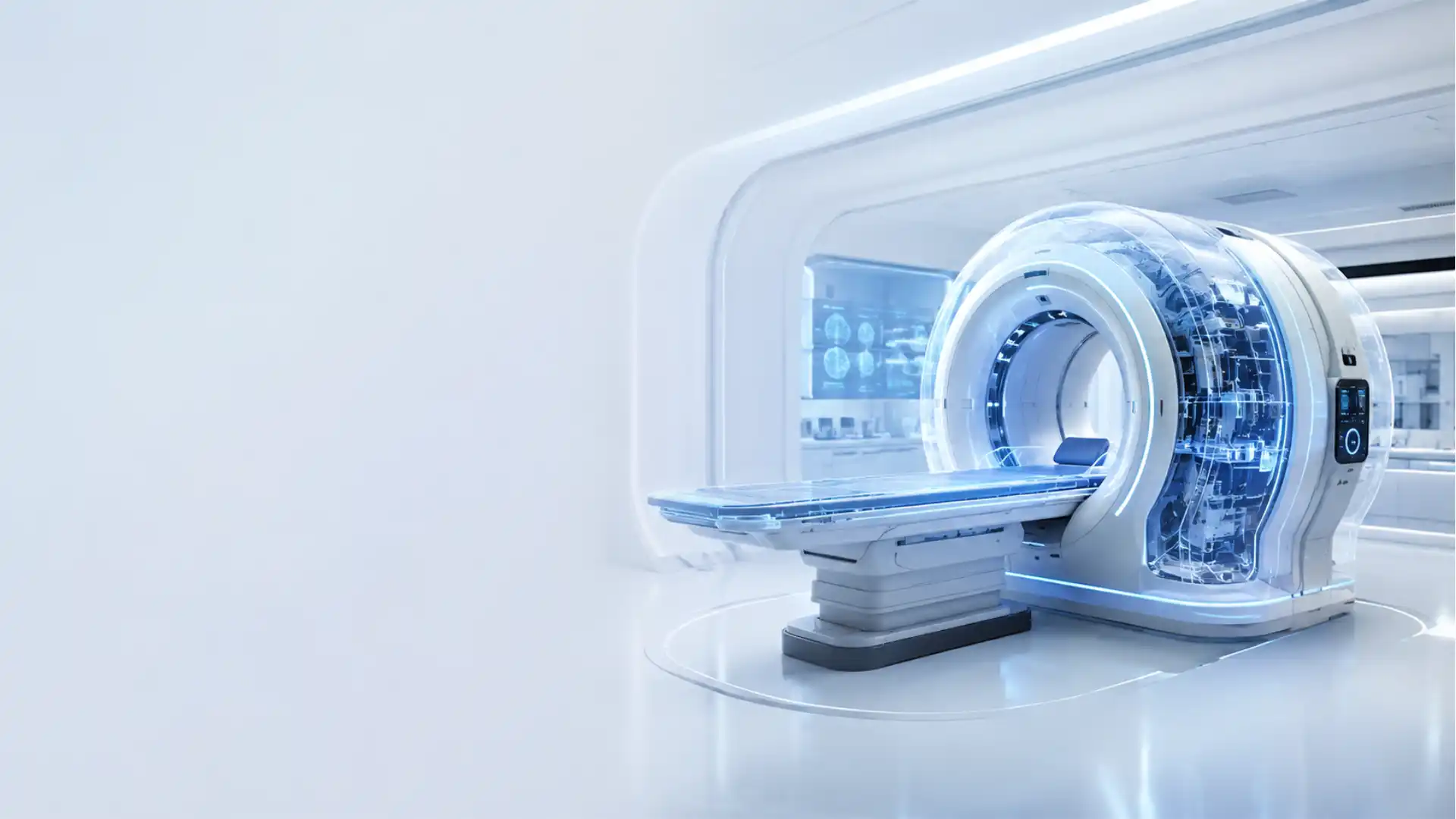
On June 17, 2026, at an event in San Francisco, David Holz stood on stage and described a machine that images the inside of a human body using sound. The company behind it was not a medical-device maker, a hospital spinout, or a longevity startup. It was Midjourney, the firm best known for turning short text prompts into pictures. Holz announced a new division, Midjourney Medical, and its first hardware product, the Midjourney Scanner, a full-body imaging system the company calls “Ultrasonic CT.”
Table of Contents
The announcement that caught everyone off guard
The basic idea, as Midjourney presented it, is simple to picture and strange to encounter. You step onto a platform set into a shallow pool of warm water. The platform lowers you down at about five centimetres a second. As you sink, your body passes through a ring packed with hundreds of thousands of tiny ultrasound elements that fire sound waves through you from every direction and record the echoes. A bank of servers reconstructs those echoes into a three-dimensional picture of muscle, fat, bone, and organs. No X-rays, no radioactive tracers, no heavy magnets — the three things that define the imaging machines most people already know.
That last point is the part Midjourney leans on hardest. A CT scanner builds its images from X-rays and carries a real, if small, radiation dose. An MRI uses powerful magnets and radio waves, which means no radiation but a slow, loud, expensive, and claustrophobic experience. Midjourney’s pitch is that ultrasound can deliver a whole-body anatomical map with none of those drawbacks, at a fraction of the cost, in a fraction of the time. Holz framed the device as the first genuinely new whole-body imaging method in roughly fifty years, and said its image quality is “in many ways superior to even MRI machines.”
Those are the company’s words, delivered at a launch, and they deserve to be read as such. The most important thing to understand about this announcement is the distance between what Midjourney showed and what Midjourney claimed. The vision is a sixty-second, near-free body scan deployed at enormous scale. The hardware that exists today is a first-generation prototype that takes around twenty minutes per scan, has imaged roughly a dozen people, and carries no clearance from the U.S. Food and Drug Administration for any diagnostic use. Both of those statements are true at the same time, and most of the confusion around this story comes from collapsing them into one.
There is also the question of why an image-generation company is doing this at all. Midjourney built a profitable business with a small team and no outside investors, selling subscriptions to a text-to-image service. It has never manufactured a physical product, never operated a regulated medical device, and never run a healthcare facility. Moving from generating pictures of imaginary places to imaging the interior of real human bodies is not an adjacent step. It is a different industry with different physics, different regulators, different liability, and a far less forgiving definition of “good enough.”
What makes the announcement worth taking seriously, rather than dismissing as a stunt, is the substance underneath the marketing. The imaging technique Midjourney is using is real and has a long research history. The hardware is built on chips from a publicly traded ultrasound company, Butterfly Network, under a licensing deal signed months earlier. The engineering team includes people who shipped complex consumer hardware at Apple. And the broader market the company is aiming at — consumers paying out of pocket for preventive whole-body scans — already exists, with providers like Prenuvo and Ezra charging thousands of dollars for whole-body MRI. Midjourney is not inventing the demand. It is proposing to serve it with a different machine at a radically lower price.
This piece works through the announcement in detail: what the device is, how the physics works, what the prototype can and cannot do today, where the sixty-second target comes from, how the regulatory plan is structured, what the business model actually is, who it threatens, and what could cause the whole project to fail. The aim is to separate the parts that are documented and verifiable from the parts that are ambition, because the gap between the two is the entire story.
The distance between the claims and the prototype reality
Midjourney made a set of specific, quotable claims at the launch, and it is worth listing them plainly before weighing any of them. The company said a full scan would eventually take about 60 seconds. It said the resulting images are comparable to, and in some respects better than, an MRI. It put numbers on that comparison: roughly 100 times the speed of a whole-body MRI and around ten times cheaper. It described a deployment plan of 50,000 scanners worldwide by 2031, with capacity for a billion scans every month. And in the boldest framing of the day, the company said that with enough early imaging, the world could one day avoid 30 percent of all deaths and 50 percent of all healthcare costs.
Set against those numbers, the documented state of the actual machine is modest. The system shown is a Gen-1 prototype. A scan on it currently takes around 20 minutes, not 60 seconds. Roughly 12 people had been scanned at the time of the announcement. The team building it is small, about nine people, led by an engineer who previously worked on Apple’s Vision Pro. There is no AI in the image-reconstruction pipeline yet — the reconstruction is being done computationally, but without the neural-network layer the company expects to add later. The device has no FDA clearance for diagnosis. The first place a member of the public could plausibly use one, a planned Midjourney facility in San Francisco, is not expected to open until the end of 2027.
To the company’s credit, Holz did not hide this gap on stage. He described the device as research-stage and was explicit that the sixty-second figure is a target rather than a current capability. The honesty matters, because it changes how the claims should be read. This is not a finished product being oversold as available tomorrow. It is an early prototype paired with an unusually expansive statement of intent. The problem is that the two get reported together, and a reader skimming headlines comes away believing a sixty-second, MRI-beating body scan exists today. It does not.
The size of the remaining gap is the part that deserves scrutiny. Going from a twenty-minute prototype scan to a sixty-second production scan is not a matter of tightening a few screws. The current bottleneck, by Midjourney’s own account, is not the physics of sound moving through tissue. It is data: how fast the system can move and process the enormous volume of acoustic information each scan produces. Closing a roughly twentyfold speed gap means major advances in bandwidth, signal processing, reconstruction algorithms, and the AI layer that does not yet exist. Each of those is a hard engineering problem on its own. Stacking all of them and hitting the target on a consumer timeline is an extraordinary bet, and it has drawn proportionally extraordinary scrutiny from radiologists and engineers.
There is a second gap that gets less attention but matters more for anyone tempted to read the device as a medical tool. None of the image-quality claims has been independently verified. The comparison to MRI comes from Midjourney’s own demonstrations. There is no published, peer-reviewed study putting the scanner’s output side by side with an MRI or CT of the same patient and showing what it catches and what it misses. There is no clinical-outcomes data of the kind Prenuvo, for example, has published for whole-body MRI. Until that work exists, “in many ways superior to even MRI” is a marketing statement, not a clinical finding, and the difference is the whole point.
This is the lens the rest of the analysis uses. Where Midjourney has shown something real, this piece says so. The hardware exists, the physics is sound, the chip partnership is documented, and the market is real. Where the company has stated a goal, this piece treats it as a goal. Sixty seconds, fifty thousand scanners, MRI-grade images, and a third fewer deaths are aspirations attached to a prototype, and they should carry the weight of aspirations until evidence moves them into the column of facts.
The Midjourney Scanner defined in plain terms
The Midjourney Scanner is a full-body ultrasound tomography device: a machine that surrounds a submerged body with thousands of ultrasound transducers, fires sound waves through the tissue from many angles at once, records the returning echoes, and reconstructs them into a cross-sectional, three-dimensional picture of the body’s internal structures. Strip away the branding and that is the entire concept. It is ultrasound, the same physical principle behind the handheld probe used in pregnancy scans, applied at whole-body scale with a great deal more hardware and computing behind it.
The physical setup has three parts. The first is the water enclosure — a shallow pool of warm water with a platform that lowers the person through it slowly, on the order of five centimetres per second. The second is the sensor ring the body passes through. Midjourney builds this from ultrasound-on-chip modules licensed from Butterfly Network: by the company’s figures, roughly 8,960 transducer elements per chip across about 40 modules, on the order of 358,000 individual elements firing and listening together. The third is the compute cluster that turns raw sound into images. The system captures around 17 gigabytes of acoustic data per second, each reconstructed body slice draws on tens of gigabytes of raw data, and a single full scan can generate hundreds of terabytes that a bank of roughly 21 servers processes into a final image with detail down to about half a millimetre.
The output, as Midjourney describes it, is a sub-millimetre, full-body anatomical map that “looks a lot like today’s MRIs” — a three-dimensional rendering of muscle, fat, bone, and organs that a person can rotate and inspect. On day one, the company is not selling that as a diagnosis. It is selling it as a body composition map: a structural readout of what is physically present in the body, such as organ volumes, muscle mass, and fat distribution, without any claim about disease.
It helps to be equally clear about what the device is not. It is not a CT scanner in the everyday sense, because it uses no X-rays and delivers no radiation dose. It is not a diagnostic instrument today, because it has no regulatory clearance to diagnose anything. It is not a handheld ultrasound repackaged, because the whole-body, all-angles geometry is a different problem from pointing a probe at one organ. And it is not a shipping consumer product, because the only version that exists is a research prototype that no member of the public can yet book. Holding those boundaries in mind prevents most of the misreadings that have followed the launch.
Ultrasonic CT and the work the name is doing
The label Midjourney chose, “Ultrasonic CT,” is doing a quiet but real amount of persuasion, and it is worth unpacking because it shapes how people read the whole product. In common usage, “CT” means a CAT scan: the doughnut-shaped machine that takes X-ray images from many angles and stitches them into cross-sections. For most people, CT is firmly associated with two things — serious, hospital-grade diagnostic imaging, and radiation. Attaching “CT” to an ultrasound device borrows the first association while the technology quietly drops the second.
Strictly, the name is not wrong. Tomography comes from the Greek word for a slice or section, and it refers to any method of imaging an object section by section and computing the internal structure from measurements taken around it. X-ray CT is one kind of tomography. So is the technique Midjourney uses, which is more precisely called ultrasound tomography or ultrasound computed tomography. The “computed” part is literal: the machine does not capture a photograph, it measures how sound travels and scatters through tissue from many directions and then solves, computationally, for the structure that would produce those measurements. In that narrow sense, “Ultrasonic CT” is an accurate, if unusual, description.
The effect of the name, though, is to make a sound-based device sound like a familiar X-ray machine without the X-rays. That framing is flattering, and several writers covering the launch flagged it as potentially confusing for exactly that reason. A reader who hears “CT” may assume the image quality and diagnostic range of a real CT scan, which images bone and air-filled structures like lungs extremely well. Ultrasound does not share those strengths, a limit covered later in this analysis. The name papers over a genuine difference in what the two technologies can see.
None of this means the choice is dishonest. It is a marketing decision that trades precision for familiarity, and companies launching unfamiliar technology do this constantly. The reason to call it out is that the name carries an implicit claim — this is comparable to the cross-sectional imaging you already trust — and that implicit claim is exactly the thing that has not been independently tested. When the underlying device is named after a more capable modality, the burden of proof should sit with the company, not with the reader who took the name at face value.
The physics of imaging a body with sound and water
Ultrasound works by sending high-frequency sound into the body and listening for what comes back. A transducer converts an electrical signal into a pressure wave, that wave travels into tissue, and wherever it meets a boundary between materials of different density — the edge of an organ, a pocket of fluid, the wall of a blood vessel — part of it reflects. The machine measures how long the echo takes to return, which tells it how deep the boundary is, and how strong the echo is, which tells it how sharp the contrast is. Do this thousands of times and you can build a map of the structures the sound passed through. That is the same principle whether the target is a fetus, a thyroid, or, in Midjourney’s case, an entire torso.
The reason the body has to be in water comes down to a single physical fact: sound barely crosses the boundary between air and skin. The mismatch in acoustic properties is so large that almost all the energy bounces off rather than entering the body. This is why a sonographer squeezes gel onto the skin before a normal scan — the gel fills the gap and lets sound pass. For a whole-body scan imaged from every direction at once, gel on one patch of skin is not enough. The entire surface needs to be coupled to the transducers, and the practical way to do that is to surround the body with water. Early experimental ultrasound systems in the 1950s did exactly this, lowering patients into tanks, and the water immersion in Midjourney’s machine is a modern version of that very old idea.
The bigger conceptual leap is the move from ordinary ultrasound to tomography. A handheld probe images from one side: it sends pulses and reads the echoes that bounce straight back, building a flat slice from a single viewpoint. Tomography surrounds the object. Sound is sent through the body from many angles, and the system records not only what reflects back but what passes all the way through to sensors on the far side. With measurements taken all around, a computer can solve for the internal structure that would produce that exact pattern of transmitted and scattered sound. The output is not one flat slice but a full cross-section, and stacking cross-sections as the body descends produces a three-dimensional volume.
That reconstruction is far harder than it sounds, and the difficulty is the heart of why this technology is only now being attempted at scale. X-rays travel in essentially straight lines, which is what makes conventional CT reconstruction mathematically clean. Sound does not. It bends, refracts, slows down and speeds up as it crosses tissues of different density, and scatters in complicated ways. Recovering a sharp image from that tangle is a heavy computational problem, closer to simulating how waves move through a complex medium than to stacking photographs. Solving it well, fast, and at body scale is exactly the kind of task that has only become feasible with very large amounts of cheap computing.
Ultrasound also has two hard physical limits that no amount of computing removes, and both follow from the same property that makes water necessary. Air and bone defeat sound. The lungs are full of air, so ultrasound cannot see deep inside them the way a CT can, which matters because lung cancer screening generally depends on CT. Bone reflects and absorbs sound strongly, casting acoustic shadows over whatever sits behind it. These are not flaws Midjourney can engineer away; they are intrinsic to imaging with sound, and they bound what any ultrasound system, however advanced, can show.
There is one more trade-off built into the physics: resolution versus depth. Higher-frequency sound produces finer detail but penetrates less far into tissue; lower-frequency sound reaches deeper but resolves less. Every ultrasound system lives somewhere on that curve, and a whole-body machine has to image structures at very different depths in the same scan. Midjourney’s claim of half-millimetre detail across the whole body is a strong one precisely because that trade-off is unforgiving, and it is one of the specific numbers that independent testing will need to confirm.
Put together, the picture is coherent. Surround a submerged body with hundreds of thousands of transducers, fire and listen from all sides, capture the flood of returning sound, and throw enough computing at the inverse problem to reconstruct a three-dimensional map. The physics is real and well understood. What is unproven is whether Midjourney’s particular combination of hardware and software delivers the resolution, speed, and reliability the company has promised.
The hardware stack behind the ring of transducers
The single piece of this project that is most clearly real, rather than aspirational, is the hardware foundation, and it did not come from Midjourney. The transducers are built on Butterfly Network’s Ultrasound-on-Chip technology, the result of a co-development and exclusive licensing agreement the two companies signed in November 2025 and disclosed in a regulatory filing. Butterfly is a publicly traded medical-device company whose entire premise is putting ultrasound onto a semiconductor chip, replacing the bulky piezoelectric crystals of traditional probes with thousands of tiny transducer elements etched into silicon. That approach is what made Butterfly’s handheld scanner possible, and it is what makes a ring of hundreds of thousands of elements economically plausible rather than absurd.
Midjourney’s contribution is to take that chip and build it out into a whole-body array. By the company’s figures, each chip carries roughly 8,960 transducer elements, and about 40 of these modules are arranged into the ring the body passes through, for something on the order of 358,000 elements working in concert. Every element can both emit and record, which is what allows the all-angles tomographic geometry described above. The scale of the sensor array is the headline hardware achievement, and it is the part of the announcement with the firmest footing, because it rests on an existing, shipping chip technology rather than on a breakthrough that has yet to happen.
The harder part of the stack is everything downstream of the sensors. The array generates data at a punishing rate — about 17 gigabytes per second — and each reconstructed slice of the body draws on tens of gigabytes of raw acoustic measurements. A single full-body scan can produce hundreds of terabytes of raw data, which a cluster of roughly 21 servers then has to process into a usable image. This is where the prototype’s twenty-minute scan time comes from. The constraint is not the sound; it is moving and crunching that volume of data fast enough. The speed problem is a computing and data-transfer problem, and it is the specific thing standing between the device that exists and the sixty-second device the company has promised.
The team building all of this is small and consumer-hardware-shaped rather than medical-device-shaped. Reports put it at around nine people, led by an engineer who previously worked on Apple’s Vision Pro headset. That pedigree says something about Midjourney’s intent: the company is approaching this as a consumer-hardware and computing problem, the kind where a tight team iterates quickly on a complex device, rather than as a traditional medical-device program with the large regulatory and clinical apparatus that usually surrounds diagnostic imaging. Whether that culture is an advantage or a liability is one of the open questions of the project, and it cuts in both directions, which later sections take up directly.
There is a tension hiding inside the hardware story that is easy to miss. Cheap, mass-produced chips are exactly what could make a low-cost scan and a fleet of tens of thousands of machines conceivable. But the compute and data infrastructure each scan demands is anything but cheap, and it grows with every scanner added to the network. Midjourney’s vision depends on both halves being true at once — chips cheap enough to deploy everywhere, and a per-scan computing cost low enough that a scan can sell for a few dollars. Those two pressures pull against each other, and reconciling them is part of what the company will have to prove over the next several years.
The Butterfly Network deal that made the hardware possible
The detail that grounds this entire project in something concrete is the partnership with Butterfly Network. In November 2025, the two companies signed a co-development and exclusive licensing agreement giving Midjourney the rights to use Butterfly’s Ultrasound-on-Chip technology, a deal disclosed in a Form 8-K filed with securities regulators. That filing matters because it converts a startling launch-day claim into a documented commercial fact. Midjourney is not asserting that it secretly invented a new ultrasound sensor in a garage. It licensed a proven, FDA-cleared chip platform from a public company and built a system around it.
Butterfly Network is worth understanding on its own terms, because its technology is the reason the scale of Midjourney’s sensor ring is even possible. Founded by the genomics entrepreneur Jonathan Rothberg, Butterfly set out to do for ultrasound what earlier semiconductor work did for other instruments: shrink it onto a chip and make it cheap to produce at volume. Its flagship product, a handheld probe that plugs into a phone, replaced the traditional crystal transducer with a single silicon chip carrying thousands of micromachined elements. That is the same building block Midjourney is stacking forty times over. Without a chip-based transducer that can be manufactured in quantity, a ring of several hundred thousand elements would be a laboratory curiosity, not a product anyone could deploy.
The structure of the deal also tells you something about each company’s position. For Midjourney, licensing rather than building means it skips the years and capital required to develop and certify its own ultrasound hardware, and instead spends its effort on the array geometry, the data pipeline, and the software. For Butterfly, a high-profile, deep-pocketed partner taking its chips into an entirely new application is a validation of the underlying platform and a potential new revenue stream, which is why the agreement was material enough to disclose to investors. An exclusive arrangement, as reported, would also mean a competitor cannot simply buy the same chips to build a rival whole-body scanner, which gives Midjourney a moat that has nothing to do with its own engineering.
The dependency runs the other way too, and it is a real risk worth naming. Midjourney’s medical ambitions now rest, at the foundation, on another company’s technology and another company’s manufacturing. Supply, pricing, and the pace of chip improvement are not fully within Midjourney’s control. If the relationship sours, if Butterfly’s roadmap diverges from what Midjourney needs, or if the chips cannot be produced at the cost and volume the deployment plan assumes, the whole edifice is affected. The partnership is the project’s firmest foundation and also one of its structural points of fragility, which is exactly what you would expect when an unproven entrant builds on a single supplier’s core component.
The prototype reality of 20 minutes and twelve people
It is worth slowing down on what actually exists, because almost every misunderstanding of this announcement comes from skipping past it. The machine Midjourney has built is a first-generation prototype. As of the launch, about a dozen people had been scanned on it. A scan takes roughly twenty minutes, not the sixty seconds in the headline. And the images the company has shown were produced without the AI layer that its long-term plan depends on; the reconstruction is being done by direct computation for now, with the neural-network stage still to come. These are not hostile characterizations. They are the facts as Midjourney itself presented them.
The twenty-minute figure deserves emphasis because it reframes the speed comparison the company drew with MRI. A whole-body MRI commonly takes somewhere in the range of an hour, sometimes longer, so a twenty-minute ultrasound scan is genuinely faster than that — but it is nowhere near the “nearly a hundred times faster” framing, which only holds if the sixty-second target is achieved. At the prototype’s real speed, the device is perhaps three to four times faster than a long MRI, which is a real improvement but a very different claim from the one that made the headlines.
The small number of people scanned is equally important context. Twelve scans is a demonstration, not a dataset. It is enough to show that the system can produce an image of a real human body, which is a real milestone for a prototype. It is nowhere near enough to characterize how the device performs across different body types, sizes, and conditions, let alone to support any statement about what it reliably detects or misses. Medical imaging systems earn trust through large, careful studies, and at a dozen scans that work has not begun in any serious form.
Midjourney Scanner: targets versus the Gen-1 prototype today
| Dimension | Midjourney’s stated target | Gen-1 prototype as of the launch |
|---|---|---|
| Scan time | About 60 seconds | About 20 minutes |
| AI in reconstruction | Central to the plan | Not yet in the pipeline |
| Image quality | Comparable to or better than MRI | Shown in demos, not independently verified |
| People scanned | A billion scans a month at scale | Roughly 12 to date |
| Regulatory status | Diagnostic clearance pursued over time | No FDA clearance; wellness use only |
| Availability | 50,000 scanners worldwide by 2031 | First location targeted for end of 2027 |
| Price | A few dollars per scan | Not commercially available |
The table makes the central point visible at a glance: nearly every striking number attached to this product sits in the left column, the column of intent, while the machine that physically exists sits in the right column. None of this means the targets are impossible. It means the public conversation has been anchored to the left column when the evidence only supports the right one.
What was demonstrated, by accounts from attendees, was tangible but limited. People could see the prototype and, in at least one case, place a hand into the system. The images shown were real reconstructions of human anatomy. That is a credible proof of concept for the basic physics and hardware. It is not a product, not a clinical tool, and not evidence for the speed, quality, or scale claims that surrounded it. Keeping the proof of concept and the promise in separate mental boxes is the single most useful thing a reader can do with this story.
The 60-second target and the engineering it would demand
The sixty-second scan is the number that made this announcement spread, and it is the number least supported by the machine that exists. Going from twenty minutes to one minute is roughly a twentyfold speedup, and Midjourney has been clear that the obstacle is not the sound itself but the data. A scan generates a torrent of acoustic measurements, and the prototype is limited by how quickly it can move that data off the sensor array and turn it into an image. Understanding what closing that gap requires makes it possible to judge how realistic the target is, rather than simply trusting or dismissing it.
Four things have to advance at once. The first is raw data bandwidth — getting tens of gigabytes per second off the array and into the compute cluster without the transfer itself becoming the bottleneck. The second is signal processing, the front-end work of cleaning and conditioning the acoustic data before reconstruction. The third is the reconstruction algorithm. Solving for internal structure from sound that bends and scatters is, done rigorously, a full wave-physics inversion, and that is computationally brutal. Faster results mean either much more computing power thrown at the exact problem or cleverer approximations that get close enough at a fraction of the cost. The fourth is the AI layer that does not yet exist in the pipeline, which the company expects to carry much of this load.
The AI piece is the most interesting and the most double-edged. Machine-learning methods for image reconstruction can produce a usable image from less data, or from a faster and rougher physics solve, by learning what real anatomy tends to look like and filling in accordingly. This is a genuine and active area of research, and it is plausibly how a twentyfold speedup eventually arrives. But the same property that makes learned reconstruction fast makes it risky. A model that fills in expected anatomy can also invent structures that are not there or smooth away ones that are, and it does so in ways that are hard to audit. An image that looks clean and convincing is not the same as an image that is faithful to the specific body in the water.
That risk collides directly with the regulatory framing discussed later. Health regulators are increasingly wary of imaging that behaves as a “black box,” where neither the patient nor a clinician can see how an output was produced. The more a scan’s final image depends on a neural network’s learned assumptions rather than on direct measurement, the more scrutiny it invites the moment the company moves from wellness pictures toward anything diagnostic. Midjourney’s speed roadmap and its regulatory roadmap are therefore in tension: the fastest path to sixty seconds runs through exactly the kind of AI reconstruction that makes a diagnostic claim harder to defend.
The fair conclusion is that sixty seconds is possible but unproven, and dependent on several hard advances landing together. Computing keeps getting cheaper, reconstruction research keeps improving, and a well-resourced team can make real progress on all four fronts. None of that is fantasy. What is aggressive is the timeline and the simultaneity. Hitting the target requires bandwidth, signal processing, algorithms, and AI reconstruction to mature in parallel and then be integrated into a reliable consumer device. Any one of them slipping pushes the whole schedule. Treating sixty seconds as a destination the company is driving toward is reasonable; treating it as a near-term spec is not.
The claim of beating MRI weighed against the evidence
The strongest version of Midjourney’s pitch is that its scanner is not just cheaper and faster than an MRI but, in the company’s words, “in many ways superior to even MRI machines.” That is a large claim, and it collapses two very different things — resolution and diagnostic capability — into one word, “superior.” Pulling them apart shows why the claim cannot be accepted as stated, even if the device turns out to be genuinely useful.
Start with what MRI actually does well, because that is the bar being invoked. MRI produces exceptional soft-tissue contrast. It can distinguish between tissues that look almost identical on other scans, detect swelling and inflammation, and characterize masses by how they behave under different imaging sequences. It is the reference standard for the brain, the spine, joints, and many soft-tissue cancers, and it does all of this without radiation. When a company says its device beats MRI, it is implicitly claiming to match or exceed that depth of tissue characterization, not merely to take a sharp-looking picture.
Ultrasound’s strengths are real but different. It is fast, cheap, safe, and excellent at imaging soft, fluid-rich structures near the surface — the thyroid, blood vessels, the gallbladder, a fetus, blood flow in real time. Whole-body ultrasound tomography extends that reach by imaging from all sides and reconstructing speed-of-sound and attenuation maps, which is a different kind of contrast from MRI’s. It is entirely possible that this produces clinically useful information about organ structure, fat, and muscle. What is not established is that this information is equivalent to, let alone better than, what MRI provides for the conditions MRI is trusted to assess.
Then there is the limit that no reconstruction can fix: the lungs. Ultrasound cannot see deep into air-filled lung tissue, and lung cancer — the deadliest cancer in much of the world — is generally caught with CT. A whole-body scan that is effectively blind to the lung interior cannot be “superior” to cross-sectional imaging across the board, because it misses an entire category of high-stakes disease. Bone imposes a similar limit, casting acoustic shadows that hide what sits behind it. These gaps are intrinsic to imaging with sound, and they mean the honest framing is complementary, not superior — a tool that may do some things well and other important things not at all.
The deeper issue is evidentiary, not technical. Even a device with stunning resolution numbers has to prove, through comparison against established imaging in real patients, what it detects, what it misses, and how often it raises false alarms. That is the difference between an impressive image and a clinical instrument, and it is the work Midjourney has not done. There is no published study placing its scanner beside an MRI or CT of the same person. Until that evidence exists, “superior to MRI” should be read as a launch-stage ambition. The device might earn a real and useful place in imaging. It has not earned the comparison it led with.
The blind spots of ultrasound, from air to bone
A phrase like “full-body scan” implies the machine sees everything, and that is the part of Midjourney’s framing most likely to mislead a non-specialist. Ultrasound has a real and useful field of view, but it is uneven. Some organs it images well, some it images poorly, and some it cannot reach at all. Mapping that unevenness is the difference between understanding what the device offers and assuming it offers a head-to-toe substitute for every scan a person might need.
The good news for the technology is genuine. Ultrasound is well suited to many of the soft, fluid-rich organs of the abdomen and neck: the liver, kidneys, spleen, gallbladder, bladder, pancreas to a degree, the thyroid, and the reproductive organs. It images blood vessels and blood flow, soft-tissue masses, lymph nodes, muscle, and fat distribution. A whole-body system that reconstructs these structures in three dimensions could plausibly produce a useful readout of organ size and gross structure, and a real picture of body composition — how much muscle, how much fat, and where the fat sits. For those purposes, an all-angles tomographic scan is a reasonable tool, and arguably a strong one.
The limits are equally concrete. The lungs are the biggest one. Air scatters sound so thoroughly that ultrasound cannot image deep inside aerated lung tissue, which is precisely where early lung cancer hides and precisely what low-dose CT is used to screen for. The brain is another, shielded behind the skull, which reflects and distorts sound; this is why brain imaging in adults relies on MRI and CT, not ultrasound. Bowel gas obscures parts of the abdomen, and anything sitting behind bone falls into an acoustic shadow. A device built on sound inherits all of these gaps no matter how many transducers it carries.
Two further factors shape real-world performance. The first is body habitus: sound attenuates as it travels, so imaging deep structures in a larger body is harder, and image quality in conventional ultrasound varies with the patient’s size. A whole-body tomographic system may handle this better than a handheld probe, but depth remains a physical constraint. The second is motion. A prototype scan that takes twenty minutes spans thousands of heartbeats and hundreds of breaths, and movement during acquisition introduces artifacts. Faster scanning reduces this problem, which is one more reason the speed target is not merely about convenience but about image quality.
There is, in fairness, an area where whole-body ultrasound tomography may outperform the ultrasound people know: operator dependence. A handheld scan is only as good as the sonographer holding the probe, and results vary with skill and angle. A machine that surrounds the body and images from fixed, known positions removes much of that variability, producing a more consistent and repeatable scan. That consistency is a real advantage for tracking the same body over time, which is exactly the longitudinal use Midjourney is aiming at. The technology’s weakness against air and bone is permanent; its traditional weakness of inconsistency is the one Midjourney’s design genuinely addresses.
The honest summary is that a Midjourney scan, if it performs as claimed on the structures it can see, would be a useful look at much of the abdominal and soft-tissue anatomy and a strong body-composition tool — and simultaneously blind to the lungs, the brain, and whatever hides behind bone. “Full-body” describes the geometry of the scan, not the completeness of what it detects, and a reader should hold those two meanings apart.
The regulatory path and the general wellness lane
Midjourney’s regulatory strategy is the most carefully chosen part of the whole launch, and it explains many of the company’s word choices. The device has no FDA clearance to diagnose anything, and rather than seek one before launch, Midjourney is entering through a different door entirely: the FDA’s policy for low-risk general wellness products. Under that policy, the company is offering the scanner as a provider of body composition maps — descriptions of what is structurally present in the body, like organ volume, muscle, and fat — while explicitly avoiding any claim to detect, diagnose, or treat disease.
The timing here is not a coincidence. On January 6, 2026, the FDA issued a revised final version of its guidance, “General Wellness: Policy for Low Risk Devices,” superseding the 2019 version. The policy rests on a two-part test: a product can be treated as a general wellness product, outside the full weight of medical-device regulation, if it is intended only for general wellness use and it presents a low risk to users. Products that make disease-specific or diagnostic claims, or that are invasive or use radiation, fall outside the policy. A non-invasive, no-radiation scan that reports body composition and pointedly avoids disease claims is designed to fit inside this lane, and Midjourney has built its language to do so.
This is a well-worn path, not a novel trick. Prenuvo and Ezra sell whole-body MRI to consumers through the same general wellness positioning, presenting their scans as proactive health information rather than diagnostic procedures, in part because that framing avoids a far slower and more demanding regulatory process. Midjourney is following an established commercial template, which is one reason the strategy is credible even when the technology is not yet proven.
The central point, often lost in coverage, is that general wellness status is enforcement discretion, not approval. The FDA is not certifying that the scanner works or that its images are accurate. It is declining to regulate the product as a medical device so long as the product stays inside the wellness boundaries. The moment the marketing, the outputs, or the use drift toward telling someone they may have a disease, the product risks being treated as an unapproved diagnostic device. And the wellness lane does not exempt a company from everything else: truth-in-advertising rules enforced by the FTC, state laws, and privacy obligations including HIPAA for protected health information all still apply.
There is a real tension built into the plan, and it is worth stating plainly. A machine that produces a detailed three-dimensional map of a person’s organs, and that the company itself has talked about in terms of “flagging weird things,” sits uncomfortably close to the diagnostic line. If a scan shows a mass and the system or its staff draw the user’s attention to it, that begins to look like detection of a possible disease, which is the thing the wellness framing forbids. Regulators have also signaled wariness about imaging that depends on opaque AI reconstruction, since a “black box” output is harder to accept as low-risk. Midjourney’s stated long-term goal is to climb the regulatory ladder deliberately — Holz said the company has begun discussions with the FDA and intends to submit test results to win diagnostic clearances over time. That climb is a multi-year process with no guaranteed outcome, and the wider the gap between the wellness pitch and what the machine actually reveals, the more pressure the framing will face.
The body composition framing as a deliberate strategy
Calling the first product a body composition map, rather than a diagnostic scan, looks modest, and that modesty is the strategy. It is the lowest rung Midjourney could stand on while still offering something people want, and standing on the lowest rung is what lets the company reach the market now instead of years from now. A device that measures muscle, fat, and organ structure, and stops short of disease claims, slots into the general wellness lane and avoids the long clinical and regulatory process a diagnostic launch would demand. The point is speed: get a real product in front of real people while the harder claims are still being built.
What the framing buys is three things at once, and each feeds the next. The first is a data moat. Every scan adds to a dataset of full-body images that no competitor has, and that dataset is the raw material for training the AI reconstruction and, eventually, for the studies a diagnostic application would require. The second is a brand and a habit. If people come to think of a Midjourney scan as a normal part of looking after themselves, the company owns a recurring relationship rather than a one-off transaction. The third is revenue and proof that the machine works at some scale, which strengthens the case the company will eventually make to regulators. Body composition is the wedge; the rest of the plan is the expansion.
The positioning even has a tidy metaphor behind it, which the company has used: scanning your organs should feel as routine as stepping on a scale. That image does real work. A scale is not a medical device, carries no fear, and invites repetition. Framing a full-body scan the same way normalizes something that would otherwise feel clinical and intimidating, and normalization is exactly what a high-volume consumer model needs. It is a smart piece of product thinking, and it is also the part a skeptic should watch most closely.
The risk in the strategy is the same line the regulatory section flagged, seen from the business side. The value of a body scan, to most people, is not knowing their fat distribution — it is the hope of catching something serious early. That hope is a disease-detection expectation, and the more the marketing leans on it, even implicitly, the closer the product drifts to the diagnostic claims the wellness framing forbids. Midjourney has to sell the dream of early detection to drive demand while formally promising only body composition, and holding both at once is a narrow path. The FTC polices the gap between what a product implies and what it can prove, and “we only measure body composition” is a hard line to walk while customers are walking in hoping for something more.
The deeper logic is a land-and-expand play on regulation itself. Start where the rules are light, accumulate data and trust, and use both to push, application by application, into territory that requires clearance. It is a coherent plan, and several digital-health companies have run versions of it. Whether it works depends on the data actually supporting diagnostic claims when the studies are run, on regulators accepting AI-heavy reconstruction, and on the company resisting the temptation to overclaim before the evidence is in. The framing is clever. It is not a guarantee that the harder rungs can be climbed.
The Midjourney Spa business model and the golden light
The strangest and most revealing part of the announcement is where Midjourney plans to put these machines. Not hospitals, not imaging centers, not doctors’ offices — spas. The company described a chain of branded wellness destinations it calls Midjourney Spas, with the first planned for Union Square in San Francisco and expected to open at the end of 2027. The reported design puts about ten scanners in a space of roughly 25,000 square feet, alongside saunas, cold plunges, hot tubs, and a gym, running 24 hours a day. The scan is meant to cost only a few dollars and to feel, in the company’s framing, like a side effect of a relaxing visit rather than a medical procedure. The aesthetic, down to descriptions of bathing in warm golden light, is pure Midjourney — a company that has always sold an experience as much as a product.
The choice is strategic, not whimsical. Placing the scanner in a wellness setting reinforces the regulatory framing: a spa is obviously not a clinic, which supports the claim that this is general wellness rather than medicine. It also gives Midjourney control of the entire experience, from the water to the lighting to the report, in the same way Prenuvo controls its own clinics rather than renting time in someone else’s. Vertical integration lets the company protect the brand, standardize the scan, and own the customer relationship directly. And making the visit pleasant and repeatable serves the data strategy: people return to places they enjoy, and every return is another scan in the dataset.
The model borrows from a world that already exists. High-end gyms and wellness clubs have spent years turning health into a lifestyle subscription, and longevity-focused clinics have made preventive testing a luxury experience. Neko Health, the body-scanning company backed by Spotify’s co-founder, runs its own purpose-built clinics on a similar logic of a calm, branded, recurring health check. Midjourney is taking that template and pushing it further, folding a heavy piece of imaging hardware into a place people might visit the way they visit a sauna.
The oddity is that a medical-grade imaging device, a shared warm-water bath, and a high-throughput consumer venue make for an unusual combination, and it raises practical questions the announcement did not answer. Chief among them is hygiene. A shared immersion tank that many people enter in a single day is an infection-control problem that clinics with single-use equipment do not face, and water management, filtration, and cleaning between users are not trivial at volume. There are also throughput questions: a twenty-minute scan and a queue of customers do not obviously fit a few-dollars price, and the economics only begin to work if the sixty-second target is reached and the per-scan computing cost falls dramatically. Real estate is its own constraint, since a fleet of 25,000-square-foot spas is a large physical and capital commitment for a company that has run lean by design.
The spa is the clearest expression of how Midjourney thinks, and that is why it is worth dwelling on. The company is not trying to sell a scanner to radiology departments. It is trying to make scanning your own body a normal, pleasant, frequent consumer act, and to own the place where that happens. The vision is coherent and unusual in equal measure. It also stacks an untested business model on top of an untested device, and both have to work for the plan to hold.
The plan for 50,000 scanners and a billion scans a month
Midjourney’s ambition does not stop at a spa in San Francisco. The company has said it wants to deploy 50,000 or more scanners worldwide by 2031, with a combined capacity of about a billion scans every month. The logic behind those numbers is the part of the vision that is genuinely interesting, even for a skeptic. A single scan is a snapshot. A fleet of scanners producing repeated scans of the same people over years would be something no medical system has ever had: a population-scale, longitudinal record of how bodies change, against which subtle early signs of disease might stand out that no single image could reveal. That is the real bet — not the scanner as a product, but the dataset as a public-health instrument.
The boldest claim of the launch grows directly out of this idea. Midjourney said that with enough early imaging, the world could eventually avoid 30 percent of all deaths and 50 percent of all healthcare costs. Those figures should be treated as rhetoric, not forecast. There is no published basis for either number, and the underlying assumption — that imaging more people more often produces proportionally better health outcomes — is exactly the assumption that decades of screening research has complicated. More scanning reliably finds more abnormalities. It does not reliably translate into fewer deaths, because many findings are harmless, many serious diseases are not caught earlier by imaging, and the harms of overdiagnosis offset some of the benefits. The 30-and-50 framing is the kind of round, sweeping claim that signals ambition rather than evidence.
The money behind the plan has been described in two ways that need reconciling. Midjourney has said it is self-funded, has no outside investors, and can pay for the first spa itself, leaning on the profitable image-generation business it built with a small team. Separately, the company’s investment in the medical effort has been reported at more than 74 million dollars. Both can be true: the larger figure is the scale of spending, and “self-funded” describes the source, which is Midjourney’s own revenue rather than venture capital. What that combination implies is a company willing to pour a large share of its profits into a long-shot hardware bet without the external funding such an effort would normally require — an unusual position that gives Midjourney freedom from investors and also concentrates the risk entirely on itself.
The scale numbers deserve a moment of arithmetic, because they expose how much has to go right. A billion scans a month across fifty thousand scanners works out to about 20,000 scans per machine per month, or on the order of several hundred per scanner per day if the machines run almost continuously. That throughput is only conceivable at the sixty-second scan time, not the prototype’s twenty minutes, and even then it assumes near-constant utilization, fast turnaround between users, and a data pipeline that can handle the load without the per-scan computing cost making the few-dollars price impossible. The scale vision is not just a manufacturing challenge. It is a bet that the speed target, the cost target, the demand, and the regulatory progress all arrive together.
None of this makes the long-term vision worthless. A cheaper, radiation-free way to look inside the body, deployed widely, would be a real contribution to preventive health if it worked and if its findings were handled responsibly. But the distance between that future and a twelve-person team with a twenty-minute prototype is vast, and the headline numbers describe the destination, not the road. The company has been candid that this is a six-year-plus horizon. The honest way to hold the plan is as a stated direction of travel from a company with an unusual tolerance for improbable bets, not as a schedule anyone should bank on.
David Holz and a company built on improbable bets
To make sense of why this project exists, it helps to know who is behind it. David Holz is not a typical consumer-tech founder. He trained as an applied mathematician at the University of North Carolina, leaving a Ph.D. program to start his first company, after stints doing research tied to NASA’s Langley Research Center and the Max Planck Institute. In 2010 he co-founded Leap Motion, a hardware company built around a small device that tracked hand and finger movements to control a computer without a mouse or keyboard. He ran it for about twelve years.
That history matters in two opposite directions, and an honest reading holds both. On one side, it means Holz has actually built and shipped complex sensor hardware before. The scanner is not his first encounter with the gap between a demo and a manufacturable device, and that experience is real. On the other side, Leap Motion is a cautionary tale. It raised on the order of 90 to 100 million dollars, reached a peak valuation north of 300 million, generated enormous hype as the future of human-computer interaction, and then struggled to find a durable market. It was eventually sold to the company now called Ultraleap for around 30 million dollars, a fraction of its peak. The pattern — a technically genuine, beautifully demoed piece of hardware that never reached the world-changing scale it promised — is exactly the pattern a skeptic should keep in mind when reading the scanner’s numbers.
Midjourney itself is the other half of the picture, and it is a genuine success story of an unusual kind. Holz founded it in 2021, recruited a small team of engineers to train diffusion models, and launched it not as a polished app but as a bot inside a Discord community. The company became profitable, stayed small, took no outside investment, and built one of the most-used image generators in the world without a traditional marketing department. Holz has described it as an independent research lab pursuing things its people find interesting rather than chasing investor returns. That structure is the engine behind the medical bet: a profitable, self-funded company with no investors to answer to can pour tens of millions into a long-shot project that no venture-backed startup would be allowed to attempt the same way.
The same independence that makes the project possible also removes the external checks a normal company would face. There are no investors demanding a focused roadmap, no board insisting on staying in the core business, no outside diligence on the medical claims. Holz can decide that an image-generation company should build a body scanner, fund it himself, and announce it on his own terms. For admirers, that is exactly the kind of freedom that produces genuinely new things. For critics, it is a single person with a track record of overhyped hardware steering a profitable company into one of the most heavily regulated and unforgiving industries there is, on conviction. Both readings are fair, and which one ages well depends entirely on whether the machine delivers.
The team and the ex-Apple Vision Pro engineering lead
The size and shape of the team building the scanner tells you how Midjourney is framing the problem to itself. By reported accounts the effort runs to about nine people, led by an engineer who previously worked on Apple’s Vision Pro headset. That is a tiny group by the standards of medical imaging, and a recognizable one by the standards of consumer hardware. Midjourney is approaching a body scanner the way a startup approaches a gadget: a small, senior team iterating quickly on a difficult device, rather than the large, layered organization a traditional diagnostic-imaging program would assemble.
The Vision Pro lineage is a real signal. That product is one of the most sensor-dense consumer devices ever shipped, packed with cameras and processors that have to fuse streams of data in real time, and building it required exactly the kind of tight hardware-and-software integration a whole-body ultrasound array demands. Hiring from that world says Midjourney sees the scanner first as a hard engineering and computing challenge — moving and reconstructing huge volumes of sensor data fast — which is consistent with the company’s own description of the bottleneck.
The gap in that approach is just as visible. Diagnostic imaging is not only an engineering problem. It is a clinical, regulatory, and quality problem, and the expertise that carries a device through validation studies, FDA submissions, quality systems, and post-market safety is a different discipline from shipping consumer electronics. A nine-person hardware team can build an impressive prototype. It cannot, on its own, run the clinical trials and regulatory process that turning body composition maps into a trusted diagnostic tool would require. If Midjourney is serious about the long climb it has described, the company will have to build or buy that capability, and the current team composition shows how early in that journey it still is. A brilliant prototype team is the right way to start. It is not the same as the organization that earns a diagnostic clearance.
Whole-body screening and the incidentaloma problem
The medical objection to scanning healthy people is not that the scans fail to find things. It is that they find too much. An incidentaloma is an unexpected finding turned up by imaging — a small nodule, a cyst, a spot on an organ — that was not the reason for the scan and, in the large majority of cases, turns out to be harmless. The more of the body you image, and the more people you image, the more of these you uncover. A whole-body scan offered to a general, mostly healthy population is, by design, a machine for generating incidental findings at scale.
The trouble begins after the finding. A spot on a scan often cannot be confirmed harmless from the image alone, so it triggers a cascade: a follow-up scan, then perhaps a specialist visit, then sometimes a biopsy, each step carrying its own cost, anxiety, and small risk of complication. Frequently the end of that chain is the conclusion that the finding was nothing to worry about. The person has then paid, worried, and occasionally undergone an invasive procedure to rule out a problem that was never going to harm them. When screening also leads to treating conditions that would never have caused symptoms, the result is overdiagnosis followed by overtreatment, which is a real harm even though it starts with a clean scan.
This is exactly why many radiologists are wary of the existing whole-body MRI services from companies like Prenuvo and Ezra. The common professional view is that for an average, low-risk person without symptoms, a whole-body scan is more likely to start a stressful and expensive chase after a harmless finding than to save a life — looking, as one framing puts it, for more trouble than it is worth. That skepticism applies to MRI, a mature and high-contrast technology. It does not disappear when the imaging is done with ultrasound.
Midjourney’s scale ambition turns this from a clinical caveat into a systemic concern. A billion scans a month is a billion opportunities to find something. Even a small rate of ambiguous findings, multiplied across that volume, produces an enormous number of follow-up visits, repeat scans, and biopsies flowing into health systems that are already stretched. Holz himself acknowledged that flagging unusual things is not a casual act and could have downsides. The honest version of that point is stronger: at population scale, the downstream burden of incidental findings is not a side effect to manage but a central design problem, and it is not clear anyone has solved it.
There is an ultrasound-specific twist that could make the problem worse rather than better. Because ultrasound generally offers less tissue contrast than MRI, some of what it shows may be ambiguous — a shadow or an irregularity that the scan cannot fully characterize. An ambiguous finding is precisely the kind that sends a patient on to the more capable imaging the cheaper scan was meant to avoid. A device sold as an accessible alternative to MRI could, in practice, generate demand for MRI and CT by raising questions it cannot answer. Whether that happens depends on how good the images really are and on how the findings are communicated, both of which are unproven.
None of this means screening never helps. Targeted screening of people at genuine, known risk — because of family history, genetics, or specific symptoms — has real value, and some cancers are caught earlier and treated more successfully because of imaging. The dispute is about net benefit across a broad, low-risk population, where the gains from the rare early catch have to be weighed against the harms spread across everyone else. That balance depends on how accurate the test is and how its findings are handled, and for a brand-new ultrasound scanner offered to the general public, neither is yet known.
The evidence base for preventive full-body imaging
The right question to ask of any screening tool is not “can it find disease” but “does using it on this population lead to better outcomes.” On that question, the evidence for preventive whole-body imaging is thin even for the established players, and nonexistent for Midjourney. Walking through what is actually known shows how far ahead of the data the company’s claims run.
Among the consumer whole-body MRI providers, Prenuvo has done the most to publish. In its largest reported outcomes work, following more than a thousand patients for a year, the company reported potential cancer in roughly two percent of those screened and a positive biopsy rate of about half among patients who went on to be biopsied. Those numbers are informative, and they are also the strongest data the consumer-screening field has produced. Ezra, by contrast, has promoted a figure of around six percent of members identifying potential cancer early, but to public knowledge has not published outcomes research showing how many of those potential cancers were real or how many actual cancers the scan missed. A percentage without follow-through tells you little about whether a test is accurate.
The larger picture is that there are no randomized controlled trials demonstrating that whole-body imaging of asymptomatic, average-risk adults reduces deaths. Major preventive-medicine bodies generally do not recommend whole-body MRI as a screening test for the general population, precisely because the benefit has not been shown and the harms of overdiagnosis are real. Independent researchers have placed the celebrity-driven full-body scan trend in the context of runaway screening — interventions that spread through enthusiasm and status rather than evidence of benefit. This is the field Midjourney is entering, and it is entering it with a less proven imaging method and a far larger scale ambition.
Two well-known statistical traps make the evidence even harder to read in screening’s favor. Lead-time bias means that finding a disease earlier can make survival look longer simply because the clock started sooner, without the person actually living any longer. Length-time bias means screening preferentially catches slow-growing, indolent disease that may never have caused harm, inflating the apparent success of the test. Both effects can make a screening program look beneficial in simple before-and-after numbers while delivering little real gain, which is why mortality data from controlled studies, not testimonials, is the standard that matters.
Against that backdrop, the claim that widespread imaging could avoid 30 percent of deaths and half of healthcare costs has no evidentiary footing. It assumes a direct line from more imaging to better outcomes that the screening literature does not support. Midjourney has published nothing — no comparison against established imaging, no outcomes data, no validation of its body composition measurements. The company is at the very start of the evidence-gathering it would need, and the honest description of the benefit case today is that it is unproven for the general population. Demand will be driven by the powerful stories of scans that caught something early, because those stories are real and moving. They are also not the same thing as evidence that scanning everyone, with this device, makes a population healthier.
The rivals already selling consumer body scans
Midjourney is not opening a new market so much as attacking an existing one from below. A small but fast-growing industry already sells whole-body scans directly to consumers who pay out of pocket for the promise of catching disease early, and understanding those players makes Midjourney’s strategy legible. The incumbents have spent years building the demand, the clinics, and in some cases the clinical evidence. Midjourney is betting it can undercut all of them on price and scale with a different machine.
The clearest reference point is Prenuvo. It owns and operates more than twenty of its own clinics, employs its own technologists and radiologists, and sells a radiation-free, contrast-free whole-body MRI that it says screens for hundreds of conditions across the major organs, read by board-certified radiologists. A single scan runs around 2,499 dollars, with membership tiers starting near 1,200 dollars and climbing toward 5,000 for bundles that add brain imaging, body composition, and lab panels. Prenuvo has also published outcomes research, which puts it ahead of the field on evidence. Its weakness is the obvious one: at those prices, it serves the affluent and the worried-well, not the general public.
Ezra took the opposite turn on price. After being acquired by the lab-testing company Function Health in 2025, it launched a shorter, AI-assisted whole-body MRI for a headline 499 dollars, a steep cut from its earlier prices of roughly 1,350 to 2,350 dollars. The catch is that the low price sits on top of a Function membership that itself costs about 499 dollars a year, and Ezra works through roughly a hundred independent imaging centers rather than its own clinics, which trades consistency for reach. Ezra also adds a low-dose CT component for the lungs, an acknowledgment that MRI alone, like ultrasound, struggles there.
A third model comes from Neko Health, the body-scanning company co-founded by Spotify’s Daniel Ek, which runs its own purpose-built clinics and combines a multi-sensor body scan with blood testing in a single calm, branded visit priced well below an MRI, in the low hundreds of dollars. Neko’s approach is the closest in spirit to what Midjourney describes — a pleasant, repeatable, design-forward health check rather than a clinical procedure — even though the underlying technology differs. Larger imaging chains such as SimonMed have also moved into lower-cost full-body MRI, pulling the price down from the premium end.
Consumer whole-body scanning compared
| Provider | Imaging method | Typical price | Scan time | Where it happens |
|---|---|---|---|---|
| Midjourney | Ultrasound tomography | A few dollars (target) | ~20 min prototype; 60 sec target | Branded spas, first end of 2027 |
| Prenuvo | Whole-body MRI | ~$2,499 per scan; memberships from ~$1,199 | Under an hour | 20+ company-owned clinics |
| Ezra (Function Health) | Whole-body MRI plus low-dose chest CT | From ~$499 plus ~$499/yr membership | ~22 minutes | ~100 partner imaging centers |
| Neko Health | Multi-sensor body scan plus blood tests | Low hundreds of dollars | About an hour visit | Company-owned clinics |
The table shows where Midjourney is aiming: not at Prenuvo’s premium tier or Ezra’s mid-market, but at a price point an order of magnitude below either, sold in a setting designed for frequent return. If the technology delivers, that is a real opening, because price is the single biggest barrier keeping these scans confined to the wealthy.
Read against this field, Midjourney’s position is a genuine threat and a genuine gamble at once. Its potential advantage is stark: a few dollars against several hundred or several thousand, no radiation, and a venue built for repeat visits rather than a clinical appointment. Its disadvantages are equally stark. The incumbents use MRI, a more capable and better-understood imaging method; some of them employ their own radiologists and publish data; and they are already operating at commercial scale today. Midjourney has a cheaper, faster modality with a lower diagnostic ceiling, no published evidence, no clearance, and no operating locations. It also inherits the same overdiagnosis problem its rivals face, amplified by the scale it is chasing. The company is not betting that it can build a better MRI. It is betting that a good-enough scan, cheap enough and pleasant enough, beats a better scan most people will never pay for — and that thesis will only be tested when real machines meet real customers.
Privacy, consent and a planetary-scale health dataset
A full-body scan is one of the most intimate pieces of data a person can generate. It is not a heart rate or a step count; it is a three-dimensional record of your organs, your tissues, and whatever they happen to contain. Midjourney’s plan involves capturing that data, compressing it, and sending it to the company’s own cloud computing clusters, where the heavy reconstruction happens. Holz said at the launch that the data would be kept secure and private. What the company did not provide were the details that actually determine whether that is true: how consent is obtained, how long scans are stored, who can access them, whether and how a person can have them deleted, and what the data may be used for beyond producing the image.
The most underappreciated point is that a wellness product may not carry the legal protections people assume health data has. HIPAA, the U.S. health-privacy law, applies to healthcare providers, insurers, and their business partners — not automatically to a consumer company selling a wellness scan. Whether Midjourney’s scans fall under HIPAA depends on how the business is legally structured, and a product deliberately positioned outside the medical-device system may also sit outside the medical-privacy system. If it does, the data is governed mainly by the company’s own privacy policy, by the FTC’s general authority over unfair or deceptive practices, and by a patchwork of state health and biometric privacy laws, rather than by the strict federal rules that cover a hospital. That is a weaker and more variable shield than most customers would expect for an image of their insides.
The scale ambition turns this from an individual concern into a structural one. A billion scans a month, accumulated over years, would be a record of human anatomy with no precedent — exactly the kind of dataset that is enormously useful and enormously dangerous at the same time. It would be the raw material for training the company’s AI and for whatever research or commercial uses follow. It would also be a target: for breaches, for law-enforcement demands, for insurers or employers who would find internal health data extremely revealing, and for any future owner of the company. Sensitive data tends to outlive the promises made when it was collected, and a dataset this intimate, held by a single private company, concentrates a great deal of risk in one place.
There is a reason to read the privacy question as central rather than peripheral to the business model. The few-dollars price and the data strategy are two sides of the same design. A scan that costs almost nothing and that people are encouraged to repeat is, in part, a mechanism for accumulating the data that gives the company its real asset. The “step on a scale” framing is apt in a way the company may not intend: a scale that quietly recorded and uploaded a detailed map of your body each time you used it would be doing something most people would want to think hard about. The cheapness is not unrelated to the data collection; it may be in service of it.
Consent quality is its own issue, and the spa setting sharpens it. Informed consent for handling deeply personal medical data is hard to obtain well even in a clinic. It is harder in a relaxed, wellness-branded environment designed to feel like a sauna visit rather than a medical procedure, where the pleasant experience works against the careful, sober reading of a data-use agreement. The recent history of consumer genetic testing is a useful warning here: a company can collect sensitive biological data from millions of willing customers and still leave them exposed when its finances, ownership, or priorities change. Midjourney has not yet shown how it will avoid that pattern, and the answers it gives on data governance deserve as much scrutiny as the answers it gives on image quality.
The data a single full-body scan actually generates
Behind the consumer-friendly framing sits a genuinely large engineering and economic problem: a single scan produces an astonishing amount of data. By Midjourney’s own figures, the array captures around 17 gigabytes per second, each reconstructed slice of the body draws on tens of gigabytes of raw acoustic measurements, and a complete scan can generate hundreds of terabytes of raw data before a cluster of roughly 21 servers turns it into a usable image. Those numbers explain the twenty-minute scan time, and they also shape what is possible at scale.
The practical question is what gets kept. There are three tiers of output: the raw acoustic data, which is enormous; the reconstructed three-dimensional image, which is far smaller but still large; and the derived measurements, such as organ volumes and fat distribution, which are tiny by comparison. Retaining hundreds of terabytes of raw data for every scan across a billion scans a month is not realistic, so the company will almost certainly keep the reconstructed image and the derived numbers while heavily compressing or discarding the raw measurements. That choice has consequences: raw data can be re-processed later with better algorithms, and throwing it away trades future flexibility for affordable storage.
The economics are where the data reality collides with the few-dollars promise. Every scan carries a real cost in computing, storage, and bandwidth, and those costs scale with volume. A price of a few dollars only works if the per-scan computing cost falls dramatically from where the prototype sits, which depends on the same advances — faster algorithms, AI reconstruction, cheaper compute — that the speed target depends on. The cost problem and the speed problem are the same problem wearing different clothes, and both have to be solved for the business model to close.
There is a tension between the longitudinal vision and the cost discipline, and it is worth naming. The value of repeated scanning comes from comparing a person’s body over time, which requires keeping enough data, at enough fidelity, to make those comparisons reliable across years. That is a long-term storage commitment for every customer, growing with every visit. Holding rich data for a billion people indefinitely is expensive, and managing it safely is harder still. The dataset is simultaneously the company’s greatest asset and one of its largest ongoing liabilities, and the per-scan price has to absorb the cost of both. The numbers can plausibly be made to work, but only if several aggressive assumptions about future computing costs turn out to be right.
The business impact across healthcare and adjacent sectors
If Midjourney’s machine works and scales, the disruption would not land evenly. Different parts of the health economy would feel it in different ways, and some would feel it as opportunity rather than threat. Taking the affected sectors one at a time is more useful than a blanket claim that this changes everything.
Radiology and hospital imaging would feel the most direct pressure, but in a complicated way. A cheap consumer scan could pull some of the worried-well — people seeking reassurance rather than treatment — away from hospital and outpatient imaging, and it would push the whole category toward consumer pricing and consumer expectations. The complication is that the device could also create imaging demand rather than reduce it, because every ambiguous finding it produces sends a person toward the MRI or CT that can actually resolve it. Whether Midjourney drains volume from radiology or feeds it depends entirely on how accurate and how cautious the scans turn out to be.
Insurers and payers sit in an awkward position. The model is cash-pay and bypasses insurance entirely, so on the surface it does not touch them. Underneath, it does. The follow-up tests, specialist visits, and biopsies triggered by incidental findings are often paid for by the insured system, which means a privately purchased scan can push costs onto payers who had no say in it. A billion scans a month generating downstream workups is the kind of externality insurers worry about, and it could draw resistance, coverage exclusions, or pressure to limit what the scans are allowed to recommend.
The wellness and longevity industry is where Midjourney fits most naturally, and there the scanner is an entrant, not a disruptor. Preventive testing, body composition tracking, and proactive health services have become a large consumer market, and a cheap body scan slots directly into it. On the body-composition front specifically, the device would compete with DEXA scans and the body-composition machines gyms already use, offering a richer picture if the imaging delivers. The spa model is a bet that this market keeps growing and that scanning becomes a normal part of a wellness routine.
Diagnostics and lab testing is an adjacent field ripe for bundling. Ezra’s owner, Function Health, is a lab-testing company, and Prenuvo pairs its scans with blood panels, because the commercial prize is a single, ongoing picture of a person’s health built from both imaging and labs. Midjourney could follow the same logic, combining its scans with other data to deepen the longitudinal record that is its real asset. That makes lab-testing companies both potential partners and potential competitors for the same customer relationship.
Medical-device incumbents — the makers of MRI and CT machines such as GE HealthCare, Siemens Healthineers, and Philips — face a longer-term and more limited threat. Their core business is hospital diagnostics, which is defended for now by ultrasound’s hard limits against air and bone and by the absence of any clinical evidence for Midjourney’s device. A credible, cheap alternative would eventually pressure the low end of imaging, but the high-stakes diagnostic core is not easily displaced by a wellness scanner. The clearest near-term beneficiary on the device side is Butterfly Network, whose chips sit at the center of the whole project and whose platform gains a major new use if Midjourney succeeds.
The impact on radiologists and the imaging workforce
A billion scans a month raises a question the announcement skipped: who looks at them. There are not nearly enough radiologists in the world to read images at that volume, and the profession is already stretched, with imaging departments reporting that radiology roles are hard to fill. Any model operating at Midjourney’s intended scale has to assume that machines, not people, do most of the looking, with human experts involved only at the edges.
The wellness framing makes this easier than it first appears, at least for now. A body composition map that reports organ volumes, muscle, and fat does not require the same careful human interpretation that a diagnostic read does. It is closer to a measurement than a diagnosis, and measurements can be largely automated. That is part of why starting with body composition is convenient: it sidesteps the reading bottleneck that diagnosis would create. The moment the company tries to climb toward telling people something might be wrong, the picture changes, because diagnostic reading carries real responsibility and cannot be casually handed to an unsupervised algorithm.
Liability is the hinge. If an automated or AI-driven read misses something serious, the question of who is responsible — the company, the software, a supervising clinician — becomes pressing, and the wellness positioning is partly a way of avoiding that exposure. By not making diagnostic claims, Midjourney limits its legal obligation to catch disease. That protection weakens with every step toward diagnosis, and the staffing and liability burden that comes with reading at scale is one of the heaviest costs of the long regulatory climb the company has described.
For radiologists themselves, a technology like this points toward a familiar tension: augmentation or replacement. The optimistic reading is that automation handles routine, high-volume measurement while radiologists focus on the difficult, high-stakes interpretation that machines cannot yet be trusted with — a shift in role rather than a loss of one. The pessimistic reading is that cheap, automated scanning erodes the volume and the perceived value of human reading over time. Which way it goes depends on whether these scans stay in the wellness lane, where human involvement is light, or earn diagnostic trust, where human oversight becomes both necessary and legally unavoidable. Either way, the reading question is not a detail. It is one of the practical limits on how far the scale ambition can actually go.
The history of ultrasound tomography from water tanks to chips
The claim that this is the first new whole-body imaging method in roughly fifty years is the kind of line that sounds impressive and falls apart under a little history. Ultrasound imaging itself is about seventy years old. The specific approach Midjourney uses — immersing a body in water and imaging it with sound from many angles — is not a new idea but a very old one, revived with modern hardware. Knowing that lineage is the fairest way to size up what the company has actually done.
Ultrasound imaging took shape in the middle of the twentieth century, and some of the earliest experimental systems looked startlingly like Midjourney’s concept. They used single transducers moved around a target while the subject sat in a water bath, because sound needs water or gel to pass into the body, and in the 1950s that often meant lowering a patient into a tank. Those early systems were slow, relying on mechanical scanning that could take on the order of an hour to build an image. Over the following decades the technology moved toward linear arrays and parallel electronic channels, which produced the handheld probe that became the everyday face of ultrasound.
Ultrasound tomography — surrounding an object and reconstructing its cross-section from sound passing through it from all sides — continued as a research thread the whole time, and it even reached the clinic in narrow forms. Dedicated ultrasound tomography scanners have been developed for imaging the breast in water, particularly for dense breast tissue where standard methods struggle. The idea of whole-body ultrasound tomography, though, stayed difficult, because imaging a whole torso from all angles and reconstructing it accurately is a far harder problem than imaging one organ.
That problem has been moving recently, which is part of why Midjourney’s timing is not arbitrary. Academic groups have demonstrated whole cross-sectional imaging of the living human body with ultrasound tomography — including work from Caltech using an immersion tank and a ring of hundreds of transducers to image the abdomen and thighs. Research of this kind shows the modality is real and advancing, and it predates and runs parallel to Midjourney’s effort. The science is not the company’s invention.
What Midjourney adds is not the underlying physics but the engineering scale and the productization. Research rigs use hundreds of transducer elements; Midjourney’s chip-based array uses hundreds of thousands. Research systems image in laboratories; Midjourney is trying to build a fast, cheap, repeatable consumer product around the same principle, backed by large-scale computing and an AI reconstruction layer. Read against the history, the honest framing of the achievement is this: the modality is decades old and the recent research is not Midjourney’s, but turning whole-body ultrasound tomography into a manufacturable consumer device built on semiconductor transducers, and producing it at scale, would be a real and difficult piece of engineering, if the company pulls it off. That is a real contribution. It is a smaller and more specific claim than “the first new imaging method in fifty years,” and it is the one the evidence actually supports.
The longevity movement that created the demand
Midjourney did not invent the desire to scan your own healthy body, and the scanner only makes sense against the cultural backdrop that did. A large and growing market has formed around preventive health, longevity, and the idea that a person should take active, data-driven control of their own body rather than waiting for symptoms. Continuous glucose monitors on people without diabetes, subscription blood panels, wearables tracking every metric, and full-body scans are all expressions of the same impulse. The scanner is a product built for a moment that already existed.
Celebrity and influencer endorsement has been the rocket fuel. When Kim Kardashian posed beside a Prenuvo scanner and called it lifesaving, the post reached millions, and full-body scans took on the quality of a status symbol — proof that you take your health, and your access to expensive technology, seriously. Companies in the space have leaned into this, sometimes offering free or discounted scans to celebrities and influencers, because aspiration sells preventive screening more effectively than evidence does. The result is a category driven heavily by enthusiasm, social proof, and the fear of missing a disease, rather than by demonstrated population benefit.
Midjourney’s bet is to ride that wave while breaking the one barrier the existing players cannot: price. The whole-body scan has been a luxury, confined to people who can spend hundreds or thousands of dollars out of pocket, and critics have pointed out that the trend mostly serves the affluent while deepening health inequities. A few-dollar scan, if it materializes, would change who can participate — and that is the genuinely appealing part of Midjourney’s vision. Democratizing access to preventive imaging is a goal worth taking seriously, and the company is right that cost is what keeps these scans exclusive.
The same democratization carries the same risk at a much larger scale, which is the uncomfortable core of the whole enterprise. The longevity movement already runs ahead of its evidence, and the harms of screening healthy people — false alarms, overdiagnosis, anxiety, and the cascade of follow-up — are real even at today’s modest volumes. Making the scan cheap and pleasant and frequent does not remove those harms; it mass-produces them. The optimistic version of Midjourney’s place in this movement is broad access to a useful tool. The pessimistic version is the industrialization of the worried-well, turning a niche enthusiasm into a population-scale source of unnecessary medical anxiety and cost. Which version arrives depends on the one thing the movement has always been short on: evidence that the scanning actually helps.
The trust problem of an image company entering medicine
There is an irony at the center of this project that is easy to state and hard to shake. Midjourney’s entire business is generating images that look real but are not — synthetic pictures produced by a model trained to make the convincing from nothing. Now the same company is asking people to trust images of their actual organs, produced in part by AI reconstruction. The expertise that made Midjourney famous is precisely the expertise that should make a careful person ask the obvious question about a medical scan: how do I know the machine is showing me what is really there, and not what a model expects to see?
That question is not unfair, and it is sharpened by the company’s history. Midjourney built its image generator by training on enormous quantities of images scraped from the internet, an approach that drew lawsuits from artists and ongoing disputes over copyright and consent. A company associated with taking image data without permission now wants to hold the most personal images a person has. Neither fact is disqualifying, but together they mean Midjourney starts its medical chapter with a brand that signals “convincing synthetic images” and “contested data practices” — two associations no one would choose as the foundation for a health business.
The brand cuts the other way too, which is part of why the bet is not crazy. Midjourney is also associated with taste, aesthetics, and a willingness to do things differently from the rest of the industry, and a lot of people find hospitals and clinics cold, confusing, and unpleasant. A health experience designed with the same sensibility that made Midjourney’s product feel magical — calm, beautiful, frictionless — could draw exactly the consumers the longevity market is chasing. The spa, the golden light, and the few-dollar price are all bets that brand affinity and a pleasant experience can pull people toward a scan that a sterile medical setting never would.
The deeper issue is that the strengths of a consumer brand and the requirements of medicine do not overlap as much as Midjourney might hope. In consumer technology, trust is built through experience, design, and word of mouth. In medicine, trust is built through evidence, transparency, and accountability — published studies, regulatory clearances, and a clear answer to who is responsible when something goes wrong. Those are different currencies. Midjourney’s most loved qualities are largely beside the point for the thing it now most needs to prove, which is that its scans are accurate and its handling of the results is responsible. A beautiful experience can get people through the door. It cannot substitute for the clinical credibility the company has not yet earned, and conflating the two is one of the easier mistakes to make about this story.
The cautionary record of big technology in healthcare
Technology companies have a long history of striding into healthcare convinced that their tools and talent will succeed where the incumbents have been slow, and the record of those efforts is sobering. It is worth walking through, not to predict Midjourney’s failure, but to set a realistic base rate for what happens when ambitious outsiders meet the realities of medicine.
The cautionary example everyone reaches for is Theranos, which promised cheap, revolutionary testing from a small sample, made sweeping claims, operated in secrecy, never validated its technology, and collapsed in fraud. The comparison is instructive precisely because of where it breaks down. Midjourney is not behaving like Theranos: it has been openly honest that its device is a prototype, it built on real, licensed, FDA-cleared chip hardware rather than a secret black box, and it has not faked results or hidden its limitations. The lesson worth keeping is narrower — that a story of a cheap, revolutionary scan with thin evidence invites exactly this scrutiny, and the only thing that resolves the scrutiny is data, not charisma.
The more relevant cautionary cases are the credible ones that still failed. Verily, Alphabet’s life-sciences arm, spent years and serious money on health moonshots, including a glucose-sensing contact lens that was eventually abandoned as impractical. Amazon built a health wearable, the Halo, and discontinued it, and shut down its primary-care effort, after discovering that healthcare resists the playbooks that work elsewhere in retail and cloud. IBM poured enormous resources into Watson for oncology, marketed it heavily, and eventually sold off the health business after it underdelivered. These were not frauds. They were well-funded, capable organizations that underestimated how hard it is to turn impressive technology into trusted medical practice.
The counter-examples point to the path that actually works, and it is the opposite of sweeping. Apple put electrocardiogram and atrial-fibrillation detection into its watch, but only as a narrow, carefully validated, FDA-cleared feature, introduced cautiously and bounded in what it claimed. The successes in this field tend to be specific, evidence-backed, and modest in scope. The failures tend to be broad, hype-driven, and ahead of their proof. Midjourney’s announcement, with its talk of beating MRI and avoiding a third of all deaths, sits closer to the second pattern than the first, even as its transparency about the prototype sets it apart.
Midjourney does have advantages that distinguish it from the graveyard: real hardware rather than vaporware, candor about the prototype’s limits, self-funding that buys patience, and a founder with genuine hardware experience. Those are reasons not to dismiss it. But the base rate for technology companies attempting something this ambitious in medicine is humbling, and the single thing that most reliably separates the survivors from the casualties is whether they did the slow, unglamorous work of validation before the world started believing the pitch. That work, for Midjourney, has barely begun.
The unit economics behind a few-dollar scan
Of all Midjourney’s claims, the price may be the most radical, and it gets the least scrutiny. A scan that costs a few dollars is not a discount on the existing market; it is a different universe from it. Prenuvo charges around 2,499 dollars and Ezra starts near 499 dollars on top of a membership, so Midjourney is proposing something on the order of a hundred to a thousand times cheaper. A number that aggressive only makes sense if you understand what it would have to cover and why the company might be willing to set it there anyway.
A scan’s price, to break even on its own, would need to absorb a long list of costs: the amortized hardware, with hundreds of thousands of transducer elements across forty chip modules; the spa itself, including real estate, water systems, staff, and round-the-clock operation; the computing, storage, and bandwidth each scan consumes; and the company’s research and regulatory spending. Set against that list, a few dollars does not obviously cover the bill, especially while the prototype still takes twenty minutes and leans on a 21-server reconstruction cluster per scan. As a standalone priced product, today, the math does not close.
It can be made coherent in two ways, and they are the same two ideas that run through the rest of this analysis. The first is throughput. If the sixty-second scan arrives and ten machines run continuously in each spa, the fixed costs of the building and equipment spread across an enormous number of scans, and the per-scan share of those costs shrinks toward the price. The second is the loss-leader logic. The scan does not have to be profitable if the real product is the data and the recurring relationship. A few dollars buys the customer’s body data and a habit of returning, and the value of a years-long, population-scale dataset — for training AI and for whatever the company builds on top of it — can justify selling the scan at or below cost. In that model, the cheapness is the customer-acquisition strategy, not the business.
Both paths depend on assumptions that are not yet true. Throughput requires the speed and compute targets the company has only promised. The loss-leader model requires that the data actually becomes lucrative enough to subsidize the whole operation, which in turn requires the regulatory climb toward applications people will pay more for. There is also a simpler risk: spas are physical, staffed, water-filled spaces, and physical operations have stubborn costs that software economics do not. A fleet of large wellness venues is a heavy fixed-cost business, and “a few dollars a scan” sits awkwardly on top of it. The price is the boldest expression of Midjourney’s belief that scale and data will make everything cheap. It is also the claim most likely to meet hard, unglamorous resistance from the cost of running real buildings full of real machines.
The liability question when a scan misses something
Every screening test can fail in two directions, and each direction carries a different legal danger. A false negative means the scan misses a real disease, and a person who believed they had been checked is harmed by the false reassurance. A false positive means the scan raises an alarm that turns out to be nothing, sending the person into the cascade of follow-up tests, anxiety, and occasional complications described earlier. At a billion scans a month, even rare failures of either kind translate into a large absolute number of harmed people, and harmed people bring claims.
Midjourney’s wellness framing is, among other things, a liability strategy. By offering body composition information rather than diagnosis, and by presumably wrapping the product in disclaimers that it is not a medical device and that users should consult a doctor, the company limits the duty it owes. If the scan is officially just information, Midjourney is not promising to catch your cancer, and the legal obligation to do so is correspondingly smaller. That is a real protection, and it is one reason the wellness lane is attractive beyond the regulatory benefits.
The protection is only as strong as the boundary holds, and the company’s own behavior could weaken it. Courts and regulators tend to look at what a product actually does and how it is actually marketed, not just at the disclaimer in the terms of service. If Midjourney’s marketing leans on the hope of early detection, or if the system or its staff draw a customer’s attention to something that looks unusual, the product starts to behave like a diagnostic tool and starts to attract a diagnostic tool’s responsibilities. The “flagging weird things” idea that Holz mentioned is exactly the kind of act that can create a duty of care, because once you tell someone something looks wrong, you have stepped into the territory of medical advice.
The structural problem is that Midjourney’s ambition runs straight into the liability it is currently avoiding. The wellness positioning works while the product stays genuinely non-diagnostic, but the company has said it wants to climb toward diagnostic clearances over time. Each step up that ladder trades legal safety for clinical value, and at the top sits full responsibility for what the scans find and miss. The existing whole-body MRI companies manage this with human radiologists reading every scan and signing off on the findings, which places accountability with a licensed professional. Midjourney’s vision of automated, AI-driven reading at enormous scale removes that human checkpoint, and it is not yet clear who stands behind the result when the machine is wrong. That question does not have to be answered to sell body composition maps. It absolutely has to be answered before the scanner can become the diagnostic tool the company wants it to be.
The failure modes that could sink the project
Ambitious projects rarely fail for one reason; they fail because any of several hard things can go wrong, and only one of them has to. Laying out the concrete ways this could stall or collapse is more honest than a vague gesture at “execution risk,” and it shows how many separate bets have to land for the vision to hold.
The first and most likely failure is the speed and cost wall. If the sixty-second scan never arrives at an affordable per-scan computing cost, the product stays stuck near its twenty-minute prototype, the throughput math for cheap scans never works, and the scale vision quietly dies even though the device technically functions. The second is image quality. If independent testing eventually shows the scans are not good enough, or that they produce too many ambiguous findings, the device loses clinical credibility before it ever gains it, and it becomes a generator of anxiety rather than insight. The third is regulatory backlash. If the FDA or FTC decides the wellness framing is a thin cover for what is effectively diagnosis, enforcement could force Midjourney into the slow medical-device pathway it is trying to avoid, or off the market entirely.
A fourth failure mode is overdiagnosis harm becoming a public story. A few high-profile cases of people hurt by false alarms, or falsely reassured by a missed disease, could turn the overdiagnosis critique from a theoretical concern into a reputational and legal crisis. The fifth is the hardware-to-product valley — the same gap that swallowed the founder’s previous company. A striking prototype is not a manufacturable, reliable, high-throughput product, and many medical-hardware moonshots die in the long, expensive middle between the two. The sixth is the Butterfly dependency. Because the chips are licensed from a single supplier, any disruption to that relationship, the chip’s pricing, or its roadmap puts the whole project at risk in ways Midjourney cannot fully control.
The seventh is a data or privacy disaster. A breach of intimate full-body scans, or a misuse of that data, would be devastating for a company whose entire pitch depends on people trusting it with images of their insides. The eighth is the economics simply never closing, where the fixed costs of real estate, water systems, staff, and compute make a few-dollar scan permanently unsustainable, burning through even a self-funded company’s resources. The ninth is liability from missed findings once the product drifts toward diagnosis. And the tenth is the most basic: demand mismatch, where the spa-based wellness model fails to attract enough repeat customers at the scale the plan requires.
Stacked together, these define a multi-front bet where success requires clearing nearly all of the hurdles and failure requires tripping on only one. The base rate for clearing every front is low, and that is the sober reason to treat the grand vision with caution. The more optimistic counterpoint is that Midjourney’s self-funding and patience change the shape of failure. A venture-backed company facing these walls would be forced to a reckoning on an investor’s timeline. A profitable, self-funded company can absorb slow progress and keep iterating for years. The most probable outcome may therefore not be a dramatic collapse but a long, quiet grind in which the product becomes something real and useful, far slower and far narrower than the launch promised. That is not failure in the Theranos sense. It is the more ordinary fate of overpromised technology: it eventually does something, just not the thing it said it would, and not on the schedule it claimed.
The skeptical and supportive expert reactions
The response to Midjourney’s announcement split along predictable lines, and the split itself is informative. The people whose job is to read medical images were the most cautious. The people whose job is to build ambitious technology were the most excited. The gap between those two reactions is, in miniature, the gap between what the device promises and what it has proven.
Radiologists and physicians were largely wary, and their objections were specific rather than reflexive. They pointed to the incidentaloma problem and the overdiagnosis it drives, to the absence of any published validation against established imaging, and to the long distance between a prototype that has scanned a dozen people and a tool a doctor could act on. A common refrain from clinicians was that this is not ready for medicine today and may not be for years, and that the imaging claims come from the company’s own demonstrations rather than from comparative data. At the same time, several acknowledged that producing real images of human anatomy with this approach is a credible proof of concept, and that a radiation-free, cheaper modality would be worth having if it could be validated.
Privacy researchers raised the alarm that the announcement was almost silent on data governance. A product designed to capture intimate full-body scans from enormous numbers of people, store them in the cloud, and build a dataset at planetary scale should, in their view, have arrived with clear answers about consent, retention, access, and deletion, and it did not. For them, the missing privacy framework was as notable as anything in the technical pitch.
The technology and AI community was the most divided. Some attendees described the launch as electric and inspiring, comparing its ambition to landmark product unveilings, and were drawn to the audacity of attempting a genuinely new imaging modality. Others were more measured, noting that the device is a prototype, that it is not yet even using AI for the images it showed, and that the headline numbers are unverified company claims. Engineers tended to land on a consistent technical read: the physics is sound, and the real challenge is the data bottleneck — moving and reconstructing the flood of acoustic information fast and cheaply enough to matter.
Pulling the reactions together, a rough consensus emerges, and it is the same conclusion this analysis keeps arriving at from different directions. The ambition is real and the proof of concept is real, but the claims run far ahead of the evidence, and almost everyone serious — supporters and skeptics alike — ends up at some version of “wait for the data.” That is not a dismissal. It is the appropriate posture toward a bold idea that has shown it can take a picture and has not yet shown that the picture means what the company says it does.
A practical guide for readers tempted by a full-body scan
For anyone reading this and wondering whether to be excited, the most useful thing to say is concrete and slightly deflating: there is nothing to do about the Midjourney Scanner right now, because you cannot get one. It is a prototype, and the first place a member of the public might use one is a single planned facility targeted for the end of 2027. No health decision should wait on it, and no one should change their current screening plans because of an announcement about a machine that does not yet exist for patients.
When and if it does become available, treat it for what it will legally be at launch: a wellness scan, not a diagnosis. It is designed to give you a picture of your body’s structure and composition, and it is specifically not allowed to tell you that you have a disease. That distinction matters for your expectations. A body composition map is interesting information; it is not a verdict on your health, and reading it as one is the first mistake to avoid.
Know the blind spots before you book anything. Because it uses sound, the scan cannot see deep into your lungs, cannot image your brain through the skull, and loses whatever sits behind bone. That means it is not lung-cancer screening, not brain screening, and not a substitute for the screenings that actually have evidence behind them — mammograms, cervical screening, colon-cancer screening, and low-dose CT for people at high risk of lung cancer. A whole-body scan that misses entire categories of disease should sit alongside those tests, never in place of them.
Go in clear-eyed about incidental findings. A scan of a healthy body has a real chance of turning up something ambiguous, and most of those findings are harmless but cannot be confirmed harmless without more tests. Decide in advance, ideally with a doctor, how you would handle a surprise result, because the moment of anxiety after a scan is the worst time to think it through. The follow-up tests, not the scan itself, are where most of the cost, worry, and occasional harm of screening actually live.
Talk to your own doctor before and after, and be honest about your risk. The benefit of imaging is real and well established for people at genuine, known risk — a strong family history, a relevant genetic result, or specific symptoms — and weak or unproven for healthy people at average risk. A physician who knows your history can tell you which group you are in, and that single fact should drive the decision far more than any marketing. If you are average-risk and symptom-free, the honest answer is that a whole-body scan is unlikely to help you and could start a chase after nothing.
Do the boring, proven things first. The screenings recommended for your age and risk are often free or low-cost, are backed by evidence, and are the ones most people skip. A flashy, photogenic scan should not crowd out the unglamorous tests that are actually known to save lives. If a few-dollar scan ever does democratize imaging, the best use of it will be as a complement to that foundation, not a replacement for it.
Finally, read the data terms as carefully as you would read a medical consent form, because a wellness scan may not carry the privacy protections you assume health data has. Understand how your scan will be stored, who can see it, whether you can delete it, and what the company may do with it. And never treat a clean scan as a clean bill of health: a normal result does not mean no disease, and false reassurance is its own kind of harm. The sensible posture toward Midjourney’s scanner today is curiosity, not action. If you want preventive care now, the evidence-based path runs through your physician and the standard screenings, not through a spa that has not opened.
The realistic scenarios for where this goes next
Forecasting a project this early is guesswork, but it helps to lay out the range of plausible futures rather than betting on a single one. Three scenarios capture most of the possibility space over the next two to six years, and naming what would have to be true for each makes it easier to read the news as it comes.
In the optimistic case, the hard pieces fall into place. The reconstruction speeds up and the per-scan cost collapses, so the sixty-second, few-dollar scan becomes real. Independent studies validate the image quality and characterize what the device reliably sees. Midjourney climbs the regulatory ladder, earning clearances application by application, and the spas open and multiply. In that world, the company has built a genuinely new, cheap, radiation-free imaging modality that widens access to preventive imaging — and, in the best version, manages the overdiagnosis problem rather than amplifying it. This is the future Midjourney is selling. It is not impossible, but it requires nearly every bet to win, which makes it the least probable of the three.
In the base case, which is the most likely, the device becomes something real but far smaller than the pitch. It settles into the longevity market as a body-composition and general-wellness product — useful, pleasant, cheaper than an MRI — while the grand claims recede. Scan times improve but maybe not to sixty seconds; a handful of spas open but not fifty thousand scanners; diagnostic clearance proves slow, partial, or perpetually “in progress.” The billion-scans, third-fewer-deaths vision turns out to have been marketing, and what remains is a modest, real business riding the preventive-health wave. This is the unglamorous outcome that most overpromised technology actually reaches, and it would still count as a kind of success.
In the pessimistic case, one of the walls proves too high. The speed and cost targets stay out of reach, or independent testing finds the images are not good enough, or regulators decide the wellness framing is a fig leaf and force the slow device pathway, or a privacy breach or a wave of overdiagnosis harm turns public opinion. The project stalls or shuts down, and the scanner joins the long list of beautifully demonstrated hardware that never became the product it promised — a larger, more consequential rerun of the founder’s previous company.
A few concrete signals will tell you which way things are heading, and they are worth watching more than any press release. Look for independent, published validation of image quality against MRI or CT; for real FDA interactions and clearances rather than statements of intent; for the first spa actually opening on or near its end-of-2027 target; for scan times dropping below a few minutes; for clear data-governance disclosures; and for any reported adverse outcomes as the device meets real people. Progress on those fronts would move the story toward the optimistic case. Silence or slippage on them would point toward the base case at best. The honest expectation, holding all of it together, is the base case — a real but much smaller thing than announced, arriving much later than promised — with the optimistic case as an upside worth rooting for and the pessimistic case as a risk that has not gone anywhere.
The international and equity dimensions of a global rollout
The word “worldwide” in Midjourney’s plan hides an enormous amount of complexity. Fifty thousand scanners deployed around the world is not one regulatory and operational problem but dozens, because every country runs its own rules for medical devices, health claims, and personal data. The careful wellness-lane strategy the company has built is specific to the United States. It rests on a particular FDA policy, and that policy does not travel.
Other markets would force different choices. The European Union regulates medical devices through its own framework and requires conformity marking before a device can be sold, and several jurisdictions are stricter than the United States about what a health product may claim and how it must be evidenced. The United Kingdom, Canada, Japan, and others each have their own regimes. A product that can launch in San Francisco as a wellness scan might be classified as a regulated medical device elsewhere, or face limits on the very framing that makes the U.S. plan work. Scaling globally means clearing each of these gates, and the regulatory burden compounds with every country added.
Data law is its own wall. Europe’s privacy regime is far stricter than the U.S. patchwork, with strong protections for health data, rights to access and deletion, and real penalties for misuse. A business model built on capturing intimate scans and accumulating a planetary dataset runs straight into rules designed to prevent exactly that kind of concentration of sensitive personal information. The data strategy that looks lightly governed in the United States would be heavily constrained in much of the rest of the world.
The equity question is where the optimistic and pessimistic readings diverge most sharply, and it deserves an honest hearing on both sides. The hopeful case is genuine: cost is the single barrier that has kept preventive imaging a privilege of the wealthy, and a scan cheap enough for almost anyone would, in principle, widen access to something currently reserved for the few. That is a goal worth taking seriously, and it is the most appealing thing about the whole project.
The harder case is that cheapness alone does not produce equity. The first spas will open in affluent urban centers, not in the places with the least access to care, so early availability skews toward people who already have options. The downstream costs of incidental findings — the follow-up tests, the specialist visits, the anxiety — fall on individuals and health systems, and critics of the existing scan industry have warned that these services can deepen health inequities rather than ease them, by adding expensive workups for the worried-well while basic care goes underfunded. Exported globally, the same dynamic could push the worried-well phenomenon and its overdiagnosis tail into health systems even less able to absorb it. Whether a global rollout democratizes imaging or simply shifts new burdens onto the people and systems least able to carry them depends on the accuracy of the scans, the discipline of how findings are handled, and where the machines actually go — and none of those is settled by a low price tag.
The accessibility and experience of being scanned in water
The water is not a detail; it is the defining feature of the experience, and the golden-light marketing glosses over what being scanned actually involves. To use the machine, a person undresses, steps onto a platform, and is slowly lowered into a pool while a ring of sensors passes over their body. That is a very different act from stepping on a scale, and the comparison the company likes to draw undersells the reality of disrobing and being submerged. The human experience of the scan will shape whether it becomes a mass-market habit, and several groups may find it harder than the pitch suggests.
Claustrophobia and anxiety are the obvious ones. Plenty of people find being lowered into water, or enclosed in any confined process, genuinely distressing, and the slow descent the company describes could be uncomfortable for them. Mobility and disability are another real barrier: getting onto a lowering platform and into a pool is not trivial for people with limited mobility, and the announcement said nothing about how the experience accommodates them. Body size interacts with the physics, since sound attenuates with depth and a larger body is harder to image well, which raises questions about whether the scan works equally for everyone.
There are also modesty, cultural, and religious considerations around undressing and immersion, particularly in any setting that feels even semi-shared, and these matter for a product hoping to become a routine part of many different people’s lives. And there is the hygiene experience from the user’s side of the same infection-control problem the business faces: entering a warm-water tank that many strangers use in a day is a different proposition from lying on a wiped-down table, and how the water is managed between users will shape whether the experience feels clean or unsettling.
None of this makes the design wrong. It is worth remembering that MRI is also a deeply uncomfortable experience for many people — a loud, narrow tube that triggers claustrophobia and that some patients cannot tolerate at all — so water immersion is not obviously worse, just differently demanding. But it trades one set of barriers for another, and the cheerful framing of a quick, pleasant dip understates the friction for a sizable share of potential users. At population scale, comfort and accessibility are not soft concerns. They are part of what determines whether the few-dollar scan becomes the habit Midjourney needs it to be, or a novelty that a large portion of people try once and never repeat.
The open questions the evidence cannot yet settle
A bold announcement is best judged by the quality of the questions it leaves open, and this one leaves a long list of them. These are not rhetorical doubts; they are concrete, answerable questions that simply do not have answers yet, and the honest way to follow this story is to watch for evidence on each rather than to settle the debate now in either direction.
The first is whether the speed and cost can actually fall far enough. Going from a twenty-minute, compute-heavy scan to a sixty-second, few-dollar one is a roughly twentyfold improvement on two fronts at once, and nobody outside Midjourney knows whether the bandwidth, algorithms, AI, and falling compute costs will combine to deliver it. The second is how good the images really are, measured the only way that counts: against MRI or CT in the same patients, scored on what each catches and misses. No such comparison has been published, so the central claim of MRI-comparable quality remains untested.
The third, closely related, is what the device reliably detects and what it overlooks. A scan’s value depends entirely on its sensitivity and its false-alarm rate across many body types and conditions, and a dozen demonstration scans cannot establish either. The fourth is whether AI reconstruction will be trustworthy. A pipeline that leans on a neural network to produce images faster could also introduce errors that are invisible to the eye and hard to audit, and the line between filling in plausible anatomy and inventing it is exactly the line a medical image must not cross. The fifth is regulatory: whether the wellness framing survives contact with regulators over time, and whether the company can actually climb toward diagnostic clearance rather than getting stuck at body composition forever.
The sixth question is the deepest, and it is not unique to Midjourney: does scanning healthy people actually make them healthier, once the harms of overdiagnosis are subtracted from the benefit of the occasional early catch? Decades of screening research have failed to settle this even for established tests, and a cheaper, higher-volume scanner does not resolve it — it raises the stakes. The seventh is data governance: how the most intimate health data imaginable will be stored, used, deleted, and protected, and whether any company can safely hold a dataset at the scale Midjourney envisions. The eighth is economic: whether a few-dollar scan sold from physical, staffed, water-filled venues can ever pay for itself. The ninth is behavioral: whether people will actually adopt a water-immersion spa scan as a repeated habit, or try it once as a novelty. And the tenth, which sits underneath the diagnostic ambition, is accountability: who answers for the consequences when the machine is wrong.
What ties these together is that none of them can be resolved by argument, only by evidence and time. Midjourney has demonstrated something real — that you can surround a submerged body with chip-based ultrasound and reconstruct a picture of what is inside. That is a genuine proof of concept, and it deserves to be recognized as one. Everything beyond it — the speed, the price, the quality, the safety, the scale, and the sweeping promises about deaths and costs — is a set of open questions attached to a prototype. The appropriate response is neither the excitement of a launch crowd nor the reflexive dismissal of a skeptic, but the patience to let each question be answered on its own terms. The picture exists. Whether it means what Midjourney says it means is the thing that has not yet been shown, and that gap, more than any single number, is the real state of the story today.
Common questions about Midjourney’s full-body scanner
It is a full-body ultrasound tomography device from Midjourney Medical, a new division of the AI image company. A person is lowered through a pool of water while a ring of hundreds of thousands of ultrasound elements images the body from all sides, and a compute cluster reconstructs a three-dimensional map of muscle, fat, bone, and organs. It uses no radiation and no magnets.
No. As of its June 2026 announcement it had no FDA clearance for diagnosis. Midjourney is launching it under the FDA’s general-wellness policy as a provider of body composition maps, while saying it intends to pursue diagnostic clearances over time.
The current prototype takes about 20 minutes. The 60-second figure is a target that depends on major improvements in data transfer, reconstruction algorithms, and AI, not a capability of the machine today.
No. It images with sound waves rather than X-rays or radioactive tracers, so it carries no radiation dose, and it uses no strong magnets either. This is one of its few clearly verified advantages.
Midjourney has said it aims for a price of just a few dollars per scan, far below the hundreds or thousands charged for whole-body MRI. That price is a target rather than a current offer, and whether it can be delivered profitably from physical, staffed venues is unproven.
The first planned location, a Midjourney Spa in San Francisco, is targeted to open at the end of 2027. No member of the public can use the scanner before then, and wider availability would come later if the technology and regulation progress.
Ultrasonic CT is Midjourney’s name for its ultrasound tomography device. It is not a CT scan, because it uses no X-rays. The “CT” refers to the computed, cross-sectional reconstruction, not to the X-ray imaging people associate with a CAT scan.
It is not cleared or marketed to diagnose cancer or any disease, and there is no published evidence of what it reliably detects. It cannot see deep into the lungs, where much early lung cancer is found, so it is not a substitute for established cancer screening.
An MRI uses powerful magnets and excels at soft-tissue contrast across the whole body, including the brain, but it is slow and costly. The Midjourney Scanner uses sound, aims to be far cheaper and faster, and produces a different kind of image, but it cannot image the lungs or brain well and has no clinical validation.
Sound cannot pass well through air or bone, so the scanner cannot image deep inside the lungs, cannot see the brain through the skull, and loses anything sitting behind bone. “Full-body” describes the scan’s geometry, not the completeness of what it detects.
Midjourney Medical is a division of Midjourney, the AI image company founded by David Holz, who previously co-founded the hardware company Leap Motion. A small team, led by an engineer who worked on Apple’s Vision Pro, is building the device.
It is the wellness venue where Midjourney plans to offer scans, combining scanners with saunas, cold plunges, and a gym. The aim is to make a body scan feel like part of a relaxing visit rather than a medical procedure, with the first location planned for San Francisco.
Its target price is far lower, and it uses ultrasound rather than MRI, but it is unproven, has no published evidence, and has a lower diagnostic ceiling than MRI. Prenuvo and Ezra are already operating, use MRI, and in Prenuvo’s case publish outcomes data.
About a dozen people had been scanned on the prototype at the time of the announcement. That is enough to demonstrate the concept but far too few to establish how the device performs across different bodies and conditions.
The images shown at launch were reconstructed computationally without an AI layer, which Midjourney plans to add later. AI reconstruction is central to the speed and scale targets, and it also raises the risk of images that look convincing but are not faithful to the body.
The main risk is overdiagnosis: scanning healthy people turns up incidental findings, most of them harmless, that trigger follow-up tests, anxiety, and occasionally invasive procedures. There is also the risk of false reassurance from a missed problem, and questions about how sensitive scan data is handled.
An incidentaloma is an unexpected finding on a scan, usually benign, discovered when imaging a healthy person or scanning for something else. Most turn out to be nothing, but confirming that often requires more tests, which is the source of much of the cost and harm of broad screening.
Midjourney has said the data will be kept secure but has not detailed consent, storage, access, or deletion. A wellness product may fall outside HIPAA, the U.S. health-privacy law, which would leave the data governed mainly by the company’s own policy, the FTC, and state laws.
Not in the foreseeable future. Ultrasound’s limits against air and bone, the absence of clinical evidence, and the lack of regulatory clearance mean it cannot replace the diagnostic core of MRI and CT, though it could compete at the low-cost, consumer-wellness end if it works.
For people at genuine, known risk, imaging can be worthwhile, and a doctor can advise. For healthy, average-risk people the benefit of whole-body screening is unproven and the risk of overdiagnosis is real, and the Midjourney Scanner specifically is not yet available. Standard, guideline-recommended screenings remain the evidence-based choice.
Author:
Jan Bielik
CEO & Founder of Webiano Digital & Marketing Agency
This article is an original analysis supported by the sources cited below
Midjourney Medical Midjourney’s official page for the Ultrasonic CT full-body scanner, describing the water-based scan, the 60-second target, and the goal of deploying around 50,000 scanners.
Midjourney full-body ultrasound scanner targets MRI speed, but prototype runs 20 minutes Tech Times reporting on the prototype’s roughly 20-minute scan time, the Butterfly Network licensing agreement disclosed in an SEC filing, and the general-wellness regulatory framing.
Midjourney pivots from AI image generation to body-scanning medical spa The Register’s coverage of the spa concept, the billion-scans-a-month ambition, and the company’s claim that widespread imaging could avoid a large share of deaths.
Midjourney’s full-body scanner: big claims, no track record TheNextWeb’s skeptical analysis of Midjourney’s lack of hardware and medical experience and the unverified comparison with MRI.
Midjourney Medical: scan your organs like you step on a scale Detailed event and technical notes, including the roughly 12 people scanned, the small team, the data bottleneck, and the absence of AI in the shown images.
Midjourney Scanner: the AI firm’s full-body device Hardware specifications, the engineering lead’s Apple Vision Pro background, and the reconstruction setup behind the prototype.
Midjourney Medical explained A clinical explainer clarifying that Ultrasonic CT is not a CT scan and that the day-one claims are unverified company figures.
Midjourney Medical: what experts, radiologists, and the internet actually think Radiologist and privacy-researcher reactions, the prototype reality, and the incidentaloma concern surrounding mass screening.
A physician’s read on the Midjourney body scanner A doctor’s caveats on the lack of clinical validation and the absence of comparative data against established imaging.
AI lab Midjourney investing over $74M to launch whole-body ultrasound screening business Reporting on Midjourney’s reported investment level and the wider whole-body MRI screening context.
Midjourney built a full-body ultrasound scanner: what it can and can’t do An accessible explainer of how the scanner works and why air and bone limit what ultrasound can image.
Scanning the body with sound Caltech’s account of imaging whole cross-sections of the living human body with ultrasound tomography using a water immersion tank.
Whole cross-sectional human ultrasound tomography Peer research on ultrasound tomography of the human body, documenting the modality’s history and prior art.
General Wellness: Policy for Low Risk Devices The FDA’s January 2026 final guidance defining the general-wellness lane that Midjourney’s launch strategy relies on.
FDA’s 2026 guidance on general wellness devices Legal analysis of the 2026 general-wellness policy, its two-part test, and what falls outside it.
FDA issues revised guidance on general wellness products Covington’s review of the revised January 6, 2026 guidance and the ambiguities it creates for sensor-enabled products.
Prenuvo MRI: cost, benefits, risks and comparison A comparison of Prenuvo and Ezra on pricing, coverage, and published-outcomes evidence.
Full-body MRI: worth the cost? An overview of full-body MRI pricing and the medical debate over benefits versus risks for healthy people.
Prenuvo prices whole-body MRI scan memberships Reporting on Prenuvo’s tiered memberships and the radiology workforce shortage.
Radiologists question benefits of preventive whole-body MRI scans Radiologists’ concerns that preventive whole-body MRI for low-risk people causes more harm than benefit.
Why consider Prenuvo Prenuvo’s own description of its published outcomes and its contrast with Ezra’s unpublished figures.
Full-body MRI scanning company Ezra gets acquired by Function Health Details of Ezra’s repricing to $499 under Function Health and the affordability and health-equity critique.
Midjourney business breakdown and founding story Background on Midjourney’s self-funded model and David Holz’s path from Leap Motion to founding the company.
Holz, founder of AI art service Midjourney, on future images An early interview establishing Midjourney’s small, self-funded, investor-free structure and Holz’s twelve years running Leap Motion.
| Citing this article? Brief excerpts are welcome. Please credit Webiano.digital, name the author where stated, and include a link to https://webiano.digital and to this original article. Full or substantial republication requires prior written permission. Read our Copyright and Content Use Policy. |
This article was prepared with the assistance of artificial intelligence tools. The content underwent expert human review, and Webiano Digital & Marketing Agency assumes editorial responsibility for its final version and publication.