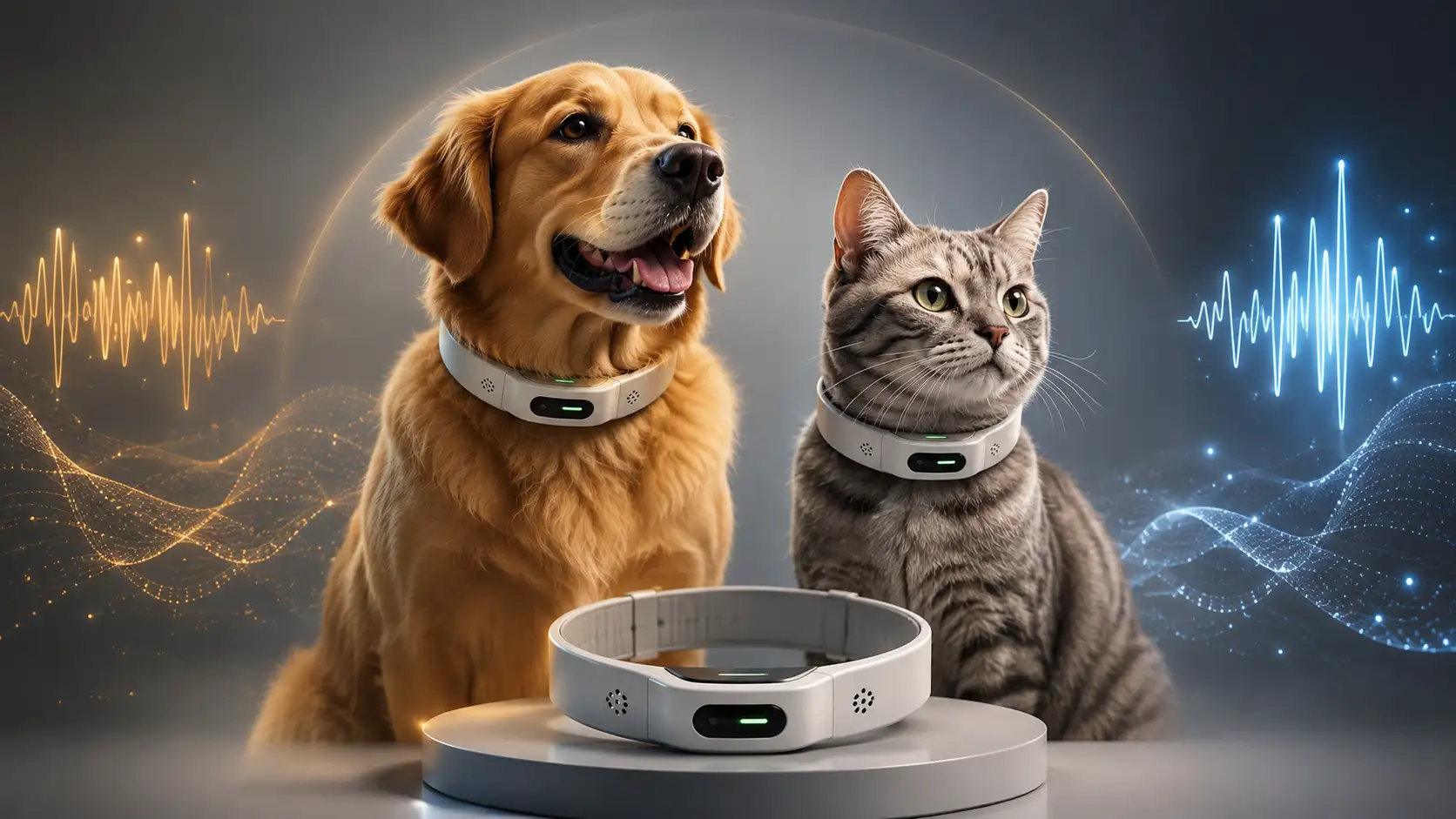
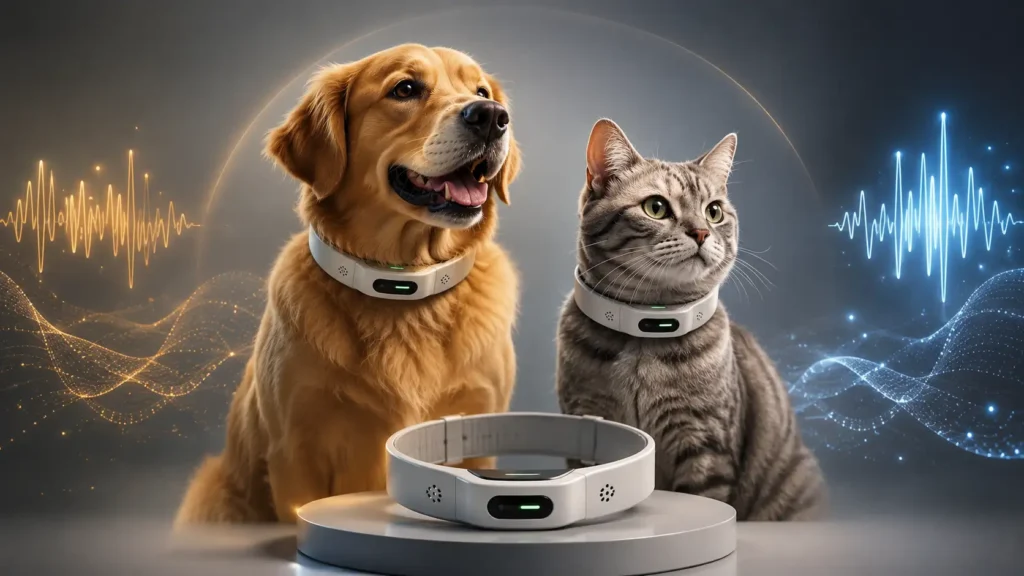
PettiChat, the smart collar promoted by China’s Meng Xiaoyi, is being sold as a pet translator. The safer reading is narrower: it is an AI system that claims to classify pet vocalisations, movement cues and likely emotional states, then turns those probabilities into human-style phrases. That distinction matters. A dog’s bark is not English in disguise. A cat’s meow is not a sentence waiting for subtitles. The product may still be commercially important, but its strongest claim needs sharper scrutiny than the viral pitch gives it.
Table of Contents
A collar that sells translation but depends on interpretation
The story is easy to understand because it touches a familiar frustration. A pet makes a sound, the owner guesses. The guess may be right, partly right, or a projection. PettiChat enters that moment with a promise: clip a small device to a collar, record the sound, combine it with motion signals, and let AI convert the result into text. Reports from Chinese and international outlets describe a device from Meng Xiaoyi, also branded PettiChat, that claims to translate dog barks and cat meows into phrases for owners, and to work in the reverse direction by converting human words into animal-like sounds. The product’s own site says the system listens automatically and translates in 1.2 seconds, while promoting 94.6 percent real-time translation accuracy.
The public hook is the word “translation.” It gives the product a clean consumer story: your pet has been speaking all along, and AI is finally giving it subtitles. The technical reality is less magical and more interesting. A collar with microphones and motion sensors can gather signals. A model can classify patterns. A mobile app can render those classifications as “I’m hungry,” “I’m scared,” “I want to play,” or another short phrase. That is not the same as decoding a hidden grammar of dogs and cats. It is closer to probabilistic behaviour interpretation.
Meng Xiaoyi’s claim lands at a moment when consumer AI is moving away from blank chat boxes and into emotionally charged objects: toys, assistants, cameras, companions, health monitors and household devices. Pet owners are an obvious audience. They already spend money on care, convenience and emotional reassurance. The collar’s appeal does not depend only on technical accuracy. It also depends on whether the output feels personal, timely and plausible enough for owners to keep using it.
That makes PettiChat a useful test case for the next phase of AI hardware. The market is no longer impressed by “AI inside” as a slogan. Buyers want evidence that a device understands a specific context better than a generic app. For a pet collar, that context includes background noise, individual animal habits, species differences, breed differences, health conditions, household routines, sensor placement, battery limits and owner feedback. The product will be judged less by viral videos than by its behaviour across thousands of ordinary kitchens, hallways, parks, crates and veterinary waiting rooms.
The confirmed product facts
The product has been described by Chinese outlets as a lightweight collar-mounted translator linked to Alibaba Cloud’s Tongyi Qianwen/Qwen model family and a proprietary pet-translation model. HK01, citing the product introduction, reported that the device clips onto a pet collar, turns cat and dog sounds into text, and syncs the result to a mobile phone as a voice chat record. The same report says the company presents the model as trained on pet voiceprint samples and designed to identify vocal, emotional and behavioural language cues.
Chinese media coverage also gives a clearer picture of the marketed specification. China Daily’s Chinese business channel described PettiChat as a wearable real-time pet translator weighing 27.2 grams, with a size roughly comparable to an egg, and said the product’s core technology is based on Alibaba Cloud’s Tongyi Qianwen model. The same report says the company claims training on more than 5 million real pet sound samples, conversion of barks, whines and purrs into human language in about one second, 94.6 percent translation accuracy, recognition of more than 20 common emotions and intentions, and a self-learning function that refines results through continued use.
Some English-language coverage describes different dataset figures. Mint reported that PettiChat is built on Alibaba Cloud’s Qwen model and said the system was trained on more than 1.5 million real-world pet audio samples and 3,200 hours of annotated pet video, with veterinarians and volunteers involved in collection. Mint also reported the price as 799 yuan, roughly $119, and said the startup claims more than 10,000 pre-orders.
Those numbers should not be merged into one tidy fact set. They come from different reports and may reflect different claims, different launch materials, different product versions, or inconsistent marketing. The most responsible version of the story is that Meng Xiaoyi is publicly claiming a high-accuracy AI pet emotion and intention system, but the underlying validation method has not been independently established in the public materials reviewed for this article. That does not prove the claim is false. It means the claim remains a vendor claim.
Confirmed claims and open questions
| Area | Reported or claimed detail | Open question |
|---|---|---|
| Product | Collar-mounted AI pet translator | Full hardware specification and sensor performance |
| Weight | 27.2 grams in Chinese coverage | Usability across small cats and dogs |
| Price | 799 yuan in English coverage | Regional pricing and warranty terms |
| Speed | About 1 to 1.2 seconds | Latency under weak network conditions |
| Accuracy | 94.6 percent claimed | Test design, labels, sample balance and independent replication |
| Dataset | Millions of pet sound samples claimed | Dataset provenance, annotation process and error rates |
| Scope | More than 20 emotions or intentions | Whether labels map to behaviour, welfare or owner-friendly phrases |
| Reverse mode | Human words rendered as barks or meows | Whether animals respond better than to ordinary owner cues |
This table separates the launch narrative from the evidence still needed. The product facts are enough to make PettiChat newsworthy. They are not enough to settle whether it performs as a true translator in uncontrolled homes.
The 94.6 percent number needs a narrower reading
The most repeated number in the PettiChat story is 94.6 percent. A figure that precise gives the impression of laboratory authority. The problem is that accuracy only means something when the task is defined. Accuracy at classifying a small set of clean, balanced emotional labels is not the same as accuracy at translating every bark, meow, whine, chirp, growl or purr in a noisy apartment.
Chinese coverage has already narrowed the claim. A Sina report says the company’s explanation is that 94.6 percent refers to emotion recognition accuracy, not word-for-word translation accuracy. The report attributes to CEO Zhang Huaxing the claim that the model was built with Zhejiang University’s College of Animal Sciences, more than 5 million cat and dog voiceprint records, and Alibaba Cloud’s Tongyi Qianwen model. It also says the system currently recognises more than 20 common emotions and intentions, and that user feedback may let the model adapt to an individual animal over time.
That clarification changes the editorial framing. A “95 percent accurate pet translator” sounds like a breakthrough in interspecies language. A “94.6 percent emotion recognition classifier across a defined set of labels” is a more plausible, more limited and more testable claim. The second claim belongs in machine learning and animal behaviour. The first belongs in consumer fantasy unless the company publishes much stronger evidence.
Accuracy also hides the class distribution problem. Suppose a dataset has many examples of ordinary attention-seeking meows and fewer examples of pain, fear or illness. A model can score well by learning the common cases while failing at the rare ones that matter most. In pet care, the rare case is often the most costly one. A false “I want snacks” output is amusing. A false “I’m fine” output when an animal is stressed, sick or in pain could delay a veterinary decision.
A second issue is label quality. Pet emotions are not directly observable. Researchers and annotators infer them from context, body posture, facial tension, physiology, behaviour before and after the sound, and sometimes owner reports. If labels are noisy, the model may learn patterns in human interpretation rather than animal state. A pet emotion model is only as strong as the behavioural science and annotation protocol behind it.
The third issue is household generalisation. A clean demonstration clip is not a typical home. Real homes contain televisions, children, other pets, appliance hums, outdoor traffic, reverberant rooms and owners speaking near the microphone. The device also sits on a moving animal. Fur, collar position, shaking, scratching, rain, chewing and battery-saving modes all affect signal quality. A high internal score does not automatically survive that mess.
PettiChat is closer to emotion tagging than speech translation
The phrase “pet translation” is doing heavy commercial work. Translation normally means that one language is converted into another while preserving meaning. The source language has symbols, syntax, conventions and shared meanings. Dogs and cats communicate, but they do not speak human-style languages. Their vocalisations are tied to arousal, attention, learned household routines, social context, physical state and environmental triggers.
A better technical description is emotion and intention tagging. The collar appears to gather audio and motion data, run classification models, and map the result to a small human-readable phrase. If the model detects high-pitched repeated barking with excited movement near a door, it might output “I want to go out.” If it detects a particular meow pattern near feeding time, it might output “I’m hungry.” The phrase is not a literal transcript. It is a user interface layer.
That interface layer may be helpful if it encourages owners to observe their pets more carefully. It may also mislead if it gives too much confidence. A phrase written in the first person carries authority. “I’m scared” feels more direct than “The system detected a pattern often associated with fear or discomfort.” The first version is more marketable. The second version is more honest.
PettiChat’s Google Play listing uses more careful language than some viral coverage. It describes the app as a companion for the device, says pets express themselves in many ways and that sounds and reactions are not always easy to interpret, and presents the app as support for understanding mood or state. The listing also says PettiChat provides emotional and behavioural reference only, not medical diagnosis or professional advice, and urges users to consult a qualified veterinarian when behaviour is persistent or unusual.
That disclaimer is not a small detail. It shows the product’s safer legal and scientific posture. The app can be framed as a reference tool, not an oracle. It may reduce guesswork in ordinary interactions, but it should not override direct observation, known routine, medical symptoms or professional assessment. The collar’s defensible use case is not “your pet can talk.” It is “your pet’s signals may be organised into useful prompts.”
Alibaba’s Qwen gives the pitch credibility but not proof
PettiChat’s use of Alibaba’s Qwen/Tongyi Qianwen model family gives the product a stronger technical story than a novelty soundboard app. Alibaba Cloud describes Qwen as a series of large language and multimodal models, including Qwen-VL, Qwen-TTS and Qwen-Audio, with newer models capable of cross-modal processing and reasoning across text, audio and vision.
Alibaba has invested heavily in audio models. Its Qwen2-Audio announcement says the model can process audio and text input, generate text output, understand multiple languages and dialects, and identify information from spoken words, music and ambient sounds. The Qwen3.5-Omni technical report describes a model family intended to work across text, vision, audio and audiovisual content, with large-scale audio-visual training and long-context multimodal understanding.
That matters because pet translation is not only an audio task. A bark by itself is ambiguous. A bark at the door, a bark during play, a bark during isolation and a bark during pain can overlap acoustically. A multimodal system that combines sound, motion and context has a better starting point than a sound-only app. In principle, an AI stack that has strong audio recognition, time-series processing, sensor fusion and language generation can turn noisy signals into accessible labels.
The catch is simple: foundation-model capability does not validate a downstream product claim. Qwen can be a strong base model and PettiChat can still overstate accuracy. A pet-specific classifier needs species-specific data, careful annotation, error analysis, independent tests and a clear explanation of what the output means. The product’s credibility should come from published validation, not only from the name of the foundation model behind it.
There is also a user-interface issue. Large language models are good at producing fluent, plausible phrases. That strength becomes a risk when the underlying signal is uncertain. A model may convert a low-confidence classification into a charming sentence, and the owner may remember the sentence more than the uncertainty. The smoother the generated phrase, the easier it is to forget that the system is making an inference.
The best design would surface confidence, context and alternatives. A pet device does not need to sound like a talking animal every time. It could say: “Likely attention-seeking,” “Possible stress,” “Pattern changed from normal,” or “Unclear, check posture and environment.” Those outputs are less entertaining, but they fit the science better.
The scientific baseline for barking is real but limited
The PettiChat idea is not pulled from nowhere. Dogs do carry information in vocalisations, and humans can detect some of it. Research has found that dog barks vary by context and acoustic structure. A classic study by Sophia Yin and Brenda McCowan examined whether domestic dog barks could be divided into subtypes based on context and individual identity, and later work has explored how acoustic features carry emotional information for human listeners. Search results for the Yin and McCowan paper identify its focus as context specificity and individual identification in dog barks.
More recent work keeps reinforcing the same broad idea while avoiding the fantasy of literal translation. A 2024 paper on dog barks and human perception reported that particular acoustic features of barks convey emotional information and affect how humans judge them; high fundamental frequency was associated with higher fear scores, and tonality influenced emotional evaluation.
Machine learning research has also moved into bark classification. A 2024 arXiv paper, “Towards Dog Bark Decoding,” examined whether speech-processing representations trained on human speech could support dog bark classification tasks, including dog recognition, breed identification, gender classification and context grounding. The paper’s abstract reports that self-supervised speech representations improved over simpler baselines and that human speech acoustics provided useful features for dog bark tasks.
These studies support a careful claim: dog vocalisations contain measurable acoustic patterns linked to context, identity and perceived affect. They do not support the stronger claim that a bark has a stable sentence-level meaning that a consumer collar can translate with near-human certainty. A dog’s sound is embedded in movement, environment and relationship. The same animal may use similar sounds for different reasons, and different animals may use different sounds for the same situation.
The gap between research and consumer hardware lies in deployment. Lab and field studies control data collection better than a collar in daily use. Researchers can define contexts, check video, remove bad recordings, balance samples and analyse uncertainty. A consumer product must handle everything automatically and quickly. That is the difference between a promising scientific direction and a reliable household tool.
Cats make the problem harder
Cats are not simply smaller dogs with different sounds. Their communication with humans is shaped by domestication, household learning and individual variation. Cats often use meows in human-directed communication, but their vocal patterns vary widely. Research on human classification of cat meows has tested whether people can identify contexts such as waiting for food, isolation and brushing. The study’s public summary says it examined adult humans’ ability to recognise meows emitted in those settings.
The findings around cat vocalisation often point toward ambiguity. Search results for acoustic studies of domestic cat meows describe work analysing contexts, mental states, fundamental frequency, duration and contours across hundreds of meows. Such research suggests signals exist, but not a clean dictionary.
The RSPCA’s cat behaviour guidance gives the practical reason. Cat welfare cues include grooming changes, hiding, tense posture, altered feeding or toileting, spraying, aggression and avoidance. It advises owners to watch behaviour and consult a vet when needed, because changes may signal stress, boredom, illness, injury or fear.
A microphone alone will miss much of that picture. A meow near a food bowl may mean hunger, habit, attention, learned reinforcement or frustration. A vocal cat may be healthy and expressive; a quiet cat may be ill, fearful or simply less vocal. Purring can accompany contentment, but it can also appear in stress or pain. A collar-based system that maps purrs and meows into tidy phrases must avoid giving owners false certainty.
Cats also challenge collar design. Many cats dislike collars or move differently when wearing devices. A 27-gram device may be acceptable for some animals and intrusive for others, depending on size, temperament, collar fit and habituation. Animal-centred design research stresses that wearables for dogs and cats face challenges in measurement accuracy and user acceptance, and that design must align with animal characteristics, context and welfare needs.
For cats, the biggest product risk is not only mistranslation. It is the owner trusting the text more than the animal’s broader behaviour. A cat that hides, changes litter habits or reduces eating needs careful attention even if the app produces a mild or playful phrase.
Body language matters more than a microphone
The strongest version of a pet emotion system must combine sound with posture, movement and context. Dogs and cats are whole-body communicators. An isolated bark or meow is a thin slice of the signal. PettiChat’s reported use of motion sensors therefore makes technical sense. Motion data could help distinguish resting, pacing, jumping, scratching, shaking, running or door-focused activity.
The RSPCA’s dog body-language guide shows why this matters. A relaxed dog may have an open mouth, natural ear position, smooth hair and a wagging tail; a worried dog may lower the head, tuck the tail, pull ears back, yawn, avoid eye contact or lick lips; an angry or very unhappy dog may show stiff posture, raised hair, stiff tail, enlarged pupils, wrinkled nose or exposed teeth. The same page says owners concerned about behaviour should speak to a vet first and may then be referred to a clinical animal behaviourist.
The AAHA behaviour guidelines list many signs of nonspecific anxiety or distress in dogs and cats, including vocalisation, lip licking, hiding, attempted hiding, changes in eating or drinking, increased grooming, reduced grooming, body lowering, inability to meet a direct gaze and other signals. The guidelines also state that behavioural changes warrant professional assessment and that veterinarians should guide clients rather than assuming animals simply grow out of problems.
This is where a collar could be useful. A device that records patterns over time may notice changes an owner misses: more vocalisation during isolation, more pacing at night, less movement, changed feeding-associated calls or repeated stress signals near a specific event. The best pet AI product may be less like a translator and more like a behaviour diary with pattern recognition.
A diary does not need to claim that the pet speaks. It needs to show trends, flag anomalies and give owners prompts for observation. “Your dog vocalised more than usual between 2 a.m. and 4 a.m.” is less charming than “I missed you,” but it may be more useful. “Your cat’s movement and vocal pattern changed after using the litter box” could be a reason to watch for urinary issues. The product becomes serious when it moves from entertainment into careful monitoring, and that is also where it inherits responsibility.
Reverse translation is the weakest claim
The claim that PettiChat can work in reverse direction — turning a human message into barks or meows — is emotionally powerful and scientifically thin. Mint reported that PettiChat promises to translate human words into a language a pet can understand and presents it as a form of real conversation.
The problem is that animals do not understand human intention because sound is shaped like an animal vocalisation. Dogs and cats learn from tone, routine, body posture, rewards, household cues, scent, gaze, repetition and context. A synthetic bark may attract attention, confuse, annoy, excite or mean nothing. A synthetic meow may be perceived as another animal sound, an odd noise, a threat, a play cue or background noise. Without behavioural trials showing that animals respond more accurately to AI-generated animal-like sounds than to ordinary human voice cues, reverse translation remains the weakest part of the product story.
There is also a welfare concern. Playing animal-like sounds at a pet is not neutral. Some sounds may increase arousal or stress, especially if they resemble alarm, distress, territorial signalling or unfamiliar animals. If a device repeatedly emits noises the owner finds funny but the animal finds confusing, the product shifts from communication aid to stimulation toy.
A responsible reverse mode would need guardrails. It should avoid distress-like sounds, limit volume, avoid repeated playback, provide species-specific warnings and present outputs as attention cues rather than messages. The product should not imply that a dog understands a generated bark as “Please come here” or that a cat understands a generated meow as “Dinner is ready” unless controlled behavioural evidence supports it.
The safer approach is to use the app to coach owners in ordinary communication: consistent words, calm tone, predictable routines, reward-based training and respect for body language. A generated bark or meow might be a novelty feature, but it should not be framed as linguistic symmetry. Pets already live in human households full of signals. Adding synthetic animal sounds does not automatically make the relationship clearer.
A pet owner wants certainty, the model gives probability
The psychology of PettiChat may matter as much as the algorithm. Owners do not buy a pet translator only because they need data. They buy it because they want closeness. They want reassurance that a quiet animal is not suffering, that a vocal animal is not distressed, that a lonely pet understands love, that a strange bark has an answer. AI enters an emotional relationship already full of guesswork.
That emotional setting creates a trust problem. When a model outputs a sentence, the owner may treat it as testimony. “I’m lonely” invites guilt. “I’m hungry” invites feeding. “I’m scared” invites intervention. “Leave me alone” may change how the owner approaches the animal. A pet translator does not merely describe behaviour. It can shape owner behaviour.
This is not automatically bad. Many owners already misread pets. A model that nudges someone to notice fear signals, stop unwanted handling or consult a vet could improve welfare. A model that repeatedly confirms the owner’s preferred story could make misreading worse. If an owner wants a pet to sound cute, needy or grateful, a phrase-generating system may reinforce that fantasy.
Confidence display is therefore central. A serious app should distinguish between high-confidence routine recognition and low-confidence interpretation. It should show alternative possibilities and encourage observation: check food, water, posture, litter box, breathing, gait, temperature, environment and recent changes. For persistent or unusual behaviour, the app should push owners toward veterinary advice, as PettiChat’s store listing already does.
The model’s language should also avoid pretending to know inner speech. “Likely requesting attention” is safer than “I’m lonely.” “Possible discomfort” is safer than “My stomach hurts” unless the system has medical validation. The line between useful empathy and invented intimacy is thin. Pet AI products will need to choose their language carefully.
The China market makes this launch possible
PettiChat is not arriving in a vacuum. China has become one of the world’s most important pet economies, with younger urban consumers spending heavily on food, services, healthcare, smart devices and social-media-friendly products. A review of China’s 2025 pet industry white paper says the urban dog and cat consumption market reached 300.2 billion yuan in 2024, up 7.5 percent, with 124.11 million urban pet dogs and cats. It also reports a larger urban cat population than dog population, with cats at 71.53 million and dogs at 52.58 million.
Reuters reported in April 2026 that China’s pet food market had grown to more than $24 billion, with annual sales rising sixfold between 2014 and 2024, and described the sector as a bright spot in a tougher consumer environment. The same report noted that large domestic companies have moved into pet food and that e-commerce platforms, packaging and localised products are reshaping competition.
This matters for PettiChat because pet owners in China are already being sold a wider emotional economy around animals. Food is no longer only food. It is freshness, safety, breed suitability, age suitability, health support and social identity. Veterinary care is no longer only illness response. It is prevention, diagnostics and long-life planning. Smart feeders and cameras are no longer only convenience devices. They are tools for remote presence.
An AI pet translator sits at the intersection of pet humanisation, smart hardware and generative AI enthusiasm. It sells the feeling that technology can reduce the emotional gap between human and animal. That is a stronger product story than a standard activity tracker, and it fits China’s highly social, video-driven consumer environment. A demo clip of a “talking” cat travels faster than a chart of activity minutes.
The price also matters. At 799 yuan, the device is not a throwaway toy for many buyers, but it sits within reach for urban pet owners who already buy premium food, grooming, toys, cameras or automated feeders. A one-time-payment model, as reported by Mint, may make it easier to position the product as hardware rather than a subscription burden.
Premium pet spending is moving toward emotional services
The global pet industry is moving in a similar direction. APPA announced that U.S. pet industry expenditures reached $158 billion in 2025 and projected $165 billion in 2026, with 95 million U.S. households owning at least one pet. It also reported growth in dog and cat ownership, with younger generations playing a large role.
Euromonitor’s pet-care research page says the global pet care market has surpassed USD 200 billion, with growth shifting from volume to value, cat care and premiumisation becoming major battlegrounds, and Asia Pacific and emerging markets shaping the next wave of growth. It also lists generative-AI-powered pet-owner solutions among 2025 pet-care trends, especially around personalised pet health management.
This broader market explains why PettiChat is likely to attract copycats. The pet category has the right ingredients: emotional attachment, recurring anxiety, willingness to spend, fragmented data, and a gap between owner interpretation and professional expertise. AI companies see room to convert that gap into consumer products.
The shift from basic pet hardware to emotional services is especially important. A GPS tracker answers “Where is my dog?” An automatic feeder answers “Did my cat get food?” A pet camera answers “What is happening at home?” A translator claims to answer “What does my pet feel?” That is a much more intimate question. The closer a product gets to emotion, the more evidence it needs.
Brands may be tempted to sell emotional certainty because it differentiates hardware. A feeder can be copied. A collar design can be copied. A proprietary dataset of animal sounds, video clips and user feedback becomes a more defensible asset. For Meng Xiaoyi, the collar may be only the entry point. The long-term asset could be the behaviour dataset created by daily use.
Pet tech has shifted from tracking to companionship
The first wave of consumer pet technology focused on location, feeding and remote viewing. These products treated pets as dependents who needed monitoring. The next wave treats them as companions whose inner states can be interpreted, predicted and emotionally mediated. PettiChat belongs to that second wave.
This shift follows a pattern across consumer AI. Chatbots moved from answering questions to roleplay, coaching, companionship and emotional support. Smart speakers moved from timers to household presence. Wearables moved from counting steps to readiness, stress and sleep interpretation. Pet wearables are following the same path: from where the animal is, to what the animal is doing, to what the animal might be feeling.
The commercial logic is clear. Location data is useful during an escape. Feeding data is useful at mealtime. Emotional interpretation is relevant all day. It gives the app more reasons to send notifications, more reasons for the owner to open it, and more chances to collect labelled feedback. An emotion interface increases engagement because it turns ordinary animal behaviour into a stream of readable events.
The risk is that constant interpretation changes the relationship. Pets do not need every sound turned into text. Some behaviours are normal ambiguity, not unresolved communication. A cat may meow because it has learned that meowing works. A dog may bark because barking is self-reinforcing in a given environment. A pet may also need quiet, distance or unstructured time rather than more human response.
A good product should reduce owner anxiety, not feed it. If every bark becomes a message and every meow becomes a notification, owners may become more reactive. They may interrupt animals more often, feed more often, check more often or worry more often. The design question is not only accuracy. It is rhythm. AI should not turn pet care into a permanent alert loop.
Data collection sits at the center of the business model
PettiChat’s claimed improvement over time depends on data. Reports describe a self-learning feature where the device records and analyses a pet’s vocal habits and adapts to the individual animal. Sina’s report says Zhang Huaxing described a process in which owners give feedback after translations, allowing AI to learn the pet’s personality and become more accurate with use.
This makes sense technically. Individual animals have distinctive vocal signatures. A model trained on a broad population may classify general patterns, but personalisation could improve routine recognition. A specific cat’s “feed me” meow may not match the average cat. A specific dog’s separation bark may have a stable household pattern. Owner feedback can supply labels that generic datasets lack.
The weakness is that owner feedback is not ground truth. If the app says “I’m hungry” and the owner feeds the pet, the pet eats. The owner may mark the output as correct even if the original cause was attention, boredom or habit. Feedback can reinforce a loop: the model suggests an interpretation, the owner acts, the animal responds, and the owner labels the suggestion as true. Personalisation can improve relevance, but it can also teach the model the owner’s assumptions.
The data also has commercial value beyond the first purchase. A large corpus of pet audio, motion, context, owner feedback, household routines and app interactions could support new products: health alerts, behaviour coaching, food recommendations, insurance partnerships, veterinary triage, training plans or social features. That future is not guaranteed, but it is the direction many connected-device markets have taken.
For buyers, the question is simple: what data is collected, where it is stored, whether audio is uploaded, how long it is kept, whether it is used for model training, whether it is shared, and whether the owner can delete it. A pet translator is also a household microphone. That fact should not be hidden behind cute language.
Privacy risks do not stop at the animal
Pet wearables look harmless because the animal wears the device. Privacy research says the issue is more complex. A PET Symposium paper on pet wearables found a mismatch between how commercial devices were marketed and how transparent they were about data collection. It also noted that some devices with activity tracking did not detail pet activity data in their privacy policies, some location-tracking devices did not detail location data, and many devices captured more owner data than pet data.
A smart pet collar can reveal household patterns. Location data may show home address, walking routes, work schedules and travel. Audio may capture owner voices, visitors, children, television, arguments or other private background sound. Motion patterns may show when the pet is alone, when people return, when routines change and when the home is empty. The pet is the sensor carrier, but the household becomes the data subject.
This is especially relevant for devices marketed through emotion. Owners may grant more permissions when the product promises closeness. They may overlook audio upload, location sharing or cloud processing because the interface frames data collection as care. The research literature calls this kind of emotional framing powerful: privacy worries can be softened when a device is associated with protecting a beloved animal.
A privacy-respecting PettiChat-style device would minimise audio retention, process as much as possible on device, upload only what is needed, separate raw recordings from derived labels, make training use opt-in, show clear retention periods, allow deletion, protect location data and avoid third-party sharing that owners would not expect. The company’s contact details and privacy documents should be easy to find and understand, not buried behind generic e-commerce templates.
The privacy issue is not a reason to reject pet AI by default. It is a reason to treat pet AI like any other microphone-bearing, cloud-connected consumer device. Cute hardware does not make data governance optional.
Regulatory questions start with AI disclosure and personal data
China already has rules that matter for generative AI services and personal data. The Cyberspace Administration of China’s Interim Measures for the Management of Generative AI Services apply to public-facing services in China that use generative AI to generate text, images, audio, video or other content. The measures state that China follows a principle of development and security together, encourages innovation, and applies inclusive, prudent and classified supervision.
The CAC has also published announcements about generative AI service filings, stating that launched generative AI applications or functions should display the filed generative AI service information in a prominent place or product-detail page, including model name and filing number where required.
Personal data rules also matter. Stanford’s DigiChina translation of China’s Personal Information Protection Law says personal information handling must follow legality, propriety, necessity and sincerity, and that collection should be limited to the smallest scope needed for the handling purpose. It defines sensitive personal information to include location tracking, and it requires separate consent for sensitive personal information handling. It also includes rules on automated decision-making, cross-border data provision, impact assessments and deletion rights.
A PettiChat-style product may touch several categories: audio data, app account data, location data, device identifiers, owner feedback, perhaps household routines and possibly children’s voices if the device records at home. Even if animal sounds themselves are not personal information, recordings and linked metadata may identify people or households. The legal risk does not disappear because the primary subject is a pet.
The EU AI Act is less directly relevant unless the product is placed in the European market, but it shows where AI governance is moving. The European Commission describes the AI Act as the first comprehensive legal framework on AI and says it uses a risk-based approach. Its list of prohibited practices includes emotion recognition in workplaces and education institutions, not pet emotion recognition, but the broader regulatory theme is clear: systems that infer internal states invite extra scrutiny when they affect people’s rights, safety or autonomy.
The device could still be useful without being literal
The sharpest criticism of PettiChat would be unfair if it dismissed every practical use. The question is not whether dogs and cats secretly speak English. They do not. The question is whether a collar can organise signals in a way that improves human attention, routine care and early response. The answer may be yes in limited settings.
A pet owner may notice that a dog’s “hungry” pattern often occurs near feeding time, but the app’s history could show that the same sound has increased during late nights. A cat owner may think a meow means food, while the app may show a new association with movement changes. A household may compare patterns before and after a move, new pet, new baby, schedule change or illness. A behaviourist or vet might find longitudinal logs useful if the system records time, activity and owner notes without pretending to diagnose.
The main value may be structured observation. Many pet problems are hard to describe after the fact. Owners arrive at a clinic saying “something seems off.” A device log could show changes in vocal frequency, nighttime restlessness or reduced activity. That does not replace clinical examination, but it may give the veterinarian a better starting point.
There is also a training use case. If a product teaches owners to associate certain sounds with body language and environment, it may improve owner literacy. A bark paired with stiff posture is different from a bark paired with a play bow. A meow paired with hiding is different from a meow paired with greeting. The app could become a guide to observation instead of a cartoon voice.
The product succeeds ethically if it makes owners look more closely at the animal. It fails ethically if it makes them look mainly at the phone.
Veterinary advice remains the boundary line
The boundary between consumer interpretation and veterinary advice must stay clear. PettiChat’s app listing says the product does not provide medical diagnosis or professional advice and recommends consulting a qualified veterinarian for persistent or unusual behaviour. That disclaimer should be repeated inside the app at the moment of risk, not only in the store description.
Veterinary behaviour guidelines support that boundary. The AAHA guidelines say worrisome behaviours should be taken seriously, behavioural changes may need professional assessment, and clients should be encouraged to have regular dialogue with veterinarians. They also warn against assuming pets grow out of behavioural problems as they mature.
The product’s phrase library should reflect those limits. A consumer collar should avoid outputs that sound like diagnosis: “I have stomach pain,” “I have urinary trouble,” “I am depressed,” or “I am sick.” It could instead flag patterns: “Vocalisation pattern changed,” “Possible stress signal,” “Activity lower than usual,” or “Persistent change, consider veterinary advice.” Those outputs are less viral, but safer.
A vet-facing export function could be useful if designed carefully. Owners could share logs showing time stamps, sound categories, activity changes, appetite notes and environment notes. The vet should see raw trends and uncertainty, not only generated pet “messages.” Clinical usefulness requires transparency about what the model measured, not just what phrase the app displayed.
There is a risk of false reassurance. If a dog whines because of pain but the app labels it “I want attention,” an owner may wait. If a cat vocalises near the litter box but the app labels it “I’m annoyed,” a urinary issue could be missed. If an elderly pet becomes less vocal and less active, silence should not be mistaken for well-being. Consumer AI needs conservative escalation when signals persist or change sharply.
Training data is the hidden asset
Every claim about PettiChat’s accuracy leads back to training data. The reported dataset claims vary across coverage, from more than 1.5 million pet audio samples and thousands of hours of video to more than 5 million sound samples.
The raw number is less meaningful than dataset structure. A strong dataset would need multiple breeds, body sizes, ages, health states, environments, recording devices, collar positions, languages in household background audio, noise conditions, multi-pet settings and verified contexts. It would need separate validation animals not seen during training. It would need careful balance across labels. It would need expert review, not only owner annotation.
The hardest part is emotional ground truth. A dog cannot confirm “I am scared” in words. Researchers infer fear from behaviour, physiology, environment and expert coding. A cat cannot confirm “I want to play.” Owners infer from context and response. If a model is trained mostly on owner labels, it may learn owner interpretation. If it is trained on expert labels, scaling becomes expensive and slower. If it is trained on video context, privacy and annotation complexity increase.
A credible validation paper would disclose the label taxonomy, sample counts per class, species split, breed distribution, recording conditions, annotation method, inter-rater agreement, training-test separation, performance by class, confusion matrix, confidence calibration and performance in noisy homes. It would report failures, not only headline accuracy. Until such evidence is public, 94.6 percent should be read as a marketing claim with an undefined denominator.
This does not mean Meng Xiaoyi lacks a serious dataset. It means the public does not yet have enough detail to judge it. The product may work well for common routines and poorly for rare states. It may work better for dogs than cats, better for vocal pets than quiet pets, better indoors than outdoors, better for some breeds, and better after personalisation. Those are not minor caveats. They define the product.
The risk of anthropomorphic feedback loops
Humans naturally read animals through human emotion. That can deepen care, but it can also distort judgement. A pet translator that writes in the first person intensifies this tendency. It makes the animal sound like a small person sending messages.
Anthropomorphism is not always harmful. Many owners who treat pets as family members invest more in care, comfort and veterinary attention. The danger appears when the human story overrides the animal’s actual behaviour. A dog that looks “guilty” may be fearful. A cat that seems “spiteful” may be stressed, sick or reacting to environmental change. A bark labelled “I’m angry” may lead an owner to punish when the animal is anxious. A meow labelled “I’m jealous” may turn a welfare issue into a personality story.
AI phrases can harden those stories. If an owner repeatedly sees “I missed you,” the owner may feel guilt and respond with treats. If the app repeatedly says “Don’t touch me,” the owner may avoid necessary handling or grooming. If it says “I’m bored,” the owner may overstimulate an animal that actually needs rest. The phrase is never neutral. It carries an instruction hidden inside a personality.
The feedback loop becomes stronger when owners rate outputs. An owner who likes a cute interpretation may mark it correct. The system learns the household’s preferred emotional script. The animal’s behaviour may then change in response to owner actions, creating a loop between model, owner and pet. This loop is not science fiction. It is a familiar pattern in recommender systems: feedback changes the world being measured.
Design can reduce this risk. The app can use neutral labels, show uncertainty, prompt observation, avoid emotional overreach and teach body-language literacy. It can also limit the use of comic or dramatic phrases in welfare-sensitive contexts. A pet translator should be charming enough to use, but not so theatrical that it becomes a fiction engine.
China’s consumer AI market is searching for intimate use cases
PettiChat also belongs to a larger competition in Chinese AI. Alibaba, Baidu, Tencent, ByteDance and many startups are pushing foundation models into daily consumer life. Alibaba Cloud describes Qwen as a model family for open-source and enterprise use, with multimodal capabilities and model customisation.
The strategic question is where AI becomes habit. Many people try chatbots, but not every chatbot becomes a daily companion. Pet care offers routine, emotion and repeat use. Feeding, walking, grooming, playing, worrying and checking happen every day. A product that turns those moments into AI-mediated feedback has a better chance of becoming sticky.
Hardware also gives AI a body. A collar on a pet feels more specific than a generic app on a phone. It gives the model a place in the household. It creates sensor data that competitors cannot easily access. It may also support retail storytelling: a visible object, a giftable product, a demo-friendly app and shareable pet clips.
For Alibaba’s ecosystem, pet AI is a useful downstream example of multimodal AI moving into niche consumer verticals. The foundation model may not be the whole product, but it supplies the language, audio and reasoning layer that a startup can package around a specific emotional use case. The future of consumer AI may be less about general assistants and more about narrow, intimate devices with domain-specific data.
That does not guarantee success. Pet owners are forgiving of cute errors for a while. They are less forgiving if a device feels random, intrusive or manipulative. The product needs to prove that it remains useful after the novelty fades. Does the owner still open the app in week four? Does the translation history change behaviour for the better? Does the animal tolerate the collar? Does the device survive chewing, rain, scratching and battery cycles? These ordinary questions decide the market.
Trust will depend on independent testing
PettiChat’s next credibility step should be independent testing. A viral launch can sell pre-orders. It cannot settle accuracy. Independent evaluation should include ordinary homes, multiple species, multiple breeds, multiple age groups, different noise levels, multi-pet households and veterinary-reviewed cases.
The test should not ask only whether owners like the phrases. Owner satisfaction matters commercially, but it is not the same as accuracy. A phrase can feel right and be wrong. A test should compare model outputs to expert-coded behaviour, known event logs, video review and follow-up outcomes. It should measure false positives and false negatives for welfare-relevant states. It should publish per-class performance, not only one headline number.
The most revealing test would include ambiguous cases. Pet communication is full of ambiguity. A dog barking at a window may be alert, excited, territorial, fearful or frustrated. A cat meowing at night may be attention-seeking, disoriented, hungry, stressed or ill. The model should be allowed to say “unclear.” If the product forces every sound into a confident sentence, it will be wrong in the exact cases where caution matters.
A strong evaluation would also compare PettiChat against ordinary owner judgement. If the device performs only as well as owners in common routines, it may still have entertainment value but limited welfare value. If it outperforms owners in recognising stress signals or changes over time, the product becomes much more serious. The benchmark should be not magic, but improvement over human guesswork.
Independent testing could also reveal where the product is strongest. It may be excellent at identifying known household routines after training. It may detect separation-related barking well. It may recognise play arousal in dogs. It may struggle with cats, pain, illness or multi-pet audio. Such a map would help buyers use it responsibly. A limited product with honest boundaries is better than a grand claim with hidden weaknesses.
The global race for animal language AI
PettiChat is part of a broader research and commercial push toward computational animal communication. Advances in audio representation, self-supervised learning, multimodal models and cheaper sensors make animal-signal analysis more feasible than before. Researchers can now process large bioacoustic datasets, discover patterns, classify calls and compare signals across contexts with tools that were not practical at consumer scale a decade ago.
Dog and cat products are only the consumer-facing edge. Similar methods are being used or explored across wildlife monitoring, livestock welfare, conservation acoustics, veterinary behaviour and animal-computer interaction. The scientific goal is usually not “translation” in the human-language sense. It is detection of species, identity, context, stress, activity, health risk or environmental change.
The pet category is special because it turns research into an emotional consumer claim. Owners do not ask for “valence-arousal modelling.” They ask what their dog wants. The product must translate scientific uncertainty into an interface. That interface can be honest or exaggerated.
The opportunity is real. A well-designed AI pet system could give owners better behavioural literacy, help detect routine changes, support ageing pets, assist multi-person households, and give vets better context. The risk is real too. A poorly designed system could overstate certainty, collect too much data, encourage projection, trigger unnecessary alerts or delay professional care.
The global winner in pet AI may not be the company with the cutest phrases. It may be the company that earns trust by being precise about uncertainty. Pet owners love charm, but they also learn quickly when a device feels fake. The product that says “I don’t know, but watch this pattern” may last longer than the product that turns every sound into a joke.
A careful buyer’s test for AI pet collars
A buyer does not need to read technical papers to evaluate a pet translator. The first test is whether the company explains the claim. Does “accuracy” mean emotion classification, intention classification, routine detection, owner satisfaction or literal translation? If the answer is vague, the headline number is weak.
The second test is whether the app shows uncertainty. A device that never admits ambiguity is not smarter; it is less honest. The third test is whether it separates medical warnings from playful phrases. A good app should push veterinary advice when behaviour changes persist, when the owner reports pain signs, or when signals indicate possible distress.
The fourth test is data control. The owner should know whether raw audio leaves the device, whether recordings are stored, whether location is collected, whether data trains models, whether children’s voices may be captured, how deletion works and whether the device can be used with reduced permissions. If those answers are difficult to find, the privacy risk rises.
The fifth test is animal comfort. A collar that irritates an animal has already failed, no matter how clever the model is. Owners should watch for scratching, freezing, hiding, avoidance, altered movement or agitation. The right device for a sturdy dog may be wrong for a small cat.
The sixth test is whether the product improves care after the novelty period. After two weeks, is the owner noticing useful patterns? Are they responding more calmly? Are they less likely to misread stress? Are they feeding or rewarding less impulsively? Are they looking at the animal more, not less? A pet translator should make the human a better observer. That is the practical standard.
PettiChat’s real meaning for consumer AI
PettiChat matters even if the strongest translation claim weakens under scrutiny. It shows where consumer AI is heading: toward emotionally specific devices that use foundation models, sensors, personalisation and generated language to mediate everyday relationships. Pets are an early category because the emotional demand is obvious and the technical standard is still forming.
The collar also exposes a tension that will appear across many AI products. Marketing wants simple magic. Science offers probabilities. Users want intimacy. Regulators want accountability. Investors want scale. Animals need welfare. A good product must hold all of those pressures without pretending they are the same.
Meng Xiaoyi’s device may become a useful behaviour reference tool. It may become a viral novelty. It may improve through user feedback. It may face backlash if independent testing contradicts the headline claims. The public evidence today supports a cautious position: PettiChat is a notable AI pet-tech launch, but the “95 percent translation” phrase should be read as a claimed emotion-recognition metric, not proof that AI has cracked cat and dog language.
The most honest future for this category is not a talking-pet fantasy. It is a better instrument for human attention. Dogs and cats already communicate through sound, posture, rhythm, routine and change. AI may help owners notice those signals sooner and organise them better. It should not replace the patience that good pet care requires.
Questions pet owners are asking about AI pet translators
PettiChat is better understood as an AI emotion and intention classifier. It may turn detected patterns into human-style phrases, but that is not the same as literal language translation.
Chinese reporting says the company clarified that the number refers to emotion recognition accuracy, not word-for-word translation. The public materials reviewed do not provide enough independent testing detail to verify the figure.
The device is associated with Meng Xiaoyi, a Chinese startup, and is branded as PettiChat in public coverage and product materials.
Reports and product coverage connect the device to Alibaba Cloud’s Tongyi Qianwen/Qwen model family, with a proprietary pet-translation model layered around it.
English-language coverage reported a price of 799 yuan, roughly $119, although regional availability and pricing may vary.
The product site and media coverage describe translation in about 1 to 1.2 seconds, though real-world latency may depend on network conditions, device state and processing design.
The product is marketed for cats and dogs. The two species communicate differently, so performance should be evaluated separately rather than assumed equal.
The reverse mode is the weakest claim. There is not enough public evidence that synthetic barks or meows carry specific messages that animals understand better than ordinary human cues.
It could, if it tracks changes in vocalisation, movement and routine and presents them cautiously. It should not replace body-language observation or veterinary advice.
Yes. A confident phrase may cause owners to trust the app more than the animal’s broader behaviour. False reassurance is a risk when pets show pain, stress or illness.
Yes. Research shows dog barks and cat meows contain acoustic patterns linked to context and emotional perception. That does not mean every sound has a fixed sentence-level meaning.
Cats vary widely in vocal behaviour, and many welfare cues appear through posture, hiding, grooming, feeding and toileting changes rather than sound alone.
No. PettiChat’s own app listing says it provides emotional and behavioural reference only and is not a medical diagnosis tool. Persistent or unusual behaviour should be discussed with a veterinarian.
A smart collar may collect audio, location, app account data, owner feedback and household routines. Even pet-focused data can reveal information about people and homes.
Not automatically. Comfort depends on the animal’s size, species, collar tolerance, movement and temperament. Owners should watch for avoidance, scratching, freezing or behaviour changes.
It should test the collar in ordinary homes, across species and breeds, with expert-labelled video review, noisy environments, per-class performance and clear false-positive and false-negative rates.
They could support veterinary conversations if they export transparent trend logs. Generated first-person pet phrases are less useful clinically than time-stamped behaviour and activity data.
It shows how consumer AI is moving into emotional hardware. Pet owners are willing to spend on care and reassurance, making pet AI a strong test market.
Treat it as a prompt for observation. Check the animal’s body language, routine, environment and health signs before acting on any generated phrase.
Author:
Jan Bielik
CEO & Founder of Webiano Digital & Marketing Agency
This article is an original analysis supported by the sources cited below
PettiChat official product page
The product page promotes the collar’s automatic listening, 1.2-second translation claim, 94.6 percent accuracy claim and geofencing feature.
PettiChat app listing on Google Play
The app listing describes PettiChat as a companion app for understanding pet mood and states that it is not medical diagnosis or professional advice.
HK01 report on Meng Xiaoyi PettiChat
Hong Kong coverage summarising the PettiChat launch, the collar-mounted design, mobile chat record and claimed Alibaba Cloud model connection.
Sina report on the 94.6 percent accuracy claim
Chinese coverage reporting the company’s clarification that 94.6 percent refers to emotion recognition rather than literal word-for-word translation.
China Daily Chinese business report on PettiChat
Chinese business coverage describing the 27.2-gram wearable design, claimed 5 million sound samples, self-learning feature and more than 20 emotion or intention categories.
Mint report on PettiChat pricing and Qwen connection
English-language report covering the 799 yuan price, claimed pre-orders, Alibaba Qwen model connection and reverse-translation pitch.
The Federal report on the AI pet collar
Coverage noting the company’s claim of more than 20 emotional expressions converted into human-readable phrases within 1.2 seconds.
Oddity Central report on the controversial pet translator
International report summarising the 10,000-unit reservation claim, price and sceptical reaction to the advertised accuracy.
Alibaba Cloud Qwen overview
Official Alibaba Cloud page describing Qwen as a family of large language and multimodal models with audio, vision and text capabilities.
Alibaba Cloud Qwen2-Audio announcement
Official Alibaba Cloud blog describing Qwen2-Audio’s audio and text processing, multilingual understanding and audio analysis capabilities.
Qwen3.5-Omni technical report
Technical report describing Alibaba’s newer omnimodal Qwen model family for text, vision, audio and audiovisual understanding.
Towards dog bark decoding
Research paper exploring the use of human speech-processing representations for automated dog bark classification tasks.
What’s in a meow
Peer-reviewed study examining human ability to classify domestic cat meows in different contexts.
Alarm or emotion
BMC Ecology and Evolution paper on how acoustic features of dog barks convey emotional information to human listeners.
Barking in domestic dogs
Classic research paper on context specificity and individual identification in domestic dog barks.
RSPCA guide to dog body language
Animal welfare guidance explaining body-language signs associated with relaxed, worried and unhappy dogs.
RSPCA guide to cat behaviour
Animal welfare guidance listing behavioural changes that may indicate stress, fear, illness or injury in cats.
AAHA canine and feline behavior management guidelines
Veterinary guidelines discussing behavioural changes, anxiety and distress signs, and the need for professional assessment.
Pets without PETs
Privacy research on pet wearables, data transparency gaps and the risk that pet devices reveal information about owners and households.
Towards effective wearable design for animals
Open-access engineering paper on design factors for animal biosensing wearables and animal-centred design.
APPA U.S. pet industry expenditure report
American Pet Products Association report stating that U.S. pet industry expenditures reached $158 billion in 2025.
Euromonitor pet care report page
Market research page describing the global pet care market surpassing USD 200 billion and noting generative-AI-powered pet-owner solutions among pet-care trends.
Reuters report on China’s pet food market
Reuters coverage of China’s growing pet food market, domestic brand competition and pet industry regulation gaps.
White paper review on China’s pet industry in 2025
Review summarising China’s urban dog and cat market size, pet population and consumption patterns.
China generative AI interim measures
Official Cyberspace Administration of China text setting out rules for public-facing generative AI services.
CAC announcement on generative AI service filing information
Official announcement describing filing disclosure expectations for launched generative AI applications or functions.
Translation of China’s Personal Information Protection Law
Stanford DigiChina translation of China’s personal information law, including rules on necessity, transparency, sensitive data and automated decision-making.
European Commission AI Act overview
European Commission page explaining the AI Act’s risk-based framework and prohibited AI practices.
| Citing this article? Brief excerpts are welcome. Please credit Webiano.digital, name the author where stated, and include a link to https://webiano.digital and to this original article. Full or substantial republication requires prior written permission. Read our Copyright and Content Use Policy. |
This article was prepared with the assistance of artificial intelligence tools. The content underwent expert human review, and Webiano Digital & Marketing Agency assumes editorial responsibility for its final version and publication.