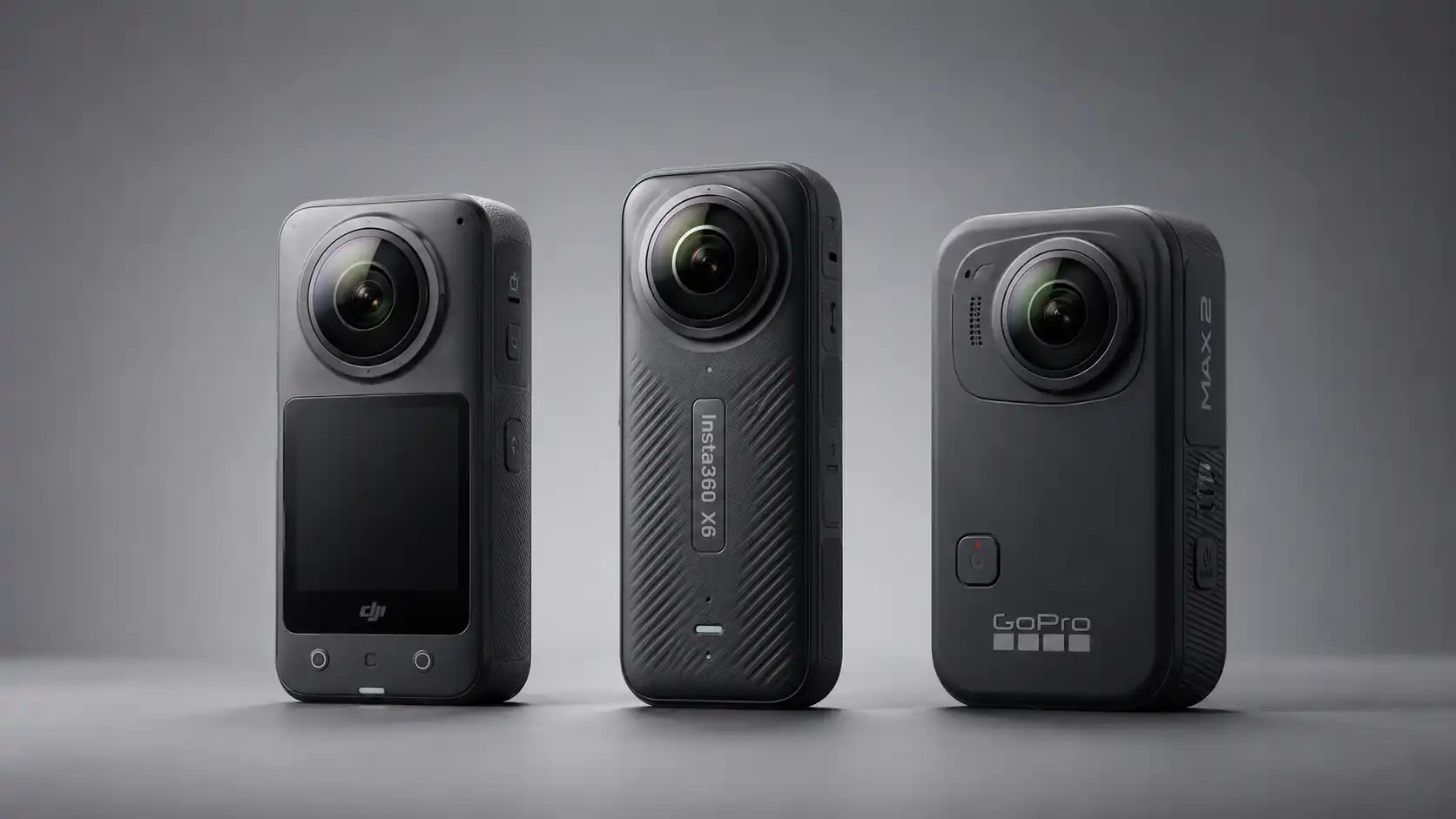
DJI and Insta360 have turned the premium 360-camera market into a three-way contest almost overnight. Insta360 released the X6 on August 12, 2026, and DJI followed with the Osmo 360 II on August 13, while GoPro’s MAX2 has been on sale since September 2025 and has gained meaningful firmware and GoPro Labs upgrades since launch. The buying answer is no longer “pick the newest camera.” It is “pick the workflow and shooting conditions that expose the fewest weaknesses.” X6 is the most ambitious all-round package, with dual custom Sony 1/1.1-inch square sensors, 8K50 recording, 10-bit color, native Dolby Vision, a 2,600mAh battery and unusually deep software automation. Osmo 360 II counters with native 8K60, 14.5-stop claimed dynamic range, a 2,150mAh battery, 105GB of usable built-in storage, replaceable lenses and DJI’s increasingly broad Osmo accessory ecosystem. MAX2 remains a serious option because its true-8K approach, six-microphone array, GPS, replaceable optical-glass lenses and mature GoPro mounting system still matter in action work.
Table of Contents
The buying decision has changed in forty-eight hours
For pure image ambition, Insta360 X6 is the default choice for buyers who can accept its premium price. Insta360 says its sensors provide an imaging area equivalent to one-inch capture for 360 work, and independent early testing from TechRadar and Tom’s Guide reports excellent daylight and low-light results. Its appeal is not only sensor hardware. InstaFrame 2.0 can produce a flat tracked clip while retaining a 360 workflow, AI Director can create edits while the camera charges, and the platform remains unusually focused on reframing after capture. That makes X6 attractive to solo creators who routinely turn one recording into horizontal, vertical and square deliverables. The caveat is price: Insta360 launched X6 at US$699.99, substantially above MAX2’s US$499.99 launch price and above DJI’s regional pricing in several markets. Early reviews also describe app friction and heat limits in demanding modes, so the specification sheet is not an unconditional win.
For motion-heavy work, Osmo 360 II has the clearest headline advantage: native 8K at 60 frames per second. That extra frame-rate margin is practical rather than decorative. Sixty-frame capture gives editors a straightforward two-times slow-motion option on a 30fps timeline while preserving the camera’s top spherical resolution, and it can reduce the per-frame displacement that makes fast movement harder to reframe cleanly. DJI also added user-replaceable lenses, removing a major weakness of the first Osmo 360, and publishes a maximum video bitrate of 220Mbps, with a much higher figure reserved for 16K 360 timelapse. The camera’s 105GB usable internal storage lowers the chance that a forgotten microSD card ends a shoot. DJI’s direct microphone compatibility and magnetic quick-release ecosystem are particularly compelling for owners of current Osmo Action and DJI Mic gear. The major uncertainty is geographic: two days after launch, availability and official pricing are still region-dependent, especially in the United States.
MAX2 is the least new camera in this comparison, but it is still the most defensible choice for established GoPro users and some professional action shooters. GoPro’s June 2026 firmware raised the standard maximum bitrate to 200Mbps and expanded controls, while GoPro Labs can reach 300Mbps and exposes advanced functions that matter in controlled production. MAX2 also supports GP-Log, built-in GPS, six microphones and tool-free twist-and-go lens replacement. Its biggest weakness against the two August 2026 launches is sensor and low-light competitiveness: independent reviewers have generally praised MAX2’s daylight detail more than its after-dark performance. Buyers should therefore resist a universal ranking. X6 is the broadest creator system, Osmo 360 II offers the strongest high-frame-rate 8K proposition and unusually generous internal storage, while MAX2 remains the action-centric choice with the deepest GoPro heritage. The rest of this comparison tests those conclusions against capture, editing, durability, audio, price and actual production workflow.
A useful way to decide is to start from failure cost. A scratched lens on a once-in-a-lifetime trip, a dead battery during a long ride, a missed audio track in an interview, or a phone that cannot process a large 360 project can matter more than a small difference in laboratory detail. All three cameras now address lens damage more credibly than Osmo 360 did, because each offers a user-replaceable approach rather than treating the exposed fisheye optics as effectively permanent. The surrounding ecosystems then diverge. Insta360 has built a catalog of invisible sticks, dive housings and software-led reframing. GoPro offers compatibility with more than 35 mounts and accessories and retains built-in GPS. DJI ties Osmo 360 II into magnetic quick releases, direct DJI Mic connectivity and a battery extension rod that DJI says can extend 8K30 recording to as much as 4.5 hours.
Launch timing matters more than usual
This comparison is unusually sensitive to publication date because two of the three cameras are only days old. Insta360 announced X6 on August 12, 2026, with immediate availability from its store, Amazon and selected retailers. DJI announced Osmo 360 II in China and Hong Kong on August 13, with official product and store pages active in those regions. GoPro announced MAX2 on September 23, 2025 and began global retail availability on September 30 of that year. A specification comparison written even one week earlier would have been obsolete. That timing also means the evidence is asymmetric. MAX2 has months of field reports, firmware history and independent testing. X6 already has several launch-window reviews from publications that used pre-release hardware for weeks. Osmo 360 II has official specifications and launch material, but far less independent long-term testing. Any confident claim about its heat behavior, lens durability or app reliability would therefore outrun the evidence available on August 15.
The age difference has another consequence: MAX2 is no longer the exact product that reviewers evaluated on day one. GoPro added GoPro Labs support in November 2025, bringing capabilities such as up to 300Mbps recording, HDRI merge and stitch-tuning controls. In June 2026, a regular firmware release introduced a 200Mbps Maximum Bitrate setting, 10-bit and GP-Log support in additional time-lapse modes, anti-flicker controls and blur reduction for single-lens recording. Firmware has narrowed some of the gap that a launch-spec table would exaggerate. It has not changed MAX2’s underlying sensors or top spherical frame rates, but it has made the camera more flexible for production users who care about compression, grading and predictable stitching. This is one reason a current MAX2 comparison should not rely solely on September 2025 reviews or retail listings.
X6 sits at the opposite end of the maturity curve. Its triple-chip architecture, 8K50 mode, Dolby Vision recording, AI Director and new lens system are all fresh. Insta360 says X6 uses two custom Sony square sensors and a Qualcomm 4nm flagship processor plus two dedicated imaging chips. Early reviewers broadly agree that the camera improves image quality and versatility, but they do not agree on every operational detail. Tom’s Guide reported overheating in high-demand scenarios, while TechRadar praised runtime and noted app instability on some devices. Those differences are not contradictions so much as reminders that workload, ambient temperature, firmware and host phone can change the experience. Anyone buying for a paid production in the launch week should treat published endurance figures as controlled benchmarks rather than guarantees. A camera that runs 140 minutes in a laboratory at 8K30 does not necessarily do so mounted in sun, connected wirelessly and recording repeated high-frame-rate clips.
Osmo 360 II needs the most cautious interpretation. DJI’s official pages confirm native 8K60, 14.5-stop claimed dynamic range, AI SuperNight 2.0, replaceable lenses, a 2,150mAh battery and 105GB usable storage. Those are concrete launch specifications, but the absence of broad independent testing is itself relevant information. For example, 8K60 looks decisive on paper, yet sustained recording time, thermal throttling, stitch quality during rapid parallax changes and noise behavior in very low light require real footage and repeatable tests. Regional availability also affects the value calculation: DJI’s Hong Kong store lists the Standard Combo at HKD 3,899, but a buyer in another country should use the local DJI store rather than convert that figure and assume equivalent tax, warranty or inventory. In this article, official claims are treated as specifications, independent tests as evidence, and untested conclusions as analysis rather than fact.
Launch-week pricing also deserves restraint. Promotional prices can change faster than specifications, and a temporary discount can distort a comparison that will remain online for months. GoPro advertised MAX2 at US$299.99 for a limited period in June 2026, down from its US$499.99 launch price, while current storefront pricing may differ by market and date. Insta360’s launch price is explicitly US$699.99 for the Standard Bundle. DJI’s Hong Kong Standard Combo is HKD 3,899, but that is not a universal dollar price. The only durable value comparison is feature value at the price a buyer can actually pay in the buyer’s region. Warranty coverage, tax, bundle contents, import restrictions and accessory costs can reverse an apparent bargain. This article therefore uses confirmed launch or official regional prices only as dated reference points and avoids pretending that one global street price exists. That distinction protects readers from comparing temporary promotions with permanent list prices across markets that apply different taxes, currencies and bundle policies.
Sensor architecture now defines the premium tier
The biggest hardware shift in current 360 cameras is not the 8K label; all three contenders can claim 8K in some form. The more consequential competition is sensor area, readout, pixel design and processing. Insta360 X6 uses two custom 1/1.1-inch square Sony CMOS sensors. Insta360 describes their 360 imaging area as equivalent to one inch and says the area is 33 percent larger than X5’s, with 2.44-micrometer pixels at 8K. DJI describes Osmo 360 II as using a one-inch 360 imaging system and pairs it with a high-performance ISP. GoPro emphasizes MAX2’s true-8K resolution and color pipeline rather than making the same large-sensor pitch. Large sensors matter because a 360 camera asks each lens to cover an enormous field, then crops heavily when footage is reframed. More useful photon collection gives the processing pipeline better material before denoising, sharpening and stitching begin.
Sensor marketing still needs careful interpretation. A “one-inch” label in compact-camera language is a format class, not a literal one-inch diagonal, and 360 cameras can use only part of a square sensor depending on lens projection and recording mode. Insta360 is unusually explicit in a footnote: X6’s 1/1.1-inch sensors deliver an imaging area equivalent to a one-inch sensor with a 4:3 aspect ratio when shooting 360 content. That footnote is more informative than simply comparing nominal sensor names. It tells the buyer that geometry and active imaging area matter. DJI’s one-inch 360 language similarly focuses on the effective panoramic system rather than a conventional rectangular photo-camera frame. The practical test is therefore not which fraction looks larger on a box, but whether the camera holds fine texture, color separation and shadow detail after stitching and reframing. Early X6 reviews provide some evidence; Osmo 360 II still needs comparable independent testing.
Processing is equally important because two fisheye streams must become one sphere in real time. Insta360 says X6 combines an eight-core 3.3GHz 4nm processor with two dedicated imaging chips and claims 500 percent more computing power than X5. It also uses separate light metering for each lens in AdaptiveTone 2.0 and dedicated ambient-light sensors for its low-light mode. DJI highlights a high-performance ISP and AI SuperNight 2.0. GoPro’s platform has evolved through firmware, adding high-bitrate recording, low-light capture optimization and stitch controls. The competitive distinction is increasingly computational rather than purely optical. A camera can use stronger denoising to make a dark frame look cleaner, tone-map two lens directions differently to handle backlight, or adjust its stitch model when subject distance changes. Those interventions can improve a finished clip, but they can also create a processed look that some colorists prefer to avoid.
For buyers, the useful conclusion is narrower than “bigger sensor wins.” X6 currently has the strongest combination of large-sensor claims and independent low-light evidence. Osmo 360 II appears engineered around the same premium imaging problem while prioritizing higher 8K frame rate. MAX2 uses a different value proposition: high spherical pixel count, strong daylight rendering, high bitrates, GoPro color and action features. Image architecture predicts strengths, but it does not replace footage. Stitching algorithms, lens sharpness near the overlap zone, exposure matching between lenses and bitrate all determine whether extra sensor quality survives into a reframed 16:9 clip. For creators who mostly shoot bright snow, beaches or motorsport, MAX2’s smaller-sensor disadvantage may matter less than its detail and mounting strengths. For dusk travel, interiors and mixed lighting, X6’s sensor and processing package is more persuasive on present evidence, with Osmo 360 II the high-potential newcomer that still needs independent confirmation.
The shape of a 360 sensor also explains why square designs have become strategically important. A dual-fisheye camera needs image circles rather than a conventional landscape rectangle. A square sensor can allocate silicon more efficiently around that circular projection, reducing unused area and allowing the manufacturer to balance resolution, heat and body size differently. The benefit is architectural efficiency, not a magical increase in optical quality. Lens design still determines how sharply the edge of each hemisphere reaches the stitch zone, and sensor readout still determines rolling-shutter behavior during fast motion. Processing then has to reconcile exposure, white balance and geometric distortion from two directions at once. X6 and Osmo 360 II both signal that premium 360 design is moving toward purpose-built imaging geometry instead of simply borrowing a conventional action-camera sensor layout. MAX2 proves that a different architecture can still compete when resolution, encoding and software are tuned well, which is why direct output remains more informative than component names alone.
Native 8K frame rates separate the three cameras
Resolution labels are easy to compare and easy to misunderstand. A 360 camera spreads its recorded pixels over an entire sphere, while the viewer usually sees only a cropped window of that sphere after reframing. That is why 8K spherical capture does not produce an 8K flat shot after the editor chooses a narrow view. The real advantage of higher spherical resolution is reframing headroom. More source pixels mean a given output window can retain finer texture before interpolation, stabilization and digital zoom reduce detail. MAX2 built its launch campaign around “True 8K,” arguing that its pixel dimensions provide up to 21 percent more resolution than competing implementations at the time. X6 records native 8K at up to 50fps. Osmo 360 II now raises the frame-rate ceiling to native 8K60, giving DJI the highest published top-resolution frame rate of these three.
Frame rate matters differently from resolution. At 30fps, each frame on a typical shutter rule may expose around twice as long as a comparable 60fps frame, which can create more motion blur in fast scenes. At 60fps, movement is sampled twice as often, and footage can be slowed to half speed on a 30fps timeline without interpolation. Osmo 360 II’s 8K60 mode is therefore a real action advantage if image quality and thermal performance hold up in practice. A mountain-bike descent, ski run or motorsport shot contains rapid camera rotation and nearby objects crossing the stitch region; extra temporal samples can make reframing smoother and preserve more usable moments. X6’s 8K50 remains well suited to 25fps delivery and gives nearly the same conceptual benefit in PAL-oriented workflows, while MAX2’s top modes emphasize its full pixel dimensions and alternative 5.6K60 or 4K100 slow-motion options.
There is a cost to every higher frame rate. The sensor must read more data, the processor must stitch and encode more frames, the storage system must sustain the data rate, and the battery must supply the load while heat is dissipated through a compact waterproof body. A launch specification cannot tell buyers whether the highest mode is the mode they will use all day. For long-form travel recording, 8K30 may remain the practical baseline even on an 8K60 camera. Insta360’s published 140-minute X6 runtime is specifically associated with 8K30 under laboratory conditions, while DJI lists up to 100 minutes of 8K30 panoramic recording for Osmo 360 II. GoPro’s runtime depends on mode and environmental conditions, and its 1,960mAh Enduro battery is designed for broad temperature performance. Editors should therefore separate “highest available mode” from “default production mode.”
The frame-rate ranking also changes if the final output is traditional action-camera footage rather than a fully reframed sphere. X6 can operate as a single-lens camera at 5K60, with a narrower maximum field at 60fps than in its 5K30 flat mode. MAX2 offers single-lens recording and GoPro has extended blur-reduction support to those modes through firmware. DJI’s broader Osmo line similarly encourages hybrid use, although Osmo 360 II’s defining advantage remains spherical 8K60. Buyers should choose the resolution-frame-rate pair they will actually edit, not the largest number on the product page. A creator delivering 4K30 social and documentary clips may value X6’s imaging and automation more than 8K60. A rider who routinely slows aggressive motion may prefer DJI. A GoPro production that depends on GPS, familiar mounts and GP-Log may accept lower top spherical frame rates in exchange for a proven workflow.
Delivery frame rate should also shape the choice. European broadcasters and many creators working under 50Hz lighting often use 25fps or 50fps timelines, making X6’s 8K50 unusually natural for that workflow. A 60fps source maps cleanly to 30fps delivery and can also be conformed for slow motion, while 50fps maps cleanly to 25fps. MAX2’s 5.6K60 and 4K100 modes give it other ways to trade spherical detail for temporal resolution. There is no universally superior frame rate without a target timeline. Mixing 50fps and 60fps footage can be handled in modern editors, but motion cadence may require interpolation, dropping frames or speed changes. Creators who routinely combine a 360 camera with a main action camera should therefore look at the whole camera kit, including its preferred shutter settings, lighting frequency and final delivery standard. A DJI user shooting 60fps across Osmo devices may value matching cadence; a European X6 user may prefer 50fps; and a GoPro user may prioritize familiar timebase settings and Labs controls.
Daylight detail is no longer an easy GoPro win
MAX2 earned much of its reputation in bright outdoor shooting. GoPro launched it with a full-resolution 8K claim, 10-bit color, GP-Log and replaceable optical-glass lenses, and reviewers such as WIRED praised its daylight sharpness and natural-looking color. That strength still matters because 360 footage is frequently reframed after stabilization, which magnifies any softness in the source. Fine daylight texture is one of the few qualities that survives every stage of a demanding 360 workflow only if it is captured well at the start. Grass, gravel, tree branches, ski tracks and road surfaces can become smeared or oversharpened once dual-lens footage is stitched, compressed, stabilized and cropped. MAX2 has shown that a carefully tuned high-resolution pipeline can preserve those details even without the largest sensors in the category.
X6 changes the daylight argument because it combines larger sensors with higher processing capacity and a much stronger 8K frame-rate ceiling than X5. TechRadar’s launch review says X6 is the first compact 360 camera the reviewer had tested that did not force a choice between excellent daylight and excellent night performance, while Tom’s Guide also praised its image quality after a month of use. Independent testing therefore supports X6 as the most balanced imaging choice at launch, not merely the best low-light model. Its 10-bit pipeline and multiple color profiles also give editors more room to control saturated skies, skin tones and mixed scenes. Insta360’s AdaptiveTone 2.0 meters the two lenses independently, which is relevant in daylight situations where one lens faces the sun and the other faces shade. The harder task is making those hemispheres meet without an obvious exposure or color discontinuity.
Osmo 360 II is more difficult to place because DJI’s official specification is strong while independent sample analysis is still sparse. DJI claims 14.5 stops of dynamic range and native 8K60, and its first-generation Osmo 360 already received positive attention for high-resolution daylight capture. The second generation adds replaceable lenses and a higher maximum bitrate of 220Mbps, both of which can protect quality in difficult scenes. A higher bitrate is useful when the image contains complex motion, but it does not automatically make one camera sharper than another. Codec efficiency, noise, sharpening, sensor readout and lens performance all influence visible detail. The 220Mbps ceiling gives DJI more data budget than many default consumer modes, yet GoPro Labs can push MAX2 to 300Mbps, while X6 relies on its own encoding choices and stronger sensor-processing architecture. Bitrate should be treated as part of the chain, not a scoreboard by itself.
For daylight-only buyers, the three cameras are closer than their marketing suggests. MAX2 remains convincing when the job is fast outdoor action, especially for users who prefer GoPro color and already own mounts. X6 brings a stronger all-conditions image pipeline and appears to give up little in bright scenes. Osmo 360 II has the most enticing combination of 8K60 and high published bitrate, but its final ranking should wait for direct side-by-side testing with production firmware. The sensible current hierarchy is evidence-based rather than absolute: X6 for the broadest proven image quality, MAX2 for proven daylight action, and Osmo 360 II for the strongest untested high-frame-rate promise. That ranking could change quickly as independent Osmo 360 II footage becomes available. Buyers shooting commercially this week should favor the camera whose behavior has already been measured under conditions close to their own work, rather than assuming the newest specification will always produce the cleanest reframed 4K image.
Daylight also exposes stitching and flare, not just sharpness. A low sun placed near the overlap region can create different flare patterns in the two lenses, while a subject passing close to the camera can reveal parallax that no amount of resolution removes. Replaceable lens modules add another variable because their seating and optical tolerances must remain consistent after a field swap. The best daylight camera is therefore the one that preserves detail without drawing attention to the fact that two lenses created the image. GoPro’s stitch-tuning controls are unusually relevant for advanced users because Depth Lock and Depth Smoothing let them influence how MAX2 handles changing scene depth. Insta360 relies more heavily on automated stitching and its mature app workflow. DJI’s second-generation replaceable-lens system is too new for a broad record of post-replacement stitch consistency. These are the kinds of differences that become visible only after reframing, which is why sample clips should be judged in the intended output format rather than as equirectangular 360 files alone.
Low-light performance exposes the real sensor gap
Low light is where small 360 cameras have traditionally paid the largest penalty for their convenience. Each lens covers roughly half a sphere, so the system needs a very wide optical design, extensive geometric correction and aggressive reframing after capture. Noise that looks acceptable in an equirectangular preview can become obvious after a narrow crop. X6 currently has the strongest verified low-light case of the three. Insta360 combines dual custom 1/1.1-inch square sensors with PureVideo processing, two ambient-light sensors and a triple-chip architecture. TechRadar’s launch testing explicitly rated X6 as excellent in both day and night conditions, while the company says the new sensors gather substantially more light per frame than X5. This does not make X6 a large-sensor cinema camera, but it gives the processing pipeline more signal before denoising and sharpening begin.
The mechanics of low-light image quality explain why sensor size alone does not settle the comparison. A camera can brighten a dark scene by increasing analog gain, lengthening shutter time, combining temporal information across frames, or using spatial noise reduction. Each choice has a cost. Higher gain raises noise; a slower shutter creates motion smear; temporal processing can produce ghosting around moving subjects; strong spatial denoising can erase skin texture, leaves and road detail. A good night mode must choose which defect is least damaging for the scene. Insta360’s PureVideo and AdaptiveTone 2.0 are designed to automate that compromise. DJI answers with AI SuperNight 2.0 and a claimed 14.5-stop dynamic range, but launch-week evidence is not yet deep enough to say whether its processing preserves moving detail better than X6 in real streets, concerts or night rides.
MAX2 is the camera most clearly challenged here. Its strengths are daylight detail, color, action durability and professional controls rather than class-leading darkness performance. WIRED’s review found it weaker in low light than in bright conditions, and GoPro later added Low Light Capture Optimization through Labs plus blur reduction improvements in regular firmware. Those updates improve control but cannot enlarge the physical sensors. GoPro’s software can choose a longer shutter or tune processing more intelligently, yet fast night action still forces the camera to balance exposure against motion blur. For stationary HDRI work or controlled scenes, Labs gives MAX2 sophisticated options. For a handheld walk through a city at night, X6’s larger imaging system is a more persuasive starting point because it needs less computational rescue before the image reaches the editor.
DJI’s 8K60 headline should be interpreted differently after dark. Sixty frames per second demands shorter exposure intervals than 30fps if the shutter follows normal motion rules, which means less light per frame. A user who selects the maximum frame rate in a dim scene may therefore give up some of the sensor advantage that made the camera attractive. The practical night mode is likely to be a lower frame rate, not the specification-sheet maximum. This applies to X6 as well. Its 8K50 mode is useful for daylight motion, while 8K30 gives the camera more time per frame and is the mode attached to Insta360’s headline battery figure. Serious users should test 30fps, 25fps and dedicated low-light modes rather than assume that “8K50” or “8K60” is the best setting for every condition.
A night-video buyer should also consider where the subject sits relative to both lenses. Street lamps, signs and headlights can create severe exposure imbalance: one hemisphere may face a bright source while the opposite lens sees deep shadow. Stitching those views cleanly requires matched color and tone near the overlap. X6’s independent per-lens metering is directly relevant to this problem, while DJI’s claimed dynamic range and SuperNight processing target the same class of scene. MAX2’s GP-Log can preserve grading flexibility, but noise and blur remain physical constraints. On the evidence available today, X6 is the safest recommendation for night travel and mixed-light interiors. Osmo 360 II may prove equally strong or better in some scenes, but that claim needs independent footage. MAX2 is better treated as a camera that can shoot at night when necessary, not as the first choice for creators whose work routinely begins after sunset.
The final night-quality judgment should be made on exported reframes, not on a camera screen. Small previews hide chroma noise, edge smearing and stitch-zone softness that become obvious on a large monitor. A useful test includes a walking subject, bright point lights, deep shadow and a slow pan, then compares the same reframed field of view at the same output resolution.
Dynamic range and color now reach professional workflows
All three cameras recognize that 360 footage is no longer confined to novelty clips. Creators increasingly mix reframed spherical shots with mirrorless, drone and action-camera footage, which makes color depth and grading behavior important. X6 records 10-bit color and introduces I-Log alongside native in-camera Dolby Vision. DJI lists 10-bit capture and D-Log M for its 360 line, while Osmo 360 II’s launch material emphasizes 14.5 stops of claimed dynamic range. MAX2 supports 10-bit color in 8K and GP-Log, with GoPro Labs extending bitrate and other controls. The category has moved from “does it shoot 8K?” to “can the footage survive a real color pipeline?” For professional users, that is a healthier question because reframing magnifies banding, clipped gradients and compression artifacts that casual playback can hide.
Ten-bit recording matters most in scenes with smooth tonal gradients or aggressive post-production. An eight-bit channel provides 256 code values per channel, while ten-bit encoding provides 1,024. The practical result is not automatically four times better visible color, because codec, bitrate, gamma and noise all matter, but the extra precision reduces the risk of posterization when an editor pushes skies or shadow transitions. Log profiles are useful because they preserve grading latitude, not because flat footage looks better straight from the camera. I-Log, D-Log M and GP-Log each require an appropriate transform or grading approach. Users mixing brands should expect to match tone curves and color response manually rather than assume that all “10-bit log” clips will line up. DJI provides an Osmo 360 D-Log M to Rec.709 LUT, and GoPro similarly supports LUT-based GP-Log workflows.
X6’s Dolby Vision option is different from a log workflow. Insta360 says X6 is its first 360 camera with native in-camera Dolby Vision and uses dynamic metadata to manage contrast and brightness. That can be attractive to creators who want an HDR deliverable without building a manual grading pipeline, especially inside compatible Apple or television workflows. Dolby Vision is a distribution choice as much as a capture feature. The viewer’s device, platform support and export path determine whether the benefit survives delivery. A creator posting mostly SDR social video may gain more from I-Log and careful Rec.709 conversion than from native Dolby Vision. Conversely, an HDR-first travel producer may appreciate a camera that can create a managed high-dynamic-range image in-camera. The feature is meaningful, but it should not be treated as a universal image-quality win.
Dynamic range claims deserve even more caution. Manufacturers measure stops under controlled conditions and may use different thresholds, processing modes or definitions. DJI’s 14.5-stop figure and Insta360’s 14.5-stop maximum claim are therefore useful indicators of design intent, not proof that the two cameras retain identical highlight and shadow information in every mode. Directly comparable latitude requires the same scene, exposure method, frame rate and grading process. A bright window in a dark room, a skier against sunlit snow or a rider moving from forest shade into open sky will reveal whether tone mapping, clipping and noise interact gracefully. Early X6 reviews show strong mixed-light performance. Osmo 360 II needs equivalent controlled tests before its published figure can be translated into a buying verdict.
MAX2 retains a professional advantage that has little to do with a headline stop count: GoPro Labs exposes unusually deep recording controls. Up to 300Mbps capture can reduce compression pressure, while timecode-oriented and advanced settings make the camera easier to fit into specialized workflows. For a colorist, predictable files can be more valuable than an automatic “best looking” image. X6 counters with stronger sensors and a more modern HDR feature set. DJI counters with D-Log M continuity across parts of its Osmo ecosystem and a high published dynamic-range claim. The winner therefore depends on production style. X6 is the strongest hybrid of automated HDR and manual grading options; MAX2 remains attractive to technical operators who use Labs; Osmo 360 II looks promising for DJI-centered productions but still needs real-world grading tests to establish how its 8K60 files behave under heavy correction.
Color consistency between the two hemispheres deserves special attention. One lens may see warm artificial light while the other faces cool daylight, and an automatic system can create a visible color step across the stitch. A high-bit-depth file gives the editor more room to repair that mismatch, but it does not prevent it. Creators should inspect skin tones and neutral surfaces as they cross the overlap region, because a technically wide dynamic range is less useful if the two sides of the sphere require separate correction.
Core specifications show three different priorities
A side-by-side specification table makes the strategic differences visible, but it should be read as a map rather than a verdict. Osmo 360 II prioritizes top-resolution frame rate and internal storage. X6 prioritizes sensor area, processing, automation and long 8K30 endurance. MAX2 prioritizes full-pixel 8K capture, action features, GPS and professional controls. DJI publishes native 8K60 and a 220Mbps maximum normal-video bitrate, plus 105GB of usable built-in storage from 128GB installed. Insta360 publishes 8K50, dual custom Sony 1/1.1-inch sensors, 47GB of usable internal storage and a 2,600mAh battery. GoPro advertises True 8K, six microphones, a 1,960mAh Enduro battery and built-in GPS, with up to 300Mbps available through GoPro Labs. None of these specifications alone predicts the sharpness of a reframed 4K clip because stitching, optics and processing intervene.
Table 1 — Confirmed headline specifications
| Feature | DJI Osmo 360 II | Insta360 X6 | GoPro MAX2 |
|---|---|---|---|
| Top published 360 video | Native 8K/60fps | Native 8K/50fps | True 8K; 5.6K/60fps and 4K/100fps options |
| Imaging approach | 1-inch 360 imaging | Dual 1/1.1-inch custom Sony square sensors, 1-inch-equivalent 360 imaging | Dual-lens True 8K system |
| Color | 10-bit, D-Log M | 10-bit, I-Log, native Dolby Vision | 10-bit, GP-Log |
| Internal storage | 128GB installed, 105GB usable | 64GB installed, 47GB usable | microSD-based |
| Battery | 2,150mAh | 2,600mAh | 1,960mAh Enduro |
| Replaceable lenses | Yes | Yes, Replaceable Lenses 2.0 | Yes, twist-and-go optical glass |
| Notable differentiator | 8K60, 220Mbps, Osmo ecosystem | AI editing, 20m waterproofing, large sensors | GPS, six mics, GoPro Labs up to 300Mbps |
The table uses manufacturer-published specifications and should not be read as a controlled laboratory comparison; mode-specific limitations and regional bundles vary.
Internal storage is an underrated distinction. A 360 camera records very large files, and a missing, slow or full memory card can stop a shoot immediately. DJI’s 105GB usable internal capacity is the strongest safety net here. X6’s 47GB usable storage is still enough to rescue a session when no card is available, but it fills faster. MAX2 relies on removable microSD storage, which is familiar to GoPro users and easy to expand by carrying multiple cards, yet it does not provide the same emergency reserve. Internal storage also changes transfer behavior: creators can treat the camera itself as a media source, while removable cards can be faster to offload through a dedicated reader. The better system depends on whether a user values redundancy, easy card swaps or minimum gear.
Battery capacity looks straightforward but is not directly proportional to runtime. X6 has the largest cell at 2,600mAh and Insta360 claims 140 minutes at 8K30 under its test conditions. Osmo 360 II’s 2,150mAh battery is rated by DJI for up to 100 minutes of 8K30 panoramic recording. GoPro’s 1,960mAh Enduro battery is smaller in nominal capacity but designed for cold-weather performance down to minus 10 degrees Celsius. Runtime is the outcome of the entire electrical and thermal system, not a milliamp-hour contest. Processor efficiency, screen state, wireless radios, codec load, stabilization and ambient temperature can change the result. For long unattended recordings, external or extension-battery options may be more important than the standard pack. DJI’s battery extension rod is especially notable because DJI says it can push 8K30 recording to as much as 4.5 hours.
The table also hides ecosystem maturity. GoPro’s 35-plus compatible mounts and accessories, built-in GPS and six-microphone design make MAX2 unusually self-contained for action work. Insta360’s invisible-stick and reframing ecosystem is central to the X6 experience, while the new camera adds stronger onboard automation and a redesigned replaceable-lens system. DJI uses magnetic quick release and direct microphone pairing to connect Osmo 360 II with the broader Osmo family. Specifications become more valuable when they remove steps from an actual shoot. A rider who already owns GoPro chest, helmet and vehicle mounts may save more time with MAX2 than with a technically newer rival. A DJI Mic owner may prefer receiver-free audio on Osmo 360 II. A solo travel creator may save the most time with X6’s automated editing.
The correct reading of this table is therefore conditional. Buyers should verify regional specifications and firmware before treating any row as permanent, because capabilities and bundles can change after launch. Osmo 360 II wins the top-frame-rate and internal-storage columns; X6 wins the battery-capacity and software-automation story; MAX2 wins GPS and microphone count while retaining the most explicitly technical firmware path. No single row determines the best camera. A 360 workflow is a chain: capture, stitch, stabilize, reframe, grade, export and publish. The product that shortens or strengthens the weakest link in that chain will usually be the better purchase. That is why the following sections spend more time on reframing, software, durability and real shooting contexts than on repeating specification numbers.
Weight, screen design and physical dimensions also affect daily use, but launch pages do not always present them in directly comparable ways across markets. Rather than mix inconsistent listings, this table concentrates on specifications that are clearly confirmed and central to the buying decision. A few grams may influence helmet comfort, yet the attached pole, battery, lens protection and mount often change the working weight more than the bare-body difference. The same logic applies to storage and battery figures: they describe capacity, while actual workflow depends on mode, temperature and accessories.
Reframing quality decides whether 8K matters
Most buyers do not publish an interactive equirectangular sphere. They capture everything around the camera and later extract a conventional view for YouTube, Instagram, TikTok, a documentary timeline or a client edit. That workflow is the defining advantage of a 360 camera: composition can be decided after the event. Reframing is also where nominal 8K resolution is spent. If the editor selects a relatively narrow field of view, only a fraction of the spherical pixels contribute to the final frame. Stabilization can crop further, and digital zoom reduces effective detail again. This is why two cameras labeled “8K” can produce visibly different 1080p or 4K reframes. The source must preserve local detail, clean edges and stable stitching across the entire sphere before the editor ever chooses an angle.
X6 is designed explicitly around this post-framing behavior. Insta360’s standard 360 mode captures first and lets the user choose views later, while InstaFrame 2.0 adds a different option: the camera can track a person, pet or object and produce a flat 4K clip without requiring the same manual reframing process. That dual workflow is one of X6’s strongest practical advantages. A creator can record an event knowing the full sphere is available, yet still obtain a quick flat result for immediate sharing. The cost is dependence on Insta360’s software logic and app ecosystem. Automated tracking may not choose the composition an editor wants, and complex projects still benefit from deliberate keyframing. Yet the availability of both fast and manual paths makes X6 unusually adaptable for solo production.
GoPro approaches reframing through Quik, MotionFrame and object tracking. MotionFrame lets the user move a phone physically to direct the virtual camera, which can make 360 editing more intuitive than manipulating keyframes on a small screen. GoPro has also improved its desktop and plugin workflow over time. MAX2 remains compelling when reframing must coexist with conventional GoPro footage. The same project may contain helmet-mounted HERO clips, MAX2 third-person shots and GPS-aware action sequences. Familiar color and mounting behavior reduce the number of variables an editor must reconcile. MAX2’s full 8K pixel dimensions also give it a strong source for bright-scene reframes, even if X6 is now more persuasive in mixed light.
DJI’s Osmo 360 II enters with a high-data foundation: native 8K60, up to 220Mbps normal-video bitrate and large internal storage. Its launch material also adds subject-following functions intended to reduce the need for a second reframing pass. The unanswered question is not whether DJI can reframe 360 video; it is how refined its tools feel after hundreds of edits. Insta360 has spent years making post-capture framing central to its consumer identity, while GoPro’s 360 software has matured through MAX and MAX2. DJI’s first Osmo 360 arrived only in 2025. Its second-generation hardware is aggressive, but software ergonomics often improve through repeated user feedback rather than a single specification jump. Buyers who edit daily should test the Mimo workflow, export controls and desktop options before switching ecosystems.
Reframing also changes the value of camera placement. An invisible pole held farther from the body creates a wider, drone-like third-person perspective and reduces the amount of digital zoom needed to show both subject and environment. Helmet mounting produces a more conventional POV but uses the sphere differently. A static tripod may require precise nadir handling where the support disappears. Better capture geometry can preserve more quality than a later sharpening filter. GoPro recommends an extension pole of at least 24 inches for clean invisible-selfie results with MAX2. Insta360 has made the invisible selfie stick central to its visual language, and DJI offers its own extension systems. The buyer comparing 8K specifications should therefore budget for the mount that creates the intended perspective; otherwise, the most expensive camera may still produce a weaker composition than a cheaper body placed intelligently.
Export strategy matters too. A 360 project can involve proxy creation, intermediate stitching, reframing and final encoding, each of which can add time or compression. A mobile-first creator may prefer an app that produces a finished social clip quickly; professional editors may prefer a desktop plugin that keeps more control inside the main nonlinear editor. The source camera cannot be evaluated separately from those steps because a theoretically sharper file that requires awkward transcoding may be less useful under a deadline than a slightly softer file that enters the timeline cleanly.
Stabilization is now expected rather than exceptional
Electronic stabilization is foundational to a 360 camera because the software has access to an entire spherical field. In principle, the virtual camera can rotate inside that sphere to cancel much of the physical camera’s roll, pitch and yaw. This is why 360 footage can remain level even when a pole twists or a rider leans. The real competition is no longer whether stabilization exists, but how much detail and natural motion it preserves while stabilizing. Aggressive smoothing can create a floating or delayed feel, and horizon correction can expose stitching errors when the camera crosses difficult orientations. MAX2 uses Max HyperSmooth with 360 Horizon Lock. Insta360 uses FlowState stabilization and horizon leveling across its 360 workflow. DJI applies its own stabilization and horizon technologies in the Osmo ecosystem.
MAX2 has an advantage in evidence because GoPro stabilization has been tested across years of action-camera use. The camera is explicitly built for helmet, body, vehicle and pole mounting, and its lower-profile shape is meant to reduce aerodynamic and physical problems in motion. For rough action, predictable stabilization is part of the camera’s durability story. A mountain biker does not care that an algorithm can theoretically level a sphere if vibration turns fine trail texture into mush. MAX2’s high daylight detail and mature HyperSmooth behavior make it a dependable option for that use. GoPro also allows adjustable stabilization behavior in its POV-oriented workflow, giving experienced users some control over how locked or natural the result feels.
X6’s stabilization benefits from its new processing architecture. Insta360 says the triple-chip system handles stitching and stabilization as part of the imaging pipeline, while the larger sensors provide cleaner source frames for the algorithm to transform. Cleaner frames make stabilization easier because the software has more reliable local texture to track and resample. In low light, this matters even more: motion blur can make a frame geometrically stable but visually smeared. X6’s advantage is therefore not only its stabilization algorithm but the image quality feeding that algorithm. Early reviews that praise its night performance indirectly strengthen the case for more usable stabilized footage after dark. The remaining concern is computational load, especially in high-resolution, high-frame-rate or heat-intensive use, where real-world testing should guide mode selection.
Osmo 360 II’s 8K60 gives stabilization a potentially useful temporal advantage. More frames per second mean smaller motion steps between adjacent frames, which can help an algorithm track fast rotation and can give an editor smoother slow-motion material. That benefit is conditional on shutter speed, exposure and processing quality. If a dark scene forces heavy noise reduction or motion blur, the extra frames do not automatically become more useful. DJI’s experience with RockSteady and HorizonSteady in the Osmo Action line shows that the company has mature stabilization technology, but Osmo 360 II’s spherical implementation still deserves direct comparison with FlowState and Max HyperSmooth. Its second-generation status suggests software continuity from Osmo 360, yet launch timing limits the amount of independent evidence available.
The best stabilization setting also depends on intent. A locked horizon is excellent for skiing, cycling and vehicle work where viewers need a stable reference. A more relaxed camera can feel better in dance, walking or cinematic movement because some roll communicates physical motion. Perfectly level is not always visually correct. Experienced editors often use 360 capture precisely because they can decide the virtual camera’s behavior later. That makes access to keyframes, easing and stabilization controls more important than an automatic label. Insta360’s mature reframing suite has an edge in creative control, GoPro’s MotionFrame and action heritage are strong, and DJI’s workflow is improving rapidly. A buyer should test not only whether footage is smooth, but whether the software lets that smoothness be shaped into the intended camera language without excessive export steps or quality loss.
Stabilization also interacts with shutter choice. A fast shutter produces crisp frames that algorithms can reposition cleanly, but it can make movement look staccato; a slower shutter looks more cinematic but bakes blur into the moving frame. Action users therefore need to balance motion cadence against algorithmic stability, especially at dusk. Neutral-density filters, auto shutter rules and frame rate can all change that balance, so a fair comparison should match exposure strategy rather than simply placing three cameras in automatic mode and declaring one smoother.
Stitching quality remains the hidden battleground
Every dual-lens 360 camera has to hide a geometric compromise. Two fisheye lenses view the world from slightly different physical positions, so nearby objects do not line up perfectly between hemispheres. Software estimates depth, warps the images and chooses a seam that makes the mismatch less obvious. Parallax, not resolution, is the fundamental reason stitch lines still appear. A hand held close to the camera, a bicycle handlebar crossing the overlap, or a railing a few centimeters from one lens can defeat an otherwise excellent stitch. Moving subjects are harder because the seam has to remain plausible from frame to frame. No manufacturer can eliminate that geometry; the competition is about how gracefully software hides it.
Insta360 has the deepest consumer history in this specific workflow, and X6 inherits a mature software stack. Its triple-chip architecture handles stitching as part of the processing chain, while the app provides tools built around reframing spherical footage. Early reviewers still report occasional stitch lines, which is useful evidence because it prevents the larger sensors from being mistaken for a cure-all. X6 reduces several image-quality constraints without abolishing the seam problem. The stronger lenses and processing may preserve cleaner detail around the overlap, but a subject too close to the camera can still be distorted. Good shooting practice remains important: keep critical faces and straight architectural edges away from the side seam when possible, and give the camera enough distance that the two viewpoints converge more naturally.
MAX2 offers unusually explicit control through GoPro Labs. Depth Lock can analyze scene depth at the start of recording and keep that stitching depth more stable, while Depth Smoothing adjusts transitions to reduce warping in changing scenes. Those controls are valuable because they expose a problem that most consumer cameras hide behind automation. A vehicle rig with a predictable subject distance may benefit from locking behavior that would be unnecessary during a casual walk. Advanced operators can therefore tune MAX2 for a specific geometry rather than accept a universal algorithm. The trade-off is complexity: Labs is optional firmware aimed at users who are comfortable with deeper settings. For most buyers, automatic stitching remains the practical path, and GoPro’s standard Quik workflow handles the normal edit.
DJI’s new replaceable lenses make stitching consistency particularly interesting. User-replaceable optics solve a real durability problem, but each replacement has to preserve optical alignment closely enough that the stitch calibration remains accurate. DJI sells single- and dual-lens replacement kits with tools, indicating that field repair is a planned part of ownership. The unanswered launch-week question is how tolerant Osmo 360 II is after repeated lens swaps. The official system is designed for replacement, so users should follow DJI’s procedure rather than improvise, yet independent long-term reports are not available two days after release. This is one of the areas where MAX2 and Insta360 have a longer evidence base simply because their replaceable-lens systems have been in users’ hands longer.
Camera placement can prevent more stitch defects than software can repair. A selfie stick aligned with the camera’s vertical axis is easy to hide because it sits in the nadir region between lens projections. A horizontal bracket, large microphone receiver or hand wrapped around the body can intrude into the overlap and become difficult to erase. The invisible-pole effect is therefore partly a mounting discipline, not a magical deletion feature. GoPro recommends a sufficiently long extension pole for clean invisible-selfie shots, while Insta360 and DJI sell purpose-built sticks and mounting systems around the same principle. Before blaming a camera for a bad seam, users should check distance, mount alignment and nearby geometry. For professional shoots, a short test at the intended rig position is more valuable than a generic online sample alone today in practice.
Stitch performance also depends on stabilization order and export software. A seam that looks acceptable in a static frame can become visible after the virtual camera pans across it, especially when the editor adds speed ramps or strong horizon correction. Exporting a short test at final resolution is useful because preview proxies may hide artifacts or use different processing. For paid work, keeping important subjects away from the stitch zone remains the most reliable insurance across all three brands, even when automatic algorithms are excellent and highly refined.
Replaceable lenses change the ownership equation
Exposed fisheye lenses are the most vulnerable part of a 360 camera. They protrude beyond the body so they can see an extremely wide field, which makes a small fall, scrape against rock or careless placement on a table much more consequential than on a conventional action camera. User-replaceable lenses turn a potentially camera-ending accident into a repairable maintenance event. MAX2 launched with twist-and-go optical-glass lenses that require no tools or calibration. Insta360 X6 continues the replaceable-lens concept from X5 with a new generation that the company says is five times more scratch-resistant and substantially cheaper to replace. DJI fixes one of the first Osmo 360’s biggest weaknesses by giving Osmo 360 II its own replaceable lens system.
The three implementations are not identical. GoPro emphasizes speed: a damaged MAX2 lens can be twisted off and replaced without tools. DJI’s replacement kits include tools, suggesting a more procedural field repair. Insta360’s system is designed around replaceable modules and emphasizes improved scratch resistance. Ease of replacement matters most when the camera is being used as action equipment rather than protected photography gear. A downhill rider or skier may need a repair at a trailhead, while a travel creator can wait until a hotel room. Tool-free replacement has an obvious advantage in the first case, but a more deliberate procedure is acceptable if it delivers reliable sealing and optical alignment. The cost and local availability of spare modules should be checked before a remote trip.
Scratch resistance is also more important than raw impact strength. A lens can survive a drop without cracking yet acquire a small mark that creates flare whenever bright light hits it. Because both lenses contribute to the sphere, a scratch on either side can contaminate many reframed angles. A tiny defect can become a repeated post-production problem rather than a single damaged frame. Insta360’s claim of five-times greater scratch resistance for X6 is therefore operationally meaningful, although it is a manufacturer comparison against the previous generation rather than a standardized cross-brand test. GoPro describes MAX2’s lenses as durable water-repelling optical glass. DJI calls the Osmo 360 II optics ultra-hard and scratch-resistant. Independent abrasion testing would be needed to rank them objectively.
Protective covers remain useful even when lenses are replaceable, but they can affect image quality. Another transparent surface introduces reflections, flare, dust and the possibility of condensation. In wet or cold environments, moisture between protector and lens can create fog that ruins footage long before physical impact becomes a concern. Protection should be matched to the risk rather than left on automatically. The first Osmo 360 documentation, for example, warned about fogging with transparent lens protectors in rain or snow. X6 and MAX2 users face the same optical principle even if accessory designs differ. When maximum image quality matters and the environment is controlled, bare replaceable lenses may be preferable; in rock, sand or crowds, a sacrificial protector can be worth the optical trade.
The ownership implication is bigger than replacement price. A camera with serviceable optics can stay in productive use longer because one common form of damage no longer forces a complete body replacement. It also changes how aggressively a creator is willing to place the camera: closer to tires, ski edges, vehicles or low ground. Replaceable lenses make creative risk more rational, not risk-free. Water seals, sensor alignment, body damage and accidental loss still remain. For buyers who intend to use a 360 camera as expendable-looking action equipment, MAX2 has the simplest published swap mechanism; X6 pairs repairability with a strong scratch-resistance claim; Osmo 360 II finally brings DJI into the same ownership model. That convergence is one of the most important improvements in the 2026 market because it removes a major practical objection to using expensive 360 cameras in the environments they are designed to capture.
Spare-lens strategy deserves the same planning as spare batteries. A replaceable system only protects a shoot if the replacement part is available when damage occurs. DJI’s Hong Kong store lists separate single- and dual-lens kits, GoPro sells MAX2 replacement optics, and Insta360’s second-generation system is intended to reduce replacement cost versus its predecessor. Availability can vary by country, so professional buyers should verify local stock before assuming that field repair will be practical, reliable and immediate during a trip or paid assignment.
Waterproofing favors X6 for bare-camera depth
Waterproof ratings are easy to reduce to one number, but 360 cameras complicate the picture because dual fisheye optics behave differently underwater. X6 is rated IP68 and Insta360 says it can be used to 20 meters without a case, with an Invisible Dive Case Pro extending operation to 60 meters. MAX2 is waterproof to 5 meters. Osmo 360 II has an IP68 rating, but users should follow DJI’s specific depth and operating guidance for the camera rather than infer capability from the rating alone. X6 has the clearest bare-camera depth advantage in the published consumer specifications. For snorkeling, surface sports and shallow free-diving, that can remove the bulk and optical complexity of a separate housing.
A waterproof body does not guarantee a good 360 underwater image. A fisheye lens is designed around the refractive index of air. Underwater, refraction changes the way light bends through the dome and can disrupt focus, field of view and stitching. This is why dedicated 360 dive housings use dome geometry and carefully positioned optics. Depth rating and optical suitability are separate questions. A camera may survive a swim while producing poor stitching or blurred edges if used bare below the surface. GoPro community guidance for MAX2 notes that hemispherical lenses can distort underwater without a case designed for the camera. Insta360 explicitly markets its Invisible Dive Case Pro as the way to capture proper 360 footage at greater depth. Serious underwater creators should therefore compare housings, not only body seals.
Water sealing also depends on maintenance. Battery doors, USB covers and lens modules must be clean and correctly seated. Sand, hair or damaged seals can compromise a rating that was achieved under laboratory conditions. A user who replaces a lens before a dive should be especially careful to follow the manufacturer’s procedure and inspect the assembly. Field-serviceable optics increase responsibility for field inspection. Salt water adds another issue because residue can dry on the lens, creating spots that are visible in every direction. Rinsing with fresh water according to the manufacturer’s care guidance and drying the camera before opening doors are basic habits that matter more with 360 optics because there is no safe “back side” of the lens. Every direction can become part of the final frame.
For kayaking, surfing or paddle sports, mounting security may matter more than depth. A 360 camera on a long invisible pole creates substantial leverage, and a fall can apply torque to the mount even if the camera remains within its waterproof limit. The safest water setup is the one that considers loss and mechanical load as well as sealing. GoPro’s extensive mount ecosystem and action heritage are strong here. Insta360 offers water-specific bundles and the deeper body rating. DJI’s Osmo ecosystem includes quick-release options, but users should confirm that every adapter in the chain is suitable for the intended water activity. A floating grip or tether can be more important than another meter of depth rating when the real risk is dropping the camera into open water.
The recommendation therefore splits by use. X6 is the most attractive choice for a traveler who wants to swim or snorkel with the bare camera and retain a generous depth margin. MAX2 is limited to shallower water without extra housing but integrates naturally into GoPro mounting habits. Osmo 360 II should be judged against DJI’s explicit waterproof instructions and regional accessories rather than the shorthand “IP68.” For real 360 diving, a purpose-built dive case remains the more important purchase than the body rating. It controls the optical boundary that determines whether the two hemispheres stitch correctly underwater. Buyers should also remember that water damage can be affected by warranty terms and misuse exclusions, so a published depth figure is not a blanket guarantee against every leak or impact during aquatic use.
Cold water creates another optical risk: condensation after moving between air-conditioned interiors, humid outdoor air and the water itself. A sealed camera can be waterproof while moisture on the outside, or trapped around an accessory protector, destroys contrast. Acclimatizing equipment and keeping lens surfaces clean are part of underwater image quality. Dome housings add surfaces that need the same care. Small droplets near the lens appear enormous because fisheye optics focus on a broad scene and can turn a single bead into a large blurred area in the stitched image. Carrying a clean microfiber cloth is therefore a more useful water accessory than it sounds.
Battery and heat determine the usable top mode
A premium 360 camera can process two high-resolution video streams, stabilize them, manage a touchscreen and maintain wireless connections inside a small sealed body. That workload turns battery and heat into core image-quality issues. X6 carries the largest battery in this comparison at 2,600mAh, and Insta360 claims 140 minutes of 8K30 recording under laboratory conditions. Osmo 360 II uses a 2,150mAh battery and DJI states up to 100 minutes of 8K30 panoramic recording. MAX2 uses a 1,960mAh Enduro cell engineered for performance across a wide temperature range. The capacity ranking is clear, but the runtime ranking is mode-dependent. A larger battery may feed a more power-hungry processor, and 8K50 or 8K60 imposes a very different thermal load from 8K30.
X6’s efficiency story is unusually aggressive. Insta360 says its processor platform uses 35 percent less power than X5 during 8K30 recording, despite substantially more computing performance. That claim helps explain the 140-minute figure, and early reviewers reported strong endurance, although Tom’s Guide also encountered overheating in demanding modes. Long runtime and heat limits can coexist because they may occur under different settings. A camera can record 8K30 efficiently for a long period yet become thermally constrained at 8K50, in direct sun or while charging. Buyers should therefore look for tests that match their actual mode. Wedding coverage, vehicle mounting and long travel walks create different thermal conditions from short ski clips in cold air.
DJI’s 8K60 mode raises the same question. Doubling temporal work relative to 30fps increases sensor readout, processing and encoding demands. The published 100-minute figure applies to 8K30, not a promise of 100 minutes at 8K60. The top specification is best treated as a burst capability until sustained independent tests establish otherwise. DJI does offer a distinctive endurance accessory: its Osmo 360 II Battery Extension Rod has an approximately 15.5Wh integrated battery and is advertised to extend 8K30 recording to as much as 4.5 hours. For long walking tours, static event capture or travel days, that can be more useful than a small difference in internal-battery capacity. It also adds size and changes handling, so it is not a free endurance gain.
MAX2’s Enduro battery emphasizes environmental reliability. GoPro states that the 1,960mAh pack supports full performance down to minus 10 degrees Celsius. That matters for ski and winter-sport users because lithium-ion chemistry loses effective performance in cold conditions. A smaller battery that remains predictable in cold weather can be more useful than a larger pack that degrades sharply. X6 and DJI also target action use, but buyers planning prolonged sub-zero work should compare published operating ranges and independent winter tests rather than only room-temperature runtime. Carrying spare batteries inside an inner pocket and swapping them is still a practical tactic for any brand because body heat keeps cells warmer before use.
Heat management changes image strategy. If a camera becomes unreliable in its highest mode, a professional operator will often step down one frame-rate tier for predictability. That is not a failure; it is production discipline. A stable 8K30 take is worth more than an interrupted 8K50 or 8K60 take. X6 has the strongest published internal endurance and a large battery, Osmo 360 II offers the highest frame rate and a compelling extension-battery path, while MAX2 brings cold-weather-focused power design and months of field evidence. For buyers who shoot short action bursts, all three are likely more than adequate. For long continuous capture, the deciding factors are sustained thermal behavior, access to power, battery swaps and the exact recording mode—not the capacity printed on the cell.
Charging speed affects real endurance because creators rarely begin every session with a fresh battery. X6 is advertised to reach 80 percent charge in 24 minutes, which can turn a meal or transfer break into meaningful shooting time. Fast charging is most useful when the battery system fits the way the camera is actually used. Swappable cells favor crews that can rotate charged packs; extension grips favor long continuous takes; USB power favors static or vehicle setups. Heat while charging should also be considered, since immediately demanding maximum-resolution recording from a warm camera can reduce thermal headroom. A disciplined power routine can therefore preserve both runtime and reliability without changing cameras.
Screen use and wireless control also change power draw. A bright display and constant phone preview consume energy that laboratory tests may avoid. Users should compare runtime under their own control pattern. This helps explain why credible battery reports can differ even when the camera, battery and nominal recording mode are the same.
Storage and transfer speed shape the editing day
High-resolution 360 footage consumes storage quickly because two wide-angle views must retain enough information to survive stitching and reframing. DJI’s Osmo 360 II includes 128GB of internal storage with 105GB usable, while X6 includes 64GB with 47GB usable. MAX2 depends on microSD storage. DJI has the strongest built-in-storage safety margin. A creator can leave a memory card at home and still record a substantial amount of material, which is valuable on travel days or spontaneous shoots. X6 offers the same type of insurance at a smaller capacity. MAX2’s card-only approach is less forgiving of a forgotten card but makes storage expansion straightforward: several tested high-capacity cards can be rotated without tying the camera up during offload.
Internal storage also reduces one common field failure: incompatible or underperforming cards. High-bitrate 8K recording requires sustained write performance, and a card that benchmarks well when empty may behave differently when hot, nearly full or fragmented. Built-in storage gives the manufacturer tighter control over the write medium. That does not eliminate file-system or heat problems, but it removes one third-party variable. On the other hand, a removable card can be physically handed to an editor, replaced immediately and archived separately from the camera. Professional crews may prefer that modularity because the camera can return to shooting while media is copied. The ideal system would provide both strong internal storage and removable expansion, which is the direction X6 and DJI take.
Transfer speed becomes the next bottleneck. A 360 project can contain tens or hundreds of gigabytes, and wireless convenience becomes less attractive when a full day’s footage must move before editing. X6 promotes Wi-Fi 6 and fast wired transfer in its launch generation, while reviewers note that its built-in storage can be offloaded without opening a card workflow. GoPro users often remove the microSD card and use a reader for large transfers, while Quik supports mobile ingestion for selected clips. DJI’s internal capacity similarly encourages USB-C or app-based movement. The fastest workflow is usually wired for bulk media and wireless for selection, preview or quick social edits. Creators should test the entire path from camera to editing drive rather than quoting theoretical interface speeds.
File organization also matters because 360 clips may require proprietary metadata, stitching interpretation or sidecar information. Copying only a rendered preview while discarding original camera files can remove future reframing options. The master asset is the spherical source, not the first flat export. A travel creator may later discover a better angle, a client may request a vertical cut, or a documentary editor may need a subject that was outside the original frame. This is one of the main reasons 360 cameras justify their large storage footprint. Archiving should therefore preserve original files, project metadata and any required software version information. A simple naming convention by date, camera and card can prevent confusion when multiple 8K cameras generate similarly named files.
Storage cost should be included in the purchase price. A camera that encourages 8K50 or 8K60 capture can generate more data than a user expects, and backups ideally exist in at least two places before cards or internal memory are erased. A US$700 camera can create a much larger downstream storage bill over years of use. MAX2’s optional 300Mbps Labs mode is an extreme example: the quality benefit comes with proportionally heavier media. DJI’s 220Mbps ceiling and 16K timelapse mode also create large files. X6’s long runtimes make it easy to accumulate footage simply because the camera can keep rolling. Buyers comparing body prices should budget for fast microSD cards, SSDs, backup storage and transfer time. The cheapest camera body is not necessarily the cheapest workflow if its preferred settings produce files that require more manual handling or duplicate intermediate renders.
Backup strategy is especially important with internal storage because the medium cannot be physically separated from the camera. If the body is lost or damaged before an offload, the built-in files disappear with it. Internal memory is a convenience layer, not a backup. Removable cards can be stored separately after a shoot, while internal storage encourages frequent copying to a phone, laptop or SSD. Travelers should offload irreplaceable footage before moving to the next location, particularly after water or action sessions where the camera faces elevated loss risk. The best storage design is the one paired with disciplined redundancy, verified cards and frequent, verified regular offloads.
Audio is a bigger differentiator than most spec sheets admit
A 360 camera records every direction visually, so sound that points the viewer toward the action becomes especially useful. MAX2 carries six microphones and GoPro supports 360 stereo, wind-noise reduction, Bluetooth audio and an Audio Field-of-View concept. X6 uses a four-microphone system with new windproofing and supports external wireless options. DJI integrates Osmo 360 II into OsmoAudio, allowing compatible DJI microphone transmitters to connect directly without a receiver. The best audio system depends on whether the job needs ambience, dialogue or both. A helmet camera wants wind control and mechanical isolation; a travel vlog wants intelligible speech; an immersive scene may need spatial ambience that follows the viewer’s virtual angle.
MAX2’s six-microphone layout is the most ambitious built-in array in this group. GoPro says it supports true-to-life 360 audio and advanced wind reduction, with ambisonic support announced as part of the platform’s development. More microphones give the processing system more spatial information, but microphone count alone does not guarantee cleaner sound. Placement, wind exposure, body resonance and signal processing matter. WIRED’s review was less enthusiastic about MAX2 audio than GoPro’s marketing, a useful reminder that real environments can expose limitations. Still, built-in GPS and multiple microphones make MAX2 unusually suited to action clips where attaching a separate transmitter is inconvenient or unsafe.
DJI’s strongest audio argument is ecosystem efficiency. Compatible DJI Mic transmitters can connect directly to supported Osmo devices without a camera-mounted receiver, reducing cables, weight and the chance that a receiver appears in the stitch zone. Receiver-free wireless dialogue is especially valuable on a 360 camera because every attached object is potentially visible. A traditional receiver fixed to the side of the body can intrude into one hemisphere or complicate invisible-pole placement. DJI’s approach moves that hardware off the camera. For interviews, walk-and-talk travel videos and creator work, this can be more valuable than an additional built-in microphone. Users should still record environmental sound when it matters, because a lavalier transmitter captures the speaker well but does not reproduce the surrounding spatial scene.
X6 focuses on wind resistance and software-backed convenience. Insta360 lists 360 windproof microphones and positions the camera as an all-in-one travel and action system. Early reviews report improved audio behavior, though no launch-week evidence establishes an absolute win over MAX2 or dedicated wireless systems. Wind is the hardest everyday audio problem for these cameras. Their exposed bodies often sit on poles, helmets or handlebars where air speed across microphone ports can be much higher than the user perceives. Digital wind reduction can make speech more intelligible, but heavy processing may thin ambience or create pumping artifacts. A foam or furry physical wind solution is difficult to place invisibly on a 360 body, which makes microphone-port design and algorithms unusually important.
Serious creators should treat camera audio as part of a layered recording plan. Use the internal array for sync and environmental sound, add a wireless transmitter for important dialogue, and consider a separate recorder when immersive ambience is central to the project. The camera that gives the cleanest routing can save more time than the camera with the most impressive microphone count. MAX2 leads in built-in array scale and action-oriented sound features. DJI leads in direct integration with its wireless microphone ecosystem. X6 offers a strong self-contained system and benefits from Insta360’s creator-focused app workflow. For casual use, all three can produce usable sound. For paid work, monitoring limitations, wind and redundancy matter enough that no built-in microphone system should be trusted as the only copy of irreplaceable dialogue.
Sync is another practical issue. External wireless audio that is recorded separately or internally on a transmitter may need to be aligned with the camera file, while direct digital connections can simplify that process. A clean sync path matters when a 360 clip is reframed repeatedly, because the same source may generate several edited angles while retaining one continuous audio track. Creators should clap, use timecode where available, or preserve a reliable scratch track. Dialogue that drifts out of sync after a long take is harder to tolerate than a small image-quality difference between cameras. This is also where MAX2’s technical orientation, DJI’s receiver-free microphone path and Insta360’s integrated creator workflow represent different strengths rather than a simple ranking for every creator. A reliable audio workflow should be tested with wind, movement and the exact mount before an important shoot.
Mobile editing is Insta360’s strongest moat
360 capture shifts work from shooting to post-production. A conventional action camera forces the operator to choose the direction while recording; a 360 camera captures the sphere and asks the editor to choose direction later. That means companion software is not an accessory. The app is part of the camera. Insta360 has spent years building its consumer workflow around reframing, tracking, templates and rapid social export, and X6 extends that philosophy with InstaFrame 2.0, Auto Edit 2.0 and AI Director. The camera can analyze footage while charging, then push generated clips to the app. For users who love 360 capture but dislike the editing backlog it creates, that is a direct attack on the category’s biggest friction point.
AI Director is particularly interesting because it moves part of the edit before the user opens a timeline. Insta360 says its system analyzes footage while X6 charges and creates highlight material that is sent to the app. Auto Edit 2.0 can then assemble framing, camera movement, cuts, music and transitions. Automation is most valuable when it creates a useful first draft rather than pretending to replace editorial judgment. Family trips, cycling clips and daily social posts often contain obvious highlights that software can surface quickly. A commercial editor, however, may reject automatic music, pacing or subject choices and return to manual keyframes. X6 succeeds because it offers both paths: automated output for speed and a mature manual 360 editor when the shot deserves more attention.
GoPro Quik has improved substantially around MAX2. It includes AI object tracking, MotionFrame editing and tools for reshaping time and stabilization. MotionFrame is clever because it lets the editor physically move the phone to point the virtual camera, reducing the conceptual distance between shooting and reframing. GoPro’s mobile workflow is strongest for users already living in Quik. Their HERO and MAX2 clips can coexist in the same ecosystem, and familiar controls reduce learning time. GoPro has also continued adding 360 features after launch rather than freezing the software at the camera’s September 2025 state. The remaining difference is cultural as much as technical: Insta360’s entire consumer identity is built around 360 editing, while GoPro supports 360 as one major product line within a broader action-camera system.
DJI Mimo has a strong base in action cameras, gimbals and creator devices, and Osmo 360 II adds subject-following and quick-edit functions. The hardware is already second generation, but DJI has had less time than Insta360 to iterate specifically on consumer 360 post-production. Software maturity is the most plausible reason to choose X6 even if Osmo 360 II wins a specification row. A creator may spend minutes recording and hours selecting, reframing, exporting and revising. Small app irritations compound across hundreds of clips. DJI can close that gap through updates, and its integration with other Osmo devices is an advantage for existing owners, but buyers should judge the present workflow rather than assume future parity.
Mobile editing has limits on every platform. 8K 360 footage is computationally heavy, phones vary greatly in RAM and thermal performance, and large projects can expose crashes or long exports. TechRadar reported X6 app instability on some older devices despite praising the camera itself. A powerful camera can outgrow the phone attached to it. Buyers should check device compatibility and test their normal project length before committing to a mobile-only workflow. Short social reframes are one problem; a ten-minute 4K deliverable with multiple keyframes, effects and color adjustments is another. X6 currently offers the richest consumer mobile path, GoPro provides a strong action-oriented alternative, and DJI is improving quickly. Professional users should still keep a desktop route available for projects where reliability, storage and precise control matter more than immediacy.
Phone storage deserves equal attention. A mobile workflow can be fast only if the device has enough free space for proxies, cached source media and exports. Large 8K projects can fill a phone before the camera itself is full. Editing directly from the camera over wireless links may reduce copying but can slow seeking and drain both batteries. A practical routine is to use the phone for selects and short social output, then move long projects to a computer or fast external storage. Insta360’s advantage is that its mobile tools justify that effort more often; the app is not merely a remote control but a central creative environment. GoPro and DJI are capable, yet X6 most clearly treats the phone as part of the product design.
Desktop workflows decide professional usefulness
Professional editors care less about an app’s novelty than about predictable media handling. They need to ingest original files, preserve metadata, reframe accurately, grade in a controlled color pipeline, synchronize audio and export without unnecessary generations. A 360 camera becomes professionally useful when it stops fighting the main editing system. MAX2 benefits from GoPro Player, plugins and GoPro Labs controls aimed at advanced users. X6 adds I-Log and has been positioned for deeper integration with professional color workflows, including DaVinci Resolve support in its launch messaging. DJI provides D-Log M transforms and desktop tools around Osmo footage, although Osmo 360 II’s exact long-form workflow will need more field use before its efficiency is clear.
MAX2’s Labs firmware is the clearest sign that GoPro treats some 360 users as technical operators rather than only social creators. It can unlock up to 300Mbps recording, HDRI merge and stitch-tuning controls, and GoPro has continued expanding normal firmware as well. Those features matter in VFX, virtual production and controlled capture because they expose parameters that consumer automation normally hides. HDRI merge, for example, brackets multiple exposures for environment-lighting work rather than producing a typical action clip. Stitch Depth Lock can make a fixed rig more predictable. A production team that knows why it needs these controls may find MAX2 uniquely useful even when X6 has stronger low-light imaging or DJI has higher top frame rate.
X6 approaches professional work from the imaging side. Ten-bit color, I-Log and native Dolby Vision broaden the kinds of deliverables the camera can support, while the larger sensors give graders cleaner material in difficult light. Better source quality reduces the amount of rescue work required later. A log file with deep shadows is not useful if those shadows are dominated by chroma noise and smeared detail. Early X6 tests suggest the hardware improvement is visible in both bright and dark conditions, which makes the camera easier to mix with higher-end footage. Its main professional caveat is software split: some AI features are mobile-centric, while desktop users may not receive every convenience available in the phone app.
DJI has a potential ecosystem advantage for crews already using DJI drones, Osmo Action cameras and DJI microphones. D-Log M continuity can simplify color matching conceptually, and direct mic support reduces rigging. Osmo 360 II’s 105GB internal storage and 220Mbps maximum normal-video bitrate also make it look production-minded. The question is whether DJI’s 360 media path is as mature as its hardware. Reframing tools, metadata handling, plugin support and batch export become decisive when a project contains hundreds of clips. The camera is only two days old, so any definitive claim about long-term professional efficiency would be premature. Teams considering a switch should run a complete test from camera through final master rather than judging a sample file in isolation.
Archive compatibility deserves attention too. Proprietary camera formats and plugins can evolve, while a flat mezzanine export may be easier to reopen years later but loses the ability to reframe from the full sphere. Professional archiving should preserve both the original spherical media and a documented rendered master. Keep the software or plugin version used for critical projects, store LUTs with the project and record any stitch or lens settings that materially affect output. This advice applies equally to X6, MAX2 and Osmo 360 II. The more computational the camera becomes, the more of the final image exists in software choices rather than immutable sensor data. A disciplined archive protects against future app changes and allows a new editor to recreate the intended virtual camera rather than being trapped by a single flat export.
Delivery codecs and platform requirements can erase differences that looked dramatic in the source. A carefully graded 10-bit 8K sphere may end as a heavily compressed vertical social clip, while a client master may preserve far more information. If a platform recompresses everything aggressively, higher source bitrate may still help but with diminishing returns. If footage is going into VFX, HDR or archival masters, the extra data and log flexibility become more valuable. Camera comparisons therefore need to distinguish acquisition quality from delivery quality; the best source file is useful only when the workflow preserves enough of its advantage to reach the audience.
Workflow differences matter more than another megapixel
A 360 camera is a production system with at least four stages: capture, transfer, reframing and delivery. The fastest camera on set can become the slowest camera in post if its files require awkward conversion or if the app cannot handle a long project reliably. X6 is built to reduce editing labor, MAX2 to expose control, and Osmo 360 II to integrate tightly with DJI hardware. Those priorities are visible in their software. Insta360 offers AI Director, Auto Edit 2.0 and InstaFrame 2.0. GoPro offers Quik, MotionFrame, object tracking, Labs controls and professional plugins. DJI combines Mimo-based editing, subject following, direct microphone connectivity and a broad Osmo accessory system.
Table 2 — Best-fit workflow by creator type
| Creator need | Best fit | Reason |
| Fast social reframing | Insta360 X6 | Mature 360 app, AI Director, Auto Edit 2.0, InstaFrame 2.0 |
| Technical 360 capture | GoPro MAX2 | GoPro Labs, up to 300Mbps, stitch controls, HDRI merge |
| DJI-centered kit | DJI Osmo 360 II | Osmo quick release, direct DJI Mic support, large internal storage |
| Low-light travel | Insta360 X6 | Larger sensors and strongest early independent night evidence |
| 8K slow-motion flexibility | DJI Osmo 360 II | Native 8K/60fps |
| GPS-heavy action | GoPro MAX2 | Built-in GPS and established action ecosystem |
This table describes workflow fit rather than universal superiority; a buyer with different priorities may rationally choose another camera in the same row.
For a solo creator, the largest hidden cost is attention. Recording a full sphere is liberating because the camera does not need to be aimed precisely, but that freedom creates more decisions later. Every clip can contain several viable angles, which makes selection slower. X6 attacks that decision cost more directly than its rivals. AI Director can surface highlights during charging, while InstaFrame can create a tracked flat clip that is closer to conventional camera output. A creator who publishes daily may gain more from those saved minutes than from a modest bitrate advantage. The risk is accepting automatic choices too readily: good editing still requires deciding what the audience should see and when. Automation is useful when it narrows options, not when it turns every scene into the same template.
For a technical operator, MAX2’s slower-looking workflow can be an advantage because it exposes more control. HDRI merge, high bitrates and stitch depth settings are not features most travelers need, but they solve specialized problems in VFX and controlled production. GoPro’s value rises with the operator’s ability to use its advanced settings. Someone who never installs Labs or grades GP-Log is paying for capabilities that may remain dormant. Conversely, a virtual-production team may prefer MAX2 precisely because a consumer camera allows parameters that are normally hidden. The same product can therefore look behind X6 in a casual ranking and ahead of it in a specialized technical brief.
DJI’s workflow advantage is ownership continuity. A creator already using DJI Mic transmitters, Osmo quick-release mounts and other current Osmo products may integrate Osmo 360 II without rebuilding the physical kit. Ecosystem reuse converts into saved setup time and lower accessory cost. The 105GB usable internal storage further reduces field friction, and the battery extension rod offers a specialized path for long recordings. What DJI lacks is the same length of public 360-software history as Insta360 and GoPro. That does not make Mimo inadequate; it means buyers with high post-production volume should test it under their own workload. Hardware integration can save minutes on set while software friction loses hours later, so both sides of the workflow must be considered together.
The practical message is that the “best 360 camera” is a workflow-specific label. X6 deserves the broadest recommendation because its image quality and editing system serve the largest range of creators. Osmo 360 II deserves priority where 8K60, DJI audio and internal storage solve concrete problems. MAX2 remains unusually strong where GPS, GoPro mounts and advanced firmware matter. A buyer should map one normal project from capture to delivery and identify the slowest or riskiest step. If that step is manual reframing, X6 has the clearest answer. If it is high-frame-rate spherical capture, DJI does. If it is specialized control or existing action infrastructure, MAX2 may still be the most rational purchase despite being the oldest camera here.
Team size changes the calculation. A solo operator usually values fewer steps, while a crew can assign media management, color and reframing to specialists. Automation has higher economic value when one person must do everything. A production company with established Resolve, Premiere or VFX pipelines may prefer MAX2’s technical controls or DJI’s hardware integration even if X6 is faster for a one-person edit. Conversely, an agency producing high volumes of short social clips may treat X6’s automatic selects as a labor-saving feature rather than a novelty. Workflow fit should therefore be measured in staff time as well as image quality, because editing labor can exceed the purchase-price difference after only a few busy projects.
Software support can change after purchase, but buyers should value features that exist on their own devices today more highly than promised integrations. A workflow that depends on a future plugin, codec update or regional app function carries schedule risk, especially for paid work with fixed delivery dates.
AI automation is useful when it removes boring work
The 2026 generation of 360 cameras is increasingly defined by software that decides where to look. That makes sense because the camera captures every direction and creates more visual information than a human editor usually needs. X6’s AI Director, Auto Edit 2.0 and InstaFrame 2.0 are the most explicit expression of this idea. DJI adds AI-based subject following and one-tap creation functions to Osmo 360 II. GoPro Quik uses AI object tracking and automated editing assistance around MAX2. The useful role of AI here is selection, tracking and first-pass assembly—not authorship of the story. It can find a person in a sphere, keep that person in frame and suggest a clip, but it cannot know which glance, reaction or environmental detail carries narrative meaning for a specific project.
Insta360 has invested most aggressively in moving the edit onto the device and into automated processing. The company says PanoMind, its multimodal model for 360 footage, was trained on more than 10,000 hours across more than 30 scenario types. AI Director can work while X6 is charging, and Auto Edit can choose framing, camera movement, cuts, music and transitions. The biggest benefit is backlog reduction. 360 owners often accumulate footage because every clip demands reframing before it looks like normal video. If the camera can produce credible selects during charging, the user starts editing from a shortlist instead of a blank timeline. That changes the psychology of ownership: the camera is less likely to become a device that captures exciting material which is never actually published.
Automation has predictable failure modes. Tracking can switch to the wrong person, lose a subject behind an obstruction or choose a framing that is technically centered but visually dull. Auto edits can overuse motion or cut away from context that matters. A human should review any AI-generated reframing before publication. This is particularly important in news, documentary or commercial work where an automated crop might exclude a relevant person or create an unintended emphasis. Consumer travel clips tolerate more experimentation, but even there the best result often comes from using AI as a starting point and then refining keyframes manually. The stronger the source sphere, the easier it is to correct the automated choice because the missed angle still exists in the original file.
DJI’s subject-following approach is strategically important because it can narrow Insta360’s software advantage if implemented well. Osmo 360 II already has the hardware headroom to capture 8K60, and adding automated subject logic reduces the amount of post work needed to use that resolution. DJI’s challenge is refinement rather than feature presence. Tracking quality must remain stable when subjects cross the stitch line, rotate around the camera or disappear temporarily. The app also has to make correction easy when automation fails. Because the product launched only on August 13, long-term evidence is limited. Buyers who depend on automatic tracking should test their specific sport or subject rather than infer performance from a demonstration with clean separation and predictable movement.
GoPro takes a more incremental path. Quik’s AI object tracking and MotionFrame can speed reframing, while Labs serves advanced users who want control rather than automation. That combination makes MAX2 less AI-centric but not software-poor. Some creators may prefer a camera that assists without making many decisions automatically. Others will find X6’s deeper automation materially faster. The distinction is partly philosophical: X6 tries to reduce the number of editing decisions, MAX2 gives the user tools to make them, and DJI is moving toward a hybrid model. The best approach depends on publishing cadence. A daily social creator benefits from automated selects; a filmmaker may prefer deterministic control; an action athlete may want quick object tracking after a run. AI should be judged by minutes saved and errors introduced, not by the number of branded features on a launch page.
Privacy and editorial judgment also deserve attention when automated systems analyze entire 360 scenes. The camera may capture bystanders, license plates, screens and conversations that the operator did not notice while filming. Automatic subject selection does not remove the creator’s responsibility to review the full frame. Reframing can reveal material that was behind the camera at the time of capture, which is precisely the power of the format and also a source of risk. Commercial and documentary users should inspect backgrounds before publication, apply blurring or obtain permissions where required, and avoid assuming that an automatically generated clip is safe merely because the software chose it.
Single-lens modes reduce the need for a second camera
A 360 camera is most distinctive when both lenses record the sphere, but there are times when the operator already knows where the action is and wants a conventional file. Single-lens modes address that need by using one side of the camera as an ultra-wide action camera. X6 records up to 5K60 in single-lens mode, with Insta360 noting that its widest 170-degree flat output is available at 5K30 while 5K60 reaches up to 132 degrees. MAX2 also supports single-lens capture, and GoPro’s June 2026 firmware extended blur reduction to those modes. Single-lens capability matters because it can remove an entire reframing stage. If the creator needs a forward-facing helmet shot, a ready-to-edit flat file may be more practical than recording a full 8K sphere and extracting one direction later.
X6’s strength is that its single-lens mode is part of a deliberate three-camera concept. Insta360 presents X6 as a full 360 camera, a tracked flat camera through InstaFrame 2.0 and a conventional single-lens action camera. Those three modes solve different kinds of uncertainty. Full 360 capture is best when the operator cannot predict where the important action will happen. InstaFrame is useful when a known subject needs to stay in a social-ready frame. Single-lens mode is best when the composition is obvious and maximum simplicity matters. That mode separation makes X6 unusually versatile for travel because a user can switch from a walking vlog to a panoramic landmark shot without changing bodies. The trade-off is that a dedicated action camera may still offer better ergonomics, lens options or specialized modes for purely forward-facing work.
MAX2’s single-lens proposition benefits from GoPro familiarity. A user already comfortable with HERO controls, mounting and Quik can treat MAX2 as a hybrid device rather than a specialist sphere camera. The practical advantage is continuity rather than raw resolution leadership. The body retains GoPro-style action priorities, the Enduro battery is designed for harsh conditions and the mounting system works with many existing accessories. GoPro’s blur-reduction firmware update also acknowledges that single-lens users care about low-light motion quality, not only immersive capture. For buyers who shoot mostly action but occasionally want invisible-pole third-person shots, MAX2 can reduce the temptation to carry two cameras. A dedicated current HERO may still win specific conventional modes, yet the hybrid value is real when bag space matters.
DJI has the same strategic opportunity because many Osmo 360 II buyers will already know Osmo Action. The company’s quick-release ecosystem and direct microphone compatibility make it easier to move a camera between conventional and 360-style rigs. The important question is whether the single-lens output is strong enough to replace a separate Osmo Action for the buyer’s normal work. That depends on required frame rates, field of view, underwater behavior and control layout. Osmo 360 II’s headline specification is spherical 8K60, so its value should not be reduced to an action-camera substitute. Still, a creator who can leave one body at home gains more than a small image-quality improvement: fewer batteries, fewer chargers, fewer media pools and less chance of missing the shot while changing cameras.
Hybrid use also affects purchase value. A US$699.99 X6 looks expensive compared with a cheaper 360 body, but the calculation changes if it genuinely replaces both a 360 camera and a conventional action camera for one creator. MAX2 and Osmo 360 II can make the same argument in different ecosystems. Replacement value is personal, not universal. A cyclist who needs GPS and familiar GoPro mounts may consolidate around MAX2. A DJI user with Mic transmitters and quick-release accessories may consolidate around Osmo 360 II. A traveler who wants the most flexible mixture of full-sphere, tracked flat and single-lens capture may prefer X6. The best test is to list the shots normally made with a second camera and verify that the 360 body can deliver them at the required resolution and frame rate without creating extra post-production work.
There is also a quality reason not to default to 360 capture. Encoding an entire sphere spends bitrate on directions that may never appear in the final video. A single-lens mode concentrates the available processing and pixels on the chosen view, although exact implementation differs by brand. Known composition favors conventional capture; uncertain composition favors the sphere. That rule keeps editing under control. If the operator is following a trail with the camera forward, single-lens footage may be the answer. If people can enter from any side, 360 capture protects the moment. Hybrid cameras are most useful when switching between those two decisions takes seconds rather than changing equipment.
Photos and timelapse reveal different creative strengths
360 cameras are usually judged by video, but still images exploit the same “frame later” idea without the burden of frame rate. X6 records 120-megapixel 360 photos, while DJI’s 360 line also reaches 120MP panoramic stills. MAX2’s launch material specifies 29MP 360 photos, though some current GoPro comparison pages show different maximum photo figures for selected modes or products, so buyers should verify the exact MAX2 mode they intend to use. High-resolution stills are valuable because a single spherical exposure can produce several conventional compositions. A travel photographer can capture an entire plaza, then later extract a vertical architectural frame, a wide establishing view and a tiny-planet treatment from the same moment.
Megapixels should be interpreted cautiously in a fisheye system. The total count covers the entire sphere, and only part of those pixels appear in any reframed image. Lens sharpness drops toward extreme edges, stitching can affect local detail, and noise reduction can reduce the effective resolution in low light. A 120MP spherical file is not equivalent to a 120MP conventional camera photograph. Its advantage is coverage. For virtual tours, environmental documentation and location scouting, that coverage can be more valuable than per-pixel perfection because the operator cannot accidentally miss a direction. For a tightly framed fine-art print, a larger-sensor conventional camera may still produce more usable detail in the selected view. The right metric is the resolution of the final crop at the field of view the user actually needs.
DJI distinguishes itself with a 16K 360 timelapse mode on Osmo 360 II. The official specification page lists 16K at 25 or 30fps for timelapse output and a maximum bitrate far above normal video for that mode. Timelapse is one place where extreme spherical resolution makes practical sense. The camera has time between exposures to collect and process more data, while the final sequence can be reframed with substantial latitude. City sunsets, cloud movement and long travel viewpoints are natural uses. The trade-off is storage and workflow: 16K source material is heavier to transfer, decode and archive, and many final platforms will display only a small fraction of that resolution. Creators should use the mode when reframing freedom or large-format output justifies the cost, not because 16K automatically looks better on a phone.
MAX2 has a specialized still-image advantage through GoPro Labs: HDRI Merge. GoPro says the camera can capture and merge 8 to 11 bracketed exposures spaced by roughly two stops for high-dynamic-range environment images used in 3D, VFX and virtual production. That is a niche capability with real professional value. An HDRI is not simply a dramatic landscape photo; it can provide image-based lighting and reflections for computer-generated scenes. X6’s higher still resolution may be more attractive for general photography, while MAX2’s automated HDRI function solves a specific production task that the others do not emphasize in the same way. This is a good example of why a broad consumer ranking can miss specialized strengths.
Photo workflows also expose the importance of tripod and pole removal. A 360 still records the support area below the camera, so the mounting system and software must create a clean nadir if the image is intended for immersive viewing. Moving subjects can complicate multi-exposure modes because each lens may capture them at different positions across brackets. Static scenes are where the most ambitious photo modes perform best. For fast candid stills, a simpler single exposure may stitch more reliably. X6 is the strongest general-purpose stills package on paper because of its 120MP capture and imaging hardware. Osmo 360 II combines similarly high resolution with exceptional timelapse ambition. MAX2 offers lower headline still resolution but a unique HDRI path for technical users. Buyers who care about photos should therefore define whether they mean social reframes, virtual tours, high-resolution panoramas or VFX lighting assets before choosing.
Exposure discipline matters more in stills because viewers can inspect a frame indefinitely. Blown highlights, chromatic aberration and stitch errors that pass quickly in video become obvious in a panorama. RAW support and controlled bracketing are more valuable for serious still work than automatic filters. DJI’s launch material for Osmo 360 II includes RAW-oriented photo capabilities in its broader feature set, while Insta360’s high-resolution photo workflow emphasizes both manual editing and AI-generated flat views. Users should still bracket critical scenes where possible and avoid placing moving people across the seam. A technically impressive 120MP file cannot recover information that was clipped or mis-stitched at capture.
Mounting ecosystems create real switching costs
Action cameras are rarely used as bare handheld boxes. They live on helmets, handlebars, chest mounts, cars, tripods, extension poles and clamps. That turns mount compatibility into a form of accumulated investment. GoPro says MAX2 works with more than 35 mounts and accessories, including older accessories that use standard GoPro mounting fingers and newer 1/4-20 systems. GoPro has the strongest legacy mounting advantage. A long-time user may already own hundreds of dollars of proven hardware for skiing, cycling, motorsport and travel. Switching brands can require adapters, duplicate mounts and new safety testing, costs that do not appear in a body-only price comparison.
DJI counters with a magnetic quick-release ecosystem that is designed to make camera changes fast. Osmo 360 II fits into a broader Osmo family, and the company offers dedicated extension, riding and battery accessories. Quick release matters when a creator changes perspective frequently. Moving from a chest position to a pole or tripod is less disruptive if the camera detaches without repeatedly threading screws. DJI’s direct microphone ecosystem compounds that convenience because audio and mounting can both be simplified. For existing Osmo users, this continuity can make Osmo 360 II much cheaper in practice than a rival that requires an entirely new set of accessories. New buyers, however, should compare the availability and price of the specific mounts they need rather than assuming every magnetic interface is suitable for high-impact use.
Insta360 has built its ecosystem around invisible-pole perspectives and activity-specific kits. That matters because a 360 camera can create visual angles that conventional action cameras cannot easily imitate. A long stick aligned with the stitching geometry can disappear, leaving a floating third-person view that resembles a small drone following the subject. The mount is part of the image-making system. X6’s software and hardware are optimized around that use, and official bundles target cycling, skiing, diving and travel. The ecosystem is mature enough that buyers can find purpose-built solutions rather than improvising every rig. Its switching cost is therefore software plus hardware: a user who leaves Insta360 gives up familiar editing habits and a collection of invisible-stick accessories at the same time.
Mount geometry also changes safety. A longer pole increases leverage on the attachment point, while a 360 camera’s protruding lenses are vulnerable if the rig swings into the ground. Vehicle mounts face wind load, vibration and legal restrictions that are not captured by a compatibility label. Compatible does not mean appropriate for every speed or activity. Users should follow manufacturer guidance, use safety tethers where sensible and inspect mounts for cracks or looseness. This is especially important with third-party adapters that combine one ecosystem with another. A small amount of flex can introduce vibration that stabilization cannot fully repair, and a failed mount can destroy both camera and surrounding property. The safest rig is the shortest, strongest arrangement that still creates the desired perspective.
The ecosystem decision is therefore partly about future friction. GoPro is the safest choice for a user with a mature GoPro kit and action-heavy work. DJI is compelling for current Osmo and DJI Mic owners who value rapid mounting and receiver-free audio. Insta360 remains the specialist ecosystem for creators whose visual style depends on invisible poles, reframing and 360-specific accessories. Switching makes sense only when the new camera solves a problem large enough to justify rebuilding the kit. A small gain in dynamic range may not justify replacing trusted mounts, batteries and cases. A major gain—such as X6’s low-light performance or Osmo 360 II’s 8K60—may justify it for a creator whose existing system regularly fails in that area. The camera body is therefore only the first line item in a serious buying comparison.
Accessory interoperability can soften switching costs. Standard 1/4-20 threads, clamp systems and generic tripods can often bridge brands even when proprietary quick releases differ. The safest shared accessories are simple mechanical supports rather than complex power or sealing parts. A universal pole may work across systems; a battery, dive housing or lens protector usually will not. Buyers building a new kit should favor mounts that terminate in common standards where possible, then use a short brand-specific adapter at the camera. That approach preserves flexibility if a future body changes while keeping the high-stress connection close to the camera manufacturer’s intended design. It also makes resale and future body upgrades less disruptive, cheaper and easier to plan across several cameras.
Travel creators benefit most from X6’s balance
Travel is the broadest test for a 360 camera because conditions change constantly. A single day can include bright streets, dark interiors, rain, public transport, swimming, handheld walking and a sunset viewpoint. The camera also has to be small enough to carry when it is not being used. X6 is currently the strongest travel recommendation because it has the fewest obvious imaging compromises across those conditions. Its larger sensors and PureVideo mode address night scenes, 8K50 covers fast daylight motion, the body is waterproof to 20 meters, internal storage provides a backup when no card is available, and the 2,600mAh battery is rated for long 8K30 use. The high purchase price is the main obstacle.
Travel also rewards fast editing because footage accumulates faster than most people expect. A 360 camera can record entire walks or activities without careful framing, which produces many clips that still need virtual-camera decisions before sharing. X6’s AI Director and Auto Edit functions are directly relevant here. A camera that clears the edit backlog is more likely to be used every day of a trip. InstaFrame 2.0 can provide a ready flat clip for quick posting, while the full sphere remains available for a more deliberate edit later. This lets a traveler send a social update from a phone without surrendering the option to build a higher-quality film after returning home.
Osmo 360 II is arguably the better travel choice for people already carrying DJI gear. Its 105GB usable internal storage is generous, direct DJI Mic connectivity reduces accessories, and the battery extension rod provides a path to very long recording. Native 8K60 is useful for activities that may be slowed later. DJI’s advantage is kit consolidation. A traveler with an Osmo Action, DJI Mic transmitters and compatible quick releases can add the 360 body without creating a separate accessory ecosystem. The uncertainty is software maturity and current regional availability. A camera that is difficult to buy or service in the traveler’s home market is less attractive regardless of specifications, and launch-week stock can change quickly.
MAX2 remains an excellent adventure-travel option when the trip is action-centered. Built-in GPS, GoPro mounts, a cold-weather Enduro battery and replaceable lenses are strong advantages for skiing, cycling and road trips. The camera is also less of an unknown because it has been in the field since 2025 and has received substantial updates. MAX2’s weakness is the part of travel that happens after daylight. Independent reviews have generally been more positive about its bright-scene performance than its low-light image quality. A user who mostly records trails, beaches and snow may not care. A city traveler who spends evenings filming markets, streets and interiors is more likely to appreciate X6’s larger sensors.
Travel buyers should also think about replacement and service. All three cameras now have replaceable lens approaches, which is crucial when the body is exposed to luggage, dust, rocks and crowded spaces. Carrying a spare lens, battery and reliable storage can save a trip. X6’s deep waterproofing and balanced image quality make it the default pick, but DJI’s internal storage and ecosystem can be more practical for some owners, while GoPro’s mount availability and established service channels may be easier in particular regions. Before departure, update firmware, test the app offline, download any required desktop tools and verify that local phone storage is sufficient. A technically superior camera is little use if the user cannot transfer or edit its files away from home.
Air travel adds another practical constraint: batteries and media must be organized so the camera can be packed, charged and cleared through security without drama. Spare lithium-ion batteries normally belong in carry-on luggage under airline safety rules, though exact limits and carrier policies should be checked before travel. One fast USB-C charger, a small set of tested cables, two or three batteries and a reliable SSD often serve better than a bag of single-purpose chargers. X6’s fast-charge claim and DJI’s extension-battery options are useful, while GoPro’s removable Enduro packs make rotation straightforward. Travelers should also download maps, manuals and editing software before departure, because remote locations may have poor connectivity and large camera applications can be impractical to retrieve on limited mobile data while abroad.
Action sports split the verdict between DJI and GoPro
Fast action puts different pressure on a 360 camera than travel or vlogging. The camera may rotate violently, pass close to foreground objects, encounter wind, cold, water and impacts, and capture motion that editors want to slow down. Osmo 360 II’s native 8K60 is the most important new action specification in this comparison. It preserves the camera’s top spherical resolution while doubling temporal sampling relative to 30fps, giving a clean two-times slow-motion path on a 30fps timeline. DJI also adds replaceable lenses and high bitrate, solving both durability and compression concerns that matter on detailed scenes such as forests, gravel, snow or water. The limitation is evidence: the camera is only days old, so sustained 8K60 heat and field behavior need broader independent testing.
MAX2 remains the safer action recommendation for users who value proven ruggedness and infrastructure. GoPro designed it around helmet, body, pole and vehicle mounting, uses a 1,960mAh cold-weather Enduro battery, includes built-in GPS and offers tool-free replaceable optical-glass lenses. These features reduce risk in the environments where action cameras are actually damaged. GPS can add speed or location context, while the mature GoPro mount ecosystem makes it easier to reuse tested rigs. MAX2 also records 5.6K60 and 4K100 spherical slow-motion modes when the user is willing to trade spatial resolution for frame rate. In bright conditions, independent reviewers have praised its detail and color.
X6 is not weak for action; it simply wins more clearly elsewhere. Its 8K50 mode is fast enough for most sports, the lenses are replaceable and advertised as more scratch-resistant, and the body is waterproof to 20 meters. Larger sensors give it a strong advantage as action moves into forests, dusk or indoor venues. X6 is the best action choice when lighting is unpredictable and editing speed matters. Insta360’s tracking and reframing tools are excellent for solo athletes who need to turn one run into several views. The higher price and lack of built-in GPS are more important to some sports users than to general creators, and the long, taller body shape may suit certain mounts differently from GoPro’s lower-profile design.
Stitching risk increases dramatically in sports because equipment often passes close to the camera. Bike handlebars, ski poles, arms and helmets can cross the overlap zone at speed. Mount placement can matter more than brand when foreground geometry is difficult. A pole that moves the camera farther from the subject may improve the stitch while also creating the desired third-person view. MAX2’s Labs stitch controls give technical users options to manage scene depth. Insta360’s mature algorithms handle many common sports rigs automatically. DJI’s second-generation system needs more field evidence around rapid close-range parallax. Athletes should test the exact helmet, bike or vehicle mount at low risk before using it in competition or a one-time event.
The action verdict is therefore conditional. Choose Osmo 360 II if top-resolution 60fps is the decisive requirement and the user is comfortable adopting a new product. Choose MAX2 if rugged action infrastructure, GPS, cold-weather behavior and known GoPro workflows matter most. Choose X6 if the sport frequently moves into poor light or if one athlete must also edit and publish quickly. There is no single action champion because action itself is not one use case. Skiing prioritizes cold and snow detail; motorsport prioritizes mounting and vibration; mountain biking stresses stitching and lens risk; surfing adds water and loss risk. The smartest buyer starts from the failure mode most likely in the chosen sport, then selects the camera that reduces that specific risk while still meeting the required image quality.
Safety is part of image quality in action work. A camera mounted where it can strike the athlete, obstruct vision or detach at speed is a bad setup regardless of stabilization. No shot justifies an unsafe mount. High-speed users should respect sport rules, manufacturer limits and local laws, and they should avoid rigid extensions in positions that can become spears during a fall. Tethers can reduce loss but may create their own entanglement risk. The right rig depends on the activity. This practical caution also favors mature ecosystems: a purpose-built helmet or vehicle mount with known behavior is usually preferable to an improvised chain of adapters created only to obtain a more dramatic 360 angle. Pre-ride inspection and a short test recording can reveal vibration, loose joints and unwanted stitch-zone obstructions before the real run begins.
Professional production gives MAX2 a specialized edge
A consumer 360 camera becomes professionally interesting when it can do something that a larger conventional camera cannot do as cheaply, safely or quickly. MAX2’s strongest professional argument is not that it has the newest sensor. It is that GoPro Labs exposes specialized functions such as up to 300Mbps recording, HDRI Merge and stitch-depth controls, while GP-Log and 10-bit capture support a deliberate post-production path. MAX2 is the most technically configurable camera in this comparison. For VFX supervisors, virtual-production teams, action units and engineers who understand those controls, that configurability can outweigh X6’s stronger low-light performance or DJI’s 8K60 headline. A consumer body that can gather a high-dynamic-range environment map or lock stitch behavior on a controlled rig has a role beyond social video.
HDRI Merge is the clearest example. GoPro says MAX2 can capture and merge eight to eleven bracketed exposures spaced by roughly two stops, producing an environment image suitable for image-based lighting, reflections and other VFX work. That feature solves a defined production task rather than adding a decorative shooting mode. A visual-effects team may need quick lighting reference in a location where a larger panoramic rig is inconvenient. MAX2 does not replace a calibrated high-end HDRI system for every job, but the automated workflow can produce useful material with minimal equipment. X6 and Osmo 360 II may create higher-resolution panoramic stills, yet neither is currently marketed around the same one-click HDRI production function. This is a case where lower general still resolution does not automatically mean lower professional value.
X6’s professional advantage is broader image quality and color flexibility. Ten-bit I-Log, native Dolby Vision, larger sensors and strong low-light performance make it easier to mix with higher-end cameras in documentary, event and branded-content work. X6 is the better professional choice when the 360 camera is expected to behave like a small cinema acquisition tool rather than a technical utility. It can capture a difficult interior or nighttime scene with less visible noise, then provide several reframed shots from one position. Its automated mobile tools are less central in this context, though they can still speed selects. Professional editors will care more about stable desktop support, metadata preservation and accurate color transforms than about automatic music or transitions.
Osmo 360 II has a compelling role in DJI-centered crews. Native 8K60 can produce high-resolution slow-motion reframes, D-Log M can fit a familiar DJI color approach, direct DJI Mic connectivity simplifies dialogue rigs, and 105GB usable internal storage provides field resilience. Its professional potential is high, but the evidence base is young. A production company should test sustained recording, file recovery, batch transfer, stitch quality after lens replacement and the complete desktop pipeline before deploying a launch-week camera on an irreplaceable shoot. The hardware specification is strong enough to justify testing; it is not old enough to justify assuming that every edge case has been discovered.
Professional buyers should also value predictability over maximum settings. If a camera’s 8K60 mode is thermally sensitive, the crew may choose 8K30. If a 300Mbps Labs mode creates storage pressure without visible delivery benefit, a lower bitrate may be smarter. The best professional setting is the one that survives the entire production chain repeatedly. MAX2 has the deepest record of specialized 360 use among these three because it has been shipping for months and its firmware has matured. X6 has the strongest current image-quality evidence. Osmo 360 II has the most aggressive high-frame-rate specification. A professional decision should therefore be made with a short camera test built around the actual scene, rig, codec, editor and final delivery rather than a universal consumer ranking.
Timecode and synchronization are another professional concern even when the camera is not the A-camera. A 360 body may sit on a vehicle, in the center of a scene or at a location that is difficult to reach once recording begins. Reliable sync reduces the cost of using 360 footage inside a multicamera timeline. GoPro’s advanced ecosystem has historically appealed to operators who want metadata and technical control, while DJI’s direct microphone path can simplify certain audio setups and X6’s strong source image reduces rescue work later. The right professional comparison should therefore include a full multicamera test with the actual recorder, microphones and editor. A perfect-looking isolated clip can still be expensive if it takes repeated manual alignment or transcoding before the editorial team can use it.
Price and value depend on the cost of time
Insta360 launched X6 at US$699.99 for the Standard Bundle, making it the most expensive camera in this comparison at its launch price. GoPro launched MAX2 at US$499.99 and has since run substantial promotions, including a temporary US$299.99 price announced in June 2026. DJI’s Hong Kong store lists the Osmo 360 II Standard Combo at HKD 3,899, but regional prices, taxes, availability and bundle contents differ. A body-price ranking is therefore temporary and geographically fragile. Buyers should compare current local checkout prices on the day of purchase, then add the accessories needed for their actual work. A camera that looks cheaper can become more expensive after batteries, poles, lens replacements, dive cases and microphone adapters are included.
Time is the larger hidden cost for frequent creators. If X6’s AI Director and mature reframing tools save fifteen minutes per published clip, that labor can quickly exceed a US$200 hardware difference for a professional or agency. Software efficiency can pay back a premium body price. The reverse is also true: a hobbyist who edits only a few clips each month may never recover that premium and may be better served by a discounted MAX2 or a locally cheaper DJI package. Value therefore depends on output volume. The more often the camera is used, the more important transfer speed, app stability, automatic selects and accessory reuse become relative to the initial purchase price.
Existing gear can change the calculation dramatically. A GoPro owner with mounts, cases and familiar Quik habits may need only the MAX2 body and a spare Enduro battery. A DJI owner may already have compatible Mic transmitters and quick-release hardware. An Insta360 owner may own invisible selfie sticks, dive gear and a well-practiced editing workflow. Ecosystem reuse is a real discount even when the store does not show it. Switching brands creates acquisition cost, setup time and the possibility of buying duplicate accessories. The gain from switching should therefore solve a persistent limitation: X6 for low light and software, Osmo 360 II for 8K60 or DJI integration, or MAX2 for GPS, Labs and GoPro action infrastructure.
Resilience has financial value too. Replaceable lenses reduce the expected cost of scratches and impacts, while internal storage can save a shoot after a card mistake. X6 and DJI both include built-in memory; MAX2’s tool-free lens replacement is particularly fast. A feature that prevents one failed paid shoot can be worth more than a small discount. Professional buyers should think in terms of downtime as well as repair price. If a replacement lens is unavailable locally, a serviceable design offers little immediate help. If a camera is the only body on a remote trip, carrying a spare lens, battery and storage becomes part of the value calculation.
At current launch positioning, X6 justifies its premium for creators who use its superior low-light performance, rich color options and software frequently. MAX2 offers the clearest path to bargain value when discounted, especially for GoPro users and technical operators. Osmo 360 II looks aggressively positioned in regions where DJI sells it directly, but cross-market conversion should not substitute for local pricing. The best value is the camera that removes the most expensive bottleneck in the buyer’s workflow. That bottleneck may be editing time, missed night footage, lack of 60fps at 8K, damaged lenses, audio rigging or mount compatibility. Price comparisons that ignore those costs are easy to publish and poor at predicting satisfaction.
Subscription and software costs should be checked as well. Camera apps may offer free core editing while cloud storage, premium templates or service plans sit behind separate purchases. A fair value comparison uses the tools required for the buyer’s normal deliverable, not every optional add-on. If a creator edits on a desktop NLE, an included mobile template library may carry little value. If a family user relies entirely on automated phone edits, the quality and cost of that mobile path matter greatly. Service plans such as DJI Care or brand-specific protection can also change the expected cost of ownership for a camera whose lenses and body will be exposed to action.
Buying at the top of a product cycle reduces technology risk but not resale risk. X6 and Osmo 360 II are new, while MAX2 is older and more likely to be discounted. Buyers who keep cameras for years may care little; frequent resellers should treat launch timing as part of ownership cost.
Buyer profiles make the choice clearer
Choose Insta360 X6 if the camera must handle the broadest mixture of travel, family, social, professional and low-light work. Its dual custom Sony 1/1.1-inch sensors, 8K50 recording, 10-bit I-Log, native Dolby Vision, 120MP stills, 20-meter waterproofing and mature automated editing create the most complete package. X6 is the safest all-round recommendation in August 2026. The price is high, and early reviews report some app and heat caveats, but independent testing supports its image-quality advantage across both daylight and darkness. A buyer who wants one premium 360 camera and does not already have a strong ecosystem reason to choose another brand should start here.
Choose DJI Osmo 360 II if 8K60 is a real production need, not simply an attractive number. It is the best fit for sports shooters who want high-resolution slow motion, DJI Mic users who value receiver-free audio, and Osmo owners who can reuse quick-release hardware. Its 105GB usable internal storage and replaceable lenses make the hardware especially practical. Osmo 360 II is the performance-first recommendation with the largest launch-week uncertainty. The camera arrived on August 13, so broad independent evidence on thermal behavior, long-term lens replacement and software reliability is not yet available. Buyers who can test before a critical job may find its specification-to-price balance extremely strong.
Choose GoPro MAX2 if action infrastructure, GPS or technical controls matter more than winning the newest imaging specification. MAX2 has built-in GPS, six microphones, GoPro’s deep mounting ecosystem, twist-and-go replaceable lenses, GP-Log and GoPro Labs support up to 300Mbps. MAX2 is the specialist recommendation for established GoPro users and technical operators. Its bright-scene image quality remains strong, and months of field use reduce launch uncertainty. Its main weakness against X6 is low light, while DJI now beats its top-resolution frame-rate proposition. Discounts can make those compromises much easier to accept.
Choose none of them if the workflow does not benefit from shoot-first-frame-later capture. A conventional action camera is simpler when the direction is known, easier to edit, and often better suited to specialized forward-facing modes. A phone or mirrorless camera may deliver better local detail for a carefully composed shot. 360 capture is valuable because it removes framing risk, not because it automatically beats conventional cameras at every image-quality metric. Buyers who rarely reframe or use invisible-pole perspectives may end up paying for pixels and software they do not need. The best purchase can therefore be an action camera plus occasional rented 360 gear for projects that truly benefit from it.
For existing owners, upgrades should be equally selective. X5 users gain larger X6 sensors, 8K50, Dolby Vision, better endurance and new automation, but a satisfied X5 owner may not need to change immediately. First-generation Osmo 360 owners gain 8K60 and replaceable lenses, which are more concrete hardware reasons to upgrade. Original MAX owners gain a much larger generational jump with MAX2, while current MAX2 owners should install the latest firmware before assuming new hardware is necessary. Upgrade when the new camera fixes a limitation encountered in real footage. Sensor envy is expensive; a repeated missed shot is a business case.
Families and casual travelers should favor simplicity over professional controls. X6’s automatic editing and strong low-light output reduce the chance that technically imperfect shooting ruins a memory, while its price may be hard to justify for occasional vacations. The best casual camera is the one that actually gets edited and shared. A discounted MAX2 can therefore be a smarter purchase for daylight holidays, and DJI can make more sense for someone who already owns an Osmo Action or DJI Mic. Nobody needs a 300Mbps Labs workflow to film a child learning to ski; they need reliable batteries, simple reframing and lenses that can survive a fall.
Motorcyclists and cyclists have a different profile. They need secure mounts, wind management, lens repairability and enough frame rate to keep rapid motion clean. MAX2 and Osmo 360 II are especially strong here for different reasons. GoPro supplies mature vehicle and action mounting plus GPS, while DJI supplies native 8K60 and a broad Osmo hardware ecosystem. X6 becomes more attractive when riding continues into dusk or when the athlete is also the editor. A creator who publishes ride highlights every day may save enough post-production time with Insta360’s automation to offset a mounting preference elsewhere.
Low-light event creators should put X6 first until Osmo 360 II has broader independent testing. Evidence should outrank launch claims when the job cannot be repeated. DJI may prove equally strong, but X6 currently has clearer third-party evidence in dim scenes.
The final ranking depends on evidence and risk
The strongest overall camera today is Insta360 X6. That judgment rests on a combination of confirmed hardware and early independent testing: larger custom Sony sensors, native 8K50, 10-bit I-Log, Dolby Vision, strong low-light performance, long 8K30 endurance, 20-meter waterproofing, replaceable lenses and the most mature consumer 360 editing system. X6 wins because it minimizes the number of situations in which the user must work around the camera. It is expensive, and its app and thermal behavior are not flawless, but it covers bright action, night travel, social editing and professional color work more evenly than the alternatives.
Osmo 360 II ranks second overall but first for buyers who specifically need native 8K60 or already use DJI’s creator ecosystem. DJI combines that frame rate with a claimed 14.5-stop dynamic range, AI SuperNight 2.0, 220Mbps maximum normal-video bitrate, 105GB usable built-in storage, replaceable lenses and a 2,150mAh battery. Its ceiling may be higher than its current ranking suggests. The reason it does not take the overall win on August 15 is simple: independent evidence lags behind the specification sheet because the camera launched only two days ago. A few weeks of serious testing could strengthen or weaken the verdict, especially around heat, stitching, low light and software.
MAX2 ranks third as a universal recommendation and higher for several specialized buyers. Built-in GPS, six microphones, GoPro mounts, twist-and-go lenses, GP-Log, Labs support, HDRI merge and up to 300Mbps recording give it capabilities that the newer cameras do not simply replace. MAX2 is not obsolete; it is more specialized. Its daylight quality remains competitive, and its firmware has improved materially since launch. The problem is that X6 has moved the low-light and all-round image target, while DJI has moved the high-frame-rate target. GoPro now wins most convincingly when its ecosystem or technical controls are part of the requirement.
The ranking also changes with price. A deeply discounted MAX2 can become the sensible choice for a hobbyist who shoots mostly daylight action. A locally competitive Osmo 360 II price can make DJI unusually compelling for an Osmo owner. X6’s US$699.99 launch price asks the buyer to use its broader capability. Value is conditional on use, region and existing gear. No static article can guarantee the street price a reader sees later, so current store listings should be checked before purchase. The technical conclusion survives those fluctuations: X6 offers the broadest proven capability, Osmo 360 II the strongest top-resolution frame rate, and MAX2 the deepest GoPro-specific action and advanced-control proposition.
For most first-time premium 360 buyers, buy X6 if the budget is comfortable. For sports creators who want 8K60 and are prepared to validate a very new camera, buy Osmo 360 II. For GoPro owners, GPS-dependent athletes or Labs users, buy MAX2 and use the latest firmware. The decisive question is which camera fails least often in the scenes you actually shoot. 360 cameras are systems, not sensor boxes: lenses, heat, storage, mounts, audio, software and editing time all affect whether the captured sphere becomes a finished video. The best product is therefore the one whose complete workflow matches the creator, not the one with the largest single number on its launch page.
There is also a timing reason not to overstate the result. X6 has had enough pre-launch review access to establish a credible early picture, while Osmo 360 II has only just reached the market in selected regions. A ranking made on August 15, 2026 is a snapshot, not a permanent hierarchy. Firmware can alter bitrate, heat management, tracking and editing behavior, as MAX2 has already demonstrated. DJI may broaden regional availability and refine Mimo; Insta360 may update AI tools; GoPro may continue extending Labs. The hardware foundations matter, but software support can meaningfully change ownership over the next year.
The best way to use this ranking is as a decision tree rather than a podium. Start with lighting, then frame rate, then ecosystem and editing. If night quality is critical, X6 leads on present evidence. If 8K60 is critical, Osmo 360 II leads on specification. If GPS, GoPro mounts or Labs are critical, MAX2 leads on workflow. After that, compare local price, waterproof needs, battery strategy and available replacement lenses. This method produces a different answer for different creators without pretending that every feature has the same importance.
A final caution concerns specifications. A short app test can reveal more than another table. Import a clip, track a subject, add keyframes and export vertical and horizontal versions. If that workflow feels irritating in a test, it will feel worse after a trip.
Questions buyers are asking about X6, Osmo 360 II and MAX2
Insta360 X6 is the strongest overall recommendation as of August 15, 2026 because it combines excellent early independent image-quality results, strong low-light performance, 8K50 capture and the most mature consumer 360 editing workflow. DJI and GoPro are better fits for specific needs.
DJI Osmo 360 II has the highest published top-resolution frame rate here, with native 8K at 60fps. Insta360 X6 records native 8K50, while MAX2 offers other high-frame-rate spherical modes including 5.6K60 and 4K100.
No. Insta360 X6 records native 8K 360 video at up to 50fps. Its 50fps ceiling fits naturally into 25fps workflows and still provides substantial slow-motion flexibility.
X6 has the strongest current independent evidence in low light. Its dual custom Sony 1/1.1-inch sensors, PureVideo processing and new processing system are backed by early reviews that found strong night performance. Osmo 360 II looks promising, but it is too new for equally broad independent evidence.
MAX2 remains very strong in bright outdoor conditions, while X6 now performs well enough that early reviewers describe it as excellent in both daylight and low light. Osmo 360 II’s 8K60 and 220Mbps ceiling are promising, but its daylight ranking still needs more independent side-by-side testing.
Yes. X6 uses Replaceable Lenses 2.0, MAX2 uses tool-free twist-and-go optical-glass lenses, and Osmo 360 II adds a user-replaceable lens design with official replacement kits.
Insta360 rates X6 to 20 meters without a case. GoPro rates MAX2 to 5 meters. DJI lists Osmo 360 II with IP68 protection and publishes its own operating guidance, which buyers should follow rather than infer a depth from IP68 alone.
Insta360 claims up to 140 minutes for X6 at 8K30 under laboratory conditions. DJI lists up to 100 minutes for Osmo 360 II at 8K30 panoramic recording. Real runtime varies with temperature, screen use, wireless connections and mode.
Osmo 360 II has the largest confirmed usable internal capacity, with 105GB usable from 128GB installed. X6 provides 47GB usable from 64GB installed. MAX2 relies on removable microSD storage.
GoPro MAX2 has built-in GPS. GoPro specifically identifies it as a distinguishing feature of MAX2, which is useful for action users who want location or motion-related metadata.
MAX2 has the largest built-in microphone array with six microphones, while DJI’s strongest advantage is direct connection to compatible DJI Mic transmitters without a receiver. X6 uses a four-microphone wind-resistant system. Dialogue-heavy creators may prefer DJI; action users may prefer GoPro’s integrated approach.
Insta360 has the strongest 360-first mobile workflow. X6 adds AI Director, Auto Edit 2.0 and InstaFrame 2.0 on top of a mature reframing environment. GoPro Quik is strong for GoPro users, while DJI Mimo is improving quickly.
It depends on the task. MAX2 has the strongest specialized technical toolset through GoPro Labs, including up to 300Mbps recording, HDRI merge and stitch controls. X6 is stronger for low-light image quality and flexible color work, while Osmo 360 II offers 8K60 and strong DJI ecosystem integration.
X6 is the best all-round travel choice because it combines strong daylight and night performance, deep waterproofing, long published runtime, internal storage and fast editing. DJI is particularly attractive to travelers who already carry Osmo and DJI Mic equipment.
Osmo 360 II is compelling when 8K60 slow-motion flexibility is the priority. MAX2 is stronger when GPS, cold-weather Enduro batteries, GoPro mounts and established action workflows matter most. X6 becomes especially attractive when the sport moves into dusk, forest or mixed light.
Osmo 360 II is the natural fit for users already invested in current Osmo quick-release accessories and compatible DJI Mic transmitters. Reusing those parts can reduce rigging time and accessory cost.
The upgrade is most compelling for users who need larger sensors, 8K50, native Dolby Vision, longer endurance, more built-in storage and the newer automation features. X5 owners who are already satisfied with image quality and 8K30 may reasonably keep their existing camera.
No. MAX2 is older, but major firmware and Labs updates added higher bitrates, expanded GP-Log support, HDRI merge and advanced stitch controls. Its GPS, mounts and action-focused design remain distinctive.
Value depends on current regional price and existing gear. MAX2 can be especially attractive when discounted, X6 justifies its premium for creators who use its imaging and editing advantages frequently, and Osmo 360 II can be highly competitive for DJI users where it is officially sold. Compare the full kit and editing time, not only the body price.
Author:
Jan Bielik
CEO & Founder of Webiano Digital & Marketing Agency
This article is an original analysis supported by the sources cited below
Osmo 360 II – All Angles. All Epic.
DJI’s official Osmo 360 II product page was used for the 8K60, one-inch 360 imaging, 14.5-stop, replaceable-lens, storage and ecosystem claims.
Osmo 360 II – Specs – DJI Hong Kong, China
DJI’s official specifications were used for battery capacity, runtime, bitrate, storage, IP rating and timelapse-mode details.
Osmo 360 II – FAQ – DJI Hong Kong, China
DJI’s official FAQ was used to verify the principal upgrades from the first Osmo 360, including native 8K60 capture.
Support for Osmo 360 II – DJI Hong Kong, China
DJI’s product-support page was reviewed for current support positioning and the company’s summary of second-generation upgrades.
Osmo 360 II – Download Center – DJI Hong Kong, China
DJI’s download center was reviewed to confirm official documentation availability and the current product support path.
Buy 8K 360° Director’s Camera Osmo 360 II
DJI’s Hong Kong store listing was used for regional launch pricing, bundle context and official product availability.
Buy Osmo 360 II Lens Replacement Kit (Single)
DJI’s official replacement-lens listing was used to verify that a single replacement lens and the required tools are sold for field service.
Buy Osmo 360 II Lens Replacement Kit (Dual)
DJI’s dual-lens replacement listing was reviewed for the repairability discussion and official replacement ecosystem.
Buy Osmo 360 II Battery Extension Rod
DJI’s official accessory page was used for the claim that the extension rod can extend 8K30 recording to as much as 4.5 hours under specified conditions.
Insta360 X6 – Flagship 8K 360 Camera with Superior Image Quality
Insta360’s official X6 product page was the primary source for sensor design, 8K50, 10-bit color, Dolby Vision, AI features, battery, lenses and imaging claims.
Insta360 Unveils X6: The Biggest Leap in 360 Capture Yet
Insta360’s launch announcement was used for the August 12, 2026 release date, US launch price, processor architecture, imaging claims, storage and workflow features.
Action Camera|360° Camera – App, Firmware Download
Insta360’s official download page was reviewed for current application and firmware support around the X6 launch.
Insta360 X6
Insta360’s official store listing was used for bundle context, current regional availability, battery claims and activity-specific accessories.
GoPro MAX2: True 8K 360 Action Camera
GoPro’s official MAX2 product page was used for True 8K, replaceable lenses, slow-motion modes, 10-bit color, stabilization and action-positioning claims.
GoPro Announces Three New Products – MAX2: 360 Camera with True 8K Resolution and Twist-and-Go Replaceable Lenses, LIT HERO: Miniature 4K Lifestyle Camera with Built-In Light for ‘Whatever, Whenever’ Capture, and Fluid Pro AI: Gimbal for Stabilizing GoPros, Phones and Other Cameras | GoPro Inc.
GoPro’s September 2025 launch release was used for MAX2 pricing, 8K positioning, six-microphone audio, GPS, lens design, GP-Log and GoPro Labs details.
GoPro Supercharges MAX2 360 Camera and Software Editing Suite with Powerful New Features
GoPro’s November 2025 release was used for 300Mbps Labs recording, HDRI Merge, low-light optimization and stitch Depth Lock and Depth Smoothing controls.
GoPro Elevates Award-Winning MAX2 360 Camera Image Quality with Powerful New Firmware Update
GoPro’s June 2026 firmware announcement was used for the 200Mbps Maximum Bitrate mode, anti-flicker control, single-lens blur reduction and dated promotional pricing.
GoPro Labs + MAX2: The Ultimate 360 Camera
GoPro’s official Labs article was reviewed for the advanced MAX2 workflow and the optional high-bitrate and professional-control positioning.
Enduro Battery (MAX2)
GoPro’s official battery page was used for the 1,960mAh capacity and published cold-weather performance down to minus 10 degrees Celsius.
Buy MAX2
GoPro’s official store page was used for bundle contents, mount compatibility and the recommendation for sufficiently long extension poles in invisible-selfie shooting.
I test 360 cameras for a living and the new Insta360 X6 is my favorite – but the price is hard to swallow
TechRadar’s launch review provided independent evidence on X6 daylight and low-light image quality, battery behavior, app limitations and premium pricing.
I tested the new Insta360 X6 for a month to see if it’s really worth $700
Tom’s Guide provided independent month-long testing of X6 image quality, endurance, usability and overheating behavior in demanding conditions.
Insta360’s next 360-degree action cam puts bigger sensors in a smaller design
The Verge was used as independent launch context for X6 sensor size, 8K50 capture, pricing, waterproofing and replaceable-lens changes.
Review: GoPro Max 2 360 Camera
WIRED’s MAX2 review provided independent context on bright-scene detail, color, low-light limitations, replaceable lenses and the practical GoPro workflow.
Insta360 X6 review: A 360 camera with a little something for everyone
Engadget’s X6 review was reviewed for independent perspective on image quality, I-Log, Dolby Vision, onboard storage, editing and stitch-line limitations.
A Survey on 360-Degree Video: Coding, Quality of Experience and Streaming
This academic survey was used for general technical context on omnidirectional-video coding, quality constraints and the special challenges of 360 capture and delivery.
| Citing this article? Brief excerpts are welcome. Please credit Webiano.digital, name the author where stated, and include a link to https://webiano.digital and to this original article. Full or substantial republication requires prior written permission. Read our Copyright and Content Use Policy. |
This article was prepared with the assistance of artificial intelligence tools. The content underwent expert human review, and Webiano Digital & Marketing Agency assumes editorial responsibility for its final version and publication.