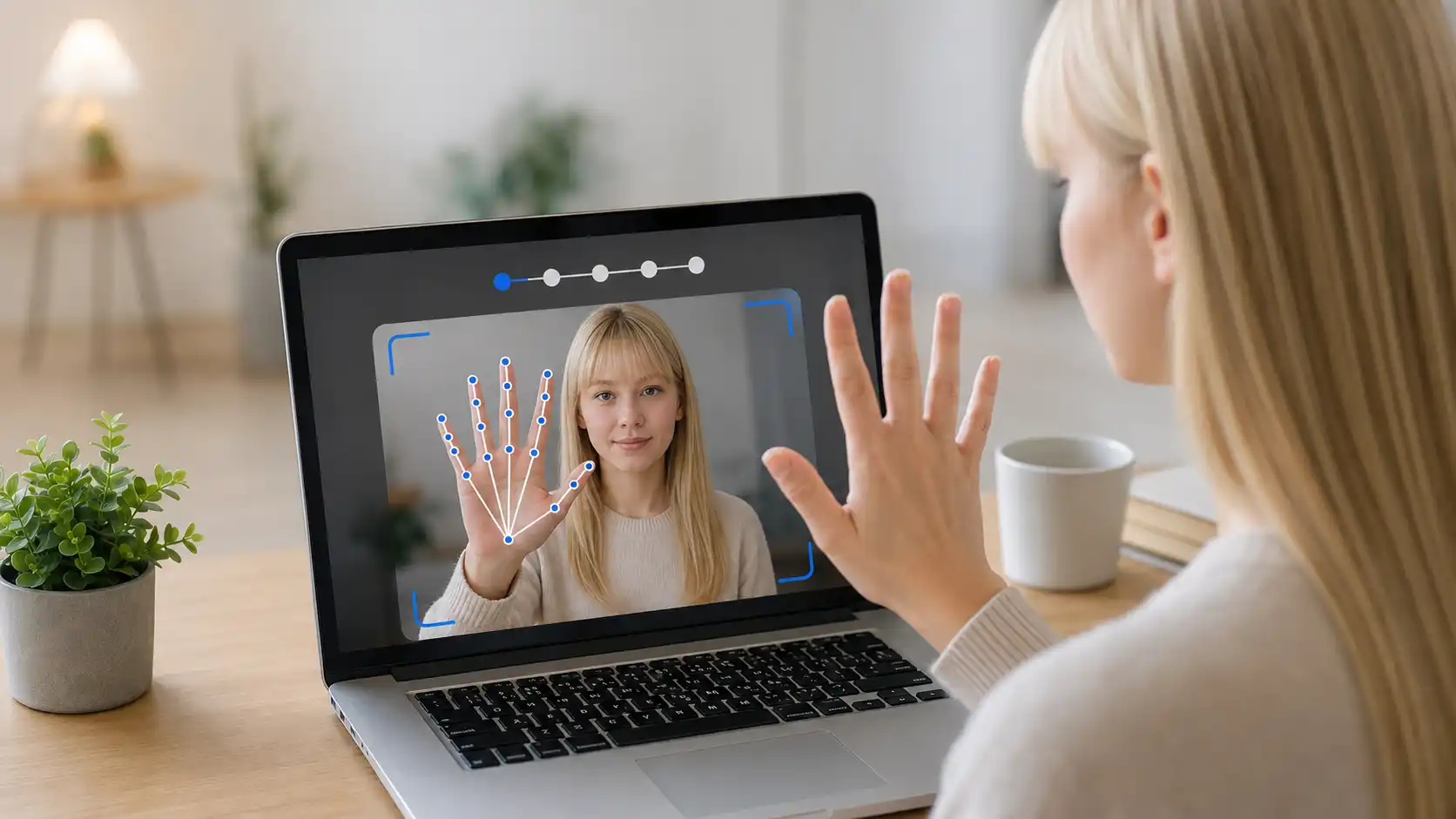
For two decades, proving you were human online meant squinting at warped letters or clicking on grids of traffic lights and crosswalks. Google is now testing a different demand. On some sites protected by reCAPTCHA, the browser asks for permission to switch on your camera, then prompts you to perform a simple hand gesture, a wave or an open palm held in front of the lens. A short video of that movement is captured, analyzed, and used to decide whether a real person is sitting at the screen. The image puzzles do not disappear, but for the first time the test is built around your body rather than your judgment of a photograph.
Table of Contents
A new kind of checkpoint arrives on the open web
The feature is documented inside Google Cloud Fraud Defense, the security product that now houses reCAPTCHA, and the documentation page was last updated on 11 June 2026. Google’s stated position is narrow and specific. The system extracts measurements of the hand from the video, never associates the footage with a user’s identity, never records audio, and deletes the video once the check is complete. Camera access requires explicit consent, can be revoked at any time in browser settings, and the related data is not shared with third parties. For anyone who cannot or will not perform a gesture, the older visual and audio challenges remain available.
That framing has not settled the matter. Within days of the feature surfacing in coverage from security outlets, the reaction split along predictable lines. Some users described the prospect of waving at a webcam to read a news article as intrusive and unsettling. Others questioned whether it would even work, pointing out that a determined attacker can feed a fake video stream into the browser without ever touching a camera. One person on X claimed to have already defeated the challenge using a virtual camera paired with AI-generated hand animation. The claim is unverified, but it lands on the central tension of the whole idea: a test designed to confirm a living human is only as strong as its defense against synthetic video.
The timing is not an accident. Automated traffic now makes up more than half of everything that moves across the web, and the tools that generate it have grown cheap and capable enough that the classic image puzzle no longer separates people from machines. Google’s hand-gesture test is one answer to that problem. It is not the only one. In the same week the feature drew attention, a coalition of browser makers and infrastructure companies announced a competing vision built on cryptography rather than cameras, a sign that the industry has not agreed on what should replace the CAPTCHA, only that something must.
This article works through the announcement in full. It covers what Google actually said and where the feature sits in its product stack, the technical machinery that turns a hand movement into a yes-or-no verdict, the long history that brought reCAPTCHA to this point, the privacy and legal questions raised by pointing a camera at users, the efficacy debate, the competitive field, the consequences for specific industries, and the practical choices facing both the people who run websites and the people who use them. The goal is not to praise or condemn a single feature but to explain a shift in how the internet decides who is allowed in.
Inside Google’s announcement and where the feature lives
Hand-gesture verification did not arrive with a keynote or a splashy blog post. It appeared as a technical documentation page under Google Cloud Fraud Defense, the umbrella that reCAPTCHA now sits beneath after years of repositioning. The page is short, plainly written, and aimed at the developers and site operators who decide whether to switch the feature on. Its restraint is itself worth noting. Google is describing a substantial change to one of the most widely deployed pieces of software on the internet in the register of a routine product note.
The documentation lays out three things: what data the system collects, how camera permissions work, and what happens for users who cannot complete a gesture. On data, Google states that when the feature is enabled, reCAPTCHA analyzes one or more videos of a user’s hand as they perform various actions or gestures, and the video is processed to extract hand landmark data consisting of 21 hand-knuckle coordinates. It then makes a set of commitments: the videos are never tied to a user’s identity, they are deleted after verification, and audio is never recorded. A separate line adds that Google does not retain any images or videos of the gestures beyond the verification process or use the data for any other purpose, and that whatever is collected falls under the Google Privacy Policy.
On permissions, the page is equally direct. Hand-gesture challenges require access to the camera. The user has to consent before any gesture is performed, the permission can be managed in browser settings at any time, and Google says it processes the videos solely for security verification and does not transfer any related data or permissions to third parties. On accessibility, the documentation commits to keeping visual and audio challenges available for users who cannot use gestures, and to developing what it calls more accessible and secure alternatives.
Two facts about positioning matter here. The first is that this is a reCAPTCHA Enterprise capability, part of the paid, configurable tier that Google now markets as Fraud Defense, not a switch that flips on automatically for every site running the free widget. The hand-gesture test is something a site operator chooses to deploy as one possible challenge type, which is why most people have not seen it and may never see it on the sites they visit most. The second is that the feature is explicitly optional and additive. Google has been clear that it will not replace the image and audio challenges. It sits alongside them as another option a site can present, and as a fallback path for the cases where behavioral scoring alone cannot reach a confident verdict.
The word “testing” is doing real work in every honest description of this rollout. There is no announced general-availability date, no published efficacy data, and no statement about how broadly the feature is being shown to live traffic. What exists is documented capability and a scattering of real-world sightings reported by users and security writers. That is enough to take the feature seriously as a statement of direction, because Google does not build and document machinery like this casually. It is not enough to treat hand-gesture verification as a settled part of the web. The right way to read it is as a deliberate experiment by the company with the most to lose if the human test breaks, conducted in public, with the privacy commitments stated up front precisely because Google understands how the move will be received.
The mechanics of a hand-gesture challenge from click to verdict
To understand what hand-gesture verification asks of a user and a browser, it helps to walk through the sequence from the moment a challenge fires. Most of reCAPTCHA’s work happens invisibly. The system watches signals from the session, the way a cursor moves, how a page is scrolled, the characteristics of the browser and device, and assigns a confidence level to the request. When that confidence is high, nothing visible happens at all. The hand-gesture challenge only enters the picture when the system decides it needs stronger proof, the same logic that has long governed when reCAPTCHA shows an image grid.
At that point, instead of a photo puzzle, the user is asked to allow camera access. This is a hard gate. A browser cannot turn on a camera without an explicit permission prompt, and the user has to actively grant it before anything is recorded. If permission is denied, the gesture path is closed and the system must fall back to another challenge type or another decision. Once permission is granted, the interface prompts a specific gesture. The exact set of gestures Google uses has not been published in detail, but the documentation describes “various actions or gestures,” and the design principle is straightforward: ask for a movement that is trivial for a present human to perform on demand and awkward for an automated system to fake convincingly in real time.
The camera then captures one or more short videos of the hand in motion. Crucially, the raw video is not the thing Google says it keeps or evaluates as imagery. The pipeline runs the footage through a hand-tracking model that extracts 21 landmark points describing the position of the knuckles, finger joints, and wrist. What gets used for the security decision is this skeletal representation of the hand and how it moves through the gesture, not a stored film of the user’s face, room, or surroundings. The documentation is explicit that the videos are deleted after the check and that audio is never part of the capture.
From the user’s side, the whole interaction is meant to take seconds. Raise a hand, perform the prompted gesture, wait for the verdict. From the system’s side, the verdict is a judgment about whether the movement looks like a real hand operated by a real person in real time, as opposed to a static image, a looped clip, or a synthetic animation. A pass clears the user through to whatever they were trying to do. A failure, depending on how the site has configured things, can mean a retry, an escalation to a different challenge, or a block.
The accessibility fallback is part of the mechanics, not an afterthought. A gesture test is useless or impossible for several groups: people on desktops with no camera, people who keep cameras physically covered, people who cannot perform hand movements because of disability or amputation, and people who simply refuse camera access on principle. For all of them, Google keeps the visual and audio challenges in place. In practice this means the hand-gesture test is best understood not as a replacement checkpoint but as one more lane added to a toll plaza that already had several, with the system steering each request toward the lane it thinks fits.
There is a subtle design consequence buried in this flow. Because the gesture path depends on camera permission, and because a large share of users will decline or lack a camera, the feature cannot stand alone as a site’s only defense. It has to be embedded in a system that already does behavioral scoring and offers other challenge types. That dependency shapes both its reach and its limits. It will only be shown to a slice of traffic, on sites that choose to enable it, in situations where the system both wants stronger proof and has reason to believe the user can supply a gesture. Understanding that narrow operating window matters, because much of the alarmed reaction has imagined a web where every page demands a webcam wave. That is not what the mechanics describe.
Hand landmarks and the math behind 21 coordinates
The technical heart of hand-gesture verification is a model that turns pixels of a hand into geometry. Google’s documentation points directly at the MediaPipe Hand Landmarker, the company’s open machine-learning solution for hand tracking, which produces exactly the 21 hand-knuckle coordinates the reCAPTCHA page references. Understanding how that model works explains both what the system can see and what Google means when it insists the footage is not retained as imagery.
MediaPipe Hands runs as a pipeline of two cooperating models. The first is a palm detection model that scans the full camera frame and returns an oriented bounding box around any hand it finds. Detecting hands is harder than it sounds, because a hand can appear at wildly different sizes, can be partly hidden, and can occlude itself when fingers fold over one another. Google’s engineers narrowed the problem by training the detector to find palms rather than whole hands, since palms are smaller, more rigid, and can be modeled with simple square boxes. That design choice reached an average precision of 95.7 percent in palm detection, a level a simpler approach could not match.
Once a palm is located, the second model performs precise keypoint localization of 21 three-dimensional hand-knuckle coordinates inside the detected region. Each of the 21 points carries an x, y, and z value. The x and y describe position within the image, normalized between 0 and 1 against the frame’s width and height. The z value encodes depth, how near or far a point sits relative to the wrist, which acts as the origin. The same 21 points are also expressed in real-world coordinates, in meters, with the origin at the hand’s approximate geometric center. The model even reports handedness, whether it is looking at a left or right hand, with a confidence score.
The 21 points are not arbitrary. They map the hand’s skeleton: the wrist, the joints running up the thumb, and the knuckle, two finger joints, and tip for each of the four fingers. Developers who build on MediaPipe rely on a known index for these points, the thumb tip is point 4, the index fingertip is 8, the middle fingertip 12, the ring 16, and the pinky 20, with the base joints sitting three indices below each tip. From these coordinates, a gesture becomes a math problem. Whether a finger is extended or curled can be read by comparing the vertical position of a fingertip against the joint below it. A wave is a pattern of those coordinates shifting across frames. An open palm is a specific arrangement of all five fingers extended. The model gives the geometry; simple logic on top of it recognizes the gesture.
This is also where the technology gets fast. MediaPipe was built to run in real time on a mobile phone, not just a powerful desktop, and it tracks hands frame by frame without re-running the expensive palm detector on every frame. It only re-triggers detection when it loses the hand. That efficiency is what makes a browser-based gesture check feel near-instant rather than like uploading and waiting on a video.
The privacy implication of this architecture is real and worth stating plainly. When Google says the system extracts landmark data and does not keep the video, it is describing a genuine difference between two kinds of data. A stored video of your hand and face in your home is rich, identifying, and dangerous if leaked. A list of 21 coordinate triples describing how a hand moved through a wave is far thinner. It is not nothing, the geometry of a hand can in principle carry identifying signal, which is the crux of the legal debate covered later. But the distinction between raw footage and extracted landmarks is the technical foundation of every privacy claim Google makes about this feature, and it is accurate as far as it goes. The harder questions are about what happens around that core: who can verify the deletion, what the browser sees before extraction, and whether geometry meant for liveness could ever be repurposed for identity.
Liveness detection and the question it tries to answer
The hand-gesture test belongs to a family of techniques that security engineers call liveness detection. The idea predates reCAPTCHA’s interest in it and has been refined for years inside identity verification, the systems banks and crypto exchanges use to confirm that the person opening an account is real. Liveness detection tries to answer one question: is there a live human physically present at the moment of the check, as opposed to a photo, a recording, a mask, or a synthetic media stream standing in for one?
It is worth being precise about what liveness does and does not establish, because the distinction shapes everything about the hand-gesture feature. Liveness proves presence. It does not prove identity. A face-liveness check used in banking confirms that a live face is in front of the camera, and a separate step matches that face against an ID document to establish who the person is. Google’s hand-gesture test only attempts the first half of that and deliberately stops there. It is not trying to learn who you are. It is trying to establish that a real, present human is performing the gesture, which is exactly the property an automated bot lacks and the property the old image puzzles were supposed to certify before AI learned to solve them.
Liveness checks come in two broad styles. Passive liveness works in the background from a single capture, analyzing texture, depth, and subtle cues without asking the user to do anything. Active liveness asks for an action: blink, turn your head, nod, or in this case, perform a hand gesture. Active approaches add friction but raise the bar, because they demand a response on demand that a pre-prepared spoof has to anticipate. Google’s choice of a hand gesture is a bet that an active, movement-based challenge is harder to fake than a static image and less invasive than a face scan. A hand is less personally sensitive than a face, carries fewer immediate identity associations for most people, and still demands real-time motion that a looped clip cannot easily supply.
The reason liveness has migrated from high-stakes identity verification into something as everyday as a website checkpoint is the collapse of the alternatives. When bots could not read distorted text, distorted text was enough. When bots could not recognize a crosswalk in a photo, the image grid was enough. Both of those properties have failed. Machine vision now reads warped letters and identifies objects in images at least as well as people, often better and far faster. The only categories of test left standing are ones that demand something a piece of software fundamentally cannot produce on its own: either proof of a physical human body in the moment, which is what liveness attempts, or proof of trusted prior vetting carried in a credential, which is what the cryptographic alternatives attempt. The hand-gesture test is Google planting a flag in the first camp.
That bet carries an obvious vulnerability, and the identity-verification industry has spent years learning it the hard way. A liveness check is only as strong as its defense against fakes that bypass the camera entirely. The threat is not someone holding a photo to a webcam; modern systems catch that. The threat is synthetic video injected directly into the software, where the camera is never involved at all. That is the failure mode that turns a clever liveness test into a speed bump, and it is the reason the early skepticism about Google’s hand-gesture feature is not merely reflexive privacy worry. The people raising it are pointing at the exact weakness that has defined the liveness arms race in finance, now arriving at the front door of the open web. The later sections on bypass and the broader arms race return to this in detail, because it is the strongest single argument that hand gestures will not be the permanent answer.
From distorted text to street signs, the road reCAPTCHA traveled
To see why Google is experimenting with cameras at all, it helps to trace how the human test became what it is. The story starts with a Guatemalan computer scientist named Luis von Ahn, who in 2000 helped coin the term CAPTCHA, a Completely Automated Public Turing test to tell Computers and Humans Apart. The early versions were the distorted, wavy text you typed to prove you were not a script. They worked because optical character recognition of the era choked on deliberately mangled letters that humans could still read.
Von Ahn then had a second idea that turned the test into something more than a gatekeeper. If millions of people were already deciphering scrambled words to pass these checks, that effort could be put to use. He and colleagues at Carnegie Mellon University, including Ben Maurer, Colin McMillen, David Abraham, and Manuel Blum, built reCAPTCHA, which served users words that automated scanning had failed to read from real books and newspapers. People proving their humanity were, at the same time, digitizing archives. The system helped transcribe the back catalog of The New York Times, reportedly 13 million articles dating to 1851, and later fed Google Books. Von Ahn famously described his own creation as a system that was “frittering away, in ten-second increments, millions of hours of a most precious resource: human brain cycles,” and reCAPTCHA was his attempt to recover that waste.
Google acquired reCAPTCHA in September 2009. Under Google, the dual-use logic deepened. The transcription work shifted toward Google’s own projects, and in 2012 reCAPTCHA began drawing on photographs from Street View, asking users to read house numbers and, soon after, to identify objects in images: crosswalks, storefronts, traffic lights, buses. Every click that selected the right squares did two jobs. It cleared the user, and it labeled an image for Google’s computer-vision training data. At its peak the system was reported to be serving around 200 million CAPTCHAs a day, which by one estimate represented on the order of 500,000 hours of human labeling effort daily.
That arrangement has drawn sustained criticism, and the criticism matters to how the new camera feature will be received. Researchers and commentators have argued for years that reCAPTCHA functions as much as a data-harvesting and behavioral-tracking system as a security tool. A widely cited academic study estimated that image-based reCAPTCHA challenges have cost society roughly 819 million hours of human time, valued in the billions of dollars in wages, while the behavioral data the system collects, cookies, browsing signals, mouse movement, browser fingerprints, carries enormous commercial value. A 2015 class action in Massachusetts argued users deserved compensation for the labor; it was dismissed, with the court treating the seconds spent as something no reasonable consumer would expect to be paid for. Google has consistently said the data is not used for personalized advertising.
The throughline from von Ahn’s scrambled words to a webcam hand wave is a steady escalation in what the test demands and what it can see. Text gave way to images when text stopped working. Images are now giving way, in this experiment, to the body itself, because images have stopped working too. Each step solved the immediate problem and raised the next set of questions, about labor, about data, and now about cameras. The history is not a side note. It is the reason a large share of users hear “Google wants to turn on your camera” and assume the worst, fairly or not. Two decades of reCAPTCHA being more than it appeared have built that reflex.
The checkbox era and the rise of the invisible score
The version of reCAPTCHA most people picture, the little box that says “I’m not a robot,” arrived in December 2014 and marked a philosophical shift. Google called it No CAPTCHA reCAPTCHA, or reCAPTCHA v2. The promise was that for most users, a single click on a checkbox would be enough. Behind that click, the system ran what it called an advanced risk analysis, studying signals from the session and the user’s behavior before and during the interaction. If the analysis was confident the user was human, the click cleared them. Only when confidence fell short did the dreaded image grid appear as an escalation.
This was the first time the test became, for many people, mostly invisible. The image puzzle did not vanish, but it moved into the role of a fallback rather than the default. v2 was also more mobile-friendly than the typing-based versions, and the image-matching challenges were easier and faster than reading distorted text. The trade was subtle but real: the system now leaned heavily on behavioral and environmental signals to make its decision, which meant it was watching more and asking less. The checkbox was less a test than a moment for the system to harvest a final burst of signal and render a verdict it had largely already formed.
In March 2017, Google pushed the logic further with invisible reCAPTCHA, an extension of v2 that dropped the checkbox for many sites. Risk assessment ran entirely in the background, and a challenge surfaced only for sessions the system flagged. Then, in October 2018, came reCAPTCHA v3, which abandoned the challenge-response model almost entirely. Instead of ever asking the user to do anything, v3 returns a score between 0.0 and 1.0 for each interaction, where values near 0 suggest an automated bot and values near 1 suggest a human. Site operators get that score and decide what to do with it. A low score might trigger extra authentication, throttle an action, or send a request to manual review. A high score sails through. Developers tag interactions with action labels, “login,” “signup,” “checkout,” so the scoring can account for context, and they tune their own thresholds in an admin console.
The invisible score is powerful and quietly controversial. It works by watching, mouse movement, scrolling, timing, browser characteristics, cookies, and the broader pattern of how a session behaves, and comparing all of it against models trained on aggregated traffic. Because v3 is meant to sit on every page of a site, critics have long pointed out that a user signed into a Google account could be feeding Google a signal about nearly every page they visit that embeds the widget, with no visible indication beyond a small logo in the corner. Independent research has reported that the system tends to assign lower scores to users behind privacy tools like Tor, and higher scores to browsers logged into a Google account, which fuels the argument that the test rewards being legible to Google.
reCAPTCHA Enterprise, the paid tier now folded into Fraud Defense, sits on top of all this with extra machinery aimed at fraud rather than spam. It adds capabilities like Account Defender, password-leak and breached-credential detection, multi-factor verification, and a transaction-protection layer for payment fraud. It returns not just a score but reason codes, labels such as automation or unexpected usage patterns that explain why a request looked risky. This is the engine room into which hand-gesture verification has been added as a new challenge type. The feature is not a standalone product. It is one more tool bolted onto a scoring system that has spent a decade learning to judge humans without asking them anything, deployed for the moments when silent scoring is not enough.
The arc from v1 to v3 is a steady retreat from asking and an advance toward watching. The hand-gesture test partly reverses that direction. It is, conspicuously, a return to asking the user to do something visible and deliberate. That reversal is a tell. After years of betting that behavioral signals could quietly sort humans from bots, Google is acknowledging that for the hardest cases, silent observation is no longer enough, and the test has to demand an act that software cannot fake. The pendulum that swung from explicit challenges toward invisible scoring is, at least for the difficult cases, swinging back.
The slow collapse of the image puzzle
The image grid did not fail overnight. It eroded, and the erosion has now reached the point where the puzzle’s security value is largely gone even as it remains everywhere. Understanding why is necessary to understand why Google would reach for something as drastic as a camera.
The first crack was always economic rather than technical. Human-powered solving farms have existed for as long as CAPTCHAs have mattered. Services such as 2Captcha and DeathByCaptcha route challenges to low-wage workers who solve them for a tiny fee, historically a fraction of a cent each. These operations achieve solve rates of 95 to 99 percent and process challenges at industrial volume. Against a farm, a CAPTCHA is not a wall; it is a toll, and a cheap one. Any attacker willing to spend pennies could already get past the image grid in bulk, which meant the puzzle mainly deterred casual abuse, not determined operators.
The second and more serious crack is artificial intelligence. The whole premise of the image grid was that recognizing a crosswalk in a photo was easy for a person and hard for a machine. That premise is dead. Modern computer vision identifies objects in images with accuracy that meets or exceeds human performance, and it does so in milliseconds. Researchers have demonstrated automated solvers for reCAPTCHA’s challenges with very high success rates, in some published cases approaching or exceeding the reliability of human solvers. Reinforcement-learning techniques have been shown to defeat the invisible scoring of v3 by generating mouse trajectories and interaction patterns that mimic the entropy of real human behavior. Headless browsers, scripted timing, proxy rotation, and the broad availability of automation tooling have made it routine to spoof exactly the signals the system relies on.
The third crack is the cost curve of the tools themselves. Defeating CAPTCHAs used to require some skill. Now there are commercial AI-powered solving services that advertise support for reCAPTCHA v2, v3, and Enterprise, alongside every other major challenge type, billed on a pay-per-success model at prices like $0.60 per 1,000 solves for reCAPTCHA v2, with accuracy claims up to 99 percent. The barrier to entry has dropped to a credit card and an API key. When the cost of defeating a defense falls below the cost of deploying it, the defense has inverted into a tax on legitimate users while barely inconveniencing attackers.
There is a bitter irony threaded through this collapse, and it points back at the history. The image puzzles taught machines to see. For years, every human who selected the squares with traffic lights was labeling training data that improved the very computer-vision systems now used to defeat the puzzles. The test that was supposed to keep machines out helped build the machines that walk through it. People proved they were human by performing exactly the task that would later make that proof obsolete. That is not a reason to mock the original design, which solved a real problem and digitized real archives. It is a reason to understand why the image grid cannot be patched back into relevance, and why Google is forced to look for tests grounded in something other than perception, which machines have now mastered.
Bots became the majority and the math changed
The single fact that explains the urgency behind every CAPTCHA experiment in 2026 is a tipping point that the industry crossed and then blew past. For the first time in at least a decade, automated traffic overtook human traffic on the web. Imperva, whose annual Bad Bot Report is one of the most cited measures of this, found that bots accounted for 51 percent of all web traffic in 2024, with malicious “bad bots” making up 37 percent. The 2026 edition, drawing on 2025 data, pushed the figure to 53 percent, with bad bots at 40 percent and human traffic fallen to 47 percent and still declining. Cloudflare’s own measurements run even higher; the company cited Cloudflare Radar data putting bots at roughly 58 percent of all HTTP requests to web content worldwide, a level its CEO had not expected to see until 2027.
Before pivoting to what those numbers mean, it is worth fixing where the hand-gesture test sits in reCAPTCHA’s twenty-year arc.
reCAPTCHA from 2007 to 2026 at a glance
| Phase | Approximate year | What the user faced | What the system relied on |
|---|---|---|---|
| reCAPTCHA v1 | 2007–2009 | Type two distorted words | OCR-resistant text, book digitization |
| Google acquisition | 2009 | Same, expanding scope | Transcription shifted to Google projects |
| Street View images | 2012 | Read house numbers, identify objects | Image labeling for computer vision |
| No CAPTCHA v2 | 2014 | Click a checkbox, sometimes an image grid | Behavioral risk analysis |
| Invisible reCAPTCHA | 2017 | Often nothing visible | Background risk scoring |
| reCAPTCHA v3 | 2018 | Nothing; a score is returned | Continuous behavioral scoring, 0.0–1.0 |
| Enterprise / Fraud Defense | 2020s | Configurable challenges and signals | Account and transaction fraud models |
| Hand-gesture test | 2026 (testing) | Wave or gesture at the camera | Liveness from 21 hand landmarks |
The table compresses two decades into a single pattern: each phase answered the failure of the last, and the test kept demanding access to more, from keystrokes to clicks to behavior to, now, the body in motion.
The cause of the bot surge is not mysterious. Generative AI and large language models have made building bots cheap, fast, and accessible to people with little technical skill. Imperva attributes the jump in simple, high-volume bot attacks, which rose from under 40 percent of attacks in 2023 to 45 percent in 2024, directly to the free availability of AI automation tools. The same tools let attackers analyze their failures and refine evasion, and a commercial Bots-as-a-Service market sells the capability ready-made. The result is more bots, smarter bots, and a flood of crude bots all at once.
The composition of that traffic has also changed in a way that matters for verification design. A growing share of it comes from AI agents, semi-autonomous software that browses, researches, and increasingly transacts on behalf of real users. One benchmark reported AI-agent traffic growing by nearly 7,851 percent year over year. These agents are not straightforwardly bad. An AI assistant fetching a page or completing a purchase because its owner asked it to is doing legitimate work. But it is automation, and a test built to detect “a real human at the keyboard” will flag it. The web is filling up with traffic that is neither a malicious scraper nor a person tapping a screen, and the binary human-or-bot question that CAPTCHAs were built to answer no longer maps cleanly onto reality.
The damage from the bad end of this spectrum is concrete and expensive. Account-takeover attacks have surged, rising 40 percent year over year, and financial services bear the heaviest load, accounting in the 2026 data for 24 percent of all bot attacks and 46 percent of account-takeover incidents. Bots increasingly target APIs directly rather than going through the visible website, bypassing the user interface to operate at machine speed; in 2025, 27 percent of bot attacks hit API endpoints. Roughly a fifth of bot attacks route through residential proxies to disguise themselves as ordinary home users. Each of these tactics is designed to look human to a system watching for human signals, which is precisely why behavioral scoring alone has reached its limit and why a liveness test that demands a physical act has become attractive. The math changed: when the majority of your visitors are machines and the best of those machines can imitate people convincingly, the only reliable distinctions left are ones that require either a body or a credential.
The agentic web complicates the idea of a human test
The rise of AI agents does more than add traffic. It undermines the conceptual foundation that CAPTCHAs were built on. The entire premise of the human test is that the web has two kinds of visitors, people and bots, and that a site is entitled to admit the first and exclude the second. Agentic AI breaks that binary, because it introduces a third category: software that is automated, yet acting with a specific person’s authorization and on that person’s behalf.
Consider an AI shopping assistant that a user has told to find the cheapest flight and book it, or a research agent asked to read twenty articles and summarize them, or a personal assistant clearing a backlog of forms. Each of these is a bot by any technical definition. Each is also doing exactly what a legitimate human user wanted, often after that human authenticated and paid for the service. A hand-gesture liveness test handles this case badly by design. There is no hand to wave, because there is no human at the keyboard in that moment, only authorized software. The test would block the agent, which means it would block the user’s own intent. A verification system built to confirm a live human is structurally hostile to the legitimate automation that more and more people now rely on.
This is the deepest reason the hand-gesture approach, however clever, is unlikely to be the whole answer. Google itself plainly understands the agentic shift; it is building some of the most capable agents in the market. A test that can only say “yes, a human is physically present” cannot distinguish an authorized agent from a malicious scraper, because neither has a human present. It treats both as failures. That is fine for the specific job of stopping fraud at a login or a checkout where a present human is genuinely expected. It is the wrong tool for the broader and faster-growing problem of sorting good automation from bad.
The competing camp in the industry has organized itself entirely around this realization, which is why the cryptographic-token approach detailed later explicitly extends “personhood” to cover AI software acting with a user’s authorization, not only humans at a keyboard. That design starts from the premise that the future web will be full of legitimate agents and that the job is to separate authorized automation from unauthorized automation, not to separate humans from everything else. The hand-gesture test and the token approach are answers to two different questions. One asks “is a live person here right now,” the other asks “was this traffic vetted by someone trustworthy, human or agent.” As agents handle a larger share of real tasks, the second question increasingly looks like the one that matters, and the first looks like a tool for a shrinking set of high-assurance moments.
None of this makes liveness detection useless. There will always be transactions, opening a bank account, authorizing a large transfer, recovering a lost account, where a site has a strong, legitimate reason to insist on a present human and to refuse automation outright. For those moments, a fast, low-friction liveness check has clear value, and a hand gesture is a reasonable, relatively non-invasive way to get one. The mistake would be to read the hand-gesture experiment as Google’s bet on how the entire web will verify visitors. It reads better as a bet on one specific layer of a layered future, the high-assurance human-present layer, while the harder question of governing an agent-saturated web gets answered, if it gets answered, somewhere else.
Google’s privacy claims examined line by line
Because the feature points a camera at users, Google’s privacy commitments deserve to be read carefully rather than accepted or dismissed wholesale. The documentation makes a tight set of claims, and each one is worth separating into what it genuinely protects and what it leaves open.
Claim one: the videos are never associated with a user’s identity. Taken at face value, this means the gesture footage is not tagged to your account, name, or profile. The plausibility of this rests on the architecture described earlier. The system’s purpose is liveness, not identification, and what it extracts is hand geometry, not a labeled portrait. The honest caveat is that “not associated with identity” is an internal handling promise, not a mathematical guarantee a user can audit. The browser session that triggers the check carries plenty of other identifying signal, an IP address, cookies, a device fingerprint, and reCAPTCHA already correlates such signals as part of its core scoring. So while the gesture video may not be filed under your name, it occurs inside a system that knows a great deal about the session it came from. The claim is specific and probably accurate on its own terms; it is narrower than “Google cannot tell who you are.”
Claim two: audio is never recorded. This is the cleanest of the commitments and the easiest to credit. A hand-gesture check has no use for sound. Recording audio would add risk and storage for no security benefit, and the statement is unambiguous. There is little reason to doubt it and little incentive for Google to violate it.
Claim three: the videos are deleted after the verification process. This is the load-bearing promise and the one users cannot verify themselves. Google states that it does not retain images or videos beyond the check, that deletion is automatic once the challenge completes, and that the data is not used for any other purpose. The entire privacy case stands or falls on this being true and staying true. Nothing in the user’s experience proves a video was deleted rather than retained, and the only assurance is Google’s word backed by its privacy policy and whatever regulatory exposure it carries. This is precisely where the skepticism in the public reaction concentrates, and the skepticism is not irrational. It is the appropriate posture toward any deletion promise that cannot be independently checked, made by a company whose core business is data.
Claim four: camera permissions require consent and can be revoked. This is largely enforced by the browser, not just by Google’s good intentions, which makes it stronger than a policy pledge. A site cannot access a camera without the browser’s permission prompt, and the user can withdraw that permission at any time in browser settings. The real caveat is about the quality of consent rather than its existence, which the next section takes up: consent extracted at the moment someone is trying to log in or check out is consent under pressure.
Claim five: data is not shared with third parties. Google says it processes the gesture videos solely for security verification and transfers no related data or permissions to third parties. This addresses one common fear directly. It does not, and cannot, speak to Google’s own internal uses beyond the stated purpose, which is governed by the same deletion and purpose-limitation promises above.
Putting the five together, the privacy design is more careful than the alarmed framing suggests and less ironclad than the reassuring framing claims. The technical choice to extract landmarks rather than store footage is real and not cosmetic. The deletion and purpose-limitation promises are reasonable on their face. But the architecture is unauditable from the user’s side, it sits inside a system built to correlate signals, and it is operated by a company carrying two decades of accumulated distrust over exactly this kind of data. A fair verdict is that the feature is probably designed in good faith to minimize what it keeps, and that designing it well does not, by itself, resolve whether users should have to take that design on trust to read a web page. The privacy question is not only “is Google handling this responsibly,” but “should waving at a camera be a condition of access at all,” and no engineering choice answers the second question.
Where hand data sits in biometric law
The legal status of hand-gesture verification is genuinely unsettled, and the uncertainty is not a lawyer’s quibble. It determines whether the feature triggers some of the strictest privacy statutes in the world, and the answer turns on a distinction that the law was not written with this exact technology in mind.
Start with the United States, where Illinois has the most consequential biometric law, the Biometric Information Privacy Act, or BIPA, passed in 2008. BIPA matters because it gives individuals a private right of action, the ability to sue directly, with statutory damages of $1,000 per negligent violation and $5,000 per intentional or reckless violation. That structure has produced a wave of litigation and some very large settlements. Critically for this feature, BIPA’s definition of a biometric identifier explicitly includes a “scan of hand or face geometry.” Hand geometry is named in the statute. On a plain reading, a system that scans a hand could fall squarely within BIPA’s scope, which would require informed written consent before collection, a published retention-and-destruction policy, a bar on profiting from the data, and limits on disclosure.
But the plain reading collides with a real legal distinction. BIPA regulates biometric identifiers and biometric information used to identify an individual. Google’s stated design does the opposite: it extracts hand landmarks to confirm liveness and explicitly does not associate the data with identity, and it deletes the footage after the check. Whether transient hand-landmark extraction performed solely for a present-or-not decision, and discarded immediately, constitutes the kind of identifying biometric scan BIPA targets is an open question that courts have not squarely resolved for this fact pattern. A plaintiff would argue that a hand scan is a hand scan and the statute names it. Google would argue that liveness is not identification, nothing is retained, and the data never functions as an identifier. Both arguments are serious, and the outcome is not obvious. The 2024 amendment to BIPA, which capped repeated collections from the same person as a single violation and accepted electronic signatures as written consent, softened the litigation economics somewhat but did not touch this definitional core.
Europe frames the same problem differently and, in some ways, more favorably to Google’s design. Under the General Data Protection Regulation, biometric data is “special category” data subject to heightened protection under Article 9, but only when it is processed for the purpose of uniquely identifying a natural person. That qualifier is decisive. If Google is processing hand geometry purely to establish liveness and not to single out or recognize a specific individual, a credible argument exists that the data falls outside the Article 9 special-category regime, even though it is plainly personal data subject to the GDPR’s general rules. The counter-argument is that hand geometry is inherently capable of identifying a person and that capability, not just the stated purpose, should govern. European regulators have not issued definitive guidance on this precise use, and the EU’s separate AI Act adds another layer of scrutiny to biometric and remote-identification systems that could become relevant depending on how the feature is classified.
The practical upshot for anyone deploying this feature is caution. A site operator who turns on hand-gesture verification is not simply enabling a setting; they are potentially taking on biometric-compliance obligations that vary sharply by jurisdiction, and in Illinois specifically, exposure to a statute with a private right of action and per-violation damages. Google’s documentation routes everything through the Google Privacy Policy and frames the company as the processor that deletes the data, but the legal relationship between Google and the sites that enable the feature, and the allocation of liability between them, is exactly the kind of detail that gets litigated after the fact rather than settled in advance. The lawful path almost certainly requires clear, specific, informed consent, honest retention representations, and a real accessibility alternative, which is part of why the feature is optional, consent-gated, and paired with fallbacks. The law has not caught up to liveness-versus-identity as a clean line, and until it does, the safest assumption for operators is that pointing a camera at users to scan their hands invites biometric scrutiny regardless of how transient the processing is.
The consent problem behind a camera permission prompt
Google leans heavily on consent as the ethical and legal foundation of the feature. The user has to grant camera access, the documentation says, and can revoke it anytime. That is true, and it matters. But consent in this setting has a quality problem that the existence of a permission prompt does not solve, and the problem deserves direct attention because it is where a reasonable-sounding safeguard gets weaker the closer you look.
The issue is the context in which consent is requested. A camera-permission prompt does not appear when a user is calmly browsing settings and deciding, in the abstract, how they feel about hand-gesture verification. It appears at the exact moment they are trying to do something: log into an account, complete a purchase, recover access, submit a form. The user has already invested effort and intent in reaching that point. Refusing the camera, if a gesture is the path the system has chosen, can mean not finishing the task. That is consent extracted under task pressure, and behavioral research on consent design has shown for years that people facing friction in the middle of a goal will accept almost any prompt that stands between them and completion. Clicking “allow” to finish checking out is not the same as freely choosing to share camera access.
There is a second layer to this, which is whether a real alternative is actually present at the moment of choice. Google’s commitment to keeping visual and audio challenges available is what saves the consent from being purely coercive, because in principle a user who declines the camera can fall back to an image grid. The strength of the consent therefore depends entirely on how sites implement it. If declining the camera smoothly routes the user to an image puzzle, consent is reasonably free, the user gives up nothing by saying no. If a site is configured so that the gesture is effectively the only viable path, or so that declining produces repeated failures and dead ends, consent collapses into a forced choice. The quality of consent is not fixed by Google’s design; it is determined site by site by how the fallbacks are wired. A user has no way to know in advance which kind of site they are on.
A third concern is informed-ness. Genuine consent requires understanding what you are agreeing to. The average person granting camera access to pass a check is not reading Google’s Fraud Defense documentation, does not know that landmarks are extracted rather than video retained, and cannot evaluate the deletion promise. They see a prompt, they want to proceed, they allow it. The gap between the careful, accurate technical design and what an ordinary user actually understands at the moment of consent is wide. This is not unique to Google; it is the chronic condition of digital consent. But it is sharper here because the thing being consented to, live camera capture of one’s body, feels more consequential to most people than accepting a cookie, even if the actual data retained is modest.
The honest framing is that consent is a real safeguard with real limits. It is enforced by the browser, which is more than a policy promise. It is paired with alternatives, which prevents the worst coercion as long as sites implement them properly. And it is undercut by the timing of the request, the variability of site implementation, and the near-impossibility of true informed-ness at the point of use. For consent to mean what Google implies it means, two things have to hold that Google does not fully control: sites must keep the non-camera path genuinely easy, and users must somehow understand what they are agreeing to. Neither can be assumed. The feature’s defenders are right that it is consent-gated. Its critics are right that consent gating, in this setting, is a weaker protection than it sounds. Both can be true, and the distance between them is exactly the space where this feature will be judged fair or coercive in practice.
Accessibility, and who a gesture test leaves behind
Every verification method excludes someone, and the history of CAPTCHAs is in large part a history of exclusion that the industry was slow to take seriously. Distorted text locked out blind and low-vision users. Image grids did the same and added a cognitive and motor burden. Behavioral scoring quietly penalized people whose interaction patterns deviated from the norm, including users of assistive technology. The hand-gesture test introduces its own exclusions, and they are broad enough that accessibility is not a footnote to this feature but a defining constraint.
The most obvious group affected is people who cannot perform hand gestures. This includes individuals with amputations, limb differences, paralysis, severe arthritis, tremor disorders, or any condition that makes controlled hand movement on command difficult or impossible. For these users, a gesture challenge is not harder; it is unavailable. A test that asks the body to do something assumes a body that can do it, and many cannot. Google’s documentation acknowledges this directly, committing to keep visual and audio challenges for users with accessibility needs who cannot use gestures, and to develop more accessible alternatives. That commitment is necessary and, on paper, adequate. Its real-world value again depends on sites implementing the fallback so that it is reachable without a fight.
A second, larger group is people without a usable camera. Many desktop computers ship without one. Privacy-conscious users physically cover their webcams or disable them. Corporate and institutional machines often have cameras locked down by policy. Older hardware may have no camera at all. For all of them, the gesture path is closed not by disability but by circumstance, and they too must be routed to an alternative. The sheer size of this group is one of the structural limits on how far the feature can spread; a verification method that a large fraction of devices cannot perform cannot become the default for anyone.
There is a subtler accessibility risk specific to a movement-based, AI-judged test. The model has to recognize a gesture as a valid hand performing a valid movement. People whose hands or movements fall outside the range the model was trained to expect may fail the check even when they comply. Someone with a hand difference, an unusual range of motion, a visible medical device, or simply a way of moving that the training data underrepresented could perform the gesture in good faith and be judged a failure. This is the well-documented fairness problem of biometric and gesture systems, that they work best for the bodies most represented in their training data and worst for everyone else, arriving in a new form. A failure here is not just an inconvenience; it can be a hard block on access experienced specifically by people whose bodies the system did not anticipate.
The accessibility-friendly reading of the feature is that, unlike the old image grid which simply excluded blind users with no real recourse, the hand-gesture test is explicitly designed as an option among several, with the visual and audio challenges retained precisely so that no single method is a universal gate. That is a genuine improvement in posture over earlier eras, when accessibility was an afterthought bolted on under criticism. The skeptical reading is that adding another method that excludes large groups, and relying on fallbacks whose quality varies by site, multiplies the ways a user can get stuck and shifts the burden onto the people least able to absorb it. The right test for whether this feature respects accessibility is simple: can a user who cannot or will not wave at a camera complete the same task, on the same site, with no penalty? Where the answer is yes, the design has done its job. Where the answer is no, the feature has recreated the oldest failure of the CAPTCHA, exclusion dressed as security, with a camera attached.
The bypass question and the injection-attack threat
The privacy debate has dominated the early reaction, but the more dangerous question for the feature’s future is whether it actually works. A liveness test that can be cheaply defeated is worse than useless, because it adds friction and collects sensitive data while providing a false sense of security. The track record of camera-based liveness in the identity-verification industry is the best available guide to how Google’s hand-gesture test will hold up, and that track record is sobering.
The naive way to attack a liveness check is a presentation attack: hold a photo, a printed image, a screen replay, or a mask in front of the real camera and hope the system accepts it. Modern liveness systems are reasonably good at catching these, using texture, depth, and motion cues, and the entire formal framework for testing them, the ISO/IEC 30107-3 standard, was built around this threat. A hand-gesture test has a natural advantage against presentation attacks, because demanding a specific real-time movement is hard to satisfy with a static artifact. If presentation attacks were the only threat, the design would be sound.
They are not the only threat, and the more serious one barely involves the camera at all. An injection attack bypasses the camera hardware entirely, inserting a synthetic or pre-recorded video stream directly into the software pipeline before any liveness check runs. The camera never sees the spoof because the camera was never involved. Attackers use virtual camera software, device emulators, manipulated SDK calls, and API-level video injection to feed the system whatever footage they choose, including AI-generated content shaped to pass the specific challenge. This is exactly the attack the X user claimed to have used against Google’s hand-gesture test, a virtual camera paired with AI-generated hand animation, and whether or not that specific claim is real, it describes the precise method that has proven most damaging against liveness everywhere else.
The scale of injection attacks in finance, where the stakes justify the effort, shows what a determined adversary can do. Threat-intelligence firm Group-IB documented 8,065 biometric injection-attack attempts against the KYC flow of a single financial institution between January and August 2025, all using AI-generated deepfakes injected through virtual cameras to defeat loan-application liveness checks. Liveness-bypass attempts using face-swap deepfakes and virtual cameras were reported to have risen 704 percent in a single year, with the cost of the tools to launch them falling to as little as $5. A finance worker at the engineering firm Arup was tricked into transferring $25 million after a deepfake video call impersonated the company’s chief financial officer. Gartner has predicted that by 2026, 30 percent of enterprises will no longer consider standalone identity verification reliable on its own against AI-driven impersonation. These numbers describe the environment Google’s hand-gesture test is walking into.
The technique that defeats face liveness applies almost directly to hand liveness. A hand is, if anything, easier to synthesize convincingly than a face, with fewer micro-expressions and subtleties to get right. Generating a plausible video of a hand performing a wave, and injecting it through a virtual camera, is well within reach of the same tooling already used against face checks. The hand-gesture test raises the bar against casual and low-effort bots, which is real value, but it does little against a sophisticated operator equipped with off-the-shelf injection tools. That is the same shape of failure the image grid suffered: it deters the lazy and barely inconveniences the determined.
This does not mean the feature is pointless. Most abuse is not sophisticated. A large share of bot traffic comes from crude, high-volume operations that will not bother building a hand-animation injection pipeline for every target, and against that majority a gesture check imposes a genuine cost. Raising the price of an attack has value even when the attack is not made impossible. The honest assessment is that hand-gesture verification is a speed bump, not a wall, useful against the broad base of unsophisticated automation and porous against the skilled adversaries who cause the most expensive harm. Anyone deploying it should understand that they are buying friction for attackers, not immunity, and should pair it with the other defenses the next section describes rather than treating a hand wave as a solved problem.
The arms race Google is buying into
By moving into liveness, Google is entering a contest that the identity-verification industry has been fighting for years, and the contours of that contest predict where the hand-gesture test goes next. It is an arms race in the literal sense: each defensive advance provokes an offensive counter, which provokes a further defense, with no stable endpoint.
The defenders have developed a layered vocabulary for the fight. Presentation Attack Detection (PAD) handles spoofs shown to the camera. Injection Attack Detection (IAD) handles synthetic streams fed into the software, and increasingly relies on device and session integrity checks that look for the fingerprints of virtual cameras, emulators, and tampered capture pipelines rather than analyzing the image at all. Some vendors layer in challenge-response cues that the attacker cannot predict, such as flashing a unique sequence of colors at the device and checking that the reflected light in the capture matches, a technique designed to be impossible to satisfy with pre-recorded footage. The leading systems combine many such signals, hundreds of fraud indicators per session in some products, on the logic that no single check survives contact with a capable adversary but a dense mesh of them is hard to defeat all at once.
Google’s hand-gesture test, as documented, is essentially a single active-liveness layer: demand a real-time gesture, extract landmarks, judge the movement. That is a reasonable opening move, but the industry’s experience says it will not be enough on its own, and Google’s own commitment to develop “more accessible and secure alternatives” reads like an acknowledgment that this is a first step in a longer program. The predictable trajectory is escalation. If attackers defeat the gesture check with injected hand animation, the defense moves toward detecting the injection itself, toward device-integrity signals, toward unpredictable challenge elements, toward combining the gesture with the behavioral scoring reCAPTCHA already does. The hand wave becomes one signal in a stack rather than the decisive test.
There is a strategic logic to Google running this experiment despite the known limits. Google sits in a near-unique position to make camera-based liveness work at scale if anyone can. It controls Chrome, the dominant browser and the layer where camera permissions and capture happen. It builds the MediaPipe models that do the hand tracking. It operates the reCAPTCHA system that already collects the behavioral signals a liveness check would be combined with. And it runs Android, where camera and device integrity are tightly integrated. The pieces needed to detect injection attacks, browser-level capture integrity, device attestation, behavioral correlation, are pieces Google owns or influences more than any competitor. A hand-gesture test from a small vendor would be trivially bypassable and dead on arrival. From Google, it is the visible tip of an infrastructure that could, in principle, address the injection problem in ways a standalone product cannot.
Whether it will is unknown, and the arms-race framing counsels humility. No liveness system has achieved durable security; they achieve temporary advantage, lose it to a new attack, and recover it with a new defense, indefinitely. The cost of the attack tools keeps falling while their quality keeps rising, which structurally favors the offense over time. Google’s hand-gesture test should be read as a move in an ongoing game, not a winning position. Its real significance is less about whether a hand wave is hard to fake today and more about Google committing its infrastructure to the liveness contest at all, which signals that the company believes the human-present problem is worth fighting on these terms even knowing the fight has no final victory. For the businesses deciding whether to rely on it, the lesson from the arms race is unambiguous: treat any single liveness method as one layer, expect it to be probed and partly defeated, and never let it carry the full weight of a security decision alone.
Turnstile, hCaptcha and a crowded field of alternatives
Google is not experimenting in a vacuum. The market for “prove you are human” has become crowded and competitive, and the alternatives reveal how unusual Google’s camera-based bet really is. Most of the field has moved in the opposite direction, toward less friction and less data, not more.
The most prominent rival is Cloudflare Turnstile, introduced in 2022 and made generally available in 2023. Turnstile’s pitch is the inverse of a hand-gesture test: it shows users nothing. It runs a rotating set of non-interactive browser checks, proof-of-work computations, browser-characteristic signals, behavioral heuristics, and issues a verdict without a puzzle or a camera. It sets no cookies, does not track users across sites, and on Apple devices can use Private Access Tokens to let the device attest to its own legitimacy without sending underlying data to Cloudflare. For most legitimate users, Turnstile is invisible. Its weaknesses are the mirror of its strengths: invisible does not mean unbeatable, and users with privacy tools or unusual configurations can still get blocked when their browser signals look incomplete.
hCaptcha, from Intuition Machines, took over much of the market reCAPTCHA ceded when Cloudflare publicly switched away from reCAPTCHA to hCaptcha in 2020, citing privacy concerns about Google’s potential use of the data. hCaptcha runs image-labeling challenges similar to reCAPTCHA’s grids, with a paid passive mode that aims to be invisible for most users. Friendly Captcha, a German product, uses an invisible proof-of-work puzzle solved by the device rather than the human, positions itself as cookie-free and GDPR-friendly by design, and is popular with European organizations that need strict data residency. Beyond these sit a long list of specialists: Arkose Labs with its Funcaptcha, GeeTest, AWS WAF Captcha, the decentralized Prosopo Procaptcha, the open ALTCHA, and others, each trading differently across security, privacy, accessibility, user experience, and price.
How the main bot-verification approaches compare
| Approach | What the user does | Data posture | Stance toward AI agents |
|---|---|---|---|
| reCAPTCHA hand gesture | Waves or gestures at the camera | Extracts hand landmarks, deletes video, consent-gated | Blocks them; assumes a present human |
| reCAPTCHA v3 / Enterprise | Usually nothing; a score is returned | Heavy behavioral signal collection | Scores them as likely bots |
| Cloudflare Turnstile | Usually nothing | No cookies, no cross-site tracking | Blocks unauthorized automation |
| hCaptcha | Labels images, or nothing in passive mode | Less Google-tied; image labeling | Blocks them by default |
| Friendly Captcha | Nothing; device solves a puzzle | Cookie-free, GDPR-oriented | Blocks them by default |
| PACT (proposed) | Nothing; browser presents a token | No personal data in the token | Admits authorized agents by design |
The table makes the outlier obvious. Among the mainstream options, the hand-gesture test is the only one that adds visible, physical friction and the only one that touches the body, while the rest of the market competes on being silent and data-light.
Two patterns stand out across this field, and both put Google’s hand-gesture test in relief. The first is that the entire competitive direction of travel has been away from user friction. Turnstile, Friendly Captcha, and the passive modes of hCaptcha and others are all racing to demand nothing of the user. A hand-gesture test runs directly against that current by asking for a deliberate physical act and camera access, the most demanding thing any mainstream verification method asks. Google is betting that for the hardest cases, friction is acceptable because the alternatives have failed; the rest of the market is betting that friction is the enemy of conversion and accessibility and should be minimized at almost any cost.
The second pattern is the privacy-and-compliance gravity pulling everything toward less data. The competitive selling points of the alternatives, no cookies, no cross-site tracking, GDPR-friendliness, EU data residency, device-side attestation, are all framed as advantages over reCAPTCHA specifically, whose behavioral data collection has long drawn legal and ethical fire. In that climate, introducing a feature that captures camera video of users, even transiently, even with deletion promises, cuts against the prevailing expectation. It is a striking strategic choice for Google to make in a market where its competitors are winning business precisely by collecting less. The hand-gesture test only makes sense as a bet that liveness is the one problem worth accepting more friction and more sensitivity to solve, because nothing lighter can solve it. Whether that bet pays off depends on whether the rest of the industry’s lighter approaches turn out to be enough, which is exactly the question the cryptographic alternative was built to answer differently.
The cryptographic alternative that landed the same week
The clearest sign that the industry has not agreed on what replaces the CAPTCHA came in the same week the hand-gesture feature drew attention. On 22 June 2026, Cloudflare announced a cross-industry initiative with Mozilla Firefox, Google Chrome, Microsoft Edge, and Shopify to develop and submit for standardization a new web protocol called Private Access Control Tokens, or PACT. Where Google’s hand-gesture test asks the body to prove presence, PACT asks cryptography to prove prior vetting, and it represents a fundamentally different theory of how to sort legitimate traffic from abuse.
PACT builds on Privacy Pass, a token architecture the Internet Engineering Task Force formalized as RFC 9576 in 2024. The mechanism at its core is the blind signature, a technique the mathematician David Chaum invented in 1983 for untraceable digital cash. In a blind-signature scheme, an issuer signs a credential without ever seeing the identity information it is signing, so no link exists between the signing event and any later use of the token. The flow works like this: a site that already has strong confidence in a user’s legitimacy, an email provider or a social platform where the user has an authenticated account, issues that user’s browser an anonymous token. When the user visits another site, the browser presents the token. The receiving site learns only that someone trustworthy already vetted this traffic; it learns nothing about who the user is, which sites they have visited, or what device they are using. Because the tokens are publicly verifiable with only the issuer’s public key, redemption can be spread across billions of sessions without a central tracking point.
The most important design decision in PACT is its explicit stance toward automation, and it is the exact opposite of the hand-gesture test’s. PACT’s notion of “personhood” deliberately extends to AI software acting with a user’s authorization, not only humans at a keyboard. It does not try to eliminate automation; it tries to separate authorized agents from malicious ones. An AI shopping assistant acting on a user’s behalf could hold a valid token and proceed without friction, while an unauthorized scraper would have no token and face the same barriers as today. Shopify’s participation is telling: every unnecessary challenge or false positive in e-commerce turns a sale into an abandoned cart, and a token that lets a legitimate agent through cleanly is worth real money. The framing across the coalition is that existing defenses are “too generic and coarse” for a web where requests increasingly come from agents rather than keyboards.
PACT is not a finished product, and its limits are as instructive as its design. The partners committed to developing the specification and submitting it for standardization, but named no standards body, announced no timeline, and published no deployment schedule. Turning a protocol into something that works across billions of browsers historically takes years. The tokens carry no personal data, but PACT does nothing about browser fingerprinting, the device-level tracking that research confirmed in 2026 is still used to follow users across sessions even after they opt out. And the deepest unresolved question is governance: who gets to be a trusted issuer of personhood tokens, and what stops that power from concentrating among a few large platforms? Cloudflare, which already underpins much of the web’s infrastructure and hosts many AI agents, is framed as a natural central participant, which raises the obvious concern that a privacy-preserving standard could still entrench the largest incumbents. Notably, Apple, which co-developed the underlying Privacy Pass technology, was absent from the announcement, and its absence was not explained.
The coexistence of these two approaches in the same week is the real story. Google, a member of the PACT coalition through Chrome, is simultaneously testing a camera-based liveness check that embodies the opposite philosophy. One bet says the answer is to confirm a live human body in the moment; the other says the answer is to carry cryptographic proof of trust and to welcome authorized agents rather than fight them. They are not mutually exclusive, a layered future could use tokens for the broad case and liveness for high-assurance moments, but they point in genuinely different directions about what the web is becoming. That the same companies are pursuing both at once is the clearest possible admission that nobody yet knows which one wins.
Two philosophies for life after the CAPTCHA
Stepping back from the technical detail, the hand-gesture test and the token approach crystallize two competing answers to a question the web now has to settle: when the old human test no longer works, what should take its place? The answers are not just different mechanisms. They rest on different beliefs about what a website is entitled to demand and what kind of traffic the future internet will mostly carry.
The first philosophy, the one the hand-gesture test embodies, holds that the gold standard is proof of a live human present in the moment. In this view, the right response to bots that can imitate everything, text, images, behavior, browser signals, is to fall back on the one thing software cannot be: an actual physical person doing an actual physical thing on demand. A wave at a camera is crude, but it is grounded in the body, and the body is the last thing a remote attacker cannot simply generate. The strength of this philosophy is its directness; it targets exactly the property bots lack. Its weaknesses are everything this article has covered, the privacy cost of cameras, the exclusion of people who cannot perform the act, the consent problems, and the injection attacks that let synthetic video impersonate a body anyway.
The second philosophy holds that the gold standard is proof of trusted vetting, carried in a credential, with identity deliberately hidden. In this view, demanding that users repeatedly prove their humanity in real time is the wrong frame entirely. Instead, some trusted party who already knows the user is legitimate, an email provider, a platform, a device’s secure hardware, vouches for them once, anonymously, and that vouching travels with them. The strength of this philosophy is that it imposes no friction on legitimate users, leaks no identity, and, crucially, can welcome authorized AI agents as first-class citizens rather than treating all automation as the enemy. Its weaknesses are the governance problem of who gets to vouch, the fingerprinting it does not address, and the years of standardization and adoption it requires before it does anything at all.
The deepest difference between them is their treatment of automation, and that difference will matter more every year. A liveness test is, by design, anti-automation. It exists to confirm that automation is absent. As AI agents take over more legitimate tasks, that stance becomes a liability, because the test cannot tell an authorized agent from a malicious one and blocks both. A token system is automation-agnostic. It cares whether traffic was vetted, not whether a human is physically present, so it can let a trusted agent through and stop an untrusted one. If the web of the next decade is one where agents routinely shop, book, research, and transact on our behalf, the automation-agnostic philosophy fits that world and the anti-automation philosophy fights it.
This is why the most likely outcome is not that one approach wins outright but that they settle into different layers of a stratified system. For the vast ordinary middle of web traffic, reading articles, browsing shops, using services, the lightest possible method wins, because friction kills usage and most traffic is not high-stakes. Invisible scoring and, eventually, cryptographic tokens are built for that middle. For the narrow band of genuinely high-assurance moments, opening a financial account, authorizing a large transfer, recovering a compromised account, where a site has a strong and legitimate reason to insist on a present human and to refuse automation, a liveness check earns its friction. Hand-gesture verification looks less like the future of the web and more like the future of one specific, important corner of it. Reading it as Google’s vision for how everyone will access everything overstates it. Reading it as Google staking a claim to the high-assurance human-present layer, while hedging on the broader question through its membership in the token coalition, fits the evidence far better.
The stakes for e-commerce and checkout flows
The abstract debate becomes concrete fastest in e-commerce, where verification friction has a direct, measurable price. Online retail is the clearest case where the calculus around a feature like hand-gesture verification is dominated not by security in the abstract but by what every added step does to completion rates.
The governing fact of online retail is that every additional step in a checkout flow loses customers. Cart abandonment is one of the most studied problems in e-commerce, and friction at the point of payment is among its leading causes. A verification step that asks a buyer to grant camera access and perform a gesture, in the exact moment they are about to pay, is friction of an unusually heavy kind. Shopify’s distinguished engineer made the point bluntly in the context of the token coalition: every unnecessary challenge or false positive can convert a completed purchase into an abandoned cart. For a retailer, the question about hand-gesture verification is not “is it secure” but “how many sales will it cost me, and is the fraud it prevents worth more than the revenue it kills?”
That framing tilts most ordinary retail against deploying a gesture check at checkout. For a typical store selling typical goods, the fraud prevented by demanding a hand wave at payment is unlikely to outweigh the conversion lost from the buyers who hesitate, decline the camera, lack one, or simply abandon the purchase rather than perform on command. The lightweight, invisible alternatives are a far better fit for the checkout itself, because they protect against fraud without inserting a moment of doubt at the most fragile point in the funnel. This is the same logic that has made Turnstile and invisible scoring popular: the best verification at checkout is the kind the customer never notices.
Where hand-gesture verification could earn its place in commerce is not the routine purchase but the high-risk event around it. Account creation for a new high-value service, a password reset on an account with stored payment methods, a suspiciously large or unusual order, a withdrawal of funds or store credit, a change to payout details, these are moments where a retailer has a genuine reason to demand strong proof of a present human and where the friction is justified by the stakes. A buyer resetting the password on an account that holds their saved cards is more willing to tolerate a verification step than the same buyer adding a $20 item to a cart. Deploying liveness selectively at these chokepoints, rather than blanket across the storefront, is the design that fits the economics.
There is also a fraud-pattern reason commerce should be selective. Account-takeover and payment fraud increasingly target APIs and operate at machine speed, bypassing the visible storefront entirely. A bot draining accounts through an exposed API does not encounter the hand-gesture challenge on the checkout page at all, which means a gesture check on the front end can create an illusion of protection while the real attack flows around it. Real commerce defense has to sit at the API and transaction layer where the fraud actually happens, with reCAPTCHA Enterprise’s transaction-protection and account-defender machinery, not only at the human-facing checkout. A hand wave at the storefront does nothing about a credential-stuffing attack hitting the login API. For e-commerce, the realistic verdict is that hand-gesture verification is a tool for a handful of high-risk human moments, deployed sparingly, inside a defense that does its heaviest work invisibly and at the API layer, and that any retailer who bolts a camera check onto routine checkout is likely trading more revenue than fraud.
Banking, fintech and the account-takeover frontline
If there is a sector where the friction of a hand-gesture check is most likely to be worth paying, it is banking and financial services, because this is where the attacks concentrate, the stakes are highest, and users already accept stronger verification as normal. The economics that argue against a gesture check at a retail checkout often flip in finance.
The threat data is stark. Financial services is the single most targeted sector for account-takeover attacks, accounting in the 2026 figures for 24 percent of all bot attacks and 46 percent of account-takeover incidents. Banks, card issuers, and fintech platforms hold exactly what attackers want: money in motion and dense stores of personally identifiable information that sell well on criminal markets. Account-takeover attempts have risen sharply, driven by AI-automated credential stuffing and phishing, and the sector’s reliance on APIs for everything from balance checks to transfers has opened a machine-speed attack surface that bots exploit directly. In this environment, a bank’s tolerance for verification friction is much higher than a retailer’s, because the cost of a successful takeover, drained accounts, fraudulent transfers, regulatory and reputational fallout, dwarfs the cost of a few abandoned sessions.
Liveness detection is already native to this world, which is the key point. Banks and fintechs have used camera-based liveness in their know-your-customer onboarding for years, asking new customers to take a selfie or perform a movement to prove a live person matches an identity document. Customers opening a bank account or a brokerage account expect to prove they are real and present; the friction is understood as the price of access to money. A hand-gesture liveness check fits naturally into this established pattern. It is less invasive than a face-and-document match, and it slots into the moments finance already gates: onboarding, high-value transfers, adding a new payee, recovering a locked account, authorizing a transaction that trips a risk threshold.
The hard caveat is that finance is also where the injection-attack threat is most advanced and most expensive, which means a bank cannot treat a hand wave as sufficient. The same sector that pioneered liveness has been the proving ground for defeating it. The Group-IB findings of thousands of deepfake injection attempts against a single institution’s KYC flow, the $25 million Arup deepfake transfer, the 704 percent rise in liveness-bypass attempts, all came from the financial arena. Attackers willing to spend real money to steal real money will build the injection pipelines needed to feed synthetic video past a liveness check, including a hand-gesture one. A bank that deploys hand-gesture verification as its frontline against sophisticated fraud, without layering injection-attack detection, device integrity, behavioral analysis, and transaction monitoring beneath it, is buying a false sense of security at the exact point where the adversaries are most capable.
The realistic role for hand-gesture verification in finance is therefore as one layer in a deep, expensive defense, useful for raising the cost of the broad base of attacks and for the moments where a present human is genuinely expected, but never as a standalone gate against the determined fraud the sector actually faces. Finance is the best fit for the feature precisely because it already understands this. The institutions most likely to deploy it well are the ones least likely to mistake it for a complete solution, because they have spent years learning that no single biometric check holds against an adversary with a budget. For an ordinary user, the practical effect is that the place you are most likely to encounter a Google-style hand-gesture check in the coming years is not a news site or a store but a financial service, at a moment where you are doing something consequential with money, sitting alongside the other verification steps banks already impose.
Media, ticketing and the scalping economy
A different set of pressures shapes how verification matters for media, publishing, and ticketing, and these sectors illustrate both the appeal and the limits of a liveness test in contexts built around scarcity and scale rather than money held in accounts.
Ticketing is the textbook case of bots causing direct, visible consumer harm. When a popular concert or match goes on sale, automated buying operations race to grab inventory faster than any human can, then resell it at inflated prices. The scalping economy runs on bots that defeat exactly the kind of checks ticketing sites deploy, and the public frustration is acute because the harm is so tangible: real fans locked out, prices multiplied, a sense that the system is rigged in favor of whoever has the best automation. Ticketing platforms have every incentive to demand strong proof of a present human at the moment of purchase, and a high-demand on-sale is one of the few consumer contexts where buyers might tolerate a gesture check, because everyone understands they are competing against bots and a step that genuinely slowed the bots down would be welcomed rather than resented.
The catch is the same injection problem, sharpened by the economics of scalping. Professional ticket-resale operations are sophisticated and well-funded; the margins justify serious investment in evasion. An operation that already runs proxy networks, headless browsers, and CAPTCHA-solving services will add hand-animation injection to its toolkit if that is what it takes to keep buying inventory. A hand-gesture check would impose a real cost and might thin out the casual and mid-tier bots, which has value, but the top-tier scalping operations that grab the most inventory are precisely the adversaries most able to defeat it. As with finance, the feature raises the floor without sealing the ceiling.
For news media and publishing, the calculus is different again and mostly cuts against gesture checks. Publishers are wrestling with a flood of AI scraper traffic, bots that harvest articles to train models or feed retrieval systems, which drives up bandwidth costs and lifts content without compensation. But the publisher’s response to scraping is poorly served by a liveness test. Demanding that human readers wave at a camera to read an article is a catastrophic experience that would drive readers away, and it does nothing about the scrapers, which would simply be blocked or routed around without ever performing a gesture. The scraping problem is about controlling automated access to content, not about confirming live humans, which is exactly the job the token approach and bot-management tools are built for and the job a hand-gesture check is built against. A publisher that put a gesture wall in front of articles would punish its audience while barely touching the scrapers it was trying to stop.
The pattern across media and ticketing reinforces the article’s larger theme. Liveness verification earns its place where a present human is genuinely expected and the act of purchase or access is a discrete, high-stakes event, which describes a hot ticket on-sale far better than it describes reading the news. Where the real problem is automated access to content or inventory at scale, the right tools are the ones that govern automation, not the ones that demand a human body. For users, this means a gesture check might plausibly appear when fighting for concert tickets, and should be regarded as a red flag of bad design if it ever appears between you and a news article you are simply trying to read.
Social platforms, fake accounts and the value of a trust signal
Social platforms face the human-verification problem in perhaps its purest form, because their entire value depends on the assumption that accounts mostly represent real people, and that assumption is under sustained assault from automation that a hand-gesture test addresses only partially.
The core threat to social platforms is fake account creation at scale. Bot-operated accounts spread spam and scams, manipulate engagement metrics, run influence and disinformation campaigns, harass users, and inflate follower counts as a paid service. Every fake account degrades the platform’s value and erodes the trust that makes the platform worth using. Account creation is therefore the natural chokepoint where platforms most want to confirm a real human, and a liveness check at signup is an intuitively appealing way to raise the cost of mass-producing accounts. If creating each fake account required defeating a hand-gesture liveness check, the per-account cost of a bot farm would rise, which is exactly what a platform wants.
The familiar limits apply, and one is specific to social platforms. The injection-attack problem means a sophisticated bot-farm operator can feed synthetic hand video past the check, and the per-account economics of social fraud, where accounts are cheap and made in bulk, push operators toward automating exactly that. A check that costs a few cents of compute to defeat per account does not stop an operation prepared to defeat it at volume. It deters the lazy and raises costs at the margin, real but partial value. The social-platform-specific wrinkle is that liveness proves a live human, not a unique one or an honest one. A single real person can perform gestures to create many accounts, and a liveness check does nothing to stop coordinated inauthentic behavior carried out by genuine humans paid to operate accounts, the click-farm model that has always coexisted with pure automation.
This is where the value of a portable trust signal becomes especially clear for social platforms, and where the two philosophies meet a real-world test. The token approach’s logic, that a trusted issuer vouches once and the vouching travels, maps onto a long-standing idea in this space: proof of personhood, establishing that an account corresponds to a distinct real human without revealing who that human is. A platform that could rely on an anonymous but trustworthy signal that an account belongs to a unique, vetted person would address fake accounts more durably than any repeatable real-time check, because the signal is about uniqueness and prior vetting rather than momentary presence. A hand-gesture liveness test, by contrast, is a momentary check that says nothing about uniqueness and can be repeated by the same person or defeated by injection.
For social platforms, then, hand-gesture verification is a plausible friction-raiser at signup and at recovery, useful against casual abuse and worth combining with other signals, but a poor fit for the deeper problems of coordinated inauthentic behavior and bulk fake accounts operated by either sophisticated automation or paid humans. The platforms with the most acute fake-account problems are likely to find the durable answer in trust and uniqueness signals rather than in repeated liveness checks, which is one more reason the token philosophy may matter more to the web’s future than the camera one. A user encountering a hand-gesture check when creating a social account should understand it as one hurdle among many the platform is using, not as a guarantee that the accounts around them are real.
Developers, integration and the Google Cloud billing reality
For the people who actually decide whether hand-gesture verification appears on a site, the developers and operators, the choice is not only about security philosophy. It is about integration effort, the configuration model, the legal paperwork, and a billing relationship that has been quietly reshaping how teams think about reCAPTCHA. These practical factors will determine adoption as much as any debate about cameras.
The first reality is that hand-gesture verification lives inside reCAPTCHA Enterprise under Google Cloud Fraud Defense, which means it is not the free, paste-two-lines widget many developers associate with reCAPTCHA. Using it means provisioning a Google Cloud project, managing reCAPTCHA keys, and operating inside the Enterprise configuration model, where challenge types, score thresholds, and actions are tuned rather than accepted as defaults. The hand-gesture test is one challenge type a team can choose to allow within that configuration, not a standalone drop-in. This raises the bar for adoption: it is a deliberate enterprise deployment decision, not a casual toggle, which is part of why the feature will appear selectively rather than everywhere.
The second reality is the billing model that now shadows every reCAPTCHA decision. Google’s enterprise reCAPTCHA is offered free up to a monthly assessment volume, on the order of 10,000 assessments per month per project, with charges above that, the next tranche billed at a flat fee and higher volumes priced per thousand assessments. Crucially, every new reCAPTCHA site now requires a Google Cloud billing account attached, even on the free tier, and Google has been migrating reCAPTCHA onto the Google Cloud model with changes to the legal terms that took effect in 2026. For a developer who once dropped reCAPTCHA onto a contact form in five minutes with no account and no billing relationship, this is a real shift. The friction is no longer “is there a plugin”; it is “do I want to manage a Google Cloud billing instrument for my form.”
That shift has consequences for the competitive picture and explains some of the market movement described earlier. The contrast that developers now weigh is sharp: Cloudflare Turnstile is free, sets no cookies, requires no cloud billing account, and for EU sites is widely treated by privacy lawyers as deployable without a consent banner, while reCAPTCHA increasingly ties a site to Google Cloud billing as traffic grows and typically requires explicit consent in the EU. For a large share of ordinary sites, that comparison pushes toward the lighter, cheaper, lower-paperwork option, and away from Google. A developer who has already moved to Turnstile or Friendly Captcha to escape Google’s billing and consent overhead is not going to come back for a hand-gesture feature they did not ask for and most of their users cannot or will not perform.
The configuration flexibility of Enterprise cuts both ways for the feature. On one hand, the Enterprise engine is genuinely capable: it returns granular scores and reason codes, integrates account-defender and transaction-protection machinery, and lets a team apply conditional logic, route a mid-range score to manual review, demand stronger verification only on risky actions, reserve the gesture challenge for specific high-stakes flows. This is exactly the environment in which hand-gesture verification can be deployed responsibly, selectively, at chokepoints, with fallbacks, rather than as a blunt wall. On the other hand, most sites will never use the majority of those controls, and the complexity that makes thoughtful deployment possible also means careless deployment is possible, a team could misconfigure the gesture challenge to fire too broadly and damage their own conversion and accessibility.
The practical takeaway for developers is that enabling hand-gesture verification is an enterprise commitment, not a quick add-on, and that the decision sits inside a broader reckoning about whether to stay on reCAPTCHA at all given its billing and consent overhead. Teams that genuinely need high-assurance human-present verification at specific chokepoints, financial actions, sensitive account recovery, high-risk onboarding, and that already operate reCAPTCHA Enterprise, are the natural and probably only serious adopters. For everyone else, the combination of integration effort, billing friction, consent obligations, accessibility complexity, and the availability of lighter alternatives makes the feature a poor fit, which is consistent with Google positioning it as an optional enterprise challenge type rather than a default for the open web.
The data-trust gap Google still has to close
Underneath every technical and legal question about this feature sits a problem Google cannot engineer away: a deficit of public trust, built over two decades, that shapes how a camera-based feature from this specific company will be received regardless of how carefully it is designed. The gap between what Google’s documentation promises and what a large part of the public is willing to believe is itself a central fact about the feature’s prospects.
The skepticism is earned, not arbitrary, and the history explains it. reCAPTCHA has spent years being more than it appeared. The image puzzles that users solved to prove their humanity were simultaneously labeling training data for Google’s computer-vision and mapping systems, work that fed Street View and, by widespread inference, autonomous-driving development, with users never told and never compensated. Researchers have characterized reCAPTCHA as a behavioral-tracking and data-collection system as much as a security tool, documenting how it harvests cookies, browsing signals, mouse movement, and browser fingerprints, and estimating that the value of the tracking it enables runs into staggering figures. Critics have noted that reCAPTCHA v3, designed to sit on every page, can feed Google a signal about nearly every site a logged-in user visits. A company with this record asking to turn on your camera starts from a position of suspicion that no amount of careful documentation fully dispels.
This is why the public reaction to the hand-gesture feature was immediate and sharp. The most-quoted user responses were not nuanced engagement with landmark extraction and deletion promises; they were blunt distrust, summed up by the person who, on being told Google deletes the video after verification, simply advised others not to believe it. That reaction is not paranoia. It is the rational application of a prior built from experience: when a company that has repeatedly extracted more value from user data than users understood says “trust us, we delete it,” a learned skepticism is the sensible default. The deletion promise is the load-bearing claim of the entire privacy design, and it is exactly the claim Google’s history makes hardest to credit on faith.
The trust gap has a structural dimension beyond reputation, and it is the one Google genuinely cannot close on its own. The privacy claims are unauditable from the user’s side. Nothing in the experience proves that landmarks were extracted rather than full video retained, that audio was truly never captured, or that the footage was deleted rather than kept. The user is asked to take the entire data-handling architecture on faith. For some companies a track record of restraint might make that faith easy; for Google, the track record points the other way, which is why the same feature that might be received calmly from a different vendor draws alarm from this one. The asymmetry is not about the engineering, which may be sound; it is about who is making the promise.
Closing this gap, to whatever extent it can be closed, would require the kind of verifiable transparency that policy pledges cannot provide: independent audits of the data flow, technical guarantees that footage cannot leave the device or cannot persist, and clarity about the legal relationship and liability between Google and the sites that enable the feature. Absent that, hand-gesture verification asks users to extend trust to the company least positioned to receive it on reputation alone. This is not a reason the feature is badly built, and it may well be built in good faith. It is a reason that the feature’s reception will be governed less by its technical merits than by the accumulated history of the company shipping it, and that Google’s two-decade pattern of quietly turning the human test into a data engine is the context every user brings, consciously or not, to the moment a prompt asks them to wave at their camera.
Practical steps for site owners weighing the feature
For an operator actually deciding whether to enable hand-gesture verification, the analysis comes down to a small number of honest questions, and most sites that ask them will conclude the feature is not for them. The point is not to discourage adoption but to match the tool to the situations where it earns its considerable cost.
The first question is whether a present human is genuinely expected at the moment you would deploy the check. If the action is something an authorized AI agent might legitimately perform on a user’s behalf, a liveness test is the wrong tool, because it will block the agent and frustrate the user who sent it. Reserve any consideration of the feature for moments where automation has no legitimate role: high-value financial actions, sensitive account recovery, high-risk onboarding. If you cannot name a specific chokepoint where a live human is the only acceptable actor, you do not have a use case for this feature.
The second question is whether the fraud you would prevent is worth more than the users you would lose. This requires being honest about three costs that a camera check imposes:
- Conversion loss from users who hesitate, decline the camera, lack one, or abandon the task rather than perform a gesture, which at a transaction point can be substantial.
- Accessibility exclusion of users who cannot perform hand gestures or have no camera, which is both an ethical problem and, depending on jurisdiction, a legal one.
- Support burden from users who fail the check despite complying, including people whose hands or movements fall outside what the model expects.
If the fraud prevented does not clearly exceed the sum of these, the feature is a net loss. For most ordinary sites and most ordinary actions, it will.
The third question is whether you can deploy it selectively and with a real fallback. Hand-gesture verification is only defensible when it fires at narrow, high-stakes chokepoints rather than across a site, and when declining the camera smoothly routes the user to an image or audio challenge with no penalty. A blanket deployment, or one where declining the camera produces dead ends, recreates the worst of the old CAPTCHA and invites both user revolt and legal exposure. If you cannot guarantee an easy non-camera path, do not enable the feature.
The fourth question is whether you understand the legal obligations you are taking on. Pointing a camera at users to scan their hands may trigger biometric-privacy law, most sharply Illinois BIPA with its private right of action and per-violation damages, and brings GDPR obligations in Europe. At minimum, deploying responsibly means clear and specific informed consent, honest representations about retention that match Google’s actual handling, a published data-handling posture, and the accessibility fallback. Treat this as a compliance project, not a configuration change, and involve legal counsel before enabling it in any consumer-facing flow.
The fifth question is whether the feature fits into a layered defense or is being asked to stand alone. Because hand-gesture verification is a speed bump against sophisticated injection attacks, it must sit alongside the defenses that do the heavy lifting: behavioral scoring, device and session integrity checks, API-layer protection, transaction monitoring, and account-defender capabilities. A hand wave on the front end does nothing about a credential-stuffing attack on your login API. If you are tempted to treat the gesture check as your security rather than one layer of it, that temptation is the strongest sign you should not deploy it.
The realistic conclusion for most operators is restraint. A small set of organizations, concentrated in finance, sensitive account management, and a few high-stakes consumer events, have genuine use cases, the resources to deploy responsibly, and the layered defenses to make a single liveness method worthwhile. For the broad majority of sites, the combination of conversion cost, accessibility exclusion, legal exposure, integration and billing overhead, and limited security benefit against capable attackers makes the lighter, invisible alternatives the better choice. The best reason to enable hand-gesture verification is a specific, defensible, high-assurance chokepoint; the best reason most sites will not is that they do not have one.
Practical steps for users who would rather not wave
For ordinary people who encounter a hand-gesture challenge and feel uneasy about it, the practical situation is more reassuring than the alarmed headlines suggest, and a clear understanding of the options removes most of the pressure from the moment of the prompt.
The first and most important fact is that the feature is optional and you can decline the camera. The image and audio challenges remain available, and Google has committed to keeping them. When a gesture is requested, you are not obligated to grant camera access; on a properly built site, declining should route you to a traditional challenge instead. If declining the camera leaves you stuck with no alternative path, that is a sign of a poorly configured site rather than a requirement of the feature, and it is reasonable to treat such a site with suspicion.
A few concrete points worth knowing:
- Camera permission is controlled by your browser, not by Google or the site. Nothing can record you without your explicit permission, and you can grant or refuse it per site. If you grant it and change your mind, you can revoke it at any time in your browser’s site-permission settings.
- What you grant is specific and revocable. Allowing camera access for one verification does not hand over standing access; permissions are managed per site and can be withdrawn, and you can check which sites hold camera permission in your browser settings.
- If you have no camera or cannot perform a gesture, you are not locked out of well-built sites, because the visual and audio challenges are the intended fallback for exactly your situation.
The second fact is about what the feature does and does not capture, which can lower the temperature of the decision. According to Google’s documentation, the system extracts measurements of your hand’s movement rather than keeping a video, does not record audio, and deletes the footage after the check. You cannot personally verify those claims, and the article has been candid that the deletion promise is unauditable and that Google’s history invites skepticism. But it is accurate to understand the stated design as capturing far less than a recording of you in your room, and to weigh your decision against what is actually claimed rather than the worst imaginable case. Healthy skepticism about the promise is warranted; assuming the maximally invasive scenario is not supported by the documented design.
The third fact is about agency in the moment. The pressure of a verification prompt comes from being mid-task and wanting to finish. The way to defuse that pressure is to remember you have a choice and that the cost of declining, on a properly built site, is taking a slightly slower image challenge instead. If a site genuinely offers no alternative to a camera and you are uncomfortable, the right response is often to reconsider whether to use that site at all, especially for anything sensitive, rather than to grant access under pressure. Your discomfort is information, and you are entitled to act on it.
For the privacy-minded specifically, a few habits reduce exposure across all of this and matter more than any single feature: keep your browser’s site-permission settings reviewed and tight, use a browser you trust on privacy, cover or disable cameras you do not need, and prefer sites and services that minimize what they demand of you. Hand-gesture verification is one prompt among the many a careful user already faces, and it is one you can decline. The realistic posture is neither alarm nor blind acceptance but informed choice: understand that you can say no, understand what is claimed and what cannot be verified, and decide each time based on the stakes of the task and your trust in the site in front of you.
The competitive signal hidden in a hand wave
Beyond what it does for users and sites, the hand-gesture experiment carries a strategic message about how Google intends to defend a business that is more important to it than the modest revenue reCAPTCHA generates. Reading the feature as a competitive move, rather than just a security tool, explains why Google would take on the privacy risk and the friction that the rest of the market is racing to avoid.
reCAPTCHA has always been worth more to Google than its direct income. It is distribution and signal: a piece of Google code running on millions of sites, feeding the company data and reinforcing its position at the center of how the web works. That position is under pressure from multiple directions at once. Cloudflare’s Turnstile took share by being free, private, and frictionless. hCaptcha grew when Cloudflare itself abandoned reCAPTCHA over privacy concerns. European competitors win business on GDPR-friendliness. And the migration of reCAPTCHA onto Google Cloud billing, with its added paperwork and consent overhead, has given developers fresh reasons to leave. In that context, a company can compete on being lighter, which Google has chosen not to do, or it can compete on doing something the lighter products cannot, which is what a liveness capability represents.
This is the strategic logic of the hand-gesture test. The lightweight alternatives are excellent at the invisible, low-friction middle of verification, and Google cannot easily out-light them. But none of them offers strong, real-time, human-present liveness as a built-in challenge type, and Google is uniquely positioned to deliver it because it owns the browser where capture happens, the models that do the hand tracking, the scoring system that supplies behavioral context, and the mobile platform where device integrity lives. By moving into liveness, Google is staking a claim to the high-assurance end of the market, the part the lightweight products do not serve, and using its control of the underlying infrastructure as the moat. It is a bet that the future has a lucrative high-assurance layer and that Google can own it even as it loses ground in the low-friction middle.
There is also a hedging logic, visible in the fact that Google is simultaneously a member of the PACT coalition through Chrome. The company is not betting everything on cameras. It is participating in the cryptographic-token effort that embodies the opposite philosophy, while independently testing the liveness approach. That is a rational posture for an incumbent facing genuine uncertainty about which model wins: develop capability in both, and be positioned to lead whichever direction the web takes. The hand-gesture test and Chrome’s involvement in PACT are not contradictory; together they are Google covering the field, ensuring that whether the future favors liveness or attestation, Google has a strong position in it.
The competitive read also clarifies why the feature is positioned as it is, an optional enterprise challenge type rather than a default for the free widget. Google does not need every site to turn on hand gestures. It needs to own the high-assurance liveness layer for the organizations that need it most, finance, sensitive account management, high-stakes consumer flows, which are also among the highest-paying customers for Google Cloud’s security products. The hand-gesture test is less a play for the open web’s everyday traffic, which the lighter tools and eventually tokens will handle, and more a play for the enterprise security spend of the institutions where a present-human guarantee is worth paying for. Seen this way, a hand wave is not just a verification step. It is Google planting infrastructure it uniquely controls into the one part of the verification market where being heavier, rather than lighter, is an advantage, and hedging the rest of its bets through the standards process. For everyone watching the future of the web, that dual move is a clearer signal than the feature itself: even Google does not know which way verification goes, so it is building toward both.
The gesture-recognition groundwork behind a simple wave
The choice of a hand wave is not arbitrary, and it did not appear from nowhere. Google has spent years building the machine-vision pieces that make a real-time gesture check possible on an ordinary phone or laptop, and the hand-gesture test builds on that accumulated work rather than starting from a blank page. The same MediaPipe stack that powers the new challenge has shipped inside consumer products for years, which is part of why Google can attempt this where a smaller company could not.
The clearest public precedent is the hand-gesture feature Google added to Meet in 2023, which let participants physically raise a hand on camera and have the software recognize the motion and trigger the on-screen raise-hand indicator without anyone touching a button. That feature proved the core capability at scale: detect a hand in a live video stream, track its motion, and classify a deliberate gesture reliably enough to act on it, across millions of users on consumer hardware in uncontrolled lighting. The reCAPTCHA test reuses the same foundation. The difference is purpose. In Meet, gesture recognition is a convenience. In reCAPTCHA, the same recognition becomes a gate, and the bar shifts from helpful to adversarial, because now there is an incentive to fool it.
There is a specific reason a gesture works better as a human test than a static check of the camera feed would. A still image of a face or a hand can be a photograph held up to the lens, and even a short passive video can be a looped recording. A gesture turns the test into a challenge-response: the system asks for a particular motion at an unpredictable moment, and a valid answer has to be produced live, in response to the prompt. This is the same logic that makes randomized challenge-response stronger than a fixed password. By asking for an action rather than merely observing presence, the test raises the cost of a canned reply, because a recording made in advance will not match a prompt chosen after the recording was made. A wave or an open palm is simple enough that almost any person can perform it, distinctive enough that the motion is easy to classify, and quick enough that it does not become a burden, which is why it sits in the design rather than something more elaborate.
The gesture approach also carries advantages in the data it needs to handle. A hand is less identifying than a face, and a small set of coordinate points describing a hand in motion is a thinner record than a full facial scan. By building the test around hand landmarks rather than face geometry, Google reduces, though it does not eliminate, the privacy and legal exposure that a face-based liveness check would carry, since face-recognition regimes are generally stricter and public sensitivity to face capture is higher. The selection of a hand, not a face, reads as a deliberate attempt to get the liveness benefit of a live challenge-response while sidestepping the most fraught category of biometric capture. Whether regulators accept that distinction is a separate question, but the engineering choice points toward an effort to stay on the lighter side of a heavy category.
None of this makes the test invulnerable, and the groundwork cuts both ways. The same maturity of gesture recognition and synthetic-media generation that lets Google detect a wave also lets an attacker generate a convincing synthetic one, because the tools to animate a realistic hand performing a requested motion have improved in step with the tools to recognize it. The gesture-recognition lineage explains why Google can build the test and run it on ordinary devices; it does not by itself explain how the test survives contact with an adversary who can synthesize the very motion it asks for. That is the unresolved tension the rest of the system, and Google’s control of the browser and device layers, has to address. The wave is well chosen and well supported by years of prior work, but the prior work delivers the capability, not the security guarantee, and the gap between those two is where the real contest lives.
Google’s device and browser integrity advantage against injection
If the central technical threat to camera liveness is injection, an attacker feeding synthetic video into the verification flow through a virtual camera or an emulated device rather than performing in front of a real lens, then the question of who can defend against it comes down to who controls the layers beneath the camera. On that question Google occupies a position almost no competitor can match, and it is the single strongest argument that Google’s version of camera liveness might hold where a standalone vendor’s would not.
The reason is that Google does not just run reCAPTCHA. It builds Chrome, which intermediates the camera-permission prompt and the video capture in the browser, and it builds Android, which sits underneath a large share of the mobile devices where verification happens. Control of those layers means Google can, in principle, gather signals about whether a camera feed is coming from genuine hardware or from a software source pretending to be a camera, and whether the device and browser themselves look authentic or manipulated. A pure verification vendor sees only the video that reaches it. Google can ask deeper questions about where that video came from and what produced it, because it owns the pipes.
This advantage has a concrete lineage in Google’s existing device-integrity tooling. The Play Integrity API, the successor to SafetyNet Attestation, already lets apps check whether they are running on a genuine, untampered Android device with a legitimate software stack, backed in part by hardware-rooted signals that are hard to forge without compromising the device itself. The same category of attestation, evidence rooted in the device’s hardware that an environment is genuine rather than emulated, is precisely the kind of signal that distinguishes a real camera on a real phone from a synthetic feed injected through a virtual device. Layering hardware-backed integrity checks underneath a liveness test moves the contest away from “can the video fool the model,” where synthetic media is winning, and toward “can the attacker fake an entire trusted hardware environment,” which is a far higher bar.
There is a parallel on the browser side. Initiatives that let a browser or platform attest to the integrity of the environment, signaling that a request comes from a genuine, unmodified browser on a genuine device, point in the same direction: pushing verification down to a layer where forgery requires defeating hardware-backed trust rather than merely generating a convincing picture. Combined with the camera flow that Chrome controls directly, Google has the raw material to make injection meaningfully harder, not by improving the gesture classifier but by checking the provenance of the feed the classifier is judging. The defensive strategy that actually counters injection is not better liveness detection in isolation but liveness detection bound to device and browser integrity, and Google is one of very few entities holding all of those pieces at once.
The same capability raises its own concerns, and the advantage is double-edged. Tying verification to device and browser integrity edges toward a web where access depends on running approved hardware and approved, unmodified software, which worries people who value the ability to use the browsers, operating systems, and modified devices of their choice, and who see attestation as a route to locking the open web behind a gate of sanctioned configurations. The very integrity machinery that could make Google’s camera liveness resistant to injection is the same machinery critics fear as a tool for controlling which clients are allowed to participate online at all. That tension is unresolved and largely separate from the hand-gesture feature itself, but it is the backdrop against which Google’s integrity advantage has to be read. The capability that makes the defense credible is also the capability that makes parts of the security and open-web community uneasy, and both readings are grounded in the same underlying fact: Google controls the layers where this fight is actually decided.
Biometric rules beyond Illinois and Europe
The legal discussion around hand-gesture verification tends to orbit two poles, Illinois biometric law and the European data-protection regime, because those are the regimes with the sharpest teeth and the most developed case histories. A feature deployed on the open web does not get to choose its jurisdiction, though, and the patchwork of biometric and privacy rules outside those two centers matters for how the test can be operated globally. The picture is fragmented, the rules are inconsistent, and the absence of a single global standard is itself part of the problem any worldwide deployment faces.
Within the United States, Illinois is the strictest but not the only relevant regime. Texas and Washington both have biometric privacy statutes, and while they lack the private right of action that makes Illinois litigation so active, they impose obligations on the capture and handling of biometric identifiers and can be enforced by state authorities. Several other states have folded biometric data into broader consumer-privacy laws, treating it as a sensitive category that triggers heightened consent and handling requirements. The result inside a single country is a mosaic in which the same hand-gesture flow can carry materially different obligations depending on which state a user sits in, and where the legal question of whether transient liveness extraction even counts as covered biometric processing has to be answered separately against each statute’s particular definitions.
Beyond the United States and the European Union, the spread of comprehensive data-protection law over the past several years has produced more regimes that a camera-based check has to reckon with. India’s data-protection framework, China’s Personal Information Protection Law, Canada’s federal privacy regime, Brazil’s data-protection statute, and the United Kingdom’s post-Brexit data rules each set their own terms for how personal and sensitive data may be collected and used, and many treat biometric information as a special category warranting stronger safeguards or explicit consent. China’s regime in particular imposes strict requirements on the handling of sensitive personal information and on transfers of data out of the country, which shapes how any biometric-adjacent feature can operate there. The common thread is that consent, purpose limitation, and data minimization recur across these laws, and Google’s stated design, deleting the video, extracting only landmarks, using the data solely for the liveness check, reads as an attempt to satisfy that recurring set of principles across many regimes at once rather than tailoring to any single one.
The hardest part of the global picture is not any individual law but the lack of harmony among them. A liveness check that is clearly permissible in one country may sit in a gray zone in a second and risk a private lawsuit in a third, with no settled cross-border answer to the threshold question of whether momentary hand-landmark extraction for presence detection is regulated biometric processing at all. That ambiguity is exactly why the feature is cautious and optional rather than a default. An incumbent operating worldwide cannot afford to turn on a potentially biometric flow everywhere by fiat, because the legal exposure compounds across dozens of inconsistent regimes, and a single adverse interpretation in an active-litigation jurisdiction can be expensive. The fragmentation pushes toward a conservative posture, narrow deployment, careful consent, minimal retention, precisely the posture the documentation describes.
For organizations considering the feature, the practical takeaway is that the legal analysis cannot be done once and reused. A site serving a global audience faces not one biometric-law question but a stack of them, and the answer in each jurisdiction depends on unsettled interpretations of how presence-detection differs from identification under that jurisdiction’s particular definitions. The reassurance that Google does not link the data to identity helps the argument in most of these regimes, because the gravest restrictions tend to attach to biometrics used to identify a specific person, but “helps the argument” is not the same as “settles the matter.” The honest global picture is a thicket of overlapping, inconsistent rules in which the feature’s lawfulness is plausible in many places, uncertain in several, and genuinely contested in a few, and in which no operator can claim a clean worldwide answer until courts and regulators across these jurisdictions begin to rule.
Open questions the evidence cannot yet settle
For all that can be said with confidence about hand-gesture verification, an honest account has to be clear about how much remains genuinely unknown. Several of the most important questions cannot be answered from the available evidence, and the responsible posture is to name them rather than to project certainty in either direction.
The first open question is scope: how widely will this actually be deployed? Everything documented describes a capability and a test, not a rollout plan. There is no announced general-availability date, no statement of how much live traffic is seeing the feature, and no public sense of how many sites have enabled it. The feature could remain a niche enterprise option used by a handful of high-assurance services, or it could expand if Google pushes it and adoption follows. The difference between those outcomes is enormous for users, and the evidence simply does not settle which way it goes. Treating the feature as either a fringe experiment or an imminent web-wide change would both overstate what is known.
The second open question is efficacy: does it actually stop bots better than the alternatives? Google has published no data on how the hand-gesture test performs against real attacks, no false-positive or false-negative rates, no measure of how it holds up against injection attempts. The reasoning in this article about its vulnerability to injection attacks is inference from the well-documented behavior of camera-based liveness elsewhere, not from published results on this specific feature. It is plausible that Google’s control of the browser and device layers lets it detect injection better than standalone vendors can, and it is plausible that the feature is as bypassable as the skeptics claim. Without efficacy data, the security value is genuinely uncertain, and anyone asserting confident numbers in either direction is guessing.
The third open question is the legal status, which courts and regulators have not resolved for this fact pattern. Whether transient hand-landmark extraction for liveness triggers BIPA, whether it falls inside or outside GDPR’s special-category regime, how the EU AI Act treats it, and how liability is allocated between Google and the sites that enable it, are all unsettled. The arguments on each side are serious, the outcomes will likely come from litigation and regulatory guidance rather than from anything available now, and a single adverse ruling could reshape the feature’s viability. The legal uncertainty is not a detail to be resolved by reading the documentation more carefully; it is a real fork whose direction is unknown.
The fourth open question is the broader contest between philosophies. Whether the web’s future belongs to liveness, to cryptographic attestation, to a layered combination, or to something not yet proposed, is exactly what the industry is fighting over and exactly what cannot be known yet. PACT is a proposal with no timeline. The hand-gesture test is an experiment with no rollout plan. The rise of AI agents is reshaping the question underneath both. Anyone who tells you confidently how the web will verify humans in five years is speculating, and the appropriate humility is to hold the competing approaches as live possibilities rather than to crown a winner.
What can be said is narrower and firmer. Bots are now the majority of web traffic and the old image puzzle is broken; that is settled. Google is testing a camera-based liveness check that extracts hand landmarks, with stated privacy protections that are carefully designed and fundamentally unauditable; that is documented. The feature is a speed bump against sophisticated attackers and a real cost to casual ones, raises genuine privacy, consent, accessibility, and legal questions, and is best suited to a narrow set of high-assurance moments; that follows from the evidence and the history of the technology. Everything beyond that, scope, efficacy, legality, and which philosophy prevails, is open, and the most useful thing an analysis can do is mark the boundary between what is known and what is not honestly, rather than fill the gaps with confidence the evidence does not support.
The shape of verification over the next few years
Pulling the threads together, the hand-gesture experiment is best understood not as a destination but as one visible move in a transition the whole web is being forced through, and the rough shape of where that transition leads is becoming legible even though the details are not.
The forcing function is settled and irreversible. Automation is now the majority of web traffic, the old human tests are broken, and AI is simultaneously making bots cheaper and better while filling the web with legitimate agents that the old binary cannot classify. No single development reverses this. The question is not whether verification changes but what it changes into, and the honest answer is that the web is heading toward a stratified system rather than a single replacement for the CAPTCHA.
At the broad base, for the ordinary traffic that makes up most of what people do online, the direction is toward less friction and less data, because friction kills usage and privacy law and competition both punish heavy data collection. Invisible behavioral scoring already serves this layer, and over time cryptographic attestation, if the governance problems get solved and standardization succeeds, could serve it better by imposing no friction and welcoming authorized agents. This is the layer where the lightweight tools and eventually tokens win, and where a camera-based check has no place.
At the narrow top, for the genuinely high-assurance moments where a site has a strong and legitimate reason to insist on a present human and refuse automation, liveness detection earns its friction, and hand-gesture verification is a reasonable, relatively non-invasive entry in that category. Opening a financial account, authorizing a large transfer, recovering a compromised account, fighting bots for scarce inventory, these are the situations where demanding a real human in the moment is worth the cost, and where Google’s control of the browser, models, and device layers gives it a genuine shot at making camera liveness work despite the injection threat. This is the layer the hand-gesture test is built for, and it is a real layer, just a much smaller one than the alarmed coverage implies.
Three forces will shape how this plays out, and watching them is more useful than predicting a winner. The first is the agentic shift: as AI agents handle more real tasks, pressure mounts to move away from anti-automation tests toward systems that distinguish authorized automation from malicious automation, which favors the token philosophy over the liveness one for the broad case. The second is regulation: how BIPA, GDPR, the EU AI Act, and their successors treat liveness, biometrics, and verification will set hard limits on what is deployable, and the legal uncertainty around camera-based checks specifically could either constrain or legitimize the hand-gesture approach. The third is the arms race: liveness will be probed and partly defeated, defenses will escalate toward injection detection and device integrity, and the durability of any camera-based method depends on whether the defense can keep pace with cheap, improving synthetic video.
The realistic verdict on Google’s hand-gesture reCAPTCHA is therefore measured. It is a serious, carefully designed experiment by the company with the most at stake, addressing a real and worsening problem, with genuine value at the high-assurance edge and genuine limits everywhere else. It is not the future of how everyone will access everything; it is a claim on one important corner of a verification market that is fragmenting into layers. It raises privacy, consent, accessibility, and legal questions that its engineering cannot fully answer, and it arrives carrying two decades of earned distrust that no documentation dispels. The most accurate way to hold it is as a single, revealing data point in a larger story: the web is rebuilding how it decides who gets in, nobody yet knows the final form, and a hand waving at a camera is one of the first clear glimpses of a transition that will take years to resolve and that will touch, eventually, almost everyone who uses the internet.
Common questions about Google’s hand-gesture reCAPTCHA
It is an experimental reCAPTCHA challenge type, documented under Google Cloud Fraud Defense, that asks a user to perform a simple hand gesture such as a wave or open palm in front of their camera. The browser requests camera permission, records a short video of the motion, and the system decides whether a live person is present. It is an optional, additive challenge for reCAPTCHA Enterprise, not a replacement for the existing image and audio tests.
No. Google’s documentation states that no audio is recorded during the verification. Only short visual data of the hand movement is captured for the liveness decision.
According to Google, the captured video is used only to verify that a real person is present and is deleted after the check is complete. The video is not tied to a user’s identity and, per the documentation, is not shared with third parties.
No. Google has been explicit that the visual and audio challenges remain available. The hand-gesture method is one more option a site can enable, and users who decline the camera can in principle fall back to the older challenge types, provided the site keeps those paths configured.
Yes. Camera access requires the browser’s permission prompt, which a user can decline, and any permission already granted can be revoked in browser settings at any time. Whether declining is painless depends on how the individual site has set up its fallback challenges.
The verification is built on hand-landmark extraction rather than stored footage. Google’s underlying MediaPipe technology represents a hand as 21 coordinate points describing the positions of knuckles and fingertips. The liveness decision works from that geometric and motion data rather than from a retained recording of the user’s face or surroundings.
This is genuinely unsettled. Many biometric laws focus on data processed to uniquely identify a person, while Google’s stated purpose is liveness detection, confirming presence rather than identity. Whether a transient hand scan for presence detection counts as regulated biometric processing is a question courts and regulators have not resolved for this fact pattern.
It is contested. Illinois’ Biometric Information Privacy Act explicitly names a scan of hand geometry as a biometric identifier, which on a plain reading could bring a hand scan within scope. The counterargument is that BIPA’s gravest obligations attach to biometrics used to identify individuals, and a momentary liveness check that is never linked to identity may sit outside the law’s core concern. No court has settled the point for this specific use.
Automated traffic has overtaken human traffic on the web, and the old image puzzles have been largely defeated by cheap automated solvers and AI. Independent reports put bots at a majority of web traffic, with bad bots a large and growing share, which has pushed verification toward harder-to-fake signals such as a live human action.
Estimates vary by source and method. Imperva’s most recent bad-bot reporting put automated traffic above half of all web traffic, with bad bots near 40 percent and human traffic below half. Cloudflare’s network data has indicated an even higher automated share of requests. The direction across sources is consistent: bots now equal or exceed humans online.
Probably, by a capable attacker. The most serious threat is an injection attack, where synthetic or pre-recorded video is fed directly into the verification pipeline through a virtual camera or emulator, bypassing the real camera entirely. At least one unverified public claim described defeating the test this way using AI-generated hand animation, and injection is the method that has proven most damaging against liveness systems generally.
It is an attack that inserts a fake video stream into the software before the liveness check runs, so the real camera is never involved. Attackers use virtual camera tools, device emulators, and manipulated software calls to supply whatever footage they choose, including AI-generated content shaped to pass a specific challenge. It is distinct from a presentation attack, where a spoof is physically shown to a real camera.
Turnstile is a lightweight, mostly invisible verification widget that avoids visual puzzles and does not use camera access or interactive challenges by default. Google’s hand-gesture method sits at the opposite end: a deliberate, high-friction, camera-based liveness check meant for high-assurance moments rather than routine, invisible filtering. They target different layers of the verification problem.
PACT, announced the same week by Cloudflare with major browser makers, is a proposed cryptographic standard that would let a trusted issuer vouch anonymously that a request comes from a real person, without the receiving site learning who that person is. It represents a different philosophy from camera liveness, attestation rather than a live human test, and it explicitly aims to accommodate authorized AI agents. It is a proposal with no rollout timeline.
A gesture test can exclude users who cannot reliably perform a hand motion, lack a camera, or use assistive setups. Google’s stated retention of visual and audio alternatives is meant to preserve a path for those users, but the real accessibility outcome depends on whether each site keeps an equivalent, low-friction alternative genuinely available rather than burying it.
Yes. reCAPTCHA now requires a Google Cloud billing account attached to every new site, even on the free tier, and the service has been migrating onto the Google Cloud model. Hand-gesture verification is a reCAPTCHA Enterprise capability, so enabling it is an enterprise integration commitment rather than a quick drop-in.
Enterprise reCAPTCHA is offered free up to roughly 10,000 assessments per month per project, with charges above that, the next tranche billed at a flat fee and higher volumes priced per thousand assessments. A Google Cloud billing account is required even within the free allowance.
The most plausible places are high-assurance moments rather than ordinary browsing, opening or recovering a financial account, authorizing a large transaction, sensitive account management, or fighting for scarce inventory such as concert tickets. Encountering it merely to read a news article would be a sign of poor design.
For most sites, no. The combination of conversion cost, accessibility exclusion, legal uncertainty, integration and billing overhead, and limited protection against capable attackers makes lighter, invisible tools the better choice for routine traffic. The feature fits a narrow set of organizations with a specific, defensible, high-assurance chokepoint and the layered defenses to use a single liveness method responsibly.
Author:
Jan Bielik
CEO & Founder of Webiano Digital & Marketing Agency
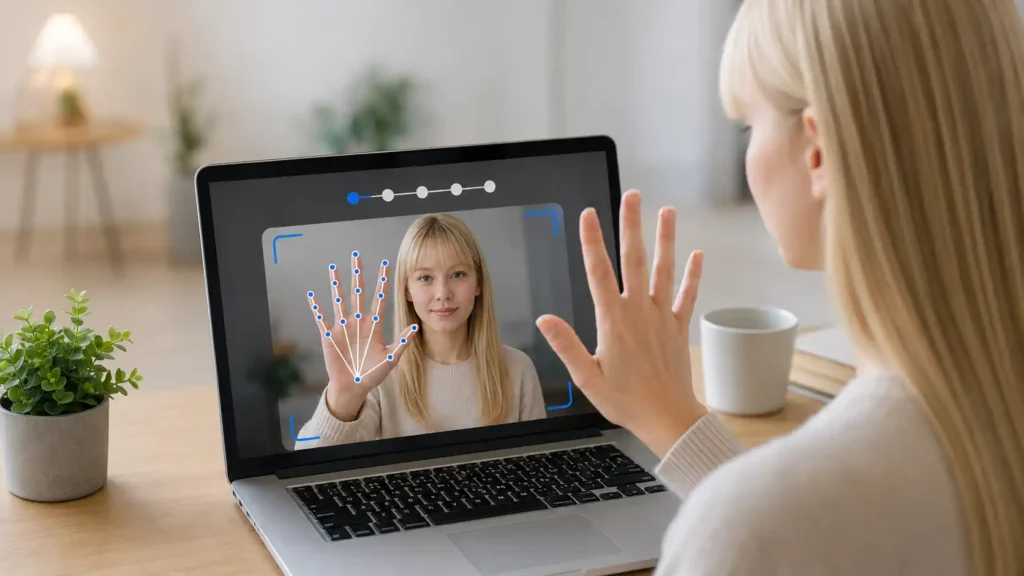
This article is an original analysis supported by the sources cited below
reCAPTCHA hand-gesture verification documentation Google’s own technical documentation for the hand-gesture challenge under Google Cloud Fraud Defense, describing how the check works, what it captures, audio and deletion behavior, and that visual and audio challenges remain available.
MediaPipe Hand Landmarker solution Google’s developer documentation for the hand-landmark model that underpins gesture recognition, detailing the 21 hand-landmark coordinate scheme and real-time on-device hand tracking.
Google Privacy Policy Google’s overarching privacy policy, relevant to how the company describes data collection, purpose limitation, and the handling of user information across its products.
Google’s hand-gesture CAPTCHA raises camera privacy fears Cybernews coverage of the hand-gesture test, summarizing the feature, Google’s stated protections, and the privacy concerns raised by requiring camera access to prove humanity.
Google reCAPTCHA hand-gesture verification Help Net Security’s report on the verification method, covering its mechanics, positioning as an additive challenge, and the security context driving it.
Google tests hand-gesture verification for reCAPTCHA 80.lv’s account of the experiment, including how the browser captures hand motion and Google’s claims about audio and video handling.
Google finds a new way to verify you are human as bots outnumber people The Hans India on the launch, framing the feature against the backdrop of automated traffic overtaking human traffic online.
Google tests hand-gesture verification, asking users to wave at their camera Shopifreaks coverage detailing the gesture flow and the failure of image challenges against AI-driven bots.
reCAPTCHA history and overview Wikipedia’s reference entry on reCAPTCHA, covering its Carnegie Mellon origins, Google’s 2009 acquisition, the v2 checkbox, invisible reCAPTCHA, v3 scoring, and the book and Street View digitization work.
Google acquires reCAPTCHA in two-for-one deal Computerworld’s contemporaneous report on Google’s 2009 acquisition of reCAPTCHA and the dual purpose of human verification and text digitization.
reCAPTCHA: 819 million hours of wasted human time Boing Boing’s summary of academic estimates on the human time and economic cost absorbed by solving reCAPTCHA challenges over the years.
2025 Imperva Bad Bot Report Imperva’s annual analysis of automated traffic, the source for figures on bots as a majority of web traffic and the share attributable to malicious automation.
Bad Bot Report 2026: bots in the agentic age Imperva’s most recent reporting on automated traffic, covering the rise of AI-agent traffic, account-takeover growth, and the shifting human-to-bot ratio.
2025 Imperva Bad Bot Report on AI internet traffic Thales newsroom analysis accompanying the Imperva findings, with detail on AI-driven automation and sector-level bot-attack patterns.
Turnstile, a private CAPTCHA alternative Cloudflare’s announcement of Turnstile, explaining its invisible, privacy-oriented approach and its avoidance of visual puzzles and cross-site tracking.
Cloudflare Turnstile product page Cloudflare’s product overview for Turnstile, describing how the lightweight verification widget works without interactive challenges.
Cloudflare Turnstile versus Google reCAPTCHA A comparison of the two verification systems on privacy, user friction, and implementation, useful for situating the hand-gesture method against lighter alternatives.
Cloudflare, Chrome and Firefox plan to replace CAPTCHAs with cryptographic tokens Tech Times coverage of the PACT proposal, outlining the cryptographic-attestation approach backed by major browser makers and its accommodation of authorized agents.
Cloudflare collaborates with leading browsers on a privacy-first protocol Cloudflare’s press release announcing the PACT collaboration with browser vendors and partners, describing the anonymous-vouching model and its goals.
Privacy Pass architecture, RFC 9576 The IETF specification underlying the cryptographic-token approach, defining the architecture for anonymous tokens that attest to a property without revealing identity.
Biometric Information Privacy Act (BIPA) overview The ACLU of Illinois explainer on BIPA, covering its consent requirements, private right of action, and the inclusion of hand and face geometry as biometric identifiers.
Biometric data privacy laws Bloomberg Law’s survey of biometric privacy statutes across jurisdictions, useful for understanding how regimes beyond Illinois treat biometric and sensitive data.
BIPA update: Illinois limits liability and clarifies electronic consent Greenberg Traurig’s analysis of the 2024 amendments to BIPA, including the single-violation damages cap and the recognition of electronic signatures for consent.
Biometric liveness detection explained An overview of liveness detection that distinguishes presentation attacks from injection attacks and explains why liveness proves presence rather than identity.
Face spoofing and liveness bypass, the real threat An industry analysis of how liveness systems are attacked, including synthetic media and injection techniques, and why these are harder to counter than physical spoofs.
Injection-attack detection is critical yet often misunderstood Biometric Update’s reporting on the rise of injection attacks against verification systems and the importance of detecting feeds that bypass the camera entirely.
| Citing this article? Brief excerpts are welcome. Please credit Webiano.digital, name the author where stated, and include a link to https://webiano.digital and to this original article. Full or substantial republication requires prior written permission. Read our Copyright and Content Use Policy. |
This article was prepared with the assistance of artificial intelligence tools. The content underwent expert human review, and Webiano Digital & Marketing Agency assumes editorial responsibility for its final version and publication.