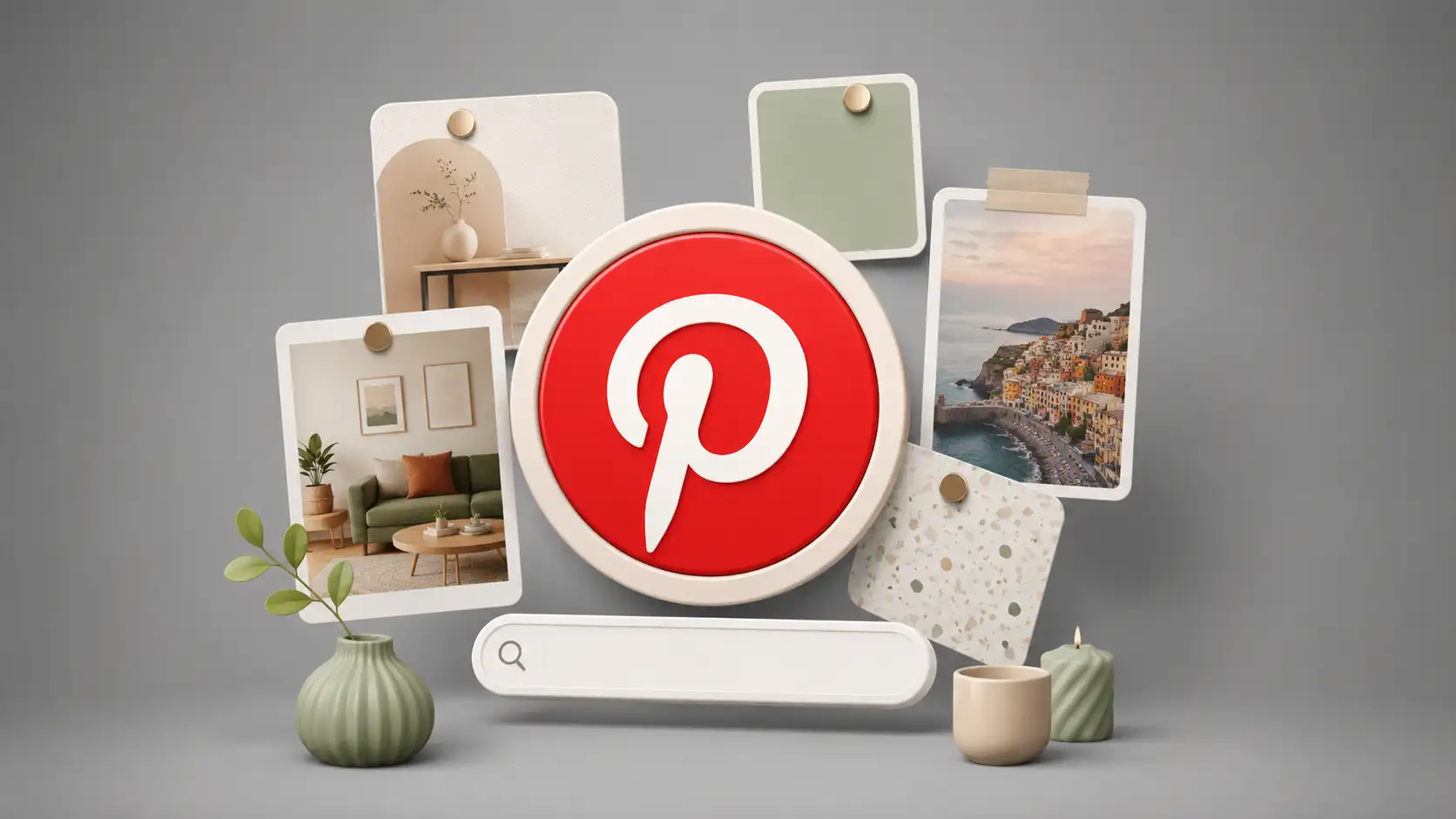
Pinterest is one of the few giant websites that still feels built around an ordinary, almost private human impulse: I might need this later. Not “watch me.” Not “argue with me.” Not “look at what happened five minutes ago.” Just that small, familiar urge to keep a recipe, a tiled bathroom, a book cover, a garden gate, a wedding table, a coat, a colour, a chair, a packaging detail, or a strangely perfect photograph because it says something you cannot quite say yet.
Table of Contents
That sounds modest, even old-fashioned. It is also why Pinterest remains unusually hard to replace. It is less a social network than a place for unfinished decisions. A saved Pin can be an instruction, a reference, a fantasy, a shopping lead, an identity draft, or a little piece of evidence that you are slowly becoming interested in something. The act is lightweight. You do not need a polished opinion. You do not need to explain yourself. You only need to know that the image should not disappear back into the noise of the open web.
Pinterest calls itself a visual search and discovery platform, and its own help materials describe Pins as bookmarks that can be saved to boards, searched, shared, organised into sections, or kept secret. That functional description is accurate but too dry. Pinterest’s real subject is taste before taste has become a sentence.
Its scale makes that idea even stranger. Pinterest says it has 631 million monthly active users and that people save 1.5 billion Pins every week. Numbers like that normally summon images of frantic feeds and public performance. Pinterest uses them to build something closer to a planetary filing cabinet, full of personal categories that no museum curator would think to create: “soft autumn outfits,” “houses with windows in the kitchen,” “things to cook when sad,” “Italian coastal bathroom,” “book club snacks,” “dresses if I become brave.” The web rarely treats private attention as the main event. Pinterest does.
The site is familiar enough to be taken for granted, which is a mistake. Underneath its friendly red Save button sits a very particular theory of the internet: people often know what they want only after they see it, and the way they describe that desire is often wrong, incomplete, or embarrassing. A conventional search engine asks you to articulate the target. Pinterest is willing to begin with a hunch, a texture, a colour, a room in a film still, or an image you found on the wrong page at 1:17 a.m. That is a deeper piece of product thinking than it first appears.
A search engine built from intentions, ecame powerful by turning language into a route through the web. You type words, it returns pages. Pinterest begins a step earlier, at the point where language is still failing. You may know that you want a living room to feel warmer without becoming “rustic,” or an outfit to look softer without becoming “boho,” or a dinner table to feel generous without becoming “wedding.” Those are not clean search queries. They are half-formed instructions from the part of the brain that makes judgments by looking. Pinterest treats visual uncertainty as a valid starting point.
That distinction matters because plenty of online desire is visual before it is verbal. A person sees a lampshade with a very particular curve. A cook notices the way a tart has been glazed. A designer wants the muted red from a chair in a hotel lobby, not a generic “red chair.” A parent is trying to work out why one child’s bedroom photo feels calm while another feels like a catalogue. In each case, a keyword search creates friction because the user is forced to translate a visual instinct into bad language. Pinterest accepts the instinct as it is. It lets the image carry more of the query.
The ordinary version of this begins with search. Pinterest’s help centre says users can search for ideas, people, and trends; browse suggested topics; use the camera; and look for ideas relevant to an uploaded photo. Yet even text search on Pinterest does not feel like standard web search. It is closer to entering a subject into a room where everyone has already brought visual examples. Search “linen curtains,” and the result is not merely information about linen curtains. It is a field of possible lives: pale rooms, old wood, long light, clipped captions, expensive mistakes, rental compromises, styled photographs, useful measurements, and links that may or may not still work. A Pinterest result page gives you a direction before it gives you an answer.
The platform’s strongest trick is that it turns subject matter into atmosphere without losing utility. That combination is rarer than it should be. Magazines excel at atmosphere but often keep the reader at a tasteful distance. Retail sites deliver utility but are usually grim corridors of filters and product grids. Social platforms create endless atmosphere but bury the useful part under commentary, personality, and performance. Pinterest allows all three to overlap. You can arrive because you need a “small bathroom shelf,” drift through twenty compact bathrooms with smart lighting, save three, and leave with enough material to make a decision next weekend. The browsing itself becomes part of the research.
The human appeal sits in the absence of urgency. Most large platforms train people to respond: reply, react, repost, refresh, purchase before the timer expires. Pinterest trains a softer habit: collect, compare, return. A Pin does not demand a public stance. A board does not need an audience. The site makes room for dormant interests, which is an underrated feature. Your “Portugal” board may wait five years. Your “plants” board may become serious after one dead fern and a move to a brighter flat. Your “writing spaces” board may be nothing more than six images of desks until one day it changes the way you arrange a room. Pinterest gives unfinished thoughts somewhere to live without forcing them to become goals.
That patient structure also makes Pinterest an odd kind of memory machine. Search engines remember the web. Pinterest remembers your future self’s weak signals. A saved image is not a diary entry, but it can reveal a slow shift in attention more clearly than a journal ever would. Look back through a long-running board and you may find that you were becoming interested in ceramics, Japanese breakfast, climbing, blue paint, second-hand furniture, or absurdly neat pantry jars long before you admitted it aloud. The saved image often notices the change before the person does.
There is a reason people return to old Pinterest boards with a mix of tenderness and embarrassment. A board is an archive of taste without the pressure of consistency. It can hold a black leather sofa next to a countryside kitchen, a brutalist lamp beside a floral dress, a holiday in Iceland beside a guide to making soup. No one has to defend the contradiction. In fact, Pinterest works best when it preserves contradiction. The app understands that liking an image does not mean committing to an identity. A board is allowed to be a messy first draft of a person.
The small act of saving changes the whole experience
The Save button looks almost too simple to deserve attention. It is one of the most consequential interface choices on the modern web. Saving is less final than buying, less public than posting, and more useful than liking. It says: keep this near me. That is a very different relationship with content from the usual social-media transaction, where approval flashes briefly and then vanishes into a feed no one will revisit. Pinterest gives attention a physical-looking place to go.
A Pin is technically a bookmark, but “bookmark” undersells the emotional mechanics. Browser bookmarks have always felt like shelves in a back office: useful, neglected, impossible to browse without regret. Pinterest bookmarks have surfaces. You remember the pale green kitchen, the hand-drawn map, the loaf with the black sesame crust, the rust-coloured chair. Visual memory makes the saved collection feel alive. The board becomes not a database but a room. You do not merely retrieve a Pin; you recognise it.
Pinterest’s own guide makes the system plain: Pins may be images, videos, or products; saved Pins live on boards; boards can be arranged, divided into sections, shared with others, or marked secret. Those options sound like small organisational features, yet together they create a personal information system that feels unusually humane. A board section called “lighting,” “paint,” or “tiny details” does more than tidy a collection. It lets a vague project acquire shape without turning into an intimidating spreadsheet. Structure arrives in small, forgiving increments.
The private-board option deserves more respect than it gets. The modern web has trained people to assume that keeping a public profile is normal and keeping an interest private is somehow suspicious. Pinterest quietly rejects that premise. A secret board might contain a surprise party, a medical-recovery meal plan, a move you have not told anyone about, a future tattoo, a divorce-era apartment search, a honeymoon, or the clothes you wish you had the courage to wear. Private curation is not a lesser form of online life; it is often the honest one.
This is why Pinterest’s boards feel closer to sketchbooks than feeds. The value lies partly in what remains unposted. You do not have to narrate why you saved a photo of a narrow hall painted deep blue. You do not have to explain why you have a board called “quiet houses” or why it contains thirty windows, four dogs, two lamps, and a foggy road. The lack of social explanation is liberating. The web rarely offers many places where taste can exist without turning into a brand. Pinterest still leaves room for the user who does not want to perform a self.
What Pinterest is unusually good at
| Use | What makes it work | Where it can fail |
|---|---|---|
| Planning a real project | Visual comparison stays visible | Old links and outdated prices can mislead |
| Finding a style direction | You can begin with a feeling | The feed may over-confirm one aesthetic |
| Saving web discoveries | Pins turn loose tabs into a collection | Attribution and source quality vary |
| Shopping by visual cues | Objects inside images become search targets | Similar-looking products can flatten differences |
| Keeping private ideas | Secret boards protect unfinished plans | Organisation still requires a little discipline |
The table reveals why Pinterest survives in so many people’s habits. It is rarely the best tool for one isolated job, yet it is unusually good at keeping a project in motion from the first flicker of interest to the point where you finally act.
Saving also changes how users browse the wider web. Pinterest’s browser extension and URL-saving tools allow people to turn images from other sites into Pins, then place them in a board with related material. The feature is easy to dismiss as a convenience. Its bigger effect is philosophical: it turns the open web from a place you merely consume into a place you actively collect from. Pinterest makes the rest of the internet feel less disposable.
That collection habit creates a subtle resistance to the tyranny of tabs. Tabs are demands. Each one suggests unfinished work. A board is kinder because it does not demand immediate resolution. You can save an article about shelving, a sofa, a paint palette, and a ceramic studio visit without needing to decide which one matters most. Later, patterns appear. Maybe every image has natural wood. Maybe every room has a low lamp. Maybe the project is not actually about “decor” at all; it is about a desire for softness, storage, or less visual clutter. Pinterest turns accumulation into a form of self-briefing.
The site also benefits from the fact that its fundamental unit is small. A Pin can be useful in ten seconds. You do not need to sit through a creator’s origin story, subscribe to a newsletter, watch eight minutes of preamble, or decipher a comment thread full of arguments. You see an image, a title, a source, perhaps a short note, and decide whether it belongs. That restraint becomes more attractive each year as the web fills with forced engagement. Pinterest still respects the possibility that a useful encounter might be brief.
Of course, saving can become a substitute for doing. Plenty of boards are cemeteries of imagined selves. The “get fit” board does not lift the weight. The “learn Italian” board does not open the textbook. The “garden” board does not remove the weeds. Yet that criticism misunderstands what Pinterest is for. The site is not a discipline machine. It is a place where desire becomes visible enough to inspect. Not every saved thing needs to become a completed project to have been worth saving.
Pinterest understands things you cannot name
The most interesting part of Pinterest is not the feed or the board. It is the moment when an image becomes a search prompt. You open a Pin, touch or select a particular object inside it, and ask for visually related things. A bag, a lamp, a neckline, a kitchen backsplash, a plate, a hair colour, a specific corner of a room: the search can begin from that fragment. This is search stripped of the fantasy that words always come first.
Pinterest’s visual-search tools let users search with a whole image or a cropped area of an image, select individual objects, find similar or shoppable items, refine results with suggested terms, and even create cutouts for collages. The mechanics are simple enough that they almost disappear. That is precisely the point. The interface treats visual recognition as a natural action rather than a special technical feat. You look at the thing you want, point at it, and keep looking.
Other companies have offered visual search for years, often as a technological showcase. Pinterest’s version feels more native because the platform already contains the context in which visual search makes sense. A photo of a coat is not isolated. It sits beside related cuts, colours, outfits, stores, styling choices, mood boards, and user collections. A search engine that recognises an object is useful. A search engine that understands that object as part of a taste cluster is much more interesting. Pinterest does not merely identify a thing; it tries to identify the direction behind the thing.
Consider the difference between wanting “a green chair” and wanting the green chair in a picture. The first request delivers inventory. The second carries details that language drops on the floor: the degree of fadedness, the rounded arms, the surrounding wood, the contrast with a cream wall, the feeling that the chair belongs to someone who has good lamps. Visual search gives the user a route from impression to approximation. It will not always find the exact object, and perhaps it should not. The pleasure often lies in discovering nearby possibilities rather than a perfect match.
Pinterest Lens pushes the idea further by letting people point a camera at something in the world or upload an image from their camera roll. Pinterest says Lens can be used for things such as ingredients and street style, with controls to zoom or focus on a particular object. The old fantasy of augmented reality was that digital information would float over daily life like science fiction. Pinterest’s more grounded version says something better: daily life is already full of unlabelled references. The camera becomes a way to ask the world what you are looking at.
This has consequences for how we think about “search literacy.” People are used to being blamed for bad search queries, as though the answer is always to become more precise. Pinterest offers a gentler premise. Sometimes precision is impossible. Sometimes the user needs to browse their way toward a better question. Someone may start with a photo of a brown leather shoe, move through “soft leather loafers,” then “European summer outfits,” then “linen trousers,” and finally realise that the problem was not the shoe but the proportion of the whole outfit. The search path is part of the thought process.
The platform’s suggested keywords are especially revealing. After visual search, Pinterest often offers words that help refine what is on screen. That small bridge between image and language matters. The user does not have to invent vocabulary from scratch; the system proposes terms that might be close enough to continue. It is an interface for people who know by recognition rather than taxonomy. Pinterest quietly teaches users how to describe their own taste.
There is a creative tension here. Visual similarity is not the same as cultural understanding. Two rooms may share a palette and still belong to wildly different traditions, budgets, climates, or ways of living. A visually similar product might be worse made, less durable, more expensive, or badly copied. A recipe with the same beautiful surface might be written by someone who has never tested it. Pinterest can make resemblance feel like relevance, and those are not identical. The platform is brilliant at first steps, not final judgment.
That limitation is not a reason to dismiss it. It is a reason to use it with the right mindset. Treat Pinterest as a field notebook, not an oracle. Use it to spot a direction, then leave the platform and investigate properly. Open the original source. Check measurements. Read the recipe twice. Look for the maker. Find a local supplier. Compare prices. Pinterest is at its best when it makes the real world more legible, not when it persuades you to remain inside its image grid. A great Pin should send you somewhere, not keep you scrolling forever.
Visual search also exposes a larger shift in online behaviour. The old web was organised around pages and hyperlinks. The newer web is increasingly organised around recognisable fragments: a face, a shoe, a room, a chart, a food texture, a type treatment, a screenshot. Pinterest has spent years living in that fragmentary world. Its advantage is not that it invented visual thinking. Its advantage is that it built an interface for people who already think that way.
A quieter commercial machine hiding in plain sight
Pinterest can feel like a gentle scrapbook until you notice how close it sits to shopping. That closeness is not accidental. The platform’s company page says more than half of its users think of Pinterest as a place to shop, while its product pages describe Pins as images, videos, or products that may lead to a retailer’s website. The commercial logic is direct: people come to Pinterest while they are imagining, comparing, planning, and narrowing a choice. That is often the moment when buying begins, even when the user insists they are “just looking.”
Pinterest understands something that many retailers still forget: a purchase rarely starts with a product name. It starts with a world. Someone does not wake up desiring a specific dining chair from a specific brand. They want a dining room that feels less temporary. They want a birthday party that feels more generous. They want a skincare routine that seems calmer, a kitchen that feels less grim, a dress for a wedding that does not make them feel costume-like. Pinterest is useful to commerce because it catches people before their desire has been reduced to a SKU.
This makes the platform genuinely good for discovery and potentially dangerous for the same reason. It lets commercial content blend into the natural grammar of inspiration. A product Pin may arrive beside a tutorial, an old magazine scan, a personal photograph, a design studio’s portfolio, or a board assembled by someone with excellent taste and no visible agenda. That mixture can feel rich. It can also make advertising feel less like interruption and more like a plausible next step in a private fantasy. Pinterest’s softest edges are also part of its sales machinery.
The site is not coy about the connection. Its visual-search documentation says selected objects may lead to similar items that are available to buy on a merchant’s website. Its commercial-content rules also place product Pins, promoted content, affiliate material, and paid partnerships inside a formal policy structure. The platform is a business, and the shopping layer is not an accidental add-on. The remarkable thing is how rarely the commercial layer breaks the mood.
This is where Pinterest differs from the bluntness of many ad-heavy networks. Ads on other platforms often arrive as a demand for attention. They compete with personal posts, news, rage, celebrity fragments, and memes. On Pinterest, the commercial object can look like a response to a genuine visual query. That does not make it neutral. It makes it better camouflaged. A reader should keep that distinction in mind. Useful recommendations and profitable recommendations can occupy the same square of screen.
Still, the commerce is not inherently cynical. People genuinely want to find the source of a lamp, a dress, a paint colour, or a kitchen tool. The ordinary web has made that task oddly difficult. Product pages disappear. Search results are cluttered with SEO sludge. Social posts bury links in captions. Marketplace inventory is messy. Pinterest can reduce some of that friction by holding the image and source together, or at least closer together than most platforms do. The desire to know where something came from is not shallow; it is often practical.
Pinterest’s richest shopping value appears when a person uses it to compare language, not merely products. Search one kind of object, save a few examples, and then read the captions, descriptions, and related suggestions. Soon you have a vocabulary. You learn that the thing you like is a “wishbone chair,” a “mushroom lamp,” a “Fisherman knit,” a “zellige tile,” a “Parisian curtain fringe,” a “mid-century credenza,” or a “butterfly chair.” Once that language exists, you are no longer wholly dependent on the platform. Pinterest can turn aesthetic recognition into practical search terms.
The risk arrives when the site compresses style into repeatable merchandise. A beautiful room may have been built over decades, with inherited furniture, repairs, books, local objects, flawed proportions, and lucky accidents. The grid converts that room into a few purchasable signals: bouclé chair, travertine table, striped cushion, brass lamp. The result is not necessarily bad, but it is thinner. Pinterest is extremely good at extracting the visible recipe from a place; it is less good at carrying the unphotographable parts. Taste is often a history, not a shopping list.
The smartest way to use Pinterest commercially is therefore slightly sideways. Do not ask it to tell you what to buy. Ask it to show you what you are responding to. Notice the recurring materials, lines, shapes, and moods. Then spend money slowly. Look outside the platform. Find makers, second-hand sellers, library books, local shops, and repair options. Pinterest becomes far more useful when you treat its product grid as a sketch of desire rather than an automatic checkout queue. It should sharpen your eye before it opens your wallet.
The mess remains part of the charm
Pinterest is not a clean archive. It is an archive made from the web, which means it inherits the web’s mess. Sources disappear. Images become detached from their makers. Recipes circulate without context. Boards hold reposted versions of reposted versions. A beautiful photograph may lead to a dead page, a retailer in another country, an aggregator, a copied product, or nowhere at all. The platform’s visual abundance can make these fractures easy to ignore. The image is often more durable than the information attached to it.
That weakness should make users more curious, not less. When you find a Pin that seems perfect, follow the link, look for the original creator, and check whether the source deserves trust. This matters especially with food, health, interiors, travel, and crafts, where a great image can create the illusion of competence. A sunlit recipe photograph does not prove that the instructions work. A before-and-after renovation does not show the budget, the planning approvals, or the contractors. A travel board does not reveal the season, crowds, cost, or access needs. Pinterest is full of useful clues, but a clue is not the same as evidence.
The platform itself has policies and enforcement systems around harmful content, including rules against malicious misinformation actors, violent groups, certain harmful claims, and other prohibited material. Its transparency materials also describe enforcement work around climate, health, civic misinformation, and conspiracy content. Those policies matter. They do not eliminate the ordinary problem of image-led credibility, where something feels trustworthy because it looks coherent, polished, and familiar. Visual calm can disguise bad information just as easily as visual chaos can.
Pinterest’s content quality is also uneven because that is the cost of its scale. The grid thrives on abundance. It needs thousands of interpretations, variations, bad copies, old tutorials, personal experiments, product listings, mood boards, and strange little corners. A cleaner platform might remove some of the surprise. Yet the mess can also narrow the user’s imagination. Search a popular style for long enough and the same handful of visual formulas start to dominate: the same arch, the same tile, the same palette, the same statement chair, the same book stack, the same version of “effortless.” A recommendation system can turn taste into a corridor without announcing that it has done so.
Pinterest gives users tools to push back. Its recommendation settings allow people to refine suggestions based on viewed Pins, boards, interests, following, and AI content categories. The platform also says people can turn off recommendations connected to certain boards, while archived and secret boards are excluded from automatic recommendation signals. These controls will not make the feed neutral. They do make a useful point: your saved material is not merely storage; it also teaches the system what to keep showing you. Curation is never entirely private once the feed is learning from it.
That feedback loop is worth understanding. Save thirty cream kitchens and Pinterest will assume you want more cream kitchens. Save enough stylised home offices and you may stop seeing workspaces that are practical, cheap, cluttered, or strange. The system is doing what it was asked to do, but “more of what I liked” is not always “more of what I need.” Discovery needs occasional friction. It needs the unfamiliar material, the ugly first draft, the low-budget solution, the unphotogenic but clever idea. A good board should widen your taste, not merely flatter it back to you.
The remedy is easy and pleasant: make odd boards. Save things you are not sure you like. Search outside your normal aesthetic. Pair glossy images with documentation, books, makers, archives, and local references. Follow a few people or boards whose decisions surprise you. Let the feed become less self-similar. Pinterest’s interface makes this simple because it does not demand a coherent public identity. You can train your eye in private, through contradiction.
The mess also contains a kind of anthropology. Old Pins preserve styles that have passed through fashion and become detached from their original context. You find wedding trends from a decade ago, graphic-design habits from early Instagram, kitchen ideas from the blog era, type treatments from Tumblr, rooms that once looked impossibly fresh and now look instantly dated. This is not just nostalgia. It is evidence of how quickly visual culture hardens into cliché. Pinterest is a time machine for things that were briefly everywhere.
That archive-like quality is more useful than the platform advertises. Designers, writers, photographers, stylists, students, and researchers can use Pinterest to notice recurrence. What colour combinations return? Which silhouettes keep resurfacing? How do domestic spaces get photographed in different periods? What does “cozy” look like in 2013 compared with 2026? The search results are not a scholarly database, so care is required. Yet they expose the repeating visual weather of the internet. Pinterest is one of the best places to see taste becoming collective before it becomes named.
The uncomfortable AI layer is already in the room
Pinterest has always been a platform where human-made images circulate, mutate, detach from sources, and accumulate new meanings. Generative AI makes that ecology more complicated. The company now describes Pinterest Canvas as a multimodal foundation model used to power image-related experiences, and says Version 6 has been trained on approximately 500 million rows of publicly available Pins, descriptions, and metadata that users saved or uploaded under Pinterest licences, together with synthetic data. That is not a small technical footnote; it changes how the archive should be read.
Pinterest says it labels image Pins when content owners identify them as AI-generated or modified, and when its detection systems identify that the material may have been generated or altered using relevant metadata standards. It also offers settings intended to show fewer AI Pins in certain categories. Those are sensible steps, particularly on a platform where appearance carries so much of the meaning. Yet labels do not make the deeper problem disappear. A visual discovery site relies on the idea that an image can be a useful reference. When synthetic images mix into the same river, the reference value becomes harder to judge at a glance.
For some uses, AI images are harmless or even playful. A collage about a fantasy bedroom, an editorial concept, a mood board for a fictional world, or a colour study does not necessarily need documentary truth. Pinterest has always hosted aspiration, and aspiration has never been fact. The trouble starts when a generated room is treated as a renovation reference, a fabricated garment is treated as a product, a synthetic food image is treated as a recipe result, or an altered travel picture is treated as a real place. The visual language of possibility can quietly borrow the authority of reality.
The platform’s response has to be judged by how it behaves at the moment of confusion, not merely by whether a label exists somewhere in a close-up view. When a person is scrolling quickly, saving fast, or building a board late at night, they are not conducting forensic analysis. They are following a feeling. A discreet disclosure may be easy to miss. The burden should not fall entirely on users to distinguish between a photograph, a stylised edit, a 3D render, a brand mock-up, and an AI-generated image that imitates any of them. Pinterest’s strongest feature, visual immediacy, makes visual ambiguity more consequential.
This does not mean Pinterest should become an austere evidence repository. That would destroy much of the site’s pleasure. It does mean the platform needs to maintain a usable distinction between images that are useful as real-world references and images that are primarily imaginative prompts. The difference is not moral. It is functional. A person shopping for lighting needs different information from a person collecting dream kitchens. The future of visual search depends on knowing when a picture is a lead and when it is a fiction.
There is another tension. Pinterest’s archive is valuable because it contains so much real human curation: the strange choices, repeated saves, niche combinations, captions, boards, and associations that people made for their own reasons. Training models on that material raises a question that will become harder to ignore: what happens when a platform built from collective human taste begins to generate fresh versions of that taste at industrial scale? The risk is not only copyright conflict; it is aesthetic flattening.
A recommendation engine already tends to reward familiar patterns. Generative systems can make those patterns cheaper to reproduce. The result may be an endless supply of rooms, outfits, meals, and objects that feel uncannily like things people have already liked. They will be plausible, polished, and emotionally vacant. Pinterest could become flooded with pictures that satisfy the system’s knowledge of desire without carrying any of the stubborn particularity that makes a real photograph worth saving. The internet does not need more images that are merely recognisable as desirable.
The good news is that Pinterest users are unusually capable of resisting that flattening because the platform’s best habit is not passive consumption. It is selection. People can choose what to save, name boards in idiosyncratic ways, follow original sources, and build collections that exceed the feed’s default taste. A Pin becomes interesting because someone decided it mattered to them, not because an image model made another attractive rectangle. Human curation remains Pinterest’s most convincing argument for itself.
The next version of Pinterest should lean harder into provenance and source quality without strangling the site’s playfulness. Show creators more clearly. Surface original publishers. Make it easier to distinguish a retailer product page from a repost, a real project from a concept rendering, a tested recipe from a seductive image. Let users filter by source type when they need to. These are not glamorous ideas. They are the kind of quiet infrastructure that protects the joy of browsing. Trust is what lets inspiration survive contact with action.
Pinterest remains a small rebellion against the feed
The most appealing thing about Pinterest is not that it has escaped the internet’s bad habits. It has not. It collects data, sells advertising, learns from behaviour, absorbs commercial content, and faces the same hard problems around provenance, moderation, AI, and attention that every large platform faces. Its difference is subtler. Pinterest still gives people permission to browse without declaring a position.
That permission has become rare. Every other major surface seems to want a reaction, a hot take, a personality, a side, a recurring performance. Pinterest tolerates curiosity that has not yet become expertise. You can search for sourdough, brutalist churches, tiny balconies, camping meals, antique rings, jazz posters, or vegetables painted like still lifes without needing to produce anything afterwards. The site does not ask you to turn your interest into content. It lets fascination remain private and incomplete.
This makes Pinterest particularly good for people in transitional moments. Moving house. Changing jobs. Recovering from a breakup. Starting a garden. Planning a wedding. Becoming a parent. Learning to cook. Considering a new haircut. Trying to understand what a room, wardrobe, or routine should look like after life has changed. These are moments when people are not only looking for information; they are looking for a picture of what comes next. Pinterest offers a visual rehearsal space for the future.
A board can be a gentle form of agency when other parts of life feel uncertain. It says that even if you cannot yet move, buy, travel, paint, quit, plant, cook, or begin, you can still collect evidence of a direction. That should not be romanticised too much. Saving images is not change. Yet it is sometimes the first visible sign that a person has begun to imagine change seriously. A folder of images can be the earliest map of a decision.
The platform is also an argument for a slower kind of algorithm. Its feed is still algorithmic, but the desired outcome is not always immediate engagement. The system wants you to encounter something you might save, and saving implies a longer horizon. A saved Pin can matter tomorrow, next month, or years later. That temporal difference changes the emotional tone of the product. A viral post is built to peak. A Pin is built to remain available for recall. Pinterest’s unit of success is often delayed usefulness.
That may explain why the site has such stubborn staying power. It is not as culturally loud as the platforms that dominate headlines, yet it sits inside people’s lives at precisely the moments when plans become concrete. It is there before a kitchen renovation, before a trip, before a baby arrives, before a new hobby takes hold, before someone redecorates a rented bedroom to feel less temporary. The site’s influence is often invisible because it occurs upstream of the finished photograph, purchase, recipe, event, or room. Pinterest does much of its work before anyone thinks to call it influence.
Its web-native weirdness is part of the appeal. The best Pinterest boards are not brand strategy. They are collections with titles that sound like fragments from a diary or a screenplay: “future home maybe,” “a little strange,” “food I would make if I had friends over,” “the kind of blue I mean,” “things that feel like rainy Saturdays,” “not sure but yes.” These are not taxonomies. They are private languages. Pinterest preserves them at scale, which is absurd and somehow moving. Millions of people are building tiny personal museums with no admission fee and no official curator.
Use Pinterest badly and it becomes a pretty treadmill. You save without revisiting, scroll without noticing, buy the shorthand version of a style, and mistake a curated image for a complete life. Use it well and it becomes one of the web’s most humane tools: a place to turn vague attraction into a collection, a collection into language, and language into a more deliberate choice. The difference lies less in the app than in the attention you bring to it.
Open it with a project, a hunch, or a visual question that has been bothering you. Save fewer things than you think you need. Follow the original links. Make one board private. Give it an odd name. Put in material that does not match. Return after a week and look for the pattern you did not know you were making. This is where Pinterest stops being a familiar app and becomes a surprisingly intimate instrument. It is a place where taste can become visible before it becomes settled.
Questions worth asking before you open Pinterest
Is Pinterest still useful if I am not planning a wedding, redesigning a home, or shopping for clothes? Yes, because its strongest use is not tied to any one lifestyle category. Pinterest works whenever the question is visual, fuzzy, and open-ended. Writers use it to collect settings, textures, objects, and character clues. Teachers use it for projects and classroom ideas. Cooks save ingredient combinations and plating references. Travellers gather streets, routes, museums, tiny hotels, and local food. People learning a craft can compare tools, techniques, materials, and finished work. The platform becomes less interesting only when your question has a single factual answer. For a train timetable or tax rule, use a direct source. For “what does a calm work corner look like in a very small room,” Pinterest is in its element.
How should I avoid building a board full of copied or misleading material? Treat the Pin as an invitation to investigate, not a final source. Open original links, check the creator, and look for context before acting on expensive, technical, medical, or safety-related advice. Save a useful image, but also save the actual source when possible. For recipes, read comments and cross-check technique. For interiors, look for measurements, materials, and project details. For products, compare the brand site with independent sellers and reviews. For travel, check current local information instead of trusting a beautiful old image. A good board can contain inspiration and documentation side by side; the mix makes it more useful.
Will the algorithm trap me in one aesthetic? It can, especially when you save the same visual formula repeatedly. Pinterest learns from saves, searches, boards, and browsing behaviour, so the feed tends to echo what you have already rewarded. Break the loop on purpose. Search for opposite materials, different climates, older references, cheaper solutions, less polished examples, local traditions, and styles you do not automatically identify with. Archive boards that no longer represent your interests. Refine recommendations in settings. Keep a “wild card” board for things that make no immediate sense. Pinterest becomes more alive when you use it to encounter surprise rather than confirm a pre-existing mood.
What is the best way to use Pinterest without turning it into endless scrolling? Enter with a small frame: a board, a problem, a time limit, or a list of things you want to compare. The site becomes draining when the feed is the destination; it becomes useful when the feed is a route toward a collection. Save a few strong Pins, then stop and inspect them. Ask what repeats. Delete near-duplicates. Add sections only when a board becomes crowded. Leave the platform to research, measure, shop, make, or write. The goal is not to have the prettiest board. The goal is to leave with a better question or a better decision.
Author:
Jan Bielik
CEO & Founder of Webiano Digital & Marketing Agency
This article is an original analysis supported by the sources cited below
Pinterest company profile
Official overview of Pinterest’s visual discovery positioning, monthly active user figure, weekly Pin saves, and shopping-oriented audience data.
All about Pinterest
Official guide to Pins, boards, secret boards, group boards, search, product discovery, and saving ideas.
Use visual search features
Official explanation of image search, object selection, visual refinements, shopping results, and collage cutouts.
Pinterest Lens
Official guide to camera- and image-based discovery through Pinterest Lens.
AI at Pinterest
Official explanation of Pinterest Canvas, generative-AI labels, model transparency, and controls for seeing fewer AI Pins.
Refine your recommendations
Official documentation on changing recommendation signals linked to Pins, boards, interests, following, and AI content.
Community guidelines
Pinterest’s current rules covering harmful content, misinformation actors, abuse, and other platform-safety requirements.
Pinterest Predicts 2026
Pinterest’s 2026 trends report, used here as context for the platform’s role in visual culture and personal curation.
| Citing this article? Brief excerpts are welcome. Please credit Webiano.digital, name the author where stated, and include a link to https://webiano.digital and to this original article. Full or substantial republication requires prior written permission. Read our Copyright and Content Use Policy. |
This article was prepared with the assistance of artificial intelligence tools. The content underwent expert human review, and Webiano Digital & Marketing Agency assumes editorial responsibility for its final version and publication.