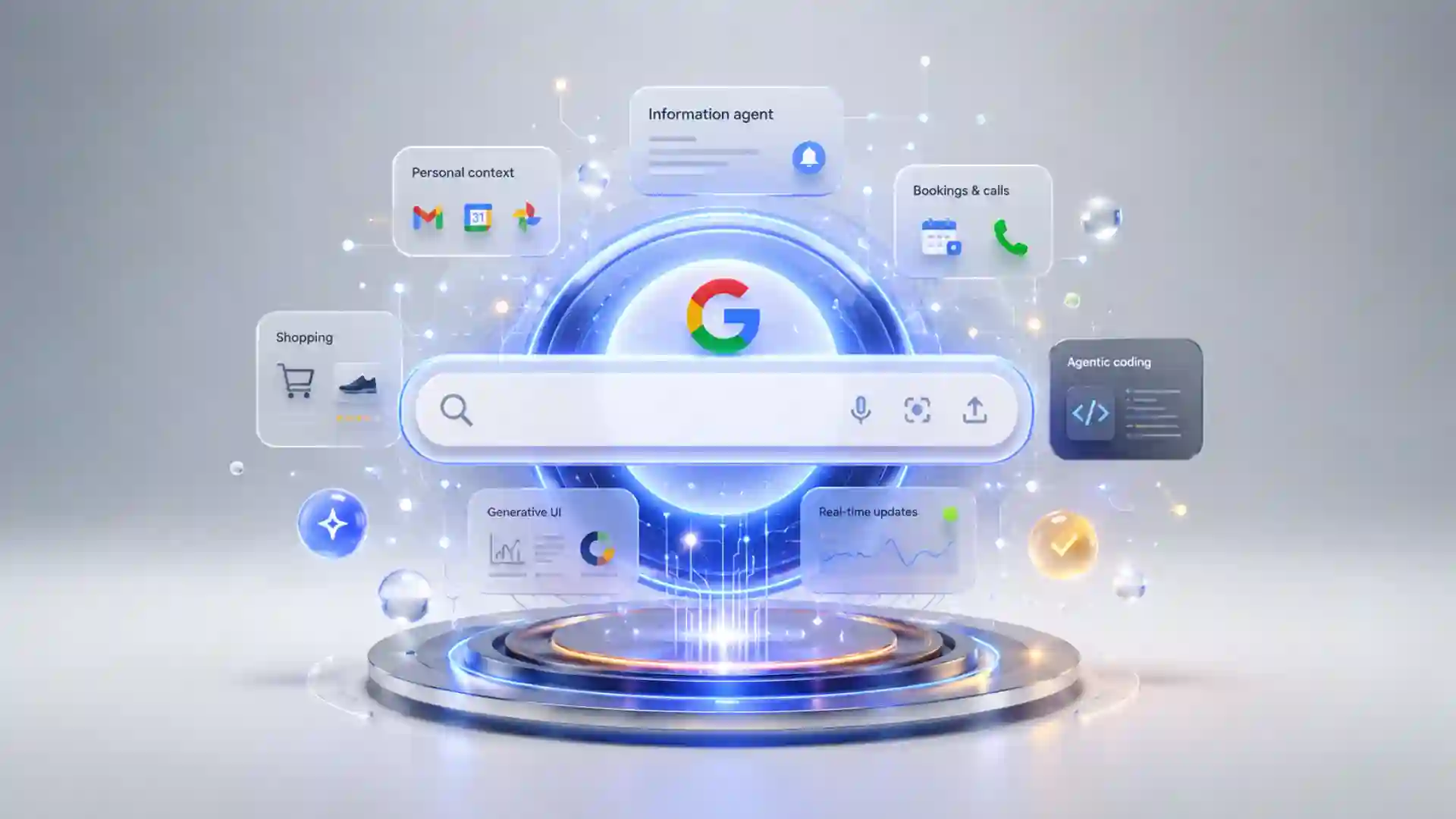
Google’s Search announcement at I/O 2026 is not a routine feature release. It is a direct attempt to change the role of the Search box itself. Google is moving Search from a system that returns pages toward a system that interprets intent, monitors information, creates interfaces, books services, calls businesses, shops across merchants, and connects personal context when users permit it. The center of gravity is no longer only the ranked results page. The new strategic unit is the AI-mediated task.
Table of Contents
Search moves from retrieval to delegated work
Google’s May 19, 2026 announcement marks a sharper break than the company’s earlier AI Overviews rollout. AI Overviews changed the presentation of answers. AI Mode changed the conversational layer. The 2026 Search update goes further by pushing agents, personal context, coding, monitoring, booking, and commerce into the same surface that billions of people already associate with finding information. Google says AI Mode has passed one billion monthly users, with queries more than doubling every quarter since launch. The company also says Search queries reached an all-time high last quarter.
The practical meaning is plain: Google wants Search to become a place where users delegate intent, not just describe keywords. A user looking for an apartment, a restaurant slot, a local repair provider, a product drop, a fitness tracker, or a complex comparison is no longer being steered only toward sources. The user is being invited to keep the task inside Search while Google’s AI gathers information, reasons across it, and presents next steps.
That does not mean links disappear. Google keeps saying that AI Mode and AI Overviews include supporting links and that classic Search remains available. It also says users will continue to receive a range of Search results. But the interface hierarchy changes when the AI response, agent, or generated tool becomes the primary interaction and the link becomes supporting evidence, optional reading, or a completion path. The link remains, but it is no longer always the first event.
This is the tension at the heart of AI Search. Google built its power by organizing the open web and ranking pages. Now it is folding web retrieval into a system that may answer, monitor, call, book, code, summarize, and compare before the user clicks. For users, the appeal is clear. Fewer repeated searches. Fewer tabs. Less friction. For publishers, retailers, local businesses, and SEO teams, the bargain is more complicated. Visibility must now survive inside AI-generated responses and agentic workflows, not just blue links.
Reuters described Google’s I/O 2026 push as putting AI agents directly into the search box, while also noting the enterprise and model competition behind the announcement. The same report says AI Overviews now serve 2.5 billion monthly users and AI Mode has about one billion users, according to Sundar Pichai.
The Search box becomes the product
The most revealing part of the announcement is not any single agent. It is the redesign of the Search box. Google calls it the biggest upgrade to the box in more than 25 years. The new box expands to accommodate longer prompts, supports text, images, files, videos, and Chrome tabs, and provides AI-powered suggestions that go beyond old autocomplete. It is starting to roll out in countries and languages where AI Mode is available.
That change matters because the Search box has always compressed user intent. People learned to write “best running shoes flat feet” because classic Search worked best when the query was short, noun-heavy, and shaped around ranking signals. AI Mode changes the grammar. A user can ask for “a shoe for marathon training, mild overpronation, wet roads, under $160, available near me, with enough cushioning but not too heavy.” That query is not only longer. It is closer to a decision brief.
Google’s own usage data supports this direction. The company says the average AI Mode search is triple the length of a traditional Search query. It also says more than one in six U.S. searches now use voice or images, with image searches growing more than 40% month over month. Planning-related AI Mode queries grew 80% faster than AI Mode queries overall over the past six months, according to Google’s Trends data.
The old Search box was a request field. The new Search box is closer to an intake form for an AI system. That makes it strategically powerful. It lets Google capture messy intent before the user moves to ChatGPT, Perplexity, TikTok, Reddit, Amazon, Booking, Yelp, or a vertical marketplace. It also lets Google ask follow-up questions, attach context, and route the query through different systems.
The Search box is becoming Google’s defensive wall against AI-native competitors. ChatGPT search gives users a conversational path to timely answers with links to web sources. Microsoft’s Bing Generative Search presents AI-generated summaries with sources and classic links. Perplexity has trained users to expect cited answers. Google’s answer is to make the familiar Search box absorb the conversational, multimodal, agentic, and transactional patterns before they become separate habits elsewhere.
The user may not think in these terms. They will notice that the box accepts more context, returns richer responses, keeps a conversation alive, and performs more work. That is enough. Search habits change when the default box changes.
Google’s 2026 Search update at a glance
| Feature | Google’s stated rollout | Strategic meaning |
|---|---|---|
| Gemini 3.5 Flash in AI Mode | Global default for AI Mode | Search gets a faster agentic model layer |
| Intelligent Search box | Rolling out where AI Mode is available | Queries become longer, richer, and multimodal |
| Information agents | First for AI Pro and Ultra subscribers this summer | Search becomes a monitoring system |
| Agentic booking and calling | U.S. rollout this summer for selected tasks | Search moves closer to service transactions |
| Generative UI in Search | Available to everyone this summer | Results become custom tools and simulations |
| Personal Intelligence | Nearly 200 countries and 98 languages | Search begins using permitted personal context |
The table shows the shape of Google’s move: model upgrade, interface redesign, persistent agents, transactions, generated software, and personal context are being packaged as one Search evolution. That is broader than an answer box upgrade.
AI Mode graduates from experiment to operating layer
AI Mode began as an experiment. In March 2025, Google introduced it through Search Labs as a more advanced AI Search mode built on Gemini 2.0, designed for complex, multi-part questions, follow-ups, reasoning, comparisons, and multimodal inputs. In May 2025, Google started rolling AI Mode out in the U.S. without a Labs signup and described it as the place where Gemini’s frontier capabilities would first enter Search.
The 2026 announcement shows AI Mode becoming an operating layer. Users can move from an AI Overview into AI Mode through follow-up questions. Context carries forward. Links and supporting articles are expected to become more relevant as the conversation deepens. The model in AI Mode is now Gemini 3.5 Flash, according to Google.
This matters because AI Mode is where Google can test a new Search contract without immediately collapsing the classic results page. AI Overviews appear when Google’s systems decide they add value. AI Mode is the stronger environment for exploratory, multi-step, comparative, or uncertain tasks. Google Search Central describes AI Mode as useful for queries that need further exploration, reasoning, or complex comparisons, and says AI Overviews and AI Mode may use query fan-out to issue related searches across subtopics and data sources.
Query fan-out is one of the least understood parts of AI Search, but it may be the most commercially important. In classic Search, one query generally produces one ranked set of results. In AI Mode, the system may break a complex question into subquestions, search across them, reason over the material, and build a combined response. Google described the same method in its 2025 AI Mode update, saying AI Mode breaks questions into subtopics and issues multiple queries simultaneously. For Deep Search, Google said the system could issue hundreds of searches and create a cited report.
For users, this makes Search feel more capable. For website owners, it makes visibility less predictable. A page may be used because it answers a subtopic rather than the original visible query. A brand may surface because it has strong entity signals in one part of the task, even if it would not rank first for the short query a user might have typed before. AI Mode rewards content that answers the hidden structure of the task, not only the visible wording of the query.
Gemini 3.5 Flash gives Search an agentic engine
Google says Gemini 3.5 Flash is the new default model in AI Mode globally. The model announcement describes Gemini 3.5 as a family built for complex, agentic workflows, starting with 3.5 Flash. Google says Flash delivers frontier performance for agents and coding, is available through the Gemini app and AI Mode in Google Search, and is also available to developers through Google Antigravity, Gemini API in Google AI Studio, Android Studio, Gemini Enterprise Agent Platform, and Gemini Enterprise.
That model choice is central to the Search update. A search engine that only retrieves documents can tolerate a model that summarizes well. A search engine that books, monitors, calls, shops, generates dashboards, reasons over personal context, and builds custom interfaces needs a model tuned for longer tasks and tool use. Google’s 3.5 Flash positioning is clearly about that: agentic workflows, coding, speed, and real-world utility.
The strategic tradeoff is latency versus depth. Users expect Search to be fast. Agentic systems need time to plan, search, compare, verify, and act. Google’s answer appears to be a Flash-class model that claims strong speed while supporting more complex tasks. In its Q1 2026 remarks, Sundar Pichai said Google had reduced Search latency by more than 35% over five years and reduced the cost of core AI responses by more than 30% after upgrading AI Overviews and AI Mode to Gemini 3.
The numbers matter because AI Search is expensive. Every generated answer costs compute. Every query fan-out creates more retrieval and inference work than a traditional result set. Every agentic task adds planning and verification. Alphabet is funding this through a business where Search remains the largest revenue engine. Reuters reported that Search was Alphabet’s biggest revenue driver in 2025, while the company expected $180 billion to $190 billion in capital expenditure in 2026.
The model is not just a feature. It is the cost structure of the new Search experience. If Google can serve richer AI tasks quickly and cheaply enough, it protects the Search franchise. If costs rise faster than monetization, or if user trust weakens, the shift becomes harder.
Query fan-out changes the economics of visibility
Google Search Central’s description of AI features gives publishers a rare look into the mechanics. AI Overviews and AI Mode may use query fan-out, issuing multiple related searches across subtopics and data sources to build a response. Google says advanced models identify supporting web pages while responses are being generated and may display a wider and more diverse set of helpful links than classic web search.
This sounds friendly to the web, and it may be in some cases. A narrow expert page that would never outrank a giant domain for a broad keyword might still be pulled into an AI answer for a precise subquestion. A local business with clear inventory or service data might surface inside a task. A publisher with deeply reported background context may be cited for a specific claim.
But query fan-out also weakens the old measurement model. Traditional SEO reporting starts with ranked keywords, landing pages, clicks, impressions, and position. AI Mode may touch a site as one of many supporting sources, without a simple “ranking position” that maps to the visible user query. Google says sites appearing in AI features are included in Search Console’s Performance report under the Web search type. That keeps reporting inside existing tools, but it does not give site owners a clean breakdown of AI Mode citations, AI Overview link exposure, or agentic use.
For SEO teams, the hard part is separating three effects: fewer clicks from answer satisfaction, more impressions from broader AI exposure, and different clicks from deeper follow-up behavior. Google says AI experiences have led users to search more often and ask more complex questions, and that AI Overviews show links in many ways. Publishers will want more detail than that. They need to know whether AI Search sends readers, absorbs readers, or sends different readers at different stages.
The new visibility economy is citation plus selection plus action. A page may be cited. A business may be selected. A product may be added to a cart. A service provider may receive a call. A publisher may be used as evidence in a generated response. Those are not the same outcome, and they should not be measured as if they are.
Information agents turn Search into a monitoring system
The most radical Search feature in Google’s announcement is not the AI answer. It is the information agent. Google says users will be able to create, customize, and manage multiple AI agents inside Search. The first version is an information agent that operates in the background, monitors the web and real-time data such as finance, shopping, and sports, then sends synthesized updates with possible actions. Information agents will launch first for Google AI Pro and Ultra subscribers this summer.
This changes the temporal logic of Search. Classic Search is synchronous: user asks, system returns. An information agent is persistent: user defines the intent once, system watches for changes. The apartment example in Google’s announcement is revealing because apartment hunting is not a single query. It is a standing preference with constraints: budget, neighborhood, commute, pet rules, floor plan, amenities, lease date, safety, transit, and availability. A normal search engine requires repeated checking. An agent turns that repeated checking into a background task.
For the web, this creates a new kind of competition. Pages and feeds will not only compete for a click at query time. They will compete to be recognized by agents as fresh, relevant, trustworthy, and actionable when conditions change. Structured data, inventory freshness, clear publication dates, canonical entity names, and machine-readable availability become more valuable. So does reputation. An agent that notifies a user about an apartment, product, ticket, or local service has to avoid noise.
For Google, this deepens retention. If a user creates a monitoring agent in Search, Google owns the ongoing task. The next interaction may be a notification, not a query. The user may never return to the original marketplace or publisher unless the agent routes them there. Information agents convert Search from a destination into an ambient layer.
That also raises product questions. How often should agents notify users? Which sources are trusted enough for alerts? Can businesses understand when they were considered and rejected? Will publishers receive meaningful traffic when an agent summarizes their reporting? Google has not answered those questions in detail. The direction is still clear: Search is becoming a system that works between queries.
Booking and calling move Search closer to transactions
Google is expanding agentic booking in Search to local experiences and services. The company says users will be able to share criteria, such as finding a private karaoke room for six on a Friday night that serves food late, and Search will bring together pricing and availability with direct links to finish booking through a provider. For selected categories such as home repair, beauty, and pet care, users in the U.S. will be able to ask Google to call businesses on their behalf.
This is not merely a convenience feature. It moves Search deeper into the transaction funnel. Google already influenced local discovery through Maps, Local Pack results, reviews, Business Profiles, ads, and reservation integrations. Agentic booking changes the interface from “show me options” to “perform the search labor and narrow the options.” Calling businesses goes even further because Google becomes an intermediary in offline availability.
Google’s agentic calling guide shows how this works for local retail queries. A user searches for products near them, sees a “Let Google call” option, answers a short list of questions, chooses text or email summaries, and receives a summary after Google calls relevant businesses.
For local businesses, the lesson is blunt. If a business cannot express availability, services, hours, pricing, inventory, and booking paths clearly, it may lose inside agentic filtering before a human ever sees it. In the past, a messy website or incomplete profile still had a chance if the user called. In the agentic model, the intermediary may decide the business is not actionable enough.
The same logic applies to restaurants, salons, home services, clinics, venues, repair shops, and pet services. Agentic Search favors businesses with clean listings, consistent NAP data, updated hours, accurate categories, reliable booking partners, fresh reviews, service-area clarity, and fast response channels. A business that treats local data as an afterthought is asking an AI agent to guess.
That does not mean every business must surrender to platform booking. It means the open web has to become easier for agents to interpret. Clear pages, clear terms, clear location details, schema where appropriate, visible pricing ranges, current availability, and unambiguous service descriptions now matter for both humans and machines.
Agentic coding brings generative UI into the results page
Google’s agentic coding announcement inside Search may look like a technical flourish, but it changes the meaning of a result. Google says Search will bring Antigravity and Gemini 3.5 Flash’s agentic coding capabilities into Search so it can build custom generative UI, including visual tools, tables, graphs, simulations, dashboards, trackers, and mini apps. The company says generative UI will be available to everyone in Search this summer, while custom Antigravity experiences such as mini apps will start first for Google AI Pro and Ultra subscribers in the U.S.
This turns Search from a document interface into a software interface. A query about astrophysics might produce a simulation. A query about a watch mechanism might produce an interactive layout. A recurring task such as planning a wedding, moving home, or building a fitness routine might produce a tracker. The user is not only reading an answer. The user is operating a generated tool.
That is a profound change for publishers. Many informational pages exist because the user needs a calculator, checklist, comparison table, decision tree, or visual explanation. If Search generates those directly, some utility content becomes harder to defend. The pages that survive will need authority, originality, current data, expert explanation, community trust, proprietary tools, or experiences that cannot be replaced by a generic generated interface.
Google Antigravity’s developer announcement explains the broader agentic pattern: agents can plan and execute complex tasks across editor, terminal, and browser; modify codebases; create artifacts such as task lists, plans, screenshots, and recordings; and run in a manager surface for long-running tasks. Bringing that logic into Search means Google is normalizing software generation for ordinary searchers, not only developers.
The generated interface becomes a new answer format. That makes content strategy harder. A publisher no longer competes only against other articles. It may compete against a Search-generated calculator, visual explainer, or mini app that uses many sources and keeps the interaction on Google.
Personal Intelligence raises the value and risk of context
Personal Intelligence is Google’s term for connecting personal data from apps such as Gmail and Google Photos, and soon Google Calendar, to AI Mode and Gemini experiences when users choose to connect them. In the 2026 Search announcement, Google says it is expanding Personal Intelligence in AI Mode to nearly 200 countries and territories across 98 languages with no subscription required. Google says users choose whether to connect apps.
Personal context is powerful because many real tasks depend on private details. Travel planning depends on flight confirmations, hotel reservations, past trips, family preferences, budget, calendar constraints, and photos. Shopping depends on purchase history, sizes, brands, returns, and style preferences. Troubleshooting depends on the exact device model and receipt. A generic search engine cannot know these details unless the user types them in.
Google’s earlier Personal Intelligence expansion described examples such as tailored shopping recommendations based on previous purchases, tech support based on purchase receipts, and layover suggestions that account for gates, walking time, food preferences, and boarding time. That is the difference between public search and personal assistance.
The risk is also clear. The more useful Search becomes, the more sensitive the context becomes. Connecting Gmail, Photos, Calendar, Chrome, Maps, Shopping, and Search creates a powerful user model. Even if permissions are clear, many users will not fully understand how context travels across tasks. The product burden is not only security. It is comprehension.
Google’s AI Principles say the company’s AI work should safeguard safety, security, privacy, and intellectual property, and use oversight, due diligence, testing, monitoring, and safeguards. Those principles now face a mass-market test inside Search. A personal assistant inside a separate app is one thing. A personal assistant inside the world’s default information gateway is another.
For users, the right question is not whether personal context is useful. It plainly is. The right question is whether controls are visible, reversible, granular, and understandable at the moment of use. Users should know which apps are connected, which data types are being used, when context is being carried into a follow-up, and how to disconnect the system.
Search ads face a new interface problem
Google’s Search business is built on high-intent queries. A person searches, sees organic results and ads, clicks, and converts. AI Search complicates that pattern because the interaction is longer, more conversational, and often closer to task completion. If Search answers more directly, generates comparison tools, calls businesses, books services, or adds products to a cart, the placement and meaning of ads must change.
Google has already put ads into AI Overviews in some contexts. In its October 2024 AI Overviews expansion, the company said ads would continue to appear in dedicated slots with clear labeling, and that ads in AI Overviews were available on relevant U.S. mobile queries. The 2026 agentic Search push raises the next question: where does sponsored influence fit when an agent is making or narrowing decisions?
A classic sponsored link is easy to label. A sponsored agent recommendation is more complex. If an agent chooses which providers to call, which products to compare, which merchants to surface, or which booking links to show, the system must preserve user trust. Paid placement cannot quietly become agent judgment. That would damage the credibility of the assistant.
Alphabet’s financial context explains why this is not a side issue. Alphabet reported more than $400 billion in annual revenue for 2025, and Google Services includes Search, ads, Android, Chrome, Maps, Google Play, devices, and YouTube. In Q4 2025, Google Search & other revenue was $63.073 billion, up from $54.034 billion a year earlier. Search monetization is too large to remain untouched by the interface shift.
The commercial future of AI Search depends on ads that are clear enough for users and useful enough for advertisers. If ads feel hidden inside AI recommendations, trust erodes. If ads are too separate from the task, monetization weakens. Google has to solve both problems while regulators are already watching the search market.
Publishers face a harder traffic bargain
Google’s message to publishers is consistent: AI features include links, create opportunities for more sites, and rely on the same SEO fundamentals as classic Search. Google Search Central says there are no extra technical requirements to appear in AI Overviews or AI Mode beyond being indexed and eligible for a snippet, and it advises site owners to focus on helpful, reliable, people-first content, crawlability, internal links, page experience, textual content, high-quality images and videos, and accurate structured data.
That guidance is sensible, but it does not remove the economic worry. Publishers do not earn revenue from being useful to an AI system unless that usefulness produces clicks, subscriptions, licensing, brand lift, or other measurable benefit. AI Overviews and AI Mode may cite sources, but a satisfied user may not click. A user who asks follow-up questions may stay in the AI interface. An information agent may summarize updates rather than send readers to the original reporting.
Google’s October 2024 AI Overviews expansion emphasized links and said newer link designs drove increased traffic to supporting websites compared with previous designs. Publishers will still want independent evidence across categories. News, health, finance, product reviews, local services, recipes, travel, and evergreen explainers do not behave the same way.
The risk is uneven. A brand with direct demand, newsletters, apps, communities, paid subscriptions, original data, and strong authority may adapt. Thin informational sites built for search arbitrage will struggle. Specialist publishers could gain citations for narrow expertise but lose casual clicks. Local news could be cited for facts while losing pageviews. Product review sites could be bypassed if AI Search generates comparisons and shopping paths.
The web’s traffic bargain is moving from ranking exposure to answer participation. That means publishers need to ask new questions: Which pages are cited? Which entities are recognized? Which original data points are used? Which queries now end inside AI Mode? Which content still earns a click because it offers depth, trust, tools, community, or reporting that a generated answer cannot replace?
Brands need entity clarity, not SEO theater
The phrase “AI optimization” is already being stretched into too many weak tactics. Google’s own guidance rejects the idea that sites need special markup or machine-readable files to appear in AI features. It says foundational SEO still applies and there are no additional technical requirements for AI Overviews or AI Mode.
That does not mean nothing changes. It means the work becomes more concrete. AI Search needs to understand entities, relationships, evidence, freshness, and task relevance. Brands need clear official pages, consistent naming, accurate product and service descriptions, author expertise, visible dates, structured data that matches visible content, crawlable text, helpful media, and pages that answer real decision questions.
For a B2B software company, that may mean publishing integration details, pricing logic, security documentation, implementation timelines, comparison pages, case studies, API references, and clear support policies. For a local clinic, it may mean accurate services, insurance details, location pages, physician profiles, appointment paths, and patient-friendly explanations. For a retailer, it may mean live inventory, return policies, size guides, reviews, delivery windows, and merchant identity.
Entity clarity is the opposite of keyword stuffing. It gives AI systems enough stable information to identify who you are, what you offer, where you operate, what evidence supports your claims, and which user problems you solve. It also gives humans the same thing.
The strategic error is to chase every new acronym while leaving basic facts messy. If the AI system cannot tell whether a brand, product, author, location, or service is the same entity across the web, the brand loses. If the system can identify the entity but finds no clear evidence of expertise, availability, pricing, or trust, the brand still loses. AI Search rewards clarity at the entity level and usefulness at the task level.
Local businesses enter the agentic queue
Local Search has always been practical. Users want a dentist open now, a plumber who serves their area, a restaurant with tables, a store with a product in stock, or a groomer who takes large dogs. AI agents make that practical layer even more demanding because the agent must decide who is worth contacting, comparing, or booking.
Google’s booking and calling features point in this direction. In the Search announcement, Google says users can describe criteria for local experiences and services, while Search gathers pricing and availability with direct links to finish booking. It also says users in selected categories can ask Google to call businesses on their behalf in the U.S. this summer.
For local operators, the agentic queue will likely reward businesses that keep their digital presence clean. Google Business Profile data, service categories, hours, holiday schedules, appointment URLs, photos, menu data, product availability, reviews, response rates, and website clarity all become inputs. The business is not only marketing to humans scrolling a map. It is presenting itself to a system that may need to complete a task.
There is an equity issue here. Large chains have teams and integrations. Small businesses often have outdated sites, incomplete listings, inconsistent phone numbers, and limited booking tools. If agentic Search favors businesses with clean data and fast integrations, the gap could widen. Google may need to make agentic participation easy enough for small businesses that do not have technical staff.
The agent will prefer businesses that reduce uncertainty. A salon that lists services, durations, prices, staff availability, booking policies, and updated hours is easier to recommend than one that only has a homepage and a phone number. A repair company with service areas, emergency fees, license details, and appointment slots is easier to route than one with vague claims.
Local SEO has often been treated as a checklist. Agentic Search turns it into operational data hygiene.
Shopping becomes a cart, not a click
Google’s shopping announcement gives the Search update a commercial backbone. Google says people shop across Google more than a billion times a day and that Shopping Graph contains more than 60 billion product listings. At I/O 2026, it introduced Universal Cart, an AI-powered cart that works across merchants and Google services, including Search and the Gemini app at launch in the U.S., with YouTube and Gmail to follow.
Universal Cart is designed to track deals, price drops, price history, back-in-stock alerts, compatibility issues, payment perks, loyalty benefits, and merchant offers. Google says checkout will use Universal Commerce Protocol and Google Pay with selected merchants, while the brand remains the merchant of record. Google also discussed Agent Payments Protocol, which creates digital mandates for agentic purchases with spending limits and accountability.
The strategic meaning is large. Google is not only defending Search from AI answer engines. It is defending commercial intent from Amazon, TikTok Shop, marketplaces, retailer apps, and AI shopping assistants. A universal cart gives Google a persistent shopping object. The user can add products while searching, using Gemini, watching YouTube, or reading Gmail. That object becomes a place for recommendations, price intelligence, checkout, and future agentic purchases.
For merchants, the promise is conversion. For Google, it is retention. For users, it is convenience. For regulators and rivals, it may raise questions about platform power, ranking, payment rails, and merchant access.
Shopping in AI Search will be decided by data quality as much as persuasion. Product feeds, pricing, availability, variants, returns, reviews, images, compatibility, shipping, and merchant reputation become the language agents use to compare options. A beautiful product page still matters, but the cart needs structured, current, trustworthy data.
The Web tab matters more than it looks
The Guardian reported that users will still be able to choose the original version of Search through a tab titled “Web.” That detail may seem small, but it could become politically and behaviorally meaningful. When a product shifts toward AI answers and agents, the classic web results tab becomes a safety valve.
Some users will prefer AI Mode. Others will want direct links, especially for news, technical troubleshooting, legal questions, medical research, academic sources, product reviews, and controversial topics. The Web tab gives Google a way to say it is not removing traditional Search. It also gives power users a way to bypass the AI layer when they distrust the generated response or want source diversity.
The existence of the Web tab does not settle the issue of default power. Defaults matter. If most users stay in the AI flow, the Web tab may serve a minority. But that minority may include journalists, researchers, SEO professionals, developers, lawyers, analysts, and skeptical users whose trust matters. Google needs them because AI Search will be judged harshly when it fails in public.
For publishers, the Web tab is not a growth strategy. It is a fallback. It may preserve access for users who actively want links, but it does not guarantee exposure in the default experience. Brands and media companies should not assume that old rankings remain enough if the mainstream path moves through AI responses.
The Web tab is a pressure release, not a reversal. Google’s main product direction is agentic and AI-mediated. Classic web results remain part of the system, but the company is betting that many users will prefer delegated search once it works well enough.
Competition arrives from chat, browsers, and answer engines
Google’s Search shift is defensive as much as inventive. ChatGPT search launched in October 2024 as a way to get timely answers with links to web sources inside a conversational interface. OpenAI later made it available more broadly, and its announcement emphasized publisher partnerships, news and data providers, and a blend of natural language with current information.
Microsoft’s Bing Generative Search presents an AI-generated layout with summaries, contextual information, images, interactive elements, sources, and regular search links. Microsoft says the layout is on limited release for selected query categories. Perplexity trained a different expectation: direct answers with citations as the core product pattern. Even when each rival has limits, they chip away at the idea that users must begin every information task with Google’s classic results page.
Google’s advantage is distribution. Search, Chrome, Android, Gmail, YouTube, Maps, and Gemini create a web of entry points. Reuters reported that Gemini has 900 million monthly users and AI Overviews in Search have 2.5 billion monthly users, according to Pichai. Few competitors can match that reach.
But reach does not guarantee habit permanence. Search is a habit until a new habit solves the job better. Young users already use social platforms for discovery. Developers use coding agents. Professionals use chat-based research. Shoppers use marketplaces. Travelers use vertical booking apps. If AI agents become the interface for tasks, Google must ensure the Google agent is where users start.
The competitive question is not whether Google has users. It does. The question is whether users keep treating Google as the first place to delegate complex intent. That is what the 2026 Search box update is designed to protect.
Antitrust remedies now overlap with AI distribution
The timing of Google’s agentic Search push matters because Google’s search power is under regulatory scrutiny. In September 2025, the U.S. Department of Justice said the court prohibited Google from entering or maintaining exclusive contracts related to distribution of Google Search, Chrome, Google Assistant, and the Gemini app; ordered Google to make certain search index and user-interaction data available to rivals; and ordered syndication services to support competition. The DOJ said the remedies also reach GenAI technologies and companies.
This creates a new regulatory frame. In the older search market, distribution power meant default placement in browsers, mobile devices, and search access points. In the AI market, distribution power may include default AI assistants, browser agents, app integrations, personal data access, search index access, model grounding, and agentic commerce paths.
Google’s 2026 Search update ties many of those assets together. Search gets Gemini 3.5 Flash. AI Mode connects with personal context. Chrome tabs become inputs. Shopping links to Universal Cart. Booking and calling use local and real-time data. Antigravity brings coding into Search. Each piece may be defensible on product grounds. Together, they deepen the role of Google’s ecosystem.
Regulators will care about whether rivals can compete when Google controls the query surface, browser, mobile operating system, maps data, shopping graph, ads system, and personal context permissions. They will also care about whether AI answers and agents steer users toward Google-owned services, favored partners, or paid placements.
AI Search turns antitrust from a question of default search boxes into a question of default agents. The remedy debate will not stop at links. It will move into data access, agent interoperability, disclosure, choice screens, payments, and the ability of publishers and businesses to understand platform mediation.
Security risks move from bad answers to bad actions
A wrong AI answer is harmful enough. An agent that takes action based on wrong or manipulated information is riskier. Google’s Search agents may monitor the web, call businesses, book services, shop, generate code-like tools, connect personal context, and produce dashboards. That expands the attack surface.
OWASP’s Top 10 for Large Language Model Applications lists prompt injection, insecure output handling, training data poisoning, model denial of service, supply chain vulnerabilities, sensitive information disclosure, and insecure plugin design among major risks. Prompt injection can manipulate models through crafted inputs, and insecure output handling can lead to downstream exploits.
In Search, the risk is not theoretical. An AI system reads untrusted web pages. Some pages may include hidden instructions, misleading structured data, malicious content, fake reviews, or poisoned information. An agent that calls businesses could be manipulated by spam listings. A shopping agent could be pushed toward counterfeit or low-quality goods. A generated interface could misstate formulas, calculations, or safety guidance. A personal assistant could expose sensitive context if permissions and boundaries fail.
Google has its Secure AI Framework, which focuses on security foundations, detection and response, automated defenses, platform-level controls, adaptive mitigations, and contextualizing AI risks in business processes. Google says SAIF is designed to address AI/ML model risk management, security, and privacy.
The burden is high because Search sits at the boundary between public information and personal intent. Agentic Search must treat the web as an adversarial environment. It cannot assume that pages, listings, feeds, or reviews are honest just because they are crawlable. Verification, source quality, spam defenses, permission boundaries, user confirmation, and audit trails become core product requirements.
Trust will depend on controls users can understand
Trust in AI Search will not come only from model quality. It will come from visible controls. Users need to know what the system is doing, which sources it used, what it is allowed to access, what it is allowed to do, and when it needs confirmation.
Google’s announcement stresses user control for Personal Intelligence, saying users choose whether to connect apps such as Gmail and Google Photos. That is a necessary starting point. But consent at connection time is not enough. Users need ongoing clarity during the task. If AI Mode uses a Gmail receipt to troubleshoot a device, that should be visible. If it uses Photos for travel memories, that should be clear. If it carries context into a follow-up, users should know.
Agentic systems also need action boundaries. A booking agent should not finalize a reservation without confirmation unless the user has explicitly granted that permission. A shopping agent should respect price limits, product constraints, merchant preferences, and return needs. A calling agent should avoid misrepresenting the user. A generated tracker should not imply medical advice when it is only organizing fitness data.
NIST’s AI Risk Management Framework and Generative AI Profile give organizations a risk-management lens for these issues. NIST says the GenAI Profile helps organizations identify unique risks posed by generative AI and proposes actions that align with goals and priorities. For a consumer product at Google’s scale, those risks include accuracy, privacy, security, explainability, misuse, bias, and over-reliance.
The winning AI Search interface will make control feel normal, not hidden in settings. Users should not need to become privacy engineers to understand a search assistant. The product should explain itself at the moment the decision matters.
Search Console data needs sharper interpretation
Google says sites appearing in AI features such as AI Overviews and AI Mode are included in Search Console’s Performance report under the Web search type. That means site owners will see traffic effects inside familiar reporting, but it also means AI-specific visibility may remain blended unless Google adds more granular filters.
This matters because AI Search can produce contradictory signals. A site may lose clicks on simple answer queries but gain clicks from deeper research questions. It may be cited more often but clicked less often. It may receive fewer visits but better-qualified visits. It may see brand searches rise because users discover the entity inside AI responses. It may be used as a source without obvious referral behavior.
SEO teams should avoid simplistic conclusions. A traffic drop after AI expansion does not automatically mean AI Overviews caused it. A click increase does not prove AI Mode helped. Core updates, seasonality, competitor changes, SERP features, ads, Discover, social discovery, and demand shifts still matter. But AI Search adds a new layer that deserves its own analysis.
The most useful approach is to segment by intent. Definitions, quick facts, commodity tutorials, and basic listicles are exposed to answer substitution. Original reporting, expert analysis, local specificity, fresh data, product availability, technical documentation, and high-trust advice may still earn clicks because users need depth or verification. The question is not whether AI Search reduces traffic. The question is which intent classes it absorbs and which it expands.
Google Search Central’s guidance still points to fundamentals: crawlability, indexing, people-first content, page experience, textual clarity, images and videos where useful, and structured data that matches visible content. Those are not glamorous, but they remain the base layer. Without them, a site cannot reliably participate in either classic Search or AI Search.
News and evergreen content split in AI Search
News content and evergreen content face different pressures in AI Search. News depends on freshness, attribution, original reporting, source trust, and fast updating. Evergreen content depends on completeness, clarity, expertise, and long-term usefulness. AI Mode and information agents blur both, but the risks differ.
For news publishers, information agents could monitor beats, companies, athletes, markets, legal cases, elections, and local events. A user may ask to be alerted when a development happens. The agent may synthesize information from blogs, news sites, social posts, and fresh data. Google’s announcement explicitly names blogs, news sites, social posts, and real-time data as inputs for information agents.
That creates attribution pressure. If a news outlet breaks a story and agents summarize it, the publisher needs prominent citation, referral, licensing, or brand recognition. Otherwise the agent captures the value of reporting without sending enough value back. This is the same issue AI Overviews raised, but persistent monitoring makes it sharper.
Evergreen publishers face a different problem. Many evergreen articles exist to answer repeated questions. AI Search is well suited to compressing that material. A generic article on “how to choose a suitcase” may be less defensible when AI Mode can ask about trip length, airline, budget, climate, and packing style, then produce a custom answer. A deeply tested luggage review with original photos, measurements, durability data, and long-term use notes has more protection.
AI Search punishes interchangeable content. That applies to news rewrites, SEO listicles, shallow explainers, thin affiliate pages, and generic local pages. It rewards material with evidence, originality, current facts, clear authorship, and direct usefulness.
Enterprise search habits bleed into consumer search
Google’s agentic Search push mirrors patterns already spreading in enterprise software. Workers increasingly expect AI systems to search across documents, summarize tasks, prepare reports, generate code, build dashboards, and automate workflows. The consumer Search update brings similar behavior to public web tasks.
Google’s own enterprise messaging around Gemini 3.5 and Antigravity emphasizes agents that execute complex workflows, coding tasks, and software development work. Gemini 3.5 Flash is available through enterprise channels, developer tools, and AI Mode. Antigravity’s artifact-based workflow gives developers plans, screenshots, recordings, and reviewable outputs rather than raw tool logs.
In consumer Search, the same pattern appears as generated UI, custom dashboards, trackers, booking agents, information agents, and personal intelligence. The boundary between “searching the web” and “using a work assistant” is thinning. Users will start expecting public Search to behave like a lightweight project manager for everyday tasks.
This shift favors Google because it has both consumer distribution and enterprise AI infrastructure. But it also exposes Google to higher expectations. A search result can be approximate. A task assistant must be dependable. A search result may send a user to a bad page. An agent may book the wrong thing, call the wrong business, or miss a crucial constraint. The margin for error shrinks when the product acts.
Consumer AI Search is borrowing enterprise workflow logic without enterprise training. Ordinary users may not understand verification, permissions, prompt specificity, source reliability, or audit trails. The product has to absorb that complexity.
Google’s advantage is reach, but reach is not destiny
Google’s strength is enormous. Search, Android, Chrome, Gmail, YouTube, Maps, Shopping, and Gemini create daily surfaces for billions of users. Alphabet’s 2025 results show the scale behind the move: annual revenue exceeded $400 billion, and Search remained central to Google Services. Q1 2026 remarks from Sundar Pichai said Search & Other Advertising revenue grew 19%, while AI Mode and AI Overviews brought users back to Search more.
That scale gives Google three advantages. First, it can introduce AI Search features to huge audiences without asking users to install a new product. Second, it can use live information systems across maps, shopping, finance, sports, and local data. Third, it can connect personal context across Google apps when users permit it.
Still, reach does not settle the outcome. AI-native products have fewer legacy constraints. ChatGPT search does not need to preserve a classic SERP. Perplexity does not need to protect Google Ads. Browser agents can act directly on webpages. Vertical marketplaces can specialize in travel, shopping, restaurants, real estate, or local services with cleaner transaction data.
Google must move carefully because it has more to lose. If AI Search reduces publisher trust, advertiser clarity, user confidence, or regulatory tolerance, the cost is high. If it moves too slowly, users form habits elsewhere. Google is trying to change Search without breaking the business that funds it.
That is the defining tension of the 2026 announcement. The company is making Search more like an agent platform, but it must still preserve the web ecosystem, ad market, and user trust that made Search dominant.
The practical playbook for publishers and brands
The response to AI Search should be practical, not theatrical. Brands and publishers do not need a magic “AI Mode schema.” Google says no special markup is required for AI Overviews or AI Mode beyond eligibility in Search with snippets. But they do need to make their information clearer, more original, more current, and easier to verify.
The first job is entity hygiene. Official names, authors, products, locations, services, prices, policies, and contact details should be consistent across the site and major platforms. The second job is evidence. Claims should be supported by data, examples, testing, sources, author credentials, and dates. The third job is task coverage. Content should answer the actual decisions users bring to AI Mode, not only the keywords they used to type.
For publishers, this means investing in original reporting, expert analysis, explainers with genuine depth, data projects, live updates, newsletters, membership paths, and direct reader relationships. For brands, it means clear product information, support documentation, comparison pages, implementation details, pricing transparency where possible, and proof that claims are true. For local businesses, it means data accuracy, booking readiness, review management, service clarity, and fast response channels.
Visibility priorities for AI Search
| Asset | Reason it matters | Practical signal |
|---|---|---|
| Clear entity pages | AI systems need stable identity | Official names, profiles, products, and locations match everywhere |
| Original evidence | Generated answers need trustworthy support | Testing, reporting, data, photos, expert review, and visible dates |
| Task-specific content | AI Mode breaks questions into subtopics | Pages answer constraints, tradeoffs, and decision criteria |
| Fresh operational data | Agents act on availability and price | Inventory, hours, booking, service areas, and policies stay current |
| Strong internal links | Crawlers and users need discoverability | Related pages connect logically without hiding core facts |
| Media with context | Multimodal search needs usable assets | Images and videos sit near descriptive text and metadata |
This playbook is not a replacement for editorial quality or product strength. It is a way to make real value legible to AI systems and humans at the same time. The goal is not to trick AI Search. The goal is to be the source an agent can safely use.
The strategic meaning of Google’s agent era
Google’s announcement is best understood as a platform shift inside Search. AI Overviews were the first public shock because they changed the results page. AI Mode changed the conversation. The 2026 update changes the role of Search in the user’s life: ask, continue, monitor, personalize, call, book, shop, generate, and act.
That shift will not land evenly. Some users will love the reduced friction. Others will distrust generated answers and return to the Web tab. Some publishers will gain exposure as cited authorities. Others will lose casual traffic. Some local businesses will receive better-qualified leads. Others will be filtered out because their data is unclear. Some advertisers will find new high-intent surfaces. Others will worry about transparency.
The strongest conclusion is not that links are dead. Links still matter. Google still needs the web. Users still need sources. Regulators still care about access. Publishers still produce the information AI systems need. But links are becoming part of a larger machine. Search is no longer only a ranked list of destinations. It is becoming an AI control surface for tasks.
For Google, that is a defensive necessity and a growth bet. For the web, it is a renegotiation. The winners will be the sources, brands, and businesses that are clear enough to be understood, trusted enough to be cited, useful enough to be selected, and resilient enough not to depend on one interface for survival.
Reader questions about Google’s AI Search shift
Google announced a major AI Search update that brings Gemini 3.5 Flash into AI Mode globally, introduces a redesigned intelligent Search box, adds information agents, expands agentic booking and calling, brings generative UI and mini-app creation into Search, and widens Personal Intelligence in AI Mode.
It is Google’s redesigned Search input that accepts longer, more natural prompts and supports text, images, files, videos, and Chrome tabs. It also gives AI-powered suggestions beyond traditional autocomplete.
AI Mode is Google’s more conversational Search experience for complex, multi-step, comparative, or exploratory questions. It supports follow-ups and uses AI systems such as query fan-out to search across related subtopics.
Google says AI Mode has surpassed one billion monthly active users globally, and that AI Mode queries have more than doubled every quarter since launch.
Google says Gemini 3.5 Flash is the new default model in AI Mode globally. Google describes it as a model built for agentic workflows and coding.
Information agents are AI agents inside Search that monitor topics or conditions in the background and send synthesized updates when relevant changes occur. Google says they will launch first for Google AI Pro and Ultra subscribers.
Yes. Google says AI Overviews and AI Mode show supporting links, and users will continue to get a range of Search results. The Guardian also reported that users can choose a Web tab for the original link-based experience.
Query fan-out is a technique where Google’s AI systems break a complex question into related subtopics and issue multiple searches to build a richer response. It is used in AI Overviews and AI Mode.
Google says there are no special technical requirements or special schema needed to appear in AI Overviews or AI Mode. A page must be indexed and eligible to appear in Google Search with a snippet.
Publishers should focus on original reporting, expert analysis, clear authorship, current dates, crawlable text, strong internal linking, relevant media, and content that answers real decision questions rather than shallow keyword variations.
It may reduce clicks for some quick-answer and commodity informational queries, while creating exposure for sources used in complex answers. The effect will vary by topic, source quality, intent, and whether users need deeper reading after the AI response.
Local businesses need accurate listings, service details, hours, booking paths, inventory, reviews, contact information, and clear websites. Agentic calling and booking favor businesses that reduce uncertainty for users and AI systems.
Generative UI means Search can create custom visual layouts, tools, simulations, tables, graphs, trackers, or dashboards in response to a query. Google says this will be available to everyone in Search this summer.
Google says it is bringing Antigravity and Gemini 3.5 Flash’s agentic coding capabilities into Search so users can get generated interfaces and mini apps for certain tasks.
Personal Intelligence lets users connect Google apps such as Gmail and Google Photos, and soon Calendar, so AI Mode can give more personally relevant responses. Google says users choose whether to connect apps.
The risks involve sensitive context moving into search-like interactions. Users need clear controls over which apps are connected, which data is used, when context carries into follow-ups, and how to turn access off.
ChatGPT search brings timely web answers and source links into a conversational interface. Google’s move is broader inside its own ecosystem because it combines Search, AI Mode, agents, personal context, commerce, booking, and generated interfaces.
Risks include prompt injection, manipulated web content, insecure outputs, sensitive information disclosure, bad source selection, and agents taking actions from unreliable data. OWASP lists prompt injection and insecure output handling among major LLM application risks.
The biggest impact is the shift from ranking pages to mediating tasks. Visibility will depend on whether a source, business, product, or brand is cited, selected, trusted, or acted on by an AI system, not only whether it ranks high on a classic results page.
Author:
Jan Bielik
CEO & Founder of Webiano Digital & Marketing Agency
This article is an original analysis supported by the sources cited below
Google Search’s I/O 2026 updates: AI agents and more
Primary Google announcement used for the article’s discussion of AI Mode, Gemini 3.5 Flash in Search, information agents, agentic coding, and Personal Intelligence.
How AI Mode is changing the way people search in the U.S.
Google’s usage data on AI Mode adoption, longer queries, voice and image behavior, planning queries, and brainstorming searches.
Gemini 3.5: frontier intelligence with action
Google DeepMind’s model announcement covering Gemini 3.5 Flash, agentic workflows, coding performance, rollout channels, and model positioning.
AI features and your website
Google Search Central guidance on AI Overviews, AI Mode, query fan-out, eligibility, supporting links, and Search Console reporting.
Top ways to ensure your content performs well in Google’s AI experiences on Search
Google Search Central advice on content quality and visibility in AI Overviews and AI Mode.
Expanding AI Overviews and introducing AI Mode
Google’s March 2025 announcement introducing AI Mode as an experimental Search experience.
AI Mode in Google Search: Updates from Google I/O 2025
Google’s I/O 2025 update on AI Mode, query fan-out, Deep Search, live capabilities, and agentic tasks.
AI Overviews in Search are coming to more places around the world
Google’s October 2024 expansion of AI Overviews to more than 100 countries and over one billion monthly users.
Introducing the Universal Cart and more ways to help you shop
Google’s agentic commerce announcement covering Universal Cart, Shopping Graph scale, Universal Commerce Protocol, and Agent Payments Protocol.
Build with Google Antigravity, our new agentic development platform
Google Developers announcement explaining Antigravity’s agentic development model and artifact-based verification.
New ways to plan travel with AI in Search
Google’s travel planning announcement showing how AI Mode and Canvas use flights, hotels, Maps, reviews, and web data.
How to ask Google to call local businesses for you using agentic calling
Google’s explanation of local-business calling in Search and how summaries are returned to users.
Personal Intelligence in AI Mode and Gemini expands in the U.S.
Google’s Personal Intelligence expansion describing Gmail, Google Photos, Gemini, and AI Mode connections.
Google courts coders and consumers at I/O, touts cheaper AI model for enterprises
Reuters reporting on Google I/O 2026, Gemini 3.5 Flash, AI agents in Search, enterprise pricing, adoption figures, revenue context, and AI infrastructure spending.
Google announces glasses are back and search is getting an AI makeover
The Guardian’s reporting on Google I/O 2026, longer Search queries, AI Mode behavior, the Web tab, agents, and related hardware announcements.
Introducing ChatGPT search
OpenAI’s official announcement for ChatGPT search, used for competitive comparison of conversational search and publisher-linked results.
Bing Generative Search
Microsoft’s official product page explaining generative search layouts, summaries, sources, and classic link placement.
Department of Justice wins significant remedies against Google
The DOJ’s September 2025 statement on search remedies, exclusivity limits, data-sharing obligations, and GenAI coverage.
Alphabet announces fourth quarter and fiscal year 2025 results
Alphabet’s SEC-filed results used for revenue, Search and other revenue, and capital expenditure context.
Q1 2026 earnings call: remarks from our CEO
Sundar Pichai’s Q1 2026 remarks on Search growth, AI Mode, AI Overviews, latency, response cost, and Google Cloud AI adoption.
OWASP Top 10 for Large Language Model Applications
OWASP’s LLM security risk list used for the article’s discussion of prompt injection, insecure output handling, and agent risks.
AI Risk Management Framework
NIST’s AI RMF hub and GenAI Profile context used for governance and risk management discussion.
Google’s Secure AI Framework
Google’s SAIF guidance used for AI security, privacy, and risk control context.
Our AI Principles
Google’s AI Principles page used to frame responsible development, safeguards, privacy, security, and intellectual property.
| Citing this article? Brief excerpts are welcome. Please credit Webiano.digital, name the author where stated, and include a link to https://webiano.digital and to this original article. Full or substantial republication requires prior written permission. Read our Copyright and Content Use Policy. |
This article was prepared with the assistance of artificial intelligence tools. The content underwent expert human review, and Webiano Digital & Marketing Agency assumes editorial responsibility for its final version and publication.