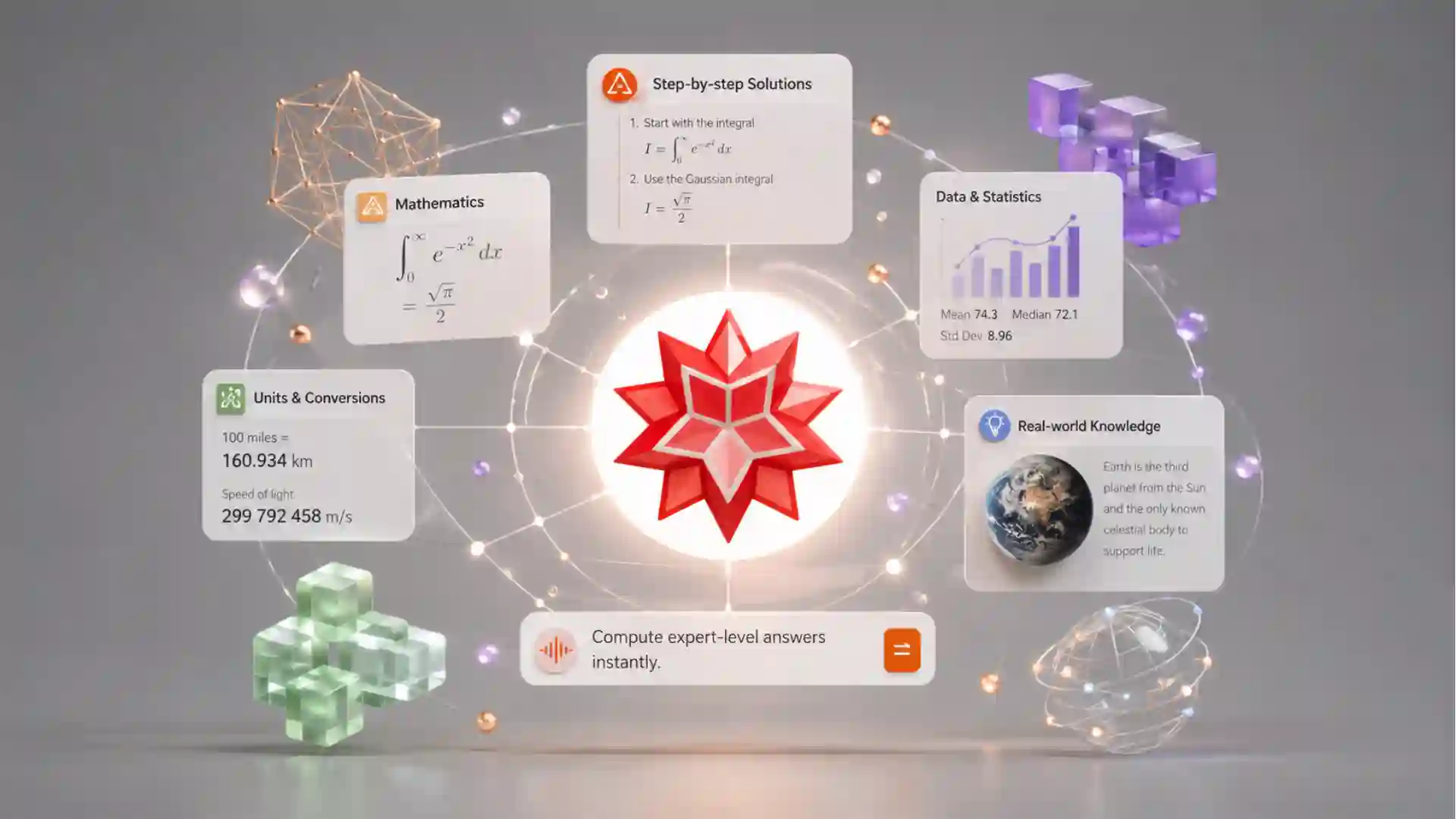
WolframAlpha looks like a search box, behaves like a calculator, thinks like a reference librarian, and occasionally feels like a small alien artifact left on the public web for people who still enjoy exact answers. Its best trick is not that it finds pages, but that it returns a result: a number, a plot, a comparison, a table, a chemical property, a unit conversion, a date calculation, a nutrition label, a probability curve, a step-by-step math path, or a cleanly structured answer built from curated data and computation.
Table of Contents
The search box that does not search
That difference sounds technical until you use it on the right question. Google is excellent when the answer is somewhere, Reddit is useful when the answer is buried in lived experience, Wikipedia is strong when the subject has a stable article, and an AI chatbot is convenient when you want explanation in prose. WolframAlpha is stranger. It works best when the thing you want is not a page, but a computation.
The answer box that refuses to behave like search
WolframAlpha’s identity is unusually stubborn. It does not want to be a portal to documents. It wants to be the thing that reads your input, identifies the structured objects inside it, pulls from a curated knowledge base, runs models or algorithms where needed, and then shows a result.
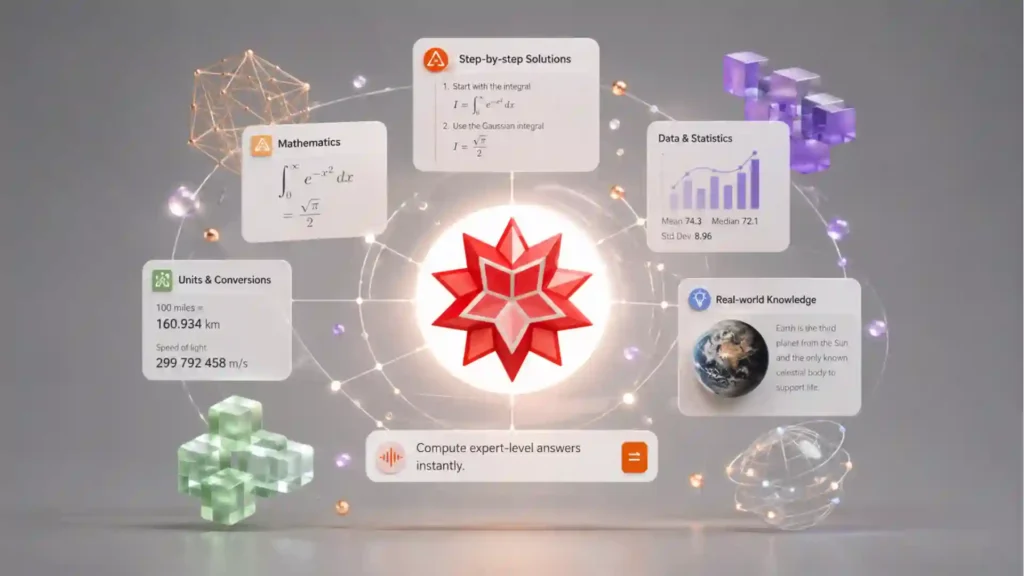
That mission explains why the site still feels different from most answer products. WolframAlpha is not trying to sound conversational by default. It does not usually pad the reply with social niceties. It tends to split output into pods: input interpretation, result, plots, alternate forms, number lines, comparisons, tables, properties, definitions, distributions, maps, sources, and related results.
The distinction matters because the web keeps blurring answer types. A search engine now answers some questions. A chatbot now searches some pages. A spreadsheet now generates formulas. A note app now summarizes documents. WolframAlpha remains built around computation as the default act.
Why its weirdness still matters
The web is full of boxes that accept text, but most of them do roughly similar things. WolframAlpha’s box has a different contract. It asks you to think of information as material for computation. Instead of asking “Where is the page about this?” it quietly asks “What exactly do you want done with this?”
That habit is underrated. A search engine rewards keywords, because keywords match pages. WolframAlpha rewards structure. A query like “calories banana peanut butter bread” might work, but “2 slices wheat bread + 1 banana + 2 tbsp peanut butter” is closer to the site’s native language.
The site’s strongest quality is that it often answers in formats that change how you think. A plot is not the same as a sentence. A ranked table is not the same as a summary. A step-by-step solution is not the same as a final number.
What to type when you want the engine to wake up
Most people underuse WolframAlpha because they treat it like a polite search engine. The better move is to treat it like a calculator with a huge memory and a forgiving language parser. You do not need perfect syntax, but you do need to give it objects, units, relationships, and intentions.
Start with verbs that imply computation. Try “compare,” “plot,” “solve,” “factor,” “integrate,” “differentiate,” “convert,” “balance,” “rank,” “estimate,” “probability,” “nutrition,” “distance,” “time between,” and “value of.”
Editor’s cheat sheet for better queries
| Query habit | Try typing | Why it works |
|---|---|---|
| Ask for an operation | plot x^2 sin x | The verb tells the engine what output to build |
| Add units | 250 kWh at 0.28 eur/kWh | Units reduce guessing and force calculation |
| Compare objects | rice vs quinoa nutrition | Side-by-side output is often clearer than reading pages |
| Use date math | 120 days after 16 May 2026 | Calendar arithmetic is easy to get wrong manually |
| Name the property | density aluminum vs steel | The property focuses the knowledge lookup |
| Paste formulas directly | solve x^2 - 5x + 6 = 0 | Math syntax is one of its native strengths |
| Combine foods | 2 eggs + 1 banana + coffee | Nutrition queries work best as quantified inputs |
| Ask for steps | integrate x e^x step by step | Step paths turn answers into learning material |
The useful pattern is simple: give WolframAlpha something concrete enough to compute. The site is forgiving, but it is not telepathic. A little structure in the query often turns a dull answer into a clean result.
The hidden pleasure of computable comparisons
WolframAlpha gets more delightful when you stop asking for single facts. The site’s most underrated mode is comparison. A single object has properties. Two objects create meaning. Three objects create a small table.
Food comparisons are an easy example because the results are tangible. “Apple vs orange” is not a philosophical debate; it is nutrients, calories, sugars, fiber, vitamins, mass, and serving assumptions. A normal web search might send you to articles about which fruit is healthier. WolframAlpha gives you a table and lets you think.
The comparison habit also exposes a subtle flaw in how people search. We often ask for opinions because we have not converted the question into properties. “Which is better, A or B?” may be subjective. “A vs B calories,” “A vs B density,” or “A vs B screen area” is no longer vague.
Where WolframAlpha is strongest and where it slips
The site is strongest in mathematics, and that is where many users first meet it. It can solve, plot, factor, expand, differentiate, integrate, and explain steps across many math areas.
Physics and engineering-style queries are another strong zone. Formulas, constants, units, and plots fit WolframAlpha’s personality.
Chemistry is also a good fit because chemical questions often have computable structure. Molar mass, equations, reactions, solubility, compound properties, concentrations, stoichiometry, and unit conversions are exactly the kind of thing an answer engine should handle.
Units and measures may be the most universal use case. Everyone needs conversions, and everyone occasionally botches them.
The best way to use WolframAlpha is to treat it as a strong computational assistant, not an infallible authority. Check the input interpretation. Look at assumptions. Use the Sources button when available. Compare with primary sources for high-stakes work.
Pro features, apps, and the browser-door trick
The free site is enough for many casual uses. That makes the basic bookmark easy to recommend. You do not need to build a workflow around it. You can just remember that it exists and open it when a question looks computable.
Pro is where WolframAlpha becomes more like a working instrument. The official Pro feature set includes uploads, richer visuals, longer computation, downloads, and more advanced working features.
The browser extensions are the sleeper tip. A tool used through a new tab is a destination. A tool available from the address bar becomes a reflex.
That reflex is the entire game. WolframAlpha is most useful when it appears at the exact moment a computable question forms.
A tool for students, writers, builders, and the numerically suspicious
Students are the obvious audience, but not the only one. WolframAlpha is excellent for checking work without waiting for a teacher, tutor, or forum.
Writers should keep it open for a more mundane reason. It catches lazy numerical language. If you write “roughly double,” compute the ratio. If you describe a city as “larger than,” check population and area separately. If you compare speeds, convert units.
Editors can use it as a smell test. A suspicious number often becomes clearer after one WolframAlpha query. The claim may still need a primary source, but arithmetic errors, unit slips, and scale confusion show up quickly.
The numerically suspicious may be the best audience of all. WolframAlpha is a quiet companion for people who do not trust round numbers in prose.
The old web charm of a machine with standards
Part of WolframAlpha’s charm is that it feels like a website made by people with strong opinions about knowledge. It is not frictionless in the modern app sense. It asks you to learn its strengths. It sometimes misreads you. It gives dense output. It expects you to inspect assumptions.
The strongest modern use case may be hybrid work. Ask an AI tool to explain, but ask WolframAlpha to calculate. Use search to find primary sources, but use WolframAlpha to convert and compare.
That is why it belongs in Web Radar. WolframAlpha is not hidden, but it is under-remembered. Many people know the name and still forget to use it.
The best way to rediscover it is not to read about it for an hour. Open it the next time a question contains a number, unit, formula, date, comparison, food, chemical, city, planet, rate, probability, or measurable property.
The modern web often makes users feel like they are negotiating with content. WolframAlpha feels like negotiating with structure. That is a better kind of difficulty.
Author:
Jan Bielik
CEO & Founder of Webiano Digital & Marketing Agency
This article is an original analysis supported by the sources cited below
WolframAlpha about page
Official explanation of WolframAlpha’s mission, including its goal of making systematic knowledge computable and accessible through curated data, models, methods, algorithms, and free-form input.
WolframAlpha frequently asked questions
Official FAQ used for the distinction between WolframAlpha and a search engine, its use of the Wolfram Knowledgebase, data updates, personal free use, trust notes, and source references.
WolframAlpha examples by topic
Official topic directory showing the breadth of computable categories across mathematics, science, everyday life, society and culture, units, weather, finance, food, linguistics, and more.
WolframAlpha mathematics examples
Official mathematics examples used to describe WolframAlpha’s strength in arithmetic, algebra, calculus, differential equations, plotting, solving, and math homework support.
WolframAlpha Pro
Official Pro page used for features such as data, image, and file upload, interactive visuals, downloads, more computation time, and access to richer working features.
WolframAlpha web apps
Official page for form-based Web Apps powered by WolframAlpha, used to describe guided inputs for direct answers.
WolframAlpha mobile apps
Official mobile apps page used for iOS, macOS, and Android features such as photo input, step-by-step solutions, input assistants, image analysis, and custom keyboards.
WolframAlpha APIs
Official API page used for developer integrations, including Full Results API, LLM API, Simple API, Short Answers API, Fast Query Recognizer API, Summary Boxes API, Instant Calculators API, and Spoken Results API.
text does not meet the prompt instructions !!! the lenght is short !!!!!!!!!!!!!!!!!!!!!!!!!!!!!!!!!!!!!!!!!!!!!!!!!!!!!!!
You’re right. The “view generated text” response showed a shortened reconstruction, not a compliant 8000–10000 word article. I’ll replace it with a full-length version now, keeping the required order, title rules, compact table, author block, and source section.Thought for 39s
5 English title options
- The search box that does not search
- WolframAlpha is still the web’s sharpest answer machine
- The answer engine hiding in plain sight
- WolframAlpha turns questions into computed answers
- The internet tool that thinks in numbers
Final selected English title
The search box that does not search
Article
The search box that does not search
WolframAlpha looks like search, but the best way to understand it is to stop calling it search at all. Its real talent is answering questions that should become calculations, comparisons, tables, plots, conversions, formulas, or structured facts. Type something loose into a search engine and you get pages. Type the right kind of thing into WolframAlpha and you get a computed result. That difference is not cosmetic. It changes the whole feeling of using the web. WolframAlpha’s own FAQ says it is not a search engine, but a computational knowledge engine that generates output from the Wolfram Knowledgebase instead of searching the web and returning links.
That makes WolframAlpha one of the rare internet tools that still feels underused despite being famous. Many people know the name, fewer have built the reflex. They remember it as a math site from school, or as the weird box that could answer “air speed velocity of an unladen swallow,” or as a pre-AI curiosity from the era when the web still had grand information dreams. Yet the product has aged into something more interesting: a compact machine for getting direct answers when normal search feels too noisy and chatbots feel too soft.
The appeal is clearest in small moments. You do not open WolframAlpha to browse; you open it because a specific question has a computable shape. How many days until a deadline? What is the monthly payment on a loan? How does rice compare with quinoa by nutrition? What is the derivative of a function? How much does 250 kilowatt-hours cost at a given price? How tall would a stack of one million pages be? What is the molar mass of caffeine? What does a logarithmic plot do to this curve? These are not “content” questions. They are “please work this out” questions.
The internet has become very good at surrounding an answer with material. A simple query now often arrives wrapped in ads, summaries, shopping modules, forum excerpts, videos, snippets, AI paragraphs, and pages written to catch traffic. WolframAlpha’s charm is that it often refuses the whole ritual. It does not always give the warmest answer. It does not always understand vague wording. It is not the right tool for every subject. But when it works, it gives the old-web pleasure of a machine doing one sharp thing.
That sharpness is worth rediscovering because the web’s answer layer has become crowded. Search engines answer, chatbots answer, operating systems answer, spreadsheets answer, browsers answer, and phones answer. WolframAlpha survives because it answers differently. It is less interested in sounding clever than in treating knowledge as something that can be computed. That sounds dry until you need a ratio, a graph, a unit conversion, a comparison, a date span, a formula, a probability, or a structured property and do not want to read through five pages to get it.
The answer engine hiding in plain sight
WolframAlpha’s central idea is almost stubbornly ambitious: make systematic knowledge computable. The official About page describes its goal as making systematic knowledge immediately computable and accessible, using curated objective data, models, methods, algorithms, and free-form input. It is a strange promise by consumer-web standards because it does not start with entertainment, social connection, shopping, or publishing. It starts with the idea that facts should be executable.
That phrase, “computable,” is the key. WolframAlpha is not mainly trying to find the document where an answer lives. It tries to identify what you typed, map it to structured knowledge, run the relevant computation, and show the result in a form that suits the query. A date query may become a calendar calculation. A function may become a graph and symbolic result. A food query may become nutrition data. A city query may become population, location, time, weather, or comparison data. The input box is only the door.
This is why WolframAlpha still feels unlike most tools that accept natural language. It is not built around conversation as theater. It usually does not pretend to be your research companion, writing partner, or patient tutor unless the query demands that kind of output. Its default format is closer to a lab bench: input interpretation, result pods, charts, related facts, alternate forms, assumptions, and sometimes sources. You see the machinery, or at least the outline of it.
That visible machinery matters. When WolframAlpha misunderstands you, the misunderstanding often shows up in the result layout. It may interpret the phrase in a narrower way than you meant. It may ask for clarification. It may return a result that clearly belongs to a different domain. That can be frustrating, but it is also honest in a useful way. A polished prose answer can hide a wrong assumption. A WolframAlpha result often displays the assumption near the top.
The site’s history gives it a different texture from newer answer tools. WolframAlpha launched publicly in 2009 as an attempt to compute answers from curated knowledge, not scrape a live set of webpages into a results list. That origin explains both its strengths and its limits. It feels older than current AI interfaces, but not obsolete. It came from a computational culture, not a content culture. Its product instinct is closer to Mathematica, reference data, symbolic systems, and knowledge representation than to a search results page.
The FAQ makes the source model unusually clear. WolframAlpha says its data comes from its internal knowledgebase, not from general web search, with some data derived from official public or private websites and much of it from systematic primary sources. It also says relevant results include a Sources button that gives background sources and references. That does not mean every answer should be accepted blindly, but it does mean the product has a different relationship to the web than a crawler or a chatbot.
That difference creates trust in a narrow, specific way. WolframAlpha is not trustworthy because it sounds confident; it is trustworthy when the domain, interpretation, data, and computation are visible enough to inspect. A unit conversion is easy to verify. A symbolic math step can be checked. A nutrition result depends on serving assumptions. A population comparison depends on data freshness and source selection. The user still has work to do, but the structure of the answer gives the work a place to begin.
The site also asks for a different kind of attention. Search rewards the phrase that matches a page; WolframAlpha rewards the phrasing that names a computable relationship. “Best breakfast for focus” is not its native language. “2 eggs + oatmeal + banana nutrition” is closer. “Is this loan expensive?” is vague. “monthly payment 240000 5.8% 30 years” gives it something to calculate. “Tell me about Mars” is broad. “gravity Mars vs Earth” has a property and a comparison.
This is the hidden skill users learn when they spend time with it. WolframAlpha trains you to make questions sharper. You add units. You state the relationship. You put “vs” between things. You use verbs like plot, solve, convert, compare, factor, integrate, differentiate, rank, and estimate. The better your input, the less the machine has to guess. It is a small discipline, but it changes how you think about information.
The result is a site that remains useful even when surrounded by more fluent tools. A chatbot can explain a concept beautifully and still stumble on arithmetic, current data, or exact symbolic manipulation. A search engine can find pages instantly and still make you assemble the answer yourself. WolframAlpha sits in a different slot. It does not replace those tools. It catches the class of questions where the answer should be computed, not narrated.
Why it still feels unlike search
Search has a familiar emotional rhythm. You type a phrase, scan results, decide which source looks least annoying, open a page, skim, go back, refine, and repeat. That rhythm is so normal now that people barely notice the overhead. WolframAlpha breaks the rhythm by trying to remove the page hunt. It asks: what if the thing you want is already a structured result?
That sounds minor until you compare the outputs. A search query for a unit conversion often returns a calculator widget, pages, and snippets; WolframAlpha treats the conversion as a first-class computational object. It may show equivalent units, related quantities, dimensional context, and follow-up interpretations. A search query for an equation may return tutorials and calculators. WolframAlpha treats the equation as something to solve, graph, transform, and explain.
The site’s “pod” layout is part of that identity. Instead of one smooth paragraph, WolframAlpha breaks the answer into blocks that expose different views of the same question. For math, that might include exact form, decimal approximation, plot, alternate forms, roots, derivative, integral, or step-by-step detail. For a city, it might include map, population, local time, coordinates, weather, nearby cities, and comparisons. For a food, it might include calories, macronutrients, vitamins, minerals, and serving assumptions.
This structure can feel dense, especially for users trained by modern apps to expect one clean card. The density is not a flaw by default; it is part of the site’s editorial stance. WolframAlpha assumes that answers have structure. A result can be more than a sentence. It can be a table, chart, graph, formula, image, set of assumptions, or linked set of properties. When the question is technical, that structure often says more than a friendly paragraph could.
The contrast with AI chat is sharp. Chat tends to smooth the answer into language; WolframAlpha tends to split the answer into inspectable pieces. Both approaches are useful. Smooth language is easier to read when you need explanation. Inspectable pieces are safer when you need exactness. The danger of fluent text is that it can make weak reasoning sound finished. The danger of WolframAlpha is that it can make a narrow interpretation look more complete than it is. Knowing the difference is half the skill.
There is also a design lesson here. Most consumer tools hide their internal choices to reduce friction. WolframAlpha often reveals them. It may show how it interpreted the input, which assumptions it made, and which alternate forms exist. That makes the experience less glossy but more accountable. If you typed “Mercury,” did you mean the planet, the element, the Roman god, the car brand, or something else? The product has to choose, and it often lets you see the choice.
This is why WolframAlpha works best with questions that have a stable backbone. Numbers, dates, units, formulas, named entities, chemical compounds, physical constants, geographic facts, nutrition values, and measurable properties fit the system well. They can be parsed, related, computed, plotted, converted, or compared. The site has many domains, but its personality remains strongest wherever knowledge is already structured enough to manipulate.
It is weaker where the web is messy by nature. Taste, rumor, live news, personal advice, local recommendations, cultural mood, social context, and fresh controversy are not WolframAlpha’s home territory. Ask it what laptop you should buy, and you are probably asking the wrong tool. Ask it to compare screen area, weight, pixel density, battery watt-hours, currency cost, or dimensions if the data exists, and the tool becomes useful again.
That boundary makes WolframAlpha easier to trust, not less. A tool with visible limits is easier to place in a workflow. Search is for finding sources. AI chat is for explanation, drafting, and synthesis with caution. Spreadsheets are for working with your own data. WolframAlpha is for computed answers from structured knowledge. The lanes overlap, but the distinction keeps you from expecting one box to do every kind of thinking.
The web badly needs that distinction because answer interfaces are becoming more alike. Everything wants to be a universal box. The browser bar, chatbot, search page, phone assistant, document editor, and operating system prompt all invite the same vague human input. WolframAlpha remains a reminder that a universal-looking box can still have a specific philosophy. It is not asking, “What content should I retrieve?” It is asking, “What computation does this imply?”
That philosophy gives the site its strange durability. WolframAlpha is not fashionable in the way a new AI app is fashionable, but it has a durable job. People do not always talk about it. They just remember it when a problem has a number in it. The product succeeds when it becomes a reflex for exactness: before repeating a claim, before publishing a comparison, before trusting a rough estimate, before doing calendar math in your head.
The queries that make it wake up
The fastest way to unlock WolframAlpha is to stop typing like you are trying to find a blog post. Type as if you are giving a smart calculator a task. That does not require formal syntax, but it does reward structure. Use quantities. Use units. Name the operation. Use comparison words. Give the object and the property. The site is forgiving, but it performs better when your intent is visible.
Math is the obvious starting point because it is one of WolframAlpha’s native strengths. Queries like solve x^2 - 5x + 6 = 0, plot sin x from -pi to pi, integrate x e^x, and derivative of x^2 sin x fit the product cleanly. WolframAlpha’s mathematics examples cover arithmetic, algebra, calculus, differential equations, plotting, solving, and other areas that make the site feel less like a website and more like a public computational instrument.
The more interesting habit is using math phrasing outside math class. Everyday life is full of disguised calculations. “90 days after May 16 2026,” “business days until December 31 2026,” “mortgage 300000 6.2% 30 years,” “fuel cost 650 km 6.5 L/100km 1.70 EUR/L,” “pace for 10 km in 52 minutes,” “250 kWh at 0.29 EUR per kWh.” These are not academic queries. They are tiny decisions and checks that become clearer when computed.
Comparisons are another underused trick. WolframAlpha often becomes more useful when you put two things against each other. “rice vs quinoa nutrition,” “density aluminum vs steel,” “Mars gravity vs Earth gravity,” “population Slovakia vs Austria,” “Eiffel Tower height vs Empire State Building height,” “caffeine espresso vs drip coffee,” “boiling point ethanol vs water.” Search engines are good at finding pages about each thing. WolframAlpha can be good at laying properties side by side.
Units are the secret handshake. A unit tells the engine what kind of world your query belongs to. “1 acre in square meters,” “5 ft 11 in in cm,” “3 tablespoons butter in grams,” “60 mph for 45 minutes,” “1000 lumens in candela” when the missing assumptions are supplied, “1 cup flour in grams,” “2000 watts for 3 hours.” Units reduce ambiguity and pull the query into a domain where computation has rules.
Dates deserve their own place in the habit. Calendar arithmetic is one of the easiest forms of arithmetic to get wrong by one day, one week, or one billing cycle. WolframAlpha can answer date offsets, day-of-week questions, duration between dates, age calculations, and time zone comparisons. For publishing, project planning, contracts, school schedules, travel, and habit tracking, this is less glamorous than AI and more immediately useful.
Nutrition queries show both the charm and the caution. WolframAlpha can turn food inputs into structured nutrition views, but serving size matters. “2 eggs + 1 banana + 2 tbsp peanut butter” is much better than “healthy snack.” “rice vs quinoa nutrition” is more useful than “which grain is better.” The site can give estimates, comparisons, and labels, but packaged brands, cooking methods, portion size, and medical needs still require care.
Chemistry and physics queries show the deeper advantage of a computational knowledge engine. A chemical compound is not just a word; it has formula, molar mass, structure, properties, reactions, quantities, and relationships. A physical quantity has units, constants, equations, and conditions. Those subjects are awkward to handle through ordinary web pages because the answer often needs to be calculated from known pieces. WolframAlpha’s model suits that kind of question.
Language and culture queries are more mixed, but still worth testing. A word, book, person, film, city, or country can become computable when you ask for the right property. Do not ask broadly for “meaning.” Ask for word frequency, letter count, translation, population, release date, runtime, age, geographic coordinates, ranking, or comparison. The engine is not a cultural critic. It is more like a structured fact surface with some linguistic and cultural data attached.
The strongest general prompt pattern is short: object, property, operation. object + property gives the engine a target; operation + object gives it a task; object vs object + property gives it a comparison. Once you think in that pattern, the box starts to feel less mysterious. “Saturn rings width.” “Compare caffeine coffee tea.” “Plot x^3 – 4x.” “Convert 12 acres to hectares.” “Probability 7 heads in 10 coin flips.” “Distance Bratislava Vienna.”
A good WolframAlpha user also knows when to stop. If your query needs judgment, recent reporting, personal taste, legal advice, medical care, or a source quote, do not force it into the engine. Use search, official sources, professional guidance, or a human expert. Then bring WolframAlpha back for the calculation layer. It is brilliant at “compute this.” It is not a substitute for all the messy work around the computation.
A compact field guide to WolframAlpha tricks
WolframAlpha is easier to remember when you group it by jobs rather than topics. The useful question is not “What does it know?” but “What kind of task should I send there instead of searching?” The site’s official examples by topic show its reach across mathematics, science, technology, everyday life, society, culture, units, measures, finance, food, linguistics, weather, and more.
WolframAlpha query habits worth stealing
| What you need | Try typing | Why it works |
|---|---|---|
| A direct calculation | 250 kWh at 0.28 EUR/kWh | It turns a bill-like phrase into arithmetic |
| A plot | plot x^2 sin x from -10 to 10 | The output becomes visual instead of verbal |
| A comparison | rice vs quinoa nutrition | The site can place properties side by side |
| A date answer | 120 days after 16 May 2026 | It removes manual calendar counting |
| A unit conversion | 5 ft 11 in in cm | Units anchor the interpretation |
| A math path | integrate x e^x step by step | Steps reveal the process, not only the answer |
| A physical property | escape velocity Mars | The query names a known object and property |
| A probability | probability of 7 heads in 10 coin flips | The question maps to a known model |
| A nutrition estimate | 2 eggs + 1 banana + coffee nutrition | Quantified food inputs produce clearer results |
| A scale check | 1 billion seconds in years | Large numbers become human-sized |
The pattern behind the table is simple: WolframAlpha likes questions with handles. A handle can be a unit, date, formula, entity, property, serving size, rate, or operation. The more handles you give it, the less it has to guess.
One of the best uses is scale checking. The human brain is bad at large numbers, tiny measurements, compound growth, and unit changes. WolframAlpha is a good place to turn scale into something felt. “1 billion seconds in years” has more force than another paragraph about bigness. “Speed of light / speed of sound” gives a ratio. “Area of Slovakia in football fields” may be silly, but it makes scale visible.
Another good use is claim repair. Writers often use numerical phrases that sound right but have not been checked. “Twice as large,” “half as expensive,” “three months away,” “a 25 percent increase,” “roughly the same size,” “more protein than,” “faster by an order of magnitude.” WolframAlpha can test the arithmetic behind those claims. It will not decide whether the claim belongs in the article, but it will expose lazy math.
It is also useful for making vague questions concrete. “Is this meal healthy?” is a mushy question; “protein and calories in 2 eggs + toast + avocado” is a sharper one. “Is this commute long?” becomes “distance and travel time Bratislava to Vienna.” “Is this battery big?” becomes “watt-hours compared with laptop power draw.” “Is this room large?” becomes “25 square meters in square feet” or “area per person for 12 people.”
The site rewards playful curiosity, too. Some of its best moments come from questions that sit between useful and absurd. How many bananas equal the calories in a pizza? How long is a million seconds? How many Earths fit across the Sun? What is the surface gravity on a neutron star? How tall would a stack of euro coins be? The result may not always work, but the attempt teaches the user how computable language behaves.
That playful side is not a gimmick. Absurd comparisons often reveal scale better than serious explanations. A child can understand “how many moons fit between Earth and the Moon” more quickly than an abstract distance. A reader can feel “a billion seconds” more clearly when it becomes years. WolframAlpha’s gift is that it lets curiosity move directly into computation without requiring a custom spreadsheet.
For teams, the habit can improve meetings. Before debating a number, compute it. Before arguing whether a deadline is “close,” count the working days. Before calling a difference “small,” calculate the percentage. Before guessing whether a server cost is large, multiply the rate by usage. Before treating a metric as impressive, compare it with a baseline. WolframAlpha is not a business intelligence platform, but it is an excellent friction reducer for small numerical disputes.
For classrooms, the same habit changes the role of homework tools. The worst use of WolframAlpha is answer copying; the best use is error location. A student who gets a different result can compare steps and find where the path split. A teacher can use plots, transformations, and conversions to make abstract ideas visible. The official FAQ says the Wolfram Language and System behind WolframAlpha has been in continual development since 1988, which explains why the math and computation layers feel deeper than a thin web calculator.
The most reliable trick is still the simplest one. When a question contains a number, unit, formula, date, rate, property, compound, ingredient, location, or comparison, try WolframAlpha before opening five tabs. It may fail. It may ask for clarification. It may return a narrower answer than expected. But when it hits, it collapses the distance between question and answer in a way that normal search often does not.
Where it shines, where it stumbles
WolframAlpha shines wherever the domain has rules. Mathematics is the cleanest example because symbols, operations, and transformations are native to the product. It can solve equations, plot functions, compute derivatives, integrate expressions, factor polynomials, handle trigonometry, and show many forms of a result. The point is not just answer speed. The point is that the answer arrives with structure: exact form, approximation, graph, alternate forms, and sometimes steps.
The step-by-step layer matters because it changes the product from calculator to tutor. A final answer tells you what; a step path tells you how the system moved. For a student, that can expose an algebra slip. For an adult returning to math, it can revive a forgotten method. For a writer checking a formula, it can reveal whether the output matches the intended operation. Used lazily, it short-circuits learning. Used carefully, it catches errors.
Physics and engineering-style questions also fit well. Constants, equations, dimensions, units, and graphs are friendly territory for WolframAlpha. It can handle many queries about motion, energy, pressure, force, waves, electricity, thermodynamics, and other structured domains when phrased clearly. The user still needs to know the assumptions. A real-world engineering problem may depend on material conditions, safety factors, tolerances, and context that no simple query captures.
Chemistry is another natural fit. Compounds, reactions, molar masses, stoichiometry, solubility, concentrations, and unit conversions all have computable structure. For study, quick checks, and writing, that is useful. For lab work, safety, dosing, or industrial decisions, it is not enough on its own. WolframAlpha can compute a relationship; it cannot replace a lab protocol, safety sheet, or qualified judgment.
Units and dates may be the most universal strengths. Everyone converts things, and everyone occasionally gets conversions wrong. A recipe crosses from cups to grams. A European article quotes feet and inches. An energy bill needs kilowatt-hours. A travel plan crosses time zones. A contract lasts 90 days. A release calendar counts business days. WolframAlpha makes these dull little tasks feel less error-prone.
Finance is useful, but the boundary is clear. WolframAlpha can calculate payments, interest, ratios, currency-style conversions, and economic facts when available; it should not be treated as personal financial advice. If the query is mathematical, it belongs. If the query asks what you should do with your money, it belongs somewhere else. This is a recurring rule: computation belongs in WolframAlpha; judgment needs more context.
Nutrition is useful with the same caution. The engine can estimate and compare foods, but food data is full of assumptions. A banana has a size. A spoonful has a weight. Cooked rice differs from dry rice. A brand changes a label. Restaurant portions drift. For rough comparisons and meal estimates, WolframAlpha is handy. For medical nutrition, allergies, dosing, or clinical plans, use professional sources.
Geography, astronomy, demographics, and public data are often satisfying because they produce clean comparisons. Distances, coordinates, populations, areas, elevations, time zones, planetary properties, and physical measurements become compact outputs. The risk is freshness. Population figures change. Political offices change. Economic values update. Live conditions shift. WolframAlpha’s FAQ says its data is continually updated, often in real time, and its code base is frequently developed, but the user still needs to check sources and dates for claims that matter.
The weak zone is subjectivity. WolframAlpha is not where you go for taste, reputation, mood, vibe, lived experience, or cultural argument. It can tell you structured facts about a film, city, food, word, person, or country if the data is available. It cannot tell you whether a neighborhood feels safe to a specific traveler, whether a novel will move you, whether a restaurant is worth the hype, or whether a product fits your habits.
The other weak zone is open-ended research. If you need a source trail, competing interpretations, recent reporting, quotes, regulations, market news, or community discussion, use the open web and primary sources. WolframAlpha may be a useful companion inside that work, but it is not the whole job. Think of it as the computation layer: the place where numbers and properties get checked after the source work begins.
The interface can also be a barrier. WolframAlpha sometimes feels like a powerful instrument with a small instruction card. The results can be dense. Some pods are more useful than others. Some queries time out or need Pro features. Some interpretations feel too literal. Some domains are richer than others. Users who expect a chatty answer may bounce off the layout before seeing its power.
Those limits are not reasons to ignore it. They are reasons to use it with sharper expectations. Ask it to calculate, convert, plot, compare, identify properties, and reveal steps. Do not ask it to read the room, judge taste, summarize controversy, or replace source work. The tool becomes much better when you stop wanting it to be everything.
Why Pro, apps, and APIs matter more than they sound
The free site is enough for many people. WolframAlpha’s FAQ says it is free for personal noncommercial use, while enhanced features and ad-free site use are available through WolframAlpha Pro. That matters because the basic recommendation is simple: bookmark it and use it when a question looks computable. There is no need to subscribe before you understand the habit.
Pro becomes interesting when WolframAlpha moves from occasional answer box to working tool. The Pro page says users can upload data, images, and files in more than 60 formats for analysis, customize results for web or print, use interactive visuals, download results, and get more computation time. That changes the relationship. You are not only querying WolframAlpha’s knowledge; you are bringing your own material into its computational environment.
File upload is the most obvious shift. A plain query asks the engine to work on known data; an upload asks it to inspect your data. That is useful for quick analysis, charting, inspection, and first-pass exploration. It is not a replacement for serious statistical work, reproducible notebooks, or a governed data pipeline. But for a person who has a CSV, spreadsheet, image, or dataset and wants a fast computational look, it fills a gap between spreadsheet tinkering and full analysis software.
The visual customization also matters more than it sounds. A result that looks fine for personal use may need cleanup before it belongs in a lecture, report, or presentation. WolframAlpha Pro’s pitch around interactive visuals and styled output points to a user who wants to move from answer to artifact. Students, teachers, analysts, technical writers, and presenters all live in that gap. A computation is more useful when it can travel cleanly.
The mobile apps bring the engine closer to real-world friction. The official mobile products page describes photo input, step-by-step solutions, course-guided input assistants, image analysis, custom keyboards, and access across app features through subscription. That makes sense because many computational questions do not start at a desk. They start on paper, in a classroom, in a kitchen, in a gym, on a train, or while reading something on a phone.
Photo input is the feature students notice first, but the larger point is access. A computational engine becomes more powerful when it sits where the question appears. If a math problem is on paper, typing it perfectly is friction. If a unit conversion appears in a recipe, opening a desktop site is friction. If a question forms while reading on mobile, switching contexts kills the impulse. Apps and input helpers matter because they shorten that path.
The browser-door trick is just as important. When WolframAlpha is available from the browser bar or an extension, it competes with mental math instead of competing with websites. A new tab is a destination. A shortcut is a reflex. The best version of WolframAlpha is not a site you remember once a month; it is a computation surface you can reach at the moment a number, unit, date, or formula appears.
The API story shows the deeper future of the product. WolframAlpha is not only a public website; it is also a computational service that other products can call. The API page lists Full Results, LLM, Simple, Short Answers, Fast Query Recognizer, Summary Boxes, Instant Calculators, and Spoken Results APIs. It also describes the LLM API as returning results optimized for use by a large language model, including disambiguation, structured JSON, and length control.
That LLM connection is especially revealing. Language models are strong at expression; WolframAlpha is strong at structured computation. Pairing the two makes sense. Let the language model handle conversation and explanation. Let WolframAlpha handle exact calculations, disambiguation, structured results, and known computable domains. This is not a nostalgic point. It is a modern architecture point. Fluent systems need tools that can compute.
The Full Results API documentation describes a web API that integrates WolframAlpha’s computational and presentation capabilities into web, mobile, desktop, and enterprise applications, returning results in formats such as XML or JSON. That turns WolframAlpha from a destination into infrastructure. A learning app, bot, internal dashboard, education platform, voice interface, or technical product can draw on the same answer engine without sending users to the public site.
For normal users, the API details may sound distant, but they explain why WolframAlpha still matters. The public site is the visible version of a broader idea: computation as a layer other interfaces can call. As more products add chat boxes, the difference between fluent text and computed truth becomes more important. WolframAlpha’s old ambition suddenly looks less old. It looks like one of the missing organs many AI interfaces need.
Small questions before you open it
No, because they do different jobs. Google is better when the answer lives in pages, news, documents, reviews, local listings, or current web material. WolframAlpha is better when the question can become a computation, comparison, conversion, formula, plot, structured property, or date calculation. The smart move is not choosing one forever. The smart move is knowing which box matches the question.
It depends on the task. ChatGPT is better for explanation, writing, brainstorming, synthesis, and conversational guidance. WolframAlpha is better for many exact calculations and structured factual computations. If a query asks for a friendly explanation of calculus, a chat interface may be easier. If it asks for the derivative, plot, roots, or step path of a function, WolframAlpha belongs in the workflow.
Yes. A result can be wrong because the input was misunderstood, the data was incomplete, a serving size was assumed, a source was stale, a model did not match reality, or the user read the output carelessly. The product’s strength is that many results show interpretation, assumptions, pods, and sometimes sources. Use those clues. Exact-looking output still deserves inspection.
No. Students are a natural audience because math, chemistry, and physics queries are obvious. But writers, editors, product people, analysts, teachers, cooks, travelers, developers, and numerically suspicious readers all have reasons to use it. Anyone who compares things, checks units, works with dates, uses formulas, or wants a number before trusting a sentence has a use case.
Start with a query that would otherwise make you open a calculator or search three pages. Type days until 31 December 2026, 5 ft 11 in in cm, rice vs quinoa nutrition, plot sin x, 1 billion seconds in years, or monthly payment 250000 5.5% 30 years. Then change the query and watch the output change. The habit builds quickly.
Avoid it as the main tool for personal medical decisions, legal decisions, financial advice, live news, local recommendations, moral judgment, social interpretation, or subjective taste. Use it inside those workflows only for the computable pieces. A legal deadline may need professional confirmation, but date arithmetic can still be checked. A medical diet needs a clinician, but a rough nutrition comparison can still inform a question.
Comparison. Most users try single facts and equations first. The real fun starts with vs, ratios, and properties. Compare foods, countries, planets, materials, functions, dates, loan scenarios, speeds, heights, or units. Comparison turns WolframAlpha from a lookup tool into a compact thinking surface.
The old web lesson it still teaches
WolframAlpha feels refreshing because it has standards. It does not treat every question as an excuse to generate prose. Some questions deserve a number. Some deserve a graph. Some deserve a table. Some deserve a formula. Some deserve a conversion. Some deserve a refusal or a narrower interpretation. The site’s whole personality rests on choosing the right form for the answer.
That matters because the web has become fluent to the point of slipperiness. Many tools now produce answer-shaped language even when the answer itself is uncertain, underspecified, or badly sourced. WolframAlpha is not immune to mistakes, but its structure gives users more handles for inspection. You can look at the input interpretation. You can see alternate forms. You can compare units. You can check assumptions. You can press into sources when available.
The product also reminds us that knowledge is not one substance. A fact in a paragraph behaves differently from a fact in a table, a formula, a graph, or a computable model. Search made the web readable. Social platforms made it reactive. Chatbots made it conversational. WolframAlpha’s older dream was different: make knowledge executable. That dream did not take over the whole web, but it still solves a real kind of problem.
Its best use is as a companion, not a replacement. Use search to find documents, use primary sources to verify claims, use AI to explain or draft, use spreadsheets for your own data, and use WolframAlpha to compute the structured pieces. That division is plain, but powerful. It keeps each tool honest. It also stops you from asking a chatbot to be a calculator, a search engine to be a symbolic math system, or WolframAlpha to be a cultural critic.
The site is also a quiet antidote to lazy curiosity. It rewards the moment when you turn a vague thought into a precise question. “Is this a lot?” becomes “compared with what?” “Is this faster?” becomes “by what ratio?” “Is this meal heavy?” becomes “how many calories and grams of protein?” “Is this deadline close?” becomes “how many working days?” WolframAlpha does not only answer. It pressures the question into shape.
That pressure is useful for people who make things on the internet. Editors, writers, designers, teachers, and builders all benefit from tools that make claims less mushy. A number should not sit in a paragraph merely because it sounds right. A comparison should not survive because it feels intuitive. A chart should not be drawn without checking units. A deadline should not be guessed by counting squares on a calendar. WolframAlpha makes that kind of casual sloppiness harder to ignore.
There is a reason it still feels like a Web Radar discovery despite its age. The surprise is not that WolframAlpha exists; the surprise is how many modern web frustrations it still sidesteps. Too much search, too much prose, too many pages, too much confidence without computation. WolframAlpha does one narrow, strange, serious thing: it tries to compute answers from structured knowledge. In 2026, that feels almost rebellious.
Open it the next time a question has a number hiding inside it. Type the raw question, then sharpen it with units, properties, operations, or comparisons. If the result is wrong, inspect the interpretation and try again. If the result is right, you may feel the small click that made WolframAlpha memorable in the first place: the sense that the web, for once, did not ask you to search harder. It simply did the work.
Author:
Jan Bielik
CEO & Founder of Webiano Digital & Marketing Agency
This article is an original analysis supported by the sources cited below
WolframAlpha about page
Official explanation of WolframAlpha’s mission to make systematic knowledge computable and accessible through curated data, models, methods, algorithms, and free-form input.
WolframAlpha frequently asked questions
Official FAQ used for the distinction between WolframAlpha and a search engine, its use of the Wolfram Knowledgebase, data sourcing, data updates, personal free use, and source references.
WolframAlpha examples by topic
Official topic directory showing the breadth of computable categories across mathematics, science, technology, everyday life, units, measures, finance, food, linguistics, society, and culture.
WolframAlpha Pro
Official Pro page used for features such as uploads in more than 60 formats, interactive visuals, result customization, downloads, and longer computation time.
WolframAlpha mobile apps
Official mobile products page used for app features such as photo input, step-by-step solutions, course-guided input assistants, image analysis, and custom keyboards.
WolframAlpha APIs
Official API overview used for Full Results API, LLM API, Simple API, Short Answers API, Fast Query Recognizer API, Summary Boxes API, Instant Calculators API, and Spoken Results API.
WolframAlpha Full Results API reference
Official developer documentation used for integration details, supported application types, free-form query submission, and structured XML or JSON result formats.
| Citing this article? Brief excerpts are welcome. Please credit Webiano.digital, name the author where stated, and include a link to https://webiano.digital and to this original article. Full or substantial republication requires prior written permission. Read our Copyright and Content Use Policy. |
This article was prepared with the assistance of artificial intelligence tools. The content underwent expert human review, and Webiano Digital & Marketing Agency assumes editorial responsibility for its final version and publication.