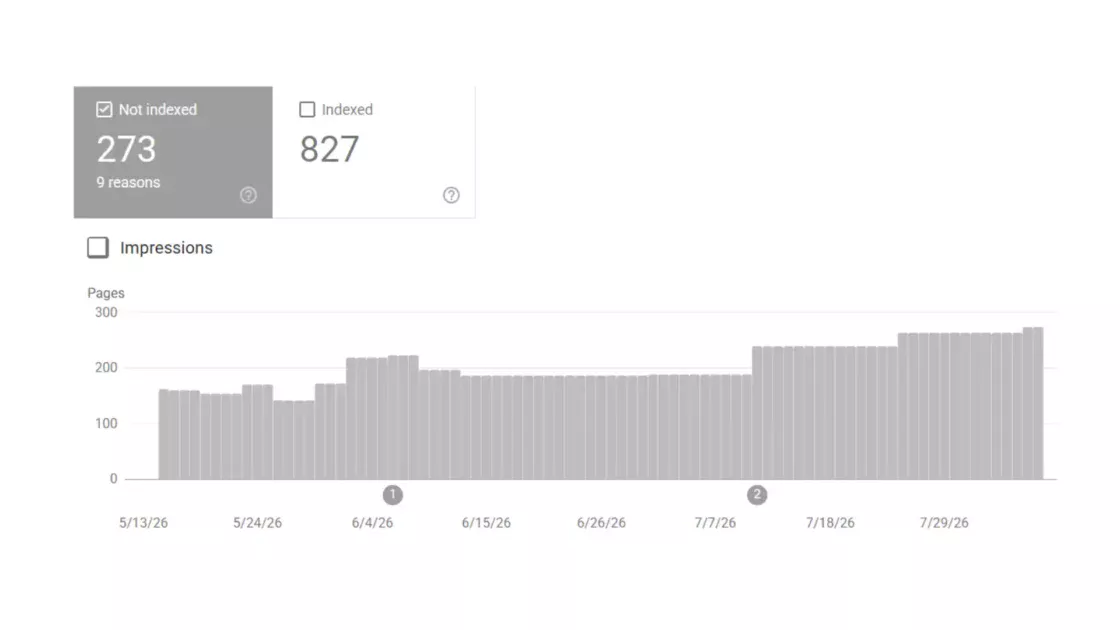
The screenshot shows a Google Search Console host status warning that many site owners underrate: server connectivity was acceptable recently, but failed at a high rate in the past. That is not a cosmetic technical note. It means Googlebot tried to request URLs and, for some period, the server did not answer reliably or did not return a complete response. Before rankings, before structured data, before AI Overviews, before topical authority, before brand signals, a crawler has to reach the page.
Table of Contents
Google describes Search as a process that begins with crawling, then indexing, then serving results. Crawling is where Google downloads text, images, and video from discovered pages; indexing is where Google analyzes and stores what it found; serving is where results are returned for a query. A site that fails at the crawl layer is not merely “slow.” It is partially invisible at the point where search visibility begins.
Server connectivity is the first visibility test
Search systems do not begin by judging the quality of a headline, the originality of an article, or the depth of an author profile. They begin with a network request. Server connectivity is the first technical test a site must pass because every later search and AI process depends on a successful fetch.
Google’s technical requirements for eligibility in Search are blunt. Googlebot must not be blocked, the page must work with an HTTP 200 success status, and the page must contain indexable content. Google also says indexing is not guaranteed even when these requirements are met. That wording matters because it places server availability below every editorial ambition: a page can be excellent and still lose visibility if Google cannot access it reliably.
The Search Console message in the screenshot is therefore a record of a past access problem. Google is saying it did not recently face major difficulty crawling the site, but it did earlier. The “Server connectivity” line says the failed crawl rate is now acceptable, while the historical chart shows a large spike around mid-February and smaller later incidents. That pattern is typical of an outage, overloaded origin, CDN issue, firewall rule, bad bot-protection setup, or platform maintenance window that returned incomplete responses.
The reason this matters for AI visibility is direct. Google’s AI features still rely on the broader Search infrastructure. Google’s own AI features documentation says the same SEO best practices remain relevant for AI Overviews and AI Mode, and that a page must be indexed and eligible to appear in Google Search with a snippet to be shown as a supporting link. No crawl, no index. No index, no supporting link. No supporting link, no chance to be cited or surfaced in that search experience.
Server connectivity is often treated as a hosting issue. For search, it is a distribution issue. For AI search, it becomes a retrieval issue. When AI systems, search engines, and crawlers cannot fetch the source, the page becomes less available to the systems that decide what users see.
The screenshot shows a past crawl trust problem
The green icon in the screenshot can be misleading. It does not mean nothing happened. It means the current fail rate is acceptable, while the host had problems in the past. Google’s Crawl Stats report assesses host availability through robots.txt fetching, DNS resolution, and server connectivity. It says a significant error in any of those categories can lower host availability, and the report uses a dotted red line to mark the threshold above which an issue is recorded.
In this case, robots.txt fetch and DNS resolution are shown as acceptable. The problem is server connectivity. Google’s description of that category is precise: the graph shows when the server was unresponsive or did not provide a full response for a URL during crawling. That is a crawl delivery failure, not an editorial problem.
A short spike can still matter. Crawlers do not experience a site the way a human visitor does. A human may visit once and reload if something fails. Googlebot may be fetching thousands of URLs, resources, redirects, sitemaps, images, feeds, JavaScript files, CSS files, and canonical URLs over many hours. A five-minute infrastructure problem during an intense crawl window can create a visible error spike even if most customers never complain.
The chart in the screenshot appears to show a heavy failure event early in the 90-day window, followed by lower-level instability. The high historical spike is the part to investigate. A site owner should not stop at “acceptable recently.” The operational question is: what exact system failed, and will the same failure return during the next crawl surge, product launch, news spike, migration, sale, or bot-protection update?
Search Console is useful here, but it is not the whole investigation. It shows that Google had a problem. It does not always show why the origin failed, which firewall rule fired, which CDN edge returned an error, which upstream timed out, or whether Googlebot was incorrectly challenged. Server logs, CDN logs, load balancer logs, web application firewall logs, DNS monitoring, uptime records, and application error traces are needed to reconstruct the incident.
Crawling is the supply chain for search and AI systems
A publisher, brand, SaaS company, ecommerce store, or local service site often thinks of visibility as a content problem. Better articles, better category pages, better structured data, better author pages, better FAQs. Those things matter only after the content enters the machine-readable supply chain.
The supply chain begins with discovery. Google finds URLs through links, sitemaps, and previous crawl history. It then requests the URL. If the server returns a valid response, Google can process the document, render where needed, extract links, evaluate canonical signals, read structured data, assess page content, and place eligible content into the index. Google’s Search documentation divides the process into crawling, indexing, and serving; that order is not decorative.
AI search adds more pressure to this chain because answer engines often need fresh, retrievable, source-backed material. Google says AI Overviews and AI Mode may use a “query fan-out” technique, issuing multiple related searches across subtopics and data sources to build a response. That makes accessibility more valuable, not less. AI search is not a magic layer that bypasses technical SEO. It intensifies the need for pages that can be found, fetched, parsed, indexed, and trusted.
This is why server connectivity is more than uptime. Uptime monitoring usually asks whether one URL returns a response from one or several test locations. Crawling asks whether many URLs, resources, and rules are consistently available to automated clients over time. A homepage can be up while product pages return intermittent 502 errors. A blog can load for humans while the firewall challenges Googlebot. A page can work in a browser while server-side rendering fails under crawler load. A CDN can serve cached HTML while blocking robots.txt or sitemap requests.
The crawler supply chain is only as strong as its weakest technical dependency. DNS, TLS, CDN routing, origin capacity, application performance, robots.txt, redirects, status codes, canonical links, internal links, sitemap freshness, structured data access, and bot authentication all touch the same path. A server connectivity warning is a signal that this path broke under real crawler conditions.
Host status matters before content quality is judged
Content quality cannot rescue a page that search systems fail to fetch. That point sounds obvious, yet many SEO audits still bury host availability below keyword research, title tags, schema markup, or link analysis. The order should be reversed for any site with a Search Console host warning.
Google’s technical requirements say Googlebot access and an HTTP 200 status are minimum requirements for eligibility. Google also says client and server error pages are not indexed. A server error on an important URL is therefore not a minor defect. It creates a moment in which the search system sees failure where it expected content.
That does not mean a single failed request destroys rankings. Search systems are built to tolerate transient web failures. The risk comes from pattern, scale, recurrence, and timing. A failure that affects a rarely visited old URL may have little visible impact. A failure that hits the homepage, category pages, news articles, product feeds, sitemaps, or robots.txt during a major crawl can damage discovery and refresh cycles.
Search engines also respond to server stress defensively. Google’s HTTP status code documentation says 5xx and 429 server errors prompt Google’s crawlers to temporarily slow crawling. It adds that already indexed URLs may be preserved for a time, but eventually dropped if problems persist, and that content received from URLs returning 5xx is ignored. Server errors teach crawlers to pull back. For sites that rely on freshness, that pullback can be commercially painful.
This is the crawl trust problem. A reliable host gives crawlers confidence to request more. An unreliable host gives crawlers reasons to request less. Google’s crawl budget documentation frames large-site crawling around the need to manage Google’s crawling of large and frequently updated sites, especially sites with many URLs or rapid changes. For a small site, crawl budget may not be a daily concern. For a news site, marketplace, job board, travel site, real estate platform, ecommerce catalog, or programmatic content library, crawl reliability is central.
AI Overviews and AI Mode still depend on indexable web pages
A dangerous myth has entered SEO conversations: AI search replaces classic search rules. Google’s own documentation says the opposite. For AI Overviews and AI Mode, Google says the best practices for SEO remain relevant, there are no extra technical requirements, and pages must be indexed and eligible to appear in Search with a snippet to be shown as supporting links.
That makes server connectivity a gatekeeper for AI visibility. A page cannot be selected as a supporting source in Google’s AI features if it cannot first meet the ordinary crawl, index, and serving requirements of Search. The AI layer may change presentation and query behavior, but it does not remove the crawl layer.
The same logic applies beyond Google. OpenAI’s crawler documentation says OAI-SearchBot is used to surface websites in ChatGPT search features, and that sites opted out of OAI-SearchBot will not be shown in ChatGPT search answers, though they may still appear as navigational links. Anthropic says disabling Claude-SearchBot prevents its system from indexing content for search improvement and may reduce visibility and accuracy in user search results. Perplexity says webmasters can manage how their sites interact with its crawlers through robots.txt tags.
Those policies differ by company, but they share one operational truth: AI systems that cite, retrieve, summarize, or ground answers on the web need fetchable sources. If the server blocks, rate-limits, challenges, times out, or returns partial responses to these agents, the site loses machine access.
This does not mean every AI crawler should be allowed without limits. Publishers have legitimate concerns about data use, rights, server load, paywalls, and training. The strategic point is sharper: bot policy must be deliberate. Accidental blocking caused by fragile infrastructure is not a rights strategy; it is visibility leakage.
Server connectivity is not the same as page speed
Many teams confuse server connectivity with performance. They are related, but not identical. Page speed asks how quickly a page loads after a request succeeds. Server connectivity asks whether the request succeeds at all and whether the server returns a full response.
Core Web Vitals measure user experience for loading performance, interactivity, and visual stability. Google lists Largest Contentful Paint, Interaction to Next Paint, and Cumulative Layout Shift as the Core Web Vitals metrics, with targets of 2.5 seconds for LCP, under 200 milliseconds for INP, and below 0.1 for CLS. These metrics matter for users and page experience. But a page can have good Core Web Vitals and still produce crawl connectivity failures during overload. A site can also have poor Core Web Vitals while still returning crawlable HTML.
For search visibility, the sharper hierarchy is:
Connectivity first. HTTP success second. Parseable content third. Rendering and page experience after that.
A site that returns intermittent 502 or 503 responses fails before Core Web Vitals enter the discussion. A crawler cannot evaluate the layout stability of a page it did not receive. It cannot validate structured data hidden behind a failed upstream. It cannot follow internal links from a page that timed out.
Server connectivity also has a different audience. Page speed is experienced by users. Connectivity is experienced by crawlers, browsers, API clients, feed readers, uptime monitors, AI agents, and third-party systems. A CDN might serve cached assets quickly to users while origin errors prevent Googlebot from receiving uncached URLs. A bot-protection system might let browsers pass but block automated clients. A serverless platform might cold-start slowly enough to trigger crawler timeouts even when human users rarely notice.
That is why the Crawl Stats report is so useful. It records Google’s experience, not the owner’s assumption. When Search Console reports server connectivity failures, the site has already failed a real Googlebot access test.
Failed requests waste crawl demand
Crawling is not infinite. Search engines balance crawl demand and crawl capacity. Demand comes from the perceived need to crawl URLs: freshness, popularity, links, sitemaps, change history, and discovery signals. Capacity reflects what the host can safely handle. If the host returns errors or slows down, crawlers reduce pressure.
Google’s documentation on 5xx and 429 errors makes the crawl effect explicit: these responses prompt temporary crawling slowdowns, and Google gradually raises crawl rate again after the server returns 2xx responses. Every failed crawl request is a missed opportunity to refresh, discover, confirm, or understand content.
For small brochure sites, wasted crawl requests may not create a visible disaster. For high-change sites, waste compounds. News publishers need new articles discovered fast. Ecommerce sites need stock, price, canonical, and availability changes reflected. Marketplaces need expired pages retired and fresh inventory found. SaaS companies need documentation updates surfaced. Local sites need service pages and location changes reflected. Media libraries need video and image assets accessible.
When server connectivity fails, crawlers spend part of their session learning that the host is unreliable. That means fewer successful fetches during the same window. If failures recur, the system may reduce future crawl pressure. The practical result can look like slow indexing, stale snippets, delayed article pickup, unexplained drops in discovered URLs, slower recovery after content updates, or a rise in “Discovered – currently not indexed” and “Crawled – currently not indexed” patterns.
Search Console’s Page indexing report shows the indexing status of URLs Google knows about in a property. The URL Inspection tool provides information about Google’s indexed version of a page and lets site owners test whether a URL might be indexable. Those tools become more useful when read together with Crawl Stats. Page indexing shows outcomes. URL Inspection shows page-level evidence. Crawl Stats shows host-level access patterns.
Large, fresh, and news-driven sites carry the highest risk
Crawl reliability matters for every public site, but the damage is uneven. A five-page law firm site with stable pages may recover quietly from a short outage. A news site publishing dozens of articles per day may lose the freshness window. A product catalog with thousands of rapidly changing URLs may watch search engines crawl errors instead of inventory. A programmatic site may expand URL discovery faster than its infrastructure can serve pages.
Google’s crawl budget guide is aimed at large sites, medium or larger sites with rapidly changing content, and sites with many URLs classified as discovered but not indexed. It gives rough examples such as large sites with more than one million unique pages and medium or larger sites with more than 10,000 unique pages that change daily. The numbers are not a cliff. They show which kinds of sites need to treat crawling as an engineering discipline.
News publishers face a special version of the problem. Google’s Publisher Center technical guidance says each article on a news site must have a permanent, unique URL, and warns not to republish articles under a new URL. Permanent URLs support discovery and continuity, but they do not matter if the server cannot serve the article when crawlers request it.
For news, timing is brutal. Search and AI systems reward freshness only after they can see the new page. A server connectivity problem during publication can cause the crawler to miss the article, delay its indexation, or reduce crawl activity during a peak period. If the story is tied to a fast-moving event, the lost window may never return.
The same risk applies to Google Discover and AI-style surfaces that depend on timely understanding. No public documentation promises that server reliability alone will make a page appear there. But the technical sequence is unforgiving: freshness signals cannot work when fresh content cannot be fetched.
The 5xx and 429 signals tell crawlers to back away
HTTP status codes are not just diagnostics. They are instructions and signals. A 200 says the page worked. A 404 says the resource was not found. A 301 or 308 says the resource moved. A 503 says the service is unavailable. A 429 says too many requests. Crawlers interpret these responses in ways that affect future crawl behavior.
Google treats 429 as a sign that the server is overloaded and considers it a server error for crawling purposes. Its documentation says 5xx and 429 errors trigger temporary crawling slowdowns. That is logical. A responsible crawler should not hammer a host that appears stressed. But from the site owner’s side, a wave of 5xx or 429 responses can cause the very visibility bottleneck the business wanted to avoid.
Planned maintenance should be handled carefully. RFC 9110 defines the Retry-After field as either an HTTP date or a number of seconds to delay after receiving the response. Google’s troubleshooting guidance says site owners may return 503 or 429 temporarily for Googlebot requests when overloaded, but prolonged “no availability” responses can cause Google to slow or stop crawling URLs.
The distinction is operational. A short, honest 503 with Retry-After during maintenance is different from recurring random 502s from an unstable origin. A brief 429 during a crawler surge is different from a misconfigured WAF that rate-limits Googlebot every day. A temporary failure tells crawlers “come back later.” A repeated failure tells crawlers “this host is unreliable.”
The best server error is the one that is rare, intentional, short-lived, and visible in logs. The worst is intermittent, unexplained, hidden behind a CDN, and repeated under crawler load.
Robots.txt, DNS, and server connectivity fail differently
The screenshot separates robots.txt fetch, DNS resolution, and server connectivity because each failure breaks crawling in a different way. Treating them as one generic “crawl error” hides the fix.
Robots.txt controls which URLs crawlers may access. Google says a robots.txt file is mainly used to manage crawler traffic and is not a mechanism for keeping a page out of Google; to keep a page out of Google, use noindex or password protection. Google also says before automated crawlers crawl a site, they download and parse robots.txt to extract rules.
DNS resolution is more basic. If the hostname does not resolve or the DNS server fails to answer, the crawler cannot know where to connect. Search Console’s Crawl Stats report describes DNS resolution errors as moments when the DNS server did not recognize the hostname or did not respond during crawling.
Server connectivity comes after DNS and robots.txt access. It means Google reached the host path far enough to request URLs, but the server was unresponsive or did not provide a full response.
The fixes differ:
Robots.txt failures require checking status code, content type, file location, caching, redirects, and accidental blocking.
DNS failures require checking registrar configuration, authoritative nameservers, DNSSEC, propagation, TTL strategy, and provider availability.
Server connectivity failures require checking origin health, CDN routing, load balancers, upstream timeouts, bot rules, TLS, application errors, cache misses, request limits, and network stability.
The screenshot’s clean robots.txt and DNS rows narrow the likely problem. The site probably did not suffer a broad hostname failure. The issue was more likely in the server response path.
A broken robots.txt file can freeze crawling
Even though the screenshot’s robots.txt row is acceptable, robots.txt deserves special attention because it can stop crawling across a host. Google says if robots.txt does not return a valid file or a 404, Google will slow or stop crawling until it can get an acceptable robots.txt response.
Google’s robots.txt handling rules show why. For a robots.txt file returning 5xx errors, Google stops crawling the site for the first 12 hours while trying to fetch the file. If it cannot fetch a new version, it may use the last good version for up to 30 days while retrying. If problems continue and the site has general availability problems, Google may stop crawling the site while periodically requesting robots.txt.
This is one of the most underrated technical risks in SEO. Teams often place robots.txt behind the same application layer as the rest of the site. During deploys or incidents, the file can return HTML, 500 errors, redirects, authentication challenges, or CDN blocks. To a crawler, that can mean the rules are unavailable.
A reliable robots.txt response is infrastructure, not a one-time SEO file. It should be small, cacheable, fast, served from a stable path, monitored from outside the network, and tested after platform changes. If a site uses different subdomains, protocols, or ports, rules must be placed where they apply. Google’s robots.txt documentation says rules apply only to the host, protocol, and port where the file is hosted.
AI crawler governance makes this more complex. OpenAI, Anthropic, Perplexity, Google, and others use separate bot identifiers and rules. Blocking or allowing the wrong agent can affect search, training, user-requested fetches, or answer visibility differently. Server connectivity and robots governance now need to be managed together.
CDN and firewall rules are now search visibility systems
Modern server connectivity problems often come from protection layers, not from the origin server being fully down. CDN rules, web application firewalls, bot managers, DDoS tools, geo restrictions, JavaScript challenges, header validation, IP reputation systems, and rate limits can block or degrade crawlers while users still see a working site.
This is especially common after a security hardening project. A team adds aggressive bot protection to reduce scraping, credential stuffing, or fake traffic. Human users pass because they run JavaScript, accept cookies, and interact with the page. Googlebot, OAI-SearchBot, Claude-SearchBot, PerplexityBot, Bingbot, and other agents may not behave like a browser session. If the security layer treats them as hostile, crawling breaks.
Google provides guidance on verifying requests from Google crawlers and fetchers. It recommends reverse DNS lookup on the accessing IP, verifying the domain name, then doing a forward DNS lookup to confirm it maps back to the same original IP. Google also publishes technical properties for common crawlers and says its common crawlers obey robots.txt when crawling automatically.
The lesson is practical: do not identify trusted crawlers by user-agent string alone. User agents can be faked. Verification belongs in infrastructure logic. A good setup validates known crawler IPs or reverse DNS where appropriate, allows necessary crawl paths, blocks abusive unknown bots, and logs each decision.
AI crawlers make this harder because policies are still evolving and differ by vendor. OpenAI says OAI-SearchBot and GPTBot can be controlled independently, with OAI-SearchBot tied to ChatGPT search results and GPTBot tied to training use. Anthropic describes separate bots for user-initiated requests and search indexing. A one-size-fits-all “block AI bots” rule may protect some content rights while also cutting off answer-engine visibility. That may be the right editorial choice for some publishers. It should not happen by accident.
AI search has turned crawl access into a business decision
Classic SEO already required crawl access. AI search makes the access decision more strategic because the market is splitting bots by purpose. Some agents crawl for search indexing. Some crawl for model training. Some fetch pages because a user asked a live question. Some crawl for safety, ads, commerce, analytics, or previews.
OpenAI’s documentation is one example. It says a webmaster can allow OAI-SearchBot to appear in search results while disallowing GPTBot to indicate that crawled content should not be used for training OpenAI’s foundation models. Anthropic says disabling Claude-User may reduce visibility for user-directed web search, and disabling Claude-SearchBot may reduce search-result visibility and accuracy.
This creates a new governance layer for brands and publishers. Visibility policy, rights policy, and infrastructure policy now meet inside robots.txt, firewall rules, and server logs.
A media company may decide to allow search-related bots but block training bots. A SaaS company may allow documentation to be fetched by AI answer engines because support visibility matters. An ecommerce business may allow product pages to be discovered but restrict internal search pages, cart paths, faceted traps, and low-value parameters. A subscription publisher may allow previews while protecting paywalled text. A public-sector site may prioritize access for public information retrieval.
Server connectivity is the technical foundation for all of these choices. If the server fails under bot traffic, policy becomes theory. If the firewall blocks legitimate crawlers randomly, the company does not have a strategy; it has an access leak. If robots.txt returns intermittent errors, all bot governance becomes unstable.
Search Console is a warning light, not the full engine report
Search Console tells site owners how Google experienced the site. That makes it extremely useful. It also means it is partial by design. The Crawl Stats report can show total crawl requests, download size, response times, grouped responses, file types, crawl purposes, Googlebot types, and host status. Google’s Search Central blog described the improved Crawl Stats report as giving website owners crawl totals and charts for total requests, total download size, and average response time.
But Search Console does not replace logs. It does not show every request. It may show examples, not a full forensic trail. It may lag. It does not always reveal the CDN rule, upstream service, application exception, memory spike, deploy, plugin, database lock, or bot challenge that produced the error.
The right reading of the screenshot is therefore: Google has already confirmed a historical crawl access problem. Now the site owner must use infrastructure data to find the cause.
A serious investigation should pull:
Server access logs for Googlebot and other major crawlers.
CDN logs with edge status, origin status, cache status, country, user-agent, and rule matches.
Load balancer logs with upstream timeouts and health checks.
Application logs around the spike.
Deploy history.
WAF and bot-manager events.
DNS provider health and changes.
Origin CPU, memory, connection count, queue depth, database latency, and error traces.
Sitemap request logs.
Robots.txt request logs.
The strongest evidence often comes from matching timestamps. If Search Console shows a spike on February 15, look at every infrastructure event around that window. If a plugin update, hosting migration, cache purge, bot rule, certificate renewal, DNS change, or deploy happened at the same time, the root cause may be close.
Server logs reveal whether bots are welcomed or punished
Server logs are the truth layer for crawl analysis. Search Console tells you that Google encountered failures. Logs show which URLs failed, which status codes were returned, how long responses took, which IPs requested them, whether the request hit cache or origin, and whether a security rule intervened.
For AI and search visibility, logs should be segmented by verified crawler groups:
Googlebot and Google common crawlers.
Bingbot and IndexNow-related discovery patterns.
OAI-SearchBot, GPTBot, and ChatGPT user agents where relevant.
ClaudeBot, Claude-User, and Claude-SearchBot where relevant.
PerplexityBot and user-requested Perplexity fetchers where relevant.
Other major search, social, and preview bots.
Unknown high-volume bots.
The goal is not to allow everything. The goal is to see reality. You cannot manage crawl access from opinions about bots. You need request-level evidence.
For Googlebot, verification is especially critical because fake Googlebot traffic is common. Google’s verification guidance explains the reverse DNS and forward DNS method for validating Google crawler requests. Once verified, a site can treat genuine Googlebot differently from unknown agents using the same user-agent string.
Logs should answer direct questions. Did Googlebot receive 200 responses on priority URLs? Did it get 5xx responses from the origin or CDN? Was robots.txt always 200 or 404? Did sitemaps return 200 quickly? Did Googlebot fetch JavaScript and CSS needed for rendering? Did it get redirected through long chains? Did it hit rate limits? Did mobile Googlebot receive the same content as desktop? Did AI search bots get blocked intentionally or accidentally?
A site that cannot answer those questions is running search visibility blind.
Crawl budget is capacity plus demand
Crawl budget is often misunderstood as a secret quota that can be manipulated through tricks. A more useful framing is capacity plus demand. Demand is why a crawler wants to fetch URLs. Capacity is how much the host appears able to handle without harm. Server connectivity affects capacity.
Google’s crawl budget guide says many sites do not need deep crawl budget work, especially when pages are crawled the same day they are published and sitemaps and index coverage are maintained. It focuses instead on large or fast-changing sites and those with many discovered but not indexed URLs. That is a good filter. Crawl budget panic is wasteful for small stable sites. Crawl reliability discipline is necessary for sites at scale.
Server connectivity changes the crawler’s confidence. If the host responds cleanly and quickly, crawlers can safely request more. If the host returns server errors, timeouts, or incomplete responses, crawlers have a reason to slow down. Google’s documentation ties server errors directly to crawl-rate reduction.
Crawl waste also comes from URL bloat. Faceted navigation, calendar traps, duplicate parameters, internal search result pages, endless pagination, mixed canonical signals, session IDs, staging URLs, and redirect chains can consume crawl attention. Server connectivity failures make this worse because the crawler may spend limited requests on junk URLs that fail instead of priority pages that matter.
A healthy crawl system does two things at once: it makes the right URLs easy to discover and makes the host reliable when crawlers request them. One without the other is incomplete. A perfect sitemap pointing to URLs that return 503 is useless. A powerful server serving millions of duplicate URLs is wasteful.
Sitemaps cannot compensate for an unreliable host
Sitemaps are discovery aids, not visibility guarantees. Google’s sitemap documentation says the lastmod value may be used if it is consistently and verifiably accurate, and that it should reflect significant updates to main content, structured data, or links. That makes sitemaps useful for freshness and crawl prioritization. It does not make them a substitute for server availability.
A common failure pattern looks like this: a site publishes content, updates the sitemap, pings discovery systems where supported, then fails to serve the URL reliably when crawlers arrive. The team sees “submitted” and assumes the page entered search. It did not. Submission is not fetching. Fetching is not indexing. Indexing is not ranking. Ranking is not AI citation.
IndexNow provides another useful discovery path for participating search engines. Bing describes IndexNow as a free, open-source protocol that gives site owners more control over how quickly content is discovered and displayed. The IndexNow site describes it as a way for site owners to inform search engines and crawlers used for information retrieval about latest content changes.
Discovery protocols work best when the server is ready for the crawl that follows. Announcing a URL and failing to serve it is like sending an invitation to a locked building. Search systems may return later, but the first freshness window has been damaged.
For news and ecommerce, this sequence deserves monitoring. After publication or product update, the system should verify sitemap inclusion, status code, canonical tag, indexability, structured data validity, response time, and crawler access. For high-value URLs, one automated live fetch is not enough. The page should be tested from locations and user agents that resemble crawler conditions.
Structured data is useless when crawlers cannot fetch the page
Structured data helps search engines understand entities, relationships, products, articles, authors, organizations, reviews, events, recipes, and other page features. Google says structured data can make pages eligible for rich results when it follows policies and technical guidelines. It also warns that correctly marked-up structured data does not guarantee appearance in search results.
That warning is often discussed in editorial terms, but the access layer comes first. Google’s structured data guidelines say structured data pages should not be blocked from Googlebot by robots.txt, noindex, or other access control methods. If the server fails, the markup is unreachable. If the page returns 5xx, Google ignores the content it receives from that URL.
This is especially relevant for AI search. Many brands now add schema, author metadata, organization markup, FAQ content, product attributes, and sameAs references because they want better machine understanding. That work is rational. But if connectivity is unstable, the crawler may not consistently see the markup, or may see it on some URLs and not others.
Machine-readable clarity depends on machine-readable access. Entity SEO, semantic SEO, and generative engine visibility all start with fetch reliability. A beautiful knowledge graph strategy cannot survive a server path that returns intermittent incomplete responses.
Structured data should also match visible content. Google’s AI features documentation includes structured data matching visible text among continuing SEO fundamentals for AI experiences. That is another reason to fix server reliability first. If crawlers fetch partial HTML, blocked resources, or error templates, the visible page and structured data relationship may be broken or impossible to validate.
JavaScript rendering raises the cost of failed fetches
A crawler fetching a modern web page may need more than one request. It may request HTML, JavaScript bundles, CSS, images, API endpoints, fonts, and other resources. If the page depends heavily on client-side rendering, server connectivity problems can block not only the document but also the resources needed to understand the document.
Google’s robots.txt documentation gives a small but revealing example: resource files such as scripts and styles can be blocked only if their absence will not affect Google’s understanding of the page; if missing resources make the page harder to understand, do not block them. That logic applies to failed resources as well as blocked resources. If a crawler cannot fetch required JavaScript or CSS because the server or CDN is unstable, rendering and understanding suffer.
JavaScript-heavy sites often create hidden crawl risks:
HTML shell returns 200 but core content loads from an API that times out.
Product data depends on client-side calls blocked by bot rules.
Documentation pages render only after a JavaScript bundle served from a different host.
Internal links appear only after hydration.
Canonical tags or meta robots directives are inserted client-side.
Structured data is generated after a delayed client-side render.
Error handling returns a 200 status with an empty app shell.
These issues do not always appear as classic server connectivity failures in a simple uptime check. They appear when crawlers fetch the full page environment. For AI and search visibility, the server has to deliver the content path, not just the first byte of an application shell.
Server-side rendering, static generation, edge caching, graceful degradation, and stable API responses are not just performance choices. They are crawl reliability choices. A page whose main content is present in initial HTML has fewer points of failure than a page that requires a chain of scripts and API calls before crawlers can see the answer.
News visibility punishes fragile publishing infrastructure
News SEO compresses time. A normal evergreen page may have days or weeks to be discovered, tested, indexed, and ranked. A breaking news story may have minutes. If server connectivity fails during publication, the loss is not only technical. It is editorial distribution failure.
Google News technical guidance stresses permanent URLs and warns against republishing articles under new URLs. That supports continuity and crawl understanding. But permanent URLs have to be reachable at the moment of publication. A news operation with strong journalists and weak infrastructure creates a mismatch: the newsroom produces timely work, but crawlers receive errors.
The rise of AI summaries makes that mismatch more expensive. AI Overviews and AI Mode surface links in response to complex queries, and Google says AI Mode can issue multiple related searches across subtopics and data sources. A fresh, well-reported article that cannot be crawled during the query fan-out window may be absent when the system builds its supporting set.
For publishers, server connectivity should be part of the editorial launch checklist. The CMS publish button is not the finish line. The page should return 200, be accessible to crawlers, appear in the news sitemap where appropriate, carry accurate structured data, include a stable canonical, load quickly enough for crawler fetches, and avoid WAF challenges.
In news, crawl reliability is part of the newsroom’s distribution infrastructure. It belongs in the same operational conversation as homepage placement, push alerts, newsletters, social packaging, and syndication.
Ecommerce and marketplace sites lose money through crawl instability
Ecommerce visibility depends on accurate, reachable URLs at scale. Product pages change price, stock, reviews, delivery promises, images, variants, canonical signals, and structured data. Category pages shift based on inventory and merchandising. If crawlers hit server errors during those changes, search results can lag behind business reality.
A product page that fails during crawling may remain stale in the index. A discontinued product may remain visible longer than it should. A new product may take longer to appear. A category page may fail to refresh. A price or availability update may not be seen. Structured data may not be trusted if access is inconsistent. None of these failures requires a full-site outage.
Marketplaces face the same problem with listings. Real estate, jobs, travel, events, vehicles, and local inventory pages depend on fast turnover. Crawl instability can leave expired listings visible and fresh listings undiscovered. That damages both search performance and user trust.
Server connectivity also interacts with faceted navigation. Ecommerce platforms often create huge numbers of filter combinations. Crawlers may discover more URLs than the server can serve well, especially if each uncached filter creates expensive database queries. The site then generates its own crawl stress.
The fix is not only more server capacity. It is crawl path design. Important category and product URLs should be cacheable and easy to reach. Low-value URL combinations should be controlled through internal linking, canonical strategy, parameter handling, robots rules where appropriate, and platform logic. Origin servers should not waste expensive computation on crawl traps.
AI answers reward sources that stay fetchable
AI answer systems are moving search from a list of links toward synthesized responses with supporting links, citations, or source cards. The systems differ, and their ranking methods are not fully public. But the source-side requirement is plain: a source that cannot be retrieved is harder to use.
OpenAI says OAI-SearchBot is for search and is used to surface websites in ChatGPT search features. Anthropic says Claude-SearchBot indexes content to improve search relevance and accuracy, and disabling it may reduce visibility. Perplexity describes crawlers and user agents that gather and index information automatically or in response to user requests.
This does not create a single rule for “AI visibility.” It creates an operational standard: a site that wants to appear in AI-supported answers must decide which AI agents to allow, then serve them reliably.
Some teams will reject this because of rights concerns. That is legitimate. Publishers may choose licensing, blocking, partial access, paywall controls, or selective bot policies. The danger is accidental invisibility. A board-level content policy should not be implemented by random 403s from a CDN rule nobody remembers. A legal strategy should not be confused with a misconfigured origin timeout.
AI visibility also depends on freshness. Some AI systems use live search or retrieval for current information. If a site’s server errors block the crawl, the system may use older sources, competitors, aggregators, forums, or secondary summaries. Once an AI answer has enough supporting material from accessible competitors, the unstable site may simply be absent.
The crawl layer now belongs in executive reporting
Technical SEO used to sit between marketing and web development. Server connectivity pushes it into operations, infrastructure, security, and leadership. The reason is simple: crawl access now affects search traffic, AI answer visibility, brand presence, revenue, customer acquisition, reputation, and content return on investment.
A Search Console host warning should not be left to an SEO specialist alone. The SEO can identify the visibility risk. Engineering must trace the root cause. Infrastructure must fix capacity or routing. Security must review bot rules. Product must reduce crawl traps. Editorial must understand publication timing. Leadership must decide which AI agents are allowed.
The reporting should be plain and business-readable:
Did crawlers reach our priority URLs?
Did verified search bots receive 200 responses?
Did server errors affect discovery or refresh?
Did security tools block legitimate crawlers?
Did AI search bots receive intentional policy responses or accidental failures?
Did crawl failures align with traffic or indexing drops?
This is not “technical hygiene” in the soft sense. It is distribution reliability. A brand may spend heavily on content, PR, product pages, and authority building. If crawlers cannot fetch the pages, that investment becomes harder to recover.
Two crawl systems now run side by side
Classic search crawling and AI retrieval overlap but are not identical. Classic crawling builds and refreshes indexes. AI retrieval may use indexes, live fetches, query fan-out, user-triggered browsing, or search partnerships. A site can be visible in Google Search and less visible in a specific AI assistant because of bot policy. It can also be accessible to an AI user-requested fetcher while blocking a training crawler.
Search and AI access layers compared
| Layer | Main purpose | Failure mode | Visibility impact |
|---|---|---|---|
| Googlebot crawl | Discovery, indexing, refresh | 5xx, robots block, DNS failure, WAF block | Lower crawl rate, delayed indexing, possible removal after persistent errors |
| Bingbot and IndexNow | Discovery and indexing for Bing ecosystem | Submission without reliable fetch | Slower reflection of new or changed URLs |
| OAI-SearchBot | ChatGPT search result surfacing | Robots block or server block | Site may not be shown in ChatGPT search answers |
| Claude-SearchBot and Claude-User | Search indexing and user-directed retrieval | Bot disallow, rate limit, challenge | Lower visibility or retrieval accuracy in Claude-related search contexts |
| Perplexity crawlers | Search indexing and user-requested retrieval | Robots or infrastructure restrictions | Reduced ability to gather and show source material |
This table does not argue that every bot must be allowed. It shows why access policy must be specific by bot purpose. Search indexing, AI training, live user retrieval, previews, and spammy scraping are different traffic categories and should not be handled by one blunt rule.
The most common causes sit outside the CMS editor
A site owner looking at the screenshot may first check WordPress, Shopify, Webflow, a custom CMS, or a plugin. That is natural, but server connectivity failures often sit below the content layer.
Common causes include overloaded origin servers, database saturation, PHP worker exhaustion, Node process crashes, memory limits, queue bottlenecks, cold starts, bad deploys, TLS handshake problems, CDN origin timeout settings, cache purges, blocked IP ranges, bot challenge pages, rate limiting, redirect loops, DNS provider incidents, malformed responses, compression errors, HTTP/2 issues, and maintenance windows returning the wrong status.
A recurring cause is treating bots as one traffic type. Security teams may see automated traffic and tighten rules. Marketing then sees indexing problems. Engineering sees no human outage. Everyone’s dashboard looks correct, but Googlebot was punished.
Another cause is cache asymmetry. Human users hit cached pages. Crawlers request deeper URLs, sitemaps, old articles, pagination, media files, feed URLs, or uncached parameter variants. The origin struggles only under crawler paths. The homepage uptime monitor remains green. Search Console records server connectivity failures.
The fix starts with reproducing crawler paths, not refreshing the homepage in a browser. Test robots.txt, sitemaps, priority templates, old URLs, paginated pages, category pages, product pages, article pages, JavaScript assets, CSS files, images, API endpoints, and redirects from crawler-like conditions. Compare cached and uncached requests. Compare verified bots and normal browsers. Compare mobile and desktop Googlebot where logs allow.
Monitoring needs crawler-specific service levels
Many sites monitor uptime, but few monitor crawlability. The difference matters. Uptime asks whether the site is alive. Crawlability asks whether search and AI systems can access the right resources consistently.
A crawler-specific monitoring setup should track:
Priority URL status codes.
Robots.txt status, size, content, and latency.
Sitemap index and sitemap file status.
Canonical page templates.
Server response time by bot group.
5xx and 429 rate by bot group.
CDN edge status versus origin status.
WAF actions on verified crawlers.
Redirect chain length.
HTML completeness.
Structured data presence.
Indexability signals.
Important JavaScript and CSS asset access.
AI crawler access decisions.
The target is not perfection. The web is messy. The target is rapid detection and clear ownership. A crawl failure should page the same seriousness as a broken checkout flow when organic search is a major acquisition channel.
Search Console is not enough because it reports after Google has experienced the problem. Real-time monitoring should catch issues before crawler trust erodes. Search Console then becomes validation that Google’s experience improved.
Response codes should be intentional
Search systems interpret status codes. This makes status code discipline a search visibility requirement.
A page that exists and should be indexed should return 200. A permanently removed URL should return 404 or 410. A moved URL should redirect cleanly to the best equivalent. A temporary maintenance state should use 503 with Retry-After where appropriate. An overloaded state may use 429 carefully. A blocked private page should use authentication or noindex strategy depending on the goal. A page that should remain out of search should not rely on robots.txt if the objective is deindexing, because Google warns robots.txt is not a secure hiding mechanism and disallowed URLs can still appear if linked elsewhere.
Bad status code patterns are common:
Soft 404 pages returning 200.
Maintenance pages returning 200.
Out-of-stock products returning 500.
Redirect chains that pass through blocked URLs.
Robots.txt returning 403.
Sitemap files returning intermittent 502.
Bot challenges returning 200 with challenge HTML.
Expired pages redirecting to irrelevant categories.
Internal search pages generating endless crawlable 200 URLs.
Each pattern teaches crawlers the wrong thing. Search visibility improves when server responses match reality.
AI and search visibility depend on policy plus reliability
A site’s future visibility will depend on two questions. Which automated systems are allowed to access the content? Can the infrastructure serve those systems reliably?
The first question is strategic. It belongs to leadership, legal, editorial, SEO, and product. The second is operational. It belongs to engineering, infrastructure, security, and platform owners. The two cannot be separated anymore.
Google’s AI features documentation says pages must meet Search technical requirements and be eligible with snippets to appear as supporting links. OpenAI, Anthropic, and Perplexity each publish crawler controls with different consequences. The Robots Exclusion Protocol itself is not access authorization; RFC 9309 says its rules are not a form of authorization.
That last point matters. Robots.txt is a convention respected by legitimate crawlers, not a security barrier. Sensitive content needs authentication, authorization, paywall logic, or server-side protection. Public content intended for discovery needs reliable crawl access. Semi-public content needs a deliberate access model.
The worst position is ambiguity: pages are public, content teams expect visibility, security tools block crawlers unpredictably, and nobody owns the policy.
Server connectivity is the foundation of semantic SEO
Semantic SEO often focuses on entities, intent coverage, topical maps, structured data, internal links, author credibility, definitions, comparisons, and source-backed claims. Those are useful. But semantic systems need access to the text.
If a crawler cannot fetch a page, it cannot extract the entities. If it receives a partial response, it may miss the key passages. If JavaScript fails, it may see thin content. If structured data is blocked, it cannot reconcile markup with visible text. If internal links are inaccessible, discovery weakens. If the site returns errors under load, freshness decays.
AI systems increase demand for clear, extractable, reliable content. They also reward sources that answer specific questions with enough context for retrieval. But the retrieval process begins with a technical fetch. Server connectivity is the physical layer of semantic visibility.
For agencies and in-house teams, this changes prioritization. A semantic content plan should begin with a technical access audit. Are the pages indexable? Are they returning 200? Are important assets crawlable? Are internal links present in HTML? Are sitemaps accurate? Are logs showing successful bot fetches? Are AI crawler policies documented? Are server errors below a defined threshold? If not, content expansion may add more URLs to a fragile system.
Practical metrics for leadership
Search teams need metrics that executives can understand without reading raw logs. The metrics should tie infrastructure behavior to visibility risk.
Crawl reliability metrics that deserve board-level attention
| Metric | Healthy reading | Risk reading |
|---|---|---|
| Verified Googlebot 5xx rate | Near zero on priority URLs | Repeated spikes or template-wide errors |
| Robots.txt availability | Stable 200 or valid 404, fast response | Any 5xx, timeout, blocked response, or challenge |
| Sitemap availability | Stable 200, accurate files | Intermittent 5xx, stale URLs, bad lastmod |
| Priority URL fetch success | 200 on pages that should rank | 5xx, 429, soft 404, redirect loops |
| WAF actions on verified bots | Allow or logged policy decisions | Blocks, challenges, rate limits, country filters |
| AI crawler policy | Documented by bot and purpose | Unknown, accidental, or contradictory rules |
| Crawl response time | Stable and low enough for repeated fetches | Spikes during publish, cache purge, or bot traffic |
The table is intentionally operational. Search visibility becomes easier to manage when crawl reliability is measured like a service-level commitment, not like a vague SEO checklist.
A 30-day recovery plan for the warning in the screenshot
The screenshot says the problem was high in the past, not high now. That makes the next 30 days a prevention window. The site owner should not wait for another red status.
Start with the date range shown in the chart. Identify the exact days and approximate hours of the large spike and smaller later incidents. Pull server, CDN, WAF, deploy, DNS, and application logs for those windows. Match Googlebot requests to status codes and response times. Separate verified Googlebot from fake Googlebot. Look for 500, 502, 503, 504, 429, timeouts, partial responses, and challenge pages.
Next, inspect robots.txt and sitemap reliability. Even though robots.txt is acceptable in the screenshot, it should be monitored because a future robots failure can slow or stop crawling. Confirm robots.txt returns a valid 200 or valid 404 quickly, without redirects, authentication, WAF challenges, or HTML error templates. Confirm sitemap indexes and sitemap files return 200 and contain only canonical, indexable URLs with accurate lastmod values.
Then audit bot protection. Verify that genuine Googlebot is allowed by DNS/IP validation methods, not merely by user-agent. Confirm Bingbot and other search crawlers are treated according to policy. Decide how OAI-SearchBot, GPTBot, Claude-SearchBot, Claude-User, PerplexityBot, and other AI agents should be handled. Put that policy in writing. Implement it in robots.txt and infrastructure rules. Log every block.
After that, test priority page templates. Homepage, section pages, articles, product pages, categories, location pages, documentation pages, pagination, feeds, and media resources should return stable 200 responses under crawler-like conditions. Test uncached requests, because crawlers often expose origin weakness hidden from normal users.
Finally, set alerts. A verified crawler 5xx spike should trigger engineering review. A robots.txt failure should trigger urgent escalation. A sitemap failure should trigger content and platform owners. A WAF block on verified Googlebot should trigger security and SEO review. The goal is to make crawl failure visible before Google has to report it weeks later.
The business impact is bigger than rankings
Server connectivity affects rankings, but rankings are too narrow a frame. The real impact spans discovery, freshness, AI citation, brand representation, customer acquisition, paid efficiency, content ROI, and trust.
A site that cannot be crawled reliably may spend more on content to get less visibility. It may rely more heavily on paid channels because organic pages are slow to index. It may lose AI answer mentions to competitors with less expertise but better accessibility. It may frustrate users who click stale results. It may show outdated product or article information. It may weaken structured data eligibility. It may create false debates about content quality when the root cause is infrastructure.
The cost is also internal. Teams waste time arguing about algorithm changes when the logs show 503s. Editors rewrite articles that were never fetched. SEO specialists adjust schema on pages that crawlers cannot access. Developers tune front-end performance while origin timeouts remain. Security blocks bots without knowing revenue impact. Leadership asks why AI visibility is weak while the site accidentally disallows or fails the relevant agents.
Server connectivity turns search visibility from a marketing channel into a reliability discipline. That is the core strategic shift.
The strongest sites treat crawlers as critical users
Crawlers are not customers, but they are access intermediaries between the site and future customers. Search bots, AI search bots, preview bots, feed fetchers, and discovery systems decide whether pages enter the databases and answer layers where people look for information.
That does not mean bots should receive special content. Cloaking is risky and wrong. It means legitimate crawlers should receive the same core content users receive, without accidental blocks, broken resources, false status codes, or unstable server behavior. It also means abusive bots should be controlled without harming verified agents.
Google’s AI features guidance says content should remain aligned with fundamental SEO best practices, including allowing crawling in robots.txt and hosting infrastructure, making content findable through internal links, providing a good page experience, making important content available in textual form, and making structured data match visible text. These are not separate from server connectivity. They sit on top of it.
A crawler-critical approach asks practical questions before every launch:
Will Googlebot reach this page?
Will Bing discover it?
Will the sitemap be updated accurately?
Will the page return 200 from cache and origin?
Will the content exist in HTML or reliably render?
Will structured data match visible content?
Will security tools allow verified crawlers?
Will AI search agents follow our intended policy?
Will logs prove the outcome?
Visibility is not published. Visibility is delivered.
The warning should change priorities immediately
The screenshot is not a disaster if the issue is resolved. It is a useful early warning. The site still has a green overall state, and the current fail rate appears acceptable. But the historical spike should change priorities because it proves the crawl path has failed before.
The right conclusion is not panic. It is discipline. Server connectivity should move above cosmetic SEO work until the root cause is known. Fixing headings, rewriting metadata, expanding FAQs, or adding schema will not protect the site from another server-response failure. Those tasks matter after access is stable.
For AI and search visibility, the hierarchy is unforgiving:
The server must answer.
The crawler must be allowed.
The page must return the right status.
The content must be indexable.
The page must be understandable.
The source must be strong enough to deserve visibility.
A site can fail at any step. Server connectivity is the first step that broke in the screenshot. That is why it deserves urgent attention.
The future of AI visibility will favor reliable sources
AI search is often discussed as a content revolution. It is also an infrastructure filter. Systems that build answers from the web need sources that are accessible, current, clear, and stable. They need documents that can be fetched, parsed, cited, compared, and revisited. They need sites that do not collapse during crawl spikes or hide behind accidental bot challenges.
No site is entitled to visibility. Google says meeting technical requirements does not guarantee indexing. Google also says meeting AI feature requirements does not guarantee crawling, indexing, or serving. But failure at the server layer removes the site from serious competition before quality can be assessed.
That is the real answer to the user’s point. Server connectivity is the most decisive technical part of AI and search visibility because it is the entry point for every downstream signal. Content, links, schema, author authority, topical depth, Core Web Vitals, freshness, and brand demand all need a reachable page. Without that, search systems and AI systems cannot reliably see the work.
The screenshot should be treated as a gift: Google already showed where the system cracked. The next move is to make sure it cannot crack there again.
Direct answers for site owners dealing with crawl connectivity
It means Google had problems getting a full response from your server during crawling. Google describes this category as cases where the server was unresponsive or did not provide a full response for a URL during a crawl.
No. DNS resolution means the hostname could not be resolved or the DNS server did not respond. Server connectivity means DNS likely worked, but the server response path failed after that point.
No. Robots.txt fetch is about Google retrieving the crawl rules file. A robots.txt failure can slow or stop crawling, but the screenshot shows robots.txt as acceptable.
A resolved past warning does not automatically mean current ranking loss. The risk depends on which URLs failed, how long failures lasted, whether they repeated, and whether Google reduced crawling or delayed indexing during that period.
Google says pages must be indexed and eligible to appear in Search with a snippet to appear as supporting links in AI Overviews or AI Mode. If crawling fails, indexation and eligibility are at risk.
OpenAI says OAI-SearchBot is used to surface websites in ChatGPT search features, and sites opted out of OAI-SearchBot will not be shown in ChatGPT search answers, though they may still appear as navigational links.
No. Decide by bot purpose. Search visibility, training use, and user-triggered retrieval are different. The policy should be written, intentional, and reflected in robots.txt and infrastructure rules.
Yes. A CDN can return 5xx errors, timeouts, blocked responses, or bot challenges even when the origin is partly healthy. CDN logs are often needed to diagnose the problem.
Yes. User-agent strings can be faked, so blocking or allowing by user-agent alone is unsafe. Google recommends reverse DNS and forward DNS verification for Google crawler requests.
For temporary maintenance, 503 with Retry-After is usually the cleanest signal. RFC 9110 defines Retry-After as either an HTTP date or a delay in seconds.
Not necessarily. Google treats 429 as a sign of overload and considers it a server error for crawl behavior. It can trigger temporary crawling slowdowns.
No. Google says robots.txt is mainly for managing crawler traffic and is not a reliable way to keep pages out of Google. Use noindex or password protection when the goal is exclusion from the index.
No. Core Web Vitals measure loading, interactivity, and visual stability after a page is reachable. Server connectivity is about whether the crawler receives the response in the first place.
No. Crawl failures often hit deeper URLs, sitemaps, article pages, product pages, JavaScript files, CSS files, feeds, or uncached pages while the homepage still works.
CDN logs, origin access logs, WAF logs, load balancer logs, application logs, DNS change history, and deploy history matter most. Match them against the dates in the Crawl Stats chart.
No. Sitemaps support discovery, but crawlers still need the server to return working pages. Google uses lastmod only when it is consistently and verifiably accurate.
Intermittent failures reduce the chance that crawlers consistently see and validate structured data. Google says structured data pages should not be blocked from Googlebot by robots.txt, noindex, or other access controls.
Find the exact cause of the historical spike: origin overload, CDN errors, firewall rules, deploys, DNS changes, database issues, or bot challenges. Then monitor verified crawler 5xx rates, robots.txt, sitemaps, and priority URL responses.
Search and AI systems cannot rank, cite, summarize, or recommend pages they cannot fetch. Server connectivity is the doorway every visibility signal must pass through.
Author:
Jan Bielik
CEO & Founder of Webiano Digital & Marketing Agency

This article is an original analysis supported by the sources cited below
Crawl Stats report
Google Search Console documentation explaining host status, crawl availability, robots.txt fetch, DNS resolution, and server connectivity categories.
Optimize your crawl budget
Google documentation on crawl budget management for large, fast-changing, and discovery-heavy sites.
How HTTP status codes affect Google’s crawlers
Google documentation explaining how 5xx and 429 responses affect Google crawler behavior and crawl rate.
Google Search technical requirements
Google Search Central documentation defining the minimum technical requirements for Search eligibility.
In-depth guide to how Google Search works
Google documentation explaining crawling, indexing, and serving as the core stages of Search.
AI features and your website
Google Search Central guidance on AI Overviews, AI Mode, supporting links, and technical requirements for AI features.
Google’s common crawlers
Google documentation describing common crawler behavior, robots.txt compliance, and crawler identification properties.
Overview of OpenAI crawlers
OpenAI documentation explaining OAI-SearchBot, GPTBot, ChatGPT search visibility, robots.txt controls, and crawler purposes.
Does Anthropic crawl data from the web, and how can site owners block the crawler?
Anthropic documentation explaining ClaudeBot, Claude-User, Claude-SearchBot, search visibility implications, and robots.txt controls.
Perplexity crawlers
Perplexity documentation explaining its crawler and user-agent controls for webmasters.
How Google interprets the robots.txt specification
Google documentation explaining robots.txt fetching, file location, scope, status-code handling, caching, and parsing.
Introduction to robots.txt
Google Search Central documentation explaining what robots.txt is used for and its limitations.
Build and submit a sitemap
Google documentation explaining sitemap creation, submission, and proper use of the lastmod value.
Understanding Core Web Vitals and Google Search results
Google Search Central documentation defining Core Web Vitals and their role in page experience.
General structured data guidelines
Google documentation explaining structured data eligibility, access requirements, formats, quality rules, and rich result limits.
Technical guidelines for Publisher Center
Google Publisher Center documentation covering permanent URLs and technical requirements for news publishers.
Verify requests from Google crawlers and fetchers
Google documentation explaining how to verify Google crawler requests through reverse and forward DNS checks.
URL Inspection tool
Google Search Console documentation explaining indexed URL inspection, live URL testing, and page-level indexing diagnostics.
Page indexing report
Google Search Console documentation explaining how the Page indexing report shows the indexing status of URLs Google knows about.
Why IndexNow
Bing documentation explaining IndexNow as an open protocol for faster content discovery.
IndexNow
The official IndexNow site describing the protocol for notifying search engines and information-retrieval crawlers about URL changes.
RFC 9309 Robots Exclusion Protocol
IETF RFC defining the Robots Exclusion Protocol and clarifying that robots.txt rules are not access authorization.
RFC 9110 HTTP semantics
IETF HTTP semantics specification defining the Retry-After field and related HTTP behavior.
| Citing this article? Brief excerpts are welcome. Please credit Webiano.digital, name the author where stated, and include a link to https://webiano.digital and to this original article. Full or substantial republication requires prior written permission. Read our Copyright and Content Use Policy. |
This article was prepared with the assistance of artificial intelligence tools. The content underwent expert human review, and Webiano Digital & Marketing Agency assumes editorial responsibility for its final version and publication.