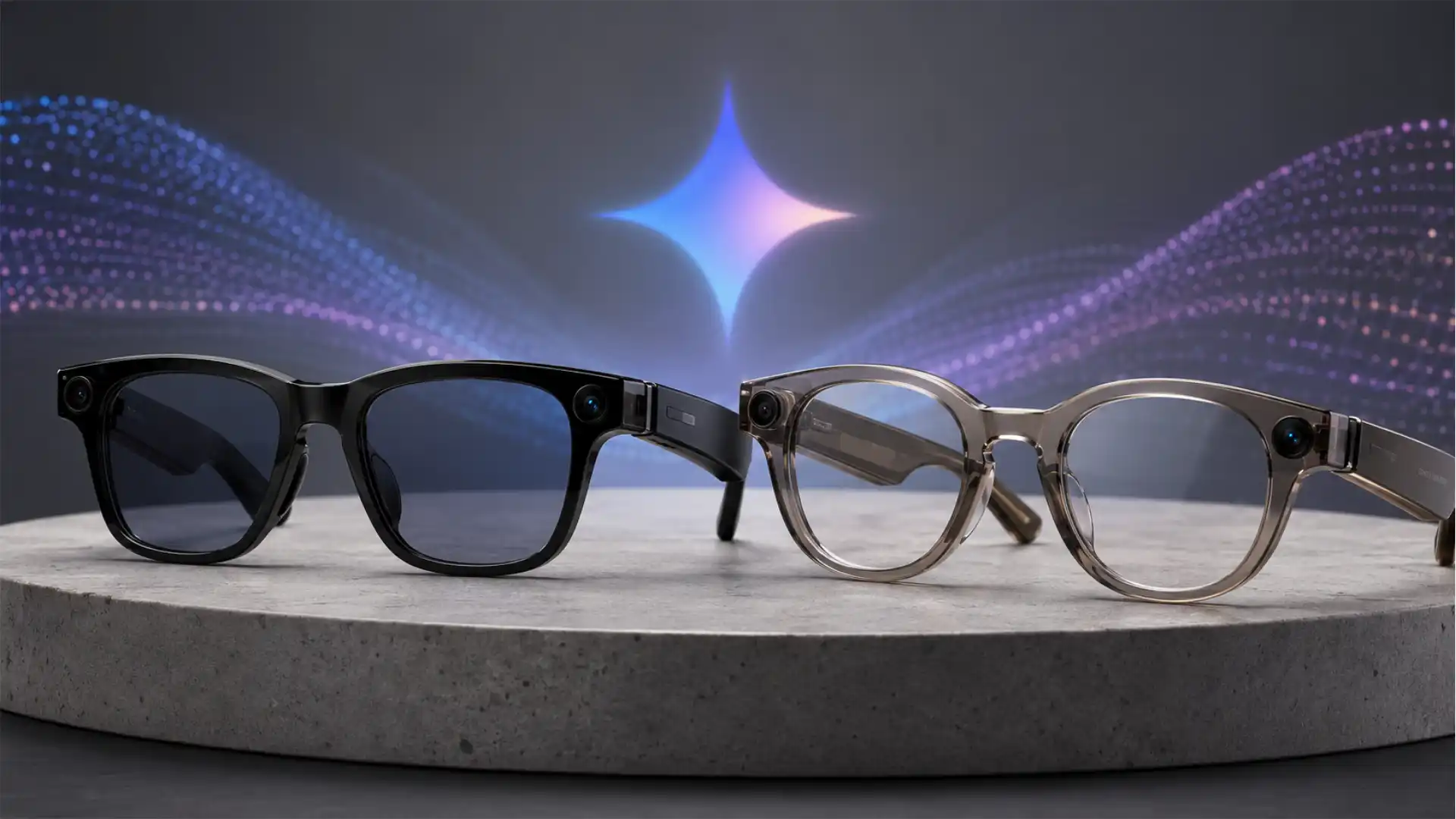
Google’s intelligent eyewear reveal is not a nostalgia act for Google Glass. It is a new attempt to put Gemini into a form factor that sits closer to daily life than the phone: on the face, near the eyes, beside the ears, always available, but still socially risky. Google says the first audio glasses built with Samsung, Warby Parker and Gentle Monster are coming later this fall, while display glasses remain a separate track for information that appears in the wearer’s field of view.
Table of Contents
Google is returning to glasses through audio before full AR
Google’s new eyewear strategy begins with a careful choice: audio-first glasses before display-first glasses. That matters because the most difficult version of smart eyewear is not a pair of frames that can hear, speak and take photos. The harder version is a pair of glasses that can place digital information in the user’s view without becoming heavy, expensive, distracting, or socially alarming. Google is keeping those two categories separate. Audio glasses arrive first; display glasses are framed as the next step.
The company’s May 19, 2026 announcement describes “two types of intelligent eyewear”: audio glasses that give spoken help in the wearer’s ear, and display glasses that show information when needed. That language is doing a lot of work. It tells consumers not to expect a full augmented-reality headset hidden inside normal frames this fall. It also tells developers and partners that Android XR is not limited to one hardware shape. Google is building a range: headsets, audio frames, display frames, and experimental mixed-reality glasses.
The launch order is sensible. Audio glasses avoid the hardest optical problems. They do not need waveguides, projectors, transparent displays, spatial UI layers, or the same level of visual calibration. They still need good microphones, speakers, cameras, battery life, thermal control and weight distribution, but those problems are closer to what the market has already accepted in products like Ray-Ban Meta. Google’s first commercial question is not whether it can build AR glasses. It is whether it can make people use Gemini without touching a phone.
The audio-first route also gives Google a cleaner story around style. Warby Parker and Gentle Monster are not display-panel companies. They are eyewear brands with different cultural positions. Warby Parker stands for accessible, prescription-friendly, everyday frames. Gentle Monster stands for bolder fashion eyewear. Their role is not cosmetic. In smart glasses, design is adoption. A device that sits on the face cannot hide in a pocket after the novelty fades.
Samsung’s newsroom makes the same point from a hardware-ecosystem angle. The company says the glasses are designed as a companion device to a mobile phone, giving users help through voice interaction inside a familiar form factor. It also says the first collections are scheduled for this fall in select markets, with more details still to come.
That leaves the product in an unusual middle state. It is public enough for a reveal video, brand pages and partner quotes. It is not public enough for a buyer to compare battery life, price, prescription support, camera resolution, water resistance, storage, repair options or data controls. The difference between a compelling demo and a product people wear all day will be decided by those missing details.
The fall launch is a product milestone, not the full story
The user-facing message is simple: Gemini is coming to your glasses this fall. The market-facing message is more complex. Google has moved from concept to visible product design, but it has not yet given the full buyer contract. A smart-glasses launch without price, battery life, weight, regional availability and prescription details remains incomplete. A fall launch creates attention; specifications create trust.
Google’s own post says the audio glasses are launching first “later this fall” and that the first designs shown at Google I/O 2026 are part of broader Gentle Monster and Warby Parker collections coming later this year. Samsung says availability may vary by market and that features, specs and other product information are subject to change. Those caveats matter. They mean the reveal is a directional commitment, not the final retail brief.
That is normal for a platform launch, but it also creates risk. Consumers do not buy “Android XR strategy.” They buy a pair of glasses that must survive daily friction. They will ask whether the frames feel heavy by lunch, whether the speakers leak audio on public transport, whether the camera attracts suspicion, whether the assistant mishears in traffic, whether the charging case is bulky, whether prescription lenses cost extra, and whether the product works well with iPhones.
The reveal also leaves a brand question unresolved. The glasses are made with Google, Samsung and eyewear partners. Which name will sit in consumers’ heads? Ray-Ban Meta succeeded partly because the product name was easy to say. “Ray-Ban Meta” connected a known eyewear icon with a known technology platform. Google, Samsung, Warby Parker and Gentle Monster create a stronger industrial team but a harder naming problem. If the product is marketed too technically, it may feel like a gadget. If it is marketed only as fashion, Gemini becomes invisible.
The market does not need another proof that cameras can fit inside glasses. It needs proof that the product has a daily reason to exist. Google’s pitch is that the glasses can help with directions, texts, photos, translations, reminders and context-aware questions. Those are practical, but they are also familiar. The sharper claim is that Gemini will interpret the world around the user and take small actions across Google services. That is where the product becomes a distribution point for assistant behavior, not just a wearable camera.
The fall timing gives Google a chance to enter the holiday cycle, but it also puts pressure on the company to clarify the buyer experience soon. A vague “coming later” message works at I/O. It will not work at checkout. The reveal creates the narrative; the next disclosure has to create confidence.
Samsung is the hardware bridge Google did not have last time
Google’s first major smart-glasses era was defined by technical ambition and social friction. This new attempt is shaped by partnership. Samsung brings mobile hardware engineering, supply-chain discipline, Galaxy ecosystem reach and experience selling wearables at scale. Google brings Gemini, Android XR, Google services, developer relationships and years of work in computer vision and AR. Warby Parker and Gentle Monster bring the part Silicon Valley often mishandles: the face.
Samsung’s role should not be treated as a side note. The official Samsung announcement describes the eyewear as combining Samsung hardware engineering, Google AI technology and premium eyewear design. It also positions the device inside the Galaxy ecosystem, with functions such as notification summaries, calendar entries, translation, navigation help and photo capture.
That creates a different model from Google Glass. Glass was visibly Google’s product. It felt like a computer company asking the public to accept a computer on someone’s face. The new model spreads responsibility across companies that already own pieces of the daily-device stack. Samsung has phones, buds, watches and tablets. Google has the assistant and services. Eyewear brands own the social and optical legitimacy. Google’s return to glasses is less a single-device bet than an ecosystem coalition.
The coalition also reflects a hard lesson from wearables. A smartwatch can survive as a gadget category because it sits on the wrist and has a familiar interaction model: glance, tap, track, pay. Glasses are more intimate. They change how other people perceive the wearer. They imply vision, attention and recording. Hardware excellence alone cannot solve that. A pair of smart glasses must pass a mirror test, a prescription test, a privacy test and a social test before AI features even matter.
Samsung also gives Google a path to phone pairing. Google’s post and Samsung’s announcement both describe the eyewear as working with the phone rather than replacing it. That helps battery life, connectivity and app access. It also keeps the product closer to an accessory than a standalone computer. For early versions, that is the safer choice. Standalone glasses with cameras, displays and local AI would be heavier, hotter and more expensive.
There is a strategic trade-off. If the glasses rely strongly on phones, then phone ecosystem politics matter. Samsung will want the Galaxy experience to feel native. Google will want Android XR to feel broader than Galaxy. Warby Parker will want the product to appeal beyond Android loyalists. iPhone compatibility may become a buying factor, especially in the United States. Reports have already noted that Google’s smart-glasses strategy is being read against Meta and Apple in the same market conversation.
The partnership is strong because each participant covers a weak spot in the others. It is also fragile because the product must avoid looking like a committee. Smart glasses need a simple promise. The best version of this launch is not “Samsung hardware with Google AI in Warby Parker and Gentle Monster frames.” It is “glasses that look right and answer when you ask.”
Warby Parker and Gentle Monster solve different adoption problems
Warby Parker and Gentle Monster are not interchangeable design partners. Their audiences, retail cultures and brand meanings are different, and Google needs both. Warby Parker gives the project an everyday prescription path. Gentle Monster gives it fashion credibility and a willingness to make technology feel less apologetic. The reveal of both brands at once suggests Google understands that smart eyewear cannot be sold through a single aesthetic.
Warby Parker’s official page says it is developing next-generation glasses with Google and Samsung for all-day wear and describes its version as combining Warby Parker design and prescription expertise with built-in multimodal AI capabilities. Gentle Monster’s page presents the collaboration as an intelligent-eyewear experience shaped by the brand’s design vision.
That split matters. A person who wears glasses every day often chooses frames through habit, face shape, prescription needs, insurance, comfort, local retail access and small style preferences. Warby Parker is built for that buyer. A person buying Gentle Monster frames may be more open to eyewear as statement. That buyer may accept thicker temples or more dramatic silhouettes if the design feels intentional. Smart glasses will not become normal through one universal frame. They will need many styles because faces are not standardized.
The prescription issue is especially important. Smart glasses that ignore prescription wearers treat the largest natural eyewear audience as an afterthought. If the Warby Parker line supports prescription lenses cleanly, with clear pricing and fitting, it could remove a major barrier. If prescription support is expensive, limited, delayed or awkward, the product becomes closer to sunglasses and novelty wear.
Gentle Monster’s role is different. It helps the product avoid the embarrassment of looking like a prototype. Fashion brands can make thickness look deliberate. They can also turn technology into a cultural object rather than an engineering compromise. That is not superficial. Early smart glasses have often failed the “would I wear this without the tech?” test. Gentle Monster gives Google a chance to answer yes for a style-conscious segment.
Both brands also help with retail education. Smart glasses need more explanation than normal frames. Buyers will want to feel the weight, test audio leakage, understand indicators, ask about prescriptions, compare charging cases and learn what happens to photos or audio. Warby Parker stores and Gentle Monster showrooms can become physical trust points if the training is good. A bad retail script would hurt adoption more than a bad ad.
The risk is that fashion partners can make the device look better, but they cannot make it behave better. If Gemini is slow, if microphones fail in noisy places, if battery life is thin, if privacy controls feel vague, the frame design will not save the product. Style gets the glasses onto the face. Utility keeps them there.
Gemini is the real product inside the frames
The most important component in Google’s intelligent eyewear is not the camera, speaker, microphone or frame. It is Gemini. The glasses are a new endpoint for Google’s assistant strategy: a way to let Gemini hear what the user says, see parts of the user’s environment, understand location and direction through the phone and sensors, and execute tasks without a screen. The glasses turn Gemini from an app into an ambient interface.
Google’s post says users can say “Hey Google” or tap the side of the frame to access Gemini. It lists examples such as asking about something in view, getting directions, sending texts, taking photos, summarizing notifications, translating speech and working with Google apps. Samsung’s announcement adds examples such as personalized suggestions, ordering pickup, calendar additions and text translation on menus or signs.
Those examples show the difference between voice assistant and multimodal assistant. A traditional voice assistant waits for a command. A multimodal assistant can use what the camera sees, what the phone knows, what the user has said before and what the service graph contains. The command “What is this?” becomes more powerful when the assistant can see the object. “Remind me to buy this” becomes more useful when the camera captures the label and the assistant sends the item to Keep or a shopping list.
Google has been preparing this story through Project Astra and Gemini Live. DeepMind describes Project Astra as work toward a universal AI assistant, with capabilities such as natural interaction, multimodal memory and visual understanding. Google’s 2025 writing on Gemini as a universal assistant described an AI that understands context, plans and takes action across devices.
Glasses are a natural endpoint for that ambition because the phone creates friction. Pulling out a phone changes posture, attention and social presence. Glasses can reduce that friction for short tasks. Ask, listen, keep walking. That is the promise. It is powerful precisely because it is small.
The danger is that small actions can become invasive when they involve cameras and personal data. A Gemini-powered pair of glasses may need to process voice, images, video snippets, location context, app data, contacts, messages and reminders. Google’s Gemini Apps Privacy Hub says Gemini collects prompts, tasks, shared files, photos, videos, screens, page content and transcripts or recordings of Gemini Live interactions depending on use.
That does not mean the glasses are inherently unsafe. It means the product will need unusually clear privacy design. Users must know when data is captured, what is stored, what is processed on-device or in the cloud, what is used for training, how third-party app actions work and how bystanders are protected. Gemini makes the glasses useful; Gemini also makes the trust burden much heavier.
Android XR is Google’s attempt to avoid another isolated device
The new glasses sit on Android XR, the platform Google announced in December 2024 with Samsung and Qualcomm. That is a crucial difference from earlier eyewear experiments. Google is not presenting the glasses as a one-off gadget. It is presenting them as part of a platform for headsets and glasses, with Android tools, Google apps, Gemini and developer support.
Android XR gives Google a way to do what Android did for phones: create a shared software base across many devices and manufacturers. The analogy is not perfect. Phones have large screens, batteries and app stores. Glasses have narrow interaction windows, heavy privacy constraints and far less room for hardware variation. Still, the platform move matters. It tells developers that the eyewear category may not be limited to Meta’s stack or Apple’s spatial-computing stack.
Google’s original Android XR announcement said the platform is built for XR headsets and glasses, supports tools such as ARCore, Android Studio, Jetpack Compose, Unity and OpenXR, and is meant to give developers a unified path across device types. It also said Android XR would first launch on headsets before supporting all-day glasses in the future.
That sequencing is useful. Headsets give developers more screen space, more compute and clearer immersive use cases. Glasses require stricter design discipline. A notification on a headset can be a panel. A notification on audio glasses may be a sentence. A navigation cue on display glasses may be a small arrow. The same platform needs different interaction rules across forms.
Android XR also lets Google connect eyewear to the Android app base without promising that every phone app belongs on the face. That distinction is key. The worst version of smart glasses is a tiny phone interface near the eye. The best version is a set of context-aware actions that remove the need to open the phone. Developers will need to think less like screen designers and more like service designers. What is the smallest useful response? What should be spoken? What should be private? What should wait until the user looks at a phone?
For Google, Android XR is also a defensive move. Meta has spent years building wearables, AR research and glasses partnerships. Apple has Vision Pro and long-term spatial-computing ambitions. Google cannot afford to let the next device layer become someone else’s assistant endpoint. If AI assistants become the main interface, the platform that owns the wearable context may own the user’s next intent.
The product category is closer to earbuds than headsets
The most useful way to understand Google’s first Gemini eyewear is not to compare it only with Google Glass or Apple Vision Pro. The better comparison may be earbuds. Audio glasses sit between earbuds, cameras and lightweight wearables. They are worn for daily tasks, not for immersive sessions. They speak, listen, capture and connect. They do not need to replace the phone or laptop.
That positioning lowers expectations in a healthy way. A headset promises a new computing space. Audio glasses promise less phone handling. If Google sells them as full AR, disappointment will follow. If it sells them as Gemini in a socially wearable frame, the value proposition becomes clearer. The first win is not immersive computing. The first win is a quicker path from intent to action.
The earbud comparison also exposes the adoption challenge. Earbuds became normal because they offered clear daily utility: music, calls, noise control, voice commands and portability. Audio glasses must prove they do enough beyond earbuds. If a user can ask Gemini through earbuds and a phone camera, why put cameras and speakers into frames? The answer has to be speed and context. Glasses see what the user sees without requiring a phone raise. They know where the head is pointed. They can capture first-person photos. They can whisper navigation while leaving ears partly open.
The camera is both advantage and liability. It allows visual questions, document capture, sign translation and quick photos. It also triggers bystander concern. Earbuds do not record video from the listener’s face. Glasses do. That changes the etiquette.
The headset comparison creates the opposite problem. Headsets are powerful but socially limited. They are too obvious, too isolating and too heavy for constant public use. Audio glasses are lighter and more normal but offer less visual output. That trade-off is the point. The market may be telling companies that people want AI assistance before they want AR immersion.
Wired’s hands-on report after Google I/O 2026 said the audio-only Warby Parker and Gentle Monster glasses will launch later this year, that all upcoming versions have cameras, and that display versions offer richer use cases such as text alongside translation and visual navigation. The report also noted Google’s claim that the glasses rely on the phone’s GPS while using the cameras and Google’s Visual Positioning System for location refinement.
That architecture makes the first generation easier to accept. It does not pretend the glasses are a self-contained spatial computer. It makes them a companion, and companion devices can become habits when they remove small frictions every day.
The camera makes the product useful and controversial at the same time
The camera is the hinge of the whole category. Without a camera, Gemini glasses would be voice-access eyewear with speakers. That could still be useful, but it would not justify the claim that the assistant understands the world around the user. With a camera, the glasses can answer questions about signs, objects, menus, receipts, landmarks, ingredients, appliances, route cues and moments worth saving. With a camera, the product also walks directly into the privacy fight that shaped Google Glass and still follows camera glasses today.
Google and Samsung describe use cases such as taking photos, translating text in line of sight, asking Gemini about what the user sees and receiving navigation support. Those functions require visual input. Even if the system does not continuously record, the public will care about the possibility of recording. Smart glasses do not only process the wearer’s world. They may capture other people who did not choose the device.
That is why technical indicators and policy controls matter. Recording lights, sound cues, app permissions, default settings and physical design choices all affect trust. They may not be enough by themselves. The social issue is not only whether the device records; it is whether people nearby can tell when it records and whether they have any practical ability to object.
The privacy problem is not new. Google Glass faced backlash partly because bystanders could not easily know how they were being captured or identified. Google later shifted Glass into enterprise contexts and eventually ended sales of Glass Enterprise Edition in March 2023, with support running until September 15, 2023.
The new product arrives in a different environment. People are used to phone cameras everywhere. Video doorbells, dashcams, body cameras, TikTok, livestreaming and AI photo tools have shifted norms. Yet glasses are still different because the camera is pointed where the wearer looks. A phone is usually visible when filming. Glasses can be ambiguous. A person may not know whether the wearer is listening to music, asking Gemini a question, taking a picture or recording a video.
Google’s AI principles say the company will incorporate privacy principles, give opportunities for notice and consent, and provide transparency and control over data use. Those commitments will be tested more sharply on face-worn cameras than in many software products.
The product’s credibility will depend on making privacy readable. The wearer needs simple controls. Bystanders need visible signals. Regulators need explanations. Parents, schools, workplaces, hospitals, gyms, cinemas, courts, border areas and transport operators will need policies. The camera gives Gemini eyes. It also gives the category its hardest political problem.
Audio is the safest interface until displays mature
Audio is not only a launch constraint. It is an interface strategy. Spoken assistance is less visually intrusive than a display. It can fit into walking, commuting, shopping and quick tasks. It can also preserve the wearer’s gaze. That aligns with Google’s claim that the glasses deliver help without taking users out of the moment. The phrase is marketing, but the product logic is sound: many tasks do not need a screen.
Directions are a good example. A phone map requires looking down. Audio directions let the user keep walking. Display arrows may be better at complex intersections, but audio gets most of the value with less hardware burden. Texting is similar. Dictating a reply and hearing a summary can be enough. A visual keyboard or full message thread in a lens is unnecessary for many moments.
Translation is more complicated. Audio translation can be helpful during conversation, but captions are useful when speech is noisy, unfamiliar names appear, or the wearer wants to review exact wording. Google’s 2025 Android XR glasses preview described real-time translation and the idea of “subtitles for the real world.” The 2026 launch separates audio and display categories, suggesting Google sees captions as a display-glasses strength rather than a necessary feature for the first retail frames.
The audio-first interface also avoids display fatigue. Even small lens displays can distract. They raise questions about safety while walking, driving or cycling. They need brightness control, legibility, prescription alignment and battery power. If display glasses are too dim outdoors, too bright indoors, or too hard to read with certain prescriptions, the experience breaks quickly.
Audio has its own limits. It is less private in quiet rooms if speakers leak. It can be hard to hear in traffic. It may annoy users if responses are too long. It can interrupt conversation. It can mispronounce names. It can become awkward when the user needs to say commands aloud in public. A good audio-glasses interface must be brief, discreet and interruptible.
This is where Gemini’s conversational abilities matter. The assistant must respond in the right amount of detail for the moment. A phone answer can be long because the user is reading. An answer in glasses must be edited for ears and context. “Turn left after the pharmacy” is better than a map lecture. “That sign says parking is allowed after 6 p.m.” is better than a full municipal parking explanation.
The real innovation may be less about hardware and more about answer shape. Smart glasses need AI that knows when not to talk.
Display glasses remain the category’s harder promise
Google’s display-glasses track is more ambitious because it brings the product closer to augmented reality. A display can show navigation cues, captions, message snippets, widgets, object labels, visual reminders and app information. It can also create distraction, discomfort and new privacy concerns. The technical goal is simple to state and hard to build: put useful information in the line of sight without making the glasses look or feel like a device.
The 2026 Google post says display glasses will show the information users need when they need it. The 2025 Google preview described optional in-lens displays that privately provide information and demos involving messaging, directions, appointments, photos and live translation.
That “optional” word matters. Display hardware changes everything. It affects frame thickness, lens design, price, battery life, prescription compatibility, thermal behavior and repair. It can also divide the market. Some users may want the lightest audio frames possible. Others may pay more for visual cues. Google appears to be leaving room for both.
The display version also changes developer opportunity. Audio glasses mostly need actions and spoken answers. Display glasses can support glanceable UI. The temptation will be to put too much on the lens. Weather, stocks, sports, steps, messages, rides, shopping, translations, maps and AI answers can all fight for attention. The success of display glasses will depend on restraint. The lens is not a phone screen. It is a small, high-trust interruption layer.
The Verge’s hands-on report from Google I/O 2026 described display-only features such as widgets, translation shortcuts, sports scores, Fitbit steps, weather and 3D educational elements on prototype hardware. It also noted that many Gemini features work with or without a display, meaning audio-only glasses can still support much of the assistant experience.
That distinction helps Google. If the core Gemini layer works on audio glasses, display models can be positioned as premium or specialized rather than mandatory. The market can mature gradually. Developers can learn what belongs in audio and what deserves pixels.
Display glasses will also be judged against Meta Ray-Ban Display, which Meta brought to U.S. retail in September 2025 at $799 with the Meta Neural Band included. Meta’s move means Google is not entering an empty field. It is entering a category where competitors are already experimenting with on-lens interfaces, gesture control and retail channels.
The hard promise is not showing pixels. The hard promise is showing the right pixels, at the right time, in frames people actually want to wear.
The Google Glass lesson is social before technical
Google Glass is still the shadow over every Google eyewear announcement. It should not be treated as a simple failure story, because Glass was early, ambitious and useful in some enterprise contexts. Yet its consumer image became tied to awkwardness, privacy anxiety and the feeling that the wearer was performing technology at everyone else’s expense. The new Gemini glasses must escape that association through design, behavior and trust.
Google officially stopped selling Glass Enterprise Edition on March 15, 2023 and said it would support the device until September 15, 2023. That ended a long chapter that began as a public experiment and later shifted toward business use.
The lesson is not “never build glasses.” The lesson is that face-worn devices are judged by people who are not wearing them. A phone user filming in public may be annoying, but the behavior is legible. A glasses wearer may be recording, translating, asking an assistant, or doing nothing. The ambiguity creates tension. The bystander experience is part of the product experience.
The new strategy addresses some Glass-era weaknesses. The frames look closer to normal eyewear. The first commercial models avoid obvious prism displays. Established eyewear brands are involved from the start. The assistant is more capable. Society has grown more familiar with cameras, voice assistants and wearable devices. Meta has shown that camera glasses can sell when packaged as stylish frames with clear daily uses.
Yet old risks remain. If users behave badly, the product may be blamed. If recording indicators are hard to see, venues may ban the glasses. If Gemini identifies people or sensitive information in public ways, regulators will notice. If the glasses feel expensive and unclear, critics will frame them as a Silicon Valley vanity object.
There is also a memory problem. Many consumers never used Google Glass, but the phrase still carries cultural residue. For some, it means failed tech. For others, surveillance. For Google, the best answer is not a defensive explanation. It is a product that feels ordinary enough to avoid the old caricature.
The biggest shift from Glass is that the assistant is no longer a weak layer. Google Glass arrived before modern multimodal AI. It could capture, display and notify, but it could not understand the world with the fluidity Google now claims for Gemini. That means the new glasses have a stronger reason to exist. It also means they carry more sensitive processing. Google has solved one part of the value problem by making the assistant better. It must now solve the social problem by making the device accountable.
Meta has already proved demand, but not the final form
Google is entering a market that Meta helped normalize. Ray-Ban Meta glasses showed that smart glasses can sell when they look like known eyewear, offer camera capture, open-ear audio and voice AI, and avoid the bulk of headsets. Meta’s 2023 Ray-Ban Meta launch emphasized improved audio, cameras, custom frame combinations, lighter design, livestreaming and Meta AI voice interaction.
The commercial signal became stronger in 2025. Reuters reported in October 2025 that EssilorLuxottica posted record quarterly sales and said it would accelerate wearables production capacity, with Ray-Ban Meta glasses described as a driver of growth. The company said third-quarter revenue rose 11.7 percent year over year to €6.9 billion, and the CFO said the company expected to bring forward plans for 10 million units of annual wearables capacity.
That does not mean Google can copy Meta’s formula and win. Meta has retail presence through Ray-Ban and EssilorLuxottica, social apps for capture and sharing, and years of consumer messaging around the product. Google has different strengths: Android, Gemini, Search, Maps, Gmail, Calendar, Photos, YouTube, Keep, Lens, Translate and Samsung. Meta proved that camera glasses can become a real consumer category; Google’s bet is that assistant depth can make the category more useful.
The competitive difference may be task execution. Meta’s glasses are strong for capture, social sharing, audio and Meta AI. Google’s glasses can lean into service integration: asking about a place on Maps, adding ingredients to Keep, creating Calendar events, summarizing messages, using Translate, calling on Search knowledge and tying into Android notifications. That is a strong bundle if it works smoothly.
Meta also gives Google a warning. The category’s success creates scrutiny. More camera glasses in public means more pressure from privacy advocates, schools, workplaces and regulators. Demand does not erase discomfort. It amplifies it because the technology becomes common.
Google also faces a timing issue. Meta is no longer only selling audio camera glasses. Meta Ray-Ban Display has already pushed into lens-based information with a neural wristband. If Google’s first wave is audio-only, some critics may call it late. That criticism misses the strategic point, but it will still shape perception. Google needs to explain why audio-first is deliberate, not behind.
The market is not waiting for one winner. It is likely to split by ecosystem, style, price and use case. Some buyers will choose Meta for Ray-Ban design and social features. Some may choose Google/Samsung for Android, Gemini and productivity. Some will wait for Apple. The category is still early enough that trust and clarity can matter more than first-mover status.
The missing specifications are not minor details
The reveal showed designs and features, but the most important buyer details remain absent. Price, weight, battery life, charging speed, prescription lens cost, camera resolution, storage, water resistance, repairability, regional rollout, iPhone support, child-safety rules, data retention, recording indicators and enterprise controls are not footnotes. They will decide whether the product is a daily device or a short-lived curiosity.
Samsung’s announcement says more details will come in the months ahead and notes that features, specifications, availability and other product information are subject to change. Google’s post focuses on feature categories rather than hard specs. The Verge reported that Google did not provide price or specifications during demos and that the final glasses were not available to try in person.
Battery life may be the most unforgiving spec. All-day wear does not require all-day active use, but it does require enough standby and interaction time that users stop thinking about charging. If the glasses need frequent charging, they become an accessory for demos and trips, not a habit. The charging case matters too. A bulky case weakens the everyday promise.
Weight is equally sensitive. A few grams can change comfort when the device rests on the nose and ears. The temples must contain electronics without making the frames clamp too hard. Weight distribution matters more than raw weight. Heavy front lenses, thick arms or uneven balance can make frames tiring even if the number looks acceptable on paper.
Price will define the audience. A low price may require compromises and hurt margin. A high price may limit adoption to enthusiasts and professionals. Prescription upgrades may make the real price much higher than the headline price. Meta’s Ray-Ban Meta line created a reference point with a consumer price that looked closer to premium eyewear than XR hardware. Google’s partners will need to decide whether they are selling fashionable AI eyewear or a premium computing device.
The privacy spec is harder to express but just as important. Buyers will need to know what the lights mean, when the camera activates, where data goes, how voice and image history is handled, and how Gemini settings transfer from phone to glasses. Bystanders will need visible signals. Venues will need rules.
The reveal earned attention because the partners are credible. The launch will earn adoption only if the specifications make the product feel boring in the right way: easy to charge, easy to fit, easy to understand, easy to trust.
Table stakes for Gemini eyewear
Confirmed and still missing product details
| Area | What is confirmed | What still needs clarity |
|---|---|---|
| Launch timing | Audio glasses are planned for later this fall | Exact release date and market list |
| Partners | Google, Samsung, Warby Parker and Gentle Monster | Final branding and retail responsibilities |
| Product types | Audio glasses first, display glasses as a separate category | Timing for consumer display models |
| Core input | Voice, touch on frame, camera context | Detailed indicators and capture controls |
| Main assistant | Gemini through Android XR | On-device versus cloud processing details |
| Design | First Warby Parker and Gentle Monster styles previewed | Full collections, colors, sizes and prescriptions |
| Phone role | Companion device model | iPhone support, Android requirements and Galaxy features |
| Buying details | Fall launch in select markets | Price, battery, weight, repair and warranty |
This table shows the real state of the announcement: Google has defined the category, partners and use cases, but not the final retail contract. That is enough for an I/O reveal. It is not enough for a purchase decision.
The strongest use cases are small, repeated and time-sensitive
The most persuasive use cases for Gemini eyewear are not dramatic. They are small moments that happen often enough to create habit. Directions while walking. A quick photo without digging for a phone. A text reply while carrying groceries. A sign translation. A calendar entry from a poster. A note saved from a recipe. A question about an object in front of the user. These moments are not spectacular, but they are precisely where phones create friction.
Google’s examples line up with that logic: directions, texts, photos, questions about what the user sees, notification summaries and translation. Samsung adds route-based suggestions, pickup orders, calendar additions and menu or sign translation.
The strongest pattern is “see, ask, act.” The user sees something. Gemini interprets it. Then Gemini performs a small action. That loop is more powerful on glasses than on a phone because the camera is already aligned with attention. If a person looks at a restaurant sign and asks whether it is worth trying, the glasses can combine visual recognition, location, reviews, opening hours and preferences. If the user asks to add it to a list, the action becomes immediate.
Navigation is likely to be one of the first habit-forming uses. The phone already handles maps well, but walking with a phone out is awkward and sometimes unsafe. Audio directions in glasses can be natural, especially if the system understands head direction and nearby landmarks. Display glasses could improve this further by showing subtle cues, but audio may be enough for most city walking.
Translation is another strong case, but it will be judged harshly. Demos often happen in quiet rooms with clear speech. Real streets, train stations, restaurants and markets are noisy. The assistant must handle accents, overlapping voices, names, slang and partial sentences. The Verge’s hands-on report noted that real-life noisy scenarios can be harder for the glasses and that microphones may focus on sound in front of the wearer.
Photo capture is useful but sensitive. It is easy to imagine parents, travelers, cyclists, workers and creators liking hands-free first-person shots. It is just as easy to imagine gyms, schools, bars and offices restricting them. Google must show that photo capture is controlled and obvious.
The most important use cases will not be the flashiest. They will be the ones where users quietly stop reaching for the phone.
A universal assistant needs boundaries as much as memory
Google’s long-term assistant vision is clear: Gemini should become a more personal, context-aware and action-capable helper. Glasses make that vision feel tangible. A phone assistant knows what the user types or shares. A glasses assistant may know what the user is looking at, hearing, walking past and trying to do. That creates power, but it also raises the question every ambient assistant must answer: how much context is too much?
DeepMind’s Project Astra work points toward natural interaction, proactive responses and multimodal memory. Google’s 2025 universal-assistant post describes an assistant that understands context and can act across devices. Those ideas are technically exciting, but on face-worn hardware they need strong boundaries.
Memory is useful when it saves effort. If Gemini remembers that the user prefers vegetarian restaurants, it can filter suggestions. If it remembers a parking location, it can guide the user back. If it remembers a conversation about a trip, it can support planning. Yet memory becomes uncomfortable when users do not understand what is remembered, for how long, or from which inputs.
The glasses make this sharper because context may include other people. A user might ask about a meeting slide, a child’s homework, a medical document, a shop receipt, a stranger’s outfit, a neighbor’s car or a sign in a private building. The assistant should not treat all visual context as equal. Ambient AI needs a hierarchy of sensitivity.
Google’s Gemini Apps Privacy Hub is broad because Gemini runs across many services. It explains categories of data that may be collected, including prompts, tasks, shared files, photos, videos, page content, screens and Gemini Live transcripts or recordings. For glasses, Google will need to translate that into device-specific controls. A user should not have to infer eyewear behavior from a general Gemini privacy page.
Boundaries also matter for action. If Gemini can add a calendar event, send a message, place an order or update a list, it needs confirmation patterns that fit audio. Too many confirmations make the product tedious. Too few create errors. A good system may need different confidence thresholds: low-risk notes can happen quickly; purchases and messages require explicit confirmation.
The assistant must also admit uncertainty. A bad answer spoken into the ear can feel more authoritative than a search result on a screen because the user may not see sources or alternatives. For visual questions, Gemini should be careful when identification is uncertain. That is especially true for people, medical objects, legal signs or safety instructions.
The universal assistant cannot be universal in permission. It must be selective, understandable and interruptible.
The privacy fight will be local, not only regulatory
Regulation will matter, especially in Europe, but much of the privacy fight around smart glasses will happen locally. Schools, offices, hospitals, gyms, cinemas, courtrooms, factories, casinos, museums, government buildings and private events will make their own rules. Some will ban recording. Some will require visible indicators. Some will treat smart glasses like phones. Others will treat them like body cameras.
The European Commission describes the AI Act as a risk-based legal framework for AI, with bans on certain unacceptable-risk systems and stricter rules for higher-risk uses. The GDPR treats biometric data used for unique identification as a special category and defines biometric data as data from technical processing of physical, physiological or behavioral characteristics that allow or confirm unique identification.
Consumer Gemini glasses are not automatically a banned biometric-identification system. A pair of camera glasses used for translation or navigation is different from a law-enforcement facial-recognition system. Still, the device sits near sensitive areas: video capture, audio capture, location context, potential face images, AI inference and third-party app actions. If future features move toward identity, emotion, health, workplace monitoring or public-space analytics, scrutiny will rise quickly.
The European Data Protection Board’s guidelines on video devices show why smart glasses will not be treated as ordinary electronics in every setting. Video processing can involve personal data, legal bases, purpose limitation, retention limits and rights of people captured.
Local policy may move faster than law. A school principal does not need to wait for an AI Act interpretation to ban camera glasses during exams. A gym can require devices with cameras to stay in lockers. A company can set rules for confidential meetings. A hospital can restrict recording near patients. A concert venue can decide whether hands-free filming violates performance rules.
This creates a practical challenge for Google and partners. The product needs a public etiquette layer. Buyers should know where not to use the camera. Retail staff should explain indicators and controls. The app should make privacy settings easy to find. The device should make capture states obvious. The best privacy design is not only compliant; it is socially legible.
The company that teaches norms well may gain an advantage. A confusing product invites bans. A clearly controlled product gives institutions more room to allow it.
The market is moving from “smart glasses” to “AI eyewear”
The language around the category is changing. Google and Samsung call the new product “intelligent eyewear.” Meta calls its products AI glasses. Warby Parker uses “Intelligent Eyewear.” The phrase matters because it shifts the emphasis away from general computing and toward assistant behavior. These are not merely smart glasses with apps. They are eyewear designed around AI.
That framing helps avoid some old AR baggage. “Augmented reality” often implies visual overlays, games, headsets and spatial computing. “AI eyewear” implies help, capture, translation, memory and voice. For audio-first frames, that is more accurate. The product is not mainly about placing holograms in space. It is about giving Gemini a wearable sensor and output channel.
The category shift also affects business models. Smart glasses used to be judged by hardware features: camera, display, battery, sensor set. AI eyewear will be judged by the assistant, services and model quality. Does it understand speech in noise? Does it see objects correctly? Does it perform actions across apps? Does it remember preferences without feeling creepy? Does it answer quickly? Does it respect privacy? Does it improve through updates?
That favors companies with AI models, service ecosystems and developer platforms. It also creates dependence on subscriptions. If advanced Gemini features require paid plans, consumers may face a two-layer cost: expensive frames plus AI service fees. Google has not detailed the commercial model for Gemini eyewear features. That will matter. A buyer will want to know whether the glasses become less useful without a subscription.
The shift also changes the role of eyewear brands. They are not only frame designers. They become front doors to AI devices. That may create new retail workflows: fitting frames, pairing phones, explaining AI controls, handling lens prescriptions, teaching privacy, selling protection plans and supporting software updates. Eyewear stores will need some of the knowledge of electronics retail without losing the trust of optical care.
Warby Parker’s direct-to-consumer model may adapt well to this because the company already blends physical stores, online accounts, prescriptions and brand storytelling. Gentle Monster may turn the product into a fashion-tech object, possibly with more limited, style-driven releases. AI eyewear will be sold as both technology and identity. That makes partner choice central, not decorative.
The term “intelligent” also raises expectations. If the glasses feel dumb, slow or scripted, the label will backfire. The intelligence has to show up in ordinary moments, not only on stage.
Search, Maps and Gemini give Google a different angle from Meta
Google’s strongest advantage in eyewear is not only Gemini. It is the service graph around Gemini. Search, Maps, Gmail, Calendar, Photos, YouTube, Lens, Translate, Keep and Android notifications create many small actions that fit glasses. Meta has social scale and eyewear momentum. Google has information, location and productivity depth.
The difference shows up in likely use cases. A Google-powered pair of glasses can answer questions about a storefront through Search and Maps. It can translate signs through Google Translate. It can add route stops through Maps. It can save a recipe ingredient list to Keep. It can create a Calendar event from a poster or message. It can summarize notifications from an Android phone. It can potentially connect visual capture to Photos organization. The more useful the Google account already is, the more useful Gemini glasses may become.
That does not guarantee success. Google has often struggled to turn service breadth into clear hardware narratives. Pixel phones have improved but remain smaller than Samsung and Apple in many markets. Google Assistant had wide reach but lost cultural momentum as generative AI changed expectations. Wearables require disciplined product focus, not just service integration.
Still, glasses fit Google’s core strengths in a way headsets do not. Search and Maps are world-facing products. Glasses are world-facing hardware. The camera can turn the environment into a query. The microphone can turn intent into action. The speakers can return brief answers without a screen. Google Lens already trained users to point a camera at the world for information. Gemini glasses could make that behavior less deliberate and more conversational.
The Guardian’s Google I/O 2026 report connected the eyewear reveal to Google’s broader AI push in Search and Gemini, including longer, more natural queries and agentic actions across Google products. That context matters. The glasses are one part of a wider effort to place Gemini wherever intent begins: search box, phone, workspace, car, headset and now frames.
Meta’s strength is that it controls high-frequency social surfaces. Google’s strength is that it controls high-frequency intent surfaces. AI eyewear sits between them. A user may want to capture a moment for Instagram, but also ask what a sign says, where to turn, whether a restaurant is open, or where they parked. The winning assistant may be the one that handles the most real-life micro-intents with the least friction.
Google’s challenge is to make that advantage visible in retail. “Powered by Gemini” is not enough. Buyers need demos that show why Google’s ecosystem makes the glasses better on Tuesday afternoon, not only at a developer conference.
Developers need a new grammar for face-worn software
Android XR gives developers familiar tools, but smart glasses require unfamiliar discipline. The face is not a phone. It is not a watch. It is not a headset. The software grammar must fit brief interactions, limited attention, high privacy and uneven environments. Developers who simply shrink phone apps will fail.
Google’s Android XR platform pitch emphasizes a unified base across headsets and glasses, with support for Android tools and frameworks. That is useful, but developers will still need device-specific patterns. Headsets can support panels, virtual screens and immersive scenes. Audio glasses need voice actions, earcons, short responses and safe fallbacks to the phone. Display glasses need glanceable UI that avoids clutter.
The best early apps may not look like apps at all. They may be actions inside Gemini. Save this. Translate that. Remember where I parked. Send this picture. Add these ingredients. Summarize the sign. Call the place. Find a quieter route. Check whether this train goes to my stop. Those are intents, not app sessions.
Developers will need to decide when a result should stay in the ear, appear on a lens, open on the phone, or be saved for later. That routing is a new design surface. A cooking app might let glasses capture a recipe and send structured ingredients to a phone. A travel app might support quick hotel confirmation lookup through voice. A retail app might identify a product but avoid intrusive offers. A workplace app might require stronger privacy and admin controls.
The error model is different too. A phone app can show a form before submission. Glasses may rely on voice confirmation. A misunderstood message or wrong calendar event can create real annoyance. Developers need conservative defaults and clear undo paths.
Context will be powerful but dangerous. An app that uses location, camera input and personal history can be useful. It can also feel manipulative if it triggers offers at every storefront. Face-worn software must earn the right to interrupt. Bad notification design on glasses will feel worse than bad notification design on a phone because it enters the user’s sensory field.
Android XR’s opportunity is to build common interaction patterns before each manufacturer invents its own. If developers can rely on consistent privacy indicators, permission prompts, action confirmations and phone handoff behavior, the ecosystem becomes safer. Fragmentation would confuse users and weaken trust.
The developer story is promising, but the first generation of consumer value will likely come from Google’s own apps. Third-party developers will follow where daily usage appears.
Phone pairing is a strength until it becomes a constraint
Google and Samsung describe the eyewear as a companion to a mobile phone. That is the right near-term architecture. The phone can provide connectivity, GPS, app data, account state, processing support, settings and a larger screen for setup. The glasses can stay lighter and simpler. This is similar to how many smartwatches began as phone companions before gaining more standalone functions.
The companion model reduces hardware burden. It lets the glasses avoid carrying every radio, processor and battery requirement of a standalone device. It also lets users manage photos, permissions and Gemini settings through a familiar phone app. For a first retail wave, that is practical.
Yet the phone relationship creates market questions. Will the glasses work fully with any Android phone? Will Samsung Galaxy phones get special features? Will iPhones be supported? Will some features require specific Android versions, Google apps or Gemini plans? Warby Parker’s U.S. audience includes many iPhone users, so this cannot remain vague for long.
Reuters reported in December 2025 that Warby Parker and Google were developing lightweight AI-powered glasses with the first product expected in 2026, and that the collaboration would use Android XR and Gemini. The same report said pricing and distribution details were not provided.
If Google wants the glasses to become a broad eyewear product rather than an Android accessory, cross-platform support matters. Meta’s Ray-Ban glasses work with both iOS and Android through the Meta AI app, which expands the addressable market. Google may prefer deep Android integration, but Warby Parker and Gentle Monster will care about fashion buyers, not only Android loyalists.
There is also an ecosystem tension inside Android. Samsung is a core partner, but Google’s platform ambitions require other phone makers and future eyewear makers. If the product feels too Galaxy-specific, Android XR may look narrower than promised. If it feels too generic, Samsung may lose differentiation.
The phone can also become a fallback for tasks that are too complex for glasses. That is good design. A short answer can come through audio; a detailed review, map, photo edit or purchase confirmation can open on the phone. The handoff must be fast. If users have to pull out the phone too often, they may question why the glasses exist.
The companion model succeeds when the phone becomes support infrastructure, not the main interaction again.
Retail will decide whether the technology feels normal
Smart glasses cannot rely only on online launch pages. People need to try them. They need to feel the weight, see the design on their face, test the speaker, understand prescription options and ask privacy questions. Retail is not secondary for this category. It is part of the product.
Warby Parker has an advantage here because it already sells through stores and online fittings. The company can integrate intelligent eyewear into an existing frame-selection journey. That makes the product less alien. A buyer can compare normal frames and smart frames in the same environment. The sales conversation can begin with fit and prescription before moving to Gemini.
Gentle Monster offers a different retail experience: more theatrical, more fashion-led, more global in premium districts. Its smart glasses may benefit from being presented as a designed object rather than a tech accessory. That matters for early adopters who want the product to signal taste, not gadget enthusiasm.
Samsung’s retail and carrier relationships may matter too, especially if the glasses pair best with Galaxy phones. Google’s own retail presence is smaller, but it can use online channels, demos and Android ecosystem marketing.
Retail staff will need training that goes beyond features. They must explain what the glasses do when the camera is active, how Gemini data is handled, whether the glasses work without a subscription, what happens if the user loses them, whether employers can manage them, how repairs work and how prescriptions are ordered. A confused answer at retail can destroy trust.
The product also needs a return policy that respects face-worn uncertainty. Buyers may not know after five minutes whether the frames are comfortable. They may discover audio leakage on a train or battery limits during a weekend trip. Generous returns could reduce purchase anxiety, especially for a first generation.
Meta’s success with Ray-Ban shows the value of eyewear distribution. Consumers are more willing to try smart glasses when they are sold through familiar frame channels rather than only electronics stores. Google’s partner choices suggest it understands this. The future of AI eyewear may be decided as much in optical retail as in model benchmarks.
Retail will also shape social norms. If stores present the glasses responsibly, buyers may use them responsibly. If stores push only novelty and capture, backlash may follow.
The business model may mix hardware, services and ecosystem lock-in
The economics of Gemini eyewear will not be simple. There is hardware cost in sensors, speakers, microphones, chips, battery, frames and lenses. There is retail cost in fitting, prescription handling and support. There is AI cost in inference, cloud processing, model development and safety systems. There is ecosystem value in keeping users inside Google and Samsung services. The pricing strategy will reveal which part of the model matters most.
If the glasses are priced near premium regular eyewear, Google may be subsidizing adoption or accepting lower hardware margin to spread Gemini. If they are priced much higher, the product becomes a premium gadget and adoption narrows. If advanced Gemini functions require subscription tiers, buyers may compare the total cost against a phone plus earbuds.
The Warby Parker partnership has already drawn investor attention. BusinessWire reported in May 2025 that Warby Parker partnered with Google to develop AI-powered glasses intended for all-day wear. Reuters later reported a 2026 launch timeline. After the I/O 2026 reveal, market coverage noted investor questions around missing details such as price, firm timing, battery life and weight.
For Google, direct hardware profit may not be the primary goal. The deeper value is distribution. If Gemini becomes the assistant people use while walking, shopping, traveling and communicating, Google gains more intent signals and more service engagement. That does not mean the product is merely a data play. It means the business case extends beyond frame margin.
Samsung’s economics are different. Samsung wants hardware categories that reinforce Galaxy. Smart glasses could become part of a device family alongside phones, watches, buds and XR headsets. A buyer who uses Gemini glasses with a Galaxy phone may be less likely to leave the ecosystem.
Warby Parker and Gentle Monster need a model that protects brand value. They cannot let smart frames become a support burden that dilutes core eyewear. They also need enough margin to handle fittings, returns and repairs. The optical part of the product cannot be treated as an accessory to the tech part. For prescription wearers, the lenses are central.
The subscription question is unavoidable. Gemini already spans consumer and paid tiers in different products. If eyewear features depend on advanced multimodal models, Google may limit some functions to paid plans. That could be reasonable if clearly disclosed. Hidden service limits would frustrate buyers.
The cleanest business model is the one buyers can understand before purchase. If the glasses require a phone, an account, optional AI tiers, prescription upgrades and region-specific features, the sales page must say so plainly.
Table stakes in the competitive field
Google eyewear versus major adjacent products
| Product track | Core strength | Main limitation | Strategic meaning |
|---|---|---|---|
| Google and Samsung audio glasses | Gemini, Android XR, phone companion model, eyewear partners | Missing public specs and price | AI assistant distribution through daily frames |
| Future Android XR display glasses | Visual cues, captions, navigation, widgets | Harder optics, cost, weight and battery | Path toward practical AR |
| Ray-Ban Meta | Known eyewear brand, camera capture, Meta AI, social sharing | Privacy scrutiny and ecosystem limits | Proof that stylish camera glasses can sell |
| Meta Ray-Ban Display | Lens display plus neural band control | Higher price and limited early retail | Push toward consumer display glasses |
| Apple Vision Pro | Rich spatial computing and premium displays | Headset weight, price and public-use limits | High-end spatial benchmark, not all-day eyewear |
| Google Glass legacy | Early face-worn computing lessons | Social backlash and unclear consumer fit | Warning about privacy, design and timing |
The competitive field shows why Google is starting with audio glasses. The company is choosing the version of smart eyewear most likely to be worn outside a demo room, while keeping display glasses and Android XR headsets in the broader platform story.
Enterprise and accessibility may become the quiet growth engines
The consumer reveal focuses on style and daily life, but enterprise and accessibility use cases may become crucial. Face-worn AI can help workers keep hands free, help travelers understand signs, help people with low vision interpret spaces and help teams document tasks. These uses may create deeper value than casual photo capture.
Google’s Project Astra page says the company is developing a version in collaboration with the blind and low-vision community and describes a Visual Interpreter research prototype that can understand objects and unfamiliar spaces. That line points to a serious accessibility path for camera-based AI.
Accessibility could be one of the most defensible uses for Gemini eyewear. A person with low vision may benefit from spoken descriptions of objects, signs, shelves, intersections or documents. The assistant could help identify a product, read a menu, summarize a notice, detect a doorway or describe a room. The value is concrete and human. The risks still exist, but the use case is easier to justify than novelty capture.
Enterprise uses are also natural. Field technicians, logistics workers, healthcare staff, inspectors, warehouse teams and manufacturing workers may use glasses for hands-free instructions, documentation, remote support and translation. Google Glass found some enterprise relevance even after consumer excitement faded. The new Gemini layer could make those workflows more powerful if companies can manage privacy, security and compliance.
The challenge is that consumer-style AI glasses may not be rugged or controllable enough for enterprise. Businesses need device management, data retention policies, app controls, audit logs, role permissions, repair programs and sometimes safety certifications. They may also need versions without consumer data flows. Google Workspace privacy controls and enterprise Gemini commitments could help, but eyewear-specific governance will be needed.
Accessibility and enterprise also affect design. A worker may accept heavier frames for longer battery life or safety certification. A blind user may prioritize reliable audio, tactile controls and low-latency visual description over fashion. A consumer may prioritize style. One product line may not serve all groups.
The best long-term outcome is not one pair of Gemini glasses for everyone. It is a family of eyewear products tuned to different contexts. The 2026 reveal hints at that with audio and display categories, fashion partners and Android XR as a broader platform.
The assistant must work in noise, motion and ambiguity
Demos are controlled. Streets are not. For Gemini eyewear, real-world performance will be judged in wind, traffic, overlapping conversations, bad lighting, glare, rain, crowds, accents, fast walking, patchy connectivity and social pressure. A smart-glasses assistant that works only in quiet rooms will fail daily use.
Speech recognition is central. The glasses must hear the wearer without capturing too much surrounding speech. They must separate commands from conversation. They must respond quickly enough that voice feels natural. Long pauses are more awkward in glasses than on a phone because the user may be standing in public waiting for a voice in the ear.
Visual recognition has similar challenges. A phone user can aim carefully, retake photos and look at a screen. A glasses camera sees from head height, often while moving. It may capture partial objects, motion blur, low light, reflections or crowded scenes. The assistant must know when the visual evidence is weak. If it confidently misreads a sign, gives the wrong turn or identifies the wrong product, trust drops.
Wired’s hands-on report described controlled demos where Gemini could identify objects and save information to Google Keep, but also noted that the experience took place on early reference glasses and that final polished designs were not tested by the reporter.
Latency is another hidden spec. A half-second delay can feel responsive. Three seconds can feel slow. Ten seconds breaks the interaction. Cloud AI can be powerful, but network quality varies. On-device processing could improve responsiveness and privacy for some tasks, but glasses have limited thermal and battery budgets. Google has not yet detailed what runs where.
The assistant also needs conversational repair. If it mishears a restaurant name, the user should be able to correct it naturally. If it cannot identify something, it should ask the user to look again or open the phone. If a requested action is risky, it should confirm. If the environment is too noisy, it should say so.
The product’s intelligence will be measured less by spectacular answers than by graceful failure. People forgive limits when a device is honest and recoverable. They reject devices that act confident while being wrong.
Motion matters too. Wearers will use these glasses while walking. Interfaces must avoid cognitive overload. A spoken answer that is fine on a couch may be too long at a crosswalk. The assistant must adapt to context, not only content.
Privacy controls need to be visible in hardware and software
A privacy policy is not enough for smart glasses. The controls must be visible in hardware, understandable in software and clear to bystanders. A camera near the eyes carries a different trust requirement than a camera in a phone. Google, Samsung and the eyewear partners need to show how recording, visual queries and Gemini memory work in practice.
The device should answer basic questions without legal fog. When does the camera turn on? Is a photo stored automatically? Does Gemini process a live view or only a captured frame? Can the user review and delete visual interactions? Are voice recordings stored? Are bystanders’ faces processed? Are visual queries used to improve models? What happens when Gemini Apps Activity or related settings are off? What is processed on-device? What is sent to Google servers?
Google’s Gemini Apps Privacy Hub gives broad categories of data collected in Gemini Apps, but eyewear needs a product-specific explanation because the input type is different.
Hardware controls matter because software menus can be hidden. A physical capture gesture, visible LED, shutter sound or other recording cue may help. The challenge is that indicators must be clear without ruining design. If they are too subtle, bystanders will not trust them. If they are too aggressive, wearers may find the product embarrassing. The right balance is hard, but avoiding it would be worse.
Software controls should be layered. A simple user needs basic choices: camera permissions, voice activation, Gemini history, photo storage, app connections. Advanced users need more: retention periods, cloud processing details, app-by-app permissions, location settings, model-improvement choices and export/delete options. Parents and workplaces need separate controls.
There should also be location-sensitive or context-sensitive protections. For example, the companion app could remind users about privacy in sensitive locations or let venues publish rules through device policy. That may sound heavy, but face-worn cameras will force these conversations.
The EU AI Act and GDPR are not the only relevant frameworks, but they illustrate the direction of travel: AI systems and data processing are increasingly judged by risk, sensitivity, transparency and rights.
The safest approach is to make privacy part of the product experience, not a document users see after purchase. If Google wants Gemini on people’s faces, it has to make trust glanceable.
The naming problem may shape public understanding
“Intelligent eyewear” is descriptive, but it is not yet a product name people will repeat. The announcement involves Google, Samsung, Warby Parker, Gentle Monster, Android XR and Gemini. That is a lot of branding for one pair of glasses. The public will simplify it whether companies want them to or not. They may call them Google glasses, Samsung glasses, Gemini glasses, Warby AI glasses or Gentle Monster AI glasses.
Naming matters because it sets responsibility. If the product fails, who takes the blame? If privacy concerns arise, who answers? If software updates are needed, whose app handles them? If a frame breaks, whose support team fixes it? If a user buys at Warby Parker but pairs with a Samsung phone and uses Gemini, the service chain must be clear.
Meta and Ray-Ban have a cleaner public formula. Ray-Ban supplies the iconic eyewear identity; Meta supplies the technology and AI layer. “Ray-Ban Meta” is short and memorable. Google’s coalition is broader but harder to package.
There may be different product names by partner. Warby Parker Intelligent Eyewear and Gentle Monster Intelligent Eyewear could each be powered by Google and Samsung. That gives eyewear brands front-stage identity while Google and Samsung power the platform. It may work in retail, but it could dilute Android XR recognition.
The phrase “Gemini glasses” is likely to spread because it captures the feature people understand: Google’s AI in glasses. Google may or may not want that shorthand. It makes the assistant central, but it may underplay Samsung’s hardware and the eyewear brand’s design. It also raises expectations that all Gemini functions work on the glasses.
A good name should tell buyers three things quickly: these are glasses, they use Gemini, and they come from a trusted eyewear design. Too much platform language will make the product sound like developer hardware.
The naming issue also affects search and discoverability. Consumers will search for “Google AI glasses,” “Gemini glasses,” “Warby Parker smart glasses,” “Samsung smart glasses,” “Gentle Monster AI glasses” and “Android XR glasses.” The brands need content that connects these queries without confusing buyers. For Google News, AI Overviews and answer engines, clarity around official names, launch date and features will matter.
The reveal has succeeded in creating interest. The next phase must reduce naming confusion before retail.
The eyewear brands will face support questions they have not faced before
Warby Parker and Gentle Monster know frames, lenses, fit and style. Smart eyewear adds battery health, firmware updates, phone compatibility, account security, microphones, speakers, cameras, charging cases and AI service behavior. That changes the support burden.
A normal pair of glasses can be adjusted, repaired, replaced or re-lensed through known processes. Smart glasses add failure modes. The speaker may buzz. The microphone may fail. A software update may break pairing. The charging case may stop charging. Gemini may behave differently after a model update. A user may forget the account tied to the glasses. A privacy setting may disable a feature. A prescription lens replacement may need electronics-safe handling.
Warby Parker’s brand is built partly on making eyewear easier to buy. If intelligent eyewear feels complicated, that brand promise is at risk. The company will need clear support flows: what the store handles, what Samsung handles, what Google handles, what can be fixed, what must be replaced and what data should be wiped before service.
Gentle Monster’s challenge is different. Fashion-led products often use scarcity, statement design and brand experience. Smart glasses require long-term software support and practical service. A beautiful frame that cannot be repaired or updated will frustrate buyers.
Warranty terms will matter. If the battery degrades after two years, can it be replaced? If a prescription changes, can lenses be updated without buying new electronics? If the user scratches a lens, does the repair require special parts? If a new Gemini feature arrives, will older frames support it? These questions can shape long-term satisfaction.
There is also resale and transfer. Regular glasses are personal and often prescription-specific, but sunglasses can be resold. Smart glasses tied to accounts need secure reset. A secondhand buyer must not inherit data. Google learned from phones and Nest devices how important account reset and ownership transfer can be.
The product is not finished when it leaves the store. It becomes a supported computing device on the user’s face. Eyewear partners that treat it only as a frame launch will be caught by the service tail.
Retail support can become an advantage if done well. Many consumers would rather ask a store associate than troubleshoot an AI wearable online. Warby Parker may be especially well placed if it invests in staff training and repair clarity.
The first version should avoid doing too much
A first-generation consumer product often fails by trying to prove the whole future at once. Google should resist that. The first Gemini eyewear does not need to replace the phone, become full AR, run every app, record everything, identify everyone, or act like a science-fiction assistant. It needs to do a small set of tasks reliably enough that users form habits.
The best first version would be modest: quick visual questions, good navigation prompts, reliable messaging, useful translation, fast photo capture, clean notification summaries, simple reminders, strong privacy controls and comfortable frames. If those work, the product earns the right to expand.
Doing too much would create failure points. Shopping orders, photo editing, calendar automation, app integrations, proactive suggestions and memory features can be useful, but each adds risk. Wrong orders, wrong edits, wrong dates and unwanted suggestions are more annoying when triggered through glasses. Google should use conservative defaults and let users opt into deeper behavior.
A device worn in public also needs social restraint. It should not speak too often. It should not record casually. It should not push promotions into the ear. It should not turn every storefront into an AI prompt. The more intimate the device, the less aggressive the software should be.
Google’s broader AI strategy includes agents, personal assistants and cross-product actions. Eyewear can support that, but it should not become the most aggressive endpoint. A phone or desktop can handle complex planning. Glasses should handle immediate context and short tasks.
The winning early product may feel surprisingly quiet. It should be there when asked and mostly absent otherwise. That is hard for technology companies that want to showcase features, but it is right for the face.
The restraint principle also applies to display glasses. Early display frames should not attempt full visual computing. They should show small cues: translation captions, arrows, discreet notifications, task confirmations. If users feel overwhelmed, they will turn displays off or stop wearing the glasses.
A product category becomes normal when it disappears into routines. Google should measure success by repeat use after the novelty fades, not by the length of the feature list at launch.
The information layer could reshape local search
Gemini eyewear is especially relevant to local search because it can turn the user’s surroundings into queries. A person walking down a street may ask about a café, a bus stop, a parking sign, a museum, a product in a shop window, a trail marker or a building. Google already owns much of the information needed to answer those questions. Glasses reduce the friction between seeing and searching.
This could matter for businesses. If users ask glasses for “the best lunch nearby,” “is this place open,” “does this restaurant have gluten-free options,” or “book a table here,” local listings become more assistant-facing. Business data accuracy will matter even more. Hours, menus, reviews, photos, accessibility information, reservations and inventory could be surfaced through spoken answers or small display cues.
For Google, this creates a powerful extension of Search and Maps. The query no longer begins with typing. It begins with gaze and voice. The assistant can use location and visual context to interpret vague commands. “What is that place?” becomes a local-search query. “Is it any good?” becomes a review summary. “Take me there” becomes navigation.
That also raises fairness and transparency issues. If Gemini recommends one coffee shop over another, businesses will care why. If paid placements ever enter eyewear responses, disclosure becomes delicate. An ad in the ear or on a lens must be handled with extreme care. The user is not browsing a page; they are moving through the world.
Local search through glasses may also change SEO. Businesses may need structured data that answer engines can parse quickly: opening hours, booking links, menu details, services, accessibility, pricing, photos, policies and real-world identifiers. Reviews may be summarized more often than displayed. Voice answers may cite fewer options than a screen. Being the answer becomes more important when the interface has no results page.
The risk for Google is antitrust attention. Search integration, Maps data, Android XR, Gemini and eyewear hardware create a powerful stack. Regulators may ask whether Google favors its own services or limits competing assistants and apps. The more successful the product becomes, the more these questions will matter.
For users, the benefit is obvious: less typing, quicker context. For businesses, the shift could be profound. A shop’s digital presence may need to serve not only screens but also AI glasses passing by the front door.
Translation is emotionally powerful but technically unforgiving
Real-time translation is one of the most compelling smart-glasses demos because it feels human. It promises to reduce friction between people who do not share a language. Google has shown translation concepts for Android XR glasses before, and Samsung’s 2026 announcement includes real-time translations with audio and text translation on menus or signs.
The emotional pull is clear. A traveler could understand a train announcement. A tourist could read a menu. A parent could speak with a teacher. A worker could understand instructions. A deaf or hard-of-hearing user might benefit from captions on display glasses if speech is converted reliably. Translation makes the device feel less like a gadget and more like access.
The technical bar is high. Real conversations include interruptions, slang, accents, mixed languages, cultural references, jokes, names, background noise and incomplete sentences. Literal translation can be wrong even when words are recognized correctly. Audio translation adds latency. If the assistant waits too long, the conversation stalls. If it guesses too early, it may mislead.
Display captions can help, but they introduce reading load. The wearer must look at the person and read at the same time. In social settings, that can be awkward. Audio translation keeps eyes up but may be harder to review. The right mode may vary by setting.
There is also a privacy issue. Translation involves capturing another person’s speech. Even if the user sees it as help, the other speaker may not know their words are being processed by an AI system. Clear social norms and visible cues matter.
The feature will likely work best first in constrained situations: signs, menus, short phrases, travel questions, simple service interactions. Complex conversations will be harder. Google should communicate that honestly. Overpromising translation would damage trust faster than almost any other feature because misunderstandings can have personal consequences.
Translation can still be a killer use case in the literal sense of daily usefulness. It is a feature people immediately understand. It also draws on Google’s long history in Translate and Lens. If the glasses handle signs and short interactions well, they could become genuinely useful for travel and multilingual cities.
The path to success is not perfect translation everywhere. It is reliable help in common moments, with humility when the system is uncertain.
Photo capture needs a new etiquette contract
Hands-free photo capture is one of the clearest benefits of camera glasses. It lets users keep their hands free, capture first-person moments and avoid the ritual of pulling out a phone. Parents, travelers, creators and workers can all see the appeal. Meta’s Ray-Ban Meta marketing leaned heavily into capturing moments from the wearer’s point of view, and Google’s announcement includes snapping photos as a core function.
Yet photo capture is also the feature most likely to irritate others. A phone raised for a photo is a visible social signal. Glasses are less obvious. Even if a light turns on, people may not notice it. The etiquette contract must be stronger than “trust the wearer.”
The device should make capturing deliberate. A tap, voice command or clear gesture is better than passive capture. Continuous background recording would be far more controversial. The product should also make it easy to stop recording and review what was captured. Accidental photos must be easy to delete.
There is a design tension. Users want capture to be quick. Bystanders want capture to be obvious. If the signal is too subtle, trust suffers. If the signal is too intrusive, users may feel self-conscious. The right balance may vary by country and venue.
Photo editing through Gemini adds another layer. The Verge’s hands-on report described demos where Gemini could remove unwanted elements from photos. That is a powerful feature, but it raises authenticity questions. If glasses capture a scene and immediately edit it through AI, the line between record and creation blurs.
For personal memories, that may be fine. For journalism, evidence, insurance, workplace documentation or public disputes, it is sensitive. The device and companion app may need metadata, AI-edit disclosures or original-file preservation. Google has broader work on AI content provenance, but eyewear makes the issue more immediate because capture is so easy.
The etiquette of camera glasses should be built before mass adoption, not after a backlash. Google, Samsung and eyewear partners can set expectations through onboarding, retail scripts, visible signals and defaults.
The public will accept some camera glasses if behavior feels reasonable. It will reject them if users act like the world has consented to be their content stream.
The assistant’s voice will shape the product’s personality
A screen interface can be scanned, ignored or closed. A voice in the ear feels more personal. Gemini eyewear will need a voice experience that is useful without becoming intrusive, friendly without becoming performative, concise without feeling rude. The assistant’s tone is not a minor detail. It is the product’s personality.
The device should speak less than a phone displays. Long answers may be acceptable when the user asks for a briefing, but many glasses interactions should be short. A spoken response should fit the user’s context. Walking directions need landmarks. Translation needs speed. A restaurant summary needs enough detail to decide. A text notification summary needs discretion.
Voice also creates privacy questions. Open-ear speakers may leak audio. If Gemini reads a private message aloud in a quiet room, others may hear. The system should adapt volume, offer bone-conduction-like discretion if hardware supports it, or default to summaries rather than full content. Users need control over which notifications can be spoken.
The wake phrase and tap gesture matter too. “Hey Google” is familiar, but saying it repeatedly in public can feel awkward. A frame tap may be more discreet. False wakes must be rare. Accidental activation in conversation would erode trust.
The assistant should also be interruptible. If Gemini starts a long explanation, the user should be able to stop it immediately. Ear-worn interfaces that cannot be interrupted become irritating. Google’s Project Astra work emphasizes natural interaction and fewer interruptions, but retail glasses will need to prove that in ordinary use.
Voice identity may become competitive. Meta AI, Siri, Gemini and future assistants will each have different response styles. On glasses, style matters because the assistant is closer to the body. Users may choose not only the smartest assistant but the one that feels least annoying.
The best Gemini eyewear voice will probably sound modest: brief, calm, accurate and easy to dismiss. It should not try to be a companion in every moment. It should be a tool that knows when silence is better.
This is a product-design challenge as much as an AI challenge. The model may know the answer, but the interface must know how much of it belongs in someone’s ear.
Google’s broader AI push makes eyewear more strategic
The eyewear reveal arrived inside a wider Google I/O 2026 story about Gemini moving deeper into Search, apps and agents. That context changes the meaning of the glasses. They are not an isolated hardware experiment. They are part of a distribution strategy for AI assistance across the user’s day.
The Guardian reported that Google used I/O 2026 to describe changes to Search, Gemini and agentic features across Google products, and that the eyewear line was unveiled with Samsung, Warby Parker and Gentle Monster for a fall release.
For Google, the strategic fear is clear. If users begin asking AI assistants instead of typing search queries, the company must own the assistant layer. If that assistant layer moves into wearables, Google must be present there too. The search box cannot remain the only starting point for intent. The starting point may be a voice command while walking, a camera view of a sign, a message summary in the ear, or a glance at a display.
Gemini eyewear gives Google a physical anchor for this new intent layer. It lets Google answer questions tied to the real world, not only web pages or documents. That could strengthen Search and Maps. It could also give Google more ways to route users into its services. The product sits at the intersection of AI, local search, mobility, communications and commerce.
This strategic importance means Google is unlikely to treat the glasses as a side project if early traction appears. Android XR, Samsung partnership and eyewear-brand collaboration all point to a longer arc. The company is trying to build a platform before Apple’s likely consumer glasses and while Meta is still shaping the category.
The risk is that strategic ambition can overload the product. If every Google team wants its feature on the glasses, the experience will become noisy. Search, Maps, Gmail, Calendar, Keep, Photos, YouTube, Shopping and third-party agents all have possible roles. Someone must decide what does not belong.
The glasses should not become a billboard for Google’s AI portfolio. They should become the most disciplined expression of it. If Google can make Gemini useful in such a constrained, intimate form factor, that discipline may improve its assistant strategy everywhere else.
The Apple question hangs over every smart-glasses launch
Apple has not launched consumer smart glasses as of this writing, but its presence shapes the market. Vision Pro established Apple’s premium spatial-computing position, while long-running expectations around lighter eyewear create pressure on every competitor. Google and Meta are moving before Apple defines the mainstream glasses narrative.
This gives Google an opening. If Gemini eyewear reaches consumers this fall and works well, Google can claim real-world experience in AI glasses before Apple enters the category. It can learn from usage, build developer patterns, refine Android XR and strengthen partnerships. It can also make smart glasses feel less speculative.
Apple’s likely strengths are design integration, custom silicon, privacy marketing, retail education, developer frameworks and ecosystem control. Its challenge will be price, battery, display technology and timing. Meta’s strength is eyewear momentum. Google’s strength is information and assistant services. Samsung’s strength is device hardware and Android reach.
The market may not wait for perfect AR. Meta’s success suggests consumers will buy useful camera and audio glasses without full displays. Google’s audio-first approach follows that signal. Apple may take longer if it insists on a more advanced visual experience.
Still, Apple’s eventual entry could reset consumer expectations around design and privacy. Google should use its head start to build credibility. The company cannot rely on being first; it must be trusted. The memory of Google Glass makes that harder, but Samsung and eyewear partners help.
The Apple question also affects developers. If developers believe Apple glasses are coming, they may hesitate to invest deeply in Android XR unless Google shows real device sales. The fall launch becomes important not only for consumers but for ecosystem confidence. Developers need evidence that Android XR glasses are more than a recurring demo.
Google’s best defense against a future Apple product is not speculation. It is a shipping product with clear daily value. If users already rely on Gemini glasses for translation, directions, notes and quick answers, a future Apple pitch will have to beat a habit, not just a concept.
The next year may define whether AI glasses are a Meta-led category, an Apple-waiting category, or a broader platform race where Google has a serious seat.
The design must make electronics feel intentional
Smart glasses often fail aesthetically when electronics look like a compromise. Thick temples, odd camera placement, visible sensors, unbalanced frames and limited styles make the device feel like a prototype. Google’s use of Warby Parker and Gentle Monster is a direct attempt to avoid that. The electronics must feel like part of the design, not something hidden badly inside it.
Gentle Monster can make bold shapes that accommodate hardware. Warby Parker can make everyday frames that feel acceptable for work, errands and prescription use. The first designs previewed by Google and Samsung show different personalities: one more fashion-forward, one more classic.
Design has practical consequences. Thicker temples may improve battery and audio but can feel heavy or visually loud. Slimmer frames may look better but reduce battery and speaker quality. Camera placement affects image perspective and privacy signaling. Touch surfaces need to be reachable without accidental triggers. Microphone placement affects voice pickup. Lens options affect prescription and sunglasses use.
The frames must also fit many faces. Nose bridge, temple length, hinge tension, lens width and weight distribution all matter. A phone can be held differently by different users. Glasses must fit the body. Poor fit will create returns even if the software is good.
Color and material choices matter too. Transparent frames may reveal electronics in a playful way. Matte black may hide them. Fashion buyers may prefer seasonal releases. Prescription buyers may want conservative options. The broader the collection, the better the chance of daily wear.
The design also communicates privacy. A visible camera can be honest but may look alarming. A hidden camera may look elegant but feel deceptive. The product needs to avoid the impression of stealth. For camera glasses, making the technology too invisible can be a trust problem.
There is no perfect solution. The category lives in tension between looking normal and being transparent about sensors. Google and partners will need to choose honesty over pure concealment. A product worn on the face should not make everyone else guess what it is doing.
Battery life will define daily trust
Battery life is not glamorous, but it may decide the product’s fate. Glasses that die before the day ends lose their claim to all-day usefulness. Glasses that require constant charging become another gadget chore. Glasses that run hot or throttle features lose trust. Because Google has not yet disclosed battery details, the category’s most practical question remains open.
Battery design in glasses is unforgiving. The frame has limited volume. Weight must be balanced. Batteries near the temples and ears must remain safe and comfortable. The device may need to power microphones, speakers, camera, touch sensors, wireless radios, processing and possibly display components. Audio-only glasses have an easier battery path than display glasses, which is another reason they launch first.
The charging case can compensate. Meta’s Ray-Ban Meta glasses use a charging case model, and Meta described its 2023 case as holding additional charges for a total of 36 hours of use. Google’s partners have not yet given equivalent numbers.
Consumers will care about active use and standby separately. A pair of glasses might last all day as normal eyewear but only a few hours of heavy audio, camera and Gemini use. That may be acceptable if communicated clearly. It will not be acceptable if marketing implies all-day AI while real use drains quickly.
Battery aging is another issue. Regular glasses can last years. Consumer electronics batteries degrade. If the smart part fades after two or three years, can the frames remain useful as regular glasses? Can the battery be replaced? Will prescription lenses be transferable? These questions affect sustainability, cost and trust.
Display models will face harder trade-offs. Lens displays, brightness and spatial sensors need more power. Users may accept shorter active life for premium visual functions, but only if expectations are clear. A product that requires mid-day charging may still work for commuters or travelers, but not for all-day wear.
Battery life is where the promise of ambient AI meets physics. Google can make Gemini smarter through software updates. It cannot update away poor weight or weak battery capacity. The fall product needs conservative claims and strong real-world results.
The first markets will reveal Google’s confidence
Samsung says the first collections are scheduled to launch this fall in select markets. That phrase signals controlled rollout rather than immediate global availability. The choice of markets will reveal much about Google’s confidence, regulatory strategy and retail priorities.
The United States is an obvious early market because Warby Parker’s retail network and Google’s consumer AI push are strong there. South Korea may matter because of Samsung. Fashion centers may matter for Gentle Monster. Europe is attractive but more complex because of privacy law, language diversity and AI regulation. Japan could be relevant for Gentle Monster’s regional fashion audience and tech adoption, though no official market list has been announced.
A limited rollout can be wise. It lets companies learn from real-world use, support issues, privacy feedback and retail training before scaling. It also reduces the risk of broad backlash if early software needs refinement. The danger is that a limited launch can look hesitant if competitors scale faster.
Market selection will also affect feature availability. Translation languages, Gemini services, Maps data, voice features, app integrations, phone compatibility and privacy settings may differ by country. Buyers should not assume every demo feature works everywhere. Google will need localized product pages that avoid ambiguity.
Regulatory readiness will shape Europe. The AI Act, GDPR and national data-protection authorities create a more demanding environment for camera and AI devices. That does not mean the glasses cannot launch in Europe. It means disclosures, data controls, consent logic and feature restrictions must be carefully designed.
Retail partner availability matters too. Warby Parker has a mostly North American footprint. Gentle Monster has a global fashion-retail presence but not a prescription-care model at Warby’s scale. Samsung can fill some retail gaps, but an eyewear product benefits from eyewear fitting.
The first market list will tell us whether Google sees Gemini eyewear as a broad consumer launch or a carefully managed category test. Both can be valid. The wrong move would be promising global availability before support and compliance are ready.
The category could change how people think about phones
Smart glasses will not replace phones soon. The phone remains the main screen, camera, payment device, app hub and personal computer for most users. But Gemini eyewear could reduce how often people pull phones out for small tasks. That matters. A device does not need to replace the phone to change phone behavior.
The phone has become a universal remote for life, but it is also a distraction machine. Many tasks begin with intent and end in unrelated scrolling. Glasses can handle some intents without opening the screen. Ask for a direction. Send a quick reply. Capture a receipt. Translate a sign. Save a note. Hear a notification summary. These are small, but small tasks are frequent.
If glasses reduce phone pickups, they could become valuable even without full AR. The benefit is not only convenience. It is attention preservation. A user can stay in conversation, keep walking, carry bags or look at surroundings while getting help.
Google’s own framing emphasizes hands-free and heads-up assistance. That phrase is accurate when the product works well. It is also the philosophical answer to Google Glass’s old problem. Glass was criticized for making the wearer seem less present. Gemini eyewear must prove the opposite: that it helps the user stay more present by reducing phone use.
This claim will be tested socially. If users talk to Gemini constantly in public, they may seem less present. If they record too often, they may make others uncomfortable. If the assistant interrupts conversations, the glasses become a distraction. The design must support restraint.
The phone will remain the place for deeper review. A user may ask through glasses and then inspect details on a phone. That handoff could become a new pattern: glasses for capture and intent, phone for depth and control. The best system will make the transition feel natural.
The near-term goal is not post-smartphone computing. It is fewer unnecessary phone moments. That is a more believable promise and one that consumers can feel quickly if the product is good.
Google must earn permission one interaction at a time
The future of Gemini eyewear will not be decided by the reveal video. It will be decided by repeated micro-moments: a correct translation, a useful turn instruction, a fast message reply, a respectful recording indicator, a comfortable frame, a battery that lasts, a retail associate who explains privacy clearly, a companion app that makes settings understandable. Trust will be built or lost one interaction at a time.
The product has strong ingredients. Gemini gives Google a serious assistant story. Android XR gives a platform story. Samsung gives hardware credibility. Warby Parker and Gentle Monster give design reach. The market has warmed to AI glasses because Meta and EssilorLuxottica proved there is demand. The timing is better than the Google Glass era.
The risks are equally real. Missing specs create uncertainty. Cameras raise privacy questions. Assistant errors feel more intimate in the ear. Display ambitions can overreach. Phone pairing can become ecosystem friction. Naming can confuse buyers. Retail support can strain eyewear partners. Regulation can restrict features. Social norms can turn quickly.
The smartest reading of the announcement is neither hype nor dismissal. Google is not simply reviving Google Glass. It is building a wearable endpoint for Gemini at the moment AI assistants are moving from chat boxes into actions, cameras and personal context. The glasses are important because they place that assistant at the boundary between the digital account and the physical world.
If Google gets this right, Gemini eyewear will not feel like a tiny computer on the face. It will feel like a pair of glasses that occasionally saves the user from reaching for a phone. That is a smaller promise than science-fiction AR, but it may be the one that finally makes smart eyewear normal.
Questions readers are asking about Gemini eyewear
Google says the first audio glasses are coming later this fall. Samsung says the first intelligent-eyewear collections will launch this fall in select markets, with more details to be announced.
The eyewear is being developed by Google and Samsung with design partners Warby Parker and Gentle Monster. Google supplies Gemini and Android XR, Samsung contributes hardware engineering, and the eyewear brands shape the frames.
No. They are a new Android XR-based product line built around Gemini, phone pairing and eyewear-brand design. The first models are audio glasses rather than the prism-style Google Glass design.
The first models launching this fall are audio glasses. Google has also described display glasses as a separate category, but the fall launch begins with audio-first eyewear.
Google and Samsung describe use cases such as voice assistance, questions about what the user sees, navigation, texts, photos, notification summaries, calendar actions, translation and menu or sign interpretation.
Yes, the announced use cases include photo capture and visual understanding. Reports from I/O demos also indicate that the audio-only versions use cameras so Gemini can understand what the wearer is seeing.
The glasses are described as companion devices to a mobile phone. The phone is expected to provide key connectivity, app access, location support and account integration.
Google and Samsung have not yet provided full compatibility details. iPhone support, Android requirements and Galaxy-specific features remain important open questions.
Pricing has not been announced. That is one of the biggest missing details before the fall launch.
Android XR is Google’s platform for XR headsets and glasses, created with Samsung and Qualcomm. It is meant to support devices ranging from headsets to lightweight glasses, with Gemini built into the experience.
Warby Parker brings everyday eyewear and prescription expertise. Gentle Monster brings a stronger fashion identity. Google needs both because smart glasses must look wearable before people care about the AI.
Ray-Ban Meta is built around Meta AI, camera capture, audio and social sharing. Google’s glasses are built around Gemini, Android XR and Google services such as Maps, Translate, Calendar and Keep.
The companies have not published the full privacy and recording-control details yet. Because the glasses have cameras and microphones, visible indicators, permissions and data controls will be central to public trust.
Warby Parker says its Intelligent Eyewear combines its design and prescription expertise with built-in multimodal AI capabilities. Detailed prescription pricing, lens options and fitting rules have not yet been announced.
No. Even display glasses are more likely to reduce small phone interactions than replace the phone. The phone remains the main screen, app hub and control surface.
Audio glasses are lighter, simpler and less technically risky than display glasses. They let Google bring Gemini to eyewear while avoiding the hardest optical, battery and weight challenges.
In Europe, the GDPR and AI Act are relevant because smart glasses can involve cameras, microphones, personal data and AI processing. Local rules in schools, workplaces and venues may also restrict use.
Yes. Visual interpretation, spoken descriptions, translation and hands-free assistance could help blind and low-vision users if designed carefully with strong privacy and reliability safeguards.
Buyers should wait for price, battery life, weight, prescription costs, market availability, phone compatibility, privacy controls, recording indicators, repair terms and subscription requirements.
Author:
Jan Bielik
CEO & Founder of Webiano Digital & Marketing Agency
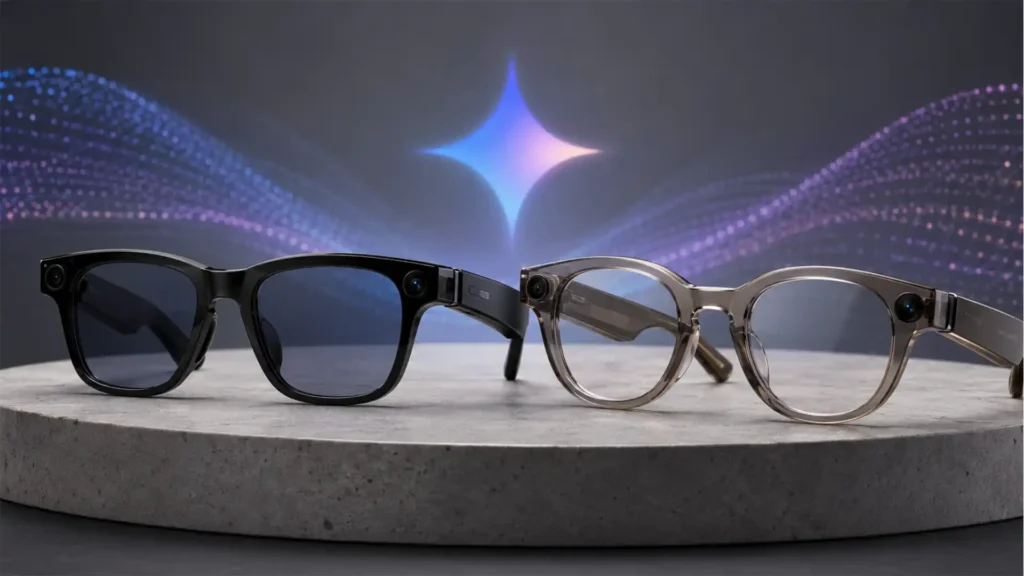
This article is an original analysis supported by the sources cited below
Intelligent eyewear is coming this fall
Google’s official May 19, 2026 Android XR announcement describing the fall launch of audio glasses, the separate display-glasses category, Gemini features and the Warby Parker, Gentle Monster and Samsung partnership.
Samsung and Google Give First Look at New Intelligent Eyewear
Samsung’s U.S. newsroom release confirming the Google I/O 2026 reveal, partner roles, phone-companion model, feature examples, select-market fall launch plan and product caveats.
Sneak Peek: Intelligent Eyewear | Gemini is Coming to Your Glasses
Google’s official reveal video for the intelligent eyewear preview referenced in the brief.
Warby Parker Intelligent Eyewear
Warby Parker’s official product page for its Google and Samsung intelligent-eyewear collaboration, including all-day-wear positioning and prescription expertise.
Gentle Monster Intelligent Eyewear
Gentle Monster’s official collaboration page for intelligent eyewear created with Google and Samsung.
A new look at how Android XR will bring Gemini to glasses and headsets
Google’s 2025 Android XR glasses preview covering camera, microphone, speaker, optional in-lens display, translation, messaging, directions and prototype testing.
Android XR: The Gemini era comes to headsets and glasses
Google’s December 2024 Android XR platform announcement with Samsung, including the platform’s role across headsets and glasses.
Qualcomm and Google collaborate to launch new Android XR platform
Qualcomm’s developer post on Android XR and its collaboration with Google and Samsung for XR devices.
Project Astra
Google DeepMind’s official Project Astra page describing natural interaction, multimodal memory, visual interpretation research and the path toward universal AI assistant capabilities.
Our vision for building a universal AI assistant
Google DeepMind’s 2025 post explaining Gemini’s universal-assistant direction, Project Astra capabilities and context-aware action across devices.
Gemini Apps Privacy Hub
Google’s official Gemini Apps privacy notice explaining categories of data collected when users interact with Gemini.
AI at Google: our principles
Google’s AI principles page, including privacy design, accountability, safety and restrictions on harmful surveillance uses.
Glass Enterprise Edition Announcement FAQ
Google’s official support FAQ confirming the end of Glass Enterprise Edition sales and support timeline.
Warby Parker, Google to launch AI-powered smart glasses in 2026
Reuters report on Warby Parker and Google’s 2026 smart-glasses timeline, Android XR, Gemini and the two-category device strategy.
EssilorLuxottica sales boosted by Meta AI glasses
Reuters report on EssilorLuxottica’s smart-glasses-driven sales performance and production-capacity plans.
Introducing the New Ray-Ban | Meta Smart Glasses
Meta’s official 2023 launch post for Ray-Ban Meta smart glasses, including price, camera, audio, livestreaming, Meta AI and charging-case details.
Meta Ray-Ban Display: Breakthrough AI Glasses Available Now
Meta’s official post on the Ray-Ban Display launch, pricing and availability, used for competitive context around display-enabled AI glasses.
AI Act
European Commission page explaining the EU AI Act, its risk-based framework and regulatory purpose.
Art. 4 GDPR – Definitions
GDPR text resource used for the legal definition of biometric data.
Art. 9 GDPR – Processing of special categories of personal data
GDPR text resource used for the treatment of biometric data used for unique identification as a special category of personal data.
Guidelines 3/2019 on processing of personal data through video devices
European Data Protection Board guidance relevant to video devices, personal data and privacy obligations.
A first and second look at the Android XR glasses launching this year
The Verge hands-on and demo report on Android XR glasses, Project Aura, prototype performance, missing specs and practical limitations.
Hands-On With All of Google’s New Upcoming Android XR Smart Glasses
WIRED hands-on report covering the Google and Samsung eyewear demos, audio-only launch timing, camera use, translation and Visual Positioning System details.
Google announces glasses are back and search is getting an AI makeover
The Guardian’s Google I/O 2026 report connecting Google’s intelligent eyewear reveal with Gemini, Search and agentic AI announcements.
| Citing this article? Brief excerpts are welcome. Please credit Webiano.digital, name the author where stated, and include a link to https://webiano.digital and to this original article. Full or substantial republication requires prior written permission. Read our Copyright and Content Use Policy. |
This article was prepared with the assistance of artificial intelligence tools. The content underwent expert human review, and Webiano Digital & Marketing Agency assumes editorial responsibility for its final version and publication.