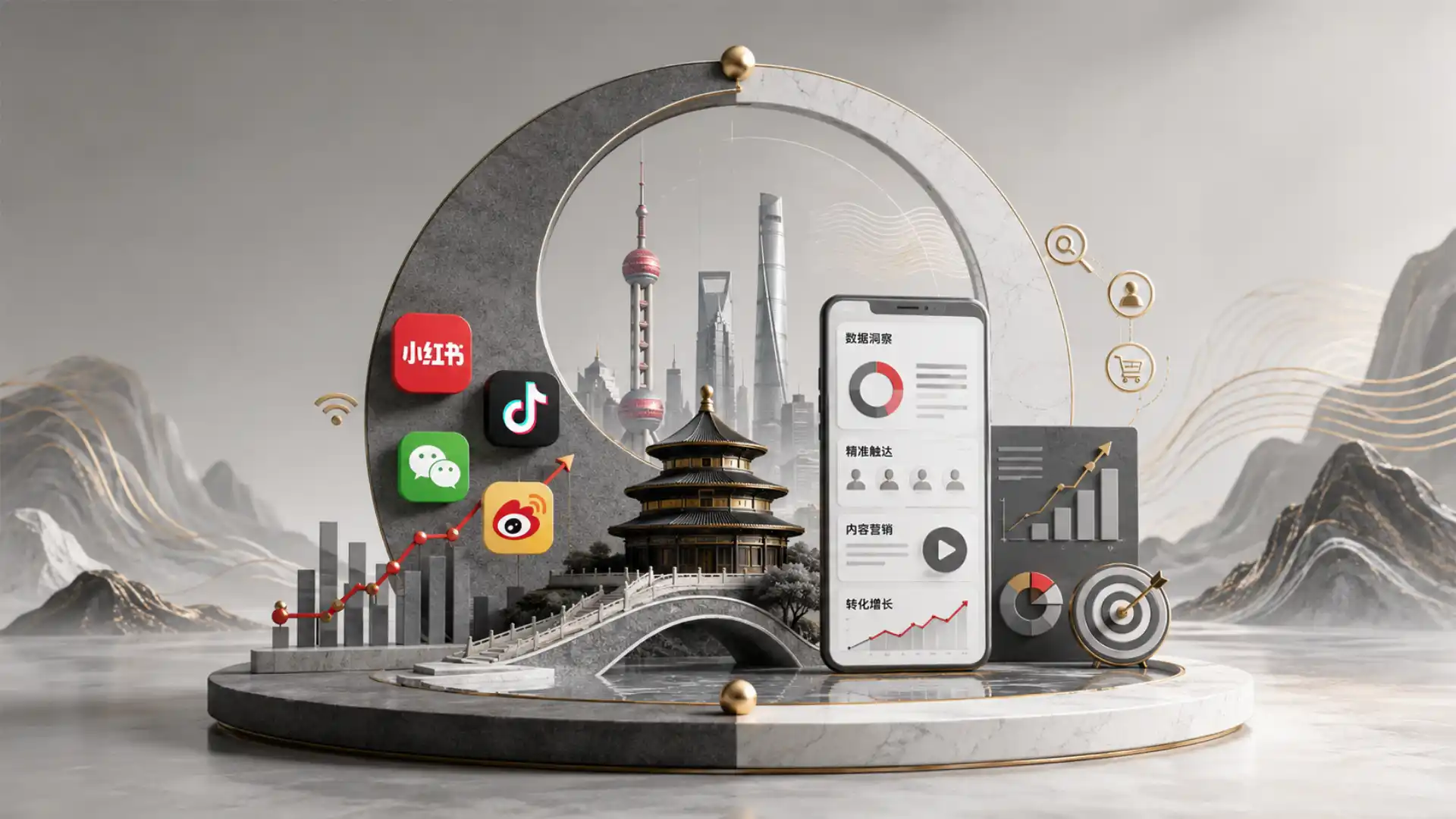
Performance marketing in China does not begin with a landing page. It usually begins inside an app where the user already watches videos, chats with friends, reads product notes, follows creators, searches for reviews, joins brand groups, pays for goods, receives delivery updates and contacts customer service. The Western habit of separating media, website, checkout, CRM and analytics into different layers does not map cleanly onto China. The market is built around commercial ecosystems, not around the open web.
Table of Contents
China’s performance model is built inside closed commercial apps
That difference changes the job of the marketer. Buying traffic is only one part of the system. The real work is to connect paid media, creator content, platform search, product pages, livestream scripts, coupons, stores, payment, service and repeat purchase in the same operating rhythm. A campaign that looks strong in the ad dashboard can still fail if the product detail page is weak, the store rating is low, the livestream host is not trusted, the discount is mispriced, the customer-service team answers too slowly, or the platform’s algorithm cannot read enough conversion signals.
China has the scale to make performance marketing brutally measurable, but that does not make it simple. DataReportal estimated 1.11 billion internet users in China in January 2025, equal to 78% internet penetration, and 1.08 billion social media user identities. CNNIC’s official statistical report put China’s mobile internet users at 1.105 billion at the end of 2024, with 99.7% of internet users accessing the internet by mobile phone.
The market is also commercially deep. China’s National Bureau of Statistics reported 15.5225 trillion yuan in nationwide online retail sales in 2024, with online physical-goods retail sales accounting for 26.8% of total retail sales of consumer goods. For a performance marketer, that means the internet is not a media channel sitting above commerce. It is a core retail environment.
The mistake foreign brands often make is to translate a Google–Meta–Shopify–CRM model into Chinese names. They ask which platform is “China’s Facebook,” which one is “China’s TikTok,” and which one replaces Google. Those comparisons break quickly. WeChat is not just a messaging app. Douyin is not just short video. Xiaohongshu is not just a lifestyle social network. Taobao and Tmall are not just marketplaces. Baidu is no longer just classic search. Each platform owns its own media logic, data structure, conversion path and trust mechanism.
Performance marketing in China works when the brand accepts the platform-native nature of the market. The user does not need to leave the app to move from awareness to purchase. A video can become a search query. A review can become a store visit. A livestream can become a checkout. A coupon can become a CRM trigger. A Mini Program can become a repeat-purchase engine. A private group can become a high-margin retention channel. The funnel still exists as a business concept, but the consumer experience often feels like a dense loop of content, proof, offer and service.
This is why China rewards operators more than campaign planners. The winning teams are not only good at media buying. They understand merchandising, feed algorithms, creator economics, compliance, store operations, customer service, logistics, after-sales rules, data governance and pricing. China’s performance market is a system, and each part of the system can raise or destroy return on ad spend.
Scale makes the market unforgiving
China’s digital audience is not only large; it is highly active across commerce-heavy services. CNNIC reported that by December 2024, China had 1.101 billion social-network users, 1.081 billion instant-messaging users, 1.070 billion online-video users and 1.040 billion short-video users, with short video reaching 93.8% of internet users. The same report recorded 974 million online-shopping users and 1.029 billion online-payment users.
Those numbers explain why China is a test market for performance formats that later appear elsewhere. Short-video shopping, livestream commerce, group-buying mechanics, social search, creator-led conversion and retail-media auctions all matured at speed because the user base was already mobile, payment-ready and platform-trained. The audience does not need to be educated about QR codes, wallet payments, in-app stores, livestream deals or social product discovery. The friction is low enough for small changes in price, delivery promise or content angle to move real sales.
Scale also punishes lazy localization. A foreign brand may assume that its global creative, translated into Chinese, will be enough. It rarely is. Chinese consumers often evaluate imported brands through platform-specific signals: store certification, product-note credibility, creator fit, review depth, price history, brand response speed, user-generated photos, livestream proof, delivery reliability and post-purchase service. A brand’s paid ad is only one trust signal among many.
The competitive field is crowded. On Tmall, JD.com, Pinduoduo, Douyin, Kuaishou and Xiaohongshu, users can compare brands in seconds. They can search for “real review,” “is it worth buying,” “comparison,” “ingredient analysis,” “authentic or fake,” “discount history,” “buyer show,” and category-specific concerns. The result is a market where advertising claims need operational backing. A good click-through rate does not survive poor reviews.
The market’s size also means platforms can train their ad systems with enormous behavioral data. That gives buyers strong targeting and bidding tools, but it also shifts power to platforms. Campaigns work better when conversion events, product feeds, store data and creative signals remain inside the same ecosystem. A brand that refuses to invest in platform-native assets often buys expensive traffic with weak feedback loops.
This is one reason the Chinese ad market is so digital. eMarketer projected China’s digital ad sector would reach $143 billion in 2024, representing 85% of total media spending. The exact share may vary by source and methodology, but the direction is not in doubt: China’s media economy is heavily digital, heavily mobile and deeply tied to commerce platforms.
Performance marketing in such a market is not a campaign checklist. It is a daily operating discipline. Teams watch platform dashboards, store analytics, search queries, comments, coupon take-up, creator content, livestream conversion, repeat purchase and refund patterns. They adjust product pages, pricing, content hooks and bidding rules together. The best teams do not treat media as a separate department. They make paid media part of commercial management.
Performance starts before the click
A click is late in the Chinese performance journey. The user may have seen the product on Douyin, searched Xiaohongshu for reviews, checked Tmall for brand legitimacy, asked a friend in WeChat, compared prices on JD or Pinduoduo, watched a livestream demonstration, and then clicked only after trust had already been built elsewhere. Attribution often credits the final action while the real persuasion happened earlier.
This is especially true for categories with high perceived risk: beauty, maternal and baby products, health-related goods, education, luxury, electronics, food supplements, travel, financial services and imported products. Consumers want proof before purchase. Proof comes from creators, user notes, comment sections, store ratings, buyer photos, certifications, livestream demonstrations, expert content, brand history and platform reputation.
Performance teams therefore need to plan for “pre-conversion assets.” These include Xiaohongshu notes that answer search queries, Douyin videos that show use cases, WeChat content that explains after-sales policies, Tmall detail pages that handle objections, Baidu content for high-intent searches, and creator reviews that make the product feel safe. The paid ad then captures demand that these assets helped create.
A Western direct-response mindset often underestimates this layer. It asks why the cost per acquisition is high and tries to fix bidding. In China, the problem may sit outside the ad account. The product may lack enough credible notes on Xiaohongshu. The brand may have weak search visibility inside Douyin. The Tmall store may look underdeveloped. The price may be inconsistent across platforms. The customer-service script may be slow or vague. The livestream host may not match the category. The paid campaign only exposes those weaknesses faster.
Pre-click work also matters because platform algorithms read user behavior before purchase. A short video that earns saves, comments, replays and searches may become cheaper to distribute. A product page that keeps users engaged may support better traffic quality. A store with strong repeat-purchase signals may receive more efficient traffic. The ad system does not evaluate only the creative. It evaluates the commercial context around the creative.
China performance marketing is therefore closer to revenue architecture than media buying. The click is a measurement point, not the full story. The marketer’s job is to design the conditions under which the click becomes rational: trust, relevance, price, convenience, urgency and proof.
The funnel behaves more like a loop
The classic funnel assumes a staged journey: awareness, consideration, conversion and loyalty. China still has those stages, but users often move through them in nonlinear ways. A livestream can introduce a product, answer objections, create urgency, close the sale and recruit the buyer into a private community in one session. A Xiaohongshu note can generate search demand, social proof and store traffic weeks after publication. A WeChat group can drive repeat purchase without new paid acquisition.
The loop usually looks like this: content sparks interest, search verifies credibility, platform proof reduces risk, offer mechanics push action, payment closes the purchase, after-sales service affects reviews, reviews feed future discovery, and CRM brings the buyer back. Every sale creates data and social proof that influence the next sale.
This loop explains why campaign planning is different. A three-week paid campaign can produce immediate sales, but a three-month content-and-commerce program may build cheaper traffic through platform search and user trust. A brand that only buys bursts of traffic may never develop the assets that lower acquisition costs later. A brand that invests only in content may fail to convert because its store, offer and retargeting system are weak.
The loop is also platform-specific. On WeChat, the loop often runs through Official Accounts, Mini Programs, WeCom contacts, groups, coupons and repeat purchase. On Douyin, it runs through feed content, livestream rooms, product cards, search behavior and store follow. On Xiaohongshu, it runs through lifestyle notes, keyword visibility, saves, comments and credibility. On Tmall, it runs through marketplace search, store membership, product ranking, promotional events and paid placements. On Kuaishou, trust in creators and community familiarity can matter more than polished brand assets.
A mature China plan maps loops, not only channels. The question is not “Where do we buy traffic?” It is “Where does the user first believe us, where does the user verify us, where does the user buy, where do we retain the buyer, and where do future buyers find proof?” The answer will differ by category, city tier, price point and brand maturity.
This also affects budgeting. A budget split that looks efficient in a spreadsheet may fail if it ignores the role of each platform. Xiaohongshu may not show the highest direct ROAS, but it may reduce hesitation on Tmall. WeChat may not create the cheapest first purchase, but it may raise lifetime value. Douyin may produce quick sales, but returns and discount dependency may reduce net margin. The strongest plan separates contribution from attribution.
Mobile behavior rewires every metric
China’s internet is overwhelmingly mobile. CNNIC’s figure of 99.7% mobile access among internet users is not a technical detail; it is the foundation of the market. Mobile use shapes creative, checkout, search, customer service and measurement.
Creative must work in seconds. The first frame matters. Product use must be visible. Captions need to carry meaning even without sound. Comment sections become part of the persuasion. A product page must answer concerns quickly. Coupons and payment must work without forcing the user across too many app boundaries. Customer service must respond inside the environment where the user is already active.
Mobile also makes “micro-intent” visible. Users search inside apps after seeing content. They tap product tags during a video. They save a note for later. They join a livestream but wait for the right coupon. They follow a store before buying. They message customer service before committing. They share products in private chats. These actions matter because they signal intent before purchase.
Performance marketers need to measure these signals. A campaign dashboard that tracks only impressions, clicks and purchases misses much of the decision process. Better scorecards include saves, follows, store visits, product-card clicks, cart additions, coupon claims, livestream dwell time, comments, search volume, private-domain joins, repeat visits, customer-service chats, refunds and repeat purchase. Not every signal deserves the same weight, but each can reveal where the loop is working or breaking.
Mobile behavior also shortens the distance between content and transaction. Douyin’s official Ocean Engine site describes Douyin as a platform that has expanded beyond short video into livestreaming and e-commerce, and lists 600 million daily active users and 400 million search daily active users on its platform page. Even when a brand treats Douyin as an awareness channel, many users treat it as a place to search, compare and buy.
The same pattern appears across platforms. WeChat search, Xiaohongshu search, Taobao search, JD search, Douyin search and Baidu search all play roles. The mobile user does not think in a clean sequence. They use whichever search box, feed or chat path feels natural at that moment. A China performance plan needs search visibility inside social apps, not only on search engines.
WeChat turns retention into media
WeChat is difficult for foreign marketers to classify because it cuts across messaging, content, payments, mini-apps, video, search, customer service and CRM. Tencent reported that the combined monthly active users of Weixin and WeChat reached 1.385 billion at the end of 2024. For brands, that scale makes WeChat less a “channel” than a customer operating system.
WeChat’s performance value is strongest after the first contact. Official Accounts distribute content and service messages. Mini Programs host stores, booking tools, loyalty programs and service flows. WeCom connects staff to customers. Groups allow private traffic management. Video Accounts adds short-video and livestream surfaces. WeChat Pay reduces checkout friction. Search allows users to find content, Mini Programs and brand services inside the ecosystem.
Tencent’s 2024 annual report said Marketing Services revenue rose 20% year over year to RMB121.4 billion, driven in part by demand for Video Accounts, Mini Programs, Weixin Search and AI-powered advertising infrastructure. That growth shows how WeChat has moved from a relationship layer into a larger performance-media environment.
The performance mechanics are different from auction-only paid social. WeChat often works best when paid acquisition feeds owned relationships. A beauty brand might use Moments ads, Video Accounts content or creator cooperation to bring users into a Mini Program store. It then uses membership, coupons, service messages, groups and staff-assisted selling to raise repeat purchase. A private-clinic brand might use WeChat to nurture leads, book consultations and handle service questions. A B2B firm might use Official Account content and WeCom follow-up to convert leads slowly.
The metric that matters on WeChat is not only immediate ROAS. It is the cost of acquiring a reachable customer relationship. A buyer who joins a membership program, accepts service messages or connects with a store consultant can be reached again without paying the same auction cost. That is why Chinese marketers talk about private traffic. The phrase can be overstated, but the business logic is real: as public traffic gets expensive, brands try to build repeatable contact points they control more directly.
WeChat also has limits. Organic reach is not free in the naive sense. Groups require moderation. Official Account content must earn attention. WeCom staff can annoy users if incentives are too aggressive. Mini Programs need traffic from ads, search, QR codes, store staff, communities or offline locations. WeChat performance works when the brand treats it as infrastructure, not a dumping ground for followers.
For foreign brands, WeChat is often the place where China localization becomes operational. Customer service scripts, loyalty rules, coupon design, content tone, product education, store-locator flows and after-sales handling all meet inside the same environment. A poor WeChat setup can weaken even a strong media campaign because Chinese users expect service to be fast, local and app-native.
Douyin turns attention into checkout
Douyin is one of the clearest examples of China’s content-commerce model. It is a feed, a search engine, a creator economy, a livestream venue, a store environment and a performance platform. Ocean Engine, Douyin Group’s digital marketing platform, presents Douyin alongside Toutiao, Xigua Video, CSJ and other inventory, with ad and e-commerce solutions built around in-feed, search, livestream and store traffic.
The core mechanism is simple to describe and hard to execute. Short-form content discovers demand before the user states it. The platform’s recommendation system tests content against behavior. Strong videos earn more distribution. Product cards, store links, livestream rooms and search results turn interest into shopping. Paid tools then push content, products or livestream rooms toward users more likely to act.
The best Douyin performance accounts do not treat creative as a finished advertisement. They treat it as a testing system. A brand may run many variants of hooks, demonstrations, claims, price frames, creator styles, lengths and calls to action. The team watches not only sales, but completion rate, replays, comments, product-card clicks, follows, search lift and livestream entry. Losing content is cut quickly. Winning content is adapted, not copied blindly.
Livestreaming adds another layer. The host is not merely a presenter. The host is a sales interface. The script, product sequence, coupon timing, stock pressure, chat moderation, product demonstration and customer-service support all affect conversion. A strong media buyer cannot rescue a weak room. A polished video team cannot rescue poor pricing. A famous host cannot rescue a product with weak reviews.
Douyin also changes the meaning of search. Users search after seeing content, and search results include videos, accounts, products, stores and livestream-related signals. A brand with weak Douyin search visibility may pay to create demand and then lose that demand to competitors or unaffiliated reviewers. Performance on Douyin therefore includes feed buying, search defense, store strength and creator proof.
The risk is dependence on discount-led growth. Douyin can move volume fast, especially in categories where visual proof matters. But if the offer is too aggressive, users learn to wait for livestream deals. If the content is too transactional, the account may lose engagement. If the brand relies on paid boosts without building organic content quality, traffic costs can rise quickly. If returns are high, headline GMV hides weak net revenue.
For a foreign brand, Douyin works best when the China team has authority over content tempo and commercial rules. Global approval cycles that take weeks are poorly suited to a platform where hooks, memes, objections and competitor moves can shift daily. The brand still needs governance, but governance must not freeze the operation.
Kuaishou shows the community side of short-video commerce
Kuaishou is often discussed beside Douyin, but its commercial texture is different. It has a reputation for stronger creator-follower relationships, deep engagement in lower-tier cities and trust-driven sales formats. That does not mean it is only a lower-tier platform; it means its performance logic often depends more on familiarity and community than on polished discovery alone.
Kuaishou’s 2024 results show the scale of its commercial engine. The company reported that online marketing services revenue reached RMB20.6 billion in the fourth quarter of 2024, up 13.3% year over year, while full-year online marketing services revenue grew by more than 20%. It also reported RMB462.1 billion in fourth-quarter e-commerce GMV, up 14.4%, and 143 million monthly active paying users in e-commerce.
For marketers, the practical message is that short-video commerce in China is not a single-channel story. Kuaishou offers feed ads, creator cooperation, livestream commerce, store mechanics and algorithmic marketing tools, but the social relationship between creator and audience can matter more than in a purely trend-driven feed. A creator who has sold consistently to a loyal audience may outperform a more polished but less trusted account.
This matters for product categories where explanation, demonstration and trust lower risk. Agricultural goods, household items, apparel, food, local specialties, personal care, value-oriented products and practical electronics can all benefit from creator credibility. The conversion driver may be less about brand image and more about perceived honesty, familiarity and proof.
Kuaishou also illustrates a wider rule: China’s performance market is segmented by social energy, not only by demographics. Two users with similar age and income may buy differently depending on whether they trust platform search, creator recommendations, livestream hosts, marketplace rankings or private groups. The channel plan needs to reflect behavior, not only audience labels.
The operational pressure is similar to Douyin. Brands need content volume, room management, price discipline, store operations, fulfillment and after-sales control. If the product is not ready for fast feedback, the same channel that creates sales can create public complaints. Performance success is visible, but so is failure.
Alibaba makes retail media the centre of paid growth
Taobao and Tmall remain critical for many categories because they sit closest to purchase intent. Alibaba describes Taobao and Tmall as the world’s largest retail commerce business by GMV in the twelve months ended March 31, 2024, citing Analysys, and states that its China commerce revenue includes customer management services charged through models such as cost per click, cost per thousand impressions, time-based placement and cost per sale.
That language matters. Alibaba is not only a marketplace operator. It is a retail-media system. Merchants buy traffic, search visibility, display placements, recommendation exposure, affiliate-style sales and promotional participation inside a marketplace where users already have purchase intent. The distance between ad impression and transaction can be short, but the competition is intense.
Retail media in China differs from classic paid search because store performance is part of media performance. Product titles, SKU structure, price, reviews, sales history, store rating, customer service, delivery promise, campaign participation and membership tools all influence conversion. A bid may win traffic, but the store must win the sale. The ad auction and the merchant operation are inseparable.
Alibaba’s annual report also points to AI-driven shopping functions, including recommendations, virtual showrooms and personal assistants built with Qwen. This matters because retail discovery is not frozen around keyword search. Product discovery inside marketplaces is increasingly shaped by recommendation, personalization, content and AI-assisted browsing.
Tmall is often a legitimacy anchor for premium and foreign brands. A flagship store can reassure users that the product is official. Taobao can be broader and more price-sensitive. Tmall Global serves cross-border categories where a brand may not yet operate full domestic distribution. For performance planning, the question is not only which store to open. The question is how the store participates in paid search, content, promotions, membership, reviews and platform events.
Alibaba’s relationship with the broader internet has also changed. Reuters reported in September 2024 that Taobao and Tmall would begin accepting Tencent’s WeChat Pay, a move that chipped away at a long-standing payment barrier between major ecosystems. In May 2025, Reuters reported that Alibaba and RedNote, known in China as Xiaohongshu, were partnering to let RedNote users click product links that lead to Taobao.
These moves do not erase walled gardens, but they show pressure toward selective interoperability where commerce growth requires it. For marketers, this creates new pathing: content on Xiaohongshu may connect more directly to Taobao, and users may face less payment friction on Alibaba platforms. The strategic lesson is clear. China remains platform-controlled, but platform boundaries are not fixed.
Baidu keeps intent alive while AI changes search pages
Baidu remains important in China performance marketing, especially for high-intent, high-consideration and information-heavy categories. Users still search for medical information, education options, B2B suppliers, software, travel, industrial services, legal and financial topics. For many brands, Baidu is less glamorous than Douyin or Xiaohongshu, but it can catch demand when the user is actively seeking an answer.
The challenge is that search itself is changing. Baidu reported that by the end of June 2025, more than 50% of mobile search result pages contained AI-generated content, up from 35% in April, and that the figure reached 64% in July. Baidu also reported 735 million monthly active users for Baidu App in June 2025 and said Managed Page accounted for 50% of Baidu Core online marketing revenue in the quarter.
This changes performance marketing in two ways. First, brands need to think beyond paid keyword listings. If AI-generated answers and managed pages shape the user’s first impression, content quality, structured information and brand authority matter more. Second, lead generation must be watched carefully. Baidu can produce high-intent leads, but lead quality depends on keywords, page experience, claim compliance, form design, call-center handling and follow-up speed.
Baidu is also heavily affected by category regulation. Healthcare, finance, education and other sensitive fields require tighter claim review and documentation. Advertisers must be careful with certificates, landing pages, business licenses, prohibited terms and exaggerated promises. A campaign that would be routine in a less regulated category may be rejected or create legal risk in a sensitive one.
For B2B, Baidu still has a practical role. Procurement staff, engineers, distributors and business owners may search for product types, suppliers, technical specifications and after-sales support. The conversion may not happen online immediately. It may become a phone call, WeChat contact, catalog download or dealer inquiry. In these categories, performance measurement must include lead quality and sales follow-up, not only form volume.
Baidu also interacts with China’s broader search ecosystem. A user may search Baidu for a category, then verify on Xiaohongshu, then buy on Tmall, then join a WeChat group for service. Search marketers who only defend Baidu miss the social-search layer. Social marketers who ignore Baidu may lose high-intent users who want formal information. The practical answer is not to rank one platform as “best,” but to define the search role each platform plays.
Xiaohongshu sells through proof before it sells through ads
Xiaohongshu, also known internationally as RedNote, is best understood as a trust and discovery engine. Users come to search for lived experience: beauty routines, travel plans, fashion inspiration, home products, parenting tips, fitness notes, restaurant choices and product comparisons. The platform is not only a place to push ads. It is a place where users ask whether a product belongs in their life.
That makes Xiaohongshu especially powerful before purchase. It can create demand, validate claims, build category language and give users the social proof they need to move to a store. A user may search “best sunscreen for oily skin,” “is this serum irritating,” “winter coat for Beijing,” “Europe travel outfits,” “small apartment storage,” or “is this luxury bag worth it.” Brands that appear credibly in these searches can influence the decision before the final click.
Reuters’ May 2025 report that Alibaba and RedNote were linking Xiaohongshu content with Taobao shopping paths shows how valuable that discovery role has become. The report described the partnership as a formal app-to-app shopping connection between Xiaohongshu’s lifestyle content and Alibaba’s e-commerce infrastructure.
Performance on Xiaohongshu is therefore often indirect. Paid placements and creator campaigns may not produce immediate last-click ROAS comparable with marketplace search. But they may raise branded search, increase product-page conversion, reduce hesitation and provide the evidence users want. Xiaohongshu is where many products earn permission to be considered.
The platform also rewards language precision. Users search in natural phrases, and notes need to match real concerns. A beauty brand should not only publish brand slogans; it should answer skin type, climate, texture, ingredient, routine and comparison questions. A travel brand should address visa timing, route planning, weather, local transport, budget and photo spots. A home brand should show dimensions, installation problems, cleaning, durability and real-room context.
KOL and KOC seeding on Xiaohongshu requires care. Too much obvious paid content can damage credibility. Too many identical talking points make users suspicious. Strong campaigns mix creator tiers, real use cases, search terms, product education and comment management. The brand needs to monitor not only views, but search ranking, saves, comments, sentiment, store traffic and conversion lift elsewhere.
The risk is treating Xiaohongshu as cheap social proof. Users are skilled at detecting scripted notes. The platform’s value depends on perceived authenticity, and that means brands must tolerate a degree of specificity and imperfection. The best content feels useful before it feels promotional.
Livestreaming is sales theatre with hard operating rules
Livestream commerce in China is often misunderstood as entertainment with a buy button. It is closer to a live retail operation. The host, product selection, price ladder, script, claims, demonstration, coupon timing, live comments, customer service, payment path, fulfillment and return handling all matter at the same time. A livestream room is a sales floor, a media placement and a compliance risk in one.
The format works because it compresses attention, proof and urgency. Viewers can see the product demonstrated, ask questions, watch others buy, receive time-limited offers and complete payment inside the app. For products that need demonstration, comparison or reassurance, livestreaming can reduce hesitation. For value-driven categories, the format can make price and scarcity feel immediate.
But the economics can be harsh. Famous hosts may require high fees, commissions, strict pricing and deep stock preparation. Brand-run rooms need consistent traffic, trained staff, scripts, product rotation and content discipline. Short sessions may not build enough rhythm. Long sessions require operational stamina. Returns, refunds, discount leakage and platform fees can eat into margin. Headline GMV is not profit.
Regulation is also tightening. China’s State Administration for Market Regulation and Cyberspace Administration of China published livestream e-commerce supervision measures in December 2025, effective February 1, 2026. The measures define livestream e-commerce as selling goods or services through video, audio, graphics or mixed live streams on platforms and state their purpose as protecting the rights and interests of consumers and operators.
For performance teams, this means livestreaming must be governed like a regulated sales channel. Scripts need claim review. Hosts need training. Product demonstrations must not mislead. Endorsements, discounts, stock claims, health claims and comparisons need evidence. Customer-service commitments must match reality. The brand must know who is responsible: the platform, livestream room operator, seller, marketer, service provider or creator.
Livestreaming is strongest when it fits a wider loop. A Douyin or Kuaishou room can create first purchase. A WeChat community can retain the buyer. Xiaohongshu notes can make the product credible before the live event. Tmall or JD store strength can reassure buyers. Paid traffic can feed the room, but the room must convert on its own merits.
The mistake is to run livestreaming as a stunt. A one-off session with a celebrity host may create a sales spike but leave no repeatable machine. A mature brand builds its own live-room capability, tests scripts, trains hosts, keeps product claims clean, integrates customer service and uses live performance data to improve product pages and content.
Private traffic is China’s answer to rising acquisition costs
Private traffic, often called “si yu” in Chinese marketing, refers to customer relationships that a brand can reach repeatedly with less dependence on public ad auctions. It usually includes WeChat groups, WeCom contacts, Mini Program members, store members, brand apps, SMS, customer-service accounts and loyalty programs. The phrase is sometimes used too loosely, but the commercial reason behind it is sound: when public traffic costs rise, brands try to keep more of the customer relationship.
The idea does not mean traffic is free. Building and managing private traffic costs money. Staff must answer messages, run groups, segment users, create content, issue coupons, prevent spam, handle complaints and measure repeat purchase. Poorly managed groups become noisy discount channels. Aggressive outreach can hurt brand trust. But when done well, private traffic turns first-time buyers into reachable customers.
WeChat is the centre of many private-traffic systems because it combines messaging, payments, Mini Programs, service and social context. A skincare brand can bring a buyer into a skin-care consultation flow. A grocery chain can send local coupons. A clinic can manage appointments. An education company can nurture parents through content and adviser follow-up. A luxury retailer can connect VIP customers with store staff.
Private traffic changes performance measurement. The first purchase may appear expensive, but the second and third purchases may cost less if the customer has joined a reachable environment. A campaign with lower first-order ROAS may beat a higher-ROAS campaign if it recruits better members. The scorecard needs cohort retention, repeat purchase, order frequency, gross margin, refund rate and service cost.
Private traffic also demands consent and data discipline. China’s Personal Information Protection Law protects personal information and applies to processing inside China, with extra-territorial reach where overseas processing serves or analyzes people in China. Brands cannot treat private traffic as an unregulated contact list. Collection purpose, consent, minimization, storage, access control and deletion rights matter.
The strategic value of private traffic is resilience. Platforms change ad rules, ranking formulas and traffic prices. A brand with a real customer base can respond more calmly. It can launch products, gather feedback, test offers and raise repeat purchase without buying every touch from scratch. Still, private traffic is not a substitute for public discovery. It is the retention and relationship layer that makes public acquisition more profitable.
KOLs and KOCs are media, sales staff and reputation risk
Influencer marketing in China sits close to performance because creators are not only awareness vehicles. They search-test products, shape review language, run livestreams, host store links, answer comments, create proof and sometimes close sales directly. KOLs can deliver scale. KOCs can deliver credibility. Both can influence platform search and conversion beyond their visible campaign metrics.
The key is role clarity. A top creator may be used for reach, a category expert for authority, a mid-tier creator for demonstration, and many smaller KOCs for search coverage and lived experience. A campaign that pays only for one famous post may miss the way Chinese users verify products through repeated signals across search results and comment sections.
Creator selection must go deeper than follower count. Brands need to check audience fit, historical content, comment quality, fake engagement, category credibility, sales record, past controversies, platform penalties, contract terms and data access. A creator who looks attractive in a media plan may be weak in real conversion or risky for brand safety.
Contracts need specificity. They should define content claims, disclosure duties, approval rights, usage rights, exclusivity, platform links, data reporting, deletion conditions, livestream rules, refund responsibilities and prohibited statements. For regulated categories, claim control is even more important. A creator’s exaggeration can become the brand’s problem.
China’s internet advertising rules add pressure. The Measures for the Administration of Internet Advertising require internet advertisements to be identifiable, require paid listings to be marked as ads, set rules for purchase links in experience-sharing content, and impose archive and responsibility duties on advertisers and relevant platforms. Livestreaming sellers, room operators and marketers may bear advertiser, publisher or endorser responsibilities depending on their role.
Creator marketing works best when it is treated as part of the conversion architecture, not as rented popularity. The content must answer real user questions. The creator’s tone must fit the platform. The path to store or product page must be clean. The brand must track downstream search, store visits, coupon use, sales and sentiment. The creator relationship should build a body of proof, not only a temporary spike.
Creative testing happens at content speed
China’s performance teams often move faster on creative than global headquarters expect. The feed environment changes quickly, and platform algorithms reward content that fits current user behavior. A brand may test dozens or hundreds of short-video variations around one product: different hooks, problems, demonstrations, price frames, scenes, creator types, captions, music choices, comparison angles and proof points.
Speed does not mean chaos. Good teams build creative systems. They define claim boundaries, product truths, audience segments, approved proof points, visual rules, competitive references and disallowed language. Then they allow enough variation for the platform to find demand pockets. The discipline is not to control every frame from headquarters, but to control the truth of the message while testing the expression.
Creative fatigue is a real cost. A winning video may decay as the audience saturates. A livestream script may lose energy. A Xiaohongshu note template may become too recognizable. A marketplace product image may stop standing out during shopping festivals. Creative production must be continuous because China’s platforms are content-hungry.
The strongest creative is rarely a global brand film cut down to mobile. It is native to the platform. On Douyin, that may mean problem-solution demonstrations, fast comparison, creator-led use, visible transformation or sharp offer framing. On Xiaohongshu, it may mean detailed notes, authentic photos, search-friendly titles, real-life context and precise pros and cons. On WeChat, it may mean service-rich content, member benefits, practical education or adviser follow-up. On Tmall, it may mean product images, detail pages and review prompts that solve purchase hesitation.
Creative testing should also feed product and merchandising decisions. If users repeatedly ask the same question in comments, the product page should answer it. If a video angle drives clicks but poor conversion, the promise may be attracting the wrong users. If a livestream host faces repeated objections on price, bundling may need adjustment. If Xiaohongshu notes convert interest but not purchase, store credibility or price parity may be weak.
In China, content is not just communication. It is market research, search inventory, conversion support and customer-service evidence. Teams that learn from creative feedback outperform teams that only report creative winners.
Measurement is possible, but not portable
China is not a measurement black box, but it is not a simple open-web attribution market either. Each major platform has its own data, event structure, pixel or API logic, store analytics and reporting limits. Cross-platform user identity is constrained by privacy law, platform boundaries and technical fragmentation. Global analytics tools that work elsewhere may have limited value or need local configuration.
The practical measurement stack often includes platform ad dashboards, store analytics, Mini Program data, CRM or membership data, customer-service records, server-side conversion events, coupon codes, link parameters, call tracking, offline-store data, financial reporting and periodic incrementality tests. The goal is not to find one perfect dashboard. The goal is to reconcile platform truth with business truth.
Platform truth tells the marketer what happened inside a specific ecosystem: impressions, clicks, views, product-card taps, store visits, adds to cart, purchases, livestream behavior, follows, coupon claims or managed leads. Business truth tells the company whether those actions created profit: net revenue, margin, returns, subsidies, platform fees, creator fees, logistics cost, repeat purchase and customer-service cost.
The gap can be large. A Douyin campaign may show strong GMV but weak margin because of discounts and returns. A Xiaohongshu campaign may show weak direct conversion but raise Tmall branded search and product-page conversion. A WeChat member drive may show slow revenue but strong repeat purchase after two months. A Baidu campaign may show cheap leads but poor sales after call-center qualification.
Good measurement begins with a naming system. Campaigns, SKUs, coupons, creators, livestream sessions, landing pages and member flows need consistent labels. Without naming discipline, China’s fast channel mix becomes impossible to read. Teams also need to separate new customer acquisition from repeat purchase, full-price sales from subsidized sales, and gross GMV from net recognized revenue.
Incrementality is underused but needed. Platform attribution often claims credit for conversions that may have happened anyway. Brands can run holdouts by region, audience, time period, store group, coupon exposure or media split where platform rules allow. The test does not need to be perfect to be useful. It should answer practical questions: Which channel creates new demand? Which channel captures existing demand? Which creator format changes conversion? Which promotion steals margin?
Measurement in China is a craft. The data exists, but it sits in fragments. The team that connects those fragments with commercial judgment has a real advantage.
Attribution needs platform truth and business truth
Attribution is one of the most common failure points for foreign brands in China. Global teams ask for a familiar multi-touch attribution model. Local teams send platform reports. Finance asks why ROAS differs from net sales. Agencies defend last-click metrics. Marketplace teams argue that sales were caused by store operations. Social teams argue that demand came from content. Everyone may be partly right.
The issue is structural. China’s platforms have strong internal measurement but limited cross-platform transparency. A Xiaohongshu note can push a user to search on Tmall. A Douyin video can create branded demand that converts later on JD. A WeChat group can push a user back to a Mini Program after exposure elsewhere. A Baidu click can lead to a WeCom conversation and an offline sale. No single platform will fully credit another platform’s influence.
A practical model uses layers. First, read platform attribution for tactical improvement inside each platform. Second, read store and business data to see real revenue, margin and repeat purchase. Third, use controlled tests and time-series analysis to estimate lift across the system. Fourth, look at proxy indicators such as branded search, direct store traffic, note saves, product ranking, coupon redemption and member growth.
The aim is not attribution purity. The aim is better budget decisions. If Xiaohongshu content raises Tmall conversion, the budget should not be cut simply because Xiaohongshu last-click ROAS looks low. If a livestream drives high GMV but high refunds, the budget should not grow blindly. If Baidu produces fewer leads but higher contract value, cost per lead may be the wrong metric.
Attribution also needs category logic. Fast-moving consumer goods, cosmetics, luxury, education, B2B machinery, healthcare, travel and local services do not share the same decision cycle. A category with frequent repeat purchase can accept higher first-order acquisition costs if retention is strong. A high-ticket product may need longer nurture. A low-margin commodity may require strict payback and price discipline.
China’s platform diversity makes attribution messy, but it also gives brands many signals. The best teams do not fight endlessly over the “true” source of a sale. They define decision rules. For example: marketplace search gets judged by profitable orders and search share; Xiaohongshu by search visibility, sentiment and assisted conversion; Douyin by net GMV and customer quality; WeChat by retention and LTV; Baidu by qualified leads and sales acceptance.
Attribution becomes useful only when it changes action. A beautiful model that does not change bids, content, pricing, store pages or CRM flows is just reporting theatre.
Data rules shape what marketers can collect
China’s data governance regime is central to digital marketing. The Personal Information Protection Law, Data Security Law and Cybersecurity Law form the base. They influence consent, collection purpose, cross-border transfer, data localization, processing agreements, security duties and user rights. Foreign brands cannot treat China data as another regional feed into a global CRM without review.
The Personal Information Protection Law defines personal information broadly and protects people’s rights and interests in personal information. It applies to processing inside China and can apply to overseas processing when products or services are offered to people in China or their behavior is analyzed. The Data Security Law sets duties around data handling and security, including risk management for important data. The Cybersecurity Law applies to network construction, operation, maintenance and use inside mainland China and includes duties around cybersecurity and critical information infrastructure.
For marketers, this affects daily practice. Lead forms need clear purpose and consent. Membership programs need privacy notices. CRM fields should be limited to what is needed. Sensitive personal information requires extra care. Data processors and agencies need contracts. Access rights should be controlled. Data export from China to overseas systems may need assessment, standard contracts, certification or exemption depending on the data and volume.
China has also adjusted cross-border data rules to ease some business flows. Reuters reported that the Cyberspace Administration of China issued rules in March 2024 to facilitate cross-border data flow, with exemptions for some international trade, cross-border transportation and other scenarios where personal information or important data is not involved. The official provisions also set conditions around critical information infrastructure operators, personal information thresholds and security assessment or contract mechanisms.
The practical lesson is that performance measurement must be designed with privacy from the start. A brand should not first build a data flow and then ask legal teams to approve it. The data map should show what is collected, where it is stored, which vendor processes it, whether it leaves China, how long it is kept, and how users can exercise rights.
Privacy compliance also affects media efficiency. If events are missing, platforms have weaker signals. If consent is unclear, data use becomes risky. If global systems cannot receive certain data, reporting must be localized. If the company cannot reconcile customer IDs legally, LTV analysis becomes harder. Compliance is not separate from performance. It sets the boundaries of the performance engine.
Advertising law reaches into search, reviews and livestreams
China’s internet advertising rules cover far more than banner ads. The Measures for the Administration of Internet Advertising require internet ads to be distinguishable, paid search listings to be clearly marked as advertisements, and experience-sharing content with purchase links to be marked as advertising. They also require advertisers to be responsible for the truthfulness of internet ads and to keep advertising archives for at least three years.
These rules matter because China’s performance marketing often blends content and commerce. A lifestyle note, search result, livestream recommendation, product comparison, creator review or short video may function as advertising when commercial links or paid relationships exist. The boundary between content and ad is not always obvious to users, which is precisely why regulators focus on disclosure and responsibility.
The same measures address pop-up and opening-screen ads, requiring a clear close sign and one-click closure while banning deceptive or difficult close mechanisms. They also address unsolicited ads through email or instant messaging, requiring consent and a refusal mechanism.
For performance teams, these details affect conversion design. Aggressive pop-ups, forced countdowns, unclear ads, disguised endorsements and pushy messaging may increase short-term clicks but create legal exposure and user distrust. A “growth hack” that violates ad rules is not a strategy; it is a liability.
Claims need special care. Beauty products, health foods, medical services, financial products, education, children’s products and imported goods can trigger category-specific restrictions. “Best,” “number one,” guaranteed results, disease claims, investment returns, exaggerated efficacy and unverifiable comparisons may be unsafe. A livestream host improvising claims under sales pressure can create serious risk.
Compliance should sit inside the content workflow. Scripts, creator briefs, product pages, search ads, livestream claims, landing pages and CRM messages need review rules before they go live. That does not mean every post must wait for slow legal approval. It means the team needs approved claim libraries, banned terms, evidence files, escalation paths and training.
China’s performance market rewards speed, but speed without control can be expensive. The best teams build guardrails that allow fast testing without letting creators, media buyers or customer-service staff invent claims.
Algorithms are regulated business infrastructure
Algorithms are not invisible plumbing in China. They are part of the regulatory field. China’s provisions on algorithmic recommendation services require providers to follow laws and ethics, uphold fairness, openness and transparency, and avoid using algorithms to spread prohibited information or create harmful user patterns. They also require user notices, options related to personalized recommendations, and rules against algorithm-based unreasonable differential treatment in transaction terms.
For marketers, this matters because performance media relies on algorithmic targeting, bidding, recommendation, personalization and content distribution. The platform algorithm decides which user sees which video, product, livestream or ad. The advertiser feeds the algorithm with creative, bids, product data and conversion signals. Regulation sets boundaries around how that matching can operate.
The anti-discrimination point is commercially relevant. Dynamic pricing, coupon targeting and user segmentation are common in performance marketing, but they need governance. A brand may want to target high-value customers with different offers. It must avoid practices that look unfair, deceptive or discriminatory under relevant rules. The safest path is to define segmentation by clear campaign purpose, consent, eligibility and documented business logic.
Algorithmic rules also affect content distribution. Platforms face duties to manage harmful content, prevent addictive or excessive consumption patterns, and provide user controls. That can change feed behavior, recommendation logic and ad delivery. Marketers who rely on exploitative hooks or manipulative content may see performance decay or moderation risk.
The platform algorithm is both a growth engine and a compliance filter. Brands need to understand what the algorithm rewards, but they also need to understand what the platform is required to suppress or label. This is one reason local platform specialists matter. They read not only dashboards, but policy updates, platform notices, moderation trends and category restrictions.
AI will intensify this issue. Baidu’s AI-generated search pages, Alibaba’s AI shopping tools, Tencent’s AI-powered ad infrastructure and platform creative tools all push marketing toward machine-assisted targeting and content production. The more automated the system becomes, the more brands need human governance over claims, data use, pricing and customer treatment.
The main performance channels in China
The main performance channels in China
| Channel layer | Main platforms | Strongest role | Main performance signal |
|---|---|---|---|
| Closed social and CRM | WeChat, WeCom, Mini Programs | Retention, service, repeat purchase | Member growth, repeat order, LTV |
| Short video and live commerce | Douyin, Kuaishou | Discovery, impulse purchase, product demonstration | Net GMV, ROAS, live-room conversion |
| Retail media | Tmall, Taobao, JD, Pinduoduo | Purchase capture, store traffic, marketplace ranking | Profitable orders, search share, store conversion |
| Social search and proof | Xiaohongshu | Consideration, review discovery, lifestyle validation | Saves, branded search lift, assisted conversion |
| Intent search | Baidu, Sogou, 360 Search | High-intent leads, B2B, services, regulated categories | Qualified leads, sales acceptance, cost per deal |
| Local services | Meituan, Dianping, Amap, WeChat local tools | Store visits, bookings, coupons, local discovery | Redemption, booking, offline conversion |
| Creator commerce | Platform KOLs, KOCs, affiliates | Trust, reach, product education, livestream selling | Creator-level sales, sentiment, search impact |
| Owned data and membership | Brand CRM, Mini Program, store membership | Customer value and retention | Cohort retention, margin, repeat purchase |
This table simplifies a market that changes fast, but it shows the central point: China performance marketing is not one channel replacing Google and Meta. It is a stack of app-native commercial systems that must be connected around the customer decision.
Cross-border brands need a China data and entity plan
Foreign brands entering China often focus first on media: which platform to use, which agency to hire, which creators to book. Those choices matter, but the operational foundation comes earlier. The brand needs to decide how it will sell, collect data, receive payments, handle customer service, issue invoices, manage logistics, store customer information, appoint local partners and satisfy platform verification requirements.
The route depends on market entry model. A brand may sell through cross-border e-commerce, a Tmall Global store, a domestic Tmall flagship, JD, Douyin store, distributors, offline retail, a WeChat Mini Program, local marketplaces or a mix. Each route affects licensing, tax, labeling, warehousing, customer service, returns, data collection and ad account setup.
Cross-border e-commerce can reduce some initial barriers, but it is not a shortcut around localization. Product pages must be in Chinese. Customer-service hours must match user expectations. Delivery and returns must be clear. Reviews must be built. Creator content must answer local concerns. Pricing must account for platform fees, duties, promotions, commissions and discount expectations.
A domestic entity or partner may be needed for deeper operations. Certain ad accounts, store types, payment tools, data processing flows and customer-service structures require local documentation. Foreign companies can open some accounts with non-Chinese business licenses on selected services; Ocean Engine, for example, states on its site that it accepts non-Chinese business licenses for account opening, subject to review and approval. But that does not remove the need for legal, tax and operational planning.
The biggest risk is building a marketing plan before the commerce path is ready. If a campaign drives demand to a store with poor logistics, unclear after-sales, missing payment options or weak customer service, the brand pays to create disappointment. In China, dissatisfied users have many public places to leave evidence: reviews, notes, comments, screenshots and group chats.
Foreign brands also need data routing decisions. Will customer data remain in China? Which vendors process it? Which data moves to the global CRM? Does the company need standard contracts or security assessment for certain transfers? What consent language is used? Which team responds to user data requests? These are not abstract legal questions. They determine what the performance team can measure and retarget.
Payments are conversion infrastructure
China’s payment layer is a conversion engine. Alipay and WeChat Pay are not just payment methods; they are embedded into social, retail, service and offline behaviors. CGAP’s analysis of China’s digital payments noted that Alipay and WeChat Pay linked wallets directly to broad in-app ecosystems including retail platforms, financial services, bill pay and many online and offline consumption services.
For performance marketing, this matters because payment friction can destroy a campaign. If the user is ready to buy inside an app but the payment method is inconvenient, conversion drops. If a platform wallet is trusted, checkout feels natural. If the payment flow connects to coupons, membership and after-sales service, it becomes part of the marketing loop.
The September 2024 Reuters report that Taobao and Tmall would begin accepting WeChat Pay is therefore more than a payments story. It reduces friction between Alibaba commerce and Tencent’s wallet ecosystem, and it reflects the gradual weakening of older platform walls where growth requires smoother user paths.
Payments also connect offline and online performance. QR codes can link store visits to Mini Programs, coupons, memberships and payment records. Local campaigns can drive redemption in restaurants, clinics, gyms, retail stores or service outlets. A paid ad may lead to a coupon, a coupon to a QR code, a QR code to payment, and payment to CRM. The transaction becomes a data point for retention.
Payment data is sensitive and governed by financial and personal-information rules. Brands should not assume that payment-linked data can be freely used for advertising. But at the business level, payment integration is part of performance design. The question is not only “Did the ad get a click?” It is “Did the user have a trusted, fast, compliant way to complete the action?”
China’s mobile payment culture also affects pricing behavior. Users are accustomed to coupons, wallet promotions, red packets, limited-time offers, group-buying discounts and app-specific benefits. That can help conversion, but it can also train discount dependence. A brand must decide when payment-linked promotions acquire valuable customers and when they only buy low-margin orders.
Promotions, subsidies and price signals carry more weight
Performance marketing in China is tightly linked to price architecture. Promotions are not occasional extras; they are often part of the platform rhythm. Shopping festivals, livestream coupons, member discounts, limited-time bundles, deposit pre-sales, platform subsidies, brand vouchers, category coupons and creator-exclusive offers all influence conversion.
This does not mean every brand should discount heavily. It means users are trained to notice price signals. They compare across platforms. They remember shopping festival prices. They wait for livestream deals. They ask in comments whether a product is cheaper elsewhere. They search for coupons. They check whether a brand’s flagship store price matches the creator offer.
Poor price control can break performance. If Douyin offers a lower price than Tmall, users may abandon the Tmall store. If Pinduoduo undercuts the brand’s premium channel, brand perception may suffer. If livestream discounts are too deep, regular store conversion weakens. If a private group receives better coupons than public buyers, users may delay purchase until they join the group.
A China performance plan needs a price map, not only a media plan. The map should define baseline price, promotional floors, platform-specific offers, bundle logic, member benefits, creator commissions, shopping festival strategy, distributor controls and gray-market monitoring. Without it, channel teams compete against each other.
Promotions also affect measurement. ROAS based on gross sales may look strong while contribution margin is poor. A coupon may produce many orders but low repeat purchase. A creator may sell volume only because of a subsidy the brand cannot repeat. A shopping festival may clear inventory but reset consumer expectations around price.
The best teams separate volume tactics from customer-value tactics. A discount can be useful if it recruits buyers who repeat at healthier margins. A bundle can raise average order value and trial. A member coupon can move a user into a retention system. A livestream deal can introduce a new product if the follow-up experience is strong. But discounting without a retention path is expensive attention.
Local services bring performance marketing into the street
China’s digital marketing does not stop at e-commerce. Local services and offline retail are deeply connected to mobile discovery. Restaurants, clinics, gyms, hotels, beauty salons, education centres, tourist attractions, stores and service providers use apps for search, reviews, booking, coupons, map discovery, QR codes and payment.
The mechanics differ from pure e-commerce. The conversion may be a booking, coupon claim, call, navigation request, store visit, QR scan, deposit, consultation or offline purchase. The user may discover the business on Dianping, Meituan, Amap, Douyin, Xiaohongshu, WeChat search, Baidu Maps or a creator video. Reviews and location signals matter heavily.
For local services, performance media must connect to operations at the store level. A coupon campaign that drives traffic to a restaurant fails if service is slow, menus are unclear or staff do not honor the offer. A clinic lead campaign fails if advisers respond late. A travel campaign fails if availability is inaccurate. Offline execution becomes part of media ROI.
Local content is also specific. Users want neighborhood relevance, route clarity, real photos, pricing, appointment availability, queue time, service quality, opening hours and social proof. A polished brand message may be less persuasive than a clear note showing exactly what happens when the user arrives.
Offline conversion requires instrumentation. QR codes, coupon codes, booking IDs, membership links, staff attribution, payment records and store-level dashboards help connect digital spend to offline results. Without that, local performance turns into impression buying with weak accountability.
For global brands with physical retail, China’s local-service layer can be powerful. Stores can become content sources, service points, membership recruitment sites and livestream locations. Staff can connect users through WeCom. Offline events can generate Xiaohongshu notes. QR codes can tie shelf browsing to Mini Program purchase. The boundary between online and offline is operationally thin.
B2B and high-consideration categories need a different route
China performance marketing is often discussed through beauty, fashion, FMCG and consumer electronics. But B2B, industrial, software, education, healthcare, finance, professional services and high-ticket categories need a slower model. The user may research across Baidu, WeChat, Zhihu, industry portals, trade shows, Xiaohongshu, Douyin, official websites and private chats before contacting sales.
B2B performance should not chase low-cost leads without sales qualification. A form fill from Baidu or a content download from WeChat may be useful only if the company, role, budget and project timeline are real. Lead scoring, sales acceptance and pipeline value matter more than raw lead count.
WeChat is often central for B2B because sales conversations move naturally into WeCom or personal WeChat contexts. Official Account articles can explain technical issues. Mini Programs can host catalogs, calculators, event registration or case libraries. Baidu can capture high-intent searches. Douyin and video platforms can demonstrate equipment, process or expertise. Offline exhibitions can feed digital follow-up.
For regulated high-consideration categories, claim discipline is strict. Medical, finance and education content must avoid exaggerated promises and comply with licensing rules. A performance team that only understands bidding can put the company at risk. Legal review, compliance documents and platform approval timelines must be built into campaign planning.
The main KPI for high-consideration China performance is not cheap traffic. It is qualified demand that sales can convert. That means connecting campaign source, content theme, lead form, adviser follow-up, sales stage and contract value. It also means rejecting channels that deliver volume but poor fit.
China’s platform mix can still work well for high-consideration brands. Xiaohongshu can influence trust in education, travel, lifestyle services and health-adjacent categories. Baidu can capture formal intent. WeChat can nurture. Douyin can demonstrate. The path is longer, but the performance discipline remains: measure the business outcome, not only the media action.
Search visibility now lives across Baidu, WeChat, Douyin and Xiaohongshu
Search in China is no longer only a search-engine question. Users search inside whichever app best fits the context. For official information, they may use Baidu. For lifestyle proof, Xiaohongshu. For video demonstration, Douyin or Kuaishou. For brand services, WeChat. For purchase, Taobao, Tmall, JD or Pinduoduo. For places, maps and local-service apps.
This means China SEO is fragmented but commercially rich. Brands need to know which questions users ask on each platform. A skincare product may need ingredient and texture content on Xiaohongshu, product-title and marketplace search work on Tmall, short video answers on Douyin, official service pages on WeChat, and category education on Baidu. The same keyword does not behave the same way everywhere.
Baidu’s AI search changes formal search. Xiaohongshu’s note search changes social proof. Douyin’s search connects content with product and livestream results. WeChat search connects public content, Mini Programs, services and accounts. Marketplace search connects user intent directly to product ranking and paid placements.
The new China search strategy is not one keyword list. It is a matrix of intent, platform and asset type. The brand must decide which questions deserve a product page, which deserve a creator note, which deserve a short video, which deserve an Official Account article, which deserve a marketplace search placement and which deserve customer-service scripts.
Search visibility also protects paid media. If a Douyin campaign triggers users to search the brand on Xiaohongshu and they find negative or thin content, the ad spend leaks. If a Xiaohongshu note creates purchase intent and the Tmall search result is dominated by resellers or competitors, demand leaks. If Baidu search results show outdated pages or weak official content, trust leaks.
Brands should monitor branded and category search regularly. Search volume, ranking, sentiment, competitor presence, review quality and platform autocomplete all reveal market perception. In China, search is not only demand capture. It is a public record of consumer doubts.
Agencies win only when operations match the media plan
Foreign brands often rely on local agencies, and in China that is usually necessary. Platform interfaces, account verification, media relationships, creator sourcing, local content production, compliance review, customer-service expectations and shopping festival calendars all require local knowledge. But agency selection must match the business problem.
A media-buying agency can run campaigns, but it may not fix store conversion. A social agency can create Xiaohongshu notes, but it may not manage Tmall operations. A livestream agency can staff a room, but it may not protect brand claims. A TP, or Tmall Partner, can manage marketplace operations, but it may not build private traffic. A KOL agency can book creators, but it may not connect content to CRM.
China performance often fails in the gaps between agencies. The social team says awareness is growing. The store team says conversion is weak. The media team says ROAS is acceptable. The finance team says margin is poor. The customer-service team says users are confused. The brand manager has no single operating picture.
The solution is not always one mega-agency. It is governance. The brand needs one commercial owner for China performance, shared KPIs, clear data definitions, weekly operating reviews, claim guidelines, price rules, platform responsibilities and escalation paths. Agencies should be judged by business impact, but the brand must give them enough authority and information to act.
Good agency questions are concrete. Which platform accounts do you manage directly? What category benchmarks do you use? How do you separate gross GMV from net revenue? How do you audit creators? How do you handle claim review? What is your process for Xiaohongshu search seeding? How do you connect Douyin content tests to store-page changes? How do you measure WeChat repeat purchase? How do you manage shopping festival inventory and pricing?
A weak agency hides behind platform jargon. A strong agency explains trade-offs. It will tell the brand when a requested KPI is unrealistic, when a price floor is too high for a platform, when the creative approval process is too slow, when a store page is blocking conversion, and when a campaign is buying low-quality demand.
A realistic market-entry sequence for foreign brands
A foreign brand entering China should resist the urge to launch everywhere. China’s platform map is large, and each platform requires real work. A scattered launch burns money and creates weak signals. A better sequence starts with product-market clarity, then builds proof, then scales paid acquisition.
The first step is category diagnosis. Who buys the category? Which platforms do they trust? What are the main objections? Which competitors define the price range? Which claims are allowed? Which products need adaptation? Which packaging, sizing, flavor, shade, ingredient, warranty or service details need localization? The answers shape everything else.
Next comes commerce setup. The brand chooses a store route, payment flow, customer-service model, logistics arrangement, return policy, data setup and platform accounts. Product pages are built with local search terms, images, proof, FAQs, certifications and review strategy. The brand prepares claim guidelines and customer-service scripts before paid traffic arrives.
Then comes proof building. Xiaohongshu notes, Douyin content, early creator trials, WeChat service content, marketplace reviews and Baidu official information create the evidence layer. The goal is not to flood the internet with paid praise. It is to make the product findable, understandable and credible.
Paid testing follows. The brand runs controlled tests on the platforms most likely to match the category: marketplace search for purchase intent, Douyin for discovery and live testing, Xiaohongshu for consideration, WeChat for retention, Baidu for high-intent or B2B demand. Budgets are set to learn, not to force scale before the loop is ready.
Scaling comes last. The brand increases spend only when it understands contribution margin, repeat purchase, refund behavior, platform mix, price discipline and creative production capacity. China rewards speed after the machine works; it punishes speed before the machine exists.
This sequence may feel slower than simply buying ads, but it reduces waste. Paid traffic reveals weaknesses quickly. If the store is unready, users leave. If proof is thin, users hesitate. If service is slow, users complain. If prices conflict, users wait. The goal is to build enough commercial readiness that every paid yuan has a fair chance to convert.
KPIs that actually describe China performance
China performance reporting often overuses ROAS because it is easy to read and platform dashboards provide it. ROAS matters, but it can mislead. Gross GMV may include discounts, returns, shipping subsidies and platform fees. Attributed sales may not be incremental. A high-ROAS retargeting campaign may only capture existing buyers. A low-ROAS content campaign may raise conversion elsewhere.
A better KPI set separates acquisition, conversion, quality and retention. Acquisition metrics include reach, cost per qualified visit, new-buyer cost, creator audience fit and search lift. Conversion metrics include store conversion, product-card click rate, cart rate, livestream conversion, coupon use and checkout completion. Quality metrics include refund rate, review sentiment, customer-service burden, average order value, gross margin and contribution margin. Retention metrics include repeat purchase, member activation, cohort value and time to second order.
For marketplaces, brands should track search share, ranking, paid versus organic traffic, product-page conversion, review count and quality, promotional profitability, store membership and repeat purchase. For Douyin and Kuaishou, they should track content-level performance, live-room quality, net GMV, refund rate, follower value, search lift and store conversion. For Xiaohongshu, they should track keyword coverage, save rate, comment quality, sentiment, branded search and assisted store traffic. For WeChat, they should track member growth, consented reach, Mini Program conversion, repeat purchase and service response.
The most useful China KPI is contribution by customer cohort. Which customers were acquired, at what cost, through which path, with what margin, and how did they behave after the first order? This is harder than platform ROAS, but it tells the truth that finance and marketing can share.
KPI design must also account for platform roles. A channel used for proof should not be judged like a checkout channel. A channel used for retention should not be judged only by first-order acquisition. A channel used for lead quality should not be judged by form volume alone. Bad KPI matching causes good channels to be cut and bad channels to scale.
The practical reporting cadence should be layered. Daily dashboards catch tactical problems. Weekly reviews adjust spend, creative, inventory and pricing. Monthly reviews assess channel contribution and cohort quality. Quarterly reviews decide platform strategy, agency scope and budget allocation. China moves fast, but strategic learning still needs time windows long enough to see repeat purchase and margin.
Core compliance checkpoints for China campaigns
Core compliance checkpoints for China campaigns
| Issue | Practical requirement | Performance impact |
|---|---|---|
| Personal data collection | State purpose, obtain valid consent, limit fields | Affects lead forms, CRM, retargeting and LTV analysis |
| Cross-border data | Review whether data export needs assessment, contracts, certification or exemption | Shapes global reporting and CRM integration |
| Ad identifiability | Mark ads, paid search and paid experience-sharing content where required | Affects creators, reviews, search ads and content commerce |
| Claim evidence | Keep proof for product, price, ranking, efficacy and comparison claims | Reduces rejection, takedowns and enforcement risk |
| Livestream duties | Train hosts, review scripts, manage seller and room responsibilities | Protects high-volume sales events from legal and reputational damage |
| Algorithmic targeting | Avoid unfair differential treatment and respect user controls | Shapes segmentation, coupons, pricing and personalization |
The table is not legal advice, but it captures the operating truth: compliance is not a late-stage approval box in China. It is part of campaign design, measurement design, creator management and conversion design.
AI is changing search, ads and content production
AI is now part of China’s marketing infrastructure. Baidu is adding AI-generated content into search results at scale. Alibaba is applying AI to shopping recommendations and assistants. Tencent reports demand for AI-powered advertising infrastructure. Douyin and other platforms use machine learning to distribute content, target ads and model conversion.
For performance marketers, AI matters in three places. First, search and discovery surfaces are changing. If answer-style results satisfy user intent inside the platform, fewer users may click classic links. Brands need structured, credible, platform-native content that AI systems can understand and surface. Thin promotional pages will be less useful.
Second, ad delivery is becoming more automated. Platforms increasingly encourage advertisers to provide products, creative assets, goals and conversion signals while the system allocates traffic. This can improve efficiency when the data is clean. It can also hide learning if teams stop understanding why campaigns work. Marketers need to audit inputs: product feed quality, event quality, creative variety, bidding goals and conversion definitions.
Third, content production is becoming faster. AI can draft scripts, generate variations, summarize reviews, analyze comments and assist creative testing. But China’s claim rules, platform moderation and consumer skepticism make blind automation risky. A generated script that exaggerates efficacy, misstates a product feature or copies a competitor can create legal and brand problems.
AI raises the value of human judgment. The machine can test and distribute; the team must decide what is true, compliant, distinctive and commercially sensible. China’s platforms will reward useful content, strong stores and clear conversion signals. They will not reward brands that automate generic claims at scale.
Generative AI also changes answer-engine visibility. Users may ask AI assistants for product comparisons, travel advice, health information, education choices or store recommendations. Brands need content that is specific, verified, structured and present across trusted platforms. This is where SEO, GEO and platform content merge. The future China search plan includes Baidu, social search, marketplace search and AI-mediated answers.
Retail media is becoming the operating centre
Retail media in China is more mature than many Western brands expect because marketplaces have long combined search, display, recommendation, promotion, store tools and transaction data. Alibaba, JD, Pinduoduo, Douyin and Kuaishou all offer forms of media tied closely to commerce. The advertiser is often also the seller, which means sales data, product data and ad data sit close together.
This closeness is powerful. A platform can target users based on shopping behavior, category interest, cart actions, store visits and purchase history. It can adjust placements based on product availability, promotion timing and conversion probability. A brand can see which keywords, products, creators or live sessions drive sales inside the platform.
But retail media can become a tax on merchants if not managed. Brands may pay more each year to defend the same shelf position. Promotions can erode margin. Competitors can bid on category terms. Platform events can force inventory and discount commitments. A brand that does not build organic store strength may become dependent on paid placements.
The best retail-media strategy combines paid traffic with store fundamentals. Product pages must answer objections. Reviews must be managed ethically. Search titles must match user language. Product images must show key benefits clearly. Customer service must respond quickly. Delivery promises must be reliable. Membership must convert buyers into repeat customers.
Retail media also changes the marketing organization. The media buyer needs to understand inventory. The e-commerce manager needs to understand bid strategy. The content team needs to understand product-page conversion. Finance needs to see net margin by platform. If these functions stay separate, the brand will misread performance.
As platforms add AI shopping assistants and recommendation engines, retail media may become less keyword-dependent and more product-data-dependent. Rich product attributes, clear images, structured content, reviews and conversion history may feed discovery. Brands that treat product data as administrative work will miss a performance lever.
The platform economy makes brand control harder
China’s platforms give brands access to huge audiences, but they also control the rules. Account approval, ad review, algorithm changes, store ranking, search visibility, creator policies, content moderation, data access, payment flows and promotional calendars are platform-managed. A brand can influence performance, but it does not own the full environment.
This creates a tension. The fastest route to sales is often inside platforms. The safest route to long-term brand control requires owned customer relationships, diversified channels and consistent price governance. China performance strategy lives between those two needs.
A brand that depends too much on one platform faces concentration risk. A Douyin-heavy strategy may suffer if content costs rise or live conversion weakens. A Tmall-heavy strategy may suffer if search competition grows or promotional pressure increases. A Xiaohongshu-heavy strategy may build proof but lack conversion infrastructure. A WeChat-heavy strategy may retain customers but need outside acquisition.
Diversification does not mean spreading thin. It means building a role for each platform and avoiding single-point failure. One platform may create discovery, another proof, another purchase, another retention. The brand’s operating system connects them.
Platform control also affects data. The platform can report rich internal performance while limiting exportable user-level data. This is normal in China, and marketers must plan around it. The brand’s own CRM, membership and commerce data become more important as a counterweight. Owned data is not a replacement for platform data, but it is the brand’s memory.
The brand must also maintain consistency. Users compare. If claims differ across platforms, trust suffers. If prices conflict, users delay. If service quality differs, users complain. If creators make claims the official store cannot support, the brand looks unreliable. Platform-native marketing must still feel like one brand.
Consumer trust is the real conversion rate
China’s consumers are sophisticated digital shoppers. They compare prices, read reviews, search for negative experiences, follow creators, inspect product pages, check store legitimacy and ask questions. This behavior is not a barrier to performance marketing; it is the environment in which performance marketing works.
Trust is built through repeated evidence. Official stores signal legitimacy. Reviews signal experience. Creator content signals use. Xiaohongshu notes signal lifestyle fit. Baidu results signal formal presence. WeChat service signals reliability. Fast delivery and fair returns signal competence. Each touch reduces perceived risk.
Conversion rate is often a trust score in disguise. If conversion is weak, the issue may not be targeting. It may be that users do not believe the claim, do not understand the product, do not trust the store, do not like the price, cannot find enough proof, or fear poor service. Bidding harder only sends more users into the same doubt.
Trust is category-specific. A snack brand needs taste, safety, freshness and price proof. A skincare brand needs ingredient, skin-type and efficacy proof. A baby product needs safety and parent testimony. A travel brand needs itinerary, visa, weather and local detail. A B2B supplier needs technical proof, certifications, case studies and after-sales support. A clinic needs licensing, doctor credentials and careful claim compliance.
Foreign brands may carry prestige, but prestige is not enough. Local consumers may ask whether the imported product suits Chinese skin, climate, taste, home size, family habits, delivery needs or service expectations. Localization is not only language. It is evidence that the product fits the buyer’s life.
Performance teams should read comments as market intelligence. Repeated objections reveal missing proof. Repeated comparisons reveal competitor pressure. Repeated questions reveal unclear pages. Repeated complaints reveal operational failure. China’s public feedback channels are fast, blunt and valuable.
Content commerce changes the role of brand storytelling
Brand storytelling still matters in China, but it must work harder. Users do not gather around brand narratives just because a company tells them. They reward content that solves problems, entertains, demonstrates, compares, educates or offers credible social proof. A brand story has to earn its place inside the user’s feed or search result.
This is why China content often looks more practical than global campaign work. A product may be shown in use rather than described abstractly. A creator may compare it with alternatives. A note may list drawbacks as well as benefits. A livestream may focus on demonstrations and objections. A WeChat article may explain service or maintenance. The content sells by being useful.
The brand’s voice must survive inside practical content. If every post becomes a discount pitch, brand equity weakens. If every post becomes polished corporate messaging, performance weakens. The middle path is specific, useful and recognizable. The user should feel that the brand understands the category and the consumer, not that it is reading a global tagline in Chinese.
Content commerce also changes creative ownership. Brand teams, agencies, creators, livestream hosts, store operators and customer-service staff all produce market-facing language. A host’s explanation, a customer-service reply and a product-page FAQ can influence conversion as much as an official ad. The brand voice is distributed across operations.
That requires a content knowledge base. The team needs approved product facts, claim evidence, common objections, competitor comparisons, banned terms, category education, customer-service answers and platform-specific tone rules. This knowledge base lets content move fast without drifting from the truth.
A strong China brand story is not one message repeated everywhere. It is a set of truths expressed differently by platform: proof on Xiaohongshu, demonstration on Douyin, service on WeChat, authority on Baidu, transaction clarity on Tmall, community trust on Kuaishou and price logic where value matters.
Shopping festivals create opportunity and distortion
China’s shopping festivals are major performance moments: 618, Singles’ Day, Double 12, Chinese New Year, category days, platform events and livestream festivals. They can create traffic, urgency and sales volume. They can also distort performance if brands judge them poorly.
A festival campaign needs preparation months ahead. Product selection, inventory, price floors, creative, creator bookings, store pages, customer-service staffing, logistics capacity, membership preheating and paid-media budgets must align. The event itself is not only a media buy. It is a commercial operation.
Festivals change user behavior. Consumers may delay purchases before major events. They compare promised discounts. They stack coupons. They watch livestreams for better deals. They punish brands that create confusing mechanics. The best offer is not always the deepest discount; it is the offer users understand and trust.
Festival ROAS should be read with caution. Some sales are pulled forward from future demand. Some orders carry lower margin. Some users may not repeat. Some traffic is expensive because every competitor is bidding. On the other hand, a festival can recruit new members, clear inventory, launch products and raise marketplace ranking if the brand has a follow-up plan.
The post-festival period is as important as the event. New buyers need onboarding, review prompts, service, replenishment flows and membership activation. Refunds and complaints must be handled quickly. Product feedback should feed the next cycle. Without post-event retention, the brand pays for a temporary spike.
Foreign brands should not copy festival tactics blindly. A premium brand may protect price and focus on exclusive bundles, gifts or membership benefits. A mass brand may use aggressive volume tactics. A new brand may use the event to gain trial. A mature brand may defend share. The tactic must fit the brand’s China stage and margin structure.
Category differences decide the channel mix
No single China performance playbook works for all categories. Beauty and personal care often depend on Xiaohongshu proof, Douyin demonstration, Tmall legitimacy and WeChat retention. Fashion may lean into Xiaohongshu styling, Douyin trends, marketplace search and private communities. Food and beverage may rely on short video, livestream tasting, offline sampling, community group buying and marketplace promotions.
Consumer electronics require comparison, specifications, reviews, warranty clarity and marketplace credibility. Luxury requires controlled distribution, brand safety, Xiaohongshu inspiration, WeChat VIP service, offline integration and careful discount discipline. Travel needs Xiaohongshu itineraries, Douyin inspiration, Baidu information, WeChat service and booking conversion. Education and healthcare require regulated claims, high-trust content and lead qualification.
B2B products need Baidu, WeChat, industry media, exhibitions, technical content and sales follow-up. Local services need map visibility, reviews, coupons, booking tools and store operations. Apps and games need app-store strategy, Douyin or Ocean Engine inventory, creator content, community operations and retention metrics.
The channel mix should be built from decision barriers. If the barrier is lack of awareness, short video and creators may help. If the barrier is trust, Xiaohongshu, reviews and official stores matter. If the barrier is purchase friction, marketplace and payment flows matter. If the barrier is repeat purchase, WeChat and membership matter. If the barrier is technical complexity, Baidu and deep content matter.
This is a better planning method than copying competitor budgets. Competitors may have different margins, store maturity, brand awareness, distribution agreements, inventory needs or data assets. Their visible media may not show the hidden CRM, discount, creator contract or offline support behind it.
Category planning also requires city-tier thinking. Consumer behavior in Shanghai, Beijing, Shenzhen, Chengdu, Hangzhou, Wuhan, lower-tier cities and rural markets can differ by price sensitivity, platform preference, delivery expectations, creator trust and offline access. A national campaign can hide regional variation. Store-level and province-level data often reveal where performance is real.
Regulation and platform policy reward mature operators
China’s regulatory environment can seem intimidating, but mature operators treat it as part of the market design. The rules around personal information, data security, cybersecurity, advertising, algorithmic recommendation, livestreaming and cross-border data flow are not side notes. They shape what can be measured, claimed, targeted and automated.
For marketers, the immediate effect is process. Campaigns need claim review. Data flows need mapping. Creators need contracts. Livestream hosts need training. Lead forms need consent. Ad archives need retention. Cross-border reporting needs legal review. Platform notices need monitoring. Sensitive categories need documentation.
This may look like friction, but it can also create competitive advantage. Brands with clean processes can move faster because they know what is allowed. They suffer fewer rejections, takedowns and last-minute rewrites. They can brief creators clearly. They can keep evidence ready. They can integrate data without panic. Compliance becomes speed when it is built into the workflow.
Platform policy is equally important. Each platform has its own review rules, prohibited terms, category restrictions, account scoring, content moderation patterns and appeal processes. These rules change. Local teams need to monitor them and update creative, landing pages and scripts. A campaign blocked by platform review loses time and money.
Foreign headquarters often underestimate this. They may approve claims globally and assume they are safe in China. They may want to use before-and-after imagery, medical-adjacent claims, superlatives, aggressive comparisons or user data flows that create local risk. The China team must be able to push back with evidence.
The safest approach is not timid marketing. It is precise marketing. Say what the product can prove. Show real use. Disclose commercial relationships where required. Collect only needed data. Give users clear choices. Keep records. Train partners. This still leaves room for strong performance.
The practical operating model behind strong China performance
A strong China performance team looks different from a Western digital media team. It needs platform specialists, store operators, content producers, creator managers, livestream staff, CRM managers, data analysts, customer-service leads, compliance support and finance input. The smaller the team, the more each person must understand adjacent functions.
Weekly work is tactical and commercial. The team reviews spend, conversion, creative winners, store conversion, search trends, creator output, livestream data, inventory, customer complaints, refund reasons, review sentiment and upcoming promotions. Decisions are made across functions. If comments show confusion, content and product pages change. If paid traffic is expensive, offer and creative are reviewed. If refunds rise, operations investigates before media scales.
The operating rhythm should include daily platform checks, weekly performance reviews, monthly cohort analysis and quarterly strategy resets. Daily checks catch campaign errors, rejected ads, stockouts, customer-service spikes and creative decay. Weekly reviews shift budgets and content. Monthly reviews judge customer quality and margin. Quarterly resets decide platform roles and investments.
The team must own a single performance dictionary. Terms like GMV, net sales, new customer, repeat customer, member, lead, qualified lead, ROAS, ROI, refund rate, margin and LTV must be defined. Without shared definitions, agencies and teams report different versions of reality.
Finance should be involved early. China performance can look strong at the gross-sales level while underperforming after discounts, commissions, platform fees, shipping, returns, taxes, agency fees and customer-service costs. Finance does not need to run marketing, but it needs to help define profitable growth.
Customer service should also be close to marketing. In China, pre-sales chat can decide conversion. After-sales handling can decide reviews. Service scripts can become content ideas. Common questions can reveal missing product-page information. A customer-service team that sits outside the performance loop wastes valuable feedback.
The strategic meaning for global marketers
China is not a future version of every market, but it shows where performance marketing can go when mobile payments, content platforms, retail media, creators, livestreaming and CRM merge at scale. The result is a market where media, commerce and service are difficult to separate.
Global marketers can learn from China without copying it blindly. The first lesson is that performance is not only traffic buying. It is the design of a conversion environment. A high-performing ad needs proof, checkout, service, pricing and retention around it. The second lesson is that platform-native behavior matters. Users do not move through a brand’s preferred funnel; they move through the apps they trust. The third lesson is that retail media is becoming central wherever transaction platforms control demand.
The fourth lesson is that measurement must mature beyond last click. China makes this obvious because the user path crosses content, search, marketplace, private chat and payment. But the same problem exists elsewhere. Brands need business-based measurement, incrementality thinking and cohort economics.
The fifth lesson is that compliance is now part of performance. Privacy, ad disclosure, algorithmic fairness, data transfer and creator responsibility are not external to growth. They set the rules of the system. Brands that build governance into operations can move faster than brands that treat compliance as a final hurdle.
China’s performance market rewards brands that behave like operators, not advertisers. The winning team does not ask only how to get attention. It asks how to earn trust, convert cleanly, fulfill reliably, learn quickly and bring the customer back.
For foreign brands, that is the central adjustment. China is not a market where a global campaign can be translated and bought into visibility. It is a market where performance is assembled from local content, platform rules, payment habits, commerce infrastructure, service expectations and regulatory discipline. The brands that accept that complexity are the ones with a chance to scale profitably.
The next phase belongs to AI, compliance and commerce depth
China’s next performance-marketing phase will be shaped by three forces: AI-mediated discovery, tighter operating compliance and deeper commerce integration. Search pages, shopping assistants and ad systems will use more AI. Regulators will keep defining duties for data, advertising, livestreaming and algorithms. Platforms will keep trying to keep users inside their own commercial paths while selectively opening links where growth requires it.
This will favor brands with strong product data, clear claims, real customer proof, fast content production, clean data governance and connected commerce operations. It will punish brands that depend on thin creative, unmanaged creators, messy price structures or opaque data flows.
AI will not remove the need for local insight. It may increase it. When platforms automate bidding and content distribution, the inputs become more important: product truth, event quality, creative variety, store conversion, customer value and compliance boundaries. If the inputs are weak, automation spreads weakness faster.
Commerce depth will also matter. Platforms want more closed-loop transactions because transaction data improves ads and retention. Brands want more owned relationships because platform traffic is costly. Consumers want convenience, proof, price clarity and service. The tension among those three forces will define the market.
Performance marketing in China works when a brand builds a loop that the user trusts and the platform can read. Content attracts attention. Search and social proof reduce doubt. Store and payment systems close the order. Service and CRM create the next order. Data and compliance keep the machine lawful and measurable. That is the model. It is demanding, but it is also why China remains one of the most important laboratories for digital commerce anywhere.
Practical answers about performance and digital marketing in China
China’s performance marketing is built inside super-apps, marketplaces, short-video platforms, social search and mobile payment systems. The user often moves from content to proof to checkout without entering the open web. That makes store operations, platform search, creator content, payment and CRM part of the same performance system.
The main platforms depend on the category, but WeChat, Douyin, Kuaishou, Tmall, Taobao, JD, Pinduoduo, Xiaohongshu and Baidu are central. WeChat is strong for retention and service. Douyin and Kuaishou are strong for content commerce. Tmall, Taobao and JD are strong for purchase intent. Xiaohongshu is strong for review-led discovery. Baidu remains important for formal search and high-intent leads.
Google is not the main performance channel inside mainland China. Brands targeting Chinese consumers usually need Baidu, platform search, WeChat, Douyin, Xiaohongshu and marketplace media. Google may matter for overseas Chinese audiences, travel planning outside China or international B2B contexts, but it is not the core mainland performance engine.
It is both, but its strongest value often sits in CRM, service, Mini Programs, membership and repeat purchase. WeChat ads can acquire users, while WeCom, groups, Official Accounts and Mini Programs can turn that contact into a longer customer relationship.
No. Douyin is strongest where video, demonstration, creators, search and live commerce can reduce purchase hesitation. It works well for beauty, food, fashion, home, electronics, travel, education and many services, but the model must fit the category. Some B2B and high-ticket categories need slower content and lead qualification.
It can, but its larger role is often consideration and trust. Xiaohongshu helps users search for reviews, routines, comparisons and lifestyle fit. It may raise conversion on Tmall, Taobao, JD, WeChat or offline stores even when last-click attribution undercounts its influence.
Livestreaming is important in many categories because it combines demonstration, social proof, urgency and checkout. It is also operationally demanding. Brands need trained hosts, claim control, pricing discipline, stock planning, service support and margin analysis.
Private traffic means customer relationships that a brand can reach repeatedly, usually through WeChat, WeCom, Mini Programs, store membership or brand CRM. It is used to reduce dependence on paid public traffic and improve repeat purchase. It still requires consent, service and content management.
Start with category research, platform selection, commerce setup, claim review, customer-service planning and proof building. Do not launch heavy paid media before the store, product pages, reviews, payment flow, data setup and service path are ready.
There is no universal answer. Marketplace search may show strong direct ROAS for purchase-ready users. Douyin may scale fast but needs careful margin control. Xiaohongshu may assist conversion rather than close it directly. WeChat may show value in repeat purchase. The right metric depends on the channel’s role.
Platform ROAS may use gross GMV and platform attribution. Business profit must account for discounts, commissions, creator fees, platform fees, refunds, shipping, taxes, agency costs and repeat purchase. Net margin and cohort value are better indicators than gross sales alone.
Not always, but it depends on platform, category and sales model. Some platforms may accept overseas business licenses for certain ad accounts, while deeper commerce, payments, domestic stores, data operations or regulated categories may require local structures or partners.
China’s Personal Information Protection Law affects consent, data collection, CRM, profiling, data sharing and cross-border transfers. Marketers need clear notices, limited data collection, proper vendor agreements and legal review for data leaving China.
Possibly, but the company must review data localization, consent, cross-border data transfer rules, vendor access and security duties. Many brands use localized data setups or controlled integrations rather than sending all China user data into a global system.
Baidu remains useful for high-intent search, B2B, services, healthcare-adjacent research, education, travel and formal brand information. AI-generated search pages are changing how visibility works, so brands need stronger content and structured information, not only paid keywords.
They can be, but only when the creator’s role is clear. Top KOLs may create reach, mid-tier creators may explain products, and KOCs may build search proof. The brand must audit audience quality, claim safety, contract terms, data reporting and downstream conversion.
They often translate a Western funnel into Chinese platforms without rebuilding the commerce and trust system. China requires local content, platform-native assets, price discipline, payment integration, customer service, data compliance and marketplace operations.
Discounts are common, but they are not always the right answer. Promotions must fit margin, brand position and retention strategy. Heavy discounting can create volume while damaging price trust and profit.
Use platform metrics for tactical learning, but judge the business with net revenue, contribution margin, new-customer quality, refund rate, repeat purchase, member growth and cohort LTV. Add incrementality tests where possible.
Yes. AI is already shaping search pages, ad delivery, shopping recommendations and creative production. Brands will need cleaner product data, stronger content, compliant claims and better measurement because automated systems amplify both strengths and weaknesses.
Author:
Jan Bielik
CEO & Founder of Webiano Digital & Marketing Agency
This article is an original analysis supported by the sources cited below
The 55th Statistical Report on China’s Internet Development
CNNIC’s official statistical report on China’s internet users, mobile access, short-video use, online shopping, online payment and related digital behaviors.
Digital 2025 China
DataReportal’s 2025 country report on China’s internet users, social media identities, mobile connections and digital adoption.
Total Retail Sales of Consumer Goods in 2024
China’s National Bureau of Statistics release covering retail sales, online retail sales and the share of online physical-goods retail in total consumer-goods sales.
China remains world’s largest online retail market for 12th straight year
Chinese government news release summarizing Ministry of Commerce statements on China’s online retail market and e-commerce scale.
China’s digital ad sector grows 12.1 percent despite economic headwinds
eMarketer analysis of China’s digital advertising market, including projected digital ad spending and platform competition.
Tencent annual report 2024
Tencent’s annual report covering Weixin and WeChat user scale, Marketing Services revenue, Video Accounts, Mini Programs, Weixin Search and advertising infrastructure.
Alibaba Group annual report 2024
Alibaba Group’s annual report covering Taobao, Tmall, customer management services, commerce revenue models and AI-related shopping services.
Baidu announces second quarter 2025 results
Baidu’s official quarterly results release covering Baidu App users, online marketing revenue, managed pages and the rise of AI-generated mobile search results.
Kuaishou Technology announces fourth quarter and full year 2024 financial results
Kuaishou’s financial results release covering online marketing services revenue, e-commerce GMV, paying users and AI-assisted advertising systems.
Ocean Engine homepage
Ocean Engine’s official platform information on Douyin, Toutiao, Xigua Video, CSJ and its advertising and e-commerce marketing products.
Alibaba, RedNote in tie-up as China e-commerce competition intensifies
Reuters report on Alibaba and RedNote connecting Xiaohongshu lifestyle content with Taobao shopping links.
Alibaba’s China e-commerce platforms to accept Tencent’s WeChat Pay
Reuters report on Taobao and Tmall adding WeChat Pay and the gradual weakening of older platform payment barriers.
Personal Information Protection Law of the People’s Republic of China
DigiChina translation of China’s Personal Information Protection Law, used for analysis of consent, personal information processing and extra-territorial application.
Data Security Law of the People’s Republic of China
DigiChina translation of China’s Data Security Law, used for data governance, important data and security-duty analysis.
Cybersecurity Law of the People’s Republic of China
DigiChina translation of China’s Cybersecurity Law, used for analysis of network operation, cybersecurity duties and critical information infrastructure context.
Provisions on the Management of Algorithmic Recommendations in Internet Information Services
China Law Translate version of China’s algorithmic recommendation provisions, used for analysis of recommendation systems, user controls and algorithmic fairness.
Interim Measures for the Administration of Internet Advertising
China Law Translate version of China’s internet advertising measures, used for analysis of ad disclosure, paid search labeling, pop-up rules, creator content and livestream advertising duties.
Live e-commerce supervision measures
Official Cyberspace Administration of China publication of livestream e-commerce supervision measures effective February 1, 2026.
Provisions on Promoting and Regulating Cross-Border Data Flow
China Law Translate version of China’s cross-border data flow provisions, used for analysis of exemptions, thresholds and compliance routes.
China’s cyberspace regulator issues rules to facilitate cross-border data flow
Reuters report on China’s March 2024 cross-border data rules and exemptions for certain trade, transport and business scenarios.
China digital payments revolution
CGAP research on Alipay, WeChat Pay and China’s wallet-led digital payment ecosystems.
Global Payments Report
Worldpay’s global payments report hub, used for context on digital payment trends and wallet-based commerce.
| Citing this article? Brief excerpts are welcome. Please credit Webiano.digital, name the author where stated, and include a link to https://webiano.digital and to this original article. Full or substantial republication requires prior written permission. Read our Copyright and Content Use Policy. |
This article was prepared with the assistance of artificial intelligence tools. The content underwent expert human review, and Webiano Digital & Marketing Agency assumes editorial responsibility for its final version and publication.