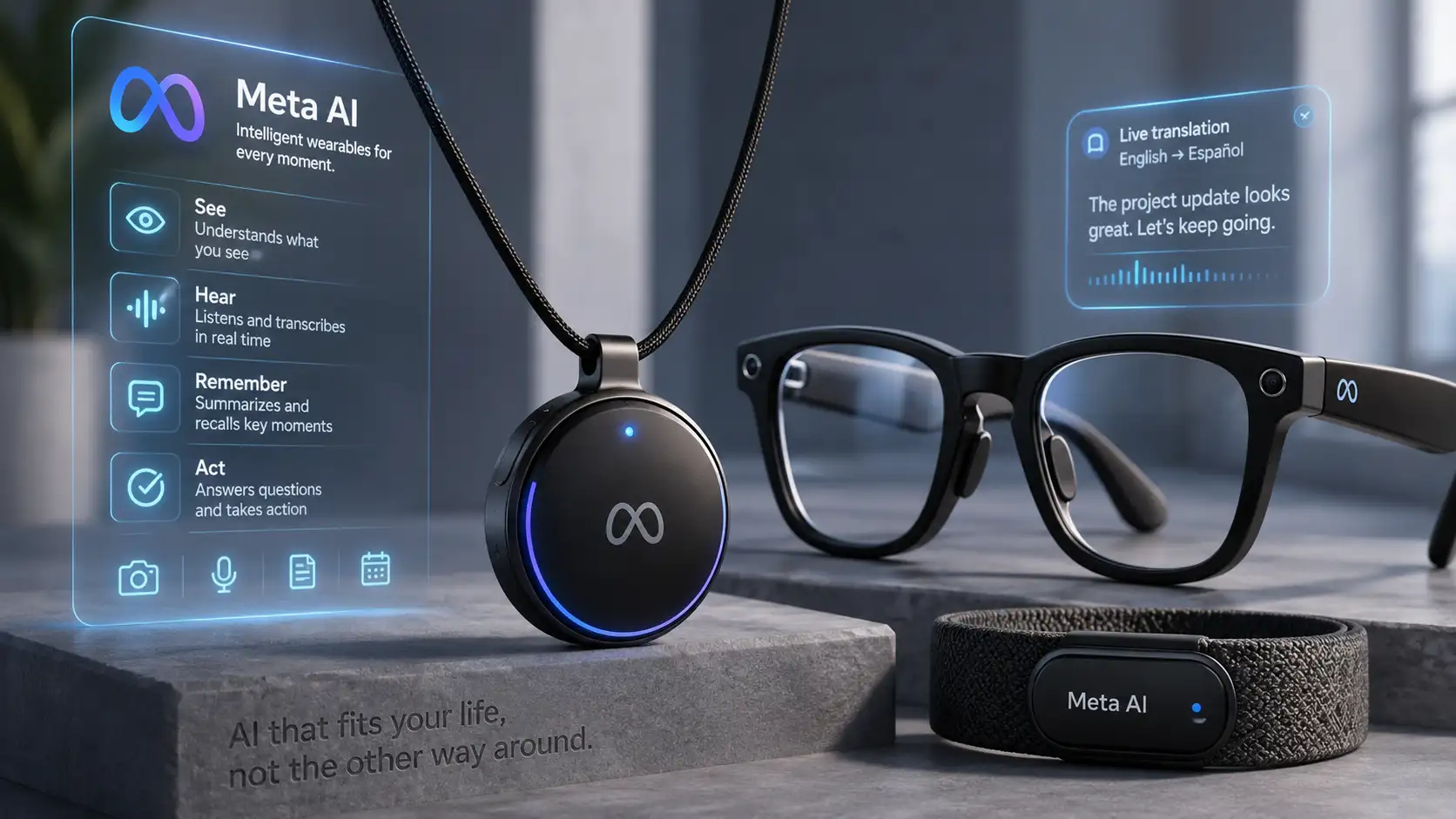
Meta’s reported AI pendant sounds, at first, like a small hardware story. It is not. It is a test of whether Meta can move artificial intelligence out of the browser tab, out of the phone app, and into a device that is close enough to the body to see, hear, remember, and act. Reuters reported on May 29, 2026, citing The Information, that Meta plans to test an AI pendant next year and is preparing a wider wearable push that includes AI-powered glasses and a workplace platform called Wearables for Work. Meta declined to comment on the report.
Table of Contents
The numbers attached to the plan explain the scale. The report says Meta wants to sell 10 million wearable devices in the second half of 2026, while secondary reporting on the same memo says the company is also aiming for 6.8 million monthly active wearable users by year-end. Those targets sit beside a harder official fact: Reality Labs generated $402 million in revenue in Meta’s first quarter of 2026 and posted an operating loss of $4.03 billion.
Meta’s wearable push is really an interface strategy
The pendant matters because Meta is trying to define the next everyday interface for AI. A chatbot on a screen waits for a prompt. A wearable assistant, if it works, gathers context before the user asks. It sees the receipt, hears the meeting, remembers the walk-through, notices the object on the table, and connects those observations to a user’s calendar, messages, work tools, or stored memories.
That shift changes the product category. Wearable AI is not only a device category. It is an attempt to make AI ambient. The assistant becomes less like a search box and more like a layer over daily life. For Meta, that is a chance to escape the limits of mobile operating systems controlled by Apple and Google. It is also a chance to attach paid services to hardware that people wear for hours rather than open occasionally.
The Reuters report says Meta’s plan includes not only a pendant but new AI glasses and a Wearables for Work platform, with partnerships tied to EssilorLuxottica brands such as Ray-Ban and Oakley. That places the pendant inside a larger portfolio, not as a replacement for glasses but as another sensor-rich form factor.
Meta has already moved beyond experimental eyewear. The company announced Oakley Meta HSTN glasses in June 2025, with a limited-edition model priced at $499 and broader collection pricing starting at $399. In September 2025, Meta announced Ray-Ban Display glasses with a built-in display and a Meta Neural Band, starting at $799.
Those devices show the path Meta is taking. Camera glasses bring visual questions and hands-free capture. Display glasses add private glanceable output. A pendant adds continuous audio or memory functions without requiring a camera on the face. The strategic move is not one gadget. It is a family of AI surfaces.
The reported pendant makes memory the product
A pendant worn around the neck carries a different promise from smart glasses. Glasses are about vision, capture, and immediate context. A pendant is more naturally associated with memory, meetings, conversations, reminders, and personal recall. Meta’s acquisition of Limitless makes that connection clear.
Limitless, formerly known for an AI pendant that captured and transcribed conversations, said on its website that it had been acquired by Meta. The company stopped selling new pendants, said it would continue supporting existing customers through 2026, and made subscriptions free for existing pendant customers.
The acquisition gives Meta a shortcut into a problem that every AI company wants to solve: turning messy daily speech into useful memory. Meeting summaries are only the obvious first use. A wearable memory device could support sales calls, medical notes, construction-site walkthroughs, classroom review, interviews, legal intake, accessibility support, and personal life logging.
The hard part is not transcription alone. Phones already record audio. Laptops already summarize meetings. The harder problem is permissioned, structured recall: knowing which parts of a conversation matter, who was present, what commitments were made, which details should be private, and which tasks should be pushed into another app. A necklace computer that records indiscriminately is a liability. A wearable assistant that remembers with rules, context, and restraint is a product.
This is where Meta’s ambition becomes both more plausible and more dangerous. A device around the neck does not need to be taken out of a pocket. It does not require a user to hold it toward a whiteboard or press record on a laptop. It sits at the boundary between convenience and surveillance.
Reality Labs’ losses make software revenue the real target
Meta’s wearable push has to be read against Reality Labs’ financial burden. In Q1 2026, Meta reported total revenue of $56.31 billion, up 33% year over year. Its Family of Apps segment remained the profit engine, with $55.91 billion in revenue and $26.9 billion in operating income. Reality Labs, by contrast, produced $402 million in revenue and an operating loss of $4.03 billion.
That gap is the core business tension. Meta can spend aggressively because advertising still throws off massive cash. But Reality Labs cannot remain only a cost center. Meta’s 2025 annual filing said Reality Labs reduced operating profit by about $19.19 billion in 2025 and warned that 2026 losses were expected to be similar, with long-term Reality Labs investment dependent on profits from other businesses.
Hardware alone will not fix that. Even if Meta sells millions of glasses and pendants, consumer electronics margins are hard, returns are real, and support costs rise with scale. The better business is layered on top: paid AI, enterprise subscriptions, developer apps, cloud processing, productivity services, premium features, and perhaps eventually commerce or advertising.
Meta does not need every wearable to be highly profitable on day one. It needs wearables to become a distribution channel for recurring AI revenue. That is why the pendant report matters more than its shape suggests. If Meta can place AI at the sensory edge of the user’s life, it can sell the software that interprets that life.
Hardware is the entry fee, not the prize
A pendant, glasses, a wristband, and a display are all expensive ways to reach the same strategic point: persistent context. The most useful AI assistant is the one that knows what the user is doing, not only what the user typed. Meta’s wearables try to collect that context directly.
The company’s September 2025 Ray-Ban Display announcement shows how Meta is already blending input and output. The glasses support live captions and translation, are paired with the Meta Neural Band, and offer up to six hours of mixed-use battery life with a charging case extending total use to 30 hours.
The Neural Band is worth watching because it points to another route around the phone. Voice is useful, but not always socially acceptable. Touching glasses is awkward. Looking at a phone defeats the point. A wrist-based input device gives users a quiet control layer for wearable AI. The pendant may gather audio. Glasses may gather vision. The wristband may provide private commands.
For Meta, the hardware stack could become a kind of body-area platform. The glasses see. The pendant hears and remembers. The wristband controls. The phone configures. The cloud reasons. The subscription pays. None of these layers needs to win alone if the system works together.
That is the optimistic version. The less flattering version is that Meta is still searching for a form factor that people will actually use. VR did not become a daily computing platform. Smart displays were niche. The metaverse pitch ran far ahead of consumer behavior. AI wearables give Meta a second chance because the user problem is more immediate: people want help remembering, translating, navigating, identifying objects, and handling tasks.
Wearables for Work brings the bet into offices and factories
The reported Wearables for Work platform may be more strategically valuable than the pendant itself. Consumer wearables have to fight fashion, battery life, price sensitivity, privacy discomfort, and unclear daily use. Workplaces have sharper problems: training, inspections, logistics, meetings, accessibility, field service, safety documentation, and hands-free access to information.
Reuters reported that the workplace platform is part of Meta’s plan. The same report tied the push to AI glasses, the pendant, and developer partnerships.
The enterprise angle gives Meta a route into a market where the buyer is not always the wearer. That can speed adoption, but it raises the stakes. A logistics company may want warehouse workers to receive hands-free picking instructions. A hospital may want clinicians to capture notes. A manufacturer may want field technicians to identify parts and document repairs. A law firm may want meeting summaries. In each case, the device becomes part of an employer’s information system.
The office version of wearable AI will face tougher consent and compliance questions than the consumer version. Employees may not feel free to refuse a device. Visitors may not know they are being recorded. Sensitive discussions may be captured in the background. Trade secrets, patient data, children’s data, union activity, and HR complaints could flow through an AI system if controls are weak.
This is why Wearables for Work is not just a product extension. It is a governance problem. The winner in enterprise wearable AI will not be the company with the flashiest demo. It will be the company that gives buyers audit trails, data retention rules, device management, local processing options, clear recording signals, access controls, and reliable ways to delete or quarantine sensitive material.
Meta’s reported targets are aggressive, even with smart glasses momentum
The reported goal of 10 million wearable sales in the second half of 2026 is ambitious in any category, especially for devices that ask people to wear cameras, microphones, or sensors in public. Reuters attributed that target to The Information’s report on Meta’s memo.
Meta does have momentum. EssilorLuxottica, Meta’s eyewear partner, has been increasing smart-glasses production capacity, and Reuters reported in February 2025 that the company aimed to boost annual production capacity to 10 million units by the end of the following year. The same Reuters report said more than 2 million Ray-Ban Meta glasses had been sold since their September 2023 launch.
Later reporting pointed to much higher volume. The Verge and UploadVR reported that EssilorLuxottica’s CEO said Meta and EssilorLuxottica sold more than 7 million smart glasses in 2025. That figure, if accurately reflected, helps explain why Meta is no longer treating glasses as a novelty category.
Still, monthly active users matter more than shipments. A device sold during a product spike does not become a platform unless people wear it, charge it, update it, and pay for services around it. Secondary reporting on Meta’s memo said the company is targeting 6.8 million monthly active wearable users by the end of 2026. That is the more revealing target because it measures habit, not inventory.
Meta’s reported wearable roadmap at a glance
| Element | Reported or confirmed status | Strategic meaning |
|---|---|---|
| AI pendant | Reported plan, with testing expected next year | Pushes AI toward memory, meetings, and always-available audio context |
| New AI glasses | Confirmed product expansion across Ray-Ban and Oakley lines | Gives Meta a face-worn visual interface and fashion distribution |
| Wearables for Work | Reported workplace platform | Moves the category into enterprise productivity, compliance, and device management |
| Developer access | Meta opened a wearables device access toolkit preview in December 2025 | Invites outside apps to use camera and audio features under Meta’s rules |
| Paid AI services | Meta has been reported to be expanding subscription plans for AI features | Turns hardware into a route for recurring software revenue |
| Reality Labs pressure | Q1 2026 loss of $4.03 billion on $402 million revenue | Forces Meta to prove wearables can become more than subsidized experiments |
The table shows why the pendant should not be read in isolation. The reported plan links hardware volume, AI services, workplace use, and developer distribution into one strategy.
The subscription layer is the missing profit story
Meta’s consumer internet business is built on ads, but wearable AI may need a different money model. A camera on the face and a microphone near the chest are sensitive surfaces. The more personal the device becomes, the more awkward advertising becomes. A user may tolerate ads in a social feed. The same user may reject an assistant that turns personal context into commercial prompts.
This makes subscriptions attractive. Reuters reported in February 2025 that Meta planned to test a paid subscription service for its Meta AI chatbot, while later reporting from TechCrunch described Meta subscription plans across Facebook, Instagram, WhatsApp, and Meta AI, including AI tiers priced around $7.99 and $19.99 per month.
The subscription logic is straightforward. A basic assistant may answer questions and summarize short interactions. Paid tiers could offer longer memory, more cloud processing, advanced agents, workplace integrations, video understanding, higher limits, team admin controls, or premium models. A user might buy the hardware once. The margin comes from the monthly fee.
This is also why Meta’s agentic AI work matters. Reuters reported in May 2026 that Meta was working on an advanced agentic AI assistant designed to carry out everyday tasks for users, citing the Financial Times.
A wearable assistant without agency is a narrator. It can tell you what it sees or heard. A wearable assistant with agency becomes a doer. It can draft the follow-up email after a meeting, add a maintenance issue to a ticketing system, order a replacement part, send a note to a colleague, or update a CRM record. That is where subscriptions become easier to justify.
The business question is not whether people will buy an AI pendant. The harder question is whether they will pay every month because the pendant makes the assistant more useful.
Smart glasses give Meta a head start, but not a moat
Meta has one advantage many AI competitors lack: a wearable product already in market, attached to a globally known eyewear brand. Ray-Ban matters because glasses are fashion objects before they are computing devices. EssilorLuxottica matters because distribution, fitting, lenses, and retail trust are hard to replicate.
Meta’s Oakley expansion adds another layer. Oakley Meta HSTN targets sport and performance use, where hands-free capture, durability, and voice access make more sense than in a formal office setting. Meta said the limited-edition Oakley Meta HSTN would be available for preorder from July 11, 2025, with broader Oakley Meta HSTN models starting at $399 later that summer.
The head start is real. It is not permanent. Google has moved Android XR toward eyewear, saying at Google I/O 2026 that intelligent eyewear was coming with partners including Samsung, Gentle Monster, and Warby Parker. Samsung and Google described the glasses as phone companions with Gemini, navigation, notifications, translation, and visual understanding features.
Google’s threat is ecosystem depth. Android, Gemini, Maps, Gmail, YouTube, Photos, and Search give Google natural services to connect to smart glasses. Samsung adds hardware scale and mobile distribution. Warby Parker and Gentle Monster add fashion credibility. Meta has strong social graphs and AI ambition, but it does not control the dominant mobile operating systems.
The competitive question becomes which company controls the daily assistant habit. If the assistant is tied to the phone, Google and Apple have an advantage. If the assistant is tied to the wearable, Meta has room to win. If users expect the assistant to work across every app and device, the battle becomes less about glasses and more about permissions.
A pendant changes the privacy conversation
Smart glasses already make bystanders uneasy. A pendant can feel less visible and more intimate. Glasses point a camera outward. A pendant sits on the chest, closer to conversations, social spaces, and private rooms. Even without a camera, continuous audio capture raises consent issues that are hard to solve with a simple LED or chime.
Meta’s AI glasses privacy guidance tells users to respect people’s preferences, power off devices in sensitive spaces, and follow laws around recording and privacy. It also describes the capture LED as part of the signaling system.
Meta’s supplemental privacy policy for AI glasses says the devices may collect photo, video, audio, metadata, location data, and, for supported devices, EMG sensor data. It also says that when cloud processing is enabled, photos and videos are sent to Meta servers, and that Meta AI service data may include media, prompts, transcripts, and information from the device.
Those disclosures are central to the wearable AI debate. A device that answers “What am I looking at?” may need to send an image to the cloud. A device that summarizes a conversation may need to process audio. A device that remembers a meeting may store names, commitments, and personal details. Each feature creates a data trail.
The privacy risk is not only collection. It is secondary use, retention, training, access, breach exposure, workplace monitoring, and bystander capture. The public will not judge wearable AI only by what the owner wants. It will judge the device by what it does to everyone nearby.
Consent cannot be treated as a settings screen
Consumer technology often pushes consent into settings menus. Wearable AI does not fit that pattern. The device interacts with non-users. A person sitting beside a pendant wearer did not accept Meta’s terms. A worker walking past smart glasses did not configure the privacy dashboard. A child in a classroom did not choose to be part of a memory system.
This is the central social problem for AI wearables. The buyer and the data subject are often different people. That makes wearable AI different from a phone camera, even though phones also record public life. Phones are visible when used. A wearable device may be active while the wearer appears passive.
Recording indicators help, but they do not solve the deeper issue. Many people do not know what a light means. In crowded spaces, they may not see it. In workplaces, they may not feel able to object. In public, they may not know whether audio, video, or only AI processing is active.
Meta’s privacy materials place responsibility partly on users: ask before capturing, avoid sensitive spaces, and follow local law. That is necessary but incomplete. At scale, social rules cannot rest on millions of individual judgment calls. Device design has to encode restraint. Enterprise deployment has to encode policy. Regulators will expect more than politeness.
A pendant intensifies the issue because audio feels different from images. A photo can be accidental or obvious. A conversation transcript is relational. It contains more than appearance; it contains intent, tone, names, plans, conflict, health details, financial facts, and private judgment. The most useful memory features are also the most sensitive.
Europe will test the workplace version first
The European Union’s AI Act is already shaping how companies think about AI systems that touch workplaces, biometrics, and sensitive inference. The AI Act entered into force on August 1, 2024, with full applicability set for August 2, 2026, though some provisions apply on different dates. General-purpose AI obligations began on August 2, 2025, while certain high-risk rules have later application dates.
Article 5 of the AI Act restricts prohibited AI practices, including manipulative systems, social scoring, certain biometric uses, and emotion recognition in workplaces and education institutions except for specific medical or safety purposes.
That matters for Wearables for Work. A workplace wearable that summarizes meetings may be acceptable if it is transparent, controlled, and properly consented. A system that infers emotion, attention, fatigue, stress, productivity, or intent from voice and behavior would enter a far more sensitive regulatory zone.
The pendant itself may not be the regulated risk. The software layer may be. If Meta sells an employer a platform that records, summarizes, ranks, flags, scores, or infers behavior, the classification changes. A simple note-taking assistant has one risk profile. A productivity surveillance system has another.
For enterprise buyers, compliance will be a product feature. The winning workplace wearable platform will need regional controls, admin policy, retention limits, consent workflows, data export, access logging, and clear separation between personal and employer-owned information. Without that, the sales pitch will run into legal departments before it reaches large-scale deployment.
The technical ceiling is lower than the demo script
Wearable AI demos are easy to understand. A person looks at an object and asks what it is. A user walks through a city and gets directions. A meeting is summarized. A document is read aloud. These examples are persuasive because they solve real friction. They also hide the messy operating conditions of daily life.
First-person vision is hard. Wearable cameras see from awkward angles. They capture blur, motion, occlusion, bad lighting, partial objects, and social scenes with irrelevant background detail. A 2025 research benchmark called WearVQA examined visual question answering for wearable devices and found that proprietary and open-source multimodal models achieved only 24% to 52% accuracy on its test set, with performance dropping on low-quality images and reasoning-heavy tasks.
That does not mean wearable AI is doomed. It means the product must be honest about uncertainty. If the glasses misidentify a mushroom, a medication, a machine part, or a traffic condition, the cost is not the same as a wrong trivia answer. The assistant has to know when not to answer, when to ask for a better view, when to escalate, and when to say the image is not reliable enough.
Audio is also messy. Real rooms contain overlapping speakers, accents, noise, confidential side conversations, jokes, and implied commitments. A meeting summary may omit the one detail that mattered. A task extractor may assign action items incorrectly. A transcript may misattribute a statement. In workplace settings, these mistakes can cause operational and legal problems.
The best wearable AI products will not pretend to be omniscient. They will design around failure. They will make source material easy to inspect, mark uncertain statements, preserve context, and let users correct memory. The devices that hide uncertainty behind confident answers will create trust failures.
Edge AI and cloud AI will define trust
Every wearable AI device has to decide what runs on the device, what runs on the phone, and what goes to the cloud. That split affects speed, cost, battery life, privacy, and capability. Local processing protects sensitive context and reduces latency, but it is constrained by chips, heat, power, and model size. Cloud processing supports stronger models and longer context, but it sends personal data to remote servers.
Meta’s AI glasses policy describes cloud processing for photos and videos when enabled, as well as voice interactions that may include audio, transcripts, and background noise.
For casual users, the cloud trade-off may be acceptable when asking for a translation or object identification. For employers, doctors, lawyers, journalists, schools, and government agencies, cloud processing becomes a procurement question. Where is the data stored? Who can access it? Is it used to improve models? Is it retained? Can it be deleted? Can the organization disable training? Can sensitive sessions be processed locally?
This is where AI wearables differ from older smart glasses. A camera-only wearable records media. An AI wearable interprets media. Interpretation creates derived data: labels, summaries, embeddings, transcripts, action items, people recognized by context, and inferred intent. Derived data can be more searchable and more revealing than raw audio or video.
The trust test for Meta will be whether users believe the company can separate personal context from its advertising machine. Meta may build clear controls and enterprise boundaries. The burden is still heavier because the company’s core business has long been behavioral targeting and social data. Wearable AI asks users to grant a deeper layer of access.
Developers are the difference between a gadget and a platform
Meta’s December 2025 Wearables Device Access Toolkit shows the company understands that first-party features are not enough. Meta said the developer preview gives developers access to camera and audio functionality for early prototyping, with limited early access and selected partners allowed to publish publicly.
A wearable platform needs apps that Meta would never build on its own. A warehouse app for picking and inventory. A clinical workflow app for note capture. A museum guide. A low-vision navigation service. A field repair assistant. A cooking coach. A sports training tool. A language-learning companion. A construction inspection system. These are not all social products. They depend on domain knowledge.
The developer challenge is trust. Granting third-party apps access to cameras and microphones on face-worn or body-worn devices is not like granting access to a phone photo library. The sensors run in public and semi-private spaces. Meta has to balance developer growth against a safety model that prevents creepy or abusive applications.
A strong developer platform also gives Meta a way to avoid one of the failures of earlier AR and VR efforts: too few daily-use apps. VR had strong gaming and some enterprise niches, but it did not become a general computing environment. Smart wearables have a better chance because the tasks are smaller and more frequent. Users do not need to enter a virtual world. They need to remember a name, read a sign, capture a task, translate a sentence, or identify a tool.
Developers will matter most if Meta exposes enough capability without making the devices socially unacceptable. That is a narrow path.
The assistant needs eyes, ears, memory and restraint
The promise of wearable AI is not that the model gets smarter in isolation. The promise is that the assistant gets better context. A model that sees the object, hears the instruction, remembers the previous meeting, knows the calendar, and understands the user’s preferences can answer differently from a chatbot waiting inside an app.
This is why the pendant is strategically logical. Glasses give visual context but are not always worn. A pendant could stay on during meetings, walks, errands, or work shifts. It could become the memory layer even when glasses are not suitable.
The practical assistant would need four traits. It needs perception, so it can understand what is happening. It needs memory, so it can connect the present to past commitments. It needs agency, so it can take action. It needs restraint, so it does not record, infer, or act when it should not.
Most AI strategies focus on the first three. The fourth may decide whether wearable AI is socially accepted. A device that sees everything and hears everything may impress technologists and alarm everyone else. A device that asks clearly, shows status clearly, forgets by default, and keeps sensitive information bounded may have a chance.
Meta’s public privacy guidance for AI glasses already tells users not to capture sensitive information such as PINs and not to harass or infringe privacy. The pendant category will need the same guidance, but with stronger defaults because audio capture is harder for others to notice.
The future wearable assistant cannot be only helpful to the wearer. It has to be tolerable to the room.
Accessibility is the strongest argument for the category
Some wearable AI use cases sound indulgent. Others are plainly useful. Accessibility is one of the clearest. Hands-free visual description, object identification, text reading, navigation cues, live captions, translation, and volunteer support can change daily tasks for blind, low-vision, deaf, hard-of-hearing, mobility-impaired, or neurodivergent users.
Meta published an accessibility-focused article in May 2026 describing how AI wearables can support disabled people, including reading menus, navigating airports, and using hands-free camera features.
Be My Eyes has also worked with Meta AI glasses, bringing hands-free volunteer calls to smart glasses for blind and low-vision users.
These examples matter because they show a practical floor for the product category. Even if many consumers treat AI glasses as a novelty, some users have daily problems that the devices address directly. A wearable that describes the world, reads signs, or captures a volunteer’s perspective is not just a tech demo.
Accessibility also exposes the need for reliability. A blind user asking a wearable assistant to identify an intersection or label a product needs clear uncertainty boundaries. A wrong answer can be frustrating, unsafe, or costly. The same applies to live captions and translation. The product has to communicate confidence without making the user decode model behavior.
For Meta, accessibility can strengthen the social case for AI wearables. It should not become a shield against privacy criticism. The same device can be genuinely useful for one person and intrusive to another. A mature product strategy has to hold both truths at once.
Google is making the race harder
Meta’s biggest wearable AI threat may not come from another glasses startup. It may come from Google rebuilding its earlier smart-glasses ambition around Gemini and Android XR. At Google I/O 2026, Google said intelligent eyewear would arrive with partners and described audio and display glasses connected to Gemini, with partners including Samsung, Gentle Monster, and Warby Parker.
The reason this matters is services. Smart glasses and pendants become more useful when connected to maps, email, calendars, photos, messages, search, cloud documents, and operating-system notifications. Google already owns many of those layers for Android users. Samsung gives Google a hardware ally with global scale. Warby Parker and Gentle Monster give the effort a fashion route that avoids the mistake of treating eyewear as pure electronics.
Meta’s counterweight is social context and hardware momentum. Facebook, Instagram, WhatsApp, Messenger, Threads, and Meta AI give it a massive user base. Its eyewear partnership with EssilorLuxottica gives it retail credibility. Its Reality Labs spending gives it talent and hardware depth. Its AI work gives it models and assistant features.
The battle will not be decided by which company first says “AI glasses.” It will be decided by who can make the device useful every day without making it feel invasive, fragile, or redundant with the phone.
Google’s presence also pressures Meta to move quickly. If Android XR glasses become the default extension of Android phones, Meta’s wearables risk becoming accessories instead of platforms. That helps explain the urgency behind sales targets and workplace efforts.
Apple and OpenAI pressure Meta from opposite sides
Apple’s pressure is structural. It controls the iPhone, the App Store, privacy positioning, and the most profitable consumer hardware ecosystem. Even when Apple moves slowly, it sets expectations around device integration, permissions, and premium design. If Apple enters AI wearables more directly, it can tie the device to iOS, AirPods, Apple Watch, Vision Pro software lessons, and on-device privacy messaging.
OpenAI’s pressure is different. It owns one of the strongest consumer AI habits through ChatGPT, and it has been moving toward agentic services and hardware-linked experiences through partnerships and device ambitions. Reuters has reported that Meta is also working on advanced agentic AI assistants, showing that the race is not only about sensors but about task execution.
Meta sits between these pressures. It has social distribution like neither Google nor OpenAI. It has hardware investment at a scale few companies can match. Yet it does not control the main mobile platforms, and it has a trust deficit around personal data. That makes wearable AI both an opportunity and a vulnerability.
A pendant could give Meta a new entry point. It does not require a glasses prescription, a fashion choice, or a display. It could pair with any phone. It could work in meetings, classrooms, and field jobs. But if the best assistant experience depends on deep phone permissions, platform owners still hold power.
This is the old Meta problem in a new form. The company wants to own the interface layer, not merely rent distribution from other companies. Wearable AI is one route to that goal.
Fashion is infrastructure in smart eyewear
Meta’s partnership with EssilorLuxottica is not a branding detail. In eyewear, fashion is infrastructure. People do not put computers on their faces only because of specs. They wear glasses because they fit, look acceptable, match identity, and work with lenses. A bad-looking device fails before the software is tested.
Ray-Ban and Oakley give Meta two different cultural channels. Ray-Ban carries everyday style and broad retail recognition. Oakley carries performance, sport, and outdoor use. That allows Meta to place AI into contexts where cameras and hands-free interaction feel less strange: cycling, running, travel, training, and active work.
The reported move toward other wearable forms, including a pendant, suggests Meta knows glasses will not cover every use case. Some people do not wear glasses. Some jobs forbid cameras. Some social settings reject smart eyewear. Some users may prefer a device hidden under clothing or worn as a badge.
That diversity of form factors matters. The next AI interface may not be one device. It may be a set of devices matched to social context. Glasses for visual tasks. Earbuds for audio. Watches for glanceable alerts. Pendants for memory. Phones for configuration and fallback.
The wearable market is not only a battle of chips and models. It is a battle of social acceptability. Devices that look normal, signal clearly, and fit existing habits have a better chance than devices that announce themselves as technology first.
A wearable ad business would be powerful and risky
Meta’s main profit engine remains advertising. In Q1 2026, Meta’s advertising revenue was $55.02 billion, dwarfing Reality Labs revenue. That creates an unavoidable question: will wearable AI become another advertising surface?
A direct ad inside a wearable assistant could feel intrusive. A prompt in the corner of smart glasses based on what the user is looking at would raise immediate concern. A restaurant suggestion based on location and conversation could be useful once and alarming the next time. A shopping recommendation based on a shelf view could look like the natural endpoint of Meta’s ad business, but it would also intensify criticism that personal context is being monetized too aggressively.
Meta may avoid overt wearable advertising at first. Subscriptions are cleaner. Enterprise licensing is cleaner. Paid AI capacity is cleaner. But Meta’s history means the question will remain. Investors will wonder how the company monetizes millions of active wearable users. Users will wonder whether the device is watching for them or watching them.
The more personal the sensor, the narrower the tolerance for commercial use. A social feed ad is easy to ignore. A wearable assistant that interrupts a conversation, labels a product, or ranks choices based on commercial incentives risks breaking trust.
The strategic answer may be a layered model: paid services for sensitive AI features, business subscriptions for workplace tools, and carefully bounded commerce features only when user-initiated. Whether Meta can resist the stronger advertising temptation will shape public acceptance.
The workplace platform could become Meta’s cleanest revenue path
Wearables for Work may offer Meta a more credible revenue model than consumer subscriptions alone. Companies already pay for productivity tools, meeting software, CRM systems, field service platforms, and collaboration suites. If a wearable assistant saves time in a warehouse, reduces documentation burden for technicians, or improves training, the value can be measured.
That does not make enterprise adoption easy. Microsoft’s HoloLens history is a warning. HoloLens had serious enterprise and industrial use cases, but Microsoft’s release notes now describe the final feature release for HoloLens 2 and security updates continuing through December 2027.
The lesson is not that enterprise wearables fail. It is that enterprise wearables must justify themselves against simpler tools. A tablet is cheaper. A phone is familiar. A barcode scanner is rugged. A laptop is flexible. A headset may be too bulky. A pendant may raise recording concerns. Glasses may not work for every face, lens, or job site.
Meta’s advantage is that AI wearables may be lighter, cheaper, and more everyday than past enterprise AR headsets. The task set is also different. The goal is not always full augmented reality. It may be audio notes, visual identification, step-by-step prompts, translation, captions, and documentation.
Enterprise buyers will ask one brutal question: does the wearable remove enough work to justify the risk? If the answer is yes in field service, logistics, training, healthcare administration, or customer support, Meta has a business. If the answer is mostly “it looks impressive,” the category will stall.
Continuous sensing is the breakthrough and the red line
The phrase “always-on” is dangerous because it can mean two different things. In the useful sense, it means the assistant is ready when needed and can process context without friction. In the alarming sense, it means constant capture of people, places, and conversations.
Research projects already show what is possible when wearable sensors and AI are combined. VisionClaw, a 2026 research project, describes an always-on wearable AI agent on Meta Ray-Ban smart glasses that integrates first-person perception with task execution, including shopping cart actions, notes from documents, meeting briefings, calendar events, and smart-device control. The study reported faster task completion and lower interaction overhead in lab and deployment tests.
Those capabilities are a preview of the market. The assistant does not just respond to commands; it notices tasks. It can turn what it sees into action. That is useful when the user is carrying tools, navigating a new place, or managing many small obligations. It is also the moment when wearable AI becomes socially charged.
A model that sees a prescription bottle and suggests a reminder may be useful. A model that sees a coworker’s confidential slide and stores it may be a problem. A model that hears a promise and adds a task may be useful. A model that hears a private dispute in the background and preserves it may be a violation.
The product line between assistance and surveillance will not draw itself. It has to be defined through defaults, visible controls, processing choices, and law.
Main trade-offs for wearable AI
| Promise | Friction | Business impact |
|---|---|---|
| Context-aware assistant | Requires sensors near private moments | Stronger AI usefulness, higher trust burden |
| Meeting memory | Consent and retention rules become hard | Subscription and enterprise value if governance is credible |
| Visual Q&A | Low-quality first-person images reduce reliability | Useful daily feature, but risky for safety-critical answers |
| Workplace deployment | Employees and visitors may not freely consent | Enterprise revenue depends on compliance controls |
| Developer apps | Sensor access raises abuse risk | Platform growth requires strict review and clear permissions |
| Continuous sensing | Battery, privacy, and social acceptance limits | Differentiates the product while creating regulatory exposure |
These trade-offs are not side issues. They are the product. Meta’s wearable plan will rise or fall on how well the company handles the tension between usefulness and intrusion.
The phone is not disappearing
The language around AI wearables often implies that the phone is about to be replaced. That is unlikely in the near term. Phones remain powerful, flexible, private enough for many tasks, socially accepted, and tied to payments, identity, apps, photos, messages, and work tools.
Wearables work best as extensions. They reduce friction for moments when the phone is inconvenient: hands are busy, eyes need to stay forward, the user is moving, the task is brief, or the situation requires quick memory. The phone remains the full-screen device for editing, browsing, confirmation, and control.
This actually helps Meta. The wearable does not need to replace the phone to become valuable. It only needs to own moments the phone handles badly. A pendant that reliably captures and summarizes meetings could justify itself without replacing a single app. Glasses that translate signs or identify objects could become a daily habit without replacing the phone camera. Display glasses that show captions or directions could be useful even if the phone remains the main device.
The danger is redundancy. If users can do almost everything on a phone with less social friction and lower cost, wearables become occasional accessories. Meta’s product challenge is to create enough “I would have missed that” moments: a remembered commitment, a translated sentence at the right time, a captured task while hands were full, a visual answer without fumbling for a device.
The phone will remain the anchor. Meta wants the wearable to become the context layer around it.
The memory layer will decide whether pendants matter
A pendant without persistent memory is a voice recorder with AI. A pendant with useful memory is a new interface. The difference is not storage volume. It is retrieval.
Users do not need every word of every meeting. They need the line that mattered, the person who promised the next step, the product detail from a sales call, the doctor’s instruction, the name of the restaurant, the code spoken during setup, the idea mentioned while walking, the billable note, the project decision.
Useful memory requires structure. It has to know people, places, time, tasks, files, permissions, and sensitivity. It has to distinguish a casual comment from a commitment. It has to let users ask, “What did Lisa say about the deadline last Tuesday?” and return an answer with traceable context.
This is why the Limitless acquisition fits Meta’s plan. Limitless built around the idea of a pendant as an AI memory device, not merely an audio recorder. Meta gains product experience, talent, and a clearer picture of how consumers respond to a wearable that records conversations.
The challenge is that memory makes trust harder, not easier. A wrong summary may be corrected. A retained private conversation may become a lasting problem. A searchable archive of daily life is useful precisely because it is powerful. It is risky for the same reason.
For a pendant, forgetting is as important as remembering. The product needs temporary capture, selective saving, private modes, local deletion, session boundaries, and clear ways to exclude people or places. Memory without restraint will not scale socially.
Meta’s AI ambitions now depend on distribution
AI model quality matters, but distribution may matter more in the consumer assistant race. A model inside a website competes each time the user chooses where to ask a question. A model inside a wearable competes at the moment of need. If the device is already on the user’s face or chest, the assistant is closer than any app.
Meta’s existing distribution is enormous. In Q1 2026, Meta reported 3.56 billion Family daily active people, meaning users active on at least one of its family products on a given day.
That scale gives Meta a route to introduce AI services inside familiar apps. But apps do not solve the interface problem. Users still have to open them. Wearables give Meta an always-available physical edge. The company’s AI can become an input layer, not only a destination.
This matters for search and commerce. If a user asks glasses to identify a product or asks a pendant to recall a conversation, the assistant is mediating intent before a search engine, store, or workplace tool enters the picture. That position is powerful. It is also why Google will not ignore the category.
Meta’s bet is that distribution through wearables will be harder for rivals to copy than distribution through apps. Building a chatbot is easier than building fashionable glasses, retail partnerships, optical support, sensor systems, privacy controls, developer access, and enterprise deployment. The barrier is not one technology. It is the combined system.
The cost structure remains unforgiving
Reality Labs losses are not an accounting footnote. They are the financial shadow over every wearable announcement. Meta can afford heavy spending because its advertising business remains strong, but investor patience has limits. A hardware platform has to show a credible route from loss-making investment to durable revenue.
Meta’s Q1 2026 financials show the imbalance clearly. Family of Apps generated nearly all revenue and profit. Reality Labs generated a fraction of revenue and a multi-billion-dollar operating loss.
The investment thesis for wearables has to answer four questions. First, can Meta sell enough devices to create a user base? Second, can it keep monthly active usage high? Third, can it attach paid AI or enterprise services? Fourth, can it reduce the per-device and per-user cost of support, cloud inference, returns, and customer education?
The cloud inference cost deserves attention. A wearable AI assistant may use multimodal models, transcription, translation, image processing, memory retrieval, and agentic task execution. If users pay nothing beyond the device purchase, high usage could raise costs faster than revenue. That makes subscriptions and enterprise pricing more than a nice extra. They may be necessary for the economics to work.
The reported sales target of 10 million devices in the second half of 2026 is not only about scale. It is about proving that Reality Labs has a route out of endless subsidy. If Meta sells the devices but fails to convert them into paid service relationships, the hardware win will be incomplete.
AI glasses are becoming a real market, but still young
Market data suggests wearables are growing, but the specific AI glasses category remains young and uneven. IDC said worldwide wearable shipments rose 9.1% in 2025 to 611.5 million units, driven by earwear, smartwatches, and other categories.
XR and smart glasses are more volatile. IDC reported that mixed reality and VR headset shipments declined 42.8% in 2025, while the broader XR market outside those segments grew sharply, and it projected a strong CAGR for XR glasses from 2025 to 2029. IDC also identified obstacles including battery life, immature app ecosystems, privacy concerns, and unclear consumer utility.
Those obstacles map directly onto Meta’s challenge. Battery life limits all-day use. App ecosystems decide whether devices become platforms. Privacy concerns shape public tolerance. Consumer utility determines whether buyers keep wearing the device after the novelty fades.
Smart glasses appear to be escaping some of the stigma that hurt Google Glass, partly because the design is more normal and the AI use cases are clearer. But the market is still fragile. A few viral privacy incidents, weak battery performance, unreliable answers, or poor enterprise governance could slow adoption.
Meta’s advantage is that it has already put real devices into the market. Its disadvantage is that success now requires more discipline. A small enthusiast product can survive rough edges. A 10-million-unit ambition cannot.
The pendant will have to justify its place beside earbuds and watches
A pendant competes with more than other pendants. It competes with earbuds, smartwatches, phones, glasses, and meeting software. Many people already wear AirPods or other earbuds for audio input. Many wear watches for notifications and health sensors. Phones can record and summarize meetings. Laptops are present in conference rooms.
The pendant’s case has to be distinct. It may offer better microphone positioning than a watch, more natural availability than a phone, less social visibility than glasses, and longer-session memory than earbuds. It may work for people who do not want cameras on their face. It may serve as a badge-like workplace tool.
But it also faces fashion and stigma problems. A pendant that looks like a recorder may make others uncomfortable. A pendant hidden under clothing may raise transparency concerns. A pendant that must be charged daily may be abandoned. A pendant that produces mediocre transcripts may be replaced by phone software.
Meta will likely treat the pendant as part of a bundle rather than a standalone revolution. It could be a meeting device for professionals, a memory layer for creators, a workplace sensor for specific roles, or a companion to glasses. The form factor may matter less than the software plan attached to it.
The strongest consumer case may be memory. Earbuds can hear, but users do not think of them as archives. Watches notify, but they do not sit close to speech. A pendant can be framed as a personal memory device. That framing is powerful, but it requires excellent consent design.
Wearable AI turns meetings into a battlefield
Meetings are an obvious target because they are painful, repetitive, and full of lost information. Every large company wastes hours on discussions that produce unclear next steps. A pendant that captures the meeting, summarizes decisions, and creates action items sounds useful.
It also enters one of the most sensitive areas of workplace life. Meetings include strategy, performance feedback, legal advice, health discussions, salary information, conflict, and informal comments. A wearable meeting assistant changes behavior. People may speak less freely if they know a coworker’s pendant is capturing the room.
Workplace meeting tools already record and summarize calls, but they operate inside explicit software environments. Participants often see a recording notice. The transcript belongs to the meeting platform. A pendant makes recording portable. It can be present in a hallway conversation, lunch discussion, or informal desk chat.
For Wearables for Work, Meta will need meeting modes that are visible, permissioned, and policy-based. Employers will need controls over who can record, when recording is allowed, where data goes, and how bystanders are notified. Employees will need protections against hidden monitoring.
The opportunity is large because meetings are everywhere. The risk is large for the same reason.
If Meta gets workplace memory right, it gains a high-value productivity product. If it gets it wrong, the pendant becomes a symbol of office surveillance.
Visual AI will be more useful when it stops pretending every question is safe
Visual question answering is one of the most natural uses for AI glasses. A user can ask what a plant is, translate a sign, identify a part, read a menu, or understand an appliance warning. Meta’s current glasses already support visual AI features, and Oakley’s product pages describe “Hey Meta, look and…” interactions in which photos are processed by Meta AI.
The challenge is risk classification. Identifying a landmark is low stakes. Reading a medication label is higher stakes. Advising on a dangerous tool is higher still. A wearable assistant that does not understand these differences will produce dangerous confidence.
This is where product design needs more than model tuning. The assistant should answer directly when the task is low risk and the visual evidence is clear. It should ask for a better view when the image is poor. It should refuse or redirect when the task requires professional judgment. It should show what it based the answer on.
Research on wearable visual QA supports caution. WearVQA found that first-person wearable images create accuracy problems for models, especially when images are low quality or tasks require reasoning.
Meta’s consumer experience will be judged by the magical cases. Its legal and safety exposure will be shaped by the failures. A smart wearable should be humble in the moments where the cost of being wrong is high.
The developer toolkit opens a door Meta will have to police
Meta’s Wearables Device Access Toolkit is an important sign because platforms do not grow through first-party apps alone. Developers need access to sensors and system features to build specific use cases. Meta’s preview gives selected developers access to camera and audio capabilities for prototyping and early public publishing by approved partners.
The tool could seed the apps that make wearables useful in real life. Accessibility services, field repair tools, translation helpers, education apps, fitness coaching, memory systems, and enterprise workflows all require sensor access.
Sensor access also invites abuse. A malicious or careless app on a phone is bad. A malicious or careless app with wearable camera and microphone access is worse. It could capture bystanders, infer sensitive facts, or store context in ways users do not understand.
Meta will need app review rules that match the physical reality of the device. It will need permission prompts that do not become meaningless. It will need clear indicators when apps are using sensors. It will need special restrictions for children, schools, workplaces, healthcare, and public spaces. It will need enforcement, not just policy text.
Developer growth and privacy restraint will be in tension. If Meta locks the platform down too much, innovation slows. If it opens too quickly, one scandal can damage the category. The toolkit is a necessary step, but it turns Meta into a gatekeeper for AI in public space.
The social graph gives Meta an unusual advantage
Meta’s AI wearables are not starting from zero. The company already owns social and messaging surfaces where daily life is organized: WhatsApp groups, Instagram DMs, Facebook communities, Messenger chats, creator accounts, Marketplace, Threads conversations, and family networks. A wearable assistant that plugs into those contexts may feel more useful than a generic assistant.
A pendant that remembers a conversation could draft a WhatsApp follow-up. Glasses that capture a moment could share to Instagram. A meeting summary could become a Messenger note. A travel translation could connect to a friend’s recommendation. Meta’s apps make the assistant socially aware in ways that a pure model provider may not match.
This advantage cuts both ways. The same integrations that make wearable AI useful also raise trust questions. Users may not want private memory linked too easily to social apps. A photo captured for identification should not feel one tap away from accidental sharing. A workplace note should not blend with personal messages.
Meta has to design boundaries between contexts. Personal, social, and work memory cannot become one undifferentiated pool. The assistant needs to know where information belongs and where it must not travel.
Context is Meta’s advantage. Context leakage is Meta’s risk.
The metaverse lesson is still fresh
Meta spent years arguing that VR and AR would become the next computing platform. The company renamed itself around that conviction. The public result has been mixed. Quest headsets have a real user base and a gaming market, but the broad metaverse vision did not become a daily habit for mainstream users.
AI wearables are different because they do not ask users to leave the physical world. They sit on top of it. A pair of AI glasses or a pendant does not need a virtual room to be useful. It helps with the actual room.
That is the strongest reason to take Meta’s wearable AI push seriously. The company is not only repeating the metaverse pitch. It is adapting the hardware ambition to a clearer behavior: people want AI that understands their immediate surroundings.
Still, the metaverse lesson should make Meta cautious. Big platform shifts are not declared into existence. They happen when daily behavior changes. Users do not care whether a device fits an executive roadmap. They care whether it saves effort without creating new embarrassment, risk, or expense.
Reality Labs’ financial losses keep the pressure on. Meta can no longer sell a far-future platform story alone. It needs products that users wear now and services they pay for soon.
The assistant race is moving from answers to actions
The first wave of consumer AI assistants was answer-based. Users typed questions and received text, images, code, or summaries. The next wave is action-based. Assistants book, file, message, schedule, remember, compare, buy, and coordinate.
Wearables make that shift more concrete. The assistant can observe the trigger. It sees the broken part, hears the commitment, reads the sign, watches the cooking step, or detects that the user is in a store aisle. The action can be tied to the situation instead of being manually described.
This is why Meta’s agentic AI efforts matter. A wearable assistant that only explains the world may be useful. A wearable assistant that acts on the world becomes a stronger business.
The risk is unauthorized action. A wearable agent should not send a sensitive email because it misheard a conversation. It should not order a product based on a glance. It should not share a summary with the wrong person. It should not take workplace actions without auditability.
The best version of agentic wearable AI is confirmable and traceable. It drafts before sending. It cites what it used. It asks before storing sensitive material. It offers reversible actions where possible. It separates low-risk actions from high-risk ones.
Meta’s challenge is to make the assistant feel fast without making it reckless. Speed sells the product. Control keeps it usable.
The AI pendant may be a bridge device
A pendant could succeed even if it never becomes the iconic AI device. It may be a bridge to test memory, consent, enterprise workflows, audio capture, and subscriptions before more advanced glasses or AR devices mature.
Bridge devices matter. They train users. They train companies. They train developers. They generate usage data. They reveal which features people keep using and which ones vanish after the demo. They expose privacy failures before the product expands.
Meta’s reported pendant may serve several strategic purposes at once. It can extend AI wearables beyond eyewear. It can reuse talent and product concepts from Limitless. It can test workplace memory. It can create a subscription bundle. It can create another surface for Meta AI without depending on phone operating-system placement.
The risk is that bridge devices can look disposable. Consumers may hesitate to buy a pendant if they believe glasses, earbuds, or phones will absorb the function. Enterprise buyers may wait for clearer standards. Developers may hold back until Meta’s roadmap stabilizes.
Meta has to make the pendant useful enough on its own while positioning it as part of a broader system. That is a difficult message but not impossible. The product can be sold as a dedicated memory device rather than a general computer.
The public will decide with social norms, not spec sheets
Technology companies often assume adoption follows capability. Wearables prove otherwise. A device can be technically impressive and socially awkward. It can solve a problem and still feel rude in a meeting. It can be legal and still unwelcome at a dinner table.
Google Glass failed partly because it violated social expectations before people understood its benefits. Meta’s current glasses avoid some of that by looking more like normal eyewear. A pendant may have a different social path. It could look like a badge, a necklace, a recorder, or a medical device depending on design.
The social question is simple: do people near the wearer feel respected? If the answer is no, the product will be fought in restaurants, classrooms, offices, gyms, clinics, and homes. If the answer is yes often enough, the category can normalize.
Social acceptance will depend on visible signals, physical design, recording rules, defaults, and cultural etiquette. It will also depend on early users. If AI wearables become associated with creators, accessibility, field work, and practical memory, the category gains legitimacy. If they become associated with covert recording or obnoxious behavior, backlash will follow.
The most important interface may not be the display or voice command. It may be the signal that tells everyone else what the device is doing.
The newsroom, classroom and clinic will be stress tests
Some spaces will test wearable AI faster than others. Newsrooms will care about recording consent, source protection, and unpublished information. Classrooms will care about children, attention, cheating, disability support, and teacher privacy. Clinics will care about patient data, medical documentation, consent, and professional liability.
These environments are not fringe. They are exactly where memory and hands-free documentation are useful. A journalist could use a pendant for interviews. A student could use it for lecture review. A clinician could use it for notes. A technician could use glasses for repair guidance. The same utility creates the same sensitivity.
Meta will need sector-specific answers. General privacy settings will not satisfy a hospital. A school will need child-safety rules. A newsroom will need source protection. A law firm will need privilege controls. A manufacturer will need trade secret protection. A government agency will need procurement and security review.
Wearables for Work could give Meta a framework to handle these needs. But a generic enterprise platform will not be enough. The more regulated the setting, the more Meta must prove its system can be configured, audited, and constrained.
The companies that win wearable AI in sensitive environments will be those that treat governance as product design, not paperwork.
Meta’s advantage is speed, but speed creates exposure
Meta moves fast because it has money, talent, partnerships, and a leadership team willing to make large bets. That speed gives it a chance to define wearable AI before competitors settle their strategies. It also increases the chance of mistakes.
Hardware mistakes are expensive but often fixable. Privacy mistakes are stickier. If users believe a pendant recorded them without consent, if a workplace rollout feels coercive, or if a developer app misuses sensor access, the damage may affect the whole category.
This is why Meta’s reported targets should be read carefully. Ten million devices in half a year would require production, distribution, marketing, support, software stability, and social comfort to line up at once. Even if the target is internal and flexible, it shows urgency.
The question is whether Meta can scale responsibly. Small pilots allow careful handling. Mass-market launches magnify edge cases. The same device used by a careful professional can be misused by a teenager, a manager, a stalker, or a careless creator. Consumer scale always finds the weak points.
Meta’s best path may be staged adoption: mature glasses for consumers, pendant pilots in controlled settings, enterprise programs with strict policy, developer access for approved partners, and paid AI features that begin where user value is clear. Rushing every layer at once would increase risk.
The business case rests on active use
Device sales are useful, but active use is the test. A wearable sitting in a drawer does not create subscription revenue, developer demand, data for improvement, or habit. Meta’s reported target of 6.8 million monthly active wearable users by year-end is therefore more strategically revealing than the shipment target.
Active use depends on small daily wins. A user wears glasses because they capture hands-free video at the right moment. They keep a pendant charged because it remembers meetings better than they do. They pay for AI because it saves enough time to feel obvious. They invite the assistant into work because it reduces admin load.
Failure also happens through small frictions. The device dies before dinner. The summary misses the point. The glasses feel awkward indoors. The pendant makes friends uncomfortable. The privacy settings are confusing. The AI asks for cloud access too often. The user stops wearing it for a week and never returns.
Wearable habit is harder than app habit because the device touches the body. It has to be comfortable, acceptable, and reliable. The software can be brilliant and still lose to a bad hinge, weak battery, poor fit, or social embarrassment.
For Meta, this means the hardware cannot be treated as a delivery vessel for AI. The physical experience is the distribution.
The strategic question Meta must answer
Meta’s reported AI pendant and wearable expansion are best understood as a bet on proximity. The company wants its AI to be closer to the user than a phone app and more context-aware than a chatbot. Glasses, pendants, wristbands, workplace platforms, developer tools, and subscriptions all point toward the same idea: AI becomes more useful when it is present at the moment life happens.
The strategy is coherent. It is also exposed. The financial pressure from Reality Labs is real. The competitive pressure from Google, Samsung, Apple, OpenAI, and others is rising. The privacy burden is heavier than in ordinary consumer software. The technical limits of first-person AI are still visible in research. The social norms around recording and memory are unsettled.
Meta’s best chance is not to sell the pendant as a futuristic charm. It is to make a specific promise and keep it: better memory, safer capture, useful workplace support, clear consent, strong controls, and AI services worth paying for.
The real prize is not a necklace computer. It is the right to become the default assistant for the physical world. That right will not be granted by a memo, a product launch, or a sales target. It will be earned each time someone decides the device is useful enough to wear and respectful enough to allow in the room.
Answers readers are asking about Meta’s AI wearable plans
Reuters reported on May 29, 2026, citing The Information, that Meta plans to test an AI pendant next year. Meta declined to comment on the report, so the pendant should be treated as a reported plan, not a confirmed product launch.
Based on the reported plan and Meta’s acquisition of Limitless, the pendant would likely focus on memory, audio capture, transcription, summaries, meetings, and AI assistance. A final product could differ because Meta has not publicly announced specifications.
Limitless built an AI pendant focused on recording and transcribing conversations. Its acquisition gives Meta technology, product experience, and talent connected to wearable memory devices.
No. Smart glasses are face-worn devices with cameras, audio, and in some models displays. A pendant would likely be worn around the neck and may focus more on audio, memory, and meeting capture.
Wearables for Work is a reported Meta workplace platform for AI wearables. It appears aimed at enterprise use cases such as meetings, documentation, field work, and productivity. Meta has not publicly detailed the platform.
Reuters reported that Meta wants to sell 10 million wearable devices in the second half of 2026, citing The Information’s report on an internal memo.
Secondary reporting on the same memo says Meta is targeting 6.8 million monthly active wearable users by the end of 2026. That target matters because active use is more important than shipment volume for subscriptions and platform growth.
Reality Labs is Meta’s long-term hardware and immersive technology division. In Q1 2026, it generated $402 million in revenue and lost $4.03 billion, which increases pressure to turn wearables into a real business.
Hardware sales matter, but subscriptions and software services may be more important. Paid AI features, enterprise plans, developer apps, memory services, and productivity tools could create recurring revenue.
Meta and EssilorLuxottica have reported strong momentum. Reuters reported that more than 2 million Ray-Ban Meta glasses had been sold since September 2023, while later reports said more than 7 million Meta smart glasses were sold in 2025.
Meta’s Ray-Ban Display glasses are AI glasses with a built-in display and Meta Neural Band controls. Meta announced them in September 2025 with pricing starting at $799.
Oakley gives Meta a sport and performance eyewear channel. Meta announced Oakley Meta HSTN glasses in June 2025, expanding beyond Ray-Ban into another EssilorLuxottica brand.
Google, Samsung, Apple, and OpenAI are the most relevant strategic competitors. Google and Samsung have already shown Android XR eyewear concepts with Gemini and fashion partners.
The main risks are always-available microphones and cameras, bystander capture, cloud processing, workplace monitoring, retained transcripts, training data use, and unclear consent from people near the wearer.
Meta’s supplemental privacy policy says photos and videos may be sent to Meta servers when cloud processing is enabled, and that Meta AI service data may include media, prompts, transcripts, and device information.
Yes. The EU AI Act restricts certain AI uses, including emotion recognition in workplaces and education except for specific medical or safety purposes. Workplace wearable AI will need careful compliance design.
They are improving, but reliability remains a problem. Research on wearable visual question answering found that models struggled with blurry, occluded, and low-quality first-person images, with tested accuracy ranging from 24% to 52%.
A wearable platform needs specialized apps. Meta’s Wearables Device Access Toolkit gives selected developers access to camera and audio functions, which could support accessibility, workplace, field-service, education, and productivity apps.
Not soon. Phones will remain the main screen, app hub, payment device, and control center. AI wearables are more likely to handle moments when hands-free context, memory, translation, visual answers, or quick action matter.
The biggest question is whether people will accept a device that remembers real-world conversations. If Meta cannot solve consent, privacy, reliability, and monthly value, the pendant may remain a niche product.
Author:
Jan Bielik
CEO & Founder of Webiano Digital & Marketing Agency
This article is an original analysis supported by the sources cited below
Meta plans AI pendant, Wearables for Work in hardware boost, The Information reports
Reuters report on Meta’s reported AI pendant plans, Wearables for Work, wearable sales target, Reality Labs figures, and Meta’s decision not to comment.
Meta memo outlines ambitious hardware plans, including new AI pendant
The Information report cited by Reuters as the source for Meta’s reported internal wearable roadmap.
Meta reports first quarter 2026 results
Official Meta financial release for Q1 2026, including Reality Labs revenue and operating loss, Family of Apps performance, and total company revenue.
Meta Platforms 2025 Form 10-K
SEC filing describing Reality Labs losses, Meta’s segment structure, long-term investment risks, and dependency on Family of Apps profitability.
Limitless
Official Limitless page confirming its acquisition by Meta, support for existing pendant customers, and the end of new pendant sales.
Meta acquires AI wearables startup Limitless
Reuters report on Meta’s acquisition of Limitless, the AI pendant company focused on capturing and transcribing conversations.
Introducing Oakley Meta glasses
Official Meta announcement of Oakley Meta HSTN glasses, pricing, availability, and performance-focused positioning.
Introducing Meta Ray-Ban Display and Meta Neural Band
Official Meta announcement of Ray-Ban Display glasses, Neural Band controls, live captions, translation features, battery claims, and pricing.
Introducing Meta Wearables Device Access Toolkit
Meta developer blog introducing limited developer access to camera and audio functionality for AI glasses and wearable applications.
Meta AI glasses privacy and responsible use
Meta guidance on privacy, capture LEDs, sensitive spaces, and responsible use expectations for AI glasses.
Meta supplemental privacy policy
Meta legal policy covering AI glasses data, including photos, videos, audio, transcripts, cloud processing, location, and EMG-related data.
EU regulatory framework on artificial intelligence
European Commission page explaining the AI Act timeline, applicability dates, general-purpose AI obligations, and risk-based structure.
AI Act Article 5 prohibited AI practices
EU AI Act Service Desk text on prohibited AI practices, including certain biometric, emotion recognition, and workplace-related restrictions.
Android XR at Google I/O 2026
Google announcement describing Android XR eyewear, Gemini integration, and partners including Samsung, Gentle Monster, and Warby Parker.
Samsung and Google reveal intelligent eyewear
Samsung announcement on its collaboration with Google for intelligent eyewear using Gemini, navigation, translation, notifications, and phone-linked experiences.
Worldwide wearable device shipments rise in 2025
IDC data on global wearable device shipments, including 2025 growth and category-level context.
Worldwide XR market rebounds in 2025, IDC says
IDC release on XR shipment trends, smart-glasses growth expectations, and barriers such as privacy, battery life, app ecosystems, and consumer utility.
WearVQA, a benchmark for wearable visual question answering
Research paper examining visual question answering on first-person wearable images and documenting accuracy limits for multimodal models.
VisionClaw, an always-on wearable AI agent
Research paper exploring an always-on wearable AI agent using Meta Ray-Ban smart glasses for perception and task execution.
Meta plans advanced agentic AI assistant
Reuters report on Meta’s work toward a more advanced AI assistant capable of carrying out everyday tasks.
Meta officially launches subscriptions with more AI plans
TechCrunch report on Meta subscription plans across social products and AI tiers, including monthly pricing for AI-related plans.
Meta AI
Official Meta AI site describing Meta’s AI products, assistant direction, and broader artificial intelligence strategy.
EssilorLuxottica boosts production capacity for smart glasses
Reuters report on EssilorLuxottica’s smart-glasses production expansion, partnership with Meta, and sales volume since the Ray-Ban Meta launch.
Meta sold 7 million smart glasses in 2025
The Verge report on comments from EssilorLuxottica’s CEO about Meta smart-glasses sales momentum in 2025.
Be My Eyes for smart glasses
Be My Eyes page describing hands-free volunteer support and accessibility features on Meta AI glasses for blind and low-vision users.
Meta AI wearables and accessibility
Meta article describing accessibility uses for AI wearables, including reading, navigation, and hands-free assistance.
Microsoft HoloLens release notes
Microsoft documentation showing the HoloLens 2 support path and final feature release context for enterprise wearable and AR hardware.
Oakley Meta
Official Oakley Meta product page describing AI glasses features, visual AI interactions, and the consumer positioning of performance-focused smart eyewear.
Use live translation on Meta AI glasses
Meta help page explaining live translation on Meta AI glasses and the supported language experience.
| Citing this article? Brief excerpts are welcome. Please credit Webiano.digital, name the author where stated, and include a link to https://webiano.digital and to this original article. Full or substantial republication requires prior written permission. Read our Copyright and Content Use Policy. |
This article was prepared with the assistance of artificial intelligence tools. The content underwent expert human review, and Webiano Digital & Marketing Agency assumes editorial responsibility for its final version and publication.