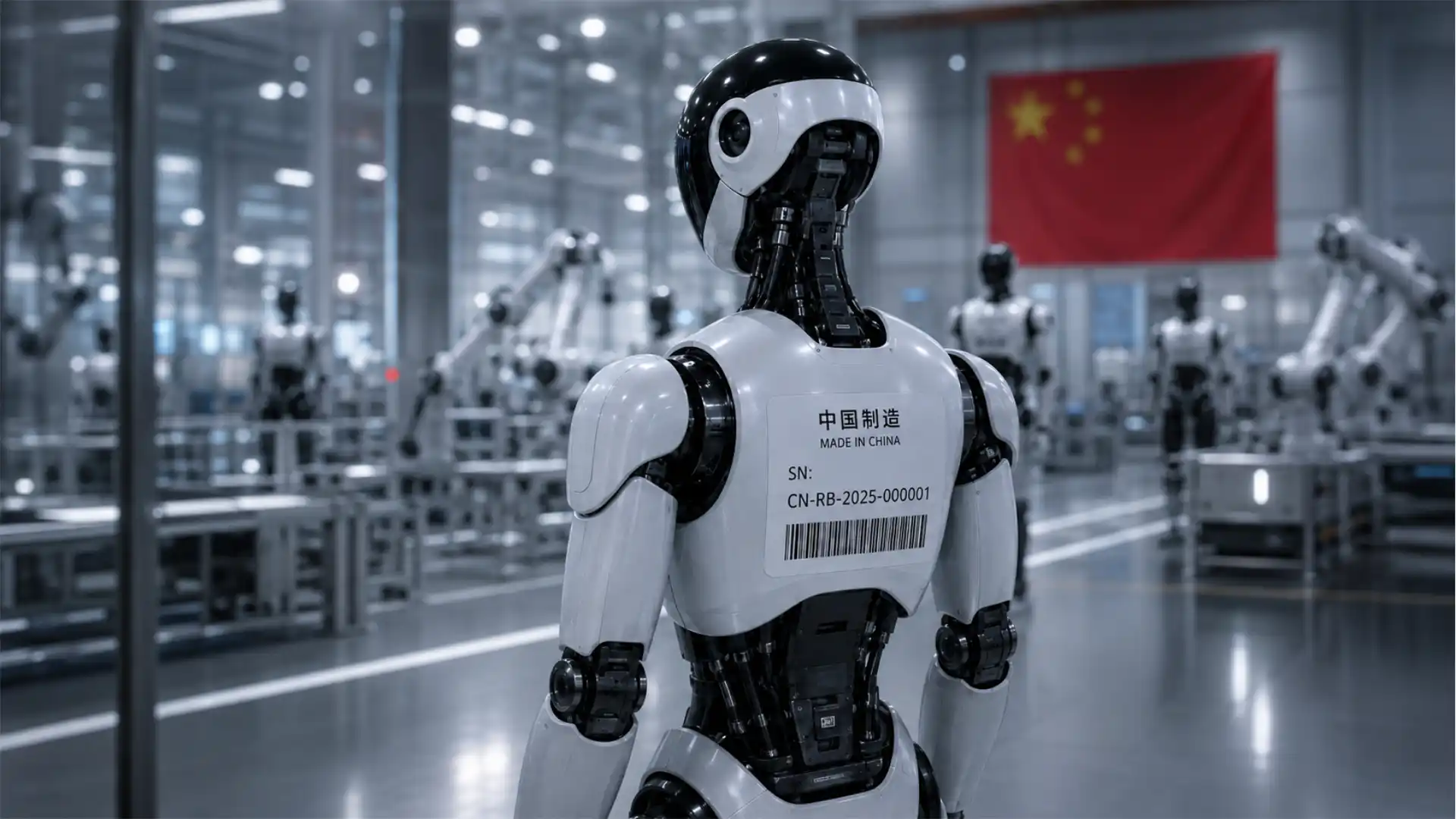
China has moved from staging humanoid robot spectacles to building the paperwork behind them. The new plan is not about granting machines personhood. It is about giving each humanoid robot a unique digital identity, tying that identity to a lifecycle record, and making robots traceable when they leave the factory, enter public or industrial settings, break down, change owners, or reach the end of use. The practical message is blunt: China wants humanoid robots to scale, and scaling requires records, liability trails, and standards.
Table of Contents
China’s new robot ID system is narrower and more important than the headline sounds
The phrase “every robot in China will have a serial number” captures the spirit of the story, but the current policy is more precise. The system announced in May 2026 applies to humanoid robots, meaning human-shaped, AI-driven, bipedal machines. It is not yet a universal registry for all industrial arms, warehouse robots, delivery robots, drones, medical robots, quadrupeds, or consumer appliances. The policy focus is humanoids because they are the category most likely to move between factories, offices, care settings, exhibitions, public venues, and eventually homes.
China launched what state and industry outlets describe as the country’s first Humanoid Full Lifecycle Management Service Platform in Beijing on May 22, 2026. The platform was guided by the Ministry of Industry and Information Technology’s Science and Technology Department and led by the Humanoid Robotics and Embodied Intelligence Standardization Technical Committee. It had already covered more than 100 humanoid robot companies, more than 200 product models, and over 28,000 robots assigned lifecycle codes at launch.
The ID is meant to follow the machine through the chain that matters for governance: research and development, production, market access, sales, operation, maintenance, scrapping, and recycling. That is a different concept from a normal factory serial number. A serial number identifies a product unit. A lifecycle identity creates a record that can connect the unit to manufacturer filings, technical parameters, maintenance history, usage scenarios, safety incidents, component changes, and end-of-life handling.
This distinction matters because humanoid robots are not just durable goods. They are physical AI systems. They move, perceive, decide, collect data, interact with people, and perform tasks in environments that are hard to predict. A robot that falls during a marathon demo is embarrassing. A robot that falls in a factory aisle, a hospital corridor, or an elder-care facility is a liability question. A robot that records images, audio, or environmental data in a workplace is a data governance question. A robot that receives a software update after sale is a product responsibility question.
The ID system is China’s answer to a basic problem in embodied AI: once robots leave controlled laboratories, the industry needs a way to prove which machine did what, under which configuration, in which setting, under whose responsibility. Without that record, manufacturers blame operators, operators blame integrators, integrators blame software vendors, and regulators are left reconstructing a moving machine’s history after harm has already happened.
The 29-character code is a machine identity, not a robot citizenship card
Reports from China Daily and other outlets describe the code as a 29-character identifier made of numerals and English letters. The code identifies a robot’s brand nationality, company, product model, and serial number. It also links to information such as the manufacturer, hardware parameters, intelligence level, and factory filing records. China Daily noted that the identifier is unique and 11 characters longer than a Chinese citizen ID number.
The comparison with a national identity card is useful for readers but legally misleading if taken too far. Robots are not being treated as citizens. They are not receiving legal rights, political status, or civil identity. The robot ID is an industrial governance instrument. It is closer to a vehicle identification number, aircraft registration, medical device traceability code, or high-risk equipment file than to a human identity document.
The reason people keep using the “robot passport” metaphor is that the system is designed to make a machine portable across settings while keeping its records intact. A robot might leave a manufacturer in Wuhan, move to a distributor, be leased to a factory in Suzhou, receive joint replacements during maintenance, be redeployed to a logistics site, then be sold into a training facility. Without a shared code, each stage creates its own data silo. With a common code, the robot has a continuous record.
Biometric Update, citing the four-part structure reported around the launch, described the code as including a two-digit national code, a four-digit manufacturer code, a six-digit model code, and a 17-digit serial code distinguishing individual units. More than 28,000 robots across 200 models had already been assigned IDs at the time of reporting.
The value of this arrangement is not the code itself. A code is cheap. The value is the database and governance model behind it. A paper number does little unless it is linked to mandatory fields, responsible parties, update duties, audit trails, technical records, and sanctions for false filing or non-filing. Chinese sources are careful to frame the work as a lifecycle management platform, not only a label. That wording signals a system meant to become part of how humanoids are approved, monitored, maintained, traded, and retired.
For manufacturers, the code becomes a compliance anchor. For buyers, it may become a trust signal. For regulators, it becomes a handle. For insurers, it could become a rating input. For repair networks, it can reduce ambiguity about parts, software version, and service history. A humanoid with a clean lifecycle record may eventually be easier to sell, lease, insure, finance, and redeploy than a machine with unknown provenance.
The launch marks a shift from demos to accountable deployment
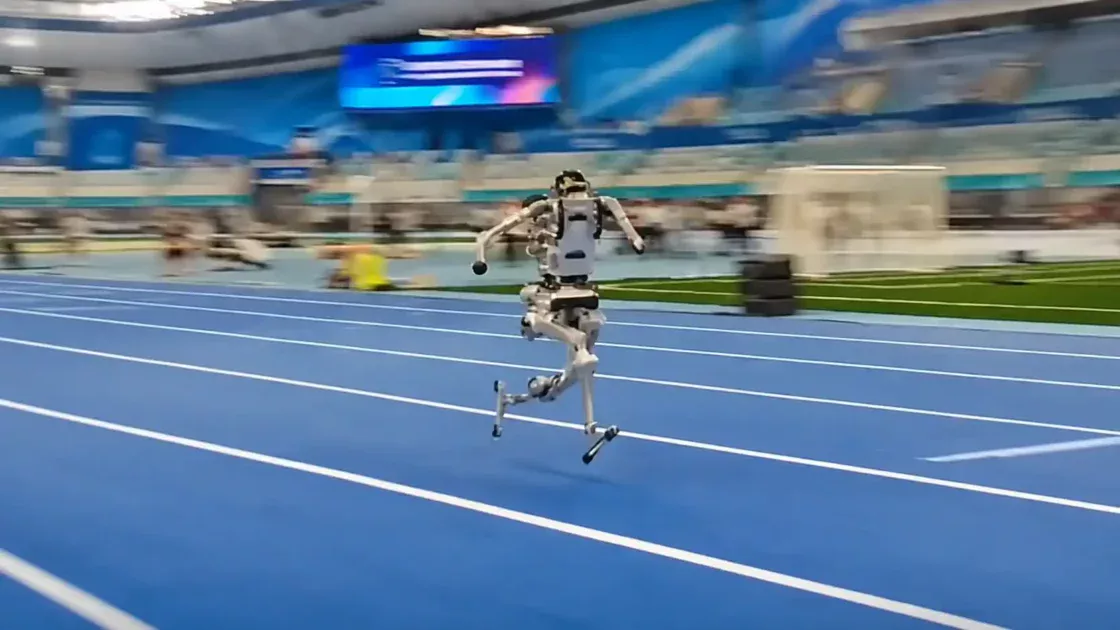
China’s humanoid robot sector has spent the past several years using public demonstrations to prove that the hardware is improving: robots running, dancing, boxing, serving drinks, carrying objects, navigating factory floors, and joining staged competitions. Those events matter because humanoids are hard to build and harder to make reliable. They also create a distorted picture. The real test for the sector is not whether a robot can perform a choreographed routine. It is whether thousands of machines can work safely around people under messy conditions.
The lifecycle platform is a sign that Chinese policymakers see the sector entering a more serious deployment phase. CCTV’s report described the platform as a base for full-chain governance, with coverage from research and production through market access, use, maintenance, scrapping, and recycling. It is meant to create a closed loop described by Chinese sources as “source traceable, process controllable, risk preventable, responsibility accountable.”
That wording is bureaucratic, but the problem behind it is concrete. A humanoid robot is a moving stack of mechanical components, batteries, motors, sensors, control software, cloud services, AI models, training data, user interfaces, and human operating practices. A fault can come from a loose joint, a worn actuator, a corrupted perception model, a bad update, poor operator training, a hacked communication channel, a damaged battery, a wrong task assignment, or a deployment environment outside the robot’s rated capability.
A conventional product recall system is too blunt for that complexity. If a specific robot model has a battery defect, regulators need to know which units are affected. If one manufacturer’s control software fails under a particular operating mode, operators need a way to verify whether their machines have the affected firmware. If a robot used in a public setting records personal data beyond its declared purpose, the question is not only “which company made it?” but “which unit was deployed, where, with which software and which data policy?”
The ID system starts by solving the traceability problem. It does not by itself solve the safety problem, the data problem, the ethics problem, or the labor problem. It creates the record structure through which those problems can be assigned to real parties rather than discussed as abstract risks.
Hubei provided the pilot before the national platform
The national platform did not appear in a vacuum. Hubei province had already moved first through the Hubei Humanoid Robot Innovation Center in Wuhan. China Daily reported that some humanoid robots in Hubei were set to become the first in China to receive identity card numbers, allowing their full lifecycle activities to be recorded. The center completed filing applications and coding tests for the first batch of enterprises and products with MIIT on May 11, 2026.
The Hubei pilot matters because it shows how the policy may work on the ground. The first participants were not random consumer devices. They were firms across Hubei’s humanoid robot industrial chain, including Optics Valley Dongzhi, GLRoad, Hubei Qirobotics, Jingchu Humanoid Robot, HandX, Guanggu Haribit, and Maxnova. That list suggests an attempt to create regional operating experience before pushing the model nationally.
The Hubei center’s explanation of the ID system focused on maintenance and liability. If a robot breaks down, operators can check operational logs and maintenance records through the unique ID to locate the malfunction, determine liability, and carry out repairs. A second-hand buyer or new user could verify performance and service records rather than repeatedly testing from scratch.
That second point is underrated. Humanoid robots are expensive capital goods, and the sector will struggle to scale if every buyer treats every used robot as an opaque risk. Lifecycle records can support leasing markets, certified pre-owned sales, maintenance contracts, warranty transfers, and specialized service providers. China’s electric vehicle industry scaled partly because battery, vehicle, and charging data became part of a dense operating system. Humanoid robots may require a comparable data structure, though with different safety and privacy questions.
The Hubei pilot also reflects a familiar Chinese industrial policy pattern: test a mechanism in a strong regional cluster, link it to national standards, then use the standard to pull companies into a shared architecture. This approach can move quickly because local governments, innovation centers, standards bodies, and firms often work in overlapping policy networks. It can also create compliance pressure before the market has decided which technologies deserve to win.
The code turns a robot into a managed asset
For manufacturers, a humanoid robot ID is a compliance burden, but it is also a commercial instrument. The machine becomes easier to manage as an asset. A factory buyer wants to know whether a robot has been maintained according to schedule, whether its joints have exceeded safe wear thresholds, whether its battery pack has degraded, whether its software is current, and whether it has been used in settings beyond its certified range. A lifecycle record gives buyers a way to ask those questions without relying only on seller claims.
The same logic applies to leasing. If a robotics company leases humanoids to factories, hotels, retail spaces, or training centers, it needs records for uptime, repair frequency, operator behavior, redeployment suitability, and residual value. A unique identity code tied to standardized records makes those contracts easier to price. Machines that work near people will not be financed like laptops. They will be financed like risky mobile equipment, with maintenance history and incident records baked into valuation.
Insurers will watch this carefully. The hardest part of insuring emerging robotic systems is not imagining harm. It is pricing probability. A robot with traceable service records, verified operating parameters, and known deployment history is a better underwriting object than a black-box machine. China’s platform could eventually support insurance products for robot operators, service firms, leasing companies, and public venues.
Repair networks also gain from standardization. When each manufacturer uses its own internal code and record format, third-party service becomes inefficient. Repairers need to translate part numbers, logs, firmware versions, and maintenance categories across suppliers. A shared lifecycle identity does not make all robots technically interoperable, but it gives the market a common reference point.
The risk is that the ID becomes more than a reference point. If access to the platform becomes mandatory for market participation, the standards body and platform administrators gain power over which companies can sell, deploy, and maintain humanoids. That may improve safety. It may also favor larger firms that can absorb compliance costs and integrate with government-backed infrastructure.
The system is built around lifecycle governance
The strongest clue in the policy is the repeated phrase “full lifecycle.” Chinese reports describe the platform as covering research and development, production, access, sales, use, maintenance, scrapping, and recycling. Securities Times reported that the accompanying lifecycle management standard clarified identity coding rules for complete humanoid robot units and management requirements across production, circulation, maintenance, and recycling.
That lifecycle concept is not decorative. Robots change after sale. They receive firmware updates. They may be trained or tuned for specific tasks. They may use third-party software modules. Operators may attach tools, modify hands, swap batteries, replace sensors, or alter safety settings. A humanoid robot in year three may not be the same risk object that left the factory in year one.
A lifecycle system tries to record those changes. It asks a governance question that traditional product regulation often struggles with: who remains responsible when a product’s behavior changes after delivery? If the manufacturer updates the perception model, the manufacturer may carry responsibility. If the operator disables a safety feature, the operator may carry responsibility. If an integrator attaches an uncertified end effector, the integrator may carry responsibility. If a service provider installs counterfeit parts, the service provider may carry responsibility.
Without records, responsibility becomes a negotiation after the incident. With records, responsibility becomes at least partly evidentiary. That does not make liability simple. It makes it less invisible.
Lifecycle governance also supports recalls. If a specific batch of actuators fails under humidity, regulators can identify affected machines. If a software update causes unstable gait in one model, manufacturers can find the units running that version. If battery degradation crosses a safety threshold, operators can be required to replace packs. The ID system is a skeleton for future recall, certification, and incident reporting rules.
The ID code connects static identity with dynamic telemetry
The robot ID has two layers. The static layer tells the world what the machine is: manufacturer, model, national or brand origin, serial number, hardware parameters, intelligence level, and filing records. The dynamic layer records what happens to that machine: maintenance, application scenarios, operational accuracy, joint wear, battery status, and potentially safety events. China Daily reported that real-time data such as joint wear, battery status, and operational accuracy could be accessed through the management platform.
That is the most sensitive part of the system. Static identity is ordinary industrial administration. Dynamic telemetry is operational surveillance of machines. It may be justified for safety, but it raises commercial and privacy questions. Who can see the data? Which fields are mandatory? How often are they updated? Are raw logs stored centrally, or are only summaries filed? Can local regulators access deployment records? Can competitors infer product performance? Can users challenge inaccurate records? Can sensitive workplace data be separated from machine health data?
Those questions will shape whether the platform becomes a trusted safety layer or a compliance chokepoint. A factory may accept reporting battery health and service records. It may resist reporting operational logs that reveal production methods, throughput, defects, or customer orders. A hospital may need strict controls on any robot data that touches patients. A school or elder-care site may face even higher sensitivity.
The technical design will matter as much as the rule. A safer design would separate identifiers, safety logs, maintenance records, and user data through access controls. A riskier design would concentrate too much operational detail in one platform. Traceability is useful only when the system traces the right things for the right parties under clear limits.
China’s data governance regime already has laws and rules covering personal information, data security, algorithmic recommendation services, generative AI services, and deep synthesis. Humanoid robots sit across these categories rather than inside one neat box. A robot can be a product, an AI system, a data collector, a workplace tool, a service interface, and a mobile sensor platform at the same time.
The four-part code structure shows China’s export ambitions
A two-digit national code at the front of the reported structure signals more than domestic administration. It suggests the system is designed with cross-border movement in mind. If Chinese humanoid robots are exported, leased abroad, brought back for service, or sold through international distributors, their identity records may need to travel beyond local Chinese registration.
That does not mean other countries will accept Chinese lifecycle records as sufficient. European, American, Japanese, South Korean, Middle Eastern, and Southeast Asian regulators may demand their own safety filings, product certifications, cybersecurity assurances, and incident reporting. Yet a standardized Chinese identity could become the manufacturer’s own export dossier. It could make it easier for Chinese firms to answer foreign buyers’ due diligence questions.
This is where the ID system becomes strategically interesting. Product standards are never only technical. They influence markets. If Chinese humanoid robot makers normalize a lifecycle identity format early, foreign distributors, insurers, repairers, and integrators may adapt to it because Chinese machines are widely available and cheaper. Once customers get used to a format, it becomes part of procurement language.
China has done this before in adjacent sectors. Electric vehicles, batteries, solar components, telecom equipment, and industrial automation all show the same pattern: domestic scaling creates technical practices; technical practices become standards; standards support export; export makes those standards hard to ignore. The robot ID system could become another instance of that pattern.
The other possibility is fragmentation. If the European Union requires one form of traceability, Japan another, China another, and private insurers another, manufacturers will face duplicate data demands. That would raise costs and slow deployment. The global humanoid robot market may eventually need interoperable identity and incident-reporting standards, even if governments disagree on governance philosophy.
China’s industrial robot base gives the policy weight
China’s humanoid robot ID system should be read against the country’s broader automation position. The International Federation of Robotics reported in April 2026 that China had around 2 million industrial robots in operation, about 4.5 times Japan’s operational stock, and that 54% of all robots installed worldwide in 2024 were deployed in China, equal to about 295,000 units.
That industrial base matters because humanoid robots are not emerging into a country unfamiliar with robotics. China already has large robot supply chains, component makers, integrators, factory customers, automation engineers, machine vision firms, battery suppliers, and local governments willing to subsidize deployment. Humanoids remain an early market, but they sit on top of a large manufacturing and automation system.
The IFR figures also explain why Beijing is paying attention before humanoids become common in homes. Industrial automation has already shown how quickly robot adoption can move once costs fall and use cases become repeatable. If humanoids follow even a fraction of that curve, regulators do not want to improvise after millions of machines are already circulating.
Humanoid robots are different from industrial arms. A robot arm is often bolted down, fenced, programmed for repetitive tasks, and deployed in a structured work cell. A humanoid walks through unstructured spaces, uses limbs near people, and may rely on general-purpose AI. That difference creates higher uncertainty. It also makes identity and lifecycle records more valuable.
China’s government wants the humanoid sector to become a future industry, not just a demonstration category. MIIT’s 2023 guiding opinion on humanoid robot innovation set goals for a preliminary innovation system by 2025 and stronger technology, supply chains, and industrial ecosystem by 2027. The same policy called for batch production and demonstration applications in special operations, manufacturing, and livelihood services.
China’s humanoid sector is large but still immature
China Daily cited a March report from Beijing CCID Publishing and Media and China Electronics News saying global humanoid robot shipments reached about 17,000 units in 2025, with a global market size of 2.88 billion yuan, or about $424 million. The same report said China had more than 140 humanoid robot manufacturers, shipments of 14,400 units, 84.7% of the global total, and a domestic market worth 1.55 billion yuan.
Those numbers tell two stories at once. China is already the volume center of humanoid robots. Yet the market is still tiny compared with cars, smartphones, appliances, industrial robots, or even many categories of service robots. A sector with 140 manufacturers and roughly 14,400 annual domestic shipments is crowded before it is mature.
That imbalance creates a risk of weak products, repeated designs, exaggerated claims, and short-lived startups. It also creates a need for a common record system. When many companies are racing to ship, buyers need a way to distinguish machines that have passed basic filing, maintenance, and safety checks from machines that are little more than funded prototypes.
China’s National Development and Reform Commission has warned about a possible humanoid robotics bubble, with too many firms chasing similar products and too few proven use cases. That warning fits the ID system’s purpose. Standards are a way to turn a speculative sector into an administered sector. They do not guarantee commercial success, but they can force companies to disclose enough information to make failure less chaotic.
The market’s immaturity also means the ID system may shape product design early. If manufacturers know that certain hardware parameters, intelligence levels, service records, and operating data must be filed, they will build products around those reporting requirements. Compliance can become architecture. That is powerful because decisions made during an early standards phase often persist for years.
The ID system creates a common language for fragmented companies
Chinese reports repeatedly mention fragmentation: companies operating in isolation, incompatible technical standards, and the lack of unified norms for traceability, safety supervision, and data circulation. China Daily quoted Liu Chuanhou of the Hubei Humanoid Robotics Innovation Center saying the initiative is expected to promote standardization and strengthen the institutional foundation for large-scale development.
Fragmentation is not unique to China. Humanoid robotics is fragmented everywhere because it combines many disciplines: mechanical engineering, control systems, AI, perception, batteries, materials, hands, actuators, operating systems, cloud services, simulation, teleoperation, reinforcement learning, and human-machine interaction. Firms often solve the same problems in incompatible ways.
A shared ID system does not harmonize all of that. It does not make one robot’s hand compatible with another robot’s wrist. It does not make models share training data. It does not make safety certifications equivalent. It does create a minimum common administrative object: a registered complete machine tied to a product model, manufacturer, parameters, records, and lifecycle events.
That minimum can support deeper standards later. Once every robot has a unique identity, regulators can attach additional requirements to that identity: proof of safety testing, cybersecurity certification, model update logs, deployment category, operator training records, geofencing permissions, incident reports, recycling records, and insurance status. The identity is the base layer.
The danger is over-standardization too soon. Humanoid robotics is not mature enough for rigid design rules that freeze technology. If the ID system requires records but leaves room for technical diversity, it may support the sector. If it becomes a narrow template that favors today’s dominant architectures, it may punish better designs that do not fit the form.
The system fits China’s wider AI governance style
China has taken a stepwise approach to AI governance: regulate specific risk surfaces, build filing systems, require platform accountability, and connect standards with state oversight. Algorithmic recommendation rules came first, deep synthesis rules followed, then generative AI measures, then broader safety frameworks and sector-specific standards. The humanoid robot ID system extends that logic from online AI into physical AI.
That extension is critical. A chatbot can mislead, defame, manipulate, or leak data. A robot can do those things while also moving through a room. Embodied AI turns software risk into physical risk. The moment an AI system has motors, joints, batteries, and proximity to people, governance cannot stay inside content moderation or model filing.
China’s 2023 Interim Measures for generative AI services apply to public-facing services that generate text, images, audio, video, or other content. Algorithmic recommendation rules govern recommendation services. Deep synthesis rules cover synthetic content services. Humanoid robots may use all of these capabilities, but they also need product safety, mechanical reliability, real-world logging, and incident accountability.
This is why the ID system is not just another AI rule. It is a bridge between AI governance and industrial product governance. It treats a humanoid as a unit that must be managed through physical life, digital change, and operational context. That is a more demanding model than regulating a website or app.
The approach is also consistent with China’s preference for traceable deployments. Rather than waiting for court cases to define responsibility over many years, China often builds filing, registration, certification, and platform mechanisms up front. That can reduce uncertainty for firms that know how to comply. It can also increase state visibility into emerging technology markets.
International standards leave a gap for humanoids
Existing robot standards were not designed for the humanoid wave now being promoted. ISO 10218 covers industrial robot safety, with the 2025 editions addressing industrial robots and robot applications. ISO 13482 covers safety requirements for personal care robots such as mobile servant robots, physical assistant robots, and person carrier robots. ISO 8373 supplies robotics vocabulary used by standards bodies and statistical organizations.
Those standards are useful, but humanoids strain the categories. A humanoid may work in a factory one day, a showroom the next, a training center the next, and a care setting later. It may be industrial equipment, service robot, research platform, entertainment device, mobility aid, telepresence system, or AI interface depending on use. A standard written for one environment may not cover the full risk profile.
IEEE’s humanoid robot study group has pointed to gaps in the standards structure, including the need to assess which existing standards apply, which do not, and where new standards are needed. China’s identity system can be read as an administrative answer to the same gap: when product categories blur, a lifecycle record at least preserves information across categories.
The harder task is safety testing. A humanoid’s fall risk depends on gait control, surface conditions, payload, speed, center of mass, proximity to humans, software state, battery health, and recovery behavior. A robot’s manipulation risk depends on grip force, hand design, object type, task constraints, perception accuracy, and human presence. Cybersecurity risk depends on connectivity, remote update channels, cloud dependencies, and local autonomy.
A serial number cannot test any of that. It can link test results to a machine. That is the difference. The ID system is a registry layer; it must be paired with credible test methods if it is to become a safety system rather than a filing exercise.
China’s safety standard work is moving in parallel
The ID platform is arriving alongside standard projects for humanoid safety and data. China’s National Public Service Platform for Standards Information lists a national standard project titled “Safety requirements for humanoid robots — Part 1: General safety.” The project is under the National Robot Standardization Technical Committee and covers risk assessment, mechanical safety, electrical safety, functional safety, information security, interaction and decision safety, and other requirements for design, production, inspection, use, and maintenance.
That scope shows why the identity system was needed. Safety requirements can be written on paper, but enforcement requires a way to connect a tested design with a shipped unit and its later changes. If a robot is certified under one configuration and later receives a software update, part replacement, or task extension, the safety record must remain attached to the machine.
Another national standard project covers humanoid robot datasets, including architecture, dataset construction, data collection, format requirements, processing, annotation, fusion, storage, release, use, destruction, quality, and security requirements. The project covers real, simulated, and synthetic data for humanoid robot research, training, testing, and evaluation.
Dataset governance is not separate from robot identity. A humanoid’s capabilities depend heavily on training data and simulation. If a robot behaves poorly, investigators may need to know not only the hardware and software version, but also which data pipeline shaped its behavior. That is difficult because dataset records can be proprietary, huge, sensitive, and constantly changing. A lifecycle identity might eventually link to training history, evaluation records, and approved update packages without exposing raw data.
The direction is clear: China is building not one rule, but a standards stack. Identity is one layer. General safety is another. Dataset management is another. Product certification, electronic fences, compliance certification, and safety assessment may follow, according to Chinese reporting on next steps.
The platform creates a basis for robot recall and incident reporting
Every mature safety regime needs a path for incidents to become evidence and evidence to become corrective action. Cars have recalls. Aircraft have maintenance logs and incident investigations. Medical devices have adverse event reporting. Industrial machinery has inspection and safety procedures. Humanoid robots will need similar systems because they will fail in public, sometimes in ways that are hard to reproduce.
A lifecycle identity supports incident reporting by answering the first set of questions: Which unit was involved? Who made it? Which model? Which software version? Which hardware configuration? Which operator? Which task? Which maintenance history? Which environment? Which prior warnings? Which modifications?
Those questions decide whether an event is a one-off accident or a pattern. If five robots of the same model fall after a specific firmware update, regulators need to connect the cases. If one operator repeatedly deploys different robots outside rated conditions, the problem is the operator. If one service provider installs nonconforming parts, the problem is in maintenance. Without identity-linked records, those patterns remain hidden.
The system may also improve recall precision. A broad recall is expensive and damaging. A narrow recall requires reliable data. If a joint assembly from one supplier is used in 12,000 units across 15 models, and a defect appears in a certain production lot, the platform can in theory identify the affected machines. That ability matters as humanoid supply chains deepen.
There is a privacy version of incident reporting too. If a robot leaks sensitive data, the investigation needs to know which logs were collected, which cloud service handled them, which operator had access, and whether the unit was configured correctly. Physical AI incidents will often be hybrid incidents: part safety failure, part cybersecurity failure, part data governance failure.
Liability is the real target behind traceability
The official language often says traceability and accountability. The second word is the more important one. A robot ID makes it harder for parties to escape responsibility by claiming uncertainty. It does not determine guilt automatically, but it gives investigators a starting record.
Humanoid robot liability can involve at least six parties: the manufacturer, the component supplier, the AI model provider, the software updater, the systems integrator, the operator, and the owner. A seventh party, the service provider, may handle maintenance. An eighth, the venue, may control the environment. The more modular the robot, the more complicated liability becomes.
Consider a simple injury: a robot carrying a box turns too sharply and hits a worker. The cause could be bad path planning, a sensor blind spot, a slippery floor, a worn actuator, an overloaded payload, an uncertified attachment, operator override, poor site mapping, or a software update. Liability depends on evidence. The ID system is designed to preserve that evidence.
This will shape contracts. Manufacturers may require operators to maintain records through the platform. Operators may require integrators to document site modifications. Insurers may require proof of updates. Service firms may be required to upload maintenance data. Buyers may demand clean lifecycle histories. Robot identity turns responsibility into a chain of recorded obligations.
There is a risk of false confidence. Records can be incomplete, inaccurate, manipulated, or too technical for courts and regulators to interpret. A lifecycle platform needs audit rules, data integrity protections, penalties for false filings, and independent access for investigators. Otherwise, the ID becomes a decorative compliance label.
Data security is not a side issue
Humanoid robots are mobile sensor systems. They may capture video, audio, location, environmental maps, faces, work routines, object inventories, production processes, and user commands. In factories, that data may reveal trade secrets. In homes or care settings, it may reveal intimate personal behavior. In public spaces, it may implicate biometric and surveillance concerns.
The ID platform may collect or link to operational information such as application scenarios, maintenance records, joint wear, battery status, and operational accuracy. That information sounds mechanical, but it can still reveal sensitive activity. A robot’s working hours, location, task type, failure rate, and performance profile can expose business operations.
China Daily quoted Liu Chuanhou saying the ID number can support rapid traceability and liability confirmation in cases involving safety incidents or potential data hazards, helping prevent risks such as technology abuse and information leakage. That formulation recognizes that humanoid governance is not only about falling robots. It is also about data and abuse.
A credible system needs separation between robot health data and personal or commercial data. It also needs rules for retention, access, correction, deletion, and cross-border transfer. These details are rarely the first thing highlighted in launch reports, but they decide whether the system is proportionate.
The policy challenge is sharper because China’s humanoid firms want to improve models through field data. Real-world robot data is precious. It captures edge cases that simulation misses: messy floors, unpredictable humans, odd lighting, worn parts, unusual objects, and language variations. If the ID system makes data flows more structured, it could help model improvement. If it is too intrusive, customers may resist deploying robots in sensitive settings.
Electronic fences may become the next governance layer
Chinese reporting around the launch mentioned future work on identity recognition, product certification, and electronic fence standards. An electronic fence is a digital constraint that limits where or how a machine operates. For humanoid robots, it could mean location boundaries, speed limits, no-go zones, task permissions, proximity rules, or restrictions tied to venues.
This is a natural extension of robot identity. Once a robot has an ID and a declared deployment setting, regulators or operators can attach permissions to that unit. A factory robot may be allowed on production floors but not offices. A service robot may be allowed in a hotel lobby but not guest rooms. A care robot may require special authorization for physical assistance tasks. A demonstration robot may be restricted to exhibition zones.
Electronic fencing can reduce risk, but it also raises control questions. Who sets the fence? The manufacturer, operator, regulator, venue owner, insurer, or platform administrator? Can a robot override the fence in emergencies? What happens when GPS fails indoors? How are indoor maps verified? Can a malicious actor spoof the location system? Can an operator disable the fence? What counts as a violation?
The ID system makes electronic fencing enforceable because it ties permissions to a unit. Without identity, a fence is just local software. With identity, fence compliance can become part of the robot’s lifecycle record. A future Chinese humanoid may not only have an ID; it may have a permission profile that decides where it can move and what tasks it can perform.
This could support safety in public spaces. It could also make humanoid deployment more bureaucratic. The trade-off will depend on how risky the use case is. A robot in a closed factory cell should not face the same rules as a robot moving through a train station.
The business impact reaches beyond compliance teams
For robotics companies, the ID platform changes product management. Compliance fields become part of engineering documentation. Service records become sales assets. Data interfaces must support reporting. Lifecycle events must be captured in a consistent way. Small startups that treat documentation as an afterthought will struggle.
Large firms may benefit. They already have product lifecycle management systems, quality control processes, and staff who can handle filings. They can turn compliance into marketing: certified records, verified service, traceable parts, safe deployments, approved updates. Smaller firms may need shared tools or service providers to meet the same requirements.
The platform may also support consolidation. Buyers facing a crowded market will prefer vendors that can prove lifecycle discipline. Regulators may scrutinize firms with poor records. Insurers may charge more for machines from companies with weak maintenance history. Over time, the ID platform could help separate firms that can ship reliable machines from firms that can only build demos.
There is another business effect: after-sales revenue. If every robot has a record and maintenance history, manufacturers can build service packages around compliance. They can sell inspections, update management, certified parts, lifecycle audits, redeployment checks, and end-of-life handling. Humanoid robotics may become less like selling gadgets and more like operating fleets.
Fleet thinking is central. A company deploying 200 humanoids across multiple sites needs dashboards, maintenance schedules, incident records, update controls, operator logs, and compliance reports. A national identity platform may create a baseline, but private fleet management systems will compete above it.
The second-hand market may depend on trusted identity
Humanoid robots will be expensive enough that reuse matters. A machine used for demonstration or training may later move to a factory support role. A robot leased for an event may be refurbished. A company that fails may sell its fleet. Without trusted records, used humanoids will be risky.
A lifecycle ID can support a second-hand market by making provenance visible. Buyers can review whether the robot was maintained, whether it suffered major failures, whether key components were replaced, whether software support remains active, whether safety certifications apply, and whether the unit has been used outside its intended conditions. China Daily’s Hubei report specifically mentioned that new users could verify performance and service records without repeated testing.
That matters for circular economy goals too. Robots contain batteries, metals, motors, sensors, and electronic components. End-of-life records can support recycling, parts recovery, and hazardous material handling. If regulators want to prevent unsafe reuse or illegal disposal, identity is the simplest starting point.
A strong second-hand market could lower adoption costs. Not every user needs the newest humanoid. Schools, training centers, research labs, and smaller firms may buy older machines if they can verify condition. A bad second-hand market, by contrast, would push more machines into waste or unsafe informal reuse.
The ID system could become the dividing line between legitimate and grey-market robots. A registered used humanoid with a clear record may be accepted by insurers and venues. An unregistered or tampered unit may be excluded from formal deployment. That would make identity economically valuable, not merely administrative.
The platform may support certification but cannot replace it
Certification is different from identification. An ID says which unit exists. Certification says the unit or product model meets defined requirements under defined tests. A lifecycle record can store certification status, but it does not prove safety by itself.
Chinese sources suggest product certification and safety assessment capacity will be developed alongside the identity system. Zhejiang’s economic information center cited Chinese standards experts saying future work would include identity-related standards, product certification, electronic fences, identity compliance certification, and safety assessment capabilities to support supervision and accident responsibility.
This sequencing is sensible. Start with identity. Add records. Add certification. Add enforcement. The challenge is credibility. Certification must be technically serious enough to catch real risks, not merely confirm paperwork. It must cover mechanical safety, functional safety, electrical safety, cybersecurity, human-robot interaction, fallback behavior, and deployment-specific limits.
Testing humanoids is hard because their use cases differ. A robot carrying tools in a factory has different hazards from a robot greeting visitors in a museum or assisting older adults. Certification may need tiers: base hardware safety, mobility safety, manipulation safety, data security, task-specific approval, and public-space deployment approval.
The ID platform could make tiered certification practical. Each robot’s record could show which certifications apply and under what operating conditions. A buyer could see that a unit is approved for demonstration but not physical assistance, or for indoor logistics but not public-road movement. The strongest version of the system would make limits visible, not just approvals.
Manufacturers will need version control for physical AI
Software versioning is familiar. Hardware versioning is familiar. Humanoid robots require both, and the two interact. A software update that is safe on one actuator batch may be unsafe on another. A replacement sensor may alter perception. A new hand may change force limits. A worn joint may degrade gait control. A model update may change how the robot responds to ambiguous human gestures.
The ID system pushes manufacturers toward rigorous version control. Each robot’s lifecycle record needs to know which configuration is active. If an incident occurs, investigators must reconstruct the state of the machine at the time. That includes firmware, AI model version, control stack, installed components, calibration data, safety settings, and relevant maintenance.
This is a serious engineering discipline. Many robotics teams are excellent at prototypes but weak at long-term configuration management. The ID system will expose that weakness. A company cannot credibly claim lifecycle traceability if it cannot map software and hardware changes to individual units.
The issue becomes sharper with learning systems. If a humanoid adapts through on-device learning or receives task tuning from field data, its behavior may diverge across units. That raises the question of whether each unit’s learned state must be recorded, bounded, or resettable. Regulators may not accept a fleet of machines whose behavior cannot be explained because each unit drifted through local adaptation.
China’s dataset standard project shows awareness of the data side. But version control for embodied AI remains hard globally. The robot ID is a necessary handle for configuration management, but the industry still needs methods for auditing behavior in systems that learn and update.
Buyers will ask harder procurement questions
For customers, the new system changes what “safe robot” means. A buyer should not ask only whether a humanoid can perform a task. It should ask whether the robot has a registered identity, whether its product model is filed, whether certifications apply to the intended use, whether maintenance records are accessible, whether software updates are logged, whether operator training is required, and whether incident reporting duties are clear.
Procurement teams will need technical and legal checklists. A hotel buying a lobby robot has different risks from a factory leasing robots for material handling. A school using humanoids for STEM education has different data and supervision duties from a warehouse using them after hours. A care facility has the highest sensitivity because robots may interact with vulnerable people.
The ID system gives buyers a practical tool: request the lifecycle record. If the seller cannot provide it, the buyer should treat the machine as higher risk. If the record shows repeated failures or unclear maintenance, the buyer can negotiate price, require refurbishment, or walk away. A robot’s history will become part of the purchase decision.
Buyers should also understand that a registered ID does not mean unlimited safe use. The deployment environment matters. Floors, lighting, network quality, human density, emergency exits, task design, operator training, and supervision procedures all affect risk. A robot certified for one setting may be unsafe in another.
The most mature buyers will treat humanoid deployment like equipment deployment, not gadget adoption. They will run site assessments, define restricted zones, train staff, document tasks, monitor incidents, and require service-level agreements. The ID platform may make those practices easier to standardize.
Public-space robots raise the highest stakes
Humanoid robots in closed factories are easier to govern than humanoids in public spaces. Factories have trained staff, controlled areas, safety procedures, and restricted access. Public spaces have children, older adults, crowds, uneven behavior, unpredictable obstacles, and higher privacy sensitivity.
China has already used humanoid robots in highly visible public demonstrations and events. Public enthusiasm can accelerate adoption, but public-space deployment is where a robot ID becomes politically important. If a robot injures someone, captures sensitive data, blocks an emergency route, malfunctions in a crowd, or becomes a target for hacking, authorities need quick traceability.
The ID system could support public confidence by making robots visibly accountable. A venue could display a robot’s registration status, operating limits, and responsible operator. A regulator could require all public-space humanoids to be registered and checked. Citizens could report incidents using the robot’s visible code or scannable marker.
But public visibility also creates surveillance concern. A robot with cameras and microphones walking in a station or mall is not perceived like a static industrial machine. People may ask who operates it, what it records, where data goes, and whether they can avoid interaction. The ID code may answer who the robot is, but not whether the deployment is socially acceptable.
Public-space use will therefore need more than technical traceability. It will need signage, data minimization, clear operator responsibility, emergency stop procedures, insurance, and limits on tasks. A humanoid robot in public should be treated as a managed presence, not a roaming product demo.
Europe’s AI Act takes a different path
The European Union’s AI Act uses a risk-based framework for AI systems. The European Commission describes it as the first legal framework on AI addressing AI risks, with obligations varying by category. High-risk AI systems face tighter requirements, and systems used as safety components of covered products can fall into high-risk treatment.
That approach differs from China’s robot identity platform. The EU framework regulates AI systems by risk category and intended use. China’s humanoid platform starts with the physical unit and records its lifecycle. These models are not mutually exclusive. A mature regime may need both: risk classification for the AI function and identity traceability for the robot body.
The EU has strong product safety and liability traditions, and the updated Product Liability Directive expands attention to software, digital elements, and AI-related products. But Europe does not currently have a China-style national identity system for every humanoid robot unit. That gap may become more visible if humanoids enter care, logistics, public service, or industrial settings at scale.
Europe may resist centralized robot registration for political and privacy reasons. It may prefer manufacturer technical files, CE marking, conformity assessment, incident reporting, and market surveillance. That can work, but it may become strained if robots change materially after sale. The policy question for Europe is whether unit-level traceability can be achieved without building a centralized robot identity platform.
China’s approach is more direct. It creates an administrative object before the market matures. Europe’s approach is more legalistic and risk-classification driven. The United States, by contrast, has no unified federal humanoid robot registration framework, though sector-specific rules, product liability, workplace safety, and state laws may apply depending on use.
The United States may rely on courts and sector rules for longer
The United States has world-class robotics research and strong AI firms, but its governance style is more fragmented. Humanoid robots may be regulated through workplace safety rules, product liability, consumer protection, sector-specific rules, privacy laws, procurement standards, and voluntary industry standards. That may be flexible, but it can leave gaps until incidents force litigation or legislation.
A U.S. humanoid robot used in a warehouse may fall under occupational safety expectations, product liability doctrines, and contract obligations. A robot used in health care may trigger medical or health privacy issues if it performs certain functions. A consumer robot may trigger product safety and privacy scrutiny. A security robot may raise surveillance and civil liberties concerns. There is no single national unit identity layer comparable to China’s platform.
That may suit the U.S. market while humanoids remain experimental. It may become harder once robots are deployed in fleets. Fleet deployment rewards standard records. Insurers, plaintiffs, employers, unions, and regulators will all ask for logs when something goes wrong. If there is no public platform, private platforms will emerge: manufacturer dashboards, insurance databases, workplace records, and incident exchanges.
The U.S. advantage may be openness and innovation speed. The disadvantage may be delayed accountability infrastructure. China’s advantage may be fast standard setting. The disadvantage may be over-centralization and compliance burden. The global race is not only about who builds better robots; it is also about who builds the governance layer that lets robots work at scale.
Labor politics will follow the ID system into factories
Humanoid robots are often framed as helpers for dangerous, dull, or labor-shortage tasks. That framing is partly true. It is also incomplete. Robots that can move through human spaces will affect work design, job categories, monitoring practices, training needs, wage bargaining, and workplace safety responsibilities.
An ID system does not solve labor displacement. It can, however, make robot deployment more visible. If factories register humanoids by unit and deployment scenario, policymakers may gain better data on where robots are used and how quickly adoption spreads. That could support workforce planning, safety inspections, and subsidy design.
Workers may also care about identity records. If a robot injures someone, the worker or union will want access to maintenance logs, incident history, and operating parameters. If a robot is used to monitor workers through cameras or sensors, the workforce will want to know what data is collected and who controls it. If robots are introduced under claims of safety improvement, records can test whether incidents actually fall.
The labor question is sharpened by China’s manufacturing automation base. Robots are already central to industrial upgrading. Humanoids could extend automation into tasks that were hard for fixed systems: carrying items through human spaces, tending machines, inspecting equipment, handling irregular objects, supporting logistics, or doing night shifts in flexible environments.
Robot identity may become part of labor governance because it creates a countable unit of automation. Once robots can be counted, tracked, and classified by use, governments can measure adoption more precisely. That measurement can guide policy, but it can also expose politically sensitive changes in employment.
The ID system may accelerate government procurement
Government procurement is one of the fastest paths for emerging technology in China. Local governments can support demonstrations, public-service pilots, industrial parks, exhibitions, training centers, and public facilities. A national robot ID system makes procurement easier because officials can require registered machines and standardized records.
This matters for humanoid robots because public procurement can create early demand before private use cases are fully proven. Cities may deploy robots in government service halls, museums, transport hubs, education centers, elder-care pilots, emergency drills, or industrial demonstration zones. Registration gives these deployments a compliance frame.
Beijing Economic-Technological Development Area, where the national platform was released, has become a major robotics and embodied intelligence hub. Securities Times reported that the area has gathered more than 300 robotics and embodied intelligence firms and opened more than 50 real-world data collection sites as part of embodied intelligence experimentation.
This kind of local ecosystem can turn standards into deployment practice. If public demonstration zones require lifecycle IDs, participating companies will comply. If those pilots become reference projects, other cities will copy the model. The ID system may therefore spread through procurement and pilot programs before hard penalties become the main enforcement tool.
The risk is performative deployment. If local governments buy robots to signal technological ambition rather than solve real problems, lifecycle records will make the machines traceable but not useful. Governance can reduce disorder; it cannot create demand where the use case is weak.
The system could become a data advantage for Chinese firms
Humanoid robotics depends on field data. Simulation helps, but robots must learn from real environments. Data about failures, maintenance, joint wear, task success, battery degradation, and deployment conditions can improve design. If China’s lifecycle platform standardizes parts of that data, it may give the sector a feedback loop.
This does not mean all data will be pooled openly. Companies will guard competitive information. Regulators may receive summary fields rather than raw logs. Yet even standardized categories can improve industry learning. If failure types are coded consistently, patterns emerge. If maintenance intervals are recorded, component weaknesses become visible. If deployment scenarios are classified, policymakers can see which use cases are real and which remain theatrical.
The platform could also help identify best-performing firms. Companies with lower incident rates, better uptime, and cleaner maintenance records may gain credibility. Poor performers may be exposed. That can improve market discipline, though only if data quality is high and metrics are not gamed.
There is a tension here. The more data the platform collects, the more useful it becomes for governance and industrial learning. The more data it collects, the more sensitive it becomes for companies and users. The core design challenge is to capture enough information to improve safety without turning every robot into a reporting device for everything around it.
Cybersecurity becomes a mechanical safety issue
A hacked humanoid is not just a data breach. It can be a moving hazard. If an attacker gains control over movement, perception, task instructions, update channels, or safety settings, the risk can become physical. The ID platform can support cybersecurity by recording software versions, update history, and device status. It cannot secure robots by itself.
Humanoid robots need secure boot, signed updates, access control, encrypted communication, vulnerability reporting, intrusion detection, safe fallback modes, and emergency stops. They also need clear rules about remote operation. Many humanoids will use cloud services, teleoperation, or remote diagnostics. Those links are useful and risky.
A lifecycle record can show whether a robot is running patched software. It can flag units that missed critical updates. It can connect incidents to firmware versions. It can identify machines affected by a vulnerability. This is the same logic used in software asset management, now applied to moving machines.
China’s standard project for general humanoid safety includes information security, communication security, body security, application security, and integrated management among its technical areas. That pairing of safety and information security is necessary. In embodied AI, cybersecurity is not an IT department issue. It is part of functional safety.
The industry should expect cybersecurity certification to become part of robot market access. A humanoid that cannot prove secure updates and access controls will be hard to justify in public or sensitive settings. The robot ID may become the place where security status is recorded and checked.
Human operators remain part of the safety system
A humanoid robot can be unsafe because of bad design, but it can also be unsafe because of bad operation. Operators may assign tasks beyond rated capability, ignore maintenance warnings, overload payloads, use robots near crowds, bypass safety settings, or fail to train staff. The ID system can record some of these issues, but it cannot remove human responsibility.
This is why lifecycle governance must include users and service providers, not only manufacturers. Securities Times reported that the lifecycle management standard applies to manufacturers, service providers, sellers, users, and recycling institutions. That broad scope is important. A robot’s life after sale may be more dangerous than its life at shipment.
Operator training may become mandatory for certain categories. A robot used for public interaction may require trained supervisors. A robot used for physical assistance may require stricter rules. A robot used in industrial settings may need integration with workplace safety procedures. A robot used in care settings may require ethical and privacy training.
The ID system can record authorized operators, training status, and deployment approvals if regulators choose to add those fields. That would make it easier to assign responsibility after incidents. It would also add administrative work for employers.
The balance should be practical. Not every interaction with a robot needs a licensed operator. But certain tasks should. A humanoid carrying a box in a fenced demo zone is not the same risk as a humanoid helping an older adult stand up. The rules should reflect that difference.
Consumers may meet robot IDs before they understand them
If humanoid robots enter shopping malls, hotels, restaurants, showrooms, schools, hospitals, and elder-care facilities, ordinary people may see visible ID labels or QR codes. The challenge is making that information useful. A long alphanumeric code is not meaningful to the public unless it links to understandable facts.
A public-facing robot ID page could show the operator, manufacturer, model, permitted role, emergency contact, data collection notice, last safety inspection, and complaint channel. That would make the ID more than a regulatory code. It would give people a way to understand and challenge deployment.
China’s Xinhua commentary framed robot IDs as a way to avoid confusion when robots injure people, are hijacked, malfunction, or damage equipment. It argued that records can help clarify whether responsibility lies with the manufacturer, user, or another party. That public explanation is persuasive because it starts from everyday accountability.
Yet public-facing identity must avoid false reassurance. A visible ID does not mean a robot is safe in every setting. A green checkmark can become a liability if people assume more than it proves. Public pages should state operating limits and responsible parties plainly.
There is also the risk of spoofing. If IDs are visible, scammers or unauthorized operators might display fake codes. A trustworthy system needs verification methods that are hard to counterfeit. QR codes should link to official records, not vendor-controlled pages alone. Robot identity will need authentication, not just display.
The recycling stage shows regulators are thinking beyond launch
Scrapping and recycling appear repeatedly in Chinese descriptions of the platform. That may sound like a minor detail because humanoid robots are still early. It is not minor. End-of-life governance matters for batteries, motors, sensors, rare earths, electronics, and potential data storage.
A discarded robot may still contain sensitive data. It may have logs, maps, user records, credentials, or proprietary software. Recycling must therefore include data wiping and secure decommissioning, not only physical disposal. A lifecycle record can show whether a unit was properly retired.
Recycling records also help prevent unsafe grey-market reuse. A damaged robot that should be scrapped might be resold if there is no identity trail. A registered end-of-life status can make improper resale easier to detect. Parts harvesting can also be governed more carefully if critical components are tracked.
This is especially relevant for batteries and actuators. Worn components may be unsafe if reused without testing. A lifecycle platform can record component replacement and disposal. If China’s humanoid industry grows as policymakers hope, end-of-life management will become a real environmental and safety issue.
A full lifecycle system is only credible if the final stage is real. Many product registries focus on sale and ignore disposal. China’s robot platform is at least rhetorically broader. The proof will be whether recycling institutions and service providers actually update records when robots leave service.
The policy may favor embodied AI platforms over standalone machines
Humanoid robots are increasingly platform products. A robot may come with an operating system, app ecosystem, cloud service, developer tools, simulation environment, model marketplace, fleet dashboard, and service network. The ID system fits this platform model because it makes each physical unit a node in a larger management system.
This may favor firms that can provide complete stacks. A company selling only hardware may struggle to maintain lifecycle records, software updates, and compliance reporting unless it partners with platform providers. A company offering hardware, software, cloud management, and service can integrate reporting more easily.
China’s robotics sector includes both full-stack firms and component specialists. The ID system may create demand for middleware: compliance APIs, fleet management software, maintenance record tools, identity verification services, and certification workflows. A new service layer could emerge around robot compliance.
That service layer will be valuable because many firms will not want to build reporting infrastructure from scratch. Standards often create markets for compliance tools. The same happened in cybersecurity, automotive software, medical devices, and financial reporting.
The risk is vendor lock-in. If a few platform firms control lifecycle management tools, smaller robot makers may become dependent on them. If the national platform uses interfaces that only large firms can support easily, market diversity may narrow. The technical openness of the platform will shape the competitive structure of China’s humanoid sector.
The serial number is a signal to global competitors
For foreign robotics companies, China’s robot ID system is a warning and a template. It warns that Chinese firms may soon operate under a national traceability architecture, giving them a structured way to prove compliance, service history, and deployment scale. It also offers a template because every serious robotics market will face similar questions.
Global competitors should not dismiss the policy as bureaucracy. Bureaucracy can be infrastructure. A national standard that links machines to records can lower transaction costs once companies adapt. It can help customers compare products, help regulators approve deployments, and help insurers price risk.
Foreign firms entering China may need to comply with the identity system if they manufacture or sell humanoids there. The reported national code field suggests cross-border considerations. A non-Chinese robot maker may need to map its product records into the Chinese code structure, file model data, and maintain lifecycle updates. That could expose technical details the firm would rather keep private.
Chinese firms exporting abroad may face the opposite problem: proving that their Chinese lifecycle records satisfy foreign buyers without triggering concern about data access or state visibility. A European buyer may value maintenance traceability but worry about data flows to Chinese platforms. Contracts will need to specify which data is shared, stored, localized, or separated.
Robot identity will become part of trade, procurement, and trust. The companies that handle it transparently will have an advantage.
The system will test the meaning of “intelligence level”
Reports say the robot ID covers information such as “intelligence level.” That phrase is potentially important and potentially vague. A humanoid’s intelligence could refer to autonomy level, perception capability, planning ability, language interaction, task generality, learning capacity, cloud dependence, or human supervision requirements.
If “intelligence level” becomes a standardized field, regulators will need definitions. Otherwise, the term risks becoming marketing language. A robot that follows remote commands is not as autonomous as one that plans tasks locally. A robot that recognizes objects in a controlled factory is not equivalent to one that interacts freely with the public. A robot that uses a language model for conversation is not necessarily safe for physical assistance.
A useful intelligence classification should focus on operational risk. It should ask: Can the robot move without direct human control? Can it manipulate objects? Can it interact physically with humans? Can it make task decisions? Can it learn from deployment? Can it operate offline? Can it connect to cloud models? Can it override instructions? Can it refuse unsafe commands? Can it explain status?
The ID platform could store such classifications. That would help match robots to deployment settings. A low-autonomy robot may be suitable for demonstrations. A higher-autonomy robot may need stronger certification and supervision. A robot with physical assistance functions may need a distinct category.
The danger is that “intelligence level” becomes a prestige score. Firms may exaggerate autonomy because investors and customers reward it. Regulators should instead tie higher autonomy to higher obligations. The safest incentive is to make autonomy claims costly when they increase risk.
China’s move does not settle the ethics debate
Robot identity helps accountability, but it does not answer the ethical questions around humanoids. These machines are built to resemble people, communicate with people, and sometimes invite emotional attachment. That creates risks of deception, dependency, manipulation, and overtrust, especially among children, older adults, and isolated users.
An ID code can disclose that the robot is a registered machine. It cannot prevent a user from treating it as a companion, authority figure, or caregiver. If humanoids enter care, education, customer service, or domestic settings, regulators will need rules about emotional interaction, transparency, limits on persuasion, and human oversight.
China has already moved toward draft rules for AI systems with human-like interaction and emotional engagement, according to Reuters reporting in late 2025. Those rules reflect a broader concern: AI that behaves socially can shape users even when it has no physical body. Humanoid robots intensify that concern by adding presence, movement, gaze, gestures, and touch.
Ethics also touches labor. A humanoid may be designed to look friendly while replacing a human role. It may collect workplace data while appearing as a helper. It may influence consumer behavior in retail settings. It may be used in public security or quasi-policing roles. Identity does not decide whether those uses are acceptable.
Traceability is a governance floor, not an ethical ceiling. The ID system can make robots accountable after deployment. It cannot decide which deployments society should reject.
The policy will need enforcement to matter
Chinese reports acknowledge that moving from paper standards to industry practice will take work. Zhejiang’s report cited standards expert Dong Jian saying that the next steps include standards promotion and training for manufacturers and service providers, plus identity, product certification, electronic fence, compliance certification, and safety assessment work.
That implementation gap is the central test. A platform can launch with 28,000 coded robots because companies participate in a coordinated push. The hard part is keeping records accurate over years. Maintenance must be uploaded. Updates must be logged. Incidents must be reported. Retired robots must be marked. False filings must be punished. Unregistered machines must face market consequences.
Enforcement will likely combine incentives and pressure. Registered robots may gain easier access to pilots, procurement, subsidies, public venues, insurance, and certification. Unregistered robots may be blocked from formal markets. Firms that keep clean records may gain credibility. Firms that do not may lose opportunities.
Regulators must also avoid making the system too burdensome. If filing is slow, unclear, or expensive, startups may delay product launches or avoid formal deployments. If reporting fields are excessive, data quality may fall. If compliance changes too often, firms may spend more time satisfying forms than improving safety.
A good governance platform should make the safest behavior the easiest behavior. The ID system will work best if it becomes part of normal engineering and maintenance workflows, not a separate paperwork ritual.
The risk of centralizing too much information is real
Centralized traceability has benefits, but it also creates a tempting data concentration. A platform covering humanoid robots nationwide could reveal company production volumes, deployment locations, product performance, maintenance problems, customer categories, and technology progress. Even if not all information is public, access governance becomes a strategic issue.
Companies will ask who can see what. Local governments may want regional data. Central regulators may want national oversight. Standards bodies may want aggregated metrics. Manufacturers may want access to their own fleets. Buyers may want histories. Insurers may want risk data. Researchers may want anonymized datasets. Law enforcement may request records after incidents.
Those requests are not equal. Some are legitimate. Some could expose commercial secrets or personal data. The platform needs role-based access, audit trails, data minimization, and clear rules for sharing. It also needs cybersecurity protection because a national robot registry would be a high-value target.
Data centralization can also create competitive anxiety. If domestic firms believe rivals can infer weaknesses through platform data, they may underreport. If foreign firms believe sensitive product information is exposed, they may avoid the market or limit offerings. Trust in the platform will depend on governance design.
The platform’s credibility will rest not only on what it collects, but on what it refuses to collect. A restrained, purpose-built system will be easier to defend than an all-seeing database.
A robot ID may become the basis for machine-readable regulation
Once every registered robot has a unique code, regulation can become machine-readable. A robot could query whether it is allowed to operate in a location. A venue could verify a robot’s certification status. A fleet manager could receive automated warnings when a unit’s maintenance record is overdue. A regulator could flag robots running outdated software. An insurer could price coverage using verified service data.
This is the future hidden inside the serial number. The ID turns the robot into a regulatory endpoint. Rules can attach to the unit. Permissions can change. Status can be checked. Records can be audited. That is more flexible than static certification alone.
Machine-readable regulation can improve safety if done well. It can also create brittle dependencies. A robot should not fail dangerously because a network check times out. A venue should not rely solely on an online status page if emergency procedures are needed. Offline fallback and human authority remain essential.
The most mature systems will combine pre-deployment approval, local safety controls, live status checks, and incident reporting. The ID code makes those layers interoperable. It is not glamorous, but it is the kind of infrastructure that determines whether physical AI can leave the lab.
Humanoid robots will not scale only through better motors and models. They will scale through boring systems that prove machines are known, maintained, limited, and accountable.
The serial number changes the story investors tell
Humanoid robotics has attracted huge attention because it promises a general-purpose machine for the physical world. Investors like that story. The ID system introduces a more disciplined story: deployment will be regulated, records will matter, and companies will need operational maturity.
This may cool the weakest hype. A startup that shows a flashy demo but cannot document safety, service, software versions, and product filings will look less credible. A company with less spectacular demos but stronger fleet reliability may look more valuable. The market may begin to reward boring competence.
Investors should read the policy as a sign that China wants the sector to professionalize. The state is not stepping back. It is building the rails. That can support growth by reducing uncertainty, but it can also expose firms that are not ready for real-world use.
The policy may also shape funding toward enabling layers: safety testing, simulation, fleet management, compliance software, certified components, maintenance networks, cybersecurity, and data governance. These businesses may be less visible than humanoid brands, but they may capture durable value.
The next phase of humanoid robotics will not belong only to the companies with the most viral videos. It will belong to the companies that can keep fleets working safely and prove it.
China’s approach could become a model in developing markets
Many countries will not build full humanoid robot standards from scratch. If Chinese humanoids become affordable and widely exported, developing markets may adopt Chinese-origin compliance records as a starting point. That could happen through procurement contracts, financing packages, local distributor requirements, or bilateral industrial cooperation.
For countries with limited regulatory capacity, a manufacturer-provided lifecycle record is better than no record. A hospital, factory, or public agency buying imported robots may ask for the Chinese identity record, service logs, and safety files. Local regulators may then build lighter rules around those documents.
This could extend Chinese standards influence. Standards often travel with exports. If Chinese robots arrive with a ready-made identity and lifecycle management system, foreign buyers may treat it as a de facto standard. Competitors may need to map their records to it.
There will be resistance too. Countries concerned about data sovereignty may reject any system that sends operational data to servers in China. They may require local storage, local registration, or independent certification. Chinese firms will need export versions of lifecycle management that respect local rules.
The likely result is layered identity: a Chinese manufacturer ID, a destination-country registration, and private fleet records. Interoperability will become a business issue. The firms that make robot identity portable without forcing sensitive data transfer will be better positioned globally.
The policy’s success will be judged by incidents, not announcements
Launch numbers are useful, but they do not prove success. The real test will come after robots malfunction, injure people, leak data, fail inspections, change owners, receive major updates, and reach end of life. At that point, the system must show whether it can answer hard questions quickly.
A successful platform will produce faster recalls, clearer liability, better maintenance, fewer unsafe redeployments, stronger buyer confidence, and credible incident statistics. A weak platform will produce formal compliance without operational truth. The difference will be visible in how regulators handle the first serious humanoid incidents.
The industry should expect those incidents. Any honest robotics engineer knows that machines fail. Humanoids will fall, collide, misperceive, freeze, overheat, drop objects, misunderstand commands, and behave oddly under edge cases. A good governance system does not pretend failures will vanish. It prepares for them.
China’s ID system is therefore best understood as preparation. It is the paperwork before the accident, the record before the lawsuit, the file before the recall, and the asset history before resale. It is mundane by design.
The most important part of China’s robot ID plan is not the number. It is the decision to make humanoid robots administratively visible before they become ordinary.
The serial number turns embodied AI into governable infrastructure
Humanoid robots sit at the edge of several policy worlds: AI, manufacturing, product safety, data protection, labor, cybersecurity, public space, insurance, and recycling. A serial number cannot unify those worlds, but it gives them a shared object. That is why the policy matters.
China is not saying robots are people. It is saying robots must be traceable. It is not waiting for humanoids to become common before building records. It is building records as part of the scaling strategy. That is a different posture from markets that treat governance as something to address after adoption.
The plan may bring benefits: safer deployment, clearer accountability, better maintenance, stronger second-hand markets, more credible certification, and faster recalls. It may bring costs: data concentration, compliance burden, market favoritism, privacy concerns, and state visibility into machine deployments. Both sides are real.
For the global robotics industry, the signal is plain. Humanoid robots are leaving the demo era, and the next competition will be fought over trust, records, standards, and responsibility as much as over speed, dexterity, and intelligence. China has decided that every humanoid needs an identity before it becomes part of daily life. Other countries may not copy the exact model, but they will face the same question soon.
Core elements of China’s humanoid robot identity code
| Element | Reported function | Governance value |
|---|---|---|
| National or brand origin field | Identifies origin and supports cross-border classification | Helps export, import, and market records |
| Manufacturer code | Links the robot to the responsible company | Supports recalls, filings, and liability tracing |
| Product model code | Identifies the robot type and technical family | Connects units to certifications and safety tests |
| Individual serial code | Distinguishes each physical robot | Enables maintenance history, incident records, and resale checks |
This table simplifies the reported four-part structure. The code matters because it connects a physical humanoid robot to records that can follow it through production, deployment, maintenance, ownership changes, and end-of-life handling.
The policy creates different duties for different players
A lifecycle system only works when every participant updates the record at the right moment. The manufacturer starts the file. The seller transfers it. The operator uses the robot within approved limits. The service provider records maintenance. The recycler closes the loop. If any party fails, traceability weakens.
The platform therefore spreads responsibility across the market. It is not only a manufacturer registry. It is a chain-of-custody model for machines that can move, learn, and work. This is closer to aviation or medical-device discipline than consumer electronics.
For manufacturers, the most obvious duty is accurate filing. They must identify product models, technical parameters, hardware configurations, and factory records. They may also need to update records after recalls or major software changes. If a manufacturer hides defects, the ID trail could become evidence against it.
For operators, the duty is proper use. They may need to keep robots within approved scenarios, maintain logs, report incidents, and avoid unauthorized modifications. If they deploy a robot outside approved limits, the record may show that the fault lies downstream from the manufacturer.
For service providers, the duty is record integrity. Maintenance that is not recorded may become legally invisible. A replaced joint, battery, sensor, or control module can affect safety. Service providers may need certification to work on registered humanoids.
For recyclers, the duty is closure. A robot that reaches end of life must be decommissioned, stripped of sensitive data, and handled safely. The lifecycle record should not remain open or allow unsafe resale.
Stakeholders affected by humanoid robot IDs
| Stakeholder | New practical duty | Main benefit |
|---|---|---|
| Manufacturers | File accurate model and unit information | Easier recalls and stronger buyer trust |
| Sellers and lessors | Transfer identity-linked records | Cleaner leasing and resale markets |
| Operators | Use robots within approved limits and report events | Clearer liability and safer deployment |
| Service providers | Record repairs, updates, and part replacements | Verified maintenance history |
| Regulators | Audit records and enforce standards | Faster incident investigation |
| Recyclers | Close the lifecycle record and handle data safely | Safer end-of-life management |
The stakeholder map shows why the policy is bigger than a serial number. The ID becomes the thread connecting companies, users, maintenance firms, regulators, and recyclers throughout a robot’s working life.
The next questions will be practical rather than philosophical
The first wave of commentary has focused on the symbolism of robots getting IDs. That symbolism is understandable. Humanoid robots already trigger unease because they resemble people. A “robot ID card” sounds like science fiction becoming policy. Yet the next phase will be practical and dull in the best sense.
Will every robot display its code physically? Will buyers be able to verify records through a public portal? Which data fields will be mandatory? Who can correct wrong records? How will foreign manufacturers register? Will software updates require filing? Which incidents must be reported? Will unregistered humanoids be banned from public settings? Will records be portable across provinces? Will insurers require platform access?
These questions decide whether the system becomes useful infrastructure. The answer will likely develop through standards, pilot deployments, procurement rules, and enforcement cases rather than one sweeping law. China often builds governance through layered measures, and humanoid robots are likely to follow that path.
The platform also needs a language ordinary users can understand. Engineers may read logs. Regulators may read filings. The public needs clear labels: who operates this robot, what it is allowed to do, whether it records data, how to stop it, and where to report a problem.
China’s serial-number plan is therefore a beginning, not a complete answer. It gives the country a head start in making humanoids administratively legible. The harder work is making that legibility accurate, secure, fair, and useful when robots move into real places with real people.
Questions readers are asking about China’s robot ID system
The current system targets humanoid robots, especially human-shaped, bipedal, AI-driven machines. It should not be read as a universal ID registry for every industrial arm, drone, warehouse robot, or household device.
It is widely described as the Humanoid Full Lifecycle Management Service Platform. Chinese reports also refer to it as a full lifecycle management service platform for humanoid robots.
The platform was released in Beijing on May 22, 2026, with reporting published by Chinese state and industry outlets in the days that followed.
The platform is guided by the Ministry of Industry and Information Technology’s Science and Technology Department and led by the Humanoid Robotics and Embodied Intelligence Standardization Technical Committee.
Reports at launch said more than 28,000 humanoid robots across more than 200 product models had received lifecycle codes, covering more than 100 companies.
Reports describe the code as 29 characters long, made from numerals and English letters.
The ID is reported to identify origin, manufacturer, product model, and individual serial information. It can also link to records such as manufacturer details, hardware parameters, intelligence level, factory filing, maintenance records, use scenarios, and performance data.
No. The comparison is only a metaphor. Robots are not being given citizenship or legal personhood. The ID is an industrial traceability and governance tool.
The main goals are traceability, safety supervision, lifecycle management, maintenance efficiency, clearer liability, product circulation, and better regulatory oversight as humanoid robots move into real-world use.
Yes, if the records are accurate. Investigators could use the ID to check the robot’s manufacturer, model, configuration, maintenance history, software status, operator records, and deployment scenario.
Chinese reports say the platform can connect to dynamic information such as maintenance records, application scenarios, joint wear, battery status, and operational accuracy. The exact scope of required real-time reporting will depend on implementation rules.
Yes. Humanoid robots may collect video, audio, location, workplace, and user interaction data. The platform must separate safety and maintenance data from personal or commercially sensitive data to avoid over-collection.
Yes. A verified lifecycle record could help buyers assess a used robot’s maintenance history, performance, component replacements, and safety status before purchase or lease.
If foreign firms manufacture, sell, or deploy humanoid robots in China, they may need to map their products into the Chinese identity and lifecycle management system, depending on final rules and market access requirements.
Europe has the AI Act, product safety rules, liability rules, and conformity assessment structures, but it does not currently have a China-style national unit identity platform for every humanoid robot.
The direction points toward broad use in formal humanoid robot markets. Even if implementation begins through standards and pilots, procurement, certification, insurance, and public deployment rules could make registration practically necessary.
Electronic fences are digital restrictions that can limit where a robot operates or what it can do. Chinese reporting suggests electronic fence standards may become part of future robot identity and safety governance.
No. An ID only identifies and records the robot. Safety still requires strong engineering, testing, certification, cybersecurity, maintenance, operator training, and enforcement.
China is a major robotics manufacturing and deployment market. If its humanoid ID system becomes part of export practice, global buyers, insurers, regulators, and competitors may need to respond with their own traceability standards.
Author:
Jan Bielik
CEO & Founder of Webiano Digital & Marketing Agency
This article is an original analysis supported by the sources cited below
China to give every humanoid robot a digital ID in push to boost industry standards
South China Morning Post report on China’s national humanoid robot digital ID initiative and its link to lifecycle management.
全国首个人形机器人全生命周期管理服务平台发布
CCTV finance report on the launch of China’s first humanoid robot full lifecycle management service platform.
Robots in Hubei to get life-cycle tracing ID numbers
China Daily report detailing Hubei’s humanoid robot ID pilot, 29-character code, lifecycle data, and market figures.
给人形机器人办“身份证” 既是规范也是保护
Xinhua commentary explaining the accountability and safety rationale behind humanoid robot digital identities.
人形机器人产业迎新规将建立“数字身份证”
Zhejiang Economic Information Center article covering standards interpretation, four-segment coding, and future certification work.
全国首个人形机器人全生命周期管理平台上线 2.8万台机器人已获“数字身份证”
Securities Times report on the platform launch, coverage numbers, lifecycle standard, and Beijing deployment ecosystem.
China launches first humanoid robot lifecycle management platform in Beijing
TechNode report summarizing the platform’s role in assigning unique digital identities and tracking production-to-recycling status.
China creates digital ID for humanoid robots
Biometric Update article describing the 29-character code structure and the number of registered robots.
国家标准项目 人形机器人安全要求 第1部分 通用安全
National standards project page for China’s general safety requirements for humanoid robots.
国家标准项目 人形机器人数据集 第1部分 总则
National standards project page for humanoid robot dataset architecture, quality, lifecycle, and security requirements.
工业和信息化部关于印发《人形机器人创新发展指导意见》的通知
Chinese government publication of MIIT’s guiding opinions on humanoid robot innovation and development.
China’s first national standard system for humanoid robotics poised to spur industry development
State Council Information Office article on China’s national standard system for humanoid robotics.
China releases national standard system for humanoid robotics
China.org.cn report on the release of China’s humanoid robotics standard system and industry development goals.
Robot density surges in Europe, Asia, and Americas
International Federation of Robotics release with China’s industrial robot stock and 2024 installation share.
World Robotics 2025 industrial robots executive summary
International Federation of Robotics executive summary on global industrial robot installations and China’s market position.
Robotics standards
ISO overview of robotics standards, including ISO 10218, ISO 13482, ISO/TS 15066, and ISO 8373.
ISO 10218-1:2025 Robotics safety requirements
ISO page for the 2025 industrial robot safety requirements standard.
ISO 13482:2014 Robots and robotic devices
ISO page for safety requirements covering personal care robots.
Robot definitions at ISO
International Federation of Robotics page explaining the ISO 8373 definition of a robot used for robotics statistics.
AI Act
European Commission page explaining the EU AI Act and its risk-based regulatory framework.
Article 6 Classification rules for high-risk AI systems
AI Act reference page explaining high-risk classification for AI systems used as products or safety components.
AI principles
OECD page describing principles for trustworthy AI and AI policy governance.
Interim Measures for the Management of Generative Artificial Intelligence Services
China Law Translate English translation of China’s generative AI measures.
Translation Internet Information Service Algorithmic Recommendation Management Provisions
DigiChina translation of China’s algorithmic recommendation management provisions.
Provisions on the Administration of Deep Synthesis Internet Information Services
China Law Translate English translation of China’s deep synthesis internet information service rules.
Study group Humanoid robots
IEEE Robotics and Automation Society page describing work to identify standards gaps for humanoid robots.
China robot-hand-building unicorn Linkerbot targets $6 billion valuation
Reuters report on China’s humanoid robot component ecosystem and dexterous-hand supply chain.
China’s humanoid robots will not replace human workers, Beijing official says
Reuters report on Beijing’s framing of humanoid robots as assistive systems for productivity and hazardous tasks.
A humanoid robot-shaped bubble is forming, China warns
The Verge report on Chinese warnings about overinvestment and duplicated models in the humanoid robotics sector.
| Citing this article? Brief excerpts are welcome. Please credit Webiano.digital, name the author where stated, and include a link to https://webiano.digital and to this original article. Full or substantial republication requires prior written permission. Read our Copyright and Content Use Policy. |
This article was prepared with the assistance of artificial intelligence tools. The content underwent expert human review, and Webiano Digital & Marketing Agency assumes editorial responsibility for its final version and publication.