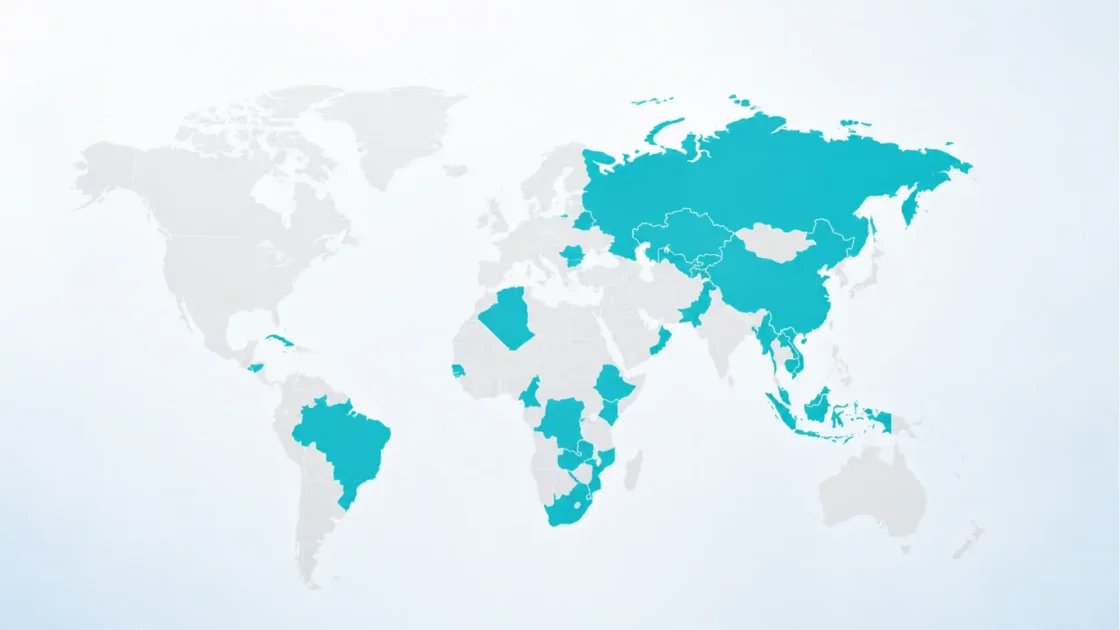
Latin America did not wait for permission to start using artificial intelligence. By late 2025, roughly 65% of consumers across the region were already using AI tools of some kind, a level of everyday use that arrived well before the institutions, regulations, and infrastructure meant to support it. The pattern is consistent across surveys: people in São Paulo, Mexico City, Bogotá, and Buenos Aires opened ChatGPT, Gemini, or a fintech chatbot and folded it into daily life faster than their governments wrote rules, faster than local companies built strategies, and faster than the region built the data centers and power capacity to run it all at scale.
Table of Contents
The adoption surge that outran the region’s readiness
That sequence matters. In the United States, China, and much of Europe, AI adoption tracked alongside heavy domestic investment, dense compute infrastructure, and active policy debates. In Latin America, use ran ahead of capacity. The region accounts for about 14% of global visits to AI products while representing only around 11% of the world’s internet users, according to estimates from the UN Economic Commission for Latin America and the Caribbean (ECLAC). People are leaning into these tools more intensively than the region’s digital weight would predict, and they are doing it largely with models built elsewhere, priced in dollars, and trained mostly on English-language data.
The result is a market defined by a widening distance between behavior and readiness. Enthusiasm is high, curiosity is higher, and trust lags behind both. Consumers experiment with AI because it is useful and accessible, not because they are confident it will behave well or that anyone is accountable when it fails. For businesses, that gap is the whole game. Companies that close it — by pairing automation with visible human accountability and cultural fluency — earn permission to scale. Those that read high usage as a license to strip out human contact tend to hit a wall of public backlash.
The strategic picture is a paradox. Latin America is simultaneously one of the world’s most engaged AI-using regions and one of its least-resourced AI-building regions. It hosts a fast-growing developer base, a handful of globally significant technology companies, and several ambitious national plans. It also receives a sliver of global AI investment, loses trained specialists to higher-paying markets abroad, and struggles with rural connectivity that excludes millions from the digital economy entirely. Both halves of that description are true at once, and the tension between them shapes nearly every question worth asking about AI in the region.
This analysis maps that tension in detail. It looks at who is using AI and how, which countries lead and which lag, what the region is trying to build for itself, and where the binding constraints sit. It treats the regional story as genuinely uneven rather than monolithic, because the difference between Chile and Bolivia, or between a Nubank engineer and a smallholder farmer in rural Peru, is often larger than the difference between Latin America and the global average. The headline is not that the region is behind or ahead. It is that adoption, infrastructure, talent, capital, and governance are moving at very different speeds, and the mismatch is now the defining feature of AI in Latin America.
What the numbers actually show about regional use
The cleanest read on regional AI use comes from the Latin American Artificial Intelligence Index, known by its Spanish acronym ILIA, which ECLAC and Chile’s National Center for Artificial Intelligence (CENIA) published in its third edition in 2025. The index measures 19 countries across three dimensions: enabling factors, research and development and adoption, and governance, drawing on more than 100 sub-indicators. Its central finding is that the region is adopting AI faster than its digital footprint would suggest, but that the activity is concentrated in a small group of countries and tilted heavily toward consuming finished products rather than building them.
On the global stage, Latin America and the Caribbean sit in the middle of the pack. The region ranked seventh in one widely cited 2026 AI readiness assessment, with an average score near 43, ahead of Africa but behind North America, Western Europe, developed Asia, and parts of emerging Asia. Within that average, the spread is enormous. Brazil leads the region by a wide margin, followed by Chile, while more than a third of the countries assessed remain in an early-stage category with thin ecosystems and limited capacity. The regional number is almost meaningless without the distribution behind it.
Consumer behavior is where the region punches above its weight. Beyond the 65% of consumers using AI tools, ECLAC’s estimate that Latin America and the Caribbean generate 14% of global visits to AI solutions against an 11% share of internet users captures the intensity of engagement. Brazil alone is consistently the third-largest source of ChatGPT traffic in the world, behind only the United States and India, accounting for somewhere between 5% and 6% of global visits depending on the month and the measurement firm. Mexico ranks among the fastest-rising markets, and OpenAI’s own quarterly usage data has repeatedly flagged Latin America and the Caribbean as one of the regions where adoption is broadening fastest.
Enterprise adoption tells a more cautious story. Surveys put regional enterprise AI deployment around 47%, with only Brazil, Chile, and Uruguay appearing in the global top 50 on that measure. A separate reading found AI adoption among organizations in the region rose roughly 18 percentage points in 2024 to reach about 40%, with enthusiasm and optimism running higher than the global average even where actual deployment lagged. The recurring problem is not curiosity but conversion: companies launch pilots and then struggle to scale them into production because they lack unified AI strategies, governance frameworks, and the talent models to operate systems reliably.
The investment and talent figures are the sobering counterweight. ECLAC’s ILIA 2025 reported that Latin America and the Caribbean account for 6.6% of global GDP but receive only about 1.12% of global AI investment, a mismatch that constrains the region’s ability to scale anything ambitious. The talent gap relative to the global average has widened since 2022, tied to an accelerating outflow of specialists to richer markets. Álvaro Soto, who directs the ILIA at CENIA, captured the mood precisely when he observed that countries show great interest but no sense of urgency, and that no country in the region exceeds the world average in AI investment relative to GDP per capita. The region is enthusiastic, engaged, and under-resourced, and the data leaves little room to pretend otherwise.
The maturity map from pioneers to explorers
ILIA 2025 sorts the region into three tiers, and the labels are a useful shorthand for understanding why a single regional average misleads. At the top sit the pioneers, a small group with the strongest combination of enabling factors, research activity, and governance. Chile holds the top regional position in the index and is the clearest example, paired with Brazil, which leads on scale and on raw research and commercial output. These countries have national strategies with at least some implementation behind them, recognizable research centers, and AI use cases that have moved past experimentation into production.
The middle tier, the adopters, includes eight countries occupying an intermediate level and narrowing the gap with the leaders. ECLAC named Colombia, Ecuador, Costa Rica, and the Dominican Republic among them, citing improvements in connectivity, talent, and national strategies. These are countries where AI is visibly taking hold in banking, retail, and parts of government, but where the supporting ecosystem — local research depth, domestic compute, specialized training pipelines — is still thin enough that progress depends heavily on imported tools and foreign cloud capacity.
The bottom tier, the explorers, covers more than a third of the countries assessed, with incipient ecosystems and limited capabilities. For these markets, AI use is real at the consumer level but institutionally shallow. There is little domestic investment, few specialists, weak or absent regulation, and connectivity gaps that exclude large rural populations. The distance between an explorer-tier country and the regional pioneers is, in practical terms, the distance between watching the technology happen and shaping how it happens locally.
Where the region stands by country (selected indicators, 2025–2026)
| Country | ILIA tier | Notable strengths | Main constraint |
|---|---|---|---|
| Brazil | Pioneer | Largest market, ~41% of regional data center investment, 3rd-largest ChatGPT traffic globally, R$23bn national plan | Execution gap, infrastructure still incipient |
| Chile | Pioneer | Top regional ILIA score, CENIA research base, renewable energy, Latam-GPT coordination | Small domestic market, talent retention |
| Mexico | Pioneer/adopter | ~800,000 developers, Querétaro data center hub, nearshoring magnet | Regulation pending, rural and security gaps |
| Colombia | Adopter | National AI policy, cloud-engineering talent, Bogotá and Medellín hubs | Limited domestic compute and capital |
| Argentina | Adopter | Strong developer base, English proficiency, $25bn Stargate plan | Austerity, brain drain, regulatory uncertainty |
| Uruguay | Adopter | High connectivity, top-50 enterprise adoption, stable governance | Tiny scale |
The table compresses a complex picture, but the throughline is consistent: leadership in the region is defined less by who uses AI most and more by who has the research base, the energy, the capital, and the governance to convert use into capability. Brazil leads on sheer mass, Chile on institutional quality, and Mexico on the talent and geography that make it a natural extension of North American technology supply chains. Everyone else is closing distance at varying speeds.
What the tiers also reveal is that the region’s AI story is not converging on a single model. Brazil is pursuing state-led sovereignty with large public investment. Chile is leaning on collaborative, research-driven public goods. Mexico is integrating tightly with the United States as a nearshore hub. Argentina is betting on radical deregulation to attract private capital. These are genuinely different strategies, and the next several years will test which ones produce durable local capability rather than just heavier consumption of someone else’s models.
Brazil as the region’s center of gravity
No account of AI in Latin America gets far without Brazil, which is the region’s largest economy, its largest technology market, and the gravitational center for nearly every metric that matters. Brazil holds the largest installed base of WhatsApp Business in the world, hosts the region’s most valuable fintechs, and consistently ranks as the third-largest source of ChatGPT traffic globally. It also captures the largest share of regional data center investment, somewhere above 40% by most estimates, with São Paulo functioning as Latin America’s primary interconnection hub. When global cloud providers talk about Latin America, they are usually talking about Brazil first and everywhere else second.
The country’s scale shows up in consumer behavior and enterprise activity alike. Brazilian banks such as Itaú and Bradesco have built large-scale AI operations, and Nubank, headquartered in São Paulo, has become a global reference for AI in digital banking. On the consumer side, Brazilian users have been early and heavy adopters of generative tools, and OpenAI’s usage data has repeatedly placed Brazil among the markets driving international growth. The combination of a large, young, mobile-first population and widespread digital payments through the Pix instant-payment system created fertile ground for AI-enabled financial and commercial services.
Brazil is also the region’s most assertive state actor on AI policy. In July 2024, President Luiz Inácio Lula da Silva’s government launched the Brazilian Artificial Intelligence Plan (PBIA) 2024–2028, branded “AI for the Good of All,” with an indicative budget of about R$23 billion, roughly USD 4 billion, over four years. The plan is built around five strategic axes and 54 actions, spanning sovereign infrastructure, research and industrial adoption, public-sector modernization, workforce training, and governance. Nearly R$14 billion is earmarked for business and industrial projects, more than R$5 billion for infrastructure including sustainable energy for data centers, and about R$1.1 billion specifically to develop a Portuguese-language large language model. A centerpiece is the planned upgrade of the Santos Dumont supercomputer, operated by the National Laboratory for Scientific Computing, which the government wants to rank among the most powerful machines in the world.
Brazil’s framing of AI as a question of sovereignty is deliberate and consequential. Lula put it bluntly at the launch: instead of waiting for AI to arrive from China, the United States, South Korea, or Japan, the country should build its own. That stance reflects a deeper skepticism toward dependence on foreign technology, sharpened by the 2013 Snowden revelations about US surveillance, and it positions Brazil as a leader of Global South efforts to shape AI governance, including through the BRICS grouping and the G20. The Lula government has staked real political capital on autonomy rather than dependence, which complicates straightforward technology imports even as US hyperscalers pour billions into Brazilian data centers.
The gap between ambition and execution is the recurring critique. Analysts who welcome the PBIA also note the distance between strategic formulation and delivery, particularly on infrastructure, where installed capabilities remain limited, and on coordination across federal entities, universities, and companies, which has historically been difficult in Brazil. A sovereign cloud and a top-five supercomputer require not just money but sustained maintenance, technical updating, and cybersecurity, or they risk becoming underused. Brazil has the scale, the talent pipeline, and the political will to lead the region. Whether it can convert R$23 billion of intent into durable capability is the open question that will shape the regional balance for years.
Chile’s quiet bid for regional leadership
Chile rarely dominates headlines about AI, but on the measures that capture institutional quality rather than raw size, it leads Latin America. ILIA 2025 placed Chile at the top of the regional index in the pioneer category of AI maturity, and the country has built a credible case as the region’s research and coordination hub. It hosts more than 30 data centers around Santiago, benefits from abundant solar and wind resources that make sustainable compute genuinely feasible, and has a national center, CENIA, that has become the connective tissue for regional AI collaboration.
Chile’s structural advantages are real. The country combines political and institutional stability that is unusual in the region, strong connectivity including wide 5G coverage, and an energy matrix that increasingly runs on renewables. Those traits matter enormously for data centers, which need reliable power, predictable regulation, and cool, stable operating environments. Chile’s renewable energy position is not a marketing line but a competitive asset, and operators have signed power purchase agreements to run Chilean facilities entirely on solar and storage. For an industry whose costs and emissions are dominated by electricity, that combination is hard to replicate elsewhere in the region.
The clearest expression of Chile’s ambition is its role coordinating Latam-GPT, the regional open-source language model developed under CENIA’s leadership. Rather than trying to out-spend OpenAI or Google, Chile positioned itself as the orchestrator of a collaborative public good built by and for the region. CENIA’s director, Álvaro Soto, has been explicit that the goal is not to compete with the frontier labs but to give Latin America the technical capacity to build and understand models on its own terms. That framing — public, collaborative, research-led — is a distinct strategic identity, and it has drawn participation from dozens of institutions across the region.
Chile’s main constraint is size. With a population of around 20 million and a relatively small domestic market, the country cannot generate the scale of demand, capital, or talent that Brazil or Mexico can. Its strength lies in punching above its weight through quality: strong research, stable governance, clean energy, and a credible claim to regional leadership on the questions of how AI should be built and governed rather than simply consumed. Chile is small enough that it cannot win on volume, so it is competing on trust, sustainability, and technical credibility instead.
That positioning also makes Chile a natural partner for the rest of the region. CENIA’s coordinating role gives smaller countries a way to participate in serious model development without each building everything from scratch, and Chile’s governance maturity offers a reference point for neighbors writing their own rules. If Latin America develops a genuinely regional approach to AI rather than a set of disconnected national efforts, Chile is the most likely candidate to anchor it. The country has chosen a role — convener and standard-setter — that fits its capabilities and its constraints, and it has executed that role more coherently than larger neighbors have executed their more expensive plans.
The risk for Chile is that quality without scale gets overtaken by scale without quality. If Brazil’s R$23 billion plan delivers, or if Argentina’s deregulated, capital-hungry approach attracts enough private investment, Chile’s careful leadership could be eclipsed by sheer mass. For now, though, the country has the strongest institutional foundation in the region, and its bet on being the trusted coordinator of regional AI rather than its biggest spender looks like a sober reading of what a mid-sized economy can realistically achieve.
Mexico’s scale, nearshoring pull and new rulebook
Mexico’s AI story is inseparable from its geography. The country sits directly south of the largest technology market on earth, shares overlapping time zones with US teams, and has become the natural beneficiary of nearshoring as companies pull supply chains and engineering work closer to home. Mexico City recently surpassed São Paulo as the largest tech talent hub in Latin America, and the country now counts well over 800,000 software engineers, with more than 130,000 IT graduates entering the workforce each year. Guadalajara and Monterrey have built strong reputations in software, fintech, and machine learning, and Monterrey alone recorded a tech-workforce expansion of more than 100% over five years.
That talent base, plus proximity, has made Mexico a magnet for AI-adjacent investment. Querétaro has emerged as one of the region’s fastest-growing data center hubs, with Amazon Web Services committing USD 5 billion to its Querétaro region and other operators announcing multi-billion-dollar campuses in the area. Microsoft pledged USD 1.3 billion toward AI and cloud expansion in Mexico, part of a broader hyperscaler buildout. Mexico is now the second-largest country in the region, after Brazil, to host the major global cloud operators, and its role as a near-shore extension of North American technology infrastructure is becoming structural rather than opportunistic.
On the demand side, Mexico is among the world’s fastest-rising markets for consumer AI, repeatedly flagged in OpenAI’s usage data as a country gaining ground, and it ranks among the top non-English markets for ChatGPT. Mexican enterprises and small businesses are accelerating adoption to improve efficiency and competitiveness, supported by public-private initiatives. One example is PotencIA Mx, launched by Tecnológico de Monterrey together with Meta and the Ministry of Economy, an accelerator designed to help small and medium-sized businesses and startups integrate AI into their operations by combining academic expertise, government support, and private-sector collaboration.
Mexico is also moving toward comprehensive regulation, positioning itself among the region’s governance leaders alongside Chile and Brazil. The proposed Federal Law Regulating Artificial Intelligence, first introduced in 2023 by Senator Alejandra Lagunes, would create a risk-based compliance framework and establish a National Commission for Artificial Intelligence, CONAIA, as the central supervisory authority under the Ministry of Economy. The bill would require authorization, transparency, and accountability for high-risk systems, with developers obliged to document architecture, data sources, training methods, and risk-mitigation measures. As of late 2025 it remained under discussion in the Senate’s science and technology commission, with final approval anticipated in 2026.
Complementing the bill, Mexico’s National AI Strategy 2.0, launched in 2025 by the Secretariat of Economy, emphasizes trustworthy AI, open-data infrastructure, and sustainable innovation, while the country aligns itself with the OECD AI Principles and UNESCO’s ethics recommendation. The framework also dovetails with USMCA digital-trade principles, which matters for a country whose economic future is tightly bound to North American integration. Mexico’s strategic bet is to be the indispensable near-shore AI hub for North America, combining a deep, increasingly AI-specialized talent pool, fast-growing data center capacity, and a governance regime compatible with its largest trading partner.
The constraints are familiar and serious. Regulation is still pending rather than enacted, leaving businesses to operate under existing data-protection and consumer law in the interim. Rural connectivity and security challenges persist, and the benefits of the nearshoring boom concentrate in a handful of states, with Nuevo León capturing a large share of nearshoring-linked foreign investment. Mexico has more raw talent and a clearer structural role than almost any country in the region. Converting that into domestic AI capability, rather than primarily serving as a labor and infrastructure base for US companies, is the harder and more important task.
Argentina’s high-risk wager on deregulation
Argentina has chosen the most distinctive AI strategy in the region, and possibly the most divisive in the world. Under President Javier Milei, the government has staked its pitch to global technology firms on a promise to keep AI deliberately unregulated. In a Financial Times op-ed co-authored with Deregulation Minister Federico Sturzenegger, Milei vowed to let AI develop freely “without the deadly hand of premature and poorly understood regulation,” and invited the world’s tech companies to set up shop with the declaration that Argentina is “open for business.” The bet is that radical regulatory permissiveness, low corporate taxes, and aggressive investment incentives can leapfrog the country into relevance despite years of economic instability.
The most striking element of the plan is the proposed legal category of the “non-human corporation,” an entity operated entirely by AI agents or robots. Milei argues that autonomous AI systems running businesses without constant human supervision require a new legal framework, drawing a parallel to the seventeenth-century invention of the limited-liability company. The proposal sits alongside a “social digital twin” program that would use citizen data to simulate Argentine society and inform policy, and a broader investment-incentive regime known as RIGI, which offers 30-year fiscal and customs benefits to large foreign-currency investments. The package is openly aimed at attracting hyperscale data center investment and frontier AI companies.
The headline result of that courtship is Stargate Argentina, a planned data center in Patagonia developed with the US-Argentine firm Sur Energy under a letter of intent with OpenAI, representing an investment of up to USD 25 billion and a capacity of up to 500 megawatts powered primarily by renewables. Announced in October 2025 after Milei met OpenAI executives at the Casa Rosada, it would be the first Stargate project in Latin America and, if built, the largest AI facility in the region. Salesforce separately committed USD 500 million over five years, and Milei has cultivated relationships with Sam Altman, Elon Musk, and Peter Thiel, positioning Argentina as a willing partner for the export of American AI in the Western Hemisphere.
The criticism has been fierce and substantive. Opposition politicians and civil-liberties advocates warn that an unregulated AI framework risks turning Argentina into, in one former lawmaker’s words, “a catastrophic experiment for human dignity.” The social digital twin drew immediate comparisons to surveillance and to the predictive-policing premise of Minority Report, with an opposition senator filing a formal request for transparency on its legal framework and data protections. Privacy experts flagged the danger of aggregating citizen data into a system that lets an algorithm forecast social outcomes. Even Anthropic, the maker of the Claude models, has publicly argued that AI needs guardrails, a direct counterpoint to Milei’s deregulation pitch.
The deeper problem is that Argentina’s AI ambitions are undermined by its own austerity. Milei’s “chainsaw” budget cuts have eliminated more than 52,000 public-sector jobs, including over 4,000 scientific research positions, gutting the academic infrastructure that trains AI specialists. Argentina is now, in the words of one report, shipping talent overseas the way it ships beef and soy. Researchers describe a broken chain for retaining talent: salaries abroad can be up to ten times higher, labs run on outdated equipment, and few graduates choose academia when half of undergraduates already out-earn a starting professor. The country pitches itself as a future AI powerhouse while its best-trained engineers quietly leave.
Argentina’s bet is therefore genuinely high-variance. The deregulated, capital-hungry model could attract enormous private investment and turn the country into a regional compute hub, especially given Patagonia’s wind resources and Argentina’s near-90% internet penetration. Or it could produce showcase data centers that serve foreign workloads while domestic research withers, civil-liberties concerns harden, and the promised broad-based benefits fail to materialize. The Stargate announcement remains at the letter-of-intent stage, with a first 100-megawatt phase reportedly targeted for 2027, and several of OpenAI’s global Stargate commitments have moved slower than announced. Argentina has made the boldest wager in the region. Whether it pays off depends on execution it has not yet demonstrated and on a fiscal squeeze that is actively eroding the human capital any AI economy requires.
Colombia, Uruguay, Peru and the middle of the pack
Beyond the three largest players, a cluster of mid-sized countries is doing serious work that rarely makes global headlines. Colombia is the clearest example. The country has a national AI policy, recognized tech hubs in Bogotá and Medellín, and a reputation for strong cloud-engineering talent. Bogotá alone has produced more than 215,000 software and tech graduates over five years, and Colombia ranked second in South America on one global startup-ecosystem index with more than 20% year-over-year growth. Its one-hour offset from US Eastern time makes it one of the most convenient nearshore options for East Coast teams, and AWS has partnered with the Colombian government on cloud-computing training programs aimed at reaching large numbers of professionals.
Uruguay is the region’s quiet overperformer. Small in population but high in connectivity and institutional stability, it is one of only three regional countries — with Brazil and Chile — to appear in the global top 50 for enterprise AI deployment. Uruguay’s strengths are governance quality and digital maturity rather than scale, and the country has long served as a stable base for technology services. It also contributes disproportionately to regional research, including in natural-language processing, where Uruguayan academics have been involved in efforts to build language resources for Spanish and Portuguese.
Peru, by contrast, illustrates the adopter-to-explorer boundary. It has a growing developer community and rising consumer AI use, but it sits lower on readiness measures, constrained by connectivity gaps and limited domestic investment. Peru and several Andean and Central American countries are where the digital divide bites hardest: AI use is real in major cities but institutionally shallow, with little local research, weak regulation, and rural populations that remain largely outside the digital economy. The middle of the pack is not a single condition but a spectrum, from Colombia’s increasingly credible ecosystem to countries where AI is mostly a consumer phenomenon riding on imported tools.
Costa Rica deserves separate mention. ECLAC placed it among the adopter tier, and it has a long history as a near-shore services hub with strong English proficiency, particularly for customer-facing and bilingual roles. Its constraint is volume: the talent pool is smaller than larger neighbors, which makes it well-suited for specialized or communication-intensive work but harder to scale. The Dominican Republic, also an adopter, has been among the fastest-rising countries in OpenAI’s consumer usage rankings, a reminder that small Caribbean and Central American markets can see rapid grassroots adoption even without heavy infrastructure.
What unites these countries is a shared dependence on choices made elsewhere. They consume models built by US and increasingly Chinese labs, run workloads on cloud capacity concentrated in Brazil, Mexico, and Chile, and write national strategies that often lack financing and implementation mechanisms. ECLAC’s blunt warning applies most directly to this group: a growing number of countries have national AI strategies, but most lack the budgets, delivery mechanisms, and evaluation systems to make those strategies effective. The risk for the middle and bottom tiers is that strategy documents substitute for capability, producing the appearance of national AI policy without the compute, capital, or talent to back it.
The opportunity, though, is leapfrogging. Countries that never built dense legacy infrastructure can in principle jump directly to cloud-native, AI-enabled services, much as the region jumped to mobile payments without passing through universal credit-card penetration. For the middle of the pack, the realistic path is not to build frontier models but to deploy existing ones well in banking, public services, agriculture, and small business, while plugging into regional efforts like Latam-GPT and shared cloud capacity. The countries that do this deliberately, with attention to connectivity and skills, will narrow the gap. Those that rely on grassroots adoption alone will keep using AI heavily while shaping it not at all.
Latam-GPT and the case for a sovereign model
The most ambitious attempt to change Latin America’s position from consumer to builder is Latam-GPT, the region’s first large open-source language model, coordinated by Chile’s CENIA. The project was announced at the February 2025 AI Action Summit in Paris and presented in a fuller launch event in February 2026, framed as a landmark regional step: a model built from and for Latin America and the Caribbean, with governance and priorities grounded in regional context rather than imported from the global north. It is the clearest institutional expression of the idea that the region should not only use AI but help shape it.
The scale of the collaboration is the point. Latam-GPT was developed by a coalition of more than 60 institutions and close to 200 specialists across 15 or more Latin American and Caribbean countries, plus Spain, with support from the Chilean Ministry of Science, the Development Bank of Latin America and the Caribbean (CAF), Amazon Web Services, and the Data Observatory. The model was trained on more than 2.6 million regional documents, drawn from governments, universities, libraries, archives, and community organizations, including web data, news, academic articles, literature, and educational resources spanning arts, science, medicine, sports, and politics. The training effort processed enormous volumes of public data and was supported by around USD 10 million in supercomputing power in Chile.
What distinguishes Latam-GPT technically is its grounding in the region’s languages and cultures. Unlike models trained primarily on English data, it is designed to understand the cultural and linguistic nuances and the historical and political contexts of Latin America. It communicates in Spanish, Portuguese, and several Indigenous languages, with CENIA collaborating with Mapuche, Rapanui, and Guaraní translators to incorporate and help preserve those languages. The intent is to correct the underrepresentation of Latin American and Indigenous cultures in mainstream models, which tend to carry the biases of their predominantly English, global-north training data.
Latam-GPT’s governance is as notable as its training. The project relies on ethically sourced, open-access, and properly licensed material, with explicit permissions from data contributors, and it publishes its list of data sources, a transparency practice that contrasts with models built by scraping the internet indiscriminately. CENIA and its partners anonymize or exclude sensitive personal information and have taken particular care with Indigenous communities’ rights and consent. That approach sidesteps the legal uncertainty around training data that has dogged frontier labs, and it positions Latam-GPT as a public good with defensible provenance rather than a commercial product racing to market.
The project’s leaders are careful to manage expectations. CENIA’s Álvaro Soto has repeatedly stressed that the goal is not to compete with OpenAI or Google but to build foundational infrastructure for regional applications — chatbots, public-service assistants, and educational tools — adapted to local needs. As of early 2025 the model’s capability was described as comparable to an earlier generation of frontier systems rather than the newest ones, and researchers involved acknowledge it will be hard to compete with corporations that command vastly greater resources. The realistic framing is that Latam-GPT is a starting point, a way for the region to begin positioning itself in the language-model world with its own voice, not a challenger to the frontier.
The deeper argument for Latam-GPT is about capability and control, not benchmark scores. CENIA’s executive director, Rodrigo Durán, made a point that resonates well beyond Chile: the fact that the region came together to build a model shows it can understand how to create the technology, which has implications for regulation, because you cannot regulate something you do not understand. A region that can build, fine-tune, and audit its own models has bargaining power that a region of pure consumers does not. Latam-GPT may never top a leaderboard, but if it gives governments, universities, and startups across the region a transparent, regionally grounded foundation to build on, it will have done something the frontier models cannot: put the tools of AI development, and the understanding that comes with them, in regional hands.
The sovereignty argument behind homegrown AI
Latam-GPT and Brazil’s PBIA are both expressions of a broader idea gaining traction across the Global South: that AI sovereignty matters, and that depending entirely on a handful of US and Chinese companies for a foundational technology is a strategic vulnerability. The sovereign-AI argument has several strands, and they are worth separating because they are often blurred together in the political rhetoric.
The first strand is representational. Models trained mostly on English data and global-north cultural frameworks underrepresent the languages, histories, and lived realities of Latin America, which produces weaker performance on region-specific tasks, higher bias risk, and a subtle but real cultural flattening. A chatbot that does not understand local idioms, legal systems, or social context delivers worse answers and, at scale, exports a particular worldview. Building regionally grounded models is partly about accuracy and partly about cultural self-determination, ensuring that the region’s knowledge and identity are represented in the systems that increasingly mediate information.
The second strand is economic. AI tools priced in dollars and controlled by foreign firms extract value from the region while leaving little local capability behind. A region that hosts data centers for foreign workloads but cannot build its own models captures the lowest-value parts of the AI economy — electricity, land, and basic labor — while the high-value layers of model development, intellectual property, and platform control remain offshore. Sovereign AI is, in this reading, an industrial-policy bet that the region should climb the value chain rather than remain a supplier of compute and a consumer of finished products.
The third strand is governance and security. Brazil’s skepticism toward dependence on US technology, sharpened by the Snowden revelations, reflects a concern that critical digital infrastructure controlled by foreign companies and subject to foreign jurisdiction is a national-security risk. Data sovereignty — keeping citizens’ data within national borders and under national law — has become a recurring theme, and it underpins both Brazil’s sovereign-cloud ambitions and the proliferation of data-residency requirements. Sovereignty is not only about pride; it is about who controls the data, the models, and the chokepoints in a strategic technology.
These arguments have found political expression in multilateral forums. Brazil has positioned itself as a leader of Global South efforts on AI governance, including a BRICS leaders’ declaration on global AI governance that represents a joint position by developing economies in the contest over the technology. The framing is that AI governance is being shaped largely by wealthy countries and dominant firms, and that the Global South risks having its demands ignored unless it organizes. Lula was asked by the UN Secretary-General to help mobilize Global South countries on AI debates, and the issue featured in Brazil’s G20 priorities.
The counterargument is pragmatic and hard to dismiss. Sovereign AI is expensive, and the region’s USD 4 billion plans look modest against the hundreds of billions that frontier labs and their backers are deploying. Critics note that overly protective or nationalist approaches can drive away talent and investment, and that the region’s most realistic path may be to use the best available global tools well rather than to build inferior domestic substitutes at great cost. There is also a real tension between sovereignty rhetoric and the fact that US hyperscalers are funding most of the region’s actual compute. The honest assessment is that sovereignty is a legitimate strategic goal constrained by hard financial limits, and the region’s leaders are trying to thread a needle: assert autonomy while accepting the foreign capital that builds the infrastructure their autonomy ultimately depends on.
The consumer market that moved first
The defining feature of AI in Latin America is that ordinary people adopted it before companies, governments, or infrastructure caught up. Several structural factors explain why the consumer market moved first, and they also explain why the region’s AI economy looks so different from those of the United States or Europe. The starting point is that Latin America is overwhelmingly mobile-first. Smartphones, not desktops, are the primary computing device for most of the population, and the region built its digital habits around mobile apps and messaging rather than around the office software stack that anchored AI adoption in wealthier markets.
Messaging is central. WhatsApp is not just a chat app in Latin America; it is the primary digital interface for hundreds of millions of people, used for personal conversation, customer service, commerce, and increasingly AI-mediated interactions. Brazil hosts the world’s largest installed base of WhatsApp Business, and businesses across the region reach customers primarily through messaging rather than websites or apps. That makes conversational AI a natural fit: a chatbot inside WhatsApp meets people where they already are, without requiring them to download anything new or change behavior. The conversational interface that made ChatGPT a global phenomenon maps neatly onto a region that already lived in chat.
Pricing has been the other accelerant. The launch of lower-cost tiers, particularly OpenAI’s ChatGPT Go at around USD 4 to 5 per month in emerging markets, dramatically expanded access in countries where the standard USD 20 subscription is prohibitively expensive. Localized pricing has driven explosive growth in markets like India and Indonesia, and the same dynamic applies across Latin America, where dollar-denominated software is a heavy burden in economies with weaker currencies. Cheaper tiers convert curiosity into sustained use by bringing AI within reach of students, freelancers, and small-business owners who would never pay frontier-market prices.
The data confirms the pattern. Brazil is consistently the third-largest source of ChatGPT traffic in the world, and OpenAI’s own quarterly usage analysis has repeatedly highlighted Latin America and the Caribbean as one of the fastest-broadening regions, with countries like the Dominican Republic, Haiti, Mexico, Costa Rica, and Brazil among the fastest risers in per-capita usage rank. Adoption in low- and middle-income countries has been growing at several times the rate of the wealthiest nations, a structural signal that the next wave of AI users will come disproportionately from markets like Brazil and Mexico. The region’s young, digitally native population is a natural early-adopter base, and usage skews toward the under-35 cohort that dominates AI use everywhere.
How people use AI in the region mirrors global patterns with a regional accent. The largest categories are writing and information tasks, but OpenAI’s data shows specialized uses gaining ground, including education and vocational advice, business-operations help, marketing material, and health and medical documentation. A meaningful share of consumer AI use in the region is effectively unpaid professional work — small-business owners drafting marketing copy, freelancers producing content, students and workers using consumer accounts for tasks their employers have not yet formally adopted. AI is becoming embedded in everyday work before training, policy, and assessment practices have caught up, which is a productivity boon and a governance headache at the same time.
The consumer-first pattern has a strategic consequence that runs through this entire analysis. Because adoption happened from the bottom up, driven by accessible tools and pragmatic experimentation rather than top-down enterprise rollouts, the region’s AI habits formed around foreign consumer products. The challenge for local companies and governments is to build on that grassroots fluency rather than fight it, channeling a population that is already comfortable with AI into uses that create local value and are governed responsibly. The demand is there and proven. What remains underdeveloped is everything behind it.
Banking and fintech as the proving ground
If consumers led adoption, financial services led the enterprise transformation, and for good reason. Latin America’s banks and fintechs sit on enormous, structured transactional datasets, serve markets where large populations are underbanked, and operate in an environment where fraud and credit risk are persistent, expensive problems. That combination — rich data, large unmet need, and high-value problems — makes finance the natural proving ground for AI in the region, and the results are among the most concrete anywhere.
Nubank, the São Paulo-based digital bank that has become the largest in Latin America, is the clearest case. In 2026 the company detailed an AI strategy built on three pillars it considers hard to replicate: proprietary data, foundation models, and talent. At the center is nuFormer, Nubank’s proprietary self-supervised foundation model, trained on the bank’s own transactional data. The most important application is credit: nuFormer’s precision lets Nubank safely extend credit to customers who would have been excluded by less granular models, advancing financial inclusion and revenue at the same time. The model is live in the bank’s largest credit segment in Brazil and expanding to personal loans and to Mexico and Colombia, and Nubank is building what it calls an “AI Private Banker” to help customers organize their finances.
The financial-inclusion angle is not incidental marketing; it is the strategic heart of fintech AI in the region. Roughly 70% of Latin Americans have historically been underbanked or unbanked, and traditional credit scoring excludes people without formal financial histories. AI-powered credit scoring and fraud detection let lenders evaluate thin-file customers using alternative data, bringing millions into the formal financial system. This is the “leapfrog” dynamic in action: countries that never built dense traditional financial infrastructure can jump directly to AI-driven banking, and Nubank’s expansion into Mexico is a template for exporting that model across the region.
Fraud detection is the other major application, and it matters enormously given the region’s fraud problem. Banks use machine learning to flag suspicious transactions in real time, an increasingly urgent capability as AI-enabled fraud — voice cloning, deepfakes, synthetic identities — escalates. The same technology that helps criminals impersonate executives and bypass identity verification also powers the defensive systems banks deploy to catch them, creating an AI arms race inside the financial sector. For institutions onboarding customers remotely through know-your-customer processes, AI-driven identity verification is both a vulnerability and a shield.
The economics are starting to show up in results. Manolo Atala, co-founder of the Mexican fintech Fairplay, has cautioned that generative AI is not inherently cheap, with enterprise-scale adoption requiring spending on cloud compute, licenses, talent, integration, and compliance. His point is that the return on AI depends on scaling beyond pilots, generating new revenue, and building risk management into adoption. That distinction — between AI pilots that demonstrate capability and AI deployments that change the business — separates the leaders from the laggards across the regional financial sector. The banks and fintechs that have moved from experiments to production are seeing real gains; those stuck in pilot mode are absorbing cost without return.
Fintech’s lead also reflects where the region’s AI talent and capital concentrate. Nubank and Mercado Pago can afford to build proprietary models and hire scarce specialists in ways that smaller firms cannot, which means the most advanced AI work in the region clusters in a handful of well-capitalized financial and commerce companies. That concentration is efficient but uneven: it produces world-class regional examples while leaving most of the economy dependent on off-the-shelf tools. The fintech sector proves what is possible with AI in Latin America. The harder question is how widely those capabilities diffuse beyond the few companies with the data, money, and talent to build them.
E-commerce, logistics and the Mercado Libre playbook
Mercado Libre, the region’s dominant e-commerce and fintech platform, has turned AI into a central organizing principle rather than a side project, and its public results offer some of the clearest evidence that AI is moving the numbers in Latin American commerce. The signal from the top is unmistakable: founder Marcos Galperin stepped into an executive chairman role with an explicit focus on applying AI across the business, raising it from a departmental function to a core strategic pillar. When the founder of the region’s most valuable consumer-internet company reorganizes his own role around AI, it is a statement about where the business is heading.
The company’s customer-service transformation is the most striking example. Mercado Libre deployed an AI-powered customer-service agent for its Mercado Pago payments platform that now handles close to 90% of customer queries and requests without human involvement, sharply lowering service costs. At the scale of a platform serving hundreds of millions of users across the region, automating the overwhelming majority of routine support interactions is a material change to the cost structure, and it illustrates both the upside of AI automation and the backlash risk if escalation paths to humans are removed without care.
On the seller side, Mercado Libre built GenAds, a generative-AI tool that automatically creates product images and banner ads for smaller sellers, using image-generation models running on Amazon Bedrock with Stability AI. The business problem was concrete: tens of thousands of small sellers needed compelling product visuals but lacked the resources to produce them. GenAds generated those images at scale and, according to the company and AWS, increased click-through rates by an average of 25%, directly improving sellers’ sales. It is a textbook case of AI lowering the barrier to professional-quality marketing for small businesses that could never afford it otherwise.
AI also runs through Mercado Libre’s logistics and credit operations. The company uses AI to optimize delivery routes for its Mercado Envíos shipping network and to generate credit scores for consumers without traditional financial histories, mirroring the financial-inclusion logic that drives fintech AI across the region. The throughline is that AI is embedded in nearly every layer of the platform — support, advertising, logistics, credit — rather than bolted on as a feature. The company has also established AI principles and an AI governance policy to keep generative tools within ethical and legal bounds, a sign that a serious operator treats governance as part of deployment rather than an afterthought.
The financial impact has been explicit. Mercado Libre reported fourth-quarter 2025 net revenue growth of 45% year over year, and the CFO told analysts that both the commerce and fintech businesses were increasingly supported by the tangible impact of the company’s AI investments. That is one of the clearest public statements linking AI spending to revenue growth from any Latin American company. At the same time, the heavy AI spending compressed margins, with 2025 net income growing only about half as fast as sales, and the stock fell sharply from its peak. The market’s discomfort with near-term margin pressure is the price of building AI capability at scale, and Mercado Libre’s leadership has framed it as the right kind of spending even though it hurts in the short run.
Mercado Libre’s playbook is instructive for the region because it shows what disciplined, business-integrated AI looks like as opposed to scattered experimentation. The company picked high-value problems — service cost, seller marketing, delivery efficiency, credit access — and applied AI directly to each, measured the results, and accepted the investment cost. Its experience also surfaces the technical challenges of scaling generative AI: availability, security, observability, and traceability are recurring themes in the company’s own accounts of building these systems. The lesson is not that AI is a magic lever but that it pays off when aimed at specific, measurable problems and operated with serious engineering discipline, which is exactly the gap most of the region’s smaller companies have not yet crossed.
AI in the fields from soy to coffee
Agriculture is where Latin America’s AI opportunity is largest and its adoption most uneven, a tension that captures the regional story in miniature. The region is an agricultural powerhouse — Brazil and Argentina are among the world’s top exporters of soy, beef, and grains — and AI applied to farming could deliver outsized productivity and sustainability gains. Yet adoption remains concentrated among large operations, with smallholders largely excluded by cost and connectivity. The potential is enormous; the diffusion is partial.
Brazil leads the region and is among the global leaders in agricultural technology, helped by its large average farm size, which makes precision-agriculture hardware and software economically viable. By some estimates nearly 80% of Brazil’s exported crops rely on precision agriculture or traceability solutions, and the country’s agritech startup and smart-farming market has grown into a multi-hundred-million-dollar sector concentrated in São Paulo, Minas Gerais, and Rio Grande do Sul. Brazilian farmers use multispectral satellite imagery, drone surveillance, IoT soil and crop sensors, and AI analytics to monitor crop health in real time, identify stress and disease early, apply variable-rate irrigation and fertilizer, and forecast yields. AI-driven precision agriculture has been associated with yield increases of up to 20–25% and significant reductions in water and chemical use.
The applications go beyond crops. AI computer vision is used for livestock monitoring to reduce animal stress, climate and weather models help farmers time planting and irrigation, and chatbot services answer farmers’ questions in their own language. Global agricultural-technology firms — John Deere, Bayer, Trimble, AGCO — serve Brazil and Argentina as priority markets, and partnerships like John Deere’s satellite-connectivity deal with SpaceX’s Starlink address the connectivity gap that has limited precision agriculture in remote areas. Brazil’s national AI plan explicitly targets agriculture, including more accurate climatic data, computer-vision livestock tools, and chatbots for farmers, alongside environmental applications like predicting extreme weather and monitoring the Amazon.
The investment case is compelling. A 2025 Inter-American Development Bank report framed digital agriculture as a tool to improve yields and efficiency, protect natural capital, and unlock competitive, resilient development for the region. Climate volatility makes the argument more urgent: as extreme weather threatens crop production, AI-driven tools for drought-resistant planning, water-saving irrigation, and early disease detection become not just productivity enhancers but resilience measures. For a region whose economies and food security depend heavily on agriculture, AI is a strategic agricultural technology, not a luxury.
The barrier is the digital divide, which falls hardest on the smallholders who most need help. Precision agriculture requires connectivity, capital, and digital literacy, all of which are scarce in rural Latin America, where only about four in ten rural residents have access to basic internet. Large commercial farms adopt readily; small farms and cooperatives lag, constrained by upfront costs and patchy rural infrastructure. The risk is that AI widens the gap between industrial agriculture and smallholders rather than narrowing it, concentrating gains among operations that were already productive while leaving subsistence and small-scale farmers further behind.
Closing that gap is where policy and low-cost innovation matter. Affordable mobile apps, web dashboards, and inexpensive APIs can put satellite-driven crop advisories and AI tools in the hands of smallholders without requiring heavy hardware, and governments and NGOs are partnering with technology firms on pilot programs that bring low-cost sensors and AI services to rural communities. The deciding factor is whether the region treats agricultural AI as a tool for inclusive rural development or lets it remain a premium product for large agribusiness. The technology to lift smallholder productivity exists. Whether connectivity, affordability, and training reach the farmers who need it most is a choice the region has not yet fully made, and the answer will shape both rural livelihoods and the region’s standing as a global food supplier.
Public services and the promise of better government
Governments across Latin America see AI as a way to deliver public services more efficiently to populations that have long been underserved by the state, and public-sector modernization is a stated priority in nearly every national strategy. The appeal is obvious. Public administration in much of the region is slow, paperwork-heavy, and unevenly distributed, and AI promises to speed up service delivery, reduce costs, and extend access to citizens far from administrative centers. The promise is real, but ECLAC’s data is blunt that the public sector is the most lagging area for AI in the region, with few countries having clear, financed AI government strategies.
Brazil’s PBIA places public services at the core. The plan’s third strategic axis targets AI for improving public services in health, education, and public security, and it identifies the Conecta GOV.BR digital-government platform as a priority integration point, with explicit goals for cataloging and interoperable data exchange. The logic is that a government sitting on large administrative datasets can use AI to streamline benefits, automate routine processing, and make evidence-based policy, freeing scarce public resources for higher-value work. Brazil’s environmental ambitions are bundled in too: using AI to predict extreme weather, prevent disasters, safeguard the Amazon, and map biomes for species monitoring.
Several countries are experimenting with AI public-service assistants — chatbots that help citizens work through government processes — and Latam-GPT was explicitly designed to serve as a foundation for such tools, with virtual public-service assistants among its intended applications. The advantage of a regionally grounded model here is concrete: a government chatbot needs to understand local legal terminology, administrative structures, and the specific ways citizens phrase their needs, which a model trained on regional documents handles better than a generic one. Mexico’s National AI Strategy 2.0 similarly emphasizes open-data infrastructure and trustworthy AI in public services.
The cautionary case is Argentina’s “social digital twin,” which shows how public-sector AI can go wrong. The program, announced as a virtual replica of Argentine society that ingests government and private data to simulate scenarios and forecast the effects of policy, was pitched as moving the state from reactive to predictive. It immediately drew comparisons to surveillance and predictive policing, with opposition politicians and privacy experts warning that aggregating citizens’ personal data to let an algorithm predict social outcomes risks turning the future into surveillance over citizens. The program’s botched promotional rollout, riddled with typos and AI-generated errors, became a public embarrassment, but the substantive concern — data protection, legal basis, citizen rights — is the more serious issue.
That tension runs through public-sector AI everywhere in the region: the same capabilities that improve services can enable surveillance, and the governance frameworks to draw the line are often absent or weak. Biometric identification for public security is a live flashpoint in Brazil’s regulatory debate, where amendments concerning biometric-surveillance carve-outs are among the contested issues in the AI bill before the Chamber of Deputies. AI in government is simultaneously the region’s biggest opportunity to improve citizens’ lives and its biggest risk to their rights, and which way it tips depends on governance choices that most countries have not yet made carefully.
The practical obstacle, beyond rights concerns, is execution capacity. ECLAC’s finding that most national strategies lack financing, implementation mechanisms, and impact evaluation applies with particular force to the public sector, where bureaucratic coordination, procurement, data quality, and technical skills are all binding constraints. Deploying AI well in government requires clean, interoperable data, technical talent inside the state, and sustained funding — exactly the things in shortest supply. The region’s governments have ambitious plans for public-service AI. Turning those plans into services that actually work, while protecting the citizens whose data powers them, is a test most have only begun.
Health systems testing AI under tight budgets
Healthcare is one of the most promising and most constrained frontiers for AI in Latin America. The region’s health systems are stretched, unevenly distributed, and short of specialists, especially outside major cities, which is precisely the situation where AI diagnostic and triage support could do the most good. Extending the reach of scarce medical expertise to underserved populations is the central promise, and it aligns with the broader regional pattern of AI as a tool to leapfrog gaps in traditional infrastructure.
The applications under exploration mirror global health-AI trends adapted to regional constraints. AI image analysis can help interpret radiology and pathology where specialists are scarce, decision-support tools can extend the reach of overstretched clinicians, and AI documentation tools can reduce administrative burden. OpenAI’s usage data shows health and medical documentation among the fastest-growing work-related uses of consumer AI, which suggests health workers in the region are already using general-purpose tools for clinical and administrative tasks, formally or not. Latam-GPT’s stated applications include health, and Brazil’s PBIA targets health as a priority area for AI in public services.
The case for health AI in the region rests on access. In areas where there are few doctors and long distances to care, AI-enabled triage, remote diagnostics, and clinical decision support can meaningfully extend the reach of limited medical resources. A rural clinic with a connected device and an AI diagnostic aid can offer a level of screening that would otherwise require a specialist hours away. For chronic-disease management, AI tools that help patients and primary-care providers monitor conditions could ease pressure on overburdened hospital systems. The potential public-health return in a region with significant access gaps is substantial.
The constraints are equally real, and they are the constraints that run through this entire analysis: connectivity, capital, data, and governance. AI diagnostic tools require reliable internet and devices that rural clinics may lack, the upfront cost of deploying and maintaining systems strains tight health budgets, and the data needed to train or validate region-specific medical models is often fragmented across underfunded systems. Health data is also among the most sensitive categories under data-protection law, which raises the governance bar: deploying AI on patient data demands strong privacy safeguards, and Brazil’s LGPD and similar frameworks treat health data with heightened protection.
There is also a safety dimension specific to health that the region’s weak regulatory environment makes more acute. AI tools that influence clinical decisions carry real risk of harm if they are inaccurate, biased toward populations they were not trained on, or deployed without clinical oversight. Models trained predominantly on global-north medical data may perform worse on regional populations, a bias problem with direct clinical consequences. The careful framing, which the region’s leaders sometimes acknowledge and sometimes do not, is that health AI should augment rather than replace clinical judgment, and that it requires validation on local populations and human oversight to be safe.
For now, health AI in the region is more promise than widespread practice, concentrated in pilots, larger private hospitals, and the better-resourced parts of public systems. The trajectory will depend on whether connectivity reaches rural clinics, whether health budgets can absorb the cost, whether region-specific medical data and models develop, and whether governance keeps pace. The opportunity to extend scarce medical expertise to underserved populations is one of the most socially valuable AI applications available to the region. Realizing it at scale, safely, requires solving exactly the infrastructure, capital, and governance problems that constrain AI everywhere in Latin America, in a domain where the cost of getting it wrong is measured in lives.
Classrooms, tutors and the literacy question
Education is where the region’s AI optimism and its inequality collide most directly. AI tutoring promises to expand access to quality learning for students who lack it, and the region’s young population makes the potential audience vast. At the same time, the digital divide threatens to make AI a tool that widens educational gaps rather than closing them, available to well-connected urban students and out of reach for the rural and poor. The technology that could democratize learning could also entrench the advantages of those who already have the most.
The promise is grounded in real need and real capability. Low-cost AI tutors that adapt to individual students could supplement overstretched school systems, and Latam-GPT was explicitly designed with educational tools as a core application, including low-cost AI tutors and the preservation of Indigenous languages through collaboration with Mapuche, Rapanui, and Guaraní speakers. A regionally grounded, open model matters here: an educational tool needs to understand the local curriculum, language, and cultural context, and an open, free model removes the cost barrier that proprietary tools impose on cash-strapped schools and students.
Students are already adopting AI on their own, well ahead of institutional policy. The under-35 cohort dominates AI use across the region, and education and vocational advice rank among the fastest-growing categories in OpenAI’s usage data. Students use ChatGPT and similar tools for research, writing, explanation, and study support, often through low-cost tiers that bring them within reach. AI use is becoming embedded in students’ learning before schools and universities have developed policies, training, or assessment practices to handle it, which creates both a learning opportunity and an integrity challenge that institutions across the region are scrambling to address.
The faculty perspective is mixed and consequential. Educators worldwide are divided on whether AI is a challenge or an opportunity for learning, and that ambivalence shapes how it gets adopted in classrooms. The constructive view treats AI as a tool to personalize learning, free teachers from routine tasks, and extend support to students who lack tutoring; the wary view worries about academic integrity, over-reliance, and the erosion of foundational skills. For a region with significant educational inequality, the stakes of getting this balance right are high, because AI could either be a great equalizer or a great divider depending on how access and pedagogy are managed.
The binding constraint, again, is the digital divide. With only about four in ten rural Latin Americans having basic internet access, AI educational tools risk reaching the students who least need them while bypassing those who would benefit most. An AI tutor is worthless to a student without a device or a connection, and the regions of Brazil, Argentina, and the Andes that already receive inadequate digital services are the same ones where AI in education will arrive last. Without deliberate investment in connectivity, devices, and teacher training, education AI will track existing inequality rather than counter it.
There is also a workforce dimension to education AI that connects to the region’s economic strategy. Universities in Brazil, Mexico, Argentina, and Colombia have embedded AI, machine learning, data science, and cloud computing into their curricula, feeding the talent pipeline that makes the region attractive for nearshoring. Year-round bootcamps and certifications in major cities produce job-ready engineers. Building AI skills in the workforce is itself one of the most important educational applications, and it is where the region’s interest in AI as an economic opportunity meets its need to train the people who will build and deploy it. The education question is ultimately about whether the region uses AI to broaden opportunity or to concentrate it, and that is a matter of investment and policy rather than technology.
The economics of paid AI and the dollar-price problem
A constraint that shapes AI adoption across Latin America, and one that gets less attention than infrastructure or regulation, is simple economics: most leading AI tools are priced in US dollars, and dollar-denominated software is expensive in economies with weaker, often volatile currencies. The pricing gap is not a minor friction. It determines who can afford sustained access to capable AI and who is limited to free tiers or locked out entirely, and it interacts with every other dynamic in the regional market.
The standard pricing of frontier consumer AI illustrates the problem. A ChatGPT Plus or comparable subscription at around USD 20 per month, or a Microsoft Copilot license at roughly USD 30 per user on top of an Office subscription, represents a significant cost for individuals and small businesses in countries where average incomes are a fraction of US levels and where currency depreciation can erode purchasing power overnight. For a small business in a country with a devalued currency, USD-priced AI tools can be prohibitively expensive, and the problem is most acute in extreme cases like Argentina, where years of high inflation have made dollar-denominated subscriptions especially painful.
This is why lower-cost tiers have been such a powerful accelerant. OpenAI’s ChatGPT Go, priced around USD 4 to 5 per month in emerging markets, dramatically expanded access where the standard tier was out of reach, and the explosive growth such pricing produced in India and Indonesia points to the same potential across Latin America. Localized, lower pricing converts the region’s enormous latent demand into actual sustained use by bringing capable AI within reach of students, freelancers, and small businesses. The pattern is consistent: where access is cheap, adoption surges; where it is dollar-priced at frontier-market rates, use stays shallow or free-tier-bound.
The cost problem extends from consumers to enterprises. Building or deploying AI at enterprise scale requires spending on cloud compute, model licenses, talent, integration, and compliance, all of which are expensive and often dollar-linked. McKinsey research cited in market analyses found that only a small share of small and medium-sized enterprises in the region — around 18% in one 2023 reading — could allocate budget for AI adoption, largely due to financial constraints and competing priorities. For most of the region’s businesses, the question is not whether AI could help but whether they can afford it, and that affordability gap keeps advanced AI concentrated among large, well-capitalized companies.
Open-source models are part of the answer to the cost problem, which is one reason Latam-GPT’s open, free model is strategically significant beyond its cultural grounding. A capable open model that organizations can run without per-seat licensing fees offers a cost-effective alternative to proprietary tools, particularly for schools, governments, and small businesses that cannot absorb dollar-denominated subscriptions. The economics of open versus proprietary AI are different in a region where every dollar of foreign-currency cost is heavier, and that difference could shape which tools actually diffuse widely.
The dollar-price dynamic also reinforces the region’s dependence on foreign infrastructure in a subtle way. Because the leading tools and the cloud capacity to run them are priced in dollars and controlled by foreign firms, the cost of participating in the AI economy flows largely offshore, and currency volatility adds a layer of risk that companies in stable, dollar-economy markets do not face. The economics of AI in Latin America are not just about whether the technology works but about whether the region can afford to use it at scale in currencies that buy less of it every year. That is a structural disadvantage no amount of enthusiasm overcomes, and it is part of why affordability, open models, and local pricing matter as much as the technology itself.
China’s growing footprint in the region’s AI
The competition to supply Latin America’s AI is not only an American story. China has been steadily expanding its technology footprint in the region, and the contest between US and Chinese providers is becoming a defining geopolitical dimension of AI in Latin America, with the region as a strategic prize that both powers are courting. Understanding the regional AI picture requires seeing it as part of a broader rivalry over who builds the infrastructure and supplies the tools of a foundational technology.
China’s presence shows up across the technology stack. Huawei has operated a cloud region in Buenos Aires since 2017 and has built telecommunications and cloud infrastructure across the region, often competing directly with Western vendors on price and financing. Chinese models have also entered the consumer and developer markets: DeepSeek, the Chinese AI model that drew global attention for its capability and low cost, is among the tools that have gained traction in the region, and Chinese AI products generally compete on affordability, which resonates in price-sensitive markets. For a region where cost is a binding constraint, cheaper Chinese alternatives have real appeal.
The geopolitical framing has become explicit in policy circles. US analysts and officials increasingly view Latin America as a theater in the US-China technology contest, arguing for accelerated export of American AI to deny Chinese technology diffusion in what they call a critical market in the Western Hemisphere. The Trump administration’s executive orders on American AI leadership framed AI exports as a pillar of national competitiveness and security, and Argentina under Milei has positioned itself as a willing partner for American AI specifically, with analysts framing the OpenAI Stargate deal partly as a way to anchor American rather than Chinese infrastructure in the region. The choice of whose AI to build on is becoming a geopolitical decision, not just a commercial one.
Brazil’s posture complicates the binary. The Lula government’s insistence on AI sovereignty and its skepticism toward US technology governance, combined with its leadership of Global South coalitions including BRICS, position Brazil as neither straightforwardly pro-US nor pro-China but as an advocate for multipolarity and regional autonomy. US-Brazil relations reached a low point in 2025 amid tariff and political tensions, even as US hyperscalers continued pouring investment into Brazilian data centers. Brazil wants the investment without the dependence, and it is trying to keep its options open across both superpowers while building its own capability.
For the region as a whole, the US-China competition cuts both ways. It brings investment, infrastructure, and competitive pricing as both powers court regional markets, which accelerates the buildout the region needs. But it also raises the risk of the region becoming a contested space where technology choices carry geopolitical strings, data-security concerns multiply, and countries face pressure to align. The region’s strongest hand lies in playing the competition to its advantage — extracting investment, technology transfer, and favorable terms from both sides — rather than becoming dependent on either. Whether Latin American governments can manage that contest to build genuine local capability, or whether they simply end up hosting one superpower’s infrastructure or the other’s, is one of the more consequential open questions about AI in the region.
The hyperscaler buildout reshaping the map
The most visible AI investment in Latin America is physical: the data centers that global cloud providers are building across the region at an accelerating pace. After years as a peripheral market, Latin America has become a genuine battleground for hyperscaler expansion, with Amazon Web Services, Microsoft Azure, Google Cloud, and Oracle all launching new regions and committing billions of dollars, driven by AI and cloud demand. The buildout is reshaping where the region’s digital infrastructure sits and which countries anchor it, and it is the foundation on which nearly all regional AI use ultimately runs.
The numbers are substantial and concentrated. The regional data center market has been projected to roughly double, reaching values in the low tens of billions of dollars by 2030, with Brazil holding more than 40% of regional data center investment and São Paulo serving as the primary interconnection hub. Microsoft announced plans to invest USD 2.7 billion in Brazil and USD 1.3 billion in Mexico to expand AI infrastructure, with later reporting citing far larger Brazilian commitments. Google committed around USD 1 billion to cloud infrastructure in Brazil, including data centers and fiber. AWS launched its second Brazilian region in São Paulo and committed USD 5 billion to its Querétaro region in Mexico, alongside earlier Brazilian commitments. New players keep arriving: CloudHQ announced a multi-billion-dollar build in Querétaro, and Terranova, backed by the Actis infrastructure fund, launched its first Mexican facility as part of a USD 1.5 billion plan spanning Brazil, Mexico, and Chile.
Major AI infrastructure commitments in the region (announced 2024–2026)
| Investor | Market | Reported commitment | Focus |
|---|---|---|---|
| OpenAI / Sur Energy | Argentina (Patagonia) | Up to USD 25bn | 500MW AI data center, renewable-powered |
| Microsoft | Brazil, Mexico | USD 2.7bn (Brazil) + USD 1.3bn (Mexico), with larger figures later cited | AI and cloud infrastructure |
| AWS | Mexico (Querétaro), Brazil | USD 5bn (Querétaro), plus Brazil regions | Cloud regions, AI capacity |
| Brazil | ~USD 1bn | Cloud, data centers, fiber | |
| Terranova (Actis) | Brazil, Mexico, Chile | USD 1.5bn | Hyperscale campuses |
| Brazilian state (PBIA) | Brazil | ~USD 4bn (R$23bn) | Sovereign supercomputer, public AI |
The table shows both the scale of foreign private capital and how it concentrates in three markets — Brazil, Mexico, and Chile — that have the connectivity, energy, and stability to host hyperscale facilities. Argentina’s Stargate plan, if realized, would be the largest single facility in the region. The pattern is clear: the region’s compute is being built by foreign companies in a handful of countries, which deepens the dependence that sovereignty advocates worry about even as it provides the infrastructure the region needs.
The local operators matter too. Ascenty, a joint venture of Digital Realty and Brookfield, runs more than 34 facilities across Brazil, Chile, Mexico, and Colombia on a proprietary fiber network, targeting hyperscaler demand. Equinix anchors interconnection in São Paulo and Rio de Janeiro. ODATA signed renewable power agreements for its Chilean operations, and DataSpots secured grid access for multi-billion-real projects across Brazilian states. These operators are the physical substrate beneath the cloud providers’ regional presence, and their expansion tracks the same Brazil-Mexico-Chile concentration.
Energy is the decisive variable in where this infrastructure goes, and it is one of the region’s genuine advantages. Latin America leads the world in renewable energy for data centers, with more than 60% of power capacity coming from renewable sources by some measures. Brazil draws roughly 90% of its electricity from renewables, mostly hydropower, and has the transmission capacity to move it, which makes it attractive for energy-hungry AI workloads. Chile’s solar and wind resources let operators run facilities on clean power, and Argentina’s Patagonian wind is central to the Stargate pitch. For an industry whose costs and emissions are dominated by electricity, the region’s clean, abundant power is a real competitive draw.
The buildout’s significance for regional AI is foundational but double-edged. More data center capacity means lower latency, better compliance with data-residency rules, and AI-ready infrastructure closer to users, which benefits local developers and enterprises. But the concentration of that capacity in foreign hands and in a few countries reinforces the region’s position as a host for others’ infrastructure rather than an owner of its own. The hyperscaler buildout is bringing the region the compute it needs to use AI at scale. Whether it also builds regional capability, or simply makes Latin America a well-located, cheaply powered place to run American and Chinese workloads, depends on what the region builds on top of the concrete and silicon being poured into it.
Stargate Argentina and the giant-project gamble
The single largest AI infrastructure announcement in Latin America’s history is Stargate Argentina, and it crystallizes both the scale of foreign investment the region can attract and the questions that hang over such mega-projects. Announced in October 2025, the project is a letter of intent between OpenAI and the US-Argentine firm Sur Energy to build a large-scale data center in Patagonia, representing an investment of up to USD 25 billion and a capacity of up to 500 megawatts, powered primarily by renewable energy. It would be the first Stargate project in Latin America and, if built, the largest AI facility in the region, surpassing existing facilities in Brazil, Chile, and Mexico.
The structure reflects how these deals work. The project sits within Argentina’s RIGI investment-incentive regime, which offers 30-year fiscal and customs benefits to large foreign-currency investments, and it would be developed through a joint venture between Sur Energy and an unnamed leading global cloud-infrastructure provider, with OpenAI participating as the main buyer of computing capacity through a power-purchase-style arrangement. Reports suggest construction would begin in 2026 with a first 100-megawatt phase targeted for 2027. AMD is reported to supply a large volume of its accelerators to Stargate facilities. The deal also expands access to OpenAI technology across Argentina through the “OpenAI for Countries” initiative, starting with government agencies.
The strategic logic for Argentina is to use a single anchor project to create gravity, much as early AWS regions created ecosystems in the US and Europe. If Argentina hosts major AI infrastructure, local developers gain earlier access to advanced compute, APIs, and partner programs, can prototype AI products faster, and can offer near-shore clients participation in the same infrastructure layer global players use. For a country with a strong developer base and near-90% internet penetration but a small data center market, a project of this scale would be transformative if it materializes as promised.
The skepticism is well-founded, and it operates on several levels. The first is execution risk. The announcement remains at the letter-of-intent stage, and OpenAI’s global Stargate program has a track record of announcements outpacing delivery — Bloomberg reported in 2025 that the flagship US project had not started and had not raised funds against its initial budget, amid market uncertainty and hardware-valuation concerns. A USD 25 billion commitment in a country with Argentina’s economic volatility carries obvious risk of delay, downsizing, or abandonment, and observers note the project may evolve into a smaller deployment than the headline figure suggests.
The second concern is environmental and social. Patagonia’s wind makes renewable power feasible, but the sheer energy demand of a 500-megawatt AI facility raises fears of a mismatch between the sustainable framing and the actual local impact, with environmental groups likely to scrutinize ecosystem effects. The third concern is sovereignty and security: localizing infrastructure in Argentina while having a prominent foreign company so closely involved raises questions about who controls the data and the chokepoints, the same tension that runs through the region’s sovereignty debate but in especially sharp form given Argentina’s deregulatory stance and the project’s foreign anchor.
Stargate Argentina is therefore the region’s highest-stakes bet in miniature: enormous potential upside, significant execution risk, and unresolved questions about environmental impact, sovereignty, and whether the promised broad benefits will reach beyond the facility itself. It embodies Argentina’s larger wager that radical openness to foreign capital can leapfrog the country into AI relevance. If it is built as announced, it would reshape the region’s compute map and validate the deregulatory model. If it stalls or shrinks, it will join the list of grand AI announcements that outran reality. As of mid-2026, the project is a letter of intent and a political showcase, not yet a data center, and the gap between the USD 25 billion headline and a working facility in Patagonia is the gap the whole gamble has to cross.
Energy, water and the limits of the build
The AI buildout in Latin America runs into a hard physical reality that is easy to overlook amid the investment announcements: AI is enormously resource-intensive, consuming vast amounts of electricity and water, and the region’s ability to sustain the buildout depends on resources that are abundant in some places and contested in others. Energy and water are emerging as binding constraints and as sources of genuine social and environmental conflict, and they will shape where and whether the region’s AI infrastructure can actually expand.
Energy is the region’s headline advantage. Latin America’s clean, abundant power is one of its strongest cards in attracting AI infrastructure, with the region leading the world in renewable energy for data centers and more than 60% of capacity drawing on renewables by some measures. Brazil’s roughly 90% renewable electricity, mostly hydropower, plus its transmission capacity, makes it attractive for energy-hungry workloads; Chile’s solar and wind let operators run facilities on clean power; and Argentina’s Patagonian wind anchors the Stargate pitch. Compared with the US, where domestic energy supply is a central constraint on the Stargate program, the region’s clean-power abundance is a real differentiator.
But abundance is not the same as limitless or uncontested. AI data centers add enormous new demand to electricity grids, and even renewable-rich countries face questions about grid capacity, transmission bottlenecks, and the trade-off between powering data centers and meeting other needs. Argentina’s energy strategy under Milei includes an ambitious push to expand nuclear capacity, including a domestically designed small modular reactor, explicitly framed as carbon-free power for AI — a sign that even a wind-rich country sees the need for far more generation to support its AI ambitions. The energy demands of large facilities are substantial enough that they reshape national energy planning.
Water is the more contentious resource, because data centers use large volumes for cooling, and water is scarce and politically sensitive in much of the region. Brazil has moved to regulate it: a bill introduced to the Chamber of Deputies in October 2025 would govern data center water consumption to protect water sovereignty and natural resources, requiring environmental licensing, water-use plans, impact assessments, and the prioritization of reused or non-potable water for cooling. The bill would restrict data center installation in water-scarce areas, conservation buffers, Indigenous lands, and near traditional communities, and would require annual disclosure of water consumption, with penalties for violations. That such legislation exists signals that data center water use is already a recognized source of conflict.
The tension between the AI buildout and local communities is real and growing. The same Patagonian and Brazilian sites attractive for their energy can face opposition over water use, land, ecosystem effects, and the question of who benefits. A facility that consumes a community’s water and electricity while serving foreign workloads and employing relatively few local people is a hard sell, and environmental and community groups are increasingly organized around exactly these concerns. The region’s resource advantages are genuine, but they come with social and environmental costs that the buildout’s boosters tend to understate.
The deeper point is that the AI buildout’s physical limits are part of why the region’s AI economy is constrained, alongside capital and talent. The infrastructure that AI requires is not abstract; it sits on land, draws on grids, and consumes water, and each of those is finite and contested. Latin America’s clean energy gives it a real opportunity to host sustainable AI infrastructure, but only if the buildout is managed to respect water scarcity, grid capacity, and community rights. Mismanaged, the same buildout could generate conflict, environmental damage, and backlash that undermines the investment it is meant to attract. The region’s resource endowment is an asset and a responsibility at once, and how it handles the energy and water demands of AI will shape both the buildout’s pace and its social license.
The talent the region trains and then loses
Latin America has built a large, capable technology workforce, and it is one of the region’s genuine strengths in the AI era. It is also losing that talent at an accelerating rate, and the gap between the engineers the region trains and the ones it retains is one of the most damaging constraints on its AI ambitions. The region produces skilled people and then exports them, which is good for the individuals and for the foreign companies that hire them but corrosive for local capability.
The scale of the workforce is impressive. Estimates put the region’s developer pool between 2.2 and 2.6 million, with Brazil holding roughly half — more than 750,000 software developers — and Mexico counting over 800,000. The region graduates large numbers of engineers each year, with Brazil and Mexico alone producing well over 300,000 new engineering professionals annually and nearly a million people across the region earning tech-related degrees. Universities in Brazil, Mexico, Argentina, and Colombia have embedded AI, machine learning, data science, and cloud computing into their curricula, and many engineers specialize in exactly the cloud-native and AI/ML domains that the global market demands.
That talent has made the region a nearshoring magnet, which is both an opportunity and a trap. US companies facing developer shortages and high domestic costs increasingly hire in Latin America, drawn by cost savings of 40–60%, overlapping time zones that enable real-time collaboration, cultural alignment, and strong English proficiency in major hubs. Mexico City surpassed São Paulo as the region’s largest talent hub, and cities like Bogotá, Buenos Aires, Medellín, and Monterrey have become serious centers. The IT services market is projected to grow substantially, and the demand for the region’s engineers is strong and rising.
The trap is that nearshoring channels the region’s best talent into serving foreign companies rather than building local capability. The region’s developers increasingly work remotely for US firms, earning and learning, but applying their skills to others’ products, which is rational for the individuals — salaries abroad or for foreign employers can be many times local levels — but means the value of their work accrues elsewhere. The talent stays physically in the region but works for the global market, a softer form of brain drain that hollows out local AI development even as it raises individual incomes.
The harder brain drain is physical departure, and Argentina is the cautionary case. Milei’s austerity has eliminated thousands of scientific research positions, and researchers describe a broken chain for retaining talent: salaries abroad up to ten times higher, outdated lab equipment, and few graduates choosing academia when half of undergraduates already out-earn a starting professor. AI specialists are leaving for the US, UK, and EU, and the country that pitches itself as a future AI hub is, in the words of one report, shipping talent the way it ships beef and soy. ECLAC’s ILIA confirms the regional pattern: the talent gap relative to the global average has widened since 2022, tied to an accelerating outflow of specialists, with advanced AI training insufficient and concentrated in a few countries.
Retaining and growing AI talent is therefore one of the region’s central challenges, and it connects directly to the investment and infrastructure gaps. Talent stays where there are well-paying jobs, compelling research, and modern infrastructure, and the region struggles to offer all three at globally competitive levels. The countries that build local AI ecosystems — research centers, well-funded labs, ambitious projects, competitive compensation — will keep more of their talent; those that rely on training people who then leave will keep subsidizing the rest of the world’s AI development. Latam-GPT’s collaborative model is partly an attempt to give regional researchers compelling work at home, and Brazil’s PBIA explicitly targets talent development and research networks. Whether these efforts can compete with the pull of foreign salaries and the push of austerity is uncertain, but the stakes are clear: a region that cannot keep its AI talent cannot build its own AI future, no matter how many engineers it graduates.
The investment gap that constrains everything
Behind nearly every constraint on AI in Latin America sits a single, stubborn number: the region accounts for 6.6% of global GDP but receives only about 1.12% of global AI investment, according to ECLAC’s ILIA 2025. That mismatch is the financial root of the region’s position as a heavy user and a light builder, and it ripples through talent retention, infrastructure ownership, research depth, and the ability to scale anything ambitious. The region simply does not attract the capital that AI development at scale requires.
The figures put the region’s ambitions in sobering perspective. Brazil’s R$23 billion PBIA, at roughly USD 4 billion over four years, is the region’s largest public AI commitment and a genuinely significant national effort. It is also modest against the hundreds of billions that frontier labs and their backers are deploying — OpenAI’s global Stargate program alone targets USD 500 billion, and private AI investment in the US reached over USD 100 billion in a single year. The region’s flagship national plans are smaller than the rounding error on a single American mega-project, which is not a criticism of the plans but a measure of the scale gap the region is trying to close.
CENIA’s Álvaro Soto identified the structural problem precisely: no country in the region exceeds the world average in AI investment relative to GDP per capita, and the regional average sits roughly six times below that threshold. The investment shortfall, he argued, severely restricts the region’s ability to scale productive, technological, and innovative initiatives. The problem is not that the region lacks ideas, talent, or use cases — it has all three — but that it lacks the capital to turn them into durable capability, which is why so much depends on foreign investment and why sovereignty ambitions run into hard financial limits.
The investment that does flow is heavily skewed toward physical infrastructure built by foreign companies, rather than toward local model development, research, or startups. Hyperscaler data center commitments dominate the investment headlines, and while that capacity is valuable, it represents foreign firms building infrastructure to serve their own platforms and customers, not capital flowing into regional AI capability. Venture capital into regional AI startups exists and is growing — the region’s startups raised several billion dollars across hundreds of rounds in 2025 — but it is a fraction of what US, Chinese, or even some European ecosystems command, and it concentrates in a few hubs and a few well-known companies.
The investment gap interacts viciously with the talent gap. Without competitive capital, the region cannot fund the labs, salaries, and research that would keep talent home, so talent leaves, which weakens the ecosystem, which makes the region less attractive for investment, a cycle that is hard to break without a deliberate push. Capital and talent reinforce each other, and the region is short on both, which is why incremental efforts struggle to change the trajectory and why ECLAC frames the challenge as requiring aligned digitalization and productive-development policies, not isolated initiatives.
Breaking the cycle is the central strategic challenge, and it has no easy solution. The realistic levers are concentrating limited public capital on high-impact investments like shared compute and regional collaboration, attracting foreign investment on terms that build local capability and transfer technology rather than just hosting workloads, growing domestic venture capital, and cooperating regionally to pool resources that no single country can muster alone. Latam-GPT’s pooled, collaborative model and Chile’s coordinating role point toward the cooperation path, and the development banks — CAF and the Inter-American Development Bank — are playing a financing role. The investment gap is the region’s binding constraint, and closing it requires either far more domestic capital, foreign investment structured to build local capability, or regional pooling — most likely all three. Until it closes, the region will keep using AI heavily while building it lightly, no matter how ambitious its national plans sound on paper.
The connectivity and cost divide
For all the talk of AI adoption, a basic fact limits how widely its benefits can spread in Latin America: a large share of the population still lacks reliable internet access, and AI is useless to people who cannot get online. The digital divide is the most fundamental constraint on inclusive AI in the region, and it threatens to make the technology a tool that deepens existing inequalities rather than reducing them. Adoption statistics that look impressive in aggregate mask millions of people on the wrong side of the connectivity line.
The rural-urban gap is stark. Only about four in ten rural Latin Americans have access to basic internet, which effectively excludes millions from the digital economy entirely, let alone from AI tools that require connectivity to function. Urban centers like Buenos Aires, São Paulo, Mexico City, and Bogotá lead in adoption and infrastructure, while rural and peri-urban areas lag far behind. Within Brazil, São Paulo and the Southeast dominate AI development while the North and Northeast receive inadequate services. The pattern repeats across the region: AI concentrates where connectivity, capital, and talent already cluster, reinforcing rather than offsetting geographic inequality.
Connectivity is only the first barrier; cost is the second, and they compound each other. Even where internet access exists, the dollar-denominated pricing of leading AI tools puts them out of reach for many in economies with weaker currencies, as discussed earlier. A rural small business with a marginal connection and a devalued currency faces a double exclusion: it may not have reliable internet, and even if it does, capable AI may be unaffordable. The combination of connectivity gaps and cost barriers means AI’s benefits flow disproportionately to the urban, connected, and relatively affluent, exactly the populations that need the least help.
The consequences are concrete across every sector this analysis has covered. Agricultural AI bypasses the smallholders who most need productivity gains because precision tools require connectivity and capital. Educational AI reaches well-connected urban students while skipping rural and poor ones. Health AI extends to clinics with reliable internet and devices but not to the remote facilities where the doctor shortage is worst. In each case, the technology’s potential to democratize access runs straight into a connectivity and cost reality that channels it toward those already advantaged. The divide turns AI’s egalitarian promise into a mechanism of concentration unless something counteracts it.
Closing the divide requires deliberate investment that the market alone will not provide, because extending connectivity to sparse, low-income rural areas is rarely commercially attractive. ECLAC and other bodies have stressed that AI will deepen existing divides unless there are specific investments in connectivity, training, and rural innovation. Some of the pieces are emerging: satellite connectivity through services like Starlink can reach areas terrestrial networks do not, low-cost devices and pricing tiers lower the cost barrier, and government and development-bank programs target rural digital inclusion. But these efforts are partial and unevenly distributed, and the divide remains wide.
The connectivity and cost divide is ultimately a choice about whether AI in the region serves everyone or mainly the privileged. The technology is increasingly capable and, through low-cost tiers and open models, increasingly affordable at the point of use, but it cannot reach people who lack connectivity, and it cannot help businesses that cannot afford it. Whether the region invests in the unglamorous infrastructure of rural broadband, affordable access, and digital literacy will determine whether AI narrows or widens the gaps that already define Latin American development. It is the least flashy item in the region’s AI agenda and arguably the most consequential for whether the benefits are shared.
Regulation taking shape across different models
Latin America is writing the rules for AI in real time, and the region is producing several distinct regulatory models rather than converging on one. The approaches range from Brazil’s risk-based framework modeled partly on the EU to Argentina’s deliberate deregulation, with Mexico, Chile, and others in between, and the fragmentation creates both laboratory diversity and the cross-border inconsistency that complicates life for businesses operating regionally. How the region governs AI will shape adoption, investment, and rights for years, and the picture is still forming.
Brazil’s effort is the most developed. Bill 2338/2023, the country’s comprehensive AI framework, was approved by the Senate in December 2024 and is under review in the Chamber of Deputies, where it has been referred to a special committee and where amendments — particularly around biometric surveillance carve-outs, transparency obligations for foundation models, and the relationship to existing data-protection law — remain unresolved. The bill takes a risk-based approach inspired by the EU AI Act, with three tiers: excessive-risk systems banned, high-risk systems requiring impact assessments, and significant-risk systems subject to transparency obligations. It would establish a National System for the Regulation and Governance of AI coordinated by the data-protection authority, the ANPD, working with sectoral regulators, and provides for fines up to BRL 50 million or 2% of turnover. No enactment date is confirmed, and the final text may differ from the Senate version.
Brazil’s bill is notable for cross-referencing Inter-American Human Rights System obligations in its operational provisions, the first comprehensive AI regulation in the region to do so, which reflects Brazil’s status as a party to the American Convention on Human Rights and its acceptance of the Inter-American Court’s jurisdiction. That grounding in regional human-rights law gives the Brazilian framework a distinctive character and exposes state AI deployments to treaty-body scrutiny that the EU framework does not impose in the same form. The bill’s journey has involved intense lobbying, with industry groups pushing to soften worker protections and high-risk obligations, illustrating the political contest over where to set the balance between innovation and rights.
Mexico is moving toward comprehensive regulation through its proposed Federal Law Regulating Artificial Intelligence, which would create a risk-based framework and the CONAIA supervisory commission, with final approval anticipated in 2026, as discussed earlier. The bill aligns with the EU AI Act, OECD principles, and USMCA digital-trade rules, positioning Mexico among the region’s governance leaders. Argentina represents the opposite pole, with Milei explicitly committing to keep AI unregulated to attract investment, proposing novel categories like the “non-human corporation,” and drawing criticism that the absence of guardrails risks serious harms. Chile, the regional leader on AI maturity, has emphasized governance and ethics in its national strategy and through CENIA’s work, and Colombia, Uruguay, and others have national policies of varying enforceability.
The fragmentation has real costs. ECLAC found that while a growing number of countries have national AI strategies, most lack financing, implementation mechanisms, and impact-evaluation systems, and that policies tend to focus on regulatory aspects rather than building a technological ecosystem. Inconsistent rules across borders create uncertainty and confusion for developers and businesses operating regionally, raising compliance costs and complicating regional expansion. A company deploying AI across Brazil, Mexico, Argentina, and Chile faces four different and evolving regulatory environments, which is a meaningful barrier to the regional scale that would help the AI economy grow.
The regulatory picture reflects a region genuinely grappling with how to govern a powerful, fast-moving technology with limited state capacity. The diversity of approaches is in some ways a feature, allowing different models to be tested, and the engagement with international standards and human-rights frameworks is a sign of seriousness. But the gap between writing strategies and implementing them, the inconsistency across borders, and the tendency to regulate before building all constrain the regulation’s effectiveness. The region’s challenge is to develop governance that protects rights and builds trust without smothering the innovation and investment it needs, and to do so with enough regional coordination that businesses can operate across borders. It is early, the frameworks are unsettled, and the balance between protection and innovation is still being negotiated across very different national models.
Data protection and the privacy backdrop
Underneath the AI-specific regulation sits a layer of data-protection law that shapes how AI can be deployed in the region, because AI systems run on data, and how that data can be collected, used, and protected determines what is permissible. Latin America has a relatively developed data-protection tradition, led by Brazil, and that backdrop matters enormously for AI, both as a constraint on deployment and as a foundation for trust. The privacy framework is where many of AI’s risks and protections are actually adjudicated.
Brazil’s General Data Protection Law, the LGPD, is the regional benchmark. Modeled in part on Europe’s GDPR, it governs the processing of personal data, including automated decision-making, and it remains the key legal backbone for AI applications that touch personal data. The ANPD, Brazil’s data-protection authority, is positioned to coordinate AI governance under the proposed AI bill and already serves as the primary or concurrent regulator where AI involves personal-data processing. The LGPD means that AI deployed in Brazil on personal data is already subject to meaningful legal constraints, even before the dedicated AI law is enacted, which gives the country a governance foundation that some neighbors lack.
The interaction between data protection and AI surfaces in several tensions. Training data is one: Brazil’s debate over text-and-data-mining rules and the use of copyrighted and personal material for AI training is unresolved, with courts so far taking a relatively flexible view of copyright limitations for research and AI training, though the proposed AI bill could change that. Automated decision-making is another: the LGPD provides rights around decisions made solely by automated processing, which matters for AI used in credit, hiring, and public services. And sensitive data — health, biometric — receives heightened protection, which raises the bar for AI in healthcare and for biometric-surveillance applications.
Biometric surveillance is the sharpest flashpoint where data protection and AI collide. The use of facial recognition and biometric identification for public security is among the most contested issues in Brazil’s AI regulatory debate, with amendments concerning biometric carve-outs unresolved in the Chamber of Deputies. The concern is that AI-powered biometric surveillance, deployed by states with weak oversight, threatens privacy and civil liberties, and the region’s history of authoritarianism and its ongoing security challenges make this a live and serious worry. Argentina’s social digital twin, which aggregates citizen data to forecast social outcomes, drew exactly this kind of privacy alarm.
Across the region, data-protection maturity varies. Brazil leads, Mexico has a developed framework and its proposed AI law would add AI-specific data obligations, and other countries have data-protection laws of varying strength and enforcement. The unevenness mirrors the broader regulatory fragmentation: a company processing data for AI across multiple countries faces different privacy regimes, and individuals enjoy different protections depending on where they live. Strong, well-enforced data protection is both a constraint on AI deployment and a foundation for the trust that AI adoption ultimately requires, and the region’s relatively serious privacy tradition, led by the LGPD, is one of its assets even as the AI-specific layer is still being built.
The privacy backdrop connects directly to the trust gap that defines the regional AI moment. People adopt AI tools readily but trust them cautiously, and part of what they are wary of is how their data is used and who is accountable when systems fail or are abused. Strong data protection, transparent data practices, and meaningful oversight are how that trust gets built, and the region’s challenge is to enforce the protections it has, extend them where they are weak, and resolve the AI-specific questions — training data, automated decisions, biometric surveillance — in ways that protect rights without blocking beneficial uses. Data protection is not a side issue to AI in Latin America; it is the legal terrain on which much of the region’s AI future will be decided.
The fraud wave riding on the same tools
The same AI tools that are improving banking, commerce, and public services in Latin America are also powering a surge in fraud, and the region is a significant target. AI-enabled scams — voice cloning, deepfakes, synthetic identities — have escalated sharply, and the region’s heavy reliance on digital channels, combined with large underbanked populations newly entering the financial system, makes it fertile ground for criminals wielding the same technology. The dark side of AI adoption is arriving alongside the benefits, and it is substantial.
The numbers are alarming globally and the region is not spared. Deepfake-enabled voice phishing surged by extraordinary margins in 2025, with some measures showing increases of over 1,600% in a single quarter, and global losses to AI-enabled fraud have been estimated in the hundreds of billions of dollars. Voice cloning now requires as little as a few seconds of audio, and detection is hard: human accuracy at spotting high-quality deepfakes can drop sharply. Brazil’s overall scam losses reached an estimated USD 54 billion in 2024, with voice phishing a major component, and other regional markets have seen millions of fraudulent calls. The region’s exposure is real and growing.
Latin America is being specifically targeted by organized AI-fraud operations. One Latin American collective documented by threat researchers shifted from romance scams to corporate procurement fraud in 2025, repeatedly targeting procurement teams in Brazil and Argentina using synthetic voices to reroute supplier payments. The pattern mirrors high-profile global cases — the USD 25 million Hong Kong deepfake-video-conference heist, executive-impersonation scams that fooled finance staff into wiring large sums — adapted to regional targets. The attacks exploit organizational psychology, urgency, authority, and fear of delay, rather than technological ignorance, which makes them effective against even sophisticated targets.
The financial sector faces a particular squeeze because its AI-driven identity verification and know-your-customer processes are both a defense and a target. Fintechs and banks onboarding customers remotely rely on AI to verify identities, and those same digital front doors are prime targets for deepfake attacks that use synthetic faces and voices to bypass verification. The result is an AI arms race inside the financial system, with institutions deploying AI fraud-detection systems to catch AI-enabled fraud, each side escalating. For a region where fintech is the leading edge of AI adoption and where financial inclusion brings millions of less digitally experienced people into the system, the fraud risk is a serious threat to the trust that adoption depends on.
The fraud wave intersects with the region’s weak regulatory environment in a worrying way. Where AI regulation is absent or unenforced, and where deepfake-specific laws and disclosure requirements are still being written, the legal tools to deter and prosecute AI-enabled fraud lag the threat. Brazil has begun addressing parts of this — a bill to prohibit unauthorized AI-generated realistic imitations was introduced, and the AI framework would impose transparency obligations — but enforcement capacity is limited, and the cross-border nature of fraud operations complicates prosecution. The mismatch between fast-evolving AI fraud and slow-developing legal responses is a regional vulnerability.
Defending against the fraud wave requires action on multiple fronts that the region is only beginning to organize. Financial institutions are investing in AI-driven detection and stronger verification, but the human element remains critical: verification protocols, code words, and out-of-band confirmation for high-value transactions are among the practical defenses, since the attacks target processes and exploit urgency. The region’s challenge is to build fraud defenses as fast as criminals build attacks, in an environment of weak regulation, limited enforcement, and a population newly exposed to digital finance. The fraud wave is a direct consequence of AI adoption, and managing it is essential to preserving the trust that makes the beneficial uses possible. It is a reminder that the same tools transforming the region’s economy are equally available to those who would exploit it.
Jobs, automation and the labor debate
The question of what AI does to work is as fraught in Latin America as anywhere, and it carries particular weight in a region with large informal economies, significant inequality, and a workforce heavily concentrated in roles potentially exposed to automation. The labor debate is unresolved, with optimism about productivity and new opportunities running alongside real fears about displacement, and the region’s specific economic structure shapes how the question plays out.
The data captures the ambivalence. Research cited in regional analyses found that while a large majority of workers — around 85% — expect AI to improve their jobs, a substantial minority, around 42%, anticipate workforce reductions. Workers are simultaneously hopeful that AI will make their work better and worried that it will eliminate jobs, and both expectations are reasonable given how unevenly AI’s effects are landing. The International Labour Organization has noted structural changes in labor markets due to AI, particularly affecting highly skilled and younger workers, and has emphasized the need for organizations to manage workforce transitions responsibly.
The optimistic case for the region’s labor market rests on the nearshoring and talent dynamics discussed earlier. AI adoption is associated with net hiring effects in some projections — one estimate cited a net positive hiring effect for the region in 2025 and 2026 — as AI creates demand for engineers, data specialists, and AI-related roles. The region’s large, increasingly AI-skilled workforce is well-positioned to capture work in AI development, deployment, and the nearshore services that AI is reshaping rather than eliminating. For skilled technology workers, AI is more likely to be an opportunity than a threat, expanding the demand for their capabilities.
The pessimistic case focuses on displacement and inequality. Industries most exposed to AI-driven automation in the region include manufacturing, logistics, finance, and technology, and Mercado Libre’s automation of close to 90% of payment-platform customer queries is a concrete example of AI replacing routine human work at scale. In a region with large numbers of workers in customer service, administrative, and routine cognitive roles, the displacement risk is real, and it falls hardest on workers least equipped to transition. The benefits of AI-driven productivity may accrue to capital and skilled workers while the costs fall on those whose jobs are automated, deepening inequality in a region already among the world’s most unequal.
The informal economy adds a complication specific to the region. Large shares of Latin American workers operate in the informal sector, outside formal employment protections, which makes both the measurement and the management of AI’s labor effects harder. Workforce-transition programs, reskilling, and social protection are the standard responses, but they are difficult to extend to informal workers, and the region’s fiscal constraints limit the scale of support governments can offer. A guide produced by the Argentine Industrial Union with ILO technical support explicitly addressed how organizations can adopt AI responsibly while managing workforce transitions, a sign that the labor dimension is being taken seriously, but the gap between recognizing the challenge and resourcing a response is wide.
The labor debate ultimately reflects the broader regional pattern of uneven effects. AI is likely to benefit skilled workers and create new high-value roles while displacing routine work, and whether the net effect is positive or negative for the region’s workers depends on how the transition is managed — on reskilling, on social protection, on whether displaced workers can move into new roles. The region faces the same automation question as wealthier economies but with fewer resources to cushion the transition and a more unequal starting point, which raises the stakes. The optimistic and pessimistic cases are both partly right, and which dominates is not predetermined by the technology but shaped by policy, investment, and whether the region treats the labor transition as a priority or an afterthought.
What businesses in the region should do now
For companies operating in Latin America, the strategic question is no longer whether to adopt AI but how to do it in a way that delivers real value rather than stalling in perpetual pilot mode. The region’s experience, and the gap between leaders like Nubank and Mercado Libre and the long tail of companies stuck experimenting, points to a set of practical lessons that apply across sectors and company sizes. This is interpretation drawn from the patterns in the evidence, not a guarantee, but the throughline is consistent enough to be useful.
The first lesson is to move from pilots to production by aiming AI at specific, measurable problems. The companies seeing real returns picked concrete, high-value problems — customer-service cost, seller marketing, credit access, delivery efficiency — and applied AI directly to each, then measured the results. The failure mode across the region is launching scattered pilots that demonstrate capability but never scale into the business, which absorbs cost without return. Manolo Atala of Fairplay made the point precisely: the return on AI depends on scaling beyond pilots, generating new revenue, and building risk management into adoption. Businesses should start with a clear problem and a clear metric, not with AI as an end in itself.
The second lesson is that AI success is mostly about people and processes, not algorithms. The widely cited framing that allocates the large majority of transformation effort to people and processes and only a small share to algorithms and technology holds in the region. Companies that treat AI as a technology purchase fail; those that invest in governance, talent, workflow redesign, and change management succeed. For most regional companies, the binding constraint is organizational capacity — strategy, governance frameworks, talent models — not access to the technology, which is increasingly available and affordable. Building that capacity is the real work.
The third lesson is to take governance and observability seriously from the start rather than bolting them on later. Mercado Libre established AI principles and a governance policy, and the technical challenges its engineers describe — availability, security, observability, traceability — are exactly what separate reliable AI systems from fragile ones. Operating AI without observability, as one industry figure put it, is like flying a plane without radar. Governance is not bureaucratic overhead; it is what makes AI deployment safe, compliant, and sustainable, and in a region with rising fraud, evolving regulation, and a trust gap, getting it right is a competitive advantage rather than a cost.
The fourth lesson concerns cost discipline in a dollar-priced, currency-volatile environment. AI is not inherently cheap, and enterprise adoption carries real costs in compute, licenses, talent, integration, and compliance, all complicated by currency risk. Businesses should weigh proprietary against open-source options, where models like Latam-GPT may offer cost-effective alternatives for some use cases, and should structure AI spending to manage foreign-currency exposure. The economics of AI are tighter in the region than in dollar economies, which makes disciplined cost management and a clear-eyed view of return on investment more important, not less.
The fifth lesson is to respect the trust gap and the cultural context. The region’s experience shows that companies which read high AI adoption as license to strip out human contact face backlash, while those that pair automation with visible accountability and cultural fluency earn permission to scale. Chatbots without escalation paths feel dismissive, and AI content without cultural grounding feels foreign even in Spanish or Portuguese, as regional analysts have observed. Businesses should keep humans in the loop where it matters, be transparent about AI use, and ground AI in local language and context. The companies that close the gap between how often people use AI and how much they trust it will win the regional market; those that ignore it will plateau.
The sixth lesson, particularly for smaller companies, is to use the grassroots fluency that already exists. The region’s population is comfortable with AI, its workforce is increasingly AI-skilled, and low-cost tiers and open models lower the entry barrier. Small businesses can adopt AI for marketing, customer service, and operations affordably, building on tools their staff and customers already understand. The opportunity for the region’s vast small-business sector is real and accessible, provided companies focus on practical applications, manage costs, and build on the digital habits their market already has. The leaders have shown what disciplined AI adoption looks like. The task for everyone else is to follow with the same focus on real problems, people, governance, cost, trust, and local context.
The trust gap that will decide the next phase
If one idea captures the inflection point Latin America has reached with AI, it is the gap between use and trust. The region adopted AI faster than it came to trust it, and that distance — between how often people use these tools and how much they trust them to act autonomously — is the variable that will determine the next phase. Regional analysts have argued that this gap is wider in Latin America right now than almost anywhere, and that closing it is the difference between AI adoption that scales and adoption that plateaus.
The pattern is by now familiar: AI became normal behavior before it became trusted infrastructure. Usage is high, curiosity is higher, and confidence lags behind participation. People test AI for utility, not because they fully trust it, and adoption happened before any cultural or institutional consensus about what the technology should be allowed to do. The region absorbed AI rather than deliberately adopting it, and the result is a population that uses AI heavily while remaining skeptical about autonomy, accountability, and whose interests the technology serves. That skepticism is rational, and it is the next frontier.
The trust gap manifests in concrete market behavior. Consumers resist automation that removes human presence without adding clear value: virtual influencers without narrative context feel hollow, chatbots without escalation paths feel dismissive, and AI-generated content without cultural grounding feels foreign even when written in the local language. Companies that interpreted high adoption as permission to automate aggressively, remove human touchpoints, and replace visible people with synthetic proxies provoked backlash. Usage data measures access; trust is earned differently, and the companies that confused the two are hitting walls.
The question that defines the coming phase, in the words of one regional analysis, is no longer how exciting AI is but who is responsible when it fails. The excitement phase is ending, and accountability is becoming the central concern — for consumers wary of being mistreated by automated systems, for businesses deciding how much autonomy to grant AI, and for governments writing rules. The shift from curiosity to accountability is the maturation of the regional AI market, and it rewards transparency, visible human responsibility, and cultural fluency while punishing opacity and the careless removal of human judgment.
Closing the trust gap is therefore the strategic imperative for everyone with a stake in AI in the region. For companies, it means assistive rather than fully autonomous AI in customer-facing roles, clear escalation to humans, transparency about AI use, and grounding in local context. For governments, it means governance frameworks that protect rights and establish accountability, building the institutional trust that adoption ultimately rests on. For the region’s AI projects, it means the transparency and cultural grounding that Latam-GPT was designed around. The trust gap is not a problem to be wished away but a condition to be addressed, and how the region addresses it will shape whether AI adoption deepens into durable transformation or stalls at the surface.
The trust dimension also connects to the region’s larger choice about whether AI serves broad benefit or narrow advantage. Trust is built when people see AI improving their lives, treating them fairly, and operating with accountability, and it erodes when AI is used to surveil, to displace without recourse, or to extract value while removing human contact. The region’s AI future depends on building trust through demonstrated benefit and visible accountability, not on assuming that high usage equals acceptance. The countries, companies, and projects that understand this — that treat trust as something earned through cultural fluency, transparency, and accountability rather than something granted by enthusiasm — will define the next phase. Those that ignore it will find that a region which adopted AI eagerly can grow disillusioned just as fast.
The realistic scenarios from here
Predicting where AI in Latin America goes next means acknowledging that the region’s trajectory is not predetermined, because the same conditions that constrain it also leave room for genuinely different outcomes depending on choices about investment, talent, governance, and cooperation. Rather than a single forecast, the honest assessment is a set of plausible scenarios, shaped by which of the region’s tensions resolve favorably and which do not.
The optimistic scenario is leapfrogging. In this path, the region builds on its grassroots adoption, capable workforce, and clean energy to climb the AI value chain. Brazil’s R$23 billion plan delivers a sovereign supercomputer and a Portuguese-language model; Latam-GPT matures into widely used regional infrastructure; Chile anchors regional coordination; Mexico converts its nearshoring role into domestic capability; and foreign investment is structured to transfer technology rather than merely host workloads. Connectivity and affordability improve enough that AI’s benefits reach beyond the urban and affluent, fintech-style financial inclusion spreads to other sectors, and the region uses AI to address its development challenges. In this scenario, the region’s enthusiasm and talent overcome its capital and infrastructure gaps through deliberate policy and regional cooperation.
The pessimistic scenario is entrenchment of dependence and inequality. Here, the investment gap persists, talent continues to drain abroad, and the region remains a heavy user and light builder. Foreign companies build data centers to serve their own platforms, capturing the low-value layers of the AI economy while model development and intellectual property stay offshore. AI deepens existing divides as its benefits concentrate among the connected and affluent while rural, poor, and informal populations are left behind. National strategies remain unfunded documents, regulation stays fragmented and unenforced, the fraud wave erodes trust, and the region’s AI moment delivers more for foreign firms and domestic elites than for ordinary people. In this path, the region’s grassroots adoption becomes a market to be served rather than a foundation to build on.
The most likely outcome is uneven and somewhere in between, which is consistent with the region’s history and its current trajectory. Different countries will follow different paths — Brazil pursuing sovereignty with mixed execution, Chile leading on quality, Mexico integrating with North America, Argentina running its high-variance deregulation experiment, and the middle and bottom tiers consuming heavily while building little. Some sectors will transform — fintech and e-commerce are already doing so — while others lag. Some populations will benefit substantially while others are excluded. The regional average will improve, but the distribution behind it will remain wide, and the gap between leaders and laggards may widen even as the whole region advances.
Several variables will tip the balance among these scenarios. Whether the investment gap closes through domestic capital, well-structured foreign investment, and regional pooling is the most fundamental. Whether the region keeps its talent or keeps exporting it will determine its capacity to build. Whether connectivity and affordability reach the excluded will decide if AI narrows or widens inequality. Whether governance protects rights and builds trust without smothering innovation will shape adoption and investment. And whether the region cooperates — pooling resources through projects like Latam-GPT and bodies like CENIA, CAF, and ECLAC — or fragments into disconnected national efforts will determine whether it punches at or below its collective weight.
The deepest question, underneath all the scenarios, is whether Latin America’s AI future is something it shapes or something that happens to it. The region has shown it can adopt AI eagerly and use it creatively, and it has launched genuine efforts — Latam-GPT, national plans, regulatory frameworks — to move from consumer to builder. It also faces hard constraints in capital, talent, infrastructure, and connectivity that enthusiasm alone cannot overcome, and a geopolitical environment in which larger powers are competing to supply its AI. The region is using AI faster than it can power or govern it, and closing those gaps — in infrastructure, investment, talent, connectivity, and governance — is the work that will determine whether AI becomes a driver of inclusive development or another technology that arrives on terms set elsewhere. The trajectory is genuinely open, the stakes are high, and the choices being made now, in capitals and companies and coding bootcamps across the region, will decide which scenario Latin America lives.
Common questions about AI across Latin America
Chile ranks first in the region on the 2025 Latin American Artificial Intelligence Index produced by ECLAC and Chile’s National Center for Artificial Intelligence, which assessed 19 countries. Chile and Brazil sit in the top “pioneers” tier, ahead of a group of adopters that includes Colombia, Ecuador, Costa Rica and the Dominican Republic. More than a third of the countries studied fall into a lower “explorers” tier, which shows how uneven progress is across the region.
Adoption at the consumer level is high and grew quickly. Survey data indicates that roughly two-thirds of consumers in the region have used generative AI tools, and ECLAC has noted that Latin America accounts for about 14 percent of global AI platform visits while representing around 11 percent of global internet users. That means people in the region use AI tools at a rate higher than their share of the online population, even though the region builds very little of the underlying technology.
Latam-GPT is a regional open-source large language model led by Chile’s National Center for Artificial Intelligence with more than 60 partner institutions and around 200 specialists across more than 15 countries. It was trained on millions of regional documents and built to handle Spanish, Portuguese and several Indigenous languages such as Mapuche, Rapanui and Guaraní. The project, which launched in early 2026, is positioned as a culturally grounded alternative to models built primarily on English-language data from the United States and elsewhere.
Brazil combines the region’s largest economy, its biggest pool of AI users, the most data-center investment and a national strategy backed by real money. It is among the largest sources of ChatGPT traffic worldwide, attracts a large share of regional data-center spending, and benefits from an electricity grid that is roughly 90 percent renewable, which matters for power-hungry AI facilities. Brazil also passed a comprehensive AI bill through its Senate and launched a multi-year national AI plan, which puts it ahead of most neighbors on both infrastructure and policy.
Very little relative to its economic size. The region attracts on the order of 1 percent of global AI investment while accounting for roughly 6 to 7 percent of global GDP, a gap that constrains everything from research to infrastructure. This shortfall is the central reason the region remains a heavy user and a light builder of AI, and closing it is widely seen as the most important variable for the region’s AI future.
Stargate Argentina is a proposed large-scale data-center project linked to OpenAI and the energy developer Sur Energy, announced through a letter of intent in late 2025. Plans described an investment of up to 25 billion dollars and around 500 megawatts of capacity, with a location in Patagonia chosen partly for its energy potential and cool climate. It is one of several giant infrastructure commitments that could reshape the region’s AI map if they are built as announced, though projects of this scale carry real execution risk.
Regulation is emerging but uneven. Brazil’s AI bill, modeled in part on a risk-based approach, passed its Senate and moved to the lower house, while Mexico has discussed a federal AI law and a dedicated agency, and other countries rely on strategies, guidelines or existing data-protection statutes. Argentina has deliberately taken a light-touch, deregulatory stance. The result is a patchwork in which rules, enforcement capacity and philosophy differ sharply from one country to the next.
Brazil’s plan for artificial intelligence, covering 2024 to 2028, commits about 23 billion reais across several priority areas and dozens of specific actions. It funds infrastructure such as a national supercomputer, supports the development of a Portuguese-language model, and targets applications in areas like health, education, agriculture and public administration. It is the most heavily funded national AI effort in the region and a centerpiece of Brazil’s bid for technological sovereignty.
Financial services are among the most advanced AI adopters in Latin America. The digital bank Nubank built a proprietary foundation model to improve credit decisions and customer service and to extend financial inclusion, and it has been expanding beyond Brazil into Mexico and Colombia. Across the sector, AI is used for fraud detection, credit scoring of customers without traditional histories, and automated customer support, which makes fintech the clearest proving ground for practical AI in the region.
Argentina under its current government has pitched itself as a low-regulation destination for AI investment, contrasting itself with stricter regimes elsewhere and courting large infrastructure projects. The approach is paired with incentives for major investments and a broader push to attract capital. Critics warn that minimal oversight raises risks around rights and accountability, and that deep cuts to public research and staff may undercut the country’s ability to build domestic AI capacity even as it hosts foreign facilities.
Most advanced AI services are priced in US dollars, so subscription and usage costs are effectively tied to exchange rates and local purchasing power. In countries with currency volatility or high inflation, that makes dollar-priced AI relatively expensive for individuals and businesses. Lower-cost subscription tiers introduced by major providers have eased the barrier somewhat, and open-source regional options may offer cheaper alternatives for some uses, but cost remains a real constraint on deeper adoption.
China is an active supplier of cloud and AI infrastructure in Latin America, with companies such as Huawei operating regional cloud facilities and Chinese AI models gaining users. This sits within a broader contest in which the United States and China both seek to supply the region’s AI hardware, software and investment. For many countries, the practical result is a choice among competing foreign suppliers rather than a purely domestic path.
The biggest constraints are a shortage of investment, a persistent loss of skilled talent abroad, limited computing infrastructure, and uneven internet connectivity. On top of these sit fragmented regulation and a trust gap between how much people use AI and how much they rely on it. Together these factors keep the region dependent on technology developed elsewhere, even though grassroots adoption and the available workforce are genuine strengths.
Agriculture is a major and practical AI use case, especially in large producers like Brazil and Argentina. Precision techniques that use AI, satellite data and sensors help optimize planting, irrigation, fertilizer use and harvest timing, and a large share of Brazil’s exported crops is associated with such methods. These tools can raise yields and efficiency, though access tends to favor larger and better-connected operations over smallholders.
The labor picture is mixed. Surveys cited by international labor bodies show a majority of workers expect AI to improve their jobs, while a substantial minority expect it to reduce employment, and the region’s large informal workforce complicates any simple forecast. The likely outcome is significant change in the composition of work, with some roles automated, others augmented and new ones created, which puts a premium on skills, retraining and worker protections.
Connectivity gaps are a serious limit on who benefits from AI. A large share of rural residents in the region lack reliable internet access, which means AI’s advantages tend to concentrate in cities and among wealthier populations. Without progress on affordable, widespread connectivity, AI risks widening existing divides rather than narrowing them, regardless of how capable the underlying tools become.
The trust gap is the distance between how often people in Latin America use AI tools and how much they trust those tools to act on their own. Adoption ran ahead of confidence, so usage is high while skepticism about autonomy, accountability and fairness remains. Closing that gap through transparency, clear human escalation and cultural grounding is widely seen as the key to whether AI adoption deepens or stalls.
The major cloud providers have announced large investments to build and expand data-center capacity in Latin America. Microsoft committed multibillion-dollar investments in Brazil and Mexico, Google has invested in Brazilian infrastructure, and Amazon Web Services committed billions to expand in Mexico’s Querétaro hub. These buildouts add capacity and jobs, but a central question is whether they mainly host foreign platforms or also help the region build its own AI capability.
The practical advice that emerges from the region’s leaders is to target AI at specific, measurable problems and scale beyond pilots, to invest in people, governance and processes rather than treating AI as a pure technology purchase, and to take observability and compliance seriously from the start. Companies should manage costs carefully in a dollar-priced environment, respect the trust gap by keeping humans in the loop where it matters, and build on the AI fluency their staff and customers already have.
Author:
Jan Bielik
CEO & Founder of Webiano Digital & Marketing Agency

This article is an original analysis supported by the sources cited below
Latin America and the Caribbean accelerate the adoption of artificial intelligence ECLAC press release introducing the 2025 Latin American Artificial Intelligence Index, with the regional maturity tiers and the figures on AI platform use relative to internet population.
Brazil launches a USD 4 billion plan for AI and prepares global action Official Brazilian government summary of the national AI plan for 2024 to 2028, including its scale, priority areas and global positioning.
Final version of the Brazilian Artificial Intelligence Plan (PBIA) Institutional detail on the PBIA’s axes, actions and infrastructure commitments, including the supercomputer and Portuguese-language model.
Brazil launches the Brazilian Artificial Intelligence Plan 2024-2028 UNCTAD investment policy monitor entry documenting the plan’s budget and policy framing.
Brazil Senate advances discussions on bill to regulate AI use US Library of Congress legal monitor on the progress of Brazil’s risk-based AI bill through the Senate.
Brazil AI regulation scanner Legal guide outlining the structure, obligations and enforcement design of Brazil’s proposed AI framework.
Artificial Intelligence 2025: Brazil Practitioner guide to Brazil’s AI legal environment, data-protection backdrop and regulatory direction.
AI governance in Mexico Overview of Mexico’s emerging AI regulatory proposals, including a federal law and a dedicated oversight body.
Nubank details AI transformation strategy built on data, foundation models and democratized financial advice Company account of Nubank’s proprietary foundation model and its use of AI for credit, service and financial inclusion.
Mercado Libre and Mutt Data case study AWS case study describing Mercado Libre’s generative AI advertising work and the engineering behind it.
Mercado Libre says AI investments support 45% revenue surge Earnings coverage linking Mercado Libre’s AI deployment to its revenue growth and customer-service automation.
Argentine government and OpenAI announce project to build data center in Patagonia Report on the Stargate Argentina announcement, its scale and its location in Patagonia.
OpenAI, Sur Energy to build massive AI data centre in Patagonia Coverage of the OpenAI and Sur Energy partnership behind the proposed Argentine facility.
OpenAI plans 500MW data center in Argentina Industry reporting on the capacity, phasing and chip supply for the Stargate Argentina project.
Milei’s proposal to allow non-human corporations run by AI causes concern in Argentina Account of Argentina’s deregulatory AI agenda and the debate it has provoked.
Javier Milei wants to make Argentina an AI hub. Its talent may have other plans Reporting on Argentina’s AI ambitions alongside cuts to research and the resulting pressure on local talent.
The United States, Argentina, and seizing the moment for American AI Policy analysis on US engagement with Argentina in the broader contest over AI infrastructure.
Stargate LLC Reference overview of the Stargate initiative and its international data-center commitments.
Launch of the first open large language model for Latin America and the Caribbean: Latam-GPT Analysis of the Latam-GPT project, its partners and its goals around language and cultural representation.
The new open-source AI model for Latin America Industry coverage of Latam-GPT’s scope, training data and regional collaboration.
Latam-GPT Background on the development of Latam-GPT and its emphasis on Spanish, Portuguese and Indigenous languages.
AI in Latin America’s agriculture Overview of precision-agriculture applications of AI in the region and their impact on productivity.
Brazil data center market Market research on Brazil’s data-center sector, the largest in the region and the leading destination for facility investment.
Latin America data center market analysis Market research on the growth, drivers and geography of data-center capacity in the region.
Deepfakes and the AI scam wave eroding trust Analysis of how AI-enabled fraud and synthetic media are affecting trust, with relevance to Latin American targets.
Deepfake statistics 2025 Data on the scale and growth of deepfake and voice-cloning fraud informing the region’s fraud discussion.
AI adoption in Latin America: how the region sets its own terms Commentary on the distinctive shape of AI adoption across Latin America and its cultural dimensions.
Latin America’s AI-curious majority: what 2025 revealed and what 2026 will test Regional analysis of consumer AI behavior and the gap between usage and trust.
OpenAI signals research, 2026 Q1 update Provider data on widening AI use across markets, age groups and types of work.
An unexpected opening for US-Brazil tech cooperation Policy perspective on technology cooperation between the United States and Brazil and its strategic context.
| Citing this article? Brief excerpts are welcome. Please credit Webiano.digital, name the author where stated, and include a link to https://webiano.digital and to this original article. Full or substantial republication requires prior written permission. Read our Copyright and Content Use Policy. |
This article was prepared with the assistance of artificial intelligence tools. The content underwent expert human review, and Webiano Digital & Marketing Agency assumes editorial responsibility for its final version and publication.