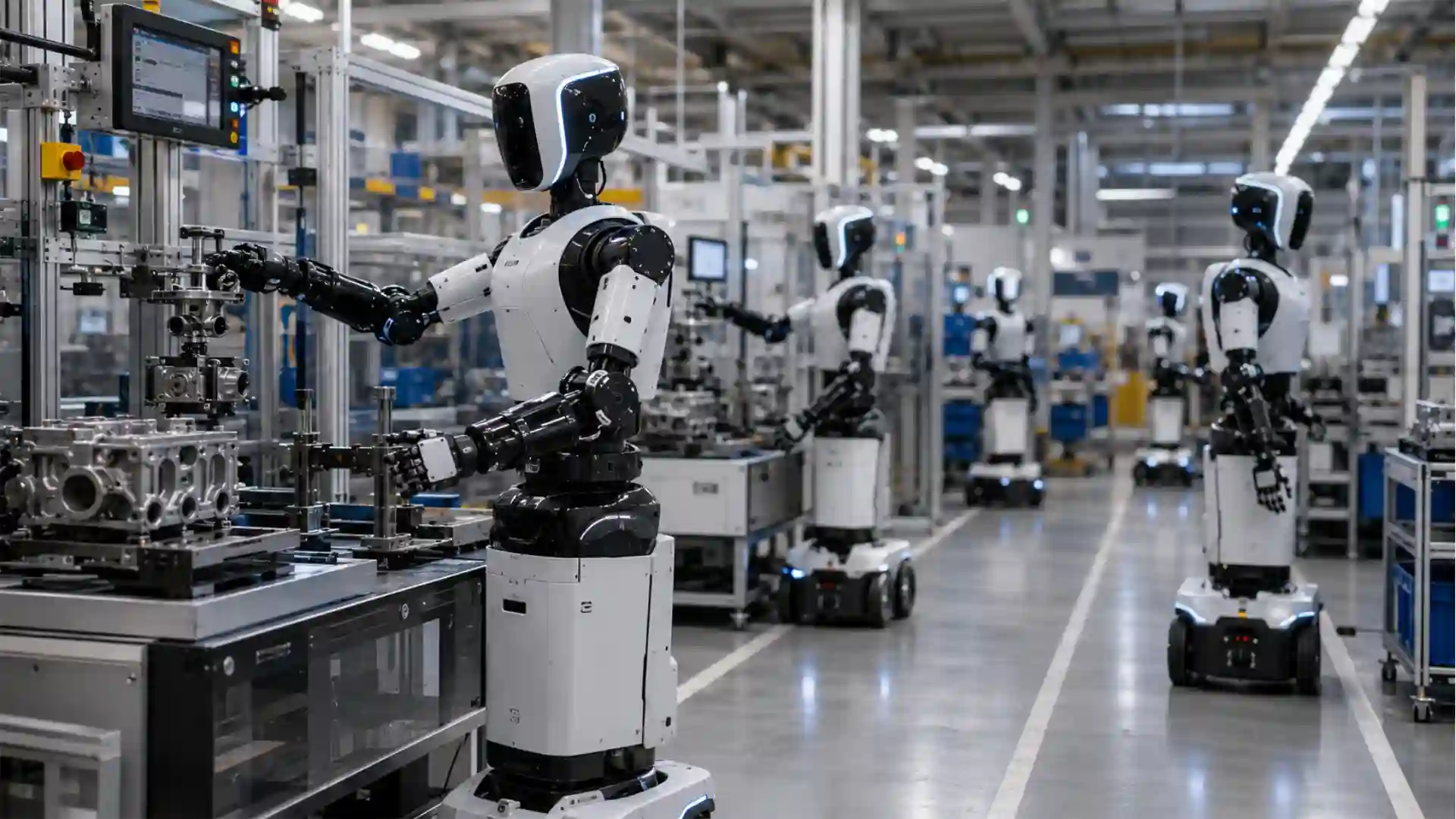
Schaeffler’s new agreement with Humanoid matters because it gives the humanoid robotics market something it has badly needed: a disclosed industrial rollout plan with named factory sites, a staged deployment window, and a service model tied to actual production work. Humanoid, the UK-based robotics company founded by Artem Sokolov in 2024, says it has signed a binding phased deployment and supply agreement with Schaeffler to place wheeled humanoid robots in live manufacturing operations, with the first systems scheduled to go live in Germany before the end of 2026. The target is a four-digit number of wheeled humanoid units across Schaeffler’s global facilities by 2032. Reuters reported that the expected scale is roughly 1,000 to 2,000 robots, while noting that the companies did not disclose the contract value or exact unit number.
Table of Contents
The deal that moves humanoids from demo floor to factory plan
The first phase is specific enough to separate the deal from the usual robotics theater. It is scheduled for December 2026 through June 2027 at two German Schaeffler sites. Herzogenaurach is set to focus on box handling in a live production environment. Schweinfurt is set to start with a three-month capability demonstration and integration test, then move into another three-month on-site phase aimed at stable, near full-scale operation. The industrial test is not whether a humanoid can perform a polished task in a video. The test is whether it can keep working under factory constraints, across shifts, inside existing systems, without turning every exception into a human rescue call.
The deal also has a second layer that may prove just as important as the robot deployment. Humanoid and Schaeffler signed a five-year actuator supply agreement. Schaeffler will become Humanoid’s preferred supplier for more than half of Humanoid’s joint actuator demand for wheeled humanoid platforms through 2031, and Humanoid says the arrangement is expected to translate into a seven-digit number of actuators. In robotics, actuators are not just commodity parts. They are the muscles of the system: motors, gears, sensors, control electronics, and mechanical packaging that convert software intent into motion. A humanoid robot’s reliability is often limited by these joints long before it is limited by public-facing AI claims.
The structure of the Schaeffler-Humanoid agreement also points to a shift in the business model. Humanoid says the deployment is organized around Robot-as-a-Service, or RaaS. Under that model, Humanoid provides the robots, connects them to fleet management software, handles maintenance, issues updates, provides 24/7 technical support, and manages performance over time. This matters because the buyer is not simply placing a capital equipment order and absorbing every operational unknown. A RaaS contract puts more responsibility on the robot supplier to keep the fleet working, measurable, patched, maintained, and improving after installation.
Schaeffler is not a random first adopter. It is a German automotive and industrial supplier with deep manufacturing knowledge, a global production base, and a direct commercial interest in humanoid robot hardware. The company has already positioned humanoid robotics as one of its new growth areas. In March 2026, Schaeffler reported 2025 revenue of 23.5 billion euros, identified humanoid robotics and defense as new growth areas, and said the company was working to become a broader motion technology business after its merger with Vitesco.
For the robotics industry, the agreement is a marker. It does not prove that humanoid robots are ready for broad factory replacement. It does not prove that general-purpose robots have solved dexterity, safety, economics, or reliability. It does prove that a major industrial supplier is willing to put a multi-year deployment plan into the open, tie it to production sites, and bind it to a hardware supply relationship. That is a different class of signal from a laboratory demo.
Schaeffler is not buying a robot fleet in the old industrial sense
Traditional factory automation usually starts with a defined process, a fixed cell, and a carefully engineered machine. The buyer specifies the station, the cycle time, the workpiece, the safety perimeter, the machine interfaces, and the expected output. The supplier then builds, installs, commissions, and hands over a system that is meant to repeat a narrow operation for years. Industrial robots have been built around that logic for decades. They are excellent at welding, painting, palletizing, machine tending, and precise movement inside designed environments.
The Schaeffler-Humanoid deal follows another logic. Schaeffler is not only buying machines; it is entering a long-running operating arrangement. The RaaS model turns the robot into a managed fleet asset. The robot supplier remains deeply involved after deployment because the product is not finished at the moment of installation. The fleet needs monitoring, maintenance, software updates, safety validation, task tuning, and data-driven improvement. Humanoid robotics is not only a hardware sale. It is a recurring operations contract attached to a moving, sensing, decision-making machine.
That distinction is central to the business case. If a Schaeffler plant bought a fixed robot cell, the project would be judged through a familiar capital investment lens: purchase price, installation cost, depreciation, cycle time, utilization, maintenance, and payback period. A humanoid RaaS deployment asks different questions. Does the service fee include enough technical support to reduce internal burden? Can the provider handle software patches without stopping production? Can task models be copied from one site to another? Can robots be redeployed when production mix changes? Can the supplier take responsibility for uptime levels that a plant manager can actually trust?
This is why the service wrapper is not a footnote. A factory humanoid is closer to a deployed technology stack than to a stand-alone machine. It includes the physical platform, end effectors, sensors, perception software, motion control, fleet scheduling, facility integration, remote diagnostics, safety monitoring, cybersecurity controls, and operator interfaces. When Humanoid says its RaaS model includes fleet management connectivity, maintenance, 24/7 support, updates, and ongoing performance management, it is describing the operating layer that makes the robot usable beyond a pilot.
The model also changes the risk split. Schaeffler still carries factory risk: downtime, safety, labor relations, production quality, and integration with its own systems. Humanoid carries product and fleet performance risk. If robots fail frequently, if replacement parts are slow, if updates break workflows, if perception systems drift, or if the real productivity is lower than promised, the service model makes those problems visible quickly. A subscription-like arrangement can reduce upfront friction, but it also creates a continuous performance audit.
The same logic has made RaaS attractive in warehouse automation, autonomous mobile robots, and smaller factory deployments. Companies want automation without owning every technical layer. They want providers to keep systems current and accountable. But humanoids raise the bar. A mobile humanoid has more joints, richer perception, greater interaction with human spaces, and more unpredictable failure modes than many single-purpose machines. RaaS makes adoption easier on paper, yet it also forces the robot company to prove that its technology can survive operational reality every week.
The industrial question is not whether Schaeffler can afford robots. It can. The question is whether a service model gives Schaeffler a faster route to useful automation while preserving flexibility across factories built for people, forklifts, carts, bins, racks, and changing production schedules. If the answer is yes, RaaS becomes more than a financing structure. It becomes the commercial form that helps humanoids leave one-off pilots.
Herzogenaurach and Schweinfurt will set the tone
The first two sites in the rollout matter because they define the evidence base. Herzogenaurach and Schweinfurt are not abstract symbols of German engineering. They are the early proving grounds where Humanoid’s machines will meet a production environment with real material flow, real worker movement, real IT rules, real safety review, and real pressure from line operations. The companies have chosen tasks and validation steps that reveal a careful sequencing strategy rather than a dramatic attempt to automate everything at once.
Herzogenaurach is focused on box handling. That may sound modest, but it is exactly the kind of task where humanoid robotics has a plausible first role. Boxes vary in weight, position, orientation, deformation, labeling, surface texture, and visibility. They are handled near people and existing equipment. They often sit between logistics and production. They are common enough to justify automation, but varied enough to expose the limits of fixed automation. Box handling is boring only to outsiders. Inside a factory, reliable box handling can remove repetitive manual load, reduce ergonomic strain, and smooth material flow.
Schweinfurt is described as a test of near full-scale operations. Humanoid’s statement says that work there will begin with a three-month capability demonstration and integration testing period, then proceed to a three-month on-site phase aimed at stable, continuous operation approaching full production scale. That wording is important. It frames the rollout as a staged validation project, not as an instant plant transformation. The company must first prove capability, then integration, then continuous operation.
This sequencing reflects a hard truth in factory robotics: a machine can pass a demo while still failing the plant. The plant adds constraints that are easy to miss in a showcase. Floors are imperfect. Lighting changes. Workers cross paths. Containers arrive damaged. Labels are placed differently. Network connectivity has gaps. Maintenance windows are limited. Safety officers require evidence, not enthusiasm. Production engineers ask how the robot behaves when upstream flow stops, when a box is missing, when a human blocks the route, when a gripper loses contact, or when a software update needs to be rolled back.
The first phase will also test whether Humanoid can integrate into Schaeffler’s existing production lines. Reuters reported that Humanoid will help Schaeffler integrate the robots into existing factory lines, while Humanoid’s own announcement says the collaboration includes Schaeffler’s requirements for system architecture, safety, IT infrastructure, rollout processes, and security-by-design principles. Those phrases are not decoration. They describe the actual burden of industrial adoption. A robot that cannot connect safely to factory workflows becomes a visitor, not a worker.
The choice of two German sites also gives the deployment public credibility. Germany remains one of the world’s most automated manufacturing economies. The International Federation of Robotics reported that Western Europe reached 267 robots per 10,000 manufacturing employees in 2024, while the EU average was 231, above the global average cited by IFR in that release. Schaeffler is not testing humanoids in an automation-light setting where any robot looks impressive. It is testing them in a region where industrial robotics is already mature and where the standard for reliability is high.
For Humanoid, the early sites will become reference cases. For Schaeffler, they will determine internal trust. A procurement team may sign a framework. Engineers, line managers, safety teams, works councils, maintenance staff, and operators decide whether the robots earn room on the floor. If Herzogenaurach and Schweinfurt produce stable performance, the rollout has a credible path. If they expose weak uptime, hard-to-support hardware, excessive human supervision, or unresolved safety issues, the 2032 target becomes harder to defend.
A wheeled humanoid is a compromise, not a shortcut
Humanoid’s first large Schaeffler deployment is centered on wheeled humanoids, not bipedal walking robots. That detail deserves attention because it tells us where the industry is becoming more practical. A humanoid shape is useful because factories, tools, containers, doors, shelves, carts, and workstations are designed around human reach, human height, and human manipulation. Legs may be useful in stairs, uneven terrain, and complex human environments. But in many factories, wheels are faster, safer, easier to control, less energy-hungry, and less mechanically punishing.
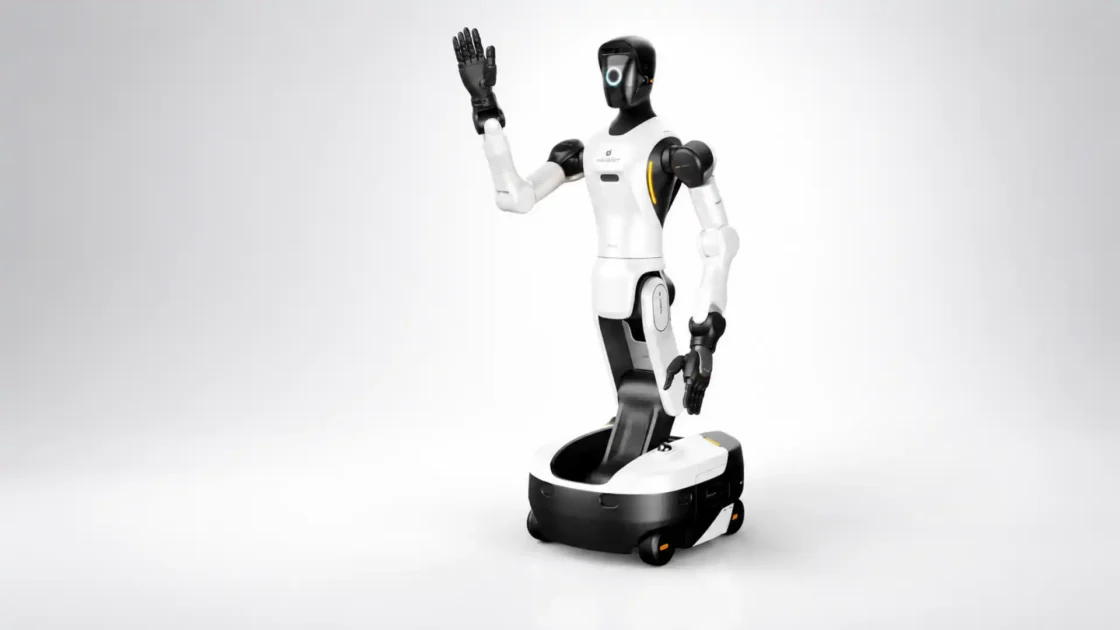
The HMND 01 Alpha Wheeled platform is listed by Humanoid at 220 cm tall, 300 kg in weight, with 29 degrees of freedom excluding end effectors, a maximum speed of 2 meters per second, a 4-hour average run time, and a 15 kg payload. It uses an omnidirectional wheeled mobile base and includes RGB cameras, depth sensors, 6D force-torque sensors, haptic feedback, and modular end effectors, including a 12-degree-of-freedom five-finger hand or a simpler parallel gripper.
Those numbers make the design choice clearer. A 300 kg wheeled robot is not a delicate consumer appliance. It is a large industrial machine that must be managed with serious safety design. Its wheeled base can give it smoother motion on factory floors than a walking platform, while its humanoid upper body can reach, lift, grip, inspect, and work with human-oriented infrastructure. The industrial value is not that the robot imitates a person perfectly. The value is that it combines mobile base reliability with a human-scale manipulation envelope.
Wheeled humanoids also reduce some of the energy and control burden. Bipedal locomotion is hard. It requires balance, foot placement, recovery, whole-body coordination, and constant control under uncertainty. Those capabilities are advancing, but they remain costly in power, hardware wear, safety certification, and engineering effort. If the first factory use cases are box handling, kitting, tote movement, machine-side logistics, or inspection, wheels may do the locomotion job better. The humanoid upper body can remain the differentiator.
This compromise is visible across the sector. Mercedes-Benz has been testing Apptronik’s Apollo humanoid for intralogistics and component movement. Reuters reported in 2026 that Apptronik was developing Apollo for industrial use with both legs and wheels for navigation, while Mercedes-Benz and Apptronik have focused public messaging on manufacturing and logistics use cases such as delivering assembly kits and checking parts.
A wheeled platform is also easier to fit into industrial safety assumptions. Factories already manage autonomous mobile robots, tugger trains, carts, forklifts, and wheeled handling equipment. A humanoid upper body adds new risks, but the locomotion layer is more familiar than a large biped walking near people. That may help early approvals, though it does not remove the need for careful risk assessment. A heavy mobile robot with arms, grippers, sensors, and software-controlled behavior still needs safety-rated stops, speed limits, separation logic, collision avoidance, and defined interaction procedures.
The compromise has limits. Wheels are poor on stairs. They struggle with cables, thresholds, debris, ramps, and certain outdoor or maintenance environments. A wheeled humanoid cannot claim the full human mobility story. But factories often do not need that story. They need dependable motion between stations, the ability to position near racks or workbenches, and enough upper-body dexterity to handle workpieces without redesigning the whole process. In that sense, wheeled humanoids may be the first serious commercial bridge between autonomous mobile robots and true general-purpose humanoids.
The RaaS contract changes who owns factory risk
Robot-as-a-Service is often described as a subscription model, but that definition is too shallow for this case. In a humanoid factory deployment, RaaS is a risk allocation mechanism. It determines who pays upfront, who maintains the robots, who updates software, who monitors fleet health, who handles support at 2 a.m., who supplies spare parts, who measures performance, and who takes responsibility when the robot fleet falls short.
Humanoid’s description of the deal is unusually explicit. The company says it will provide the robotic systems and related services needed for end-to-end deployment and operation, including connection to fleet management software, maintenance, 24/7 technical support, updates, and ongoing performance management. That is much broader than selling a machine and leaving the customer with a manual. It resembles the operating model used in cloud software and managed industrial services, but attached to physical robots that move through a factory.
Confirmed deal terms at a glance
| Element | Confirmed detail | Strategic meaning |
|---|---|---|
| Customer | Schaeffler | Major German automotive and industrial supplier |
| Robot company | Humanoid | UK robotics company founded in 2024 |
| Initial sites | Herzogenaurach and Schweinfurt | German production validation before wider rollout |
| First phase | December 2026 to June 2027 | Staged proof of integration and continuous operation |
| Target scale | Four-digit fleet by 2032 | Reuters reports an estimated 1,000 to 2,000 robots |
| Business model | Robot-as-a-Service | Robots bundled with software, maintenance, updates, support, and performance management |
| Component deal | Five-year actuator supply agreement | Schaeffler becomes preferred actuator supplier for more than half of Humanoid’s wheeled-platform demand |
The table shows the deal’s unusual structure: deployment, service, and component supply sit in one strategic package. Schaeffler is not only preparing to use robots; it is positioning itself inside the robot supply chain.
The RaaS model helps explain why a young robotics company can pursue a large industrial rollout. A humanoid robot will not be perfect at shipment. Its usefulness will depend on how fast it learns new tasks, how well the fleet software schedules work, how quickly failures are diagnosed, how easily skills are updated, and how much human intervention remains. A service contract lets Humanoid remain inside that improvement loop. It also lets Schaeffler demand measurable performance rather than absorbing every weakness as its own engineering problem.
This does not make the risk disappear. It may make the risk easier to see. A factory manager will ask for uptime, mean time between failures, mean time to repair, safety incident rates, task completion rates, exception frequency, human assistance time, and cost per handled unit. A RaaS provider must track those numbers. If the robot handles boxes well for one hour but needs frequent resets across a shift, the service model will expose the gap. If each new site needs heavy custom work, the model will expose weak repeatability. If the fleet improves with data and software updates, the model will show compounding value.
There is a financial reason Schaeffler may prefer this path. RaaS can shift some spending from capital expenditure to operating expenditure, reduce upfront commitment, and let deployments scale in phases. It can also protect the buyer from owning hardware that becomes obsolete quickly. But the business case depends on contract details that have not been disclosed: service fees, utilization thresholds, performance penalties, repair responsibilities, upgrade rights, data rights, and exit terms.
In factory automation, accountability is often fragmented. A robot maker sells the arm. A gripper maker supplies the end effector. A system integrator designs the cell. A software vendor provides scheduling. A maintenance team keeps it running. In humanoid RaaS, the provider may need to carry more of that burden. That is why this deal will be watched closely. Humanoid’s commercial challenge is not only to build a robot. It is to become a dependable industrial service operator.
The actuator side of the agreement may matter as much as the robots
The actuator supply agreement deserves equal attention because it reveals the hardware bottleneck behind humanoid ambition. Humanoid robots need many high-performance joints. Each joint must deliver torque, precision, speed, thermal stability, shock tolerance, compactness, and long service life. Hands, wrists, elbows, shoulders, hips, knees, ankles, torsos, and mobile bases all add to the bill of materials. Even a wheeled humanoid, which avoids some bipedal leg complexity, still needs many precise motion systems.
Schaeffler is well positioned in that layer. The company has long supplied bearings, precision drives, motion components, and automotive systems. Its humanoid robotics push takes those capabilities into a new market. The five-year agreement with Humanoid makes Schaeffler the preferred actuator supplier for more than half of Humanoid’s joint actuator demand for wheeled platforms through 2031. The expected seven-digit actuator count signals more than a showcase order. It suggests a component pipeline designed for scaling.
Schaeffler’s parallel agreement with Hexagon Robotics reinforces the same strategy. In April 2026, Schaeffler said it had entered a strategic technology partnership with Hexagon Robotics covering high-precision strain wave and planetary gear actuators, plus integration of at least 1,000 AEON humanoids into Schaeffler’s global production system within seven years. The company said its actuator platform includes electric motors with integrated power electronics and precise encoders, using two-stage planetary or strain wave gears depending on requirements.
This is where the deal becomes bigger than Schaeffler’s own factory labor question. Schaeffler is trying to turn its motion expertise into a position inside the humanoid value chain. The company can learn as an operator, test its components under factory conditions, then sell those components into the robotics ecosystem. That dual role is powerful if managed well. Every robot working in Schaeffler’s plants can become both a productivity tool and a long-duration test bench for Schaeffler’s own motion technology.
Actuators also determine service economics. A robot fleet’s cost is not only its purchase price. It is the rate at which joints wear, drift, overheat, loosen, fail, or require recalibration. It is the cost and speed of replacing modules. It is the complexity of diagnosing faults before they stop production. A robot with impressive AI but fragile joints will be expensive to operate. A robot with strong joints but poor task intelligence will sit idle. Commercial humanoids require both.
McKinsey has argued that the humanoid supply chain is becoming a strategic battleground, with component choices made at prototype stage potentially turning into production incumbency once architectures stabilize. Its 2026 analysis specifically noted Schaeffler’s movement into humanoid actuator supply and its expectation that new sectors, including humanoid robotics, could represent up to 10 percent of group sales in 2035.
This helps explain Schaeffler’s urgency. The company is not waiting for a fully mature humanoid market to appear. It is trying to shape the component base early. If humanoid robot volumes rise, the winners may not only be the brands whose robots appear in videos. They may be the suppliers of joints, gearboxes, bearings, sensors, batteries, thermal systems, brakes, safety components, and manufacturing processes. Schaeffler has chosen the layer it understands: motion.
Schaeffler’s industrial logic is bigger than one robot vendor
Schaeffler’s robotics strategy is not limited to Humanoid. It has signed or announced partnerships across the humanoid ecosystem, including Hexagon Robotics and earlier work around humanoid components. Reuters reported in November 2025 that Schaeffler had partnered with Neura Robotics to develop and supply key components and planned to integrate several thousand humanoids into its production lines by 2035. Reuters also reported that Schaeffler expected up to 10 percent of 2035 sales from new areas such as defense, eVTOL aircraft, and humanoid robotics.
That multi-partner approach is rational. No one knows yet which humanoid architecture will dominate industrial use. Some robots will walk. Some will roll. Some will use five-finger hands. Some will use simpler grippers. Some will be built for logistics, others for assembly support, inspection, maintenance, construction, retail, or care environments. The control stack may evolve quickly as vision-language-action models, reinforcement learning, simulation, teleoperation, and fleet learning mature. A supplier that wants to sell into this market should avoid betting everything on a single embodiment or robot brand.
Schaeffler’s own corporate transformation makes the timing easier to understand. The company completed its merger with Vitesco Technologies in October 2024 and positioned the combined group as a motion technology company with four divisions: E-Mobility, Powertrain & Chassis, Vehicle Lifetime Solutions, and Bearings & Industrial Solutions. At the time, Schaeffler said the combined company would have pro-forma annual sales of around 25 billion euros, around 120,000 employees, more than 250 locations, and more than 100 production facilities worldwide.
A company of that size faces two pressures at once. It must keep serving automotive customers through a difficult transition in combustion, hybrid, and electric platforms. It must also find growth in markets that use its core skills but are not fully dependent on traditional vehicle cycles. Humanoid robotics fits that search. It uses motion control, precision manufacturing, bearings, gears, sensors, thermal design, electronics, and systems integration. It also creates a potential internal customer: Schaeffler’s own factories.
The March 2026 Schaeffler results make that pivot explicit. The company reported stable 2025 revenue of 23.5 billion euros, EBIT before special items of 936 million euros, and named humanoid robotics and defense as new growth areas. The same results showed pressure in parts of the established automotive business, including weaker demand from Western manufacturers in Europe in the Powertrain & Chassis division.
The Humanoid deal should be read as both an automation project and an industrial repositioning move. Schaeffler is looking for plant productivity. It is also looking for component demand. It wants to learn which humanoid systems can work, which components fail, what service intervals look like, what safety constraints matter, and how robot makers behave as customers. That knowledge could become commercially useful even if some early robot deployments underperform.
There is also a signaling effect. Schaeffler’s public commitment tells robot makers that the company is serious about becoming a supplier to the sector. It tells investors that humanoid robotics is not a side curiosity. It tells customers that Schaeffler’s motion technology can be tested inside its own plants. It tells engineering talent that robotics is part of the company’s future. Industrial strategy often works through this kind of flywheel: internal adoption creates credibility, credibility attracts partners, partners bring demand, and demand justifies deeper investment.
Germany’s automation base makes this rollout more credible and more demanding
Germany is a difficult place to fake a factory automation breakthrough. The country’s manufacturing system already uses industrial robots at high density, especially in automotive and machinery. Germany’s plants have deep experience with robot cells, machine tools, quality systems, maintenance discipline, worker representation, safety rules, and supplier integration. A humanoid rollout there will be judged against a mature automation baseline, not against an empty floor.
The IFR reported that Western Europe reached a record 267 robots per 10,000 manufacturing employees in 2024, while the EU average reached 231. The same release placed Germany among the global top 20 countries for robot density. A separate IFR release said Europe’s automotive industry installed 23,000 new robots in 2024, the second-best result in five years, and that car makers accounted for around a third of annual manufacturing robot installations in Europe.
Those numbers matter for the Schaeffler deal because they show that humanoids are not entering a low-automation market. They are entering a highly automated one. That means the robot must justify itself in tasks where traditional automation is too rigid, too expensive, too hard to redeploy, or too intrusive to install. The humanoid argument is strongest in brownfield factories, where production systems were built around human movement and where full redesign is not economical.
The brownfield advantage is straightforward: factories contain many tasks that are still manual not because they are intellectually complex, but because they sit in awkward spaces between standardized processes. A worker may move bins between stations, pick mixed parts from clutter, handle variable packaging, scan labels, top up line-side material, perform visual checks, or move items through spaces designed for people. Fixed automation can handle some of those tasks, but it often requires conveyors, guarding, fixtures, special tooling, and process redesign. A mobile humanoid promises a less invasive route.
The promise needs proof. Germany’s automation culture will test whether the humanoid is truly flexible or merely under-specified. Plant engineers will ask whether a wheeled humanoid can meet takt-time demands, coordinate with existing equipment, handle variance, and pass safety assessments. Works councils will ask how jobs change, how employees are protected, and how performance monitoring affects workers. Maintenance teams will ask whether the robot is supportable with known procedures. IT teams will ask about cybersecurity, access control, data flows, and software updates. A humanoid in Germany must earn trust from a factory ecosystem that already knows what good automation looks like.
That may help the technology in the long run. A serious industrial customer forces better engineering. It does not tolerate vague claims for long. If the robots cannot perform, the rollout slows. If they can, the proof will be stronger than a controlled demonstration. The same is true for Schaeffler’s component business. Actuators that survive German production environments have credibility with other industrial customers.
Germany’s position also brings competitive urgency. Chinese manufacturers have been moving rapidly in both industrial automation and humanoid robotics. The IFR has documented China’s rising robot density and its huge operational stock in industrial robots. Reuters reported in 2024 that China had overtaken Germany in industrial robot density according to IFR data at the time, reflecting China’s heavy investment in factory automation.
For German suppliers, humanoid robotics is not only a futuristic labor topic. It is part of the manufacturing competitiveness question. If factories in Asia can deploy flexible robotics faster and cheaper, European suppliers face cost and speed pressure. If European suppliers can shape high-value components, safety systems, and industrial integration methods, they can hold valuable parts of the market even if robot assembly volumes concentrate elsewhere.
Labor scarcity gives the deal a strategic use case, not a free pass
Labor scarcity is one of the clearest reasons manufacturers are testing humanoid robots, but it should not be used as a lazy explanation. Germany’s labor market is complex. Weak economic demand has reduced hiring pressure in some areas, while demographic change still points to a shrinking workforce and long-term skills constraints. A robot deal must be understood against both forces.
The ifo Institute reported in February 2026 that 22.7 percent of companies in Germany said they had a shortage of qualified workers, down from 25.8 percent in October and the lowest level in five years. In industry, ifo said 16.6 percent of companies reported skilled worker shortages, with mechanical engineering around 19 percent. That suggests the shortage had eased from earlier peaks, partly because weak economic conditions reduced labor demand.
The long-term demographic pressure remains. Germany’s Institute for Employment Research says the country’s workforce will shrink over time, with the baby-boomer generation retiring between now and 2035, compounding difficulties in finding skilled labor. The German Economic Institute also warned in April 2026 that demographic change will pose major labor-market challenges and that the labor force is shrinking sharply despite current economic weakness.
This combination is important. A factory may not be desperately short of workers today, but it can still face an aging workforce, harder recruitment for shift work, ergonomic strain, rising quality demands, and pressure to keep production in high-cost countries. Humanoid robots do not need to replace whole occupations to be useful. They can target specific tasks that are repetitive, physically tiring, or difficult to staff consistently.
The credible labor argument for humanoids is task substitution, not worker replacement at factory scale. A robot that handles boxes, moves totes, feeds line-side material, or performs simple inspections can reduce burden in narrow areas. It can also allow skilled workers to focus on quality, problem solving, machine setup, maintenance, and supervision. But the robot will create new work too: robot operations, exception handling, maintenance, safety review, data management, and integration.
The social question will be difficult. German factories operate within a labor relations model that gives workers a formal voice through works councils and codetermination structures. Any large rollout of robots will raise questions about job design, retraining, surveillance, ergonomics, shift planning, and employment security. Schaeffler will need to show that humanoids solve real production problems without treating workers as obstacles to automation.
There is a practical reason to be honest here. Overclaiming labor replacement can slow adoption. It triggers fear, regulatory attention, union resistance, and internal skepticism. A better case is narrower and stronger: use humanoids where manual work is repetitive, physically demanding, variable enough to resist fixed automation, and measurable enough to prove value. If the robot performs, workers will judge it by whether it makes the shift safer and less punishing, not by whether it satisfies a market narrative about general-purpose AI.
The labor scarcity argument gives Schaeffler and Humanoid a reason to act early. It does not excuse poor performance. If a robot needs too much supervision, fails too often, or slows a line, it will not solve labor scarcity. It will add another operational burden. The deal’s staged structure suggests both companies understand this. The first test is not philosophical. It is whether the machine can handle work.
Humanoid robots are entering factories through logistics first
The earliest industrial humanoid use cases are clustering around logistics, kitting, tote movement, box handling, line-side delivery, and inspection support. That pattern is not accidental. These tasks are common, repetitive, physically demanding, and often located in spaces designed for people. They also avoid some of the hardest assembly operations, where tolerances, force control, fastening quality, traceability, and cycle time can be unforgiving.
Schaeffler’s first stated use case in Herzogenaurach is box handling. Mercedes-Benz has described Apptronik’s Apollo as a production support robot for intralogistics, transporting components or modules to the production line and carrying out initial quality checks. Apptronik’s own announcement with Mercedes-Benz referred to delivery of assembly kits and inspection of components. BMW’s Figure 02 trial at Plant Spartanburg involved placing sheet metal parts into fixtures, a manufacturing task that combines handling, positioning, and repetitive movement.
Logistics-first adoption makes sense because it gives robots room to work without requiring immediate mastery of every factory skill. A robot moving boxes or totes must still be safe and reliable, but it may have more tolerance than a final assembly station with tight cycle-time pressure. If the robot fails, the process may be recoverable through human intervention. If it succeeds, the productivity and ergonomic benefits are visible.
Agility Robotics provides a useful comparison outside automotive. In November 2025, Agility said its Digit humanoid had moved more than 100,000 totes in live commercial deployment at GXO’s Flowery Branch facility. The company framed the milestone as evidence that humanoids need to move past novelty and prove concrete throughput in logistics.
That kind of benchmark is exactly what humanoid robotics needs. The sector has been rich in videos but short on operational metrics. A serious factory customer will want to know handled units per hour, intervention rate, damage rate, uptime, recovery time, battery swap or charging burden, task transfer time, and cost per unit. Logistics tasks create measurable outputs. They allow comparison with human labor, conveyors, AMRs, forklifts, cobots, and fixed automation.
The path into factories is likely to be incremental: move material first, then handle more varied objects, then assist with assembly, then take on more dexterous tasks once reliability improves. Humanoid’s own Schaeffler statement points in this direction. After initial stages, the companies will assess performance and expand across the value stream, including future dexterous tasks such as assembly and packaging.
The danger is that logistics success can be mistaken for general-purpose success. Moving totes is not the same as assembling complex products. Picking bearing rings is not the same as wiring, fastening, seal placement, or quality-critical torque operations. Humanoids may move through these layers over time, but each step adds difficulty. The Schaeffler rollout will gain credibility if it publishes or discloses evidence of progressive task expansion rather than jumping directly to broad claims.
Logistics-first adoption also has a plant layout advantage. Material handling often crosses existing boundaries. It touches warehouses, supermarkets, line-side areas, packaging stations, and production cells. A mobile humanoid that can work safely in those zones may create value without rebuilding the whole factory. That is the commercial opening.
The hard part is not picking one box once
A robot demo usually shows a clean success. Factory work is a study in repeated imperfection. The box is crushed. The label is turned away. The tote is half-hidden. The part is oily. The bin is cluttered. A person steps into the path. A cart is left in the wrong place. The lighting changes. A Wi-Fi access point fails. A gripper pad wears. A software update changes behavior. A sensor becomes dirty. A downstream station stops. The robot must either recover, wait safely, ask for help, or hand off the problem without creating chaos.
That is why the Schaeffler-Humanoid deal will be judged on long-duration behavior. The phrase “stable, continuous operation approaching full production scale” is more demanding than it appears. It implies that the robot must operate across time, not just across a task. The system must maintain calibration, battery availability, route planning, object recognition, gripper performance, safety logic, and fleet coordination over extended operation.
Humanoid’s product page says its wheeled robot is designed for autonomous and teleoperated industrial tasks, with sensors including RGB cameras, depth sensors, 6D force-torque sensors, and haptic feedback. That sensor mix is necessary for handling variable objects, but sensors alone do not solve factory unpredictability. The machine must convert perception into correct action under uncertainty.
The hardest performance metric may be exception handling. A robot that succeeds 95 percent of the time can still be unusable if the remaining 5 percent creates frequent human interruptions. A worker who has to rescue a robot every few minutes will see it as a burden. A line manager will see hidden labor. A safety engineer will see risk. A financial controller will see inflated operating cost. Humanoid robotics moves from demo to industry when the exception rate becomes low, predictable, and cheap to manage.
Teleoperation can help early deployments. A remote or local human can guide a robot through unfamiliar cases, gather training data, and prevent full stoppage. But teleoperation is not a free solution. It adds labor cost, latency, supervision burden, and safety questions. It can be useful as a bridge, especially during task learning, but a factory business case weakens if the robot needs constant human control.
Battery life is another practical constraint. Humanoid lists a 4-hour average run time for HMND 01 Alpha Wheeled. A factory working two or three shifts must manage charging, swaps, idle time, and fleet size around that limit. If a robot spends too much of the day charging, the customer needs more robots to cover the same work. If charging is poorly scheduled, the fleet becomes unavailable at the wrong time. If battery swaps require trained staff, labor returns through the side door.
Payload also defines the use case. Humanoid lists a 15 kg payload for the wheeled platform. That covers many boxes, totes, components, and subassemblies, but not all factory material. The robot’s useful envelope depends on payload, reach, gripper choice, object geometry, route distance, speed limits, safety constraints, and endurance. A nominal payload number is only the beginning of the engineering question.
The Schaeffler rollout will expose these details. If the robot is limited to highly controlled box handling, the value may still be real but narrow. If it learns quickly across bins, packages, and stations, the value broadens. If a fleet can share learned workflows across sites, the service model becomes stronger. The hard part is repetition under ugly conditions.
Fleet software turns single robots into factory infrastructure
A single humanoid can impress visitors. A fleet has to behave like infrastructure. Once a factory deploys dozens or hundreds of robots, the main problem shifts from individual motion to coordination. Which robot gets which task? Where does it charge? Which route does it take? What happens when it fails? How are priorities set when production schedules change? How does the system avoid congestion? Who sees alarms? Which data goes to manufacturing execution systems, warehouse systems, maintenance systems, and safety logs?
Humanoid’s KinetIQ framework is central to its answer. The company describes KinetIQ as a four-layer architecture operating across different time scales, from fleet-level coordination to whole-body control. System 3 coordinates multiple robots toward externally defined fleet-level goals. System 2 coordinates actions of a single robot. System 1 is a vision-language-action model for locomanipulation, translating natural-language goals into target poses. System 0 is the whole-body controller running at 50 Hz, with a lower-level compliant control layer at 1 kHz.
This layered design is not just a technical detail. It reflects the hierarchy a factory needs. A plant manager thinks in goals: move material, feed a line, clear a backlog, maintain flow. A robot supervisor thinks in tasks: pick this tote, deliver to that station, return to charge. The robot must then convert tasks into perception, planning, reaching, grasping, moving, and stopping. The control system must maintain physical stability and safe motion at high frequency. Factory robotics needs intelligence at several levels, and failure at any level can stop the operation.
Fleet software also determines whether deployment knowledge compounds. If a robot learns a box-handling workflow in Herzogenaurach, can that workflow be reused in another Schaeffler site? If Schweinfurt validates a safe route structure, can it become a rollout template? If a gripper strategy fails on a certain package type, can the system update across the fleet? A service model becomes more powerful when the provider can move learning from site to site without rebuilding every application from scratch.
This is the central commercial promise of embodied AI in factories. Traditional automation scales through engineered replication: copy the cell, copy the fixtures, copy the program. Humanoid robotics aims to scale through a mix of hardware commonality, software learning, teleoperation data, simulation, and fleet updates. That promise remains partially unproven, but Schaeffler’s multi-site rollout gives it a real test.
The data architecture will matter. Factories are sensitive environments. Camera data, production schedules, product designs, process parameters, worker movements, and equipment interfaces can be commercially or personally sensitive. A fleet system must define what data is stored, where it is processed, who can access it, how long it is retained, how it is anonymized, and how updates are validated. These questions are not abstract when robots carry cameras and operate near people.
Fleet management also makes cybersecurity a safety issue. A compromised software update, weak remote access control, or manipulated task instruction could affect physical motion. The EU Machinery Regulation explicitly seeks to cover new technologies such as autonomous mobile machinery, connected equipment, and AI modules used in safety functions, and it becomes applicable from January 20, 2027 for most provisions.
Humanoid’s announcement says the Schaeffler collaboration includes security-by-design principles and alignment with Schaeffler’s system architecture, safety, and IT infrastructure requirements. That is necessary. A large robot fleet cannot be treated as a set of gadgets. It is connected factory infrastructure.
Safety will decide the speed of adoption
Safety is the gatekeeper for humanoid deployment. A factory can tolerate imperfect productivity during a pilot. It cannot tolerate unclear hazards. A 300 kg mobile robot with arms, grippers, cameras, force sensors, and software-defined behavior must be assessed as a machine that can injure people, damage equipment, disrupt production, or create new ergonomic and psychological risks if poorly introduced.
The safety problem is broader than collision avoidance. It includes speed and separation monitoring, stopping distances, gripper force, pinch points, load stability, dropped objects, emergency stops, battery hazards, maintenance access, remote operation, update validation, cybersecurity, task boundaries, human training, signage, floor markings, lighting, and incident procedures. It also includes the robot’s behavior when it is uncertain. A safe robot must know when not to act.
ISO 10218-1:2025 sets safety requirements for industrial robots as partly completed machinery, including safe design, risk reduction measures, and information for use. ISO 10218-2:2025 addresses industrial robot applications and robot cells, including integration, commissioning, operation, maintenance, and decommissioning in industrial settings. These standards matter because humanoid deployment is not only a robot design issue; it is an application and integration issue.
The safest humanoid is not the one with the most impressive motion. It is the one whose motion envelope, failure behavior, and human interaction rules are known well enough to certify, train, monitor, and repeat. That is a less glamorous standard, but it is the standard factories live by.
Humanoid’s wheeled design may help safety assessment in some ways and complicate it in others. Wheels are predictable on factory floors, and speed can be controlled. The robot’s mass, height, arms, and payload create other hazards. A tall robot carrying a 15 kg box through a shared area is not the same as a small AMR moving under a rack. The upper body introduces reach, swing, pinch, and load-drop risks.
The application must define collaboration carefully. A robot that works near people is not automatically collaborative in the safety sense. Collaboration depends on the application, the speed, the force, the separation, the task, the workpiece, the safeguards, and the risk assessment. A robot may be safe in one use case and unsafe in another. That is why staged deployment is essential.
What must be proven before the fleet scales
| Proof area | Evidence Schaeffler will need | Reason it matters |
|---|---|---|
| Safety | Risk assessments, validated stops, safe routes, trained operators | Human-robot work areas require predictable hazard control |
| Uptime | Shift-level availability, repair time, fault patterns | A factory fleet fails commercially if it needs constant rescue |
| Task quality | Correct picks, low damage, stable placement, traceability | Handling work must protect parts and production flow |
| Integration | IT, MES, WMS, maintenance, security, and rollout templates | Robots must fit the factory system rather than operate beside it |
| Economics | Cost per handled unit, supervision burden, utilization, service fees | RaaS only works if recurring cost is justified by measurable output |
| Scalability | Reuse of skills across lines and sites | Multi-site deployment depends on repeatability, not custom hero projects |
The table shows why the Schaeffler rollout is a multi-year validation challenge. A humanoid fleet scales only when safety, uptime, quality, integration, economics, and repeatability are proven together.
Safety will also shape labor acceptance. Workers need to know what the robot will do, how to stop it, when it has right of way, what its signals mean, where it can go, and how incidents are handled. If robots are unpredictable, workers will either distrust them or work around them. Both outcomes reduce value.
The companies will likely keep many safety details private, but public credibility will rise if they disclose meaningful operational evidence over time. The humanoid sector does not need more vague safety claims. It needs deployment data, incident discipline, and integration methods that industrial customers can compare.
European regulation will shape the deployment path
The timing of the first Schaeffler-Humanoid deployment overlaps with a changing European machinery and AI regulatory environment. The EU Machinery Regulation applies from January 20, 2027 for most provisions, which is during or just after the initial Schaeffler deployment window. The regulation replaces the Machinery Directive and is meant to cover machinery placed on the European market, including new technologies such as autonomous mobile machinery, connected equipment, and AI modules that use learning techniques for safety functions.
This matters because humanoid robots sit at the boundary of several regulatory domains. They are physical machinery. They include software. They may include AI-based perception, planning, and control. They may connect to factory IT networks. They may receive remote updates. They may operate near workers. They may process visual data. Their safety depends on both hardware and software behavior.
The EU AI Act adds another layer. The European Commission describes the AI Act as a risk-based legal framework for AI developers and deployers, part of a wider package meant to support trustworthy AI in Europe. Its practical interaction with industrial robotics will depend on the system’s use, whether AI functions are safety components, product classifications, and evolving implementation guidance.
The legal environment is still shifting. Reuters reported in May 2026 that EU countries and lawmakers reached a provisional agreement to dilute and delay parts of AI rules, including high-risk enforcement changes, while machinery was reportedly excluded from the AI Act in that political compromise. This is a developing area, so factory deployments will likely be guided by machinery safety law, product conformity rules, standards, and AI governance practices rather than a single simple answer.
For Schaeffler, compliance will not be a paperwork exercise. It will shape architecture. Remote updates must be controlled. Safety-related software must be validated. Cybersecurity must be linked to machine safety. Documentation must support conformity assessment. Operators need clear instructions. Substantial modifications must be managed. If a robot’s learning system changes behavior after deployment, the company must understand whether that change affects safety or conformity.
The Machinery Regulation’s direct applicability across EU member states may create a more consistent framework than the older directive, but it also raises the stakes. A large customer like Schaeffler will demand that a robot supplier can support European compliance at scale. This favors companies that build safety engineering and documentation into the product early. It hurts companies that treat compliance as an afterthought.
The regulatory question also touches the RaaS model. If Humanoid provides updates, maintenance, remote support, and performance management, it remains operationally close to the deployed machines. The contract must define responsibilities for changes that affect safety, cybersecurity, data protection, and documentation. A software patch is not just a product improvement when it can change how a 300 kg robot moves.
Europe’s rules may slow careless deployment, but they may also create a quality filter. Customers that need safe, certifiable, supportable robots may prefer suppliers that can operate within strict requirements. If Schaeffler helps shape those methods through early deployment, it could gain knowledge that becomes valuable across the market.
Integration with old factory systems is the hidden workload
The phrase “existing production environment” carries more weight than most robotics announcements admit. Existing factories are full of legacy systems, local workarounds, physical constraints, old machines, newer digital layers, and informal human knowledge. A humanoid robot must enter that environment without demanding a full redesign. That is the selling point. It is also the trap.
A robot handling boxes may need to know what to pick, where to deliver it, how to confirm completion, what to do if inventory is missing, which route is safe, which zones are restricted, and which production priority matters most. Those instructions may come from a warehouse management system, a manufacturing execution system, an ERP layer, a local line-side call system, a human supervisor, or a hybrid of all four. The robot cannot live only inside its own app.
Schaeffler’s announcement says Humanoid will support integration into existing production environments and meet requirements for system architecture, safety, IT infrastructure, standardized rollout processes, and security-by-design. That is the right list. It is also a heavy list.
The integration workload is where many robotics pilots lose their economic case. The robot may function, but the custom engineering around it becomes too expensive. Each site needs mapping, network approval, process analysis, safety validation, operator training, maintenance procedures, spare parts planning, and workflow tuning. If every deployment is a bespoke project, scaling to 1,000 or 2,000 robots becomes painful. If the integration can be templated, the rollout becomes plausible.
Standardized rollout processes are therefore central. Schaeffler has a global production network. A humanoid deployment cannot depend forever on a small team of specialists flying from site to site. It needs repeatable site surveys, application templates, safety packages, commissioning checklists, operator training modules, support escalation paths, and performance dashboards. The first German sites will likely generate those templates.
The IT challenge is not only connectivity. Factories are cautious about external systems. Remote access must be controlled. Data flows must be approved. Cloud connections may be restricted. Edge processing may be required. Software updates need maintenance windows and rollback plans. User permissions matter. Logs must be auditable. Cybersecurity teams need threat models. A robot company that grew quickly in a startup environment may need to mature fast to satisfy industrial IT.
Physical integration is equally stubborn. A route that works during a demo may be blocked during normal operation. A pickup point may be too high, too low, or too cluttered. A box may need a new fixture. A worker may need a visual signal. A charging station may take floor space that production wants for material. A safety scanner may see false positives near reflective surfaces. A gripper may need a pad material change. These small problems become the real work.
Humanoids are often marketed as a way to avoid redesigning factories. The accurate statement is narrower: humanoids may reduce the amount of redesign needed for some tasks. They do not remove integration work. Schaeffler’s rollout will test whether that reduction is enough to justify the technology.
Maintenance economics will expose weak hardware quickly
A robot fleet creates a maintenance reality that demos cannot hide. Joints wear. Cables fatigue. Sensors get dirty. Grippers lose friction. Batteries degrade. Wheels wear. Bearings heat. Fasteners loosen. Cooling systems clog. Calibration drifts. Software logs fill with warnings. The factory does not care that the machine is humanoid if it spends too much time waiting for service.
Maintenance economics may be the most important reason the actuator supply agreement matters. Schaeffler knows motion components. If it can supply reliable actuators, it reduces one of the largest sources of humanoid downtime. If actuators fail too often, the RaaS model becomes expensive for Humanoid and frustrating for Schaeffler. A service contract makes reliability financially painful for the provider because repair cost and uptime pressure remain active throughout the contract.
The HMND 01 Alpha Wheeled platform’s mass and payload imply industrial loads on the hardware. A 300 kg robot moving through a factory, carrying up to 15 kg, reaching and gripping repeatedly, will subject joints and structures to repeated stress. Humanoid’s listed 4-hour average run time also means battery and charging systems become part of the maintenance equation.
Humanoid reliability will be measured less by peak capability than by ordinary wear. A robot that can perform a difficult motion once but needs frequent recalibration will not scale. A robot that performs a modest task thousands of times with predictable service intervals has a better business case.
Factories will expect maintenance documentation, spare parts availability, modular replacement, diagnostics, and clear responsibility. If a joint fails, can a technician replace a module quickly? Does the robot self-diagnose early warning signs? Does Humanoid ship parts fast enough? Does Schaeffler service any components itself? Are repairs done on-site or off-site? What happens to service fees during downtime? These details decide whether RaaS feels like relief or dependency.
There is also a learning loop. A fleet operating inside Schaeffler factories can generate failure data that improves actuator design, cable routing, thermal management, sealing, gripper selection, and maintenance intervals. That is valuable for Schaeffler as a supplier. It can learn not only from lab testing but from real robot duty cycles. The more units deployed, the better the reliability data.
The challenge is that early fleets may be expensive to support. Young hardware usually changes quickly. Spare parts inventories may be immature. Field technicians may be scarce. Software and hardware versions may differ across units. Service documentation may lag design changes. A major industrial customer will pressure Humanoid to professionalize these processes early.
This is another reason the deal is significant. It forces a young robotics company into the discipline of industrial fleet support. If Humanoid succeeds, it gains credibility. If it struggles, the market learns where the bottlenecks are. Either outcome is useful evidence in a field crowded with claims.
The data loop is the reason a service model matters
Robots improve through data, but factory data is not easy to collect, use, or share. A humanoid robot needs examples of successful and failed grasps, object variations, route obstacles, human interactions, lighting conditions, workcell layouts, exception cases, and recovery actions. It needs to learn which motions are safe, which are efficient enough, which cause wear, and which create quality risk. A RaaS model keeps the robot supplier close enough to collect operational evidence and update the system, subject to customer rules.
Humanoid’s KinetIQ architecture points toward this learning model. Its AI page describes a hierarchy that includes fleet-level coordination, robot-level task coordination, VLA-based locomanipulation, and whole-body control. The company says its System 1 uses vision-language-action model technology and processes multi-camera inputs, language goals, and robot state, then routes information through action decoders to produce actions.
That approach depends on data quality. Internet-scale image and language data can help a model recognize objects and interpret instructions, but factory manipulation requires physical experience. A robot must learn friction, weight distribution, occlusion, container deformation, grasp stability, and the consequences of motion. Simulators help, but real factories produce edge cases that synthetic environments miss.
The most valuable data in humanoid robotics may be the failures: the slipped box, the missed grip, the blocked route, the confused object, the near-collision, the human intervention. Those cases teach the system where its assumptions break. A fleet deployment can collect them at a scale that a lab cannot.
The data loop also raises governance questions. Schaeffler will not want sensitive production data flowing freely into a vendor’s general training pool without controls. Workers may object to camera data if it appears to monitor them. European data protection rules may apply when people are identifiable. Production information may be commercially sensitive. The contract must define what data is used for support, what data is used for model improvement, what is anonymized, what stays on-site, and what can be shared across customers.
There is a competitive angle. Robot companies that deploy earlier can gather more real-world manipulation data. That data can improve models, which improves performance, which wins more deployments, which generates more data. This is the flywheel many humanoid companies are chasing. But industrial customers will not donate their factories to a vendor’s data strategy unless they receive value, protection, and control.
RaaS makes the data loop more natural because the vendor remains responsible for performance. A one-time hardware sale gives the vendor less incentive and less access to improve deployed robots. A service contract makes improvement part of the value proposition. Updates should reduce exception rates, add tasks, improve speed within safety limits, and extend hardware life. The customer pays recurring fees partly because the system is expected to get better.
The test is whether the improvements are real. Software updates in industrial settings must be validated. A model that improves one task could degrade another. A change that increases speed could increase risk. A perception update could alter behavior in unexpected lighting. The data loop must be paired with controlled deployment, version management, rollback, and safety review. Learning is valuable only if it can be governed.
Cost claims will face the shift clock
The humanoid business case will be judged by factory time. A robot must justify itself across shifts, not in a launch presentation. Cost per hour is not enough. The buyer needs cost per useful task, cost per handled unit, cost per shift covered, and cost per problem avoided. That calculation includes the service fee, internal supervision, integration cost, floor space, charging time, downtime, maintenance, safety administration, worker training, and the opportunity cost of process changes.
Humanoid has not disclosed the value of the Schaeffler contract. Reuters reported that the companies did not disclose the contract value or precise robot numbers. This leaves the economics open. The fleet target is large, but the business case remains unproven publicly until cost, output, uptime, and deployment scope are known.
A simple comparison with wages can mislead. A human worker is not just a pair of arms. A worker notices anomalies, communicates with teammates, improvises, cleans up, changes tasks, understands context, and handles exceptions. A robot may work without fatigue, but only inside its operating envelope. The correct comparison is task-specific. If a robot handles boxes reliably for many hours with low supervision and predictable service cost, it can be valuable. If it needs frequent help, the hidden labor cost rises.
The RaaS model makes the cost structure more transparent over time. Monthly or usage-based fees can be compared with output. If a robot handles a known number of boxes per shift, Schaeffler can calculate the effective cost. If software updates increase throughput, the value improves. If downtime rises, the provider must respond. Factory economics will cut through humanoid hype because every shift produces numbers.
The cost equation must also include avoided redesign. A fixed automation cell may be cheaper per unit at high volume, but expensive or impractical for variable tasks. A humanoid may be more expensive per machine but cheaper to deploy where tasks change and infrastructure is human-oriented. The economic question is therefore not “humanoid versus human” in general. It is “humanoid RaaS versus the best alternative for this specific task in this specific plant.”
Alternatives are plentiful. A factory can use conveyors, autonomous mobile robots, cobots, lift assists, ergonomic tools, automated storage systems, machine vision, or process redesign. Reuters reported in 2025 that specialized task-focused robots were attracting strong investor interest because they can offer clearer paths to profitability than general-purpose humanoids in many settings. That critique applies directly to Schaeffler’s rollout: humanoids must win against simpler machines where simpler machines can do the job.
The humanoid advantage appears when tasks require mobility, reach, perception, and manipulation in environments designed for people. If a simpler AMR can move the same boxes more cheaply, the humanoid is the wrong tool. If a fixed cell can handle the work with better speed and reliability, the humanoid is the wrong tool. If a humanoid can cover multiple tasks across a line without redesign, its higher complexity may be justified.
The shift clock will decide. Industrial users do not need humanoids to be magical. They need them to be useful enough, safe enough, and cheap enough across real operating time.
Supplier power is moving toward joints, gears, sensors, and control electronics
The public sees the robot body. Industrial strategy looks inside it. Humanoid robots require a dense stack of components: actuators, gearboxes, bearings, encoders, force sensors, tactile sensors, cameras, depth sensors, batteries, thermal systems, power electronics, structural parts, brakes, compute, wiring, connectors, and software control layers. As the market matures, supplier power will concentrate around components that are hard to make, hard to qualify, and expensive to replace.
Actuators sit near the top of that list. They determine torque, precision, weight, cost, thermal behavior, and reliability. Schaeffler’s decision to supply more than half of Humanoid’s joint actuator demand for wheeled platforms through 2031 puts it in a strategic position if Humanoid scales. The expected seven-digit actuator volume suggests that even a few thousand robots can drive very large component demand because each robot contains many joints.
This is why automotive and industrial suppliers are watching humanoids. A single robot brand may rise or fall, but the component categories can grow across many brands. Suppliers that win early design slots can become difficult to displace once a robot architecture is validated. Changing actuators later may require redesigning control software, thermal systems, mechanics, safety assessments, and manufacturing processes. Early component wins can become sticky.
McKinsey’s 2026 supply chain analysis made the same point in strategic terms, arguing that the window to shape the humanoid supply chain is open but narrowing and that design successes at prototype stage can convert into production incumbency once architectures stabilize. It cited Schaeffler’s movement from no humanoid presence to a key actuator supplier role in under two years.
The humanoid race is not only a race among robot makers. It is a race among supply chains. Companies that master high-volume precision components may capture value even if they never sell a full robot. This pattern is familiar from automotive manufacturing, smartphones, aerospace, and industrial machinery. The brand at the front depends on deep supplier networks behind it.
China’s position in hardware supply is a major factor. Chinese robotics companies benefit from dense local supply chains, fast prototyping, lower component costs, and strong government and investor support. European suppliers have strengths in precision engineering, safety, industrial quality, and customer integration, but they must move quickly to avoid being boxed out of high-volume component categories.
Schaeffler’s actuator strategy is therefore defensive and offensive. It defends the company’s motion expertise as automotive markets shift. It attacks a new component category before standards and suppliers are fully settled. It also gives Schaeffler a way to learn from multiple robot makers, not only Humanoid.
The Schaeffler-Humanoid deal may become a reference point for other suppliers. If the rollout succeeds, robot makers will seek durable motion suppliers. If it struggles because of hardware reliability, suppliers will learn what must improve. Either way, the market moves from concept to bill of materials.
The deal sits inside a wider automotive robotics race
Schaeffler’s move is part of a broader push by automotive companies and suppliers to test humanoid robots in production. BMW, Mercedes-Benz, Tesla, Hyundai through Boston Dynamics, Toyota research efforts, and many suppliers are examining where humanoid or mobile manipulation systems can fit. Automotive is a natural early market because it already uses robots heavily and has many brownfield tasks that remain manual.
BMW tested Figure 02 at Plant Spartanburg in South Carolina. BMW said in September 2024 that Figure 02 had been tested successfully in a real production environment, placing sheet metal parts into fixtures, and that the project marked the first time BMW had used humanoid robots in production.
Mercedes-Benz has gone further into public integration. In March 2025, Mercedes-Benz said it was testing Apptronik’s Apollo humanoids at its Digital Factory Campus Berlin, with an initial focus on repetitive intralogistics tasks. Mercedes said Apollo could transport components or modules to production staff and perform initial quality checks. Reuters later reported that Mercedes-Benz had invested a low double-digit million-euro sum in Apptronik and was testing robots in Berlin and Kecskemét.
Agility Robotics, while more logistics-focused than automotive, has provided one of the clearer commercial milestones with Digit moving more than 100,000 totes at a GXO facility. That matters because it shifts attention from demonstrations to throughput.
This competitive field helps explain the Schaeffler rollout’s ambition. Many automotive robot pilots involve a small number of units. Schaeffler and Humanoid are discussing a four-digit deployment target by 2032. That scale, if reached, would move beyond experimentation. It would make humanoids part of factory planning.
Automotive is a proving ground because it combines high labor cost, high quality demands, complex logistics, and mature automation knowledge. A humanoid that survives automotive supplier plants has a stronger claim for other industries. A humanoid that fails there may still work in simpler settings, but it cannot claim broad industrial readiness.
The automotive sector also has an unusual relationship with robotics because car companies know mass manufacturing. Tesla’s Optimus program, for example, is tied to the idea that automotive production expertise can support robot production. Apptronik has partnered with Jabil to explore manufacturing Apollo robots. Figure has used BMW as a high-profile production reference. The market is converging around the belief that robot production itself will need automotive-style scale.
Schaeffler’s advantage is different. It is not a carmaker trying to build a robot brand. It is a motion supplier and factory operator trying to occupy the component and deployment layers. That may prove more durable than chasing the full robot. If many robot brands compete, they all need components.
The wider race also creates pressure to disclose real evidence. Companies can no longer rely on polished videos. Customers will ask what happened at BMW, Mercedes, GXO, Schaeffler, and other named deployments. They will compare uptime, use cases, scale, safety, and economics. Public reference deployments are becoming the currency of trust.
Schaeffler’s own factories become a proof point for its component business
The strongest version of Schaeffler’s strategy is circular. The company supplies components to humanoid robots, deploys humanoid robots in its own factories, learns from the deployed fleet, improves the components, then sells better components to more robot makers. This is not guaranteed, but it is strategically coherent.
Schaeffler’s plants give the company a controlled yet demanding test environment. It can observe actuator performance under real duty cycles, compare robot designs, study maintenance patterns, and understand which motions create stress. It can see whether strain wave gears, planetary gears, motors, encoders, thermal systems, and bearings behave as expected. It can test service intervals and failure modes. That knowledge is hard to buy from market reports.
The company’s agreement with Hexagon Robotics made this dual role explicit: Schaeffler would develop and supply key actuator components while also integrating at least 1,000 Hexagon AEON humanoids into its production system within seven years. The Humanoid agreement follows the same logic, adding a RaaS deployment and a preferred actuator relationship.
A factory deployment turns Schaeffler from a component seller into a component user. That changes the conversation with robot makers. Schaeffler can speak not only from catalog specifications but from operational evidence. It can say which actuator designs survived, which failed, and which maintenance models worked.
This is especially useful because humanoid component requirements are still unsettled. Robot makers are experimenting with different joint counts, hand designs, payload targets, mobility systems, battery sizes, control architectures, and task priorities. A supplier that learns across multiple deployments can influence standards before they harden. It can push for modular joints, easier replacement, better diagnostics, lower heat, longer life, and manufacturable designs.
The risk is channel conflict or overextension. If Schaeffler becomes deeply tied to certain robot makers, others may worry about dependence. If it tries to supply too many designs too early, engineering resources may stretch. If internal robot deployments disappoint, the component story could suffer. The company must separate learning from overcommitment.
Still, Schaeffler’s position is unusual. It has industrial credibility, motion expertise, global plants, and a strategic need to diversify. Humanoid robotics gives it a market where those assets align. The Humanoid deal is therefore not a one-off purchase order. It is part of a thesis: the next large market for precision motion may walk or roll through factories.
China’s robotics speed raises the pressure on European suppliers
China is a central force in industrial robotics and an increasingly aggressive player in humanoids. Its advantage is not only government ambition or company count. It has dense electronics supply chains, battery capacity, motor and sensor suppliers, fast prototyping, manufacturing scale, and intense domestic competition. These conditions can compress hardware development cycles and drive down cost.
The IFR has documented China’s rise in industrial robot density and operational stock. Reuters reported in 2024 that China had overtaken Germany in industrial robot density, according to IFR data at that time, after more than doubling its density since 2019. That shift was symbolically important because Germany had long represented high-end automation strength.
McKinsey’s 2026 humanoid supply chain analysis argued that China’s humanoid robotics supply chain operates under structurally different conditions from the rest of the world, shaping scale speed, cost trajectory, and regional competitiveness.
For Schaeffler, this pressure cuts both ways. China is a market and a competitor. Reuters reported in May 2026 that Schaeffler was collaborating with around 45 humanoid robotics players globally and already had five customer contracts in the segment, with the largest customers in China and the United States. That suggests Schaeffler is not only defending a European position; it is trying to sell into the global race.
Europe’s best chance may not be to outpace China on low-cost robot assembly. It may be to own high-value layers: safety, industrial integration, precision motion, reliable components, certification, and demanding factory use cases. Schaeffler’s strategy fits that path. A German supplier can use its own factories to develop and validate components for a global market.
Cost remains a threat. If Chinese humanoid makers lower prices quickly, European factories may face pressure to adopt cheaper systems. But lower robot price is not the same as lower total cost. Industrial buyers will consider reliability, service, safety compliance, cybersecurity, integration, spare parts, data governance, and local support. A cheaper robot that fails often or cannot pass safety review is expensive. A more costly robot that performs reliably may be cheaper over its life.
The component market may also divide by tier. Some actuators may become commoditized. Others, especially for high-performance joints and safety-critical applications, may remain premium. Schaeffler’s challenge is to stay in the premium layer while reducing cost enough for volume.
The Schaeffler-Humanoid deal therefore sits inside a geopolitical manufacturing question. Can Europe turn its industrial engineering base into a role in physical AI? Or will it become mostly a customer of robot systems developed and manufactured elsewhere? Schaeffler is trying to avoid the second outcome.
Humans will still define the operating envelope
Humanoid robots are often discussed as autonomous systems, but early factory deployment will be deeply human-shaped. Humans will choose tasks, define safety boundaries, prepare work areas, handle exceptions, maintain robots, train workflows, supervise fleets, and decide when a robot’s behavior is acceptable. The robot may be physically capable, but the operating envelope is a human design.
This is visible in the Schaeffler rollout. The first tasks are selected. The sites are staged. The integration testing is planned. The safety and IT requirements are named. The service model includes support. None of this suggests a robot simply arriving and figuring out the factory alone. It suggests a managed socio-technical deployment.
Workers will also be the first to know whether a robot is useful. They will see if it blocks aisles, slows tasks, drops boxes, needs rescue, or removes painful work. They will learn its signals, its blind spots, and its habits. A deployment that ignores worker feedback will miss practical problems until they become expensive.
The best early humanoid deployments will treat operators as domain experts, not as labor units to be replaced. Workers know where material flow breaks. They know which containers are awkward. They know which station is always short of parts. They know where a robot route will conflict with a shift routine. Their knowledge can make deployment faster and safer.
Human oversight also affects AI governance. A robot must escalate when uncertain. The escalation path must be designed. Who receives the alert? What information do they see? Can they intervene remotely? Can they approve a risky grasp? Can they pause the robot? Is the intervention logged? How are repeated failures turned into engineering fixes rather than endless operator burden?
Training is another hidden requirement. Workers need to understand not only how to stop the robot, but how to work around it safely, how to request service, how to report issues, and what the robot is allowed to do. Maintenance staff need deeper training. Supervisors need performance dashboards that are useful rather than distracting. IT teams need system knowledge. Safety teams need documentation and incident procedures.
The presence of humanoid robots may also change job design. A worker who previously moved boxes may become a robot handler, flow coordinator, or quality-focused operator. That can be positive if training and job quality improve. It can be negative if workers are left supervising unreliable machines without authority or support.
The Schaeffler-Humanoid deal will therefore test organizational capability as much as robot capability. The hardware may come from Humanoid. The success will depend on how Schaeffler absorbs it into the factory.
The investment case depends on boring factory metrics
Market forecasts for humanoid robots are large, but factories will not buy forecasts. Goldman Sachs projected in 2024 that the total addressable market for humanoid robots could reach 38 billion dollars by 2035, with shipments reaching 1.4 million units, driven partly by lower material costs. Morgan Stanley projected in 2025 that the broader humanoids market, including supply chains, repair, maintenance, and support, could reach 5 trillion dollars by 2050, with more than 1 billion humanoids in use by then.
Those estimates show investor interest, not factory proof. The Schaeffler rollout matters because it can connect big market narratives to operational evidence. If a leading German supplier deploys hundreds and then thousands of wheeled humanoids with measurable results, forecasts gain credibility. If the rollout stalls after pilots, the market will adjust its expectations.
The metrics will be ordinary. Uptime. Throughput. Cost per move. Human intervention rate. Damage rate. Safety incidents. Battery availability. Maintenance cost. Time to deploy a new task. Time to deploy a new site. Number of tasks per robot. Software update success. Worker acceptance. These are not glamorous, but they decide procurement.
Humanoid robotics will become investable at scale when the numbers look less like venture claims and more like factory operations. Schaeffler is one of the companies that can generate that evidence because it has enough sites, enough process variety, and enough internal engineering discipline to test the technology seriously.
The RaaS model adds another metric: recurring revenue quality. For Humanoid, a large RaaS fleet could produce predictable service revenue if robots perform. It could also create heavy service liabilities if robots require too much support. Investors will watch gross margins, fleet uptime, support cost, parts consumption, and customer expansion. A robot company can grow revenue and still struggle if each robot is expensive to keep alive.
For Schaeffler, the investment case has two layers. Internal automation may reduce manual burden, stabilize production, and improve flexibility. External component sales may create a new revenue line. Reuters reported in May 2026 that Schaeffler expected its humanoid robotics business to build an order book in the hundreds of millions of euros by 2030, based on projected production of at least 1 million humanoid robots from 2026 to 2030 and Schaeffler’s estimate that about 50 percent of a humanoid robot’s materials bill is addressable for the company.
That is an ambitious assumption. It depends on the humanoid market growing, Schaeffler winning designs, robot makers reaching production scale, and factories accepting the technology. The Humanoid deal supports the thesis but does not prove it alone.
The boring metrics will decide whether the thesis survives.
Failure modes will be practical rather than dramatic
Humanoid robot failures are often imagined in dramatic terms: runaway machines, science-fiction danger, or sudden mass replacement. The more likely failure modes are dull and commercially damaging. The robot may be too slow. It may need too much help. It may fail to handle enough object variation. It may be hard to maintain. It may require too much integration. It may work in one site but not transfer well to another. It may pass safety review only under narrow constraints. It may cost more than simpler automation.
These are the risks Schaeffler and Humanoid must manage. None of them makes the technology useless. They define the pace of deployment. A robot that is too slow for a main production line may still work in replenishment. A robot that cannot do assembly may still handle boxes. A robot that needs teleoperation in rare exceptions may still be viable. The commercial question is where the boundary lies.
Reuters’ 2025 reporting on specialized robots captured a real skepticism in the market: task-focused robots can often show clearer profitability than humanoids because they solve narrow problems with lower complexity. That skepticism is healthy. It forces humanoid companies to prove where human-like form creates enough extra value to justify the extra cost.
The most dangerous failure for humanoid robotics is not a spectacular accident. It is becoming an expensive generalist that loses to cheap specialists task by task. Schaeffler’s rollout can avoid that trap by selecting use cases where mobility, reach, perception, and manipulation genuinely matter together.
Another practical failure mode is pilot purgatory. A robot performs well enough to keep testing but not well enough to scale. The customer extends pilots, adds limited tasks, and produces positive language without committing to broad deployment. McKinsey’s article on humanoids crossing from concept to commercial reality framed this problem directly: the industry must leave pilot purgatory and deliver value at scale in the workplace.
The Schaeffler deal is designed to escape that trap through staged scaling. It has an initial phase, then a 2032 fleet target. But the gap between first phase and full target is wide. Many things can slow deployment: safety findings, cost, worker concerns, robot supply, actuator production, software maturity, factory priorities, economic downturns, or better alternatives.
This is why public wording matters. A “target” is not the same as delivered robots. Reuters noted that the exact numbers and contract value were not disclosed. The market should treat the four-digit fleet as a serious plan, not as completed adoption.
The best outcome would be transparent learning: successful tasks scaled, weak tasks postponed, safety methods improved, and component reliability measured. Humanoid robotics does not need perfection to become useful. It needs honest deployment discipline.
A phased rollout is the only credible way to scale
The Schaeffler-Humanoid agreement is phased because there is no credible alternative. A factory cannot responsibly deploy 1,000 humanoid robots at once. The technology, safety case, integration templates, maintenance model, workforce training, and economics must mature together. Phasing allows the companies to test assumptions before scale turns mistakes into system-wide failures.
The first phase runs from December 2026 through June 2027. That period will likely answer basic questions: Can the robots perform the selected tasks? How much human support is needed? Are routes and workstations suitable? Do safety measures work? How difficult is IT integration? How often do hardware issues appear? Can software updates improve performance without destabilizing operations? What do workers think?
After that, scaling requires standardization. The robot model must be stable enough. The actuator supply must be reliable. Maintenance procedures must be documented. Training must be repeatable. Fleet software must handle more units. Site rollout teams must know what to do. Procurement and finance must see cost evidence. Safety teams must have reusable assessment methods.
A phased rollout is not a sign of caution alone. It is the industrial method for turning uncertain technology into a controlled operating system. The companies’ language around standardized rollout processes suggests they are planning for this.
The 2032 target leaves roughly five years after the initial phase for broader deployment. That is both long and short. It is long enough for hardware revisions, task expansion, and site-by-site scaling. It is short enough that Humanoid must move from startup speed to industrial supplier discipline quickly. A four-digit robot fleet requires manufacturing, quality control, service staffing, spare parts, and software operations beyond what most young robotics firms have proven.
The actuator agreement through 2031 supports the schedule. Schaeffler’s component supply can give Humanoid a more secure hardware base while giving Schaeffler demand visibility. But components must scale with quality. A seven-digit actuator supply is a manufacturing challenge of its own.
Phasing also protects Schaeffler. The company can expand where value is proven and slow where it is not. It can compare Humanoid robots with Hexagon robots, Neura-related systems, traditional automation, and internal process changes. A multi-partner strategy gives Schaeffler options if one platform underperforms.
The phased approach will be most credible if each phase has measurable gates. A gate might include uptime threshold, task throughput, maximum intervention rate, safety approval, cost per unit, worker training completion, and maintenance readiness. Without gates, phasing becomes a public relations timeline. With gates, it becomes industrial governance.
The humanoid sector needs this discipline. The technology is advancing quickly, but factories cannot run on optimism. Schaeffler’s plan is notable because it appears to treat scaling as an engineering process, not a slogan.
This is not a general-purpose robot breakthrough yet
The Schaeffler-Humanoid deal is important, but it should not be oversold as the arrival of general-purpose humanoid labor. The confirmed use cases are still narrow. The robots are wheeled. The initial phase is limited to two sites. The broader deployment target runs to 2032. Exact economics are undisclosed. The robot’s future task expansion remains conditional on performance.
A true general-purpose robot would handle many tasks across environments with minimal reprogramming, low supervision, safe human interaction, reliable dexterity, and acceptable cost. No company has publicly proven that at industrial scale. The current market is closer to flexible task-specific deployment: humanoid-shaped robots learning constrained jobs in structured environments.
This distinction protects credibility. Humanoid robots can be commercially useful before they are general-purpose. A robot that handles boxes, totes, kitting, line-side delivery, and simple inspection across several factories may be valuable even if it cannot perform complex assembly. A robot that works on wheels may be valuable even if it cannot climb stairs. A robot that needs controlled work areas may be valuable even if it cannot roam freely. Industrial value does not require science-fiction autonomy. It requires reliable work inside a defined envelope.
The language from Humanoid and Schaeffler points to that envelope. Initial box handling, capability demonstration, integration testing, stable operation, future packaging and assembly tasks: this is an incremental path. It is serious because it is incremental.
The public should also separate robot intelligence from factory readiness. A robot may use advanced vision-language-action models and still struggle with dirty sensors, battery scheduling, gripper wear, IT approvals, or safety constraints. AI progress is necessary but not sufficient. Physical AI becomes industrial technology only when embodiment, controls, hardware, safety, and service work together.
This is why the Schaeffler deal is more meaningful than a generic AI announcement. It anchors AI in material handling, actuators, maintenance, factory systems, and production validation. It gives the market something real to watch. But it remains a test.
There is a healthy skepticism inside the robotics community about humanoids. Some engineers argue that specialized robots will beat humanoids in most tasks. They are often right. A humanoid should not be used where a conveyor, AMR, cobot, or fixture solves the problem better. The humanoid case depends on tasks where the factory is already shaped around humans and where flexibility has value.
The Schaeffler rollout will either strengthen that case or narrow it. Both outcomes would be useful. The worst outcome would be vague success language without measurable deployment reality. The best outcome would be clear evidence about which tasks humanoids can perform, where they fail, and what conditions make them economically sound.
The strategic meaning of the Schaeffler deal
The Schaeffler-Humanoid deal is a serious milestone because it combines five elements rarely seen together in humanoid robotics: a named industrial customer, specific first sites, a multi-year fleet target, a RaaS operating model, and a component supply agreement. Each element matters on its own. Together, they make the agreement a test of whether humanoids can become factory infrastructure rather than demonstration machines.
For Humanoid, the deal is a chance to prove industrial credibility early in the company’s life. Founded in 2024, the company is still young, but the Schaeffler agreement places it in front of a demanding manufacturing customer with global scale. Its challenge is to move from product ambition to fleet operations. That means safety, uptime, integration, support, spare parts, updates, and measurable performance.
For Schaeffler, the deal is both internal and external. Internally, it can automate selected factory tasks, reduce manual burden, and learn how humanoids fit into production. Externally, it can position itself as a supplier of motion components for the humanoid sector. The actuator agreement shows that Schaeffler wants to sell into the market, not merely buy from it. Reuters’ reporting that Schaeffler expects a humanoid robotics order book in the hundreds of millions of euros by 2030 shows the company sees a commercial component opportunity.
For Germany and Europe, the deal is a signal that humanoid robotics is moving into the industrial competitiveness debate. Europe has strong automation users and suppliers, but China and the United States are moving quickly in AI, robotics startups, and component ecosystems. Schaeffler’s move suggests one European path: use established manufacturing and motion expertise to shape the hardware and deployment layers of physical AI.
For the broader market, the deal sets a benchmark. Future announcements will be compared with it. Are the sites named? Are the tasks defined? Is the service model clear? Is there a component supply chain? Are safety and integration addressed? Is the fleet target tied to a staged plan? Vague announcements will look weaker next to structured deployments.
The most important conclusion is also the least dramatic: humanoid robots are entering factories through narrow, measurable, service-supported work. They are not arriving as universal workers. They are arriving as managed machines for specific tasks, backed by software, support, maintenance, and industrial partners. That is the path that can survive contact with real production.
The Schaeffler rollout may succeed, stall, or evolve into something narrower than the current target. The deal is still worth attention because it turns the humanoid debate from speculation into execution. By late 2026 and through 2027, the first German deployments should begin showing whether wheeled humanoids can handle production work with enough reliability to justify scale. By 2032, the market will know whether the phrase “thousands of humanoid robots in factories” was an early signal of a new automation layer or a target that ran into the hard physics of industrial work.
Practical questions around Schaeffler’s humanoid robot rollout
Humanoid, a UK-based robotics company founded by Artem Sokolov in 2024, is deploying the robots under a binding phased deployment and supply agreement with Schaeffler.
The German company is Schaeffler, a major automotive and industrial supplier that describes itself as a motion technology company.
Humanoid’s announcement says the deal targets a four-digit number of wheeled humanoid robots by 2032. Reuters reported an estimated range of 1,000 to 2,000 robots.
The initial deployment phase is scheduled from December 2026 through June 2027.
The first phase will take place at Schaeffler sites in Herzogenaurach and Schweinfurt, Germany.
The Herzogenaurach site will focus on box handling in a live production environment. Schweinfurt will focus on capability demonstration, integration testing, and validation of stable operation near production scale.
The deployment targets wheeled humanoid robots. The wheeled design gives the robot a mobile base while keeping a humanoid upper body for handling and manipulation.
Robot-as-a-Service means Humanoid supplies the robots together with deployment support, fleet management software, maintenance, updates, 24/7 technical support, and ongoing performance management.
RaaS shifts the project from a one-time equipment purchase to a managed operating service. That makes uptime, maintenance, support, software updates, and measurable performance part of the supplier’s responsibility.
Schaeffler will become Humanoid’s preferred supplier for more than half of Humanoid’s joint actuator demand for wheeled platforms through 2031. The agreement is expected to involve a seven-digit number of actuators.
Actuators move robotic joints. They strongly affect payload, speed, precision, reliability, power use, maintenance cost, and service life.
Schaeffler sees humanoid robotics as both an internal automation tool and a new component market for its motion technology, including bearings, precision drives, motors, sensors, and actuators.
No. The early use cases are narrow and staged. The robots are being tested for defined tasks such as box handling, with future expansion depending on performance, safety, cost, and integration.
Box handling and logistics tasks are repetitive, physically demanding, common in factories, and often difficult to automate with fixed systems when objects and workflows vary.
The main risks are uptime, safety approval, high maintenance needs, weak exception handling, integration difficulty, cost per useful task, worker acceptance, and competition from simpler automation.
Industrial robot safety standards such as ISO 10218-1 and ISO 10218-2 matter, along with the EU Machinery Regulation, which applies to machinery and covers new technologies such as autonomous mobile machinery and AI-related safety functions.
BMW has tested Figure 02 at Plant Spartanburg, while Mercedes-Benz has tested Apptronik’s Apollo in production support and intralogistics. Schaeffler’s agreement stands out because it includes a four-digit deployment target, RaaS model, and actuator supply agreement.
Yes, but not immediately at broad scale. Humanoid says the companies will assess performance after the initial stages and may expand across the value stream, including future dexterous tasks such as assembly and packaging.
The clearest proof will be safe operation across shifts, low human intervention, strong uptime, measurable throughput, predictable maintenance, successful integration with factory systems, and repeatable deployment across more sites.
The 2032 target gives the rollout a long enough horizon for staged scaling. It also creates a public benchmark for whether humanoid robots can move from pilot projects into large factory fleets.
Author:
Jan Bielik
CEO & Founder of Webiano Digital & Marketing Agency
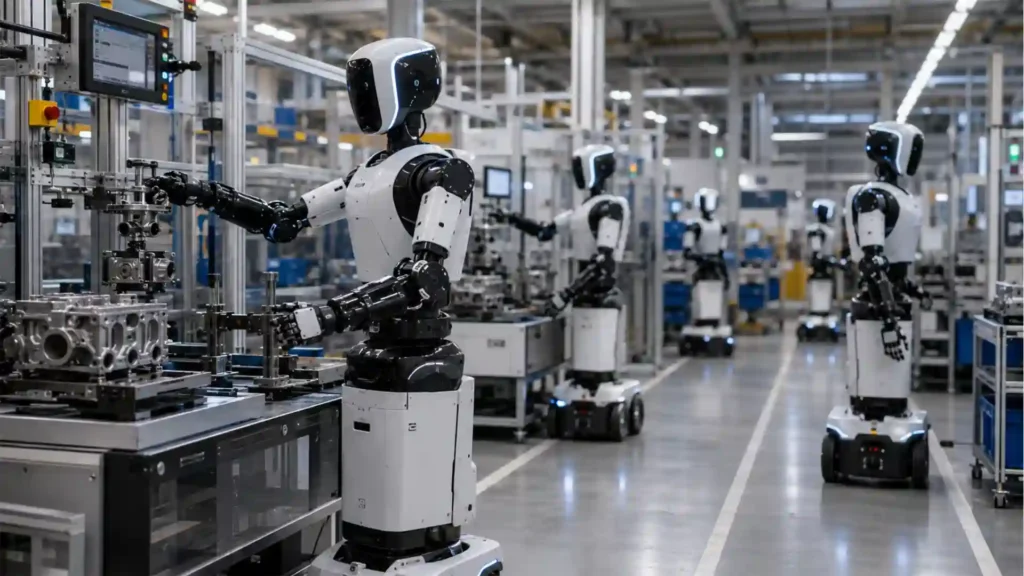
This article is an original analysis supported by the sources cited below
Humanoid secures landmark deal with Schaeffler to deploy thousands of humanoid robots
Humanoid’s official announcement of the Schaeffler deployment, RaaS model, German launch sites, 2032 scale target, and actuator supply agreement.
Humanoid to deploy up to 2,000 robots at Schaeffler plants
Reuters report with the estimated 1,000 to 2,000 robot range, initial deployment timing, German sites, and actuator supply details.
German firm to employ thousands of wheeled humanoid robots in factories under new deal
News report summarizing the Schaeffler-Humanoid agreement, RaaS structure, and KinetIQ fleet intelligence claims.
HMND 01 Alpha Wheeled
Humanoid’s product page for the wheeled HMND 01 platform, including height, weight, payload, run time, sensor package, end effectors, and mobile base information.
KinetIQ Humanoid’s AI stack overview
Humanoid’s technical overview of its four-layer KinetIQ architecture, covering fleet coordination, robot-level reasoning, VLA-based locomanipulation, and whole-body control.
Humanoid robotics Schaeffler enters into strategic partnership with Hexagon Robotics
Schaeffler’s official release on its Hexagon Robotics partnership, actuator platform, AEON integration plan, and humanoid robotics strategy.
Schaeffler sees humanoid robotics orders in three-digit million euros by 2030
Reuters report on Schaeffler’s expected humanoid robotics order book, global collaborations, customer contracts, and materials bill opportunity.
Schaeffler reports solid results for 2025
Schaeffler’s 2025 financial results, including revenue, EBIT before special items, division performance, and the company’s stated focus on humanoid robotics as a new growth area.
Merger of Vitesco Technologies Group AG into Schaeffler AG successfully completed
Schaeffler’s official release on the completed Vitesco merger, new corporate setup, business divisions, production footprint, and motion technology positioning.
Robot density surges in Europe, Asia, and Americas
International Federation of Robotics release with 2024 robot density figures for Western Europe, the EU, North America, Asia, and leading automation economies.
Europe’s auto industry installed 23,000 new robots
International Federation of Robotics release on 2024 automotive robot installations in Europe and the automotive sector’s role as the region’s strongest robotics customer industry.
Skilled Labour Report 2025/2026
DIHK report page describing Germany’s continuing skilled labor challenge despite weaker company staffing demand.
Shortage of skilled workers decreasing in Germany
ifo Institute survey data on the share of German companies reporting skilled worker shortages in early 2026, including industry and mechanical engineering figures.
Longer working hours
German Economic Institute report on demographic change, Germany’s shrinking labor force, and labor supply pressures.
Shortage of skilled workers
Institute for Employment Research explainer on Germany’s workforce decline, baby-boomer retirements, and skilled labor constraints.
AI Act
European Commission page explaining the EU AI Act, its risk-based structure, and its role in Europe’s AI policy framework.
Regulation 2023/1230/EU machinery
EU-OSHA page explaining the EU Machinery Regulation, its replacement of the Machinery Directive, and its coverage of autonomous mobile machinery, connected equipment, and AI-related safety functions.
ISO 10218-1:2025 Robotics safety requirements Part 1 Industrial robots
ISO page for safety requirements covering industrial robots as partly completed machinery, including safe design and risk reduction.
ISO 10218-2:2025 Robotics safety requirements Part 2 Industrial robot applications and robot cells
ISO page for requirements on industrial robot applications and cells, including integration, commissioning, operation, maintenance, and decommissioning.
Humanoid robots for BMW Group Plant Spartanburg
BMW Group report on testing Figure 02 humanoid robots in a real production environment at Plant Spartanburg.
Apptronik and Mercedes-Benz enter commercial agreement
Apptronik’s announcement of its Mercedes-Benz commercial agreement and potential Apollo use cases in logistics, assembly kit delivery, and inspection.
AI and humanoid robots
Mercedes-Benz page on testing Apptronik’s Apollo robots at the Digital Factory Campus Berlin and using humanoids for production support and intralogistics.
Digit moves over 100,000 totes in commercial deployment
Agility Robotics milestone report on Digit moving more than 100,000 totes in a live GXO logistics deployment.
The global market for humanoid robots could reach $38 billion by 2035
Goldman Sachs Research article on humanoid robot market forecasts, projected 2035 addressable market size, and shipment estimates.
Humanoid robot market expected to reach $5 trillion by 2050
Morgan Stanley Research article on long-term humanoid robotics market projections, industrial and commercial use, and adoption timing.
Scaling the humanoid robotics supply chain into billion-dollar wins
McKinsey analysis of humanoid robotics supply chain constraints, component strategy, China’s supply chain position, and Schaeffler’s actuator role.
Humanoid robots crossing the chasm from concept to commercial reality
McKinsey article framing the challenge of moving humanoid robots from pilots to commercial workplace value.
Function over flash specialized robots attract billions with efficient task handling
Reuters analysis of investor interest in task-focused robots and the commercial challenges facing general-purpose humanoid robots.
| Citing this article? Brief excerpts are welcome. Please credit Webiano.digital, name the author where stated, and include a link to https://webiano.digital and to this original article. Full or substantial republication requires prior written permission. Read our Copyright and Content Use Policy. |
This article was prepared with the assistance of artificial intelligence tools. The content underwent expert human review, and Webiano Digital & Marketing Agency assumes editorial responsibility for its final version and publication.