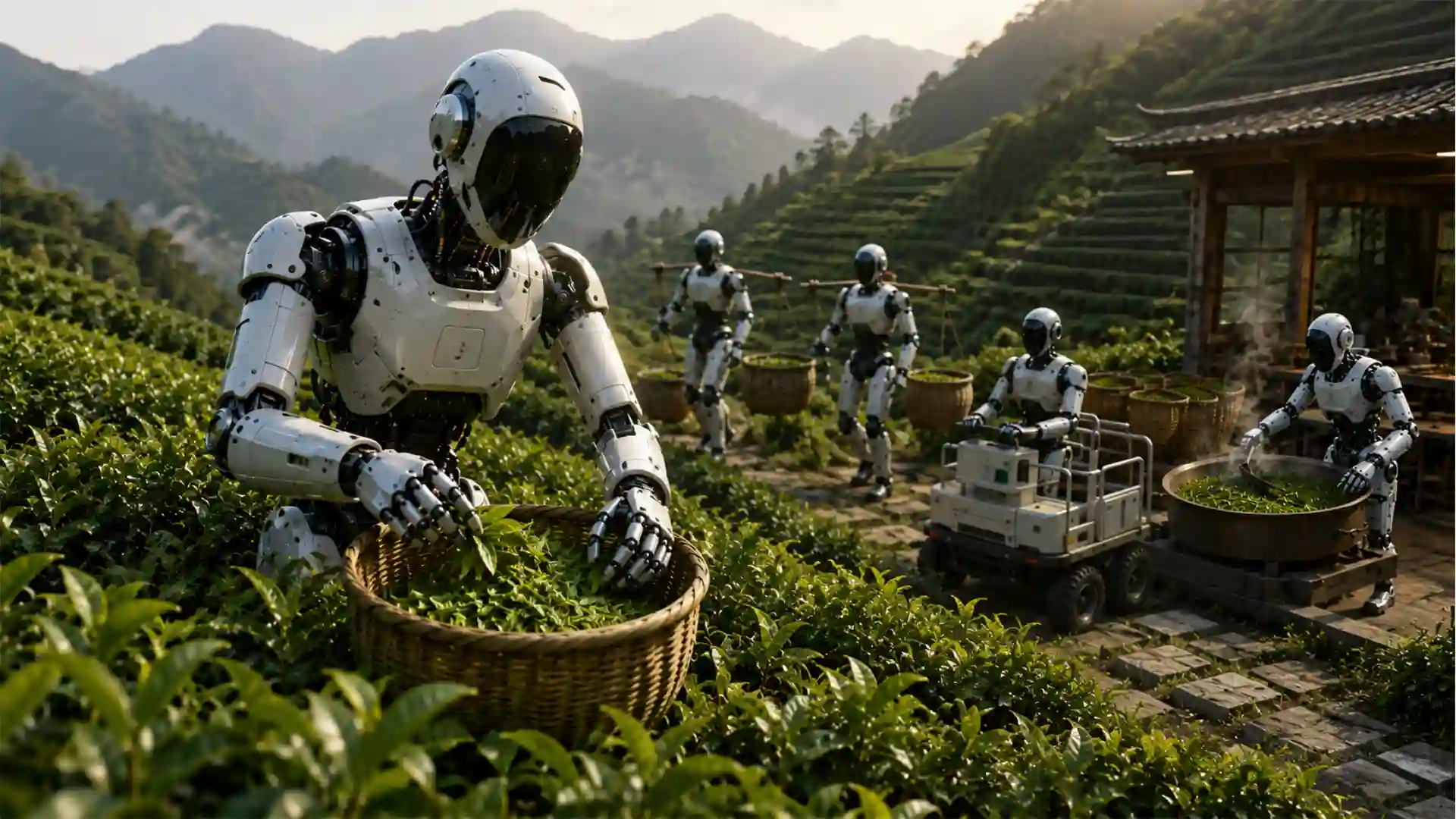
China’s humanoid robots did not walk into Fujian’s tea mountains as finished farm workers. They entered as machines being tested against leaves, slopes, heat, fragile materials and old human judgment. On May 10, 2026, humanoid robots worked with tea makers in Fuding, Fujian province, picking leaves, moving them through mountain paths, withering, roasting and pressing tea cakes. The machines completed the assigned tasks only after failures, and that detail matters. The demonstration was not proof that robots are ready to replace tea workers. It was proof that China is moving humanoid robotics out of the showroom and into production environments where weakness is harder to hide.
Table of Contents
A tea field became a harder test than a race track
A race track is not easy for a humanoid robot, but it is controlled in ways a tea mountain is not. The surface is planned. The goal is single-purpose. The robot moves forward, handles balance, manages heat, avoids collapse and reaches the finish. Fujian asked for a different sort of competence. The robots had to touch a living crop, carry material, shift between outdoor and indoor tasks, tolerate uneven ground, work near humans, and respond to the physical behavior of tea leaves as they changed during processing.
The scene was staged for public attention, but the work itself was not empty theatre. The official CCTV+ report described robots in Fuding carrying, holding, picking and roasting tea, with thermal imagery visible during the roasting process. The same report said the machines had trained for a week after participating in Beijing’s humanoid robot half-marathon, then entered a production base to work alongside people on leaf picking, transportation, withering, roasting and cake pressing. That chain of tasks matters because it moved the robot from motion display into material handling.
The field also exposed a problem that robotics companies often prefer to discuss in abstract language. Tea production is physical, seasonal and unforgiving. Fresh leaves bruise. Heat changes aroma. Over-handling can damage quality. Slopes make transport slow and tiring for people and unstable for machines. A humanoid robot that looks impressive during a choreographed run may still fail when asked to pinch a bud without crushing it or turn leaves in a hot roasting stage at the right pace.
Fang Hainan, a representative of a robot engineering team, gave the most revealing comment in the CCTV+ account. He said the real-world challenge enriched training scenarios and exposed “much room for improvement,” including problems in the finger area used for pinching. He also said the team would address those problems through product iteration. The quote is useful because it avoids the false certainty often attached to robotics demos. The fingers, not the headline speed, became the serious engineering story.
The robots ultimately finished their assigned tasks, but the wording in the report is just as useful as the accomplishment. CCTV+ noted repeated failures before completion. In robotics, especially agricultural robotics, failure is not a side note. It is the data source. A robot that falls, overheats, grips badly or hesitates in a real task produces information that a lab test may miss. That makes Fujian less like a product launch and more like a public field trial.
China’s robotics industry has already shown it can build machines that run faster, dance better and appear more stable than earlier models. Fujian asked a harder question. Can a humanoid robot use its body as a work instrument in a small, variable, high-skill production process? The trial did not fully answer yes. It did show the type of task that will decide whether humanoids become labor tools or remain expensive symbols of national technology ambition.
The Fuding trial in confirmed terms
The confirmed details are narrow but rich. The event took place in Fuding City, Fujian province, on May 10, 2026. It was connected to the promotion campaign for the 2026 World Humanoid Robot Games, scheduled for Beijing in August. The robots had taken part in the humanoid half-marathon in Beijing in April and then received one week of training for the tea task. They worked with humans on leaf picking, transportation, withering, roasting and cake pressing. The trial was presented as the first time humanoid robots had tested those training results in an actual tea production environment.
Local reporting from Fuding added detail about the participating teams and setting. The “energy relay” activity for the 2026 World Humanoid Robot Games began in Fuding on the morning of May 10, with teams linked to Beijing-based robotics groups, Unitree Technology, the Beijing Humanoid Robot Innovation Center’s Tiangong line and Honor’s Lightning robots. The robots challenged the full tea-picking and tea-making process at a production site provided by Dingbai Tea, a local tea company. The mix of municipal government, state media, robotics companies and a real tea enterprise made the event both a technology showcase and an industrial policy signal.
The same local account said the robots used flexible fingers to pick tea leaves, spread leaves gently during the drying stage, and turned tea leaves at a steady speed during charcoal roasting. It also quoted Fang Hainan saying that entering a real tea environment was a rare opportunity because the team could not know, from outside the task, how rough the mountain road would be or how high workshop temperatures would affect the robot. That is a valuable admission. Simulation can prepare a robot for many patterns, but it often misses the messy coupling between terrain, temperature, material and operator behavior.
A separate CCTV News report, republished by Tencent, framed the Fuding work as the domestic first stop of the 2026 World Humanoid Robot Games energy relay. It described humanoid robots collaborating with people in a core white-tea producing area, participating in picking, transferring, drying, charcoal baking and cake pressing while collecting data for practical deployment. Data collection was not a secondary benefit. It was one of the explicit purposes of the trial.
The confirmed story is therefore not “China replaces tea workers with robots.” That is too large and too early. The confirmed story is more specific: China put humanoid robots into a real, heritage-linked tea production chain in Fujian, made them perform work with humans, recorded their performance and failures, and tied the exercise to a national push to make humanoid robots more autonomous, dexterous and practical. The difference is not semantic. It separates news analysis from promotional exaggeration.
The location also matters. Fuding is not merely a scenic place where robots happened to appear. It is associated with white tea, mountain cultivation, craft processing and rural industry. If robots can work there, even in limited ways, the use case carries more meaning than a lab bench demo. If they cannot work there reliably, the failures expose the gap between humanoid robotics rhetoric and commercial field work.
The task chain mattered more than the spectacle
The most useful way to read the Fujian demonstration is through the task chain. Each stage tested a different part of the humanoid robotics stack. Leaf picking tested hand-eye coordination, finger force, plant perception and judgment about which leaf to touch. Transport tested gait, load balance and path adaptation. Withering tested soft spreading and distribution. Roasting tested heat tolerance, repeatable motion and thermal sensing. Cake pressing tested controlled force and placement.
A single robot demo often hides weakness by narrowing the task. The Fuding trial made that harder. A robot that handles transport may still fail at picking. A robot that can turn leaves in a pan may be poor at deciding which tender shoot is usable. A robot that can move in a workshop may stumble on a wet mountain path. Tea production forced the machines to switch modes, and switching modes remains one of the hardest parts of useful robotics.
Fuding tea tasks and the robot capability being tested
| Tea production stage | Robot capability under pressure | Main weakness exposed |
|---|---|---|
| Picking leaves | Finger control, plant perception, gentle pinching | Damaging leaves or missing the right target |
| Mountain transport | Biped balance, load carrying, rough-terrain walking | Slipping, energy drain, slow recovery |
| Withering and spreading | Soft contact, even distribution, repeatable arm motion | Uneven handling and poor material feel |
| Roasting | Thermal monitoring, heat tolerance, timing, human coordination | Overheating and weak process judgment |
| Cake pressing | Force control, positioning, stable handling | Inconsistent pressure and alignment |
The table shows why the demonstration was more demanding than a short robot performance. Each tea task used a different failure mode as a test instrument. A commercial system would need to pass many of them in sequence, not as isolated tricks.
The chain also explains why humanoid form is both attractive and questionable. Tea production spaces are built around people. Steps, baskets, benches, pans, trays and workshop layouts assume human bodies. A humanoid robot can, in theory, use those spaces without redesigning the entire farm or factory. It has arms where people have arms, hands where people use hands, and legs that fit paths built for workers rather than wheeled platforms.
That is the argument for humanoids. The counterargument is cost and complexity. A wheeled robot, drone or fixed automation cell may perform one stage better and cheaper. Xinhua reported in March 2026 that West Lake Longjing producers were using drones to move fresh tea leaves down the mountain in minutes, while a digital factory with more than 300 machines and 12 production lines could run processing work with only six monitoring workers. That is not humanoid robotics; it is task-specific automation. It may be the stronger near-term model for many tea producers.
Fuding’s humanoid trial should be judged against that reality. The robot does not need to be better than a human in every motion. It must be better, cheaper or safer than the mix of humans, drones, conveyors, fixed machinery, machine-vision pickers and handheld tools already available. The trial’s strongest result may be that humanoids can gather useful data across the entire chain, not that they are ready to own the chain.
Picking tea tested fingers before intelligence
Picking tea looks simple only to someone who has never watched it closely. A picker is not grabbing a standardized object from a flat surface. The target is small, flexible, partly hidden and easy to damage. Buds and young leaves may sit near older leaves on the same branch. The picker’s decision changes with season, product grade, weather, plant health and tea style. The hand motion has to be gentle but decisive.
China Daily’s 2025 report on spring tea harvest robots in Zhejiang made the difficulty plain. It said new tea growth can look much like older leaves and noted that early spring buds may be only about two centimeters long, with petioles just a few millimeters in length. The same report said tea-picking robots use image data to identify buds and leaves, and cited a machine that could handle the workload of about 1.5 human workers. Even specialized tea-picking machines remain measured against human selectivity and speed, not against abstract robot capability.
The humanoid version of this problem is even harder. A specialized picker can be designed around one plant geometry and one harvesting motion. A humanoid hand has to handle many contact types. In Fuding, the engineering team identified pinching-finger problems. That is not a small defect. Pinching is the link between perception and product quality. If the robot sees the right leaf but pinches at the wrong angle or with the wrong force, the task fails commercially even if it looks close on video.
Dexterous manipulation research supports this point. A 2025 Frontiers in Robotics and AI survey described dexterous manipulation as a highly complex challenge for humanoid robots because it involves high-dimensional control, complex kinematics, contact dynamics, limited training data and shifts between training and real-world conditions. The tea leaf is a small object, but the control problem is large.
Human tea pickers solve part of the problem through touch, habit and micro-adjustments. They feel resistance, adjust finger placement, avoid bruising and maintain rhythm across many plants. A robot needs sensors, hand design, control software and training data to approximate that judgment. Vision alone is not enough. A camera may identify the target, but it does not automatically produce the correct pinch.
The Fuding trial’s finger issue therefore carries more weight than a casual reader might notice. It points to the main bottleneck in humanoid labor: the body is not useful without contact intelligence. A robot may navigate a field, find a worker, carry a basket and turn its head convincingly, yet still fail at the tiny contact event that creates economic value. In tea, the business value begins at the fingertip.
Mountain transport exposed the balance problem
Transporting tea on mountain roads may sound like the simplest stage in the chain. It is not. A humanoid carrying leaves must manage its own weight, the load, slope angle, loose surfaces, path irregularities and changing center of mass. A basket is not a fixed industrial payload bolted to a robotic arm. It shifts. Leaves settle. The robot’s steps transmit motion into the load, and the load pushes back into the robot’s balance system.
CCTV+ said transporting tea on mountain roads improved robots’ motion-control capability on rough terrain. That phrase is easy to skim, but it names one of the most commercially relevant lessons from the trial. Real production paths are not robot-friendly by default. They include narrow turns, broken surfaces, damp soil, stones, steps, drainage channels and people moving unpredictably.
The Beijing half-marathon created confidence in robot locomotion, but a mountain transport task is different from a race. Running rewards speed and stride stability. Transport rewards slower balance, recovery, load control and safe interaction. A fast humanoid with long legs and cooling systems may still be poorly suited to carrying fragile agricultural material through sloped paths.
The local Fuding account included a revealing detail: Fang Hainan said the team would not have known the high demands of rugged tea mountain roads without entering the picking environment. The comment matters because it points to a gap between assumed and actual operating conditions. Many robotics projects fail not because the core model is weak, but because the deployment site contains a hundred small frictions not present in the lab.
A wheeled platform might do better on a prepared road. A drone might do better on short downhill transport. A conveyor might work inside a plant. The humanoid only earns its place if it can move through spaces originally designed for human workers without large reconstruction costs. That is the premise behind humanoid robots for production. It is also the source of their risk. Human-built spaces are compatible with human bodies, but they are not automatically safe for machines with limited recovery skills and expensive components.
Balance in tea transport is therefore not a novelty. It is an economic filter. If a robot falls with a load of fresh leaves, the immediate loss may be small. The bigger loss is downtime, repair cost, safety concern and loss of operator confidence. A robot that needs constant rescue becomes another worker’s burden. Fujian’s mountain paths tested whether humanoids can reduce labor or merely redistribute labor into supervision and recovery.
Thermal imaging moved the robot into process control
The roasting stage made the demonstration more serious. Picking and carrying test movement. Roasting tests process control. CCTV+ reported that robots used a thermal-imaging real-time monitoring system during roasting to support precise temperature control for a delicate process. Video metadata described a robot roasting tea with a human while thermal imagery showed tea during the roasting process.
This is where the story moves beyond the visible humanoid body. Thermal imaging is not a humanoid feature. It is a sensing layer that could be used by a fixed machine, a robotic arm or a human assistant. Its use in the Fuding trial suggests that the robot’s future value may come less from looking human and more from combining human-like reach with machine sensing. The most practical robot in a tea workshop may be the one that sees heat better than a person while still moving through human workstations.
Tea roasting is not only about hitting a number. Temperature distribution, timing, leaf moisture, movement speed and operator judgment interact. A thermal camera can read surface heat patterns, but quality decisions require a model of what those heat patterns mean for the product. A robot must connect thermal data to action: turn the leaves, slow the motion, pause, withdraw, alert a human or adjust the process. The Fuding trial showed the sensing layer, but not enough public evidence to claim full autonomous process judgment.
Still, thermal imaging is a plausible near-term use. Many craft industries already rely on skilled workers to interpret heat, smell, texture and timing. A robot or sensor system that provides consistent heat mapping could reduce variation even before the robot can run the full process alone. In that sense, thermal control may commercialize earlier than humanoid autonomy. A tea maker might accept a tool that helps monitor roasting long before accepting a machine that decides the whole roast.
The workshop also creates a heat problem for the robot itself. The local Fuding report quoted Fang saying that entering the tea workshop revealed high temperature conditions and overheating problems. This is a useful reminder that thermal control runs in two directions. The robot monitors heat in the leaves, but its motors, batteries, sensors and electronics must also survive the environment.
That dual thermal problem will matter in many real deployments. Kitchens, foundries, greenhouses, warehouses, mines, outdoor farms and rescue scenes all stress machines. A robot designed for a comfortable demo hall may behave differently in heat, humidity, dust or smoke. Fujian’s roasting step therefore tested not only tea quality but robot endurance.
Withering and spreading asked for soft contact
Withering and spreading sound calm compared with mountain transport or roasting, but they reveal another layer of difficulty. Tea leaves need to be spread with care. Too thick a layer can change moisture loss. Rough handling can bruise material. Uneven distribution can alter downstream processing. A worker’s hand makes constant small adjustments because the leaves are flexible, tangled and variable.
The Fuding local report said robots opened and closed their palms to spread leaves gently and evenly during the drying stage. The language is promotional, but the task is real. Soft contact with irregular organic material is one of the dividing lines between industrial automation and field-ready robotics.
Industrial robots have long worked well where parts are rigid, positions are defined and repeatability matters more than improvisation. Tea leaves are not like bolts, circuit boards or car parts. They bend, fold, stick, overlap and vary in moisture. A robot spreading leaves must decide not only where to place its hand but how much pressure to apply and when to stop. A human worker may not verbalize those decisions; the body learns them.
Research on agricultural robot hand-eye coordination explains why this is hard. A 2025 Engineering review noted that agronomic targets are living organisms with diverse growth patterns and physical traits, and that robots handling complex agricultural operations face unevenly distributed targets, irregular and overlapping growth patterns, fragility, and the need to mimic human gentleness. Tea withering is exactly the kind of task where force, perception and material behavior cannot be separated.
Withering also complicates the idea that automation means one robot doing one action. The robot may need to observe leaf distribution, move material, recheck the surface, coordinate with airflow or sunlight, and adapt to volume. It may work best not as an independent tea master, but as a mobile assistant that performs tiring repetitive spreading while a human oversees quality.
That hybrid model is more believable than full replacement. A human worker retains product judgment. The robot takes over a subset of repeatable motions. Sensors provide information that humans cannot easily measure at scale. The tea producer gains consistency without surrendering craft identity. The early value may lie in co-working, not autonomy for its own sake.
Cake pressing turned craft into repeatable force
Cake pressing tested a different form of control. Instead of delicate pinching or soft spreading, pressing asks for force, alignment and consistency. Tea cakes need material placed correctly, pressure applied evenly and shape maintained. A humanoid robot’s arms and hands may be useful here because the task resembles human workshop labor more than open-field harvesting.
Yet force control is not trivial. Too little pressure gives poor form. Too much pressure can damage material or alter product behavior. Misalignment creates waste. The robot must handle a deformable mass, apply pressure through a tool or mold, and maintain stability during the action. Pressing is a reminder that craft is often a sequence of force decisions.
The CCTV+ report included cake pressing as one of the production stages in the Fuding trial. It did not provide detailed performance metrics for this stage, which limits any strong claim about quality. The absence of metrics is itself important. Public demonstrations often report task completion but not yield loss, consistency, processing time, product grade or human intervention rate. Those are the numbers a tea producer would need before buying a system.
Cake pressing may become easier to automate than picking because the environment is more structured. The leaves have already been collected and processed. The workspace can be arranged around the robot. Fixtures, molds and guides can reduce uncertainty. If humanoids find early roles in tea production, controlled workshop tasks like pressing may arrive before high-quality autonomous picking on slopes.
The same logic appears across robotics. Full autonomy in an uncontrolled outdoor environment is hard. Semi-structured indoor tasks are easier. A humanoid may move from warehouse handling to factory inspection, hotel support or hospital delivery before it can perform delicate agricultural harvesting at commercial speed. The 2026 World Humanoid Robot Games themselves use scenario-based events in factories, hotels, homes, emergency sites, hospitals and retail spaces, which tells us where organizers see practical testing grounds.
Pressing tea cakes therefore matters less as a single task and more as a deployment pattern. It is a bridge between craft and mechanization. A robot can learn force profiles, human demonstrations can be recorded, and the workspace can be made safer. The closer a task is to a stable workstation, the sooner humanoid robots may become useful.
The failures were part of the result
The most honest line in the Fuding coverage was not about success. It was about failure. CCTV+ said the humanoid robots ultimately finished their assigned tasks despite repeated failures. That phrase gives the demonstration credibility because it admits what real operators need to know: robots still fail in production environments.
Failure in a demo can mean many things. The robot may fall. It may miss a leaf. It may grip the wrong material. It may overheat. It may need a human engineer to adjust its settings. It may complete a task too slowly. It may finish the motion but produce tea that does not meet a quality threshold. Public reports did not quantify those failures, so the analysis must stay careful. Completion is not the same as commercial readiness.
The distinction matters because robotics hype often treats a visible action as proof of deployment. A robot picking one leaf is not the same as harvesting a morning’s production. A robot roasting with a human is not the same as running a batch repeatably under production pressure. A robot carrying tea once is not the same as moving loads all day without human rescue.
The first World Humanoid Robot Games in 2025 offered a similar lesson. AP reported that more than 500 humanoid robots from 280 teams competed in Beijing, but the opening ceremony also included a robot model that fell and had to be carried off by two people. Other robots performed, scored, fell and recovered. The contrast between spectacle and fragility has become part of the public story of humanoids.
Fujian made that contrast more consequential. A robot falling on a stage is embarrassing. A robot failing in a production line creates cost. A robot that mishandles leaves may damage inventory. A robot that overheats in a roasting workshop may interrupt a time-sensitive process. A robot that requires constant engineer attention may not reduce labor at all.
The useful question is not whether the robot failed. It is whether the failure generated data that improves the next version. The Fuding reports say motion capture and other data collection were part of the exercise. That makes sense. For humanoid robotics, each difficult production scenario becomes a training environment. The field trial is both a performance and a data-mining operation.
Motion capture made the field a training lab
CCTV+ reported that engineers used motion capture to collect data and improve flexible control of a five-finger dexterous hand. That detail is central to the trial. It means the robots were not merely demonstrating learned skills; the event itself fed future training.
Motion capture has two roles in this setting. It can record how human tea makers move, giving robots a reference for hand trajectory, wrist angle, force timing and body posture. It can also record how robots move and fail, giving engineers evidence of mismatch between intended and actual behavior. A tea mountain becomes a sensor-rich classroom for embodied AI.
Embodied AI is the idea that intelligence must be learned and expressed through a body acting in the physical world. For text or image software, failure may be a wrong answer or misclassification. For a humanoid robot, failure has mass, momentum, heat, friction and repair cost. That makes data from real tasks more valuable and more expensive.
The February 2026 release of China’s first national standard system for humanoid robotics and embodied AI shows that policymakers are treating the field as a full industrial chain. Xinhua said the system covers basic commonality, brain-like and intelligent computing, limbs and components, complete machines and systems, application, safety and ethics. It also said application standards cover development, operation and maintenance across scenarios. The Fuding trial sits exactly inside that shift from prototype to scenario-governed deployment.
Motion capture also raises a cultural and labor question. If human tea makers’ motions are recorded to train robots, their craft knowledge becomes data. That data may improve robot products owned by technology companies. The worker’s skill is then partly extracted into a model, a hand controller or a motion library. There is economic value in that transfer. It deserves attention, especially in heritage industries where craft identity is part of the product.
This does not mean robots should be rejected. It means the data relationship should be visible. Farmers, tea companies, local governments and robot firms will need clear agreements about who owns production data, who benefits from craft digitization and how human expertise is credited. The robot learns from the worker before it ever competes with the worker.
Fuding was not a random backdrop
Fuding gives the robot trial cultural and industrial weight. Fujian’s provincial government describes Fuding white tea production technique as a national intangible cultural heritage item under the traditional craft category. It says white tea originated in Fuding, with tea gardens around the Tailao Mountain range spanning 17 townships, and that production involves processes such as withering, piling, drying, sorting, baking and packaging.
The FAO’s Globally Important Agricultural Heritage Systems page for the Fuding White Tea Culture System describes centuries-old white tea cultivation that blends ecological knowledge and craftsmanship, with tea gardens integrated with forests and crops. FAO notes the system’s living agricultural heritage, local biodiversity, rural livelihoods and distinctive processing method centered on natural withering. That means the robot trial entered a place where production is inseparable from identity.
This matters for interpretation. A robot in a generic warehouse is judged mostly on output. A robot in Fuding’s white-tea chain is judged on output, damage, cultural fit, product quality, worker acceptance and whether automation weakens or protects the story behind the tea. A premium agricultural product is not only a commodity. It is origin, method, reputation and trust.
The local Fuding report said the city has about 320,000 mu of harvestable tea gardens and that the tea industry is a pillar of rural revitalization. It also said Fuding has explored technology in ecological planting, digital traceability and intelligent manufacturing. The robot trial therefore fits a local strategy of adding technology to a heritage industry rather than treating tradition and automation as opposites.
The risks are real. A heritage product can lose value if consumers believe machines flatten the craft. A region can gain value if technology protects quality, reduces labor strain and strengthens traceability. The difference depends on how automation is introduced. A thermal sensor that helps a tea master avoid batch variation may be accepted. A robot marketed as replacing tea makers may trigger resistance.
Fuding is also a useful test because its terrain and craft make automation difficult. A successful demo there carries more credibility than one in a clean industrial booth. A failed demo there teaches more than a polished video. The mountain is not decoration. It is the test bench.
White tea’s craft makes automation less forgiving
White tea is not processed like a fully standardized industrial product. The official Fujian description says Fuding white tea is lightly fermented and uses a process involving no frying or rolling, with moderate natural oxidation that preserves active enzymes and polyphenols. It lists withering, piling, drying and sorting among core techniques and notes that temperature variations affect processing methods.
European geographical indication documentation for Fuding Bai Cha also describes white tea as native to Taimu Mountain in Fuding, using specific tree varieties and a process involving withering and drying without frying or kneading. The document identifies the protected name as Fuding Bai Cha, translated as Fuding White Tea. The origin rules and method details mean automation must respect process identity, not only throughput.
For robotics, this creates a quality-control puzzle. Automation is attractive because it can repeat motions and measure conditions. Craft products depend on adaptation. Tea makers respond to weather, moisture, leaf tenderness and subtle sensory cues. If a robot repeats yesterday’s process on today’s leaves, consistency may become rigidity.
This is why thermal imaging is useful but incomplete. Heat maps tell one part of the story. Moisture, oxidation, aroma and tactile feel tell other parts. A robot that monitors temperature may reduce one source of variation, but it does not automatically replace the human sense of readiness. The strongest near-term system may pair machine measurement with human judgment.
White tea also shows why the term “humanoid robot” can mislead. The humanoid body is visible; the process knowledge is less visible. Commercial value will depend on the invisible layer: models trained on leaf state, quality outcomes, expert interventions, motion patterns and environmental conditions. Without that layer, the robot is a body performing gestures. With it, the robot becomes part of a process-control system.
There is a second commercial point. Premium tea often sells through narrative. Consumers pay for origin, season, hand skill and trust. A producer that uses robots will need to decide how to explain that choice. “Robot-made tea” may sound futuristic to some buyers and damaging to others. “Robot-assisted thermal monitoring under human tea master supervision” may preserve more trust. The wording will matter because the market for heritage food is sensitive to authenticity.
Fuding’s robot trial therefore invites two judgments at once. Engineers ask whether the robot can perform the work. Tea producers ask whether the work remains Fuding white tea in the eyes of buyers. The technical pass mark and the market pass mark are not the same.
China is turning robot sports into industrial testing
The Fuding trial was tied directly to the 2026 World Humanoid Robot Games. Beijing’s official English site says the second Games will run from August 22 to 26, 2026, at the National Speed Skating Oval, with 32 events split between competitive events and scenario-based events. It names track and field, soccer and street dance in the competitive category, along with housekeeping, firefighting and retail assistance in scenario-based events.
CGTN reported that the Games would feature more than 30 events showing embodied intelligence and fine manipulation. It also said scenario-based contests would include factories, hotels, homes, emergency response sites, hospitals and retail spaces. The format makes the Games less like a pure sports contest and more like a public testing program for humanoid capabilities.
This explains why tea production became part of the promotion campaign. A sports event builds public attention. A tea trial gives the technology a local production story. Together, they turn humanoid robots into national industrial theatre with real data benefits. The robots are not only entertaining viewers; they are being pushed through tasks that reveal weaknesses.
China has used public demonstrations before to accelerate technology narratives, from high-speed rail to electric vehicles and drones. Humanoid robots now sit in that same communication pattern. The difference is that humanoids are more fragile in public. They fall. They stall. They need help. That fragility may actually help the sector if it keeps expectations closer to reality.
The Beijing Games also show a shift in what counts as progress. A robot running fast is visually easy to understand. A robot folding clothes, preparing food, extinguishing fire or moving through a factory is harder to score but closer to labor value. The Fuding trial belongs to the second category. It asks whether the humanoid body can do work that people already do in spaces already built for people.
There is also a policy dimension. Events produce rankings, standards, press attention and investor interest. They create common tasks that companies can compare against. They push teams to solve practical problems by a deadline. The risk is that companies tune for competition rather than production. A robot that wins a scenario event may still be far from dependable use in a factory or farm.
For now, the Games and the tea relay should be read as part of China’s attempt to move humanoids through three stages: spectacle, benchmark and deployment. Fujian suggests that the benchmark stage is becoming more grounded. It is still public relations. It is also practical stress testing.
The half-marathon explains the confidence behind the tea trial
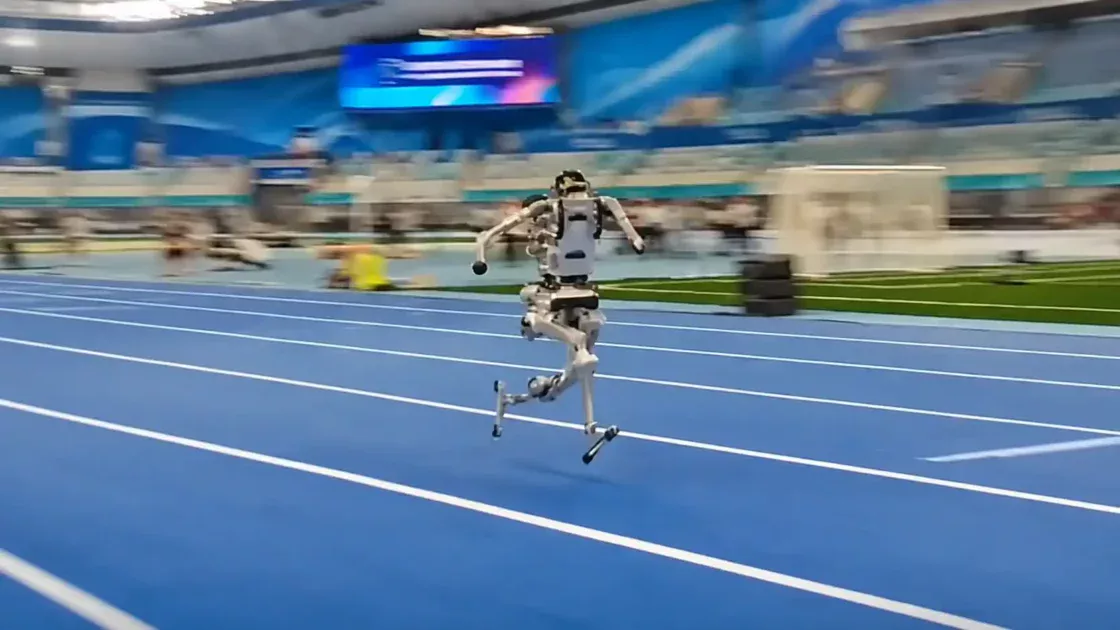
The robots sent to Fuding had a public backstory. They had participated in the humanoid robot half-marathon in Beijing in April 2026. That race produced headlines because Honor’s robot finished the 21-kilometer course in 50 minutes and 26 seconds, faster than the human half-marathon world record. Reuters reported that the number of participating robot teams grew from 20 to more than 100 from the previous year, that nearly half navigated autonomously, and that robots and about 12,000 human runners used parallel tracks to avoid collisions.
AP reported the same winning time and said Beijing E-Town stated about 40 percent of robots navigated autonomously while others were remotely controlled. AP also noted a large improvement from the previous year, when the winning robot took 2 hours, 40 minutes and 42 seconds. The half-marathon showed dramatic progress in locomotion, endurance and thermal design. It did not prove the robots could work.
The Fuding trial is best seen as the next question after the race. If a robot can run, can it carry? If it can balance at speed, can it balance on a mountain path with a load? If it can manage motor heat on a track, can it operate in a roasting workshop? If it can navigate a course, can it understand a production task? The answer in Fujian was mixed, and mixed is the only honest answer.
The marathon also reveals how different robot skills transfer. Running develops actuation, cooling, battery management, structural reliability and balance recovery. Those capabilities matter in production. But tea work adds perception, manipulation, material handling and human coordination. A long-legged racing robot may not be the right body for a tea workshop. A slower, more stable machine with better hands may be more useful.
Du Xiaodi, an Honor engineer, told Reuters that running faster may not seem meaningful at first, but it supports technology transfer into structural reliability, cooling and industrial applications. The statement is plausible. It also needs limits. Transfer from racing to tea is partial. The legs may transfer better than the hands. The cooling may transfer better than the craft judgment.
This is why the Fuding result is more instructive than the race result. A race compresses evaluation into one number: time. Tea production requires many scores that public reports did not provide: successful picks per hour, damage rate, human intervention rate, energy use, overheating incidents, batch quality, cleaning time, safety incidents and maintenance cost. Until those numbers appear, the demonstration remains early evidence rather than a commercial case.
Factory robots are not the same problem
China is already the world’s largest industrial robot market, but that does not make humanoid tea workers easy. The International Federation of Robotics reported that 542,000 industrial robots were installed globally in 2024, more than double the number from ten years earlier. It said China represented 54 percent of global deployments in 2024, with 295,000 industrial robots installed and an operational stock above 2 million units.
IFR’s 2026 robot-density release made the scale even clearer, saying around 2 million industrial robots were operating in China and that 54 percent of all robots installed worldwide in 2024 were deployed there. China’s factory-robot strength gives it supply chains, talent and policy momentum. It does not erase the difference between a factory cell and a tea mountain.
Industrial robots thrive in controlled settings. The part arrives where expected. Lighting is controlled. Safety cages or collaborative rules define human interaction. Objects are rigid and repeatable. If the process varies, engineers redesign the line to reduce variation. Agriculture works the other way. The environment changes, the object changes, the task changes, and the robot must absorb more uncertainty.
Humanoid robots promise to bridge that gap because they use a human-like body in human-centered spaces. But the more human-like the robot becomes, the harder the control problem becomes. Two legs are harder than wheels. Five-finger hands are harder than parallel grippers. Whole-body balance while manipulating soft material is harder than a bolted arm moving along a programmed path.
This creates a tension in China’s robotics strategy. The country’s factory automation base can lower component costs and speed manufacturing. Servo motors, reducers, sensors, batteries, controllers and machine-vision systems all benefit from large industrial ecosystems. Yet the tea task requires more than cheaper components. It requires embodied learning in messy settings.
The Fuding demonstration sits at the border between these worlds. It borrowed from China’s industrial robotics base but entered an agricultural craft process. That is why it drew attention. The robots were not showing that factory automation had arrived in tea. They were testing whether the next robotics layer can survive outside the factory logic.
Humanoid robots carry a costly promise
Humanoid robots attract attention because they appear general-purpose. A human-shaped machine might, in theory, walk into workplaces designed for people and perform many tasks without rebuilding everything. That is the dream behind the current wave of humanoid investment. In tea production, the dream is obvious: one robot could pick, carry, spread, roast, press, clean and assist workers across the day.
The cost problem is just as obvious. A general-purpose robot is expensive to build, hard to train and difficult to maintain. A machine built only to carry baskets may be cheaper. A drone may transport fresh leaves faster. A fixed roasting machine may control heat better. A conveyor may move material at lower cost. A specialized gripper may pick a specific tea standard more reliably than a humanoid hand.
The commercial question is therefore not whether humanoids can perform a task once. It is whether their flexibility outweighs their cost. Humanoids make the most sense where the same body can perform many useful tasks in a place that cannot easily be redesigned. Fuding’s tea environment fits the argument in some ways: slopes, workshops and heritage spaces are built around people. Yet it also challenges the argument because every task has quality demands.
China’s policy push adds another layer. Reuters reported in 2023 that China’s industry and information ministry issued guidelines for humanoid robotics and aimed for an innovation system by 2025. China Daily’s Xinhua-based report said the guideline placed humanoid robots within China’s push to develop future industries.
Policy can lower risk for companies by creating funding, standards, test sites and public procurement. It cannot make a robot economically useful by decree. The machines must still survive production hours, justify maintenance, meet safety rules and produce measurable value. If humanoids cost far more than the labor they displace or support, adoption will remain limited to demonstrations, research facilities and flagship sites.
Fuding should therefore be read as both ambition and caution. The ambition is to place humanoids into work chains that matter to rural industry. The caution is that each tea stage reveals a cheaper alternative. The humanoid must compete not only with people, but with every simpler machine that solves one part of the problem.
The dexterous hand remains the bottleneck
The Fuding reports repeatedly return to the hand. Robots used flexible fingers. They pinched leaves. Engineers saw finger problems. Motion capture was used to improve flexible control of a five-finger dexterous hand. The hand is not a detail; it is the bottleneck.
Humanoid robots can look competent while walking and still be poor workers because most work happens through contact. The hand must grasp, release, push, pull, press, rotate, feel resistance, adapt to material and coordinate with the wrist, elbow, shoulder and body. Tea production multiplies the challenge because the material changes from living leaf to withered leaf to heated leaf to pressed cake.
A Frontiers review on dexterous manipulation notes that humanoids designed to operate in human environments need precise, adaptable and sample-efficient manipulation, yet real-world dexterous control faces high-dimensional action spaces, limited training data and shifts between training and deployment conditions. Fuding’s pinching problem is a textbook case of the gap between human-like hardware and human-like manipulation.
Agricultural manipulation adds a further burden. The Engineering review on hand-eye coordination says robots handling complex agronomic tasks must deal with irregular growth, overlapping targets and fragile materials. It also states that perception errors, low operating efficiency and lack of non-destructive safety remain major problems for current agricultural robots.
For tea, non-destructive handling is central. A crushed bud, bruised leaf or unevenly handled batch can reduce product value. The robot must not merely pick; it must pick without degrading the crop. That requires control at the edge of perception and touch. Vision tells the robot where the leaf is. Force sensing and control tell it how to touch. Experience tells it when the action is right.
The fastest path may be imitation learning from skilled workers. The robot records human motions, learns the pattern and then improves through trial. Yet imitation is not copying. Human fingers have soft tissue, nails, skin friction and sensory feedback. Robot fingers have joints, actuators, sensors and coverings. The same motion may produce different contact forces. The robot has to learn the intention of the hand, not only its shape in motion.
Agriculture punishes robots with disorder
Agricultural robotics has a long history of impressive prototypes and slow commercial spread. The reasons are not mysterious. Farms and plantations are less structured than factories. Plants vary. Light changes. Soil moves. Weather interferes. Workers, animals, equipment and natural obstacles share the space. Products are fragile and time-sensitive. A machine that works in one field may struggle in another.
A Wageningen University review of selective harvesting robotics identified three main challenges: variation, incomplete information and safety. It noted that agricultural robots work in uncontrolled environments with natural objects whose appearance, geometry and mechanical traits vary, and that cluttered environments create occlusion and partial observability. It also emphasized that produce and plants can be delicate and that robots must use a soft touch. The Fuding tea trial fits all three challenges.
Tea adds its own form of disorder. Slopes shape planting. Weather changes picking windows. Bud standards vary by product grade. Leaves overlap and hide each other. Processing conditions depend on humidity and temperature. Human workers bring tacit knowledge that is hard to write into rules. A robot entering this environment meets not one problem but a stack of small uncertainties.
This is why the demonstration’s repeated failures should not be surprising. A humanoid robot trained for a week was asked to perform a work chain that humans learn through repeated seasonal practice. Completion after failure is a start. It is not a proof of readiness.
The disorder also affects data. Training a robot in one Fuding tea base gives it knowledge of that site, those paths, those plants, those tools and those worker routines. Transfer to another mountain, another tea variety or another processing style may require more training. Agricultural deployment is rarely one model rolled out unchanged everywhere.
This does not make robotics pointless. It means the first commercial uses will likely be narrow and site-specific. A robot may work in a carefully prepared processing room before it works across open slopes. A sensor-assisted roasting tool may spread faster than a fully autonomous humanoid picker. A mobile robot may assist transport on improved paths while humans continue selective picking. The field will reward systems that accept agricultural disorder rather than pretending it is a factory.
Tea offers a cleaner target than many crops, but not an easy one
Compared with apples hidden in canopies, strawberries under leaves or peppers behind branches, tea has some advantages for robotics. The crop is usually low and reachable. The desired young leaves may be visually identifiable with enough training data. The harvest surface can be scanned. The product is small and light. Tea farms often follow rows or terraces, giving machines some structure.
Those advantages explain why tea has attracted robotic picking research and machine-vision systems. China Daily reported that Zhejiang tea robots use AI to identify tea buds and leaves through image data, and that researchers are also working on tea varieties more suited to mechanical harvesting. The future of tea automation may involve changing both the robot and the crop system.
Yet tea remains difficult because quality standards are fine-grained. The difference between an acceptable pick and a poor pick can be small. Timing is seasonal. High-grade teas may depend on selective hand picking. Terrain can be steep. Fresh leaves are delicate. Processing must happen quickly after harvest. A robot that is slow may miss the harvest window even if its accuracy is good.
Tea also has product tiers. Lower-grade or larger-leaf teas may be easier to mechanize. Premium spring teas may resist full robotic picking longer because buyers care about selectivity and handwork. The economic case will vary by product type. A humanoid robot may not first appear in the most premium picking stage. It may appear in transport, spreading, sorting, monitoring or packaging.
This staged adoption is more credible than a sudden robot takeover. Producers do not need a humanoid to replace every worker to gain value. A robot that reduces the hardest carrying tasks during peak harvest could matter. A thermal-monitoring system that reduces batch loss could matter. A semi-autonomous workstation that frees skilled workers for quality decisions could matter.
Tea is a good test because it is difficult enough to be meaningful and structured enough to be imaginable. If robots cannot make progress in tea, many other crops will be harder. If they do make progress, the path will still be uneven across crop type, terrain, grade and producer budget.
Labor shortage is the business case, not science fiction
The Fuding coverage repeatedly links humanoid robots to labor shortage. CCTV+ said the traditional tea-making industry revealed possibilities for using humanoid robots to solve labor shortages. The local Fuding account quoted a China Media Group representative saying Fuding was chosen because white tea is a local pillar industry with real labor needs.
This matters because robotics adoption is rarely driven by novelty alone. Producers buy machines when labor is scarce, costly, unsafe, inconsistent or unable to meet peak demand. Tea harvesting is seasonal and labor-intensive. Skilled workers may be older. Younger workers may prefer urban jobs. Weather can compress picking windows into short periods when labor demand spikes.
China Daily’s Longjing report said the average age of tea pickers in Longjing’s premium production area was 65, with labor shortage challenging reliance on manual picking. A Frontiers study on China’s agricultural labor force found that labor aging had an adverse effect on agricultural total factor productivity among farm households, working partly through reduced technological progress and lower resource allocation efficiency. Labor pressure gives agricultural robotics its strongest economic argument.
Tea is not alone. Agriculture across many countries faces aging workforces, seasonal worker shortages and rising labor costs. A 2015 study on tea harvesting machines in Taiwan stated that migration of rural labor, population aging, high wages and labor shortages created problems for the tea industry, and cited survey findings that harvesting used 87 percent of available tea labor while manufacturing used 5 percent. Taiwan is not Fujian, but the labor pattern is relevant to tea economies more widely.
The risk is that “labor shortage” becomes a slogan that hides practical economics. A humanoid robot must still cost less than the labor it replaces or the loss it prevents. It must work during peak season, survive storage or redeployment between seasons, and be repairable in rural areas. It must not require so many engineers that the labor problem simply changes shape.
A more likely near-term model is labor support. Robots perform carrying, monitoring, repetitive handling or dangerous hot-work assistance while skilled humans focus on selection and quality. The business case begins where robots reduce peak strain without asking producers to redesign the whole tea economy overnight.
Digital tea factories point to a mixed model
The most credible future for tea automation is not all-humanoid and not all-handmade. It is mixed. Drones move leaves where slopes slow people. Machine-vision pickers handle some standards. Digital factories process larger volumes. Thermal systems monitor heat. Humans supervise quality and handle high-grade work. Humanoids enter where a human-shaped mobile body has a clear advantage.
Xinhua’s 2026 report on Longjing tea described a nearly 7,000-square-meter digital factory with more than 300 machines across 12 production lines. It said the process runs from withering and pan-firing to sorting, blending, air separation and packaging, and that only six workers are needed to monitor operations and adjust parameters. It also reported that a roasting workshop could produce 750 kilograms of finished tea per day, compared with about half a kilogram per day by a skilled tea master.
That factory example is crucial because it shows automation already moving through tea without humanoid robots. Fixed machines can process volume at a scale no humanoid can match. Drones can move leaves down mountains faster than foot transport. Specialized systems can be cheaper and more reliable than general-purpose robots. Humanoid robots will have to fit into an automation ecosystem that already has stronger tools for many tasks.
This does not make the humanoid irrelevant. Fixed factories are capital-heavy and may suit larger producers. Many rural sites have mixed spaces where full automation is hard. A humanoid that can move among existing tools, carry trays, load machines, take sensor readings, clean work areas and assist humans could fill gaps between fixed automation islands.
The best analogy may be the shift from single-purpose farm machines to fleets of complementary tools. A tea producer might use drones for transport, fixed machines for processing, sensors for quality monitoring and mobile robots for flexible handling. Humanoids would compete for the flexible-handling layer. They would not replace every other machine.
Fuding’s trial therefore should not be read as “humanoids versus traditional tea.” It is better read as “humanoids entering a broader digital tea system.” The question is whether they become useful nodes in that system or remain ceremonial visitors.
Thermal control may matter before full autonomy
The most commercially realistic part of the Fuding trial may be thermal monitoring, not humanoid labor. Roasting and baking depend on heat control. Errors can affect aroma, moisture and quality. Thermal imaging offers a way to make heat visible, recordable and comparable across batches. A robot using that information is interesting, but a human using that information may be useful sooner.
This pattern appears often in automation. The sensor layer arrives before the autonomous robot. Farmers adopt yield maps before autonomous tractors. Warehouses adopt scanners before full robotic picking. Factories adopt machine vision before fully flexible robot cells. Tea producers may adopt thermal maps, moisture sensors and digital records before humanoids run the line.
A thermal system that helps a tea master make better decisions may face less resistance than a robot claiming to replace the tea master. It also offers clearer value: fewer ruined batches, better consistency, more traceable processing and training support for less experienced workers. The humanoid body can later act on the sensor output if the control system proves reliable.
CCTV+ described the thermal-imaging real-time monitoring system as helping achieve precision temperature control during roasting. The public report does not tell us whether the robot made autonomous decisions from that data or whether humans interpreted it. That distinction is central. A monitoring system is not the same as closed-loop autonomous process control.
The Fuding local report also noted overheating concerns in the workshop. That creates a practical engineering trade-off. The robot may need cooling to survive the environment, which increases weight, cost and energy use. A fixed thermal camera, by contrast, is simpler. The humanoid must justify why its body needs to be near the heat at all.
One answer is manipulation. If the same machine that reads heat can also stir, turn or reposition leaves, it may reduce delay between sensing and action. Another answer is flexibility: the robot can move between workstations. But these advantages must be proven against simpler installations. Thermal intelligence will likely reach tea production before fully autonomous humanoid roasting.
Quality, safety and liability still need rules
A humanoid robot in a tea workshop creates quality, safety and liability questions. If the robot damages leaves, who absorbs the loss? If it overheats near a roasting station, who is responsible? If it injures a worker on a narrow path, which safety standard applies? If it records human craft movements, who owns that data? If robot-assisted tea is sold as traditional craft tea, what disclosure is needed?
China’s February 2026 national standard system for humanoid robotics and embodied AI begins to address the need for rules. Xinhua reported that safety and ethics standards run through the full industrial life cycle and that application standards govern development, operation and maintenance across scenarios. It also said the system was developed with more than 120 research institutions, enterprises and industry users under a Ministry of Industry and Information Technology technical committee.
Standards matter because humanoids work near people. A factory arm can be fenced. A tea-picking humanoid cannot be fully separated from workers if it is supposed to share paths and workstations. A machine with legs, arms and load-bearing tasks must have clear rules for emergency stop, safe force, speed, fall behavior, battery safety, heat tolerance, cleaning and food-contact surfaces.
Food production adds another layer. Tea is not eaten raw like lettuce, but it is a consumable product. Robots touching leaves or processing surfaces must be cleanable. Materials must be suitable. Lubricants, coverings and dust from the robot must not contaminate product. Maintenance procedures must fit food-safety expectations. A robot that can pick tea but cannot meet hygiene and cleaning rules is not production-ready.
Liability will also shape adoption. Small producers may avoid robots if insurance, maintenance and compliance costs are unclear. Larger producers may experiment because they have capital, quality systems and public-relations incentives. Municipal governments may support pilots because they align with rural upgrading and technology policy. The result could be uneven adoption, with showcase sites first and ordinary farms later, if ever.
The Fuding event did not answer these regulatory questions. It made them visible. Once humanoids leave the demo hall and enter production, standards stop being paperwork and become adoption infrastructure.
Standards are catching up with the hardware race
China’s robotics hardware is moving quickly, and policy is trying to keep pace. The 2023 humanoid robotics guidelines set goals around an innovation system by 2025. The 2026 standards system broadened the frame to embodied AI, components, whole machines, applications, safety and ethics. The 2026 World Humanoid Robot Games added real-world scenario contests. These pieces form a pipeline: policy goals, technical standards, public benchmarks and field trials.
The standards race matters because humanoids are not a single technology. They combine motors, reducers, batteries, sensors, perception models, planning systems, hands, gait control, cloud tools, data pipelines and safety systems. A weakness in one layer can break the product. A humanoid robot is only as deployable as its least reliable subsystem.
Commercial hurdles after the Fujian trial
| Hurdle | Reason it matters for tea producers | Likely near-term answer |
|---|---|---|
| Leaf damage rate | Quality loss can erase labor savings | Human-supervised picking and better fingers |
| Terrain reliability | Mountain paths create falls and downtime | Limited routes, improved paths, transport drones |
| Heat tolerance | Roasting spaces stress electronics | Fixed sensors first, cooled robots later |
| Cleaning and hygiene | Tea contact requires safe materials and routines | Food-grade coverings and defined cleaning protocols |
| Cost per useful hour | Seasonal work limits payback | Shared-service robots or mixed automation |
The hurdles point to a practical conclusion. The Fuding trial proved the need for standards as much as the promise of robots. Without rules for safety, data, maintenance and quality, humanoid tea work remains a demonstration rather than a dependable business tool.
Standards also shape competition. If China creates workable benchmarks for humanoid safety and scenario performance, domestic companies can build around them. Suppliers can design compatible components. Insurers and buyers can assess risk. Export markets may later compare their own rules against Chinese systems. That is one reason robotics standards are industrial policy, not merely technical administration.
The risk is premature standardization. If rules lock in weak assumptions too early, they can slow better designs. Humanoid robotics is still fluid. Hand designs, locomotion strategies, perception models and human-robot interfaces are changing quickly. Standards need to define safety and interoperability without freezing innovation into today’s hardware patterns.
Fujian’s tea trial gives standard-setters a useful case. It includes food contact, rough terrain, human collaboration, heat exposure, cultural heritage, data collection and semi-structured production. Few lab benchmarks include that many dimensions. A tea field may teach regulators as much as engineers.
The economics are harder than the performance video
A video of humanoid robots making tea travels easily online. A return-on-investment model does not. Producers need to know what the robot costs, how long it works per charge, how often it fails, who repairs it, how much training it needs, whether it reduces labor at peak times, and whether the tea sells at the same grade. Without those numbers, the demo is only a technical signal.
The first commercial question is utilization. Tea picking is seasonal. Processing may be seasonal or batch-driven. A costly humanoid must either work across multiple tasks, across multiple farms, or across enough months to pay for itself. Otherwise, a cheaper specialized machine or hired labor may remain better. The general-purpose promise of humanoids only matters if the robot is used enough hours.
Shared-service models may appear. A robotics company, local cooperative or equipment service provider could own robots and rent them during harvest peaks. This already happens in some forms of agricultural mechanization. It lowers upfront cost for farmers and keeps machines utilized across sites. But humanoids are more complex than tractors or harvesters. Transport, calibration, site preparation and worker training could eat into the benefit.
Maintenance is another economic filter. Rural tea areas need repair access. A robot that requires engineers from Beijing or Shenzhen for every fault will not scale into ordinary production. Producers will need local technicians, modular parts and diagnostics. China’s industrial robot base may help here, but humanoid hands, legs and sensors are still specialized.
Quality economics may matter more than labor economics for premium tea. If a robot reduces labor cost by 10 percent but lowers product grade, adoption fails. If a robot raises consistency, improves traceability or reduces batch loss, it may be adopted even without replacing many workers. Thermal imaging could be valuable for this reason. The value may come from less waste, not fewer wages.
The Fuding trial did not publish cost or productivity metrics. That is normal for an early demonstration, but it limits conclusions. The next serious milestone will not be another video. It will be measured performance under production conditions.
Traditional workers will not disappear as neatly as planners hope
Automation narratives often treat labor as a simple shortage to be filled by machines. Rural work is more complex. Tea picking and processing provide income, seasonal employment, community knowledge and cultural identity. Older workers may rely on harvest income. Skilled tea makers carry reputation. Local governments may want productivity without hollowing out rural employment.
CCTV+ quoted Wang Chuanyi, a traditional Fuding white tea craftsman, saying it was his first time making tea with robots and that robots still needed improvement, though he believed they would become more refined. The quote is cautious and open. It does not frame the robot as a replacement. It frames it as a new participant in the workshop.
That human response may be the realistic path. Workers may accept robots that reduce carrying, heat exposure or repetitive handling. They may resist robots that devalue craft or reduce wages without sharing benefits. Producers may use robots to address peak labor gaps while retaining skilled workers for quality-sensitive tasks. The social acceptance of tea robots will depend on whether workers experience them as tools, rivals or surveillance devices.
Data collection could become sensitive. Motion capture of human craft movements may improve robots, but it also turns worker know-how into a digital asset. If that asset benefits only robotics firms, resentment may grow. If workers are paid, credited or given higher-value supervisory roles, acceptance may be stronger.
Skill transition will also matter. A tea worker may become a robot supervisor, sensor interpreter or quality-control operator, but that shift requires training. Not every worker wants or receives such training. Local vocational programs could become part of automation policy. Without them, the benefits may flow to technology firms and large producers while smaller workers lose bargaining power.
The cleanest adoption story is not “robots replace tea workers.” It is “robots take on tasks that are dangerous, physically hard, time-consuming or hard to staff, while human expertise remains central to quality.” That story may be partly true if deployment is designed around it. It will not happen automatically.
The global robotics contest is moving from demos to datasets
The Fuding tea trial sits inside a global shift in robotics. The most valuable asset is not only hardware; it is task data. Robots need examples of human movement, failure cases, environmental variation, object behavior and successful recovery. Production environments provide those examples. A company that gathers more useful data from real work may improve faster than one with a prettier prototype.
China’s public events are useful in this data race. The half-marathon generated data on locomotion, endurance, cooling and autonomy. The World Humanoid Robot Games generate comparative task data. The Fuding trial generated data on tea picking, terrain, roasting, heat and hand control. Each public demonstration doubles as a data-collection campaign.
This is why scenario diversity matters. A humanoid trained only in factories may struggle in homes. A home robot may struggle outdoors. A tea robot may learn soft handling but not heavy lifting. Real general-purpose robotics requires exposure to many task families. China’s strategy appears to be creating public, semi-public and industrial scenarios where companies can test and refine systems.
The United States, Japan, South Korea and Europe have deep robotics expertise, but China’s advantage may be deployment scale and manufacturing speed. IFR data show China’s dominant industrial robot market. AP’s 2026 half-marathon report also cited Omdia ranking AGIBOT, Unitree Robotics and UBTech Robotics as first-tier vendors by shipments for general-purpose embodied intelligent robots, each over 1,000 units in the prior year, with the first two above 5,000.
Scale does not guarantee leadership in dexterity or safety. It does create more machines, more failures, more iteration and lower component costs. Fujian’s tea trial should be interpreted through that lens. The event itself may not change tea production soon. The data it generates may feed future robots that work in other settings.
The global question is whether humanoids become platforms or remain products. A platform improves across tasks because learning transfers. A product performs one job and stops there. Tea work is valuable to the platform thesis because it combines locomotion, manipulation, sensing and human collaboration. If lessons from tea improve factory, retail or home robots, the trial’s value exceeds agriculture.
Public spectacle still distorts expectations
Humanoid robots are unusually prone to hype because they look like us. A machine with legs and arms invites comparison with workers, athletes and characters from fiction. A video of a robot making tea can make limited progress look like a finished future. That is why careful language matters.
The confirmed Fuding reports do not say robots took over a tea factory. They do not provide productivity numbers. They do not say the tea met commercial quality standards. They do not say the robots worked without human intervention. They do say the robots worked with humans, completed assigned tasks after repeated failures, used thermal monitoring in roasting and provided useful training data. Those facts are meaningful enough without exaggeration.
The half-marathon coverage shows the same tension. Reuters and AP reported astonishing speed improvements, but AP also reported that some robots were remotely controlled and that one robot crashed into a board after crossing the finish line. Public perception may remember only the record time. Engineers remember the control modes, scoring rules, cooling systems, failures and safety barriers.
Public spectacle can still serve a serious purpose. It attracts talent, capital, policy support and public familiarity. It pushes companies to demonstrate under visible pressure. It gives journalists and analysts a way to track progress. But spectacle becomes harmful when it replaces metrics.
For tea automation, the needed metrics are clear: pick accuracy, leaf damage, human intervention, task time, batch quality, uptime, battery life, cleaning time, safety incidents, repair cost and total cost per kilogram. A future Fuding trial that publishes even some of these numbers would be far more useful than a cleaner video.
Until then, the correct reading is cautious interest. The robots are no longer confined to the stage, but they are not yet ordinary workers.
Fuding’s rural industry strategy gives the trial its political meaning
The Fuding event was not just a company demo. It involved state media attention, local government visibility, a local pillar industry and national robotics branding. That combination makes it political in the industrial-policy sense. It shows how China wants advanced robotics to connect with regional development, rural revitalization and traditional industries.
Local reporting said Fuding has been pushing tea industry development through ecological planting, digital traceability and intelligent manufacturing. It framed the robot trial as part of technology empowerment for traditional agriculture. The message is that rural industries should not be left outside China’s robotics and embodied AI push.
This has strategic logic. Rural industries face labor aging and productivity pressure. They also offer many real-world environments that challenge robots: farms, orchards, warehouses, processing rooms, cold chains and village logistics. If robotics firms only test in urban factories, their products may miss large parts of the economy.
Fuding also gives the state a softer narrative for humanoids. Military or surveillance uses of robots can trigger concern. Tea production presents robots as helpers in heritage, agriculture and rural income. It is a friendlier public story. That does not make it false, but it does make the messaging purposeful.
The challenge is avoiding symbolic deployment. A city can host a robot trial without ordinary producers gaining useful tools. A tea company can appear in a broadcast without changing its production economics. A robot can stand beside a tea master without reducing labor shortage. Policy success will require adoption beyond showcase farms.
The next step would be longer trials across the harvest period, with multiple producers and published performance categories. If the robots only appear for an energy relay, the event remains a promotional milestone. If they return for measured seasonal work, Fuding could become a genuine test region for agricultural humanoids.
The strongest use case may be uncomfortable work, not delicate picking
The public imagination goes to robots picking tea leaves because picking is iconic. The stronger early use case may be less romantic: carrying loads, moving trays, handling hot workshop tasks, monitoring roasting, feeding machines, cleaning work areas, sorting materials and taking repetitive measurements. These jobs may have lower quality risk and higher labor relief.
Picking premium leaves requires high dexterity. Carrying baskets requires balance and route reliability. Monitoring heat requires sensors and software. Feeding trays into equipment requires repeatable motion. Cleaning requires reach and endurance. The robot may become useful first where failure is recoverable and quality damage is limited. The first commercially useful tea humanoid may be a workshop assistant, not a master picker.
This pattern is common in automation. Robots enter the dull, dirty, repetitive or dangerous tasks before they enter the symbolic high-skill task. In tea, hot roasting environments and load transport may fit that path. The local report’s mention of overheating shows that hot tasks also challenge the robot, but a thermal-monitoring or tool-handling role may still be more reachable than selective picking.
A workshop assistant role also fits the humanoid form. The robot can use existing doors, tables, shelves and tools. It can move between stations. It can collaborate with people. It does not need to solve the full outdoor perception problem. It can gather data from repeated indoor tasks.
For producers, this may be easier to accept. A robot that moves trays does not threaten the tea master’s identity. A robot that monitors heat supports quality. A robot that carries loads helps older workers. Adoption built around assistance may face less cultural resistance than a claim that robots can replace tradition.
The Fuding trial included enough stages to hint at this future. It did not need to prove every stage equally. It revealed which stages are closer to deployment and which remain research problems. The boring tasks may carry the business case.
The weakest use case remains fully autonomous craft judgment
The hardest claim to support is that humanoid robots can soon make high-quality tea autonomously from leaf selection to final cake. The Fuding trial does not prove that. Craft judgment remains difficult because it blends sensory cues, local knowledge, product goals and market expectations. Machines can measure more than people in some ways, but they do not automatically understand what matters.
A tea master evaluates leaf condition, smell, moisture, heat behavior and product style. Some of this can be instrumented. Some can be modeled. Some may remain human judgment for a long time, especially in premium products. Full autonomy is least likely where the process depends on subtle quality interpretation.
This does not mean AI will never assist craft. It already can classify images, detect patterns, track batches and suggest process settings. Over time, models trained on quality outcomes may become useful advisers. But advice is different from authority. A producer may use AI to support decisions while keeping humans responsible for product quality.
The risk of over-automation is quality drift. If a model is trained on limited data, it may standardize toward average outcomes. Heritage products often depend on skilled variation, not average consistency. A robot that removes variation may also remove character. The business question is which variation is defect and which variation is value.
Fuding white tea’s heritage status makes this especially relevant. FAO describes cultural roots, rituals, traditions and the bond between people, tea and land. Automation that protects those elements may strengthen the industry. Automation that erases them may harm the brand.
The strongest future is probably layered judgment. Sensors capture heat and moisture. Robots perform repeatable physical actions. Humans guide quality decisions and intervene when conditions change. AI systems learn from outcomes and suggest adjustments. Craft becomes instrumented, not eliminated.
Robot tea also raises branding questions
“Robot-made tea” is a phrase that can sell curiosity once. It is not automatically a durable premium brand. Some consumers will find it exciting. Others may see it as proof that the tea is less authentic. Producers will need to choose their language carefully.
If the robot is used in low-grade bulk processing, the branding question may be minor. Efficiency and consistency matter more. If the robot is used in premium Fuding white tea, the story must preserve origin and craft. The producer may describe robot assistance in transport, temperature monitoring or traceability rather than claiming machine craftsmanship.
Geographical indication rules add another layer. The European technical specification for Fuding Bai Cha ties the product to Fuding’s area, tea varieties and withering/drying process. The document does not ban robots, but it shows that protected identity rests on method and origin. Automation must be framed as a tool inside the protected process, not as a replacement for the process.
There may be a niche market for technology-themed tea. A limited batch made with robot assistance could attract collectors, media and younger consumers. But long-term tea value depends on repeat trust. Novelty fades. Quality remains.
Brand owners should also consider transparency. If robots are used, say where and how. Was the tea picked by robots, transported by robots, roasted with thermal robot assistance or simply featured in a demo? Clear disclosure prevents confusion and lets consumers decide. Trust will be more valuable than futuristic language.
For Fuding, the smartest branding may be “heritage craft supported by measured technology.” That allows modernization without abandoning tradition. It also fits the real state of the technology: robots are assistants and learners, not independent tea masters.
The environmental question is more complicated than it looks
Robots in agriculture are sometimes presented as automatically greener. The Fuding case does not justify that assumption. A humanoid robot has embodied energy, batteries, electronics, maintenance needs and eventual waste. If it reduces damaged batches, unnecessary transport or inefficient processing, it may lower resource use. If it mainly performs symbolic tasks or requires heavy support, the environmental case weakens.
FAO’s description of the Fuding White Tea Culture System emphasizes forests, tea gardens, crops, biodiversity, water regulation and intercropping. Any technology introduced into such a system should be judged by its effect on that ecological balance. A robot is not sustainable because it is advanced. It is sustainable only if its full use pattern reduces harm or protects value.
Lightweight robots could reduce soil compaction compared with heavy machinery. Drones could reduce foot transport time without road building. Sensors could reduce batch waste. Better timing could protect quality under climate stress. These are plausible benefits. They need measurement.
There are also risks. More machinery can increase energy demand. Batteries require charging infrastructure. Robots may encourage path modification, workshop redesign or equipment purchases that favor larger producers over smallholders. If automation pushes monoculture or standardization, it could conflict with heritage and biodiversity goals.
The environmental assessment should compare systems, not slogans. Human-only production has labor and yield constraints. Conventional mechanization has fuel, soil and quality impacts. Drones have energy and noise profiles. Humanoids have materials and maintenance impacts. The best answer may be a balanced mix of tools chosen for each site.
Fuding’s trial did not provide environmental data. It did provide a chance to ask the right questions before deployment expands. Rural robotics should be evaluated by land, energy, quality, labor and waste together.
Climate pressure strengthens the case for sensing
Tea production is sensitive to weather. Temperature, humidity, rainfall, frost and heat affect leaf growth and processing. As climate variability increases, producers may need faster monitoring and more adaptive processing. Robots may be part of that response, but sensors and data systems are likely to matter first.
Sixth Tone reported in 2025 on extreme weather affecting China’s tea heartland, with drought, frost, hail, snow and unusual heat damaging crops and disrupting migrant tea pickers’ income. While that report focused on another tea region, it points to a wider vulnerability: narrow harvest windows can be destabilized by weather shocks.
A humanoid robot cannot stop frost. It may help if labor shortages become sharper during compressed harvest windows, or if processing must respond more quickly to variable leaf condition. Thermal imaging, moisture sensing and digital traceability may become more useful under climate stress because they allow producers to document and adjust conditions.
The climate argument for robotics is not that machines replace weather-sensitive farming. It is that better sensing and flexible labor support may reduce losses when conditions change fast. A robot that can work longer hours during a compressed harvest may be useful. A robot that fails in heat or humidity will not.
This brings the discussion back to Fuding’s roasting stage. Thermal imaging is a concrete sensing tool. It could help standardize process responses under variable leaf moisture or workshop conditions. If connected to quality data, it could teach producers which heat patterns produce desired results under different weather conditions.
Climate pressure may also alter crop design. Researchers in Zhejiang are already working on tea varieties more suited to mechanical harvesting, according to China Daily. If climate adaptation and mechanization converge, tea production may change at the plant, field and workshop levels.
Humanoids will be one part of that adaptation, not the whole answer. The bigger shift is toward measured agriculture: more sensors, more records, more automation where useful, and more explicit management of variability.
China’s supply chain advantage is real but not decisive
China has a serious advantage in robotics manufacturing. Its industrial robot base is large. Its electronics and battery supply chains are deep. Its companies can produce components at scale. Its local governments are willing to fund test zones. Its public events create visibility. All of that helps humanoid robotics.
IFR data support the scale claim: China accounted for 54 percent of global industrial robot installations in 2024, with 295,000 installations, and Chinese manufacturers outsold foreign suppliers in their home market for the first time.
Yet supply chain strength does not solve deployment alone. A cheaper actuator helps. It does not teach the robot which tea leaf to pinch. A stronger battery helps. It does not solve food-contact hygiene. A better camera helps. It does not settle liability after a worker injury. The advantage gets China to more trials faster; the trials still have to prove usefulness.
There is also a risk of overbuilding. When policy, capital and media attention converge on a sector, companies may rush similar products into the market. Xinhua’s 2026 standards report said China’s humanoid robot industry saw large growth in 2025, with more than 140 domestic manufacturers releasing more than 330 models, according to MIIT. That breadth is impressive, but it also raises questions about duplication and long-term survival.
Fuding’s real-world trial is a useful antidote to showroom competition. In a showroom, many robots look capable. In tea production, small differences in fingers, cooling, balance and software become visible. Field tasks separate performative similarity from operational difference.
If China’s many humanoid companies are forced into real tasks, consolidation may come through evidence. The machines that survive heat, slopes, soft leaves and human collaboration will matter. The machines that only look good on stage will fade. Real production environments are the market’s filter.
The international lesson for agriculture
The Fujian trial is Chinese, but the lesson travels. Agricultural robotics everywhere faces the same friction: crops are variable, labor is scarce, and full automation is harder than investors expect. Humanoid robots may eventually become part of that answer, but agriculture will not bend itself completely around humanoid dreams.
Tea producers in India, Sri Lanka, Japan, Taiwan, Kenya and other markets will watch such trials differently. Some will see a route to labor relief. Some will see a threat to hand-picked premium identity. Some will prefer specialized harvesters. Some will use drones and digital processing first. The right answer will depend on wage levels, terrain, product grade, farm size, capital access and consumer expectations.
FAO’s tea market page notes that tea has cultural and agricultural importance across countries and that tea cultivation sites in China, Korea and Japan are designated as Globally Important Agricultural Heritage Systems. The overlap between heritage and modernization is not only a Chinese problem.
The Taiwanese tea harvesting-machine study is relevant here because it shows that labor shortage and mechanization pressures existed outside mainland China long before humanoids entered the conversation. The study’s labor figures underline why harvesting attracts mechanization first. But it also shows that tea automation has usually advanced through specialized machinery, not general-purpose humanoids.
International adoption may therefore skip humanoids in many places. A producer may choose a tea harvester, drone, sensor system or digital dryer instead. Humanoids will need a clear role in mixed, human-centered spaces. Their appeal will be strongest where fields are too complex for simple machines and wages are high enough to justify expensive robots.
Fujian’s trial gives other countries a useful benchmark: do not ask whether robots can appear in a tea field. Ask whether they can perform measurable work without harming quality, workers or margins.
The real signal from Fujian
The strongest signal from Fujian is not that humanoid robots are ready for tea production. The strongest signal is that China is willing to expose humanoids to real production friction and collect the failures. That is a more serious stage than polished exhibition. It is also the stage where hype either turns into engineering progress or collapses under cost and reliability.
The trial showed progress: robots could participate across the tea chain, use thermal monitoring, navigate rougher settings, interact with human workers and complete assigned tasks after training. It also showed limits: fingers had problems, failures repeated, overheating appeared, and public reports did not provide commercial metrics. Both sides are the story.
Fuding’s tea mountains gave the robots a task rich enough to matter. The leaves tested fingers. The paths tested balance. The roasting tested thermal sensing and heat tolerance. The workshop tested human collaboration. The heritage setting tested cultural fit. Few demonstrations compress so many issues into one scene.
The next serious questions are practical. Will the robots return for longer trials? Will producers publish damage rates and intervention rates? Will the systems meet hygiene and safety rules? Will the economics work outside a state-media event? Will human tea makers gain better tools or lose bargaining power? Will consumers accept robot-assisted heritage tea?
For now, Fujian should be remembered as an early public test of embodied AI in a heritage production chain. It made the future look less magical and more mechanical: fingers slipping, motors heating, engineers adjusting, leaves turning under thermal cameras, humans still nearby. That is exactly why the demonstration mattered. It showed that the hard part of humanoid automation begins when the robot finally touches real work.
Reader questions about China’s tea-making robots
Yes. On May 10, 2026, humanoid robots worked with human tea makers at a production base in Fuding, Fujian province, on leaf picking, transportation, withering, roasting and cake pressing. The work was part of a promotion campaign for the 2026 World Humanoid Robot Games.
No public source supports that claim. CCTV+ reported that the robots completed assigned tasks despite repeated failures. The demonstration showed progress and exposed limits rather than proving commercial readiness.
The trial took place in Fuding, Fujian province, a major white-tea area. Fuding white tea production is linked to national intangible cultural heritage and to the FAO-listed Fuding White Tea Culture System.
Public reports name picking, transportation, withering or drying, roasting or charcoal baking, and cake pressing. Local reporting also described spreading leaves and turning tea during roasting.
Yes. CCTV+ reported that a thermal-imaging real-time monitoring system was used during roasting to support precise temperature control.
Thermal imaging makes heat patterns visible. In tea roasting, heat affects moisture, aroma and quality, so temperature monitoring can support more consistent processing when paired with human or machine decisions.
No. The public reports describe the robots working alongside humans. The strongest near-term interpretation is human-robot assistance, not full replacement.
A robotics team representative said the finger area used for pinching showed problems. That matters because tea picking depends on gentle, accurate contact with fragile leaves.
Tea buds and young leaves are small, delicate and visually close to older leaves. Picking also requires gentle force and product-grade judgment, which are hard for robotic hands and vision systems.
Transporting tea on mountain roads tested balance, load carrying and rough-terrain motion. It moved the robots beyond controlled indoor movement.
The Fuding trial was the first stop of an energy-relay promotion campaign for the 2026 World Humanoid Robot Games. The Games will be held in Beijing from August 22 to 26, 2026.
They are a humanoid robot competition in Beijing with competitive events and scenario-based tasks. The 2026 edition includes 32 events, including sports and real-world tasks such as housekeeping, firefighting and retail assistance.
Some robots had participated in Beijing’s humanoid robot half-marathon in April 2026. That race tested locomotion, cooling and endurance before the robots were moved into a more complex production task.
Yes. Reuters and AP reported that an Honor robot finished the 21-kilometer Beijing robot half-marathon in 50 minutes and 26 seconds, faster than the human half-marathon record at the time.
No. Running tests endurance, cooling and balance. Agriculture also requires perception, dexterous manipulation, gentle contact, safety, cleaning and process judgment.
They may support some tasks, especially transport, monitoring and repetitive workshop handling. Full replacement of skilled picking and craft processing is not supported by current public evidence.
Automation does not automatically remove origin identity, but producers must stay within protected process expectations and maintain quality. Clear disclosure and human oversight may matter for consumer trust.
Public reports did not provide pick accuracy, leaf damage rate, batch quality, human intervention rate, uptime, cost per hour, cleaning time or safety incident data. Those metrics are needed for commercial assessment.
The most realistic uses are likely assistance tasks: carrying, tray handling, thermal monitoring, feeding machines, cleaning and repetitive workshop work. Fully autonomous premium tea picking is harder.
Author:
Jan Bielik
CEO & Founder of Webiano Digital & Marketing Agency
This article is an original analysis supported by the sources cited below
Humanoid robots engage in full tea-making process
CCTV+ report on the May 10, 2026 Fuding trial, including picking, transport, roasting, thermal imaging, failures and engineering comments.
2026世界人形机器人运动会能量传递首站活动在福鼎启动
Local Fuding account of the World Humanoid Robot Games energy-relay event, participating robot teams, tea-company setting and local industry context.
视频丨解锁采茶制茶流程!2026世界人形机器人运动会能量传递国内首站启动
CCTV News report republished by Tencent on the Fuding tea-making robot activity and data collection during traditional tea processes.
2nd World Humanoid Robot Games
Beijing municipal information page for the August 2026 Games, including dates, venue, event categories and real-world scenario tasks.
More autonomous, agile and practical: Beijing to host 2nd World Humanoid Robot Games in August
CGTN report on the 2026 Games, including competitive and scenario-based contests and the focus on embodied intelligence and fine manipulation.
Humanoid robots race past humans in Beijing half-marathon, showing rapid advances
Reuters report on the April 2026 Beijing humanoid robot half-marathon, robot participation, autonomy and Honor’s winning time.
A humanoid robot sprints past the human half-marathon world record in Beijing race
AP report on the 2026 Beijing robot half-marathon, including the winning time, autonomy share and comparison with the 2025 race.
World Humanoid Robot Games kick off in Beijing
AP report on the first World Humanoid Robot Games in Beijing, robot teams, public spectacle and visible failures.
China issues guidelines for development of humanoid robotics
Reuters report on China’s 2023 humanoid robotics guidelines and the target of building an innovation system.
China aims to build innovation system for humanoid robots by 2025
China Daily and Xinhua report on China’s policy goal for a humanoid robot innovation system.
China releases national standard system for humanoid robotics and embodied AI
Xinhua report on China’s 2026 national standard system for humanoid robots and embodied AI, including safety, ethics and application standards.
World Robotics 2025 report – Industrial robots
International Federation of Robotics report on global industrial robot installations, China’s 2024 share and operational robot stock.
Robot density surges in Europe, Asia, and Americas
International Federation of Robotics release on robot density and China’s industrial robot deployment scale.
Robots revolutionize spring tea harvest in East China
China Daily report on AI tea-picking robots in Zhejiang, tea picker age, bud-recognition difficulty and robotic arm cost reductions.
Millennium-old tea gardens in east China meet the age of drones, automation
Xinhua report on Longjing tea drones, automated processing lines and digital tea production.
National ICH: Fuding white tea production technique
Fujian provincial government page on Fuding white tea’s intangible cultural heritage status and production technique.
Fuding White Tea Culture System in Fujian Province, China
FAO Globally Important Agricultural Heritage Systems page on Fuding’s white tea culture, ecology, craft and rural livelihood role.
Technical specifications for registration of geographical indication Fuding Bai Cha
European Commission geographical indication technical document describing Fuding Bai Cha origin, protected name and process specifications.
Tea | Markets and Trade
FAO tea market page providing context on tea cultivation and agricultural heritage systems.
The impact of labor force aging on agricultural total factor productivity of farmers in China
Frontiers in Sustainable Food Systems study on China’s aging agricultural labor force and productivity effects.
Developing situation of tea harvesting machines in Taiwan
Engineering, Technology & Applied Science Research paper on tea harvesting labor pressure and mechanization.
Interactive imitation learning for dexterous robotic manipulation
Frontiers in Robotics and AI survey on dexterous manipulation challenges for humanoid robots.
Advance on agricultural robot hand–eye coordination for agronomic task
Engineering review on agricultural robot hand-eye coordination, target perception, fragile materials and non-destructive handling.
Selective harvesting robotics: Current research, trends, and future directions
Wageningen University review on selective harvesting robotics, including variation, incomplete information and safety challenges in agricultural environments.
In China’s tea heartland, workers pick through climate extremes
Sixth Tone report on weather shocks, harvest disruption and worker impacts in China’s tea regions.
| Citing this article? Brief excerpts are welcome. Please credit Webiano.digital, name the author where stated, and include a link to https://webiano.digital and to this original article. Full or substantial republication requires prior written permission. Read our Copyright and Content Use Policy. |
This article was prepared with the assistance of artificial intelligence tools. The content underwent expert human review, and Webiano Digital & Marketing Agency assumes editorial responsibility for its final version and publication.