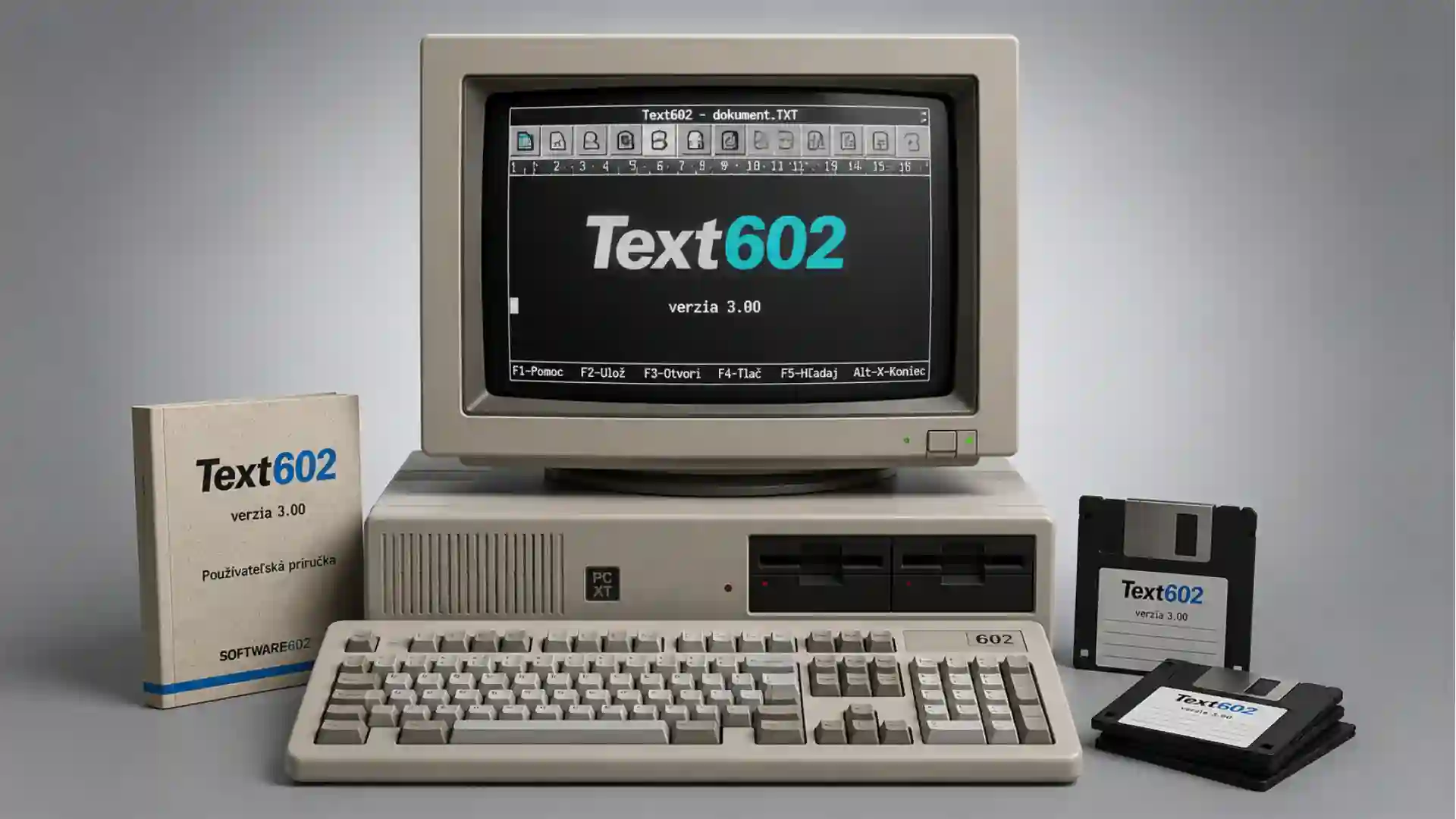
Text602 did not become memorable because it looked futuristic. It became memorable because it solved a brutally ordinary office problem better than anything else nearby: people needed to write Czech and Slovak text on cheap IBM-compatible PCs, print it without mangled accents, and do it without turning every secretary, clerk, teacher, lawyer, and accountant into a computer technician. That is the quiet magic of T602. It was a DOS word processor, yes, but for a generation of users in Czechoslovakia and then the Czech Republic and Slovakia, it was closer to a bridge. On one side sat the typewriter, carbon paper, correction tape, scissors, glue, and the fear that one typo could ruin a page. On the other side sat the personal computer, still strange, still expensive, still surrounded by myths. Text602 made that crossing feel possible.
Table of Contents
Open an old screenshot of Text602 and the first thing you notice is not beauty, but confidence. The screen is dark, the letters are sharp, the interface is stern, and the whole thing looks as if it expects the user to get to work. It does not flatter. It does not decorate. It does not pretend that document writing is leisure. It gives you a page, commands, formats, margins, printer control, and a way to get Czech and Slovak characters onto paper. That bluntness is part of why it still has a pulse online. T602 belongs to the small class of old software that people do not remember only as software. They remember the room around it: the office chair, the humming monitor, the floppy disk, the printer, the first serious document written without a typewriter.
The best reason to rediscover Text602 today is not nostalgia by itself. Nostalgia is easy and usually lazy. T602 is more interesting because it shows what local software can do when global tools do not understand local work. Its great subject was not text in the abstract. Its subject was text with háčeks, accents, habits, printers, forms, files, offices, and users who did not have time for a theory of computing. Text602 was a product of timing, geography, hardware constraint, and cultural need. It was made by people who understood the exact friction of writing in this region on DOS-era machines. That is why it feels like an internet-era discovery even though it predates the web: it is a reminder that useful software often starts by caring about a small, specific pain that bigger products treat as a detail.
The program’s public record has a wonderfully compact origin story. Text602 came from the circle around Prague’s 602nd basic organization of Svazarm, a state-era association that gathered personal-computer enthusiasts before November 1989. The names most often attached to the program are Jaromír Šiška, Richard Kaucký, and Martin Šiška, with later development carried by Software602. The program became a Czech and Slovak WYSIWYG word processor for IBM PC-compatible machines running DOS, and it spread heavily through offices in the first half of the 1990s. The version at the center of this piece, Text602 3.00, sits right in the most culturally potent phase of that story: 1991, before Windows office suites swallowed the desk.
A Web Radar pick usually points to something worth opening now, and Text602 qualifies in a strange way. It is not a trendy tool you sign into. It is not a new product with a pricing page and a polished video. It is a fossil with working teeth. Its file format still turns up in old archives. Its screenshots still explain a period of office computing better than a museum label. Its manuals still circulate through second-hand listings. Its descendants and corporate afterlife still exist in Software602’s move from DOS-era writing tools to electronic signatures, digital archives, eIDAS services, and document workflows. The surprise is not that Text602 existed; the surprise is how much of the Czech and Slovak digital office can be read through this one black screen.
A local machine for a local writing problem
The most important feature of Text602 was not a glamorous feature. It handled national alphabets. That sounds small until you imagine writing Slovak or Czech on a machine that treats your language as an inconvenience. A word processor in Central Europe could not win by merely copying the command structure of a foreign product. It had to respect diacritics, keyboard maps, printers, and documents that carried real administrative weight. Text602 let users work with Czech and Slovak characters without extra helper programs, and it also supported other alphabets and keyboard maps. That one decision made it feel native in a way imported software often did not.
The hardware story matters because Text602 was not written for fantasy machines. It ran on IBM PC-compatible DOS computers, including modest PC XT-class setups, and it used graphics mode. That choice was technically demanding in the DOS period, because graphics screens were slower to redraw than text-mode screens. Yet graphics mode gave the program an escape route from the character-set limits that made accents so annoying on some machines. In practice, Text602 chose the harder display path because the writing problem demanded it.
That graphics-mode choice is one of the cleverest parts of the whole story. Root.cz’s technical history of DOS word processors points out that Text602’s graphics mode allowed letters with accents, Cyrillic, Greek characters, and multiple visual styles to appear without the old pain of replacing or reprogramming character ROMs on certain graphics cards. In a market where users often had CGA, Hercules, EGA, or VGA cards and wildly uneven printer setups, this mattered more than a shiny feature list. Text602 did not merely display text; it worked around the real hardware mess sitting on office desks.
This is where Text602 becomes more than a relic. A lot of modern software talks about localization as a translation layer: change the labels, adjust the currency, ship. T602’s localization was deeper. It treated Czech and Slovak writing as the core job. It took the shape of the keyboard seriously. It took old printers seriously. It took the social situation seriously: people were moving from typewriters to PCs, often under pressure, with little patience for failed output. The product’s taste was practical, not decorative.
Richard Kaucký later described the program’s success with a line that still feels right: timing, timing, timing. In a Pravda interview, he framed T602 as the right product in the right time and place, then added the plainest description of its appeal: it was an electric typewriter that wrote and printed in Czech and Slovak. That is almost comically modest, but it explains the adoption better than a dramatic startup legend. Text602 won because it did the job people were actually trying to do.
The old office metaphor mattered too. Ivan Burger, who trained people on T602 in the 1990s and wrote about it, remembered teaching many administrative workers who had spent their working lives on typewriters. To make the computer understandable, he mapped digital objects to office objects: disks as cabinets, folders as binders, documents as file covers. This is a beautiful detail because it strips away the heroic myth of personal computing. For many users, the PC did not arrive as a revolution; it arrived as an office full of familiar objects disguised as commands.
Text602 therefore had to be two things at once. It had to be enough of a word processor for serious work, and enough of a typewriter replacement for frightened or skeptical users. Too little power, and offices would outgrow it. Too much abstraction, and new users would bounce off it. The program’s sweet spot was not perfection. It was fit. T602 belonged to a short period when the best software did not need to feel effortless; it needed to feel learnable, dependable, and printable.
The black-screen office
There is a reason people remember Text602 by its look. Norton Commander had its famous blue panels; Text602 had its black working surface. Pravda’s retrospective made this contrast explicit: the blue background suggested Norton Commander, while the black screen was characteristic of Text602. That visual memory says a lot about DOS computing in the region. Software was not only a tool; it was a color in the room. If you saw the black screen, you knew someone was writing something meant to leave the computer.
The interface had a seriousness that modern writing apps often avoid. Today’s editors hide machinery until the user asks for it. T602 belonged to another culture. It made the machinery visible: margins, formatting, printer behavior, blocks, keyboard commands, conversion utilities, macros, table-like frames, and document parameters. Some of this now feels harsh. Some of it feels refreshing. The program did not treat writing as a blank Zen surface; it treated writing as document production.
The result was a screen that could feel severe but not stupid. Text602 supported font styles such as bold, italics, underline, high and wide text, superscript, and subscript; it could work with blocks, paragraphs, multiple keyboard maps, printer definitions, macros, contents, indexes, mail merge, and a simple file manager. None of this makes it comparable to modern office suites feature by feature. That would be the wrong comparison. The better comparison is with an office desk in 1991: paper, labels, forms, envelopes, lists, tables, and a printer that might or might not behave.
The program’s limits were also part of its character. Text602 used monospaced text for editing and printing, unlike richer competitors such as WordPerfect or Word. It did not reformat paragraphs with the invisible fluidity people expect now. Some habits it encouraged, such as aligning columns with spaces, aged badly. Yet these weaknesses are not embarrassing footnotes. They reveal the trade-offs. Text602 optimized for offices that needed documents more than typography.
The screen-redraw trick is especially charming. Graphics mode could be slow, so Text602 used a pragmatic method when scrolling could not keep up: it redrew only enough of the screen to preserve orientation rather than insisting on perfect repainting. This is the kind of small engineering choice that reveals taste. The program did not chase purity. It protected flow. Fast-enough movement mattered more than visual correctness during a held Page Down key.
Printing was where the romance ended and the office began. DOS did not give word processors a rich, universal printing system. Text602 had to deal with actual printers, actual character sets, and actual users who needed output. It offered different printing methods, including sending text as graphics, loading a character set into printer RAM, or printing in text mode where the printer already had the right characters. The slower graphics option was often the safest because it avoided missing accents. A document that looked right on paper was worth more than elegance inside the code.
The most revealing detail may be that printer definitions lived in editable files. That meant users or technicians could adjust them when a printer did not match the supplied setup. Modern users rarely touch printer drivers directly, and thank goodness for that. In the DOS office, though, this kind of configurability could decide whether the software was usable. Text602 treated the printer not as an afterthought, but as the final judge of the whole writing process.
Seen from today, the program sits between two eras of trust. The typewriter era trusted the page because the page was the interface. Modern cloud editors ask users to trust remote storage, sync, accounts, permissions, templates, and export formats. Text602 sat in the middle: a local program, a local file, a local printer, a local command structure. Its promise was physical and immediate: type here, format here, print there.
Why version 3.00 still feels like the one to open
Version 3.00 matters because it carries the strong middle of the Text602 story. Earlier versions proved the idea. Later version 3.1 tried to move toward a newer interface style and added features, but it arrived as Windows was becoming the default direction. Version 3.00, released in the 1991 period represented by the user manual record, feels like the canonical T602 memory: mature enough for offices, still fully DOS in spirit, and still close to the first wave of mass adoption. If someone says “T602,” the mental image is usually closer to 3.00 than to the more transitional 3.1.
The manual record alone is enough to make the version feel tactile. A second-hand listing for “Textový editor Text 602 verze 3.00: uživatelská příručka” identifies J. Lapáček, Software602, Prague, 1991, 206 pages, illustrated. That is not just bibliographic trivia. A 206-page user manual tells you that T602 was not a toy. It belonged to a culture where software arrived with a book, and learning the program meant reading, training, copying commands, and developing office rituals. The software was a package of habits, not merely an executable.
There was also a shorter reference-manual tradition around the same version. The Czech Wikipedia entry lists J. Lapáček’s “Textový editor Text 602 (verze 3.00): referenční příručka,” published by Software602 in 1991 with 72 pages. Between a user manual and a reference manual, you can feel the seriousness of the market: people did not merely want to launch the program; they needed to master it well enough to produce reliable documents at work. That is the difference between software as novelty and software as infrastructure.
Version 3.1 is useful as contrast. It brought a more changed interface, higher memory needs, support for working with more than two documents, separate cursor and mouse pointer behavior, drag and drop, and more image format support. Yet it did not define the public memory in the same way. By 1995, Windows had already shifted expectations. Kaucký said that year marked the definitive move toward Microsoft Windows, and that it made little sense to make the “typewriter” more complicated than it needed to be. That comment is a neat epitaph for the DOS word processor as a mass office object.
The most interesting software is sometimes the version just before the big shift. Text602 3.00 is that kind of object. It belongs to a world where DOS still made sense, local character support could sell a product, and Windows had not yet made its interface assumptions unavoidable. It was strong enough to become normal, but not so late that it had to imitate the next platform. It is the version to open when you want to feel the confidence of the local DOS office before the global office suite took over.
There is a reason the file format continued to matter after the program’s cultural peak. Text602 documents used the .602 format, and Root.cz describes it as relatively simple: user text plus control characters and parameter lines beginning with an at sign. That simplicity made conversion possible and helped the format travel into later tools and old archives. A format survives when enough real work is trapped inside it.
This afterlife is one of the richest parts of the discovery. A 1998 Živé.sk article about viewing and printing T602 files under Windows 95 describes the problem plainly: old Text602 documents could be hard to open or print properly, especially when tables, frames, or graphics were involved. The article praised a small free viewer that could display formatting, tables, special symbols, print, and export to RTF. By 1998, T602 was already legacy, but legacy with enough real documents behind it to create a small tool economy.
That is the sign of software that mattered. Nobody writes conversion tools, viewer tips, and workaround articles for a program that left no footprint. Text602 left files in schools, offices, firms, personal disks, and probably plenty of forgotten drawers. The format is part of the product’s cultural residue. T602 did not disappear when people stopped launching it; it remained inside the documents they still needed.
What stands out in Text602 3.00
| Detail | Why it matters |
|---|---|
| DOS word processor for IBM-compatible PCs | It belonged to the exact machines spreading through local offices. |
| Native Czech and Slovak text handling | It solved the language problem that made imported tools feel awkward. |
| Graphics-mode display | It worked around character-set limits and showed formatting on screen. |
| Printer-focused design | It respected the messy reality of office output. |
| Version 3.00 manual culture | It was serious enough to require proper learning material. |
| .602 file afterlife | Its documents stayed relevant after Windows displaced DOS workflows. |
The table makes Text602 look almost simple, which is fair. Its genius was not that it did everything. Its genius was that it knew which problems mattered in its place and time. T602 was not a universal writing dream. It was a precise answer to the local office becoming digital.
The product that came before the company’s second life
Software602’s current website looks almost comically far from the black T602 screen. The company now talks about electronic signatures, HR digitalization, Microsoft 365 integrations, eIDAS services, forms, portals, archives, and digital document workflows. The old DOS word processor is not the daily product story anymore. Yet the continuity is obvious once you stop looking at interface style and start looking at the job. Software602 still lives around documents, trust, signatures, archives, and administrative work.
That continuity makes Text602 a better Web Radar subject than a dead download link would be. It is not only “old software from 1991.” It is the first act in a long Czech document-software story. The PDF Association describes Software602 as a qualified trust service provider focused on long-term legal validity of digital documents, validation for signatures, seals, and timestamps under eIDAS, and lists the company as a full member that joined in January 2014. The company moved from helping people produce documents to helping organizations preserve, sign, validate, and manage them.
That pivot says something about survival. Many local software brands from the DOS and early Windows era vanished when Microsoft Office became the default office environment. Software602 did not keep winning by insisting that the old word processor was enough. It moved deeper into document infrastructure. That is less romantic than a black-screen legend, but more interesting as business history. The firm’s second life came from following the document beyond typing.
An archived 1996 Software602 press release captures the transition mood beautifully. It announced M602 3.0 for DOS with fax, antivirus, and internet email features, and mentioned a 602proDOS package containing Text602 3.1, Calc602, and M602. That package name has a wonderful late-DOS confidence to it. It feels like a platform trying to remain useful while the ground is moving toward Windows and internet connectivity. You can almost hear the old office suite stretching itself to include the next decade.
This is why Text602 should not be reduced to a charming antique. It belonged to a local software ecosystem: Text602 for writing, Calc602 for spreadsheets, M602 as a file manager, later Windows products and office suites, then digital-signature and document services. Some parts aged out. Some changed shape. The thread is paperwork. The Czech and Slovak office did not stop needing documents; it changed what trust in a document meant.
The Microsoft story is present, but it should not dominate the article. Yes, Windows and Microsoft Office eventually won the daily office workflow. Yes, T602 was displaced. Yet treating the story as “local tool loses to global giant” makes it too small. Text602’s more useful lesson is about the period before global defaults harden. In that period, local builders can solve local problems with unusual force. T602’s victory was not permanent, but it was real enough to become memory.
The company’s current public language about reducing paper has a funny historical echo. In the early 1990s, Text602 reduced dependence on the mechanical typewriter. Today, Software602 sells tools for electronic signing, archiving, forms, and administrative digitalization. The enemy changed from the typewriter to paper-based bureaucracy. The through-line is not technology fashion; it is the stubborn administrative life of documents.
That makes the Text602 discovery oddly current. When modern tools claim to reinvent productivity, they often forget that offices run on trust, format, output, signatures, permissions, and long-term readability. Text602 understood a primitive version of that truth. Its output had to survive the printer. Its files had to move through local systems. Its commands had to be teachable. The old DOS editor exposes the bones of document work better than many polished cloud products do.
The internet afterlife of a DOS habit
Text602 now lives online as a mixture of encyclopedia entry, screenshot, memory, workaround, second-hand manual, and downloadable abandonware-adjacent curiosity. That scattered afterlife fits the program. T602 was never only a branded website. It was a habit distributed across offices. Its remains are distributed too. You find it in wiki pages, Czech technical retrospectives, old forum memories, archived reviews, used-book listings, viewer utilities, and jokes about files nobody wants to convert by hand. The web did not preserve T602 in one museum case; it preserved it as debris.
That debris is worth opening because it teaches a different kind of software literacy. Many retro-computing discoveries are visually exotic but socially thin: a pretty interface, a forgotten gadget, a failed platform. Text602 is socially dense. It touches language, administration, training, piracy, hardware limits, printer pain, regional software economics, and the emotional shift from typewriter to PC. A black DOS screen becomes a map of how computing actually entered ordinary work.
The piracy angle is part of the truth, and it should be handled without moral theatre. Kaucký’s Pravda interview acknowledged the flourishing software piracy of the 1990s in Czech and Slovak environments, even among firms, while also saying the company did earn from sales because people would pay for a good program. That combination feels believable. The program spread through official purchase, recommendation, institutional use, copying, and sheer necessity. T602 became normal partly because normal software culture was still being invented.
The same period produced another kind of memory: training rooms full of adults learning how to think digitally. Burger’s anecdotes about people personifying computers may sound funny, but they should not be read as condescension. They show how alien the machine felt. A typewriter responds mechanically and visibly. A PC waits, processes, freezes, redraws, saves to invisible storage, and demands naming conventions. Text602 sat at the emotional border between a tool you could understand by touch and a system you had to trust.
This is also why the phrase “WYSIWYG” deserves a local reading. In English-language software history, WYSIWYG often points toward desktop publishing, graphical interfaces, fonts, and screen-page fidelity. In the Text602 story, WYSIWYG had a more workmanlike force. What you saw needed to resemble what you could print with Czech and Slovak accents on available equipment. It was not only about visual modernity. It was about reducing the gap between typing, seeing, and handing someone a usable page.
The program also shows how memory attaches to friction. People do not remember every smooth tool they used. They remember tools that demanded rituals: commands learned by repetition, strange file names, keyboard maps, printer settings, saved documents on labeled disks, and the small dread of conversion later. Text602 had enough friction to become memorable, but enough usefulness to make the friction worthwhile. That is a powerful combination for cultural survival.
A web reader who has never used DOS can still understand the appeal. Imagine a writing app built for your exact office language at the moment everyone around you is being told to computerize. Imagine it runs on machines your organization can actually buy. Imagine it prints correctly when foreign tools stumble. Imagine trainers can explain it through the metaphor of cabinets, binders, and document folders. That is not merely software adoption; that is a workplace changing its nervous system.
There is also a quiet design lesson hiding in the file format. Root.cz’s description of .602 as a simple format with visible parameter lines and inline control characters makes it look almost humble beside modern binary formats and cloud-native document structures. That humility has advantages. It made certain conversions and repairs easier. It also reminds us that documents are not magic; they are agreements between programs, users, and time. A readable-enough old format can age better than a clever opaque one.
Text602’s afterlife in viewers and converters is therefore not a side story. It is the proof that the program crossed from application to archive problem. Every organization eventually learns this lesson: the file you save today may outlive the software that made it. T602 users learned it when Windows became normal and old .602 files still mattered. A word processor’s true lifespan is measured not by sales, but by how long people need the documents.
That is why Text602 feels so good as a Web Radar discovery. It is not merely “you can run an old DOS editor.” It is a doorway into a whole vanished arrangement of office work. There is the program. There are the manuals. There are the names of its authors. There is the company that survived. There are old articles trying to help Windows 95 users rescue files. There are technical notes about graphics modes and code pages. A small black-screen tool turns into a surprisingly rich internet trail.
The taste of constraint
Text602’s design taste came from constraint, not abundance. It had to fit DOS machines. It had to work with uneven graphics cards. It had to print to printers that might lack the right character sets. It had to teach users who were not hobbyists. It had to make Czech and Slovak writing feel ordinary. It had to do enough without becoming a monster. Constraints like these can produce ugly software, but they can also produce software with a clear spine. T602 had that spine.
The program’s Czech interface was not a minor comfort. It shaped who could enter the software. Commands, help, manuals, and training all become less intimidating when the language belongs to the workplace rather than to a foreign technical culture. For administrators moving from typewriters, this mattered. It made the computer less like a machine owned by specialists. Text602 helped make office computing linguistically domestic.
The WordStar influence also tells a story. Text602 used keyboard shortcuts inherited from WordStar, which tied it to an older command tradition rather than the mouse-first logic that would later dominate. For experienced DOS users, keyboard control could be fast and precise. For new users, it meant memorization. This was the bargain of the period. Power lived in commands you learned with your hands.
The mouse behavior in older versions shows the awkward edge of that transition. Root.cz notes that Text602 had only one cursor before version 3.1, so moving the mouse could move the editing position itself, which caused trouble in tasks such as drawing tables with graphical characters. This is the kind of detail that modern readers can laugh at, but it is also historically useful. It shows a program negotiating between keyboard-era assumptions and GUI-era expectations. The interface was not timeless; it was visibly mid-transition.
The tables issue is especially revealing. Text602 could draw frames and table-like structures, and many users built practical office tables that way. Yet later conversion to Word or Windows tools could be painful because such structures did not always map cleanly. The 1998 Živé.sk article mentioned struggles with tables and diagrams when converting T602 documents. T602 documents often carried the ingenuity and compromises of their original environment inside the file.
That embedded environment is what makes old software hard to judge fairly. If you test Text602 now in isolation, you may see missing luxuries and clumsy habits. If you place it back in the office of 1991, the judgment changes. A program that prints accents, runs on modest hardware, supports familiar document routines, and lets people stop retyping whole pages after mistakes is not clumsy. It is liberation under constraint.
The typewriter comparison should not be romanticized either. Typewriters were reliable in one sense and punishing in another. A typo could become correction fluid. A paragraph change could mean retyping. Copies meant carbon paper. Layout adjustments meant physical work. T602 made revision part of writing rather than a penalty after writing. For administrative workers, that was not a small convenience; it changed the rhythm of the day.
The pleasure of Text602 was probably not delight in the modern product-design sense. It was the quieter pleasure of control. You could move text. You could save versions. You could print another copy. You could correct a sentence without destroying the page. You could write in your own language. You could teach the program to another person. That kind of control creates loyalty even when the interface is austere.
There is a lesson here for modern local tools. Global software can cover many cases, but it often misses the emotional texture of a place: language quirks, institutional habits, legal forms, office rituals, printer realities, training needs, old files, and informal workarounds. Text602 won because it understood the texture. It did not ask the local office to become generic before it could become digital.
That may be the most contemporary thing about it. We now live with tools that are polished, synced, subscribed, and constantly updated, but not always intimate with local reality. T602 reminds us that software earns trust when it meets people where their work is stubbornly specific. The sharper product is not always the one with the largest vision; sometimes it is the one with the clearest small loyalty.
Small notes for curious readers
The simplest way to think about Text602 is as a Czech and Slovak DOS word processor that became a workplace standard before Windows office suites took over. It was WYSIWYG in the practical DOS-era sense, ran on IBM-compatible PCs, and became especially associated with the first half of the 1990s. Its reputation comes from ordinary office usefulness, not from aesthetic glamour.
The reason version 3.00 is so interesting is that it sits at the center of the mature DOS moment. It is documented by 1991 Software602 manuals and precedes the more visibly transitional 3.1 release from 1995. For readers trying to understand the popular memory of T602, 3.00 feels like the best doorway because it carries the classic interface and the strong office-use period.
The program was not technically perfect, and that is part of the point. It had limits around typography, paragraph reformatting, cursor behavior, and later conversion pain. Yet those limits did not prevent adoption because the main job was more urgent: write, format, save, and print local-language documents on available machines. A flawed tool can still be the right tool when it solves the right pain.
Text602 files matter because documents outlive tools. The .602 format became a practical issue for people who later needed to view, print, or convert old documents under Windows. That is why viewer utilities and conversion discussions appeared after the program’s peak. The legacy is not only the executable; it is the paperwork people left behind.
The modern Software602 company should be read as continuation rather than contradiction. Today it works with electronic signatures, document archiving, forms, eIDAS-related services, and digital workflows. That looks far from a DOS word processor, but the subject is still document work. Text602 was about making documents on a PC; the later company is about making documents legally durable, movable, and manageable.
The real charm of Text602 is that it makes the early digital office feel local again. Too much personal-computer history is told through American products, Silicon Valley personalities, and global platforms. T602 tells a smaller story with sharper edges: Prague developers, Czech and Slovak text, DOS machines, office workers, printers, manuals, and files that refused to vanish. That is why it deserves to be opened, remembered, and studied.
Why it still deserves a click
Text602 is worth discovering because it makes software history feel less abstract. It is easy to say that personal computers replaced typewriters. T602 shows the replacement in all its specific mess: accents, keyboard maps, printer definitions, training metaphors, manuals, file formats, and users learning to trust a screen. It turns a broad historical claim into an object you can actually inspect.
The program also challenges the idea that important software must be globally famous. T602 mattered because it was intensely regional. It mattered because it solved a problem for Czech and Slovak offices at the right moment. It mattered because people used it to write real letters, contracts, teaching materials, forms, notices, tables, and internal documents. Its importance is measured in everyday dependence.
There is a particular pleasure in old software that still explains itself. Text602’s interface, manuals, and file format all speak from a time when the boundary between user and machine was more visible. The user could see commands. The manual had weight. The printer setup was part of the story. The file had recognizable parameters. Modern software often hides its machinery; Text602 leaves fingerprints everywhere.
For designers and product people, the lesson is not to imitate the black screen. The lesson is to understand the job as sharply as T602 did. The program won because it knew the local pain: writing and printing Czech and Slovak documents on DOS PCs. It did not need to become a universal creative canvas. It needed to make offices productive without humiliating the people moving from typewriters. That is product judgment, not nostalgia.
For archivists and digital-history people, the program is a reminder that local formats are cultural evidence. A .602 file is not only a technical object. It may contain a school document, a small-business invoice, an office memo, a manuscript, a legal form, or a municipal record. The format encodes the practical world that produced it. Preserving old documents means preserving old working cultures too.
For readers from Slovakia and Czechia, Text602 may trigger a more personal response. The name carries family computers, school offices, public institutions, early business paperwork, and the feeling that the computer had finally learned to write properly in the local language. For readers elsewhere, it offers something rarer: a view of personal computing that did not pass first through the usual American memory machine. T602 is local history with universal software lessons.
The best web discoveries are not always new. Sometimes they are old enough to have escaped marketing, old enough to reveal their compromises, and old enough to show what people truly needed from technology. Text602 is one of those discoveries. It is a black-screen DOS word processor from a very specific place and time, but it still asks a question modern tools should fear: does your software understand the real work, or only the category it belongs to?
That question is why Text602 has not gone completely quiet. It survives in old documents, technical articles, second-hand manuals, company history, user memory, and the odd pleasure of seeing a DOS program solve a local problem with stubborn clarity. Open it as a curiosity and you get nostalgia. Stay with it a little longer and you get something better. You get a portrait of the moment when the Czech and Slovak office stopped being typed and started being computed.
Answers for curious readers
Yes. Text602 was often shortened to T602, and for many Czech and Slovak users the shorter name became the everyday name of the program. It was the word processor people meant when they talked about writing documents on DOS PCs before Microsoft Word became normal in local offices.
It solved the local writing problem. Czech and Slovak users needed diacritics, usable keyboard layouts, reliable printing, and a program that worked on modest IBM-compatible PCs. Text602 did those things at the right moment, when offices were moving from typewriters to computers.
No, but that was its strongest cultural advantage. It also supported other character sets and keyboard maps, but its real importance came from making Czech and Slovak office writing feel natural on DOS machines.
Text602 3.00 sits in the classic period of the program. It belongs to the early 1990s moment when T602 was mature, widely useful, and still clearly part of the DOS office world before Windows office suites took over.
Often yes, but not always cleanly. Old .602 files may need converters, viewers, emulators, or careful handling, especially if they contain tables, frames, special formatting, or printer-specific tricks.
Because it shows how software becomes important by understanding a place. Text602 was not globally famous like Word, but it understood Czech and Slovak office work better than many imported tools of its time. That makes it a sharp example of local software doing exactly the job people needed.
Author:
Jan Bielik
CEO & Founder of Webiano Digital & Marketing Agency
This article is an original analysis supported by the sources cited below
Text602 on Czech Wikipedia
Used for the core historical record of Text602, including its DOS platform, Software602 connection, authorship references, version history, feature list, file-format notes, and references to the 1991 Software602 manuals.
Text602 on Slovak Wikipedia
Used to cross-check the Slovak framing of Text602 as a WYSIWYG DOS word processor widely used in Czechoslovakia, Czechia, and Slovakia, with strong support for national alphabets and modest hardware.
Textové procesory s grafickým uživatelským rozhraním v systému DOS
Used for the technical reading of Text602, especially graphics-mode behavior, character-set handling, supported display cards, scrolling compromises, printing design, and the .602 document format.
Pri vývoji T602 sa partia bavila
Used for Richard Kaucký’s recollections about the program’s creation, timing, success, piracy-era context, the 1995 shift toward Windows, and the description of T602 as an electric typewriter that wrote and printed in Czech and Slovak.
Prvý skutočný premožiteľ písacieho stroja
Used for period memory about T602 replacing the typewriter in offices, Ivan Burger’s training experience, and the cultural shift from mechanical writing to PC-based document work.
Kniha Textový editor Text 602 verze 3.00 uživatelská příručka
Used for bibliographic details of the 1991 Software602 user manual for Text602 version 3.00, including author listing, publisher, place, page count, and physical manual context.
Software602 official website
Used for the company’s current positioning around electronic signatures, document digitalization, forms, portals, archives, Microsoft 365 integration, and administrative workflows.
Software602 member profile at the PDF Association
Used for the current description of Software602 as a qualified trust service provider focused on long-term legal validity of digital documents, digital signatures, seals, timestamps, PDF/A, and eIDAS-related services.
Software602 archived 1996 press release at Muzeum Internetu
Used for the 1996 snapshot of Software602’s DOS-era product ecosystem, including M602 3.0 and the 602proDOS package with Text602 3.1, Calc602, and M602.
| Citing this article? Brief excerpts are welcome. Please credit Webiano.digital, name the author where stated, and include a link to https://webiano.digital and to this original article. Full or substantial republication requires prior written permission. Read our Copyright and Content Use Policy. |
This article was prepared with the assistance of artificial intelligence tools. The content underwent expert human review, and Webiano Digital & Marketing Agency assumes editorial responsibility for its final version and publication.