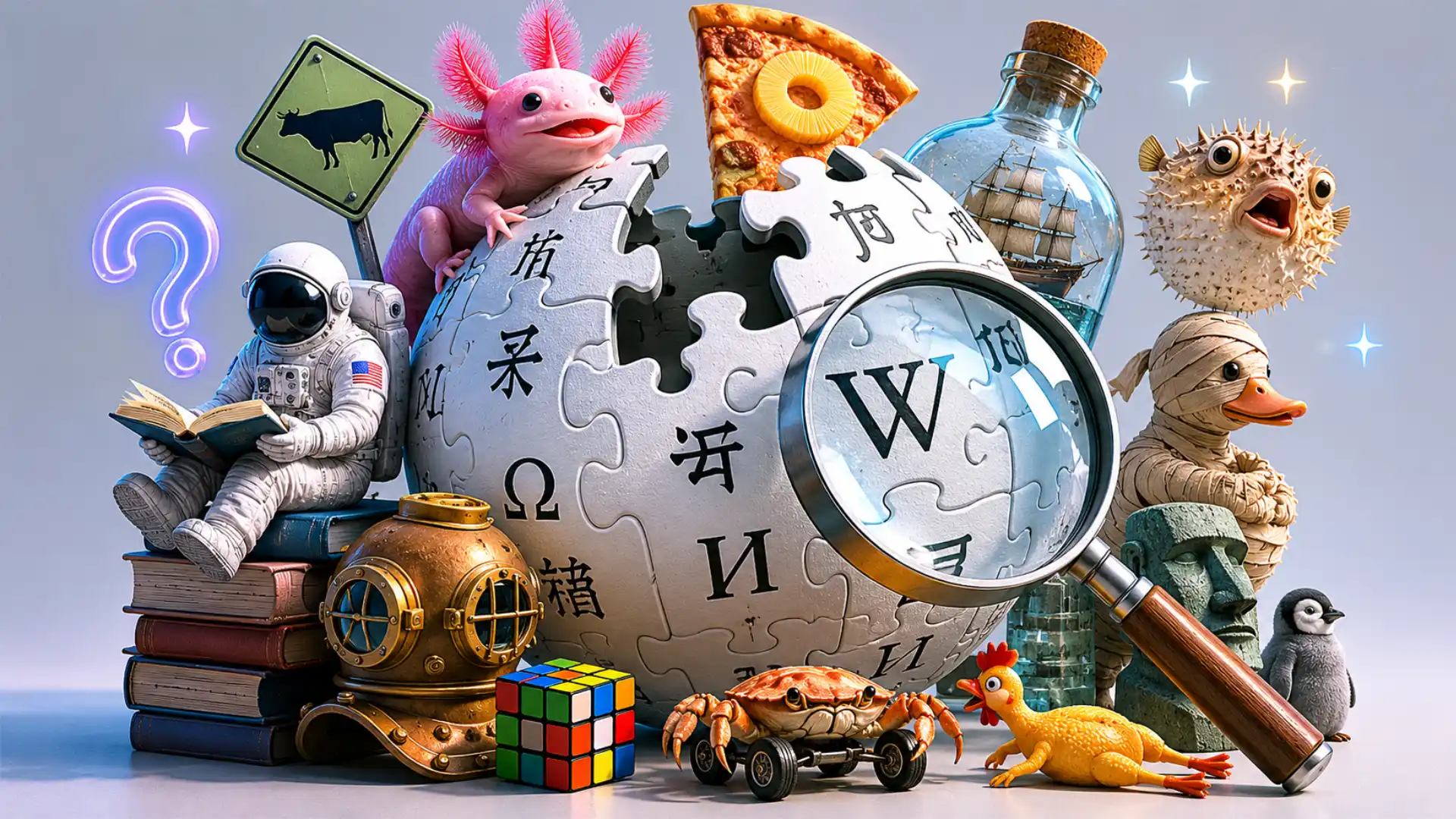
Wikipedia has a secret-feeling page where the encyclopedia stops pretending to be tidy. Not because it abandons standards, but because it points those standards at subjects that feel like they escaped from a pub quiz, a fever dream, a footnote, or a very patient librarian’s private joke. The page is called Wikipedia:Unusual articles, and the name is almost too modest for what it is: a long, hand-sorted passageway into articles about phantom islands, spite houses, death by laughter, cosmic latte, gassy lakes, countries that barely existed, animals with strange jobs, languages with improbable lives, and historical events that sound fake until the citations start behaving.
Table of Contents
The best thing about it is that it is not random. Random Wikipedia already exists, and it has its own joy, but this page is something stranger: a communal act of taste inside a reference work that normally tries to hide taste behind policy. The page itself says the entries are “somewhat unusual” while still being “verifiable, valuable contributions to the encyclopedia,” and it frames them as things one might not expect to find in Encyclopædia Britannica. That tension is the whole charm. The page is funny because it is serious. It is serious because the funny things still have to survive Wikipedia.
Open it for five minutes and it becomes clear why this page has lasted. It is not merely a list of oddities. It is a map of what happens when millions of people build a reference work large enough to include the formal, the tragic, the petty, the comic, the useless, the beautiful, and the hard-to-classify. The page was created on 3 December 2002, and Wikipedia’s page information panel records more than 6,000 edits to it. That age matters. A throwaway joke page would have rotted. This one has been argued over, trimmed, protected, split, rebuilt, watched, and kept alive.
The page works because it knows the difference between weird and merely messy. Wikipedia is full of pages that are obscure, technical, regional, tiny, or dull to anyone outside a narrow interest. Unusual articles is not trying to collect all of those. It is looking for the moment when a real subject produces the little double-take of internet discovery: wait, this exists? The criteria mention unexpected encyclopedia subjects, ironic combinations of ideas, clear anomalies, notorious hoaxes, unplanned cult followings, serious things that might still amuse, and topics that stand apart from similar ones. That is a surprisingly strong editorial filter for a page that greets you with chaos.
That filter makes the list feel closer to a museum cabinet than a link dump. There are places, histories, foods, laws, sports incidents, scientific oddities, individual animals, invented systems, hoaxes, rituals, names, and media artifacts. The subject range is huge, but the page does not feel like a scraped directory. It feels curated by people who understand that the internet’s best rabbit holes are not made from quantity alone. They need friction. They need judgment. They need someone to decide that a pizza farm belongs beside phantom islands, that a spite house deserves its place, and that a list can be playful without becoming lazy.
A back door into Wikipedia’s stranger intelligence
The page sits in Wikipedia’s project namespace, not in the encyclopedia proper. That small technical detail changes the mood. It is not presented as a formal article about unusual things. It is a page made by Wikipedians about Wikipedia’s own contents. It is closer to a tour route, a clubhouse map, or a curator’s tray than a standard reference entry. The page even says it is not an article and that the inclusion rule is consensus that an article fits on the page. That makes it feel more honest than many official-looking “best of the internet” lists, because it admits that taste is involved.
That admission is rare on the web now. Most discovery pages pretend their rankings arrived from nowhere: “top,” “best,” “must-see,” “most fascinating,” “ultimate.” Wikipedia’s unusual list has a softer, stranger grammar. It says: these are articles that the community has noticed as odd, whimsical, ironic, anomalous, or unexpectedly notable. It does not need to pretend there is a universal metric for surprise. The page’s weakness becomes its trust signal. It knows “unusual” is not a clean category. It says so.
The page also benefits from Wikipedia’s habit of linking everything. Each entry is not just a title. It usually comes with a small caption, often dry, comic, or lightly mischievous. One entry may point to a place that does not exist, another to a building made for spite, another to a hill where gravity appears to misbehave, another to a natural nuclear reactor. The captions work like tiny door handles. They give you just enough to click without smothering the surprise.
This is where the page beats algorithmic discovery. A recommender system usually tries to infer what you already want. This page introduces things you did not know how to want. It is not “people who read this also read that.” It is “someone, somewhere, noticed that this belongs in the cabinet.” That human quality is hard to fake. You can feel the fingerprints in the wording, the section choices, the jokes, the borderline cases, and the fact that some entries probably caused arguments.
Wikipedia’s own scale gives the page its power. The English Wikipedia has more than seven million articles, and Wikipedia’s about page describes it as a free online encyclopedia that anyone can edit, with human volunteers collaborating across the project. In a smaller reference work, a list of unusual entries would feel like a gimmick. In Wikipedia, it feels like a pressure release valve for scale. When a knowledge base becomes that large, weirdness is not an exception. Weirdness becomes a statistical certainty.
The list turns that certainty into a reading experience. It saves the reader from having to stumble blindly through millions of pages. It does not flatten the encyclopedia into a single feed. It preserves the feeling of wandering while adding just enough order to keep you moving. The categories act like shelves: places, history, mathematics, language, science, technology, pop culture, food, sports, folklore, law, religion, military, death, questions, lists, and other meta-pages. That spread alone says something about Wikipedia’s shape. The odd is not confined to one corner. It leaks everywhere.
The page is especially good at revealing Wikipedia’s hidden editorial personality. People often talk about Wikipedia as if it were a neutral machine that emits summaries. Spend time with this page and the machine becomes visibly human. Editors are making choices, writing captions, balancing jokes against standards, worrying about quality, protecting the page from vandalism, and debating whether an odd subject is odd enough. The encyclopedia is not only an information product. It is a community with taste, habits, scars, and running jokes.
That personality does not undermine the encyclopedia. It makes the encyclopedia more interesting. The unusual list reminds the reader that neutrality is not the same as boredom. A neutral article about an absurd subject can still be delightful. A page about a hoax can be sober and hilarious at the same time. A list of anomalous places can teach geography more memorably than a polished tourism brochure. The page is not valuable because it lowers the standard. It is valuable because it applies the standard to subjects that feel allergic to standardization.
The result is a page that behaves like an internet artifact from an earlier, better web. It is plain, dense, link-heavy, slightly awkward, and uninterested in conversion funnels. There is no newsletter modal, no “related stories” sludge, no autoplaying video, no synthetic enthusiasm. It is just a page full of doors. That simplicity is part of the pleasure. You click because your curiosity wins, not because the interface has been engineered to trap you.
The list is funny because the rules are serious
The funniest thing about Wikipedia:Unusual articles is how carefully it guards its nonsense. The page carries a notice that the material is kept because it is considered humorous and not meant to be taken seriously. A few lines later, it reminds readers that articles about unusual things may be accepted only if they meet the usual criteria for inclusion. That pairing is beautiful. The page is allowed to wink, but the encyclopedia behind every link still has to stand up.
This is why the page is more satisfying than a viral “weird facts” thread. A weird facts thread often collapses under its own lack of care. The claims are too clean, too convenient, too meme-ready. You start wondering whether anyone checked anything. Wikipedia’s list has a different appeal. The entries are strange, but the surrounding machinery is fussy: notability, verifiability, article quality, style, consensus, source standards, edit history, protection rules. The joke survives inside a bureaucracy, which somehow makes it funnier.
The page even warns that mainspace lists of unusual things need outside references that specifically classify entries as unusual. That is a very Wikipedia sentence, and it matters. It separates a project-page tour from an encyclopedia article making a claim about the world. On the project page, community consensus can decide what feels odd enough for the cabinet. In mainspace, a list claiming “these things are unusual” needs a neutral definition and outside support. The rabbit hole is playful, but the boundary is policed.
That boundary gives the page its strange dignity. It is not trying to smuggle trivia into Wikipedia under a serious title. It is clearly marked as a humorous project page. It points outward to articles that, in theory, should meet encyclopedia standards on their own. If a subject is too thin, too invented, too poorly sourced, or only funny because someone wants it to be, it should not survive. The list depends on the health of the articles it collects.
This is also why some of the entries feel better than internet trivia. A topic like a natural nuclear reactor, a phantom island, a place at zero degrees latitude and longitude, or a building constructed from spite gains force when it is treated plainly. The writing does not need to shout. The facts are odd enough. Wikipedia’s dry style becomes part of the comedy: a calm paragraph explaining something that sounds like a prank.
The page is full of that dry electricity. It lets the reader bounce between hard knowledge and comic disbelief. A lake can be both geologically deadly and absurdly memorable. A country can exist for seven hours. A building can be prized for its uselessness. A fake island can have a history. A phrase can become famous because the internet chewed on it for years. The list does not erase the difference between tragedy, absurdity, and play. It places them close enough that the reader has to keep adjusting.
That adjustment is the core reading pleasure. You are not only learning facts. You are learning how elastic the category of “encyclopedic” can be. Wikipedia’s five pillars say the project combines features of general and specialized encyclopedias, almanacs, and gazetteers, while refusing to be a soapbox, advertising platform, social network, vanity press, anarchic experiment, indiscriminate collection, or web directory. The unusual articles page lives right on that border. It tests how much strangeness a serious encyclopedia can hold without turning into a junk drawer.
The answer seems to be: quite a lot, if the entries are real enough. That phrase, “real enough,” is doing heavy work. A subject does not need to be solemn to be encyclopedic. It does need to be documented, distinct, and more than a private joke. A hoax can be notable if the hoax itself had public life. A meme can be notable if it shaped online culture beyond a tiny circle. A weird place can be notable if maps, history, law, or science have something to say about it.
The page’s captions sharpen that distinction. They often give the comic angle first, but the link leads to a fuller record. That rhythm is perfect for discovery. The caption says, “this is ridiculous.” The article says, “and here is the record.” The reader gets the sugar rush of surprise and the slower satisfaction of context. A weaker site would stop at the surprise. Wikipedia gives you the rabbit hole behind the punchline.
The list also shows how humor works best when it has restraint. Many entries are captioned with puns, jokes, and little nudges, but the page rarely feels like it is begging for laughs. The humor comes from selection and juxtaposition as much as wording. A cow with antlers atop a power line pole appears near a warning about comparable chaos. A line like that feels handmade. It is not polished brand voice. It is the web speaking in its own sideways rhythm.
That sideways rhythm is a relief. So much modern web writing has become either flattened by search habits or inflated by marketing. Wikipedia:Unusual articles has no reason to behave that way. It is too old, too communal, too weird, and too attached to the encyclopedia’s internal norms. It has the density of a wiki page and the sensibility of a curious person who has been collecting odd clippings for decades.
The pleasure is in the ordering
The page is not beautiful in the usual design sense. It is long, packed, and visually busy. It looks like Wikipedia because it is Wikipedia: links, headings, small images, notices, shortcuts, symbols, and an enormous table of contents. Yet the structure does real work. The categories give the reader just enough grip to choose a direction without destroying the sense of drift.
The top-level sections are a small taxonomy of human weirdness. Places and infrastructure come first, which feels right. Geography is one of the richest sources of “that cannot be real” knowledge. Islands that do not exist, places claimed by nobody, borders that look like mistakes, buildings built for pointless reasons, and physical illusions all have a special kind of appeal. They are strange because they are located. The map says they belong to reality, even when the mind objects.
History follows with a different flavor. Historical weirdness often feels less like a joke and more like proof that humans have always been erratic. The past is full of miniature states, failed plans, ceremonial excess, hoaxes, strange deaths, bizarre wars, and decisions that look unreal from a distance. The list gives those stories a second life as clickable curiosities, but the deeper interest is not only “people were strange.” It is that records preserve strangeness unevenly, and Wikipedia has become one of the places where the uneven bits gather.
The science sections are some of the strongest because nature does not care about plausibility. Animals, plants, diseases, space phenomena, chemistry, and earth science routinely produce facts that sound invented. A serious scientific subject can feel more surreal than fiction because it comes without narrative politeness. Wikipedia’s unusual list catches that feeling well. It lets the reader move from human-made oddities to the universe’s own bad jokes.
Language gives the page another register. Unusual names, dialects, constructed systems, specific words, and linguistic edge cases remind the reader that language is not a clean tool. It is a fossil bed of accidents, jokes, power, migration, sound, error, and habit. Wikipedia is especially good at language oddities because a single article can connect etymology, social use, politics, media, and identity without needing a glossy frame.
Pop culture and online culture make the list feel alive to internet readers. These entries are where Wikipedia’s role as a memory machine becomes most obvious. Memes, jokes, failed media, cult artifacts, strange songs, peculiar films, and digital phenomena often decay quickly on the platforms that made them visible. Wikipedia gives some of them a slower afterlife. The unusual page then pulls them back into view as part of a larger cabinet of culture.
Food, sports, law, religion, military history, and death each bring their own kind of oddness. Food oddities are often physical and social at once. Sports oddities reveal rules under pressure. Legal oddities show how formal systems handle human absurdity. Religious and spiritual oddities can be delicate because belief deserves care, but the page includes parody religions and strange practices where public record and cultural weight allow it. Death, unsurprisingly, becomes one of the darkest shelves in the cabinet.
The section on questions is one of the page’s finest ideas. Some Wikipedia articles are unusual not because the subject is exotic, but because the title is shaped like a question. A question-title article feels like a search query that wandered into the encyclopedia and acquired citations. It exposes the way people actually look for knowledge. The web is full of questions. Wikipedia usually answers them by naming topics. This section lets the question remain visible.
The lists section is even more meta. A list of unusual articles that contains unusual lists is Wikipedia folding back on itself. This is part of the site’s charm. It does not only contain knowledge; it contains systems for sorting knowledge, systems for debating the systems, pages about the systems, and joke-adjacent pages about the pages. The unusual articles list belongs to that internal architecture. It is a tour of the encyclopedia and a specimen of the encyclopedia’s culture at the same time.
The page’s organization is what keeps it from becoming mush. A less disciplined version would be one endless stream of “look at this weird thing.” That would be fun for a few minutes and then exhausting. The headings create rhythm. The reader can skim, choose, abandon, return, and recognize patterns. The list respects the wandering impulse without letting it collapse into noise.
It also rewards different reading styles. A person who loves geography can stay in places for half an hour. A science reader can jump to animals, plants, medicine, or astronomy. A web-culture reader can head straight for memes. A writer can harvest prompts. A teacher can find examples. A bored person can click until time disappears. The same page supports all of these uses without announcing them.
That is good web design, even if the page does not look designed. It is design by structure, not polish. The interface is basic, but the content architecture is strong. It knows what kind of page it is: a huge index for curiosity. The page does not need cards, filters, gradients, or animations. It needs links that make you mutter, “sorry, what?” and then open a new tab.
A compact map for first-time visitors
The fastest way into the page is to pick a shelf rather than start at the top. The table of contents is part of the experience. It looks almost too long, but that length is the promise. You are not entering a polished article with a beginning and end. You are entering a corridor with rooms.
A quick map of the rabbit hole
| Entry path | Best for | What makes it click |
|---|---|---|
| Places and infrastructure | Map lovers, travelers, urbanists | Reality starts looking badly rendered |
| Science | Curious readers, teachers, trivia hunters | Nature beats fiction for strangeness |
| Language | Writers, editors, word people | Names and words reveal old accidents |
| Popular culture | Internet people, media obsessives | Memes get treated like artifacts |
| Law and society | Policy nerds, history readers | Formal systems meet human chaos |
| Lists and meta-pages | Wikipedia fans | The encyclopedia folds into itself |
This compact map matters because the page can intimidate at first glance. The trick is not to “finish” it. The trick is to enter through the section that matches your current appetite, then let the page pull you sideways. If a link feels too obvious, skip it. If a caption makes no sense, click it. The best route is rarely the most logical one.
For readers new to the page, places and infrastructure might be the strongest opening shelf. It contains the kind of oddity that is instantly legible. A phantom island is easy to understand: people believed in land that was not there. A gravity hill is easy to picture: a road seems to bend physics. A spite house needs almost no explanation: architecture as revenge. These topics create immediate curiosity because they combine physical reality with a conceptual glitch.
Science is the shelf for people who want the page to keep surprising them after the joke fades. A funny place name or a bizarre building gives quick pleasure. A strange scientific topic often keeps unfolding. The first click may be “that sounds fake.” The third click may be geology, evolutionary pressure, chemical conditions, disease history, taxonomy, or physics. The page becomes a bridge from internet curiosity to real learning.
Language is quieter but deeply sticky. Unusual names and linguistic edge cases have a way of staying in the mind because they attach to sound. They also reveal how much cultural history hides inside labels. A name can preserve conquest, migration, misunderstanding, colonial administration, local humor, bureaucratic error, or one person’s stubbornness. Wikipedia is good at that kind of small, layered explanation.
Popular culture is where the page starts to feel like a memory attic. Some entries are famous enough that many readers will recognize them. Others feel like artifacts from a web that keeps disappearing: memes, viral phrases, strange shows, odd songs, cult media, and online jokes that escaped their original context. The list gives them a place where they are no longer only nostalgia. They become documented culture.
Law and society entries often have the sharpest aftertaste. They are funny until they are not. Strange legal cases, failed policies, punishments, tax oddities, social customs, and government decisions show the absurdity of formal systems trying to contain real people. A topic may begin as a laugh and end as a reminder that institutions produce their own weirdness.
The meta-pages are for readers who like Wikipedia as a subject, not only as a tool. Once you start clicking around Wikipedia’s internal project pages, you see the backstage: policies, essays, maintenance lists, humorous pages, disputes, shortcuts, and community norms. Unusual articles is one of the best entrances into that backstage because it is accessible. You do not need to understand wiki governance to enjoy it, but the page quietly points toward the machinery.
There is also a practical reading move that makes the page better: open links in new tabs. Treat the main list as a base camp. Click one article, read the lead, check the references if the subject feels suspicious, then return. The page is less satisfying if you scroll passively. It wants branching attention. It rewards readers who treat curiosity as a trail rather than a feed.
The captions deserve attention too. They are not just decoration. They often tell you why the article was placed there. A title alone may not signal the oddity, especially when the article name is plain. The caption supplies the angle. It says, in effect, “look at this subject from here.” That tiny editorial gesture is what turns an index into a recommendation.
Images add another layer of oddness. Wikipedia’s unusual page uses small images throughout, and the effect is charmingly uneven. Some are useful, some are funny, some are baffling until the caption lands. The images remind the reader that many unusual subjects are not abstract at all. They have photographs, maps, diagrams, historical illustrations, artifacts, bodies, buildings, landscapes, and documents. Weirdness looks back.
The page also invites rereading. Because entries change, sections shift, and your own attention changes, the list does not feel exhausted after one visit. A reader might ignore the food shelf one day and get trapped by it a week later. A teacher might return for examples. A writer might return for prompts. A Wikipedia editor might return to check whether an entry still belongs. The page is static enough to feel familiar and alive enough to keep its edge.
Why this page still feels alive
Part of the page’s appeal is that it has not been sanded into content-marketing smoothness. It still feels like a wiki page with all the marks of communal maintenance: notices, shortcuts, page protection, symbols for featured and good articles, transcluded sections, talk links, and the occasional joke that would never survive a brand review. That roughness is not a flaw. It is proof of habitat.
Wikipedia’s page information view shows that the page is watched by thousands of users and has no-expiry protection rules for editing and moving. Edits require autoconfirmed or confirmed access, while moving the page requires administrator access. That tells you something about its visibility and vulnerability. A page like this attracts curiosity, but curiosity also attracts vandalism. The cabinet needs glass.
The same page information view records tens of thousands of page views in the previous 30 days at the time checked. That is not celebrity-web traffic, but for an old project page buried inside Wikipedia’s internal namespace, it is a strong sign of ongoing life. People still find it, share it, return to it, or stumble into it through links. The page is not an abandoned relic. It is a durable minor landmark.
Its durability comes from a simple pattern: readers like curated surprise. The web has more information than anyone can absorb, but much of it arrives through feeds that guess, rank, or provoke. Wikipedia:Unusual articles feels different because it does not chase the reader. It waits. It is there whenever someone wants an hour of strange, sourced wandering. That patience has become rare.
The page also survives because Wikipedia itself keeps supplying material. Every new article, every expanded article, every improved source, every emerging cultural artifact, and every rediscovered historical oddity could become a candidate. The unusual list is parasitic in the best sense: it feeds on the encyclopedia’s growth. As Wikipedia documents more of the world, the cabinet can be rearranged.
The community layer matters just as much as the supply of articles. A list like this needs people who care enough to argue about edge cases. Is a subject truly unusual, or just obscure? Is the article strong enough? Is the caption fair? Is the joke too much? Does a listed topic still belong after the article changes? Those questions are invisible to most readers, but they are the reason the page does not collapse into junk.
The page is a reminder that curation is not only a professional media activity. It can happen inside a volunteer knowledge project, through small edits and consensus. The result may not look glossy, but it can have more taste than a polished editorial package. Taste here is not a single editor’s brand. It is an accumulated community instinct for “this belongs in the strange tray.”
That community instinct is messy, but it has memory. A page created in 2002 has lived through the old blog web, social bookmarking, Digg, Reddit’s rise, Twitter’s rise and fracture, algorithmic feeds, TikTok, AI summaries, and the slow decay of many link-sharing habits. Through all of that, a plain wiki page full of odd links still works. The format is almost stubbornly resilient.
It works because clicking a good link still feels good. That sounds obvious, but the modern web often forgets it. A link is a promise of elsewhere. A strong link says: leave this surface and go somewhere stranger, deeper, more specific. Wikipedia:Unusual articles is built almost entirely from that old pleasure. It trusts the link. It trusts the reader’s curiosity. It does not need to overexplain.
The page also exposes one of Wikipedia’s underrated strengths: internal travel. Search engines bring readers to single pages. AI answer tools compress pages into direct responses. Social platforms tear facts into fragments. Wikipedia still lets readers move from subject to subject through visible connections. The unusual list amplifies that movement. It is not a destination so much as a launch mechanism.
That launch mechanism has a moral advantage over many curiosity products. It does not depend on outrage, fear, or humiliation. Some subjects are dark, and some are tragic, but the general promise is not cruelty. The page says the world is stranger than your feed, not worse. That difference matters. It offers curiosity without the sourness that often comes with viral weirdness.
The list is also a quiet argument for slow browsing. It asks you to read captions, choose links, skim leads, notice categories, and follow side trails. It is not built for instant consumption, even though many entries give quick hits. The deeper pleasure comes from letting one subject unfold into another. You arrive for a funny title and leave knowing about border disputes, geology, folklore, tax law, animal behavior, or internet history.
The tiny discipline behind the weirdness
The page’s charm depends on Wikipedia’s larger discipline. Without that discipline, the unusual list would be a swamp. Wikipedia’s own policies say articles are not supposed to be personal essays, original thought, mere promotion, or indiscriminate collections of information. Those rules sound dry until you realize they are what make the weird pages readable. The strange subject gets a frame, sources, limits, and a neutral voice.
Wikipedia’s policy against original thought is especially relevant. A weird article should not exist because one editor thinks a subject is funny. It should exist because the subject has been documented beyond that editor’s private enthusiasm. The page about unusual articles can be playful, but the articles it links to need outside footing. That distinction protects the reader from pure internet folklore.
The “not a directory” rule also matters. Wikipedia openly says it functions as an index of its own content in one sense, but it is not a directory of everything that exists. Unusual articles might look like a directory at first, yet it survives by being selective. It is an index with a point of view about the encyclopedia’s own odd corners, not a census of all weird facts.
Neutrality gives the page its deadpan force. Wikipedia’s five pillars say articles should document and explain major points of view with due weight, avoid advocacy, and characterize issues rather than debate them. That is a perfect engine for strange subjects. A page about an absurd event becomes stronger when it refuses to mug for the reader. The list may wink; the article keeps a straight face.
This deadpan quality is why the rabbit hole feels clean rather than greasy. A lot of weird-web content turns subjects into spectacle. Wikipedia’s better unusual articles do the opposite. They make the subject legible. They tell you where it happened, what sources say, what is disputed, how the term is used, why the event mattered, and where the joke stops. The reader still gets wonder, but not at the cost of the subject.
The page’s own notes also push against lazy inclusion. It says each entry should be an article on its own, not merely a section inside a less unusual article, and that entries should be of decent quality and broadly meet the manual of style. That is a strong constraint. It means the list is not only collecting odd titles. It is asking whether the oddity has enough shape to stand as a subject.
That requirement produces a better kind of curiosity. A section-level oddity can be amusing, but a full article gives the reader somewhere to go. The subject has context, history, references, related topics, and sometimes debates. The list is not a wall of trivia pellets. It is a set of entrances into self-contained rooms.
The quality markers add another small pleasure. The page notes that a star marks featured articles and a plus marks good articles. That means some of the weirdest subjects are not only present on Wikipedia; they have been refined to high internal standards. A reader can chase oddity and quality at the same time. That combination feels deeply Wikipedia: the absurd topic with the polished article.
This is where the page becomes more than entertainment. It trains the reader to see knowledge as uneven, surprising, and collectively maintained. It also trains skepticism. A good unusual entry makes you ask why a subject is notable, what counts as evidence, who decides categories, and how humor changes the way we read facts. You are having fun, but you are also watching classification happen.
That classification is never neutral in the casual sense. Calling something unusual is a human judgment. What feels bizarre to one culture may be ordinary to another. What seems comic from one distance may be painful up close. The page admits its definition is not precise or absolute, which is exactly the kind of humility the subject needs.
The best entries survive that problem by being specific. A vague claim like “this custom is weird” ages badly and often says more about the observer than the subject. A specific subject with documentation—an anomalous border, a recorded hoax, an unusual mathematical object, a famous meme, a documented animal, a named legal case—has firmer ground. The page is at its strongest when it does not exoticize. It simply points to a documented oddity and lets the reader feel the tilt.
That is also why the page belongs on Wikipedia rather than a separate novelty site. A novelty site would probably push the joke harder. Wikipedia gives the oddity a restrained container. The page’s internal humor is fun, but the deeper appeal comes from the surrounding discipline: links, sourcing, revision history, consensus, page protection, and the possibility that any weak entry can be challenged.
What it reveals about the web
The unusual articles page is a relic of link culture that still feels useful. Link culture once ran on blogs, directories, forums, social bookmarking, personal homepages, and the habit of sending someone a URL because it was too good not to share. Much of that culture has been absorbed into feeds. The link still exists, but it is often trapped inside a platform’s tempo. Wikipedia’s list keeps the older rhythm alive: a page, a caption, a link, a new page, another link.
The page also shows what the open web did better than feeds: it made curiosity spatial. You moved through pages like rooms. You remembered where you had been. You fell down holes that had shape. Feeds make curiosity temporal; everything arrives as a stream. Wikipedia:Unusual articles is spatial. It has shelves. It has neighborhoods. It lets you build a path.
That spatial feeling is why the page remains memorable. You do not only remember one fact. You remember the act of moving from a strange place to a strange animal to a strange law to a strange song. The list makes knowledge feel adjacent. It gives the web back its old feeling of connected rooms.
The page is also a useful antidote to AI-flattened knowledge. A chatbot answer might summarize a strange article neatly, but it will struggle to reproduce the pleasure of choosing the next doorway yourself. The unusual list is not just information retrieval. It is discovery through visible choice. The reader sees the neighboring titles and makes a move. That agency is part of the fun.
There is a product lesson here too. Not every discovery experience needs personalization. Sometimes the stronger choice is a shared cabinet. Everyone sees the same strange shelves. That common surface creates culture. A personalized feed may be more efficient at holding attention, but it rarely creates the same feeling of “you have to see this page.” Wikipedia:Unusual articles is shareable because it is stable. The same object can be passed around.
The page’s stability also makes it good for return visits. A feed is hard to revisit because it is always moving and often opaque. A wiki page has a URL, a history, a talk page, and a structure. Even when it changes, it remains recognizably itself. That makes it feel less disposable than most curiosity media.
The page also reveals how much of the internet’s best material is not new. Many entries are about old events, old places, old words, old cases, old species, old jokes, or old records. The pleasure is not novelty in the news sense. It is rediscovery. The page gives old knowledge a new route to attention.
That matters because the modern web often confuses freshness with value. A strange article from 2007, 1907, or 1707 may be more worth opening than a new post engineered for today’s reaction cycle. Wikipedia’s unusual list has no embarrassment about oldness. It treats the past as a live mine of weirdness.
The page also has a healthier relationship with boredom. It does not try to make every entry equally exciting. Some links will not land for you. Some captions will feel too cute. Some sections will be denser than your mood. That unevenness is fine. A cabinet does not need every drawer to delight every visitor. The reader’s own taste completes the page.
There is even a small ethics of attention in that unevenness. The page does not force a single narrative on the reader. It offers many doors and lets boredom be a sorting mechanism. If something does not catch, you move on. If something catches, you give it time. That is a calmer model of browsing than the feed’s endless pressure to react.
For editors, designers, and product people, the page is a reminder that curation can be light. It does not need heavy commentary, rankings, scoring, badges, or forced takeaways. A title, a caption, a section, and a link can be enough when the underlying material is strong. The restraint is the product.
For writers, the page is a generator of premises. Every odd entry contains the seed of an essay, a short story, a classroom example, a podcast segment, a joke, a research question, or a dinner conversation. It is not a writing tool, but it behaves like one because it keeps producing collisions. Spite plus architecture. Geography plus error. Humor plus death. Bureaucracy plus absurdity. Nature plus disbelief.
For ordinary readers, it is simpler: the page is fun. That should not be treated as a lesser claim. Fun is one of the reasons people keep learning after school stops making them. A page that makes a reader curious without humiliating them, tricking them, or trapping them is doing something good for the web.
What readers usually ask after opening it
No. It is a Wikipedia project page, which means it belongs to the community and maintenance side of Wikipedia rather than the main encyclopedia article space. That is why it can make jokes, talk about inclusion criteria, and act as a curated tour of other articles.
Not automatically. They are Wikipedia articles, which means their quality varies and they can change. The unusual page itself says entries should be decent quality, but the smart move is still to check each article’s sources, notices, and edit history if you plan to use it for anything serious.
Because the weirdness is attached to Wikipedia’s normal machinery: article standards, citations, page histories, editors, talk pages, and community review. It is not perfect, but it is less slippery than a social post with no trail.
In principle, Wikipedia is editable, but this page is protected enough that editing requires an autoconfirmed or confirmed account, and additions are supposed to fit the page’s criteria. That makes sense for a high-visibility page with a tempting premise.
Yes, but the humor is bounded by the encyclopedia behind it. The page itself says the material is considered humorous and not meant to be taken seriously, while also reminding readers that unusual subjects still need to meet Wikipedia’s inclusion standards.
Treat it like a base camp for curiosity, not a single article to finish. Start with one section, open links that create a double-take, and return to the list when the trail gets too deep. The page is better when you wander with a little discipline.
It is ideal for people who miss the older web’s sense of discovery: writers, teachers, trivia lovers, designers, researchers, Wikipedia fans, internet historians, and anyone who likes finding a subject that sounds fake but is documented.
It shows that Wikipedia is not only a reference tool but a living culture of classification. The unusual list makes the community’s taste visible. It lets readers see editors sorting not only what is true, but what is surprising enough to deserve a side door.
Why it is worth opening now
The page deserves attention because it makes Wikipedia feel strange again. Many people use Wikipedia so often that it becomes invisible: a background utility, a quick check, a place to confirm a date or identify an actor. Unusual articles restores the sense that Wikipedia is a vast human construction full of eccentric rooms. It turns the site from a lookup tool back into a place.
It is also a reminder that the web does not need to be new to be alive. A page created in 2002 can still feel fresher than many modern discovery products because its core behavior is timeless: collect interesting doors and label them well. The page does not need a redesign to work. It needs care, taste, and enough readers who still enjoy getting lost.
There is a particular joy in seeing absurd subjects treated with respect. A page about a ridiculous building, a strange animal, a failed state, an impossible-sounding landscape, or a notorious hoax does not have to choose between comedy and knowledge. Wikipedia’s unusual cabinet lets both exist at once. The reader laughs, then learns, then clicks again.
That is the rare balance. Too much seriousness would kill the page. Too much joking would cheapen it. Too much order would make it dull. Too little order would make it useless. The current page sits in a lively middle: curated but not polished flat, funny but not empty, huge but not shapeless, old but not dead.
The page is not perfect, and that imperfection is part of its texture. Some captions are better than others. Some entries will feel debatable. Some sections are uneven. Some jokes may age. A few links may disappoint. None of that ruins the experience. A communal cabinet should have quirks. The point is not flawless editorial control. The point is that the cabinet keeps inviting the next curious person in.
The strongest reason to open it is simple: you will probably find something you did not know existed. Not something packaged for you by an algorithm. Not something inflated into a trend. Just a real article, sitting inside the world’s largest reference site, about a subject that briefly makes the world feel larger and less predictable. That feeling is one of the web’s oldest pleasures, and this page still delivers it.
Wikipedia’s curated cabinet of oddities is worth bookmarking because it makes curiosity feel voluntary again. You are not being pushed. You are not being chased. You are standing in front of shelves built by thousands of strangers, each shelf saying: choose a door, lose ten minutes, come back with a stranger mind.
Author:
Jan Bielik
CEO & Founder of Webiano Digital & Marketing Agency
This article is an original analysis supported by the sources cited below
Wikipedia:Unusual articles
Official Wikipedia project page that curates odd and unusual articles and explains the page’s inclusion criteria, humorous status, topic sections, and quality expectations.
Information for Wikipedia:Unusual articles
Official Wikipedia page information view used to verify the page creation date, edit count, protection status, watcher count, and recent page-view figure.
Wikipedia:About
Official introductory Wikipedia page used for background on Wikipedia’s scale, volunteer editing model, purpose, and current English-language article count.
Wikipedia:Five pillars
Official Wikipedia principles page used to frame how the unusual articles list sits beside the encyclopedia’s core ideas about neutrality, scope, and what Wikipedia is.
Wikipedia:What Wikipedia is not
Official Wikipedia policy page used to explain why the unusual articles list works only when it is bounded by rules against original thought, indiscriminate collecting, and directory-style dumping.
| Citing this article? Brief excerpts are welcome. Please credit Webiano.digital, name the author where stated, and include a link to https://webiano.digital and to this original article. Full or substantial republication requires prior written permission. Read our Copyright and Content Use Policy. |
This article was prepared with the assistance of artificial intelligence tools. The content underwent expert human review, and Webiano Digital & Marketing Agency assumes editorial responsibility for its final version and publication.