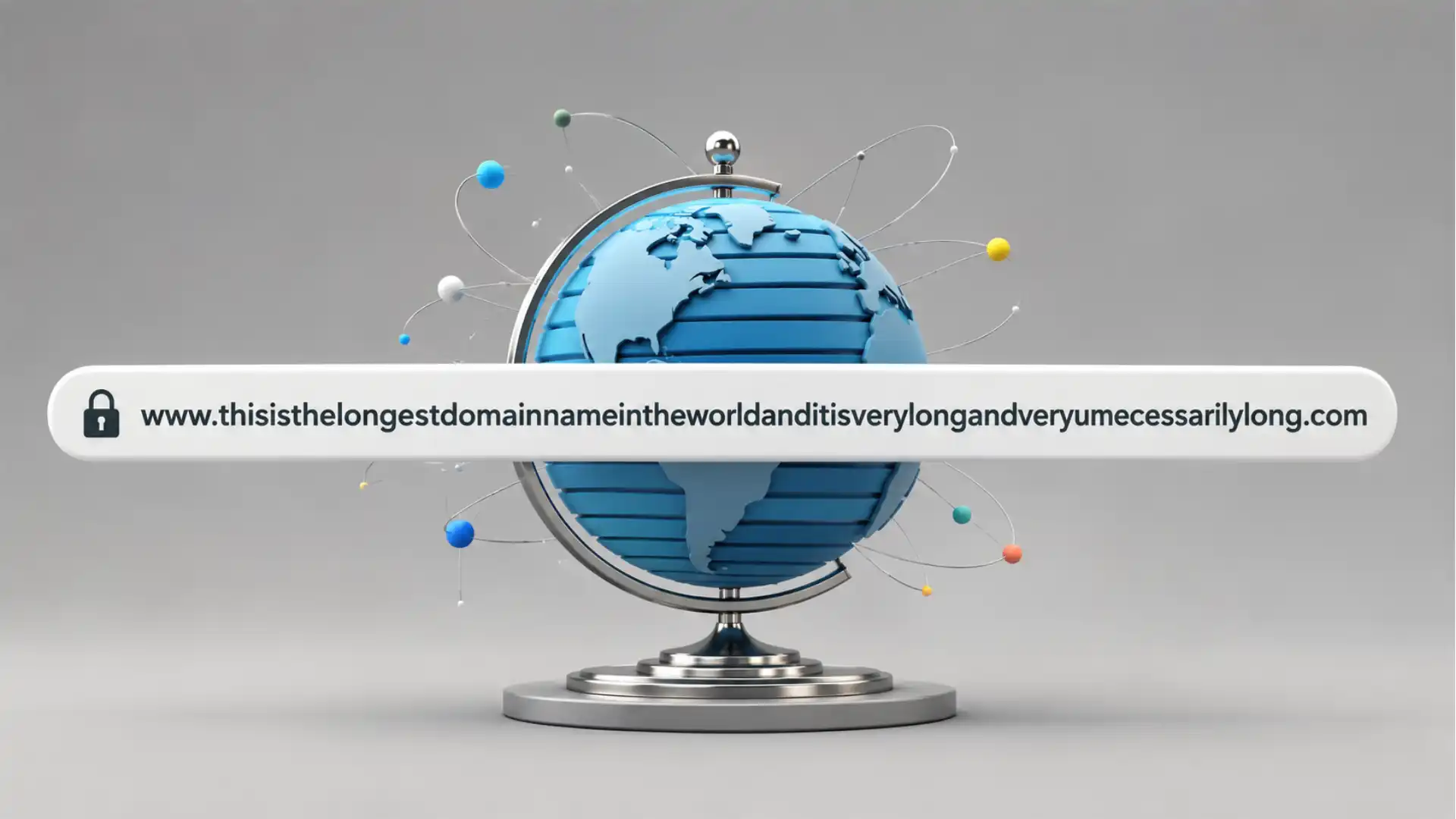
The longest domain name on the web is not hard to understand because it is technical. It is hard to understand because the stunt works only when you notice where the ruler is placed. The address is theofficialabsolutelongestdomainnameregisteredontheworldwideweb.international, and the whole joke is printed right there in the name. It does not tease a product. It does not hide behind branding. It announces its own absurdity, then depends on DNS rules to make that absurdity technically defensible. The site connected to the claim says the domain has 77 characters in total, while LongestDomains.com lists it as “the absolute longest domain” in its current record collection.
Table of Contents
The funny part is that the domain is not especially useful as an address. Nobody sane would type it from memory. Nobody would put it on a billboard unless the pain was the point. It is a website whose main feature is the fact that you reached it at all. That makes it a perfect Web Radar object: a tiny, almost pointless corner of the internet that becomes interesting because somebody looked at a boring rule, found the edge of it, and turned the edge into a monument.
The record also carries a small trap. A normal domain label can only go so far. RFC 1035, the old DNS specification still sitting underneath everyday browsing, says labels are limited to 63 octets and full names to 255 octets. In the way most people talk about domain names, the “name” before the dot is where the 63-character ceiling lives. The long .international extension lets this particular domain stretch the visible address beyond older .com stunts without breaking the label rule.
That is why the answer to “what is the longest domain name in the world?” needs a raised eyebrow. If you mean the longest possible second-level label, many domains can tie at 63 characters. If you mean the whole visible domain, including the dot and the top-level domain, then long extensions change the game. If you mean the longest domain that actually became culturally memorable, the old Welsh village URL still has a stronger story. If you mean the most self-aware record attempt, the .international domain wins with a straight face and a very silly hat.
The site belongs to an old internet tradition that feels nearly extinct: registering a domain just to prove that the domain could exist. This is not product design. It is not content marketing. It is not even useful trivia until somebody asks the right question. It is a kind of DNS folk art, made from letters, registration fees, and an almost heroic disregard for taste.
The internet’s longest name is not quite a name
The address looks like one huge object, but DNS does not see it the way a human eye does. DNS breaks names into labels, separated by dots. In example.com, example is one label and com is another. In this case, theofficialabsolutelongestdomainnameregisteredontheworldwideweb is the long second-level label, and international is the top-level domain. The dot between them is not decoration. It is the hinge that lets the trick work.
The second-level part has 63 letters. That is the magic number for a single DNS label. It is not a poetic limit. It comes from the way DNS labels are encoded, with a length field that leaves six bits to express the label length. RFC 1035 states the limit plainly: labels are 63 octets or less, names 255 octets or less. The result is a quiet technical ceiling that domain pranksters have been bumping their heads against for decades.
The .international part matters because top-level domains became longer and stranger after the expansion of generic TLDs. The IANA delegation page for .international identifies it as a generic top-level domain, records Binky Moon, LLC through Identity Digital as the sponsoring organisation, and notes a registration date for the TLD itself in December 2013. That gives the record attempt a longer suffix to count, unlike old stunts trapped under .com, .net, .org, or country-code domains.
The full visible domain has 77 characters when counted without http://, https://, or www. That count includes the 63-character second-level label, the dot, and the 13-letter .international extension. The domain is long because the pre-dot part touches the normal label ceiling and the extension adds another long word after it. It is not magic. It is arithmetic with a registrar receipt.
That distinction matters because domain records often get muddled by casual wording. People say “domain name” when they mean the string before .com. They say “URL” when they mean a domain. They count www. when they should not. They ignore dots, then count them later. The web lets these phrases collapse into one another because browsers forgive us. Record claims are less forgiving.
The strongest version of the claim is not “this is the longest DNS name possible.” A fully qualified domain name can be longer than this if it uses several labels. You could create a hostname such as something.verylong.example.com, and the total dotted name could stretch far beyond 77 characters while still obeying DNS limits. The .international stunt is narrower and cleaner: it appears to claim the longest registered second-level domain plus public suffix combination that still functions as a memorable, single-purpose web address.
That narrower claim is also why the site is interesting. It is not trying to be the whole theoretical maximum. It is trying to sit exactly where everyday web culture meets DNS bureaucracy. It uses the longest allowed registrable label and pairs it with a long public extension. It is long enough to look ridiculous in a browser bar, but not so technical that only a network engineer can appreciate it.
A pure DNS maximalist could probably invent longer fully qualified names using subdomains. A normal reader would not care. The charm here is that the address still behaves like something you might share as a link. It fits in a sentence, barely. It can be said aloud, badly. It has a punchline before the page loads.
That is why the record feels both real and slippery. The domain is real, the technical limit is real, and the cultural title is partly theatre. It is a record made from definitions. Change the definition and another winner appears. Keep the definition tight, and the .international domain has a satisfying little crown.
The site is a tiny monument to DNS rules
LongestDomains.com presents the whole thing like a shrine to a very narrow obsession. That is the right tone for this kind of project. It lists the .international domain as the “absolute longest domain” with 77 characters, then places it among other long-domain curiosities, including palindrome domains, old 63-character .com records, and the famous Welsh village domain. The page is less a polished product than a cabinet of internet curios.
The design language is part of the appeal. It feels like a page made for people who still enjoy the web as a place of private jokes. It is not chasing conversion. It is not trying to keep you in a funnel. It is a list, a claim, a few links, and a sense that the author has spent too much time thinking about a question most people would abandon after one search.
That is not an insult. The best internet oddities often come from disproportionate attention. Somebody sees a rule that almost nobody cares about, then spends time arranging examples, dates, and categories around it. LongestDomains.com is full of that energy. It cares about whether a long domain is alphabetical, numerical, sentence-like, palindromic, or historically early. It treats these categories as if they deserve ceremony.
The .international domain itself pushes the gag further because the name reads like a title card for its own record attempt. “The official absolute longest domain name registered on the World Wide Web” would already be a ridiculous phrase. Appending .international gives it the feeling of a certificate, as if the extension were wearing a sash. It is linguistically bloated in exactly the way a record stunt should be.
There is a small sadness in this too. A long domain usually becomes more memorable as trivia than as a destination. The moment you understand the joke, the site has done most of its work. You do not go back every morning. You do not open an account. You do not follow a content series. The address is the artifact. The page behind it is almost secondary.
That makes it oddly honest. Many websites pretend the domain is only a neutral doorway into something larger. This one admits that the doorway is the whole building. The domain is not a brand name pointing to a service; it is the service, the claim, the joke, the credential, and the souvenir. It is the web equivalent of a shop sign so oversized that there is no shop behind it.
The technical neatness gives the gag a stronger spine. It is not just a long string someone pasted into a URL path. URL paths can be absurdly long, and anyone can generate a grotesque link with folders, query parameters, tracking codes, and fragments. That would be cheap. A domain registration has to pass registry rules. It has to fit the DNS model. It has to resolve. It has to be paid for and renewed. The paperwork is what makes the joke better.
The web is full of artificial extremes, but registered domains are unusually satisfying record objects because they are public, scarce in their exact form, and tied to infrastructure. You cannot own a tweet length record in the same way. You cannot make a browser bar respect a joke unless the DNS agrees. A domain name has just enough bureaucracy to make a silly claim feel official.
The site also sits in a lineage of internet record-hunting that is much older than social virality. Before feeds swallowed discovery, weird domains were their own form of entertainment. People bought them to make jokes, redirect friends, win arguments, or leave strange little plaques in the DNS. Some became memes. Some became linkbait. Some disappeared. A few survived as evidence of a time when the address bar itself felt like a playground.
The longest-domain project preserves that feeling. It asks the reader to care about a tiny edge case for the pleasure of caring. There is no deep utility hiding underneath. That is part of why it works. A web full of dashboards, growth tools, and subscription prompts leaves less room for harmless uselessness. This domain is useless in a way that feels clean.
What the record claim is really counting
| Version of “longest” | What gets counted | Why it matters |
|---|---|---|
| Second-level label | 63 characters | Maximum ordinary registrable label length |
| Full visible domain | 77 characters | Label plus dot plus .international |
| Full DNS name | Up to 255 octets | Theoretical DNS ceiling with labels included |
| Longest memorable old record | Welsh village domain | Cultural recognition, not just length |
The table matters because the phrase “longest domain” is too blunt for the actual web. A stunt domain, a DNS label, a full hostname, and a famous URL can all be “longest” under different rules. The .international address is most interesting when seen as a record of visible registered-domain length, not as the outer edge of every possible DNS name.
Why the Welsh record still feels better
The old champion still has romance. llanfairpwllgwyngyllgogerychwyrndrobwllllantysiliogogogoch.co.uk feels less like a stunt domain and more like a place that wandered into the internet wearing its full name. VICE’s 2015 piece on the long-domain race says the Welsh village domain received a Guinness Book of Records title in 2002 as the longest domain name in the world.
That domain carried something the .international record cannot quite fake. It pointed at a real village with a real story outside DNS. The long Welsh name is not random keyboard stuffing. It belongs to Llanfairpwllgwyngyll on Anglesey, whose extended form became a tourism draw long before domain trivia existed. The internet record was layered on top of an older naming stunt, one that already lived in railway signs, postcards, pronunciation challenges, and tourist photographs.
The Welsh case is messier now. The once-famous long domain no longer has the same clean village-site feel it had in older accounts. When checked in May 2026, the domain opened to gambling-related content rather than the charming local web presence described by earlier articles. That shift is a reminder that domain records are fragile. A famous address can outlive its original purpose, change hands, or become a shell for unrelated content.
That fragility is part of domain culture. A domain is not a monument unless someone keeps paying for it and guarding its meaning. The phrase may stay famous while the page behind it mutates. Search results, old articles, and memories preserve one version; DNS points to whatever exists now. The web has no built-in respect for nostalgia.
The Welsh record still feels better because its length has texture. The name has consonant clusters, Welsh digraphs, place-name mythology, and the odd joy of watching people try to pronounce it. The .international record is more mechanical. It says what it is. It counts to the edge. It wins on measurement, not on atmosphere.
The distinction matters for readers because internet records are rarely only about the number. The most memorable records have a story that survives after the number is beaten. The longest tweet stopped mattering when platforms changed. The biggest homepage stopped mattering when screens changed. The Welsh domain still lingers because the name had a life before the web and remains funny outside the browser.
The .international domain has a different kind of purity. It is a record attempt stripped of romance. It does not pretend to represent a town, a person, a project, or a culture. It represents the act of registering a record-length domain. That makes it less charming, but more conceptually clean. It is a domain about domains.
VICE’s article captured the older long-domain race as a strange contest among people trying to own maximum-length addresses, including pi-themed domains and sentence-like .com names. That era feels like the web doing pub trivia with infrastructure. People were not building platforms. They were making little claims, then hoping someone would notice.
LongestDomains.com keeps that older race alive by cataloguing the artifacts. The page treats long domains almost like rare stamps. A 63-character alphabetical prefix is one category. A 63-character numerical prefix is another. A properly formed English sentence using all 63 characters is another. This is obsessive, but not empty. The categories reveal how people turn a strict technical limit into a creative constraint.
That is where the Welsh domain and the .international domain meet. Both are naming stunts that became more interesting because they passed through formal systems. The Welsh long name passed through local tourism, signage, and popular culture. The .international name passed through domain registration rules. In both cases, length becomes a kind of permission slip for attention.
The charm is in how useless it is
There is no obvious practical use for a 77-character domain. That uselessness is the point, and it is refreshing. Most domain advice pushes in the opposite direction: be short, be clear, be memorable, avoid hyphens, avoid confusion, protect the brand. The longest-domain stunt violates the spirit of nearly all of that advice while obeying the letter of the DNS.
A short domain says, “remember me.” A domain this long says, “look at what the system allowed.” It is not meant to be typed; it is meant to be seen. It turns the address bar into an exhibit label. You arrive with the punchline already visible, and the rest of the page only confirms that the punchline was intentional.
That kind of web object used to be more common. People once made sites because a domain name amused them. A joke phrase was enough. A single-page gag was enough. The web felt full of small doors that opened into almost nothing, but the nothing had personality. Today, even small sites often arrive wrapped in analytics, monetisation, lead capture, or search strategy. A domain-length stunt feels like a preserved fossil from a less optimised web.
The word “official” in the domain name is especially good. It is funny because the authority is self-awarded. Nobody hears “the official absolute longest domain name registered on the World Wide Web” and imagines a solemn international committee. The officialness is part of the costume. It makes the claim sound more certified than it is, while the DNS quietly supplies the only authority that matters: the name resolves or it does not.
The word “absolute” does similar work. It overstates the certainty of a record that depends on definitions. Absolute sounds final. DNS reality is conditional. Are we counting labels? Dots? TLDs? Subdomains? Punycode? The record’s language plays in the gap between public understanding and technical precision. It is funny because it acts certain where the reader eventually learns to be careful.
The .international ending is the final flourish. It makes the whole thing feel grander than it deserves. A .com version would be shorter and more familiar. .international gives the stunt an inflated ceremonial sound. It reads as if the domain has crossed borders to receive a medal. It also happens to be technically useful for the count, which makes the grandiosity functional.
That blend of silliness and rule-following is rare. Bad internet jokes often ignore the system they joke about. This one understands the system just enough to bend public perception without breaking technical rules. It knows the pre-dot label limit. It knows a long TLD improves the total count. It knows “longest domain” sounds clearer to ordinary people than “longest visible registered second-level label plus TLD string.”
There is also a quiet patience behind the joke. A domain record only survives if renewal keeps happening. Every year, the owner has to decide the bit is still worth paying for. That recurring cost changes the texture of the stunt. It is not a one-off post. It is a small annual vote for absurd continuity.
The India Book of Records entry for a similar long-domain claim shows how these stunts become formalised by record culture. It records a domain with 63 repeated letters before .international, counting 77 characters in the same broad way. That entry is not the same as a universal internet authority, but it shows how the long-TLD trick moved from nerd amusement into record-book language.
The appeal is not that the record is profound. The appeal is that it is real enough to be argued about. A fake record is boring. A clean technical record is dry. A semi-official, definition-sensitive record that lives in the browser bar has just the right amount of friction. It invites the reader to count, object, verify, and then smile anyway.
What it reveals about naming on the web
A good domain name usually disappears into habit. You stop seeing google.com, wikipedia.org, or nytimes.com as technical strings. They become handles for places in your mind. The longest-domain stunt reverses that process. It makes the address visible again. It asks you to notice the machinery you usually ignore.
That is why it belongs in Web Radar. It turns the most ordinary web component into the main event. Every site has a domain. Most domains are forgettable. This one is almost all domain and barely any site. It exposes the naming layer as a place where creativity, vanity, bureaucracy, and comedy can still meet.
The history of domain names has always had two personalities. One side is practical infrastructure. Names map human-readable strings to network locations. They let people reach services without remembering IP addresses. They sit inside root zones, registries, resolvers, caches, and protocols. IANA describes the DNS root zone as the highest level of the naming hierarchy and maintains the authoritative record of top-level domains.
The other side is cultural real estate. People treat domains as identity, status, memory, speculation, and territory. A short .com can sell for millions. A perfect brand name can decide how a company feels before its homepage loads. A bad domain can make a real organisation look temporary. A weird domain can make a joke travel further than the page behind it deserves.
The longest-domain site sits exactly between those two personalities. It is infrastructure used as theatre. The owner did not invent DNS. They did not change the rules. They looked at the naming system and asked how far a visible registered address could be pushed while staying legible as a record. That is a classic internet move: use a standard system for a non-standard little performance.
It also shows why new TLDs changed more than branding options. They changed the shape of possible jokes. Under .com, a maximum-length second-level label plus .com gives a different visible total than the same label plus .international. When hundreds of newer extensions entered public awareness, the suffix became part of the creative surface. A domain was no longer only name.com; it could be a phrase split across the dot, a joke ending, a location claim, or a record-length multiplier.
IANA’s .international delegation page makes the record feel less like a prank floating in the air. The TLD is part of the official DNS root, with named registry management and technical delegation data. That is the dry foundation under the joke. The silliness works because the infrastructure is serious.
There is a lesson here for anyone who works with web naming. Constraints create taste, but they also create mischief. The 63-character label limit encourages short names in normal use, yet it also tempts people to hit the ceiling just because the ceiling exists. A maximum is a dare. Somebody will always try to touch it.
The long-domain stunt also reveals how much of online meaning depends on context outside the page. The domain alone tells you what to think before any content appears. If the page fails, the joke partly survives. If a link preview truncates it, the joke may even improve. If a browser warning appears, the absurdity deepens. The name is strong enough to carry the concept without the site doing much work.
That is not how most domain strategy works. A normal business domain needs trust, recall, and low friction. This domain chooses friction as the experience. It makes sharing awkward. It makes copying risky. It breaks layouts. It forces interfaces to wrap a string they were not built to display gracefully. A 2025 Brave browser issue even used the exact domain as a test case for long-name wrapping in a wallet connection panel.
That last detail is wonderfully fitting. A joke domain becomes a software edge case. The name is so long that it exposes interface assumptions. Designers often imagine domains as modest strings. Security prompts, wallet panels, address bars, mobile sheets, and cards need to handle the ridiculous cases too. One absurd registration becomes a reminder that the web is full of inputs longer, uglier, and stranger than the happy path.
The site is also a quiet warning about record-chasing as a design philosophy. The longest name is not the best name. It is barely a name at all. It has value as a curiosity because it violates the rules of good naming while respecting the rules of registration. Any brand copying the tactic would look desperate unless the absurdity were the whole product.
The record works because it is singular. A world full of maximum-length domains would be unusable and dull. The joke depends on contrast. Most addresses are short enough to ignore; this one makes itself impossible to ignore. That is why opening it feels less like visiting a site and more like picking up a strange object from the side of the web.
The record is easier to enjoy when you stop making it tidy
There is a temptation to settle the matter with one clean answer. The better response is to keep the mess visible. The longest domain name in the world is not a single universal fact in the same way the tallest mountain is not a single universal fact unless you decide whether to measure from sea level, base, or Earth’s centre. Length depends on where counting starts and ends.
The .international domain is the best answer for the modern visible-domain stunt. It reaches the 63-character label limit and adds a long public suffix. It is self-descriptive, easy to verify as a claim, and listed by LongestDomains.com as the absolute longest current record with 77 characters. It is exactly the kind of internet object that deserves a tab opened out of curiosity, not because it is useful.
The Welsh domain is still the better story for people who like their web oddities with a sense of place. It tied domain length to a real village, a railway-era naming stunt, and a global pronunciation joke. VICE’s archive of the long-domain race gives it the older record-book glamour. The current state of the domain muddies that charm, but does not erase why people remember it.
The DNS specification is the sober referee. It tells us why 63 matters and why 255 matters. A single label has one ceiling. A full DNS name has another. Public record claims then add human rules on top: count the dot, count the TLD, exclude www, ignore protocol, prefer registered public domains over invented subdomains. Each choice changes the winner.
That mess is not a defect. It is the reason the topic stays fun after the first answer. A tidy fact would be dead in one sentence. A slippery record creates room for technical explanation, old web history, Welsh tourism, new TLDs, record books, interface bugs, and a little skepticism about anything calling itself “official.”
The site rewards exactly that mood. Open it as a record claim, not as a normal website. It is not there to solve a problem. It is there to make the address bar feel strange again. It reminds you that the web still contains objects made from pure curiosity, petty rivalry, and a willingness to pay for a joke that almost nobody asked for.
That is why the domain is worth radar attention. It is a tiny proof that the internet’s boring layers still contain weird cultural life. DNS rules were not written for comedy, but comedy finds the boundaries. Registries were not created for record stunts, but record stunts rent space inside them. Browser bars were not meant to be punchlines, but sometimes a punchline fits there better than anywhere else.
The record also says something about how people relate to systems. Given a box, someone will try to fill it exactly. Given a limit, someone will make the limit visible. Given a namespace, someone will plant a flag at the far edge and write a boast on it. The longest-domain site is that flag: too long, too literal, too silly, and somehow more human than many better-designed websites.
Answers for curious readers
The best answer is yes, with a careful definition. As a visible registered-domain stunt, theofficialabsolutelongestdomainnameregisteredontheworldwideweb.international is commonly presented as the 77-character “absolute longest” domain because it uses a 63-character label plus the long .international extension. It is not the longest theoretical DNS name possible.
The DNS label limit comes from the DNS specification. RFC 1035 limits labels to 63 octets and full names to 255 octets, which is why maximum-length registrable labels usually stop at 63 ordinary ASCII characters.
It makes this version of the record stronger. The long TLD adds visible characters after the dot, and IANA’s delegation record confirms .international as a generic top-level domain in the DNS root. A 63-character label under .com would be shorter in total visible length than the same label under .international.
The Welsh domain remains culturally famous because it was tied to Llanfairpwllgwyngyllgogerychwyrndrobwllllantysiliogogogoch and was described by VICE as a 2002 Guinness-listed longest-domain record. The domain’s current content no longer matches the older charming village-site story, which is a useful warning about how domains can change over time.
Almost never. Its value is the stunt itself. A real service normally needs a name that people can recall, trust, type, and share without anxiety. This address is memorable only because it is absurd, which makes it a good web curiosity and a terrible naming model.
The pleasure is in seeing a boring technical boundary turned into a public object. It is one of those small websites that exists because someone cared about a very narrow internet edge case. That is enough. Not every good click needs utility; some clicks are souvenirs from the web’s stranger instincts.
Author:
Jan Bielik
CEO & Founder of Webiano Digital & Marketing Agency
This article is an original analysis supported by the sources cited below
The Longest Domains
A dedicated catalogue of long-domain record claims, including the 77-character .international domain and several historical maximum-length examples.
Longest Domain Name on the Internet
The official record-claim domain itself, presented as a 77-character longest-domain stunt; live access may vary, but the claim is also reflected in indexed metadata and linked record catalogues.
RFC 1035
The DNS implementation specification that defines the 63-octet label limit and 255-octet full-name limit behind the record’s technical boundary.
IANA delegation record for .international
The official root-zone delegation page confirming .international as a generic top-level domain and listing its registry information.
The long-forgotten battle for the longest domain name on the internet
VICE’s useful archive of the older long-domain race, including the Welsh village domain and other 63-character record attempts.
Ten interesting domain-related facts
A domain-industry article that compares the Welsh long domain, pi-related long domains, and the .international record claim.
Longest domain name created by an individual
A record-book entry showing how 77-character .international long-domain claims have also appeared in formal record culture.
| Citing this article? Brief excerpts are welcome. Please credit Webiano.digital, name the author where stated, and include a link to https://webiano.digital and to this original article. Full or substantial republication requires prior written permission. Read our Copyright and Content Use Policy. |
This article was prepared with the assistance of artificial intelligence tools. The content underwent expert human review, and Webiano Digital & Marketing Agency assumes editorial responsibility for its final version and publication.