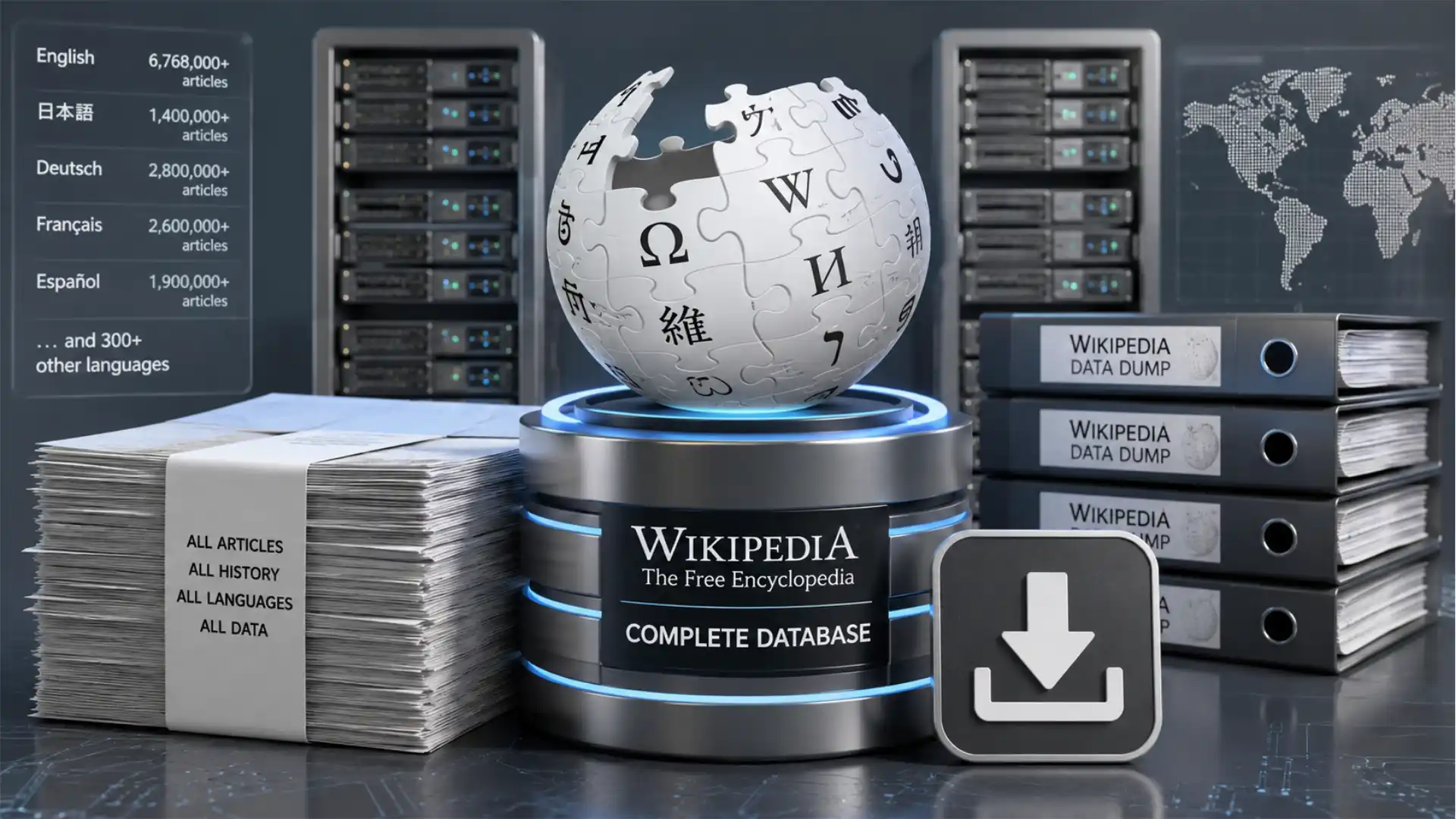
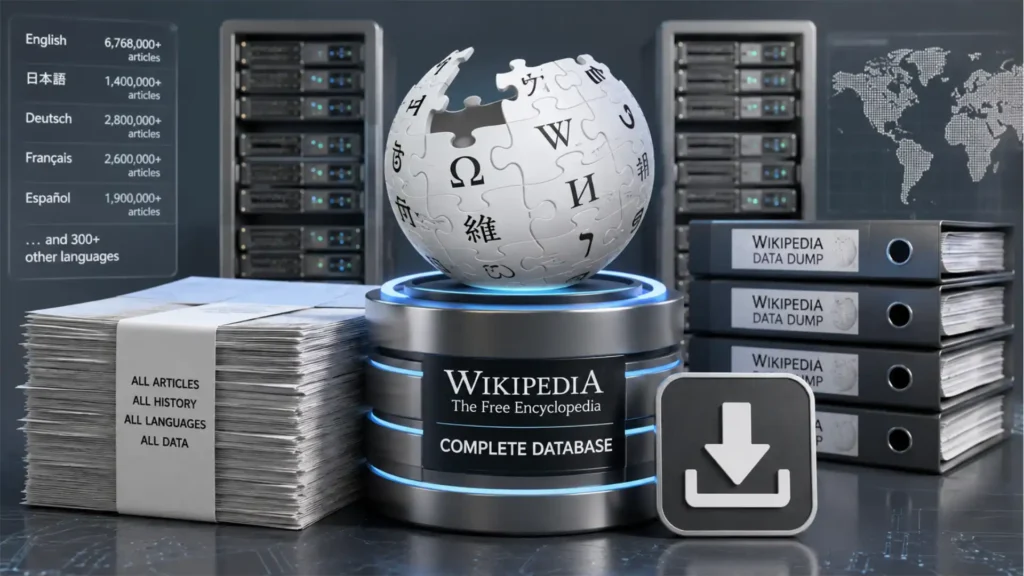
The claim sounds almost too generous for the internet of 2026: you can freely and legally download Wikipedia’s database. It is true, but the truth is more technical, more legally precise, and more strategically important than the viral version suggests. Wikimedia provides public dumps of wiki content and related datasets; the dumps are used by researchers, offline reader projects, archivists, data engineers, and people building search systems. The official Meta-Wiki data dumps page says the dumps are “free to download and reuse,” while the main Wikimedia Downloads page now directs users toward MediaWiki Content File Exports and notes that legacy XML database dumps are deprecated for the newer path.
Table of Contents
The fact behind the viral claim
Wikipedia’s downloadable database is not a rumor, a loophole, or a special privilege reserved for universities and technology companies. The public dump system is part of Wikimedia’s open-knowledge architecture. Anyone with enough storage, bandwidth, patience, and technical skill may download large parts of Wikipedia, all of English Wikipedia, or in principle the public content of Wikimedia projects across languages.
The public story matters because most people experience Wikipedia as a website, not as a dataset. They type a question, land on an article, skim an infobox, check a citation, and leave. Behind that familiar page sits a constantly changing body of wikitext, templates, categories, links, metadata, revision histories, structured data connections, media references, and community processes. Wikimedia exposes much of that material through downloads. That decision turns Wikipedia from a website into public infrastructure.
The simplest version is this: Wikipedia text is available for reuse under free and open licenses, not because no one owns it, but because contributors license their work that way. Wikimedia’s Terms of Use say users may read, print, share, and reuse articles and other media under free and open licenses, and that contributors generally license their contributions under a free and open license unless the contribution is public domain.
The technical version is messier. There is no single magical “download all human knowledge” button. Wikimedia’s dump ecosystem includes current page content, full revision histories, SQL tables, Wikidata entity exports, analytics datasets, search indexes, Kiwix ZIM files for offline reading, and enterprise APIs for high-volume reusers. The right download depends on the job: offline reading, legal archiving, natural-language processing, search indexing, data journalism, classroom access, AI retrieval, or full historical research.
The legal version is also narrower than the viral claim. Free and legal does not mean free of obligations. Wikipedia text is generally licensed under Creative Commons Attribution-ShareAlike and the GNU Free Documentation License, with exceptions and additional terms. Wikimedia’s dump license page also warns that images have separate licensing status, and that fair-use material or unnoticed copyright infringements may appear in dumps.
That distinction is not a lawyer’s footnote. It determines whether a publisher, school, app developer, AI company, journalist, or disaster-preparedness group may redistribute what they downloaded and under what conditions. The same dump that is harmless on a laptop may create compliance duties when republished inside a commercial app, a training corpus, a search product, or a printed reference.
The phrase “entire Wikipedia” needs careful handling
“Entire Wikipedia” sounds simple until someone asks which Wikipedia. English Wikipedia alone is only one language edition. Wikipedia exists across hundreds of languages, and Wikimedia Foundation’s press materials describe Wikipedia as operating in nearly 300 languages with more than 65 million articles, more than 1.5 billion unique devices accessing it each month, and nearly 250,000 monthly volunteer editors. Pew Research Center, using Wikimedia data, reported that as of December 2025 Wikipedia had more than 66 million articles across all languages, around 7 million articles in English, and roughly 775 terabytes of text, images, videos, and other uploaded files.
That means the phrase “download Wikipedia” hides several choices. A person may mean English Wikipedia only. They may mean articles without images. They may mean the current version of each article, not the entire edit history. They may mean all public Wikimedia projects, including Wiktionary, Wikisource, Wikivoyage, Wikibooks, Wikiquote, Wikiversity, Wikinews, Wikimedia Commons, and Wikidata. They may mean a readable offline snapshot in Kiwix rather than raw wikitext. Each version is real. Each carries different size, license, and processing burdens.
The most common personal use case is not the full database. It is an offline reader file. Kiwix exists for that purpose. It packages Wikipedia and other educational content into ZIM files, which can be stored on a phone, laptop, USB drive, local server, or school device. Kiwix describes its work as making knowledge available offline through open-source software and ZIM-based content packages.
The most common technical use case is different. Developers and researchers usually want current article content, revision histories, link tables, page metadata, Wikidata entities, or cleaned text extracts. For those users, Wikimedia Downloads and MediaWiki Content File Exports are more relevant than Kiwix. A readable encyclopedia and a database dump are related artifacts, not the same product.
The phrase “entire” also breaks on images. Wikipedia articles display images from Wikimedia Commons and, in some language editions, locally hosted files. Commons files follow their own license pages. Some images are freely licensed, some are public domain, and some uses outside Wikimedia may run into non-copyright restrictions or jurisdictional differences. Wikimedia Commons states that it accepts freely licensed or public-domain media and places reuse responsibility on the reuser, while Wikimedia’s dump license page warns that image copyright information is contained in image description pages and that many images are not released under the default text license.
The most accurate public explanation is this: You may download public Wikimedia content legally, but you must choose the correct dump, understand what it contains, and follow the license conditions for the material you reuse.
Wikimedia’s dump system is public infrastructure
The public dump service exists because Wikimedia was built around reuse from the start. The official Meta-Wiki data dumps page lists research, offline reader projects, archiving, bot editing, and queryable data access as uses for the dumps. It also says Wikimedia asks for help ensuring many copies of dumps remain available, a sign that public mirroring is part of the preservation model, not a fringe activity.
This architecture changes the social meaning of Wikipedia. If Wikipedia were only a website, its resilience would depend on one organization’s servers, one domain, one interface, and one live access pathway. Because dumps exist, the public content may travel into libraries, classrooms, humanitarian projects, research archives, language tools, and local networks. A downloadable encyclopedia is harder to erase, censor, or lose than a website that only works online.
The dump system also reflects a practical truth about the web: crawling live pages is wasteful when a structured export exists. Anyone who wants a large copy of Wikipedia should use dumps, APIs, or enterprise services rather than hammering public pages with a scraper. Wikimedia’s 2024–2025 annual report describes the pressure caused by automated AI scraping, including increased multimedia bandwidth and the cost of bot traffic that “bulk reads” large numbers of less popular pages.
This is one reason the dump system matters beyond hobbyist curiosity. It channels heavy reuse into repeatable, documented pathways. It gives people a legal and technical alternative to undisciplined scraping. It lets schools and libraries plan offline access. It lets researchers cite a snapshot. It lets AI and search developers work from stable files rather than live page fetches. It gives preservationists something to mirror.
The public dump system also exposes the tension inside open infrastructure. Wikimedia wants knowledge to be free, but its servers, bandwidth, storage, staff time, abuse prevention, and engineering work are not free. The more valuable Wikipedia becomes to AI, search, assistants, and commercial knowledge products, the sharper that tension gets.
The old XML dumps are being replaced for a reason
For years, many technical guides pointed users to the classic XML and SQL dump pages. Those files still exist in the public memory of developers because thousands of scripts, tutorials, research papers, and projects were built around them. The Wikimedia Downloads page now says the legacy database backup dumps are a complete copy of public Wikimedia wikis in wikitext and metadata embedded in XML, but it also marks those XML dumps as deprecated and tells users to use MediaWiki Content File Exports instead.
The newer MediaWiki Content File Exports documentation explains why. Wikimedia says the legacy XML dump infrastructure has been difficult to maintain and could no longer reliably produce the bigger wikis. The Data Engineering team reimplemented the export process and made the new files publicly available.
That shift is a big technical update. The public claim that Wikipedia is downloadable remains true, but the preferred download route has changed. Anyone writing a fresh guide in 2026 should point serious users toward MediaWiki Content File Exports for content exports, while explaining that older SQL/XML dump pages remain part of the ecosystem and may still be used for specific tables, legacy workflows, or tools.
MediaWiki Content File Exports come in two main datasets. The current dataset contains the unparsed content of the current revisions from all public Wikimedia wikis and is exported per wiki once per month. The history dataset contains the unparsed content of all past and present revisions and is also exported per wiki once per month.
The difference between those two datasets is crucial. Current content is enough for most search indexes, offline reading pipelines, language-model retrieval indexes, classroom mirrors, and article analysis projects. Full history is needed when the research question concerns edit evolution, authorship patterns, vandalism reversion, policy disputes, historical wording, or the life of a page over time. Full history is far larger and far harder to process.
The new export documentation also gives a disciplined download method: identify the wiki, choose current or full history, check for the SHA256SUMS file for the target date, download the listed files only after the export is complete, and verify each file with the checksum. That checksum step separates a serious archive from a folder of giant files whose integrity is only assumed.
The database is wikitext, not a finished webpage
A raw Wikipedia content dump is not the same thing as opening wikipedia.org in a browser. The dump usually contains wikitext and metadata, not a clean HTML page with every template already expanded and every image neatly embedded. This catches many first-time users.
Wikitext is the source markup used by MediaWiki. It may include templates, references, categories, links, infobox calls, tables, parser functions, and other elements that only become the familiar article after MediaWiki renders them. A raw dump gives access to the underlying content, but the reuser must decide how to parse it. That may require MediaWiki itself, a specialized parser, a simplified extraction tool, or a pipeline that accepts imperfect text.
The MediaWiki manual on importing XML dumps states that XML dumps contain wiki pages with revisions but not site-related data such as user accounts, images, or edit logs. It also warns that importing large dumps through interactive import tools may cause timeouts or failures.
This distinction shapes every serious reuse project. A historian may want the source wikitext because templates, comments, and revisions carry meaning. A search engineer may want normalized article text with templates stripped. A legal archive may want full source fidelity. A school may not want raw dumps at all; it may want a Kiwix ZIM file. A publisher may need text, attribution, and source links. An AI developer may want chunked, cleaned, deduplicated passages with citation metadata.
The raw dump is the beginning of the work, not the finished product. It is similar to receiving a library’s catalog, stacks, marginalia, and building map in machine-readable form. The knowledge is there, but the form must match the task.
The legal permission is real, but it is not public domain by default
The strongest misunderstanding around Wikipedia downloads is legal. People hear “free” and assume “public domain.” That is wrong for most Wikipedia text. Wikipedia text is generally free to reuse because it is licensed for reuse, not because copyright disappears.
Wikimedia’s legal information for dumps says original textual content is licensed under the GNU Free Documentation License and Creative Commons Attribution-ShareAlike 4.0, with some text available only under the Creative Commons license and with some authors releasing material under extra licenses or into the public domain. It also says Wikidata structured data in the main, Property, Lexeme, and EntitySchema namespaces is released under CC0.
Creative Commons Attribution-ShareAlike means reuse is allowed, including commercial reuse, but attribution and share-alike conditions matter. A reuser should preserve proper credit, point to the license, indicate changes where required, and respect the share-alike requirement when adapting material. The GNU Free Documentation License may matter for older or specific reuse cases, though many modern Wikipedia reuse workflows focus on CC BY-SA.
The Wikimedia Terms of Use explain the contributor side of this arrangement. Contributors generally license edits to Wikimedia projects under free and open licenses, and readers may share and reuse articles and other media under those licenses.
The practical consequence is simple: Downloading is allowed; redistribution must be license-aware. A private copy on a laptop has low legal risk. A public mirror, commercial app, printed book, dataset release, AI training corpus, or search product needs real compliance work. That work should include attribution strategy, license notices, source links, change tracking, and media filtering.
Images deserve extra care. Wikimedia Commons accepts freely licensed and public-domain media, but a file’s license terms live on the file description page. Local Wikipedia projects may also use limited non-free media under local policies. Wikimedia’s dump license page warns that fair-use and other exceptions may not transfer to different reuse settings.
Two download worlds exist side by side
The average reader and the technical reuser need different things. One wants “Wikipedia without the internet.” The other wants “Wikipedia as data.” Both are valid, but mixing them creates confusion.
Main download paths for different users
| User goal | Better starting point | Typical format | Main caution |
|---|---|---|---|
| Offline reading | Kiwix | ZIM | Snapshot may lag live Wikipedia |
| Current article text | MediaWiki Content File Exports | Compressed XML | Requires parsing wikitext |
| Full edit history | Content history exports | Compressed XML shards | Very large and slow to process |
| Link and page metadata | SQL/XML dump area | SQL tables and XML | Legacy XML path is deprecated |
| Wikidata graph work | Wikidata dumps | JSON or RDF | Different license model for structured data |
| High-volume commercial reuse | Wikimedia Enterprise | API snapshots and streams | Paid and operationally structured |
The table separates the reader’s path from the engineer’s path. Kiwix is usually the cleanest answer for human offline access; Wikimedia dumps are the cleanest answer for data work.
Kiwix files are designed to be read. They package rendered content into an offline format. Raw dumps are designed to be processed. They preserve source content and metadata in forms that software systems can transform. A person preparing for internet outages, travel, censorship, school connectivity gaps, or emergency response is usually better served by Kiwix. A person building a corpus, index, archive, analytics pipeline, or retrieval system usually needs Wikimedia dumps.
Wikimedia’s own Downloads page links Kiwix files as static dumps of wiki projects in OpenZIM format, while the Kiwix Wikipedia ZIM index lists many language-specific ZIM packages by file name and date.
That separation also prevents disappointment. The raw dump will not feel like Wikipedia. Kiwix will not provide the full revision history. Wikidata will not contain article prose. SQL tables will not contain article text in the way a beginner expects. Enterprise APIs are not needed for a hobbyist offline copy. Different tools exist because “download Wikipedia” is not one task.
The current-only dump is the practical default
Most people do not need the full edit history of Wikipedia. They need the current version of each article at a fixed moment. This is the practical default for search, offline content, classroom access, summarization, language processing, and reference mirrors. Current-only exports provide a snapshot of what readers would broadly recognize as Wikipedia at that date.
The older Wikipedia database download help page describes pages-articles-multistream.xml.bz2 as current revisions only, excluding talk and user pages, and calls it “probably what you want.” The same page notes that the compressed file is over 25 GB and expands to over 105 GB, while full history expands to multiple terabytes.
The exact sizes change as Wikipedia grows, but the relationship remains. Current article text is manageable for a prepared individual or small team. Full history is infrastructure-scale. All languages and all media move the project into large storage and bandwidth territory. The Pew Research Center estimate of roughly 775 terabytes for Wikipedia’s text, images, videos, and other uploaded files makes clear that “everything” is not a casual laptop project.
Current-only dumps are also easier to reason about. They give a date-stamped snapshot. Researchers can cite it. Engineers can rebuild an index from it. Schools can update periodically. Archivists can store recurring copies. A product team can maintain a reproducible pipeline.
The full history has different value. It is the record of how public knowledge changes. It shows when facts were added, when disputes emerged, how vandalism was corrected, how article quality improved, and how topics moved through public attention. It is invaluable for certain research, but it is not the right default for most users.
Multistream files solved a practical access problem
The word “multistream” appears in many dump guides because it made compressed Wikipedia dumps easier to work with. A normal compressed archive may require decompression from the start to reach one article. A multistream Bzip2 dump breaks the compressed content into many concatenated streams and pairs it with an index. The dump format documentation explains that multistream files contain identical uncompressed content to the non-multistream version, but the stream structure allows splitting and access by offset.
The Wikipedia database download help page is blunt about this: it tells users to get the multistream version and the corresponding index file, because it allows access to an article without unpacking the whole archive.
That may sound like a narrow compression detail, but it reflects a larger truth about Wikipedia as data. Scale changes the meaning of convenience. A format that is merely annoying at one gigabyte becomes operationally decisive at hundreds of gigabytes or terabytes. The ability to seek, split, verify, resume, index, and process in parallel determines whether a project is practical.
Multistream files also show the difference between “downloaded” and “usable.” A user may have the file, but without the right parser, index, checksum, and storage plan, they do not yet have an encyclopedia they can search or a dataset they can trust.
Kiwix is the human answer to offline Wikipedia
Kiwix deserves its own place in the story because it answers a different problem from raw dumps. If the goal is to read Wikipedia offline, Kiwix is the practical path for most people. It packages content into ZIM files and provides reader apps and server tools. Kiwix says it develops open technologies to bring knowledge offline and describes ZIM as a way to compress and share content.
A Kiwix file is useful in settings where internet access is unavailable, censored, unreliable, expensive, or intentionally avoided. That includes schools with weak connectivity, refugee education programs, ships, field research, prisons, remote clinics, disaster zones, and personal emergency archives. It also includes ordinary people who want a local reference library on a phone, tablet, laptop, or home server.
The difference between Kiwix and raw dumps is not just comfort. Kiwix includes a reading layer. Raw dumps require a processing layer. Kiwix is closer to a bookcase. Dumps are closer to a warehouse of source files.
Kiwix also introduces trade-offs. The snapshot may not match today’s live article. Some files include images and are larger; some exclude pictures and are smaller. Topic-specific ZIM files reduce storage but narrow coverage. Search quality and rendering depend on the package and reader. For human reading, those trade-offs are usually acceptable. For compliance, research reproducibility, and machine extraction, raw dumps may be more appropriate.
The deeper significance of Kiwix is social. It turns open licensing into real access. A legal right to download is abstract until someone builds a usable offline package, a reader, a catalog, and a deployment model. Open knowledge becomes practical when the format matches the people who need it.
Wikidata is a different kind of downloadable knowledge
Wikidata often gets folded into public discussions of Wikipedia, but it is not just another article dump. It is a structured knowledge base: items, properties, statements, qualifiers, references, labels, descriptions, aliases, and links across languages. For search engines, AI systems, data journalists, libraries, and knowledge graph builders, Wikidata may be as important as Wikipedia prose.
Wikidata’s database download page says JSON dumps containing all entities are available and recommended, with dumps created weekly. It also lists RDF dumps and says structured data in the main, Property, Lexeme, and EntitySchema namespaces is available under CC0, while text in other namespaces follows Attribution/Share-Alike terms.
That license distinction matters. Wikidata’s core structured data is far easier to reuse in many products because CC0 waives copyright restrictions to the extent possible. Wikipedia prose, by contrast, carries attribution and share-alike duties. A product that combines both needs to treat them separately.
Wikidata also solves a problem that raw article text does not solve well. Article prose is rich but ambiguous. Wikidata statements are structured but incomplete and sometimes contested. A search or AI system may use Wikipedia text for explanation and Wikidata for entity resolution, dates, relationships, identifiers, geographic coordinates, language links, and schema-like structure.
The downloadable Wikipedia ecosystem is therefore not only about articles. It includes a graph of claims and identifiers that helps machines connect concepts across languages. That is why Wikimedia content is so valuable to the broader knowledge economy.
Data dumps are not full operational backups
Wikimedia’s Meta-Wiki data dumps page includes a warning that the dumps are not backups, not consistent, and not complete, while still being useful. That sentence deserves attention because it deflates a common myth.
A public content dump is not a live copy of Wikimedia’s production environment. It does not reproduce the entire operational database, user accounts, private data, deleted revisions, abuse filters, internal logs, site configuration, cache state, extension behavior, or every media storage layer. The MediaWiki importing manual makes a similar point: XML dumps contain page content and revisions but not a full backup of the wiki database, images, user accounts, or edit logs.
That limit is intentional and necessary. Some data is private. Some data is operational. Some data is unsafe to publish. Some data has no value to ordinary reusers. Public dumps serve reuse, research, and access, not total infrastructure cloning.
A downloaded Wikipedia dump lets you reuse public content; it does not turn you into the Wikimedia Foundation. You do not inherit live moderation, community governance, update workflows, legal response systems, vandalism fighting, privacy controls, or trust signals. Those systems are part of what makes Wikipedia function.
This matters for people who want to create mirrors. A mirror can preserve a snapshot, but it cannot automatically preserve the community. It can serve content, but it cannot easily recreate the editorial process that created the content. It can offer resilience, but it may age quickly without updates. It can support access, but it may mislead if users think it is live.
The download is legal because the community built licensing into the project
Wikipedia’s legality as a downloadable corpus comes from a social contract. Contributors edit under terms that allow reuse. Readers benefit from that reuse. The public gains a common reference layer. Reusers accept license duties.
The model is not frictionless. Attribution at Wikipedia scale is hard. Share-alike obligations can complicate derivative works. Mixed media licenses create filtering problems. Imported text from outside sources may carry extra requirements. Vandalism and copyright infringement may exist in a snapshot before removal. Wikimedia’s dump legal page expressly warns that potential infringements may remain in dumps and that use is at the reuser’s risk.
Yet the model works because it is explicit. The site is not “free” through neglect. It is free through rules. The open license turns millions of volunteer edits into a public resource with a known legal pathway for reuse. That is rare on the modern web, where content is often technically reachable but legally uncertain, contractually restricted, hidden behind API terms, or priced for platform access.
Wikipedia’s downloadable database is one of the clearest examples of lawful mass reuse at internet scale. Its existence explains why Wikipedia appears in search snippets, voice assistant answers, classroom materials, research corpora, AI datasets, offline libraries, entity databases, and countless internal tools.
The legal clarity is also why large commercial players cannot credibly pretend Wikipedia is just random scraped web text. It has a license. It has attribution rules. It has a nonprofit steward. It has a public mission. It has infrastructure costs. Those facts now shape the AI licensing debate.
AI made the dump question political
For a long time, Wikipedia dumps felt like an open-data topic. In the AI era, they became part of a larger argument about who pays for public knowledge infrastructure when commercial systems depend on it.
Reuters reported in January 2026 that Wikimedia had partnerships with major technology firms including Microsoft, Meta, Amazon, Perplexity, and Mistral AI, expanding the Wikimedia Enterprise initiative, after an earlier Google arrangement announced in 2022. The report said Wikipedia’s content is central to AI training data and that high-volume scraping had increased server demand and costs for the nonprofit.
A month earlier, Reuters reported remarks by Wikipedia co-founder Jimmy Wales at Reuters NEXT, where he said AI bots crawling the site created disproportionate infrastructure costs and argued that public donations were not meant to subsidize large commercial AI products.
This does not cancel the openness of Wikipedia’s content. Wikimedia Enterprise itself was launched as an opt-in product for organizations that need high-volume, reliable reuse, while Wikimedia said smaller content reusers could continue to use dumps and APIs freely.
The distinction is subtle but central. The content license allows reuse; the infrastructure pathway still matters. A person downloading a dump once is not the same as an AI crawler hitting live servers at massive scale. A classroom mirror is not the same as a global model-training operation. A volunteer research project is not the same as a commercial assistant product that relies on Wikipedia daily.
AI turned Wikipedia’s old openness into a governance problem. The public wants free knowledge. Developers want easy data. AI companies want huge corpora. Wikimedia needs to fund servers and staff. Volunteers want the work respected. Users want reliable answers. No single license sentence resolves those competing pressures.
Wikimedia Enterprise does not make the free dumps disappear
Wikimedia Enterprise is sometimes misunderstood as a paywall. It is not a replacement for public dumps. It is a service layer for organizations that need guaranteed uptime, structured access, support, and high-volume delivery. Wikimedia’s Enterprise documentation says its Snapshot API can provide a compressed file containing every article in a project, while other endpoints provide current article retrieval and real-time update streams.
The 2021 Wikimedia Foundation announcement framed Enterprise as a product for high-volume reuse, with service-level agreements and customer support, while saying reader donations would remain the primary funding source and that smaller reusers would continue using free dumps and APIs.
That split mirrors other public infrastructure models. There is a free public road and a commercial freight lane. There is open data and paid support. There is a public dataset and a service contract. The paid layer does not negate the public layer; it gives heavy users a more responsible path.
For most individuals, educators, civic technologists, and researchers, public dumps remain the story. For large technology companies, the ethical and operational story increasingly points toward paid structured access. The legal right to reuse content and the practical duty not to overload nonprofit infrastructure are not the same question.
Wikimedia Enterprise also signals that Wikipedia is no longer merely a destination website. It is a supplier in the knowledge supply chain. Its content feeds search, assistants, maps, knowledge panels, answer boxes, entity graphs, and model datasets. That supply chain needs technical contracts, money, and accountability, not just goodwill.
Search, AI, and answer engines depend on this open layer
Wikipedia has become a reference substrate for the internet. Search engines use it for entity recognition, knowledge panels, snippets, and disambiguation. AI systems use it as training material, retrieval material, benchmark-adjacent text, and factual grounding. Voice assistants have long drawn on it for short answers. Educational tools use it as a first stop. Journalists use it to orient themselves before reading primary sources.
The Wikimedia Foundation’s 2024–2025 annual report says Wikipedia articles are viewed billions of times each year and that Wikipedia functions as a trusted foundation used by search engines, chatbots, and voice assistants. The same report describes Wikipedia as one of the top 10 most visited websites and cites nearly 15 billion monthly views.
This dependence is not accidental. Wikipedia’s article structure, editorial norms, entity coverage, internal linking, infoboxes, citations, language versions, and revision history make it unusually useful to machines. The database dumps make that utility portable. The license makes it lawful. The community makes it credible enough to be reused.
The downloadable database is therefore not a curiosity; it is one of the hidden supply lines of search and AI. A product may never show the word “Wikipedia” on its interface and still rely on Wikipedia-derived text, labels, summaries, entity IDs, links, or article structures somewhere inside its pipeline.
This creates a trust challenge. When Wikipedia appears through another system, users may lose the page context: edit history, talk page disputes, citation quality, warning templates, neutrality debates, article age, and source links. The dump allows reuse, but the reuser chooses how much context to preserve. That choice affects reliability.
The best use cases are practical and grounded
The strongest argument for downloading Wikipedia is not paranoia. It is continuity. A local copy protects access when networks fail, when censorship blocks domains, when classrooms lack connectivity, when disasters disrupt infrastructure, or when researchers need reproducible snapshots.
For schools, a Kiwix copy may put a reference library in a classroom with no reliable internet. For libraries, it may support patrons during outages. For disaster response groups, it may provide medical, geographic, engineering, and language material in low-connectivity settings. For families, it may be a digital reference shelf. For journalists, it may preserve a snapshot of public knowledge at a date. For researchers, it may provide a corpus that can be cited and reprocessed.
Technical teams use dumps for different reasons: building search indexes, training entity linkers, extracting links, studying knowledge gaps, mapping citation networks, tracking public attention, analyzing revision histories, testing parsers, creating multilingual corpora, and checking how facts propagate across language editions.
The strongest projects start by naming the use case before downloading anything. A user who only wants offline reading should not fetch full revision history. A data scientist studying vandalism should not use a cleaned text dataset that removed revision metadata. A publisher reusing article text should not ignore attribution. An AI team building retrieval should not throw away source URLs and revision dates.
The download is easy compared with the design decision. The central question is not “Can I get the data?” It is “Which version of the data fits the job, and what obligations follow from using it?”
The wrong use cases create real risks
Open data invites misuse as well as public benefit. Wikipedia dumps may be used to create outdated mirrors that look current, spam sites that launder volunteer work, low-quality AI datasets stripped of attribution, hallucination-prone answer systems, or commercial products that hide their dependence on free labor.
The biggest technical risk is staleness. Wikipedia changes constantly. A local snapshot freezes knowledge at a date. That is acceptable if the date is visible. It is dangerous if the mirror presents old medical, legal, political, or scientific information as current. Wikimedia’s own Terms of Use warn that content is informational and not professional advice.
The second risk is parsing error. Wikitext is complex. A poor parser may drop references, scramble tables, mishandle templates, remove warnings, merge unrelated sections, or misread infoboxes. A model trained or retrieved on badly parsed text inherits those errors.
The third risk is license stripping. Some downstream datasets remove revision history, author attribution paths, license notices, or source URLs. That may break legal duties and also weaken trust. A passage without provenance is harder to verify.
The fourth risk is media reuse. Images may carry separate license terms, personality rights, trademarks, cultural restrictions, or fair-use limits. A bulk downloader who treats all media as interchangeable free assets may create legal exposure.
The legal permission to download is not permission to be careless. Wikimedia’s openness shifts responsibility to the reuser. That responsibility grows with audience size, commercial value, and the sensitivity of the topics being republished.
Cleaned datasets are useful, but they are not Wikipedia itself
Many developers do not work directly from Wikimedia dumps. They use cleaned datasets hosted by platforms such as Hugging Face. The Hugging Face wikimedia/wikipedia dataset card describes a dataset of cleaned articles built from Wikipedia dumps, with one subset per language and cleaning that strips markdown and unwanted sections such as references.
Those datasets save time. They are attractive for language modeling, embeddings, semantic search prototypes, educational demos, and analysis that does not need full wikitext fidelity. They also introduce loss. Removing references may remove the trail of verification. Stripping markup may flatten article structure. Cleaning choices may bias the corpus toward prose and away from tables, templates, citations, categories, and maintenance signals.
A cleaned Wikipedia dataset is a derivative, not a substitute for the official dump. It may be exactly right for a prototype and wrong for an audit. It may simplify text extraction but obscure licensing, date, revision, and citation context. It may be easier to load but less defensible for a system that needs traceability.
This difference matters in AI. A retrieval system that answers user questions should preserve article title, source URL, revision date, section, and license metadata wherever possible. A training corpus may not expose those fields to end users, but the team still needs internal provenance. A compliance review without source lineage becomes guesswork.
The cleanest workflow for serious systems often starts with official dumps, records the exact snapshot date, runs a documented parser, stores article and revision identifiers, preserves source URLs and license notices, and only then creates model-ready text.
Downloading Wikipedia teaches an uncomfortable lesson about scale
The first surprise is that the text of English Wikipedia is large but not unimaginable. The second surprise is that the full history, all languages, media, and related data expand the project into serious storage territory. The third surprise is that processing may be harder than downloading.
A user may download a compressed dump and feel finished. Then decompression takes hours. Parsing takes longer. Templates do not resolve. References are messy. Redirects and disambiguation pages need handling. Page IDs and revision IDs matter. Category links may require SQL tables rather than raw wikitext. Some tools expect legacy XML paths. Some files are split across shards. Verification requires checksum discipline. Updates require scheduling.
At Wikipedia scale, “having the file” is only the first milestone. Usability requires compute, storage, indexing, parsing, monitoring, documentation, and periodic refreshes. For a personal offline copy, Kiwix hides much of that work. For a technical system, the work becomes the project.
This is why Wikimedia’s own documentation emphasizes identifying the target wiki, choosing current or history exports, checking SHA256SUMS, and verifying downloads. It is also why enterprise users may pay for structured access rather than maintain every pipeline themselves.
Scale also changes ethical responsibility. A home user who downloads once has minimal infrastructure impact. A company that repeatedly crawls live pages at high volume creates costs for a nonprofit. Wikimedia’s annual report states that AI scraper traffic increased costs and staff time and led to improved bot-detection systems.
The archive value is bigger than convenience
A downloadable Wikipedia snapshot is a cultural artifact. It captures what a large volunteer community knew, prioritized, argued about, sourced, and structured at a moment in time. The full revision history captures the process behind that artifact.
Historians of science can study how public explanations of vaccines, climate change, pandemics, AI, wars, elections, or disasters changed. Linguists can compare coverage across languages. Sociologists can examine conflict and consensus. Journalists can audit when claims entered articles. Archivists can preserve threatened knowledge. Public-interest technologists can build offline access tools for communities with poor connectivity.
The dump system turns Wikipedia from a live reference into a historical record. That is one reason public downloads matter even when the live website remains available. A live page shows the current consensus or current compromise. A dump shows a past state. A revision history shows the path.
This archival value also protects against platform amnesia. Web pages disappear. APIs change. Companies shut down datasets. Terms shift. Search results decay. A public dump, mirrored widely and cited carefully, gives researchers something stable.
The Internet Archive has long been part of the broader Wikimedia preservation ecosystem, and the Wikipedia database download help page points to dumps from Wikimedia projects and the Internet Archive. Public redundancy is not glamorous, but it is the difference between a slogan about free knowledge and a durable commons.
The business impact reaches beyond Wikimedia
The ability to download Wikipedia has commercial value even when the content is free. Search engines, AI companies, educational platforms, analytics firms, compliance tools, content management systems, and app developers all benefit from a reliable public knowledge base.
The business question is not only “Who owns the content?” It is “Who pays for the infrastructure that makes the content reusable?” Wikimedia’s Enterprise initiative is one answer. Public dumps are another. Donations are another. Volunteer labor is the foundation under all of them.
Reuters’ January 2026 report on new Wikimedia Enterprise partners shows that large technology firms are being pushed toward more formal support of the knowledge infrastructure they use. Wikimedia’s 2024–2025 audit highlights say the Foundation devoted 77.4% of its budget to movement support and increased grant funding to $26.3 million.
The market has treated Wikipedia as free input for years. The AI boom is forcing a correction between legal openness and operational cost. A company may have the right to reuse licensed content, but repeated high-volume access, freshness requirements, and commercial dependence create a stronger case for financial contribution.
This does not mean every startup, researcher, or school should pay Wikimedia. It means the largest beneficiaries have fewer excuses. If a commercial assistant, search engine, or model provider depends on Wikipedia’s corpus, update stream, and public trust, supporting the infrastructure is part of responsible reuse.
The business impact also affects SEO and publishing. Many websites compete with Wikipedia in search results, but they also rely on Wikipedia as an entity source. Brands monitor their Wikipedia pages. Publishers check article references. Knowledge panels draw from Wikimedia ecosystems. Wikipedia is both competitor and infrastructure.
The governance model travels with the data only partly
A downloaded dump contains text, metadata, and sometimes history. It does not contain the living governance model that produced them. That model includes neutral point-of-view norms, verifiability rules, citation practices, page protection, arbitration, administrator actions, edit filters, talk page debates, WikiProjects, quality assessments, and thousands of informal habits.
When a company or researcher reuses Wikipedia, they often take the artifact and leave the governance behind. That is understandable; governance is harder to package than text. But it creates risk. The quality of a Wikipedia article is not only in the words. It is in the visible process around those words.
A serious reuse system should preserve signals of governance where possible. Article warnings, protection status, talk page controversy, citation density, revision age, edit frequency, and quality-class assessments may matter. Removing all of them creates a cleaner dataset and a less honest one.
This is especially relevant to AI answer systems. A model that treats every Wikipedia paragraph as equally settled loses the difference between a stable article about a chemical element and a disputed article about an active political conflict. A retrieval system that exposes source links but hides warning templates may overstate confidence. A summarizer that strips citations may make Wikipedia look more self-contained than it is.
The dump gives access. Trust still requires design.
Readers need to know the difference between live and local knowledge
A downloaded copy of Wikipedia is a snapshot. It may be useful, life-changing, or even lifesaving in low-connectivity settings, but it is not live. For subjects that change quickly, the date matters.
Medical articles evolve as evidence changes. Political articles change during elections and conflicts. Biographies change after deaths, appointments, scandals, and corrections. Technology articles change when products ship or fail. Legal and regulatory articles change when laws and guidance shift. A local copy is only as current as its last update.
Every public offline deployment should show its snapshot date clearly. A school server, emergency kit, library kiosk, or mobile app should tell users when the content was built. For sensitive topics, it should encourage checking current sources when internet access exists.
The live Wikipedia site also exposes recent edits, talk pages, page histories, source references, and notices. An offline copy may reduce or remove those signals. That is acceptable when the goal is access, but it should not be hidden.
The date issue also matters for AI. If a model or retrieval index uses a Wikipedia dump from a specific month, its answers inherit that cutoff. A system that does not know its Wikipedia snapshot date cannot be transparent about freshness.
The most responsible download workflow is boring
Good data practice rarely looks exciting. It looks like naming files, verifying checksums, documenting sources, saving licenses, and keeping logs. Wikipedia dumps are no exception.
A responsible workflow starts with a decision: current content, full history, SQL metadata, Wikidata, Kiwix, or Enterprise. Then it chooses a wiki ID, such as enwiki for English Wikipedia. Then it selects a date. Then it checks whether the export is complete through the checksum file when using MediaWiki Content File Exports. Then it downloads files with resumable tools, verifies hashes, records the exact source URLs, and stores the license notices.
After download comes parsing. The parser choice should be documented. If templates are expanded, document how. If references are removed, document that. If redirects are resolved, document the method. If only main-namespace articles are kept, say so. If disambiguation pages are removed, say so. If images are excluded, say so.
The boring workflow is what makes the dataset defensible. Without it, a team may know it has “Wikipedia data” but not which Wikipedia, from which date, with which parser, under which license handling, with which exclusions.
For individuals, this discipline may be lighter. A Kiwix user should still note the package date and whether it includes images. A family emergency drive should be tested before it is needed. A school deployment should update on a schedule. A local server should avoid presenting a 2024 snapshot as 2026 knowledge.
Legal reuse requires attribution design, not a footnote
Attribution is easy for one copied paragraph. It is harder for millions of articles. Wikipedia’s scale forces reusers to design attribution into the product.
A website mirror may attribute on each article page with a source link, license link, and change notice. A mobile app may place attribution in article views and an about page. A dataset may include license files, source URLs, dump dates, and fields that preserve article identity. An AI system may need internal provenance even when it cannot show every contributor in an answer. A printed book may need a different method.
The share-alike requirement also matters for adaptations. If a reuser modifies Wikipedia text and republishes it, the adapted text may need to be shared under compatible terms. This can collide with proprietary publishing models if not planned in advance.
Reuse duties by content type
| Content type | Common license position | Reuse duty | Higher-risk mistake |
|---|---|---|---|
| Wikipedia article text | CC BY-SA and GFDL, with exceptions | Attribute, link license, preserve compatible terms for adaptations | Treating it as public domain |
| Wikidata structured entities | CC0 for main structured data namespaces | Attribution not required by CC0, but provenance is still good practice | Mixing it with article prose rules |
| Commons media | File-specific free license or public domain | Follow the file page license and credit requirements | Assuming every image has the same license |
| Local non-free media | May rely on limited fair-use policy | Avoid reuse unless independently cleared | Republishing outside Wikimedia context |
| Cleaned third-party datasets | Derived from dumps with their own documentation | Check source date, license, and processing notes | Losing source and revision traceability |
The table shows why “Wikipedia is free” is too broad for publication decisions. The legal status depends on the layer of the Wikimedia ecosystem being reused.
For many reusers, the safest practice is to keep source URLs, revision IDs, dump dates, and license metadata attached to content throughout the pipeline. Removing those fields for convenience may create future compliance problems. It also makes correction harder when a source article changes or a user challenges an answer.
The technical stack depends on the job
A small offline-reading project may need only Kiwix and storage. A research project may need a download script, checksum verification, decompression tools, streaming XML parsing, a database, and a reproducible notebook. A search product may need indexing, language detection, redirect resolution, anchor-text extraction, and update scheduling. An AI retrieval product may need chunking, embeddings, citation preservation, and freshness checks.
The technical stack should not be chosen from a random tutorial. It should come from the data shape. Wikimedia dumps may include compressed XML shards, SQL files, page tables, link tables, Wikidata JSON or RDF, analytics logs, and ZIM files. Each format rewards different tools.
The MediaWiki dump format page notes that SQL metadata files do not contain page text, while multistream XML files contain compressed page content with a paired index. The Wikidata download page recommends JSON dumps for entity data and warns that XML dumps are not stable interfaces for Wikidata’s JSON content.
Wrong-format downloads waste days. A beginner who wants article prose may download SQL link tables. A data scientist who wants categories may discover categories inside wikitext are not the same as parsed categorylinks tables. A developer who wants rendered pages may discover that raw dumps do not expand templates. A historian who wants edit evolution may accidentally use current-only content.
The right first step is to write one sentence: “I need [content type] from [wiki/project] as of [date] for [use case].” That sentence prevents most mistakes.
The database is multilingual, but not evenly so
Wikipedia’s multilingual scale is one of its strengths and one of its complications. English has the largest article count among language editions, but other languages have deep coverage in local topics, culture, geography, history, and institutions that English may miss. Some large editions were heavily affected by bot-created articles. Pew reported that Wikipedia had articles in 342 languages as of late 2025, and noted that automation boosted content in some large non-English editions.
A multilingual download strategy must account for uneven coverage, not merely file availability. A search engine that indexes only English Wikipedia misses local knowledge. A school deployment in Ghana, India, Ukraine, Brazil, or Indonesia may need local-language content even if the English dump is larger. A multilingual AI system needs cross-language links, Wikidata IDs, and language-specific quality checks.
Downloading all languages is not the same as achieving knowledge equity. A small language edition may contain fewer articles, shorter articles, or fewer active editors. It may also contain knowledge unavailable elsewhere. The value cannot be measured only in gigabytes.
Wikimedia’s 2024–2025 annual report discusses efforts to support diverse language communities and mentions Abstract Wikipedia and Wikifunctions as long-term work aimed at expanding knowledge across languages. That matters because the dump system preserves what exists, but community support affects what gets created.
For reusers, multilingual care means keeping language codes, article URLs, Wikidata links, and date stamps intact. It also means avoiding the assumption that English is the master version and all other editions are translations. Wikipedia language editions are separate communities with separate articles, sources, priorities, and disputes.
The open database makes censorship harder but not impossible
Offline Wikipedia has a clear censorship-resistance value. If a government blocks Wikipedia, if a network filters it, or if a disaster cuts connectivity, local copies preserve access to at least a snapshot. Kiwix and dump mirrors make knowledge portable.
This does not make the system invulnerable. Local devices can be seized. Mirrors can be blocked. Updates can be interrupted. Offline copies can grow stale. Local distributors may alter content. Users may not know whether a copy is authentic. A hostile actor may produce a manipulated mirror.
The same openness that enables preservation also requires verification. Checksums, source URLs, signed releases where available, trusted distribution channels, visible snapshot dates, and community mirrors all matter. Wikimedia’s MediaWiki Content File Exports documentation encourages SHA256 verification, which is the right habit for any serious archive.
Censorship resistance also depends on local language. An English offline copy may be better than nothing, but it may not serve the people most affected by censorship or low connectivity. Local-language ZIM packages, school-focused subsets, medical packages, and community-curated distributions may matter more than the largest single file.
The social value of downloadable Wikipedia is strongest when it reaches people who would otherwise lose access. That is a different success metric from counting total terabytes downloaded.
Wikipedia’s openness forces publishers to compete differently
For publishers, Wikipedia is both a rival and a baseline. It ranks in search, absorbs informational intent, feeds answer systems, and shapes entity understanding. Yet publishers also use it for orientation, fact checks, links, and background. The downloadable database strengthens that role because it allows downstream systems to ingest Wikipedia at scale.
A publisher cannot beat Wikipedia by pretending basic facts are scarce. They are not. The existence of a legal, downloadable Wikipedia database pushes publishers toward original reporting, expert analysis, proprietary data, local knowledge, lived experience, and primary documentation. Commodity summaries are weaker when a free reference layer exists.
This is especially true in AI search. If an answer engine already has Wikipedia-derived background, a publisher’s advantage must come from something Wikipedia does not supply: timely reporting, interviews, documents, field observation, expert synthesis, original images, product testing, local context, or accountable opinion.
At the same time, publishers benefit from Wikipedia’s open entity layer. Clear topic structures, identifiers, and citations help the web organize information. Wikidata and Wikipedia links help machines connect names, places, organizations, and events. The public knowledge layer supports discoverability even for sites that compete with Wikipedia in search results.
The strategic lesson for publishers is not to copy Wikipedia. It is to understand where Wikipedia ends.
The AI training debate will not be solved by dumps alone
Some AI companies may argue that public dumps solve the infrastructure issue because they reduce scraping. That is partly true. A company that downloads scheduled dumps responsibly causes less live-site load than one that crawls millions of pages repeatedly. Yet dumps do not solve every issue.
AI systems often want freshness. They may want recent changes, page views, images, citations, talk page signals, and real-time updates. They may still crawl. They may still use public APIs. They may still create load. Wikimedia Enterprise exists partly because high-volume users need structured delivery beyond occasional dump downloads.
There is also a credit problem. If an AI answer draws on Wikipedia but never shows Wikipedia, user awareness and donor support may weaken. If traffic shifts from Wikipedia pages to AI answers, the public may rely more on Wikimedia while seeing it less. That creates a long-term funding and legitimacy problem.
Dumps answer the data-access question. They do not answer the public-credit question, the infrastructure-funding question, or the volunteer-recognition question. Those questions are now central to the future of open knowledge.
Wikimedia’s annual report language about AI scrapers and Reuters’ reporting on Enterprise deals show that the Foundation is already treating AI reuse as an infrastructure issue, not merely a copyright issue.
The likely direction is a split ecosystem: public dumps for ordinary reuse, APIs for developers, Kiwix for offline access, and paid enterprise-grade pipelines for large commercial systems. The challenge is keeping the public layer genuinely public while asking the largest beneficiaries to support the commons.
Offline access has renewed relevance in a fragile internet
The value of a local encyclopedia rises when the internet feels less dependable. War, censorship, disaster, energy instability, platform failure, cyberattacks, school connectivity gaps, and rising data costs all make offline access more than nostalgia. A downloaded Wikipedia copy is not a replacement for professional guidance, live news, or local emergency information, but it is a strong general reference layer.
Kiwix’s mission is aimed directly at this problem: access where connectivity is missing, costly, or censored. The public dump system gives technical groups another path for custom deployments, but most communities need ready-to-read packages rather than raw exports.
A serious offline access plan should include a device strategy, power strategy, update schedule, language selection, content scope, and training. A school may need a local Wi-Fi hotspot serving Kiwix. A clinic may need medical and local-language packages. A ship may need reference and repair material. A family may need a simple reader app and a tested storage card.
Downloading is not preparedness unless the copy is readable, findable, powered, and tested. Many people have files they cannot open. A useful offline Wikipedia setup should be tried before an outage.
The broader point is cultural. The web trained people to assume knowledge lives somewhere else. Wikipedia dumps reverse that assumption. They make public knowledge something communities may hold locally.
The preservation case gets stronger as the web decays
Link rot, platform shutdowns, paywalls, hostile takeovers, search volatility, spam, AI-generated sludge, and disappearing local news all weaken the public web. Wikipedia is not immune to these forces, but its dump system gives it an archival advantage. It is one of the few major knowledge resources where routine public snapshots are part of the operating model.
This does not preserve everything. Article references may point to dead pages. External sources may vanish. Images may have separate storage and license concerns. Talk page context may be excluded from reader packages. Full history may be too large for many mirrors. Still, the public dumps create a preservation baseline most websites lack.
A society that values knowledge should not rely only on live platforms. It needs public copies, libraries, archives, mirrors, checksum verification, open formats, and rights that allow lawful redistribution. Wikipedia’s dump ecosystem is imperfect, but it is a working example.
The archive value also protects against internal mistakes. If a dump run fails, mirrors may have previous copies. If a tool changes, old formats remain documented. If a project needs a past snapshot, the public record may still exist. This redundancy is part of digital resilience.
The open web needs more systems like this, not fewer.
The user’s decision tree is simpler than the documentation
Wikimedia documentation is thorough but intimidating. The beginner’s decision tree can be much simpler.
If the goal is reading Wikipedia offline, use Kiwix. If the goal is current article text for data work, use MediaWiki Content File Exports current content for the target wiki. If the goal is edit history, use the history export and prepare for large storage and processing. If the goal is structured facts, use Wikidata JSON or RDF dumps. If the goal is high-volume commercial reuse with freshness and support, examine Wikimedia Enterprise. If the goal is pageviews or analytics, use the analytics datasets linked from Wikimedia Downloads.
The wrong path is live scraping at scale when public dumps or APIs fit the need. It wastes Wikimedia resources and creates a brittle pipeline.
A beginner should also avoid chasing “all of Wikipedia” before proving the workflow on a smaller wiki or subset. Download a small language edition or a sample. Parse it. Verify it. Index it. Check attribution. Then scale. Wikipedia’s size punishes untested assumptions.
For people who want English Wikipedia offline, a Kiwix package is the fastest path. For people who want the official current text, the current content export is the modern path. For people who want older tutorials based on legacy XML, they should check whether the guidance still matches the 2026 Wikimedia export structure.
The data is open, but trust still comes from people
The most tempting error is to treat Wikipedia’s database as a machine asset detached from its human origins. The dumps are files, but the knowledge inside them was written, edited, reverted, debated, sourced, translated, patrolled, and maintained by people.
The Wikimedia Foundation’s 2024–2025 annual report emphasizes volunteers, donors, and software engineers as the people behind the knowledge, and cites 250,000 volunteer editors globally. That human layer is not decorative. It is the reason the files are worth downloading.
AI systems, search engines, and offline readers all inherit the benefits of that labor. They also inherit its limits: uneven coverage, systemic bias, language gaps, source availability, community disputes, and the constraints of volunteer time. Downloading the database does not remove those limits. It scales them.
The ethical reuse of Wikipedia starts with remembering that the database is volunteer work under a public license, not raw material that appeared from nowhere. Attribution is the legal expression of that memory. Financial support is the institutional expression. Careful design is the technical expression.
This is why the AI licensing debate feels different from ordinary data procurement. Wikipedia is not a stock-photo library or a private data broker. It is a public commons maintained by volunteers and donors. Its openness is a social achievement, not an invitation to extraction without responsibility.
The practical meaning of “free” in 2026
The word “free” carries several meanings at once. Wikipedia is free to read. Its text is free to reuse under license. Its dumps are free to download. Its software stack is largely open. Its volunteer labor is unpaid. Its infrastructure is not costless. Its legal obligations are not optional. Its trust is not automatic.
A precise sentence is better than the viral one: The public content of Wikipedia and other Wikimedia projects is available through official downloads and may be reused under applicable free licenses, but reusers must choose the right dataset, respect licenses, handle media carefully, verify files, and avoid abusive infrastructure use.
That sentence is less catchy. It is also the truth.
The fact that this is possible at all remains remarkable. A top-10 website, built by volunteers, read billions of times, used by search engines and AI systems, offers public content exports at global scale. The modern web rarely works that way. Many platforms block bulk access, restrict APIs, sell data under opaque contracts, or treat public contributions as proprietary assets. Wikipedia’s dump system points in the opposite direction.
That openness is fragile because it depends on culture, law, engineering, money, and trust all holding together. Downloads alone do not guarantee the future of free knowledge. They give the public a way to participate in preserving and reusing it.
A sharper public message is needed
The public should know that Wikipedia can be downloaded. The public should also know what that does and does not mean.
It means a student can carry an encyclopedia without internet access. It means a school can run a local knowledge server. It means a researcher can analyze a dated snapshot. It means an archivist can preserve a copy. It means a developer can build a search index. It means a language community can reuse and adapt content. It means AI and search companies have lawful pathways to structured access.
It does not mean every image is free of conditions. It does not mean attribution disappears. It does not mean the dump is live. It does not mean raw wikitext is easy to read. It does not mean the full history is small. It does not mean Wikimedia’s infrastructure costs vanish. It does not mean downstream systems inherit Wikipedia’s governance.
The best public message is not “download everything.” It is “download the right thing, use it responsibly, and support the commons that made it possible.”
That message is less viral, but it respects the project. Wikipedia’s downloadable database is one of the internet’s great public goods. Its value comes from the rare combination of legal openness, technical access, global volunteer labor, and institutional stewardship. Treating it as merely a giant free file misses the story.
Questions readers ask about downloading Wikipedia
Yes. Wikimedia provides public dumps of Wikipedia and other Wikimedia project content, and those dumps are free to download and reuse under applicable licenses. Legal reuse still requires compliance with attribution, share-alike, media-license, and other terms.
No, not by default. Most Wikipedia article text is under Creative Commons Attribution-ShareAlike and the GNU Free Documentation License, with exceptions. Wikidata’s main structured data namespaces are generally CC0.
Kiwix is usually the easiest path. It provides reader software and ZIM files built for offline browsing, rather than raw database processing.
MediaWiki Content File Exports are now the modern Wikimedia path for current and historical public wiki content exports. Legacy XML database dumps still exist but are marked deprecated in favor of the newer exports.
Raw article text dumps do not automatically give a clean, ready-to-use copy of every image. Images and media have separate files, locations, and license terms. Many users choose Kiwix packages with or without pictures for offline reading.
Only if you choose a history export. Current exports usually include the latest revision of each page. Full history exports are far larger and harder to process.
Yes. English Wikipedia is identified by the wiki ID enwiki. You can download English-specific exports or Kiwix packages, depending on whether you need raw data or offline reading.
In principle, public dumps are available per wiki, but downloading and maintaining all language editions requires large storage, bandwidth, and processing capacity.
Wikipedia downloads usually contain article text and revision content. Wikidata downloads contain structured entity data in JSON or RDF formats and use a different licensing model for core structured data.
The license permits broad reuse, including commercial reuse, if license conditions are followed. Large AI companies also face infrastructure and responsibility questions, which is why Wikimedia Enterprise exists for high-volume structured access.
No for large-scale use. Dumps, APIs, Kiwix files, or Wikimedia Enterprise are better paths. Heavy scraping of live pages creates unnecessary load on Wikimedia infrastructure.
Public XML content dumps are not full database backups. They do not include user accounts, private operational data, deleted revisions, or the full live production environment.
They are snapshots. They may be accurate for the dump date, but Wikipedia changes constantly. Offline copies should show their snapshot date, especially for fast-changing topics.
Yes, if you follow the relevant license terms. That usually means attribution, license links, source links, and compatible licensing for adaptations.
Commercial reuse is allowed under the free licenses, but commercial products still need to meet attribution, share-alike, and media-license obligations.
Not automatically. Commons generally accepts free content, but each file has its own license details, and reusers must check file pages and local legal restrictions.
For reading, start with Kiwix. For data work, start with a small wiki or a current content export before attempting English Wikipedia or full history.
Wikimedia says the old XML dump infrastructure became difficult to maintain and could not reliably produce the largest wikis. MediaWiki Content File Exports are the newer public export path.
Yes, especially when copies are verified, dated, mirrored, and kept usable. Public dumps make Wikipedia more resilient than a website-only knowledge system.
They treat “free” as meaning “no rules.” The content is open, but responsible reuse requires the right dataset, license compliance, source tracking, and respect for Wikimedia’s infrastructure.
Author:
Jan Bielik
CEO & Founder of Webiano Digital & Marketing Agency
This article is an original analysis supported by the sources cited below
Wikimedia Downloads
Official Wikimedia download index listing MediaWiki Content File Exports, legacy database backup dumps, analytics files, Kiwix files, and other public datasets.
MediaWiki Content File Exports
Wikitech documentation for the newer Wikimedia content export system, including current and historical exports, monthly schedules, wiki IDs, checksums, and download guidance.
MediaWiki Content File Exports readme
Official readme describing MediaWiki Content File Exports as compressed XML datasets containing unparsed content from public Wikimedia wikis.
Data dumps
Meta-Wiki overview of Wikimedia public dumps, their uses, frequency, reuse status, limitations, and help resources.
Wikipedia database download
Wikipedia help page explaining dump locations, English Wikipedia files, multistream downloads, current revisions, full histories, and related tools.
License information about Wikimedia dump downloads
Official Wikimedia dump licensing page covering text licenses, image licensing differences, Wikidata CC0 status, fair-use warnings, and possible infringements.
Wikimedia Foundation Terms of Use
Official Wikimedia terms explaining free reading, sharing, reuse, contributor licensing, user responsibility, infrastructure rules, and informational-use limits.
Manual: Importing XML dumps
MediaWiki documentation explaining what XML dumps contain, what they exclude, and why large imports require care.
Data dumps dump format
Technical Meta-Wiki documentation explaining SQL metadata, multistream dumps, indexes, offsets, and dump format details.
Wikidata database download
Official Wikidata page describing JSON, RDF, XML, and incremental dumps, recommended formats, weekly creation, and licensing.
Wikimedia Enterprise API documentation
Documentation for Wikimedia Enterprise APIs, including Snapshot API, On-demand API, real-time streams, authentication, and high-volume access options.
Wikimedia Foundation launches Wikimedia Enterprise
Wikimedia Foundation announcement describing Wikimedia Enterprise, service-level agreements, high-volume reuse, and the continued availability of free dumps and APIs.
Wikimedia Foundation press facts
Official Wikimedia Foundation press page with current facts on Wikipedia languages, article counts, monthly unique devices, views, and volunteer editors.
Wikimedia Foundation 2024–2025 annual report
Wikimedia Foundation annual report covering volunteers, platform infrastructure, readership, AI scraping pressure, financial accountability, and strategic priorities.
Highlights from the Wikimedia Foundation’s fiscal year 2024–2025 audit report
Wikimedia Foundation Diff post summarizing audited financial statements, movement-support spending, grants, and fiscal accountability.
Wikipedia owner signs on Microsoft, Meta in AI content training deals
Reuters report on Wikimedia partnerships with major technology and AI companies through Wikimedia Enterprise.
Wikipedia seeks more AI licensing deals similar to Google tie-up, co-founder Wales says
Reuters report on Jimmy Wales’ comments about AI scraping, infrastructure costs, Google’s arrangement, and the need for commercial support.
Wikipedia at 25
Pew Research Center analysis of Wikipedia’s scale, article counts, languages, English Wikipedia size, storage estimates, and pageview patterns.
Kiwix
Official Kiwix site describing its offline access mission, open-source tools, ZIM-based content distribution, and education-focused deployments.
Kiwix Wikipedia ZIM index
Wikimedia-hosted index of Wikipedia ZIM files for offline reading across languages and package types.
ZIM file format
OpenZIM documentation page for the file format used by Kiwix and other offline knowledge packages.
Wikimedia Wikipedia dataset on Hugging Face
Dataset card for cleaned Wikipedia article text derived from Wikimedia dumps, useful for understanding downstream dataset processing and limitations.
Creative Commons Attribution-ShareAlike 4.0 International
Creative Commons license deed explaining the Attribution-ShareAlike framework commonly associated with Wikimedia text reuse.
GNU Free Documentation License 1.3
GNU Project text of the Free Documentation License referenced in Wikimedia dump licensing.
Commons licensing
Wikimedia Commons policy page explaining acceptable free media licenses, public-domain requirements, noncommercial restrictions, and reuse responsibility.
| Citing this article? Brief excerpts are welcome. Please credit Webiano.digital, name the author where stated, and include a link to https://webiano.digital and to this original article. Full or substantial republication requires prior written permission. Read our Copyright and Content Use Policy. |
This article was prepared with the assistance of artificial intelligence tools. The content underwent expert human review, and Webiano Digital & Marketing Agency assumes editorial responsibility for its final version and publication.