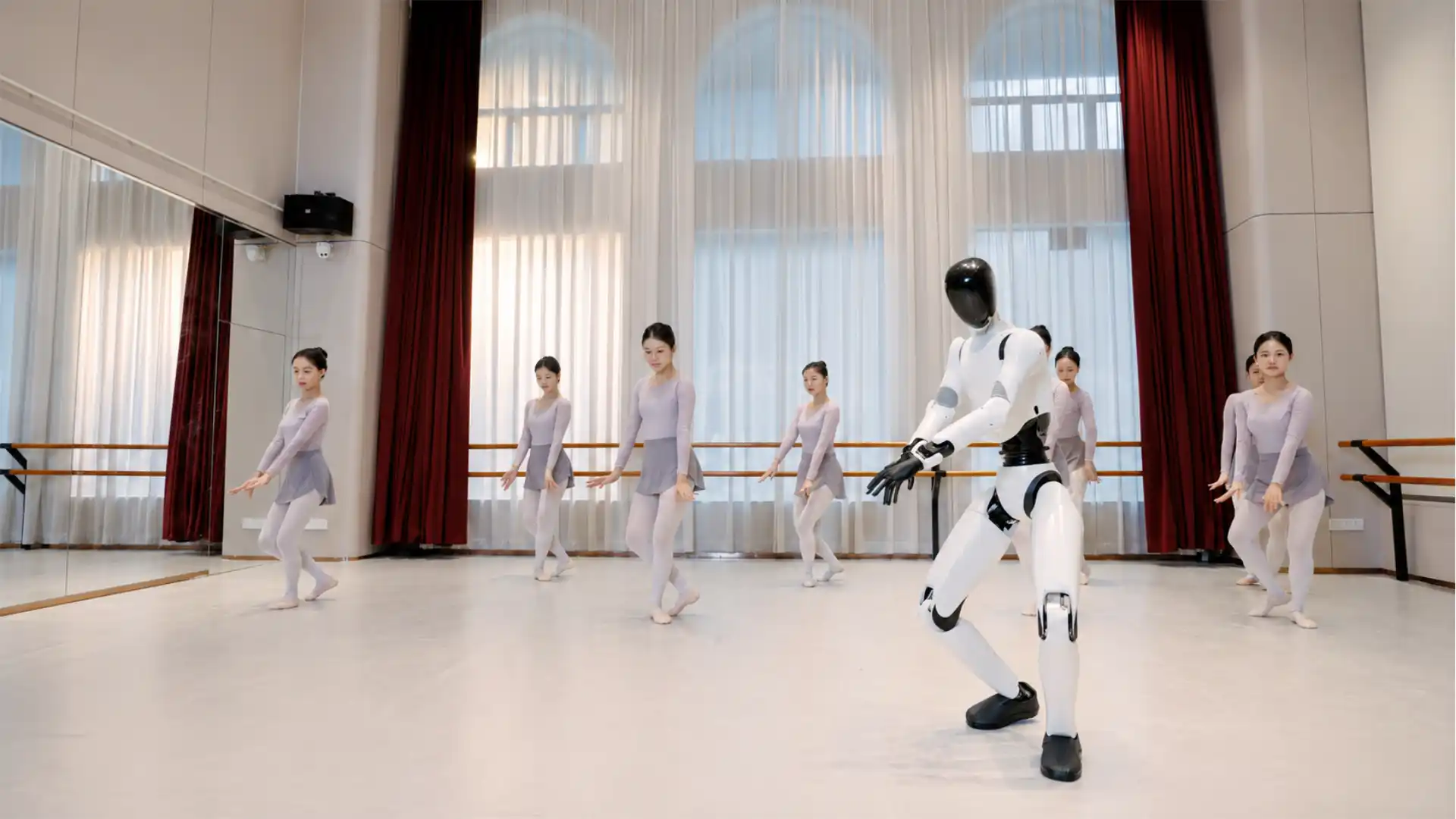
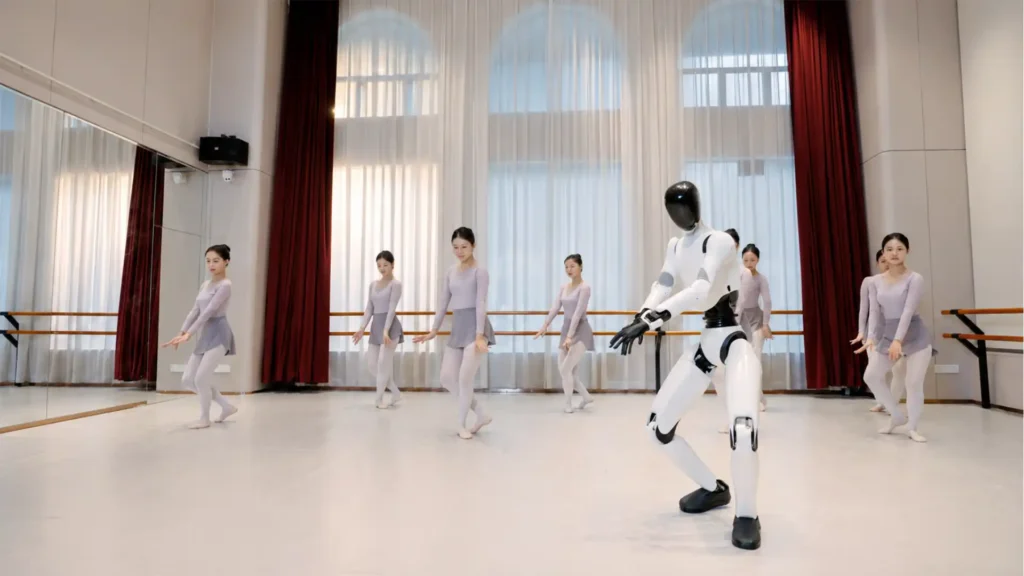
UBTech’s Walker C1 did not draw global attention because a robot moved to music. Robots have danced on stages, in labs, at trade fairs and in viral clips for years. The sharper point is that Walker C1’s waltz and ballet routine placed a full-size Chinese humanoid inside a familiar human performance space, beside human dancers, with movement smooth enough to make viewers ask a practical question rather than a science-fiction one: how close are humanoid robots to becoming credible service machines outside factories? UBTech promoted the Walker C1 performance as part of its role as the official exclusive humanoid robot partner of ChainExpo 2026, while China’s broader robotics push is now backed by policy, manufacturing capacity, industrial robot density and fast-moving domestic competition.
Table of Contents
The ballet clip made humanoid progress visible
The Walker C1 video landed because ballet is not a neutral test in the public imagination. A robot carrying a box can look useful but dull. A robot turning beside a dancer invites the viewer to judge posture, timing, balance, smoothness and intent. That judgment is immediate. People do not need an engineering background to notice a wobble, a delayed arm, a locked knee or a step that arrives a fraction too late.
That is why dance demonstrations have become a powerful public shorthand for humanoid robotics. They compress mechanical control, perception, joint coordination and software timing into a scene that ordinary viewers can read. The risk is that the scene can also mislead. A rehearsed stage routine does not prove that a humanoid robot can navigate a crowded hotel lobby, recover from a shove, carry luggage safely, answer unpredictable questions or work through a long shift without supervision. It proves something narrower, but still useful: the robot can execute a controlled sequence with enough fluency to look less like a machine fighting itself.
UBTech’s own language around the Walker C1 performance framed it as a blend of “precision, grace, and engineering,” and described the routine as a marker for intelligent service robotics rather than a pure entertainment stunt. The company said the robot performed waltz and ballet with human dancers to mark the ChainExpo 2026 partnership.
That framing matters. China’s humanoid race is no longer only about laboratory prototypes or single-purpose robots in fenced industrial zones. It is moving into public spaces, national showcases, logistics pilots, car factories, exhibitions and service scenarios. Walker C1 is part of that shift, even if the ballet itself is not proof of broad autonomy.
The performance also showed a recurring feature of China’s robotics communication strategy: technical progress is staged as cultural spectacle. Humanoid robots appear at expos, galas, sports events and trade fairs because these venues turn industrial policy into a visual story. Viewers see elegance. Investors see market signaling. Engineers see a control problem. Policymakers see a national technology narrative.
Walker C1 sits between theatre and service robotics
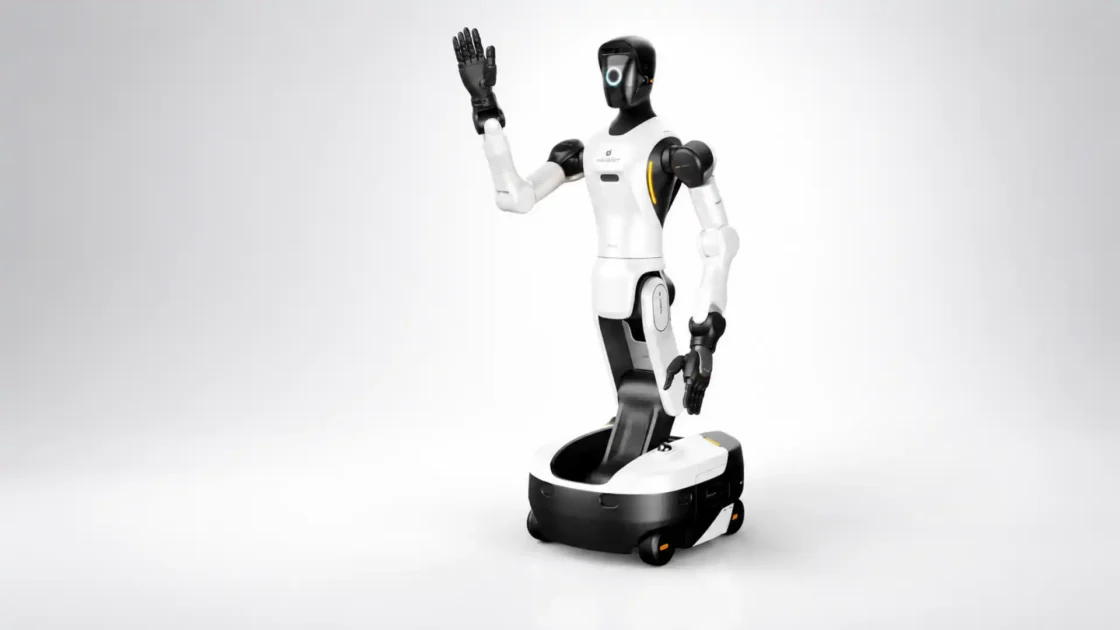
The Walker C1 is best understood as a commercial service humanoid, not as an industrial workhorse. UBTech’s older Walker C product page lists a 163 cm humanoid, a 43 kg body, 20 degrees of freedom, RGBD and binocular vision, structured-light 3D cameras, high-precision inertial sensing, Wi-Fi and Bluetooth, and a claimed working profile of roughly two hours walking or four hours standing. The page also says Walker C debuted at the Spring Banquet of Guangdong Province in 2025 to welcome guests and introduce technological achievements.
UBTech has not published the same level of technical detail for Walker C1 in the material surfaced around the ballet clip. That gap is worth stating plainly. The available public evidence supports the claim that Walker C1 performed a waltz and ballet routine beside human dancers; it does not yet support a detailed technical audit of Walker C1’s hardware. Several online summaries have reused specifications from related Walker models or unverified databases. Those numbers may turn out to be close, but they should not be treated as confirmed Walker C1 specifications unless UBTech publishes them in a product sheet or filing.
The service category explains the choice of performance. A factory humanoid is judged by throughput, uptime, payload, cycle time, safety and integration with manufacturing systems. A service humanoid is judged by a softer but not easier set of traits: approachability, motion quality, speech, navigation, crowd safety, gesture, presence and the ability to create trust during short interactions.
A ballet routine serves that market logic. It says: this robot is not only a steel frame with motors. It can occupy a human-facing setting without looking absurd. It can move near people without seeming chaotic. It can become part of an event, a reception, a guided tour or a branded visitor experience.
That does not make Walker C1 ready for every service job. A commercial robot that can dance in a scripted scene may still struggle with children running across its path, poor lighting, reflective floors, multilingual accents, network outages, battery limits and edge cases that no choreographer placed in the rehearsal. Service robotics is harsh because the environment is uncontrolled and the public expects the machine to understand social rules that are rarely written down.
The C1 performance is therefore neither trivial nor decisive. It is a signal that UBTech wants a place in the public-service humanoid category while its Walker S line pursues industrial deployment. The distinction between the C line and the S line is one of the main points investors, customers and readers should keep in view.
Ballet is a demanding control problem
Ballet looks delicate, but for a humanoid robot it is a hostile test. The robot must shift weight, coordinate ankles, knees, hips, torso, shoulders, elbows and wrists, and keep its center of mass inside a safe support region. Even small timing errors can cascade. A human dancer corrects through reflex, muscle elasticity, vestibular sensing, foot pressure, vision and years of embodied practice. A robot has to approximate parts of that process through sensors, actuators, control policies and software loops.
Humanoid motion research has long relied on model-based control, whole-body control, model predictive control, imitation learning and reinforcement learning to bridge the gap between desired movement and physically stable execution. A 2025 survey of humanoid locomotion and manipulation describes humanoid robotics as a field spanning design, actuation, sensing, control, planning and decision-making, with model-based planning and control forming the backbone for decades while learning-based methods add new capabilities.
Dance pushes those systems in a specific way. It is not only locomotion. It is expressive whole-body motion under balance constraints. The arms cannot be treated as decoration because arm movement changes angular momentum. The torso cannot swing freely because torso motion changes stability. The feet cannot be placed wherever the motion looks pretty because ground contact defines the robot’s support. For a robot, elegance is not a surface feature. Elegance is the visible result of many invisible corrections arriving on time.
That is why dance work in academic robotics is often tied to human-robot interaction rather than entertainment alone. UC San Diego engineers reported in 2024 that they trained a humanoid robot to learn expressive movements, including dance routines and gestures, while maintaining a steady gait across varied terrain. Their stated aim was to improve human-robot interaction in factories, hospitals, homes and hazardous sites.
Walker C1’s ballet performance belongs to that same broad idea: expressive motion is a trust interface. People read movement before they read specifications. A robot that moves stiffly near a person feels unsafe even if its safety case is good. A robot that moves fluidly feels more capable, even when its autonomy is limited. Engineers, regulators and buyers have to separate those two reactions.
That separation is hard. Public response to humanoid robots is unusually sensitive to movement quality. A jerky step can make a machine seem primitive; a smooth pirouette can make it seem smarter than it is. The true technical question sits between those reactions: what control architecture, sensing stack and safety system can repeat the motion under changing conditions?
The confirmed facts around the Walker C1 performance
The core public record is narrow but enough for a careful analysis. UBTech released or promoted the Walker C1 performance under the title “When humanoid robot meets elegance,” tied it to the company’s appointment as the official exclusive humanoid robot partner of ChainExpo 2026, and described Walker C1 as a new-generation full-size commercial service humanoid. The robot performed waltz and ballet with human dancers in the video promoted by UBTech and echoed across social platforms and technology outlets.
The ChainExpo context is verifiable beyond the robot clip. The official China International Supply Chain Expo site lists the fourth CISCE from June 22 to 26, 2026. That timing helps explain why a polished humanoid video would be released now. Supply-chain exhibitions are not just sales floors. They are industrial diplomacy stages. A humanoid robot partner at such an expo says something about China’s attempt to connect AI, robotics, manufacturing, logistics and public-facing technology into one national supply-chain story.
UBTech is also not a random entrant chasing viral attention. The company is listed in Hong Kong, has spent years developing the Walker family, and has used humanoid robots in both industrial and service narratives. Its 2025 interim report describes the Walker S, Walker S1 and Walker S2 as industrial embodied-intelligence humanoid robots, and states that the company is working on technologies including servo drive systems, large model technology, semantic VSLAM, learning-based motion control, visual perception and multimodal interaction.
The same interim report says the Walker S2 includes a hot-swappable autonomous battery-changing system, a 52-degree-of-freedom bionic body, a claimed 15 kg payload and a 3-minute battery swap for 7×24 operation. Those claims refer to the industrial Walker S2, not Walker C1, but they show where UBTech is directing its deeper commercialization effort.
Walker C1’s ballet should therefore be read beside UBTech’s industrial Walker S program, not in isolation. The performance is the public-facing face of a company trying to sell a broader thesis: humanoid robots will work, greet, guide, carry, inspect, sort, talk and perform in environments built for people.
The Walker family shows two different bets
UBTech’s humanoid strategy appears to split across two tracks. One is the industrial Walker S line, designed for factories, logistics and production-line tasks. The other is the commercial service Walker C direction, designed for human-facing environments such as receptions, exhibitions and public service scenes. The ballet clip belongs to the second track, but the credibility halo comes from the first.
Industrial robots have a cleaner business case. If a robot can perform material handling, sorting, inspection or parts movement at predictable cost, a factory can calculate payback. If the robot works in an environment already mapped, supervised and integrated with manufacturing software, deployment is still difficult but measurable. UBTech’s filings talk in this language. The company describes Walker S field trials entering a stage where multiple robots execute production-line-level tasks including workbin handling, SPS sorting, parts assembly, process material handling and quality inspection.
Commercial service robots are harder to justify with a spreadsheet. A humanoid at an exhibition booth or visitor center may create attention, guide guests, answer questions and strengthen brand perception. That value is real but harder to measure. The robot is partly labor tool, partly interface, partly media object. A dance routine is useful precisely because service robots must be evaluated as social artifacts as well as machines.
The two tracks can feed each other. Industrial deployment creates data, tests hardware durability, pushes battery management, exposes failures and forces better fleet management. Service deployment tests speech, navigation in public space, gesture, emotional response and human trust. A company that operates in both domains can move lessons between them, but it also risks blurring claims. A breakthrough in factory battery swapping does not automatically make a service robot socially safe. A graceful stage routine does not automatically make an industrial robot productive.
UBTech’s public materials support this split reading. The 2025 annual results announcement says the Walker S2 moved into mass production and delivery in 2025, and that UBTech reached annualized production capacity of more than 6,000 full-size embodied intelligent humanoid robots by year-end. It also reports 2025 revenue of about RMB820 million from full-size embodied intelligent humanoid robot products and services, with 1,079 units sold.
Those numbers, if sustained, matter more than the ballet clip. The commercial test is not whether a humanoid can make viewers applaud once. It is whether the same engineering base can create repeatable deployments that customers renew, expand and trust.
China’s humanoid push is policy, not only product marketing
The Walker C1 moment sits inside a state-backed race. China’s Ministry of Industry and Information Technology adopted guiding opinions on humanoid robot innovation and development in November 2023, setting a three-year policy direction for the sector. Beijing’s official English-language communication later described China’s goal of building an innovation system for humanoid robots by 2025.
That policy context does not mean every Chinese humanoid robot will succeed. It means the sector receives attention from ministries, local governments, standards bodies, investors, manufacturers and state-linked showcase platforms. Humanoid robots are being framed as a frontier industry tied to AI, advanced manufacturing, aging demographics, industrial upgrading and supply-chain autonomy.
The logic is clear. China already has a deep base in industrial automation, electronics manufacturing, batteries, sensors, machining, motors, logistics and scale production. Humanoid robots combine many of these strengths. They also create demand for domestic components and software stacks. For Beijing, the sector is not merely about replacing a worker with a biped. It is about building a high-value ecosystem around embodied AI.
A 2025 Strategic Study of CAE article describes China’s humanoid robot industry as growing quickly but still facing hard limits, including core technology gaps, mass-production difficulty and commercialization obstacles. The paper recommends work on core technologies, industrial layout, infrastructure, demonstration projects, laws, regulations and policy support.
That mix of ambition and constraint is the right lens for Walker C1. The ballet clip expresses ambition. The policy papers and industry reports reveal the constraints. China’s humanoid program is moving fast, but speed should not be confused with solved reliability, solved autonomy or solved economics.
China’s factory robot base gives humanoid firms an advantage
Humanoid robotics does not grow from empty ground. It draws on manufacturing capacity, component suppliers, industrial customers, software talent and a willingness to run pilots at scale. China’s position in traditional industrial robotics is therefore relevant.
The International Federation of Robotics reported that 542,000 industrial robots were installed worldwide in 2024, with Asia accounting for 74 percent of new deployments. China represented 54 percent of global deployments, with 295,000 industrial robots installed in 2024, and its operational robot stock exceeded 2 million units. The IFR also said Chinese manufacturers sold more than foreign suppliers in China for the first time, reaching 57 percent domestic market share.
Those figures do not translate directly into humanoid leadership. Most industrial robots are not humanoid. They are arms, gantries, SCARA robots, mobile platforms and other machines designed around specific tasks. Yet the ecosystem surrounding them matters. Factories that already buy automation are more likely to test new automation. Suppliers that already build motors, gearboxes, sensors and controllers can adapt to humanoid demand. Engineers who have integrated robots into production lines understand uptime, safety cages, workflow bottlenecks and maintenance cost.
China’s advantage is not that humanoid robots are already mature. Its advantage is that immature humanoids can be tested inside a huge automation market. That produces data, failure cases and purchasing pressure. It also creates hype, overcapacity and weaker companies chasing subsidies or investor excitement. Both effects can exist at the same time.
UBTech’s own industrial claims point in this direction. Its filings describe production-line-level tasks, multi-robot collaboration and plans to train models on large industrial datasets from Walker deployments. A commercial humanoid company that can collect real operating data from factories may learn faster than one limited to lab demonstrations.
For Walker C1, the link is indirect but powerful. The service robot benefits from the broader maturity of actuators, batteries, control stacks and manufacturing processes developed for industrial humanoids. Viewers see a ballet routine. Underneath it is a national and corporate attempt to turn industrial automation depth into embodied AI products.
From viral movement to embodied intelligence
The phrase “embodied intelligence” can sound abstract, but in robotics it has a concrete meaning. A robot is not only a chatbot in a plastic shell. It has a body, sensors, motors, power limits, joint friction, balance constraints and contact with the physical world. Intelligence has to survive physics.
UBTech’s 2025 interim report uses the embodied-intelligence frame heavily. It says AI is moving from the digital realm to the physical world, and describes embodied intelligence as AI integrated into physical entities that perceive, learn and interact with the environment in real time. The report lists technologies such as semantic VSLAM, learning-based motion control, visual perception, multimodal interaction, BrainNet 2.0 and Co-Agent systems.
A dance routine is a good public illustration of embodied intelligence because it cannot be reduced to language. A text model can describe a pirouette, but a robot has to place torque through joints without falling. The gap between sentence and action is the core robotics problem.
The same gap explains why progress can look uneven. AI models have improved quickly in language and image generation because digital environments allow fast data scaling. Robots learn more slowly because physical data is expensive, messy and risky. Every fall can damage hardware. Every real-world deployment requires supervision. Every contact with a human introduces safety concerns. Simulation helps, but simulation does not fully capture floor friction, actuator wear, cable flex, lighting, crowd behavior or the odd ways people interact with machines.
This is why stage clips are both exciting and limited. A choreographed routine can show a control stack working under designed conditions; real embodied intelligence requires adaptation under undesigned conditions. The more UBTech moves robots into factories, logistics centers, exhibitions and public venues, the more data it will gain on those undesigned conditions.
The gap between choreography and autonomy
Choreography is not a synonym for autonomy. A robot can perform an impressive routine from preplanned motion sequences, teleoperation, partial autonomy or learned control policies. The viewer often cannot tell which is happening. Unless the developer discloses the control mode, a public video should be treated as a demonstration of visible capability, not a full autonomy claim.
This does not make the Walker C1 clip meaningless. Choreography still tests hardware repeatability, coordination and balance. A poorly built humanoid cannot fake smooth motion indefinitely. Yet the hardest service tasks are not choreographed. They involve interruption, conversation, navigation, safe stopping, intent recognition and recovery.
Autonomy has layers. A robot may autonomously stabilize its gait while following a preplanned upper-body routine. It may autonomously avoid obstacles while a human operator triggers behaviors. It may use scripted speech and still rely on large language models for open-ended answers. It may have impressive self-balancing but limited scene understanding. Public demos rarely expose those boundaries.
NIST’s 2026 proposal for a humanoid robot baseline performance benchmark is relevant because it calls for measurable locomotion and manipulation tasks that represent minimum expected capabilities for commercially available humanoid robots. NIST notes that the DARPA Robotics Challenge was the last major moment when humanoid robot performance was rigorously measured across robots, and argues that a new benchmark is needed.
Benchmarks will matter more than videos once customers begin comparing humanoid robots seriously. Buyers need to know whether a robot can climb a step, recover from a small push, open a door, pick a dropped item, dock safely, detect a child, operate for a full shift, or stop before contact. A ballet routine answers none of those questions directly. It creates the reason to ask them.
Commercial service humanoids need a different proof
Service humanoids do not need to beat human dancers. They need to be useful, safe, reliable and acceptable in spaces where people move unpredictably. That proof is different from a trade-show performance.
A service robot in a museum, airport, hotel, hospital lobby or exhibition hall must perform several tasks at once. It must localize itself, recognize obstacles, manage its path, avoid startling people, speak clearly, handle repeated questions, maintain battery state, escalate to a human when needed and avoid actions that create legal or reputational risk. It also has to look calm while doing all of this. People forgive a warehouse robot for being strange. They judge a humanoid by human social standards.
This is why Walker C1’s motion quality is relevant. A robot that moves with smoother timing may be easier for people to predict. Predictability is a safety feature. Humans avoid collisions partly by reading body language. If a humanoid’s shoulder turns before it walks, if its head orientation suggests attention, if its arm motion is controlled rather than sudden, people may navigate around it more naturally.
Yet there is a danger in making robots too humanlike without giving them enough competence. A humanoid form raises expectations. Users may assume the robot understands language, intent, personal space and social context better than it does. A robot that looks graceful but cannot handle a simple exception may create frustration faster than a screen-based kiosk.
The service market will reward humanoids only where the human shape solves a real interface problem. Greeting guests, guiding visitors, demonstrating technology, performing at events and supporting branded environments may be early niches. Broad deployment in healthcare, elder care, retail or transport requires stronger evidence on safety, reliability, privacy and cost.
Industrial proof is moving faster than service proof
UBTech’s industrial Walker S program has more concrete public evidence than Walker C1’s service program. The company’s 2025 interim report says Walker S field trials entered Phase 2.0, with multiple robots collaborating on production-line-level tasks. Its 2025 annual results announcement says Walker S2 started mass production and delivery, and reports 1,079 full-size embodied intelligent humanoid robot units sold in 2025.
UBTech also announced in November 2025 through PR Newswire that it had begun mass production and delivery of several hundred Walker S2 industrial humanoid robots, with Walker series orders exceeding RMB800 million since early 2025. Reuters later reported that UBTech signed an agreement with Airbus for humanoid robots in aviation manufacturing, with Airbus describing the cooperation as being in an early concept-testing stage. Reuters also reported UBTech’s statement that its 2025 humanoid robot order value exceeded RMB1.4 billion and that production capacity was expected to exceed 10,000 units in 2026.
The Airbus detail is especially useful because it adds restraint. “Early concept-testing stage” is not the language of mature replacement. It is the language of exploration. It signals interest from a serious industrial buyer while keeping expectations grounded.
Industrial humanoids are still hard to deploy, but the buyer’s needs are clearer. A factory can define a task: move these bins, inspect these parts, sort these items, load this fixture. Performance can be measured. A service humanoid must often justify itself across softer tasks that overlap with hospitality, communication and brand experience.
Walker C1’s ballet may help UBTech win attention in the service lane. Walker S2’s industrial data will likely decide how credible UBTech looks in the wider humanoid market. The strongest robotics companies will not be the ones with the best single clip. They will be the ones with the shortest loop from deployment failure to improved product.
Rival humanoid makers are defining different lanes
UBTech is competing in a crowded field. Tesla positions Optimus as a general-purpose bipedal autonomous humanoid for unsafe, repetitive or boring tasks, requiring software for balance, navigation, perception and interaction with the physical world. Boston Dynamics presents Atlas as an enterprise humanoid for industrial work and material handling, listing specifications such as 56 degrees of freedom, 1.9 m height, 90 kg weight, four hours of battery life and self-swappable batteries.
Figure has focused on industrial deployment with BMW. BMW said Figure 02 was tested at Plant Spartanburg in a real production environment, with a 70 kg body, about 170 cm height and 20 kg load capacity. Figure later said its Figure 02 deployment at BMW ran 10-hour shifts Monday through Friday and loaded more than 90,000 parts. Unitree, meanwhile, has attacked the market from a cost and agility direction. Its G1 page lists a 1320 mm standing height, about 35 kg weight and 23 to 43 degrees of freedom depending on configuration.
These companies are not all solving the same problem in the same order. Tesla has scale manufacturing and AI ambition but faces scrutiny over timelines. Boston Dynamics has unmatched public credibility in dynamic robotics and is now pushing Atlas toward enterprise use. Figure is trying to prove factory deployment fast. Unitree has built a strong public image around agile, comparatively accessible humanoids and quadrupeds. UBTech is leaning on China’s manufacturing ecosystem, industrial pilots, government-aligned strategy and service-showcase visibility.
Walker C1’s ballet is therefore a positioning move. It tells the market UBTech wants to be seen not only as a factory humanoid company, but also as a maker of robots that can occupy human social spaces. That message is distinct from Atlas carrying parts or Figure loading components.
Walker C1 and rival humanoids at a glance
| Robot or company | Publicly visible direction | Evidence that matters now |
|---|---|---|
| UBTech Walker C1 | Commercial service and public interaction | Waltz and ballet performance with human dancers tied to ChainExpo 2026 |
| UBTech Walker S2 | Industrial embodied-intelligence humanoid | Mass production claims, factory tasks, battery swapping, order announcements |
| Tesla Optimus | General-purpose biped for repetitive or unsafe work | Tesla’s AI and robotics strategy, factory ambitions, autonomy stack claims |
| Boston Dynamics Atlas | Enterprise material handling and industrial work | Productized electric Atlas, self-swappable battery, industrial specifications |
| Figure 02 | Automotive production support | BMW plant testing and Figure’s later deployment metrics |
| Unitree G1 | Agile, lower-cost humanoid platform | Published dimensions, weight and degree-of-freedom configurations |
This comparison is not a ranking. It shows that the humanoid market is splitting into use-case narratives before it has settled into mature product categories. Walker C1 belongs to the service and public-interaction narrative, while UBTech’s stronger commercial evidence still comes from industrial Walker S deployments.
The hardware problem behind graceful movement
A full-size humanoid robot is a chain of compromises. More powerful motors improve movement but add weight, heat, cost and power demand. More degrees of freedom increase expressive capacity but complicate control. Bigger batteries extend runtime but burden locomotion. A stronger frame improves durability but reduces agility. Softer coverings may make a robot friendlier but complicate thermal management, cleaning and repairs.
The public often sees the outer shell. Buyers eventually care about the inner ledger: actuator life, joint backlash, maintenance intervals, spare-part cost, battery replacement, sensor calibration, fall damage, warranty terms and service response. A graceful ballet routine can hide that ledger, but it cannot remove it.
UBTech’s industrial filings reveal how central hardware still is. Walker S2’s described features include a 52-degree-of-freedom body, 15 kg payload, autonomous battery swapping, finger payload improvements and new dexterous hands. Those details are not decorative. They are attempts to solve uptime, manipulation and industrial handling.
For Walker C1, the hardware demands differ. A service humanoid may not need a 15 kg payload, but it needs quiet motion, attractive form, safe surfaces, stable walking on polished floors, reliable sensors under expo lighting, and enough battery life to avoid constant interruptions. It also needs maintenance that a venue operator can tolerate. If a robot requires specialist engineers after every public event, its business case weakens.
The hidden test of Walker C1 is not whether it can finish the dance once. It is whether its joints, batteries, sensors and software can repeat public-facing work without becoming a support burden. This is where robotics companies often meet reality. Demos are short. Operations are long.
Software becomes the bottleneck after the body works
Once a humanoid can stand, walk and gesture, the bottleneck shifts. The robot needs scene understanding, task planning, language grounding, social behavior, failure recovery and fleet management. That software has to connect high-level intent to low-level movement without creating unsafe actions.
UBTech’s reports use the language of a “humanoid brain” and “humanoid cerebellum,” with BrainNet 2.0 and Co-Agent technology connecting reasoning nodes and skill nodes. The company says the “super brain” handles semantic understanding, reasoning, decision-making and anomaly detection, while the “intelligent cerebellum” translates instructions into real-time physical execution. It also says on-device inference latency has been improved to under one second for parts of this architecture.
Those claims fit the wider direction of humanoid robotics. The industry is trying to connect foundation models, vision-language-action systems, reinforcement learning, imitation learning and whole-body control. The difficulty is that high-level models are good at meaning, while bodies require precision. A robot cannot “roughly” place its foot. It cannot hallucinate a grasp. It cannot improvise through a safety rule.
A service humanoid needs even more grounding. If a visitor asks, “Can you take me to the nearest exit?” the robot must understand the request, know the map, choose a safe route, move at human-compatible speed, avoid blocking others, detect if the visitor stopped following, and comply with venue safety procedures. Language alone is not enough.
The next phase of humanoid competition will be less about making robots look alive and more about making them fail gracefully. A robot that pauses, explains a limitation and calls a human is more deployable than one that continues confidently into an unsafe state.
Safety will decide public deployment speed
Humanoid robots will operate close to people, and that makes safety the gatekeeper. Traditional industrial robots often work behind barriers or in structured cells. Service humanoids move in shared spaces. That raises different risks: collision, pinching, falls, privacy, crowd behavior, misuse, cybersecurity, emotional overtrust and unclear liability.
ISO 10218-1:2025 covers safety requirements for industrial robots, addressing inherently safe design, risk reduction and information for use before integration into larger systems. The ISO page also states that the standard does not apply to service robots where the public can have access or consumer products for household use. ISO 13482:2014, by contrast, addresses personal care robots such as mobile servant robots, physical assistant robots and person carrier robots, including human-robot physical contact applications.
This split shows the regulatory challenge. A humanoid that greets visitors at an expo is not identical to a bolted factory arm. A humanoid that carries objects in a warehouse is not identical to an elder-care assistant. A humanoid that dances beside people raises questions about close-contact movement, safe stopping distances and liability if someone steps into its path.
China is also building standards activity around humanoid robots. Beijing’s official site reported in 2025 that China’s first national standards for humanoid robot technical requirements had been approved for development, covering areas including environmental perception, decision-making and planning, motion control and task execution.
The faster humanoids enter public spaces, the more standards will move from background paperwork to market infrastructure. Customers will not buy only motion. They will buy evidence: safety cases, certifications, logs, incident procedures, software update controls, cybersecurity posture and insurance clarity.
China’s standards push is part of the race
Standards are often treated as dull afterthoughts. In humanoid robotics, they may become a competitive tool. A market with shared benchmarks and safety rules can scale faster because buyers know what claims mean. A market without them becomes a theatre of videos, private tests and vague promises.
UBTech’s 2025 interim report states that the company served as deputy head of the Humanoid Robot Standards Working Group of the National Robotics Standardization Committee and co-leader of the Embodied Intelligence Working Group of the National AI Standardization Subcommittee. It says UBTech helped develop technical requirements for operational tasks, positioning and navigation, and human-computer interaction within the first batch of national standards for humanoid robots.
This matters for two reasons. First, companies involved in standards can shape the language by which products are evaluated. Second, standards help turn prototypes into procurement categories. A buyer can ask for compliance against specific requirements rather than relying on a polished demo.
NIST’s performance assessment work points in the same direction from a U.S. measurement perspective. NIST describes the need for test methods covering perception, mobility, dexterity and safety components of robotic systems, with performance models that manufacturers can use to assess robot systems in smart manufacturing applications.
A serious humanoid market will need fewer adjectives and more test reports. Words such as lifelike, intelligent and autonomous mean little without context. Can the robot complete a task 500 times? Under what lighting? With what failure rate? Around what people? At what speed? With what recovery behavior? Standards turn those questions into procurement language.
The economics remain unresolved
The business case for humanoid robots is still uneven. Industrial robots have decades of adoption behind them because they deliver measurable productivity in defined tasks. Humanoids promise flexibility in human-built environments, but flexibility is expensive if the robot performs only a narrow set of jobs.
UBTech’s 2025 annual results announcement reports strong growth in full-size embodied intelligent humanoid robot products and services, but that is one company’s reported performance during a high-investment phase. Reuters reported UBTech’s statement that 2025 humanoid orders exceeded RMB1.4 billion and production capacity was expected to exceed 10,000 units in 2026; it also reported Airbus describing its UBTech cooperation as early concept testing. The two facts belong together: order momentum is real, but mature deployment is still under examination.
The economics differ by use case. A factory robot can be justified if it performs a task through long shifts with lower injury risk, stable quality and acceptable maintenance cost. A service robot may be justified by marketing value, visitor experience, reduced staffing strain or data collection, but the payback is harder to isolate.
A humanoid also competes against cheaper alternatives. A screen kiosk can answer questions. A wheeled robot can guide visitors. A robotic arm can handle parts. A conveyor can move goods. Software can schedule staff. The humanoid form must earn its premium.
The human shape is economically rational only when the environment, tools or users make that shape useful. A humanoid can use stairs, doors, handles, shelves and workstations designed for people. It can communicate with gestures. It can operate in spaces where rebuilding the environment would cost more than buying adaptable machines. Those advantages are real, but they do not apply everywhere.
Walker C1’s ballet raises brand value and public confidence. It does not settle the cost-per-task question. UBTech’s industrial deployments are more likely to reveal whether the company can cross from attention to margin.
Public fascination is both asset and liability
Humanoid robots attract attention because they resemble people. That attention lowers marketing cost, but it raises expectations and fear. A box-moving robot looks like equipment. A humanoid looks like a possible worker, assistant, performer, companion or threat. The public reads it through labor anxiety, science fiction, national competition and personal unease.
The Walker C1 clip drew attention because viewers saw something graceful. Other humanoid clips go viral when robots fall, stumble or behave strangely. Both reactions are part of the same cultural cycle. People want proof that robots are advancing, and they also want reassurance that robots remain flawed.
AP reported in 2026 that more than 100 robots were showcased at Hong Kong exhibitions, with machines demonstrating language, dancing, boxing, sand painting, backflips and security patrol functions. The report also noted that China had more than 140 humanoid-robot manufacturers and more than 330 models in 2025, and cited Omdia ranking AGIBOT, Unitree and UBTech among top-tier vendors by shipments.
This public field is becoming crowded. A single ballet clip can stand out for a few days, but the baseline for surprise keeps rising. Robots dancing, running, boxing, flipping and greeting guests are moving from novelty to genre. That pushes companies toward more dramatic demonstrations, which can create risk if the show outruns the product.
A humanoid company has to manage wonder without selling fantasy. If a demo implies general intelligence that the robot does not possess, backlash follows when users meet the actual product. If a company undersells progress, it loses attention in a market driven by visibility. UBTech’s challenge is to convert spectacle into evidence before the spectacle becomes ordinary.
Humanoid robots are becoming media infrastructure
Walker C1’s ballet is part of a broader pattern: humanoid robots are becoming media objects used to narrate national and corporate technological progress. They appear at expos, conferences, festivals, factory openings and product launches because they photograph well. They give abstract AI a body.
This matters for Google News, search interest, investor attention and public policy. A humanoid robot on stage is easier to understand than an AI model benchmark or a motor-control diagram. The image travels. The clip becomes a symbol. Search queries follow: Walker C1 robot, UBTech humanoid ballet, China humanoid robot, robot Swan Lake, humanoid robots in China, ChainExpo 2026 robot.
The media function does not make the technology fake. It means the public record becomes shaped by what is visible rather than what is most commercially relevant. A robot sorting parts for 10 hours may matter more than a dance, but the dance will reach more people. A battery-swap mechanism may decide uptime, but a waltz will decide the headline.
Humanoid robots occupy a rare space where engineering demonstration, brand theatre and industrial policy meet in one body. That is why coverage must avoid two errors. The first is dismissing every performance as a gimmick. The second is treating every performance as proof of near-term replacement.
Walker C1 deserves the middle reading. It is a technically polished communication event from a serious robotics company in a serious national market. It is not a complete proof of service autonomy.
Labor anxiety will intensify with humanlike performances
A humanoid robot dancing beside people triggers a different emotional response from a robotic arm welding a car body. It invites comparison with human skill. That comparison can feel playful in ballet, but it becomes charged when the same body shape appears in factories, warehouses, hotels or care settings.
Labor anxiety around humanoids will grow because the machines are designed to fit human environments. Their value proposition often rests on using human tools, moving through human spaces and taking over tasks that were hard to automate without redesigning the workspace. Even when robots begin with dull, dangerous or repetitive jobs, workers may see a broader replacement path.
Tesla explicitly frames Optimus around unsafe, repetitive or boring tasks. BMW framed Figure 02 trials as support for employees performing ergonomically awkward and exhausting tasks, with ongoing safety assessment. UBTech’s industrial materials describe handling, sorting, parts assembly and quality inspection. These are reasonable automation targets, but the social question remains: who benefits from the productivity gain, and how fast do job designs change?
In service settings, the tension may be subtler. A robot greeter may not replace a skilled worker directly, but it can reshape staffing expectations. A hotel that uses humanoids for basic directions may reduce front-desk load. A museum that uses robots for guided tours may turn human guides into premium services. An expo that uses robots for spectacle may set new expectations for technology-driven visitor experience.
The debate will not be about whether robots can dance. It will be about which human tasks are being reclassified as automatable because robots can now move and communicate in more human ways. Policymakers, employers and unions will need to discuss deployment transparency, training, job redesign and safety long before humanoids become commonplace.
The ChainExpo setting gives the clip strategic meaning
ChainExpo, formally the China International Supply Chain Expo, is a meaningful setting for Walker C1’s promotional role. The official CISCE site lists the fourth expo for June 22 to 26, 2026. A humanoid robot partner at a supply-chain expo is not random. It connects robotics to manufacturing capability, logistics, industrial coordination and global trade relationships.
Supply-chain events are where countries and companies tell stories about reliability. They are also where China seeks to present itself not only as the world’s factory, but as a source of advanced technology embedded across production networks. A humanoid robot performing ballet is not directly about supply-chain resilience, but the body of the robot contains the supply chain: actuators, reducers, batteries, sensors, chips, cameras, materials, software, assembly and maintenance services.
The performance also shifts the idea of supply chains from invisible logistics to visible intelligence. A visitor may not remember a panel on component sourcing. They will remember a humanoid robot dancing. That memory becomes a gateway to the broader message: China wants to lead not only in making goods, but in making the intelligent machines that make and move goods.
UBTech benefits from this setting because it can present both service and industrial faces. Walker C1 can greet, dance and guide. Walker S2 can be discussed in the language of industrial deployment, battery swapping and factory tasks. The company can show grace at the front of the booth and talk throughput behind it.
For UBTech, ChainExpo is a stage where public trust, industrial ambition and export narrative overlap. The Walker C1 clip is best read as a pre-expo signal that the company wants to be seen at the center of China’s embodied-AI supply-chain story.
A service humanoid must pass the awkward lobby test
The real test for Walker C1 is not Swan Lake. It is an awkward lobby at 4:30 p.m. A visitor walks too close. A child waves from the side. Someone asks a question in accented English. The floor is reflective. The Wi-Fi briefly drops. A staff member rolls a cart across the route. The robot’s battery is low. A person tries to take a selfie while blocking its path.
That scene is less elegant than ballet and far more valuable. Service humanoids live or die by edge cases. The public does not behave like a choreography partner. People interrupt, test, joke, touch, crowd, ignore instructions and ask irrelevant questions. A commercial service humanoid must handle this without creating danger or embarrassment.
This is where form factor becomes both help and hazard. A humanoid can signal attention through head and torso orientation. It can point, wave, bow, gesture and occupy social space in familiar ways. But it can also be misunderstood. If it has arms, people may expect it to carry objects. If it has a face or face-like display, people may expect emotion. If it walks, people may expect it to understand the flow of pedestrian movement.
The service robot’s job is partly to lower the mismatch between what people expect and what the robot can actually do. That is design, not only AI. Movement speed, voice tone, gesture size, stopping behavior, eye-line, error messages and staff handoff all shape user trust.
Walker C1’s ballet suggests UBTech is attentive to motion aesthetics. The deployment question is whether that attention extends to the messy choreography of public life.
Factory buyers will ask harder questions than viewers
A viewer asks, “Does it look real?” A factory buyer asks, “What happens after 1,000 hours?” The second question determines revenue durability.
Industrial buyers will want cycle-time data, uptime logs, mean time between failures, safety certification, integration cost, task-change procedures, spare-part supply, battery replacement cost, remote monitoring, cybersecurity controls, software rollback, training requirements and insurance implications. A humanoid robot that performs well in a video can still fail procurement if those answers are weak.
UBTech’s reported industrial orders and production capacity suggest that serious buyers are at least testing the category. Its annual results announcement reports more than 6,000 annualized production capacity for full-size embodied intelligent humanoid robots by the end of 2025 and 1,079 units sold that year. PR Newswire’s UBTech announcement said Walker S2 mass production and delivery began with several hundred units and Walker series orders exceeding RMB800 million since early 2025.
The credible reading is not that humanoids are already replacing workers at scale across industry. It is that the purchase conversation has moved from “interesting prototype” to “pilot, deploy, measure and iterate.” That is a real shift.
For Walker C1, the equivalent buyer questions will concern crowd safety, language performance, navigation reliability, content management, guest satisfaction, staff workload reduction and maintenance. Service customers may tolerate more spectacle value than factories, but they will still expect reliability once the novelty fades.
The market is split between humanoid necessity and humanoid theatre
Not every task needs a humanoid robot. Many tasks are better solved by non-humanoid machines. Warehouses use conveyors, autonomous mobile robots and robotic arms for good reasons. Hospitals may prefer carts and specialized delivery robots for moving supplies. Hotels may use kiosks, apps and wheeled service robots. The humanoid shape adds cost and complexity.
The humanoid argument is strongest in human-built environments where redesigning the environment is expensive or where social interaction is part of the task. A robot with legs can use stairs and uneven spaces. Arms and hands can interact with tools designed for people. A torso and head can make communication easier. A humanlike silhouette can draw attention in entertainment and hospitality.
The theatre problem appears when companies use the humanoid form because it attracts attention even though a simpler robot would do the job better. That may be acceptable in an expo booth or brand activation. It becomes wasteful in operations.
Walker C1 sits close to this boundary. As a performance robot, it clearly has theatre value. As a service robot, it must show necessity. Greeting guests and guiding visitors may justify a humanoid if the goal includes brand experience and natural interaction. For pure wayfinding, a screen may be cheaper. For pure delivery, wheels may be better.
The future market will not be humanoid versus no robots. It will be humanoids where embodiment pays, specialized robots where specialization wins, and software where no body is needed. A mature buyer will not ask whether humanoids are impressive. They will ask whether the humanoid body is the right tool.
The dance routine reveals a trust strategy
Trust in robotics is not only built through certifications and performance metrics. It is also built through repeated exposure to machines behaving predictably in human settings. Dance is one way to create that exposure. It frames the robot as coordinated, non-threatening and culturally legible.
This is not accidental. A robot that can perform ballet beside dancers borrows emotional cues from the dancers. It becomes part of a human scene rather than an isolated machine. The music, costume, stage lighting and choreography soften the robot’s presence. Viewers judge it as a participant.
For service robotics, that matters. People are more likely to approach a robot that seems calm and socially readable. A humanoid with abrupt motion, loud motors or uncertain posture can trigger avoidance. A robot with smoother movement can feel safer, even before a user knows its safety systems.
UC San Diego’s expressive humanoid work made a related point: expressive and more humanlike body motions were linked to trust and human-robot coexistence. The research context differs from UBTech’s commercial video, but the human factor overlaps.
Walker C1’s ballet is a trust-building artifact. It is meant to make the robot feel acceptable in shared space. The unresolved question is whether that trust is earned by operational reliability or merely borrowed from performance aesthetics. The answer will emerge only through deployments where users interact with the robot without a script.
Robot dance has history, but the stakes have changed
Robot dance is not new. Small consumer robots and research platforms have danced for years. UBTech itself has a history in performance robotics; its Alpha series appeared in synchronized dance contexts long before full-size humanoids became the center of industrial AI debate. What has changed is the size of the machines, the ambition of the companies and the proximity to real deployment.
A toy robot dance is entertainment. A full-size humanoid dance is a claim about physical intelligence. The body is heavier, the fall risk greater, the actuation harder and the social implication stronger. The robot looks like something that might share a workspace, not a gadget on a desk.
China’s recent wave of robot performances sits in a different industrial moment. AP reported more than 140 humanoid-robot manufacturers and more than 330 models in China in 2025, with leading vendors shipping meaningful volumes. IFR data shows China’s unmatched scale in industrial robot deployment. UBTech’s filings and announcements describe industrial humanoid orders, capacity and production-line pilots.
In that setting, robot dance is no longer a standalone novelty. It is part of a commercialization funnel. A viral clip drives attention. Attention supports brand legitimacy. Brand legitimacy helps meetings with customers, investors and governments. Deployments generate data. Data improves robots. Better robots create stronger clips.
The spectacle and the business model now feed each other. That does not guarantee success, but it changes the meaning of the stage.
The hard part is recovery, not performance
A polished routine shows what a robot can do when things go right. Robustness is what happens when things go wrong. For humanoid robots, recovery is often harder than execution. A slight slip, unexpected contact, sensor glitch, mistimed step or obstacle can turn stable motion into a fall.
Humans recover constantly. We adjust foot placement after a bump, change gait on a wet floor, shift weight when carrying a bag, and use arms for balance without conscious planning. Robots must detect disturbances, estimate state, choose corrective actions and execute them within tight time windows. A humanoid’s tall body and small feet make this especially difficult.
This is why NIST’s call for baseline benchmarks matters. A robot’s ability to perform standard locomotion and manipulation tasks under measurable conditions will reveal more than a highlight video. For service robots, the benchmark set should eventually include safe stopping, obstacle negotiation, door handling, crowd navigation, docking, communication failure and human handoff.
Walker C1’s ballet looks smooth because the routine is designed around success. That is fine for a demonstration. But buyers will need to see recovery: what happens if a dancer steps late, if a visitor crosses the stage, if the floor surface changes, if the robot’s foot placement is imperfect?
The next meaningful Walker C1 demo would not be a harder dance. It would be a messier one. A robot that can pause safely, replan, continue and communicate the reason would say more about service readiness than an extra flourish.
The humanoid body changes privacy and data questions
A service humanoid is a mobile sensor platform in a human-shaped body. It may carry RGB cameras, depth cameras, microphones, inertial sensors and network connectivity. It may process speech, faces, gestures, location, crowd movement and environmental maps. In public venues, that creates privacy questions.
UBTech’s Walker C product page lists RGBD cameras, binocular vision, structured-light 3D cameras and inertial sensing for Walker C. These are normal robotic sensing tools, but in a public-facing humanoid they carry social weight. People may not know when they are being recorded or analyzed. They may treat the robot as a performer while it is also mapping space and processing interactions.
Commercial service deployments will need clear policies. What data is captured? Is video stored or processed locally? Are conversations retained? Are faces identified? Can venue operators review logs? How are children handled? How are bystanders informed? Who is responsible if the robot gives wrong directions or records sensitive information?
The human shape can make privacy harder because people anthropomorphize. They may speak more casually to a humanoid than to a kiosk. They may stand closer. They may assume the interaction is temporary when the system is logging data. Regulators will likely treat these systems through existing data protection rules, but humanoids create new practical contexts.
Trustworthy service robotics will require visible privacy design, not only hidden compliance. A robot that moves gracefully but handles data opaquely will face resistance in schools, hospitals, airports and public venues.
The supply chain inside the robot may matter as much as the robot
Humanoid robots are supply-chain products in the deepest sense. Their performance depends on motors, reducers, bearings, batteries, sensors, chips, cameras, connectors, structural materials, cooling, software tools, simulation systems and manufacturing quality. A company’s ability to scale depends on suppliers as much as algorithms.
This is why the ChainExpo setting is more than a backdrop. China’s supply-chain strength gives domestic humanoid firms a practical advantage in iteration speed and cost control. If a company can source components quickly, test new joint designs, modify tooling and deploy pilots with local industrial partners, it can shorten development cycles.
The advantage is not absolute. High-end actuators, precision reducers, AI chips and advanced sensors remain contested areas. Export controls, semiconductor constraints and geopolitical risk may affect humanoid robot development. Software and safety validation remain difficult regardless of manufacturing base. Yet the physical supply chain is central.
UBTech’s reported capacity expansion and order growth should be read through this lens. Production capacity is not only factory space. It means supplier qualification, assembly process, quality control, testing, field support and after-sales service. Reuters reported UBTech’s expectation that production capacity for industrial humanoid robots would exceed 10,000 units in 2026. That target, if met, would require far more than viral demand.
The humanoid race will be won partly in procurement offices, supplier audits and quality labs. Walker C1’s stage motion is the visible tip of a long industrial stack.
The global competition is shifting toward deployment data
The first wave of the current humanoid boom was dominated by videos. Companies showed walking, sorting, folding laundry, carrying boxes, talking, dancing or recovering from pushes. The next wave will be judged by deployment data: hours worked, tasks completed, failures, interventions, injury record, cost per task and customer renewals.
Figure’s BMW update is an example of the new language. The company said Figure 02 ran 10-hour shifts Monday through Friday and loaded more than 90,000 parts during the deployment. Whether one views that as proof of maturity or a still-limited pilot, it is the kind of metric the market needs. UBTech’s annual unit sales and industrial order disclosures move in the same direction.
Walker C1 will need similar evidence in its category. How many public events can it support? How many visitor interactions per hour? How many navigation failures? How often does staff intervene? How long between maintenance events? Does it improve visitor satisfaction or reduce staff load? Does the novelty persist after the first week?
Humanoid robotics is entering the audit phase. The companies that keep publishing only spectacle will look weaker over time. The companies that publish deployment metrics, even imperfect ones, will shape customer expectations.
This does not mean every useful metric must be public. Customers may keep operational data private. But the market will demand enough evidence to distinguish mature systems from cinematic prototypes.
China’s local competition may be UBTech’s toughest pressure
UBTech competes globally, but its most immediate pressure may come from China’s own humanoid sector. AP cited data showing more than 140 humanoid-robot manufacturers and more than 330 models in China in 2025. Unitree, AGIBOT, EngineAI and other firms are pushing videos, products and pilots at a rapid pace. Local governments and industrial parks are supporting robotics clusters. Component suppliers are improving. Customers are testing.
Competition can accelerate progress. It pushes prices down, forces clearer use cases and spreads technical talent. It can also create noise. Too many firms chasing similar demos may flood the market with claims that buyers cannot verify. A few failures in public settings could damage trust across the category.
UBTech’s advantage is that it has a public listing, a long robotics history, recognized humanoid branding and reported industrial orders. Its risk is that faster-moving rivals may define the public imagination or undercut on price. Unitree, for instance, has made global waves with agile and comparatively accessible robots, while AGIBOT has gained visibility in Chinese humanoid showcases.
Walker C1’s ballet can be read as a response to that competitive pressure. It is a claim to elegance and service presence, not just mechanical ability. In a crowded field, style becomes a differentiator, at least at the top of the funnel.
The deeper differentiator will be whether UBTech can link style to deployments that competitors cannot match.
Service robots will need local cultural fluency
A humanoid service robot is not culturally neutral. Greeting style, gesture, personal distance, voice tone, politeness rules and public expectations vary by country and setting. A robot that works in a Chinese exhibition hall may need adaptation for a European airport, a Japanese hotel, a Gulf shopping mall or a U.S. hospital.
Dance can travel more easily than daily service. A ballet reference such as Swan Lake is globally recognizable. A waltz has broad cultural readability. But guiding a visitor, answering questions or handling a complaint requires local fluency. The robot must know not only language, but service norms.
UBTech’s Walker C page emphasizes communication and sensing features for a humanoid service robot, while public materials around Walker C1 frame it as a commercial service humanoid. The next step for any such robot is localization. Multilingual speech alone is not enough. The robot’s gestures, pacing and escalation behavior must fit the environment.
This is where service humanoids may become a software and content business as much as a hardware business. Venue maps, scripts, brand voice, emergency procedures, visitor analytics and local regulations all become part of deployment. A robot provider may need partners in hospitality, event operations, facilities management and data governance.
A graceful robot that cannot adapt to local service expectations will remain a stage object. A less theatrical robot with better operational localization may win real contracts. Walker C1’s global relevance depends on this transition.
The emotional response is part of the product
Humanoid robots do not enter the market like forklifts. They carry emotional meaning. People may feel delight, unease, curiosity, suspicion or attachment. A company that ignores this will design poor service experiences.
Walker C1’s ballet taps delight. It makes the robot appear gentle, precise and collaborative. That is useful because many people associate humanoids with threat or job loss. A dance routine reframes the machine as a partner, at least for a moment.
The risk is over-attachment or overtrust. If a robot looks too capable, users may rely on it in situations where it lacks judgment. If it looks too human, users may attribute emotions or intentions that do not exist. If it performs with dancers, viewers may assume it understands the dance rather than executing a control sequence.
Service robotics must manage this emotional gap. Designers can make robot behavior expressive without deceptive human simulation. They can signal limitations clearly. They can avoid pretending the robot has feelings. They can make handoffs to humans easy. They can use motion to support safety rather than to imitate life for its own sake.
The best service humanoids will feel readable, not fake-human. Walker C1’s ballet is readable as performance. Real deployment should preserve that clarity: the robot should be charming enough to approach, but transparent enough to trust responsibly.
A compact map of the deployment questions
The Walker C1 video answers one question: can UBTech make a full-size service humanoid perform a polished routine beside humans? Public evidence says yes. The video does not answer the questions that decide deployment.
Demo claims and deployment questions
| Public claim or impression | Evidence still needed for deployment |
|---|---|
| Smooth waltz and ballet movement | Repeatability across many events, floors and lighting conditions |
| Safe movement near people | Certified safety case, collision testing and emergency stop behavior |
| Service humanoid positioning | Real customer pilots in venues with visitor interaction data |
| Humanlike expressiveness | User studies showing trust without overreliance or confusion |
| Commercial readiness | Maintenance cost, uptime, staff training and support model |
| Broader autonomy | Disclosure of control mode, navigation capability and failure recovery |
The table shows why a strong demo should start due diligence, not end it. Walker C1’s performance is a credible signal of motion quality and brand direction. Commercial readiness needs evidence from uncontrolled public environments.
The credible read on the Walker C1 moment
The fairest reading of Walker C1 is neither hype nor dismissal. The robot’s ballet and waltz performance is a meaningful demonstration of motion quality, coordination and public-facing design. It also acts as a marketing signal tied to ChainExpo 2026 and China’s wider push to present humanoid robotics as a strategic industry.
The performance does not prove general autonomy, broad service competence or near-term mass adoption in public spaces. It does not reveal enough about Walker C1’s hardware, control mode, runtime, safety certification, recovery ability or deployment economics. Those limits are not criticisms; they are the difference between a demo and a product case.
UBTech’s broader position is stronger than the clip alone. The company has reported industrial humanoid deployments, Walker S2 production and delivery, major order values, and factory-oriented technical development. That context makes Walker C1 more interesting because it comes from a company working both sides of the humanoid market: public service presence and industrial embodied AI.
The real story is that humanoid robots are crossing from isolated technical demos into coordinated commercial narratives. Walker C1’s ballet is one expression of that crossing. It is designed to make humanoid robotics feel near, elegant and socially acceptable. The next phase will test whether that feeling survives contact with daily operations.
The next evidence to watch
The next meaningful Walker C1 evidence would include a product sheet, deployment announcements, customer names, runtime data, safety documentation and videos showing unscripted interaction. A service robot does not need to reveal every proprietary detail, but it must provide enough information for buyers to assess risk.
For UBTech more broadly, the evidence to watch is industrial delivery follow-through. Are Walker S2 units deployed where announced? Do customers expand orders after pilots? Does Airbus or another global manufacturer move from concept testing to wider use? Do production capacity targets translate into shipments and service revenue? Does the company reduce support burden per robot?
For China’s humanoid sector, the evidence is benchmark quality. NIST and other institutions are moving toward more formal performance testing. China is developing national standards. Once the market has common measurements, viral clips will carry less weight.
For the global market, the evidence is customer retention. A robot sold once may reflect novelty. A robot reordered after months of use reflects value. A robot deployed across sites reflects operational trust.
The strongest future headline for Walker C1 would not be that it danced better. It would be that it worked safely for months in a crowded public venue and people kept using it after the novelty wore off.
The wider meaning for humanoid robotics
Walker C1’s ballet performance matters because it shows how humanoid robotics is changing its public face. The field is no longer presented only through research labs, factory pilots or speculative renderings. It is entering cultural scenes where people can judge movement emotionally. That shift will accelerate interest and scrutiny.
The technology still faces hard problems: dexterous manipulation, long-duration autonomy, safety certification, power density, maintenance, cost, privacy, social acceptance and reliable recovery. None of these problems vanish because a robot can waltz. Yet the ability to waltz smoothly is not meaningless. It is one sign that control, actuation and design are improving.
China’s role is central. The country has the world’s largest industrial robot market, a fast-growing humanoid manufacturing base, policy support, standards activity and firms willing to stage high-visibility demonstrations. UBTech is one of the companies trying to turn that ecosystem into products and deployments.
The most realistic forecast is not a sudden humanoid takeover. It is a gradual sorting. Some humanoid robots will find roles in factories, logistics, events, exhibitions and service venues. Many will remain too expensive or fragile for broad use. Some companies will fail. Others will become suppliers, software vendors or fleet operators. The humanoid form will win where it solves real problems in human environments and lose where simpler automation is better.
Walker C1’s graceful routine is a milestone in visibility, not the finish line for capability. It made the progress easy to see. The harder story begins after the music stops.
Questions readers are asking about Walker C1 and humanoid robots
Walker C1 is a full-size commercial service humanoid robot developed by Chinese robotics company UBTech. It gained attention after performing waltz and ballet routines with human dancers in a video tied to UBTech’s ChainExpo 2026 partnership.
Yes. UBTech promoted Walker C1 performing waltz and ballet with human dancers, and technology outlets amplified the video. The public evidence supports the performance claim, though it does not disclose every technical detail behind the control mode.
UBTech’s public promotional material around the clip does not provide enough detail to confirm full autonomy. The safest reading is that the video shows a successful controlled performance, not proof that Walker C1 can handle open-ended public environments without supervision.
Ballet makes robot motion easy to judge. Viewers can see balance, timing, smoothness and coordination without reading a specification sheet. The performance also placed a humanoid robot beside human dancers, making the machine’s progress feel immediate and social.
Walker C1 is presented as a commercial service humanoid. UBTech’s industrial humanoid line is the Walker S series, including Walker S, Walker S1 and Walker S2, which the company links to factory and logistics applications.
Walker C1 is associated with service, interaction and public-facing performance. Walker S2 is UBTech’s industrial humanoid, described in company materials as having features such as autonomous battery swapping, a 52-degree-of-freedom body and factory-task capabilities.
The public material around the ballet performance does not provide a full confirmed Walker C1 specification sheet. UBTech’s Walker C page lists specifications for Walker C, but those should not automatically be treated as Walker C1 specifications.
Dance tests whole-body coordination, balance, timing and expressive motion. It also affects public trust because people read robot movement emotionally. A smooth dance does not prove full autonomy, but it can reveal progress in motion control.
No. A choreographed routine is different from working in a crowded lobby, hotel, airport or hospital. Daily service requires safe navigation, speech, error recovery, privacy controls, maintenance support and clear handoff to human staff.
ChainExpo 2026 refers to the fourth China International Supply Chain Expo, scheduled for June 22 to 26, 2026. UBTech promoted Walker C1’s performance in connection with its role as official exclusive humanoid robot partner of the event.
China sees humanoid robotics as part of advanced manufacturing, embodied AI, supply-chain strength and future industrial competitiveness. National policy, local government support and a large automation market are all pushing the sector forward.
The International Federation of Robotics reported that China accounted for 54 percent of global industrial robot deployments in 2024, with 295,000 installations and more than 2 million industrial robots in operation.
Major competitors and peers include Tesla with Optimus, Boston Dynamics with Atlas, Figure with Figure 02, Unitree with G1 and H1 series robots, and Chinese firms such as AGIBOT and EngineAI.
Some humanoids are being tested or deployed in defined industrial tasks, but broad worker replacement is not yet proven. Current use is mostly in pilots, limited deployments, demonstrations, research, logistics experiments and specific production tasks.
Useful evidence would include customer deployments, safety certifications, uptime data, maintenance records, visitor interaction metrics, navigation performance, battery life in real use and clear disclosure of autonomy limits.
They can be designed for safe operation, but safety depends on the robot, setting, task and certification. Public-facing humanoids need strong collision avoidance, safe stopping, force limits, emergency procedures, privacy protection and staff oversight.
Standards make robot claims measurable. They help buyers compare safety, motion, task execution, navigation and human interaction. Without standards, the market relies too heavily on videos and marketing claims.
They may appear first in exhibitions, branded venues, hotels, museums and transport hubs where interaction and attention have value. Wider adoption depends on reliability, cost, safety, localization and whether the humanoid form offers more value than kiosks or wheeled robots.
The main lesson is that humanoid robots are becoming more socially visible and mechanically polished, but commercial readiness still depends on deployment evidence. Walker C1’s performance is a credible signal, not a complete proof.
Author:
Jan Bielik
CEO & Founder of Webiano Digital & Marketing Agency
This article is an original analysis supported by the sources cited below
UBTECH Walker C1 When humanoid robot meets elegance
Official UBTech video page for the Walker C1 waltz and ballet performance promoted around ChainExpo 2026.
UBTECH Walker C humanoid service robot
Official UBTech product page with public specifications and service-robot positioning for the Walker C model.
China’s Walker humanoid robot amazes with precise ballet performance
Technology news report describing the Walker C1 ballet and waltz routine and the public reaction to the demonstration.
UBTECH Robotics 2025 interim report
Official UBTech interim report describing Walker S, Walker S1, Walker S2, embodied intelligence strategy, industrial tasks and core technology development.
UBTECH Robotics 2025 annual results announcement
Hong Kong Exchange filing with UBTech’s 2025 annual results, humanoid robot revenue, sales volume, capacity and Walker S2 business review.
UBTECH humanoid robot Walker S2 begins mass production and delivery
Company announcement distributed through PR Newswire detailing Walker S2 mass production and order figures.
UBTech agrees Airbus deal to expand robot use in aviation manufacturing
Reuters report on UBTech’s agreement with Airbus and the early concept-testing status of the aviation manufacturing collaboration.
UBTech humanoid robots for the future of manufacturing
MERICS analysis of UBTech’s Walker S2, industrial deployment path, production goals and remaining technical hurdles.
World Robotics 2025 report industrial robots released by IFR
International Federation of Robotics release with 2024 global industrial robot installation data and China’s share of deployments.
China guiding opinions on the innovation and development of humanoid robots
Digital Policy Alert entry summarizing China’s November 2023 adoption of national guiding opinions for humanoid robot development.
China’s first national standards for humanoid robots approved for development
Beijing government article on China’s first national standards for humanoid robot technical requirements.
China International Supply Chain Expo
Official CISCE site listing the fourth China International Supply Chain Expo dates and event context.
Tesla AI and robotics
Official Tesla page describing Optimus as a general-purpose bipedal autonomous humanoid robot and outlining the software challenges involved.
BMW Group humanoid robots for Plant Spartanburg
BMW Group article describing Figure 02 testing at BMW Plant Spartanburg, including size, weight, load capacity and production context.
Figure 02 contributed to the production of 30000 cars at BMW
Figure AI deployment update describing its 11-month Figure 02 project at BMW and reported production metrics.
Boston Dynamics Atlas humanoid robot
Official Boston Dynamics Atlas product page with enterprise positioning, specifications, battery features and industrial application roadmap.
Unitree G1 humanoid robot
Official Unitree G1 product page with published dimensions, weight and degree-of-freedom configurations.
Learning dance moves could help humanoid robots work better with humans
UC San Diego article on research linking expressive humanoid movement, dance routines and human-robot interaction.
Humanoid locomotion and manipulation current progress and challenges
Technical survey on humanoid robot control, planning, learning, locomotion, manipulation and future research challenges.
Humanoid robot baseline performance benchmark
NIST proposal for measurable baseline tasks to evaluate commercially available humanoid robot capabilities.
Performance assessment framework for robotic systems
NIST project page on test methods for perception, mobility, dexterity and safety in robotic assembly systems.
ISO 10218-1 2025 robotics safety requirements for industrial robots
ISO page for the 2025 industrial robot safety standard and its scope.
ISO 13482 2014 safety requirements for personal care robots
ISO page for the personal care robot safety standard covering mobile servant robots, physical assistant robots and person carrier robots.
Humanoid robots show off their language and boxing skills in Hong Kong
Associated Press report on China’s humanoid robot manufacturers, public demonstrations and shipment rankings.
Humanoid robot technology and industry development
Strategic Study of CAE article analyzing China’s humanoid robot technology, industry opportunities, commercialization barriers and policy recommendations.
Cover image: Reprophoto YouTube
| Citing this article? Brief excerpts are welcome. Please credit Webiano.digital, name the author where stated, and include a link to https://webiano.digital and to this original article. Full or substantial republication requires prior written permission. Read our Copyright and Content Use Policy. |
This article was prepared with the assistance of artificial intelligence tools. The content underwent expert human review, and Webiano Digital & Marketing Agency assumes editorial responsibility for its final version and publication.