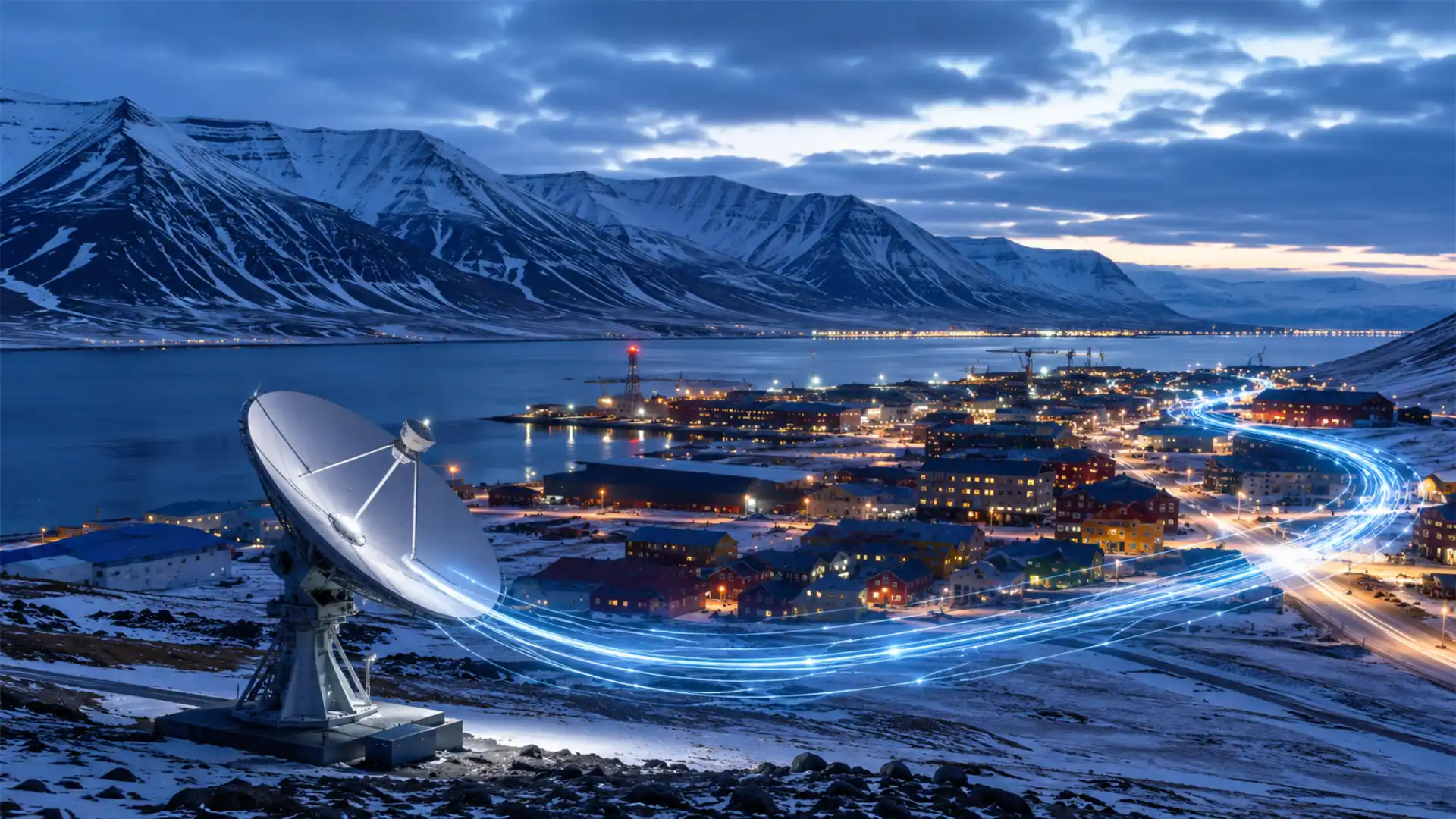
Longyearbyen is not a digital miracle. It is a hard, expensive, carefully maintained exception. At 78 degrees north, on Norway’s Svalbard archipelago, a town of roughly 2,500 people lives with polar night, polar bears, avalanche risk, permafrost damage, a closing coal era, and mainland-grade electronic communications delivered through two fibre-optic cables under the Arctic seabed. Statistics Norway counted 2,512 people in Longyearbyen and Ny-Ålesund in the first half of 2026, while Visit Svalbard describes Longyearbyen as the world’s northernmost settlement with more than 1,000 permanent residents.
Table of Contents
Svalbard is the archipelago, Longyearbyen is the town
Svalbard is often described in travel writing as if it were a town. It is not. Svalbard is the Arctic archipelago under Norwegian sovereignty; Longyearbyen is its main town, administrative centre, and everyday social hub. The distinction matters because the story of “the northernmost city with very fast internet” is really the story of one settlement and the infrastructure that keeps it tied to the Norwegian mainland.
Longyearbyen sits on Spitsbergen, the largest island in the archipelago, beside Adventfjorden and below steep, unstable Arctic slopes. It is not the northernmost place where people live. Research stations and smaller settlements exist farther north, including Ny-Ålesund. The meaningful claim is narrower and stronger: Longyearbyen is widely described as the world’s northernmost settlement with a permanent population above 1,000. Visit Svalbard gives the latitude as 78 degrees north and notes that the town is 1,316 kilometres from the North Pole.
That framing also avoids a common mistake. A “city” normally suggests scale, metropolitan services, and a broad urban economy. Longyearbyen has a school, airport, shops, restaurants, cultural life, a local council, research institutions, emergency services, and a population drawn from many countries. Yet its size, legal status, and infrastructure model are different from a normal city. It is a small Arctic settlement carrying functions that look disproportionately global.
The town’s digital reputation comes from this mismatch. A visitor expects poor connectivity in a place beyond 78 degrees north. Instead, Longyearbyen has fibre-backed communications, 5G in large parts of the settlement, satellite-data infrastructure of global relevance, and public services that depend on near-mainland digital capacity. Norway’s 2024 Svalbard white paper states that the fibre link gives Svalbard the same level of electronic communication services as the mainland because of the cables’ “virtually unlimited capacity.”
The result feels paradoxical only from a distance. On the ground, it is practical. Longyearbyen is remote, but it is not disconnected. It is small, but it is not technologically marginal. It is Arctic, but it is also part of a national infrastructure system. Its internet is fast because the town became important to space operations before it became famous as a digital curiosity.
Longyearbyen at a glance
| Fact | Current picture |
|---|---|
| Location | Spitsbergen, Svalbard, Norway, around 78° N |
| Settlement role | Main town and administrative centre of Svalbard |
| Population | 2,512 in Longyearbyen and Ny-Ålesund in first half of 2026 |
| Connectivity backbone | Two subsea fibre-optic cables to mainland Norway |
| Global function | Home area for Svalbard Satellite Station, one of the world’s key polar satellite ground stations |
| Main vulnerability | Dependence on a small number of physical links across Arctic terrain and seabed |
The table shows the central contradiction: Longyearbyen is tiny by global urban standards, but it sits on infrastructure that matters to satellites, aviation, research, public administration, and national preparedness.
Geography turns isolation into strategic value
Longyearbyen is far north enough to feel unreal on a map. It is also far north enough to be useful. That is the core of Svalbard’s modern infrastructure story. The same geography that makes daily life difficult makes the town valuable for polar-orbiting satellites, Arctic research, climate monitoring, and Norwegian presence in the High North.
Most remote towns are forced to argue for connectivity by pointing to social need. Longyearbyen has that argument too. Residents need health services, school systems, payments, aviation links, public administration, emergency warnings, online work, and contact with the mainland. But Svalbard has another argument: polar orbital geometry. Satellites passing over the poles can be contacted from high-latitude ground stations much more frequently than from lower latitudes. Svalbard’s position near 78 degrees north therefore gives it a physical advantage that cannot be recreated in Oslo, Berlin, London, or New York.
That advantage is visible at Platåberget, the mountain plateau near Longyearbyen where the KSAT Svalbard Ground Station operates. ESA describes the station as the world’s largest polar ground station, with more than 160 antennas as of 2024, and says its location allows communication with satellites on each of their 14 daily passes.
This geography explains why Svalbard did not remain dependent on slow satellite links. Before the fibre system, large volumes of satellite data had to leave the archipelago through far more limited channels. Once the satellite business required large, reliable data transfer to clients around the world, an undersea fibre link became not a luxury but a condition for growth. Space Norway says the limited capacity of earlier satellite transmission became a constraint on SvalSat’s future, and that the Norwegian Space Agency saw subsea fibre as necessary for the station’s development.
The same physical facts produce different outcomes for different actors. For a resident, the high latitude means darkness, ice, supply costs, weather delays, and safety routines. For a satellite operator, it means repeated contact with polar-orbiting spacecraft. For Norway, it means sovereignty, law enforcement, civil preparedness, and control of infrastructure in a sensitive region. Svalbard’s connectivity is a product of all three needs meeting in one exposed place.
That is why Longyearbyen’s internet is not a gimmick. It is the visible consumer layer of a much deeper system. Fast browsing, video calls, cloud work, and card payments are the local face of an infrastructure built for satellites, government, aviation, research, and strategic continuity.
The fibre cable changed the meaning of remoteness
The decisive piece of Longyearbyen’s digital story lies under the sea. Space Norway owns and operates the subsea fibre system linking Svalbard to mainland Norway. Its two cables run roughly 1,400 kilometres along the ocean floor, a distance Space Norway compares to Oslo to Paris. The system connects Longyearbyen and the Svalbard Satellite Station to the mainland through stable broadband.
That cable system became operational in January 2004 after construction was completed in 2003. Space Norway lists two cables, eight fibre pairs, an estimated lifetime until the end of 2028, and significant security upgrades during 2018–2024. It also notes that one cable suffered damage in January 2022, with no loss of service, and was fully repaired in June 2023.
This is the point at which the “fast internet at the edge of the world” claim becomes credible. Longyearbyen is not relying on a heroic Wi-Fi mast, a lucky satellite dish, or a fragile consumer trick. It is connected by fibre, the same basic technology that underpins high-capacity internet in major cities. The distance is extreme, the environment is harsh, and the repair logistics are far harder than in temperate waters, but the principle is familiar: light moves through glass strands, carrying huge volumes of data with low latency and high reliability.
The Norwegian government’s 2024 Svalbard white paper makes the strategic status explicit. It says electronic communications are crucial for residents, businesses, research and higher education, public administration, civil protection, emergency preparedness, and the achievement of Svalbard policy. It then identifies the two subsea fibre-optic cables as critical infrastructure and says the link provides the same level of electronic communication services as on the mainland.
That sentence is stronger than most travel claims about “fast internet.” It does not say every resident always gets the world’s fastest measured download speed. It says the island’s communications foundation has the capacity to provide mainland-level electronic services. That is the meaningful comparison. In a place where food, fuel, spare parts, construction materials, hospital transfers, and avalanche protection are all constrained by geography, digital capacity is one of the few systems where Longyearbyen can look surprisingly normal.
The cable also changed expectations. Once a remote town has fibre-backed communications, people start to build life around it. Researchers move data. Businesses use cloud services. Students learn online. Tour operators handle bookings. Public agencies coordinate. Families stream, call, pay, and work. The internet becomes invisible until it fails. In Longyearbyen, that invisibility is a sign of how deeply Arctic modernity now depends on a pair of physical lines laid across the seabed.
The satellite station made bandwidth unavoidable
Svalbard’s fibre connection was not built mainly because residents wanted faster streaming. The deeper driver was SvalSat, the Svalbard Satellite Station. The town’s unusually strong internet is a side effect of being close to one of the most important satellite downlink locations on Earth.
The Norwegian Space Agency says SvalSat is the largest ground station for polar-orbiting satellites in the world and receives data on behalf of many countries. It also says SvalSat is a main ground station for the European Galileo and Copernicus satellite programmes, and that the fibre cable ensures data travels quickly to its destination.
ESA’s 2024 description gives the scale: the KSAT Svalbard Ground Station was established in 1997, sits on Platåberget near Longyearbyen, and now consists of more than 160 antennas. Because of its 78-degree-north position, it can communicate with polar-orbiting satellites on each of their 14 daily passes.
This creates a clear chain. Polar satellites pass over Svalbard again and again. Ground antennas receive large volumes of data. That data must move rapidly to users elsewhere. The old communications setup could not support the expected growth. Fibre solved the bottleneck. Residents then benefited from infrastructure that was justified by a global space function. Longyearbyen got fast connectivity because space data needed an Arctic exit route.
The station’s importance also makes the cable more than a local utility. Earth observation, weather forecasting, navigation support, environmental monitoring, and emergency-related data flows all depend on ground segments. A satellite is only as useful as the system that controls it, receives data from it, and moves that data to the people who need it. Svalbard’s geography gives access to the satellite. The fibre gives the data a route out.
This is why the topic belongs in news analysis, not only travel writing. The connection between Longyearbyen and the mainland is part of a larger question about critical infrastructure. The public sees the Arctic town, the colourful houses, the polar night, and the strangeness of fast internet so far north. Governments see an exposed node in a network that links space, civil society, research, aviation, weather systems, and national security.
The same point applies to future investment. When Norway discusses replacing or expanding the fibre system, it is not only planning better broadband for residents. It is planning continuity for an Arctic space-data corridor. That corridor matters because polar orbit has become central to climate science, navigation, surveillance of sea ice, maritime operations, and weather models.
Fast internet at 78 degrees north needs a careful definition
The phrase “one of the fastest internet connections in the world” sounds dramatic. It needs careful handling. There is a difference between having one of the world’s most capable remote settlement connections and proving that every household in Longyearbyen has the fastest measured consumer broadband on Earth.
The strongest verified claim is this: Svalbard has a high-capacity fibre connection to mainland Norway, and the Norwegian government says it provides the same level of electronic communication services as on the mainland because of the cables’ virtually unlimited capacity. Space Norway says the system consists of two separate 1,400-kilometre cables and stands as the world’s northernmost high-speed connection.
That is already remarkable. Most settlements this far north would struggle to maintain basic communications without satellite dependence. Longyearbyen instead sits on a fibre backbone. The town also has 5G in large parts of Longyearbyen and Barentsburg, according to Norway’s 2024 Svalbard white paper, while Telenor describes Svalbard as one of the northernmost places in the world with 5G coverage.
Public speed rankings, however, are messy. They depend on methodology, sample size, subscribed plans, devices, Wi-Fi conditions, server distance, mobile versus fixed broadband, and whether tests measure peak access or real-world user experience. A small Arctic town may have an excellent fibre backbone and still show varied household speeds depending on subscription, local network equipment, congestion, and the user’s test setup. The better claim is not that Longyearbyen beats every city on a speed-test chart; it is that few towns this remote have such high-grade physical connectivity.
That distinction matters because it makes the story more impressive, not less. A city in East Asia or Scandinavia can deliver gigabit fibre across dense neighbourhoods with short routes, competitive markets, and easy repair access. Longyearbyen requires a 1,400-kilometre subsea link, Arctic repair plans, national policy support, and resilience against weather, seabed risks, fishing activity, geopolitical concern, and ageing infrastructure.
The speed is therefore inseparable from the system behind it. A journalist can write that Longyearbyen is among the world’s most digitally connected remote communities. A resident can say the internet feels normal. A policymaker can say the cables are critical infrastructure. A satellite operator can say the bandwidth is necessary. All four statements point to the same reality: Longyearbyen’s connection is exceptional because it makes an extreme place function like a connected mainland community.
The internet claim in precise terms
| Claim | Stronger wording |
|---|---|
| “Svalbard has the fastest internet in the world” | Not proven by the strongest current public sources |
| “Longyearbyen has unusually fast internet for its remoteness” | Well supported by the fibre infrastructure and mainland-service statements |
| “The town is connected by undersea fibre” | Confirmed by Space Norway and the Norwegian government |
| “The connection is critical infrastructure” | Explicitly stated in Norway’s Svalbard white paper |
| “The system is risk-free” | False; the 2022 cable damage showed physical vulnerability |
| “New infrastructure is planned” | Confirmed through Arctic Way planning and contract announcements |
This table separates travel shorthand from evidence. The story does not need exaggeration. The verified facts are strong enough.
The 2022 cable incident exposed the real risk
Svalbard’s digital strength rests on a narrow physical base. In January 2022, one of the two subsea fibre cables lost signal. The incident did not cut Longyearbyen off because the second cable maintained service, but it removed reserve capacity and forced authorities to examine what a double failure could mean. NUPI’s policy brief states that the immediate consequence was loss of reserve capacity and that a failure of both cables could limit mainland communication, stop the data flow from SvalSat, weaken preparedness, and limit air traffic.
The incident became news partly because it happened in the same broad period when Europe was becoming more alert to subsea infrastructure vulnerability. NUPI notes that speculation about intentional damage appeared quickly, but it also stresses that sabotage was not proven and that global subsea cable breaks are often caused by fishing, anchors, natural phenomena, or technical failures.
That caution is important. A cable break in the Arctic is not automatically an act of war. It is also not just a routine engineering matter. The location, the role of SvalSat, the dependence of the town, and the geopolitical setting make any unexplained damage politically sensitive. Evidence must carry the claim. Suspicion cannot replace proof.
The damaged cable also showed why redundancy matters. A single undersea cable would have turned the incident into a far more serious crisis. With two cables, the system absorbed the failure. Residents did not experience a dramatic blackout, and the satellite station kept operating through the remaining link. Yet the incident stripped away the comforting fiction that fibre connectivity is somehow immaterial. It is physical. It has a route. It lies in places where ships move, anchors drag, seabeds slope, weather delays repair, and monitoring is difficult.
Space Norway later stated that the damaged cable was fully repaired in June 2023 and that security upgrades had been implemented during 2018–2024. The current cables still have an estimated lifespan until the end of 2028.
For Longyearbyen, the lesson is blunt. Fast internet is not only about speed. It is about continuity under stress. A fibre-backed town can feel less remote than it is, until something happens to the fibre. Then the map returns.
Arctic Way is Norway’s next answer
Norway is not treating the current fibre system as permanent. The service life of the existing Svalbard fibre connection is approaching its expected end, and Space Norway is pursuing an upgraded subsea network for Svalbard and Jan Mayen. Space Norway says the goal is for the new subsea fibre connection to be operational by 2028.
In February 2025, Space Norway and SubCom announced Arctic Way, a new subsea cable system linking mainland Norway, Jan Mayen, and Svalbard. The press release describes it as the world’s northernmost subsea cable system, gives a total length of 2,350 kilometres, and says service is scheduled to begin in 2028.
The same announcement says the existing two Svalbard cables are expected to remain in use as backup as long as they stay functional. That detail matters. The future design is not a simple swap of old cable for new cable. It is a resilience strategy: add a new route, keep the existing ones while possible, and reduce the chance that a single event can isolate Svalbard’s digital systems.
High North News reported in September 2025 that the seabed survey for Arctic Way was nearing completion, that the project had a cost framework of NOK 2.8 billion, and that the cable would branch to Jan Mayen, which currently relies on satellite communication. The same report noted that the new cable is scheduled to be operational by 2028.
Arctic Way is therefore a connectivity project, but it is also a sovereignty and preparedness project. Space Norway’s project page says the new cables will reinforce Norwegian sovereignty over Jan Mayen and Svalbard, and that the Norwegian Armed Forces will lease transmission capacity on commercial terms during the cable’s 25-year lifespan.
For Longyearbyen residents, the practical value may be less dramatic than the engineering. The town already has good service. The real benefit is reduced future risk. The present system was extraordinary when completed in 2003 and activated in 2004. By the late 2020s, its age becomes part of the risk calculation. Arctic Way is a reminder that world-class remote connectivity has to be rebuilt before it fails, not admired until it breaks.
Digital strength still depends on physical discipline
Internet language often makes infrastructure sound weightless. Cloud. Wireless. Signal. Coverage. Network. In Svalbard, the illusion does not last. The system depends on cables, landing points, power feeds, repair ships, seabed surveys, burial depth, spare parts, weather windows, monitoring, and political funding. Longyearbyen’s digital life is made possible by physical discipline.
Space Norway’s fibre page lists details that rarely appear in tourist stories: two cables, approximately 1,400 kilometres long, eight fibre pairs, steel-wire armouring, outer coating, repair-ship support agreements, security upgrades, and the 2022 damage record. The company also states that the system is the primary link for residents, businesses, and governing authorities.
The physical exposure is not unusual for subsea cables globally. What is unusual is the consequence of failure in a place with so few alternatives. A dense European country may route traffic around multiple terrestrial and undersea paths. A remote Arctic archipelago has fewer options. Satellite links can provide backup, but they do not fully replace the capacity, latency profile, and reliability of fibre for all functions.
NUPI’s analysis of the 2022 incident makes this clear. If both cables failed, communication with the mainland would be limited, SvalSat’s data flow would cease, and civil society’s ability to prepare would be strained.
The local digital story also depends on energy. Connectivity equipment needs power. The satellite station needs power. Homes, servers, airport systems, emergency systems, and municipal services need power. Longyearbyen has been moving away from coal, but the energy transition itself shows the fragility of a settlement that is not connected to a larger power grid. The Norwegian government’s 2024 white paper notes that Longyearbyen is not connected to larger power and water systems and that local supply systems are therefore especially important.
This is the hidden cost of being an advanced Arctic settlement. Every “normal” service has a heavier base layer. Internet depends on cables. Cables depend on repair capacity. Repair depends on weather and ships. Digital services depend on electricity. Electricity depends on local generation. Local generation depends on fuel, transition planning, maintenance, and governance. The farther north a community sits, the less anything is merely technical.
Longyearbyen’s achievement is not that it escaped physical limits. It is that Norway built systems strong enough for residents to forget those limits for much of the day.
The Svalbard Treaty makes the place legally unusual
Svalbard’s infrastructure story cannot be separated from its legal status. The Svalbard Treaty was signed in 1920 and entered into force in 1925. Norway has sovereignty over the archipelago, but the treaty contains obligations on equal treatment, taxation, and limits on military activity. Norway’s 2016 Svalbard white paper states that Article 1 recognises Norway’s “full and absolute sovereignty,” while the treaty places limits on how authority may be exercised in certain defined areas.
The Storting’s historical account says the treaty now has 48 parties and that Articles 2 and 3 require equal rights for citizens and companies from treaty countries in specified areas, meaning discrimination by citizenship or national affiliation is prohibited in those areas.
This has shaped Svalbard’s demography, economy, and politics. People from many treaty countries can live and work on Svalbard under a regime unlike mainland Norway’s ordinary immigration system. Companies and states have historically used the archipelago for mining, research, logistics, and presence. Russia maintains activity in Barentsburg. International science has a strong role. Tourism brings people from far beyond Norway. The town is Norwegian, but the archipelago has always had an international dimension.
That makes infrastructure more sensitive. A cable is not only a cable when it supports a strategic settlement under a treaty regime watched by other states. A satellite station is not only a technical facility when it receives data for major international programmes. A port, airport, energy plant, land sale, housing stock, or research station can become part of a broader discussion about national control.
Norway’s 2024 Svalbard white paper is direct about this. It says the government wants to strengthen the Norwegian family community in Longyearbyen and enhance state control over important infrastructure. It also notes that climate change, tourism, research, education, the decline of coal mining, demographic change, and a more serious security situation have altered Svalbard since the previous report.
This is the governance background behind the internet story. Longyearbyen’s fibre connection supports daily life, but it also supports Norwegian administration, preparedness, aviation, and space infrastructure in a place where national presence has always been policy. Digital infrastructure has become one of the tools through which Norway keeps Svalbard stable, open, and governable.
The town’s population is small, mobile and politically important
Statistics Norway counted 2,512 people in Longyearbyen and Ny-Ålesund in the first half of 2026. The age structure is striking: 1,398 people were between 20 and 44, while only 46 were aged 67 or older.
That profile tells readers something important. Longyearbyen is not a normal town that slowly ages in place over generations. It is a high-turnover Arctic community built around work, research, services, education, tourism, public administration, and personal choice. Many residents stay for limited periods. Some build deep local roots, but the town’s population structure remains younger and more mobile than mainland communities.
The Norwegian government speaks of strengthening the “Norwegian family community” in Longyearbyen. That phrase is not accidental. It points to a policy concern: Svalbard should not become only a rotating platform for short-term labour, tourism, research campaigns, and strategic infrastructure. Norway wants a stable civilian society, with schools, households, local democracy, cultural life, and services that make the settlement more than a work camp.
Fast internet fits this policy goal in a quiet way. Families need schooling tools, entertainment, remote contact, banking, health communication, public information, and the ability to handle daily administration without waiting for mainland mail or office hours. Workers need reliable digital systems. Students need access to learning platforms. Researchers need data transfer. Tour operators need booking systems and weather updates. Local government needs public communication. Connectivity is one of the conditions that lets Longyearbyen function as a town rather than a seasonal outpost.
This does not mean life is easy. Housing is limited. Costs are high. Healthcare is narrower than on the mainland. The climate sets rules. People must understand polar bear safety outside settlements. Weather affects travel. Social life can be intense because the community is small. The same internet that connects people outward may also make them more aware of what they lack compared with mainland cities.
Yet the population numbers show why Longyearbyen matters beyond scale. A town of 2,500 would rarely attract international analysis if it sat near a highway in southern Norway. At 78 degrees north, under the Svalbard Treaty, beside a major satellite ground station, connected by critical subsea cables, and exposed to rapid climate change, 2,500 people become a strategic community.
Coal built the town, but data now helps hold it together
Longyearbyen began as a coal settlement. The name itself comes from John Munro Longyear, the American whose Arctic Coal Company started mining there in the early twentieth century. For much of its life, Longyearbyen was a company town defined by extraction, darkness, risk, and distance from ordinary Norwegian society.
That era is now closing. Longyearbyen’s coal-fired power plant shut down in October 2023, ending decades of coal-based local power generation. The Barents Observer reported that the plant had supplied heat and electricity since 1983 and was the world’s northernmost coal power plant.
Mine 7, the last Norwegian coal mine on Svalbard, was set to end production in 2025 and has since become the symbol of the end of Norwegian coal mining on the archipelago. High North News reported in 2025 that Mine 7’s closure would mark the end of more than 100 years of Norwegian coal production on Svalbard.
This transition changes the town’s identity. Research, education, tourism, public administration, logistics, culture, and space infrastructure now carry more of the settlement’s future. The shift is not clean or painless. Coal gave Longyearbyen jobs, heat, routines, hierarchy, identity, and a reason for Norway to maintain a strong settlement. Replacing that with a mixed economy requires housing, training, regulation, energy planning, and a clearer definition of what kind of town Longyearbyen should become.
Connectivity is central to that new model. A research town needs data. A tourism town needs digital booking, communications, and safety coordination. A satellite town needs high-capacity transmission. A modern Arctic family community needs the digital tools expected in mainland life. Coal made Longyearbyen visible on the ground; fibre makes it visible in global networks.
The change also carries symbolism. The town that once exported coal and burned coal for local power now supports climate science, earth observation, seed preservation, and international research into Arctic change. That does not erase the carbon history, and it does not make the transition complete. Diesel has been used as an interim energy source after coal, and permanent energy solutions remain a difficult policy problem. But the direction is unmistakable. Longyearbyen is moving from an extraction identity toward an infrastructure-and-knowledge identity.
In that light, the fast internet story is more than a curiosity. It marks the town’s economic pivot. A coal town could survive with slower communications. A satellite, research, tourism, and governance town cannot.
Energy remains the hardest local system to fix
Internet may be one of Longyearbyen’s strongest systems, but energy is one of its hardest. The town is not connected to a mainland power grid. Its electricity and district heating must be produced locally, under Arctic conditions, for a small population with high reliability needs. The 2024 Svalbard white paper warns that Longyearbyen is not connected to larger power and water systems, making local supply systems especially important.
The coal-fired power plant closure was a historic break, but the replacement path is complicated. Longyearbyen Local Council’s energy transition pages describe a shift away from coal toward a safer and more climate-friendly energy solution, based on a new combined heat and power plant, renewable energy, and increased energy efficiency.
A temporary diesel solution may reduce some emissions compared with the old coal plant, but it is not a satisfying end point. Fuel still has to be shipped in. Costs remain exposed. Climate goals remain difficult. Reliability cannot be compromised because a power failure in an Arctic town threatens heat, water, communications, and public safety. Energy transition in Longyearbyen is not a slogan; it is a live engineering problem with no forgiving backup grid.
This matters for the internet discussion because high-capacity connectivity is only useful when the systems around it remain stable. The fibre cable can carry data, but routers, mobile networks, data facilities, emergency systems, the airport, the satellite station, homes, and municipal services need power. Digital dependence raises the stakes for energy reliability.
The town’s energy question also shows a broader Arctic dilemma. Remote communities are often asked to decarbonise faster because climate change is highly visible around them. Yet they face harder constraints: darkness, cold, transport dependence, small load profiles, limited economies of scale, weather exposure, and thin maintenance capacity. Solar works differently under polar night. Wind must survive ice, storms, and maintenance realities. Batteries help but do not remove the seasonal challenge. Imported fuels are politically and environmentally uncomfortable but operationally familiar.
Longyearbyen’s future therefore depends on combining systems rather than waiting for one perfect answer. Energy efficiency, renewables, thermal storage, new generation, demand management, and emergency fuel planning may all have roles. The same logic applies to communications: fibre, backup fibre, satellite reserve, local networks, and emergency procedures all matter.
The lesson is simple and severe. At the top of the world, modern life depends less on one brilliant technology than on layers of backup.
Climate change is already a local infrastructure issue
Svalbard is not only a place where climate change is studied. It is a place where climate change damages assumptions. UNIS writes that Longyearbyen experiences warmer temperatures and a higher share of precipitation falling as rain instead of snow, linked largely to declining winter sea ice north and east of Svalbard. It also states that sea areas east of Svalbard saw wintertime warming of 10.6 degrees Celsius during 1971–2019, compared with below 1 degree globally over the same period.
A Polar Research study on the Svalbard Airport temperature series found that since 1991 the warming rate at Svalbard Airport was 1.7 degrees Celsius per decade, more than twice the Arctic average and about seven times the global average for the same period.
These numbers matter because they are not abstract. Warmer winters change snow stability. Rain-on-snow events change avalanche risk. Permafrost warming changes building foundations. Shorter cold periods affect transport, snowmobile routes, tourism seasons, and fieldwork. Glacier melt affects landscapes, hazards, and research conditions. A town built for one Arctic climate now has to adapt to another.
UNIS notes that avalanches in and around Longyearbyen are not new, but changed temperature, wind, and precipitation patterns expose new areas. The 2015 and 2017 avalanches led to local warning systems and permanent physical protection measures above buildings.
This is why climate adaptation in Longyearbyen looks concrete: avalanche barriers, building relocation, zoning changes, monitoring systems, drainage, foundation design, emergency planning, and new rules for field safety. It is not only about polar bears on melting ice or symbolic images of glaciers. It is about whether houses can stay where they are, whether roads remain safe, whether foundations move, whether warnings come in time, and whether public authorities can afford the measures required.
Connectivity plays a role here too. Climate monitoring produces data. Avalanche warnings need communications. Emergency services need coordination. Researchers need to move observations from field sites to analytical systems. Residents need alerts. Public agencies need maps and models. The fibre link is not a climate solution, but it is part of the adaptation toolkit.
Longyearbyen therefore shows a sharp Arctic truth: digital modernity and climate vulnerability are advancing together. The town can have 5G, fibre, satellite downlinks, and global research networks while also facing permafrost thaw, landslide risk, warmer winters, and costly adaptation. Technology does not cancel geography. It gives the community more tools with which to face it.
Avalanches turned adaptation into everyday policy
The 2015 avalanche in Longyearbyen remains one of the events that changed local thinking about risk. Scientific work published in 2025 describes the 19 December 2015 avalanche from Sukkertoppen as destroying eleven houses, burying nine people, and killing two. A second major avalanche hit in February 2017.
These disasters matter because they broke any comfortable separation between “nature” and “town.” The mountains are not scenery. Snow is not only atmosphere. Slope, wind, temperature, rain, housing, zoning, warning systems, and evacuation routines form one safety system. When the climate changes, the system has to be recalculated.
UNIS describes two kinds of response: permanent adaptation measures that reduce the probability and consequences of incidents, and preparedness measures based on monitoring, warning, and quick response. After the avalanches, local warnings were developed using data from snow sensors and observer networks, while physical protection measures were built above exposed buildings.
This is where Longyearbyen becomes a practical case study for remote climate adaptation. The town is small enough that each measure is visible. A new barrier changes a hillside. A demolished housing area changes memory. A warning system changes daily routines. A planning decision changes where families can live. Climate adaptation is not hidden in a national budget line; it is built into the slope above the town.
Fast connectivity matters because warning systems, weather data, municipal communication, mapping, research, and emergency coordination all benefit from reliable networks. Yet the deeper adaptation work remains physical. You cannot download an avalanche barrier. You cannot stream a stable foundation. You cannot cloud-compute your way out of rain falling on snow above a housing area. Digital tools support judgment, but local engineering and governance carry the burden.
Longyearbyen’s experience also challenges tourism clichés. Visitors often see the Arctic as dramatic emptiness. Residents see a managed risk environment. The rule not to leave town without polar bear protection is one expression. Avalanche forecasting is another. Weather windows, route decisions, guide responsibility, and emergency capacity all belong to the same culture.
The result is not fear. It is discipline. People live in Longyearbyen because the place offers beauty, community, work, science, freedom, and intensity. They stay because the town has learned to convert danger into rules, maps, barriers, training, and habits. The Arctic does not become safe; it becomes legible enough to live with.
Tourism is being pulled back toward limits
Svalbard has become a sought-after Arctic destination, but the tourism model is under pressure. MOSJ, the Environmental Monitoring of Svalbard and Jan Mayen system, reports that the number of people going ashore from cruise ships and smaller tourist vessels outside settlements and Isfjorden rose from about 24,000 in 1996 to about 92,000 in 2024. It also says landing sites increased from fewer than 100 in the late 1990s to usually more than 200 per year in more recent years.
Growth brought revenue, jobs, and international attention. It also brought pressure on wildlife, cultural heritage, landing sites, rescue capacity, and local tolerance. The Arctic is often marketed through scarcity: last wilderness, northernmost town, polar bears, silence, ice, darkness, midnight sun. Popularity eats into the very qualities being sold.
Norway has started tightening the rules. MOSJ says that from 1 January 2025, regulatory changes affect marine and coastal tourism, including a ban on disembarkation in large protected areas except at 43 mapped sites and passenger restrictions on tourist vessels in protected areas in western Svalbard.
The Governor of Svalbard also announced new environmental regulations, including polar bear distance requirements and landing restrictions for tourist activities in many protected areas. The rules require at least 300 metres from polar bears, and 500 metres from 1 March to 30 June.
This is not anti-tourism. It is a shift from volume growth toward managed presence. Svalbard cannot be treated like a theme park at the edge of the ice. Its wildlife is protected, its cultural remains are vulnerable, and its emergency capacity is limited by weather, distance, and available personnel.
Connectivity affects tourism in both directions. Fast internet makes Svalbard easier to market, book, review, film, and share. It helps operators coordinate trips, track weather, manage payments, communicate safety information, and reach clients. It also accelerates demand by making the place more visible on social media and search platforms. A photo of Longyearbyen under northern lights can travel faster than the local system can absorb additional pressure.
That is the uncomfortable digital loop. The same connectivity that supports safe, professional tourism also helps turn fragile places into global objects of desire. Longyearbyen benefits from being connected, but the archipelago has to regulate the consequences of being seen.
Polar bear rules show the difference between romance and reality
Polar bears are part of Svalbard’s global image, but local rules are designed to keep people away from them. The Governor of Svalbard states that anyone travelling outside settlements must be equipped with suitable means of scaring off polar bears, and the Governor recommends carrying firearms. The same page states that carrying loaded firearms in Longyearbyen’s settlement area is forbidden and that firearms may not be brought into shops or public buildings.
The 2025 environmental rules add formal distance requirements: at least 300 metres from polar bears, and 500 metres between 1 March and 30 June. If a person discovers a bear at closer range, they are obliged to retreat, with some exceptions for inhabited areas and facilities.
The message is clear. Polar bears are not attractions to approach; they are protected predators in a shared risk landscape. The safest encounter is usually the one that does not happen. The best guide is not the one who gets visitors close, but the one who knows how to avoid pressure on the animal and danger to the group.
These rules shape the town’s culture. Firearm lockers and warning signs are not theatrical props. They are part of an everyday boundary between settlement and wilderness. Inside Longyearbyen, people live with shops, schools, restaurants, offices, internet, and local politics. Outside the settlement, the risk profile changes quickly. The transition can happen at the edge of town.
That boundary makes Longyearbyen unusual for digital workers and visitors. A person can join a video call on a fast connection, then step into a place where leaving the settlement without proper protection is irresponsible. The contrast is not contradiction; it is the town’s defining condition.
Polar bear rules also show why governance matters. Svalbard’s tourism economy depends partly on wildlife appeal, but the law prioritises protection and safety. Climate change may alter bear movement, sea-ice access, denning patterns, and human encounter risk. More tourism and more media attention can increase pressure to turn rare sightings into content. The regulatory response is to make distance non-negotiable.
This discipline is part of Svalbard’s broader infrastructure culture. Fibre cables need redundancy. Avalanche slopes need monitoring. Tourists need rules. Residents need preparedness. Bears need distance. The town survives by refusing to confuse access with entitlement.
Research gives Longyearbyen a second economic spine
Longyearbyen’s future rests heavily on knowledge activity. The University Centre in Svalbard, known as UNIS, is based in Longyearbyen and supports Arctic education and research. UNIS describes research areas that include Arctic safety, field safety, societal safety, emergency preparedness, natural hazards, and climate adaptation.
The Norwegian government’s 2024 Svalbard white paper says research and higher education have become important bases for settlement as coal mining has declined. It also says the government will establish a separate Svalbard Research Office to provide clearer Norwegian research leadership and support UNIS as the sole higher education provider in Svalbard.
This is not ordinary campus life moved north. Arctic research in Svalbard is field-based, expensive, weather-dependent, and safety-intensive. Students and researchers study glaciers, permafrost, sea ice, geology, biology, atmosphere, snow, avalanches, technology, and human adaptation in a place where the phenomena are outside the door. The location is the laboratory.
Connectivity is a research multiplier. Field observations become more useful when they can be transferred, checked, compared, archived, and shared. Satellite data received nearby can be tied to ground observations. International teams can collaborate without waiting for physical return from the archipelago. Instruments can send data continuously. Students can access global academic systems from a town otherwise separated by Arctic waters.
Research also strengthens Norwegian presence without looking like militarisation. It brings people, institutions, grants, networks, and public legitimacy. It supports environmental management and climate adaptation. It gives Longyearbyen skilled jobs and global relevance beyond tourism. In a treaty setting where many countries have interests, Norwegian research leadership becomes part of civil governance.
There are tensions. International science is welcome, but Norway wants clearer coordination. Research activity can disturb environments if poorly managed. Field safety demands resources. More projects mean more transport, more cabins, more equipment, and more human presence. Climate change makes field conditions less predictable, while also making the region more scientifically urgent.
Longyearbyen’s research role therefore depends on the same balance as its internet: openness with control, ambition with discipline, global relevance with local limits. The town is becoming a knowledge settlement, but knowledge in the Arctic still needs fuel, housing, safety training, weather judgment, and working communications.
The seed vault shows Svalbard’s symbolic power
The Svalbard Global Seed Vault is near Longyearbyen, not in the town centre, but it has become one of the archipelago’s most recognisable symbols. The official Seed Vault site describes it as offering safe, free, long-term storage of seed duplicates from genebanks and nations participating in the global effort to secure future food supply.
The Crop Trust reports that the Seed Vault safeguards duplicates of more than 1.3 million seed samples from almost every country, with room for millions more.
Its power lies in the same combination that defines Svalbard’s fibre story: remoteness, stability, and global dependence. The vault is physically isolated but internationally connected. It is built into an Arctic mountain, yet it serves agriculture in countries far from snow and ice. It depends on Norwegian administration, international trust, logistics, refrigeration, and the willingness of genebanks to deposit duplicates.
The vault also complicates lazy descriptions of Svalbard as empty wilderness. The archipelago contains infrastructure whose purpose is planetary. SvalSat supports satellite data flows. The fibre cables connect Arctic space operations and civil society. The Seed Vault backs up crop diversity. UNIS trains and hosts Arctic researchers. Longyearbyen is small, but the systems around it touch global food security, earth observation, and climate knowledge.
The Seed Vault’s symbolism can be overplayed in popular media as a “doomsday vault.” The practical role is more sober. It is a backup collection, not a magic solution to food-system risk. Seeds still have to be conserved, regenerated, documented, and used through genebanks and breeding systems. Depositors retain ownership. The vault does not replace active crop diversity work. It protects duplicates in case other collections are damaged by war, disaster, underfunding, or system failure.
That sober interpretation is more powerful than the myth. It shows how Svalbard’s remote infrastructure works best: not by saving the world alone, but by adding a strong, carefully managed layer of backup to systems that remain distributed elsewhere.
This is also the lesson of the cables. A fibre link does not make Svalbard invulnerable. Two cables do not remove risk. Arctic Way will not end all concern. But each layer reduces fragility. Svalbard’s value lies in strategic backup, not fantasy security.
Satellite data makes the Arctic visible to the world
SvalSat’s role reaches far beyond Svalbard. Polar-orbiting satellites support weather forecasting, environmental monitoring, sea-ice observation, disaster response, navigation systems, land-use monitoring, and climate science. The ground station’s position allows frequent contact with satellites that pass over high latitudes, and the fibre system moves the data onward.
ESA says the KSAT Svalbard Ground Station can communicate with satellites on each of their 14 daily passes. The Norwegian Space Agency says SvalSat receives data on behalf of many countries and serves as a main ground station for Galileo and Copernicus.
This makes Longyearbyen part of the hidden chain behind familiar services. Weather forecasts on phones, sea-ice charts for ships, climate datasets used by scientists, and earth-observation products used by governments all depend on networks of satellites and ground stations. The user rarely sees the Arctic antenna or the fibre cable. Yet the data path may pass through Svalbard.
The town’s fast internet is therefore not merely local convenience; it is connected to the way modern societies observe the planet. This is why the 2022 cable incident attracted attention beyond Svalbard. If both cables failed, the effect would not be limited to streaming or email in Longyearbyen. It could affect SvalSat data flow, aviation communication, emergency preparedness, and public administration.
SvalSat also raises questions about dual use. Earth observation, navigation, weather, and communications often sit between civilian and strategic domains. Data collected for environmental or commercial use can matter to security actors. Satellite infrastructure is increasingly relevant in conflict, maritime awareness, sanctions enforcement, climate monitoring, and Arctic route planning. A ground station may be civilian and still strategically meaningful.
Norway manages satellite activity on Svalbard through regulation. The 2024 Svalbard white paper says satellite activities are specially regulated and that the Norwegian Communications Authority supervises satellite stations including SvalSat.
That oversight reflects the treaty context and the sensitivity of the site. Svalbard’s legal regime limits certain military uses, but the archipelago is not outside geopolitics. The satellite station’s importance sits precisely in that grey zone where civil infrastructure, commercial service, environmental monitoring, and national interest overlap.
For readers, the main point is this: Longyearbyen is not fast because it is lucky. It is fast because it sits beside infrastructure the world needs to see itself from orbit.
The internet makes normal life possible, not glamorous
For residents, the most important effect of fast connectivity is often ordinary. People pay bills, stream films, call family, work, study, file documents, book travel, send photos, read news, manage healthcare communication, use bank authentication, join meetings, and handle public forms. In a place where physical movement is expensive and weather-dependent, digital normality reduces the psychological and administrative cost of distance.
The Norwegian government’s white paper names the range of users: residents, businesses, research and higher education, public administration, civil protection, emergency preparedness, Svalbard policy, SvalSat, and Avinor’s traffic management at Svalbard Airport.
That list is a useful corrective. The internet is not only entertainment. It is woven through aviation, government, safety, science, and business. A payment terminal in a shop, a weather briefing for a guide, a school assignment, a doctor’s communication with mainland specialists, a municipal notice, an airport system, and a satellite data transfer all share dependence on the communications backbone.
This matters because remote communities often suffer from a double penalty. They are far from physical services and also underconnected digitally. Longyearbyen’s fibre link removes part of that double penalty. It cannot create a full hospital, a larger housing market, cheaper groceries, or mainland weather. But it can make many knowledge, communication, and administrative functions feel less remote.
There is also a social side. Longyearbyen attracts people from far away. Many have family elsewhere. The ability to maintain video contact with parents, children, partners, friends, and professional networks changes the emotional viability of staying. A place can be physically isolated without being socially cut off.
The reverse is also true. Fast internet lets mainland pressures enter the town. Residents can follow every debate about Svalbard from Oslo, Moscow, Brussels, or international media. Tourists can broadcast mistakes instantly. Work can follow people home. The boundary between Arctic refuge and global attention becomes porous.
Still, the practical balance is clear. Without high-grade connectivity, Longyearbyen would struggle to sustain its current mix of families, research, tourism, administration, and space activity. The internet is not an accessory to modern Arctic life. It is one of the load-bearing systems.
Local business depends on being digitally mainland
Longyearbyen’s economy is small but varied. Tourism operators, hotels, restaurants, shops, guides, researchers, public agencies, logistics companies, maintenance providers, cultural venues, and service businesses all depend on connectivity. The town’s market is local in size but international in reach.
A tourism company needs online booking, payments, weather updates, customer messages, safety coordination, digital marketing, and review platforms. A research institution needs data transfer, remote collaboration, cloud systems, academic access, instrument monitoring, and video meetings. A shop needs card payments, stock management, supplier communication, and accounting. A local authority needs public notices, case handling, emergency communication, mapping, and contact with national agencies. The fibre link allows a small Arctic business to use the same digital tools as a mainland firm.
The Norwegian government’s white paper says the cables provide mainland-level electronic communication services, and Space Norway describes the connection as the primary link for residents, businesses, and governing authorities.
That does not make business easy. Shipping costs are high. Labour turnover is high. Housing shortages can restrict recruitment. Seasonal tourism creates uneven demand. Climate change affects winter activities. Regulations can limit growth in protected areas. Energy costs and uncertainty matter. Yet digital capacity removes one barrier that could otherwise be decisive.
This is especially important as coal declines. A mining economy is rooted in geology and heavy equipment. A research, tourism, services, and space-support economy is rooted in networks. It needs skilled people, information flows, marketing, bookings, permits, safety systems, data products, and international visibility. Longyearbyen’s new economic base would be far weaker if it had to rely on slow, high-latency, unreliable communications.
The town’s digital strength also creates opportunities for remote work, though with limits. A person can work online from Longyearbyen, but they still need housing, income, legal permission under Svalbard’s special regime, health coverage awareness, and acceptance of local risks. The internet may make work portable; it does not make the Arctic frictionless.
The more realistic business conclusion is this: fast connectivity does not make Longyearbyen a cheap place to operate, but it makes many modern activities possible that geography would otherwise block. That is a serious economic advantage.
Aviation, health and emergency systems raise the stakes
Longyearbyen’s airport is a lifeline. It connects the town to mainland Norway, supports tourism, supplies, medical transfers, public administration, and emergency response. The 2024 Svalbard white paper says Avinor uses the fibre-optic connection for traffic management at Svalbard Airport.
That single detail shows why “internet speed” is too narrow a frame. Communications infrastructure supports air traffic systems, not just consumer devices. In a place where roads do not connect settlements across the archipelago and the mainland is far away, aviation is part of basic resilience.
NUPI’s policy brief on the 2022 cable break states that if both cables were destroyed, one possible consequence would be limited air traffic, although ambulance and military aircraft would still work. It also notes that much communication with the outside world would be lost and that such a situation would go beyond civil society’s ability to prepare.
Health services carry similar implications. Space Norway describes the fibre connection as vital for health services, aviation, research, and national governance.
Longyearbyen does not have the full medical capacity of a mainland city. Serious cases and childbirth-related needs often require travel to the mainland. Digital communications cannot replace doctors, beds, aircraft, weather windows, or evacuation capacity. Yet they support coordination, records, consultations, logistics, and emergency decisions.
Civil protection in Svalbard also involves unusual hazards: polar bear encounters, avalanches, extreme weather, field accidents, maritime incidents, cold exposure, glacier travel, remote cabins, cruise ships, and changing sea ice. Emergency systems need communications that work under pressure. That includes ordinary networks, backup plans, satellite devices, radio systems, and trained personnel.
A fibre cable failure in Svalbard is therefore not only an inconvenience. It is a preparedness event. The town may still have backup channels, but capacity, reliability, and coordination can degrade. In a dense mainland region, degraded internet might be frustrating. In Longyearbyen, it can affect aviation, health, public administration, satellite operations, and crisis management.
That is why Norway’s planning language keeps returning to critical infrastructure. The term is not rhetorical. It describes systems whose failure could produce consequences far beyond consumer discomfort. Longyearbyen’s digital life is fast because it has to be reliable; it has to be reliable because the margin for improvisation is thin.
The 5G layer adds mobility, but fibre remains the foundation
Svalbard’s connectivity story includes mobile networks as well as undersea fibre. Norway’s 2024 Svalbard white paper says mobile networks in Svalbard have been upgraded to the latest mobile standard, with 5G access in large parts of Longyearbyen and Barentsburg. It also says Ny-Ålesund received mobile coverage in 2023 and that an enhanced reserve satellite link has been operational for Svalbard since 2022.
Telenor’s Open Lab page describes Svalbard as one of the northernmost places in the world with 5G coverage and frames the location as a demanding environment for public protection and disaster-relief network testing.
This adds a second layer to the story. Fibre gives the high-capacity route to the mainland. Mobile networks distribute connectivity through populated areas and support local use cases: phones, emergency communication, field coordination near settlements, tourism operations, logistics, and everyday mobility. The impressive fact is not only that Longyearbyen has fibre, but that modern mobile service has been extended into such an extreme location.
Yet mobile coverage should not be misunderstood. Svalbard is vast, mountainous, glaciated, and sparsely inhabited. Coverage is concentrated in settlements and selected areas. Outside those zones, people cannot assume ordinary mobile service. Guides, researchers, and residents travelling in the field need proper safety equipment, communications planning, and knowledge of conditions.
This is another example of Svalbard’s dual reality. In town, a phone may behave much as it does on the mainland. Outside town, the environment quickly reasserts itself. Fast mobile data in Longyearbyen does not mean the archipelago is digitally carpeted. It means the settled areas have modern service, while the wilderness remains a place where preparation matters.
5G also depends on the fibre backbone. Mobile networks need backhaul. A radio access network can connect devices locally, but data must travel onward through core systems and external links. If the subsea system were badly degraded, mobile service could continue in limited ways, but the experience and capacity would change. Wireless at the edge of the world still depends on wires under the sea.
For policymakers, Svalbard is a test of high-latitude network design. For residents, it is simpler: the phone works in town. That ordinariness is an achievement.
Undersea cables have become Arctic sovereignty infrastructure
Subsea telecommunications cables are no longer treated as neutral background. They carry economic life, government communication, military-related data, scientific information, financial transactions, and social contact. In the Arctic, where routes are sparse and repair is hard, their political value is sharper.
Norway’s Svalbard white paper says Nkom supervises critical infrastructure in the electronic communications sector, including the fibre-optic cable connection between Svalbard and the mainland. The same document says the government will work toward a new high-capacity fibre-optic cable connection to replace the current cable.
Space Norway’s Arctic Way project page is explicit that the new cables will reinforce Norwegian sovereignty over Jan Mayen and Svalbard.
This language reflects a wider shift. Infrastructure is a way of exercising presence. A country that maintains communications, energy, law enforcement, housing, ports, airports, research, and rescue capacity in the High North demonstrates practical sovereignty. Legal sovereignty alone is not enough if the systems that make settlement possible are weak, foreign-controlled, or failing.
The Svalbard Treaty adds sensitivity because other countries have rights under the treaty, and the archipelago has a history of Russian presence and international research. Norway’s goal is not to close Svalbard. It is to keep Norwegian authority clear while respecting treaty obligations. Infrastructure control is one way to do that without changing the legal regime.
The 2022 cable incident strengthened this view. Even without proof of sabotage, the event showed that a single physical failure could affect reserve capacity and raise questions about preparedness. The lesson for states is that unexplained infrastructure damage in remote strategic regions cannot be dismissed as a technical footnote. It becomes part of national risk assessment.
Longyearbyen’s fast internet is therefore also an expression of Norwegian state capacity. It says Norway can maintain modern civil society, satellite infrastructure, public services, and regulatory control in one of the hardest inhabited environments on the planet.
That matters more as Arctic attention rises. Climate change is opening access, increasing shipping interest, exposing resources, changing military calculations, and drawing outside powers toward northern routes and knowledge systems. Svalbard’s cables are thin lines on the seabed, but politically they are thick with meaning.
Geopolitics sits quietly beside daily life
Longyearbyen does not feel like a military frontier in the way outsiders may imagine. It is a town of schools, shops, dogs, snowmobiles, municipal debates, fieldwork, cafés, safety briefings, and weather talk. Yet geopolitics is never far away.
Norway’s 2024 Svalbard white paper says the security situation globally and nearby is more serious and unpredictable than when the previous Svalbard report was presented. It also says the government will strengthen national control over important infrastructure.
Reuters reported in 2024 that Norway planned greater control over infrastructure on Svalbard because of security concerns and climate change, within a treaty setting that gives Norway sovereignty while allowing citizens of signatory states to settle and engage in certain activities.
The geopolitical story is easy to exaggerate and hard to ignore. Russia has a historic and current presence in Barentsburg. China has shown interest in Arctic research and routes. NATO’s northern awareness matters because of the North Atlantic and Russia’s northern fleet. Satellite infrastructure has strategic value. Subsea cables have become more closely watched across Europe after incidents in the Baltic and North Atlantic. Svalbard is peaceful, but it is not politically empty.
For residents, this can feel distant until it appears in concrete ways: land policy, port discussions, research coordination, Russian diplomatic statements, infrastructure ownership debates, cruise rules, property restrictions, or media attention. A local issue can suddenly become a national story because it touches sovereignty or security.
The challenge for Norway is to avoid turning Svalbard into a stage for unnecessary escalation while still managing real risks. The treaty regime requires predictability, equal treatment in specified areas, and careful legal framing. Heavy-handed moves can draw criticism. Weak control can create vulnerabilities. The policy art lies in steady administration.
The internet story fits that pattern. Norway does not need to militarise broadband to understand its strategic role. It needs reliable ownership, supervision, redundancy, repair plans, and replacement before the old system ages out. That is sober sovereignty: not flags and speeches, but cables, contracts, regulators, and maintenance.
Longyearbyen’s ordinary digital life is one of the quietest forms of geopolitical presence. The town logs on, and in doing so it remains connected to Norway.
The Arctic environment makes repair a strategic problem
A damaged cable near a mainland coast is difficult. A damaged cable in the high Arctic can be far worse. Weather, ice, depth, distance, vessel availability, seabed terrain, and darkness all complicate work. Space Norway says parts of the existing Svalbard connection run through sea depths reaching 2,700 metres, and that the cables are buried about two metres deep in selected areas to protect them from trawling and anchoring.
NUPI’s brief says the January 2022 break was estimated between 130 and 230 kilometres from Longyearbyen, in an area where the seabed suddenly drops to around 2,700 metres. It took eleven days to restore data traffic via the damaged cable and reserve capacity.
Repair logistics shape risk. If a cable is damaged, the operator needs to locate the fault, mobilise equipment, secure a repair vessel, work within weather windows, recover or access the cable, repair it, test it, and restore service. Each stage can be slower in remote waters. Spare parts and specialist ships are not waiting beside Longyearbyen.
Arctic Way planning reflects this. High North News reported that the new cable will be buried under two metres of mud where possible, at depths up to 1,500 metres, and that seabed surveying is itself a safety measure because it helps choose safer cable routes.
Resilience starts before the cable is laid. Route selection, burial strategy, landing design, contractor choice, repair agreements, monitoring, and backup systems all determine how a future incident plays out. Once the cable is on the seabed, options narrow.
This matters for other Arctic regions too. Greenland, the Faroe Islands, Iceland, northern Norway, Alaska, northern Canada, and remote research stations all face versions of the same problem. Remote communities may depend on one or two links whose failure would have outsized consequences. Satellite constellations improve backup options, but fibre remains the capacity backbone for many high-demand systems.
Longyearbyen is therefore a model and a warning. It shows that a remote Arctic town can have excellent connectivity. It also shows that excellence does not eliminate fragility. The more advanced the service becomes, the more painful the loss would be.
The town is not a smart city, and that is the wrong frame
It is tempting to call Longyearbyen a smart city because it has fibre, 5G, research institutions, satellite infrastructure, and a high-tech Arctic profile. That label misses the point. Smart-city language usually implies sensors, platforms, traffic systems, efficiency dashboards, real estate development, and municipal technology procurement. Longyearbyen’s intelligence is more elemental.
The town is smart because it respects constraints. It monitors avalanche risk. It regulates polar bear encounters. It plans cable redundancy. It thinks about water and power without mainland grid support. It manages tourism pressure. It ties research to local adaptation. It understands that physical infrastructure, legal authority, and local culture have to work together.
A normal smart-city pitch celebrates convenience. Longyearbyen’s systems are about survival, continuity, and national presence. The question is not whether a traffic light can adjust itself. The question is whether an Arctic settlement can keep heat, communications, aviation, emergency services, research, and social life functioning when the climate is changing and the nearest mainland support is far away.
This is why digital technology should not dominate the story too much. The fibre cable is crucial, but so are avalanche barriers, energy systems, harbour capacity, housing, airport operations, regulations, field safety, repair contracts, and people willing to live with inconvenience. A connected Arctic town is not built by bandwidth alone.
The “smart” part is often social. Residents learn routines quickly: shoe etiquette indoors, weather awareness, polar bear boundaries, firearm rules outside settlements, respect for guides, darkness management, community cooperation, and acceptance that plans change. Local knowledge reduces risk in ways no app can replace.
At the same time, digital systems improve that local knowledge. Weather data, satellite imagery, avalanche observations, emergency alerts, mapping, and communication tools all sharpen decision-making. The best model is not human versus technology. It is experienced humans using good tools without forgetting the land.
Longyearbyen’s lesson for technology policy is that remote connectivity must be designed around place, not around slogans. A fibre cable in Svalbard is not the same policy object as fibre in a suburb. It carries different risks, duties, and meanings.
The town’s modernity is visible in contradictions
Longyearbyen is full of contradictions that are not contradictions to residents. A person can buy groceries and see a rifle rack. A student can submit an online assignment and learn field safety for polar bear country. A guide can check satellite weather data before leading a trip through terrain where mobile coverage may vanish. A researcher can analyse climate change while living in a town once built on coal. A child can attend school in the world’s northernmost large settlement while the town debates energy transition, housing, and national policy.
The internet makes these contrasts sharper because it brings mainland normality into an extreme setting. A video call from Longyearbyen may look like a normal meeting until the person mentions polar night, avalanche warnings, or the need to fly south for certain medical needs. A tourist may post a picture instantly from a place that still requires strict environmental protection.
This duality is one reason the town fascinates global audiences. It is not just remote. It is modern and remote. It is not just Arctic. It is fibre-connected Arctic. It is not just small. It is strategically important. The surprise comes from categories colliding.
Good analysis has to resist turning those collisions into clichés. Longyearbyen is not a fantasy settlement where nobody can die, everyone carries guns, and internet is magic. It is a real community with municipal responsibilities, national policy debates, childcare, work stress, housing issues, cultural life, environmental rules, and infrastructure bills. The dramatic facts are true enough without turning the town into a cartoon.
The better story is about systems. Coal made settlement possible. Treaty law shaped international access. Norwegian governance stabilised authority. Satellites made bandwidth necessary. Fibre made modern digital life possible. Climate change made adaptation urgent. Tourism made regulation harder. Geopolitics made infrastructure control more important. Energy transition made the future uncertain.
Longyearbyen’s contradictions are therefore not quirks. They are the visible edges of a complex settlement model. The town survives by layering modern systems over an environment that keeps testing them.
That is why its fast internet feels so striking. It is not a sign that the Arctic has become easy. It is proof of how much work is required to make the Arctic feel briefly normal.
Daily life depends on rules more than myths
Popular stories about Svalbard often repeat a small set of dramatic claims: polar bears outnumber people, death is forbidden, guns are required, the town is dark for months, and the internet is among the fastest in the world. Some have truth behind them; others are distorted. The real Longyearbyen is governed less by myths than by practical rules.
Polar bears are protected, distance requirements apply, and people travelling outside settlements need suitable deterrents. Loaded firearms are not allowed in Longyearbyen’s settlement area, and firearms cannot be brought into shops or public buildings.
Tourism landings in many protected areas are now restricted to mapped locations, with guide and group-size rules. Cruise passenger limits and environmental regulations are part of a wider attempt to reduce pressure on vulnerable places.
Communications are governed as critical infrastructure, with Nkom supervision and state concern about replacement. Satellite stations are specially regulated.
These rules may appear restrictive from outside. Locally, they are part of how freedom is made possible. People can live, research, guide, visit, and work in Svalbard because the risks are managed through law, training, equipment, and institutional responsibility. Without rules, the place would not feel more free; it would become more dangerous and more vulnerable to political backlash.
The internet myth works the same way. Longyearbyen is not digitally advanced because residents wished hard enough. It is connected because institutions planned, paid, regulated, repaired, and upgraded a system. Fast service is the user experience; governance is the hidden structure.
This is an important lesson for remote development. Outsiders often romanticise frontier life as self-reliance. Longyearbyen shows a different reality. Remote modern life depends heavily on collective systems: public authority, cable operators, meteorologists, engineers, guides, regulators, teachers, pilots, health workers, satellite technicians, and emergency planners.
The farther a town is from ordinary support, the more serious its rules have to be. Longyearbyen is not less governed because it is remote. It is governed carefully because it is remote.
The future of Svalbard connectivity will be more layered
The next phase of Svalbard connectivity will likely be layered rather than singular. Arctic Way is expected to add a new subsea fibre route by 2028, while the existing cables may remain as backup if they stay functional. Satellite reserve links and low Earth orbit systems add further options, and mobile networks support local access in settlements.
This layered model is the sensible future. No single link is enough. Fibre gives capacity. Existing cables give redundancy while they last. New fibre gives replacement and route diversity. Satellite gives emergency fallback and coverage beyond cable-fed settlements. Mobile networks give everyday access. Radio and specialist field systems remain necessary outside coverage zones.
The goal should not be perfect connectivity. It should be graceful degradation. If one system fails, another should carry essential functions. If full broadband is unavailable, emergency communication should remain. If one cable is cut, another should preserve capacity. If weather blocks repair, backup should buy time. If mobile coverage ends outside town, field teams should have other tools.
This is especially true as Svalbard’s functions become more data-dependent. Satellite downlinks may grow. Research instruments may produce more continuous data. Tourism operators may depend on digital systems for safety and logistics. Public services may shift further online. Residents may expect the same digital quality as the mainland. Each improvement raises dependence.
Climate change adds uncertainty. Less sea ice may open some access but worsen weather exposure, coastal erosion, and ecological pressure. Warmer conditions can alter risks on land. More Arctic activity can increase demand for communications while also increasing the number of vessels and possible seabed interactions.
The political environment also argues for layers. If subsea infrastructure is watched more closely because of hybrid threats or accidental damage risk, then resilience becomes a national security measure. Not every incident will be malicious, but every incident will be judged in a more suspicious climate.
Longyearbyen’s future internet story will therefore be less about headline speed and more about continuity. The question is not whether the town can be fast on a good day. It is whether it can stay connected on a bad one.
Svalbard’s openness creates both value and pressure
Svalbard’s treaty regime and global profile make it unusually open. International residents, researchers, tourists, companies, and institutions all contribute to the archipelago’s life. That openness is part of the place’s value. It supports science, cultural diversity, tourism, and international legitimacy.
At the same time, openness creates pressure. More visitors mean more environmental management. More international interest means more diplomatic sensitivity. More research requires coordination. More digital visibility increases demand. More strategic attention raises the stakes around infrastructure ownership and control. Svalbard’s openness works only when Norwegian governance remains clear and trusted.
The 2024 Svalbard white paper reflects this balancing act. It reaffirms continuity and predictability while also calling for stronger national control over important infrastructure and measures to strengthen the Norwegian family community in Longyearbyen.
This is not a retreat from the treaty. It is Norway’s attempt to manage a more crowded, warmer, more visible Arctic. Equal treatment obligations remain in specified areas, but Norway retains sovereignty and regulatory authority. The government’s legal position is that the treaty limits certain exercises of authority, not sovereignty itself.
Connectivity sits inside this balance. Foreign researchers, satellite customers, tourists, and businesses benefit from Svalbard’s communications infrastructure. Norway benefits too, through presence, data flows, economic activity, and governance capacity. But the backbone must remain dependable and under trusted control. A failure or ownership dispute would not be only commercial; it would become political.
This is why infrastructure policy in Svalbard often sounds more serious than the size of the town would suggest. A housing decision, port investment, cable project, or tourism limit may affect only a few thousand residents directly. But each decision signals how Norway intends to govern the archipelago in a changing Arctic.
Longyearbyen’s fibre connection is a public good with strategic consequences. It serves users, but it also expresses authority. It enables openness, but it requires control. It connects the town to the world, but it also binds the town more tightly to Norway.
The local community carries the human cost of global relevance
Global relevance can be flattering from outside. For residents, it can be tiring. Longyearbyen is expected to be a family community, research platform, tourism destination, satellite node, climate warning symbol, sovereignty marker, and media curiosity all at once. That is a heavy load for a small town.
The population structure shows limited age diversity compared with mainland towns, with a large share of working-age adults and few older residents. Statistics Norway’s first-half 2026 table lists only 46 people aged 67 or older in Longyearbyen and Ny-Ålesund.
High turnover affects friendships, institutions, employers, volunteer life, schools, and local democracy. People arrive for adventure, research, contracts, tourism seasons, public jobs, or personal reinvention. Some stay. Others leave after a few years. A community can be warm and still unstable.
Fast internet softens some of this. It lets people maintain outside relationships, work with mainland systems, and feel less cut off. It also makes departure easier. A resident can keep one foot elsewhere. A worker can compare local frustrations with mainland options daily. A tourist can treat the town as content rather than home. Digital connection does not automatically deepen belonging.
Housing and services matter more. Norway’s 2024 white paper includes measures related to Longyearbyen housing, infrastructure, research leadership, cruise limits, power and water supply, port needs, and fibre replacement.
That range shows what it takes to sustain a settlement. Broadband alone cannot keep families in town if housing is insecure. Satellite work alone cannot build community if labour is too transient. Tourism alone cannot provide identity if it overwhelms residents. Research alone cannot replace the social role mining once played. A future Longyearbyen needs digital strength, but also housing, energy, schools, trust, and reasons to stay.
The human cost of global relevance is that local decisions are rarely just local. Residents live with consequences of national policy, international law, climate science, tourism demand, and geopolitical attention. A town of 2,500 becomes a screen onto which the world projects Arctic anxieties.
The best writing about Longyearbyen should therefore keep residents at the centre. They are not scenery for an infrastructure story. They are the people who live with the cables, the weather, the rules, the opportunities, and the risk.
The internet story is also a lesson in digital equality
Digital equality is usually discussed through urban-rural divides, affordability, school access, or mobile coverage. Longyearbyen adds another dimension: geographic extremity does not automatically require digital inferiority if infrastructure is treated as a public and strategic priority.
The town’s fibre-backed connection shows that remote communities can receive high-grade digital service when there is enough policy will, economic rationale, and technical planning. Svalbard had all three: residents and public agencies needed connectivity; SvalSat created a strong commercial and strategic bandwidth driver; Norway had national reasons to maintain a capable settlement.
Most remote communities do not have a major satellite ground station beside them. That makes Longyearbyen unusual. But the broader lesson still holds. When connectivity is framed only as consumer market demand, small remote places lose. When it is framed as health, education, emergency preparedness, economic participation, public administration, and national resilience, the calculation changes.
The Norwegian government’s language supports this wider view. It lists residents, businesses, research and higher education, public administration, civil protection, emergency preparedness, and Svalbard policy as dependent on communication links.
This approach should interest policymakers beyond Norway. Rural fibre, island cables, Indigenous community broadband, Arctic satellite backup, mountain-region connectivity, and disaster-resilient networks all face similar questions. Who pays before the market is large enough? Which services count as essential? How much redundancy is enough? When does connectivity become security infrastructure?
Longyearbyen’s answer is not easily copied, but it is clear. A small population can justify large infrastructure when the settlement carries functions larger than its headcount. In Svalbard, those functions include sovereignty, satellite data, research, emergency preparedness, tourism management, and a permanent Norwegian community.
Digital equality should not mean every place receives identical infrastructure for identical reasons. It should mean geography is not allowed to cut people off from basic participation in modern society. Svalbard shows one high-end version of that principle. Its residents can live under polar night without accepting digital darkness.
The global cable network has reached the Arctic edge
The internet is often imagined as a planetary web, but its physical routes are uneven. Dense corridors connect major economies. Remote regions depend on fewer lines. Svalbard’s fibre system pushes high-capacity communications into a place with tiny population but large strategic value.
Space Norway says the Svalbard Connection consists of two parallel fibre-optic cables spanning about 1,400 kilometres. The Arctic Way system will extend the logic further, linking mainland Norway, Jan Mayen, and Svalbard across 2,350 kilometres within the Arctic Circle.
This tells us something about the direction of infrastructure. As Arctic research, security, shipping, environmental monitoring, and satellite operations become more important, data networks follow. The Arctic is not becoming less remote in a physical sense. It is becoming more connected through selective, high-value corridors.
Those corridors will matter for science and safety. They may also matter for competition. Control over data routes, landing sites, repair capacity, and monitoring can shape influence. A cable route can support civilian life while also increasing strategic awareness. The same fibre that lets a family make a video call can carry satellite data used in weather models, maritime monitoring, or government systems.
The Arctic edge is therefore becoming part of the internet’s critical geography. That does not mean every northern coastline will soon be crossed by cables. The economics remain hard. But where there is a strong driver, such as SvalSat or Jan Mayen’s military and communications needs, investment can happen.
The challenge is to avoid treating Arctic cables as ordinary commercial assets. They cross difficult environments, serve limited populations, support public functions, and carry geopolitical meaning. Their failure may produce effects disproportionate to their market revenue. Repair may require special arrangements. Governance may need closer coordination between companies, regulators, defence authorities, environmental bodies, and local communities.
Longyearbyen is one of the clearest examples. The town’s internet feels everyday because the cable system works. The system works because it is backed by institutions that understand the Arctic is not an ordinary market.
Visitors notice the signal before they understand the system
A visitor arriving in Longyearbyen may notice the internet before understanding anything about SvalSat, Space Norway, Nkom, or Arctic Way. The phone connects. Payments work. Hotel Wi-Fi behaves. Maps load. Messages leave. Photos upload. The shock lies in expectation: people assume the far north means digital scarcity.
That reaction is understandable. Many remote places still struggle with slow, expensive, unreliable connectivity. Longyearbyen’s normality feels luxurious because the surrounding landscape is so severe. The signal becomes part of the travel experience, even when it was not built for tourism.
Yet visitors who stop at surprise miss the deeper story. The same phone connection depends on a local and national system shaped by satellite data, public policy, undersea engineering, environmental regulation, and Arctic risk. The town is not connected because tourists need Instagram. Tourists can use Instagram because the town is connected for much heavier reasons.
This distinction matters because tourism storytelling can trivialise infrastructure. A headline about “the Arctic town with blazing internet” invites wonder but not responsibility. A better story explains that high-speed connectivity supports residents, aviation, emergency services, research, public administration, and satellite operations. It also explains that tourists should not mistake digital comfort for environmental ease.
The visitor still needs to respect rules: do not disturb wildlife, follow guide instructions, stay within safe areas, understand weather changes, observe firearm and polar bear safety norms, and treat the town as a community rather than a backdrop. Fast internet does not reduce the need for humility.
The best visitor lesson is this: Longyearbyen is modern, but not tamed. Its restaurants, hotels, galleries, and connectivity are real. So are polar bear rules, avalanche histories, climate stress, and infrastructure vulnerability. The town asks outsiders to hold both truths at once.
That is also why Longyearbyen remains compelling. It refuses simple categories. It is not a museum of Arctic hardship, and it is not a frictionless northern resort. It is a working settlement where modern systems meet old risks every day.
Policymakers see a prototype for remote resilience
For policymakers, Svalbard is a prototype. It is small enough to study closely and complex enough to matter. The settlement combines energy transition, climate adaptation, digital infrastructure, tourism management, local democracy, treaty law, critical infrastructure protection, research policy, and geopolitical signalling.
The 2024 Svalbard white paper reads like a map of those pressures: strengthen the Norwegian family community, increase state control over important infrastructure, manage tourism and maritime activity, address power and water supply, support research leadership, and replace the current fibre connection.
The lesson is not that every remote town should copy Longyearbyen. Few places have its legal status, satellite station, geopolitical value, or climate profile. The lesson is that remote resilience is interdisciplinary. A cable project is not only telecom policy. An energy transition is not only climate policy. Tourism rules are not only environmental policy. Housing is not only local welfare. In a remote strategic settlement, each system affects the others.
The most important policy habit is to plan before crisis. Replace cables before age becomes failure. Build avalanche protection before another disaster. Regulate tourism before damage becomes irreversible. Strengthen energy systems before the temporary solution becomes permanent by default. Clarify research governance before crowded activity creates conflict. Maintain local community before turnover hollows it out.
Svalbard also shows the value of public language. Norway’s documents do not pretend the archipelago is ordinary. They identify climate change, security conditions, infrastructure control, and settlement policy directly. That clarity helps avoid confusion. It also gives local actors a framework for investment and regulation.
For other remote regions, the Longyearbyen example supports a broader principle: resilience requires redundancy, but also legitimacy. A backup system no one funds is not resilience. A regulation no one trusts is not resilience. A cable no one can repair is not resilience. A settlement with fast internet but no stable housing is not resilient.
Longyearbyen is not perfect. It is useful precisely because its tensions are visible. It is a small town where the future of remote infrastructure can be seen in compressed form.
The Arctic town has become a media symbol for competing stories
Longyearbyen attracts media because it can be made to represent many stories at once. For climate journalists, it is a warming frontline. For technology writers, it is a remote place with surprising connectivity. For travel media, it is northernmost adventure. For geopolitical analysts, it is a treaty-governed Arctic node near Russian interests. For science writers, it is a research platform. For food-security writers, it is the gateway to the Seed Vault. For infrastructure specialists, it is a cable-resilience case.
That symbolic density is powerful but risky. A place that can stand for everything can easily be flattened into myth. Longyearbyen becomes “the town where you cannot die,” “the town with guns,” “the town with fastest internet,” “the town of polar bears,” or “the town Russia wants.” Each frame captures a fragment. None is enough.
Good analysis should show how the frames connect. Fast internet links to satellites. Satellites link to geography. Geography links to sovereignty. Sovereignty links to the treaty. The treaty links to international presence. International presence links to geopolitics. Climate change links to avalanches, permafrost, tourism, and energy transition. Tourism links to environmental rules. Energy links to local survival. Research links to adaptation and policy.
The town’s media appeal also creates feedback. More attention brings more visitors, investment interest, research interest, and political scrutiny. That can benefit Longyearbyen, but it can also burden it. Residents may recognise their home in parts of the coverage and not in others.
Digital connectivity accelerates this symbolic role. Svalbard is photographed, filmed, streamed, posted, mapped, tracked, and searched constantly. The Arctic is no longer distant from the global imagination. It enters feeds in real time. The fibre cable carries not only data out of Svalbard, but attention into it.
This makes editorial responsibility important. Svalbard deserves writing that is vivid without being fake, precise without being dull, and critical without turning the place into a geopolitical prop. The strongest story is already there: a small Arctic community is using high-grade infrastructure to maintain normal life while climate, law, technology, and power politics converge around it.
The limits of fast internet remain clear
Fast connectivity does not remove Longyearbyen’s limits. It does not make groceries cheap. It does not shorten polar night. It does not stop rain-on-snow events. It does not make the airport immune to weather. It does not create a mainland hospital. It does not give every visitor wilderness competence. It does not replace housing. It does not solve the energy transition. It does not erase geopolitical tension.
The internet changes the experience of remoteness, but it does not abolish remoteness. That is the central analytical point.
A remote town with poor communications is isolated in two ways: physically and digitally. Longyearbyen has reduced the second isolation dramatically. The first remains. Ships still matter. Aircraft still matter. Weather still matters. Fuel still matters. Food supply still matters. Field safety still matters. Local knowledge still matters.
This distinction is important for anyone tempted by a fantasy of remote digital living. Yes, a person can work online from Longyearbyen if they have the right circumstances. But they are not stepping outside geography. They are entering one of the most infrastructure-dependent places in Europe. The town’s apparent digital ease is supported by public investment, strategic industry, and constant maintenance.
The same applies to policy. A high-capacity cable cannot compensate for weak emergency systems. 5G cannot compensate for irresponsible tourism. Satellite data cannot compensate for delayed climate adaptation. Online services cannot compensate for insufficient housing. Digital strength is one layer, not the whole settlement.
The best way to understand Longyearbyen is to see fast internet as a force multiplier. It makes public services better, research stronger, business more viable, tourism more manageable, families more connected, and satellite operations possible. But it multiplies the strength of systems that still have to exist physically and socially.
A connected Arctic town is still an Arctic town. The difference is that its residents can face Arctic constraints with better information, stronger links, and fewer forms of isolation than earlier generations.
The strongest comparison is not with megacities
Comparing Longyearbyen’s internet to Seoul, Singapore, Stockholm, or Zurich misses the point. Dense cities can deliver fast broadband because customers are many, routes are short, and infrastructure is easy to access. Longyearbyen’s achievement should be measured against other remote settlements: Arctic communities, islands, research towns, military outposts, mountain regions, and places where one cable can decide the quality of modern life.
Against that comparison, Longyearbyen is exceptional. It has mainland-level communications, 5G in key settlement areas, a global satellite ground station, planned next-generation subsea redundancy, and national policy attention.
The lesson is not that the town is faster than every city. It is that it escapes a pattern common to remote places. It does not accept weak connectivity as the inevitable price of geography. Longyearbyen shows that remoteness can be engineered down, even when it cannot be erased.
This also changes the cultural meaning of north. The Arctic is often portrayed as a place beyond modern systems. Svalbard complicates that image. It is deeply northern and deeply networked. It is exposed to climate change and connected to earth-observation systems that measure climate change. It is distant from agricultural regions and home to a global seed backup. It is small and tied to multinational satellite programmes. It is remote and strategically visible.
That comparison also reveals unfairness elsewhere. If Longyearbyen can be connected because satellite data and sovereignty justify investment, what about remote communities without such strategic value? The answer cannot be to promise every place a Svalbard-scale cable. But it should push governments to define basic digital rights more seriously for remote populations.
Longyearbyen’s advantage came from overlapping needs. Residents benefited because space infrastructure needed bandwidth. In other regions, schools, health services, emergency response, Indigenous governance, economic participation, or climate monitoring may provide the public rationale. The policy challenge is to see those needs before market logic dismisses them.
The most useful comparison is not speed versus speed. It is seriousness versus neglect. Svalbard got serious infrastructure. Many remote communities still wait for it.
The town’s digital future will depend on trust
Infrastructure works best when people trust it enough to build life around it, but not so much that they forget its limits. Longyearbyen has reached that delicate stage. Residents and institutions can assume strong connectivity in daily life. Authorities cannot assume it will always be there without investment.
Trust has several layers. People must trust the service. Operators must trust repair agreements. The state must trust ownership and oversight. International users must trust regulatory predictability. Residents must trust that replacement planning will not arrive too late. Tourists must trust official safety guidance. Researchers must trust data channels. Emergency planners must trust backups.
The 2024 white paper’s promise to work toward a new high-capacity fibre connection is therefore a trust signal. Arctic Way’s contract and 2028 schedule are another.
Trust also depends on honesty. The 2022 incident should not be exaggerated into proven sabotage, and it should not be minimised as irrelevant. The current cables should not be described as failing tomorrow, and their age should not be ignored. Longyearbyen should not be sold as digitally invulnerable, and it should not be portrayed as backward. Trust grows when public language matches technical reality.
Local trust is just as important. Residents need clear communication during incidents, credible emergency planning, and visible maintenance of systems they depend on. In a small town, institutional credibility is personal. People know the consequences of vague promises.
The digital future may also test trust between openness and security. Satellite data, research access, tourism, and international presence are core to Svalbard’s identity. Security concerns may push toward tighter control. The challenge will be to protect infrastructure without undermining the openness that gives Svalbard much of its value.
Longyearbyen’s fibre story is therefore also a governance story. Cables carry data, but institutions carry trust. Without trust, even strong infrastructure becomes politically fragile.
A small town now sits inside several global systems
Longyearbyen is easy to describe as remote. It is harder, and more accurate, to describe it as embedded. The town is embedded in Norwegian sovereignty policy, the Svalbard Treaty regime, global satellite data systems, Arctic climate research, tourism markets, seed conservation symbolism, undersea cable networks, and European security debates.
This embeddedness is what makes the town unusual. A place can be geographically remote and systemically central. Longyearbyen proves it.
The undersea cables link it to mainland Norway. SvalSat links it to polar satellites. UNIS links it to international science. The Seed Vault links it to global crop diversity. Visit Svalbard and expedition operators link it to tourism demand. The Governor and national ministries link it to Norwegian administration. Environmental rules link it to conservation policy. Climate change links it to planetary risk.
For residents, these systems appear in practical forms: a job, a rule, a visitor, a research project, a news crew, a delayed flight, a cable repair, an avalanche warning, a council decision, a fibre upgrade, a price in the shop. Global systems become local texture.
This is why the town’s internet story has such strong explanatory power. The cable is a physical line that makes embeddedness visible. It shows that Longyearbyen is not an isolated dot. It is a node. Small, cold, exposed, and human, but still a node.
The idea of a node also captures the risk. Nodes can be overloaded. They can fail. They can be targeted. They can become symbols. They require maintenance and governance. Their value lies in connection, but connection brings dependency.
Longyearbyen’s future will depend on managing that dependency without losing local life. A town cannot exist only as a node for other people’s systems. It needs schools, housing, culture, friendships, routines, and the right to be ordinary. The best future for Longyearbyen is not to become more symbolic. It is to remain livable while carrying symbolic weight.
The real story is disciplined modernity at the edge
The strongest version of the Svalbard internet story is not “the fastest internet in the world is in the Arctic.” That is too loose. The stronger version is this: the world’s northernmost large permanent settlement has mainland-grade electronic communications because Norway, Space Norway, satellite operators, regulators, and local institutions built and maintained a high-capacity Arctic infrastructure system.
That system is impressive because it is disciplined. Two cables instead of one. Fibre rather than only satellite. Backup links. Supervision by Nkom. Repair agreements. Security upgrades. Replacement planning. Arctic Way. Mobile upgrades. Regulation of satellite activity. Local awareness that a cable break is a preparedness issue, not only a telecom issue.
The town’s discipline extends beyond communications. It appears in polar bear rules, avalanche adaptation, tourism restrictions, energy planning, research governance, and environmental protection. Longyearbyen is not modern because it ignores Arctic risk. It is modern because it organises around Arctic risk.
The future remains uncertain. Climate change is accelerating. Energy transition is unfinished. Tourism must stay within limits. Cable replacement must arrive on time. Geopolitics may become sharper. Housing and community stability will remain difficult. The town will keep balancing openness, control, livelihood, conservation, and presence.
Yet Longyearbyen already demonstrates something rare. It shows that an extreme place can be technologically advanced without becoming easy. It shows that digital capacity can support community, science, safety, and sovereignty in a settlement most people will never visit. It shows that infrastructure is not glamorous until the map makes it improbable.
At 78 degrees north, the internet is not an escape from the Arctic. It is one of the ways people stay there. Longyearbyen’s fast connection is a monument not to speed, but to maintenance, foresight, and the refusal to let distance decide the town’s future.
Questions readers ask about Svalbard’s connected Arctic life
No. Svalbard is an archipelago under Norwegian sovereignty. Longyearbyen is the main town and administrative centre on Spitsbergen.
Longyearbyen is widely described as the world’s northernmost settlement with more than 1,000 permanent residents. Smaller research stations and settlements exist farther north.
Statistics Norway counted 2,512 people in Longyearbyen and Ny-Ålesund in the first half of 2026, with most of them in Longyearbyen.
Yes. The town is connected to mainland Norway by two subsea fibre-optic cables, and Norway’s Svalbard white paper says the connection provides mainland-level electronic communication services.
No. The stronger verified claim is that Longyearbyen has unusually strong, fibre-backed connectivity for such a remote Arctic settlement.
The main driver was Svalbard Satellite Station. Polar-orbiting satellites pass over Svalbard frequently, and large volumes of satellite data need to move quickly to the mainland.
Space Norway owns and operates the fibre-optic cable connection between Svalbard and mainland Norway.
The current Svalbard fibre connection consists of two parallel cables of roughly 1,400 kilometres.
One of the two subsea cables lost signal in January 2022. Service continued through the other cable, but reserve capacity was lost until the damaged link was restored.
Sabotage was speculated about, but NUPI’s analysis notes that it was not proven. Cable breaks can also be caused by fishing, anchors, natural phenomena, or technical failures.
Arctic Way is a planned new subsea cable system linking mainland Norway, Jan Mayen, and Svalbard. It is scheduled to enter service in 2028.
Norway’s 2024 Svalbard white paper says 5G is available in large parts of Longyearbyen and Barentsburg.
Its high latitude lets ground stations communicate frequently with polar-orbiting satellites. ESA says the KSAT Svalbard Ground Station can communicate with satellites on each of their 14 daily passes.
SvalSat is the Svalbard Satellite Station on Platåberget near Longyearbyen. It is one of the world’s most important polar satellite ground stations.
Svalbard is under Norwegian sovereignty but governed by the Svalbard Treaty, which gives citizens and companies from treaty countries equal rights in specified areas. Its location, infrastructure, and Russian presence in Barentsburg add strategic sensitivity.
No. New regulations require at least 300 metres of distance from polar bears, and 500 metres from 1 March to 30 June.
Not inside the town. The Governor recommends firearms for travel outside settlements because of polar bear risk, but loaded firearms are forbidden in Longyearbyen’s settlement area and cannot be taken into shops or public buildings.
Yes. Svalbard is warming rapidly, with effects on permafrost, avalanches, rain-on-snow events, glaciers, and infrastructure.
Tourism has grown sharply, especially marine and coastal tourism. New rules limit landings in protected areas and strengthen wildlife protection.
It shows that remote places can have strong digital infrastructure when connectivity is treated as essential for public services, safety, research, business, and national resilience.
Author:
Jan Bielik
CEO & Founder of Webiano Digital & Marketing Agency
This article is an original analysis supported by the sources cited below
Population of Svalbard
Statistics Norway’s current population data for Longyearbyen, Ny-Ålesund and other Svalbard settlements.
Welcome to Longyearbyen
Visit Svalbard’s destination page describing Longyearbyen’s latitude, settlement status and visitor context.
Meld. St. 26 (2023–2024) Svalbard
Norwegian government white paper setting out current Svalbard policy, governance priorities and infrastructure objectives.
Meld. St. 26 (2023–2024) Communication chapter
Norwegian government section on Svalbard’s fibre connection, mobile coverage, satellite regulation and communications infrastructure.
Meld. St. 26 (2023–2024) Measures chapter
Norwegian government section listing planned measures on research, cruise limits, local supply systems, port needs and new fibre connection.
Fibre optic cables
Space Norway’s technical and policy overview of the current Svalbard fibre-optic cable system.
Fibre broadband
Space Norway’s description of the Svalbard Connection and its role in broadband, aviation, health services, research and governance.
Subsea cables
Space Norway’s project page on the planned new subsea fibre network for Svalbard and Jan Mayen.
Space Norway launches Arctic Way
Space Norway and SubCom press release announcing the Arctic Way Cable System, its route, length and 2028 service target.
Survey for Arctic Way soon to be completed
High North News report on the Arctic Way seabed survey, project cost framework and planned operational timeline.
The subsea cable cut at Svalbard January 2022
NUPI policy brief analysing the 2022 Svalbard cable incident, consequences and preparedness implications.
KSAT ground station in Svalbard
ESA description of the KSAT Svalbard Ground Station, its antenna scale and polar-orbit communications advantage.
Arctic Access
Norwegian Space Agency page explaining SvalSat’s role in polar satellite communications, Galileo, Copernicus and fibre-backed data transfer.
The KSAT Global Ground Station Network
KSAT overview of its global ground station network and satellite connectivity infrastructure.
The Svalbard Treaty
Storting historical account of the Svalbard Treaty, Norwegian sovereignty and equal-rights provisions.
Meld. St. 32 (2015–2016) Svalbard treaty framework
Norwegian government explanation of the legal framework, treaty interpretation and limits on the exercise of authority.
Climate in Svalbard 2100
Norwegian climate knowledge base for Svalbard adaptation, including observed and projected changes in temperature, precipitation, permafrost and hazards.
Look to Longyearbyen for climate adaptation
UNIS article explaining local climate adaptation, avalanche risk, rain-on-snow events and warming around Svalbard.
Revisiting the extended Svalbard Airport monthly temperature series
Peer-reviewed Polar Research article on long-term temperature trends at Svalbard Airport.
New environmental regulations enters into force on 1 January
Governor of Svalbard summary of new environmental rules, polar bear distance requirements and landing restrictions.
Firearms
Governor of Svalbard guidance on firearms, polar bear protection and restrictions within Longyearbyen.
Marine and coastal tourism
MOSJ monitoring page on cruise and coastal tourism trends, environmental pressure and regulatory changes in Svalbard.
Svalbard Global Seed Vault
Official Seed Vault site describing its purpose as free, safe and long-term storage for duplicate seed collections.
Svalbard Global Seed Vault
Crop Trust overview of the Seed Vault’s holdings, purpose and role in global crop diversity backup.
Research
UNIS research overview covering Arctic safety, emergency preparedness, natural hazards and climate adaptation.
About the energy transition
Longyearbyen Local Council page outlining the town’s energy transition after coal-fired power generation.
| Citing this article? Brief excerpts are welcome. Please credit Webiano.digital, name the author where stated, and include a link to https://webiano.digital and to this original article. Full or substantial republication requires prior written permission. Read our Copyright and Content Use Policy. |
This article was prepared with the assistance of artificial intelligence tools. The content underwent expert human review, and Webiano Digital & Marketing Agency assumes editorial responsibility for its final version and publication.