A reported plan, not a confirmed decision
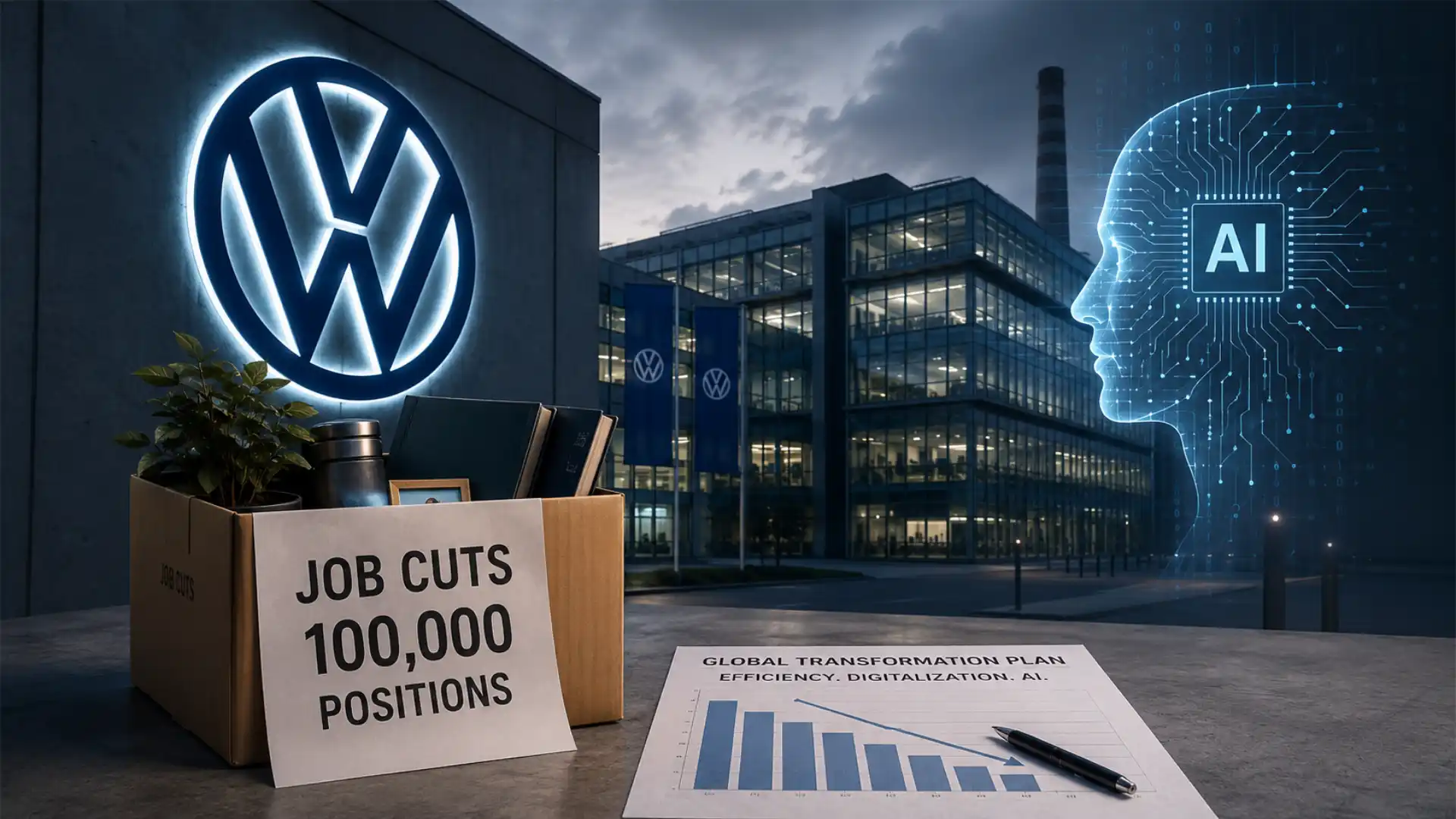
The figure is large enough to distort the story around it. A reported plan to cut as many as 100,000 Volkswagen Group jobs would equal a workforce reduction of roughly one-sixth from the group’s year-end 2025 total workforce, including Chinese joint ventures. It has been described as a possible component of the deepest reset in Volkswagen’s modern history. Yet the most important fact is also the least dramatic: Volkswagen has not confirmed that a 100,000-job programme has been approved.
Table of Contents
Reuters reported on June 26, 2026, that two people familiar with the matter said chief executive Oliver Blume was considering cuts of up to 100,000 jobs and the end of production at four German sites. Volkswagen declined to comment on the reported plan and said relevant facts would be discussed and approved by the appropriate bodies. Three days later, Reuters reported that management had told employee representatives that agreed reductions were insufficient, while adding that the scale of any further cuts had not been defined to the works council.
That distinction matters. A reported internal scenario, a board-level proposal, a target under negotiation, a plant decision and a signed workforce agreement are not interchangeable. Volkswagen’s system of co-determination gives labour representatives and the state of Lower Saxony influence that few global carmakers face. A proposal that looks arithmetically tidy in a management presentation can become much slower, more expensive and politically different once it reaches the supervisory board, works councils, IG Metall and regional governments.
The reported number nevertheless deserves serious attention because it fits a visible sequence of events. Volkswagen has already agreed to reduce more than 35,000 jobs at Volkswagen AG’s German sites by 2030 through socially responsible measures. It has also set a groupwide target involving about 50,000 positions across Volkswagen, Audi, Porsche and software unit CARIAD. At the June 2026 annual general meeting, Blume said binding agreements for more than 28,000 departures at Volkswagen AG had already been signed.
The new report is therefore not a claim that Volkswagen woke up one morning and discovered artificial intelligence. It is a warning that the existing labour-and-capacity programme may not yet close the gap between the company’s inherited cost structure and the economics of the markets in which it now competes. AI belongs inside that gap, but it is not its main cause.
The phrase “AI responsible” is tempting because it turns a difficult industrial story into a neat technology story. It suggests a clean substitution: software replaces people, therefore jobs disappear. Volkswagen’s situation is messier. The group is wrestling with lost momentum in China, thin margins, excess European capacity, uneven electric-vehicle demand, trade friction, expensive German plants, a complicated portfolio of brands and a shift from combustion-engine engineering toward batteries, electronics and software. AI can make the workforce smaller at the margin by reducing certain tasks and raising output per employee. It does not explain why factories that once made business sense are now under pressure.
A credible reading of the reported plan begins with the word “may.” The number may be a maximum scenario, a bargaining position, a way to establish urgency ahead of supervisory-board discussions, or a collection of already announced reductions and potential new measures. It may include workers outside Germany, temporary or indirect roles, positions removed through attrition, business disposals, outsourcing, shared-service consolidation, and plant-related headcount. It may never become a single public number at all.
The practical question for workers, suppliers, investors and European policymakers is not whether the reported headline survives unchanged. It is whether Volkswagen can restore earnings and speed without breaking the industrial system that made it Europe’s largest carmaker. The answer will depend less on how many people AI replaces than on whether Volkswagen can sell enough competitive cars, at acceptable prices, with a production footprint suited to the new market.
The arithmetic behind the headline
Volkswagen’s published employee figures show why a 100,000-job report produces such alarm. The group stated that it had 628,893 active employees at the end of 2025, plus workers in partial retirement and trainees, while the total workforce including Chinese joint ventures was 662,942. Another sustainability disclosure gives a narrower headcount of 602,659 employees, reflecting a different reporting definition. Such differences are normal in a conglomerate with joint ventures, trainees, partial-retirement arrangements and businesses spread across many countries. They also make broad layoff headlines harder to interpret.
A cut of 100,000 jobs against 662,942 people is about 15%. Against active employees alone, it is closer to 16%. Either calculation signals a profound change, but neither tells readers where the jobs would come from. The method matters. A vacancy that is not refilled, a voluntary severance agreement, a retirement, the sale of a business, a plant closure and an involuntary redundancy all reduce headcount. They carry radically different human, financial and political consequences.
Volkswagen’s December 2024 agreement offers the first benchmark. It referred to a socially responsible reduction of more than 35,000 jobs across Volkswagen’s German locations by 2030, paired with a job-security plan through 2030. It also said technical production capacity at German plants would be reduced permanently by 734,000 units. The deal was notable precisely because it avoided immediate compulsory redundancies and immediate factory closures while accepting that the company needed fewer employees and less capacity.
The June 2026 reporting raised the possibility of a more confrontational phase. The four sites named in reporting were Volkswagen plants in Hanover, Zwickau and Emden, and Audi’s Neckarsulm location. Reuters said more than 45,000 jobs could be at risk if those plants closed, but the company had not confirmed the sites or a closure decision. Treating a reported list as a final closure schedule would be wrong. It is still useful as a signal of where management may see the heaviest tension between capacity, product allocation and cost.
A further complication is that job reductions often proceed faster in corporate plans than in reported headcount. Companies count signed agreements, projected retirements and assumed turnover because those figures are relevant to cost planning. Employees see a different reality: the open role that is never replaced, a department told to operate with fewer specialists, a contractor whose work no longer returns, a supplier facing lower volumes, or a young worker who finds the usual apprenticeship path narrowed. The public headline captures one number; the industrial effect arrives through hundreds of smaller decisions.
The layers inside a 100,000-job headline
| Category | What it could include | What it would mean |
|---|---|---|
| Existing agreed exits | Retirement, partial retirement and severance already signed | Lower headcount with less immediate conflict |
| New voluntary programmes | Buyouts, early-retirement offers and recruitment freezes | Costly upfront but more manageable politically |
| Plant-related reductions | Production, maintenance, logistics and local support roles | Large regional impact and high fixed restructuring cost |
| Corporate consolidation | Finance, purchasing, HR, IT and management layers | Tasks may move, be automated or be shared |
| Portfolio changes | Divestments, outsourcing or business closures | Jobs may leave the group without disappearing from the economy |
| Involuntary redundancies | Direct dismissals where legal and contractual rules permit | Fastest route to lower payroll, highest social conflict |
The table explains why the headline figure cannot answer the question of personal risk. A worker at a site with secure future product allocation faces a different situation from a specialist in a duplicated corporate function, even if both appear in the same groupwide headcount total. It also explains why unions focus on plant commitments, product promises and no-compulsory-redundancy protections rather than accepting a single percentage target.
A 100,000-job programme would also have to be reconciled with Volkswagen’s need for skills. The group is trying to improve vehicle software, accelerate electric-vehicle development, build battery expertise, strengthen data infrastructure and compete in China. Cutting payroll without protecting critical engineering, manufacturing, cybersecurity, quality and commercial talent would solve a short-term cost problem by widening a medium-term competitiveness problem.
The useful headline is not “100,000 people replaced by AI.” The useful headline is this: Volkswagen may be testing whether its existing workforce and capacity plans are enough for a business model under pressure on several fronts at once.
The reset began before generative AI arrived
Volkswagen’s labour challenge did not begin with ChatGPT, factory vision systems or generative-AI copilots. It began years earlier with the collision between a capital-heavy industrial structure and a market shifting toward electric vehicles, software-defined functions and Chinese competitors with lower costs and faster product cycles. The company’s previous plans already acknowledged that its production footprint and workforce mix were built for a different profit model.
The 2024 agreement was explicit. Volkswagen said value creation in the auto industry was moving toward electric vehicles and software. The company’s workforce structure, it said, did not adequately reflect future profit pools. That is not an AI diagnosis. It is an admission that the balance between direct manufacturing work, traditional powertrain activities, software roles and indirect functions had become misaligned with the products and services expected to generate returns.
Combustion-engine cars use a dense network of specialised components and processes: engines, transmissions, exhaust systems, fuel delivery, after-treatment, calibration and many variants built over decades. Battery-electric vehicles do not erase labour, but they change where it sits. Battery packs, power electronics, thermal systems, high-voltage safety, software integration and cell sourcing become central. Some mechanical roles decline; others become more technically demanding. A factory designed around high volumes of engines and transmissions cannot assume that it retains the same employment base when the model mix changes.
Volkswagen’s core challenge is that the transition is not clean. It must keep selling profitable combustion and hybrid vehicles while investing in electric models, software platforms, batteries and new digital services. It must do so while customers still compare a new electric car not only with rival electric cars but with familiar petrol and hybrid alternatives. The cash generated by the old model funds the transition, yet the old model itself requires plants, suppliers, tooling, engineering and labour commitments.
That produces a painful timing problem. Costs for the future arrive before volumes for the future fully compensate for declining earnings from the past. A company with weak margins has less room to carry overlapping systems. Management then looks for activities that can be shared across brands, simplified, outsourced, digitised or stopped.
AI becomes attractive within that setting because it promises to reduce the cost of overlap. It may speed engineering simulations, automate routine documentation, predict equipment failure, improve demand forecasting, support purchasing negotiations, classify quality defects and help service workers find technical information. Each use case may save hours, reduce rework or shorten a development cycle. A large group can add those savings across thousands of processes.
Yet a tool that reduces task time is not necessarily the reason a plant has too much capacity. A robot-vision system may reduce quality-inspection rework. It does not explain why a plant is underused. A generative-AI assistant may shorten a software engineer’s documentation work. It does not explain why customers in China are buying fewer Volkswagen vehicles. A demand model may improve inventory allocation. It does not resolve a mismatch between European capacity and sales volumes.
This difference is crucial for public debate. AI is often the visible instrument of a restructuring whose deeper causes are commercial and industrial. The technology helps management seek productivity. The market tells management how much productivity it must find.
The group’s own financial language supports that reading. Volkswagen reported €321.9 billion in 2025 sales revenue, almost unchanged from the prior year, but an operating result of €8.9 billion, down 53% from €19.1 billion in 2024, with an operating margin of 2.8%. The decline included major special effects tied to Porsche product planning and tariff-related costs in the United States, but the gap between stable revenue and sharply weaker earnings points to a business that cannot rely on volume alone.
Stable revenue can conceal a worsening industrial equation. A carmaker may sell a similar number of vehicles while earning less on each one. Price discounts, mix changes, higher battery costs, tariffs, capacity underutilisation, warranty expenses, software delays, financing costs and labour inflation can all press the margin. The answer is not automatically mass layoffs. But it turns every fixed cost into a management question.
Volkswagen is now being judged against a more demanding standard than “can it remain huge?” It must show that its scale produces profitable, appealing products quickly enough to compete in the world’s hardest car markets. This was the issue before the current AI boom. It will remain the issue even if every office worker receives an AI assistant tomorrow.
Profit pressure has changed the tone
The sharp fall in Volkswagen’s 2025 operating result changed the emotional temperature around the restructuring. A company with a 5.9% operating margin can argue about the pace of change. A company reporting 2.8% faces a more immediate credibility test with investors, lenders, suppliers and its own supervisory board. The number does not imply financial distress in the narrow sense; Volkswagen still produced €6.4 billion in automotive net cash flow in 2025. It does mean that the cushion for strategic mistakes has become thinner.
Volkswagen attributed much of the year-on-year profit decline to special effects. It cited €4.7 billion in non-cash impairment losses on goodwill and capitalised project costs, plus other expenses related to Porsche’s adjusted product planning. It also cited €2.9 billion of additional expenses connected with increased US import tariffs introduced in April 2025. Those entries are not ordinary recurring factory payroll. They still matter because they consume management attention and reduce the capital available for investment, dividends, restructuring and price competition.
A carmaker’s margin is not a vanity metric. It determines whether the company can afford incentives when demand weakens, whether it can absorb a delayed vehicle launch, whether it can invest in a battery platform before the returns are proven, whether it can protect jobs during a downturn and whether suppliers believe volumes will remain stable. When margins compress, managers become less tolerant of complex product programmes and duplicated organisations.
Volkswagen’s reported target of more than €6 billion in annual net cost savings by 2030 provides a practical sense of the pressure. Cost targets of that scale are rarely met through one action. They require purchasing savings, lower development complexity, reduced material costs, fewer production variants, better capacity utilisation, lower fixed overhead, fewer management layers, shared platforms, less external spending and workforce reductions.
The difficulty is that not all “costs” behave alike. Cutting agency fees or travel budgets can be done quickly. Cancelling a vehicle project saves future expenditure but may leave a gap in a brand’s product range. Closing a factory removes a fixed cost only after years of negotiated severance, asset impairment, supplier changes, political conflict and site remediation. Reducing headcount in engineering may save salaries while slowing the product pipeline. Reducing quality staff may produce a larger warranty bill later.
This is where the AI narrative becomes appealing to executives. AI is framed as an alternative to blunt cuts because it allows the same workforce to generate more output. In practice, companies often pursue both. They use AI to standardise and automate work, then reduce the number of people needed to perform the standardised process. The critical question is whether the released capacity is redirected to higher-value work or removed from the payroll.
Volkswagen’s stated AI investment shows that it expects a material economic return. In September 2025, the group said it planned to invest up to €1 billion in AI by 2030 and expected potential savings of up to €4 billion by 2035. The cited areas were AI-supported vehicle development, industrial applications and high-performance IT infrastructure. The company’s own framing was speed, quality and competitiveness across the value chain.
Potential savings are not the same as an announced reduction in jobs. Savings can come from avoiding future hiring, reducing prototypes, lowering scrap, shortening development times, preventing downtime, improving purchasing decisions and reducing warranty costs. A company that claims billions in AI-related savings is announcing an ambition, not a headcount map. The relation to labour becomes direct only when management chooses not to redeploy the time or skills that AI frees up.
The wider reset looks harsher because Volkswagen is trying to do two things that clash in the short term: save cash and regain speed. Saving cash rewards fewer projects, fewer variants and fewer layers. Regaining speed requires decisive product development, sharper software execution, better customer insight and investment in talent. A workforce plan that cuts too broadly may improve a spreadsheet while making the company slower. A plan that leaves too much capacity in place may protect peace while preserving poor economics.
The test for Volkswagen will be whether the next phase makes its products more competitive, not merely its organisation smaller. A company does not defeat faster Chinese rivals by becoming a thinner version of its old self. It needs a different operating rhythm.
China is the largest strategic wound
The German factory debate cannot be separated from China. For decades, China was Volkswagen’s biggest source of volume, scale and profits. The group built a powerful local presence through joint ventures, broad dealer networks and models tailored to Chinese buyers. That position has become much harder to defend as domestic manufacturers improve rapidly in electric vehicles, software, design, cost control and product development speed.
Volkswagen’s own delivery data records the deterioration. Group deliveries in Asia-Pacific fell 6.5% to 3.01 million vehicles in 2025, chiefly because of intense competition in China; deliveries in China fell 8.0%. The annual report says the group’s passenger-car market share in Asia-Pacific declined to 7.8% from 8.6%, while its battery-electric market share in the markets assessed fell to 1.6% from 3.2%.
Those figures are not merely a regional sales problem. China changes the economics of Volkswagen’s global industrial system. High Chinese volume once supported platform scale, supplier purchasing power, engineering amortisation and the earnings needed to fund factories elsewhere. When that volume falls, costs previously spread across millions of vehicles become more visible. Europe then carries a heavier burden of fixed costs, even before considering its own demand uncertainty.
Chinese competitors have changed the terms of competition. They are not only selling lower-priced electric cars. Many have developed tighter control over batteries, electronics, software, manufacturing and local supply chains. They operate in a market where rapid iteration is normal and feature expectations change quickly. European brands that once sold engineering reassurance face customers who now expect digital features, competitive charging performance, frequent updates and short delivery cycles.
Volkswagen does not lack scale in China. It lacks the old assumption that scale alone will secure demand. The group has responded with China-specific development, partnerships and new electric products. It has also said that the weak 2025 BEV result in China was partly related to a planned model transition before new launches. That may be true. It does not remove the structural challenge: Chinese brands are capable of competing at a level that makes recovery far harder than a standard product-cycle dip.
A falling China business changes the factory question in Germany because Volkswagen’s European plants cannot be insulated from the global portfolio. The company does not allocate models site by site in a vacuum. It balances platforms, powertrains, export opportunities, supplier contracts, labour agreements, logistics, plant productivity and brand strategy. If China produces fewer profits and fewer engineering economies of scale, every German plant must prove a more direct commercial case.
There is a tempting but incomplete story that Germany is losing jobs because China is “taking” them. The reality is more complicated. Chinese demand for foreign brands has weakened while Chinese manufacturers are also expanding internationally. The effect is a double pressure. Volkswagen sells fewer cars in its former growth engine and faces more capable rivals in Europe and other export markets. The company must meet that competition under European energy, labour and regulatory conditions.
Tariffs do not eliminate the problem. The European Union’s definitive countervailing duties on Chinese battery-electric vehicles range from 7.8% to 35.3%, depending on the producer. They may slow some imports or reshape sourcing decisions. They do not erase the efficiency, product or speed advantages that competitors have built. They also do not guarantee that European consumers will choose a local car if the product, price or software experience does not meet expectations.
Volkswagen’s answer must be more than defensive. It must build cars Chinese buyers want, with local development and local cost discipline, while ensuring that European products are not left behind. That requires investment even as the group looks for cuts. The apparent contradiction is central to the reported 100,000-job scenario: the company is trying to reduce the legacy burden while spending enough to regain relevance in its most important competitive arena.
China also complicates the AI question. AI is not an optional future technology in the Chinese auto market; it is embedded in the race for digital cockpits, driver assistance, development speed, manufacturing data and customer services. Volkswagen’s AI investment is partly an effort not to fall further behind. The group may use AI to make engineers faster, factories more predictable and software work more productive. That is a response to competition, not a standalone trigger for mass job destruction.
Workers should still take the productivity agenda seriously. When management says “speed” and “efficiency,” it is saying that future work will be organised differently. The most exposed roles may be those tied to slow, repetitive, duplicated or highly manual information flows. The roles most protected will tend to be those that combine deep product knowledge, responsibility for safety, hands-on problem solving, cross-functional judgment and customer value.
China has made that sorting more urgent. It has not made it simple.
Europe’s electric transition is uneven, not absent
European car demand is often described as weak in a way that implies consumers have rejected electric vehicles. The numbers are more nuanced. Battery-electric cars took 17.4% of EU new-car registrations in 2025, up from 13.6% in 2024. Hybrid-electric cars held 34.5%, while the combined share of petrol and diesel fell to 35.5%. Europe is shifting, but it is doing so unevenly, with major differences in household income, charging access, incentives, company-car tax rules, electricity prices and buyer confidence.
That unevenness is costly for a group like Volkswagen. Product planning works best when demand develops broadly in the direction of the investment programme. Instead, some markets have moved rapidly toward battery-electric cars, others have favoured hybrids, and many consumers remain price-sensitive. A carmaker must carry parallel powertrain strategies longer than it would prefer. It must avoid missing emissions targets while also avoiding inventory of electric models that require heavy discounting.
The European Commission’s 2025–2027 flexibility measure illustrates the tension. Manufacturers were allowed to meet CO₂ targets across a three-year average rather than on an annual basis, providing breathing room while leaving the underlying regulatory path intact. The measure reduces the immediate risk of one bad sales year producing a huge compliance bill. It does not remove the need to sell more low-emission vehicles over time.
For Volkswagen, this means the electric transition is a volume, cost and timing problem. Selling more electric cars supports regulatory compliance and positions the group for future rules. Selling them at deep discounts can damage margins. Keeping combustion production high may support short-term cash flow but raises the risk of a later, sharper adjustment. The company has to build a portfolio that works across all those conditions.
The transition also changes plant utilisation. Electric models often use new platforms, different supplier flows and new assembly requirements. A factory cannot always switch from an internal-combustion vehicle to an electric vehicle without major investment and time. Even after conversion, the facility needs enough demand to justify the fixed cost. A site with capable workers and good quality can still become vulnerable if its assigned products no longer fill the line.
The reported factory list should be viewed through this lens. Zwickau, for example, became emblematic of Volkswagen’s early electric-vehicle production in Germany. That makes it politically and symbolically important, but it does not guarantee a stable future if demand, model allocation and cost do not align. Emden has been part of the group’s EV strategy as well. Hanover is tied to commercial vehicles and wider industrial activity. Neckarsulm is an Audi site with its own premium-brand and production questions. The value of a factory is not set by history alone; it depends on what it makes next and at what cost.
A transition that looks gradual in national registration data can feel abrupt inside a plant. A small change in demand mix may determine whether a production shift is full, whether overtime is available, whether a supplier’s contract is renewed or whether a future model is awarded. That is why factory workers do not experience “17.4% BEV share” as an abstract statistic. They experience it through schedules, training, model launches and investment announcements.
AI may reduce some of the friction. Better forecasting may improve production planning. Digital twins may reduce the cost of changes to lines. Machine vision may find defects earlier. Engineering tools may cut the time needed to validate components. These gains matter. They do not create customers. They do not solve charging anxiety. They do not lower interest rates for a family choosing between a compact electric car and a cheaper hybrid.
The policy lesson is uncomfortable. Europe cannot demand faster electrification from manufacturers while treating demand conditions as someone else’s problem. Charging deployment, energy affordability, consumer incentives, predictable rules, local battery supply and an industrial response to Chinese competition all shape whether plants remain viable. A carmaker’s workforce plan is partly a private corporate matter, but it also reveals the condition of the policy framework around it.
Volkswagen’s present risk comes from the mismatch between a long-term direction and a volatile present. The company knows it must be stronger in electric vehicles and software. It has not yet found a cost structure that makes the journey comfortable. Its workforce debate is a consequence of that gap.
The United States has become a margin problem
The United States is not Volkswagen’s largest strategic wound in the same way China is, but tariff pressure has made it an important earnings problem. Volkswagen’s 2025 annual results cited €2.9 billion of additional expenses tied to higher US import tariffs introduced in April 2025. That number appears alongside the company’s broader profit deterioration and shows why a global manufacturer cannot treat trade policy as a distant political issue.
Tariffs do not affect every Volkswagen brand or vehicle equally. The impact depends on where a model is assembled, where its components are sourced, what price segment it occupies, how much cost can be passed through to customers and whether the group has local capacity available. Premium imports can carry more price than small cars, but high prices also reduce volume. Mass-market vehicles may be more sensitive to price, but moving production is not quick or cheap.
For a group whose brands range from entry-level cars to luxury models, tariffs create a portfolio problem. A cost increase may prompt one brand to reduce incentives, another to raise list prices and a third to rethink its model mix. The group then faces a wider decision: whether to absorb lower margins, reconfigure supply chains, localise more production, shift exports or reduce investment elsewhere to preserve cash.
This matters for German jobs because export economics are part of German plant economics. A factory that relies on overseas demand is vulnerable when tariffs or trade barriers change. A factory that makes models for Europe alone is vulnerable when Europe is oversupplied. No plant is entirely sheltered. The result is a more demanding allocation process in which every site needs a clear role.
Volkswagen has tried to build more regional resilience, including manufacturing and product efforts in North America. Yet localising a vehicle portfolio cannot be done through a press release. It requires suppliers, battery sourcing, engineering adaptation, capacity, dealer confidence and years of product planning. Tariffs often arrive faster than factories.
The company’s 2025 operating result made the link explicit. Stable revenue did not protect margins from trade costs, restructuring expenses and product-planning changes. Management faced a business in which more of the sale price was absorbed by costs that were not easily controlled in the short term. Labour then becomes a focus not because workers created the tariff, but because payroll is one of the largest recurring fixed-cost pools a company can reshape over several years.
This is another reason the AI explanation is incomplete. AI may improve customs documentation, supply-chain forecasting, supplier risk assessment and pricing analysis. It cannot remove an import duty. It may help Volkswagen decide which products to localise or which shipments to reroute, but those decisions still require capital, facilities and time.
The trade backdrop also makes long-term capacity commitments harder. A company that expects a stable global market can assign models to plants for a full cycle with confidence. A company facing abrupt tariff changes may want more flexibility, shorter commitments and fewer underused sites. That inclination conflicts directly with the stability workers and local governments want.
Europe often views Volkswagen’s restructuring through the lens of domestic manufacturing. The United States shows that the group’s problem is global. China pressures volume and competitive position. Europe pressures capacity and regulation. The United States pressures margin through trade. Each problem interacts with the others. A dollar of lost margin in one market can reduce investment freedom in another.
The political temptation is to treat tariffs as a reason to protect every existing European job at any cost. The corporate temptation is to respond by cutting European costs as fast as possible. Neither approach is sufficient. Volkswagen needs a portfolio that can withstand trade volatility without stripping away the engineering and industrial base required to build the next generation of vehicles.
For employees, the practical point is simple: the reported job threat is not confined to office automation or domestic EV demand. It is connected to a global model that has become more exposed to political risk. That is a harder problem to solve with a chatbot than with a coherent industrial strategy.
Excess capacity is the factory issue beneath the workforce issue
Factories are expensive even when they are not making cars. They require maintenance, management, utilities, safety systems, security, tooling support, training, supplier coordination and a workforce that cannot be switched on and off like a website server. When a plant runs below efficient utilisation for a prolonged period, the cost per vehicle rises. The company must either fill the plant, assign a new product, accept lower returns, repurpose it or close it.
Volkswagen’s 2024 German agreement acknowledged the point without using the language of closure. It planned a lasting reduction of technical production capacity by 734,000 units. That is a capacity statement, not merely a personnel statement. It says the company did not expect every line and every plant to be filled by future demand on the old scale.
Capacity reduction is often misunderstood as a response to one bad year. It can be a strategic judgement about future vehicle volumes, product mix and productivity. A modern factory may produce more vehicles with fewer people, fewer shifts and lower rework than an older operation. If total demand is flat, increased productivity means less labour and fewer active lines are needed. This is the route through which technology, including AI, enters the industrial equation.
However, capacity is not identical to buildings. A plant can reduce capacity by ending a shift, removing a model, shortening production weeks, changing a product allocation or limiting overtime. It can be repurposed for components, battery work, logistics, recycling, research, special vehicles or third-party use. Closure is the most visible option, but it is not the only one.
The reported plant list makes the issue concrete. If more than 45,000 jobs are potentially connected to the sites named in reporting, the question becomes whether Volkswagen sees enough future model volume to sustain them. That question cannot be answered by a simple national sales total. It depends on platforms, export routes, brand demand, product timing, plant productivity and the company’s willingness to invest.
A plant’s real cost is often buried in the supply chain. Suppliers build facilities near major factories. Logistics networks, toolmakers, maintenance firms, caterers, transport companies, apprenticeships and local service businesses grow around them. A factory with 5,000 direct employees may support many more jobs beyond its gates. When management talks about “capacity,” a region hears a threat to its economic identity.
That is why German factory politics are unusually intense. Volkswagen is not merely a private employer. It sits at the centre of regional industrial ecosystems, and Lower Saxony has a stake in the company’s governance. A closure decision has consequences for tax revenue, housing, training, local elections and the credibility of German industrial policy.
AI plays a limited but real role in the utilisation calculation. AI-supported scheduling may allow a plant to operate with fewer buffers. Predictive maintenance may reduce downtime. Digital quality systems may lower rework. Better demand forecasts may prevent inventory from accumulating. A company that gets those gains can operate with less slack. In a fully loaded factory, that may improve profitability without reducing employment. In an underused factory, it may make the arithmetic of retaining surplus labour harder.
There is a social choice inside that arithmetic. Higher productivity does not force layoffs by itself. A company may use productivity to reduce working time, retrain workers, bring outsourced work in-house, build new products or preserve competitiveness while maintaining jobs. It may also use it to cut payroll. The outcome depends on demand, bargaining power, investment and management priorities.
Volkswagen’s existing job-security arrangements give unions leverage to argue for the first set of choices. The reported scale of new cuts suggests management may argue that the old compromise does not solve the financial problem quickly enough. A serious negotiation would need to compare the full cost of closure against alternatives: product allocation, reduced hours, conversion investment, supplier reshoring, shared production with another brand, contract manufacturing or site diversification.
A factory is not saved by sentiment. It is saved by a credible workload. The harshest part of Volkswagen’s reset is that it must find that workload in markets where old assumptions no longer hold.
German costs are part of the story, but not the whole story
Germany is expensive for car manufacturing. Wages are high, energy costs have been volatile, compliance requirements are demanding and production sites often carry decades of accumulated complexity. Those facts are real. They are also too often used as a lazy explanation for every industrial problem. Germany’s high costs coexist with a workforce known for technical skill, process knowledge, quality discipline and supplier density. The real question is whether those strengths are converted into products and production systems customers will pay for.
Volkswagen has already reduced factory costs at its German sites, according to Blume’s June 2026 remarks. Reuters reported that he said costs had fallen by more than 20% by 2025. That is a substantial achievement, but it also signals the scale of the starting problem: if a 20% reduction still leaves management arguing that current job cuts are insufficient, the gap is deeper than one round of efficiency measures.
German industrial output has also faced a weak macroeconomic backdrop. Destatis reported that industrial production in January to November 2025 was 1.2% lower than a year earlier, while automotive industry production fell 8.9% in December 2025 from the previous month. Monthly data should not be used to diagnose a company, but they show the broader environment in which Volkswagen is operating.
A high-cost location needs high-value work. That does not necessarily mean only luxury vehicles. It means products with sufficient pricing power, technology content, quality reputation, productivity and supply-chain efficiency to support the labour base. A German plant making a globally desired vehicle at high utilisation may be competitive. A German plant making a slow-selling car with too many variants may not be, even if its workforce is highly capable.
Volkswagen’s complexity is part of the challenge. The group manages numerous brands and model lines, often with different customer promises and regional strategies. Shared platforms can create scale, but shared platforms can also create internal competition for plant allocation. Each brand wants its own identity, features and timing. Each deviation can add engineering, purchasing and production cost.
The German cost debate also includes management. A carmaker cannot credibly demand sacrifices from production workers while leaving layers of corporate overhead, brand duplication and slow decision-making untouched. The political durability of any workforce programme will depend on whether employees see senior leadership, executive structures, external consultants and non-core assets being subjected to the same discipline.
The reported 100,000-job plan may be intended partly to address that perception by reaching beyond factory floors. A groupwide number suggests that savings would not be limited to manual work. Yet the distribution matters. Corporate functions are easier to consolidate and automate, but plant closures cause more concentrated social damage. A company that cuts thousands of office roles across many cities may have less political resistance than one that removes a single factory from a region, even if the total job number is smaller.
AI may have more immediate impact in expensive German indirect functions than on a production line. Document review, coding support, translation, reporting, legal research, purchasing analysis, finance reconciliation and customer communication contain tasks that digital tools can compress. A company facing high salary costs has a strong incentive to deploy AI there. This does not mean every white-collar role disappears. It means job design changes, hiring slows and teams may be asked to handle more work with fewer people.
The danger is that a cost programme becomes indiscriminate. German engineering and manufacturing know-how has been built through long apprenticeships, practical problem solving and tacit knowledge that is difficult to capture in a database. Removing experienced people may create savings visible in a quarter and losses visible only when a launch goes wrong, a supplier fails or a quality problem emerges.
Volkswagen’s task is not to defend every historic cost. It is to decide which costs are the price of excellence and which costs are the residue of a business model that has become too slow. That distinction is harder than an AI prompt and more consequential than a headline.
Co-determination will determine the pace of change
Volkswagen cannot implement a vast restructuring as though it were a purely managerial company. German labour law, works councils, collective agreements, the influence of IG Metall and Lower Saxony’s role in the company’s governance create a system in which industrial change must be negotiated. This does not make cuts impossible. It makes the process more political, more procedural and often more expensive.
The December 2024 agreement shows the style of compromise Volkswagen has used. The company accepted commitments around job security and avoided immediate site closures, while labour accepted capacity reductions and more than 35,000 socially responsible job reductions through 2030. IG Metall described the approach as a fundamental difference from layoffs and plant closures: exits would occur through phased retirement, early retirement and severance arrangements rather than compulsory dismissals.
Such programmes are not painless. A worker leaving early loses a planned future at the company. A younger worker may see fewer openings. A department losing experienced staff must redistribute knowledge. But voluntary and age-based reductions give companies time to redesign work and avoid the shock of immediate mass unemployment.
The reported new scenario appears to test the limits of that model. If management believes agreed reductions are insufficient, it may seek stronger measures. Labour representatives are likely to ask whether management has exhausted alternatives: model allocations, shorter working time, reindustrialisation, early retirement, retraining, insourcing, reduced dividends, asset sales, supplier renegotiation and cuts to executive overhead.
A works council’s position is not simply “no change.” It is often “no change without a credible industrial plan.” Workers have reason to demand specifics: Which products will each site make? What volume assumptions sit behind those plans? Which costs are being cut outside production? What roles will be retrained? Which skills will the group recruit while it reduces headcount? How will AI affect staffing by function? What safeguards prevent a temporary downturn from becoming permanent deindustrialisation?
Management, in turn, will argue that delay has a cost. A company that keeps too much capacity, too many overlapping roles and too much product complexity can lose the ability to invest at all. The uncomfortable truth is that labour and management may agree on the diagnosis that Volkswagen needs to become faster and cheaper while disagreeing intensely about who bears the burden.
Co-determination makes the AI question more concrete. It gives employee representatives a route to ask for transparency on automation projects, training, data use, monitoring and job redesign. AI systems can be used to improve work, but they can also be used to intensify it: tighter performance measurement, automated scheduling, productivity rankings and reduced discretion. The labour debate will not only concern job count. It will concern the quality and control of the work that remains.
German industrial relations may also favour a more balanced transition than a purely market-led system. A negotiated approach can preserve skills through downturns, support shorter working arrangements and attach retraining commitments to technology adoption. It can also make a company slower to close loss-making sites. Whether that is a flaw or a strength depends on whether the extra time produces a viable new workload.
The political role of Lower Saxony adds another layer. A state shareholder and regional leaders have a direct interest in preserving employment and industrial capability. That can give workers support, but it can also create pressure for compromises that keep sites alive without solving the commercial problem. The worst outcome would be a long period of uncertainty in which plants receive neither a secure future nor a clear transition plan.
The reported 100,000 figure may therefore be less a forecast than a negotiating instrument. It establishes the scale of the pain management believes is possible. Labour’s task is to force management to demonstrate that each reduction is tied to a real economic need rather than a target chosen for financial theatre.
For investors, the process may look frustratingly slow. For workers, slow is often the difference between an orderly transition and a personal crisis. For Volkswagen, the challenge is to move quickly enough to compete without destroying the trust and skills on which its manufacturing system still depends.
The brand portfolio makes every cut harder
Volkswagen Group’s scale is both an advantage and a burden. It owns brands aimed at different price points, regions and customer identities: Volkswagen Passenger Cars, Audi, Škoda, SEAT/CUPRA, Porsche, Volkswagen Commercial Vehicles, Bentley, Lamborghini, Ducati, Scania, MAN and other activities. In theory, the portfolio spreads risk and creates purchasing, platform and technology scale. In practice, it can create duplicate functions, competing investment claims and slow decision paths.
A restructuring that seeks €6 billion or more in annual savings cannot ignore the portfolio. The group needs to ask where brands genuinely require separate development, design, software, purchasing, sales and corporate structures, and where separation has become an expensive habit. The answer varies by activity. Brand identity matters enormously in design, marketing and product positioning. It matters less in back-office reporting systems, many procurement categories, cybersecurity standards, data infrastructure and some engineering tools.
The portfolio also shapes labour risk. A job at Audi, Porsche or CARIAD may be counted in the same groupwide reduction target as a job at Volkswagen AG, but the underlying business conditions differ. Premium brands may have stronger pricing power but higher exposure to China and trade friction. Mass-market brands may have thinner margins but more scope for platform scale. Software operations may have a large investment need and a history of restructuring. Commercial vehicles follow a different demand cycle from passenger cars.
Volkswagen’s 2025 results captured some of this unevenness. CARIAD increased sales revenue to €1.8 billion, up 33.8%, but remained loss-making with a €2.2 billion operating loss, though that was an improvement from €2.4 billion. The company said the result reflected a transformation programme and high restructuring expenses.
A portfolio strategy should not use CARIAD’s losses as a reason to abandon software. The group needs software capability. The issue is whether the work is organised in a way that delivers usable technology to brands on time and at a cost they can support. A central unit can create scale. It can also become detached from product teams, slow to decide and expensive to coordinate.
The same principle applies to shared vehicle platforms. Scale lowers the cost per vehicle only when the platform is reliable, flexible and used at sufficient volume. If brand-specific deviations multiply or launches are delayed, the promised scale becomes less valuable. A job reduction programme then risks removing people from teams already struggling to deliver.
This is why “cut 100,000 jobs” is not a strategy. It is a possible financial outcome. The strategy must identify which capabilities Volkswagen keeps central, which it decentralises, which it shares, which it outsources and which it exits. It must also explain how those choices produce better cars, not merely lower overhead.
AI may sharpen the argument for centralisation in some areas. A common enterprise data platform, cloud infrastructure, cybersecurity model, engineering knowledge base or AI governance system makes little sense if every brand builds its own version. Shared AI tools can reduce duplicated coding, reporting and analytics work. They can also standardise processes across the group.
Yet central tools must serve brand and site reality. An AI model trained on generic quality data may fail to capture a plant-specific issue. A shared software platform may frustrate a brand if it cannot respond quickly to customer needs. The group must avoid replacing fragmented bureaucracy with centralised digital bureaucracy.
The portfolio question is also about capital allocation. Every brand seeks investment in new models, electrification, technology and marketing. In a period of thin margins, not every project can be funded. Management may decide to reduce variants, delay launches, close non-core activities or sell assets. Those decisions affect jobs indirectly through the workload assigned to factories and engineering centres.
Workers and suppliers should watch for signs that Volkswagen is simplifying its portfolio architecture rather than just reducing people. A smaller number of platforms, fewer overlapping models, shared digital infrastructure and clearer regional responsibilities would suggest a real operating reset. A headline job target without those changes would suggest the company is treating symptoms.
The group’s scale remains a strength, but only if it becomes faster. The brands must be large enough to share cost and distinct enough to earn loyalty. That balance will decide whether workforce reductions become a bridge to recovery or merely the next chapter in a long decline.
Electric vehicles have changed the value chain
The most consequential shift in Volkswagen’s workforce is not generative AI. It is the changing value chain of the car itself. Electric vehicles place more economic weight on batteries, power electronics, software, charging integration, thermal management and digital services. Internal-combustion vehicles place more weight on engines, transmissions, exhaust systems and a long chain of mechanical components. The transition changes which suppliers matter, which factory skills are scarce and which jobs can be sustained.
A battery pack is not simply an engine with a different fuel source. It has different materials, safety requirements, sourcing risks, manufacturing steps and repair economics. It requires expertise in cell chemistry, high-voltage systems, thermal management, battery management software and recycling. Some traditional component work declines as vehicle architecture becomes simpler in mechanical terms. New work appears in other parts of the system, but it may not appear in the same town, company or job category.
This creates a difficult social reality. A worker whose skills are tied to a combustion-engine component may hear that the electric transition creates new jobs, but the new job may demand different qualifications, be located elsewhere or arrive years later. The transition is not neutral at the individual level. It is a redistribution of industrial work.
Volkswagen’s challenge is to retain and retrain enough people to build the new value chain while avoiding the cost of maintaining the old one indefinitely. That requires training investment, clear career paths and credible product plans. A company that tells workers to reskill without showing where the future work will be located is asking them to absorb uncertainty without a contract.
Battery production adds another complication. Europe wants more local battery capability for strategic and employment reasons, but cell manufacturing is capital-intensive, price-sensitive and dominated by global competitors with deep scale. A carmaker may want local supply and still struggle to make the economics work. If battery costs fall faster elsewhere, European sites need exceptional quality, energy conditions and supply-chain support to remain competitive.
AI enters the battery story in useful ways. It may improve cell-development analysis, battery health prediction, production quality inspection and supply planning. It may also support faster simulation of materials and thermal performance. These are high-value technical uses. They are unlikely to replace the need for engineers, technicians and safety specialists. They may change what those specialists spend their time doing.
The broader manufacturing system is becoming more software-dependent. A battery-electric car is controlled by electronic systems that communicate across the vehicle. Software updates, diagnostics, cybersecurity and data management become central to the customer experience. That raises demand for people who understand both automotive engineering and software systems. It also puts pressure on traditional engineering organisations that were built around hardware development cycles.
Volkswagen’s 2024 workforce presentation captured the strategic concern: future profit pools were expected to shift toward EVs and software, while much of the group workforce remained in direct production activities. That does not mean direct production work is unimportant. It means the company needs to decide how much direct work is required for the volumes it expects and what proportion of its people need to move toward new technical fields.
The risk is that the company treats workforce change as a one-way shedding process. A strong industrial transition needs both exits and entry paths. Apprenticeships need to evolve. Experienced mechanics need routes into high-voltage work. Manufacturing workers need training for battery safety and digital production systems. Engineers need closer links to software and data teams. Suppliers need support to shift product lines.
A 100,000-job headline hides that complexity. It makes the issue sound like fewer people making the same cars. The actual challenge is different: Volkswagen is trying to build a workforce capable of making different cars, using different technologies, for customers whose expectations have changed.
Whether AI contributes to job losses depends on how the company handles this shift. Used well, AI may shorten training, surface technical knowledge and reduce repetitive work, allowing experienced employees to focus on fault finding, process improvement and safety. Used poorly, it may become a pretext for removing people before the new work is ready.
The factory of the future will not be empty. It will be more digitally connected, more dependent on high-voltage and software skills, and less forgiving of organisations that separate hardware, software, quality and supply-chain decisions into rigid silos. Volkswagen’s workforce plan must be judged against that future, not against nostalgia for the past.
Software is a strategic need and an organisational scar
Volkswagen’s software subsidiary CARIAD has become a symbol of both necessity and frustration. The group needs a stronger software capability because cars increasingly depend on digital architecture, over-the-air updates, driver assistance, connected services and data. It also needs that capability to work across brands without causing product delays, cost overruns or disconnected customer experiences.
CARIAD’s financial results show a business in transition rather than a finished success. The unit’s 2025 revenue increased 33.8% to €1.8 billion, driven mainly by software deliveries to group brands, while its operating loss improved modestly to €2.2 billion. Volkswagen said the transformation programme was being implemented consistently and that CARIAD had been technically restructured and reorganised to become leaner.
The word “leaner” should be read carefully. In a software unit, it can mean fewer management layers, fewer external contractors, fewer overlapping programmes, a smaller central workforce or a narrower product scope. It can also mean that some work moves closer to brands or external partners. It does not necessarily mean Volkswagen is retreating from software. It may mean the company is trying to stop a central organisation from becoming an expensive bottleneck.
Software work is especially relevant to the AI question because many AI tools directly affect coding, testing, documentation, requirements analysis and technical support. A skilled engineer using a coding assistant may produce more quickly. Automated test generation may find bugs earlier. AI may summarise defect reports, translate specifications or identify patterns in field data. These tools can raise output per developer and reduce the need for some routine tasks.
But software teams are not interchangeable factories of code. Automotive software has safety, cybersecurity, regulatory and integration responsibilities. A generated code suggestion is not a certified vehicle function. It must be reviewed, tested, validated and integrated into a complex system. The idea that AI will allow a carmaker to dismiss most software engineers is not credible. The more realistic outcome is a changed mix: fewer people doing repetitive implementation or coordination work, more value placed on architecture, validation, systems engineering, safety assurance and domain knowledge.
CARIAD’s organisational history also offers a caution. Centralising a capability because it looks strategic does not guarantee better delivery. A central unit can become distant from brand needs, overloaded with governance and slow to make trade-offs. Volkswagen’s reset needs to distinguish between software capability and software bureaucracy. Cutting the latter may be necessary; cutting the former would deepen the group’s problem.
The company’s AI plans may help CARIAD work differently. Shared development environments, knowledge retrieval systems, synthetic test data, defect triage and automated code-quality checks could reduce friction. The larger opportunity may be in connecting vehicle data, manufacturing data and engineering data so teams see problems earlier. That requires strong data governance, common architectures and trust between brands and central functions.
There is also a labour issue beyond headcount. AI tools may change the career ladder for junior software workers. Entry-level tasks such as writing basic code, preparing documentation, searching legacy systems and producing routine tests are among the tasks most likely to be accelerated. Companies need to decide how new engineers build judgment if AI handles much of the work that used to teach them the basics. A workforce plan that cuts junior routes while demanding more senior digital skills will create a future talent shortage.
Volkswagen should be judged by whether its software reorganisation improves launches and customer experience. Faster time to market, fewer software defects, reliable updates, clearer product ownership and lower development cost would show progress. A smaller CARIAD workforce without better delivery would simply prove that cutting is easier than rebuilding.
The current job-cut reports should therefore not be read as proof that software and AI are reducing Volkswagen’s need for digital talent. They may reveal the opposite: the company needs digital talent, but in different structures and with fewer duplicated roles. The difficult part is deciding which people and skills belong in that future.
AI is a productivity programme, not a single job category
Volkswagen has made AI a prominent part of its future investment story. In September 2025, it said it intended to invest up to €1 billion in AI by 2030, with uses in vehicle development, industrial applications and IT infrastructure. It said AI could generate up to €4 billion in savings by 2035. The company also described more than 1,200 AI applications across the group, with more in development, according to contemporary reporting.
Those numbers invite an obvious question: if Volkswagen expects billions in savings from AI, will that money come from jobs? Some will. Labour is a major component of operating cost, especially in engineering, administration, software, sales support, logistics planning and finance. Yet savings are not a one-for-one measure of payroll reduction. A development team that uses AI to reduce prototype cycles may save material and testing cost. A factory that predicts equipment faults may save downtime. A purchasing team that improves forecasting may reduce inventory. A service system that diagnoses problems faster may lower warranty expense.
The more precise term is productivity programme. AI changes the amount of output that an organisation can produce with a given amount of labour, capital and information. Management then decides what to do with the gain. It can make the same number of employees more productive, reduce overtime, cut contractor spending, redeploy people to new work, slow hiring or remove positions.
The most immediate labour effect is likely to be attrition rather than sudden replacement. A department that once hired ten analysts to support growth may hire six because software handles routine reporting. A shared-service centre may merge teams after AI-enabled workflow tools reduce manual reconciliation. A product-development group may use fewer external engineering contractors. These changes reduce jobs over time without a dramatic “AI layoff” announcement.
Factory work will be affected differently. Industrial AI is often narrow and specific: machine vision for quality inspection, predictive maintenance, energy management, robotic process control, production scheduling and supply-chain forecasting. It may reduce repetitive inspection or data-entry tasks, but it also depends on technicians, operators, maintenance workers, industrial engineers and quality teams who understand the physical process. A model may flag an anomaly; a human must decide whether a production line is safe to continue.
The OECD’s work on AI and employment points to a pattern that fits Volkswagen’s likely experience. Surveys in manufacturing and finance have found workers and employers generally positive about AI’s effect on performance and working conditions, while job-loss concerns remain real and require close monitoring. The evidence does not support a simplistic conclusion that adoption automatically produces mass unemployment.
The International Labour Organization has made a related point in its research on generative-AI exposure: exposure is not the same as automation. Many jobs contain tasks that may be changed or supported by AI without being eliminated. That distinction is especially important in automotive work, where safety, quality, physical systems and legal accountability limit full substitution.
Volkswagen’s own language around AI emphasises faster development, better quality and competitiveness. That is consistent with a company that wants to reduce time-to-market and internal friction. It is not evidence of a board-approved plan to replace 100,000 workers with algorithms. The reported 100,000 figure arose in the context of factories, capacity, China, tariffs and cost cuts—not an AI announcement.
Still, workers should reject false reassurance. AI will shape staffing. It will weaken the case for duplicated, routine and easily codified work. It will increase pressure on teams to show higher output. It may centralise knowledge in systems that make it easier to move work between locations. It may alter performance measurement and reduce the value of tasks that used to justify a full-time role.
The better question is not “Will AI take Volkswagen jobs?” It is “Which Volkswagen tasks will become easier to automate, which jobs will be redesigned around AI, and which savings will the company retain rather than reinvest?” That question has answers by department, plant and occupation. A groupwide headcount number cannot provide them.
Factory AI will change work before it removes people
Car factories have used automation for decades. Robots weld, paint, move parts and support assembly. Programmable logic controls equipment. Sensors monitor production. AI is an extension of that history, not a sudden arrival of intelligence in a previously manual environment. Its distinctive contribution is the ability to find patterns in large data sets, recognise visual anomalies, predict failure and support decisions that once depended on slower human analysis.
At Volkswagen, the most plausible factory uses include quality inspection, predictive maintenance, process optimisation, inventory control, energy management, intralogistics and production scheduling. A vision system can inspect painted surfaces or component fit more consistently than a human eye over long shifts. A predictive model can identify equipment behaviour that precedes a failure. A scheduling system can coordinate parts, labour and production sequence more tightly.
These applications may reduce certain tasks. Fewer people may be needed for repetitive inspection, routine data collection, manual scheduling or basic reporting. But factories are physical environments full of variability. Suppliers deliver parts with subtle differences. Equipment ages. Weather affects logistics. A worker notices a sound, smell or vibration that is not in the training data. A quality issue requires investigation across design, supplier, process and human factors. AI creates a new layer of information; it does not remove the need for operational judgment.
The labour effect may be most visible in how jobs are combined. An operator who once spent part of a shift recording data may use an interface that records it automatically. A maintenance technician may receive a prioritised list of likely faults. A quality worker may investigate the anomalies a vision model highlights rather than inspect every unit. The job becomes more technical, more data-mediated and potentially less physically repetitive.
This creates a training challenge. If Volkswagen reduces headcount while introducing more AI, it must make sure remaining workers have time and support to learn the systems. A factory cannot simply add dashboards and expect performance to improve. Operators need confidence to question a model. Supervisors need to understand its limits. Maintenance teams need access to data and authority to act. Works councils need clarity on whether systems are being used for process improvement or individual performance surveillance.
The potential for surveillance is often ignored in corporate AI narratives. Production data may reveal output by shift, workstation, task or worker. That can be used to find bottlenecks. It can also be used to pressure individuals, set unrealistic targets or hide staffing shortages behind productivity metrics. Labour representatives will rightly seek boundaries around data use, especially where AI systems infer performance or recommend schedules.
Safety is another limit. Automotive manufacturing includes high-voltage systems, heavy equipment, chemicals, robots and complex ergonomics. An AI recommendation cannot substitute for legal safety obligations or trained safety personnel. Any productivity gain that reduces supervision too far may increase risk and cost more than it saves.
A factory with better AI tools may need fewer people per vehicle over time. That statement is true across much of industrial history. It does not establish that Volkswagen’s reported 100,000-job scenario is an AI outcome. The group’s capacity and market issues would exist even if factory AI stopped improving today. The technology intensifies the pressure to use plants efficiently; it does not create the underlying demand problem.
The social choice lies in the distribution of productivity gains. A factory may use them to produce more with the same staff, reduce working hours, bring outsourced work back inside, retrain people for new products or reduce headcount. Demand decides part of the answer. Bargaining and management choices decide the rest.
For workers, the practical defence is not to deny AI. It is to demand a transition plan: training linked to real roles, human oversight, limits on surveillance, transparent staffing assumptions and a commitment to use productivity gains for competitiveness before using them for cuts. A company that wants workers to trust AI must show that it is improving the factory rather than merely making redundancies easier to justify.
Engineering work is the richer AI opportunity
AI’s largest potential effect at Volkswagen may emerge in engineering rather than on the assembly line. Vehicle development is expensive, iterative and information-heavy. Engineers work through simulations, specifications, test results, supplier data, regulations, design changes, software interfaces and physical prototypes. A tool that reduces the cycle time of even one of those activities may have broad financial value.
Volkswagen has said AI will support vehicle development. The likely use cases are familiar across the industry: generating and checking requirements, searching engineering knowledge, modelling components, identifying test cases, analysing defects, translating technical material, producing code support, comparing design alternatives and predicting performance. These tools do not remove engineering accountability, but they can reduce the time spent on low-value search, formatting and repetition.
The group’s stated ambition to accelerate development cycles matters more than a narrow job-replacement narrative. A carmaker facing Chinese competitors that launch products quickly needs to reduce the time between concept, engineering, validation and market delivery. A faster cycle lowers development cost, reduces the risk that a product is outdated at launch and allows the company to respond to customer preferences more quickly.
The trade-off is that faster development can mean fewer people are needed in some support functions. If AI reduces the time required to prepare reports, document changes, search old project files or run standard simulations, managers may conclude that a smaller team can deliver the same programme. The risk is greatest in work that is highly repetitive, standardised and detached from final technical responsibility.
Work involving integration and judgment is harder to compress. An engineer deciding whether a safety-related system is ready for production must understand hardware, software, testing, regulations and real-world failure modes. An AI system may provide evidence; it cannot carry the legal and professional accountability. The same applies to chief engineers, quality leaders, homologation specialists, cybersecurity experts and supplier managers.
There is also a hidden risk in overusing AI: knowledge erosion. Engineering organisations learn through the work of junior and mid-level staff who investigate problems, build models, write tests and document decisions. If tools automate too much of that work without a deliberate training model, the organisation may produce fewer people capable of understanding the system deeply. It may become dependent on tools and external vendors while losing the internal judgment needed to assess them.
Volkswagen needs to treat AI as a change in the engineering operating system, not a procurement project. That means common data standards, clean product information, clear responsibility, secure access, model validation, IP protection and tools that fit actual workflows. A generative assistant trained on poor or fragmented data may create confident but unreliable outputs. In automotive development, that is a quality and safety issue, not just an IT inconvenience.
The company’s AI investment is also a signal to suppliers. If Volkswagen shortens its development cycles, suppliers will be expected to match the pace. They will need compatible data systems, faster validation, digital engineering skills and the ability to respond to changes with less lead time. The productivity benefit may therefore shift pressure down the supply chain.
This is why workforce policy cannot be confined to Volkswagen payroll. Germany and central Europe have dense automotive supplier networks. A large carmaker that reduces engineering staff, product variants or local development work affects toolmakers, design firms, test laboratories, software contractors and component suppliers. Some will gain work from new technology programmes; others will lose the stable orders that financed their skills.
AI could make Volkswagen more competitive if it shortens development without sacrificing quality. That would support jobs indirectly by improving product relevance. It could also make the company leaner in engineering. Both outcomes can happen at the same time. The question is whether the company redeploys people toward the difficult work of systems integration, validation and new product creation, or simply counts the hours saved as a reason to cut.
White-collar roles may face the first staffing effect
The office is where the direct headcount effect of generative AI may arrive first. Large carmakers have extensive administrative structures: finance, human resources, purchasing, legal, communications, sales planning, marketing operations, customer service, IT support, project management and corporate reporting. Much of this work involves documents, spreadsheets, presentations, workflows, tickets, contracts, supplier information and internal knowledge—all areas in which AI tools can reduce the time required for routine tasks.
Volkswagen’s size makes the opportunity large. A small productivity gain across thousands of people in shared services can translate into major savings. A group that expects up to €4 billion in AI-related savings by 2035 will scrutinise such functions closely. The likely first move is not a mass dismissal notice. It is a hiring freeze, a reduction in contractors, consolidation of teams, fewer replacement hires after retirement and tighter spans of control.
Workers in these functions should distinguish between tasks and roles. AI may draft a report, summarise a meeting, classify an invoice, search a policy database or prepare a first response to a customer. It may not be able to resolve an unusual supplier dispute, make a labour-law judgment, negotiate a contract, handle a sensitive customer case or take accountability for a financial decision. Jobs change when the balance of tasks changes.
The positions most exposed are those built around repetitive processing, simple information retrieval, routine drafting and manual transfer of data between systems. The positions most resilient combine domain expertise, relationship management, ethical judgment, regulatory responsibility, commercial negotiation or the ability to resolve exceptions. This is not a guarantee of security. It is a useful guide to where job design is likely to shift.
AI also creates new office work: data governance, cybersecurity, model risk, audit, prompt and workflow design, change management, quality control, legal review, training and vendor management. The number of new roles may not equal the number reduced, and new roles may require different skills. A company that wants to avoid unnecessary job loss needs reskilling routes that are specific enough to be credible.
Volkswagen’s works councils will have a role here. They can ask whether an AI system is intended to eliminate tasks, reduce staffing, improve service or monitor employees. They can demand consultation before systems reshape workloads. They can negotiate training and redeployment. Such mechanisms do not stop technology. They make its human impact visible before a restructure is presented as inevitable.
There is a management danger, too. White-collar reduction is easy to overdo because the damage is less visible than a plant closure. A company may cut project support, analysts, coordinators and experienced administrators, then discover that engineers and managers spend more time doing administrative work themselves. The apparent payroll saving can reappear as slower decisions, poor data, missed compliance steps and exhausted specialist staff.
AI should allow companies to remove needless work, not merely remove people while leaving needless work intact. Volkswagen’s complexity has been built through brands, regions, products, regulations and legacy systems. A useful AI programme would simplify processes first and automate second. Automating a bad process faster is not a productivity miracle.
The current job-cut report should put white-collar workers on notice without inviting fatalism. Their risk is real because their tasks fit many early AI applications. Their value is also real because Volkswagen’s transition requires experienced people who understand how complex industrial organisations actually function. The company will need fewer report producers; it may need more decision-makers who can turn data into action.
AI savings require expensive foundations
A company does not collect AI savings by signing software licences. It needs data, computing capacity, cyber security, governance, integration, training and process redesign. Volkswagen’s commitment to invest up to €1 billion in AI by 2030 includes high-performance IT infrastructure for this reason. The investment itself is an admission that the technology is not a free productivity windfall.
Automotive data is fragmented by design. It sits in engineering systems, factory machines, supplier portals, service networks, finance tools, logistics systems and vehicle fleets. Data may be sensitive, incomplete, inconsistent or subject to contractual limits. Combining it responsibly requires common standards and careful access controls. A model that sees the wrong data, or sees it without context, can make a costly recommendation at scale.
Cybersecurity is especially important. Connected vehicles, manufacturing systems and product-development environments are attractive targets. An AI system that accesses technical drawings, source code, supplier information or customer data expands the security surface. Volkswagen must decide which models can be used, where data is stored, how prompts are logged, how outputs are checked and how intellectual property is protected.
Governance also has a workforce dimension. Employees need to know whether they are allowed to use external AI tools, what information they may enter, how they must verify outputs and who is responsible for errors. Without clear rules, workers either avoid useful tools or use them informally, creating legal and security risks. A company that wants productivity needs trust and clarity, not just pressure.
The European Union’s AI regulatory framework adds a further layer for high-risk uses. Automotive systems that affect safety, employment or personal data may face stronger documentation, transparency and oversight requirements than routine office assistants. This slows reckless deployment but may protect Volkswagen from a different kind of cost: lawsuits, recalls, regulatory penalties and reputational harm.
The strongest AI business case may be in reducing error and delay rather than cutting labour. A quality problem caught before production can save more than a small administrative headcount reduction. A better battery-health model may reduce warranty cost. A faster simulation may prevent an expensive late design change. A supply-chain prediction may avoid a line stoppage. These effects are less visible than layoffs but more valuable to a carmaker’s long-term health.
Management will still seek headcount benefits. A company facing thin margins has little reason to invest in productivity tools and then preserve every duplicated process. The difference is between an industrial AI programme that makes Volkswagen better and an accounting AI programme that makes it smaller. The first may lead to fewer roles in some areas but creates a stronger reason to retain and develop others. The second risks hollowing out capability.
The workforce should judge AI by concrete questions. Which processes are being redesigned? What quality checks remain human? What training is funded? Which roles will be redeployed? What data will be used for performance management? How will the company prevent AI tools from creating new safety or privacy risks? What portion of the projected savings comes from labour, material, quality, development speed or avoided capital spending?
Without answers, “AI savings” is a slogan. With answers, it becomes a real industrial programme that can be negotiated and measured.
The productivity paradox could decide the outcome
Volkswagen’s predicament is a classic productivity paradox. The company needs to become more productive to compete. Higher productivity often means fewer labour hours per vehicle, fewer people per administrative process and less need for duplicated work. But if Volkswagen uses productivity only to cut costs while its products remain weak, it may shrink without becoming competitive. If it refuses productivity gains to preserve existing roles, it may become too expensive to invest.
The right sequence matters. Better productivity should first improve product quality, speed, cost and capacity utilisation. If those improvements generate more demand, jobs may be stabilised even as labour hours per vehicle fall. If demand does not recover, higher productivity will make workforce reductions harder to avoid. That is the industrial reality behind the AI debate.
A carmaker cannot assume that efficiency automatically produces sales. Customers do not buy a vehicle because its manufacturer has eliminated a reporting team. They buy because the car meets their needs on price, design, reliability, digital features, range, charging, brand trust and financing. Productivity is a means to offer that value at a viable margin.
Volkswagen’s financial position explains why management is pressing. A 2.8% operating margin leaves little room for a long experiment. Yet the group has resources, brands, factories, engineering depth and cash generation that many rivals lack. The challenge is to use them decisively. The company’s 2025 automotive net cash flow of €6.4 billion shows it is not a company without options. It is a company whose options are becoming more costly.
The productivity paradox also applies to labour relations. Workers may accept technology if they see it securing future work. They will resist it if they see it used to raise targets, reduce staff and increase surveillance. A negotiated productivity deal could link AI adoption to training, redeployment, job guarantees for defined periods, work-time arrangements and investment commitments. Such agreements are difficult, but Volkswagen’s governance system is designed for difficult bargains.
The alternative is a cycle of distrust. Management announces AI investment and cost targets. Workers assume job cuts. Workers resist data systems and restructuring. Management sees resistance as proof that more central control is needed. The company becomes slower precisely when it needs speed.
There are examples of a better path within manufacturing. New technology can support predictive maintenance, reduce physical strain, improve safety and make quality problems easier to catch. It can also allow experienced workers to mentor others by turning tacit knowledge into accessible systems. The point is not that every AI project is good. The point is that the design of the project determines whether it supports or undermines industrial capability.
Volkswagen’s board will need to decide whether the reported 100,000 figure is a route to genuine renewal or a financial shortcut. A genuine renewal would include fewer variants, simpler processes, clearer platform strategy, stronger China products, credible European EV economics, a rational factory footprint, better software delivery and a workforce plan tied to skills. A shortcut would focus on headcount without correcting the reasons the headcount became unaffordable.
The distinction will become visible in the company’s future announcements. Product launches, plant allocations, software milestones, China partnerships, investment plans and margin targets will reveal more than an isolated redundancy number. The 100,000 report matters because it raises the stakes. It does not settle the strategy.
Job losses at Volkswagen would travel through Europe
Volkswagen is not a self-contained employer. Its plants anchor a network of suppliers, engineering firms, logistics providers, dealers, maintenance companies, training institutions and local businesses. A major reduction in Volkswagen employment would therefore ripple across Germany, Slovakia, the Czech Republic, Spain, Portugal, Hungary, Poland and other countries tied to the group’s production system.
The Czech and Slovak exposure is particularly relevant. Volkswagen Group brands and suppliers are deeply integrated into central European manufacturing. An adjustment in German capacity may shift some work, but it may also reduce overall component demand. A supplier producing parts for combustion engines faces pressure from electrification whether the final vehicle is assembled in Wolfsburg, Bratislava or elsewhere. A supplier dependent on one model programme faces risk if that programme is delayed or cancelled.
The International Monetary Fund has noted the dual challenge facing central European automotive economies: the shift toward electric vehicles and stronger competition from Chinese manufacturers. The issue is not simply lost factory volume. It includes research investment, worker retraining, supply-chain adaptation and the risk that high-value parts of the future value chain are built elsewhere.
A Volkswagen reset may create opportunities for some suppliers. Companies involved in battery systems, power electronics, sensors, software, charging, lightweight materials, recycling and digital manufacturing could gain work. But transition gains are uneven. A firm making a specialised combustion component cannot always become a battery supplier. It may lack capital, customers, intellectual property or skilled workers for the new market.
This is why a regional workforce strategy must extend beyond direct Volkswagen employees. Governments often focus on headline plant jobs because they are visible. Supplier job losses can arrive quietly through lower orders, pricing pressure and delayed contracts. By the time a supplier closes, the industrial ecosystem may have already lost training capacity and specialised knowledge.
AI adds another layer. Large manufacturers may use AI to improve procurement, design and logistics, increasing the pressure on suppliers to provide data, meet faster response times and accept tighter margins. Suppliers without digital capability may be pushed out. At the same time, smaller firms could use AI tools to improve engineering and quality if they have access to capital and skilled workers.
Volkswagen has an interest in protecting capable suppliers. A carmaker cannot build reliable vehicles without them. Cost pressure that pushes suppliers into distress often returns as quality problems, supply interruptions and higher long-term risk. The group’s procurement strategy must distinguish between genuine inefficiency and the cost of preserving a local industrial base.
Regional governments also need to avoid a false choice between preserving every existing job and accepting decline. The useful response includes retraining linked to employer demand, support for supplier diversification, energy and grid investment, accessible financing for industrial conversion, local testing and research infrastructure, and practical help for apprenticeships. A worker leaving a combustion component plant needs more than a general promise of “green jobs.” They need a nearby employer, a paid training route and a job that uses transferable skills.
The reported 100,000 number is groupwide, but its social meaning will be local. A reduction spread across several countries and functions may be economically severe but manageable in some places. The closure of a major plant in one town can alter a generation’s prospects. Volkswagen’s leaders should understand that the public response will not be governed by percentage calculations. It will be governed by whether affected communities see a future after the factory.
Plant closures would be a test of industrial credibility
A factory closure is different from a workforce reduction. It is a declaration that a physical place no longer has a role in the company’s future production system. It destroys not only jobs but an expectation that long-term effort, loyalty and public support will be rewarded with continuity. That is why the reported possibility of four German closures has caused such alarm.
Volkswagen has already broken one historic taboo by ending car production at its Dresden factory in late 2025. The site had symbolic importance as a showcase for the group, but weak demand, restructuring and cost pressure made its previous role difficult to sustain. The closure did not mean Volkswagen had abandoned German manufacturing. It did show that no site could rely forever on the company’s past reluctance to close domestic facilities.
A decision to close larger plants would be far more consequential. The sites named in reporting have industrial roles, workforces, supply links and political significance. They also differ from one another. A commercial-vehicle facility cannot be evaluated by the same criteria as a premium Audi plant or an EV-focused passenger-car factory. The company would need a site-specific case for each one.
Management has reasons to consider closure. It may see permanent excess capacity, insufficient future product volume, high conversion costs, poor cost competitiveness or a better use for capital elsewhere. It may believe that maintaining a site without enough work drains funds from vehicles and technologies that have a stronger future. These are serious arguments, not automatically evidence of managerial hostility to workers.
Workers and communities have serious counterarguments. A closure may eliminate skilled capacity that becomes valuable when demand recovers. It may create enormous restructuring costs. It may damage Volkswagen’s political relationships and brand reputation in Germany. It may make supplier networks less efficient. It may reduce the company’s flexibility if a new product needs local volume later. It may also signal a retreat from the industrial base on which Volkswagen’s quality reputation rests.
The best alternative is not indefinite subsidy. It is credible repurposing. A site might assemble a future electric model, build components, produce battery modules, handle recycling, develop prototypes, support commercial-vehicle conversion, host a supplier park or produce for a different group brand. Each option needs real volume, real capital and a real customer case. Empty promises of “transformation campuses” do not replace a production programme.
AI may make repurposing more plausible in niche areas. Smart factories, battery diagnostics, digital logistics, vehicle-data services and automated remanufacturing could create work. But they are unlikely to absorb the workforce of a full-scale vehicle plant on their own. The scale mismatch must be acknowledged.
A closure decision is therefore a test of Volkswagen’s industrial credibility. Can the group explain why a site has no viable future? Can it show that alternatives were evaluated honestly? Can it provide workers with retraining and transition support that lead to actual employment? Can it protect the supplier base? Can it allocate future investment in a way that is commercially credible rather than politically convenient?
The answer will also shape future labour negotiations. If workers conclude that job-security agreements are temporary shields before closure, trust will collapse. If management concludes that every capacity decision is impossible, it may lose the ability to invest. A workable compromise requires facts that both sides can test.
A reported maximum may become a smaller negotiated number
The history of industrial restructurings suggests that the final number often differs from the first reported maximum. Management may present a severe scenario to establish urgency. Unions may mobilise against it. Government pressure may produce concessions. Market conditions may improve or worsen. Assets may be sold. Product allocations may change. Voluntary exits may exceed expectations. The end result can be lower, higher, slower or differently distributed than the initial report.
Volkswagen’s public position leaves room for that process. It has not confirmed the 100,000 plan. It has said relevant matters must be discussed and approved by the proper bodies. The works council message reported by Reuters said further reductions had not been quantified to employee representatives. These are not the words of a finished programme.
A negotiated outcome could take several forms. The company might retain the broad 50,000 groupwide target already discussed and tighten implementation. It might add more voluntary exits, reduce contractor and temporary-worker use, sell non-core assets, consolidate office functions and defer plant decisions. It might close one site rather than four, or convert sites with public support. It might reduce planned production capacity more sharply while preserving formal employment through shorter hours and redeployment.
None of these outcomes is painless. A smaller final number does not mean that uncertainty disappears. A large workforce reduction through attrition still changes careers and communities. The point is that the headline number should not be treated as a completed fact.
The main risk is drift. If Volkswagen delays hard choices without restoring margin and product appeal, the eventual adjustment may become more severe. If it acts too fast, it may cut capabilities needed for recovery. The board must make decisions with imperfect information about China, European demand, tariffs, technology and competitor behaviour. That is why a sensible plan needs triggers and review points rather than a rigid headcount target detached from market conditions.
Workers should ask for those triggers. What level of demand would justify a plant’s future model? What margin improvement is expected from each measure? How many roles are being eliminated because of capacity, because of duplication, because of AI or because of business disposals? How much of the savings depends on voluntary exits? What new jobs will be created, and where? What will happen if sales recover faster than expected?
Investors should ask parallel questions. How much cash will restructuring consume? How quickly do savings arrive? What is the risk of labour conflict? Which brands and regions are expected to contribute? Does the plan protect product investment? What is the contingency if China remains weak?
A credible answer would replace one shocking number with a framework. It would show that Volkswagen is managing a transition, not merely reacting to panic. Until then, the 100,000 figure remains a useful warning about the scale of the problem, but a poor guide to the final outcome.
The jobs most likely to change
The workforce effects of Volkswagen’s reset will not be evenly distributed. Some roles are linked directly to vehicle volumes; others are linked to the legacy combustion value chain; others are linked to corporate complexity; others are tied to the future technologies the company needs. Treating “Volkswagen employee” as one category hides the real labour market.
Production roles at underused sites face the clearest capacity risk. If a plant loses a model or a shift, assembly, logistics, maintenance, quality and support jobs may all be affected. These roles are not necessarily easy to replace with AI. Their risk comes from a lack of work, not from a machine that performs the same task.
Combustion-powertrain and related supplier roles face structural pressure. Engines, transmissions, exhaust systems and fuel-related components remain important for years, but the long-term direction of regulation and product investment reduces the certainty of future volume. Workers with transferable manufacturing, machining, electrical and maintenance skills may find routes into EV-related work; those routes require training and local demand.
Corporate and shared-service roles face the most direct AI-related pressure. Finance operations, HR administration, document management, procurement analytics, basic IT support, reporting and coordination work are fertile ground for automation and consolidation. The company may not announce “AI cuts,” but it may stop replacing people whose tasks are increasingly handled by software.
Engineering roles will divide by task. Routine documentation, code scaffolding, standard simulation support and repetitive test preparation may require fewer labour hours. Systems engineering, safety, validation, cybersecurity, power electronics, battery management, quality, integration and product leadership may gain importance. The challenge is that the company will need fewer people in some engineering streams and more in others, often with different skills.
Commercial roles may change too. Dealership support, marketing operations, customer service and sales planning are becoming more digital. AI can personalise communication, forecast demand and automate simple support. It cannot replace trust in a high-value purchase or resolve every customer problem. The commercial workforce may become smaller in back-office functions while needing stronger data and customer-experience skills.
The safest jobs are not necessarily the most technical ones. They are the jobs closest to accountability, difficult physical work, tacit knowledge, safety, human relationships and cross-functional decision-making. A production technician who can diagnose an unusual problem, a buyer who can negotiate a difficult supplier issue, a quality leader who can stop a launch, or a field engineer who understands customers has a form of value that is hard to standardise.
The most vulnerable jobs are not necessarily low-skilled. A highly paid analyst whose work consists mainly of producing recurring reports may be more exposed than a factory worker whose role requires constant adaptation. Exposure depends on task structure, not status alone.
Volkswagen should publish a clearer skills map as part of any workforce programme. It does not need to reveal confidential site plans, but it should show where it expects demand for skills to rise and fall. Workers need more than a generic invitation to learn AI. They need to know which qualifications lead to which future jobs.
A serious transition plan would include paid training, recognised credentials, portable skills, time to learn and hiring commitments in growth areas. It would also recognise that not every worker can or wants to become a software developer. Industrial transitions fail when they assume that everyone displaced from a mechanical role can move into coding. The future car industry needs electricians, maintenance specialists, production workers, safety experts, logistics staff, battery technicians, toolmakers and customer-service professionals as well as software engineers.
AI’s role is to reshape tasks across these occupations. Volkswagen’s role is to decide whether that reshaping becomes a path to better industrial work or a faster route to exclusion.
New skills will not automatically replace old jobs
Corporate announcements often describe a technology transition as a skills transition, as though training alone closes the gap. Training matters, but it does not create jobs by itself. A worker who completes a battery or data course still needs a role in a location they can reach, at a wage that supports their life, with an employer willing to hire someone whose previous career was different.
Volkswagen’s job question is therefore also a geography question. If future software, battery and data roles are concentrated in a few cities while traditional manufacturing jobs disappear from smaller industrial towns, the company may increase its technical capability while weakening the communities that supplied its workforce. Retraining programmes need to be linked to site-level industrial plans.
Apprenticeships remain one of Volkswagen’s strongest tools. The company and its suppliers have long trained workers through practical systems that combine education and production. Those programmes need to incorporate high-voltage safety, electronics, data literacy, automation, cybersecurity awareness and digital maintenance. They should not abandon mechanical fundamentals; they should connect them to new vehicle architecture.
Mid-career training is harder. Experienced workers have families, mortgages, shift patterns and deep occupational identities. They cannot all take years out for retraining. A credible programme needs paid learning during work, clear progression and support from supervisors. It needs to value experience rather than treating older employees as a cost to be removed before new skills are needed.
AI could support this work. Knowledge systems may make technical manuals easier to use. Simulations may allow safer practice. Translation tools may open training across borders. Personalised learning systems may help workers develop at different speeds. These are useful applications because they support human capability instead of only reducing labour hours.
The company should also protect the flow of younger talent. A restructuring that closes entry-level roles may improve short-term headcount but harm renewal. Volkswagen needs young engineers, technicians, apprentices and software specialists who understand its products and culture. AI may reduce the amount of routine work available to teach them, so training design needs to become more deliberate.
Supplier workers need equal attention. Many may not have access to Volkswagen’s internal training budgets. Public policy and industry associations should support shared training centres for battery systems, automation, digital manufacturing, repair and recycling. A regional approach is more realistic than expecting each small supplier to build a full transition academy.
The key measure of success is not the number of courses offered. It is the share of workers who move into stable, relevant employment after training. Companies and governments should publish that figure. Without it, reskilling can become a public-relations substitute for a real labour-market strategy.
Volkswagen’s possible job reductions make this urgent. The group does not need to promise that every current job survives. It does need to show that it is not discarding people whose skills helped build its business while recruiting new talent elsewhere. A transition that keeps workers connected to the future production system is economically smarter than one that simply pays them to leave.
Quality, safety and warranty risk put limits on cuts
Every cost programme carries a danger: savings can move from one line of the income statement to another. A company may reduce headcount in quality, engineering support, supplier management or service operations, then face higher warranty expenses, recalls, launch delays or customer dissatisfaction. In the car industry, the cost of a defect often appears long after the cost-cutting decision.
Volkswagen cannot afford a quality-led setback while it is trying to rebuild confidence in software, electric vehicles and China. Customers who are already comparing the group with fast-moving rivals will not be patient with unreliable updates, battery concerns, poor service or inconsistent fit and finish. A cheaper organisation that makes less dependable cars is not competitive.
AI can improve quality if it is used with discipline. Machine vision may spot defects early. Field-data analysis may identify failure patterns. Predictive models may direct engineers to the highest-risk components. AI can also create new risks if models are poorly trained, outputs are trusted without validation or responsibility becomes unclear.
Human quality expertise remains central. Someone must decide whether a pattern is real, whether a supplier needs to change a process, whether a vehicle programme should be delayed, whether a field action is required and whether a customer complaint points to a systemic problem. Those decisions require evidence, but also judgment and accountability.
The same applies to safety. Volkswagen’s future vehicles will contain high-voltage systems, complex driver-assistance functions and connected software. The company must maintain rigorous controls around functional safety, cybersecurity and regulatory compliance. These are not areas where headcount cuts should be made by percentage.
A restructuring plan should identify protected capabilities. It should state that safety-critical validation, cybersecurity, quality assurance and regulatory approval have minimum staffing and competence requirements. It should explain how AI tools are validated before use in these functions. Such commitments would give workers, customers and regulators confidence that speed is not being purchased at the expense of trust.
The broader lesson is that Volkswagen cannot solve its margin problem by becoming careless. Its historical brand strength rests partly on engineering solidity and production discipline. The market has changed, but those qualities remain valuable. The reset must preserve them while changing the parts of the organisation that are slow, duplicated or no longer connected to customer value.
Volkswagen is not alone, but its scale magnifies the risk
Automotive companies across Europe, Japan, the United States and South Korea are confronting related pressures: electrification, Chinese competition, software investment, trade friction, high capital needs and volatile demand. Volkswagen is not unique in cutting costs or reassessing factories. Its situation attracts more attention because of its scale, its symbolic role in Germany and the reported magnitude of potential cuts.
The company’s size gives it advantages that smaller manufacturers lack. It has many brands, global purchasing power, established supplier relationships, a large customer base, financing operations, engineering resources and cash-generation capacity. It can spread platform and technology costs across more vehicles if its programmes work. It can also absorb more complexity and delay before a crisis becomes obvious.
Those same qualities can slow change. Large organisations can hide duplication in layers of management, regional structures and brand boundaries. They can carry weak projects longer because no one wants to admit failure. They can struggle to align decisions across thousands of people. A small Chinese competitor may move faster not only because it pays lower wages but because it has fewer legacy commitments.
Volkswagen’s reset must therefore be judged against the speed of the industry, not only against its own past. A plan that looks aggressive by German standards may still be too slow relative to competitors that design, price and launch vehicles faster. A plan that looks efficient by financial standards may still destroy the talent needed to catch up.
AI is part of that competitive speed contest. It can shorten cycles and improve information flow. But every major carmaker is investing in similar tools. AI is not a proprietary moat by itself. The advantage comes from data quality, organisational discipline, product choices and the ability to turn software output into reliable vehicles. Volkswagen cannot assume that spending €1 billion makes it competitive; it must prove that it deploys the investment better than rivals.
The external comparison also warns against blaming European workers for every cost problem. Chinese manufacturers benefit from different supply chains, market scale, policy conditions and industrial ecosystems. Europe’s response cannot be to demand that German workers accept Chinese wage levels. It needs productivity, energy policy, battery capability, digital infrastructure, trade policy and demand support that make high-skill manufacturing viable.
Volkswagen is a test case for whether Europe can manage that balance. A successful reset would show that a large legacy manufacturer can adapt without abandoning its industrial core. A failed reset would strengthen the argument that Europe has protected an old model too long and lacks a credible new one.
The board must choose a business model, not only a savings target
The central question facing Volkswagen’s supervisory board is not how many jobs it can cut. It is which business model it wants to fund. A savings target is a tool. A business model determines whether the savings lead somewhere.
One path is defensive contraction. Volkswagen reduces capacity, cuts roles, narrows investment, protects cash and accepts a smaller position in some markets. This path may be rational if demand and margins remain weak. It can preserve financial stability. It may also surrender scale, supplier leverage and technological ambition over time.
A second path is selective renewal. Volkswagen cuts the work and capacity that no longer support a viable product strategy, while concentrating investment in affordable electric cars, China-specific offerings, software reliability, battery systems, commercial vehicles, premium brands with clear customer demand and factories that can win future allocations. This path is harder because it requires both discipline and conviction.
A third path is political preservation. The company keeps too much capacity through temporary compromises, avoids closures, spreads reductions slowly and hopes that demand improves. This may protect jobs in the near term. It risks leaving Volkswagen with insufficient cash and too little speed if the market does not recover.
The reported 100,000 figure suggests management may be trying to force a choice away from the third path. By putting a severe scenario into the public domain, deliberately or otherwise, it makes clear that small adjustments may no longer satisfy the board. The company’s statement that the current business model does not work for all brands in its existing form points in the same direction.
Workers should not accept “business model” as a vague justification. They should demand detail. Which brands are profitable enough to support investment? Which markets are expected to grow? Which models will carry plant volume? Which capabilities will be central? Which will be external? How will AI change work? What are the assumptions about China and tariffs? What happens if those assumptions fail?
Investors should demand the same. A credible reset needs milestones: margin recovery, factory-cost reductions, development-cycle improvements, software delivery, China market performance, EV profitability and cash flow. Headcount reductions alone are not evidence of progress.
The board also faces a question of leadership credibility. Oliver Blume has to convince employees that cost cuts are not arbitrary, investors that change is fast enough, customers that Volkswagen remains relevant, and political stakeholders that German industry is not being abandoned. No single speech will achieve that. The company needs consistent decisions that align with its stated strategy.
Four plausible outcomes from the reported reset
The first outcome is a negotiated extension of the existing programme. Volkswagen could increase voluntary departures, tighten hiring, reduce contractor use, consolidate corporate functions and improve factory costs without confirming a 100,000-job target. It might retain most major sites while reducing shifts and capacity. This would be the least disruptive route, but it depends on enough savings arriving quickly and sales improving.
The second outcome is a focused plant and portfolio restructuring. The group could decide that some sites or activities no longer fit its future model, then pair closures or conversions with large social packages, supplier support and new investment at remaining locations. This would be painful and politically costly, but it could create a clearer industrial footprint.
The third outcome is a larger global workforce programme. Volkswagen could use a 100,000 figure as a framework across brands, countries, shared services and businesses. Much of the reduction could occur through attrition, retirement, disposals and outsourcing rather than direct layoffs. The headline would remain severe even if the individual mechanisms differed.
The fourth outcome is that market conditions force a worse answer. If China remains weak, tariffs persist, European margins deteriorate and software or product launches disappoint, Volkswagen may need deeper cuts than anyone currently wants. This is the scenario management will cite when arguing that delay is dangerous.
None of these outcomes is determined by AI. AI influences the productivity assumptions inside each one. It may make corporate consolidation easier, reduce labour hours in development and improve factory efficiency. It does not decide whether China demand recovers or whether a German plant has enough future volume.
The most constructive scenario would use AI savings to support renewal. Volkswagen could reduce repetitive work and external spend, reinvest in vehicle development and plant conversion, protect quality-critical roles, retrain workers and use voluntary exits where possible. That would still involve job losses, but it would frame them within a credible future workload.
The least constructive scenario would use AI as rhetorical cover. Management could claim that automation makes cuts inevitable without explaining the real commercial reasons. That would poison labour relations and hide the choices that remain under human control.
Signals that will show whether the plan is real
Several developments will clarify the situation in the coming months. The first is governance. Any formal supervisory-board decision, works-council agreement or detailed company statement will carry more weight than anonymous reports. Volkswagen’s current refusal to pre-empt internal processes means the exact shape of the plan remains unsettled.
The second is plant allocation. A factory’s future becomes more secure when it receives a named product, production timing, investment budget and volume plan. Vague references to “future mobility” are not enough. Conversely, a decision to stop investment or end a model without replacement is a clear warning.
The third is the split between voluntary and involuntary exits. A programme based on retirement, partial retirement and severance has a different human and political character from direct compulsory redundancies. The proportion of each will reveal how much room Volkswagen has to manage change through negotiated means.
The fourth is investment. A company cannot credibly promise a future in electric vehicles, software and China while sharply cutting the teams and capital needed to deliver those areas. Watch for spending on platforms, battery work, high-performance IT, local China products, factories and training.
The fifth is margin and cash flow. Volkswagen needs more than stable sales. It needs evidence that product mix, cost reductions and pricing are restoring earnings. The 2025 margin of 2.8% set a low base. Sustainable improvement would make a less destructive workforce plan more plausible.
The sixth is AI governance. The company should disclose concrete applications, training programmes, worker consultation and the way it measures savings. A list of pilots is not enough. Readers should look for evidence that AI is being used to improve development, quality and production rather than only to reduce staff.
The seventh is China. New-model reception, local partnerships, pricing, market share and delivery trends will tell the most important commercial story. Volkswagen’s Q1 2026 China deliveries fell 14.8% in a declining market, even as it said market share improved slightly. That mix of weak volume and relative resilience captures the uncertainty: the company may be stabilising competitively while still losing scale.
The answer to the AI question
AI is not the main reason Volkswagen may cut up to 100,000 jobs. The reported reset is rooted in a far broader industrial crisis: weak profitability, pressure in China, excess capacity, expensive German operations, trade costs, the difficult economics of electrification and a need to simplify a complex group.
AI is relevant because Volkswagen is betting on it to improve development speed, factory performance, quality, logistics and office productivity. It will change tasks. It will reduce the need for some routine work. It will probably slow hiring and contribute to workforce reductions in corporate and technical support functions. Its role may grow as the group pursues up to €4 billion in projected AI-related savings by 2035.
But saying “AI is responsible” reverses the causal chain. Volkswagen is turning to AI because the company needs to compete faster and operate more cheaply. It is doing so because the old industrial model no longer delivers enough margin and security. The technology is part of the response.
That distinction should shape the public debate. Blaming AI alone makes job losses sound technologically inevitable. They are not. Management choices, product success, government policy, trade conditions, labour agreements and investment decisions will determine how many jobs go, where they go and whether Europe retains the capability to make competitive cars.
Volkswagen’s real test is whether it can use this crisis to become more focused without becoming smaller in every way that matters. The company needs fewer layers, less duplication, better software execution, more credible electric products, stronger China performance and a factory system matched to actual demand. It also needs the people who can build, validate, sell and service those vehicles.
A brutal reset may be unavoidable in part. A blind purge would be a choice.
Questions readers are asking about Volkswagen’s reset
No. Volkswagen has not confirmed a board-approved plan to cut 100,000 jobs. Reuters reported that the figure was under consideration according to people familiar with the matter, while Volkswagen said relevant issues would be discussed and approved by the responsible bodies.
The reported figure is groupwide and could include German and international roles, voluntary exits, retirements, corporate consolidation, plant-related reductions, outsourcing and business disposals. The exact geographic and functional breakdown has not been confirmed.
Reporting named Volkswagen sites in Hanover, Zwickau and Emden, plus Audi’s Neckarsulm plant. Volkswagen has not confirmed a closure decision for those sites.
No. AI is part of Volkswagen’s effort to raise productivity, but the deeper drivers are weak margins, Chinese competition, capacity pressure, tariffs, electrification costs and the group’s complex structure.
AI is more likely to change tasks than replace entire factory occupations in the near term. It may automate inspection, reporting, scheduling and predictive maintenance work, while increasing demand for technicians, quality specialists and workers able to operate digital systems.
Routine white-collar work is likely to face the most direct pressure: reporting, document processing, basic customer support, administrative workflows, simple analytics and repetitive coding or testing tasks. Exposure varies by task, not just job title.
Yes. Volkswagen has already used partial retirement, early retirement, severance agreements and recruitment controls in its German workforce programme. A future plan could rely heavily on those methods, though no new arrangement has been confirmed.
Volkswagen has said around 50,000 jobs are to be cut across Volkswagen, Audi, Porsche and CARIAD, including more than 35,000 at Volkswagen AG in Germany. More than 28,000 departures at Volkswagen AG had been contractually agreed by June 2026.
Chinese manufacturers have become stronger in electric vehicles, software, batteries, pricing and product speed. Volkswagen’s China deliveries fell 8.0% in 2025, and its Q1 2026 China deliveries fell 14.8% year on year in a weak market.
No. Battery-electric cars reached 17.4% of EU new-car registrations in 2025. The problem is uneven demand, price sensitivity, infrastructure differences and the challenge of making EVs profitable while maintaining existing combustion and hybrid business.
Capacity becomes excessive when factories and lines are built for higher volumes or a different mix of vehicles than the market currently supports. Volkswagen’s 2024 agreement included a planned permanent reduction of German technical production capacity by 734,000 units.
Volkswagen said in 2025 that it could generate up to €4 billion in AI-related savings by 2035, after investing up to €1 billion in AI by 2030. These are company projections, not a confirmed labour-saving total.
AI creates demand for data governance, cybersecurity, model validation, digital manufacturing, systems engineering and training. Those roles may not match the number or location of roles reduced elsewhere.
CARIAD is Volkswagen Group’s software unit. It remains strategically important but has been reorganised and is undergoing cost and efficiency measures after years of losses and delivery challenges.
No. Major closures would also affect suppliers, logistics companies, service businesses, apprenticeships, local tax revenue and regional employment. The indirect effect can exceed the direct payroll impact.
Government and Lower Saxony can influence negotiations, support investment and shape policy conditions, but they cannot simply order a private company to maintain every job regardless of commercial conditions. Volkswagen’s governance and labour arrangements give public stakeholders more influence than they have at many companies.
A credible plan would link job changes to product allocations, investment, skills, factory workloads, voluntary-exit mechanisms, quality safeguards and measurable commercial targets. A headcount number alone is not a strategy.
Workers should watch for supervisory-board decisions, plant product allocations, works-council agreements, announcements on voluntary programmes, AI deployment rules, training commitments, investment plans and evidence of whether margins and China sales improve.
Yes. The reported figure may be a maximum scenario or negotiating position. The final outcome could be smaller, spread over years, achieved mostly through voluntary exits, or altered by changes in market conditions and labour negotiations.
Author:
Jan Bielik
CEO & Founder of Webiano Digital & Marketing Agency
This article is an original analysis supported by the sources cited below
Reuters report on Volkswagen considering up to 100,000 job cuts
Contemporary reporting on the reported scenario, named sites and the status of Volkswagen’s response.
Reuters report on Volkswagen telling workers existing cuts are insufficient
Reporting on the works council’s account of management’s warning and the absence of a quantified new plan presented to employee representatives.
Reuters report on Volkswagen’s planned 2026 German workforce reduction
Reporting on progress toward existing workforce reductions and factory cost measures.
Volkswagen agreement on future competitiveness
Official 2024 agreement on more than 35,000 socially responsible workforce reductions and German production-capacity cuts.
Volkswagen 2025 annual results
Official full-year figures covering revenue, operating result, margin, vehicle sales and automotive net cash flow.
Volkswagen annual report on results of operations
Official explanation of the 2025 operating-result decline, including Porsche-related effects and US tariff expenses.
Volkswagen annual report on total workforce
Official group workforce figures, including active employees, partial retirement and Chinese joint ventures.
Volkswagen annual report on employees and non-employees
Official employee headcount disclosure and reporting definition.
Volkswagen 2025 deliveries release
Official regional delivery figures and Volkswagen’s account of pressure in China.
Volkswagen annual report on deliveries
Official data on Volkswagen Group market share in Asia-Pacific and battery-electric vehicles.
Volkswagen Q1 2026 deliveries release
Official update on China deliveries and market-share performance in early 2026.
Volkswagen annual general meeting statement from Oliver Blume
Official statement on groupwide workforce targets, signed departures and projected annual cost savings.
Volkswagen AI investment announcement
Official outline of the group’s planned AI investment, application areas and anticipated economic contribution.
Reuters report on Volkswagen’s AI investment
Independent reporting on the group’s expected AI investment and claimed savings potential.
Volkswagen 2025 results for CARIAD
Official financial update on CARIAD’s revenue, operating loss and transformation programme.
ACEA 2025 EU new-car registration data
European market data on battery-electric, hybrid and combustion-car market shares.
European Commission decision on countervailing duties for Chinese BEVs
Official account of definitive EU duties on imported Chinese battery-electric vehicles.
European Commission information on CO₂ standards for cars and vans
Official explanation of the 2025–2027 compliance flexibility for car and van manufacturers.
IG Metall interview on Volkswagen workforce reductions
Union perspective on voluntary workforce reductions, early retirement and plant-closure safeguards.
OECD overview of AI and work
Evidence and policy analysis on AI’s effect on workers and employers, including manufacturing.
International Labour Organization research on generative AI and jobs
Research distinguishing occupational exposure to generative AI from automatic job replacement.
OECD report on AI in manufacturing
Analysis of artificial intelligence use, opportunities and challenges in EU manufacturing and mobility.
IMF analysis of Europe’s EV transition and global competition
Economic analysis of Europe’s transition to electric vehicles under increasing competition from Chinese producers.
IMF analysis of the Czech automotive industry
Assessment of the electric-vehicle transition and Chinese competition for a major central European automotive economy.
Destatis update on German industrial production
Official German statistical release documenting the automotive contribution to industrial-production weakness in late 2025.
| Citing this article? Brief excerpts are welcome. Please credit Webiano.digital, name the author where stated, and include a link to https://webiano.digital and to this original article. Full or substantial republication requires prior written permission. Read our Copyright and Content Use Policy. |
This article was prepared with the assistance of artificial intelligence tools. The content underwent expert human review, and Webiano Digital & Marketing Agency assumes editorial responsibility for its final version and publication.