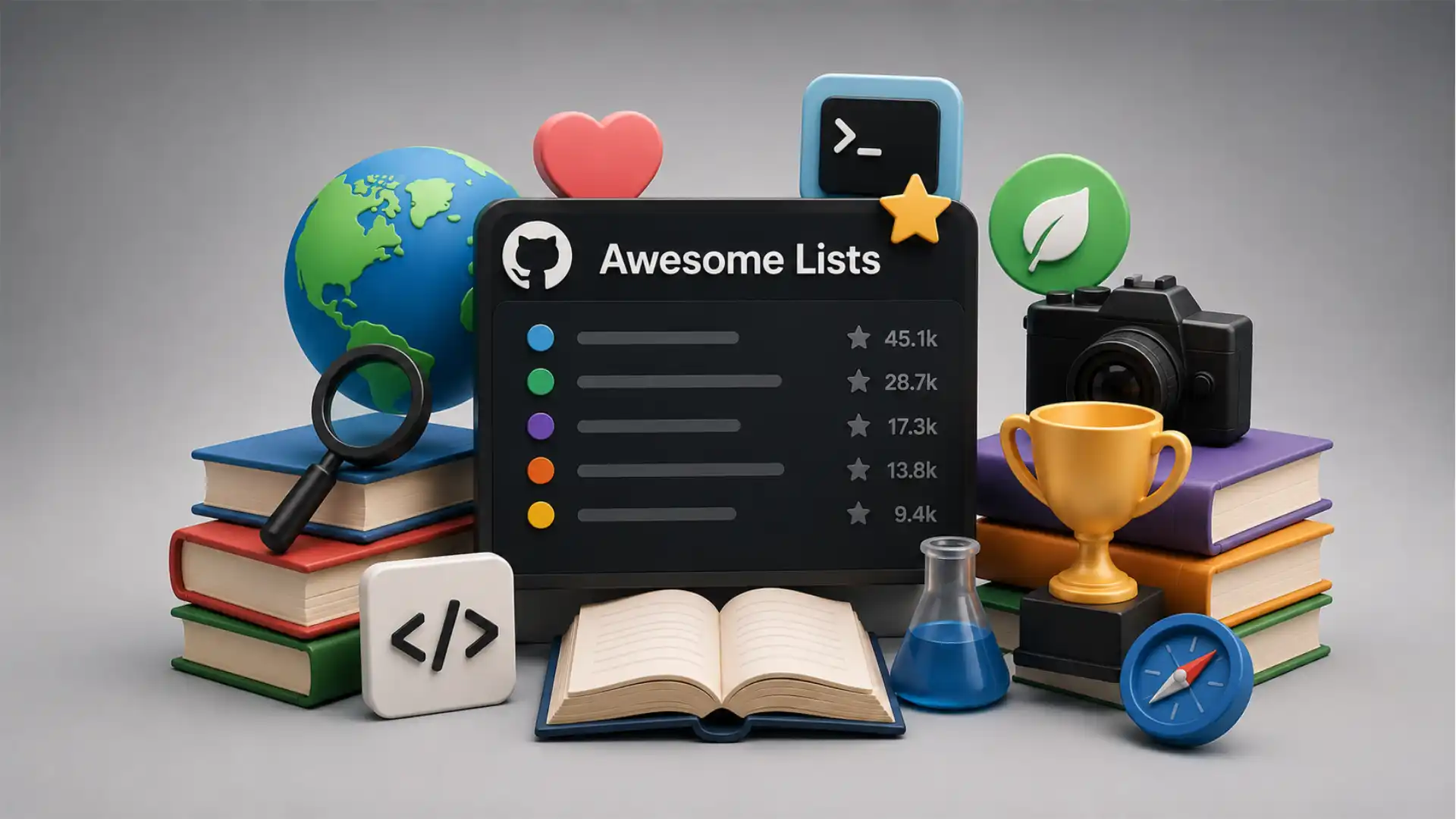
Search the web long enough and you develop a familiar fatigue. Every answer arrives through a crowded lane: a ranked results page, a glossy roundup, an affiliate-heavy review, a marketplace, a social feed that has decided what counts as “for you.” You get options before you get orientation. You get a hundred tabs before you get a reason to open the first one. Then, in a corner of GitHub, you run into a plain Markdown file called awesome-something, and the temperature drops. No funnel, no pop-up, no synthetic urgency. Just a person or a community saying: these are the things worth knowing in this small territory.
Table of Contents
That modest format has become one of the web’s quietest institutions. GitHub itself describes an awesome list as a community-curated collection of “awesome things,” noting that the subjects range from command-line applications to fantasy books; its topic page listed 10,876 public repositories tagged awesome when checked for this article. The central directory, Sindre Sorhus’s awesome repository, is the map behind the maps: a huge index that sends readers outward to lists about platforms, programming, business, entertainment, health, transit, no-login web apps, radio, plotters, and subjects no sensible product manager would ever put on the same navigation bar.
The strange part is how little technology the idea requires. An awesome list is usually a README. It has a title, a short sentence telling you what its slice of the world is, a table of contents, and rows of links with brief explanations. The machinery is almost embarrassingly basic. Its real engine is judgment. Someone looked at far more than they included, decided what counted, and left a trail that another person can inspect, argue with, improve, or fork.
That is a more radical service than it sounds. The wider web has trained us to treat discovery as a black-box transaction: type a phrase, accept the order, hope the system’s incentives are not working against you. An awesome list makes a different offer. It does not pretend to know you. It gives you a visible editorial point of view, a scope, an archive of changes, and a door into a subject. You are not being “served content.” You are being handed someone’s field notes.
A README became a map
The original charm of awesome lists lies in their refusal to become a proper product. A company facing the same problem might build a search interface, a tagging system, user accounts, recommendation cards, newsletters, analytics, social proof, and an onboarding flow that begins by asking what you want to achieve. The awesome-list tradition stayed close to the file. The list is the interface. Markdown headings become aisles. Links become inventory. One-line descriptions answer the question that search results usually dodge: why should this particular thing receive ten minutes of your attention?
A README is also a useful place to put an opinion because it comes with just enough friction. You cannot quietly slide an entry into a list the way a platform slides a sponsored product higher in search. A change is a commit. A proposed inclusion is often a pull request. A reader can look at the discussion, see when a link arrived, inspect why it was accepted, and notice when a maintainer has stopped touching the project. The recommendation has receipts. That does not make every list wise, current, or free of bias. It makes the bias legible, which is much better than disguising it as neutral relevance.
The root awesome repository demonstrates the scale that this tiny pattern can reach. Its contents move from platforms and programming languages through books, gaming, media, learning, security, business, work, networking, health, events, and a sprawling miscellaneous section. The same index that points to lists about Node.js and Linux also sends you toward fantasy, podcasts, creative coding, scientific writing, public transit, radio, falsehoods programmers believe in, and web apps that work without a login. That breadth is the point. “Awesome” survived because it was loose enough to travel well, yet familiar enough to signal a shared expectation.
The phrase has become a kind of folk protocol. When you see awesome- in a repository name, you have a rough idea of the bargain. You expect a collection rather than an app. You expect links that have been sorted into a coherent shape. You expect some editorial voice, even if it only appears in the selection and the phrasing of mini-descriptions. You expect that the list is trying to spare you from repeating someone else’s early research. The naming convention compresses a social contract into seven letters.
This matters because discovery is not merely about finding the top result. It is about acquiring a mental model of the territory. Search is good at answering a question you already know how to ask. Lists are better when your question is still vague, when the vocabulary is unfamiliar, or when you suspect the interesting parts lie outside the popular keywords. A search for “self-hosted photo management” may deliver a few familiar brands and long articles written to rank. An excellent self-hosted list first shows you that photo management is one room in a much larger house that includes authentication, email, dashboards, recipe managers, personal knowledge bases, GIS, media streaming, and dozens of other categories. The list gives you the map before it asks you to pick a street.
There is another advantage to the humble README: it lets readers move at their own speed. You can scan it like a menu, search within it, open five tabs, copy a subsection into your notes, or read every entry from top to bottom when you are in the mood for a rabbit hole. It does not demand a session. It does not punish you for leaving. It does not need to know what device you are using or whether you have ever been there before. It behaves like a document, not a trap.
There is a reason Markdown has aged better than many supposedly richer publishing formats. It is hard to fake sophistication in a plain text file. A maintainer cannot drown a weak structure in animation, hiding a thin collection behind interface tricks. The reader sees the hierarchy at once: the headings, the descriptions, the gaps, the awkward categories, the suspiciously large sponsor block, the neglected links. The format makes editorial quality visible at a glance. A beautiful directory can mask weak decisions for a while. A README leaves nowhere to hide.
The file also carries a quiet archival power. Each list is readable in a browser, easy to clone, easy to mirror, easy to keep even if the original maintainer walks away. That portability matters on a web that increasingly treats useful knowledge as an account-bound service. A recommendation list does not need a database migration or a paid plan to survive. It can be copied, revised, translated, split, and carried into a new home. The list is lightweight enough to outlive the product cycle around it.
The apparent simplicity also leaves room for personality. A list of command-line tools can feel austere and practical. A list of design resources can feel like a shop run by someone with excellent shelves. A list of weird web projects can expose the curator’s appetite for useless beauty. The medium does not force one tone. It only forces a decision: include or do not include. That binary is why good lists feel sharper than broad portals. Every omission says something.
People sometimes dismiss lists as a primitive format because they are static compared with feeds and databases. That misses the appeal. The best awesome lists are not static in the dead sense. They are slowly alive. Their changes do not blur into a real-time stream. They accumulate as discrete acts of maintenance: one outdated tool removed, one missing category added, one description corrected, one link moved to a better home. The tempo is closer to gardening than publishing. You return after a year and notice that the path is still there, but the weeds have been pulled.
The useful art of leaving things out
The most revealing document in this whole culture is not the giant index. It is the “awesome manifesto,” a short style guide that states the premise plainly: a list should be “a curation, not a collection.” It tells maintainers to include only items they or another contributor can personally recommend and to prefer leaving things out over stuffing the page. That sentence explains why the format still has life. A list with every possible entry is a directory. A list willing to disappoint someone is editorial work.
The word “awesome” is intentionally unserious, but the standard beneath it is demanding. It does not mean objectively best. It means someone is prepared to put their name beside an item and say it deserves a reader’s time. That is a much higher bar than “this exists,” “this has funding,” “this ranks on Google,” or “this was announced last week.” The distinction between existence and recommendation is the entire game.
This is also why a great list may feel slightly frustrating. You find it after searching for a category, spot a project you expected to see, and it is absent. The absent project may be good. It may even be better for your exact use case. Yet the omission forces a useful thought: what standard is this maintainer applying? Perhaps the project is unmaintained, too narrow, poorly documented, commercial in a list meant for free software, or simply not trusted by the people who care for the repository. A list cannot provide total coverage and remain selective. Its blind spots are often the price of its signal.
The editorial labor becomes clearer once you read the rules for admission to the central directory. The pull-request template asks for a focused, non-generated Markdown list with a concise scope, a Contents section, consistent descriptions, contribution guidance, an appropriate license, and items that are maintained rather than archived, deprecated, or missing documentation. It also rejects a list merely assembled without serious effort. The format has standards because link rot is always waiting.
That level of formality may sound fussy for a page of links. It is the opposite of fussy. It recognizes that every weak entry taxes the reader. A vague description forces a click. A dead project wastes twenty minutes. A tool that has not been updated in five years may send a newcomer down a route that ends in a broken dependency tree, an abandoned community, and a difficult migration. A list is not spared responsibility because its raw material is free. Attention is the currency it is spending.
The better maintainers understand that selection is not a one-time act. A repository can look spectacular on launch day and gradually become a fossil. Its stars keep climbing because the name is famous. Its old links become the first things newcomers see. Its once-helpful categories preserve a technical vocabulary that the field has outgrown. Maintenance is unglamorous partly because a good removal rarely draws applause. Nobody shares a post that says “we took away an abandoned package.” Yet that quiet deletion might be the list’s most useful contribution of the month. A serious list earns trust by pruning.
What separates a strong list from a link dump
| Signal | What it looks like | Why readers feel the difference |
|---|---|---|
| A narrow promise | The list states its subject in one clean sentence. | You know whether you are in the right room before opening twenty links. |
| Editorial descriptions | Each entry says what the project does, not merely that it is “awesome.” | The reader can judge relevance without visiting every page. |
| Visible maintenance | Recent commits, issue discussion, replacements for stale tools. | A recommendation carries more weight when someone still stands behind it. |
| A real contribution path | Clear rules, pull requests, and consistent formatting. | The list belongs to a community without becoming a free-for-all. |
| The courage to omit | Fewer entries, stronger reasons, less promotional noise. | The page behaves like a trusted shelf, not a search result page. |
A compact list with these traits will often beat a famous list with ten times the links. The reader does not need a curator to have seen everything. The reader needs the curator to have filtered hard enough that each entry begins with a presumption of attention-worthiness.
A curated list also forces an uncomfortable but healthy move: it makes a maintainer state a threshold without pretending the threshold is universal. A language ecosystem might reward stable documentation over raw novelty. A creative-tools list might make room for eccentric experiments that no enterprise buyer would touch. A research list may favor papers and primary sources over tutorials. The reader is not asked to worship the standard; the reader is asked to see it. That visibility makes it easier to decide whether the list’s taste travels well to your situation.
Scope does more than prevent sprawl. It protects the reader from category collapse. Once a list starts accepting every vaguely related resource, its headings become decorative and each entry loses context. The antidote is not more entries, more filters, or a machine-generated taxonomy. It is a maintainer saying: this is outside the boundary, and another list does that better. The official manifesto explicitly recommends linking to other awesome lists when they already cover a subject sufficiently well. A good list knows where to stop.
The manifesto goes beyond admission standards. It asks maintainers to explain why an item is on the list, to define the list’s scope, to keep grammar and formatting clean, and to organize material into categories. These requirements sound mundane because they are mundane. That is their strength. The web is full of discovery systems that promise intelligence while failing at basics such as a useful sentence below a link. Clarity is not ornamental in a list. It is the product.
Good curation also acknowledges that categories are arguments. Place a project under “static site generators” rather than “content management systems,” and you imply a way of seeing it. Create a section called “no-login web apps,” and you make an ethic visible: software that works before it asks for your identity deserves a category of its own. Split “self-hosted” into services people can run and proprietary alternatives they may want to avoid, and you give form to a political as well as technical preference. The headings teach readers how to think about the subject.
That makes awesome lists unusually revealing cultural artifacts. They record what a community thinks belongs together at a given moment. Look at an old list and you can see the fashionable architectures, the frameworks that once mattered, the tools that disappeared, the names people were tired of repeating, the anxieties that deserved their own headings. A hand-maintained index is not neutral archival material. It is a time capsule of practical taste.
The web’s quiet recommendation engine
Most recommendation systems hide their criteria because their criteria are commercial, proprietary, or too messy to explain. The awesome-list model does the opposite. It exposes the final layer of selection in public. You can see who maintains the repository. You can watch a pull request succeed or fail. You can scroll through issues where people challenge duplicates, complain about stale links, or argue that a category is too broad. The recommendation is made of human disagreements, left in the open.
GitHub is a particularly strange home for this because it was built around code, not taste. Yet the tools of software collaboration fit curation remarkably well. Version control creates a history. Issues create an inbox for criticism. Pull requests create a structured way to propose an addition without granting a stranger permanent editorial power. Forks let a reader make a rival list rather than wage a campaign in the comments. Markdown keeps the content portable. The infrastructure built for source code turns out to be excellent for shared memory.
This is why the word “community-curated” should not be mistaken for “everyone gets in.” Community in a healthy list does not mean a thousand people editing one document at random. It means the document has a legible owner, a public process, and a route for useful pressure. The maintainer has the right to say no. Contributors have the right to ask why. Readers have the right to leave, fork, or build a competing index. The system works because participation is possible without making consensus mandatory.
That arrangement produces a form of recommendation that feels more durable than a viral post. Social media is great at giving a project a burst of attention. It is terrible at storing the context that made the recommendation worth hearing. Six months later, the post is buried, the replies have vanished into a platform’s private ranking logic, and the link no longer has a home. An awesome list puts the recommendation in a stable neighborhood. The project appears beside related alternatives, inside a category, under a maintainer’s rules. It gains context instead of merely gaining reach.
A brilliant list is also a small act of information architecture. It takes material that might be scattered across papers, blogs, repos, company sites, newsletters, documentation pages, and personal bookmarks, then presents it in a sequence that makes the area feel navigable. The order rarely claims to be mathematically correct. It does not need to be. Alphabetical order, sensible categories, and crisp notes are enough to remove the first layer of chaos. Order is often more useful than ranking.
Consider the difference between opening a search engine and opening an “Awesome React” or “Awesome Selfhosted” page. Search begins with your terms. The list begins with the maintainer’s schema. That schema may introduce you to concepts you did not know to search for: state-management approaches, testing tools, authentication patterns, local-first applications, backup systems, monitoring stacks, mapping software, or niche protocols. The search engine treats your ignorance as a query problem. The list treats it as a discovery opportunity.
The central directory is especially good at this sideways movement. You might arrive looking for a programming resource and notice lists about digital humanities, public transit, engineering strategy, creative technology, or fantasy. The jump is not algorithmically “personalized.” It is simply exposed. The directory does not know that a person interested in command-line tools might also enjoy readmes, radio, or internet culture. It leaves the adjacent doors visible anyway. Serendipity works better when it is not pretending to be prediction.
The model is especially appealing now because so much web discovery is being repackaged as an answer. Search engines increasingly answer above the results. AI assistants summarize before they show their sources. Social platforms reduce a subject to the handful of items that create the most reaction. Those systems have their uses, but they often remove the part where you see the shape of a field. An awesome list gives you the uncompressed layer: the categories, the neighboring options, the failures of neatness, the evidence of a person’s hand. It lets you browse the argument instead of receiving only its conclusion.
There is a quiet democratic quality to the fork button. A reader who thinks a list has become too commercial, too broad, too stale, or too hostile to beginners does not need permission to build a different version. They can duplicate the file and make a competing editorial claim. That does not guarantee the fork will attract readers; attention still has gravity. Yet the possibility changes the culture. The canonical list is influential but never technically unreplaceable. Authority remains contestable because the source is copyable.
The one-line entry descriptions are crucial. The main directory does not just name topics; it often says what each topic covers: public-transit data standards and tools, no-login web apps, electric-guitar specifications, software for analyzing brain data, or independent developer businesses. Those little phrases act like labels on a library shelf. They reduce the cost of curiosity. A reader does not need to commit to a click simply to find out what the label meant. A sentence can be a much better filter than a thumbnail.
The model has another quiet virtue: it makes small domains feel worthy of care. Not every subject deserves a startup, a conference, or a giant commercial database. Some deserve a calm page maintained by three people who really know the terrain. There is dignity in that scale. A list about a narrow framework, a regional event scene, a hobbyist protocol, or a forgotten format does not have to become a platform to be useful. It only has to make the next person’s first hour less lonely.
That is why the best lists often feel more like introductions than recommendations. The maintainer is not saying, “Buy this.” They are saying, “You have entered a room I know. Start with these shelves.” The warmth is subtle, but it is there. A reader can feel when an index has been built by someone who remembers what it was like to arrive without the vocabulary, the bookmarks, or the old colleagues who already knew where the good material lived. A list is empathy in index form.
Every subject eventually gets an awesome list
The first assumption many people make is that awesome lists are a developer thing. They are, and they are not. GitHub’s own topic page describes the ecosystem through examples as distant as CLI applications and fantasy books. The root directory turns that claim into a browseable fact, moving from technical stacks into books, entertainment, work, health and social science, events, hardware, media, and strange micro-domains. The format escaped programming because the problem it solves was never uniquely technical.
Every field produces the same early-stage chaos. People collect private bookmarks. Someone makes a spreadsheet. A forum thread becomes the unofficial answer for six months. A newsletter writer keeps repeating the same five links. A newcomer asks where to start and gets different answers depending on who happens to reply. Then one obsessive person decides that the loose material needs a home. The first version may be rough. It gets shared. Somebody opens a pull request. The filename becomes a phrase people recognize. A personal shortcut turns into public infrastructure.
Take Awesome Selfhosted. Its description is plain: free-software network services and web applications that people can host on their own servers. Yet the project has grown far beyond a casual bookmark page, with thousands of commits, a dedicated website, categories, and a separate area for non-free software. The list is not merely helping readers choose software. It is giving form to an entire worldview about ownership, privacy, interoperability, and running your own tools. A list can become the front door to a subculture.
Awesome Python shows a different evolution. It calls itself an opinionated guide to frameworks, libraries, tools, and resources, then stretches across AI, web development, HTTP, data, developer tooling, DevOps, security, media, and the Python toolchain. It has also grown a searchable companion website, while the README remains the source of truth for the categories and entries. The list did not outgrow its document; it built a better window onto it.
That pattern matters. The README is not a prison. It is a stable editorial core. A list can later acquire a site, filters, star counts, screenshots, a newsletter, contributor automation, or a data file without losing the original virtue. The danger arrives only when the extra layers replace the editorial discipline that made the list worth visiting. A directory with a polished search box but no taste is still a directory. The document earns the interface, not the other way around.
Some lists remain deliberately tiny because their subjects demand it. A page about a niche programming language, a specific design tool, a local civic-data scene, or a hardware protocol may contain only a few dozen links. That is not a failure of ambition. A compact collection can be far more trustworthy than an enormous universal guide because the maintainer has a realistic chance of keeping it current. Scale is not proof of care.
Others become broad enough to reveal their own internal tensions. The root directory includes items that are very close to software engineering and items that seem wonderfully peripheral: plotters, podcasts, radio, lucid dreams, open-source photography, creative coding, discount programs for student developers, and lists about falsehoods. This is where the “awesome” phenomenon becomes genuinely fun. It shows that the open-source community’s urge to catalog does not stop at compilers and packages. It spills into hobbies, anxieties, aesthetics, and curiosities.
The lists that leave the strongest impression are often the ones that take an odd niche seriously. A page about one obscure hardware tool, an old file format, a visual programming environment, a local open-data scene, or a tiny browser feature may never attract a huge audience. It does not need one. For the person who lands there at 1 a.m. with a broken project and no useful search terms, that page can feel absurdly generous. Niche knowledge becomes public knowledge when someone bothers to give it a shelf.
There is an economy of gratitude around these projects that is easy to miss. Readers rarely write a long note to the person who removed a dead link, revised an obsolete label, or added a better explanation beside an existing project. They simply save time. The reward is indirect and scattered across thousands of quiet visits. This is why list maintenance can look invisible from outside while being deeply social in practice. The curator may never meet the people whose work they made easier.
There is a reason that the “list of lists” became a genre of its own. Once a community trusts the format, a new problem appears: how do you find the right curated list? The central repository answers by curating curators. It is a recursive directory, and the recursion is part of the joke. The ecosystem even contains Sindre Sorhus’s deliberately absurd “awesome-awesome-awesome-awesome,” described as a curated list of lists of lists of awesome lists. The culture knows that it is building a hall of mirrors, and it grins while doing it.
Humor is not incidental here. The word “awesome” has always carried a little self-awareness. It is an overstatement used as a signal that nobody wants the dead tone of enterprise documentation. A good list can be serious about quality without pretending to be a standards body. It can care about licenses, descriptions, maintenance, and link checks while still naming itself after a slang adjective. The informality makes the standards easier to join.
The scope of the subject also shapes the list’s politics. A self-hosted directory tends to care about licensing and deployment. A language list may care about maintenance, documentation, and compatibility. A list about learning may care about accessibility and beginner friendliness. A list about creative tools may care about inspiration and strange edge cases. None of those standards are universal. They are local definitions of “worth knowing.” The best list makes its local values visible rather than pretending its entries floated down from an objective sky.
This is why trying to produce one canonical global list for a broad subject is usually a mistake. The moment a topic becomes large enough, readers need more than one view. They need a list for beginners, a list for practitioners, a list for people who want free software, a list for people who want enterprise support, a list for a particular language, region, operating system, or philosophy. Forking is not a failure of the model. It is how the model keeps its point of view sharp.
The maintenance is the medium
A list’s present-tense usefulness is created by maintenance, not by the day it was published. That sounds obvious, yet the web still rewards launch energy far more visibly than upkeep. New lists get shared because they are fresh. Old lists become trusted because they have survived hundreds of tiny decisions: whether to remove a broken link, whether to create a new category, whether to reject a near-duplicate, whether a formerly good project has fallen behind, whether a short description still tells the truth. The real work happens after the screenshot-worthy moment.
This is why a repository’s history is part of its reading experience. Recent changes tell you that someone is still looking. The pattern of updates tells you what kind of care the project receives. A list revised only when a famous tool launches behaves differently from one that quietly fixes descriptions and removes abandoned entries. Neither rhythm is automatically wrong, but the difference is useful evidence. Maintenance leaves a fingerprint.
The public discussion around a list can be unusually revealing. A good pull request is a tiny editorial exchange: a contributor proposes an item, explains its fit, and submits to the house style; a maintainer may ask for a clearer description, a better category, proof of activity, or a reason the project belongs rather than an existing alternative. That is not administrative noise. It is the list deciding what it wants to be. The comments show the standard in action.
Readers often think of documentation as something a project writes about itself. Awesome lists show a more social form of documentation: the field describing its own useful objects. An entry has not been written by the project’s marketing team. It has been written, or at least accepted, by someone whose job is to make the shelf useful. The description may be shorter and less flattering than a project homepage. It is also more likely to put the project beside competitors and state its function without theater. Third-party wording creates a different kind of trust.
This work has a cost. The larger the list, the more incoming suggestions it attracts, the more disputes it inherits, and the more stale detail it must carry. Many maintainers eventually restrict submissions, ask for more evidence, or slow their review pace because the volume stops being compatible with careful judgment. That friction is not a flaw in the social contract. It is the price of preserving a point of view. A list that says no slowly may be healthier than a list that says yes quickly.
For readers, the practical lesson is almost tender: notice the maintenance. When a list has saved you time, recognize the unglamorous labor behind the calm page. File a useful issue instead of a vague complaint. Fix a typo. Report a dead link. Read the contribution rules before asking a curator to do your homework. The people who keep these maps current are not content vending machines. They are volunteers, maintainers, and librarians of temporary knowledge.
A badge is not a verdict
The awesome badge has become a small piece of open-source prestige. The manifesto provides a badge for lists and another “mentioned in awesome” badge for projects featured by one. A badge has obvious appeal: it tells a visitor that someone outside the project has paid attention. It also carries the aura of a selection, which is far more attractive than self-description. Put it on a README and the project appears to have crossed a threshold. The badge turns a line in someone else’s document into a social signal.
That signal is useful, but it carries risks. The more authority a famous list acquires, the more people want to be listed for reasons that have little to do with readers. A young open-source project may see a prominent entry as a source of stars, contributors, search visibility, or commercial credibility. That creates pressure on maintainers. Every submission must be weighed not only as a recommendation but as a potential attempt to turn the list into a distribution channel. Curation attracts the same opportunism that eventually reaches every attention-rich surface.
The central project’s submission rules read like an immune response to that pressure. They require lists to be at least thirty days old, say that the list must not be AI-generated, require awesome-lint, reject lists that are duplicates, and warn against including unmaintained, archived, deprecated, or undocumented items in the main list. The language is unusually direct for an open-source template because it has had to be. A public recommendation system needs defenses against people who confuse visibility with merit.
The prohibition on AI-generated lists is particularly revealing. It is not a complaint about technology in the abstract. It is a recognition that a list can look finished without containing the work that makes curation trustworthy. A language model can produce neat categories, fluent descriptions, and hundreds of plausible links. It cannot, by itself, stand behind every inclusion, notice that a project is quietly abandoned, understand the social texture of a field, or feel the accumulated annoyance that tells an experienced maintainer which tool does not belong. A list needs attention, not merely output.
The other danger is ossification. A famous list with a famous name can become the default reference even after its underlying choices have aged. Readers arrive with trust preloaded. They assume the first project in a category remains the right first project. The maintainer may still be active, but the field has moved so fast that the list’s old ordering and old vocabulary have become a form of inertia. Popularity can preserve a recommendation long after the original reasons have weakened. Stars are evidence of attention, not evidence of freshness.
A careful reader should treat an awesome list as a well-marked trailhead, not as a court ruling. Look at recent commits. Read the contributing guide. Check whether issues receive replies. Open a few links and notice whether the descriptions still match reality. See how the list handles replacements. Does it clearly distinguish legacy projects from current ones? Does it flag commercial services or free software? Does the owner explain controversial inclusions? Trust grows from the maintenance pattern, not the repository’s star count.
The reader should also resist the temptation to treat placement as a league table. Some lists are alphabetical by design. Others group projects by type without ranking them. Even when a project appears first, that position may reflect history, naming, or a maintainer’s late-night cleanup rather than a claim of superiority. A curated list tells you that an item deserves consideration; it rarely proves that the item is right for you. Selection and evaluation are related, but they are not the same task.
Time is the other hidden variable. A project that was thrilling two years ago may be a poor choice for a new build today. A recently released tool may be too young for a central list even if it looks exciting. The central directory’s thirty-day requirement for new lists is a small acknowledgment that reputations need time to form. Readers need the same patience. Novelty is a signal of change, not a substitute for evidence.
This is not a reason to become cynical. It is a reason to become active. The form invites readers to do more than consume. If a link is dead, submit a fix. If an item deserves inclusion, follow the guide and make a case. If the scope is wrong for your needs, fork the list or start a narrower one. The contribution guide for the central directory walks readers through editing a README, explaining a proposed change, and submitting a pull request. The page is not only a shelf. It is a workshop.
The tooling reinforces the idea that editorial care has mechanical parts. awesome-lint checks general Markdown rules and list-specific rules, including whether a list has the expected badge and whether entries follow the format. A linter cannot evaluate taste. It cannot know whether a project will delight a reader or lead them into an expensive dead end. It can reduce the boring errors that make a carefully judged list harder to use. Automation guards the floor so humans can argue about the ceiling.
This balance is one of the format’s best lessons. There is no false choice between personal taste and consistency. A maintainer can be opinionated about the entries while being strict about format, scope, descriptions, and contribution procedure. In fact, structure gives opinion more credibility. When a list has clear rules, readers can disagree with the choices without dismissing the entire endeavor as a random bookmark pile. The rules do not erase taste; they make taste accountable.
A small amount of prestige also produces good behavior. Projects often improve documentation, clarify licenses, fix broken install instructions, or clean up their presentation because they want to meet a list’s standards. That is not a perfect incentive, but it is healthier than chasing an opaque ranking system. The maintainer is not asking a project to please an algorithm. They are asking it to be legible to a human reader. The bar is editorial, not theatrical.
The limits deserve names. No recommendation system becomes trustworthy by being called curated. Awesome lists have weaknesses that are built into their strength. The first is the bottleneck of a maintainer’s attention. A list with a strong editorial voice may depend on one person whose interests, time, health, career, and patience inevitably change. If that person leaves, the page can remain online while its authority quietly evaporates. A README does not announce that it has become stale with the clarity of a closed shop. Readers have to learn to see inactivity as part of the content.
The second weakness is that public lists tend to reward projects that are already legible in public. Tools with English documentation, polished repositories, friendly contribution paths, established communities, and visible maintainers have an easier route into curation. Useful work that lives in small regional communities, closed forums, non-English documentation, academic labs, messy personal sites, or informal networks is less likely to appear. The problem is not unique to awesome lists; it belongs to the web itself. Still, a list that claims to map a field may unintentionally map only the portion of the field that knows how to present itself on GitHub. Visibility is not the same thing as coverage.
This matters most when the list is treated as a neutral canon. A popular repository can make a particular set of tools look inevitable. Newcomers then learn the field through the same handful of names, contributors build integrations around them, tutorials assume them, and alternatives become harder to discover. The effect resembles a shortcut that slowly turns into a road. Few people intend to erase the side paths, but the traffic follows the visible route. Curation shapes markets and habits even when it never tries to.
The strongest response is not to abandon lists. It is to read them with a small amount of friction. Look for what is missing. Search outside GitHub after you have learned the vocabulary. Read the contribution rules and see whose work they favor. Browse a competing list with a different philosophy. Notice whether the page treats commercial products, free software, academic resources, personal projects, and legacy tools as if they belong in the same basket. A list becomes more useful when you see its edges.
There is also the danger of mistaking curation for testing. An entry may be carefully selected and still fail on your operating system, your budget, your scale, your team’s skills, your privacy requirements, or the odd constraints of your project. A maintainer’s approval is a reason to investigate, not a guarantee that the tool will survive contact with your work. The list reduces the search space; it does not make the decision for you.
Finally, the format can become a refuge for people who enjoy collecting more than using. It is possible to read awesome lists for years and build very little, much as it is possible to watch product reviews without buying anything or save recipes without cooking. The cure is simple: let each visit end with a concrete action. Install one thing. Read one primary document. Join one community. Remove one dead bookmark. Discovery earns its keep when it changes what you do next.
How to use the rabbit hole without drowning in it
The easiest way to misuse an awesome list is to treat it as a shopping cart. You open the page, scan a category, add twenty repositories to bookmarks, and leave with the vague comfort of having “researched the space.” Weeks later, the bookmarks folder becomes a graveyard of good intentions. The better approach is slower and more selective. Use the list to choose a path, not to collect possessions.
Begin with the list’s stated scope. A good opening sentence tells you what kind of problem the page is trying to solve. Respect that boundary. Do not ask an “Awesome React” list to settle every question about product design. Do not ask a self-hosting directory to be a full security audit. Do not assume a list of learning resources is a curriculum. The list is a map made at a certain zoom level. You get more from it when you know what it is not trying to be.
Keep a small note while you browse. Beside each promising item, write the reason it caught your eye and the condition under which you would use it. “Good for a static prototype,” “worth revisiting for offline support,” “looks elegant but documentation is thin,” “only relevant if we need self-hosting.” This turns a list from an intake pipe into a conversation with your future self. The note preserves judgment after the initial excitement fades.
Do not let repository stars do all the deciding. A large star count tells you that a lot of people noticed something. It says less about maintenance, fit, or the specific part of the project that matters to you. A smaller entry in the same category may be quieter because it solves a narrower problem with fewer ambitions and less promotional energy. The useful question is not “which project won?” It is “which project makes the fewest compromises for this job?” Lists offer candidates, not champions.
There is value in reading a list backward as well as forward. The newest entries and recent pull requests often reveal what the field is becoming; the oldest surviving entries show which ideas had enough durability to remain. Removed entries, when the history makes them visible, are equally instructive. They tell you what did not age well, what changed names, what got acquired, what became obsolete, or what a maintainer no longer wants to endorse. A changelog is sometimes the most honest part of a recommendation.
When a list contains too much, use its structure to make a deliberate detour. Do not begin with the obvious category. Open the adjacent one. A person researching web frameworks may learn more from static generators, developer tooling, accessibility resources, or design systems than from the hundredth framework comparison. A person exploring self-hosted services may find their real need under backups, identity, monitoring, or network tools. The best discovery often happens one category to the side of the original plan.
There is no need to become a GitHub person to enjoy the phenomenon. The practice is portable: a shared document of local restaurants that explains what each place does well; a personal music index organized by mood rather than genre; a small list of reliable public-interest databases; a classroom reading page that tells students why each source belongs. The technical vocabulary is incidental. The durable idea is that careful selection, openly explained, still beats an endless feed.
Then read the headings before the entries. This sounds trivial, but it changes the experience. Category names expose the maintainer’s model of the field. They show you which distinctions are seen as first-class. In a sprawling list, the headings often reveal the real find before any link does. Perhaps you did not know there was a difference between a protocol tool and a library, between a CMS and a static site generator, between a local-first app and a self-hosted service, between a framework and a teaching resource. The category teaches you a word, and the word improves your next search.
Choose one or two entries that genuinely fit the thing you are doing now. Read their documentation, recent releases, issues, and examples. Compare them with one neighbor in the same category. Stop there unless a concrete question emerges. A list works best when it narrows an investigation, not when it turns the investigation into a compulsive browse. Depth beats quantity when the material is already curated.
The same advice applies to browsing for pleasure. The root directory is a marvelous place to waste an afternoon, but it rewards a loose theme. Follow “no-login web apps” into a different picture of software. Follow “plotters” into machines that draw. Follow “open-source photography” into a set of people building tools for images without the usual platform gravity. Follow “radio,” “creative coding,” or “digital humanities” and see how far the GitHub world extends past repositories that compile. The route matters more than the destination.
For people who make things, awesome lists offer a useful test of your own project’s legibility. Could a curator describe it in one factual sentence? Does the repository explain what it does before asking for installation? Is the documentation current? Is the license clear? Does a newcomer know whether the project is maintained? The central template’s insistence on focused descriptions and consistent entry text is not merely bureaucratic. It reflects the reader’s first encounter with a project. A project that cannot be clearly summarized is difficult to recommend.
Starting a list of your own is a useful exercise even when you never publish it. Pick a subject that keeps returning in your work. Write the scope in one sentence. Add fewer entries than you think you need. Give each one a description that answers what it is for, not how impressed you are by it. Return after a month and remove anything you would no longer recommend. The act of curating sharpens your own standards before it serves anyone else.
A public list deserves the same humility. State what you know, state the edge of the map, welcome corrections, and avoid the fantasy that your page has solved a field. The best maintainers do not own the subject; they host a conversation about it in a form that is easy to use. That posture keeps a list from becoming a monument to its author. It remains a working document with room for the next person’s better find.
For teams, a private awesome list is often more practical than a sprawling internal wiki. Keep a Markdown file of trusted libraries, accessibility references, deployment notes, vendors, research sources, and examples that have proved their worth. Add a sentence for each item explaining why it belongs. Put it under version control. Review changes when someone proposes a new entry. The public culture offers a pattern that works just as well behind a company firewall. Shared taste becomes less fragile when it has a file.
For writers, designers, researchers, and curious non-developers, the deeper lesson is that the open web still supports human-scale recommendation. The list does not need to become a brand to matter. It does not need a monetization story. It can be maintained by a person with a clear interest and a low tolerance for junk. There are few places left online where a reader can encounter that kind of unmonetized editorial labor without immediately being pushed toward a subscription, a referral link, or an account. An awesome list is a small proof that the web still contains gifts.
The format also exposes a useful standard for any discovery product. A good index tells you where it begins and ends. It gives reasons, not just names. It admits that someone made choices. It shows signs of maintenance. It lets readers challenge and improve it. It does not confuse a large inventory with a good recommendation. These are old-fashioned expectations. They are old-fashioned because they work. The simplest systems often reveal the clearest values.
The next time you hit a subject that feels too broad for search, add awesome to the query. Not because every list will be great. Some are stale, promotional, overgrown, or built by someone whose taste does not match yours. Add it because the best result may be a person’s hard-won answer to the same first-week confusion you are feeling now. A well-kept list does not end the research. It makes the research feel possible.
That is the quiet triumph of the awesome-list phenomenon. It turned the most ordinary unit of the early web — a page of links — into a living format for collective taste. It gave communities a way to record their best starting points without surrendering the work to a ranking engine. It made documentation, maintenance, disagreement, and generosity part of the same small object. The badge may be playful. The word may be silly. The underlying idea is serious: someone cared enough to sort the internet for the next person.
Author:
Jan Bielik
CEO & Founder of Webiano Digital & Marketing Agency
This article is an original analysis supported by the sources cited below
Awesome lists about all kinds of interesting topics
The central directory that illustrates the range of topics and the README-based structure of the format.
The awesome manifesto
The official guidance on selection, scope, descriptions, badges, and list maintenance.
Awesome list pull request template
The current admission rules for lists submitted to the central directory, including maintenance and non-generated-content requirements.
Awesome Lists GitHub topic
GitHub’s description of the community-curated format and its current public-repository topic page.
Awesome Selfhosted
A major example of a topic-specific list that has grown into a broader discovery resource.
Awesome Python
An example of an opinionated language ecosystem guide that keeps its README as an editorial source of truth.
awesome-lint
The tool that checks structural and formatting rules used across the awesome-list ecosystem.
| Citing this article? Brief excerpts are welcome. Please credit Webiano.digital, name the author where stated, and include a link to https://webiano.digital and to this original article. Full or substantial republication requires prior written permission. Read our Copyright and Content Use Policy. |
This article was prepared with the assistance of artificial intelligence tools. The content underwent expert human review, and Webiano Digital & Marketing Agency assumes editorial responsibility for its final version and publication.