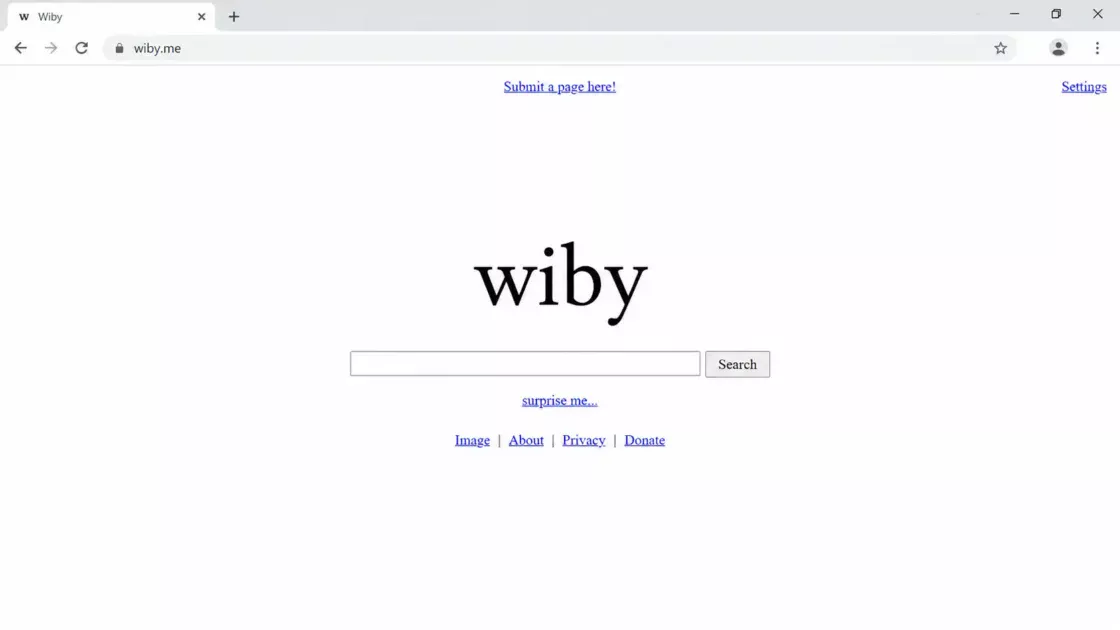
Webernaut, a site with no visible staff and no confirmed revenue, has spent the past stretch hand-picking 100 websites while the open web fills with AI-written pages and a shrinking click-through rate. Its restraint looks like a weakness. Set against what killed StumbleUpon and the Open Directory Project, it reads instead as the one design choice a solo curator can actually survive on.
Table of Contents
Webernaut has published exactly 100 Discoveries. Not ninety-eight, not a thousand — a round hundred, split across four categories, each one picked by an editor who writes a short note on what makes the site worth a visit. The number is a ceiling the project has chosen for itself, not a count it happens to have reached on the way to something larger. In October 2026, the newsletter Visualising Data gave the project a passing mention, calling it “a small independent site for discovering interesting corners of the web,” built in part around a growing shelf of data-visualization projects. That nod arrived at an odd moment for the idea it represents. Ahrefs reported in February 2026 that an AI Overview now cuts the click-through rate of the top organic search result by 58 percent, and Axios reported the same spring that AI-written articles had settled at roughly half of everything newly published online, citing research from the SEO firm Graphite. Into that condition, Webernaut offers an answer that sounds almost quaint: one person, looking at websites, deciding by hand which hundred are worth someone else’s time. The site keeps its own reach narrow on purpose, and that choice, more than anything on its homepage, is the actual story. StumbleUpon tried the opposite approach, at far greater scale, and it did not last.
A hundred links instead of the whole internet
The project’s own framing is explicit about what it is not trying to do. Webernaut’s about page states that it “isn’t trying to catalogue the whole internet or keep you in an endless feed,” and that the aim is “to help you find something good — and then send you to the website itself.” That second half of the sentence is the part worth sitting with. Most discovery tools of the past twenty years tried to keep a visitor on their own platform for as long as possible, because that attention was the product being sold to advertisers. Webernaut’s stated goal runs the other way: get someone to leave.
That difference traces back to a specific collapse. StumbleUpon, founded in November 2001 by Garrett Camp and Geoff Smith, let a user click a button and land on a web page selected by an algorithm trained on the user’s own ratings and the ratings of similar users. At its peak it briefly overtook Facebook as the largest source of social-media referral traffic in the United States. By 2018, TechCrunch reported, the company judged that the entire premise — bouncing a visitor between independent pages — had been outcompeted by the infinite scroll of a social feed, and it shut the service down after sixteen years, migrating its accounts to a successor called Mix. VentureBeat’s coverage of the closure quoted Camp calling the sixteen years “an amazing experience” without offering a clear account of why the stumble button, once dominant, had stopped working.
The pattern repeats across the discovery tools that followed StumbleUpon’s model. Listings on Product Hunt for sites such as Stumbled and Web Wander show the same basic pitch resurfacing every few years: a button, a random website, a promise to recreate the serendipity of an earlier web. None of those relaunches has matched StumbleUpon’s own scale, which suggests the gap StumbleUpon left behind is real but has so far resisted being filled by copying its structure rather than its spirit.
Webernaut did not inherit StumbleUpon’s ambition to represent a large slice of the internet, and that omission looks less like an oversight than a lesson absorbed.
Inside the three-layer structure that keeps Webernaut small
Webernaut’s own FAQ lays out three distinct layers, and the boundaries between them do most of the work of keeping the project’s scope under control. A Discovery is “a website or web experience personally selected and featured by Webernaut,” reviewed one at a time by an editor and presented with a short introduction before a visitor is sent on to the original site. A Find is a community-submitted link, reviewed and categorized by other members, explicitly separated from the editorial track: “not every Find is an official Webernaut Discovery,” the FAQ states. A Collection is a themed grouping of websites that any registered user can build, publish, keep private while in progress, or “Remix” from someone else’s published version.
No account is required to browse Discoveries, visit the linked sites, or share a public page. An account is required only to save a website, create a Collection, submit a Find, or take part in Find reviews. The site’s privacy answer states that Google Analytics 4 runs by default on eligible public pages but is excluded from private and account pages, with sensitive data filtered and advertising features turned off, and that it starts without an opt-in prompt.
That same FAQ spends unusual care on what happens after someone deletes their account, spelling out that public Finds and Collections a member previously chose to publish can remain available under a neutral attribution rather than vanishing outright, while private drafts, notes and saved websites are removed. Few discovery tools bother to document that level of detail, and the fact that Webernaut does suggests its account structure was built with an eye toward outlasting any single contributor’s decision to walk away.
The hundred Discoveries sit inside four named categories — Playful Interactions, Strange Corners, Quiet Escapes and Perspective Shift — alongside eleven themed Curated Picks such as Relaxing Websites, Soundscapes and Internet History & Culture. The category pages feature specific, named works: an interactive browser film called Brainstream, a text-based story called Cactus Blue Motel by Astrid Dalmady, a webcam-style virtual café called I Miss My Cafe, and a flight-and-satellite viewer called Stowaway, among others. Each one is a small, independently made project that an editor chose to put in front of visitors rather than leave to a search ranking.
The mechanism search engines gave up on in 2017
Webernaut is not the first attempt to replace algorithmic ranking with human judgment, and the project it most resembles in structure, rather than in tone, is one that no longer exists. The Open Directory Project, known by its dmoz.org domain, launched in 1998 under the names Gnuhoo and then Newhoo before Netscape acquired and renamed it. At its height it was maintained by a volunteer community that, by one count cited by Search Engine Land, had grown into the thousands of editors sorting the web by hand into a tree of categories. Google’s own early search results drew on DMOZ’s category descriptions for years. On March 17, 2017, AOL — DMOZ’s owner by that point — shut the project down, and Search Engine Land’s coverage of the closure noted that the directory had already “been mostly forgotten as a resource” long before the formal announcement; the surprise, the outlet wrote, was that it had taken so long.
DMOZ’s failure mode was not a lack of editors. It was the opposite problem: a volunteer structure trying to describe the entire web, with no mechanism to keep thousands of unpaid contributors aligned on quality or to stop the directory’s relevance from eroding once Google’s own crawler-based ranking became more useful than any hand-built tree of categories could be. A single editor cannot replicate DMOZ’s labor force, but a single editor also cannot generate DMOZ’s coordination problem. Capping the official track at one hundred curated entries, reviewed one at a time, removes the exact failure condition that ended the Open Directory Project. It cannot describe the internet. It was never supposed to.
The timing of DMOZ’s end matters too. AOL did not shut the directory down because a competitor out-curated it; it shut the directory down once the traffic and the relevance had already drained away, years after Google’s algorithm had made DMOZ’s categories largely redundant for most searches. A single-editor project with no comparable owner to disappoint has no equivalent moment of institutional abandonment to fear, which removes one more way a project like Webernaut could end that neither StumbleUpon nor DMOZ managed to avoid.
Nobody is paying to keep the links honest
What a visitor to Webernaut will not find is as telling as what they will. There is no banner advertising on the pages reviewed for this analysis, no paid placement disclosed anywhere in the site’s public policies, and no subscription tier mentioned in its FAQ. The only confirmed data pipeline is Google Analytics 4, used, by the site’s own account, to measure visits and engagement rather than to sell inventory to advertisers. That is a different economic position from StumbleUpon, whose scale made it attractive to eBay, which bought the company for 75 million dollars in 2007 before spinning it out again in 2009 — a transaction that made sense only because StumbleUpon’s traffic volume had commercial value to someone else.
A project with no disclosed revenue has an obvious weakness: nothing visible is currently paying for the editor’s time, which raises the plain question of how long one person keeps curating for free once the initial novelty of the project fades. But it also sidesteps the specific trap that caught both of Webernaut’s predecessors, where a parent company’s changing assessment of commercial value, rather than any failure of the underlying idea, decided when the project ended.
Three generations of web-discovery tools compared
| Tool | Active years | How entries were selected | Account needed to browse | What ended or threatens it |
|---|---|---|---|---|
| StumbleUpon | 2001–2018 | Algorithm, trained on user ratings | No | Displaced by social-feed attention; shut down after 16 years |
| Open Directory Project (DMOZ) | 1998–2017 | Thousands of volunteer editors | No | Owner withdrew support once relevance had already eroded |
| Webernaut | Current | One editor, plus reviewed community submissions | No, for browsing | No confirmed revenue model has been disclosed |
The table understates how different the economic stakes are. StumbleUpon and DMOZ both needed to matter at a size that justified a parent company’s continued investment; both eventually stopped mattering at that size, for different reasons, and both were retired by an owner rather than by their original builders. Webernaut has not disclosed a monetization strategy, which means it also has not built in the specific failure condition that ended its two most obvious predecessors: a backer deciding the audience no longer justifies the cost. Whether that absence of a business model is a design decision or simply a project too young to need one is not something the site’s own public pages resolve.
Who actually benefits when an editor picks your site
The clearest winners from a Webernaut Discovery are the makers of the sites it features, almost all of whom are working on projects too small or too strange to rank for a search term anyone would type. A browser-based interactive film, a hand-made virtual café, a single illustrator’s interactive short story — none of these compete well against commercial content optimized for search, and none of them generate the kind of engagement signal that a recommendation algorithm rewards. An editorial pick sends traffic that bypasses both of those filters entirely, on the strength of one person’s judgment that the work is worth seeing.
The second beneficiary is harder to name specifically, because it is an audience rather than an individual: anyone tired of a search results page that increasingly returns an AI-generated summary instead of a link, or a social feed optimized for a metric other than their own curiosity. The University of Leipzig and Bauhaus-University Weimar study cited in reporting on the state of search found that search engines are “losing the arms race against SEO spam,” a dynamic that a 2026 Gartner projection tied to a 25 percent decline in traditional search volume. A site that filters by hand, at a scale small enough for one person to stand behind every entry, is a direct answer to that specific complaint, even if it is an answer that can only ever reach a small fraction of the people affected by the problem.
What Webernaut does not do is compete with search as a utility. Nobody is going to ask Webernaut what time a shop closes, or how to fix a plumbing leak. Its usefulness is confined to the much narrower category of discovery for its own sake — browsing rather than searching — which is also the exact category of use that StumbleUpon once owned and then lost.
That narrower category still has real value to the people it reaches. A visitor who has nowhere to be and no specific question in mind is precisely the person search engines serve worst, because they have no query to type. Webernaut’s categories are built for exactly that moment: a short list to click through with no goal beyond curiosity, something search has never been optimized to support regardless of how its ranking signals change.
The community layer that could undo the whole idea
Webernaut’s Finds and Collections sit outside the editorial track for a reason: they let the site grow without multiplying the workload of its single editor. But that same openness is the feature most likely to reproduce the quality problems that eventually hurt both of Webernaut’s predecessors. DMOZ’s downfall was partly a function of coordinating thousands of volunteers with no single accountable judgment; a community layer that lets members “help review” Find submissions and “shape” what gets surfaced is, structurally, a smaller version of the same coordination problem, even with far fewer contributors.
StumbleUpon’s decline is sometimes told as a story purely about competition from social feeds, but its own user-generated rating system was also vulnerable to gaming by marketers trying to get traffic for client sites — a problem that affects any system where inclusion is decided by volume of approval rather than by one accountable reviewer. Webernaut’s FAQ draws a careful line here: “Community inclusion doesn’t automatically make something an official Discovery.” That line is the project’s main defense against its own community layer degrading the editorial one. Whether it holds depends on whether the site’s single editor is willing to keep that wall in place once growth creates pressure to blur it — a pressure every comparable project before it eventually faced.
Remix adds a second, quieter risk. Because a Collection can be copied into an independent version that keeps updating on its own after the original is deleted or made private, a single bad Collection can outlive the moderation decision meant to remove it. The FAQ acknowledges as much, noting that “independent Remixes aren’t automatically removed” even after the source Collection is deleted. That is a reasonable trade-off for preserving work people have built, but it is also a mechanism that a purely editorial site, with no Remix feature at all, would not need to manage.
The numbers argue against this scaling at all
No public figure on Webernaut’s own site discloses follower counts, registered-user totals, or monthly visits, and no third-party traffic estimate reviewed for this analysis offers a reliable number either; that absence should be read as a limit on what can be claimed here, not filled in with a guess. What can be measured is the size of the problem the site responds to. Graphite’s analysis, reported by Axios in May 2026, found that AI-generated articles had briefly overtaken human-written ones between November 2024 and March 2025, peaking near 55 percent of newly published content before settling closer to half. Ahrefs measured the downstream effect on search behavior directly: by December 2025, the presence of an AI Overview correlated with a 58 percent drop in click-through rate for the first-ranked organic result, nearly double the 34.5 percent decline the firm had measured in April 2025.
Set against figures like those, a hundred hand-picked links is a rounding error. Webernaut cannot absorb a sizable share of the traffic that is leaking out of a search ecosystem processing billions of queries a day, and nothing in its structure suggests it is trying to. The honest reading is not that Webernaut solves the discovery problem described by those statistics. It is that the problem has grown large enough, and visible enough, that a project this small can get a mention in an independent newsletter simply for trying a different approach — which is itself a sign of how little competition exists in the specific niche of openly human-curated discovery right now.
That scarcity of competitors is worth naming directly. If curated, single-editor discovery sites were already common and well known, Webernaut’s hundred links would be unremarkable. They are not common, which is itself evidence that the model is harder to sustain than it looks, or that the current wave of search frustration is recent enough that few projects have had time to build a track record. Either explanation points to the same conclusion: whatever happens to Webernaut specifically, the gap it is attempting to fill has not yet been closed by anyone operating at meaningful scale.
The payoff for anyone trying to get found online
For a creator with an unusual, independently built website, the practical lesson is concrete: manually reviewed discovery platforms represent a channel that conventional search engine optimization cannot reach, because inclusion runs on one editor’s judgment rather than on crawlable signals like backlinks, keyword density or page speed. A site like Webernaut cannot be gamed the way a ranking algorithm can, which means the standard playbook of content marketing does not transfer. The relevant move is submitting a Find or pitching a Discovery directly, on the strength of the work itself, not on the strength of its metadata.
For businesses and marketers further from that niche — the audience closer to Jan Bielik’s own agency work — the broader implication is about where attention is still winnable. As algorithmic search and AI summaries claim a growing share of clicks that used to flow to a ranked page, channels that run on editorial trust rather than algorithmic relevance, including small curated discovery sites, niche newsletters and community-reviewed directories, become comparatively more valuable precisely because they are harder to automate into irrelevance. That value is currently small in absolute terms. It is not small in relative terms, against a search ecosystem whose own click-through economics are worsening by the Ahrefs firm’s own repeated measurement.
The practical step for a marketer advising a client with an unconventional project is correspondingly specific: treat a submission to a reviewed discovery site the way a publicist would treat a pitch to an editor, not the way an SEO team would treat a backlink campaign. The two skills — writing for a crawler and writing for a person who will actually read the pitch — are not interchangeable, and the second one has quietly become the scarcer of the two.
A bet that only pays off if the web keeps getting worse
Webernaut’s prospects depend less on its own execution than on a trend outside its control: whether AI-generated content and algorithm-mediated search keep degrading the experience of finding something worth reading. If Ahrefs’s click-through numbers stabilize, if search engines regain the upper hand against spam the way the University of Leipzig and Bauhaus-Weimar researchers found they were currently losing, or if a better-funded competitor builds the same editorial model at a scale Webernaut cannot match, the appeal of a hundred hand-picked links shrinks fast. A hundred links is not a product. It is closer to a demonstration that the demonstration still has an audience.
But the more plausible near-term path, based on the evidence available now, runs the other way. Nothing in the data reviewed here — not the Graphite figures on AI content share, not the Ahrefs figures on AI Overview click losses, not the account of why search quality has eroded — points toward the underlying problem reversing on its own in the near term. Under those conditions, a project that refuses to scale, that keeps one person accountable for every official pick, and that sends visitors away rather than trying to keep them, is not behaving naively. It is doing the one thing its two most direct predecessors never managed: staying small enough, and specific enough, that there is no obvious point at which it becomes too expensive, too unwieldy, or too compromised for whoever is running it to keep doing it by hand. The clearest sign that the bet is working will not be a membership count or a funding round. It will be the absence of news about Webernaut at all — the quiet persistence of a hundred links, slowly replaced and added to, long after the headlines about AI slop have moved on to whatever comes next.
Reader questions about Webernaut and the discovery problem it addresses
What is Webernaut?
Webernaut is a website for discovering other websites, built around three tracks: Discoveries, personally selected and introduced by an editor; Finds, individual links submitted and reviewed by the community; and Collections, themed groupings of sites that any registered member can build and publish.
How is a Discovery different from a Find?
A Discovery is chosen one at a time by Webernaut’s own editor and comes with a short written introduction. A Find is submitted by a community member and reviewed collectively by other users. The site’s FAQ states directly that community inclusion as a Find does not automatically make something an official Discovery.
Do I need an account to use Webernaut?
No account is required to browse Discoveries, visit the external sites they link to, or share a public Discovery, Find or Collection page. An account is needed only to save a website, create or publish a Collection, submit a Find, or take part in Find reviews.
How many websites has Webernaut featured as official Discoveries?
The site lists 100 curated Discoveries, organized into four categories — Playful Interactions, Strange Corners, Quiet Escapes and Perspective Shift — plus eleven themed Curated Picks grouping sites around a broader interest such as relaxation, data visualization or internet history.
How does Webernaut make money?
No monetization method is disclosed on the pages reviewed for this analysis. The site’s own privacy policy confirms that it runs Google Analytics 4 on eligible public pages to measure visits and engagement, with advertising features explicitly turned off and sensitive data filtered out.
What happened to StumbleUpon, the service people compare Webernaut to?
StumbleUpon launched in 2001 as an algorithm-driven discovery tool and briefly became one of the largest sources of social-media referral traffic in the United States. Its founder shut it down in 2018, after sixteen years, migrating users to a successor called Mix once social feeds had displaced the random-discovery model it was built on.
Is Webernaut similar to the old Open Directory Project, or DMOZ?
Structurally yes, in that both rely on human judgment rather than an algorithm to decide what gets surfaced. DMOZ scaled that judgment across thousands of volunteer editors trying to describe the entire web, and closed in 2017 after its relevance had eroded for years. Webernaut instead caps its official track at a fixed, small number of entries reviewed by one editor, which avoids the coordination problem that affected DMOZ’s much larger volunteer structure.
Why does Webernaut deliberately keep its curated list so small?
The site’s own about page states that its goal is not to catalogue the internet but to help a visitor find something good and then send them on to the original site. Limiting official Discoveries to a fixed, hand-reviewed number keeps that editorial judgment traceable to one accountable curator rather than diluting it across a large team or a crowd.
How does Webernaut handle user privacy?
Browsing the site requires no account. Google Analytics 4 is active by default on eligible public pages but excluded from private and account-holder pages, starts without an opt-in prompt, and is configured with advertising features disabled and sensitive data filtered, according to the site’s published policy.
Can I submit my own website to Webernaut?
Yes, through the Find submission process available to registered users, which routes a suggested link into community review rather than directly into the official Discoveries track. A separate, unofficial path exists for creators to pitch a project directly for editorial consideration as a Discovery.
Author:
Jan Bielik
CEO & Founder of Webiano Digital & Marketing Agency
This article is an original analysis supported by the sources cited below
Discover Interesting Websites
Webernaut’s homepage, describing its Discoveries and Community tracks and confirming the “human-curated websites made to explore” framing used throughout the site.
About Webernaut
The site’s own statement of purpose, including the line that it is not trying to catalogue the internet but to help visitors find something good and move on to the original site.
FAQ | Webernaut
Webernaut’s detailed FAQ defining Discoveries, Finds and Collections, account requirements, and its Google Analytics 4 privacy practices.
Explore Webernaut’s Curated Discoveries
The browse page listing Webernaut’s four Discovery categories, its 100-entry total, and its eleven themed Curated Picks.
The Visualising Data Newsletter – Issue #27, October 2026
Independent newsletter coverage describing Webernaut as a small independent site for discovering interesting corners of the web.
So long, StumbleUpon
TechCrunch’s report on StumbleUpon’s 2018 shutdown after sixteen years, including its past status as the top source of social-media referral traffic in the US.
StumbleUpon is closing down after 16 years
VentureBeat’s coverage of the closure announcement, including founder Garrett Camp’s comments and the launch of the successor platform Mix.
RIP DMOZ: The Open Directory Project is closing
Search Engine Land’s report on the 2017 closure of the volunteer-edited Open Directory Project, including its diminished relevance in the years before shutdown.
AI hasn’t overtaken human writers online
Axios’s report on Graphite’s analysis of AI-generated content share across the web, including the near-50-percent plateau reached by 2026.
Update: AI Overviews Reduce Clicks by 58%
Ahrefs’s own February 2026 study of 300,000 keywords, measuring the click-through rate impact of Google’s AI Overviews using Google Search Console data.
AI slop is winning the battle for the internet front page
Reporting citing a University of Leipzig and Bauhaus-University Weimar study finding that search engines are losing ground against SEO spam, linked to a Gartner-projected decline in search volume.
Stumbled
A Product Hunt listing for a comparable modern discovery tool built around a curated collection of interesting, weird and quality websites.
Web Wander
A Product Hunt listing for another contemporary random-website discovery tool, illustrating continued independent interest in StumbleUpon-style browsing.
| Citing this article? Brief excerpts are welcome. Please credit Webiano.digital, name the author where stated, and include a link to https://webiano.digital and to this original article. Full or substantial republication requires prior written permission. Read our Copyright and Content Use Policy. |
This article was prepared with the assistance of artificial intelligence tools. The content underwent expert human review, and Webiano Digital & Marketing Agency assumes editorial responsibility for its final version and publication.