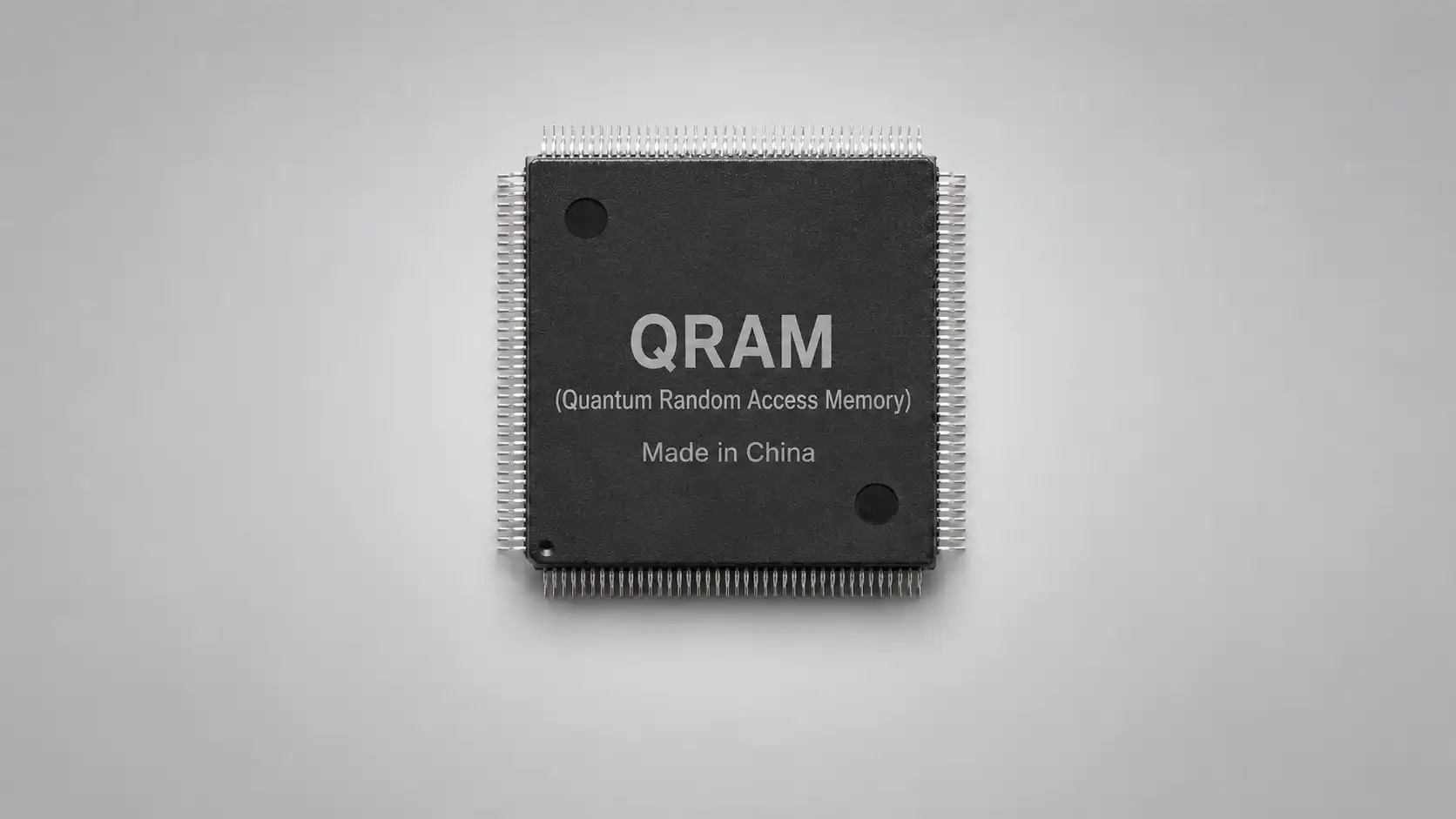
China has not suddenly crossed into everyday, commercial quantum computing. The stronger and more accurate reading is narrower: a Zhejiang University-led team has experimentally demonstrated a bucket-brigade quantum random access memory, or QRAM, on a superconducting quantum processor, addressing 4-bit and 8-bit classical data with reported query fidelities of 0.809 ± 0.025 and 0.604 ± 0.005 in Nature Physics. That is still far from a market-ready quantum memory system. It is also a serious step because it attacks a problem that processor headlines often hide: quantum computers are only useful for many data-heavy algorithms if they can get data into the quantum part of the machine without spending the whole advantage on loading the data.
Table of Contents
The real news is smaller than the headline and more useful because of it
The tempting headline says China has opened the era of “true quantum computing.” The evidence does not support that claim. The work is a proof-of-principle hardware experiment, not a finished quantum memory product, not a universal cure for quantum data loading, and not a sign that drug discovery or fraud detection will be transformed tomorrow. The team’s largest demonstration addressed 8 classical bits, and its query fidelity dropped to around 60.4 percent, which is a clear reminder that the experiment is still in the laboratory stage.
Yet it would be just as wrong to dismiss the result because the prototype is small. Quantum computing has reached a stage where scaling is no longer only about adding more qubits or running more impressive benchmark circuits. A machine that cannot read, route, and return data at the right point in an algorithm is not a useful machine for data-heavy work. QRAM matters because it sits at the boundary between a quantum processor and the classical information many proposed quantum algorithms assume they can query. That boundary is where much of the practical pain lives.
The Zhejiang experiment is important because it implemented a version of an architecture that has sat inside quantum algorithm papers for years. The original bucket-brigade idea was proposed by Vittorio Giovannetti, Seth Lloyd, and Lorenzo Maccone as a way to query a memory tree with only a logarithmic number of active switches during a memory call, rather than activating the whole memory array. The promise was never that QRAM would be easy. The promise was that, with the right architecture, a quantum query might avoid the most obvious resource explosion.
That is the proper frame for this news. China’s result is not the start of a mature commercial era. It is a hardware-level answer to a question the field has avoided at times: what happens when QRAM is built on a real noisy superconducting chip rather than assumed inside an algorithm diagram? The answer, at least in this experiment, is that bucket-brigade QRAM can be made to run at tiny scale, that errors can be studied branch by branch, and that fidelity still falls sharply when the architecture grows.
The most useful sentence for readers is this: the breakthrough is a credible experimental QRAM milestone, not a finished quantum computing revolution. It makes a long-standing bottleneck less abstract. It does not remove the need for error correction, larger memory capacity, better router fidelity, improved cryogenic integration, stronger control electronics, and realistic economic comparisons with classical high-performance computing.
QRAM solves a data-access problem, not every quantum problem
Quantum random access memory is often misunderstood because the phrase sounds like ordinary computer memory with a quantum label attached. It is not that simple. Classical RAM lets a conventional computer use an address to retrieve data from a memory location. QRAM is designed for a quantum computer that may hold the address in superposition, meaning the query can coherently involve many possible addresses at once.
That does not mean a QRAM magically reads every database item for free. Quantum mechanics is not a loophole around data storage costs. The useful point is more precise: a QRAM gives a quantum algorithm a way to ask a memory lookup question while preserving the quantum structure of the address register. Many proposed quantum algorithms need exactly that kind of lookup. Without it, the algorithm may spend too much time preparing input states or calling a slow oracle, and the promised speedup may disappear.
The Nature Physics paper describes QRAM as an efficient access mechanism for classical data and a prerequisite for many quantum algorithms that aim for quantum speed-up. The paper also makes the experimental context clear: there have been many QRAM proposals, but relatively few experimental realizations.
This matters because quantum speedups are not just properties of a processor. They are properties of a whole computational workflow. A quantum algorithm has to get its input, manipulate it, control error, produce output, and justify the cost of doing all of that on quantum hardware. A data-heavy quantum machine learning algorithm that spends most of its runtime loading classical data may lose the advantage that made it interesting.
Scott Aaronson’s well-known warning about quantum machine learning captured this problem early: new algorithms could promise large speedups, but the details of input access, output readout, and model assumptions decide whether the speedup survives contact with reality. His point remains relevant here. QRAM is one of the places where the fine print becomes hardware.
The Zhejiang experiment gives the field a concrete platform for that fine print. It does not prove that QRAM will scale to useful databases. It does prove that a circuit-based bucket-brigade design can be mapped onto a superconducting quantum processor and tested through a full query cycle at small scale. That shifts some of the debate from pure architecture theory to measured error behavior.
The bucket-brigade idea is a tree of quantum routing decisions
The bucket-brigade QRAM design uses a tree structure. Each layer of the tree helps route the query toward a memory cell. In a classical binary tree, each branch is selected by an address bit. In a bucket-brigade QRAM, the address may be quantum, so the routing process must preserve coherence across different possible paths. If the address register is in superposition, the routing pattern must also exist in a coherent superposition of paths.
The original attraction of the bucket-brigade model was resource behavior. A naive QRAM design risks involving too many active elements for every query. Giovannetti, Lloyd, and Maccone argued that a bucket-brigade approach could require only O(log N) active routing operations during a memory call for a memory of size N, even though the memory still contains many physical elements.
The Zhejiang implementation follows that family of ideas, but with a circuit-based design on superconducting hardware. The Nature Physics paper says the team used a binary tree of quantum routers and introduced a gate decomposition scheme that reduced circuit depth compared with a conventional controlled-SWAP implementation. The team also proposed an error mitigation method to improve query fidelity.
Circuit depth matters because each additional operation is another chance for a noisy quantum device to make a mistake. Superconducting qubits have improved greatly, but they still operate under tight coherence limits. A QRAM circuit that is too deep may look good on paper and fail on hardware. A shallower routing construction is not a cosmetic improvement; it is one of the conditions for any near-term QRAM experiment to work at all.
The Zhejiang University notice gives more engineering detail. It says the researchers reduced the quantum circuit depth needed for QRAM by roughly 30 percent, used a superconducting quantum chip with reported single-qubit and two-qubit gate fidelities of 99.96 percent and 99.7 percent, achieved a 94.5 percent high-precision quantum routing operation, and then built QRAM architectures addressing 4-bit and 8-bit classical data.
Those numbers belong together. A reader should not focus only on the final 80.9 percent and 60.4 percent query fidelities. The experiment is a stack of engineering constraints: gate quality, routing design, circuit depth, data writing, data retrieval, address loading, address retrieval, measurement, and error mitigation. The final query fidelity is the score after all of those pieces have been asked to cooperate.
Reported QRAM demonstration at a glance
Reported QRAM demonstration metrics
| Item | Reported detail |
|---|---|
| Research group | Zhejiang University-led team with collaborators |
| Platform | Superconducting quantum processor |
| QRAM architecture | Circuit-based bucket-brigade QRAM |
| Demonstrated addressing | 4 classical bits and 8 classical bits |
| Query fidelity | Up to 0.809 ± 0.025 for 4-bit addressing and 0.604 ± 0.005 for 8-bit addressing |
| Circuit improvement | Gate decomposition reduced QRAM circuit depth versus a conventional controlled-SWAP approach |
| Status | Proof-of-principle experiment, not a commercial memory system |
The table captures the central technical claim without the hype. The result is strongest when described as a small but concrete QRAM implementation on superconducting hardware, backed by measured query fidelities and error-propagation tests rather than by broad claims about immediate applications.
The fidelity drop is the story inside the story
The experiment’s most important number may not be the best 4-bit result. It may be the fall from about 80.9 percent query fidelity at 4-bit addressing to about 60.4 percent at 8-bit addressing. That drop is not a failure in the sense of invalidating the work. It is evidence of the scaling wall the work is trying to measure.
A real QRAM system for useful data-heavy algorithms would need far more than 8 classical bits. It would need a memory size, query rate, fidelity, and integration model that made sense against classical alternatives. Even modest practical datasets contain thousands, millions, or billions of records. The present experiment is nowhere near that scale. The value is that the experiment exposes error behavior early, before the field pretends the bottleneck has been solved.
The Zhejiang group studied error propagation by looking at how noise affects queried and unqueried branches of the QRAM tree. The university notice describes tests in which errors introduced farther from the queried branch had weaker effects on the final output, consistent with a localized error-propagation pattern. The researchers also examined entanglement entropy across router layers and reported that quantum correlations weakened with depth, which they linked to the bucket-brigade architecture’s noise resilience.
That point matters because QRAM skepticism often turns on a simple fear: a memory device with many coherent components may be ruined by too many opportunities for error. A bucket-brigade architecture argues that a query does not need to entangle the whole memory in the same dangerous way. The new experiment does not settle the argument, but it gives data from a real platform.
Connor T. Hann’s Nature Physics News & Views article frames specialized quantum memories as needed for quantum speedups in data-intensive problems and describes this work as a proof-of-principle demonstration with a superconducting processor. That phrase, “proof-of-principle,” should stay attached to the story. It prevents both overclaiming and underclaiming.
A useful analogy is not a finished hard drive. It is a first working test of a difficult memory-routing mechanism. The mechanism may later fail to scale economically. It may evolve into a specialized accelerator component. It may be replaced by another data-loading method. But it has now been operated and measured in a real superconducting quantum environment.
Classical data is a hidden cost in many quantum speedup claims
Many quantum algorithms look powerful because they assume an oracle or memory interface that returns data in the right quantum form. In a complexity-theory paper, this is often acceptable: the paper studies what follows if such an access model exists. In a machine, the access model has to be built.
This is where the difference between an algorithmic speedup and a system speedup becomes painful. Suppose a quantum routine offers a dramatic advantage once the data has been loaded. If the loading process takes longer than the routine saves, the advantage is gone. If the QRAM requires too many qubits, too much control hardware, or too much error correction, the claimed advantage may become a theoretical artifact.
The 2025 QRAM survey and critique by Samuel Jaques and Arthur G. Rattew is useful because it does not treat QRAM as an automatic win. It defines QRAM as a mechanism to access data based on quantum-state addresses and then separates active models from passive models. The paper argues that many QRAM advantages shrink once control hardware and competing classical parallelism are counted. It also says cheap, asymptotically scalable passive QRAM looks unlikely under existing proposals, while circuit-based QRAM may still be useful in many applications.
That critique should be read alongside the Zhejiang result, not against it. The experiment does not refute QRAM skepticism. It gives skeptics and advocates something better to analyze: measured behavior. The QRAM bottleneck is no longer only an assumption buried in the input model; it is a hardware problem with routing fidelity, circuit depth, noise localization, and device layout.
This is also why the result matters beyond China. Every leading quantum computing program faces some version of the same issue. IBM, Google, Microsoft, Amazon, IonQ, Quantinuum, PsiQuantum, D-Wave, and Chinese academic teams all use different hardware strategies, but useful quantum workloads need more than qubits. They need memory, interconnects, control electronics, error correction, compilation, calibration, and application-specific ways to move information through the system.
The public conversation still leans toward processor milestones because qubit counts and benchmark claims are easy to summarize. QRAM is harder to explain. It is also closer to the unglamorous truth of computing: data movement is often as decisive as arithmetic.
The Zhejiang team turned a theoretical primitive into a measured circuit
The Nature Physics paper lists Fanhao Shen, Yujie Ji, Debin Xiang, Yanzhe Wang, Ke Wang, Chuanyu Zhang, Aosai Zhang, Yiren Zou, Yu Gao, Zhengyi Cui, Gongyu Liu, Jianan Yang, Yihang Han, Jinfeng Deng, Anbang Wang, Zhihong Zhang, Hekang Li, Qiujiang Guo, Pengfei Zhang, Chao Song, Liqiang Lu, Zhen Wang, Jianwei Yin, and co-authors. The affiliations include Zhejiang University’s School of Physics, its College of Computer Science, the ZJU-Hangzhou Global Scientific and Technological Innovation Center, and China Mobile (Suzhou) Software Technology.
That mix of physics and computer science is not incidental. QRAM is not just a device physics problem. It is also an architecture problem. The paper’s contribution sits between quantum hardware, circuit compilation, routing structure, and algorithmic assumptions. A physicist can improve gates and coherence; a computer architect can reduce circuit depth and map the computation to a two-dimensional processor; an algorithm specialist can ask whether the access model is worth the cost.
The arXiv version of the work, submitted in June 2025, describes a full QRAM cycle involving address loading, data loading, data writing, data retrieval, and address retrieval. It also notes the use of quantum teleportation to help maintain logarithmic time complexity when mapping the architecture to a two-dimensional grid.
That detail matters because physical layout can destroy theoretical scaling. A tree looks neat in a diagram. A superconducting quantum processor is a two-dimensional chip with limited connectivity, microwave controls, crosstalk, and layout constraints. If the mapping requires too much routing overhead, the advantage vanishes. The work’s gate decomposition and mapping choices are therefore part of the result, not implementation footnotes.
The broader lesson is that QRAM research is moving from “could such a primitive exist?” to “what does it cost on actual hardware?” That shift is healthier for the field. It reduces exaggerated claims because the numbers become harder to hide. It also helps engineers choose which bottlenecks deserve investment.
Superconducting processors are a natural place to test QRAM, but not the only one
The Zhejiang work uses superconducting qubits, one of the most mature platforms for gate-based quantum computing. Superconducting processors benefit from fast gates, established microfabrication methods, and strong industrial attention. They also demand cryogenic operation, careful control of noise, and dense wiring or control schemes as systems grow.
A superconducting platform is useful for QRAM because it gives researchers programmable control over qubits arranged in a chip layout. The same programmability that supports algorithm experiments also supports architecture experiments, including quantum routing, state transfer, and error-mitigation protocols.
The QRAM field is not limited to superconducting qubits. Other proposals include photonic networks, spin-photon architectures, acoustic systems, superconducting cavities, and phonon routing. A 2024 PRX Quantum paper proposed QRAM architectures using three-dimensional superconducting cavities, while a Physical Review Letters paper on transmon-controlled phonon routing proposed a tree-like architecture in which surface acoustic wave phonons are routed by transmons.
These alternatives matter because QRAM may punish platforms differently than ordinary gate-model circuits do. A good quantum processor is not automatically a good quantum memory system. QRAM requires routing, storage, coherence across branches, data writing, and readout. A platform with excellent gate fidelities may still struggle with memory scaling. A platform with good photonic interconnects may have different strengths and weaknesses.
That is one reason the Zhejiang result should be seen as part of a wider architecture search. It strengthens the case that superconducting systems can host QRAM experiments. It does not prove superconducting QRAM will be the winning design. The winning design, if one exists, will be decided by the cost of a useful query, not by a single small-scale demonstration.
The word “memory” hides three different ideas
The term “quantum memory” is overloaded. A standard quantum memory stores quantum states so they can be retrieved later. QRAM is different. It is a memory access architecture for querying data, often classical data, using quantum addresses. A third idea is classical memory attached to a quantum computer, which may simply feed measurement results, calibration data, or control instructions into a hybrid workflow.
Confusing those three ideas leads to exaggerated stories. The Zhejiang result is not a long-lived quantum storage device for arbitrary quantum states. It is not the same as DRAM for a laptop. It is not a commercial cache for quantum cloud computing. It is a quantum random access memory architecture designed to support coherent lookup operations.
The distinction matters for applications. In drug discovery, for example, a QRAM would not replace molecular simulation algorithms. It would support certain kinds of data access inside algorithms that require lookup of molecular features, Hamiltonian terms, or encoded datasets. In fraud detection, QRAM would not scan bank transactions by itself. It would support a future quantum routine that queries encoded transaction data under strict assumptions about data loading, privacy, noise, and output readout.
This is why every application claim needs careful verbs. A scalable QRAM could support some quantum algorithms that use large classical datasets. It would not, by itself, “solve” drug discovery or fraud detection. QRAM is an enabling primitive, not an application.
The Nature paper’s language is more restrained than many news headlines. It states that QRAM is a prerequisite for many quantum algorithms seeking quantum speed-up, while describing the experiment in terms of 4-bit and 8-bit addressing, query fidelity, error propagation, and scalability analysis.
A good editorial reading should keep the primitive and the application separate. The primitive is real and important. The applications remain conditional.
The best comparison is the classical memory wall
Classical computing has its own memory wall. Processors became very fast, but moving data from memory to computation often limited real performance. Caches, memory hierarchy, prefetching, high-bandwidth memory, GPU memory systems, chiplets, interconnects, and data locality all exist because raw arithmetic is rarely the whole story.
Quantum computing has a harsher version of that problem. Data cannot simply be copied freely because of the no-cloning theorem. Measurement can destroy quantum states. Coherence is fragile. Error correction is expensive. The interface between classical data and quantum computation is therefore not a minor input pipe; it is part of the computational model.
QRAM is one response to that memory wall. It tries to give quantum algorithms an access pattern that preserves superposition. The bucket-brigade model tries to reduce the number of active elements involved in a query. Circuit-based versions try to make the idea compatible with hardware that researchers can program and test.
The Zhejiang experiment shows that this comparison is no longer just metaphor. The researchers built a route through a memory tree, loaded addresses, wrote data, retrieved data, and measured the output. The result is small, but it resembles the kind of system-level test classical computing engineers would recognize: not just a faster arithmetic unit, but a data path under real constraints.
This point also explains why QRAM may become strategically important even before it becomes commercially useful. Countries and companies that invest only in processors may miss architecture layers that later decide utility. Those layers include memory, interconnect, cryogenic control, error correction, compilers, and workload-specific data encoding.
China’s result fits a broader national push into quantum technology
China has identified quantum technology as one of the future industries it wants to develop during the 2026–2030 planning cycle. The State Council’s English-language government portal reported in March 2026 that China would nurture future industries including quantum technology, embodied AI, brain-computer interfaces, and 6G, while the draft 15th Five-Year Plan outline urged efforts to foster new growth drivers such as quantum technology, biomanufacturing, hydrogen and nuclear fusion power.
That policy context does not make every Chinese quantum result strategically decisive. It does explain why architecture-level advances attract attention. Quantum computing is not only a scientific race; it is also a supply-chain, talent, fabrication, control-electronics, standards, and national-security race.
China has already built a strong profile in quantum communications and photonic quantum computing, and Chinese teams have published high-profile results across superconducting and optical platforms. The QRAM work adds another layer: not just faster quantum processors, but the supporting structures needed for useful computation.
The timing also matters. In May 2026, the U.S. Department of Commerce announced letters of intent for $2.013 billion in federal incentives across nine companies to accelerate U.S. leadership in quantum computing, including proposed support for GlobalFoundries and IBM quantum foundry efforts and seven quantum computing companies. The announcement explicitly linked quantum computing to national defense, advanced materials, biopharmaceutical discovery, financial modeling, and energy systems.
Both China and the United States are therefore funding quantum as a platform technology. The difference is not only who has the best processor benchmark in a given month. The deeper race is over the whole stack: wafers, cryogenics, error correction, memory, interconnects, algorithms, applications, and industrial know-how.
A QRAM prototype does not change that race overnight. It does show that Chinese teams are not working only on headline qubit counts. They are also attacking less visible pieces of the system.
The U.S. response is about the stack, not only the processor
The U.S. National Quantum Initiative describes itself as the federal gateway for quantum information science and says the National Quantum Initiative Act calls for a coordinated federal program to accelerate quantum research and development for economic and national security goals.
That coordination matters because quantum systems require many sectors to mature together. If a country has strong quantum algorithms but weak fabrication, it depends on others for hardware. If it has good chips but weak cryogenic control electronics, scaling slows. If it has many prototypes but no memory or interconnect strategy, useful workloads remain distant.
The Commerce Department’s 2026 quantum incentive announcement is notable because it funds both foundry capacity and specific companies across multiple quantum modalities. The official notice mentions superconducting, trapped-ion, photonic, topological, silicon-spin, and neutral-atom approaches, and names unresolved engineering problems such as device reproducibility, optical complexity, error rates, cryogenic integration, control hardware, ultra-fast readout electronics, photonic loss, and interconnects.
That list reads like a map of the quantum stack. QRAM sits directly inside it. A useful quantum memory architecture needs reproducible devices, low error rates, control hardware, interconnects, and readout. It may also need a foundry model that produces chips with enough uniformity to build larger routing structures.
China’s QRAM paper should therefore not be viewed as a stand-alone laboratory curiosity. It is part of the same technical stack that U.S. funding announcements are trying to strengthen. The race is shifting from isolated demonstrations toward system architecture.
QRAM is tied to quantum machine learning, but the caveats are severe
Quantum machine learning is one of the application areas most often linked to QRAM. The reason is straightforward: many machine learning tasks use large datasets, vectors, matrices, or feature maps. Some proposed quantum algorithms operate on data in amplitude encoding or other quantum-access models. QRAM appears as a way to supply those inputs.
The risk is that the phrase “quantum AI” invites careless marketing. A QRAM does not make neural networks suddenly superior. It does not remove the cost of collecting, cleaning, labeling, encoding, and validating data. It does not solve the problem of reading out useful classical answers from a quantum state. It does not guarantee an advantage over GPUs, TPUs, or classical algorithms designed to exploit sparsity and structure.
Several papers have argued for quantum machine learning speedups under specific assumptions. Rebentrost, Mohseni, and Lloyd’s 2014 quantum support vector machine paper is a famous example. Ciliberto and co-authors later reviewed quantum machine learning from a classical perspective, emphasizing the care needed in comparing models and access assumptions.
QRAM strengthens one part of the QML story only if it scales with acceptable cost. If the memory requires too much overhead, the “quantum” advantage may be eaten by the data interface. If a classical system can run a massively parallel approximation faster and cheaper, the business case fails. If the output is too hard to extract, the algorithm remains elegant but unusable.
The fair interpretation is this: QRAM is a necessary condition for some quantum data algorithms, not sufficient proof that quantum machine learning will beat classical AI. The Zhejiang experiment makes that necessary condition more physical, but it does not settle the economic or algorithmic comparison.
Drug discovery claims need a narrower, more honest frame
Drug discovery is a natural area for quantum computing interest because molecules are quantum systems. Quantum simulation has long been one of the most credible uses for fault-tolerant quantum computers. The case is strongest when the quantum computer simulates quantum chemistry directly, rather than merely searching a classical database.
QRAM enters the drug discovery story through data access. A future system might query molecular descriptors, sparse Hamiltonian terms, candidate structures, or precomputed features in superposition as part of a larger quantum routine. It might support subroutines in quantum chemistry, optimization, or machine learning. But those are conditional possibilities, not near-term deliverables.
The Nature Physics QRAM paper references quantum chemistry and data-intensive algorithms in its bibliography, including work on qubitization, sparse factorization, and electronic spectra. That tells us the authors understand QRAM as a supporting element for algorithms that need structured data access. It does not mean the 8-bit prototype can accelerate pharmaceutical research.
A practical drug discovery workflow also involves wet-lab validation, toxicity, pharmacokinetics, manufacturability, intellectual property, clinical trials, regulation, and business risk. Faster computation is useful only when it improves decisions inside that chain. A QRAM-based quantum routine would have to earn its place against classical simulation, AI screening, laboratory automation, and high-performance computing.
The honest headline is not that China’s QRAM will speed up drug discovery now. It is that a scalable QRAM would remove one input-access obstacle for certain quantum algorithms that might later matter in molecular science. That is still valuable. It is just not magic.
Fraud detection claims are even more conditional
Financial fraud detection is a data-heavy task, so it is often mentioned alongside QRAM. Banks, card networks, payment processors, and exchanges scan transaction streams for anomalies, suspicious patterns, account takeovers, mule networks, synthetic identities, and market abuse. These systems already use large-scale classical machine learning, graph analytics, rules engines, and streaming infrastructure.
A future QRAM could, in theory, support quantum algorithms that query historical transaction data, graph structures, or feature vectors in superposition. But the practical barriers are large. Financial data is sensitive, regulated, and time-dependent. Fraud detection requires low false positives, explainability, latency guarantees, auditability, secure data handling, and integration with existing systems.
Quantum hardware would also have to compete with classical systems that are deeply mature and already tuned for the business cost of fraud. Many fraud models are not limited by matrix algebra alone. They are limited by data quality, adversarial behavior, compliance constraints, customer friction, and rapid model drift.
That does not make QRAM irrelevant to finance. Quantum computing may later matter for portfolio optimization, risk modeling, Monte Carlo acceleration, cryptography, and some graph problems. But fraud detection is a poor place for casual promises. QRAM would be an input primitive inside a future algorithmic stack, not a plug-in fraud scanner.
The Commerce Department’s 2026 quantum announcement lists financial modeling among areas with quantum implications. That language is broader and more defensible than saying a small QRAM prototype will detect fraud on global markets.
The AI angle depends on data encoding, not just compute power
Artificial intelligence is often used as shorthand for any data-heavy computing task. In the QRAM discussion, that shorthand can mislead. AI workloads are not one thing. Training a transformer, running a recommender model, classifying images, searching vector embeddings, building graph features, and optimizing reinforcement-learning policies all stress hardware in different ways.
Quantum computers are not replacements for GPUs. They are specialized machines for particular mathematical structures. A QRAM might support algorithms that operate on vectors, kernels, matrices, or probability distributions. It does not turn a quantum processor into a faster general-purpose AI accelerator.
Data encoding is the hard part. Many quantum algorithms assume amplitude encoding, where a classical vector is loaded into quantum amplitudes. That can be powerful on paper because n qubits can represent a vector in a 2ⁿ-dimensional space, but preparing that state may be expensive. QRAM is one proposed route around the cost, but only if the QRAM itself is efficient and accurate enough.
This is why the QRAM debate remains central to quantum AI. If data loading costs dominate, the AI claim collapses. If QRAM or another state-preparation method becomes practical for structured datasets, some quantum learning subroutines become more credible. The Zhejiang result nudges the hardware side forward but leaves the algorithmic and economic comparison open.
A careful business reader should treat “quantum AI” as a research area, not a procurement category. The practical question is not whether QRAM sounds useful for AI, but whether a specific QRAM-supported quantum routine beats a specific classical pipeline on cost, speed, accuracy, and integration risk.
The experiment also tests the credibility of quantum oracles
In quantum algorithms, an oracle is often a black-box operation that answers a query. Oracles are useful in theory because they let researchers isolate the structure of a problem. But a physical computer cannot use a magical black box. It needs a circuit, memory, data loader, or device that implements the oracle.
QRAM is one way to realize some of those query operations. That makes it a bridge between theoretical algorithms and physical machines. When researchers say a quantum algorithm assumes QRAM access, they are not making a small assumption. They are assuming an entire architecture with costs.
Grover’s search algorithm is the classic example of a query model. It gives a quadratic speedup for unstructured search, but the oracle must be implemented. If the oracle is expensive, the practical speedup changes. The same issue appears in quantum linear systems algorithms and machine learning algorithms that assume efficient access to data.
The Zhejiang result therefore helps the field ask better questions. Instead of asking whether an oracle is “available,” researchers can ask what fidelity, depth, qubit count, routing overhead, and error mitigation a QRAM implementation requires. Those numbers can then be inserted into resource estimates.
This is the path from theory to engineering. It is slower than hype, but more useful. A quantum speedup claim becomes more trustworthy when its data-access primitive has a measured cost.
The error-mitigation result is useful but not a substitute for fault tolerance
The Zhejiang paper includes an error mitigation method to improve query fidelity. Error mitigation is important for near-term quantum experiments because current devices are noisy and not yet fully fault-tolerant. But error mitigation is not the same as error correction.
Error mitigation tries to reduce or infer the effect of noise, often using post-processing, calibration, symmetry checks, probabilistic methods, or additional measurements. It can make small experiments more informative. It does not by itself protect arbitrarily large computations from accumulating errors.
Fault tolerance requires encoding logical qubits across many physical qubits so errors can be detected and corrected during computation. That adds heavy overhead but is widely regarded as necessary for large, reliable quantum algorithms. QRAM in a fault-tolerant setting is especially hard because memory and access structures may require many qubits and many operations.
Di Matteo, Gheorghiu, and Mosca studied fault-tolerant resource estimation for quantum random-access memories and described QRAM cost as a limiting factor in some algorithms. Their work is a reminder that the cost of making QRAM reliable may dominate the workload.
The Zhejiang result should therefore be read as a near-term experimental and architectural milestone. It does not remove the need for fault-tolerant QRAM analysis. If anything, it makes that analysis more urgent because engineers now have concrete experimental structures to evaluate.
The router is the core component
The word “router” may sound borrowed from networking, and the analogy is useful. In bucket-brigade QRAM, a quantum router directs a data bus through a tree depending on address information. If the address is quantum, the router must preserve coherence. It cannot simply choose one classical path and discard the others.
That makes the router technically difficult. It may involve multi-qubit interactions or decompositions into available gates. The Zhejiang paper introduced a more efficient gate decomposition for quantum routers, reducing circuit depth. Other researchers have also explored coherent quantum routers on superconducting processors.
A 2025 arXiv paper by Sheng Zhang and co-authors reported coherent quantum routers for bucket-brigade QRAM on a superconducting processor, with individual QRouter fidelities up to 95.74 percent and a two-layer routing network average fidelity of 82.40 percent.
That related work shows how the QRAM field is decomposing the larger problem into parts. Build better routers. Improve routing fidelity. Reduce depth. Add error-detection features. Study how routers cascade. Map tree structures to chips. Then test full QRAM cycles.
The router is where algorithmic elegance meets hardware pain. A QRAM can only be as credible as its routing operations. If routers are too noisy, too slow, too large, or too hard to control, the memory architecture fails no matter how appealing the scaling argument looks.
A stronger QRAM roadmap will need architecture, fabrication and compilers together
The path from an 8-bit QRAM demonstration to a useful system is not a straight line. It requires improvements at several layers at once. Better qubits help, but they are not enough. Better circuit decompositions help, but they are not enough. Better error mitigation helps, but it is not enough.
A practical QRAM roadmap needs at least five layers to mature together. First, physical devices must deliver higher gate fidelity, longer coherence, lower crosstalk, and reproducible fabrication. Second, quantum routers must become shallower, more reliable, and easier to cascade. Third, chip layouts must support tree-like access patterns without wasting too much routing overhead. Fourth, compilers must map QRAM circuits to real devices while preserving the intended scaling. Fifth, resource estimates must include the cost of error correction, cryogenic control, and classical competition.
This is why the 2023 systems architecture work by Xu, Hann, Foxman, Girvin, and Ding is relevant. It proposed an end-to-end QRAM architecture, discussed query latency, memory capacity, fault tolerance, 2D layout mapping, compilation, scheduling, and simulation of noisy QRAM circuits.
The Zhejiang experiment sits downstream from that kind of systems thinking. It shows that QRAM hardware is not only a physics challenge. It is also a computer architecture problem. Useful QRAM will require co-design across hardware, layout, compilation, algorithm design, and application modeling.
The “world’s first” phrasing needs caution
Some coverage described the result as the world’s first superfast quantum memory. The South China Morning Post reported that Chinese scientists had created the world’s first superfast memory for quantum computers and cited the data-reading bottleneck for big-data tasks such as drug discovery and fraud detection.
That framing captures the excitement but risks flattening the technical meaning. The safer claim is that the team demonstrated a circuit-based bucket-brigade QRAM architecture on a superconducting quantum processor at small scale, with 4-bit and 8-bit addressing. The Zhejiang University notice also describes the work as a first experimental demonstration on a superconducting quantum platform and links it to noise-resilience evidence.
“World’s first” claims in quantum computing are often tricky because different platforms, definitions, and partial demonstrations exist. A result may be first for a particular architecture, first on a particular hardware type, first with a full query cycle, or first at a specific fidelity. Those distinctions matter.
A reader should ask four questions whenever “first” appears in a quantum headline:
- First at what exact task?
- First on which hardware platform?
- First at what scale and fidelity?
- First compared with which prior demonstrations?
For this story, the valuable answer is specific: a Zhejiang University-led team published a Nature Physics article on a bucket-brigade QRAM implemented with a superconducting quantum processor, addressing 4-bit and 8-bit classical data and studying error propagation. That is strong enough without stretching into vague claims about a new computing era.
The best near-term impact is better benchmarking of memory assumptions
The QRAM result may not lead quickly to a commercial device. Its near-term value may be benchmarking. Quantum algorithms that assume QRAM need credible cost models. The field needs to know how query fidelity scales, how errors propagate, how much depth can be removed, how routers behave, and how two-dimensional layouts affect performance.
A measured QRAM prototype helps researchers calibrate those models. It gives them realistic gate counts, routing behavior, and noise effects. It also helps expose where theory is too optimistic.
This matters because quantum computing has already suffered from claims that hide input-output costs. A result that makes those costs measurable improves trust. It lets a company or government funder ask sharper questions: how many physical qubits are needed for a useful QRAM? What is the query error after error correction? How does the query rate compare with classical memory bandwidth? Does the application need exact lookup or approximate state preparation? How many repeated measurements are needed to extract useful output?
The near-term value of QRAM experiments may be to kill weak quantum advantage claims as much as to support strong ones. That is good for the field. Hype consumes capital and credibility. Measured architecture research builds both more slowly.
Two claims that should not be confused
Careful wording for QRAM claims
| Claim | Better wording |
|---|---|
| China has started the era of practical quantum computing | China has demonstrated a small QRAM architecture that addresses a key data-access bottleneck |
| QRAM lets quantum computers read all data instantly | QRAM supports coherent lookup using quantum addresses under strict hardware and algorithmic constraints |
| Drug discovery will now speed up dramatically | Future scalable QRAM could support some quantum chemistry or data-query routines |
| Fraud detection will become instant | Future QRAM-backed algorithms may be explored for financial modeling or anomaly tasks, but deployment remains distant |
| The bottleneck is solved | One small proof-of-principle result gives measured progress and exposes scaling challenges |
The more careful phrasing is not less exciting. It is more durable. A result that survives precision is stronger than a result inflated by vague claims.
The economics of QRAM will be brutal
Even if QRAM scales technically, it must compete economically. That means cost per useful query, not just fidelity. A future system has to justify qubits, cryostats, control electronics, fabrication, calibration, cloud access, software development, and integration with classical systems.
Classical memory is extraordinarily cheap, dense, fast, and reliable. Classical accelerators are improving quickly. GPUs, TPUs, AI ASICs, and high-bandwidth memory systems handle huge datasets with mature software stacks. QRAM will not beat them by being “quantum.” It will need workloads where quantum query access produces a clear end-to-end gain.
This is the strongest argument for caution. A theoretical speedup may survive mathematically and still fail economically. If a quantum memory needs millions of physical qubits and heavy error correction to query data that a classical cluster can process cheaply, the business case fails. If a QRAM query is slower than a classical memory hierarchy for the relevant task, the business case fails. If the algorithm needs too many repetitions to extract output, the business case fails.
That does not mean QRAM is doomed. It means the target is narrow. QRAM is most plausible where the quantum part of the algorithm gives enough advantage to pay for a very expensive data-access primitive. Quantum chemistry, certain linear algebra routines, some search or optimization tasks, and structured scientific simulations may be better candidates than generic “big data.”
The Zhejiang result does not answer the economics. It gives the first kind of evidence the economics will later need: measured physical behavior.
Security and cryptography add another layer
QRAM also appears in cryptographic discussions because quantum algorithms can change assumptions about search, collision finding, lattice problems, and other structures. Some QRAM-related cryptanalysis papers study query access models that affect resource estimates. The details matter because security decisions cannot rely on vague quantum speedup claims.
Post-quantum cryptography already assumes that large quantum computers may threaten RSA and elliptic-curve systems through Shor’s algorithm. QRAM is not needed for that core warning. But for other cryptanalytic models, memory access assumptions can change speedups and costs.
This reinforces the same lesson: the access model is part of the threat model. A cryptanalytic claim that assumes cheap QRAM should be read differently from one that includes fault-tolerant QRAM resources. Overstating QRAM could overstate some risks; ignoring it could understate future capabilities if practical architectures emerge.
The QRAM survey and critique is especially relevant here because it warns that active QRAM may lose much of its apparent advantage when control hardware and classical parallel alternatives are counted.
Security agencies, banks, and infrastructure operators should not change cryptographic migration plans because of this one experiment. They should continue post-quantum migration for the reasons already established by public-key cryptography risk. The QRAM result belongs to a different question: how realistic are certain data-access-heavy quantum algorithms?
The result strengthens China’s research reputation, but not in isolation
Zhejiang University’s work is part of a broader Chinese research base in quantum information science. The team’s affiliations span physics, computer science, and chip fabrication. The university notice states that the superconducting quantum computing platform was built and provided by Zhejiang University’s superconducting quantum computing team, with chips fabricated at the university’s micro-nano fabrication center.
That local capability matters. Quantum computing progress depends on tight feedback loops between design, fabrication, measurement, and theory. A team that can design a QRAM experiment, fabricate a chip, run the device, analyze error propagation, and publish in Nature Physics has more than a one-off result. It has a working research pipeline.
China’s policy push adds money and direction, but the quality of the research still depends on teams like this producing hard, peer-reviewed results. The QRAM paper gives China a credible architecture milestone. It does not prove leadership across the whole field. Quantum leadership is fragmented by platform, metric, and application.
The global picture remains mixed. The United States has deep industrial players, national labs, university groups, and venture-funded companies. Europe has strong photonics, trapped-ion, neutral-atom, and quantum communication work. China has world-class academic groups and major state support. The United Kingdom, Canada, Japan, Australia, Singapore, and others also matter.
The QRAM result is a strong Chinese contribution to a global systems problem. It is not a standalone declaration of dominance.
The hardest scaling question is memory size
A 4-bit or 8-bit QRAM is small enough to fit inside an experiment. A useful QRAM must scale memory size while preserving useful fidelity. That is where the field will face its hardest test.
If query error grows too quickly, the memory becomes useless. If qubit count grows too quickly, the hardware becomes impractical. If circuit depth grows too quickly, coherence kills the result. If the layout becomes too complex, fabrication and calibration fail. If error correction overhead is too large, the cost overwhelms the algorithm.
The bucket-brigade model is attractive because it tries to make query infidelity grow more gently with memory size. Prior theoretical work, including Hann and co-authors’ PRX Quantum paper on QRAM noise resilience, has studied why the architecture may be more tolerant of generic noise than naive designs.
The Zhejiang experiment offers early hardware evidence related to that idea. Its error-propagation tests suggest noise effects may be localized in a way consistent with bucket-brigade resilience. But the fidelity drop from 4-bit to 8-bit addressing shows that practical scaling remains unsolved.
The next meaningful milestones are not hard to name. A stronger QRAM program would show larger addressing depth, higher query fidelity, better router cascades, error-corrected or error-detected operation, repeatable device fabrication, and end-to-end algorithm demonstrations where QRAM is not merely present but useful.
Until then, memory size remains the gap between a milestone and a machine.
Data loading is not the only bottleneck
QRAM focuses on data access, but quantum computing has several bottlenecks at once. Error correction is the largest for many long algorithms. Connectivity limits circuit mapping. Cryogenic wiring limits scaling in superconducting systems. Photonic loss limits some optical architectures. Ion shuttling, laser control, calibration, crosstalk, measurement speed, and compiler quality all matter depending on the platform.
That means QRAM should not be oversold as “the” obstacle. It is one obstacle among many. Solving it would not automatically produce a useful quantum computer. Failing to solve it would weaken many data-heavy quantum algorithm claims.
The right way to place QRAM is inside a bottleneck map. For quantum chemistry, Hamiltonian simulation and fault-tolerant gate costs may dominate. For machine learning, state preparation and readout may dominate. For optimization, problem encoding and solution quality may dominate. For cryptography, logical qubit count and T-gate resources may dominate. For QRAM-heavy algorithms, data access may dominate.
A useful quantum industry will not be built by solving one problem in isolation. It will be built by aligning the problem, the algorithm, the hardware, the memory model, and the classical wrapper. The Zhejiang result improves one part of that alignment.
The role of open data and reproducibility
The Nature Physics paper states that figure data and supporting findings are publicly available through Zenodo, and that data analysis and numerical simulation code are available through the same record.
That matters for trust. Quantum computing claims can be hard to evaluate because devices are specialized, calibration is complex, and raw experimental details are often difficult to reproduce elsewhere. Public data and code do not make replication automatic, but they let other researchers inspect assumptions, compare models, and test analysis pipelines.
Reproducibility will be especially important for QRAM. A single experiment may depend on device layout, calibration choices, noise characteristics, and mitigation methods. To become a field rather than a one-off result, QRAM demonstrations need independent implementations across hardware platforms.
The best future evidence would include larger superconducting demonstrations, competing photonic or acoustic implementations, fault-tolerant resource studies tied to measured components, and application-level tests where QRAM reduces total runtime or resource cost.
A QRAM result becomes more valuable when other teams can stress-test it. Open data is a good step in that direction.
Commercial quantum companies should treat this as a warning
For quantum startups and large technology companies, the QRAM result is both encouraging and uncomfortable. It is encouraging because it shows that memory architectures can move from theory toward hardware. It is uncomfortable because it makes clear that useful quantum computing requires much more than impressive processors.
A company promising quantum advantage in data-heavy workloads needs a data-access story. It must explain how data enters the quantum computation, what the access model costs, whether QRAM is assumed, how the input state is prepared, how errors are controlled, how outputs are read, and where the classical system fits.
Investors should ask those questions. Enterprise buyers should ask them. Government agencies should ask them. A quantum roadmap that mentions drug discovery, finance, logistics, or AI without discussing data loading is incomplete.
This does not mean every quantum company needs to build QRAM. Some workloads may avoid QRAM. Some architectures may use different state-preparation methods. Some useful quantum applications may be native quantum simulations where the “data” is a Hamiltonian rather than a massive classical dataset. But companies that rely on quantum access to classical data must be explicit.
The Zhejiang result raises the standard for quantum application claims. Once a primitive begins to exist in hardware, vague assumptions become less acceptable.
The media should stop using “instant” for quantum data access
Words like “instant,” “unlimited,” and “massive parallelism” make quantum stories sound clearer while making them less accurate. Superposition does not mean every answer is read out at once. Measurement returns limited classical information. Quantum algorithms are powerful because interference amplifies useful answers and suppresses others under specific structures.
QRAM does not change that. It allows coherent lookup. It does not give free access to all database contents. A quantum computer cannot simply query a huge dataset in superposition and print all results. The algorithm must be designed so that the memory query contributes to an interference pattern that yields a useful output.
That distinction is essential for readers. Without it, QRAM sounds like science fiction memory. With it, QRAM becomes a difficult but meaningful computer architecture primitive.
A better news sentence would be: QRAM is designed to let a quantum algorithm query memory locations coherently when the address is in superposition. That sentence avoids fake magic and explains the real value.
The Zhejiang experiment deserves coverage because it is real. It also deserves careful coverage because quantum computing already has a hype problem. Precision protects the field.
The next credible milestones are clear
The next stage of QRAM work should not be judged by press adjectives. It should be judged by measurable progress.
A larger QRAM demonstration should address more data while improving or preserving fidelity. It should show better router cascades. It should compare circuit decompositions under realistic noise. It should map the tree structure to hardware with less overhead. It should test whether error localization continues at larger depth. It should integrate more rigorous error detection or early error-correction methods. It should connect QRAM queries to an actual algorithmic subroutine, not just a memory demonstration.
The field also needs stronger resource estimates. How many physical qubits would a useful QRAM require under surface-code error correction? How many logical operations per query? How much cryogenic control bandwidth? How many memory calls per algorithm? What is the break-even point against a classical cluster? Which workloads remain interesting after those costs are counted?
These questions may sound less exciting than “new era begins,” but they decide whether the new era ever arrives. The next milestone is not a larger headline. It is a larger, cleaner, better-costed QRAM query.
The likely future is hybrid, not pure quantum
A practical quantum computing system will almost certainly be hybrid. Classical machines will prepare data, control experiments, compile circuits, run error decoders, manage memory, post-process results, and decide when quantum subroutines are worth calling. Quantum processors will handle specialized parts of the computation.
QRAM fits inside that hybrid model. It would not replace classical storage. It would sit between classical data and quantum routines that need coherent lookup. The surrounding system would still use classical databases, caches, networks, and accelerators.
This matters for business strategy. The companies that benefit from QRAM may not be those building only qubits. They may include chip foundries, cryogenic electronics firms, compiler companies, quantum software firms, cloud infrastructure providers, scientific computing groups, and industries with structured quantum-relevant workloads.
The most realistic future is not a quantum computer sitting alone in a data center, reading all corporate data in superposition. It is a classical-quantum system where a specialized QRAM or data-loading layer supports narrow quantum routines inside a larger workflow.
Hybrid architecture is the practical frame for QRAM. It keeps expectations grounded and makes the engineering problem clearer.
This result changes the research agenda more than the market
For markets, the result should not trigger immediate revaluation of quantum computing companies or application timelines. No commercial QRAM product has arrived. No enterprise can use this 8-bit prototype for production workloads. No drug company or bank should expect near-term deployment from this result alone.
For research agendas, the result is more important. It tells experimental groups that QRAM is no longer purely theoretical. It gives architecture researchers fresh data. It tells algorithm designers to be more specific about memory access. It gives skeptics a concrete target for critique. It gives funders a reason to support memory and interconnect work, not only processor scaling.
This is often how real technology progress looks. It does not arrive as a clean breakthrough that changes everything at once. It arrives as a difficult subsystem becoming measurable. The market impact is distant; the research impact is immediate.
That distinction is not pessimistic. It is the difference between science news and product news. The Zhejiang QRAM work is strong science news.
China’s QRAM result narrows one gap and exposes the rest
The best final reading is balanced. China’s QRAM result is not hype if described accurately. It is also not a finished memory breakthrough in the consumer or enterprise sense. It is a peer-reviewed, small-scale demonstration of a bucket-brigade QRAM architecture on a superconducting quantum processor, with measured fidelity, reduced circuit depth, error mitigation, and error-propagation analysis.
It narrows one gap: the gap between QRAM as an assumption and QRAM as hardware. It exposes the rest: scaling, fidelity, error correction, memory size, layout, cost, and application-level advantage.
That is exactly why it matters. The future of quantum computing will be decided less by slogans about speed and more by whether hard primitives like QRAM can survive full-stack accounting. Zhejiang University’s experiment gives the field one more real number to work with.
Practical implications for researchers, investors and enterprises
For researchers, the message is to build costed QRAM models around measured components. The experiment gives useful numbers, but those numbers should be extended, challenged, and replicated. Researchers should test how different router designs behave, how error mitigation scales, and whether QRAM-supported algorithms retain advantage under realistic resource estimates.
For investors, the message is to ask harder technical questions. A company claiming data-heavy quantum advantage should explain its memory model. If it assumes QRAM, it should say what kind. If it avoids QRAM, it should explain its state-preparation path. If it relies on future fault tolerance, it should provide resource estimates. A vague quantum AI claim without data-access accounting is weak.
For enterprises, the message is to keep quantum exploration focused. Drug discovery, materials, finance, and AI teams should track QRAM because it may affect future workloads. They should not build near-term roadmaps around immediate QRAM availability. Better near-term work includes identifying structured problems, cleaning scientific datasets, building classical baselines, and learning where quantum subroutines might fit.
For policymakers, the message is to fund the stack. Processor programs are visible. Memory and interconnect programs are often less visible but just as necessary. The U.S. Commerce Department’s 2026 focus on foundries, modalities, control hardware, readout, interconnects, and engineering bottlenecks reflects that broader need. China’s QRAM result points in the same direction from the research side.
The phrase “true quantum computing” needs a stricter definition
The user-facing phrase “true quantum computing” is emotionally powerful but technically vague. Quantum computers already exist as experimental and early commercial-access machines. They run quantum circuits, simulate small systems, and support research. What does “true” mean?
If it means fault-tolerant, large-scale, economically useful quantum computing, then this QRAM result does not start that era. If it means a move beyond processor-only demonstrations toward system primitives needed for useful workloads, then the phrase has a defensible meaning. This is a step toward fuller quantum computer architecture, not the arrival of mature quantum computing.
A stricter definition should include useful logical qubits, fault-tolerant operations, reliable data access, credible algorithms, validated application gains, and cost comparisons against classical computing. QRAM is only one part of that list. The Zhejiang work advances that part.
That is why the best title for the story is not “China begins the era of true quantum computing.” It is more accurate to say that China’s QRAM advance brings quantum computing closer to real data. The distinction matters because it keeps the public conversation tied to evidence.
Questions readers ask about China’s QRAM result
They demonstrated a bucket-brigade quantum random access memory architecture on a superconducting quantum processor, addressing 4-bit and 8-bit classical data with reported query fidelities of 0.809 ± 0.025 and 0.604 ± 0.005. It is a proof-of-principle experiment, not a commercial QRAM device.
No. The result is a meaningful step in quantum memory architecture, but it does not create a practical, large-scale, fault-tolerant quantum computer. It addresses one data-access bottleneck at small scale.
QRAM, or quantum random access memory, is a memory-access architecture that lets a quantum algorithm query data using addresses that may be in quantum superposition. It is different from ordinary RAM and different from a device that simply stores arbitrary quantum states.
Many proposed quantum algorithms assume fast access to classical or quantum data. Without a credible QRAM or another efficient data-loading method, the time and hardware cost of input access may erase the algorithm’s speed advantage.
Bucket-brigade QRAM is a tree-based QRAM design in which routing elements direct a query toward memory cells. Its attraction is that only a limited number of routing elements need to be active during a query, which may reduce noise and resource costs.
The reported demonstration addressed 4 classical bits and 8 classical bits. That is tiny compared with practical datasets, but it is enough to test routing, query fidelity, and error behavior on real hardware.
Query fidelity measures how accurately the QRAM returns the intended query result. Higher fidelity means the memory operation is closer to the desired quantum operation. The drop from about 80.9 percent to about 60.4 percent shows scaling remains hard.
The safest wording is that it is a first or early experimental demonstration of a bucket-brigade QRAM on a superconducting quantum processor at small scale. Broad “world’s first” claims depend on exact definitions and should be used cautiously.
No. A scalable QRAM could support future quantum algorithms relevant to chemistry or molecular data, but this prototype is far too small for real drug discovery workloads.
Only in a future, highly conditional sense. Fraud detection depends on data quality, latency, compliance, explainability, and classical infrastructure. QRAM could support future quantum data-query routines, but it is not a near-term fraud detection tool.
Not by itself. QRAM addresses one input-access problem for some quantum machine learning algorithms. Practical quantum AI would still need useful algorithms, scalable hardware, error correction, efficient output readout, and proof of advantage over classical systems.
Larger QRAM circuits require more operations and more routing structure, giving noise more chances to affect the result. The fidelity drop is a normal warning sign in quantum scaling, not a reason to dismiss the experiment.
Error mitigation improves the usefulness of noisy near-term experiments by reducing or estimating noise effects. It is not the same as full quantum error correction, which would be needed for large, reliable quantum computing.
No. Some quantum algorithms do not need QRAM. QRAM is mainly relevant for algorithms that need coherent lookup into classical or quantum data structures.
Yes. Some workloads may use different state-preparation methods, problem encodings, specialized oracles, analog simulation, or classical preprocessing. QRAM is one possible route, not the only route.
Superconducting processors are programmable, fast, and mature enough for complex circuit experiments. They also have challenges, including cryogenic operation, noise, crosstalk, and scaling constraints.
Investors should ask quantum companies how their workloads handle data access. Claims about quantum AI, finance, or drug discovery are weak if they do not explain state preparation, QRAM assumptions, output readout, and classical baselines.
A larger QRAM demonstration with higher fidelity, better error handling, clearer resource estimates, and integration into an actual algorithmic subroutine would be more meaningful than another headline-only claim.
It strengthens China’s position in quantum architecture research, but it does not settle global leadership. The deeper race involves the full stack: chips, memory, interconnects, error correction, compilers, applications, and manufacturing.
China’s QRAM result is a credible small-scale hardware milestone that brings quantum computers closer to useful data access, while leaving the hard work of scaling and fault tolerance unresolved.
Author:
Jan Bielik
CEO & Founder of Webiano Digital & Marketing Agency
This article is an original analysis supported by the sources cited below
A bucket-brigade quantum random access memory
Nature Physics article reporting the Zhejiang University-led bucket-brigade QRAM experiment on a superconducting quantum processor.
Quantum random access memory put to the test
Nature Physics News & Views analysis describing the experiment as a proof-of-principle demonstration of quantum memory for data-intensive problems.
Experimental realization of the bucket-brigade quantum random access memory
arXiv version of the Zhejiang University-led QRAM work, including the authors’ abstract and technical framing.
Nature Physics|光学与量子信息研究所:基于超导量子芯片的量子随机存储器实现
Zhejiang University notice describing the QRAM implementation, reported chip fidelities, circuit-depth reduction, query fidelities, and noise-propagation analysis.
Source data and simulation code for a bucket-brigade quantum random access memory
Zenodo record referenced by the Nature Physics paper for figure data, supporting data, analysis code, and numerical simulation code.
QRAM: A survey and critique
Quantum journal review by Samuel Jaques and Arthur G. Rattew examining QRAM models, assumptions, costs, and limits.
Quantum random access memory
Physical Review Letters paper by Vittorio Giovannetti, Seth Lloyd, and Lorenzo Maccone introducing a QRAM architecture with reduced active switching requirements.
Architectures for a quantum random access memory
Physical Review A paper expanding the QRAM architecture discussion, including conventional fanout and bucket-brigade designs.
Architectures for a quantum random access memory
arXiv version of the Giovannetti, Lloyd, and Maccone QRAM architecture paper.
Resilience of quantum random access memory to generic noise
PRX Quantum paper analyzing QRAM noise resilience, a central issue for scaling bucket-brigade designs.
On the robustness of bucket brigade quantum RAM
New Journal of Physics paper studying robustness properties of bucket-brigade QRAM.
Fault-tolerant resource estimation of quantum random-access memories
arXiv paper by Olivia Di Matteo, Vlad Gheorghiu, and Michele Mosca on fault-tolerant QRAM resource costs.
Systems architecture for quantum random access memory
arXiv paper proposing an end-to-end systems architecture for QRAM, including compilation, mapping, scheduling, and noisy simulation.
Systems architecture for quantum random access memory
ACM MICRO publication version of the systems architecture work on QRAM.
Quantum random access memory architectures using 3D superconducting cavities
PRX Quantum paper proposing QRAM architectures based on superconducting cavities.
Quantum random access memory with transmon-controlled phonon routing
Physical Review Letters paper proposing QRAM through transmon-controlled phonon routing.
Demonstrating coherent quantum routers for bucket-brigade quantum random access memory on a superconducting processor
arXiv paper reporting coherent quantum routers for bucket-brigade QRAM on a superconducting processor.
Fat-tree QRAM: A high-bandwidth shared quantum random access memory for parallel queries
arXiv paper proposing a high-bandwidth shared QRAM architecture for parallel quantum queries.
Read the fine print
Nature Physics essay by Scott Aaronson warning that quantum machine learning speedups depend on input, output, and access-model assumptions.
Quantum machine learning algorithms: Read the fine print
Scott Aaronson’s explanatory post linking to and discussing the Nature Physics essay on caveats in quantum machine learning.
Quantum support vector machine for big data classification
Physical Review Letters paper often cited in quantum machine learning discussions involving data access assumptions.
Quantum machine learning: A classical perspective
Royal Society review examining quantum machine learning claims from the perspective of classical algorithms and assumptions.
Quantum algorithm for linear systems of equations
Physical Review Letters paper introducing the HHL algorithm, central to many later discussions about quantum linear algebra and data-access assumptions.
A fast quantum mechanical algorithm for database search
ACM STOC paper by Lov Grover introducing the quantum search algorithm and the query-model speedup that shaped later oracle discussions.
Department of Commerce announces letters of intent with 9 companies for $2 billion to accelerate U.S. leadership in quantum computing
NIST-hosted U.S. Department of Commerce announcement on proposed quantum computing incentives under the CHIPS and Science Act.
National Quantum Initiative
Official U.S. federal portal for National Quantum Initiative information, strategy, reports, and coordinating bodies.
China to nurture emerging, future industries
Chinese government portal report on 2026 policy priorities and the draft 15th Five-Year Plan outline, including quantum technology among future industries.
China unveils world’s first superfast quantum memory, paving way for practical computing
South China Morning Post news report on the Chinese QRAM result and its claimed relevance to data-heavy quantum computing.
Chinese scientists demonstrate quantum random access memory architecture aimed at solving data bottleneck
The Quantum Insider report summarizing the Zhejiang University QRAM experiment, reported fidelities, and practical caveats.
| Citing this article? Brief excerpts are welcome. Please credit Webiano.digital, name the author where stated, and include a link to https://webiano.digital and to this original article. Full or substantial republication requires prior written permission. Read our Copyright and Content Use Policy. |
This article was prepared with the assistance of artificial intelligence tools. The content underwent expert human review, and Webiano Digital & Marketing Agency assumes editorial responsibility for its final version and publication.