A web address written in Cyrillic looks like a break from the rules of the internet, and it is anything but. When someone types сбербанк.рф or президент.рф into a browser, the request that travels across the network is not Cyrillic at all. It is plain ASCII, the same character set that has carried every domain name since the 1980s. The Cyrillic letters exist only at the surface, in the part of the system that humans read. Underneath, the address has been quietly rewritten into a form the global Domain Name System has always understood. That gap between what a person sees and what the network resolves is the single most important fact about Cyrillic domains, and almost everything practical about them follows from it.
Table of Contents
A Cyrillic web address is a normal domain wearing a different alphabet
The reason this matters for anyone running a website in Russia, Ukraine, Serbia, Bulgaria, or any other market built on the Cyrillic alphabet is that the surface and the machinery do not always agree. A name can look clean in one browser and turn into a string of dashes and letters in another. It can work in a web address bar but fail in an email client. It can rank in search exactly like its Latin equivalent, or it can sit unused because the audience never learns it exists. None of this is random. Each behavior traces back to a specific technical decision, a registry policy, or a security trade-off that was settled years ago and still governs how these names move through the world.
A Cyrillic domain is a type of internationalized domain name, usually shortened to IDN. An IDN is any domain that contains at least one character outside the basic Latin set of a–z, the digits 0–9, and the hyphen. That definition is broad on purpose. It covers Arabic, Chinese, Greek, Hebrew, Devanagari, and the accented Latin letters used across Europe, alongside Cyrillic. What unites them is that none can be stored directly in the DNS, because the DNS was never built to carry anything but a narrow band of ASCII. The internationalization of domain names was the engineering answer to that limitation, and it was deliberately designed to add a translation layer rather than rebuild the foundations the entire internet depends on.
For the purposes of this analysis, two distinct things sit under the single word “Cyrillic domain,” and confusing them is the first mistake most people make. There is the second-level name, the part a business actually chooses, such as the word “магазин” (shop) or a brand written in Cyrillic letters. Then there is the ending, the top-level domain, such as .рф for Russia or .бг for Bulgaria. A name can be Cyrillic in one part, both parts, or neither. The strategic and technical implications shift depending on which combination is in play, and a serious decision about going Cyrillic has to treat them separately rather than as one undifferentiated choice.
The stakes are not abstract. The .рф zone alone held 778,902 registered domains at the end of 2025, which makes it the largest internationalized country-code domain in the world by a wide margin. Cyrillic is the working alphabet for well over 250 million people, and the registries that manage these endings treat them as core national infrastructure rather than novelties. At the same time, adoption across the broader IDN category has been flat or shrinking for years, browsers still occasionally refuse to display these names in their native form, and email remains a weak point that has not been fully solved more than a decade after the relevant standard was finished. A Cyrillic domain is genuinely useful and genuinely constrained, and both things are true at once.
This piece works through the whole picture, from the encoding that makes Cyrillic addresses possible to the way Google and Yandex treat them, the security problems they create, the markets where they carry real weight, and the practical steps involved in registering and running one without walking into the known traps.
The difference between a local name and a Cyrillic ending
The phrase “Cyrillic domain” hides a fork in the road. On one side is a domain where only the second-level label is Cyrillic while the ending stays Latin, such as a hypothetical пример.com. On the other is a fully Cyrillic name where both the label and the ending are non-Latin, such as пример.рф. These are not cosmetic variations. They behave differently in browsers, they are treated differently by registries, and they send different signals to search engines and to the people who read them.
A fully Cyrillic country-code domain is the cleaner option in almost every respect, because the registries behind those endings enforce script consistency. The Russian registry only accepts Cyrillic second-level names under .рф. The Serbian registry does the same under .срб. The European Union’s Cyrillic ending, .ею, requires that the second-level name match the script of the ending, so a Cyrillic name pairs with the Cyrillic top-level domain and a Latin name pairs with .eu. This rule matters because it removes the most dangerous configuration of all, the one where Latin and Cyrillic letters mix inside a single label and create a name that looks like an established Latin brand while resolving somewhere else entirely.
A mixed name, where Cyrillic appears under a Latin ending such as .com, is technically possible in registries that allow it, and it is where most of the trouble lives. The DNS does not care what scripts a label uses, but browsers and security tools care a great deal. When a label combines characters that look alike across scripts, the software has to decide whether the name is a legitimate local address or an attempt to impersonate something. That decision is the root of the homograph problem, and it is the reason a Cyrillic name under a Latin ending often ends up displayed as raw encoded text rather than the letters the owner intended.
There is also a difference in who controls the rules. A Cyrillic country-code ending is governed by a national or regional registry that publishes a defined list of permitted characters and a policy for handling look-alike variants. Russia’s Coordination Center for TLD .RU/.РФ, Serbia’s RNIDS, and the European Union’s EURid all operate this way. A generic ending such as .com, by contrast, applies a single global policy that was never designed around the needs of any one script. The practical consequence is that the same Cyrillic word can be safe and well-behaved under .рф and risky or unusable under .com, purely because of the rules attached to the ending rather than anything about the letters themselves.
For a business choosing a name, this fork translates into a concrete sequence of questions. Is the audience reading Cyrillic as their primary script, or do they switch comfortably to Latin? Is the goal local trust and memorability inside a single market, or international reach across many? Does the name need to work in email, where Cyrillic support is still uneven, or only in a browser? Will the address appear mainly when people type it, or mainly as a clickable link inside other sites, where the encoded form can surface and look unfamiliar? The right answer is rarely “all Cyrillic everywhere” and rarely “avoid Cyrillic entirely.” It is usually a deliberate split, where a fully Cyrillic country-code name handles the local-facing role and a Latin name carries the technical and international load.
Getting that split right depends on understanding the machinery underneath, starting with the encoding that turns any Cyrillic name into something the DNS can carry. That encoding has a name, a history, and a set of quirks that explain most of what goes right and wrong with these domains.
Punycode is the quiet machinery behind every Cyrillic domain
Every Cyrillic domain that works on the public internet relies on a conversion called Punycode. It is the bridge between the Unicode characters a person reads and the ASCII string the DNS resolves, and it does its job without anyone noticing, which is exactly the point. The name was chosen as a compact, slightly playful label for “punycode,” a bootstring encoding of Unicode defined in a 2003 technical standard. Its task is narrow and precise: take a label that contains non-ASCII characters and rewrite it as a string built only from lowercase letters, digits, and hyphens, in a way that can be reversed perfectly to recover the original.
The output of that conversion is easy to recognize once you know the pattern. Every Punycode label carries the prefix xn--. The Russian ending .рф, for example, becomes xn--p1ai in the DNS. The Cyrillic word “сайт” (site) under the Ukrainian ending becomes the encoded label xn--80aswg, and the full address сайт.укр resolves as xn--80aswg.xn--j1amh. The prefix is a flag. It tells any piece of software that the characters following it are not a literal name but the encoded form of one, so a program that understands the encoding can decode it back to Cyrillic for display while a program that does not can still route it correctly as plain ASCII. This is why Cyrillic domains function everywhere even though most of the internet’s plumbing has no concept of Cyrillic at all.
The conversion is not a simple substitution table. The algorithm separates the ASCII characters in a label from the non-ASCII ones, records the positions where the non-ASCII characters belong, and encodes those positions and characters as a compact alphanumeric sequence appended after a delimiter. The result looks like noise to a human but is fully deterministic, and the property that matters most is that it is losslessly reversible, meaning the decoded label is always exactly the original Unicode string with nothing added or lost. That reversibility is what makes spoof detection and validation possible later, because a system can always recover the true characters and check them against rules.
Two terms describe the two faces of the same name, and they appear constantly in the technical literature. The Unicode form a user expects to see is the U-label. The ASCII-compatible encoded form stored in the DNS is the A-label. So сайт.рф is a pair of U-labels, and xn--80aswg.xn--p1ai is the corresponding pair of A-labels. Every operation the DNS performs uses A-labels exclusively. The conversion in one direction is called ToASCII, used before a name is sent to a resolver or written into a zone file, and the conversion in the other direction is ToUnicode, used when a name is displayed to a user. An application that performs these conversions is described as IDNA-aware, and whether a given piece of software is IDNA-aware explains much of why the same domain behaves inconsistently across tools.
The ToASCII conversion can fail, and that failure is not a bug but a feature. If a label contains characters that the rules forbid, or violates length limits, or breaks one of the structural constraints, the conversion stops and the name simply cannot be used as a domain. A domain name in the DNS, including all its labels and separators, cannot exceed 253 characters, and a single label cannot exceed 63. Because Punycode expands the character count, a Cyrillic name that looks short to a reader can bump against the label limit faster than a Latin one, which is a real constraint for long compound words common in Slavic languages. The encoding is efficient, but it is not free, and the math occasionally rules out a name that seemed perfectly reasonable.
For day-to-day work, the encoding is invisible until it is not. A registrar’s control panel will accept the Cyrillic name and handle the conversion automatically, so the owner manages the domain in its readable form. Trouble appears when the encoded form leaks into view, which happens when a name is copied into a system that does not decode it, pasted into a chat or a spreadsheet, written into an analytics report, or displayed by a browser that has decided not to show the native characters for security reasons. At that moment the audience sees xn--80aswg.xn--p1ai instead of сайт.рф, and the friendly, memorable name that justified going Cyrillic in the first place turns into something that looks broken or suspicious. Understanding when and why the encoded form surfaces is the difference between using these domains well and being surprised by them.
From IDNA2003 to IDNA2008 and why the revision mattered
The standard that defines how Unicode characters become valid domain names is called IDNA, short for Internationalizing Domain Names in Applications. It exists in two generations, and the difference between them is not academic trivia. It shaped which Cyrillic characters are allowed, how consistently names behave, and how well the system keeps pace with new versions of Unicode. The first generation, IDNA2003, was published in March 2003 as a set of related documents, with Punycode as its encoding engine. It made Cyrillic domains technically possible and powered the first wave of internationalized addresses.
IDNA2003 carried a design flaw that became more visible over time. It was tied to a specific frozen version of Unicode, version 3.2, and it relied on explicit mapping tables that transformed certain characters before encoding. Some of those mappings were heavy-handed. The German sharp s, ß, was silently folded into “ss,” and the Greek final sigma was merged with the regular sigma, so two visually and linguistically distinct characters collapsed into one. For a standard whose entire purpose was to respect local languages, mapping away real letters was a meaningful failure. It also meant the standard could not gracefully absorb the new characters that later Unicode versions kept adding, because its behavior was pinned to a snapshot of the past.
The second generation, IDNA2008, was published in August 2010 across a family of documents commonly cited as RFC 5890 through RFC 5894. It changed the approach in a way that mattered for every script, Cyrillic included. Instead of a fixed mapping table tied to one Unicode version, IDNA2008 defines validity per character based on the character’s Unicode properties. A character is either allowed, disallowed, or allowed only in a specific context, and that classification flows from the properties Unicode itself assigns. The effect is that the standard does not need to be rewritten every time Unicode grows. New characters inherit the right treatment automatically through their properties, which is why the system has been able to keep functioning across many Unicode releases without constant manual patching.
For Cyrillic specifically, there is a dedicated companion document. RFC 5992, published in October 2010, is a registration and administration guideline for internationalized domain names in European languages that use Cyrillic. It covers Bosnian, Bulgarian, Belarusian, Kildin Sami, Macedonian, Montenegrin, Russian, Serbian, and Ukrainian, and it lays out which characters are appropriate for registration and how to handle look-alike characters drawn from Greek and Latin. It exists because Cyrillic shares the page with two other European scripts whose letters can be confused with it, and the registries needed agreed guidance on which characters to permit and how to manage variants. The Asian languages that use Cyrillic, such as Kazakh and Mongolian, were deliberately left for separate treatment, since their character sets and confusion risks differ.
The transition between the two generations was not instant, and it created a period of inconsistency that still echoes. The two standards disagree on a handful of characters, the ß and final-sigma cases being the most cited, and software written to one generation can produce different results from software written to the other. To smooth this over, a Unicode technical standard known as UTS 46 defines a compatibility-processing mode that lets applications handle names in a way that works acceptably under both regimes. Most browsers today follow this compatibility processing rather than pure IDNA2008, which is part of why their behavior is similar but not identical. The adoption of IDNA2008 has continued to edge forward year by year, but the long tail of older systems means the practical reality is a mix, and anyone deploying Cyrillic names is deploying into that mix rather than into a single clean standard.
The full map of Cyrillic country-code endings
The set of Cyrillic country-code endings is small, deliberate, and shaped as much by politics and visual-confusion rules as by technology. Each one was evaluated through the IDN ccTLD Fast Track Process, the procedure ICANN launched in 2009 to let countries and territories obtain top-level domains representing their names in local scripts. The process is conservative by design, because a top-level domain string sits at the root of the global naming system and a careless approval can create confusion or open a door to abuse. Cyrillic endings have faced an additional hurdle that Latin endings never do: several Cyrillic letters look almost identical to Latin ones, so a proposed ending can be rejected purely because it resembles an existing Latin domain.
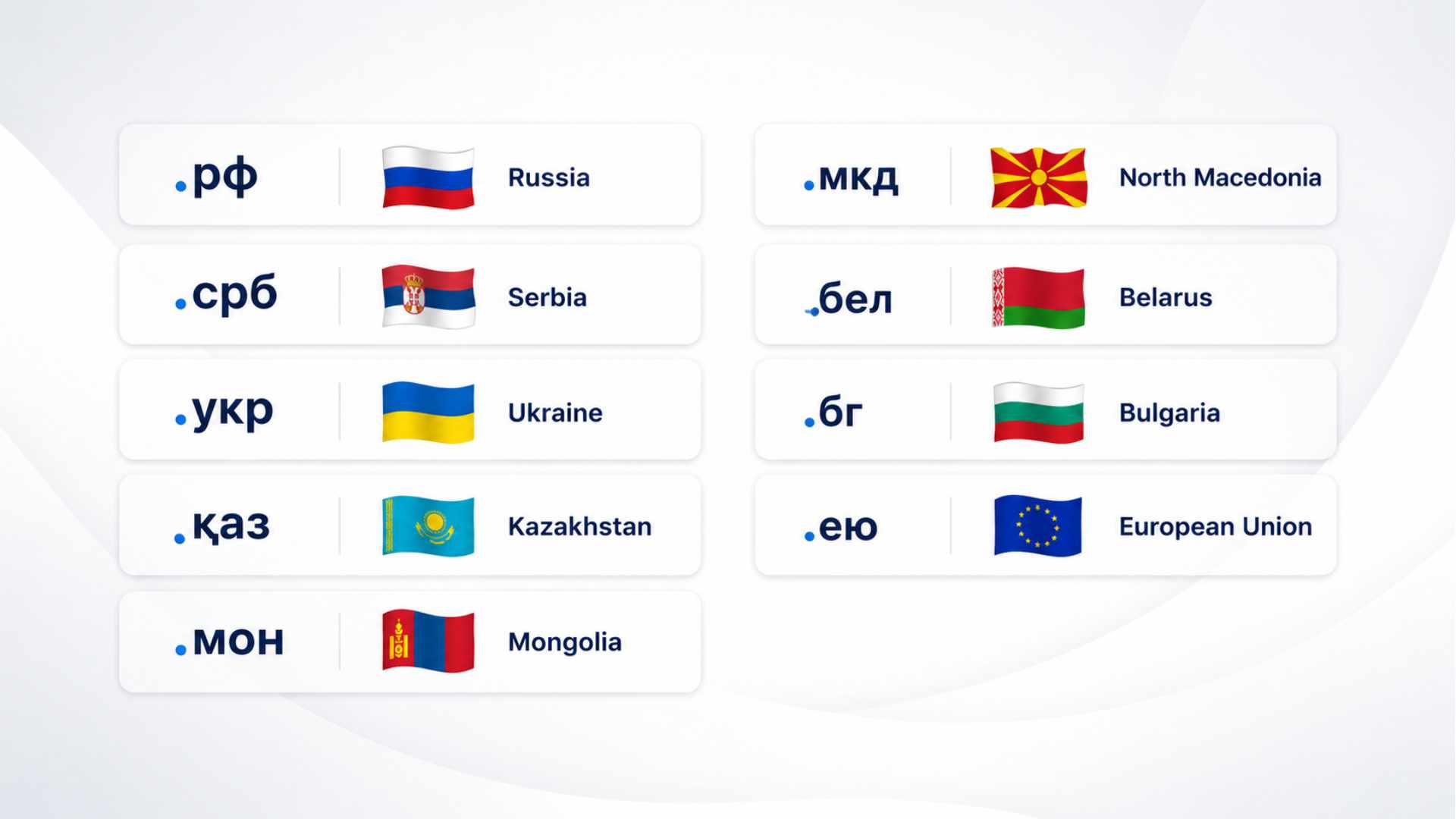
Russia was first. The .рф ending, encoded as xn--p1ai, became operational on 13 May 2010, the first Cyrillic implementation of the internationalized domain system and the first non-Arabic, non-Latin country-code domain to go live. The letters рф stand for Российская Федерация, the Russian Federation. Serbia followed as the second Cyrillic country to obtain its ending, .срб, active from 2011 with public registration opening in early 2012. Ukraine secured .укр, approved by ICANN’s board in February 2013 and added to the root in March of that year. Kazakhstan obtained .қаз and Mongolia received .мон, both using Cyrillic letters specific to those languages. North Macedonia gained .мкд in early 2014, and Belarus launched .бел on 1 March 2014. Bulgaria’s .бг was approved in 2014 after years of rejection and launched in 2016. The European Union’s Cyrillic variant, .ею, was also delegated, extending the EU’s identity into the script used by its Bulgarian members.
Cyrillic country-code endings and their encoded forms
| Ending | Country or region | Encoded (A-label) | Live since |
|---|---|---|---|
| .рф | Russia | xn--p1ai | 2010 |
| .срб | Serbia | xn--90a3ac | 2011 |
| .укр | Ukraine | xn--j1amh | 2013 |
| .қаз | Kazakhstan | xn--80ao21a | 2013 |
| .мон | Mongolia | xn--l1acc | 2013 |
| .мкд | North Macedonia | xn--d1alf | 2014 |
| .бел | Belarus | xn--90ais | 2014 |
| .бг | Bulgaria | xn--90ae | 2016 |
| .ею | European Union | xn--e1a4c | delegated |
The encoded forms in the table are the strings these endings actually take inside the DNS, and they are worth keeping visible because tooling, logs, and certificate systems often surface them rather than the readable Cyrillic.
A pattern runs through this list. The endings that struggled most were the ones whose letters mirror Latin characters. Bulgaria’s .бг was rejected twice before approval because the letter combination resembles Brazil’s .br to a reader who does not know Cyrillic. Serbia’s .срб, by contrast, moved through more smoothly even though it also contains characters with Latin look-alikes, partly because the string as a whole was judged less confusable. The governing principle in the approval process is that a Cyrillic two-character ending should not consist exclusively of letters that could be mistaken for Latin ones, which is why direct transliterations of “ru” into Cyrillic were avoided for Russia in favor of the abbreviation рф. The rules treat visual confusion as a security and stability question, not merely an aesthetic one, because an ending that looks like another country’s could be used to mislead.
It is also worth noting what is absent. Several countries that use Cyrillic have never pursued a Cyrillic ending, and some that could have chosen direct transliterations chose abbreviations or distinctive strings instead, specifically to clear the confusion bar. The result is a map that reflects negotiation and compromise rather than a tidy one-to-one correspondence between countries and scripts. Every country with a Cyrillic ending also keeps its traditional Latin two-letter code, so Russia has both .рф and .ru, Serbia has .срб and .rs, Ukraine has .укр and .ua, and Bulgaria has .бг and .bg. The Cyrillic and Latin versions are independent zones with no automatic mapping between them, which means owning the Latin name does not give you the Cyrillic one or vice versa. That independence has direct consequences for brand protection, because a company that secures only the Latin version leaves the Cyrillic equivalent open for someone else to register.
.рф and the Russian experiment that proved the model
If any single domain demonstrated that a Cyrillic ending could work at scale, it is .рф. The launch in 2010 was watched closely because it was the first test of whether a large, motivated, single-script audience would adopt addresses in their own alphabet. The early signal was dramatic. The zone reached around 700,000 registered names within roughly two months of opening, an uptake that immediately placed it among the largest national domains in Europe. That surge was partly a land rush, with trademark holders, media organizations, and speculators racing to claim names during the structured sunrise and priority periods, but it established .рф as a serious zone rather than a symbolic gesture.
Fifteen years later the picture is one of steady maturity rather than explosive growth. By the end of 2025 the .рф zone held 778,902 registered domains, an increase of 18,740 names or about 2.5 percent over the year. That keeps it the largest internationalized country-code domain in the world. The composition of the zone tells its own story. Around 96 percent of .рф registrations belong to Russian entities and individuals, and roughly 82 percent are held by individuals rather than companies, which points to a domain used for personal sites, small projects, and local identity as much as corporate presence. The zone is served by 185 accredited registrars and more than 341,000 distinct administrators, and registration is heavily concentrated in Moscow, the Moscow region, and St. Petersburg, mirroring the geography of Russian internet activity generally.
The contrast with Russia’s Latin domain is instructive. The .ru zone passed 6 million registered names in October 2025, roughly ten years after it crossed 5 million, and it ranks among the largest country-code domains globally, behind Germany’s .de, China’s .cn, the United Kingdom’s .uk, and the Netherlands’ .nl. So .ru is several times larger than .рф and grows on its own track. The two are not competitors so much as complements. The Latin domain carries the bulk of commercial and technical infrastructure, while the Cyrillic domain serves a specific role centered on readability and local resonance. The Coordination Center that administers both treats .рф as a strategic asset for the Russian-language internet rather than a Latin replacement, and the registration data supports that framing.
Why did .рф succeed where the broader IDN category stalled? The conditions were close to ideal. Russia has a very large population that reads Cyrillic as its primary and often only script, a strong domestic internet sector, a search engine in Yandex that handles Cyrillic natively, and a registry willing to invest in promotion and security. The argument for a Cyrillic address is strongest exactly where a Latin one imposes a real cost: a reader who does not use the Latin keyboard layout fluently can recall and type a Cyrillic name far faster than its transliterated equivalent. In a market where that describes a large share of users, the memorability advantage is concrete rather than sentimental. The same logic explains why the model travels poorly to markets where the audience switches between scripts comfortably, because the cost a Cyrillic address removes is smaller there.
The Russian case also exposes the limits that come bundled with the benefits. The encoded form still surfaces in many off-domain contexts, the email situation remains imperfect, and the zone’s growth has settled into low single digits even in the most favorable possible market. If the most committed, best-resourced Cyrillic audience in the world produces a zone that grows 2.5 percent a year and sits below 800,000 names against a Latin sibling above 6 million, that ratio is the clearest available measure of where Cyrillic endings fit. They are valuable, they are durable, and they are a complement rather than a replacement. Every other Cyrillic ending operates in conditions less favorable than Russia’s, which makes .рф both the proof of concept and the ceiling.
Serbia, Ukraine, and the smaller Cyrillic registries
Beyond Russia, the Cyrillic endings live very different lives, and their registration volumes are far smaller. Serbia’s .срб is administered by the Serbian National Internet Domain Registry Foundation, known as RNIDS, which also runs the Latin .rs domain. RNIDS made a point of building the Cyrillic zone carefully, reserving names that matched existing .rs registrations and names needed by the state, then opening general registration through accredited registrars. The Serbian registry frames national domains, both Latin and Cyrillic, as the natural first choice for local businesses because they signal the market a company serves, carry a low rate of abuse, and come with local dispute-resolution mechanisms. In practice .rs dominates and .срб occupies a smaller, identity-driven niche, the same split visible in Russia but on a much smaller base.
Ukraine’s .укр has a particular weight given the country’s linguistic politics, where the choice of Cyrillic script and Ukrainian language carries meaning beyond the technical. The ending was approved in 2013 and added to the root the same year. Adoption has been modest, constrained by the same forces that limit Cyrillic everywhere, and by a Ukrainian market that has historically leaned heavily on .ua and .com.ua for commercial use. Cyrillic domains in Ukraine sit at the intersection of national identity and practical reach, and the practical side has generally won for businesses that need to operate internationally or that worry about how an encoded address looks to partners abroad.
Kazakhstan’s .қаз and Mongolia’s .мон are notable for using Cyrillic letters specific to those languages rather than the Russian repertoire, which is why they fall outside the European Cyrillic guideline and were treated as separate cases. Kazakhstan presents an additional wrinkle, because the country has been moving its Kazakh language toward a Latin-based alphabet over a multi-year transition. That policy direction sits awkwardly with a Cyrillic ending, and it illustrates how a country’s script politics can undercut the long-term logic of a Cyrillic domain even after the ending exists. Mongolia uses Cyrillic for the Mongolian language inside the country, alongside the traditional Mongolian script, and the ending reflects that everyday reality.
North Macedonia’s .мкд and Belarus’s .бел round out the European Cyrillic set, both launched in 2014 and both small. Belarus is a bilingual environment where Russian dominates online, so the Belarusian Cyrillic ending competes not only with Latin domains but with the gravitational pull of the much larger Russian-language internet next door. Across all of these smaller registries, a consistent lesson emerges. The ending existing is not the same as the ending being used. Delegation is a one-time event driven by national policy and pride. Sustained registration depends on a population that reads the script as its default, a local search engine that handles it well, and an economy where the memorability gain outweighs the friction, and most of these markets have only some of those ingredients.
The combined effect is a long tail. Russia’s zone accounts for the overwhelming majority of all Cyrillic country-code registrations, and the remaining endings together hold a fraction of that. For a business operating in Serbia, Ukraine, Bulgaria, or the smaller markets, the decision to register a Cyrillic name is rarely about reach and almost always about a specific local-trust or brand-protection goal, with the Latin domain doing the heavy lifting. That is a reasonable use, but it is a narrow one, and treating these endings as a primary growth channel mistakes their actual role.
Bulgaria’s long fight for .бг and the string-similarity problem
No Cyrillic ending illustrates the politics of the approval process better than Bulgaria’s .бг. The string is the natural Cyrillic equivalent of Bulgaria’s Latin .bg, and Bulgaria has a strong claim to Cyrillic as a matter of heritage, since the script took early hold in the medieval Bulgarian state. Yet the application was rejected twice, in 2009 and again in 2010, on the ground that .бг looked confusingly similar to Brazil’s .br. To a reader fluent only in Latin, the Cyrillic letter г can read like a Latin “r,” producing a string that resembles “br.” Brazil’s government supported the rejection, arguing that any graphic confusion could facilitate phishing.
The Bulgarian case became a focal point for a deeper criticism of how ICANN judges similarity. Critics argued that the evaluation looked at strings in isolation rather than in context. A person who reads Cyrillic does not confuse г with a Latin “r,” and the letter б in Bulgarian usage looks closer to the numeral 6 than to a Latin “b.” More to the point, a fully Cyrillic ending can only host fully Cyrillic second-level names under the registry’s own rules, so the realistic confusable space is much narrower than a raw character comparison suggests. A phishing domain that needs to impersonate a Brazilian Latin brand gains nothing from a Cyrillic ending that forces Cyrillic names. The objection was that the process penalized a legitimate national string for a theoretical resemblance that would not survive contact with how the ending is actually used.
After years of negotiation, .бг was approved in 2014 and launched in 2016, and the episode left a lasting mark on the rules. ICANN’s similarity evaluation drew sustained criticism for appearing to favor some applicants and delay others without a transparent, context-aware standard. The same dynamic caught Greece’s proposed .ελ and the European Union’s Greek variant .ευ, both held up over resemblance to existing Latin strings, with .ευ eventually approved only on the condition that the same registry control both it and .eu and prevent equivalent second-level names from existing in both. The pattern showed that a country could be blocked from its own script for years by a look-alike argument, even one many specialists considered weak.
The string-similarity problem has not gone away, and it remains live. In November 2025 ICANN sought public input on updated string-similarity evaluation guidelines for the 2026 round of its new generic top-level domain program, a sign that the tension between expanding the multilingual internet and preventing confusion is still being negotiated rather than settled. The underlying difficulty is real. Visual confusion across scripts is a genuine security concern, and a permissive approach at the root could create endings that mislead at scale. But an overly strict, context-blind approach denies legitimate scripts their place and slows the multilingual internet that the same institutions say they want. Bulgaria’s decade-long wait for four Cyrillic letters is the cautionary example, and it shaped how seriously registries now take the difference between a character that merely looks similar and one that creates a usable deception.
The European Union’s Cyrillic .ею and the homoglyph bundle
The European Union sits in an unusual position, because it operates across three scripts at once. Most EU languages use Latin, Greece uses Greek, and Bulgaria uses Cyrillic, and with Bulgaria’s accession in 2007 Cyrillic became the third official script of the Union. The registry EURid, which manages the .eu domain, therefore manages three top-level endings that are meant to represent the same entity: .eu in Latin, .ευ in Greek, and .ею in Cyrillic. This is not a vanity exercise. It is a structural acknowledgment that a single political entity can have a legitimate presence in multiple scripts, and it forced EURid to confront the cross-script confusion problem more directly than a single-script registry ever has to.
EURid’s solution centers on two firm rules. The script of a second-level name must match the script of the ending. A Cyrillic name registers under .ею, a Greek name under .ευ, and a Latin name under .eu, with no mixing across the boundary. This eliminates the most dangerous configurations before they can exist. The second rule addresses the subtler danger of names that look identical across scripts. EURid groups visually equivalent names into what it calls a homoglyph bundle, so that a name and its look-alikes across scripts are linked and cannot be registered by different parties to deceive. If one party holds a name, the confusable equivalents in the bundle are reserved rather than left open for an impostor.
The .ευ Greek case shows how seriously the institutions treat this. The Greek variant was initially rejected as too similar to the Latin .eu, and it was only approved later on the explicit condition that EURid own both endings and guarantee that equal or equal-looking second-level names could not exist independently in both. That condition is essentially a homoglyph-bundle rule applied at the level of entire endings. The lesson EURid demonstrates is that cross-script confusion is manageable, but only through deliberate registry policy, not through any property of the scripts themselves. Left to a permissive global default, Cyrillic and Latin and Greek names that look alike would be a phishing resource. Bound by matching-script rules and homoglyph bundles, they coexist safely.
For a Bulgarian business, .ею is available as a pan-European Cyrillic identity, but its adoption has been minimal, dwarfed by both the Latin .eu and Bulgaria’s national .бг. The broader significance of the EU’s three-script arrangement is as a working model. It proves that a registry can offer Cyrillic alongside Latin without creating a security mess, and it documents exactly which policies are required to do so. Any registry weighing Cyrillic support, and any business assessing the risk of a Cyrillic name, can look at EURid’s rules as the reference standard for what responsible cross-script administration looks like.
Generic Cyrillic endings beyond the country codes
Cyrillic is not confined to country-code endings. The expansion of generic top-level domains created room for Cyrillic generic endings as well, and a handful exist. The familiar generics .org and .com have Cyrillic forms, .орг and .ком, created so that an organization or commercial entity could present a fully Cyrillic address without a national ending. Russia’s registry community also secured .дети, a Cyrillic generic ending meaning “children,” intended for content aimed at younger users, and the city of Moscow obtained .москва as a geographic Cyrillic ending alongside the Latin .moscow. These sit in the generic space rather than the country-code space, which means they are governed by ICANN’s contracts with their registry operators rather than by national registries.
These endings matter less for volume than for what they reveal about the category’s health. Branded and niche generic endings have been the main source of decline in the internationalized domain count. The total number of internationalized top-level domains worldwide fell to 142 by the end of 2025, eighteen fewer than the year before, and that drop came largely from branded domains being retired rather than from country-code endings disappearing. A company that once ran its own internationalized branded ending and then wound it down subtracts from the count, and several did exactly that as the new-gTLD experiment matured and many branded endings proved not worth maintaining.
For a business, the practical relevance of Cyrillic generics is narrow. A Cyrillic .ком or .орг address carries the same readability benefit and the same friction as a Cyrillic country-code address, with the added drawback that these endings are less recognized than the national ones. A Russian audience knows .рф instinctively; far fewer recognize .ком. An ending that the audience does not recognize undercuts the entire memorability rationale, because a name is only easy to recall if the ending is familiar enough to feel like a real address. Geographic endings like .москва have a clearer logic for genuinely local, city-focused projects, but even there the Latin equivalents and the national .рф tend to win on familiarity. The generic Cyrillic endings exist, they work technically, and they occupy a corner of the market that most projects can reasonably skip.
Inside the browser when a Cyrillic name is typed
The moment a person types a Cyrillic address into a browser, a short sequence of well-defined steps runs before any network traffic leaves the machine. Understanding that sequence explains why the same name can appear as clean Cyrillic in the address bar or as a string of encoded characters, sometimes in the same browser depending on the ending. The browser is not being arbitrary. It is applying a chain of validation and display rules, and each rule has a security purpose.
The first step is validation against the IDNA rules. The browser checks every character in each label against the allowed, disallowed, and contextual classifications, applying additional constraints such as the bidirectional rules that govern right-to-left scripts. Cyrillic is left-to-right, so the bidirectional rules rarely bite, but the character-validity checks do. A label that contains a disallowed character, or a character used in a forbidden position, fails this stage. The second step is Punycode encoding. Any label containing non-ASCII characters is run through the encoding algorithm, while pure-ASCII labels pass through untouched, and the encoded labels receive the xn-- prefix. The Cyrillic ending .рф becomes xn--p1ai, the Cyrillic second-level name becomes its own encoded label, and the assembled ASCII string is what the browser will actually resolve.
The third step is the DNS lookup itself, which is utterly ordinary. The resolver sees a normal ASCII domain and has no idea it represents Cyrillic. It returns an address, the connection proceeds, and from the network’s point of view nothing unusual has happened. All the intelligence about scripts lives in the browser, before and after the lookup, never in the DNS. This separation is the entire architectural premise of internationalized domains: keep the global infrastructure ASCII-only and forever stable, and push all the script handling into the applications at the edges.
The fourth step is where the visible inconsistency comes from: the display decision. After resolving the name, the browser must decide whether to show the user the native Cyrillic characters or the encoded xn-- form. This is a security choice, not a technical necessity, and every major browser makes it through a policy designed to balance two goals that pull in opposite directions. On one side, billions of people do not read Latin and deserve to see addresses in their own script, so showing encoded gibberish to legitimate local users would make the browser feel broken and punish exactly the populations internationalized domains exist to serve. On the other side, the visual similarity between Cyrillic and Latin letters can be weaponized to impersonate trusted sites, so showing native characters indiscriminately would help attackers.
The browsers resolve this through a set of tests applied to each label separately. A label that draws characters from a single, consistent script and follows the rules is generally shown in its native form. A label that mixes scripts in a suspicious way, or that consists entirely of characters chosen to imitate Latin letters under an ending that does not belong to that script, is shown as encoded text instead. The exact tests differ between browsers, but the shared logic is that a fully Cyrillic name under a Cyrillic ending is treated as legitimate and displayed in Cyrillic, because the combination of consistent script and matching ending signals a genuine local address rather than an impersonation. This is the single most important reason to keep Cyrillic names paired with Cyrillic endings: it is the configuration the display rules trust.
The practical takeaway for anyone running a Cyrillic site is that the address bar is reliable for the safe configurations and unforgiving for the risky ones. A name like магазин.рф will show as Cyrillic across modern browsers because it satisfies every test. A Cyrillic name jammed under .com, or a name that mixes a Latin word with a Cyrillic letter, risks being displayed as xn-- text precisely because the browser cannot rule out deception. The browser’s display rules are not an obstacle to using Cyrillic domains well; they are a map of which configurations are safe. Building inside the safe configurations means the native characters appear as intended, and stepping outside them means accepting that some users, in some browsers, will see encoded text.
The homograph attack and the аррӏе.com problem
The security risk that shadows every conversation about Cyrillic domains has a name: the homograph attack, sometimes called a homoglyph or script-spoofing attack. The mechanism is simple and depends on a fact of Unicode. Many scripts contain characters that are visually identical, or nearly so, to characters in other scripts, yet occupy different code points and are entirely different characters to a computer. The Latin “a,” the Cyrillic “а,” and the Greek “α” can look the same on screen while being three distinct entities. An attacker can register a domain that looks identical to a trusted one but is built from look-alike characters from another script, and a victim has almost no way to spot the substitution by eye.
The threat was anticipated early. In December 2001, two researchers at the Technion in Israel, Evgeniy Gabrilovich and Alex Gontmakher, published a paper describing exactly this attack and demonstrated it by registering a version of microsoft.com that used Cyrillic characters. The danger moved from theory to public alarm in February 2005, when Eric Johanson demonstrated at a hacker conference that browsers of the day would render a spoofed PayPal address, with the Latin “a” replaced by a Cyrillic one, as the genuine paypal.com. Internet Explorer was unaffected, but only because it did not support internationalized domains at all. The browsers that did support them responded with a patchwork of defenses, including allowlists of endings whose registries enforced anti-spoofing rules.
For a few years the problem seemed contained, until a researcher named Xudong Zheng reopened it in April 2017. He registered the domain аррӏе.com, encoded as xn--80ak6aa92e.com, in which every visible character was Cyrillic but the whole string read as “apple.com” in Chrome, Firefox, and Opera. The attack worked because the name used only Cyrillic characters, making it a single-script label rather than a mixed one. The defenses browsers had relied on since 2005 were built to catch labels that mixed scripts, where a single foreign character sits among Latin ones. A label that is entirely Cyrillic but composed only of letters that imitate Latin sailed straight past that mixed-script detection. This is the whole-script confusable problem, and it is the hardest version of the homograph attack to defeat, because there is no script mixing to flag.
The defenses since then have focused on two ideas. First, browsers test whether all the letters in a label come from a set of whole-script-confusable characters, and if so, whether the ending belongs to that script. The Cyrillic letters that imitate Latin form a known set: the letters that look like a, e, o, p, c, y, and x are the usual suspects, and a label built only from such letters under a non-Cyrillic ending is treated as dangerous. Second, browsers compare a name against a list of frequently impersonated domains using a “skeleton” that strips away the differences between look-alike characters, so a name whose skeleton matches a major brand triggers the encoded display. These mechanisms are imperfect, because the list of top domains cannot cover everything and checking visual similarity against hundreds of millions of registered names in real time is costly, but they raised the bar considerably.
A hard limit remains, and it is the one every Cyrillic site owner should understand. The browser defenses only operate inside the browser. A homograph URL distributed through email, a messaging app, a social network, or a document is not filtered by the browser’s display rules until the moment it is clicked, by which point the page may already be loading. Even when the address bar then reveals the encoded form, the attack has had its opening. This is why the homograph problem is treated as a phishing and authentication problem as much as a domain problem, and why the standard defenses extend well beyond the browser, into email authentication, password managers that refuse to autofill on the wrong domain, and the registry rules that aim to stop the malicious name from being registered at all. The risk is real, it is well understood, and it is the reason Cyrillic under a Latin ending carries a stigma that Cyrillic under a Cyrillic ending does not.
Chrome, Firefox, and Safari each draw the line differently
The browsers agree on the goal of balancing usability against spoofing, but they reach it through policies that differ in the details, and those differences explain why a borderline Cyrillic name can display natively in one browser and as encoded text in another. Knowing how the major engines behave is practical knowledge for anyone deploying a Cyrillic site, because the display experience is part of how the brand lands.
Chrome decides script by script, label by label. It converts each label to Unicode under the compatibility-processing rules, then runs a series of checks. If a character is not allowed under the Unicode identifier rules, the label is shown encoded. If a label mixes scripts, it is subjected to a restrictive profile that, among other things, forbids combining Latin with Cyrillic or Greek in the same label, while permitting Latin to combine only with the East Asian scripts where such mixing is common and benign. If a label is a whole-script confusable, Chrome checks whether the ending belongs to a script known to host large numbers of that script’s domains, and if not, it shows the encoded form. Chrome tightened these rules significantly in version 59, the release that responded to the whole-script confusable demonstration, and it maintains a notion of endings associated with Cyrillic, such as the Russian and Ukrainian endings, so that legitimate Cyrillic names under those endings display natively while the same characters under .com do not.
Firefox applies a restrictive Unicode profile and an ending allowlist. Latin mixed with Cyrillic or Greek is never permitted in a single label, and the browser maintains a list of endings whose registries enforce anti-homograph policies, granting those endings more permissive native display. Firefox also exposes a setting, reachable through its configuration interface, that forces every internationalized name to appear in its encoded form. A security-conscious user who switches that setting on will see xn-- strings for all Cyrillic domains, legitimate ones included, which is a blunt but effective personal defense. The existence of that toggle is a reminder that the browser’s default is a compromise, and that some users deliberately trade readability for certainty.
Safari is the most conservative of the major browsers. Apple maintains an allowlist of scripts that do not contain Latin-confusable characters and tends to display Cyrillic, Greek, and certain other scripts as encoded text on endings that do not match the script. Apple’s stated reasoning is a deliberate trade-off: it would rather occasionally show an ugly encoded string for a legitimate Cyrillic domain than risk letting a phishing domain through. This is why Safari was never vulnerable to the 2017 whole-script demonstration in the way the other browsers were. Edge inherited Chrome’s policy when it adopted the Chromium engine in 2020, so the two now behave essentially alike, which consolidated a large share of the browser market under a single approach.
The cumulative picture is that the safe configuration displays consistently everywhere and the risky configuration displays inconsistently or not at all. A Cyrillic name under a Cyrillic ending is shown natively across Chrome, Edge, Firefox, and Safari, because every engine recognizes the matching-script combination as legitimate. The same Cyrillic characters under a Latin ending may show natively in some browsers, as encoded text in others, and as encoded text for any user who has hardened their settings. For a business, this argues for two habits. Test the actual address in all the major browsers before committing to it, because the experience is not uniform. And stay inside the matching-script configuration, because it is the only one that every browser displays the way the owner intends. The browsers are not adversaries here; they are enforcing the boundary between names that are safe to show and names that might deceive, and building inside that boundary is simply building on solid ground.
Registry rules that contain the spoofing risk
Browsers are the last line of defense against homograph attacks, but they are not the first. The first is the registry, the organization that decides which names can be registered under an ending at all. A well-run registry can prevent most spoofing names from ever existing, which is far more effective than catching them at display time, and the difference in registry discipline is the main reason Cyrillic behaves so much better under national endings than under permissive global ones.
The core technique is character restriction. A registry that only accepts characters from a defined script, and refuses the rest of Unicode, eliminates the cross-script mixing that makes most homograph attacks possible. Russia’s registry accepts only Cyrillic second-level names under .рф. Serbia does the same under .срб. The European Union enforces script-matching under .ею. These single-script policies are the reason a fully Cyrillic country-code name is structurally safer than a Cyrillic name under .com, where the global registry historically allowed a much wider character range and could not lean on any one script’s rules. The early guidance to registries was explicit: accept characters only from the Latin alphabet and the registry’s own national script, not all of Unicode. The national Cyrillic registries followed that advice; some large generic registries did not, and the homograph problem concentrated exactly where the advice was ignored.
The second technique is variant management, the practice of treating visually equivalent names as a linked group. The Cyrillic-specific registration guideline, RFC 5992, was written precisely to help registries handle the look-alike characters that Cyrillic shares with Greek and Latin. A registry that implements variant rules can reserve the confusable equivalents of a registered name so they cannot be claimed by an impostor, the same homoglyph-bundle logic EURid applies. ICANN supports this through machine-readable label-generation rulesets that encode, for each script, which characters are permitted and how variants relate, giving registries a shared technical basis rather than leaving each to invent its own. Variant management turns a potential attack surface into reserved, inert names.
The third technique is active monitoring and takedown. Russia’s registry runs a program that identifies and blocks malicious names, and in 2025 that effort blocked 60,789 malicious domains across the .RU and .РФ zones, with the registry reporting that phishing activity on the Russian internet declined for the first time in recent years as a result. This is the unglamorous, continuous work that keeps a zone trustworthy, and it complements the structural defenses of character restriction and variant management. A registry that combines all three, restricting characters, managing variants, and actively removing abuse, produces a zone where the homograph risk is contained at the source.
The implication for a business is reassuring as far as it goes. Under a disciplined national Cyrillic ending, the spoofing risk is largely a solved problem, because the registry will not let the dangerous names exist and will remove the ones that slip through. The residual risk lives almost entirely under permissive endings and in the off-browser channels where no display rule applies. That residual risk is real and worth defending against through email authentication and brand monitoring, but it should not be confused with the structural safety of a well-governed Cyrillic country-code zone, which is genuine.
Google treats Punycode and Unicode as the same address
A persistent worry among site owners is that a Cyrillic domain will rank worse than a Latin one, that search engines will treat the encoded form as somehow inferior or penalize the unfamiliar characters. On the Google side, this worry is largely unfounded, and the reason is a clear, long-standing position. Google considers the Punycode form of a hostname to have the same significance as the native form. To Google’s systems, сайт.рф and xn--80aswg.xn--p1ai are the same address, and the encoded representation carries no penalty and confers no advantage. The domain is evaluated on the same signals as any other.
Google’s own guidance for international sites states plainly that using an internationalized domain name is fine, with one important technical caveat: use UTF-8 encoding in the URL, and escape URLs properly when linking to them. This matters because a Cyrillic domain often comes with Cyrillic paths and query strings, and those parts of the URL need correct UTF-8 handling to be crawled and indexed reliably. The domain label is handled through Punycode automatically, but the rest of the URL is the site owner’s responsibility, and mishandled encoding in the path is a more common cause of indexing trouble than anything about the Cyrillic domain itself.
Beyond the neutral treatment of the encoding, Google’s general approach to international targeting applies in the usual way. A country-code ending is a strong geo-targeting signal. A .рф domain tells Google, as clearly as .ru or .de does, that the site is intended for a specific national audience. That signal can lift rankings in the target market while reducing visibility elsewhere, which is exactly what a locally focused Cyrillic site usually wants. The other signals Google weighs, including server location, local language content, local addresses and phone numbers, and links from other local sites, all stack on top of the ending. None of these are unique to Cyrillic; they are the standard international SEO toolkit, and a Cyrillic site benefits from them the same way a Latin one does.
Where Cyrillic intersects with a specific Google mechanism is the exact-match consideration. Historically, search engines gave a ranking nudge to domains that exactly matched a search query, and there was a period when internationalized domains did not receive that nudge because the engine effectively saw the encoded form. That has changed. Google now extends the benefit of an exact-match domain to internationalized names, treating the native characters as the real match, which opened a range of possibilities for languages whose words rely on non-Latin characters. The practical weight of exact-match domains has declined across the board, so this is a minor factor rather than a reason to choose a Cyrillic name, but it is no longer a disadvantage.
The honest framing is that Google neither rewards nor punishes a Cyrillic domain for being Cyrillic. It ranks the site on content, links, technical health, and relevance, and it reads the ending as a geo signal. The indirect argument that a Cyrillic name helps SEO runs through user behavior rather than any direct ranking factor: if a local audience trusts and remembers a Cyrillic address, they may click it more readily and engage with the site longer, and those behavioral signals can feed back into performance. That is a real but second-order effect, and it depends entirely on the audience genuinely preferring the Cyrillic form. For an audience that does not, the same name produces no behavioral lift and adds the friction of the encoding surfacing off-site. The domain choice is close to neutral for Google’s algorithms, which means the decision should rest on the audience and the brand, not on a hoped-for ranking edge that does not exist.
Yandex, the CIS market, and Cyrillic in practice
For sites targeting Russia and the wider Russian-speaking world, Google is only part of the search picture, and often not the larger part. Yandex holds roughly 65 percent of the Russian search market and significant shares in Belarus, Kazakhstan, Ukraine, and other post-Soviet markets, reaching a Russian-speaking audience numbering in the hundreds of millions. Any serious assessment of how a Cyrillic domain performs in search has to account for Yandex, and Yandex’s relationship with Cyrillic is fundamentally more native than Google’s.
On the core question, Yandex is unambiguous. It crawls and indexes Cyrillic domains and Cyrillic URLs without issue, and it gives no ranking preference to either Cyrillic or Latin. The Yandex search team has stated directly that the engine does not favor one script over the other in the address, while recommending clear, human-readable URLs as a general practice. So a Cyrillic domain is not penalized in Yandex any more than in Google, and the engine handles the encoded and native forms interchangeably. Where Yandex differs is in depth of language understanding. The engine was built around Russian, and it handles Cyrillic morphology, the complex declensions and inflections of Slavic languages, and local cultural context with a sophistication that general-purpose engines do not match. For a Russian-language site, that linguistic depth is a meaningful advantage in being understood and ranked well.
The geo-targeting picture also differs in an operationally important way. Google infers regional relevance from passive signals like the ending, links, and language. Yandex expects an explicit declaration. Through Yandex Webmaster, a site owner binds a domain, or specific sections of it, to particular cities, regions, or countries. A multi-region business cannot rely on a single undifferentiated site to rank across territories in Yandex; the platform’s guidance favors distinct subdomains or, preferably, dedicated subdirectories for each region. A national ending like .рф reinforces the Russian focus, but the explicit regional binding in Yandex Webmaster does the heavier lifting, and skipping it leaves performance on the table regardless of how Cyrillic the domain is.
Yandex’s crawling behavior is its own discipline. It crawls more conservatively and less frequently than Google, which means new content can wait days or weeks to appear in the index unless the owner takes active steps. Yandex has championed the IndexNow protocol, developed with Microsoft’s Bing, which lets a site push notifications of new and updated pages rather than waiting to be crawled, and it offers Turbo Pages, lightweight fast-loading page versions, to improve mobile performance. Yandex Webmaster and Yandex Metrica are the essential tools for monitoring indexing health and engagement, with Metrica providing behavioral data, heatmaps, and session insights comparable to or beyond the Western equivalents. For a Cyrillic site, getting indexed in Yandex is a more deliberate process than in Google, and the domain’s script is the least of the work involved.
The strategic conclusion for the CIS market is that a Cyrillic domain and Yandex are well matched, but the matching is about the audience and the language, not the script in the address bar. Yandex rewards native-quality Russian content, local trust signals, explicit regional targeting, and clean technical setup. A Cyrillic ending fits naturally into that environment and reinforces the local signal, while carrying no ranking cost. But it earns its place through the audience’s genuine preference for a readable local address, not through any favor from the algorithm, and a Latin .ru domain with the same content and setup would rank on the same terms. For Russian-speaking markets, the case for Cyrillic rests on the people, and Yandex simply does not stand in the way.
The exact-match domain question for Cyrillic names
The exact-match domain, where the domain name is the same as the search term people use, was once a powerful SEO tactic and is now a faded one, but it has a specific twist for Cyrillic that is worth untangling. In the early years of internationalized domains, an exact-match Cyrillic name did not capture the benefit that an exact-match Latin name did, because search engines effectively processed the encoded form and the native characters did not register as the match. A name that perfectly matched a Cyrillic keyword was treated as if it were the encoded string, which read like nonsense and matched nothing. That gap put Cyrillic names at a disadvantage that had nothing to do with their quality and everything to do with how engines processed them.
That disadvantage has closed. Modern search engines extend exact-match recognition to internationalized names, treating the native Cyrillic characters as the genuine string for matching purposes. A Cyrillic name that matches a Cyrillic query now receives the same consideration as a Latin name matching a Latin query. For languages built on non-Latin characters, this effectively opened a whole category of exact-match names that had previously been inaccessible, because the words people search for are written in those characters and only a same-script domain can match them precisely.
The catch is that the prize shrank as the door opened. Search engines deliberately reduced the weight of exact-match domains years ago, after the tactic was abused to rank thin, low-value sites purely on a keyword-stuffed domain name. An exact-match domain today is a faint signal at best, easily overwhelmed by content quality, links, and relevance. So the Cyrillic exact-match opportunity is real but small. It is no longer a disadvantage, which removes a historical objection to Cyrillic names, but it is not a reason to choose one either. A business should not register магазин.рф in the hope that matching the word “магазин” will lift its rankings, because that lift is negligible.
The more durable point underneath the exact-match question is about semantic relevance rather than literal matching. Both Google and Yandex have moved decisively toward understanding meaning, entities, and intent rather than rewarding literal keyword presence, in the domain or anywhere else. A Cyrillic domain that happens to contain a relevant word gains little from the word itself. What helps is the surrounding signals: content that genuinely serves the query, a clear topical focus, authoritative links, and a structure search engines can read. A Cyrillic name participates in all of that on equal footing, but it does so as an ordinary domain, not as a keyword shortcut. The exact-match era is over for every script, and Cyrillic arrived at the party just as it was ending, which is a fittingly modest place for the consideration to occupy.
Email is where Cyrillic domains still break
If a single practical issue undermines Cyrillic domains more than any other, it is email. More than a decade after the relevant standard was finished, sending and receiving mail on a fully Cyrillic address remains unreliable, and this is the weak point that turns many otherwise sound Cyrillic plans into a partial deployment. The domain can resolve perfectly in a browser and still fail as the home of an email address, and the failure is silent and frustrating.
The standard exists. Email Address Internationalization, known as EAI, was standardized in 2012 and allows non-ASCII characters in either part of an email address: the domain after the @ sign, the mailbox name before it, or both. An address like почта@пример.рф is valid under EAI, with Cyrillic on both sides of the @. The problem is not the standard but its adoption across the sprawling, decentralized world of email servers, clients, web forms, and the countless systems that validate and store email addresses. Email passes through far more independent pieces of software than a web request does, and every one of them has to support EAI for the address to work end to end. Many do not.
The numbers are sobering. An ICANN review found that only around 29 percent of email servers operating on generic-domain names support internationalized email addresses. That means a Cyrillic email address sent to a randomly chosen recipient has a substantial chance of hitting a server somewhere in the path that cannot handle it, and the message bounces or vanishes. Web forms compound the problem, because a great many of them validate email addresses against rules that assume ASCII and reject anything with non-Latin characters as malformed. A customer trying to enter a Cyrillic email address into a form may simply be told it is invalid, which is a poor experience and a lost conversion. The chain is only as strong as its weakest link, and email has many links.
The recommended workaround is aliasing with an ASCII fallback. Rather than downgrading a Cyrillic address by converting it to its encoded form, which produces an unusable-looking xn-- address, the better practice is to provide an ASCII alias alongside the internationalized address, so mail can flow through the ASCII route when a system in the path cannot handle EAI. Even ICANN, which added internationalized email support to its own account system in July 2025 as a demonstration, still requires every user to supply a secondary ASCII address for exactly this reason: to maintain compatibility with the many systems that have not caught up. The transition to full support is genuinely underway, but it is incomplete, and a Cyrillic email address today should always have an ASCII path behind it.
For a business, the practical rule is straightforward and a little deflating. Use a Cyrillic domain for the website, but do not rely on a Cyrillic email address as the primary point of contact. Configure email on the matching ASCII domain, or use an ASCII mailbox on a domain that has one, and treat any Cyrillic address as a convenience for the subset of correspondents whose systems support it rather than as a dependable channel. This is the single most important operational caveat for Cyrillic domains, and ignoring it leads directly to lost mail, failed sign-ups, and support tickets. The website can be confidently Cyrillic; the email cannot, at least not yet.
SSL, DNS tooling, and the developer’s reality
Beyond email, a Cyrillic domain touches a long chain of technical systems, and most of them work but a few introduce friction that a developer needs to anticipate. The encoding that makes Cyrillic possible also makes every tool a small test of whether it handles internationalized names correctly, and the answer varies by tool and by how it was built.
On certificates, the situation is generally good. Most certificate authorities support internationalized domains, and a Cyrillic site can obtain a valid certificate the same way a Latin one does. The practical detail is that certificates and the tools around them frequently operate on the encoded form, so a certificate for сайт.рф is often issued and displayed for xn--80aswg.xn--p1ai. This is correct and secure, but it means the encoded string surfaces in certificate details, in some browser security panels, and in monitoring tools, which can be momentarily confusing to anyone not expecting it. The certificate covers the right domain; it just shows the domain in its DNS form. Teams running certificate monitoring should map the encoded forms to their readable names so alerts and dashboards make sense.
On DNS tooling, the basics are reliable. Command-line tools query internationalized domains, generally by accepting the encoded form, and some accept native characters and convert internally. The reversibility of the encoding is what makes this dependable: any tool can recover the exact original characters from the encoded label, so lookups round-trip cleanly. The registration data systems show the same split between the older WHOIS protocol, which expects ASCII in both directions and is case-insensitive and textual, and the newer RDAP protocol, which takes encoded queries but returns structured Unicode data with stricter casing rules. A developer building anything that handles domains has to normalize casing and encoding consistently, because inconsistent handling across these systems is a common source of fragmented namespaces and failed lookups.
The deeper risk for developers is inconsistent libraries. Implementations of the encoding and validation exist across languages, in Python, Node.js, Go, and others, and they are mostly compatible, but subtle differences in how they treat edge cases, the disputed characters between the two standard generations, or invisible joiner characters can produce hidden discrepancies. A system that encodes a name one way in one component and another way in another component can end up treating the same domain as two different strings. The discipline that prevents this is a single, consistent normalization and encoding pipeline, applied everywhere a domain enters or leaves the system, validated against the Unicode security guidelines and the current standard. This is unglamorous plumbing, but it is exactly where internationalized-domain bugs hide.
There is also a validation hazard that bites ordinary applications rather than specialist tools. A great deal of software validates domains and email addresses against rules that silently assume ASCII, and rejects anything with non-Latin characters as invalid. A Cyrillic domain entered into such a system is treated as malformed, even though it is perfectly valid. This shows up in sign-up forms, in third-party integrations, in older content management systems, and in analytics platforms that mangle or drop the non-ASCII characters. The defensive posture is to assume that any system not specifically built for internationalized input may choke on it, and to test the Cyrillic domain through the entire stack the business depends on, from the registrar and DNS to the certificate, the mail flow, the forms, the analytics, and every integration in between. A Cyrillic domain that works in the browser has cleared only the first hurdle, and the rest of the stack deserves the same scrutiny before launch.
Backlinks, citations, and how Cyrillic looks off-site
A domain does not live only on its own pages. It appears in links across other sites, in directories, in citations, in social posts, in documents, and increasingly in the outputs of answer engines and AI assistants. How a Cyrillic name behaves in those off-site contexts is a distinct consideration from how it behaves on the site itself, and it is where some of the practical disadvantages concentrate. A Cyrillic address is universal and memorable to its target audience and awkward to everyone and everything outside it.
The most concrete issue is the encoded form surfacing in links. When a Cyrillic domain is referenced in a system that does not decode it, the link shows as xn--80aswg.xn--p1ai rather than сайт.рф. This is more common off-site than on, because the owner controls their own pages but not the countless other places a link can appear. An encoded link looks unattractive and unfamiliar, and it can read as suspicious to people trained to be wary of strange-looking URLs. For building a backlink profile, this is a real friction: an encoded link in a directory or an article is less inviting to click and less obviously trustworthy than a clean Latin URL or a properly displayed Cyrillic one. A Latin domain is simply more portable across the open web, easier to place in international databases, easier to cite, and free of the risk that it surfaces as gibberish somewhere along the way.
This matters more as search shifts toward answer engines and AI-driven results, the domain of work often labeled generative engine optimization. Answer engines and AI assistants extract, cite, and reproduce URLs, and a domain that sometimes appears in its readable Cyrillic form and sometimes in its encoded form is harder for those systems to handle cleanly and harder for a reader of the answer to trust. The citation a model surfaces is part of how a brand is perceived in that context, and an encoded citation is a weaker signal than a clean one. There is no penalty in the ranking sense, but there is a presentation cost, and presentation is much of what answer engines trade in. A name that reads as xn-- in a cited source list does not convey authority the way a clean name does.
The strategic response is the split-domain pattern, and it resolves most of this. Use the Cyrillic country-code name for the local-facing, audience-touching role, where the matching-script configuration guarantees clean native display and the readability advantage is real. Use a Latin domain as the canonical technical home and the anchor for link building, citations, and international reach, where portability and clean display everywhere matter most. The two can point at the same content through proper redirects and canonical signals, so the brand presents a Cyrillic face to its local audience and a Latin face to the open web and the machines that index it. This is not a compromise so much as a recognition that the two domains do different jobs, and forcing one name to do both is what produces the friction. Used together, a Cyrillic name and a Latin name cover the full range of contexts a modern brand has to appear in, each in the role it handles best.
Universal Acceptance and the promise of a multilingual internet
The problems that dog Cyrillic domains, the encoded form surfacing, email failing, forms rejecting valid addresses, have a collective name and a coordinated effort behind solving them. The name is Universal Acceptance, usually shortened to UA, and it is the principle that every valid domain name and email address should work in every internet-enabled application, device, and system, regardless of the script, the language, or the length of the string. UA is the umbrella under which the long, slow work of making Cyrillic and every other script truly usable everywhere is organized.
The idea has a history and a clear origin. The term traces to Ram Mohan, who as a registry technology leader in the early 2000s ran into the first acceptance problems and formulated three blunt observations that have held up for two decades: an older ending is accepted more often than a newer one, an ASCII-only ending is accepted more often than an internationalized one, and a short two- or three-letter ending is accepted more often than a longer one. A Cyrillic ending is newer, internationalized, and represented in the DNS by a longer encoded string, which means it sits on the wrong side of all three observations at once. That is precisely why Cyrillic, despite being technically standardized for fifteen years, still meets resistance in software written by people who never considered it.
The organized response is the Universal Acceptance Steering Group, founded in 2015 at an ICANN meeting in Singapore and supported by ICANN as a community-led program. Its work is mundane and essential: documenting where systems fail, producing technical guidance for developers, running readiness assessments, and pressing software vendors, registries, hosting providers, and governments to fix their handling of internationalized names and addresses. UA explicitly includes email through the EAI standard, since an email address is useless if it cannot be created and used across the systems people rely on. The economic argument the group has made is that UA-readiness is a multi-billion-dollar opportunity, on the order of nearly ten billion dollars by one widely cited estimate, because the next large wave of internet users will come online in languages and scripts that ASCII-only systems cannot serve.
The institutional momentum has grown recently. ICANN runs an annual UA Day, held most recently in May 2025 with its flagship event in Hanoi, drawing participants across registries, developers, governments, and academia. In 2025 ICANN partnered with UNESCO to promote Universal Acceptance globally, formalizing a cooperation that frames a multilingual internet as a matter of digital inclusion rather than a technical niche, and that partnership produced a policy brief in 2026. ICANN has made UA a strategic goal in its plan for the period running through 2030, launched a curriculum program in early 2026 to embed internationalized-domain and UA topics into technical education, and convened an expert working group to draft adoption guidelines. The direction of travel is unmistakable, even if the destination is still distant.
For anyone deciding about a Cyrillic domain today, UA is both reassurance and warning. The reassurance is that the deficiencies are recognized, funded, and being worked on by serious institutions, so the experience of running a Cyrillic name should keep improving. The warning is that the work is not finished, and a business deploying a Cyrillic domain in the present is deploying into a partially ready environment rather than a fully solved one. The smart posture is to use Cyrillic where it works well now, the matching-script website, keep an ASCII path where it does not, the email, and treat the steady progress of Universal Acceptance as a tailwind that will gradually widen the range of contexts where a Cyrillic name simply works. The promise is real; it is just not yet fully delivered.
The 2026 numbers and what they say about adoption
Stripped of advocacy and aspiration, the registration data tells a sober story about where internationalized domains, Cyrillic included, actually stand. The most authoritative recent measure is the IDN World Report 2026, published in May 2026, an annual study that has tracked internationalized-domain registrations, technical readiness, and industry sentiment for over a decade in partnership with UNESCO and the relevant registries. Its findings are a useful corrective to both the boosters and the skeptics.
The headline figure is modest. There are at least 4.3 million internationalized domain registrations worldwide, and the top ten endings account for 76 percent of that total. That concentration is telling: the category is dominated by a handful of large zones, with .рф among the very largest, while the long tail of endings holds little. Against a global domain market measured in the hundreds of millions, internationalized domains represent well under two percent of all registrations. This is not necessarily a failure so much as a reflection of how the internet developed from a Western, Latin-script origin, but the proportion is small and has stayed small.
The growth trend is the part that should temper any enthusiasm. Registration growth has been negative across most regions for years, though the report notes the pace of decline is slowing, and the Americas were a notable exception in 2025 with most country-code endings there recording positive growth. The number of internationalized top-level domains worldwide actually fell to 142 by the end of 2025, down eighteen from the prior year, driven mainly by branded endings being retired. So the category is not expanding; in registration terms it has been gently contracting, with the decline easing rather than reversing. Russia’s .рф growing 2.5 percent in 2025 is, in this context, a relatively strong performance for an internationalized zone, which says as much about the category’s weakness as about Russia’s strength.
The report identifies the persistent culprit behind the stagnation, and it is not technology. Public awareness of internationalized domains remains low across every region, with no sign of improvement year over year. Most people, even in markets that use non-Latin scripts, do not know these domains exist or do not think to register them. The technical foundations have improved steadily, with the registration-data systems getting better and the current standard’s adoption edging forward, but technical readiness without awareness produces unused capability. Sentiment among the registries surveyed has actually darkened, with fewer expecting adoption to grow over the next five years than expected it a year earlier. The machinery works better than ever, and the demand has not followed.
The honest reading for a business is that a Cyrillic domain is a deliberate, niche choice, not a rising tide to ride. The data does not support the idea that Cyrillic adoption is surging and that early movers will be rewarded by a wave of growth. It supports the opposite: a stable, concentrated, slowly contracting category where the value of a Cyrillic name comes from its specific fit with a specific local audience, not from category momentum. That does not make Cyrillic a bad choice where the fit is genuine; .рф’s 778,902 names are real and durable. It makes it a choice to justify on its own local merits, with clear eyes about the fact that the broader internationalized-domain story is one of unrealized potential rather than breakout success, and has been for years.
Russia’s 2025 expansion into the languages of its peoples
The most significant recent development in the Cyrillic domain world came in 2025, and it points to a future for these endings that has less to do with reach and more to do with linguistic preservation. On 11 August 2025, the Russian registry opened the .рф zone to characters from the official languages of seventeen republics of the Russian Federation, adding twenty-five new letters and symbols to the permitted set. The change made it possible to register .рф addresses using the specific Cyrillic characters of languages such as Tatar and Bashkir, which had previously been excluded because the standard Russian repertoire lacked their additional letters.
The motivation was documented and deliberate. In 2024 the registry studied demand for these characters and found that the languages of Russia’s peoples were widely used online, yet speakers of some of them faced a concrete limitation: certain additional Cyrillic letters and symbols their languages require simply could not be used in a domain name. The expansion removed that limitation, and the uptake was immediate if small, with more than 1,500 native-script domains registered in these additional characters within the first weeks. The registry framed the move as advancing multilingualism and cultural diversity in the Russian segment of the internet, and as a step toward preserving the country’s linguistic heritage in the digital space.
This is a meaningfully different use case from the one that drove .рф’s launch. The original argument for a Cyrillic ending was memorability and reach for a huge Russian-reading audience. The language expansion is about inclusion and preservation for much smaller communities whose scripts had no digital home at the domain level. A Tatar-language site on a Tatar-character .рф address is not chasing scale; it is asserting that the language belongs online in its own letters. That is a legitimate and arguably more enduring rationale than commercial reach, because it is rooted in identity rather than convenience, and identity does not erode the way a convenience advantage can when audiences become bilingual.
The development also illustrates how a national registry can use a Cyrillic ending as an instrument of language policy. The technical implementation was carried out by the registry’s technical center, and officials described it explicitly as a step toward strengthening digital sovereignty alongside preserving linguistic heritage. The same ending that serves the majority Russian-language internet now also serves the minority languages of the federation, which broadens what .рф is for without changing how it works. For the smaller Cyrillic-using languages outside Russia, and for minority-language communities generally, this is a template: a registry that already operates a Cyrillic ending can extend it to additional scripts and characters at relatively low cost, turning the domain into a vehicle for languages that would otherwise have no presence at the top level.
For a business or organization, this expansion is unlikely to change a domain decision unless it operates specifically in one of these language communities, in which case it opens a genuinely new option. Its broader importance is as a signal of where the value of Cyrillic and other non-Latin endings is migrating. Reach was always the weaker argument and is getting weaker as audiences grow comfortable switching scripts. Inclusion, preservation, and the assertion that a language deserves a digital identity in its own characters are the stronger and more durable arguments, and the 2025 expansion is the clearest recent example of a registry leaning into them. The future of Cyrillic endings may look less like a commercial channel and more like cultural infrastructure, and Russia’s move is an early and concrete instance of that shift.
Digital sovereignty and the politics of a national alphabet
A Cyrillic domain is never only a technical artifact. It carries political weight, because a national script in the address bar is a statement about identity, control, and where a country’s internet belongs. The push for Cyrillic endings has always been entangled with the idea of digital sovereignty, the principle that a state should exercise meaningful control over the digital infrastructure its citizens depend on, and that entanglement shapes how these domains are promoted, governed, and perceived.
Russia is the most explicit case. The registry and government officials describe the .рф zone, and the broader Russian internet, in the language of sovereignty and resilience, framing a strong national domain space as a key element of an internet that the country controls and can keep functioning under pressure. The 2025 language expansion was presented partly in those terms. A Cyrillic ending, in this framing, is not just a convenience for Russian readers but a marker of a self-determined national digital space, distinct from the Latin, English-origin defaults of the global internet. That framing predates the current geopolitical climate but has intensified with it, as the question of how dependent any country should be on infrastructure governed elsewhere has become more pointed.
This political dimension cuts in more than one direction, and a business has to read it honestly. On one side, a Cyrillic ending can signal genuine local commitment and alignment with a national audience, which builds trust in markets where that matters. On the other side, the same sovereignty framing can make a Cyrillic ending feel politically loaded in ways that complicate an international or cross-border brand. A company operating across several markets may find that an ending freighted with one country’s sovereignty narrative sits awkwardly with audiences elsewhere, or carries associations it would rather avoid. The neutrality a Latin domain offers is itself a feature for brands that want to stay clear of these currents.
The geopolitical context also bears on practical stability in ways that are hard to predict. National registries operate under national law and national politics, and a domain’s long-term security depends partly on the stability of the institutions behind it. A Cyrillic ending ties a brand’s identity to a specific national registry and the legal and political environment around it, which is a different risk profile from a globally governed generic ending. For most local businesses operating squarely within their home market, this is not a concern; the national registry is the natural home. For organizations that operate across contested borders, or that worry about the durability of any single jurisdiction’s governance, it is a factor worth weighing alongside the technical and marketing considerations.
The deeper point is that the multilingual internet, of which Cyrillic domains are one piece, is itself a political project as much as a technical one. The institutions promoting Universal Acceptance frame it in terms of inclusion and the right of people to use the internet in their own language, which is a values-based argument, not merely an engineering one. The choice of a script in a domain name participates in that larger contest over whose internet this is and whose languages it serves. A business does not have to resolve that contest to make a sensible domain decision, but it should recognize that a Cyrillic ending is a small entry into it, and that the entry carries meaning to the people who read the address. The politics do not make Cyrillic right or wrong; they make it a choice with a dimension beyond the technical, and pretending otherwise misreads what a national alphabet in an address actually signals.
Cyrillic measured against Arabic, Chinese, and the other scripts
Cyrillic is one script in a larger family of internationalized endings, and seeing it in that company clarifies both its strengths and its limits. The internationalized country-code endings were built through a community effort that produced label-generation rules for many writing systems, and the cumulative result is substantial: across the whole program, more than 150 top-level domains have been delegated in dozens of languages and over twenty scripts, including a large set of country-code endings evaluated through the Fast Track process and a further set of generic endings. Cyrillic, Arabic, and Chinese are the scripts where this effort has produced the most actual usage, and comparing them shows what drives adoption.
Chinese endings demonstrate the ceiling for a non-Latin script. China’s primary Chinese-character ending and Taiwan’s hold hundreds of thousands of registrations each, with Taiwan’s around half a million and China’s well into six figures, and the Chinese-character generics add more. The driver is the same one that powers .рф: an enormous population for whom the native script is not a preference but the default, served by domestic technology platforms built around that script. Arabic endings, delegated for a range of countries across the Middle East and North Africa, add another large block, with their own complication that Arabic is written right to left, which invokes the additional bidirectional rules in the standard and makes Arabic internationalized domains technically more demanding than left-to-right Cyrillic.
Placed in this family, Cyrillic occupies a strong but not dominant position. The .рф zone is among the largest internationalized country-code endings in the world, rivaled mainly by the Chinese endings, and Cyrillic as a whole benefits from a dedicated standards document, a clear repertoire of characters, and the relative simplicity of a left-to-right script. What it shares with every other non-Latin script is the awareness gap and the off-site friction. The encoded form surfaces for Arabic and Chinese names exactly as it does for Cyrillic, email is unreliable across all of them, and adoption everywhere is concentrated in a few large zones with a long thin tail behind.
The instructive contrast within the family is between scripts whose audiences are monolingual in that script and scripts whose audiences routinely switch to Latin. Where the audience reads only the native script, the endings thrive. Where the audience moves easily between scripts, adoption stays low, because the cost the native ending removes is small. Cyrillic-using populations vary along exactly this axis. A large Russian-reading audience that does not use the Latin keyboard fluently sustains .рф, while bilingual populations in smaller Cyrillic markets, comfortable in both scripts, produce thin national zones. The script is not the variable that decides adoption; the audience’s relationship to Latin is. That is why .рф is the standout among Cyrillic endings and why the Chinese endings stand out in their family, and it is the single most reliable predictor of whether a non-Latin ending will be used.
The practical lesson for a brand is that the question “should we use a Cyrillic domain” is really the question “does our audience read Cyrillic as its default and find Latin a genuine friction.” If yes, Cyrillic behaves like the successful members of the internationalized family. If no, it behaves like the unused members, regardless of how culturally appropriate the script might seem. The decision is about the people, not the alphabet, and the broader internationalized-domain experience across every script confirms it.
Business impact across e-commerce, media, government, and brands
The value of a Cyrillic domain is not uniform across types of organization. It lands differently in e-commerce than in media, differently for government than for a multinational brand, and a serious assessment has to treat the sectors separately rather than reaching for a single verdict. The common thread is that the benefit tracks how local and how monolingual the audience is, and the cost tracks how much the organization depends on email, international reach, and clean off-site presentation.
For e-commerce, a Cyrillic domain can support the local-facing storefront where the readability and trust advantages are real, but the operational caveats bite hardest here. An online store depends on email for order confirmations, password resets, and customer service, and the unreliability of Cyrillic email means a store should never run its transactional mail on a Cyrillic address. Checkout forms and third-party payment integrations frequently assume ASCII and can reject Cyrillic email input, costing conversions at the worst possible moment. The sensible pattern for e-commerce is a Cyrillic storefront domain paired with ASCII infrastructure for mail and integrations, so the customer sees a trustworthy local address while the order pipeline runs on systems that will not choke. A store that goes Cyrillic without separating these concerns invites exactly the silent failures that erode trust.
For media and publishing, the calculus tilts more favorably. A news or content site lives primarily in the browser and on social distribution, the encoded form matters less because readers arrive through links and apps rather than typing addresses, and a Cyrillic name reinforces local identity and editorial authority with a domestic audience. Russia’s .рф launch saw early adoption by media organizations for exactly these reasons. The off-site friction still applies when other sites link to the publication, but for a media brand whose audience is national and whose distribution is largely through platforms, a Cyrillic domain aligns well with the product, and the search engines, Yandex especially, handle Cyrillic content natively, which suits a high-volume publisher producing in the local language.
For government and public institutions, the Cyrillic domain is close to a natural fit, and here the sovereignty argument is a feature rather than a complication. A government serving citizens in their national language has every reason to present its services in the national script, and the early .рф adopters included the highest offices of the Russian state. The Universal Acceptance movement makes a pointed argument here: when a government’s own digital services cannot process local-language email addresses, it locks citizens out of services in their own country, which is a public-policy failure, not just a technical gap. Governments are encouraged to lead by example, adopting local-script domains and addresses and requiring support in procurement. For the public sector, a Cyrillic domain is part of serving the public in its own language, and the email caveat becomes a reason to fix government systems rather than to avoid the script.
For multinational and cross-border brands, the picture is the most cautious. A global brand depends on portability, clean presentation across every market and platform, reliable email, and freedom from associations tied to any single jurisdiction. The encoded form surfacing in international contexts, the email unreliability, and the political weight of a national ending all cut against a brand that needs to look the same and work the same everywhere. For a multinational, a Cyrillic domain is at most a local-market complement, never the primary identity, and many global brands reasonably skip it entirely, relying on a Latin domain with proper localization and regional targeting to serve Cyrillic-reading markets. The exception is a brand making a deliberate, visible commitment to a specific market, where a Cyrillic local domain signals that commitment, but even then it sits alongside the Latin primary rather than replacing it.
Across all four sectors, the recurring structure is the split-domain pattern adapted to the organization’s dependencies. The more local and language-bound the audience, the stronger the case for Cyrillic; the more an organization depends on email, reach, and uniform presentation, the more it needs an ASCII foundation underneath. Government leans most toward Cyrillic, multinationals least, with media and e-commerce in between and distinguished mainly by their reliance on email and transactional flows. There is no single answer because the organizations are not in the same situation, and the useful move is to map a specific organization’s audience and dependencies onto this structure rather than to ask whether Cyrillic is good or bad in the abstract.
The individual user and the memory advantage
Underneath the institutional and commercial calculations sits the original reason internationalized domains were created: the individual person who reads a non-Latin script and wants the internet to work in their own language. For that person, a Cyrillic domain is not a strategy or a signal but a genuine convenience, and the convenience is concrete enough to measure. A reader whose native and habitual script is Cyrillic can recognize and recall a Cyrillic name far faster than its transliterated Latin equivalent, and the registry that runs .рф has long argued that a Russian speaker memorizes a Cyrillic name almost instantly while a Latin transliteration takes noticeably longer to fix in memory.
This advantage is real precisely where the audience is not fluent on the Latin keyboard. Transliteration is lossy and inconsistent: a single Russian word can be rendered into Latin letters several plausible ways, so a transliterated domain forces the reader to guess which spelling the owner chose. A Cyrillic name removes the guesswork, because there is only one way to write the word in its own script. For a small business, a personal site, or a local service whose customers are domestic and Cyrillic-reading, that directness is the whole value proposition, and it explains why .рф skews so heavily toward individual registrants rather than corporations. The people getting the most out of Cyrillic domains are ordinary users naming ordinary projects in their own letters.
The convenience has limits the individual user runs into just as businesses do. The same person who finds a Cyrillic address easy to remember may struggle to type it on a device set to a Latin layout, may find that a Cyrillic email address fails when they try to use it to sign up for a foreign service, and may see the encoded form appear when they share the link in some apps. The memory advantage is strongest in the act of recalling and typing a website address on a familiar device, and weakest everywhere the name has to travel outside the user’s own script environment. This is the individual-scale version of the split between local-facing strength and off-site friction that runs through the entire subject.
There is also an accessibility and inclusion dimension that matters for individuals beyond mere convenience. For someone who reads only Cyrillic, or reads Latin slowly, a web and email environment that works in their own script is the difference between full participation and partial exclusion. The argument for internationalized domains has always been, at its core, that language should not determine who can fully use the internet, and for the individual that is not an abstraction. It is the experience of being able to name and reach things online in the letters they think in. The slow progress of Universal Acceptance is, from this angle, a question of how completely that experience is delivered, and the people most affected are exactly those individual users whose script is not Latin.
The practical reality for an individual choosing a domain mirrors the institutional advice in miniature. Use a Cyrillic name for a project aimed at a Cyrillic-reading audience and enjoy the memorability, but keep a working ASCII email address for everything that has to interact with the wider world. The individual does not need a split-domain strategy, but they do need to know that the Cyrillic address is a friendly front door for their own audience and not a universal key, and that the email caveat applies to them as much as to any company. With that understanding, a Cyrillic domain serves the individual user well in exactly the role it was designed for, and the design was, in the end, about people reading their own language online.
The failure points worth planning around
A clear-eyed plan for a Cyrillic domain is mostly a plan for its known failure points, because the successes take care of themselves and the failures are predictable. Every one of these has appeared earlier in context; gathered together, they form a checklist of what to anticipate before committing, so that the encoded form, the email gaps, and the validation rejections are designed around rather than discovered in production.
The first failure point is the encoded form surfacing where the native characters were expected. This happens whenever a Cyrillic name passes through a system that does not decode it, and it is most common off the owner’s own site: in links on other sites, in some apps, in analytics reports, in certificate panels, in any tool not built for internationalized input. The plan is to expect it, to keep a mapping of the encoded forms to readable names for internal use, and to lean on the matching-script configuration that maximizes native display in browsers. The encoded form cannot be eliminated everywhere, but it can be confined to contexts where it does little harm.
The second failure point is email, and it is the most consequential. A Cyrillic email address will fail across a meaningful share of the systems it touches, because most email servers and many web forms do not support internationalized addresses. The plan is firm: do not run primary or transactional email on a Cyrillic address, configure mail on an ASCII domain, and treat any Cyrillic address as a convenience alias with an ASCII fallback behind it. This single decision prevents the largest category of silent, damaging failures, and it costs nothing but the discipline to separate the website’s script from the email’s.
The third failure point is validation rejection, where software that assumes ASCII refuses a valid Cyrillic domain or email as malformed. This shows up in sign-up forms, payment flows, third-party integrations, older content systems, and analytics. The plan is to test the Cyrillic domain through the entire stack the business depends on before launch, treating every system not specifically built for internationalized input as a suspect, and to keep ASCII alternatives available wherever a critical flow might reject the Cyrillic form. The stack, not the browser, is where Cyrillic domains actually break, and only end-to-end testing surfaces the breaks in advance.
The fourth failure point is the off-site reach penalty, the reduced portability and the weaker presentation in links, citations, and answer-engine outputs. The plan is the split-domain pattern: a Latin canonical domain as the anchor for link building, citations, and international reach, with the Cyrillic name handling the local-facing role and both pointing at the same content through correct redirects and canonical signals. This does not remove the friction so much as route around it, letting each name do the job it does well.
The fifth failure point is the strategic mismatch, choosing Cyrillic for an audience that does not actually prefer it. This is the failure that no technical measure fixes, because the problem is that the memorability advantage never materializes while the friction is fully present. The plan is to honestly assess whether the audience reads Cyrillic as its default and finds Latin a genuine cost, and to choose Cyrillic only where that is clearly true. A Cyrillic domain deployed for the wrong audience is pure friction with no offsetting benefit, and the most important planning step is the one taken before any technical work begins: confirming that the audience is the kind for whom Cyrillic is a help rather than a hurdle. With these five failure points anticipated, a Cyrillic domain is a manageable, well-understood tool; without that anticipation, it is a series of surprises.
A practical path to registering and running a Cyrillic name
Setting up a Cyrillic domain follows the same broad shape as registering any other name, but a handful of steps carry weight that does not exist for an ordinary Latin address, and getting them right at the start prevents the most common operational surprises. The first decision is the registry and the ending, because not every registrar sells every Cyrillic ending, and the rules attached to each ending differ. A .рф name comes from a registrar accredited by the Coordination Center for the Russian top-level domains, a .укр name from a Ukrainian registrar, a .ею name from an EURid agent, and each carries its own eligibility and script conditions. Confirming that the chosen ending is available through a registrar that supports it, and that the intended second-level string passes that registry’s character rules, is the step that determines whether the rest of the process is smooth or stalled.
The second step is to verify the string itself before committing to it. A Cyrillic registry will reject a name that mixes scripts or uses characters outside its permitted set, so a name that quietly contains a Latin letter sitting among the Cyrillic ones will fail validation even though it looks correct to the eye. Running the intended name through a Punycode converter at this stage serves two purposes: it confirms the name encodes cleanly to a valid xn-- form, and it reveals the encoded string that will appear in tools, certificates, and logs for the life of the domain. Knowing that encoded form in advance removes the later shock of seeing an unfamiliar xn-- string where the readable name was expected, and it gives a value that can be searched for and recognized across systems.
Once the name is registered, the third step is to decide the relationship between the Cyrillic name and any Latin companion domain, and this decision is best made before content goes live rather than retrofitted afterward. The pattern that holds up is a single canonical home with the other name redirecting to it. Most deployments make the Latin domain canonical because of its off-site portability, with the Cyrillic name issuing a permanent redirect, though a strongly local project can reverse this. What matters is that one name is authoritative, that the redirect is a clean permanent one, and that the canonical tag on every page points at the authoritative version, so that search engines consolidate signals onto one address instead of splitting them and so that visitors always settle on the same name regardless of which they typed.
The fourth step is the mail decision, and the safe default is settled before any address is printed or configured. Do not run primary or transactional email on the Cyrillic name. Provision the mailbox on a stable ASCII domain, and if a Cyrillic-looking address is wanted for public display, treat it as a forwarding alias that delivers to the ASCII mailbox rather than as the system of record. This keeps password resets, receipts, invoices, and account notifications flowing through the channel that the widest set of servers and forms will accept, while still letting the brand show a Cyrillic face where presentation matters more than deliverability. The cost of getting this wrong is silent lost mail, which is the hardest failure to detect after the fact.
The fifth step is search-engine registration, and here the two major engines want different things. With Google, the work is light: confirm the property in Search Console using the form that matches how the site is served, let the ccTLD carry its geographic signal, and make sure internal links and the sitemap use one consistent form of the name. With Yandex, the work is more deliberate. Yandex rewards an explicit regional declaration, so verifying the site in Yandex Webmaster and setting the regional binding tells the engine which market the site serves rather than leaving it to infer. For a site whose audience is in the CIS, completing the Yandex side is not optional polish; it is the step that aligns the site with the engine most of that audience actually uses.
The sixth step is to test the whole chain end to end before launch, using real software rather than assumption. The only reliable check is to put the actual name through the actual tools. Type the name into the target browsers and confirm it shows as readable Cyrillic rather than the xn-- form, which verifies that the registry’s script rules satisfy the browser display policy. Issue or install the certificate and confirm it covers the name. Send a message to and from any mail alias and confirm delivery. Submit the address through the kinds of web forms the audience will use and watch for rejection. Each of these is a place where a Cyrillic name can behave differently from a Latin one, and each is cheap to test in advance and expensive to discover in production.
The seventh and ongoing step is to keep one normalization habit across every system that touches the name. Pick one canonical written form and one encoded form and use them consistently in analytics, in advertising accounts, in CRM records, in documentation, and in any code that compares or stores the domain. The friction that catches Cyrillic deployments after launch is rarely a single dramatic failure; it is the slow accumulation of mismatches where one system stored the readable form and another stored the encoded one and a comparison between them silently failed. A single written standard, applied everywhere from the first day, is the cheapest insurance against that drift.
Choosing between a Cyrillic ending and a Latin one
The decision that sits underneath every other step is whether to use a Cyrillic name at all, and it deserves a clear-eyed weighing of what each choice gives and costs rather than a reflexive answer in either direction. The case for Cyrillic rests on a single real strength: for a reader whose default alphabet is Cyrillic, a Cyrillic name is more memorable, more obviously native, and easier to type than a transliterated Latin approximation. A bakery in Belgrade, a regional newspaper in Russia, a municipal service in Bulgaria, a cultural body whose entire audience reads Cyrillic by default — for these, the name in the audience’s own script signals belonging and removes the small friction of mentally converting between alphabets. The advantage is genuine, and it is concentrated entirely on the audience-facing side of the equation, in recognition and trust rather than in any technical property.
The case against Cyrillic rests on the accumulation of friction documented throughout this analysis, and the friction is real and present even where it is individually small. The encoded xn-- form surfaces in tools and logs. Email is unreliable enough that a parallel ASCII address is effectively mandatory. Web forms outside the home market reject the name often enough to matter. Off-site, in links and citations and answer-engine outputs, the name presents as either an unfamiliar Cyrillic string or a machine-looking encoded one, weakening its portability. None of these is a barrier on its own, but together they form a steady tax that an all-Latin name simply does not pay. The choice is therefore not between a good option and a bad one; it is between a name optimized for local recognition and a name optimized for universal frictionlessness, and the right answer depends entirely on which of those two properties the project actually needs.
Cyrillic versus Latin domain decision factors
| Factor | Favors Cyrillic | Favors Latin |
|---|---|---|
| Audience | Reads Cyrillic as its default | International or mixed-script |
| Primary use | Local recognition, branding, print | Email, forms, cross-border reach |
| Off-site presence | Minor concern | Heavy link building and citations |
| Operational simplicity | Acceptable to manage two names | One name, no encoding surprises |
| Market engine | Yandex and the CIS | Google-led global search |
The table sorts the decision by the factor that drives it, and the pattern across the rows is consistent rather than mixed: Cyrillic wins where the work is local, audience-facing, and recognition-driven, while Latin wins wherever the work reaches outward into email, forms, off-site references, and cross-border audiences. A project that lands clearly on one side of most rows has an easy answer, and most projects do land clearly once the factors are named honestly.
For the large set of cases that do not land cleanly on one side, the resolution is usually not to choose between the two names but to run both in the split-domain arrangement described earlier, and this is the single most useful conclusion the evidence supports. The Cyrillic name and the Latin name are not really competitors; they are specialists. The Cyrillic name does the local-facing, brand-facing, print-facing work where its memorability pays off, and the Latin name does the email, the forms, the link building, and the cross-border reach where frictionlessness matters. Pointed at the same content through clean redirects and consistent canonical signals, the pair captures the recognition advantage of the local script without surrendering the universal acceptance of the Latin one. The extra cost is the management of two names and one normalization standard, which for any project large enough to care about its domain strategy is a modest price.
The decision also shifts with the type of organization, and a few patterns recur often enough to name directly. A purely local consumer business serving a Cyrillic-reading population — a restaurant, a clinic, a local retailer — can reasonably lead with the Cyrillic name, because almost all of its audience is the kind for whom the name helps and almost none of its traffic depends on the cross-border channels where the name hurts. A media outlet or institution that is local in audience but cited widely benefits most from the split arrangement, leading with whichever name fits its self-presentation while keeping the other ready for the channel it serves. A business with any meaningful international dimension should make Latin canonical without much hesitation, treating any Cyrillic name as a redirecting local alias rather than the primary identity, because the cross-border friction of a Cyrillic-canonical setup compounds in exactly the channels such a business depends on. And an organization whose identity is bound up with national or linguistic sovereignty may choose Cyrillic for reasons the cost-benefit calculation does not capture, accepting the friction as the price of a statement it considers worth making.
What should not drive the decision is any belief that one script ranks better than the other, because that belief is simply false. Search engines assign no ranking advantage or penalty to either script; Google treats the encoded and readable forms as one address and Yandex indexes Cyrillic without preference. The choice is about audience, presentation, and operational reach, never about a hidden ranking lever, and a strategy built on the idea that Cyrillic either helps or hurts visibility is a strategy built on a misunderstanding. The honest factors are the ones in the table, and they are enough to reach a sound decision without inventing a ranking effect that does not exist.
The open questions the evidence cannot yet settle
For all that is now well understood about Cyrillic domains, several questions remain genuinely open, and an honest account names them rather than papering over them with confident predictions the evidence does not support. The first is the direction of adoption itself. The 2026 numbers show a split picture: the established Cyrillic registries are stable to modestly growing while the broader internationalized-domain category is flat or shrinking in most regions, and the count of internationalized top-level domains fell over the prior year as branded strings retired. Whether this means Cyrillic has found a durable niche audience that will sustain it, or whether it marks an early plateau before a slow decline, cannot be read from a single year. The registries with strong national backing look secure; the wider category’s trajectory is the part the data does not yet resolve.
The second open question is whether universal acceptance will close the gap fast enough to change the calculation. The institutional commitment is real and better funded than before, with a multi-year strategic plan, an international partnership, and a training program all now in motion, and the headline argument frames the unfinished work as a large economic opportunity rather than a charitable cause. But the email-acceptance figure has stayed low across years of effort, and the gap between the standards being technically complete and the wider software ecosystem actually honoring them has proven stubborn. Whether the renewed push finally moves the practical numbers, or whether universal acceptance remains a goal that is perpetually a few years away, is the single factor that would most change the cost-benefit weighing for Cyrillic domains, and it is precisely the factor that cannot yet be predicted with confidence.
The third open question is the long-run effect of answer engines and the shift in how people reach information. For most of the web’s history the destination was a clicked link, and a domain name’s job was to be typed, remembered, and clicked. As a growing share of queries are answered by systems that synthesize from sources rather than sending users to them, the role of the domain name as a thing a human types and recalls may shrink, and with it the memorability advantage that is the strongest argument for a Cyrillic name. At the same time, how these systems present, attribute, and weight Cyrillic source domains in their citations is not yet well characterized, and the off-site presentation of a Cyrillic name in an answer-engine context could turn out to matter more, not less, than in a traditional results page. Both effects are plausible, they pull in opposite directions, and the evidence to settle which dominates does not yet exist.
The fourth open question is geopolitical, and it sits awkwardly close to the technical surface. Cyrillic domains are concentrated in a region where digital sovereignty, sanctions, and the fragmentation of the global internet are active pressures, and the largest Cyrillic registry operates inside that context. Whether the political environment pushes Cyrillic adoption upward, as national-identity and sovereignty arguments strengthen, or constrains it, as cross-border friction and isolation deepen, is unresolved, and it depends on developments far outside the domain industry’s control. A national alphabet on the internet is a technical artifact with a political shadow, and the shadow’s direction over the coming years is not something the registration statistics can forecast.
The fifth open question is whether browser and registry defenses against script-mixing attacks will hold as both attackers and the underlying character sets evolve. The current defenses are layered and have worked well, with the most dangerous historical demonstrations now neutralized by display policies and registry rules. But the confusable-character problem is structural, not incidental, rooted in the simple fact that distinct writing systems contain shapes that look alike, and the security posture is a continuing negotiation rather than a solved problem. As registries open to additional characters and scripts, as new endings are delegated, and as the tooling around domains grows more complex, whether the defenses keep pace is a question that gets re-answered with each change rather than settled once.
None of these open questions argues against using a Cyrillic domain where it fits, and none of them is a reason to wait for a clarity that may never fully arrive. The right posture is to act on what is known and stay alert to what is not. What is known is enough to deploy a Cyrillic name well: the encoding is stable, the standards are mature, the search treatment is settled, the email workaround is reliable, and the failure points are all identified and plannable. What is unknown is mostly about the future shape of the wider environment — adoption curves, the pace of universal acceptance, the rise of answer engines, the political weather, and the long arms race over confusables — and those are matters to watch rather than barriers to action. A Cyrillic domain in 2026 is a well-understood tool deployed into a still-evolving setting, and the honest summary is that the tool is ready even where the setting is not yet finished.
Moving an existing site onto a Cyrillic name without losing ground
A common situation is not a fresh launch but a transition: an established site on a Latin domain that wants to adopt a Cyrillic name, either as a replacement or as an added local identity. This is where the most accumulated value is at risk, because an existing site carries rankings, backlinks, and brand recognition that a careless move can scatter, and the safe approach treats the Cyrillic name as an addition to that value rather than a replacement that starts from zero. The governing principle is that the existing Latin domain’s accumulated authority is an asset to preserve, not abandon. In almost every transition the right move is to keep the Latin domain as the canonical home and introduce the Cyrillic name as a redirecting alias, precisely because the Latin domain is where the backlinks already point and where the off-site references already resolve. Reversing that — making a brand-new Cyrillic name canonical and demoting the established Latin one — throws away years of consolidated signal for a name that has none of it yet.
When a full switch to a Cyrillic canonical is genuinely wanted, the mechanics matter and the work resembles any domain migration with one added wrinkle. Every old URL needs a permanent redirect to its exact counterpart on the new name, mapped page to page rather than dumped onto a homepage, so that the authority attached to each individual page transfers rather than collapsing. The canonical tags update to the new form, the sitemap is resubmitted, and both engines are told about the change through their respective change-of-address mechanisms. The added wrinkle is that the new name is encoded, so every redirect target, every canonical tag, and every sitemap entry must use one consistent form of the Cyrillic name, and a mismatch between the readable form in one place and the encoded form in another reintroduces exactly the normalization drift that quietly breaks Cyrillic deployments.
The backlink question deserves its own attention during a transition, because links pointing at the old name do not automatically become links to the new one. Permanent redirects pass the great majority of their value, which is why the redirect map must be complete and exact, but the redirects are doing ongoing work rather than performing a one-time transfer, and they need to stay in place indefinitely rather than being treated as temporary scaffolding. For the most valuable inbound links it is worth the effort to ask the linking sites to update to the new name directly, removing the dependence on the redirect for those specific references, though the redirect remains the safety net for the long tail of links that will never be updated.
The transition is also the moment to make the email decision explicitly rather than letting it happen by default. A site that moves its web presence to a Cyrillic name should not move its email there with it. The mailboxes stay on a stable ASCII domain regardless of what the website’s canonical name becomes, because the deliverability reasons that argue against Cyrillic email do not change just because the web side has switched. Keeping mail on an ASCII domain while the site lives on a Cyrillic one is not an inconsistency to apologize for; it is the correct split, with each name carrying the role it handles reliably. Handled this way — authority preserved, redirects exact and permanent, signals consistent, and email kept on stable ground — a move onto a Cyrillic name adds a local identity without surrendering the standing the site already earned.
Questions readers ask about Cyrillic domains
A Cyrillic domain is a web address written wholly or partly in the Cyrillic alphabet, such as пример.рф, rather than in the Latin letters that the domain name system was originally built around. It is a normal domain in every functional sense; the only difference is the script the human sees. Behind the scenes the name is converted into a Latin-letter form that the underlying infrastructure can process, so the Cyrillic appearance is a display layer over a system that still runs on a restricted set of ASCII characters.
Punycode is the encoding that turns a Cyrillic name into a string the domain name system can handle. It converts the Unicode characters into a sequence of permitted ASCII characters and attaches the prefix xn-- so that software recognizes the result as an encoded internationalized name. Every Cyrillic domain has a Punycode form, and that form is what appears in many tools, certificates, and logs. Understanding Punycode is the key to not being surprised when a readable Cyrillic name shows up elsewhere as an unfamiliar xn-- string.
The xn-- prefix marks a name that has been encoded from another script into the system’s permitted character set. When a tool, a log file, or a certificate shows xn-- followed by letters and numbers, it is displaying the encoded form of an internationalized name rather than a different domain. The readable Cyrillic version and the xn-- version are the same address expressed two ways, and software can convert freely between them.
No. Search engines treat the encoded and readable forms of a name as the same address and assign no ranking penalty for using a Cyrillic domain. There is also no ranking bonus. The script of the domain is not a ranking factor in either direction, and any strategy built on the belief that Cyrillic helps or hurts visibility is based on a misunderstanding of how search engines handle these names.
Google decodes the Punycode form to its Unicode equivalent and treats the name like any other, crawling and indexing the site normally. The country-code ending still works as a geographic signal that helps Google associate the site with a market. Google’s guidance is to use a consistent form of the name across internal links and the sitemap and to serve the site cleanly, after which the Cyrillic name competes on the same footing as a Latin one.
Yandex indexes Cyrillic content without any script preference and is well suited to the languages most Cyrillic domains serve. The practical difference from Google is that Yandex rewards an explicit regional declaration, so confirming the site in Yandex Webmaster and setting the regional binding tells the engine which market the site serves. For an audience in the CIS, completing the Yandex side is an important step rather than optional polish, because that is the engine much of the audience uses.
A large share of mail servers and web forms still do not fully accept addresses with non-Latin characters, so an email address on a Cyrillic domain can fail to send, receive, or validate in ways that are hard to detect. The reliable approach is to run primary and transactional email on a stable ASCII domain and, if a Cyrillic-looking address is wanted for display, to treat it as a forwarding alias that delivers to the ASCII mailbox rather than as the real system of record.
A homograph attack exploits the fact that some Cyrillic letters look almost identical to Latin ones, allowing an attacker to register a name that appears to be a familiar brand but is actually composed of different characters. A well-known demonstration registered a name that looked like a major company’s address but was written entirely in Cyrillic letters chosen for their resemblance to Latin ones. The deception works on the human eye even though the two names are completely distinct to software.
Modern browsers apply rules that decide whether to show a name in its readable form or fall back to the safer encoded form. When a name mixes scripts suspiciously or resembles a Latin-script address too closely, the browser displays the xn-- form instead, stripping away the visual disguise. The exact rules differ between browsers, with some more conservative than others, but the major ones all neutralize the most dangerous look-alike names by refusing to render them as readable text.
.рф is Russia’s Cyrillic country-code ending, the first Cyrillic top-level domain, launched in 2010. It is the largest internationalized country-code domain in the world by registration count, with hundreds of thousands of names, and the overwhelming majority of its registrants are within Russia. Its success demonstrated that a national Cyrillic ending could attract registrations at scale and remain stable over more than a decade.
Generally no. Cyrillic registries reject names that mix scripts, because mixed-script names are a primary vector for look-alike deception. A name must use characters from the permitted set for that ending, and a stray Latin letter sitting among Cyrillic ones will fail validation. This is why it is worth checking an intended name through a converter before committing to it, to confirm it encodes cleanly and contains no hidden cross-script characters.
Most certificate authorities support internationalized names, so a Cyrillic domain can be secured normally, though the certificate often displays the encoded form of the name. The practical step is to confirm during setup that the issued certificate covers the name and that browsers show the connection as secure. There is no separate class of certificate required; the same providers that secure Latin domains generally secure Cyrillic ones.
Bulgaria’s application for its Cyrillic ending was rejected more than once because the proposed string was judged too visually similar to an existing Latin country code, raising the risk of confusion. Only after the similarity concern was resolved did the ending gain approval, and it launched several years after the country first sought it. The episode shows that the rules governing new endings weigh visual confusability heavily, sometimes delaying a legitimate national ending for years.
Universal acceptance is the principle that all valid domain names and email addresses, including those in non-Latin scripts, should work consistently across all software and online systems. It is the unfinished work that internationalized domains depend on, because the standards that make Cyrillic names valid are complete while the wider ecosystem of forms, servers, and applications has been slower to honor them. Closing that gap is the single development that would most improve the day-to-day experience of using a Cyrillic name.
It depends on the audience and the use. A Cyrillic name is more memorable and more obviously native for a Cyrillic-reading audience, which favors it for local, brand-facing, and print uses. A Latin name carries less friction in email, web forms, and cross-border reach. For an audience that reads Cyrillic by default and uses the site locally, Cyrillic makes sense; for any meaningful international dimension, Latin is the safer canonical choice.
Yes, and for many projects this is the best answer. One name is made canonical and the other redirects to it with a permanent redirect, both pointing at the same content with consistent canonical signals. The Cyrillic name handles the local, recognizable, brand-facing role while the Latin name handles email, forms, and off-site reach. The pair captures the strengths of each script at the cost of managing two names and one consistent normalization standard.
Links to a Cyrillic name function normally, but the name presents off-site as either an unfamiliar Cyrillic string or a machine-looking encoded form, which can weaken its portability in citations and references. When both a Cyrillic and a Latin name exist, building links to the Latin canonical name and letting permanent redirects carry the Cyrillic name’s value onto it keeps the off-site authority consolidated on the more portable address.
The picture is mixed. The established Cyrillic registries with national backing are stable to modestly growing, while the broader internationalized-domain category has been flat or shrinking in most regions. The trajectory depends on factors that cannot yet be predicted, including the pace of universal acceptance, the rise of answer engines that change the role of the domain name, and the political environment in the regions where Cyrillic is used. The honest answer is that Cyrillic has a durable niche whose future size is genuinely uncertain.
Consistency of form across every system. The friction that catches Cyrillic deployments is rarely one dramatic failure; it is the slow accumulation of mismatches where one system stores the readable form and another stores the encoded one and a comparison between them silently fails. Choosing one written form and one encoded form and using them everywhere — analytics, advertising, CRM, documentation, and code — is the cheapest and most effective protection against the problems that Cyrillic names actually cause in practice.
Author:
Jan Bielik
CEO & Founder of Webiano Digital & Marketing Agency
This article is an original analysis supported by the sources cited below
ICANN — Internationalized Domain Names ICANN’s reference overview of internationalized domain names, explaining how non-Latin scripts are represented in the domain name system and the policy framework that governs them.
ICANN — Get Universal Acceptance Ready ICANN’s program page on Universal Acceptance, setting out the goal that every valid domain and email address should work in all software regardless of script.
ICANN — A Universal Acceptance Milestone ICANN blog post documenting progress on Universal Acceptance in 2025, including institutional partnerships and the economic case framing the remaining work.
RFC 5890 — Internationalized Domain Names for Applications (IDNA): Definitions and Document Framework The foundational IDNA2008 specification defining the terminology and structure of the modern internationalized domain standard, including A-labels and U-labels.
RFC 5891 — Internationalized Domain Names in Applications (IDNA): Protocol The IDNA2008 protocol document specifying how names are registered and looked up, replacing the earlier mapping-based approach with per-character validity.
RFC 3492 — Punycode: A Bootstring Encoding of Unicode for IDNA The specification of Punycode, the encoding that converts Unicode domain labels into the ASCII xn-- form the domain name system can process.
RFC 5992 — Internationalized Domain Names Registration and Administration Guidelines for European Languages Using Cyrillic The Cyrillic-specific registration guideline covering the languages that use the script and the rules registries apply to contain confusable characters.
Chromium — Internationalized Domain Names (IDN) in Google Chrome Chromium’s documentation of how the browser decides whether to display a name in readable form or fall back to Punycode to prevent look-alike spoofing.
Unicode Technical Standard #46 — Unicode IDNA Compatibility Processing The Unicode standard reconciling the IDNA2003 and IDNA2008 behaviors that browsers use to process internationalized names consistently.
Unicode Technical Standard #39 — Unicode Security Mechanisms The Unicode standard defining confusable detection and restriction levels that underpin browser and registry defenses against look-alike domains.
Xudong Zheng — Phishing with Unicode Domains The 2017 demonstration of an all-Cyrillic name that rendered identically to a major Latin-script brand, prompting tightened browser display policies.
IDN Homograph Attack A reference overview of the homograph attack technique, its history, and the browser and registry countermeasures developed in response.
Internationalized Domain Name A reference overview of internationalized domain names, the encoding process, and the standards that define how non-Latin scripts appear in addresses.
Internationalized Country Code Top-Level Domain A reference listing of internationalized country-code endings, including the Cyrillic ones, with their encoded forms and delegation dates.
.рф A reference overview of Russia’s Cyrillic country-code ending, the first Cyrillic top-level domain and the largest internationalized country-code domain by registrations.
RNIDS — Domain Names The Serbian national registry’s information on its domain endings, including the Cyrillic .срб ending and the rules attached to it.
Coordination Center for TLD RU/РФ — News Reporting from the registry that administers Russia’s Latin and Cyrillic endings on registration figures and developments in the Russian domain space.
EURid — Domain Names with Special Characters (IDNs) The European registry’s guidance on internationalized .eu names, including the Cyrillic .ею ending and the script-matching and homoglyph rules that apply.
Google Search Central — Managing Multi-Regional and Multilingual Sites Google’s documentation on geographic and language targeting, including how country-code endings act as a geographic signal in search.
The IDN World Report 2026 The 2026 edition of the annual study tracking internationalized domain registrations, growth trends, top-level domain counts, and public awareness.
Universal Acceptance A reference overview of the Universal Acceptance principle, its history, and the gap between completed standards and real-world software support.
CircleID — String Similarity: The Case of the Bulgarian Cyrillic IDN vs the Brazil ccTLD An analysis of the string-similarity dispute that delayed Bulgaria’s Cyrillic ending over its resemblance to an existing Latin country code.
USENIX Security — Measuring and Characterizing Homograph Attacks Academic research measuring the prevalence and characteristics of homograph and confusable domains across the internet at scale.
| Citing this article? Brief excerpts are welcome. Please credit Webiano.digital, name the author where stated, and include a link to https://webiano.digital and to this original article. Full or substantial republication requires prior written permission. Read our Copyright and Content Use Policy. |
This article was prepared with the assistance of artificial intelligence tools. The content underwent expert human review, and Webiano Digital & Marketing Agency assumes editorial responsibility for its final version and publication.