A website is not “AI-ready” because it has an llms.txt file, a new schema plugin, or a dashboard with a score. It is ready when a search or answer system that you have chosen to permit can reach the page, understand the subject, find a precise answer, assess its evidence, and send a reader to a useful destination. Google now says this directly: for AI Overviews and AI Mode, the core conditions are ordinary Search conditions. A page must be indexed and eligible for a snippet. Google also says that no special schema or AI-only markup is required.
Table of Contents
That definition is practical because it gives site owners something they can test. A page is either accessible or not. It either has a clear canonical version or it does not. Its central claim is either stated plainly or hidden inside sales language. Its facts are either dated and sourced or unsupported. Its mobile landing experience either respects the reader who clicked a cited link or it wastes that visit.
The phrase “AI-ready” is often used as a marketing shortcut for a mix of very different activities: technical SEO, structured data, crawler rules, content operations, product feeds, local data, brand authority, analytics, and prompt monitoring. Treating all of that as one magic layer causes bad decisions. It encourages teams to spend time on speculative hacks while a high-value page is blocked by noindex, rendered only after a script fails, or missing the factual information that the user actually needs.
The useful test is not whether an AI tool knows your brand name. It is whether your priority pages behave like reliable public evidence.
That test covers five conditions:
- Retrieval readiness: permitted crawlers receive the right status code, page, assets, and readable main content.
- Search readiness: the correct canonical URL is eligible for indexing, snippets, and ordinary discovery.
- Answer readiness: the page contains direct, specific, qualified statements that match real user questions.
- Trust readiness: readers can identify the publisher, author or accountable team, dates, evidence, method, and commercial interest.
- Measurement readiness: the business can observe crawling, indexing, visibility, referrals, engagement, and commercial results.
The conditions are connected, but they are not interchangeable. A page with excellent author information is still unusable if a crawler gets a 403. A page with valid product markup still fails if its price is stale. A page that earns a citation but leads to an intrusive interstitial, thin lead form, or irrelevant product family has not delivered useful business value.
The question is also platform-specific. Google’s generative features are rooted in Google Search. Bing says its webmaster guidance applies across Bing Search, Copilot, and its grounding API. OpenAI documents OAI-SearchBot for ChatGPT search. Perplexity documents a search crawler separate from its user-triggered fetcher. Those systems do not use identical crawlers, indexes, controls, retrieval rules, interfaces, or source displays.
A responsible audit therefore starts with a policy choice: Which systems do we want to reach, on which public pages, and in return for what expected value? That question belongs to business, editorial, legal, security, engineering, and analytics teams. It cannot be answered by an SEO plugin alone.
AI readiness starts with a clear definition
The phrase “AI-ready” becomes vague when it is not attached to a defined use case. A public news publisher, an online retailer, a local service company, a regulated financial firm, a university, and a B2B software company do not need the same type of page. They do need the same basic discipline: an answer system must not have to guess who publishes the material, what it means, when it was reviewed, or whether its central claim applies to the user’s situation.
For a retailer, readiness may rest on product data that is visible, current, and coherent across the product page, feed, structured data, availability signal, and checkout. A customer asking whether a device works with a particular operating system needs a stable answer page, not only a visual product selector. Google’s product documentation treats accurate product information as part of eligibility for richer product presentations in Search.
For a local business, readiness means more than a map embed. It means the public site states a real address or service area, current opening hours, service scope, booking or contact route, and evidence that the business is tied to the place it claims to serve. LocalBusiness markup may support Google’s understanding of business details, but it does not repair a city page built from copied paragraphs and swapped place names.
For a publisher, readiness depends on clear reporting standards: bylines, dates, corrections, original reporting, primary documents, source transparency, and useful context. A page that simply rewrites a press release may be crawlable and technically correct, but it does not offer much distinct evidence for an answer engine to select.
For a B2B company, the strongest source material may sit outside the marketing site: documentation, security notes, implementation guides, API references, release notes, system-status history, methodology pages, and support articles. Those pages often answer the questions buyers ask after the homepage has already captured their attention. A business that hides operational facts behind slogans forces search systems and human readers to find better sources elsewhere.
A working definition for any site is:
A website is AI-ready for a chosen use case when its priority pages are publicly reachable by approved systems, eligible for the relevant search ecosystem, specific enough to answer real questions, supported by visible proof, and measured after publication.
The phrase “for a chosen use case” prevents simplistic rules. A publisher may permit a search crawler but block a training crawler. A paid research company may publish abstracts and methods while protecting full reports with authentication. A software company may expose public documentation but keep customer data behind login. A health organization may publish educational material while routing personalised clinical advice to qualified staff.
The right robots policy for one business may be wrong for another. There is no moral requirement to let every agent scrape every public URL. There is also no logic in blocking a crawler by accident and then complaining that the relevant answer surface never references the site.
AI readiness is not a universal entitlement. It is a deliberate publishing position.
This definition also ends the search for a score that predicts every answer. No owner controls whether an individual platform cites a page for a specific query at a particular moment. Indexing, ranking, retrieval, answer composition, citations, country, language, and interface conditions all change. Google says it does not guarantee crawling, indexing, or serving even when a page meets its requirements.
What a site owner controls is the removal of preventable failure. That is where the audit begins.
Separate selection from presentation
A page may be selected by a retrieval system without receiving a visible citation. A page may appear as a link in one interface and not in another. A source may support one sentence in a generated answer while a different source is displayed beside the result. A system may surface a page on desktop in one country and show a different source on mobile somewhere else.
These distinctions are not minor. They change how an AI-readiness report should be written.
Selection is the upstream process. A system discovers a URL, checks access rules, fetches it, renders it where necessary, processes its content, matches it to a query, compares it with alternatives, and decides whether the page supports part of an answer. The site controls some inputs, influences others, and does not control the final choice.
Presentation is what the user sees. The platform may show a web result, an AI Overview source link, a conversational citation, a product card, a local listing, an image, a recommended follow-up, a knowledge panel element, or no visible source at all. Presentation may change even when the underlying page remains eligible.
A bad audit confuses the two. It says, “We tested a prompt and the brand did not appear, so the site is not ready.” That conclusion is not defensible. The prompt may have been poor, the result may be regional, the source set may have changed, or the question may have been answered better by an official authority. A single absence is an observation, not a diagnosis.
The opposite mistake is just as common. “We appeared in a chatbot response, so the work succeeded.” One citation proves that a source was visible at one time. It does not prove that the page is crawlable at scale, that the business has a coherent crawler policy, that the claim is current, that readers complete a useful action, or that the result will persist.
Google’s current guidance is useful because it makes eligibility clear. For Google AI features, a page should be indexed and eligible to show a snippet. The site does not need a separate AI technical layer.
OpenAI’s documentation draws a related boundary. OAI-SearchBot is used to surface sites in ChatGPT search. OpenAI states that a site opting out of OAI-SearchBot will not be shown in ChatGPT search answers, although it may still appear as a navigational link.
Perplexity makes a similar distinction between PerplexityBot, which it describes as a search crawler that surfaces and links websites in its search results, and Perplexity-User, which fetches pages in response to user actions.
The audit should therefore record two parallel facts for every priority page:
- Underlying status: accessible, allowed, indexable, snippet-eligible, technically coherent, and evidence-rich.
- Observed visibility: cited, linked, shown in a feature, referred traffic, or absent in a defined test set.
The first is a readiness diagnosis. The second is a market observation. Mixing them creates misleading conclusions and wasted work.
Build a representative URL set before testing anything
The homepage is almost never a sufficient test. It is usually polished, closely watched, and structurally different from the pages where useful information actually lives. A proper audit begins with a sample that exposes the full site, including weak templates and overlooked commercial paths.
For a small site, select 15 to 25 URLs. For a mid-sized site, select 30 to 60. For a large international site, sample by page template, language, country, category, business line, and technical stack. The point is not to count pages for its own sake. The point is to discover patterns that repeat across hundreds or thousands of URLs.
Include:
- The homepage and main category pages.
- High-revenue product, service, and location pages.
- Top organic landing pages.
- Pages with high impressions but low click-through rates.
- Pages that support frequent sales or customer-service questions.
- Recent articles and evergreen guides.
- Older pages that still attract links or visits.
- Pages dependent on JavaScript.
- PDFs, downloadable reports, tools, calculators, and video hubs.
- Pages that are gated, personalised, multilingual, or region-specific.
- Author, organization, policy, documentation, and contact pages.
For each URL, record the canonical URL, template type, title, main heading, visible update date, author or responsible organization, status code, robots directives, declared canonical, actual canonical outcome where known, sitemap presence, main-content length, visible sources, internal links in and out, structured-data types, and owner.
Add a column called “Question this page must answer.” That column changes the audit. Instead of judging a page on a generic SEO checklist, the team judges whether it can answer a meaningful user need.
A product page might need to answer, “Will this device work with macOS 15 and a 27-inch external display?” A local service page might need to answer, “Does this company perform emergency electrical repairs in Bratislava after 18:00?” A legal guide might need to answer, “Which Czech VAT registration threshold applies to this type of business in 2026?” A documentation page might need to answer, “What OAuth scopes are required for this integration?”
The page may not answer every edge case. It should answer its stated one accurately.
A representative URL set turns AI readiness from a slogan into a testable inventory.
The sample should also include pages that stakeholders do not like. Add a legacy page with a weak layout. Add a location template. Add a product variant. Add an article published before a CMS migration. Add a deep technical page. Add a page generated through a client-side application. The failures that matter most often sit outside the flagship content.
Once the set exists, keep it stable. Re-run it quarterly or after major technical changes. A stable sample lets the team compare evidence over time instead of reconstructing the audit from memory.
Retrieval is the first hard gate
Before discussing content quality, prove that the page is retrievable.
Open a private browser window. Load the final canonical URL. Check the status code. Confirm that the page returns a meaningful 200 response rather than a redirect loop, a soft 404, a login route, an empty application shell, a bot challenge, or a consent page that replaces the actual content.
Then repeat the test with tools that inspect the response rather than only the rendered browser view. A page may look perfect after scripts execute, cookies are stored, and local assets load from cache. That does not prove that a crawler receives the same thing.
For every priority URL, check:
- Final status code after redirects.
- Redirect chain length.
- HTTP headers.
- Response body before JavaScript executes.
- Rendered DOM after the page settles.
- Mobile behaviour.
- Main-content visibility without login.
- Main-content visibility without scrolling, clicking, typing, or choosing a preference.
- Critical resource loading: CSS, JavaScript, API responses, images, fonts, and structured data.
- Behaviour under a neutral browser profile with no stored cookies.
- WAF, CDN, geo, rate-limit, or browser-check responses.
Google explains that JavaScript processing involves crawling, rendering, and indexing as separate phases. Resources blocked from crawling are not rendered. That makes source-versus-rendered comparison a basic technical check, not an advanced edge case.
The central question is not, “Does the page work on an employee’s computer?” The question is, “Does an approved retrieval path receive a stable, complete, readable version of the central information?”
A high-value page fails this gate when its core content appears only after a fragile interaction. Examples include product specifications inside a region selector, pricing inside an authenticated session, support instructions inside an expandable script panel, regulatory tables displayed only through a canvas, or a service area loaded only after a user accepts optional cookies.
None of those patterns is automatically forbidden. They create risk when the page contains the answer only in that form.
A better design gives the user both depth and stable context. Keep the interactive configurator, but publish high-demand compatibility combinations as indexable pages. Keep the calculator, but explain the formula, assumptions, output, and common scenarios in HTML. Keep the visual dashboard, but write the key findings and date range on the page. Keep the comparison tool, but expose the primary selection criteria in a readable table.
The first condition for answer visibility is boring but absolute: the answer must be present where a permitted system can retrieve it.
Robots controls need a policy, not a pile of defaults
Robots files, meta robots tags, X-Robots-Tag headers, bot-management tools, WAF rules, and authentication controls do different jobs. Many sites fail because the team treats them as one switch.
A robots.txt file tells compliant crawlers which URLs they may request. Google describes it as a mechanism for managing crawl access, mainly to avoid overloading a site. It is not a dependable method for removing a page from Google Search.
A noindex directive tells a crawler not to include a page in search results. It can be provided through an HTML meta tag or the X-Robots-Tag HTTP header. Google notes that a crawler must be able to fetch the page to see the directive. A page blocked by robots.txt may prevent Google from seeing its noindex instruction.
A WAF or authentication system enforces access. That is different from a voluntary instruction. Cloudflare’s documentation states that robots rules are instructions, not a security mechanism; a site needing real restriction should use server-side controls.
The audit needs all three layers.
Start with the live robots.txt response on every important hostname. International sites often have www, non-www, country, staging, mobile, and app subdomains. Do not assume the same file reaches each one. Record the rules affecting Googlebot, Bingbot, OAI-SearchBot, GPTBot, PerplexityBot, and any other crawler the business has explicitly chosen to consider.
Then inspect page-level directives. Look for:
<meta name="robots" content="noindex, nofollow">and response headers such as:
X-Robots-Tag: noindexAlso inspect snippet directives. Google says nosnippet applies across Search surfaces, including AI Overviews and AI Mode, and prevents page content from being used as direct input for those AI features. max-snippet limits how much text may be used.
That does not make nosnippet wrong. A publisher may choose it for commercial or rights-management reasons. The audit simply must state the consequence honestly. A page configured not to provide a snippet is not ready to contribute direct text to Google’s AI features.
Write a short crawler policy in ordinary language. It should state:
- Which public sections are intended for Google and Bing indexing.
- Which AI-search crawlers are permitted.
- Which training-related crawlers are permitted or blocked.
- Which restricted sections rely on authentication rather than robots rules.
- Who approves changes.
- How production behaviour is verified.
- How the policy is reviewed after a CDN, bot-management, or hosting change.
A policy might say: “Public documentation, help articles, product specifications, and editorial guides are accessible to Googlebot, Bingbot, OAI-SearchBot, and PerplexityBot. Training crawlers are blocked. Customer portals, account pages, internal search results, personal data, and licensed reports require authentication and are not exposed by robots rules alone.”
That is a decision. A plugin-generated list of unknown bots is not.
Snippet eligibility is a Google AI gate
For Google AI Overviews and AI Mode, Google’s own requirement is direct: a page must be indexed and eligible to show a snippet in Google Search. Google does not require special markup for its generative features.
That means an ordinary Search technical audit is the first Google AI audit.
For each priority URL, establish whether:
- The intended canonical URL is indexed or eligible to be indexed.
- The page is not blocked by a crawl rule.
- The page is not marked
noindex. - The page is not excluded as a duplicate, alternate, soft 404, redirect, or access error.
- The page has no unintended
nosnippet,max-snippet, ordata-nosnippetrestriction. - Google-selected canonical and declared canonical are aligned.
- The main content supports the page’s stated topic.
- The page’s visible content is not materially weaker on mobile.
Google’s URL Inspection report is useful because it shows the difference between what the site intended and what Google understood. Use it on a small but meaningful sample, not every URL in a large site. Capture the index result, last crawl information, robots status, declared canonical, Google-selected canonical, and rendered view where useful.
Do not rely on a site: query as proof of health. It is a rough diagnostic, not an index-management tool. A page may appear in a site: search while its canonical, snippet eligibility, or rendering state is still wrong for the use case that matters.
A technically eligible page may still be a poor answer source. Consider a service page called “Data privacy services.” It might be indexed, linked from the navigation, and free of robots problems. Yet it says little about jurisdiction, scope, process, deliverables, team, source law, current regulation, or limitations. It passes the search gate. It fails the source-quality test.
The reverse is also common. A detailed guide may provide real evidence, named authors, primary-source links, precise headings, and current dates, but it is orphaned, not in a sitemap, or accidentally canonicalized to a category page. That is a structural failure, not a writing failure.
Indexing and citation are not the same thing. Indexing is the basic condition that gives a page a chance to be selected.
Source HTML and rendered content must agree
Many websites now use client-side frameworks, personalisation engines, cookie-management platforms, geolocation, experiments, and third-party services. Those systems can build useful experiences. They also create a risk: the page a normal returning visitor sees may not be the page a crawler, new user, or alternative browser receives.
Compare three views for priority pages:
- Raw response: headers and HTML before scripts execute.
- Rendered browser view: the DOM after scripts load in a neutral browser session.
- Search-engine view: the page information available through Search Console or comparable diagnostics.
Look for the title, primary heading, first answer paragraph, author information, date, canonical tag, robots tag, primary links, product facts, tables, source citations, and structured data. If a crucial item appears only in the final browser view, record the dependency. If it appears only after a click, record that too.
The audit is not a demand to render every character on the server. Google supports JavaScript pages and documents its rendering process. The practical issue is dependency. If a page’s commercial or editorial value relies on multiple network calls, a consent state, a region cookie, and a click event, its retrieval path is more fragile than a page whose central content is already available in the document.
A common example is the pricing page. The page title, logo, and hero text arrive in the response, but plan limits, currency, feature differences, and legal terms load from an API after geolocation is detected. A human in the company’s main market sees the right information. A crawler may receive an empty table, a loading state, a blocked endpoint, or a different region. The business believes it has published price information. It has published a conditional application state.
The repair is not always a full architecture change. Often the site can expose a stable public pricing explanation and use the interactive selector for deeper detail. The public page can state available plans, a price range or region rule, key limits, effective date, and link to the selector. The selector still serves the customer. The static page supplies the evidence path.
The same logic applies to tabs, accordions, carousels, infinite scroll, and tools. Interactive elements are not inherently bad. They become a problem when they hide the core answer and leave no readable equivalent.
The core fact should survive a slow network, an empty cache, a non-returning visitor, and an imperfect render.
JavaScript architecture creates cumulative risk
JavaScript failures rarely come from one dramatic bug. They build through small dependencies: a client-side router, a cookie banner, a tag manager, an A/B test, a personalisation tool, a third-party API, a payment script, a CDN cache, a browser capability check, and a WAF decision. Each item may work in isolation. Together, they can produce inconsistent pages.
A practical audit looks at timing, dependency, parity, and failure modes.
Timing asks whether central content arrives promptly or waits for hydration and API calls. Dependency asks what happens if a third-party script fails. Parity asks whether mobile and desktop receive the same title, headings, main text, structured data, links, and canonicals. Failure modes ask whether the page degrades to readable information or an empty shell.
Google uses mobile-first indexing, meaning it uses the mobile version of a site’s content for indexing and ranking. Google also advises site owners to ensure that primary content is not lazy-loaded only after interaction.
The implication is not “avoid JavaScript.” It is “do not make the page’s meaning dependent on a chain that fails silently.”
Run these checks on high-value templates:
- Disable JavaScript briefly and inspect the fallback.
- Throttle network speed.
- Block optional third-party scripts.
- Clear cookies and local storage.
- Test a mobile user agent.
- Inspect API failures in the network panel.
- Check whether essential text is present before interaction.
- Compare desktop and mobile HTML.
- Review response caching and
Varybehaviour. - Test a new geographic region where the site localises content.
- Review client-side redirects.
- Confirm that real links use crawlable
hrefvalues.
A mature team also checks logs around deployments. A content launch may be declared successful based on a visual QA pass while the API that supplies product availability returns errors to uncached traffic. A consent-platform change may prevent the article body from loading until a visitor accepts optional categories. A WAF rule may challenge a crawler that the robots file permits. These issues are invisible in an office browser with stored cookies.
An AI-readiness project should make delivery simpler, not add another layer of runtime uncertainty.
Entity clarity comes before structured data
Search systems need enough visible context to distinguish a company, person, product, service, location, and document from similarly named alternatives. This is often called entity optimisation. The useful work is less glamorous: remove ambiguity.
A reader should be able to answer these questions quickly:
- Who publishes this page?
- What exactly is being described?
- Which version, product, service, or location is involved?
- Who is the intended audience?
- Which country, jurisdiction, language, or market applies?
- What date or version governs the information?
- What is editorial, what is commercial, and what is technical?
- Which page offers supporting proof?
A software company that calls every product “AI automation” is not clear. A page that states “workflow automation for accounts-payable invoice approval in EU-based mid-market companies” has defined a subject. A manufacturer that uses one model name for several regional variants creates confusion unless it clearly states the difference. A professional-services firm that says “compliance support” needs to identify the framework, scope, market, and type of work.
Entity clarity means that neither a person nor a system has to guess the referent of a claim.
Start with organization pages. State the legal or commercial name where relevant, brand relationship, public contact route, headquarters or operating area where material, and purpose of the site. A publisher should make its editorial ownership and correction route visible. A marketplace should distinguish itself from sellers. A reseller should not imply that it is the manufacturer. An affiliate publisher should disclose commercial relationships.
Then apply the same discipline to individual pages. Each page should name the subject directly in its title, heading, opening, and related links. It should avoid vague pronouns such as “this solution” when several products are present. It should state scope where the answer changes by region, version, plan, or audience. It should use a stable naming convention across documentation, product pages, support articles, and press material.
This work improves readers’ experience as much as retrieval. A person arriving from a citation often wants to verify a narrow fact. They should not have to decode a brand architecture or hunt for the version being discussed.
Structured data should describe the page, not decorate it
Structured data is useful when it reflects visible, accurate page content. It gives systems a more explicit description of elements such as articles, products, organizations, local businesses, breadcrumbs, events, and questions. It does not grant an AI citation. Google says no special structured data is required for its generative AI features, and valid markup does not guarantee a rich result.
Use structured data as a consistency check.
For an article, confirm that headline, author, publisher, dates, image, and main entity match the visible page. For a product, confirm that product identifier, offer, price, availability, variant, and review information match what a user sees. For a local business, confirm that the location is real, the contact details are current, and the service claims match the page. For an organization, confirm that name, official site, brand relationships, and contact points are not contradictory.
Google’s structured-data policies require markup to be representative of the visible page and warn against misleading or policy-violating data.
A practical structured-data review
| Page type | Question to ask | Pass condition |
|---|---|---|
| Article or guide | Does the markup match visible title, author, date, publisher, and body subject? | A reader sees the same core facts that the markup declares |
| Product | Do price, availability, identifier, and variant match the page and feed? | No conflict between markup, page copy, feed, and purchase route |
| Local business | Does the markup represent a real, relevant public business presence? | Address, phone, hours, and service scope are accurate and visible |
| Organization | Is the publisher identity explicit and consistent across the site? | Official name, domain, relationship, and public contact details align |
| FAQ or instructional page | Do answers exist for people, not only for code? | Direct visible answers correspond to the marked-up content |
The table does not predict an AI answer. It identifies whether the structured data tells the truth about the page.
Validation tools are useful, but manual review matters more. A green tool result does not make dateModified meaningful if a CMS updates it on every deployment. A valid product offer does not make a hidden regional price transparent. An author object does not make a page trustworthy if no author appears to readers. Markup that is technically valid but editorially empty does not create authority.
Use the Rich Results Test where the page qualifies for a supported Google feature. Use schema validation for broader data quality. Then read the page as a person. If the visible content does not make the structured claim obvious, fix the page before adding more markup.
Good markup follows clear publishing. It does not replace it.
Public proof makes claims usable
A search system has no colleague to call when a claim looks vague. A reader arriving from an answer may also have only seconds to decide whether the page deserves trust. The page needs to carry its own proof.
Google’s people-first content guidance asks publishers to assess whether content provides original information, reporting, research, or analysis, whether it gives a substantial description of the topic, and whether it adds more than a rewrite of other sources.
Treat that as a practical editorial standard.
A claim such as “Our platform reduces processing time by 60%” tells a buyer almost nothing. What process? Compared with what baseline? Which users? Over what period? What conditions? Was the finding measured, modelled, or estimated? Does the result vary by workflow?
A more credible statement might read: “In a March 2026 internal analysis of 18 customer implementations, median invoice-review time fell from 14 minutes to 8 minutes after workflow rules were configured. Results differed by invoice complexity and approval structure. The method, sample criteria, and exclusions are listed below.”
The second statement is not immune to scrutiny. It is inspectable. It states a date, measure, scope, limitation, and method. It gives a system and a reader a meaningful unit of evidence.
For priority information pages, inspect:
- Visible author, editorial desk, reviewer, or accountable organization.
- Author profile when subject expertise matters.
- Publication date and meaningful update date.
- Primary sources for key factual claims.
- Methodology for original research, rankings, tests, comparisons, or benchmarks.
- Limitations close to the claim they qualify.
- Commercial disclosure where affiliate, sponsor, reseller, or vendor incentives apply.
- Correction and contact route.
- Jurisdiction, audience, and scope for advice.
- Review ownership and refresh schedule.
High-consequence content needs a higher bar. Medical, legal, financial, safety, security, compliance, and public-policy pages should state the relevant source hierarchy, review status, date, jurisdiction, and scope. Avoid turning general information into individual advice. A generated answer may extract a sentence without carrying every nuance. The source page must not hide critical conditions in a distant footer.
Trust is not a logo strip. It is the reader’s ability to inspect the basis of a claim.
Write answer blocks, not robotic snippets
A page does not need to be chopped into artificial “chunks” to be understood. Google explicitly says there is no special requirement to break content into tiny pieces for generative AI and no ideal page length.
Pages still need extractable statements.
An answer block is a short, self-contained piece of writing that states a definition, decision, procedure, comparison, or limitation clearly enough to stand outside the page’s visual design. It should use the named subject, state the scope, and link or lead into proof.
Weak example:
Our next-generation service offers flexible support for modern organisations.
Stronger example:
The service provides managed endpoint monitoring for companies with 250 to 5,000 employee devices. It covers Windows, macOS, and Linux endpoints, but it does not replace a 24/7 incident-response retainer.
The stronger version does real work. It names the service, audience, coverage, and limit. It allows the rest of the page to explain monitoring methods, integrations, pricing, onboarding, support hours, and response process.
A strong page often gives the central answer in its opening 100 to 150 words, then provides the evidence and practical detail that support it. That does not make the page shallow. It makes the page readable.
Use headings that identify the content below them. “Compatible operating systems and browser versions” is clearer than “Technical details.” “Eligibility and exclusions for the 2026 grant” is clearer than “What to know.” “Installation time for a three-zone heat-pump system” is clearer than “The process.”
Use definitions where terms are ambiguous. State units. State dates. Explain whether a number is estimated, measured, current, historical, or projected. Put limitations close to claims. Use tables when decisions require comparisons, but explain the criteria in surrounding text.
A useful test is to copy an answer paragraph into a blank document without the heading. Does the sentence still name its subject? Does it explain where the claim applies? Does it rely on an earlier visual element? Does it make a measurable claim without stating the measure? If the answer breaks outside the original page layout, rewrite it.
Extractability is clarity under removal from context.
Information architecture makes evidence discoverable
A good page should not be a dead end. Readers and retrieval systems need routes between the concise answer, supporting evidence, technical detail, commercial route, and related topics.
Google uses links to discover URLs. Its sitemap guidance also says that proper internal linking remains central to discovery, even when a sitemap is present.
That makes internal linking part of AI readiness.
An article about a new regulation should link to the official source, a plain-language explainer, the relevant jurisdiction page, prior version, author or reviewer, methodology where applicable, and a correction path. A product page should link to specifications, compatibility, installation, warranty, support, pricing, return policy, and comparison pages. A local page should link to service details, coverage map, booking route, practitioner or team page, and location evidence.
The test is simple: Can a reader follow the factual trail without using site search?
Use topic hubs rather than disconnected archives. A cybersecurity business might group content around identity, endpoint, cloud, response, governance, compliance, and integrations. Each hub can connect foundational explanations, implementation guidance, product documentation, original research, case material, comparisons, and glossary definitions.
A broad “resources” library with hundreds of orphaned posts is weaker than a smaller collection where related pages are explicitly connected. Search systems can discover linked relationships. Human readers gain the same benefit.
Breadcrumbs, descriptive anchor text, logical URLs, and stable categories make this work easier. “Read more” is not harmful in every layout, but a link should be understandable from nearby context. “Read the incident-response playbook for cloud accounts” communicates far more than a generic button.
Sitemaps belong in the same operational layer. Google says a sitemap helps it crawl a site more intelligently but does not guarantee crawling or indexing.
Check whether the sitemap includes intended canonical URLs, excludes redirects and noindex pages, reflects language versions, and updates after publishing changes. Large catalogs, news publishers, video libraries, and image-heavy sites may have additional sitemap needs. A sitemap does not fix weak internal links, but it is a useful completeness check.
A ready site gives readers a route from claim to evidence, and a route from evidence to action.
Topic depth beats phrase repetition
Google’s current generative-search guidance describes query fan-out: systems may issue related searches across subtopics and data sources to answer a user’s original query.
That behavior rewards real subject coverage more than repetition of a broad phrase.
Take a company that sells payroll software for Europe. A weak page repeats “European payroll software” in headings and metadata. A stronger body of work answers practical questions: countries supported, legal-employer model, payroll calendar, language support, social contributions, data processing, integrations, onboarding, tax handling, local support, security, pricing logic, employee self-service, and limitations.
Not every page needs every answer. The site needs a connected evidence base.
Topic planning should start with real questions from sales calls, support tickets, onboarding, user research, search data, account teams, industry forums, and product feedback. Group questions by intent:
- Definition and terminology.
- Evaluation and comparison.
- Technical integration.
- Troubleshooting.
- Compliance or jurisdiction.
- Price and buying process.
- Local availability.
- Product limitation.
- Implementation and change management.
- Current update or release.
Then identify the assets needed to answer them. A definition may need a concise guide. A comparison may need criteria, table, evidence, and caveats. A technical question may need documentation and version details. A compliance question may need primary authorities, dates, and qualified review. A local question may need verified service information.
The work becomes stronger when it distinguishes commodity material from owned knowledge. Commodity material explains public facts that many sites can paraphrase. Owned knowledge adds first-hand testing, original data, methodology, regional reporting, product-specific documentation, expert experience, interviews, templates, operational checklists, screenshots, or decision rules.
Google advises site owners to create “valuable, non-commodity content” and warns against using generative tools to create many pages without user value.
Topic depth is not a long article. It is coverage of the distinctions that decide a real user’s question.
Freshness must reflect real review
A date is a factual claim. If a page displays “updated today” because the CMS changed a template while the page’s rule, price, product capability, or statistic has not been reviewed, the date misleads readers.
The audit should distinguish four dates:
- Original publication date.
- Substantive revision date.
- Data or observation date.
- Date of the primary source used.
A research article may be published on June 20, revised on June 25 to correct a chart, and based on a dataset released on June 18. Those dates are not interchangeable. A product guide might have been written in 2024 but tested against software version 5.4 in 2026. State both if both matter.
Build a freshness inventory for pages where time changes the answer:
- Prices and availability.
- Product specifications and version support.
- Regulations, tax rules, and policy conditions.
- Medical, safety, and security guidance.
- News and market reporting.
- Event schedules and opening hours.
- “Best”, “top”, “latest”, and year-specific pages.
- Comparative buying guides.
- API documentation and integrations.
- Travel conditions and local requirements.
Assign an owner and trigger. Do not update every page on a fixed calendar just to create a new timestamp. Use event triggers: a regulation changes, a product ships, a plan changes, a data source updates, a location moves, a standard changes, or an error is corrected.
A short visible change note improves credibility. “Updated June 2026 to reflect the revised threshold. This page applies to VAT-registered businesses in Slovakia and excludes one-off cross-border transactions.” The reader sees what changed and what did not.
Review source links at the same time. Primary authorities may replace a page, revise guidance, withdraw a report, or publish a newer dataset. Broken evidence links are not a cosmetic issue. They undermine the source chain.
Freshness means that the facts governing a decision have been checked, not that a publishing field changed.
Product pages need decision-grade facts
Retail and B2B product pages often lose answer visibility because they treat factual details as secondary to design. Product images, sales copy, and a call to action appear above the fold, while compatibility, dimensions, versions, stock, price conditions, service terms, and restrictions are hidden in tabs or a checkout flow.
A product page should answer the buyer’s first factual questions without requiring a conversation.
Check:
- Exact product name, model, version, and variant.
- Region and language applicability.
- Compatibility and exclusions.
- Technical specifications in readable text.
- Price or clear price logic.
- Availability, lead time, and stock status where public.
- Shipping, warranty, return, subscription, or contract conditions.
- Setup requirements.
- Included and excluded items.
- Support route.
- Comparison with close variants.
- Last reviewed date when product facts change quickly.
Google’s product documentation explains that accurate product data can support richer Search representations. That is useful, but the visible page remains the primary source for the buyer who arrives after a result.
Product feeds, markup, page content, checkout, and merchant data should agree. A mismatch creates a credibility problem even if the page ranks. A displayed price that changes at checkout without explanation, a stock label that contradicts the feed, or a product identifier that differs between variants creates user confusion and system uncertainty.
Where a product has many configuration choices, publish stable answer pages for the combinations people actually search. A selector tool may remain useful for long-tail complexity. It should not be the only place where basic compatibility information exists.
The product page should make a buyer more certain, not merely more interested.
Local pages need proof of place
Local pages often fail through false specificity. A business creates hundreds of city URLs, changes the place name, adds a stock map, and claims local service. The pages may be technically indexable. They do not show that the business has actual knowledge, presence, or capacity in those places.
A credible local page states what the company does in that area, where it operates, what response or travel constraints apply, how customers book, who delivers the service where relevant, and what proof supports the local claim. That proof may be a physical address, defined service area, local project examples, local regulatory detail, practitioner availability, directions, local partnerships, or properly disclosed customer stories.
Check:
- Business name and brand identity.
- Address or clearly defined service area.
- Phone number and contact route.
- Current hours and emergency availability.
- Real services available in the place.
- Local team or delivery evidence where relevant.
- Transport, travel, or coverage constraints.
- Local legal or regulatory context where material.
- Booking route.
- Accurate reviews and testimonial policy.
- LocalBusiness markup only where it represents the visible page truth.
A local service business may serve an entire region without an office in every city. That is fine. State the service area honestly. “We provide on-site maintenance in the Bratislava Region within one business day; urgent callouts are available in selected districts.” That is more useful than pretending to have an office everywhere.
Local relevance is proved through useful local facts, not city-name repetition.
Publishers need original reporting and accountable updates
For publishers, the technical layer matters, but it is not the differentiator. A generative system can find an official press release, a government statement, a corporate filing, a public dataset, and a wire report. A publisher earns source value by adding reporting, documents, local knowledge, timeline, analysis, expert context, or explanation.
A strong news page makes clear:
- What happened.
- What is confirmed.
- What remains uncertain.
- Which source supplied each central fact.
- When the article was published and updated.
- Who reported or edited it.
- Whether the piece contains original reporting.
- Which primary documents support it.
- How the story relates to prior developments.
- How readers can report a correction.
News sitemaps and article structured data may aid discovery and presentation, but they do not turn weak material into distinctive reporting. Google provides technical guidance for news sitemaps and article data; use those features where the publication model qualifies.
A publisher should also preserve source context. Do not remove author pages, timestamps, corrections, or archive links during redesigns in pursuit of a cleaner layout. Those items are part of the publication’s factual identity.
For analysis pieces, distinguish reporting from judgment. A reader needs to know which statements are established fact, which are sourced interpretation, and which are the author’s own analysis. That distinction matters for trust and for answer systems that may compress a longer article into a few sentences.
A publisher becomes more useful to AI search by doing journalism and explanation that primary sources do not already provide.
Mobile arrival experience decides whether visibility matters
A cited link may create a short, high-intent visit. The reader may want to verify one fact, compare a product, make a booking, read a source, or see a technical limitation. A slow, cluttered, or evasive landing page wastes that visit.
Google’s page-experience guidance asks site owners to assess Core Web Vitals, secure delivery, mobile display, intrusive interstitials, ads that interfere with main content, and clarity between primary content and surrounding material.
Treat that as a conversion and trust audit, not a hunt for a perfect lab score.
Open a priority page on a typical mobile viewport. Check the first screen. Can the reader see the title and first answer? Does a cookie wall cover the content? Does a chat bubble overlap the table? Does a newsletter pop-up appear before the user sees the source? Does a video begin automatically? Does the page jump as ads and images load? Does a sticky banner obscure a call to action? Is the primary content readable at normal zoom?
Core Web Vitals measure loading, interaction responsiveness, and visual stability based on real-world experience. Google recommends good performance but does not present those metrics as a standalone ranking formula.
The right interpretation is practical. A page that takes too long to expose its central answer loses readers. A page that shifts content makes it hard to assess information. A page that blocks the source behind interstitials creates distrust. An answer surface may provide the short answer, but the source page must earn the reader’s next minute.
AI visibility has no commercial or editorial value if the landing experience breaks the trust that the citation created.
Images, documents, video, and tools need HTML companions
Many organizations keep their strongest proof in formats that are difficult to retrieve, quote, or understand without surrounding context. Research lives in PDFs. Technical procedures live in videos. Data lives in dashboards. Product details live in image files. Calculations live in interactive tools.
Those assets should not remain isolated.
Publish an HTML companion page for each high-value document, video, tool, dataset, or visual report. The page should state:
- What the asset contains.
- Who produced it.
- Date and version.
- Main findings or outputs.
- Method and assumptions.
- Source data.
- Limits.
- Definitions.
- A direct link to the asset.
- Related pages and next steps.
For a PDF report, publish the executive findings, methodology, author names, key charts in readable form, data date, sample, exclusions, version history, and download link. For a video, publish a summary, transcript where appropriate, timestamps, speakers, featured product version, and references. For a calculator, explain the formula, assumptions, inputs, outputs, and cases where professional advice is necessary.
Google’s image guidance emphasises that images should be discoverable and supported by page context. It also provides image and video sitemap guidance for sites where those formats are material.
Do not use alt text as a hidden replacement for an explanation. Alt text supports accessibility and image understanding; it does not replace a chart caption, visible source note, methodology, or conclusion. A chart needs readable text that states its measurement, dates, units, population, source, and caveats.
When the best information is trapped in a file, a frame, or a session, publish its core meaning in a stable web page.
AI crawler access is a business decision
Crawler access is not only an engineering question. It touches intellectual property, contracts, commercial strategy, privacy, brand reach, editorial policy, and measurement.
Google’s generative features depend on the same Search foundations as ordinary Google Search. Google states that pages eligible for its generative features must be indexed and eligible for snippets.
OpenAI separates OAI-SearchBot from GPTBot. OAI-SearchBot is used for ChatGPT search; GPTBot relates to training. OpenAI says a site may allow the search crawler while disallowing the training crawler.
Perplexity states that PerplexityBot is designed to surface and link websites in Perplexity search results and is not used to crawl content for foundation models.
Bing says its webmaster guidance covers Bing Search, Copilot, and its grounding API.
The policy process should therefore ask:
- Which public content do we want represented in cited search experiences?
- Which content has contractual, privacy, copyright, or security restrictions?
- Which crawlers do we permit for search discovery?
- Which crawlers do we permit for training, if any?
- What referral, brand, subscription, or conversion value would access create?
- How will we verify that the policy works in production?
- How will we handle a new crawler or changed vendor policy?
A business should not use robots rules as its only protection for sensitive content. Authentication, authorization, server-side restrictions, and access controls exist for that job. Robots instructions are useful for well-behaved crawlers, but they are not a private vault.
Make the crawler decision explicit, document it, and verify the actual response.
Log files prove what access rules really do
A browser test gives a useful user view. Logs provide operational evidence.
For priority paths, collect timestamp, URL, hostname, status code, bytes returned, response time, user agent, IP address, cache status, WAF action, and response headers where practical. Group activity by verified crawler, not user-agent text alone. User agents can be spoofed.
Google offers methods for verifying Googlebot through reverse DNS and published IP ranges. Use those methods before allowing or blocking traffic based on identity claims.
The log review should answer:
- Did the crawler request
robots.txt? - Did it request priority URLs?
- Did it receive 200, 301, 302, 403, 429, or 5xx?
- Did it receive full content or a tiny application shell?
- Did it receive a WAF challenge?
- Did critical API endpoints fail?
- Did traffic change after a deployment?
- Is crawl activity trapped in low-value filters, parameters, internal search, or duplicate URLs?
- Did an observed referral follow a crawler visit?
- Did the live behaviour match the policy?
High crawl volume is not proof of success. Low crawl volume is not proof of exclusion. The point is alignment. A crawler the business intends to permit should not repeatedly receive 403 responses. A URL the business intends to protect should not be publicly fetchable through a predictable path. A new AI bot should not be allowed or blocked accidentally because someone copied a rule from a forum.
Cloudflare’s AI Crawl Control offers tooling for observing crawler activity, controlling individual crawler access, and monitoring robots-file interactions. These tools may reduce operational burden, but an organization should still understand its raw server behaviour and enforcement order.
A crawler policy is only real when logs confirm the intended crawler receives the intended response.
Google Search Console and Bing establish the baseline
Before monitoring chatbot prompts, establish ordinary search baselines. Google’s generative features use Google Search foundations. Bing’s framework covers its own search, Copilot, and grounding environments.
In Google Search Console, inspect performance by page, query, country, device, and date. Identify pages that already earn impressions for definition queries, comparisons, troubleshooting, local needs, product research, technical questions, and high-intent commercial searches. Those pages have demonstrated demand and should receive early attention.
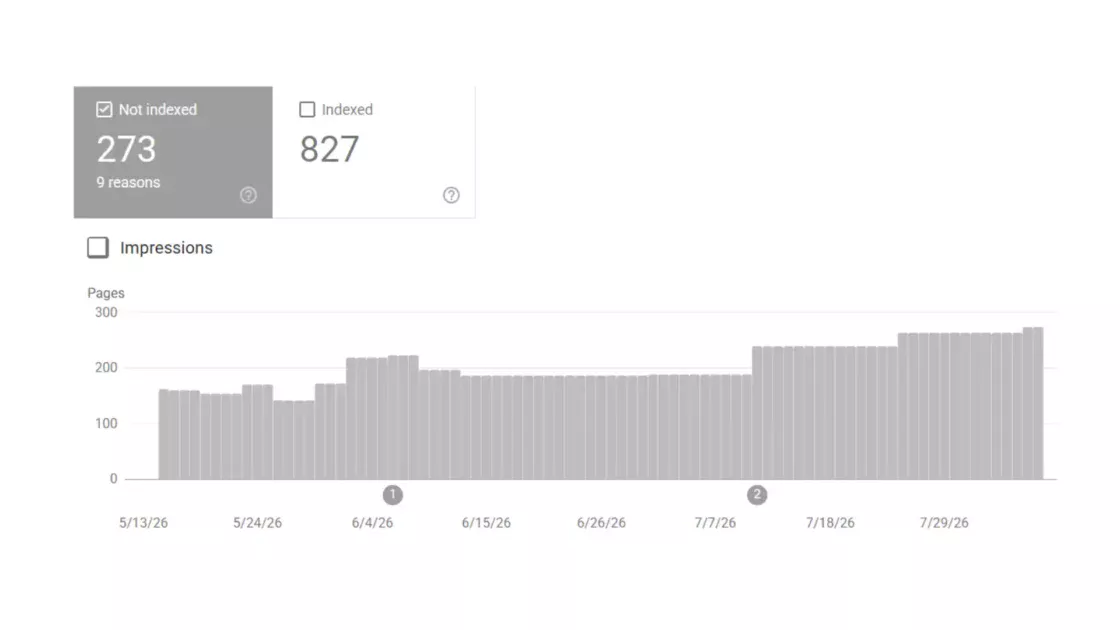
Use the Page Indexing report to find priority URLs excluded for reasons that conflict with business intent. Some exclusions are correct. Not every parameter page or duplicate should index. Focus on pages that should be present but are not because of noindex, robots blocking, redirect errors, duplicate selection, server errors, soft 404 classification, or weak discovery.
Use URL Inspection to resolve individual high-value cases. Do not request reindexing repeatedly without a real change. Fix the page, validate the fix, then submit the relevant URL or sitemap update.
In Bing Webmaster Tools, verify the domain, submit the sitemap, inspect indexing and crawl data, review search performance, and use the available diagnostics. Bing’s guidance makes this more than a legacy task for websites that care about Copilot and related grounded experiences.
IndexNow may be useful for frequently changing sites. It notifies participating search engines when a URL is added, changed, or deleted. It is a notification mechanism, not a promise of indexing or ranking.
A baseline dashboard should include:
- Priority URL index status.
- Organic impressions, clicks, and click-through rate.
- Query groups by intent.
- Bing performance where relevant.
- Crawl and server errors.
- Sitemap health.
- Referral traffic by known answer surface.
- Landing-page engagement.
- Conversion or assisted-conversion quality.
- Content freshness status.
- Observed citation and source-set trends.
Without a baseline, a team will mistake coincidence for AI visibility progress.
New generative AI reports improve measurement, but do not replace analytics
Google announced dedicated Search Console views for generative AI performance in Search and Discover on June 3, 2026. Google described the reports as dedicated views of impressions from AI Overviews, AI Mode, and generative AI features in Discover, with rollout initially limited to a subset of sites.
That development changes the measurement conversation. It gives some site owners direct reporting rather than forcing them to rely entirely on prompt observation. It does not eliminate the need for page-level analytics, server logs, conversion tracking, or editorial review.
Check whether the report is available in the relevant Search Console property. Do not assume universal access while rollout remains selective. If available, use it to ask practical questions:
- Which pages appear in generative features?
- Which countries and devices drive those impressions?
- Did a major content update change visibility?
- Are product, documentation, editorial, or local pages represented?
- Does increased generative visibility lead to relevant visits?
- Are there pages with AI visibility but weak engagement?
- Which topics are absent despite having business priority?
Avoid simplistic comparison with ordinary organic clicks. A generative impression, source link, and traditional web result may have different presentation and click behaviour. Measure the complete path: visibility, referral, landing-page engagement, lead quality, purchase, subscription, support deflection, or reader return.
Use cohorts. Compare a group of improved priority pages with a comparable group that was not changed. Record the date of the change, nature of the fix, index state, affected template, and expected outcome. This creates a more useful record than claiming that any traffic rise came from “AI SEO.”
The measurement question is not “Did AI mention us?” It is “Which pages appeared for which needs, and what happened after that visibility?”
Prompt testing needs controls
Prompt testing is useful when it is disciplined. Casual testing produces screenshots, not evidence.
Build a library of 30 to 100 questions from real search intent. Include definition, comparison, troubleshooting, local, technical, compliance, buying, support, and current-information queries. Write them naturally. Do not insert your own brand or lead the system toward a desired answer.
For each test, record:
- Exact prompt.
- Date and time.
- Platform and interface.
- Country and language.
- Device type.
- Logged-in state where relevant.
- Whether web retrieval was used.
- Main answer.
- Sources cited or linked.
- Your domain’s appearance or absence.
- Destination URL.
- Accuracy of the representation.
- Follow-up behaviour.
- Commercial relevance.
- Screenshot or saved output where allowed.
Run the same prompt set more than once. Results vary. A site absent on Monday may appear later because of crawling, index updates, changed source selection, query reformulation, location, or interface changes. A single response cannot establish a trend.
Use competitor-neutral questions. Ask “Which systems support X?” rather than “Why is our product best?” Ask “What is the current requirement for Y in Slovakia?” rather than “Does our company meet Y?” The purpose is to understand the source environment, not to manufacture validation.
Review accuracy as well as presence. An answer may cite a page but explain it incorrectly. It may cite an outdated page. It may use a product page for a fact that belongs on a support page. These are source-governance issues. Fix the underlying page first.
Prompt testing should reveal a repairable gap: access, content, trust, product data, local evidence, or measurement.
Citation capture exposes the competitive evidence standard
For each controlled test, collect every cited domain and URL. Classify the source: official authority, academic institution, manufacturer, retailer, publisher, reviewer, local directory, government, forum, social post, or unknown.
Then inspect why each source may have been useful.
It may contain a primary document. It may have current data. It may define a narrow term. It may publish a comparison table. It may show local hours, prices, compatibility, methodology, original research, or an expert byline. The objective is not to copy a competitor’s phrasing. The objective is to identify the factual asset your site lacks.
A company that wants visibility for “SOC 2 compliant payroll software” may find that cited sources publish security scope, certification details, data-processing statements, subprocessor lists, SSO documentation, audit dates, and customer responsibility boundaries. The company’s own page says only “enterprise-grade security.” The repair is not to repeat the phrase “SOC 2” more often. The repair is to publish reviewed security documentation that answers the real questions.
A local clinic may be absent from health-related local queries because its public information is incomplete while map and directory sources offer current hours, booking links, specialties, and verified contact details. A publisher may lose to an official source because it has not added reporting, context, documents, or explanation.
Citation capture also finds risk. A page cited in an answer may be stale, incomplete, or poorly scoped. Being cited is not an automatic win. A wrong product specification, outdated legal threshold, or misleading clinical statement creates reputation risk.
The most useful competitive insight is often the fact pattern another source owns and your site does not yet publish.
A quarterly AI-readiness audit takes ninety minutes
A quarterly session catches high-risk problems before they become structural. The session should include someone responsible for content, someone who understands technical delivery, someone who sees analytics, and a person who can make commercial decisions.
Use a 90-minute format.
First 15 minutes: review the representative URL set. Remove obsolete pages. Add product launches, major editorial assets, high-revenue pages, top organic entries, and URLs affected by legal or technical change. Confirm the question each page must answer.
Next 15 minutes: run retrieval checks. Review status codes, final URL, canonical, robots directives, headers, rendered content, mobile state, and recent deployment changes. Flag blocked content, empty shells, unintended noindex, unexpected nosnippet, broken assets, redirect chains, and consent barriers.
Next 15 minutes: review indexing and crawl evidence. Inspect Search Console and Bing for the priority URLs. Check sitemap inclusion. Review canonical conflicts, crawl errors, and access logs for approved crawlers.
Next 15 minutes: assess the page as evidence. Read the opening answer, headings, sources, author information, dates, scope, limitations, disclosures, internal links, and next step. Ask whether an unfamiliar reader could understand and trust the page.
Next 15 minutes: review visibility and outcomes. Check organic performance, generative AI reports where available, referrals, engagement, conversions, assisted outcomes, and known support impact.
Final 15 minutes: run a small controlled prompt sample. Record source sets, mention accuracy, and landing-page relevance. Pick three actions with owners, deadlines, and a verification method.
The meeting should end with a brief decision log:
- What is broken?
- Which template is causing repeated failure?
- Which factual asset needs substantive review?
- Which crawler policy requires a business decision?
- Which URL needs verification after repair?
- Which metric will prove whether the repair mattered?
A recurring audit does not create bureaucracy. It creates a habit of catching access and evidence failures before they become invisible revenue or trust losses.
Use red, amber, and green instead of a fake score
Executives often ask for one number. A score can direct attention, but it should not pretend to predict citations.
Use hard gates first. A page that is blocked, noindex, inaccessible, canonicalised incorrectly, or barred from snippets where snippets are required is not ready, regardless of excellent content.
For pages that clear those gates, assess five dimensions:
- Retrieval access.
- Search and snippet eligibility.
- Answer clarity.
- Evidence and accountable publishing.
- Measurement and business path.
Mark each dimension red, amber, or green.
Red means documented failure or missing control. Amber means the page works but has a material weakness. Green means it has passed the defined checks for its page type.
A simple readiness decision model
| Dimension | Red | Amber | Green |
|---|---|---|---|
| Retrieval | Blocked, challenged, broken, or incomplete | Works but relies on fragile rendering or interaction | Main content is stable and available |
| Search eligibility | noindex, wrong canonical, blocked, or snippet-restricted by mistake | Indexed but with unresolved duplication or discovery issue | Correct canonical is eligible and clear |
| Answer clarity | Vague, thin, or context-dependent claims | Useful but missing a key definition, limit, or comparison | Direct answer, scope, evidence, and related links |
| Trust | No visible owner, date, source trail, or disclosure | Basic accountability but weak method or update practice | Accountable publisher, proof, dates, scope, and corrections |
| Measurement | No crawl, visibility, referral, or outcome tracking | Partial metrics or fragmented ownership | Defined dashboard, logs, tests, and commercial outcome path |
The table is a prioritisation tool. It does not forecast a platform’s answer composition.
At portfolio level, report the share of priority URLs that pass each condition. For example: percentage of URLs publicly retrievable; percentage with correct canonical status; percentage free from unintended snippet restrictions; percentage with accountable publishing; percentage with current facts; percentage with a clear answer block; percentage with a defined conversion route; percentage with crawler-policy confirmation.
Use the assessment to decide what to fix, not to make a promise about future citations.
A thirty-day remediation plan puts hard gates first
A short remediation sequence should begin with failures that prevent all value. Do not start by rewriting dozens of articles while a production rule blocks them.
Days 1 to 5: resolve hard gates. Fix accidental noindex, robots conflicts, canonical errors, server errors, redirect chains, critical JavaScript failures, sitemap problems, blocked assets, WAF denials, and mismatched crawler rules. Confirm each fix in production.
Days 6 to 12: repair templates. Add or correct visible author or accountable organization fields where relevant, meaningful dates, canonical controls, descriptive titles, clean headings, internal-link modules, accessible tables, correct structured-data fields, and consent behaviour that does not block primary content.
Days 13 to 20: improve priority evidence assets. Rewrite high-value pages around direct answers, scope, proof, source links, current facts, limitations, and helpful paths. Build missing comparison pages, implementation guides, methodology pages, local proof pages, security pages, and HTML companions for important documents.
Days 21 to 25: complete operational measurement. Verify Google Search Console and Bing Webmaster Tools. Repair sitemap processes. Consider IndexNow where content changes frequently. Confirm crawler policies. Group known answer-engine referrals in analytics. Build a prompt-test library and citation-capture sheet.
Days 26 to 30: re-audit. Repeat the representative URL set. Check whether hard gates are closed. Compare index status, technical delivery, content completeness, crawl evidence, and early visibility. Record unresolved work that needs legal review, product-data cleanup, engineering roadmap investment, or original research.
Do not expect every visibility change within thirty days. Crawling, indexing, ranking, and answer selection take time. The aim is to create a site that is technically and editorially ready when systems revisit it.
The quickest progress comes from removing real barriers, not buying a new vocabulary.
Common failures in AI-readiness work
The first failure is treating llms.txt as the project. Google says it does not use llms.txt or special AI text files for visibility in Google Search, including its generative features. A business may create such a file for another service, but it does not replace crawlability, indexability, sources, page quality, or analytics.
The second failure is schema inflation. A plugin adds every possible type of markup to every page. Google’s policies require data to reflect visible content and avoid misleading claims. More types do not equal better understanding.
The third failure is generic expansion. A company publishes hundreds of pages that restate public definitions without original analysis, product facts, methods, local context, or first-hand knowledge. Google warns against scaled content that offers little added value.
The fourth failure is forgetting Bing. A company focuses on Google while ignoring Bing indexing, Bing Webmaster Tools, and the documented relationship between Bing, Copilot, and grounding.
The fifth failure is allowing access without measuring it. A team changes robots rules but cannot tell whether approved crawlers reached the site, whether citations appeared, whether referrals arrived, or whether visitors completed useful actions.
The sixth failure is blocking access by accident. A WAF change, staging rule, CMS setting, CDN migration, region layer, or cookie platform stops crawlers or hides main content. The site still looks normal to staff. Visibility decays quietly.
The seventh failure is treating a citation as the goal. A citation that lands on stale content, a heavy popup, an irrelevant category page, or a generic form creates little value. The landing page must complete the reader’s next task.
The eighth failure is promising guaranteed placement. No credible provider can guarantee an AI Overview source link, a ChatGPT search citation, a Perplexity result, or a Copilot answer. Report eligibility, observed visibility, source coverage, and outcome. Do not sell certainty the platforms themselves do not offer.
Evidence standards should rise with risk
A recipe blog, product catalog, medical information page, payroll guide, and building-safety manual should not carry the same editorial burden. The risk of being wrong changes the evidence standard.
Low-consequence information may need a clear publisher, stable answer, basic source links, and a meaningful date when freshness matters. Product content needs accurate specifications, price logic, availability, conditions, and clear distinction between promotional language and documented capability.
High-consequence content needs more: qualified review, primary-source hierarchy, jurisdiction, date, limitations, correction policy, conflict disclosure, maintenance cadence, and direct statements about what the page does not cover.
A page stating “available in Europe” should identify countries, exclusions, date, and delivery model when those details affect a buyer. A page stating “compliant” should name the standard, version, scope, audit status, and customer responsibilities. A page stating “secure” should describe controls, independent assessment where relevant, and residual risk. Vague confidence is dangerous because answer interfaces often compress it.
Google’s people-first guidance directs site owners toward original information, complete topic coverage, and trustworthy practices. It does not prescribe one template because the proof needed by a product page and a regulated advice page differs.
The higher the cost of a wrong answer, the less acceptable it is to hide conditions or rely on unsourced claims.
Governance keeps readiness from decaying
A site is not ready because it passed one audit. It remains ready because its publishing, engineering, legal, and measurement processes preserve the conditions that made the audit pass.
Define ownership:
- Who owns crawler policy?
- Who approves new bot rules?
- Who maintains structured-data templates?
- Who reviews regulated or high-consequence content?
- Who checks Search Console and Bing?
- Who reads server logs after technical changes?
- Who owns referral and conversion measurement?
- Who can correct or remove public content quickly?
- Who owns content freshness for each topic cluster?
Maintain an inventory of critical templates: article, product, category, local page, author profile, organization page, documentation page, resource hub, PDF companion, glossary, support article, and policy page. Define minimum fields for each template.
For example, a documentation template may require version, last-tested date, operating assumptions, permissions, configuration steps, error states, and deprecation notes. A product page may require model identifier, visible specifications, availability, support path, return or contract terms, and reconciled product data. An article may require author or desk, date, evidence links, canonical, clear headline, and correction route.
Add these checks to deployment QA. Before launching a redesign, inspect status codes, canonicals, robots metadata, main-content parity, mobile state, structured data, internal links, sitemap changes, analytics tags, cookie behaviour, and WAF access. Before launching a CMS change, confirm editors still have fields for sources, author, dates, captions, headings, tables, and canonical controls.
Readiness is a property of operations, not a one-off SEO project.
The practical test after the audit
The final test is not whether a chatbot says your website is “AI-ready.” It is whether a priority page survives a real information journey.
A user asks a specific question. A system identifies related needs. It retrieves pages from an index or permitted web source. It looks for content that is accessible, relevant, current, clear, and defensible. It chooses sources. It presents an answer, perhaps with a link. The reader arrives and decides whether the source deserves trust.
Your site must hold together through each step.
A credible internal readiness statement looks like this:
Our priority pages are publicly retrievable for approved systems, indexed or eligible in relevant search ecosystems, free from unintended snippet restrictions, written around direct evidence-supported answers, maintained by accountable publishers, connected to supporting information, and measured through crawl, visibility, referral, and business-outcome data.
That is a stronger standard than “we installed AI schema.” It also produces a better website for humans. The same work makes content easier to discover, simpler to verify, more useful in sales and support, safer in regulated topics, and more resilient when answer interfaces change.
Start with ten priority URLs. Check access, canonical status, snippet rules, mobile content, direct answers, sources, dates, author or publisher identity, internal links, crawler policy, and measurement. Fix what is broken. Document what is uncertain. Preserve what works.
That is the practical way to find out whether your site is ready for AI search.
Questions site owners ask during an AI-readiness audit
It means your priority pages are accessible to approved retrieval systems, eligible within the relevant search environment, clear enough to answer real questions, backed by visible evidence, and measured after publication. It does not mean guaranteed citations.
No. Google says no special schema or extra technical requirement is needed for its AI Overviews and AI Mode. Use structured data where it accurately reflects the visible page and supports eligible Search features.
No. Google says it does not use llms.txt or similar special files for Google Search visibility, including generative features.
No. Decide based on business model, contracts, intellectual-property policy, privacy, public-content strategy, and expected referral or discovery value.
OpenAI documents GPTBot and OAI-SearchBot separately. A site may allow OAI-SearchBot for ChatGPT search while blocking GPTBot for training-related access.
OpenAI says a site that opts out of OAI-SearchBot will not appear in ChatGPT search answers, though it may still appear as a navigational link.
Google’s published guidance focuses on ordinary Google Search eligibility: the page should be indexed and eligible for snippets. Google states that no separate generative-AI technical requirement applies.
Yes. Google says nosnippet prevents content from being used as direct input in AI Overviews and AI Mode. max-snippet also limits text available for direct input.
Indexing is only one condition. The page may lack a precise answer, fresh facts, original evidence, or a strong fit for the query. A platform may also choose different sources based on the user, location, language, and moment.
Compare raw source, rendered browser DOM, and Search Console’s view where available. Check whether the main answer, headings, links, and proof appear without interaction or an unstable API response. Google documents crawling, rendering, and indexing as separate JavaScript-processing phases.
No. They are not a citation formula. They measure loading, interaction responsiveness, and visual stability. Poor performance still harms the reader’s experience after a citation.
Not every page needs an individual byline. Every page should make accountable publishing clear. Informational, editorial, advisory, and high-consequence pages benefit from visible author, reviewer, or responsible organization information.
Check that visible product name, model, variant, price, stock status, compatibility, shipping terms, returns, and specifications agree with structured data, feeds, and checkout.
Check accurate name, address or service area, phone number, current hours, services, booking route, local proof, and mobile usability. Do not rely on generic city pages.
Use Search Console’s generative AI reports where available, Bing Webmaster Tools, server logs, referral data, landing-page analytics, and conversion tracking. Google’s dedicated generative reports began selective rollout in June 2026.
Yes. Bing says its webmaster guidelines apply across Bing Search, Copilot, and the grounding API.
Perplexity states that PerplexityBot is designed to surface and link websites in Perplexity search results and is not used for foundation-model training.
Select ten high-value URLs. Verify 200 responses, canonical tags, index and snippet eligibility, visible content, mobile usability, dates, sources, accountable publishing, internal links, crawler policy, and an identifiable measurement route.
Treating a technical artifact as a substitute for useful source material. A page earns durable visibility through access, clarity, evidence, currency, accountable publishing, and a good reader experience.
No. IndexNow may speed up notice of added, updated, or deleted URLs for participating search engines. It does not guarantee crawling, indexing, rankings, or citations.
Author:
Jan Bielik
CEO & Founder of Webiano Digital & Marketing Agency

This article is an original analysis supported by the sources cited below
AI features and your website
Google’s site-owner guidance for inclusion eligibility in AI Overviews and AI Mode.
Google’s guide to optimizing for generative AI features on Google Search
Google’s current guidance on generative search, query fan-out, non-commodity content, and myths around special AI files and markup.
Introducing Search Generative AI performance reports in Search Console
Google’s June 2026 announcement of dedicated generative AI visibility reports in Search Console.
How Google Search works
Google’s explanation of crawling, indexing, serving, and the absence of a guarantee that eligible pages will appear.
Creating helpful, reliable, people-first content
Google’s guidance on original information, useful coverage, trust, and source quality.
Google Search’s guidance about using generative AI content
Google’s policy guidance on generated content and scaled content abuse.
Robots meta tag, data-nosnippet, and X-Robots-Tag specifications
Google’s documentation for page-level indexing, snippet, and preview controls.
Block search indexing with noindex
Google’s guide to implementing noindex and avoiding conflicts with robots blocking.
Robots.txt introduction and guide
Google’s explanation of robots rules and their limits as an access-control mechanism.
Understand JavaScript SEO basics
Google’s documentation of crawling, rendering, and indexing for JavaScript web applications.
Mobile-first indexing best practices
Google’s mobile-content guidance and its use of mobile versions for indexing and ranking.
What is a sitemap
Google’s documentation on sitemap use, limits, and relationship to internal links.
Overview of crawling and indexing topics
Google’s technical reference covering canonicalization, crawl management, mobile sites, metadata, and site changes.
Introduction to structured data markup in Google Search
Google’s explanation of structured data and rich-result eligibility.
Product structured data
Google’s guidance on product offers, availability, and richer product appearances.
Local business structured data
Google’s structured-data guidance for local business details in Search and Maps contexts.
Understanding Core Web Vitals and Google Search results
Google’s explanation of user-experience metrics for loading, responsiveness, and visual stability.
Understanding page experience in Google Search results
Google’s guidance on mobile display, HTTPS, interstitials, advertising interference, and main content.
Image SEO best practices
Google’s guidance for image discovery, surrounding context, captions, and visual search visibility.
Bing Webmaster Guidelines
Bing’s official rules for discovery, crawling, indexing, evaluation, Bing Search, Copilot, and grounding API use.
AI Performance in Bing Webmaster Tools
Bing’s documentation for grounding queries and citation activity in AI-generated answers.
IndexNow documentation
Technical documentation for notifying participating search engines when URLs are added, updated, or deleted.
Overview of OpenAI crawlers
OpenAI’s documentation for OAI-SearchBot, GPTBot, crawler controls, and ChatGPT search inclusion.
Perplexity crawlers
Perplexity’s official descriptions of PerplexityBot and Perplexity-User.
AI Crawl Control
Cloudflare’s documentation for observing and managing AI crawler access.
Robots.txt setting
Cloudflare’s explanation of managed robots rules for known AI crawlers.
Directives in AI Crawl Control
Cloudflare’s guidance for observing crawler interactions with robots directives across hostnames.
| Citing this article? Brief excerpts are welcome. Please credit Webiano.digital, name the author where stated, and include a link to https://webiano.digital and to this original article. Full or substantial republication requires prior written permission. Read our Copyright and Content Use Policy. |
This article was prepared with the assistance of artificial intelligence tools. The content underwent expert human review, and Webiano Digital & Marketing Agency assumes editorial responsibility for its final version and publication.