AI search optimization is easy only after a business has solved the difficult work: publishing information worth citing and operating a site that search systems can crawl, interpret, index, and trust. That is not a slogan for traditional SEO. It is now close to the formal position of the platforms shaping AI-assisted discovery.
Table of Contents
Google’s current guidance says that visibility in its generative search experiences remains rooted in core Search ranking and quality systems. Its requirements are strikingly ordinary: pages need to be indexed, eligible for snippets, technically accessible, useful, original, and clear. Google says site owners do not need special AI files or new markup just to appear in AI features. Bing’s recent AI Performance reporting and OpenAI’s publisher documentation point in the same direction from different products: visibility begins with accessible, attributable web content and ends with measurement, not mythology.
The claim that “AI search optimization is easy if content and technical structure are okay” is therefore mostly right, though only if “okay” means genuinely strong rather than merely adequate. A page that loads, has a sitemap, and contains 1,500 words is not automatically fit for AI search. The content needs a distinct point of view or evidence base. The site needs a coherent information model. The business needs to know which pages answer which questions, where claims came from, who maintains them, and what happens when reality changes.
This article uses a strict editorial standard: no invented evidence, no padded certainty, and no shortcuts disguised as strategy.
The argument is right but the word “okay” carries the w k is the visible checklist. A team can add descriptive headings, correct broken canonicals, update an XML sitemap, put author names on articles, validate structured data, and clean up templated metadata. Those actions matter. They often remove the obstacles that stopped a strong page from being discovered or understood. They are not, however, the same thing as building a source that an AI answer system has reason to select.
The difficult work sits beneath the checklist. A financial adviser must explain products accurately, include jurisdictional limits, distinguish regulated guidance from general education, and update claims when rates or rules change. A software company must publish documentation that reflects the product a customer can actually use, not the roadmap deck. A medical publisher must make authorship, review, dates, citations, and scope obvious. A retailer must keep price, availability, product variants, shipping, and return information consistent across pages and feeds. A local business must not leave old hours, closed locations, or stale service areas across the web.
AI search exposes weak operating practices because it depends on information being usable outside the page where it was written. A traditional ranking result may still deliver a click to a vaguely relevant article. An answer system is trying to synthesize a response, compare sources, choose claims, and attach citations or links. Vague information creates selection risk. Conflicting information creates trust risk. Thin pages provide no reason to choose one publisher over another.
The distinction matters because “AI search optimization” has become a market for small rituals. Vendors sell llms.txt files as if they are passports. Others recommend hiding keyword-rich statements in invisible sections, adding generic FAQ blocks to every URL, buying publisher mentions, or generating hundreds of “answer pages” that repeat public knowledge. Google’s own generative-search guidance directly rejects much of this thinking: it says special AI markup and llms.txt are not required for its AI features, and it tells site owners to focus on clear technical structure and non-commodity, people-first information.
That does not mean technical work is trivial. It means the technical target is more disciplined than a collection of hacks. Search systems need a clean canonical URL. They need crawlable links. They need content that appears in the rendered page reliably. They need no-index directives used intentionally. They need consistency between the document, its metadata, its structured data, and, for commerce, its product feed. These are not glamorous jobs. They decide whether an otherwise excellent source exists as a usable source at all.
The strongest interpretation of the user’s proposition is this: once a site already behaves like a reliable public information system, AI-search work becomes much less mysterious. The organization is no longer trying to appease an unknown machine. It is making its knowledge easier to discover, verify, quote, maintain, and measure.
AI answer systems still need retrievable web documents
AI search is often described as a break from web search. The interface has changed sharply: users write full questions, ask follow-ups, compare options, request summaries, and expect a single response. The underlying task still depends heavily on documents, entities, links, feeds, indexes, and source evaluation.
Google states that its AI features draw on content from its Search index. Its eligibility guidance does not create a parallel entry point for “AI pages”; it requires a page to be indexed and eligible to appear with a snippet in Google Search. Google also warns that meeting technical requirements does not guarantee crawling, indexing, ranking, or inclusion. That caveat matters. Eligibility is not selection. A page enters the pool only after the site has made it technically and editorially legible.
This has practical consequences. A founder may publish a sharp explanation of a difficult topic, but it cannot be used if search engines cannot find it through normal links, if it lives behind a broken JavaScript route, if the canonical points elsewhere, if the page is blocked from snippets, or if several near-identical URLs divide the signals. A site with an immaculate content strategy but broken retrieval is a library with books locked in storage.
The other error is to treat AI systems as passive readers of raw HTML. Search products need to decide more than whether text exists. They assess relevance to a question, likely usefulness, freshness, apparent trust, page context, link relationships, and the degree to which a statement fits the surrounding web. AI-generated answers can also blend different source types: an official product page for specifications, an independent review for experience, a public authority for rules, a merchant feed for availability, and a forum thread for a narrow practical problem.
A source is selected because it is both available and appropriate. Availability is technical. Appropriateness is editorial. The two reinforce each other. Clean technical systems preserve the meaning of content. Strong content gives the crawler and ranking systems something worth preserving.
This framing also explains why a single universal “AI visibility score” is unlikely to be useful. A site may appear frequently in answers about basic definitions but rarely in high-intent product comparisons. It may earn citations but not clicks because answers satisfy early-stage curiosity. It may attract fewer visits while the remaining visits have higher purchase intent. It may be visible in Bing and Microsoft Copilot because Bing has indexed it well, while it is less present in Google AI features due to a different result mix. Search behavior has always been contextual. AI interfaces make the context more varied.
ChatGPT search uses web sources and presents links to relevant pages in its responses. OpenAI also documents separate crawler functions, including a crawler that can support search features and a bot that controls training access. The relevant lesson for publishers is not that every crawler operates identically. It is that crawl policy, source availability, and referral measurement are operational decisions, not abstract branding choices.
A business therefore needs a source inventory before it pursues anything called AEO, GEO, or AI SEO. Which pages are the definitive explanations? Which pages are original proof? Which URLs describe services, locations, authors, products, policies, and prices? Which details exist only in PDF files, internal systems, social posts, or sales calls? A system cannot reliably cite facts that the publisher has not published in a stable, accessible form.
The 2026 reporting changes make the debate more concrete
For years, teams arguing about AI search had little direct evidence. They relied on screenshots, self-reported traffic trends, rank trackers, manual prompt tests, and anecdotes from individual publishers. Those observations were useful but noisy. A cited page may not receive a click. A source may appear in one interface, country, or query variation and disappear in another. Users may phrase the same question differently. Search products evolve too quickly for a static test sheet to settle the matter.
The reporting environment is changing. On June 3, 2026, Google announced dedicated Search Console views for performance in generative AI features, including AI Overviews, AI Mode, and generative AI features in Discover. Google said this visibility remains included in the overall Performance report while the dedicated view provides a more focused way to examine generative-search impressions. That is a major operational shift because it moves discussion from guessed visibility toward product-provided measurement.
Microsoft made a related move earlier. Bing announced an AI Performance public preview in Bing Webmaster Tools on February 10, 2026, describing reporting for when sites are cited in AI-generated answers across Microsoft Copilot, Bing search, and related AI experiences. Microsoft had already published guidance on AI-powered search measurement, describing a pattern of fewer but more consequential clicks and a need to connect upstream visibility to on-site engagement.
The value of these reports is not merely a new dashboard. They encourage better questions.
A weak question asks: “Did we rank in AI?” It treats an evolving set of experiences as a single ten-blue-links position.
A useful question asks: “Which pages are cited for which intent clusters, by which platform, in which country, and what happens after users arrive?” It then asks whether cited content supports the business outcome. A publisher might value subscriptions, a manufacturer might value qualified distributor leads, a consultancy might value high-fit inquiries, and a retailer might value product-detail-page sessions that lead to checkout.
Visibility without intent is a vanity metric; traffic without outcome is a partial metric; outcomes without source quality are hard to sustain. The new reports make it possible to connect more of those pieces, but they do not remove the need for judgment.
Teams should resist a predictable overreaction: shifting every editorial decision toward pages that appear in an AI feature report. Search Console and Bing reporting show observed platform behavior, not a universal definition of content quality. A page that gets few AI impressions may still drive direct conversions, rank in ordinary results, support sales teams, earn links, reduce support costs, or serve as a citation backbone for other content. The role of measurement is to improve prioritization, not to hand control of the editorial calendar to a dashboard.
The new data does make one thing harder to deny. AI search is no longer only an interface experiment watched by marketers from the sidelines. It is becoming a measurable discovery channel inside the major search ecosystems. That raises the standard for content operations. It also weakens the case for panic. The platform evidence does not say publishers must invent a new discipline from scratch. It says they should make the underlying website more coherent and then monitor how those foundations travel into AI experiences.
Content quality has become more exposed, not less relevant
A common anxiety is that AI answers turn content into raw material and make writing less valuable. The more useful conclusion is harsher and more constructive: generic writing is less defensible, while original, maintained, well-attributed writing becomes easier to distinguish.
Search systems have always faced a problem of abundance. Thousands of pages can answer a simple question. AI answer products intensify that problem because they need to choose a few sources, combine claims, and provide a response without simply listing every plausible page. A generic article that defines a term, repeats familiar advice, and offers no original reasoning gives the system little basis to select it. It is replaceable by another page, a product manual, a public guidance note, or the model’s own ability to compress common knowledge.
Google’s guidance makes this point unusually directly. It advises site owners to create “non-commodity” content—information with a reason to exist beyond a recycled list of tips—and to prioritize people-first material that adds value beyond common knowledge. Google’s helpful-content guidance also places emphasis on experience, expertise, authoritativeness, and trustworthiness as part of the systems’ effort to identify useful information.
Non-commodity does not require every company to commission a research lab. It means the page carries material that competitors do not possess in the same form. A payroll platform can publish actual decision logic, implementation constraints, country-specific deadlines, change logs, and examples from its support history. An architecture firm can explain the trade-offs it saw during planning approval. A law firm can explain how a new judgment changes a familiar process, with jurisdictional boundaries. A retailer can provide accurate compatibility tables, measurement guidance, original photography, service documentation, repair parts, and real stock information.
The useful unit is not “content volume.” It is verifiable information density. A 700-word page with exact instructions, limits, screenshots, source links, update dates, and named expertise may be more useful than a 4,000-word article composed of general advice. Length still has a role: difficult subjects require room. Yet length without new information is merely more surface area for ambiguity.
There is also a difference between writing that works as a landing page and writing that works as evidence. A landing page may state that a service is fast, tailored, trusted, and industry-leading. Those words signal almost nothing. Evidence could include turnaround windows, eligibility criteria, service boundaries, audited performance, supported regions, named methods, legal terms, customer requirements, and exceptions. AI systems do not need to “understand marketing” to see the difference. Readers see it as well.
This is one reason AI search work often feels difficult for businesses whose websites have been treated mainly as a sales brochure. The website lacks the factual substrate needed for granular questions. The sales team knows the answer. Product managers know the answer. Customer support knows the answer. The answer exists in slide decks, internal wikis, spreadsheets, and call recordings, but not in a stable public document. The solution is not more keyword research. It is a publishing decision: choose which knowledge should become durable, reviewable public material.
Original information earns the right to be cited
AI answers increase the value of source material that begins somewhere. A company that rewrites public documentation may compete for attention, but it is rarely the best original source. A company that publishes the specifications, policy, benchmark, study, dataset, change log, price, inventory status, case record, or firsthand explanation creates a stronger claim on citation.
This is especially visible in areas where accuracy is testable. Users asking about software capabilities need documentation from the maker, not an affiliate article that paraphrases the feature list. Users asking about a regulatory deadline need the regulator or an authoritative legal analysis that identifies the rule and its practical consequence. Users comparing products need current specifications and actual availability. Users looking for local services need official location, hours, contact, qualification, and booking information.
Originality is not synonymous with novelty. A page may cover a familiar subject and still earn selection because it explains a hard edge case well. A cybersecurity consultancy might not be the first to publish “what is ransomware?” Yet it could be unusually useful for “what does a ransomware incident response retainer exclude?” because it has direct operational knowledge. A tax specialist may not own the definition of VAT, but may own a precise guide to a cross-border filing pattern that it handles every week.
The strongest content often answers the question behind the question. Searchers ask “What is this?” when they really need to know whether it applies to them. They ask “How much does it cost?” when they need to understand the pricing model, contract term, hidden requirements, and decision criteria. They ask “Is it safe?” when they need boundaries, failure modes, certification, maintenance, and accountability. Pages that expose the underlying decision structure have lasting value because they reduce uncertainty instead of merely filling an information gap.
This is also where generic AI-generated content fails most visibly. Large language models are good at producing fluent summaries of common material. They are weaker when the correct answer relies on details that are unpublished, domain-specific, recent, legally constrained, operationally contingent, or contradictory across sources. Publishing those details carefully makes a site more useful to users and more distinct to systems that need evidence.
Google’s guidance on the use of generative AI in content is aligned with that principle. Google does not prohibit the use of generative tools. Its concern is content produced at scale without added value, and its guidance asks publishers to focus on accuracy, quality, relevance, and people-first use—including in page titles, descriptions, structured data, and image alt text.
The practical question for every draft is not “Was AI used?” It is “What new, checked, sourceable information would disappear from the web if this page vanished?” If the honest answer is “not much,” the page is unlikely to become a dependable AI-search asset. If the answer includes a real method, fresh evidence, a first-party explanation, a careful comparison, or a maintained record, the page has a better reason to exist.
Experience and authorship make ambiguous claims easier to trust
Many sites mistake author boxes for expertise. A headshot, job title, and two-sentence biography are useful signals, but they do not compensate for unsupported claims. The deeper role of authorship is accountability. It tells a reader who stands behind the information, what that person knows, when the material was reviewed, and how the publisher handles limits.
This becomes more important as AI systems bring users directly to a fragment of a page. A visitor may arrive after seeing a citation in an AI answer, a search snippet, a comparison panel, or a social preview. They may not have encountered the brand before. The page must establish credibility quickly without relying on vague institutional language.
A strong authorship model often contains five practical elements:
- A real author or accountable organization.
- A clear description of relevant experience or qualification.
- A publication date and, where meaningful, a material-update date.
- Links to primary evidence, official documentation, or a transparent methodology.
- A route for corrections, updates, or contact when the subject warrants it.
The exact format changes by sector. A product documentation page may name a product team and show release history. A newsroom article may show a reporter, editor, publication date, corrections note, and primary documents. A medical page may show writer, reviewer, credentials, clinical-review date, and cited evidence. A B2B guide may name a practitioner and identify the circumstances in which the advice applies.
Authorship is most persuasive when the document itself shows the author’s judgment. A lawyer who writes “consult a lawyer” at the end of every general article is not showing judgment. A better page explains which facts change the legal answer, which jurisdictions are outside scope, which dates matter, and where a reader should verify official rules. The disclaimer becomes part of the information architecture rather than a reflexive shield.
Google’s people-first content documentation frames E-E-A-T as a set of aspects its systems seek when prioritizing helpful information. It does not say a biography field automatically creates ranking benefits. That distinction protects against shallow implementation. Showing experience means publishing work that demonstrates it: original examples, properly framed opinions, reviewed explanations, records of practice, methods, and careful correction when needed.
A company should also be precise about organizational authorship. Many content teams publish collective work under a brand because the knowledge belongs to product, legal, engineering, and support groups. That is legitimate when the page clearly identifies the accountable publisher and applies a genuine review process. The problem comes when a fake personal author is manufactured to imitate expertise. That damages trust with readers and becomes a governance risk inside the organization: no one owns the accuracy once a problem appears.
For AI search, credibility is partly a selection question and partly a click-through question. An answer may cite a page because it contains a relevant statement. The user decides whether to trust, act on, subscribe to, or buy from the publisher. Consistent bylines, transparent expertise, linked evidence, and maintained pages improve that handoff.
Answers need completeness rather than answer-shaped fragments
A popular response to AI search has been to turn every paragraph into a direct answer. The instinct has merit. Clear statements make pages easier to read, quote, and extract. The mistake is treating the answer sentence as the finished product.
A direct opening sentence without context can mislead. “Yes, X is deductible” might be technically accurate for one country, date, business type, or expense category and wrong for the reader’s situation. “This software integrates with Y” might mean a native integration, a partner-built connector, a Zapier workflow, an API route, or a manual export. “Delivery takes two days” may apply only to certain inventory, destinations, cut-off times, and order values.
Answer extraction works best when a page pairs a concise claim with the evidence, boundary, and next decision. The claim allows a search system and reader to orient quickly. The boundary prevents false certainty. The next decision helps the reader use the information.
A reliable page structure frequently follows this sequence without becoming mechanical:
- State the practical answer plainly.
- Explain the conditions that make it true.
- Show the evidence, source, method, or product detail.
- Identify meaningful exceptions or failure cases.
- Link to the next relevant step.
This is not a template that must appear on every URL. It is a useful editorial discipline. It forces writers to separate what is known from what is inferred. It reduces the habit of burying the answer under introductory prose. It also creates cleaner passages for retrieval systems without sacrificing accuracy.
Google’s SEO Starter Guide advises publishers to write useful, reliable, people-first material, to keep content current, and to anticipate different ways readers seek the same information. The guide also notes that Google’s language-matching systems can understand relevance beyond exact keyword repetition. That is a useful corrective to the idea that every page needs endless question variations embedded in headings.
A page should contain the terms that an expert and a novice genuinely use, but it should not become a search-query landfill. A dental practice can explain “root canal treatment,” “endodontic treatment,” “tooth nerve infection,” and the symptoms a patient may describe. It should not turn every heading into a barely altered keyword phrase. Natural semantic coverage comes from a complete explanation, examples, definitions, related decisions, and precise terminology.
The same principle applies to FAQ sections. A FAQ is useful when it answers real recurring questions with information that is not already duplicated pointlessly elsewhere. It is weak when it repeats the article in miniature or when every page across a site receives the same generic ten questions. AI answer systems do not need more text; they need fewer ambiguities.
Entity clarity matters more than topical decoration
AI search often seems to reward “entities,” a term that has been abused into another vague optimization pitch. The practical meaning is less mysterious. A page should make clear who or what it is discussing and how that thing relates to other things.
A product is not only a product name. It has a model number, variant, manufacturer, specifications, price, availability, compatibility, documentation, images, reviews, and sometimes regulatory or safety context. A professional firm is not only a brand. It has people, locations, practice areas, jurisdictions, certifications, cases, methods, and contact routes. A news publisher is not only a domain. It has authors, dates, publication sections, original reporting, corrections, and sources.
A human reader can infer relationships from design, logos, and shared context. Machines need more explicit signals. Clear headings, descriptive links, visible relationships, consistent naming, page titles, breadcrumbs, organization pages, and accurate structured data all serve the same purpose: they reduce uncertainty about what the page represents.
Entity clarity is not a hunt for markup tricks. It is the discipline of making a site internally consistent. If a company calls a service “managed cloud support” on its homepage, “cloud operations” on service pages, “MSP cloud solutions” in case studies, and “IT assistance” in navigation, it may be speaking naturally to different audiences. Yet it should still define those relationships. Are these distinct offers? Is one the parent category? Are they regional names for the same service? Does a specific plan include a specific capability? The answer should not live only in the sales team’s head.
A site with strong entity clarity avoids a common form of AI-search disappointment. A publisher sees its own brand named in an answer but finds that the link goes to a third-party directory, a reseller, an old review, or a generic category page rather than to the authoritative document. The issue is not always ranking power. It may be that the business has failed to publish or connect the canonical source of truth.
Structured data is part of this work, but it should come late in the reasoning process. First, the organization needs a truthful page model. Then it can describe the model in machine-readable form. Schema.org exists to provide extensible vocabulary that helps webmasters embed structured data for search engines and other applications. Google says it uses structured data to understand page content and entities on the web, while also warning through its documentation that markup is not a guarantee of a specific result feature.
The important phrase is “truthful page model.” Product price in markup should match the visible product page. An article’s publication date should be meaningful rather than frequently reset to manufacture freshness. An author should be real. Organization details should match public business information. Review markup should not be injected for content the business did not actually collect. Technical consistency is not glamorous, but it makes a site a safer source to interpret.
Search intent has become a chain of decisions
AI interfaces encourage longer questions, but they do not eliminate intent. They make intent less visible to teams that still organize work around a short list of keywords. A user might ask, “Which payroll system is suitable for a 60-person company with employees in Germany and Austria, no in-house HR specialist, and an existing accounting platform?” That is not one keyword. It is a chain of constraints.
The best pages do not merely rank for the noun “payroll system.” They clarify the decisions that sit around the noun: company size, country coverage, implementation effort, integrations, user roles, pricing model, compliance responsibilities, support boundaries, migration path, and setup time. Some of those facts belong on product pages. Some belong in documentation. Some belong in comparisons. Some belong in case studies. Some belong in a calculator or a sales conversation.
AI search raises the value of content portfolios built around decisions rather than isolated terms. A site should map the questions a buyer or reader asks before, during, and after a choice. It should then decide which questions require a dedicated page, which belong within a broader guide, and which should be answered through structured product or service data.
This is not a call to build thousands of pages. In fact, large content programs often fail because they create one page for each superficial variation of the same query. A better approach starts with decision distinctness. Does this question require a materially different answer? Does the user need different evidence? Would a reader be misled if the answer were buried inside another page? Is the answer stable enough to publish? Does the business have authority to state it?
For a B2B company, this could create an architecture such as:
- A definitive service or product page explaining scope.
- Integration pages for real supported systems.
- Industry pages where requirements actually differ.
- Implementation documentation.
- Pricing or commercial-model information.
- Security, compliance, and procurement material.
- Case evidence with enough detail to be useful.
- Comparison or “alternatives” material only where the company can be fair and factual.
- Help content that addresses product use after purchase.
For a publisher, it could mean a core explanatory guide, timely reporting, a maintained reference page, expert analysis, source documents, and related coverage. For a local company, it may mean location pages, service pages, transparent coverage limits, booking information, pricing ranges, reviews, and practical preparation guides.
The advantage is not only AI visibility. It improves sales, support, onboarding, and editorial coordination. A site that knows where each decision is answered produces fewer contradictions. It gives readers clearer paths. It creates fewer redundant URLs. It makes it easier to update information when a product, rule, or policy changes.
Evidence beats ungrounded confidence
Answer systems force a simple test on brand content: if a claim appears in a synthesized response, would the publisher be comfortable with a reader opening the cited page and asking, “Where is the proof?”
Many commercial pages fail this test. They claim that a solution is secure without naming certifications, controls, boundaries, incident procedures, data locations, or the distinction between product security and customer configuration. They claim that shipping is fast without defining the region, stock condition, carrier, and delivery promise. They say a service is compliant without naming the regulation, jurisdiction, date, or responsibility split. They say a product is “best” without a method, comparison basis, or source.
Confidence is not evidence. In AI search, unsupported confidence is a fragile form of visibility. A short-lived citation is possible. Sustained trust from a serious reader is harder.
Evidence does not need to be academic to be useful. It can be a clear product specification, public terms of service, a documented test method, a named regulation, a public authority source, a first-party case study with precise constraints, a change log, a shipping policy, a return policy, a photo showing a real installation, or a transparent methodology. The level of proof should match the risk of the decision.
A furniture retailer does not need a peer-reviewed paper to say a table is made from oak, but it should provide accurate material, dimensions, weight limit, finish, assembly requirements, care instructions, and availability. A health publisher has a much higher burden. It should identify qualified reviewers, distinguish evidence from opinion, cite current authoritative sources, and avoid oversimplifying symptoms or treatment choices. A financial-services page must not hide jurisdiction, risk, or regulatory status behind generic reassurance.
The editorial method is straightforward:
- List every claim that could change a decision.
- Mark whether it is a fact, a judgment, an estimate, a promise, or an opinion.
- Identify the evidence a skeptical reader would expect.
- Publish that evidence, or weaken the claim.
- Assign an owner and review date where the claim can age.
This creates a better page even before a crawler arrives. It also supplies material that search systems and AI interfaces can use with less ambiguity.
Google’s helpful-content documentation tells creators to focus on reliable material that benefits people rather than content created to manipulate rankings. That guidance may sound broad, but it becomes concrete when applied to claims. A page built for users shows its workings. A page built only for ranking often uses broad superlatives because they consume little effort and create no accountability.
Indexing remains the first technical gate
Before a page can be cited, it needs to be found and eligible for indexing. That sounds basic, yet many AI-search projects begin with content rewrites while the site still has crawl problems, broken redirects, no-index mistakes, poor internal discovery, or canonical conflicts.
Google describes Search as an automated system that uses crawlers to discover pages and add them to its index. It notes that most pages are found through crawling rather than manual submission. The implication is clear: a site needs normal discoverability. Sitemaps supplement that work; they do not replace a crawlable site architecture.
An indexing audit for AI-search readiness should begin with a small set of hard questions:
- Does the page return a successful HTTP response to users and crawlers?
- Is the intended canonical URL indexable?
- Does the page carry an accidental noindex directive or restrictive X-Robots-Tag?
- Does robots.txt block important assets or paths?
- Does the page have crawlable internal links from relevant pages?
- Is the material available in the rendered HTML in a reliable way?
- Does the page appear in the sitemap if it is a priority URL?
- Are there duplicate, parameterized, print, staging, or alternate URLs competing with it?
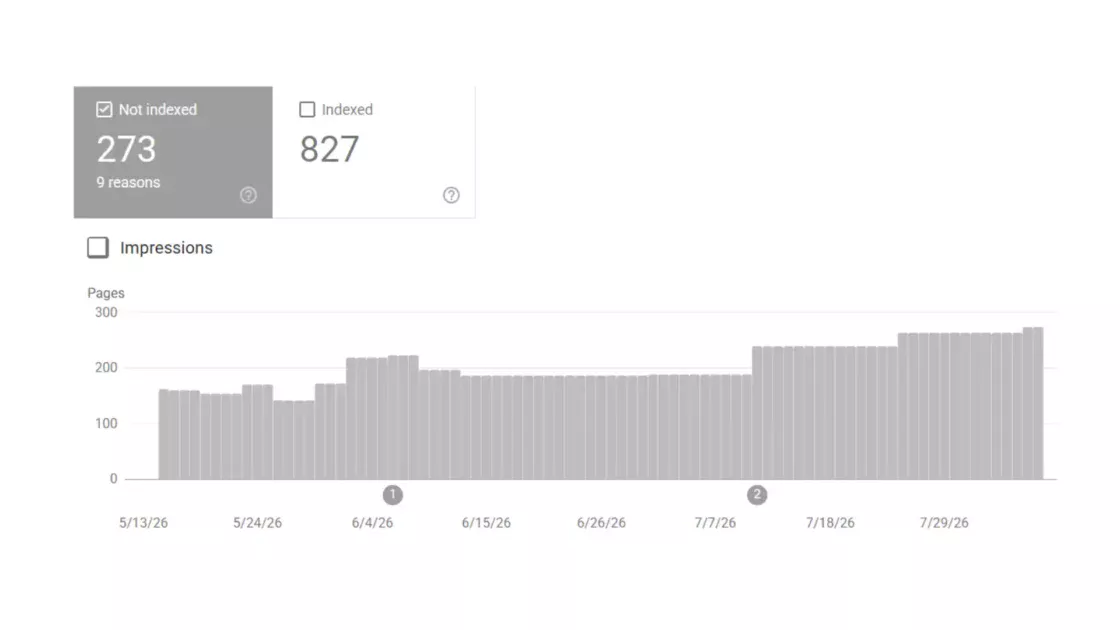
- Does Search Console show a known indexing issue?
- Does the page have enough distinctive content to warrant indexing?
This sequence seems ordinary because it is ordinary. The important point is that AI search has not made it optional. In fact, as products draw from large indexes and source pools, technical ambiguity becomes more costly. A page with uncertain canonical status may be excluded. A product page with fragmented variants may be misinterpreted. A resource trapped behind a site-search form may be invisible to the crawler. A content hub that relies on “load more” buttons without crawlable pagination may hide older but important material.
Google’s robots-meta guidance explains that publishers can manage indexing and snippet behavior with robots meta tags, data-nosnippet, and X-Robots-Tag directives. Such controls are legitimate, yet they must be intentional. A business that blocks snippets broadly while expecting its material to appear in generative search is creating a contradictory policy.
The same is true of gated content. A publisher has a right to protect paid material. It should decide which parts of the knowledge base need to be publicly discoverable, which pages should introduce the value of a subscription, and which details remain within the product. A site that hides every useful explanation may still sell through direct brand demand, but it has less material available for search-driven discovery.
Site architecture tells machines what the business considers important
Technical architecture is sometimes framed as a crawl-budget issue that matters only to large sites. It is broader than that. Architecture expresses relationships. It shows which pages belong together, which pages are foundational, which details support a broader topic, and which URLs are orphaned or obsolete.
Google’s documentation says it analyzes links and page relationships to understand site structure and relative importance. It recommends crawler-friendly navigation and warns that content reachable only through a site search box may not be discovered through normal crawling. Google also emphasizes the use of standard <a href> links for discoverability.
A useful architecture begins with the business model, not the CMS menu. A manufacturer might use:
- Company and brand foundation.
- Product families.
- Individual products and variants.
- Technical documentation.
- Compatibility and accessories.
- Support and repair.
- Industries and use cases.
- Distributors and local availability.
- News and change logs.
A specialist publisher might use:
- Core reference explainers.
- Timely reporting.
- Analysis and opinion, clearly labeled.
- Source documents and datasets.
- Author pages.
- Topic hubs.
- Corrections and editorial policies.
A services firm might use:
- Services.
- Industries or situations where the service materially differs.
- Locations.
- People and credentials.
- Methods.
- Results or case work.
- Pricing or engagement models.
- Legal, security, or compliance information.
- Contact and qualification paths.
Architecture should make it possible to answer “where is the definitive page for this fact?” When the answer is unclear inside the company, it will be unclear on the web. That leads to near-duplicate landing pages, conflicting statements, scattered PDF files, and orphaned resources.
The strongest internal linking patterns are usually editorial rather than algorithmic. A guide on data migration links to the implementation service, related documentation, case evidence, pricing framework, security page, and contact path where those links genuinely improve the reader’s next decision. A product page links to manuals, compatibility information, stock availability, care guidance, and returns policy. A news article links to the definitive explainer, original documents, and related reporting.
This is not about inserting a fixed number of links. It is about preserving a logical map of knowledge. Search engines use links to discover pages and understand relevance; readers use them to check claims and move through a decision. A site that treats links as a design detail loses both benefits.
Internal links are editorial citations inside a domain
External citations receive more attention because they can build authority and referral traffic. Internal links are often more controllable and more directly connected to AI-search readiness. They tell a crawler what the publisher considers related. They provide context through anchor text. They make deep pages discoverable. They let a user move from an answer fragment to the full evidence.
A mature internal linking strategy is not a widget that appends “related posts” at the bottom of every article. It is a deliberate editorial graph.
Suppose a cybersecurity company publishes a guide to phishing-resistant authentication. A thin link pattern might point only to a contact form. A stronger pattern might lead to an implementation guide, comparison of authentication methods, supported identity providers, device requirements, security-policy documentation, case evidence, a glossary entry, and a service page. Each link introduces a different part of the topic. The guide becomes a gateway into a connected body of evidence rather than an isolated traffic page.
The best internal links reduce the distance between a claim and its proof. A claim about a product’s integration should link to current integration documentation. A claim about policy should link to the policy. A claim about an industry result should link to a case study that provides context. A claim about a person’s expertise should link to a real author page or work record.
This matters for AI systems because source selection often starts at a document level but can benefit from the surrounding site’s clarity. A page surrounded by related, consistent, descriptive documents gives stronger contextual signals than a page that stands alone. It also matters for users coming through AI citations. They may be satisfied by the sentence that led them there, then need a faster route to the next question. Strong internal links capture that intent.
Poor patterns are easy to identify:
- Sitewide footer links to every service, regardless of relevance.
- Anchors such as “click here,” “learn more,” and “read more” where descriptive wording would be clearer.
- Orphaned pages included only in a sitemap.
- Repeated keyword anchors that sound unnatural to readers.
- Internal links to outdated versions when a current canonical page exists.
- Category hubs that link to a few featured entries but not the full relevant set.
- “Related content” modules based only on publication date or category tags.
Google’s link guidance advises making links crawlable and using wording that helps people and Google make sense of the linked content. It is modest advice with major implications. A site does not need a complicated internal-link automation project before it can improve. It needs editors, product owners, and developers to treat links as statements about relationships.
Canonicals and duplicates decide whether a fact has one home
A site can publish accurate information and still dilute it through duplication. This is a frequent issue for ecommerce, large CMS installations, international sites, and businesses that rely on campaign parameters or content syndication.
Google defines canonicalization as the process of selecting the representative URL from a set of duplicate or very similar pages. Its documentation explains that site owners can signal a preferred canonical, but Google ultimately chooses a representative URL based on multiple factors.
The practical problem is not merely that duplicate URLs “hurt SEO.” Duplication creates uncertainty about which document expresses the official version of a fact. If a product appears on /product/green-jacket, /product?sku=123, /sale/green-jacket, /collection/jackets/green-jacket, and a print version, which page should receive internal links, external links, structured data, and update attention? Which one should an AI product answer cite? Which one is safe to use when the price changes?
One important fact should have one strong primary home, with alternatives clearly subordinate to it. That does not mean every similar page must disappear. Variants, filtered views, regional versions, campaign pages, and paginated results can serve real user needs. The publisher must make the relationship clear through canonicals, redirects where appropriate, internal links, parameter handling, and consistent content.
Bing’s December 2025 guidance on duplication in AI experiences is unusually plain: clean, consolidated signals reduce ambiguity and help search engines and AI systems understand a site’s intent and surface the right version. It also notes that duplicate content can create unnecessary work as a site grows.
For content teams, duplicate control is an editorial issue as much as a technical one. A company may have three pages that all claim to explain “managed IT services,” written by different agencies over five years. Each has slightly different scope and pricing language. The fix is not merely a canonical tag. It may require a decision about the core offer, page consolidation, redirects, old-campaign retirement, and a shared source of truth for terminology.
Ecommerce sites need special care around product variants and faceted navigation. Google’s guidance on ecommerce URL design warns that poor structures can cause missed content, duplicate retrieval, and crawling inefficiency. It recommends descriptive URLs, fewer alternative paths to the same page, and a clear approach to variants.
A reliable canonical policy should cover:
- HTTP and HTTPS variants.
- www and non-www choices.
- Trailing slash conventions.
- Sort and filter parameters.
- Internal-site search pages.
- Tracking parameters.
- Product variants.
- Pagination.
- Print and mobile alternatives.
- Syndicated copies.
- Old campaign URLs.
- Regional and language variants.
The policy should be visible in development standards, content workflows, and QA—not buried in an SEO spreadsheet used only when traffic drops.
JavaScript architecture can either reveal or hide the content
Modern websites frequently use client-side frameworks, personalisation layers, consent systems, app shells, and dynamic components. None of this automatically prevents search visibility. The risk comes from treating rendering as someone else’s problem.
Google has published detailed guidance on JavaScript SEO. Among other points, it warns that canonical URLs should be set consistently, with HTML preferred where possible, and that JavaScript should not change the canonical to a different value from the original HTML. Google also describes dynamic rendering as a workaround rather than a recommended solution because it adds complexity and operational burden.
AI-search readiness raises the stakes for reliable rendering because a page has to carry its actual meaning. The page title, canonical, headings, main copy, structured data, internal links, image attributes, product details, and update information should not depend on fragile client-side sequences. A crawler may render much of the page successfully, but a flaw in hydration, a blocked script, a user-triggered load state, or an inconsistent API response can leave key information absent or contradictory.
The question is not whether the site uses JavaScript. The question is whether the public document exists reliably before a user performs an action. A product category that requires a visitor to press “load more” may hide later products from crawlers. A help center that renders content only after a login-state check may not present a stable public document. A location page that waits for a geolocation prompt before showing services may become unclear to search systems and users outside the expected flow.
The audit needs to examine actual rendered output rather than relying on the CMS editor. Test pages with browser developer tools, URL inspection, server logs, rendered HTML checks, and crawler simulations where appropriate. Verify that content appears in the document, that links are real <a href> links, that canonical and robots directives survive rendering, and that structured data reflects the same information a user sees.
Incremental loading deserves particular attention. Google’s ecommerce pagination documentation states that its crawlers generally follow URLs in href attributes and do not click buttons or trigger JavaScript functions that require user actions to change the page. Sites using infinite scroll or “load more” therefore need a crawlable URL pathway to the material.
The broader lesson is simple: use modern front-end systems when they serve the product, but do not force discovery systems to perform a user session before they can understand the page.
Performance is part of the trust transfer after a citation
Search visibility and user experience are often treated as separate disciplines. AI citations make the connection more obvious. A user sees a claim, decides to inspect the source, clicks, and lands on the page. If the page is slow, unstable, obscured by overlays, or difficult to use on a phone, the publisher loses the moment of trust the citation created.
Web performance is not a magic AI ranking lever. It is a basic condition of a credible web experience. Google’s web.dev documentation defines Core Web Vitals around loading performance, interaction responsiveness, and visual stability. The commonly referenced “good” thresholds are Largest Contentful Paint at 2.5 seconds or less, Interaction to Next Paint at 200 milliseconds or less, and Cumulative Layout Shift at 0.1 or less.
These numbers should not become a target divorced from the user. A site can score well in a lab while still presenting a confusing page. A long-form document can load fast but bury its sources beneath intrusive widgets. A retail page can have good LCP yet show stale price information because the product API has failed. Performance is one part of reliability, not a substitute for it.
Still, performance often reveals organizational priorities. A site weighed down by several tag managers, third-party scripts, conflicting experimentation tools, autoplay media, heavy web fonts, and ungoverned plugins may be making the same management mistake in other areas: nobody owns the experience end to end. AI-search work can surface that problem because it brings content, technical delivery, analytics, and conversion into one conversation.
A fast, stable, accessible page protects the value of every citation, organic result, social link, newsletter click, and direct visit. The business case is broader than a visibility metric.
Useful performance work includes reducing unnecessary JavaScript, setting dimensions for media, prioritizing the main content, avoiding layout shifts caused by late-loading banners, controlling third-party tags, serving appropriately sized images, and measuring field data rather than relying only on synthetic tests. Each change should be evaluated against business function. Removing a tool that supports checkout recovery may be foolish if the net commercial impact is negative. Leaving ten unused trackers in place because no team owns them is equally foolish.
Structured data is a description layer, not an admission ticket
Structured data is valuable because it tells machines what a document claims to represent. It does not manufacture truth, authority, or relevance. A poor page with perfect JSON-LD remains poor. A strong page with no structured data may still be useful and discoverable. The practical opportunity is to make accurate pages less ambiguous.
Google states that it uses structured data found on the web to understand page content and information about the web and its entities. Schema.org provides a shared vocabulary for describing things such as articles, organizations, people, products, offers, events, images, videos, and local businesses.
For publishers, useful markup often includes Article or NewsArticle where appropriate, author, publisher, dates, images, and main entity context. For businesses, Organization and LocalBusiness data may clarify identity and location. For ecommerce, Product, Offer, ProductGroup, BreadcrumbList, Organization, and LocalBusiness can describe the product, commercial offer, hierarchy, and business context. The appropriate types depend on what is genuinely on the page.
The main technical rule is correspondence. The markup must describe material visible to users and supported by the page. If the product is unavailable, the offer data must not say in stock. If the article has a materially updated date, that should reflect a real update. If an author is named, the page should show that author. If an FAQ is marked up, the questions and answers should exist for readers and add information rather than being hidden markup bait.
The role of structured data in an AI-search-ready site
| Content situation | Useful machine-readable description | Editorial requirement |
|---|---|---|
| News or analysis article | Article or NewsArticle, author, date, publisher | Show real authorship, sourcing, and material dates |
| Product page | Product, Offer, ProductGroup, BreadcrumbList | Keep price, availability, variants, and shipping facts current |
| Local service page | LocalBusiness, Organization, service context | Match business details, opening hours, coverage, and contact routes |
| Documentation page | BreadcrumbList, SoftwareApplication where relevant | Publish version, compatibility, limits, and updates clearly |
| Expert profile | Person and Organization relationships | Make credentials and role verifiable on the site |
The table does not imply that markup guarantees citation or rich results. It outlines a clean alignment between page purpose and machine-readable description. Google’s documentation is explicit that structured data supports understanding and eligibility for certain search appearances, not a promise of display.
The common misuse of structured data is trying to express things the site has not earned. A business marks itself as a leading provider without a meaningful data field. It adds rating markup from unverified testimonials. It applies every available type to every page. It sets dates mechanically. It treats validation success as a quality verdict. None of this improves the underlying resource.
A strong implementation begins with a schema inventory tied to page templates. Identify page types, list the fields that are true and maintainable, validate the output, and monitor changes through deployments. The team should also establish ownership: marketing may own editorial claims, product may own specifications, operations may own location data, commerce may own price and stock feeds, and engineering may own implementation reliability.
Freshness is not a date stamp; it is a maintenance system
AI answers raise the cost of stale content because a dated claim can be repeated at scale. A misleading page may still be indexed for months. A user may encounter it through search, a social link, a featured snippet, an AI summary, or a sales email. The publisher then pays for information it failed to maintain.
Freshness is often misunderstood as “publish more often” or “change the date frequently.” Neither creates reliable information. A good maintenance system answers three questions: what changes, who notices, and who updates the public source of truth?
A retailer needs systems for price, stock, promotions, shipping, returns, and product discontinuations. A software company needs release notes, documentation versioning, deprecation notices, compatibility changes, and retired integration pages. A professional-services firm needs legal, regulatory, location, fee, and staff updates. A publisher needs corrections, follow-up reporting, archive labels, and the distinction between historical context and current fact.
A current answer needs current source material, not cosmetic freshness. Search engines and AI products may use many signals around recency, but readers care about whether the claim applies now. Date transparency helps readers judge that.
Google’s SEO Starter Guide advises checking previously published content, updating it when needed, or deleting it when it is no longer relevant. Google’s Search documentation also describes sitemaps as a way to provide information about pages and updates, while noting that sitemap submission is only a hint and not a guarantee of crawling.
A good content-maintenance operation distinguishes three kinds of updates:
- Substantive update: the central claim, evidence, recommendation, product capability, price, policy, or legal position changed.
- Maintenance update: links, formatting, screenshots, examples, dates, or minor references changed without altering the main conclusion.
- Archival action: the material is no longer current and should be removed, redirected, or clearly labelled as historical.
That distinction prevents a familiar problem: old pages get a fresh date even though their substance is obsolete. The page may look current while misleading readers. It also helps editorial teams prioritize. Not every page needs an annual rewrite. The pages affecting decisions, sales, health, money, safety, compliance, or product use deserve formal review triggers.
News publishing needs source discipline more than AI theatre
News organizations face a specific version of the AI-search question. Generative answer interfaces may summarize developing stories, link to reporting, surface multiple outlets, or give users a fast factual answer before they click. That puts pressure on publishers to prove why their reporting should be selected and followed.
The answer is not content inflation. It is source discipline.
A strong news page distinguishes confirmed facts from allegations, context from the latest event, reporting from analysis, and primary documents from commentary. It timestamps publication and meaningful updates. It names reporters and editors. It corrects errors visibly. It links to original statements, filings, data, court records, transcripts, or documents where publication rights and safety allow. It makes clear what is known, what remains unclear, and what is being reported by others.
The most defensible news source is the one that adds reporting, verification, and context that a summary cannot replace. A fast rewrite of a press release may be useful for a narrow window. It has little long-term claim on reader trust. An article that verifies claims, finds new facts, explains effects, and preserves source context becomes a durable reference.
Google’s Discover documentation says eligible content can appear based on users’ interests, and its Search appearance documentation now includes guidance for AI features and preferred sources. In May 2026, Google updated its documentation to note that preferred sources can be highlighted in AI Mode and AI Overviews for users who have chosen a publication. That makes audience trust more valuable, not less. A publisher that readers deliberately select gains an advantage no markup script can imitate.
Newsrooms should also avoid treating AI summaries as a reason to put key facts only in social posts or video captions. Public, crawlable, well-structured article pages remain the core asset. Video, newsletters, podcasts, social distribution, and apps broaden reach. The article is still the durable record that other systems can cite, link, archive, and revisit.
Ecommerce exposes every disconnect between content and operations
Ecommerce is one of the clearest examples of why AI-search work is easy only after foundational work is sound. A product answer may need current price, availability, image, shipping details, variant compatibility, retailer policies, ratings, and the product’s actual characteristics. Any mismatch becomes commercially costly.
Google’s ecommerce documentation recommends structured data on product pages and product feeds in Merchant Center to improve the accuracy of its understanding of product information. It says Merchant Center is required for certain surfaces, such as the Google Shopping tab, and notes that feeds can provide more control over update timing for price and inventory.
A retailer should think of its public product information as a connected system:
- The product page is the reader-facing record.
- Structured data describes the product and offer.
- Merchant Center feeds provide a more direct commerce data source.
- Images establish visual identity and product details.
- Category pages establish product relationships.
- Stock and price systems keep commercial facts current.
- Shipping and returns pages define the purchase conditions.
- Review systems add context where they are genuine and well managed.
- Support and care pages answer post-purchase questions.
AI shopping visibility becomes fragile when those layers disagree. A product page saying “available now,” a feed saying “out of stock,” and a checkout saying “pre-order” do not merely create a ranking issue. They create a customer-trust problem.
Product content also needs to escape the manufacturer-description trap. Many retailers publish the same supplied description, same specification table, and same stock image as every competitor. That may be unavoidable for baseline facts. It does not create a reason to select the retailer for advice. The retailer’s distinctive value might sit in fit guidance, original photography, comparison tools, compatibility checks, specialist installation notes, support availability, accurate local stock, or real delivery clarity.
The information layers that make a product answer dependable
| Layer | Question it answers | Failure that damages AI-search readiness |
|---|---|---|
| Product page | What is this item and who is it for? | Generic copy, missing specifications, hidden variants |
| Offer data | What does it cost and is it available? | Price or stock mismatch between page, feed, and checkout |
| Images and media | What does it look like and how is it used? | Generic assets, missing alt context, misleading visuals |
| Category structure | How does it relate to alternatives? | Orphaned products and unclear hierarchy |
| Policies | What happens after purchase? | Hidden shipping, returns, warranty, or service details |
| Support content | What happens when users need help? | No manuals, compatibility notes, care, setup, or repair information |
The table reflects an operational truth: an AI answer may pull from one layer, while the buyer judges the retailer through all of them. Google’s commerce guidance explains that structured data and Merchant Center data can support richer product presentation and that product data accuracy matters across Google surfaces.
For fast-changing catalogs, technical freshness becomes a business requirement. Bing’s IndexNow guidance describes a way for sites to notify participating search engines of added, updated, or deleted URLs. Microsoft has emphasized its use in keeping content discoverable in AI-powered search, especially for timely changes. IndexNow is not an answer-engine ranking switch. It is a useful operational signal for sites that change often.
Local businesses need a public record of reality
Local search has always depended on accurate real-world facts: name, address, phone, hours, category, reviews, service area, photos, menus, appointments, inventory, and local reputation. AI-assisted local discovery makes the same facts more conversational. A user may ask for a repair service that handles a certain brand, a restaurant with a dietary accommodation open after a specific time, a clinic offering a procedure in a particular neighborhood, or a contractor licensed for a certain job.
The business cannot answer these questions well through generic homepage copy. It needs precise public information.
A useful local-business site usually includes a clear organization page, location pages where locations have real differences, service pages with scope and exclusions, up-to-date hours and contacts, appointment or booking information, staff or qualification pages where relevant, practical pricing guidance, policy pages, original images, and routes to verified review platforms. Structured LocalBusiness data can support clearer interpretation, but it must match the public record.
Local AI visibility is heavily constrained by factual hygiene. An out-of-date holiday-hours page, a closed office still listed in navigation, an old phone number in schema, and a service area that differs from the Google Business Profile create mixed signals. The business may still appear in answers, but it increases the chance that the answer disappoints the user.
Service-area businesses face a related problem. Many create dozens or hundreds of near-identical city pages with a swapped place name. Those pages often add little local information and make it difficult to identify what the company actually serves. Better local content describes genuine local presence, licensing, travel policy, regional constraints, service examples, partners, local regulations, or location-specific availability. If no material difference exists, a broader area page may be more honest and more useful.
For high-consideration local decisions, trust content does more work than a generic list of services. A consumer deciding on a roof replacement, legal adviser, accountant, clinic, or home renovation wants to know qualifications, process, timing, risk, price structure, insurance, compliance, and what happens when something goes wrong. Publishing this information reduces sales friction and produces source material with a clearer reason to be cited.
International sites must express real local differences
Multilingual and multi-market sites complicate AI-search work because language translation alone does not create local relevance. A company may sell in several countries, but price, currency, tax treatment, availability, regulation, delivery conditions, product names, support routes, and legal terms may differ. Publishing one generic English page and translating it mechanically can create factual errors.
A durable international model starts with the decision: does this market have a genuinely distinct offer or merely a translated audience? Where the offer differs, the site needs localized content and technical signals that reflect those differences. Where it does not, a translated version may be enough, provided it is accurate and maintained.
The most important operational principle is one truth per market, not one template per language. A French-language page for a product sold in Belgium may need different tax, delivery, legal, and customer-service details from a French-language page for France. A Spanish-language support page may need country-specific regulatory guidance. A global software company may need to separate feature availability by region, data residency, language support, billing currency, and local partners.
Technical implementation matters here: hreflang annotations, canonical relationships, localized sitemaps, correct language in visible content, and consistent internal links all reduce ambiguity. Yet the editorial model comes first. A site that has not decided which facts are global and which are local cannot correctly mark them up.
Search systems are also capable of language matching beyond exact phrases. Google’s guidance advises thinking about different terms users may use, while warning publishers not to focus only on exact query matching. That supports natural localization: use terms native speakers and local customers actually use, not only literal translations of headquarters terminology.
For AI search, regional inconsistency creates a particular risk. A broad answer may cite a page written for one market while the user needs another. The best defense is precise market context in titles, headings, currencies, terms, location information, and internal navigation. The goal is not to prevent all cross-market discovery. It is to make the appropriate page the clearest source for the relevant situation.
Crawler policy is a commercial decision, not a reflex
As more AI companies crawl the web, website owners face choices about bots and access. Those choices should not be made only by an engineer responding to server load or by a marketer pursuing extra exposure. They involve legal, editorial, commercial, security, and data-governance considerations.
OpenAI’s documentation distinguishes crawler behavior across products and gives site operators information on its user agents and robots.txt controls. Its publisher FAQ states that publishers who allow OAI-SearchBot can track referral traffic from ChatGPT, including via referral tagging.
The practical questions are straightforward:
- Does the publisher want the content available for search discovery?
- Does it want to restrict use for training?
- Does the bot create unacceptable infrastructure load?
- Is the material public, licensed, sensitive, or paywalled?
- Does the business have analytics that identify referrals and outcomes?
- Does access policy match the company’s wider publishing strategy?
- Is the robots configuration tested and documented?
A robots policy should reflect a reasoned position, not a copied blocklist. Blocking a bot might protect a content strategy or reduce resource use. Allowing it might expand discovery and referral opportunity. Each choice has trade-offs.
There is also a difference between controlling access and assuming control over every use of public information. Search publishing has always involved a degree of downstream representation through snippets, cached signals, previews, and links. AI interfaces extend that representation. Publishers should set the controls available to them, monitor referral behavior, protect genuinely restricted material, and build direct audience relationships through email, memberships, customer accounts, apps, events, and repeat-use products.
The strongest business response is not dependence on one traffic source. It is a diversified information strategy where the website remains the authoritative public record, while valuable direct relationships reduce the risk of any one interface changing its treatment of publishers.
Measurement must connect citations to outcomes
A citation report is useful, but it is not a complete performance system. It tells a team that a source appeared. It does not automatically explain whether the cited content was correct, whether the user clicked, whether they found the answer, whether they returned, or whether the business gained anything.
A practical measurement framework needs several levels.
First, monitor technical availability: index coverage, crawl errors, canonical problems, structured-data validity, sitemap processing, page experience, server errors, redirects, broken internal links, and rendered-page consistency.
Second, monitor search visibility: impressions, clicks, query and page patterns, AI-feature appearances where platform reports provide them, rich result eligibility, Discover exposure where relevant, and branded versus non-branded discovery.
Third, monitor content behavior: engaged sessions, scroll depth used carefully, click paths, support deflection, document downloads, video views, repeat visits, newsletter signups, saved items, and returns to product or service pages.
Fourth, monitor business outcomes: qualified leads, sales, subscriptions, appointments, activated users, retained customers, reduced support load, partner inquiries, or other metrics tied to the organization’s actual goals.
AI visibility should be evaluated as part of a chain, not as an isolated percentage. A page cited in an answer may be fulfilling a research-stage role. A related product page may convert later. Attribution will often be imperfect. The right response is to use a mixed evidence model rather than to dismiss the activity because it lacks a single-click conversion.
Bing’s AI performance guidance has explicitly focused on linking AI-generated-answer visibility with on-site behavior and conversion analysis. Google’s June 2026 Search Console update adds a dedicated view for generative AI feature performance. Together, these tools make it more practical to measure the source side of AI discovery, but they do not replace analytics discipline.
Teams should create a review rhythm that avoids both panic and complacency. Weekly checks may identify technical breaks, indexing changes, and sudden citation shifts. Monthly reviews can compare content clusters, intent groups, and conversion patterns. Quarterly reviews should examine whether the information architecture still matches the product, market, and audience. Major content changes should be tied to a hypothesis: which user need is being served, which source deficiency is being corrected, and what evidence would show improvement.
This is more useful than testing a handful of prompts in a private browser and declaring victory. Manual prompt checks still have a role for qualitative review. They can reveal whether a brand is misunderstood, whether source context is poor, whether competitors hold a unique fact, or whether an answer exposes a content gap. They should be treated as research observations, not a stable rank report.
Correlation is not a content strategy
AI-search discussions often produce confident causal claims from weak evidence. A page adds FAQ markup and appears in an AI answer, so the markup is credited. A brand earns a citation after publishing a large guide, so word count is credited. A site declines after an AI interface expands, so AI is blamed even though seasonality, product changes, tracking errors, demand shifts, competitors, indexing issues, or ordinary ranking movement may be involved.
A disciplined team separates sequence from causation. It records what changed, which URLs changed, when crawlers processed the change, which markets and devices were affected, whether the query mix changed, whether ordinary search traffic moved too, and whether the outcome repeats across comparable pages.
The aim is not to prove a universal AI-search formula. It is to make better decisions under uncertainty. That requires controlled thinking.
A useful experiment might compare a set of related technical guides. One group receives a real evidence upgrade: original diagrams, verified examples, detailed limits, improved internal links, accurate author attribution, and a content-maintenance owner. Another group stays unchanged. The team tracks indexation, impressions, click patterns, linked-page behavior, and qualitative source mentions over a meaningful period. The result may still be ambiguous, but it is better evidence than a single before-and-after screenshot.
Experiments should avoid degrading the user experience in pursuit of a measurement trick. Do not hide important content, remove useful explanations, or publish artificial variations merely to see what an AI answer selects. Focus on changes that would be worthwhile even if the platform never exposed a special AI report.
This is where the central proposition returns. When content and technical structure are genuinely strong, optimization becomes less about guessing algorithmic moves and more about normal operational improvement. The organization identifies a clear information gap, fills it with accurate material, makes the document accessible, connects it to related sources, and measures whether users and systems respond.
The llms.txt myth reveals a broader strategic problem
Every new technical format attracts a wave of certainty. llms.txt has become one example. The format may be used by some tools or communities, and publishers are free to experiment where it fits their own goals. Google’s official guidance is direct: it does not use llms.txt or other special AI text files and markup as a requirement for inclusion in Google Search or its generative AI features.
The deeper problem is not the file itself. It is the belief that a small metadata artifact can compensate for weak public information.
A site with no clear product pages, no maintained documentation, inconsistent entity names, shallow service descriptions, broken canonicalization, inaccessible JavaScript content, no author accountability, and stale policies will not become a dependable AI source because it publishes a machine-readable index. The file may organize links. It does not create facts. It does not verify claims. It does not repair operational inconsistency.
The same is true of excessive FAQ markup, schema stuffing, prompt-oriented keyword blocks, content written for “AI agents,” fake third-party mentions, and AI-generated comparison pages with no methodology. These tactics appeal because they promise a cheap way to influence a complex system. They also distract from work that is harder to outsource: interviewing experts, fixing a product data feed, designing an information model, creating diagrams, checking legal claims, improving page performance, assigning update ownership, and consolidating duplicate content.
A useful rule is that any AI-search tactic should pass the reader-benefit test. If a change makes the page clearer, more accurate, easier to discover, easier to maintain, or easier to verify, it has a defensible purpose. If it exists only to send a hypothetical signal to an unknown model, it deserves skepticism.
A sensible implementation sequence starts with an inventory
Businesses often ask which “AI SEO” tasks should be done first. The answer should not begin with a new tool. It should begin with an inventory of the information the business already publishes and the information it relies on internally.
Start by listing important decisions users make. For each decision, identify the official public page, the evidence supporting it, the owner responsible for updates, the related pages, the target audiences, and the technical status.
A compact workflow looks like this:
- Identify revenue, trust, and support-critical questions. These might include pricing, compatibility, eligibility, safety, availability, policy, implementation, and location.
- Map existing source pages. Identify the canonical document for each answer. Note gaps, duplicates, stale pages, and contradictory pages.
- Audit retrieval. Check indexing, robots controls, canonicals, internal links, sitemaps, JavaScript rendering, mobile experience, and performance.
- Audit evidence. Review whether claims have source support, clear authorship, update dates, examples, limits, and next steps.
- Repair the source of truth. Consolidate pages, correct facts, publish missing detail, and assign maintenance owners.
- Describe pages accurately. Add or repair structured data, page titles, descriptions, image context, breadcrumbs, and product feeds where relevant.
- Measure before and after. Use Search Console, Bing Webmaster Tools, analytics, server logs, commerce data, and qualitative answer checks.
- Build a maintenance rhythm. Tie reviews to product releases, legal changes, inventory updates, staff changes, seasonal events, and editorial calendars.
This sequence is not glamorous. It prevents a major waste pattern: content teams create new articles while broken source pages and technical contradictions persist underneath them.
The first goal is not more pages. It is fewer unresolved ambiguities. An AI answer has a better chance of using a page when the page clearly answers one thing, is connected to its evidence, represents the current state of the business, and has a stable technical identity.
The sequence also protects budget. A company may discover that its biggest AI-search obstacle is a product feed mismatch, not a lack of blog posts. Another may discover that valuable expertise is trapped in non-indexed PDFs. A third may learn that its services are indistinguishable because every page uses the same broad copy. A fourth may find that mobile rendering loses the very content that desktop visitors see.
Governance decides whether the gains survive
AI-search readiness cannot be delegated permanently to an SEO specialist or a content agency because the underlying facts belong to different parts of the business. Marketing owns some pages. Product owns specifications. Engineering owns delivery. Legal owns regulated claims. Customer support sees recurring questions. Sales knows objections. Operations controls availability and locations. Finance controls pricing and terms.
Without governance, the website becomes a lagging record of the company. Pages age because nobody owns the fact. Technical regressions ship because SEO testing happens too late. Product copy becomes inconsistent because every team writes its own version. AI-search visibility then looks unpredictable when the real problem is unmanaged publishing.
A practical governance model assigns four roles:
- Source owner: accountable for accuracy of the underlying fact.
- Editorial owner: accountable for clarity, audience fit, and publication quality.
- Technical owner: accountable for accessibility, templates, structured data, and measurement.
- Review owner: accountable for periodic checks and change triggers.
One person may hold several roles in a smaller business. The roles still need to exist.
A source owner for a pricing page might be finance or commercial operations. The editorial owner could be content marketing. The technical owner might manage the CMS and feed integration. The review owner could be the commercial lead responsible for price changes. The page itself should not be updated by a copywriter guessing from an old slide deck.
Governance turns content into an operational asset rather than a campaign output. That is the organizational change behind durable AI-search performance.
The same model works for publishers. The reporter owns reporting accuracy. An editor owns publication quality and correction policy. The product and engineering teams own page performance and metadata implementation. A desk editor or standards team owns ongoing updates where a story evolves. The goal is not bureaucracy for its own sake. It is clear responsibility when a user sees an error or when a change in the real world makes a page outdated.
The competitive advantage is a better source, not a cleverer prompt
The central question for leaders is not “How do we rank in an AI answer?” It is “What would make our organization the source an answer system should prefer when a reader needs this information?”
The answer may be:
- Better product facts.
- More precise documentation.
- Original reporting.
- A clearer methodology.
- Stronger local data.
- More transparent pricing.
- More useful comparison material.
- Real practitioner experience.
- Better images and visual explanations.
- Faster correction and update cycles.
- Cleaner technical delivery.
- Better internal links and page relationships.
- More trustworthy policy information.
- A direct relationship with readers or customers.
None of these are secrets. Their difficulty is why they matter. Competitors can copy a title tag. They cannot quickly copy an established product-data system, a disciplined editorial desk, an authoritative knowledge base, years of documented practice, a thoughtful technical architecture, or an organization that knows who owns every important claim.
Google’s current generative-AI guidance sums up the situation without the hype: foundational SEO, clear technical structure, and unique, valuable content remain the basis of visibility. Google also warns that no combination of best practices guarantees crawling, indexing, ranking, or inclusion. That is the right level of certainty. Good foundations improve eligibility and make selection more plausible; they do not create an entitlement to traffic.
For businesses, that uncertainty should be liberating. It shifts attention from phantom loopholes toward work that still pays off when interfaces change. A clean canonical, an accurate product feed, a maintained knowledge base, a clear author record, a crawlable site, and evidence-rich content all serve people even when no AI feature is visible. They strengthen ordinary search, direct conversion, referral traffic, support, compliance, sales enablement, and reputation.
The easy part begins after the foundations hold
AI search optimization is not easy in the way a one-click plugin is easy. It is easy in the more useful sense that the path becomes obvious once the site has the right foundations.
A website that has strong content and technical structure does not need to be rebuilt for every new answer interface. It needs to keep doing what trustworthy web publishing has always required: publish facts in accessible documents, state claims precisely, show evidence, explain boundaries, connect related pages, use accurate machine-readable descriptions, remove duplicate confusion, maintain freshness, protect user experience, and measure what happens after discovery.
That is why the phrase “AI search is easy if content and technical structure are okay” should be rewritten slightly:
AI-search optimization becomes straightforward when content, data, ownership, and technical structure are already reliable.
The word “reliable” is doing important work. Reliable information survives interface shifts. It is useful in a search result, an AI Overview, an AI Mode response, a ChatGPT search answer, a Microsoft Copilot citation, an email from a sales rep, a support ticket, a product comparison, and a direct browser visit. It gives systems material they can retrieve and readers material they can trust.
The businesses that treat AI search as a separate marketing game will spend heavily chasing unstable signals. The businesses that treat it as a test of public information quality will make quieter, harder, more durable improvements. They will publish better sources. That remains the work that matters.
Questions readers ask before rebuilding their AI-search strategy
AI search optimization is largely an extension of sound SEO: crawlability, indexability, useful content, clear page structure, accurate facts, and strong user experience remain central. AI interfaces add a stronger focus on source quality, answer completeness, entity clarity, freshness, and evidence.
No. Google’s official guidance says it does not require llms.txt or special AI markup to appear in Google Search’s generative AI features. Pages still need to meet ordinary technical requirements and provide useful, original content.
No. Structured data makes page meaning clearer and can support eligibility for certain search appearances. It does not guarantee indexing, ranking, citation, or display in an AI answer.
Original, accurate, maintained material with clear authorship, practical detail, evidence, boundaries, and a distinct point of view. Product documentation, regulatory explainers, research, current policy pages, technical guides, first-party data, and detailed service information are strong candidates.
No. Length is useful only when it is needed to explain a complex subject. A concise page with precise facts, examples, limitations, and source support can be more useful than a much longer generic article.
ChatGPT search uses web sources and links to relevant pages. OpenAI also documents crawler controls for website operators, including OAI-SearchBot.
It depends on the business’s commercial, legal, editorial, and infrastructure priorities. A sensible decision considers discovery value, referral traffic, training policy, server impact, content licensing, and whether public information is accurate enough to represent the business.
Check whether the pages that matter are indexable, have the correct canonical URL, are not blocked by robots directives, are reachable through crawlable internal links, and display their core content reliably.
Sitemaps help search engines discover important pages and understand update information. They are a discovery aid, not a guarantee of crawling, indexing, ranking, or AI citation.
Page speed is not a standalone AI-answer tactic. It protects the user experience after a citation or search result earns a click. Slow, unstable pages waste the trust created by discovery.
It should show accurate product identity, variants, specifications, price, availability, images, delivery details, returns, compatibility, and support information. Structured data and Merchant Center feeds should match the visible page and checkout reality.
They may reduce clicks for some simple informational queries, while clicks that remain may be more qualified. The effect differs by topic, product, query intent, interface, and user behavior. Measure visibility, traffic quality, and business outcomes together.
Use platform reporting where available, including Google Search Console’s generative AI views and Bing Webmaster Tools AI Performance. Combine that data with analytics, referral behavior, conversions, subscriber activity, and qualitative source checks.
Yes, when it answers genuine recurring questions, adds information, and is maintained. Generic FAQs copied across many pages rarely improve reader value or source quality.
Yes, but the final content must be accurate, useful, original enough to justify publication, and checked by accountable people. Publishing large volumes of unreviewed material with little added value creates quality and policy risks.
It means information that offers something beyond common knowledge or a generic rewrite: firsthand experience, original data, precise instructions, unique examples, reliable methods, current facts, detailed product knowledge, or expert interpretation.
Artificial mentions are weak foundations. Strong visibility comes from real reputation, original information, credible references, and material that users or publishers genuinely choose to cite.
Treating AI visibility as a separate hack while leaving weak source pages, stale information, unclear technical structure, duplicate URLs, unsupported claims, and broken internal linking unresolved.
Review frequency should match the risk and rate of change. Product prices, availability, legal guidance, medical information, and policy pages need prompt update triggers. Stable educational material can follow a periodic review schedule.
AI-search readiness means a site has accessible, indexable, accurate, evidence-rich, well-structured, maintained pages that clearly represent the organization, its offerings, and its knowledge.
Author:
Jan Bielik
CEO & Founder of Webiano Digital & Marketing Agency

This article is an original analysis supported by the sources cited below
Google’s guide to optimizing for generative AI features
Google’s official explanation of why foundational SEO, clear technical structure, and non-commodity content remain central to generative search visibility.
AI features and your website
Google Search Central guidance on site eligibility and content inclusion in AI Overviews and AI Mode.
Introducing Search Generative AI performance reports in Search Console
Google’s June 2026 announcement of dedicated reporting for generative AI features in Search Console.
Top ways to ensure your content performs well in Google’s AI experiences
Google’s product guidance on preparing content for AI Overviews and AI Mode.
Creating helpful, reliable, people-first content
Google’s framework for helpful content and its discussion of experience, expertise, authoritativeness, and trustworthiness.
Google Search’s guidance on using generative AI content
Google’s policy and quality guidance for using generative tools in web publishing.
Google Search Essentials
The core technical and quality requirements for eligible Google Search content.
An in-depth guide to how Google Search works
Google’s explanation of crawling, indexing, and serving in Search.
SEO Starter Guide
Google’s baseline guidance on useful content, query language, current information, links, and reader experience.
Introduction to structured data markup in Google Search
Google’s explanation of how structured data supports interpretation of web pages and entities.
Robots meta tags, data-nosnippet, and X-Robots-Tag specifications
Google documentation for controlling crawling, indexing, and snippet behavior.
Learn about sitemaps
Google’s explanation of sitemap purpose, page discovery, and update signals.
Build and submit a sitemap
Google’s guidance on sitemap construction and submission limits.
Understand JavaScript SEO basics
Google documentation on rendering, canonical consistency, and JavaScript implementation choices.
How to specify a canonical URL with rel=”canonical”
Google’s guide to consolidating duplicate and similar URLs.
Mobile-first indexing best practices
Google guidance on ensuring equivalent, usable mobile content for indexing.
SEO link best practices for Google
Google documentation on crawlable links and descriptive anchor text.
Get on Discover
Google’s documentation on Discover visibility and performance reporting.
Guide to preferred sources in Google Search
Google’s explanation of preferred-source selection and its availability in AI features.
Share your product data with Google
Google guidance on product structured data, Merchant Center feeds, price and inventory accuracy.
Designing a URL structure for ecommerce websites
Google’s technical recommendations for ecommerce URL architecture, product variants, and duplicate control.
Help Google understand your ecommerce website structure
Google guidance on navigation, product discovery, internal links, and site hierarchy.
Overview of OpenAI crawlers
OpenAI’s documentation on product crawlers, user agents, and robots.txt controls.
Publishers and developers FAQ
OpenAI’s publisher information on OAI-SearchBot and referral tracking from ChatGPT search.
Introducing ChatGPT search
OpenAI’s announcement describing web search with linked sources in ChatGPT.
Introducing AI Performance in Bing Webmaster Tools
Microsoft’s February 2026 announcement of AI citation reporting in Bing Webmaster Tools.
Keeping content discoverable with sitemaps in AI-powered search
Microsoft guidance on sitemaps and IndexNow for keeping changing content discoverable.
Does duplicate content hurt SEO and AI search visibility
Microsoft’s discussion of consolidated content signals and duplicate-content clarity in AI experiences.
IndexNow documentation
Official protocol documentation for notifying participating search engines of added, updated, and deleted URLs.
Web Vitals
Google’s web.dev guidance on LCP, INP, CLS, and their user-experience thresholds.
Getting started with schema.org
Schema.org’s introduction to structured data vocabulary for web pages and entities.
| Citing this article? Brief excerpts are welcome. Please credit Webiano.digital, name the author where stated, and include a link to https://webiano.digital and to this original article. Full or substantial republication requires prior written permission. Read our Copyright and Content Use Policy. |
This article was prepared with the assistance of artificial intelligence tools. The content underwent expert human review, and Webiano Digital & Marketing Agency assumes editorial responsibility for its final version and publication.