For most of 2025, generative engine optimization ran on guesswork. Practitioners built prompt sets, checked citation logs, and argued about whether chunking content into 300-word blocks actually mattered, because nobody outside Google, OpenAI, or Anthropic had a straight answer. That changed on May 15, 2026, when Google published its first official documentation on optimizing for generative AI features in Search, titled “Optimizing your website for generative AI features on Google Search.” The guide sits inside a new “Generative AI fundamentals” section of Search Central and was announced through John Mueller on the Search Central Blog.
Table of Contents
The daily routine changed the week Google’s May 2026 guidance landed
The document did two things that reshaped the daily habits of anyone doing this work for a living. First, it confirmed that AI Overviews and AI Mode run on Google’s core ranking and quality systems, not a parallel AI-only index. Google’s own language is that the same SEO fundamentals apply because its generative features are rooted in core Search ranking and quality systems, using techniques like retrieval-augmented generation and query fan-out to surface content already in the index. Practically, that meant a page that cannot rank in ordinary search has no real shot at being cited in an AI Overview either, no matter how cleverly it is formatted for machines.
Second, and more disruptive for daily workflows, Google named several tactics that agencies and in-house teams had spent a year building processes around, then told practitioners to stop worrying about them. The guide says llms.txt files get no special treatment beyond being treated like any other text file Google’s crawler might discover. Content chunking is unnecessary, because Google’s systems can parse multi-topic pages and extract the right passage without an author pre-fragmenting the content. AI-specific rewriting to capture long-tail synonym variants is not required, since the models already understand meaning across phrasing. Special schema formats or Markdown-only versions of pages are not needed either.
That single document forced a routine correction across the industry within about a week. Teams that had built recurring calendar blocks for “chunk this week’s articles” or “generate an llms.txt update” either dropped those tasks or reassigned the time elsewhere. Danny Sullivan had already hinted at this in January 2026, saying Google engineers had told him directly that chunking was not recommended, but the May guide made it official and gave practitioners something to point to when a client asked why a tactic they had read about on a blog was being deprioritized.
What the guide did not do is settle the question for any platform other than Google. It explicitly states that ChatGPT, Claude, and other AI engines may weight signals differently, and it stops short of claiming Google reveals everything that influences AI Overview selection. That caveat is the reason the daily routine described in this article is not a single checklist. It is closer to running three or four semi-overlapping playbooks at once: one tuned to Google’s stated preferences, one built around what independent measurement shows works on ChatGPT and Perplexity, and one that treats brand mentions and community signals as their own discipline regardless of which model is asking.
The net effect on a working week is less busywork on cosmetic AI-specific formatting and more time spent on the things Google says still matter: genuinely useful, non-commodity content; clear organization; strong E-E-A-T signals; and a site that a normal user, not just a crawler, would find worth reading. Practitioners who had built entire service offerings around markdown conversion and chunking services had to explain, sometimes uncomfortably, why that line item on the invoice no longer reflected best practice. The routine did not get simpler. It got redirected toward measurement, entity work, and community presence, which is where most of the rest of this article spends its time.
Defining GEO, AEO and AI visibility in practice
The terminology around this discipline is still messy, and that mess shows up in how teams staff and budget for the work. Generative Engine Optimization is the term that stuck after a 2023 Princeton paper, later expanded into a benchmark called GEO-bench covering roughly 10,000 queries, tested nine content-modification tactics against a Bing-Chat-style engine and found that the right changes could lift a source’s visibility in generative answers by up to 40 percent. That paper gave the field its name and its first piece of hard evidence that specific, testable tactics beat vague advice about “quality content.”
Answer Engine Optimization predates GEO by a few years and originally described optimizing for voice search and featured snippets. By 2026 the two terms have mostly merged in daily use, because the underlying mechanism, an AI system selecting and synthesizing a small number of sources into a direct answer, is the same whether the surface is a voice assistant, a chat window, or a search results page. Some practitioners still draw a line: AEO for winning the short, structured answer block, GEO for the broader practice of shaping brand entity and content signals so an AI engine trusts and cites the source at all. In practice, most job postings and agency service pages use the terms interchangeably, and a growing number simply call the whole category AI visibility.
Traditional SEO optimizes for a position in a list of ranked links. The unit of success is a spot on a results page. GEO optimizes for something structurally different: inclusion inside a synthesized paragraph that the user reads without necessarily clicking anything. A page can rank first for a keyword and still receive zero citations in the AI answer sitting above it. That gap is the reason a second discipline had to exist at all, and it is the reason the daily routine now includes tasks that have no equivalent in a pre-2023 SEO calendar, like running the same query across five AI platforms to see which one, if any, names your brand.
Three surfaces dominate the daily tracking work: Google’s AI Overviews and AI Mode, OpenAI’s ChatGPT Search, and Perplexity, with Microsoft Copilot and Google’s Gemini app treated as secondary but non-trivial surfaces depending on the client’s audience. Each surface pulls from a different mix of sources and applies different weighting to signals like brand mentions, structured data, and community content, which is why a routine built around a single platform tends to produce a distorted picture of overall AI visibility.
The working definition most practitioners have settled on for 2026 is this: GEO is the set of technical, content, and entity practices that increase the odds a generative AI system retrieves, trusts, and cites a specific source when synthesizing an answer, measured through citation frequency, share of voice, and answer positioning rather than rank position. That definition matters because it dictates what gets measured, and what gets measured dictates what shows up on a weekly calendar.
The query fan-out mechanism and why it drives daily habits
Almost every recurring task in a 2026 GEO routine traces back to one mechanism: query fan-out. When a user asks an AI system a question, the system rarely searches for the literal string typed into the box. Instead, it breaks the question into several smaller sub-queries, runs each one separately, and stitches the retrieved passages into a single synthesized response. A question like “what is the best VPN for streaming Netflix in Europe” might generate three or four separate searches behind the scenes, covering general VPN rankings, Netflix-specific streaming performance, and European server coverage.
This is not a minor technical detail. It is the reason a content strategy built purely around one target keyword per page consistently underperforms in AI citation tracking, even when it performs fine in traditional rankings. A page needs to answer the parent question and enough of the likely sub-questions that it keeps appearing across multiple fan-out branches. Practitioners describe this as writing for “the whole cluster of questions a real person would actually ask,” which in practice means building out FAQ sections, comparison tables, and modular subsections that each stand on their own as a complete answer to one fragment of the bigger question.
The daily consequence is a shift in how content briefs get written. A brief that once specified a primary keyword and two or three secondary keywords now needs a list of the sub-queries a fan-out system is likely to generate, gathered by thinking through what a person would search if they were breaking the original question down themselves. Some teams pull this directly from Reddit threads, comparison forums, and “people also ask” boxes; others use AI visibility platforms that expose real prompt data drawn from actual user conversations, which is more reliable than guessing because it reflects what people are actually asking rather than what a keyword tool thinks they might ask.
Fan-out also explains why the overlap between top-ranking Google pages and the sources cited inside AI Overviews has fallen sharply. Estimates published across several 2026 studies put the gap at real magnitude: analysis aggregating data from Profound, SE Ranking, and Ahrefs found the overlap between visible top-ten results and AI-cited sources sitting somewhere between 17 and 54 percent by early 2026, down from roughly 76 percent as recently as mid-2025. Research from the GEO firm Brandlight put the decline even more starkly, describing the overlap as having dropped from around 70 percent to below 20 percent. Whatever the precise number, the direction is consistent across every measurement source available: ranking well in classic search and being cited in an AI answer are now separate outcomes that require separate tracking, and increasingly separate content strategy.
That separation is what makes fan-out the organizing idea behind the rest of this article. Every habit described from here, from morning citation checks to entity schema maintenance to Reddit monitoring, exists because a system that decomposes questions into fragments rewards sources that can answer fragments cleanly, credibly, and in a form the model can lift directly into its response.
Morning citation checks across ChatGPT, Perplexity, Gemini and AI Overviews
Ask a handful of in-house GEO leads what the first thirty minutes of their workday look like, and the answer is remarkably consistent: a citation dashboard, opened before email. This is the single most distinctive new habit separating 2026 GEO practice from 2022-era SEO work, where the equivalent morning ritual was a rank tracker checked once or twice a week at most.
The reason for the daily cadence is that AI-generated answers change faster and less predictably than search rankings ever did. A brand can appear in a ChatGPT answer on Monday and disappear by Wednesday with no announced update, no visible penalty, and no changelog to consult. Update latency varies by platform and by the monitoring tool in use: enterprise-tier platforms like Otterly and Profound report re-check windows in the 25 to 50 minute range for their higher-priced plans, while budget tools batch updates once every four to twenty-six hours. A team that only checks weekly can lose, and regain, meaningful citation share without ever knowing it happened, which makes the data useless for attributing cause and effect to any specific content change.
The morning check itself usually follows a fixed sequence: pull the overnight citation report for the tracked prompt set, scan for any prompt where the brand’s citation status flipped since the previous day, and flag anything that moved in either direction for deeper review later in the day. Practitioners running lean operations do this manually by re-running ten to twenty core prompts by hand across ChatGPT, Perplexity, and Google’s AI Mode; teams with budget for a dedicated platform let the software run hundreds of prompts overnight and review a dashboard instead.
Sites with clean entity schema and consistent structured data see meaningfully higher AI citation rates than comparable pages without it, according to practitioner testing reported in 2026, which is one reason the morning review often includes a quick glance at whether any tracked page lost its FAQ or Organization markup during a recent content management system update. Schema regressions are invisible in a normal editorial review and only show up as an unexplained citation drop days later, so catching them early during the daily check saves a much longer diagnostic session down the line.
The five surfaces that get checked daily are rarely treated with equal weight. Google’s AI Overviews and AI Mode get priority because they now appear on roughly a quarter of all United States searches and around half of informational queries, a scale no other AI surface currently matches. ChatGPT Search comes next given its enormous prompt volume, followed by Perplexity, which despite smaller absolute traffic shows a disproportionately high rate of citing sources outside the traditional top ten, making it a useful early signal for whether new content strategies are gaining traction before they show up anywhere else. Gemini and Copilot round out the check for brands with relevant audience overlap, though several practitioners describe these as a twice-weekly rather than daily task given lower query volume for most commercial categories.
Reading Google Search Console through an AI visibility lens
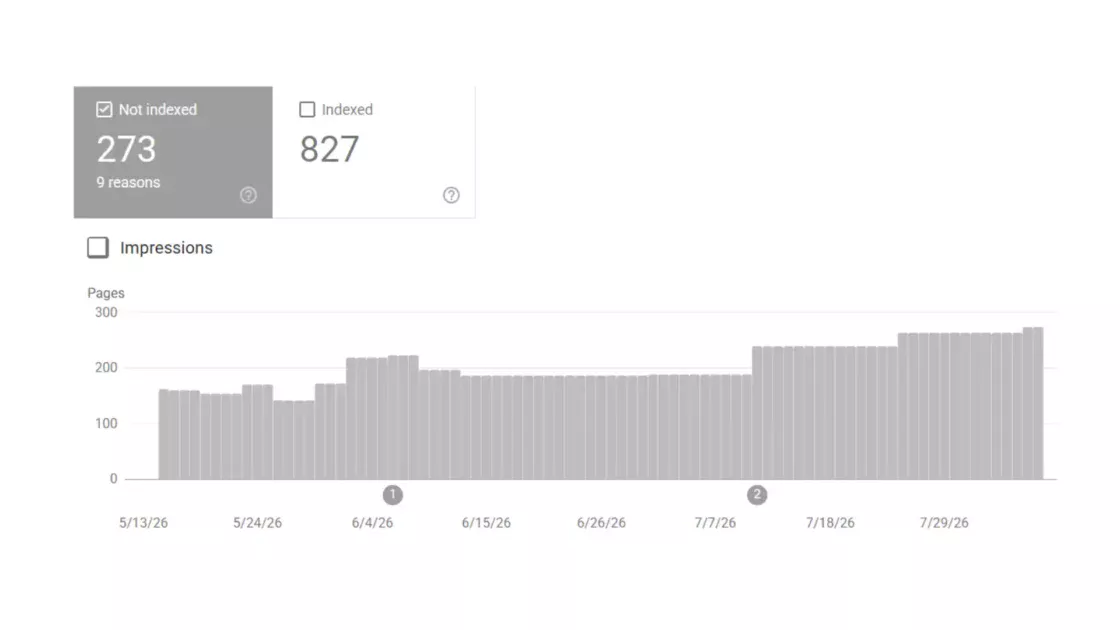
Search Console has not added a dedicated AI Overview report as of mid-2026, which forces practitioners into a workaround that has become its own daily and weekly habit: reading standard performance data differently than they used to. The signal everyone is watching for is a specific pattern, impressions holding steady or rising while click-through rate falls, which strongly suggests a page is being pulled into an AI Overview or AI Mode answer without the user needing to click through to see it.
A randomized field study run by Search Engine Journal between January and February 2026 isolated this effect with more rigor than the correlational studies that came before it. Researchers randomly assigned real searchers to see or have hidden the AI Overview panel during live queries, and found that AI Overviews reduced outbound organic clicks by 38 percent on the queries where they appeared. Removing the panel nearly doubled outbound clicks on those same searches. That is a causal number, not a guess, and it gives practitioners a defensible way to explain to a client or a boss why organic sessions can decline even as a page continues to rank and continues to earn impressions.
The daily habit that follows from this is segmentation. Teams create a dedicated Search Console segment, or an equivalent view inside whatever combined analytics stack they use, isolating queries and landing pages where AI Overviews or AI Mode are known to trigger. Some pair this with a referrer segment built in analytics tooling that separates traffic explicitly arriving from ChatGPT, Perplexity, Copilot, and Gemini link-outs, since these referrers are now large enough on many sites to matter for attribution and no longer belong lumped into a generic “other” bucket.
There is a documented silver lining that keeps this data review from being purely defensive. Analysis published by Digital Applied in March 2026 found that brands cited inside AI Overviews earned 35 percent more organic clicks and 91 percent more paid clicks compared to non-cited competitors targeting the same queries. That is a striking number: being named inside the AI answer correlates with more commercial value than holding the top organic position underneath it. Separately, Press Gazette-cited data from 2026 found that visitors who do click through from an AI Overview show 23 percent lower bounce rates and 41 percent longer time on site than average organic visitors, consistent with the idea that the AI has already pre-qualified the reader’s intent before they ever land on the page.
Put together, the weekly Search Console review has shifted from “did rankings move” to a three-part question: is CTR falling on pages with stable impressions, which pages show referrer traffic from AI platforms, and among the pages that do get cited, is the resulting traffic converting at the elevated rate the 2026 data suggests it should. Teams that only ask the first question end up with an incomplete and unnecessarily alarming picture of their AI-era performance.
The new toolkit and where Profound, Otterly, Peec and Athena differ
No 2026 GEO routine runs without at least one dedicated tracking platform, and the market has sorted into a fairly clear tier structure by price and depth. At the entry level, Otterly AI has become the default starting point for smaller teams and solo practitioners, with pricing beginning around 29 dollars a month for a limited prompt set. It tracks brand mentions and citations across ChatGPT, Google AI Overviews, Perplexity, Gemini, and Copilot, and its GEO Audit feature runs more than twenty-five on-page and technical checks, returning a diagnostic explanation for why a specific page may not be earning citations. Reviewers consistently note that Otterly is strong on monitoring and diagnosis but comparatively light on prescriptive “rewrite this to win” guidance, meaning a team still has to translate its findings into an editorial plan themselves.
Peec AI occupies a similar mid-market position with a particular strength in reporting flexibility: agencies managing multiple client accounts favor it for Looker Studio integration and project-level client access, letting an agency hand a client direct visibility into the data rather than a static PDF. At the enterprise end, Profound and Athena dominate discussion, both offering prompt fan-out tracking, competitor benchmarking, and dashboards built for multi-stakeholder reporting rather than a single marketer’s daily glance. Profound has raised roughly 155 million dollars at a reported valuation near 1 billion dollars, serves Fortune 500 accounts, and built a Conversation Explorer drawing on more than 400 million tracked conversations to surface real user questions at scale. Athena’s pricing starts near 295 dollars a month for a base tier of 3,500 tracked prompt-credits, with each credit representing one prompt checked on one AI platform, a structure that can get expensive quickly for teams tracking broad prompt sets across many platforms.
A second wave of tools tries to close the gap between monitoring and action. ZipTie, AirOps, and Writesonic’s GEO product each pair citation tracking with a content workflow layer, turning a detected citation gap directly into a content brief or a CMS-ready draft rather than leaving that translation step to a human analyst. AirOps in particular links its influence scoring, which ranks publishers by how often they get cited in AI answers, directly to outreach and content planning inside the same interface.
The established SEO platforms have not stood still. Semrush, Ahrefs, and Conductor have all added AI visibility modules to their existing suites, a move that lets teams already paying for those tools get a baseline view of AI citation performance without adding a new line item to the budget, even if the depth rarely matches a purpose-built platform. Ahrefs’ Brand Radar leans on a database exceeding 239 million tracked prompts, functioning more as a research resource than a live tracking dashboard.
No single tool covers every platform, every competitor, and every content-to-action workflow at a price most teams can justify, which is why a surprising number of 2026 GEO routines run two tools in parallel: a budget monitoring platform for daily citation checks, paired with either a manual spot-check process or a pay-per-query API service for deeper investigation during launches, crises, or competitive pushes. The right combination depends less on which tool has the most funding and more on whether a team actually has the capacity to act on what the dashboard shows them.
Building and maintaining prompt sets for tracking
A citation dashboard is only as useful as the list of prompts it runs, and building that list has become a dedicated recurring task rather than a one-time setup step. Teams that treat the prompt set as static, written once during onboarding and never revisited, consistently end up tracking questions nobody actually asks six months later, because the language people use to query AI systems shifts faster than the language used in traditional keyword research.
The starting point for most teams is mapping real customer questions rather than guessing at keyword variants. Some pull directly from sales call transcripts, support tickets, and Reddit threads sorted by upvotes in relevant subreddits over the past year, treating the most-upvoted questions as a reasonable proxy for what a large number of real buyers care about. Others rely on the prompt research features built into enterprise platforms, which surface actual anonymized query volume rather than an SEO tool’s estimate of what a user might type. Profound’s prompt research tool, for instance, breaks its data down by intent, informational, comparison, or purchase, so a team can see not just that a phrase gets asked but why people are asking it, which changes how the corresponding content should be structured.
A well-built prompt set for a mid-sized brand typically runs somewhere between thirty and a hundred core prompts, split across informational questions about the category, direct comparison questions naming the brand against two or three named competitors, and transactional questions phrased the way a buyer close to a decision would phrase them. Running every prompt across every tracked AI platform daily gets expensive fast under credit-based pricing models, so most routines apply a tiered cadence: the highest-priority comparison and branded prompts get checked daily, broader informational prompts get checked two or three times weekly, and long-tail exploratory prompts get checked monthly or ahead of a specific content push.
Maintaining the set means retiring prompts that have gone stale, adding new ones as product lines or competitors change, and periodically re-validating that the prompts still reflect real phrasing rather than phrasing the team invented and assumed was representative. A prompt like “best CRM for small business” might need to be split into several more specific variants once tracking data shows the fan-out system is actually decomposing that question into narrower sub-queries about pricing, integrations, and onboarding time, each of which deserves its own tracked entry if the team wants visibility into which specific angle is winning or losing citations.
There is a quieter discipline buried inside this task that many teams underweight: documenting exactly how each prompt is worded, since AI answers are sensitive to phrasing in ways traditional search results are not. Two nearly identical prompts, one asking “is X worth it” and another asking “is X worth the money,” can return meaningfully different cited sources. Treating the prompt wording itself as a controlled variable, changed deliberately and tracked over time rather than drifting accidentally, is what turns a citation dashboard from a curiosity into a genuine measurement instrument.
Weekly competitor citation audits
Where a daily check answers “did our own citation status change,” a weekly audit answers a different and arguably more strategically useful question: who is winning the citations we are losing, and what are they doing that we are not. This has become a Friday-afternoon or Monday-morning fixture on most GEO calendars, distinct enough from the daily routine that teams treat it as its own block of time rather than an extension of the morning check.
The mechanics are straightforward but time-consuming without the right tooling. For each prompt in the tracked set where a competitor appears and the brand does not, the analyst pulls the exact passage the AI system quoted or paraphrased, identifies the source URL, and looks for a pattern across the source, is it a comparison page with a table, a review aggregator, a Reddit thread, a piece of original research. Citation analysis features built into platforms like Otterly and Peec surface this automatically, showing which publishers and specific URLs get cited most often within a topic area, which turns what used to be a manual competitive teardown into something closer to a filtered report a junior analyst can run in under an hour.
The output of this audit typically feeds two different downstream actions. The first is a content gap list: specific sub-questions where a competitor’s page answers more completely or more citably than the brand’s equivalent page, prioritized by how frequently that gap shows up across the tracked prompt set. The second, less obvious action is digital PR and outreach targeting, since a competitor being cited via a third-party comparison site or review platform rather than their own domain reveals a distribution channel worth pursuing independently of any content rewrite.
A pattern that shows up repeatedly in 2026 competitive audits is that the winning source is often not the competitor’s own website at all. A neutral third-party comparison, a well-regarded review platform, or a Reddit thread with strong community validation frequently outranks both the brand’s and the competitor’s own marketing pages inside an AI answer, because the AI system treats independent validation as a stronger trust signal than brand-authored copy. This finding reshapes what “competitive audit” even means in this context: the competitor to beat is sometimes a third-party publisher rather than a rival company, and the weekly review increasingly includes tracking which independent domains are earning outsized citation share across an entire category, not just which named competitors are winning.
Teams running this audit consistently enough to spot trends, rather than treating each week as an isolated snapshot, are the ones who catch shifts early: a competitor’s new comparison page starting to earn citations within days of publication, or a previously dominant third-party source losing citation share after a platform update changes which sources it trusts. Catching that shift in week one rather than month three is the entire point of running the audit on a fixed weekly cadence instead of only when a client asks for a quarterly report.
Monthly share of voice and brand visibility index reviews
Daily citation checks and weekly competitor audits both operate at the level of individual prompts. Once a month, most GEO routines zoom out to a metric that aggregates across the entire tracked prompt set: share of voice, sometimes branded by individual platforms as a Brand Visibility Index or an Answer Share of Voice score. The underlying idea is consistent across tools even when the exact label differs: what percentage of tracked prompts, across all tracked AI platforms, mention or cite this brand at all, and within the responses that do mention it, how prominent is that mention relative to competitors named in the same answer.
This monthly rollup exists because day-to-day and even week-to-week citation data is genuinely noisy. A single prompt flipping in or out of a citation on any given day can reflect a temporary model update, a caching quirk, or simple variance in how a generative system samples its response rather than any real change in underlying content quality. Averaging across dozens or hundreds of prompts over a full month smooths that noise out and gives a number stable enough to report to a client or a leadership team without overclaiming precision the underlying data does not support.
The monthly review typically breaks share of voice down by several cuts: overall trend line month over month, breakdown by individual AI platform since a brand can be strong on Perplexity and nearly invisible on Gemini for the same prompt set, and breakdown by prompt category, informational versus comparison versus transactional, since improvement work targeted at one category rarely transfers cleanly to another. Answer positioning and depth get tracked alongside raw mention frequency, because a brand mentioned in passing near the end of a long AI answer is worth measurably less than a brand cited as the first or primary source, even if both count as a “citation” in a simple binary tracking system.
Sentiment analysis has become a standard companion metric in this monthly review rather than a nice-to-have addition. It is not enough to know a brand gets mentioned; teams also want to know whether the AI-generated summary of the brand is accurate and favorable or subtly wrong and unflattering, since a factual error repeated consistently across AI answers can do real reputational damage that a raw citation-count metric would completely miss. Tools in this category flag factual misalignment between what a brand’s own site claims and what the AI system is actually saying about it, which gives teams a monthly to-do list of corrections to push, sometimes by updating on-site content and structured data, and sometimes by seeding accurate information into third-party sources the AI system is more likely to trust.
The monthly cadence also anchors budget and staffing conversations. Because eMarketer data from 2025 already showed United States enterprises dedicating an average of 12 percent of digital marketing budgets to generative engine optimization, with 94 percent of surveyed teams planning to increase that spend through 2026, the monthly share of voice number has effectively become the KPI that justifies whether that spending continues to grow, holds steady, or gets reallocated elsewhere.
Content structure habits, answer blocks and extractable passages
If tracking work fills the analytical half of a GEO week, structuring content fills the production half, and the specific habits here have converged more than most other parts of the discipline. The core idea, sometimes called passage-level extractability, is that a generative engine is not linking to a page the way classic search does. It is rewriting the page’s content into its own words, and it strongly favors source material that is already close to that final form: short, self-contained, factual statements that can be lifted with minimal transformation.
This has produced a consistent set of writing habits across teams that otherwise disagree about almost everything else in the discipline. Paragraphs get built to answer one specific sub-question completely rather than building toward an answer across several paragraphs. Numbers, named entities, and specific claims replace vague qualitative language wherever the underlying research supports it, because entity-dense text is measurably easier for a retrieval system to extract cleanly. Analysis from Kevin Indig at Growth Memo, cited widely across the industry in 2026, found that cited passages carry an entity density around 20.6 percent, compared to roughly 5 to 8 percent in ordinary English prose, a gap large enough that it now functions as an informal editing checklist item: does this paragraph name specific things, brands, products, prices, versions, rather than describing them abstractly.
Comparison tables have become close to mandatory for any content competing in a category with more than one viable option, not because tables look nice but because a well-structured table is close to the ideal input format for an AI system building a synthesized comparison answer. The same logic applies to numbered steps for procedural content, since HowTo-structured, sequential instructions get preferentially cited for “how to” queries across nearly every platform studied.
Heading structure has shifted too, though less dramatically than some early advice suggested. H2 sections phrased as direct questions, followed immediately by a concise two-to-four sentence answer before any elaboration, remain a strong pattern for both traditional featured snippets and AI Overview citation. What Google’s May 2026 guidance changed is the belief that this structure needs to be mechanically rigid or duplicated in a special AI-only format. The guide’s position, that its systems already understand multi-topic pages without needing pre-fragmented chunks, means the habit now is to write naturally structured, well-organized content rather than engineering artificial chunk boundaries purely to satisfy an assumed machine-parsing requirement that turned out not to exist, at least for Google’s own systems.
The daily discipline that has emerged from all of this is less about following a rigid formula and more about a specific editing pass added to every piece before publication: reading each section and asking whether it could be lifted, nearly verbatim, into a synthesized answer and still make complete sense on its own. Sections that fail that test tend to get rewritten regardless of how well they read as connected narrative prose, because narrative flow that depends on the preceding paragraph is exactly the kind of content a fan-out retrieval system struggles to extract cleanly.
The first hundred words rule and TLDR first writing
One specific structural habit deserves its own section because of how consistently it appears across independent 2026 guidance and how sharply it breaks from pre-AI content writing conventions: putting the complete, direct answer to the page’s primary question inside the first 100 to 200 words, before any scene-setting, background, or narrative buildup.
The reasoning behind this habit differs slightly depending on which AI surface a team is optimizing for, but the underlying logic converges. For platforms using real-time retrieval, Perplexity and Google AI Overviews being the clearest examples, the system evaluates a page’s relevance largely based on its opening content, since that is what it processes first and most thoroughly. A page that spends its first three paragraphs building context before finally stating a conclusion risks having that opening section judged less relevant than a competing page that states the answer immediately, even if the buried answer, once reached, is equally good or better.
This has effectively killed a writing convention that dominated content marketing for over a decade: the slow-build introduction designed to hook a reader emotionally before delivering value. That convention made sense when the primary audience was a human scanning search results who needed to be convinced to keep reading. It makes considerably less sense when a meaningful share of the audience is a retrieval system extracting a passage in the first pass through the page and a human reader arriving after already seeing an AI-generated summary, meaning the reader who does click through has already been told the gist and wants confirmation or depth, not a reveal.
The habit shows up concretely in how briefs and outlines get structured. Rather than an introduction section that sets up the topic, most 2026 GEO-aware content briefs specify a direct-answer opening: state the core claim or answer in the first two to four sentences, follow immediately with the specific numbers or facts that support it, and only then move into the broader context, history, or nuance that a narrative-driven introduction would traditionally have opened with. This mirrors the same TLDR-first structure that performs consistently well across independent measurement of top-cited GEO content, and it has become enough of a default that many editorial style guides now flag any draft that opens with generic scene-setting as needing a structural rewrite before it goes further in the review process.
There is a real tension this habit creates for teams who also care about brand voice and storytelling, since a direct-answer-first structure can read as cold or transactional if applied without judgment to every single piece of content a brand publishes. Most practitioners resolve this by applying the rule strictly to primarily informational, search-intent-driven content, while preserving more narrative freedom for brand storytelling, thought leadership, and content explicitly designed for human engagement rather than AI citation, treating the two content types as separate tracks with separate structural rules rather than forcing one convention onto everything.
A compact look at habit frequency across a GEO week
Pulling the habits described so far into a single view helps explain why a GEO routine feels heavier than a legacy SEO calendar even though the total number of distinct tasks is not dramatically larger. The difference is cadence: several tasks that used to run monthly or quarterly now run daily, and a few genuinely new tasks, citation checking chief among them, did not exist in any form before 2024.
Habit frequency across a typical GEO working week in 2026
| Habit | Typical cadence | Primary tool or method |
|---|---|---|
| Cross-platform citation check | Daily | Otterly, Profound, Peec, or manual prompt runs |
| Search Console AI-segment review | Daily to weekly | GSC + referrer segmentation |
| Competitor citation audit | Weekly | Citation analysis features, manual review |
| Prompt set maintenance | Weekly to monthly | Prompt research tools, Reddit/support ticket mining |
| Share of voice and sentiment rollup | Monthly | Brand Visibility Index dashboards |
| Schema and entity audit | Monthly | Rich Results Test, schema validators |
| Reddit and forum monitoring | Daily | Native search, brand-mention alerts |
| Content freshness audit | Monthly to quarterly | CMS reports, dateModified checks |
The table understates one thing that does not fit neatly into a frequency column: the amount of judgment required to interpret each data point correctly. A daily citation check that simply logs a number without anyone asking why that number moved is closer to theater than measurement, a criticism several 2026 industry commentators have leveled specifically at teams that buy an expensive monitoring platform and treat the dashboard itself as the deliverable rather than a starting point for weekly decisions. The tools listed above generate data efficiently. Turning that data into a defensible content and outreach plan still depends on an analyst who understands both the mechanics of query fan-out and the specific competitive landscape of the category being tracked, and that part of the routine has resisted automation more than the measurement layer has.
Entity SEO as a daily discipline
Backlinks used to be the dominant currency of authority in search. In 2026, a different metric has taken over much of that role for AI citation purposes: how clearly and consistently a brand exists as a recognized entity across the web, independent of any single page’s content quality. Research cited across several 2026 GEO analyses found that brand mentions correlate with AI visibility at roughly 0.664, more than three times stronger than the 0.218 correlation measured for backlinks, a gap large enough to justify reallocating real budget away from traditional link building and toward entity-building work instead.
An entity, in this context, is a specific, disambiguated thing a knowledge graph can point to: a company, a founder, a product, a named author. The work of entity SEO is making sure that every one of those things is described consistently across every place it appears, the brand’s own site, Wikidata, LinkedIn, Crunchbase, press coverage, and industry directories, because AI systems cross-reference multiple sources when deciding how confidently to treat a claim as true. Inconsistent details, a founding date that differs between the website and a LinkedIn company page, for example, fragment what should be a single strong entity into several weaker, contradictory signals.
This has turned entity maintenance into a recurring audit rather than a one-time setup task. A typical monthly or quarterly pass checks that name, address, and phone details remain consistent across every directory listing; that the brand’s Organization schema still matches current facts about leadership, funding, or service offerings; and that any new hires in public-facing roles, particularly named authors and subject matter experts, have their own Person entities properly linked back to the organization. Teams working with fast-growing companies describe this as a genuinely tedious but high-leverage task, since a single inconsistency discovered months after it was introduced can quietly suppress citation eligibility the entire time it goes unnoticed.
Building a Wikidata presence has become one of the most commonly recommended, if unglamorous, entity tasks on a 2026 GEO roadmap, precisely because it is a one-time setup with durable payoff rather than a recurring content commitment. Wikidata does not carry Wikipedia’s notability threshold, is free to edit, and functions as a primary structured input into Google’s Knowledge Graph, giving a brand a stable, machine-readable identifier that both search engines and AI systems can reference unambiguously. Practitioner guidance from 2026 recommends establishing solid third-party sourcing first, press coverage, industry databases, government registrations, before creating the Wikidata entry itself, since Wikidata’s sourcing requirements have tightened and an unsourced entry is more likely to be flagged or removed than one built on a foundation of independently verifiable citations.
The daily habit that ties this together for a working practitioner is less glamorous than any single tactic: a running checklist, revisited whenever anything about the business changes, that treats entity consistency as infrastructure rather than a project with a defined end date. Brands that skip this work are not necessarily producing worse content. They are simply harder for an AI system to confidently identify as a known, trustworthy thing, which quietly caps how far even excellent content can go in citation performance.
Schema markup maintenance routines
Google’s May 2026 guidance told practitioners not to bother with special AI-only schema formats, but it did not say schema markup itself had stopped mattering, and the daily and weekly routines around structured data have if anything grown more disciplined rather than less. The distinction that matters is between schema built purely to trigger a visible rich result in a search listing and schema built to establish machine-readable entity trust, and the second category has become the more actively maintained one.
Five schema types dominate the maintenance calendar for most content-driven brands: Organization schema establishing the company entity with name, logo, founding date, and sameAs links; Person schema for founders, executives, and named content authors, carrying credentials and links to professional profiles; Article schema carrying publication and modification dates that feed directly into freshness signals; FAQPage schema structuring question-and-answer content for direct extraction; and increasingly, explicit knowsAbout properties on both Organization and Person schema, declaring the specific topics and industries a brand or individual genuinely has expertise in, which several 2026 analyses describe as one of the highest-impact additions available since the broader March 2026 structured data changes took effect.
The recurring task that keeps this from becoming a set-and-forget project is validation. A monthly pass through Google’s Rich Results Test and Schema.org’s own validator catches the kind of silent breakage that a content management system update, a theme change, or a plugin conflict can introduce without anyone noticing until citation data starts declining for reasons that are not otherwise obvious. Teams managing schema across dozens or hundreds of pages increasingly rely on automated monitoring that flags schema errors or omissions as soon as they appear, rather than relying entirely on a periodic manual spot-check, because the gap between an error being introduced and being caught manually can otherwise stretch to weeks.
Keeping the dateModified field on Article schema honest has become its own small discipline. The habit that has emerged in response to earlier abuse of this field, where teams updated timestamps without making any substantive change purely to signal freshness, is a documented internal policy: dateModified only changes when facts, data, examples, or guidance in the underlying content have materially changed, never as a cosmetic freshness signal on its own. Google’s own May 2026 guidance reinforces this directly, warning that changing dates without meaningful updates is not a strong strategy and that a page should be updated when the substance of what it says has actually changed.
Bidirectional entity linking, where an Article node references its Person author by ID, that Person node references the Organization by ID, and the Organization node carries its own sameAs links out to Wikidata and LinkedIn, has become a technical best practice worth a dedicated line item in a quarterly technical audit. The logic is that an AI system evaluating trust wants to resolve a full chain, from the specific claim, to the author who wrote it, to the organization that published it, to external validation that the organization is real, in as few steps as possible, and a properly linked schema graph makes that resolution close to instantaneous rather than requiring the system to infer the connections from unstructured text.
Wikidata and knowledge graph upkeep
Beyond the initial entry-creation task described earlier, Wikidata and knowledge graph work carries its own smaller, ongoing maintenance rhythm that many GEO routines assign to a specific owner, often someone with both marketing and light technical fluency, rather than leaving it to whoever happens to notice something is out of date.
The core recurring task is straightforward to describe and tedious to execute consistently: checking that every claim on the brand’s Wikidata entry, industry classification, founding date, headquarters location, key personnel, official website, still matches reality, and that every claim carries a citation to an independent, verifiable source rather than sitting unsourced. Wikidata’s community-editing model means anyone can technically make this correction, but in practice a brand that wants its entity data to stay accurate needs someone checking on a defined schedule, typically quarterly for stable details and immediately after any material business change, a funding round, an executive departure, a rebrand, that would otherwise leave the public entity record silently wrong for months.
Google’s Knowledge Graph itself sits one layer removed from Wikidata and is not directly editable, but brands with an existing Knowledge Panel can claim ownership through Search Console verification and suggest edits to the panel’s description, images, and listed social profiles. This claiming and suggestion process has become a periodic task rather than a daily one, since panel updates on Google’s side do not happen instantly, but the habit of checking the panel for drift, an old logo, an outdated description, a social profile that no longer exists, on a monthly basis catches problems before they compound.
The measurable payoff for this category of work has been documented with reasonable specificity. A widely cited 2024 study on entity SEO found that brands with a verified, well-structured Wikidata item were 3.2 times more likely to display a Google Knowledge Panel at all, and 2.7 times more likely to appear in AI Overview citations compared to brands without that Wikidata presence. Those multipliers help justify the otherwise unglamorous recurring time commitment to a leadership team that might otherwise question why anyone is spending hours per month editing entries on a site most people have never heard of.
One nuance that has become common knowledge among practitioners doing this work seriously: a Wikidata entry created without independent sourcing is fragile. The platform’s editorial community actively removes or flags unsourced claims about commercial entities, particularly newer or smaller brands attempting to bootstrap notability through the entry itself rather than reflecting notability that already exists elsewhere. The sequence that tends to hold up is earning genuine independent coverage first, press mentions, industry database listings, government business registrations, and only then building the Wikidata entry on top of that existing foundation, treating the entry as documentation of established facts rather than as a tool for manufacturing credibility that does not yet exist anywhere else.
Author entity building and person schema
A byline used to be a formality. In a 2026 GEO routine it is closer to a strategic asset, because AI systems increasingly attribute trust to the individual named as a content’s author, not just to the domain publishing it. This has turned author entity building into a recurring habit rather than a one-time bio-page setup, and it explains why the author paragraph attached to a piece of content, credentials, affiliation, and a link to a canonical profile, has become something teams actively maintain rather than treat as boilerplate.
The concrete recurring tasks fall into a few categories. Author bio pages need periodic updates as credentials, roles, or areas of focus change, since a stale bio undermines the exact expertise signal it exists to establish. Person schema tied to each named author needs its knowsAbout property kept current, reflecting the topics that author is genuinely writing about now rather than a static list set when the page was first built. And the sameAs links out to LinkedIn, and where relevant to Wikidata or professional directories, need occasional verification that they still resolve to the correct, currently accurate profile.
This work has a direct connection to the E-E-A-T framework that has anchored Google’s quality evaluation for years and that the May 2026 generative AI guidance explicitly reaffirmed as still relevant. Clear bylines, linked author pages, and explained credentials give both human readers and AI systems an answer to a question that unattributed or thin content cannot answer: who created this, and why should anyone trust their claims. Google’s own guidance frames this directly, recommending that publishers explain relevant expertise and make clear why a given author or publisher is credible on the specific topic being covered, rather than assuming credibility is self-evident from the content alone.
There is a practical tension in this habit worth naming directly: much of the content produced under high-volume 2026 publishing operations, including AI-assisted workflows, is not written entirely by the named human author in the traditional sense. Google’s guidance addresses this without banning the practice outright, framing the real question as one of outcome and oversight rather than tool use. Content produced with AI assistance for research, drafting, or organization is treated as acceptable as long as a human is genuinely adding expertise, verification, editing, and accountability, while large volumes of low-value, unoriginal, unsupervised AI output create real risk regardless of how the byline is presented. Some publishers have started adding brief context about how content was produced when that production method is material to how much a reader should trust a given claim, a transparency habit that is not yet universal but is becoming more common as the line between human-written and AI-assisted content continues to blur across the industry.
The routine that ties all of this together is less about any single schema field and more about treating the named author as a real entity worth actively curating, with the same seriousness applied to the organization’s own entity signals, rather than treating a byline as a formality left over from print journalism.
Reddit and forum monitoring as a daily habit
If there is one habit that would have seemed genuinely strange to a 2022-era SEO team and is now a fixed daily task for a serious 2026 GEO operation, it is monitoring Reddit threads with the same discipline once reserved for a brand’s own website analytics. The shift is backed by numbers large enough to be hard to dismiss: a 50,000-response analysis across major AI platforms cited in early 2026 found Reddit content appearing in 68 percent of AI-generated answers, and a separate prompt-testing exercise across 200 product comparison queries found Reddit threads showing up in AI Overview citations 62 percent of the time, ahead of individual brand websites at 41 percent and review platforms like G2 and Trustpilot at 35 percent.
The platform-level variance behind that aggregate number matters for where teams focus their daily attention. Perplexity leans on Reddit especially heavily, citing it in close to half of its responses according to research from Lily Ray at Amsive, while Google AI Overviews cite Reddit at a lower but still substantial rate and ChatGPT, which draws more heavily on Wikipedia as its top source, still gives Reddit a meaningful citation share. Tinuiti’s Q1 2026 AI Citations Trends Report documented an even sharper platform split: Reddit’s citation share on ChatGPT crossed 5 percent in January 2026, while the equivalent figure on Google’s Gemini sat at just 0.1 percent, a gap wide enough that a brand’s Reddit strategy genuinely needs to account for which specific AI surface its target audience actually uses.
Two structural developments explain why this is not a passing trend. Google’s licensing deal with Reddit, reported at roughly 60 million dollars, made Reddit’s real-time content and API a first-class data source feeding Google’s AI training and its Vertex AI infrastructure, formalizing what had previously been an informal reliance on Reddit’s publicly crawlable content. Separately, research from SE Ranking found that domains with substantial mention volume on Reddit and Quora are roughly four times more likely to be cited by AI systems than domains with minimal community activity, a correlation strong enough that several practitioners now treat Reddit mention volume as a leading indicator worth tracking with the same rigor as backlink counts once received.
The daily monitoring task itself has a few concrete components: tracking brand mentions across a defined set of target subreddits, whether through native Reddit search or a dedicated monitoring tool; watching for threads where the brand’s category is being actively discussed even without a direct mention, since these represent both a listening opportunity and a potential citation source once a thread accumulates enough engagement; and flagging any thread showing early signs of ranking well in Google’s own organic results, since a Reddit thread appearing in the top few organic positions for a relevant query carries outsized weight for eventual AI citation regardless of what it says about the brand.
The reason this monitoring runs daily rather than weekly is speed of decay and speed of opportunity working in opposite directions. A misleading or outdated thread about a product can get cited by an AI system within days of gaining traction, giving a team a narrow window to respond with a genuine, transparent correction before the thread’s framing calcifies into the default answer AI systems repeat. Conversely, a thread showing early momentum in a positive direction is worth reinforcing quickly, while it is still gaining visibility, rather than discovering it weeks later once the opportunity to shape the surrounding conversation has largely passed.
Participating authentically in community discussions
Monitoring Reddit is only half of the habit. The harder, more time-intensive half is participation, and the way legitimate 2026 GEO practice approaches this differs sharply from the astroturfing tactics that a segment of the industry still openly sells despite the clear risks involved.
The credible playbook, echoed across multiple 2026 sources describing how ecommerce and B2B teams approach Reddit strategically, follows a consistent sequence. Teams identify a small number of priority subreddits, typically in the range of three to ten, where their category is genuinely discussed at meaningful volume, prioritizing communities with active daily posting over communities with large subscriber counts but low actual engagement. Team members, often founders or subject-matter experts rather than a marketing intern managing a brand account, build real karma history through genuinely useful participation in relevant threads before ever mentioning their own product, a process that credible guides describe as taking somewhere in the range of thirty to ninety days before it produces measurable AI citation pickup.
The line between legitimate participation and prohibited manipulation is drawn sharply and repeatedly across the sources covering this topic, and it is a line worth stating plainly rather than softening: coordinated inauthentic behavior, purchased aged accounts, fabricated positive threads, or brigading a competitor’s mentions are detectable by both Reddit’s own moderation systems and by the AI systems increasingly trained to recognize inauthentic patterns, and the consequences for getting caught are typically permanent rather than a slap on the wrist. Several sources describing this space explicitly frame authentic, sustained, genuinely helpful participation as the only approach with a durable payoff, treating anything closer to astroturfing as a short-term tactic that carries real brand and platform risk disproportionate to whatever temporary citation lift it might produce.
The role of community management inside a marketing organization has shifted accordingly. Where community management was historically treated as a support function focused on customer service and light engagement, 2026 GEO strategy increasingly treats it as central to AI visibility, because the people managing community presence are the ones shaping the environments where real product experience gets discussed in public, and that discussion is precisely the raw material AI systems draw on when forming an internal representation of how a brand should be characterized in a generative answer.
A specific, less obvious form of participation that has become part of the routine is hosting AMAs and similar structured community events when a brand genuinely has something worth discussing, a new product launch, a founder’s personal story, a technical deep dive into how something works. These events generate a concentrated burst of authentic, first-person, entity-dense discussion in a short window, which several practitioners describe as producing a disproportionately large and durable citation benefit compared to the same volume of discussion spread thinly across months of ordinary participation, precisely because the concentration and authenticity signal that AI systems appear to weight heavily is easier to establish in a focused event than in scattered, incidental mentions.
Mirroring UGC signals on owned content
Community monitoring and participation feed a third habit that closes the loop back onto a brand’s own website: deliberately mirroring the structural and linguistic patterns that make Reddit and forum content so citable, applied to content the brand fully owns and controls. This is distinct from simply linking to or embedding Reddit threads. It is closer to learning from user-generated content’s underlying structure and rebuilding some of that structure inside first-party pages.
The most direct version of this habit is treating Reddit as a research source rather than only a monitoring target. Sorting target subreddits by top posts over the past year surfaces the questions a category’s audience genuinely cares about most, ranked by real community validation rather than by keyword search volume, which tends to reflect what people search for rather than what they actually want answered. Every high-upvote question extracted this way becomes a candidate FAQ entry, direct-answer H2 heading, or standalone comparison section on the brand’s own pages, closing the gap between what users actually ask in an unfiltered setting and what the brand’s content currently addresses.
Vocabulary extraction is the second, subtler part of this mirroring habit. Reading the specific phrasing real users apply inside forum discussions, rather than the phrasing a brand’s own marketing team defaults to, frequently surfaces language gaps that keyword research alone would miss. A forum consistently asking whether a particular extra step is actually worth the effort, phrased in exactly those informal terms, signals both the underlying intent and the tone a well-targeted answer should adopt, and content written to match that phrasing tends to perform better in both organic search and AI citation tracking than content written in more generic, brand-safe marketing language.
A third and more advanced version of this habit involves deliberately structuring owned content to read with some of the same first-person, experience-based texture that makes UGC citable in the first place, without crossing into fabricating experiences that did not happen. This typically shows up as genuine case studies, named employee or customer testimonials with specific, verifiable detail, and first-person accounts of actually using a product for a defined period, structured with the same entity density and specificity that Reddit threads naturally carry, but grounded in real, disclosed, attributable experience rather than manufactured to imitate community authenticity the brand has not actually earned.
The underlying strategic logic connecting all three parts of this habit is straightforward: since third-party validation is a stronger trust signal to AI systems than brand-authored claims, and since a brand cannot fully control third-party platforms, the next best available lever is making first-party content structurally and linguistically as close as possible to the kind of content that independently earns citations, while being scrupulously honest that anything presented as a testimonial or case study reflects something that genuinely happened rather than content dressed up to look more authentic than it is.
Freshness routines and content decay checks
AI systems weigh recency more heavily than most legacy SEO practice ever did, which has turned content freshness auditing into a scheduled routine rather than something teams get to when time allows. The underlying reasoning is intuitive once stated plainly: a guide published in 2024 and never touched since is competing against a 2026 article covering the same ground with current facts, and an AI system synthesizing an answer has a clear incentive to favor the source more likely to be accurate right now.
The monthly or quarterly decay audit that has become standard practice typically pulls a report across the entire content library, sorted by publish date and last-modified date, flagging any page discussing a topic prone to material change, pricing, product features, regulatory status, statistics, that has not been substantively updated within a defined window, often six to twelve months depending on how fast the underlying subject matter actually moves. Pages flagged this way get triaged into a short list of either updates, full rewrites, or, in some cases, deliberate retirement if the topic no longer serves any current audience need.
The habit that separates disciplined freshness work from freshness theater is precision about what actually counts as an update. Google’s own May 2026 guidance is explicit that changing a dateModified timestamp without a meaningful corresponding change in the content’s substance is not a strong strategy, and several practitioners describe this as a lesson the industry had to learn the hard way after an earlier wave of teams tried gaming freshness signals purely through cosmetic date changes. The routine that has replaced that gaming attempt requires every flagged update to include at least one of a defined set of substantive changes: new or corrected data, an updated example reflecting current product or market conditions, a revised recommendation reflecting new evidence, or newly added sections addressing a sub-question that tracking data shows readers are now asking but the existing content does not cover.
Freshness checks extend beyond the article body into the structured data layer as well. Article schema’s dateModified field needs to move in lockstep with genuine content updates, and teams increasingly automate this so the schema update happens as part of the same publishing workflow that pushes the content change live, removing the chance of a human forgetting to update the metadata separately from the visible text.
A less obvious part of this routine involves watching for topics where an AI system’s own training data has simply gone stale in a way that creates an opportunity rather than a threat. Content covering something recent enough that it postdates a major model’s last training update carries a measurable advantage in citation likelihood, since the AI system has no other way to answer the question except by retrieving fresh web content, and teams tracking model release cycles and stated knowledge cutoffs use that information to prioritize which timely topics deserve the fastest possible turnaround from research to published, fully structured content.
Refresh cadence versus publishing new pages
A recurring resource-allocation debate shows up in nearly every 2026 GEO planning meeting: given a fixed amount of content production capacity in a given month, how much should go toward refreshing existing pages versus publishing entirely new ones. The answer that has emerged from practitioner experience is more nuanced than either extreme, and the routine that has settled out treats the decision as its own periodic exercise rather than a fixed policy applied uniformly across an entire content library.
The case for refresh-first prioritization rests on a simple efficiency argument: an existing page that already has some accumulated authority, some existing backlinks, some prior citation history, and some established rankings needs a meaningfully smaller lift to reach strong AI citation performance than a brand-new page starting from zero on every one of those dimensions. Updating a page that already ranks reasonably well, adding the missing sub-question coverage that fan-out tracking reveals readers are asking about, tends to produce a faster and larger citation improvement than publishing an entirely new page targeting the same core topic, all else equal.
The case for new-page publishing remains strong in a specific and identifiable circumstance: when tracking data reveals a genuinely uncovered sub-topic or emerging question with no existing page anywhere in the library remotely equipped to answer it. Refreshing an unrelated existing page to awkwardly cover a genuinely new topic tends to produce a worse result than a purpose-built new page, both for the human reader’s experience and for how cleanly the content maps to the specific fan-out sub-query it needs to answer.
The routine that balances these two considerations typically runs on a quarterly planning cycle rather than being decided page by page in an ad hoc way. Teams review the full decay-and-gap picture together, cross-referencing which existing pages are underperforming relative to their topic’s potential against which tracked prompts have no strong existing content answering them at all, and allocate the coming quarter’s production capacity across both categories based on where the data shows the clearest opportunity rather than defaulting reflexively to either “always refresh” or “always publish new.”
A pattern several practitioners note explicitly: refreshing existing content tends to be underused relative to how effective it actually is, because publishing something new carries more visible, immediate satisfaction for a content team and is easier to report as a concrete output in a monthly summary, while a quiet update to an existing page’s third section is a much less visible accomplishment even when it moves citation numbers more than a brand-new article would have. Correcting for that bias, deliberately protecting time for refresh work against the natural organizational pull toward always shipping something new, has become its own small management discipline inside larger content operations.
Business impact for ecommerce teams
Ecommerce sits in a curious middle position in the 2026 AI search landscape: transactional and local-intent queries remain relatively insulated from AI Overview coverage, staying under roughly 15 percent coverage as Google continues prioritizing Shopping ads and the traditional Local Map Pack for revenue-protection reasons, while informational and comparison queries that precede a purchase, “best X for Y use case,” “is X worth it,” “X versus Y,” are among the categories AI systems cover most aggressively.
This split shapes where ecommerce GEO routines concentrate their effort. Product pages themselves get a more modest, largely structural treatment: accurate, current Merchant Center feeds, clean product schema with correct pricing and availability, and well-maintained media, because Google’s own guidance frames commercial data accuracy as the priority for this content type rather than AI-specific rewriting. The heavier daily and weekly investment goes into the comparison and buying-guide content that sits upstream of the product page itself, since that is the content actually competing for citation inside AI-generated shopping research, and increasingly, that competing content includes Reddit threads and independent review platforms rather than only rival brands’ own comparison pages.
The Universal Commerce Protocol referenced in Google’s May 2026 guidance adds a genuinely new item to the ecommerce GEO routine, even though the guidance itself frames it as forward-looking rather than urgent. UCP is an emerging open standard, co-developed with Shopify and endorsed by more than twenty companies, intended to let AI browser agents execute transactions directly on a merchant’s site rather than merely researching and then handing off to a human to complete the purchase. Teams operating in categories where this kind of agentic transaction is plausible in the near term have started auditing basic data hygiene through an agent’s-eye view: whether pricing is current, whether the checkout flow breaks on mobile, whether key specifications render only through JavaScript that a simpler agent might fail to execute properly, since an agent will more likely skip or misread a page than a human would tolerate the same friction.
The commercial stakes behind getting this right are measurable rather than theoretical. Data from Digital Applied’s March 2026 analysis, cited earlier in this article, showed brands cited inside AI Overviews earning 91 percent more paid clicks and 35 percent more organic clicks compared to non-cited competitors targeting the same queries, a gap large enough that ecommerce marketing leadership increasingly treats AI citation performance as a leading indicator worth its own dashboard, separate from and complementary to traditional paid and organic performance reporting.
Business impact for B2B SaaS teams
B2B and technology categories show among the highest rates of AI Overview coverage of any vertical studied in 2026, with some analyses putting coverage above 80 percent for informational and comparison queries in this space, which means B2B SaaS teams face the sharpest version of the click-to-citation shift described throughout this article. A prospective buyer researching a category increasingly gets a synthesized comparison of vendors before ever visiting a single vendor’s website, making the AI answer itself the primary competitive battlefield rather than a supporting channel.
This reality has reshaped how B2B marketing teams allocate their GEO effort relative to other sectors. Reddit and community-platform presence carries outsized weight in B2B specifically, because purchase decisions in this category are unusually dependent on peer validation, engineers and buyers trusting other practitioners’ first-hand experience far more than vendor marketing claims, a dynamic reflected directly in the earlier finding that domains with strong Quora and Reddit mention volume are roughly four times more likely to earn AI citation than domains without that community presence. Subreddits organized around specific technical roles, sysadmin communities being a frequently cited example, function as genuine influence hubs where a tool’s reputation gets established well before any formal buying process begins, and AI systems appear to absorb and reflect that reputation into how they characterize a vendor in generative answers.
Comparison content has become the single highest-priority content category for B2B GEO teams as a direct consequence. A well-built “X versus Y” page, structured with the direct-answer, entity-dense, table-supported habits described earlier in this article, competes directly against both rival vendors’ own comparison pages and independent third-party comparison sites for citation inside AI answers to exactly the query type buyers ask most often when they are close to a decision. Teams increasingly build and maintain comparison pages for every named competitor combination that shows meaningful search or prompt volume, rather than treating a single generic “alternatives” page as sufficient coverage.
Case study and review-based content plays a correspondingly larger role in B2B than in most other sectors, partly because G2 and Capterra-style aggregate ratings feed directly into AggregateRating schema that several 2026 analyses tie to measurable citation lift, with one frequently cited figure suggesting a 10 percent increase in G2 review volume correlates with roughly a 2 percent increase in AI citation rate for the corresponding vendor. That correlation, modest on its own, has been enough to push several B2B marketing teams to formalize review-generation as a recurring GEO task rather than leaving it to customer success teams as an afterthought disconnected from the broader visibility strategy.
Business impact for local service businesses
Local service businesses occupy the most sheltered position of any sector examined here, and understanding why matters as much as the sheltered status itself. AI coverage for local intent queries, “near me” searches and similarly location-anchored questions, remains low, estimated around 7 percent as of early 2026, because Google continues routing this intent primarily through the Local Map Pack and specialized local directories rather than through AI Overviews, a deliberate choice that protects the accuracy requirements and monetization structure built around local search rather than reflecting any technical limitation of the AI systems themselves.
This does not mean local businesses can ignore the broader GEO routine described throughout this article, but it does mean the priority ordering differs from ecommerce or B2B. Google Business Profile accuracy, service and location clarity, and consistent NAP data across directories, all long-standing local SEO fundamentals, remain the dominant lever, and Google’s own May 2026 guidance explicitly frames local business optimization in these traditional terms rather than introducing AI-specific local tactics.
Where AI citation does start to matter for local businesses is at a level one step removed from the immediate transactional query: the informational and reputational content surrounding a local decision. A regional contractor, a med spa, or a moving company increasingly does compete for AI citation on questions like “what should I ask before hiring a contractor for X” or “is a med spa procedure worth the cost,” questions where the answer genuinely benefits from first-hand, locally specific expertise a national content farm cannot easily replicate. Google’s May 2026 update explicitly highlighted this as good news for legitimate local service operators: a moving company that has completed thousands of jobs in a specific market has exactly the kind of hyperlocal, first-hand operational knowledge that an AI system cannot synthesize from generic public data, and a med spa with a board-certified medical director carries an authority signal that a content-farm competitor cannot convincingly fake.
The practical routine for local businesses, then, leans more heavily on E-E-A-T signals grounded in real operational history than on the citation-tracking-heavy cadence described for ecommerce and B2B teams earlier in this article. Reviews, genuine before-and-after documentation, staff credentials clearly presented, and specific claims about experience and volume of work completed carry disproportionate weight, while the daily cross-platform citation-checking habit that anchors a B2B or ecommerce routine is typically a lighter, less frequent task for a local business given how much smaller the AI-covered share of its relevant query volume currently is.
Business impact for publishers and media
No sector has felt the click-economy shift as directly or as painfully as digital publishing, and the routine adjustments publishers have made read almost like triage compared to the more strategic optimization work described for other sectors in this article. Referral traffic to large publishers fell 22 percent over the past two years, according to 2026 industry analysis, with the decline landing far harder on smaller and medium publishers, roughly 47 percent for medium-sized outlets and 60 percent for small publishers, a gap that is reshaping which publishers can even afford to keep investing in the AI visibility work described throughout this article. Penske Media has publicly alleged that AI Overviews suppress clicks by as much as 90 percent on some queries, and organic click-through rate on pages that trigger an AI Overview has fallen by as much as 61 percent compared to equivalent traditional results.
Google’s five structural changes to AI Overviews and AI Mode, announced May 6, 2026, by Hema Budaraju, Google’s VP of Product Management for Search, target publisher concerns directly even though Google’s own framing avoids language like “click crisis.” Inline citations placed next to the specific text they support, hover previews revealing site names before a click, and a “Subscribed” label surfacing content from outlets a user already pays for, all represent attempts to preserve some click value for publishers within an AI-answer-first search experience. The Subscribed label in particular requires publishers to actively register through a Google publisher form rather than receiving the benefit automatically, which has added a specific, concrete new task to publisher GEO checklists: confirming registration status and verifying the label is actually appearing correctly for subscribed readers.
A new “Community Perspectives” element pulling quotes from forums and social media directly into AI Overviews adds a further wrinkle publishers now track: their own content increasingly competes for visibility not only against rival publishers but against unpaid, unedited Reddit and forum commentary discussing the same news, sitting inside the same AI-generated answer.
The daily and weekly routine for publisher GEO teams accordingly weights heavily toward the referrer-segmentation and CTR-decline monitoring described earlier in this article, since detecting exactly which stories and topics are experiencing the sharpest AI-driven suppression versus which are benefiting from citation-driven, pre-qualified traffic has become essential for editorial and business planning. Several publishers have begun explicitly tracking a “second-click value” metric, essentially asking whether a story offers enough depth, exclusive reporting, or original analysis beyond what an AI Overview could plausibly synthesize, to give a reader genuine reason to click through even after seeing a competent AI-generated summary.
Business impact for professional services firms
Law firms, accounting practices, consultancies, and similar professional services businesses sit in an unusual position within the 2026 GEO landscape: the underlying purchase decision is high-trust and relationship-driven in a way that resists full displacement by an AI-generated summary, but the research phase that precedes hiring a professional services provider has moved substantially into AI-assisted search, meaning firms increasingly need to be citable during a phase of the buying journey that historically happened through referrals and word of mouth rather than search at all.
E-E-A-T signals carry unusually direct weight in this sector because the underlying product being sold is expertise itself, which makes the author entity and credential-building work described earlier in this article not just a supporting GEO tactic but close to the core of the strategy. A named partner’s Person schema, complete with bar admissions, certifications, published work, and a clearly linked professional profile, functions simultaneously as a traditional credibility signal for a human reader and as the specific machine-readable entity data an AI system needs to confidently attribute expertise when synthesizing an answer to a question like “what should I look for in a firm handling X kind of matter.”
Regulatory and compliance content, an area many professional services firms already produce as thought leadership, has become disproportionately valuable for AI citation specifically because it tends to be genuinely time-sensitive, entity-dense, and hard for a generic content farm to replicate with real accuracy. A firm that reliably publishes accurate, promptly updated analysis of a regulatory change earns a freshness and expertise advantage that compounds over time, particularly given how heavily AI systems appear to weight recency for any topic prone to material, ongoing change.
The daily and weekly routine for a professional services GEO program tends to be lighter on the aggressive cross-platform citation-checking cadence that anchors ecommerce and SaaS routines, and heavier on a smaller number of carefully maintained, deeply authoritative resources covering the firm’s core practice areas, updated on a defined schedule tied to actual regulatory or industry developments rather than an arbitrary content calendar. Reddit and forum presence matters less directly here than in consumer or technical B2B categories, though niche professional communities and industry-specific forums still carry real weight for the more technical, practitioner-to-practitioner end of this sector’s content, and monitoring those narrower communities has become a smaller-scale analog of the broader Reddit monitoring habit described earlier for more consumer-facing sectors.
Comparing citation behavior across AI platforms
Nothing in this article matters as a practical routine unless it accounts for how differently each major AI platform selects and weights its sources, since a habit tuned for one surface can be nearly irrelevant, or actively misdirected, on another. The data gathered across 2026 measurement studies shows consistent, sizeable divergence rather than a single unified “AI search” behavior pattern.
How major AI platforms differ in citation behavior, based on 2026 measurement
| Platform | Dominant source pattern | Reddit citation share | Notable behavior |
|---|---|---|---|
| ChatGPT Search | Wikipedia-heavy, news and educational sources | Roughly 11 to 13 percent, rising toward 5 percent-plus on some tracked periods | Search access runs largely through Bing indexing |
| Perplexity | Highest social-media reliance of any major platform | Close to 47 percent in some analyses | Around 31 percent of citations from social sources overall |
| Google AI Overviews | Blend of Knowledge Graph facts and high-authority web content | Roughly 13 to 21 percent depending on study | Heavier reliance on schema and entity signals |
| Google AI Mode | Similar retrieval base to AI Overviews, broader source pool | Around 9 percent | Query fan-out most explicitly documented here |
| Google Gemini | Most conservative on social sources of the major platforms | As low as 0.1 percent in some periods | Diverges sharply from AI Mode despite common parent |
The practical consequence of this divergence is that a routine built entirely around Google’s own documented preferences, no chunking needed, schema as trust signal rather than display trigger, core SEO fundamentals still applying, does not transfer cleanly to a Reddit-and-UGC-heavy platform like Perplexity, and a Reddit-heavy strategy tuned for Perplexity will underperform on Gemini, where social sources barely register. Teams serving audiences concentrated on a specific platform, a technical B2B audience skewing toward ChatGPT and Perplexity, for instance, or a broad consumer audience where Google’s own surfaces dominate, have started deliberately weighting their routine’s time allocation toward the platforms their actual audience uses rather than spreading effort evenly across all five surfaces by default.
This platform-specific reality is also why nearly every credible 2026 GEO source insists on tracking citation performance broken out by individual platform rather than as a single blended score. A blended, cross-platform citation number can mask a situation where a brand is winning decisively on one surface and effectively invisible on another, information that would otherwise get lost inside a single reassuring-looking aggregate metric.
Risks, limits and failure modes of the new routine
Every habit described in this article carries a corresponding way to get it wrong, and several of those failure modes have become common enough by mid-2026 to deserve direct treatment rather than a passing caveat. The first and most basic is measurement theater: buying an expensive monitoring platform, watching the dashboard, and mistaking the act of watching for the act of improving. Several 2026 industry critics have made this point sharply, distinguishing platforms that pair monitoring with an actual action layer from those that simply report a number back with no clear next step, and noting that a team without the capacity or expertise to act on citation data is, in effect, paying for an expensive way to feel informed rather than for anything that moves the underlying metric.
A second and more consequential failure mode is chasing platform-specific tactics that turn out to be based on outdated or simply incorrect assumptions. The chunking and llms.txt example described early in this article is the clearest case study: teams that built recurring workflows and even paid service offerings around these tactics had to unwind that investment once Google explicitly said the tactics were not needed for its own generative AI features. Because different AI platforms genuinely do weight signals differently, a tactic validated for one platform through independent testing can be worthless, or worse, actively counterproductive, when applied uniformly to another platform’s very different retrieval logic.
Overreliance on any single AI visibility vendor’s proprietary scoring methodology represents a third risk. Because no independent, universally agreed measurement standard exists for “AI visibility” the way domain authority or keyword rank position eventually became relatively standardized concepts in traditional SEO, a brand’s reported citation performance can vary meaningfully depending on which vendor’s prompt set, sampling methodology, and platform coverage generated the number. Teams that rely on a single vendor’s dashboard without periodically sanity-checking the numbers through manual spot-checks or a second data source risk making real strategic decisions based on a metric with more measurement noise than the confident-looking dashboard number suggests.
A fourth risk sits specifically in the entity and schema layer: aggressive, poorly executed structured data implementation can create more harm than the absence of schema would have. Inconsistent claims across multiple schema nodes, outdated dateModified fields left stale after a real content change, or schema that overstates credentials or affiliations, whether accidentally or deliberately, all create exactly the kind of cross-source inconsistency that AI systems appear to treat as a trust-reducing signal rather than a neutral absence of data.
The single most consequential risk across nearly every habit in this article is treating any of it as a substitute for having a genuinely trustworthy, accurate, well-differentiated product or service to begin with. GEO habits amplify existing signal; they do not manufacture credibility that was not already present somewhere in the underlying business, and several of the failure modes described above amount to different ways of discovering that the underlying signal being amplified was weaker, less accurate, or less differentiated than the team doing the optimizing had assumed.
Privacy, disclosure and authenticity risks in community tactics
The Reddit and forum-based habits described earlier in this article carry a distinct category of risk that deserves separate treatment from the general measurement and tactics risks already covered, because the consequences here extend beyond wasted budget into genuine reputational, legal, and platform-level exposure.
Astroturfing, the practice of manufacturing apparently organic, independent-seeming community endorsement through coordinated or fabricated accounts, sits at the center of this risk category. Multiple 2026 sources describing legitimate Reddit strategy are explicit and repeated in warning against it, not as a mild caution but as a practice both Reddit’s own moderation systems and the AI systems trained partly on Reddit’s data have become increasingly capable of detecting, with consequences described consistently as permanent rather than a temporary setback. The specific detection signals these sources describe, coordinated posting timing, accounts with thin or purchased karma history suddenly posting branded content, unnaturally uniform phrasing across supposedly independent accounts, are the same signals a careful human moderator would look for, which means an agency or brand tempted by a shortcut here is betting against detection systems built specifically to catch exactly this pattern.
Disclosure obligations add a second, more legally grounded layer of risk that some GEO practitioners underweight relative to the platform-detection risk. Brand representatives, employees, and paid partners participating in community discussions about their own products generally carry disclosure obligations under advertising and consumer protection law in most jurisdictions, obligations that do not disappear simply because the participation happens on a community platform rather than in a formal advertisement. A brand-affiliated account participating in a Reddit thread without disclosing that affiliation, even with genuinely helpful intent and accurate information, can create real regulatory exposure independent of whatever AI citation benefit the participation might produce.
A subtler authenticity risk involves the UGC-mirroring habit described earlier in this article: the temptation to make owned first-party content read more like independent, experience-based UGC than it genuinely is. There is a meaningful difference between structuring a genuine case study to be entity-dense and specific, which is legitimate craft, and dressing up brand-authored marketing copy to imitate the texture of an independent Reddit post without disclosing that it originates from the brand itself, which drifts toward the same deceptive-authenticity problem astroturfing represents, just executed on owned media rather than a third-party platform.
The risk that connects all three of these concerns is that AI systems and their operators have strong incentives to keep improving detection of exactly this category of manipulation, since inauthentic signal degrades the reliability of the answers these systems provide to their own users. A tactic that works today specifically because detection has not yet caught up is, by construction, a tactic operating on borrowed time, and the brands most exposed when detection does catch up are the ones that built an entire strategy around exploiting the gap rather than treating community presence as a genuine, disclosed, and durable relationship with real communities.
Agentic search and browser agents as a coming daily habit
Every habit described so far in this article assumes a human eventually reads either the AI-generated answer or the underlying webpage. A newer category of behavior, browser agents that research, compare, and in some cases complete transactions on a user’s behalf without a human reviewing every step, is early enough in 2026 that it does not yet dominate daily GEO routines, but it has moved from purely speculative to something a growing number of practitioners are actively preparing for.
Google’s own May 2026 guidance addresses this directly, describing how browser agents access websites by analyzing screenshots, inspecting the DOM structure, and interpreting the accessibility tree, a meaningfully different access pattern than either a human browsing visually or a traditional crawler indexing HTML. The guidance frames agent optimization as something to explore “if this is something that’s relevant to your business and you have extra time,” a notably soft framing compared to the firmer language used elsewhere in the same document, signaling that Google itself views this as forward-looking infrastructure rather than an urgent 2026 priority for most businesses.
The specific technical gaps that matter for agent readiness differ somewhat from the gaps that matter for human visitors or even for traditional AI citation. Content that renders correctly for a human because JavaScript executes properly in a browser can render incompletely or not at all for a simpler agent that processes a page differently, meaning key specifications, pricing, or availability information hidden behind client-side rendering represents a specific risk category distinct from ordinary SEO crawlability concerns. Practitioners preparing for this future describe data hygiene, current pricing, functioning checkout and booking flows on mobile, and cleanly accessible product specifications, as the actual readiness gap, more than any content or schema work already covered elsewhere in this article.
Addy Osmani’s April 2026 content framework, published while he was Director of Engineering at Google Cloud AI, introduced the idea of token efficiency as a genuine, measurable optimization factor for agent-facing content, essentially arguing that content structured to convey the same information in fewer tokens carries a real advantage when an agent is processing many pages under some effective budget constraint, a consideration that has no real equivalent in how content gets optimized for a human reader or even for a standard AI Overview citation.
The Universal Commerce Protocol referenced earlier in the ecommerce section of this article represents the clearest concrete infrastructure development in this space, an open standard co-developed with Shopify and endorsed by more than twenty companies, intended to let agents execute transactions directly rather than merely researching and handing off to a human. Whether UCP or a competing standard ultimately becomes the dominant transaction layer for agentic commerce remains genuinely unsettled, but the direction, toward AI systems that do not just answer questions but complete tasks, is consistent enough across major platforms that most practitioners interviewed across 2026 sources treat some version of agent-readiness work as an inevitable, if not yet urgent, addition to the GEO routine within the next one to two years.
A practical weekly checklist for a working GEO routine
Pulling every habit described across this article into a single usable structure, the routine that has emerged across credible 2026 practice can be organized into a repeatable weekly rhythm rather than an unstructured, ever-expanding list of individually important tasks.
Daily tasks anchor the routine and take priority over everything else on the list, since these are the tasks where delay directly costs measurement fidelity. A cross-platform citation check across the core tracked prompt set, run either through a dedicated monitoring tool or a manual spot-check process for smaller operations, comes first. A quick scan of Search Console or equivalent analytics for the impressions-steady, CTR-falling pattern that signals AI Overview involvement follows. Reddit and forum monitoring across priority subreddits and brand-mention alerts rounds out the daily block, since both citation opportunity and reputational risk in this channel move fast enough that a weekly check genuinely misses meaningful developments.
Weekly tasks build on the daily data rather than duplicating it. A competitor citation audit, identifying which prompts show a competitor or a third-party source winning where the brand is not, gets scheduled as a defined block rather than squeezed in opportunistically. Prompt set review, checking whether tracked prompts still reflect current, real customer language and retiring or adding entries as needed, fits naturally into the same weekly cycle. Community participation, contributing genuinely useful responses in target subreddits and forums, also runs on a weekly cadence for most teams, even though monitoring itself happens daily.
Monthly tasks step back to the aggregate and infrastructure level. Share of voice and sentiment rollups across the full tracked prompt set give the stable, noise-reduced metric appropriate for reporting upward. A schema and entity audit, running validators, checking sameAs consistency, and verifying Person and Organization data remains current, catches the kind of silent technical decay described earlier in this article. A content freshness audit flags pages due for a genuine, substantive update rather than a cosmetic date change.
Quarterly tasks handle the slower-moving, higher-leverage infrastructure work: Wikidata entry verification and correction, refresh-versus-new-page resource allocation planning informed by the prior quarter’s decay and gap data, and a broader strategic review of which AI platforms deserve increased or decreased routine attention based on where the brand’s actual audience is concentrating its AI-assisted research.
No fixed checklist survives contact with a genuinely fast-moving discipline unchanged, and this one should be read as a durable starting structure rather than a permanent prescription. Teams that treat the cadence itself, daily measurement, weekly competitive response, monthly aggregation, quarterly infrastructure, as the stable element, while staying willing to swap in new specific tasks as platforms and guidance evolve, tend to hold up better over time than teams that memorize a fixed 2026 checklist and keep running it unchanged well into a year where the underlying platforms have already moved on.
Strategic outlook for the routine in 2027
Extrapolating forward from where the routine stands in mid-2026, several trends already visible in this year’s data appear likely to intensify rather than reverse, which gives practitioners a reasonable basis for planning even without certainty about the specific tools or platforms that will dominate a year from now.
Gartner’s widely cited projection that AI assistants will handle roughly a quarter of global searches in 2026, rising past half by 2028, implies the current trajectory of citation-economy displacement has considerably further to run rather than approaching a plateau. If that projection holds even approximately, the gap between brands with mature GEO routines and brands still operating on a pre-2024 SEO calendar will likely widen further before it narrows, since citation authority, much like domain authority before it, appears to compound over time rather than resetting with each new platform update.
The consolidation already visible in the AI visibility tooling market seems likely to continue as well. Established SEO platforms, Semrush, Ahrefs, and Conductor among them, have already added AI visibility modules to their existing suites, and the pattern historically seen in adjacent software categories suggests dedicated point solutions will increasingly either get acquired, get bundled into a larger platform, or need to differentiate sharply on a specific capability, deep attribution, revenue linkage, or a particular platform’s coverage depth, to survive as standalone products against increasingly capable incumbent bundles.
Agentic search and the browser-agent behavior described earlier in this article seems the most likely candidate to move from a forward-looking, low-urgency item on Google’s own guidance to a genuinely mainstream daily-routine concern within the next one to two years, particularly if a transaction standard like the Universal Commerce Protocol achieves the kind of broad adoption its current backer list suggests is plausible. Teams that treat current agent-readiness work as optional preparation rather than urgent execution are making a reasonable bet given today’s volumes, but that bet has a visible expiration date attached to it.
The community and UGC-citation trend documented throughout this article’s Reddit sections shows no clear sign of reversing either, and if anything the licensing arrangements already in place between major platforms and community sites suggest the structural incentive for AI systems to keep drawing on this kind of content will persist. Whether Reddit specifically retains its current outsized citation share, or whether a successor platform or a more distributed set of niche community sites captures a growing share of that role, the underlying preference for experience-dense, community-validated content over polished brand copy appears to reflect something durable about how these retrieval systems evaluate trust, not simply a temporary quirk of Reddit’s particular 2026 licensing relationships.
What seems least likely to persist unchanged is the current level of platform-specific tactical fragmentation. As Google’s May 2026 documentation demonstrated, official guidance narrows ambiguity once it exists, and something similar seems plausible for other major platforms as the discipline matures and the commercial stakes of getting AI citation right continue rising. A routine currently defined partly by educated guesswork about platform-specific weighting may, within a year or two, be defined more by documented, semi-official guidance across a broader set of platforms than Google alone.
Open questions the evidence cannot yet settle
Several genuinely unresolved questions run underneath the confident-sounding routines described throughout this article, and honest practitioners tend to flag these rather than pretend the discipline has settled questions it has not.
The first is measurement validity itself. Different vendors report meaningfully different citation-share numbers for the same brand and the same rough prompt set, because sampling methodology, prompt phrasing, and platform-access mechanics differ across tools in ways that are not always transparent to the customer relying on the output. Until an independent, standardized measurement approach emerges, something the industry has not yet produced despite several vendors’ internal benchmarks, any single number reported in this space should be read as a directional signal rather than a precise, comparable metric.
The second is causal attribution within content changes. When a page’s citation performance improves after a GEO-informed rewrite, isolating which specific change, the entity-dense rewriting, the table addition, the schema update, the freshness signal, actually drove the improvement is genuinely difficult without controlled testing that few organizations have the volume or patience to run properly. Most of the specific tactical advice circulating in the industry, including much of what is described in this article, rests on plausible mechanism and observed correlation rather than rigorously isolated causal evidence, a limitation worth stating directly rather than glossing over.
The third is durability. Tactics validated against today’s model versions and today’s retrieval architectures may simply stop working, or start working differently, once major platforms update their underlying systems, a pattern the chunking and llms.txt reversal described earlier in this article already demonstrated concretely for at least one platform. Whether the broader entity, schema, and community-signal strategies described here prove similarly fragile against future model updates, or whether they reflect something more fundamental about how any sufficiently capable retrieval system will evaluate trust, remains an open question the field has not had enough time or enough model generations to answer with confidence.
The fourth concerns the long-term economics of a zero-click information economy. If AI Overviews and their equivalents continue absorbing an increasing share of informational search intent without a corresponding increase in the citation-driven traffic and conversion value that would replace lost click volume, the underlying business model funding much of the content that AI systems currently rely on for training and retrieval could shrink in ways that eventually degrade the quality of the source material available to synthesize from in the first place. Several of the sources drawn on for this article gesture at this concern without resolving it, and it is not obvious that any single actor, publisher, platform, or advertiser, currently has the incentive structure needed to solve it unilaterally.
None of these open questions argue for abandoning the routines described across this article. They argue for treating the current 2026 playbook as a working hypothesis under active revision rather than a finished, permanent methodology, a framing that itself has become part of how the most credible practitioners in this space talk about their own work.
Staffing and team structure behind a modern GEO operation
The tasks described throughout this article do not distribute evenly across a single job title, and the staffing model behind a functioning 2026 GEO operation looks noticeably different from a traditional SEO team structure even at similar headcount. Most mature in-house teams have settled on some version of a three-way split: a measurement and analytics owner responsible for the daily citation checks, prompt set maintenance, and monthly reporting rollups described earlier; a content and technical owner responsible for schema, entity consistency, and the structural editing habits that make content citable; and a community owner responsible for Reddit and forum monitoring and participation, a role that barely existed in this form inside a marketing organization before 2025.
Smaller teams and solo practitioners inevitably collapse these roles into one person wearing all three hats across a working week, which is part of why the weekly checklist described earlier in this article matters so much as an organizing structure. Without a defined cadence attached to each category of task, the community and entity work in particular tends to get crowded out by whichever task feels most urgent on a given day, since neither carries the same immediate, visible deadline pressure that a content deadline or a client report does.
Agencies serving multiple clients face a related but distinct staffing challenge: the tooling costs described in the earlier toolkit section scale differently depending on whether prompt tracking is licensed per client or pooled across an agency’s book of business, and several of the platforms reviewed earlier specifically market agency-tier pricing and white-label reporting features aimed at this exact staffing reality. An agency that underinvests in dedicated GEO staffing relative to its client roster risks running the kind of measurement-without-action theater described in the risks section of this article, generating dashboards clients can see but never translating the data into the schema fixes, content rewrites, and community outreach that actually move the numbers.
A less obvious staffing shift involves who owns the relationship with engineering and product teams. Because agentic readiness, structured data implementation, and page rendering behavior all sit closer to the technical stack than classic content marketing ever did, GEO leads increasingly need either direct technical fluency or a genuinely collaborative relationship with a development team, a dependency that traditional content marketing roles rarely required to the same degree and that has become one of the more common friction points inside organizations still structured around a pre-2024 division of labor between marketing and engineering.
Crawler access, robots.txt, and keeping AI bots welcome
A surprising number of otherwise well-run GEO programs fail at the most basic possible step: the site is technically inaccessible to the AI crawlers the entire routine assumes are reading it. This has become common enough to warrant its own recurring technical check rather than a one-time setup task, largely because default configurations at the hosting and CDN level have shifted in ways that quietly block AI bot traffic without an obvious signal to the site owner.
The specific, frequently cited example is Cloudflare’s default configuration change, which began blocking AI crawler traffic automatically for many sites, catching site owners who had never deliberately configured any AI-bot restriction and had no reason to suspect their robots.txt or edge configuration had changed underneath them. The recurring habit this has produced is a periodic robots.txt and server-log review: checking that user agents associated with major AI crawlers, GPTBot, ChatGPT-User, ClaudeBot, PerplexityBot, and Google’s various AI-specific crawlers among them, are not explicitly disallowed, and cross-referencing server logs to confirm those crawlers are actually visiting at a reasonable frequency rather than being silently dropped at the network edge before they ever reach the application layer.
This check matters more than it might initially seem, because a site can rank well in traditional Google search, whose crawler access typically remains intact even when other bots are blocked, while being functionally invisible to ChatGPT’s or Perplexity’s retrieval systems if those specific crawlers are blocked at the CDN level rather than through a deliberate, informed choice. Diagnosing this failure mode from the outside is genuinely difficult, since normal search visibility and normal user-facing site behavior both look completely unaffected, and the only clear symptom is depressed or absent AI citation performance that has no other obvious explanation.
The routine that has emerged in response treats crawler access verification as a standard item in the monthly technical audit described earlier in this article’s schema maintenance section, run alongside the schema validation checks rather than as an entirely separate task, since both share the same underlying risk profile: a change made somewhere else in the technical stack, quietly breaking something the AI citation pipeline depends on, with no immediate visible symptom beyond the AI-specific metrics a team might not be checking closely enough to catch the regression quickly.
Video and image citation habits
Text has dominated this article because text still dominates most measured AI citation activity, but video and image content play a distinct and growing role that several 2026 GEO routines have started tracking as a separate lane rather than folding it entirely into text-based content strategy. Google’s AI Overviews already draw on multimedia to support generated answers, and optimizing image alt text and video titles for accessibility carries a dual benefit, improving traditional accessibility compliance while also giving AI systems clearer machine-readable context about what a given piece of visual content actually shows.
YouTube in particular shows up as a meaningfully cited source across several of the platform-comparison studies referenced earlier in this article, sitting close behind Reddit in aggregate citation share across ChatGPT, Perplexity, and Google’s AI surfaces. This has pushed some GEO routines to extend the same entity-density and direct-answer thinking developed for written content into video scripts and descriptions: a video’s title and opening seconds increasingly get structured the same way a written page’s opening hundred words do, stating the direct answer to the core question immediately rather than building toward it, since transcript-based retrieval systems appear to weight early content in a video similarly to how they weight early content on a page.
Video transcripts themselves have become a quiet but meaningful technical checklist item, since an AI system extracting information from video content typically works from an accurate transcript rather than analyzing the video’s visual content directly in most current implementations. Ensuring transcripts are accurate, properly formatted, and actually published alongside the video, rather than relying entirely on auto-generated captions that frequently misrender technical terms, brand names, and numbers, has become a specific quality-control task some teams now build into their video publishing checklist for exactly this reason.
Image-based content carries a smaller but real role, primarily through structured product and review imagery feeding into schema-supported rich results and through the alt-text and surrounding context that helps an AI system correctly attribute what an image shows when it appears alongside a synthesized answer. This remains a comparatively lower-priority item in most 2026 GEO routines relative to the text-based habits covered throughout the bulk of this article, but teams in visually driven categories, home goods, fashion, food, have started treating image schema and alt-text quality with a rigor closer to what text content already receives.
Multilingual and international considerations
Most of the measurement and platform-behavior data referenced throughout this article comes from English-language, largely United States-centric research, and practitioners working across multiple languages and markets have learned to treat that data as directional rather than universally applicable. Google’s own AI Overviews feature already spans more than 200 countries and over 40 languages, meaning a large share of the query volume this entire discipline is trying to influence sits outside the English-language, US-market context most published GEO research actually studies.
Platform-specific citation patterns appear to vary by market in ways the industry has only begun to document systematically. A source that dominates citation share for a given query type in the United States, Reddit being the clearest example given how US-centric its user base and content historically has been, may play a much smaller role in markets where an equivalent local community platform or forum culture dominates instead. Teams operating internationally have started building market-specific versions of the community-monitoring habit described earlier in this article, identifying the local-language equivalent of Reddit or industry forums for each priority market rather than assuming a single global community strategy anchored on English-language platforms will transfer cleanly.
Entity and schema work carries its own multilingual complexity. A brand’s Wikidata entry and sameAs links need to resolve correctly regardless of which language a user or an AI system is querying in, which means multilingual brands increasingly maintain either a single, carefully internationalized entity record or coordinated, consistent records across language-specific Wikipedia and Wikidata entries, rather than allowing language-specific entity fragments to drift apart and create the same kind of cross-source inconsistency flagged as a risk earlier in this article, just replicated across languages instead of across platforms.
Content translation and localization habits have shifted somewhat in response to Google’s guidance that AI systems can understand synonyms and general meaning without needing exhaustive keyword-variant coverage. This has reduced, though not eliminated, the pressure some multilingual GEO programs previously felt to produce mechanically translated variants targeting every possible phrasing in every target language, shifting emphasis instead toward genuinely well-localized content that reflects how native speakers in each market actually phrase questions, mirroring the same vocabulary-extraction habit described earlier in the Reddit-mirroring section, just applied market by market rather than assuming one language’s phrasing patterns transfer directly into another.
Proving ROI and reporting GEO performance to leadership
Every habit described across this article eventually runs into the same organizational question: how does a team justify the time and tooling budget this routine requires to a leadership audience that ultimately cares about revenue rather than citation share as an end in itself. This reporting challenge has become its own recurring monthly task, distinct from the internal share-of-voice rollup described earlier, because the audience and the framing both need to shift for a leadership-facing report to land effectively.
The most defensible reporting approach connects citation performance to the downstream metrics leadership already tracks and trusts, rather than asking leadership to accept a new, unfamiliar metric on faith. The Digital Applied data referenced several times throughout this article, showing brands cited inside AI Overviews earning 35 percent more organic clicks and 91 percent more paid clicks than non-cited competitors on the same queries, functions well in this context precisely because it translates citation performance into the click and conversion language a revenue-focused leadership team already understands, rather than requiring them to independently value an abstract “share of voice” number.
A second reporting habit that has become increasingly common involves explicitly separating measurement from action in the monthly leadership update, since the risks section of this article already flagged measurement-without-action as a common failure mode, and leadership reporting is exactly where that failure mode becomes visible to the people whose budget approval keeps the program funded. A report that shows citation trends without a clear accompanying narrative connecting specific actions taken, a schema fix, a content refresh, a Reddit engagement push, to specific subsequent movement in the numbers risks looking like activity rather than results, even when the underlying work is genuinely sound.
Kevin Indig’s pipeline-growth finding, referenced earlier in the UGC section of this article, that pipeline can grow roughly 2.3 times faster than traffic under an AI-citation-driven strategy, and can grow even while raw traffic stays flat or declines, has become one of the more useful framing tools for exactly this leadership conversation, because it directly addresses the natural anxiety a declining traffic number produces even when the underlying business impact is neutral or positive. Reporting frameworks that pair a traffic trend line with a pipeline or lead-quality trend line side by side, rather than reporting traffic in isolation, help prevent an accurate but incomplete traffic decline from triggering a premature and counterproductive budget cut to the exact program working to offset that decline.
Topical hub building and internal linking
One habit that predates the AI-search era but has taken on renewed importance inside a 2026 GEO routine is deliberate topical hub construction: grouping related content under a clear pillar structure with consistent internal linking, rather than publishing individual articles as disconnected units. The renewed importance comes directly from the fan-out mechanism described earlier in this article. A retrieval system decomposing a complex question into several sub-queries is more likely to find, trust, and cite a source that demonstrates coherent, comprehensive coverage of an entire topic area, since that breadth signals the kind of subject matter authority the E-E-A-T framework rewards, rather than a single isolated article that happens to answer one fragment well but sits disconnected from any broader demonstrated expertise on the subject.
The recurring task this produces is a periodic content mapping exercise, typically run quarterly alongside the refresh-versus-new-page planning described earlier in this article: reviewing an entire topic cluster, identifying which sub-questions already have strong, citable coverage, which have thin or outdated coverage, and which have no coverage at all, then using that gap map to prioritize both new content and internal linking updates that make the cluster’s coherence more legible to both human readers and retrieval systems parsing site structure.
BreadcrumbList schema and clear, hierarchical URL structures support this habit at the technical level, giving both search engines and AI systems a machine-readable signal about which pages are subtopics of which broader pillar, reinforcing the same topical authority signal that well-executed internal linking already communicates through the content and anchor text itself. Teams building out knowsAbout properties on their Organization and Person schema, described earlier in the entity SEO section of this article, benefit directly from a well-organized topical hub, since a coherent cluster of content gives concrete, verifiable substance to a topical-expertise claim that would otherwise be an unsupported assertion sitting alone in a schema field.
The habit that ties hub-building into the daily and weekly routines described throughout this article is less about any single new task and more about a consistent editorial discipline: every new piece of content gets evaluated not just on its own individual citability, using the direct-answer and entity-density habits covered earlier, but on how well it strengthens or fills a gap in an existing topical cluster, treating the cluster’s overall coherence and completeness as its own measurable goal rather than an incidental byproduct of publishing enough individual articles over time.
Human oversight inside AI-assisted production pipelines
Nearly every habit described across this article assumes some degree of AI assistance in the underlying production process, whether that is a monitoring platform running automated prompt checks, a schema validator flagging errors, or a drafting tool helping a writer move faster through a comparison page. Google’s May 2026 guidance addressed the resulting question directly rather than leaving it ambiguous: AI-assisted content is not penalized simply because AI was involved in the workflow, but large volumes of low-value, unoriginal, unsupervised AI output create real risk regardless of the tool used to produce it. The operative distinction the guidance draws is between AI as a research, drafting, and organizing aid inside a workflow a human genuinely oversees, and AI as a substitute for the human expertise, verification, and accountability that E-E-A-T signals are supposed to represent in the first place.
This has produced a specific, recurring editorial habit inside high-volume 2026 content operations: a defined human review step that cannot be skipped regardless of how much of the drafting process was AI-assisted, checking specifically for factual accuracy, genuine added expertise beyond what a model could generate unprompted, and consistency with the entity and schema claims the same piece of content will carry once published. Teams running large-scale, systematic content production, especially operations built around a repeatable, mechanically enforced word count and structural template, have learned that the review step needs to be as procedurally rigorous as the production step itself, since a template that reliably produces well-structured, citable content can just as reliably produce well-structured, citable content that happens to be wrong if the underlying research and verification are not equally disciplined.
Several publishers have started experimenting with explicit disclosure about production methodology, noting when AI assistance played a material role in drafting, particularly for content where the production method itself might reasonably affect how much a reader trusts a specific claim. This practice is not yet universal, and Google’s guidance frames it as something that “may make sense” in specific cases rather than a blanket requirement, but the direction is consistent with the broader E-E-A-T emphasis on transparency about who created content and why they are credible to have created it.
The daily discipline that emerges from all of this is a distinction worth stating plainly: automating the mechanical parts of a GEO routine, citation tracking, schema validation, structural formatting, prompt monitoring, has clearly proven its value throughout this article, but automating the judgment calls, verifying a fact is actually true, confirming a claim is genuinely defensible, deciding whether a piece of content adds real expertise or merely repackages existing information, remains a task the discipline has not found a reliable way to hand off, and the routines that hold up best in 2026 are the ones that keep a human clearly accountable for exactly that judgment layer rather than assuming a well-built pipeline can substitute for it.
Cross-team collaboration and the handoff between marketing and product
The staffing shift described earlier in this article, where GEO leads need real technical fluency or a genuinely collaborative relationship with engineering, plays out in practice through a specific set of recurring handoffs that did not exist in this form inside most marketing organizations before AI search made technical implementation this central to visibility outcomes. Schema deployment, crawler-access configuration, and page-rendering behavior all sit at least partly inside a codebase that marketing does not directly control, which means the weekly and monthly technical audits described throughout this article routinely surface issues that require a ticket, a sprint slot, or a deployment window rather than something a content team can fix unilaterally inside a CMS.
This has pushed some organizations toward a specific process adaptation: a standing, lightweight sync between the GEO lead and a designated engineering contact, often weekly or biweekly rather than ad hoc, specifically to triage the technical findings coming out of schema audits, crawler-access checks, and rendering diagnostics before they pile up into a backlog nobody prioritizes. Without this structure, several practitioners describe a familiar failure pattern: a real, measurable technical issue gets identified in a monthly audit, gets logged somewhere, and then sits unaddressed for months because it competes for engineering time against feature work with more obvious, immediate business justification, even though the AI-visibility cost of leaving it unresolved compounds the longer it goes unfixed.
Product teams enter this collaboration picture most directly around the agentic-readiness work described earlier in this article. Ensuring pricing renders correctly without depending entirely on client-side JavaScript, ensuring booking or checkout flows function reliably enough for a simplified agent to complete a transaction, and keeping product specification data structured and current all sit closer to product and engineering ownership than to marketing’s traditional remit, yet the business case for prioritizing this work is currently being made, when it is made at all, primarily by GEO and marketing teams who can see the AI-visibility and citation data that motivates the request but who typically lack the direct authority to prioritize it inside a product roadmap.
The organizations that have handled this transition most smoothly tend to share one structural trait: a shared dashboard or reporting artifact that both marketing and engineering leadership can see, connecting specific technical findings, a missing schema field, a blocked crawler, a slow-rendering product page, directly to the citation and traffic metrics described throughout this article, rather than leaving the business case for technical prioritization to live only inside a marketing team’s internal reporting where engineering leadership never encounters it. This shared visibility does not eliminate the underlying resource-competition problem between technical debt, feature work, and AI-visibility fixes, but it does at least ensure the AI-visibility case gets argued with the same data-backed specificity that other engineering priorities already receive, rather than arriving as a vague, hard-to-prioritize request to “improve our AI search presence” with no concrete technical ask attached to it.
The broader lesson embedded in this collaboration challenge is one that recurs throughout nearly every section of this article: the discipline described here is not, in the end, a purely content-and-marketing function that happens to use some new terminology. It touches technical infrastructure, product data quality, community management, legal disclosure obligations, and editorial judgment simultaneously, and the routines that actually work in 2026 are the ones built by teams willing to treat it as the genuinely cross-functional discipline the evidence throughout this article shows it to be, rather than trying to run it entirely out of a single department using only the tools and authority that department already had before generative AI search existed.
Getting started when the routine feels like too much at once
Every habit catalogued across this article can look overwhelming assembled into a single list, and teams encountering this discipline for the first time in 2026 consistently ask the same practical question: where does a team with limited time and no existing tooling actually begin, rather than trying to implement all of it simultaneously and likely doing none of it well.
The sequencing that has worked most consistently across smaller teams and newer GEO programs starts with measurement before optimization, on the reasoning that improving something requires first knowing its current state. A manual baseline, running the brand’s ten to twenty most important prompts by hand across ChatGPT, Perplexity, and Google’s AI Mode, and simply recording whether and how the brand appears, costs nothing beyond time and gives a starting reference point before any paid tooling enters the picture. From there, a single entry-level monitoring tool, priced in the 29 to 99 dollar per month range covered earlier in this article’s toolkit section, typically becomes the first paid investment, replacing the manual baseline with a repeatable daily process.
Technical fundamentals come next, specifically because they are one-time or infrequent fixes rather than ongoing content commitments: confirming AI crawlers are not accidentally blocked, verifying core schema, Organization, Person, Article, FAQPage, validates cleanly, and checking that the brand has at minimum a basic, accurately sourced Wikidata presence. These three checks alone address several of the most common, highest-leverage gaps described throughout this article, and none require an ongoing weekly time commitment once resolved.
Only after measurement and technical fundamentals are in place does it make sense to invest heavily in the content restructuring, community participation, and freshness-audit habits that dominate the rest of this article’s weekly and monthly checklist, since applying those habits without a working measurement system in place means a team cannot actually tell whether the content work is producing any result. Teams that reverse this sequence, investing heavily in content rewrites and Reddit participation before establishing any way to measure whether either is working, consistently report frustration and an inability to justify continued investment, precisely the measurement-theater risk in reverse, doing real work with no way to prove it mattered.
A final practical note on pacing: nearly every source referenced throughout this article that discusses realistic timelines converges on a similar range, somewhere between thirty and ninety days before a newly established GEO routine produces measurable, defensible movement in citation performance, community-earned mentions, or knowledge graph presence. Teams expecting faster results, particularly from the entity and community habits described in the middle sections of this article, tend to abandon genuinely sound work prematurely, mistaking the normal lag between action and measurable effect for evidence the tactic itself does not work.
Questions people ask about the daily GEO routine
GEO stands for Generative Engine Optimization, the practice of structuring content and brand entity signals so AI systems like ChatGPT, Perplexity, and Google’s AI Overviews cite a source when synthesizing an answer. Traditional SEO optimizes for a ranked position in a list of links; GEO optimizes for inclusion inside a synthesized answer, which is a structurally different outcome that a page can achieve or miss independently of its traditional ranking.
In practice, most 2026 teams use the terms interchangeably. AEO originally described optimizing for voice search and featured snippets, while GEO emerged from academic research on generative engines specifically, but the underlying mechanism and the daily tactics both disciplines now recommend have largely converged.
Daily for core, high-priority prompts, since citation status can change within a day with no visible trigger. Weekly competitor audits and monthly share-of-voice rollups add the trend context that daily spot-checks alone cannot provide.
According to Google’s May 2026 guidance, no. Google’s crawler may discover the file but treats it like any other text file with no special indexing benefit. Other AI platforms and crawlers may behave differently, so an llms.txt file is not harmful to have, but it should not be treated as a priority task.
Google’s official guidance says no, its systems can parse multi-topic pages and extract relevant passages without pre-fragmented chunking. Clear structure, direct answers, and logical organization remain valuable for readability and for other AI platforms, but deliberate chunking purely to satisfy an assumed machine-parsing requirement is not necessary for Google’s generative AI features.
Ranking and citation are increasingly separate outcomes. A page can rank first and still lack the passage-level extractability, entity clarity, or freshness signals that citation selection weighs, and the overlap between top-ranking pages and AI-cited sources has fallen well below historical levels.
Very important across most consumer and B2B categories, though the exact weight varies sharply by AI platform. Perplexity leans on Reddit heavily, Google’s Gemini uses it minimally, and ChatGPT and Google AI Overviews sit somewhere in between, so a Reddit strategy needs to account for which specific platform a brand’s audience actually uses.
Only with clear, honest disclosure of the employee’s affiliation. Undisclosed brand-affiliated participation carries both platform-detection risk and potential regulatory disclosure exposure, and coordinated or fabricated engagement, astroturfing, carries a real risk of permanent penalties from both Reddit and AI platforms trained to detect inauthentic patterns.
Entity SEO is the practice of building a consistent, machine-readable identity for a brand or person across schema markup, Wikidata, LinkedIn, and other authoritative sources. AI systems cross-reference these sources when deciding how confidently to treat a claim, and brand mentions correlate with AI visibility roughly three times more strongly than backlinks do.
For most B2B, professional services, and mid-to-large ecommerce brands, yes, a well-sourced Wikidata entry is one of the highest-leverage, durable investments available, since it feeds directly into Google’s Knowledge Graph and correlates strongly with both Knowledge Panel eligibility and AI Overview citation rates.
Entry-level monitoring starts around 29 to 99 dollars a month for a limited prompt set. Mid-market tools typically run 100 to 400 dollars a month. Enterprise platforms with content-to-action workflows and revenue attribution can exceed 500 to 1,000 dollars a month depending on prompt volume and platform coverage.
Query fan-out is the process by which an AI system breaks a user’s question into several smaller sub-queries, searches for each separately, and synthesizes the results into one answer. It means content needs to address the whole cluster of likely sub-questions, not just the single primary keyword a page targets.
Most credible sources converge on a range of thirty to ninety days before measurable movement appears, particularly for entity and community-based tactics. Expecting faster results often leads teams to abandon sound tactics prematurely.
No. Google’s own guidance is explicit that its generative AI features are rooted in core Search ranking and quality systems, meaning a page that cannot rank well in traditional search is unlikely to perform well in AI citation either. GEO adds a layer on top of solid SEO fundamentals rather than replacing them.
This is a documented pattern tied to AI Overviews appearing above traditional results. A randomized study found AI Overviews reduce outbound clicks by roughly 38 percent on triggered queries, even when the underlying ranking position has not changed.
Data from 2026 analysis suggests brands cited inside AI Overviews earn substantially more organic and paid clicks than non-cited competitors targeting the same queries, making citation a genuinely valuable outcome distinct from and sometimes more commercially valuable than the top organic ranking position beneath it.
No. Schema is a prerequisite that helps AI systems parse and verify content confidently, and sites with strong schema are cited notably more often than comparable sites without it, but schema alone does not guarantee citation without genuinely relevant, authoritative, and well-structured underlying content.
Investing heavily in content rewrites or community participation before establishing any way to measure citation performance, which makes it impossible to tell whether the work is having any effect and often leads to premature abandonment of tactics that simply needed more time to show results.
Likely, though the urgency is still developing. Agents access pages differently than human browsers or traditional crawlers, often via screenshots and accessibility-tree analysis, so data hygiene, accurate pricing, and functional checkout flows matter more than cosmetic AI-specific formatting for agent readiness.
Author:
Jan Bielik
CEO & Founder of Webiano Digital & Marketing Agency

This article is an original analysis supported by the sources cited below
Mastering generative engine optimization in 2026: Full guide Search Engine Land’s overview of how GEO functions as a cross-functional discipline spanning content, technical SEO, and measurement in 2026.
Generative Engine Optimization (GEO): The Complete Guide for 2026 LLM Pulse’s detailed breakdown of the Princeton GEO-bench research and the tactics with the strongest measured evidence behind them.
Generative Engine Optimization (GEO): The Complete 2026 Guide to Ranking in AI Search Enrich Labs’ guide covering the TLDR-first, direct-answer content structure favored by real-time retrieval AI platforms.
GEO Guide 2026: Generative Engine Optimization Explained Digital Applied’s guide summarizing Princeton research findings on citation-worthy content tactics and measurement approaches.
Google publishes guide on optimizing for generative AI features Search Engine Land’s coverage of Google’s official May 15, 2026 documentation on optimizing for AI Overviews and AI Mode.
Google’s AI Optimization Guide: What Helps Content Appear in AI Overviews, AI Mode, and AI Search ALM Corp’s analysis of Google’s guidance on AI-assisted content, author bylines, and freshness practices.
Google’s May 2026 AI Overviews Update: 7 Fixes To Make Now NetConnect Digital’s breakdown of the click-through rate decline data and the shift from ranking to citation-worthiness.
The 2026 Publisher’s Guide to AI Overviews: Traffic, Keywords, and Survival 12AM Agency’s publisher-focused analysis of query fan-out, zero-click search, and sector-by-sector AI Overview coverage rates.
Google publishes guide to optimizing for generative AI search Semrush’s summary of Google’s official position that AEO and GEO are extensions of core SEO rather than separate disciplines.
How Google AI Overviews Impact SEO in 2026 eSEOspace’s analysis of entity authority, structured data, and AI visibility tracking tool categories.
AI Overviews Traffic 2026: 58% CTR Drop and Google’s Response A detailed account of Google’s May 6, 2026 structural updates to AI Overviews and AI Mode, including inline citations and the Subscribed label.
Google I/O 2026: How the AI search update changes SEO visibility Launchcodex’s coverage of the Universal Commerce Protocol, browser agents, and the causal CTR study from Search Engine Journal.
Google’s New AI Search Guide Calls AEO And GEO ‘Still SEO’ Search Engine Journal’s reporting on Google naming llms.txt, chunking, and special schema as unnecessary tactics.
Google’s AI Overviews: What You Need to Know in 2026 Nightwatch’s practical optimization tips for AI Overview visibility, including multimedia and freshness signals.
The Best Generative Engine Optimization Tools (GEO) Goodie’s comparative review of enterprise and SMB-tier AI visibility platforms.
Best GEO Tools in 2026: The Ultimate Comparison for AI Search Optimisation Buried Agency’s pricing and feature comparison across Profound, Athena, Peec, and Otterly.
Best Athena HQ AI Alternatives for AI Visibility Tracking in 2026 Omnia’s review of Profound, Scrunch, AirOps, and Peec AI capabilities and positioning.
22 Best AI Search Rank Tracking & Visibility Tools for 2026 Rankability’s roundup of AI visibility tools segmented by business size and use case.
Top 10 Generative Engine Optimization (GEO) Platforms for AI Visibility Gauge’s comparison of prompt-tracking coverage and pricing across major GEO platforms.
The Top 10 AEO Tools To Get You Cited in AI Search Conductor’s review of AEO platform pricing tiers and citation analysis features.
AI Visibility Tools Comparison 2026: Top Platforms Ranked Georion’s breakdown of update latency and pricing tiers across AI visibility monitoring platforms.
Best AI Visibility Tools 2026: Profound vs Peec vs Otterly vs the Rest Surmado’s funding and market-positioning comparison across the AI visibility tooling landscape.
Entity SEO: Schema Markup & Knowledge Graphs for AI (2026) Growthvibe’s guide to entity grounding, Wikidata, and sameAs properties for AI citation.
Best Schema Markup Types for AI Visibility & Citations AI Growth Agent’s technical guide to bidirectional entity linking and schema maintenance for AI citation.
Schema Markup After March 2026: Structured Data Update Digital Applied’s analysis of knowsAbout properties and entity disambiguation changes following March 2026 structured data updates.
Entity SEO Definition — Knowledge Graph, sameAs, Wikidata 1Digital’s glossary explainer on sameAs, NAP consistency, and entity SEO fundamentals.
Knowledge Graph SEO: What It Is and How to Build Your Entity Authority ContentForce AI’s research on brand-mention correlation with AI visibility compared to backlink correlation.
Wikidata for SEO: Building Your Entity’s Knowledge Graph Presence Over The Top SEO’s guide to Wikidata sourcing requirements and Knowledge Panel correlation data.
Mastering Reddit SEO Strategy For UGC Success In 2026 Fuel Online’s framework for Reddit monitoring, participation, and UGC signal mirroring.
Reddit Mentions for AI SEO Citations: Why UGC Is Becoming the Strongest Signal in 2026 Editoria Agency’s analysis of how generative engines weight community consensus and correction patterns.
Reddit as an AEO Signal Source: How LLMs Pull Brand Mentions to Drive AI Citations Discovered Labs’ technical explanation of the TABLE framework and Reddit’s role as third-party validation.
Reddit’s Rise in AI Citations: What Marketers Must Know About AEO Strategy CMSWire’s report on Tinuiti’s Q1 2026 AI Citations Trends data across platforms.
Reddit and YouTube in AI Search: Why UGC Is the #1 Cited Source by LLMs Salespeak’s summary of Lily Ray’s research on citation frequency across ChatGPT, Perplexity, and Google AI Overviews.
Reddit Strategy for AI Citations: Ecommerce Guide 2026 Evolve Media Agency’s ecommerce-focused playbook for authentic Reddit participation and karma-building.
9 Proven Reddit AI SEO Plays ReddiReach’s guide to subreddit prioritization and tracking cadence for Reddit-based AI citation work.
9 Best Otterly.ai Alternatives for Your GEO Workflow in 2026 ZipTie’s comparison of monitoring-only versus action-layer GEO tools and their respective pricing.
| Citing this article? Brief excerpts are welcome. Please credit Webiano.digital, name the author where stated, and include a link to https://webiano.digital and to this original article. Full or substantial republication requires prior written permission. Read our Copyright and Content Use Policy. |
This article was prepared with the assistance of artificial intelligence tools. The content underwent expert human review, and Webiano Digital & Marketing Agency assumes editorial responsibility for its final version and publication.