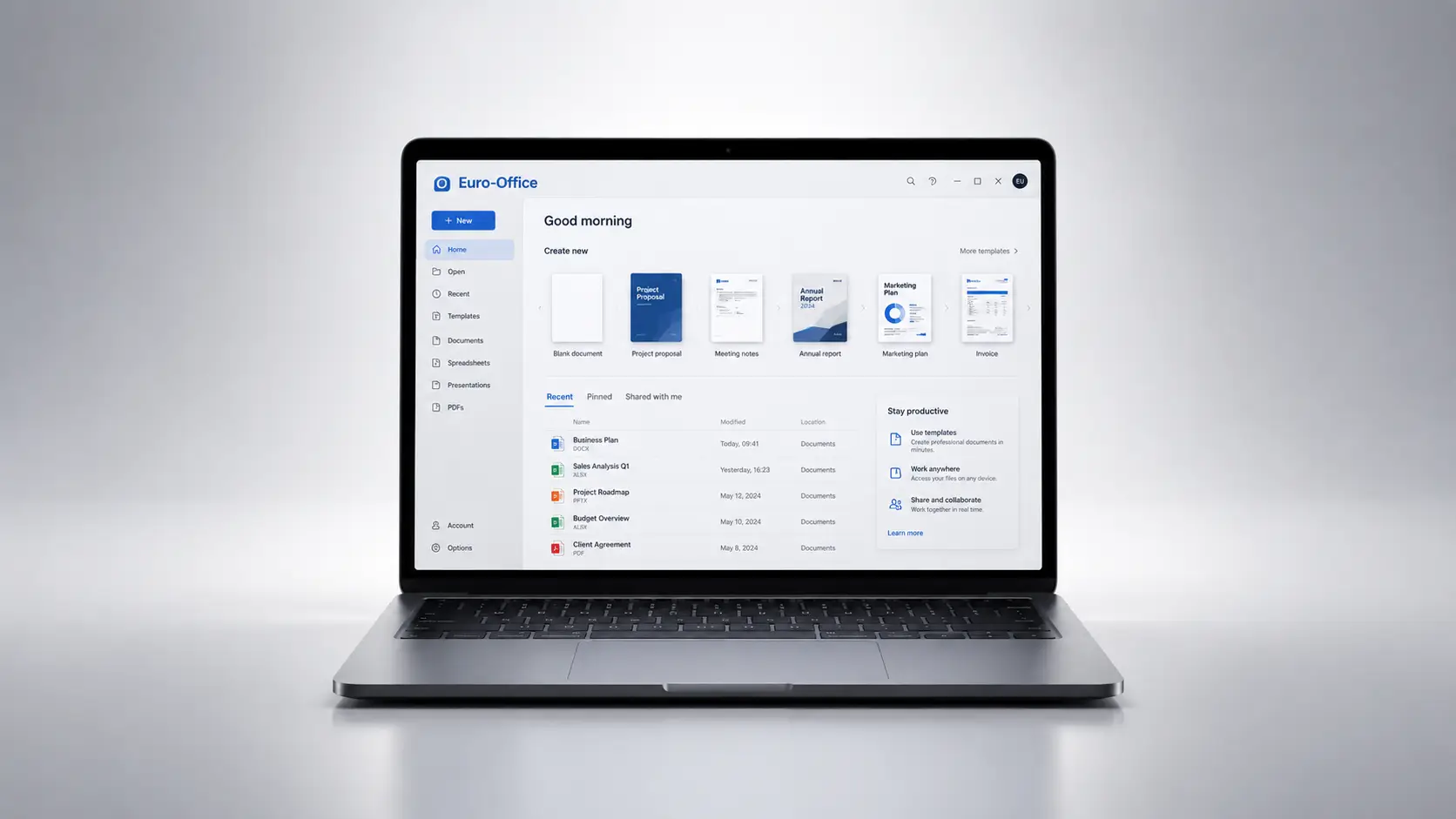
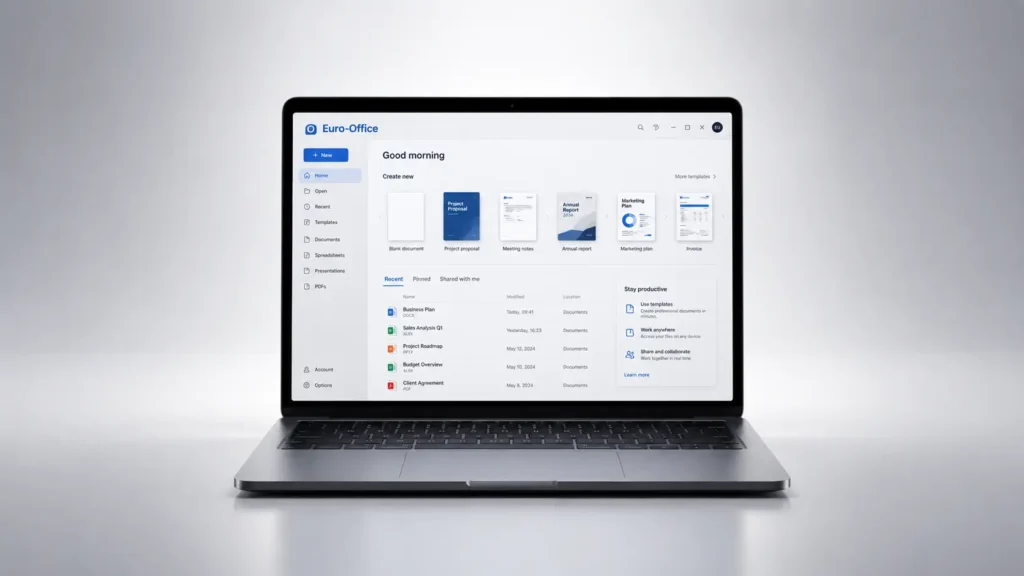
Euro-Office will move from public preview to a first stable production release on June 9, 2026, giving Europe’s digital-sovereignty debate a concrete product to judge rather than another policy slogan. Nextcloud says the first stable version will be available on GitHub and will let users create and collaboratively edit documents, spreadsheets and presentations; a related press release says the release will be made available to all users on the same date and integrated into partner products, including Nextcloud Hub 26 Spring.
Table of Contents
Euro-Office arrives as a product, not only a political statement
Euro-Office matters because office software is one of the least glamorous but most entrenched layers of digital infrastructure. Governments write laws in documents. Schools share assignments through office suites. Hospitals exchange spreadsheets. Businesses approve contracts in tracked changes. A country may talk about sovereign cloud, AI strategy and national cyber resilience, yet still depend each morning on document formats, identity systems, admin consoles, storage rules and collaboration tools controlled by foreign vendors.
The project’s June 9 release changes the debate because it creates a testable artifact. A sovereign office suite either opens files correctly, keeps comments intact, handles concurrent editing, integrates with existing storage and meets security expectations, or it does not. That is a tougher standard than conference language about autonomy.
Nextcloud describes Euro-Office as a “fully independent office suite” built with organizations across Europe, after a public tech preview. The first stable version is planned for production use on GitHub, not only for demonstration. That detail matters. GitHub availability gives administrators, developers and competing vendors the ability to inspect, build, test and integrate the software instead of waiting for one packaged commercial service.
Euro-Office is not being positioned as a casual desktop download for a single user replacing Word at home. Its GitHub organization says the suite is not designed for stand-alone use but for web-based integration into another product that handles files, permissions and workflows, such as file sharing, a wiki or a project management platform. That framing makes Euro-Office closer to a shared editing engine than a full Microsoft 365 clone.
The coalition behind the project includes IONOS, Nextcloud, EuroStack, XWiki, OpenProject, Soverin, Abilian, BTactic, Open-Xchange and Office.eu, according to Nextcloud’s June 9 release announcement. Those names matter because Euro-Office is not just one vendor trying to rebrand a niche editor. It is being built as a shared component for a European collaboration ecosystem.
The timing is also sharp. European policymakers are debating cloud procurement, AI infrastructure, dependency on U.S. hyperscalers and the role of European suppliers in sensitive public-sector systems. Reuters reported on May 27, 2026 that EU leaders were divided over how far to go in limiting large multinational access to EU cloud tenders, with a Cloud and AI Development Act expected to address parts of that dependency problem.
Euro-Office is much smaller than that geopolitical debate. Yet it touches the same nerve. Office software is where sovereignty becomes daily work. It is where data residency, vendor lock-in, format compatibility, support contracts, public procurement, migration risk and user habit meet on one screen.
The June 9 launch is only the first serious checkpoint
The first stable release should not be mistaken for a finished challenge to Microsoft 365 or Google Workspace. Nextcloud’s announcement says the first release will support collaborative creation and editing of documents, spreadsheets and presentations; it also says future work includes desktop and mobile apps, integration features and fuller support for open standards such as ODF.
That makes June 9 a checkpoint rather than a victory lap. A stable release means organizations can begin production testing with more confidence. It does not mean legal departments, ministries, schools or banks can switch overnight. Large office-suite migrations are hard because they touch thousands of templates, macros, permissions, archived files, email attachments, third-party connectors, mobile access policies, accessibility workflows and training habits.
The practical question is not whether Euro-Office exists. It is whether it is boring enough to trust. Office software succeeds when users stop noticing it. A procurement officer does not want an ideological battle every time a DOCX file renders differently. A teacher does not want to explain format conversion during exam week. A government lawyer does not want tracked changes to shift between systems. A hospital administrator does not want spreadsheet formulas to behave differently after migration.
The first release therefore needs to prove three things at once: compatibility with dominant Microsoft file formats, enough stability for real-time collaboration, and clean integration into European platforms that already manage identity, file storage, access control and audit trails. Its public roadmap shows that the coalition understands some of these demands. Nextcloud’s momentum update listed work on build processes, automated testing, English code comments, documentation, security fixes, performance improvements, stability and ODF support.
A production-ready release on GitHub also changes the role of public-sector buyers. Instead of asking whether a European alternative exists, buyers can ask more precise questions: who maintains the build, who signs releases, how security updates are distributed, how support is contracted, which formats are native, which are imported, which features are missing, and which migration paths are documented.
The launch gives Europe a product to test against its own sovereignty claims. If the suite is useful, administrations can no longer say there is no credible path to reduce dependency. If it is weak, the coalition will face a public backlog instead of applause.
The project is an editing engine inside a wider European stack
The distinction between an office suite and a workplace suite matters. Microsoft 365 is not only Word, Excel and PowerPoint. It is identity, SharePoint, OneDrive, Teams, Exchange, compliance tooling, eDiscovery, admin roles, endpoint policy, retention labels, Copilot integration and a marketplace of connectors. Google Workspace is not only Docs, Sheets and Slides. It is Gmail, Drive, Calendar, Meet, identity controls, data-region settings, admin APIs and mobile management.
Euro-Office is narrower. Its GitHub description says it is a web-based solution for collaborative document editing, intended to sit inside products that handle documents. It lists support for DOCX, PPTX, XLSX, PDF, ODT, ODS, ODP, TXT and other formats, with real-time editing and the ability to save documents back to the application used to open them.
That architecture is not a weakness by itself. It may be the only realistic way to compete. A European office alternative does not need to duplicate every Microsoft 365 feature on day one. It needs to become a strong shared editing layer that Nextcloud, OpenProject, XWiki, Office.eu and other platforms can embed. This model follows the logic of open-source infrastructure: build the hard common component once, let different products package it for different audiences.
Nextcloud says Euro-Office will be bundled with partner solutions, including Nextcloud Hub 26 Spring, and will appear as an alternative to Collabora under the Nextcloud Office umbrella. IONOS Managed Nextcloud customers are expected to be able to install Euro-Office after launch, while IONOS’ Nextcloud Workspace rollout is planned later in the summer. Office.eu will integrate it, and XWiki expects integration in the fourth quarter.
This matters for adoption. A ministry does not adopt an editor in isolation. It adopts a workflow. If Euro-Office appears inside a trusted file-sharing platform, a project-management system or a wiki, it reduces migration friction. The user opens a file where the file already lives. The administrator manages access in the system already in place. The buyer contracts with the provider already certified or trusted.
Euro-Office is best understood as a shared European document-editing substrate. Its success depends less on a consumer brand than on whether European workplace providers can make it feel native inside their own products.
Digital sovereignty is now a software procurement issue
Europe has spent years discussing digital sovereignty at the level of law, industrial policy and cloud infrastructure. Euro-Office pulls that discussion into procurement. A public buyer choosing an office suite must translate sovereignty into contract terms, support obligations, migration budgets and risk controls.
The European Commission’s own open-source software strategy supports that direction. Its 2020–2023 strategy committed the Commission to increasing the use of open source in strategic areas and set objectives including digital autonomy, software reuse, source-code sharing, better public services and staying in control. The Commission’s page also says open source and proprietary software should be evaluated on a level playing field, including total cost of ownership and exit costs.
That last phrase is central. Microsoft 365 or Google Workspace may look cheaper in a license comparison than a migration to a European stack. But exit costs sit in the background: retraining, data export, contract termination, format conversion, identity redesign, compliance reassessment and lost productivity. A buyer that ignores exit costs treats lock-in as free.
The Data Act pushes in the same direction. The Commission says the law includes measures to increase fairness and competition in the European cloud market, protect companies from unfair contractual terms, create safeguards against unlawful third-country government access to non-personal data and define interoperability requirements for data processing services. It applies from September 12, 2025.
An office suite is not identical to cloud infrastructure, but the logic overlaps. Documents are data. Collaboration platforms are data-processing services in ordinary business language. Switching costs are real. Interoperability determines whether a user can leave without losing working history. A sovereign office suite has to reduce lock-in, not simply move lock-in under a European flag.
Procurement teams should therefore ask Euro-Office vendors the same hard questions they ask hyperscalers: which data leaves the European Economic Area, what subprocessors are used, which logs are generated, where support data is stored, how encryption keys are managed, how deletion is verified, how formats are documented, and how customers exit without penalty.
Sovereignty is not an emotion in a contract. It is a set of enforceable controls.
Microsoft and Google already heard the sovereignty argument
Euro-Office should not be framed as if Microsoft and Google ignored European sovereignty concerns. They have moved in response to them. Microsoft says its EU Data Boundary is a geographically defined boundary where it commits to store and process customer data and personal data for enterprise online services, including Microsoft 365, subject to limited circumstances where data continues to be transferred outside the boundary. Microsoft says the project was completed in February 2025 after three phases covering customer data, pseudonymized personal data and professional services data at rest.
Google Workspace also offers data-location controls. Google’s Workspace data regions page says administrators can select where data is processed, including the EU, the U.S., globally or multiple regions, and can add controls for encryption and support access. Google announced Sovereign Controls for Google Workspace in 2022 to help organizations control, limit and monitor data transfers to and from the EU.
These are not trivial changes. They show that European regulation and public-sector pressure have forced global vendors to adapt their products. Many organizations will decide that these controls are enough, especially if they value Microsoft or Google’s maturity, support networks and feature depth.
Euro-Office has to compete against that reality, not against a caricature. The strongest case for Euro-Office is not that U.S. vendors have no European controls. They do. The stronger case is that data residency is not the same as operational, legal and strategic control. A customer may keep more data in Europe and still depend on a foreign product roadmap, foreign corporate governance, foreign licensing policy, foreign support structures, foreign AI strategy and foreign control-plane decisions.
That difference is what Euro-Office is trying to exploit. Its promise is not only “your data is in Europe.” Its promise is that the editing layer itself can be governed, inspected, forked, packaged and supported by European organizations under open-source terms. Whether the first stable release makes that promise credible is the question.
The EDPS Microsoft 365 case made the risk visible
The European Data Protection Supervisor’s investigation into the European Commission’s use of Microsoft 365 gave public-sector buyers a concrete example of the compliance burden attached to major cloud office suites. In July 2025, the EDPS said the Commission had brought its Microsoft 365 use into compliance after a March 2024 decision found infringements and imposed corrective measures. The EDPS said the issues concerned purpose limitation, international transfers and unauthorized disclosures of personal data.
The case did not declare Microsoft 365 unusable. It did the opposite in one sense: it showed that compliance could be achieved after corrective measures, contractual changes and supervision. But it also showed why office software has become a governance issue. Even the European Commission, with legal expertise and bargaining power, needed a long enforcement process to satisfy the supervisor.
That history strengthens the market case for European alternatives. A smaller municipality, school network or regulated business may not have the Commission’s leverage. It may lack the staff to negotiate advanced contractual terms or assess cloud-transfer risks across a large vendor’s service map. For those organizations, a European open-source stack could be attractive if it reduces legal uncertainty, gives clearer audit paths and avoids some foreign-jurisdiction questions.
Yet Euro-Office cannot simply claim compliance by origin. European ownership does not automatically mean lawful processing, strong security or resilient operations. Public-sector buyers still need data protection impact assessments, processor agreements, incident response terms, retention controls, accessibility checks and backup policies. An open-source component can support compliance, but it does not replace compliance work.
The EDPS case therefore cuts both ways. It raises the cost of complacency with dominant cloud suites. It also sets a high bar for any alternative that claims to be safer.
Compatibility is the central battlefield
Every serious office-suite challenger meets the same wall: Microsoft file compatibility. DOCX, XLSX and PPTX dominate real-world document exchange. Even organizations that prefer open standards receive Microsoft-format files from partners, courts, contractors, suppliers, universities and citizens. A sovereign suite that cannot handle those files will be politically attractive and operationally rejected.
Euro-Office’s GitHub page lists DOCX, PPTX and XLSX support among its key features. That is necessary. It is not enough. Compatibility is not a checkbox. It is thousands of edge cases: nested tables, tracked changes, footnotes, comments, styles, macros, charts, conditional formatting, pivot tables, merged cells, embedded objects, slide animations, fonts, forms, PDF export fidelity and template behavior.
A mismatch that seems minor in a demo can become a migration blocker in public administration. A ministerial letterhead that shifts by one line may be unacceptable. A spreadsheet formula that produces the same result but formats differently may confuse auditors. A slide deck that breaks charts may damage executive trust. Users do not judge alternatives against the standard. They judge them against the file in front of them.
This is where Euro-Office’s origin matters. The project is based on technology derived from ONLYOFFICE, which has long marketed Microsoft-format fidelity as a strength. Heise reported that IONOS, Nextcloud and other partners were forking OnlyOffice to build the Euro-Office project. TechRadar also reported that Euro-Office builds on existing ONLYOFFICE code rather than starting from zero.
That foundation gives Euro-Office a practical head start. Building a modern collaborative editor from scratch would take years. Forking an existing editor lets the project focus on governance, packaging, security, integration and sovereignty claims. But it also creates legal and community risks, especially around licensing and attribution.
The office market rewards boring fidelity more than visionary language. Euro-Office will be judged file by file.
ODF support is the real sovereignty test
Microsoft-format compatibility is required for adoption. It cannot be the final sovereignty goal. The Document Foundation’s criticism of Euro-Office focused on exactly this point: a European suite that prioritizes OOXML compatibility without making ODF native may shift hosting and governance while leaving Europe dependent on Microsoft’s format architecture. The Foundation argued that ODF is an ISO standard developed through an open process and should be treated as a European public good, not merely as a compatibility option.
OASIS describes the OpenDocument Format as a specification for office documents, including text documents, spreadsheets, charts and presentations. ISO/IEC 26300-1:2015 defines the OpenDocument schema as an international standard.
This is not a niche standards argument. File formats shape institutional memory. A state that archives public records in a format controlled by one vendor has made a long-term dependency choice. A school system that creates all new documents in a format tied to one ecosystem has made a future procurement choice. A company that cannot move its templates without breakage has accepted switching costs.
Euro-Office’s June release announcement says full support for open standards such as ODF will be “on top of the agenda for the next release.” Its momentum update also says the project will work toward full ODF support and frames open standards as a priority.
That is encouraging but not final. The hard question is whether ODF becomes a first-class native format or remains one export option among many. Users can already save files into many formats in many suites. The strategic issue is default behavior: which format receives the best fidelity, the deepest testing, the cleanest round-tripping and the least friction?
A sovereign office stack needs Microsoft compatibility for the present and open-format defaults for the future. Without the first, it will not be adopted. Without the second, it will not reduce dependency.
Euro-Office’s practical adoption tests
| Test | Strong signal | Weak signal |
|---|---|---|
| Microsoft-format handling | Complex DOCX, XLSX and PPTX files round-trip without visible damage | Basic files work, but templates, comments or charts break |
| ODF commitment | ODF becomes a native, deeply tested format path | ODF exists mainly as import or export |
| Integration | Works inside Nextcloud, XWiki, OpenProject and Office.eu with clear admin controls | Requires awkward deployment or duplicate permissions |
| Security maintenance | Signed releases, fast patches, public advisories and audit paths | Unclear release ownership or slow patch flow |
| Governance | Public roadmap, contribution rules and multi-vendor decision-making | One vendor controls direction in practice |
This table separates launch interest from adoption readiness. The biggest tests are not ideological. They are operational: files, formats, patches, governance and integration.
The licensing dispute is a serious cloud over the launch
The most uncomfortable part of the Euro-Office story is the dispute with ONLYOFFICE. ONLYOFFICE publicly accused the Euro-Office initiative led by Nextcloud and IONOS of using technology derived from ONLYOFFICE editors in violation of licensing terms and international intellectual property law. It said ONLYOFFICE is distributed under GNU AGPL v3 with additional requirements for branding, attribution and open-source distribution obligations.
Heise reported the accusation shortly after Euro-Office was announced, noting that the project relied on a fork of OnlyOffice and that OnlyOffice argued its AGPLv3 license and additional conditions had not been followed.
For public-sector buyers, this matters. A sovereignty project cannot afford unresolved legal ambiguity around its core codebase. Open source does not mean “no rules.” It means rights are granted through licenses, and those licenses create obligations. If a project depends on a fork of another project, buyers will want legal comfort that distribution, branding, attribution, source availability and trademark handling are clean.
The dispute also raises a deeper governance question. Forks are a normal part of open source. They can protect users when a project changes direction, when maintainers block contributions, when ownership raises concerns, or when communities disagree. But a fork’s legitimacy depends on license compliance, transparent attribution and credible maintenance.
Euro-Office’s GitHub organization says it welcomes contributions and aims to reduce barriers to participation. Its DocumentServer repository lists AGPL-3.0 license information and provides Docker-based testing instructions.
That public availability is useful, but it does not by itself settle every claim. The launch period needs clear legal documentation. Buyers will ask for it. Rival vendors will inspect it. Community contributors will expect it. If Euro-Office wants to be trusted by governments, the licensing story must be boring, documented and defensible.
Open source is not a magic shield
Open source gives Euro-Office advantages: public code, forkability, independent inspection, shared development and less dependence on one vendor’s private roadmap. Those strengths are real. They are also often overstated.
A public repository does not guarantee secure code. A permissive contribution process does not guarantee good governance. A European coalition does not guarantee long-term funding. An AGPL license does not guarantee rapid patching. A public roadmap does not guarantee that hard features will be delivered.
The Commission’s own open-source strategy recognizes this tension. It promotes open source but also lists security, governance, legal coaching, procurement practice and community participation as parts of a serious strategy.
Euro-Office has to avoid the classic trap of open-source public-sector projects: strong launch, weak maintenance. Governments have seen many platforms arrive with political support and fade when budgets, contributors or leadership attention move elsewhere. Office software needs dull continuity. Users need support for years. Security teams need advisories. Administrators need upgrade paths. Developers need merge discipline. Accessibility specialists need test plans. Translators need a process. Documentation writers need authority.
The project’s momentum update is promising because it mentions unglamorous work: build systems, automated testing, code comments, outdated dependencies, binary blobs, performance, stability and contribution rules.
That is the work that matters. The future of Euro-Office depends less on launch rhetoric than on maintenance culture. A sovereign office suite cannot be a campaign. It has to be infrastructure.
Europe’s office-suite market is not empty
Euro-Office enters a market that already has open-source and European alternatives. LibreOffice remains the best-known open-source desktop office suite. Collabora Online provides browser-based collaboration based on LibreOffice technology. Nextcloud already integrates office options under Nextcloud Office. Office.eu launched in The Hague in March 2026 as a European-owned cloud office platform built on open-source technology and European infrastructure.
This makes Euro-Office part of a crowded sovereignty push, not a lone savior. That is healthy if the components interoperate and dangerous if the ecosystem fragments. Europe does not need five incompatible “sovereign” office stories that each require separate migration plans. It needs shared standards, shared identity patterns, shared procurement language and clear differences between editing engines, workplace suites and hosting offers.
Office.eu is a good example of the packaging layer. Its site describes a full cloud-based suite with documents, spreadsheets, presentations, file storage, email, calendars and video meetings, aimed at European users and organizations. It claims 100% European ownership and European infrastructure.
Euro-Office is different. It is a component that can be integrated into Office.eu, Nextcloud, XWiki or OpenProject. That difference should be made clear in marketing and procurement. Confusion will hurt adoption. A buyer asking “Is Euro-Office an alternative to Microsoft 365?” deserves a precise answer: it is an open-source collaborative editing suite that may be packaged inside broader alternatives to Microsoft 365.
Europe’s challenge is not lack of projects. It is turning projects into a coherent stack.
The public sector is the natural early market
Euro-Office is most likely to gain early traction in public administrations, education, regulated industries and organizations already using Nextcloud or related European collaboration tools. These buyers have stronger reasons to care about jurisdiction, auditability, public procurement, open standards and long-term exit rights.
The Interoperable Europe Act, which entered into force in April 2024, aims to strengthen public-sector interoperability and allow administrations to cooperate across territorial, sectoral and organizational boundaries while maintaining sovereignty at all levels of government. That policy direction makes office-suite interoperability more than a technical preference.
A public administration’s documents often cross organizational borders. Local governments exchange files with national ministries. Schools send documents to municipalities. Hospitals communicate with regulators. Courts, procurement offices and social services share records across systems. If each organization adopts a different “sovereign” tool without shared formats and procedures, sovereignty creates new friction.
Euro-Office can fit the public-sector agenda if it supports open formats, integrates with existing public-sector platforms and gives administrators audit control. It will struggle if it becomes another isolated editor.
Education is also a natural market. Schools and universities face budget pressure, privacy concerns and platform lock-in. Many already use browser-based collaboration tools. A European open-source option could appeal if it is easy enough for teachers and students, and if institutions can host or contract it with clear data protections.
Regulated industries are another path, especially where DORA, NIS2 and sectoral rules push firms to examine ICT dependency. EIOPA says DORA creates an EU oversight framework for critical ICT third-party providers to address systemic and concentration risks in the financial sector’s reliance on a limited number of providers. Reuters reported that EU regulators designated major technology companies, including AWS, Google Cloud and Microsoft, as critical third-party computing providers for finance in November 2025.
An office editor will not solve third-party concentration risk alone. But it can reduce one layer of dependency if adopted inside a wider European stack.
The SME case is harder but not impossible
Small and medium-sized enterprises are a tempting audience for Euro-Office, but not an easy one. SMEs rarely buy ideology. They buy fewer problems. Microsoft 365 and Google Workspace are attractive because they are familiar, bundled, documented, supported by IT consultants and integrated with everything from CRM systems to accounting tools.
A European office alternative can appeal to SMEs if it offers clear pricing, migration help, predictable support and compatibility. Office.eu’s messaging is aimed partly at this group, promising migration from Microsoft or Google accounts and a gradual switch.
Euro-Office itself is less likely to be bought directly by a small business unless packaged by a provider. The SME customer will not pull a Docker image and build an office system. It will subscribe to a managed workspace. That means Euro-Office’s SME adoption depends on IONOS, Office.eu, Nextcloud partners, local managed-service providers and vertical software vendors.
The SME angle also intersects with Europe’s Digital Decade targets. The Commission says Europe’s cloud and edge ambition includes a target that 75% of European businesses should use cloud-edge technologies by 2030, and its page reports that 45.2% of businesses used cloud services in 2023, with higher uptake among large enterprises than small businesses.
That gap creates an opening for European providers. If SMEs are still moving toward cloud collaboration, some may skip direct dependence on Microsoft or Google if a local, trusted, compliant and well-supported option exists. But the product must meet users where they are. The average SME does not want to become a digital-sovereignty case study. It wants the invoice template to open.
For SMEs, sovereignty must be packaged as less risk and less lock-in, not as extra homework.
Microsoft’s moat is workflow, not only Word
Euro-Office’s hardest competitor is not the Word ribbon. It is the surrounding Microsoft workflow. Documents live in SharePoint and OneDrive. Permissions follow Entra ID. Meetings happen in Teams. Email lives in Exchange. Compliance officers use Purview. Administrators use Intune. Legal teams use retention and eDiscovery tools. Finance teams use Excel models wired to Power BI, ERP exports and macros. Copilot is being woven into the suite.
Google has a different moat: browser-native collaboration, Gmail habits, Drive sharing, Sheets workflows, Classroom in education, Meet, Calendar and admin simplicity.
A European editing engine can compete with part of that stack, but not all of it. The coalition’s strategy of embedding Euro-Office in platforms such as Nextcloud, OpenProject, XWiki and Office.eu acknowledges this. It says, in effect: do not fight the suite alone; build a stack.
The stack still needs cohesion. Identity must work across products. Mobile editing must work. Notifications must be reliable. Search must find documents. Version history must be clear. Offline access must be addressed. Admins must have logs. Data retention must match policies. Accessibility must be serious. APIs must be stable.
This is where open-source coalitions often struggle. Each product may be good on its own, but the user experiences seams: different admin panels, inconsistent sharing models, uneven mobile apps, mismatched search, duplicated notifications and unclear support responsibility. Microsoft’s advantage is not perfection. It is integration by one vendor with enormous engineering resources.
Euro-Office can win only if the European stack feels coherent enough. That does not require copying Microsoft. It requires fewer visible cracks.
Security claims need evidence, not nationality
Sovereign software is often marketed as safer because it is European, open source or free from foreign jurisdiction. Those claims may be relevant, but they are not security evidence. A secure office suite needs vulnerability management, dependency tracking, code review, sandboxing, document parser hardening, macro policy, file upload controls, authentication integration, audit logs, secure defaults, release signing and rapid patch distribution.
Document editors are high-risk software because they parse complex files from external parties. Malicious documents have long been used in phishing and intrusion campaigns. Collaborative editors also handle authentication tokens, file permissions, temporary caches, previews, autosaves and concurrent editing state. A flaw can expose sensitive documents or give attackers a route into a collaboration platform.
Nextcloud’s Euro-Office updates mention security work, including updates to outdated OpenSSL and other pull requests tied to security and performance. The June release announcement says the first stable version focused on code cleanup, security updates and integration with existing solutions.
That is the right direction. Buyers still need more. They need a security policy, advisories, CVE handling, third-party audits, threat models and support SLAs. Public-sector buyers may ask whether Euro-Office has undergone penetration testing, supply-chain review or secure build verification. Regulated industries will ask whether logging, incident reporting and recovery processes match their obligations.
NIS2 also raises the bar. The directive aims to extend cybersecurity obligations across a larger part of the economy and set coordinated risk-management and reporting expectations.
Security is where open source earns trust through process, not slogans. Euro-Office should publish as much of that process as possible.
Governance will decide whether the coalition holds
Euro-Office’s coalition model is a strength only if decision-making is transparent. Nextcloud’s momentum update says the project has introduced contribution documentation, a code of conduct and a governance section. For now, decisions are based on consensus among project members, with an open-source “who codes, decides” principle and a plan to set up a more formal steering committee as the project grows.
That is a reasonable starting point. It will not be enough forever. A project serving governments and regulated businesses needs predictable governance. Who decides roadmap priorities when public-sector ODF demands conflict with enterprise Microsoft-format fidelity? Who approves security releases? Who has trademark authority? Who can merge large architectural changes? What happens if a major contributor leaves? Who owns infrastructure? Who pays maintainers? How are commercial interests balanced?
The history of open-source infrastructure shows that forks and coalitions work best when governance is credible. The Valkey, OpenSearch and OpenTofu examples outside office software show how communities can respond when licensing or control becomes contested. They also show that forks need institutional support, not only technical anger.
Euro-Office has a chance to build governance suited to European public infrastructure. It should consider a neutral foundation model, public steering minutes for major decisions, security embargo rules, published release criteria, conflict-of-interest disclosure and clear rules for vendor-specific features.
The governance question is not bureaucratic. It is commercial. A government buyer will not depend on a project if it fears one vendor can shift the roadmap or abandon maintenance. A private company will not build integrations if the API direction is unclear. A contributor will not invest time if decisions appear closed.
Sovereignty without governance is just branding.
The AI question is still mostly unanswered
Office suites are becoming AI surfaces. Microsoft is pushing Copilot across Microsoft 365. Google is embedding Gemini into Workspace. Users increasingly expect document drafting, summarization, spreadsheet analysis, meeting notes, search across files and automated presentation generation. Euro-Office’s early pitch is centered on editing, sovereignty and collaboration, not AI.
That may be wise for a first release. AI features add legal, privacy, compute and governance complexity. They also raise a sovereignty paradox: a European office suite that sends document content to a foreign AI model for summarization would weaken its own argument.
Nextcloud’s momentum update hints at integration flexibility, including the ability to use a different AI back end.
That could become important. A sovereign office suite does not need to reject AI. It needs controls. Administrators should decide whether AI is enabled, which provider is used, whether content leaves a defined jurisdiction, whether prompts are logged, whether model training is allowed, how generated content is labeled and how sensitive classifications are enforced.
The EU’s broader policy debate is moving in this direction. Reuters reported in April 2026 that EU regulators planned to focus Digital Markets Act attention on cloud and AI services, including whether cloud services and AI should be made fairer and more contestable.
For Euro-Office, AI is a future differentiator and a future risk. The suite could become a European workplace layer where organizations choose local or sovereign AI back ends. Or it could fall behind user expectations if Microsoft and Google make AI-assisted work feel standard. The right path is probably admin-controlled AI plumbing, not a rushed assistant.
Migration will be the real cost center
Software price is only one part of an office-suite migration. The expensive work is discovery and change management. Organizations must identify file stores, document templates, macros, shared drives, retention rules, public forms, meeting workflows, collaboration patterns, mobile use, external sharing, authentication dependencies and legal holds.
Euro-Office’s integrated model may reduce some of this pain if it is introduced inside existing Nextcloud or OpenProject deployments. But any serious Microsoft or Google migration still needs planning.
A practical migration usually starts with low-risk groups: internal notes, project documentation, basic spreadsheets and collaborative drafts. High-risk workloads stay longer on legacy tools: finance workbooks with macros, legal templates with track changes, regulatory filings, executive presentation templates and documents exchanged heavily with outside partners.
This phased model matters because it avoids false promises. A sovereign office strategy does not require an overnight switch. It may begin by making open formats the default for new internal documents, using Euro-Office for collaborative drafting, keeping Microsoft Office for specific high-fidelity legacy cases and reducing dependency over time.
The best migration strategy is not “rip and replace.” It is “classify, pilot, migrate, measure and keep exceptions visible.” Buyers should demand tools and services that support that reality.
Euro-Office vendors should publish migration playbooks. They should include compatibility test suites, template conversion guidance, external-sharing patterns, user training materials and risk categories. Without these, the project may gain enthusiasm among technologists but fail with operations teams.
Public procurement needs new questions
A procurement tender for an office suite often asks for features: word processing, spreadsheets, presentations, collaboration, mobile apps, identity integration, support, compliance, uptime. Euro-Office suggests a better set of questions.
The first question is control. Can the buyer inspect source code, choose a hosting provider, move between providers, export documents and keep working if one vendor exits? The second is jurisdiction. Where are data, logs, metadata, support files and backups processed? The third is format policy. Which formats are native, which are supported, and what fidelity guarantees exist? The fourth is governance. Who controls the roadmap, security releases and contribution process? The fifth is ecosystem fit. Does the suite integrate with file storage, identity, project management, email, chat and records management?
Procurement should also distinguish between open source and open governance. A vendor may provide open-source code but run the hosted service in a way that creates lock-in. Another vendor may package Euro-Office with strong support and clear exit rights. The buyer must evaluate the service, not only the license.
The Commission’s open-source strategy explicitly mentions total cost of ownership including exit costs when evaluating open-source and proprietary solutions. That principle should be applied aggressively to office suites.
A cheap subscription can become expensive if exit is hard. A migration can look costly but reduce long-term dependency. Procurement should price lock-in as a risk, not treat it as invisible.
The business impact for European vendors could be larger than the product
Euro-Office could become more than an office editor if it gives European vendors a shared component around which to build services. IONOS can package managed workspace offerings. Nextcloud can improve its office choices. XWiki can embed collaborative editing. OpenProject can connect project documents to planning workflows. Office.eu can strengthen its suite. Local managed-service providers can sell migration, hosting, security review and support.
This is the strongest industrial-policy argument for Euro-Office. Europe does not only need end-user products. It needs value chains. A shared open-source office layer can create work for developers, integrators, auditors, trainers, translators, accessibility experts and hosting providers.
Nextcloud’s June press release says many partners are providing development resources and that IONOS and Nextcloud began hiring a dedicated development team in April, with first positions filled.
That is the kind of detail that matters. Sovereignty requires people paid to maintain code. If Euro-Office creates European jobs around document infrastructure, its value exceeds license substitution. It becomes part of Europe’s software capacity.
Still, the ecosystem must avoid duplication. If every vendor forks Euro-Office privately, patches slowly and adds incompatible features, the shared layer weakens. The coalition needs common upstream discipline. Commercial packaging is useful; fragmentation is not.
The limits of a European label
A European label can help Euro-Office enter conversations, but it will not keep users. Users stay when the tool works. Administrators stay when upgrades are safe. Lawyers stay when contracts are clear. Security teams stay when patches arrive. Finance teams stay when spreadsheets do not break. Public-sector leaders stay when procurement can defend the decision.
The project should avoid overclaiming. It should not promise to “replace Microsoft 365” in a general sense. It can replace parts of Microsoft Office workflows for specific organizations, especially when integrated into a European collaboration stack. It can reduce dependency in document editing. It can support open-source governance and open standards. It can give public buyers a credible alternative to evaluate. Those are strong claims without fantasy.
The risk of overclaiming is backlash. A failed migration damages not only one product but the broader open-source sovereignty argument. Users who have a bad experience with a “European alternative” may become more loyal to Microsoft or Google than before. The coalition should therefore be strict about release quality, compatibility documentation and known limitations.
Trust grows when a product states its limits clearly and then improves them.
Market pressure may help Euro-Office even among non-adopters
Euro-Office can affect the market even if adoption is gradual. A credible alternative changes negotiations. Public buyers can ask Microsoft and Google harder questions about data residency, exit rights, pricing, interoperability and AI controls if they have another path. European vendors can build services around a shared editing layer. Standards advocates can push ODF with renewed urgency. Regulators can point to alternatives when discussing procurement policy.
Competition does not require instant dominance. It requires credible substitutability. If Euro-Office becomes credible enough for ministries, universities and regulated companies to pilot, it weakens the assumption that Microsoft and Google are unavoidable.
Microsoft and Google are likely to respond with more sovereignty controls, local partnerships and compliance features. That would benefit customers. The goal of Euro-Office should not be symbolic purity. It should be contestability.
The EU’s digital-sovereignty debate often swings between protectionist rhetoric and market realism. Euro-Office sits between them. It is a market product created for a political reason. Its success would show that sovereignty can be pursued through usable software, not only regulation.
The release should be judged with patience and discipline
The first stable release on June 9 should be tested hard but fairly. It should not be expected to equal decades of Microsoft Office maturity. It should not be excused from basic production standards either.
A fair test would include several document sets: ordinary text documents, public-sector templates, legal tracked-change files, spreadsheets with formulas and charts, presentations with embedded media, ODF files, PDFs and documents with comments from multiple users. Tests should measure rendering, editing, round-tripping, collaboration, performance, accessibility and export quality.
Administrators should test deployment, updates, logs, authentication, backup, restore, storage integration, permissions and external sharing. Security teams should test patch workflow, dependency visibility and document parser behavior. Legal teams should test processor agreements and source-code licensing. Records managers should test archival formats.
This disciplined testing is better than praise or dismissal. Euro-Office deserves neither blind enthusiasm nor reflexive cynicism. It deserves procurement-grade evaluation.
The strategic question after launch
After June 9, the question will shift from “will Europe launch an office alternative?” to “which organizations will take the risk of proving it?” Early adopters matter. A strong pilot in a city, university, ministry, hospital network or regulated company could create confidence. A failed pilot could slow adoption.
The coalition should support reference deployments with unusual care. Public case studies should include migration scope, file compatibility issues, user training, security review, support model and lessons learned. Glossy adoption announcements will not be enough. Buyers need operational detail.
The project should also publish a compatibility matrix and update it honestly. It should say which Microsoft features are fully supported, partly supported or unsupported. It should define ODF goals. It should document integration status for Nextcloud, Office.eu, XWiki, OpenProject and others. It should separate stable features from roadmap items.
A serious buyer can handle limitations. What it cannot handle is uncertainty disguised as maturity.
Euro-Office’s real promise is optionality
The strongest argument for Euro-Office is optionality. Europe does not need every organization to abandon Microsoft or Google immediately. It needs credible options so that dependency is a choice, not a default forced by lack of alternatives.
Optionality has practical value. It lets governments negotiate better. It lets regulated industries design fallback paths. It lets schools choose privacy-respecting tools. It lets European vendors build local services. It lets open standards regain relevance. It gives developers a shared project to improve rather than another closed procurement target.
Optionality also reduces political panic. When a region has no alternatives, every foreign policy dispute becomes a software-risk debate. When alternatives exist, even imperfect ones, organizations can plan.
Euro-Office will not decide Europe’s digital sovereignty by itself. But it gives the debate a working surface. On June 9, that surface becomes stable enough for production use. The serious work begins after the download.
The best outcome is a boring European office layer
The best version of Euro-Office is not a nationalist trophy. It is a boring, well-maintained, well-documented, legally clean, secure, open-source editing layer used inside many European collaboration products. Users open documents, edit together, save files, export cleanly, and move on. Administrators patch it. Auditors understand it. Developers contribute to it. Public buyers can procure it without heroic legal work.
That is harder than a launch announcement. It requires years of maintenance, governance and honest compatibility work. It requires the coalition to keep ODF on the roadmap and Microsoft-format fidelity in the test suite. It requires vendors to package the software without fragmenting it. It requires public-sector buyers to fund open-source maintenance rather than only consume it.
If Euro-Office reaches that point, it will matter even to organizations that never use the name. It will become part of the European software commons: not glamorous, not dominant, but available, inspectable and useful.
That is the real test. A sovereign office suite succeeds when sovereignty disappears into ordinary work.
Practical questions readers are asking about Euro-Office
Yes. Nextcloud says the first stable Euro-Office version will be ready for production use on GitHub from June 9, 2026, after a public tech preview.
No. Euro-Office is an open-source collaborative document-editing suite designed for integration into other products. Office.eu is a broader European cloud office platform that can include document editing, file storage, email, calendar and meetings. Office.eu is listed as an integration partner for Euro-Office.
Not by itself. Euro-Office focuses on document, spreadsheet and presentation editing. A Microsoft 365 replacement also needs identity, email, storage, chat, compliance, device management and many admin services. Euro-Office may become part of a broader replacement stack.
The coalition named by Nextcloud includes IONOS, Nextcloud, EuroStack, XWiki, OpenProject, Soverin, Abilian, BTactic, Open-Xchange and Office.eu.
Yes. The project is hosted publicly on GitHub, and the DocumentServer repository lists an AGPL-3.0 license.
The project’s GitHub page lists support for DOCX, PPTX, XLSX, PDF, ODT, ODS, ODP, TXT and other formats.
Yes. Its GitHub page lists real-time collaborative editing for documents, spreadsheets and presentations, and Nextcloud’s launch materials describe collaborative creation and editing.
The current project is not designed primarily for stand-alone use. Its GitHub page describes it as a web-based editor integrated into another product. Desktop and mobile apps are on the roadmap.
Yes. Nextcloud says Euro-Office will be bundled with Nextcloud Hub 26 Spring and offered as an alternative to Collabora under Nextcloud Office.
Nextcloud says IONOS Managed Nextcloud customers will be able to install Euro-Office after launch, with rollout to IONOS’ Nextcloud Workspace planned later in the summer.
The biggest technical challenge is high-fidelity compatibility with real-world Microsoft Office files while also improving open-format support, especially ODF.
ODF is an open document standard recognized by OASIS and ISO. It matters because long-term public records and institutional documents should not depend entirely on a format controlled by one vendor.
Yes. ONLYOFFICE has accused the Euro-Office initiative of license violations related to technology derived from ONLYOFFICE editors. Euro-Office buyers should watch how the project documents and resolves licensing questions.
No. European ownership can reduce some jurisdictional risks, but compliance still depends on contracts, processing controls, security measures, retention rules, auditability and lawful deployment.
LibreOffice is a mature open-source desktop office suite with ODF as its native format. Euro-Office is focused on web-based collaborative editing and integration into workplace platforms.
Governments are a natural early market because of sovereignty, procurement and interoperability demands. But the project may also interest education, regulated industries and SMEs through managed service providers.
AI is not the central first-release story. The roadmap mentions integration flexibility, including use of a different AI back end, but buyers should treat AI controls as a future governance issue.
Most companies should test first. A sensible path is a pilot with low-risk documents, compatibility checks, user feedback, security review and a migration plan before wider rollout.
Euro-Office succeeds if it becomes a legally clean, secure, well-maintained, well-integrated editing layer with strong Microsoft-format compatibility and first-class open-format support.
Author:
Jan Bielik
CEO & Founder of Webiano Digital & Marketing Agency
This article is an original analysis supported by the sources cited below
Euro-Office general availability set for June 9
Nextcloud’s release article confirming the June 9, 2026 production-ready GitHub release and planned partner integrations.
Sovereign office suite Euro-Office to release June 9
Nextcloud’s press release naming coalition members, release timing and integration plans.
Euro-Office GitHub organization
The public project page describing Euro-Office’s role, intended integration model, file-format support and contribution approach.
Euro-Office DocumentServer repository
The technical repository showing deployment instructions and AGPL-3.0 licensing information.
Euro-Office European industry initiative launches office suite
The March 2026 announcement introducing Euro-Office as a European sovereign office-suite project.
Euro-Office building momentum
Nextcloud’s roadmap update on security, performance, ODF support, governance and contribution process.
ONLYOFFICE flags license violations in Euro-Office project
ONLYOFFICE’s public statement alleging license and attribution violations by the Euro-Office initiative.
Euro-Office OnlyOffice accuses of license violations
Heise’s report on the dispute between ONLYOFFICE and the Euro-Office project.
Watch out Microsoft 365 European giants launch Euro-Office
TechRadar’s coverage of the Euro-Office launch, coalition and ONLYOFFICE-related controversy.
Office.eu officially launches in The Hague
Office.eu’s March 2026 launch announcement positioning the platform as a European-owned office suite.
Office.eu
Office.eu’s product site describing its European cloud office platform, features and migration positioning.
European Commission open source software strategy
The Commission’s open-source strategy page covering digital autonomy, procurement, reuse and open-source governance.
Cloud computing and Europe’s Digital Decade targets
European Commission policy page on cloud and edge infrastructure, Digital Decade targets and adoption data.
Europe’s Digital Decade
European Commission page explaining the Digital Decade framework and targets for Europe’s digital transformation.
European Commission brings use of Microsoft 365 into compliance
EDPS press release on the European Commission’s Microsoft 365 compliance process after corrective measures.
What is the EU Data Boundary
Microsoft documentation describing the EU Data Boundary and its scope for enterprise online services.
Microsoft completes landmark EU Data Boundary
Microsoft’s February 2025 statement on completing its EU Data Boundary phases.
Google Workspace data regions
Google Workspace page describing data-region controls, local storage options and administrative access controls.
Announcing Sovereign Controls for Google Workspace
Google’s 2022 announcement of Workspace sovereignty controls for EU organizations.
Data Act explained
European Commission explainer on the Data Act, cloud-market fairness, interoperability and third-country access safeguards.
Interoperable Europe Act
European Commission portal page explaining the Interoperable Europe Act and public-sector interoperability goals.
Digital Operational Resilience Act
EIOPA page on DORA and oversight of critical ICT third-party providers.
Directive EU 2022/2555 on cybersecurity
Official EU text of the NIS2 Directive on cybersecurity obligations and wider sectoral coverage.
OpenDocument Format for Office Applications version 1.2
OASIS standard page for OpenDocument, covering document, spreadsheet and presentation schemas.
ISO/IEC 26300-1:2015 OpenDocument schema
ISO page for the OpenDocument international standard.
Euro-Office sovereign in name only, or in reality too
The Document Foundation’s critique of Euro-Office’s format strategy and argument for ODF as a native standard.
Europe’s push to break Big Tech’s grip tempered by internal debate
Reuters report on Europe’s live policy debate over cloud dependency, procurement and technological sovereignty.
EU rules reining in Big Tech will now target cloud services and AI
Reuters report on EU plans to examine cloud and AI under digital competition rules.
Amazon, Google named by EU among critical tech providers for finance industry
Reuters report on EU regulators designating major technology firms as critical third-party providers under DORA.
| Citing this article? Brief excerpts are welcome. Please credit Webiano.digital, name the author where stated, and include a link to https://webiano.digital and to this original article. Full or substantial republication requires prior written permission. Read our Copyright and Content Use Policy. |
This article was prepared with the assistance of artificial intelligence tools. The content underwent expert human review, and Webiano Digital & Marketing Agency assumes editorial responsibility for its final version and publication.