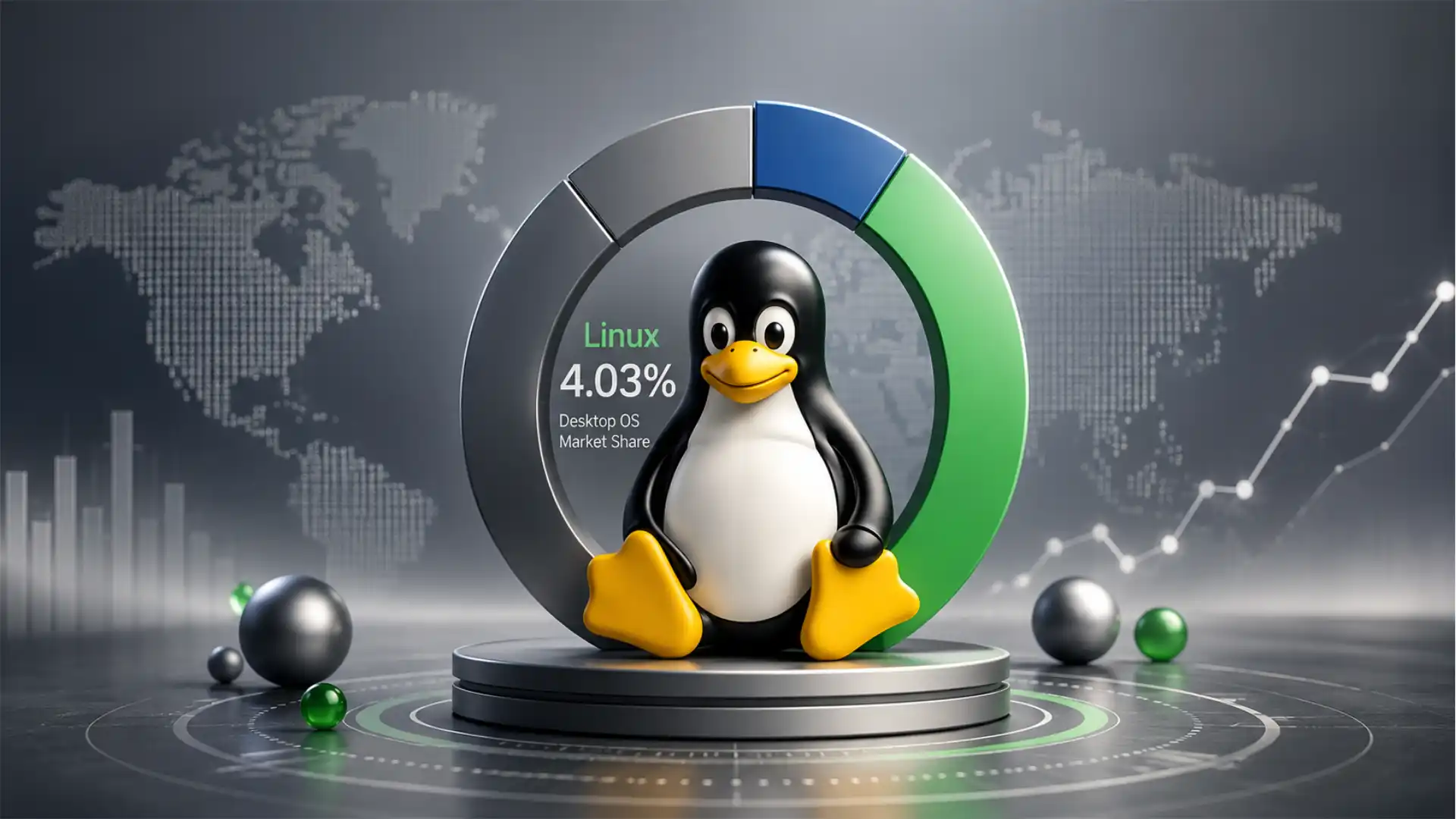
Linux on the desktop is still a minority operating system. Linux as a computing base is not. The latest public figures show the split clearly: StatCounter recorded 2.99% Linux share of worldwide desktop operating system web traffic in April 2026, while Valve’s Steam survey showed 4.52% Linux share among surveyed Steam users in the same month. Android, which runs on a Linux-based kernel, held 67.35% of worldwide mobile OS web traffic in StatCounter’s April 2026 data. Those numbers answer the same casual question in three different ways, and only one of them is the familiar “Linux desktop” answer.
Table of Contents
The useful answer is a range, not one percentage
A clean answer to “what percentage of users use Linux?” depends on the word users. If the question means people using a traditional Linux distribution on a laptop or desktop, the current global answer is roughly 3% of desktop web usage. If it means PC gamers who answer Valve’s Steam Hardware & Software Survey, the answer is about 4.5%. If it means developers, the answer is far higher, because Stack Overflow’s 2025 Developer Survey shows Linux and Linux-based environments across a much larger share of technical users. If it means web infrastructure, Linux moves from minority desktop OS to dominant server platform.
The safest answer is this: desktop Linux is near 3% globally, Linux among Steam users is around 4.5%, Linux among developers is much higher, and Linux-based systems dominate large parts of servers, mobile kernels, supercomputing, cloud infrastructure, and embedded devices. That is not a trick. It is a measurement problem. Operating system share is usually counted from web traffic, surveys, installed systems, or server fingerprinting. Each method sees a different slice of computing.
StatCounter’s April 2026 desktop figure is the simplest public benchmark because it measures browsing activity across a large analytics network. It reported Windows at 63.66%, Unknown at 19.28%, OS X at 8.19%, macOS at 4.37%, and Linux at 2.99% for worldwide desktop operating systems. The number is not a census of all computers. StatCounter says it tracks page views across more than 1 million websites and analyzes the browser, operating system, and other user-agent signals for those page views. That makes it a useful web-usage indicator, not a perfect installed-base count.
The headline answer also changes when Android enters the frame. Android is not a GNU/Linux desktop distribution, and most Android users do not think of themselves as Linux users. Yet Android’s kernel is based on an upstream Linux Long Term Supported kernel, with Android-specific patches added by Google. Counting Android as “Linux usage” gives a very different answer from counting only Ubuntu, Fedora, Debian, Arch, Linux Mint, Pop!_OS, openSUSE, NixOS, and related desktop distributions.
That distinction matters because casual debates often mix these categories. Someone claiming “Linux has only 3%” is usually talking about desktops. Someone claiming “Linux is everywhere” is talking about servers, Android, supercomputers, routers, containers, cloud hosts, and embedded devices. Both statements may be true, but they describe different markets.
Desktop Linux remains small because the desktop market is unusually hard to move
The desktop operating system market has a long memory. Windows became the default platform for consumer PCs, business workstations, accounting software, games, peripherals, device drivers, enterprise identity systems, and school computer labs. That history still shapes what people buy and what vendors support. Even when a modern Linux desktop is stable, fast, and pleasant, it often arrives as an alternative to an incumbent platform that comes preinstalled.
Desktop market share is not just a vote on software quality. It is a count of distribution. Most people use the operating system that came with the machine. That fact favors Windows on commodity PCs and macOS on Macs. Linux is widely available, but it usually requires a deliberate choice: buying from a niche Linux hardware vendor, installing it manually, replacing Windows on an existing PC, dual-booting, or using a work-provided machine configured by an IT department.
The April 2026 StatCounter desktop figure is therefore not surprising. Linux at 2.99% does not mean only 2.99% of people could use Linux comfortably. It means that, among measured desktop web traffic worldwide, Linux-identifying systems produced 2.99% of the traffic in that month. That figure sits inside a market where Windows still has the default channel and Apple owns a vertically integrated hardware-software channel.
The large “Unknown” line in the same StatCounter desktop data also deserves attention. StatCounter showed Unknown at 19.28% worldwide in April 2026, a very large share beside Windows, macOS, OS X, and Linux. Unknown does not automatically mean Linux. It may include privacy-filtered user agents, misclassified systems, unusual browsers, bots not removed by every detection step, or environments where the OS signal is unclear. But the size of the Unknown category warns against pretending desktop OS share is exact to the decimal point.
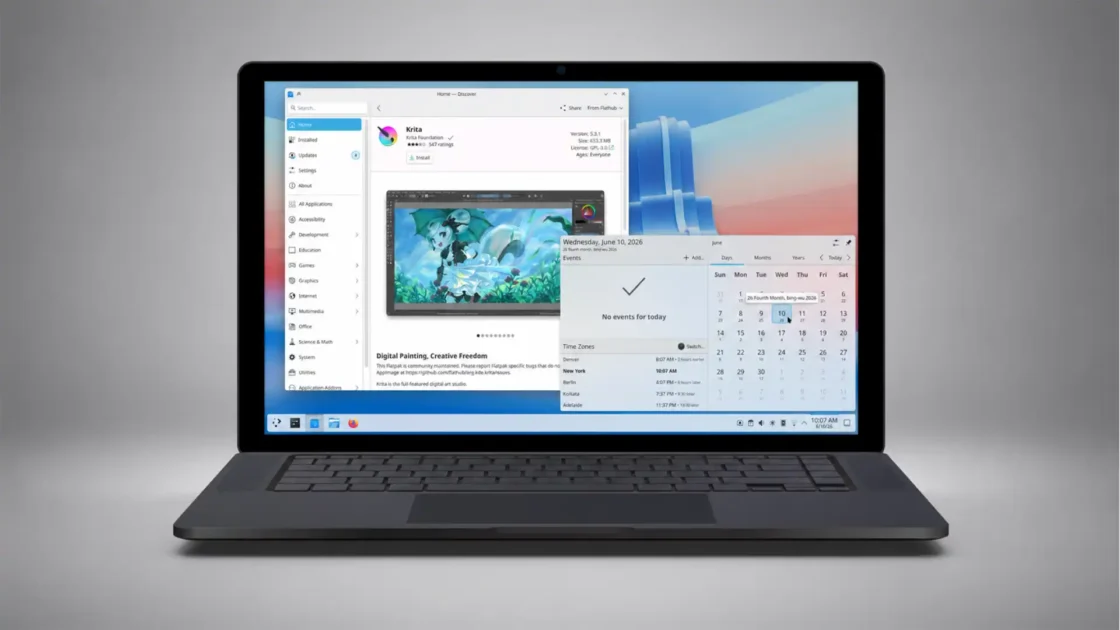
Desktop Linux has still become easier to live with. Hardware support is better than it was during the old “year of the Linux desktop” jokes. The main distributions ship polished installers, strong desktop environments, app stores, flatpak-style packaging options, and built-in update tools. Laptop power management, Wi-Fi, Bluetooth, high-DPI displays, Nvidia drivers, AMD graphics, printer discovery, and suspend/resume still vary by machine, but the gap is smaller than it used to be. The catch is that market share does not rise just because the experience improves. The distribution channel has to change too.
The current desktop number is lower than many Linux fans expected
Many Linux watchers expected desktop Linux to benefit more visibly from Windows 10 end-of-support pressure. Microsoft ended Windows 10 support on October 14, 2025, with Windows 11 requiring newer hardware features on many machines. Linux offers a practical route for older PCs that run Windows 10 well but cannot meet Windows 11 requirements. That should, in theory, increase migration.
The current global desktop number shows caution. Linux did not suddenly jump to 10% because Windows 10 reached its support cutoff. The StatCounter worldwide desktop number for April 2026 is still 2.99%. A small rise in certain countries or communities may be real, but global desktop share remains constrained by user habits, business software, gaming requirements, hardware bundles, and support expectations.
For households, the friction is ordinary. People ask whether their printer will work, whether Microsoft Office files will render the same, whether tax software is available, whether school portals require a Windows-only tool, whether anti-cheat games work, whether video editing workflows survive, whether family members will call them for support, and whether online banking support staff will blame Linux for any problem. Many of those issues have workarounds, but a workaround is not the same as a default consumer path.
For companies, the friction is organizational. Linux desktops need identity integration, endpoint management, patching policies, VPN support, device control, remote support, compliance reporting, secure boot policies, encryption management, procurement rules, application certification, staff training, and vendor accountability. These needs do not make Linux unsuitable. They make migration a project, not a download.
This is why the desktop number moves slowly. The Linux desktop does not need to be bad to remain small. It only needs to face a market where the default OS is already installed, already supported, already familiar, and already baked into workflows.
The Steam number tells a different story
Gaming used to be one of Linux’s weakest desktop arguments. Native Linux games existed, but the broader PC gaming world was built around Windows APIs, Windows launchers, Windows anti-cheat systems, and Windows driver assumptions. That has changed faster than the overall desktop market.
Valve’s April 2026 Steam Hardware & Software Survey reports Linux at 4.52%, Windows at 93.47%, and macOS at 2.01% among participating Steam users. The same Steam page states that participation is optional and anonymous, which matters because the survey is not a strict census. Still, the direction is meaningful: Linux gaming has moved from curiosity to a measurable PC gaming segment.
The reason is not only that more gamers installed Ubuntu or Arch on a tower PC. The reason is Valve’s platform work. SteamOS, Proton, Mesa graphics improvements, AMD driver maturity, Vulkan adoption, the Steam Deck, and the handheld PC category changed Linux gaming from a hobbyist configuration challenge into a commercial product experience.
Valve’s Steamworks documentation describes Proton as the compatibility layer that lets Windows games run on Linux using a modified version of Wine and high-performance graphics API implementations. Valve says most APIs are already supported by Proton and many games work out of the box. That single layer changed the economics of Linux gaming. Developers no longer need to ship a native Linux port for every title before Linux users get a playable game.
The Steam number still does not mean Linux is close to overtaking Windows in gaming. Windows remains dominant by a wide margin. But 4.52% on Steam is larger than desktop Linux’s worldwide web-traffic share, and the gap says something useful: Linux adoption is stronger where a platform owner has built an integrated experience, curated compatibility, and hardware around it.
SteamOS changed Linux adoption without asking users to become Linux users
SteamOS is the most interesting Linux desktop success story because it hides Linux from people who do not care about Linux. A Steam Deck owner may use a Linux distribution every day without thinking about package managers, systemd, Wayland, KDE Plasma, Btrfs, Wine, Proton, Vulkan, or Mesa. The device boots into a gaming interface. The Linux base matters, but it is not the product pitch.
That is a major shift in Linux consumer adoption. Traditional desktop Linux often asks the user to choose a distribution, make an installation USB drive, enter firmware settings, understand partitioning, pick a desktop environment, and troubleshoot hardware. SteamOS asks the user to buy a device and play games. That difference is why consumer Linux may grow faster in appliances than in generic laptops.
Valve says SteamOS is an Arch Linux-based Linux distribution, with open-source base operating system components and the Steam Client included. That puts it inside the Linux ecosystem while giving users a product identity separate from “desktop Linux.” It resembles Android in one respect: the kernel and open-source base are technical foundations, but the mass-market brand is something else.
The Steam Deck also shifted developer incentives. A game that works well through Proton or earns Deck compatibility may reach a new hardware audience without a traditional Linux port. That does not solve every problem. Kernel-level anti-cheat, launchers, media codecs, DRM, multiplayer services, and unsupported middleware still block some titles. But the friction is lower than it was when Linux gaming depended on native ports alone.
SteamOS also shows the difference between Linux as a platform and Linux as a visible label. Many users will adopt Linux faster through a finished device than through a public commitment to open-source computing. That may disappoint purists, but it is how large consumer markets move.
Developers use Linux at a much higher rate than ordinary desktop users
Developer surveys show why Linux can be culturally loud while statistically small on desktops. Stack Overflow’s 2025 Developer Survey reports that, for the question “What is the primary operating system in which you work?”, Windows remained high, macOS remained strong, and Linux-related entries were common. The survey lists Ubuntu at 27.8% personal use and 27.7% professional use, Linux non-WSL at 17.6% personal and 16.7% professional, Debian at 11.4% personal and 10.4% professional, Arch at 9.7% personal and 4.6% professional, Fedora at 5.8% personal and 3.7% professional, Red Hat at 1.8% personal and 5.7% professional, and WSL near the same range as non-WSL Linux for professional use.
These categories should not be added together as if they were exclusive population shares. The survey design and write-in handling make the numbers different from a market-share chart. But the message is clear: Linux is far more common among developers than among general desktop users.
The reason is practical. Developers work with servers, containers, cloud runtimes, CI/CD systems, package managers, shells, compilers, scripting tools, language runtimes, infrastructure-as-code tools, Kubernetes clusters, and observability pipelines. Much of that world is Linux-native or Linux-first. A developer using Windows often uses WSL. A developer using macOS often deploys to Linux. A developer using Linux locally removes one layer of translation.
This technical pull explains why Linux influence exceeds desktop share. A small share of consumer desktops can still produce a large share of developer mindshare, open-source contributions, documentation, forum answers, cloud images, package ecosystems, security research, and infrastructure defaults. In developer circles, Linux is not niche in the same way it is niche at a retail laptop counter.
The developer story also helps explain the gap between perception and measurement. A person who spends time in programming forums, cybersecurity communities, systems administration circles, AI infrastructure teams, and open-source projects will see Linux everywhere. A person who looks at browser traffic from ordinary desktops will see Linux near 3%. Both views are real. They just come from different rooms.
Linux dominates websites where the operating system is known
The desktop share becomes much less relevant when the question moves to websites and hosting. W3Techs reported on May 26, 2026 that Linux is used by 61.3% of all websites whose operating system is known, while Unix as a broader family is used by 91.6% of websites whose OS is known. Its operating-system overview shows Unix at 91.6% and Windows at 8.6% for websites with known operating systems, with a note that a website may use more than one operating system.
This is not the same question as desktop usage. A website may run behind a CDN, a load balancer, a container platform, multiple origins, managed hosting, serverless functions, or infrastructure that is hard to fingerprint. “Whose operating system we know” is a key caveat. Still, the direction is not disputed: Linux and Unix-like systems are the default public-web infrastructure base.
The reasons are economic and architectural. Linux fits web servers because it is scriptable, automatable, license-flexible, secure when maintained well, and deeply integrated with cloud tooling. Nginx, Apache, PostgreSQL, MySQL, MariaDB, Redis, Docker, Kubernetes, HAProxy, Prometheus, Grafana, systemd, OpenSSH, iptables/nftables, BPF tooling, and thousands of server packages grew around Unix-like assumptions. Windows Server is still used, especially where .NET, Active Directory, Windows workloads, and Microsoft enterprise stacks dominate. But web hosting at scale leans heavily toward Linux.
For ordinary people, this means Linux often serves the page even when it does not run their laptop. A Windows user reading news, a macOS user shopping online, and an iPhone user streaming media may all be reaching Linux-backed infrastructure. Linux’s public visibility as a desktop brand is low compared with its invisible role as the operating layer behind services.
This makes Linux a strange market-share story. On the client side, it is a minority. On the server side, it is a default. For search engines, AI crawlers, e-commerce sites, banks, social networks, SaaS tools, government portals, developer platforms, and media services, Linux is not an outsider. It is part of the floor.
Android makes the question politically and technically awkward
Android complicates Linux usage debates because it is both true and incomplete to call Android a Linux-based operating system. The Android Open Source Project says Android’s kernel is based on an upstream Linux Long Term Supported kernel and that Google combines LTS kernels with Android-specific patches to form Android Common Kernels. That is a technical fact.
But Android is not a conventional Linux distribution. It does not ship the GNU userland as a normal desktop distribution does. Its application model, permission system, graphics stack, update chain, hardware abstraction layers, app store economics, and vendor modifications are Android-specific. Most Android users are not Linux desktop users, and they do not make choices that resemble Linux distribution choices.
StatCounter’s mobile OS data for April 2026 showed Android at 67.35% worldwide mobile operating system share, with iOS at 32.55%. Counting Android as “Linux usage” makes Linux the base for most mobile web traffic. Excluding Android keeps “Linux” in the desktop sense near 3%. Neither choice is neutral. The right answer depends on the intent behind the question.
For consumer behavior, Android should not be merged with desktop Linux. Someone deciding whether to support a Linux desktop app should not treat Android’s 67.35% mobile share as evidence of desktop Linux demand. For kernel influence, Android absolutely matters. Billions of devices run Linux-derived kernels because Android exists.
That split is the core of the topic. Linux is not one market. It is a family of kernels, distributions, platforms, appliances, servers, embedded systems, and commercial products. The public argument becomes confused when people want one percentage to represent all of that.
ChromeOS sits in the middle but is usually counted separately
ChromeOS also complicates the numbers. It is Linux-based at the technical layer, but market-share charts often count it separately from “Linux.” StatCounter, for example, frequently separates ChromeOS as its own category when it appears in a dataset. That makes sense from a product-market standpoint: Chromebook buyers generally bought ChromeOS, not a Linux desktop distribution.
ChromeOS has a visible Linux development environment through Linux on ChromeOS, often called Crostini. Google’s ChromeOS developer documentation describes Linux on ChromeOS as a development environment, with topics covering setup, internals, FAQ, and related container terms. But that container feature is not the same as saying the user’s main desktop environment is Ubuntu or Fedora. The OS experience remains ChromeOS.
Whether to count ChromeOS as Linux depends on the same distinction as Android. For kernel genealogy, yes, it belongs in the broader Linux-derived world. For desktop Linux adoption, no, it should usually be separated. A developer targeting Linux desktop packaging, system tray behavior, Wayland sessions, Flatpak distribution, or GNOME/KDE UI conventions cannot assume ChromeOS users behave like Fedora Workstation users.
ChromeOS also shows how Linux can succeed when bundled with hardware, managed updates, a narrow product promise, and a consumer-ready identity. Chromebooks did not win education and budget segments by telling users to install Linux. They won where price, manageability, browser-first workflows, and school administration made sense.
The lesson repeats: Linux grows most easily when the user does not have to assemble the product. Android did it for phones. ChromeOS did it for browser-first laptops. SteamOS did it for handheld gaming. Traditional desktop Linux still asks more from users, which is why the share remains lower.
The word “users” hides at least six different populations
A precise answer requires separating at least six groups. First are general desktop users, measured through browser traffic or device fleets. This is where Linux is near 3% worldwide in StatCounter’s April 2026 desktop data. Second are gamers, where Steam’s optional survey puts Linux at 4.52% in April 2026. Third are developers, where Linux and Linux-related environments show much higher shares in Stack Overflow’s survey.
Fourth are mobile users, where Android dominates, but the label “Linux user” becomes less useful for describing user behavior. Fifth are server operators and websites, where W3Techs shows Linux at 61.3% of websites whose OS is known. Sixth are specialized computing environments: supercomputers, routers, TVs, cars, industrial systems, point-of-sale terminals, NAS devices, development boards, and cloud appliances.
Each population answers a different commercial question. A software vendor asking whether to make a Linux desktop client should care about desktops, developers, and maybe SteamOS. A game studio should care about Steam Linux share, Steam Deck behavior, Proton compatibility, anti-cheat support, and controller UX. A cloud vendor should care about Linux server workloads. A cybersecurity firm should care about Linux’s server, container, Android, and embedded exposure. A government agency planning sovereign workstations should care about desktop management and open-source office migration, not Android share.
The danger is not merely academic. Bad counting creates bad product decisions. If a company dismisses Linux because “only 3% use it,” it may underinvest in server security, developer tooling, cloud support, and container images. If it overstates Linux because “Android is Linux,” it may overestimate demand for a native desktop app. The count must match the decision.
The clearest current Linux usage figures
| Context | Latest useful public figure | What it measures | Main caveat |
|---|---|---|---|
| Worldwide desktop Linux | 2.99% | Desktop web traffic in StatCounter, April 2026 | Web usage, not installed-device census |
| Europe desktop Linux | 3.31% | Desktop web traffic in Europe, April 2026 | Regional browsing mix affects share |
| Steam Linux | 4.52% | Optional anonymous Steam Hardware & Software Survey, April 2026 | Surveyed Steam users, not all PC gamers |
| Developer Linux use | 17.6% Linux non-WSL personal, 16.7% professional | Stack Overflow developer survey category | Developer survey categories are not general-market share |
| Android mobile OS | 67.35% | Worldwide mobile OS web traffic, April 2026 | Android uses a Linux-based kernel but is not desktop Linux |
| Websites using Linux | 61.3% | Websites whose OS is known, W3Techs, May 26 2026 | Public website fingerprinting, not all servers |
The table shows the main pattern: Linux looks small only when the question is narrowed to conventional desktops. As soon as the category shifts to gaming handhelds, developer machines, mobile kernels, websites, or servers, Linux becomes much larger or harder to separate from the infrastructure beneath it.
StatCounter is useful but easy to misread
StatCounter’s numbers are popular because they are public, frequently updated, and easy to compare across countries, platforms, and time. But they are not a hardware shipment dataset. They are not an enterprise asset inventory. They are not a count of all powered-on computers. StatCounter explains that its tracking code is installed on more than 1 million sites, that it records billions of page views monthly, and that it analyzes browser, operating system, screen resolution, and mobile-device signals from those page views.
That method is strong for measuring web usage. It is weaker for measuring devices that do not browse the public web, devices with privacy filtering, kiosks, offline systems, internal corporate workstations, servers, embedded devices, and machines behind unusual user-agent policies. A Linux workstation used mostly for coding, terminal work, local builds, and internal dashboards may generate less public web traffic than a Windows consumer laptop used for browsing all day.
This matters for Linux because Linux users may be disproportionately technical. A developer might spend hours in terminals, IDEs, local services, SSH sessions, and cloud consoles. A casual Windows user may spend the same time browsing web pages tracked by analytics scripts. Page-view share and user share are related, but they are not identical.
StatCounter also separates categories according to detected OS labels. Android is Android, not Linux. ChromeOS may be separate. “Unknown” may be large. macOS naming may appear split as OS X and macOS, depending on data and detection. In April 2026 worldwide desktop data, OS X and macOS were separate lines. Readers should resist treating every line as a perfectly clean platform boundary.
Still, StatCounter is valuable. It gives a consistent public lens into web-facing desktop behavior. For the narrow question “what share of desktop browsing is Linux?” the answer is clearly low single digits globally in April 2026.
Regional figures matter because Linux adoption is uneven
Linux desktop adoption is not spread evenly across the world. Europe’s StatCounter desktop figure for April 2026 was 3.31%, a little above the worldwide desktop figure of 2.99%. The United States, India, Germany, Brazil, Finland, and other markets can vary because of education systems, public-sector choices, PC purchasing patterns, income levels, language communities, piracy patterns, developer concentration, and local attitudes toward proprietary platforms.
A global average hides those differences. Linux is often stronger in technical communities, universities, government pilots, developer-heavy cities, privacy-conscious circles, open-source communities, gaming handheld niches, and countries where older hardware needs a longer useful life. It can be weaker in places where Windows licensing is bundled cheaply, where MacBooks dominate developer culture, where local software vendors support only Windows, or where schools and businesses standardize on Microsoft 365 and Windows management.
The regional question also has a political layer. In Europe, Linux is part of a broader discussion around open source, public procurement, dependency on U.S. technology providers, cloud sovereignty, office formats, and government control over infrastructure. The European Commission’s open-source strategy says the Commission will encourage and use open source and promote sharing and reuse of software solutions, knowledge, and expertise. Those policy goals do not instantly raise Linux desktop share, but they create conditions for public-sector evaluation.
Germany’s Schleswig-Holstein offers a practical example. Interoperable Europe reported in February 2026 that Schleswig-Holstein had completed a state administration email migration involving more than 44,000 mailboxes and 110 million emails and calendar entries, had moved 80% of its ecosystem to LibreOffice, and retained a commitment to switch work laptops to Linux. That is not a global market-share revolution. It is a sign that public-sector Linux and open-source migration is moving from slogans into operational projects.
Linux growth is easier in organizations with technical control
Linux adoption rises when an organization controls the environment. Servers are the obvious case. Cloud teams choose images, automate provisioning, patch fleets, restrict access, standardize logging, and manage packages. Users do not need to care about the OS because the OS is a managed layer. That is perfect territory for Linux.
The same logic applies to SteamOS and Android. In both cases, the platform owner controls hardware targets, update paths, user experience, app distribution, compatibility layers, and support expectations. Users do not have to assemble the OS experience themselves. The product arrives as a finished system.
Traditional desktop Linux is harder because the user may be both consumer and integrator. They choose the distribution, the desktop environment, the install method, the file system, the GPU driver, the packaging source, the office suite, and the support path. Power users like that control. Ordinary buyers usually do not.
Enterprise desktop adoption can solve that by removing choice. An IT department can ship one distribution, one image, one patch policy, one set of applications, one support desk, one identity provider, one browser, one office suite, and one VPN. At that point Linux becomes manageable. But the project must be funded and owned.
The Linux desktop therefore tends to grow in controlled niches before it grows in the unmanaged mass market: schools, call centers, public administration, developer workstations, cybersecurity teams, research labs, thin clients, kiosks, and gaming appliances. Those niches do not always show up as dramatic global desktop share, but they matter.
Windows 10’s end of support gave Linux an opening but not a free win
Windows 10’s support cutoff created one of the strongest consumer arguments for Linux in years. Microsoft’s support page says Windows 10 support ended on October 14, 2025, and advises moving to Windows 11 on eligible devices. For PCs that do not meet Windows 11 requirements, Linux offers a way to keep hardware useful without running an unsupported OS.
The argument is especially strong for older laptops with SSDs and enough RAM. A lightweight Linux distribution can keep a machine useful for browsing, writing, media playback, coding, and schoolwork. That matters for household budgets and electronic waste. A PC that cannot run Windows 11 officially may still be fast enough for Linux.
But the opening has limits. Many users will keep Windows 10 despite support risks. Some will pay for extended security updates if available in their region or organization. Some will buy new PCs. Some will move to Chromebooks, tablets, or Macs. Some will never hear a clear Linux migration message from a trusted source. Some will try Linux, hit one unsupported device, and return.
Linux migration also has an emotional barrier. Replacing an OS feels bigger than replacing a browser. People worry about losing files, breaking a machine, or being alone when something fails. A technically accurate migration guide does not erase that anxiety.
The Windows 10 moment may raise Linux’s share over time, but the April 2026 desktop data shows no instant global surge. Linux’s future desktop gains will likely come from a mix of old-PC reuse, gamer adoption through SteamOS, privacy-minded users, developer workflows, public-sector pilots, and hardware vendors selling Linux preinstalled.
The hardware channel is still the main bottleneck
The most direct path to higher desktop Linux share is not another distribution. It is more good hardware sold with Linux already installed. Preinstallation matters because it turns Linux from an experiment into the default. It also moves support responsibility from the user to the seller.
Linux hardware vendors already exist, and some mainstream vendors offer selected developer machines with Linux. But the scale is not comparable to Windows PCs or Macs. Retail shelves, corporate procurement catalogs, school contracts, warranty scripts, call-center flows, and repair networks still mostly assume Windows or macOS.
Driver support has improved because much hardware support is upstreamed into the Linux kernel, and AMD and Intel graphics support are strong on many systems. Still, laptops are complicated. Fingerprint readers, webcams, audio codecs, suspend behavior, battery reporting, keyboard backlights, touchpads, docking stations, secure boot chains, BIOS updates, and vendor utilities can make or break the user experience. A Linux-ready laptop is not just a laptop that boots Linux. It is a laptop whose full hardware and firmware story has been tested.
The same is true for peripherals. Printers, scanners, drawing tablets, audio interfaces, RGB controllers, game controllers, VR headsets, webcams, and capture cards vary widely. Linux does not need perfect support for every device to grow, but it needs fewer first-week failures for ordinary buyers.
A user who installs Linux on unsupported hardware is acting as their own system integrator. A user who buys a Linux-preinstalled machine is buying a product. That difference is the desktop bottleneck in one sentence.
Software availability is better than the reputation, but gaps remain
Desktop Linux software availability is much better than its old reputation suggests. Browsers work. Web apps work. LibreOffice, OnlyOffice, Krita, Blender, Kdenlive, OBS Studio, VLC, Thunderbird, GIMP, Inkscape, VS Code, JetBrains IDEs, Git tools, database clients, Docker workflows, Discord, Slack, Zoom, Signal, Spotify, Steam, and many cross-platform apps cover large parts of ordinary and technical use.
Packaging is also less fragmented than before. Distribution repositories still matter, but Flatpak, AppImage, Snap, vendor repositories, and containerized development environments reduce the old “which distro package exists?” problem. Developers can ship to Linux without targeting every package manager directly.
The remaining gaps are not imaginary. Adobe Creative Cloud, full Microsoft Office desktop apps, certain accounting packages, many enterprise VPN clients, specialized CAD tools, pro audio workflows, medical and legal software, school testing tools, game anti-cheat systems, and hardware vendor utilities still tilt many users back to Windows or macOS. Web apps reduce some pain, but not all.
File compatibility is another sticking point. LibreOffice is strong, but businesses that exchange heavily formatted Microsoft Office documents may still face layout issues, macro problems, template differences, font mismatches, and support concerns. In organizations, those small differences become political. A migration can fail because a form, spreadsheet, or print workflow breaks.
The Linux desktop no longer lacks applications in a broad sense. It lacks guaranteed compatibility with certain proprietary workflows that control user choice. That is enough to keep share low in many professional environments.
Linux’s strongest consumer route may be through appliances
Android, ChromeOS, SteamOS, routers, smart TVs, NAS devices, and car systems point toward a pattern: Linux wins consumer users when it is embedded in a product, not presented as a do-it-yourself platform. This does not diminish Linux. It explains its success.
The Linux kernel and open-source ecosystem are excellent foundations for device makers because they are modifiable, portable, mature, network-ready, and backed by a huge technical community. A company can build a phone OS, a TV interface, a game console-style handheld, a network appliance, or an industrial controller on top of Linux without turning every buyer into a Linux enthusiast.
This is why a consumer may own five Linux-based devices and still say they do not use Linux. Their phone runs Android. Their router runs embedded Linux. Their TV may run a Linux-based OS. Their NAS may run Linux. Their Steam Deck runs SteamOS. Their smart speaker, car infotainment system, or home automation hub may rely on Linux somewhere inside. Yet their laptop may be Windows or macOS.
The brand visibility problem is real. Linux is often infrastructure, not the product name. That invisibility lowers desktop brand adoption but raises total technical adoption. Linux is the part people do not see.
For the percentage question, this means the narrow desktop answer undercounts Linux’s role in everyday life. But the broad device answer overstates ordinary user awareness and desktop app demand. A good analysis keeps those two truths separate.
Developers, servers, and containers make Linux the default backend language
Even where desktop Linux is absent, Linux assumptions shape modern software. Containers typically package Linux userland environments. Kubernetes clusters usually run Linux nodes. CI pipelines build inside Linux images. Cloud documentation starts with Linux commands. Security tools assume Linux paths, permissions, daemons, sockets, cgroups, namespaces, and package managers. AI and data engineering workflows often rely on Linux drivers, CUDA stacks, Python environments, and server orchestration.
This matters because the developer ecosystem feeds the rest of the market. If a tool is born in cloud infrastructure, it is likely to support Linux first. If a security scanner targets production workloads, Linux coverage is mandatory. If an AI framework wants GPU clusters, Linux support is not optional. If a database runs at scale, Linux performance and operational behavior are core concerns.
That backend dominance also explains WSL’s importance. Windows Subsystem for Linux gives Windows developers a Linux-like environment without replacing Windows. Stack Overflow’s 2025 survey listed WSL at 15.9% personal use and 16.8% professional use, which sits near Linux non-WSL in the professional category. WSL is both a bridge and a pressure valve. It lets Windows keep developers who need Linux tooling.
WSL may slow desktop Linux migration because developers can keep Windows while using Linux command-line environments. It may also deepen Linux literacy because more users learn Linux tools. The effect is mixed. It raises Linux’s technical presence without necessarily raising Linux desktop share.
That is the story of Linux in 2026: low desktop share, high technical gravity.
Supercomputing shows the opposite end of the market
At the high-performance computing end, Linux’s position is far from marginal. TOP500 maintains data on the world’s highest-performing supercomputers and provides an operating-system family page for Linux. The public supercomputing conversation has treated Linux as the standard for years because large-scale scientific computing needs deep hardware control, scheduler integration, networking performance, compiler toolchains, custom kernels, and cluster automation.
Supercomputers are not consumer devices, so they should not be mixed into desktop user share. But they demonstrate Linux’s range. The same kernel family that powers phones, routers, developer workstations, cloud VMs, and websites also scales into national laboratories and exascale systems. Very few operating system families cover that span.
The reason is not romance about open source. It is engineering control. Supercomputing centers need to tune systems at a level that proprietary desktop operating systems do not invite. Linux offers source-level access, broad hardware support, scheduler ecosystems, scientific package stacks, and a culture of systems modification.
The desktop market rewards familiarity and preinstallation. Supercomputing rewards control and adaptability. Linux wins much more decisively in the second market because those qualities matter there more than consumer software defaults.
Linux counted three different ways
| Counting method | Included | Excluded | Best use |
|---|---|---|---|
| Narrow desktop Linux | Ubuntu, Fedora, Debian, Arch, Linux Mint, openSUSE, Pop!_OS, NixOS and similar desktop distributions | Android, ChromeOS, most embedded Linux, servers | Measuring demand for traditional Linux desktop apps and support |
| Linux-derived consumer platforms | Android, ChromeOS, SteamOS, some smart TVs, routers, appliances | macOS, iOS, Windows, non-Linux embedded systems | Understanding Linux kernel reach in consumer devices |
| Infrastructure Linux | Web servers, cloud VMs, containers, Kubernetes nodes, supercomputers, network appliances | Consumer desktops not used as infrastructure | Planning server, cloud, cybersecurity, hosting, and developer tooling |
These categories prevent the biggest misunderstanding. A 3% desktop share does not contradict Linux’s dominance in infrastructure, and Android’s massive share does not prove mass demand for desktop Linux software.
Public-sector Linux is a sovereignty story, not only a cost story
Government interest in Linux and open source is often framed as a license-cost issue. Cost matters, but it is not the whole story. Public bodies also care about procurement independence, open standards, auditability, long-term access to public data, local vendor ecosystems, security review, and reduced dependency on a small set of foreign suppliers.
The European Commission’s open-source strategy explicitly links open source with sharing, reuse, and better European services. Schleswig-Holstein’s migration shows how this becomes operational: email, office suites, cloud storage, laptops, and support offices. Interoperable Europe reported licensing-fee savings and reinvestment into the open-source ecosystem, but the migration also involved transparency, privacy, informational symmetry, and public-sector cooperation.
Those projects matter for Linux adoption because government desktops are one of the few places where platform defaults can be changed at scale. A household user may hesitate to install Linux alone. A ministry can mandate a tested stack, train staff, and build a support organization. That does not make migration easy. It makes it possible.
The risk is underestimating change management. Replacing Windows is not just replacing a kernel and desktop shell. It touches document templates, macros, printers, procurement systems, user training, accessibility tools, remote meetings, security policies, records management, and legacy applications. Public-sector Linux succeeds when it is treated as institutional reform, not a weekend installation.
The Linux desktop is strongest when the task is clear
Linux performs well when users have a clear reason to choose it. Developers choose it for tooling. Privacy-minded users choose it for control. Gamers choose SteamOS for handheld gaming. Security teams choose it for visibility and scripting. Universities choose it for research. Governments choose it for sovereignty and cost control. Old-PC users choose it for longevity. Makers choose it for hardware projects. Server operators choose it for automation.
The weak case is the vague one: “Use Linux because it is better.” Better for what? A user whose work lives in Microsoft Office, Adobe Creative Cloud, a Windows-only accounting package, and a kernel anti-cheat game may not find Linux better. A user who writes Python, runs containers, uses Git, values customization, and prefers open systems may find it clearly better.
This is why the Linux desktop grows through tribes and tasks rather than mass conversion campaigns. Each task creates its own adoption argument. The developer argument is not the gamer argument. The old-laptop argument is not the government argument. The privacy argument is not the server-admin argument. Linux is a general-purpose OS, but adoption rarely starts from generality.
For market-share analysis, this matters because growth is likely to be uneven. SteamOS can lift gaming share without lifting office desktop share. Government migrations can raise institutional share without affecting home laptops. WSL can increase Linux tool use without increasing Linux desktop share. Android can increase Linux kernel reach without increasing desktop Linux identity.
The app-store problem remains unresolved
Windows and macOS have familiar software distribution patterns for mainstream users. Mobile has app stores. ChromeOS has Chrome Web Store and Android app integration. Linux has repositories, graphical software centers, Flatpak, Snap, AppImage, vendor downloads, command-line package managers, and source builds. Power users like that flexibility. New users may see fragmentation.
The Linux ecosystem has improved this problem, but not fully solved it. Flathub has become a major cross-distribution app channel. Snap has Canonical backing. AppImage gives portable binaries. Native distribution packages remain strong for core software. Yet developers still face choices that do not exist in the same way on Windows or macOS: Which format? Which sandbox? Which portals? Which runtime? Which store? Which update mechanism? Which distro versions?
For users, the experience depends on distribution defaults. Fedora Silverblue, Ubuntu, Linux Mint, Pop!_OS, Debian, Arch, openSUSE, elementary OS, and others may present different software paths. A guide written for one may not apply cleanly to another. That variety is a strength for experts and a support burden for mass adoption.
This affects the percentage because mainstream adoption rewards predictability. A support article that says “click this download button” is easier than one that says “choose the right package for your distribution.” Linux’s packaging diversity is technically rich but commercially expensive.
SteamOS sidesteps this by controlling the main app channel. Android sidesteps it with Play Store and OEM stores. ChromeOS sidesteps it through web apps and managed channels. Traditional desktop Linux still has to make the cross-distro story feel less like a maze.
Security is a Linux strength and a Linux responsibility
Linux is often associated with security, but security is not automatic. A patched, well-configured Linux system can be extremely resilient. An abandoned router, an exposed server with weak credentials, an outdated NAS, or a misconfigured cloud instance can be dangerous. Linux’s server and embedded reach means Linux vulnerabilities have broad consequences.
The kernel’s active development model matters here. Kernel.org listed current stable and long-term kernel releases with dates as of May 2026, showing the constant maintenance rhythm behind Linux. Android’s kernel model adds another layer, with Android Common Kernels and generic kernel images tying mobile security to a downstream Linux base.
For desktop users, Linux security benefits include strong package signing, central repositories, permission models, rapid patching, full-disk encryption options, open review, and fewer commodity malware campaigns than Windows. But a user still needs updates, browser hygiene, cautious use of scripts, safe extension habits, strong passwords, and backups. Linux is not a magic shield.
For organizations, Linux’s strength is transparency and control. Teams can audit, patch, harden, automate, log, isolate, and rebuild systems. Containers and immutable images support clean deployment patterns. But that power requires skill. The same flexibility that makes Linux strong also permits poor configurations.
Security strengthens Linux’s case in governments, cloud, and technical teams. It does not by itself turn desktop Linux into a mass consumer platform, because ordinary buyers rarely choose an OS through a threat-model comparison.
Privacy gives Linux a cultural advantage
Privacy concerns push some users toward Linux because many distributions avoid the advertising, account-binding, telemetry, and cloud-default patterns associated with larger proprietary platforms. This is not merely ideological. Users notice when operating systems steer them toward accounts, bundled services, AI features, cloud backup, app recommendations, or data-sharing settings.
Linux distributions vary, but the broad culture gives users more control. A typical distribution can be installed without a vendor account. Updates do not need to be tied to a consumer identity. Default apps are often open source. The system can be inspected and modified. Community builds exist for users with special privacy or security needs.
That privacy advantage is a real adoption driver, but its market effect is limited by trade-offs. Privacy-minded users accept more responsibility. They research hardware, choose distributions, configure browsers, select DNS providers, manage backups, and learn alternatives to proprietary apps. Most consumers prefer convenience until a privacy concern becomes immediate.
Still, privacy is a durable reason for desktop Linux to keep growing slowly. It is also part of the public-sector sovereignty discussion. Control over data, formats, infrastructure, and update paths increasingly matters to governments and regulated industries. Linux is well placed for that conversation, even if the desktop share remains small.
The role of distributions is changing
Linux distributions used to be the main public face of Linux adoption. Ubuntu, Debian, Fedora, Arch, Linux Mint, openSUSE, Red Hat Enterprise Linux, SUSE Linux Enterprise, Alpine, Gentoo, and others each represented a different philosophy. They still matter. But many users now encounter Linux through platforms that hide distribution identity.
A developer may use a container image without caring whether it is Debian, Alpine, Ubuntu, or Red Hat-based until a package conflict appears. A gamer may use SteamOS and know only that it works. An Android user never sees a Linux distribution name. A cloud user chooses an image from a marketplace. A Chromebook user lives in ChromeOS. A router owner never sees the embedded distribution.
This makes “Linux user” less tied to distro identity than before. The strongest visible distro communities remain influential, but Linux adoption increasingly flows through managed layers: images, containers, devices, cloud services, and appliance systems.
That shift has both benefits and costs. It brings Linux to people who would never install it manually. It also makes Linux less visible as a public brand. A person can be surrounded by Linux-derived systems and still think Linux is a niche hobby desktop.
For desktop share, distributions still matter because they own the traditional Linux PC experience. Linux Mint may appeal to Windows switchers. Fedora may appeal to developers who want newer stacks. Ubuntu remains a common default. Debian appeals to users who value stability. Arch appeals to users who want control. Pop!_OS, elementary OS, Zorin OS, NixOS, EndeavourOS, CachyOS, and others serve more specific communities. The diversity is a strength, but it splits the story.
The desktop user experience is no longer the main technical barrier
Linux critics often speak as if the desktop still looks like a 2004 science project. That is outdated. GNOME, KDE Plasma, Cinnamon, Xfce, Budgie, Pantheon, and other environments provide polished daily computing experiences. Installation is often easier than a Windows reinstall. Updates can be simpler. App stores exist. Gaming works better. Hardware detection is stronger. Printers often work without hunting drivers.
The barrier has moved from desktop polish to ecosystem certainty. A user asks: Will my exact laptop sleep properly? Will my company VPN work? Will my external monitor dock behave? Will my game launch? Will my school software run? Will my bank support me? Will my accountant’s spreadsheet render correctly? Will my camera utility exist? Will my drawing tablet pressure curve work? Will my meeting software screenshare under Wayland?
These are not failures of desktop design. They are edge compatibility and vendor-support issues. An OS can be beautiful and still lose users when one non-negotiable workflow breaks.
Wayland’s rise also shows the maturity challenge. It modernizes Linux graphics and security, but some tools built around X11 assumptions needed adjustment. Screen sharing, remote desktop, color management, input tools, fractional scaling, HDR, VRR, Nvidia behavior, and accessibility have improved unevenly across desktops and distributions. Ordinary users do not care whether the issue is the compositor, toolkit, portal, driver, or app. They care whether it works.
Linux’s desktop progress is real. Its remaining blockers are less about basic usability and more about exact compatibility with a fragmented hardware and software world.
Gaming anti-cheat remains one of the hardest consumer blockers
Proton solved a huge part of the Windows-games-on-Linux problem, but multiplayer anti-cheat remains a stubborn barrier. Some anti-cheat systems support Linux and Steam Deck. Others do not. Some publishers could enable support but choose not to. Some games run technically but block online play. Some work for months and break after an update.
This matters because a small number of games can determine a user’s OS choice. A gamer may be willing to experiment with Linux until one favorite competitive game does not work. The rest of the library becomes irrelevant if the daily game is blocked.
Valve’s Proton documentation says most APIs are already supported and most games work out of the box, while the team continues to improve compatibility. That is a strong position compared with where Linux gaming stood before Proton. But game compatibility is not only about APIs. It is also about publishers, DRM providers, anti-cheat vendors, launchers, account systems, and store policies.
SteamOS improves the market signal. Publishers now see Linux not only as desktop hobbyists but as Steam Deck owners and SteamOS device users. That commercial identity may move more anti-cheat decisions over time. Yet progress depends on publishers deciding that Linux support is worth the risk and cost.
The Steam Linux share of 4.52% in April 2026 is therefore both an achievement and a ceiling warning. Linux gaming has broken out of invisibility, but the hardest compatibility issues are now concentrated in games with strong network and anti-cheat dependencies.
The enterprise desktop is a harder target than the developer laptop
Linux is common in enterprise infrastructure but rare on enterprise desktops outside specific roles. The reasons are not mysterious. Enterprises standardize around endpoint management, compliance tooling, Microsoft 365, identity systems, document workflows, device encryption, EDR agents, procurement contracts, help desk scripts, and application certification. Windows is deeply embedded in that stack.
A developer laptop is easier to migrate because developers often know how to solve problems, and their toolchains may benefit from Linux. A finance department laptop, legal laptop, HR laptop, procurement laptop, or field-sales laptop has different constraints. It needs specific business software, support accountability, predictable document exchange, and minimal retraining.
Linux can work in enterprise desktops when the organization narrows the workflow: browser-based apps, standard office suite, internal portals, remote desktops, email, chat, and controlled peripherals. Call centers, kiosks, labs, public libraries, and administrative roles may be good targets. But the wider the application mix, the harder the migration.
This is why public-sector and enterprise Linux desktop projects succeed only when they address the whole stack. Replacing Windows without replacing Windows-dependent workflows creates failure. The OS is only one layer.
Enterprise Linux desktop adoption may still rise because more work is browser-based, more infrastructure is cloud-based, and Windows licensing and hardware requirements create pressure. But it will likely grow through managed projects, not spontaneous employee choice.
Linux’s share is higher in influence than in visible consumer identity
A platform’s influence is not always proportional to its consumer desktop share. Linux influences software architecture, developer education, cloud economics, security practices, infrastructure hiring, hardware enablement, open-source governance, and government technology policy. A 3% desktop figure cannot capture that.
Consider a typical software product. It may be written on macOS and Windows laptops, tested in Linux containers, built in Linux CI runners, deployed to Linux Kubernetes nodes, monitored by Linux-based agents, served through Linux web servers, used on Android phones, and accessed by Windows desktops. Which operating system “won” that product? The user interface may not be Linux, but the production path is.
The same applies to AI. Training clusters, inference servers, CUDA drivers, ROCm environments, container images, Python stacks, and orchestration tools lean heavily toward Linux. Ordinary users may experience AI through a web app on iOS or Windows, but the infrastructure behind it likely runs on Linux. The user percentage and the workload percentage diverge.
This is why Linux’s desktop share should not be read as a measure of technical relevance. Desktop Linux is a minority consumer OS. Linux itself is a central infrastructure OS. The two facts are not in conflict.
Linux adoption is pulled by economics as much as ideology
Open source is often discussed through values: freedom, transparency, collaboration, sovereignty, and control. Those values matter. But Linux adoption is also pulled by hard economics. No per-machine OS license cost, flexible redistribution, commodity hardware support, automation, long hardware life, vendor choice, and lower cloud friction all affect decisions.
For server fleets, license economics compound quickly. For governments, document formats and procurement independence matter. For schools, older hardware reuse matters. For startups, cloud images and container ecosystems matter. For device makers, kernel availability and hardware adaptation matter. For gamers, a SteamOS handheld has to work and be priced well. For developers, tooling has to save time.
Ideology may start some adoption, but operational benefits keep it. A government cannot migrate thousands of workers on slogans alone. A cloud provider cannot run Linux because it feels virtuous. A gamer will not stay on SteamOS if games fail. A developer will not use Linux if tools are worse. Linux wins where control, cost, performance, automation, and flexibility produce real gains.
The desktop challenge is that ordinary users often do not see these gains directly. Windows or macOS may already do what they need. Linux’s economic advantages are more visible to organizations and technical users than to someone buying one laptop for home use.
The “year of the Linux desktop” framing is tired and misleading
The old phrase turns Linux adoption into a binary event: either Linux takes over the desktop or fails. That was never a good frame. Linux has already won many markets and remains small in one very visible market. The desktop is not the whole computing world.
A better frame is where does Linux remove enough friction to become the default? It did so in servers. It did so in Android’s kernel base. It did so in supercomputing. It did so in many embedded devices. It is doing so in handheld PC gaming through SteamOS. It has not done so in the general-purpose consumer desktop, mostly because the desktop is tied to preinstalled operating systems, proprietary applications, and support expectations.
This frame also avoids false disappointment. If desktop Linux rises from 3% to 5%, that is meaningful growth even if it does not dethrone Windows. If SteamOS expands to more handhelds, that is a Linux success even if users call it SteamOS. If public administrations migrate office stacks and laptops, that is a Linux success even if the global StatCounter line barely moves.
Linux adoption is not one big switch. It is a set of market-specific substitutions. Each substitution has different incentives, blockers, and support models.
The most likely Linux growth paths through 2030
The most likely desktop-related growth path is not a sudden global Windows collapse. It is a collection of smaller paths that add up. SteamOS and Linux gaming may continue to lift Linux among gamers, especially if handheld devices and console-like PCs grow. Windows 10 hardware pressure may push some older PCs to Linux. Public-sector sovereignty projects may create managed Linux workstation deployments. Developer tools may keep Linux strong among programmers. Privacy concerns may move a small but steady group away from proprietary platforms.
Cloud and server Linux will remain strong because the economics and tooling reinforce it. Android will keep Linux-derived kernels in billions of mobile devices. Embedded and edge systems will keep using Linux where customization and hardware support matter. AI infrastructure will keep Linux central because GPU servers, drivers, containers, and orchestration are aligned around it.
The uncertainty is the consumer laptop channel. A broad desktop jump would require better Linux-preinstalled availability, stronger retail support, more vendor-backed devices, clearer app distribution, wider proprietary app compatibility, improved peripheral certification, and a migration story trusted by non-technical users. None of that is impossible. None of it happens automatically.
The strategic question for Linux advocates is less “how do we persuade everyone?” and more “which adoption path has the least friction?” SteamOS answered that for gaming handhelds. Governments may answer it for sovereign desktops. Developers already answered it for technical work. The generic home PC remains the hardest case.
The percentage that matters depends on the decision being made
A publisher deciding whether to support Linux needs a different number than a policymaker, a developer-tool vendor, a hardware maker, a cloud provider, or a cybersecurity team. The question should be rewritten before it is answered.
A native desktop app vendor should start with desktop Linux share, developer concentration, customer requests, distribution channels, support cost, and whether the app serves technical users. A game studio should examine Steam Linux share, Steam Deck and SteamOS compatibility, Proton behavior, anti-cheat requirements, and controller UX. A SaaS company should care less about native Linux clients if the product is browser-based, but it should test Linux browsers and developer workflows if the audience is technical.
A hardware maker should care about kernel driver support, firmware updates, distribution certification, suspend behavior, and whether Linux buyers influence developer communities. A government should care about sovereignty, support, staff training, open formats, procurement, and migration risk. A cloud or security company should treat Linux as mandatory because the infrastructure share is too large to ignore.
This is why the casual “what percent use Linux?” question should not be answered with only one number unless the scope is clear. The one-number answer is good for quick conversation, not for strategy.
The shortest accurate answer for readers
For ordinary readers asking about desktop computers, about 3% of worldwide desktop web traffic used Linux in April 2026, according to StatCounter. For PC gamers on Steam, 4.52% of surveyed users used Linux in April 2026, according to Valve’s Steam Hardware & Software Survey. For mobile users, Android’s 67.35% mobile OS share changes the picture because Android uses a Linux-based kernel, but Android should not be treated as desktop Linux. For websites whose OS is known, W3Techs put Linux at 61.3% on May 26, 2026.
That is the answer in one paragraph. The analysis behind it is that Linux is small where operating systems are chosen by consumer PC defaults and large where the market rewards control, automation, customization, and infrastructure economics.
Search interest is high because the numbers feel contradictory
People search this topic because Linux produces a paradox. It feels powerful, common, and influential in technical culture. It looks tiny in desktop market-share charts. The contradiction disappears when the categories are separated.
Linux is highly visible to people who build technology. It is less visible to people who buy laptops in retail stores. It is central to web infrastructure but not central to office desktops. It is everywhere in Android’s kernel base but not branded as Linux on phones. It is increasingly relevant in gaming through SteamOS but still far behind Windows across Steam. It is a public-sector sovereignty option but not a default consumer platform.
Search engines and AI answer systems also struggle with the wording because “Linux” can mean the kernel, GNU/Linux distributions, Android’s kernel base, ChromeOS’s base, server OS families, or desktop distributions. A good answer must disambiguate instead of flattening the term.
The best search-ready sentence is: Linux has roughly 3% worldwide desktop share by web traffic, around 4.5% share among surveyed Steam users, a much higher developer presence, and majority or dominant roles in many server, website, mobile-kernel, and supercomputing contexts.
That sentence avoids both undercounting and hype.
Linux’s future depends on products, not arguments
The next stage of Linux adoption will be decided by products that remove choice anxiety. SteamOS did that for handheld gaming. Android did it for phones. ChromeOS did it for managed browser-first laptops. Successful public-sector migrations do it through policy, training, and support. Developer adoption does it through tools that make Linux the path of least resistance.
Arguments alone do not move mass markets. A non-technical user does not install Linux because a forum explains kernel design. They switch when the machine works, the apps are there, the files open, the games run, the calls work, the printer prints, and support exists. That is a product problem.
Linux has strong raw material: a mature kernel, active distributions, open-source culture, hardware support, cloud alignment, developer mindshare, security tooling, gaming progress, and sovereignty appeal. It also has friction: fragmented app distribution, inconsistent hardware certification, missing proprietary apps, support uncertainty, and low retail presence.
That combination points to steady, uneven growth rather than a sudden desktop takeover. Linux will likely keep expanding in places where someone packages it into a complete experience. Where users must do the packaging themselves, adoption will remain concentrated among technical and motivated users.
The number should be used carefully
The most current public numbers support a careful statement, not a slogan. Desktop Linux is still a low-single-digit platform globally. Linux as a technical foundation is one of the most widely used operating system bases in the world. Both claims are true.
A person asking whether Linux is “popular” deserves a direct answer: as a consumer desktop, it is still niche. As a server, developer, cloud, mobile-kernel, supercomputing, and embedded foundation, it is mainstream or dominant in many categories. The difference is not spin. It is the shape of computing.
The April 2026 desktop figure of 2.99% is useful for measuring the visible Linux desktop. The Steam figure of 4.52% is useful for measuring Linux gaming momentum. The Android kernel documentation is useful for understanding why mobile Linux debates are complicated. The W3Techs figure of 61.3% for websites whose OS is known is useful for infrastructure.
The right percentage is the one matched to the right market. Without that match, the answer becomes either too small or too inflated.
Questions readers ask about Linux usage
StatCounter reported 2.99% Linux share of worldwide desktop operating system web traffic in April 2026. That is the best quick public answer for traditional desktop Linux usage.
No. StatCounter’s desktop Linux figure refers to desktop operating systems. Android is counted separately in mobile and all-platform operating system charts.
Technically, Android uses a Linux-based kernel. For desktop market share, it should not be counted as desktop Linux. For kernel reach, Android is part of the broader Linux story.
If you mean Android as a Linux-kernel-based system, StatCounter showed Android at 67.35% of worldwide mobile OS web traffic in April 2026. If you mean a traditional Linux mobile OS, the share is tiny.
Valve’s Steam Hardware & Software Survey reported 4.52% Linux share in April 2026 among surveyed Steam users.
SteamOS, the Steam Deck, Proton, and better Linux graphics support have made Linux gaming more practical. Steam’s audience is also more technical than the general desktop market.
Yes. Stack Overflow’s 2025 survey shows Linux-related operating systems and WSL at much higher rates among developers than Linux’s general desktop web-traffic share.
In Stack Overflow’s 2025 survey, Ubuntu appears prominently, with 27.8% personal use and 27.7% professional use in the listed operating-system category.
W3Techs reported on May 26, 2026 that Linux is used by 61.3% of websites whose operating system is known.
Servers reward automation, stability, remote management, licensing flexibility, and tooling. Desktops reward preinstallation, app compatibility, hardware support, and user familiarity.
ChromeOS is Linux-based at a technical level, but it is usually counted separately from desktop Linux because users experience it as ChromeOS, not as a traditional Linux distribution.
Yes, especially on older PCs that cannot move easily to Windows 11. But the April 2026 global desktop number does not show an instant mass migration.
For browsing, email, office work, media, coding, and many games, yes. The hard cases are specialized proprietary apps, some peripherals, some business workflows, and certain multiplayer games.
Sources use different methods: web traffic, surveys, hardware reports, website fingerprinting, or installed-base estimates. Each method sees a different part of the market.
Linux has grown in some visible areas, especially gaming and technical work, but the worldwide desktop share remains low single digits in current StatCounter data.
StatCounter’s April 2026 figure for desktop Linux in Europe was 3.31%, above the worldwide desktop Linux figure of 2.99%.
Linux is used by roughly 3% of worldwide desktop users by web-traffic share, around 4.5% of surveyed Steam users, and a much larger share of developers, servers, websites, Android-based mobile devices, and supercomputers.
It can grow, but mass desktop adoption depends on better preinstalled hardware, app support, peripheral reliability, game compatibility, and mainstream support channels.
They should use the number tied to their audience. A developer-tool company should weigh developer Linux usage. A game studio should weigh Steam Linux and SteamOS data. A general consumer app should start with desktop Linux share.
Author:
Jan Bielik
CEO & Founder of Webiano Digital & Marketing Agency
This article is an original analysis supported by the sources cited below
Desktop operating system market share worldwide
StatCounter’s worldwide desktop operating system market share chart, used for the April 2026 Linux desktop share figure.
Operating system market share worldwide
StatCounter’s all-platform operating system chart, used to compare desktop-only readings with broader operating system traffic.
Mobile operating system market share worldwide
StatCounter’s worldwide mobile operating system chart, used for Android’s April 2026 mobile share.
Desktop operating system market share Europe
StatCounter’s European desktop operating system chart, used for the April 2026 Europe Linux desktop share.
Desktop operating system market share United States of America
StatCounter’s U.S. desktop operating system market share chart, used for regional comparison context.
FAQ | StatCounter Global Stats
StatCounter’s methodology page explaining its use of page views, user-agent data, operating system detection, and its web analytics network.
Steam Hardware & Software Survey
Valve’s official Steam survey page, used for April 2026 Steam Linux share and survey-method context.
Steam survey for April 2026 shows Linux still trending well
GamingOnLinux coverage of the April 2026 Steam survey, used as a specialist Linux gaming news source.
Technology | 2025 Stack Overflow Developer Survey
Stack Overflow’s 2025 developer survey technology section, used for developer operating system usage data.
Analytics.usa.gov about page
The U.S. Digital Analytics Program’s explanation of its federal web analytics data, used for methodology and public-sector web-traffic context.
Analytics.usa.gov API | GSA Open Technology
Official GSA API documentation for Digital Analytics Program reports, including operating system and browser report types.
Usage statistics of Linux for websites
W3Techs’ Linux website operating system statistics page, used for the May 2026 figure on websites whose operating system is known.
Usage statistics and market shares of operating systems for websites
W3Techs’ operating system overview for websites, used for Unix and Windows comparison on public websites.
Operating system family Linux | TOP500
TOP500’s operating system family page for Linux, used for supercomputing context.
November 2025 TOP500 list
TOP500’s November 2025 list page, used for high-performance computing context.
Kernel overview | Android Open Source Project
Official Android documentation explaining Android’s relationship to upstream Linux LTS kernels and Android Common Kernels.
Linux on ChromeOS
ChromeOS developer documentation for Linux environments on ChromeOS, used to explain why ChromeOS is Linux-related but usually counted separately.
The Linux Kernel Archives
Kernel.org release information, used for Linux kernel maintenance and release context.
Windows 10 support has ended on October 14, 2025
Microsoft’s official Windows 10 end-of-support page, used for migration-pressure context.
Steam Deck and Proton
Valve’s Steamworks documentation explaining Proton as a compatibility layer for running Windows games on Linux.
ValveSoftware Proton
Valve’s Proton repository, used for technical background on Linux gaming compatibility.
SteamOS
Valve’s SteamOS page, used for SteamOS and Linux-based gaming platform context.
Open source software strategy
European Commission open-source software strategy page, used for policy and public-sector open-source context.
Schleswig-Holstein’s open source strategy, a year on
Interoperable Europe’s report on Schleswig-Holstein’s open-source migration progress, used for public-sector Linux and open-source adoption context.
Linux Foundation annual report 2025
Linux Foundation annual report page, used for ecosystem and open-source governance context.
| Citing this article? Brief excerpts are welcome. Please credit Webiano.digital, name the author where stated, and include a link to https://webiano.digital and to this original article. Full or substantial republication requires prior written permission. Read our Copyright and Content Use Policy. |
This article was prepared with the assistance of artificial intelligence tools. The content underwent expert human review, and Webiano Digital & Marketing Agency assumes editorial responsibility for its final version and publication.