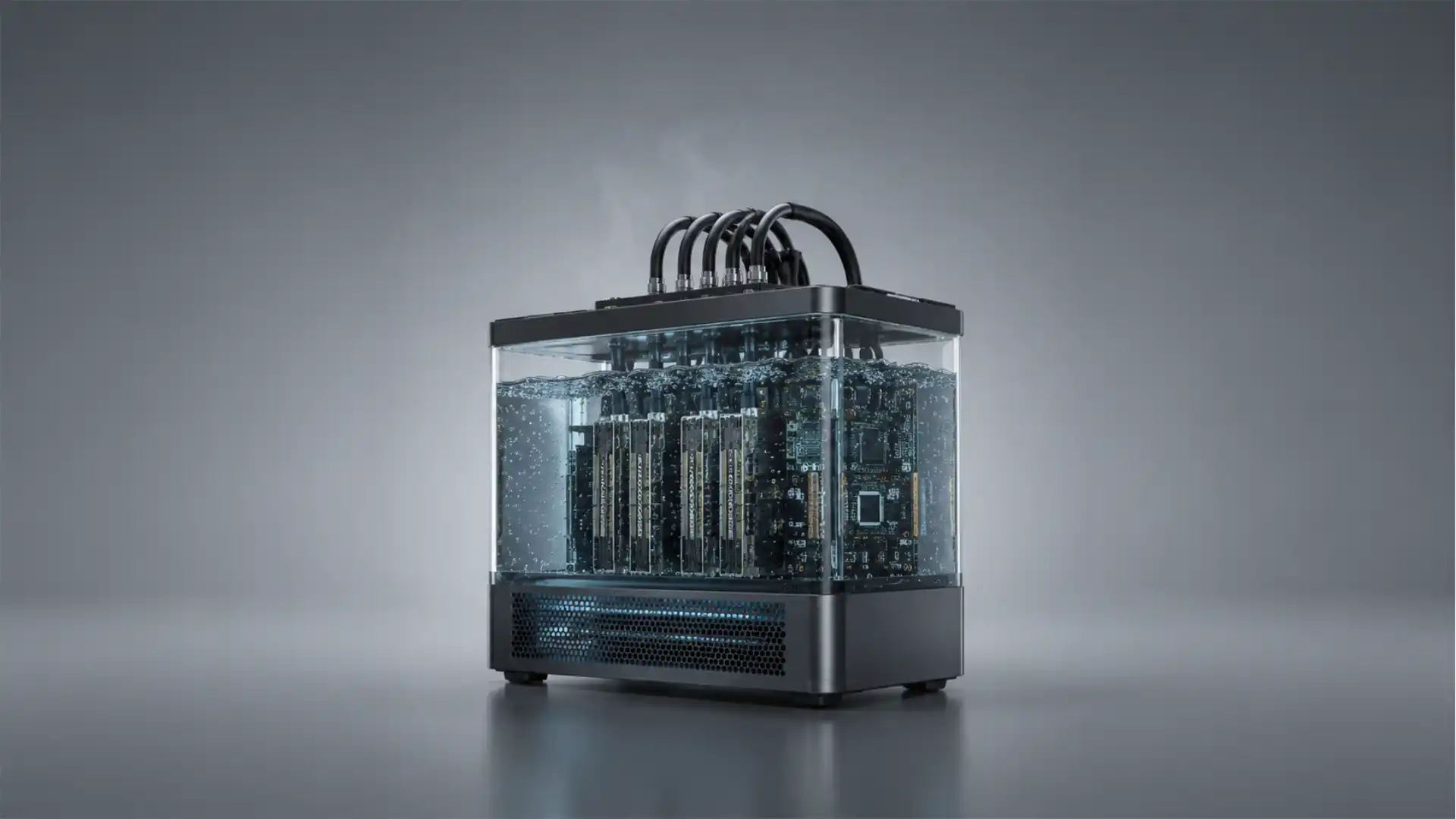
Servers lowered into a bath of dielectric fluid look strange only until the power bill, rack density and failure data enter the discussion. Two-phase immersion cooling is not a decorative engineering trick. It is a direct response to a hard physical problem: AI hardware is concentrating too much heat into too little space for ordinary airflow to remain the default answer. In this design, the fluid does not conduct electricity, but it does carry heat. Near 49 °C to 50 °C in common two-phase fluids, it boils on hot components, becomes vapor, rises, condenses, and falls back into the tank.
Table of Contents
The process sounds almost too simple for the AI era. That simplicity is its appeal. It removes the server fan from the center of the cooling story. It shifts heat transfer away from high-speed air and toward phase change. It lets racks run denser, with less dependence on compressor-based cooling, and with a cleaner path to warm-water heat rejection. It also brings new questions about fluids, service, regulation, safety, warranty, and long-term supply. The technology is no longer a curiosity. It is one of the clearest signs that AI infrastructure is becoming a thermal engineering business as much as a computing business.
The news inside a tank of boiling dielectric fluid
The core claim is straightforward. In two-phase immersion cooling, servers are submerged in a dielectric liquid, meaning an electrically insulating liquid that can touch powered electronics without shorting them. When chips, memory, power supplies and other components heat the liquid to its boiling point, the liquid changes phase. The vapor rises to a condenser. The condenser cools it back into liquid. Gravity returns it to the bath. The tank becomes a closed thermal cycle rather than a room full of air handlers fighting hotspots.
The Open Compute Project defines immersion cooling as liquid in direct contact with IT equipment components and separates the category into single-phase and two-phase systems. In the two-phase case, OCP describes heat transfer through evaporation and condensation, with the liquid-gas movement driven by natural buoyancy rather than a conventional pumped liquid loop inside the bath.
That distinction matters because the AI data-center debate often treats “liquid cooling” as one thing. It is not one thing. Direct-to-chip cold plates, rear-door heat exchangers, single-phase immersion baths, two-phase immersion baths and hybrid designs all move heat with liquids, but they differ in risk, density, service model, facility design and vendor lock-in. Two-phase immersion is the most visually dramatic of these approaches because the coolant is meant to boil. Boiling is not failure. Boiling is the heat-transfer mechanism.
The 50 °C figure in the news brief aligns with well-known two-phase cooling demonstrations and modern fluids. Lawrence Berkeley National Laboratory’s report on an open-bath immersion demonstration noted that 3M Novec 649 boiled at 49 °C and that the vapor condensed back to liquid without recirculation or return pumps for either phase. Chemours says its Opteon 2P50 developmental dielectric heat-transfer fluid, made for two-phase immersion, has a normal boiling point of 49 °C and is designed for closed systems in which vapor is condensed and returned to the bath.
The immediate reason this is newsworthy is AI. Training and inference clusters are being built around accelerators that concentrate power in dense trays and racks. NVIDIA’s GB200 NVL72, for example, connects 36 Grace CPUs and 72 Blackwell GPUs in a rack-scale liquid-cooled design. NVIDIA’s own documentation describes an NVL72 rack as 18 one-rack-unit compute trays, nine NVLink switch trays, top-of-rack management switches and power shelves. Oracle has said each GB200 rack can draw more than 120 kW at peak, a level that exceeds traditional air-cooled infrastructure.
A cooling method that once belonged mostly to high-performance computing, cryptocurrency mining and engineering trials is now being reconsidered for the densest AI work. Microsoft said in 2021 that it was running a two-phase immersion cooling solution in its Quincy, Washington, data center and described it as the first production two-phase deployment by a cloud provider. Microsoft also said its investigation showed a 5% to 15% power reduction for a given server in two-phase immersion and that the design enabled denser cloud resources.
The larger story is not that every AI data center will become a room of boiling tanks. That is unlikely. The story is that air is losing its automatic status. For decades, the mainstream server room was designed around raised floors, cold aisles, hot aisles, computer room air handlers and server fans. AI clusters have changed the density equation. Two-phase immersion is one of the stronger signals that data centers are being redesigned around the chip’s thermal limits rather than the building’s inherited airflow habits.
The physical problem AI has forced into the open
AI infrastructure has made heat visible again. Data centers were always thermal machines, but the cloud era often hid that fact behind software abstractions. Users saw applications, not chillers. They saw model responses, not fan curves. That veil is thinning because accelerator clusters behave less like general-purpose server fleets and more like industrial loads. The useful output is computation, but nearly every watt consumed by the IT equipment still becomes heat inside the facility.
The International Energy Agency projects that global data-center electricity consumption will double to about 945 TWh by 2030 in its base case, just under 3% of global electricity use. It also projects data-center electricity consumption to grow at about 15% per year from 2024 to 2030, with accelerated servers driven mainly by AI growing much faster than conventional server loads. Lawrence Berkeley National Laboratory reported that U.S. data-center electricity use rose from 58 TWh in 2014 to 176 TWh in 2023 and could reach 325 TWh to 580 TWh by 2028, depending on growth assumptions.
Those numbers matter for cooling because cooling is not an accessory. A facility that doubles IT load must remove roughly double the heat unless the servers become dramatically more energy-frugal per unit of work. The facility may run with better PUE, better controls and less chiller energy, but the heat still needs somewhere to go. AI does not only increase the electricity question; it increases the heat-rejection question at the same time.
The old answer was moving more air. That answer weakens when rack density rises beyond the comfort zone of standard server rooms. Air has low heat capacity compared with liquids. It works well when heat is spread across many ordinary racks, each drawing a few kilowatts to perhaps tens of kilowatts. It becomes noisy, bulky and energy-hungry when a rack behaves like a small industrial machine. Dense AI racks force either much more airflow, colder supply air, more containment, more fan energy, more floor space, or a shift toward liquid.
Air cooling also pushes heat into the room before the facility captures it. That is manageable at moderate density, but it becomes fragile at high density. Hotspots appear. Inlet temperatures vary. Server fans ramp aggressively. Equipment may throttle. Technicians work in louder, hotter spaces. The room itself becomes part of the thermal transport path. Liquid cooling moves heat capture closer to the source, which is why it becomes attractive when the source grows more intense.
The thermal problem is not only the GPU. High-density AI nodes include CPUs, memory, NVLink or other interconnect devices, power conversion hardware, network switches and storage. A rack-scale AI system is a thermal ecosystem. Some components receive cold plates in direct-to-chip designs. Other components may still need air. Immersion changes that architecture by placing far more of the electronics in direct contact with coolant, though practical implementations vary in what gets submerged and how power and network connections are handled.
AI workloads also create uneven heat. Training runs can hold accelerators near sustained load for long periods. Inference can generate burst patterns depending on user demand, batch size, model routing and service-level targets. The cooling system must handle steady heat, bursts and uneven distribution across trays. Microsoft’s two-phase immersion discussion specifically tied the design to bursty cloud workloads, noting that servers in liquid-cooled tanks could run at elevated power without overheating.
The pressure is not limited to hyperscale firms. Enterprises buying private AI clusters, cloud providers building sovereign AI regions, research labs deploying GPU partitions and colocation operators serving multiple AI tenants all face the same equation. The compute may differ, but the heat does not negotiate. A facility that cannot deliver power and remove heat cannot sell the AI capacity its customers want.
This is why a boiling dielectric bath deserves attention. It attacks the problem at the level where physics is least forgiving: the interface between hot electronics and cooling medium. Two-phase immersion replaces forced airflow with latent heat transfer. That phrase sounds technical, but the practical meaning is plain. A fluid absorbs a large amount of heat while changing from liquid to vapor, holding component temperatures near the boiling point under the right conditions. The server room stops depending on pushing vast volumes of air through narrow metal boxes.
The mechanism behind two-phase immersion cooling
Two-phase immersion cooling begins with a fluid chosen for three properties: it must be electrically insulating, chemically compatible with electronics and able to boil at a useful temperature. In many data-center designs, that useful temperature sits near 50 °C. The fluid fills a tank or sealed enclosure. Servers or server components are immersed. When chips and power devices generate heat, the fluid near those surfaces reaches the boiling point. Bubbles form. Vapor carries heat upward. A condenser coil or heat exchanger at the top of the system removes heat from the vapor. The vapor returns to liquid and falls back into the bath.
This is not the same as dunking servers in oil and pumping warm liquid through a heat exchanger. That would be single-phase immersion if the coolant stays liquid throughout the process. Two-phase immersion deliberately uses vaporization and condensation. LiquidStack describes the cycle as a passive process in which compute equipment heats dielectric liquid until it boils, vapor rises, condenses on a heat exchanger, and returns to the tank; it notes that the cooling cycle rejects IT heat without pumps or moving parts, aside from a small filter-circulation pump in its described setup.
The “without pumps and fans” statement needs careful handling. Inside the two-phase bath, the main heat movement can be passive. Buoyancy lifts vapor. Gravity returns liquid. Server fans are often removed or disabled because the immersed equipment no longer needs to move air across heat sinks. Yet the facility still needs to reject heat outside the tank. A condenser may connect to a water loop, dry cooler, cooling tower, district heating network or other heat-rejection plant. Those external loops can include pumps, valves and fans. The better claim is not that the entire data center has no moving parts; the better claim is that the tank can remove IT heat without server fans and without a pumped coolant loop through the immersed electronics.
Lawrence Berkeley National Laboratory’s open-bath immersion description makes that boundary clear. In the demonstrated system, electronic components were cooled by convection or by boiling near hot components; vapor rose to a condenser, condensed back into liquid, and condensate fell into the bath. The report states that recirculation or return pumps were not needed for either phase of the Novec 649 two-phase immersion cooling process, while also describing cooling-water flow through a condenser and external heat rejection equipment.
The physics is attractive because boiling creates strong local heat transfer. A hot chip surface does not merely warm a stream of air. It triggers phase change at or near the surface. The vapor bubble carries energy away. Condensation at the heat exchanger releases that heat into another loop. Properly managed, the electronics see a stable thermal environment tied to the fluid’s boiling point and condenser performance.
The system must still be engineered carefully. Boiling regimes differ. Too little boiling means poor heat transfer. Too much heat flux can create vapor blanketing near a surface, reducing contact with liquid and risking local temperature rise. Fluid purity matters. Surface finishes matter. Tank geometry matters. Condenser capacity matters. Vapor containment matters. Liquid level matters. Cable penetrations and seals matter. A two-phase tank looks simple in a demonstration video, but production use depends on fine details.
The condenser is the hidden center of the system. It must keep vapor pressure, vapor level and liquid return within safe limits. If the condenser cannot remove heat fast enough, vapor volume grows. If it overcools in the wrong way, it may disturb stable boiling or create unnecessary facility load. The control problem is not the same as controlling a chilled-water air handler. It is a liquid-vapor equilibrium problem tied to IT workload.
Fluid management is just as important. The liquid must remain electrically insulating and chemically stable. It must not attack polymers, labels, solder masks, connectors, cables or elastomers. It must not absorb contaminants that change dielectric strength. It must not escape in ways that undermine cost, emissions claims or safety rules. Because two-phase fluids are often expensive, even small losses matter over time. The LBNL demonstration found that fluid cost and liquid loss were serious issues, with Novec 649 priced at $75 per liter in that report and unaccounted liquid loss significant enough to warrant future research.
The maintenance model also changes. A technician may lift a server from a tank instead of sliding it from a rack. In two-phase systems, equipment can emerge relatively dry if removed properly because the fluid evaporates and is captured by the condenser, but that process depends on service procedure, vapor containment and operator discipline. The task is not impossible. It is different enough that training, tools and warranties become part of the adoption barrier.
Two-phase immersion is best understood as a thermal cycle, not a single product. The tank, fluid, condenser, facility loop, server design, controls, monitoring and service workflow all form one system. The boiling liquid is the most visible element, but the value comes from the whole architecture working as a controlled heat-transfer machine.
The reason 50 °C matters
The 50 °C boiling point is not a random specification. It sits in a practical middle zone. It is high enough to allow warm-water heat rejection in many climates, but low enough to keep electronics within acceptable operating temperatures when properly designed. A two-phase fluid that boils near 49 °C or 50 °C creates a natural thermal clamp: once local surfaces drive the liquid to boiling, added heat goes into phase change rather than simply pushing the liquid temperature upward.
The LBNL immersion report explains the facility-side value clearly. Since Novec 649 boiled at 49 °C, the cooling water used to condense vapor could be much warmer than the water used in many high-performance computing cooling systems. The report said the studied system could work with cooling water around 40 °C to 45 °C, rather than the colder 7 °C to 20 °C water used by other approaches, and that such higher-temperature water can often be produced without compressor-based refrigeration.
That point is central. Traditional chilled-water cooling spends energy making water cold enough to absorb heat from air or equipment. Warm-water cooling reduces or avoids that need. A dry cooler can reject heat to outdoor air when conditions allow. A district heating connection can reuse the heat when local demand exists. A cooling tower may still be used in some designs, but the temperature lift is more favorable. A two-phase fluid near 50 °C creates room for heat rejection that is less dependent on chillers.
The number also affects server performance. Many chips are designed to operate safely at junction temperatures far above 50 °C, but the path from silicon junction to coolant includes thermal resistance through packaging, heat spreaders, interfaces and mechanical structures. A fluid boiling at 49 °C does not mean the silicon runs at 49 °C. It means the coolant-side environment is held near that point under boiling conditions. The chip temperature may be higher, but it is managed more predictably if heat transfer is strong and the system avoids dry-out.
For AI accelerators, predictability matters. Thermal throttling damages the economics of an expensive cluster. If a GPU rack is bought to deliver tokens, training throughput or research cycles, any reduction in sustained performance changes the return on capital. A cooling system that stabilizes temperature under load is not only a facility feature. It becomes part of the compute product.
The 50 °C boiling point also has implications for safety and work practices. It is warm enough to require care but far from extreme industrial heat. It may allow safer maintenance than systems operating at much higher liquid temperatures, though chemical handling requirements depend on the fluid. Operators must still manage vapor exposure, ventilation, spill procedures and personal protective equipment based on the fluid’s safety data sheet.
There is a trade-off. A lower-boiling fluid may cool electronics at lower temperatures but may require tighter vapor containment or create more loss risk. A higher-boiling fluid may make vapor loss less likely but leave less thermal margin for components. The exact boiling point is therefore tied to chip design, condenser design, climate, heat reuse plans, fluid chemistry and operator comfort.
Chemours’ Opteon 2P50 illustrates the direction of current fluid development. The company says it is a developmental HFO dielectric fluid made for two-phase immersion, with zero ozone-depletion potential, very low GWP of 10 under AR6 accounting, closed-system vapor return, and a 49 °C normal boiling point. Those claims show where the market is heading: not only toward heat transfer, but toward lower climate impact, closed containment and replacement of earlier fluids facing supply or regulatory pressure.
A boiling point near 50 °C also changes the energy narrative. The cooling system can reject heat at a higher temperature, which gives engineers more choices. In cooler climates, dry coolers may work for long periods. In urban projects, warm return temperatures may support heat reuse. In water-stressed regions, operators may reduce dependence on evaporative cooling. The fluid’s boiling point becomes part of the site-selection and permitting argument.
That does not make 50 °C magical. It is a design point. A data center still needs careful airflow or liquid loops for components outside the bath, reliable condensers, leak and vapor monitoring, and a facility plant sized for peak load. Yet the number matters because it turns boiling from an emergency into a control strategy. At roughly 50 °C, phase change becomes a practical way to remove AI heat while keeping the facility side warm enough for lower-energy heat rejection.
Air cooling has reached its political limit as well as its thermal limit
Air cooling is not dead. It remains proven, serviceable and familiar. Most servers in the world still depend on air. Many enterprise workloads do not justify immersion, direct-to-chip cooling or major facility redesign. Air will remain the standard for moderate-density IT for years. The shift is narrower and more serious: air is losing ground at the high-density edge where AI clusters live.
The first limit is thermal. Dense accelerator racks need more heat removed per unit of footprint. Air cooling can move a surprising amount of heat with containment, high-speed fans and careful ducting, but fan energy rises, noise rises, and failure margins narrow. Server fans also consume power inside the IT load. That power becomes heat too. Removing fans from immersed servers can cut parasitic energy and remove a common failure point.
The second limit is spatial. Air needs volume. Hot aisles, cold aisles, clearances, containment, plenums and airflow paths occupy real estate. A facility designed for ordinary racks may not accept dense AI racks without derating, spreading equipment across more floor area, or building special pods. If the business wants to place more compute in a smaller footprint, liquid becomes attractive because it carries far more heat per unit volume than air.
The third limit is acoustic and operational. High-speed server fans are loud. Dense air-cooled rooms can be uncomfortable and hard to service. Noise is not only a workplace issue; vibration and acoustic energy can affect some storage devices, and harsh environments increase technician risk. Immersion removes much of the server fan noise, though pumps, dry coolers and facility fans may remain elsewhere.
The fourth limit is local politics. Air cooling often works with evaporative cooling towers or chilled-water plants that draw attention during heat waves and droughts. Not every air-cooled data center consumes large volumes of water, and not every liquid-cooled data center is water-free. Still, local debates increasingly focus on power, water and land. The United Nations University warning reported by Reuters said data centers are expected to consume twice as much power and water by 2030 if AI expansion continues on its current path, with water consumption projected to reach 9.3 trillion liters. Cooling choices now affect permitting, community trust and utility planning.
The fifth limit is power delivery. A facility cannot sell AI capacity if grid connection, backup power and cooling are not aligned. Dense racks create concentrated power draws and concentrated heat. When Oracle says a GB200 rack can draw more than 120 kW at peak, the cooling question becomes inseparable from busways, PDUs, backup systems and grid interconnection. Air systems built around older density assumptions were not designed for that profile.
Two-phase immersion enters the debate because it changes the local heat-transfer path. Instead of pushing more air through tighter spaces, it submerges electronics in a fluid that boils on heat-producing surfaces. That directly addresses the point of highest thermal stress. It also creates a path to eliminate server fans, shrink some air-management infrastructure, and reject heat at a warmer temperature.
Yet the political limit of air does not automatically make immersion acceptable. Communities may still object to the power draw. Regulators may still scrutinize water, land and emissions. Fire marshals, insurers and environmental agencies may ask new questions about dielectric fluids. Workers may need chemical handling protocols. Two-phase immersion solves some visible cooling problems while introducing a different governance problem: the data center must now prove that its fluid loop is safe, contained and durable.
This is why cooling strategy has become a board-level issue for AI infrastructure. Air, direct-to-chip and immersion are no longer small facility preferences. They shape where a project can be built, how quickly it can connect to utilities, how much compute fits on the site, which hardware can be deployed, which vendors must be trusted and which sustainability claims survive scrutiny.
The difference between single-phase and two-phase immersion
Single-phase immersion and two-phase immersion share the same basic idea: electronics are placed in an electrically insulating liquid. They diverge at the mechanism. In single-phase immersion, the liquid absorbs heat and remains liquid. It is circulated, naturally or by pumps, through a heat exchanger. In two-phase immersion, the liquid boils near hot components and becomes vapor; the vapor condenses back into liquid and returns to the bath.
OCP’s immersion requirements draw this line directly. Single-phase systems heat and cool the dielectric liquid without changing its phase, with circulation through natural or forced convection. Two-phase systems use evaporation to cool IT equipment and a heat exchanger to condense gas back to liquid, with buoyancy-driven motion moving the liquid and gas.
Single-phase immersion is often easier to understand operationally. It resembles a warm liquid loop. Fluids may include synthetic hydrocarbons, esters or other dielectric liquids. The fluid is usually less volatile than a low-boiling two-phase fluid. Tanks may be simpler. Fluid loss risk may be lower. The system may be more forgiving in service because the coolant is not constantly vaporizing under normal operation.
Two-phase immersion is thermally powerful because boiling absorbs large amounts of heat at nearly constant temperature. It can remove intense local heat loads without forcing large volumes of liquid across every component. The passive vapor path gives it an elegant mechanical story: no server fans, no pumped flow through the immersed boards, vapor up, liquid down. That elegance comes with stricter needs for vapor containment, condenser design, fluid cost control and chemical selection.
Single-phase and two-phase immersion compared
| Feature | Single-phase immersion | Two-phase immersion |
|---|---|---|
| Heat-transfer path | Liquid warms but stays liquid | Liquid boils, vapor condenses |
| Fluid movement | Natural or pumped liquid circulation | Buoyancy and gravity inside the bath |
| Main facility interface | Heat exchanger and liquid loop | Condenser and heat-rejection loop |
| Service concern | Draining, handling, residue, compatibility | Vapor containment, fluid loss, condenser control |
| Best fit | Dense but less extreme workloads, simpler operation | Very high heat flux and compact AI or HPC systems |
This comparison shows why the decision is not a beauty contest. Single-phase immersion often wins on familiarity and fluid handling. Two-phase immersion wins when heat flux, density and fan removal become the higher priority. The right answer depends on the workload, site climate, maintenance culture, hardware vendor support and fluid strategy.
The single-phase path may suit many colocation and enterprise environments because it asks less from the fluid supply chain and service model. A company can submerge compatible servers, circulate liquid through an exchanger, and operate at warm temperatures without managing a constant vapor cycle. It still requires new procedures, but the mental model is closer to industrial liquid cooling.
The two-phase path suits facilities that are willing to engineer the tank as a controlled phase-change system. It rewards good design with compactness and strong heat transfer. It punishes poor design through fluid loss, uncertain service cost, contamination risk or condenser bottlenecks. That is why the technology has often appeared first in high-performance computing, crypto mining, cloud experimentation and specialized AI infrastructure rather than ordinary server closets.
Both paths raise warranty questions. Standard servers were not always designed for immersion. Labels, adhesives, plastics, cables, connectors, fans, bearings, thermal interface materials and conformal coatings may behave differently in dielectric fluids. Hardware vendors increasingly support liquid-cooled variants, but immersion-compatible supply is still narrower than air-cooled supply. The market needs more server designs built from the start for immersion rather than adapted after purchase.
Both paths also affect failure analysis. When an air-cooled server fails, technicians know the routine: remove the unit, inspect, replace, return, or send to vendor. Immersion adds fluid handling and may complicate evidence preservation. Was a failure caused by component defect, contamination, material incompatibility, overheating, fluid chemistry, vapor loss or service error? Operators, OEMs and insurers need clearer responsibilities.
The practical decision will often be hybrid. Direct-to-chip cold plates may cool GPUs and CPUs. Air may cool lower-power components. Rear-door exchangers may capture exhaust heat. Immersion may serve the highest-density pods or special AI clusters. The era of one cooling method for the whole data center is fading. Facilities will increasingly be zoned by workload density, service model and hardware generation.
Rack density is changing faster than the building shell
Data centers are long-lived buildings, but AI hardware changes quickly. That mismatch is one reason cooling has become disruptive. A facility designed a few years ago around 10 kW to 20 kW racks may struggle with clusters that need far more power and cooling per rack. The shell, electrical rooms, piping routes, floor loading, ceiling height and heat-rejection plant do not change as fast as GPUs.
The NVIDIA GB200 NVL72 is a useful symbol because it packages 72 Blackwell GPUs into a liquid-cooled rack-scale design. NVIDIA frames it as a 72-GPU NVLink domain for real-time trillion-parameter inference and training, while its user guide describes the physical rack structure as compute trays, switch trays, management switches and power shelves. This is not a standard rack filled with unrelated servers. It is closer to a rack-sized machine.
When a rack becomes a machine, the facility must treat it that way. Power distribution, cooling manifolds, maintenance access, leak detection, firmware management, networking and workload placement all become part of one deployment plan. A rack at 100 kW or more cannot be dropped into a legacy hall casually. It needs reserved electrical capacity, heat-rejection capacity and operating procedures.
Two-phase immersion offers a different way to use floor space. A tank may hold multiple servers horizontally or in specialized enclosures. The footprint changes from vertical rack rows to bath systems. This may improve density by removing some air-management space, but it can also create new layout constraints. Tanks need overhead access, lifting equipment, safe service zones, cable management and fluid-handling space. The density gain is therefore not automatic. It depends on the room design.
The LBNL page on liquid cooling says immersion can cool high-density electronics without compressor-based cooling and can operate with high-temperature coolant, enabling dry coolers and reducing evaporative water use in many places. That is a facility advantage, but it does not erase the need for careful architectural planning. An immersion hall is not just an air-cooled hall with tanks inserted. It is a different machine room.
Colocation operators face a special challenge. Their customers may arrive with different hardware platforms, density targets and cooling preferences. One tenant may want direct-to-chip GPU clusters. Another may want air-cooled enterprise racks. Another may ask for immersion. Supporting all three inside one campus requires zoning, metering, water-loop planning, operational separation and contract clarity. The building becomes a menu of thermal products.
Hyperscalers can move faster because they control more of the stack. They design workloads, buy hardware at scale, influence server manufacturers, build campuses and operate software schedulers. That makes them better positioned to adopt aggressive cooling methods for selected deployments. Microsoft’s two-phase immersion project was possible partly because it could coordinate with a server manufacturer and integrate the cooled servers into cloud resource management.
Enterprises have less room for experimentation. A bank, manufacturer or hospital deploying AI capacity may not want to own a novel cooling model. It may prefer cloud, colocation or a managed appliance. That creates a market opening for immersion vendors, but also raises the bar for support. If the cooling system requires rare expertise, adoption slows.
The building shell also determines heat reuse. A warm two-phase condenser loop is easier to connect to district heating or nearby industrial heat demand if the site was planned for it. Retrofitting heat reuse after construction is harder. Pipe routes, heat exchangers, contracts, seasonal demand and utility interfaces need early design. The thermal value of immersion is highest when the building is planned around it, not when it is treated as a late-stage equipment swap.
This is the deeper significance of rack density. It is not just that racks draw more power. It is that fast-changing AI hardware forces slow-changing real estate to become more adaptable. Two-phase immersion is one answer. Direct-to-chip cooling is another. The winners will be the designs that align chips, racks, rooms, power and heat rejection from the start.
Passive boiling does not mean infrastructure without moving parts
A phrase like “no pumps and no fans” is attractive, but it can mislead if it is not framed carefully. Two-phase immersion can remove heat from immersed electronics through passive boiling and condensation. The server fans can disappear. The bath itself may not need a pump to move coolant across the hot boards. Vapor rises because it is less dense. Liquid returns by gravity. That is the elegant part.
The full data-center cooling chain still has moving parts. Heat must leave the condenser. In many designs, water or another facility fluid flows through condenser coils or heat exchangers. That loop may use pumps. A dry cooler may use fans. A cooling tower may use fans and pumps. Valves modulate flow. Filters may circulate fluid at low rate. Sensors and controls manage vapor level, condenser performance and safety.
LiquidStack’s own description captures the nuance: the two-phase cycle is passive and does not require pumps or mechanical equipment to reject IT heat, except for a small pump that circulates fluid through a filter. LBNL’s open-bath description says no recirculation or return pumps were needed for either phase of the Novec 649 cycle, while the same report describes cooling-water flow through the condenser and external heat rejection equipment.
This nuance matters for energy claims. A vendor may truthfully say the immersed IT side removes server fans and internal coolant pumps, but the facility energy use depends on the condenser loop, outdoor conditions, heat-rejection plant and controls. In a cool climate with dry coolers and warm water, energy use may fall sharply. In a hot climate with less favorable ambient conditions, the facility may still need mechanical assistance.
It also matters for reliability. Removing hundreds or thousands of small server fans reduces one category of failure. Fans are mechanical devices, they consume power, and they can fail. Yet the system becomes more dependent on condenser integrity, seals, fluid purity, monitoring and facility loops. The reliability question shifts rather than disappears.
A passive bath can be tolerant of brief local disturbances because boiling responds naturally to heat. If one component becomes hotter, it boils more fluid locally, within design limits. That is useful. But if the condenser is undersized, fouled or starved of facility flow, the whole bath can move toward vapor-management trouble. The weak point is no longer a fan in one server; it may be the shared heat-rejection interface.
This is why high-density cooling needs instrumentation. Operators need temperature data, vapor pressure or vapor-level indicators, fluid level, leak detection, dielectric properties, condenser approach temperatures, flow rates on the facility side, and alerts tied to workload states. The system may be passive in heat transport, but it cannot be blind.
AI workloads make this harder. A sudden shift in inference traffic or training schedule can change heat output quickly. If software moves many jobs into one immersion pod, the cooling system must respond. Cloud schedulers may eventually integrate thermal state as a first-class signal. Microsoft hinted at this direction when it discussed allocating bursty workloads to servers in liquid-cooled tanks that could run at elevated power.
The phrase “without cooling fans” is more solid when applied to immersed servers. The fans normally mounted inside servers are often unnecessary because there is no air path to drive. Removing fans saves power and space and reduces noise. It may also simplify airflow management in the room. Yet some air-cooled auxiliary equipment may remain, and networking gear outside the bath may still need air.
The facility design therefore becomes layered. The submerged IT layer may be fanless and passively cooled through boiling. The condenser layer transfers heat to a liquid loop. The campus layer rejects or reuses heat. The grid layer supplies power. Two-phase immersion reduces mechanical complexity at the server level, but it increases the need for system-level thermal coordination.
Lower cooling energy is only one part of the case
The strongest public argument for immersion cooling is often lower energy use. That argument is real, but it is incomplete. Energy savings depend on baseline design, climate, workload, density, heat-rejection method and accounting boundary. A highly tuned air-cooled hyperscale facility may already have a low PUE. A poorly managed legacy server room may offer much larger savings from any modern liquid approach.
Microsoft said its two-phase immersion investigation showed a 5% to 15% power reduction for a given server. ASHRAE’s liquid-cooling white paper said liquid-cooled designs can reduce PUE below 1.1 and that warm-water cooling can minimize or eliminate chiller need. LBNL says immersion can work with high-temperature coolant and dry coolers, reducing compressor-based cooling and evaporative water use.
Those are strong points, but the economic case for two-phase immersion is broader. It includes higher compute density, less server fan power, possible overclocking or sustained boost operation, lower water dependence, less floor space for the same IT load, better heat reuse potential, and better performance stability under dense AI workloads. The value is not only fewer cooling kilowatt-hours. The value is more usable compute per building, per megawatt and per thermal constraint.
For AI infrastructure, density can matter as much as PUE. A model-training cluster benefits from low-latency interconnects and close physical grouping. Spreading compute across more rooms or campuses may complicate network design and reduce utilization. Dense cooling lets operators place more accelerators near each other without overwhelming the room. That can improve the economics of expensive networking and switching.
The power saved by removing server fans is also not trivial. Server fans draw power inside the IT load. In PUE accounting, fan power inside the server may appear as IT energy, not facility overhead. That means immersion can improve real energy use without fully showing up as a PUE gain if the boundary is not examined carefully. Operators should look at total energy per unit of computation, not only facility overhead.
Cooling energy also interacts with peak power. Utilities and campuses care about maximum draw, not only annual energy. If liquid cooling reduces fan ramp and chiller peaks during hot weather, it may lower peak demand charges or reduce backup capacity needs. If dense AI racks create sharp power swings, the cooling and electrical systems must be sized together. A lower-energy cooling system that still requires high peak heat rejection may not solve the entire utility problem.
A second economic factor is capital cost. Two-phase systems require tanks, condensers, fluid, compatible servers, facility loops, controls, service equipment and staff training. The fluid inventory alone can be expensive. A buyer should compare the full cost against alternatives: direct-to-chip racks, rear-door heat exchangers, higher-efficiency air cooling, or new construction with warm-water loops. The right answer depends on scale.
A third factor is utilization. Cooling does not create value if the hardware is idle. AI clusters are expensive enough that high utilization is central to the business case. A two-phase system that supports denser deployment but sits half used will not justify itself. Software scheduling, customer demand and model economics remain decisive.
A fourth factor is maintenance. Immersion may reduce fan replacements and thermal failures, but it may add fluid testing, tank service, special lifting, filtration, vapor containment checks and more complex return merchandise authorization workflows. The cost of downtime during service matters. A tank holding many servers may create a different failure domain from a rack holding independent nodes.
The better economic question is therefore: which cooling method delivers the lowest cost per reliable unit of AI work at this site, with this hardware, over this asset life? That question includes energy, water, floor space, power density, downtime, performance, regulatory risk, residual value and staff capability. Two-phase immersion can win that calculation in high-density AI environments, but it does not win by default.
Reliability gains come from fewer fans and fewer thermal shocks
Reliability is one of the more serious arguments for immersion cooling. Air-cooled servers depend on many small fans, heat sinks, ducts, filters and airflow paths. Fans fail. Dust accumulates. Airflow gets blocked. Hotspots can develop from poor cable management or containment leaks. Immersion removes or reduces several of those failure modes by placing components in direct contact with liquid.
A stable liquid environment can reduce temperature swings. Electronics dislike repeated thermal cycling because expansion and contraction stress solder joints, packages and connectors. AI workloads may create long periods of high heat followed by lower utilization. If immersion keeps temperatures steadier, it may lower mechanical stress. The exact reliability gain depends on hardware design and fluid compatibility, but the mechanism is plausible and supported by the experience of liquid-cooled high-performance systems.
Microsoft’s earlier underwater data-center work is not the same as two-phase immersion, but it shaped the company’s thinking about sealed, controlled environments. Its Project Natick research suggested that controlled environments could reduce some failure causes associated with human intervention and atmospheric exposure. Microsoft later linked lessons from that work to its two-phase immersion exploration, though the technologies differ.
Two-phase immersion also changes the cooling response to hotspots. In air cooling, a local hotspot may depend on airflow reaching the right fin stack. In boiling immersion, a hotter local surface drives more local boiling, again within design limits. That self-adjusting behavior is attractive for chips with uneven heat distribution. Modern AI packages can have localized hotspots that challenge conventional heat spreaders.
Yet reliability claims must be disciplined. Immersion removes fans, but it adds fluid exposure. Components not designed for long-term immersion may suffer material compatibility issues. Some plastics may swell. Adhesives may loosen. Labels may detach. Cables may stiffen or degrade. Connectors may trap fluid. Thermal interface materials may behave differently. Batteries, spinning disks and some optical modules may be unsuitable or require isolation.
Two-phase systems add vapor-control reliability. Seals, lids, gaskets, condenser surfaces and cable penetrations become part of uptime. If fluid escapes, cost rises and cooling performance may degrade. If vapor condenses in unintended places, service becomes messy. If contaminants enter the bath, dielectric strength and heat transfer may change. Reliability gains are real only when fluid compatibility, containment and service procedures are engineered with the same seriousness as the thermal cycle.
There is also a failure-domain question. A fan failure may affect one server. A condenser issue may affect a tank. A facility-loop failure may affect many tanks. Redundancy must be designed at the right level. Air-cooled data centers often use redundant air handlers and multiple airflow paths. Immersion needs its own redundancy model: multiple condensers, parallel facility loops, safe workload shedding, emergency heat capacity and clear procedures for draining or isolating a tank.
Monitoring is part of reliability. Operators should track fluid level, dielectric strength, contamination, acidity or chemical breakdown indicators where relevant, condenser approach temperature, vapor behavior, and leak or vapor alarms. They should connect those metrics to workload orchestration. A data center cannot run high-density AI safely if the cooling system is treated as a passive black box.
Reliability also includes human reliability. Technicians trained on rack servers need new habits. Opening a tank, lifting immersed equipment, waiting for fluid to drain or evaporate, preventing contamination, checking seals and managing service carts are not ordinary rack tasks. Mistakes can cause fluid loss or damage. Better designs will make the human workflow obvious and hard to perform incorrectly.
Insurance and certification will shape reliability expectations. Insurers may ask for evidence on fire behavior, fluid toxicity, spill containment, emergency response, maintenance training and failure history. Regulators may ask about chemical inventories. OEMs may ask about fluid testing before honoring warranties. These are not side issues. They decide whether reliability claims translate into deployable capacity.
The most credible reliability argument for two-phase immersion is therefore narrow but strong: it removes server fans and airflow uncertainty from the hottest AI systems, while giving engineers a stable thermal environment if the fluid system is properly contained and monitored. That is enough to make it attractive. It is not enough to let operators ignore the new failure modes.
Serviceability remains the awkward part of immersion
The hardest question in many immersion projects is not whether the technology can remove heat. It can. The harder question is whether a data-center team can service it quickly, safely and cheaply at scale. A cooling system that performs beautifully in a lab may fail commercially if every hardware replacement becomes slow, messy or vendor-dependent.
Air-cooled service is familiar. A technician identifies a failed server, slides it out of the rack, swaps a component, and returns the unit or sends it away. The workflow is supported by decades of tooling, training, packaging, warranty rules and spare-parts logistics. Immersion changes the physical act. Servers may be vertical blades in a bath, horizontal modules in a tank, or specialized sleds. They may need lifting tools. They may emerge wet, warm or surrounded by vapor. The technician must avoid contaminating the fluid.
Two-phase immersion has one advantage over oil-based systems: properly handled equipment can emerge relatively dry because low-boiling fluid evaporates and is captured by the condenser. The LBNL demonstration described equipment being removed slowly through the vapor so liquid on surfaces quickly evaporated and was captured, leaving servers essentially dry under that procedure. That is a real service benefit. It does not remove the need for controlled handling.
The awkwardness grows with scale. A hyperscale site may replace large numbers of components every day. Even a low failure rate creates many service events when the fleet is enormous. If immersion slows each event, labor cost rises. If it requires specialized vendor staff, response times suffer. If opening tanks causes fluid loss, operating cost rises. If technicians dislike the workflow, staffing becomes harder.
Design can solve some of this. Tanks can use tool-less lids, guided lifting, drip capture, integrated hoists, quick-disconnect power and network connections, service trays, contamination controls and clear sensor feedback. Hardware can be built for immersion from the start, with compatible materials and accessible failure points. But immature designs may feel like prototypes even when they are sold as products.
The location of failed parts matters. If fans are removed, one common failure source disappears. If the remaining failures are mostly modular boards that can be lifted and swapped, immersion may work well. If failures often involve small components requiring bench repair, the process becomes more complicated. Operators must decide whether to repair immersed hardware on site or treat it as a sealed replaceable unit.
Warranty workflows need clarity. If an immersed server fails, the hardware vendor may require evidence that the fluid was approved, clean and within specification. Fluid vendors may require evidence that contaminants did not enter. Cooling vendors may blame server materials. Operators can get caught between suppliers. Strong contracts should define compatibility, testing frequency, failure analysis access and liability.
Serviceability also affects security. Many AI clusters handle sensitive data or proprietary models. Removing hardware from immersion tanks may require chain-of-custody controls, secure wiping, storage of wet or recently immersed components, and approved shipping processes. A service model designed only around thermal performance may miss data-handling obligations.
The tank layout changes maintenance ergonomics. Horizontal bath systems may need overhead clearance and lifting equipment. This can conflict with low ceilings or dense cable trays. It can affect how technicians reach components. It can change floor loading. It can require spill containment zones. Those details matter in real facilities.
Immersion vendors often argue that lower failure rates will reduce service frequency enough to offset service complexity. That may be true in some deployments, especially if fan failures and thermal stress drop sharply. Buyers should ask for field data, not only engineering claims. Mean time between failure, mean time to repair, fluid loss per service event, contamination incidents, warranty acceptance rates and technician injury records are more useful than polished diagrams.
The awkward truth is that immersion cooling turns server maintenance into a combined IT, mechanical and chemical-handling procedure. That is manageable, but it is not the same job. Adoption will accelerate only when the service model becomes as repeatable as rack service is today.
The fluid is the business risk hiding in plain sight
The coolant is not a commodity in two-phase immersion. It is the thermal medium, the electrical safety barrier, the vapor phase, the containment challenge, the environmental exposure risk and a major line item in capital cost. In air cooling, the working fluid is air. In direct-to-chip cooling, water-glycol or treated water loops are familiar to facility teams. In two-phase immersion, the dielectric fluid becomes a strategic dependency.
A good two-phase fluid must satisfy a demanding list. It should be electrically insulating, nonflammable or low risk under expected conditions, chemically stable, compatible with electronics, low in toxicity, low in climate impact, available at scale, affordable enough to fill tanks, and suitable for closed-loop vapor recovery. It must boil at the right temperature and condense efficiently. It must keep those properties for years.
Historically, fluorinated fluids such as 3M Novec 649 were central to two-phase immersion demonstrations. The 2016 LBNL report used Novec 649 and documented both its strong thermal behavior and drawbacks, including cost and fluid loss. That history matters because it shows both the promise and the weakness of early two-phase systems: excellent heat transfer, but a fluid supply and environmental story that needed improvement.
The market then faced a major shift. 3M announced in December 2022 that it would exit all PFAS manufacturing by the end of 2025 and work to discontinue PFAS use across its product portfolio by that date. Since many fluorinated heat-transfer fluids are caught up in PFAS discussions or substitution pressure, operators evaluating two-phase immersion must treat fluid roadmap risk as a central procurement issue.
Chemours’ Opteon 2P50 shows the replacement path vendors are trying to build. It is marketed as a developmental HFO dielectric fluid for two-phase immersion, with low GWP, zero ozone-depletion potential, closed-system operation and a normal boiling point of 49 °C. The details matter because the industry needs fluids that keep the thermal benefit while reducing regulatory, climate and supply risks.
Yet a new fluid does not become bankable simply because the chemistry is promising. It needs long-duration compatibility data with real servers. It needs supplier capacity. It needs safety documentation across jurisdictions. It needs acceptance by OEMs, insurers and regulators. It needs lifecycle emissions analysis, reclaim or disposal procedures, and realistic loss rates. The fluid is where thermal engineering meets chemical governance.
Operators also need to understand fluid loss. Even a low-loss closed system may lose fluid through maintenance, seals, accidental openings, permeation or service procedures. If the fluid is costly, losses hurt the economics. If the fluid has climate or regulatory concern, losses hurt the environmental claim. If replacement supply is tight, losses threaten uptime.
Fluid purity is another business issue. Contaminants can come from manufacturing residues, dust, degraded materials, service tools, labels or human error. A fluid that absorbs contaminants may lose dielectric strength or change boiling behavior. Testing and filtration become part of operations. That adds recurring cost and requires expertise.
Procurement contracts should cover more than initial price per liter. They should cover guaranteed supply, reclaim options, approved storage, emergency replenishment, testing kits, compatibility matrices, regulatory updates, and end-of-life handling. Buyers should ask whether the fluid supplier can support multi-megawatt deployments, not only pilot tanks.
There is also a financial accounting issue. Fluid inventory may be a large capital asset sitting inside tanks. If the fluid becomes obsolete, restricted or unsupported, the operator faces stranded cost. If a better fluid arrives, switching may require draining, cleaning, compatibility retesting and perhaps hardware approval. The cooling system is therefore linked to chemical product cycles, not only server refresh cycles.
For two-phase immersion to scale, fluid vendors must make the coolant boring. Boring means available, approved, tested, documented, reclaimable and stable in price. Until then, the most advanced part of the cooling system may also be its largest procurement risk.
PFAS pressure has changed the two-phase roadmap
The PFAS issue is not a footnote. It has reshaped the market for fluorinated fluids used in electronics cooling, fire suppression, cleaning and other industrial processes. 3M’s exit from PFAS manufacturing by the end of 2025 removed a major supplier from categories that had supported two-phase cooling demonstrations and related thermal applications.
PFAS is a broad category, and not all substances carry the same risk profile. Policy debates often flatten that nuance. Data-center buyers cannot. They need precise chemistry, regulatory classification, environmental persistence data, toxicity data, GWP, exposure limits and disposal rules. A vague statement that a fluid is “next generation” is not enough for a multi-year facility investment.
The issue matters for two-phase immersion more than for many single-phase oil or ester systems because low-boiling dielectric fluids have often relied on specialized fluorinated chemistries. Those chemistries delivered nonflammability, dielectric strength and useful boiling points. Replacing them without losing performance is hard. Replacing them at data-center scale is harder.
Chemours and other suppliers are trying to fill that gap with lower-GWP fluids. Opteon 2P50 is one example. The company says it is developed for two-phase immersion and offers low GWP under AR6, no ozone-depletion potential and a 49 °C boiling point. That is directionally important. The market needs a credible supply base beyond discontinued legacy fluids.
Regulators are also tightening data-center reporting, even when the rules do not focus specifically on immersion fluids. The European Commission’s Delegated Regulation (EU) 2024/1364 established the first phase of a common Union rating scheme for data centers and requires reporting by operators with installed IT power demand of at least 500 kW. The regulation includes indicators related to energy, renewable energy, waste heat reuse, cooling and water use. The Commission is also preparing a Data Centre Energy Efficiency Package and a rating scheme with minimum performance standards work under way.
This regulatory direction changes the value of immersion claims. It is no longer enough to say a cooling system lowers PUE. Operators may need to report water footprint, energy sources, heat reuse and other indicators. If a two-phase system reduces water use but depends on a fluid with unresolved environmental concerns, regulators and communities may ask harder questions.
PFAS pressure also affects investor risk. Data centers are capital-intensive assets. A campus may be financed over long horizons. If a cooling fluid faces future restriction, its risk becomes a financing issue. Lenders and customers may ask whether a site can operate through a regulatory change without major retrofit. Buyers of AI capacity may ask whether the infrastructure aligns with their own reporting obligations.
Vendors may respond in three ways. They may move toward lower-impact fluorinated alternatives. They may focus on closed systems with tight containment and reclaim. They may shift some customers toward single-phase fluids with less regulatory controversy, accepting lower heat-transfer intensity. The market will likely use all three responses.
The practical lesson for operators is simple: fluid diligence belongs at the same level as power diligence. A data-center project would never ignore grid capacity, generator fuel contracts or transformer lead times. It should not ignore dielectric-fluid supply, regulatory status, compatibility and recovery plans.
Two-phase immersion may still be one of the most attractive tools for the densest AI systems. PFAS pressure does not invalidate the method. It does raise the bar. The next phase of the market will be won by systems that combine strong thermal performance with fluids that survive environmental scrutiny, supplier due diligence and long-term operational testing.
New fluids must pass chemistry, supply and warranty tests
A new dielectric fluid enters the data-center market through a narrow gate. Thermal performance is only the first requirement. The fluid must prove itself across chemistry, supply, safety, warranty and field operations. This is especially true for two-phase immersion because the fluid is continuously changing phase and touching electronics.
The chemistry test begins with dielectric strength and chemical stability. The fluid must not conduct electricity under expected contamination levels. It must resist breakdown under heat, exposure to metals and plastics, and years of operation. It must not create corrosive byproducts. It must not dissolve materials that then redeposit elsewhere. It must not degrade seals and gaskets that keep vapor inside the system.
The compatibility test is broader. Real servers contain solder masks, printed circuit boards, connectors, cables, plastics, elastomers, labels, adhesives, optical components, thermal interface materials and sometimes batteries or components that should not be submerged. A fluid may be compatible with most metals and plastics, as Chemours claims for Opteon 2P50, but operators still need a server-specific compatibility matrix. The word “most” does not close a warranty claim.
The supply test asks whether the fluid exists in enough volume for data-center scale. A pilot tank may need hundreds of liters. A large deployment may need far more. If the supplier cannot guarantee production, quality, shipping and emergency replenishment, the cooling system carries supply-chain risk. This is not theoretical. 3M’s PFAS exit shows how a chemistry roadmap can change the availability of once-standard fluids.
The safety test includes flammability, toxicity, exposure limits, ventilation, spill response, decomposition products and emergency procedures. A fluid with no flash point under a specified test still needs operational safety documentation. Fire marshals and insurers will ask how the system behaves under electrical fault, overheating, fire exposure, tank breach or ventilation failure.
The warranty test is often the commercial bottleneck. Server OEMs may approve specific fluids, specific immersion vendors and specific operating conditions. If a customer uses an unapproved fluid, hardware warranties may be limited. If a fluid supplier changes formulation, retesting may be required. If a component fails, the question becomes whether the fluid caused or contributed to failure. Strong ecosystem alignment is essential.
The lifecycle test includes loss, reclaim, disposal and climate impact. A closed system should not release much fluid, but service events and leaks happen. The operator needs a plan for capturing vapor, recovering spilled liquid, filtering or reclaiming used fluid, and disposing of contaminated material. Environmental claims should include those realities.
The operational test is the most unforgiving. A fluid may look good in a product sheet and still produce problems after thousands of service cycles, many hardware revisions and years of workload variation. Operators should ask vendors for field hours, failure modes, fluid-analysis results, and documented procedures for contamination events. They should also demand clear alarm thresholds and sampling schedules.
This is why two-phase immersion will likely grow through controlled ecosystems first. A cloud provider or OEM-led platform can approve a narrow set of servers, fluids, tanks and facility interfaces. That reduces variables. Open colocation use, where many customers bring many hardware types, is harder. The more open the environment, the more compatibility risk rises.
The best new fluids will be judged not only by boiling point and GWP, but by the boring details: stable supply, clean handling, low loss, broad compatibility, accepted safety data, approved warranties and predictable cost. A two-phase fluid must become part of the infrastructure standard, not a specialty chemical experiment sitting inside a server room.
AI chips make cooling a performance feature
Cooling used to be a support function. In AI infrastructure, it is becoming part of performance. A GPU that cannot hold sustained clocks under load delivers less value. A rack that must be derated because of thermal limits wastes expensive silicon. A cluster that spreads hardware too widely to manage heat may pay a networking penalty. The cooling system now affects the amount of useful computation a buyer receives.
A 2025 study comparing liquid-cooled and air-cooled H100 GPU systems reported that liquid-cooled systems held GPU temperatures between 41 °C and 50 °C under load, while air-cooled systems fluctuated between 54 °C and 72 °C. The authors reported 17% higher performance in the liquid-cooled setup, with better performance per watt. The study is not a two-phase immersion proof, but it supports the broader point: thermal stability changes AI hardware output.
The performance link is especially important for inference. Inference economics depend on throughput, latency and uptime. A model service that hits thermal limits during demand spikes may need more hardware to meet the same service level. Cooling that allows sustained operation can reduce the amount of spare capacity needed. Microsoft’s discussion of using immersion-cooled servers for bursty workloads points in this direction.
Training has a different profile. Long training runs require sustained power and stable operation over days or weeks. A thermal fault can interrupt work, waste energy and delay model development. Dense liquid cooling helps maintain the thermal environment needed for long runs. The closer the cooling system sits to the heat source, the less the facility depends on room-level corrections after heat has already spread.
Two-phase immersion also changes overclocking or boost discussions. If the coolant can absorb heat aggressively near the component surface, operators may run hardware at elevated power within safe limits. That does not mean every workload should be overclocked. Higher power can reduce energy proportionality or increase component stress. But it gives cloud schedulers another tool: selected high-priority workloads may run in thermal zones with more headroom.
The challenge is that AI hardware design is moving quickly. GPUs, accelerators and memory packages change power density and hotspot patterns with each generation. A cooling method must adapt. Direct-to-chip cold plates can be redesigned for specific packages. Immersion can cool many surfaces at once, but heat flux limits and boiling behavior still depend on surface geometry. The cooling industry must keep pace with silicon packaging.
NVIDIA’s rack-scale designs show why cooling and architecture are now linked. GB200 NVL72 is not merely a collection of GPUs; it is a liquid-cooled rack-scale system with a 72-GPU NVLink domain. The interconnect, power shelves and cooling design are part of one product. Future systems will likely deepen that integration.
This creates a strategic shift for cloud buyers. They may not see the cooling technology, but they will feel its effects through pricing, availability, performance consistency and regional capacity. A cloud region that can deploy denser AI clusters sooner may offer better access to top-tier accelerators. A provider constrained by cooling may ration capacity or charge more.
Cooling also affects model design choices. If power and heat are constrained, developers may choose smaller models, mixture-of-experts routing, quantization, batching or sparsity techniques to reduce compute load. If cooling expands thermal headroom, larger or more responsive services become easier to operate. The software and facility layers are starting to influence each other.
The phrase “AI factory” is often used loosely, but the factory analogy works here. A factory’s production rate depends on machinery, energy, heat removal, maintenance and logistics. AI data centers produce computation. If heat removal limits the line speed, cooling becomes a production technology. Two-phase immersion deserves attention because it treats heat removal as part of compute density, not as an afterthought.
Liquid cooling changes the economics of floor space
Floor space in a data center is valuable only when it has power, cooling and network capacity behind it. AI has made that more obvious. A square meter without enough power and heat rejection is not productive space. Immersion cooling can change the economics by increasing the amount of IT load that fits into a given footprint, but it also changes the shape and service needs of that footprint.
Traditional rack rows waste some space on air management. Hot aisles, cold aisles, containment, maintenance clearance and airflow paths are necessary for air cooling. Liquid cooling reduces some of that burden. Direct-to-chip systems still use racks and often keep some air cooling for non-cold-plated components. Immersion tanks may abandon the standard rack-row layout entirely, depending on design.
The economic value is strongest where land, shell construction or campus expansion are constrained. Urban data centers, sovereign AI facilities near population centers, edge AI deployments and retrofitted high-performance rooms may all care about compute per square meter. If two-phase immersion enables more accelerators in less room, it can delay or avoid new construction.
Chemours claims that two-phase immersion using Opteon 2P50 can enable up to a 60% reduction in physical data-center footprint in its cited application claims. That is a vendor claim and should be tested against project assumptions, but it reflects the main commercial argument: density is part of total cost.
The academic literature also points to space reduction, though assumptions vary. The arXiv paper “Enough Hot Air” reports a direct comparison showing about 50% lower energy consumption and about two-thirds less occupied space when using immersion cooling, while also warning about maintenance and reliability concerns and arguing that retrofitting air-cooled data centers with immersion can be costly.
Footprint savings are not free. Tanks may be lower and wider than racks. They need overhead lifting or side access. They may require containment curbs or special flooring. Fluid storage and service carts take space. Facility loops and condenser plumbing need routes. The net gain must be calculated across the whole room, not only the server footprint.
Floor loading also matters. A tank filled with dielectric liquid and hardware may impose different loads from a rack. Existing raised floors may not support it. New halls can design for this, but retrofits may need structural work. That adds cost and downtime.
Cabling is another floor-space issue. AI clusters need high-bandwidth networking. Immersion layouts must route power and network connections without creating service obstacles or vapor escape paths. If cables cross lids or block lifting, maintenance suffers. Purpose-built immersion servers and connectors can reduce this problem.
The economics of floor space also depend on utilization. A dense tank that runs at high utilization creates strong value. A dense tank held in reserve for occasional peak demand may not. Operators should measure cost per delivered compute-hour or token, not just kilowatts per square meter.
Colocation pricing may evolve around this. Instead of selling cabinets, providers may sell high-density liquid-cooled zones, AI pods or thermal capacity blocks. Customers may pay for power and cooling density rather than physical rack count. Immersion could become a premium service in sites where ordinary halls cannot host the newest accelerators.
The real floor-space story is that AI collapses the distance between real estate and chip performance. A data center is no longer just a place to put servers. It is a heat-removal and power-delivery machine. Two-phase immersion changes the machine’s geometry.
PUE improves, but PUE does not tell the whole story
Power usage effectiveness, or PUE, remains the most cited data-center energy metric. The Green Grid defines PUE as total data-center energy divided by the energy used by ICT equipment. A perfect PUE would be 1.0, meaning all energy goes to IT equipment and none to cooling, lighting, power conversion losses or other facility overhead. Real facilities sit above that.
Liquid cooling can improve PUE by reducing chiller use, fan energy, air-handling load and other facility overhead. ASHRAE’s liquid-cooling white paper says liquid-cooled solutions allow PUE to drop below 1.1 and that warm-water cooling can reduce or eliminate chiller need. Google reports its data-center PUE performance publicly and compares its fleet against an industry average, showing how mature hyperscalers have already pushed facility overhead down.
The problem is that PUE can miss important parts of the AI cooling story. Server fans are often counted inside IT load. If immersion removes those fans, total energy use may fall, but PUE may not improve as much because the denominator also changes. A facility can have a good PUE and still consume vast electricity if IT load grows rapidly. A site can reduce cooling overhead and still stress the local grid.
PUE also says little about water. A data center with low PUE may use evaporative cooling to reduce electricity use while consuming water. Another facility may use more electricity for dry cooling but far less water. Which is better depends on local climate, grid carbon intensity, water scarcity and policy goals. That is why regulators increasingly track water metrics alongside energy metrics.
PUE says little about carbon intensity. A data center on a fossil-heavy grid with excellent PUE may emit more than a less efficient facility supplied by cleaner power. Recent research on U.S. hyperscale data centers estimated that 403 facilities consumed 68 TWh to 99 TWh and were associated with 37 million to 54 million metric tons of CO2 across scenarios, with central-scenario carbon intensity above the U.S. grid average. Cooling helps, but energy supply remains decisive.
PUE says little about compute output. An AI data center exists to deliver useful computation. A cluster with slightly worse PUE but far higher model throughput per watt may be better than a cluster with a prettier facility metric. The industry needs metrics that connect facility energy to training runs, inference tokens, latency, utilization and hardware lifetime.
Two-phase immersion can improve PUE where it replaces chiller-heavy cooling and server fan energy. It may also improve compute density and thermal stability. But operators should resist claiming that a low PUE solves the environmental issue. The IEA projects data-center electricity demand to grow quickly even as efficiency improves. Demand growth can overwhelm facility-efficiency gains.
The European Union’s reporting direction reflects this broader view. Delegated Regulation 2024/1364 requires data-center operators above the threshold to report information and KPIs to a European database, with indicators tied to energy, renewable energy, water, cooling and waste heat reuse. That is a sign that single-number claims will face more scrutiny.
PUE is still useful, but it is not enough for AI infrastructure. Two-phase immersion should be judged by total energy per unit of compute, water impact, carbon intensity, heat reuse, reliability, hardware utilization and lifecycle cost. A cooling system that looks good on PUE but fails on fluid loss, supply risk or service downtime is not a clean win.
Water use becomes a local issue, not a spreadsheet metric
Water has become one of the most sensitive data-center issues because it is local. Electricity can be procured across markets, backed by contracts or paired with renewable generation claims. Water is drawn from a watershed. Communities feel it directly. Cooling technology now shapes whether a data center is seen as a manageable industrial load or an unwelcome competitor for scarce resources.
Air-cooled facilities may use evaporative cooling to reduce electricity consumption. That can be sensible in some climates and problematic in others. Liquid cooling does not automatically mean low water use. Direct-to-chip systems and immersion systems still need heat rejection. They may use dry coolers, cooling towers, chilled water, district loops or hybrid approaches. The water impact depends on the facility plant.
Two-phase immersion can reduce water dependence because it operates at higher coolant temperatures and can reject heat through dry coolers in more conditions. LBNL says immersion works well using high-temperature coolant and that dry coolers can reject heat to the atmosphere, reducing evaporative water use in many locations. Chemours claims its two-phase approach using Opteon 2P50 can nearly eliminate water use in data-center applications, though buyers should test such claims against site design.
The warmer the heat-rejection loop, the easier it is to avoid evaporative cooling. That is where the 50 °C boiling point helps. A condenser loop returning warm water gives engineers more thermal headroom than a chilled-water system. In cool or temperate climates, dry coolers can reject heat for much of the year. In hot climates, dry cooling may require larger equipment or supplemental systems.
The trade-off between water and electricity is not simple. Dry cooling may use less water but more fan energy or larger heat exchangers. Evaporative cooling may use water but reduce electricity. A low-carbon grid and water-scarce region may favor dry cooling. A water-rich, power-constrained region may make a different choice. The right design is local.
The United Nations University warning reported by Reuters adds pressure to this debate. The report projects data-center water consumption rising to 9.3 trillion liters by 2030 and frames AI infrastructure as electricity generation, cooling systems, transmission networks, chips, minerals, land and water, not just software. Whether one accepts every projection or not, the public framing has changed. Cooling is now part of AI’s social license.
EU policy is moving in the same direction. The European Commission’s data-center energy performance page says its database collects and publishes data relevant to energy performance and water footprint for data centers with large energy consumption. This means water metrics will become harder to bury in annual reports.
Two-phase immersion could become attractive in water-stressed regions if it supports dry cooling at acceptable cost. It could also help dense urban AI sites where water permits are difficult. But operators must avoid overclaiming. If a site uses water for backup cooling, humidification, domestic use, power generation indirectly, or heat-rejection support during hot periods, the full water story should be disclosed.
There is also embodied water in manufacturing chips, servers and infrastructure. Cooling choice does not erase that. A serious water claim should distinguish operational water at the site from upstream water in supply chains. Regulators may not require all of that today, but large customers increasingly ask for it.
Two-phase immersion’s water advantage is strongest when warm condenser loops replace evaporative or chilled-water dependence. That is a real advantage. It becomes credible only when paired with site-specific WUE data, transparent operating assumptions and honest accounting of backup modes.
Heat reuse becomes easier when cooling runs warm
Data centers produce heat constantly. The difficulty is using it. Low-grade heat from air-cooled halls is often too cool, too diffuse or too awkwardly captured for practical reuse. Liquid cooling changes this by producing warmer, more concentrated heat streams. Two-phase immersion is especially interesting because its condenser loop can run warm enough to be more useful for district heating or nearby thermal loads.
The LBNL report on two-phase open-bath immersion described cooling-water temperatures of 40 °C to 45 °C for condensing vapor in the studied system. That temperature range is not enough for every industrial use, but it is more useful than low-temperature air exhaust. With heat pumps, storage or suitable district heating networks, it can contribute to space heating, greenhouses, pools or other low-temperature needs.
ASHRAE’s liquid-cooling white paper explicitly notes the possibility of capturing waste heat to heat buildings, gardens and pools, generating cold water with adsorption chillers, or contributing heat back to utilities. The concept is not new. What AI changes is the scale and continuity of heat. Large AI sites may generate steady waste heat that looks more like an industrial resource.
Heat reuse is easier to discuss than to execute. A data center must be near a heat user. The heat user must need heat at the right temperature and schedule. Contracts must define price, reliability and backup. Utilities and district heating operators must connect infrastructure. Seasonal mismatch can hurt economics: data centers produce heat in summer too, when buildings may not need it.
Two-phase immersion can improve the technical side by producing a warm liquid stream at a predictable temperature. That lowers the lift required for heat pumps and makes heat-exchanger design cleaner. It may also reduce the cooling plant’s burden if heat is exported rather than rejected to the atmosphere. But the business side remains hard.
Regulation may push more operators to examine heat reuse. EU data-center reporting includes waste-heat reuse indicators, and the Commission’s sustainability scheme uses reported information to assess elements such as waste heat and cooling. If heat reuse becomes part of ratings or permitting, warm liquid cooling gains strategic value.
For AI campuses, heat reuse may also help community acceptance. A project that consumes large power but supplies heat to a district network, industrial park or public buildings may face less resistance than one that rejects all heat outdoors. That does not solve grid strain or water concerns, but it makes the physical presence of the data center more useful locally.
The engineering must be honest. Exporting heat can add complexity and failure dependencies. A data center cannot let a district heating fault threaten IT uptime. It needs a backup heat-rejection path. The heat user cannot rely on a data center without contractual and technical safeguards. Both sides need redundancy.
There is also a temperature hierarchy. Direct-to-chip warm-water systems may produce return temperatures higher or lower than two-phase immersion depending on design. Two-phase fluid boiling near 49 °C does not guarantee district-heat output at that temperature after heat-exchanger losses. Heat pumps may still be needed. Site design decides the value.
The heat-reuse argument is one of the strongest long-term reasons to favor warm liquid cooling over colder air-based systems. It turns waste heat from a nuisance into a possible resource. Two-phase immersion supports that shift, but it needs local heat demand and early planning.
Standards are turning immersion from craft into discipline
Immersion cooling needs standards because it changes the boundary between IT equipment and facility infrastructure. Air cooling separated those worlds more cleanly. Facilities supplied cool air. Servers used fans and heat sinks. With immersion, the coolant touches electronics, the tank becomes both IT and mechanical equipment, and service procedures involve fluid, power, lifting and contamination control. Without standards, each deployment becomes a custom craft project.
The Open Compute Project’s immersion requirements are part of the effort to make the field more disciplined. The document defines immersion cooling, separates single-phase and two-phase technologies, and describes open-bath, enclosed-chassis and hybrid approaches. It also identifies dielectric fluid groups such as synthetic hydrocarbons, esters and fluorochemicals. This vocabulary matters because buyers need to compare systems without vendor fog.
ASHRAE TC 9.9 has also helped move liquid cooling into mainstream data-center design. Its white paper frames liquid cooling as part of a broader response to rising socket power, lower case-temperature margins and the need for lower PUE. ASHRAE guidance gives facility engineers a common base for water temperatures, reliability thinking, and the interface between IT and mechanical systems.
Standards do not remove competition. They make competition legible. Vendors can still differ in tanks, condensers, fluids, controls and service models, but buyers can ask the same questions: Does the system comply with OCP definitions? Which fluid classes are approved? What are the material-compatibility results? What monitoring is required? What failure modes are documented? What facility water temperatures are supported? What service procedure prevents contamination?
The need for standards grows as colocation providers enter the market. A hyperscaler can build a proprietary immersion ecosystem and control the variables. A colocation facility serving multiple customers needs repeatable acceptance criteria. It must know which servers, fluids and tanks can coexist. It must manage safety and warranty across tenants. Standards reduce friction.
Standards also help insurers and regulators. A fire marshal reviewing an immersion hall needs recognized references for fluid properties, containment, electrical safety and emergency response. An insurer needs evidence that the design follows accepted practice. An environmental agency may need fluid inventories and spill controls. The more standardized the system, the easier those reviews become.
The standardization challenge is harder for two-phase than for single-phase because vapor behavior adds another layer. Condensers, headspace, seals, vapor loss, pressure behavior and fluid recovery need consistent treatment. A minor design flaw can create operating cost or exposure risk. Standard tests for loss rate, vapor containment and service events would help buyers.
Hardware standards are just as important. Servers designed for immersion should use compatible materials, avoid unnecessary fans, expose serviceable parts, and support connectors that work in tank environments. Labels and adhesives should not contaminate fluid. Components unsuitable for immersion should be isolated or redesigned. Without server-side standards, tank vendors carry too much adaptation burden.
The market is moving from experiments toward repeatable deployment. That transition is often slow because standards lag behind innovation. But it is necessary. Two-phase immersion will not scale because it looks clever; it will scale when engineers, operators, insurers, OEMs and regulators can treat it as a disciplined infrastructure category.
Regulation is catching up with data-center physics
Data-center regulation is shifting from broad energy concern to measurable performance rules. The change is driven by electricity demand, water pressure, grid bottlenecks and public scrutiny of AI buildouts. Cooling systems sit directly in the middle because they influence power overhead, water use, heat reuse and site design.
The European Union has already created a reporting structure. Delegated Regulation (EU) 2024/1364 sets out information and KPIs to be communicated to the European database by operators of data centers with installed IT power demand of at least 500 kW. It is the first phase of a common Union rating scheme for data centers. The European Commission says the database collects and publishes data relevant to energy performance and water footprint, and it is preparing a Data Centre Energy Efficiency Package, a rating scheme and work on minimum performance standards.
Reuters reported in June 2026 that the EU plans minimum energy-efficiency standards for data centers, with EU capacity expected to more than double to 28 GW by 2030 from 12 GW the previous year, and a needs assessment due by 2027. The report also said the EU is working on a sustainability label covering criteria such as water use and clean energy supply.
This regulatory pressure changes cooling procurement. A buyer choosing between air, direct-to-chip and two-phase immersion must consider not only operating cost but also future reporting and rating exposure. A cooling method that reduces water use and enables heat reuse may improve regulatory standing. A method tied to controversial fluids may face questions even if it lowers energy use.
Regulators are also likely to care about grid impact. Data centers are large, constant loads. AI clusters can intensify that load in regions already facing power constraints. The IEA projects that data centers will drive a large share of electricity demand growth in advanced economies. Cooling systems that reduce overhead help, but they do not eliminate the need for power generation and grid upgrades.
Local permitting may be more decisive than national policy. Municipalities may ask about water withdrawal, backup generators, noise from dry coolers, chemical inventories, heat rejection, visual impact and jobs. Immersion may reduce some noise inside the data hall but outdoor heat-rejection equipment still matters. A dry cooler field has fans and footprint. A district heating tie-in has pipes and construction impacts.
Chemical regulation will intersect with data-center regulation. If two-phase systems use specialty fluids, operators may need to report inventories, manage spill plans and comply with occupational exposure rules. PFAS scrutiny has already changed supplier decisions. New fluids will need clear regulatory positioning.
The AI Act and other AI-specific rules may eventually connect model operation to energy reporting, though the details vary by jurisdiction. Even without AI-specific energy mandates, corporate customers increasingly ask cloud providers for emissions, water and renewable-energy data tied to their workloads. Cooling affects the numbers behind those disclosures.
Regulation may favor liquid cooling indirectly. If minimum performance standards tighten and water reporting becomes public, operators will look for cooling designs that reduce chiller energy and evaporative water. Warm-water liquid cooling, including two-phase immersion, has an answer. The question is whether it can provide that answer with acceptable fluid and service risk.
Data-center physics is becoming data-center policy. Heat, water and power are no longer hidden behind the server-room door. Two-phase immersion is entering the market at the same time regulators are asking better questions about what AI infrastructure consumes and releases.
Hyperscalers will not all pick the same answer
The largest cloud and AI infrastructure firms share the same thermal pressure, but they will not converge on one cooling design. Their hardware roadmaps, facility portfolios, software stacks, supply contracts, regulatory exposure and risk tolerance differ. Some will favor direct-to-chip cooling for rack-scale GPU systems. Some will use immersion in selected zones. Some will push advanced air cooling where density permits. The future will be mixed.
Microsoft’s public two-phase immersion project showed one path: use immersion tanks in production, coordinate with a server manufacturer and integrate the cooled capacity into cloud resource management. NVIDIA’s GB200 NVL72 shows another path: rack-scale liquid cooling centered on a tightly integrated accelerator architecture. Google’s long-running PUE reporting and data-center efficiency work show a third path: relentless facility tuning at fleet scale, with liquid cooling used where hardware requires it.
Hyperscalers will choose based on control. A company that designs its own AI chips and servers may prefer custom cold plates or immersion-compatible boards. A company buying vendor racks may follow the vendor’s cooling architecture. A company with many existing campuses may adopt cooling methods that fit current buildings. A company building new AI campuses can design from scratch.
The workload mix matters. Training clusters, high-throughput inference, storage-heavy services, general cloud VMs and enterprise applications do not need the same cooling. A hyperscaler may deploy two-phase immersion only for the most thermally intense workloads, while ordinary services remain air-cooled. That segmentation will likely be common.
Risk tolerance also differs. Two-phase immersion has strong thermal appeal but introduces fluid and service risk. A hyperscaler with deep engineering teams may accept that risk to gain density. A more conservative operator may wait for standards, warranties and field data. Early movers may gain experience; late movers may avoid first-generation mistakes.
Supply chains may shape decisions as much as engineering. If a hyperscaler can secure approved dielectric fluid and immersion-ready hardware at scale, two-phase becomes more viable. If fluid supply is uncertain or expensive, direct-to-chip may win. If cold-plate components face long lead times, immersion may gain interest. The cooling market is now part of the AI supply chain.
Regional differences will also matter. A cool climate with dry-cooling potential may make warm-water liquid cooling more attractive. A dense urban site near district heating may value heat reuse. A water-stressed region may avoid evaporative systems. A hot region with cheap water and constrained power may choose differently. No global default will satisfy all sites.
There is also a branding dimension. Hyperscalers compete on sustainability claims, regional capacity and AI performance. Cooling choices support those narratives. A boiling-liquid data center is visually memorable, but a provider may prefer less dramatic direct-to-chip systems if they are easier to standardize. The best marketing may be invisible reliability and lower total cost.
The market should not expect a single winner. Two-phase immersion will be one tool in a cooling portfolio. Its role will expand where density, water avoidance and warm heat rejection outweigh fluid and service complexity.
Direct-to-chip cooling and immersion will coexist
Direct-to-chip cooling and immersion are often presented as rivals. They are better understood as different tools. Direct-to-chip uses cold plates attached to major heat sources such as GPUs and CPUs, with coolant moving through those plates. Immersion places electronics in dielectric fluid, either single-phase or two-phase. Both bring liquid closer to heat than air cooling does. They differ in service model, component coverage and facility integration.
Direct-to-chip has the advantage of fitting the rack paradigm. Servers can remain in racks. Technicians can slide units out. Liquid manifolds and quick disconnects add complexity, but the overall data-hall layout remains familiar. This is why many AI rack systems use direct liquid cooling. It is a practical bridge from air-cooled data centers to higher-density liquid-cooled infrastructure.
Immersion has the advantage of broader contact. It can cool many components, not only those with cold plates. It can remove server fans and reduce airflow dependence. In two-phase designs, boiling provides strong local heat transfer. This makes immersion attractive for very high heat flux, compact deployments or systems designed from the start around tanks.
Cooling choices under AI rack pressure
| Cooling path | Strongest advantage | Main constraint | Likely role |
|---|---|---|---|
| Advanced air cooling | Familiar service and low change cost | Limited density and high fan burden | Moderate-density enterprise and cloud workloads |
| Direct-to-chip liquid cooling | Fits rack-based AI systems | Still needs air or extra cooling for some components | Mainstream high-density GPU clusters |
| Single-phase immersion | Simpler fluid handling than boiling systems | Pumping and heat-exchanger design | Dense specialist deployments and selected colocation zones |
| Two-phase immersion | High heat transfer and passive bath cycle | Fluid supply, vapor containment and service model | Extreme-density AI, HPC and compact facilities |
The table points to coexistence rather than replacement. Direct-to-chip cooling is likely to be the mainstream path for many AI racks, while two-phase immersion will compete hardest where rack density, water avoidance or compactness justify deeper operational change. The best facilities will support more than one cooling mode.
A hybrid design may use direct-to-chip for GPUs and CPUs, air for memory and network gear, rear-door heat exchangers for exhaust, and immersion for selected high-density pods. This may sound messy, but it reflects reality. Different components and workloads need different thermal treatment. The challenge is to avoid turning the facility into a maintenance maze.
Direct-to-chip cooling has its own risks. Leaks can damage equipment. Quick disconnects can fail. Coolant quality matters. Facility and IT teams must coordinate. Uptime Institute has noted that operators hesitate because direct liquid cooling redefines the interface between facilities and IT, introduces unfamiliar failure events and still needs standardization. Those concerns apply even more strongly to immersion.
Immersion has its own advantages in fan removal and whole-board cooling, but it may struggle with hardware refresh cycles if form factors remain tank-specific. Direct-to-chip may better follow OEM rack roadmaps because major vendors are already designing liquid-cooled racks for AI systems. NVIDIA’s GB200 NVL72 is explicitly liquid-cooled at rack scale.
The coexistence argument matters for investment. A data-center owner should avoid betting the whole campus on one cooling method unless it controls the workload and hardware roadmap. Flexible warm-water loops, enough mechanical space, strong monitoring and modular deployment zones may be wiser. A site designed only for air may become obsolete for top AI hardware. A site designed only for one immersion vendor may become locked in.
For server manufacturers, coexistence means product lines will fragment. There will be air-cooled models, direct-liquid-cooled models and immersion-compatible models. That raises manufacturing complexity but opens new markets. For customers, it raises procurement questions: which cooling format will be supported for the life of the hardware?
The direction is clear even if the split is uncertain. Liquid cooling is moving from specialty to mainstream in AI. Immersion is moving from demonstration to selected production. The future data center will not be air versus liquid. It will be a thermal portfolio matched to workload density.
Retrofitting old halls is harder than building new ones
Retrofitting immersion into an air-cooled data hall is often harder than the thermal diagram suggests. The obstacle is not only the tank. It is the building. Existing halls may lack floor loading, fluid containment, overhead clearance, pipe routes, warm-water loops, heat-rejection capacity, power density and service space. They may also be contractually committed to tenants using standard racks.
The “Enough Hot Air” paper argues that retrofitting an air-cooled data center with immersion cooling can be costly and is often not recommended. That warning aligns with field reality. A new AI hall can be designed around liquid loops and dense power from day one. An old hall may need so much modification that the business case weakens.
Power is usually the first retrofit limit. A hall designed for 5 kW to 15 kW racks may not have busway, switchgear, transformer or backup capacity for 100 kW-class racks or dense immersion pods. Cooling cannot solve absent power. Upgrading electrical infrastructure may require outages, utility work and long-lead equipment.
Mechanical space is the second limit. Immersion tanks need condenser connections and heat rejection. Existing chilled-water systems may not be ideal for warm-water immersion loops. If the building uses room-level air handlers, adding liquid loops can be intrusive. Pipe routes may conflict with ceilings, cable trays or fire systems.
Structural loading is the third. A liquid-filled tank can be heavy. Raised floors may need reinforcement or removal. Slab capacity must be checked. Vibration and seismic restraints may be required. If tanks require hoists, ceiling structure and clearances matter.
Service workflow is the fourth. Existing aisles designed for rack service may not support tank lids, lifting arms, fluid carts or temporary staging. The operator may need new maintenance zones. That reduces usable IT space and complicates operations.
Fire and environmental systems are the fifth. Immersion fluids may change fire suppression design, spill containment, ventilation and emergency response. Even fluids with low flammability require review. Local authorities may ask for documentation and training.
A partial retrofit can still make sense. A data center may convert one room or pod to immersion for high-density AI while leaving the rest air-cooled. This limits disruption and lets the operator learn. It also creates operational complexity because staff must manage multiple cooling models.
New builds have a clear advantage. They can align site selection, grid connection, liquid loops, dry coolers, heat reuse, tank layout, floor loading and service workflow. They can choose climates and utility interfaces that make warm-water cooling valuable. They can negotiate permits with the cooling system already defined.
The retrofit challenge is one reason direct-to-chip cooling may grow faster than immersion in some markets. Direct-to-chip racks can fit existing rack layouts more easily, though they still need liquid supply and return. Immersion demands a deeper change in room geometry.
Two-phase immersion is most powerful when it shapes the data center from the design stage. Retrofitting will happen, but the best economics likely belong to purpose-built AI halls, high-performance computing rooms and compact facilities where conventional air design would already fail.
Compact AI data centers still need heavy grid connections
Immersion cooling can reduce footprint, but it cannot shrink the electricity demand of AI hardware beyond the energy saved in cooling and fans. A compact data center filled with dense AI equipment may occupy less land and use less cooling overhead, yet it still requires a large grid connection. This is a key point for public debate: compact does not mean light.
The IEA projects global data-center electricity consumption to reach around 945 TWh by 2030 in its base case. LBNL projects U.S. data-center electricity use could reach 325 TWh to 580 TWh by 2028. Cooling improvements can reduce overhead, but they do not erase the growth in IT load. AI demand is driven by computation.
Two-phase immersion may allow more compute per room, which can intensify the grid issue at a site. A facility that once hosted lower-density racks may now concentrate more megawatts into the same or smaller footprint. From the utility’s perspective, that is not a small facility. It is a large industrial load, even if the building looks compact.
The grid connection includes more than megawatts. Utilities care about load shape, ramping behavior, power quality, redundancy, transformer availability, transmission constraints and interconnection queues. AI workloads may have different temporal patterns from traditional enterprise loads. Training can be sustained; inference can be bursty. Cooling systems must handle those patterns, but utilities must supply them.
Backup power becomes more complicated at high density. Diesel generators, gas turbines, batteries, fuel cells or grid-interactive designs must cover critical loads. If immersion reduces cooling overhead, backup cooling energy may fall, but the IT load remains large. Emergency heat rejection still needs design. A dense immersion tank cannot lose condenser capacity indefinitely during a power event.
Heat rejection also has grid implications. Dry coolers use fans. Pumps use power. Chillers, if present, use more. Lower-energy cooling helps reduce peak draw, especially during hot weather, but the facility still needs enough electrical capacity to run the cooling plant during worst-case conditions. A thermal design that depends on fans during heat waves must include that fan load in peak planning.
Compactness may help land use. It may reduce building materials and shorten some internal cable runs. It may make edge or urban AI deployments feasible. But communities may still object if the project needs new substations, transmission upgrades or backup generators. The public often sees the building; the utility sees the load.
This is where heat reuse and grid planning intersect. A compact immersion-cooled AI center near a district heating network may return some value to the community. A facility paired with new clean generation, storage or flexible load management may reduce grid stress. A facility that arrives as a sudden megawatt-scale demand with little local benefit will face resistance.
Two-phase immersion can support flexible thermal operation. A warm fluid system may store some heat transiently, and software scheduling may shift workloads based on grid conditions. But high-value AI workloads often demand availability, not flexibility. Operators must be realistic about how much load shifting they can offer.
Immersion cooling makes AI data centers smaller in space, not necessarily smaller in power. That distinction will decide whether the technology earns public trust. Lower cooling energy is valuable, but grid impact remains the main infrastructure constraint.
Software scheduling becomes part of thermal design
AI data centers are controlled by software as much as by mechanical equipment. Workloads move across clusters. Jobs start, stop and scale. Inference traffic rises and falls with users. Training schedules allocate accelerators for long runs. When cooling capacity becomes a constraint, workload scheduling must understand thermal state.
This is not entirely new. Cloud providers already manage power, availability zones, hardware failures and utilization through software. What changes with dense AI and immersion is the need to tie scheduler decisions to local thermal capacity. A two-phase tank may have a heat-rejection limit based on condenser capacity and facility loop conditions. If too many high-power workloads concentrate in one tank, vapor behavior and condenser load change.
Microsoft’s two-phase immersion discussion pointed toward this integration. It described allocating sudden spikes in compute demand to servers in liquid-cooled tanks because they could run at elevated power without overheating. That is a small public glimpse of a larger trend: cooling-aware scheduling.
A scheduler could use tank temperature, vapor level, condenser margin, facility-water temperature and outdoor conditions to decide where to place workloads. During cool weather, a dry-cooled immersion zone may have extra headroom. During hot weather, the same zone may need lower load or more fan power. During maintenance, jobs may move away from a tank before service. This makes the cooling system part of the resource pool.
The benefit is higher utilization without crossing thermal limits. Instead of statically derating hardware for worst-case conditions, operators can adapt. If a tank has margin, the scheduler can use it. If a condenser loop is constrained, workloads shift. This is especially valuable for AI inference, where traffic patterns are variable and latency targets matter.
The risk is coupling. If software makes aggressive thermal decisions and the cooling telemetry is wrong, hardware can overheat or throttle. If the scheduler depends on a cooling zone that then fails, service can degrade. Cooling-aware scheduling needs reliable sensors, conservative limits and fail-safe behavior.
This also changes how customers experience cloud capacity. A provider may offer burst pricing, priority tiers or reserved AI capacity tied to thermal zones. Customers may not know the cooling method, but they may pay for the performance headroom it provides. Immersion could become part of invisible quality of service.
Research into cooling control is expanding. Models, digital twins and reinforcement-learning approaches are being explored for liquid-cooled facilities, though production adoption must be cautious. The goal is not to let an opaque model gamble with uptime. The goal is to use better prediction for flow control, setpoints, heat rejection and workload placement.
Two-phase immersion has natural thermal buffering because fluid inventory and phase change absorb heat, but it is not infinite. The system can ride through short variations better than an air path in some cases, yet condenser capacity still sets the steady-state limit. Software must distinguish between short burst headroom and sustained load capacity.
The next AI data center will treat cooling state as a scheduling input. Two-phase immersion makes that relationship more explicit because the tank’s thermal behavior is measurable and tied to workload heat. The operator that unites software scheduling and thermal engineering will get more value from the same hardware.
Safety, insurance and operator training will decide adoption speed
Technical feasibility does not guarantee adoption. Data centers are conservative for good reasons. Downtime is expensive. Worker safety is non-negotiable. Insurance requirements matter. Fire codes and local permits can slow projects. Two-phase immersion must satisfy these practical gatekeepers before it becomes common outside specialist deployments.
Safety starts with the fluid. Operators need safety data sheets, exposure limits, ventilation guidance, spill procedures, decomposition-product information and fire behavior. A fluid may be nonconductive and nonflammable under standard tests, but the facility still needs procedures for electrical faults, overheating, tank breach, maintenance exposure and emergency response. Local authorities may not be familiar with dielectric immersion fluids, so education and documentation are part of deployment.
Insurance underwriters will focus on unfamiliar failure modes. They may ask what happens if a condenser fails, if fluid leaks, if vapor accumulates, if a tank lid is left open, if a fire occurs nearby, or if a technician drops equipment into a bath. They may ask whether the system is listed or certified under recognized standards. They may require spill containment or monitoring. Premiums and coverage terms can affect economics.
Operator training is equally decisive. A technician who services air-cooled racks may not be ready to handle a two-phase tank. Training must cover lockout procedures, safe lifting, vapor awareness, contamination prevention, fluid sampling, seal inspection, emergency shutdown, and personal protective equipment. The training must be repeated and audited, not delivered once during commissioning.
The service environment should be designed to reduce error. Good systems make safe actions easy. Lids should guide proper opening. Sensors should alert before unsafe conditions. Carts should capture drips. Connectors should prevent incorrect insertion. Labels should survive the environment. Maintenance software should tie service steps to alarms and documentation.
Emergency response planning changes. Firefighters and site security need to know what fluids are present, where they are stored, and how to handle a tank incident. Spill kits and ventilation controls must be available. If the fluid has vapor behavior, responders need guidance. Even if the fluid is low hazard, uncertainty during an emergency creates risk.
Worker comfort also affects adoption. Immersion rooms may be quieter because server fans are removed. That is a benefit. But technicians may work around warm tanks, chemical handling rules and lifting equipment. If the workflow feels cumbersome, operators will resist. Human factors are part of engineering.
Regulatory compliance varies by jurisdiction. A fluid accepted in one country may face different reporting, exposure or environmental rules elsewhere. Global operators need multi-region compliance plans. A two-phase system meant for worldwide deployment must avoid becoming trapped by local chemical restrictions.
Training also includes IT staff and facilities staff learning each other’s language. Immersion blurs the boundary. Facilities teams must understand workload heat patterns. IT teams must understand condenser limits and fluid health. The old handoff between server and building is no longer enough.
Adoption speed will depend less on demonstration videos and more on whether insurers, fire marshals, technicians and OEM warranty teams become comfortable. The technology will scale when it feels operationally ordinary. That requires standards, data and training.
Supply chains will decide whether two-phase cooling scales
Two-phase immersion depends on a supply chain that is still younger than the market for air-cooled racks. Tanks, condensers, dielectric fluids, compatible servers, seals, sensors, heat exchangers, filters, service tools and approved procedures all need to arrive together. A shortage in any layer can slow deployment.
The fluid supply chain is the most visible risk because of the PFAS transition and the need for new lower-impact fluids. 3M’s exit from PFAS manufacturing by the end of 2025 changed assumptions around legacy fluorinated fluids. New suppliers must prove they can produce consistent, approved fluids in volumes suited to data-center projects.
The hardware supply chain is also complex. Servers must be designed or approved for immersion. Removing fans is easy in concept but not enough. Board materials, connectors, cables, power supplies and optics must survive long exposure. OEMs need production lines and test procedures for immersion variants. Customers need warranties that match the cooling method.
The mechanical supply chain includes tanks, condensers, lids, seals, manifolds, sensors and controls. These are not generic parts. A two-phase system must manage vapor containment and liquid return. Condenser performance must match IT heat output. Seals must survive repeated opening and closing. Sensors must work in the fluid and vapor environment.
The facility supply chain includes dry coolers, pumps, heat exchangers, piping, valves and control systems. AI buildouts are already competing for electrical equipment such as transformers and switchgear. Liquid-cooling components may become another bottleneck if adoption rises quickly.
Integration is the hardest supply-chain layer. A buyer does not want a tank vendor blaming a fluid vendor, a server vendor blaming a tank design, or a facility engineer discovering late that the heat-rejection loop cannot meet condenser requirements. Successful projects need integrated reference designs and clear accountability.
Reference architectures will help. If OEMs, cooling vendors and fluid suppliers certify combinations, buyers can move faster. NVIDIA’s rack-scale liquid-cooled systems show the power of integrated design on the direct-to-chip side. Two-phase immersion needs similar ecosystem packages: approved servers, approved fluids, approved tanks and approved service procedures.
Geopolitics may play a role. AI infrastructure is now strategic. Countries are building sovereign AI capacity. Export controls affect accelerators. Chemical supply chains and cooling equipment may also become strategic dependencies. A nation investing in domestic AI capacity may not want to rely on a single foreign dielectric fluid supplier.
Scaling also requires recycling and end-of-life supply chains. Used fluid must be reclaimed or disposed of. Tanks must be cleaned. Hardware removed from immersion may need special handling. If the industry lacks reclaim capacity, sustainability claims and operating costs weaken.
The pace of AI demand may tempt operators to deploy immature systems quickly. That is risky. A cooling system installed under schedule pressure can create years of service pain. Buyers should require factory testing, site acceptance testing, fluid sampling, training and spare-parts plans before loading critical AI work.
Two-phase immersion will scale only as fast as its ecosystem becomes dependable. The physics is ready for more use. The supply chain must now become boring, broad and auditable.
Vendor lock-in is a risk for early buyers
Early immersion buyers may gain density and experience, but they also risk lock-in. A two-phase system ties together tank geometry, fluid chemistry, server form factor, condenser design, service tools and control software. If those pieces come from a narrow vendor ecosystem, switching later can be expensive.
Lock-in begins with fluid approval. A tank may be designed around one fluid’s boiling point, vapor pressure, material compatibility and safety profile. Switching fluids may require new condensers, seals, controls or server approvals. Even if a replacement fluid is marketed as compatible, a data-center operator must retest. That creates friction.
Server form factor is another lock-in path. Immersion tanks may accept only certain sleds or modified servers. If the vendor’s roadmap lags the latest AI accelerators, the operator may be stuck. Direct-to-chip racks also create some lock-in, but standard rack geometry gives buyers more options than custom tank formats.
Control software can lock operators in through monitoring, alarms, service workflows and integration with building management systems. If data is not exportable or APIs are weak, the cooling system becomes a black box. AI data centers need telemetry that can feed scheduling, maintenance and energy reporting. Closed systems reduce operational freedom.
Maintenance contracts can lock in service. If only the vendor can open tanks, test fluid or approve repairs, operating cost may rise. Some customers may accept that for critical systems, but they should price it honestly. Others will demand training and rights to self-maintain.
Spare parts are a related issue. Condensers, seals, sensors, filters and service tools should be available for the life of the deployment. A start-up vendor may offer strong technology but uncertain long-term support. Large data-center operators must evaluate vendor balance sheets and manufacturing capacity, not only thermal performance.
Standards reduce lock-in by creating common definitions and test methods. OCP’s immersion requirements help buyers compare systems and ask for common interfaces. But standards do not yet eliminate proprietary designs. The market is still early enough that vendor-specific choices matter.
Contracts should include exit rights. Buyers should negotiate fluid substitution procedures, data export, spare-parts availability, source-code escrow where relevant, support commitments, and compatibility obligations for future hardware. They should avoid deployments where a single supplier controls every layer without transparency.
Lock-in may be acceptable if the performance gain is large enough. Hyperscalers often accept custom infrastructure because they can absorb engineering cost and influence vendors. Smaller buyers should be more cautious. A private AI cluster owner may not have the leverage to recover from a vendor’s roadmap failure.
The early two-phase immersion market will reward careful procurement. The best buyers will treat the cooling system as a platform with lifecycle risk, not as a one-time mechanical purchase.
Sustainability claims need lifecycle accounting
Two-phase immersion often appears in sustainability discussions because it can reduce cooling energy, reduce water use and support heat reuse. Those are legitimate advantages when the system is well designed. But credible sustainability claims need lifecycle accounting. A data center cannot focus only on facility cooling power and ignore fluid production, fluid loss, hardware manufacturing, energy source, water context and end-of-life handling.
The IEA’s data-center demand projections show why. Even if cooling overhead falls, total data-center electricity use is projected to rise sharply because IT load grows. A lower-energy cooling system is helpful, but it does not make AI infrastructure low-impact by itself. The carbon outcome depends heavily on electricity supply.
Fluid lifecycle matters. Earlier two-phase systems often used fluorinated fluids with climate or regulatory concerns. New fluids claim lower GWP and better environmental profiles, but operators must account for manufacturing emissions, operational losses, reclaim rates and disposal. A closed system with low loss is much stronger than an open or poorly serviced system.
Water accounting must be local. A system that reduces evaporative cooling may be a major benefit in a dry region. In a water-rich region with a carbon-intensive grid, the electricity-water trade-off may look different. Sustainability is not a universal score; it is site-specific.
Hardware lifecycle matters too. Immersion may extend hardware life by reducing thermal stress, or it may complicate reuse and repair if components are modified or exposed to fluid. If immersed hardware becomes harder to resell, recycle or refurbish, embodied carbon accounting changes. If reliability improves and replacement rates fall, that is a real benefit.
The LBNL liquid-cooling page notes that phase-change immersion showed excellent energy performance but had fluid drawbacks. That sentence captures the lifecycle issue: no cooling method should be evaluated on one dimension. A system can be thermally strong and still need scrutiny on fluid impact.
Regulation is moving toward broader accounting. EU data-center reporting covers energy performance and water footprint, and the Delegated Regulation includes indicators for energy, renewable energy, waste heat reuse, cooling and water use. That broader reporting will make narrow claims less persuasive.
Customers will ask harder questions as well. Cloud buyers with climate commitments want workload-level emissions estimates. If two-phase immersion lowers facility overhead, providers may include that in their calculations. But if the site runs on high-carbon power, the benefit may be overshadowed. If the fluid has uncertain lifecycle impact, customers may discount the claim.
A credible lifecycle claim should include the following: total facility electricity, IT electricity, cooling electricity, water withdrawal and consumption, grid carbon intensity, heat reuse, fluid inventory, fluid loss rate, fluid GWP, fluid reclaim plan, hardware lifetime and end-of-life handling. That list is longer than a marketing slide, but it is the level of detail serious buyers need.
Two-phase immersion can be part of a lower-impact AI infrastructure strategy. It is not a sustainability guarantee. The difference lies in the power source, site design, fluid containment, heat reuse and transparent reporting.
Edge and sovereign AI may revive compact immersion systems
The first wave of AI infrastructure has been associated with enormous hyperscale campuses. The next wave may include smaller sovereign, enterprise and edge deployments that still need high-density compute. Two-phase immersion could fit some of those use cases because it allows compact, fanless, high-heat systems with reduced dependence on traditional data-center airflow.
Sovereign AI projects want local control over data, models and infrastructure. Not every country or region can build giant campuses quickly. Some need compact facilities near existing power, district heating or secure government sites. Immersion could help place more compute into constrained buildings, provided the fluid and service model are accepted.
Edge AI has a different need. Some inference workloads benefit from proximity to users, factories, hospitals, defense sites or telecom networks. Edge sites may lack full data-center mechanical infrastructure. A sealed or semi-contained immersion unit could reduce dependence on dust-prone air paths and server fans. Two-phase systems may be attractive where maintenance visits are limited, though service complexity must be solved.
Industrial AI may also benefit. Factories, labs and energy sites may need local accelerator clusters for simulation, robotics, quality control or digital twins. These locations may have heat-rejection infrastructure or useful heat demand. Immersion could integrate with industrial thermal loops more naturally than air cooling.
Defense and high-performance computing have long been interested in dense, rugged cooling. The LBNL demonstration was tied to Department of Defense installations and high-performance electronics. That heritage may become relevant again as AI workloads move into secure and constrained environments.
The compactness argument must be balanced against operational support. A small edge site may not have staff trained in two-phase fluid handling. If a tank alarm occurs, who responds? If a server fails, can local technicians service it? If fluid needs testing, how is that done? For edge adoption, vendors may need sealed modules with swap-based service rather than open maintenance.
Sovereign deployments may also raise fluid-supply concerns. A government building critical AI capacity may prefer domestic or allied supply chains. A cooling system dependent on a single foreign specialty fluid may face procurement resistance. This could drive regional fluid production or favor single-phase systems with broader fluid options.
Compact immersion may pair well with heat reuse in cold climates. A small AI facility near municipal buildings could supply heat if the thermal loop is planned well. This could improve community acceptance and energy use. But seasonal mismatch and backup heat rejection remain.
The economics of edge immersion depend on utilization. A compact AI unit running high-value inference near users may justify advanced cooling. A lightly used local cluster may not. The cooling system should match the workload’s value, not the novelty of the deployment.
Two-phase immersion may find some of its best niches outside giant campuses: secure AI rooms, compact sovereign facilities, edge inference nodes and industrial sites where air cooling is inconvenient. These markets will demand simpler service packages than hyperscalers need.
The strategic meaning for cloud buyers
Cloud customers rarely choose a data-center cooling method directly. They choose regions, instance types, price, availability and performance. Yet cooling now affects all of those. A provider that can cool dense AI clusters reliably can bring more accelerator capacity online. A provider constrained by cooling may have fewer GPUs, higher prices or longer waitlists.
For buyers of AI training capacity, cooling affects sustained performance. If a cluster throttles under heat, job duration increases. If a facility must derate racks during hot weather, capacity becomes less predictable. If liquid cooling stabilizes performance, customers receive more consistent throughput.
For inference buyers, cooling affects latency and burst capacity. A provider with thermal headroom may handle demand spikes better. A provider close to its cooling limits may need more conservative scheduling or higher reserve capacity. That cost can appear in pricing.
For enterprise procurement teams, cooling affects due diligence. Customers with sustainability reporting obligations may ask cloud providers for energy, water and emissions data. A provider using two-phase immersion may claim lower cooling energy or water use. Buyers should ask for measured metrics, not only broad statements: PUE, WUE, carbon intensity, heat reuse, and whether fluid impacts are included.
For regulated industries, cooling affects regional availability. A bank or healthcare organization may need AI capacity in a specific jurisdiction. If the local data-center market lacks power and cooling for dense AI, cloud options may be limited. Compact liquid-cooled facilities could improve regional capacity, but only if regulators and utilities approve.
For cost management, cooling affects the long-term price of AI. Electricity, water, land and cooling equipment are part of the cost of compute. If two-phase immersion lowers total cost in dense deployments, some savings may flow to customers through lower prices or better availability. If fluid and service costs are high, the benefit may stay limited.
Cloud buyers should not demand one cooling technology. They should demand outcomes: reliable capacity, transparent energy and water reporting, low carbon where possible, strong uptime, and credible hardware lifecycle management. A provider may meet those outcomes with direct-to-chip cooling, immersion, air, or a mix.
Still, two-phase immersion can serve as a signal. A provider experimenting with or deploying it shows that it is working at the edge of thermal density. That may indicate engineering depth. It may also indicate that the provider is solving a specialized problem, not necessarily that all its infrastructure is better.
Buyers should ask whether the cooling method is production-proven, what workloads it supports, whether it affects availability zones, and what sustainability data is measured. They should also ask whether the provider has a plan for fluid supply and regulation if immersion is used.
The strategic question for cloud buyers is not “Does my provider use boiling liquid?” The question is “Can my provider deliver AI capacity without hidden thermal, water or grid bottlenecks?” Two-phase immersion is one possible answer to that question.
The likely path over the next five years
Two-phase immersion is unlikely to replace air cooling broadly within five years. It is more likely to expand in high-density niches while direct-to-chip liquid cooling becomes the standard path for many AI racks. Air cooling will remain strong for mainstream enterprise and cloud workloads. The data center will become thermally segmented.
The first growth area will be hyperscale and specialist AI deployments where the operator controls hardware and software. These environments can justify custom engineering and can learn from pilots. Microsoft’s two-phase production example showed that a cloud provider can integrate immersion into operations when it controls enough of the stack.
The second area will be high-performance computing and research clusters. These facilities already understand liquid cooling, dense hardware and scientific workloads. They may accept immersion if it improves density, stability or heat reuse. Some will choose direct-to-chip instead, depending on system vendors.
The third area will be compact sovereign or edge AI. This will grow more slowly because service models must mature. Sealed or modular immersion units may be needed for sites without deep mechanical staff.
The biggest barrier will be fluid confidence. New lower-impact dielectric fluids must prove long-term behavior, broad compatibility and reliable supply. 3M’s PFAS exit has made buyers more alert to chemistry roadmap risk. This may slow some two-phase decisions until suppliers and OEMs provide stronger guarantees.
The second barrier will be serviceability. Operators need immersion hardware that can be serviced as routinely as racks. If maintenance remains awkward, adoption will stay limited. Vendors that solve service workflow may beat vendors with slightly better thermal numbers.
The third barrier will be standards and warranties. OCP and ASHRAE provide helpful foundations, but the market needs more detailed certification for fluids, servers, tanks and service events. OEM warranty support will decide many enterprise and colocation deployments.
The fourth barrier will be capital timing. AI demand is moving faster than construction. Operators may choose whatever cooling method gets approved hardware deployed fastest. Direct-to-chip systems tied to OEM rack roadmaps may have an advantage here. Two-phase immersion must show speed as well as performance.
Regulation may help immersion if energy and water standards tighten. EU reporting and planned performance standards will push operators to show lower overhead and water impact. Warm-water liquid cooling has a strong answer. But chemical scrutiny may push in the opposite direction if fluids are not clearly acceptable.
By 2030, the market may look like this: air cooling for ordinary IT, direct-to-chip for most high-density AI racks, single-phase immersion for some dense and rugged deployments, and two-phase immersion for the highest heat-flux or most compact systems. That mix would still represent a major shift from the air-dominated model.
The next five years will not be a referendum on whether two-phase immersion works. It works. The test will be whether it becomes operationally normal, chemically bankable and easy to buy at scale.
A quiet shift in the architecture of computation
The image of servers boiling in a clear fluid is memorable, but the deeper shift is architectural. Computation is being redesigned around energy and heat. AI accelerators are no longer small components hidden inside ordinary servers. They are the center of rack-scale machines, campus power plans and national infrastructure debates. Cooling has moved from the basement to the strategy room.
Two-phase immersion captures this shift because it makes the physical nature of AI impossible to ignore. A model may feel like software to the user. The answer arrives as text, image, code or voice. Behind it are chips, memory, switches, power shelves, transformers, cooling loops, fluids, condensers, dry coolers, water systems, grid upgrades and maintenance teams. The “cloud” is an industrial system.
The technology also challenges old data-center instincts. Boiling used to mean danger in electronics. In two-phase immersion, boiling is the point. Air used to be the universal cooling medium. In dense AI systems, air becomes a constraint. Server fans used to be normal. In immersed systems, they become unnecessary power consumers and failure points. The room itself changes from an airflow chamber into a heat-exchange plant.
This shift does not make two-phase immersion inevitable everywhere. It makes it relevant. The market will still compare it against direct-to-chip cooling, single-phase immersion, advanced air and future chip-level cooling methods. Microsoft has even explored microfluidic cooling channels near silicon, showing that cooling innovation is moving closer to the chip itself. The direction is consistent: heat must be captured closer to where it is created.
The public conversation must also mature. Data-center cooling is not a side issue for engineers. It affects electricity demand, water use, land use, local heat, noise, permitting, emissions and the price of AI services. The Reuters report on U.N. researchers warning of doubled power and water use by 2030 shows how quickly the issue has moved into public policy. The EU’s move toward data-center performance standards shows that governments are no longer treating these facilities as ordinary buildings.
Two-phase immersion gives operators a credible technical tool for the densest AI systems. It reduces dependence on server fans, supports warm heat rejection, can reduce water use, and enables compact compute. It also forces operators to manage fluid chemistry, vapor containment, service procedures, standards, warranties and lifecycle accounting.
The final judgment should be neither hype nor dismissal. Two-phase immersion cooling is a serious answer to a serious bottleneck. It will not solve AI’s energy demand alone. It will not remove the need for clean power, grid planning, efficient models or honest reporting. But it may decide where the most powerful AI systems can be built, how densely they can run, and how much cooling overhead society must pay for each unit of computation.
The server room is changing because the chip changed. A dielectric liquid that boils near 50 °C is one of the clearest signs of that change. It turns heat from an airflow problem into a phase-change cycle. It turns cooling from background infrastructure into a competitive technology. And it reminds the AI industry that every digital leap eventually meets a physical limit.
Questions readers ask about boiling-liquid server cooling
Two-phase immersion cooling is a server-cooling method in which electronics are submerged in a dielectric liquid that boils near hot components. The vapor rises to a condenser, turns back into liquid and returns to the bath.
It is called two-phase because the coolant operates as both liquid and vapor during normal operation. The phase change from liquid to vapor absorbs heat, and condensation returns the vapor to liquid.
No. The fluid is chosen because it is electrically insulating, so powered electronics can operate while submerged when the system is properly designed and maintained.
A boiling point near 49 °C to 50 °C allows the fluid to remove heat from electronics while enabling warm-water heat rejection. This can reduce dependence on colder chilled-water systems.
Boiling is the intended heat-transfer process. The system must be designed to avoid unsafe heat flux, vapor-control problems or dry-out near hot surfaces.
It can remove or disable server fans because the electronics are cooled by liquid contact rather than airflow. Facility heat rejection may still use pumps or fans outside the tank.
The liquid-vapor movement inside the bath can be passive, driven by buoyancy and gravity. External condenser loops, dry coolers or filtration systems may still use pumps.
Not always. Direct-to-chip cooling fits rack-based AI systems well. Two-phase immersion is stronger where very high heat flux, compactness or fan removal justify more operational change.
It depends on the workload and site. Single-phase immersion is often simpler to handle. Two-phase immersion provides strong phase-change heat transfer but adds vapor containment and fluid-supply concerns.
AI accelerators concentrate high power in dense racks. Air cooling becomes harder as rack power rises, and liquid cooling captures heat closer to the source.
It can reduce cooling energy and server fan power, especially when it avoids compressor-based cooling. Actual savings depend on climate, facility design, workload and baseline cooling.
It can reduce water use when paired with dry coolers or warm-water heat rejection. It is not automatically water-free because heat still needs to leave the facility.
Yes, warm liquid loops can make heat reuse easier than low-temperature air exhaust. Reuse still depends on nearby heat demand, contracts, backup systems and seasonal matching.
The main risks are fluid cost and supply, vapor containment, material compatibility, service complexity, warranty uncertainty, chemical regulation and operator training.
Some legacy fluorinated fluids used in thermal applications have been affected by PFAS scrutiny and supplier exits. New lower-impact fluids must prove performance, safety and supply reliability.
No. Many will use direct-to-chip liquid cooling, advanced air cooling or single-phase immersion. Two-phase systems are most likely in extreme-density AI, HPC and compact specialist deployments.
Some can, but retrofits can be difficult because tanks need structural support, liquid loops, service space, containment and suitable power density. New builds are easier.
It can improve sustained performance by reducing thermal throttling and stabilizing temperatures. The exact gain depends on hardware, workload and cooling design.
They should ask for measured energy, water, emissions, reliability and capacity data. The cooling method matters less than proven ability to deliver AI capacity without hidden thermal bottlenecks.
Author:
Jan Bielik
CEO & Founder of Webiano Digital & Marketing Agency
This article is an original analysis supported by the sources cited below
To cool datacenter servers, Microsoft turns to boiling liquid
Microsoft’s report on its production two-phase immersion cooling deployment in Quincy, Washington, including dielectric fluid, density and workload-management context.
Liquid Cooling
Lawrence Berkeley National Laboratory’s overview of liquid cooling, immersion cooling, high-temperature coolant operation and the water-saving potential of dry heat rejection.
OCP Immersion Requirements Rev. 2.10
Open Compute Project requirements document defining immersion cooling, single-phase and two-phase systems, open-bath designs, enclosed chassis and dielectric fluid groups.
Emergence and Expansion of Liquid Cooling in Mainstream Data Centers
ASHRAE TC 9.9 white paper on the drivers, design issues and energy implications of liquid cooling in data centers.
Immersion Cooling of Electronics in DoD Installations
Detailed Lawrence Berkeley National Laboratory report on open-bath two-phase immersion cooling, Novec 649 boiling behavior, condenser operation, energy modeling and fluid-loss issues.
DOE releases new report evaluating increase in electricity demand from data centers
U.S. Department of Energy announcement summarizing LBNL’s 2024 U.S. data-center energy-use report and projected load growth.
2024 United States Data Center Energy Usage Report
Lawrence Berkeley National Laboratory report estimating U.S. data-center electricity consumption and growth scenarios through 2028.
Energy demand from AI
International Energy Agency analysis of data-center electricity demand growth, AI-driven accelerated server demand and regional projections to 2030.
Executive summary of Energy and AI
IEA summary of global AI and data-center electricity demand, including the projection that data-center electricity consumption will more than double by 2030.
Energy performance of data centres
European Commission page explaining the data-center energy-performance database, reporting obligations, data-center rating work and forthcoming performance package.
Commission Delegated Regulation (EU) 2024/1364
Official EU regulation establishing the first phase of a common Union rating scheme for data centers and defining reporting requirements for qualifying facilities.
Power Usage Effectiveness
The Green Grid glossary entry defining PUE as total data-center energy divided by ICT equipment energy.
Power usage effectiveness
Google Data Centers page showing public fleet-level PUE reporting and comparison against industry averages.
GB200 NVL72
NVIDIA product page describing the GB200 NVL72 liquid-cooled rack-scale system with 36 Grace CPUs and 72 Blackwell GPUs.
Hardware — NVIDIA DGX GB Rack Scale Systems User Guide
NVIDIA documentation describing NVL72 rack configuration, compute trays, switch trays, management switches and power shelves.
Behind the scenes scale your NVIDIA GB200 NVL72 deployments with dedicated OCI APIs
Oracle Cloud Infrastructure technical blog noting GB200 rack peak draw above 120 kW and the need for high-density power delivery and liquid cooling.
Tank-based 2-phase immersion cooling explained
LiquidStack explanation of two-phase immersion cooling, including dielectric liquid boiling, vapor condensation and passive heat-transfer cycle.
Opteon 2P50 developmental dielectric heat transfer fluid
Chemours product page for a developmental two-phase immersion cooling fluid with a 49 °C boiling point and low GWP claims.
3M to exit PFAS manufacturing by the end of 2025
3M corporate announcement on its plan to exit all PFAS manufacturing and discontinue PFAS use across its product portfolio by the end of 2025.
AI embraces liquid cooling, but enterprise IT is slow to follow
Uptime Institute analysis of liquid-cooling adoption, AI density pressure, operator hesitations and the gap between AI infrastructure and enterprise IT.
Uptime Institute Global Data Center Survey Results 2025
Uptime Institute survey summary covering rising costs, power constraints, AI density requirements and operational challenges in the data-center sector.
EU plans energy standards for data centres amid concerns over soaring power use
Reuters report on EU plans for minimum data-center energy-efficiency standards, sustainability labeling and capacity growth projections.
AI to double data centre power and water consumption by 2030, UN researchers say
Reuters report on United Nations University projections for data-center power, water, emissions and land impact linked to AI demand.
Enough Hot Air
Academic paper comparing air cooling and immersion cooling across energy use, density, cost, maintenance and retrofit concerns.
Cooling Matters
Academic benchmark comparing liquid-cooled and air-cooled NVIDIA H100 systems for AI workloads, including temperature and performance differences.
| Citing this article? Brief excerpts are welcome. Please credit Webiano.digital, name the author where stated, and include a link to https://webiano.digital and to this original article. Full or substantial republication requires prior written permission. Read our Copyright and Content Use Policy. |
This article was prepared with the assistance of artificial intelligence tools. The content underwent expert human review, and Webiano Digital & Marketing Agency assumes editorial responsibility for its final version and publication.