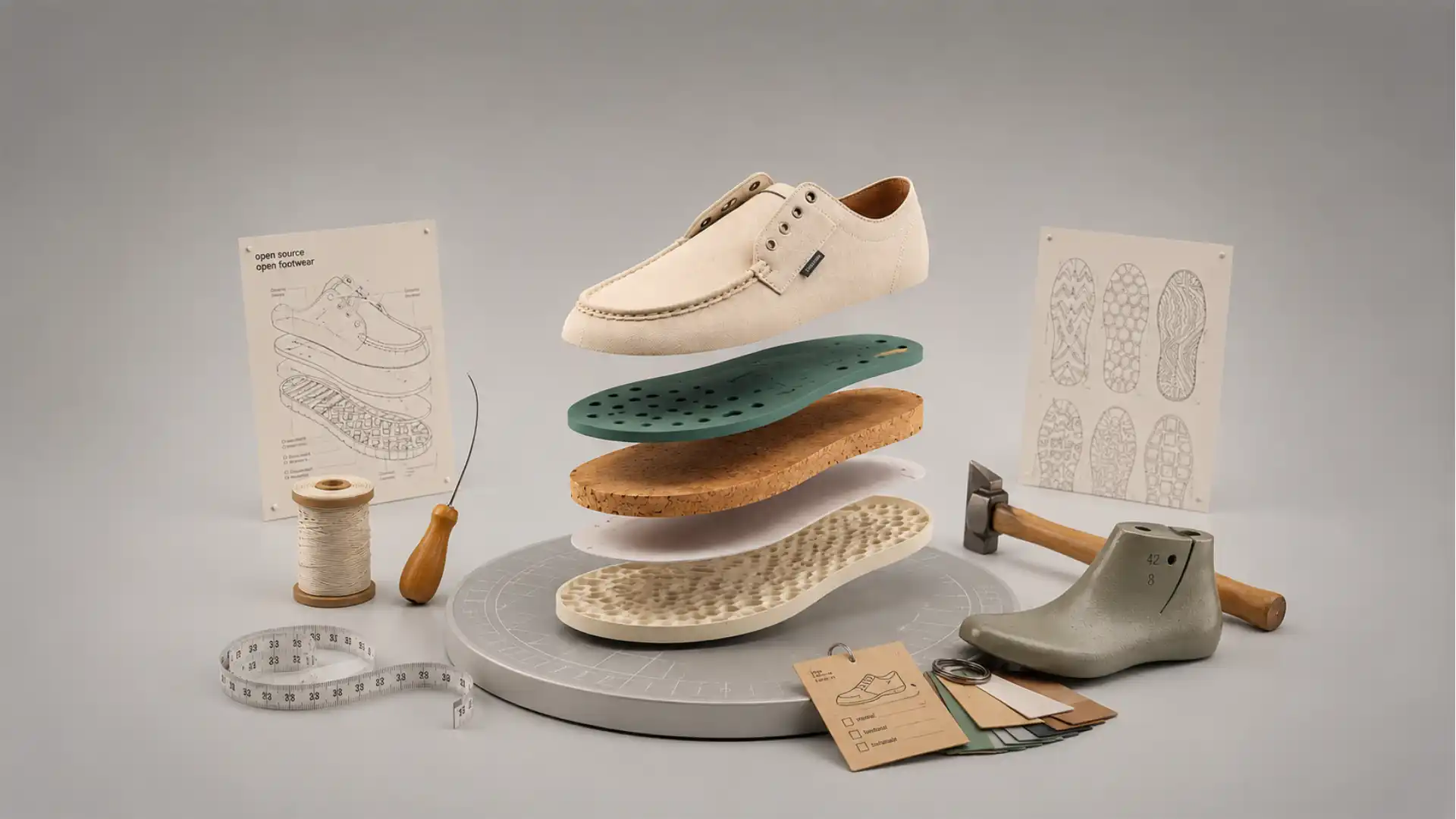
Open Footwear does something that still feels slightly illegal the first time you see it: it treats shoes as files, patterns, parts, materials, machines, mistakes and shared knowledge, not as sealed consumer objects that arrive from somewhere far away with a logo already stitched onto them.
Table of Contents
A shoe is a project, not a product
The strange pleasure of Open Footwear is that it makes the shoe feel unfinished again. Not unfinished in the sloppy sense, but unfinished in the best maker sense: available for inspection, modification, failure, repair, argument and personal judgment. The site’s maker page opens with a direct invitation to become a “digital shoemaker,” then backs that phrase with a step-by-step guide built around digital tools such as a laser cutter, CNC router, 3D printer and hand sewing. That combination matters. It is not a fantasy render of a future sneaker. It is a bridge between a FabLab bench and something you might actually wear outside.
Most footwear websites want you to choose between sizes, colors and shipping options. Open Footwear asks a more interesting question: what if the object on your foot could be read like an open hardware project? The shoe is no longer only a fashion item, performance promise or brand signal. It becomes a small manufacturing system. You need files. You need materials. You need machines. You need hands. You need time. You also need the humility to accept that making a shoe is not the same as ordering one.
That is why the site deserves attention beyond the small circle of footwear nerds. Open Footwear sits at the meeting point of open-source culture, local manufacturing, wearable design, digital fabrication and anti-consumerist curiosity. Its homepage describes open-source running and barefoot shoe designs made for digital manufacturing, while its shoe page presents Open Barefoot and Open Run as downloadable designs under the Creative Commons Attribution-ShareAlike 4.0 license. That license choice is part of the story. It says: copy this, change this, share what you make, but keep the commons alive.
The project also has a very good sense of scale. It does not claim that every household will soon own a sneaker factory. It does not pretend that global footwear logistics will vanish because someone has a 3D printer and a stubborn weekend. The maker guide makes the work visible. A pair of shoes requires multiple tools, different materials, cut patterns, shaped parts and stitching. The promise is not “instant shoes.” The promise is access. You can study the object. You can download the design. You can make a version. You can understand why the ordinary shoe is much less ordinary than it looks.
The best internet finds often make a familiar object feel newly readable. Open Footwear does exactly that. Once you look at the project, every commercial shoe starts to look less like a black box and more like a decision stack. Why that sole? Why that upper? Why that material? Why that fit? Why that supply chain? Why no repair path? Why so little public knowledge around something most humans use every day? A shoe becomes less boring the moment you see the layers.
The site is also refreshingly physical for a web project. It does not live only in screenshots, APIs or browser tricks. Its endpoint is a real foot on real ground. That gives the whole thing a different texture. Open-source software can be forked without splinters, glue or blisters. Open-source footwear drags the neatness of digital culture back into the stubborn world of materials. Foam compresses. Fabric frays. Thread tension matters. A digital file may be clean, but a shoe has to survive walking.
That friction is exactly the appeal. Open Footwear is not interesting because it makes shoemaking easy. It is interesting because it makes shoemaking approachable without lying about the craft. The site treats digital fabrication as a language for entering the craft, not as a magic trick that deletes it. A laser cutter does not replace knowledge. A CNC router does not replace fit. A 3D printer does not replace patience. They give the curious person a way into a domain that usually belongs to factories, technicians, designers and guarded production workflows.
The name “Let’s Make It!” on the maker page is almost too cheerful for what the project is really doing. Beneath the friendly wording is a quiet challenge to the default footwear economy. Most shoes are bought, worn, degraded and discarded inside systems the wearer cannot see. Open Footwear puts the hidden workflow on the table. It says: here are the files, here are the tools, here is the process, here is the thing you thought only a brand could make.
That does not make the project anti-brand in a cheap way. It is more interesting than that. It is pro-literacy. It wants people to understand what goes into footwear and what might change when designs travel as shared files rather than finished products. Some readers will never make a pair. That is fine. The site still changes the way they look at shoes. A good open project does not need everyone to participate with the same intensity. It just needs to make the object less closed than it was yesterday.
Open Footwear also arrives at a moment when the word “open” gets abused. Many things are described as open because they have a public landing page, a free trial or a community Discord. This project uses “open” in the older, more demanding sense: designs published for others to use and adapt, with a share-alike license attached. The difference is not semantic. An open design is not a marketing mood. It is an invitation with obligations.
The site’s strongest move is that it keeps the website as a doorway, not the destination. A weaker version of this project would drown the visitor in manifestos about sustainable manufacturing, personalization and the future of fashion. Open Footwear does speak about local production and open design, but its center of gravity remains practical. Download files. Find tools. Make a pair. Learn by doing. The rhetoric follows the object rather than swallowing it.
That makes it a very Web Radar kind of discovery. It is not the largest platform in its category. It is not polished into sterile sameness. It has the odd, charming seriousness of a project built by people who genuinely care about the thing. You do not open it because it is perfect. You open it because it makes a hidden part of the internet feel alive: the part where someone looks at a mass-produced object and asks whether ordinary people deserve more access to how it is made.
The maker guide has the right kind of difficulty
The Open Footwear maker guide is most compelling because it does not flatten shoemaking into a weekend gimmick. It positions the reader as a maker who will use digital tools, but the steps still lead through physical work. Laser cutting, CNC routing, 3D printing and hand sewing do not belong to the same tidy category. They belong to different skill families. That mix is exactly what makes the guide feel honest. A shoe is not one thing. It is a collection of operations held together by fit.
The phrase “digital shoemaker” could have sounded like a buzzword. Here it lands better because the guide has enough material specificity to support it. Digital shoemaking is not presented as typing a prompt and receiving footwear. It means working from open files, translating shapes into machine paths, cutting and forming parts, then doing the human work of assembly. The digital part matters, but it never gets to be the whole story.
This is where Open Footwear differs from a lot of 3D-printed shoe content online. Many projects stop at the novelty of printing a wearable form. Open Footwear is more hybrid. The shoes are digital-manufacturing projects, but they are not reduced to a single machine. The required tools listed across the site include laser cutting, vinyl cutting and CNC milling for its shoe designs, while the maker page adds 3D printing and hand sewing to the practical mix. That tells you the project is thinking in systems, not stunts.
A shoe is a brutal test object for maker culture. It has to bend, hold, breathe, grip, fit and survive repeated impact. It touches skin. It carries body weight. It fails in annoying, sometimes painful ways. A decorative 3D print can sit on a shelf and look successful. A shoe has to negotiate sweat, movement, terrain, asymmetry and the emotional humiliation of looking weird in public. Open Footwear chooses a hard object, which makes the project more credible.
The maker guide’s difficulty also protects the project from becoming another disposable internet hack. If making the shoes requires a FabLab, attention and manual skill, the result is less likely to be treated as a throwaway novelty. The process asks for care before the product exists. That care changes the relationship. When you cut, sew or shape part of a shoe yourself, you understand wear in a different way. A scratch becomes information. A failed seam becomes instruction. A pressure point becomes design feedback rather than an excuse to return a product.
The guide also hints at a more useful future for local fabrication spaces. FabLabs and makerspaces often struggle with the gap between “cool machine demo” and “object with daily use.” Open Footwear gives those spaces a concrete project with cultural weight. Shoes are intimate, common and technically rich. They are not another keychain, coaster or laser-cut box. A workshop around open footwear gives people a reason to learn machines through something they already understand with their bodies.
That body knowledge is underrated. Everyone has opinions about shoes, even people who do not think of themselves as design-minded. They know when a toe box is wrong. They know when a sole feels dead. They know when a shoe rubs in the same place every time. Open Footwear gives that everyday sensitivity a production path. It turns the wearer’s complaints into design questions. For a maker project, that is powerful.
The site’s maker language also avoids the trap of treating beginners as children. It does not bury the visitor in industrial terminology, but it does not pretend the craft is effortless. The best beginner-friendly projects are not the easiest ones. They are the ones that let a beginner see the path clearly enough to start. Open Footwear’s guide does that by making the sequence visible and by naming the tools involved. It gives the visitor a map of the work.
There is a quiet educational value here that goes beyond footwear. A person who makes even one shoe project learns something about CAD, files, tolerances, machine limits, material behavior and assembly order. They also learn that “customization” is not the same as choosing from a dropdown menu. Real customization has consequences. Change one dimension and another part may stop fitting. Change a material and the behavior shifts. Open design teaches cause and effect better than polished product pages ever could.
The guide’s use of hand sewing is especially important. It keeps craft in the frame. Digital fabrication culture sometimes speaks as if machines are the natural endpoint of making, but shoes resist that story. Hands still matter. The point is not to replace handwork with digital tools. The point is to connect them in a way that gives more people access to the object. A “digital shoemaker” is still a shoemaker, not a file manager.
There is also something emotionally different about making something for your own feet. A chair, lamp or shelf lives near you. A shoe moves with you. It is personal in a more unforgiving way. If it works, you feel the success every time you stand up. If it fails, your body reports the error immediately. That feedback loop makes the project unusually intimate for open hardware. The user is not only the builder. The user is the testing rig.
Open Footwear’s maker guide is not just instruction. It is a permission structure. It tells the visitor that footwear is not off-limits. You are allowed to enter this category. You are allowed to download, inspect and adapt. You are allowed to make something imperfect and learn from the result. For an industry that usually sells identity, performance and secrecy, that permission feels surprisingly radical.
The practical caveat is obvious but worth keeping in the article because it protects the recommendation. This is not a five-minute craft. It asks for tools most people do not own, or access to a FabLab that has them. It asks for comfort with files and materials. It asks for patience with fit. Someone who wants cheap shoes tomorrow should not start here. Someone who wants to understand shoes from the inside should absolutely open the site.
That is the editorial judgment: Open Footwear is not frictionless, and that is its virtue. The project is most useful for people who want a real making experience, not a shortcut. It belongs to the web of plans, files, workshops and open documentation that makes the internet feel less like a shopping mall and more like a library with tools attached.
Open Barefoot and Open Run make the idea tangible
The project becomes easier to grasp once you see that Open Footwear is not only a manifesto but a pair of named shoe directions. Its shoe page presents two designs: Open Barefoot and Open Run. Those names do useful work. They tell the visitor that the project is not trying to make one universal shoe. It is exploring different footwear needs through open designs.
Open Barefoot is the most approachable concept at first glance. The official page describes it as a minimalist open-source barefoot shoe that you can make yourself with just two materials. That is a strong editorial hook because it compresses the whole project into something unusually clear. Minimalism here is not only aesthetic. It lowers the intimidation level. If a person is going to make a shoe for the first time, “two materials” sounds less frightening than a complex stack of foams, textiles, adhesives and molded components.
Barefoot shoes also fit the open-source logic unusually well. The barefoot footwear world already attracts people who care about foot shape, ground feel, toe room and less conventional design assumptions. Those users are often suspicious of mainstream shoe categories. Open Barefoot gives that curiosity a making path. Instead of searching endlessly for the perfect minimalist shoe, a maker can study an open design and begin adapting it.
Open Run is the more ambitious sibling. The re:publica listing for Juraj Suska’s 2026 talk describes Open Run as a high-performance running shoe made for marathons as well as everyday wear, customizable and buildable by anyone. It also claims that runners have completed sub-3-hour marathons in Open Run shoes. That claim is striking because it pushes the project beyond the usual DIY zone. A homemade shoe that survives a jog is one thing. A design associated with serious running performance is another.
That performance angle gives Open Footwear its tension. The project is not only asking whether people can make shoes. It is asking whether open production can handle objects where comfort, durability and performance actually matter. A running shoe is a harsh judge. It repeats impact thousands of times. It punishes sloppy fit. It exposes bad material choices quickly. If Open Run can live anywhere near that category, the project becomes much harder to dismiss as a craft curiosity.
The two models also reveal a smart product-thinking split. Open Barefoot makes the project feel accessible and materially simple. Open Run makes it feel ambitious and culturally provocative. Together they widen the door. A minimalist-shoe maker, a runner, a FabLab instructor, an open hardware enthusiast and a footwear student can all find a different reason to care. The site does not need to speak to everyone with one design.
The licensing matters again here. Open Footwear says its designs are shared under CC BY-SA 4.0, which permits adaptation and sharing under the same license terms. That gives the models a life beyond the original creators. If someone modifies the fit, material stack or fabrication method and shares it back, the project can develop through use. The shoe becomes a commons object rather than a fixed SKU.
The share-alike part is especially fitting for footwear. Shoes are deeply local in ways product pages hide. Feet differ. Materials available in one city may not be available in another. Machine access differs by makerspace. Running surfaces differ. Climate differs. An open shoe design that can be adapted and re-shared has a better chance of surviving those differences than a closed object pretending one commercial sizing grid can satisfy everyone.
Open Barefoot and Open Run also make the website easier to recommend. A discovery article should not ask readers to admire an abstract principle for 8000 words. It should point to the thing worth opening. In this case, the thing is the combination of downloadable shoe designs, a maker guide and a project philosophy that remains tied to real footwear. Open Footwear is worth clicking because you can move from curiosity to files and process quickly.
There is a small but important emotional shift when a project names its designs. “Open-source shoes” sounds like a category. “Open Barefoot” and “Open Run” sound like objects with identities. That gives the project a publishing advantage. It becomes easier to talk about, teach, workshop and remember. A good open project needs names people can carry into conversation.
The designs also show that open-source does not have to look like raw engineering. Footwear is cultural. It carries taste, silhouette, self-presentation and body politics. Open Footwear has to deal with that whether it wants to or not. A shoe cannot hide behind utility alone. If people feel embarrassed wearing it, the project loses. That makes the design challenge more interesting than another invisible technical object.
The project’s public workshop activity reinforces the same point. A ZAM workshop listing from January 2026 described participants building a personalized pair of Open Barefoot shoes in a full-day session, ending with shoes they could wear home. That kind of workshop gives the site social proof of a practical kind. The design is not only posted online. It can become a guided group activity where people learn by making.
That workshop framing also makes Open Footwear less lonely. Open-source projects often struggle when the files are public but the learning path is solitary. A shoe is too embodied for pure file dumping. People need guidance, examples and shared troubleshooting. Workshops turn the project from “download and good luck” into a small community practice. For a craft-heavy open design, that matters.
Open Run’s re:publica appearance adds another layer. The project was presented publicly in Berlin in May 2026 as “World’s Fastest Open-Source Running Shoes — Made by YOU!” The title is bold, maybe even cheeky, but the listing’s description is more useful than the slogan. It positions Open Footwear as an independent open-source research project challenging consumerism and the footwear industry, with collaborations involving academic teams and a global network of makers, creators and runners.
That outside context helps the reader understand the seriousness behind the playful maker invitation. Open Footwear is not just a weekend upload. It is part research project, part design practice, part public education effort. That mixture gives it a richer profile than a single downloadable shoe file on a model repository. It wants to be copied, but it also wants to change how people imagine production.
There is still a healthy skepticism to keep. Open-source footwear will not automatically solve waste, overproduction, bad fit or labor issues. Local manufacturing can be inefficient if done poorly. DIY materials can still be questionable. A maker shoe can fail. An open license does not guarantee good design. But Open Footwear is not asking for blind belief. It is asking for participation and scrutiny. That is a much better deal.
The designs make the project concrete enough to judge. You do not have to agree with every implied future of open manufacturing. You can still respect the clarity of the attempt: publish shoe designs, document the making path, invite adaptation, test the limits of local fabrication and turn a familiar consumer object into shared knowledge. That is a web project with teeth.
What stands out inside Open Footwear
| Element | Why it matters |
|---|---|
| Maker guide | Turns curiosity into a visible making path rather than leaving visitors with a slogan |
| Open Barefoot | Gives the project a minimalist entry point with a clear material story |
| Open Run | Pushes the idea into performance territory instead of staying with novelty wearables |
| Digital tools | Connects FabLab machines to a daily object people already understand |
| CC BY-SA 4.0 | Keeps adaptation and sharing inside the commons rather than making openness cosmetic |
| Workshops and talks | Shows the project leaving the website and entering real maker spaces |
The table matters because Open Footwear is easy to misread as either a shoe site or a maker tutorial. It is both, but the stronger description is a small open manufacturing ecosystem around footwear. The site, files, tools, license, designs and workshops all reinforce the same idea: shoes can be studied, made and shared more openly than the consumer market suggests.
The internet needs more projects with material consequences
Open Footwear feels refreshing because so much of the web now points back to screens. We get dashboards, feeds, AI toys, productivity layers, content tools, subscription portals and endless software for managing other software. Open Footwear uses the web as a route toward a physical object that must earn its place in daily life. That gives it a kind of seriousness even when the project is playful.
A shoe is also a perfect object for questioning the distance between consumers and production. Most people wear shoes every day, but very few know how they are made. They may know brand stories, sneaker drops, retail prices and broad categories. They rarely know the pattern logic, lasting decisions, machine operations, material compromises or repair limits. Open Footwear does not solve that ignorance by explaining it from above. It invites the reader into the process.
The project belongs to a larger family of internet artifacts that make manufacturing more legible. Think of open furniture plans, open-source prosthetics, printable assistive devices, repair manuals, CNC furniture systems, parametric design tools and public hardware documentation. The best examples do not merely share files. They change the social contract around objects. They suggest that users are allowed to know more.
Open Footwear is especially memorable because footwear usually resists that treatment. Shoes are wrapped in brand mythology and performance language. Companies discuss cushioning, energy return, support and sustainability in polished phrases, while the actual construction remains distant. An open shoe design cuts through the performance fog. It says: if the shoe is good, let people inspect it. If the design improves, let them share the improvement.
This is where the project’s anti-consumerist edge becomes most interesting. It does not scold the reader for buying shoes. It offers an alternative relationship to the object. You can still appreciate commercial footwear after seeing Open Footwear, but you may be less passive about it. You may ask better questions. You may care more about repair, fit, materials and local capability. A good web discovery changes what the reader notices afterward.
The “local production” angle is attractive, but it should be handled carefully. Local does not automatically mean better. A locally made object can waste material, use poor inputs or consume more energy than a centralized process. But local production does offer one undeniable benefit: visibility. When the making happens near the user, the process becomes easier to inspect. Open Footwear’s strongest sustainability claim is not a vague promise of virtue. It is the possibility of a shorter, more understandable production loop.
The open-source angle also changes the economics of experimentation. Commercial footwear development is expensive and guarded. A failed prototype may never be seen outside a company. In an open project, failure can become documentation. A weird modification can be shared. A local material test can matter to someone elsewhere. The knowledge does not have to disappear inside a private product cycle. That is the quiet power of open design.
Shoes also expose the limits of pure digital abundance. Files can be copied almost freely, but a shoe still needs material, labor and machine time. That tension is useful. It prevents the project from drifting into naive internet optimism. Open Footwear reminds us that the web can distribute knowledge, but the world still charges for rubber, textile, electricity, tooling access and human attention. The digital commons does not abolish the physical economy. It gives people a better starting point inside it.
The project also suggests a different role for design education. A footwear student looking at Open Footwear does not only see inspiration. They see publishable patterns, fabrication methods, licensing choices and community-facing documentation. That is a different skill set from sketching a concept shoe for a portfolio. It asks the designer to think about reproducibility, file hygiene, material accessibility and instructions for strangers. Those are hard, useful disciplines.
For makerspaces, Open Footwear could become a teaching object with unusually broad appeal. A class on laser cutting can feel abstract until it cuts something the student cares about. A class on CNC routing can feel technical until the part touches the ground. A class on sewing can feel separate from digital fabrication until the student sees the upper and sole as parts of one system. Shoes force cross-disciplinary learning without making the lesson feel artificial.
For runners, the appeal is different. Runners are already experimenters. They track mileage, surfaces, injury patterns, socks, lacing, stack height, drop and foot strength. Open Run inserts fabrication into that culture of testing. Not every runner will want to make footwear. But the idea that a running shoe could be studied and adapted openly is powerful in a category where performance claims are often mediated by marketing.
For barefoot-shoe people, Open Barefoot may feel like a natural extension of existing skepticism. Minimalist footwear communities already question mainstream assumptions about support, toe shape and cushioning. Open Footwear gives that questioning a practical path. Instead of only debating brands, users can engage with a design. They can test, modify, compare and share. That is a healthier form of disagreement than endless comment-thread ideology.
For people interested in sustainability, the project is valuable because it is specific. It does not wave at “eco-friendly shoes” as a mood. It asks what happens when shoes are made closer to where they are used, when designs can be repaired or altered, when files outlive product seasons, when knowledge is not trapped inside a brand. Those are better questions than vague green messaging.
The project’s real cultural importance may be literacy rather than replacement. Open Footwear probably will not replace mass footwear for most people. It may not need to. If it teaches a small but growing group of people how shoes are designed, fabricated, fitted and shared, it changes the conversation around footwear. Some projects win by scaling as products. Others win by making a category more transparent.
That kind of transparency is rare on the consumer web. Product pages tell us benefits. Reviews tell us experiences. Forums tell us complaints. Open projects tell us construction. They let the object become inspectable. Open Footwear belongs to that last category, and that is why it feels like a hidden internet gem rather than another niche product site.
It also has a charming refusal to stay purely digital. The best line you can imagine after browsing the site is not “I learned about shoes.” It is “I might try to make a pair.” That shift from reading to doing is the old web at its best. Not passive consumption, not endless commentary, but a page that makes the reader look for a local FabLab.
The rough edges are part of the recommendation
Open Footwear is worth recommending, but not because it is friction-free. The site is a little raw in the way independent open projects often are. The concept is stronger than the polish. Some visitors will want more photos, clearer progress examples, deeper troubleshooting or a smoother path from first click to first file. That does not weaken the discovery. It makes the project feel alive, still forming, still dependent on people doing the work.
A polished commercial site hides uncertainty because uncertainty harms conversion. Open Footwear benefits from showing some of its uncertainty. The object is hard. The process is hard. The future of open footwear is not settled. That unsettled quality is part of why the project is interesting. You are not looking at a finished consumer funnel. You are looking at a field experiment with shoes.
The project also asks the reader to accept a different definition of convenience. Buying shoes is convenient because the labor is hidden. Making shoes is inconvenient because the labor becomes yours. But hidden labor is not the same as absent labor. Open Footwear makes that visible. It trades retail convenience for manufacturing literacy. For the right person, that trade is worth it.
There is a risk that casual visitors will misunderstand the project as a cheaper path to footwear. That would be the wrong frame. Making your own shoes through digital fabrication may cost time, machine access, materials and failed attempts. The value is not cheapness. The value is agency, learning and customization. A reader who opens the site expecting a discount sneaker hack will miss the point.
There is also a fit risk that deserves respect. Shoes are intimate ergonomic objects. Bad fit is not just annoying; it can cause pain. Open designs should be approached with testing, adjustment and caution, especially for running. The re:publica description’s sub-3-hour marathon claim is impressive, but it should not encourage reckless copying. Performance footwear is personal. A shoe that works for one runner can punish another.
The site would benefit from more structured paths for different visitor types. A FabLab instructor needs workshop planning details. A runner needs performance and fit notes. A barefoot-shoe beginner needs sizing and material guidance. A designer needs file structure and modification logic. A sustainability reader needs lifecycle discussion. The current project contains several of these threads, but there is room to make the routes clearer.
A stronger gallery would also help. Open hardware projects gain trust when visitors can see real builds, failed builds, workshop tables, worn shoes, repaired shoes and modified versions. The more Open Footwear shows the messy life of the designs, the stronger the project becomes. Beauty shots matter less than evidence of use. Worn soles are persuasive.
Documentation depth is another obvious growth area. Open projects live or die by documentation. The files are only the beginning. What material thickness worked? Which machine settings caused trouble? Where do first-time makers fail? How does fit change after wear? Which steps require a second person? Which substitutions are safe, and which ruin the shoe? These questions are not criticism from outside. They are the natural next layer for any serious open design.
Community visibility could also become central. A shared map of makerspaces that have built the shoes, user modifications, local material experiments, translated guides, workshop kits and running logs would turn the site from a project page into a knowledge hub. Open Footwear already points in that direction. The question is how much of the growing practice can be made visible without overwhelming the clean invitation.
The licensing choice helps, but licenses do not create community on their own. CC BY-SA 4.0 gives the legal structure for adaptation and sharing. People still need social reasons to contribute. They need recognition, clear contribution routes and examples worth copying. Open Footwear’s next challenge is not only better files. It is better loops: build, document, share, improve, repeat.
That said, the project should not over-professionalize itself too quickly. Part of its charm is that it feels close to the workshop. If every rough edge were sanded into startup language, the site would lose credibility. The reader needs to feel the hands behind it. Open Footwear should become clearer, not slicker. Better documentation, yes. More corporate polish, no.
The strongest independent web projects often carry this exact tension. They need enough clarity to welcome outsiders and enough rawness to remain believable. Open Footwear sits in that zone. It has a serious idea, practical pages, named designs and public activity. It also has the unfinished energy of something that wants participants more than customers. That is rare.
The project’s limits are also what make it editorially honest. It does not promise universal access. It assumes tool access. It assumes motivation. It assumes a tolerance for making. It is not for everyone. That is not a weakness. A discovery format should not pretend every interesting website is useful to every reader. Open Footwear is for people who feel a little spark when a consumer object becomes inspectable.
The ideal reader may not even be a shoemaker. It might be someone who runs a makerspace, teaches product design, repairs gear, studies circular economy, hacks wearables, loves barefoot shoes, questions fashion waste or simply enjoys seeing a closed category opened up. The audience is united less by footwear expertise than by curiosity about how objects could be made differently.
That is why the project’s roughness feels acceptable. A slick shoe brand sells confidence. Open Footwear sells entry. Entry is messier. It requires the site to expose process, not hide it. If the project continues to grow, its job will be to make the path easier to follow while preserving the difficulty of the craft. That balance is hard, but the current site already points toward it.
The recommendation is strongest when framed as a site to open, study and possibly act on. Do not open Open Footwear as a shopping alternative. Open it as a small laboratory. Open it to see how files become soles. Open it to remember that the internet still contains people trying to make daily objects less closed. Open it because a shoe is much more interesting when it stops being a sealed box.
Practical doubts after the first click
The first doubt is whether an ordinary person can really make these shoes. The honest answer is: an ordinary curious person with access to the right tools and enough patience can enter the process. That is different from saying anyone can do it instantly. The maker guide is built around digital fabrication and hand work, so access matters. A nearby FabLab, makerspace or workshop changes the whole equation.
The second doubt is whether the shoes are actually wearable. The project’s workshop descriptions and public materials position the shoes as wearable objects, not display props. The ZAM workshop even described participants walking home in the shoes they made. Open Run is presented in re:publica’s listing as a marathon-capable running design, with the notable sub-3-hour marathon claim attached. Still, wearability depends on build quality, fit, materials and use case. A handmade shoe deserves testing before trust.
The third doubt is whether this is only for barefoot-shoe fans. Open Barefoot will naturally attract that crowd, but the broader project is bigger. Open Run brings performance running into the frame. The maker guide brings digital fabrication education into the frame. The open license brings design commons into the frame. A person can dislike barefoot shoes and still find Open Footwear interesting as open hardware.
The fourth doubt is whether the project is sustainable in a real sense. The careful answer is that Open Footwear supports a more transparent and potentially more local production model, but sustainability depends on materials, machine use, durability, repair and waste. The project’s strongest environmental value is not a guaranteed footprint claim. It is the way it makes production choices visible and shareable.
The fifth doubt is whether the files are free to modify. Open Footwear states that its designs are published under CC BY-SA 4.0. That license is designed for sharing and adaptation, with attribution and share-alike conditions. For a maker, that means the project is not merely viewable. It is meant to be worked on, adapted and circulated under the same open logic.
The sixth doubt is whether a beginner should start with Open Run. Probably not, unless they have guidance and a strong reason. Open Run is the more demanding promise because running shoes face serious performance stress. Open Barefoot looks like the gentler entry point because of its minimalist concept and two-material framing. Beginners should start where fit, risk and complexity feel manageable.
The seventh doubt is whether open footwear can ever compete with commercial shoes. “Compete” may be the wrong word. Open Footwear does not need to beat a global shoe company at distribution, branding or price. It competes on access to knowledge, local making, modification and transparency. Those are different values. For some users, they matter more than convenience. For most users, they may still matter enough to change expectations.
The eighth doubt is whether this is a website or a movement. Right now it is best understood as a project with movement-like instincts. It has official pages, maker instructions, named shoe designs, a license, workshops, public talks and an argument about local open production. Whether it becomes a broader movement depends on participation. The site is the doorway. The real test is how many people build, adapt and share.
The ninth doubt is whether the project is worth opening if you will never make a shoe. Yes, because the site teaches a different way to look at manufactured objects. Even a passive visit has value. It turns footwear from a brand object into a made object. That shift is small but sticky. Afterward, shoes look less like lifestyle goods and more like design decisions wrapped around a foot.
The final doubt is whether Open Footwear is polished enough to trust. Trust should not come from polish here. It should come from openness, specificity and continued evidence of use. The project is strongest where it shows files, tools, workshops and public claims that can be examined. A reader should bring curiosity and judgment, not blind faith. That is the correct posture for any open hardware project.
Why this belongs in your bookmarks
Open Footwear is the kind of site that makes the web feel less exhausted. It is not another layer of commentary about technology. It is not another app promising to manage your attention. It is a real attempt to move knowledge from closed production into public hands, using a familiar object that everyone understands and almost nobody knows how to make.
The project’s charm comes from its refusal to separate imagination from work. It imagines open-source shoes, but then it gives you a maker path with actual tools. It talks about local production, but then it points toward cutting, routing, printing and sewing. It gestures at sustainability, but its stronger argument is material literacy. It invites customization, but it does not pretend customization is merely aesthetic.
The site also reminds us that the internet is still a distribution system for skills. That used to be one of the web’s great promises. A person could find a guide, download files, learn a craft, join a small community and make something that previously felt inaccessible. Open Footwear belongs to that lineage. It is not nostalgic. It simply uses the web for something better than passive scrolling.
There is a particular delight in seeing open-source language applied to a shoe. The phrase feels wrong for half a second, then obvious. Why should software be the only domain where people expect readable, modifiable systems? Why should a daily object be less inspectable than a codebase? Open Footwear does not answer those questions with a lecture. It answers with a pattern, a tool list and a dare.
The project is also a useful antidote to fake personalization. Commercial personalization often means picking a color, adding initials or choosing from preapproved variants. Open Footwear points toward a deeper form: changing the object because the design is available. That kind of personalization is harder, but it respects the user more. It assumes the user might want agency, not just options.
There is a business lesson here as well, even for people who never touch a laser cutter. Closed products depend on controlled knowledge. Open projects depend on shared improvement. Footwear has long sat on the closed side, partly for good reasons and partly because secrecy protects margins. Open Footwear asks what happens when some of that knowledge becomes public. The result may not replace brands, but it can pressure them to be clearer, more repairable and less mystical.
The project’s best future would not be a single viral moment. It would be a slow accumulation of builds, modifications, local workshops, better instructions, translated guides, material experiments and real wear reports. Open hardware often grows through stubborn repetition rather than explosive scale. Shoes, of all objects, should grow that way. They need miles, not hype.
The site is worth bookmarking because it may become more useful as more people touch it. That is the sign of a real open project. A static marketing site ages as its claims get stale. A shared design project can age by gaining scars, fixes and variants. Open Footwear has the ingredients for that kind of aging. It deserves attention now because the foundation is already interesting, and the direction is better than the polished sameness around it.
The reader who opens it should look at three things first. Start with the maker page to understand the work. Then look at the shoe designs to see how the idea becomes objects. Then read the about page and public project descriptions to understand the larger argument about open-source design and local manufacturing. That path keeps the project grounded. First the making, then the shoes, then the philosophy.
The most memorable part is still the basic inversion. Shoes normally come to us as finished things. Open Footwear sends them back upstream. It shows the files before the object, the tools before the purchase, the process before the brand story. That inversion is why the site sticks in the mind. It makes the familiar strange in a useful way.
For Web Radar, that is enough. A good discovery does not need to be universally practical. It needs to open a door most readers did not know existed. Open Footwear opens one into a small digital shoemaking lab where open-source culture has soles, stitches and machine dust. You may not leave with a pair of shoes. You may leave with a better question about every pair you own.
Author:
Jan Bielik
CEO & Founder of Webiano Digital & Marketing Agency
This article is an original analysis supported by the sources cited below
Open Footwear makers guide
The official “Let’s Make It!” page introducing the step-by-step maker path for producing Open Footwear shoes with digital tools and hand work.
Open Footwear homepage
The main official project page describing Open Footwear as an open-source footwear project built around downloadable designs, digital manufacturing and local making.
Open Footwear shoes page
The official page presenting the project’s shoe designs, including Open Barefoot and Open Run, along with the digital tools listed for making them.
Open Barefoot
The official product page for Open Barefoot, described as a minimalist open-source barefoot shoe that can be made with two materials.
Open Footwear about page
The official background page describing Open Footwear as an independent research project focused on open-source design, local manufacturing and digital tools.
Open Footwear at re:publica 2026
A public event listing for Juraj Suska’s 2026 talk about Open Footwear, including outside context on Open Run, the CC BY-SA 4.0 license, collaborators and performance claims.
Creative Commons Attribution-ShareAlike 4.0 International
The license referenced by Open Footwear, defining the attribution and share-alike terms for remixing and sharing licensed material.
| Citing this article? Brief excerpts are welcome. Please credit Webiano.digital, name the author where stated, and include a link to https://webiano.digital and to this original article. Full or substantial republication requires prior written permission. Read our Copyright and Content Use Policy. |
This article was prepared with the assistance of artificial intelligence tools. The content underwent expert human review, and Webiano Digital & Marketing Agency assumes editorial responsibility for its final version and publication.