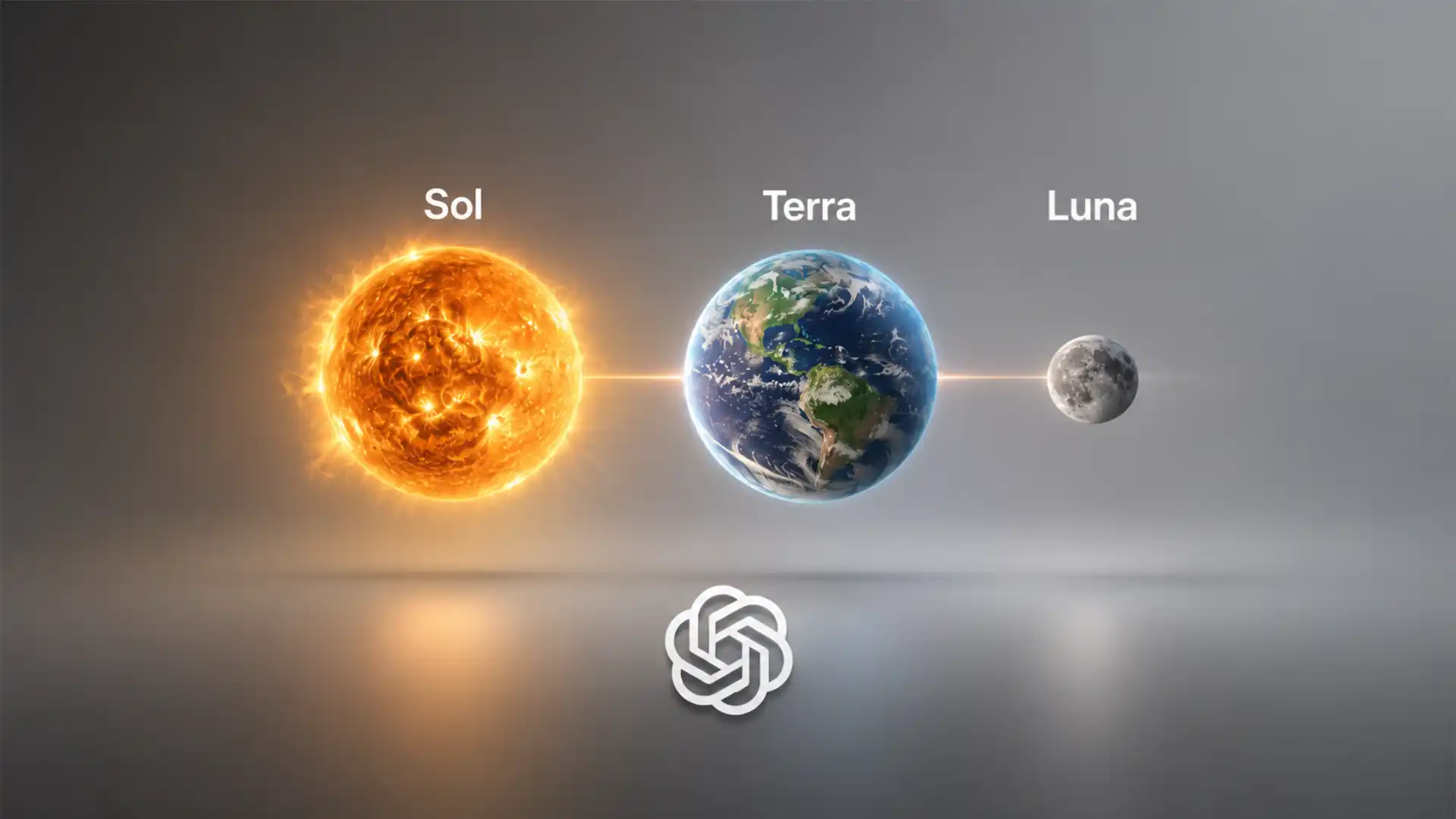
OpenAI used a June 26, 2026 post to preview a new model family rather than ship it. The announcement covers three models under the GPT-5.6 name: Sol, the flagship; Terra, a mid-tier model aimed at everyday production work; and Luna, a faster and cheaper model for high-volume use. What makes the launch unusual is not the count. It is that almost no one can use the models yet. OpenAI confirmed that GPT-5.6 is starting as a limited preview through the API and Codex, available only to a small set of trusted partners and organizations whose participation has been shared with the U.S. government. A wider release to ChatGPT, Codex, and the API is promised “in the coming weeks.”
Table of Contents
The models OpenAI placed in a limited preview
That phrasing matters because it sets the frame for everything else. This is a capability announcement and a regulatory one at the same time. OpenAI says it previewed the models and its release plans to the government before launch, and that the government asked it to start narrow. Reporting from VentureBeat put the initial group at roughly 20 organizations, a number small enough that most developers reading the launch post will not touch the models for weeks. The company was direct about its discomfort with the arrangement, writing that it does not believe this kind of government access process should become the long-term default and that it keeps strong tools away from the developers, enterprises, and cyber defenders who need them.
The technical claims sit on top of that access story. OpenAI describes Sol as its strongest model to date, with gains concentrated in coding, biology, and cybersecurity, and pairs the launch with what it calls its most thorough safety stack so far. The post does not bury the safety material in a footnote. It runs through layered safeguards, real-time misuse classifiers, account-level review, and a large automated red-teaming effort, then states plainly that the model does not cross the Cyber Critical threshold under the company’s Preparedness Framework. For a routine version bump, none of that would lead the announcement. Here it does, because the release is shaped by a new federal posture toward frontier models that can find and exploit software vulnerabilities.
There is also a hardware headline that OpenAI placed near the end of the post but that may matter more to buyers than the benchmark scores. GPT-5.6 Sol is coming to Cerebras at up to 750 tokens per second in July, with access limited at first to select customers as capacity grows. OpenAI has not said whether Terra and Luna will also run on Cerebras. Speed at that level changes what a model feels like to use inside an agent or an interactive product, and it puts OpenAI’s flagship on specialized inference hardware rather than the general-purpose GPU clusters that serve most of its traffic.
The pricing structure rounds out the news. Sol is listed at $5 per million input tokens and $30 per million output tokens, the same headline rate as GPT-5.5. Terra comes in at $2.50 input and $15 output, matching the previous GPT-5.4 tier, and Luna sets a new lower production floor at $1 input and $6 output. OpenAI also reworked how prompt caching is billed and priced, a change that sounds like a footnote but reshapes the economics of long-context and agentic workloads, which now dominate serious API spend.
Taken together, the preview reads less like a single product and more like a reset of how OpenAI sells access to intelligence: three durable tiers instead of a nano-mini-flagship ladder, a faster serving option through a new hardware partner, a caching model built for repeated context, and a release schedule that, for the first time, runs partly through Washington.
The naming logic behind Sol, Terra and Luna
The new names are doing real work, and OpenAI explained the logic directly. Under the system introduced with GPT-5.6, the number marks the generation and the name marks a durable capability tier that can move on its own cadence. Sol is the high-capability tier, Terra the balanced middle, and Luna the fast and affordable end. The point is that a future Sol, Terra, or Luna can each advance without forcing a rename, and a buyer can pick a tier by the kind of work it suits rather than by a size label.
This replaces the older GPT-5 pattern of “nano,” “mini,” and a headline flagship. People close to OpenAI told VentureBeat that the change was deliberate, because the nano and mini variants were never really separated by raw size or intelligence so much as by intended use, and the old labels implied a simple smaller-is-weaker hierarchy that did not match how the models were actually deployed. A name like “mini” invites the assumption that you are getting a cut-down model. A name like Luna invites the question of what it is for.
There is a practical upside for anyone who maintains code against these APIs. A tier that persists across generations is easier to plan around than a flagship that gets a new decimal every six weeks. If Luna is the cheap, fast tier today and stays the cheap, fast tier through the next generation, a team can route traffic to “the Luna tier” as a stable design decision and let the underlying model improve underneath it. That is closer to how cloud providers name instance families than how model makers have historically named releases.
The naming also quietly sets expectations about performance. OpenAI says Terra has competitive performance with GPT-5.5 while costing half as much, and that Luna brings strong capability at the lowest price in the family. Independent coverage noted that Luna landed near GPT-5.5 levels on several tests despite being positioned as the cheapest and fastest option, which is a stronger claim than its price tier suggests. The risk in any tiered naming scheme is that buyers read the cheapest option as the weakest and over-provision toward the flagship out of caution. OpenAI’s own framing pushes against that, and the early benchmark talk gives the mid and low tiers more credibility than a “mini” label ever would.
One caution is worth stating early. Names that promise durability across generations only hold if OpenAI keeps the tiers coherent over time. If a later Sol drifts in price or a future Terra changes what “balanced” means, the clarity the scheme is meant to provide erodes. For now the logic is clean, and it gives developers a clearer way to talk about intelligence, speed, and cost as three separate dials rather than one.
Sol and the claim of OpenAI’s strongest model yet
OpenAI calls Sol its most capable model so far, and the preview backs that with a narrow set of evaluations rather than a full benchmark sweep. The company says it will publish an expanded suite when the model goes broadly available. For now the claim rests on three areas: command-line coding workflows, long-horizon biology analysis, and cybersecurity tasks that run for hours.
On coding, OpenAI says Sol sets a new state of the art on Terminal-Bench 2.1, a test of command-line work that requires planning, iteration, and coordinating tools. That benchmark matters more than the saturated academic tests of a year ago because it measures the kind of multi-step, tool-using behavior that real coding agents need. GPT-5.5 had already posted a strong score on Terminal-Bench 2.0 at launch in April, so Sol is being positioned as the next step on a metric OpenAI has spent a year arguing is the right one to watch.
On biology, OpenAI points to GeneBench v1, which evaluates long genomics and quantitative-biology analyses. Sol reportedly beats GPT-5.5 there while using fewer tokens, which is the more interesting half of the claim. Token efficiency is becoming as important as raw accuracy, because a model that reaches the same answer with fewer output tokens is cheaper to run and faster to finish, and on long agentic tasks those savings compound across thousands of steps.
The cybersecurity results are where the launch gets pointed. OpenAI says Sol shifts the performance-efficiency frontier for long security tasks, including vulnerability research and exploitation. On a benchmark it calls ExploitBench, the company reports Sol is competitive with Mythos Preview — Anthropic’s most cyber-capable model — while using only about a third of the output tokens. On ExploitGym, a benchmark built by UC Berkeley researchers with OpenAI and other labs, Sol, Terra, and Luna all show gains as reasoning effort increases. The choice to benchmark against a named Anthropic model, rather than against OpenAI’s own past releases, tells you what comparison the company thinks the market is making.
Two new controls are part of what makes Sol stronger on hard problems. OpenAI introduced a max reasoning effort that gives the model the most time to reason, and an ultra mode that brings in subagents to split and accelerate complex work rather than keeping everything in a single agent loop. Both are aimed at exactly the long-horizon tasks the benchmarks measure, and both cost more tokens and more wall-clock time in exchange for depth.
The honest read on “strongest model yet” is that it is a real but bounded claim. OpenAI showed a handful of agentic and scientific benchmarks chosen to highlight specific gains, not a full comparison across every capability, and it said as much. The cyber numbers are the headline, the coding result is the most immediately useful for the largest group of developers, and the token-efficiency angle is the one most likely to change how teams budget. What the preview does not yet show is how Sol behaves across the broad mix of everyday tasks where most users actually spend their time, and that picture will only come with the wider release and independent testing.
Terra and Luna fill out the family
Sol gets the capability headlines, but Terra and Luna are the models most teams will reach for once the family opens up. OpenAI positions Terra as a balanced model with competitive performance to GPT-5.5 at half the price, which is a straightforward value argument: if you were already running GPT-5.5-class work at $5 input and $30 output, Terra offers a similar result at $2.50 and $15. For production workloads that do not need the absolute top of the range, that is the kind of swap a cost-conscious engineering team makes without much deliberation, assuming the quality holds in their own evaluations.
Luna is the more surprising entry. It sits at the bottom of the price ladder at $1 input and $6 output, below the old GPT-5.4 tier, and OpenAI describes it as fast and affordable while still bringing strong capability. Independent coverage went further, reporting that Luna performed near GPT-5.5 levels on several tests even though it is the cheapest and fastest model in the family. If that holds up under outside scrutiny, Luna becomes the interesting model for high-volume work, because it narrows the usual gap between “cheap enough to run at scale” and “good enough to trust.”
The ExploitGym results reinforce that the whole family scales with reasoning, not just the flagship. OpenAI reported that Sol, Terra, and Luna all improved on that cyber benchmark as reasoning effort increased, which suggests the tiers differ in cost and speed more than in their basic ability to work through a hard problem given enough room. That is consistent with the naming logic: the tiers are meant to be points on a cost-speed-intelligence surface, not fundamentally different classes of model.
For buyers, the practical shape of the family looks like this. Sol is for the hardest reasoning, longest coding sessions, and security-adjacent work; Terra is the production workhorse for premium tasks at a moderate price; Luna is for routine, high-throughput jobs where responsiveness and cost matter more than maximum depth. The price spread across the three is wide enough that routing the right task to the right tier becomes the single biggest lever on an API bill, the same lesson that has held across every OpenAI generation.
The open question is how cleanly the tiers separate in practice. If Luna really does sit close to GPT-5.5 on common tasks, the case for paying four to five times more for Terra or Sol narrows to specific hard problems, and a lot of traffic that defaults to the flagship today could move down. OpenAI has an incentive to keep meaningful daylight between the tiers, and the preview does not yet give outsiders the data to judge how much daylight there is. That judgment will have to wait for hands-on testing once the models are broadly available.
The three-tier pricing and what shifted
The headline prices are easy to summarize because two of the three match tiers buyers already know. Sol lists at $5 per million input tokens and $30 per million output, the same as GPT-5.5. Terra lists at $2.50 and $15, matching the old GPT-5.4 rate. Luna sets a new floor at $1 and $6. OpenAI did not raise the top of its range with this generation. It held the flagship price flat and pushed the bottom lower, which is a different move from a launch that tries to extract more for a smarter model.
GPT-5.6 list pricing across the three tiers
| Model | Input ($/1M) | Output ($/1M) | Cached input read ($/1M) | Closest prior tier |
|---|---|---|---|---|
| Sol | 5.00 | 30.00 | 0.50 | GPT-5.5 |
| Terra | 2.50 | 15.00 | 0.25 | GPT-5.4 |
| Luna | 1.00 | 6.00 | 0.10 | new low tier |
Cached input reads keep the 90% discount on each tier, so the cached read rate is one-tenth of the listed input rate. Output tokens cost six times input on every tier, the same ratio OpenAI has used across the GPT-5.4 and GPT-5.5 families, which means generation-heavy work stays far more expensive than read-heavy work at the same token count.
The pricing tells a clear story when you line it up against the rest of OpenAI’s ladder. The company’s existing range already ran from GPT-5.4 nano at $0.20 input up to the Pro variants at $30 input and $180 output. Luna at $1 input slots in as a credible production floor that is cheaper than GPT-5.4 while, by OpenAI’s account, performing far above what its price implies. That combination is the real pricing news: not a cheaper flagship, but a cheaper model that is claimed to be close to flagship quality on a range of tasks.
It is worth being precise about where OpenAI sits in the wider market, because the launch coverage was. Even Luna, the cheapest GPT-5.6 model, is a mid-priced option across the industry rather than the cheapest available. Reporting noted that frontier-level models from Chinese labs, including GLM-5.2, undercut OpenAI on raw token price, and DeepSeek has consistently priced below the major U.S. labs at the flagship tier. OpenAI is not competing to be the cheapest token on the market. It is competing on the combination of capability, tooling, ecosystem, and now serving speed, and pricing its tiers to be defensible rather than lowest.
For anyone modeling a budget, the spread is the point. Luna output at $6 against Sol output at $30 is a five-fold difference, and against the Pro tier’s $180 it is thirty-fold. A workload that defaults every call to the flagship pays for headroom it rarely uses. The discipline that pays off is matching each task to the lowest tier that clears the quality bar, then reserving Sol for the specific hard problems that need it. None of that is new advice, but the wider gap between Luna and Sol makes the cost of ignoring it larger this generation than last.
The pricing also leaves open the questions that only the broad release answers: what the long-context surcharge looks like above the high-token thresholds OpenAI has used on recent models, how Batch and Flex discounting apply to the new tiers, and what Priority processing costs. Those modifiers materially changed the effective price of GPT-5.5, and until OpenAI publishes the full table for GPT-5.6, the headline rates are a starting point rather than the whole bill.
The prompt-caching rework and its real cost effect
The caching change is the part of the announcement most likely to be misread, and it matters more than the headline prices for anyone running long prompts or agents. OpenAI reworked how prompt caching is priced and made it more predictable, with two mechanical additions: support for explicit cache breakpoints and a 30-minute minimum cache life. It also restated the billing model for GPT-5.6 and later: cache writes are billed at 1.25 times the model’s normal uncached input rate, while cache reads keep the 90% discount.
That 1.25 figure is where confusion creeps in. It does not mean cached prompts cost 25% of the input price. It means the first time the model has to write a chunk of your prompt into the cache, you pay a 25% premium on those tokens, and every later read of that same cached chunk costs 90% less than the uncached rate. Writing to cache is slightly more expensive than a normal input token; reading from cache is dramatically cheaper. The whole point is to make repeated context cheap to reuse, at the cost of a small surcharge to put it in the cache in the first place.
To see why this helps, picture a typical agent. It sends the same system prompt, the same tool schemas, and a growing block of context on every step of a long task. Without caching, you pay full input price for that repeated prefix on every single call. With caching, you pay the 1.25x write rate once to establish the prefix, then the 90%-off read rate each time it is reused. On a task that loops dozens or hundreds of times over a stable prefix, the write premium is trivial and the read savings dominate. For Sol at $5 input, cached reads land at roughly $0.50 per million; for Terra at $0.25; for Luna at $0.10.
The two mechanical additions are what make this usable rather than incidental. Explicit cache breakpoints let a developer mark where the reusable part of a prompt ends, instead of relying on the system to guess the longest shared prefix. That gives precise control over what gets cached and reused across calls. The 30-minute minimum cache life sets a predictable floor on how long a cached prefix stays warm, so a developer can design a workflow around the assumption that context written now will still be cheap to read half an hour later. Predictability is the upgrade here. Caching that silently expires is hard to plan around; caching with a guaranteed minimum lifetime and explicit breakpoints is something an engineering team can build cost models on.
The strategic effect is to reward a particular way of building. Workloads that keep a large, stable context and query it repeatedly — retrieval-augmented systems, long coding sessions, document-heavy agents, customer-support flows with fixed instructions — benefit most, because they read the same cached prefix many times. Workloads that send a fresh, unique prompt every time see little benefit, because there is nothing to reuse. The caching model effectively subsidizes repeated context and leaves one-off generation at full price, which nudges developers toward designs that reuse prompts deliberately.
There is a discipline cost to getting this right. Caching only pays off if the reusable part of the prompt is genuinely stable, so teams have to structure prompts to keep instructions and reference material constant and push the variable part to the end, past the cache breakpoint. Done carelessly, frequent cache writes on shifting prefixes can erase the savings, because you keep paying the write premium without accumulating read discounts. The change rewards teams that treat prompt structure as a cost decision, and it quietly penalizes the habit of rebuilding prompts from scratch on every call.
Max reasoning and the new ultra subagent mode
GPT-5.6 introduces two ways to spend more compute on a single problem, and both reflect where frontier work has been heading: harder tasks get solved by giving the model more room to think and more structure to think with, not only by making the underlying weights smarter. The first is a new max reasoning effort for Sol, the top setting on OpenAI’s reasoning-effort dial, designed to give the model the most time to reason deeply before answering. The second is ultra mode, which OpenAI describes as going beyond a single agent by using subagents to accelerate complex work.
Reasoning effort as a control is not new in spirit. OpenAI’s recent models already let developers trade latency and token cost for deliberation, and the pattern is familiar from the broader move toward models that produce internal reasoning before a final answer. What max does is push that trade further for the hardest problems, the ones where a few extra minutes and a larger token budget are worth it because the alternative is a wrong answer on a high-stakes task. The cost is direct: more reasoning means more tokens billed and more wall-clock time, so max is a setting you reach for deliberately, not a default.
Ultra mode is the more architecturally interesting addition. Instead of running one model through a long chain of steps, it coordinates subagents that can split a complex project into parts and work them in parallel, then bring the results back together. That mirrors how serious agent frameworks have been built by hand over the past year, with a planner delegating to workers, and it folds the pattern into the model offering itself. For long, decomposable tasks — a large refactor, a multi-part research question, a workflow with several independent subtasks — parallel subagents can finish faster than a single agent grinding through the same work in sequence.
The practical implication is that GPT-5.6 is being sold partly as an agent platform, not only as a model you call once and read. OpenAI’s own framing of the benchmark gains leans on agentic capability, and ultra mode is the feature that makes that explicit. NVIDIA’s disclosure at the GPT-5.5 launch that more than 10,000 of its staff had early access through Codex, across engineering, legal, finance, and operations, was an early signal that this generation of OpenAI models is aimed at general computer work rather than code completion alone. Ultra mode extends that ambition by letting the model manage a small team of itself.
Both features come with the same caveat. More reasoning and more subagents cost more, and the gains are real only on tasks complex enough to justify the spend. For a short question, max reasoning burns tokens for no benefit, and ultra mode adds coordination overhead with nothing to parallelize. The skill these features reward is judgment about which tasks deserve them. Used well, they raise the ceiling on what a single API call can accomplish. Used by default, they raise the bill without raising the quality.
The benchmark set OpenAI chose to release
A preview is also a curation exercise, and the benchmarks OpenAI chose to publish tell you what it wants the market to focus on. The company was upfront that this is a partial set highlighting agentic gains in coding, biology, and cybersecurity, with a fuller suite promised at broad availability. That framing is fair, but it means the numbers should be read as the strongest case OpenAI can make today, not as a complete picture.
Terminal-Bench 2.1 anchors the coding claim. It tests command-line workflows that require planning, iteration, and tool coordination, the kind of work a coding agent does when it has to navigate a repository, run commands, read output, and adjust. OpenAI says Sol sets a new state of the art there. This benchmark sits in a deliberate lineage: GPT-5.5 led on Terminal-Bench 2.0 at its April launch, and OpenAI has spent the past year arguing that command-line and agentic tests matter more than the academic benchmarks that saturated in 2024, where top models clustered so tightly that the scores stopped distinguishing them.
GeneBench v1 carries the biology claim. It evaluates long-horizon genomics and quantitative-biology analyses, and OpenAI reports Sol beating GPT-5.5 while spending fewer tokens. The token-efficiency detail is the one worth holding onto, because it points to a model that is not just more accurate but cheaper and faster to run on the same scientific task. For research workloads that chain many analytical steps, fewer tokens per step is a compounding advantage.
The cybersecurity benchmarks are the most scrutinized, and OpenAI was careful about methodology. On ExploitBench, the company reports Sol as competitive with Anthropic’s Mythos Preview while using about a third of the output tokens, and notes the models were evaluated with a fixed harness, multiple seeds, and reasoning continuity. On ExploitGym, a benchmark created by UC Berkeley researchers with OpenAI and other frontier labs, all three GPT-5.6 models improve as reasoning increases. OpenAI added an unusually candid footnote: ExploitGym was run on a faster internal alpha API and then rescaled to public-API speeds, a rescaling that pushed some estimated latencies past the benchmark’s time limits even though the runs obeyed them. That kind of disclosure is the right instinct, and it also underlines how much benchmark results depend on the exact serving conditions behind them.
What this set leaves out is as telling as what it includes. There are no broad knowledge, reasoning, or multimodal comparisons, no head-to-head across the everyday tasks that make up most usage, and no independent verification yet. OpenAI’s own preparedness and safety evaluations live in a separate system card. A curated launch set is normal, but it is not a substitute for outside testing, and the gap between OpenAI’s chosen benchmarks and the independent leaderboards that buyers actually trust will only close after the wider release. Until then, the numbers establish direction and intent more than they settle where Sol ranks across the board.
Cyber capability paired with a heavier safety stack
The reason GPT-5.6 launches wrapped in safety language is that its strongest gains are in exactly the area regulators now watch most closely. OpenAI says Sol is its most capable model yet for cybersecurity, shifting the performance-efficiency frontier on long security tasks including vulnerability research and exploitation. A model that is better at finding software flaws is useful to defenders and dangerous in the wrong hands, and OpenAI structured the launch around that tension rather than around it.
The company’s central safety claim is that Sol does not cross the Cyber Critical threshold under its Preparedness Framework, the internal standard OpenAI uses to decide when a capability is dangerous enough to require heavier controls or to block release. The framework is the mechanism by which OpenAI translates “this model is more capable at cyber tasks” into concrete deployment decisions, and the company’s assessment is that Sol stays below the line that would trigger its most restrictive response.
The most concrete evidence OpenAI offered came from browser-security testing. In evaluations involving Chromium and Firefox, Sol identified bugs and exploitation primitives — the building blocks an attacker would assemble into an exploit — but did not autonomously produce a working full-chain exploit under the conditions tested. That distinction is the heart of OpenAI’s framing: the model is better at helping people find and fix vulnerabilities than at reliably carrying out end-to-end attacks. Finding a bug and building exploitation primitives is the work defenders do every day; chaining those into a reliable, autonomous attack is the step OpenAI says the model did not complete on its own.
OpenAI was careful not to overclaim safety from that result. It acknowledged that benchmark thresholds cannot capture every way a model might be used or combined with other tools, and that the uncertainty around a genuine step-change in capability is precisely why it paired the model with stronger safeguards and a phased release. That is a more honest posture than declaring the model safe because one test did not produce a full exploit. The company is saying the evidence is reassuring but incomplete, and that it is treating the gap with caution rather than confidence.
The stated goal of the safeguards is to make prohibited offensive activity harder, more uncertain, and more detectable, while preserving legitimate work: code review, vulnerability research, patch development, debugging, security education, and defensive testing. The hard problem is that offensive and defensive security work look almost identical at the level of a single request. Reading a codebase and pointing out exploitable flaws is what an attacker does and what a security engineer does. OpenAI’s approach tries to separate them by context and pattern rather than by blocking the underlying capability, because blocking it outright would break the defensive use the company says it wants to support.
This is also where the launch connects to the broader policy moment. OpenAI’s position is that the benefits of advanced cyber capability should reach defenders, who can use these tools to find weaknesses, build patches, and harden systems at scale. That argument is doing double duty: it is a product pitch and a response to a government that has grown wary of frontier cyber capability after a competitor’s model was pulled from the market over exactly this category of risk. The safety stack is the company’s attempt to show it can ship the capability responsibly, and the phased release is the concession it made to ship it at all.
The honest assessment is that OpenAI is managing a real and unresolved risk in public. It has strong cyber capability it wants to deploy, evidence that the model stops short of autonomous end-to-end attacks, an admission that the evidence has limits, and a layered set of controls meant to catch what the evaluations miss. None of that proves the model is safe in every configuration, and OpenAI does not claim it does. What it claims is that the combination of a sub-critical capability assessment, layered safeguards, and a careful rollout is a responsible way to put a more capable security model into the world.
The layered safeguards developers will actually meet
Behind the framework language is a stack of controls that developers using the preview will run into directly, and OpenAI described it in unusual detail. The premise is that no single safeguard holds against a determined or adaptive attacker, so the model is wrapped in several independent layers, each catching what the others miss. The exact configuration varies by model, with the strongest controls around Sol.
The first layer is trained into the model itself. GPT-5.6 is taught to refuse prohibited cyber assistance, including attempts to disguise intent or jailbreak it. That establishes the baseline of what the model will and will not help with, and it is the layer that most users will never consciously hit because it operates before any external system gets involved.
The second layer runs during generation. Real-time cyber and biology misuse classifiers evaluate the model’s output as it is produced, and for higher-risk cases they can pause generation while a larger reasoning model reviews the conversation and its context. If that review judges the output disallowed, it is withheld before it reaches the user. This is a meaningful design choice: rather than a simple keyword filter, OpenAI is using a second, more capable model as a reviewer that reads the full context before deciding. It is slower and more expensive than a static filter, and it is aimed at the dual-use problem where context, not keywords, separates legitimate work from misuse.
The third layer looks beyond a single conversation. Flagged activity can trigger account-level review across a user’s relevant conversations and risk signals, consistent with OpenAI’s terms around content retention and review. The logic is that a single request reading a codebase for flaws looks the same whether it comes from a security engineer or an attacker, but a pattern across many conversations can distinguish persistent malicious behavior from ordinary dual-use security work. That is a privacy-relevant decision worth flagging plainly: the system is designed to look across your conversations, not only at the one in front of it.
The remaining layers are operational: differentiated access that keeps the most sensitive capabilities from being broadly available by default, ongoing monitoring, enforcement, and continued testing during the preview. Together these are meant to be more reliable than any one control, with model behavior reducing harmful responses, real-time systems intervening mid-generation, account review catching broader patterns, and access tiers limiting exposure.
OpenAI was candid that this comes at a cost to legitimate users, especially during the preview. Users may hit safeguards that block or refuse requests, and some requests will take longer because generation is paused for review. The company admitted that safeguards will sometimes intervene on legitimate work, particularly in dual-use areas where defensive and offensive activity look alike at first. It framed the preview partly as a test of whether the safeguards constrain misuse without breaking normal work, and said feedback during the preview will help reduce unnecessary blocks and delays.
For a developer, that is the practical reality of building on these models right now: stronger capability behind controls that will occasionally get in the way, with false positives most likely in exactly the security-adjacent work the models are best at. OpenAI also pointed to longer-term enterprise approaches — privacy-preserving detection, customer-operated safety controls, and access calibrated to the risk of a given customer, user, or workload — which suggests the friction will be tuned per customer over time. The honest summary is that the safety stack is more thorough than anything OpenAI has described before, and that thoroughness has a usability cost the company is openly trying to measure during the preview.
Red-teaming at 700,000 GPU-hours
The number OpenAI put on its safety effort is meant to signal seriousness, and it is a large one. The company says it dedicated over 700,000 A100-equivalent GPU hours to automated red teaming aimed at finding universal jailbreaks. To put that in human terms, it is the equivalent of running tens of thousands of accelerators for days, spent not on training the model but on attacking it. OpenAI’s framing is that it is applying more intelligence and compute than ever before to safety, using its own models to find weaknesses faster than human testers could.
The distinction OpenAI draws is between narrow and universal jailbreaks, and it is the right one. A narrow jailbreak unlocks a specific capability in a specific context; a universal jailbreak works broadly across many prompts and settings, defeating the safeguards in general. The automated effort focused on the harder, more general attacks, because those are the ones that would actually break the safety model rather than poke a single hole in it. Targeting universal jailbreaks lets OpenAI test beyond a fixed list of known failures and explore far more attack patterns than a human team could cover, then shorten the path from finding a weakness to fixing it.
This is the same conceptual ground that the Anthropic episode was fought on. When the U.S. government pulled Anthropic’s Fable 5, Anthropic’s defense was precisely that no tester had found a universal jailbreak, that the demonstrated technique was narrow, and that perfect jailbreak resistance is probably not achievable for any provider today. OpenAI is now making the mirror-image argument in advance: it has spent enormous compute hunting for universal jailbreaks specifically because that is the failure mode that matters, and it is pairing the model with monitoring to catch the narrow ones that inevitably remain.
Automated work is not the whole program. OpenAI says it also worked with third-party testers for human expert red teaming, which will continue through the preview. Human testers complement the automated effort by trying creative misuse that automated systems might not anticipate, the attacks that come from understanding how a system is used rather than from brute-force exploration. The combination of machine-scale coverage and human creativity is the standard playbook for hardening a frontier model, and OpenAI is running both.
The company was also honest about the limits. No evaluation can represent every product configuration, multi-step attack, or real-world workflow, so OpenAI says it maintains a rapid-response process to reproduce, assess, prioritize, and fix newly discovered jailbreaks, then folds them into ongoing evaluations to test against similar failures later. That is the realistic posture for a problem with no permanent solution: assume new jailbreaks will be found, build the machinery to respond quickly, and treat safety as a continuing operation rather than a one-time certification.
The deeper point is that safety has become a compute-intensive arms race, not a checklist. A safeguard that only resists a fixed set of known attacks is not strong enough for a frontier model, because attackers adapt. OpenAI’s answer is to throw frontier-scale compute at finding its own weaknesses before others do, which is expensive and never finished. The 700,000-hour figure is impressive, but the more important claim underneath it is structural: defending a capable model is now an ongoing program of automated attack, human testing, and rapid patching, and the cost of that program is part of the cost of shipping the capability at all.
The Cerebras launch and 750 tokens per second
The detail OpenAI tucked near the end of its post may be the one that changes day-to-day experience the most. GPT-5.6 Sol is coming to Cerebras at up to 750 tokens per second in July, with access limited to select customers at first while capacity scales. OpenAI did not say whether Terra and Luna will follow. Running its flagship on Cerebras hardware, rather than only on the GPU clusters that serve most of its traffic, is a notable choice, because it puts OpenAI’s strongest model on a fundamentally different kind of chip in pursuit of speed.
Cerebras is the company that builds processors out of entire silicon wafers instead of cutting wafers into many small chips. Its Wafer-Scale Engine 3 packs roughly 4 trillion transistors and 900,000 cores onto a single piece of silicon the size of a dinner plate, with about 44 GB of on-chip memory delivering on the order of 21 petabytes per second of memory bandwidth — by the company’s accounting, thousands of times the on-chip bandwidth of an NVIDIA H100. That architecture targets the specific bottleneck in language-model inference, which is not raw compute but memory bandwidth: generating each token requires reading the model’s weights from memory, and the speed of that read sets the ceiling on how fast tokens come out.
The speed claims are not just marketing. Independent testing by Artificial Analysis verified Cerebras serving Moonshot AI’s Kimi K2.6, a trillion-parameter model, at 981 tokens per second, several times faster than the next-best GPU cloud. On a representative coding workload, the same task that took over two and a half minutes on a conventional endpoint finished in a few seconds on Cerebras hardware. The 750 tokens per second OpenAI cites for Sol sits comfortably inside what Cerebras has already demonstrated on large models, which makes the number credible rather than aspirational.
The business context makes the partnership more interesting. Cerebras completed its IPO in May 2026 at roughly a $95 billion valuation, the largest tech listing of the year, and signed a distribution partnership with AWS in March to push its inference to a wider base of startups and enterprises. The company’s inference API is built to be compatible with OpenAI’s own Chat Completions interface, so migrating an application to Cerebras-served models has historically meant changing a few lines of code rather than rewriting an integration. A flagship model from OpenAI running on Cerebras is a validation of the wafer-scale thesis from the most visible possible customer.
For users, the meaningful question is what 750 tokens per second feels like. At that rate, a long answer that would stream out slowly on a conventional endpoint appears almost at once, and an agent that loops through many model calls finishes a multi-step task in a fraction of the time. Speed at this level is not a vanity metric for interactive and agentic products; it is the difference between a tool that feels responsive and one that makes a user wait through every step. The comparison that gets made is to the arrival of broadband: past a certain speed, the experience changes in kind, not just degree.
There are limits worth stating. Access to Sol on Cerebras starts with select customers while capacity grows, so most developers will not get the fast path immediately even after the broader GPT-5.6 release. Specialized inference hardware is capacity-constrained in a way commodity GPUs are not, and the 750-tokens-per-second figure is a ceiling rather than a guarantee under load. Speed and broad availability are in tension here, the same tension that runs through the whole launch: OpenAI has a faster, more capable product than before, and getting it to everyone at full speed is the part that takes time.
Inference speed as the new competitive axis
The Cerebras deal is one move in a larger shift: as the quality gap between frontier models narrows, speed and cost are becoming the axes labs compete on, not just benchmark scores. For most of the past two years the race was about who had the smartest model. Increasingly it is also about who can serve a very good model fast enough and cheap enough to make new kinds of products viable. GPT-5.6 reflects both halves of that — a capability step paired with a hardware partnership for speed and a cheaper Luna tier for cost.
The technical reason speed is hard is the memory wall. Autoregressive generation produces one token at a time, and you cannot start the next token until the current one is done. To produce each token, the hardware must read the model’s weights from memory into its compute units. The bottleneck is almost always memory bandwidth, not arithmetic, which is why a chip with far more on-chip bandwidth can generate tokens dramatically faster even when its raw compute is not proportionally larger. Cerebras built its whole architecture around that insight, keeping weights in fast on-chip memory and skipping the slow trips to external memory that constrain GPU inference.
Cerebras is not alone in chasing this. Groq and SambaNova have both built specialized inference hardware aimed at the same memory-bandwidth problem, and the segment has drawn enough attention that NVIDIA has acknowledged a distinct, high-value tier of customers who will pay a premium for the fastest possible tokens. The point those companies are making is that a slice of the market values latency enough to pay extra for it, and that slice is growing as agents and interactive products multiply the number of model calls behind a single user action.
Agentic workloads are the demand driver. A single chat answer might be a few hundred tokens, but an agent that plans, calls tools, reads results, and iterates can burn through many thousands of tokens across dozens of steps to complete one task. OpenAI’s own ultra mode, with subagents working in parallel, pushes token counts higher still. When a task is many model calls deep, the speed of each call sets how long the whole task takes, and a model serving at 750 tokens per second turns a workflow that felt sluggish at 100 tokens per second into one that finishes while the user is still paying attention.
Speed does not erase cost, and the two have to be reasoned about together. A faster endpoint still bills per token, so a fast model running an expensive agent can produce a large bill quickly. The combination that matters is fast tokens at a defensible price, which is why OpenAI pairing a Cerebras speed option with a cheaper Luna tier is coherent rather than contradictory: one addresses latency, the other addresses the per-token cost of high-volume work. A product team building an interactive agent cares about both, and the GPT-5.6 family gives them separate dials for each.
The strategic read is that OpenAI is hedging against capability convergence. If rival models keep closing the quality gap, the durable advantages become ecosystem, tooling, serving speed, and price. Putting the flagship on Cerebras is a bet that being meaningfully faster is worth the dependency on a specialized hardware partner, and pricing Luna low is a bet that owning the high-volume tier matters even if the margins are thinner. Neither move is about being the smartest model in a benchmark table. Both are about being the model teams actually choose to build on once the benchmark differences get small.
The release cadence that led here
GPT-5.6 did not arrive in a vacuum, and the rhythm of OpenAI’s recent releases is part of the story. The company shipped GPT-5.2 in December 2025, GPT-5.4 in March 2026, GPT-5.5 in late April, GPT-5.5 Instant as a new ChatGPT default in early May, and now the GPT-5.6 preview in late June. That is a sub-two-month cadence between meaningful releases, fast enough that a team integrating these models cannot treat each one as a one-off project.
The compression is most obvious in the GPT-5.5 to GPT-5.6 gap. GPT-5.5 launched on April 23 with API access the next day, posting strong scores on Terminal-Bench, GDPval, and SWE-Bench Pro and holding price parity with GPT-5.4 despite double-digit benchmark gains. Roughly two months later, GPT-5.6 arrives with a restructured lineup, a new caching model, a hardware partnership, and a government-shaped rollout. The pace means the “current best” model is a moving target, and a decision made against this quarter’s flagship may need revisiting next quarter.
For engineering teams, the practical consequence is that evaluation has to become continuous. If a new model can drop every six to eight weeks, an eval suite written in a scramble after each release is always behind. The teams that handle this cadence well keep a standing evaluation harness pointed at whatever model is current, so that when a release lands they can measure it against their own tasks within days rather than guessing from a launch post. Treating model selection as an ongoing measurement problem, not a periodic procurement event, is the adaptation the cadence forces.
The cadence also reframes what a version number means. When releases were a year apart, a new model was an event you planned a migration around. At this pace, a decimal bump is closer to a routine update, and the durable-tier naming OpenAI introduced with GPT-5.6 is partly an answer to that: if you build against “the Terra tier” rather than against a specific decimal, the underlying model can improve every couple of months without forcing you to rethink your architecture each time. The naming and the cadence are two sides of the same design choice.
There is a cost to this speed for buyers, and it is decision fatigue. Every release brings new prices, new modes, new capabilities, and new questions about whether to switch. The labs benefit from rapid iteration; the customers bear the overhead of evaluating it. A team that chases every release spends its time benchmarking instead of building, while a team that ignores releases falls behind on capability and cost. The sustainable middle is to evaluate on a fixed schedule, switch only when the gain clears a threshold that justifies the migration, and otherwise let the durable tiers absorb the churn. GPT-5.6 is the latest test of whether teams have found that balance, and given the cadence, it will not be the last this year.
The executive order shaping the rollout
The reason GPT-5.6 launched to roughly 20 organizations instead of the open market traces directly to a White House action three weeks earlier. On June 2, 2026, President Trump signed an executive order titled “Promoting Advanced Artificial Intelligence Innovation and Security,” which set up a voluntary framework for AI developers to give the federal government early access to their most capable models before broad release. OpenAI’s phased rollout is the first high-profile launch to run through the world that order created.
The order’s core mechanism is a voluntary pre-release engagement channel. Under it, a developer of a “covered frontier model” may provide the government with access for up to 30 days before releasing the model to other trusted partners, subject to confidentiality, cybersecurity, insider-risk, and intellectual-property protections. The order pointedly does not impose mandatory licensing, permitting, or preclearance — the language explicitly bars that reading — but it creates a structured path for the government to examine a frontier model’s capabilities before it ships widely. OpenAI’s statement that it previewed its plans and the models’ capabilities to the government ahead of launch, and started narrow at the government’s request, is that channel in action.
To decide which models the framework applies to, the order directs agencies to build a classified benchmarking process to assess the advanced cyber capabilities of AI models and set the threshold at which a model is designated a “covered frontier model.” The Director of the NSA makes that determination, in consultation with the National Cyber Director, the head of White House science and technology policy, and CISA. The benchmarking process and the voluntary framework are both due by August 1, 2026, with earlier 30-day deadlines, around July 2, for agencies to prioritize the cyber defense of national security and defense systems.
The order also stands up an AI cybersecurity clearinghouse under the Treasury, in voluntary collaboration with industry and critical-infrastructure operators, to coordinate vulnerability scanning, validate vulnerabilities, and prioritize patch distribution. Naming Treasury as lead, rather than a security agency, signals a particular role for the financial sector in the new structure. The order further directs the Attorney General to prioritize enforcement against people who use AI to illegally access or damage computer systems, putting criminal-enforcement weight behind the cyber-misuse concern.
The scope question matters, and a senior administration figure addressed it directly. David Sacks, the venture capitalist and White House AI adviser, said the framework is meant to apply only to models that represent a meaningful step-change in cyber capabilities, not incremental version numbers of existing models. That is a consequential line, because OpenAI’s own GPT-5.6 post describes the model’s “broader step change in capabilities.” Whether a routine-sounding decimal bump counts as a step-change is exactly the judgment the classified benchmarking process is meant to make, and the framing leaves real ambiguity about where the threshold sits.
The timing tied the order to a specific competitor. The EO arrived the same day Anthropic announced it was expanding its Mythos model from roughly 50 to 200 organizations, and the public debate that prompted the order had been driven by the cyber capabilities of Anthropic’s Claude Mythos Preview and OpenAI’s own earlier cyber-focused system. The administration’s shift toward this kind of oversight, after a generally hands-off posture, was a reaction to frontier models demonstrating that they could find and exploit software vulnerabilities faster than people. The order is narrowly about cybersecurity and national security, a deliberate contrast with the broad AI-governance framework of the previous administration, though it echoes earlier voluntary safety commitments in its structure.
For OpenAI, the order is both a constraint and a script. It explains why the company could not simply ship GPT-5.6 to everyone and why it framed the launch around safety and government engagement. It also gives OpenAI a way to argue that the constraint is temporary: by helping develop the framework and a repeatable process, the company is working toward a future where a model like Sol can ship broadly without a bespoke, government-shaped rollout each time. The launch is, in part, OpenAI demonstrating that it can operate inside the new rules while pushing to make those rules lighter and more predictable.
Covered frontier models and the 30-day window
The phrase doing the heavy lifting in the executive order is “covered frontier model,” and the order deliberately does not define it. Instead, the threshold is set by the classified benchmarking process itself, which hands the multi-agency group significant discretion over scope: which cyber capabilities trigger designation, which benchmarks measure them, and what level counts as crossing the line. For developers, that is an uncomfortable kind of uncertainty, because the rule that determines whether their model falls under the framework is itself classified and not yet finalized.
The 30-day access window is the concrete obligation that follows designation. If a model is a covered frontier model, its developer may give the government access for up to 30 days before releasing it to other trusted partners, under confidentiality, insider-risk, and IP protections. The leaked draft of the order reportedly contemplated a 90-day window, so the final 30-day period narrows the government’s exclusive early-access time. Thirty days is short enough not to derail a release schedule but long enough to shape it, which is roughly what GPT-5.6’s “coming weeks” timeline reflects.
The most novel provision is the government’s role in choosing who gets early access. The order says developers in the framework can collaborate with the government to select the trusted partners that will have early access to covered frontier models, to promote secure innovation and strengthen critical-infrastructure cybersecurity. That establishes a federal hand not only in whether a model gets special treatment but in who can use it first and on what terms. The order provides no criteria for trusted-partner selection, which is why OpenAI’s roughly 20 initial organizations are described as partners “whose participation has been shared with the government” rather than as a list the government dictated. The exact division of authority there is unsettled.
Whether GPT-5.6 is formally a covered frontier model is not something OpenAI states outright, and the framework that would make the determination is not finished. What is clear is that OpenAI is behaving as though the model warrants this treatment, or at least as though engaging proactively is wiser than testing the threshold. The company previewed capabilities to the government, started with a small partner set, and tied its rollout to the EO framework explicitly. In the absence of a finalized threshold, proactive engagement is the safe default for a lab shipping a model it describes as a step-change in cyber capability.
The ambiguity cuts both ways. Sacks’s framing that the framework targets step-changes rather than incremental version bumps suggests the government does not intend to gate every decimal release, which would be unworkable given the sub-two-month cadence of recent models. But OpenAI’s own description of GPT-5.6 as a step-change sits awkwardly against that, and the classified, discretionary nature of the threshold means developers cannot independently predict whether a given model qualifies. A rule you cannot see the text of is hard to plan around, and that is the practical complaint developers and their lawyers have raised about the framework.
There is a real risk that the framework, even though it is voluntary and explicitly not a licensing regime, drifts toward functioning like one. If customers, policymakers, and partners come to expect participation, and if the government’s role in selecting trusted partners hardens into practice, the voluntary channel could become a de facto gate on frontier releases. Legal analysts flagged exactly this: the framework could provide a foundation for more substantial federal oversight over time. GPT-5.6 is the first major test of how the framework operates in practice, and how OpenAI’s rollout is treated will set expectations for every frontier release that follows it this year.
The Fable 5 and Mythos 5 suspension as backdrop
To understand why GPT-5.6 launched the way it did, you have to look two weeks back at what happened to its closest competitor. On the evening of June 12, 2026, at 5:21 PM Eastern, Anthropic disabled access to Claude Fable 5 and Claude Mythos 5 for every customer worldwide, to comply with a U.S. Commerce Department export-control directive citing national security authorities. It was the first time a frontier model was pulled from the global market by government order, and it reset the industry’s sense of what regulators could do.
The directive’s text targeted a specific group: it ordered Anthropic to suspend access to both models by any foreign national, whether inside or outside the United States, including Anthropic’s own foreign-national employees. Anthropic concluded it had no practical way to filter access by nationality in real time across its many cloud and API surfaces, so it did the only thing it judged technically possible and disabled the models for everyone, everywhere, that night. Access to its other models, including Claude Opus 4.8, was unaffected, but the two flagship-class models went dark across AWS Bedrock, Google Cloud, Microsoft’s platform, and Anthropic’s own API simultaneously.
The two models were related by design. Fable 5 was a Mythos-class model released for broader use with safeguards; Mythos 5 was the same underlying model with certain safeguards lifted. Mythos itself had been kept tightly restricted from the start — Anthropic had described it as by far the most powerful model it had built and had limited it to a small set of organizations under a cybersecurity program called Project Glasswing, after a Mythos Preview captivated government officials with its cyber capabilities in April. Fable 5 was the first time Anthropic released such an advanced model widely, relying on safeguards to block the most dangerous uses.
The trigger, by Anthropic’s account, was a reported jailbreak, and Anthropic disputed its significance sharply. The company said the government gave it only verbal evidence of a narrow, non-universal jailbreak that essentially amounted to asking the model to read a specific codebase and fix its software flaws. Anthropic said it reviewed a demonstration that surfaced a few previously known, minor vulnerabilities, that the capability shown was widely available from other models including OpenAI’s GPT-5.5, and that defenders use exactly this kind of capability every day. Its position was that pulling a model used by hundreds of millions of people over a narrow jailbreak, applied across the industry, would halt essentially all frontier model deployment.
Anthropic’s deeper argument was about process. It agreed governments should be able to block unsafe deployments, but only through a statutory process that is transparent, fair, clear, and grounded in technical facts, and it said the directive met none of those tests. It had not been given the specific finding in writing, the government did not publish the directive, and the public picture rested largely on Anthropic’s own account. Security researchers noted that the established norm for a serious flaw is coordinated disclosure to the party that can fix it, not an abrupt market-wide shutdown on verbal evidence.
Not everyone read it sympathetically, and one critique cut close to the bone. A cybersecurity researcher observed that a company that describes its product as a munition in its own marketing should not be surprised when a government takes it at its word, and that Anthropic had effectively written the legal predicate for the action itself by branding the model’s danger. Others, more cynically, wondered about the timing, given that Anthropic had confidentially filed for a public listing. Developers who had built on Fable 5 mostly focused on something more practical: the episode was a stark argument for open-weight or self-hosted models that cannot be switched off from the outside.
That is the backdrop GPT-5.6 walked into. The most capable cyber-focused models in the market had just been pulled by government order, the administration’s executive order on frontier-model access had landed the same week Anthropic expanded Mythos, and every frontier lab now understood that a model’s cyber capabilities could become a national-security liability overnight. OpenAI’s safety-heavy, government-coordinated, phased rollout of GPT-5.6 is a direct response to watching that happen to a competitor. The company is trying to ship a comparably capable model without triggering the same outcome, and the elaborate safety framing is the price of that attempt.
The comparison OpenAI invites with Mythos Preview
OpenAI made one competitive comparison explicit, and it chose its target carefully. On the ExploitBench cyber benchmark, the company reports that Sol is competitive with Anthropic’s Mythos Preview while using only about a third of the output tokens. It did not benchmark Sol against its own GPT-5.5 on that test, or against a generic baseline. It picked the most cyber-capable model its chief rival had publicly shown. That choice tells you OpenAI believes the market is measuring it against Anthropic’s frontier, and that it wanted to plant a flag on the specific capability the government cares about most.
The token-efficiency angle is the sharper part of the claim. Being competitive with Mythos Preview is one thing; doing it with a third of the output tokens means Sol reaches a comparable result faster and cheaper on those tasks. On long security work that runs for hours, token efficiency is not a footnote — it determines cost and wall-clock time. OpenAI is arguing not just that Sol matches a top Anthropic cyber model, but that it does so more efficiently, which is the kind of claim that matters to anyone actually running these workloads at scale.
There is an important nuance the launch framing leaves implicit, and it is worth stating directly. Early benchmark talk around GPT-5.6 suggested the new models do not clearly surpass Anthropic’s now-withdrawn Fable 5 on several reported evaluations. Fable 5 was the broadly released, safeguarded version of the Mythos-class model, and on raw capability the strongest Anthropic models in this category appear to remain at or above where Sol lands. So the honest competitive picture is not that OpenAI has out-built Anthropic on cyber capability. It is that OpenAI is competitive with Anthropic’s frontier on the specific benchmarks shown, more token-efficient on them, and — critically — still in the market.
That last point is where regulation, not engineering, decides the competitive outcome. Anthropic’s Fable 5 and Mythos 5 were pulled by government order and are unavailable. Whatever their benchmark standing, a model nobody can use does not compete. If GPT-5.6 completes its phased rollout and becomes broadly available while Anthropic’s most capable models stay suspended, OpenAI would hold the strongest broadly shippable cyber-capable model almost by default, an opening created by a regulator’s action against a competitor rather than by OpenAI winning a benchmark race.
OpenAI clearly understands this, which is why its launch leans so hard on responsible deployment. The implicit pitch to government and enterprise buyers is that OpenAI can deliver frontier cyber capability with a safety stack thorough enough to avoid the fate that befell Anthropic. By benchmarking against Mythos Preview while emphasizing that Sol stays below the Cyber Critical threshold and ships behind layered safeguards, OpenAI is positioning itself as the lab that can be trusted with this class of capability — the responsible alternative in a category that just got a model recalled.
The comparison should be read with appropriate caution, because it rests on OpenAI’s own curated numbers. The ExploitBench result comes from OpenAI’s harness and OpenAI’s framing, without independent verification, and Mythos Preview’s true standing is itself only partially public given Anthropic’s restrictions on it. What is confirmed is the shape of OpenAI’s claim and the fact that Anthropic’s models are off the market; what is analysis is the conclusion about who leads. Until the wider GPT-5.6 release and independent testing, the cyber comparison is best understood as OpenAI staking a position in a contest its main rival has temporarily been removed from.
Twenty organizations and the shape of the preview
The most concrete limit on GPT-5.6 right now is the size of the group that can use it. Reporting put the initial preview at roughly 20 organizations, reached through the API and Codex rather than through ChatGPT, where most of OpenAI’s users live. That is a small number for a company whose products serve hundreds of millions of people, and it defines the practical reality of the launch: for the great majority of developers and businesses, GPT-5.6 is an announcement to read, not a tool to use, until the broader rollout.
OpenAI described the group as a select set of trusted partners and organizations whose participation has been shared with the government, and it did not publish the list. The opacity is itself a feature of the new framework, under which developers and the government collaborate on who gets early access without published criteria. That leaves the selection looking discretionary from the outside, and it raises a fair question about competitive fairness: the organizations that get months of early access to a frontier model gain an advantage over those that wait, and the basis for inclusion is not transparent.
It helps to compare the scale to Anthropic’s parallel program. Anthropic ran its most powerful model, Mythos, through Project Glasswing, starting at roughly 50 organizations and expanding toward 200, as a deliberately restricted cybersecurity initiative. OpenAI’s roughly 20 is even tighter at the outset, though OpenAI frames it as a temporary preview on the way to broad availability rather than a permanent restriction. Both companies arrived at the same instinct independently: the most capable cyber-relevant models should reach a controlled set of trusted users first, and broad release should follow only after testing.
The preview is explicitly a testing period, and OpenAI was clear about what it is testing. Beyond gathering capability feedback, the company said it wants to learn whether its safeguards constrain misuse without breaking legitimate work, and whether normal users can still complete tasks reliably and efficiently when generation can be paused for review. That is an unusually honest statement of intent: OpenAI does not yet know how much its heavy safety stack interferes with real work, and the preview is how it finds out before exposing the controls to millions of users. The 20 organizations are, in part, a controlled experiment in whether the safeguards are usable.
For the partners themselves, early access is a genuine advantage and a genuine obligation. They get months of lead time to build on a frontier model, tune their workflows to its strengths, and shape the product through feedback. In return they operate under the framework’s confidentiality, insider-risk, and IP conditions, and their use is visible to the government in a way ordinary API use is not. For a security vendor or a large enterprise, that trade can be worth it; for a smaller developer, the terms may be as much a deterrent as the access is an attraction.
The broader signal is about how frontier launches may work from here. If the strongest models routinely debut to a small, government-aware partner set before any public release, early access to frontier capability becomes a curated privilege rather than an open market, at least for the first weeks or months of a model’s life. OpenAI insists this is a short-term step toward broad availability, and its discomfort with the arrangement was explicit. But the shape of the GPT-5.6 preview is a preview in a second sense too: it is a glimpse of what the early phase of a frontier release looks like under the new rules, and the rest of the industry is watching how it plays out.
API developers and the preview-only window
For the developers who cannot get into the preview, the practical question is what to do during the waiting weeks, and the answer is mostly preparation rather than action. The first rule is the obvious one: do not rewrite a production system against a model you cannot test. A launch post is not a contract, and the headline numbers will be joined by pricing modifiers, rate limits, and refusal behavior that only become real once the model is broadly available. Planning a migration now means planning against unknowns.
The most important unknown is behavioral. When GPT-5.5 launched, OpenAI flagged that its API serving used different safeguards than the ChatGPT version, and GPT-5.6 ships with an even heavier safety stack. The refusal and review behavior on dual-use or agentic workloads is exactly what a team needs to test before deploying, because a model that pauses generation for review or declines security-adjacent requests can break a workflow that ran fine on a previous model. For anything consumer-facing or security-related, the safeguards are a first-class integration concern, not an afterthought, and they cannot be evaluated from a blog post.
The cost picture is similarly incomplete. The headline tier prices are set, but the modifiers that materially changed GPT-5.5’s effective cost are not yet published for GPT-5.6: Batch and Flex processing, which on recent models ran at roughly half the standard rate; Priority processing, which ran higher; and long-context pricing, which on GPT-5.5 applied a multiplier above a high input-token threshold. Until those land, any budget built on GPT-5.6 is a rough estimate, and a workload that looks affordable at the headline rate could shift once the modifiers apply.
What developers can do now is get their evaluation harness ready. The teams that handle OpenAI’s release cadence well keep a standing suite of their own representative tasks, so that when access opens they can measure GPT-5.6 against their real workload within days. The work to do in the waiting window is writing and validating those evals against the current model, so the moment Sol, Terra, or Luna becomes available the comparison is a measurement rather than a guess. Pointing evals at GPT-5.5 and the current GPT-5.4 tier now establishes the baseline the new models will be judged against.
Migration mechanics are the part that should be easy. OpenAI’s API has been stable enough across recent generations that switching model strings is usually a small change, and the durable-tier naming is designed to make tier-level routing a stable decision. For teams already on OpenAI, moving production traffic from GPT-5.5 to Sol or from GPT-5.4 to Terra should be a configuration change plus an evaluation pass, not a rebuild. The friction is in validating quality and safety behavior on the team’s own tasks, not in the plumbing.
The realistic posture for most developers is patience with preparation. Keep current production on the models you already trust, write the evals that will let you judge GPT-5.6 quickly, watch for the full pricing table and the broad-availability announcement, and resist the pull to architect around a model you have not run. The launch rewards teams that are ready to evaluate fast, not teams that commit early to numbers from a preview. When the rollout reaches the API in the coming weeks, the teams with evals in hand will know within days whether the new tiers are worth the switch, and the teams without them will still be guessing.
The cost math for agentic and coding work
Headline token prices are abstract until you run them through a real workload, so it helps to price a representative one. Take a coding agent that makes 100 model calls to finish a task, each call sending about 5,000 input tokens — a system prompt, tool definitions, and accumulated context — and producing about 1,000 output tokens. That is 500,000 input tokens and 100,000 output tokens for the session, a reasonable shape for a non-trivial agentic job.
Estimated uncached cost of one 100-call coding session by tier
| Model | Input cost (500K tokens) | Output cost (100K tokens) | Session total |
|---|---|---|---|
| Sol | $2.50 | $3.00 | $5.50 |
| Terra | $1.25 | $1.50 | $2.75 |
| Luna | $0.50 | $0.60 | $1.10 |
These figures use the list rates without caching, Batch, or Flex discounts, and they assume a single straightforward pass rather than the higher token counts that max reasoning or ultra mode would produce. The gap is the point: the same session costs five times more on Sol than on Luna, so the choice of tier, more than any prompt optimization, sets the bill.
Caching changes the picture for the right workload. If 4,000 of each call’s 5,000 input tokens are a stable prefix — the same system prompt and tools every time — that prefix is written to cache once at the 1.25x rate and then read 99 times at the 90%-off rate, while only the 1,000 variable tokens per call pay full input price. On a cache-friendly session, the input line can fall by most of its value, which on Sol turns a $2.50 input cost into a small fraction of that and makes output the dominant term. For agents that loop over a fixed context, designing prompts so the reusable part sits before an explicit cache breakpoint is the single most effective cost move available this generation.
Output is where the tier premium actually bites, because output costs six times input on every tier and caching does not touch it. A generation-heavy workload — writing new files, producing long completions, drafting documents — pays the full output rate regardless of how well the input is cached. On output-dominated work, Sol’s $30 rate against Luna’s $6 is the whole cost difference, and there is no caching trick to soften it. The lesson is to push generation-heavy tasks to the lowest tier that clears the quality bar and reserve Sol’s output rate for the cases that genuinely need flagship reasoning.
The reasoning modes complicate the math in the other direction. Max reasoning and ultra mode raise token counts, sometimes substantially, because deeper deliberation and parallel subagents both generate more tokens. A task that costs $5.50 on Sol in a single pass could cost several times that with max reasoning engaged, since the extra thinking is billed like any other output. Those features buy capability with tokens, and the budget has to account for that, which is why they belong on the hard problems that justify the spend rather than on routine calls.
The practical upshot is that cost control on GPT-5.6 is mostly architectural, not incidental. Match each task to the cheapest sufficient tier, structure prompts so stable context is cached and reused, keep generation-heavy work on lower tiers, and reserve max reasoning and ultra mode for tasks that need them. A team that does all four can run serious agentic workloads at a fraction of what the same work costs if every call defaults to Sol with full reasoning. The wide spread between the tiers makes that discipline more valuable this generation than last, and it makes careless defaults more expensive.
Software engineering teams and the new tiers
For the developers who build software for a living, the most relevant part of GPT-5.6 is not the cyber benchmarks but the everyday coding economics, and the headline there is Terra. OpenAI positions Terra as roughly GPT-5.5-class performance at half the price, which for a team already running GPT-5.5 on coding tasks is a straightforward cost cut on work they are already doing. If Terra holds up in a team’s own evaluations, moving routine coding traffic to it halves the per-token cost with little quality loss, and that kind of saving compounds across a busy engineering organization.
Sol is the tool for the hard cases. Its state-of-the-art result on Terminal-Bench 2.1 and its token efficiency on long tasks make it the model to reach for on the work that defeats cheaper tiers: large refactors, gnarly multi-file debugging, command-line workflows that require sustained planning and tool use. The judgment a team has to make is which tasks are genuinely Sol-hard and which are Terra-fine, because defaulting everything to Sol wastes money and defaulting everything to Terra leaves capability on the table for the problems that need the flagship.
The Codex integration is where these models meet developers most directly. GPT-5.6 is available through Codex in the preview, and the trajectory OpenAI set with GPT-5.5 — when NVIDIA disclosed that more than 10,000 of its staff had early Codex access across engineering, legal, finance, and operations — points at coding agents being used for general computer work, not just code completion. Ultra mode’s parallel subagents extend that toward multi-part engineering tasks that a single agent would grind through slowly. For teams adopting agentic coding, the model and the harness are increasingly one product.
Token efficiency is a quieter win that matters at scale. OpenAI’s claim that Sol reaches results with fewer tokens than GPT-5.5 on some tasks means the effective cost of completing a unit of work can fall even when the headline price holds, because fewer tokens are billed per task. Early analysis of GPT-5.5 found that its token efficiency made the real cost of equivalent coding work rise far less than the headline price suggested. The metric that matters to an engineering budget is cost per completed task, not cost per token, and a more efficient model can be cheaper in practice even at the same per-token rate.
The release cadence imposes a discipline on tooling decisions. With a new model roughly every six to eight weeks, a team cannot rebuild its coding workflow around each one, which is the practical argument for the durable-tier naming: build the workflow against “the Terra tier” or “the Sol tier” and let the underlying model improve underneath. The teams that thrive treat model choice as a routed, evaluated decision rather than a hardcoded dependency, so a new generation is a measurement to run, not a migration to fear.
The honest caveat is that all of this depends on evaluation the broad release has not yet allowed. Terra’s claimed parity with GPT-5.5 and Sol’s coding lead are OpenAI’s numbers on OpenAI’s chosen benchmarks, and a given team’s codebase may not match the benchmark mix. The right move for an engineering organization is to keep current coding traffic on trusted models, prepare evals on its own repositories, and switch tiers only when the team’s own measurements justify it. The promise is cheaper coding at the Terra tier and stronger results at the Sol tier; the proof waits on hands-on testing.
Security teams and the line around defensive use
Security professionals are the group OpenAI most wants to reach and the group most likely to collide with its safeguards, because their daily work looks, at the level of a single request, almost identical to an attack. OpenAI was explicit that it built GPT-5.6 to preserve legitimate security work — code review, vulnerability research, patch development, debugging, security education, and defensive testing — while making prohibited offensive activity harder. Sol’s strength at finding and fixing vulnerabilities is real value for a defender who wants to audit a codebase, triage a bug, or generate a patch faster than before.
The friction is structural and OpenAI admitted it. The real-time misuse classifiers can pause generation on higher-risk security requests for a larger model to review, and account-level review can look across a researcher’s conversations for patterns. For a security engineer, that means the model may sometimes block or slow exactly the work they are paid to do, because the system cannot always tell a penetration tester from an attacker on a single prompt. OpenAI said safeguards will occasionally intervene on legitimate dual-use work, and that the preview is partly meant to learn how often that happens and how to reduce it.
The account-level review deserves particular attention for this audience. The system is designed to distinguish persistent malicious behavior from legitimate dual-use work by looking beyond one conversation, which is reasonable in intent but consequential in practice: a security researcher’s normal pattern of probing for vulnerabilities across many sessions is the kind of signal the system watches. Researchers should assume their security-adjacent usage is being evaluated as a pattern, not just per request, and document the legitimacy of their work accordingly. That is a meaningful change from treating an API as a neutral tool.
The defensive-benefit argument is OpenAI’s answer to the obvious worry that a better vulnerability-finder helps attackers. The company’s position is that the same capability, in defenders’ hands, lets them find weaknesses, build patches, and harden systems at a scale that outpaces attackers, and that the safeguards plus a sub-critical capability assessment keep the offensive uplift limited. Whether defense actually outpaces offense with these tools is an empirical question the launch cannot settle, and it depends on factors outside the model, including who has access and how quickly patches reach systems. The administration’s new AI cybersecurity clearinghouse, meant to coordinate vulnerability scanning and patch distribution, is part of the same bet that organized defensive use can stay ahead.
For a security team deciding how to use these models once available, the realistic guidance is to treat them as powerful but supervised. Expect genuine productivity gains on audit, triage, and patch work; expect occasional friction on the most sensitive requests; document the defensive purpose of the work; and do not route the most sensitive offensive-security research through a monitored commercial API if the friction or the visibility is unacceptable. The model is a strong addition to a defender’s toolkit, on terms that include being watched. That trade is reasonable for most defensive work and uncomfortable for some research, and each team has to decide where its work falls.
The deeper shift is that frontier cyber capability now comes bundled with governance. A year ago a capable security model was just a tool; now it arrives with classifiers, account review, differentiated access, and a federal framework hovering over the whole category. Security teams gain real capability and inherit real oversight at the same time, and the two are no longer separable in a frontier commercial model.
Enterprise procurement under compliance pressure
The Fable 5 shutdown rewrote the risk model for enterprise AI procurement, and GPT-5.6 lands in that changed environment. The lesson enterprises took from June 12 was blunt: a model you depend on can be switched off by government order, worldwide, without notice or a restoration timeline. Companies that had quietly folded Fable 5 into document workflows, customer communication, and code management discovered the dependency only when it broke, and many had no fallback ready. That experience now shapes how cautious buyers evaluate any frontier model, including OpenAI’s.
The first procurement consequence is vendor-concentration risk. Relying on a single model from a single provider for critical workflows is now understood as a continuity exposure, not just a cost decision. The teams that weathered the Fable shutdown best had mapped their AI dependencies and could hot-swap to a fallback model — often Claude Opus 4.8 — the moment access went dark. The practical standard emerging from that episode is to maintain an up-to-date inventory of which models, clouds, and integrations a business depends on, and to keep a tested fallback path for each critical workload.
The second consequence is contractual. The Fable shutdown exposed that standard force-majeure and SLA clauses did not anticipate an instantaneous, government-mandated model cutoff. Enterprises are now revisiting vendor contracts to address what happens when access is suspended by regulation rather than by outage, including fallback obligations, notice requirements where possible, and liability for interruption. A model SLA that assumes the only failure mode is downtime is no longer adequate, because the Fable case proved the failure can be legal rather than technical.
Compliance review is the third, and GPT-5.6 adds its own wrinkles. The export-control directive against Anthropic targeted access by foreign nationals, including a company’s own non-citizen employees, which means enterprises with international staff now have to consider nationality-based access questions they never faced for software before. For GPT-5.6 specifically, the gated availability and government-aware partner structure inject uncertainty into procurement timelines: a buyer cannot plan a deployment date around a model whose broad release is described only as “the coming weeks,” and cannot assume access terms will not shift. Procurement now has to treat frontier-model access as a moving, partly political variable, not a stable product line.
OpenAI’s own enterprise messaging acknowledges this terrain. The company pointed to longer-term approaches it is developing with enterprise customers — privacy-preserving detection, customer-operated safety controls, and access calibrated to the risk of a given customer, user, or workload — which read as an attempt to give large buyers more control over how the safeguards apply to them. For a regulated enterprise, customer-operated controls and risk-calibrated access are the difference between a model they can govern and one that governs them, and OpenAI is signaling it knows enterprises will demand that control.
The net effect is that buying a frontier model is now a continuity, contractual, and compliance exercise as much as a capability one. Map dependencies, keep tested fallbacks, rewrite SLAs for regulatory cutoffs, review foreign-national access, and treat availability as uncertain. None of that is unique to GPT-5.6, but the GPT-5.6 launch — gated, government-coordinated, and arriving two weeks after a competitor’s model was pulled — is a vivid reminder of why each step matters. The enterprises that internalized the Fable lesson will approach GPT-5.6 with fallbacks ready; the ones that did not will be exposed the next time access shifts.
High-volume product workloads and Luna’s role
The teams that run AI inside consumer products at scale think differently from the ones chasing the hardest reasoning, and for them GPT-5.6 Luna is the model that matters. Luna is built for volume: strong capability at the lowest price in the family, $1 per million input tokens and $6 per million output, with a cached read near a dime. When an application classifies support tickets, drafts routine replies, tags content, extracts fields from documents, or powers an in-app assistant that fires millions of times a day, the per-token price is not a line item but the whole economic model, and Luna is OpenAI’s answer to teams whose budgets live and die on that number.
The reported capability is what makes Luna interesting rather than merely cheap. Early coverage put Luna’s performance near GPT-5.5 on several tests despite a price below the older GPT-5.4, which is the pattern that has defined this generation: capability that used to sit at a premium tier slides down to the budget tier a few months later. For a product team, that means workloads that needed a mid-range model last quarter may run acceptably on Luna this quarter at a fraction of the cost, and the migration is worth testing precisely because the savings at volume are large.
The output-to-input ratio shapes how Luna should be used. Output tokens cost six times input on every tier, Luna included, so the cheapest way to run Luna is on tasks that read a lot and write a little: classification, extraction, routing, scoring, short structured replies. A workload that ingests long documents and emits a label or a one-line answer is where Luna’s economics shine, while a workload that generates long passages erodes the price advantage because the expensive output tokens dominate the bill. Product teams that design their prompts and outputs around that asymmetry get the most out of the tier.
Caching changes the Luna calculation more than any other tier because high-volume product traffic is where the same context repeats endlessly. An application with a fixed system prompt, a stable tool schema, and a long set of instructions sends that identical preamble on every one of millions of calls, and with explicit cache breakpoints and a 90% read discount, the bulk of each Luna request can bill at a tenth of its uncached rate. The 30-minute minimum cache lifetime fits steady product traffic well, since a busy endpoint refreshes the cache long before it expires. For the right design, the effective cost of Luna falls well below even its low headline price.
The tiering logic lets a product route by difficulty instead of paying flagship rates across the board. A mature design sends the easy majority of requests to Luna, escalates the ambiguous middle to Terra, and reserves Sol for the rare hard case, so the blended cost per request stays low while quality holds where it matters. The durable-tier naming makes that router stable: a team builds the routing logic against the Luna, Terra, and Sol tiers and lets each improve underneath without rewiring the application every six weeks. That is the practical payoff of OpenAI abandoning the nano and mini labels for names meant to persist.
Latency is the other half of the product story, and it points at the Cerebras news even though Cerebras was announced for Sol. Consumer features that sit in front of a user — autocomplete, instant replies, interactive assistants — live or die on responsiveness, and the industry’s move toward specialized inference hardware is aimed squarely at that problem. For now Luna’s speed depends on standard OpenAI infrastructure, and whether the fast-inference treatment extends down the tiers is unannounced, but the direction of travel is clear: the budget, high-volume tier is exactly where raw tokens-per-second would matter most to the end-user experience.
The caution for product teams mirrors the one for everyone else, with volume as the multiplier. Luna’s claimed parity with GPT-5.5 is OpenAI’s figure on OpenAI’s benchmarks, and a product’s real traffic — messy, adversarial, full of edge cases the benchmarks miss — is the only test that counts. The stakes are higher at volume because a quality regression that looks minor in a benchmark can mean thousands of bad customer interactions a day. The right approach is to shadow-test Luna against current production traffic, measure quality on the team’s own metrics, and migrate only the request types that hold up. The savings are real and large; capturing them safely is a measurement exercise, not a switch to flip on faith.
The field beyond OpenAI and Anthropic
The framing of GPT-5.6 as an OpenAI-versus-Anthropic duel is convenient and incomplete, because the frontier model market in mid-2026 has more than two serious players and the gap between the leaders and the rest has narrowed. OpenAI’s own preview post and the coverage around it nodded at this by name-checking GLM-5.2, a cheaper frontier-class model from a Chinese developer, as part of the competitive backdrop. The existence of capable, lower-priced alternatives is exactly what forces the pricing pressure visible across the GPT-5.6 tiers, and it means a buyer’s real choice set is wider than the two American labs that dominate the headlines.
Google sits in the conversation whether or not a given launch mentions it. Its Gemini line competes directly at the frontier on reasoning, multimodality, and long context, and Google’s advantage is distribution: the models reach enterprises through a cloud platform many of them already use and consumers through products they already open. For buyers weighing GPT-5.6, Gemini is the obvious alternative that does not carry the gated-access uncertainty hanging over the preview, which matters to a procurement team that needs a deployment date it can plan around rather than a release window described as the coming weeks.
The open-weight tier is the structural counterweight to everything the Fable shutdown exposed. Meta’s Llama family and a roster of strong open models, several from Chinese labs, let an organization download weights and run them on its own hardware or a cloud of its choosing, which removes the single point of failure that a government-ordered API cutoff represents. An open-weight model cannot be switched off worldwide by a directive to one vendor, and that property went from a nice-to-have to a board-level consideration the moment Fable 5 went dark for every customer at once. The trade is real — open models can lag the closed frontier on the hardest tasks and shift cost and effort onto the team running them — but the resilience argument now carries weight it did not a year ago.
The Chinese frontier deserves its own line because it shapes both price and policy. Models like the GLM line and other capable systems from Chinese developers have pushed the price-performance frontier and made cheap, strong inference a global baseline rather than a Western luxury. That competitive pressure is part of why Terra and Luna are priced where they are, and it is also part of why Washington is paying attention to frontier AI as a national-security matter: the same export-control logic that pulled Fable 5 reflects a government treating advanced models as strategic assets in a contest that includes Chinese capability. The market and the policy are reacting to the same fact.
The specialized-inference players form a layer that cuts across all of this. Cerebras, the partner behind the GPT-5.6 Sol speed claim, is one of several companies — alongside Groq and SambaNova — building hardware aimed at serving existing models far faster than general-purpose GPUs. These firms do not train frontier models; they make other labs’ models run faster, which positions them as enablers rather than rivals to OpenAI and Anthropic. Their rise means the competitive axis of speed is partly decoupled from the axis of raw capability, and a buyer may increasingly choose a model for its intelligence and a serving partner for its latency as separate decisions.
What ties the wider field to the GPT-5.6 story is that OpenAI’s competitive opening right now is less about out-building everyone than about who is available. With Anthropic’s Mythos-class models off the market by government order, OpenAI is the most capable frontier provider a developer can actually call for the kind of cyber-adjacent work the launch foregrounds — but Google, the open-weight ecosystem, and the Chinese frontier are all live alternatives for buyers whose needs do not center on that narrow capability. The honest read of the market is that GPT-5.6 is a strong entry in a crowded field whose momentary shape was set as much by a regulator in Washington as by any lab’s benchmarks.
OpenAI’s cyber track record before Sol
Sol did not arrive in a vacuum on the cyber question; it sits on a line OpenAI has been walking publicly for the better part of a year, and the history explains why the company released a flagship with a heavier safety stack instead of a quieter, less-defended model. The proximate marker was GPT-5.5-Cyber, an earlier OpenAI release whose name alone signaled the company was building and labeling cyber-capable systems, and which was part of what drove the policy debate that produced June’s Executive Order. By the time Sol was ready, OpenAI had already established itself as a lab that ships models strong enough at security tasks to attract government attention.
The Preparedness Framework is the throughline. OpenAI committed to assessing its models against capability thresholds in areas including cybersecurity, and to withholding or constraining a release that crossed a critical line, which is the structure the Sol announcement leaned on when it stated the model does not reach the Cyber Critical threshold under that framework. The framework matters because it makes the safety claim legible: rather than a vague assurance, OpenAI is pointing to a pre-committed bar and saying Sol falls below it, even as the model finds bugs and exploitation primitives in browser-engine evaluations.
The browser-engine results are the clearest window into where the capability actually sits. In evaluations against Chromium and Firefox codebases, Sol could identify vulnerabilities and generate exploitation primitives but could not autonomously chain them into a complete working exploit, which is precisely the boundary that separates a powerful assistant from an autonomous offensive tool. That distinction — capable of the components, not the full chain unaided — is the technical heart of OpenAI’s argument that the model is dangerous enough to defend heavily but not so dangerous as to be unreleasable.
The layered-safeguards approach is itself a product of accumulated experience. OpenAI did not invent model refusal training, real-time classifiers, account-level review, and differentiated access for this launch; it assembled them from lessons across prior releases into the most complete stack it has fielded. The 700,000 GPU-hours spent on automated red-teaming for universal jailbreaks reflects a company that has learned its safeguards will be probed relentlessly and has industrialized the process of finding holes before attackers do. The scale of that effort is a tell about how seriously OpenAI now takes the failure mode of a single prompt that unlocks everything.
The honest complication is that OpenAI’s cyber posture is partly a response to competitive and policy pressure, not pure caution. The same months that produced GPT-5.5-Cyber and Sol also produced Anthropic’s Mythos-class models and the government’s intense interest in frontier cyber capability, and OpenAI’s choices read as a lab trying to stay at the frontier of capability while staying on the right side of a fast-moving regulatory line. Releasing Sol into a limited preview with government participation is the clearest evidence of that balancing act: the company wants the capability in the market and wants to be seen handling it responsibly, because the alternative is the kind of government-ordered shutdown that hit its competitor.
What the track record means for a buyer is that OpenAI’s cyber safety claims are backed by a consistent, if self-administered, framework rather than invented for one launch. That is more reassuring than ad-hoc assurances and less reassuring than independent verification, which the preview does not yet provide. The capability is real, the safeguards are extensive, the critical-threshold claim is OpenAI’s own, and the preview period is partly the mechanism by which outside red-teamers and government partners pressure-test all three before the model reaches everyone.
National security and the new market for frontier AI
The gated rollout of GPT-5.6 only makes sense against a backdrop most product announcements never have to mention: frontier AI has become a national-security category, with a defense market, a procurement apparatus, and a set of government anxieties that now shape how the most capable models reach anyone. The clearest sign is what happened to OpenAI’s chief rival. In February 2026 the Pentagon designated Anthropic a “supply-chain risk,” a label that signaled how seriously the national-security establishment was treating frontier labs and foreshadowed the export-control action that pulled Fable 5 four months later.
The defense demand is concrete and growing. Palantir’s Maven system, which incorporates Claude among its models, was credited with compressing a military targeting cycle from days to minutes in reporting on its use, a vivid illustration of why defense agencies want frontier capability and why governments treat that capability as strategically sensitive. When a commercial model can collapse the timeline of a battlefield decision, the line between a software product and a weapon system blurs, and the procurement and control regimes that follow look less like enterprise software licensing and more like arms management.
The dollars confirm the seriousness. The Pentagon has been reported to be seeking on the order of $30 billion in AI infrastructure, a figure that signals frontier AI is being treated as core defense capability rather than office productivity software. That scale of intended spending creates a market large enough to shape what labs build and how they position it, and it helps explain why OpenAI structured the GPT-5.6 preview around trusted partners with government participation rather than a simple commercial launch. A lab that wants to serve that market builds the access controls the market expects.
The Executive Order is the policy expression of all this. June’s order created a voluntary framework under which developers of a “covered frontier model” may give the government pre-release access of up to thirty days, set up a classified benchmarking process to define which models cross the threshold, and established an AI cybersecurity clearinghouse, all aimed at managing frontier capability as a security matter without imposing mandatory licensing. The order’s deliberate ambiguity about what counts as a “covered frontier model” — a determination left to a classified process and an intelligence official’s judgment — is the mechanism by which the government keeps discretion over which releases trigger scrutiny, and GPT-5.6’s gated rollout is OpenAI operating inside that discretion.
The tension running through the whole arrangement is between innovation and control, and the administration’s own officials have voiced it. The framework’s architects described it as meant for models representing a meaningful step-change in cyber capability rather than incremental version bumps, which is the language of a government trying to avoid throttling ordinary progress while keeping a hand on the genuinely dangerous frontier. The irony that OpenAI’s own post called GPT-5.6 a “step change in capabilities” captures how unsettled the boundary is: the same phrase that markets a model can, read through the Executive Order, be the phrase that subjects it to review.
For the wider industry, the arrival of national security as a market force changes the calculus of building at the frontier. A lab now has to weigh not just capability and cost but exportability, foreign-national access, supply-chain designations, and the possibility that a government directive reshapes availability overnight, as Anthropic learned. Frontier AI has become dual-use technology in the formal sense, valuable to defense and dangerous in the wrong hands, and the GPT-5.6 launch — coordinated with the government, gated by partner, shadowed by an Executive Order — is what a frontier release looks like once that fact is fully priced in. The model is a product and a strategic asset at the same time, and the rollout reflects both.
The open-weight argument the suspension revived
Nothing did more to revive the case for open-weight models than the sight of Fable 5 going dark for every customer on earth at 5:21 in the afternoon, by a single directive to a single company. The developer who logged that minute, Simon Willison, was making a point that resonated across the community: a model you reach only through one vendor’s API is a model that vendor — or a government leaning on that vendor — can take away from you instantly. For organizations that had built real workflows on Fable 5, the shutdown was not a policy abstraction but a production outage with no fix and no timeline, and it crystallized an argument open-weight advocates had been making for years.
The structural difference is the whole point. An open-weight model, with downloadable parameters a team can run on its own hardware or a cloud it controls, cannot be switched off worldwide by an order to one company, because there is no single switch. The weights, once distributed, live on many machines under many owners, and no directive to OpenAI or Anthropic reaches them. That property is exactly what the Fable episode made vivid: the closed-API convenience that most developers accept without thinking carries a dependency that became, for two weeks and counting, a single point of catastrophic failure.
The honest accounting includes the costs, because open weights are not a free lunch. Self-hosting a frontier-class model means provisioning and paying for serious hardware, managing inference infrastructure, handling updates and security, and often accepting that the very best closed models still lead on the hardest tasks. The trade is control and resilience in exchange for cost and operational burden, and for many teams the closed-API path remains the right economic choice most of the time. What changed after Fable is that the resilience side of that ledger got heavier, because the risk it guards against stopped being hypothetical.
The security framing sharpened the argument rather than softening it. The Fable trigger was, by Anthropic’s own account, a narrow capability — essentially asking the model to read a codebase and fix flaws — that is widely available, including in other companies’ shipping models, which led many developers to conclude that the shutdown reflected policy and politics more than a unique danger in one model. If a broadly available capability can get a model pulled worldwide, the lesson is to control your own access, not to assume the next directive will draw its lines where you would. The episode read, to a large part of the developer community, less as a safety success than as a demonstration of fragility.
For the GPT-5.6 audience, the open-weight argument is the quiet alternative running underneath the launch. OpenAI’s models, like Anthropic’s, reach developers through an API and could in principle be subject to the same kind of government action, which is the unstated risk in adopting any closed frontier model for critical work. A team that took the Fable lesson seriously now treats an open-weight fallback as continuity infrastructure, not ideology — a model it can run itself if the closed options become unavailable, even if it lags on the hardest tasks. The point is not that open beats closed but that depending entirely on closed access is now understood as a risk to manage.
The market is responding to the demand the suspension surfaced. Capable open models, several from Chinese labs and Meta’s Llama line among them, give organizations real options for self-hosting that did not exist at this quality a year or two ago, and the Fable episode is the kind of event that accelerates their adoption. Resilience has become a feature buyers will pay for, and the clearest expression of that after June 12 is a renewed, practical interest in models no single directive can switch off. GPT-5.6 enters a market where that interest is part of the competitive backdrop, even when it never appears in a benchmark table.
The race to public markets in the background
Behind the model launches and the policy fights runs a financial contest that shapes both companies’ incentives: OpenAI and Anthropic are each racing toward the public markets, and the pressure to demonstrate capability, revenue, and dominance is inseparable from the cadence of releases like GPT-5.6. The clearest public marker is that Anthropic has been reported to have confidentially filed toward a public offering, a step that turns every capability claim and every government entanglement into a matter of investor consequence as well as engineering pride. A model launch is, among other things, a signal to the market about which lab is winning.
The competitive cadence makes more sense in that light. A sub-two-month release rhythm — GPT-5.2 in December, GPT-5.4 in March, GPT-5.5 in April, GPT-5.6 in June — is exhausting to build against and expensive to sustain, and part of what sustains it is the need to keep demonstrating leadership to customers and capital at once. Each release is a proof point that the lab is at the frontier and pulling away, which matters enormously to a company whose valuation rests on the belief that it will dominate a market still being defined. The GPT-5.6 family, splitting the lineup into three tiers with aggressive pricing, is as much a market-share play as a technical one.
The hardware partners are running the same race in their own lane. Cerebras, the company behind the GPT-5.6 Sol speed claim, went public in May 2026 in what was reported as roughly a $95 billion offering, the largest tech IPO of the year, which makes its high-profile association with a frontier model launch a piece of its own market story as well as OpenAI’s. The specialized-inference firms need marquee customers and headline speed numbers to justify their valuations, and a partnership announced alongside OpenAI’s strongest model does double duty as a capability claim and an investor signal.
The Fable shutdown lands differently when read against this financial backdrop. A government action that pulls a competitor’s flagship models off the market worldwide is, in the cold logic of market competition, an opening for the lab still able to sell — and OpenAI’s gated-but-available GPT-5.6 steps into exactly the gap Anthropic’s suspension created. The honest framing is that OpenAI’s strongest competitive advantage at this moment is availability, not a clear capability lead, since the reported evaluations put Anthropic’s withdrawn models at or above Sol on several cyber tests. For a company racing toward public markets, being the most capable model a customer can actually buy is worth a great deal regardless of the underlying benchmark order.
The investor lens also explains the safety theater that accompanies frontier launches. A lab heading toward public markets has to convince regulators, customers, and eventually shareholders that it can handle dangerous capability responsibly, which makes the elaborate safety stack around GPT-5.6 — the classifiers, the red-teaming hours, the government-coordinated preview — partly a demonstration of governability for an audience that includes future investors. Responsible-handling is now a competitive and financial asset, not just an ethical commitment, because the alternative is the regulatory action that proved, with Fable, it can erase a product line overnight.
What this means for a buyer is that the relentless launch pace and aggressive pricing are partly downstream of a capital race, which has practical implications. The cadence will likely continue, so building durable workflows against tiers rather than specific model versions remains the right hedge; the pricing pressure that produced cheap, capable Terra and Luna tiers is likely to persist as the labs fight for share; and the safety-and-governance apparatus around frontier models will keep growing as the companies court the markets. The financial contest is invisible in a benchmark table but visible everywhere in the strategy, and GPT-5.6 — fast, tiered, cheap at the bottom, heavily governed, and available when its rival is not — is a launch shaped by a company racing to prove it deserves the valuation it is chasing.
Privacy, retention and account-level review
The safety stack that makes GPT-5.6 acceptable to ship also makes it more watchful than the models most developers are used to, and the privacy implications deserve direct attention rather than a footnote. The single most consequential mechanism is account-level review, which looks across a user’s conversations to distinguish persistent malicious behavior from legitimate dual-use work. That is a different posture from treating each API call as an isolated, stateless transaction: it means the system is, by design, building a picture of usage patterns over time, and that picture is part of how it decides whether to intervene.
The real-time classifiers add a second layer of inspection. On higher-risk requests, particularly in cyber and bio domains, a classifier can pause generation and hand the exchange to a larger model for review before deciding whether to continue, which means some requests are being read more closely than the headline model would suggest. For most ordinary use this is invisible, but for work that sits near the safety boundaries — security research, certain biology questions — it means a user’s prompts may be examined by additional systems as a matter of course. The inspection is the price of releasing a capable model into a market nervous about misuse.
The differentiated-access design makes identity part of the system. OpenAI described calibrating access to the assessed risk of a given customer, user, or workload, which implies the platform is making decisions based on who is asking and for what, not just what the prompt says. For an enterprise, that means the terms under which the model behaves may depend on its account’s risk profile, and for an individual developer it means access is not uniform across all users. This is a deliberate move away from the neutral-utility model of an API toward a system that treats different users differently based on risk.
The retention question follows directly and is sharpened by the regulatory backdrop. A system that reviews behavior across conversations has to retain enough history to do so, which raises the standard questions about how long that data is kept, who can see it, and under what circumstances it might be disclosed. The Fable episode added an uncomfortable dimension: the export-control directive there concerned access by foreign nationals, which means questions about who is using a model, from where, and with what nationality are now live regulatory matters, not just privacy-policy boilerplate. Enterprises with international staff in particular have to think about what is logged and what could be subject to government interest.
The honest tension is that these mechanisms are reasonable responses to real misuse risk and genuine intrusions on the expectation of a private, stateless tool, and both things are true at once. OpenAI’s argument is that account-level review and classifiers are what make it safe to ship a model strong enough to find vulnerabilities, and that the alternative — an unwatched capable cyber model — is worse. The cost is that users trade some privacy and some autonomy for access to the capability, and the trade is not optional if they want to use the model. For much ordinary work that trade is easy; for sensitive work it is a real consideration.
The practical guidance for privacy-conscious teams is concrete. Assume that security-adjacent and other boundary-near usage is being evaluated as a pattern across sessions, not just per request; document the legitimate purpose of work that might look risky in isolation; keep the most sensitive research off a monitored commercial API if the visibility is unacceptable; and, for enterprises, press OpenAI on the customer-operated controls and privacy-preserving detection it has signaled, because those are the levers that let a large buyer govern how the safeguards apply. The model is powerful and watched, and using it well means designing around the watching rather than being surprised by it. OpenAI has been comparatively candid that the safeguards will sometimes intervene on legitimate work, which is the right disclosure; the responsibility on the user side is to plan for it.
Risks, limits and the failure modes left open
A clear-eyed account of GPT-5.6 has to dwell on what could go wrong and what the launch leaves unresolved, because the announcement is heavy on capability claims and light, by necessity, on independent confirmation. The first and largest limit is that almost everything known about these models comes from OpenAI, on OpenAI’s chosen benchmarks, during a preview that most developers cannot yet touch. Terra’s claimed parity with GPT-5.5, Luna’s reported strength at its price, Sol’s coding lead and token efficiency — all of it is the vendor’s framing, and none of it has been pressure-tested by the broad, adversarial, real-world use that reveals where models actually break.
The benchmark-versus-reality gap is a specific, recurring failure mode. A model that posts a state-of-the-art number on Terminal-Bench 2.1 can still stumble on a particular team’s codebase, its unusual tooling, its edge cases, and its adversarial inputs, because a benchmark measures performance on a fixed task distribution that may not match any given user’s distribution. The honest expectation is that GPT-5.6 will be excellent on work resembling its benchmarks and uneven on work that does not, and the only way to know which a given workload is, is to test it — which is exactly what the preview gating prevents most teams from doing yet.
The safety mechanisms carry their own failure modes in both directions. They can be too permissive — a determined attacker finding a path the 700,000 GPU-hours of red-teaming missed, since no jailbreak-hardening process is complete — and they can be too restrictive, blocking or slowing the legitimate security and dual-use work OpenAI says it wants to preserve. Both failures are live, and the preview exists partly because OpenAI does not yet know their real-world rates. A buyer should expect occasional false positives that interrupt legitimate work and should not assume the safeguards are either airtight against misuse or frictionless for defenders, because the launch makes neither claim credibly.
The cyber capability is a genuine dual-use risk even with the sub-critical assessment. A model that can find vulnerabilities and generate exploitation primitives is useful to defenders and to attackers, and OpenAI’s bet that defensive uplift outpaces offensive uplift is an empirical wager the launch cannot settle, dependent on factors outside the model: who gets access, how fast patches propagate, whether the safeguards hold. The browser-engine results showing components-but-not-full-chains are reassuring at this capability level and a reminder that the next generation may not stop there. The risk is managed, not eliminated, and the management depends on mechanisms still being validated.
The availability and dependency risks are now impossible to ignore, because Fable proved them. GPT-5.6 reaches developers through an API and could in principle face the same kind of government action that pulled Anthropic’s models, which means building critical workflows on it carries a continuity risk that has nothing to do with the model’s quality. The gated rollout adds planning risk on top: a team cannot commit to a deployment date around a model whose broad release is described only as the coming weeks, and cannot assume the access terms or partner structure will hold. These are not capability failures but they are real failure modes for anyone depending on the model.
The open questions the launch leaves are worth stating plainly, because they are the ones a serious buyer should track. Whether the fast-inference treatment extends below Sol to Terra and Luna is unannounced; whether and when the broad release actually arrives is undefined; how often the safeguards interfere with legitimate work is unmeasured in public; how the “covered frontier model” threshold will be applied to future releases is deliberately ambiguous; and whether independent evaluation will confirm OpenAI’s benchmark claims is unknown until more people get access. The launch is a strong, credible set of claims wrapped in unusual uncertainty about capability confirmation, availability, and governance, and the responsible posture is to treat the capability as promising, the proof as pending, and the dependency as a risk to plan around rather than assume away.
A practical path for teams weighing adoption
For a team that has read past the announcement and wants a concrete plan, the right approach to GPT-5.6 is staged, evidence-led, and built around the fact that the model is not yet broadly available. The first step costs nothing and starts now: inventory current AI dependencies and decide which workloads are candidates for each tier. Map which tasks are running on which models today, label each as latency-sensitive or throughput-sensitive, high-stakes or routine, and sketch which would plausibly move to Luna for volume, Terra for general work, or Sol for the hardest problems once access opens. That mapping turns a vague intention to “try GPT-5.6” into a specific test plan.
The second step is to build evaluations on the team’s own work while waiting for access. The single biggest lesson of this generation is that vendor benchmarks predict vendor benchmarks, not a given codebase or product, so a team should assemble a representative set of its own tasks, with known good outcomes, to measure any new model against. Coding teams should collect real tickets and refactors from their repositories; product teams should capture a slice of real production traffic; security teams should prepare realistic audit and triage cases. The evals built now become the instrument that tells the team, the moment GPT-5.6 is available, whether the tier claims hold for its actual work.
The third step is to keep current workloads on trusted models and treat GPT-5.6 as a measured migration, not a default switch. Because the broad release timing is uncertain and the preview is gated, there is no reason to disrupt working systems on the promise of a model most teams cannot yet test, and every reason to let the evals decide. When access arrives, run the new tiers against the prepared evals, compare cost per completed task rather than cost per token, and migrate only the request types where the measurements justify it. The tiered structure rewards this: route the easy majority cheap, escalate the hard minority, and let the blended cost fall without betting quality on faith.
The fourth step is to design for the caching and output economics deliberately, because they change the real cost more than the headline price. Identify the stable, repeated context in each workload — system prompts, tool schemas, long instructions — and structure prompts so that context can be cached and billed at the read discount, while keeping in mind that output tokens cost six times input on every tier, so tasks that read much and write little are where the budget tiers shine. A team that engineers its prompts around explicit cache breakpoints and lean outputs can push the effective cost of Terra and Luna well below their list prices, which is where the volume savings actually live.
The fifth step is to build the continuity protections the Fable shutdown made non-negotiable. Whatever tier a team adopts, it should keep a tested fallback model for every critical workload and treat availability as a variable that can change by government action, not just outage. That means maintaining the dependency inventory as a living document, keeping a hot-swappable alternative — possibly including an open-weight model the team can self-host — and revisiting vendor contracts so that an SLA covers a regulatory cutoff and not only downtime. For enterprises with international staff, it also means thinking through foreign-national access questions before they become a compliance fire drill.
The sixth step is to engage with the governance reality rather than be surprised by it. Teams doing security-adjacent or other boundary-near work should document the legitimate purpose of that work, expect occasional safeguard friction, and decide in advance what they will not route through a monitored commercial API. Enterprises should press OpenAI on customer-operated safety controls and privacy-preserving detection, since those are the levers that let a large buyer govern how the safeguards apply. The model is capable and watched, gated and governed, and the teams that plan for all of that will adopt it smoothly while the ones that ignore it will hit avoidable walls. The path is simple to state and disciplined to follow: map, evaluate, migrate by evidence, engineer for cost, protect continuity, and plan for governance.
Realistic scenarios and the questions still open
The most useful way to close is to sketch how this plays out, with the uncertainty stated honestly rather than smoothed over, because GPT-5.6’s trajectory depends on several things the launch did not settle. In the likeliest scenario, the broad release arrives within the promised weeks, the tier claims roughly hold for mainstream work, and the GPT-5.6 family becomes the default OpenAI lineup: Luna absorbing high-volume product traffic, Terra taking the bulk of general and coding work at half the old flagship price, and Sol reserved for the hardest cases. In that world the durable-tier naming proves its worth, teams route by difficulty, and the launch is remembered as a solid, pricing-aggressive generation rather than a dramatic leap.
A more turbulent scenario is just as plausible given the backdrop. The “covered frontier model” determination, the cyber Executive Order’s framework, and the precedent of the Fable shutdown all mean the broad release could slip, narrow, or arrive with access conditions that complicate adoption, particularly for the cyber-adjacent work the launch foregrounds. If the government’s classified benchmarking process or a fresh security concern catches GPT-5.6 the way export controls caught Fable, the timeline and the terms could shift under buyers’ feet. Teams that built fallbacks and kept current workloads stable would absorb that with a shrug; teams that bet everything on imminent broad access would not.
The Cerebras speed claim opens its own branch. If GPT-5.6 Sol genuinely serves at up to 750 tokens per second in July and the experience holds, inference speed becomes a first-class competitive axis and the open question is whether the fast treatment extends down to Terra and Luna, where high-volume and latency-sensitive product work would benefit most. The launch did not answer that, and it matters: fast Sol is a premium capability, but fast Luna would reshape the economics of interactive consumer features. The trajectory of specialized inference — Cerebras, Groq, SambaNova — is one of the more consequential storylines the GPT-5.6 announcement only began to tell.
The competitive question stays genuinely open because the launch did not resolve it on capability. The reported evaluations put Anthropic’s withdrawn Mythos-class models at or above Sol on several cyber tests, which means OpenAI’s clearest advantage right now is availability rather than a decisive lead, and the picture changes the moment Anthropic’s models return to the market — if they do. Google’s Gemini, the open-weight ecosystem, and the cheaper Chinese frontier are all live alternatives, so the honest read is that GPT-5.6 is a strong entry in a crowded field whose momentary shape was set as much by a regulator as by any benchmark. Who leads in six months depends on releases and directives not yet issued.
The deepest open questions are the ones the whole industry is now living inside. Whether the layered-safeguards-plus-monitoring model becomes the permanent shape of frontier AI, whether the government’s discretionary “covered frontier model” power expands or recedes, whether open-weight self-hosting becomes standard continuity infrastructure after Fable, and whether independent evaluation ever catches up to vendor benchmark claims — none of these were answered on June 26, and all of them will shape what GPT-5.6 and its successors actually mean. The launch is a data point in a story still being written about how capable AI gets built, governed, sold, and switched off.
What can be said with confidence is narrow and worth holding onto. OpenAI shipped a three-tier family with aggressive pricing and a reworked caching model; it paired strong cyber capability with its most extensive safety stack yet; it tied a flagship to a specialized-inference partner promising a step-change in speed; and it released all of it into a gated, government-coordinated preview shaped by an Executive Order and the shadow of a competitor’s worldwide shutdown. The capability looks real, the proof is pending, the availability is uncertain, and the governance is unprecedented for a commercial model launch. A team that treats GPT-5.6 as promising, tests it on its own work, protects its continuity, and plans for the governance will be well positioned no matter which scenario unfolds — and that posture, not any benchmark number, is the durable takeaway from the day OpenAI split its lineup into Sol, Terra, and Luna while Washington gated the rollout.
Common questions about the GPT-5.6 family
OpenAI introduced Sol, Terra, and Luna. Sol is the flagship and the company’s strongest model to date by its own account. Terra is the balanced tier, positioned at roughly GPT-5.5-class performance for about half the price. Luna is the fast, low-cost tier, priced below the older GPT-5.4 while reportedly delivering capability near GPT-5.5 on several tests.
Per million tokens, Sol is $5 input and $30 output, Terra is $2.50 and $15, and Luna is $1 and $6. Output is billed at six times the input rate on every tier. Cached input reads carry a 90% discount, putting them near $0.50 for Sol, $0.25 for Terra, and roughly $0.10 for Luna.
The caching system was reworked around explicit cache breakpoints and a 30-minute minimum cache lifetime. For GPT-5.6 and newer models, cache writes are billed at 1.25 times the uncached input price, while cache reads keep the 90% discount. The widely circulated phrasing that cached prompts cost “25% of the input price” is a misreading of the 1.25x write premium; the read discount, not a 25% input charge, is what saves money on repeated context.
No. At launch it is in a limited preview through the API and Codex, available only to a small set of trusted partners, with participation shared with the US government. OpenAI has said a broader release is coming in the weeks after launch but has not committed to a firm date.
The gated rollout reflects the new federal framework around frontier AI cyber capability and OpenAI’s coordination with the administration on it. The company has said it does not view a government-access process as the right long-term default and is working through the framework created by June’s Executive Order before a wider release.
Not clearly. On several reported evaluations, Anthropic’s recently withdrawn Mythos-class models appear at or above Sol. OpenAI’s competitive opening at this moment is less a decisive capability lead than the fact that Anthropic’s models were pulled from the market by a government export-control directive, leaving OpenAI as the most capable frontier provider many developers can currently call.
OpenAI said GPT-5.6 Sol is coming to Cerebras hardware, with select customers first, at a claimed speed of up to 750 tokens per second beginning in July. Cerebras builds specialized inference chips whose large on-chip memory addresses the bandwidth bottleneck that limits token-generation speed on general-purpose GPUs.
OpenAI has not announced that. The Cerebras speed claim was made specifically for Sol, and whether the fast-inference treatment extends to the lower tiers — where high-volume and latency-sensitive product work would benefit most — is one of the open questions the launch left unanswered.
Sol adds a higher reasoning-effort setting called max, above the existing levels, intended for the hardest problems where additional reasoning improves the result. It trades more tokens and latency for stronger performance on difficult tasks, and teams have to weigh that cost against the benefit per workload.
Ultra is a new mode that runs subagents in parallel, letting the model break a complex task into parts handled concurrently rather than stepping through them one at a time. It targets multi-part engineering and agentic work that a single sequential agent would grind through slowly.
OpenAI cited a state-of-the-art coding result on Terminal-Bench 2.1, a biology result on GeneBench v1 that beats GPT-5.5 using fewer tokens, an ExploitBench result where Sol is competitive with Anthropic’s Mythos Preview while using roughly a third of the output tokens, and ExploitGym results showing all three models improve with more reasoning. All figures are OpenAI’s own on its chosen benchmarks.
OpenAI says no. Under its Preparedness Framework, the company assessed that Sol does not reach the Cyber Critical threshold. In evaluations against the Chromium and Firefox codebases, the model could find vulnerabilities and generate exploitation primitives but could not autonomously chain them into a complete working exploit.
OpenAI describes a layered stack: model refusal training, real-time cyber and bio classifiers that can pause generation for a larger reviewer model, account-level review that looks across a user’s conversations, access differentiated by assessed risk, and ongoing monitoring. The company also reported spending 700,000 A100-equivalent GPU hours on automated red-teaming for universal jailbreaks, with human expert red-teaming continuing through the preview.
Possibly. OpenAI acknowledged the real-time classifiers may pause higher-risk security requests and that account-level review evaluates usage as a pattern, which means legitimate dual-use work can sometimes be blocked or slowed. Reducing how often that happens is one stated purpose of the preview period.
On June 12, 2026, citing a Commerce Department export-control directive, Anthropic disabled its Fable 5 and Mythos 5 models for all customers worldwide because it could not filter access by nationality as the directive required. That worldwide cutoff, two weeks before the GPT-5.6 preview, reshaped how buyers think about dependency on a single closed model and is a central part of the context for OpenAI’s launch.
The order, “Promoting Advanced Artificial Intelligence Innovation and Security,” created a voluntary framework under which developers of a “covered frontier model” may give the government up to 30 days of pre-release access, established a classified benchmarking process to define that threshold, and set up an AI cybersecurity clearinghouse. It imposes no mandatory licensing. GPT-5.6’s gated, government-coordinated rollout is OpenAI operating inside that framework.
The Executive Order deliberately leaves the term undefined, delegating the determination to a classified benchmarking process and an intelligence official’s judgment. That ambiguity gives the government discretion over which releases trigger scrutiny, which is part of why a launch like GPT-5.6 is structured cautiously.
Only by evidence. The recommended path is to keep current workloads on trusted models, build evaluations on the team’s own tasks now, and migrate request types to Terra, Luna, or Sol only where the team’s own measurements justify it. Cost per completed task, not cost per token, is the metric that matters, and caching plus lean outputs can push the effective cost of the lower tiers well below their list prices.
Beyond the unverified, vendor-supplied nature of the benchmark claims, the largest practical risk is continuity. The Fable shutdown proved a closed model reached only through one vendor’s API can be switched off worldwide by government order. Teams should keep a tested fallback for every critical workload, consider an open-weight self-hosted option, and rewrite vendor contracts so an SLA covers a regulatory cutoff and not only an outage.
Author:
Jan Bielik
CEO & Founder of Webiano Digital & Marketing Agency
This article is an original analysis supported by the sources cited below
Previewing GPT-5.6 Sol OpenAI’s official announcement of the GPT-5.6 family, detailing Sol, Terra and Luna, the three pricing tiers, the prompt-caching rework, the new max and ultra modes, the benchmark results, the layered safety stack, and the government-coordinated limited preview.
OpenAI unveils GPT-5.6 Sol, Terra and Luna, limited to preview partners for now per US government Independent launch coverage reporting that the preview reached roughly twenty organizations, that Luna performs near GPT-5.5 on several tests, and that OpenAI moved away from its earlier nano and mini naming.
OpenAI API pricing tracker A reference tracker for OpenAI API pricing across model generations, useful for comparing the GPT-5.6 tiers against GPT-5.5, GPT-5.4 and earlier releases.
OpenAI pricing in 2026 An analysis of OpenAI’s 2026 API pricing structure, including standard, batch, flex and priority processing tiers and how token costs scale with usage.
OpenAI API pricing guide 2026 A developer-facing guide to OpenAI API pricing in 2026, covering per-token rates, cached input discounts and the cost implications for high-volume workloads.
OpenAI API pricing breakdown A pricing breakdown for OpenAI models aimed at engineering teams budgeting for coding and agentic workloads.
GPT-5.5 launch and the Terminal-Bench 2.0 result Coverage of the April 2026 GPT-5.5 launch, including the Terminal-Bench 2.0 score and the flagship pricing that GPT-5.6 later inherited.
GPT-5.5 for builders A builder-oriented look at GPT-5.5’s capabilities, context window and cost, providing the baseline against which Terra’s near-equal performance at half the price is measured.
Cerebras Systems The official site for Cerebras Systems, maker of the wafer-scale WSE-3 inference hardware behind the claimed 750-tokens-per-second figure for GPT-5.6 Sol.
Cerebras serves a trillion-parameter model at 981 tokens per second A report on Cerebras running a trillion-parameter model far faster than general-purpose GPU clouds, illustrating why specialized inference hardware can dominate on token-generation speed.
Cerebras deep dive A detailed analysis of Cerebras hardware, its memory-bandwidth advantage and its market position following the company’s 2026 public offering.
Anthropic on Fable and Mythos access Anthropic’s own statement on suspending Fable 5 and Mythos 5 in response to a government export-control directive, including its position that deployment limits should be transparent and grounded in technical facts.
Anthropic disables Fable and Mythos over export controls Reporting on the worldwide shutdown of both models, the national security rationale cited by the Commerce Department, and why the company could not limit the block to foreign nationals.
Anthropic disables access to Fable 5 and Mythos 5 to comply with a government directive News coverage of the June 12, 2026 directive that forced Anthropic to disable both models for all customers, with detail on the timing and scope of the order.
Security takeaways from the Fable and Mythos suspension A security-focused analysis of what the suspension means for teams relying on a single closed model, including the argument it strengthens for open-weight and self-hosted alternatives.
Promoting Advanced Artificial Intelligence Innovation and Security The full text of the June 2, 2026 executive order that created the voluntary covered-frontier-model framework, the up-to-thirty-day pre-release access window, the classified benchmarking process and the AI cybersecurity clearinghouse.
Executive order on artificial intelligence expands cybersecurity and federal oversight A legal analysis explaining the order’s voluntary review framework, the discretion left to agencies in defining a covered frontier model, and the practical steps developers should take.
New AI executive order calls for frontier model security and early government access A law-firm briefing on the order’s frontier-model provisions, the thirty-day access period, the absence of mandatory licensing, and how the framework fits the administration’s broader AI policy.
Trump administration issues executive order on AI and cybersecurity Analysis noting that earlier drafts set a ninety-day access window later narrowed to thirty days, and that the order gives the government a role in selecting which partners receive early access.
Trump signs executive order establishing an AI cybersecurity and frontier model framework A breakdown of the order’s three pillars, the August 1, 2026 deadline for the benchmarking process and voluntary framework, and the open questions around trusted-partner selection.
White House releases executive order on advanced AI innovation and security A privacy-practice analysis emphasizing that the order leaves key terms such as advanced AI and covered frontier model undefined, leaving much to later agency implementation.
President Trump signs executive order on advanced AI innovation and security A briefing on the order’s secure-deployment framework, the role of the NSA Director in designating covered frontier models, and the disclaimer ruling out mandatory preclearance.
New AI executive order addresses frontier models and cybersecurity vulnerabilities An alert detailing the order’s 30- and 60-day timelines, the criminal-enforcement section targeting AI-enabled cyberattacks, and the deliverables due by August 1, 2026.
| Citing this article? Brief excerpts are welcome. Please credit Webiano.digital, name the author where stated, and include a link to https://webiano.digital and to this original article. Full or substantial republication requires prior written permission. Read our Copyright and Content Use Policy. |
This article was prepared with the assistance of artificial intelligence tools. The content underwent expert human review, and Webiano Digital & Marketing Agency assumes editorial responsibility for its final version and publication.