Agibot’s June 2026 factory livestream matters because it was built around a difficult proposition: show humanoid robots performing repetitive industrial work for days, not minutes, in a real production environment rather than a polished demonstration cell.
Table of Contents
The company said multiple Agibot G2 robots worked from June 23 to June 28 at Longcheer Technology’s tablet factory in Nanchang, China. Agibot reported more than 64 hours of operation, 64,828 production-line tasks, participation in more than four workflows, a 99.99% task-success rate and cumulative line output of 17,625 tablet units. The robots worked in a quality-inspection section of a tablet production line alongside people, materials and existing equipment.
The first requirement is to treat those figures accurately. They are Agibot’s own reported results, not an independently audited production study. The company has not publicly released a task-by-task fault log, an availability breakdown, a complete list of human interventions, a full maintenance record, station cycle-time data or a factory-side economic comparison against the prior process. A vendor’s press release is not the same thing as third-party certification.
That caveat does not make the event trivial. It makes the event worth examining properly.
Factory trials force robot makers to confront the parts of industrial automation that are usually invisible in short videos. A robot may look convincing while picking a carefully placed object at a technology event. The same machine faces a different problem when trays are imperfectly loaded, light changes through a shift, a conveyor drifts, a fixture becomes dusty, parts arrive at mixed angles, operators move nearby and every second affects downstream production.
A line does not care whether the robot is impressive. It cares whether work gets done at the required rhythm, whether products remain undamaged, whether workers can operate safely around the system, whether the robot can recover from minor trouble, and whether the factory earns more or loses less after the machine arrives.
The industry’s test is shifting from visible capability to repeatable production performance. That shift is good for buyers, workers, engineers and investors because it narrows the gap between a robot story and a robot business.
Agibot’s claimed result also lands in a sector where conventional automation already sets a high threshold. The International Federation of Robotics reported 542,000 industrial robots installed worldwide in 2024, with 4.664 million operational industrial robots in use globally. China accounted for 295,000 installations that year and remained the world’s largest industrial-robot market.
Humanoid robots are not entering empty factories. They are entering plants already filled with six-axis arms, collaborative robots, automated guided vehicles, autonomous mobile robots, machine-vision stations, conveyors, dedicated grippers, feeders, fixtures and warehouse software. Those systems became standard because they are good at narrow tasks performed thousands or millions of times.
Agibot is not proving that humanoids will replace that equipment. It is trying to prove something more specific: a mobile, human-compatible robot may now perform selected work on a live line for long enough and reliably enough to deserve the same procurement attention given to other industrial assets.
That is a demanding claim. It is also a far more useful claim than the vague promise of a robot that can eventually “do anything a person can do.”
The reported numbers need careful interpretation
A reported 99.99% task-success rate sounds close to perfection. In industrial work, the real meaning sits inside the definition of the word “task.”
If the denominator was 64,828 discrete production actions, a 99.99% rate implies that roughly six or seven events failed to meet Agibot’s stated success criterion. That would be a strong result under many conditions. Yet the public release does not define the exact boundaries of a task. A task could mean lifting a tablet, presenting it to a station, inserting it into a fixture, moving a tray, unloading a completed item, placing an item into a sorting bin or confirming a visual result.
Each interpretation matters.
A task count does not automatically equal a finished product count. Agibot reported 64,828 task events and cumulative line output of 17,625 tablet units. Dividing those figures suggests roughly 3.68 robot tasks per tablet unit. That ratio is plausible for a process involving repeated handling and inspection motions around each tablet. It also confirms that the word “task” should not be read as “one fully assembled tablet.”
The distinction is not pedantic. A factory buyer needs to know whether the robot completed the entire work content of a station, performed a small but important subset, or merely handled material before and after a fixed machine performed the core inspection or test.
The same care applies to the 64-hour operating figure. More than 64 hours over six days is a valuable endurance marker, especially in a public livestream. It does not mean the robots ran continuously for six full 24-hour days. The public report does not disclose charging time, battery swaps, planned pauses, scheduled maintenance, changeovers, network interruptions, operator breaks, material shortages or the share of time in active motion versus waiting.
A robot can be technically operational but economically idle because an upstream process has not supplied materials. It can be mechanically healthy but unavailable because a safety scanner has paused the area. It can execute tasks successfully while still failing to keep up with the line’s required takt time.
Takt time is the rate at which a production system must complete units to satisfy demand. A robot that performs a task correctly every time but takes 28 seconds in a station built around a 20-second takt creates a queue. A robot that performs more slowly than a human may still be useful if it operates overnight, reduces injury exposure, covers a labor shortage or avoids expensive retooling. The point is that success rate alone does not settle the economic question.
Reported factory-trial metrics
| Reported metric | Agibot’s stated figure | Practical reading |
|---|---|---|
| Trial period | June 23–28, 2026 | Six-day public factory demonstration |
| Operating time | More than 64 hours | Useful endurance evidence, though not a full uptime record |
| Production-line task events | 64,828 | High-volume discrete actions, with task definitions undisclosed |
| Task-success rate | 99.99% | Strong company-reported claim, not publicly independently audited |
| Production workflows | More than four | Indicates work across multiple process steps |
| Cumulative line output | 17,625 tablet units | Shows participation in a production process, not necessarily full assembly ownership |
The figures show volume, repetition and reported consistency. They do not yet provide the full reliability, quality, safety and cost record needed for large purchase orders.
A precise reading still leaves room for a serious conclusion. It is unusual for a humanoid-robot vendor to attach a multi-day schedule, a named factory, a customer setting, production statistics and a public livestream to its claims. That approach creates a better standard than a short clip designed around a single best-case run.
The difference between a task count and a production result
Factories do not buy robots because they complete many motions. They buy robots because they improve a production result.
That result may take several forms. A robot may lift output by removing a bottleneck. It may reduce quality escapes by placing products into a test fixture more consistently. It may reduce overtime by covering a night shift. It may protect workers from repetitive strain. It may support rapid product changes by moving between stations without requiring a full fixed-automation redesign. It may reduce the risk created by high turnover in a difficult job.
Task count is evidence, but it sits below those outcomes.
Imagine a machine that picks up a tablet, turns it, places it in a test fixture, removes it, carries it to a tray and returns to its start position. A vendor may count each of those actions separately. The robot could accumulate thousands of completed tasks while contributing little financial value if its motions slow the station, if it requires a person to resolve frequent small errors, or if it creates cosmetic damage that appears only at final inspection.
The opposite case also exists. A robot may complete fewer task events than a human worker but still improve the line because it performs the most physically tiring part of the job during a labor-constrained shift. The value may come from steadier attendance, lower injury exposure or reduced training time rather than raw speed.
The production result therefore depends on at least six linked measures:
Availability: Is the robot ready during planned production hours?
Performance: Does it meet the station’s required cycle time?
Quality: Does it prevent damage, false rejects and missed defects?
Recovery: What happens when the robot encounters an exception?
Labor impact: How much human support is needed behind the system?
Economics: Does the full cost compare well with the existing process?
A factory manager will judge the robot through that combined picture. No procurement team should accept a headline number in place of it.
The tablet context makes this especially relevant. Consumer-electronics assembly and quality inspection involve delicate surfaces, tightly controlled fixtures, repeated handling, cosmetic standards and limited tolerance for dropping or scratching devices. A robot may have enough perception to find a tablet, but the commercial test is whether it grips the tablet without damage, moves at the right speed, aligns it accurately and places it correctly through thousands of cycles.
The quality decision itself may also sit outside the robot. A vision system, electrical test station or factory quality process may decide whether a tablet passes inspection. The humanoid may perform material movement around that decision. In a stronger system, the robot could also respond to ambiguous results, route uncertain units and handle reinspection. Those are different technical and regulatory situations.
A robot that handles products successfully is not automatically a robot that performs quality judgment successfully. Buyers need separate evidence for physical handling, inspection accuracy and final quality outcome.
Agibot’s reported output figure is therefore better read as proof of involvement in a live industrial flow than proof of complete end-to-end tablet assembly. That remains an important step. It also leaves clear questions for the next trial.
Longcheer’s production environment is harder than a showroom
A live factory is difficult because its variability is ordinary rather than dramatic.
Lights change. Reflections appear on screens and glass surfaces. Trays become partly empty. Operators load materials at slightly different angles. Packaging crumples. Conveyor timing varies. Dust reaches sensors. Cables vibrate. A device is placed a few millimeters away from the nominal position. A fixture loosens. A product variant arrives without warning.
Humans handle these irregularities almost instinctively. They notice that a tablet is tilted, that a tray is empty, that a part looks wrong, that a cable has moved or that a fixture is not fully closed. Robotics engineers must turn these small judgments into sensing, control, recovery policies and safety boundaries.
The central problem is not merely object recognition. It is closed-loop physical work.
The robot must see the object, estimate where it is, decide where its arm should go, avoid collisions, select the right grip, control force, lift the item, verify that the grasp worked, move through a constrained space, place the item correctly and detect whether the final state is acceptable. Every stage can fail in a different way.
A camera may correctly identify a tablet but misjudge the edge because of glare. A gripper may approach correctly but apply too little force. The arm may have enough range but strike a fixture because of a small calibration error. The robot may place the tablet in the right location but fail to seat it fully in a test station. The test station may reject a unit even though the robot’s physical motion was correct.
This is why factory deployment is a better proving ground than mobility videos or exhibition demonstrations. The robot has to work through a chain of dependencies. Physical intelligence becomes visible not in one elegant movement but in the ability to maintain a stable sequence despite small disturbances.
Agibot said the G2 systems operated amid human workers, moving materials and surrounding equipment under real production conditions. If that description accurately represents ordinary factory conditions, it gives the trial more weight than an isolated demonstration cell.
The important phrase is “ordinary factory conditions.” A robot must eventually handle the workday as it is, not as a marketing team would prefer it to be.
A constrained environment is not a criticism. Industrial automation often works by reducing uncertainty. Fixtures hold components in a consistent orientation. Conveyors deliver materials at a known position. Barcodes tell systems what product is coming. Dedicated grippers reduce handling variation. Structured work cells make robots faster, safer and more reliable.
Humanoids enter the market because many useful tasks remain outside that ideal structure. They may involve mixed bins, frequent changeovers, existing work benches, human-designed containers, temporary stations, irregular placement or product ranges too broad for a dedicated machine.
The commercial argument for Agibot’s G2 is not that factories should abandon structured automation. It is that a flexible robot may work productively in the remaining gaps without forcing the plant to rebuild itself around a new fixed cell.
The G2’s wheeled design matters more than its appearance
Public discussion often treats “humanoid” as a single category. The engineering reality is more useful.
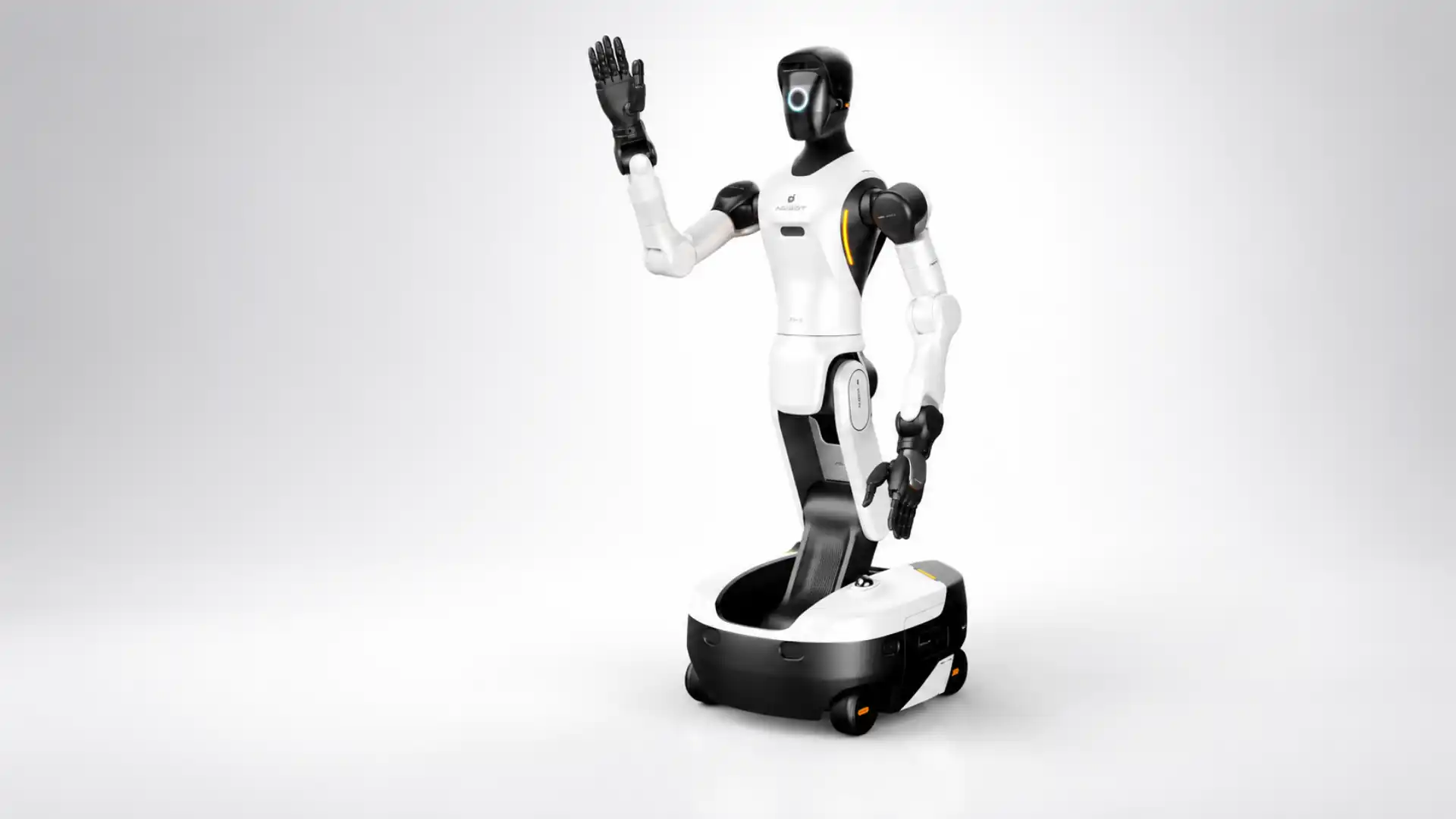
A robot may have a human-like upper body, two arms, a torso, sensors positioned near head height and an ability to work at benches or racks built for people. It may also use wheels rather than legs. That design choice can be an advantage in factories with flat floors, predictable aisles and indoor routes.
Bipedal walking is technically demanding. It requires balance control, repeated impact management, more energy, added mechanical complexity and careful fall prevention. Legs are useful where stairs, uneven terrain or human-only access routes matter. Many industrial sites do not need those capabilities.
A wheeled base offers stability, lower energy use, simpler navigation and less risk of a fall during normal indoor work. It also allows the upper body to focus on the job that creates commercial value: manipulating objects, operating equipment, loading fixtures and handling materials.
Agibot’s G2 is presented as a wheeled industrial embodied-AI robot. That format fits the Longcheer use case. A tablet-quality line does not require the robot to walk over rough ground or climb stairs. It requires safe movement through a controlled production area and accurate work at the station.
The body shape also does not need to copy every human feature. Five-fingered hands look general, but many industrial tasks are better handled by suction cups, parallel grippers, soft fingers, clamps, tool changers or customized contact surfaces. Agibot’s deployment reportedly used customized grippers for the tablet work. That is not a compromise. It is often the right industrial choice.
Factories do not pay for visual resemblance. They pay for reach, payload, repeatability, force control, tool compatibility, safety, maintenance and uptime.
A robot with two arms may be useful where one arm stabilizes an object while the other performs an action. It may also manage containers, trays, cables and parts that require coordinated movement. Yet two arms add cost, weight, collision complexity and more joints to maintain. Each task needs a real answer to a basic question: does the extra freedom create enough value to justify the added system complexity?
The same question applies to mobility. A fixed arm may be better where the work happens at one point all day. A wheeled robot may be better where the work shifts among several stations. A mobile manipulator with a non-humanoid upper body may be better still in some layouts.
The factory does not need a robot that resembles a person. It needs a machine that fits the physical and economic logic of a specific job.
Agibot’s trial should therefore be read as evidence for an industrial design choice as much as a software claim. Wheeled, bimanual robots may reach factories earlier than fully bipedal systems because they avoid a major layer of mobility complexity while preserving compatibility with many human-built workspaces.
Quality inspection exposes the real limits of embodied AI
Tablet inspection is an instructive first use case because it joins repetitive handling with fine tolerances.
A tablet may be light, but it is not easy to handle carelessly. Screens scratch. Glass reflects overhead lighting. Corners catch in fixtures. Protective films create glare. Cosmetic defects may be subtle. Product variants may differ in size, camera layout, button placement, ports, color or packaging.
The robot must handle the item gently enough to prevent damage while moving it confidently enough to keep up with the station. The line needs the system to recognize which item is present, orient it correctly, insert or position it accurately, wait for the test result and route it according to that result.
A traditional fixed automation cell can solve some of this very well. If every tablet is placed into a fixture at the same position, a fixed camera and a dedicated mechanism may operate with speed and exceptional repeatability. The case for a humanoid appears where the environment changes too often, materials are presented less predictably, several adjacent workflows need to be handled, or a full mechanical redesign would cost too much.
A key distinction must remain clear: moving a product and judging product quality are separate capabilities.
The robot may perform a physical movement while a fixed test station decides whether the tablet passes. That split can be sensible. Industrial systems often use purpose-built equipment for the measurement itself while assigning material handling to another machine.
The more ambitious use case gives the robot a role in the judgment. It may detect visible issues, compare images against accepted standards, decide whether a unit needs reinspection or route questionable products to a human. That raises the validation requirement sharply. False accepts may let defective products escape. False rejects may waste good material and slow the line. Both errors have financial consequences.
Machine vision has been part of manufacturing for decades. The new question is whether embodied AI makes it easier to combine vision with flexible movement. A robot that can reposition a product, change viewing angles, retrieve a unit for reinspection and handle unusual exceptions may add value beyond a static camera station.
The risk is uncontrolled complexity. If the robot’s flexibility introduces new variation into a quality process, the system may be worse than a simple fixed solution. The right design maintains a controlled inspection standard while using the robot’s mobility and manipulation only where they reduce friction.
Agibot’s public material does not yet disclose enough detail to determine where the G2 sat in that hierarchy. It is clear that the robots operated in a quality-inspection section and handled tablet-related production tasks. It is not yet clear which quality judgments were made by the robot, by fixed equipment, by operators or by a separate vision stack.
That detail should be part of future reporting. It would reveal whether the trial was primarily a material-handling deployment, a robot-assisted inspection system or a deeper embodied-AI quality workflow.
Availability is more important than a headline success rate
Availability is the percentage of planned production time during which an asset is ready to do its intended work.
That sounds simple. It is not.
For a humanoid robot, availability includes mechanical uptime, battery status, sensor health, network connectivity, calibration, charging or battery-swapping routines, software reliability, safety-system status, material supply, queue management, remote-support access and the time required to recover from exceptions.
A robot can complete 99.99% of attempted tasks and still be a poor factory asset if it spends too much time unavailable. It may need frequent charging. It may stop after a camera becomes dirty. It may require a skilled technician after a software fault. It may wait for a human because a tray is empty. It may become inactive whenever a worker crosses into its safety zone.
Availability must be paired with performance rate and quality rate. Industrial operations often use these measures as the basis for overall equipment effectiveness, or OEE. A machine with high availability but slow cycles may not meet output targets. A fast machine that creates damage does not create usable output. A robot that works well only when a specialist stands beside it may hide labor costs that erase the benefit.
A six-day trial is useful because it begins to expose these issues. Short demonstrations can avoid ordinary trouble through careful preparation. Multi-day operation creates more opportunities for environmental drift, minor faults, human interactions and routine operational variability.
The stronger next disclosure would include:
Planned production hours.
Active robot hours.
Charging or battery-swap time.
Scheduled maintenance.
Unplanned downtime.
Safety pauses.
Material-wait time.
Remote-support time.
Mean time to recovery.
Worst-case recovery time.
A buyer would also want to know whether the robot’s rate improved or deteriorated across the six days. Did the system become better as operators learned the workflow? Did it suffer wear? Did the environment become more difficult during different shifts? Did a software update occur? Were any tasks changed during the livestream?
This is not an argument against the Agibot result. It is the normal evidence standard for industrial equipment.
Traditional industrial robots became trusted because users learned to measure them through uptime, service intervals, spare-part availability, repeatability, cycle time and repair procedures. Humanoids must earn the same trust through the same operational discipline.
The useful benchmark is not whether a robot works. It is whether the factory can rely on it when the shift begins.
A failure taxonomy would make the claim more credible
A single task-success percentage compresses operationally different problems into one number.
A robot that misidentifies a tablet is not failing in the same way as a robot that loses a grip. A gripper fault is different from a safety stop. A blocked aisle is different from a software crash. A two-second retry is different from a 45-minute technician intervention. A harmless perception uncertainty is different from a product-damaging collision.
Factories need a failure taxonomy.
A useful public report would divide failures into categories such as:
Perception failure.
Grasp failure.
Placement failure.
Force-control error.
Motion-planning error.
Quality-inspection disagreement.
Safety-triggered stop.
Hardware fault.
Battery or charging issue.
Network or software interruption.
Material-flow exception.
Human-requested stop.
Each category should report frequency, median recovery time, worst recovery time, whether the system recovered automatically, whether a remote operator intervened and whether the event affected product quality.
That information would make the 99.99% claim far more useful. A rate near 100% is attractive, but the severity of the remaining failures matters more than the count alone.
Suppose seven task events did not meet the success definition. If all seven were harmless retries that took three seconds, the impact may be negligible. If one of them caused a 20-minute line stop or scratched a tablet, the commercial meaning changes.
A rare failure becomes more important as production volume rises. At 99.99%, one million task events would imply roughly 100 events outside the stated success definition if performance remained stable. Those events may be manageable, but they need to be understood.
The same logic applies to remote operation. Human intervention is not automatically evidence of failure. Many industrial systems rely on remote diagnostics, maintenance support and exception handling. The critical questions are how often support is needed, what skill level is required, whether the robot waits safely, and whether the support model scales from one factory to fifty.
A fleet that needs one remote specialist for every robot does not deliver the labor economics implied by a general-purpose workforce replacement story. A fleet that needs one specialist to supervise fifty robots may look very different.
The data also matter for safety. A robot that stops too readily may be safe but unproductive. A robot that continues operating under uncertainty may create unacceptable risk. The right trade-off depends on the task, the environment, the degree of separation from workers and the severity of potential harm.
Agibot’s livestream raised the industry’s public standard by placing a multi-day task count in front of viewers. The next step is a shared vocabulary for the failures that sit behind that number.
Conventional automation remains the main competitor
Humanoid robots are often presented as competitors to human workers. In many factories, their closest competitor is not a person. It is an existing automation option.
A dedicated industrial arm can move quickly, repeatedly and for long periods. It can be mounted beside a conveyor, programmed for one well-defined motion and fitted with a gripper engineered for a single part. It may cost less than a humanoid, require less energy and have a more established maintenance ecosystem.
A fixed machine-vision station may inspect a known orientation faster than a mobile robot. A custom feeder can make objects arrive in exactly the same position. A purpose-built fixture can eliminate the need for a sophisticated perception system. A conveyor can move material more cheaply than a walking or wheeled robot.
These are not arguments that make humanoids irrelevant. They define the work that humanoids should target.
A humanoid or mobile dual-arm robot is most plausible when fixed automation becomes too rigid or too expensive. That may occur when product variety is high, changeovers are frequent, workstations were built for people, part presentation varies, labor is difficult to staff, task demand fluctuates or the work cell changes often.
The decision should begin with the process, not the body form.
A task with stable geometry, very high volume, long product life and predictable material flow is likely to favor dedicated automation. A task with several product variants, irregular handling, human-designed tools, short production runs or frequent layout changes may favor a more flexible machine.
The answer may still be a collaborative arm, autonomous mobile robot or mobile manipulator rather than a humanoid. The most useful system is the one that meets the target with the least unnecessary complexity.
The International Federation of Robotics data provide a reminder of the scale of the established market. Annual industrial-robot installations remained above 500,000 for four consecutive years through 2024. Asia accounted for 74% of deployments, while China remained the largest individual market.
That installed base contains decades of engineering knowledge: safety cells, maintenance routines, service networks, programming practices, spare-parts supply, reliability testing and factory integration.
Humanoid suppliers need to learn from that history. A robot does not become industrial because it uses an AI model. It becomes industrial when it can be purchased, installed, maintained, serviced, insured and trusted on a production schedule.
Agibot’s own framing points in the right direction. The company positions embodied-AI robots for tasks that are less structured and more variable than the work typically handled by conventional automation.
The test is whether that positioning survives a plant engineer’s cost model.
The commercial case depends on avoided pain
A robot does not need to be cheap in absolute terms. It needs to cost less than the problem it solves.
That problem may be a labor shortage on an unpopular shift. It may be high turnover in repetitive work. It may be overtime. It may be difficulty recruiting workers for a physically tiring job. It may be a bottleneck that delays shipment. It may be repeated retooling costs when product designs change. It may be the inability to keep a station running through peak demand.
The wrong starting point is the robot’s purchase price.
The right starting point is the present cost of the process. A factory should calculate wages, overtime, benefits, training, absenteeism, turnover, ergonomics, quality losses, supervision, scrap, delayed output and the cost of line changes. It should then compare that with the robot’s total cost.
The robot side includes acquisition or subscription fees, integration, custom fixtures, safety systems, software, maintenance, spare parts, electricity, batteries, charging infrastructure, network changes, insurance, remote support, operator training and expected downtime.
A five-year total-cost-of-ownership model is more useful than a headline price. It also needs a sensitivity analysis. What happens if the robot is available 85% of planned time rather than 95%? What happens if remote support costs more than expected? What happens if a new product variant requires a week of reconfiguration? What happens if the supplier changes its pricing or cannot provide replacement parts quickly?
The economics can favor a flexible robot even when its per-unit cycle time is slower than a purpose-built machine. A fixed automation project may require months of design, procurement and validation. A mobile robot may begin useful work much sooner in an existing workspace. It may move to another task after a product change. It may avoid several separate machines.
The economics can also expose weak cases. If a fixed robot arm handles the task faster, more reliably and for less money, the humanoid may not deserve a place on that line. If a human worker performs the job cheaply, safely and consistently, robot deployment may create more trouble than benefit.
A factory buyer’s economic scorecard
| Measure | Core question | Evidence to request |
| Availability | Is the robot ready during planned production? | Active hours, downtime logs and recovery times |
| Throughput | Does it meet or improve takt time? | Median and worst-case cycle time by product variant |
| Quality | Does it reduce or preserve accepted output? | Damage rate, false rejects and defect escapes |
| Labor demand | Does the robot reduce hidden support work? | Interventions per 100 hours and staffing plan |
| Changeover | Can it switch work without long engineering delays? | Demonstrated setup time and validation process |
| Maintenance | Can the factory repair and sustain it? | Preventive maintenance, spares and service terms |
| Cost | Does it beat the current process over time? | Five-year total-cost model and sensitivity cases |
A pilot should answer whether the robot improves a defined job under factory conditions, not whether the technology looks promising in general.
Agibot’s trial is commercially relevant because it begins to provide data that a buyer can use as a starting point. It does not yet provide enough information to build a full cost model. That gap is normal for an early public deployment. It should shrink quickly if the company wants industrial customers to treat the result as more than a showcase.
Integration speed may become the decisive advantage
Flexible robots are attractive partly because traditional automation projects can take a long time.
A typical fixed automation project may involve site measurement, mechanical design, custom fixtures, safety guarding, electrical work, controls programming, machine interfaces, vision calibration, factory acceptance testing, operator training and production validation. That investment can deliver excellent performance. It can also become hard to justify for short product runs, frequent changes or uncertain demand.
The promise of a humanoid or mobile embodied-AI robot is not “no integration.” That phrase would be misleading.
The promise is less mechanical redesign for a broader set of changing tasks.
A robot that works at human bench height, uses existing aisles, handles existing containers and learns through demonstrations may reduce the amount of custom infrastructure needed. It may move from one station to another without being physically rebuilt into the line. It may allow a factory to test automation without committing to a permanent cell.
The claim must be measured carefully.
A vendor may say a robot was deployed in a few days while excluding weeks of process mapping, simulation, fixture work, network preparation and testing performed before the public launch. A plant may assign its best operators to support the trial. A supplier may send a large engineering team that is not economically realistic for every customer.
The right question is whether the process can be repeated.
Can the next deployment be installed with the same method? Can a systems integrator perform it? Can the customer’s own maintenance team take over? Can the robot learn a similar task at another site without a research project? Can the vendor provide documentation, version control and standard safety templates?
A pilot becomes a product only when the answers become routine.
Agibot said the Longcheer G2 integration moved from early engagement to mass-production-line use in four months. That is a noteworthy claim. It should be interpreted as an early integration case, not as proof that every factory can adopt the system in the same period.
The relevant benchmark will be replication. A G2 deployment at a second Longcheer site would be useful. A deployment at another electronics manufacturer would be stronger. A deployment at a factory with different layouts, lighting, processes and product variants would test whether the system travels well.
The winners in humanoid robotics may not be the firms with the most striking demonstrations. They may be the firms that reduce deployment work from months to weeks without compromising safety, quality or serviceability.
Vision-language-action models are changing the robot stack
The recent progress in embodied AI is tied to a change in robot software.
Traditional industrial robots are often programmed through explicit motion sequences, coordinates, rules and predefined logic. That approach works well in structured settings. It becomes costly when tasks involve visual variation, many product types or frequent changes.
Vision-language-action models, often called VLA models, aim to connect visual input, language understanding and physical action. A model may receive camera images, robot state, task instructions and context, then generate action choices or high-level plans for the machine.
Google DeepMind’s RT-2 project helped define the category. The research described a vision-language-action model that learned from web-scale visual and language data as well as robotic data, translating that knowledge into generalized robot instructions.
The appeal is clear. Instead of teaching every new task through extensive conventional programming, a technician may be able to demonstrate the task, describe it, provide examples and let the robot apply learned skills within a defined operating boundary.
A robot could recognize a new object type, understand that it should place it in a known fixture, infer that a box belongs in a particular bin or detect that a task has not reached the expected final state.
The limits are just as important.
A model can generate a plausible action that is physically unsafe, mechanically impossible or incompatible with a factory rule. It may recognize an object but misjudge its exact location. It may understand a task instruction but fail to account for friction, force, timing, collision risk or a changed fixture.
Physical work requires more than semantic understanding. It requires contact control, verified trajectories, calibrated sensors, reliable actuators and clear safety constraints.
NVIDIA’s Isaac GR00T work reflects the same direction. Its GR00T N1 project was presented as an open, customizable foundation-model approach for humanoid reasoning and skills, while later work has emphasized cross-embodiment capability.
The strongest industrial architecture will not hand full authority to a language model. It will layer learned intelligence with deterministic control and safety systems.
Low-level control manages joints, force, speed and immediate stops.
Motion planning enforces reachable and collision-free paths.
Task-level software chooses approved actions and handles workflow state.
Factory systems manage schedules, materials, traceability and quality records.
Human operators receive clear escalation paths for uncertain events.
A factory robot does not become safer because it sounds more intelligent. It becomes safer when its intelligence operates inside verified physical limits.
Robot data has become a manufacturing asset
Robots require data that differs from internet text, product images or generic video.
A useful robot-training dataset includes what the robot saw, what it did, how its joints moved, what force it applied, whether the task succeeded, how the environment changed and how a human corrected the process when something went wrong.
That data is expensive to collect because physical demonstrations take time. A person may need to teleoperate a robot, guide its arm, label outcomes, review difficult cases and repeat tasks across changing conditions.
Agibot has made data collection central to its strategy. Reuters reported in 2025 that the company operated a Shanghai data-collection facility where about 100 robots were teleoperated by around 200 people, operating for 17 hours per day.
Its AgiBot World paper describes more than one million robot trajectories across 217 tasks in five deployment scenarios, framed as a large-scale dataset for embodied intelligence.
Those claims do not guarantee real-world generalization. They do explain why companies in this field are investing in data operations rather than treating them as a side project.
A robot trained on neat demonstrations may fail when a part appears at an unfamiliar angle, when a tray is partly empty, when a camera sees glare, when the object is slightly damaged or when a person interrupts the usual sequence. The gap between training conditions and real conditions is known as distribution shift.
Factory deployment produces valuable data because it reveals those gaps.
Each rare event can become a lesson: a missing item, a poorly positioned tablet, a loose fixture, a blocked route, a failed grasp, a confusing reflection, a damaged surface or an unexpected human action. The robot supplier can use those cases to improve detection, recovery and task policies.
The data loop can become powerful. More deployments create more physical interaction data. More data improves policies. Better policies make deployments more attractive. More deployments create further data.
The loop only works if customers trust the governance around it.
Factories may not want images of products, proprietary processes, line layouts, quality defects or operational data sent to a vendor’s cloud. They may face contractual restrictions, export-control concerns, data-residency rules or trade-secret obligations. A supplier needs clear rules on data ownership, storage, access, retention, deletion and model training.
A buyer should ask whether raw video leaves the site, whether data is processed at the edge, whether cloud access is required for core operations, whether customer data trains shared models and whether a customer can require local retention or deletion.
A robot’s data policy may become as important to procurement as its arm reach or battery capacity.
Human demonstrations will remain part of the process
The image of a robot learning everything independently is appealing. Factory deployment will remain human-assisted for a long time.
People are good at demonstrating the small adjustments that make physical work possible. They sense whether a part is catching. They alter grip pressure. They notice when a cable is in the way. They choose a different approach angle. They recognize that a fixture is not fully closed. They understand when a process should stop rather than continue.
Teleoperation captures some of this knowledge. A skilled operator guides the robot through the motion while the system records visual input, joint states, force signals and action sequences. Those demonstrations can later support imitation learning, policy refinement or task teaching.
The human role does not disappear. It changes.
Workers may become robot trainers, cell supervisors, material handlers, quality validators, maintenance technicians, remote operators or exception managers. A factory may use experienced line workers to teach robots the work they understand best. That can retain valuable process knowledge rather than forcing it out of the organization.
The labor economics must include those people.
If every robot requires one dedicated operator, the system may still have value in hazardous or hard-to-staff work, but it is not a labor-substitution machine in the simple sense. If one operator can supervise a fleet, the economics change. If the robot handles routine tasks and calls for help only in rare cases, the process may free people for higher-value work.
This is also where the rhetoric around “autonomy” needs restraint.
A robot that handles 99% of actions without human input may be useful. A robot that needs a remote worker to recover from every unusual event may not scale easily. A robot that improves through human demonstrations may become more capable over time, but only if the data pipeline, safety validation and update process are controlled.
The Longcheer trial reportedly involved human operators in the production environment. Public reporting has not stated how many people supported the deployed G2 units, how often they intervened or whether those interventions were physical or remote.
Those details matter because they define the true operating model.
A humanoid robot should be evaluated as part of a human-machine system, not as a standalone worker.
China’s industrial base gives local robot makers an advantage
China’s humanoid-robot push is tied to more than investor enthusiasm.
The country has dense supply chains in motors, reducers, batteries, cameras, displays, sensors, electronics, machine tools, industrial controls and consumer hardware. It also has a large manufacturing base where automation buyers, systems integrators and component suppliers already understand factory requirements.
That creates an iteration advantage.
A robot company may discover that an actuator heats too quickly, that a wrist needs more torque, that a camera placement produces glare, that a connector fails under repeated motion or that a gripper material marks a product surface. In a dense local supply network, it may be able to test alternatives quickly, build revised hardware and return to a customer site faster than a company dependent on a dispersed supply chain.
Reuters has reported that Chinese humanoid-robot developers benefit from deep component supply, policy support and a large manufacturing base, while also facing intense competition and questions about commercial durability.
The International Federation of Robotics figures reinforce the market context. China accounted for more than half of global industrial-robot installations in 2024 and had an operational stock exceeding two million industrial robots.
That does not mean every Chinese factory is ready for humanoids. It does mean that many potential customers already understand automation procurement. They know that a robot needs service, integration, safety design, uptime and support. A humanoid company can sell into an ecosystem with experienced automation engineers and established production disciplines.
Public policy also plays a role. Government support can fund research, pilot projects, component supply and demonstration facilities. It can accelerate the formation of a domestic industry. It cannot create durable customer demand by itself.
A subsidized pilot can generate headlines. A recurring production contract requires real operating value.
Agibot’s factory livestream can be read as an attempt to move the discussion from policy ambition to factory evidence. The company is trying to make its case through tasks, hours and output rather than through general claims about artificial intelligence.
That is the correct direction. China’s advantage will not rest on robot quantity alone. It will rest on whether companies can turn supply-chain speed, data collection and manufacturing access into deployments that work repeatedly across customers.
Safety remains a central industrial barrier
A mobile dual-arm robot introduces physical risks that do not disappear because the machine uses advanced AI.
It can strike a person. It can pinch fingers. It can drop a product. It can collide with equipment. It can move unexpectedly after a software error. It can create hazards during charging, maintenance, manual recovery or emergency stops. It can become dangerous if a sensor is blocked or a network connection fails.
Safety begins with risk assessment.
The assessment needs to examine the specific work cell. What happens when a worker enters the robot’s area? How quickly can the machine stop? Where are the pinch points? What happens if the robot drops a tablet? What happens if a gripper fails? Can the machine move during maintenance? How are batteries isolated? Who has authority to reset the system? Does a camera or lidar failure force a safe stop?
The current industrial-robot safety framework remains highly relevant. ISO 10218-1:2025 covers safety requirements for industrial robots, including inherent safety design, risk reduction and information for use. ISO 10218-2:2025 addresses industrial robot applications and robot-cell integration.
Humanoid robots may create situations not fully anticipated by older fixed-cell assumptions, particularly when they move through shared areas or work near people. That does not remove the need for established safety practice. It makes rigorous implementation more important.
A robot may operate beside people only at reduced speed and force. It may need safety-rated monitored stops, area scanners, light curtains, pressure-sensitive devices, physical barriers or tightly defined work zones. It may be safer to separate the fast portion of a task from nearby workers rather than insist on direct human-robot coexistence.
The most dangerous marketing phrase in this field may be “works safely alongside people” without specific conditions. Every safe collaboration claim depends on the motion, payload, environment, safeguard design, operator behavior and risk assessment.
The U.S. Occupational Safety and Health Administration emphasizes hazard evaluation and controls for robot systems in workplace settings. The core lesson applies everywhere: hazards must be identified before operation, not after an incident.
For Agibot, future public demonstrations would gain credibility from clear safety disclosure. That could include the cell layout, stop behavior, safety sensors, operating-speed limits, human access rules and recovery procedures. Such detail may seem less exciting than a task count. It is what plant safety officers, insurers and operations leaders need to see.
A robot’s intelligence cannot replace safeguards. It raises the need to prove that safeguards still work when behavior varies.
Regulation will shape deployments outside China
Humanoid robot companies face more than technical and commercial questions. They also face machinery rules, workplace-safety requirements, data-protection obligations, cybersecurity expectations, AI governance and product-liability exposure.
The exact legal position depends on where the robot is sold, where it operates, how it is integrated, what data it processes and whether it works near people. A robot sold as a standalone product may have different compliance responsibilities from one delivered as part of a complete integrated work cell.
In the European Union, Regulation (EU) 2023/1230 on machinery will apply from January 20, 2027. It replaces the prior machinery directive framework and addresses machinery safety in a world where software and digital systems play a larger role in equipment behavior.
The EU AI Act adds a second governance layer. Regulation (EU) 2024/1689 establishes a risk-based framework for artificial intelligence systems placed on the EU market or used within the EU. Not every factory robot will be classified in the same way. The legal analysis depends on the intended use, system function and deployment context.
The direction is clear. Suppliers need technical documentation, risk assessment, traceability, human oversight, update governance and incident management. Customers need to know which model version is running, what changes after an update, whether a new policy alters behavior and who remains responsible if the system fails.
Cross-border deployment creates additional complexity. A robot may be designed in China, trained with data from multiple countries, sold through a regional distributor, integrated by a local systems firm and serviced through remote access from another jurisdiction. Each connection raises questions about cybersecurity, trade secrets, data transfer and liability.
Factories cannot treat those questions as an afterthought.
A mature vendor will arrive with safety documentation, cybersecurity material, data-processing terms, update procedures, field-service commitments and clear allocation of responsibilities. A vendor that cannot provide those basics may struggle even if the robot performs well in a pilot.
Regulation can slow deployment. It can also separate serious industrial suppliers from companies focused on demonstrations.
Cybersecurity becomes physical security
A networked humanoid robot is part of operational technology.
Operational technology directly interacts with physical processes. A robot senses the factory, moves through it, manipulates materials and may connect to production systems. A cybersecurity failure may therefore create more than data loss. It can stop a line, damage products, expose trade secrets or create physical hazards.
The attack surface is broad.
Robots may use cameras, depth sensors, lidar, onboard computers, wireless connectivity, fleet-management platforms, cloud services, charging stations, remote-support portals, update systems and interfaces with manufacturing execution systems or programmable logic controllers.
A compromised account could give an attacker access to robot controls. A damaged update pipeline could distribute unsafe software. A ransomware event could halt a fleet. A fake sensor feed could cause poor decisions. Poorly segmented networks could give a robot-support system access to wider factory infrastructure.
NIST’s Guide to Operational Technology Security emphasizes that OT systems need security practices adapted to their reliability, performance and safety requirements.
A factory deploying humanoids should require network segmentation, strong authentication, signed software updates, controlled remote access, logging, patch-management procedures, asset inventories, vulnerability disclosure processes and rollback plans.
Remote support needs particular discipline. Vendors often need access to diagnose faults, review telemetry or assist with updates. That access should be time-limited, approved, authenticated and logged. It should not create an unrestricted permanent path into sensitive production networks.
The buyer should also ask what happens when cloud connectivity fails. Can the robot continue safely with local control? Does it stop? Which functions disappear? Does the system retain local logs? Is remote inference required for motion decisions? What data leave the plant during ordinary operation?
NIST’s AI Risk Management Framework offers a useful governance structure: govern, map, measure and manage. Applied to robots, that means assigning accountable owners, identifying hazards and vulnerabilities, measuring performance and failures, and managing system changes through documented procedures.
A robot that is secure on installation day but receives uncontrolled updates six months later is not secure in any practical factory sense.
Labor effects will depend on deployment choices
Humanoid robots create immediate concern because they resemble workers and are designed to enter workspaces built for people.
The fear of job loss is understandable. A robot that handles repetitive material movement or inspection may reduce demand for certain tasks. The effect will differ by factory, labor market, shift pattern, product mix and management strategy.
Some early robot deployments focus on work that is physically tiring, difficult to staff or unpopular. Repetitive lifting, awkward reaches, night-shift material movement and monotonous inspection are often cited as candidates. Those uses may reduce injury exposure and allow workers to move toward quality, maintenance, supervision or training roles.
That outcome is not guaranteed.
A company may use robots to reduce staffing without investing in retraining. It may move remote-support roles elsewhere. It may increase pressure on the workers who remain. It may create higher-skilled maintenance jobs while reducing entry-level work. The distribution of gains depends on management, bargaining power, policy and local labor conditions.
Reuters has reported that China’s humanoid-robot drive is connected to demographic pressure, manufacturing strategy and concern about the social consequences of automation.
The factory-level question is practical: which work is changing, who does the new work, who receives training and how is performance measured?
A better deployment model starts with task redesign. Identify the actions that create injury risk, repeated strain, high turnover or chronic staffing gaps. Move those actions first. Give experienced workers a role in teaching, validating and supervising the robot. Track ergonomic outcomes, overtime, absenteeism and retention alongside throughput.
The human contribution also remains vital for exception handling. A robot may process routine items while people deal with unusual defects, unusual configurations, unclear quality states or equipment problems. That arrangement can make work more skilled. It can also make it more stressful if staffing is cut too aggressively.
A company that treats workers as part of the deployment system is more likely to capture practical knowledge. Workers know the small deviations that formal process maps miss. They know which parts tend to stick, which fixtures wear out, which product variants cause trouble and which production shortcuts create quality problems.
Factory robots do not dictate a labor outcome. Management decisions do.
Other deployments show the sector is becoming more concrete
Agibot’s trial is part of a wider push by humanoid-robot companies to provide evidence from real operating environments.
BMW said in February 2026 that Figure 02 had supported production of more than 30,000 BMW X3 vehicles over ten months at its Spartanburg plant in the United States. BMW said the robot worked ten-hour shifts from Monday to Friday and handled sheet-metal parts for a welding process.
That was also a company-reported result, and it should be read with the same scrutiny applied to Agibot. Yet it matters because it points to a common direction: large manufacturers are allowing humanoid systems into production-adjacent work and reporting hours, shifts and output-related activity rather than only staged demonstrations.
Agility Robotics has also positioned its Digit robot for commercial logistics work, including deployments connected with GXO operations. Digit’s early focus has centered on mobile material handling rather than delicate electronics inspection.
Tesla continues to present Optimus as a long-term general-purpose humanoid program. Its 2025 update referred to a Gen 3 design and preparation for a pilot production line before the end of 2026. Manufacturing a robot at volume, however, is different from proving that the robot delivers verified customer value over long periods.
Hyundai has outlined plans to introduce Boston Dynamics Atlas humanoids into U.S. factory activity from 2028, initially focusing on repetitive and high-risk industrial tasks.
Schaeffler and UK-based Humanoid announced plans for a large future deployment program, with early deployment activity expected from late 2026 into 2027.
The common theme is not that humanoids have already become routine industrial equipment. They have not.
The common theme is that manufacturers are moving from curiosity toward controlled operating trials. They are selecting narrow work cells, defined tasks, limited production roles and measurable output.
This is where the industry becomes less cinematic and more serious.
The companies most likely to succeed will not be those that claim a robot can replace a full worker across every situation. They will be those that identify tasks where their machines perform well enough, safely enough and cheaply enough to earn a place beside existing automation.
The road from trial to commercial scale is long
A factory trial proves that a robot can work somewhere. Commercial scale proves that a company can deliver, support and expand a product across many sites.
Those are different achievements.
Commercial scale requires consistent hardware manufacturing, qualified suppliers, component testing, field-replaceable parts, repair procedures, spare inventories, service technicians, training programs, software-version control, fleet management, cybersecurity operations and customer support.
A robot can perform well as a carefully maintained prototype while becoming less reliable when manufactured at larger volume. Component tolerances matter. Calibration routines matter. Assembly quality matters. Battery performance matters. Supply-chain disruptions matter.
Software scaling has a similar problem. A vendor may manage one factory with direct engineer support. Fifty factories require monitoring tools, remote diagnostics, customer-specific data separation, update approval, rollback capability, support tickets and documented escalation procedures.
A bug that affects one unit is a technical problem. A bug that affects a fleet becomes an industrial incident.
Agibot said its 15,000th robot rolled off the production line in June 2026 and identified the milestone unit as a G2 industrial robot. That figure demonstrates manufacturing ambition. It does not mean 15,000 G2 humanoids are operating in factories.
The key commercial questions are more specific:
How many G2 units are in paid industrial operation?
How long have they worked?
Which customers have expanded from pilot to recurring orders?
What service commitments exist?
How much human support does each fleet require?
How often do customers redeploy the robots to new tasks?
What is the maintenance cost per operating hour?
Public answers to those questions would matter more than a broad shipment total.
A durable humanoid business will likely need more than hardware sales. It may combine robot leasing, software subscriptions, maintenance contracts, task libraries, integration services, remote operations and training. Each model carries different risks for buyers.
Robots-as-a-service can reduce up-front capital demands. It can also create dependence on a supplier’s ongoing financial health and service capacity. A buyer needs exit rights, support guarantees, data protections and clarity on what happens if the vendor changes strategy.
Scale begins when deployment, support and economics become repeatable rather than exceptional.
The next evidence should be harder to ignore
Agibot has set a useful public benchmark. The company can make the benchmark stronger through transparency.
A future report should disclose the number of deployed robots, the exact task definitions, station cycle time, planned versus active hours, downtime causes, hardware faults, battery routines, human intervention rate, remote-support time, product-damage figures, quality outcomes and maintenance needs.
It should distinguish robot success from line success.
It should also clarify whether the 17,625 tablets represent units handled by the robots, units whose process was partly supported by the robots, or finished units attributable to a specific robot-enabled station.
A before-and-after comparison would be valuable. The report could compare output, labor hours, defect rate, downtime and ergonomics before robot deployment and during robot-assisted operation. A matched comparison across similar shifts or lines would be stronger.
Independent review would add further credibility. That review could come from the customer, a systems integrator, an insurance partner, a testing organization or an academic lab with access to logs and plant data. It does not need to expose proprietary process details. It does need to confirm that the numbers mean what they appear to mean.
Public livestreams may become a regular format for this industry. They are imperfect, but they are better than edited clips. A continuous camera feed makes it harder to hide every recovery, reset and operator intervention. It still cannot show all system data. A livestream should be combined with transparent metrics and defined acceptance criteria.
The sector also needs shared terminology.
What is a task?
What counts as success?
What counts as a human intervention?
What counts as availability?
What is autonomous recovery?
What is a safety stop?
What is a production-impacting failure?
Without common definitions, a 99.99% claim from one vendor cannot be fairly compared with a 99.5% claim from another.
The next competitive advantage may belong to the company willing to publish the most disciplined operational evidence.
A buyer’s first pilot should be narrow and demanding
Factories interested in humanoid robots should avoid broad promises and start with one bounded process.
The selected task should have measurable pain. It may be physically repetitive, difficult to staff, costly to reconfigure or prone to inconsistency. It should have a stable input and output, defined quality criteria and a clear baseline.
The first step is process observation. Engineers and operators should record current cycle time, task variation, product mix, ergonomic risk, error sources, downtime causes, material flow and staffing requirements.
The second step is a site survey. Measure aisle widths, floor conditions, lighting, wireless coverage, charging options, emergency exits, safety zones, access points, fixture dimensions and machine interfaces.
The third step is an acceptance plan. Define the required availability, target takt time, quality threshold, allowed human-support rate, safety conditions and cost assumptions before the robot arrives.
The pilot should last long enough to encounter ordinary problems. Two hours can test basic integration. Two weeks can reveal routines and simple failures. A month begins to expose changeovers, maintenance, shift variation and operator adaptation. A three-month program gives a better picture of serviceability and sustained value.
The contract should state who owns data, who can access logs, who approves software changes, who responds to incidents, who bears responsibility for product damage, and how the factory can stop or end the pilot.
The vendor should have room to improve the system. The factory should retain control over production safety and sensitive data.
A pilot should not be judged by whether the robot impresses visiting executives. It should be judged by whether it performs the intended work safely, reliably and economically.
That standard protects everyone. It prevents buyers from spending on spectacle. It gives suppliers a fair way to prove value. It gives workers clarity about the role the machine will actually play.
The next 18 months will separate products from performances
Humanoid robotics is entering a period of sorting.
Some companies will remain focused on research platforms, entertainment, marketing demonstrations or low-volume specialty uses. Some will become component suppliers, data providers or software-platform companies. Some will find narrow but profitable industrial roles. A smaller group may build repeatable products with long-term customer contracts.
The dividing line will not be whether a robot can walk, dance, run or mimic a person. It will be whether it can perform a defined work cell through normal factory disorder.
Which systems can move materials without creating congestion?
Which systems can handle delicate electronics without damage?
Which systems can operate across shifts without excessive intervention?
Which systems can be repaired by trained local staff?
Which systems can move from one product variant to another without a lengthy engineering project?
Which suppliers can meet safety, cybersecurity and data-governance requirements?
Which systems retain value after the publicity around the first trial fades?
The market is likely to fragment by task. Some robots will concentrate on box movement, tote handling, parts presentation, inspection support, machine tending, warehouse picking or low-payload assembly. A single general-purpose machine may eventually perform many of these jobs. The first commercial successes will probably remain task-specific.
That is not a failure of the humanoid vision. It is how industrial technology normally enters the market.
A six-axis arm did not need to solve every manufacturing problem to become indispensable. An autonomous mobile robot did not need to navigate every environment to gain a place in warehouses. Humanoid robots do not need to replace full human workers to create a large business.
They need to deliver reliable work where conventional automation is too rigid and manual work is too costly or difficult.
Agibot’s Nanchang trial belongs to this more practical phase. The company has supplied a public claim with enough detail to invite serious examination. It has not supplied all the evidence required to settle the business case.
The coming period will determine whether Agibot can repeat the result across shifts, sites, customers and product categories. That is the real test.
The strongest reading of Agibot’s result
Agibot’s factory livestream should not be treated as proof that general-purpose humanoid labor has arrived.
It should not be dismissed as another robot video either.
The company has reported a six-day public deployment in a live tablet-production setting, with more than 64 hours of operation, 64,828 task events, more than four workflows, a claimed 99.99% success rate and involvement in output totaling 17,625 tablet units.
Those figures are strong enough to matter.
They are also incomplete.
The public record does not yet provide a full task taxonomy, independent verification, availability breakdown, detailed downtime analysis, human-support figure, quality comparison, safety record or cost model. Those omissions prevent a broad conclusion about industrial readiness.
The most credible conclusion is narrower.
Agibot has produced one of the more concrete public factory demonstrations yet seen in humanoid robotics.
The next question is not whether the company can stage another livestream. It is whether it can deliver transparent, repeatable and economically credible deployments across real factories.
The answer will depend on hardware durability, data quality, integration speed, safety engineering, service capacity, customer trust and the discipline to report failures as honestly as successes.
That is the standard the industry should now apply to every humanoid-robot company.
The practical questions readers are asking about Agibot’s factory trial
Agibot reported a 99.99% task-success rate during the June 23–28, 2026 factory livestream. The result is company-reported and has not been publicly independently audited.
Agibot reported more than 64 operating hours during the six-day factory demonstration.
The company reported 64,828 production-line task events across more than four workflows.
Agibot said the robots contributed to cumulative line output of 17,625 tablet units. The public material does not state that the robots independently completed every assembly stage.
The trial took place at Longcheer Technology’s tablet factory in Nanchang, China.
Agibot used multiple G2 industrial embodied-AI robots, which have a wheeled mobile base and dual-arm configuration.
Agibot has not publicly provided a detailed definition. It likely refers to successful completion of discrete production actions such as picking, placing, transferring or handling tablets during inspection workflows.
It is a strong reported result, but buyers also need availability, cycle time, quality impact, maintenance data, human-support levels and total-cost analysis.
Task success measures whether attempted actions meet a defined criterion. Uptime or availability measures whether the robot is ready during planned production time.
A factory includes varying lighting, material changes, human activity, equipment interfaces, production timing and ordinary operational disruptions that are often absent in controlled demonstrations.
Not in every use case. Dedicated industrial arms remain better for many stable, high-volume tasks. Humanoids may fit more variable, human-designed environments.
They are most plausible where product variation is high, fixed automation is difficult to justify, workspaces are designed for people and labor shortages or repetitive tasks create pressure.
Yes. Workers may train robots, manage materials, validate quality, maintain equipment, handle exceptions and supervise fleets.
ISO 10218-1:2025 and ISO 10218-2:2025 are central industrial-robot safety standards. Every deployment also needs a task-specific risk assessment.
Networked robots can introduce risks through remote support, software updates, sensors, fleet-management systems and connections to factory operational technology.
They are AI systems that connect visual input and language understanding with physical robot actions. They may improve task learning, but industrial deployments still require deterministic control and safety limits.
Useful next disclosures include task definitions, robot count, downtime causes, human interventions, cycle time, quality outcomes, maintenance records, safety events and cost comparisons.
Set a baseline before deployment, choose one bounded task, define availability and quality targets, track human support and compare the robot-enabled process with the existing method.
They may reduce some repetitive tasks while creating new work in maintenance, supervision, integration and training. The outcome depends on management choices and labor policy.
It provides a concrete company-reported example of multiple humanoid robots operating for days in a live tablet-production environment. It does not yet prove broad independently verified adoption across factories.
Author:
Jan Bielik
CEO & Founder of Webiano Digital & Marketing Agency
This article is an original analysis supported by the sources cited below
Agibot concludes six-day real factory livestream
Agibot’s June 2026 report on the Nanchang livestream, including the operating time, task count, reported task-success rate, workflow count and tablet-output figure.
Agibot announces Longcheer factory livestream
Agibot’s announcement of the June 23–28, 2026 live factory demonstration at Longcheer Technology’s Nanchang facility.
Agibot and Longcheer Technology deployment announcement
Agibot’s April 2026 account of G2 robots entering Longcheer tablet production workflows.
Agibot’s 15,000th robot milestone
Agibot’s June 2026 manufacturing milestone announcement identifying the G2 as the 15,000th robot produced.
World Robotics 2025 industrial robots
International Federation of Robotics data on 2024 industrial-robot installations, regional demand and worldwide operational stock.
AgiBot World Colosseo
Research paper describing AgiBot World’s embodied-AI dataset, task coverage and robot-trajectory collection approach.
China’s robot quest triggers system overload
Reuters Breakingviews analysis of China’s humanoid-robot market, funding, sales levels and commercial constraints.
Chinese robot maker AgiBot plans Hong Kong IPO
Reuters reporting on Agibot’s growth plans, data-collection operations and financing ambitions.
BMW Group to deploy humanoid robots in production
BMW’s February 2026 report on Figure 02 activity at Spartanburg and future production plans.
Successful test of humanoid robots at BMW Plant Spartanburg
BMW’s 2024 statement on Figure 02 testing in its U.S. manufacturing environment.
Digit deployed at GXO
Agility Robotics’ account of Digit entering commercial logistics operations with GXO.
Tesla Q4 2025 update
Tesla’s investor update covering Optimus Gen 3 and its stated production-line preparation plans.
RT-2 translates vision and language into action
Google DeepMind’s explanation of the RT-2 vision-language-action research project.
Gemini Robotics
Google DeepMind’s current information on Gemini Robotics vision-language-action models and embodied reasoning systems.
NVIDIA Isaac GR00T N1
NVIDIA’s announcement of a foundation-model approach for humanoid robot reasoning and skills.
Open X-Embodiment
Academic research on learning across different robot embodiments and large-scale robotics datasets.
ISO 10218-1:2025
International safety requirements for industrial robots, including inherent safety design and risk reduction.
ISO 10218-2:2025
International safety requirements for industrial robot applications, integration and robot cells.
EU Machinery Regulation
Regulation (EU) 2023/1230 governing machinery safety requirements in the European Union.
EU Artificial Intelligence Act
Regulation (EU) 2024/1689 establishing harmonized rules for artificial intelligence in the European Union.
NIST AI Risk Management Framework
NIST’s framework for governing, mapping, measuring and managing AI risks.
NIST Guide to Operational Technology Security
NIST guidance on securing operational technology systems while preserving safety, reliability and performance.
OSHA robotics hazard evaluation and solutions
U.S. workplace-safety guidance on identifying and controlling hazards associated with industrial robots.
Hyundai plans humanoid deployment at U.S. factory
Reuters report on Hyundai’s stated plans to introduce Boston Dynamics Atlas robots into factory operations.
Humanoid plans Schaeffler factory deployment
Reuters report on Humanoid’s planned future deployment program with Schaeffler.
| Citing this article? Brief excerpts are welcome. Please credit Webiano.digital, name the author where stated, and include a link to https://webiano.digital and to this original article. Full or substantial republication requires prior written permission. Read our Copyright and Content Use Policy. |
This article was prepared with the assistance of artificial intelligence tools. The content underwent expert human review, and Webiano Digital & Marketing Agency assumes editorial responsibility for its final version and publication.