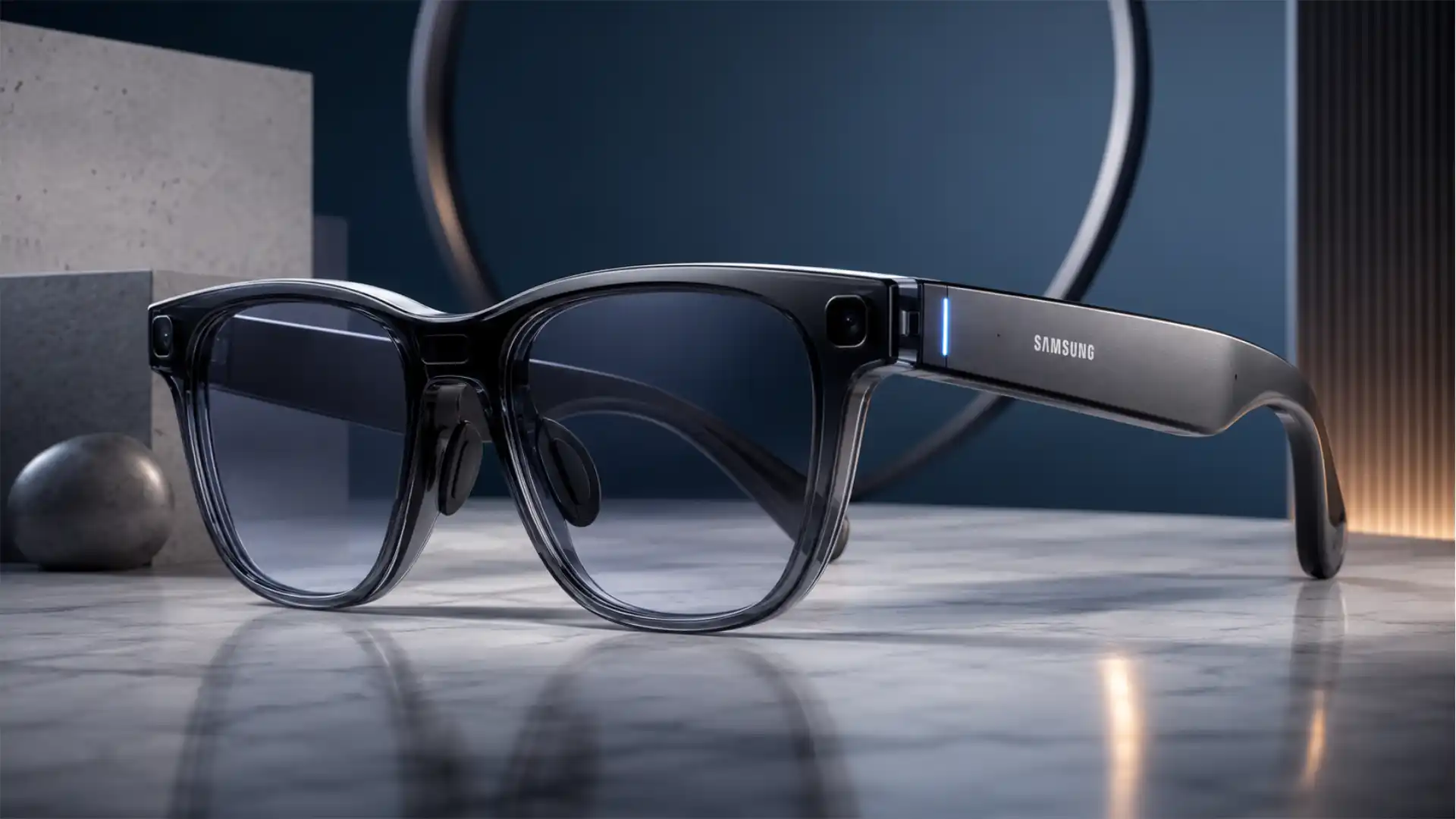
Samsung is not entering an empty market. Meta has already built the closest thing the smart-glasses category has to a consumer lead: camera-and-audio glasses sold through recognised eyewear brands, a more expensive display model, a maturing retail presence, and a social distribution machine that turns first-person capture into a habit. In 2025, global smart-glass shipments reached 9.6 million units, with Meta accounting for about 76.1% of them, according to IDC data reported by Reuters. Samsung and Google are therefore not trying to create public interest in a new form factor. They are trying to take share from the company that has made AI glasses feel normal enough to wear outside.
Table of Contents
The important correction is that Samsung has not yet launched a retail product called “Galaxy Glasses,” and it has not publicly published the full specification sheet, price, weight, battery life or country-by-country availability for the eyewear shown at Google I/O 2026. What Samsung and Google have shown is still consequential. On May 19, 2026, they presented two premium “intelligent eyewear” styles made with Gentle Monster and Warby Parker. Google says the first wave will be audio glasses arriving later in fall 2026, with Gemini available through voice, alongside functions such as directions, messaging and hands-free photo capture.
That makes the contest less tidy than “Samsung versus Meta.” Samsung supplies hardware engineering, Google supplies Android XR and Gemini, while Gentle Monster and Warby Parker bring fashion, fitting and optical retail. Meta, by contrast, has spent years tightly joining its own AI, social apps, hardware roadmap and EssilorLuxottica’s brands, manufacturing and stores. The two efforts are competing for the same place on a person’s face, but they are using opposite industrial logic. Meta has built a vertically coordinated product business. Samsung and Google are attempting a platform coalition.
The coalition has one clear advantage: it can give Android users an alternative to a wearable tied to Meta’s services without asking them to abandon familiar phones, maps, messages or assistants. It has one immediate weakness: alliances look powerful on stage, while products win only when their fit, setup, support, battery life, prescription options and camera behaviour survive daily use. A beautiful collaboration does not remove the awkwardness of charging a frame, speaking aloud to an assistant in a quiet train carriage, or explaining to strangers that the camera light means a recording is active.
This analysis separates public facts from inference because smart glasses remain unusually vulnerable to enthusiastic leaks, prototype assumptions and wishful extrapolation. Samsung, Google, Warby Parker and Gentle Monster have confirmed the partnership, the companion-phone model, the first audio-first launch and the intent to bring Gemini into everyday eyewear. They have not confirmed many of the details people usually use to judge a consumer device. The absence of a specification is itself information: the companies are still selling the idea of the category before they sell the finished hardware.
The evidence standard here is deliberately strict: company announcements establish what has been announced, while unverified reports remain clearly marked as reports rather than product facts.
The public announcement is narrower than the headline
The phrase “Samsung’s new smart glasses” is useful shorthand, but it can hide the division of labour.ccribed intelligent eyewear created with Gentle Monster and Warby Parker. Samsung called the glasses a companion device to a mobile phone, intended to provide help through voice interaction and a familiar frame. Google supplied the clearer product taxonomy a few lines later: audio glasses first, display glasses later.
That split matters because audio glasses and display glasses solve different problems. Audio glasses replace small moments of phone use with spoken responses, open-ear audio, microphones, cameras and an assistant that sees or hears enough to answer. They can feel almost like ordinary eyewear because no visible image engine has to sit in the lens. Display glasses add a second layer of complexity: waveguides or other optical systems, brightness management, alignment, eye-box tolerance, power consumption, thermal management, and user-interface questions that become more difficult once text is floating close to the wearer’s eye.
Google’s wording leaves little doubt about the near-term sequencing. It says audio glasses are launching first later in fall 2026. The statement does not promise that the first Samsung-linked frames will carry an in-lens display, nor does it name a commercial model, price band or launch market. The companies demonstrated the larger Android XR direction: glasses that may offer spoken assistance or visual information, both using Gemini. But the only public retail timing applies to the audio-first category, not to a full augmented-reality product.
This discipline is more than pedantry. A non-display pair could directly meet Meta’s most important commercial product on its own terms: lightweight frames with cameras, microphones, speakers, an AI assistant and phone-linked services. A display product would instead face Meta Ray-Ban Display, which begins at $799 with a full-colour display in the right lens and a wrist-worn Neural Band for subtle gesture control. The jobs overlap, yet the engineering, price expectations and daily habits differ sharply.
The announcement also does not settle who owns the customer relationship. A buyer may meet the product through a Warby Parker store, a Gentle Monster collection, a Samsung phone setup flow, Google’s Android software or a carrier and electronics retailer. Meta’s model is far more legible: the glasses appear under Meta, Ray-Ban and Oakley branding, with a Meta app and a direct path into Instagram, WhatsApp and Messenger. Samsung and Google need to decide whether their strength lies in presenting one unified experience or letting each eyewear label keep a distinct customer identity.
There is a strategic benefit to leaving the commercial architecture open. Google can bring Android XR to multiple frame partners rather than making a single hardware bet. Samsung can demonstrate its component, device-integration and industrial-design role without having to persuade the market that consumers want one more Galaxy sub-brand. Warby Parker and Gentle Monster retain their reason for participating: they are not merely distributing a generic gadget; they are presenting eyewear as part of their own design language.
Still, ambiguity becomes costly once preorders open. Shoppers buying prescription frames need clear answers on lens options, refitting, repairs, water resistance, warranty, battery replacement, camera quality and data handling. They do not buy an “ecosystem” for their face. They buy a pair of glasses, then judge every compromise against the ordinary glasses they already own. Samsung’s first real test is not whether the partnership sounds credible. It is whether a buyer can understand exactly what they are purchasing in less than five minutes.
Audio glasses are the practical opening move
Starting with audio glasses is not a retreat from ambition. It is a practical acknowledgement of the constraints that have slowed augmented-reality eyewear for more than a decade. Every gram matters when a device sits on the bridge of the nose. Every extra milliwatt generates heat close to the temples. Every millimetre of lens thickness changes the face that buyers see in a mirror. A product that gets any of those details wrong becomes a demonstration device rather than a daily object.
Google’s audio-first approach points to a familiar use pattern. A wearer asks Gemini for a fact, a reminder, a translation or directions; hears a response through open-ear speakers; captures a photo or sends a message without lifting a phone. The assistant does not need to occupy the visual field for every task. For many interactions, a display might even be a distraction. Walking directions can be spoken. A restaurant’s opening time can be read aloud. A calendar prompt can arrive as a brief sound. The glasses earn their place by shortening interruptions, not by turning every errand into an interface demo.
This is precisely the territory where Meta has made progress. Ray-Ban Meta Gen 2 pairs a camera, microphones, open-ear audio and Meta AI with conventional-looking frames. Meta says the generation offers up to eight hours of typical use, a charging case with up to 48 additional hours, 3K Ultra HD video capture, and live translation that can work offline once language packs are downloaded. The product is not merely a camera on a face; it is a phone-adjacent device that handles calls, music, prompts and first-person media.
Samsung and Google should not assume that matching feature lists will be enough. A voice request works only when wake-word detection is dependable, microphones are intelligible in wind and traffic, the assistant understands intent, speakers remain understandable without broadcasting private audio, and the phone connection remains stable. Every failure feels more personal on glasses than it does on a phone because the device has displaced a familiar action. Pulling out a phone is slow but predictable. Asking a frame a question that gets misheard in public is fast only in the successful case.
Audio glasses also frame a more defensible social compact than display glasses. The wearer looks outward rather than downward. A companion may still notice a camera and worry about recording, but the wearer is not obviously reading a floating prompt during a conversation. That does not eliminate privacy concerns. It reduces one source of interpersonal friction: the fear that an ordinary interaction is being supplemented by unseen text, notifications or instructions.
The first release will also show whether Google has learned from its own history with Glass. The early product’s stigma was not only about cameras. It was about a device that looked like a device. Smart glasses now have a different opening because compact cameras, microphones, battery systems and AI services are stronger, while Meta’s commercial success has made the category less strange. But normality remains a design outcome, not a technical specification. The winning audio glasses will be worn on days when the wearer has no intention of using their smart features.
Samsung’s role gives the coalition a plausible hardware route. It understands Android phones, mobile components, wireless connectivity, camera systems, batteries and global device support. Google brings services and a developer platform. The optical partners bring a discipline consumer-electronics companies often underestimate: temples, hinge tension, nose fit, lens shape, materials, colour, prescription workflow and how frames feel after six hours. That is enough to build a compelling product. It is not enough to guarantee that the product will be lighter, better-looking or more dependable than Meta’s existing glasses.
Meta’s lead is built on more than a camera
The word “crown” can make Meta’s lead sound like a marketing trophy. It is more concrete than that. Meta has a working hardware portfolio across several price and use cases: standard Ray-Ban Meta glasses, sport-oriented Oakley models, and Meta Ray-Ban Display, which adds a full-colour in-lens display and Neural Band. It has a longstanding industrial partnership with EssilorLuxottica, access to eyewear stores and prescription infrastructure, product generations in the market, and apps where the resulting media already has a natural audience.
The commercial scale is material. EssilorLuxottica said more than seven million AI-glasses units, including Ray-Ban Meta and Oakley Meta, were sold in the full year 2025. Reuters, citing IDC, reported Meta had about 76.1% of global smart-glass shipments last year. Those figures are not interchangeable—one is a partner’s unit total across named products, while the other is a shipment-share estimate—but they point in the same direction: Meta’s advantage is not hypothetical. It has reached a volume that supports retail learning, component purchasing, software iteration and cultural visibility.
Retail learning matters more than it appears. Standard headphones can be bought from a web page after a few reviews. Smart glasses require a more involved decision. Buyers may need prescription lenses. They need to know whether the frame suits their face. They may need a live demonstration, especially for a display product with a wearable control band. Meta Ray-Ban Display itself requires an in-store demo before purchase in its initial sales model, and its prescription option has specific lens constraints. Meta has already built that friction into the buying process.
Meta also possesses a rarely discussed advantage: it understands the value of limiting the initial claim. Ray-Ban Meta is not marketed as a full wearable computer. It is a camera, an audio device, a hands-free assistant and a social connection tool in a familiar frame. Meta Ray-Ban Display goes further but remains a small contextual display rather than a wide-field holographic system. That product boundary avoids the trap of promising a future computer and shipping an awkward peripheral.
Samsung and Google could take a similar approach, yet their platform language creates pressure to prove more. Android XR is designed for headsets and glasses, making it tempting to present the eyewear as the first step toward a broad spatial-computing future. That narrative is technologically coherent. It can also obscure the real consumer question: does the first pair make a morning commute, a walk, a shop visit, a trip or a work shift easier than using a phone and ordinary glasses?
Meta’s social platforms add a second flywheel. A first-person photo or short clip does not need a new publishing destination. It can live in Instagram, Messenger, WhatsApp or Facebook. New users see content that was made with the product before they consider buying the product. The mechanism is familiar from smartphones, but smart glasses sharpen it because the footage has a distinctive point of view. Samsung and Google possess large software surfaces of their own—Google Photos, YouTube, Messages, Maps, Android sharing—but they need a coherent answer to the question of what the glasses are for when the wearer is not asking Gemini a question.
A device does not defeat Meta by being a little less expensive or by carrying a different assistant. It needs to give users a reason to change a habit, and to make that habit feel more trustworthy, more useful or more personally appropriate than Meta’s version. Samsung’s effort has enough pieces to make that possible. The gap between pieces and a product is where this category has often failed.
The market is becoming a three-layer contest
The smart-glasses market is starting to divide into three product layers. The first is camera-and-audio eyewear: glasses that capture, speak, listen and connect but do not display visual information. The second is display eyewear: glasses with a small private screen for prompts, captions, navigation or media. The third is true augmented-reality eyewear: products meant to overlay spatial digital content across a larger field of view with richer input and tracking. Meta itself uses a comparable distinction between camera AI glasses, display AI glasses and its future AR ambitions.
Samsung and Google have publicly placed their first fall 2026 products in the first layer. That is not a limitation in commercial terms. It is the layer with the clearest proof that ordinary people will wear the hardware. Meta’s success has come largely from this category. The camera is discreet enough for quick capture, speakers make the frame useful for audio, and AI adds a reason to talk to the device rather than merely record with it. The absence of a display helps preserve the most important property: the product can still pass for eyewear.
The second layer is more difficult but strategically attractive. A display changes the quality of certain tasks. Captions can be read rather than heard. Translation becomes more private and more immediate. Directions can appear as a visual cue. A short message can be checked without reaching into a pocket. Meta Ray-Ban Display provides a live market test of that proposition with a display in the right lens, a 12MP camera, visual navigation, captions, translation, calls and Neural Band input. Its $799 starting price shows the cost of moving beyond audio glasses.
The third layer remains a technical and economic challenge. Wide-field AR needs displays bright enough for outdoor use, optical systems that do not make the lenses unacceptably thick, low-latency sensing, efficient computing, rich spatial mapping and an interaction model that does not turn the wearer into someone visibly gesturing at empty air. It also needs a price low enough to attract people who are not paid developers, early adopters or corporate buyers. No company has yet established a mass consumer product at this layer.
That makes Samsung’s sequencing sensible. It can begin with a product people already understand, then move up the stack if it earns the right. A buyer who finds real value in spoken translation, good audio, contextual answers and hands-free capture is more likely to accept a display in a later frame. A buyer who finds the audio glasses unreliable has no reason to trust a more expensive version.
The strategic tension is that Samsung and Google may need a display roadmap sooner than they want to reveal it. Meta already sells one. Qualcomm’s smart-glasses silicon roadmaps are explicitly prepared for displays, on-device AI, cameras and low-power audio. The industry is building the ingredients for display eyewear even while commercially sensible products remain camera-and-audio first.
What is confirmed and what is still not public
| Area | Confirmed in public announcements | Still not publicly confirmed |
|---|---|---|
| First release | Audio glasses are due later in fall 2026 | Exact launch date and first countries |
| Partners | Samsung, Google, Gentle Monster and Warby Parker | Full commercial ownership and support model |
| Core role | Companion to a mobile phone with voice interaction and Gemini | Chipset, RAM, storage and connection architecture |
| Functions | Directions, texts, photos and spoken assistance | Camera resolution, video modes and audio specifications |
| Product roadmap | Google describes both audio and display glasses | Timing, price and technical design of Samsung-linked display frames |
| Retail proposition | Frames are part of Gentle Monster and Warby Parker collections | Prescription range, repairs, warranty and retail footprint |
The distinction is useful because it prevents a polished demo from being mistaken for a finished consumer specification. Publicly confirmed features are enough to establish the strategy; they are not enough to judge the final product.
The category will likely stay layered rather than converge around one perfect device. People who want a camera and audio may not want a display. People who want contextual text may not want a neural wristband. People who want spatial apps may accept a more visible headset. Samsung’s opportunity is not to build every layer at once. It is to make the transition between layers feel coherent for Android users, developers and optical partners.
Samsung’s role is hardware power without a single-brand burden
Samsung’s presence gives Google’s eyewear plan an industrial anchor. Google knows services, models, operating systems, mapping and cloud infrastructure. It has a long history of working across devices, yet it has often depended on partners to make consumer hardware feel complete. Samsung brings a different set of strengths: large-scale mobile manufacturing experience, component sourcing, Android integration, global product support, carrier relationships and an understanding of what happens after an attractive prototype becomes a product that must survive returns, repairs and regional certification.
Warby Parker’s own page makes the division unusually explicit. It says its forthcoming Intelligent Eyewear is designed by Warby Parker, built with Google’s AI and supported by Samsung’s hardware engineering leadership. Gentle Monster describes its product as created in collaboration with Google and Samsung. That public language points toward a model in which Samsung is not simply a logo on the temple. Samsung appears to be helping turn Google’s platform and the eyewear companies’ designs into a manufacturable device.
For Samsung, this may be a better first move than launching a prominent Galaxy-branded frame into a fashion category. A Galaxy phone is expected to carry Samsung’s visual identity. Eyewear is more personal and more culturally loaded. People choose glasses not only for features but for face shape, professional setting, optical need and self-image. A technology company can make an excellent frame and still lose because the frame looks wrong on the consumer who wanted to buy it.
The partner model spreads that risk. Warby Parker has experience with prescription eyewear, direct retail and an audience that expects approachable design. Gentle Monster offers a distinct, fashion-led sensibility and a premium image that can make the technology feel less generic. Google gains two aesthetic entry points. Samsung gains exposure without insisting that every user wants to signal allegiance to a phone manufacturer.
The risk is fragmentation. A user should not need to learn whether one frame supports a Gemini feature that another does not, whether the companion app changes by partner, or whether repairs go through Samsung, Google or the eyewear brand. A fragmented launch can also complicate developer support. The platform needs consistent APIs and device capabilities; retail partners need differentiated products. Balancing those objectives requires rules that are visible to developers and invisible to customers.
Samsung also faces a difficult positioning question inside its own portfolio. It already has Galaxy phones, watches, earbuds and the Galaxy XR headset. A pair of smart glasses should not duplicate each of those products. It should relay value between them. A traveller might use glasses for quick translation and audio directions, a phone for detailed booking changes, earbuds for private calls, and a headset for a longer immersive session. The products need to feel like parts of a personal system rather than an expensive collection of overlapping notifications.
Samsung’s early Galaxy XR work offers one clue. The company has already put Android XR into a headset and later added enterprise, accessibility and spatial features through software updates. That experience should help Samsung understand the system-level demands of XR: device management, mixed-reality interfaces, comfort limitations, prescription needs and the value of improvements after launch. Glasses are a different format, but the underlying lesson remains: software support is not a postscript to hardware; it is the reason the hardware retains relevance after the launch event.
The company’s strategic prize is larger than a single frame. If Samsung becomes the hardware bridge between Android phones, Android XR and fashion-led eyewear, it gains influence over an emerging category without needing to own every software service or retail channel. That could be a strong position. It also makes execution more dependent on partners moving at the same pace.
Android XR is the real long-term challenge to Meta
The public conversation will understandably focus on Gemini, cameras and frame styles. The long-term contest may be decided by Android XR. Google introduced Android XR in December 2024 with Samsung and Qualcomm as a platform intended for headsets and glasses. Google describes it as an open, unified operating system that gives users device choice and developers familiar Android tools and frameworks. Samsung’s Galaxy XR headset became the first Android XR device in 2025.
An operating system matters in smart glasses for a reason that is easy to miss. The device will not succeed on hardware alone. It needs navigation, translations, messaging, calendars, commerce, media, accessibility features, communication tools and perhaps specialised enterprise applications. A closed product can ship useful first-party experiences quickly. An open platform can, in theory, attract many device makers and software developers. The question is whether the platform becomes coherent enough for that openness to matter.
Meta’s system is more vertically integrated. Its glasses can connect with Meta AI and its family of apps, and its hardware roadmap proceeds inside the same company that operates those platforms. This lets Meta decide which features appear first, how captured media is handled, and how products fit into its broader social ecosystem. It also creates a clear limitation for some users: they may not want their first pair of AI glasses centred on Meta’s identity, services or data relationships.
Android XR gives Samsung and Google a different argument. It can be the familiar Android route into wearable intelligence. An Android user may expect Google Maps, Messages, Photos, Assistant-era voice habits, Gemini and perhaps third-party Android services to work in ways that feel less dependent on a single social company. That expectation will not automatically become reality. Glasses need deliberate app design, permissions that make sense at eye level, and a strong answer to the question of which functions belong in audio and which require a phone screen.
The phone is especially important. Google and Samsung describe the early eyewear as a mobile companion. This reduces the amount of silicon, storage and battery that must sit in the frame. It also means the first product’s usefulness depends on Bluetooth or Wi-Fi reliability, phone compatibility, account setup and a coherent handoff between small spoken interactions and detailed phone tasks. A platform that claims openness must still provide a narrow, dependable baseline experience.
Android’s openness can become a problem when differentiation turns into inconsistency. A navigation command should work the same way on a Gentle Monster frame and a Warby Parker frame. A developer needs to know whether the camera, microphones, displays, wake words and privacy signals behave predictably across devices. A consumer needs to know whether a software update will arrive when Google releases it or when a hardware partner has certified it. These are familiar Android questions, made less forgiving because the device is worn on the face.
The promise is credible because Google already has core services that fit quick, contextual use. Maps has place data and routing. Translate has language infrastructure. Photos has image organisation. Gmail and Calendar handle personal information. Gemini is being positioned as the multimodal layer that can interpret the immediate world. Android XR’s opportunity is to make those services feel less like a drawer of apps and more like a coherent assistant layer.
That is a powerful idea, but it must be disciplined. Smart glasses are not a place to reproduce the phone. The better Android XR experience will not be the one that offers the most app icons. It will be the one that knows when not to interrupt, when to answer in one sentence, when to hand a task back to the phone, and when a spoken request should require explicit confirmation.
Gemini has to earn a place in the wearer’s ear
Gemini is central to Google’s pitch because glasses create a situation where an assistant can be asked about the surrounding world without forcing the user to open an app. The wearer could ask about a landmark, translate a sign, remember a name, get walking directions, send a text, capture a photo or ask a practical question while their hands are occupied. Google’s public examples include directions, texting and photos, while the broader Android XR material describes AI that understands what the wearer is seeing and can take actions in response.
The technical idea is straightforward. The camera, microphones, location, phone connection and account context give an assistant a better sense of the immediate task than a voice speaker on a table. The human problem is harder. People will accept a glasses-based assistant only if it is quick, discreet, accurate and socially tolerable. A response that takes ten seconds, misunderstands a request, demands a repeated wake word or speaks at the wrong moment turns a potential convenience into a small public embarrassment.
Gemini’s strongest use cases are likely to be narrow and contextual. “Translate this menu.” “What time does this museum close?” “Send a message to Alex that I am ten minutes late.” “Take a photo.” “Give me walking directions to the station.” “Remind me to buy this later.” These are not grand demonstrations of artificial intelligence. They are small replacements for phone rituals. A useful smart-glasses assistant succeeds by removing friction from ordinary moments, not by providing a theatrical conversation.
Multimodality raises the stakes. When an assistant sees through a camera, errors can become more consequential. A mistaken visual answer about medicine, a label, a price, a travel instruction or a person could create real harm. Google will need a cautious product design that distinguishes between useful recognition, uncertain inference and claims that should be verified on a phone. The glasses should be comfortable saying “I’m not sure” when the visual evidence is weak. A confident but wrong answer is more damaging in a device that feels intimate and immediate.
The assistant also has to respect conversational privacy. A phone screen lets people quietly formulate a request. Audio glasses invite speech, and spoken prompts can be overheard. A device that forces users to say account details, medical questions, personal reminders or destinations aloud will not be used in many public settings. Tap controls, discreet confirmation tones, a phone handoff, limited on-frame gestures and private audio paths all matter. Google’s display roadmap could eventually ease this problem by making some answers visible rather than audible. For the audio-first product, it is a constraint, not a later refinement.
Language support will be a major test. Translation is one of the most persuasive smart-glasses features because it is immediately understandable and useful in travel, hospitality, education and multilingual workplaces. Yet it needs reliable speech recognition, readable or audible output, acceptable latency, local availability and clear notice of whether audio is processed on device, on the connected phone or in the cloud. Meta’s effort to add more live-translation languages and offline language packs shows how much product work lies behind a feature that looks simple in a demonstration.
Gemini’s differentiation need not depend on claiming superior intelligence in abstract benchmarks. The difference could be integration. If a user can ask about a place in front of them, then have Maps route them there, Messages notify a contact, Calendar adjust an appointment and Photos preserve the result, the glasses feel tied to a life rather than to a single AI interaction. This is where Google’s service breadth is meaningful. It is also where permissions, consent and data boundaries become central.
Camera hardware turns convenience into a trust problem
Cameras are the feature that make smart glasses useful and controversial at the same time. A hands-free camera can capture a child’s first steps, a cycling route, a repair task, a concert moment, a cooking sequence or the view from a worksite without pulling a phone from a pocket. It is also a camera that can point wherever the wearer looks, often without the conspicuous posture of holding a phone.
Meta has treated capture as a core reason to buy its frames. Meta Ray-Ban Display has a 12MP camera and a visual viewfinder, while Ray-Ban Meta Gen 2 promotes 3K Ultra HD video and new capture modes. Qualcomm’s AR1 family is built around camera image signal processors, low-power audio and on-device AI. In this category, the camera is not an accessory. It is the sensor that turns the glasses into an assistant, a recording device and a communications tool.
Samsung has not publicly confirmed camera specifications for the fall eyewear. Reports based on leaks have suggested a 12MP Sony sensor, autofocus, a roughly 50-gram entry model and a later display model. Those details remain unconfirmed by Samsung, Google, Warby Parker or Gentle Monster and should not be treated as a promise. They are useful only because they reveal where observers expect Samsung to compete: image quality, visual AI and a frame light enough for everyday use.
Autofocus would be particularly consequential if it arrived. Fixed-focus cameras can work for broad scenes but struggle with small text, near objects or a subject at a distance. A smart-glasses camera meant to read signs, product labels, menus and documents benefits from better focus control. Yet autofocus adds engineering, power and latency demands. It also does not solve the real privacy issue, which is not whether the camera is technically good but whether bystanders can see and trust the signal that it is on.
Meta uses a capture LED and says it alerts users if the LED is covered. That is a sensible baseline, but it is not a complete social answer. A light can be overlooked in a noisy room, misunderstood, blocked, damaged or treated as irrelevant. A bystander might not know whether the wearer is recording, taking a photo, using an assistant or simply listening to music. Samsung and Google will need a privacy signal that works outside their own product documentation.
Good camera design also needs restraint. Glasses do not need to record every interaction. A strong product should make the record state unambiguous, set sensible capture limits, clearly show storage and sharing flows, and avoid default behaviours that make private or sensitive material too easy to retain. The system should offer a clean separation between visual assistance and saving an image. “Look at this and tell me what it is” should not silently become “store this image in my account.”
There is a business reason to get this right. Trust is not a compliance box; it determines where a wearer feels able to use the device. A pair of glasses that people avoid in cafés, offices, schools, hospitals, museums, public transport or family gatherings has lost much of its daily utility. Products in this category must win two audiences at once: the owner who wants convenience and the people around the owner who did not choose to be near a wearable camera.
Battery life is a feature, not a footnote
Smart-glasses buyers do not think in battery capacity. They think in moments of disappointment. A device that dies before an afternoon journey, becomes too warm after recording video, loses its phone connection after an hour, or needs a bulky charging case feels less like eyewear and more like an obligation. The physical constraints are brutal because the battery must live in slim temples, close to the wearer’s head, without making the frame feel unbalanced.
Meta has shown the current commercial benchmark. Ray-Ban Meta Gen 2 claims up to eight hours of typical use and an additional 48 hours from its case. Meta Ray-Ban Display claims up to six hours of mixed use, plus up to 24 additional hours through its case. Display hardware, camera use and active AI all consume more power than a frame used mainly for audio. These claims are useful as comparisons, not guarantees of a universal day; real battery life depends on recording, calls, streaming, signal strength, volume and assistant use.
Samsung and Google have not published comparable battery figures. That absence is one reason the fall launch matters more than the demonstration. It will reveal whether the first frames are optimised for an all-day backup role or for shorter bursts of active assistance. A product can survive with modest battery life if it has a genuinely useful charge case and does not pretend to be something it is not. A product cannot survive if its marketed daily use case and its real endurance do not match.
Heat is closely related. On-device computing has benefits: faster responses, less dependence on a connection, and fewer reasons to send sensitive data away from the device. It also creates local thermal demands. Cloud computing moves heavy work off the frame but adds data traffic, latency and dependence on network quality. The engineering choice will shape not only battery life but the feel of the product against the wearer’s temples.
Qualcomm’s new AR1+ platform illustrates the direction of travel. It supports on-glass small language models, on-device AI, 12MP image capture, low-power audio and display support, while Qualcomm says it is 26% smaller than the prior generation. Samsung has not confirmed it is using this chip in its glasses. The relevance is architectural: the supply chain is now building silicon specifically for frames that need AI, camera processing, audio and eventual displays without becoming visibly larger.
A successful Samsung-linked pair will need to be honest about battery modes. There may be a low-power audio mode, a high-quality recording mode, a visual-assistant mode that uses the camera briefly, and a phone-tethered mode that shifts work to the handset. Consumers will understand those trade-offs if the product communicates them plainly. They will not forgive a vague “all-day” claim that disappears under normal use.
The charging case itself is part of the industrial design. It must fit in a pocket or bag, protect the glasses, charge reliably, look acceptable beside normal eyewear cases and avoid creating a new daily accessory that people leave behind. Meta’s collapsible display-glasses case and conventional charging cases for its camera glasses show two different answers. Samsung, Google and their eyewear partners should treat the case as the second half of the product, not packaging.
The first Samsung-linked glasses do not need to beat every Meta battery number. They need to make the charging rhythm disappear into a normal day. That means enough reliability to leave the house without a plan, enough case capacity to rescue an evening, and enough clear feedback that a wearer never wonders whether the glasses will work when the moment arrives.
Optical comfort will decide whether the technology survives
A smart-glasses specification sheet can list microphones, cameras and processors. It cannot fully describe how a frame sits on the nose at 4 p.m. That is why the eyewear partners are central rather than decorative. Glasses have to balance pressure across the ears and nose, work with different face shapes, accommodate prescription needs, retain their shape, avoid pinching hair or slipping during movement, and remain acceptable to people who have worn corrective lenses every day for years.
Warby Parker and Gentle Monster represent different routes to that outcome. Warby Parker has built a consumer eyewear business around accessible style, prescription processes and direct retail. Gentle Monster is a fashion label with a recognisable design language and a premium audience. Google and Samsung are not simply borrowing their names. They are trying to enter through companies whose customers already trust them to put objects on their faces.
Prescription support will be one of the most important unannounced details. A large part of the potential market already needs corrective lenses. If the smart component works only with plain lenses, the product becomes an additional pair rather than a primary pair. That makes it harder to justify, especially at premium prices. If prescription support is narrow, slow, expensive or hard to repair, the real addressable audience shrinks.
Meta Ray-Ban Display shows the complexity. It offers prescription lenses for an extra charge, within specified ranges, and the display lens cannot be swapped after purchase. The company uses in-store demos and fitting because the product is not a generic electronics purchase. Meta’s standard glasses benefit from the optical network behind Ray-Ban and EssilorLuxottica. Samsung and Google’s Warby Parker partnership could create a credible answer in the United States, but the approach will need equivalents in other markets.
Lens choices shape more than vision correction. Sunglasses, clear lenses, photochromic lenses, blue-light filters, progressive prescriptions and regional styles all affect whether glasses become primary eyewear. A product that has one black frame, two generic sizes and limited lenses may impress reviewers but struggle with long-term wear. Fashion companies know this instinctively. Electronics firms sometimes learn it after a costly first generation.
There is also an emotional issue. Many people do not want their glasses to advertise that they own a gadget. They want them to suit their face. A frame with a visible camera, thick temples, glossy surfaces or unusual geometry will invite attention. That can be desirable for early adopters, but it limits mainstream adoption. Meta’s strongest achievement has not been making its products invisible; it has been making them recognisable as normal Ray-Ban or Oakley objects before their technology becomes obvious.
Samsung’s coalition can compete here if it does not force one house style. A Gentle Monster product should feel like Gentle Monster. A Warby Parker product should feel like Warby Parker. The underlying controls, privacy signals and setup flows should remain consistent. This is a difficult design problem because differentiation and consistency pull in opposite directions.
Comfort also includes hearing. Open-ear audio must be loud enough to understand directions on a street, yet quiet enough not to disturb people nearby. It must handle wind, glasses vibration and different ear shapes. Microphones must pick up the wearer’s voice without turning a public request into a repeated shouting exercise. These are subtle quality issues that decide whether someone keeps using a product after the novelty fades.
Smart glasses are not a phone that happens to be worn. They are eyewear that happens to compute. Any company that reverses that priority will struggle, no matter how advanced its assistant appears in a keynote.
Fashion partnerships are a distribution strategy
The Samsung-Google alliance is often described as a technology collaboration. It is equally a retail and cultural strategy. Meta’s partnership with EssilorLuxottica gave it an immediate answer to one of wearable technology’s hardest questions: where do people buy glasses, get them fitted and trust the brand enough to wear them? Ray-Ban and Oakley already had social credibility, retail networks, lens expertise and style histories. Meta plugged AI into that existing system rather than asking consumers to adopt a new eyewear label.
Warby Parker gives Samsung and Google a comparable route in a different segment. Its stores, digital ordering experience and prescription orientation can make intelligent eyewear feel like a natural extension of a frame purchase. Gentle Monster supplies something Meta cannot easily duplicate through Ray-Ban alone: a more explicitly fashion-led, globally recognisable design vocabulary with a customer base accustomed to distinctive frames and collaborations. Together, the partners let Google and Samsung test whether AI glasses can belong to different visual cultures.
The arrangement could change the economics of the category. A traditional consumer-electronics launch centres on a single product identity, a short feature list and a standard price. Eyewear operates through collections, seasonal designs, lens choices, face fit, retail staff and an expectation of personal choice. Selling the same computing stack through more than one label may lower the risk that one design misses the market. It may also make software support and inventory management harder.
Meta has already signalled that frame variety matters. Ray-Ban Meta Gen 2 comes in Wayfarer, Skyler and Headliner styles, while Meta’s broader AI-glasses line has expanded across Ray-Ban and Oakley. This is a recognition that the market cannot be won by one generic form. The user does not select a frame only because it is technically capable. They select it because it is compatible with their work, sport, fashion, face and vision needs.
Samsung and Google’s partners should therefore avoid treating the first frames as a limited-edition technology novelty. The goal should be an enduring collection model. That means spare parts, colour updates, prescription service, repair channels, clear treatment of software support dates and a retail experience where staff can explain privacy signals as naturally as they explain lens coatings.
The fashion channel may also soften a political problem. Smart glasses raise anxiety when they appear to be surveillance hardware. A product built by a social-media giant may carry that concern into every interaction, however responsibly it is designed. A product encountered through an optician or fashion store begins from a different cultural position. It does not escape the privacy question, but it may enter the conversation with less inherited distrust.
There is no guarantee that fashion credibility will translate into smart-glasses adoption. Customers may like a Gentle Monster frame and still reject the idea of microphones and cameras near their face. Warby Parker customers may value prescription convenience but not want to charge their glasses. The partners still need a clear answer to the question “What do these do for me today?” A beautiful frame makes the question easier to ask. It does not answer it.
The most successful collaboration will not feel like Samsung hardware wearing a fashion costume. It will feel like a desirable frame whose intelligence is surprisingly well integrated. That is a higher bar than a technology brand typically faces, but it is the correct bar for this category.
The phone remains central to the first experience
Samsung and Google have positioned the early eyewear as a companion to a mobile phone. That should be read as a deliberate product choice, not a shortcoming. The phone provides computing power, connectivity, account access, a large screen for complex tasks, storage, app permissions and a trusted place for setup and recovery. The frame can stay lighter, cooler and closer to ordinary eyewear because it does not need to become a full standalone computer.
The relationship has to be carefully designed. A user may begin a request with a phrase to Gemini through the glasses, receive a short spoken answer, then need a phone screen for a map, a booking, an order form, a long message or a setting. The handoff must feel intentional. A glasses assistant should not attempt to force complex visual work through audio merely to prove that it can. The better experience says: this is the part that belongs in your ear, and this is the part that belongs on your phone.
Phone dependence also affects accessibility and privacy. People who cannot easily hold a phone may gain genuine freedom from hands-free capture, voice control and spoken information. Others may prefer to keep sensitive tasks on the phone where they can read, review and edit them silently. A companion model gives users both options, provided that the app is well designed and not merely a dumping ground for settings.
There are practical concerns. Which Android versions will work? Will iPhone support exist? Does the phone need to remain near the wearer? Which services function offline? How does the system behave when the phone loses signal, runs low on battery, enters airplane mode or is being used by another app? What happens when a user has two phones, a work profile or a shared family account? These questions sound mundane. They become decisive because smart glasses already ask users to adopt one more connected object.
Meta’s product also depends on a companion app, account and internet connection for certain cloud-enabled features. Its display glasses require a compatible smartphone and Meta AI mobile app, and cloud functions such as real-time assistance, translation and navigation need connectivity. Samsung and Google are not uniquely exposed to this limitation. They are, however, more likely to be judged against the high expectations Android users have for integration across phones, watches, earbuds and cars.
The ideal Samsung experience would use the Galaxy ecosystem where it makes sense without excluding the wider Android market. Galaxy owners may expect better pairing, settings integration, wearable controls and interoperability with Buds or Galaxy Watch. Google will want the glasses to feel like Android XR, not a Galaxy-only accessory. Warby Parker and Gentle Monster will want a customer who buys their frame to be able to use it without first joining a confusing ecosystem hierarchy.
This is a solvable problem, but it requires product humility. The launch should clearly state which phones work, what the companion app does, which features need a Google account, whether Samsung accounts are required, how media sync works and where data lives. Vague account architecture has a hidden cost: it makes a product feel less personal at the moment it is asking for access to a person’s camera, location, messages and voice.
Display glasses are the next strategic pressure point
Google has not left any doubt that display glasses are part of the Android XR plan. It described two types of intelligent eyewear: audio glasses and display glasses, both intended to provide Gemini-powered help while the wearer stays hands-free and heads-up. The first audio release does not erase the display ambition; it postpones its consumer test.
The reason display glasses matter is cognitive, not only technical. Audio can handle a quick answer, a prompt, a direction or a message read aloud. Visual information is better for a map, a translated text block, a caption, a short list, a confirmation, a photo composition cue, a calendar overview or a reminder that should not be spoken in public. A small display lets the assistant be less intrusive because it can show rather than say.
Meta Ray-Ban Display is the immediate reference product. It places a full-colour display in the right lens, supports visual answers, messages, captions, translation, navigation and video calls, and pairs with an EMG wristband to control content through subtle muscle signals. It starts at $799, a price that indicates both the technical difficulty and the premium consumer segment Meta is targeting.
Samsung and Google should resist the temptation to respond with a display simply because Meta has one. A poor display can make a product worse than audio-only glasses: bulky, dim outdoors, visually tiring, too expensive or too distracting. The right question is whether the display makes enough frequent tasks better to justify its effect on price, weight and battery. A navigation arrow that appears reliably at the right moment could be valuable. A screen that spends most of the day showing notifications is not.
Input is just as important. Voice works for many tasks but not all. Touch controls on the temple are useful for media and capture but limited for browsing. A wristband, ring, watch gesture or finger tracking might add silent control. Each option creates another product to charge, fit and explain. Meta’s Neural Band is technologically interesting because surface electromyography can pick up subtle muscle signals from the wrist. It also demonstrates that display glasses may need a companion input device to feel natural.
Samsung has possible advantages here because it already sells watches and earbuds. A Galaxy Watch could theoretically become part of a low-friction input or notification system; earbuds could offer more private audio. No such integration has been announced for the glasses, so it should not be assumed. The strategic point is simply that Samsung has adjacent hardware that could make a display glasses experience less dependent on a novel accessory.
Display glasses also intensify the privacy and attention question. A person speaking to an audio assistant may be understood to be using technology. A person wearing display glasses may be receiving prompts, reading messages or seeing generated descriptions that no one else can inspect. The product needs visible social conventions. A display that fades away when unused, clear external capture indicators and restrained notification design could help. A frame that makes every conversation feel mediated will struggle.
Samsung’s display challenge is not to show more information than Meta. It is to make visual information feel like a quiet aid rather than a second phone screen hovering over everyday life.
Silicon will shape the experience before consumers see it
The smart-glasses category is often judged by visible features. Much of the decisive work is invisible: the image signal processor that cleans up video, the neural processor that handles small AI tasks, the radios that maintain a connection, the audio system that suppresses wind, the thermal design that keeps temples comfortable, and the power management that decides whether a frame gets through a day.
Qualcomm’s AR1 Gen 1 and AR1+ Gen 1 platforms show what the industry expects a modern smart-glasses chip to do. Qualcomm describes AR1 as its first Snapdragon platform designed for smart glasses, with dual image signal processors, support for displays, on-device AI and optimised thermals. AR1+ adds a smaller design, support for on-glass small language models, 12MP photo and 6MP video capability, low-power microphones and display support. Samsung has not publicly identified the silicon in its coming eyewear, so any claim that it uses a particular Qualcomm platform would be speculative.
The direction still matters. A frame does not need to perform every AI request in the cloud. Some tasks—wake-word recognition, noise reduction, basic visual processing, simple classification, device control and perhaps limited language functions—can happen locally. Local processing can reduce delay, preserve privacy in some scenarios and keep basic functions alive during poor connectivity. It can also limit the amount of raw camera and microphone data that travels away from the device.
Cloud processing remains necessary for bigger models, current web information, complex reasoning, content generation and services tied to the user’s account. The useful product will blend the two without forcing users to understand which layer handled each request. The device should reply quickly when a task is simple, be transparent when it needs a network, and avoid pretending it can answer confidently when it lacks data.
For Samsung, silicon choices may also affect supply-chain control. The company has expertise across chips, displays, memory and mobile devices, even when individual products use partner components. This does not guarantee a hardware edge. It gives Samsung experience with the trade-offs required to ship at volume: cost, yield, power, radio performance, thermal safety, component availability and repairability.
A crucial issue is multimodal latency. If a wearer looks at a sign and asks for a translation, the system needs to capture a readable image, identify the text, process it, translate it, then speak or display the result. If the process takes too long, the wearer will use their phone. If it is fast but inaccurate, the wearer will stop trusting it. The same is true of visual search, object recognition, reminders and navigation.
The first Samsung-linked glasses do not need to win an abstract processor race. They need to show good judgement about what to compute locally, what to send to the phone and what to route to the cloud. In a face-worn device, efficient intelligence is more valuable than maximum intelligence. The user experiences speed, battery, warmth and reliability—not benchmark charts.
On-device AI could become Samsung’s quiet advantage
The rhetoric around AI glasses often concentrates on assistants that can “see what you see.” The more useful technical distinction may be where the seeing and reasoning happens. A cloud-first product can draw on large models and current information, but it needs a connection and must transmit data. A device-first approach can keep some tasks local, reduce response time and reduce the scope of data movement. Neither model is universally better. The product needs a clear boundary between them.
Qualcomm says AR1+ can run small language models directly on glasses and support on-device translation. It also says the platform is intended for phone-free use cases, even though most consumer products will still use a companion handset for heavier tasks. These capabilities show that the technical assumptions of the category have shifted. Smart glasses no longer need to be only remote microphones for a cloud service.
Samsung and Google could use local processing to make the first product more trustworthy in simple situations. A wake word should not require a round trip to a data centre. Basic audio controls should remain responsive without a connection. A camera view used to frame a photo should not disappear when the phone loses service. A downloaded language pack could permit limited translation during travel. The more ordinary functions that remain dependable offline, the more the glasses feel like a product rather than a network terminal.
The privacy argument has limits. Processing locally does not automatically make a system private. The device may still sync logs, send metadata, connect to accounts, store media in the cloud or use online services after an interaction. Companies need to describe the data path in plain terms: what stays on the frame, what goes to the phone, what is uploaded, what is retained, what is used to improve models, and what the user can delete. A vague claim of “on-device AI” should not become a substitute for a clear privacy notice.
There is also a quality trade-off. Small models can be fast and useful, but they may be less capable in nuanced conversations, unfamiliar languages or complex visual scenes. Product design should assign them tasks where they perform reliably. A small local model may be excellent for commands, reminders, simple classifications and known phrases. It may be unsuitable for a medical interpretation or a confident description of an ambiguous scene.
Samsung’s experience with Galaxy AI creates a potentially useful bridge. Users already encounter on-device and cloud-assisted AI features on phones. A smart-glasses product could present itself as an extension of that model, where certain features are fast and local while richer Gemini tasks use network services. Samsung and Google have not described this architecture publicly for the glasses, so it remains an analytical possibility rather than a confirmed feature.
The commercial benefit is straightforward. Lower cloud dependence can control operating costs and improve product resilience. AI glasses may generate frequent, short requests. If every glance, command and audio event requires expensive cloud inference, the business model becomes harder to sustain at mass-market prices. Local processing cannot replace cloud services, but it can reduce the number of times the system needs them.
The best privacy story would not be a marketing slogan. It would be a product architecture users can understand: local when possible, phone-linked when helpful, cloud-based when necessary, and explicit consent when information leaves the user’s control.
Software will matter more than the first frame design
Frame design will dominate launch coverage because it is visible. Software will decide whether early buyers continue wearing the product three months later. Smart glasses need a rhythm of useful improvements: better translation, more reliable calls, improved assistant responses, media editing, safety features, accessibility options, app integrations and fixes for edge cases that no test lab fully anticipates.
Samsung’s Galaxy XR history is relevant. Samsung has already issued updates for its Android XR headset that add Android Enterprise support, accessibility improvements and spatial features. That does not prove that smart-glasses support will be equally strong, but it does show that the company and Google are treating Android XR as a living platform rather than a one-time device launch.
Meta has also treated its glasses as software products. Ray-Ban Meta Gen 2 brought battery and video improvements, while later updates added functions such as more translation support and conversation features. The display glasses have a feature set that depends heavily on continuing software work: visual answers, captions, messaging, navigation, media sharing and gesture input. A smart-glasses company cannot freeze its feature list at launch because the assistant, the apps and the social norms are all changing at once.
Android XR could give Samsung and Google an advantage if it translates ordinary Android developer knowledge into useful glasses experiences. The opportunity is not to invite every phone app onto the face. Most phone apps would be terrible smart-glasses apps. The opportunity is to expose limited, high-value actions: start a route, hear a notification, capture a note, control media, access a checklist, confirm an appointment, translate a phrase, use a work instruction, or hand off to the phone.
Developer rules need to be strict. A glasses app should not assume the right to listen continuously, use the camera in the background or interrupt the wearer with loud audio. Permissions should be more explicit than phone permissions because the device is both intimate and socially visible. Developers need good ways to request an action without turning the frame into a notification machine. Google’s platform experience can help here, but it must resist Android’s historical tendency to let too many behaviours coexist.
The companion app deserves attention. It will likely handle pairing, media imports, account settings, software updates, privacy controls, support, diagnostics and perhaps a history of assistant activity. Meta’s app is already the control centre for its glasses. Samsung and Google need a similarly clear place where a user can see what happened on the device, revoke permissions, manage connected services and export or delete data.
A strong update policy could become a differentiator. Buyers should know how long the glasses will receive security patches and major feature updates, how battery health will be treated, and whether future Gemini capabilities will reach first-generation hardware. Unlike a phone, a pair of glasses cannot be casually swapped every two years if it contains prescription lenses and has become part of a daily routine. Long-term support is therefore a practical purchasing issue, not only a sustainability claim.
Samsung and Google should sell the first frame as a reliable foundation, then let software make it more useful without destabilising the core experience. A device that improves quietly is better than one that chases a monthly parade of flashy but unreliable AI demonstrations.
Media sharing is where Meta begins with an advantage
A smart-glasses camera produces a specific kind of media: first-person, hands-free, immediate and often emotionally personal. Meta understands that media’s distribution value because its products feed directly into Instagram, Facebook, Messenger and WhatsApp. A wearer can capture a short video, send it to friends, join a video call or share a story without inventing a new audience. The product is tied to a social system with existing habits.
Samsung and Google have no shortage of media properties. Google Photos is a major repository and organisation layer for personal images. YouTube and Shorts are enormous publishing surfaces. Android has broad share-sheet integration. Samsung has its own gallery, cloud, television and device ecosystem. The challenge is not lack of destinations. It is the absence of a single obvious first-person social loop that matches Meta’s vertically integrated model.
That could turn into an advantage if the companies frame capture differently. Not every user wants glasses that make it easier to post. Many want a better way to remember, document or communicate privately. A product that treats hands-free capture as a personal archive, a family tool, an accessibility feature or a work aid may appeal to people who are wary of turning daily life into content. The glasses can support sharing without making public sharing the centre of their identity.
There are ethical reasons for this restraint. First-person capture can be valuable in a family setting, on a bike ride, during travel or while doing a task with both hands. It can also turn interpersonal moments into extractable content. The product’s default editing, sharing and storage flows will shape how it is used. If it makes public posting too frictionless, it could amplify the anxiety that smart glasses are built for recording others. If it makes the user confirm before sharing, it can preserve the value of capture while discouraging impulsive publication.
Meta’s advantage remains formidable. It has user accounts, social graphs, messaging services and advertising-funded incentives to keep people engaged. Samsung and Google should not try to out-Meta Meta in social capture. They should position the glasses as an Android-centric utility device where media is a feature, not the entire commercial engine.
This distinction affects camera design. A creator-first product might prioritise high video resolution, stabilisation, live streaming and quick publishing. A utility-first product might prioritise legible capture of signs and text, reliable photos, privacy controls, storage management and simple sharing with trusted contacts. Both choices can exist in a portfolio, but a first product should choose a clear primary role.
There is still room for creator appeal. The first-person perspective is inherently interesting, and YouTube creators may adopt the frames for behind-the-scenes material, tutorials or travel footage. Yet creators will judge the product harshly on video quality, framing, battery, heat, export workflow and reliability. They are not a forgiving launch audience. Samsung’s camera expertise could help, but a photo-centric reputation does not automatically translate into a tiny face-worn camera with limited battery and storage.
Meta’s social flywheel is real, but it is not the only path to habit. Samsung and Google can compete by making the glasses more useful before they become more shareable.
Privacy is the category’s permanent product requirement
Privacy is not a side chapter in smart glasses. It is one of the product’s core functions because the device carries microphones and cameras into places where people may not expect a recording device to be present. The issue affects the buyer, the people around the buyer, employers, schools, retailers, venue operators and regulators.
The UK Information Commissioner’s Office makes a basic point that applies well beyond CCTV: public confidence depends on surveillance being lawful, fair, transparent and consistent with data-protection standards. The ICO warns that intrusive processing can affect how people behave and move freely in public spaces. Smart glasses are not identical to a fixed surveillance system, but the principle is directly relevant. A device worn by an individual can still change the social atmosphere around everyone else.
Samsung and Google need privacy design that operates at four levels. First, there is external signalling: a bystander should have a clear, durable indication when capture is active. Second, there is user control: the wearer should understand when the camera or microphones are engaged, where recordings go, and how to delete them. Third, there is data governance: the system should explain retention, cloud processing, human review, model training and account linkage. Fourth, there is social design: the product should discourage covert or inappropriate use rather than merely shifting responsibility to the wearer.
Meta’s capture LED is an example of the first level. It indicates that content is being captured, and Meta says users are prompted if it is covered. The mechanism is better than no signal. It does not settle the issue, because signals must be recognisable to people who do not follow product news, and real-world misuse can ignore intended controls.
Voice assistants add another layer. A microphone used for a voice command may make nearby people wonder whether their speech is being recorded or transcribed. The product needs clear audio feedback, reasonable timeout rules and an easy physical way to mute or disable sensitive sensors. A physical switch carries more trust than a buried setting because it gives the user a visible, immediate action.
Data minimisation should guide visual AI. The glasses do not need to retain every image used to answer a question. They do not need to keep a continuous archive of environmental audio. They should not make model improvement the default explanation for why personal footage is stored. The line between a useful temporary sensor input and a durable behavioural record has to be visible in the app and understandable in ordinary language.
Consent is difficult in public because bystanders cannot opt into someone else’s wearable camera. That does not make the product impossible to sell. It means companies must avoid pretending that an LED alone resolves the ethical problem. Good privacy design will include education for users, venue guidance, strong misuse reporting, restrictions on certain AI functions and visible security practices. It will also require willingness to remove features that become socially destructive even if they are technically impressive.
Facial recognition is especially sensitive. The ICO describes facial-recognition systems as using digital facial images to derive biometric templates that can identify, verify or categorise people. Samsung and Google have not announced a glasses feature that identifies strangers by face, and they should not be assumed to be building one. The relevant lesson is regulatory and social: any move from visual assistance toward identifying people in public would raise a much higher level of legal and ethical scrutiny.
Regulation will shape the product as much as engineering
Smart glasses sit at the intersection of data protection, consumer safety, communications law, optical standards, product certification, intellectual property, AI governance and workplace rules. A company can ship technically capable hardware and still find that its most valuable functions are limited by regional law, unclear liability or practical retail constraints.
Europe is particularly important because the legal environment places strict expectations on personal data and biometric information. The GDPR requires data-protection impact assessments in situations likely to create high risk, including certain large-scale monitoring of publicly accessible areas. The exact legal analysis for consumer glasses will depend on the processing and the actor involved; an individual wearer, a company deploying glasses for workers, and a platform provider may face different obligations. The broader point is clear: camera-and-AI systems cannot be treated as ordinary accessory data collection.
The EU AI Act creates further pressure around certain uses of biometric data and harmful AI practices. Smart glasses that offer translation or object assistance are not automatically high-risk merely because they have cameras. The regulatory picture changes if a product attempts to infer protected traits, identify strangers in public, make consequential decisions or conduct persistent monitoring. Companies should design product boundaries early rather than add a controversial function and hope legal disclosures will solve the problem.
The United Kingdom’s data-protection guidance is also useful because it emphasises necessity, proportionality and transparency in video surveillance. These concepts should guide consumer products even where the law’s direct application differs. A smart-glasses feature should have a clear purpose. A company should not collect more audio, imagery or location data than the purpose requires. A user should know what the system is doing.
Regulatory pressure can become a design advantage. A product that offers local processing, clear sensor signals, simple deletion, limited retention, straightforward account controls and carefully bounded AI features may be easier to launch across markets. It may also be more trusted by customers. The companies that treat regulation as an engineering input will move faster than those that treat it as a legal clean-up task.
Workplace use will be particularly complex. A warehouse, hospital, factory, retail floor or office may see real benefits from hands-free instructions, translation, checklists and documentation. It may also face worker-monitoring concerns, trade-secret risks, union objections, patient privacy obligations or restrictions on recording. Samsung’s April 2026 Android Enterprise update for Galaxy XR indicates that the company sees managed XR devices as a viable business category. The smart-glasses form will need its own policies, controls and deployment models.
Consumer law matters too. Buyers need accurate claims about battery life, AI availability, compatibility, prescription limitations, region-specific features and subscription dependencies. A smart-glasses company cannot hide meaningful limits behind an assistant’s promotional language. If a feature works only in selected languages, needs a current subscription, depends on a phone model or sends data to a cloud service, that should be visible before purchase.
Samsung and Google should treat legal clarity as part of product clarity. The best compliance outcome is not a dense policy page. It is a system in which users can see, control and explain what their glasses do.
Accessibility could turn smart glasses into a genuinely useful tool
The strongest argument for smart glasses is not that they look futuristic. It is that they can make information and communication available in forms that work better for some people than a phone screen does. Spoken directions can help a person carrying something or using mobility aids. Captions can support people who are deaf or hard of hearing. Translation can reduce language barriers. Hands-free capture can help people who cannot easily hold a phone. Visual assistance may support people with low vision, provided the system is honest about its limits.
Meta has publicly highlighted accessibility uses for its AI wearables, including hands-free capture and support for people with disabilities. Its display glasses also position captions, visual information and hands-free functions as useful for people with reduced vision, hearing or mobility. These claims should be evaluated with care; an accessibility feature needs reliability, inclusive testing and clear fallback options. Still, they point to a serious part of the category’s potential.
Samsung and Google have an opportunity because Android already includes accessibility services and Google has experience with speech, translation, captions, maps and image understanding. Smart glasses could make selected capabilities less effortful. A person could hear a sign read aloud, receive a private caption in a display version, ask for a reminder without operating a touch screen, or use voice to communicate during a task where hands are unavailable.
The risk is overclaiming. Computer vision can misread text, misunderstand a scene, fail in low light, struggle with glare or provide an inaccurate answer about an object. A product should never imply that visual AI is a substitute for orientation training, medical advice, human assistance or specialist accessibility tools. The language should be concrete: this feature may assist with reading a label, recognising text, hearing directions or receiving notifications. It should not pretend to offer universal perception.
Design choices matter. Open-ear speakers preserve environmental awareness but can be hard to hear in loud places. In-ear audio may be more private but can block ambient sound. Voice commands can help users with limited hand mobility but create problems for people with speech differences. A display can offer captions but may not work well for users with certain vision conditions. The product should support multiple input and output paths rather than assuming one interaction mode fits everyone.
Samsung’s device ecosystem could help here if the glasses coordinate with phones, watches, hearing devices and earbuds. Again, no specific integration has been announced, so it should not be presumed. The principle is that accessibility becomes stronger when an ecosystem does not make every function depend on one sensory channel or one physical gesture.
Accessibility also strengthens the case for privacy. A person using visual assistance may need to point a camera at signs, documents or objects in public. The system should process that information safely, make it clear what is stored and avoid turning assistive use into data collection. Users who rely on technology for independence should not have to trade away more privacy than other users.
The best smart glasses will not treat accessibility as a special mode hidden in settings. They will make flexible, low-friction interaction part of the core product. Samsung and Google have enough software and hardware reach to pursue that standard, but the implementation must be tested with the people it claims to assist.
Enterprise adoption offers a separate route to scale
Consumer smart glasses must be stylish, affordable and socially comfortable. Enterprise smart glasses can succeed under a different set of conditions. A technician may accept a more visible frame if it saves time during inspection. A warehouse worker may value spoken pick instructions. A field engineer may benefit from hands-free photos and remote support. A hotel employee may use translation. A clinician may need strict controls, but certain documentation or training tasks may benefit from a lightweight device.
Samsung’s Android Enterprise support for Galaxy XR is evidence that it sees managed XR as part of its strategy. Enterprise features are not automatically transferable from a headset to glasses, but the direction is important. Businesses need device management, app whitelisting, remote updates, security controls, user provisioning, data retention rules, support channels and a clear line between work and personal use.
The first Samsung-linked glasses could be attractive in work settings because audio-first hardware is less intrusive than a headset. A worker can remain aware of surroundings. The device may not block vision. Instructions can arrive through sound rather than a persistent visual overlay. A camera can document a task without holding a phone. Those benefits come with obvious restrictions: certain sites prohibit cameras, audio recording or wireless devices; others require protective eyewear, hard hats or specialised lenses.
Samsung’s enterprise experience is valuable because companies will ask for administrative answers before they ask for Gemini features. Can a manager disable camera use? Can a worker use a company account without exposing personal data? Is media stored locally or centrally? Can the device be wiped remotely? Which logs exist? How are model prompts handled? Can a company restrict location access? How does the product work in a facility with poor connectivity?
Google’s software services may strengthen the work proposition, especially for Maps, translation, Workspace-compatible communication and Gemini-assisted information retrieval. Yet enterprise buyers will demand boundaries. An assistant that sees or hears the workplace must not casually expose confidential materials. The product needs a clear business data policy, contractual controls and a managed mode that is genuinely different from a consumer app with a work login.
There is a danger in treating enterprise as an easy fallback. Workers are not test subjects for unproven surveillance products. A device that records their movements, measures their activity or sends ambient data to an employer can create serious trust and labour issues. The best deployments will be task-specific, voluntary where possible, designed with worker input and limited by purpose. Recording a repair procedure is different from continuously monitoring an employee.
If Samsung and Google get this right, enterprise use can provide stable demand and valuable feedback while consumer adoption grows. It can also pay for more specialised frames, accessories and software. If they get it wrong, the category could inherit a reputation for workplace monitoring that harms consumer trust too.
The commercial opportunity is real, but the ethical bar is higher than a productivity demonstration. Smart glasses should help people do a job safely and competently, not turn every job into a stream of personal sensor data.
Meta’s distribution advantage is difficult to copy
Technology companies often describe distribution as a matter of sales channels. In smart glasses, distribution includes fitting, prescription service, product education, returns, repair, social permission and the simple reassurance that someone can try the frame before buying it. Meta’s partnership with EssilorLuxottica gives it access to brands and stores built for those conditions. The strength is not only that Ray-Ban and Oakley are famous. It is that their business already knows how eyewear moves from shelf to face.
Meta’s display glasses demonstrate the importance of this. The product is available through selected physical retail locations, and Meta requires an in-person demo for purchase in its early model. That is unusual for mainstream consumer electronics, but sensible for a device that uses a display and a wristband, needs fitting and costs $799 before prescription lenses.
Warby Parker gives Samsung and Google a strong route to a similar kind of purchase journey. Its direct consumer relationship and optical retail capability can support discovery, fitting and prescriptions. Gentle Monster gives the coalition cultural reach but may require a different retail model and product story. The challenge is to make the experience consistent enough that users do not feel they are buying different technology depending on the frame label.
Online retail will still matter. Many customers buy glasses online after trying a brand in store, and smart glasses may have a higher rate of research before purchase. Digital tools need to explain fit, features, data controls, compatibility, lens options and delivery timelines without burying the buyer in technical details. Customers should be able to understand whether a frame is suitable for their prescription before committing to it.
Service is a bigger issue than it appears. A smart frame combines fragile electronics with lenses that may be customised. If the battery degrades, the camera fails, a hinge breaks or the software stops pairing, the customer needs a clear repair path. Traditional eyewear repairs and consumer-electronics repairs are not identical. Companies have to decide whether the product is repaired, replaced, re-lensed or treated as a sealed device. The answer affects long-term cost and environmental credibility.
Meta has had time to learn these lessons through multiple generations. Samsung and Google can learn from that rather than repeat it. A launch that emphasises preorders and celebrity visuals but lacks service detail will create scepticism among people who wear glasses every day. An optical partner’s reputation is earned slowly and can be damaged quickly if high-tech products feel disposable.
The coalition’s possible advantage is choice. A user may prefer a Warby Parker frame for prescription convenience, a Gentle Monster frame for style, and eventually another Android XR brand for sport or safety use. That breadth could be more powerful than a single dominant brand. It needs a common quality standard. One bad frame, poor app experience or unclear warranty can make the entire platform feel unreliable.
Meta’s lead is defendable because it has solved many unglamorous problems at once. Samsung and Google do not need to copy its exact route, but they must solve the same problems with equal seriousness.
Price will expose the coalition’s real ambition
No public price has been announced for the Samsung-Google audio glasses. That makes price speculation premature, but price is still the most important unspoken strategic choice. It determines whether the first frames are a mass-market phone accessory, a premium fashion object, a prosumer camera, an optical purchase with technology added, or a stepping stone toward more expensive display hardware.
Meta’s portfolio shows the range. Standard Ray-Ban Meta glasses list from $299 on Meta’s current product page, while Ray-Ban Meta Gen 2 launched from $379. Meta Ray-Ban Display begins at $799, excluding the additional cost of prescription lenses in the display configuration. Meta has now also introduced a broader lower-cost range starting at $299. These prices make clear that camera-and-audio glasses can approach mainstream consumer electronics, while display glasses still sit in a premium bracket.
Samsung and Google have choices. A lower price could accelerate adoption and give Android users a reason to try the category. A higher price could protect margins, support better materials and signal that the frame is real eyewear rather than a disposable gadget. Warby Parker and Gentle Monster will likely pull the offerings toward different price and design expectations. Prescription options could add further cost and complexity.
The price cannot be judged independently of service. A $299 frame with weak battery, limited support and no prescriptions may feel expensive. A $499 frame with good fit, useful AI, proper lenses, long support and clear data controls may feel reasonable to someone who wears glasses all day. A $799 display device must demonstrate a category of use that a phone cannot replicate. The market will not accept “future computing” as a sufficient explanation for the premium.
Subscriptions are another unresolved issue. AI features can create ongoing cloud costs. Google and Samsung need to decide which Gemini functions are included, which may be capped, and whether premium services will require a subscription. A hardware price that looks attractive can become less attractive if a useful assistant feature later sits behind a recurring payment. Clarity at launch matters because consumers are increasingly wary of buying devices whose capabilities change after sale.
A companion-phone model may lower the bill of materials relative to a fully standalone device. It could let Samsung and Google price the audio glasses competitively. Yet fashion materials, cameras, custom optical work, batteries and retail margin still make this a difficult product to push into low-cost territory. The wrong response would be to cut the very qualities—comfort, durability, privacy controls, sound quality—that make people keep the glasses on.
The price also affects public perception. Cheap glasses with cameras may create more privacy anxiety because they look like mass surveillance hardware. Premium glasses may feel elitist or niche. A careful mid-market price, sold through trusted optical channels, could make the product feel like a normal upgrade for someone already considering a new pair of frames.
Samsung’s pricing decision will reveal whether it wants volume quickly, margin carefully, or a platform foothold that matters more than the first year’s unit sales. All three are plausible. Only one will match the product that arrives.
The leaked Galaxy Glasses reports are directionally interesting, not facts
Recent reporting has circulated details about possible Samsung “Galaxy Glasses” models, sometimes described by the names Jinju and Haean. The reports suggest an audio-and-camera entry version arriving first and a later model with a micro-LED display. Other claimed details include a 12MP Sony camera, autofocus, a weight around 50 grams, a 245mAh battery and price estimates. Samsung, Google, Warby Parker and Gentle Monster have not confirmed these specifications.
These reports should not be dismissed entirely, because they line up with the public strategic direction. Google has said audio glasses come first and has described display glasses as a second category. Samsung has publicly joined the Google, Gentle Monster and Warby Parker partnership. The leaked two-tier framework is therefore plausible: one product aimed at everyday AI, audio and capture; another aimed at contextual visual information. Plausible is not confirmed.
The distinction matters because leak reporting often hardens into buyer expectation. A consumer may assume a particular sensor, price or release date is promised, then judge the actual product against a specification that never existed. A company may also change hardware choices late in development because battery, yield, optical performance, regulatory requirements or manufacturing costs force a trade-off. Smart-glasses products are particularly exposed to this because a small change in weight or thermal design can alter the entire frame.
The most interesting claim is autofocus. If Samsung can offer better near and distance capture in an acceptable frame, that could improve visual-assistant functions as well as media quality. But autofocus is not a magic differentiator. A smart assistant must still interpret the captured image correctly; lighting, motion blur, privacy boundaries and user intent still matter. The product should not be judged by camera numbers alone.
The claimed price bands are even more uncertain. A $379-to-$499 audio model would place Samsung directly against Meta’s more premium camera glasses and above Meta’s new lower-cost offerings. A $600-to-$900 display model would fall into the same broad territory as Meta Ray-Ban Display. Those ranges are strategically imaginable but unverified. The actual price will depend on the lens, retail model, materials, AI cost structure and product positioning.
The reports do reveal a useful strategic question. Does Samsung intend to launch a recognisable Galaxy-branded product in addition to—or instead of—the eyewear-brand collections previewed at I/O? The official material does not answer that. Google’s language focuses on Gentle Monster and Warby Parker collections, while Samsung’s announcement calls the partnership “new intelligent eyewear.” Until a product page, retail listing or formal launch says otherwise, “Galaxy Glasses” remains a convenient media label, not a confirmed product name.
There is a wider lesson. Leaks can offer hints about a company’s ambitions, but official announcements define what consumers can rely on. That is especially true when a product involves multiple partners whose commercial roles may change before sale.
The first battle will be for trust, not technical superiority
It is tempting to frame Samsung’s arrival as a contest of specifications: camera resolution, grams, battery, display brightness, AI model, processor or price. Those factors matter. The first battle will be about trust.
Trust begins with the wearer. Will the glasses pair reliably? Will Gemini answer correctly enough to become a habit? Will the frame be comfortable, the battery adequate, the audio clear, the camera useful and the companion app understandable? A device that fails on these basics cannot compensate with an impressive roadmap.
Trust also belongs to people nearby. Will they know when a camera is recording? Will they believe the signal? Will they worry that a conversation is being transcribed? Will venues need to ban the frames? Will employees feel monitored? Will parents feel comfortable around them? Technical privacy features need to be visible, understandable and enforceable.
There is institutional trust. Retailers need to know how to fit, sell and service the products. Employers need managed controls. Regulators need clarity on data flows and sensitive AI functions. Developers need predictable APIs and permission rules. Optical partners need assurance that their brands will not be damaged by a product that feels unreliable or invasive.
Meta has an awkward advantage here: it has already encountered much of this scrutiny. Its capture LED, retail demos, prescription programmes, app controls and device categories are imperfect answers, but they are answers that have been tested in public. Samsung and Google can use that market learning without copying Meta’s entire stack. They may even be able to improve on it by making privacy and account control more central to the launch.
The products should be designed to create visible etiquette. A physical sensor-off switch, an obvious recording signal, short default recording sessions, plain privacy prompts, a simple way to explain the device to others, and an option to use features locally could reduce friction. None of these choices is glamorous. Together they determine whether the wearer feels comfortable using the product where it is actually valuable.
Trust also means restraint around AI claims. The glasses should not imply that Gemini can reliably understand every scene, identify every object or provide answers that deserve medical, legal or financial confidence. A product that knows its limits can become more credible over time. One that speaks with unwarranted certainty will create the kind of anecdotes that spread quickly and damage adoption.
Samsung’s chance to challenge Meta improves if it makes the glasses feel less like a social-media camera and more like a carefully governed personal assistant. That requires engineering, product design, retail training and clear public communication at the same time.
The competition is already changing Meta’s strategy
Samsung and Google do not have to sell a single pair before they influence Meta. The existence of an Android XR coalition with major eyewear partners pushes the market toward faster feature releases, more fashion choice, better retail coverage and clearer privacy commitments. Meta’s June 2026 lower-priced glasses launch at $299 shows that it is already extending its pricing ladder beneath the $799 display product.
Meta’s response will likely focus on the assets it already controls: Ray-Ban and Oakley brand equity, wider frame variety, social apps, camera quality, sales volume, and an increasingly sophisticated display and Neural Band roadmap. The company may also rely on its fast feature cadence and existing user familiarity with Meta AI. A first-time smart-glasses buyer may prefer a product that friends have seen, retailers already understand and creators already use.
Samsung and Google can shift the frame of competition. They can make the question less about who has the best social camera and more about which glasses fit into a person’s Android life with the least compromise. Google’s Maps, Translate, Messages and Gemini services have obvious relevance. Samsung’s hardware and ecosystem reach can provide confidence that the product is not a one-off experiment. Warby Parker and Gentle Monster can make frame choice feel more personal.
The categories may separate rather than converge. Meta could remain strongest for social capture and lightweight display interaction. Samsung and Google could become strongest for Android utility and multi-partner eyewear choice. Apple, Snap and other companies may occupy additional positions around premium AR, fashion, sport or creator use. Market share will not necessarily flow to the company with the best single device; it may flow to the company with the clearest reason to wear a device daily.
The contest as it stands in mid-2026
| Dimension | Meta | Samsung, Google and eyewear partners | Strategic meaning |
|---|---|---|---|
| Retail product today | Camera, audio and display glasses are already on sale | Audio-first eyewear is announced for fall 2026 | Meta has the immediate execution lead |
| Brand route | Ray-Ban and Oakley with EssilorLuxottica | Gentle Monster and Warby Parker | Samsung-Google gain style diversity but must coordinate |
| AI model | Meta AI inside Meta’s services | Gemini inside Android XR | The contest is partly about account and ecosystem preference |
| Platform model | Tighter vertical integration | Multi-partner Android XR approach | Openness can broaden choice or create fragmentation |
| Social distribution | Instagram, WhatsApp, Messenger and Facebook | Google Photos, YouTube, Android sharing and partner channels | Meta has a clearer first-person media loop |
| Display path | Ray-Ban Display with Neural Band is on sale | Display glasses are planned as a category, timing unconfirmed | Meta holds a current visual-interface advantage |
The table captures the central imbalance: Meta has more product proof, while Samsung and Google have a credible route to a broader Android-based alternative. The coalition will be judged on whether its advantages become visible in the first finished frame.
There is a broader market benefit here. Competition can force companies to stop treating AI glasses as demos. Consumers will gain better camera indicators, more prescription options, clearer battery disclosures, more choices in style, better assistants and perhaps lower prices. The risk is that companies rush to add sensors and AI features before they have solved the interpersonal and legal questions. A crowded market does not automatically produce a mature market.
The Android ecosystem needs a sharper answer on messaging
Messaging is one of the most common reasons people reach for a phone. It is also one of the areas where smart glasses can go wrong. A voice-read message can be useful while walking, cooking, driving a permitted hands-free context or carrying something. It can be awkward in public, inaccurate in a noisy place or inappropriate when the content is sensitive. A voice reply may be convenient, but not when the user needs to edit a sentence, share a private detail or check a recipient.
Meta Ray-Ban Display uses its in-lens display and Neural Band to show and respond to messages, including through WhatsApp, Messenger and Instagram. Meta’s integration is strong because it operates the services. Samsung and Google have a different messaging landscape: Google Messages, RCS, Gmail, Android notifications, third-party messaging apps and Samsung’s own device environment. The first glasses should not try to make every service work identically.
A focused answer would start with a few safe actions. The glasses might announce a message from a chosen contact, read a short preview only when the user confirms, allow a quick dictated reply, and push longer or sensitive exchanges back to the phone. The system should make clear which account and app it is using. It should avoid reading incoming content aloud by default in public.
RCS could give Android an advantage in rich messaging between compatible users, but the product experience must not depend on a messaging protocol lesson. A wearer wants to know that a message was sent, not whether the system used RCS, SMS or another transport. Google and Samsung should handle the complexity beneath the surface while keeping confirmations clear.
Notifications are more dangerous than messages because they can make glasses feel like an always-on interruption device. The right design will likely be sparse: critical alerts, navigation cues, selected calls, reminders and context the user explicitly asks for. Everything else belongs on the phone. The temptation to prove that the glasses are “connected” by sending every notification to the wearer will undermine the product’s promise of keeping people present.
Voice interaction needs editable fallbacks. A dictated message should appear in the phone app for correction. The user should be able to cancel a send easily. The glasses should not assume that a partial phrase spoken in conversation is an instruction. Wake-word and press-to-talk options should be clearly differentiated. These small details are where public confidence is won.
There is also an opportunity for translation. A multilingual message could be read or drafted with assistance, but the product must make clear when text has been machine-translated. A mistaken translation in a personal or work message can have consequences. Glasses should make communication easier, not make users less accountable for what is sent in their name.
The Android approach should be calm and selective. A smart-glasses messaging experience is good when it reduces the number of times the user checks a phone, not when it moves every phone habit into their ear.
Navigation could become the product’s most persuasive use case
Navigation is one of the clearest smart-glasses use cases because it involves repeated phone checking at precisely the moments when a person is moving through the world. Walking directions delivered through open-ear audio can let a user keep their phone away. A display version could add turn prompts or a small map. Google has publicly named directions among the first functions for its coming intelligent eyewear.
Google Maps gives the coalition an obvious advantage in data, local search and routing. The product could answer a simple request—“take me to the nearest station,” “where is the café I saved,” “how long will this walk take”—then provide concise prompts without demanding visual attention. The best experience would respect context. It should not narrate every street corner, overwhelm the wearer with advertising or make a person look detached from their surroundings.
Meta has already established navigation as a display-glasses use case, with visual maps and turn-by-turn walking directions through Meta AI. The difference may lie in the broader service integration. Google’s map data, places information, saved lists, calendar locations and Android account context could make navigation feel more naturally connected to a user’s day. That potential will matter only if the service works quickly and handles location permissions sensitively.
Navigation also exposes the limits of audio. In a noisy street, a wearer may miss a prompt. In a quiet museum, they may not want spoken directions. In a crowded city, the glasses need to know when to repeat a cue and when to fall silent. A subtle vibration is not available unless the frame or a linked wearable supports it. A display could solve some issues, but adds its own hardware and attention cost. Samsung and Google should choose output modes that fit the first audio product rather than promising a display experience before it is ready.
Safety is critical. Smart glasses should not encourage users to focus on directions while crossing roads or cycling in unsafe conditions. Audio prompts need to be short and timed carefully. Visual prompts, once available, should be restrained. The product should avoid treating navigation as an excuse to put an augmented interface in the user’s field of view at every moment.
Travel adds a strong combined use case: directions, translation, hands-free photos and contextual questions about a place. This is a compelling story for consumers because it contains a genuine sequence of tasks. It is also a demanding one because it requires location accuracy, language support, battery endurance, roaming connectivity and good privacy behaviour in public spaces. A product that works well for a weekend trip will have done more to prove its value than one that only works in a controlled demo.
Navigation is likely to be the first feature that makes people understand smart glasses without explanation. It is also the feature that will reveal whether Gemini, Android XR, audio hardware and phone integration are truly working together.
Translation can prove the difference between a demo and a daily tool
Translation is an obvious smart-glasses showcase because it makes a person’s surroundings legible without interrupting the moment. A user might hear a phrase translated, ask the glasses to read a sign, speak a response or later see captions in a display model. It matters in travel, international families, hospitality, education and workplaces with multilingual staff.
The feature is technically demanding. Spoken translation requires audio capture, speech recognition, language detection, translation, text-to-speech and a way to keep turn-taking natural. Visual translation needs a readable image, optical character recognition, layout understanding and translation that does not erase context. A product has to handle accents, noise, slang, mixed languages and situations where a literal translation is not useful.
Meta has expanded live translation across its glasses and has discussed offline language packs for certain conversations. The existence of those features demonstrates both the value and the limits of the use case. Translation is not a single button. It is a collection of languages, regional availability, device processing choices and user-interface decisions.
Google has strong translation assets and Gemini’s multimodal ambitions, giving Samsung’s eyewear a credible foundation. The company should avoid promising universal fluency. Better to state exactly which languages work, whether translation is available offline, what data is processed, how long a response takes and whether the feature is intended for casual assistance rather than legal, medical or emergency communication.
The audio-first frame has an advantage in simple conversational translation because it can keep the wearer looking at the other person. It has a limitation in privacy: spoken output can be heard by others. A user may prefer an earbud or a display for sensitive exchanges. The product could offer a mode where a translation is sent to the phone screen or where one ear remains quieter. These choices need to be developed with real users rather than assumed from a demo.
Display glasses could turn translation into a more private and accessible experience through captions or text overlays. That is strategically important because it gives Google a reason to move beyond audio once the first product is established. Still, display translation will need careful visual design. Text must be readable, stable and clearly distinguished from the surrounding world. A floating block of words that arrives late or obscures a person’s face would weaken the social interaction it is meant to support.
Translation also raises accountability. Users should know when they are speaking machine-generated text to another person. The system should not let a confident synthetic voice create false certainty in sensitive contexts. An easy “show on phone” or “repeat slowly” option may be more useful than a flashy automatic mode.
A translation feature becomes a habit when it is fast enough to trust, limited enough to understand, and discreet enough to use without making the conversation feel mediated by a machine.
Repairability and prescriptions will expose the product’s maturity
A smart-glasses launch can look polished while hiding the issues that determine whether the product belongs in a real wardrobe. Can the lenses be replaced? Can a scratched lens be repaired without discarding the electronics? What happens when the battery ages? Can a broken temple be fixed? How are prescription changes handled? Is the device recyclable? Will the same frame remain available long enough for an optician to support it?
These questions are crucial because glasses are not treated like phones. Many people wear the same pair for years. Prescription needs can change. Frames get dropped, sat on and exposed to rain, heat, sweat and cosmetics. A camera-and-battery device is more fragile and less repairable by default than a traditional frame. The companies need to explain their approach before buyers discover the limits through a support ticket.
Meta Ray-Ban Display’s integrated display lens makes prescription service especially complex; Meta says the prescription cannot be added after purchase because the lens and display are specifically integrated. That is a reasonable technical constraint, but it illustrates the potential friction. Samsung and Google’s first audio frames may be easier to service than a display product, yet they still need a clear lens and repair model.
Warby Parker’s involvement could be a material advantage if it creates a straightforward path for prescription fitting, adjustments and future optical service. Gentle Monster’s participation could help establish premium frame quality and style. Neither role removes the electronics problem. A good retail plan should include clear warranties, practical repair routes, the availability of spare parts and a policy on battery degradation.
The environmental dimension matters too. A product that combines short-lived electronics with highly personal lenses risks becoming wasteful if replacement means throwing away an entire frame. Smart glasses will have to earn consumer trust not only through utility but through longevity. Software support, battery health, lens service and repair access all affect that trust.
Samsung is familiar with repairability debates across phones and appliances. Google has faced the same issues in its hardware. The glasses partnership gives them a chance to set a higher standard early. A customer should not have to choose between keeping an expensive prescription frame and receiving a security update. Long-term support, transparent service fees and availability of compatible lenses would make the product more credible than a limited-run gadget.
A mature smart-glasses product is one that survives the second prescription, the first scratched lens, the first battery complaint and the first software issue. Those events are predictable. Companies that treat them as edge cases will discover that the edge is where normal ownership happens.
The business model cannot depend on novelty forever
The first year of smart-glasses sales will be shaped by curiosity, reviews, creators, retail demos and early-adopter enthusiasm. The second year will be shaped by repeat purchases, prescription replacement, feature updates, referrals, retention and whether people wear the frames after the novelty disappears. Samsung and Google should plan for the second year from the beginning.
The recurring-cost problem is especially important with AI. Camera understanding, voice interaction, translation and live assistance can require cloud infrastructure. A company can subsidise early usage, but it must decide what happens at scale. Will there be free core features and paid premium services? Will Google bundle some functions with an existing subscription? Will businesses pay for managed features? Will the glasses create indirect value through Android engagement, Google services or Samsung ecosystem sales?
Meta has a different set of incentives because its glasses can feed engagement across social platforms and support its broader AI strategy. The product may justify investment beyond direct hardware margin. Samsung and Google have their own indirect incentives: Android stickiness, Gemini adoption, hardware ecosystem attachment, mapping and search use, enterprise services and a future Android XR developer ecosystem. The coalition does not need to copy Meta’s financial model, but it must know which value it is pursuing.
Fashion partners bring another commercial logic. They need frames that protect their brand and generate appropriate retail margins. A low-priced, heavily subsidised technology product might undermine that. A high-priced product with unclear service could harm customer trust. The partnership needs a model that supports high-quality eyewear without making the glasses too expensive for the category to grow.
Data monetisation is the most sensitive option. Smart glasses generate unusually intimate context: location, images, audio, gaze direction in some future products, routines, questions and personal communications. Companies should be explicit that selling a product does not grant them a licence to turn that context into advertising targeting or behavioural profiling. Even the perception that glasses are data-harvesting devices could slow adoption.
The strongest business model may be mundane: sell a desirable frame at a fair margin, provide useful features that justify ownership, offer clear paid tiers only where they add obvious value, and make support good enough that people recommend the product. This approach is less dramatic than a platform narrative, but it fits an object worn every day.
Samsung and Google also need to decide whether the first hardware generation is designed as a base for future upgrades. A buyer who spends hundreds on smart glasses will ask whether next year’s model will make theirs obsolete. If the company releases new frames too quickly, it may damage trust. If it waits too long, it loses momentum. Software support and trade-in or upgrade options could help balance the problem.
The companies do not need to prove that AI glasses will replace phones. They need to prove that a phone-plus-glasses relationship is worth paying for year after year.
Samsung’s broad device ecosystem is useful only when it stays out of the way
Samsung has more connected-device assets than most smart-glasses competitors: phones, tablets, watches, earbuds, televisions, appliances, PCs and an XR headset. That breadth could make intelligent eyewear more useful. It could also turn the product into a confusing menu of integrations. The difference lies in restraint.
The obvious pairings are easy to imagine. A Galaxy phone could handle setup, storage, long-form tasks and cloud connections. Galaxy Buds could offer more private audio in certain situations. A Galaxy Watch might support subtle controls, notifications or health-adjacent use cases. A television could receive captured media. A PC could become a larger screen for reviewing clips or managing work content. None of these connections has been confirmed for the glasses, so they should not be treated as launch promises.
The strategic value is that Samsung already understands cross-device continuity. A customer may accept a new glasses category more readily if it fits a familiar account, backup, device-finding and support system. Google’s Android XR role can keep the platform relevant beyond Samsung customers. The partners need to define which experiences are universal and which are enhanced on Galaxy devices.
Too much exclusivity would be risky. The eyewear is being introduced through fashion brands, not as a phone-only accessory. A Warby Parker buyer should not feel punished for using a different Android phone. A Gentle Monster customer should not be forced into a Samsung account maze merely to use basic functions. At the same time, Samsung has a legitimate reason to offer deeper integration to its own device customers.
The best rule is simple: core glasses functions should be excellent with compatible mainstream Android phones; Galaxy devices should add convenient extras that do not fragment essential features. This is familiar territory for Android products, but glasses amplify the cost of inconsistency. If pairing, calls, photos or Gemini work differently across handsets, retail staff will struggle to explain the product and buyers will hesitate.
There is also a philosophical issue. Smart glasses should reduce device attention, not create a new cross-device chore. The system should not ask users to manage five apps, multiple accounts and elaborate automations. Integration should appear as a benefit when the user wants it—a photo arriving in a library, a route moving from phone to glasses, a call transferring to an earbud—not as a requirement to get basic value.
Samsung’s ecosystem can be an advantage only when a user barely notices it. The moment the glasses feel like a loyalty test, the fashion partnership loses its purpose.
A multi-brand platform could make fashion choice a competitive weapon
Meta has solved the fashion problem through a deep partnership with EssilorLuxottica and a growing collection of Ray-Ban and Oakley products. Samsung and Google are pursuing a more plural route. Gentle Monster and Warby Parker are not merely two sales channels; they represent different consumer identities. A multi-brand Android XR model could let people choose hardware that fits their aesthetic without changing the underlying assistant or service layer.
This is potentially powerful. A sport-oriented user may eventually want a frame optimised for movement. A professional may prefer a restrained prescription-friendly design. A fashion customer may want a bolder silhouette. A workplace may need safety eyewear. One platform supporting multiple frame identities can match the way people already buy eyewear more closely than a single hardware line can.
The platform must still maintain common standards. The camera indicator should be recognisable across brands. Privacy controls should work the same way. Core Gemini functions should not be arbitrarily reserved for one label. Setup and updates should not change so much that a user needs a separate tutorial for each frame. The brands can vary in style, materials, price and target audience while sharing the invisible rules that make the product trustworthy.
This is where Android XR could turn into a real strategic asset rather than a slogan. An open platform lets hardware innovation occur at the frame level while software compatibility remains stable. Developers can build for a capability class rather than a single brand. Users can switch styles without losing their data, assistant preferences or purchased services. Partners can differentiate without recreating the entire technical stack.
The danger is that early fragmentation arrives before the category has product-market fit. Too many models, inconsistent features, confusing naming and uneven update schedules could make smart glasses feel like the worst parts of Android’s historical fragmentation. Samsung and Google should begin with a small number of clear products, then expand only when the platform rules are strong.
The fashion opportunity has another benefit: it can reduce the pressure to cram every capability into one frame. A premium display model can have different trade-offs from a lightweight audio model. A sport frame can prioritise stability and durability. A prescription frame can prioritise lens options. The platform can serve more users without pretending that one design suits all faces and use cases.
Meta’s crown rests partly on familiar eyewear brands. Samsung and Google can challenge it by making brand choice broader, while ensuring the technology beneath that choice remains stable, private and easy to use.
The first release needs a conservative feature set
A common mistake in new product categories is to ship a long list of features that work inconsistently. Smart glasses should resist this. The first Samsung-Google frames need a small set of functions that perform reliably in ordinary conditions: hands-free photos, basic video, calls, music, navigation, selected messaging, concise Gemini answers, practical translation and sensible phone handoff.
Every added feature increases the number of things that must be explained, supported, secured, localised and made socially acceptable. A shopping assistant may sound appealing but could create conflicts around prices, recommendations and data. Face recognition might appear technically impressive but would create immediate privacy and regulatory problems. Persistent audio capture might help an assistant remember context but would alarm users. The launch should avoid features whose controversy outweighs their daily value.
A conservative feature set is not timid if it is executed well. A photo that looks good in low light, an assistant that understands a short request, directions that arrive at the correct moment, a message reply that sends accurately and a translation mode that is clear could be enough to establish habit. The product does not need to narrate the world constantly. It needs to be available when the user has a specific reason to ask.
Meta’s product evolution reinforces this lesson. Its successful camera glasses have gained better battery, better video, translation and more languages through updates. Its display product offers a higher-end experience with a distinct input method. The company did not force every customer into a single maximal device.
Samsung and Google should explicitly separate “available now,” “coming in an update” and “future Android XR direction.” This reduces disappointment and makes the product feel honest. A consumer who buys an audio pair should not believe they are getting a display pair through software. A user should know which Gemini features are regionally available and which require a network. Clear language is a competitive advantage in a category full of vague promises.
The product should also include graceful exits. A user must be able to turn off the assistant, mute microphones, stop recording, disable notifications, remove a connected account and use the frame as ordinary audio eyewear. The more control users have, the more willing they may be to experiment with the smarter features.
The most persuasive first release will not be the one that sounds most futuristic. It will be the one that makes a consumer say, after a week, “I forgot I was using a new kind of device.”
The decisive comparison will happen in ordinary life
Product demonstrations make every smart-glasses task look smooth. Ordinary life is less cooperative. A person wears glasses in rain, wind, crowded trains, offices, dim restaurants, family gatherings, airports, shops, walks, workouts and meetings. They wear them with a hat, earrings, different hairstyles, a mask in some settings, sunscreen, make-up, prescription lenses and a bag full of other devices. They want to speak quietly, not repeat commands. They want to record a moment without missing it. They want directions without being distracted.
Meta has had the benefit of thousands or millions of such ordinary-life tests through its existing user base. The seven-million-unit figure from EssilorLuxottica and the shipment-share data reported by Reuters are not just market statistics. They represent a large pool of people discovering what works, what breaks, what feels awkward and what makes the category useful.
Samsung, Google, Warby Parker and Gentle Monster will need to learn rapidly. Their advantage is that they can learn from Meta’s visible choices as well as from their own testing. They know buyers care about style, battery, camera quality, prescription options, privacy signals and assistant reliability. They know display hardware raises price and complexity. They know a retail experience matters. They know an AI assistant has to be helpful without becoming intrusive.
The ordinary-life comparison will likely produce different winners for different users. A creator may prefer Meta’s social integrations. An Android user who relies on Google Maps and Messages may prefer Samsung-Google glasses. A fashion customer may be drawn to Gentle Monster. A person needing a particular prescription may choose based on the optical partner. A business may choose based on device management. There may not be one crown in practice; there may be several defensible product positions.
The category will also face a larger cultural test. People have learned to tolerate phones being raised for photos because the signal is obvious. Smart glasses make capture more ambiguous. Companies must show that they can build a new social norm without asking the public to simply accept more surveillance. The winner will be the company that gives wearers useful tools while giving bystanders credible reasons not to feel exploited.
Samsung’s challenge to Meta will be decided less by a launch keynote than by thousands of small moments when people decide whether the glasses stay on their face or return to their case.
The strategic verdict is ambitious but not yet complete
Samsung and Google have made a serious move. Their intelligent eyewear partnership has credible hardware engineering, a major AI assistant, an emerging Android XR platform, two meaningful eyewear brands and a fall 2026 timing for audio glasses. They are addressing the right market: the part of smart glasses that looks most likely to become habitual before true AR hardware is ready for the mass market.
Meta still has the stronger current position. It has products on sale, commercial volume, recognised eyewear brands, social distribution, a display model, retail experience, prescription pathways and a more mature feature catalogue. Its leadership is based on visible execution, not only brand noise.
Samsung and Google do not need to beat Meta at every feature to matter. They need to make the Android alternative compelling on its own terms. That means frames people want to wear, Gemini functions that solve real tasks, trustworthy privacy controls, clean phone integration, practical prescriptions, dependable battery life, transparent data rules and retail support that treats the device as eyewear first.
The fall launch will answer the first set of questions: the product name, markets, price, camera capabilities, battery life, compatibility, lens options, privacy hardware, software architecture and exact division of responsibility among Samsung, Google and the optical brands. Until then, the most honest assessment is that the coalition has the outline of Meta’s strongest challenger, not yet the proof of it.
The title is still fair because the direction is unmistakable. Samsung is not building a novelty headset at the edge of its portfolio. With Google, Warby Parker and Gentle Monster, it is placing a direct bet on the product category Meta has done the most to legitimise. The fight will not be won by claiming that glasses are the next computer. It will be won by making them an object people trust enough to wear every day.
Questions readers are asking about Samsung’s smart-glasses challenge
No. Samsung and Google showed intelligent eyewear at Google I/O 2026, but the first audio glasses are due later in fall 2026. Samsung has not yet published a complete retail specification or announced an official “Galaxy Glasses” product name.
Google says the first audio glasses are coming later in fall 2026. The company has not publicly provided an exact launch date or full country list.
The public partnership includes Samsung, Google, Gentle Monster and Warby Parker. Samsung is associated with hardware engineering, Google with AI and Android XR, while the eyewear partners are developing the frame collections.
Google says audio glasses will launch first. It also describes display glasses as a future category, but it has not confirmed that the first fall 2026 Samsung-linked frames will have an in-lens display.
Publicly named functions include Gemini voice assistance, directions, texts and hands-free photos. More detailed features, such as camera quality, battery life and exact translation support, have not been fully announced.
Not officially. “Galaxy Glasses” is widely used in reports about Samsung’s plans, but Samsung’s public announcements refer to “intelligent eyewear.”
The first Samsung-Google products are expected to compete most directly with Meta’s camera-and-audio glasses. Meta already sells those products, while Samsung and Google are preparing their first audio frames for fall 2026.
Meta Ray-Ban Display is Meta’s higher-end AI glasses product with a full-colour display in the right lens and a Neural Band wrist controller. It starts at $799 in the United States.
Samsung, Google, Warby Parker and Gentle Monster have not announced official prices. Price estimates in leak reports are not confirmed product information.
Samsung has described the eyewear as a companion device to a mobile phone. The degree of phone dependence for individual functions has not yet been fully explained.
Google has confirmed Gemini’s role in the experience, but it has not published the full processing architecture for the first frames. Some future smart-glasses chips support on-device AI, but Samsung has not confirmed its selected chipset.
Google has named hands-free photo capture as a planned function, which indicates camera capability. Full camera specifications have not been publicly confirmed.
Prescription options have not been announced. This will be a major detail because many potential buyers need corrective lenses and expect fitting through optical partners.
No official Samsung-Google battery estimate has been published. By comparison, Meta says Ray-Ban Meta Gen 2 has up to eight hours of typical use, while Meta Ray-Ban Display has up to six hours of mixed use.
No responsible product should permit covert recording. Samsung and Google have not yet described their camera indicator or sensor privacy controls, so buyers should wait for those details. Meta uses an external capture LED on its glasses.
Samsung and Google have not announced stranger facial-recognition features. Such functions would raise acute biometric-data and privacy issues, especially in public settings.
Translation is a likely fit for Gemini-powered eyewear, but Samsung and Google have not published a complete list of supported languages or offline capabilities for the first product. Google has publicly highlighted directions, texts and photos.
Enterprise use is possible in areas such as hands-free instructions, documentation and translation, but deployment would need careful privacy, security and workforce policies. Samsung has already added Android Enterprise support to Galaxy XR.
Android XR is Google’s platform for headsets and glasses. It is intended to support Android-based XR devices, Gemini experiences and a broader developer ecosystem.
Meta’s lead in retail presence, eyewear partnerships, social apps, product generations and shipment volume is difficult to overcome. Samsung and Google must turn their strong partnership into a finished product people trust and want to wear daily.
Author:
Jan Bielik
CEO & Founder of Webiano Digital & Marketing Agency
This article is an original analysis supported by the sources cited below
Samsung and Google give first look at new intelligent eyewear
Samsung’s May 19, 2026 announcement of the Google, Samsung, Gentle Monster and Warby Parker collaboration.
Intelligent eyewear with Gemini is coming this fall
Google’s description of the audio-first launch timing, the two eyewear categories and the Gemini-led experience.
Android XR the Gemini era comes to headsets and glasses
Google’s original Android XR platform announcement with Samsung and Qualcomm.
Introducing Galaxy XR the first Android XR headset
Google’s account of Samsung’s first Android XR hardware product.
Introducing Galaxy XR opening new worlds
Samsung’s framing of Galaxy XR as the beginning of its Android XR ecosystem.
Samsung Galaxy XR evolves work in the AI era
Samsung’s April 2026 update covering Android Enterprise support and further XR features.
Warby Parker Intelligent Eyewear
Warby Parker’s public description of its role with Google and Samsung.
Gentle Monster Intelligent Eyewear
Gentle Monster’s public description of its collaboration with Google and Samsung.
Meta Ray-Ban Display AI glasses with an EMG wristband
Meta’s announcement of its display glasses, Neural Band, launch price, battery claims and product categories.
Meta Ray-Ban Display
Meta’s current product information on the in-lens display, cameras, captions, translations, navigation, privacy indicator and prescription limits.
Ray-Ban Meta Gen 2 now with up to 2X the battery life and better video capture
Meta’s published specifications and feature claims for its second-generation camera-and-audio glasses.
Ray-Ban Meta AI glasses
Meta’s current entry pricing and Ray-Ban Meta product positioning.
Meta launches cheaper range of AI smart glasses starting at $299
Reuters reporting on Meta’s June 2026 lower-cost product line and IDC shipment-share data.
EssilorLuxottica full-year 2025 results
EssilorLuxottica’s report that AI-glasses units sold, including Ray-Ban Meta and Oakley Meta, exceeded seven million in 2025.
Snapdragon AR1 Gen 1 platform
Qualcomm’s technical overview of smart-glasses chip capabilities for cameras, displays, AI and thermals.
Snapdragon AR1+ Gen 1 platform
Qualcomm’s description of on-glass language models, image processing, microphones and power improvements.
Snapdragon AR2 Gen 1 platform
Qualcomm’s technical reference for lighter augmented-reality glasses and multi-chip architecture.
Meta AI wearables and accessibility
Meta’s examples of hands-free wearable uses for disabled people and developer accessibility efforts.
ICO guidance on video surveillance
UK data-protection guidance on lawfulness, fairness, transparency and public trust around video surveillance.
ICO guidance on facial recognition technology and surveillance
UK regulator explanation of facial-recognition systems, biometric templates and public-space implications.
Data protection impact assessment guidance
European guidance on GDPR data-protection impact assessments and high-risk processing.
Samsung Galaxy Glasses leak is a direct shot at Meta Ray-Ban’s crown
A clearly identified report on unconfirmed alleged Samsung glasses specifications and product tiers.
| Citing this article? Brief excerpts are welcome. Please credit Webiano.digital, name the author where stated, and include a link to https://webiano.digital and to this original article. Full or substantial republication requires prior written permission. Read our Copyright and Content Use Policy. |
This article was prepared with the assistance of artificial intelligence tools. The content underwent expert human review, and Webiano Digital & Marketing Agency assumes editorial responsibility for its final version and publication.